US6914144B2 - Process for preparing integrin antagonist intermediate - Google Patents
Process for preparing integrin antagonist intermediate Download PDFInfo
- Publication number
- US6914144B2 US6914144B2 US10/353,612 US35361203A US6914144B2 US 6914144 B2 US6914144 B2 US 6914144B2 US 35361203 A US35361203 A US 35361203A US 6914144 B2 US6914144 B2 US 6914144B2
- Authority
- US
- United States
- Prior art keywords
- structural formula
- compound
- alkyl
- base
- acetonitrile
- Prior art date
- Legal status (The legal status is an assumption and is not a legal conclusion. Google has not performed a legal analysis and makes no representation as to the accuracy of the status listed.)
- Expired - Fee Related, expires
Links
- 0 *C(=O)C1=CN=C(C(C)=O)C=C1 Chemical compound *C(=O)C1=CN=C(C(C)=O)C=C1 0.000 description 6
- KLJLPXYHKGHGPQ-UHFFFAOYSA-N NCCCC1=CN=C(CCCN)C=C1 Chemical compound NCCCC1=CN=C(CCCN)C=C1 KLJLPXYHKGHGPQ-UHFFFAOYSA-N 0.000 description 5
- SHEHOIZMCRXBNT-NSJFVGFPSA-N [C-]#[N+]/C=C(\C)C1=CN=C(/C(C)=C/C#N)C=C1 Chemical compound [C-]#[N+]/C=C(\C)C1=CN=C(/C(C)=C/C#N)C=C1 SHEHOIZMCRXBNT-NSJFVGFPSA-N 0.000 description 5
- BFBAWCJGPXMMMA-CJHNNRCVSA-L [C-]#[N+]/C=C(\O[Y])C1=CN=C(/C(=C/C#N)O[Y])C=C1 Chemical compound [C-]#[N+]/C=C(\O[Y])C1=CN=C(/C(=C/C#N)O[Y])C=C1 BFBAWCJGPXMMMA-CJHNNRCVSA-L 0.000 description 5
- XNDHNDAYFBTYBD-UHFFFAOYSA-N [C-]#[N+]CCC1=CN=C(CCC#N)C=C1 Chemical compound [C-]#[N+]CCC1=CN=C(CCC#N)C=C1 XNDHNDAYFBTYBD-UHFFFAOYSA-N 0.000 description 3
- QXUIOTHIYBNLQB-UHFFFAOYSA-N [C-]#[N+]CCC1=CN=C(CCC)C=C1 Chemical compound [C-]#[N+]CCC1=CN=C(CCC)C=C1 QXUIOTHIYBNLQB-UHFFFAOYSA-N 0.000 description 3
- RMAYDTATBIZYRS-CZWQYMDDSA-L COC(=O)C1=CC=C(C(=O)OC)N=C1.[C-]#[N+]/C=C(\O[Na])C1=CC=C(/C(=C/C#N)O[Na])C=N1 Chemical compound COC(=O)C1=CC=C(C(=O)OC)N=C1.[C-]#[N+]/C=C(\O[Na])C1=CC=C(/C(=C/C#N)O[Na])C=N1 RMAYDTATBIZYRS-CZWQYMDDSA-L 0.000 description 1
- LZVYZAOBCZLNEY-OXNJXPNZSA-I COC1=NC=C([C@H](CC(=O)O)N2CCN(CCCC3=NC4=C(C=C3)CCCN4)C2=O)C=C1.I.I[V](I)I.I[V]I.NCCCC1=CC2=C(C=C1)CCCN2.NCCCC1=CC=C(CCCN)N=C1 Chemical compound COC1=NC=C([C@H](CC(=O)O)N2CCN(CCCC3=NC4=C(C=C3)CCCN4)C2=O)C=C1.I.I[V](I)I.I[V]I.NCCCC1=CC2=C(C=C1)CCCN2.NCCCC1=CC=C(CCCN)N=C1 LZVYZAOBCZLNEY-OXNJXPNZSA-I 0.000 description 1
- FEXIZULENHQGSD-UHFFFAOYSA-N I.NCCCC1=CC=C(CCCN)N=C1.[C-]#[N+]CCC1=CC=C(CCC#N)C=N1 Chemical compound I.NCCCC1=CC=C(CCCN)N=C1.[C-]#[N+]CCC1=CC=C(CCC#N)C=N1 FEXIZULENHQGSD-UHFFFAOYSA-N 0.000 description 1
- BJGIVKVVWDYULI-NHOOJKCLSA-L [C-]#[N+]/C=C(\OS(=O)(=O)C1=CC=CC=C1)C1=CC=C(/C(=C/C#N)OS(=O)(=O)C2=CC=CC=C2)C=N1.[C-]#[N+]/C=C(\O[Na])C1=CC=C(/C(=C/C#N)O[Na])C=N1 Chemical compound [C-]#[N+]/C=C(\OS(=O)(=O)C1=CC=CC=C1)C1=CC=C(/C(=C/C#N)OS(=O)(=O)C2=CC=CC=C2)C=N1.[C-]#[N+]/C=C(\O[Na])C1=CC=C(/C(=C/C#N)O[Na])C=N1 BJGIVKVVWDYULI-NHOOJKCLSA-L 0.000 description 1
- DMSZUSRZJHTWHG-JIFILJCPSA-N [C-]#[N+]/C=C(\OS(=O)(=O)C1=CC=CC=C1)C1=CC=C(/C(=C/C#N)OS(=O)(=O)C2=CC=CC=C2)C=N1.[C-]#[N+]CCC1=CC=C(CCC#N)C=N1 Chemical compound [C-]#[N+]/C=C(\OS(=O)(=O)C1=CC=CC=C1)C1=CC=C(/C(=C/C#N)OS(=O)(=O)C2=CC=CC=C2)C=N1.[C-]#[N+]CCC1=CC=C(CCC#N)C=N1 DMSZUSRZJHTWHG-JIFILJCPSA-N 0.000 description 1
- PSNFTAGWHULWNJ-XALLDRSPSA-L [C-]#[N+]/C=C(\O[Y])C1=CN=C(/C(=C/C)O[Y])C=C1 Chemical compound [C-]#[N+]/C=C(\O[Y])C1=CN=C(/C(=C/C)O[Y])C=C1 PSNFTAGWHULWNJ-XALLDRSPSA-L 0.000 description 1
Classifications
-
- C—CHEMISTRY; METALLURGY
- C07—ORGANIC CHEMISTRY
- C07D—HETEROCYCLIC COMPOUNDS
- C07D213/00—Heterocyclic compounds containing six-membered rings, not condensed with other rings, with one nitrogen atom as the only ring hetero atom and three or more double bonds between ring members or between ring members and non-ring members
- C07D213/02—Heterocyclic compounds containing six-membered rings, not condensed with other rings, with one nitrogen atom as the only ring hetero atom and three or more double bonds between ring members or between ring members and non-ring members having three double bonds between ring members or between ring members and non-ring members
- C07D213/04—Heterocyclic compounds containing six-membered rings, not condensed with other rings, with one nitrogen atom as the only ring hetero atom and three or more double bonds between ring members or between ring members and non-ring members having three double bonds between ring members or between ring members and non-ring members having no bond between the ring nitrogen atom and a non-ring member or having only hydrogen or carbon atoms directly attached to the ring nitrogen atom
- C07D213/24—Heterocyclic compounds containing six-membered rings, not condensed with other rings, with one nitrogen atom as the only ring hetero atom and three or more double bonds between ring members or between ring members and non-ring members having three double bonds between ring members or between ring members and non-ring members having no bond between the ring nitrogen atom and a non-ring member or having only hydrogen or carbon atoms directly attached to the ring nitrogen atom with substituted hydrocarbon radicals attached to ring carbon atoms
- C07D213/28—Radicals substituted by singly-bound oxygen or sulphur atoms
- C07D213/30—Oxygen atoms
-
- A—HUMAN NECESSITIES
- A61—MEDICAL OR VETERINARY SCIENCE; HYGIENE
- A61P—SPECIFIC THERAPEUTIC ACTIVITY OF CHEMICAL COMPOUNDS OR MEDICINAL PREPARATIONS
- A61P19/00—Drugs for skeletal disorders
-
- C—CHEMISTRY; METALLURGY
- C07—ORGANIC CHEMISTRY
- C07D—HETEROCYCLIC COMPOUNDS
- C07D213/00—Heterocyclic compounds containing six-membered rings, not condensed with other rings, with one nitrogen atom as the only ring hetero atom and three or more double bonds between ring members or between ring members and non-ring members
- C07D213/02—Heterocyclic compounds containing six-membered rings, not condensed with other rings, with one nitrogen atom as the only ring hetero atom and three or more double bonds between ring members or between ring members and non-ring members having three double bonds between ring members or between ring members and non-ring members
- C07D213/04—Heterocyclic compounds containing six-membered rings, not condensed with other rings, with one nitrogen atom as the only ring hetero atom and three or more double bonds between ring members or between ring members and non-ring members having three double bonds between ring members or between ring members and non-ring members having no bond between the ring nitrogen atom and a non-ring member or having only hydrogen or carbon atoms directly attached to the ring nitrogen atom
- C07D213/24—Heterocyclic compounds containing six-membered rings, not condensed with other rings, with one nitrogen atom as the only ring hetero atom and three or more double bonds between ring members or between ring members and non-ring members having three double bonds between ring members or between ring members and non-ring members having no bond between the ring nitrogen atom and a non-ring member or having only hydrogen or carbon atoms directly attached to the ring nitrogen atom with substituted hydrocarbon radicals attached to ring carbon atoms
- C07D213/36—Radicals substituted by singly-bound nitrogen atoms
- C07D213/38—Radicals substituted by singly-bound nitrogen atoms having only hydrogen or hydrocarbon radicals attached to the substituent nitrogen atom
-
- C—CHEMISTRY; METALLURGY
- C07—ORGANIC CHEMISTRY
- C07D—HETEROCYCLIC COMPOUNDS
- C07D213/00—Heterocyclic compounds containing six-membered rings, not condensed with other rings, with one nitrogen atom as the only ring hetero atom and three or more double bonds between ring members or between ring members and non-ring members
- C07D213/02—Heterocyclic compounds containing six-membered rings, not condensed with other rings, with one nitrogen atom as the only ring hetero atom and three or more double bonds between ring members or between ring members and non-ring members having three double bonds between ring members or between ring members and non-ring members
- C07D213/04—Heterocyclic compounds containing six-membered rings, not condensed with other rings, with one nitrogen atom as the only ring hetero atom and three or more double bonds between ring members or between ring members and non-ring members having three double bonds between ring members or between ring members and non-ring members having no bond between the ring nitrogen atom and a non-ring member or having only hydrogen or carbon atoms directly attached to the ring nitrogen atom
- C07D213/24—Heterocyclic compounds containing six-membered rings, not condensed with other rings, with one nitrogen atom as the only ring hetero atom and three or more double bonds between ring members or between ring members and non-ring members having three double bonds between ring members or between ring members and non-ring members having no bond between the ring nitrogen atom and a non-ring member or having only hydrogen or carbon atoms directly attached to the ring nitrogen atom with substituted hydrocarbon radicals attached to ring carbon atoms
- C07D213/54—Radicals substituted by carbon atoms having three bonds to hetero atoms with at the most one bond to halogen, e.g. ester or nitrile radicals
- C07D213/57—Nitriles
Definitions
- the present invention discloses a novel process and novel intermediates toward the preparation of 2,5-di-(3′-aminopropyl)pyridine which is useful in the synthesis of ⁇ v ⁇ 3 integrin receptor antagonists.
- the present invention provides a novel process for the preparation of 2,5-di-(3′-aminopropyl)pyridine of structural formula I.
- Another aspect of the present invention is concerned with novel intermediates useful in the disclosed process.
- the compound of formula I is produced in a highly efficient manner in a total of four chemical steps featuring a one-pot double addition of acetonitrile anion to a 2,5-pyridine dicarboxylate diester followed by activation of the resulting di-enolate and a two-step hydrogenation sequence to the final product.
- the instant invention is concerned with an alternative process for preparing 2,5-di-(3′-aminopropyl)pyiidine of structural formula I and useful intermediates obtained during that process.
- the process utilizes a double addition of acetonitrile anion to a 2,5-pyridine dicarboxylate diester, activation of the resulting di-enolate, and a two-step hydrogenation sequence to the diamine I.
- the process of the present invention involves the preparation of the compound of structural formula I: comprising the steps of: (a) producing a compound of structural formula II: wherein M is an alkali or alkaline earth metal, by treating a 2,5-pyridine dicarboxylate diester of structural formula III: wherein R 1 and R 2 are each independently C 1-4 alkyl or phenyl-C 1-3 alkyl, with acetonitrile in a reaction solvent in the presence of a base; (b) producing a compound of structural formula IV: wherein Y is an acyl, sulfonyl, or phosphoryl group, by reacting a compound of structural formula II: with an acylating, sulfonylating, or phosphorylating reagent; (c) producing a compound of structural formula VI: by hydrogenating a compound of structural formula IV: and (d) producing a compound of structural formula I: by hydrogenating a compound of structural formula VI:
- Compound I may be isolated from the reaction or used without further purification for additional chemical modification in the synthesis of ⁇ v ⁇ 3 integrin receptor antagonists.
- the key steps in the process of the present invention include a double acetonitrile addition to a 2,5-pyridine dicarboxylate diester, activation of the resulting di-enolate, and a two-step hydrogenation sequence to the final product.
- the substrate for the double acetonitrile addition reaction is a 2,5-pyridine dicarboxylate diester of structural formula III wherein R 1 and R 2 are each independently C 1-4 alkyl or phenyl-C 1-3 alkyl.
- the double acetonitrile addition reaction is effected with a 2,5-pyridine dicarboxylate diester and acetonitrile in the presence of a base in a suitable reaction solvent.
- the base is selected from the group consisting of an alkali or alkaline earth metal hydride, such as sodium hydride, lithium hydride, magnesium hydride, and calcium hydride; an alkyl lithium, such as n-butyl lithium; an alkali metal hexamethyidisilazide, such as potassium and lithium hexamethyldisilazide; and an alkali or alkaline earth metal alkoxide, such as sodium methoxide, sodium ethoxide, and potassium tert-butoxide.
- an alkali or alkaline earth metal hydride such as sodium hydride, lithium hydride, magnesium hydride, and calcium hydride
- an alkyl lithium such as n-butyl lithium
- the base is an alkali or alkaline earth hydride, in particular, sodium hydride or calcium hydride.
- Suitable reaction solvents for the addition reaction include, but are not limited to, toluene, benzene, acetonitrile, dioxane, diethyl ether, tetrahydrofuran, and dialkyl ethylene glycol ethers, such as ethylene glycol dimethyl ether.
- the reaction solvent is acetonitrile or ethylene glycol dimethyl ether.
- the addition reaction is carried out at a temperature range of about 0° C. to about 10° C. In one embodiment, the addition reaction is carried out at a temperature range of about 70° C. to about 80° C.
- the second step in the process of the present invention involves the activation of the dienolate of structural formula II. This is effected by treating the dienolate II in a suitable reaction solvent with an acylating, sulfonylating, or phosphorylating reagent Y-X, wherein Y is an acyl, sulfonyl, or phosphoryl group, respectively, and X is a leaving group, such as halide, acyloxy, and sulfonyloxy.
- Examples of an acylating reagent include an alkanoyl halide, an alkanecarboxylic acid anhydride, an aroyl halide, wherein aroyl is benzoyl or naphthoyl, and an arylcarboxylic acid anhydride, wherein aryl is phenyl or naphthyl.
- Examples of a sulfonylating agent include an alkanesulfonyl halide, an alkanesulfonic anhydride, an arylsulfonyl halide, and an arylsulfonic anhydride, wherein aryl is phenyl or naphthyl.
- Examples of a phosphorylating agent include a dialkylphosphoryl halide and a diarylphosphoryl halide.
- Specific embodiments of the reagent Y-X include methanesulfonyl chloride, methanesulfonic anhydride, trifluoromethanesulfonyl chloride, trifluoromethanesulfonic anhydride, benzenesulfonyl chloride, p-toluenesulfonyl chloride, p-toluenesulfonic anhydride, acetyl chloride, acetic anhydride, pivaloyl chloride, pivalic anhydride, benzoyl chloride, and benzoic anhydride.
- the reagent Y-X is benzenesulfonyl chloride or p-toluenesulfonyl chloride.
- Suitable reaction solvents include, but are not limited to, lower alkanols, such as methanol, ethanol, and isopropyl alcohol; toluene; tetrahydrofuran; methylene chloride; water; ethyl acetate; isopropyl acetate; and aqueous lower alkanols.
- the reaction solvent is methanol or ethanol.
- the reaction is carried out at a temperature range of about ⁇ 10° C. to about 30° C.
- a buffer is optionally added to the reaction mixture.
- the buffer is sodium carbonate, potassium carbonate, or dipotassium hydrogenphosphate.
- the third reaction step involves hydrogenation of the activated enolate of structural formula IV.
- the hydrogenation reaction is performed by applying hydrogen in the presence of a palladium catalyst and base in a suitable reaction solvent.
- Palladium catalysts include Pd/C, Pd/Al 2 O 3 , Pd/CaCO 3 , Pd/BaCO 3 , Pd/BaSO 4 , and Pd(OH) 2 .
- the base is selected from an inorganic base or an organic base.
- Inorganic bases include sodium carbonate, potassium carbonate, dipotassium hydrogenphosphate, and potassium dihydrogenphosphate.
- Organic bases include pyridine and substituted pyridines, such as 2,6-lutidine, 2,4,6-collidine, and polyvinylpyridine.
- Suitable reaction solvents include, but are not limited to, toluene; tetrahydrofuran; lower alkanols, such as methanol and ethanol; water; and aqueous lower alkanols, such as aqueous methanol and aqueous ethanol.
- the fourth reaction in the sequence involves hydrogenation of the derived di(cyanoethyl)2,5-pyridine of structural forrnula VI.
- this reaction is performed in a suitable reaction solvent in the presence of a Raney nickel catalyst and ammonia.
- Suitable reaction solvents include, but are not limited to, toluene; tetrahydrofuran; lower alkanols, such as methanol and ethanol; water; and aqueous lower alkanols, such as aqueous methanol and aqueous ethanol.
- Another aspect of the present invention provides novel compounds of structural formula IV which are intermediates in the instant process for the preparation of compound I: wherein Y is C 1-4 alkanoyl, benzoyl, naphthoyl, phenyl-C 1-3 alkanoyl, C 1-4 alkanesulfonyl, benzenesulfonyl, di-(C 1-4 alkyl)phosphoryl, and diphenylphosphoryl, wherein the benzene, benzoyl, naphthoyl, and phenyl groups are unsubstituted or substituted with one or two substituents independently selected from halogen, nitro, cyano, methyl, and methoxy.
- Y is benzenesulfonyl optionally substituted with one or two substituents independently selected from halogen, nitro, cyano, methyl, and methoxy.
- a further aspect of the present invention provides the novel compound of structural formula VI which is an intermediate in the instant process for the preparation of compound I:
- the compound of structural formula I can be converted into 3-(5,6,7,8-tetrahydro-[1,8]-naphthyridin-2-yl)-propylamine (VII) as described in U.S. Pat. No. 6,262,268 (Jul. 17, 2001). As disclosed in WO 01134602, this intermediate is useful to prepare ⁇ v ⁇ 3 integrin receptor antagonists, such as the compound of structural formula VIII disclosed in U.S. Pat. No. 6,017,926 (Jan. 25, 2000), which is useful to inhibit bone resorption and to treat osteoporosis.
- lower alkanol is meant a C 1-5 linear or branched-chain alkyl alcohol, such as methanol, ethanol, isopropanol, and 1-butanol.
- halide is meant fluoride, chloride, bromide, and iodide.
- halogen is meant fluorine, chlorine, bromide, and iodine.
- acyl is meant C 1-4 alkanecarbonyl, arylcarbonyl wherein aryl is phenyl or naphthyl, and phenyl-C 1-3 alkanecarbonyl.
- sulfonyl C 1-4 alkanesulfonyl, wherein alkane is optionally substituted with one to three fluorine atoms; arylsulfonyl group, wherein aryl is phenyl or naphthyl; and phenyl-C 1-3 alkanesulfonyl.
- phosphoryl is meant di(C 1-4 ) alkanephosphoryl or diarylphosphoryl, wherein aryl is phenyl or naphthyl.
Landscapes
- Chemical & Material Sciences (AREA)
- Organic Chemistry (AREA)
- Health & Medical Sciences (AREA)
- Pharmacology & Pharmacy (AREA)
- Animal Behavior & Ethology (AREA)
- Physical Education & Sports Medicine (AREA)
- Chemical Kinetics & Catalysis (AREA)
- General Chemical & Material Sciences (AREA)
- Medicinal Chemistry (AREA)
- Nuclear Medicine, Radiotherapy & Molecular Imaging (AREA)
- Engineering & Computer Science (AREA)
- Life Sciences & Earth Sciences (AREA)
- Bioinformatics & Cheminformatics (AREA)
- General Health & Medical Sciences (AREA)
- Public Health (AREA)
- Veterinary Medicine (AREA)
- Pyridine Compounds (AREA)
- Pharmaceuticals Containing Other Organic And Inorganic Compounds (AREA)
- Low-Molecular Organic Synthesis Reactions Using Catalysts (AREA)
- Organic Low-Molecular-Weight Compounds And Preparation Thereof (AREA)
Abstract
A process is provided for the preparation of 2,5-di-(3′-aminopropyl)pyridine which is useful in the synthesis of αvβ3 integrin receptor antagonists. Also provided are useful intermediates obtained from the process.
Description
This application claims the priority of Provisional Application No. 60/352,601, filed Jan. 29, 2002.
The present invention discloses a novel process and novel intermediates toward the preparation of 2,5-di-(3′-aminopropyl)pyridine which is useful in the synthesis of αvβ3 integrin receptor antagonists.
The present invention provides a novel process for the preparation of 2,5-di-(3′-aminopropyl)pyridine of structural formula I.

Another aspect of the present invention is concerned with novel intermediates useful in the disclosed process.
A synthesis of the compound of formula I was previously disclosed in U.S. Pat. No. 6,262,268 (Jul. 17, 2001). In the issued U.S. patent, the 2,5-bis-substituted pyridine ring system was constructed by means of a one-pot double Suzuki cross-coupling of a 2,5-dihalopyridine with a protected allylamine in the presence of 9-BBN and subsequent removal of the primary amine protecting groups.
In the present invention, the compound of formula I is produced in a highly efficient manner in a total of four chemical steps featuring a one-pot double addition of acetonitrile anion to a 2,5-pyridine dicarboxylate diester followed by activation of the resulting di-enolate and a two-step hydrogenation sequence to the final product.
The instant invention is concerned with an alternative process for preparing 2,5-di-(3′-aminopropyl)pyiidine of structural formula I and useful intermediates obtained during that process. The process utilizes a double addition of acetonitrile anion to a 2,5-pyridine dicarboxylate diester, activation of the resulting di-enolate, and a two-step hydrogenation sequence to the diamine I.

The novel process and novel intermediates are illustrated in the following embodiment denoted in Scheme 1 below.

The process of the present invention involves the preparation of the compound of structural formula I:

comprising the steps of: (a) producing a compound of structural formula II: 
wherein M is an alkali or alkaline earth metal, by treating a 2,5-pyridine dicarboxylate diester of structural formula III: 
wherein R1 and R2 are each independently C1-4 alkyl or phenyl-C1-3 alkyl, with acetonitrile in a reaction solvent in the presence of a base; (b) producing a compound of structural formula IV: 
wherein Y is an acyl, sulfonyl, or phosphoryl group, by reacting a compound of structural formula II: 
with an acylating, sulfonylating, or phosphorylating reagent; (c) producing a compound of structural formula VI: 
by hydrogenating a compound of structural formula IV: 
and (d) producing a compound of structural formula I: 
by hydrogenating a compound of structural formula VI: 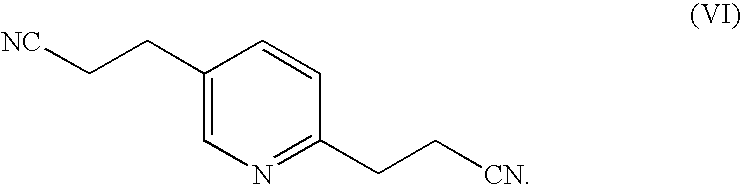
comprising the steps of: (a) producing a compound of structural formula II:
wherein M is an alkali or alkaline earth metal, by treating a 2,5-pyridine dicarboxylate diester of structural formula III:
wherein R1 and R2 are each independently C1-4 alkyl or phenyl-C1-3 alkyl, with acetonitrile in a reaction solvent in the presence of a base; (b) producing a compound of structural formula IV:
wherein Y is an acyl, sulfonyl, or phosphoryl group, by reacting a compound of structural formula II:
with an acylating, sulfonylating, or phosphorylating reagent; (c) producing a compound of structural formula VI:
by hydrogenating a compound of structural formula IV:
and (d) producing a compound of structural formula I:
by hydrogenating a compound of structural formula VI:
Compound I may be isolated from the reaction or used without further purification for additional chemical modification in the synthesis of αvβ3 integrin receptor antagonists.
The key steps in the process of the present invention include a double acetonitrile addition to a 2,5-pyridine dicarboxylate diester, activation of the resulting di-enolate, and a two-step hydrogenation sequence to the final product.
The substrate for the double acetonitrile addition reaction is a 2,5-pyridine dicarboxylate diester of structural formula III wherein R1 and R2 are each independently C1-4 alkyl or phenyl-C1-3 alkyl. In one embodiment, the dicarboxylate diester is a dimethyl or diethyl ester (R1=R2=Me or Et, respectively).
The double acetonitrile addition reaction is effected with a 2,5-pyridine dicarboxylate diester and acetonitrile in the presence of a base in a suitable reaction solvent. In one embodiment, the base is selected from the group consisting of an alkali or alkaline earth metal hydride, such as sodium hydride, lithium hydride, magnesium hydride, and calcium hydride; an alkyl lithium, such as n-butyl lithium; an alkali metal hexamethyidisilazide, such as potassium and lithium hexamethyldisilazide; and an alkali or alkaline earth metal alkoxide, such as sodium methoxide, sodium ethoxide, and potassium tert-butoxide. In one class of this embodiment, the base is an alkali or alkaline earth hydride, in particular, sodium hydride or calcium hydride. Suitable reaction solvents for the addition reaction include, but are not limited to, toluene, benzene, acetonitrile, dioxane, diethyl ether, tetrahydrofuran, and dialkyl ethylene glycol ethers, such as ethylene glycol dimethyl ether. In one embodiment the reaction solvent is acetonitrile or ethylene glycol dimethyl ether. The addition reaction is carried out at a temperature range of about 0° C. to about 10° C. In one embodiment, the addition reaction is carried out at a temperature range of about 70° C. to about 80° C.
The second step in the process of the present invention involves the activation of the dienolate of structural formula II. This is effected by treating the dienolate II in a suitable reaction solvent with an acylating, sulfonylating, or phosphorylating reagent Y-X, wherein Y is an acyl, sulfonyl, or phosphoryl group, respectively, and X is a leaving group, such as halide, acyloxy, and sulfonyloxy. Examples of an acylating reagent include an alkanoyl halide, an alkanecarboxylic acid anhydride, an aroyl halide, wherein aroyl is benzoyl or naphthoyl, and an arylcarboxylic acid anhydride, wherein aryl is phenyl or naphthyl. Examples of a sulfonylating agent include an alkanesulfonyl halide, an alkanesulfonic anhydride, an arylsulfonyl halide, and an arylsulfonic anhydride, wherein aryl is phenyl or naphthyl. Examples of a phosphorylating agent include a dialkylphosphoryl halide and a diarylphosphoryl halide. Specific embodiments of the reagent Y-X include methanesulfonyl chloride, methanesulfonic anhydride, trifluoromethanesulfonyl chloride, trifluoromethanesulfonic anhydride, benzenesulfonyl chloride, p-toluenesulfonyl chloride, p-toluenesulfonic anhydride, acetyl chloride, acetic anhydride, pivaloyl chloride, pivalic anhydride, benzoyl chloride, and benzoic anhydride. In a preferred embodiment the reagent Y-X is benzenesulfonyl chloride or p-toluenesulfonyl chloride. Suitable reaction solvents include, but are not limited to, lower alkanols, such as methanol, ethanol, and isopropyl alcohol; toluene; tetrahydrofuran; methylene chloride; water; ethyl acetate; isopropyl acetate; and aqueous lower alkanols. In one embodiment the reaction solvent is methanol or ethanol. The reaction is carried out at a temperature range of about −10° C. to about 30° C. A buffer is optionally added to the reaction mixture. In one embodiment the buffer is sodium carbonate, potassium carbonate, or dipotassium hydrogenphosphate.
The third reaction step involves hydrogenation of the activated enolate of structural formula IV. In one embodiment, the hydrogenation reaction is performed by applying hydrogen in the presence of a palladium catalyst and base in a suitable reaction solvent. Palladium catalysts include Pd/C, Pd/Al2O3, Pd/CaCO3, Pd/BaCO3, Pd/BaSO4, and Pd(OH)2. The base is selected from an inorganic base or an organic base. Inorganic bases include sodium carbonate, potassium carbonate, dipotassium hydrogenphosphate, and potassium dihydrogenphosphate. Organic bases include pyridine and substituted pyridines, such as 2,6-lutidine, 2,4,6-collidine, and polyvinylpyridine. Suitable reaction solvents include, but are not limited to, toluene; tetrahydrofuran; lower alkanols, such as methanol and ethanol; water; and aqueous lower alkanols, such as aqueous methanol and aqueous ethanol.
The fourth reaction in the sequence involves hydrogenation of the derived di(cyanoethyl)2,5-pyridine of structural forrnula VI. In one embodiment, this reaction is performed in a suitable reaction solvent in the presence of a Raney nickel catalyst and ammonia. Suitable reaction solvents include, but are not limited to, toluene; tetrahydrofuran; lower alkanols, such as methanol and ethanol; water; and aqueous lower alkanols, such as aqueous methanol and aqueous ethanol.
Another aspect of the present invention provides novel compounds of structural formula IV which are intermediates in the instant process for the preparation of compound I:

wherein Y is C1-4 alkanoyl, benzoyl, naphthoyl, phenyl-C1-3 alkanoyl, C1-4 alkanesulfonyl, benzenesulfonyl, di-(C1-4 alkyl)phosphoryl, and diphenylphosphoryl, wherein the benzene, benzoyl, naphthoyl, and phenyl groups are unsubstituted or substituted with one or two substituents independently selected from halogen, nitro, cyano, methyl, and methoxy. In one embodiment, Y is benzenesulfonyl optionally substituted with one or two substituents independently selected from halogen, nitro, cyano, methyl, and methoxy.
wherein Y is C1-4 alkanoyl, benzoyl, naphthoyl, phenyl-C1-3 alkanoyl, C1-4 alkanesulfonyl, benzenesulfonyl, di-(C1-4 alkyl)phosphoryl, and diphenylphosphoryl, wherein the benzene, benzoyl, naphthoyl, and phenyl groups are unsubstituted or substituted with one or two substituents independently selected from halogen, nitro, cyano, methyl, and methoxy. In one embodiment, Y is benzenesulfonyl optionally substituted with one or two substituents independently selected from halogen, nitro, cyano, methyl, and methoxy.
A further aspect of the present invention provides the novel compound of structural formula VI which is an intermediate in the instant process for the preparation of compound I:

The compound of structural formula I can be converted into 3-(5,6,7,8-tetrahydro-[1,8]-naphthyridin-2-yl)-propylamine (VII) as described in U.S. Pat. No. 6,262,268 (Jul. 17, 2001). As disclosed in WO 01134602, this intermediate is useful to prepare αvβ3 integrin receptor antagonists, such as the compound of structural formula VIII disclosed in U.S. Pat. No. 6,017,926 (Jan. 25, 2000), which is useful to inhibit bone resorption and to treat osteoporosis.

Representative experimental procedures utilizing the novel process of the present invention are detailed below. They are given for purposes of illustration only and are not intended to limit the process of the present invention to the specific conditions given for making the exemplified compounds.
By lower alkanol is meant a C1-5 linear or branched-chain alkyl alcohol, such as methanol, ethanol, isopropanol, and 1-butanol. By halide is meant fluoride, chloride, bromide, and iodide. By halogen is meant fluorine, chlorine, bromide, and iodine. By acyl is meant C1-4 alkanecarbonyl, arylcarbonyl wherein aryl is phenyl or naphthyl, and phenyl-C1-3 alkanecarbonyl. By sulfonyl is meant C1-4 alkanesulfonyl, wherein alkane is optionally substituted with one to three fluorine atoms; arylsulfonyl group, wherein aryl is phenyl or naphthyl; and phenyl-C1-3 alkanesulfonyl. By phosphoryl is meant di(C1-4) alkanephosphoryl or diarylphosphoryl, wherein aryl is phenyl or naphthyl.
Step A:

To a solution of dimethyl 2,5-pyridinedicarboxylate (1-1) (21.1 g) in acetonitrile (500 mL) at 60° C. was cautiously added sodium hydride (60% dispersion in mineral oil; 18.1 g). The reaction was allowed to cool and ethanol (30 mL) added. The product was isolated by filtration and washed with three portions of ethanol (50 mL). The solid was dried under a flow of nitrogen to afford 28.6 g of 1-2. 1H-NMR (400 MHz; DMSO-d6): δ 8.61 (d, J=2.0 Hz, 1H), 7.84 (dd, J=8.0, 2.0 Hz, 1H), 7.66 (d, J=8.0 Hz, 1H), 4.57 (s, 1H), 3.99 (s, 1H).
Step B: 
Step B:
The bis sodium enolate from Step A (1-2)(28.4 g) was suspended in methanol (210 mL) with sodium carbonate (14 g) and cooled to 0° C. Benzenesulfonyl chloride (31 mL) was added and the reaction aged for 2 h. The slurry was filtered and washed with ice-old methanol (2×50 mL) to afford 61 g of 1-3. Two isomers, major listed: 1H-NMR (400 MHz; CDCI3): δ 8.81 (d, J=2.4 Hz, 1H), 8.10 (dd, J=1.2, 8.4 Hz, 2H), 8.06 (dd, J=1.2, 8.4 Hz, 2H), 8.00 (dd, J=8.4, 2.4 Hz, 1H), 7.85 (d, J=8.4 Hz, 1H), 7.80 (m, 2H), 7.63 (m, 4H), 6.65 (s, 1H), 5.75 (s, 1H).
Step C: 
Step C:
To a slurry of the bis-enol benzenesulfonate from Step B (1-3) in methanol (40 mL) was added with an additional 16 g of sodium carbonate, and the mixture was hydrogenated under 40 psi hydrogen at 20° C. in the presence of 10% Pd-C (1.0 g) for 32 h. The reaction mixture was filtered through a filter aid such as Celite® or solka floc® and concentrated under reduced pressure to afford 2,5-di(2-cyanoethyl)pyridine (1-4).
1H-NMR (400 MHz; CDCl3): δ 8.45 (d, J=2.0 Hz, 1H), 7.57 (dd, J=8.0, 2.0 Hz, 1H), 7.22 (d, J=8.0 Hz, 1H), 3.13 (t, J=7.2 Hz, 2H), 2.97 (t, J=7.2 Hz, 2H) J=7.2 Hz, 2H), 2.65 (t, J=7.2 Hz, 2H).
Step D: 
Step D:
A solution of 2,5-di(2-cyanoethyl)pyridine from Step C (3.16 g) was dissolved in 7N ammonia in methanol solution (45 mL) and hydrogenated under 40 psi of hydrogen gas pressure at 50° C. in the presence of Raney nickel (1.6 g) for 20 h. The catalyst was filtered through solka floc® and washed with methanol. The filtrate and wash were combined and concentrated under reduced pressure to give 2,5-di(3-aminopropyl)pyridine (I)(2.95 g).
1H-NMR (400 MHz; D2O): δ 7.99 (d, J=2.0 Hz, 1H), 7.29 (dd, J=8.0, 2.0 Hz, 1H), 6.92 (d, J=8.0 Hs, 1H), 2.48 (t, J=7.7 Hz, 2H), 2.43-2.34 (m, 4H), 2.29 (t, J=7.7 Hz, 2H), 1.54 (pentet, J=7.7 Hz, 2H), and 1.42 (pentet, J=7.7 Hz, 2H). 13C-NMR (101 MHz; D2O): δ 158.7, 147.8, 137.6, 135.5, 123.0, 40.4, 40.2, 34.1, 33.5, 32.6, and 29.2.
Claims (13)
1. A process for preparing the compound of structural formula I:

comprising (a) producing a compound of structural formula II:

by treating a 2,5-pyridine dicarboxylate diester of structural formula III:

wherein R1 and R2 are each independently C1-4 alkyl or phenyl-C1-3 alkyl, with acetonitrile in a reaction solvent in the presence of a base; (b) producing a compound of structural formula IV:

by reacting a compound of structural formula II:

with an acylating, sulfonylating, or phosphorylating reagent; (c) producing the compound of structural formula VI:

by hydrogenating a compound of structural formula IV:

wherein Y is an acyl, sulfonyl, or phosphoryl group; and (d) hydrogenating the compound of structural formula VI:

2. The process of claim 1 additionally comprising the step of producing a compound of structural formula II:

by treating a 2,5-pyridine dicarboxylate diester of structural formula III:

wherein R1 and R2 are each independently C1-4 alkyl or phenyl-C1-3 alkyl; with acetonitrile in a reaction solvent in the presence of a base.
3. The process of claim 2 wherein the base is selected from the group consisting of an alkali or alkaline earth metal hydride, an alkyl lithium, an alkali metal hexamethyldisilazide, and an alkali or alkaline earth metal alkoxide.
4. The process of claim 3 wherein the base is an alkali or alkaline earth metal hydride.
5. The process of claim 2 wherein the reaction solvent is selected from the group consisting of toluene, benzene, acetonitrile, dioxane, diethyl ether, tetrahydrofuran, and ethylene glycol dimethyl ether.
6. The process of claim 5 wherein the reaction solvent is acetonitrile or ethylene glycol dimethyl ether.
7. The process of claim 1 wherein the sulfonylating reagent is benzenesulfonyl chloride or benzenesulfonic anhydride optionally substituted with one or two groups independently selected from halogen, nitro, cyano, methyl and methoxy.
8. The process of claim 1 wherein the reaction is carried out in the presence of a buffer.
9. The process of claim 1 wherein in (d), the hydrogenation is carried out in the presence of a Raney nickel catalyst and ammonia.
10. The process of claim 1 wherein in (c), the hydrogenation is carried in the presence of a palladium catalyst and base.
11. A compound of the structural formula:

wherein Y is C1-4 alkanoyl, benzoyl, naphthoyl, phenyl-C1-3 alkanoyl, C1-4 alkanesulfonyl optionally substituted with one to three fluorines, benzenesulfonyl, di-(C1-4 alkyl)phosphoryl, and diphenylphosphoryl, wherein the benzene, benzoyl, naphthoyl, and phenyl groups are unsubstituted or substituted with one or two substituents independently selected from halogen, nitro, cyano, methyl, and methoxy.
12. The compound of claim 11 wherein Y is benzenesulfonyl optionally substituted with one or two substituents independently selected from halogen, nitro, cyano, methyl, and methoxy.
13. A compound of structural formula VI:

Priority Applications (1)
| Application Number | Priority Date | Filing Date | Title |
|---|---|---|---|
| US10/353,612 US6914144B2 (en) | 2002-01-29 | 2003-01-29 | Process for preparing integrin antagonist intermediate |
Applications Claiming Priority (2)
| Application Number | Priority Date | Filing Date | Title |
|---|---|---|---|
| US35260102P | 2002-01-29 | 2002-01-29 | |
| US10/353,612 US6914144B2 (en) | 2002-01-29 | 2003-01-29 | Process for preparing integrin antagonist intermediate |
Publications (2)
| Publication Number | Publication Date |
|---|---|
| US20030176707A1 US20030176707A1 (en) | 2003-09-18 |
| US6914144B2 true US6914144B2 (en) | 2005-07-05 |
Family
ID=27663113
Family Applications (1)
| Application Number | Title | Priority Date | Filing Date |
|---|---|---|---|
| US10/353,612 Expired - Fee Related US6914144B2 (en) | 2002-01-29 | 2003-01-29 | Process for preparing integrin antagonist intermediate |
Country Status (4)
| Country | Link |
|---|---|
| US (1) | US6914144B2 (en) |
| AR (1) | AR038189A1 (en) |
| TW (1) | TW200304439A (en) |
| WO (1) | WO2003064390A1 (en) |
Cited By (3)
| Publication number | Priority date | Publication date | Assignee | Title |
|---|---|---|---|---|
| US20080057053A1 (en) * | 2006-08-31 | 2008-03-06 | Cardiac Pacemakers, Inc | Bispecific antibodies and agents to enhance stem cell homing |
| US20080057027A1 (en) * | 2006-08-31 | 2008-03-06 | Cardiac Pacemakers, Inc | Methods and devices to regulate stem cell homing |
| US20080058922A1 (en) * | 2006-08-31 | 2008-03-06 | Cardiac Pacemakers, Inc. | Methods and devices employing vap-1 inhibitors |
Citations (3)
| Publication number | Priority date | Publication date | Assignee | Title |
|---|---|---|---|---|
| US6017926A (en) | 1997-12-17 | 2000-01-25 | Merck & Co., Inc. | Integrin receptor antagonists |
| US6262286B1 (en) | 1997-09-23 | 2001-07-17 | Basf Aktiengesellschaft | Method for selective production of racemic metallocene complexes |
| US6262268B1 (en) | 1999-11-10 | 2001-07-17 | Merck & Co., Inc. | Process and intermediates to a tetrahydro-[1,8]-naphthyridine |
Family Cites Families (2)
| Publication number | Priority date | Publication date | Assignee | Title |
|---|---|---|---|---|
| IL149313A0 (en) * | 1999-11-08 | 2002-11-10 | Merck & Co Inc | Process and intermediates for the preparation of imidazolidinone alpha v integrin antagonists |
| EP1252162B1 (en) * | 2000-01-20 | 2012-07-25 | Merck Sharp & Dohme Corp. | Alpha v integrin receptor antagonists |
-
2003
- 2003-01-20 AR ARP030100156A patent/AR038189A1/en unknown
- 2003-01-20 TW TW092101118A patent/TW200304439A/en unknown
- 2003-01-24 WO PCT/US2003/002191 patent/WO2003064390A1/en not_active Ceased
- 2003-01-29 US US10/353,612 patent/US6914144B2/en not_active Expired - Fee Related
Patent Citations (3)
| Publication number | Priority date | Publication date | Assignee | Title |
|---|---|---|---|---|
| US6262286B1 (en) | 1997-09-23 | 2001-07-17 | Basf Aktiengesellschaft | Method for selective production of racemic metallocene complexes |
| US6017926A (en) | 1997-12-17 | 2000-01-25 | Merck & Co., Inc. | Integrin receptor antagonists |
| US6262268B1 (en) | 1999-11-10 | 2001-07-17 | Merck & Co., Inc. | Process and intermediates to a tetrahydro-[1,8]-naphthyridine |
Non-Patent Citations (1)
| Title |
|---|
| Palucki, et al., Tetrahedron Letters, vol. 42, No. 39, 2001) "A highly efficient synthesis of 2-[3-aminopropyl]-5m6,7,8-tetrahydronaphthyridine via a double Suzuki reaction and a Chichibabin cyclization", pp. 6811-6814. |
Cited By (5)
| Publication number | Priority date | Publication date | Assignee | Title |
|---|---|---|---|---|
| US20080057053A1 (en) * | 2006-08-31 | 2008-03-06 | Cardiac Pacemakers, Inc | Bispecific antibodies and agents to enhance stem cell homing |
| US20080057027A1 (en) * | 2006-08-31 | 2008-03-06 | Cardiac Pacemakers, Inc | Methods and devices to regulate stem cell homing |
| US20080058922A1 (en) * | 2006-08-31 | 2008-03-06 | Cardiac Pacemakers, Inc. | Methods and devices employing vap-1 inhibitors |
| US8372399B2 (en) | 2006-08-31 | 2013-02-12 | Cardiac Pacemakers, Inc. | Bispecific antibodies and agents to enhance stem cell homing |
| US8636995B2 (en) | 2006-08-31 | 2014-01-28 | Cardiac Pacemakers, Inc. | Methods and devices to regulate stem cell homing |
Also Published As
| Publication number | Publication date |
|---|---|
| TW200304439A (en) | 2003-10-01 |
| AR038189A1 (en) | 2005-01-05 |
| US20030176707A1 (en) | 2003-09-18 |
| WO2003064390A1 (en) | 2003-08-07 |
Similar Documents
| Publication | Publication Date | Title |
|---|---|---|
| EP3720849A2 (en) | Processes for making modulators of cystic fibrosis transmembrane conductance regulator | |
| EP1682135B1 (en) | salt of a tetrahydropyranyl cyclopentyl tetrahydropyridopyridine derivative as CCR2-antagonist | |
| KR20180005248A (en) | Synthesis of heterocyclic compounds | |
| JP2004523529A5 (en) | ||
| EP2166012A1 (en) | Process for producing trans-dibenzoxenopyrrole compound and intermediate therefor | |
| CA2543250C (en) | Process for the preparation of ccr-2 antagonist | |
| DE69925023T2 (en) | SYNTHESIS OF ACYCLIC NUCLEOSIDE DERIVATIVES | |
| US6914144B2 (en) | Process for preparing integrin antagonist intermediate | |
| CN111051288A (en) | Industrial Process for Monoalkylation of Piperidine Nitrogen in Piperidine Derivatives with Deuterated Alkyl | |
| JP7809139B2 (en) | Methods for preparing BTK inhibitors | |
| KR20040105765A (en) | Process for synthesizing chiral N-aryl piperazines | |
| AU2016224930A1 (en) | Process for the preparation of Vortioxetine | |
| GB2126212A (en) | Process for the production of (+/-)-4-oxo-1,2,3,6,7,11b-hexahydro- 4H-pyrazino(2,1-a]isoquinoline derivatives | |
| US7169935B2 (en) | Process for preparing heterocyclic indene analogs | |
| FI79533C (en) | Process for the preparation of therapeutically useful N-substituted e isoquinoline derivatives | |
| WO2014154908A1 (en) | Selective alkylation of cyclopentyl alcohols | |
| KR20020015313A (en) | Novel synthesis of piperazine ring | |
| JP2009500435A (en) | Novel pyrocatechin derivatives | |
| TWI389912B (en) | Process for the preparation of n-[5-(3-dimethylamino-acryloyl)-2-fluoro-phenyl]-n-methyl-acetamide | |
| HK40105292A (en) | Process for preparing btk inhibitors | |
| TW202423902A (en) | Pharmaceutical process and intermediates | |
| CN120157598A (en) | A method for synthesizing dihydrobenzofuran derivatives | |
| CN117295730A (en) | Process for preparing BTK inhibitors | |
| EP3016931B1 (en) | A novel process for the preparation of tetralin and naphthalene derivatives | |
| JPH0692964A (en) | New production of bishydroxymethylcyclopentane derivative and its intermediate |
Legal Events
| Date | Code | Title | Description |
|---|---|---|---|
| AS | Assignment |
Owner name: MERCK & CO., INC., NEW JERSEY Free format text: ASSIGNMENT OF ASSIGNORS INTEREST;ASSIGNOR:PYE, PHILIP J.;REEL/FRAME:015459/0132 Effective date: 20020726 |
|
| REMI | Maintenance fee reminder mailed | ||
| LAPS | Lapse for failure to pay maintenance fees | ||
| STCH | Information on status: patent discontinuation |
Free format text: PATENT EXPIRED DUE TO NONPAYMENT OF MAINTENANCE FEES UNDER 37 CFR 1.362 |
|
| FP | Lapsed due to failure to pay maintenance fee |
Effective date: 20090705 |