US6903228B2 - Preparation of phthalanes - Google Patents
Preparation of phthalanes Download PDFInfo
- Publication number
- US6903228B2 US6903228B2 US10/471,052 US47105203A US6903228B2 US 6903228 B2 US6903228 B2 US 6903228B2 US 47105203 A US47105203 A US 47105203A US 6903228 B2 US6903228 B2 US 6903228B2
- Authority
- US
- United States
- Prior art keywords
- process according
- salt
- formula
- phthalane
- acid
- Prior art date
- Legal status (The legal status is an assumption and is not a legal conclusion. Google has not performed a legal analysis and makes no representation as to the accuracy of the status listed.)
- Expired - Fee Related
Links
- 0 [1*]C1=CC2=C(C=C1)C(CCCN(C)C)(C1=CC=C([2*])C=C1)OC2 Chemical compound [1*]C1=CC2=C(C=C1)C(CCCN(C)C)(C1=CC=C([2*])C=C1)OC2 0.000 description 3
- DLCIQKKAEHZCGK-UHFFFAOYSA-N [C-]#[N+]C1=CC2=C(C=C1)C1(C3=CC=C(F)C=C3)(CCC1N(C)C)OC2 Chemical compound [C-]#[N+]C1=CC2=C(C=C1)C1(C3=CC=C(F)C=C3)(CCC1N(C)C)OC2 DLCIQKKAEHZCGK-UHFFFAOYSA-N 0.000 description 1
Classifications
-
- C—CHEMISTRY; METALLURGY
- C07—ORGANIC CHEMISTRY
- C07D—HETEROCYCLIC COMPOUNDS
- C07D307/00—Heterocyclic compounds containing five-membered rings having one oxygen atom as the only ring hetero atom
- C07D307/77—Heterocyclic compounds containing five-membered rings having one oxygen atom as the only ring hetero atom ortho- or peri-condensed with carbocyclic rings or ring systems
- C07D307/87—Benzo [c] furans; Hydrogenated benzo [c] furans
Definitions
- This invention relates to a process for the preparation of certain phthalanes, particularly but not exclusively citalopram.
- the antidepressant drug citalopram 1-[3-(dimethylamino)propyl]-1-(4-fluorophenyl)-1,3-dihydro-5-isobenzofurancarbonitrile, has the formula:
- GB 1526331 describes citalopram and other closely similar phthalanes of formula: wherein R 1 and R 2 each represents halogen, a trifluoromethyl group, a cyano group or R—CO— wherein R is an alkyl radical with from 1 to 4 carbon atoms, and acid addition salts thereof with pharmaceutically acceptable acids.
- GB 1526331 describes a number of processes for making citalopram, among which is a process in which a compound of formula II in which R 1 is bromine and R 2 is fluorine, is reacted with cuprous cyanide in an inert organic solvent to obtain a compound of formula II in which R 1 is a cyano group, i.e. to obtain citalopram.
- This process is particularly described in Example 3 of GB 1526331 where the yellow oil 1-(4′-fluorophenyl)-5-bromophthalane (free base) and cuprous cyanide are refluxed in dimethyl formamide. Dimethyl formamide dissolves the bromophthalane.
- the citalopram so formed is crystallised out by pouring the reaction mixture into an aqueous solution of sodium cyanide.
- R 1 in the compound of formula II is initially bromine, chlorine or iodine, and R 2 is fluorine.
- R 1 in the compound of formula II is initially bromine, chlorine or iodine
- R 2 is fluorine.
- Other phthalanes can also be made.
- the oxalate salt in the process of the invention, we prefer to use the oxalate salt, but other salts can equally be used.
- the salt is reacted with the cuprous cyanide as a suspension in an organic liquid.
- organic liquids include sulfolane, dimethylsulfoxide, N-methyl pyrrolidone, tetraglyme, ethylene glycol.
- the reaction is effected under heat over a period of time.
- the exact conditions will depend on the organic liquid and, to a lesser extent, the salt used.
- the reaction is preferably conducted under an inert atmosphere, e.g. nitrogen.
- an inert atmosphere e.g. nitrogen.
- the suspension is preferably heated at 150-155° C. for about three hours. More generally, the time of heating will be from 1 to 5 hours at or below the reflux temperature of the organic liquid.
- citalopram is recovered from the reaction mixture by any suitable means. We have found that washing the organic liquid with an aqueous base and then extracting the citalopram into an aqueous acid solution is satisfactory. Upon neutralisation of the acid solution, the citalopram precipitates out and can be recrystallised as desired. Since citalopram is normally used in the form of its hydrobromide salt, conversion thereto is preferably effected in the usual way.
- aqueous solution of ethylene diamine as the base, but other bases can be used such as ammonia, monomethylamine, dimethylamine, other amines, and alkali metal hydroxides.
- the preferred aqueous acid solution is an organic acid solution.
- acetic acid but other acids can be used such as hydrochloric acid, sulphuric acid, phosphoric acid, formic acid and other organic and mineral acids.
- Bromophthalane oxalate 100 g and cuprous cyanide 35 g are suspended in diglyme 500 ml and heated under a blanket of nitrogen to a temperature of 150-155° C. and maintained for 3 hours.
- the reaction mass is then cooled to 50° C. and 100 ml of a 50% aqueous solution of ethylene diamine is added.
- the lower aqueous layer is drained off.
- the organic layer is diluted with toluene 500 ml and further washed with ethylene diamine solution followed by 5% EDTA solution.
- the product is extracted into 10% solution of acetic acid 150 ml. Under vigorous stirring, 25% aqueous ammonia solution is then introduced into the acetic acid extract to ensure complete neutralization of the acid.
- the product which precipitates out is filtered.
- the crude product is then crystallized from n-hexane.
- the purified citalopram base is then taken in ethyl acetate or isopropyl alcohol, water and aqueous hydrobromic acid is added.
- the product is filtered and dried in a vacuum oven to obtain 35 g of citalopram hydrobromide.
Landscapes
- Chemical & Material Sciences (AREA)
- Organic Chemistry (AREA)
- Organic Low-Molecular-Weight Compounds And Preparation Thereof (AREA)
- Pharmaceuticals Containing Other Organic And Inorganic Compounds (AREA)
- Acyclic And Carbocyclic Compounds In Medicinal Compositions (AREA)
- Low-Molecular Organic Synthesis Reactions Using Catalysts (AREA)
Abstract
Citalopram and other phthalanes are made by reacting a salt of a compound of formula (II) where R1 is halogen and R2 is halogen, trifluoromethyl, cyano or R—CO— where R is a C1-4 alkyl group, with cuprous cyanide.
Description
This application is a §371 Application of International Application No. PCT/GB02/01054, filed on Mar. 7, 2002, claiming the priority of Great Britain Application No. 0105627.4, filed Mar. 7, 2001, the entire disclosures of which are incorporated herein by reference in their entireties.
This invention relates to a process for the preparation of certain phthalanes, particularly but not exclusively citalopram.
The antidepressant drug citalopram, 1-[3-(dimethylamino)propyl]-1-(4-fluorophenyl)-1,3-dihydro-5-isobenzofurancarbonitrile, has the formula:

GB 1526331 describes citalopram and other closely similar phthalanes of formula:
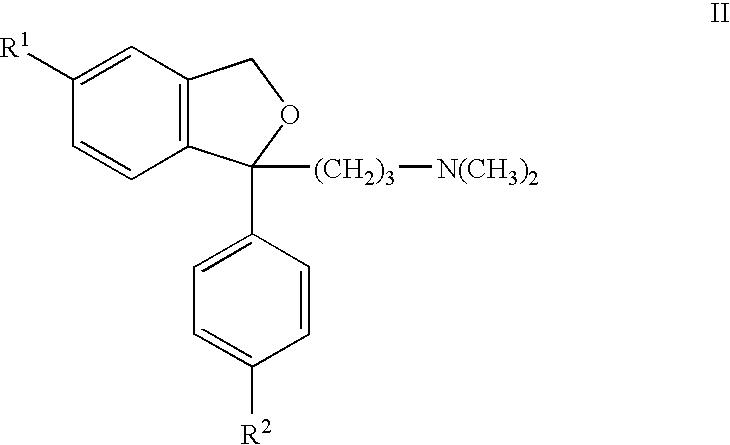
wherein R1 and R2 each represents halogen, a trifluoromethyl group, a cyano group or R—CO— wherein R is an alkyl radical with from 1 to 4 carbon atoms, and acid addition salts thereof with pharmaceutically acceptable acids.
wherein R1 and R2 each represents halogen, a trifluoromethyl group, a cyano group or R—CO— wherein R is an alkyl radical with from 1 to 4 carbon atoms, and acid addition salts thereof with pharmaceutically acceptable acids.
GB 1526331 describes a number of processes for making citalopram, among which is a process in which a compound of formula II in which R1 is bromine and R2 is fluorine, is reacted with cuprous cyanide in an inert organic solvent to obtain a compound of formula II in which R1 is a cyano group, i.e. to obtain citalopram. This process is particularly described in Example 3 of GB 1526331 where the yellow oil 1-(4′-fluorophenyl)-5-bromophthalane (free base) and cuprous cyanide are refluxed in dimethyl formamide. Dimethyl formamide dissolves the bromophthalane. The citalopram so formed is crystallised out by pouring the reaction mixture into an aqueous solution of sodium cyanide.
We have investigated this process and have found that it is difficult to carry out and generally gives only a low yield. We have tried the same process but without any solvent, and whilst the reaction conversion is good, it is very difficult to isolate pure white citalopram product
We have now found a way in which these difficulties can be reduced or overcome.
According to one aspect of the present invention, there is provided a process for the preparation of a phthalane of formula II in which R1 is cyano and R2 is as defined for formula II above, wherein a salt of a compound of formula II in which R1 is halogen, is reacted with cuprous cyanide.
The process is especially useful for making citalopram in which case R1 in the compound of formula II is initially bromine, chlorine or iodine, and R2 is fluorine. Other phthalanes can also be made.
In the process of the invention, we prefer to use the oxalate salt, but other salts can equally be used. For example, the fumarate, acetate, maleate, mesylate, citrate, lactate, tartrate, besylate, tosylate, mandelate, benzoate, salicylate and other organic acid salts.
According to a further preferred feature of the invention, the salt is reacted with the cuprous cyanide as a suspension in an organic liquid. There are many possible such liquids, as will be clear to those skilled in the art. We prefer to use diglyme but other possible organic liquids include sulfolane, dimethylsulfoxide, N-methyl pyrrolidone, tetraglyme, ethylene glycol.
The reaction is effected under heat over a period of time. The exact conditions will depend on the organic liquid and, to a lesser extent, the salt used. The reaction is preferably conducted under an inert atmosphere, e.g. nitrogen. By way of example, we have found that in the case of the oxalate salt and using diglyme as the organic liquid, the suspension is preferably heated at 150-155° C. for about three hours. More generally, the time of heating will be from 1 to 5 hours at or below the reflux temperature of the organic liquid.
At the end of the reaction, citalopram is recovered from the reaction mixture by any suitable means. We have found that washing the organic liquid with an aqueous base and then extracting the citalopram into an aqueous acid solution is satisfactory. Upon neutralisation of the acid solution, the citalopram precipitates out and can be recrystallised as desired. Since citalopram is normally used in the form of its hydrobromide salt, conversion thereto is preferably effected in the usual way.
In the above recovery procedure, we prefer to use an aqueous solution of ethylene diamine as the base, but other bases can be used such as ammonia, monomethylamine, dimethylamine, other amines, and alkali metal hydroxides. The preferred aqueous acid solution is an organic acid solution. We prefer to use acetic acid but other acids can be used such as hydrochloric acid, sulphuric acid, phosphoric acid, formic acid and other organic and mineral acids. In order that the invention may be more fully understood, the following Example is given by way of illustration only.
Bromophthalane oxalate 100 g and cuprous cyanide 35 g are suspended in diglyme 500 ml and heated under a blanket of nitrogen to a temperature of 150-155° C. and maintained for 3 hours. The reaction mass is then cooled to 50° C. and 100 ml of a 50% aqueous solution of ethylene diamine is added. The lower aqueous layer is drained off. The organic layer is diluted with toluene 500 ml and further washed with ethylene diamine solution followed by 5% EDTA solution. The product is extracted into 10% solution of acetic acid 150 ml. Under vigorous stirring, 25% aqueous ammonia solution is then introduced into the acetic acid extract to ensure complete neutralization of the acid. The product which precipitates out is filtered. The crude product is then crystallized from n-hexane. The purified citalopram base is then taken in ethyl acetate or isopropyl alcohol, water and aqueous hydrobromic acid is added. The product is filtered and dried in a vacuum oven to obtain 35 g of citalopram hydrobromide.
Claims (14)
1. A process for the preparation of a phthalane of formula:

wherein R2 is halogen, trifluoromethyl, cyano or R—CO— where R is an alkyl radical having from 1 to 4 carbon atoms, and acid addition salts thereof, which comprises reacting a salt of a compound of formula:

in which R1 is halogen and R2 is as defined above, with cuprous cyanide.
2. A process according to claim 1 , wherein R2 is fluorine.
3. A process according to claim 1 , wherein said salt is an organic acid salt.
4. A process according to claim 3 , wherein the salt of formula II is the oxalate.
5. A process according to claim 3 , wherein the salt of formula II is the fumarate, acetate, maleate, mesylate, citrate, lactate, tartrate, besylate, tosylate, madelate, benzoate or salicylate.
6. A process according to claim 1 , wherein the salt of formula II is reacted with the cuprous cyanide in an organic liquid.
7. A process according to claim 6 , wherein the organic liquid is diglyme.
8. A process according to claim 6 , wherein the organic liquid is sulfolane, dimethylsulfoxide, N-methyl pyrrolidone, tetraglyme or ethylene glycol.
9. A process according to claim 1 , wherein the reaction is conducted under heating in an inert atmosphere.
10. A process according to claim 1 , wherein at the end of the reaction, the reaction mixture is washed with an aqueous base, and the phthalane is extracted from the wash liquid into an aqueous acid solution.
11. A process according to claim 10 , wherein the base is ammonia, an amine, or an alkali metal hydroxide, and the acid is an organic acid.
12. A process according to claim 9 , wherein the aqueous acid solution extract is neutralized to precipitate the phthalane.
13. A process according to claim 1 , wherein the phthalane of formula III is citalopram.
14. A process according to claim 1 , wherein the phthalane of formula III is converted to a salt thereof.
Applications Claiming Priority (3)
| Application Number | Priority Date | Filing Date | Title |
|---|---|---|---|
| GBGB0105627.4A GB0105627D0 (en) | 2001-03-07 | 2001-03-07 | Preparation of phthalanes |
| GB0105627.4 | 2001-03-07 | ||
| PCT/GB2002/001054 WO2002070501A1 (en) | 2001-03-07 | 2002-03-07 | Preparation of phthalanes |
Publications (2)
| Publication Number | Publication Date |
|---|---|
| US20040092755A1 US20040092755A1 (en) | 2004-05-13 |
| US6903228B2 true US6903228B2 (en) | 2005-06-07 |
Family
ID=9910160
Family Applications (1)
| Application Number | Title | Priority Date | Filing Date |
|---|---|---|---|
| US10/471,052 Expired - Fee Related US6903228B2 (en) | 2001-03-07 | 2002-03-07 | Preparation of phthalanes |
Country Status (19)
| Country | Link |
|---|---|
| US (1) | US6903228B2 (en) |
| EP (1) | EP1366034B1 (en) |
| AT (1) | ATE368035T1 (en) |
| AU (1) | AU2002236076B2 (en) |
| BG (1) | BG108232A (en) |
| CA (1) | CA2442613A1 (en) |
| CZ (1) | CZ20032653A3 (en) |
| DE (1) | DE60221360T2 (en) |
| EE (1) | EE200300424A (en) |
| GB (1) | GB0105627D0 (en) |
| HU (1) | HUP0303467A2 (en) |
| LT (1) | LT5167B (en) |
| LV (1) | LV13132B (en) |
| PL (1) | PL364834A1 (en) |
| RU (1) | RU2276148C2 (en) |
| SK (1) | SK12292003A3 (en) |
| TR (1) | TR200301444T2 (en) |
| WO (1) | WO2002070501A1 (en) |
| ZA (1) | ZA200308039B (en) |
Cited By (2)
| Publication number | Priority date | Publication date | Assignee | Title |
|---|---|---|---|---|
| US20050043550A1 (en) * | 2002-01-07 | 2005-02-24 | Thennati Rajamannar | Process for the preparation of 1-[3-(dimethylamino)propyl]-1-(4-fluorophenyl)-1,3-dihydro-5-isobenzofuran carbonitrile |
| US20060074253A1 (en) * | 2001-09-24 | 2006-04-06 | Pharmachem Technologies Limited | Process for the preparation of citalopram |
Families Citing this family (5)
| Publication number | Priority date | Publication date | Assignee | Title |
|---|---|---|---|---|
| ES2194597B2 (en) * | 2002-01-25 | 2004-08-01 | Esteve Quimica, S.A. | PROCEDURE FOR OBTAINING CITALOPRAM. |
| GB0206708D0 (en) * | 2002-03-21 | 2002-05-01 | Cipla Ltd | Pharmaceutical salts |
| US7019153B2 (en) * | 2003-06-10 | 2006-03-28 | Sun Pharmaceutical Industries Limited | Process for hydrogenolysis of [1-(3-dimethylamino)propyl)]-1-(4-fluorophenyl)-1,3-dihydro-5-halo-isobenzofuran acetamido-3-substituted-3-cephem-4-carboxylic acid |
| KR101103118B1 (en) * | 2007-11-02 | 2012-01-04 | 동아제약주식회사 | Novel 1,3-dihydro-5-isobenzofurancarbonitrile derivative compound and pharmaceutical composition for treating premature ejaculation containing the same |
| DE102010013069B4 (en) | 2010-03-26 | 2012-12-06 | Hommel-Etamic Gmbh | measuring device |
Citations (5)
| Publication number | Priority date | Publication date | Assignee | Title |
|---|---|---|---|---|
| GB1526331A (en) * | 1976-01-14 | 1978-09-27 | Kefalas As | Phthalanes |
| WO1999030548A2 (en) * | 1999-04-14 | 1999-06-24 | H. Lundbeck A/S | Method for the preparation of citalopram |
| WO2000013648A2 (en) * | 1999-06-25 | 2000-03-16 | H. Lundbeck A/S | Method for the preparation of citalopram |
| WO2001045483A2 (en) * | 2000-12-22 | 2001-06-28 | H. Lundbeck A/S | Method for the preparation of pure citalopram |
| GB2357762A (en) * | 2000-03-13 | 2001-07-04 | Lundbeck & Co As H | Preparation of Crystalline Base or Salts of Citalopram |
Family Cites Families (2)
| Publication number | Priority date | Publication date | Assignee | Title |
|---|---|---|---|---|
| ITMI991579A1 (en) * | 1999-06-25 | 2001-01-15 | Lundbeck & Co As H | METHOD FOR THE PREPARATION OF CITALOPRAM |
| ITMI991486A1 (en) * | 1999-07-06 | 2001-01-06 | Vis Farmaceutici S P A | PROCESS FOR THE SYNTHESIS OF CITALOPRAM |
-
2001
- 2001-03-07 GB GBGB0105627.4A patent/GB0105627D0/en not_active Ceased
-
2002
- 2002-03-07 AU AU2002236076A patent/AU2002236076B2/en not_active Ceased
- 2002-03-07 PL PL02364834A patent/PL364834A1/en not_active Application Discontinuation
- 2002-03-07 EE EEP200300424A patent/EE200300424A/en unknown
- 2002-03-07 CA CA002442613A patent/CA2442613A1/en not_active Abandoned
- 2002-03-07 RU RU2003129659/04A patent/RU2276148C2/en not_active IP Right Cessation
- 2002-03-07 EP EP02702553A patent/EP1366034B1/en not_active Expired - Lifetime
- 2002-03-07 TR TR2003/01444T patent/TR200301444T2/en unknown
- 2002-03-07 HU HU0303467A patent/HUP0303467A2/en unknown
- 2002-03-07 WO PCT/GB2002/001054 patent/WO2002070501A1/en not_active Ceased
- 2002-03-07 AT AT02702553T patent/ATE368035T1/en not_active IP Right Cessation
- 2002-03-07 SK SK1229-2003A patent/SK12292003A3/en unknown
- 2002-03-07 DE DE60221360T patent/DE60221360T2/en not_active Expired - Fee Related
- 2002-03-07 CZ CZ20032653A patent/CZ20032653A3/en unknown
- 2002-03-07 US US10/471,052 patent/US6903228B2/en not_active Expired - Fee Related
-
2003
- 2003-09-30 LT LT2003086A patent/LT5167B/en not_active IP Right Cessation
- 2003-10-06 BG BG108232A patent/BG108232A/en unknown
- 2003-10-07 LV LVP-03-107A patent/LV13132B/en unknown
- 2003-10-16 ZA ZA200308039A patent/ZA200308039B/en unknown
Patent Citations (5)
| Publication number | Priority date | Publication date | Assignee | Title |
|---|---|---|---|---|
| GB1526331A (en) * | 1976-01-14 | 1978-09-27 | Kefalas As | Phthalanes |
| WO1999030548A2 (en) * | 1999-04-14 | 1999-06-24 | H. Lundbeck A/S | Method for the preparation of citalopram |
| WO2000013648A2 (en) * | 1999-06-25 | 2000-03-16 | H. Lundbeck A/S | Method for the preparation of citalopram |
| GB2357762A (en) * | 2000-03-13 | 2001-07-04 | Lundbeck & Co As H | Preparation of Crystalline Base or Salts of Citalopram |
| WO2001045483A2 (en) * | 2000-12-22 | 2001-06-28 | H. Lundbeck A/S | Method for the preparation of pure citalopram |
Cited By (3)
| Publication number | Priority date | Publication date | Assignee | Title |
|---|---|---|---|---|
| US20060074253A1 (en) * | 2001-09-24 | 2006-04-06 | Pharmachem Technologies Limited | Process for the preparation of citalopram |
| US20050043550A1 (en) * | 2002-01-07 | 2005-02-24 | Thennati Rajamannar | Process for the preparation of 1-[3-(dimethylamino)propyl]-1-(4-fluorophenyl)-1,3-dihydro-5-isobenzofuran carbonitrile |
| US7148364B2 (en) * | 2002-01-07 | 2006-12-12 | Sun Pharmaceutical Industries | Process for the preparation of 1-[3-(dimethylamino)propyl]-1-(4-fluorophenyl)-1,3-dihydro-5-isobenzofuran carbonitrile |
Also Published As
| Publication number | Publication date |
|---|---|
| CA2442613A1 (en) | 2002-09-12 |
| BG108232A (en) | 2005-04-30 |
| ZA200308039B (en) | 2004-11-17 |
| DE60221360D1 (en) | 2007-09-06 |
| TR200301444T2 (en) | 2004-09-21 |
| LT2003086A (en) | 2004-07-26 |
| DE60221360T2 (en) | 2007-11-29 |
| HUP0303467A2 (en) | 2004-01-28 |
| LV13132B (en) | 2004-06-20 |
| WO2002070501A1 (en) | 2002-09-12 |
| SK12292003A3 (en) | 2004-04-06 |
| US20040092755A1 (en) | 2004-05-13 |
| LT5167B (en) | 2004-10-25 |
| RU2003129659A (en) | 2005-03-20 |
| AU2002236076B2 (en) | 2007-09-06 |
| ATE368035T1 (en) | 2007-08-15 |
| CZ20032653A3 (en) | 2004-03-17 |
| EP1366034A1 (en) | 2003-12-03 |
| PL364834A1 (en) | 2004-12-27 |
| EE200300424A (en) | 2003-12-15 |
| EP1366034B1 (en) | 2007-07-25 |
| RU2276148C2 (en) | 2006-05-10 |
| GB0105627D0 (en) | 2001-04-25 |
Similar Documents
| Publication | Publication Date | Title |
|---|---|---|
| TWI460166B (en) | New process for the preparation of 2-imino-thiazolidin-4-one derivatives | |
| US6197970B1 (en) | Process for producing 2-hydroxybenzamide derivatives | |
| US20040034228A1 (en) | Processes for preparing 6-hydroxy-3,4-dihydroquinolinone, cilostazol and N-(4-methoxyphenyl)-3-chloropropionamide | |
| WO2023205164A1 (en) | Processes for the preparation of finerenone | |
| US6903228B2 (en) | Preparation of phthalanes | |
| JP4330836B2 (en) | Process for producing piperazine derivatives | |
| AU2002236076A1 (en) | Preparation of phthalanes | |
| US20060287376A1 (en) | Palladium catalyzed indolization of 2-bromo or chloroanilines | |
| US6635773B2 (en) | Process for preparing citalopram | |
| US6262308B1 (en) | Process for the preparation of racemic sertraline | |
| CA1193598A (en) | 2-amino-benzoic acid derivatives and processes for their production | |
| JPH09253501A (en) | Halogenation catalyst | |
| US6046351A (en) | Process for preparing racemic phenethylamines | |
| KR101166280B1 (en) | Process for preparation of citalopram and enantiomers | |
| US7148364B2 (en) | Process for the preparation of 1-[3-(dimethylamino)propyl]-1-(4-fluorophenyl)-1,3-dihydro-5-isobenzofuran carbonitrile | |
| US6781003B1 (en) | Preparation of pure citalopram | |
| JPH07258176A (en) | Manufacturing of arylbenzylamine | |
| JP4526185B2 (en) | Improved process for the preparation of pharmaceutically valuable norbenzomorphane derivatives. | |
| US20040254385A1 (en) | Process for the preparation of citalopram hydrobromide | |
| JP4521090B2 (en) | Process for producing 1,1,1-trifluoro-2-aminoalkane | |
| WO2019167058A1 (en) | An improved process for the preparation of propiomazine maleate | |
| GB2376945A (en) | Citalopram preparation | |
| JP4144223B2 (en) | Method for producing chromone derivative | |
| US20110251410A1 (en) | Process for preparation of citalopram and enantiomers | |
| US20060293530A1 (en) | Process for the manufacture of citalopram hydrobromide |
Legal Events
| Date | Code | Title | Description |
|---|---|---|---|
| AS | Assignment |
Owner name: CIPLA LIMITED, INDIA Free format text: ASSIGNMENT OF ASSIGNORS INTEREST;ASSIGNORS:HAMIED, YUSUF KHWAJA;KANKAN, RAJENDRA NARAYANRAO;RAO, DHARMARAJ RAMACHANDRA;REEL/FRAME:014896/0470;SIGNING DATES FROM 20031007 TO 20031021 |
|
| FPAY | Fee payment |
Year of fee payment: 4 |
|
| REMI | Maintenance fee reminder mailed | ||
| LAPS | Lapse for failure to pay maintenance fees | ||
| STCH | Information on status: patent discontinuation |
Free format text: PATENT EXPIRED DUE TO NONPAYMENT OF MAINTENANCE FEES UNDER 37 CFR 1.362 |
|
| STCH | Information on status: patent discontinuation |
Free format text: PATENT EXPIRED DUE TO NONPAYMENT OF MAINTENANCE FEES UNDER 37 CFR 1.362 |
|
| FP | Lapsed due to failure to pay maintenance fee |
Effective date: 20130607 |