US6902825B2 - Brazed sintered compact - Google Patents

Brazed sintered compact Download PDF

Info

Publication number
US6902825B2
US6902825B2 US10/435,513 US43551303A US6902825B2 US 6902825 B2 US6902825 B2 US 6902825B2 US 43551303 A US43551303 A US 43551303A US 6902825 B2 US6902825 B2 US 6902825B2
Authority
US
United States
Prior art keywords
components
component
joining
brazing material
protrusion
Prior art date
Legal status (The legal status is an assumption and is not a legal conclusion. Google has not performed a legal analysis and makes no representation as to the accuracy of the status listed.)
Expired - Fee Related, expires
Application number
US10/435,513
Other versions
US20040013897A1 (en
Inventor
Katsuhiko Yano
Toshiro Harakawa
Current Assignee (The listed assignees may be inaccurate. Google has not performed a legal analysis and makes no representation or warranty as to the accuracy of the list.)
Diamet Corp
Original Assignee
Mitsubishi Materials Corp
Priority date (The priority date is an assumption and is not a legal conclusion. Google has not performed a legal analysis and makes no representation as to the accuracy of the date listed.)
Filing date
Publication date
Application filed by Mitsubishi Materials Corp filed Critical Mitsubishi Materials Corp
Assigned to MITSUBISHI MATERIALS CORPORATION reassignment MITSUBISHI MATERIALS CORPORATION ASSIGNMENT OF ASSIGNORS INTEREST (SEE DOCUMENT FOR DETAILS). Assignors: HARAKAWA, TOSHIRO, YANO, KATSUHIKO
Publication of US20040013897A1 publication Critical patent/US20040013897A1/en
Application granted granted Critical
Publication of US6902825B2 publication Critical patent/US6902825B2/en
Assigned to MITSUBISHI MATERIALS PMG CORPORATION reassignment MITSUBISHI MATERIALS PMG CORPORATION ASSIGNMENT OF ASSIGNORS INTEREST (SEE DOCUMENT FOR DETAILS). Assignors: MITSUBISHI MATERIALS CORPORATION
Adjusted expiration legal-status Critical
Expired - Fee Related legal-status Critical Current

Links

Images

Classifications

    • BPERFORMING OPERATIONS; TRANSPORTING
    • B23MACHINE TOOLS; METAL-WORKING NOT OTHERWISE PROVIDED FOR
    • B23KSOLDERING OR UNSOLDERING; WELDING; CLADDING OR PLATING BY SOLDERING OR WELDING; CUTTING BY APPLYING HEAT LOCALLY, e.g. FLAME CUTTING; WORKING BY LASER BEAM
    • B23K1/00Soldering, e.g. brazing, or unsoldering
    • B23K1/0008Soldering, e.g. brazing, or unsoldering specially adapted for particular articles or work
    • YGENERAL TAGGING OF NEW TECHNOLOGICAL DEVELOPMENTS; GENERAL TAGGING OF CROSS-SECTIONAL TECHNOLOGIES SPANNING OVER SEVERAL SECTIONS OF THE IPC; TECHNICAL SUBJECTS COVERED BY FORMER USPC CROSS-REFERENCE ART COLLECTIONS [XRACs] AND DIGESTS
    • Y10TECHNICAL SUBJECTS COVERED BY FORMER USPC
    • Y10TTECHNICAL SUBJECTS COVERED BY FORMER US CLASSIFICATION
    • Y10T428/00Stock material or miscellaneous articles
    • Y10T428/12All metal or with adjacent metals
    • Y10T428/12014All metal or with adjacent metals having metal particles
    • Y10T428/12028Composite; i.e., plural, adjacent, spatially distinct metal components [e.g., layers, etc.]
    • YGENERAL TAGGING OF NEW TECHNOLOGICAL DEVELOPMENTS; GENERAL TAGGING OF CROSS-SECTIONAL TECHNOLOGIES SPANNING OVER SEVERAL SECTIONS OF THE IPC; TECHNICAL SUBJECTS COVERED BY FORMER USPC CROSS-REFERENCE ART COLLECTIONS [XRACs] AND DIGESTS
    • Y10TECHNICAL SUBJECTS COVERED BY FORMER USPC
    • Y10TTECHNICAL SUBJECTS COVERED BY FORMER US CLASSIFICATION
    • Y10T428/00Stock material or miscellaneous articles
    • Y10T428/12All metal or with adjacent metals
    • Y10T428/12014All metal or with adjacent metals having metal particles
    • Y10T428/12028Composite; i.e., plural, adjacent, spatially distinct metal components [e.g., layers, etc.]
    • Y10T428/12042Porous component
    • YGENERAL TAGGING OF NEW TECHNOLOGICAL DEVELOPMENTS; GENERAL TAGGING OF CROSS-SECTIONAL TECHNOLOGIES SPANNING OVER SEVERAL SECTIONS OF THE IPC; TECHNICAL SUBJECTS COVERED BY FORMER USPC CROSS-REFERENCE ART COLLECTIONS [XRACs] AND DIGESTS
    • Y10TECHNICAL SUBJECTS COVERED BY FORMER USPC
    • Y10TTECHNICAL SUBJECTS COVERED BY FORMER US CLASSIFICATION
    • Y10T428/00Stock material or miscellaneous articles
    • Y10T428/12All metal or with adjacent metals
    • Y10T428/12306Workpiece of parallel, nonfastened components [e.g., fagot, pile, etc.]
    • Y10T428/12313Arranged to avoid lateral displacement
    • YGENERAL TAGGING OF NEW TECHNOLOGICAL DEVELOPMENTS; GENERAL TAGGING OF CROSS-SECTIONAL TECHNOLOGIES SPANNING OVER SEVERAL SECTIONS OF THE IPC; TECHNICAL SUBJECTS COVERED BY FORMER USPC CROSS-REFERENCE ART COLLECTIONS [XRACs] AND DIGESTS
    • Y10TECHNICAL SUBJECTS COVERED BY FORMER USPC
    • Y10TTECHNICAL SUBJECTS COVERED BY FORMER US CLASSIFICATION
    • Y10T428/00Stock material or miscellaneous articles
    • Y10T428/12All metal or with adjacent metals
    • Y10T428/12326All metal or with adjacent metals with provision for limited relative movement between components
    • YGENERAL TAGGING OF NEW TECHNOLOGICAL DEVELOPMENTS; GENERAL TAGGING OF CROSS-SECTIONAL TECHNOLOGIES SPANNING OVER SEVERAL SECTIONS OF THE IPC; TECHNICAL SUBJECTS COVERED BY FORMER USPC CROSS-REFERENCE ART COLLECTIONS [XRACs] AND DIGESTS
    • Y10TECHNICAL SUBJECTS COVERED BY FORMER USPC
    • Y10TTECHNICAL SUBJECTS COVERED BY FORMER US CLASSIFICATION
    • Y10T428/00Stock material or miscellaneous articles
    • Y10T428/12All metal or with adjacent metals
    • Y10T428/12451Macroscopically anomalous interface between layers

Definitions

  • the present invention relates to a brazed sintered compact in which two components are brazed to each other, using a brazing material.
  • a brazed sintered compact in which a first component and a second component are formed by sintering, and then the two components are brazed to each other.
  • Such method has been utilized for manufacturing a product of complex shape, such as planetary carriers for use with an automatic shift for automobiles.
  • Such planetary carriers have been manufactured in the past by subjecting an entire perimeter of cast iron material or a copper plate material to machine processing, resulting to increased man-hours and costs. Therefore, they are now manufactured through the above-mentioned method, i.e., by forming first and second components by sintering green compact and then brazing them to each other.
  • Japanese Patent publication No.2000-109907 teaches that small protrusion and recess for guiding purpose are formed on a joining portion so that the former is fitted into the latter in advance
  • the conventional art had another problem that as a brazing material would be very likely to flow out to the external when the brazing material was placed between the components and heated, such surplus brazing material had to be removed.
  • a solution for solving such problem is proposed by the same applicant in Japanese Patent Application No. 2000-270581 (Publication No.2002-79372).
  • This prior art discloses brazed sintered compact consisting at least of a first component and a second component to be brazed to the first component, in which one of the first and second components has a joining surface formed with a protrusion, while the other thereof has a joining surface formed with a recess, said recess being fitted to said protrusion, having such a depth as allow for a desirable joining clearance with the protrusion being fitted into the recess; and that one of the joining surfaces is formed in a perimeter thereof with a storage groove for storing surplus brazing material, thereby preventing the brazing material from flowing out to the external of the components owing to such groove.
  • the components slightly overhang the groove so that the surplus brazing material is unlikely to be easily discharged, and that the joining clearance could not be optimized duo to the backflow of the brazing material which flowed out to the external and the resultant re-permeation thereby.
  • a brazed sintered compact in accordance with a first aspect of the present invention, which is composed of at least a first component and a second component, each component having a joining surface and joined to each other by brazing, comprising:
  • At least one storage groove formed on the joining surface of one of the first and second components, said storage groove being provided for storing a surplus amount of a brazing material, and disposed opposite to a side portion of the other of the first and second components.
  • both components can be simply positioned relative to each other by fitting the protrusion into the recess. At the same time, it is possible to easily obtain a joining clearance, corresponding to a dimensional difference between the first and the second components.
  • both components are sintered with the joining clearance being filled with the brazing material after the joining clearance is set at a predetermined dimension for permeation of the brazing material, it is possible to allow as much brazing material as properly needed to permeate between the joining surfaces of the first and second components, thus enabling a desirable brazing strength to be obtained reliably, thereby enhancing the reliability of the brazing strength.
  • a second aspect of the invention is a brazed sintered compact composed of similar components of the first aspect, including at least one storage groove formed on a peripheral edge of the joining surface of one of the first and second components, said storage groove being provided for storing a surplus amount of a brazing material, arranged such that an inside surface of the storage groove is aligned with an opposite portion of the other of the first and second components.
  • a third aspect of the invention is a brazed sintered compact according to the second aspect, featured by that said clearance has such a dimension as properly needed to allow the brazing material to permeate between the joining surfaces of said first and second components.
  • a fourth aspect of the invention is a brazed sintered compact according to the third aspect, in which said first component and second component are annular plate materials each of which is formed from metal powder individually, and then they are combined with each other while a brazing material is filled in between the joining surfaces of the components, so that both components are sintered at a predetermined temperature in a furnace, at the same time that the brazing material is fused so as to braze one of the joining surfaces of the components to the other thereof.
  • a fifth aspect of the invention is a brazed sintered compact according to the forth aspect, in which said storage groove is fully opened upward.
  • a sixth aspect of the invention is a brazed sintered compact according to the fifth aspect, in which one of said first and second components is formed with a protrusion or a recess, while the other thereof is formed with a leg opposite thereto, said leg including a recess or a protrusion on a distal joining surface thereof, and
  • the surplus brazing material on the right or left side of said leg can be stored in said storage groove.
  • a seventh aspect of the invention is a brazed sintered compact according to the sixth aspect, in which a hole for inserting a brazing material pellet is formed between the right and the left storage grooves.
  • the brazing material pellet can be inserted from the hole.
  • An eighth aspect of the invention is a brazed sintered compact according to the fifth aspect, in which one of said first and second components is formed with a protrusion or a recess, while the other thereof is formed with a leg opposite thereto, said log including a recess or a protrusion on a distal joining surface thereof, and wherein the inner side surface of said storage groove is aligned with a peripheral edge of the peripheral outer surface of said leg.
  • the surplus brazing material on the peripheral outer surface side of said leg can be stored in said storage groove.
  • a ninth aspect of the invention is a brazed sintered compact according to the fifth aspect, in which said first component and second component in the form of said annular plate member is a planetary carrier composed of a pair of side plates which oppose to each other with a planetary pinion therebetween.
  • the brazed sintered compact of the invention is a planetary carrier of such a complex shape, it can be easily manufactured.
  • FIG. 1 is a perspective view showing a brazed sintered compact according to an embodiment of the present invention.
  • FIG. 2 is a fragmentary perspective view showing a first component of the brazed sintered compact according to the embodiment of the present invention.
  • FIG. 3 is a fragmentary perspective view showing a second component of the brazed sintered compact according to the embodiment of the present invention.
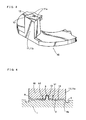
  • FIG. 4 is an explanatory diagram showing a joining clearance in the event that the first and the second components are combined with each other.
  • FIG. 5 is another explanatory diagram showing another embodiment of the invention, illustrating other examples of the protrusion, recess and storing groove of the invention.
  • a brazed sintered compact of the invention is made up of a first component 1 and a second component 10 .
  • the first component 1 is provided in the form of an annular plate member as shown in FIGS. 1 and 2
  • the second component 10 as another annular plate member with several legs 11 (three legs provided at equal angular intervals in the embodiment) protruded therefrom, as shown in FIG. 3 .
  • reference symbol H denotes a hole provided in the first component 1 for inserting a brazing material pellet thereinto.
  • the first component 1 and the second component 10 take the shape of an annular plate member, respectively, illustrating an example of a planetary carrier composed of a pair of side plates which oppose to each other with a planetary pinion (not shown) therebetween.
  • first component 1 and second component 10 are each formed by applying pressure to a powder material, and then they are combined with each other while a brazing material is filled in between the joining surfaces of the components. Thereafter, the first component 1 and the second component 10 with the brazing material being filled therebetween are brought into a sintering furnace, so that both components are sintered at a predetermined temperature, at the same time that the brazing material is fused so as to braze one of the joining surfaces of the components to the other thereof.
  • a joining surface 2 of the first component 1 is formed with a protrusion 3 which protrudes toward the second component 10 in order to position the first component 1 relative to the second component 10 , as illustrated in FIG. 2
  • the protrusion 3 is provided adjacent to an inner edge of the joining surface of the first component 1 , said protrusion 3 being tapered from a proximal portion toward a distal end thereof.
  • a joining surface 12 of the leg 11 of the second component 10 is formed with a recess 15 for fitting the protrusion 3 thereinto, said recess 13 being opposed to said protrusion 3 .
  • a depth h 2 of the recess 13 is set at a slightly smaller dimension than a protruding length h 1 of the protrusion 3 , as shown in FIG. 4 .
  • a joining clearance A of which the dimension is given by (h 1 ⁇ h 2 ) between the first component 1 and the second component 10 can be provided.
  • the joining clearance A should have a dimension for allowing the brazing material to permeate the joining surfaces between the first component 1 and the second component 10 . Accordingly, the difference between the protruding length h 1 of the protrusion 3 and the depth h 2 of the recess 13 is set at a value needed for a sufficient amount of the brazing material to permeate.
  • the joining surface 2 of the first component 1 is formed with storage grooves 4 , 4 ′ for storing a surplus amount of the brazing material, as shown in FIGS. 2 and 4 .
  • These storage grooves 4 , 4 ′ are provided in certain positions on the joining surface 2 of the first component 1 , each having a suitable depth and width, corresponding to the peripheral edges of right and left ends 11 a of the leg 11 of the second component 10 or the peripheral edge of the outer peripheral surface 11 b of the leg 11 , whereby the surplus brazing material is allowed to be collated therein when the brazing material is finished in the joining clearance A between the first component 1 and the second component 10 .
  • an inner side surface 4 a of the storage groove 4 i.e., one of the side surfaces of the storage groove 4 which is on the leg 11 side, is aligned with the left or right edge 11 a of the leg 11 , disposed opposite to the groove 4 .
  • Such arrangement is effected by fitting the protrusion 3 into the recess 13 .
  • an inner side surface 4 ′ a of the storage groove 4 ′ i.e., one of the side surfaces of the storage groove 4 ′ which is on the leg 11 side, is aligned with the peripheral edge of the outer peripheral surface 11 b of the leg 11 , disposed opposite to the groove 4 ′.
  • Between the paired right and left grooves 4 is formed the aforesaid hole H for inserting a brazing material pellet.
  • the protrusion 3 is formed on the joining surface 2 of the first component 1 , while the recess 13 of which the dimension is smaller than the height of the protrusion 3 is formed on the joining surface 12 of the leg 11 of the second component 10 , so that if only the protrusion 3 of the first component 1 is fitted into the recess 13 of the second component 10 , not only can both components 1 and 10 be properly positioned relative to each other, but also can the joining clearance A be easily obtained between the joining surface 2 of the first component 1 and the joining surface 12 of the second component, corresponding to the dimensional difference therebetween.
  • both components are sintered with the clearance A being filled with the brazing material after the joining clearance A is set at a predetermined dimension for permeation of the brazing material, it is possible to allow as much brazing material as properly needed to permeate between the joining surfaces 2 and 12 of the first and second components 1 and 10 , thus enabling a desirable brazing strength to be obtained reliably, thereby enhancing the reliability of the brazing strength. It is to be noted that finish machining is performed after being joined thus way.
  • the storage grooves 4 , 4 ′ are provided on the joining surface 2 of the first component 1 so that the surplus amount of the brazing material may be stored therein, whereby not only can the surplus brazing material be prevented from coming out of the components, which eliminates the risk of impairing the appearance, but also can the trouble of removing the surplus brazing material ho saved. Still also, as the storage grooves 4 , 4 ′ are provided in the positions corresponding to the peripheral edge of the right and left ends 11 a of the leg 11 of the second component, and the peripheral edge of the peripheral outer surface 11 b of the leg 11 , respectively, a relatively large amount of the surplus brazing material can be accommodated therein.
  • the inside surfaces 4 a , 4 ′ a of the storage grooves 4 , 4 ′ are each aligned with the side surface of the loft or right edge 11 a of the leg 11 and the peripheral edge of the peripheral outer surface 11 b of the leg 11 , disposed opposite to the groove 4 , 4 ′, while these storage grooves 4 , 4 ′ are fully opened upward, whereby the length of the clearance A overhanging the storage grooves 4 , 4 ′ is reduced to minimum, thus facilitating the prompt discharge of the surplus brazing material to the outside.
  • the present invention should not be limited to the above-mentioned embodiment but various modifications are possible within the scope of the invention.
  • the protrusion 3 is provided on the first component 1 and the recess 13 on the leg 11 of the second component 10 in the foregoing embodiment, the arrangement thereof is not limited thereto.
  • the protrusion 3 may be provided on the latter while the recess 13 on the former, as shown in FIG. 5 , and any other arrangement may be employed as long as the same action and effect of the invention is attained.
  • the first component 1 and the second component 10 are subjected to sintering and brazing at the same time in the foregoing embodiment, they may be separately sintered and then subjected to brazing process.

Landscapes

  • Engineering & Computer Science (AREA)
  • Mechanical Engineering (AREA)
  • Powder Metallurgy (AREA)

Abstract

A brazed sintered compact composed of first and second components, which are easily positioned relative to each other, enabling the provision of a good joining clearance. If a protrusion 3 of a first component 1 is fitted into a recess 13 of a second component 10, both components are able to be positioned relative to each other. Simultaneously, a joining clearance A can be easily obtained between a joining surface 2 of the first component 1 and a joining surface 12 of the second component 10, corresponding to a dimensional difference therebetween. Also, an inner side surface 4 a of a storage groove 4 is aligned with a right or left end 11 a of a leg 11, disposed opposite to the inner side surface 4 a. Accordingly, it is possible to allow as much brazing material as properly needed to permeate between the joining surfaces 2 and 12. Further, as the surface tension of the surplus brazing material becomes unlikely to be developed in the storage grooves 4,4′, the backflow of the material is prevented.

Description

BACKGROUND OF THE INVENTION
1. Field of the Invention
The present invention relates to a brazed sintered compact in which two components are brazed to each other, using a brazing material.
2. Description of the Related Art
For conventional art of this kind, it is widely recognized to manufacture a brazed sintered compact in which a first component and a second component are formed by sintering, and then the two components are brazed to each other. Such method has been utilized for manufacturing a product of complex shape, such as planetary carriers for use with an automatic shift for automobiles. Such planetary carriers have been manufactured in the past by subjecting an entire perimeter of cast iron material or a copper plate material to machine processing, resulting to increased man-hours and costs. Therefore, they are now manufactured through the above-mentioned method, i.e., by forming first and second components by sintering green compact and then brazing them to each other.
According to the conventional art, when joining the first and second components to each other by brazing, they are combined together by precise positioning therebetween. In that case, a joining clearance for allowing a brazing material to permeate between the two components becomes a problem.
In other words, if a joining clearance is too large, the penetration amount of the brazing material into the respective components will be too much, so that the components will be expanded and thus distorted, resulting to a likelihood of the noticeable drop of the components' strength. On the other hand, if a joining clearance is too small, there is a risk that the joint strength between the two components drops. Accordingly, it has been a problem how such joining clearance for allowing a brazing material to permeate could be optimized.
Also, whilst Japanese Patent publication No.2000-109907 teaches that small protrusion and recess for guiding purpose are formed on a joining portion so that the former is fitted into the latter in advance, the conventional art had another problem that as a brazing material would be very likely to flow out to the external when the brazing material was placed between the components and heated, such surplus brazing material had to be removed. A solution for solving such problem is proposed by the same applicant in Japanese Patent Application No. 2000-270581 (Publication No.2002-79372). This prior art discloses brazed sintered compact consisting at least of a first component and a second component to be brazed to the first component, in which one of the first and second components has a joining surface formed with a protrusion, while the other thereof has a joining surface formed with a recess, said recess being fitted to said protrusion, having such a depth as allow for a desirable joining clearance with the protrusion being fitted into the recess; and that one of the joining surfaces is formed in a perimeter thereof with a storage groove for storing surplus brazing material, thereby preventing the brazing material from flowing out to the external of the components owing to such groove.
According to the prior art disclosed in the above earlier application, however, the components slightly overhang the groove so that the surplus brazing material is unlikely to be easily discharged, and that the joining clearance could not be optimized duo to the backflow of the brazing material which flowed out to the external and the resultant re-permeation thereby.
SUMMARY OF THE INVENTION
Accordingly, it is an object of the present invention to provide a brazed sintered compact in which components to be joined are able to be easily positioned relative to each other, at the same time that a good and precise joining clearance can be obtained.
To attaint the object, there is proposed a brazed sintered compact in accordance with a first aspect of the present invention, which is composed of at least a first component and a second component, each component having a joining surface and joined to each other by brazing, comprising:
a protrusion formed on the joining surface of one of the first and second components;
a recess formed on the joining surface of the other of the first and second components, said recess being fitted to said protrusion, having such a depth as allows for a desirable joining clearance between the first and the second components when the former is fitted to the latter;
at least one storage groove formed on the joining surface of one of the first and second components, said storage groove being provided for storing a surplus amount of a brazing material, and disposed opposite to a side portion of the other of the first and second components.
As the joining surface of one of the components is formed with the protrusion while that of the other thereof is formed with a recess whose dimension is smaller than the height of the protrusion, both components can be simply positioned relative to each other by fitting the protrusion into the recess. At the same time, it is possible to easily obtain a joining clearance, corresponding to a dimensional difference between the first and the second components.
Accordingly, if both components are sintered with the joining clearance being filled with the brazing material after the joining clearance is set at a predetermined dimension for permeation of the brazing material, it is possible to allow as much brazing material as properly needed to permeate between the joining surfaces of the first and second components, thus enabling a desirable brazing strength to be obtained reliably, thereby enhancing the reliability of the brazing strength.
A second aspect of the invention is a brazed sintered compact composed of similar components of the first aspect, including at least one storage groove formed on a peripheral edge of the joining surface of one of the first and second components, said storage groove being provided for storing a surplus amount of a brazing material, arranged such that an inside surface of the storage groove is aligned with an opposite portion of the other of the first and second components.
With the structure, as the inside surface of the storage groove is aligned with an opposite portion of the other of the first and second components, the backflow of the surplus brazing material stored in the storage groove due to the surface tension thereof is prevented, enabling the permeation of as much brazing material as properly needed into between the first and the second components.
A third aspect of the invention is a brazed sintered compact according to the second aspect, featured by that said clearance has such a dimension as properly needed to allow the brazing material to permeate between the joining surfaces of said first and second components.
Accordingly, it is possible to easily obtain a joining clearance, corresponding to a dimensional difference between the first and the second components, so that the permeation of the brazing material is insured.
A fourth aspect of the invention is a brazed sintered compact according to the third aspect, in which said first component and second component are annular plate materials each of which is formed from metal powder individually, and then they are combined with each other while a brazing material is filled in between the joining surfaces of the components, so that both components are sintered at a predetermined temperature in a furnace, at the same time that the brazing material is fused so as to braze one of the joining surfaces of the components to the other thereof.
With the structure, sintering of the first and second components composed of metal powder, can be carried out simultaneously with the brazing of them.
A fifth aspect of the invention is a brazed sintered compact according to the forth aspect, in which said storage groove is fully opened upward.
Accordingly, as the surface tension of the surplus brazing material becomes unlikely to be developed in the storage groove, the backflow of the surplus brazing material is prevented.
A sixth aspect of the invention is a brazed sintered compact according to the fifth aspect, in which one of said first and second components is formed with a protrusion or a recess, while the other thereof is formed with a leg opposite thereto, said leg including a recess or a protrusion on a distal joining surface thereof, and
wherein the inner side surface of said storage groove is aligned with a right or a left end of said leg.
With the structure, the surplus brazing material on the right or left side of said leg can be stored in said storage groove.
A seventh aspect of the invention is a brazed sintered compact according to the sixth aspect, in which a hole for inserting a brazing material pellet is formed between the right and the left storage grooves.
Thus, the brazing material pellet can be inserted from the hole.
An eighth aspect of the invention is a brazed sintered compact according to the fifth aspect, in which one of said first and second components is formed with a protrusion or a recess, while the other thereof is formed with a leg opposite thereto, said log including a recess or a protrusion on a distal joining surface thereof, and wherein the inner side surface of said storage groove is aligned with a peripheral edge of the peripheral outer surface of said leg.
Thus, the surplus brazing material on the peripheral outer surface side of said leg can be stored in said storage groove.
A ninth aspect of the invention is a brazed sintered compact according to the fifth aspect, in which said first component and second component in the form of said annular plate member is a planetary carrier composed of a pair of side plates which oppose to each other with a planetary pinion therebetween.
With the structure, even if the brazed sintered compact of the invention is a planetary carrier of such a complex shape, it can be easily manufactured.
BRIEF DESCRIPTION OF THE DRAWINGS
For more complete understanding of the present invention, reference is now made to the following description taken in conjunction with the accompanying drawings, in which:
FIG. 1 is a perspective view showing a brazed sintered compact according to an embodiment of the present invention.
FIG. 2 is a fragmentary perspective view showing a first component of the brazed sintered compact according to the embodiment of the present invention.
FIG. 3 is a fragmentary perspective view showing a second component of the brazed sintered compact according to the embodiment of the present invention.
FIG. 4 is an explanatory diagram showing a joining clearance in the event that the first and the second components are combined with each other.
FIG. 5 is another explanatory diagram showing another embodiment of the invention, illustrating other examples of the protrusion, recess and storing groove of the invention.
DETAILED DESCRIPTION OF THE PREFERRED EMBODIMENTS
Hereunder is a description of embodiments of the present invention with reference to FIG. 1 through FIG. 5.
As shown in FIG. 1, a brazed sintered compact of the invention is made up of a first component 1 and a second component 10. The first component 1 is provided in the form of an annular plate member as shown in FIGS. 1 and 2, while the second component 10 as another annular plate member with several legs 11 (three legs provided at equal angular intervals in the embodiment) protruded therefrom, as shown in FIG. 3. In the meantime, reference symbol H denotes a hole provided in the first component 1 for inserting a brazing material pellet thereinto. In the present embodiment, the first component 1 and the second component 10 take the shape of an annular plate member, respectively, illustrating an example of a planetary carrier composed of a pair of side plates which oppose to each other with a planetary pinion (not shown) therebetween.
These first component 1 and second component 10 are each formed by applying pressure to a powder material, and then they are combined with each other while a brazing material is filled in between the joining surfaces of the components. Thereafter, the first component 1 and the second component 10 with the brazing material being filled therebetween are brought into a sintering furnace, so that both components are sintered at a predetermined temperature, at the same time that the brazing material is fused so as to braze one of the joining surfaces of the components to the other thereof.
In the present embodiment, a joining surface 2 of the first component 1 is formed with a protrusion 3 which protrudes toward the second component 10 in order to position the first component 1 relative to the second component 10, as illustrated in FIG. 2 The protrusion 3 is provided adjacent to an inner edge of the joining surface of the first component 1, said protrusion 3 being tapered from a proximal portion toward a distal end thereof.
A joining surface 12 of the leg 11 of the second component 10 is formed with a recess 15 for fitting the protrusion 3 thereinto, said recess 13 being opposed to said protrusion 3.
Specifically, a depth h2 of the recess 13 is set at a slightly smaller dimension than a protruding length h1 of the protrusion 3, as shown in FIG. 4. In other words, when the protrusion 3 is fitted into the recess 13, not only can the first component 1 be positioned relative to the second component 10, but also there can be provided a joining clearance A of which the dimension is given by (h1−h2) between the first component 1 and the second component 10.
It should be noted that the joining clearance A should have a dimension for allowing the brazing material to permeate the joining surfaces between the first component 1 and the second component 10. Accordingly, the difference between the protruding length h1 of the protrusion 3 and the depth h2 of the recess 13 is set at a value needed for a sufficient amount of the brazing material to permeate.
Further, the joining surface 2 of the first component 1 is formed with storage grooves 4, 4′ for storing a surplus amount of the brazing material, as shown in FIGS. 2 and 4. These storage grooves 4,4′ are provided in certain positions on the joining surface 2 of the first component 1, each having a suitable depth and width, corresponding to the peripheral edges of right and left ends 11 a of the leg 11 of the second component 10 or the peripheral edge of the outer peripheral surface 11 b of the leg 11, whereby the surplus brazing material is allowed to be collated therein when the brazing material is finished in the joining clearance A between the first component 1 and the second component 10.
Furthermore, an inner side surface 4 a of the storage groove 4, i.e., one of the side surfaces of the storage groove 4 which is on the leg 11 side, is aligned with the left or right edge 11 a of the leg 11, disposed opposite to the groove 4. Such arrangement is effected by fitting the protrusion 3 into the recess 13. Likewise, an inner side surface 4a of the storage groove 4′, i.e., one of the side surfaces of the storage groove 4′ which is on the leg 11 side, is aligned with the peripheral edge of the outer peripheral surface 11 b of the leg 11, disposed opposite to the groove 4′. Between the paired right and left grooves 4 is formed the aforesaid hole H for inserting a brazing material pellet.
As is apparent from the foregoing, the protrusion 3 is formed on the joining surface 2 of the first component 1, while the recess 13 of which the dimension is smaller than the height of the protrusion 3 is formed on the joining surface 12 of the leg 11 of the second component 10, so that if only the protrusion 3 of the first component 1 is fitted into the recess 13 of the second component 10, not only can both components 1 and 10 be properly positioned relative to each other, but also can the joining clearance A be easily obtained between the joining surface 2 of the first component 1 and the joining surface 12 of the second component, corresponding to the dimensional difference therebetween.
Accordingly, if both components are sintered with the clearance A being filled with the brazing material after the joining clearance A is set at a predetermined dimension for permeation of the brazing material, it is possible to allow as much brazing material as properly needed to permeate between the joining surfaces 2 and 12 of the first and second components 1 and 10, thus enabling a desirable brazing strength to be obtained reliably, thereby enhancing the reliability of the brazing strength. It is to be noted that finish machining is performed after being joined thus way.
Also, whilst the surplus amount of the fused brazing material is likely to jut out to the external, the storage grooves 4,4′ are provided on the joining surface 2 of the first component 1 so that the surplus amount of the brazing material may be stored therein, whereby not only can the surplus brazing material be prevented from coming out of the components, which eliminates the risk of impairing the appearance, but also can the trouble of removing the surplus brazing material ho saved. Still also, as the storage grooves 4,4′ are provided in the positions corresponding to the peripheral edge of the right and left ends 11 a of the leg 11 of the second component, and the peripheral edge of the peripheral outer surface 11 b of the leg 11, respectively, a relatively large amount of the surplus brazing material can be accommodated therein.
Furthermore, the inside surfaces 4 a, 4a of the storage grooves 4, 4′ are each aligned with the side surface of the loft or right edge 11 a of the leg 11 and the peripheral edge of the peripheral outer surface 11 b of the leg 11, disposed opposite to the groove 4,4′, while these storage grooves 4,4′ are fully opened upward, whereby the length of the clearance A overhanging the storage grooves 4, 4′ is reduced to minimum, thus facilitating the prompt discharge of the surplus brazing material to the outside.
Still further, even if the brazing material stored in the storage grooves 4, 4′ is urged to flow back, yet the surface tension of the surplus brazing material becomes unlikely to be developed in the storage grooves 4,4′, since the inside surfaces 4 a, 4a of the storage grooves 4, 4′ are each aligned with the side surface of the left or right edge 11 a of the leg 11 and the peripheral edge of the peripheral outer surface 11 b of the leg 11, disposed opposite to the groove 4,4′, with those storage grooves 4, 4′ being fully opened upward, thereby preventing the backflow of the surplus brazing material.
Incidentally, the present invention should not be limited to the above-mentioned embodiment but various modifications are possible within the scope of the invention. For example, although the protrusion 3 is provided on the first component 1 and the recess 13 on the leg 11 of the second component 10 in the foregoing embodiment, the arrangement thereof is not limited thereto. For example, the protrusion 3 may be provided on the latter while the recess 13 on the former, as shown in FIG. 5, and any other arrangement may be employed as long as the same action and effect of the invention is attained. Although the first component 1 and the second component 10 are subjected to sintering and brazing at the same time in the foregoing embodiment, they may be separately sintered and then subjected to brazing process.
Claims (9)

1. A brazed sintered compact composed of at least a first component and a second component, each component having a joining surface and joined to each other by brazing, comprising:
a protrusion formed on the joining surface of one of the first and second components;
a recess formed on the joining surface of the other of the first and second components, said recess being fitted to said protrusion, having such a depth as allows for a desirable joining clearance between the first and the second components when the former is fitted to the latter, and
at least one storage groove formed on the joining surface of one of the first and second components, said storage groove being provided for storing a surplus amount of a brazing material, and disposed opposite to a side portion of the other of the first and second components.
2. A brazed sintered compact composed of at least a first component and a second component, each component having a joining surface and joined to each other by brazing, comprising:
a protrusion formed on the joining surface of one of the first and second components;
a recess formed on the joining surface of the other of the first and second components, said recess being fitted to said protrusion, having such a depth as allows for a desirable joining clearance between the first and the second components when the former is fitted to the latter, and
at least one storage groove formed on a peripheral edge of the joining surface of one of the first and second components, said storage groove being provided for storing a surplus amount of a brazing material, arranged such that an inside surface of the storage groove is aligned with an opposite portion of the other of the first and second components.
3. A brazed sintered compact according to claim 2,
wherein said clearance has such a dimension as properly needed to allow the brazing material to permeate between the joining surfaces of said first and second components.
4. A brazed sintered compact according to claim 3,
wherein said first component and second component are annular plate materials each of which is formed from metal powder individually, and then they are combined with each other while a brazing material is filled in between the joining surfaces of the components, so that both components are sintered at a predetermined temperature in a furnace, at the same time that the brazing material is fused so as to braze one of the joining surfaces of the components to the other thereof.
5. A brazed sintered compact according to claim 4, wherein said storage groove is fully opened upward.
6. A brazed sintered compact according to claim 5,
wherein one of said first and second components is formed with a protrusion or a recess, while the other thereof is formed with a leg opposite thereto, said leg including a recess or a protrusion on a distal joining surface thereof, and
wherein the inner side surface of said storage groove is aligned with a right or a left end of said leg.
7. A brazed sintered compact according to claim 6, wherein a hole for inserting a brazing material pellet is formed between the right and the left storage grooves.
8. A brazed sintered compact according to claim 5,
wherein one of said first and second components is formed with a protrusion or a recess, while the other thereof is formed with a leg opposite thereto, said leg including a recess or a protrusion on a distal joining surface thereof, and
wherein the inner side surface of said storage groove is aligned with a peripheral edge of the peripheral outer surface of said leg.
9. A brazed sintered compact according to claim 5,
wherein said first component and second component in the form of said annular plate member is a planetary carrier composed of a pair of side plates which oppose to each other with a planetary pinion therebetween.
US10/435,513 2002-02-27 2003-05-09 Brazed sintered compact Expired - Fee Related US6902825B2 (en)

Applications Claiming Priority (2)

Application Number Priority Date Filing Date Title
JP2002052233A JP2003251458A (en) 2002-02-27 2002-02-27 Brazed joint sintered body
JP2002-52233 2002-02-27

Publications (2)

Publication Number Publication Date
US20040013897A1 US20040013897A1 (en) 2004-01-22
US6902825B2 true US6902825B2 (en) 2005-06-07

Family

ID=28663984

Family Applications (1)

Application Number Title Priority Date Filing Date
US10/435,513 Expired - Fee Related US6902825B2 (en) 2002-02-27 2003-05-09 Brazed sintered compact

Country Status (2)

Country Link
US (1) US6902825B2 (en)
JP (1) JP2003251458A (en)

Cited By (2)

* Cited by examiner, † Cited by third party
Publication number Priority date Publication date Assignee Title
US20110111247A1 (en) * 2008-02-22 2011-05-12 Lemke Jeffrey W Brazed component and method of forming a brazed joint therein
US11460061B2 (en) * 2017-08-09 2022-10-04 Sumitomo Electric Sintered Alloy, Ltd. Joined component

Families Citing this family (10)

* Cited by examiner, † Cited by third party
Publication number Priority date Publication date Assignee Title
US20060275607A1 (en) * 2005-06-06 2006-12-07 Semih Demir Composite assemblies including powdered metal components
WO2010106616A1 (en) * 2009-03-16 2010-09-23 トヨタ自動車株式会社 Soldered joint structure
JP5724710B2 (en) * 2011-07-21 2015-05-27 三菱電機株式会社 Plate stack type cooler
DE102013015676A1 (en) * 2013-09-23 2015-03-26 Gkn Sinter Metals Holding Gmbh Process for the production of a sintered part with high-precision molding height and parts set of sintered joining parts
EP2881205A1 (en) * 2013-12-04 2015-06-10 Alstom Technology Ltd Method for manufacturing a braze joint gap and method for brazing or soldering
US9511452B2 (en) * 2015-02-09 2016-12-06 United Technologies Corporation Assemblies with brazed joints and methods of fabricating assemblies with brazed joints
JP6703727B2 (en) * 2015-03-30 2020-06-03 住友電工焼結合金株式会社 Joined parts and method for manufacturing joined parts
US20190061035A1 (en) * 2017-08-25 2019-02-28 Pratt & Whitney Canada Corp. System and method for joining components
US11267061B2 (en) * 2019-04-16 2022-03-08 GM Global Technology Operations LLC Method of manufacturing components made of dissimilar metals
CN112207383A (en) * 2020-09-17 2021-01-12 西安空间无线电技术研究所 Microwave passive device brazing method and device

Citations (9)

* Cited by examiner, † Cited by third party
Publication number Priority date Publication date Assignee Title
US4289833A (en) * 1978-03-31 1981-09-15 Kabushiki Kaisha Fujikoshi T/A Nachi-Fujikoshi Corp. Liquid phase sintered dense composite body for brazed joints and method for making the same
JPS5813469A (en) 1981-07-14 1983-01-25 Diesel Kiki Co Ltd Joining method for sintered alloy material
JPS59209473A (en) 1983-05-13 1984-11-28 Sumitomo Electric Ind Ltd Manufacturing method of joining member of cemented carbide and sintered steel
JPH01118431A (en) * 1987-10-31 1989-05-10 Toyoda Gosei Co Ltd Manufacture of side molding for automobile
US5439257A (en) * 1992-07-16 1995-08-08 Nwd International Inc. Brazed hydraulic fittings with interference fit and method of making same
US5507528A (en) * 1994-09-30 1996-04-16 Itt Corporation Method of braze joint fastening for male to female receptacles
JP2000109907A (en) 1998-10-05 2000-04-18 Sumitomo Electric Ind Ltd Brazed joint sintered part and method of manufacturing the same
JP2002079372A (en) 2000-09-06 2002-03-19 Mitsubishi Materials Corp Brazed joint sintered body
US6592287B1 (en) * 1999-09-21 2003-07-15 General Electric Company Self-fixtured joint assembly and its preparation

Patent Citations (9)

* Cited by examiner, † Cited by third party
Publication number Priority date Publication date Assignee Title
US4289833A (en) * 1978-03-31 1981-09-15 Kabushiki Kaisha Fujikoshi T/A Nachi-Fujikoshi Corp. Liquid phase sintered dense composite body for brazed joints and method for making the same
JPS5813469A (en) 1981-07-14 1983-01-25 Diesel Kiki Co Ltd Joining method for sintered alloy material
JPS59209473A (en) 1983-05-13 1984-11-28 Sumitomo Electric Ind Ltd Manufacturing method of joining member of cemented carbide and sintered steel
JPH01118431A (en) * 1987-10-31 1989-05-10 Toyoda Gosei Co Ltd Manufacture of side molding for automobile
US5439257A (en) * 1992-07-16 1995-08-08 Nwd International Inc. Brazed hydraulic fittings with interference fit and method of making same
US5507528A (en) * 1994-09-30 1996-04-16 Itt Corporation Method of braze joint fastening for male to female receptacles
JP2000109907A (en) 1998-10-05 2000-04-18 Sumitomo Electric Ind Ltd Brazed joint sintered part and method of manufacturing the same
US6592287B1 (en) * 1999-09-21 2003-07-15 General Electric Company Self-fixtured joint assembly and its preparation
JP2002079372A (en) 2000-09-06 2002-03-19 Mitsubishi Materials Corp Brazed joint sintered body

Non-Patent Citations (2)

* Cited by examiner, † Cited by third party
Title
English Abstract JP 95039032 B, Sowa Aluminum Corp, Nov. 1992. *
esp@cenet-Document Bibliography and Abstract for Sintered Compact Joined by Brazing; JP2002079372; Mar. 19, 2003; Yano Katsuhiko; http://12.espacenet.com/espacenet/abstract?CY=ep&LG=en&PNP=JP200207937 . . . .

Cited By (4)

* Cited by examiner, † Cited by third party
Publication number Priority date Publication date Assignee Title
US20110111247A1 (en) * 2008-02-22 2011-05-12 Lemke Jeffrey W Brazed component and method of forming a brazed joint therein
US8753753B2 (en) 2008-02-22 2014-06-17 Gkn Sinter Metals, Llc Brazed component and method of forming a brazed joint therein
US10471530B2 (en) 2008-02-22 2019-11-12 Gkn Sinter Metals, Llc Brazed component and method of forming a brazed joint therein
US11460061B2 (en) * 2017-08-09 2022-10-04 Sumitomo Electric Sintered Alloy, Ltd. Joined component

Also Published As

Publication number Publication date
JP2003251458A (en) 2003-09-09
US20040013897A1 (en) 2004-01-22

Similar Documents

Publication Publication Date Title
US6902825B2 (en) Brazed sintered compact
CN102421554B (en) For bonding of powdered metal parts
JP4306507B2 (en) Caulking and joining method for plate material and caulking and joining apparatus for plate material
DE2841900A1 (en) SMALL DIMENSIONED PRESSURE VESSEL
JPS58210392A (en) Manufacture of scroll compressor
US6860526B2 (en) Coupling structure for a hollow body
AU654743B2 (en) A slider for a slide fastener and its manufacturing method
US6782598B2 (en) Method of manufacturing hollow rack shaft
EP1475178A1 (en) Brazed sintered compact
US6592287B1 (en) Self-fixtured joint assembly and its preparation
JPS59141341A (en) Uniting method of two metallic members
US6554883B1 (en) Powdered metal gear teeth
US5299350A (en) Method for joining a motor shell and base
JP2009529418A (en) Fuel filter and method of manufacturing fuel filter
JP2003251457A (en) Brazed joint sintered parts
JP2007010296A (en) Heat exchanger
JPS59120416A (en) Joining method of container and accessory
JP2005077055A (en) Oil cooler tank structure and manufacturing method thereof
JP2007134584A (en) Method for manufacturing multilayer lead frame and multilayer lead frame manufactured by this method
KR20180138162A (en) Crimping joint structure of metal plate material and joining method thereof
USRE26898E (en) Method and apparatus for attaching a clasp to a bracelet
US20210262422A1 (en) Heat exchanger housing and method of manufacturing a heat exchanger
JP2008290105A (en) Sintered component having brazing filler metal overflow preventive part from joined portion in sinter-brazing
JPS589761Y2 (en) rim
JPH0289582A (en) Structure of electron beam weld zone

Legal Events

Date Code Title Description
AS Assignment

Owner name: MITSUBISHI MATERIALS CORPORATION, JAPAN

Free format text: ASSIGNMENT OF ASSIGNORS INTEREST;ASSIGNORS:YANO, KATSUHIKO;HARAKAWA, TOSHIRO;REEL/FRAME:014391/0038

Effective date: 20030617

AS Assignment

Owner name: MITSUBISHI MATERIALS PMG CORPORATION,JAPAN

Free format text: ASSIGNMENT OF ASSIGNORS INTEREST;ASSIGNOR:MITSUBISHI MATERIALS CORPORATION;REEL/FRAME:017458/0856

Effective date: 20051201

Owner name: MITSUBISHI MATERIALS PMG CORPORATION, JAPAN

Free format text: ASSIGNMENT OF ASSIGNORS INTEREST;ASSIGNOR:MITSUBISHI MATERIALS CORPORATION;REEL/FRAME:017458/0856

Effective date: 20051201

REMI Maintenance fee reminder mailed
LAPS Lapse for failure to pay maintenance fees
STCH Information on status: patent discontinuation

Free format text: PATENT EXPIRED DUE TO NONPAYMENT OF MAINTENANCE FEES UNDER 37 CFR 1.362

FP Expired due to failure to pay maintenance fee

Effective date: 20090607