US6881820B1 - Rod-coil block polyimide copolymers - Google Patents
Rod-coil block polyimide copolymers Download PDFInfo
- Publication number
- US6881820B1 US6881820B1 US10/147,477 US14747702A US6881820B1 US 6881820 B1 US6881820 B1 US 6881820B1 US 14747702 A US14747702 A US 14747702A US 6881820 B1 US6881820 B1 US 6881820B1
- Authority
- US
- United States
- Prior art keywords
- radicals
- rod
- block copolymers
- coil
- group
- Prior art date
- Legal status (The legal status is an assumption and is not a legal conclusion. Google has not performed a legal analysis and makes no representation as to the accuracy of the status listed.)
- Expired - Fee Related, expires
Links
- 0 C.C.[1*]C(COC([2*])COCC([1*])N1C(=O)[Y]2(C1=O)C(=O)N(C([1*])COCC([2*])OCC([1*])N1C(=O)CCC1=O)C2=O)N1C(=O)CCC1=O Chemical compound C.C.[1*]C(COC([2*])COCC([1*])N1C(=O)[Y]2(C1=O)C(=O)N(C([1*])COCC([2*])OCC([1*])N1C(=O)CCC1=O)C2=O)N1C(=O)CCC1=O 0.000 description 14
- YOCLTCNNQJFEIG-UHFFFAOYSA-N Cc1cc(-c2cc(C)c(C)cc2S(=O)(=O)O)c(S(=O)(=O)O)cc1C.Cc1ccc(-c2ccc(C)cc2S(=O)(=O)O)c(S(=O)(=O)O)c1.Cc1ccc(C)c(S(=O)(=O)O)c1 Chemical compound Cc1cc(-c2cc(C)c(C)cc2S(=O)(=O)O)c(S(=O)(=O)O)cc1C.Cc1ccc(-c2ccc(C)cc2S(=O)(=O)O)c(S(=O)(=O)O)c1.Cc1ccc(C)c(S(=O)(=O)O)c1 YOCLTCNNQJFEIG-UHFFFAOYSA-N 0.000 description 1
- SFGQFXZYKMIQRW-UHFFFAOYSA-N NC(N)S(=O)(=O)O.NC(N)S(=O)(=O)O Chemical compound NC(N)S(=O)(=O)O.NC(N)S(=O)(=O)O SFGQFXZYKMIQRW-UHFFFAOYSA-N 0.000 description 1
Classifications
-
- C—CHEMISTRY; METALLURGY
- C08—ORGANIC MACROMOLECULAR COMPOUNDS; THEIR PREPARATION OR CHEMICAL WORKING-UP; COMPOSITIONS BASED THEREON
- C08J—WORKING-UP; GENERAL PROCESSES OF COMPOUNDING; AFTER-TREATMENT NOT COVERED BY SUBCLASSES C08B, C08C, C08F, C08G or C08H
- C08J5/00—Manufacture of articles or shaped materials containing macromolecular substances
- C08J5/18—Manufacture of films or sheets
-
- C—CHEMISTRY; METALLURGY
- C08—ORGANIC MACROMOLECULAR COMPOUNDS; THEIR PREPARATION OR CHEMICAL WORKING-UP; COMPOSITIONS BASED THEREON
- C08G—MACROMOLECULAR COMPOUNDS OBTAINED OTHERWISE THAN BY REACTIONS ONLY INVOLVING UNSATURATED CARBON-TO-CARBON BONDS
- C08G73/00—Macromolecular compounds obtained by reactions forming a linkage containing nitrogen with or without oxygen or carbon in the main chain of the macromolecule, not provided for in groups C08G12/00 - C08G71/00
- C08G73/06—Polycondensates having nitrogen-containing heterocyclic rings in the main chain of the macromolecule
- C08G73/10—Polyimides; Polyester-imides; Polyamide-imides; Polyamide acids or similar polyimide precursors
-
- C—CHEMISTRY; METALLURGY
- C08—ORGANIC MACROMOLECULAR COMPOUNDS; THEIR PREPARATION OR CHEMICAL WORKING-UP; COMPOSITIONS BASED THEREON
- C08J—WORKING-UP; GENERAL PROCESSES OF COMPOUNDING; AFTER-TREATMENT NOT COVERED BY SUBCLASSES C08B, C08C, C08F, C08G or C08H
- C08J5/00—Manufacture of articles or shaped materials containing macromolecular substances
- C08J5/20—Manufacture of shaped structures of ion-exchange resins
- C08J5/22—Films, membranes or diaphragms
- C08J5/2206—Films, membranes or diaphragms based on organic and/or inorganic macromolecular compounds
- C08J5/2218—Synthetic macromolecular compounds
- C08J5/2256—Synthetic macromolecular compounds based on macromolecular compounds obtained by reactions other than those involving carbon-to-carbon bonds, e.g. obtained by polycondensation
-
- H—ELECTRICITY
- H01—ELECTRIC ELEMENTS
- H01B—CABLES; CONDUCTORS; INSULATORS; SELECTION OF MATERIALS FOR THEIR CONDUCTIVE, INSULATING OR DIELECTRIC PROPERTIES
- H01B1/00—Conductors or conductive bodies characterised by the conductive materials; Selection of materials as conductors
- H01B1/06—Conductors or conductive bodies characterised by the conductive materials; Selection of materials as conductors mainly consisting of other non-metallic substances
- H01B1/12—Conductors or conductive bodies characterised by the conductive materials; Selection of materials as conductors mainly consisting of other non-metallic substances organic substances
- H01B1/122—Ionic conductors
-
- H—ELECTRICITY
- H01—ELECTRIC ELEMENTS
- H01M—PROCESSES OR MEANS, e.g. BATTERIES, FOR THE DIRECT CONVERSION OF CHEMICAL ENERGY INTO ELECTRICAL ENERGY
- H01M10/00—Secondary cells; Manufacture thereof
- H01M10/05—Accumulators with non-aqueous electrolyte
- H01M10/052—Li-accumulators
-
- H—ELECTRICITY
- H01—ELECTRIC ELEMENTS
- H01M—PROCESSES OR MEANS, e.g. BATTERIES, FOR THE DIRECT CONVERSION OF CHEMICAL ENERGY INTO ELECTRICAL ENERGY
- H01M10/00—Secondary cells; Manufacture thereof
- H01M10/05—Accumulators with non-aqueous electrolyte
- H01M10/056—Accumulators with non-aqueous electrolyte characterised by the materials used as electrolytes, e.g. mixed inorganic/organic electrolytes
- H01M10/0564—Accumulators with non-aqueous electrolyte characterised by the materials used as electrolytes, e.g. mixed inorganic/organic electrolytes the electrolyte being constituted of organic materials only
- H01M10/0565—Polymeric materials, e.g. gel-type or solid-type
-
- H—ELECTRICITY
- H01—ELECTRIC ELEMENTS
- H01M—PROCESSES OR MEANS, e.g. BATTERIES, FOR THE DIRECT CONVERSION OF CHEMICAL ENERGY INTO ELECTRICAL ENERGY
- H01M8/00—Fuel cells; Manufacture thereof
- H01M8/10—Fuel cells with solid electrolytes
- H01M8/1016—Fuel cells with solid electrolytes characterised by the electrolyte material
- H01M8/1018—Polymeric electrolyte materials
- H01M8/102—Polymeric electrolyte materials characterised by the chemical structure of the main chain of the ion-conducting polymer
- H01M8/1027—Polymeric electrolyte materials characterised by the chemical structure of the main chain of the ion-conducting polymer having carbon, oxygen and other atoms, e.g. sulfonated polyethersulfones [S-PES]
-
- H—ELECTRICITY
- H01—ELECTRIC ELEMENTS
- H01M—PROCESSES OR MEANS, e.g. BATTERIES, FOR THE DIRECT CONVERSION OF CHEMICAL ENERGY INTO ELECTRICAL ENERGY
- H01M8/00—Fuel cells; Manufacture thereof
- H01M8/10—Fuel cells with solid electrolytes
- H01M8/1016—Fuel cells with solid electrolytes characterised by the electrolyte material
- H01M8/1018—Polymeric electrolyte materials
- H01M8/102—Polymeric electrolyte materials characterised by the chemical structure of the main chain of the ion-conducting polymer
- H01M8/103—Polymeric electrolyte materials characterised by the chemical structure of the main chain of the ion-conducting polymer having nitrogen, e.g. sulfonated polybenzimidazoles [S-PBI], polybenzimidazoles with phosphoric acid, sulfonated polyamides [S-PA] or sulfonated polyphosphazenes [S-PPh]
-
- H—ELECTRICITY
- H01—ELECTRIC ELEMENTS
- H01M—PROCESSES OR MEANS, e.g. BATTERIES, FOR THE DIRECT CONVERSION OF CHEMICAL ENERGY INTO ELECTRICAL ENERGY
- H01M8/00—Fuel cells; Manufacture thereof
- H01M8/10—Fuel cells with solid electrolytes
- H01M8/1016—Fuel cells with solid electrolytes characterised by the electrolyte material
- H01M8/1018—Polymeric electrolyte materials
- H01M8/1039—Polymeric electrolyte materials halogenated, e.g. sulfonated polyvinylidene fluorides
-
- H—ELECTRICITY
- H01—ELECTRIC ELEMENTS
- H01M—PROCESSES OR MEANS, e.g. BATTERIES, FOR THE DIRECT CONVERSION OF CHEMICAL ENERGY INTO ELECTRICAL ENERGY
- H01M8/00—Fuel cells; Manufacture thereof
- H01M8/10—Fuel cells with solid electrolytes
- H01M8/1016—Fuel cells with solid electrolytes characterised by the electrolyte material
- H01M8/1018—Polymeric electrolyte materials
- H01M8/1041—Polymer electrolyte composites, mixtures or blends
- H01M8/1046—Mixtures of at least one polymer and at least one additive
- H01M8/1048—Ion-conducting additives, e.g. ion-conducting particles, heteropolyacids, metal phosphate or polybenzimidazole with phosphoric acid
-
- C—CHEMISTRY; METALLURGY
- C08—ORGANIC MACROMOLECULAR COMPOUNDS; THEIR PREPARATION OR CHEMICAL WORKING-UP; COMPOSITIONS BASED THEREON
- C08J—WORKING-UP; GENERAL PROCESSES OF COMPOUNDING; AFTER-TREATMENT NOT COVERED BY SUBCLASSES C08B, C08C, C08F, C08G or C08H
- C08J2379/00—Characterised by the use of macromolecular compounds obtained by reactions forming in the main chain of the macromolecule a linkage containing nitrogen with or without oxygen, or carbon only, not provided for in groups C08J2361/00 - C08J2377/00
- C08J2379/04—Polycondensates having nitrogen-containing heterocyclic rings in the main chain; Polyhydrazides; Polyamide acids or similar polyimide precursors
- C08J2379/08—Polyimides; Polyester-imides; Polyamide-imides; Polyamide acids or similar polyimide precursors
-
- Y—GENERAL TAGGING OF NEW TECHNOLOGICAL DEVELOPMENTS; GENERAL TAGGING OF CROSS-SECTIONAL TECHNOLOGIES SPANNING OVER SEVERAL SECTIONS OF THE IPC; TECHNICAL SUBJECTS COVERED BY FORMER USPC CROSS-REFERENCE ART COLLECTIONS [XRACs] AND DIGESTS
- Y02—TECHNOLOGIES OR APPLICATIONS FOR MITIGATION OR ADAPTATION AGAINST CLIMATE CHANGE
- Y02E—REDUCTION OF GREENHOUSE GAS [GHG] EMISSIONS, RELATED TO ENERGY GENERATION, TRANSMISSION OR DISTRIBUTION
- Y02E60/00—Enabling technologies; Technologies with a potential or indirect contribution to GHG emissions mitigation
- Y02E60/10—Energy storage using batteries
-
- Y—GENERAL TAGGING OF NEW TECHNOLOGICAL DEVELOPMENTS; GENERAL TAGGING OF CROSS-SECTIONAL TECHNOLOGIES SPANNING OVER SEVERAL SECTIONS OF THE IPC; TECHNICAL SUBJECTS COVERED BY FORMER USPC CROSS-REFERENCE ART COLLECTIONS [XRACs] AND DIGESTS
- Y02—TECHNOLOGIES OR APPLICATIONS FOR MITIGATION OR ADAPTATION AGAINST CLIMATE CHANGE
- Y02E—REDUCTION OF GREENHOUSE GAS [GHG] EMISSIONS, RELATED TO ENERGY GENERATION, TRANSMISSION OR DISTRIBUTION
- Y02E60/00—Enabling technologies; Technologies with a potential or indirect contribution to GHG emissions mitigation
- Y02E60/30—Hydrogen technology
- Y02E60/50—Fuel cells
-
- Y—GENERAL TAGGING OF NEW TECHNOLOGICAL DEVELOPMENTS; GENERAL TAGGING OF CROSS-SECTIONAL TECHNOLOGIES SPANNING OVER SEVERAL SECTIONS OF THE IPC; TECHNICAL SUBJECTS COVERED BY FORMER USPC CROSS-REFERENCE ART COLLECTIONS [XRACs] AND DIGESTS
- Y02—TECHNOLOGIES OR APPLICATIONS FOR MITIGATION OR ADAPTATION AGAINST CLIMATE CHANGE
- Y02P—CLIMATE CHANGE MITIGATION TECHNOLOGIES IN THE PRODUCTION OR PROCESSING OF GOODS
- Y02P70/00—Climate change mitigation technologies in the production process for final industrial or consumer products
- Y02P70/50—Manufacturing or production processes characterised by the final manufactured product
-
- Y—GENERAL TAGGING OF NEW TECHNOLOGICAL DEVELOPMENTS; GENERAL TAGGING OF CROSS-SECTIONAL TECHNOLOGIES SPANNING OVER SEVERAL SECTIONS OF THE IPC; TECHNICAL SUBJECTS COVERED BY FORMER USPC CROSS-REFERENCE ART COLLECTIONS [XRACs] AND DIGESTS
- Y10—TECHNICAL SUBJECTS COVERED BY FORMER USPC
- Y10T—TECHNICAL SUBJECTS COVERED BY FORMER US CLASSIFICATION
- Y10T428/00—Stock material or miscellaneous articles
- Y10T428/31504—Composite [nonstructural laminate]
- Y10T428/31721—Of polyimide
Definitions
- This invention relates to rod-coil block polyimide copolymers and more specifically to a series of rod-coil block co-polymers that are easy to fabricate, form dimensionally stable films with good ion conductivity at a wide range of temperatures for use as separator materials for a variety of applications.
- the polymers consist of short rigid rod segments alternating with flexible ether coil segments.
- a unique feature of these polymers is that the highly incompatible rods and coils phase separate giving nanoscale channels for ion conduction. The conduction of ions may be in the coil phase or rod phase or both.
- the rod phase also provides dimensional and mechanical stability to the polymer system.
- rods or coil segments can be introduced into the rods or coil segments to produce or enhance the transport of lithium ions for lithium polymer battery applications or transport of protons for fuel cell applications.
- Other uses for these rod-coil polyimide polymers include, but are not limited to ion sensors, chemical sensors, water purification, optical wave guides and the like.
- U.S. Pat. No. 5,468,571 discloses a battery with a negative electrode comprising carbon powder consolidated with a polyimide binder.
- the polyimide may be either a thermosetting polyimide or a thermoplastic polyimide.
- a representative example of polyimide resins is obtained by heat curing a solution of a polyamide acid (a polyimide intermediate) in N-methyl-2-pyrrolidone.
- the polyamide acid is obtained by reacting an aromatic diamine with an aromatic tetracarboxylic acid anhydride.
- U.S. Pat. No. 6,001,507 also discloses a non-aqueous electrolyte battery using a binder comprising a polyimide.
- the polyimides are prepared by reacting tetracarboxylic acid dianhydrides, such as pyromellitic dianhydride (PMDA), and diamines, such as bis (4-aminophenyl) ether (ODA), in an appropriate solvent to obtain polyamic acids, after which cyclodehydrating agents dehydrates the polymer.
- tetracarboxylic acid dianhydrides such as pyromellitic dianhydride (PMDA)
- diamines such as bis (4-aminophenyl) ether (ODA)
- This invention relates to polyimide rod-coil block copolymers and more specifically to the use of these copolymers as membrane materials for ion conduction.
- the polymers consist of short rigid rod segments alternating with flexible coil segments.
- the rod and coil segments can be linear, branched or mixtures of linear and branched.
- the polymers provide dimensional thermal stability and good ion conductivity. These polymers can be used in preparing fuel cells, lithium polymer batteries, ion sensors and the like.
- the rod-coil block polyimide copolymers of this invention are characterized by the general formula: wherein R 1 is selected from the group consisting of hydrogen, alkyl radicals, and alkoxy radicals, R 2 is selected from the group consisting of hydrogen, alkyl radicals, and alkoxy radicals, and X is selected from the group consisting of aromatic radicals, heterocyclic radicals, and aliphatic radicals, wherein x is equal to or greater than zero, y is equal to or greater than zero and n is equal to or greater than one.
- the alkyl or aliphatic and alkoxy radicals are radicals having from 1 to 8 carbons or higher and preferably 1 to 4 carbons.
- R 1 and R 2 are not limited and may include various other known substituents.
- block copolymers consisting of short rigid polyimide rod segments alternating with flexible ether coil segments.
- This invention relates to a series of rod-coil block polyimide copolymers that are easy to fabricate into mechanically resilient films with acceptable ionic or protonic conductivity at a variety of temperatures depending on the ultimate application.
- the polymers consist of short-rigid polyimide rod segments alternating with flexible polyether coil segments.
- the rods and coil segments can be linear, branched or mixtures of linear and branched.
- the highly incompatible rod and coil segments phase separate providing nanoscale channels for ion conduction.
- the polyimide segments provide dimensional and mechanical stability.
- the polyimide segments can be functionalized in any number of ways to provide specialized functions for a given application. For example, acid groups can be placed on the polyimide rod for proton conduction.
- the polyether coils have the added advantage of being able to coordinate with a wide variety of organic or inorganic additives to enhance the desired properties of the system for a particular application. For example, it is established that polyethers are excellent coordinating agents for lithium compounds.
- a unique feature of the present invention is the use of polyimide technology in the production of rod coil polymers. Synthesis of the polymers is facile and versatile. In addition, the incompatibility between the polyimide rod and polyether coil segments provides good phase separation and a high degree of order in the system. For example, in lithium polymer battery applications, this ordering creates channels in which the lithium ions can travel freely, leading to high ionic conductivity. Suitable substitution in either the rod or coil segments can lead to systems with lithium ion transference numbers as high as one. In fuel cell applications, the incorporation of the polyether coils allows the polymer to hold water at higher temperatures then the polyimide without the coils. In addition, suitable substitution and/or doping leads to increased properties of water retention and proton conduction at a wide range of temperatures. It is also anticipated that the cost of producing the rod coil polymers will be significantly lower than the currently used perfluorosulfonic polymers.
- the block polymers of this invention can be useful in the preparation of fuel cells. Fuel cells would operate at higher efficiency at temperatures above 80° C. due to better kinetics of redox reactions occurring within the cell. Catalysts are also less susceptible to contamination at elevated temperatures.
- the current state of the art material for polymer electrolyte membranes (PEM) for fuel cell applications are the perfluorosulfonic polymers. In addition to their high cost, the perfluorosulfonic polymers have limited utility above 80° C. due to the loss of water in the polymer membrane. The loss of water in the polymer has been attributed to the hydrophobic nature of the polymer backbone. This loss of water significantly reduces proton conduction in the membrane which reduces the efficiency of the fuel cell.
- An additional disadvantage of the perfluorosulfonic polymers in fuel cell applications is the long term stability of the membranes.
- the rod-coil block polyimide copolymers of this invention are characterized by the general formula: wherein “Y” is an organic radical i.e. an aromatic radical substituted aromatic radical, heterocyclic radical or aliphatic radical, R 1 is selected from the group consisting of hydrogen, alkyl radicals and alkoxy radicals, R 2 is selected from the group consisting of hydrogen, alkyl radicals and alkoxy radicals, and X is selected from the group consisting of aromatic radicals, substituted aromatic radicals, heterocyclic radicals, and aliphatic radicals, wherein “x” is equal to or greater than zero, “y” is equal to or greater than zero, and “n” is equal to or greater than one.
- Y is an organic radical i.e. an aromatic radical substituted aromatic radical, heterocyclic radical or aliphatic radical
- R 1 is selected from the group consisting of hydrogen, alkyl radicals and alkoxy radicals
- R 2 is selected from the group consisting of hydrogen, alkyl radicals and alk
- the preferred “Y” radicals are aromatic and include, but are not limited to, the specific following formulae: II, III, IV, V and VI.
- R 1 and R 2 are the same or different and are selected from the group consisting of hydrogen, alkyl radicals, and alkoxy radicals
- R 3 and R 4 are the same or different and are selected from the group consisting of nil, carbonyl radicals, methylene radical, hexafluoroisopropylidene radical and oxygen
- R 5 , R 6 , R 7 , and R 8 are the same or different and are selected from the group consisting of hydrogen, fluorine (F), CF 3 , alkyl radicals, alkoxy radicals, sulfonate radicals and alkyl sulfonate radicals, wherein “m” is equal to or greater than one, X is an aromatic, substituted aromatic, heterocyclic, or aliphatic radical “x” is equal to or greater than zero, and “y” is equal to or greater than zero and “n” is equal to or greater than one.
- the alkyl radicals, and alkoxy radicals are selected from the group consisting of n
- R 1 and R 2 are the same or different radicals selected from the group consisting of hydrogen, alkyl radicals and alkoxy radicals, “m” is equal to or greater than one, “x” is equal to or greater than one, “y” is equal to or greater than zero, X is selected from the group consisting of aromatic radicals, substituted aromatic radicals, heterocyclic radicals and alkyl radicals, and Z is an organic radical preferably selected from the group consisting of aromatic, heterocyclic and aliphatic radicals including: wherein the above formulae, R 3 is selected from the group consisting of nil, carbonyl radicals, oxygen, methylene radical and hexafluoroisopropylidene, and R 9 is selected from the group consisting of nitrogen, aromatic radicals, substituted aromatic radicals, heterocyclic radicals, aliphatic radicals and hydroxy aliphatic radicals wherein the aliphatic group has from 1 to 8 carbons preferably 1-4 carbons such as hydroxymethyl, hydroxyethy
- the resultant film was dried at 30° C. for 24 hours. After drying, it was cured in a vacuum oven at 200° C. for 3 hours to give 20 g of rubbery, yellow polyimide film with a formulated molecular weight of 30000.
- the polyamic acid solution is mixed with LiN(CF 3 SO 2 ) 2 salt (4.83 g) and cast onto a flat plate and then cured the same way as undoped film.
- the solution was cooled and 50 g of acidic ion-exchange resin was added (Amberlyst 15). After filtration the solution was cast onto a stainless plate and heated to 100° C. for 14 hours and then at 200° C. for 2 hours under vacuum.
- the solution was cooled and 50 g of acidic ion-exchanged resin was added (Amberlyst 15). After filtration the solution was cast onto a stainless plate and heated to 100° C. for 14 hours and then at 200° C. for 2 hours under vacuum.
- the dianhydrides include, for example, ethylenetetracarboxylic dianhydride, butanetetracarboxylic dianhydride, cyclopentanetetracarboxylic dianhydride, pyromellitic dianhydride, 3,3′,4,4′-benzophenonetetracarboxylic dianhydride, 2,2′,3,3′-benzophenonetetracarboxylic dianhydride, 3,3′,4,4′-biphenyltetracarboxylic dianhydride, 2,2′,3,3′-biphenyltetracarboxylic dianhydride, 2,2-bis(3,4-dicarboxyphenyl)propane dianhydride, 2,2-bis(2,3-dicarboxyphenyl)propane dianhydride, bis(2,3-dicarboxyphenyl)ether dianhydride, bis(3,4-dicarboxyphenyl)ether dianhydride, bis(2,3-dica
- Exemplary dicarboxylic monoanhydrides include phthalic anhydride, 2,3-benzophenonedicarboylic anhydride, 3,4-benzophenonedicarboxylic anhydride, 2,3-dicarboxyphenyl phenylether anhydride, 3,4-dicarboxyphenyl phenylether anhydride, 2,3-biphenyldicarboxylic anhydride, 3,4-biphenyldicarboxylic anhydride, 2,3-dicarboxyphenyl phenylsulfide anhydride, 3,4-dicarboxyphenyl phenylsulfide anhydride, 1,2-naphthalenedicarboxylic anhydride, 2,3-naphthalenedicarboxylic anhydride, naphthalenedicarboxylic anhydride, 1,2-anthracenedicarboxylic anhydride, 2,3-anthracenedicarboxylic anhydride and 1,9-anthracenedicarboxylic
- organic solvents used in preparing the block copolymers include, for example, N,N-dimethylformamide; N,N-dimethylacetamide; N,N-diethylacetamide; N,N-dimethylmethoxyacetamide; N-methyl-2-pyrrolidone; bis(2-methoxyethyl)ether; tetrahydrofuran; 1,3-dioxane; pyridine; dimethyl sulfoxide; dimethyl sulfone; cresol; cresylic acid; xylenol and various mixtures thereof.
- the sulfonated diamines i.e. the aromatic and aliphatic diamines useful in preparing the rod-coil copolymers can be characterized as having the general formula: wherein the preferred aromatic radicals in the above formula are characterized by the aromatic radicals selected from the group consisting of:
- the sulfonated aliphatic or alkyl diamines contain alkyl groups having up to eight carbon atoms or higher and preferably up to four carbons.
- sulfonated aromatic diamines preferably include 1,4-diaminobenzene-3-sulphonic acid; 4,4′-diamino-1-1′-biphenyl-2,2′-disulphonic acid; 4,4′-diamino-2,2′-biphenyldisulfonic acid and various combinations thereof.
- sulfonate group i.e. the sulfonated alkyl or aryl diamines
- other strong acid groups that provide high ionic conductivity in the polymeric membranes include carboxylic acid, phosphoric acid and the like.
- the amines useful in preparing the block copolymers include the monamines, triamines and diamines, e.g. aromatic diamines containing at least one benzene ring including, for example: para-phenylenediamine, 4,4′-diamino-diphenylpropane, 4,4′-diamino-diphenylmethane, diamine benzene, 1,5-diamino-napthalene, bisaniline-p-xylidene, 3,3′-diaminobenzopheneone, 4,4′-diaminobenzophenone, 3,3′-diaminodiphenylether, 4,4′-diaminodiphenylmethane, 3,3′-dimethyl benzidine and various triamines such as 1,3,5-triaminobenzene, 4,4′,4′′-triaminotriphenylmethane, 4,4′,4′′-triaminotripheny
- the monoamines include, for example, the aromatic monoamines, aniline, o-toluidine, 2,3-xylidine, 3,4-xylidine, o-aminophenol m-aminophenol, m-phenetidine, m-aminobenzaldehyde, aminobenzaldehyde, aminobenzonitrile, aminobenzonitrile, 2-aminobiphenyl, 4-aminobiphenyl, 2-aminophenyl phenyl ether, 3-aminophenyl phenyl ether, 2-aminobenzophenone, 3-aminobenzophenone, 3-aminophenyl phenyl sulfide, naphthylamine, amino-2-naphthol, 2-amino-1-naphthol and the like.
- the preferred polyoxyalkylene diamines are alkylene diamines wherein the alkylene group has from 2 to 8 carbons or higher, and preferably from 2 to 4 carbons such as polyoxyethylene diamine, polyoxypropylene diamines, polyoxybutylene diamine and various mixtures thereof.
- the lithium compounds are used as the electrolyte generally dissolved in solvent.
- solvents are not limited, the following examples include the carbonates such as ethylene carbonate, dimethoxyethane, butyllactone, diethylether, tetrahydrofuran, methyl-tetrahydrofuran, dioxolan, acetonitrile, and the lower alkyl carbonates such as methylcarbonate, and methylpropylcarbonate and the like.
- lithium batteries one or more lithium compounds, preferably the salts can be used including, for example: LiClO 4 , LiBF 4 , LiCl, LiSO 3 CH 3 , LiSO 3 CF 3 , LiN(SO 2 CF 3) 2 and LiC (SO 2 CF 3 ) 3 and various combinations thereof.
Landscapes
- Chemical & Material Sciences (AREA)
- Engineering & Computer Science (AREA)
- Manufacturing & Machinery (AREA)
- Chemical Kinetics & Catalysis (AREA)
- Electrochemistry (AREA)
- General Chemical & Material Sciences (AREA)
- Life Sciences & Earth Sciences (AREA)
- Sustainable Development (AREA)
- Sustainable Energy (AREA)
- Organic Chemistry (AREA)
- Polymers & Plastics (AREA)
- Health & Medical Sciences (AREA)
- Medicinal Chemistry (AREA)
- Inorganic Chemistry (AREA)
- Physics & Mathematics (AREA)
- Materials Engineering (AREA)
- Crystallography & Structural Chemistry (AREA)
- Composite Materials (AREA)
- General Physics & Mathematics (AREA)
- Dispersion Chemistry (AREA)
- Condensed Matter Physics & Semiconductors (AREA)
- Spectroscopy & Molecular Physics (AREA)
- Macromolecular Compounds Obtained By Forming Nitrogen-Containing Linkages In General (AREA)
Abstract
Description

wherein R1 is selected from the group consisting of hydrogen, alkyl radicals, and alkoxy radicals, R2 is selected from the group consisting of hydrogen, alkyl radicals, and alkoxy radicals, and X is selected from the group consisting of aromatic radicals, heterocyclic radicals, and aliphatic radicals, wherein x is equal to or greater than zero, y is equal to or greater than zero and n is equal to or greater than one. The alkyl or aliphatic and alkoxy radicals are radicals having from 1 to 8 carbons or higher and preferably 1 to 4 carbons. R1 and R2 are not limited and may include various other known substituents.

wherein “Y” is an organic radical i.e. an aromatic radical substituted aromatic radical, heterocyclic radical or aliphatic radical, R1 is selected from the group consisting of hydrogen, alkyl radicals and alkoxy radicals, R2 is selected from the group consisting of hydrogen, alkyl radicals and alkoxy radicals, and X is selected from the group consisting of aromatic radicals, substituted aromatic radicals, heterocyclic radicals, and aliphatic radicals, wherein “x” is equal to or greater than zero, “y” is equal to or greater than zero, and “n” is equal to or greater than one.


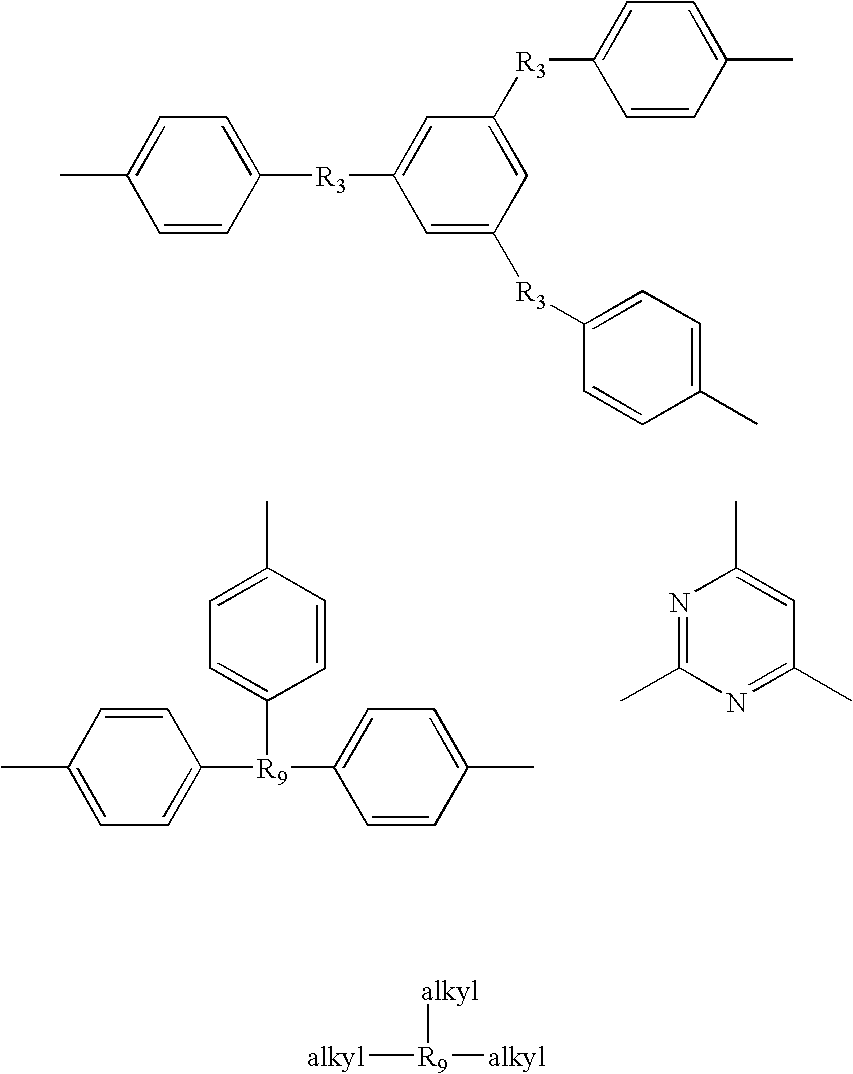
wherein the above formulae, R3 is selected from the group consisting of nil, carbonyl radicals, oxygen, methylene radical and hexafluoroisopropylidene, and R9 is selected from the group consisting of nitrogen, aromatic radicals, substituted aromatic radicals, heterocyclic radicals, aliphatic radicals and hydroxy aliphatic radicals wherein the aliphatic group has from 1 to 8 carbons preferably 1-4 carbons such as hydroxymethyl, hydroxyethyl, hydroxypropyl and the like.

wherein the preferred aromatic radicals in the above formula are characterized by the aromatic radicals selected from the group consisting of:

The sulfonated aliphatic or alkyl diamines contain alkyl groups having up to eight carbon atoms or higher and preferably up to four carbons. Specific examples of sulfonated aromatic diamines preferably include 1,4-diaminobenzene-3-sulphonic acid; 4,4′-diamino-1-1′-biphenyl-2,2′-disulphonic acid; 4,4′-diamino-2,2′-biphenyldisulfonic acid and various combinations thereof. In addition to the sulfonate group i.e. the sulfonated alkyl or aryl diamines, other strong acid groups that provide high ionic conductivity in the polymeric membranes include carboxylic acid, phosphoric acid and the like.
Claims (30)


Priority Applications (4)
| Application Number | Priority Date | Filing Date | Title |
|---|---|---|---|
| US10/147,477 US6881820B1 (en) | 2002-05-13 | 2002-05-13 | Rod-coil block polyimide copolymers |
| PCT/US2003/005112 WO2003097718A1 (en) | 2002-05-13 | 2003-02-20 | Rod-coil block polyimide copolymers |
| AU2003228216A AU2003228216A1 (en) | 2002-05-13 | 2003-02-20 | Rod-coil block polyimide copolymers |
| US10/874,008 US6855433B1 (en) | 2002-05-13 | 2004-06-16 | Mechanically resilient polymeric films doped with a lithium compound |
Applications Claiming Priority (1)
| Application Number | Priority Date | Filing Date | Title |
|---|---|---|---|
| US10/147,477 US6881820B1 (en) | 2002-05-13 | 2002-05-13 | Rod-coil block polyimide copolymers |
Related Child Applications (1)
| Application Number | Title | Priority Date | Filing Date |
|---|---|---|---|
| US10/874,008 Division US6855433B1 (en) | 2002-05-13 | 2004-06-16 | Mechanically resilient polymeric films doped with a lithium compound |
Publications (1)
| Publication Number | Publication Date |
|---|---|
| US6881820B1 true US6881820B1 (en) | 2005-04-19 |
Family
ID=29548314
Family Applications (2)
| Application Number | Title | Priority Date | Filing Date |
|---|---|---|---|
| US10/147,477 Expired - Fee Related US6881820B1 (en) | 2002-05-13 | 2002-05-13 | Rod-coil block polyimide copolymers |
| US10/874,008 Expired - Fee Related US6855433B1 (en) | 2002-05-13 | 2004-06-16 | Mechanically resilient polymeric films doped with a lithium compound |
Family Applications After (1)
| Application Number | Title | Priority Date | Filing Date |
|---|---|---|---|
| US10/874,008 Expired - Fee Related US6855433B1 (en) | 2002-05-13 | 2004-06-16 | Mechanically resilient polymeric films doped with a lithium compound |
Country Status (3)
| Country | Link |
|---|---|
| US (2) | US6881820B1 (en) |
| AU (1) | AU2003228216A1 (en) |
| WO (1) | WO2003097718A1 (en) |
Cited By (12)
| Publication number | Priority date | Publication date | Assignee | Title |
|---|---|---|---|---|
| US20080075961A1 (en) * | 2003-05-05 | 2008-03-27 | Mizori Farhad G | Imide-linked maleimide and polymaleimide compounds |
| US20080075965A1 (en) * | 2005-10-21 | 2008-03-27 | Stephen Dershem | Maleimide compositions and methods for use thereof |
| US20080262191A1 (en) * | 2007-01-26 | 2008-10-23 | Mizori Farhad G | Methods for the preparation of imides, maleimides and maleimide-terminated polyimide compounds |
| US20090148777A1 (en) * | 2007-12-06 | 2009-06-11 | Zhiquang Song | Room temperature crosslinkable ion conductive polymer system |
| US20100063184A1 (en) * | 2007-04-16 | 2010-03-11 | Designer Molecules, Inc. | Low temperature curing acrylate and maleimide based formulations and methods for use thereof |
| US20100108605A1 (en) * | 2008-11-04 | 2010-05-06 | Patil Abhimanyu O | Ethanol stable polyether imide membrane for aromatics separation |
| US20100159335A1 (en) * | 2008-12-22 | 2010-06-24 | Meador Maryann B | Branched rod-coil polyimide - poly( alkylene oxide) copolymers and electrolyte compositions |
| WO2011008742A1 (en) | 2009-07-14 | 2011-01-20 | Rogers Corporation | Alternative polymers for lithium ion primary and secondary batteries |
| US20110049731A1 (en) * | 2009-09-03 | 2011-03-03 | Designer Molecules, Inc. | Materials and methods for stress reduction in semiconductor wafer passivation layers |
| US20110130485A1 (en) * | 2003-05-05 | 2011-06-02 | Designer Molecules, Inc. | Imide-linked maleimide and polymaleimide compounds |
| US20130228901A1 (en) * | 2009-09-03 | 2013-09-05 | Designer Molecules, Inc. | Materials and methods for stress reduction in semiconductor wafer passivation layers |
| US9278909B2 (en) | 2003-05-05 | 2016-03-08 | Designer Molecules, Inc. | Amide-extended crosslinking compounds and methods for use thereof |
Families Citing this family (6)
| Publication number | Priority date | Publication date | Assignee | Title |
|---|---|---|---|---|
| US7459505B2 (en) | 2005-05-03 | 2008-12-02 | General Motors Corporation | Block copolymers with acidic groups |
| US7977394B2 (en) | 2005-05-03 | 2011-07-12 | GM Global Technology Operations LLC | Triblock copolymers with acidic groups |
| US7993792B2 (en) | 2006-07-26 | 2011-08-09 | GM Global Technology Operations LLC | Polymer blocks for PEM applications |
| US8492460B2 (en) | 2006-07-28 | 2013-07-23 | GM Global Technology Operations LLC | Fluorinated polymer blocks for PEM applications |
| WO2013155507A1 (en) | 2012-04-14 | 2013-10-17 | Seeo, Inc | Small domain-size multiblock copolymer electrolytes |
| CN117558983B (en) * | 2023-12-07 | 2024-06-21 | 广东聚圣科技有限公司 | Low-temperature electrolyte, preparation method and lithium battery |
Citations (7)
| Publication number | Priority date | Publication date | Assignee | Title |
|---|---|---|---|---|
| JPH06228310A (en) * | 1993-02-03 | 1994-08-16 | Tosoh Corp | Block copolymer and its production |
| US5468571A (en) | 1992-11-19 | 1995-11-21 | Sanyo Electric Co., Ltd. | Secondary battery |
| US5888672A (en) | 1997-02-12 | 1999-03-30 | Gustafson; Scott D. | Polyimide battery |
| US6001507A (en) | 1996-12-24 | 1999-12-14 | Sony Corporation | Non-aqueous electrolyte secondary battery |
| US6201945B1 (en) | 1998-01-08 | 2001-03-13 | Xerox Corporation | Polyimide and doped metal oxide fuser components |
| US6245881B1 (en) | 1996-05-07 | 2001-06-12 | Commissariat A L'energie Atomique | Sulphonated polyimides, membranes and fuel cell |
| US6646060B1 (en) * | 1999-05-10 | 2003-11-11 | Teijin Limited | Resin composition containing crystalline polyimide |
Family Cites Families (1)
| Publication number | Priority date | Publication date | Assignee | Title |
|---|---|---|---|---|
| US6262223B1 (en) * | 1999-02-03 | 2001-07-17 | The United States Of America As Represented By The Administrator Of National Aeronautics And Space Administration | Triamine-modified polymides having improved processability and low melt flow viscocity |
-
2002
- 2002-05-13 US US10/147,477 patent/US6881820B1/en not_active Expired - Fee Related
-
2003
- 2003-02-20 WO PCT/US2003/005112 patent/WO2003097718A1/en not_active Ceased
- 2003-02-20 AU AU2003228216A patent/AU2003228216A1/en not_active Abandoned
-
2004
- 2004-06-16 US US10/874,008 patent/US6855433B1/en not_active Expired - Fee Related
Patent Citations (7)
| Publication number | Priority date | Publication date | Assignee | Title |
|---|---|---|---|---|
| US5468571A (en) | 1992-11-19 | 1995-11-21 | Sanyo Electric Co., Ltd. | Secondary battery |
| JPH06228310A (en) * | 1993-02-03 | 1994-08-16 | Tosoh Corp | Block copolymer and its production |
| US6245881B1 (en) | 1996-05-07 | 2001-06-12 | Commissariat A L'energie Atomique | Sulphonated polyimides, membranes and fuel cell |
| US6001507A (en) | 1996-12-24 | 1999-12-14 | Sony Corporation | Non-aqueous electrolyte secondary battery |
| US5888672A (en) | 1997-02-12 | 1999-03-30 | Gustafson; Scott D. | Polyimide battery |
| US6201945B1 (en) | 1998-01-08 | 2001-03-13 | Xerox Corporation | Polyimide and doped metal oxide fuser components |
| US6646060B1 (en) * | 1999-05-10 | 2003-11-11 | Teijin Limited | Resin composition containing crystalline polyimide |
Non-Patent Citations (1)
| Title |
|---|
| Katsuya Asao and Motonori Mitoh, Polyimides (containing ether linkages; Adhesive Properties), in Concise Polymeric Materials Encylcopedia, 1202 (Joseph C. Salamone ed., CRC Press 1999). |
Cited By (20)
| Publication number | Priority date | Publication date | Assignee | Title |
|---|---|---|---|---|
| US20110130485A1 (en) * | 2003-05-05 | 2011-06-02 | Designer Molecules, Inc. | Imide-linked maleimide and polymaleimide compounds |
| US9278909B2 (en) | 2003-05-05 | 2016-03-08 | Designer Molecules, Inc. | Amide-extended crosslinking compounds and methods for use thereof |
| US20080075961A1 (en) * | 2003-05-05 | 2008-03-27 | Mizori Farhad G | Imide-linked maleimide and polymaleimide compounds |
| US8513375B2 (en) | 2003-05-05 | 2013-08-20 | Designer Molecules, Inc. | Imide-linked maleimide and polymaleimide compounds |
| US20080075965A1 (en) * | 2005-10-21 | 2008-03-27 | Stephen Dershem | Maleimide compositions and methods for use thereof |
| US8043534B2 (en) | 2005-10-21 | 2011-10-25 | Designer Molecules, Inc. | Maleimide compositions and methods for use thereof |
| US20080262191A1 (en) * | 2007-01-26 | 2008-10-23 | Mizori Farhad G | Methods for the preparation of imides, maleimides and maleimide-terminated polyimide compounds |
| WO2008092168A3 (en) * | 2007-01-26 | 2009-12-23 | Designer Molecules, Inc. | Methods for the preparation of imides, maleimides and maleimide-terminated polyimide compounds |
| US20100063184A1 (en) * | 2007-04-16 | 2010-03-11 | Designer Molecules, Inc. | Low temperature curing acrylate and maleimide based formulations and methods for use thereof |
| US8063161B2 (en) | 2007-04-16 | 2011-11-22 | Designer Molecules, Inc. | Low temperature curing acrylate and maleimide based formulations and methods for use thereof |
| US8623964B2 (en) | 2007-12-06 | 2014-01-07 | Basf Se | Room temperature crosslinkable ion conductive polymer system |
| US20090148777A1 (en) * | 2007-12-06 | 2009-06-11 | Zhiquang Song | Room temperature crosslinkable ion conductive polymer system |
| US20100108605A1 (en) * | 2008-11-04 | 2010-05-06 | Patil Abhimanyu O | Ethanol stable polyether imide membrane for aromatics separation |
| US20100159335A1 (en) * | 2008-12-22 | 2010-06-24 | Meador Maryann B | Branched rod-coil polyimide - poly( alkylene oxide) copolymers and electrolyte compositions |
| US8841406B2 (en) | 2008-12-22 | 2014-09-23 | The United States Of America As Represented By The Administrator Of National Aeronautics And Space Administration | Branched rod-coil polyimide—poly( alkylene oxide) copolymers and electrolyte compositions |
| WO2011008742A1 (en) | 2009-07-14 | 2011-01-20 | Rogers Corporation | Alternative polymers for lithium ion primary and secondary batteries |
| US20110049731A1 (en) * | 2009-09-03 | 2011-03-03 | Designer Molecules, Inc. | Materials and methods for stress reduction in semiconductor wafer passivation layers |
| US8415812B2 (en) | 2009-09-03 | 2013-04-09 | Designer Molecules, Inc. | Materials and methods for stress reduction in semiconductor wafer passivation layers |
| US20130228901A1 (en) * | 2009-09-03 | 2013-09-05 | Designer Molecules, Inc. | Materials and methods for stress reduction in semiconductor wafer passivation layers |
| US8710682B2 (en) * | 2009-09-03 | 2014-04-29 | Designer Molecules Inc, Inc. | Materials and methods for stress reduction in semiconductor wafer passivation layers |
Also Published As
| Publication number | Publication date |
|---|---|
| US6855433B1 (en) | 2005-02-15 |
| WO2003097718A1 (en) | 2003-11-27 |
| AU2003228216A1 (en) | 2003-12-02 |
Similar Documents
| Publication | Publication Date | Title |
|---|---|---|
| US6855433B1 (en) | Mechanically resilient polymeric films doped with a lithium compound | |
| US8623964B2 (en) | Room temperature crosslinkable ion conductive polymer system | |
| US9242243B2 (en) | Anion exchange polyelectrolytes | |
| JP3645558B2 (en) | PROTON CONDUCTIVE POLYMER HAVING ACID GROUP ON SIDE CHAIN, METHOD FOR PRODUCING THE SAME, POLYMER MEMBRANE USING THE PROTON CONDUCTIVE POLYMER | |
| JP5881194B2 (en) | Phosphate-doped electrolyte membrane, method for producing the same, and fuel cell including the same | |
| US7601785B2 (en) | Sulphonated multiblock copolymer and electrolyte membrane using the same | |
| Nakabayashi et al. | Polymer electrolyte membranes based on cross-linked highly sulfonated multiblock copoly (ether sulfone) s | |
| US20070202375A1 (en) | Polymer electrolyte membrane, method of manufacturing the same and fuel cell including the polymer electrolyte membrane | |
| US8628893B2 (en) | Binder compositions and membrane electrode assemblies employing the same | |
| US9005842B2 (en) | Proton exchange membrane composition | |
| KR20150060159A (en) | Electrolyte membranes of partially fluorinated and tetrasulfonated block coploymers for fuel cells and manufacturing method thereof | |
| KR101517011B1 (en) | Tetrasulfonated poly(arylene biphenyl sulfone) copolymers, Manufacturing Method thereof and Proton Exchange Membrane for Fuel Cells comprising thereof | |
| Pan et al. | Preparation and properties of sulfonated polybenzimidazole-polyimide block copolymers as electrolyte membranes | |
| WO2017110710A1 (en) | Resin composition | |
| US20100159335A1 (en) | Branched rod-coil polyimide - poly( alkylene oxide) copolymers and electrolyte compositions | |
| KR102857667B1 (en) | polymer electrolyte comprising sulfonylimide group for fuel cell and method for preparing the same | |
| US9018336B2 (en) | Polymer of sulfonated poly(arlene ether)s and manufacturing method thereof | |
| US7632591B2 (en) | Branched multiblock polybenzimidazole-benzamide copolymer and method for preparing the same, electrolyte membrane and paste/gel prepared therefrom | |
| Shin et al. | Cyclic Ammonium-Based Polyester Ionenes: Chemical Structures and Properties for Electrochemical Applications | |
| US8741454B2 (en) | Proton exchange membrane for fuel cell | |
| Meador et al. | Rod-Coil Block Polyimide Copolymers | |
| KR101633278B1 (en) | Binder composition for anode active material composition of lithium secondary battery, and anode active material and lithium secondary battery prepared therefrom | |
| KR20150019051A (en) | Proton Exchange Membrane for Fuel Cells And Manufacturing Method Thereof | |
| JP2005272666A (en) | Polyimide resin and method for producing the same | |
| JP5649765B2 (en) | Resin composition, resin molded product |
Legal Events
| Date | Code | Title | Description |
|---|---|---|---|
| AS | Assignment |
Owner name: U.S. GOVERNMENT AS REPRESENTED BY THE ADMINISTRATO Free format text: ASSIGNMENT OF ASSIGNORS INTEREST;ASSIGNORS:MEADER, MARY ANN B.;KINDER, JAMES D.;REEL/FRAME:012921/0271 Effective date: 20020513 |
|
| FPAY | Fee payment |
Year of fee payment: 4 |
|
| FEPP | Fee payment procedure |
Free format text: PETITION RELATED TO MAINTENANCE FEES FILED (ORIGINAL EVENT CODE: PMFP); ENTITY STATUS OF PATENT OWNER: LARGE ENTITY |
|
| FEPP | Fee payment procedure |
Free format text: PETITION RELATED TO MAINTENANCE FEES GRANTED (ORIGINAL EVENT CODE: PMFG); ENTITY STATUS OF PATENT OWNER: LARGE ENTITY |
|
| REMI | Maintenance fee reminder mailed | ||
| LAPS | Lapse for failure to pay maintenance fees | ||
| REIN | Reinstatement after maintenance fee payment confirmed | ||
| FP | Lapsed due to failure to pay maintenance fee |
Effective date: 20130419 |
|
| FPAY | Fee payment |
Year of fee payment: 8 |
|
| SULP | Surcharge for late payment | ||
| PRDP | Patent reinstated due to the acceptance of a late maintenance fee |
Effective date: 20131113 |
|
| REMI | Maintenance fee reminder mailed | ||
| LAPS | Lapse for failure to pay maintenance fees | ||
| STCH | Information on status: patent discontinuation |
Free format text: PATENT EXPIRED DUE TO NONPAYMENT OF MAINTENANCE FEES UNDER 37 CFR 1.362 |
|
| STCH | Information on status: patent discontinuation |
Free format text: PATENT EXPIRED DUE TO NONPAYMENT OF MAINTENANCE FEES UNDER 37 CFR 1.362 |
|
| FP | Lapsed due to failure to pay maintenance fee |
Effective date: 20170419 |