US6861458B2 - Photoprotective and lightfastness-enhancing siloxanes - Google Patents
Photoprotective and lightfastness-enhancing siloxanes Download PDFInfo
- Publication number
- US6861458B2 US6861458B2 US10/001,572 US157201A US6861458B2 US 6861458 B2 US6861458 B2 US 6861458B2 US 157201 A US157201 A US 157201A US 6861458 B2 US6861458 B2 US 6861458B2
- Authority
- US
- United States
- Prior art keywords
- groups
- group
- carbon atoms
- repeat
- lightfastness
- Prior art date
- Legal status (The legal status is an assumption and is not a legal conclusion. Google has not performed a legal analysis and makes no representation as to the accuracy of the status listed.)
- Expired - Fee Related, expires
Links
- 0 [*-]C.[*-][12*][Si]([10*])(O[Si]([4*])([5*])[6*])O[Si]([9*])([11*]C)O[Si]([7*])([8*])O[Si]([1*])([2*])[3*].[1*][Si]([2*])([3*])O[Si]([7*])([8*])O[Si]([9*])([11*]C)O[Si]([10*])([12*]C)O[Si]([4*])([5*])[6*].[1*][Si]([2*])([3*])O[Si]([7*])([8*])O[Si]([9*])([11*]C)O[Si]([10*])([12*]C)O[Si]([4*])([5*])[6*].[1*][Si]([2*])([3*])O[Si]([7*])([8*])O[Si]([9*])([11*]C)O[Si]([4*])([5*])[6*] Chemical compound [*-]C.[*-][12*][Si]([10*])(O[Si]([4*])([5*])[6*])O[Si]([9*])([11*]C)O[Si]([7*])([8*])O[Si]([1*])([2*])[3*].[1*][Si]([2*])([3*])O[Si]([7*])([8*])O[Si]([9*])([11*]C)O[Si]([10*])([12*]C)O[Si]([4*])([5*])[6*].[1*][Si]([2*])([3*])O[Si]([7*])([8*])O[Si]([9*])([11*]C)O[Si]([10*])([12*]C)O[Si]([4*])([5*])[6*].[1*][Si]([2*])([3*])O[Si]([7*])([8*])O[Si]([9*])([11*]C)O[Si]([4*])([5*])[6*] 0.000 description 39
- ZWUBULHGWFWXRX-UHFFFAOYSA-N CCCC[Si](C)(O[Si](C)(C)O[Si](C)(C)C)O[Si](C)(CCCCC(=O)[O-])O[Si](C)(C)C.[H]N(CC[N+](C)(C)C)C(=O)CCC1=CC(N2N=C3C=CC=CC3=N2)=C(O)C=C1 Chemical compound CCCC[Si](C)(O[Si](C)(C)O[Si](C)(C)C)O[Si](C)(CCCCC(=O)[O-])O[Si](C)(C)C.[H]N(CC[N+](C)(C)C)C(=O)CCC1=CC(N2N=C3C=CC=CC3=N2)=C(O)C=C1 ZWUBULHGWFWXRX-UHFFFAOYSA-N 0.000 description 2
- IIAWEQDEZPPGAD-UHFFFAOYSA-N CN(C)C1=CC=C(C(=O)OCC[N+](C)(C)C)C=C1 Chemical compound CN(C)C1=CC=C(C(=O)OCC[N+](C)(C)C)C=C1 IIAWEQDEZPPGAD-UHFFFAOYSA-N 0.000 description 2
- XYSULYLOSMHBMM-UHFFFAOYSA-O Cl.N#[N+]C1=CC=CC=C1[N+](=O)[O-].NC1=CC=CC=C1[N+](=O)[O-].O=C(O)CCC1=CC(N2N=C3C=CC=CC3=N2)=C(O)C=C1.O=C(O)CCC1=CC(N=NC2=CC=CC=C2[N+](=O)[O-])=C(O)C=C1.O=C(O)CCC1=CC=C(O)C=C1.O=NO[Na].[Cl-].[Cl-].[Cl-].[Cl-].[H]N(CC[N+](C)(C)C)C(=O)CCC1=CC(N2N=C3C=CC=CC3=N2)=C(O)C=C1.[H][N+]([H])([H])CC[N+](C)(C)C Chemical compound Cl.N#[N+]C1=CC=CC=C1[N+](=O)[O-].NC1=CC=CC=C1[N+](=O)[O-].O=C(O)CCC1=CC(N2N=C3C=CC=CC3=N2)=C(O)C=C1.O=C(O)CCC1=CC(N=NC2=CC=CC=C2[N+](=O)[O-])=C(O)C=C1.O=C(O)CCC1=CC=C(O)C=C1.O=NO[Na].[Cl-].[Cl-].[Cl-].[Cl-].[H]N(CC[N+](C)(C)C)C(=O)CCC1=CC(N2N=C3C=CC=CC3=N2)=C(O)C=C1.[H][N+]([H])([H])CC[N+](C)(C)C XYSULYLOSMHBMM-UHFFFAOYSA-O 0.000 description 2
- IADJBCIKCXGXDN-UHFFFAOYSA-N [H]C([H])(C)C([H])([H])C([H])([H])OC1=CC(O)=C(C(=O)C2=CC=CC=C2)C=C1 Chemical compound [H]C([H])(C)C([H])([H])C([H])([H])OC1=CC(O)=C(C(=O)C2=CC=CC=C2)C=C1 IADJBCIKCXGXDN-UHFFFAOYSA-N 0.000 description 2
- RVPPDJQKGHKSFB-UHFFFAOYSA-N C.C.C.[H]CCCOCCCCC[Si](C)(O[Si](C)(C)C)O[Si](C)(C)O[Si](C)(C)C Chemical compound C.C.C.[H]CCCOCCCCC[Si](C)(O[Si](C)(C)C)O[Si](C)(C)O[Si](C)(C)C RVPPDJQKGHKSFB-UHFFFAOYSA-N 0.000 description 1
- TUXQSOXLVDTHAY-UHFFFAOYSA-N CC.CC.CC.CC.Cc1ccc(C(=O)c2ccccc2)cc1.O=C(c1ccccc1)c1ccc(O)cc1.O=C(c1ccccc1)c1ccccc1O.O=C(c1ccccc1)c1ccccc1O Chemical compound CC.CC.CC.CC.Cc1ccc(C(=O)c2ccccc2)cc1.O=C(c1ccccc1)c1ccc(O)cc1.O=C(c1ccccc1)c1ccccc1O.O=C(c1ccccc1)c1ccccc1O TUXQSOXLVDTHAY-UHFFFAOYSA-N 0.000 description 1
- QPSPKSODEVXHBW-UHFFFAOYSA-N CC.CC.CC.CC.O=C(c1ccccc1)c1ccc(O)cc1.O=C(c1ccccc1)c1ccc(O)cc1.O=C(c1ccccc1)c1ccccc1O.O=C(c1ccccc1)c1ccccc1O Chemical compound CC.CC.CC.CC.O=C(c1ccccc1)c1ccc(O)cc1.O=C(c1ccccc1)c1ccc(O)cc1.O=C(c1ccccc1)c1ccccc1O.O=C(c1ccccc1)c1ccccc1O QPSPKSODEVXHBW-UHFFFAOYSA-N 0.000 description 1
- PIEXJTZELYTQCC-UHFFFAOYSA-N CC.CC.CC.CC.OC1=C(N2N=C3C=CC=CC3=N2)C=CC=C1.OC1=C(N2N=C3C=CC=CC3=N2)C=CC=C1.OC1=CC=C(N2N=C3C=CC=CC3=N2)C=C1.OC1=CC=C(N2N=C3C=CC=CC3=N2)C=C1 Chemical compound CC.CC.CC.CC.OC1=C(N2N=C3C=CC=CC3=N2)C=CC=C1.OC1=C(N2N=C3C=CC=CC3=N2)C=CC=C1.OC1=CC=C(N2N=C3C=CC=CC3=N2)C=C1.OC1=CC=C(N2N=C3C=CC=CC3=N2)C=C1 PIEXJTZELYTQCC-UHFFFAOYSA-N 0.000 description 1
- VMULLDMEIAJIED-UHFFFAOYSA-N CC.CC.[H]N1C2=CC=C(S(O)(O)O)C=C2N=N1C1=CC=CC=C1.[H]N1C2=CC=C(S(O)(O)O)C=C2N=N1C1=CC=CC=C1 Chemical compound CC.CC.[H]N1C2=CC=C(S(O)(O)O)C=C2N=N1C1=CC=CC=C1.[H]N1C2=CC=C(S(O)(O)O)C=C2N=N1C1=CC=CC=C1 VMULLDMEIAJIED-UHFFFAOYSA-N 0.000 description 1
- RUGOSIWBLNWCGT-UHFFFAOYSA-N CC.CC1=NC(C2=C(O)C=CC=C2)=NC=N1.CC1=NC=NC(C2=C(O)C=CC=C2)=N1.OC1=C(C2=NC=NC=N2)C=CC=C1 Chemical compound CC.CC1=NC(C2=C(O)C=CC=C2)=NC=N1.CC1=NC=NC(C2=C(O)C=CC=C2)=N1.OC1=C(C2=NC=NC=N2)C=CC=C1 RUGOSIWBLNWCGT-UHFFFAOYSA-N 0.000 description 1
- MLMLPPPVKIINKY-UHFFFAOYSA-N CC.CO.O=C(O)c1ccccc1 Chemical compound CC.CO.O=C(O)c1ccccc1 MLMLPPPVKIINKY-UHFFFAOYSA-N 0.000 description 1
- AXBZFCXGFDTFSX-UHFFFAOYSA-N CC.COC.O=C(O)c1ccccc1 Chemical compound CC.COC.O=C(O)c1ccccc1 AXBZFCXGFDTFSX-UHFFFAOYSA-N 0.000 description 1
- VUWMDLRKEQUSPZ-RDYRACNLSA-N CC1O[C@H](CO)[C@H](O)[C@H](O)[C@H]1O Chemical compound CC1O[C@H](CO)[C@H](O)[C@H](O)[C@H]1O VUWMDLRKEQUSPZ-RDYRACNLSA-N 0.000 description 1
- CIPFETNRIUTORK-UHFFFAOYSA-N CCC(C)(C)NCCC(C)(C)C Chemical compound CCC(C)(C)NCCC(C)(C)C CIPFETNRIUTORK-UHFFFAOYSA-N 0.000 description 1
- BCJPEZMFAKOJPM-UHFFFAOYSA-N CCC1OC1C Chemical compound CCC1OC1C BCJPEZMFAKOJPM-UHFFFAOYSA-N 0.000 description 1
- IJCOCFNOUPAKAP-UHFFFAOYSA-N CCCCCC1=CC(C(=O)O)=C(CCCC)C=C1C(=O)O.[H]C(O)(OC1=C(OC)C=CC=C1)C([H])([H])S(=O)(=O)O.[H]C([H])(C#C)OC1=C(OC)C=CC=C1C(=O)O.[H]C([H])(C(=O)O)C([H])(OC1=C(OC)C=CC=C1)C(=O)O.[H]C([H])(C1=CC(OC)=CC=C1OC)C([H])([H])C([H])([H])S(=O)(=O)O.[H]C([H])(OC1=C(OC)C=CC=C1C(=O)O)C([H])(O)C([H])([H])S(=O)(=O)O.[H]C([H])(OC1=CC(Cl)=C(OC([H])([H])C(=O)O)C=C1)C(=O)O Chemical compound CCCCCC1=CC(C(=O)O)=C(CCCC)C=C1C(=O)O.[H]C(O)(OC1=C(OC)C=CC=C1)C([H])([H])S(=O)(=O)O.[H]C([H])(C#C)OC1=C(OC)C=CC=C1C(=O)O.[H]C([H])(C(=O)O)C([H])(OC1=C(OC)C=CC=C1)C(=O)O.[H]C([H])(C1=CC(OC)=CC=C1OC)C([H])([H])C([H])([H])S(=O)(=O)O.[H]C([H])(OC1=C(OC)C=CC=C1C(=O)O)C([H])(O)C([H])([H])S(=O)(=O)O.[H]C([H])(OC1=CC(Cl)=C(OC([H])([H])C(=O)O)C=C1)C(=O)O IJCOCFNOUPAKAP-UHFFFAOYSA-N 0.000 description 1
- KQKSUBPVTZNZRA-UHFFFAOYSA-N CCCCCC1=CC(C(=O)O)=C(CCCC)C=C1S(=O)(=O)O.COC1=C(C(=O)O)C(P(=O)(O)O)=C(OC)C=C1.COC1=CC=C(OC)C(P(=O)(OC)OC)=C1C(=O)O.[H]C([H])(OC(=O)C1=C(OC)C=CC(OC)=C1)C([H])([H])P(=O)(O)O.[H]C([H])(OC1=C(C=C)C=CC=C1OC)C([H])(O)C([H])([H])S(=O)(=O)O.[H]C([H])(OC1=CC=C(OC)C(S(=O)(=O)O)=C1)C(=O)O.[H]C([H])(OC1=CC=C(OC)C=C1S(=O)(=O)O)C([H])(O)C([H])([H])S(=O)(=O)O.[H]C([H])(OC1=CC=C(OC)C=C1S(=O)(=O)O)C([H])([H])C([H])([H])S(=O)(=O)O Chemical compound CCCCCC1=CC(C(=O)O)=C(CCCC)C=C1S(=O)(=O)O.COC1=C(C(=O)O)C(P(=O)(O)O)=C(OC)C=C1.COC1=CC=C(OC)C(P(=O)(OC)OC)=C1C(=O)O.[H]C([H])(OC(=O)C1=C(OC)C=CC(OC)=C1)C([H])([H])P(=O)(O)O.[H]C([H])(OC1=C(C=C)C=CC=C1OC)C([H])(O)C([H])([H])S(=O)(=O)O.[H]C([H])(OC1=CC=C(OC)C(S(=O)(=O)O)=C1)C(=O)O.[H]C([H])(OC1=CC=C(OC)C=C1S(=O)(=O)O)C([H])(O)C([H])([H])S(=O)(=O)O.[H]C([H])(OC1=CC=C(OC)C=C1S(=O)(=O)O)C([H])([H])C([H])([H])S(=O)(=O)O KQKSUBPVTZNZRA-UHFFFAOYSA-N 0.000 description 1
- YBQRMGPWMRTSEC-UHFFFAOYSA-N CCCC[Si](C)(O[Si](C)(C)O[Si](C)(C)C)O[Si](C)(CCC)O[Si](C)(C)C.[H]C([H])=C([H])C.[H]C([H])=C([H])CCOC.[H][Si](C)(O[Si](C)(C)C)O[Si](C)(C)O[Si](C)(C)C.[Pt] Chemical compound CCCC[Si](C)(O[Si](C)(C)O[Si](C)(C)C)O[Si](C)(CCC)O[Si](C)(C)C.[H]C([H])=C([H])C.[H]C([H])=C([H])CCOC.[H][Si](C)(O[Si](C)(C)C)O[Si](C)(C)O[Si](C)(C)C.[Pt] YBQRMGPWMRTSEC-UHFFFAOYSA-N 0.000 description 1
- KGLRMYFLSUJNHV-UHFFFAOYSA-N CCCC[Si](C)(O[Si](C)(C)O[Si](C)(C)C)O[Si](C)(CCCCC(=O)O[Si](C)(C)C)O[Si](C)(C)C.[H]C([H])=C([H])CCC(=O)O[Si](C)(C)C.[H]C([H])=C([H])CCOC.[H][Si](C)(O[Si](C)(C)C)O[Si](C)(C)O[Si](C)(C)C.[Pt] Chemical compound CCCC[Si](C)(O[Si](C)(C)O[Si](C)(C)C)O[Si](C)(CCCCC(=O)O[Si](C)(C)C)O[Si](C)(C)C.[H]C([H])=C([H])CCC(=O)O[Si](C)(C)C.[H]C([H])=C([H])CCOC.[H][Si](C)(O[Si](C)(C)C)O[Si](C)(C)O[Si](C)(C)C.[Pt] KGLRMYFLSUJNHV-UHFFFAOYSA-N 0.000 description 1
- CBRGBGJHAZGHQN-UHFFFAOYSA-O CN(C)C1=CC=C(C(=O)OCC[N+](C)(C)C)C=C1.[H]N(CC[N+](C)(C)C)C(=O)CCC1=CC(N2N=C3C=CC=CC3=N2)=C(O)C=C1 Chemical compound CN(C)C1=CC=C(C(=O)OCC[N+](C)(C)C)C=C1.[H]N(CC[N+](C)(C)C)C(=O)CCC1=CC(N2N=C3C=CC=CC3=N2)=C(O)C=C1 CBRGBGJHAZGHQN-UHFFFAOYSA-O 0.000 description 1
- DEHKTRHNKYNZHD-UHFFFAOYSA-N CN(C)c(cc1)ccc1C(OCC[N](C)(C)C)=O Chemical compound CN(C)c(cc1)ccc1C(OCC[N](C)(C)C)=O DEHKTRHNKYNZHD-UHFFFAOYSA-N 0.000 description 1
- UVZKZGZVCXMHFO-UHFFFAOYSA-M COC1=CC(O)=C(C(=O)C2=CC=CC=C2)C=C1SOO[O-].C[N+](C)(C)CCC[Si](C)(O[Si](C)(C)C)O[Si](C)(C)O[Si](C)(C)C Chemical compound COC1=CC(O)=C(C(=O)C2=CC=CC=C2)C=C1SOO[O-].C[N+](C)(C)CCC[Si](C)(O[Si](C)(C)C)O[Si](C)(C)O[Si](C)(C)C UVZKZGZVCXMHFO-UHFFFAOYSA-M 0.000 description 1
- HBLIABPKVXLFHF-UHFFFAOYSA-N COC1=CC(OC)=CC(C(=O)N(CC(=O)O)CC(=O)O)=C1.[H]C([H])(C([H])(O)S(=O)(=O)O)C([H])(C1=CC=C(OC)C(OC)=C1)S(=O)(=O)O.[H]N(C(=O)C1=CC=C(OC)C(OC)=C1)C([H])([H])C([H])([H])S(=O)(=O)O Chemical compound COC1=CC(OC)=CC(C(=O)N(CC(=O)O)CC(=O)O)=C1.[H]C([H])(C([H])(O)S(=O)(=O)O)C([H])(C1=CC=C(OC)C(OC)=C1)S(=O)(=O)O.[H]N(C(=O)C1=CC=C(OC)C(OC)=C1)C([H])([H])C([H])([H])S(=O)(=O)O HBLIABPKVXLFHF-UHFFFAOYSA-N 0.000 description 1
- YXJVVCASIQTSCQ-UHFFFAOYSA-N Cc(cc1)cc(N2N3N2c2ccccc32)c1O Chemical compound Cc(cc1)cc(N2N3N2c2ccccc32)c1O YXJVVCASIQTSCQ-UHFFFAOYSA-N 0.000 description 1
- OZHRRDGGFNUCAH-UHFFFAOYSA-M Cl.N#[N+]C1=CC=CC=C1[N+](=O)[O-].NC1=CC=CC=C1[N+](=O)[O-].O=C(O)CCC1=CC(N2N=C3C=CC=CC3=N2)=C(O)C=C1.O=C(O)CCC1=CC(N=NC2=CC=CC=C2[N+](=O)[O-])=C(O)C=C1.O=C(O)CCC1=CC=C(O)C=C1.O=NO[Na].[Cl-] Chemical compound Cl.N#[N+]C1=CC=CC=C1[N+](=O)[O-].NC1=CC=CC=C1[N+](=O)[O-].O=C(O)CCC1=CC(N2N=C3C=CC=CC3=N2)=C(O)C=C1.O=C(O)CCC1=CC(N=NC2=CC=CC=C2[N+](=O)[O-])=C(O)C=C1.O=C(O)CCC1=CC=C(O)C=C1.O=NO[Na].[Cl-] OZHRRDGGFNUCAH-UHFFFAOYSA-M 0.000 description 1
- MBINWTCCGMXELZ-UHFFFAOYSA-M O=C(C1=CC=CC=C1)C1=C(O)C=C(S(=O)(=O)[O-])C=C1 Chemical compound O=C(C1=CC=CC=C1)C1=C(O)C=C(S(=O)(=O)[O-])C=C1 MBINWTCCGMXELZ-UHFFFAOYSA-M 0.000 description 1
- VUSWCWPCANWBFG-UHFFFAOYSA-N OC(C1CC=CCC1)=O Chemical compound OC(C1CC=CCC1)=O VUSWCWPCANWBFG-UHFFFAOYSA-N 0.000 description 1
- CXPTTWNHTGZOAM-UHFFFAOYSA-N [H]C([H])(C)C([H])([H])C([H])([H])OC(=O)CCC1=CC(N2N=C3C=CC=CC3=N2)=C(O)C=C1.[H]C([H])(C)C([H])([H])C([H])([H])OC1=CC(O)=C(C(=O)C2=CC=CC=C2)C=C1 Chemical compound [H]C([H])(C)C([H])([H])C([H])([H])OC(=O)CCC1=CC(N2N=C3C=CC=CC3=N2)=C(O)C=C1.[H]C([H])(C)C([H])([H])C([H])([H])OC1=CC(O)=C(C(=O)C2=CC=CC=C2)C=C1 CXPTTWNHTGZOAM-UHFFFAOYSA-N 0.000 description 1
- GVWISOJSERXQBM-UHFFFAOYSA-N [H]N(C)C([H])([H])C([H])([H])C Chemical compound [H]N(C)C([H])([H])C([H])([H])C GVWISOJSERXQBM-UHFFFAOYSA-N 0.000 description 1
Classifications
-
- A—HUMAN NECESSITIES
- A61—MEDICAL OR VETERINARY SCIENCE; HYGIENE
- A61K—PREPARATIONS FOR MEDICAL, DENTAL OR TOILETRY PURPOSES
- A61K8/00—Cosmetics or similar toiletry preparations
- A61K8/18—Cosmetics or similar toiletry preparations characterised by the composition
- A61K8/72—Cosmetics or similar toiletry preparations characterised by the composition containing organic macromolecular compounds
- A61K8/84—Cosmetics or similar toiletry preparations characterised by the composition containing organic macromolecular compounds obtained by reactions otherwise than those involving only carbon-carbon unsaturated bonds
- A61K8/89—Polysiloxanes
- A61K8/896—Polysiloxanes containing atoms other than silicon, carbon, oxygen and hydrogen, e.g. dimethicone copolyol phosphate
- A61K8/898—Polysiloxanes containing atoms other than silicon, carbon, oxygen and hydrogen, e.g. dimethicone copolyol phosphate containing nitrogen, e.g. amodimethicone, trimethyl silyl amodimethicone or dimethicone propyl PG-betaine
-
- A—HUMAN NECESSITIES
- A61—MEDICAL OR VETERINARY SCIENCE; HYGIENE
- A61K—PREPARATIONS FOR MEDICAL, DENTAL OR TOILETRY PURPOSES
- A61K8/00—Cosmetics or similar toiletry preparations
- A61K8/18—Cosmetics or similar toiletry preparations characterised by the composition
- A61K8/72—Cosmetics or similar toiletry preparations characterised by the composition containing organic macromolecular compounds
- A61K8/84—Cosmetics or similar toiletry preparations characterised by the composition containing organic macromolecular compounds obtained by reactions otherwise than those involving only carbon-carbon unsaturated bonds
- A61K8/89—Polysiloxanes
- A61K8/891—Polysiloxanes saturated, e.g. dimethicone, phenyl trimethicone, C24-C28 methicone or stearyl dimethicone
- A61K8/894—Polysiloxanes saturated, e.g. dimethicone, phenyl trimethicone, C24-C28 methicone or stearyl dimethicone modified by a polyoxyalkylene group, e.g. cetyl dimethicone copolyol
-
- A—HUMAN NECESSITIES
- A61—MEDICAL OR VETERINARY SCIENCE; HYGIENE
- A61Q—SPECIFIC USE OF COSMETICS OR SIMILAR TOILETRY PREPARATIONS
- A61Q17/00—Barrier preparations; Preparations brought into direct contact with the skin for affording protection against external influences, e.g. sunlight, X-rays or other harmful rays, corrosive materials, bacteria or insect stings
- A61Q17/04—Topical preparations for affording protection against sunlight or other radiation; Topical sun tanning preparations
-
- C—CHEMISTRY; METALLURGY
- C08—ORGANIC MACROMOLECULAR COMPOUNDS; THEIR PREPARATION OR CHEMICAL WORKING-UP; COMPOSITIONS BASED THEREON
- C08G—MACROMOLECULAR COMPOUNDS OBTAINED OTHERWISE THAN BY REACTIONS ONLY INVOLVING UNSATURATED CARBON-TO-CARBON BONDS
- C08G77/00—Macromolecular compounds obtained by reactions forming a linkage containing silicon with or without sulfur, nitrogen, oxygen or carbon in the main chain of the macromolecule
- C08G77/04—Polysiloxanes
- C08G77/38—Polysiloxanes modified by chemical after-treatment
-
- C—CHEMISTRY; METALLURGY
- C08—ORGANIC MACROMOLECULAR COMPOUNDS; THEIR PREPARATION OR CHEMICAL WORKING-UP; COMPOSITIONS BASED THEREON
- C08G—MACROMOLECULAR COMPOUNDS OBTAINED OTHERWISE THAN BY REACTIONS ONLY INVOLVING UNSATURATED CARBON-TO-CARBON BONDS
- C08G77/00—Macromolecular compounds obtained by reactions forming a linkage containing silicon with or without sulfur, nitrogen, oxygen or carbon in the main chain of the macromolecule
- C08G77/04—Polysiloxanes
- C08G77/38—Polysiloxanes modified by chemical after-treatment
- C08G77/382—Polysiloxanes modified by chemical after-treatment containing atoms other than carbon, hydrogen, oxygen or silicon
- C08G77/388—Polysiloxanes modified by chemical after-treatment containing atoms other than carbon, hydrogen, oxygen or silicon containing nitrogen
Definitions
- the present invention is directed to compositions of matter suitable for use as photoprotectants or lightfastness enhancing agents. More specifically, the present invention is directed to oligomeric or polymeric siloxanes having thereon moieties imparting to the oligomers or polymers the ability to function as photoprotectants or lightfastness enhancing agents.
- One embodiment of the present invention is directed to a compound of one of the formulae wherein R 1 , R 2 , R 3 , R 4 , R 5 , R 6 , R 7 , R 8 , R 9 , and R 10 each, independently of the others, is an alkyl group, an aryl group, an arylalkyl group, or an alkylaryl group, R 11 and R 12 each, independently of the others, is an alkylene group, an arylene group, an arylalkylene group, or an alkylarylene group, G is a cationic moiety, A is an anionic moiety, n is an integer representing the number of repeat —OSi(R 7 )(R 8 )— monomer units, a is an integer representing the number of repeat —OSi(R 10 )(R 12 -lightfastness moiety)— monomer units, and c is an integer representing the number of repeat —OSi(R 9 )(R 11 -hydrophilic moiety)— mono
- compositions for photoprotection of the skin and/or hair against ultraviolet radiation are known for use in sunscreens, cosmetics, hair products, and the like.
- examples of such materials include aromatic compounds such as p-aminobenzoic acid derivatives, benzylidenecamphor derivatives, cinnamic acid derivatives, benzotriazole derivatives, and the like.
- U.S. Pat. No. 6,270,214 discloses a process which comprises (a) applying to a substrate a fixing fluid which comprises a material selected from the group consisting of (1) block or graft copolymers of dialkylsiloxanes and polar, hydrophilic monomers capable of interacting with an ink colorant to cause the colorant to become complexed, laked, or mordanted, (2) organopolysiloxane copolymers having functional side groups capable of interacting with an ink colorant to cause the colorant to become complexed, laked, or mordanted, (3) perfluorinated polyalkoxy polymers, (4) perfluoroalkyl surfactants having thereon at least one group capable of interacting with an ink colorant to cause the colorant to become complexed, laked, or mordanted, and (5) mixtures thereof; (b) incorporating into an ink jet printing apparatus an ink composition which comprises water
- U.S. Pat. No. 6,142,618 discloses a fluid deposition apparatus comprising (a) a fluid supply, (b) a porous fluid distribution member in operative connection with the fluid supply, enabling wetting of the fluid distribution member with a fluid, and (c) a porous metering membrane situated on the fluid distribution member, whereby the metering membrane enables uniform metering of the fluid from the fluid distribution member onto a substrate.
- U.S. Pat. No. 6,124,376 discloses a process which comprises incorporating into an ink jet printing apparatus an ink composition which comprises water, a colorant, and a polymer of the formula wherein m, n, x, and y are each integers representing the number of repeat monomer units, and wherein the ratio of x:y is from about 10:90 to about 90:10, and causing droplets of the ink to be ejected in an imagewise pattern onto a recording sheet.
- U.S. Pat. No. 6,200,369 discloses an ink composition which comprises (a) water, (b) a colorant, and (c) an additive selected from the group consisting of diamido quaternary dialkyl ammonium salts, bitail quaternary tetraalkyl ammonium salts, bitail imidazolium salts, bitail biomimetic phospholipid salts, specific bisquaternary salts, ⁇ -hydroxyethyl ethylene diamine fatty acids, specific polyammonium salts, ethoxylated polyamine compounds, biquaternary pyridinium salts, aminofunctional polyorganosiloxanes, and mixtures thereof.
- an additive selected from the group consisting of diamido quaternary dialkyl ammonium salts, bitail quaternary tetraalkyl ammonium salts, bitail imidazolium salts, bitail biomimetic phospholipid salts, specific bisquatern
- U.S. Pat. No. 5,719,204 (Beach et al.), the disclosure of which is totally incorporated herein by reference, discloses polymeric dispersants used in formulating aqueous ink compositions, as well as inks containing those dispersants.
- the dispersants are graft copolymers comprising a hydrophilic polymeric segment, a hydrophobic polymeric segment incorporating a hydrolytically-stable siloxyl substituent, and a stabilizing segment, such as a reactive surfactant macromer, a protective colloid macromer, or a non-siloxyl hydrophobic monomer.
- the inks made with these dispersants show excellent stability, print characteristics, water-fastness, light-fastness, optical density, and in-use maintenance characteristics.
- U.S. Pat. No. 5,686,633 discloses a recording material for ink jet printing comprising a carrier having a surface which can be printed on or a carrier coated on one side with a material which can be printed on, wherein the carrier or the coating contains as a stabilizer at least one compound of the formula in which R 1 and R 2 independently of one another are C 1 -C 4 alkyl which is unsubstituted or substituted by one or two —OH, —COO ⁇ M + and/or —SO 3 ⁇ M + groups, C 3 -C 5 alkenyl, C 3 -C 5 alkynyl, —CH 2 CH(OH)CH 2 —SO 3 ⁇ M + , —CO-alkyl(C 1 -C 4 ) which is unsubstituted or substituted by —COOR o or —CO—N(R 5 )(R 6 ) or,
- U.S. Pat. No. 5,643,356 discloses an improved ink suitable for ink jet printing comprising a mixture of a colorant, an arylketoalkene stabilizing compound or a photoreactor, and a liquid vehicle, wherein the colorant is light-stable.
- the photoreactor is combined with a wavelength-selective sensitizer to form a radiation transorber, the colorant is mutable upon exposure of the radiation transorber to specific, narrow bandwidth radiation.
- the colored composition may also contain a molecular includant having a chemical structure which defines at least one cavity wherein each of the colorant and photoreactor or radiation transorber is associated with the molecular includant.
- the invention also includes ink jet print cartridges containing the improved ink, ink jet printers containing the improved ink and methods of printing using the improved ink.
- U.S. Pat. No. 5,610,257 discloses topically applicable sunscreen/cosmetic compositions well suited for enhanced photoprotection of human skin and/or hair against the damaging effects of UV-A and UV-B irradiation, particularly solar radiation, which comprise a photoprotecting effective amount of a novel benzotriazole-substituted polyorganosiloxane/polyorganosilane having one of the formulae (1) to (3): A-Si(R′) 3 (3) wherein A is a monovalent benzotriazole radical which comprises an acrylate or acrylamide functional group, which is bonded directly to a silicon atom, and which has the formula (4):
- U.S. Pat. No. 4,256,493 (Yokoyama et al,), the disclosure of which is totally incorporated herein by reference, discloses a jet ink composition which comprises an aqueous jet ink containing a water-soluble dye, a wetting agent, and water as main components and, incorporated therein, a water-soluble ultraviolet absorbing agent as well as a metal salt, when necessary.
- European Patent Application EP 0867486 discloses a jet printing ink composition which results in reduced drop misdirection and missing nozzles.
- the aqueous-based ink composition includes at least one colorant, a wetting agent; and a co-solvent comprising a substituted or unsubstituted lactam, an amide, or mixtures thereof.
- Japanese Patent Publication JP 10278435 discloses a thermal recording medium having excellent recording traveling properties with excellent light resistance, heat resistance, and chemical resistance of a recorded part and white part.
- the thermal recording medium comprising a thermal recording layer containing colorless or pale basic dye, colorant and a protective layer containing an ultraviolet absorbent sequentially provided on a support
- the colorant is 1,1-bis(4-hydroxyphenyl)-1-phenylethane and the absorbent is N,N′-bis(2-hydroxy-3-(2H-benzotriazole-2-il)-5-methylbenzyl)-1,4-benzene-dicarboxyamide.
- Japanese Patent Publication JP 11099740 discloses an ink jet recording sheet having superior light fastness of a recorded image, particularly superior light fastness of a magenta image, and also superior characteristics such as recording density and recording quality.
- At least one kind of compound like N-2-(3-(benzotriazole-2-yl)-4-hydroxyphenyl propionyl amino)ethyl-N,N,N-trimethyl ammonium chloride and others by a general formula is contained in an ink jet recording sheet for forming a recorded image by using aqueous ink.
- R 1 , R 2 , and R 3 respectively represent hydrogen atom, C 1 -C 4 alkyl or C 1 -C 4 hydroxyalkyl and X represents organic or inorganic anion.
- (n) represents 0, 1, or 2 and (m) represents an integer of 2 to 6.
- Japanese Patent Publication JP 2000141875 discloses a superior ink jet recording sheet of superior light fastness of a recorded image, particularly light fastness of a magenta image and free from the yellowing of surface, the deterioration of the picture quality and the like.
- a recorded image is formed on an ink jet recording sheet by using an aqueous ink, and in the recording sheet, at least one kind of benzotrizol compound represented by the formula 3-(3-(benzotriazol-2-yl)-4-hydroxyphenyl)decaglyceryl propionate or the like is contained in the recording sheet.
- R 1 represents a hydrogen atom or a 1-5C alkyl
- R 2 represents a hydrogen atom or a chlorine atom.
- (m) represents 0 or 1-4 integer
- (n) represents 1-12 integer.
- Japanese Patent Publication JP 10007958 discloses an additive for a water based ink which is especially excellent in water resistance and can give a record with a high quality image hardly accompanied by blur of characters or images or border blur at the place where two colors are applied one on top of another.
- the additive is a polyorganosiloxane-modified amphiphilic polymer which has polyorganosiloxane units and is obtained by copolymerizing a hydrophilic ethylenically unsaturated monomer and a hydrophobic ethylenically unsaturated monomer, or polymerizing an amphiphilic ethylenically unsaturated monomer, in the presence of a polyorganosiloxane having mercaptized organic groups.
- Japanese Patent Publication JP 10007969 discloses an ink composition excellent in light resistance, water resistance, and water repellency obtained by mixing a compound having a group having the function of stabilizing against ultraviolet rays with a specified amphipathic polymer.
- the composition is prepared by mixing a polar-solvent-soluble compound having the function of stabilizing against ultraviolet rays (e.g., hydroxyphenylbenzotriazole derivative) with an amphipathic polymer having polyorganosiloxane units, preferably obtained by radical-polymerizing a mixture comprising a hydrophilic ethylenically unsaturated monomer (e.g., acrylamide) and/or an amphipathic ethylenically unsaturated monomer (e.g., methoxypolyethylene glycol monomethacrylate) and optionally a hydrophobic ethylenically unsaturated monomer (e.g., methyl methacrylate) in the presence of an SH-containing polyorganosiloxane.
- a polar-solvent-soluble compound having the function of stabilizing against ultraviolet rays e.g., hydroxyphenylbenzotriazole derivative
- compositions and processes are suitable for their intended purposes, a need remains for improved lightfastness enhancing agents.
- photoprotective compositions that can be employed in personal care products such as sunblocks, makeup, hair products, or the like.
- the present invention is directed to a compound of one of the formulae wherein R 1 , R 2 , R 3 , R 4 , R 5 , R 6 , R 7 , R 8 , R 9 , and R 10 each, independently of the others, is an alkyl group, an aryl group, an arylalkyl group, or an alkylaryl group, R 11 and R 12 each, independently of the others, is an alkylene group, an arylene group, an arylalkylene group, or an alkylarylene group, G is a cationic moiety, A is an anionic moiety, n is an integer representing the number of repeat —OSi(R 7 )(R 8 )— monomer units, a is an integer representing the number of repeat —OSi(R 10 )(R 12 -lightfastness moiety)— monomer units, and c is an integer representing the number of repeat —OSi(R 9 )(R 11 -hydrophilic moiety)— monomer units.
- the present invention is directed to compounds of one of the formulae wherein R 1 , R 2 , R 3 , R 4 , R 5 , R 6 , R 7 , R 8 , R 9 , and R 10 each, independently of the others, is an alkyl group (including linear, branched, cyclic, saturated, unsaturated, and substituted alkyl groups, and wherein hetero atoms, such as oxygen, sulfur, nitrogen, silicon, phosphorus, and the like can be present in the alkyl group), typically with from 1 to about 22 carbons and preferably with from 1 to about 5 carbon atoms, although the number of carbon atoms can be outside of these ranges, an aryl group (including substituted aryl groups), typically with from 6 to about 12 carbon atoms, with 6 carbon atoms being preferred, although the number of carbon atoms can be outside of this range, an arylalkyl group (including substituted arylalkyl groups), typically with from 7 to about 28 carbon atoms, and preferably with from
- Example of suitable lightfastness moieties include 2-(3-(2H-benzotriazol-2-yl)-4-hydroxyphenyl) groups, of the formulae hydroxybenzophenone groups, of the formulae hydroxybenzoic acid groups, of the formula alkoxybenzoic acid groups, of the formula wherein R is an alkyl group (including linear, branched, saturated, unsaturated, cyclic, and substituted alkyl groups, and wherein hetero atoms, such as oxygen, sulfur, nitrogen, silicon, phosphorus, or the like, can be placed between the carbon atoms in the alkyl group), typically with from 1 to about 22 carbon atoms, preferably with from 1 to about 12 carbon atoms, and more preferably with from 1 to about 6 carbon atoms, although the number of carbon atoms can be outside of these ranges, an aryl group (including substituted aryl groups), typically with from about 6 to about 24 carbon atoms, preferably with from about 6 to about 12 carbon atoms, and more preferably
- anionic lightfastness moieties include (hydroxyphenyl)-benzotriazoles, of the general formulae hydroxybenzophenones, of the general formulae hydroxybenzoic acids, of the general formulae alkoxybenzoic acids, of the general formulae wherein R is an alkyl group, typically with from 1 to about 12 carbon atoms, although the number of carbon atoms can be outside of this range, esters of substituted benzoic acids, of the general formula wherein R′ is an alkyl group, typically with from 1 to about 12 carbon atoms, although the number of carbon atoms can be outside of this range, (hydroxyphenyl)-1,3,5 triazines, of the general formulae and the like, wherein in all of the above generic formulae, A is a substituent containing an anionic moiety.
- A can be either an anionic moiety by itself, such as a carboxylate group, sulfonate group, phosphonate group, or the like, or can be an aliphatic or aromatic group (including aliphatic and aromatic groups containing hetero atoms, such as oxygen, nitrogen, sulfur, silicon, phosphorus, or the like) to which an anionic group is attached. It is to be understood that other substituents can also be present on materials of these formulae.
- Suitable cationic lightfastness moieties include (but are not limited to) 2-(3-(2H-benzotriazol-2-yl)-4-hydroxyphenyl) quaternary compounds, of the general formulae hydroxybenzophenone quaternary compounds, of the general formulae quaternary ammonium derivatives of dialkylaminobenzoates, of the general formula wherein R 5 and R 6 each, independently of the other, is an alkyl group, typically with from 1 to about 6 carbon atoms, although the number of carbon atoms can be outside of this range, or an arylalkyl group, typically with from about 7 to about 12 carbon atoms, such as a benzyl group, although the number of carbon atoms can be outside of this range, and the like, wherein R 1 is an alkylene group (including linear, branched, saturated, cyclic, and substituted alkylene groups, and wherein hetero atoms, such as oxygen, sulfur, nitrogen, silicon, phosphorus, or the like, can
- the 2-(3-(2H-benzotriazol-2-yl)-4-hydroxyphenyl) quaternary compounds can be prepared by any desired or suitable method.
- N-2-(3-(benzotriazole-2-yl)-4-hydroxyphenyl proplonyl amino) ethyl-N,N,N-trimethyl ammonium chloride can be made by the synthetic process outlined below: 2-Nitroaniline is reacted with sodium nitrite in hydrochloric acid to yield the diazonium salt. The diazonium salt is reacted stoichiometrically with 2-(4-hydroxyphenyl)propionic acid to yield the corresponding azo compound.
- 2-(3-(2H-benzotriazol-2-yl)-4-hydroxyphenyl)propionyl aminoethyl-trimethylammonium chloride is obtained by stoichiometric reaction of a solution of 2-(3-(2H-benzotriazol-2-yl)-4-hydroxyphenyl)propionic acid in a mixture of acetic acid and dimethylformamide, with thionyl chloride, added dropwise, to generate 2-(3-(2H-benzotriazol-2-yl)-4-hydroxyphenyl)propionyl chloride.
- the acid chloride is reacted in situ with 2-aminoethyl(trimethylammonium chloride hydrochloride to yield 2-(3-(2H-benzotriazol-2-yl)-4-hydroxyphenyl)propionyl aminoethyl-trimethylammonium chloride, which is isolated by dilution with water and filtration.
- the retain mixture is cooled in a water bath to hold the reaction temperature at about 25° C.
- the quaternary dimethylaminobenzoic acid derivative can be synthesized by the reaction of dimethylaminobenzoic acid with choline chloride in the presence of thionyl chloride.
- the hydrophilic moiety can be a separate substituent, as in Formulae I, II, and III, or integral to (having) an anionic substituent the counterion of which is a cationic lightfastness moiety, as in Formula IV, or integral to (having) a cationic substituent the counterion of which is an anionic lightfastness moiety, as in Formula V.
- hydrophilic moieties include polyoxyalkylene chains, such as polyethylene oxide, polypropylene oxide, polybutylene oxide, random or block copolymers of two or more oxyalkylene monomers, or the like, such as those of the general formulae —(C x H 2x O) n H and —(OC x H 2x ) n OH wherein x, independently in each single repeat alkylene oxide unit, is an integer of 2, 3, or 4 and n is an integer representing the number of repeat alkylene oxide units, and is typically from 1 to about 60, preferably from 1 to about 30, and more preferably from 1 to about 10, although the value of n can be outside of these ranges, poly(2-alkyloxazoline)s, such as those of the general formula wherein R is an alkyl group, including linear, branched, cyclic, and unsaturated alkyl groups, typically with from 1 to about 22 carbons and preferably with from 1 to about 6 carbon atoms, although the number of carbon atoms
- R and R′ each, independently of the other, is hydrogen or methyl
- R 1 , R 2 , R 3 , R 4 , R 5 , R 6 , R 7 , R 8 , and R 9 each, independently of the others, is an alkyl group, including linear, branched, cyclic, and unsaturated alkyl groups, typically with from 1 to about 22 carbons and preferably with from 1 to about 5 carbon atoms, although the number of carbon atoms can be outside of these ranges, an aryl group, typically with from 6 to about 12 carbon atoms, with 6 carbon atoms being preferred, although the number of carbon atoms can be outside of this range, or an arylalkyl group (with either the alkyl or the aryl portion of the group being attached to the silicon atom), typically with from 7 to about 28 carbon atoms, and preferably with from 7 to about 10 carbon atoms, although the number of carbon atoms can be outside of these ranges,
- the relative molar ratio of n and m typically falls within the range of from about 3:97 to about 60:40, although the relative ratio can be outside of this range.
- Molecular weights of preferred materials typically are from about 600 to about 30,000 grams per mole, although the molecular weight can be outside of this range.
- TEGOPREN®s available from Goldschmidt Chemical, Hopewell, Va., such as TEGOPREN® 5842, wherein x is 16 and the mole ratio of n to m is about 22:78; the DBE series of hydrophilic silicones available form Gelest, Inc., Tullytown, Pa., the SILWET® silicone surfactant series available from Witco Corporation, OrganoSilicones Group, Greenwich, Conn.; Silicone Polyol copolymers available from Genesee Polymers Corporation, Flint, Mich.; and the like.
- Siloxane-oxyethylene block and graft copolymers typically are prepared by hydrosilylation of monoallyl or monovinyl ethers of polyethylene oxide glycols under the catalytic action of chloroplatinic acid by (Si—H) groups in dimethylsiloxane/methylhydrosiloxane copolymers, as disclosed in, for example, U.S. Pat. No. 2,486,458, the disclosure of which is totally incorporated herein by reference.
- R 1 , R 2 , R 3 , R 4 , R 5 , R 6 , R 7 , R 8 , and R 9 each, independently of the others, is an alkyl group, including linear, branched, cyclic, and unsaturated alkyl groups, typically with from 1 to about 22 carbons and preferably with from 1 to about 5 carbon atoms, although the number of carbon atoms can be outside of these ranges, an aryl group, typically with from 6 to about 12 carbon atoms, with 6 carbon atoms being preferred, although the number of carbon atoms can be outside of this range, or an arylalkyl group (with either the alkyl or the aryl portion of the group being attached to the silicon atom), typically with from 7 to about 28 carbon atoms, and preferably with from 7 to about 10 carbon atoms, although the number of carbon atoms can be outside of these ranges, and wherein the alkyl, aryl, or arylal
- the R groups are all methyl groups.
- These polymers can be block copolymers, random copolymers, or alternating copolymers.
- the “n” monomers are present in the polymer in an amount of from 0 to about 99 mole percent, and preferably from about 50 to about 95 mole percent
- the “c” monomers are typically present in the polymer in an amount of from about 1 to 100 mole percent, and preferably from about 5 to about 50 mole percent, although the relative ratio of monomers can be outside of these ranges.
- the number average molecular weight of these polymers typically is from about 500 to about 30,000, and preferably from about 1,000 to about 5,000, although the value can be outside of these ranges.
- organopolysiloxane copolymers are that of quaternary amino functionalized siloxane polymers, including those of the general formula wherein n and c are each integers representing the number of repeat monomer units, X is an anion, and R is a methylene group or a benzyl group.
- n and c are each integers representing the number of repeat monomer units
- X is an anion
- R is a methylene group or a benzyl group.
- QMS-435 a hydrophilic silicone supplied by Gelest, Inc., Tullytown, Pa.
- Polysiloxanes of the present invention can be prepared by any desired or effective method.
- a commercially available polymer or oligomer of the general formula can be reacted with a lightfastness compound having a terminal >C ⁇ C ⁇ group and an alkoxy or polyalkyleneoxy compound having a terminal >C ⁇ C ⁇ group in the presence of a platinum catalyst.
- Siloxane-oxyethylene block and graft copolymers typically are prepared by hydrosilylation of monoallyl or monovinyl ethers of polyethylene oxide glycols under the catalytic action of chloroplatinic acid by (Si—H) groups in dimethylsiloxane/methylhydrosiloxane copolymers, as disclosed in, for example, U.S. Pat.
- Siloxane-oxyethylene block and graft copolymers with covalently bound lightfastness substituents can be prepared by hydrosilylation of vinyl or allyl derivatives of lightfastness moieties prior to or simultaneously with the hydrosilylation of monoallyl or monovinyl ethers of polyethylene oxide glycols under the catalytic action of chloroplatinic acid by (Si—H) groups in dimethylsiloxane/methylhydrosiloxane copolymers.
- 4-alloxy-2-hydroxy benzophenone is commercially available (Aldrich 41,583-9) as are 2-(3-2H-benzotriazol-2-yl)-4-hydroxyphenyl)ethyl methacrylate (Aldrich 41,343-7) eugenol (Aldrich E5,179-1), 4-allyl-1,2-dimethoxybenzene (Aldrich 28,442-4), and 4-allyl-2,6-dimethoxyphenol (Aldrich A3160-1).
- 2-(3-2H-benzotriazol-2-yl)-4-hydroxyphenyl)ethylpentenoate can be synthesized by esterification of 2-(3-2H-benzotriazol-2-yl)-4-hydroxyphenethyl alcohol (Aldrich 43,071-4) with pentenoic acid (Aldrich 24,592-5) or pentenoic anhydride (Aldrich 47,180-1).
- a commercially available polymer or oligomer of the general formula can be reacted with an anionic compound having a terminal >C ⁇ C ⁇ group and an alkoxy or polyalkyleneoxy compound having a terminal >C ⁇ C ⁇ group in the presence of a platinum catalyst.
- An illustrative example of such a reaction is as follows: In aqueous solutions with a pH greater than about 5, the trimethylsilyl ester group is ionized to carboxylate, —COO ⁇ .
- a lightfastness moiety bearing a cationic substituent results in ion exchange to associate the lightfastness moiety with a anionic group covalently attached to the backbone of the hydrophilic siloxane, illustrated as follows:
- the quaternary ammonium substituted hydroxyphenyl benzotriazole illustrated above can be synthesized by the synthetic process outlined below: 2-Nitroaniline is reacted with sodium nitrite in hydrochloric acid to yield the diazonium salt. The diazonium salt is reacted stoichiometrically with 2-(4-hydroxyphenyl)propionic acid to yield the corresponding azo compound.
- 2-(3-(2H-benzotriazol-2-yl)-4-hydroxyphenyl)propionyl aminoethyl-trimethylammonium chloride is obtained by stoichiometric reaction of a solution of 2-(3-(2H-benzotriazol-2-yl)-4-hydroxyphenyl)propionic acid in a mixture of acetic acid and dimethylformamide, with thionyl chloride, added dropwise, to generate 2-(3-(2H-benzotriazol-2-yl)-4-hydroxyphenyl)propionyl chloride.
- the acid chloride is reacted in situ with 2-aminoethyl(trimethylammonium chloride hydrochloride to yield 2-(3-(2H-benzotriazol-2-yl)-4-hydroxyphenyl)propionyl aminoethyl-trimethylammonium chloride, which is isolated by dilution with water and filtration.
- the retain mixture is cooled in a water bath to hold the reaction temperature at about 25° C.
- the quaternary dimethylaminobenzoic acid derivative can be synthesized by the reaction of dimethylaminobenzoic acid with choline chloride in the presence of thionyl chloride.
- cationic substituted polysiloxane oligomers or polymers can be subjected to an ionic exchange process to associate the cationic groups thereon with a lightfastness compound substituted with an anionic moiety.
- the ion exchange can be performed by simple mixing of a solution containing the anionic lightfastness agent in a solvent such as acetone with a solution containing the cationic polysiloxane in a solvent such as acetone.
- r is an integer representing the number of repeat —OSi(R 9 )(C 3 H 5 OH)— monomer units, typically from about 3 to about 30, and preferably from about 3 to about 10 although the value of r can be outside of these ranges
- q is an integer representing the number of repeat —OCH 2 CH 2 — monomer units, typically from about 6 to about 30, and preferably from about 6 to about 10, although the value of q can be outside of these ranges
- Sulfonate substituted lightfastness moieties can be obtained from a variety of commercial sources, such as Chem Service Inc., Westchester, Pa., and Lancaster Synthesis Inc., Windham, N.J.
- Polymeric and oligomeric siloxanes having quaternary ammonium substituents thereon are commercially available as, for example, TEGOPREN® 6922 and TEGOPREN® 6920, obtainable from Goldschmidt Chemical, Hopewell, Va., QMS435, available from Gelest, Inc., Tullytown, Pa., and poly(dimethylsiloxane-co-methyl(3-hydroxypropyl)siloxane-graft-poly(ethylene glycol)(3-(trimethylammonio)propyl chloride)ether), available from Aldrich Chemical Co., Milwaukee, Wis.
- a similar process can be carried out with cationic-substituted polysiloxanes and lightfastness agents having carboxylic acid functional groups thereon, such as hydroxybenzoic acids and alkoxybenzoic acids.
- carboxylic acids can be obtained from a number of commercial sources. Specifically, salicylic acid, 3-hydroxybenzoic acid, 2,3-dimethoxybenzoic acid, 2,4-dimethoxybenzoic acid, 2,5-dimethoxybenzoic acid, 2,6-dimethoxybenzoic acid, 3,4-dimethoxybenzoic acid, and 3,5-dimethoxybenzoic acid are available from Aldrich Chemical Co., Milwaukee, Wis. 3-(2H-Benzotriazol-2-yl)-4-hydroxyphenylpropionic acid can be synthesized as follows:
- the present invention also includes cosmetic compositions comprising, in a cosmetically acceptable vehicle, carrier, or diluent, the compounds according to the present invention.
- These cosmetic compositions contain a compound according to the present invention in any desired or effective amount, typically at least about 0.1 percent by weight of the cosmetic composition, and preferably at least about 0.5 percent by weight of the cosmetic composition, and typically no more than about 20 percent by weight of the cosmetic composition, and preferably no more than about 10 percent by weight of the cosmetic composition, although the amount can be outside of these ranges.
- the cosmetic compositions of the invention can be used as compositions for protecting the human epidermis or hair against ultraviolet rays, as sunscreen compositions, or as makeup products.
- These cosmetic compositions can be in forms such as a lotion, a thickened lotion, a gel, a cream, an ointment, a milk, a powder, a solid stick, or the like, and can optionally be packaged as an aerosol, a foam, a mousse, a spray, or the like.
- the cosmetic compositions of the invention when used for photoprotection of the hair, they can be formulated as a shampoo, a lotion, a gel or rinse, to be applied before or after shampooing, before or after dyeing or bleaching, before, during or after permanent-waving or straightening of the hair, or as a styling or treatment lotion or gel, a blow-drying or hair-setting lotion or gel, a hair lacquer, a permanent-waving or hair-straightening composition, a composition for dyeing or bleaching the hair, or the like.
- the cosmetic compositions of the invention are used as makeup products for the eyelashes, the eyebrows, the skin, or the hair, such as a skin-treatment cream, a foundation, a lipstick, an eye shadow, a blush, an eyeliner, a mascara, a coloring gel, or the like, they can be formulated in solid or pasty, anhydrous or aqueous form, such as oil-in-water or water-in-oil emulsions, suspensions, or gels.
- the cosmetic compositions can contain the usual cosmetic adjuvants and additives, such as fats and fatty substances, organic solvents, silicones, thickeners, softeners, emollients, complementary sunscreens, anti-foaming agents, moisturizing or hydrating agents, fragrances and perfumes, preservatives, surfactants, fillers, sequestering agents, anionic, cationic, nonionic, or amphoteric polymers or mixtures thereof, propellants, basifying or acidifying agents, colorants, dyes, pigments, or nanopigments, in particular those designed to provide a complementary photoprotective effect by physically blocking out ultraviolet radiation, or any other ingredient customarily used in cosmetics, especially for the production of sunscreen compositions.
- the cosmetic treatment of the skin or hair to protect same against the deleterious effects of ultraviolet radiation, in particular solar radiation comprises topically applying to the skin or hair an effective amount of a sunscreen/cosmetic composition as described above, or of a compound according to the present invention.
- compositions of the present invention including (but not limited to) components such as those disclosed in U.S. Pat. No. 5,610,257, U.S. Pat. No. 5,089,250, U.S. Pat. No. 6,306,411, U.S. Pat. No. 6,306,409, U.S. Pat. No. 6,306,384, U.S. Pat. No. 6,303,656, U.S. Pat. No. 6,299,891, U.S. Pat. No. 6,299,890, U.S. Pat. No. 6,299,866, U.S. Pat. No. 6,299,864, U.S. Pat. No. 6,297,203, U.S. Pat. No.
- the trimethylsilyl ester of propenoic acid was prepared by reaction of propenoic acid and hexamethyldisilazane.
- propenoic acid obtained from Aldrich Chemical Co., Milwaukee, Wis.
- hexamethyldisilazane obtained from Aldrich Chemical Co.
- the reaction mixture exothermed, and vigorous outgassing was observed for 15 to 20 minutes.
- Poly(dimethylsiloxane-co-methyl (carboxyltrimethylsilylpentanoyl)siloxane)-graft-methoxypolyethylene glycol was prepared by hydrosilylation of a mixture of the trimethylsilylester of propenoic acid (prepared in Example I) and methoxy polyethylene glycol monoallyl ether (Bimax Chemical, Cockeysville Md.) catalyzed by platinum divinyltetramethyl disiloxane complex (SIP 6831.0, obtained from Gelest, Inc., Tullytown Pa.).
- Poly(dimethylsiloxane-co-methyl(3-propyl(2-hydroxybenzophenone) siloxane)-graft-methoxypolyethylene glycol) was prepared by hydrosilylation of a mixture of allyloxyhydroxybenzophenone and methoxy polyethylene glycol monoallyl ether catalyzed by platinum divinyltetramethyl disiloxane complex (SIP 6831.0, obtained from Gelest, Inc., Tullytown Pa.).
- Poly(dimethylsiloxane-co-methyl(2-(3-2H-benzotriazol-2-yl)-4-hydroxyphenyl)ethylpentanoate) siloxane)-graft-methoxypolyethylene glycol) was prepared by a procedure analogous to that of Example III except that the allyloxyhydroxybenzophenone was substituted with 2-(3-2H-benzotriazol-2-yl-4-hydroxyphenyl) ethylpentenoate.
- 2-(3-2H-benzotriazol-2-yl-4-hydroxyphenyl) ethylpentenoate was synthesized by esterification of 2-(3-2H-benzotriazol-2-yl-4-hydroxyphenethyl alcohol (Aldrich 43,071-4) with pentenoic acid (Aldrich 24,592-5) or pentenoic anhydride (Aldrich 47,180-1).
- the above complex with a cationic lightfastness agent is prepared by ion exchange. Ion exchange is accomplished by mixing of an acetone solution containing the cationic lightfastness agent in acetone with an acetone solution containing the anionic hydrophilic polysiloxane prepared in Example II. NaCl is removed by filtration and the product is obtained by removal of acetone in vacuo.
- the 2-hydroxy-4-methoxybenzophenone-5-sulfonate salt of QMS 435 (poly(dimethylsiloxane-co-methyl(3-trimethylaminopropyl) siloxane)) is prepared by ion exchange. Ion exchange is accomplished by mixing of an acetone solution containing the anionic lightfastness agent sodium 2-hydroxy-4-methoxybenzophenone-5-sulfonate in acetone with an acetone solution containing the cationic polysiloxane QMS435 (available from Gelest, Inc., Tullytown, Pa.). NaCl is removed by filtration and the product is obtained by removal of acetone in vacuo.
- Sunscreen compositions are prepared by admixing 3 parts by weight of one of the compounds prepared as described in Examples II through VI, 3 parts by weight of oxyethylenated cetylstearyl alcohol (commercially available as MERGITAL CS15 from Henkel), 4.8 parts by weight of glycerol monostearate, 4.5 parts by weight of myristic alcohol, 10 parts by weight of a benzoate of alcohols having 12 to 15 carbon atoms (commercially available as FINSOLV TN from Witco), 6 parts by weight of propylene glycol, 0.2 part by weight of a preservative, 0.6 part by weight of a perfume, and 68 grams of water.
- oxyethylenated cetylstearyl alcohol commercially available as MERGITAL CS15 from Henkel
- glycerol monostearate 4.5 parts by weight of myristic alcohol
- 10 parts by weight of a benzoate of alcohols having 12 to 15 carbon atoms commercially available as FINSOLV
- the water containing the hydrosoluble compounds is heated to from about 80 to about 85° C., and the oily phase is added to the aqueous phase. After ten minutes of brisk stirring, the mixture is allowed to cool under moderate stirring, followed by addition of the perfume and the preservative.
- the resulting compositions are useful as sunscreen emulsions.
- Sunscreen compositions are prepared by heating, admixing, and subsequently cooling 3 parts by weight of one of the compounds prepared as described in Examples II through VI, 20 parts by weight of a hydrocarbonated mineral wax, 7 parts by weight of beeswax, 12 parts by weight of oleic alcohol, 8 parts by weight of hydrogenated lanolin, 8 parts by weight of liquid lanolin, 1 part by weight of carnauba wax, 20 parts by weight of a benzoate of alcohols having 12 to 15 carbon atoms (commercially available as FINSOLV TN from Witco), 1.2 parts by weight of perfume, and 20 parts by weight of VASELINE.
- the resulting compositions are useful as sunscreen sticks.
- Sunscreen compositions are prepared by admixing 5 parts by weight of one of the compounds prepared as described in Examples II through VI, 7 parts by weight of a mixture of cetylstearyl alcohol and oxyethylenated cetylstearyl alcohol (33 moles ethylene oxide, commercially available as SINNOWAX 10 from Henkel), 2 parts by weight of a mixture of glycerol monostearate and glycerol distearate, 1.5 parts by weight of cetyl alcohol, 15 parts by weight of a benzoate of alcohols having 12 to 15 carbon atoms (commercially available as FINSOLV TN from Witco), 1.5 parts by weight of polydimethylsiloxane, 20 parts by weight of glycerine, 0.2 part by weight of a preservative, 0.6 part by weight of a perfume, and 48 parts by weight of water.
- a mixture of cetylstearyl alcohol and oxyethylenated cetylstearyl alcohol 33 moles ethylene oxide, commercially
- the cream is prepared by dissolving the filter in the oily phase containing the emulsionates, heating the oily phase to from about 70 to about 80° C., and adding, under brisk agitation, the water heated to the same temperature. Agitation is maintained for 10 to 15 minutes followed by allowing the mixture to cool under moderate agitation, and at a temperature of about 40° C. the perfume and preservative are added.
- the resulting compositions are useful as sunscreen creams.
- Sunscreen compositions are prepared by admixing 1.4 parts by weight of one of the compounds prepared as described in Examples II through VI and 98.6 parts by weight of a benzoate of alcohols having 12 to 15 carbon atoms (commercially available as FINSOLV TN from Witco).
- the resulting compositions are useful as hair protection lotions and can be applied to wet hair to protect the dried hair from the sun.
- Sunscreen compositions are prepared by admixing 5 parts by weight of one of the compounds prepared as described in Examples II through VI, 10 parts by weight of ethanol, and 85 parts by weight of C 8 -C 12 fatty acid triglycerides (commercially available as MIGLYCOL 812 from Dynamit Nobel).
- the resulting compositions are useful as hair protection lotions and can be applied to wet hair to protect the dried hair from the sun.
Landscapes
- Health & Medical Sciences (AREA)
- Chemical & Material Sciences (AREA)
- Life Sciences & Earth Sciences (AREA)
- Animal Behavior & Ethology (AREA)
- Veterinary Medicine (AREA)
- General Health & Medical Sciences (AREA)
- Public Health (AREA)
- Chemical Kinetics & Catalysis (AREA)
- Birds (AREA)
- General Chemical & Material Sciences (AREA)
- Epidemiology (AREA)
- Medicinal Chemistry (AREA)
- Polymers & Plastics (AREA)
- Organic Chemistry (AREA)
- Dermatology (AREA)
- Inks, Pencil-Leads, Or Crayons (AREA)
- Ink Jet (AREA)
Abstract


wherein R1, R2, R3, R4, R5, R6, R7, R8, R9, and R10 each, independently of the others, is an alkyl group, an aryl group, an arylalkyl group, or an alkylaryl group, R11 and R12 each, independently of the others, is an alkylene group, an arylene group, an arylalkylene group, or an alkylarylene group, G is a cationic moiety, A is an anionic moiety, n is an integer representing the number of repeat —OSi(R7)(R8)— monomer units, a is an integer representing the number of repeat —OSi(R10)(R12-lightfastness moiety)— monomer units, and c is an integer representing the number of repeat —OSi(R9)(R11-hydrophilic moiety)— monomer units.
Description


wherein R1, R2, R3, R4, R5, R6, R7, R8, R9, and R10 each, independently of the others, is an alkyl group, an aryl group, an arylalkyl group, or an alkylaryl group, R11 and R12 each, independently of the others, is an alkylene group, an arylene group, an arylalkylene group, or an alkylarylene group, G is a cationic moiety, A is an anionic moiety, n is an integer representing the number of repeat —OSi(R7)(R8)— monomer units, a is an integer representing the number of repeat —OSi(R10)(R12-lightfastness moiety)— monomer units, and c is an integer representing the number of repeat —OSi(R9)(R11-hydrophilic moiety)— monomer units.

wherein m, n, x, and y are each integers representing the number of repeat monomer units, and wherein the ratio of x:y is from about 10:90 to about 90:10, and causing droplets of the ink to be ejected in an imagewise pattern onto a recording sheet.

in which R1 and R2 independently of one another are C1-C4 alkyl which is unsubstituted or substituted by one or two —OH, —COO−M+ and/or —SO3 −M+ groups, C3-C5 alkenyl, C3-C5 alkynyl,

—CH2CH(OH)CH2—SO3 −M+, —CO-alkyl(C1-C4) which is unsubstituted or substituted by —COORo or —CO—N(R5)(R6) or, if OR1 and OR2 are in the ortho position relative to one another, R1 and R2 together are C1-C6 alkylene, M+ being H+, a monovalent, divalent or trivalent metal cation or a group (R12′)N+(R12″)(R13′)(R14′), wherein R12′, R12″, R13 and R14 independently of one another are H, C1-C4 alkyl which is unsubstituted or substituted by 1 or 3 OH, C1-C4 alkyl interrupted by O, allyl, cyclopentyl, cyclohexyl, phenyl, benzyl or tolyl, or R1 is a group

in which p′ is a number from 2 to 6, R5 and R6 independently of one another are H or C1-C4 alkyl which is unsubstituted or substituted by an OH, COORo, —COO−M+, SO3 −M+, P(O)(O-M+)2 or P(O)(ORo)2 group, R3′ and R4′ independently of one another are H, C1-C4 alkyl, OH or C1-C4 alkoxy, R3 and R4 independently of one another are H, halogen, —OR7, —COORo, —COO−M+, —OOC—R5, —CO—N(R5)(R6), —(R5)N—CO—R6, —CO—R5, —SO3 −M+, —SO2N(R5)(R6), P(OR5)3, —(O)P—(O-M+)2, —(O)P—(ORo)2, C1-C8 alkyl which is unsubstituted or substituted by 1 to 7 —OR5 or —OO—C—R5 groups, by 1 or 2 —COORo, —COO-M+, or —CO—N(R5)(R6) groups or by one or two —SO3 −M+, —SO2N(R5)(R6) or —(O)P—(ORo)2 or —(O)P(O-M+)2 groups, where M+, R5 and R6 are as defined above, or C5-C6 cycloalkyl or allyl, Ro being C1-C4 alkyl which is unsubstituted or substituted by an —OH group or —(CH2CH2O)r—H in which r is 1 to 12, and R7 being C1-C4 alkyl or —CO-alkyl(C1-C4) each of which is unsubstituted or substituted by 1 or 2 —OH groups or R3 and R4 independently of one another are one of the groups

in which R8 is a direct bond or methylene, R9 is H, C1-C8 alkyl, —COO−M+ or —SO3 −M+, where M+, R1 and R2 are as defined above, R15 is —CO—, —(O)g—CpH2p—CO—, —OOC—CpH2p—, —COO—CpH2p—, —O—CH2CH(OH)—CH2— or

in which g is 0 or 1 and p is 1 to 6 and R24 is —OR5, —N(R5)(R6) or a group

and R16 is one of the following radicals:

in which R25 is H or C1-C4 alkyl, R17 is H, C1-C4 alkyl which is unsubstituted or substituted by an —OH group, —CH2—CH(OH)—CH2—OH, C1-C4 alkoxy, —OH, —CO-alkyl(C1-C4), —COCH═CH2, allyl, benzyl or a group

in which s is the number 2 or 3, t is a number from 0 to 2 and R21 and R22 independently of one another are H, C1-C4 alkyl or phenyl.

wherein A is a monovalent benzotriazole radical which comprises an acrylate or acrylamide functional group, which is bonded directly to a silicon atom, and which has the formula (4):


where R is C1-C10 alkyl, phenyl, or 3,3,3-trifluoropropyl, B is R or A, r=0-200, s=0-50, or formulas:

where u=1-20, t=0-20 and t+u≧3. A and/or B represent a benzotriazole C3-C12 alkylene which may be substituted.

is contained in an ink jet recording sheet for forming a recorded image by using aqueous ink. In the formula, R1, R2, and R3 respectively represent hydrogen atom, C1-C4 alkyl or C1-C4 hydroxyalkyl and X represents organic or inorganic anion. (n) represents 0, 1, or 2 and (m) represents an integer of 2 to 6.

3-(3-(benzotriazol-2-yl)-4-hydroxyphenyl)decaglyceryl propionate or the like is contained in the recording sheet. In the formula, R1 represents a hydrogen atom or a 1-5C alkyl, and R2 represents a hydrogen atom or a chlorine atom. (m) represents 0 or 1-4 integer and (n) represents 1-12 integer.


wherein R1, R2, R3, R4, R5, R6, R7, R8, R9, and R10 each, independently of the others, is an alkyl group, an aryl group, an arylalkyl group, or an alkylaryl group, R11 and R12 each, independently of the others, is an alkylene group, an arylene group, an arylalkylene group, or an alkylarylene group, G is a cationic moiety, A is an anionic moiety, n is an integer representing the number of repeat —OSi(R7)(R8)— monomer units, a is an integer representing the number of repeat —OSi(R10)(R12-lightfastness moiety)— monomer units, and c is an integer representing the number of repeat —OSi(R9)(R11-hydrophilic moiety)— monomer units.


wherein R1, R2, R3, R4, R5, R6, R7, R8, R9, and R10 each, independently of the others, is an alkyl group (including linear, branched, cyclic, saturated, unsaturated, and substituted alkyl groups, and wherein hetero atoms, such as oxygen, sulfur, nitrogen, silicon, phosphorus, and the like can be present in the alkyl group), typically with from 1 to about 22 carbons and preferably with from 1 to about 5 carbon atoms, although the number of carbon atoms can be outside of these ranges, an aryl group (including substituted aryl groups), typically with from 6 to about 12 carbon atoms, with 6 carbon atoms being preferred, although the number of carbon atoms can be outside of this range, an arylalkyl group (including substituted arylalkyl groups), typically with from 7 to about 28 carbon atoms, and preferably with from 7 to about 10 carbon atoms, although the number of carbon atoms can be outside of these ranges, or an alkylaryl group (including substituted alkylaryl groups), typically with from 7 to about 28 carbon atoms, and preferably with from 7 to about 10 carbon atoms, although the number of carbon atoms can be outside of these ranges, R11 and R12 each, independently of the others, is an alkylene group (including linear, branched, cyclic, saturated, unsaturated, and substituted alkylene groups, and wherein hetero atoms, such as oxygen, sulfur, nitrogen, silicon, phosphorus, and the like can be present in the alkylene group), typically with from 1 to about 22 carbons and preferably with from 1 to about 5 carbon atoms, although the number of carbon atoms can be outside of these ranges, an arylene group (including substituted arylene groups), typically with from 6 to about 12 carbon atoms, with 6 carbon atoms being preferred, although the number of carbon atoms can be outside of this range, an arylalkylene group (including substituted arylalkylene groups), typically with from 7 to about 28 carbon atoms, and preferably with from 7 to about 10 carbon atoms, although the number of carbon atoms can be outside of these ranges, or an alkylarylene group (including substituted alkylarylene groups), typically with from 7 to about 28 carbon atoms, and preferably with from 7 to about 10 carbon atoms, although the number of carbon atoms can be outside of these ranges, G is a cationic moiety capable of forming an ionic bond with an anionic lightfastness moiety, such as those of the formula —NR13R14R15 +, wherein R13, R14, and R15 each, independently of the others, is a hydrogen atom, an alkyl group (including linear, branched, saturated, unsaturated, cyclic, and substituted alkyl groups, and wherein hetero atoms, such as oxygen, sulfur, nitrogen, silicon, phosphorus, or the like, can be placed between the carbon atoms in the alkyl group), typically with from 1 to about 22 carbon atoms, and preferably with from 1 to about 7 carbon atoms, although the number of carbon atoms can be outside of this range, and wherein two or more of R13, R14, and R15 can be joined together to form a ring, or the like, with specific examples of cationic groups —G+ and substituents —R12G+ including (but not being limited to)

wherein each R, independently of the others, is a hydrogen atom, an alkyl group, including linear, branched, cyclic, substituted, and unsaturated alkyl groups, typically with from 1 to about 22 carbons and preferably with from 1 to about 7 carbon atoms, although the number of carbon atoms can be outside of these ranges, and wherein in a specific embodiment, the R groups are all methyl groups, A is an anionic moiety, such as
—COOH
—COO−
—OH
—O—
—SO3H
—SO3 −
or the like, wherein the substituents on the substituted alkyl, alkylene, aryl, arylene, arylalkyl, arylalkylene, alkylaryl, and alkylarylene groups can be (but are not limited to) hydroxy groups, amine groups, ammonium groups, cyano groups, pyridine groups, pyridinium groups, ether groups, aldehyde groups, ketone groups, ester groups, amide groups, carbonyl groups, sulfide groups, sulfoxide groups, phosphine groups, phosphonium groups, nitrile groups, mercapto groups, nitroso groups, halogen atoms, nitro groups, sulfone groups, acyl groups, cyanopropyl groups, allyl groups, mixtures thereof, and the like, wherein two or more substituents can be joined together to form a ring, n is an integer representing the number of repeat —OSi(R7)(R8)— monomer units, typically being from about 3 to about 100, preferably from about 3 to about 50, and more preferably from about 3 to about 20, although the value of n can be outside of these ranges, a is an integer representing the number of repeat —OSi(R10)(R12-lightfastness moiety)— monomer units, typically being from 1 to about 20, preferably from 1 to about 10, and more preferably from 1 to about 5, although the value of a can be outside of these ranges, and c is an integer representing the number of repeat —OSi(R9)(R11-hydrophilic segment)— monomer units, typically being from 1 to about 50, preferably from 1 to about 20, and more preferably from 1 to about 10, although the value of c can be outside of these ranges. The number average molecular weight of the polymer typically is from about 1,000 to about 50,000, and preferably from about 2,000 to about 20,000, although the value can be outside of these ranges.

hydroxybenzophenone groups, of the formulae

hydroxybenzoic acid groups, of the formula

alkoxybenzoic acid groups, of the formula

wherein R is an alkyl group (including linear, branched, saturated, unsaturated, cyclic, and substituted alkyl groups, and wherein hetero atoms, such as oxygen, sulfur, nitrogen, silicon, phosphorus, or the like, can be placed between the carbon atoms in the alkyl group), typically with from 1 to about 22 carbon atoms, preferably with from 1 to about 12 carbon atoms, and more preferably with from 1 to about 6 carbon atoms, although the number of carbon atoms can be outside of these ranges, an aryl group (including substituted aryl groups), typically with from about 6 to about 24 carbon atoms, preferably with from about 6 to about 12 carbon atoms, and more preferably with from about 6 to about 10 carbon atoms, although the number of carbon atoms can be outside of these ranges, an arylalkyl group (including substituted arylalkyl groups), typically with from about 7 to about 25 carbon atoms, preferably with from about 7 to about 13 carbon atoms, and more preferably with from about 7 to about 11 carbon atoms, although the number of carbon atoms can be outside of these ranges, an alkylaryl group (including substituted alkylaryl groups), typically with from about 7 to about 25 carbon atoms, preferably with from about 7 to about 13 carbon atoms, and more preferably with from about 7 to about 11 carbon atoms, although the number of carbon atoms can be outside of these ranges, wherein the substituents on the substituted alkyl, aryl, arylalkyl, and alkylaryl groups can be (but are not limited to) hydroxy groups, amine groups, ammonium groups, cyano groups, pyridine groups, pyridinium groups, ether groups, aldehyde groups, ketone groups, ester groups, amide groups, carbonyl groups, sulfide groups, sulfoxide groups, phosphine groups, phosphonium groups, nitrile groups, mercapto groups, nitroso groups, halogen atoms, nitro groups, sulfone groups, acyl groups, cyanopropyl groups, allyl groups, mixtures thereof, and the like, wherein two or more substituents can be joined together to form a ring, esters of substituted benzoic acids, including those of the formula

wherein R1 and R2 each, independently of the other, is an alkyl group (including linear, branched, saturated, unsaturated, cyclic, and substituted alkyl groups, and wherein hetero atoms, such as oxygen, sulfur, nitrogen, silicon, phosphorus, or the like, can be placed between the carbon atoms in the alkyl group), typically with from 1 to about 22 carbon atoms, preferably with from 1 to about 12 carbon atoms, and more preferably with from 1 to about 6 carbon atoms, although the number of carbon atoms can be outside of these ranges, an aryl group (including substituted aryl groups), typically with from about 6 to about 24 carbon atoms, preferably with from about 6 to about 12 carbon atoms, and more preferably with from about 6 to about 10 carbon atoms, although the number of carbon atoms can be outside of these ranges, an arylalkyl group (including substituted arylalkyl groups), typically with from about 7 to about 25 carbon atoms, preferably with from about 7 to about 13 carbon atoms, and more preferably with from about 7 to about 11 carbon atoms, although the number of carbon atoms can be outside of these ranges, an alkylaryl group (including substituted alkylaryl groups), typically with from about 7 to about 25 carbon atoms, preferably with from about 7 to about 13 carbon atoms, and more preferably with from about 7 to about 11 carbon atoms, although the number of carbon atoms can be outside of these ranges, wherein the substituents on the substituted alkyl, aryl, arylalkyl, and alkylaryl groups can be (but are not limited to) hydroxy groups, amine groups, ammonium groups, cyano groups, pyridine groups, pyridinium groups, ether groups, aldehyde groups, ketone groups, ester groups, amide groups, carbonyl groups, sulfide groups, sulfoxide groups, phosphine groups, phosphonium groups, nitrile groups, mercapto groups, nitroso groups, halogen atoms, nitro groups, sulfone groups, acyl groups, cyanopropyl groups, allyl groups, mixtures thereof, and the like, wherein two or more substituents can be joined together to form a ring, (hydroxyphenyl)-1,3,5-triazine groups, of the formulae

phenylbenzimidazole sulfonic acid groups, of the formulae

reducing sugar groups, such as raffinose, those of the formula

other reducing sugars, and the like.

hydroxybenzophenones, of the general formulae

hydroxybenzoic acids, of the general formulae

alkoxybenzoic acids, of the general formulae

wherein R is an alkyl group, typically with from 1 to about 12 carbon atoms, although the number of carbon atoms can be outside of this range, esters of substituted benzoic acids, of the general formula

wherein R′ is an alkyl group, typically with from 1 to about 12 carbon atoms, although the number of carbon atoms can be outside of this range, (hydroxyphenyl)-1,3,5 triazines, of the general formulae

and the like, wherein in all of the above generic formulae, A is a substituent containing an anionic moiety. A can be either an anionic moiety by itself, such as a carboxylate group, sulfonate group, phosphonate group, or the like, or can be an aliphatic or aromatic group (including aliphatic and aromatic groups containing hetero atoms, such as oxygen, nitrogen, sulfur, silicon, phosphorus, or the like) to which an anionic group is attached. It is to be understood that other substituents can also be present on materials of these formulae. Many compounds in these classes and having ionizable ionic substituents are commercially available, such as 2-hydroxy-4-methoxybenzophenone-5-sulfonic acid; 2,2′-dihydroxy-4,4′-dimethoxybenzophenone-5-sulfonic acid; 2,3-dimethoxybenzoic acid; 3,4-dimethoxybenzoic acid; 3,5-dimethoxybenzoic acid; 2,5-dimethoxybenzoic acid; 2,6-dimethoxybenzoic acid 3,4-dimethoxybenzenesulfonic acid; 3,4,5-trimethoxybenzoic acid, 2,4,5-trimethoxybenzoic acid; 4,5-dimethoxyphthalic acid; 2,3-bis-isopropylidenedioxybenzoic acid; 2,3-bis-(carboxymethyloxy)-benzoic acid; 2,5-dihydroxyphenylacetic acid; and the like, commercially available from sources such as Aldrich Chemical Co., Milwaukee, Wis., and Chem Service Inc., Westchester, Pa. Also suitable are compounds and salts thereof such as those of the following formulae, disclosed in, for example, U.S. Pat. No. 5,686,633, the disclosure of which is totally incorporated herein by reference:


and the like, as well as mixtures thereof. Materials of these formulae can be prepared as disclosed in, for example, U.S. Pat. No. 5,686,633, the disclosure of which is totally incorporated herein by reference.

hydroxybenzophenone quaternary compounds, of the general formulae

quaternary ammonium derivatives of dialkylaminobenzoates, of the general formula

wherein R5 and R6 each, independently of the other, is an alkyl group, typically with from 1 to about 6 carbon atoms, although the number of carbon atoms can be outside of this range, or an arylalkyl group, typically with from about 7 to about 12 carbon atoms, such as a benzyl group, although the number of carbon atoms can be outside of this range, and the like, wherein R1 is an alkylene group (including linear, branched, saturated, cyclic, and substituted alkylene groups, and wherein hetero atoms, such as oxygen, sulfur, nitrogen, silicon, phosphorus, or the like, can be placed between the carbon atoms in the alkylene group), typically with from 1 to about 10 carbon atoms, and preferably with from 1 to about 4 carbon atoms, although the number of carbon atoms can be outside of this range, an arylalkylene group (including substituted arylalkylene groups), typically with from 7 to about 20 carbon atoms, more preferably with from 7 to about 13 carbon atoms, although the number of carbon atoms can be outside of this range, or a polyalkyleneoxy group (including substituted polyalkyleneoxy groups), typically polyethyleneoxy groups or polypropyleneoxy groups, typically with from 2 to about 22 repeat alkyleneoxy units, and preferably with from 2 to about 10 repeat alkyleneoxy units, although the number of repeat alkyleneoxy units can be outside of these ranges, and R2, R3, and R4 each, independently of the others, is a hydrogen atom, an alkyl group (including linear, branched, saturated, unsaturated, cyclic, and substituted alkyl groups, and wherein hetero atoms, such as oxygen, sulfur, nitrogen, silicon, phosphorus, or the like, can be placed between the carbon atoms in the alkyl group), typically with from 1 to about 10 carbon atoms, and preferably with from 1 to about 4 carbon atoms, although the number of carbon atoms can be outside of this range, an aryl group (including substituted aryl groups), typically with from 6 to about 18 carbon atoms, more preferably with from 6 to about 12 carbon atoms, although the number of carbon atoms can be outside of this range, an arylalkyl group (including substituted arylalkyl groups), typically with from 7 to about 20 carbon atoms, more preferably with from 7 to about 13 carbon atoms, although the number of carbon atoms can be outside of this range, an alkylaryl group (including substituted alkylaryl groups), typically with from 7 to about 20 carbon atoms, more preferably with from 7 to about 13 carbon atoms, although the number of carbon atoms can be outside of this range, an alkoxy group (including substituted alkoxy groups), typically with from 1 to about 10 carbon atoms, and preferably with from 1 to about 4 carbon atoms, although the number of carbon atoms can be outside of this range, or a polyalkyleneoxy group (including substituted polyalkyleneoxy groups), typically polyethyleneoxy groups or polypropyleneoxy groups, typically with from 2 to about 22 repeat alkyleneoxy units, and preferably with from 2 to about 10 repeat alkyleneoxy units, although the number of repeat alkyleneoxy units can be outside of these ranges, wherein the substituents on the substituted alkyl, alkylene, aryl, arylene, arylalkyl, arylalkylene, alkylaryl, alkylarylene, alkoxy, alkyleneoxy, and polyalkyleneoxy groups can be (but are not limited to) halogen atoms, amine groups, imine groups, ammonium groups, cyano groups, pyridine groups, pyridinium groups, ether groups, aldehyde groups, ketone groups, ester groups, amide groups, carbonyl groups, thiocarbonyl groups, sulfate groups, sulfonate groups, sulfide groups, sulfoxide groups, phosphine groups, phosphonium groups, phosphate groups, nitrile groups, mercapto groups, nitro groups, nitroso groups, sulfone groups, acyl groups, acid anhydride groups, azide groups, mixtures thereof, and the like, as well as mixtures thereof, and wherein two or more substituents can be joined together to form a ring.

2-Nitroaniline is reacted with sodium nitrite in hydrochloric acid to yield the diazonium salt. The diazonium salt is reacted stoichiometrically with 2-(4-hydroxyphenyl)propionic acid to yield the corresponding azo compound. Dissolution in 2N NaOH and addition of Zn dust, followed by dropwise addition of 50 percent NaOH over a period of about one hour to a reaction mixture held at 45° C. yields the desired 2-hydroxyphenybenzotriazole. 2-(3-(2H-benzotriazol-2-yl)-4-hydroxyphenyl)propionic acid is isolated by acidification with hydrochloric acid and isolation of the crystalline precipitated product is by filtration. 2-(3-(2H-benzotriazol-2-yl)-4-hydroxyphenyl)propionyl aminoethyl-trimethylammonium chloride is obtained by stoichiometric reaction of a solution of 2-(3-(2H-benzotriazol-2-yl)-4-hydroxyphenyl)propionic acid in a mixture of acetic acid and dimethylformamide, with thionyl chloride, added dropwise, to generate 2-(3-(2H-benzotriazol-2-yl)-4-hydroxyphenyl)propionyl chloride. The acid chloride is reacted in situ with 2-aminoethyl(trimethylammonium chloride hydrochloride to yield 2-(3-(2H-benzotriazol-2-yl)-4-hydroxyphenyl)propionyl aminoethyl-trimethylammonium chloride, which is isolated by dilution with water and filtration. In all of the reactions in this sequence the retain mixture is cooled in a water bath to hold the reaction temperature at about 25° C.

can be synthesized by the reaction of dimethylaminobenzoic acid with choline chloride in the presence of thionyl chloride.
—(CxH2xO)nH
and
—(OCxH2x)nOH
wherein x, independently in each single repeat alkylene oxide unit, is an integer of 2, 3, or 4 and n is an integer representing the number of repeat alkylene oxide units, and is typically from 1 to about 60, preferably from 1 to about 30, and more preferably from 1 to about 10, although the value of n can be outside of these ranges, poly(2-alkyloxazoline)s, such as those of the general formula

wherein R is an alkyl group, including linear, branched, cyclic, and unsaturated alkyl groups, typically with from 1 to about 22 carbons and preferably with from 1 to about 6 carbon atoms, although the number of carbon atoms can be outside of these ranges, an aryl group, typically with from 6 to about 12 carbon atoms, with 6 carbon atoms being preferred, although the number of carbon atoms can be outside of this range, an arylalkyl group, typically with from 7 to about 28 carbon atoms, and preferably with from 7 to about 10 carbon atoms, although the number of carbon atoms can be outside of these ranges, or an alkylaryl group, typically with from 7 to about 28 carbon atoms, and preferably with from 7 to about 10 carbon atoms, although the number of carbon atoms can be outside of these ranges, and n is an integer representing the number of repeat monomer units, and is typically from 1 to about 100, preferably from 1 to about 50, and more preferably from 1 to about 30, although the value of n can be outside of these ranges, poly(ethyleneimine) chains, including those of the general formula

wherein n is an integer representing the number of repeat monomer units, and is typically from 1 to about 100, preferably from 1 to about 50, and more preferably from 1 to about 30, although the value of n can be outside of these ranges, or the like.

wherein R and R′ each, independently of the other, is hydrogen or methyl, and R1, R2, R3, R4, R5, R6, R7, R8, and R9 each, independently of the others, is an alkyl group, including linear, branched, cyclic, and unsaturated alkyl groups, typically with from 1 to about 22 carbons and preferably with from 1 to about 5 carbon atoms, although the number of carbon atoms can be outside of these ranges, an aryl group, typically with from 6 to about 12 carbon atoms, with 6 carbon atoms being preferred, although the number of carbon atoms can be outside of this range, or an arylalkyl group (with either the alkyl or the aryl portion of the group being attached to the silicon atom), typically with from 7 to about 28 carbon atoms, and preferably with from 7 to about 10 carbon atoms, although the number of carbon atoms can be outside of these ranges, and wherein the alkyl, aryl, or arylalkyl groups can, if desired, be substituted with substituents that do not significantly impair the ability of the polymer to form a uniform monolayer on a paper surface, such as cyanopropyl groups, halide groups, or the like, although substituents are not preferred, and m, n, and x are each integers representing the number of repeat monomer units, x typically being an integer of from about 6 to about 30, and preferably from about 9 to about 20, although the value can be outside of these ranges. The relative molar ratio of n and m typically falls within the range of from about 3:97 to about 60:40, although the relative ratio can be outside of this range. Molecular weights of preferred materials typically are from about 600 to about 30,000 grams per mole, although the molecular weight can be outside of this range. Commercially available examples of this class of materials are the TEGOPREN®s, available from Goldschmidt Chemical, Hopewell, Va., such as TEGOPREN® 5842, wherein x is 16 and the mole ratio of n to m is about 22:78; the DBE series of hydrophilic silicones available form Gelest, Inc., Tullytown, Pa., the SILWET® silicone surfactant series available from Witco Corporation, OrganoSilicones Group, Greenwich, Conn.; Silicone Polyol copolymers available from Genesee Polymers Corporation, Flint, Mich.; and the like. Siloxane-oxyethylene block and graft copolymers typically are prepared by hydrosilylation of monoallyl or monovinyl ethers of polyethylene oxide glycols under the catalytic action of chloroplatinic acid by (Si—H) groups in dimethylsiloxane/methylhydrosiloxane copolymers, as disclosed in, for example, U.S. Pat. No. 2,486,458, the disclosure of which is totally incorporated herein by reference. The controlled synthesis of AB, ABA, and (AB)n type polyethylene oxide (A) and polydialkylsiloxane (B) copolymers by hydrosilylation of mono- or diallyl-terminated polyethylene oxide oligomers and telechelic (Si—H) terminated polydialkylsiloxane oligomers is also disclosed by, for example, Haessilin, Makromol. Chem., 186, p. 357 (1985), the disclosure of which is totally incorporated herein by reference. Further information regarding the synthesis of such block and graft copolymers is also disclosed in, for example, U.S. Pat. No. 2,846,548, British Patent 983,850; British Patent 955,916; B. Kanner, B. Prokai, C. S. Eschbach, and G. J. Murphy, J. Cellular Plast., November/December 315 (1979); H. W. Haesslin, H. F. Eicke and G. Riess, Makromol. Chem., 185, 2625 (1984); M. Galin, A. Mathis, Macromolecules, 14, 677 (1981); and Ì. Yilgör and J. E. McGrath, “Polysiloxane-Containing Copolymers: A survey of Recent Developments,” Advances in Polymer Science, Volume 86, pp. 1-86 (Springer-Verlag 1988), the disclosures of each of which are totally incorporated herein by reference.

wherein R1, R2, R3, R4, R5, R6, R7, R8, and R9 each, independently of the others, is an alkyl group, including linear, branched, cyclic, and unsaturated alkyl groups, typically with from 1 to about 22 carbons and preferably with from 1 to about 5 carbon atoms, although the number of carbon atoms can be outside of these ranges, an aryl group, typically with from 6 to about 12 carbon atoms, with 6 carbon atoms being preferred, although the number of carbon atoms can be outside of this range, or an arylalkyl group (with either the alkyl or the aryl portion of the group being attached to the silicon atom), typically with from 7 to about 28 carbon atoms, and preferably with from 7 to about 10 carbon atoms, although the number of carbon atoms can be outside of these ranges, and wherein the alkyl, aryl, or arylalkyl groups can, if desired, be substituted with substituents that do not significantly impair the ability of the polymer to form a uniform monolayer on a paper surface, such as cyanopropyl groups, halide groups, or the like, although substituents are not preferred, R11 is a spacer group which is either an alkylene group, typically with from 2 to about 12 carbon atoms, and preferably with from 2 to about 6 carbon atoms, or an arylalkylene group wherein the alkyl portion is attached to the silicon atom and the aryl portion is attached to the G group, with the alkyl portion of the arylalkylene group typically having from 2 to about 12 carbon atoms, and preferably having from 2 to about 6 carbon atoms, and with the aryl portion of the arylalkylene group typically having 6 carbon atoms, n and c are each integers representing the number of repeat monomer units, G is a cationic functional group capable of binding anionic lightfastness agents as defined hereinabove, and X is an anion, including (but not limited to) halides, such as chloride, bromide, and iodide, nitrate, sulfate, sulfite, or the like. In a preferred embodiment, the R groups are all methyl groups. These polymers can be block copolymers, random copolymers, or alternating copolymers. Typically, the “n” monomers are present in the polymer in an amount of from 0 to about 99 mole percent, and preferably from about 50 to about 95 mole percent, and the “c” monomers are typically present in the polymer in an amount of from about 1 to 100 mole percent, and preferably from about 5 to about 50 mole percent, although the relative ratio of monomers can be outside of these ranges. The number average molecular weight of these polymers typically is from about 500 to about 30,000, and preferably from about 1,000 to about 5,000, although the value can be outside of these ranges. One specific example of a member of this class of organopolysiloxane copolymers is that of quaternary amino functionalized siloxane polymers, including those of the general formula

wherein n and c are each integers representing the number of repeat monomer units, X is an anion, and R is a methylene group or a benzyl group. A commercially available example of this class of materials is QMS-435, a hydrophilic silicone supplied by Gelest, Inc., Tullytown, Pa.

can be reacted with a lightfastness compound having a terminal >C═C< group and an alkoxy or polyalkyleneoxy compound having a terminal >C═C< group in the presence of a platinum catalyst. Siloxane-oxyethylene block and graft copolymers typically are prepared by hydrosilylation of monoallyl or monovinyl ethers of polyethylene oxide glycols under the catalytic action of chloroplatinic acid by (Si—H) groups in dimethylsiloxane/methylhydrosiloxane copolymers, as disclosed in, for example, U.S. Pat. No. 2,486,458, the disclosure of which is totally incorporated herein by reference. The controlled synthesis of AB, ABA, and (AB)n type polyethylene oxide (A) and polydialkylsiloxane (B) copolymers by hydrosilylation of mono- or diallyl-terminated polyethylene oxide oligomers and telechelic (Si—H) terminated polydialkylsiloxane oligomers is also disclosed by, for example, Haessilin, Makromol. Chem., 186, p. 357 (1985), the disclosure of which is totally incorporated herein by reference. Further information regarding the synthesis of such block and graft copolymers is also disclosed in, for example, U.S. Pat. No. 2,846,548; British Patent 983,850; British Patent 955,916; B. Kanner, B. Prokai, C. S. Eschbach, and G. J. Murphy, J. Cellular Plast., November/December 315 (1979); H. W. Haesslin, H. F. Eicke and G. Riess, Makromol. Chem., 185, 2625 (1984); M. Galin, A. Mathis, Macromolecules, 14, 677 (1981); and I. Yilgor and J. E. McGrath, “Polysiloxane-Containing Copolymers: A survey of Recent Developments,” Advances in Polymer Science, Volume 86, pp. 1-86 (Springer-Verlag 1988), the disclosures of each of which are totally incorporated herein by reference. Siloxane-oxyethylene block and graft copolymers with covalently bound lightfastness substituents can be prepared by hydrosilylation of vinyl or allyl derivatives of lightfastness moieties prior to or simultaneously with the hydrosilylation of monoallyl or monovinyl ethers of polyethylene oxide glycols under the catalytic action of chloroplatinic acid by (Si—H) groups in dimethylsiloxane/methylhydrosiloxane copolymers.


4-alloxy-2-hydroxy benzophenone is commercially available (Aldrich 41,583-9) as are 2-(3-2H-benzotriazol-2-yl)-4-hydroxyphenyl)ethyl methacrylate (Aldrich 41,343-7) eugenol (Aldrich E5,179-1), 4-allyl-1,2-dimethoxybenzene (Aldrich 28,442-4), and 4-allyl-2,6-dimethoxyphenol (Aldrich A3160-1). 2-(3-2H-benzotriazol-2-yl)-4-hydroxyphenyl)ethylpentenoate can be synthesized by esterification of 2-(3-2H-benzotriazol-2-yl)-4-hydroxyphenethyl alcohol (Aldrich 43,071-4) with pentenoic acid (Aldrich 24,592-5) or pentenoic anhydride (Aldrich 47,180-1).

can be reacted with an anionic compound having a terminal >C═C< group and an alkoxy or polyalkyleneoxy compound having a terminal >C═C< group in the presence of a platinum catalyst. An illustrative example of such a reaction is as follows:


In aqueous solutions with a pH greater than about 5, the trimethylsilyl ester group is ionized to carboxylate, —COO−. Introduction of a lightfastness moiety bearing a cationic substituent results in ion exchange to associate the lightfastness moiety with a anionic group covalently attached to the backbone of the hydrophilic siloxane, illustrated as follows:

The quaternary ammonium substituted hydroxyphenyl benzotriazole illustrated above can be synthesized by the synthetic process outlined below:

2-Nitroaniline is reacted with sodium nitrite in hydrochloric acid to yield the diazonium salt. The diazonium salt is reacted stoichiometrically with 2-(4-hydroxyphenyl)propionic acid to yield the corresponding azo compound. Dissolution in 2N NaOH and addition of Zn dust, followed by dropwise addition of 50 percent NaOH over a period of about one hour to a reaction mixture held at 45° C. yields the desired 2-hydroxyphenybenzotriazole. 2-(3-(2H-benzotriazol-2-yl)-4-hydroxyphenyl)propionic acid is isolated by acidification with hydrochloric acid and isolation of the crystalline precipitated product is by filtration. 2-(3-(2H-benzotriazol-2-yl)-4-hydroxyphenyl)propionyl aminoethyl-trimethylammonium chloride is obtained by stoichiometric reaction of a solution of 2-(3-(2H-benzotriazol-2-yl)-4-hydroxyphenyl)propionic acid in a mixture of acetic acid and dimethylformamide, with thionyl chloride, added dropwise, to generate 2-(3-(2H-benzotriazol-2-yl)-4-hydroxyphenyl)propionyl chloride. The acid chloride is reacted in situ with 2-aminoethyl(trimethylammonium chloride hydrochloride to yield 2-(3-(2H-benzotriazol-2-yl)-4-hydroxyphenyl)propionyl aminoethyl-trimethylammonium chloride, which is isolated by dilution with water and filtration. In all of the reactions in this sequence the retain mixture is cooled in a water bath to hold the reaction temperature at about 25° C.

can be synthesized by the reaction of dimethylaminobenzoic acid with choline chloride in the presence of thionyl chloride.

wherein r is an integer representing the number of repeat —OSi(R9)(C3H5OH)— monomer units, typically from about 3 to about 30, and preferably from about 3 to about 10 although the value of r can be outside of these ranges, q is an integer representing the number of repeat —OCH2CH2— monomer units, typically from about 6 to about 30, and preferably from about 6 to about 10, although the value of q can be outside of these ranges, and

Sulfonate substituted lightfastness moieties can be obtained from a variety of commercial sources, such as Chem Service Inc., Westchester, Pa., and Lancaster Synthesis Inc., Windham, N.J. Polymeric and oligomeric siloxanes having quaternary ammonium substituents thereon are commercially available as, for example, TEGOPREN® 6922 and TEGOPREN® 6920, obtainable from Goldschmidt Chemical, Hopewell, Va., QMS435, available from Gelest, Inc., Tullytown, Pa., and poly(dimethylsiloxane-co-methyl(3-hydroxypropyl)siloxane-graft-poly(ethylene glycol)(3-(trimethylammonio)propyl chloride)ether), available from Aldrich Chemical Co., Milwaukee, Wis.
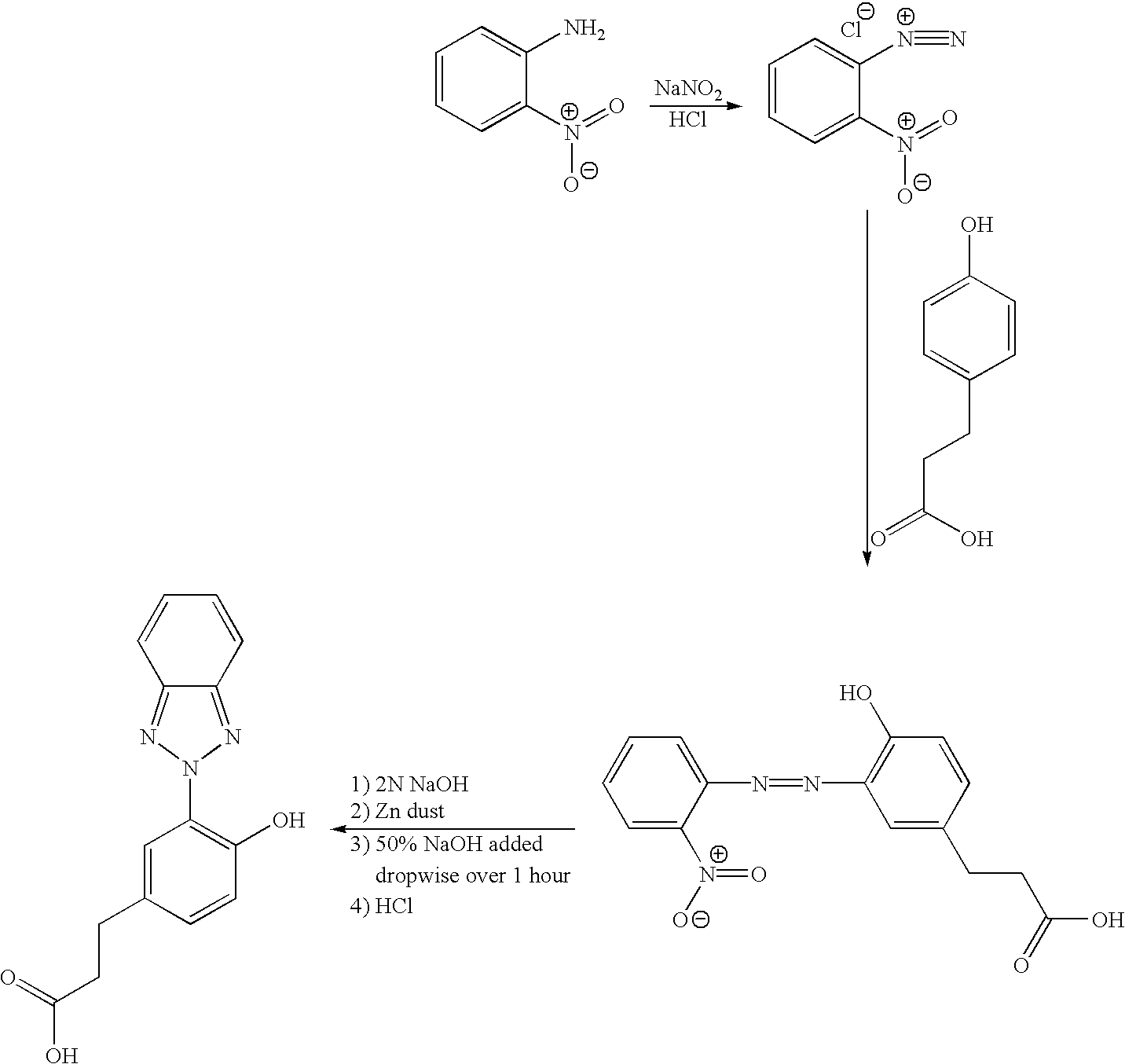


Claims (14)


Priority Applications (2)
| Application Number | Priority Date | Filing Date | Title |
|---|---|---|---|
| US10/001,572 US6861458B2 (en) | 2001-11-15 | 2001-11-15 | Photoprotective and lightfastness-enhancing siloxanes |
| US10/912,920 US7074853B2 (en) | 2001-11-15 | 2004-08-06 | Photoprotective and lightfastness-enhancing siloxanes |
Applications Claiming Priority (1)
| Application Number | Priority Date | Filing Date | Title |
|---|---|---|---|
| US10/001,572 US6861458B2 (en) | 2001-11-15 | 2001-11-15 | Photoprotective and lightfastness-enhancing siloxanes |
Related Child Applications (1)
| Application Number | Title | Priority Date | Filing Date |
|---|---|---|---|
| US10/912,920 Division US7074853B2 (en) | 2001-11-15 | 2004-08-06 | Photoprotective and lightfastness-enhancing siloxanes |
Publications (2)
| Publication Number | Publication Date |
|---|---|
| US20030133886A1 US20030133886A1 (en) | 2003-07-17 |
| US6861458B2 true US6861458B2 (en) | 2005-03-01 |
Family
ID=21696745
Family Applications (2)
| Application Number | Title | Priority Date | Filing Date |
|---|---|---|---|
| US10/001,572 Expired - Fee Related US6861458B2 (en) | 2001-11-15 | 2001-11-15 | Photoprotective and lightfastness-enhancing siloxanes |
| US10/912,920 Expired - Fee Related US7074853B2 (en) | 2001-11-15 | 2004-08-06 | Photoprotective and lightfastness-enhancing siloxanes |
Family Applications After (1)
| Application Number | Title | Priority Date | Filing Date |
|---|---|---|---|
| US10/912,920 Expired - Fee Related US7074853B2 (en) | 2001-11-15 | 2004-08-06 | Photoprotective and lightfastness-enhancing siloxanes |
Country Status (1)
| Country | Link |
|---|---|
| US (2) | US6861458B2 (en) |
Cited By (4)
| Publication number | Priority date | Publication date | Assignee | Title |
|---|---|---|---|---|
| US20060027349A1 (en) * | 2002-12-20 | 2006-02-09 | Shannon Thomas G | Strength additives for tissue products |
| US20090274791A1 (en) * | 2005-07-07 | 2009-11-05 | Mattson Pete H | Food Articles With Delivery Devices and Methods for the Preparation Thereof |
| US20100055281A1 (en) * | 2006-04-07 | 2010-03-04 | Ocean Nutrition Canada Limited | Emulsions and Microcapsules With Substances Having Low Interfacial Tension, Methods of Making and Using Thereof |
| US20100173002A1 (en) * | 2006-06-05 | 2010-07-08 | Jin Yulai | Microcapsules with improved shells |
Families Citing this family (20)
| Publication number | Priority date | Publication date | Assignee | Title |
|---|---|---|---|---|
| JP2005518114A (en) | 2002-02-14 | 2005-06-16 | アバイア テクノロジー コーポレーション | Presence tracking and namespace interconnect technology |
| US6974592B2 (en) * | 2002-04-11 | 2005-12-13 | Ocean Nutrition Canada Limited | Encapsulated agglomeration of microcapsules and method for the preparation thereof |
| BRPI0315977B8 (en) * | 2002-11-04 | 2021-05-25 | Dsm Nutritional Products Ag | microcapsules having multiple shells and method for preparing these |
| US7023980B2 (en) | 2002-12-04 | 2006-04-04 | Avaya Technology Corp. | Outbound dialing decision criteria based |
| US7474741B2 (en) | 2003-01-20 | 2009-01-06 | Avaya Inc. | Messaging advise in presence-aware networks |
| US9398152B2 (en) | 2004-02-25 | 2016-07-19 | Avaya Inc. | Using business rules for determining presence |
| FR2873920B1 (en) * | 2004-08-06 | 2006-11-24 | Tagasako Internat Corp | USE OF TRIMETHOXYBENZENE AS A SEDATIVE IN FRAGRANCE COMPOSITIONS |
| US8034450B2 (en) * | 2005-01-21 | 2011-10-11 | Ocean Nutrition Canada Limited | Microcapsules and emulsions containing low bloom gelatin and methods of making and using thereof |
| EP1848729A2 (en) * | 2005-01-27 | 2007-10-31 | Ocean Nutrition Canada Limited | Chromium-fatty acid compounds and methods of making and using thereof |
| CA2596023A1 (en) * | 2005-01-27 | 2006-11-09 | Ocean Nutrition Canada Ltd. | Fatty acid-benzenediol derivatives and methods of making and using thereof |
| DE102005004706A1 (en) * | 2005-02-02 | 2006-08-10 | Goldschmidt Gmbh | UV-absorbing quaternary polysiloxanes |
| US10166196B2 (en) | 2007-01-10 | 2019-01-01 | Dsm Nutritional Products Ag | Vegetarian microcapsules |
| US8150003B1 (en) | 2007-01-23 | 2012-04-03 | Avaya Inc. | Caller initiated undivert from voicemail |
| US20090254970A1 (en) * | 2008-04-04 | 2009-10-08 | Avaya Inc. | Multi-tier security event correlation and mitigation |
| US8301581B2 (en) | 2009-09-24 | 2012-10-30 | Avaya Inc. | Group compositing algorithms for presence |
| WO2014062856A1 (en) | 2012-10-16 | 2014-04-24 | Halozyme, Inc. | Hypoxia and hyaluronan and markers thereof for diagnosis and monitoring of diseases and conditions and related methods |
| US9540489B2 (en) * | 2013-07-29 | 2017-01-10 | The Procter & Gamble Company | Blocky cationic organopolysiloxane |
| CN112592477B (en) * | 2020-11-25 | 2023-03-03 | 深圳市优宝新材料科技有限公司 | Modified organosilicon polymer and preparation method thereof, lithium secondary battery |
| GB2623090A (en) | 2022-10-04 | 2024-04-10 | Sublino Ltd | Method of colouring |
| CN115558463B (en) * | 2022-10-20 | 2023-10-03 | 宁波聚力新材料科技有限公司 | High-heat-conductivity anti-sedimentation pouring sealant and preparation method thereof |
Citations (29)
| Publication number | Priority date | Publication date | Assignee | Title |
|---|---|---|---|---|
| US4256493A (en) | 1979-10-04 | 1981-03-17 | Dai Nippon Tokyo Co., Ltd. | Jet ink composition |
| US4859759A (en) | 1988-04-14 | 1989-08-22 | Kimberly-Clark Corporation | Siloxane containing benzotriazolyl/tetraalkylpiperidyl substituent |
| US5051458A (en) | 1988-05-27 | 1991-09-24 | Enichem Synthesis S.P.A. | UV stabilizers for organic polymers |
| US5089250A (en) | 1989-02-15 | 1992-02-18 | L'oreal | Cosmetic containing benzotriazole diorganopolysiloxanes |
| US5102707A (en) | 1988-08-04 | 1992-04-07 | Rhone-Poulenc Chimie | Diorganopolysiloxanes containing benzotriazole functional groups |
| US5270426A (en) | 1990-01-22 | 1993-12-14 | Shin-Etsu Chemical Co., Ltd. | Organosilicon compound |
| US5466768A (en) | 1991-04-25 | 1995-11-14 | Allergan, Inc. | Ultraviolet light absorbing compounds, silicone compositions and methods for making same |
| US5610257A (en) | 1994-11-08 | 1997-03-11 | L'oreal | Photoprotective/cosmetic compositions comprising benzotriazole-substituted polyorganosiloxanes/polyorganosilanes |
| WO1997020000A2 (en) | 1995-11-28 | 1997-06-05 | Kimberly-Clark Worldwide, Inc. | Improved colorant stabilizers |
| US5643356A (en) | 1993-08-05 | 1997-07-01 | Kimberly-Clark Corporation | Ink for ink jet printers |
| US5686633A (en) | 1988-12-14 | 1997-11-11 | Ciba Specialty Chemicals Corporation | Inks, particularly for ink jet printing |
| JPH107969A (en) | 1996-06-21 | 1998-01-13 | Showa Denko Kk | Ink composition |
| JPH107958A (en) | 1996-06-25 | 1998-01-13 | Showa Denko Kk | Additive for water-base ink and water-base ink composition |
| US5719204A (en) | 1995-12-26 | 1998-02-17 | Lexmark International, Inc. | Pigmented inks with polymeric dispersants |
| EP0867486A2 (en) | 1997-03-27 | 1998-09-30 | Lexmark International, Inc. | Ink jet ink containing wetting agent |
| JPH10278435A (en) | 1997-03-31 | 1998-10-20 | Oji Paper Co Ltd | Thermal recording medium |
| US5837792A (en) | 1995-06-23 | 1998-11-17 | Ciba Specialty Chemicals Corporation | Polysiloxane light stabilizers |
| JPH1199740A (en) | 1997-09-26 | 1999-04-13 | Oji Paper Co Ltd | Ink jet recording sheet |
| JP2000141875A (en) | 1998-11-10 | 2000-05-23 | Oji Paper Co Ltd | Inkjet recording sheet |
| US6087416A (en) | 1998-07-22 | 2000-07-11 | E.I. Du Pont De Nemours And Company | Aqueous pigmented ink jet inks for printing on vinyls |
| US6106599A (en) | 1999-06-29 | 2000-08-22 | Xerox Corporation | Inks |
| US6124376A (en) | 1998-08-24 | 2000-09-26 | Xerox Corporation | Ink composition for ink jet printing |
| US6142618A (en) | 1998-04-29 | 2000-11-07 | Xerox Corporation | System for depositing image enhancing fluid and ink jet printing process employing said system |
| US6200369B1 (en) | 1999-04-28 | 2001-03-13 | Xerox Corporation | Ink compositions |
| US6231655B1 (en) | 1999-03-19 | 2001-05-15 | Seiko Epson Corporation | Aqueous ink composition for use in an ink jet printer |
| US6245138B1 (en) | 1997-10-20 | 2001-06-12 | Bayer Aktiengesellschaft | Pigment preparations useful for ink-jet printing |
| US6270214B1 (en) | 1998-04-29 | 2001-08-07 | Xerox Corporation | Ink jet printing process with improved image fixation |
| EP1221381A2 (en) | 2000-12-28 | 2002-07-10 | Canon Kabushiki Kaisha | Recorded matter, method of producing recorded matter, method for improving image fastness, image fastness-improving agent, image fastness improving kit, dispenser and applicator |
| US6569511B1 (en) | 2001-11-15 | 2003-05-27 | Xerox Corporation | Recording sheets with lightfastness-enhancing siloxanes |
Family Cites Families (3)
| Publication number | Priority date | Publication date | Assignee | Title |
|---|---|---|---|---|
| US6113874A (en) * | 1998-04-29 | 2000-09-05 | Praxair Technology, Inc. | Thermochemical regenerative heat recovery process |
| US6210157B1 (en) * | 2000-04-07 | 2001-04-03 | Praxair Technology, Inc. | Fuel reformer combustion process |
| US6767530B2 (en) * | 2001-12-14 | 2004-07-27 | Praxair Technology, Inc. | Method for producing hydrogen |
-
2001
- 2001-11-15 US US10/001,572 patent/US6861458B2/en not_active Expired - Fee Related
-
2004
- 2004-08-06 US US10/912,920 patent/US7074853B2/en not_active Expired - Fee Related
Patent Citations (29)
| Publication number | Priority date | Publication date | Assignee | Title |
|---|---|---|---|---|
| US4256493A (en) | 1979-10-04 | 1981-03-17 | Dai Nippon Tokyo Co., Ltd. | Jet ink composition |
| US4859759A (en) | 1988-04-14 | 1989-08-22 | Kimberly-Clark Corporation | Siloxane containing benzotriazolyl/tetraalkylpiperidyl substituent |
| US5051458A (en) | 1988-05-27 | 1991-09-24 | Enichem Synthesis S.P.A. | UV stabilizers for organic polymers |
| US5102707A (en) | 1988-08-04 | 1992-04-07 | Rhone-Poulenc Chimie | Diorganopolysiloxanes containing benzotriazole functional groups |
| US5686633A (en) | 1988-12-14 | 1997-11-11 | Ciba Specialty Chemicals Corporation | Inks, particularly for ink jet printing |
| US5089250A (en) | 1989-02-15 | 1992-02-18 | L'oreal | Cosmetic containing benzotriazole diorganopolysiloxanes |
| US5270426A (en) | 1990-01-22 | 1993-12-14 | Shin-Etsu Chemical Co., Ltd. | Organosilicon compound |
| US5466768A (en) | 1991-04-25 | 1995-11-14 | Allergan, Inc. | Ultraviolet light absorbing compounds, silicone compositions and methods for making same |
| US5643356A (en) | 1993-08-05 | 1997-07-01 | Kimberly-Clark Corporation | Ink for ink jet printers |
| US5610257A (en) | 1994-11-08 | 1997-03-11 | L'oreal | Photoprotective/cosmetic compositions comprising benzotriazole-substituted polyorganosiloxanes/polyorganosilanes |
| US5837792A (en) | 1995-06-23 | 1998-11-17 | Ciba Specialty Chemicals Corporation | Polysiloxane light stabilizers |
| WO1997020000A2 (en) | 1995-11-28 | 1997-06-05 | Kimberly-Clark Worldwide, Inc. | Improved colorant stabilizers |
| US5719204A (en) | 1995-12-26 | 1998-02-17 | Lexmark International, Inc. | Pigmented inks with polymeric dispersants |
| JPH107969A (en) | 1996-06-21 | 1998-01-13 | Showa Denko Kk | Ink composition |
| JPH107958A (en) | 1996-06-25 | 1998-01-13 | Showa Denko Kk | Additive for water-base ink and water-base ink composition |
| EP0867486A2 (en) | 1997-03-27 | 1998-09-30 | Lexmark International, Inc. | Ink jet ink containing wetting agent |
| JPH10278435A (en) | 1997-03-31 | 1998-10-20 | Oji Paper Co Ltd | Thermal recording medium |
| JPH1199740A (en) | 1997-09-26 | 1999-04-13 | Oji Paper Co Ltd | Ink jet recording sheet |
| US6245138B1 (en) | 1997-10-20 | 2001-06-12 | Bayer Aktiengesellschaft | Pigment preparations useful for ink-jet printing |
| US6142618A (en) | 1998-04-29 | 2000-11-07 | Xerox Corporation | System for depositing image enhancing fluid and ink jet printing process employing said system |
| US6270214B1 (en) | 1998-04-29 | 2001-08-07 | Xerox Corporation | Ink jet printing process with improved image fixation |
| US6087416A (en) | 1998-07-22 | 2000-07-11 | E.I. Du Pont De Nemours And Company | Aqueous pigmented ink jet inks for printing on vinyls |
| US6124376A (en) | 1998-08-24 | 2000-09-26 | Xerox Corporation | Ink composition for ink jet printing |
| JP2000141875A (en) | 1998-11-10 | 2000-05-23 | Oji Paper Co Ltd | Inkjet recording sheet |
| US6231655B1 (en) | 1999-03-19 | 2001-05-15 | Seiko Epson Corporation | Aqueous ink composition for use in an ink jet printer |
| US6200369B1 (en) | 1999-04-28 | 2001-03-13 | Xerox Corporation | Ink compositions |
| US6106599A (en) | 1999-06-29 | 2000-08-22 | Xerox Corporation | Inks |
| EP1221381A2 (en) | 2000-12-28 | 2002-07-10 | Canon Kabushiki Kaisha | Recorded matter, method of producing recorded matter, method for improving image fastness, image fastness-improving agent, image fastness improving kit, dispenser and applicator |
| US6569511B1 (en) | 2001-11-15 | 2003-05-27 | Xerox Corporation | Recording sheets with lightfastness-enhancing siloxanes |
Non-Patent Citations (2)
| Title |
|---|
| Copending U.S. Appl. No., filed concurrently herewith, entitled "Aqueous Inks Containing Lightfastness-Enhancing Siloxanes," by Thomas W. Smith et al. |
| Copending U.S. Appl. No., filed concurrently herewith, entitled "Recording Sheets with Lightfastness-Enhancing Siloxanes," by Thomas W. Smith et al. |
Cited By (5)
| Publication number | Priority date | Publication date | Assignee | Title |
|---|---|---|---|---|
| US20060027349A1 (en) * | 2002-12-20 | 2006-02-09 | Shannon Thomas G | Strength additives for tissue products |
| US20090274791A1 (en) * | 2005-07-07 | 2009-11-05 | Mattson Pete H | Food Articles With Delivery Devices and Methods for the Preparation Thereof |
| US20100055281A1 (en) * | 2006-04-07 | 2010-03-04 | Ocean Nutrition Canada Limited | Emulsions and Microcapsules With Substances Having Low Interfacial Tension, Methods of Making and Using Thereof |
| US20100173002A1 (en) * | 2006-06-05 | 2010-07-08 | Jin Yulai | Microcapsules with improved shells |
| US9056058B2 (en) | 2006-06-05 | 2015-06-16 | Dsm Nutritional Products | Microcapsules with improved shells |
Also Published As
| Publication number | Publication date |
|---|---|
| US7074853B2 (en) | 2006-07-11 |
| US20030133886A1 (en) | 2003-07-17 |
| US20050014951A1 (en) | 2005-01-20 |
Similar Documents
| Publication | Publication Date | Title |
|---|---|---|
| US7074853B2 (en) | Photoprotective and lightfastness-enhancing siloxanes | |
| EP1084696B1 (en) | Cosmetic composition containing at least a silicone/acrylate copolymer and at least a photoprotectant | |
| JP5403361B2 (en) | Compositions based on hyperbranched condensation polymers and novel hyperbranched condensation polymers | |
| EP0601080B1 (en) | Filtering cosmetic composition containing a liposoluble filter polymer with hydrocarbonated structure and a filter silicone | |
| RU2434892C2 (en) | Polyammonium/polysiloxane copolymers | |
| JP5548367B2 (en) | Heterocyclic substituted novel condensation polymers | |
| EP0639969B1 (en) | Polymers in cosmetics and personal care products | |
| AU679391B2 (en) | Novel sunscreens, photoprotective cosmetic compositions containing them and uses thereof | |
| EP0709080B1 (en) | Photostable cosmetic light screening compositions | |
| CA2180030C (en) | Polyurethane and/or polyurea sequenced polycondensates with silicone grafts, cosmetic compositions containing the same and their use | |
| US20090076238A1 (en) | Mono-or Poly-Quarternary Polysiloxanes | |
| FR2535730A1 (en) | POLYQUATERAL POLYSILOXANE POLYMERS, PROCESS FOR THEIR PREPARATION AND THEIR USE IN COSMETIC COMPOSITIONS | |
| CA2309299C (en) | Compositions containing a polycondensate comprising at least a polyurethane and/or polyurea unit and a silicone comprising at least a carboxylic function | |
| US5223249A (en) | Cosmetic composition and methods containing diorganopoly-siloxanes containing a 2-hydroxybenzohenone group | |
| JP2874845B2 (en) | Sunscreen agent, light-protective cosmetic composition containing the same and use thereof | |
| CA2223004A1 (en) | Hair care composition including at least one silicone polymer grafted by anionic, amphoteric or non-ionic monomers, and at least one amphoteric polymer | |
| US5061479A (en) | Use of diorganopolysiloxanes containing a 3-benzylidene camphor functional group in cosmetics and new cosmetic compositions containing these compounds, intended for protecting the skin and hair | |
| US7129198B1 (en) | Use of benzotriazole UV absorbers | |
| JP4349915B2 (en) | Organosilicone derivatives of aminohydroxybenzophenone and their use as UVA filters in cosmetic preparations | |
| CN1871278A (en) | Water-soluble polyamioamides as sunscreen agents | |
| CN103476835B (en) | Silicone compound and photoprotective personal care composition comprising the same | |
| WO2024149558A1 (en) | Eyebrow make-up composition with a non-glycerolated silicone resin, a glycerolated silicone resin, a volatile hydrocarbon oil and a thickener | |
| FR2600249A2 (en) | Use of condensates of the amide-amine type for protection of the hair against attack by environmental agents, and especially against light, and process for protecting the hair | |
| JPH1045768A (en) | Novel organosilicon compounds and cosmetics containing the same | |
| MXPA00003896A (en) | Compositions containing a polycondensate comprising at least a polyurethane and/or polyurea unit and a silicone comprising at least a carboxylic function |
Legal Events
| Date | Code | Title | Description |
|---|---|---|---|
| AS | Assignment |
Owner name: XEROX CORPORATION, CONNECTICUT Free format text: ASSIGNMENT OF ASSIGNORS INTEREST;ASSIGNORS:SMITH, THOMAS W.;MCGRANE, KATHLEEN M.;REEL/FRAME:012353/0415;SIGNING DATES FROM 20011106 TO 20011108 |
|
| AS | Assignment |
Owner name: BANK ONE, NA, AS ADMINISTRATIVE AGENT, ILLINOIS Free format text: SECURITY AGREEMENT;ASSIGNOR:XEROX CORPORATION;REEL/FRAME:013111/0001 Effective date: 20020621 Owner name: BANK ONE, NA, AS ADMINISTRATIVE AGENT,ILLINOIS Free format text: SECURITY AGREEMENT;ASSIGNOR:XEROX CORPORATION;REEL/FRAME:013111/0001 Effective date: 20020621 |
|
| AS | Assignment |
Owner name: JPMORGAN CHASE BANK, AS COLLATERAL AGENT, TEXAS Free format text: SECURITY AGREEMENT;ASSIGNOR:XEROX CORPORATION;REEL/FRAME:015134/0476 Effective date: 20030625 Owner name: JPMORGAN CHASE BANK, AS COLLATERAL AGENT,TEXAS Free format text: SECURITY AGREEMENT;ASSIGNOR:XEROX CORPORATION;REEL/FRAME:015134/0476 Effective date: 20030625 |
|
| AS | Assignment |
Owner name: JP MORGAN CHASE BANK,TEXAS Free format text: SECURITY AGREEMENT;ASSIGNOR:XEROX CORPORATION;REEL/FRAME:016761/0158 Effective date: 20030625 Owner name: JP MORGAN CHASE BANK, TEXAS Free format text: SECURITY AGREEMENT;ASSIGNOR:XEROX CORPORATION;REEL/FRAME:016761/0158 Effective date: 20030625 |
|
| FPAY | Fee payment |
Year of fee payment: 4 |
|
| FPAY | Fee payment |
Year of fee payment: 8 |
|
| REMI | Maintenance fee reminder mailed | ||
| LAPS | Lapse for failure to pay maintenance fees | ||
| STCH | Information on status: patent discontinuation |
Free format text: PATENT EXPIRED DUE TO NONPAYMENT OF MAINTENANCE FEES UNDER 37 CFR 1.362 |
|
| STCH | Information on status: patent discontinuation |
Free format text: PATENT EXPIRED DUE TO NONPAYMENT OF MAINTENANCE FEES UNDER 37 CFR 1.362 |
|
| FP | Lapsed due to failure to pay maintenance fee |
Effective date: 20170301 |
|
| AS | Assignment |
Owner name: XEROX CORPORATION, CONNECTICUT Free format text: RELEASE BY SECURED PARTY;ASSIGNOR:JPMORGAN CHASE BANK, N.A. AS SUCCESSOR-IN-INTEREST ADMINISTRATIVE AGENT AND COLLATERAL AGENT TO BANK ONE, N.A.;REEL/FRAME:061360/0628 Effective date: 20220822 |
|
| AS | Assignment |
Owner name: XEROX CORPORATION, CONNECTICUT Free format text: RELEASE BY SECURED PARTY;ASSIGNOR:JPMORGAN CHASE BANK, N.A. AS SUCCESSOR-IN-INTEREST ADMINISTRATIVE AGENT AND COLLATERAL AGENT TO BANK ONE, N.A.;REEL/FRAME:061388/0388 Effective date: 20220822 Owner name: XEROX CORPORATION, CONNECTICUT Free format text: RELEASE BY SECURED PARTY;ASSIGNOR:JPMORGAN CHASE BANK, N.A. AS SUCCESSOR-IN-INTEREST ADMINISTRATIVE AGENT AND COLLATERAL AGENT TO JPMORGAN CHASE BANK;REEL/FRAME:066728/0193 Effective date: 20220822 |