US6830674B2 - Brightener additive and bath for alkaline cyanide-free zinc electroplating - Google Patents

Brightener additive and bath for alkaline cyanide-free zinc electroplating Download PDF

Info

Publication number
US6830674B2
US6830674B2 US10/288,113 US28811302A US6830674B2 US 6830674 B2 US6830674 B2 US 6830674B2 US 28811302 A US28811302 A US 28811302A US 6830674 B2 US6830674 B2 US 6830674B2
Authority
US
United States
Prior art keywords
bath
same
reducing sugar
polymeric quaternary
quaternary amine
Prior art date
Legal status (The legal status is an assumption and is not a legal conclusion. Google has not performed a legal analysis and makes no representation as to the accuracy of the status listed.)
Expired - Fee Related, expires
Application number
US10/288,113
Other versions
US20040084322A1 (en
Inventor
Robert J. Ludwig
William E. Rosenberg
Current Assignee (The listed assignees may be inaccurate. Google has not performed a legal analysis and makes no representation or warranty as to the accuracy of the list.)
Columbia Chemical Corp
Original Assignee
Columbia Chemical Corp
Priority date (The priority date is an assumption and is not a legal conclusion. Google has not performed a legal analysis and makes no representation as to the accuracy of the date listed.)
Filing date
Publication date
Application filed by Columbia Chemical Corp filed Critical Columbia Chemical Corp
Priority to US10/288,113 priority Critical patent/US6830674B2/en
Assigned to COLUMBIA CHEMICAL CORPORATION reassignment COLUMBIA CHEMICAL CORPORATION ASSIGNMENT OF ASSIGNORS INTEREST (SEE DOCUMENT FOR DETAILS). Assignors: LUDWIG, ROBERT J., ROSENBERG, WILLIAM E.
Priority to AU2003265466A priority patent/AU2003265466A1/en
Priority to PCT/US2003/025791 priority patent/WO2004044269A2/en
Publication of US20040084322A1 publication Critical patent/US20040084322A1/en
Application granted granted Critical
Publication of US6830674B2 publication Critical patent/US6830674B2/en
Adjusted expiration legal-status Critical
Expired - Fee Related legal-status Critical Current

Links

Classifications

    • CCHEMISTRY; METALLURGY
    • C25ELECTROLYTIC OR ELECTROPHORETIC PROCESSES; APPARATUS THEREFOR
    • C25DPROCESSES FOR THE ELECTROLYTIC OR ELECTROPHORETIC PRODUCTION OF COATINGS; ELECTROFORMING; APPARATUS THEREFOR
    • C25D3/00Electroplating: Baths therefor
    • C25D3/02Electroplating: Baths therefor from solutions
    • C25D3/22Electroplating: Baths therefor from solutions of zinc

Definitions

  • the present invention relates to aqueous alkaline non-cyanide zinc plating baths, and to a novel brightening agent for such electroplating baths.
  • This invention relates to improvements in the electrodeposition of zinc from aqueous alkaline cyanide-free plating baths.
  • the alkaline cyanide-free zinc plating baths that have been developed over the years are generally based on polymeric quaternary amines as brightening agents.
  • U.S. Pat. No. 3,824,158 describes an aqueous alkaline zinc electroplating bath containing an epihalohydrin quaternary salt of aminated polyepichlorohydrin.
  • 3,869,358 describes an aqueous alkaline zinc plating bath for electroplating bright metallic zinc deposits having dissolved therein a water soluble reaction product of an amine and an epihalohydrin containing recurring tertiary and/or quaternary amine groups.
  • U.S. Pat. No. 3,954,575 describes an alkaline non-cyanide zinc plating bath wherein the brightener additive comprises a water soluble polymer prepared by the reaction of at least one epihalohydrin with at least one nitrogen heterocyclic compound.
  • U.S. Pat. No. 5,435,898 describes an aqueous bath for electrodepositing zinc and zinc alloys wherein the bath contains an effective additive amount of a quaternary ammonium polymer to produce enhanced deposits.
  • German Patent DE 198 40 019 C 1 describes a brightener for alkaline cyanide-free zinc plating comprised of a ureylene quaternary ammonium polymer.
  • An object of the present invention is to provide an aqueous alkaline cyanide-free zinc electroplating bath that produces bright electrodeposits of zinc.
  • Another object of the present invention is to provide an aqueous alkaline cyanide-free zinc electroplating bath that produces bright, clear electrodeposits of zinc without interfering with the precipitation of metals during waste treatment.
  • a reducing sugar to an aqueous alkaline cyanide-free zinc electroplating bath having a polymeric quaternary amine dissolved therein.
  • the polymeric quaternary amines of this invention are well known in the plating industry and include epihalohydrin reaction products with various amines, quaternized polyethyleneimines, and ureylene quaternary ammonium polymers.
  • the electrodeposits achieved are bright and are produced in the presence of metal hydroxides on the surface of the parts to be plated.
  • the improved baths of this invention have an advantage over baths of the prior art in that they readily permit the precipitation of metals during waste treatment procedures.
  • Aqueous alkaline cyanide-free zinc electroplating baths are well known in the art and have been widely used for many years.
  • alkaline cyanide-free it is meant that the bath is essentially free of sodium cyanide salts.
  • an aqueous alkaline cyanide-free zinc electroplating bath comprises a zinc compound and an alkali hydroxide.
  • the source of zinc may be any soluble zinc compound and is usually zinc oxide and the base is usually sodium hydroxide or potassium hydroxide.
  • the predominate zinc species in the bath at high pH ranges is believed to be the zincate ion.
  • the “zinc ion” includes zincate or other ionic species of zinc useful in electroplating baths for electroplating metallic zinc therefrom.
  • the amount of dissolved zinc is generally from about 3 to about 40 g/l and desirably from about 5 to about 25 g/l and the amount of the alkaline hydroxide is generally from about 50 to about 200 g/l and desirably from about 75 to about 165 g/l.
  • the polymeric quaternary amines of this invention vary widely. As a general requirement, they are soluble in the plating bath and have a brightening effect during electrodeposition.
  • the group of polymeric quaternary amines include such compounds as the reaction of an epihalohydrin with a nitrogen heterocylclic compound as described in U.S. Pat. No. 3,954,575, an ephihalohydrin quaternary salt of aminated polyepichlorohydrin as described in U.S. Pat. No. 3,824,158, and the reaction product of an amine with an epihalohydrin producing a compound containing recurring tertiary and/or quaternary amine groups as described in U.S. Pat. No. 3,869,358, all hereby fully incorporated by reference.
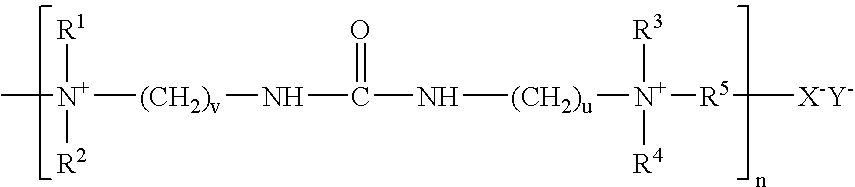
  • Polymeric quaternary amines disclosed in part in U.S. Pat. No. 4,157,388 and German Patent DE 198 40 019 C1 have the following general formulas:
  • R 1 , R 2 , R 3 , and R 4 independently, can be the same or different and includes —CH 3 , —CH 2 CH 3 , —CH(CH 3 ) 2 , or —CH 2 CH 2 OH
  • R 5 is —CH 2 CH 2 —, —CH 2 CH 2 CH 2 —, —CH 2 CH 2 CH 2 CH 2 —, —CH 2 CHOHCH 2 —, or —CH 2 CH 2 OCH 2 CH 2 —
  • X and Y can be the same or different and include Cl, Br, and I
  • v, u, and t can be the same or different and each can be from 1 to about 7
  • R 6 , R 7 , R 8 , and R 9 independently, can be the same or different and include —H, —CH 3 , —CH 2 CH 3 , —CH(CH 3 ) 2 , and —CH 2 CH 2 OH, and n is 2 to about 200.
  • the preferred polymeric quaternary amine of this invention are Mirapol WT and Mirapol AD-1 manufactured by Rhone-Poulenc.
  • the Mirapol WT is represented in the above general Formula A wherein R 1 , R 2 , R 3 , and R 4 are CH 3 , R 5 , is —CH 2 CH 2 OCH 2 CH 2 —, v and u are 3, X and Y are Cl, and n is an average of about 6.
  • the CAS Number for Mirapol WT is 68555-36-2 and for Mirapol AD-1 is 90624-75-2.
  • the polymeric quaternary amines are used herein by employing them in amounts generally from about 0.1 g/l to 10 g/l and preferably from about 0.5 g/l to about 3 g/l in the bath.
  • a thin film of hydrated iron oxides are formed on the surface of the parts. Although it is not understood how, the hydrated iron oxides interfere with the brightening ability of the polymeric quaternary amines used as brightening agents.
  • the hydrated iron oxides are present on the surface a dull pattern of electroplated zinc is initially formed. Since aqueous alkaline cyanide-free zinc electroplating baths do not have much leveling ability, the dull pattern of initially deposited zinc can be observed even after a thick layer of bright zinc is deposited over it.
  • the presence of a reducing sugar removes the thin film of hydrated iron oxides prior to electrodeposition by either reducing the iron cation and thus forming a soluble hydroxide or by selectively dissolving the hydrated iron oxides. Whichever the case, a clean film-free part surface is produced eliminating the initial dull deposition of zinc.
  • Reducing sugars are carbohydrates that are easily oxidized by mild oxidizing agents. Sugars such as glucose and fructose are reducing sugars.
  • a sugar reduces Tollens' reagent from Ag(NH 3 ) 2 + to metallic silver, or if it reduces Fehling's solution from Cu(NH 3 ) 4 ++ to red cuprous oxide, it is said to be a reducing sugar.
  • the reducing sugars of this invention include fructose, ribose, arabinose, xylose, lyxose, allose, altrose, glucose, gulose, mannose, idose, galactose, talose, glucosamine hydrochloride, and lactose.
  • the reducing sugars are used by employing them in amounts generally from about 0.5 g/l to 20 g/l and preferably from about 1 g/l to about 10 g/l.
  • the plating bath of this invention can also contain additives of the type conventionally employed in alkaline cyanide-free zinc electroplating baths and include one or more materials such as polymeric amines, gelatin, glues, peptone, thiourea, p-methoxybenzaldehyde, heliotropine, veratraldehyde, vanillin, and N-benzyl-3-carboxypyridinium chloride-sodium salt, and the reaction products of epichlorohydrin, formaldehyde and amines.
  • additives of the type conventionally employed in alkaline cyanide-free zinc electroplating baths and include one or more materials such as polymeric amines, gelatin, glues, peptone, thiourea, p-methoxybenzaldehyde, heliotropine, veratraldehyde, vanillin, and N-benzyl-3-carboxypyridinium chloride-sodium salt, and the reaction products of epic
  • the quaternary amine polymers and reducing sugars can be added separately to the plating bath by first dissolving them in a suitable solvent such as water. It is often desirable to make a concentrated mixture of the above additives in a suitable solvent and add this mixture to the bath instead of adding them separately.
  • this mixture of brighteners, or brightener contains from about 2 to 50 percent by weight of the polymeric quaternary amine and from about 1 to 20 percent by weight of the reducing sugar the remainder being suitable solvent such as water.
  • the mixture of brighteners, or brightener may also contain from about 0.5 to 30 percent by weight of additives conventionally employed in alkaline cyanide-free zinc electroplating baths as set forth herein above and fully incorporated by reference such as polymeric amine, gelatin, glues, peptone, etc.
  • Hull Cell tests were run on each of the above baths at 1 ampere for 5 minutes on zinc plated steel test panels that were stripped in 30% hydrochloric acid, rinsed and wiped with a clean wet paper towel before plating.
  • test baths were prepared as above but without the reducing sugars. 1 ampere, 5 minute test panels were run as above with the test panel preparation being the same.
  • the baths containing the reducing sugars produced brighter, cloud-free electrodeposits of zinc compared to the baths that did not contain the reducing sugars which produced dull, cloudy electrodeposits of zinc.

Landscapes

  • Chemical & Material Sciences (AREA)
  • Engineering & Computer Science (AREA)
  • Chemical Kinetics & Catalysis (AREA)
  • Electrochemistry (AREA)
  • Materials Engineering (AREA)
  • Metallurgy (AREA)
  • Organic Chemistry (AREA)
  • Electroplating And Plating Baths Therefor (AREA)
  • Cosmetics (AREA)

Abstract

An aqueous alkaline non-cyanide zinc electroplating bath containing zinc ions for producing bright electrodeposits of zinc and a brightening agent comprising a polymeric quaternary amine and a reducing sugar, and a compound that forms a reducing sugar upon hydrolysis.

Description

FIELD OF THE INVENTION
The present invention relates to aqueous alkaline non-cyanide zinc plating baths, and to a novel brightening agent for such electroplating baths.
BACKGROUND OF THE INVENTION
This invention relates to improvements in the electrodeposition of zinc from aqueous alkaline cyanide-free plating baths. The alkaline cyanide-free zinc plating baths that have been developed over the years are generally based on polymeric quaternary amines as brightening agents. U.S. Pat. No. 3,824,158 describes an aqueous alkaline zinc electroplating bath containing an epihalohydrin quaternary salt of aminated polyepichlorohydrin. U.S. Pat. No. 3,869,358 describes an aqueous alkaline zinc plating bath for electroplating bright metallic zinc deposits having dissolved therein a water soluble reaction product of an amine and an epihalohydrin containing recurring tertiary and/or quaternary amine groups. U.S. Pat. No. 3,954,575 describes an alkaline non-cyanide zinc plating bath wherein the brightener additive comprises a water soluble polymer prepared by the reaction of at least one epihalohydrin with at least one nitrogen heterocyclic compound. U.S. Pat. No. 5,435,898 describes an aqueous bath for electrodepositing zinc and zinc alloys wherein the bath contains an effective additive amount of a quaternary ammonium polymer to produce enhanced deposits. German Patent DE 198 40 019 C 1 describes a brightener for alkaline cyanide-free zinc plating comprised of a ureylene quaternary ammonium polymer.
When polymeric quaternary amines are used as brightener additives in an aqueous alkaline cyanide-free zinc plating bath, metal hydroxides on the surface of the parts to be plated cause the electrodeposit to have a cloudy, dull appearance. Accordingly, complexing agents such as salts of gluconic acid and E.D.T.A. are added to the baths to overcome the detrimental effects of the presence of metal hydroxides. While this solves the problem of cloudy, dull electrodeposits, precipitation of metals during waste treatment becomes quite difficult.
SUMMARY OF THE INVENTION
An object of the present invention is to provide an aqueous alkaline cyanide-free zinc electroplating bath that produces bright electrodeposits of zinc.
It is a further object of the present invention to provide bright, clear electrodeposits of zinc in the presence of metal hydroxides on the surface of the parts.
Another object of the present invention is to provide an aqueous alkaline cyanide-free zinc electroplating bath that produces bright, clear electrodeposits of zinc without interfering with the precipitation of metals during waste treatment.
These and other objects and advantages will be apparent from the following description.
These objects and advantages are achieved by the addition of a reducing sugar to an aqueous alkaline cyanide-free zinc electroplating bath having a polymeric quaternary amine dissolved therein. The polymeric quaternary amines of this invention are well known in the plating industry and include epihalohydrin reaction products with various amines, quaternized polyethyleneimines, and ureylene quaternary ammonium polymers. The electrodeposits achieved are bright and are produced in the presence of metal hydroxides on the surface of the parts to be plated. Moreover, the improved baths of this invention have an advantage over baths of the prior art in that they readily permit the precipitation of metals during waste treatment procedures.
DETAILED DESCRIPTION
Aqueous alkaline cyanide-free zinc electroplating baths are well known in the art and have been widely used for many years. By the term alkaline cyanide-free it is meant that the bath is essentially free of sodium cyanide salts. In general, an aqueous alkaline cyanide-free zinc electroplating bath comprises a zinc compound and an alkali hydroxide. The source of zinc may be any soluble zinc compound and is usually zinc oxide and the base is usually sodium hydroxide or potassium hydroxide. The predominate zinc species in the bath at high pH ranges is believed to be the zincate ion. It is to be understood that as used herein, the “zinc ion” includes zincate or other ionic species of zinc useful in electroplating baths for electroplating metallic zinc therefrom. The amount of dissolved zinc is generally from about 3 to about 40 g/l and desirably from about 5 to about 25 g/l and the amount of the alkaline hydroxide is generally from about 50 to about 200 g/l and desirably from about 75 to about 165 g/l.
The polymeric quaternary amines of this invention vary widely. As a general requirement, they are soluble in the plating bath and have a brightening effect during electrodeposition. The group of polymeric quaternary amines include such compounds as the reaction of an epihalohydrin with a nitrogen heterocylclic compound as described in U.S. Pat. No. 3,954,575, an ephihalohydrin quaternary salt of aminated polyepichlorohydrin as described in U.S. Pat. No. 3,824,158, and the reaction product of an amine with an epihalohydrin producing a compound containing recurring tertiary and/or quaternary amine groups as described in U.S. Pat. No. 3,869,358, all hereby fully incorporated by reference. Polymeric quaternary amines disclosed in part in U.S. Pat. No. 4,157,388 and German Patent DE 198 40 019 C1 have the following general formulas:
Figure US06830674-20041214-C00001
And
Figure US06830674-20041214-C00002
And
Figure US06830674-20041214-C00003
Wherein R1, R2, R3, and R4 independently, can be the same or different and includes —CH3, —CH2CH3, —CH(CH3)2, or —CH2CH2OH, and wherein R5 is —CH2CH2—, —CH2CH2CH2—, —CH2CH2CH2CH2—, —CH2CHOHCH2—, or —CH2CH2OCH2CH2—, and wherein X and Y can be the same or different and include Cl, Br, and I, and wherein v, u, and t can be the same or different and each can be from 1 to about 7, and wherein R6, R7, R8, and R9, independently, can be the same or different and include —H, —CH3, —CH2CH3, —CH(CH3)2, and —CH2CH2OH, and n is 2 to about 200.
The preferred polymeric quaternary amine of this invention are Mirapol WT and Mirapol AD-1 manufactured by Rhone-Poulenc. The Mirapol WT is represented in the above general Formula A wherein R1, R2, R3, and R4 are CH3, R5, is —CH2CH2OCH2CH2—, v and u are 3, X and Y are Cl, and n is an average of about 6. The Mirapol AD-1 is represented in the above general Formula B wherein R1, R2, R3, and R4 are CH3, R5 is —CH2CH2OCH2CH2—, v, u, and t are 3, X and Y are Cl and n=100. The CAS Number for Mirapol WT is 68555-36-2 and for Mirapol AD-1 is 90624-75-2.
The polymeric quaternary amines are used herein by employing them in amounts generally from about 0.1 g/l to 10 g/l and preferably from about 0.5 g/l to about 3 g/l in the bath.
During the process of cleaning steel parts before electroplating, a thin film of hydrated iron oxides are formed on the surface of the parts. Although it is not understood how, the hydrated iron oxides interfere with the brightening ability of the polymeric quaternary amines used as brightening agents. When the hydrated iron oxides are present on the surface a dull pattern of electroplated zinc is initially formed. Since aqueous alkaline cyanide-free zinc electroplating baths do not have much leveling ability, the dull pattern of initially deposited zinc can be observed even after a thick layer of bright zinc is deposited over it.
The presence of a reducing sugar removes the thin film of hydrated iron oxides prior to electrodeposition by either reducing the iron cation and thus forming a soluble hydroxide or by selectively dissolving the hydrated iron oxides. Whichever the case, a clean film-free part surface is produced eliminating the initial dull deposition of zinc.
The reducing sugars are well documented. Reducing sugars are carbohydrates that are easily oxidized by mild oxidizing agents. Sugars such as glucose and fructose are reducing sugars.
If a sugar reduces Tollens' reagent from Ag(NH3)2 + to metallic silver, or if it reduces Fehling's solution from Cu(NH3)4 ++ to red cuprous oxide, it is said to be a reducing sugar. Examples of the reducing sugars of this invention include fructose, ribose, arabinose, xylose, lyxose, allose, altrose, glucose, gulose, mannose, idose, galactose, talose, glucosamine hydrochloride, and lactose.
The reducing sugars are used by employing them in amounts generally from about 0.5 g/l to 20 g/l and preferably from about 1 g/l to about 10 g/l.
The plating bath of this invention can also contain additives of the type conventionally employed in alkaline cyanide-free zinc electroplating baths and include one or more materials such as polymeric amines, gelatin, glues, peptone, thiourea, p-methoxybenzaldehyde, heliotropine, veratraldehyde, vanillin, and N-benzyl-3-carboxypyridinium chloride-sodium salt, and the reaction products of epichlorohydrin, formaldehyde and amines.
The quaternary amine polymers and reducing sugars can be added separately to the plating bath by first dissolving them in a suitable solvent such as water. It is often desirable to make a concentrated mixture of the above additives in a suitable solvent and add this mixture to the bath instead of adding them separately. In general this mixture of brighteners, or brightener, contains from about 2 to 50 percent by weight of the polymeric quaternary amine and from about 1 to 20 percent by weight of the reducing sugar the remainder being suitable solvent such as water. The mixture of brighteners, or brightener, may also contain from about 0.5 to 30 percent by weight of additives conventionally employed in alkaline cyanide-free zinc electroplating baths as set forth herein above and fully incorporated by reference such as polymeric amine, gelatin, glues, peptone, etc.
In order to further illustrate the composition and process of the present invention, the following examples are provided. It is understood that the examples are provided for illustrative purposes and are not intended to limit the scope of the present invention as herein described and as set forth in the claims.
EXAMPLES Example 1
Zinc Ions 12 g/l
Sodium Hydroxide 120 g/l
Mirapol WT (62% by wt.) 2.0 g/l
N-Benzyl-3-carboxypyridinium 0.02 g/l
Chloride, sodium salt
D-glucose 5.0 g/l
Example 2
Zinc Ions 11 g/l
Sodium Hydroxide 135 g/l
Reaction Product of Epichlorohydrin and N- 4.0
dimethylaminopropylamine as shown in
Procedure 1 in U.S. Pat. No. 3,869,358
N-Benzyl-3-carboxypyridinium 0.03 g/l
Chloride, sodium salt
Fructose 4.0 g/l
Example 3
Zinc Ions 10 g/l
Sodium Hydroxide 100 g/l
Mirapol AD-1 (62% by wt.) 2.0 g/l
N-Benzyl-3-carboxypyridinium 0.02 g/l
Chloride, sodium salt
Lactose 6.0 g/l
Example 4
Zinc Ions 7.5 g/l
Sodium Hydroxide 90 g/l
Mirapol AD-1 (62% by wt.) 3.0 g/l
p-Methoxybenzaldehyde, sodium 0.04 g/l
bisulfite adduct
Fructose 6.0 g/l
Hull Cell tests were run on each of the above baths at 1 ampere for 5 minutes on zinc plated steel test panels that were stripped in 30% hydrochloric acid, rinsed and wiped with a clean wet paper towel before plating. For comparison, test baths were prepared as above but without the reducing sugars. 1 ampere, 5 minute test panels were run as above with the test panel preparation being the same. In comparing the results, the baths containing the reducing sugars produced brighter, cloud-free electrodeposits of zinc compared to the baths that did not contain the reducing sugars which produced dull, cloudy electrodeposits of zinc.
Waste treatment tests were performed by making 1 percent by volume solutions in water of the bath from Example 1 to simulate rinse water from commercial zinc electroplating operations. To see if the bath ingredients interfere with the precipitation of metals, 100 ppm of Ni++ as nickel sulfate, and 100 ppm of Cu++ as copper sulfate were added separately to the simulated rinse water samples. The solutions were adjusted to pH=9 with a 50% solution of sulfuric acid as is normally done during waste treatment to precipitate the insoluble metal hydroxides. The solutions were then filtered and analyzed by atomic absorption spectroscopy to determine the amount of metals left in solution. For comparison these tests were repeated with the bath of Example 1 except that equal amounts, i.e. 5.0 g/l each of E.D.T.A. tetrasodium salt, and sodium gluconate were substituted for the D-glucose. Chart 1 shows the results of the analysis of the filtrates.
CHART 1
Results of Waste Treatment Tests
100 ppm
No metal Cu++
1% Solution added 100 ppm Ni++ added added
Bath from Example 1 Zn++ = Ni++ = Cu++ =
with D-glucose 0.1 ppm less than 0.2 ppm 0.05 ppm
Bath from Example 1 Zn++ = Ni++ = 1.1 ppm Cu++ =
with E.D.T.A. 8.0 ppm 5.0 ppm
Tetrasodium salt
Bath from Example 1 Zn++ = Ni++ = 2.0 ppm Cu++ =
with Sodium 0.3 ppm 0.05 ppm
Gluconate
It can be seen from Chart 1 that E.D.T.A. tetrasodium salt and sodium gluconate interfere with the precipitation of metal hydroxides from electroplating rinses and an equal amount of D-glucose does not.
While in accordance with the patent statutes the best mode and preferred embodiment have been set forth, the scope of the invention is not intended to be limited thereto, but only by the scope of the attached claims.

Claims (22)

What is claimed is:
1. An aqueous alkaline non-cyanide zinc electroplating bath, comprising:
zinc ions, a polymeric quaternary amine, and a reducing sugar.
2. The bath of claim 1, wherein said polymeric quaternary amine has the formula:
Figure US06830674-20041214-C00004
or,
Figure US06830674-20041214-C00005
or,
Figure US06830674-20041214-C00006
or combinations thereof,
wherein R1, R2, R3, and R4, independently, are the same or different and include —CH3, —CH2CH3, —CH(CH3)2, or —CH2CH2OH,
wherein R5 is —CH2CH2—, —CH2CH2CH2—, —CH2CH2CH2CH2—, CH2CHOHCH2—, or —CH2CH2OCH2CH2—,
wherein X and Y can be the same or different and include Cl, Br, and I,
wherein v, u, and t can be the same or different and each can be from 1 to about 7,
wherein R6, R7, R8, and R9, independently, are the same or different and include —H, —CH3, —CH2CH3, —CH(CH3)2, or —CH2CH2OH,
and wherein n is 2 to about 200.
3. The bath of claim 2, wherein said reducing sugar comprises fructose, ribose, arabinose, xylose, lyxose, allose, altrose, glucose, gulose, mannose, idose, galactose, talose, glucosamine hydrochloride, or lactose, or combinations thereof.
4. The bath of claim 3, including at least one compound comprising a polymeric amine, gelatin, glue, peptone, thiourea, p-methoxybenzaldehyde, heliotropine, veratraldehyde, vanillin, N-benzyl-3-carboxypyridinium chloride-sodium salt, or the reaction product of epichlorohydrin, formaldehyde and an amine.
5. The bath of claim 4, wherein said polymeric quaternary amine has the formula:
Figure US06830674-20041214-C00007
where R1, R2, R3, and R4 are —CH3, R5 is —CH2CHOCH2CH2—, u and v are the same and are 3, X and Y are Cl, and n is 6.
6. The bath of claim 4, wherein said polymeric quaternary amine has the formula:
Figure US06830674-20041214-C00008
where R1, R2, R3, and R4 are —CH3, R5 is —CH2CH2OCH2CH2—, u, v, and t are the same and are 3, X and Y are Cl, and n is 2 to about 200.
7. The bath of claim 4, wherein said polymeric quaternary amine has the formula:
Figure US06830674-20041214-C00009
where R1, R2, R3, and R4 are —CH3, R5 is —CH2CH2CH2—, u and v are the same and are 3, X and Y are the same or different and are Cl, Br, or I, and n is 2 to about 200.
8. The bath of claim 4, wherein said polymeric quaternary amine is dissolved therein in an amount from about 0.1 to about 10 g/l.
9. The bath of claim 8, wherein said reducing sugar is dissolved therein in an amount from about 0.5 to about 20 g/l.
10. The bath of claim 4, wherein said polymeric quaternary amine polymer is dissolved therein in an amount from about 0.5 to about 3 g/l.
11. The bath of claim 10, wherein said reducing sugar is dissolved therein in an amount from about 1 to about 10 g/l.
12. The bath of claim 2, wherein said reducing sugar is D-glucose.
13. The bath of claim 2, wherein said reducing sugar is fructose.
14. The bath of claim 2, wherein said reducing sugar is lactose.
15. A brightener composition for electrodeposits of zinc from an aqueous alkaline plating bath, comprising:
from about 2% to about 50% by weight of a polymeric quaternary amine, and from about 1% to about 20% by weight of a reducing sugar, and the remainder being a suitable solvent;
wherein said polymeric quaternary amine has the formula:
Figure US06830674-20041214-C00010
wherein R1, R2, R3, and R4, independently, are the same or different and include —CH3, —CH2CH3, —CH(CH3)2, or —CH2CH2OH,
wherein R5 is —CH2CH2—, —CH2CH2CH2—, —CH2CH2CH2CH2—, —CH2CHOHCH2—, or —CH2CH2OCH2CH2—,
wherein X and Y are the same or different and includes Cl, Br, or I,
wherein y, and u, are the same or different and each independently are from 1 to about 7,
wherein n is 2 to about 200.
16. The brightener composition of claim 15, further including from about 0.5% to about 30% by weight of at least one compound comprising a polymeric amine, gelatin, glue, peptone, thiourea, p-methoxybenzaldehyde, heliotropine, veratraldehyde, vanillin, N-benzyl-3-carboxypyridinium chloride-sodium salt, or the reaction product of epichlorohydrin, formaldehyde and an amine.
17. The brightener composition of claim 16, wherein:
the reducing sugar comprises fructose, ribose, arabinose, xylose, lyxose, allose, altrose, glucose, gulose, mannose, idose, galactose, talose, glucosamine hydrochloride, or lactose.
18. The brightener composition of claim 17, wherein in said polymeric quaternary amine formula,
R1, R2, R3, and R4 are —CH3, R5 is —CH2CH2OCH2CH2—, u and v are the same and are 3, X and Y are Cl, and n is about 6.
19. The brightener composition of claim 17, wherein in said polymeric quaternary amine formula,
R1, R2, R3, and R4 are —CH3, R5 is —CH2CH2CH2—, u and v are the same and are 3, X and Y are the same or different and are Cl, Br, or I, and n is 2 to about 200.
20. The brightener composition of claim 15, wherein said reducing sugar is D-glucose.
21. The brightener composition of claim 15, wherein said reducing sugar is fructose.
22. The brightener composition of claim 15, wherein said reducing sugar is lactose.
US10/288,113 2002-11-05 2002-11-05 Brightener additive and bath for alkaline cyanide-free zinc electroplating Expired - Fee Related US6830674B2 (en)

Priority Applications (3)

Application Number Priority Date Filing Date Title
US10/288,113 US6830674B2 (en) 2002-11-05 2002-11-05 Brightener additive and bath for alkaline cyanide-free zinc electroplating
AU2003265466A AU2003265466A1 (en) 2002-11-05 2003-08-15 Brightener additive and bath for alkaline cyanide-free zinc electroplating
PCT/US2003/025791 WO2004044269A2 (en) 2002-11-05 2003-08-15 Brightener additive and bath for alkaline cyanide-free zinc electroplating

Applications Claiming Priority (1)

Application Number Priority Date Filing Date Title
US10/288,113 US6830674B2 (en) 2002-11-05 2002-11-05 Brightener additive and bath for alkaline cyanide-free zinc electroplating

Publications (2)

Publication Number Publication Date
US20040084322A1 US20040084322A1 (en) 2004-05-06
US6830674B2 true US6830674B2 (en) 2004-12-14

Family

ID=32175834

Family Applications (1)

Application Number Title Priority Date Filing Date
US10/288,113 Expired - Fee Related US6830674B2 (en) 2002-11-05 2002-11-05 Brightener additive and bath for alkaline cyanide-free zinc electroplating

Country Status (3)

Country Link
US (1) US6830674B2 (en)
AU (1) AU2003265466A1 (en)
WO (1) WO2004044269A2 (en)

Cited By (2)

* Cited by examiner, † Cited by third party
Publication number Priority date Publication date Assignee Title
CN107502925A (en) * 2017-07-12 2017-12-22 娄如祥 Watersoluble chlorinated thing zinc-plating brightener
EP2978877B1 (en) 2013-03-28 2020-09-23 Coventya SAS Electroplating bath for zinc-iron alloys, method for depositing zinc-iron alloy on a device and such a device

Families Citing this family (10)

* Cited by examiner, † Cited by third party
Publication number Priority date Publication date Assignee Title
DE102005049789A1 (en) * 2005-10-18 2007-04-19 Basf Ag Aqueous, alkylic, cyanide-free bath for the galvanic deposition of zinc and zinc alloy coatings
DE102005060030A1 (en) * 2005-12-15 2007-06-21 Coventya Gmbh New polymer with at least a partially cross-linked polymer main chains obtained from amine or methylene repeat units useful as an additive for the galvanic separation of metals and/or metal alloys
EP1870495A1 (en) * 2006-06-21 2007-12-26 Atotech Deutschland Gmbh Aqueous alkaline, cyanide-free, bath for the galvanic deposition of Zinc and Zinc alloy layers
CN101555609B (en) * 2009-04-28 2010-08-04 武汉风帆电镀技术有限公司 Brightener of cyanide-free alkaline environmental protection galvanizing composition
CN101565839B (en) * 2009-04-28 2011-04-06 武汉风帆电镀技术有限公司 Cyanogen to cyanogen-free alkali environment-friendly galvanizing brightener
EP2292679B1 (en) 2009-09-08 2020-03-11 ATOTECH Deutschland GmbH Polymers with amino end groups and their use as additives for galvanic zinc and zinc alloy baths
CN103668359B (en) * 2012-09-06 2016-03-02 上海造币有限公司 A kind of electroplate liquid of multilayer non-cyanide copper electroplating-tin alloy coat, electroplating technology and coin thereof
ES2808109T3 (en) * 2014-07-04 2021-02-25 Basf Se Alkaline Zinc Plating Additive
CN104789998B (en) * 2015-05-05 2017-02-22 广东达志环保科技股份有限公司 Bright-type alkaline cyanide-free galvanization electroplating solution and preparation method
CN110205659B (en) * 2019-07-17 2020-06-16 广州三孚新材料科技股份有限公司 Electrotinning additive and preparation method thereof

Citations (8)

* Cited by examiner, † Cited by third party
Publication number Priority date Publication date Assignee Title
US3824158A (en) 1973-01-26 1974-07-16 Hull R & Co Inc Composition of baths for electrodeposition of bright zinc
US3869358A (en) 1972-07-03 1975-03-04 Lea Ronal Inc Electrolytes for the electrolytic deposition of zinc
US3954575A (en) 1972-11-10 1976-05-04 Dipsol Chemicals Co., Ltd. Zinc electroplating
US4157388A (en) 1977-06-23 1979-06-05 The Miranol Chemical Company, Inc. Hair and fabric conditioning compositions containing polymeric ionenes
US5435898A (en) * 1994-10-25 1995-07-25 Enthone-Omi Inc. Alkaline zinc and zinc alloy electroplating baths and processes
US20020193264A1 (en) * 2001-03-30 2002-12-19 Cannell David W. Heat activated durable conditioning compositions comprising c3 to c5 monosaccharides, and methods for using same
US6652728B1 (en) * 1998-09-02 2003-11-25 Atotech Deutschland Gmbh Cyanide-free aqueous alkaline bath used for the galvanic application of zinc or zinc-alloy coatings
US20040071746A1 (en) * 2002-10-10 2004-04-15 Popplewell Lewis Michael Encapsulated fragrance chemicals

Family Cites Families (2)

* Cited by examiner, † Cited by third party
Publication number Priority date Publication date Assignee Title
FR1486494A (en) * 1966-05-20 1967-06-30 Parker Ste Continentale Process for obtaining shiny zinc deposits from pyrophosphate baths and compositions for its implementation
JPH02282493A (en) * 1989-04-21 1990-11-20 Ebara Yuujiraito Kk Zinc-cobalt alloy electroplating solution

Patent Citations (8)

* Cited by examiner, † Cited by third party
Publication number Priority date Publication date Assignee Title
US3869358A (en) 1972-07-03 1975-03-04 Lea Ronal Inc Electrolytes for the electrolytic deposition of zinc
US3954575A (en) 1972-11-10 1976-05-04 Dipsol Chemicals Co., Ltd. Zinc electroplating
US3824158A (en) 1973-01-26 1974-07-16 Hull R & Co Inc Composition of baths for electrodeposition of bright zinc
US4157388A (en) 1977-06-23 1979-06-05 The Miranol Chemical Company, Inc. Hair and fabric conditioning compositions containing polymeric ionenes
US5435898A (en) * 1994-10-25 1995-07-25 Enthone-Omi Inc. Alkaline zinc and zinc alloy electroplating baths and processes
US6652728B1 (en) * 1998-09-02 2003-11-25 Atotech Deutschland Gmbh Cyanide-free aqueous alkaline bath used for the galvanic application of zinc or zinc-alloy coatings
US20020193264A1 (en) * 2001-03-30 2002-12-19 Cannell David W. Heat activated durable conditioning compositions comprising c3 to c5 monosaccharides, and methods for using same
US20040071746A1 (en) * 2002-10-10 2004-04-15 Popplewell Lewis Michael Encapsulated fragrance chemicals

Cited By (2)

* Cited by examiner, † Cited by third party
Publication number Priority date Publication date Assignee Title
EP2978877B1 (en) 2013-03-28 2020-09-23 Coventya SAS Electroplating bath for zinc-iron alloys, method for depositing zinc-iron alloy on a device and such a device
CN107502925A (en) * 2017-07-12 2017-12-22 娄如祥 Watersoluble chlorinated thing zinc-plating brightener

Also Published As

Publication number Publication date
US20040084322A1 (en) 2004-05-06
WO2004044269A3 (en) 2004-09-23
AU2003265466A8 (en) 2004-06-03
WO2004044269A2 (en) 2004-05-27
AU2003265466A1 (en) 2004-06-03

Similar Documents

Publication Publication Date Title
US7150781B2 (en) Pyrophosphoric acid bath for use in copper-tin alloy plating
US6830674B2 (en) Brightener additive and bath for alkaline cyanide-free zinc electroplating
US4889602A (en) Electroplating bath and method for forming zinc-nickel alloy coating
US5417840A (en) Alkaline zinc-nickel alloy plating baths
DE69224114T2 (en) Electroless palladium plating composition
EP1892321B1 (en) A Hard Gold Alloy Plating Bath
US3980531A (en) Bath and process for the electrolytic separation of rare metal alloys
JPS6056084A (en) Zinc and zinc alloy electrodeposition bath and process
US4814049A (en) Plating bath composition for copper-tin-zinc alloy
NL8000586A (en) ELECTROLYTIC COATING BATH AND METHOD FOR PRODUCING GLOSSY, HIGHLY SOLID ELECTROLYTIC NICKEL IRON DEPOSITS.
JP3348963B2 (en) Zinc-cobalt alloy alkaline plating bath and plating method using the plating bath
US3878069A (en) Acid zinc galvanic bath
CA1132088A (en) Electrodepositing iron alloy composition with aryl complexing compound present
JPS609116B2 (en) Electrodeposition method for palladium and palladium alloys
US4048023A (en) Electrodeposition of gold-palladium alloys
JP6676550B2 (en) Additive for alkaline zinc plating
KR930002744B1 (en) Nickel plating solution, copper-nickel-chromium or nickel-chromium electroplating method and plating film by this plating method
EP0018752A1 (en) Electrodeposit of a white gold alloy, its preparation and electroplating bath
CN109642337B (en) Ternary zinc-nickel-iron alloys and alkaline electrolytes for electroplating such alloys
EP0132311B1 (en) Plating bath composition for copper-tin-zinc alloy
JP2769614B2 (en) Zinc-nickel alloy plating bath
US4549942A (en) Process for electrodepositing composite nickel layers
EP0107308A2 (en) Palladium electrolytic bath and method of making and using same
JPH09157884A (en) Nonacidic nickel plating bath and plating method using the bath
EP0384679B1 (en) Electrolytic deposition of gold-containing alloys

Legal Events

Date Code Title Description
AS Assignment

Owner name: COLUMBIA CHEMICAL CORPORATION, OHIO

Free format text: ASSIGNMENT OF ASSIGNORS INTEREST;ASSIGNORS:LUDWIG, ROBERT J.;ROSENBERG, WILLIAM E.;REEL/FRAME:013469/0478

Effective date: 20021030

CC Certificate of correction
FPAY Fee payment

Year of fee payment: 4

FPAY Fee payment

Year of fee payment: 8

REMI Maintenance fee reminder mailed
LAPS Lapse for failure to pay maintenance fees
STCH Information on status: patent discontinuation

Free format text: PATENT EXPIRED DUE TO NONPAYMENT OF MAINTENANCE FEES UNDER 37 CFR 1.362

FP Lapsed due to failure to pay maintenance fee

Effective date: 20161214