US6800152B2 - Process for making iron-based casting alloy - Google Patents
Process for making iron-based casting alloy Download PDFInfo
- Publication number
- US6800152B2 US6800152B2 US10/635,178 US63517803A US6800152B2 US 6800152 B2 US6800152 B2 US 6800152B2 US 63517803 A US63517803 A US 63517803A US 6800152 B2 US6800152 B2 US 6800152B2
- Authority
- US
- United States
- Prior art keywords
- carbides
- eutectic
- alloy
- austenite
- chromium
- Prior art date
- Legal status (The legal status is an assumption and is not a legal conclusion. Google has not performed a legal analysis and makes no representation as to the accuracy of the status listed.)
- Expired - Fee Related
Links
Images



Classifications
-
- C—CHEMISTRY; METALLURGY
- C22—METALLURGY; FERROUS OR NON-FERROUS ALLOYS; TREATMENT OF ALLOYS OR NON-FERROUS METALS
- C22C—ALLOYS
- C22C37/00—Cast-iron alloys
- C22C37/06—Cast-iron alloys containing chromium
-
- C—CHEMISTRY; METALLURGY
- C21—METALLURGY OF IRON
- C21D—MODIFYING THE PHYSICAL STRUCTURE OF FERROUS METALS; GENERAL DEVICES FOR HEAT TREATMENT OF FERROUS OR NON-FERROUS METALS OR ALLOYS; MAKING METAL MALLEABLE, e.g. BY DECARBURISATION OR TEMPERING
- C21D6/00—Heat treatment of ferrous alloys
- C21D6/02—Hardening by precipitation
-
- C—CHEMISTRY; METALLURGY
- C22—METALLURGY; FERROUS OR NON-FERROUS ALLOYS; TREATMENT OF ALLOYS OR NON-FERROUS METALS
- C22C—ALLOYS
- C22C37/00—Cast-iron alloys
- C22C37/06—Cast-iron alloys containing chromium
- C22C37/08—Cast-iron alloys containing chromium with nickel
Definitions
- This invention relates to an improved iron-based casting alloy having improved combinations of toughness, abrasion resistance and corrosion resistance, and the invention also relates to a process for making the alloy.
- iron-based alloys that are castable and have improved combinations of toughness, abrasion resistance and corrosion resistance.
- the paper making industry casts refiner plate alloys which can advantageously increase production at faster speeds.
- the cast refiner plates wear faster and are more susceptible to brittle fracture.
- One object of the present invention is to provide an improved process for making an iron-based casting alloy having improved combinations of toughness, abrasion resistance and corrosion resistance.
- the process of the invention for making the iron-based casting alloy is performed by precipitating eutectic chromium carbides of a first alloy system and primary carbides of a second alloy system including either vanadium carbides, niobium carbides, titanium carbides or combinations of these carbides.
- the primary carbides are precipitated at a primary carbide liquidus of the second alloy system which has a eutectic that is maintained below an austenite liquidus of the first alloy system to prevent formation of eutectic carbides of the second alloy system.
- the eutectic chromium carbides of the first alloy system are precipitated at a eutectic thereof without forming primary chromium carbides.
- Proeutectic austenite can be precipitated at an austenite liquidus of the first alloy system prior to the precipitation of the eutectic chromium carbides.
- FIG. 1 is a graphical representation of the iron-carbon-chromium phase diagram shown by solid line representation and the iron-carbon-M phase diagram by dotted line representation with M metal being niobium, vanadium, or titanium.
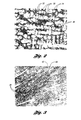
- FIG. 2 shows a microstructure of one alloy according to the invention and made by the process of the invention.
- FIG. 3 shows a microstructure of another alloy according to the invention and made by the process of the invention.
- FIG. 4 shows a microstructure of a further alloy according to the invention and made by the process of the invention.
- FIG. 5 shows a microstructure of a still further alloy according to the invention and made by the process of the invention.
- this schematic phase diagram shows the eutectic 10 of the iron-carbon-chromium alloy systems and also shows the eutectic 12 of the iron-carbon-M alloy systems.
- the alloying component M utilized in accordance with this invention is vanadium, niobium, titanium, or combinations of these elements.
- the iron-chromium system has a primary carbide liquidus 14 between the two phase region of liquid and liquid and primary chromium carbide.
- this iron-carbon-chromium system has an austenite liquidus 16 between the liquid phase and the two phase region of liquid and proeutectic austenite.
- the iron-carbon-chromium system has a phase transformation 18 at its eutectic 10 , below which any remaining liquid entirely solidifies by eutectic transformation as eutectic chromium carbide and eutectic austenite.
- the iron-carbon-M system has a primary carbide liquidus 20 between the liquid phase and the two phase region of liquid and primary carbides of vanadium, niobium, titanium, and combinations of these carbides.
- this system has an austenite liquidus 22 between the liquid phase and the two phase region of liquid and proeutectic austenite.
- the remaining liquid solidifies by eutectic transformation as eutectic carbide and eutectic austenite.
- the eutectic 12 of the iron-carbon-M system is located below the hypoeutectic austenite liquidus 16 of the iron-carbon-chromium system such that there is no formation of eutectic carbides of vanadium, niobium, or titanium. Any such eutectic carbides of vanadium, niobium, or titanium would decrease the bulk hardness of the alloy because substantially more eutectic austenite and less eutectic carbides form in the iron-carbon-M system than in the iron-carbon-chromium system.
- the initial transformation from the liquid phase begins at 26 s and first passes through the primary carbide liquidus 20 of the iron-carbon-M system to form primary carbides that may be vanadium carbides, niobium carbides, titanium carbides, or combinations of these carbides, but never reaches the eutectic 12 such that there are substantially no eutectic carbides of this system.
- the transformation continues until reaching the eutectic 10 of the iron-carbon-chromium system as identified by 26 f at which point eutectic chromium carbides (M 7 C 3 ) form with eutectic austenite but with substantially no proeutectic chromium carbides. Any such proeutectic chromium carbides would form large rod-like particles that significantly reduce toughness and thus embrittle the alloy.
- the eutectic austenite and any proeutectic austenite may not be stable upon cooling to ambient and may transform to martensite, pearlite or combinations of martensite and pearlite.
- Heat treatment can be performed to form martensite that hardens the alloy so as to be more wear resistant. It is also possible to temper the alloy to convert the martensite to ferrite and carbide so as to be more machinable. In addition, it is also possible to heat treat the alloy to form soft pearlite for improving machinability and after machining the alloy can again be heat treated to produce martensite for greater abrasion resistance.
- FIG. 2 illustrates at 200 magnification one example of a microstructure of an alloy according to the present invention.
- This alloy by weight is composed of:
- This alloy includes primary MC niobium carbides, proeutectic austenite dendrites, eutectic M 7 C 3 chromium carbides and eutectic austenite.
- the primary MC niobium carbides 30 are small compact particles dispersed in the proeutectic austenite dendrites 32 .
- Eutectic M 7 C 3 chromium carbides 34 (white) and eutectic austenite 36 (dark) form in alternate layers to make up the lacy-shaped constituent that surrounds the primary austenite dendrites.
- the nickel and molybdenum are in solid solution in the carbide and austenite constituents and increase hardenability.
- FIG. 3 illustrates at 200 magnification another example of a microstructure of an alloy according to the present invention.
- This alloy by weight is composed of:
- This alloy includes primary MC vanadium carbides, eutectic M 7 C 3 chromium carbides and eutectic austenite.
- the primary MC vanadium carbides 38 are the small compact particles dispersed throughout the alloy.
- the eutectic M 7 C 3 chromium carbides 40 (white) and eutectic austenite 42 (gray) form in alternate layers as the two lamellar constituents that make up the balance of the microstructure.
- the nickel and molybdenum are in solid solution in the carbide and austenite constituents and increase hardenability.
- FIG. 4 illustrates at 200 magnification a further example of a microstructure of an alloy according to the present invention.
- This alloy is composed of:
- This alloy includes primary MC titanium carbides, proeutectic austenite dendrites, eutectic M 7 C 3 chromium carbides and eutectic austenite.
- the primary MC titanium carbides 44 are small compact particles dispersed in the proeutectic austenite dendrites 46 .
- Eutectic M 7 C 3 chromium carbides 48 (white) and eutectic austenite 50 (dark) form in alternate layers to make up the lacy-shaped constituent that surrounds the primary austenite dendrites.
- the nickel and molybdenum are in solid solution in the carbide and austenite constituents and increase hardenability.
- FIG. 5 illustrates at 200 magnification a further example of a microstructure of an alloy according to the present invention.
- This alloy by weight is composed of:
- This alloy includes primary MC niobium and vanadium carbides, proeutectic austenite dendrites that have been partially converted to martensite, eutectic M 7 C 3 chromium carbides and eutectic austenite that has been partially converted to martensite.
- the primary MC niobium and vanadium carbides 52 are compact and clustered particles dispersed throughout the alloy.
- the eutectic M 7 C 3 chromium carbides 54 (white) and eutectic austenite 56 (dark) form in alternate layers as the two lamellar constituents that make up the balance of the microstructure.
- the nickel and molybdenum are in solid solution in the carbide and austenite constituents and increase hardenability.
- All of the examples of the alloy thus have a relatively high percentage of chromium, about 15% or more, as well as having an appropriate amount of carbon such that the eutectic 12 (FIG. 1) of the iron-carbon-M system is below the hypoeutectic austenite liquidus 16 of the iron-carbon-chromium system such that there is no formation of eutectic carbides of vanadium, niobium or titanium as previously mentioned.
Landscapes
- Chemical & Material Sciences (AREA)
- Engineering & Computer Science (AREA)
- Mechanical Engineering (AREA)
- Materials Engineering (AREA)
- Metallurgy (AREA)
- Organic Chemistry (AREA)
- Physics & Mathematics (AREA)
- Thermal Sciences (AREA)
- Crystallography & Structural Chemistry (AREA)
- Powder Metallurgy (AREA)
- Manufacture Of Alloys Or Alloy Compounds (AREA)
Abstract
Description
Claims (4)
Priority Applications (1)
| Application Number | Priority Date | Filing Date | Title |
|---|---|---|---|
| US10/635,178 US6800152B2 (en) | 1997-05-16 | 2003-08-06 | Process for making iron-based casting alloy |
Applications Claiming Priority (2)
| Application Number | Priority Date | Filing Date | Title |
|---|---|---|---|
| US08/857,991 US6669790B1 (en) | 1997-05-16 | 1997-05-16 | Iron-based casting alloy |
| US10/635,178 US6800152B2 (en) | 1997-05-16 | 2003-08-06 | Process for making iron-based casting alloy |
Related Parent Applications (1)
| Application Number | Title | Priority Date | Filing Date |
|---|---|---|---|
| US08/857,991 Division US6669790B1 (en) | 1997-05-16 | 1997-05-16 | Iron-based casting alloy |
Publications (2)
| Publication Number | Publication Date |
|---|---|
| US20040025988A1 US20040025988A1 (en) | 2004-02-12 |
| US6800152B2 true US6800152B2 (en) | 2004-10-05 |
Family
ID=25327193
Family Applications (2)
| Application Number | Title | Priority Date | Filing Date |
|---|---|---|---|
| US08/857,991 Expired - Lifetime US6669790B1 (en) | 1997-05-16 | 1997-05-16 | Iron-based casting alloy |
| US10/635,178 Expired - Fee Related US6800152B2 (en) | 1997-05-16 | 2003-08-06 | Process for making iron-based casting alloy |
Family Applications Before (1)
| Application Number | Title | Priority Date | Filing Date |
|---|---|---|---|
| US08/857,991 Expired - Lifetime US6669790B1 (en) | 1997-05-16 | 1997-05-16 | Iron-based casting alloy |
Country Status (5)
| Country | Link |
|---|---|
| US (2) | US6669790B1 (en) |
| EP (1) | EP1090157A4 (en) |
| AU (1) | AU7570698A (en) |
| CA (1) | CA2331503A1 (en) |
| WO (1) | WO1998051832A1 (en) |
Cited By (3)
| Publication number | Priority date | Publication date | Assignee | Title |
|---|---|---|---|---|
| US20080206584A1 (en) * | 2007-02-28 | 2008-08-28 | Jaszarowski James K | High strength gray cast iron |
| US20080260568A1 (en) * | 2005-09-15 | 2008-10-23 | Shah Bipin H | High Silicon Niobium Casting Alloy and Process for Producing the Same |
| US9382922B2 (en) | 2013-01-11 | 2016-07-05 | Alstom Technology Ltd | Eductor pump and replaceable wear inserts and nozzles for use therewith |
Families Citing this family (16)
| Publication number | Priority date | Publication date | Assignee | Title |
|---|---|---|---|---|
| DE102010062011B3 (en) * | 2010-11-26 | 2011-12-01 | Leibniz-Institut Für Festkörper- Und Werkstoffforschung Dresden E.V. | Process for the heat treatment of high-strength iron alloys |
| CA2861581C (en) | 2011-12-30 | 2021-05-04 | Scoperta, Inc. | Coating compositions |
| AU2013329190B2 (en) | 2012-10-11 | 2017-09-28 | Scoperta, Inc. | Non-magnetic metal alloy compositions and applications |
| WO2015081209A1 (en) | 2013-11-26 | 2015-06-04 | Scoperta, Inc. | Corrosion resistant hardfacing alloy |
| US11130205B2 (en) | 2014-06-09 | 2021-09-28 | Oerlikon Metco (Us) Inc. | Crack resistant hardfacing alloys |
| WO2016014851A1 (en) | 2014-07-24 | 2016-01-28 | Scoperta, Inc. | Hardfacing alloys resistant to hot tearing and cracking |
| US10465269B2 (en) | 2014-07-24 | 2019-11-05 | Scoperta, Inc. | Impact resistant hardfacing and alloys and methods for making the same |
| CN107532265B (en) | 2014-12-16 | 2020-04-21 | 思高博塔公司 | Tough and wear-resistant ferrous alloys with multiple hard phases |
| AU2016317860B2 (en) | 2015-09-04 | 2021-09-30 | Scoperta, Inc. | Chromium free and low-chromium wear resistant alloys |
| WO2017044475A1 (en) | 2015-09-08 | 2017-03-16 | Scoperta, Inc. | Non-magnetic, strong carbide forming alloys for power manufacture |
| EP3374536A4 (en) | 2015-11-10 | 2019-03-20 | Scoperta, Inc. | TWO WIRE ARC FLOORING MATERIALS WITH CONTROLLED OXIDATION |
| KR102408916B1 (en) | 2016-03-22 | 2022-06-14 | 스코퍼타 아이엔씨. | Fully readable thermal spray coating |
| WO2019191400A1 (en) | 2018-03-29 | 2019-10-03 | Oerlikon Metco (Us) Inc. | Reduced carbides ferrous alloys |
| US11939646B2 (en) | 2018-10-26 | 2024-03-26 | Oerlikon Metco (Us) Inc. | Corrosion and wear resistant nickel based alloys |
| JP7523461B2 (en) | 2019-03-28 | 2024-07-26 | エリコン メテコ(ユーエス)インコーポレイテッド | Thermal spray iron-based alloys for coating engine cylinder bores. |
| WO2020227099A1 (en) | 2019-05-03 | 2020-11-12 | Oerlikon Metco (Us) Inc. | Powder feedstock for wear resistant bulk welding configured to optimize manufacturability |
Citations (15)
| Publication number | Priority date | Publication date | Assignee | Title |
|---|---|---|---|---|
| US3929471A (en) | 1971-12-22 | 1975-12-30 | Hitachi Ltd | High speed steel having high wear-resistance |
| US4221612A (en) | 1977-10-14 | 1980-09-09 | Acieries Thome Cromback | Grinding members |
| US4325758A (en) | 1980-10-02 | 1982-04-20 | Western Electric Company, Inc. | Heat treatment for high chromium high carbon stainless steel |
| US4490175A (en) | 1982-11-02 | 1984-12-25 | Nippon Piston Ring Co., Ltd. | Vane for rotary fluid compressors |
| JPS6442553A (en) | 1987-08-06 | 1989-02-14 | Sumitomo Metal Ind | Alloyed cast iron excellent in toughness and wear resistance |
| EP0430241A1 (en) | 1989-11-30 | 1991-06-05 | Hitachi Metals, Ltd. | Wear-resistant compound roll |
| US5096515A (en) | 1988-11-28 | 1992-03-17 | Nippon Piston Ring Co., Ltd. | High strength high chromium cast iron and valve rocker arm made thereof |
| EP0533929A1 (en) | 1990-06-13 | 1993-03-31 | Nippon Steel Corporation | Composite roll for use in rolling and manufacture thereof |
| US5252149A (en) | 1989-08-04 | 1993-10-12 | Warman International Ltd. | Ferrochromium alloy and method thereof |
| US5310431A (en) | 1992-10-07 | 1994-05-10 | Robert F. Buck | Creep resistant, precipitation-dispersion-strengthened, martensitic stainless steel and method thereof |
| US5316596A (en) | 1991-09-12 | 1994-05-31 | Kawasaki Steel Corporation | Roll shell material and centrifugal cast composite roll |
| US5733388A (en) | 1994-08-11 | 1998-03-31 | Daido Tokiushuko Kabushiki Kaisha | Steel composition for bearings and method of producing the same |
| JPH1161322A (en) | 1997-08-08 | 1999-03-05 | Kougi Kk | Rolling roll outer layer material and rolling roll using the material |
| JPH11229070A (en) | 1998-02-18 | 1999-08-24 | Kobe Steel Ltd | Wear resistant chromium cast iron |
| US6375764B1 (en) * | 1998-12-24 | 2002-04-23 | Nisshin Steel Co., Ltd. | Weaving machine member made of an abrasion-resistant steel |
-
1997
- 1997-05-16 US US08/857,991 patent/US6669790B1/en not_active Expired - Lifetime
-
1998
- 1998-05-13 EP EP98923404A patent/EP1090157A4/en not_active Ceased
- 1998-05-13 CA CA002331503A patent/CA2331503A1/en not_active Abandoned
- 1998-05-13 AU AU75706/98A patent/AU7570698A/en not_active Abandoned
- 1998-05-13 WO PCT/US1998/009734 patent/WO1998051832A1/en not_active Ceased
-
2003
- 2003-08-06 US US10/635,178 patent/US6800152B2/en not_active Expired - Fee Related
Patent Citations (16)
| Publication number | Priority date | Publication date | Assignee | Title |
|---|---|---|---|---|
| US3929471A (en) | 1971-12-22 | 1975-12-30 | Hitachi Ltd | High speed steel having high wear-resistance |
| US4221612A (en) | 1977-10-14 | 1980-09-09 | Acieries Thome Cromback | Grinding members |
| US4325758A (en) | 1980-10-02 | 1982-04-20 | Western Electric Company, Inc. | Heat treatment for high chromium high carbon stainless steel |
| US4490175A (en) | 1982-11-02 | 1984-12-25 | Nippon Piston Ring Co., Ltd. | Vane for rotary fluid compressors |
| JPS6442553A (en) | 1987-08-06 | 1989-02-14 | Sumitomo Metal Ind | Alloyed cast iron excellent in toughness and wear resistance |
| US5096515A (en) | 1988-11-28 | 1992-03-17 | Nippon Piston Ring Co., Ltd. | High strength high chromium cast iron and valve rocker arm made thereof |
| US5252149A (en) | 1989-08-04 | 1993-10-12 | Warman International Ltd. | Ferrochromium alloy and method thereof |
| US5252149B1 (en) | 1989-08-04 | 1998-09-29 | Warman Int Ltd | Ferrochromium alloy and method thereof |
| EP0430241A1 (en) | 1989-11-30 | 1991-06-05 | Hitachi Metals, Ltd. | Wear-resistant compound roll |
| EP0533929A1 (en) | 1990-06-13 | 1993-03-31 | Nippon Steel Corporation | Composite roll for use in rolling and manufacture thereof |
| US5316596A (en) | 1991-09-12 | 1994-05-31 | Kawasaki Steel Corporation | Roll shell material and centrifugal cast composite roll |
| US5310431A (en) | 1992-10-07 | 1994-05-10 | Robert F. Buck | Creep resistant, precipitation-dispersion-strengthened, martensitic stainless steel and method thereof |
| US5733388A (en) | 1994-08-11 | 1998-03-31 | Daido Tokiushuko Kabushiki Kaisha | Steel composition for bearings and method of producing the same |
| JPH1161322A (en) | 1997-08-08 | 1999-03-05 | Kougi Kk | Rolling roll outer layer material and rolling roll using the material |
| JPH11229070A (en) | 1998-02-18 | 1999-08-24 | Kobe Steel Ltd | Wear resistant chromium cast iron |
| US6375764B1 (en) * | 1998-12-24 | 2002-04-23 | Nisshin Steel Co., Ltd. | Weaving machine member made of an abrasion-resistant steel |
Non-Patent Citations (1)
| Title |
|---|
| Solidification Structures of Fe-C-CR-(V-NB-W) Alloys, Transactions of American Foundrymen's Society. 1986. pp. 403-416. |
Cited By (5)
| Publication number | Priority date | Publication date | Assignee | Title |
|---|---|---|---|---|
| US20080260568A1 (en) * | 2005-09-15 | 2008-10-23 | Shah Bipin H | High Silicon Niobium Casting Alloy and Process for Producing the Same |
| US8012410B2 (en) | 2005-09-15 | 2011-09-06 | Grede Llc | High silicon niobium casting alloy and process for producing the same |
| US20080206584A1 (en) * | 2007-02-28 | 2008-08-28 | Jaszarowski James K | High strength gray cast iron |
| US8333923B2 (en) | 2007-02-28 | 2012-12-18 | Caterpillar Inc. | High strength gray cast iron |
| US9382922B2 (en) | 2013-01-11 | 2016-07-05 | Alstom Technology Ltd | Eductor pump and replaceable wear inserts and nozzles for use therewith |
Also Published As
| Publication number | Publication date |
|---|---|
| US20040025988A1 (en) | 2004-02-12 |
| US6669790B1 (en) | 2003-12-30 |
| CA2331503A1 (en) | 1998-11-19 |
| AU7570698A (en) | 1998-12-08 |
| EP1090157A1 (en) | 2001-04-11 |
| WO1998051832A1 (en) | 1998-11-19 |
| EP1090157A4 (en) | 2003-07-02 |
Similar Documents
| Publication | Publication Date | Title |
|---|---|---|
| US6800152B2 (en) | Process for making iron-based casting alloy | |
| Trudel et al. | Effect of composition and heat treatment parameters on the characteristics of austempered ductile irons | |
| US5769970A (en) | Steel for the manufacture of separable mechanical components and separable mechanical component | |
| US4224060A (en) | Hard alloys | |
| Stefanescu | Classification and basic metallurgy of cast iron | |
| JP7369513B2 (en) | Spheroidal graphite cast iron alloy | |
| Mourad et al. | Effects of molybdenum addition on the microstructure and mechanical properties of ni-hard white cast iron | |
| JPS61174358A (en) | Spheroidal graphite cast steel of high strength | |
| Stefanescu | Classification and basic types of cast iron | |
| JP4523230B2 (en) | Strengthened durable tool steel, method for producing the same, method for producing a member made of the steel, and member obtained | |
| US4475956A (en) | Method of making high strength ferritic ductile iron parts | |
| US3977867A (en) | Gray iron casting composition with controlled iron-chromium carbide content | |
| Korchynsky et al. | Microalloyed forging steels-A state of the art review | |
| WO1995024513A1 (en) | Steel alloys and rolling mill rolls produced therefrom | |
| Bedolla-Jacuinde | Niobium in cast irons | |
| Davis | Classification and basic metallurgy of cast irons | |
| JPS62253756A (en) | Continuous cast steel | |
| SU986955A1 (en) | Cast iron | |
| Cheng et al. | Microstructure evolution and wear resistance of boron-bearing high speed steel roll | |
| JPS6155577B2 (en) | ||
| JPH05125480A (en) | Spheroidal graphite cast iron with high | |
| US2974035A (en) | Nodular graphite steel | |
| SU1008270A1 (en) | Cast iron | |
| SU1587072A1 (en) | Iron with spherical graphite for casting | |
| SU1725757A3 (en) | Wear-resistant cast iron |
Legal Events
| Date | Code | Title | Description |
|---|---|---|---|
| FPAY | Fee payment |
Year of fee payment: 4 |
|
| AS | Assignment |
Owner name: THE ROYAL BANK OF SCOTLAND PLC, UNITED KINGDOM Free format text: SECURITY AGREEMENT;ASSIGNOR:STORK CLIMAX RESEARCH SERVICES INC.;REEL/FRAME:020837/0097 Effective date: 20080418 |
|
| AS | Assignment |
Owner name: STORK CLIMAX RESEARCH SERVICES, INC., MICHIGAN Free format text: RELEASE BY SECURED PARTY;ASSIGNOR:THE ROYAL BANK OF SOTLAND PLC, AS SECURITY AGENT;REEL/FRAME:025607/0084 Effective date: 20101230 |
|
| AS | Assignment |
Owner name: STORK CLIMAX RESEARCH SERVICES, INC., MICHIGAN Free format text: ASSIGNMENT OF ASSIGNORS INTEREST;ASSIGNOR:CLIMAX RESEARCH SERVICES, INC.;REEL/FRAME:026043/0149 Effective date: 20110323 |
|
| FPAY | Fee payment |
Year of fee payment: 8 |
|
| AS | Assignment |
Owner name: ELEMENT MATERIALS TECHNOLOGY WIXOM INC., MICHIGAN Free format text: CHANGE OF NAME;ASSIGNOR:STORK CLIMAX RESEARCH SERVICES INC.;REEL/FRAME:028681/0501 Effective date: 20111111 |
|
| AS | Assignment |
Owner name: ROYAL BANK OF CANADA, AS COLLATERAL AGENT, CANADA Free format text: SECURITY INTEREST;ASSIGNOR:ELEMENT MATERIALS TECHNOLOGY WIXOM INC.;REEL/FRAME:033500/0831 Effective date: 20140808 |
|
| AS | Assignment |
Owner name: ELEMENT MATERIALS TECHNOLOGY WIXOM INC., MICHIGAN Free format text: RELEASE BY SECURED PARTY;ASSIGNOR:ROYAL BANK OF CANADA, AS COLLATERAL AGENT;REEL/FRAME:038123/0767 Effective date: 20160322 |
|
| REMI | Maintenance fee reminder mailed | ||
| AS | Assignment |
Owner name: ING BANK N.V., LONDON BRANCH, AS SECURITY AGENT, U Free format text: SECURITY AGREEMENT SUPPLEMENT FOR IP;ASSIGNOR:ELEMENT MATERIALS TECHNOLOGY WIXOM INC.;REEL/FRAME:039115/0020 Effective date: 20160617 |
|
| LAPS | Lapse for failure to pay maintenance fees | ||
| STCH | Information on status: patent discontinuation |
Free format text: PATENT EXPIRED DUE TO NONPAYMENT OF MAINTENANCE FEES UNDER 37 CFR 1.362 |
|
| STCH | Information on status: patent discontinuation |
Free format text: PATENT EXPIRED DUE TO NONPAYMENT OF MAINTENANCE FEES UNDER 37 CFR 1.362 |
|
| FP | Lapsed due to failure to pay maintenance fee |
Effective date: 20161005 |
|
| AS | Assignment |
Owner name: ELEMENT MATERIALS TECHNOLOGY WIXOM INC., MICHIGAN Free format text: RELEASE BY SECURED PARTY;ASSIGNOR:ING BANK N.V., LONDON BRANCH, AS SECURITY AGENT;REEL/FRAME:042917/0001 Effective date: 20170629 Owner name: ING BANK N.V., LONDON BRANCH, AS FIRST LIEN COLLAT Free format text: SECURITY INTEREST;ASSIGNOR:ELEMENT MATERIALS TECHNOLOGY WIXOM INC.;REEL/FRAME:042921/0872 Effective date: 20170629 Owner name: ING BANK N.V., LONDON BRANCH, AS SECOND LIEN COLLA Free format text: SECURITY INTEREST;ASSIGNOR:ELEMENT MATERIALS TECHNOLOGY WIXOM INC.;REEL/FRAME:042922/0202 Effective date: 20170629 |
|
| AS | Assignment |
Owner name: ELEMENT MATERIALS TECHNOLOGY WIXOM INC., OHIO Free format text: FIRST LIEN RELEASE OF INTELLECTUAL PROPERTY;ASSIGNOR:ING BANK N.V., LONDON BRANCH, AS SECURITY AGENT;REEL/FRAME:061964/0814 Effective date: 20170629 Owner name: ELEMENT MATERIALS TECHNOLOGY WIXOM INC., OHIO Free format text: SECOND LIEN RELEASE OF INTELLECTUAL PROPERTY;ASSIGNOR:ING BANK N.V., LONDON BRANCH, AS SECURITY AGENT;REEL/FRAME:061964/0819 Effective date: 20170629 |