US6705039B1 - Flexible fish landing net - Google Patents
Flexible fish landing net Download PDFInfo
- Publication number
- US6705039B1 US6705039B1 US10/308,820 US30882002A US6705039B1 US 6705039 B1 US6705039 B1 US 6705039B1 US 30882002 A US30882002 A US 30882002A US 6705039 B1 US6705039 B1 US 6705039B1
- Authority
- US
- United States
- Prior art keywords
- hoop
- fish
- net
- recited
- landing
- Prior art date
- Legal status (The legal status is an assumption and is not a legal conclusion. Google has not performed a legal analysis and makes no representation as to the accuracy of the status listed.)
- Expired - Fee Related
Links
Images


Classifications
-
- A—HUMAN NECESSITIES
- A01—AGRICULTURE; FORESTRY; ANIMAL HUSBANDRY; HUNTING; TRAPPING; FISHING
- A01K—ANIMAL HUSBANDRY; AVICULTURE; APICULTURE; PISCICULTURE; FISHING; REARING OR BREEDING ANIMALS, NOT OTHERWISE PROVIDED FOR; NEW BREEDS OF ANIMALS
- A01K74/00—Other catching nets or the like
-
- A—HUMAN NECESSITIES
- A01—AGRICULTURE; FORESTRY; ANIMAL HUSBANDRY; HUNTING; TRAPPING; FISHING
- A01K—ANIMAL HUSBANDRY; AVICULTURE; APICULTURE; PISCICULTURE; FISHING; REARING OR BREEDING ANIMALS, NOT OTHERWISE PROVIDED FOR; NEW BREEDS OF ANIMALS
- A01K77/00—Landing-nets for fishing; Landing-spoons for fishing
Definitions
- the present invention relates to net nets for landing fish, and, in particular, to a flexible fish landing net for use from elevated fishing stations.
- Sport fishing is oftentimes conducted from elevated locations such as fishing piers and bridges.
- Various species of varying sizes are commonly caught at such locations.
- Smaller fish present few problems in landing with the size of the fish being within the strength limitations of the fishing tackle, thereby enabling landing by conventional reeling.
- Larger fish can present considerable problems.
- landing may be attempted by traversing the pier until a water location is reached, at which time the fish can be beached, a difficult, cumbersome and time consuming task.
- rental shops may be available whereat the fisherman may be able to rent a suitable large mouth rigid landing net.
- the present invention provides a fish landing net that may be collapsed for convenient storage and transportation, and expanded at the site to a full-size landing net that may be lowered from elevated location into the water for netting large and heavy fish that might otherwise escape due to tackle breakage or be released because of difficulties in successfully landing the fish.
- the landing net includes a flexible, prestressed circular hoop to which heavy duty netting is attached.
- the hoop is attached to a lifting line by three circumferentially spaced support ropes.
- the hoop sections around the support ropes have an annealed inner surface, which locally reduces the compressive strength and facilitates reverse bending under loading.
- the net When a larger fish is hooked and brought to an underneath location, the net is lowered into the water and maneuvered to ensnare the fish. As the net is raised, the loading forces overcome the prestressing and the reduced compressive strength at lifting locations thereby inwardly deflecting these section and constricting the hoop size and preventing the fish from escaping during landing as well as increasing the stability of the net during vertical movement. When the fish is landed and the load removed, the hoop returns to the original shape for reuse. For storage or transportation, the net hoop may be diametrically twisted into a “ Figure- 8 ” shape thereby causing the hoop to fold into a plurality of concentric hoop sections, much is the same manner as band saw blades. The compacted hoop may be conveniently transported along normal fishing gear to be deployed when needed.
- Another object of the invention is to provide a fish landing net that provides a large opening for ensnaring a large fish and a constricted opening for retaining the fish during vertical movement to a landing site.
- a further object of the invention is to provide a fish landing net that is expandable on site to functional sizes and collapsible for convenient storage and transportation.
- FIG. 1 is a perspective view of a flexible fish landing net according to an embodiment of the invention, in the open position;
- FIG. 2 is a perspective view of the fish landing net of FIG. 1, in the closed position;
- FIG. 3 is a side elevation view of the retaining hoop in the unformed position
- FIG. 4 is a perspective view of the retaining hoop in the open position
- FIG. 5 is side schematic view of the landing net in the open position, with the net attached, showing the suspension of the retaining hoop;
- FIG. 6 is an enlarged fragmentary view of the retaining hoop showing the lifting rope mounting holes
- FIG. 7 is a view similar to FIG. 6 showing the lifting rope on the retaining hoop in the open position
- FIG. 8 is a view similar to FIG. 8 showing lifting rope bending the retaining hoop section toward the closed position
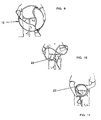
- FIGS. 9 through 11 are side elevation views showing the collapsing the retaining hoop from the open position to the collapsed position.
- FIG. 1 illustrates a flexible fish landing net 10 for landing fish from a elevated fishing station, such as a pier or bridge wherein the weight and size of the fish is potentially greater than the strength of the fishing tackle.
- the net is distinguished from regular fishing nets used by sports fisherman and typically ranges in size from two to three feet or larger.
- the landing net 10 comprises a flexible retaining hoop 12 having a generally circular configuration in the illustrated open position, a netting 14 having top loops 16 periodically peripherally threaded over the retaining hoop 12 and depending therebelow, and a lifting rigging 18 attached at three circumferentially spaced locations to the hoop 12 and operable for lowering and raising the net 10 from the fishing station.
- the load and the lifting rigging 18 are operative to cause the retaining hoop 12 to flex inwardly at three reversely bent lobes 19 to a closed position of restricted opening during raising movement, as shown in FIG. 2, to securely retain the fish within the netting 14 and stabilizing the lifting load.
- the retaining hoop 12 in the open position of FIG. 9 may be diametrically twisted into a “ Figure- 8 ” position, as shown in FIG. 10, and inwardly collapsed to form a series of concentric subhoops 20 as shown in FIG. 11, thereby establishing a compact storage position.
- the retaining hoop 12 is formed of an elastic material and establishes a prestressed circular condition in the open position sufficient for maintaining the continuous open profile while being insufficiently stressed or strong to resist locally inward deflection of the nodes 19 toward the closed positions shown in FIGS. 2 in the presence of a sufficiently large fish.
- the retaining hoop is annealed at the inner surface by reverse bending at the attachment locations to reduce the inward loading required for establishing the nodes 19 and facilitate the inward deflection.
- the retaining hoop 12 may be formed from an elongated single strip 30 of planar material.
- the strip 30 has a rectangular cross section of moderate to high aspect ratio for preventing vertical flexing about the transverse section axis while permitting the aforementioned inward deflection about the longitudinal section axis in the presence of threshold loading.
- An aspect ratio of height to thickness of at least 2:1 is satisfactory, an aspect ration in the range of 3:1 to 6:1 desirable, and an aspect ratio of about 4:1 preferred.
- a preferred material is plastic such a nylon.
- the strip 30 is provided with a plurality of through holes for use in assembly and rigging.
- a pair of fastener holes 32 are formed at each end of the strip 30 .
- suitable fasteners 34 such as nuts and bolts, are inserted through the fastener holes and tightened to fixedly establish a circular shape for the retaining hoop by flexing the strip and establishing a stressed outer skin condition therein.
- Three evenly circumferentially and closely spaced sets of rigging holes 40 are formed along the length of the strip 30 .
- the rigging holes 40 in the assembled hoop are equally circumferentially spaced 120° apart. Consistent with the above, a retaining hoop formed of nylon with a 3 ⁇ 4 by ⁇ fraction (3/16) ⁇ inch cross section, is effective for a 30 inch diameter hoop.
- the netting 14 may be formed of any suitable, commercially available material and is configured to provide a closed lower end and an open upper end 52 terminating with the end loops 16 .
- the end loops 16 are threaded onto the strip 30 prior to assembly and thereafter uniformly circumferentially spaced thereabout.
- the length of the netting is sufficient to provide ample volume for retaining targeted species and sizes of fish.
- the rigging 16 comprises a three-point rigging at a lower section 70 and an upper section 72 interconnected by a middle coupling section 74 .
- the lower section 70 includes three arms 76 .
- Each arm 76 terminates with outwardly diverging end 77 establishing circumferentially spaced loadings at the attachment locations.
- the arm is sequentially threaded inwardly under the hoop along a first run, through one of the holes 40 , along the inner periphery of the hoop, and outwardly through the other hole.
- the free end is then knotted to establish the lengths of the ends.
- the ropes are a tubular braided polyethylene.
- the distal end is heat terminated and inserted into the tubular core to fix the attachment.
- the upper ends of the rope arms 76 are gathered and knotted to form a lifting loop at the coupling section 74 .
- the lower end of the upper section 72 preferably a single strand of roping, is attached at the lifting loop with a non-slipping marine knot. Under loading conditions, it bas been found as shown in FIG. 5 that an inclination of the arms at about 45° to 60° with respect to vertical provides preferable results.
- the inwardly directed loading forces at the lower section of the rigging will overcome the prestressing and inwardly reversely flex the hoop at the nodes 19 at the attachment locations.
- the nodes 19 converging toward the center of the deformed hoop, causing the hoop to assume a progressively closed position under loading conditions that exceed the threshold prestressed value.
- smaller fish raised by the landing net may be insufficient to close the net, but may nonetheless be securely upwardly raised under stable, balanced conditions. Larger fish, more prone to activity, will be prevented from escape, by the flexing closure of the hoop.
- the flexing characteristics of the hoop are enhanced by locally annealing the hoop sections adjacent the attachment sections surrounding the holes sufficient to lower the compressive strength thereat and accommodate the reverse deflection.
- the hoop sections may be annealed by reverse flexure as shown by the arrows in FIG. 8 .
- Such annealing has been determined to significantly reduce the net closing forces required to effect the collapse of the hoop as shown in FIG. 2 .
- the nodal tendencies are also increased by the circumferentially spaced points, and by the ends 77 engaging the lower surface of the hoop and exerting further inward and upward force vectors for overcoming the residual annealed compressive strength at the inner surface and promoting the nodal buckling.
- the annealing of the strip may be performed either before hoop formation of after assembly, by manual or mechanical bending. A limited number of moderate bends are generally sufficient.
- the collapsed landing net is removed from the carrying container and the subhoops reversely rotated allowing the prestressing to expand the hoop 12 to the open position.
- the expanded net is lowered into the water and maneuvered below the fish.
- the rigging 18 is manually raised to capture the fish within the netting 14 in the confines of the hoop.
- the increasing loading on the rope arms 76 in the presence of a sufficiently large fish, will inwardly deflect the hoop 12 at the node 19 narrowing the top opening and thereby securing the fish therewithin.
- the loading is released allowing the hoop to assume the open position and faciliatating safe removal of the landed fish.
Landscapes
- Life Sciences & Earth Sciences (AREA)
- Environmental Sciences (AREA)
- Animal Husbandry (AREA)
- Biodiversity & Conservation Biology (AREA)
- Marine Sciences & Fisheries (AREA)
Abstract
A fish landing net for landing heavy fish from an elevated location includes a flexible retaining hoop having a normal open position. A netting has an open end carried at the hoop periphery and a depending closed end providing an enclosure for securing and carrying the fish. A lifting rigging is attached by three outwardly and downwardly extending rope sections to the hoop for raising and lowering said hoop member at the elevated location. The hoop has an initial prestressing establishing the open position and is locally anneals at the attachment sites for permitting inwardly deforming of the periphery under loading conditions of the fish in the netting thereby resulting in an inward constricting of the hoop opening during landing of the fish.
Description
This application is a continuation-in-part application of U.S. Ser. No. 09/824,497 filed on Apr. 2, 2001 now abandoned in the name of Phillip John Campbell and entitled “Flexible Fish Landing Net” and claims the benefit of United States Provisional Application No. 60/301,103 filed on Jun. 26, 2001 in the name of Phillip John Campbell and entitled “Flexible Fishing Net Hoop”.
The present invention relates to net nets for landing fish, and, in particular, to a flexible fish landing net for use from elevated fishing stations.
Sport fishing is oftentimes conducted from elevated locations such as fishing piers and bridges. Various species of varying sizes are commonly caught at such locations. Smaller fish present few problems in landing with the size of the fish being within the strength limitations of the fishing tackle, thereby enabling landing by conventional reeling. Larger fish, however, can present considerable problems. Where a larger fish is hooked, there is a risk that the line will break, due to the weight and movement of the fish prior to successful landing. Under such circumstances, landing may be attempted by traversing the pier until a water location is reached, at which time the fish can be beached, a difficult, cumbersome and time consuming task. At heavily trafficked sites, rental shops may be available whereat the fisherman may be able to rent a suitable large mouth rigid landing net. Inasmuch as such landing nets are large, bulky and costly, few fishermen normally have this type of equipment. Typical of such a net is disclosed in Great Britain Patent No. GB 1,181,354 to Goddard wherein a solid metal ring supports a landing net and is raised as a rigid ring by lifting cords. The net is neither flexible or collapsible. A further version is disclosed in U.S. Pat. No. 3,314,187 to Marcinkowski wherein the netting is collapsible to position a crab trap, however, the support hoop is a rigid circular ring. A limitedly flexible crab net is disclosed in U.S. Pat. No. 2,520,780 to Pieron wherein the periphery of the net is provided by two semi-circular hoops that are diametrically constrained, such that upon lifting the sides are compressed inwardly narrowing the net perimeter.
Conventional landing nets are not adapted for such locations. The typical landing net has a fixed hoop with a small attached handle. No provisions are made for lowering these nets from elevated stations. Thus, nets of the type disclosed in U.S. Pat. No. 2,814,899 to Brosius, U.S. Pat. No. 4,021,956 to Hogg, U.S. Pat. No. 4,169,331 to Baker, and U.S. Pat. No. 4,774,783 to Willard have little utility in pier and bridge elevated fishing.
In view of the foregoing, it would be desirable to provide a fish landing net for pier, bridge and like elevated fishing that could readily be used by fishermen for safely and conveniently ensnaring heavy fish.
The present invention provides a fish landing net that may be collapsed for convenient storage and transportation, and expanded at the site to a full-size landing net that may be lowered from elevated location into the water for netting large and heavy fish that might otherwise escape due to tackle breakage or be released because of difficulties in successfully landing the fish. The landing net includes a flexible, prestressed circular hoop to which heavy duty netting is attached. The hoop is attached to a lifting line by three circumferentially spaced support ropes. The hoop sections around the support ropes have an annealed inner surface, which locally reduces the compressive strength and facilitates reverse bending under loading. When a larger fish is hooked and brought to an underneath location, the net is lowered into the water and maneuvered to ensnare the fish. As the net is raised, the loading forces overcome the prestressing and the reduced compressive strength at lifting locations thereby inwardly deflecting these section and constricting the hoop size and preventing the fish from escaping during landing as well as increasing the stability of the net during vertical movement. When the fish is landed and the load removed, the hoop returns to the original shape for reuse. For storage or transportation, the net hoop may be diametrically twisted into a “Figure-8” shape thereby causing the hoop to fold into a plurality of concentric hoop sections, much is the same manner as band saw blades. The compacted hoop may be conveniently transported along normal fishing gear to be deployed when needed.
Accordingly, it is an object of the present invention to provide a fish landing net for heavy fish that is convenient to transport and easy to deploy.
Another object of the invention is to provide a fish landing net that provides a large opening for ensnaring a large fish and a constricted opening for retaining the fish during vertical movement to a landing site.
A further object of the invention is to provide a fish landing net that is expandable on site to functional sizes and collapsible for convenient storage and transportation.
The above and other objects and advantages of the present invention will become apparent upon reading the following detailed description taken in conjunction with the accompanying drawings in which:
FIG. 1 is a perspective view of a flexible fish landing net according to an embodiment of the invention, in the open position;
FIG. 2 is a perspective view of the fish landing net of FIG. 1, in the closed position;
FIG. 3 is a side elevation view of the retaining hoop in the unformed position;
FIG. 4 is a perspective view of the retaining hoop in the open position;
FIG. 5 is side schematic view of the landing net in the open position, with the net attached, showing the suspension of the retaining hoop;
FIG. 6 is an enlarged fragmentary view of the retaining hoop showing the lifting rope mounting holes;
FIG. 7 is a view similar to FIG. 6 showing the lifting rope on the retaining hoop in the open position;
FIG. 8 is a view similar to FIG. 8 showing lifting rope bending the retaining hoop section toward the closed position; and
FIGS. 9 through 11 are side elevation views showing the collapsing the retaining hoop from the open position to the collapsed position.
Referring to the drawings for the purpose of describing the preferred embodiment and not for limiting same, FIG. 1 illustrates a flexible fish landing net 10 for landing fish from a elevated fishing station, such as a pier or bridge wherein the weight and size of the fish is potentially greater than the strength of the fishing tackle. As such, the net is distinguished from regular fishing nets used by sports fisherman and typically ranges in size from two to three feet or larger.
The landing net 10 comprises a flexible retaining hoop 12 having a generally circular configuration in the illustrated open position, a netting 14 having top loops 16 periodically peripherally threaded over the retaining hoop 12 and depending therebelow, and a lifting rigging 18 attached at three circumferentially spaced locations to the hoop 12 and operable for lowering and raising the net 10 from the fishing station.
During the raising of the net 10, with a larger fish carried in the netting, the load and the lifting rigging 18 are operative to cause the retaining hoop 12 to flex inwardly at three reversely bent lobes 19 to a closed position of restricted opening during raising movement, as shown in FIG. 2, to securely retain the fish within the netting 14 and stabilizing the lifting load.
Referring to FIGS. 9 through 11, for storage and transportation, the retaining hoop 12 in the open position of FIG. 9 may be diametrically twisted into a “Figure-8” position, as shown in FIG. 10, and inwardly collapsed to form a series of concentric subhoops 20 as shown in FIG. 11, thereby establishing a compact storage position.
More particularly, the retaining hoop 12 is formed of an elastic material and establishes a prestressed circular condition in the open position sufficient for maintaining the continuous open profile while being insufficiently stressed or strong to resist locally inward deflection of the nodes 19 toward the closed positions shown in FIGS. 2 in the presence of a sufficiently large fish. As described in greater detail below, the retaining hoop is annealed at the inner surface by reverse bending at the attachment locations to reduce the inward loading required for establishing the nodes 19 and facilitate the inward deflection.
Referring to FIG. 3, the retaining hoop 12 may be formed from an elongated single strip 30 of planar material. The strip 30 has a rectangular cross section of moderate to high aspect ratio for preventing vertical flexing about the transverse section axis while permitting the aforementioned inward deflection about the longitudinal section axis in the presence of threshold loading. An aspect ratio of height to thickness of at least 2:1 is satisfactory, an aspect ration in the range of 3:1 to 6:1 desirable, and an aspect ratio of about 4:1 preferred. A preferred material is plastic such a nylon.
The strip 30 is provided with a plurality of through holes for use in assembly and rigging. A pair of fastener holes 32 are formed at each end of the strip 30. For assembly the ends are overlapped and suitable fasteners 34, such as nuts and bolts, are inserted through the fastener holes and tightened to fixedly establish a circular shape for the retaining hoop by flexing the strip and establishing a stressed outer skin condition therein. Three evenly circumferentially and closely spaced sets of rigging holes 40 are formed along the length of the strip 30. The rigging holes 40 in the assembled hoop are equally circumferentially spaced 120° apart. Consistent with the above, a retaining hoop formed of nylon with a ¾ by {fraction (3/16)} inch cross section, is effective for a 30 inch diameter hoop.
The netting 14 may be formed of any suitable, commercially available material and is configured to provide a closed lower end and an open upper end 52 terminating with the end loops 16. The end loops 16 are threaded onto the strip 30 prior to assembly and thereafter uniformly circumferentially spaced thereabout. The length of the netting is sufficient to provide ample volume for retaining targeted species and sizes of fish.
The rigging 16 comprises a three-point rigging at a lower section 70 and an upper section 72 interconnected by a middle coupling section 74. Referring to FIGS. 6 through 8, the lower section 70 includes three arms 76. Each arm 76 terminates with outwardly diverging end 77 establishing circumferentially spaced loadings at the attachment locations. The arm is sequentially threaded inwardly under the hoop along a first run, through one of the holes 40, along the inner periphery of the hoop, and outwardly through the other hole. The free end is then knotted to establish the lengths of the ends. In the preferred embodiment, the ropes are a tubular braided polyethylene. The distal end is heat terminated and inserted into the tubular core to fix the attachment. The upper ends of the rope arms 76 are gathered and knotted to form a lifting loop at the coupling section 74. The lower end of the upper section 72, preferably a single strand of roping, is attached at the lifting loop with a non-slipping marine knot. Under loading conditions, it bas been found as shown in FIG. 5 that an inclination of the arms at about 45° to 60° with respect to vertical provides preferable results.
Under sufficient loading at the net, the inwardly directed loading forces at the lower section of the rigging will overcome the prestressing and inwardly reversely flex the hoop at the nodes 19 at the attachment locations. The nodes 19 converging toward the center of the deformed hoop, causing the hoop to assume a progressively closed position under loading conditions that exceed the threshold prestressed value. Thus smaller fish raised by the landing net may be insufficient to close the net, but may nonetheless be securely upwardly raised under stable, balanced conditions. Larger fish, more prone to activity, will be prevented from escape, by the flexing closure of the hoop.
The flexing characteristics of the hoop are enhanced by locally annealing the hoop sections adjacent the attachment sections surrounding the holes sufficient to lower the compressive strength thereat and accommodate the reverse deflection. For the preferred nylon hoop material, the hoop sections may be annealed by reverse flexure as shown by the arrows in FIG. 8. Such annealing has been determined to significantly reduce the net closing forces required to effect the collapse of the hoop as shown in FIG. 2. The nodal tendencies are also increased by the circumferentially spaced points, and by the ends 77 engaging the lower surface of the hoop and exerting further inward and upward force vectors for overcoming the residual annealed compressive strength at the inner surface and promoting the nodal buckling.
The annealing of the strip may be performed either before hoop formation of after assembly, by manual or mechanical bending. A limited number of moderate bends are generally sufficient.
In use, when the user has hooked a fish and desires to utilize the landing net 10 for securing and landing a fish from the elevated fishing station, the collapsed landing net is removed from the carrying container and the subhoops reversely rotated allowing the prestressing to expand the hoop 12 to the open position. The expanded net is lowered into the water and maneuvered below the fish. The rigging 18 is manually raised to capture the fish within the netting 14 in the confines of the hoop. As the net is raised above water level, the increasing loading on the rope arms 76, in the presence of a sufficiently large fish, will inwardly deflect the hoop 12 at the node 19 narrowing the top opening and thereby securing the fish therewithin. When the fish is landed at the elevated station, the loading is released allowing the hoop to assume the open position and faciliatating safe removal of the landed fish.
Having thus described a presently preferred embodiment of the present invention, it will now be appreciated that the objects of the invention have been fully achieved, and it will be understood by those skilled in the art that many changes in construction and widely differing embodiments and applications of the invention will suggest themselves without departing from the sprit and scope of the present invention. The disclosures and description herein are intended to be illustrative and are not in any sense limiting of the invention, which is defined solely in accordance with the following claims.
Claims (12)
1. A fish landing net for landing heavy fish from an elevated location, comprising: a hoop member formed of an elastic material and having a periphery defining a normal circular open position; a netting material having an upper end carried on said hoop member at said periphery and a closed end operationally depending therefrom, said netting material providing an enclosure for securing and carrying tile fish; a rigging member attached by three outwardly and downwardly extending flexible linear members at three equally circumferentially spaced lifting positions to said hoop member for raising and lowering said hoop member at the elevated location, the hoop member having a prestressing establishing said open position and being annealed at said lifting positions to locally reduce the compressive strength thereat so as to permit inwardly nodal deformation of said periphery at said lifting positions under loading conditions of the fish in the netting material resulting in constricting of said periphery from said open position to a closed position.
2. A fish landing net for landing heavy fish from an elevated location, comprising: a one-piece elongated nylon strip having a rectangular cross section having opposite ends overlapped and fastened to provide a circular hoop and a stressed condition therein to maintain a circular shape; three pairs of circumferentially spaced attachment sites on said hoop, with said hoop being annealed at an inner surface thereof adjacent said attachment sites for reducing the compressive strength thereat; a lifting rigging including three downwardly and outwardly extending arms having outwardly diverging ends separately connected at said attachment sites; and an open ended net attached at an open end to said hoop.
3. The fish landing net as recited in claim 2 wherein said cross section has a height to width ratio in the range of 2:1 to 6:1.
4. The fish landing net as recited in claim 3 wherein said ratio is about 4:1.
5. The fish landing net as recited in claim 4 wherein said hoop is formed by said nylon strip which comprises a singular linear section having said overlapped opposite ends clamped together by fastening means.
6. The fish landing net as recited in claim 5 wherein said fastening means comprises mechanical fasteners.
7. The fish landing net as recited in claim 3 wherein said attachment sites on said hoop comprise circumferentially spaced holes and said diverging ends of said arms are threaded therethrough to establish spaced inwardly directed forces on said hoop for overcoming said compressive strength and permitting local inward deflection thereat.
8. The fish landing net as recited in claim 7 wherein said diverging ends extend inwardly over the bottom surface of said hoop at said attachment sites for establishing upwardly and inwardly directed forces for promoting said local inward deflection.
9. The fish landing net as recited in claim 8 wherein said lifting rigging is formed of tubular braided plastic.
10. A method of forming a flexible collapsible fishing net comprising the steps of: providing an elongated strip of plastic material having a rectangular cross section with a height to width ratio in the range of about 2:1 to 6:1; forming said strip into a circular shaped hoop with overlapping ends; fixedly connecting said overlapping ends; locally annealing an inner surface of said strip at a plurality of circumferentially spaced locations to reduce the compressive strength thereat; attaching an open ended netting to said strip; attaching first ends of linear lifting members to said strip at said spaced locations; connecting second ends of said linear lifting members to a main lifting member for raising and lowering said strip and net with respect to a fishing site; establishing said annealing at a level that permits inwardly nodal deflection of said spaced locations under predetermined loading conditions at said net.
11. The method as recited in claim 10 wherein pairs of circumferentially spaced holes are formed at said locations and said first ends having diverging terminal portions separately connected in load bearing relation at said holes.
12. The method as recited in claim 11 wherein three circumferentially spaced locations and three linear lifting members are provided.
Priority Applications (1)
| Application Number | Priority Date | Filing Date | Title |
|---|---|---|---|
| US10/308,820 US6705039B1 (en) | 2001-04-02 | 2002-12-03 | Flexible fish landing net |
Applications Claiming Priority (3)
| Application Number | Priority Date | Filing Date | Title |
|---|---|---|---|
| US09/824,497 US20020139032A1 (en) | 2001-04-02 | 2001-04-02 | Flexible fish landing net |
| US30110301P | 2001-06-26 | 2001-06-26 | |
| US10/308,820 US6705039B1 (en) | 2001-04-02 | 2002-12-03 | Flexible fish landing net |
Related Parent Applications (1)
| Application Number | Title | Priority Date | Filing Date |
|---|---|---|---|
| US09/824,497 Continuation-In-Part US20020139032A1 (en) | 2001-04-02 | 2001-04-02 | Flexible fish landing net |
Publications (1)
| Publication Number | Publication Date |
|---|---|
| US6705039B1 true US6705039B1 (en) | 2004-03-16 |
Family
ID=31949821
Family Applications (1)
| Application Number | Title | Priority Date | Filing Date |
|---|---|---|---|
| US10/308,820 Expired - Fee Related US6705039B1 (en) | 2001-04-02 | 2002-12-03 | Flexible fish landing net |
Country Status (1)
| Country | Link |
|---|---|
| US (1) | US6705039B1 (en) |
Cited By (25)
| Publication number | Priority date | Publication date | Assignee | Title |
|---|---|---|---|---|
| US20060112610A1 (en) * | 2004-11-26 | 2006-06-01 | Philbrook Mark C | Collapsible crustacean trap |
| US20060185215A1 (en) * | 2005-02-22 | 2006-08-24 | M Works Corporation | Landing net with filled handle |
| US20080216388A1 (en) * | 2007-03-08 | 2008-09-11 | Miller Nash LLP | Collapsible crab trap |
| US20100132242A1 (en) * | 2008-11-14 | 2010-06-03 | Emter Jr James | Event triggering closeable net |
| US7975424B1 (en) | 2009-02-09 | 2011-07-12 | Shooter Ii John Francis | Castable framed fish catching net |
| US20140077512A1 (en) * | 2012-09-17 | 2014-03-20 | James Lee Eberhart | Rope Gaff (collapsible) |
| CN104105399A (en) * | 2012-02-06 | 2014-10-15 | 约翰·查尔斯·考林汉姆 | equipment used to pull back fish |
| CN104782587A (en) * | 2015-04-03 | 2015-07-22 | 李志峰 | Crab basket hanging frame |
| CN105724325A (en) * | 2016-03-02 | 2016-07-06 | 徐存然 | Hook rail pluggable frame for shrimp and crab catching basket suspension |
| CN105815284A (en) * | 2016-04-13 | 2016-08-03 | 陈道芹 | Fishing gear |
| CN105815285A (en) * | 2016-04-13 | 2016-08-03 | 陈道芹 | Lifting fishing net |
| CN105875537A (en) * | 2016-04-13 | 2016-08-24 | 陈道芹 | Buoy type fishing net |
| CN105875527A (en) * | 2016-04-13 | 2016-08-24 | 陈道芹 | Multifunctional fishing net |
| CN105900945A (en) * | 2016-04-13 | 2016-08-31 | 陈道芹 | Lifting-type fishing gear |
| CN108739693A (en) * | 2018-05-02 | 2018-11-06 | 舒城县万佛湖渔业总公司 | A kind of catching net |
| US10165764B2 (en) * | 2017-02-16 | 2019-01-01 | Yunior Dominguez | Hoop net |
| CN109526894A (en) * | 2018-12-26 | 2019-03-29 | 佛山科学技术学院 | A kind of novel fishing tool |
| US10638737B2 (en) * | 2017-02-16 | 2020-05-05 | Yunior Dominguez | Collapsible bait net |
| CN112021110A (en) * | 2020-09-18 | 2020-12-04 | 永新县水产站 | Symbiotic breeding method for rice, fish, soft-shelled turtle and shrimp and method thereof |
| US20210059231A1 (en) * | 2019-08-29 | 2021-03-04 | Vincent George Hogan | Foldable lobster net |
| CN112806330A (en) * | 2021-02-26 | 2021-05-18 | 张宇 | Portable folding fishing net |
| US20220110302A1 (en) * | 2020-10-09 | 2022-04-14 | Yunior Dominguez | Collapsible bait net |
| US20230301281A1 (en) * | 2022-03-27 | 2023-09-28 | Randy Hicks | Framed three-point lift net |
| CN117099749A (en) * | 2023-09-18 | 2023-11-24 | 湖北钓鱼王渔具有限公司 | Support diddle-net |
| USRE50488E1 (en) * | 2017-02-16 | 2025-07-15 | Salt Addict Inc. | Collapsible bait net |
Citations (53)
| Publication number | Priority date | Publication date | Assignee | Title |
|---|---|---|---|---|
| US1262507A (en) * | 1917-10-06 | 1918-04-09 | Samuel H Johnston | Fish-trap. |
| US1340874A (en) * | 1919-10-27 | 1920-05-25 | Ellis E Brown | Folding net-frame |
| US1348398A (en) * | 1916-11-25 | 1920-08-03 | Compac Tent Company | Collapsible minnow-net |
| US1351628A (en) * | 1919-04-04 | 1920-08-31 | James K Dukas | Fishing-net |
| US1403171A (en) * | 1921-07-13 | 1922-01-10 | Koenig Frank | Crab trap |
| US1420396A (en) * | 1921-08-06 | 1922-06-20 | Sr George Thompson Warren | Fish net |
| US1457886A (en) * | 1920-08-10 | 1923-06-05 | James K Dukas | Fishing net |
| US1797251A (en) * | 1929-04-24 | 1931-03-24 | Tyrrell Frank | Combination fishing tackle and net |
| US2194621A (en) * | 1937-10-06 | 1940-03-26 | Skrjanc Rudolph | Minnow net |
| US2457922A (en) * | 1946-08-07 | 1949-01-04 | Herman V Robinson | Net |
| US2491703A (en) * | 1946-11-04 | 1949-12-20 | Dale E Bell | Collapsible net-carrying structure |
| US2520780A (en) * | 1946-05-15 | 1950-08-29 | William P Pieron | Crab net |
| US2539563A (en) * | 1949-06-09 | 1951-01-30 | Harry F Baloun | Gaffing and landing net |
| US2557079A (en) * | 1945-08-06 | 1951-06-19 | Rocco J Cutri | Rescuing device |
| US2652656A (en) * | 1949-03-10 | 1953-09-22 | Charles F Glasser | Trap |
| US2728164A (en) * | 1954-02-16 | 1955-12-27 | Mears Jonas | Crab trap |
| US2767501A (en) * | 1951-03-05 | 1956-10-23 | Bjorksten Johan | Fishing device |
| US2814899A (en) * | 1955-12-28 | 1957-12-03 | Bob L Brosius | Collapsible net |
| US2911755A (en) * | 1958-09-30 | 1959-11-10 | Rabin Charles | Trap net |
| US3224131A (en) * | 1963-07-22 | 1965-12-21 | Joel D Parse | Landing nets |
| US3314187A (en) * | 1964-11-16 | 1967-04-18 | Marcinkowski Clem | Collapsible compact crab trap |
| US3484981A (en) * | 1967-09-15 | 1969-12-23 | Deward W Gilmer | Net |
| GB1181354A (en) * | 1968-02-05 | 1970-02-18 | Goddard And Company Ltd F | Improvements in or relating to fishing nets |
| US3645034A (en) * | 1969-11-18 | 1972-02-29 | Lloyd L Pfahler | Collapsible and expansible minnow trapping net |
| US4021956A (en) * | 1976-08-18 | 1977-05-10 | Hogg John A | Fishing net |
| US4031650A (en) * | 1976-01-09 | 1977-06-28 | Popeil Brothers, Inc. | Retractable net |
| US4143480A (en) * | 1977-11-04 | 1979-03-13 | Bott Daniel A | Crawfish trap |
| GB1545476A (en) * | 1976-07-01 | 1979-05-10 | Hopkins A | Frames for fishermen's landing or keep nets |
| US4169331A (en) * | 1978-05-15 | 1979-10-02 | Baker Thomas E | Net replacement unit |
| US4292753A (en) * | 1980-06-02 | 1981-10-06 | Yesuratnam Richard J | Fish landing net |
| US4305219A (en) * | 1980-01-10 | 1981-12-15 | Ratliffe Hallie C | Crab-catching device |
| GB2082881A (en) * | 1980-09-03 | 1982-03-17 | Cowan William Waters | Fish landing net |
| US4492052A (en) * | 1983-02-07 | 1985-01-08 | Davis Bennie I | Folding fishing net |
| US4516347A (en) * | 1983-09-15 | 1985-05-14 | Dickie Investments Incorporated | Fishing net |
| GB2150801A (en) * | 1983-12-02 | 1985-07-10 | Peter Roland Smith | Claptrap |
| US4538376A (en) * | 1984-02-06 | 1985-09-03 | Morton Roger H | Trap for marine animals |
| US4774783A (en) * | 1986-02-07 | 1988-10-04 | Willard David D | Fish landing net |
| US5276989A (en) * | 1991-07-05 | 1994-01-11 | Lumb Derek W | Fish handling net |
| JPH0856532A (en) * | 1994-08-29 | 1996-03-05 | Masanori Fujisaki | Hand net for torrent fishing |
| US5497580A (en) * | 1994-09-29 | 1996-03-12 | Vanderplaats; Garrett N. | Collapsible fishing net apparatus |
| US5501026A (en) * | 1994-07-22 | 1996-03-26 | Bryant; Vincent C. | Closable net for underwater operation and method of use |
| JPH08116827A (en) * | 1994-10-19 | 1996-05-14 | Seisuke Mannaka | Foldable spoon net used for fishing |
| JPH09113A (en) * | 1995-06-22 | 1997-01-07 | Noriomi Yoshimizu | Fishing rod |
| US5605003A (en) * | 1995-10-11 | 1997-02-25 | Krc; Paul | Collapsible fish net |
| US5673510A (en) * | 1996-01-04 | 1997-10-07 | Campbell; Iver | Crabbing apparatus |
| WO1998005203A1 (en) * | 1996-08-02 | 1998-02-12 | Frank Mineo | Flexible net apparatus and corresponding methods |
| US5737869A (en) * | 1996-10-31 | 1998-04-14 | Murguido; Narciso E. | Fishing net assembly |
| US5822908A (en) * | 1997-02-07 | 1998-10-20 | Blanchard; Anthony P. | Fish netting device |
| GB2329566A (en) * | 1997-09-25 | 1999-03-31 | Nash Kevin Tackle Ltd | Landing net |
| JP2001245553A (en) * | 2000-02-07 | 2001-09-11 | Ze Yon Han | Landing net for fish |
| US20020139032A1 (en) * | 2001-04-02 | 2002-10-03 | Campbell Phillip John | Flexible fish landing net |
| JP2003092957A (en) * | 2001-09-25 | 2003-04-02 | Hiroshi Matsunaga | Dip net |
| US6598335B2 (en) * | 2000-08-07 | 2003-07-29 | Michael Akhtar | Object catcher |
-
2002
- 2002-12-03 US US10/308,820 patent/US6705039B1/en not_active Expired - Fee Related
Patent Citations (53)
| Publication number | Priority date | Publication date | Assignee | Title |
|---|---|---|---|---|
| US1348398A (en) * | 1916-11-25 | 1920-08-03 | Compac Tent Company | Collapsible minnow-net |
| US1262507A (en) * | 1917-10-06 | 1918-04-09 | Samuel H Johnston | Fish-trap. |
| US1351628A (en) * | 1919-04-04 | 1920-08-31 | James K Dukas | Fishing-net |
| US1340874A (en) * | 1919-10-27 | 1920-05-25 | Ellis E Brown | Folding net-frame |
| US1457886A (en) * | 1920-08-10 | 1923-06-05 | James K Dukas | Fishing net |
| US1403171A (en) * | 1921-07-13 | 1922-01-10 | Koenig Frank | Crab trap |
| US1420396A (en) * | 1921-08-06 | 1922-06-20 | Sr George Thompson Warren | Fish net |
| US1797251A (en) * | 1929-04-24 | 1931-03-24 | Tyrrell Frank | Combination fishing tackle and net |
| US2194621A (en) * | 1937-10-06 | 1940-03-26 | Skrjanc Rudolph | Minnow net |
| US2557079A (en) * | 1945-08-06 | 1951-06-19 | Rocco J Cutri | Rescuing device |
| US2520780A (en) * | 1946-05-15 | 1950-08-29 | William P Pieron | Crab net |
| US2457922A (en) * | 1946-08-07 | 1949-01-04 | Herman V Robinson | Net |
| US2491703A (en) * | 1946-11-04 | 1949-12-20 | Dale E Bell | Collapsible net-carrying structure |
| US2652656A (en) * | 1949-03-10 | 1953-09-22 | Charles F Glasser | Trap |
| US2539563A (en) * | 1949-06-09 | 1951-01-30 | Harry F Baloun | Gaffing and landing net |
| US2767501A (en) * | 1951-03-05 | 1956-10-23 | Bjorksten Johan | Fishing device |
| US2728164A (en) * | 1954-02-16 | 1955-12-27 | Mears Jonas | Crab trap |
| US2814899A (en) * | 1955-12-28 | 1957-12-03 | Bob L Brosius | Collapsible net |
| US2911755A (en) * | 1958-09-30 | 1959-11-10 | Rabin Charles | Trap net |
| US3224131A (en) * | 1963-07-22 | 1965-12-21 | Joel D Parse | Landing nets |
| US3314187A (en) * | 1964-11-16 | 1967-04-18 | Marcinkowski Clem | Collapsible compact crab trap |
| US3484981A (en) * | 1967-09-15 | 1969-12-23 | Deward W Gilmer | Net |
| GB1181354A (en) * | 1968-02-05 | 1970-02-18 | Goddard And Company Ltd F | Improvements in or relating to fishing nets |
| US3645034A (en) * | 1969-11-18 | 1972-02-29 | Lloyd L Pfahler | Collapsible and expansible minnow trapping net |
| US4031650A (en) * | 1976-01-09 | 1977-06-28 | Popeil Brothers, Inc. | Retractable net |
| GB1545476A (en) * | 1976-07-01 | 1979-05-10 | Hopkins A | Frames for fishermen's landing or keep nets |
| US4021956A (en) * | 1976-08-18 | 1977-05-10 | Hogg John A | Fishing net |
| US4143480A (en) * | 1977-11-04 | 1979-03-13 | Bott Daniel A | Crawfish trap |
| US4169331A (en) * | 1978-05-15 | 1979-10-02 | Baker Thomas E | Net replacement unit |
| US4305219A (en) * | 1980-01-10 | 1981-12-15 | Ratliffe Hallie C | Crab-catching device |
| US4292753A (en) * | 1980-06-02 | 1981-10-06 | Yesuratnam Richard J | Fish landing net |
| GB2082881A (en) * | 1980-09-03 | 1982-03-17 | Cowan William Waters | Fish landing net |
| US4492052A (en) * | 1983-02-07 | 1985-01-08 | Davis Bennie I | Folding fishing net |
| US4516347A (en) * | 1983-09-15 | 1985-05-14 | Dickie Investments Incorporated | Fishing net |
| GB2150801A (en) * | 1983-12-02 | 1985-07-10 | Peter Roland Smith | Claptrap |
| US4538376A (en) * | 1984-02-06 | 1985-09-03 | Morton Roger H | Trap for marine animals |
| US4774783A (en) * | 1986-02-07 | 1988-10-04 | Willard David D | Fish landing net |
| US5276989A (en) * | 1991-07-05 | 1994-01-11 | Lumb Derek W | Fish handling net |
| US5501026A (en) * | 1994-07-22 | 1996-03-26 | Bryant; Vincent C. | Closable net for underwater operation and method of use |
| JPH0856532A (en) * | 1994-08-29 | 1996-03-05 | Masanori Fujisaki | Hand net for torrent fishing |
| US5497580A (en) * | 1994-09-29 | 1996-03-12 | Vanderplaats; Garrett N. | Collapsible fishing net apparatus |
| JPH08116827A (en) * | 1994-10-19 | 1996-05-14 | Seisuke Mannaka | Foldable spoon net used for fishing |
| JPH09113A (en) * | 1995-06-22 | 1997-01-07 | Noriomi Yoshimizu | Fishing rod |
| US5605003A (en) * | 1995-10-11 | 1997-02-25 | Krc; Paul | Collapsible fish net |
| US5673510A (en) * | 1996-01-04 | 1997-10-07 | Campbell; Iver | Crabbing apparatus |
| WO1998005203A1 (en) * | 1996-08-02 | 1998-02-12 | Frank Mineo | Flexible net apparatus and corresponding methods |
| US5737869A (en) * | 1996-10-31 | 1998-04-14 | Murguido; Narciso E. | Fishing net assembly |
| US5822908A (en) * | 1997-02-07 | 1998-10-20 | Blanchard; Anthony P. | Fish netting device |
| GB2329566A (en) * | 1997-09-25 | 1999-03-31 | Nash Kevin Tackle Ltd | Landing net |
| JP2001245553A (en) * | 2000-02-07 | 2001-09-11 | Ze Yon Han | Landing net for fish |
| US6598335B2 (en) * | 2000-08-07 | 2003-07-29 | Michael Akhtar | Object catcher |
| US20020139032A1 (en) * | 2001-04-02 | 2002-10-03 | Campbell Phillip John | Flexible fish landing net |
| JP2003092957A (en) * | 2001-09-25 | 2003-04-02 | Hiroshi Matsunaga | Dip net |
Cited By (32)
| Publication number | Priority date | Publication date | Assignee | Title |
|---|---|---|---|---|
| US7886480B2 (en) * | 2004-11-26 | 2011-02-15 | Mark Christopher Philbrook | Collapsible crustacean trap |
| US20080092432A1 (en) * | 2004-11-26 | 2008-04-24 | Philbrook Mark C | Collapsible crustacean trap |
| US7610716B2 (en) * | 2004-11-26 | 2009-11-03 | Mark Christopher Philbrook | Collapsible crustacean trap |
| US20100018106A1 (en) * | 2004-11-26 | 2010-01-28 | Mark Christopher Philbrook | Collapsible crustacean trap |
| US20060112610A1 (en) * | 2004-11-26 | 2006-06-01 | Philbrook Mark C | Collapsible crustacean trap |
| US20060185215A1 (en) * | 2005-02-22 | 2006-08-24 | M Works Corporation | Landing net with filled handle |
| US20080216388A1 (en) * | 2007-03-08 | 2008-09-11 | Miller Nash LLP | Collapsible crab trap |
| US20100132242A1 (en) * | 2008-11-14 | 2010-06-03 | Emter Jr James | Event triggering closeable net |
| US7975424B1 (en) | 2009-02-09 | 2011-07-12 | Shooter Ii John Francis | Castable framed fish catching net |
| CN104105399A (en) * | 2012-02-06 | 2014-10-15 | 约翰·查尔斯·考林汉姆 | equipment used to pull back fish |
| US20140077512A1 (en) * | 2012-09-17 | 2014-03-20 | James Lee Eberhart | Rope Gaff (collapsible) |
| US9027275B2 (en) * | 2012-09-17 | 2015-05-12 | James Lee Eberhart | Rope gaff (collapsible) |
| CN104782587A (en) * | 2015-04-03 | 2015-07-22 | 李志峰 | Crab basket hanging frame |
| CN105724325A (en) * | 2016-03-02 | 2016-07-06 | 徐存然 | Hook rail pluggable frame for shrimp and crab catching basket suspension |
| CN105875537A (en) * | 2016-04-13 | 2016-08-24 | 陈道芹 | Buoy type fishing net |
| CN105815284A (en) * | 2016-04-13 | 2016-08-03 | 陈道芹 | Fishing gear |
| CN105875527A (en) * | 2016-04-13 | 2016-08-24 | 陈道芹 | Multifunctional fishing net |
| CN105900945A (en) * | 2016-04-13 | 2016-08-31 | 陈道芹 | Lifting-type fishing gear |
| CN105815285A (en) * | 2016-04-13 | 2016-08-03 | 陈道芹 | Lifting fishing net |
| US10165764B2 (en) * | 2017-02-16 | 2019-01-01 | Yunior Dominguez | Hoop net |
| US10638737B2 (en) * | 2017-02-16 | 2020-05-05 | Yunior Dominguez | Collapsible bait net |
| USRE50488E1 (en) * | 2017-02-16 | 2025-07-15 | Salt Addict Inc. | Collapsible bait net |
| CN108739693A (en) * | 2018-05-02 | 2018-11-06 | 舒城县万佛湖渔业总公司 | A kind of catching net |
| CN109526894A (en) * | 2018-12-26 | 2019-03-29 | 佛山科学技术学院 | A kind of novel fishing tool |
| US11540497B2 (en) * | 2019-08-29 | 2023-01-03 | Vincent George Hogan | Foldable lobster net |
| US20210059231A1 (en) * | 2019-08-29 | 2021-03-04 | Vincent George Hogan | Foldable lobster net |
| CN112021110A (en) * | 2020-09-18 | 2020-12-04 | 永新县水产站 | Symbiotic breeding method for rice, fish, soft-shelled turtle and shrimp and method thereof |
| CN112021110B (en) * | 2020-09-18 | 2021-11-19 | 永新县水产站 | Symbiotic breeding method for rice, fish, soft-shelled turtle and shrimp |
| US20220110302A1 (en) * | 2020-10-09 | 2022-04-14 | Yunior Dominguez | Collapsible bait net |
| CN112806330A (en) * | 2021-02-26 | 2021-05-18 | 张宇 | Portable folding fishing net |
| US20230301281A1 (en) * | 2022-03-27 | 2023-09-28 | Randy Hicks | Framed three-point lift net |
| CN117099749A (en) * | 2023-09-18 | 2023-11-24 | 湖北钓鱼王渔具有限公司 | Support diddle-net |
Similar Documents
| Publication | Publication Date | Title |
|---|---|---|
| US6705039B1 (en) | Flexible fish landing net | |
| US7886480B2 (en) | Collapsible crustacean trap | |
| US10375940B2 (en) | Fish trap with buoy-activated net | |
| US6065239A (en) | Twist closure drop fishing net | |
| US8256383B2 (en) | Collapsible practice barrels for equine barrel racing | |
| US2760297A (en) | Crab trap | |
| US8015748B2 (en) | Collapsible trap | |
| US4237645A (en) | Combination marine life trap | |
| US4388019A (en) | Artificial reef assembly construction | |
| US5987707A (en) | Bungee cord shortening device | |
| US10015954B2 (en) | Device for retrieving fish | |
| US4292753A (en) | Fish landing net | |
| US4406083A (en) | Crab catcher | |
| US20040181995A1 (en) | Collapsible crab trap | |
| US5625978A (en) | Collapsible crab trap | |
| US20020139032A1 (en) | Flexible fish landing net | |
| US4329752A (en) | Cargo loading apparatus | |
| US4956935A (en) | Spring powered crab net | |
| WO2018106125A1 (en) | Collapsible fishing trap and a method of its use | |
| US20240284886A1 (en) | Crab Fishing Trap | |
| JP3689501B2 (en) | Live fish ikesu | |
| GB2298618A (en) | Mobile fishing trolley | |
| US1339275A (en) | Fish and crab trap | |
| WO2003091584A1 (en) | Net suspension hook and spiral-shaped net joiner | |
| AU2012203103A1 (en) | A Crustacean Trap |
Legal Events
| Date | Code | Title | Description |
|---|---|---|---|
| REMI | Maintenance fee reminder mailed | ||
| FPAY | Fee payment |
Year of fee payment: 4 |
|
| SULP | Surcharge for late payment | ||
| REMI | Maintenance fee reminder mailed | ||
| FPAY | Fee payment |
Year of fee payment: 8 |
|
| SULP | Surcharge for late payment |
Year of fee payment: 7 |
|
| REMI | Maintenance fee reminder mailed | ||
| LAPS | Lapse for failure to pay maintenance fees | ||
| STCH | Information on status: patent discontinuation |
Free format text: PATENT EXPIRED DUE TO NONPAYMENT OF MAINTENANCE FEES UNDER 37 CFR 1.362 |
|
| STCH | Information on status: patent discontinuation |
Free format text: PATENT EXPIRED DUE TO NONPAYMENT OF MAINTENANCE FEES UNDER 37 CFR 1.362 |
|
| FP | Lapsed due to failure to pay maintenance fee |
Effective date: 20160316 |