US6690837B1 - Screening method for overlapping sub-images - Google Patents
Screening method for overlapping sub-images Download PDFInfo
- Publication number
- US6690837B1 US6690837B1 US09/427,810 US42781099A US6690837B1 US 6690837 B1 US6690837 B1 US 6690837B1 US 42781099 A US42781099 A US 42781099A US 6690837 B1 US6690837 B1 US 6690837B1
- Authority
- US
- United States
- Prior art keywords
- image
- sub
- density
- microdots
- imaging device
- Prior art date
- Legal status (The legal status is an assumption and is not a legal conclusion. Google has not performed a legal analysis and makes no representation as to the accuracy of the status listed.)
- Expired - Lifetime
Links
Images


Classifications
-
- H—ELECTRICITY
- H04—ELECTRIC COMMUNICATION TECHNIQUE
- H04N—PICTORIAL COMMUNICATION, e.g. TELEVISION
- H04N1/00—Scanning, transmission or reproduction of documents or the like, e.g. facsimile transmission; Details thereof
- H04N1/387—Composing, repositioning or otherwise geometrically modifying originals
- H04N1/3876—Recombination of partial images to recreate the original image
-
- H—ELECTRICITY
- H04—ELECTRIC COMMUNICATION TECHNIQUE
- H04N—PICTORIAL COMMUNICATION, e.g. TELEVISION
- H04N1/00—Scanning, transmission or reproduction of documents or the like, e.g. facsimile transmission; Details thereof
- H04N1/04—Scanning arrangements, i.e. arrangements for the displacement of active reading or reproducing elements relative to the original or reproducing medium, or vice versa
- H04N1/19—Scanning arrangements, i.e. arrangements for the displacement of active reading or reproducing elements relative to the original or reproducing medium, or vice versa using multi-element arrays
- H04N1/191—Scanning arrangements, i.e. arrangements for the displacement of active reading or reproducing elements relative to the original or reproducing medium, or vice versa using multi-element arrays the array comprising a one-dimensional [1D] array
- H04N1/1911—Simultaneously or substantially simultaneously scanning picture elements on more than one main scanning line, e.g. scanning in swaths
Definitions
- the present invention relates to an image reproduction method by joining adjacent images, such as two or more image bands, in an image generating device, such as a printer.
- the generated images may be e.g. latent, visible or lithographic and are generated on a suitable image carrier.
- An image carrier may be paper, a transparent PET (polyethyleenterephtalate) material, photographic material, an electrophotographic drum or a lithographic printing plate etc.
- a non-visible image usually undergoes a process to generate a visible image from it: a latent image may be developed; a lithographic image, comprising ink accepting and ink repellent zones, may be provided with ink, which is transferred to a paper image carrier to render a visible image.
- Some printers use thermal processes to form an image. These may be direct thermal systems, thermal (wax) transfer system or thermal systems using dye sublimation to form images on a receiving material or image carrier.
- the thermal process can be activated by using a thermal head or infrared (IR) light sources.
- An IR light source commonly used in laser thermal printers is a semiconductor laser.
- Other popular printing systems use an ink jet printing technology. Droplets of fluid ink are ejected to a receiving layer or image carrier to form a visible image.
- a very common type of printer in the office environment is a printer using an electrographic process.
- the electrophotographic process which is a specific electrographic process
- a latent electrostatic image is formed by selectively illuminating or exposing an electrostatically charged photoconductive drum and developing the latent image by toner, thereby producing a visual toner image.
- the toner may thereafter be transferred to an image carrier or substrate made of e.g. paper.
- Another electrographic process is referred to as Direct Electrographic Printing (DEP) and is described in e.g. EP-A-0 675 417.
- DEP Direct Electrographic Printing
- a toner cloud is brought in the vicinity of a print head structure. That structure has apertures that may be “opened or closed” by electrostatic action.
- toner particles travel image-wise through the apertures of the print head structure and impinge on an image substrate such as an intermediate image drum or a final image substrate such as paper or a transparency material.
- image substrate such as an intermediate image drum or a final image substrate such as paper or a transparency material.
- print heads these are units carrying the image-forming or image-generating elements, and which e.g. provide the heath, emit light or eject ink or toner particles in an image wise fashion.
- a print head is generally not capable to generate at once the complete image on the image carrier.
- the area of the image carrier is traditionally (mentally) partitioned in tiny addressable units, referred to as microdots.
- microdots are disjunctive, i.e. they do not overlap each other, and all the microdots together fill the complete image area on the carrier. As such, they form a real partition of the image carrier.
- the microdots may be obtained by a grid defined by a first set of parallel equidistant lines having a first orientation and a second set of equidistant parallel lines having a second orientation different from the first orientation.
- microdots The tiny parallelogram areas, enclosed by two sets of two parallel line portions, are referred to as microdots. If the second orientation is orthogonal to the first orientation, then the microdots have a rectangular shape. If the distance between two consecutive lines of the first set equals to such distance of the second set, then the microdots have a rhombic shape. In most cases the orientation is orthogonal and the distance is identical, resulting in square microdots.
- the multiplicative inverse of the size of the side of a square microdot is referred to as the spatial resolution of the imaging device.
- the microdot size in an electrophotographic device may be 42 micron ( ⁇ m).
- the spatial resolution of the device is then 1000/42 microdots per mm, i.e. 24 dots per mm or 600 dots per inch (600 dpi).
- the notion of an “addressable” microdot refers to the fact that the imaging device is capable to address the microdot individually.
- a binary electrographic device is capable to deposit either a maximum amount of toner or a minimum amount of toner on each individual microdot.
- the microdots are disjunctive, is may be possible that some toner particles designated for a first microdot, also partly cover an adjacent microdot, i.e. a microdot that has a side or a corner in common with the first microdot.
- Examples of such binary devices are the Agfa P400, P3400 and P3400PS devices, developed and marketed by Agfa-Gevaert N.V. in Mortsel, Belgium and having a resolution of 400 dpi.
- a multilevel electrographic device is capable to deposit on each individual microdot specific variable amounts of toner, expressed in microgram per square millimeter ( ⁇ g/mm 2 ) .
- the number of such specific amounts may be e.g. 16, such as in the Chromapress system, developed and marketed by Agfa-Gevaert N.V. in Mortsel.
- the lowest amount of toner may be generated by offering to the electrophotographic system a digital value 0, whereas the highest amount of toner may be generated by offering to the electrophotographic system a digital value 15. All values between 0 and 15 may generate on the individually addressed microdot each a specific amount of toner between said minimum and maximum amount. Since values from 0 to 15 may be represented by four bits, this system is referred to as a 4-bit multilevel system. To achieve the impression of continuous tone for images reproduced on such system, it may be necessary to introduce some form of halftoning, as described in EP-A-0 680 195, EP-A-0 634 862 and EP-A-0 682 438.
- an A4-sized image carrier (297 mm ⁇ 210 mm) comprises about 35 million microdots in a 600 dpi (ca. 24 microdots per mm) system.
- An imagesetter for generating a printable image may have a spatial resolution of 2400 dpi (ca. 95 microdots per mm). If the film or printing plate has a size of 14′′ ⁇ 17′′ (14 inch by 17 inch, i.e. 356 mm by 432 mm), the number of microdots on the image carrier amounts to 1,371 million.
- An imaging device capable to address that large number of microdots at once and at that resolution would be too costly. Therefore, the image carrier is rather exposed line by line, e.g.
- a sweeping laser beam may be generated by an imaging device comprising a laser source and a light deflection system such as a rotating polygonal mirror or a rotating pentaprism.
- a light deflection system such as a rotating polygonal mirror or a rotating pentaprism.
- all microdots arranged on a plurality of lines may be addressed at once, i.e. at the same instant. This may be achieved by a plurality of parallel LED arrays in an electrophotographic system and by a print head structure having a plurality of parallel lines of printing apertures in a DEP device.
- a plurality of sweeping laser beams may give the imaging device the capability to address a plurality of microdots at once.
- one imaging device i.e. one LED array, one printhead structure, or one laser beam system comprising a laser source and a deflection means—is capable to address one line of microdots simultaneously or at least within a short period of time. With that short period is meant the time to address all the microdots of one line, without addressing within that period other lines by the same imaging device.
- the print head can print only a portion of the image.
- a poster may have a size of 1.5 m width and 2.5 m length.
- state of the art systems have a printing head with a width of 30 cm.
- the printing head has to make at least five steps. Therefore the image is printed in several parallel bands, referred to as sub-images, which are sequentially printed alongside each other.
- the paper is fed stepwise relative to the print head in a longitudinal direction.
- the print head has a transversal shuttle movement relative to the paper for printing image bands by simultaneous operation of the plurality of nozzles.
- the bands are printed one after another.
- a first image band or sub-image is printed during a first transversal shuttle movement.
- the paper is moved stepwise in a first longitudinal movement.
- the second sub-image is printed during a second transversal shuttle movement, followed by a second longitudinal stepwise movement etc.
- the imaging material can be mounted on a drum.
- the mismatch due to displacement of a first sub-image 21 relative to a second sub-image 22 according to the size of only one microdot can cause a visible defect when printing screened (binary) images. This is referred to as a phase defect of the screened data.
- the artefacts, caused in the image zone 26 where two sub-images join, may find their origin in the imperfect placement of the printing head for printing the second sub-image in relation to the first printed sub-image. This may be due to play of the mounting and moving system of the printing head.
- EP-A-0 522 980 and EP-A-0 619 188 there is proposed to make an overlap zone of two printed bands in a thermal sublimation printer where two fitting stochastic rasters gradually fade towards the neighbouring band.
- the original image may be an image of a real scene, captured e.g. by a photographic camera or a digital camera.
- the original image may also be an image on black and white or colour print material.
- Such an image may be converted to an electronic image by an image scanner, such as the Agfa SelectScanTM digital scanner.
- Such electronic image may also be designated as an original image.
- An original image may also originate from a software application such as PhotoShop (Trademark of Adobe Inc.), for creation or modification of original or synthetic images.
- An original electronic image may represent a black and white image or a colour image.
- An electronic image is traditionally represented as one or more rectangular matrices of image pixels, wherein each pixel is represented by a digital value.
- the digital value typically ranges from 0 to 255, where 0 may represent dark and 255 may represent light or vice versa.
- Colour images are usually represented by three matrices, each matrix representing a colour component such as red, green, blue; or cyan, magenta, yellow; or hue, intensity, saturation; etc. Where the current invention refers to an original image, the following may i.a. be referred to: the electronic representation of a black and white continuous tone image, of one colour component of a continuous tone image.
- An image carrier is e.g. paper, transparent or opaque film material, such as PET, etc. on which the reproduction is made visible. Before the image is visible, several intermediate operations may be needed, such as developing a latent image, applying ink to a lithographic medium and printing on paper, etc.
- a sub-image is an image that is a portion of the original image or a derivative thereof. If an electronic image comprises 512 pixels on 512 lines, then a first sub-image may comprise 300 pixels on 512 lines, e.g. pixels 1 to 300 for each line of the original image and a second sub-image may also comprise 300 pixels on 512 lines, e.g. pixels 213 to 512 for each line of the original image.
- the first and second sub-image are conjoined, i.e. they have a common region.
- the first and second sub-image must be representative for a portion of the original image, i.e. it is possible to reproduce at least a portion of the original image on an image carrier by the first and the second sub-image.
- the overlap region is defined as a region on the final carrier, i.e. where the reproduction of the original image is visible.
- both the first sub-image and the second sub-image give a contribution to the integral optical density of the image carrier.
- image carrier is meant the substrate of the carrier (e.g. paper, PET, . . . ) along with the toning agent, e.g. toner, ink, black silver (as opposed to e.g. white silver salt such a silver behenate, which is transformed to black silver by a thermal reaction), etc.
- the toning agent e.g. toner, ink
- black silver as opposed to e.g. white silver salt such a silver behenate, which is transformed to black silver by a thermal reaction
- Application of the toning agent to the substrate changes the optical density of the image carrier at the location where the agent is applied. The optical density may be measured by a densitometer.
- the spot diameter two types of densitometers may be distinguished: traditional densitometers, having a spot diameter of 3 mm typically, and 2 or 1 mm exceptionally; and, microdensitometers capable to measure the optical density of a spot having a diameter between 10 ⁇ m and 400 ⁇ m.
- the optical transmission density is measured by illuminating a transmissive material, e.g. the image carrier carrying an image, and measuring the transmitted light T.
- the microdensitometer is capable to measure the density of one individual microdot. This density is referred to as microscopic density. If the microdensitometer is not capable to measure the microscopic density of one microdot, one may print a matrix of e.g. 20 ⁇ 20 identical microdots, and measure the microscopic density of the patch formed by the matrix. The traditional densitometer is not capable to differentiate individual microdots. If all microdots within the spot having a diameter of 3 mm have the same microscopic density, then the densitometer will read that density.
- the densitometer will read a mean value of these microscopic densities.
- This process is referred to as optical integration, and the measured optical density is referred to as integral optical density.
- This process corresponds also to what happens in the human eye, when it captures an image on an image carrier. Therefore, the visual interpretation of an image does not necessarily correspond to the microscopic density, but rather to the integral optical density.
- the integral optical density of the reproduction corresponds to the original image, rather than the microscopic density.
- a screened reproduction may look as pretty as a full continuous tone reproduction, although the microscopic densities of the screened reproduction do not match the integral optical density as observed.
- the integral optical density for an image consisting of a constant grey colour may also be defined by the mean microscopic density, taken over all microdots of a screen cell.
- a screen cell for a contone device corresponds to one microdot.
- a screen cell corresponds to the tile size of the screening method (see e.g. EP-A-0 682 438 for a definition of tiles).
- a contribution to the integral optical density is defined as follows. Suppose that the first sub-image is printed alone, without printing second sub-image, on top of the first one.
- the integral optical density D 1 of the image carrier with the first sub-image printed on it is measured, i.e. the final image carrier on which the reproduction is visible. This optical density D 1 is the contribution of the first sub-image.
- the integral optical density D 2 on the image carrier may be measured. This is the contribution by the second sub-image.
- the final optical density D in the overlap region, where both sub-image are imaged on top of each other, will generally obey the following inequalities, although exceptions are possible:
- a colour densitometer is a densitometer including a specific colour filter, e.g. a red, green or blue colour filter. If an image is printed as a cyan, magenta and yellow component, then the contribution by the first sub-image for the yellow component is measured by printing the yellow component of the first sub-image alone, without any other component of the first sub-image, nor any component of the second sub-image. The integral optical density of the yellow component is then preferably measured by a colour densitometer using a blue filter.
- a peripheral edge of a sub-image is one of the edges of the perimeter of the sub-image. If the sub-image is rectangular, then the sub-image has four peripheral edges.
- the peripheral edge in the overlap region is the edge of the sub-image bordering the overlap region. Stricto sensu the first sub-image usually gives no contribution to microdots on the peripheral edge of the first sub-image, situated in the overlap region, but that that edge is also included in the overlap region.
- Increasing the contribution by a sub-image is preferably realised by electronic image processing. This is set out below, mainly in conjunction with FIG. 5 . If in an overlap region the contribution by the first sub-image increases, usually the contribution by the second sub-image decreases. The increase and decrease are such that the reproduction resembles the original image. Methods to achieve this are set out below.
- FIG. 1 shows two parallel image bands that are dislocated by dx and dy
- FIG. 2 shows the occurrence of a phase defect on the peripheral edge of two screened image bands.
- FIG. 3 shows a first and second sub-image along with an overlap region
- FIG. 4 shows the contribution of the first sub-image to the overlap region
- FIG. 5 shows a block diagram including contribution processing
- FIG. 6 shows arrangements for test patches generated by a first and second sub-image, along with an overlap region for various percentages of halftone dots
- FIG. 6 a shows an arrangement for 100% non-blank halftone dots
- FIG. 6 b shows an arrangement for 87.5% non-blank halftone dots
- FIG. 6 c shows an arrangement for 75% non-blank halftone dots
- FIG. 6 d shows an arrangement for 62.5% non-blank halftone dots
- FIG. 6 e shows an arrangement for 50% non-blank halftone dots
- FIG. 6 f shows an arrangement for 37.5% non-blank halftone dots
- FIG. 6 g shows an arrangement for 25% non-blank halftone dots
- FIG. 6 h shows an arrangement for 12.5% non-blank halftone dots
- FIG. 7 shows the measured optical reflectance of a patch in an overlay region according to FIG. 6, imaged by specific engine values E for the first and the second sub-image and having a specific percentage of non-blank halftone dots
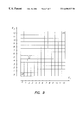
- FIG. 8 shows curves corresponding to a constant density value, connecting (E 1 , E 2 )-pairs giving that density shows patches generated by all possible combinations of engine values E 1 and E 2 .
- FIG. 9 shows patches created to obtain the curves of FIG. 8 .
- FIG. 1 shows a first sub-image 21 and a second sub-image 22 .
- the first sub-image or image band 21 may be generated by linewise exposure, i.e. parallel to the line direction 24 , e.g. by a DEP device having a single row of apertures or by an inkjet device having a row of nozzles.
- the imaging device advances according to the printing direction 23 or the image carrier on which the image is to be printed advances in the opposite direction.
- the sub-image 21 is completely printed.
- the imaging device is moved towards the second sub-image 22 or the image carrier is displaced relative to the imaging device, such that the imaging device can now print the first line of the second sub-image 22 etc.
- the two sub-images 21 and 22 must be joined to get a larger image, e.g. for the production of a poster, larger than the printing capability of the imaging device.
- the relative displacement of the printing device towards the place on the image carrier where the second sub-image must be printed, may introduce a first dislocation dx according to the line direction 24 and a second dislocation dy according to the printing direction 23 .
- the precision by which dx and dy may be minimised is decisive for the quality of the reproduced image on the carrier in the neighbourhood of the junction between the first and second sub-image 21 , 22 .
- the effect of a dislocation dx and dy will be discussed referring to simple original images.
- sub-images 21 and 22 are high density regions, e.g. black, and the dislocation dx equals to the size of one microdot, then a low density line having a width of dx may appear between the two high density sub-images 21 and 22 .
- Such line is clearly visible with a magnifying glass on a 600 dpi system and is even noticed by the naked eye at a viewing distance between 40 and 50 cm.
- FIG. 2 shows the situation on a 600 dpi system where the first sub-image 21 is dislocated relative to the second sub-image 22 in the printing direction over a distance dy of 42 ⁇ m.
- Each square area 25 having a size of 42 ⁇ m represents a microdot.
- the microdots within both sub-images 21 and 22 have alternately a high and a low microscopic density according to a chess-board pattern.
- Both sub-images represent a halftone pattern with a dot percentage of 50%. When seen at real scale by the naked eye, the halftone pattern will look as a solid grey region.
- the halftone screen 21 , 22 has a specific periodicity, characterised by a screen angle and a screen ruling. Both parameters are identical for the sub-images 21 and 22 , i.e. the screen angle is 45° and the screen ruling is 600/2 dpi.
- the halftone screen however has also a “starting point”, that may be situated in the centre of a microdot having a low density.
- the starting point may be freely moved about lines oriented according to the screen angle and over distances equal to an integer multiple of the pitch of the screen, where the pitch equals to 1/ruling. It is clear that within sub-image 21 or 22 of FIG. 2 one always arrives to the centre of another low density microdot. However, once the junction 26 is crossed, the starting points do not match. For the example of FIG. 2, the phase shift is maximum and the effect will also be clearly visible.
- An amplitude modulation screen is a screen in which halftone dots are arranged on a periodic grid.
- a periodic grid may be obtained by two sets of parallel and equidistant lines, each set having a specific orientation, usually orthogonal to each other.
- a halftone dot is a contiguous high density region on a low density background.
- a halftone dot is a contiguous low density region on a high density background.
- the area of the (high density) halftone dots grows as the density increases.
- the area of the (low density) halftone dots reduces as the density further increases.
- mid density regions halftone dots may start to touch each other.
- the number of halftone dots is constant, whereas the size or area of the halftone dots varies with the tone value of the original image to be reproduced by an arrangement of the halftone dots.
- the halftone dots have a fixed size and the number of halftone dots per unit area varies with the tone value of the original image to be reproduced by the halftone image.
- An FM halftone dot may have the size of one microdot.
- two adjacent microdots, i.e. microdots touching each other by one side, may constitute one microdot.
- a halftone dot in a frequency modulation halftone image is formed by a cluster of four microdots arranged as a 2 ⁇ 2 matrix. Other arrangements are also used. In low density regions, the high density halftone dots will be sparsely distributed over the image carrier.
- this screening technique is also referred to as stochastic screening.
- the halftone dots start to touch each other at their corner points or start to connect side by side. Once the density is high enough, no high density halftone dots on a low density background will be visible anymore, but low density halftone dots on a high density background will become visible. At very high densities, the low density microdots will be sparsely distributed on the high density background. This technique of halftoning is described in e.g. EP-A-0 642 258 and EP-A-0 682 438.
- halftoning i.e. amplitude modulation and frequency modulation
- binary printing systems i.e. systems that have the capability to deposit ink or no ink on a microdot; or to deposit toner or no toner etc.
- the printing system such as the Chromapress system referred to above, has the capability to deposit a restricted number (e.g. 16) of intermediate amounts of toner or ink on each one microdot
- the halftoning techniques may be further refined in that not only the area of the halftone dots or the number of halftone dots per unit area is modified but also the microscopic density of the microdots constituting the halftone dot—or even constituting the background—may be varied. This feature gives an extra degree of freedom that may be used in a suitable way to enhance the reproduction of continuous tone images. Suitable techniques are described in EP-A-0 634 862 and EP-A-0 682 438.
- the halftone dots used in frequency modulation (FM) halftoning have usually a size equal to the smallest halftone dots used in amplitude modulation (AM) halftoning. Therefore, for most tone levels to be reproduced, the halftone dots in AM are larger than the halftone dots in FM.
- the FM halftone dots preferably have a size of 42.3 ⁇ m by 42.3 ⁇ m; the AM halftone dots require a line ruling of 53 lpi (lines per inch), in order to be capable to reproduce 128 tone levels.
- the size of such AM halftone dots may be as large as 338 ⁇ m by 338 ⁇ m. Therefore, a dislocation dy as shown in FIG.
- the dislocation dx shown in FIG. 1 may either shift the sub-images 21 and 22 towards each other or away from each other.
- a suitable solution is to define, as shown in FIG. 3, an overlap region 28 around the junction 26 . Within that overlap region, the first sub-image 21 gradually fades out and the second sub-image 22 gradually takes over from sub-image 22 .
- FIG. 3 shows a reproduced image 27 on an image carrier. The reproduced image comprises a first sub-image 21 and a second sub-image 22 . Both sub-images extend in an overlap region 28 .
- the first sub-image 21 extends in the overlap region up to the peripheral edge 29 ; the second sub-image 22 extends in the overlap region up to the peripheral edge 30 .
- FIG. 3 shows a reproduced image 27 on an image carrier.
- the reproduced image comprises a first sub-image 21 and a second sub-image 22 . Both sub-images extend in an overlap region 28 .
- the first sub-image 21 extends in the overlap region up to the
- the first sub-image has another peripheral edge 31 on the image carrier; the second sub-image has also another peripheral edge 32 .
- the second sub-image 22 contributes to the integral optical density of the image carrier; between edges 29 and 30 , i.e. within the overlap region, both the first sub-image and the second sub-image contribute in variable degree to the integral optical density of the image carrier; between edges 30 and 31 , only the first sub-image 21 contributes to the integral optical density of the image carrier.
- the above contributions must be in accordance with the image contents of the original image to be reproduced.
- both the first and second sub-image 21 and 22 give variable contributions to the overlap region.
- both the first and second sub-image 21 and 22 must have information about the original image to be reproduced in the overlap region 28 .
- the first sub-image 21 generated from the original image will be representative for the portion of the original image to be reproduced between edge 29 and 31 ;
- the second sub-image 22 generated from the original image will be representative for the portion of the original image to be reproduced between edge 30 and 32 . Therefore, the first and second sub-image 21 and 22 will both comprise image information about the overlap region 28 .
- the first and second sub-image 21 , 22 will thus be conjoined, i.e. be joined together for a common purpose, i.e. to render or reproduce the portion of the original image within the overlap region 28 .
- the first and second sub-image are brought together so as to overlap in the overlap region 28 .
- the contribution to the integral optical density of the first sub-image 21 to the overlap region is sketched in FIG. 4 .
- the imaging device for imaging the first sub-image 21 does not need to be capable to address the microdots in the region between edge 32 and 29 .
- the contribution to the density of the image carrier by the first sub-image 21 will be 100%, i.e. that region will be imaged by data contained in the first sub-image 21 only. This assertion is true as long as between edge 30 and edge 31 not another overlap region is situated.
- the contribution to the density of the first sub-image steadily increases from edge 29 to edge 30 .
- the contribution of the first sub-image is 0%.
- the contribution of the first sub-image is 100%.
- the contribution of the first sub-image 21 is in the range [0%, 100%] and preferably does not decrease as edge 30 is approached, i.e. there may be a region within the overlap region 28 , where the contribution of the first sub-image 21 is constant as the edge 30 is approached. More preferably, that contribution is increasing as edge 30 is approached. The increase of that contribution may be linear, as shown in FIG. 4, but may also be non-linear.
- the function representing the percent contribution as a function of the distance d from the edge 29 (or edge 30 for the contribution of the second sub-image) may have a convex or concave shape or a combination of both with inflexion point etc.
- the contribution of the first sub-image 21 increases, the contribution of the second sub-image will not increase, e.g. the contribution of the second image 22 may decrease within the overlap region 28 as the edge 30 is approached.
- the reproduced image must be such that there is a very close visual resemblance between:
- the dot percentage of a region in a binary halftone image is defined as the number of microdots in that region having a high microscopic density, divided by the total number of microdots in that region.
- the dot percentage may be computed by assigning to each microdot in the region a value in the range [0.0, 1.0] by taking a value 0.0 for microdots having the lowest microscopic density, a value 1.0 for microdots having the highest microscopic density, and a value between 0 and 1 commensurate to the microscopic density for microdots having an intermediate microscopic density.
- the dot percentage is then obtained by summing the assigned values over all microdots in the region and dividing that sum by the total number of microdots in that region. By the above methods, the dot percentage is obtained as a fraction in the range [0,1]. By multiplication with a factor 100 , the dot percentage is expressed as a percentage value in the range of [0%, 100%].
- each FM halftone dot comprises a matrix of 2 ⁇ 2 microdots. In a 600 dpi system, this gives a halftone dot resolution of 300 dpi.
- a continuous tone system also referred to as contone device, has the capability to generate multiple density levels with no perceptible quantization to them.
- the number of density levels is typically 256 or more.
- Agfa's Drystar 2000 is a typical 10-bit contone device, addressable by 1024 levels applied to a thermal head, addressing each individual microdot at a spatial resolution of 300 dpi. This system is manufactured and marketed by Agfa-Gevaert N.V. in Mortsel, Belgium.
- the required density of a microdot may be obtained by time modulation or amplitude modulation of an electronic signal.
- Agfa's LR5200TM is a 16-bit contone device, wherein an intensity modulated laser beam exposes a black and white photographic laser recording film of the type ScopixTM LT2BTM at a resolution of 600 dpi.
- an intensity modulated laser beam exposes a black and white photographic laser recording film of the type ScopixTM LT2BTM at a resolution of 600 dpi.
- the contribution of the first and second sub-image may be decreased or increased in a continuous fashion.
- An original image having a constant tone level is reproduced by such systems by a structure-less image, i.e. the microdots in the reproduction all have an identical microscopic density level. No screening, rasterizing or dithering is visible, even not by a magnifying lens.
- Increasing the contribution of a sub-image in a contone system may be done preferably in a quasi continuous way, i.e. by modification of the value to drive the imaging device.
- the imaging device is operated for 100% in continuous tone mode: the translation of an image level of the original image into a drive signal does not depend on the location on the image carrier in non-overlap regions, as far as spatial corrections inherent to the imaging device are not considered.
- the contribution of the first sub-image decreases as a function of the location in the overlap region, typically the contribution of the second sub-image increases as a function of that location.
- a first imaging device gives a contribution to the density of the image carrier and a second imaging device (or the first device at a later printing stage) gives such contribution at the same location.
- the contribution in the overlap region by each imaging device depends on the image signal from the original image and on the location within that overlap region.
- Binary and multilevel imaging systems require some form of halftoning, rasterizing or dithering for the faithful reproduction of continuous tone original images.
- Binary halftoning may require modified screening techniques to fade out the first sub-image while fading in the second sub-image within the overlap region.
- Multilevel halftoning has another degree of freedom with respect to binary halftoning, in that also the microscopic density of individual microdots may be varied by visible density steps.
- Most critical images for testing correctly fading in/out are original images having one single constant tone level, e.g. grey images. Screening with FM techniques gives better results in the overlap region than screening with AM techniques.
- a first screened image is generated by the first screening method according to a first constant tone level T 1 .
- a second screened image is generated by the second screening method according to a second constant tone level T 2 .
- the second screened image is printed a first time on top of the first screened image and a first integral optical density D 1 of the result is measured.
- a second time the first and second screened images are generated.
- the second screened image is printed on top of the first screened image, but now with a relative displacement of one microdot.
- a second integral optical density D 2 is measured. The above procedure is repeated for all possible relative displacements and a mean density D m is computed.
- the two screening methods are now uncorrelated if all measured densities D j fall within the range of [0.8 D m , 1.2 D m ].
- the lowest achievable microscopic density is the integral density of the image carrier where it carries no ink, toner or minimal pigmentation.
- the highest achievable microscopic density is the integral density of the image carrier where it carries the maximum achievable amount of ink, toner or has maximal pigmentation.
- the intermediate microscopic density has a value that is preferably substantially different from the minimum and maximum integral optical density of the image carrier or of the minimum and maximum achievable microscopic density of the microdots. By substantially different is meant that the difference is at least 10% of the difference between the maximum and minimum density of the image carrier or microdots. This means that, if the minimum density is D MIN and the maximum density is D MAX , then at least one intermediate microscopic density of a microdot in the overlap region must be in the interval of:
- the imaging device is operated by a multilevel halftoning technique, preferably maximal use of the contone capabilities of the imaging device is made. This means that for reproducing an original image having one constant colour (e.g. only a specific grey), the microdots on the image carrier have a microscopic density within a narrow density interval, e.g. 20% of D MAX ⁇ D MIN , more preferably 10%.
- the gradual transition from the first sub-image 21 to the second sub-image 22 in the overlap region may be realised for contone, multilevel and binary devices by the process of the imaging system 55 as sketched in FIG.
- the original image 33 is an eight bit continuous tone image. Each grey level or tone value is represented by a value in the range of 0-255.
- An address generator 34 generates the position co-ordinates (x,y) for retrieving the original tone value T for the microdot to be imaged on the location (x,y) of the image carrier by the imaging device 38 .
- the retrieved eight bit tone value T is transmitted to the contribution processing module 35 . That module gets, apart from the tone value T, also the location (x,y) from the address generator 34 and the position of the two edges 29 , 30 delimiting the overlap region 28 .
- tone value T′ will have a value between 0 and T.
- the tone value after contribution processing T′ for the first sub-image 21 may be computed from the original tone value T by the following equation (see FIG. 3 ):
- W is the width of the overlap region, expressed e.g. in ⁇ m.
- d is the distance between edge 29 and the point (x,y),
- T′ T for (x,y) on edge 30 .
- the contribution processed tone value T′′ for the second sub-image 22 may be computed from the original tone value T by the following equation:
- the tone value after contribution processing is a non-linear function f ( ) of the distance d:
- T′ F ( T, d )
- the design of the functions f(d) and F(T,d) will be set out below.
- the contribution processed tone values T′ are sent to the bitmap generation module 37 . That module converts in the usual way tone values T′ to engine value E, suitable for driving the imaging device 38 . If the imaging device 38 is a contone device, such as the Agfa Drystar 2000 10-bit colour printer, addressed by a 10-bit engine value E, the bitmap generation module 37 transforms each tone value T′ to an engine value E independently from the location (x,y) on the carrier.
- the 8-bit tone value T′ is thus transformed to a 10-bit engine value E.
- This transformation may be realised by a look up table (LUT) having 256 entries and output values in the range of 0-1023.
- the imaging device 38 has multilevel capabilities, such as the Chromapress system, or is a binary imaging device, such as a graphical imagesetter or a platesetter for lithographic printing plates
- the bitmap generation module 37 will transform the 8-bit tone value T′ to a specific engine value E, according to the location (x,y) where the tone value T′ belongs to.
- the modules 35 and 37 may be integrated for generating a (multilevel) halftone image for a binary or multilevel imaging device 38 .
- (multilevel) halftoning is performed by making use of traditional threshold matrices or transformation tiles.
- specific threshold matrices or transformation tiles may be designed for controlling the contribution of sub-images to the density of the image carrier.
- the engine values E generated by bitmap generation device 37 are then transmitted to the imaging device 38 for imaging the sub-image.
- the second sub-image may be imaged by the same imaging device.
- two systems according to FIG. 5 are present in the imaging system, both systems having an imaging device, capable to operate in parallel. The first imaging device will then image the first sub-image, the second imaging device will image the second sub-image.
- the imaging device is a contone device as defined before, then a smooth fit of two sub-images in the overlap region is possible. If the imaging device is a binary device, such as a platesetter for a lithographic printing plate, a P3400PS binary electrophotographic printer, a binary thermographic printer etc., then it is preferred, due to the risk of phase errors, that the bitmap generator 37 generates a binary halftone image according to a stochastic screening technique (FM screening) for the imaging device 38 .
- FM screening stochastic screening
- This 600 dpi LED-based electrophotographic system is capable to print duplex colour images on a web material.
- the web material sequentially contacts five photosensitive drums.
- Each drum carries a toner image, the toner being supplied from a toner delivery means or toner station.
- the toner stations may be filled with colour toners: cyan, magenta, yellow and black.
- Each drum comprises means for adjusting dx and dy as shown in FIG. 1 . In the experiment the toner station for black and that for magenta toner were both filled with black toner.
- the drum for black toner was used for imaging the first sub-image 21
- the adjusting means were deregulated to purposively introduce dislocations dx and dy for simulation experiments. It has been found that if the overlap region 28 has a size W of 8 to 16 mm, then dislocations between ⁇ 200 ⁇ m and +200 ⁇ m may be absorbed, when imaged by the method according to the current invention. Also overlap zones of 2 mm up to 8 mm give suitable results. For 600 dpi inkjet systems printing in bands, an overlap region, imaged according to the current invention, and having a width of 4 to 5 mm gives very acceptable results.
- dislocations between ⁇ 30 and +30 ⁇ m or even between ⁇ 40 ⁇ m and +40 ⁇ m may be invisible even without compensation according to the current invention.
- the disturbance caused by a clear or dark line having a width of 40 ⁇ m may be visible by the naked eye from a short viewing distance (20-50 cm).
- Such line having a width of 100 ⁇ m (0.1 mm) is acceptable only from a larger viewing distance (larger than 1 m).
- a 300 dpi stochastic screen referred to as Agfa CristalRaster (trademark of Agfa-Gevaert N.V.), was programmed in the bitmap generation module 37 for the imaging device for imaging the first sub-image, referred to as the first imaging device. Screening was done according to a 128 ⁇ 128 tile, within the meaning as described in EP-A-0 682 438.
- the CristalRaster screen was also programmed for the imaging device for imaging the second sub-image, referred to as the second imaging device.
- the Chromapress is a 600 dpi system. Each FM halftone dot was formed by a matrix of 2 ⁇ 2 microdots.
- 100% halftone dots were printed for both the first sub-image 21 and the second sub-image 22 .
- 100% halftone dots is meant that each halftone dot on the carrier gets the specified microscopic density.
- no halftone structure is present, since all microdots within one patch get the same microscopic density.
- the first sub-image 21 is divided in 16 patches, numbered from 0 to 15. According to the experiment, each patch of the first sub-image is imaged with the engine value displayed in the patch.
- the patch labelled 15 in the upper right hand corner of FIG. 6 a was completely black. This is due to the fact that each microdot within that patch got an engine value 15 , corresponding to the highest amount of toner that can be deposited by the imaging device.
- Each individual patch of the first sub-image labelled with 1-14 also had a homogenous distribution of toner particles; the patch labelled 1 had small amounts of toner particles on each microdot, the patch labelled 14 large amounts, but smaller than the toner amounts in the patch labelled 15 .
- the second imaging device was used to image the second sub-image 22 in FIG. 6 a.
- the patch labelled with 0 got no toner, each microdot within the patch labelled 15 got a maximum amount of black toner.
- the patches labelled 1 - 14 got intermediate amounts of toner, equally distributed over all microdots in the patch, the amounts being commensurate the label value 1 - 14 .
- Both the first and second imaging device were used to image the overlap region 28 . Again 16 patches were imaged differently.
- the patch in FIG. 6 a labelled 0 / 15 got no toner from the second imaging device and got a maximum amount of toner from the first imaging device. In the patch labelled 15 / 0 , the situation was reversed.
- the first imaging device printed 16 different rectangular homogeneous patches, spanning the overlap region 28 and the first sub-image 21 ;
- the second imaging device printed 16 different rectangular homogeneous patches, spanning the overlap region 28 and the second sub-image 22 .
- the 16 patches 0 / 15 - 15 / 0 of the overlap region 28 all had a high optical density. This density was measured by a densitometer. The measured values may be plotted as shown in FIG. 7 . On the horizontal axis the engine value E 1 for the first sub-image is plotted.
- the blank halftone dots are stochastically distributed in the patches, according to he CristalRaster FM screening technique.
- the patch on the lower left hand corner of FIG. 6 b has been imaged by the second imaging device with engine value E 2 15, i.e. each non-blank halftone dot gets a maximum amount of toner, whereas each blank halftone dot, i.e. 12.5% of the halftone dots within that patch, gets no toner.
- the patch annotated with 15 / 0 in the overlap region 28 of FIG. 6 b results from overprinting the second sub-image 22 having a dot percentage of 87.5% on top of the first sub-image 21 , having a dot percentage of 0%. That 15 / 0 patch has the same structure as the 15 patch in the second sub-image 22 .
- the reverse operation is applied on the patch labelled 0 / 15 in FIG. 6 b.
- the patch labelled 4 / 11 in FIG. 6 b is the result of overprinting patch 4 of the second sub-image 22 on patch 11 of the first sub-image 21 . In this 4/11 patch four types of microdots are present:
- the microdot has minimal microscopic density.
- the microdot in the patch 4/11 in the overlap region 28 has a low microscopic density.
- the microdot in the 4/11 patch has a relatively high microscopic density.
- the microdot has a high microscopic density, due to deposition of a small amount of toner on top of a larger amount of toner.
- Case 2 and 3 have both a chance of ⁇ fraction (7/64) ⁇ .
- Case 4 has a chance of ⁇ fraction (49/64) ⁇ .
- the experiment according to FIG. 6 d refers to 62.5% non-blank halftone dots; the reflectance was plotted by symbol 42 in FIG. 7 .
- the reflectance indicated by symbol 43 in FIG. 7 corresponds to 50% non-blank halftone dots in FIG. 6 e ; symbol 44 corresponds to 37.5% in FIG. 6 f ; symbols 45 and 46 correspond to 25% and 12.5% non-blank halftone dots in FIGS. 6 g and 6 h respectively.
- the curve 39 according to this function for 87.5% CristalRaster is shown in FIG. 7 .
- optical reflectance R is displayed as a function of the Engine value, with the percentage as parameter, but the lightness L according to CIE (Commission Internationale de l'Eclairage) instead of R.
- CIE Commission Internationale de l'Eclairage
- the required reflectance value R 42% on the vertical axis of FIG. 7 and draw a horizontal line 52 .
- Vertical lines may be drawn from the engine values 1 - 15 on the horizontal axis. Wherever the intersection of the horizontal line 52 and each one of the vertical lines comes close to one of the marks 40 - 46 , according to the current example marks 41 and 42 , that combination of engine values E 1 and E 2 along with the corresponding percentage of non-blank halftone dots may be selected to achieve the required optical reflectance.
- the engine value E 1 may be selected according to the position d (FIG. 3) within the overlap region 28 . If the engine value has an integer value from 0 to 15, then E 1 may be selected according to the following equation:
- y [x], where x is a real number and y is an integer number, means that y is the integer value lower than or equal to x.
- E 1 is set to 15.
- E 2 15-E 1 .
- the intersection 54 of the horizontal line 52 and the vertical line 53 is situated between a mark 41 corresponding to 75% and a mark 42 corresponding to 62.5%.
- the level according to the first sub-image is shown on the horizontal axis E 1
- the level for the second sub-image is shown on the vertical axis E 2 .
- patch 48 has the lowest optical density since it received no toner at all, i.e. from none of both imaging devices; patch 49 has the highest optical density, since it received from the first and second imaging device a maximum amount of toner.
- the densities D 1 for the patches with E 2 0, i.e.
- the same procedure was applied for varying engine values for the second imaging engine and the first imaging engine depositing no toner. This gave the vertical linear scale D 2 and the non-linear scale E 2 in FIG. 8 . Thereafter, the density of all 144 remaining patches was measured, and those patches having a density between 0.8 and 1.2 were represented by an asterisk 50 in FIG. 8 . With each asterisk 50 , a measured density is associated.
- a surface in three-dimensional space (E 1 ,E 2 , D) is defined, D being the density measured on patch (E 1 ,E 2 ).
- the other curves in FIG. 8 representing densities 0.2, 0.4, . . . 1.4 were obtained likewise.
- Finding E 1 and E 2 are two separate and independent operations, performed for the same image pixel of the original image. Ideally E 1 and E 2 are imaged on the same microdot, but due to dislocations dx, dy, they may be imaged on different microdots. E 1 and E 2 obtained by the above method may be non-integer values. The engine however can be driven only by integer values. For converting the non-integer value to the integer value, rounding may be used, i.e. a fraction lower than 0.5 is omitted, other fractions lead to the next higher integer value. Alternatively, one of the two integer values closest to the non-integer value may be selected at random.
- a random number r with a constant or homogeneous distribution is generated in the interval [0,1) (0 included, 1 not).
- the number r is added to the non-integer E-value. From that sum the fraction is discarded, giving the integer E-value.
- this operation non-integer E-values close to an integer value have more chance to be transformed to that closer integer value. Also this operation is done preferably independently for E 1 and E 2 since due to the uncertainty about the dislocations, it is not guaranteed that the engine value E 2 will be printed on top of the engine value E 1 .
- the method described herein above may be repeated for all density values D or their original tone values T and for all locations d (FIG. 3) within the overlap region 28 .
- This function may be incorporated in the contribution processing module 35 as shown in FIG. 5, to deliver a value T′ such that the bitmap generation module 37 delivers the required engine value E.
- the tile for halftoning contone values T′ to multilevel values E, and stored in the bitmap generation module 37 may be different for overlap and non-overlap regions.
- module 36 gives also a signal to the bitmap generation module 37 , such that this module may decide to use either the usual tile or the tile for overlap regions.
- increasing the contributions by an overlapping sub-image is preferably done by increasing the microscopic density of the microdots as for constant tone values of the original image these microdots get more distance from the peripheral edge of that sub-image.
- the microscopic density may be increased by small density steps. These density steps ⁇ D are smaller than half the density difference between the maximum D MAX and minimum D MIN microscopic density achievable on a microdot, i.e.
- the screening method used is a frequency-modulated halftone screening and in the overlap region, the screening method for the first sub-image is preferably non-correlated to the screening method for the second sub-image.
- T tone value of a pixel of the original image 33
- T′ tone value of a pixel after contribution processing
- bitmap generation (e.g. multilevel halftoning)
Landscapes
- Engineering & Computer Science (AREA)
- Multimedia (AREA)
- Signal Processing (AREA)
- Image Processing (AREA)
Abstract
Description
Claims (3)
Priority Applications (3)
| Application Number | Priority Date | Filing Date | Title |
|---|---|---|---|
| US09/427,810 US6690837B1 (en) | 1998-11-03 | 1999-10-27 | Screening method for overlapping sub-images |
| US10/636,124 US20040028291A1 (en) | 1998-11-03 | 2003-08-07 | Screening method for overlapping sub-images |
| US10/695,118 US7231096B2 (en) | 1998-11-03 | 2003-10-28 | Screening method for overlapping sub-images |
Applications Claiming Priority (4)
| Application Number | Priority Date | Filing Date | Title |
|---|---|---|---|
| EP19980203869 EP0999694B1 (en) | 1998-11-03 | 1998-11-03 | Screening method and imaging system for overlapping sub-images |
| EP98203869 | 1998-11-03 | ||
| US11231098P | 1998-12-14 | 1998-12-14 | |
| US09/427,810 US6690837B1 (en) | 1998-11-03 | 1999-10-27 | Screening method for overlapping sub-images |
Related Child Applications (2)
| Application Number | Title | Priority Date | Filing Date |
|---|---|---|---|
| US10/636,124 Continuation US20040028291A1 (en) | 1998-11-03 | 2003-08-07 | Screening method for overlapping sub-images |
| US10/695,118 Division US7231096B2 (en) | 1998-11-03 | 2003-10-28 | Screening method for overlapping sub-images |
Publications (1)
| Publication Number | Publication Date |
|---|---|
| US6690837B1 true US6690837B1 (en) | 2004-02-10 |
Family
ID=30773256
Family Applications (3)
| Application Number | Title | Priority Date | Filing Date |
|---|---|---|---|
| US09/427,810 Expired - Lifetime US6690837B1 (en) | 1998-11-03 | 1999-10-27 | Screening method for overlapping sub-images |
| US10/636,124 Abandoned US20040028291A1 (en) | 1998-11-03 | 2003-08-07 | Screening method for overlapping sub-images |
| US10/695,118 Expired - Lifetime US7231096B2 (en) | 1998-11-03 | 2003-10-28 | Screening method for overlapping sub-images |
Family Applications After (2)
| Application Number | Title | Priority Date | Filing Date |
|---|---|---|---|
| US10/636,124 Abandoned US20040028291A1 (en) | 1998-11-03 | 2003-08-07 | Screening method for overlapping sub-images |
| US10/695,118 Expired - Lifetime US7231096B2 (en) | 1998-11-03 | 2003-10-28 | Screening method for overlapping sub-images |
Country Status (1)
| Country | Link |
|---|---|
| US (3) | US6690837B1 (en) |
Cited By (10)
| Publication number | Priority date | Publication date | Assignee | Title |
|---|---|---|---|---|
| US20040028291A1 (en) * | 1998-11-03 | 2004-02-12 | Dirk Broddin | Screening method for overlapping sub-images |
| US20050155502A1 (en) * | 2004-01-20 | 2005-07-21 | Kaku Shigeta | Gravure printing method and gravure printed item |
| US6950563B1 (en) * | 1999-01-23 | 2005-09-27 | Lfk-Lenkflugkoerpersysteme Gmbh | Method and system for relocating hidden objects in images |
| US20060290950A1 (en) * | 2005-06-23 | 2006-12-28 | Microsoft Corporation | Image superresolution through edge extraction and contrast enhancement |
| US20080055623A1 (en) * | 2006-08-31 | 2008-03-06 | Ricoh Co., Ltd. | Techniques for image segment accumulation in document rendering |
| US20080285085A1 (en) * | 2005-10-26 | 2008-11-20 | Peking University Founder Group Co., Ltd. | Method for Controlling the Shapes of FM-AM Mixed Dots on a Multi-Bit Depth Imaging Apparatus |
| US20100328732A1 (en) * | 2006-11-21 | 2010-12-30 | Illumina Inc. | Hexagonal site line scanning method and system |
| US20110044555A1 (en) * | 2009-08-19 | 2011-02-24 | John Swanson | Merging of image pixel arrangements |
| US20140015887A1 (en) * | 2004-08-06 | 2014-01-16 | S. Dana Seccombe | Means for higher speed inkjet printing |
| US10802770B2 (en) * | 2017-02-14 | 2020-10-13 | Hp Indigo B.V. | Dividing a spanning region of adjacent sub-images to generate print data |
Families Citing this family (14)
| Publication number | Priority date | Publication date | Assignee | Title |
|---|---|---|---|---|
| US7298510B2 (en) * | 2001-05-10 | 2007-11-20 | Canon Kabushiki Kaisha | Image enlargement through poster printing by combining pattern data with image data |
| ATE406752T1 (en) * | 2003-12-16 | 2008-09-15 | Ericsson Telefon Ab L M | ETHERNET DSL ACCESS MULTIPLEXER AND METHOD FOR PROVIDING DYNAMIC SERVICE SELECTION AND END USER CONFIGURATION |
| US7599098B2 (en) * | 2004-05-05 | 2009-10-06 | Kodak Graphic Communications Canada Company | System and methods for color matching overprinted documents |
| US7271822B2 (en) * | 2004-07-28 | 2007-09-18 | Hewlett-Packard Development Company, L.P. | Seamless stitching of multiple image fields in a wide-format laser printer |
| CN100377566C (en) * | 2005-10-26 | 2008-03-26 | 北京北大方正电子有限公司 | FM-AM Mixed Halftone Image Processing Method on Multi-bit Imaging Depth Device |
| JP5162829B2 (en) * | 2006-01-19 | 2013-03-13 | 富士ゼロックス株式会社 | Image forming apparatus and image processing method thereof |
| AU2006203027B2 (en) * | 2006-07-14 | 2009-11-19 | Canon Kabushiki Kaisha | Improved two-dimensional measurement system |
| US7955243B2 (en) * | 2006-09-28 | 2011-06-07 | Konica Minolta Systems Laboratory, Inc. | Poster printing using perforated paper |
| JP4288524B2 (en) * | 2007-01-10 | 2009-07-01 | セイコーエプソン株式会社 | Multifunction device and control method of multifunction device communication management unit, multifunction device system comprising multifunction device and multifunction device communication management unit |
| US7637585B2 (en) * | 2007-06-05 | 2009-12-29 | Hewlett-Packard Development Company, L.P. | Halftone printing on an inkjet printer |
| JP4655114B2 (en) * | 2008-06-19 | 2011-03-23 | コニカミノルタビジネステクノロジーズ株式会社 | Image reading apparatus and image forming apparatus |
| AU2009240860B2 (en) * | 2009-11-26 | 2011-12-22 | Canon Kabushiki Kaisha | Determining composite colour for dithered object and contone object |
| US8848249B2 (en) * | 2011-07-29 | 2014-09-30 | Hewlett-Packard Development Company, L.P. | Creating an image to be printed using halftone blending |
| EP2848421B1 (en) | 2013-09-12 | 2016-07-13 | Agfa Graphics Nv | Large cuboid shaped object inkjet printing |
Citations (18)
| Publication number | Priority date | Publication date | Assignee | Title |
|---|---|---|---|---|
| US5131058A (en) * | 1990-08-24 | 1992-07-14 | Eastman Kodak Company | Method for obtaining output-adjusted color separations |
| EP0517543A2 (en) | 1991-06-07 | 1992-12-09 | Canon Kabushiki Kaisha | Ink jet recording method |
| EP0522980A2 (en) | 1991-06-17 | 1993-01-13 | Eastman Kodak Company | Method and apparatus for thermally printing large images with small dye-donor patches |
| EP0529535A2 (en) | 1991-08-23 | 1993-03-03 | Eastman Kodak Company | Electronic data and drive circuit for thermal printer |
| US5253084A (en) * | 1990-09-14 | 1993-10-12 | Minnesota Mining And Manufacturing Company | General kernel function for electronic halftone generation |
| EP0619188A2 (en) | 1993-04-08 | 1994-10-12 | Eastman Kodak Company | Thermal line printer |
| EP0634862A1 (en) | 1993-07-12 | 1995-01-18 | Agfa-Gevaert N.V. | Screening method for a rendering device having restricted density resolution |
| EP0642258A2 (en) | 1993-09-02 | 1995-03-08 | Agfa-Gevaert N.V. | Frequency modulated halftone image and method for making same |
| EP0675417A1 (en) | 1994-03-29 | 1995-10-04 | Agfa-Gevaert N.V. | A method and device for direct electrostatic printing (DEP) |
| EP0677383A2 (en) | 1994-04-07 | 1995-10-18 | Scitex Corporation Ltd. | A plot strip butting image setter |
| EP0680195A1 (en) | 1994-04-27 | 1995-11-02 | Agfa-Gevaert N.V. | Clustered dot and line multilevel halftoning for electrographic colour printing |
| EP0682438A1 (en) | 1994-05-11 | 1995-11-15 | Agfa-Gevaert N.V. | Multilevel halftoning using a randomised Bayer matrix |
| EP0709802A2 (en) | 1994-10-31 | 1996-05-01 | Texas Instruments Incorporated | Optical scanning with overlap |
| EP0748109A2 (en) | 1991-07-25 | 1996-12-11 | Bayer Corporation | Screening system and method for color reproduction in offset printing |
| US5884013A (en) * | 1995-11-17 | 1999-03-16 | Agfa-Gevaert | Autotypical screening with optimised dotshape |
| US6128108A (en) * | 1997-09-03 | 2000-10-03 | Mgi Software Corporation | Method and system for compositing images |
| US6128090A (en) * | 1996-12-11 | 2000-10-03 | Agfa Gevaert N.V. | Visual control strip for imageable media |
| US6249616B1 (en) * | 1997-05-30 | 2001-06-19 | Enroute, Inc | Combining digital images based on three-dimensional relationships between source image data sets |
Family Cites Families (6)
| Publication number | Priority date | Publication date | Assignee | Title |
|---|---|---|---|---|
| US4616262A (en) * | 1983-11-14 | 1986-10-07 | Dainippon Ink And Chemicals, Incorporated | Method and apparatus for forming a combined image signal |
| DE69403581T2 (en) * | 1993-08-13 | 1998-02-05 | Agfa Gevaert Nv | Method for generating frequency-modulated halftone images |
| US5640254A (en) * | 1995-02-06 | 1997-06-17 | Polygraphex Systems, Inc. | Method for applying FM screening to a digital image |
| EP0910206B1 (en) * | 1995-04-28 | 2001-10-10 | Agfa-Gevaert N.V. | Halftone screen and method for making same |
| US6215914B1 (en) * | 1997-06-24 | 2001-04-10 | Sharp Kabushiki Kaisha | Picture processing apparatus |
| US6690837B1 (en) * | 1998-11-03 | 2004-02-10 | Agfa-Gevaert | Screening method for overlapping sub-images |
-
1999
- 1999-10-27 US US09/427,810 patent/US6690837B1/en not_active Expired - Lifetime
-
2003
- 2003-08-07 US US10/636,124 patent/US20040028291A1/en not_active Abandoned
- 2003-10-28 US US10/695,118 patent/US7231096B2/en not_active Expired - Lifetime
Patent Citations (18)
| Publication number | Priority date | Publication date | Assignee | Title |
|---|---|---|---|---|
| US5131058A (en) * | 1990-08-24 | 1992-07-14 | Eastman Kodak Company | Method for obtaining output-adjusted color separations |
| US5253084A (en) * | 1990-09-14 | 1993-10-12 | Minnesota Mining And Manufacturing Company | General kernel function for electronic halftone generation |
| EP0517543A2 (en) | 1991-06-07 | 1992-12-09 | Canon Kabushiki Kaisha | Ink jet recording method |
| EP0522980A2 (en) | 1991-06-17 | 1993-01-13 | Eastman Kodak Company | Method and apparatus for thermally printing large images with small dye-donor patches |
| EP0748109A2 (en) | 1991-07-25 | 1996-12-11 | Bayer Corporation | Screening system and method for color reproduction in offset printing |
| EP0529535A2 (en) | 1991-08-23 | 1993-03-03 | Eastman Kodak Company | Electronic data and drive circuit for thermal printer |
| EP0619188A2 (en) | 1993-04-08 | 1994-10-12 | Eastman Kodak Company | Thermal line printer |
| EP0634862A1 (en) | 1993-07-12 | 1995-01-18 | Agfa-Gevaert N.V. | Screening method for a rendering device having restricted density resolution |
| EP0642258A2 (en) | 1993-09-02 | 1995-03-08 | Agfa-Gevaert N.V. | Frequency modulated halftone image and method for making same |
| EP0675417A1 (en) | 1994-03-29 | 1995-10-04 | Agfa-Gevaert N.V. | A method and device for direct electrostatic printing (DEP) |
| EP0677383A2 (en) | 1994-04-07 | 1995-10-18 | Scitex Corporation Ltd. | A plot strip butting image setter |
| EP0680195A1 (en) | 1994-04-27 | 1995-11-02 | Agfa-Gevaert N.V. | Clustered dot and line multilevel halftoning for electrographic colour printing |
| EP0682438A1 (en) | 1994-05-11 | 1995-11-15 | Agfa-Gevaert N.V. | Multilevel halftoning using a randomised Bayer matrix |
| EP0709802A2 (en) | 1994-10-31 | 1996-05-01 | Texas Instruments Incorporated | Optical scanning with overlap |
| US5884013A (en) * | 1995-11-17 | 1999-03-16 | Agfa-Gevaert | Autotypical screening with optimised dotshape |
| US6128090A (en) * | 1996-12-11 | 2000-10-03 | Agfa Gevaert N.V. | Visual control strip for imageable media |
| US6249616B1 (en) * | 1997-05-30 | 2001-06-19 | Enroute, Inc | Combining digital images based on three-dimensional relationships between source image data sets |
| US6128108A (en) * | 1997-09-03 | 2000-10-03 | Mgi Software Corporation | Method and system for compositing images |
Cited By (23)
| Publication number | Priority date | Publication date | Assignee | Title |
|---|---|---|---|---|
| US20040028291A1 (en) * | 1998-11-03 | 2004-02-12 | Dirk Broddin | Screening method for overlapping sub-images |
| US20040085587A1 (en) * | 1998-11-03 | 2004-05-06 | Dirk Broddin | Screening method for overlapping sub-images |
| US7231096B2 (en) * | 1998-11-03 | 2007-06-12 | Agfa-Gevaert N.V. | Screening method for overlapping sub-images |
| US6950563B1 (en) * | 1999-01-23 | 2005-09-27 | Lfk-Lenkflugkoerpersysteme Gmbh | Method and system for relocating hidden objects in images |
| US20050155502A1 (en) * | 2004-01-20 | 2005-07-21 | Kaku Shigeta | Gravure printing method and gravure printed item |
| US7069851B2 (en) * | 2004-01-20 | 2006-07-04 | Think Laboratory Co., Ltd. | Gravure printing method and gravure printed item |
| US10166765B2 (en) * | 2004-08-06 | 2019-01-01 | S Dana Seccombe | Means for higher speed inkjet printing |
| US20180015719A1 (en) * | 2004-08-06 | 2018-01-18 | S Dana Seccombe | Means for Higher Speed Inkjet Printing |
| US20140015887A1 (en) * | 2004-08-06 | 2014-01-16 | S. Dana Seccombe | Means for higher speed inkjet printing |
| US7613363B2 (en) | 2005-06-23 | 2009-11-03 | Microsoft Corp. | Image superresolution through edge extraction and contrast enhancement |
| US20060290950A1 (en) * | 2005-06-23 | 2006-12-28 | Microsoft Corporation | Image superresolution through edge extraction and contrast enhancement |
| WO2007001820A3 (en) * | 2005-06-23 | 2007-11-15 | Microsoft Corp | Image superresolution through edge extraction and contrast enhancement |
| US20080285085A1 (en) * | 2005-10-26 | 2008-11-20 | Peking University Founder Group Co., Ltd. | Method for Controlling the Shapes of FM-AM Mixed Dots on a Multi-Bit Depth Imaging Apparatus |
| US8045233B2 (en) * | 2005-10-26 | 2011-10-25 | Peking University Founder Group Co., Ltd. | Method for controlling the shapes of FM-AM mixed dots on a multi-bit depth imaging apparatus |
| US8711372B2 (en) * | 2006-08-31 | 2014-04-29 | Ricoh Co., Ltd. | Techniques for image segment accumulation in document rendering |
| US20080055623A1 (en) * | 2006-08-31 | 2008-03-06 | Ricoh Co., Ltd. | Techniques for image segment accumulation in document rendering |
| US20100328732A1 (en) * | 2006-11-21 | 2010-12-30 | Illumina Inc. | Hexagonal site line scanning method and system |
| US8023162B2 (en) * | 2006-11-21 | 2011-09-20 | Illumina, Inc. | Hexagonal site line scanning method and system |
| WO2011022035A1 (en) * | 2009-08-19 | 2011-02-24 | Eastman Kodak Company | Improved merging of image pixel arrangements |
| US8174552B2 (en) | 2009-08-19 | 2012-05-08 | Eastman Kodak Company | Merging of image pixel arrangements |
| US20110044555A1 (en) * | 2009-08-19 | 2011-02-24 | John Swanson | Merging of image pixel arrangements |
| US10802770B2 (en) * | 2017-02-14 | 2020-10-13 | Hp Indigo B.V. | Dividing a spanning region of adjacent sub-images to generate print data |
| US11163504B2 (en) | 2017-02-14 | 2021-11-02 | Hp Indigo B.V. | Dividing a spanning region of adjacent sub-images to generate print data |
Also Published As
| Publication number | Publication date |
|---|---|
| US7231096B2 (en) | 2007-06-12 |
| US20040028291A1 (en) | 2004-02-12 |
| US20040085587A1 (en) | 2004-05-06 |
Similar Documents
| Publication | Publication Date | Title |
|---|---|---|
| US7231096B2 (en) | Screening method for overlapping sub-images | |
| US11778123B2 (en) | Artifact compensation mechanism | |
| JP3885310B2 (en) | Halftone image generation apparatus and method for reducing defects in printed images | |
| US6346993B1 (en) | Tone-variation-resistant phase-shiftable halftone screen system and method of using | |
| US20070046961A1 (en) | Image processing apparatus and method therefor | |
| EP0493935B1 (en) | Digital electronic system for halftone printing | |
| JP4324278B2 (en) | Gradation reproduction method using halftone dots, halftone plate output device, and halftone plate | |
| US6597388B2 (en) | Laser-induced thermal imaging with masking | |
| US6587221B1 (en) | Scanning device and method | |
| CN101025588A (en) | Image processing apparatus, image processing method and image forming apparatus | |
| US5337167A (en) | Halftone image forming apparatus including density based dot enlargement | |
| US7088479B2 (en) | Image processing apparatus for electrophotography and electrophotographic apparatus utilizing the same | |
| EP0999694B1 (en) | Screening method and imaging system for overlapping sub-images | |
| US5841458A (en) | Halftoning method for multi-color laser printer | |
| US6281924B1 (en) | Image forming method | |
| US6091512A (en) | Image processing apparatus and method for improving image reproducibility | |
| JP3711763B2 (en) | Electrophotographic image processing apparatus and method | |
| US20060279788A1 (en) | Automatic generation of supercell halftoning threshold arrays for high addressability devices | |
| EP0664522B1 (en) | Multi-level xerography exposure control through multi-beam overscan | |
| EP1231066A1 (en) | Ink jet printing method | |
| JP2003266756A (en) | Image processing apparatus and image forming apparatus | |
| US6654141B1 (en) | Image processing apparatus, image processing method and memory medium | |
| JP2800501B2 (en) | Image forming device | |
| US6049395A (en) | Method and system for achieving enhanced gray levels in a screen cell array | |
| JP2999795B2 (en) | Color image forming equipment |
Legal Events
| Date | Code | Title | Description |
|---|---|---|---|
| AS | Assignment |
Owner name: AGFA CORPORATION, MASSACHUSETTS Free format text: ASSIGNMENT OF ASSIGNORS INTEREST;ASSIGNORS:BRODDIN, DIRK;VERBRUGGEN, MARIO;TAVERNIER, SERGE;REEL/FRAME:014002/0509 Effective date: 19990823 |
|
| STCF | Information on status: patent grant |
Free format text: PATENTED CASE |
|
| FPAY | Fee payment |
Year of fee payment: 4 |
|
| AS | Assignment |
Owner name: AGFA GRAPHICS NV, BELGIUM Free format text: ASSIGNMENT OF ASSIGNORS INTEREST;ASSIGNOR:AGFA-GEVAERT N.V.;REEL/FRAME:023337/0791 Effective date: 20061231 |
|
| AS | Assignment |
Owner name: AGFA GRAPHICS NV, BELGIUM Free format text: CORRECTIVE ASSIGNMENT TO CORRECT THE ASSIGNEE FROM AGFA CORPORATION TO AGFA-GEVAERT PREVIOUSLY RECORDED ON REEL 014002 FRAME 0509;ASSIGNORS:BRODDIN, DIRK;VERBRUGGEN, MARIO;TAVERNIER, SERGE;REEL/FRAME:023355/0304 Effective date: 19990823 |
|
| AS | Assignment |
Owner name: AGFA-GEVAERT, BELGIUM Free format text: CORRECTIVE ASSIGNMENT TO CORRECT THE ASSIGNEE FROM AGFA GRAPHICS NV TO AGFA-GEVAERT PREVIOUSLY RECORDED ON REEL 023355 FRAME 0304;ASSIGNORS:BRODDIN, DIRK;VERBRUGGEN, MARIO;TAVERNIER, SEFGE;REEL/FRAME:023379/0045 Effective date: 19990823 |
|
| FPAY | Fee payment |
Year of fee payment: 8 |
|
| FPAY | Fee payment |
Year of fee payment: 12 |
|
| AS | Assignment |
Owner name: AGFA NV, BELGIUM Free format text: CHANGE OF NAME;ASSIGNOR:AGFA GRAPHICS NV;REEL/FRAME:045742/0598 Effective date: 20171017 |