US6686500B1 - Process for the production of acetic acid - Google Patents
Process for the production of acetic acid Download PDFInfo
- Publication number
- US6686500B1 US6686500B1 US09/702,056 US70205600A US6686500B1 US 6686500 B1 US6686500 B1 US 6686500B1 US 70205600 A US70205600 A US 70205600A US 6686500 B1 US6686500 B1 US 6686500B1
- Authority
- US
- United States
- Prior art keywords
- reaction composition
- acetic acid
- iridium
- methyl acetate
- reaction
- Prior art date
- Legal status (The legal status is an assumption and is not a legal conclusion. Google has not performed a legal analysis and makes no representation as to the accuracy of the status listed.)
- Expired - Fee Related, expires
Links
- QTBSBXVTEAMEQO-UHFFFAOYSA-N Acetic acid Chemical compound CC(O)=O QTBSBXVTEAMEQO-UHFFFAOYSA-N 0.000 title claims abstract description 180
- 238000000034 method Methods 0.000 title claims abstract description 43
- 238000004519 manufacturing process Methods 0.000 title claims abstract description 11
- 238000006243 chemical reaction Methods 0.000 claims abstract description 118
- 239000000203 mixture Substances 0.000 claims abstract description 84
- 239000007788 liquid Substances 0.000 claims abstract description 55
- XBDQKXXYIPTUBI-UHFFFAOYSA-M Propionate Chemical compound CCC([O-])=O XBDQKXXYIPTUBI-UHFFFAOYSA-M 0.000 claims abstract description 51
- KXKVLQRXCPHEJC-UHFFFAOYSA-N acetic acid trimethyl ester Natural products COC(C)=O KXKVLQRXCPHEJC-UHFFFAOYSA-N 0.000 claims abstract description 51
- OKKJLVBELUTLKV-UHFFFAOYSA-N Methanol Chemical compound OC OKKJLVBELUTLKV-UHFFFAOYSA-N 0.000 claims abstract description 47
- 238000005810 carbonylation reaction Methods 0.000 claims abstract description 42
- 229910052741 iridium Inorganic materials 0.000 claims abstract description 39
- GKOZUEZYRPOHIO-UHFFFAOYSA-N iridium atom Chemical compound [Ir] GKOZUEZYRPOHIO-UHFFFAOYSA-N 0.000 claims abstract description 38
- 230000006315 carbonylation Effects 0.000 claims abstract description 34
- XLYOFNOQVPJJNP-UHFFFAOYSA-N water Substances O XLYOFNOQVPJJNP-UHFFFAOYSA-N 0.000 claims abstract description 33
- 229910001868 water Inorganic materials 0.000 claims abstract description 33
- 239000003054 catalyst Substances 0.000 claims abstract description 32
- INQOMBQAUSQDDS-UHFFFAOYSA-N iodomethane Chemical compound IC INQOMBQAUSQDDS-UHFFFAOYSA-N 0.000 claims abstract description 30
- -1 phosphine oxide compound Chemical class 0.000 claims abstract description 21
- UGFAIRIUMAVXCW-UHFFFAOYSA-N Carbon monoxide Chemical compound [O+]#[C-] UGFAIRIUMAVXCW-UHFFFAOYSA-N 0.000 claims abstract description 18
- 229910002091 carbon monoxide Inorganic materials 0.000 claims abstract description 18
- KJTLSVCANCCWHF-UHFFFAOYSA-N Ruthenium Chemical group [Ru] KJTLSVCANCCWHF-UHFFFAOYSA-N 0.000 claims description 9
- 239000000376 reactant Substances 0.000 claims description 9
- 229910052707 ruthenium Inorganic materials 0.000 claims description 9
- 125000000008 (C1-C10) alkyl group Chemical group 0.000 claims description 6
- 229910052762 osmium Inorganic materials 0.000 claims description 5
- SYQBFIAQOQZEGI-UHFFFAOYSA-N osmium atom Chemical compound [Os] SYQBFIAQOQZEGI-UHFFFAOYSA-N 0.000 claims description 5
- 125000003118 aryl group Chemical group 0.000 claims description 4
- GYHNNYVSQQEPJS-UHFFFAOYSA-N Gallium Chemical compound [Ga] GYHNNYVSQQEPJS-UHFFFAOYSA-N 0.000 claims description 3
- HCHKCACWOHOZIP-UHFFFAOYSA-N Zinc Chemical compound [Zn] HCHKCACWOHOZIP-UHFFFAOYSA-N 0.000 claims description 3
- 229910052793 cadmium Inorganic materials 0.000 claims description 3
- BDOSMKKIYDKNTQ-UHFFFAOYSA-N cadmium atom Chemical compound [Cd] BDOSMKKIYDKNTQ-UHFFFAOYSA-N 0.000 claims description 3
- 229910052733 gallium Inorganic materials 0.000 claims description 3
- 229910052738 indium Inorganic materials 0.000 claims description 3
- APFVFJFRJDLVQX-UHFFFAOYSA-N indium atom Chemical compound [In] APFVFJFRJDLVQX-UHFFFAOYSA-N 0.000 claims description 3
- QSHDDOUJBYECFT-UHFFFAOYSA-N mercury Chemical compound [Hg] QSHDDOUJBYECFT-UHFFFAOYSA-N 0.000 claims description 3
- 229910052753 mercury Inorganic materials 0.000 claims description 3
- 229910052702 rhenium Inorganic materials 0.000 claims description 3
- WUAPFZMCVAUBPE-UHFFFAOYSA-N rhenium atom Chemical compound [Re] WUAPFZMCVAUBPE-UHFFFAOYSA-N 0.000 claims description 3
- WFKWXMTUELFFGS-UHFFFAOYSA-N tungsten Chemical compound [W] WFKWXMTUELFFGS-UHFFFAOYSA-N 0.000 claims description 3
- 229910052721 tungsten Inorganic materials 0.000 claims description 3
- 239000010937 tungsten Substances 0.000 claims description 3
- 229910052725 zinc Inorganic materials 0.000 claims description 3
- 239000011701 zinc Substances 0.000 claims description 3
- XBDQKXXYIPTUBI-UHFFFAOYSA-N dimethylselenoniopropionate Natural products CCC(O)=O XBDQKXXYIPTUBI-UHFFFAOYSA-N 0.000 description 70
- 235000019260 propionic acid Nutrition 0.000 description 35
- IUVKMZGDUIUOCP-BTNSXGMBSA-N quinbolone Chemical compound O([C@H]1CC[C@H]2[C@H]3[C@@H]([C@]4(C=CC(=O)C=C4CC3)C)CC[C@@]21C)C1=CCCC1 IUVKMZGDUIUOCP-BTNSXGMBSA-N 0.000 description 35
- 238000002474 experimental method Methods 0.000 description 27
- 239000006227 byproduct Substances 0.000 description 21
- 238000004458 analytical method Methods 0.000 description 16
- 239000002243 precursor Substances 0.000 description 16
- XEKOWRVHYACXOJ-UHFFFAOYSA-N Ethyl acetate Chemical compound CCOC(C)=O XEKOWRVHYACXOJ-UHFFFAOYSA-N 0.000 description 15
- 125000004429 atom Chemical group 0.000 description 15
- FIQMHBFVRAXMOP-UHFFFAOYSA-N triphenylphosphane oxide Chemical compound C=1C=CC=CC=1P(C=1C=CC=CC=1)(=O)C1=CC=CC=C1 FIQMHBFVRAXMOP-UHFFFAOYSA-N 0.000 description 14
- RIOQSEWOXXDEQQ-UHFFFAOYSA-N triphenylphosphine Chemical compound C1=CC=CC=C1P(C=1C=CC=CC=1)C1=CC=CC=C1 RIOQSEWOXXDEQQ-UHFFFAOYSA-N 0.000 description 12
- 239000007789 gas Substances 0.000 description 11
- VNWKTOKETHGBQD-UHFFFAOYSA-N methane Chemical compound C VNWKTOKETHGBQD-UHFFFAOYSA-N 0.000 description 11
- 238000004817 gas chromatography Methods 0.000 description 10
- 239000000243 solution Substances 0.000 description 10
- CURLTUGMZLYLDI-UHFFFAOYSA-N Carbon dioxide Chemical compound O=C=O CURLTUGMZLYLDI-UHFFFAOYSA-N 0.000 description 9
- 229910002092 carbon dioxide Inorganic materials 0.000 description 8
- 150000001875 compounds Chemical class 0.000 description 8
- 229910052751 metal Inorganic materials 0.000 description 6
- 239000002184 metal Substances 0.000 description 6
- 229910052703 rhodium Inorganic materials 0.000 description 6
- 239000010948 rhodium Substances 0.000 description 6
- MHOVAHRLVXNVSD-UHFFFAOYSA-N rhodium atom Chemical compound [Rh] MHOVAHRLVXNVSD-UHFFFAOYSA-N 0.000 description 6
- 230000007797 corrosion Effects 0.000 description 5
- 238000005260 corrosion Methods 0.000 description 5
- 229910052739 hydrogen Inorganic materials 0.000 description 5
- 239000001257 hydrogen Substances 0.000 description 5
- HVTICUPFWKNHNG-UHFFFAOYSA-N iodoethane Chemical compound CCI HVTICUPFWKNHNG-UHFFFAOYSA-N 0.000 description 5
- 239000000047 product Substances 0.000 description 5
- IJGRMHOSHXDMSA-UHFFFAOYSA-N Atomic nitrogen Chemical compound N#N IJGRMHOSHXDMSA-UHFFFAOYSA-N 0.000 description 4
- CPELXLSAUQHCOX-UHFFFAOYSA-M Bromide Chemical compound [Br-] CPELXLSAUQHCOX-UHFFFAOYSA-M 0.000 description 4
- 230000015572 biosynthetic process Effects 0.000 description 4
- 239000003426 co-catalyst Substances 0.000 description 4
- 239000000356 contaminant Substances 0.000 description 4
- 238000010924 continuous production Methods 0.000 description 4
- 150000002430 hydrocarbons Chemical group 0.000 description 4
- 238000011065 in-situ storage Methods 0.000 description 4
- AUONHKJOIZSQGR-UHFFFAOYSA-N oxophosphane Chemical compound P=O AUONHKJOIZSQGR-UHFFFAOYSA-N 0.000 description 4
- 125000001424 substituent group Chemical group 0.000 description 4
- LFQSCWFLJHTTHZ-UHFFFAOYSA-N Ethanol Chemical compound CCO LFQSCWFLJHTTHZ-UHFFFAOYSA-N 0.000 description 3
- UFHFLCQGNIYNRP-UHFFFAOYSA-N Hydrogen Chemical compound [H][H] UFHFLCQGNIYNRP-UHFFFAOYSA-N 0.000 description 3
- OAICVXFJPJFONN-UHFFFAOYSA-N Phosphorus Chemical compound [P] OAICVXFJPJFONN-UHFFFAOYSA-N 0.000 description 3
- 0 [1*]C(=[Y])(C[2*])C[3*] Chemical compound [1*]C(=[Y])(C[2*])C[3*] 0.000 description 3
- 230000002411 adverse Effects 0.000 description 3
- 229910052785 arsenic Inorganic materials 0.000 description 3
- RQNWIZPPADIBDY-UHFFFAOYSA-N arsenic atom Chemical compound [As] RQNWIZPPADIBDY-UHFFFAOYSA-N 0.000 description 3
- 230000000694 effects Effects 0.000 description 3
- 150000002148 esters Chemical class 0.000 description 3
- 239000012535 impurity Substances 0.000 description 3
- 229910052698 phosphorus Inorganic materials 0.000 description 3
- 239000011574 phosphorus Substances 0.000 description 3
- IKHGUXGNUITLKF-UHFFFAOYSA-N Acetaldehyde Chemical compound CC=O IKHGUXGNUITLKF-UHFFFAOYSA-N 0.000 description 2
- QTBSBXVTEAMEQO-UHFFFAOYSA-M Acetate Chemical compound CC([O-])=O QTBSBXVTEAMEQO-UHFFFAOYSA-M 0.000 description 2
- LCGLNKUTAGEVQW-UHFFFAOYSA-N Dimethyl ether Chemical compound COC LCGLNKUTAGEVQW-UHFFFAOYSA-N 0.000 description 2
- XEEYBQQBJWHFJM-UHFFFAOYSA-N Iron Chemical compound [Fe] XEEYBQQBJWHFJM-UHFFFAOYSA-N 0.000 description 2
- PXHVJJICTQNCMI-UHFFFAOYSA-N Nickel Chemical compound [Ni] PXHVJJICTQNCMI-UHFFFAOYSA-N 0.000 description 2
- 229910052784 alkaline earth metal Inorganic materials 0.000 description 2
- 229910052787 antimony Inorganic materials 0.000 description 2
- WATWJIUSRGPENY-UHFFFAOYSA-N antimony atom Chemical compound [Sb] WATWJIUSRGPENY-UHFFFAOYSA-N 0.000 description 2
- 150000001735 carboxylic acids Chemical class 0.000 description 2
- FKRCODPIKNYEAC-UHFFFAOYSA-N ethyl propionate Chemical compound CCOC(=O)CC FKRCODPIKNYEAC-UHFFFAOYSA-N 0.000 description 2
- 229930195733 hydrocarbon Natural products 0.000 description 2
- 125000004435 hydrogen atom Chemical group [H]* 0.000 description 2
- XMBWDFGMSWQBCA-UHFFFAOYSA-N hydrogen iodide Chemical compound I XMBWDFGMSWQBCA-UHFFFAOYSA-N 0.000 description 2
- 238000005984 hydrogenation reaction Methods 0.000 description 2
- 238000002347 injection Methods 0.000 description 2
- 239000007924 injection Substances 0.000 description 2
- 239000003446 ligand Substances 0.000 description 2
- 239000007791 liquid phase Substances 0.000 description 2
- 239000012263 liquid product Substances 0.000 description 2
- HSZCZNFXUDYRKD-UHFFFAOYSA-M lithium iodide Chemical compound [Li+].[I-] HSZCZNFXUDYRKD-UHFFFAOYSA-M 0.000 description 2
- 239000000463 material Substances 0.000 description 2
- 150000002739 metals Chemical class 0.000 description 2
- 229910052757 nitrogen Inorganic materials 0.000 description 2
- 125000001997 phenyl group Chemical group [H]C1=C([H])C([H])=C(*)C([H])=C1[H] 0.000 description 2
- 238000002360 preparation method Methods 0.000 description 2
- 239000002904 solvent Substances 0.000 description 2
- 238000000638 solvent extraction Methods 0.000 description 2
- NWUYHJFMYQTDRP-UHFFFAOYSA-N 1,2-bis(ethenyl)benzene;1-ethenyl-2-ethylbenzene;styrene Chemical compound C=CC1=CC=CC=C1.CCC1=CC=CC=C1C=C.C=CC1=CC=CC=C1C=C NWUYHJFMYQTDRP-UHFFFAOYSA-N 0.000 description 1
- NELHLRRFZSAALJ-UHFFFAOYSA-N C(CC)(=[O+][O-])O Chemical compound C(CC)(=[O+][O-])O NELHLRRFZSAALJ-UHFFFAOYSA-N 0.000 description 1
- 239000004215 Carbon black (E152) Substances 0.000 description 1
- VYZAMTAEIAYCRO-UHFFFAOYSA-N Chromium Chemical compound [Cr] VYZAMTAEIAYCRO-UHFFFAOYSA-N 0.000 description 1
- RJUFJBKOKNCXHH-UHFFFAOYSA-N Methyl propionate Chemical compound CCC(=O)OC RJUFJBKOKNCXHH-UHFFFAOYSA-N 0.000 description 1
- ZOKXTWBITQBERF-UHFFFAOYSA-N Molybdenum Chemical compound [Mo] ZOKXTWBITQBERF-UHFFFAOYSA-N 0.000 description 1
- 229910006069 SO3H Inorganic materials 0.000 description 1
- BUGBHKTXTAQXES-UHFFFAOYSA-N Selenium Chemical compound [Se] BUGBHKTXTAQXES-UHFFFAOYSA-N 0.000 description 1
- NINIDFKCEFEMDL-UHFFFAOYSA-N Sulfur Chemical compound [S] NINIDFKCEFEMDL-UHFFFAOYSA-N 0.000 description 1
- 239000005864 Sulphur Substances 0.000 description 1
- QCWXUUIWCKQGHC-UHFFFAOYSA-N Zirconium Chemical compound [Zr] QCWXUUIWCKQGHC-UHFFFAOYSA-N 0.000 description 1
- 239000002253 acid Substances 0.000 description 1
- 150000001267 acyl iodides Chemical class 0.000 description 1
- 239000000654 additive Substances 0.000 description 1
- 230000000996 additive effect Effects 0.000 description 1
- 239000003513 alkali Substances 0.000 description 1
- 229910001508 alkali metal halide Inorganic materials 0.000 description 1
- 150000008045 alkali metal halides Chemical class 0.000 description 1
- 229910001516 alkali metal iodide Inorganic materials 0.000 description 1
- 150000001342 alkaline earth metals Chemical class 0.000 description 1
- 239000007864 aqueous solution Substances 0.000 description 1
- QVGXLLKOCUKJST-UHFFFAOYSA-N atomic oxygen Chemical compound [O] QVGXLLKOCUKJST-UHFFFAOYSA-N 0.000 description 1
- 238000010923 batch production Methods 0.000 description 1
- 239000001569 carbon dioxide Substances 0.000 description 1
- 125000003178 carboxy group Chemical group [H]OC(*)=O 0.000 description 1
- 239000007795 chemical reaction product Substances 0.000 description 1
- 229910052804 chromium Inorganic materials 0.000 description 1
- 239000011651 chromium Substances 0.000 description 1
- 238000010276 construction Methods 0.000 description 1
- 238000001816 cooling Methods 0.000 description 1
- 230000001186 cumulative effect Effects 0.000 description 1
- 230000006378 damage Effects 0.000 description 1
- 238000005886 esterification reaction Methods 0.000 description 1
- 125000001495 ethyl group Chemical group [H]C([H])([H])C([H])([H])* 0.000 description 1
- 238000007701 flash-distillation Methods 0.000 description 1
- 238000004508 fractional distillation Methods 0.000 description 1
- 239000007792 gaseous phase Substances 0.000 description 1
- 125000000623 heterocyclic group Chemical group 0.000 description 1
- 229910000042 hydrogen bromide Inorganic materials 0.000 description 1
- 229910000043 hydrogen iodide Inorganic materials 0.000 description 1
- 230000010354 integration Effects 0.000 description 1
- 150000004694 iodide salts Chemical class 0.000 description 1
- 239000003456 ion exchange resin Substances 0.000 description 1
- 229920003303 ion-exchange polymer Polymers 0.000 description 1
- 229910052742 iron Inorganic materials 0.000 description 1
- 125000000956 methoxy group Chemical group [H]C([H])([H])O* 0.000 description 1
- 125000002496 methyl group Chemical group [H]C([H])([H])* 0.000 description 1
- 229940017219 methyl propionate Drugs 0.000 description 1
- 229910052750 molybdenum Inorganic materials 0.000 description 1
- 239000011733 molybdenum Substances 0.000 description 1
- 238000012544 monitoring process Methods 0.000 description 1
- 125000004108 n-butyl group Chemical group [H]C([H])([H])C([H])([H])C([H])([H])C([H])([H])* 0.000 description 1
- 229910052759 nickel Inorganic materials 0.000 description 1
- QJGQUHMNIGDVPM-UHFFFAOYSA-N nitrogen group Chemical group [N] QJGQUHMNIGDVPM-UHFFFAOYSA-N 0.000 description 1
- 229910052756 noble gas Inorganic materials 0.000 description 1
- 150000002835 noble gases Chemical class 0.000 description 1
- 229910052760 oxygen Inorganic materials 0.000 description 1
- 239000001301 oxygen Substances 0.000 description 1
- 150000003003 phosphines Chemical class 0.000 description 1
- 238000011027 product recovery Methods 0.000 description 1
- 239000012429 reaction media Substances 0.000 description 1
- 238000011084 recovery Methods 0.000 description 1
- 150000003284 rhodium compounds Chemical class 0.000 description 1
- 150000003839 salts Chemical class 0.000 description 1
- 229910052711 selenium Inorganic materials 0.000 description 1
- 239000011669 selenium Substances 0.000 description 1
- LMBFAGIMSUYTBN-MPZNNTNKSA-N teixobactin Chemical compound C([C@H](C(=O)N[C@@H]([C@@H](C)CC)C(=O)N[C@@H](CO)C(=O)N[C@H](CCC(N)=O)C(=O)N[C@H]([C@@H](C)CC)C(=O)N[C@@H]([C@@H](C)CC)C(=O)N[C@@H](CO)C(=O)N[C@H]1C(N[C@@H](C)C(=O)N[C@@H](C[C@@H]2NC(=N)NC2)C(=O)N[C@H](C(=O)O[C@H]1C)[C@@H](C)CC)=O)NC)C1=CC=CC=C1 LMBFAGIMSUYTBN-MPZNNTNKSA-N 0.000 description 1
- 238000013022 venting Methods 0.000 description 1
- 229910052726 zirconium Inorganic materials 0.000 description 1
Classifications
-
- C—CHEMISTRY; METALLURGY
- C07—ORGANIC CHEMISTRY
- C07C—ACYCLIC OR CARBOCYCLIC COMPOUNDS
- C07C51/00—Preparation of carboxylic acids or their salts, halides or anhydrides
- C07C51/10—Preparation of carboxylic acids or their salts, halides or anhydrides by reaction with carbon monoxide
- C07C51/12—Preparation of carboxylic acids or their salts, halides or anhydrides by reaction with carbon monoxide on an oxygen-containing group in organic compounds, e.g. alcohols
-
- C—CHEMISTRY; METALLURGY
- C07—ORGANIC CHEMISTRY
- C07C—ACYCLIC OR CARBOCYCLIC COMPOUNDS
- C07C51/00—Preparation of carboxylic acids or their salts, halides or anhydrides
- C07C51/15—Preparation of carboxylic acids or their salts, halides or anhydrides by reaction of organic compounds with carbon dioxide, e.g. Kolbe-Schmitt synthesis
Definitions
- the present invention relates to a process for the production of acetic acid and in particular, to a process for the production of acetic acid by carbonylation in the presence of an iridium catalyst and methyl iodide co-catalyst.
- EP-A-0786447 describes a process for reacting carbon monoxide with a carbonylatable reactant and/or an ester derivative thereof in a liquid reaction composition comprising an iridium carbonylation catalyst, a hydrocarbyl halide, water and carbonylation reaction product, characterised in that the liquid reaction composition comprises water at a concentration of 2 to 8% by weight, hydrocarbyl halide at a concentration in the range 1 to 20% by weight and ester derivative of the carbonylatable reactant at a concentration in the range 1.0 to 60% by weight.
- EP-A-0643034 describes a process for the production of acetic acid by carbonylation of methanol or a reactive derivative thereof which process comprises contacting methanol or a reactive derivative thereof with carbon monoxide in a liquid reaction composition in a carbonylation reactor characterised in that the liquid composition comprises (a) acetic acid, (b) an iridium catalyst, (c) methyl iodide, (d) at least a finite quantity of water, (e) methyl acetate and (f) as promoter, at least one of ruthenium and osmium.
- EP-A-0752406 describes a process for the production of acetic acid comprising (1) continuously feeding methanol and/or a reactive derivative thereof and carbon monoxide to a carbonylation reactor which contains a liquid reaction composition comprising an iridium carbonylation catalyst, methyl iodide co-catalyst, a finite concentration of water, acetic acid, methyl acetate and at least one promoter; (2) contacting the methanol and/or reactive derivative thereof with the carbon monoxide in the liquid reaction composition to produce acetic acid; and (3) recovering acetic acid from the liquid reaction composition characterised in that there is continuously maintained in the liquid reaction composition throughout the course of the reaction (a) water at a concentration of no greater than 6.5% by weight, (b) methyl acetate at a concentration in the range 1 to 35% by weight and (c) methyl iodide at a concentration in the range 4 to 20% by weight.
- a liquid reaction composition comprising an iridium carbonylation catalyst, methyl i
- U.S. Pat. No. 5,817,869 relates to process for the production of acetic acid without the use of an alkali metal halide comprising contacting methanol or methyl acetate with carbon monoxide in the presence of a carbonylation system containing about 200 to about 1200 ppm of rhodium-containing component and a liquid reaction medium comprising about 20 to about 80 weight % acetic acid; from about 0.6 to about 36 weight % methyl iodide; from about 0.5 to about 10 weight % methyl acetate, said contacting being in the presence of at least one pentavalent Group VA oxide of the formula R 3 M ⁇ O, which is present in a concentration of Group VA oxide to rhodium of greater than about 60:1, and water being added in an amount of from about 4 to about 12 weight %.
- a carbonylation system containing about 200 to about 1200 ppm of rhodium-containing component and a liquid reaction medium comprising about 20 to about 80 weight %
- EP-A-0114703 relates to a process for the preparation of carboxylic acids and/or esters by reaction of an alcohol with carbon monoxide in the presence of a rhodium compound, an iodide and/or bromide source and a phosphorus, arsenic or antimony-containing compound as promoter, characterised in that the reaction is carried out in the presence of a compound of the formula
- X represents phosphorus, arsenic or antimony and Y oxygen, sulphur or selenium and either a and b, independent of one another, are 0 or 1
- R 1 represents hydrogen or an unsubstituted or substituted hydrocarbon group
- R 2 and R 3 each represent an unsubstituted or substituted hydrocarbon group
- a and b are 0 and R 2 and R 3 together with X form a heterocyclic group
- R 1 represents hydrogen or an unsubstituted or substituted hydrocarbon group, or in the presence of a complex of a compound of formula I with a hydrocarbon iodide or bromide, an acyl iodide or bromide or hydrogen iodide or bromide.
- Examples of compounds of formula I wherein a and b are 0, include triphenylphosphine oxide
- the quantity of compound of formula I used as promoter in the process may vary within wide limits, for instance between 0.1 and 300 mol per gram atom rhodium. Preference is said to be given to use of 1-200, in particular 10-100 mol per gram atom rhodium.
- the promoters of EP-A-0114703 are directed towards improving the activity of the rhodium carbonylation catalyst system.
- the technical problem to be solved is to provide an improved carbonylation process for the production of acetic acid. It has now been surprisingly found that by using a specified quantity of a monodentate phosphine oxide compound in an iridium-catalysed carbonylation process for the production of acetic acid, the quantities of by-product propionic acid, its precursors and derivatives produced are reduced and hence selectivity to the desired acetic acid is increased.
- a process for the production of acetic acid by reacting carbon monoxide with methanol and/or a reactive derivative thereof in a liquid reaction composition comprising an iridium carbonylation catalyst, methyl iodide, methyl acetate, water and acetic acid characterised in that there is also present in the reaction composition a monodentate phosphine oxide compound in an amount of up to and including 200 mol per gram atom of iridium.
- the process of the present invention solves the technical problem defined above, by the use of a monodentate phosphine oxide compound in an amount of up to and including 200 mol per gram atom of iridium to reduce the amount of by-product propionic acid, its precursors such as ethyl iodide and ethyl acetate and its derivatives such as methyl propionate and ethyl propionate produced and increase the selectivity of the process to the desired acetic acid.
- the monodentate phosphine oxide compound may be represented by the formula
- R 1 , R 2 , R 3 are independently an unsubstituted or substituted C 1 to C 10 alkyl group or an unsubstituted or substituted C 5 to C 15 aryl group.
- the C 1 to C 10 alkyl group may be straight or branched.
- suitable C 1 -C 10 alkyl groups include methyl, ethyl, n-butyl and n-octyl.
- the C 1 -C 10 alkyl group may be substituted by one or more substituents e.g. 1-4 substituents. Suitable substituents include C 1 to C 10 alkyl groups and C 5 to C 15 aryl groups.
- the C 5 -C 15 aryl group may be e.g. phenyl, alpha-naphthyl and beta-naphthyl, preferably phenyl.
- the C 5 -C 15 group may be substituted with substituents selected from the group consisting of —NO 3 , —OH, —CN, —SO 3 H, —OCH 3 and —CO 2 H.
- a preferred monodentate phosphine oxide compound of formula II is triphenylphosphine oxide.
- Suitable promoters are preferably selected from the group consisting of ruthenium, osmium, rhenium, cadmium, mercury, zinc, gallium, indium and tungsten, and are more preferably selected from the group consisting of ruthenium and osmium and most preferably is ruthenium.
- the promoter is present in an effective amount up to the limit of its solubility in the liquid reaction composition and/or any liquid process streams recycled to the carbonylation reactor from the acetic acid recovery stage.
- the promoter is suitably present in the liquid reaction composition at a molar ratio of promoter:iridium in the range 0.5:1 to 15:1, preferably 0.5:1 to 10:1. Any reduction in carbonylation rate caused by the presence of the monodentate phosphine oxide compound may be off-set by increasing the concentration of promoter.
- the promoter may comprise any suitable promoter metal-containing compound which is soluble in the liquid reaction composition.
- the promoter may be added to the liquid reaction composition for the carbonylation reaction in any suitable form which dissolves in the liquid reaction composition or is convertible to soluble form.
- the monodentate phosphine oxide compound may be present in the reaction composition in an amount of greater than 0.5 mol per grain atom of iridium.
- the monodentate phosphine oxide compound is present in the reaction composition in an amount of 1 to 200 mol per gram atom of iridium when a promoter is present and is present in the reaction composition in an amount of 1 to 100 mol per gram atom of iridium when no promoter is present.
- the iridium carbonylation catalyst is preferably present in the liquid reaction composition at a concentration in the range 400 to 5000 ppm measured as iridium, more preferably in the range 500 to 3000 ppm measured as iridium. Any reduction in carbonylation rate caused by the presence of the monodentate phosphine oxide compound may be off-set by increasing the concentration of iridium catalyst, if present.
- the iridium catalyst in the liquid reaction composition may comprise any iridium containing compound which is soluble in the liquid reaction composition.
- the iridium catalyst may be added to the liquid reaction composition for the carbonylation reaction in any suitable form which dissolves in the liquid reaction composition or is convertible to a soluble form.
- the concentration of methyl iodide co-catalyst in the liquid reaction composition is preferably in the range 5 to 16% by weight.
- suitable reactive derivatives of methanol include methyl acetate, dimethyl ether and methyl iodide.
- a mixture of methanol and reactive derivatives thereof may be used as reactants in the process of the present invention.
- methanol and/or methyl acetate are used as reactants.
- At least some of the methanol and/or reactive derivative thereof will be converted to, and hence present as, methyl acetate in the liquid reaction composition by reaction with acetic acid product or solvent.
- the concentration of methyl acetate in the liquid reaction composition is preferably in the range 1 to 30% by weight, more preferably 5 to 25% by weight.
- Water may be formed in situ in the liquid reaction composition, for example, by the esterification reaction between methanol reactant and acetic acid product. Small amounts of water may also be produced by hydrogenation of methanol to produce methane and water. Water may be introduced to the carbonylation reactor together with or separately from other components of the liquid reaction composition. Water may be separated from other components of reaction composition withdrawn from the reactor and may be recycled in controlled amounts to maintain the required concentration of water in the liquid reaction composition.
- the water concentration in the liquid reaction composition is suitably in the range 1-15 wt %, preferably in the range 1-6.5 wt %.
- the iridium- and promoter-containing compounds are free of impurities which provide or generate in situ ionic iodides which may inhibit the reaction, for example, alkali or alkaline earth metal or other metal salts.
- Ionic contaminants such as, for example, (a) corrosion metals, particularly nickel, iron and chromium and (b) phosphines or nitrogen containing compounds or ligands which may quaternise in situ; should be kept to a minimum in the liquid reaction composition as these will have an adverse effect on the reaction by generating I ⁇ in the liquid reaction composition which has an adverse effect on the reaction rate.
- Some corrosion metal contaminants such as for example molybdenum have been found to be less susceptible to the generation of I ⁇ .
- Corrosion metals which have an adverse affect on the reaction rate may be minimised by using suitable corrosion resistant materials of construction.
- contaminants such as alkali metal iodides, for example lithium iodide, should be kept to a minimum.
- Corrosion metal and other ionic impurities may be reduced by the use of a suitable ion exchange resin bed to treat the reaction composition, or preferably a catalyst recycle stream. Such a process is described in U.S. Pat. No. 4,007,130.
- ionic contaminants are kept below a concentration at which they would generate 500 ppm I ⁇ , preferably less than 250 ppm I ⁇ in the liquid reaction composition.
- the carbon monoxide reactant may be essentially pure or may contain inert impurities such as carbon dioxide, methane, nitrogen, noble gases, water and C 1 to C 4 paraffinic hydrocarbons.
- the presence of hydrogen in the carbon monoxide feed and generated in situ by the water gas shift reaction is preferably kept low as its presence may result in the formation of hydrogenation products.
- the amount of hydrogen in the carbon monoxide reactant is preferably less than 1 mol %, more preferably less than 0.5 mol % and yet more preferably less than 0.3 mol % and/or the partial pressure of hydrogen in the carbonylation reactor is preferably less than 1 ⁇ 10 5 N/m 2 partial pressure, more preferably less than 5 ⁇ 10 4 N/m 2 and yet more preferably less than 3 ⁇ 10 4 N/m 2 .
- the partial pressure of carbon monoxide in the reactor is suitably in the range 1 ⁇ 10 5 N/m 2 to 7 ⁇ 10 6 N/m 2 , preferably 1 ⁇ 10 5 N/m 2 to 3.5 ⁇ 10 6 N/m 2 , more preferably 1 ⁇ 10 5 N/m 2 to 1.5 ⁇ 10 6 N/m 2 .
- the total pressure of the carbonylation reaction is suitably in the range 1 ⁇ 10 6 N/m 2 to 2 ⁇ 10 7 N/m 2 , preferably 1.5 ⁇ 10 6 N/m 2 to 1 ⁇ 10 7 N/m 2 , more preferably 1.5 ⁇ 10 6 N/m 2 to 5 ⁇ 10 6 N/m 2 .
- the temperature of the carbonylation reaction is suitably in the range 100 to 300° C., preferably in the range 150 to 220° C. Any reduction in carbonylation rate caused by the presence of the monodentate phosphine oxide compound may be off-set by increasing the reaction temperature.
- the process of the present invention is preferably performed as a continuous process.
- the acetic acid product may be recovered from the liquid reaction composition by withdrawing vapour and/or liquid from the carbonylation reactor and recovering acetic acid from the withdrawn material.
- acetic acid is recovered from the liquid reaction composition by continuously withdrawing liquid reaction composition from the carbonylation reactor and recovering acetic acid from the withdrawn liquid reaction composition by one or more flash and/or fractional distillation stages in which the acetic acid is separated from the other components of the liquid reaction composition such as iridium catalyst, methyl iodide co-catalyst, promoter, methyl acetate, unreacted methanol, water and acetic acid solvent which may be recycled to the reactor to maintain their concentrations in the liquid reaction composition.
- water in process streams containing iridium carbonylation catalyst for recycle to the carbonylation reactor should be maintained at a concentration of at least 0.5% by weight.
- the process of the present invention may be performed a using carbonylation reaction conditions known in the art, for example as described in EP-A-0786447, EP-A-0643034, EP-A-0752406 and EP-A-0749948, the contents of which are hereby incorporated by reference.
- the autoclave was flushed up to 5 ⁇ 10 5 N/m 2 with nitrogen and then flushed with carbon monoxide up to 5 ⁇ 10 5 N/m 2 .
- An initial charge consisting of methyl acetate, acetic acid, methyl iodide and water, was placed into the autoclave.
- a catalyst solution was primed into a liquid injection line made up of (1.35 g) of H 2 IrCl 6 aqueous solution (22.26% Ir w/w), water (5.0 g) and acetic acid (10.0 g).
- the resulting combined autoclave charge was thus methyl acetate (60.02 g), acetic acid (48.84 g), methyl iodide (23.77 g) and water (17.81 g).
- the contents of the autoclave were heated to 190° C. whilst being stirred at 1500 rpm. Once the temperature had reached 190° C. the H 2 IrCl 6 catalyst solution was injected into the autoclave with an over-pressure of carbon monoxide to the hot autoclave to bring the autoclave pressure to 2.8 ⁇ 10 6 N/m 2 .
- the autoclave pressure and temperature were maintained at a constant 2.8 ⁇ 10 6 N/m 2 and 190° C. respectively throughout the reaction, until the uptake of carbon monoxide from a ballast vessel ceased. On termination of the reaction the autoclave was cooled and vented. After cooling and carefully venting the autoclave the liquid components were discharged and analysed for liquid products and by-products by known established gas chromatography methods.
- Liquid by-products are determined by gas chromatography using a CB wax52 column on a Hewlett Packard 6820 Mk2 gas chromatograph. Detected components are quantified by integration of the component peaks relative to an external standard and expressed as parts per million (ppm) by weight.
- the main liquid by-product from carbonylation of methanol to acetic acid is propionic acid. It's precursors (ethyl iodide and ethyl acetate) are also formed. In a continuous process these precursors would be recycled to the carbonylation reactor in recycle streams, building up to a steady state concentration at which the rate of their destruction to propionic acid balances their rate of removal. In a batch process, these precursors are not destroyed, but accumulate with the propionic acid in the liquid reaction composition and these can be measured at the end of the experiment. A reduction in the amount of propionic acid and its precursors measured at the end of a batch carbonylation experiment would be expected to indicate that in a continuous process, the amount of by-product propionic acid recovered with the acetic acid product would also be reduced.
- precursors ethyl iodide and ethyl acetate
- Total propionic acid was defined as the sum of propionic acid and it's precursors ((ethyl acetate and ethyl iodide) converted to ppm propionic acid), detected in the quenched liquid products of the batch reaction and expressed in ppm.
- Total propionic acid ppm propionic acid+(ppm ethyl iodide ⁇ (74.08/155.97))+(ppm ethyl acetate ⁇ (74.08/88.11))
- the rate of gas uptake at a certain point in a reaction run was used to calculate the carbonylation rate, as number of moles of reactant consumed per liter of cold degassed reactor composition per hour (mol/l/hr), at a particular reactor composition (total reactor composition based on a cold degassed volume).
- the methyl acetate concentration was calculated during the course of the reaction from the starting composition, assuming that one mole of methyl acetate was consumed for every mole of carbon monoxide that was consumed. No allowance was made for organic components in the autoclave headspace.
- reaction composition refers to the total composition of the components in the autoclave in the cold degassed state.
- the rate of reaction was measured to be 10.04 mol/l/hr at a calculated reaction composition of 12.5% methyl acetate and steadily declined until virtually all the methyl acetate was consumed. Conversion to acetic acid was 98.2% based on methyl acetate consumed.
- Analysis of propionic acid precursors gave a total propionic acid make of 604 ppm. Gaseous by-products in the cold-vented off-gas were H 2 , 1.94% v/v; CO 2 , 2.24% v/v; CH 4 , 3.67% v/v. Analysis of the final reaction composition by Gas Chromatography gave methyl iodide 13.8%; methyl acetate 0.59%; acetic acid 90.34%.
- triphenylphosphine oxide at 50 mols per gram atom of iridium catalyst to reduce liquid and gaseous by-products.
- triphenylphosphine oxide at 10 mols per gram atom of iridium catalyst to reduce liquid and gaseous by-products.
- triphenylphosphine oxide at 1 mols per gram atom of iridium catalyst to reduce liquid and gaseous by-products.
- triphenylphosphine oxide at 1 mols per gram atom of iridium catalyst in presence of 5 mols ruthenium promoter per gram atom of iridium to reduce liquid and gaseous by-products.
- triphenylphosphine oxide at 5 mols per gram atom of iridium catalyst in presence of 5 mols ruthenium promoter per gram atom of iridium to reduce liquid and gaseous by-products.
- Example 3 Ir triphenylphosphine 278 92.2% 6.6 Reduced rate but reduced oxide propionic acid
- Example 4 Ir triphenylphosphine 412 98.5% 10.3 Good rate and reduced oxide propionic acid
- Experiment B Ir/Ru none 293 97.1% 25.94
- Example 5 Ir/Ru triphenylphosphine 283 96.7% 25.65 Good rate and propionic acid oxide remains low
- Example 6 Ir/Ru triphenylphosphine 158 94.7% 20.37 Reduced rate but reduced oxide propionic acid
Landscapes
- Chemical & Material Sciences (AREA)
- Organic Chemistry (AREA)
- Chemical Kinetics & Catalysis (AREA)
- Engineering & Computer Science (AREA)
- Oil, Petroleum & Natural Gas (AREA)
- Organic Low-Molecular-Weight Compounds And Preparation Thereof (AREA)
- Low-Molecular Organic Synthesis Reactions Using Catalysts (AREA)
- Catalysts (AREA)
Abstract
A process for the production of acetic acid by reacting carbon monoxide with methanol and/or a reactive derivative thereof in a liquid reaction composition comprising an iridium carbonylation catalyst, methyl iodide, methyl acetate, water and acetic acid characterised in that there is also present in the reaction composition a monodentate phosphine oxide compound in an amount of up to and including 200 mol per gram atom of iridium.
Description
The present invention relates to a process for the production of acetic acid and in particular, to a process for the production of acetic acid by carbonylation in the presence of an iridium catalyst and methyl iodide co-catalyst.
Preparation of carboxylic acids by iridium-catalysed carbonylation processes is known and is described, for example in EP-A-0786447, EP-A0643034 and EP-A-0752406.
EP-A-0786447 describes a process for reacting carbon monoxide with a carbonylatable reactant and/or an ester derivative thereof in a liquid reaction composition comprising an iridium carbonylation catalyst, a hydrocarbyl halide, water and carbonylation reaction product, characterised in that the liquid reaction composition comprises water at a concentration of 2 to 8% by weight, hydrocarbyl halide at a concentration in the range 1 to 20% by weight and ester derivative of the carbonylatable reactant at a concentration in the range 1.0 to 60% by weight.
EP-A-0643034 describes a process for the production of acetic acid by carbonylation of methanol or a reactive derivative thereof which process comprises contacting methanol or a reactive derivative thereof with carbon monoxide in a liquid reaction composition in a carbonylation reactor characterised in that the liquid composition comprises (a) acetic acid, (b) an iridium catalyst, (c) methyl iodide, (d) at least a finite quantity of water, (e) methyl acetate and (f) as promoter, at least one of ruthenium and osmium.
EP-A-0752406 describes a process for the production of acetic acid comprising (1) continuously feeding methanol and/or a reactive derivative thereof and carbon monoxide to a carbonylation reactor which contains a liquid reaction composition comprising an iridium carbonylation catalyst, methyl iodide co-catalyst, a finite concentration of water, acetic acid, methyl acetate and at least one promoter; (2) contacting the methanol and/or reactive derivative thereof with the carbon monoxide in the liquid reaction composition to produce acetic acid; and (3) recovering acetic acid from the liquid reaction composition characterised in that there is continuously maintained in the liquid reaction composition throughout the course of the reaction (a) water at a concentration of no greater than 6.5% by weight, (b) methyl acetate at a concentration in the range 1 to 35% by weight and (c) methyl iodide at a concentration in the range 4 to 20% by weight.
The use of polydentate chelating phosphorus or arsenic ligands in carbonylation processes is known, for example from U.S. Pat. No. 4,102,920 and U.S. Pat. No. 4,102,921 which describe respectively, their use in rhodium and iridium catalysed carbonylation processes.
The use of phosphine oxide promoters in rhodium-catalysed carbonylation processes is known from U.S. Pat. No. 5,817,869 and from EP-A-0114703.
Thus, U.S. Pat. No. 5,817,869 relates to process for the production of acetic acid without the use of an alkali metal halide comprising contacting methanol or methyl acetate with carbon monoxide in the presence of a carbonylation system containing about 200 to about 1200 ppm of rhodium-containing component and a liquid reaction medium comprising about 20 to about 80 weight % acetic acid; from about 0.6 to about 36 weight % methyl iodide; from about 0.5 to about 10 weight % methyl acetate, said contacting being in the presence of at least one pentavalent Group VA oxide of the formula R3M═O, which is present in a concentration of Group VA oxide to rhodium of greater than about 60:1, and water being added in an amount of from about 4 to about 12 weight %.
EP-A-0114703 relates to a process for the preparation of carboxylic acids and/or esters by reaction of an alcohol with carbon monoxide in the presence of a rhodium compound, an iodide and/or bromide source and a phosphorus, arsenic or antimony-containing compound as promoter, characterised in that the reaction is carried out in the presence of a compound of the formula 
wherein X represents phosphorus, arsenic or antimony and Y oxygen, sulphur or selenium and either a and b, independent of one another, are 0 or 1, R1 represents hydrogen or an unsubstituted or substituted hydrocarbon group and R2 and R3 each represent an unsubstituted or substituted hydrocarbon group, or a and b are 0 and R2 and R3 together with X form a heterocyclic group and R1 represents hydrogen or an unsubstituted or substituted hydrocarbon group, or in the presence of a complex of a compound of formula I with a hydrocarbon iodide or bromide, an acyl iodide or bromide or hydrogen iodide or bromide. Examples of compounds of formula I wherein a and b are 0, include triphenylphosphine oxide
According to EP-A-0114703, the quantity of compound of formula I used as promoter in the process may vary within wide limits, for instance between 0.1 and 300 mol per gram atom rhodium. Preference is said to be given to use of 1-200, in particular 10-100 mol per gram atom rhodium. The promoters of EP-A-0114703 are directed towards improving the activity of the rhodium carbonylation catalyst system.
The technical problem to be solved is to provide an improved carbonylation process for the production of acetic acid. It has now been surprisingly found that by using a specified quantity of a monodentate phosphine oxide compound in an iridium-catalysed carbonylation process for the production of acetic acid, the quantities of by-product propionic acid, its precursors and derivatives produced are reduced and hence selectivity to the desired acetic acid is increased.
Thus, according to the present invention, there is provided a process for the production of acetic acid by reacting carbon monoxide with methanol and/or a reactive derivative thereof in a liquid reaction composition comprising an iridium carbonylation catalyst, methyl iodide, methyl acetate, water and acetic acid characterised in that there is also present in the reaction composition a monodentate phosphine oxide compound in an amount of up to and including 200 mol per gram atom of iridium.
The process of the present invention solves the technical problem defined above, by the use of a monodentate phosphine oxide compound in an amount of up to and including 200 mol per gram atom of iridium to reduce the amount of by-product propionic acid, its precursors such as ethyl iodide and ethyl acetate and its derivatives such as methyl propionate and ethyl propionate produced and increase the selectivity of the process to the desired acetic acid.
The monodentate phosphine oxide compound may be represented by the formula 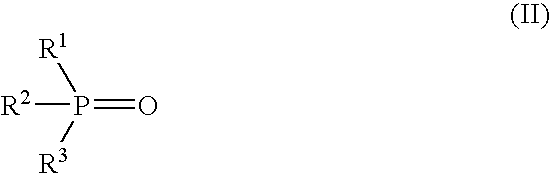
wherein R1, R2, R3 are independently an unsubstituted or substituted C1 to C10 alkyl group or an unsubstituted or substituted C5 to C15 aryl group.
The C1 to C10 alkyl group may be straight or branched. Examples of suitable C1-C10 alkyl groups include methyl, ethyl, n-butyl and n-octyl. The C1-C10 alkyl group may be substituted by one or more substituents e.g. 1-4 substituents. Suitable substituents include C1 to C10 alkyl groups and C5 to C15 aryl groups.
The C5-C15 aryl group may be e.g. phenyl, alpha-naphthyl and beta-naphthyl, preferably phenyl. The C5-C15 group may be substituted with substituents selected from the group consisting of —NO3, —OH, —CN, —SO3H, —OCH3 and —CO2H.
A preferred monodentate phosphine oxide compound of formula II is triphenylphosphine oxide.
In the process of the present invention if at least one promoter is present in the reaction composition, higher concentrations of the monodentate phosphine oxide compound can be used, which enables the benefits of reduced by-product formation to be achieved at acceptable reaction rates. Suitable promoters are preferably selected from the group consisting of ruthenium, osmium, rhenium, cadmium, mercury, zinc, gallium, indium and tungsten, and are more preferably selected from the group consisting of ruthenium and osmium and most preferably is ruthenium. Preferably, the promoter is present in an effective amount up to the limit of its solubility in the liquid reaction composition and/or any liquid process streams recycled to the carbonylation reactor from the acetic acid recovery stage. The promoter is suitably present in the liquid reaction composition at a molar ratio of promoter:iridium in the range 0.5:1 to 15:1, preferably 0.5:1 to 10:1. Any reduction in carbonylation rate caused by the presence of the monodentate phosphine oxide compound may be off-set by increasing the concentration of promoter.
The promoter may comprise any suitable promoter metal-containing compound which is soluble in the liquid reaction composition. The promoter may be added to the liquid reaction composition for the carbonylation reaction in any suitable form which dissolves in the liquid reaction composition or is convertible to soluble form.
The monodentate phosphine oxide compound may be present in the reaction composition in an amount of greater than 0.5 mol per grain atom of iridium. Preferably, the monodentate phosphine oxide compound is present in the reaction composition in an amount of 1 to 200 mol per gram atom of iridium when a promoter is present and is present in the reaction composition in an amount of 1 to 100 mol per gram atom of iridium when no promoter is present.
In the process of the present invention, the iridium carbonylation catalyst is preferably present in the liquid reaction composition at a concentration in the range 400 to 5000 ppm measured as iridium, more preferably in the range 500 to 3000 ppm measured as iridium. Any reduction in carbonylation rate caused by the presence of the monodentate phosphine oxide compound may be off-set by increasing the concentration of iridium catalyst, if present.
The iridium catalyst in the liquid reaction composition may comprise any iridium containing compound which is soluble in the liquid reaction composition. The iridium catalyst may be added to the liquid reaction composition for the carbonylation reaction in any suitable form which dissolves in the liquid reaction composition or is convertible to a soluble form.
In the process of the present invention, the concentration of methyl iodide co-catalyst in the liquid reaction composition is preferably in the range 5 to 16% by weight.
In the process of the present invention, suitable reactive derivatives of methanol include methyl acetate, dimethyl ether and methyl iodide. A mixture of methanol and reactive derivatives thereof may be used as reactants in the process of the present invention. Preferably, methanol and/or methyl acetate are used as reactants. At least some of the methanol and/or reactive derivative thereof will be converted to, and hence present as, methyl acetate in the liquid reaction composition by reaction with acetic acid product or solvent. In the process of the present invention the concentration of methyl acetate in the liquid reaction composition is preferably in the range 1 to 30% by weight, more preferably 5 to 25% by weight.
Water may be formed in situ in the liquid reaction composition, for example, by the esterification reaction between methanol reactant and acetic acid product. Small amounts of water may also be produced by hydrogenation of methanol to produce methane and water. Water may be introduced to the carbonylation reactor together with or separately from other components of the liquid reaction composition. Water may be separated from other components of reaction composition withdrawn from the reactor and may be recycled in controlled amounts to maintain the required concentration of water in the liquid reaction composition. The water concentration in the liquid reaction composition is suitably in the range 1-15 wt %, preferably in the range 1-6.5 wt %.
Preferably, the iridium- and promoter-containing compounds are free of impurities which provide or generate in situ ionic iodides which may inhibit the reaction, for example, alkali or alkaline earth metal or other metal salts.
Ionic contaminants such as, for example, (a) corrosion metals, particularly nickel, iron and chromium and (b) phosphines or nitrogen containing compounds or ligands which may quaternise in situ; should be kept to a minimum in the liquid reaction composition as these will have an adverse effect on the reaction by generating I− in the liquid reaction composition which has an adverse effect on the reaction rate. Some corrosion metal contaminants such as for example molybdenum have been found to be less susceptible to the generation of I−. Corrosion metals which have an adverse affect on the reaction rate may be minimised by using suitable corrosion resistant materials of construction. Similarly, contaminants such as alkali metal iodides, for example lithium iodide, should be kept to a minimum. Corrosion metal and other ionic impurities may be reduced by the use of a suitable ion exchange resin bed to treat the reaction composition, or preferably a catalyst recycle stream. Such a process is described in U.S. Pat. No. 4,007,130. Preferably, ionic contaminants are kept below a concentration at which they would generate 500 ppm I−, preferably less than 250 ppm I− in the liquid reaction composition.
The carbon monoxide reactant may be essentially pure or may contain inert impurities such as carbon dioxide, methane, nitrogen, noble gases, water and C1 to C4 paraffinic hydrocarbons. The presence of hydrogen in the carbon monoxide feed and generated in situ by the water gas shift reaction is preferably kept low as its presence may result in the formation of hydrogenation products. Thus, the amount of hydrogen in the carbon monoxide reactant is preferably less than 1 mol %, more preferably less than 0.5 mol % and yet more preferably less than 0.3 mol % and/or the partial pressure of hydrogen in the carbonylation reactor is preferably less than 1×10⁵ N/m2 partial pressure, more preferably less than 5×10⁴ N/m2 and yet more preferably less than 3×10⁴ N/m2. The partial pressure of carbon monoxide in the reactor is suitably in the range 1×10⁵ N/m2 to 7×10⁶ N/m2, preferably 1×10⁵ N/m2 to 3.5×10⁶ N/m2, more preferably 1×10⁵ N/m2 to 1.5×10⁶ N/m2.
The total pressure of the carbonylation reaction is suitably in the range 1×10⁶ N/m2 to 2×10⁷ N/m2, preferably 1.5×10⁶ N/m2 to 1×10⁷ N/m2, more preferably 1.5×10⁶ N/m2 to 5×10⁶ N/m2.
The temperature of the carbonylation reaction is suitably in the range 100 to 300° C., preferably in the range 150 to 220° C. Any reduction in carbonylation rate caused by the presence of the monodentate phosphine oxide compound may be off-set by increasing the reaction temperature.
The process of the present invention is preferably performed as a continuous process.
The acetic acid product may be recovered from the liquid reaction composition by withdrawing vapour and/or liquid from the carbonylation reactor and recovering acetic acid from the withdrawn material. Preferably, acetic acid is recovered from the liquid reaction composition by continuously withdrawing liquid reaction composition from the carbonylation reactor and recovering acetic acid from the withdrawn liquid reaction composition by one or more flash and/or fractional distillation stages in which the acetic acid is separated from the other components of the liquid reaction composition such as iridium catalyst, methyl iodide co-catalyst, promoter, methyl acetate, unreacted methanol, water and acetic acid solvent which may be recycled to the reactor to maintain their concentrations in the liquid reaction composition. To maintain stability of the iridium catalyst during the acetic acid product recovery stage, water in process streams containing iridium carbonylation catalyst for recycle to the carbonylation reactor should be maintained at a concentration of at least 0.5% by weight.
The process of the present invention may be performed a using carbonylation reaction conditions known in the art, for example as described in EP-A-0786447, EP-A-0643034, EP-A-0752406 and EP-A-0749948, the contents of which are hereby incorporated by reference.
The invention will now be illustrated by way of example only and with reference to the following examples:
A 300 cm3 zirconium autoclave, equipped with a stirrer and a liquid injection facility, was used for a series of batch autoclave experiments. The autoclave was flushed up to 5×10⁵ N/m2 with nitrogen and then flushed with carbon monoxide up to 5×10⁵ N/m2. An initial charge consisting of methyl acetate, acetic acid, methyl iodide and water, was placed into the autoclave. A catalyst solution was primed into a liquid injection line made up of (1.35 g) of H2IrCl6 aqueous solution (22.26% Ir w/w), water (5.0 g) and acetic acid (10.0 g). The resulting combined autoclave charge was thus methyl acetate (60.02 g), acetic acid (48.84 g), methyl iodide (23.77 g) and water (17.81 g). The contents of the autoclave were heated to 190° C. whilst being stirred at 1500 rpm. Once the temperature had reached 190° C. the H2IrCl6 catalyst solution was injected into the autoclave with an over-pressure of carbon monoxide to the hot autoclave to bring the autoclave pressure to 2.8×10⁶ N/m2.
The autoclave pressure and temperature were maintained at a constant 2.8×10⁶ N/m2 and 190° C. respectively throughout the reaction, until the uptake of carbon monoxide from a ballast vessel ceased. On termination of the reaction the autoclave was cooled and vented. After cooling and carefully venting the autoclave the liquid components were discharged and analysed for liquid products and by-products by known established gas chromatography methods.
Liquid by-products are determined by gas chromatography using a CB wax52 column on a Hewlett Packard 6820 Mk2 gas chromatograph. Detected components are quantified by integration of the component peaks relative to an external standard and expressed as parts per million (ppm) by weight.
The main liquid by-product from carbonylation of methanol to acetic acid is propionic acid. It's precursors (ethyl iodide and ethyl acetate) are also formed. In a continuous process these precursors would be recycled to the carbonylation reactor in recycle streams, building up to a steady state concentration at which the rate of their destruction to propionic acid balances their rate of removal. In a batch process, these precursors are not destroyed, but accumulate with the propionic acid in the liquid reaction composition and these can be measured at the end of the experiment. A reduction in the amount of propionic acid and its precursors measured at the end of a batch carbonylation experiment would be expected to indicate that in a continuous process, the amount of by-product propionic acid recovered with the acetic acid product would also be reduced.
In the batch reactions ‘Total’ propionic acid was defined as the sum of propionic acid and it's precursors ((ethyl acetate and ethyl iodide) converted to ppm propionic acid), detected in the quenched liquid products of the batch reaction and expressed in ppm.
This represents the cumulative formation during the batch experiment of propionic acid and its precursors, ethyl iodide and ethyl acetate. Ethanol and acetaldehyde are produced in very small amounts such that they can be ignored.
The rate of gas uptake at a certain point in a reaction run was used to calculate the carbonylation rate, as number of moles of reactant consumed per liter of cold degassed reactor composition per hour (mol/l/hr), at a particular reactor composition (total reactor composition based on a cold degassed volume).
The methyl acetate concentration was calculated during the course of the reaction from the starting composition, assuming that one mole of methyl acetate was consumed for every mole of carbon monoxide that was consumed. No allowance was made for organic components in the autoclave headspace.
By monitoring the rate of carbonylation reaction and calculating the concentration of the reaction components during the experiment, it is possible to determine the rate of carbonylation reaction which would be expected if a carbonylation process were to be operated continuously whilst maintaining under steady state, a liquid reaction composition which is the same as the total reaction composition calculated at any particular point in the batch experiment. In the batch experiments the term ‘reaction composition’ refers to the total composition of the components in the autoclave in the cold degassed state. The principal difference between the batch experiments and continuous operation is that in the batch experiments, no allowance was made in calculating the component concentrations, for partitioning of the reaction components between the liquid and gaseous phases, Owing to this partitioning, the concentration of the reaction components present in the liquid phase in a batch reaction under reaction conditions was similar, but not identical, to the total reaction composition. In particular, the more volatile components in the reaction composition, such as methyl iodide and methyl acetate, were slightly less concentrated in the liquid reaction composition than in the total reaction composition, whereas the water concentration was comparable between the two. Therefore, the rate calculated in a batch experiment at a certain total reaction composition will be similar to that in a continuous process operating with a liquid composition which is the same as the batch total reaction composition. In addition, trends observed in batch experiments by varying the process variables, such as water concentration, were comparable with the trends observed in continuous experiments.
A baseline experiment was performed using 1.35 g of H2IrCl6 solution and a combined autoclave charged of methyl acetate (60.02 g), acetic acid (48.84 g), water (17.81 g) and methyl iodide (23.77 g).
The rate of reaction, based on carbon monoxide uptake was measured to be 10.04 mol/l/hr at a calculated reaction composition of 12.5% methyl acetate and steadily declined until virtually all the methyl acetate was consumed. Conversion to acetic acid was 98.2% based on methyl acetate consumed. Analysis of propionic acid precursors gave a total propionic acid make of 604 ppm. Gaseous by-products in the cold-vented off-gas were H2, 1.94% v/v; CO2, 2.24% v/v; CH4, 3.67% v/v. Analysis of the final reaction composition by Gas Chromatography gave methyl iodide 13.8%; methyl acetate 0.59%; acetic acid 90.34%.
This is not an example according to the present invention because no monodentate phosphine oxide was present.
Experiment A was repeated except that the total combined autoclave charge consisted of methyl acetate (59.99 g), acetic acid (47.80 g), water (17.81 g) and methyl iodide (23.77 g). Triphenylphosphine oxide (43.40 g) was charged to the autoclave and 1.351 g of H2IrCl6 solution was used in the catalyst charge. The rate of reaction at a calculated reaction composition of 12.5% methyl acetate was measured as approx. 1.3 mol/l/hr. Conversion to acetic acid was 94.3% based on methyl acetate consumed. Analysis of the propionic acid precursors gave a total propionic acid make of 43 ppm. Gaseous by-products in the cold-vented off-gas were not measured due to a leak. Analysis of the final reaction composition by Gas Chromatography gave methyl iodide 1.65%; methyl acetate 41.1%; acetic acid 45.4%.
This is an example of the use of triphenylphosphine oxide at 200 mols. per gram atom of iridium catalyst and shows the reduction in liquid and gaseous by-products.
Experiment A was repeated except that the total combined autoclave charge consisted of methyl acetate (60.03 g), acetic acid (42.80 g), water (22.84 g) and methyl iodide (23.78 g). Triphenylphosphine oxide (10.85 g) was charged to the autoclave and 1.349 g of H2IrCl6 solution was used in the catalyst charge. The rate of reaction at a calculated reaction composition of 12.5% methyl acetate was measured as 3.57 mol/l/hr. Conversion to acetic acid was 82.7% based on methyl acetate consumed. Analysis of the propionic acid precursors gave a total propionic acid make of 185 ppm. Gaseous by-products in the cold-vented off-gas were H2, 0.37% v/v/; CO2, 3.53% v/v; CH4, 8.5% v/v. Analysis of the final reaction composition by Gas Chromatography gave methyl iodide 3.8%; methyl acetate 5.75%; acetic acid 73.08%.
This is an example of the use of triphenylphosphine oxide at 50 mols per gram atom of iridium catalyst to reduce liquid and gaseous by-products.
Experiment A was repeated except the total combine autoclave charge consisted of methyl acetate (60.0 g), acetic acid (48.28 g), water (17.75 g) and methyl iodide (23.77 g). Triphenylphosphine oxide (2.16 g) was charged to the autoclave and 1.348 g of H2IrCl6 solution was used in the catalyst charge. The rate of reaction at a calculated reaction composition of 12.5% methyl acetate was measured as 6.60 mol/l/hr. Conversion to acetic acid was 92.2% based on methyl acetate consumed. Analysis of the propionic acid precursors gave a total propionic acid make of 278 ppm. Gaseous by-products in the cold-vented off-gas were H2, 0.94% v/v; CO2, 2.57% v/v; CH4, 5.94% v/v. Analysis of the final reaction composition by Gas Chromatography gave methyl iodide 1.91%; methyl acetate 2.67%; acetic acid 78.42%.
This is an example of the use of triphenylphosphine oxide at 10 mols per gram atom of iridium catalyst to reduce liquid and gaseous by-products.
Experiment A was repeated except the total combined autoclave charge consisted of methyl acetate (60.01 g), acetic acid (47.79 g), water (17.85 g) and methyl iodide (23.77 g). Triphenylphosphine oxide (0.22 g) was charged to the autoclave and 1.349 g of H2IrCl6 solution was used in the catalyst charge. The rate of reaction at a calculated reaction composition of 12.5% methlyl acetate was measured as 10.3 mol/l/hr. Conversion to acetic acid was 98.5% based on methyl acetate consumed. Analysis of the propionic acid precursors gave a total propionic acid make of 412 ppm. Gaseous by-products in the cold-vented off-gas were H2, 1.58% v/v; CO2, 2.42% v/v; CH4, 5.21% v/v. Analysis of the final reaction composition by Gas Chromatography gave methyl iodide 11.6%; methyl acetate 0.51%; acetic acid 88.95%.
This is an example of the use of triphenylphosphine oxide at 1 mols per gram atom of iridium catalyst to reduce liquid and gaseous by-products.
A baseline experiment was performed repeating Experiment A except the total combined autoclave charge consisted of methyl acetate (60.0 g), acetic acid (44.58 g), water (18.71 g), methyl iodide (12.45 g) and Ru(CO)4I2 (3.64 g). 1.34 g of H2IrCl6 solution was used in the catalyst charge. The rate of reaction at a calculated reaction composition of 12.5% methyl acetate was measured as 25.94 mol/l/hr. Conversion to acetic acid was 97.1% based on methyl acetate consumed. Analysis of the propionic acid precursors gave a total propionic acid make of 293 ppm. Gaseous by-products in the cold-vented off-gas were H2, 2.42% v/v; CO2, 2.9% v/v; CH4, 5.63% v/v. Analysis of the final reaction composition by Gas Chromatography gave methyl iodide 0.831%; methyl acetate 1.0%; acetic acid 82.42%.
This is not an example according to the present invention because no monodentate phosphine oxide was present.
Experiment B was repeated except that the total combined autoclave charge consisted of charge consisted of methyl acetate (60.03 g), acetic acid (54.53 g), water (18.80 g), methyl iodide (12.43 g), Ru(CO)412 (3.70 g ) and triphenylphosphine oxide (0.44 g). 1.341 g of H2IrCl6 solution was used in the catalyst charge. The rate of reaction at a calculated reaction composition of 12.5% methyl acetate was measured as 25.65 mol/l/hr. Conversion to acetic acid was 96.7% based on methyl acetate consumed. Analysis of the propionic acid precursors gave a total propionic acid make of 283 ppm. Gaseous by-products in the cold-vented off-gas were H2, 2.18% v/v; CO2, 2.88% v/v; CH4, 5.75% v/v/. Analysis of the final reaction composition by Gas Chromatography gave methyl iodide 0.01%; methyl acetate 1.16%; acetic acid 79.8%.
This is an example of the use of triphenylphosphine oxide at 1 mols per gram atom of iridium catalyst in presence of 5 mols ruthenium promoter per gram atom of iridium to reduce liquid and gaseous by-products.
Experiment B was repeated except that the total combined autoclave charge consisted of methyl acetate (60.02 g), acetic acid (49.61 g), water (8.72 g), methyl iodide (12.44 g), Ru(CO)4I2 (3.65 g) and triphenylphosphine oxide (2.17 g). 1.346 g of H2IrCl6 solution was used in the catalyst charge. The rate of reaction at a calculated reaction composition of 12.5% methyl acetate was measured as 20.37 mol/l/hr. Conversion to acetic acid was 94.7% based on methyl acetate consumed. Analysis of the propionic acid precursors gave a total propionic acid make of 158 ppm. Gaseous by-products in the cold-vented off-gas were H2, 0.82% v/v; CO2, 2.95% v/v; CH4, 5.44% v/v. Analysis of the final reaction composition by Gas Chromatography gave methyl iodide 0.04%; methyl acetate 1.85%; acetic acid 78.4%.
This is an example of the use of triphenylphosphine oxide at 5 mols per gram atom of iridium catalyst in presence of 5 mols ruthenium promoter per gram atom of iridium to reduce liquid and gaseous by-products.
The results are summarised in the Table below.
Note: Since propionic acid formation increases rapidly above 90% conversion of methyl acetate in iridium and iridium/ruthenium catalysed carbonylations, more accurate comparisons from batch reactions are found in experiments that are terminated below 90% conversion.
| TABLE | ||||||
| Reaction | ||||||
| rate at | ||||||
| Propionic | Con- | 12.5% | ||||
| acid | ver- | methyl | ||||
| Example/ | Catalyst | make | sion | acetate | ||
| Experiment | system | Additive | (ppm) | (%) | mol/l/hr | Comments |
| Experiment A | Ir | none | 604 | 98.2% | 10.04 | |
| Example 1 | Ir | triphenylphosphine | 43 | 94.3% | 1.3 | Reduced rate but reduced |
| oxide | propionic acid. | |||||
| Example 2 | Ir | triphenylphosphine | 185 | 82.7 | 3.57 | Reduced rate but reduced |
| oxide | propionic acid. | |||||
| Example 3 | Ir | triphenylphosphine | 278 | 92.2% | 6.6 | Reduced rate but reduced |
| oxide | propionic acid | |||||
| Example 4 | Ir | triphenylphosphine | 412 | 98.5% | 10.3 | Good rate and reduced |
| oxide | propionic acid | |||||
| Experiment B | Ir/Ru | none | 293 | 97.1% | 25.94 | |
| Example 5 | Ir/Ru | triphenylphosphine | 283 | 96.7% | 25.65 | Good rate and propionic acid |
| oxide | remains low | |||||
| Example 6 | Ir/Ru | triphenylphosphine | 158 | 94.7% | 20.37 | Reduced rate but reduced |
| oxide | propionic acid | |||||
Claims (8)
1. A process for the production of acetic acid which comprises reacting carbon monoxide with a reactant selected from the group consisting of methanol, reactive derivatives of methanol and mixtures thereof in a liquid reaction composition comprising an iridium carbonylation catalyst, methyl iodide, methyl acetate, water and acetic acid wherein there is also present in the reaction composition a monodentate phosphine oxide compound in an amount up to and including 200 mol per gram atom of iridium.
2. A process according to claim 1 wherein the monodentate phosphine oxide compound is present in the reaction composition in an amount of greater than 0.5 mol per gram of iridium.
3. A process according to claim 1 wherein the monodentate phosphine oxide compound is represented by the formula: 
wherein R1, R2, R3 are independently an unsubstituted or substituted C1 to C10 alkyl group or an unsubstituted or substituted C5 to C15 aryl group.
4. A process according to claim 1 wherein the reaction composition further comprises at least one promoter.
5. A process according to claim 4 wherein the at least one promoter is selected from the group consisting of ruthenium, osmium, rhenium, cadmium, mercury, zinc, gallium, indium and tungsten.
6. A process according to claim 2 wherein the reaction composition further comprises at least one promoter.
7. A process according to claim 6 wherein the at least one promoter is selected from the group consisting of ruthenium, osmium, rhenium, cadmium, mercury, zinc, gallium, indium and tungsten.
8. A process according to claim 4 wherein the monodentate phosphine oxide compound is present in the reaction composition in an amount of 1 to 200 mol per gram atom of iridium.
Applications Claiming Priority (2)
| Application Number | Priority Date | Filing Date | Title |
|---|---|---|---|
| GBGB9926855.9A GB9926855D0 (en) | 1999-11-12 | 1999-11-12 | Process |
| GB9926855 | 1999-11-12 |
Publications (1)
| Publication Number | Publication Date |
|---|---|
| US6686500B1 true US6686500B1 (en) | 2004-02-03 |
Family
ID=10864451
Family Applications (1)
| Application Number | Title | Priority Date | Filing Date |
|---|---|---|---|
| US09/702,056 Expired - Fee Related US6686500B1 (en) | 1999-11-12 | 2000-10-31 | Process for the production of acetic acid |
Country Status (11)
| Country | Link |
|---|---|
| US (1) | US6686500B1 (en) |
| EP (1) | EP1099680A3 (en) |
| JP (1) | JP2001181229A (en) |
| KR (1) | KR20010051596A (en) |
| CN (1) | CN1299804A (en) |
| CA (1) | CA2325656A1 (en) |
| GB (1) | GB9926855D0 (en) |
| ID (1) | ID28373A (en) |
| SG (1) | SG96583A1 (en) |
| TW (1) | TW572888B (en) |
| YU (1) | YU69700A (en) |
Cited By (5)
| Publication number | Priority date | Publication date | Assignee | Title |
|---|---|---|---|---|
| US7053241B1 (en) | 2005-02-24 | 2006-05-30 | Celanese International Corporation | Acetic acid production methods incorporating at least one metal salt as a catalyst stabilizer |
| US20070093676A1 (en) * | 2004-12-27 | 2007-04-26 | Hidetaka Kojima | Methods for producing acetic acid |
| US20100113827A1 (en) * | 2008-11-03 | 2010-05-06 | Wei Wang | Removing iodobenzene compounds from acetic acid |
| US9458078B2 (en) | 2014-11-14 | 2016-10-04 | Celanese International Corporation | Processes for producing acetic acid from a reaction medium having low ethyl iodide content |
| US10067113B2 (en) | 2014-02-28 | 2018-09-04 | LyondellBasell Acetyis, LLC | Acetic acid production process |
Families Citing this family (5)
| Publication number | Priority date | Publication date | Assignee | Title |
|---|---|---|---|---|
| GB0212974D0 (en) * | 2002-06-06 | 2002-07-17 | Bp Chem Int Ltd | Process |
| GB0316756D0 (en) * | 2003-07-17 | 2003-08-20 | Bp Chem Int Ltd | Process |
| TWI465424B (en) * | 2006-03-21 | 2014-12-21 | Bp Chem Int Ltd | Process for the production of acetic acid |
| US9102612B2 (en) * | 2012-06-25 | 2015-08-11 | Lyondellbasell Acetyls, Llc | Process for the production of acetic acid |
| SG11201705237XA (en) * | 2015-01-20 | 2017-07-28 | Lyondellbasell Acetyls Llc | Use of a ruthenium promoter in a phosphine oxide carbonylation process |
Citations (6)
| Publication number | Priority date | Publication date | Assignee | Title |
|---|---|---|---|---|
| GB1406672A (en) | 1971-07-26 | 1975-09-17 | Monsanto Co | Production of carboxylic acids |
| US4414160A (en) | 1980-09-18 | 1983-11-08 | Hoechst Aktiengesellschaft | Process for making carboxylic acid halides |
| EP0114703A1 (en) | 1983-01-25 | 1984-08-01 | Shell Internationale Researchmaatschappij B.V. | Process for the preparation of carboxylic acids and/or esters |
| EP0749948A1 (en) | 1995-06-21 | 1996-12-27 | BP Chemicals Limited | Process for the carbonylation of alkyl alcohols and/or reactive derivatives thereof |
| US5817869A (en) | 1995-10-03 | 1998-10-06 | Quantum Chemical Corporation | Use of pentavalent Group VA oxides in acetic acid processing |
| US6472558B1 (en) * | 1999-11-12 | 2002-10-29 | Bp Chemicals Limited | Process for the production of acetic acid |
Family Cites Families (4)
| Publication number | Priority date | Publication date | Assignee | Title |
|---|---|---|---|---|
| JPS5363308A (en) * | 1976-11-15 | 1978-06-06 | Mitsubishi Gas Chem Co Inc | Preparation of acetyl halide |
| GB9306409D0 (en) * | 1993-03-26 | 1993-05-19 | Bp Chem Int Ltd | Process |
| US5672743A (en) * | 1993-09-10 | 1997-09-30 | Bp Chemicals Limited | Process for the production of acetic acid |
| GB9816564D0 (en) * | 1998-07-31 | 1998-09-30 | Bp Chem Int Ltd | Process |
-
1999
- 1999-11-12 GB GBGB9926855.9A patent/GB9926855D0/en not_active Ceased
-
2000
- 2000-10-31 US US09/702,056 patent/US6686500B1/en not_active Expired - Fee Related
- 2000-11-01 EP EP00309646A patent/EP1099680A3/en not_active Withdrawn
- 2000-11-02 SG SG200006322A patent/SG96583A1/en unknown
- 2000-11-10 KR KR1020000066702A patent/KR20010051596A/en not_active Withdrawn
- 2000-11-10 CA CA002325656A patent/CA2325656A1/en not_active Abandoned
- 2000-11-10 TW TW89123868A patent/TW572888B/en not_active IP Right Cessation
- 2000-11-10 JP JP2000344532A patent/JP2001181229A/en active Pending
- 2000-11-10 ID IDP20000970A patent/ID28373A/en unknown
- 2000-11-10 YU YU69700A patent/YU69700A/en unknown
- 2000-11-11 CN CN00135537A patent/CN1299804A/en active Pending
Patent Citations (6)
| Publication number | Priority date | Publication date | Assignee | Title |
|---|---|---|---|---|
| GB1406672A (en) | 1971-07-26 | 1975-09-17 | Monsanto Co | Production of carboxylic acids |
| US4414160A (en) | 1980-09-18 | 1983-11-08 | Hoechst Aktiengesellschaft | Process for making carboxylic acid halides |
| EP0114703A1 (en) | 1983-01-25 | 1984-08-01 | Shell Internationale Researchmaatschappij B.V. | Process for the preparation of carboxylic acids and/or esters |
| EP0749948A1 (en) | 1995-06-21 | 1996-12-27 | BP Chemicals Limited | Process for the carbonylation of alkyl alcohols and/or reactive derivatives thereof |
| US5817869A (en) | 1995-10-03 | 1998-10-06 | Quantum Chemical Corporation | Use of pentavalent Group VA oxides in acetic acid processing |
| US6472558B1 (en) * | 1999-11-12 | 2002-10-29 | Bp Chemicals Limited | Process for the production of acetic acid |
Non-Patent Citations (1)
| Title |
|---|
| Derwent Publications Ltd., London, GB; Class E16, AN 1978-50693A; XP002221883 & JP TE 063308 A; Mitsubishi Gas Chem. Ind. Co. Ltd.; Jun. 6, 1978 (abstract). |
Cited By (7)
| Publication number | Priority date | Publication date | Assignee | Title |
|---|---|---|---|---|
| US20070093676A1 (en) * | 2004-12-27 | 2007-04-26 | Hidetaka Kojima | Methods for producing acetic acid |
| US7683212B2 (en) * | 2004-12-27 | 2010-03-23 | Daicel Chemical Industries, Ltd. | Methods for producing acetic acid |
| US7053241B1 (en) | 2005-02-24 | 2006-05-30 | Celanese International Corporation | Acetic acid production methods incorporating at least one metal salt as a catalyst stabilizer |
| WO2006091397A1 (en) | 2005-02-24 | 2006-08-31 | Celanese International Corporation | Acetic acid production methods incorporating at least one metal salt as a catalyst stabilizer |
| US20100113827A1 (en) * | 2008-11-03 | 2010-05-06 | Wei Wang | Removing iodobenzene compounds from acetic acid |
| US10067113B2 (en) | 2014-02-28 | 2018-09-04 | LyondellBasell Acetyis, LLC | Acetic acid production process |
| US9458078B2 (en) | 2014-11-14 | 2016-10-04 | Celanese International Corporation | Processes for producing acetic acid from a reaction medium having low ethyl iodide content |
Also Published As
| Publication number | Publication date |
|---|---|
| KR20010051596A (en) | 2001-06-25 |
| CA2325656A1 (en) | 2001-05-12 |
| GB9926855D0 (en) | 2000-01-12 |
| EP1099680A3 (en) | 2003-01-22 |
| CN1299804A (en) | 2001-06-20 |
| YU69700A (en) | 2002-11-15 |
| JP2001181229A (en) | 2001-07-03 |
| TW572888B (en) | 2004-01-21 |
| SG96583A1 (en) | 2003-06-16 |
| ID28373A (en) | 2001-05-17 |
| EP1099680A2 (en) | 2001-05-16 |
Similar Documents
| Publication | Publication Date | Title |
|---|---|---|
| EP0849251B1 (en) | Iridium-catalysed carbonylation process for the production of acetic acid | |
| US5696284A (en) | Process for the carbonylation of alkyl alcohols and/or reactive derivatives thereof | |
| US6472558B1 (en) | Process for the production of acetic acid | |
| EP0936209A1 (en) | Anhydrous carbonylation process for the production of acetic acid | |
| KR101051905B1 (en) | Carbonylation Method Using Metal-Cenary Ligand Catalyst | |
| US6686500B1 (en) | Process for the production of acetic acid | |
| US7741517B2 (en) | Process for the production of acetic acid | |
| US7256308B2 (en) | Process for the production of acetic acid | |
| EP0749949B1 (en) | Process for the carbonylation of alkyl alcohols | |
| US8101796B2 (en) | Process for the production of acetic acid | |
| US7884236B2 (en) | Process for the production of acetic acid | |
| JPH11335318A (en) | Use of oxide of 5-valent va-group element in acetic acid production |
Legal Events
| Date | Code | Title | Description |
|---|---|---|---|
| AS | Assignment |
Owner name: BP CHEMICALS LIMITED, ENGLAND Free format text: ASSIGNMENT OF ASSIGNORS INTEREST;ASSIGNOR:WATT, ROBERT;REEL/FRAME:011446/0695 Effective date: 20001106 |
|
| FPAY | Fee payment |
Year of fee payment: 4 |
|
| FPAY | Fee payment |
Year of fee payment: 8 |
|
| REMI | Maintenance fee reminder mailed | ||
| LAPS | Lapse for failure to pay maintenance fees | ||
| STCH | Information on status: patent discontinuation |
Free format text: PATENT EXPIRED DUE TO NONPAYMENT OF MAINTENANCE FEES UNDER 37 CFR 1.362 |
|
| FP | Lapsed due to failure to pay maintenance fee |
Effective date: 20160203 |