US6632828B2 - Substituted imidazole neuropeptide Y Y5 receptor antagonists - Google Patents
Substituted imidazole neuropeptide Y Y5 receptor antagonists Download PDFInfo
- Publication number
- US6632828B2 US6632828B2 US10/200,966 US20096602A US6632828B2 US 6632828 B2 US6632828 B2 US 6632828B2 US 20096602 A US20096602 A US 20096602A US 6632828 B2 US6632828 B2 US 6632828B2
- Authority
- US
- United States
- Prior art keywords
- mmol
- alkyl
- product
- mixture
- nmr
- Prior art date
- Legal status (The legal status is an assumption and is not a legal conclusion. Google has not performed a legal analysis and makes no representation as to the accuracy of the status listed.)
- Expired - Fee Related
Links
- 0 *C1=NC(C2=C*=CC=C2)=CN1.C[Y] Chemical compound *C1=NC(C2=C*=CC=C2)=CN1.C[Y] 0.000 description 42
- NNPPMTNAJDCUHE-UHFFFAOYSA-N CC(C)C Chemical compound CC(C)C NNPPMTNAJDCUHE-UHFFFAOYSA-N 0.000 description 6
- YXFVVABEGXRONW-UHFFFAOYSA-N CC1=CC=CC=C1 Chemical compound CC1=CC=CC=C1 YXFVVABEGXRONW-UHFFFAOYSA-N 0.000 description 6
- UAEPNZWRGJTJPN-UHFFFAOYSA-N CC1CCCCC1 Chemical compound CC1CCCCC1 UAEPNZWRGJTJPN-UHFFFAOYSA-N 0.000 description 5
- YNQLUTRBYVCPMQ-UHFFFAOYSA-N CCC1=CC=CC=C1 Chemical compound CCC1=CC=CC=C1 YNQLUTRBYVCPMQ-UHFFFAOYSA-N 0.000 description 5
- RYMMNSVHOKXTNN-UHFFFAOYSA-N CC1=CC(Cl)=CC(Cl)=C1 Chemical compound CC1=CC(Cl)=CC(Cl)=C1 RYMMNSVHOKXTNN-UHFFFAOYSA-N 0.000 description 3
- YISYUYYETHYYMD-UHFFFAOYSA-N CC1=CC(F)=CC(F)=C1 Chemical compound CC1=CC(F)=CC(F)=C1 YISYUYYETHYYMD-UHFFFAOYSA-N 0.000 description 3
- ITQTTZVARXURQS-UHFFFAOYSA-N CC1=CC=CN=C1 Chemical compound CC1=CC=CN=C1 ITQTTZVARXURQS-UHFFFAOYSA-N 0.000 description 3
- ATUOYWHBWRKTHZ-UHFFFAOYSA-N CCC Chemical compound CCC ATUOYWHBWRKTHZ-UHFFFAOYSA-N 0.000 description 3
- IIEWJVIFRVWJOD-UHFFFAOYSA-N CCC1CCCCC1 Chemical compound CCC1CCCCC1 IIEWJVIFRVWJOD-UHFFFAOYSA-N 0.000 description 3
- IJDNQMDRQITEOD-UHFFFAOYSA-N CCCC Chemical compound CCCC IJDNQMDRQITEOD-UHFFFAOYSA-N 0.000 description 3
- KIBGZQXVPOVXDT-UHFFFAOYSA-N CC(=O)N1CCN(C2=NC(C3=CC(C(F)(F)F)=CC=C3)=CN2)CC1 Chemical compound CC(=O)N1CCN(C2=NC(C3=CC(C(F)(F)F)=CC=C3)=CN2)CC1 KIBGZQXVPOVXDT-UHFFFAOYSA-N 0.000 description 2
- VJYXZJGDFJJDGF-UHFFFAOYSA-N CC1=CC(C(F)(F)F)=CC=C1 Chemical compound CC1=CC(C(F)(F)F)=CC=C1 VJYXZJGDFJJDGF-UHFFFAOYSA-N 0.000 description 2
- OCZKVVOCLIELPF-UHFFFAOYSA-N CC1=CC=C(S(=O)(=O)N2CCC(C3=NC(C4=CC=CC(C(F)(F)F)=C4)=CN3)CC2)C=C1 Chemical compound CC1=CC=C(S(=O)(=O)N2CCC(C3=NC(C4=CC=CC(C(F)(F)F)=C4)=CN3)CC2)C=C1 OCZKVVOCLIELPF-UHFFFAOYSA-N 0.000 description 2
- FKNQCJSGGFJEIZ-UHFFFAOYSA-N CC1=CC=NC=C1 Chemical compound CC1=CC=NC=C1 FKNQCJSGGFJEIZ-UHFFFAOYSA-N 0.000 description 2
- VNXBKJFUJUWOCW-UHFFFAOYSA-N CC1CC1 Chemical compound CC1CC1 VNXBKJFUJUWOCW-UHFFFAOYSA-N 0.000 description 2
- QWTDNUCVQCZILF-UHFFFAOYSA-N CCC(C)C Chemical compound CCC(C)C QWTDNUCVQCZILF-UHFFFAOYSA-N 0.000 description 2
- VFTNIRUOHGUGMD-UHFFFAOYSA-N CCN1CCN(C2=CC=CC(C3=NC(C4=CC=CC(C(F)(F)F)=C4)=CN3)=C2)CC1 Chemical compound CCN1CCN(C2=CC=CC(C3=NC(C4=CC=CC(C(F)(F)F)=C4)=CN3)=C2)CC1 VFTNIRUOHGUGMD-UHFFFAOYSA-N 0.000 description 2
- PSGUONOBAHWNEF-UHFFFAOYSA-N CNC1=CC=CC(C2=NC(C3=CC=CC(C(F)(F)F)=C3)=CN2C)=C1 Chemical compound CNC1=CC=CC(C2=NC(C3=CC=CC(C(F)(F)F)=C3)=CN2C)=C1 PSGUONOBAHWNEF-UHFFFAOYSA-N 0.000 description 2
- RBDCCCZUZZAEPF-UHFFFAOYSA-N FC(F)(F)C1=CC=CC(C2=CNC(C3=CC([W])=CC=C3)=N2)=C1 Chemical compound FC(F)(F)C1=CC=CC(C2=CNC(C3=CC([W])=CC=C3)=N2)=C1 RBDCCCZUZZAEPF-UHFFFAOYSA-N 0.000 description 2
- ARMWVLNFIRUCAP-UHFFFAOYSA-N FC1=CC(C2=CNC(C3CCN(C4=CC=CC=N4)CC3)=N2)=CC=C1 Chemical compound FC1=CC(C2=CNC(C3CCN(C4=CC=CC=N4)CC3)=N2)=CC=C1 ARMWVLNFIRUCAP-UHFFFAOYSA-N 0.000 description 2
- QALAFHZAZQWRMI-UHFFFAOYSA-N O=[N+]([O-])C1=CC=CC(C2=NC(C3=CC(C(F)(F)F)=CC=C3)=CN2)=C1 Chemical compound O=[N+]([O-])C1=CC=CC(C2=NC(C3=CC(C(F)(F)F)=CC=C3)=CN2)=C1 QALAFHZAZQWRMI-UHFFFAOYSA-N 0.000 description 2
- LZOJPCHAPTXEQW-UHFFFAOYSA-N C.C.C.C.C.C.C.CC(C)C1=CC(NS(=O)(=O)C(C)C)=CN=C1.CC(C)C1=CC(NS(=O)(=O)C2=CC=C(C(F)(F)F)C=C2)=CC=C1.CC(C)C1=CC(NS(=O)(=O)CC2=CC=CC=C2)=CC=C1.CC(C)C1=CC=CC(N(C)S(C)(=O)=O)=C1.CCCS(=O)(=O)N(C)C1=CC(C(C)C)=CC=C1.CCCS(=O)(=O)NC1=CN=CC(C(C)C)=C1.CCS(=O)(=O)N(C)C1=CC(C(C)C)=CC=C1.CCS(=O)(=O)NC1=CN=CC(C(C)C)=C1 Chemical compound C.C.C.C.C.C.C.CC(C)C1=CC(NS(=O)(=O)C(C)C)=CN=C1.CC(C)C1=CC(NS(=O)(=O)C2=CC=C(C(F)(F)F)C=C2)=CC=C1.CC(C)C1=CC(NS(=O)(=O)CC2=CC=CC=C2)=CC=C1.CC(C)C1=CC=CC(N(C)S(C)(=O)=O)=C1.CCCS(=O)(=O)N(C)C1=CC(C(C)C)=CC=C1.CCCS(=O)(=O)NC1=CN=CC(C(C)C)=C1.CCS(=O)(=O)N(C)C1=CC(C(C)C)=CC=C1.CCS(=O)(=O)NC1=CN=CC(C(C)C)=C1 LZOJPCHAPTXEQW-UHFFFAOYSA-N 0.000 description 1
- MDJAKKSOGBORPJ-UHFFFAOYSA-N C.C.C.C.C.C.CC(=O)N1CCC(C2=NC(C3=CC(Cl)=CC(Cl)=C3)=CN2)CC1.CC1=CC=C(S(=O)(=O)N2CC=C(C3=NC(C4=CC=CC(C(F)(F)F)=C4)=CN3)CC2)C2=CC=CC=C12.CC1=CC=C(S(=O)(=O)N2CC=C(C3=NC(C4=CC=CC(C(F)(F)F)=C4)=CN3)CC2)C=C1.CS(=O)(=O)N1CCC(C2=NC(C3=CC(Cl)=CC(Cl)=C3)=CN2)CC1.ClC1=CC(Cl)=CC(C2=CNC(C3CCN(C4=CC=CC=N4)CC3)=N2)=C1.FC(F)(F)C1=CC(C2=CNC(C3=CCN(C4=CC=CC=N4)CC3)=N2)=CC=C1.FC(F)(F)C1=CC(C2=CNC(C3CCN(C4=CC=CC=N4)CC3)=N2)=CC=C1 Chemical compound C.C.C.C.C.C.CC(=O)N1CCC(C2=NC(C3=CC(Cl)=CC(Cl)=C3)=CN2)CC1.CC1=CC=C(S(=O)(=O)N2CC=C(C3=NC(C4=CC=CC(C(F)(F)F)=C4)=CN3)CC2)C2=CC=CC=C12.CC1=CC=C(S(=O)(=O)N2CC=C(C3=NC(C4=CC=CC(C(F)(F)F)=C4)=CN3)CC2)C=C1.CS(=O)(=O)N1CCC(C2=NC(C3=CC(Cl)=CC(Cl)=C3)=CN2)CC1.ClC1=CC(Cl)=CC(C2=CNC(C3CCN(C4=CC=CC=N4)CC3)=N2)=C1.FC(F)(F)C1=CC(C2=CNC(C3=CCN(C4=CC=CC=N4)CC3)=N2)=CC=C1.FC(F)(F)C1=CC(C2=CNC(C3CCN(C4=CC=CC=N4)CC3)=N2)=CC=C1 MDJAKKSOGBORPJ-UHFFFAOYSA-N 0.000 description 1
- NCXJGNPHBMEONY-UHFFFAOYSA-N C.C.C.C.CC(C)(C)NC(=O)N1CCN(C2=NC(C3=CC=CC(C(F)(F)F)=C3)=CN2)CC1.CS(=O)(=O)N1CCN(C2=NC(C3=CC=CC(C(F)(F)F)=C3)=CN2)CC1.O=C(C1=CC=CC=N1)N1CCN(C2=NC(C3=CC=CC(C(F)(F)F)=C3)=CN2)CC1.O=C(C1=CN=CC=C1)N1CCN(C2=NC(C3=CC=CC(C(F)(F)F)=C3)=CN2)CC1.O=C(NC1=CC=CC=C1)N1CCN(C2=NC(C3=CC=CC(C(F)(F)F)=C3)=CN2)CC1.O=C(NC1CCCCC1)N1CCN(C2=NC(C3=CC=CC(C(F)(F)F)=C3)=CN2)CC1 Chemical compound C.C.C.C.CC(C)(C)NC(=O)N1CCN(C2=NC(C3=CC=CC(C(F)(F)F)=C3)=CN2)CC1.CS(=O)(=O)N1CCN(C2=NC(C3=CC=CC(C(F)(F)F)=C3)=CN2)CC1.O=C(C1=CC=CC=N1)N1CCN(C2=NC(C3=CC=CC(C(F)(F)F)=C3)=CN2)CC1.O=C(C1=CN=CC=C1)N1CCN(C2=NC(C3=CC=CC(C(F)(F)F)=C3)=CN2)CC1.O=C(NC1=CC=CC=C1)N1CCN(C2=NC(C3=CC=CC(C(F)(F)F)=C3)=CN2)CC1.O=C(NC1CCCCC1)N1CCN(C2=NC(C3=CC=CC(C(F)(F)F)=C3)=CN2)CC1 NCXJGNPHBMEONY-UHFFFAOYSA-N 0.000 description 1
- MDFZPXPVMPPOBN-UHFFFAOYSA-N C.C.C.C.CC1=CC=C(S(=O)(=O)N2CC=C(C3=NC(C4=CC=CC(C(F)(F)F)=C4)=CN3)CC2)C=C1.FC(F)(F)C1=CC(C2=CNC(C3=CCN(C4=CC=CC=N4)CC3)=N2)=CC=C1.O=S(=O)(C1=CC=CC2=CC=CC=C21)N1CC=C(C2=NC(C3=CC=CC(C(F)(F)F)=C3)=CN2)CC1 Chemical compound C.C.C.C.CC1=CC=C(S(=O)(=O)N2CC=C(C3=NC(C4=CC=CC(C(F)(F)F)=C4)=CN3)CC2)C=C1.FC(F)(F)C1=CC(C2=CNC(C3=CCN(C4=CC=CC=N4)CC3)=N2)=CC=C1.O=S(=O)(C1=CC=CC2=CC=CC=C21)N1CC=C(C2=NC(C3=CC=CC(C(F)(F)F)=C3)=CN2)CC1 MDFZPXPVMPPOBN-UHFFFAOYSA-N 0.000 description 1
- IZNVINSFHOQITL-ASAUBBHKSA-N C.C.C.CC(C)N1CCC(CC2=CC=CC=C2)CC1.CC(C)N1CCC2=C(C=CC=C2)C1.CC(C)N1C[C@H](C)O[C@H](C)C1 Chemical compound C.C.C.CC(C)N1CCC(CC2=CC=CC=C2)CC1.CC(C)N1CCC2=C(C=CC=C2)C1.CC(C)N1C[C@H](C)O[C@H](C)C1 IZNVINSFHOQITL-ASAUBBHKSA-N 0.000 description 1
- GLQCTHILOGMNJS-UHFFFAOYSA-K C.CC1=CCN(C)CC1.CI.CN1C=NC(C2=CC(C(F)(F)F)=CC=C2)=C1.CN1CC=C(C2=NC(C3=CC(C(F)(F)F)=CC=C3)=CN2C)CC1.FC(F)(F)C1=CC=CC(C2=CNC(C3=CCN(C4=NC=CC=C4)CC3)=N2)=C1.I[V](I)I Chemical compound C.CC1=CCN(C)CC1.CI.CN1C=NC(C2=CC(C(F)(F)F)=CC=C2)=C1.CN1CC=C(C2=NC(C3=CC(C(F)(F)F)=CC=C3)=CN2C)CC1.FC(F)(F)C1=CC=CC(C2=CNC(C3=CCN(C4=NC=CC=C4)CC3)=N2)=C1.I[V](I)I GLQCTHILOGMNJS-UHFFFAOYSA-K 0.000 description 1
- POLFOHRWVKUINQ-UHFFFAOYSA-N CBr.CN1CCC(C2=NC=CN2C)CC1 Chemical compound CBr.CN1CCC(C2=NC=CN2C)CC1 POLFOHRWVKUINQ-UHFFFAOYSA-N 0.000 description 1
- JQNPPWWLRCVMFY-UHFFFAOYSA-N CC(=O)N1CCC(C2=NC(C3=CC=CC(F)=C3)=CN2)CC1 Chemical compound CC(=O)N1CCC(C2=NC(C3=CC=CC(F)=C3)=CN2)CC1 JQNPPWWLRCVMFY-UHFFFAOYSA-N 0.000 description 1
- HDMANUYRSKJEPU-UHFFFAOYSA-N CC(=O)N1CCC(C2=NC(C3=CC=CC(F)=C3)=CN2C)CC1 Chemical compound CC(=O)N1CCC(C2=NC(C3=CC=CC(F)=C3)=CN2C)CC1 HDMANUYRSKJEPU-UHFFFAOYSA-N 0.000 description 1
- XHEWOACFWMAEEZ-UHFFFAOYSA-N CC(=O)N1CCC(C2=NC([K])=CN2)CC1 Chemical compound CC(=O)N1CCC(C2=NC([K])=CN2)CC1 XHEWOACFWMAEEZ-UHFFFAOYSA-N 0.000 description 1
- RMMZTIUSRRWFRV-UHFFFAOYSA-N CC(=O)N1CCC(CC2=NC(C3=CC=CC(C(F)(F)F)=C3)=CN2)CC1 Chemical compound CC(=O)N1CCC(CC2=NC(C3=CC=CC(C(F)(F)F)=C3)=CN2)CC1 RMMZTIUSRRWFRV-UHFFFAOYSA-N 0.000 description 1
- FNSKUHCIEBHHLE-UHFFFAOYSA-N CC(=O)N1CCN(C2=CC=CC(C3=NC(C4=CC=CC(C(F)(F)F)=C4)=CN3)=C2)CC1 Chemical compound CC(=O)N1CCN(C2=CC=CC(C3=NC(C4=CC=CC(C(F)(F)F)=C4)=CN3)=C2)CC1 FNSKUHCIEBHHLE-UHFFFAOYSA-N 0.000 description 1
- NNVHTJYEULHCLD-UHFFFAOYSA-N CC(=O)NC1=CC=CC(C2=NC(C3=CC(C(F)(F)F)=CC=C3)=CN2)=C1 Chemical compound CC(=O)NC1=CC=CC(C2=NC(C3=CC(C(F)(F)F)=CC=C3)=CN2)=C1 NNVHTJYEULHCLD-UHFFFAOYSA-N 0.000 description 1
- CRSOQBOWXPBRES-UHFFFAOYSA-N CC(C)(C)C Chemical compound CC(C)(C)C CRSOQBOWXPBRES-UHFFFAOYSA-N 0.000 description 1
- KOZDEDRKEDUXDC-UHFFFAOYSA-N CC(C)C(C)(C)C1=CC=CC=C1 Chemical compound CC(C)C(C)(C)C1=CC=CC=C1 KOZDEDRKEDUXDC-UHFFFAOYSA-N 0.000 description 1
- ZFFMLCVRJBZUDZ-UHFFFAOYSA-N CC(C)C(C)C Chemical compound CC(C)C(C)C ZFFMLCVRJBZUDZ-UHFFFAOYSA-N 0.000 description 1
- NQRMTOKLHZNAQH-UHFFFAOYSA-N CC(C)C(C)C1=CC=CC=C1 Chemical compound CC(C)C(C)C1=CC=CC=C1 NQRMTOKLHZNAQH-UHFFFAOYSA-N 0.000 description 1
- UAZCFEANXCTOCG-UHFFFAOYSA-N CC(C)C1(C2=CC=CC=C2)CC1 Chemical compound CC(C)C1(C2=CC=CC=C2)CC1 UAZCFEANXCTOCG-UHFFFAOYSA-N 0.000 description 1
- STFFEFGQLJISMJ-UHFFFAOYSA-N CC(C)C1(C2=CC=CC=C2)CCC1 Chemical compound CC(C)C1(C2=CC=CC=C2)CCC1 STFFEFGQLJISMJ-UHFFFAOYSA-N 0.000 description 1
- HGKSJUCNMFGCEZ-UHFFFAOYSA-N CC(C)C1(C2=CC=CC=C2)CCCCC1 Chemical compound CC(C)C1(C2=CC=CC=C2)CCCCC1 HGKSJUCNMFGCEZ-UHFFFAOYSA-N 0.000 description 1
- ISDSLPMQFWIUPU-UHFFFAOYSA-N CC(C)C12CC3CC(CC(C3)C1)C2 Chemical compound CC(C)C12CC3CC(CC(C3)C1)C2 ISDSLPMQFWIUPU-UHFFFAOYSA-N 0.000 description 1
- LMTPGOVWGDJILJ-UHFFFAOYSA-N CC(C)C1=CC=CC(N(C)S(=O)(=O)C(C)C)=C1 Chemical compound CC(C)C1=CC=CC(N(C)S(=O)(=O)C(C)C)=C1 LMTPGOVWGDJILJ-UHFFFAOYSA-N 0.000 description 1
- HPBROFGYTXOJIO-UHFFFAOYSA-N CC(C)C1CC1 Chemical compound CC(C)C1CC1 HPBROFGYTXOJIO-UHFFFAOYSA-N 0.000 description 1
- RFHQRRJFJJCQDJ-UHFFFAOYSA-N CC(C)C1CCC1 Chemical compound CC(C)C1CCC1 RFHQRRJFJJCQDJ-UHFFFAOYSA-N 0.000 description 1
- TVSBRLGQVHJIKT-UHFFFAOYSA-N CC(C)C1CCCC1 Chemical compound CC(C)C1CCCC1 TVSBRLGQVHJIKT-UHFFFAOYSA-N 0.000 description 1
- GWESVXSMPKAFAS-UHFFFAOYSA-N CC(C)C1CCCCC1 Chemical compound CC(C)C1CCCCC1 GWESVXSMPKAFAS-UHFFFAOYSA-N 0.000 description 1
- MDCOXJWSLOKGER-UHFFFAOYSA-N CC(C)C1CCCCCC1 Chemical compound CC(C)C1CCCCCC1 MDCOXJWSLOKGER-UHFFFAOYSA-N 0.000 description 1
- KXUHSQYYJYAXGZ-UHFFFAOYSA-N CC(C)CC1=CC=CC=C1 Chemical compound CC(C)CC1=CC=CC=C1 KXUHSQYYJYAXGZ-UHFFFAOYSA-N 0.000 description 1
- WACPXLKEEAMYCH-UHFFFAOYSA-N CC(C)CC1=CC=NC=C1 Chemical compound CC(C)CC1=CC=NC=C1 WACPXLKEEAMYCH-UHFFFAOYSA-N 0.000 description 1
- RWIKKRFKCQDYCU-UHFFFAOYSA-N CC(C)CC1CCN(S(=O)(=O)C2=CC=CC=C2)CC1 Chemical compound CC(C)CC1CCN(S(=O)(=O)C2=CC=CC=C2)CC1 RWIKKRFKCQDYCU-UHFFFAOYSA-N 0.000 description 1
- LMYHEDXDCQRYGG-UHFFFAOYSA-N CC(C)CC1CCN(S(=O)(=O)CC2=CC=CC=C2)CC1 Chemical compound CC(C)CC1CCN(S(=O)(=O)CC2=CC=CC=C2)CC1 LMYHEDXDCQRYGG-UHFFFAOYSA-N 0.000 description 1
- XNMOJODIMPWITH-UHFFFAOYSA-N CC(C)CNC(=O)C1CCN(C)CC1 Chemical compound CC(C)CNC(=O)C1CCN(C)CC1 XNMOJODIMPWITH-UHFFFAOYSA-N 0.000 description 1
- ONNUYWHIJSKABC-UHFFFAOYSA-N CC(C)COC1=CC=CC=C1 Chemical compound CC(C)COC1=CC=CC=C1 ONNUYWHIJSKABC-UHFFFAOYSA-N 0.000 description 1
- UQRLAGGSKUVKMJ-UHFFFAOYSA-N CC(C)CSC1=CC=CC=C1 Chemical compound CC(C)CSC1=CC=CC=C1 UQRLAGGSKUVKMJ-UHFFFAOYSA-N 0.000 description 1
- RKBCYCFRFCNLTO-UHFFFAOYSA-N CC(C)N(C(C)C)C(C)C Chemical compound CC(C)N(C(C)C)C(C)C RKBCYCFRFCNLTO-UHFFFAOYSA-N 0.000 description 1
- MYIFRANTBICZAL-UHFFFAOYSA-N CC(C)N1CCC(CC2=NC(C3=CC=CC(C(F)(F)F)=C3)=CN2)CC1 Chemical compound CC(C)N1CCC(CC2=NC(C3=CC=CC(C(F)(F)F)=C3)=CN2)CC1 MYIFRANTBICZAL-UHFFFAOYSA-N 0.000 description 1
- OZCMDTAMAIOQMK-UHFFFAOYSA-N CC(C)S(=O)(=O)NC1=CN=CC(C2=NC(C3=CC=CC(C(F)(F)F)=C3)=CN2)=C1 Chemical compound CC(C)S(=O)(=O)NC1=CN=CC(C2=NC(C3=CC=CC(C(F)(F)F)=C3)=CN2)=C1 OZCMDTAMAIOQMK-UHFFFAOYSA-N 0.000 description 1
- NUSPNQIVLCBYAP-UHFFFAOYSA-N CC1=C(C(F)(F)F)C=CC=N1 Chemical compound CC1=C(C(F)(F)F)C=CC=N1 NUSPNQIVLCBYAP-UHFFFAOYSA-N 0.000 description 1
- MMZYCBHLNZVROM-UHFFFAOYSA-N CC1=C(F)C=CC=C1 Chemical compound CC1=C(F)C=CC=C1 MMZYCBHLNZVROM-UHFFFAOYSA-N 0.000 description 1
- VAWGXUBCGWYGEQ-UHFFFAOYSA-N CC1=CC(C(F)(F)F)=CC=N1 Chemical compound CC1=CC(C(F)(F)F)=CC=N1 VAWGXUBCGWYGEQ-UHFFFAOYSA-N 0.000 description 1
- PCEJZRHMOWAVKB-UHFFFAOYSA-N CC1=CC(C)=C(OCC(C)C)C(C)=C1 Chemical compound CC1=CC(C)=C(OCC(C)C)C(C)=C1 PCEJZRHMOWAVKB-UHFFFAOYSA-N 0.000 description 1
- BTQZKHUEUDPRST-UHFFFAOYSA-N CC1=CC(F)=CC=C1 Chemical compound CC1=CC(F)=CC=C1 BTQZKHUEUDPRST-UHFFFAOYSA-N 0.000 description 1
- OFKWIQJLYCKDNY-UHFFFAOYSA-N CC1=CC=C(Br)C=N1 Chemical compound CC1=CC=C(Br)C=N1 OFKWIQJLYCKDNY-UHFFFAOYSA-N 0.000 description 1
- HFPZCAJZSCWRBC-UHFFFAOYSA-N CC1=CC=C(C(C)C)C=C1 Chemical compound CC1=CC=C(C(C)C)C=C1 HFPZCAJZSCWRBC-UHFFFAOYSA-N 0.000 description 1
- XWKFPIODWVPXLX-UHFFFAOYSA-N CC1=CC=C(C)N=C1 Chemical compound CC1=CC=C(C)N=C1 XWKFPIODWVPXLX-UHFFFAOYSA-N 0.000 description 1
- ADPUMFRPNJSFIV-UHFFFAOYSA-N CC1=CC=C(C2(C(C)C)CCCC2)C=C1 Chemical compound CC1=CC=C(C2(C(C)C)CCCC2)C=C1 ADPUMFRPNJSFIV-UHFFFAOYSA-N 0.000 description 1
- WRWPPGUCZBJXKX-UHFFFAOYSA-N CC1=CC=C(F)C=C1 Chemical compound CC1=CC=C(F)C=C1 WRWPPGUCZBJXKX-UHFFFAOYSA-N 0.000 description 1
- IDXXKSNDPYHYRH-UHFFFAOYSA-N CC1=CC=C(N2CCN(C3=NC(C4=CC(C(F)(F)F)=CC=C4)=CN3C)CC2)N=C1.CC1=NC(N2CCN(C3=NC(C4=CC(C(F)(F)F)=CC=C4)=CN3C)CC2)=CC=C1.CN1C=C(C2=CC(C(F)(F)F)=CC=C2)N=C1N1CCN(C2=C(C(F)(F)F)C=CC=N2)CC1.CN1C=C(C2=CC(C(F)(F)F)=CC=C2)N=C1N1CCN(C2=C(F)C=CC=C2)CC1.CN1C=C(C2=CC(C(F)(F)F)=CC=C2)N=C1N1CCN(C2=CN=CN=C2)CC1 Chemical compound CC1=CC=C(N2CCN(C3=NC(C4=CC(C(F)(F)F)=CC=C4)=CN3C)CC2)N=C1.CC1=NC(N2CCN(C3=NC(C4=CC(C(F)(F)F)=CC=C4)=CN3C)CC2)=CC=C1.CN1C=C(C2=CC(C(F)(F)F)=CC=C2)N=C1N1CCN(C2=C(C(F)(F)F)C=CC=N2)CC1.CN1C=C(C2=CC(C(F)(F)F)=CC=C2)N=C1N1CCN(C2=C(F)C=CC=C2)CC1.CN1C=C(C2=CC(C(F)(F)F)=CC=C2)N=C1N1CCN(C2=CN=CN=C2)CC1 IDXXKSNDPYHYRH-UHFFFAOYSA-N 0.000 description 1
- RPGLCTFLIAVNJS-UHFFFAOYSA-N CC1=CC=C(S(=O)(=O)N2CC=C(C3=NC(C4=CC=CC(C(F)(F)F)=C4)=CN3)CC2)C=C1 Chemical compound CC1=CC=C(S(=O)(=O)N2CC=C(C3=NC(C4=CC=CC(C(F)(F)F)=C4)=CN3)CC2)C=C1 RPGLCTFLIAVNJS-UHFFFAOYSA-N 0.000 description 1
- OISVCGZHLKNMSJ-UHFFFAOYSA-N CC1=CC=CC(C)=N1 Chemical compound CC1=CC=CC(C)=N1 OISVCGZHLKNMSJ-UHFFFAOYSA-N 0.000 description 1
- BSKHPKMHTQYZBB-UHFFFAOYSA-N CC1=CC=CC=N1 Chemical compound CC1=CC=CC=N1 BSKHPKMHTQYZBB-UHFFFAOYSA-N 0.000 description 1
- RRXMFAUGACOEAH-UHFFFAOYSA-N CC1=CCN(C)CC1 Chemical compound CC1=CCN(C)CC1 RRXMFAUGACOEAH-UHFFFAOYSA-N 0.000 description 1
- TWGNOYAGHYUFFR-UHFFFAOYSA-N CC1=CN=CN=C1 Chemical compound CC1=CN=CN=C1 TWGNOYAGHYUFFR-UHFFFAOYSA-N 0.000 description 1
- LNJMHEJAYSYZKK-UHFFFAOYSA-N CC1=NC=CC=N1 Chemical compound CC1=NC=CC=N1 LNJMHEJAYSYZKK-UHFFFAOYSA-N 0.000 description 1
- GDOPTJXRTPNYNR-UHFFFAOYSA-N CC1CCCC1 Chemical compound CC1CCCC1 GDOPTJXRTPNYNR-UHFFFAOYSA-N 0.000 description 1
- OVRKATYHWPCGPZ-UHFFFAOYSA-N CC1CCOCC1 Chemical compound CC1CCOCC1 OVRKATYHWPCGPZ-UHFFFAOYSA-N 0.000 description 1
- MFEIKQPHQINPRI-UHFFFAOYSA-N CCC1=CC=CN=C1 Chemical compound CCC1=CC=CN=C1 MFEIKQPHQINPRI-UHFFFAOYSA-N 0.000 description 1
- VJXRKZJMGVSXPX-UHFFFAOYSA-N CCC1=CC=NC=C1 Chemical compound CCC1=CC=NC=C1 VJXRKZJMGVSXPX-UHFFFAOYSA-N 0.000 description 1
- AWXHYSJPGXAZSR-UHFFFAOYSA-N CCCS(=O)(=O)N(C)C1=CC(C(C)C)=CC=C1 Chemical compound CCCS(=O)(=O)N(C)C1=CC(C(C)C)=CC=C1 AWXHYSJPGXAZSR-UHFFFAOYSA-N 0.000 description 1
- HFAZPZDDRAKLJT-UHFFFAOYSA-N CCCS(=O)(=O)N1CCC(CC(C)C)CC1 Chemical compound CCCS(=O)(=O)N1CCC(CC(C)C)CC1 HFAZPZDDRAKLJT-UHFFFAOYSA-N 0.000 description 1
- VFLSITUIUMBYJD-UHFFFAOYSA-N CCCS(=O)(=O)NC1=CC=CC(C2=NC(C3=CC(C(F)(F)F)=CC=C3)=CN2)=C1 Chemical compound CCCS(=O)(=O)NC1=CC=CC(C2=NC(C3=CC(C(F)(F)F)=CC=C3)=CN2)=C1 VFLSITUIUMBYJD-UHFFFAOYSA-N 0.000 description 1
- YTEDYKKNCTXHHC-UHFFFAOYSA-N CCCS(=O)(=O)NC1=CC=CC(C2=NC(C3=CC(C(F)(F)F)=CC=C3)=CN2C)=C1 Chemical compound CCCS(=O)(=O)NC1=CC=CC(C2=NC(C3=CC(C(F)(F)F)=CC=C3)=CN2C)=C1 YTEDYKKNCTXHHC-UHFFFAOYSA-N 0.000 description 1
- CVEIAYYHUGFYMY-UHFFFAOYSA-N CCCS(=O)(=O)NC1=CN=CC(C2=NC(C3=CC=CC(C(F)(F)F)=C3)=CN2)=C1 Chemical compound CCCS(=O)(=O)NC1=CN=CC(C2=NC(C3=CC=CC(C(F)(F)F)=C3)=CN2)=C1 CVEIAYYHUGFYMY-UHFFFAOYSA-N 0.000 description 1
- GRSHYEFHVZIEAO-UHFFFAOYSA-N CCN(C)C1CCN(C)CC1 Chemical compound CCN(C)C1CCN(C)CC1 GRSHYEFHVZIEAO-UHFFFAOYSA-N 0.000 description 1
- ULWOJODHECIZAU-UHFFFAOYSA-N CCN(CC)C(C)C Chemical compound CCN(CC)C(C)C ULWOJODHECIZAU-UHFFFAOYSA-N 0.000 description 1
- ZBKWFCQXPPFOLJ-UHFFFAOYSA-N CCN1CCC(CC2=CC=CC=C2)CC1 Chemical compound CCN1CCC(CC2=CC=CC=C2)CC1 ZBKWFCQXPPFOLJ-UHFFFAOYSA-N 0.000 description 1
- VCTMXXLZANBFRU-UHFFFAOYSA-N CCN1CCC(CC2=NC(C3=CC=CC(C(F)(F)F)=C3)=CN2)CC1.CN1CCC(CC2=NC(C3=CC=CC(C(F)(F)F)=C3)=CN2)CC1 Chemical compound CCN1CCC(CC2=NC(C3=CC=CC(C(F)(F)F)=C3)=CN2)CC1.CN1CCC(CC2=NC(C3=CC=CC(C(F)(F)F)=C3)=CN2)CC1 VCTMXXLZANBFRU-UHFFFAOYSA-N 0.000 description 1
- VFCWGXGWQPTGNQ-UHFFFAOYSA-N CCN1CCC2=C(C=CC=C2)C1 Chemical compound CCN1CCC2=C(C=CC=C2)C1 VFCWGXGWQPTGNQ-UHFFFAOYSA-N 0.000 description 1
- LTOVMKNXPSJGLR-UHFFFAOYSA-N CCN1CCN(C2=CC=C(Cl)C=C2)CC1 Chemical compound CCN1CCN(C2=CC=C(Cl)C=C2)CC1 LTOVMKNXPSJGLR-UHFFFAOYSA-N 0.000 description 1
- UKJBDIBGSOPYNG-UHFFFAOYSA-N CCN1CCN(CC2=CC=CC(C3=NC(C4=CC(C(F)(F)F)=CC=C4)=CN3)=C2)CC1 Chemical compound CCN1CCN(CC2=CC=CC(C3=NC(C4=CC(C(F)(F)F)=CC=C4)=CN3)=C2)CC1 UKJBDIBGSOPYNG-UHFFFAOYSA-N 0.000 description 1
- NQICBXFCWFPVPL-OCAPTIKFSA-N CCN1C[C@H](C)O[C@H](C)C1 Chemical compound CCN1C[C@H](C)O[C@H](C)C1 NQICBXFCWFPVPL-OCAPTIKFSA-N 0.000 description 1
- GGCBOSHPPYQRIM-UHFFFAOYSA-N CCNC(C1=CC=CC=C1)C1=CC=CC=C1 Chemical compound CCNC(C1=CC=CC=C1)C1=CC=CC=C1 GGCBOSHPPYQRIM-UHFFFAOYSA-N 0.000 description 1
- ULEZWUGQDAQWPT-UHFFFAOYSA-N CCNC1CC1 Chemical compound CCNC1CC1 ULEZWUGQDAQWPT-UHFFFAOYSA-N 0.000 description 1
- AGVKXDPPPSLISR-UHFFFAOYSA-N CCNC1CCCCC1 Chemical compound CCNC1CCCCC1 AGVKXDPPPSLISR-UHFFFAOYSA-N 0.000 description 1
- JIMQXTXDTCPATE-UHFFFAOYSA-N CCNC1CCN(C(=O)OCC)CC1 Chemical compound CCNC1CCN(C(=O)OCC)CC1 JIMQXTXDTCPATE-UHFFFAOYSA-N 0.000 description 1
- HVAAHUDGWQAAOJ-UHFFFAOYSA-N CCNCC1=CC=CC=C1 Chemical compound CCNCC1=CC=CC=C1 HVAAHUDGWQAAOJ-UHFFFAOYSA-N 0.000 description 1
- ARALGGXXVRZQME-UHFFFAOYSA-N CCS(=O)(=O)N(C)C1=CC=CC(C2=NC(C3=CC=CC(C(F)(F)F)=C3)=CN2)=C1 Chemical compound CCS(=O)(=O)N(C)C1=CC=CC(C2=NC(C3=CC=CC(C(F)(F)F)=C3)=CN2)=C1 ARALGGXXVRZQME-UHFFFAOYSA-N 0.000 description 1
- DLQIMXDUHUSDNO-UHFFFAOYSA-N CCS(=O)(=O)N(C)C1=CC=CC(C2=NC(C3=CC=CC(C(F)(F)F)=C3)=CN2C)=C1 Chemical compound CCS(=O)(=O)N(C)C1=CC=CC(C2=NC(C3=CC=CC(C(F)(F)F)=C3)=CN2C)=C1 DLQIMXDUHUSDNO-UHFFFAOYSA-N 0.000 description 1
- QSPPRYLTQFCUCH-UHFFFAOYSA-N CCS(=O)(=O)NC Chemical compound CCS(=O)(=O)NC QSPPRYLTQFCUCH-UHFFFAOYSA-N 0.000 description 1
- JJKLCWBZWXGUFG-UHFFFAOYSA-N CCS(=O)(=O)NC1=CN=CC(C2=NC(C3=CC=CC(C(F)(F)F)=C3)=CN2)=C1 Chemical compound CCS(=O)(=O)NC1=CN=CC(C2=NC(C3=CC=CC(C(F)(F)F)=C3)=CN2)=C1 JJKLCWBZWXGUFG-UHFFFAOYSA-N 0.000 description 1
- WCHUIJZQWZFGGN-UHFFFAOYSA-N CCS(=O)(=O)NC1=CN=CC(C2=NC(C3=CC=CC(C(F)(F)F)=C3)=CN2C)=C1 Chemical compound CCS(=O)(=O)NC1=CN=CC(C2=NC(C3=CC=CC(C(F)(F)F)=C3)=CN2C)=C1 WCHUIJZQWZFGGN-UHFFFAOYSA-N 0.000 description 1
- CWHUWWIERMBEFK-UHFFFAOYSA-N CN(C)C(=O)N1CCN(C2=CC=CC(C3=NC(C4=CC=CC(C(F)(F)F)=C4)=CN3)=C2)CC1 Chemical compound CN(C)C(=O)N1CCN(C2=CC=CC(C3=NC(C4=CC=CC(C(F)(F)F)=C4)=CN3)=C2)CC1 CWHUWWIERMBEFK-UHFFFAOYSA-N 0.000 description 1
- IRXNJRDLEPCQTJ-UHFFFAOYSA-N CN(C)C1=CC=CC(C2=NC(C3=CC=CC(C(F)(F)F)=C3)=CN2C)=C1 Chemical compound CN(C)C1=CC=CC(C2=NC(C3=CC=CC(C(F)(F)F)=C3)=CN2C)=C1 IRXNJRDLEPCQTJ-UHFFFAOYSA-N 0.000 description 1
- JXFFRZHULLHXES-UHFFFAOYSA-N CN(C1=CN=CC(C2=NC(C3=CC=CC(C(F)(F)F)=C3)=CN2)=C1)S(C)(=O)=O Chemical compound CN(C1=CN=CC(C2=NC(C3=CC=CC(C(F)(F)F)=C3)=CN2)=C1)S(C)(=O)=O JXFFRZHULLHXES-UHFFFAOYSA-N 0.000 description 1
- NDALYLAJLZSBMQ-UHFFFAOYSA-N CN1C(C2=CC(Cl)=CC(Cl)=C2)=CN=C1C1CCNCC1.CN1C=C(C2=CC(Cl)=CC(Cl)=C2)N=C1C1CCNCC1 Chemical compound CN1C(C2=CC(Cl)=CC(Cl)=C2)=CN=C1C1CCNCC1.CN1C=C(C2=CC(Cl)=CC(Cl)=C2)N=C1C1CCNCC1 NDALYLAJLZSBMQ-UHFFFAOYSA-N 0.000 description 1
- AWNCYEHVPHCCES-UHFFFAOYSA-N CN1C(C2=CC(F)=CC(F)=C2)=CN=C1C1CCNCC1.CN1C(C2=CC=CC(C(F)(F)F)=C2)=CN=C1C1CCNCC1.CN1C=C(C2=CC(F)=CC(F)=C2)N=C1C1CCNCC1.CN1C=C(C2=CC=CC(C(F)(F)F)=C2)N=C1C1CCNCC1 Chemical compound CN1C(C2=CC(F)=CC(F)=C2)=CN=C1C1CCNCC1.CN1C(C2=CC=CC(C(F)(F)F)=C2)=CN=C1C1CCNCC1.CN1C=C(C2=CC(F)=CC(F)=C2)N=C1C1CCNCC1.CN1C=C(C2=CC=CC(C(F)(F)F)=C2)N=C1C1CCNCC1 AWNCYEHVPHCCES-UHFFFAOYSA-N 0.000 description 1
- HRKQCCCDAZUKCQ-UHFFFAOYSA-N CN1C(C2=CC=CC(F)=C2)=CN=C1C1CCN(C2=CC=CC=N2)CC1.CN1C=C(C2=CC=CC(F)=C2)N=C1C1CCN(C2=CC=CC=N2)CC1 Chemical compound CN1C(C2=CC=CC(F)=C2)=CN=C1C1CCN(C2=CC=CC=N2)CC1.CN1C=C(C2=CC=CC(F)=C2)N=C1C1CCN(C2=CC=CC=N2)CC1 HRKQCCCDAZUKCQ-UHFFFAOYSA-N 0.000 description 1
- SYDBGFWVSNNCFI-UHFFFAOYSA-N CN1C(C2=CC=CC(F)=C2)=CN=C1C1CCN(S(C)(=O)=O)CC1.CN1C=C(C2=CC=CC(F)=C2)N=C1C1CCN(S(C)(=O)=O)CC1 Chemical compound CN1C(C2=CC=CC(F)=C2)=CN=C1C1CCN(S(C)(=O)=O)CC1.CN1C=C(C2=CC=CC(F)=C2)N=C1C1CCN(S(C)(=O)=O)CC1 SYDBGFWVSNNCFI-UHFFFAOYSA-N 0.000 description 1
- KNQQKZLNXRXREC-UHFFFAOYSA-N CN1C(C2=CC=CC(F)=C2)=CN=C1C1CCNCC1.CN1CCC(C2=NC(C3=CC(C(F)(F)F)=CC=C3)=CN2C)CC1.CN1CCC(C2=NC(C3=CC(Cl)=CC(Cl)=C3)=CN2C)CC1.CN1CCC(C2=NC(C3=CC(F)=CC(F)=C3)=CN2C)CC1.CN1CCC(C2=NC=C(C3=CC(Cl)=CC(Cl)=C3)N2C)CC1.CN1CCC(C2=NC=C(C3=CC(F)=CC(F)=C3)N2C)CC1.CN1CCC(C2=NC=C(C3=CC=CC(C(F)(F)F)=C3)N2C)CC1 Chemical compound CN1C(C2=CC=CC(F)=C2)=CN=C1C1CCNCC1.CN1CCC(C2=NC(C3=CC(C(F)(F)F)=CC=C3)=CN2C)CC1.CN1CCC(C2=NC(C3=CC(Cl)=CC(Cl)=C3)=CN2C)CC1.CN1CCC(C2=NC(C3=CC(F)=CC(F)=C3)=CN2C)CC1.CN1CCC(C2=NC=C(C3=CC(Cl)=CC(Cl)=C3)N2C)CC1.CN1CCC(C2=NC=C(C3=CC(F)=CC(F)=C3)N2C)CC1.CN1CCC(C2=NC=C(C3=CC=CC(C(F)(F)F)=C3)N2C)CC1 KNQQKZLNXRXREC-UHFFFAOYSA-N 0.000 description 1
- NBCCJCPUIHOLPB-UHFFFAOYSA-N CN1C=C(C2=CC(C(F)(F)F)=CC=C2)N=C1C1=CC(C(=O)N2CCCCC2)=CC=C1 Chemical compound CN1C=C(C2=CC(C(F)(F)F)=CC=C2)N=C1C1=CC(C(=O)N2CCCCC2)=CC=C1 NBCCJCPUIHOLPB-UHFFFAOYSA-N 0.000 description 1
- GEYWIWUCIRGJTF-UHFFFAOYSA-N CN1C=C(C2=CC(C(F)(F)F)=CC=C2)N=C1C1=CC(C(=O)O)=CC=C1 Chemical compound CN1C=C(C2=CC(C(F)(F)F)=CC=C2)N=C1C1=CC(C(=O)O)=CC=C1 GEYWIWUCIRGJTF-UHFFFAOYSA-N 0.000 description 1
- DDBFUFMKPMAFSC-UHFFFAOYSA-N CN1C=C(C2=CC(C(F)(F)F)=CC=C2)N=C1C1=CC(C=O)=CC=C1 Chemical compound CN1C=C(C2=CC(C(F)(F)F)=CC=C2)N=C1C1=CC(C=O)=CC=C1 DDBFUFMKPMAFSC-UHFFFAOYSA-N 0.000 description 1
- KMHFWSVBBDWSLA-UHFFFAOYSA-N CN1C=C(C2=CC(C(F)(F)F)=CC=C2)N=C1C1=CC(CN2CCCC2)=CC=C1 Chemical compound CN1C=C(C2=CC(C(F)(F)F)=CC=C2)N=C1C1=CC(CN2CCCC2)=CC=C1 KMHFWSVBBDWSLA-UHFFFAOYSA-N 0.000 description 1
- RFHBIXRDAUHBOB-UHFFFAOYSA-N CN1C=C(C2=CC(C(F)(F)F)=CC=C2)N=C1C1=CC(N)=CC=C1 Chemical compound CN1C=C(C2=CC(C(F)(F)F)=CC=C2)N=C1C1=CC(N)=CC=C1 RFHBIXRDAUHBOB-UHFFFAOYSA-N 0.000 description 1
- XMPNBKVTWAJWEZ-UHFFFAOYSA-N CN1C=C(C2=CC(C(F)(F)F)=CC=C2)N=C1C1=CC([N+](=O)[O-])=CC=C1 Chemical compound CN1C=C(C2=CC(C(F)(F)F)=CC=C2)N=C1C1=CC([N+](=O)[O-])=CC=C1 XMPNBKVTWAJWEZ-UHFFFAOYSA-N 0.000 description 1
- DXXLGMGRNNFWRE-UHFFFAOYSA-N CN1C=C(C2=CC(C(F)(F)F)=CC=C2)N=C1Cl Chemical compound CN1C=C(C2=CC(C(F)(F)F)=CC=C2)N=C1Cl DXXLGMGRNNFWRE-UHFFFAOYSA-N 0.000 description 1
- LDKDROJLPGUZQR-UHFFFAOYSA-N CN1C=C(C2=CC(C(F)(F)F)=CC=C2)N=C1I Chemical compound CN1C=C(C2=CC(C(F)(F)F)=CC=C2)N=C1I LDKDROJLPGUZQR-UHFFFAOYSA-N 0.000 description 1
- SRPOGDSHBPWEKZ-UTKQMSBNSA-N CN1C=C(C2=CC(C(F)(F)F)=CC=C2)N=C1I.CN1C=NC(C2=CC(C(F)(F)F)=CC=C2)=C1.CN1C=NC(C2=CC(C(F)(F)F)=CC=C2)=C1.FC(F)(F)C1=CC=CC(C2=CNC=N2)=C1.FC(F)(F)C1=CC=CC(C2=CNC=N2)=C1.II.O=C(CBr)C1=CC=CC(C(F)(F)F)=C1.[3H]CSCCOCCl.[NaH] Chemical compound CN1C=C(C2=CC(C(F)(F)F)=CC=C2)N=C1I.CN1C=NC(C2=CC(C(F)(F)F)=CC=C2)=C1.CN1C=NC(C2=CC(C(F)(F)F)=CC=C2)=C1.FC(F)(F)C1=CC=CC(C2=CNC=N2)=C1.FC(F)(F)C1=CC=CC(C2=CNC=N2)=C1.II.O=C(CBr)C1=CC=CC(C(F)(F)F)=C1.[3H]CSCCOCCl.[NaH] SRPOGDSHBPWEKZ-UTKQMSBNSA-N 0.000 description 1
- MTXJQWZIEFAMHL-UHFFFAOYSA-N CN1C=C(C2=CC(C(F)(F)F)=CC=C2)N=C1N1CCN(C2=CC(C(F)(F)F)=CC=N2)CC1.CN1C=C(C2=CC(C(F)(F)F)=CC=C2)N=C1N1CCN(C2=CC=C(F)C=C2)CC1.CN1C=C(C2=CC(C(F)(F)F)=CC=C2)N=C1N1CCN(C2=CC=CN=C2)CC1.CN1C=C(C2=CC(C(F)(F)F)=CC=C2)N=C1N1CCN(C2=CC=NC=C2)CC1.CN1C=C(C2=CC(C(F)(F)F)=CC=C2)N=C1N1CCN(C2=NC=CC=N2)CC1 Chemical compound CN1C=C(C2=CC(C(F)(F)F)=CC=C2)N=C1N1CCN(C2=CC(C(F)(F)F)=CC=N2)CC1.CN1C=C(C2=CC(C(F)(F)F)=CC=C2)N=C1N1CCN(C2=CC=C(F)C=C2)CC1.CN1C=C(C2=CC(C(F)(F)F)=CC=C2)N=C1N1CCN(C2=CC=CN=C2)CC1.CN1C=C(C2=CC(C(F)(F)F)=CC=C2)N=C1N1CCN(C2=CC=NC=C2)CC1.CN1C=C(C2=CC(C(F)(F)F)=CC=C2)N=C1N1CCN(C2=NC=CC=N2)CC1 MTXJQWZIEFAMHL-UHFFFAOYSA-N 0.000 description 1
- QOMOHNQLDNXHKG-UHFFFAOYSA-N CN1C=C(C2=CC(C(F)(F)F)=CC=C2)N=C1N1CCN(C2=CC(F)=CC=C2)CC1 Chemical compound CN1C=C(C2=CC(C(F)(F)F)=CC=C2)N=C1N1CCN(C2=CC(F)=CC=C2)CC1 QOMOHNQLDNXHKG-UHFFFAOYSA-N 0.000 description 1
- VXGAWEWLFWMLSZ-UHFFFAOYSA-N CN1C=C(C2=CC(C(F)(F)F)=CC=C2)N=C1N1CCN(C2=CC=C(Br)C=N2)CC1 Chemical compound CN1C=C(C2=CC(C(F)(F)F)=CC=C2)N=C1N1CCN(C2=CC=C(Br)C=N2)CC1 VXGAWEWLFWMLSZ-UHFFFAOYSA-N 0.000 description 1
- OKPDWWUNFXXUKT-UHFFFAOYSA-N CN1C=C(C2=CC(C(F)(F)F)=CC=C2)N=C1N1CCN(C2=CC=C(C#N)C=N2)CC1 Chemical compound CN1C=C(C2=CC(C(F)(F)F)=CC=C2)N=C1N1CCN(C2=CC=C(C#N)C=N2)CC1 OKPDWWUNFXXUKT-UHFFFAOYSA-N 0.000 description 1
- MKNNIVNJCACNJU-UHFFFAOYSA-N CN1C=C(C2=CC(C(F)(F)F)=CC=C2)N=C1N1CCN(C2=CC=C(F)C=N2)CC1 Chemical compound CN1C=C(C2=CC(C(F)(F)F)=CC=C2)N=C1N1CCN(C2=CC=C(F)C=N2)CC1 MKNNIVNJCACNJU-UHFFFAOYSA-N 0.000 description 1
- ONCYVVWIDSWSRL-UHFFFAOYSA-N CN1C=C(C2=CC(C(F)(F)F)=CC=C2)N=C1N1CCN(C2=CC=CC=C2)CC1 Chemical compound CN1C=C(C2=CC(C(F)(F)F)=CC=C2)N=C1N1CCN(C2=CC=CC=C2)CC1 ONCYVVWIDSWSRL-UHFFFAOYSA-N 0.000 description 1
- XRTLESGNILQZRT-UHFFFAOYSA-N CN1C=C(C2=CC(C(F)(F)F)=CC=C2)N=C1N1CCN(C2=CC=CC=N2)CC1 Chemical compound CN1C=C(C2=CC(C(F)(F)F)=CC=C2)N=C1N1CCN(C2=CC=CC=N2)CC1 XRTLESGNILQZRT-UHFFFAOYSA-N 0.000 description 1
- RJKITCNGAZOYPB-UHFFFAOYSA-N CN1C=C(C2=CC(C(F)(F)F)=CC=C2)N=C1N1CCN(C2=CC=CC=[N+]2O)CC1 Chemical compound CN1C=C(C2=CC(C(F)(F)F)=CC=C2)N=C1N1CCN(C2=CC=CC=[N+]2O)CC1 RJKITCNGAZOYPB-UHFFFAOYSA-N 0.000 description 1
- UFKMYRQUOMFBRD-UHFFFAOYSA-N CN1C=C(C2=CC(C(F)(F)F)=CC=C2)N=C1N1CCN(C2=NC=CS2)CC1 Chemical compound CN1C=C(C2=CC(C(F)(F)F)=CC=C2)N=C1N1CCN(C2=NC=CS2)CC1 UFKMYRQUOMFBRD-UHFFFAOYSA-N 0.000 description 1
- BMHBIFKEUDFBQT-UHFFFAOYSA-N CN1C=C(C2=CC(C(F)(F)F)=CC=C2)N=C1N1CCN(S(C)(=O)=O)CC1 Chemical compound CN1C=C(C2=CC(C(F)(F)F)=CC=C2)N=C1N1CCN(S(C)(=O)=O)CC1 BMHBIFKEUDFBQT-UHFFFAOYSA-N 0.000 description 1
- YYKAPVPTMRIDDW-UHFFFAOYSA-N CN1C=C(C2=CC(C(F)(F)F)=CC=C2)N=C1N1CCNCC1 Chemical compound CN1C=C(C2=CC(C(F)(F)F)=CC=C2)N=C1N1CCNCC1 YYKAPVPTMRIDDW-UHFFFAOYSA-N 0.000 description 1
- JOHOFDUTZQEENQ-UHFFFAOYSA-N CN1C=C(C2=CC=CC(C(F)(F)F)=C2)N=C1C1(O)CCN(S(=O)(=O)C2=CC=CC3=CC=CC=C32)CC1 Chemical compound CN1C=C(C2=CC=CC(C(F)(F)F)=C2)N=C1C1(O)CCN(S(=O)(=O)C2=CC=CC3=CC=CC=C32)CC1 JOHOFDUTZQEENQ-UHFFFAOYSA-N 0.000 description 1
- UCDJRONNHBTAQL-UHFFFAOYSA-N CN1C=C(C2=CC=CC(C(F)(F)F)=C2)N=C1C1=CC(Br)=CC=C1 Chemical compound CN1C=C(C2=CC=CC(C(F)(F)F)=C2)N=C1C1=CC(Br)=CC=C1 UCDJRONNHBTAQL-UHFFFAOYSA-N 0.000 description 1
- HUZODEVXUGPOOA-UHFFFAOYSA-N CN1C=C(C2=CC=CC(C(F)(F)F)=C2)N=C1C1=CC(N(C)S(C)(=O)=O)=CN=C1 Chemical compound CN1C=C(C2=CC=CC(C(F)(F)F)=C2)N=C1C1=CC(N(C)S(C)(=O)=O)=CN=C1 HUZODEVXUGPOOA-UHFFFAOYSA-N 0.000 description 1
- RUSVUMAGYZNILP-UHFFFAOYSA-N CN1C=C(C2=CC=CC(C(F)(F)F)=C2)N=C1C1=CC(N)=CN=C1 Chemical compound CN1C=C(C2=CC=CC(C(F)(F)F)=C2)N=C1C1=CC(N)=CN=C1 RUSVUMAGYZNILP-UHFFFAOYSA-N 0.000 description 1
- MZEIDWXBXCBPTH-UHFFFAOYSA-N CN1C=C(C2=CC=CC(C(F)(F)F)=C2)N=C1C1=CC(N=C(C2=CC=CC=C2)C2=CC=CC=C2)=CN=C1 Chemical compound CN1C=C(C2=CC=CC(C(F)(F)F)=C2)N=C1C1=CC(N=C(C2=CC=CC=C2)C2=CC=CC=C2)=CN=C1 MZEIDWXBXCBPTH-UHFFFAOYSA-N 0.000 description 1
- NHGMRXDJCUAAQZ-UHFFFAOYSA-N CN1C=C(C2=CC=CC(C(F)(F)F)=C2)N=C1C1=CCN(C2=CC=CC=N2)CC1 Chemical compound CN1C=C(C2=CC=CC(C(F)(F)F)=C2)N=C1C1=CCN(C2=CC=CC=N2)CC1 NHGMRXDJCUAAQZ-UHFFFAOYSA-N 0.000 description 1
- IMJWQZOARKNOEM-UHFFFAOYSA-N CN1C=C(C2=CC=CC(C(F)(F)F)=C2)N=C1C1=CCNCC1 Chemical compound CN1C=C(C2=CC=CC(C(F)(F)F)=C2)N=C1C1=CCNCC1 IMJWQZOARKNOEM-UHFFFAOYSA-N 0.000 description 1
- SKHGWMDXZVQVFM-UHFFFAOYSA-N CN1C=C(C2=CC=CC(C(F)(F)F)=C2)N=C1C1=CN=CC(Br)=C1 Chemical compound CN1C=C(C2=CC=CC(C(F)(F)F)=C2)N=C1C1=CN=CC(Br)=C1 SKHGWMDXZVQVFM-UHFFFAOYSA-N 0.000 description 1
- NLHQFSVCLSNFPL-UHFFFAOYSA-N CN1C=C(C2=CC=CC(C(F)(F)F)=C2)N=C1CC1CCN(C(=O)OC(C)(C)C)CC1 Chemical compound CN1C=C(C2=CC=CC(C(F)(F)F)=C2)N=C1CC1CCN(C(=O)OC(C)(C)C)CC1 NLHQFSVCLSNFPL-UHFFFAOYSA-N 0.000 description 1
- RWEURVKVBVGWIR-UHFFFAOYSA-N CN1C=C(C2=CC=CC(C(F)(F)F)=C2)N=C1CC1CCN(S(C)(=O)=O)CC1 Chemical compound CN1C=C(C2=CC=CC(C(F)(F)F)=C2)N=C1CC1CCN(S(C)(=O)=O)CC1 RWEURVKVBVGWIR-UHFFFAOYSA-N 0.000 description 1
- NPMJSCZHYLTHQS-UHFFFAOYSA-N CN1C=C(C2=CC=CC(C(F)(F)F)=C2)N=C1CC1CCNCC1 Chemical compound CN1C=C(C2=CC=CC(C(F)(F)F)=C2)N=C1CC1CCNCC1 NPMJSCZHYLTHQS-UHFFFAOYSA-N 0.000 description 1
- HAMLMVISAKZYFU-UHFFFAOYSA-N CN1C=C(C2=CC=CC(F)=C2)N=C1C1CCNCC1 Chemical compound CN1C=C(C2=CC=CC(F)=C2)N=C1C1CCNCC1 HAMLMVISAKZYFU-UHFFFAOYSA-N 0.000 description 1
- RWYQFOZFAOHASL-UHFFFAOYSA-N CN1C=NC(C2=CC(C(F)(F)F)=CC=C2)=C1 Chemical compound CN1C=NC(C2=CC(C(F)(F)F)=CC=C2)=C1 RWYQFOZFAOHASL-UHFFFAOYSA-N 0.000 description 1
- GADHZMSNWLIJNH-UHFFFAOYSA-N CN1CC=C(C2=NC(C3=CC=CC(C(F)(F)F)=C3)=CN2C)CC1 Chemical compound CN1CC=C(C2=NC(C3=CC=CC(C(F)(F)F)=C3)=CN2C)CC1 GADHZMSNWLIJNH-UHFFFAOYSA-N 0.000 description 1
- HCKNAJXCHMACDN-UHFFFAOYSA-N CN1CCC(C(=O)O)CC1 Chemical compound CN1CCC(C(=O)O)CC1 HCKNAJXCHMACDN-UHFFFAOYSA-N 0.000 description 1
- DPHPWEPRRUBQNM-UHFFFAOYSA-N CN1CCC(C2=NC(Br)=CN2C)CC1.CN1CCC(C2=NC=C(Br)N2C)CC1 Chemical compound CN1CCC(C2=NC(Br)=CN2C)CC1.CN1CCC(C2=NC=C(Br)N2C)CC1 DPHPWEPRRUBQNM-UHFFFAOYSA-N 0.000 description 1
- FTWUTRXXIIASJN-UHFFFAOYSA-N CN1CCC(C2=NC(C3=CC(F)=CC=C3)=CN2C)CC1.CN1CCC(C2=NC=C(C3=CC=CC(F)=C3)N2C)CC1 Chemical compound CN1CCC(C2=NC(C3=CC(F)=CC=C3)=CN2C)CC1.CN1CCC(C2=NC=C(C3=CC=CC(F)=C3)N2C)CC1 FTWUTRXXIIASJN-UHFFFAOYSA-N 0.000 description 1
- JJTIYVQQGRYBCG-UHFFFAOYSA-N CN1CCC(C2=NC=CN2)CC1 Chemical compound CN1CCC(C2=NC=CN2)CC1 JJTIYVQQGRYBCG-UHFFFAOYSA-N 0.000 description 1
- CUMWJPGNYCDPLG-UHFFFAOYSA-N CN1CCC(C2=NC=CN2C)CC1 Chemical compound CN1CCC(C2=NC=CN2C)CC1 CUMWJPGNYCDPLG-UHFFFAOYSA-N 0.000 description 1
- FSZOSHJRWFBHGC-UHFFFAOYSA-N CN1CCN(C2=CC=CC(C3=NC(C4=CC=CC(C(F)(F)F)=C4)=CN3C)=C2)CC1 Chemical compound CN1CCN(C2=CC=CC(C3=NC(C4=CC=CC(C(F)(F)F)=C4)=CN3C)=C2)CC1 FSZOSHJRWFBHGC-UHFFFAOYSA-N 0.000 description 1
- NKEKLFHYVGZJGT-UHFFFAOYSA-N CN1CCN(CC2=CC=CC(C3=NC(C4=CC(C(F)(F)F)=CC=C4)=CN3)=C2)CC1.FC(F)(F)C1=CC=CC(C2=CNC(C3=CC(CN4CCOCC4)=CC=C3)=N2)=C1 Chemical compound CN1CCN(CC2=CC=CC(C3=NC(C4=CC(C(F)(F)F)=CC=C4)=CN3)=C2)CC1.FC(F)(F)C1=CC=CC(C2=CNC(C3=CC(CN4CCOCC4)=CC=C3)=N2)=C1 NKEKLFHYVGZJGT-UHFFFAOYSA-N 0.000 description 1
- WOHUFFFJAHNPCP-UHFFFAOYSA-N CN1CCN(CC2=CC=CC(C3=NC(C4=CC=CC(C(F)(F)F)=C4)=CN3C)=C2)CC1 Chemical compound CN1CCN(CC2=CC=CC(C3=NC(C4=CC=CC(C(F)(F)F)=C4)=CN3C)=C2)CC1 WOHUFFFJAHNPCP-UHFFFAOYSA-N 0.000 description 1
- ANLUOLJSTIIYLD-UHFFFAOYSA-N CNC1=CN=CC(C2=NC(C3=CC=CC(C(F)(F)F)=C3)=CN2C)=C1 Chemical compound CNC1=CN=CC(C2=NC(C3=CC=CC(C(F)(F)F)=C3)=CN2C)=C1 ANLUOLJSTIIYLD-UHFFFAOYSA-N 0.000 description 1
- SLZVNMYAQGDTPL-UHFFFAOYSA-N CNS(=O)(=O)C(C)C Chemical compound CNS(=O)(=O)C(C)C SLZVNMYAQGDTPL-UHFFFAOYSA-N 0.000 description 1
- NRKCZBWVAQJOOG-UHFFFAOYSA-N CNS(=O)(=O)C1=CC=C(C(F)(F)F)C=C1 Chemical compound CNS(=O)(=O)C1=CC=C(C(F)(F)F)C=C1 NRKCZBWVAQJOOG-UHFFFAOYSA-N 0.000 description 1
- SVDVKEBISAOWJT-UHFFFAOYSA-N CNS(=O)(=O)C1=CC=CC=C1 Chemical compound CNS(=O)(=O)C1=CC=CC=C1 SVDVKEBISAOWJT-UHFFFAOYSA-N 0.000 description 1
- NYLBABUQWKLNCW-UHFFFAOYSA-N CNS(=O)(=O)CC1=CC=CC=C1 Chemical compound CNS(=O)(=O)CC1=CC=CC=C1 NYLBABUQWKLNCW-UHFFFAOYSA-N 0.000 description 1
- UHNHTTIUNATJKL-UHFFFAOYSA-N CNS(C)(=O)=O Chemical compound CNS(C)(=O)=O UHNHTTIUNATJKL-UHFFFAOYSA-N 0.000 description 1
- FDXFTILZIXUGKL-UHFFFAOYSA-N COC(=O)C1=CC=CC(C(C)C)=C1 Chemical compound COC(=O)C1=CC=CC(C(C)C)=C1 FDXFTILZIXUGKL-UHFFFAOYSA-N 0.000 description 1
- CJRXFJDRTMMXRA-UHFFFAOYSA-N COC(=O)C1=CC=CC(C2=NC(C3=CC(C(F)(F)F)=CC=C3)=CN2C)=C1 Chemical compound COC(=O)C1=CC=CC(C2=NC(C3=CC(C(F)(F)F)=CC=C3)=CN2C)=C1 CJRXFJDRTMMXRA-UHFFFAOYSA-N 0.000 description 1
- YXBWTXMPGUTKIF-UHFFFAOYSA-N CS(=O)(=O)N1CCC(C2=NC(C3=CC=CC(F)=C3)=CN2)CC1 Chemical compound CS(=O)(=O)N1CCC(C2=NC(C3=CC=CC(F)=C3)=CN2)CC1 YXBWTXMPGUTKIF-UHFFFAOYSA-N 0.000 description 1
- GRZBHVKOAVCWQA-UHFFFAOYSA-N CS(=O)(=O)N1CCC(C2=NC([K])=CN2)CC1 Chemical compound CS(=O)(=O)N1CCC(C2=NC([K])=CN2)CC1 GRZBHVKOAVCWQA-UHFFFAOYSA-N 0.000 description 1
- LCNRHWFXLFLAFP-UHFFFAOYSA-N CS(=O)(=O)N1CCC(CC2=NC(C3=CC=CC(C(F)(F)F)=C3)=CN2)CC1 Chemical compound CS(=O)(=O)N1CCC(CC2=NC(C3=CC=CC(C(F)(F)F)=C3)=CN2)CC1 LCNRHWFXLFLAFP-UHFFFAOYSA-N 0.000 description 1
- DMCAIWQAWFEKIU-UHFFFAOYSA-N CS(=O)(=O)N1CCN(C2=CC=CC(C3=NC(C4=CC=CC(C(F)(F)F)=C4)=CN3)=C2)CC1 Chemical compound CS(=O)(=O)N1CCN(C2=CC=CC(C3=NC(C4=CC=CC(C(F)(F)F)=C4)=CN3)=C2)CC1 DMCAIWQAWFEKIU-UHFFFAOYSA-N 0.000 description 1
- RASOBGCWZSTNFU-UHFFFAOYSA-N CS(=O)(=O)N1CCN(C2=NC(C3=CC(C(F)(F)F)=CC=C3)=CN2)CC1 Chemical compound CS(=O)(=O)N1CCN(C2=NC(C3=CC(C(F)(F)F)=CC=C3)=CN2)CC1 RASOBGCWZSTNFU-UHFFFAOYSA-N 0.000 description 1
- JVRAKGJWOJWVFF-UHFFFAOYSA-N CS(=O)(=O)N1CCN(CC2=CC=CC(C3=NC(C4=CC=CC(C(F)(F)F)=C4)=CN3)=C2)CC1 Chemical compound CS(=O)(=O)N1CCN(CC2=CC=CC(C3=NC(C4=CC=CC(C(F)(F)F)=C4)=CN3)=C2)CC1 JVRAKGJWOJWVFF-UHFFFAOYSA-N 0.000 description 1
- AJDCPOBUKGPVHR-UHFFFAOYSA-N CS(=O)(=O)NC1=CN=CC(C2=NC(C3=CC=CC(C(F)(F)F)=C3)=CN2)=C1 Chemical compound CS(=O)(=O)NC1=CN=CC(C2=NC(C3=CC=CC(C(F)(F)F)=C3)=CN2)=C1 AJDCPOBUKGPVHR-UHFFFAOYSA-N 0.000 description 1
- ZNGMINLQFSXZNA-UHFFFAOYSA-N FC(F)(F)C1=CC(C2=CNC(C3=CC(Br)=CC=C3)=N2)=CC=C1 Chemical compound FC(F)(F)C1=CC(C2=CNC(C3=CC(Br)=CC=C3)=N2)=CC=C1 ZNGMINLQFSXZNA-UHFFFAOYSA-N 0.000 description 1
- DYHSPXRIUOLURT-UHFFFAOYSA-N FC(F)(F)C1=CC(C2=CNC(C3=CC(CN4CCNCC4)=CC=C3)=N2)=CC=C1 Chemical compound FC(F)(F)C1=CC(C2=CNC(C3=CC(CN4CCNCC4)=CC=C3)=N2)=CC=C1 DYHSPXRIUOLURT-UHFFFAOYSA-N 0.000 description 1
- SPDGEPPGVQTXGE-UHFFFAOYSA-N FC(F)(F)C1=CC(C2=CNC(C3=CC(N4CCNCC4)=CC=C3)=N2)=CC=C1 Chemical compound FC(F)(F)C1=CC(C2=CNC(C3=CC(N4CCNCC4)=CC=C3)=N2)=CC=C1 SPDGEPPGVQTXGE-UHFFFAOYSA-N 0.000 description 1
- PKMLPWVYCIQXEU-UHFFFAOYSA-N FC(F)(F)C1=CC(C2=CNC(C3=CCN(C4=CC=CC=N4)CC3)=N2)=CC=C1 Chemical compound FC(F)(F)C1=CC(C2=CNC(C3=CCN(C4=CC=CC=N4)CC3)=N2)=CC=C1 PKMLPWVYCIQXEU-UHFFFAOYSA-N 0.000 description 1
- PKAYJPXAJWOLNQ-UHFFFAOYSA-N FC(F)(F)C1=CC(C2=CNC(C3=CN=CC(Br)=C3)=N2)=CC=C1 Chemical compound FC(F)(F)C1=CC(C2=CNC(C3=CN=CC(Br)=C3)=N2)=CC=C1 PKAYJPXAJWOLNQ-UHFFFAOYSA-N 0.000 description 1
- FCXWUQOXMKFFEG-UHFFFAOYSA-N FC(F)(F)C1=CC(C2=CNC(CC3CCNCC3)=N2)=CC=C1 Chemical compound FC(F)(F)C1=CC(C2=CNC(CC3CCNCC3)=N2)=CC=C1 FCXWUQOXMKFFEG-UHFFFAOYSA-N 0.000 description 1
- DQNIZRIIZHEQNX-UHFFFAOYSA-N FC(F)(F)C1=CC=CC(C2=CNC(C3=CC(CN4CCCC4)=CC=C3)=N2)=C1 Chemical compound FC(F)(F)C1=CC=CC(C2=CNC(C3=CC(CN4CCCC4)=CC=C3)=N2)=C1 DQNIZRIIZHEQNX-UHFFFAOYSA-N 0.000 description 1
- OSRIYOCKYMLBTA-UHFFFAOYSA-N FC(F)(F)C1=CC=CC(C2=CNC(C3=CC(CN4CCCCC4)=CC=C3)=N2)=C1 Chemical compound FC(F)(F)C1=CC=CC(C2=CNC(C3=CC(CN4CCCCC4)=CC=C3)=N2)=C1 OSRIYOCKYMLBTA-UHFFFAOYSA-N 0.000 description 1
- PGGNBPWEPDWCGV-UHFFFAOYSA-N FC(F)(F)C1=CC=CC(C2=CNC(N3CCN(C4=CC=CC=N4)CC3)=N2)=C1 Chemical compound FC(F)(F)C1=CC=CC(C2=CNC(N3CCN(C4=CC=CC=N4)CC3)=N2)=C1 PGGNBPWEPDWCGV-UHFFFAOYSA-N 0.000 description 1
- ODAXMANXOARULA-UHFFFAOYSA-N FC(F)(F)C1=CC=CC(C2=CNC(N3CCN(C4=NC=CS4)CC3)=N2)=C1 Chemical compound FC(F)(F)C1=CC=CC(C2=CNC(N3CCN(C4=NC=CS4)CC3)=N2)=C1 ODAXMANXOARULA-UHFFFAOYSA-N 0.000 description 1
- NZFRTZBKEUJIBC-UHFFFAOYSA-N FC(F)(F)C1=CC=CC(C2=CNC(N3CCNCC3)=N2)=C1 Chemical compound FC(F)(F)C1=CC=CC(C2=CNC(N3CCNCC3)=N2)=C1 NZFRTZBKEUJIBC-UHFFFAOYSA-N 0.000 description 1
- ABQGLPFGEQRNHB-UHFFFAOYSA-N FC(F)(F)C1=CC=CC(C2=CNC=N2)=C1 Chemical compound FC(F)(F)C1=CC=CC(C2=CNC=N2)=C1 ABQGLPFGEQRNHB-UHFFFAOYSA-N 0.000 description 1
- QOGXQLSFJCIDNY-UHFFFAOYSA-N FC1=CC=C(Cl)N=C1 Chemical compound FC1=CC=C(Cl)N=C1 QOGXQLSFJCIDNY-UHFFFAOYSA-N 0.000 description 1
- MFXBPZYODDHDKV-UHFFFAOYSA-N FC1=CC=C(N2CCN(C3=NC(C4=CC(C(F)(F)F)=CC=C4)=CN3)CC2)N=C1 Chemical compound FC1=CC=C(N2CCN(C3=NC(C4=CC(C(F)(F)F)=CC=C4)=CN3)CC2)N=C1 MFXBPZYODDHDKV-UHFFFAOYSA-N 0.000 description 1
- LDMWKJHOYACKBP-UHFFFAOYSA-N N#CC1=CC=C(N2CCN(C3=NC(C4=CC(C(F)(F)F)=CC=C4)=CN3)CC2)N=C1 Chemical compound N#CC1=CC=C(N2CCN(C3=NC(C4=CC(C(F)(F)F)=CC=C4)=CN3)CC2)N=C1 LDMWKJHOYACKBP-UHFFFAOYSA-N 0.000 description 1
- JKYFHENVIWHGLJ-UHFFFAOYSA-N N=C(N)C1=CC=CC(Br)=C1 Chemical compound N=C(N)C1=CC=CC(Br)=C1 JKYFHENVIWHGLJ-UHFFFAOYSA-N 0.000 description 1
- YSHUQBZQLDOQEM-UHFFFAOYSA-N N=C(N)C1=CN=CC(Br)=C1 Chemical compound N=C(N)C1=CN=CC(Br)=C1 YSHUQBZQLDOQEM-UHFFFAOYSA-N 0.000 description 1
- PQSXALMBOMTCOB-UHFFFAOYSA-N O=C(C1=CC=CC(C2=NC(C3=CC(C(F)(F)F)=CC=C3)=CN2)=C1)N1CCCCC1 Chemical compound O=C(C1=CC=CC(C2=NC(C3=CC(C(F)(F)F)=CC=C3)=CN2)=C1)N1CCCCC1 PQSXALMBOMTCOB-UHFFFAOYSA-N 0.000 description 1
- TZIYNLSEBAYCBZ-UHFFFAOYSA-N O=C(CBr)C1=CC=CC(C(F)(F)F)=C1 Chemical compound O=C(CBr)C1=CC=CC(C(F)(F)F)=C1 TZIYNLSEBAYCBZ-UHFFFAOYSA-N 0.000 description 1
- LFYRQPZLEPBCLI-UHFFFAOYSA-N O=C(NC1=CC=CC(C2=NC(C3=CC(C(F)(F)F)=CC=C3)=CN2)=C1)C1=CC=CC=C1.O=C(NC1=CC=CC(C2=NC(C3=CC(C(F)(F)F)=CC=C3)=CN2)=C1)C1=CC=CN=C1 Chemical compound O=C(NC1=CC=CC(C2=NC(C3=CC(C(F)(F)F)=CC=C3)=CN2)=C1)C1=CC=CC=C1.O=C(NC1=CC=CC(C2=NC(C3=CC(C(F)(F)F)=CC=C3)=CN2)=C1)C1=CC=CN=C1 LFYRQPZLEPBCLI-UHFFFAOYSA-N 0.000 description 1
- DCCWIFJNPWMCLH-UHFFFAOYSA-N O=C(NC1=CC=CC=C1)C1=CC=CC(C2=NC(C3=CC(C(F)(F)F)=CC=C3)=CN2)=C1 Chemical compound O=C(NC1=CC=CC=C1)C1=CC=CC(C2=NC(C3=CC(C(F)(F)F)=CC=C3)=CN2)=C1 DCCWIFJNPWMCLH-UHFFFAOYSA-N 0.000 description 1
- AYZWCHURUFNWPV-UHFFFAOYSA-N O=C(NC1=CC=CC=C1)N1CCN(C2=NC(C3=CC(C(F)(F)F)=CC=C3)=CN2)CC1 Chemical compound O=C(NC1=CC=CC=C1)N1CCN(C2=NC(C3=CC(C(F)(F)F)=CC=C3)=CN2)CC1 AYZWCHURUFNWPV-UHFFFAOYSA-N 0.000 description 1
- RTNFOISZXOIJHR-UHFFFAOYSA-N O=S(=O)(C1=CC=CC2=C1C=CC=C2)N1CC=C(C2=NC(C3=CC=CC(C(F)(F)F)=C3)=CN2)CC1 Chemical compound O=S(=O)(C1=CC=CC2=C1C=CC=C2)N1CC=C(C2=NC(C3=CC=CC(C(F)(F)F)=C3)=CN2)CC1 RTNFOISZXOIJHR-UHFFFAOYSA-N 0.000 description 1
- AGVQPXOHPOJVIF-UHFFFAOYSA-N O=S(=O)(C1=CC=CC2=C1C=CC=C2)N1CCC(C2=NC(C3=CC=CC(C(F)(F)F)=C3)=CN2)CC1 Chemical compound O=S(=O)(C1=CC=CC2=C1C=CC=C2)N1CCC(C2=NC(C3=CC=CC(C(F)(F)F)=C3)=CN2)CC1 AGVQPXOHPOJVIF-UHFFFAOYSA-N 0.000 description 1
- YJXWJLQJMZIXBM-UHFFFAOYSA-N OCC1=CC=CC(C2=NC(C3=CC=CC(C(F)(F)F)=C3)=CN2)=C1 Chemical compound OCC1=CC=CC(C2=NC(C3=CC=CC(C(F)(F)F)=C3)=CN2)=C1 YJXWJLQJMZIXBM-UHFFFAOYSA-N 0.000 description 1
- RMDNEXJRZLDXJP-UHFFFAOYSA-N O[N+]1=CC=CC=C1N1CCN(C2=NC(C3=CC(C(F)(F)F)=CC=C3)=CN2)CC1 Chemical compound O[N+]1=CC=CC=C1N1CCN(C2=NC(C3=CC(C(F)(F)F)=CC=C3)=CN2)CC1 RMDNEXJRZLDXJP-UHFFFAOYSA-N 0.000 description 1
- YZVJARHGBQVXOR-UHFFFAOYSA-N [K]C1=CNC(C2CCN(C3=CC=CC=N3)CC2)=N1 Chemical compound [K]C1=CNC(C2CCN(C3=CC=CC=N3)CC2)=N1 YZVJARHGBQVXOR-UHFFFAOYSA-N 0.000 description 1
Classifications
-
- C—CHEMISTRY; METALLURGY
- C07—ORGANIC CHEMISTRY
- C07D—HETEROCYCLIC COMPOUNDS
- C07D233/00—Heterocyclic compounds containing 1,3-diazole or hydrogenated 1,3-diazole rings, not condensed with other rings
- C07D233/54—Heterocyclic compounds containing 1,3-diazole or hydrogenated 1,3-diazole rings, not condensed with other rings having two double bonds between ring members or between ring members and non-ring members
- C07D233/64—Heterocyclic compounds containing 1,3-diazole or hydrogenated 1,3-diazole rings, not condensed with other rings having two double bonds between ring members or between ring members and non-ring members with substituted hydrocarbon radicals attached to ring carbon atoms, e.g. histidine
-
- A—HUMAN NECESSITIES
- A61—MEDICAL OR VETERINARY SCIENCE; HYGIENE
- A61P—SPECIFIC THERAPEUTIC ACTIVITY OF CHEMICAL COMPOUNDS OR MEDICINAL PREPARATIONS
- A61P3/00—Drugs for disorders of the metabolism
-
- A—HUMAN NECESSITIES
- A61—MEDICAL OR VETERINARY SCIENCE; HYGIENE
- A61P—SPECIFIC THERAPEUTIC ACTIVITY OF CHEMICAL COMPOUNDS OR MEDICINAL PREPARATIONS
- A61P3/00—Drugs for disorders of the metabolism
- A61P3/04—Anorexiants; Antiobesity agents
-
- A—HUMAN NECESSITIES
- A61—MEDICAL OR VETERINARY SCIENCE; HYGIENE
- A61P—SPECIFIC THERAPEUTIC ACTIVITY OF CHEMICAL COMPOUNDS OR MEDICINAL PREPARATIONS
- A61P3/00—Drugs for disorders of the metabolism
- A61P3/08—Drugs for disorders of the metabolism for glucose homeostasis
- A61P3/10—Drugs for disorders of the metabolism for glucose homeostasis for hyperglycaemia, e.g. antidiabetics
-
- A—HUMAN NECESSITIES
- A61—MEDICAL OR VETERINARY SCIENCE; HYGIENE
- A61P—SPECIFIC THERAPEUTIC ACTIVITY OF CHEMICAL COMPOUNDS OR MEDICINAL PREPARATIONS
- A61P43/00—Drugs for specific purposes, not provided for in groups A61P1/00-A61P41/00
-
- A—HUMAN NECESSITIES
- A61—MEDICAL OR VETERINARY SCIENCE; HYGIENE
- A61P—SPECIFIC THERAPEUTIC ACTIVITY OF CHEMICAL COMPOUNDS OR MEDICINAL PREPARATIONS
- A61P5/00—Drugs for disorders of the endocrine system
- A61P5/48—Drugs for disorders of the endocrine system of the pancreatic hormones
-
- C—CHEMISTRY; METALLURGY
- C07—ORGANIC CHEMISTRY
- C07D—HETEROCYCLIC COMPOUNDS
- C07D233/00—Heterocyclic compounds containing 1,3-diazole or hydrogenated 1,3-diazole rings, not condensed with other rings
- C07D233/54—Heterocyclic compounds containing 1,3-diazole or hydrogenated 1,3-diazole rings, not condensed with other rings having two double bonds between ring members or between ring members and non-ring members
- C07D233/66—Heterocyclic compounds containing 1,3-diazole or hydrogenated 1,3-diazole rings, not condensed with other rings having two double bonds between ring members or between ring members and non-ring members with hetero atoms or with carbon atoms having three bonds to hetero atoms with at the most one bond to halogen, e.g. ester or nitrile radicals, directly attached to ring carbon atoms
- C07D233/88—Nitrogen atoms, e.g. allantoin
-
- C—CHEMISTRY; METALLURGY
- C07—ORGANIC CHEMISTRY
- C07D—HETEROCYCLIC COMPOUNDS
- C07D401/00—Heterocyclic compounds containing two or more hetero rings, having nitrogen atoms as the only ring hetero atoms, at least one ring being a six-membered ring with only one nitrogen atom
- C07D401/02—Heterocyclic compounds containing two or more hetero rings, having nitrogen atoms as the only ring hetero atoms, at least one ring being a six-membered ring with only one nitrogen atom containing two hetero rings
- C07D401/04—Heterocyclic compounds containing two or more hetero rings, having nitrogen atoms as the only ring hetero atoms, at least one ring being a six-membered ring with only one nitrogen atom containing two hetero rings directly linked by a ring-member-to-ring-member bond
-
- C—CHEMISTRY; METALLURGY
- C07—ORGANIC CHEMISTRY
- C07D—HETEROCYCLIC COMPOUNDS
- C07D401/00—Heterocyclic compounds containing two or more hetero rings, having nitrogen atoms as the only ring hetero atoms, at least one ring being a six-membered ring with only one nitrogen atom
- C07D401/02—Heterocyclic compounds containing two or more hetero rings, having nitrogen atoms as the only ring hetero atoms, at least one ring being a six-membered ring with only one nitrogen atom containing two hetero rings
- C07D401/06—Heterocyclic compounds containing two or more hetero rings, having nitrogen atoms as the only ring hetero atoms, at least one ring being a six-membered ring with only one nitrogen atom containing two hetero rings linked by a carbon chain containing only aliphatic carbon atoms
-
- C—CHEMISTRY; METALLURGY
- C07—ORGANIC CHEMISTRY
- C07D—HETEROCYCLIC COMPOUNDS
- C07D401/00—Heterocyclic compounds containing two or more hetero rings, having nitrogen atoms as the only ring hetero atoms, at least one ring being a six-membered ring with only one nitrogen atom
- C07D401/02—Heterocyclic compounds containing two or more hetero rings, having nitrogen atoms as the only ring hetero atoms, at least one ring being a six-membered ring with only one nitrogen atom containing two hetero rings
- C07D401/10—Heterocyclic compounds containing two or more hetero rings, having nitrogen atoms as the only ring hetero atoms, at least one ring being a six-membered ring with only one nitrogen atom containing two hetero rings linked by a carbon chain containing aromatic rings
-
- C—CHEMISTRY; METALLURGY
- C07—ORGANIC CHEMISTRY
- C07D—HETEROCYCLIC COMPOUNDS
- C07D401/00—Heterocyclic compounds containing two or more hetero rings, having nitrogen atoms as the only ring hetero atoms, at least one ring being a six-membered ring with only one nitrogen atom
- C07D401/02—Heterocyclic compounds containing two or more hetero rings, having nitrogen atoms as the only ring hetero atoms, at least one ring being a six-membered ring with only one nitrogen atom containing two hetero rings
- C07D401/12—Heterocyclic compounds containing two or more hetero rings, having nitrogen atoms as the only ring hetero atoms, at least one ring being a six-membered ring with only one nitrogen atom containing two hetero rings linked by a chain containing hetero atoms as chain links
-
- C—CHEMISTRY; METALLURGY
- C07—ORGANIC CHEMISTRY
- C07D—HETEROCYCLIC COMPOUNDS
- C07D401/00—Heterocyclic compounds containing two or more hetero rings, having nitrogen atoms as the only ring hetero atoms, at least one ring being a six-membered ring with only one nitrogen atom
- C07D401/14—Heterocyclic compounds containing two or more hetero rings, having nitrogen atoms as the only ring hetero atoms, at least one ring being a six-membered ring with only one nitrogen atom containing three or more hetero rings
-
- C—CHEMISTRY; METALLURGY
- C07—ORGANIC CHEMISTRY
- C07D—HETEROCYCLIC COMPOUNDS
- C07D403/00—Heterocyclic compounds containing two or more hetero rings, having nitrogen atoms as the only ring hetero atoms, not provided for by group C07D401/00
- C07D403/02—Heterocyclic compounds containing two or more hetero rings, having nitrogen atoms as the only ring hetero atoms, not provided for by group C07D401/00 containing two hetero rings
- C07D403/12—Heterocyclic compounds containing two or more hetero rings, having nitrogen atoms as the only ring hetero atoms, not provided for by group C07D401/00 containing two hetero rings linked by a chain containing hetero atoms as chain links
-
- C—CHEMISTRY; METALLURGY
- C07—ORGANIC CHEMISTRY
- C07D—HETEROCYCLIC COMPOUNDS
- C07D405/00—Heterocyclic compounds containing both one or more hetero rings having oxygen atoms as the only ring hetero atoms, and one or more rings having nitrogen as the only ring hetero atom
- C07D405/02—Heterocyclic compounds containing both one or more hetero rings having oxygen atoms as the only ring hetero atoms, and one or more rings having nitrogen as the only ring hetero atom containing two hetero rings
- C07D405/12—Heterocyclic compounds containing both one or more hetero rings having oxygen atoms as the only ring hetero atoms, and one or more rings having nitrogen as the only ring hetero atom containing two hetero rings linked by a chain containing hetero atoms as chain links
-
- C—CHEMISTRY; METALLURGY
- C07—ORGANIC CHEMISTRY
- C07D—HETEROCYCLIC COMPOUNDS
- C07D417/00—Heterocyclic compounds containing two or more hetero rings, at least one ring having nitrogen and sulfur atoms as the only ring hetero atoms, not provided for by group C07D415/00
- C07D417/02—Heterocyclic compounds containing two or more hetero rings, at least one ring having nitrogen and sulfur atoms as the only ring hetero atoms, not provided for by group C07D415/00 containing two hetero rings
- C07D417/12—Heterocyclic compounds containing two or more hetero rings, at least one ring having nitrogen and sulfur atoms as the only ring hetero atoms, not provided for by group C07D415/00 containing two hetero rings linked by a chain containing hetero atoms as chain links
Definitions
- the present invention relates to selective 4-(phenyl or pyridyl)imidazole derivative neuropeptide Y Y5 receptor antagonists useful in the treatment of eating disorders, pharmaceutical compositions containing the compounds, and methods of treatment using the compounds.
- Neuropeptide Y is a 36 amino acid peptide that is widely distributed in the central and peripheral nervous systems. This peptide mediates a number of physiological effects through its various receptor subtypes. Studies in animals have shown that neuropeptide Y is a powerful stimulus of food intake, and it has been demonstrated that activation of neuropeptide Y Y5 receptors results in hyperphagia and decreased thermogenesis. Therefore compounds that antagonize neuropeptide Y at the Y5 receptor subtype represent an approach to the treatment of eating disorders such as obesity and hyperphagia, and diabetes.
- WO 99/01128 discloses substituted diarylimidazoles as NPY Y5 receptor antagonists.
- the present invention relates to compounds represented by the structural formula I:
- X is ⁇ CH— or ⁇ N—
- Y is 1 to 3 substituents independently selected from the group consisting of H, halogen, trihaloalkyl, C 1 -C 6 alkyl, C 1 -C 6 alkenyl, C 3 -C 7 -cycloalkyl, C 1 -C 6 alkyl substituted by C 3 -C 7 -cycloalkyl, —OH, —O(C 1 -C 6 )alkyl, —SH, —S(C 1 -C 6 )alkyl, or —CN.
- R is R 1 -phenyl, R 1 -pyridyl, adamantyl, —(CH 2 ) n —O—(R 9 -phenyl), —(CH 2 ) n —S—(R 9 -phenyl), —CF 3 , C 1 -C 6 alkyl, C 3 -C 7 -cycloalkyl, or heterocycloalkyl selected from the group consisting of 4 to 6 membered rings comprising 3 to 5 carbon ring members and 1 to 3 ring members selected from the group consisting of —NR 8 —, —O— and —S—, heterocycloalkyl(C 1 -C 6 )alkyl wherein heterocycloalkyl is as defined above, heteroaryl(C 1 -C 6 )alkyl,
- R is R 1 -phenyl, R 1 -pyridyl, adamantyl, —(CH 2 ) n —O—(R 9 -phenyl, —(CH 2 ) n —S—(R 9 -phenyl), —CF 3 , C 1 -C 6 alkyl, or C 3 -C 7 -cycloalkyl, Y is 3-CF 3 ;
- n 0, 1, 2 or 3;
- R 1 is 1-3 substituents independently selected from the group consisting of hydroxy(C 1 -C 6 )alkyl; NO 2 ; —CHO, —C(O)O(C 1 -C 6 )alkyl; —C(O)NR 4 R 5 ; —(CH 2 ) p NR 4 R 5 ; —(CH 2 ) p NR 4 R 6 ; —NR 4 SO 2 R 7 ; —NHCOH; —NR 4 COR 5 ; —NHC(O)NR 4 R 5 ; aryl; and heteroaryl;
- p 0, 1, 2 or 3;
- R 4 is hydrogen or C 1 -C 6 alkyl
- R 5 is C 1 -C 6 alkyl, aryl or heteroaryl; provided R 4 and R 5 are not both C 1 -C 6 alkyl, and provided that when R 4 is hydrogen, R 5 is not C 1 -C 6 alkyl; or R 4 and R 5 together are C 3 -C 6 alkylene and together with the nitrogen to which they are attached form a 4-7 membered ring; or R 4 and R 5 , together with the nitrogen to which they are attached, form a 5, 6 or 7-membered ring, wherein 1 or 2 ring members are independently selected from the group consisting of —O—, —S— and —NR 12 —;
- R 6 is C 3 -C 7 cycloalkyl, benzyl, diphenylmethyl or
- R 7 is C 1 -C 6 alkyl, C 3 -C 7 cycloalkyl, benzyl, aryl, or heteroaryl;
- R 8 is hydrogen, C 1 -C 6 alkyl, —C(O)—(C 1 -C 6 alkyl), —C(O)—(C 3 -C 7 cycloalkyl), —C(O)-aryl, —C(O)-heteroaryl, —SO 2 —R 7 , aryl, heteroaryl, —CONR 4 R 5 or —C(O)—O—(C 1 -C 6 )alkyl;
- R 9 is 1 to 3 substituents independently selected from the group consisting of hydrogen, C 1 -C 6 alkyl, C 1 -C 6 alkoxy, halogeno and —CF 3 ;
- R 10 and R 11 are independently selected from the group consisting of hydrogen and C 1 -C 6 alkyl, or R 10 and R 11 , together with the carbon to which they are attached, form a C 3 -C 7 ring;
- R 12 is hydrogen, C 1 -C 6 alkyl, —C(O)—(C 1 -C 6 alkyl), —SO 2 —R 7 , R 9 -phenyl, —CONR 4 R 5 , —C(O)—O—(C 1 -C 6 )alkyl, —CHO, C 3 -C 7 cycloalkyl, (C 3 -C 7 )cycloalkyl(C 1 -C 6 )alkyl, benzyl, benzoyl, —C(O)(C 3 -C 7 )cycloalkyl, —C(O)(C 1 -C 6 )alkylphenyl, pyridylmethyl, —C(O)pyridyl, —C(O)N(di-(C 1 -C 6 )-alkyl) or 4-tetrahydropyranyl.
- R 1 is 1-3 substituents selected from the group consisting of hydroxy(C 1 -C 6 )alkyl, NO 2 , —CHO, —C(O)O(C 1 -C 6 )alkyl, —(CH 2 ) p NR 4 R 5 , —(CH 2 ) p NR 4 R 6 , —NR 4 SO 2 R 7 , —NHCOH, —NHCOR 5 , —NR 4 COR 5 —, NHC(O)NR 4 R 5 , aryl and heteroaryl; and p is 0, 1 or 2.
- R is adamantyl, —(CH 2 ) n —O—(R 9 -phenyl), —(CH 2 ) n —S—(R 9 -phenyl), —CF 3 , C 1 -C 6 alkyl, C 3 -C 7 -cycloalkyl, heteroaryl-(C 1 -C 6 )alkyl, heterocycloalkyl-(C 1 -C 6 )alkyl, or
- R is heterocycloalkyl
- heterocycloalkyl is defined as
- R 8 is preferably C(O)—(C 1 -C 6 alkyl), —C(O)—(C 3 -C 7 cycloalkyl), —C(O)-aryl, —C(O)-heteroaryl, —SO 2 —R 7 , aryl, heteroaryl, and —CONR 4 R 5 .
- R is R 1 -phenyl or R 1 -pyridyl of the formula
- R 1 is preferably —NR 4 SO 2 R 7 , wherein R 4 is H or straight or branched C 1 -C 6 alkyl, and R 7 is straight or branched C 1 -C 6 alkyl.
- Preferred compounds of this invention include those of formula I wherein X is ⁇ CH—, Y is 3-CF 3 , and R is selected from the group consisting of:
- Another group of preferred compounds of this invention include those of formula 1 wherein X is ⁇ CH—, and R is selected from the group consisting of:
- Still another group of preferred compounds of this invention include those selected from the group consisting of:
- Yet one more group of preferred compounds of this invention include those selected from the group consisting of:
- the present invention also relates to a method of treating eating disorders, such as obesity and hyperphagia, and diabetes comprising administering to a mammal in need of such treatment an effective amount of a compound of formula I.
- Another aspect of the invention is a pharmaceutical composition for treating eating disorders and diabetes which comprises a compound of formula I in combination with a pharmaceutically acceptable carrier.
- alkyl refers to “alkyl” as well as the “alkyl” portions of “alkoxy”, etc.
- Alkyl represents a straight or branched saturated hydrocarbon chain having the designated number of carbon atoms. If the number of carbon atoms is not specified, e.g., if the term lower alkyl is used, chain lengths of 1 to 6 carbons are intended.
- Cycloalkyl represents a saturated carbocyclic ring having 3 to 7 carbon atoms.
- Halogeno represents fluoro, chloro, bromo or iodo.
- heterocycloalkyl represents 4 to 6 membered rings comprising 3 to 5 carbon ring members and 1 to 3 ring members selected from the group consisting of —NR 12 —, —O— and —S—. Where a heterocycloalkyl ring comprises more than one heteroatom, no rings are formed where there are adjacent oxygen atoms, adjacent sulfur atoms, or three consecutive heteroatoms. Examples of heterocycloalkyl rings are piperazinyl, tetrahydrofuranyl, pyrrolidinyl, piperidinyl, morpholinyl and thiomorpholinyl.
- Heteroaryl means a 5 or 6-membered aromatic ring comprising 1 to 3 heteroatoms independently selected from the group consisting of —O—, —S— and —N ⁇ , provided that the rings do not include adjacent oxygen and/or sulfur atoms.
- heteroaryl groups are pyridyl, isoxazolyl, oxadiazolyl, furanyl, pyrrolyl, thienyl, imidazolyl, pyrazolyl, tetrazolyl, thiazolyl, thiadiazolyl, pyrazinyl, pyrimidinyl, pyridazinyl and triazolyl.
- heteroaryl rings are attached to the rest of the molecule through a ring carbon atom. All positional isomers are contemplated, e.g., 2-pyridyl, 3-pyridyl and 4-pyridyl.
- the substituted heteroaryl groups specifically identified in the definition of R e.g. R 2 -pyridyl and R 3 -thiazolyl, can be substituted at any available ring carbon atom.
- each variable appearing more than once may be independently selected from the definition for that variable.
- N-oxides can form on a tertiary nitrogen present in an R substituent (e.g., R is 3-pyridyl N-oxide) or when X is ⁇ N—, in the Y substituted ring.
- R is 3-pyridyl N-oxide
- a compound of formula I may form pharmaceutically acceptable salts with organic and inorganic acids.
- suitable acids for salt formation are hydrochloric, sulfuric, phosphoric, acetic, citric, malonic, salicylic, malic, fumaric, succinic, ascorbic, maleic, methanesulfonic and other mineral and carboxylic acids well known to those skilled in the art.
- the salts are prepared by contacting the free base forms with a sufficient amount of the desired acid to produce a salt in the conventional manner.
- the free base forms may be regenerated by treating the salt with a suitable dilute aqueous base solution, such as dilute aqueous sodium hydroxide, potassium carbonate, ammonia or sodium bicarbonate.
- the free base forms differ from their respective salt forms somewhat in certain physical properties, such as solubility in polar solvents, but the salts are otherwise equivalent to their respective free base forms for purposes of the invention.
- CF 3 -substituted acetophenone is brominated, then reacted with a phenyl- or pyridyl-substituted amidine to obtain compounds of formula 1a or 1b.
- Compounds prepared by this method can be converted to other compounds of formula I by treating the R 1 substituent using methods well known in the art to obtain other R 1 substituents, e.g., an ester can be converted to an acid, an acid can be condensed with an amine, a nitro group can be reduced to an amine, and an amine can be sulfonated.
- an ester can be converted to an acid
- an acid can be condensed with an amine
- a nitro group can be reduced to an amine
- an amine can be sulfonated.
- the NH moiety of the imidazolyl ring is protected with a group such as (2-trimethylsilyl)ethoxymethyl prior to reaction.
- Compounds of formula 1c wherein X is ⁇ CH— can be prepared by reacting an N-protected (CF 3 -phenyl)-substituted imidazole of formula II with an R-containing reagent, for example an R-boronic-acid of formula III, followed by deprotection of the resultant intermediate of formula IV, as shown in the following typical reaction scheme, wherein SEM is (2-trimethylsilyl)ethoxymethyl:
- compounds of formula 1d wherein X is ⁇ CH— can be prepared by reacting an N-protected (CF 3 -phenyl)-substituted imidazole with an N-protected 4-(trifluoromethanesulfonyloxy)-1,2,5,6-tetrahydropyridine of formula VIII, followed by deprotection of the resultant intermediate of formula IX.
- a method of preparation of compounds of formula 1f wherein R is N-substituted-4-piperidyl is by reacting a 5- (or 4-)-bromo-2-(N-protected-4-piperidyl)imidazole of formula XII with an aryl boronic acid of formula XIII. After deprotection of the piperidinyl moiety of the resultant intermediate, using procedures well known in the art, the piperidyl nitrogen on the intermediate of formula XIV is substituted with R 8 and the protecting group on the imidazole nitrogen is removed.
- the imidazole nitrogen of intermediate XV is deprotected, and the piperazine nitrogen of the resultant intermediate is reacted with an isocyanate or an acyl chloride to give compounds of formula 1g where R 8 is —CONR 4 R 5 , —CO—(C 1 -C 6 )-alkyl, —CO(C 3 -C 7 )cycloalkyl, —C(O)aryl, C(O)heteroaryl.
- ⁇ -Bromo-(3-trifluoromethyl)acetophenone is condensed with formamide and a (2-trimethylsilyl)ethoxymethyl group is placed on the imidazole nitrogen.
- the 2-position of the imidazolyl group is iodinated to obtain the starting material of formula II.
- Isonipecotic acid is condensed with aminoacetaldehyde dimethyl acetal and the product is reacted with ammonium acetate to form an imidazole substituted at the 2-position by N-protected 4-piperidinyl.
- a (2-trimethylsilyl)ethoxyoxymethyl group is placed on the imidazole nitrogen and the resultant product is brominated to give a mixture of regioisomeric 4- and 5-bromoimidazoles of formula XII.
- the pyridyl amidine shown in Scheme 1 is prepared by treating 3-cyanopyridine with an ammonia equivalent such as LHMDS or methylchloroaluminum amide.
- Substituted amidines used in the method of Scheme 1 are known or can be prepared by known procedures.
- the compounds of formula I exhibit selective neuropeptide Y Y5 antagonizing activity, which has been correlated with pharmaceutical activity for treating eating disorders, such as obesity and hyperphagia, and diabetes.
- the compounds of formula I display pharmacological activity in test procedures designated to indicate neuropeptide Y Y5 receptor antagonist activity.
- the compounds are non-toxic at pharmaceutically therapeutic doses. Following are descriptions of the test procedures.
- CHO cells expressing NPY Y 5 receptors were maintained in Ham's F-12 media (Gibco-BRL) supplemented with 10% FCS (ICN), 1% penicillin-streptomycin, 1% non-essential amino acids and 200 ⁇ g/ml Geneticin (GibcoBRL #11811-031) under a humidified 5% CO 2 atmosphere. Two days prior to assay, cells were released from T-175 tissue culture flasks using cell dissociation solution (1 ⁇ ; non-enzymatic [Sigma #C-5914]) and seeded into 96-well, flat-bottom tissue culture plates at a density of 15,000 to 20,000 cells per well.
- HBSS Hank's balanced salt solution
- assay buffer HBSS supplemented with 4 mM MgCl 2 , 10 mM HEPES, 0.2% BSA [HH]) containing 1 mM 3-isobutyl-1-methylxanthine ([IBMX] Sigma #I-5879) with or without the antagonist compound of interest at 37° C.
- 1 mM IBMX-HH assay buffer ⁇ antagonist compound
- assay buffer containing 1.5 ⁇ M forskolin (Sigma #F-6886) and various concentrations of NPY in the presence or absence of one concentration of the antagonist compound of interest.
- the media were removed and the cell monolayers treated with 75 ⁇ l ethanol.
- the tissue culture plates were agitated on a platform shaker for 15 minutes, after which the plates were transferred to a warm water bath in order to evaporate the ethanol.
- the cell residues were resolubilized with 250 ⁇ l FlashPlate assay buffer.
- the amount of cAMP in each well was quantified using the [ 125 I]-cAMP FlashPlate kit (NEN #SMP-001) and according to the protocol provided by the manufacturer. Data were expressed as either pmol cAMP/ml or as percent of control. All data points were determined in triplicate and EC 50 's (nM) were calculated using a nonlinear (sigmoidal) regression equation (GraphPad PrismTM).
- the K B of the antagonist compound was estimated using the following formula:
- K B [B]/ (1 ⁇ [A′]/[A] ⁇ )
- [A] is the EC 50 of the agonist (NPY) in the absence of antagonist
- [A′] is the EC 50 of the agonist (NPY) in the presence of antagonist
- Human NPY Y 5 receptors were expressed in CHO cells. Binding assays were performed in 50 mM HEPES, pH 7.2, 2.5 mM CaCl 2 , 1 mM MgCl 2 and 0.1% BSA containing 5-10 ⁇ g of membrane protein and 0.1 nM 125 I-peptide YY in a total volume of 200 ⁇ l. Non-specific binding was determined in the presence of 1 uM NPY. The reaction mixtures were incubated for 90 minutes at room temperature, then filtered through Millipore MAFC glass fiber filter plates which had been pre-soaked in 0.5% polyethyleneimine. The filters were washed with phosphate-buffered saline, and radioactivity was measured in a Packard TopCount scintillation counter.
- a range of neuropeptide Y5 receptor binding activity from about 0.5 nM to about 1000 nM was observed.
- Compounds of this invention preferably have a binding activity in the range of about 0.5 nM to 500 nM, more preferably about 0.5 to 100 nM, and most preferably about 0.5 to 10 nM.
- Neuropeptide Y Y5 receptor binding activity results for representative compounds of the invention are as follows:
- inert, pharmaceutically acceptable carriers can be either solid or liquid.
- Solid form preparations include powders, tablets, dispersible granules, capsules, cachets and suppositories.
- the powders and tablets may be comprised of from about 5 to about 95 percent active ingredient.
- Suitable solid carriers are known in the art, e.g. magnesium carbonate, magnesium stearate, talc, sugar or lactose. Tablets, powders, cachets and capsules can be used as solid dosage forms suitable for oral administration. Examples of pharmaceutically acceptable carriers and methods of manufacture for various compositions may be found in A. Gennaro (ed.), Remington's Pharmaceutical Sciences, 18th Edition, (1990), Mack Publishing Co., Easton, Pa.
- Liquid form preparations include solutions, suspensions and emulsions. As an example may be mentioned water or water-propylene glycol solutions for parenteral injection or addition of sweeteners and opacifiers for oral solutions, suspensions and emulsions. Liquid form preparations may also include solutions for intranasal administration.
- Aerosol preparations suitable for inhalation may include solutions and solids in powder form, which may be in combination with a pharmaceutically acceptable carrier, such as an inert compressed gas, e.g. nitrogen.
- a pharmaceutically acceptable carrier such as an inert compressed gas, e.g. nitrogen.
- solid form preparations which are intended to be converted, shortly before use, to liquid form preparations for either oral or parenteral administration.
- liquid forms include solutions, suspensions and emulsions.
- the compounds of the invention may also be deliverable transdermally.
- the transdermal compositions can take the form of creams, lotions, aerosols and/or emulsions and can be included in a transdermal patch of the matrix or reservoir type as are conventional in the art for this purpose.
- the compound is administered orally.
- the pharmaceutical preparation is in a unit dosage form.
- the preparation is subdivided into suitably sized unit doses containing appropriate quantities of the active component, e.g., an effective amount to achieve the desired purpose.
- the quantity of active compound in a unit dose of preparation may be varied or adjusted from about 0.01 mg to about 1000 mg, preferably from about 0.01 mg to about 750 mg, more preferably from about 0.01 mg to about 500 mg, and most preferably from about 0.01 mg to about 250 mg, according to the particular application.
- the actual dosage employed may be varied depending upon the requirements of the patient and the severity of the condition being treated. Determination of the proper dosage regimen for a particular situation is within the skill of the art. For convenience, the total daily dosage may be divided and administered in portions during the day as required.
- a typical recommended daily dosage regimen for oral administration can range from about 0.04 mg/day to about 4000 mg/day, in two to four divided doses.
- Step 1 The product of Step 1 (1.1 g, 2.3 mmol) was dissolved in CH 3 OH (30 ml) and H 2 O (10 ml), then LiOH.H 2 O (0.49 g, 12 mmol) was added. The reaction mixture was stirred for 15 h at R.T., acidified with 1 N HCl and extracted with CH 2 Cl 2 . The organic layer was evaporated to give the product (0.98 g, 92%), which was used in Step 3 without further purification.
- Example 2 To a solution of Example 2 (20 mg, 0.050 mmol) in THF (1.8 ml) was added LAH (3.0 mg, 0.08 mmol). The reaction was stirred for 15 h at R.T., then more LAH (6.0 mg, 0.16 mmol) was added. The reaction was stirred for an additional 5 h, then 1 N NaOH was added. The mixture was extracted with CH 2 Cl 2 , dried over K 2 CO 3 , filtered and concentrated under vacuum. Purification by PTLC (5:95 CH 3 OH/CH 2 Cl 2 ) yielded the title compound (10 mg, 53%).
- Step 2 To a solution of the product of Step 1 (3.91 g, 8.40 mmol) in EtOH (100 ml) was added 10% Pd/C (0.4 g) and the mixture was purged with H 2 . After 8 h under H 2 balloon pressure, the mixture was filtered through celite and the filter pad was washed with EtOH. The combined filtrate and washings were concentrated under vacuum to give the product (3.47 g, 95%) which was used in Step 3 without further purification. An analytical sample was isolated by PTLC (1:99 CH 3 OH/CH 2 Cl 2 ).
- Step 2 To a solution of the product of Example 5, Step 2 (581 mg, 1.34 mmol) and diisopropylamine (0.30 ml, 1.7 mmol) in CH 2 Cl 2 (10 ml) at 0° C. was added benzyl chloroformate (0.22 ml, 1.5 mmol). The mixture was allowed to warm to R.T. and stirred for 60 h. The solution was diluted with CH 2 Cl 2 (75 ml) and washed with 1 N HCl (25 ml) and 1 N NaOH (25 ml). The organic layer was dried (MgSO 4 ), filtered, and concentrated.
- R 12 is as defined in the following table:
- R 7 is as defined in the following table:
- Step 2 the product of Step 2 (4.74 g, 12.9 mmol) was reacted with (2-trimethylsilyl)ethoxymethyl chloride (2.7 ml, 15 mmol) to give the product (5.31 g, 82%).
- R 12 is as defined in the table
- R 7 is as defined in the following table:
- R 12a is as defined in the following table:
- R 12a is as defined in the following table:
- Example 17 To a solution of Example 17 (0.037 g, 0.077 mmol) in EtOH (2.5 ml) was added 10% Pd/C. The mixture was stirred under a balloon of H 2 for 16 h, then filtered through celite, and the filter pad was washed with EtOH. The combined filtrate and washings were concentrated under vacuum. The residue was subjected to PTLC (4:96 2 M NH 3 in CH 3 OH/CH 2 Cl 2 ) to yield the product (0.019 g, 50%).
- Step 2 To a solution of the product of Preparation 2, Step 2 (359 mg, 1.05 mmol) in THF (5 ml) in a dry ice-acetone bath was added 1.6 M butyllithium in hexanes (0.80 ml, 1.3 mmol). The solution was stirred for 15 min. then zinc chloride (442 mg, 3.25 mmol) in THF (3 ml) was added. The mixture was stirred at ⁇ 78° C. for 10 min. and warmed to R.T. over 30 min. 1,1′-Bis(diphenylphosphino)ferrocene-palladium dichloride (68 mg, 0.083 mmol) and the product of Step 1 (480 mg, 1.45 mmol) were added.
- Example 31 A solution of Example 31, Step 1 (27 mg, 0.087 mmol), acetic anhydride (15 ⁇ L, 0.16 mmol), Et 3 N (45 ⁇ L, 0.32 mmol), and a catalytic amount of DMAP in CH 2 Cl 2 (5 ml) was stirred at R.T. overnight.
- the reaction mixture was diluted with CH 2 Cl 2 (30 ml) and washed with sat'd NH 4 Cl (20 ml). The organic layer was dried (MgSO 4 ), filtered and evaporated. The residue was purified by PTLC (5:95 CH 3 OH/CH 2 Cl 2 ) to give the product (14 mg, 46%).
Landscapes
- Chemical & Material Sciences (AREA)
- Organic Chemistry (AREA)
- Health & Medical Sciences (AREA)
- Diabetes (AREA)
- Life Sciences & Earth Sciences (AREA)
- Animal Behavior & Ethology (AREA)
- Chemical Kinetics & Catalysis (AREA)
- General Chemical & Material Sciences (AREA)
- Medicinal Chemistry (AREA)
- Nuclear Medicine, Radiotherapy & Molecular Imaging (AREA)
- Bioinformatics & Cheminformatics (AREA)
- Pharmacology & Pharmacy (AREA)
- Engineering & Computer Science (AREA)
- Veterinary Medicine (AREA)
- General Health & Medical Sciences (AREA)
- Public Health (AREA)
- Hematology (AREA)
- Obesity (AREA)
- Endocrinology (AREA)
- Emergency Medicine (AREA)
- Child & Adolescent Psychology (AREA)
- Pharmaceuticals Containing Other Organic And Inorganic Compounds (AREA)
- Plural Heterocyclic Compounds (AREA)
- Medicines That Contain Protein Lipid Enzymes And Other Medicines (AREA)
Abstract
Compounds of the formula Ior a pharmaceutically acceptable salt, solvate or N-oxide thereof, wherein</PTEXT>X is =CH- or =N-;</PTEXT>Y is H, halogen, trihaloalkyl, alkyl, alkenyl, cycloalkyl, cycloalkyl, SH, -S-alkyl, or -CN.</PTEXT>R is alkyl, -CF<HIL><PDAT>3</SB><PDAT>, cycloalkyl, heterocycloalkyl, heterocycloalkyl-alkyl, heteroarylalky or adamantyl, or optionally substituted phenyl, phenoxyalkyl, phenylthioalkyl, pyridyl, thienyl, thiazolyl, pyrazinyl, 1,2,5,6-tetrahydropyridine or wherein R<HIL><10 </SP><PDAT>and R<HIL><11 </SP><PDAT>are hydrogen, alkyl or together form a cycloalkyl, are disclosed, as well as pharmaceutical compositions and methods of using said compounds in the treatment of eating disorders and diabetes.</PTEXT>
Description
This application is a divisional of U.S. Ser. No. 09/737,141, filed Dec. 14, 2000, now U.S. Pat. No. 6,444,687 which claims the benefit of U.S. Provisional Application No. 60/171,223, filed Dec. 16, 1999.
The present invention relates to selective 4-(phenyl or pyridyl)imidazole derivative neuropeptide Y Y5 receptor antagonists useful in the treatment of eating disorders, pharmaceutical compositions containing the compounds, and methods of treatment using the compounds.
Neuropeptide Y is a 36 amino acid peptide that is widely distributed in the central and peripheral nervous systems. This peptide mediates a number of physiological effects through its various receptor subtypes. Studies in animals have shown that neuropeptide Y is a powerful stimulus of food intake, and it has been demonstrated that activation of neuropeptide Y Y5 receptors results in hyperphagia and decreased thermogenesis. Therefore compounds that antagonize neuropeptide Y at the Y5 receptor subtype represent an approach to the treatment of eating disorders such as obesity and hyperphagia, and diabetes.
Substituted imidazoles are used in various pharmaceutical and non-pharmaceutical applications. WO 99/01128 discloses substituted diarylimidazoles as NPY Y5 receptor antagonists.
The present invention relates to compounds represented by the structural formula I: 
or a pharmaceutically acceptable salt, solvate or N-oxide thereof, wherein
X is ═CH— or ═N—;
Y is 1 to 3 substituents independently selected from the group consisting of H, halogen, trihaloalkyl, C1-C6 alkyl, C1-C6 alkenyl, C3-C7-cycloalkyl, C1-C6 alkyl substituted by C3-C7-cycloalkyl, —OH, —O(C1-C6)alkyl, —SH, —S(C1-C6)alkyl, or —CN.
R is R1-phenyl, R1-pyridyl, adamantyl, —(CH2)n—O—(R9-phenyl), —(CH2)n—S—(R9-phenyl), —CF3, C1-C6alkyl, C3-C7-cycloalkyl, or heterocycloalkyl selected from the group consisting of 4 to 6 membered rings comprising 3 to 5 carbon ring members and 1 to 3 ring members selected from the group consisting of —NR8—, —O— and —S—, heterocycloalkyl(C1-C6)alkyl wherein heterocycloalkyl is as defined above, heteroaryl(C1-C6)alkyl, 
provided that when R is R1-phenyl, R1-pyridyl, adamantyl, —(CH2)n—O—(R9-phenyl, —(CH2)n—S—(R9-phenyl), —CF3, C1-C6alkyl, or C3-C7-cycloalkyl, Y is 3-CF3;
n is 0, 1, 2 or 3;
R1 is 1-3 substituents independently selected from the group consisting of hydroxy(C1-C6)alkyl; NO2; —CHO, —C(O)O(C1-C6)alkyl; —C(O)NR4R5; —(CH2)pNR4R5; —(CH2)pNR4R6; —NR4SO2R7; —NHCOH; —NR4COR5; —NHC(O)NR4R5; aryl; and heteroaryl;
p is 0, 1, 2 or 3;
R4 is hydrogen or C1-C6 alkyl;
R5 is C1-C6 alkyl, aryl or heteroaryl; provided R4 and R5 are not both C1-C6 alkyl, and provided that when R4 is hydrogen, R5 is not C1-C6 alkyl; or R4 and R5 together are C3-C6 alkylene and together with the nitrogen to which they are attached form a 4-7 membered ring; or R4 and R5, together with the nitrogen to which they are attached, form a 5, 6 or 7-membered ring, wherein 1 or 2 ring members are independently selected from the group consisting of —O—, —S— and —NR12—;
R6 is C3-C7 cycloalkyl, benzyl, diphenylmethyl or 
or R4 and R6, together with the nitrogen to which they are attached form a group of the formula 
R7 is C1-C6 alkyl, C3-C7 cycloalkyl, benzyl, aryl, or heteroaryl;
R8 is hydrogen, C1-C6 alkyl, —C(O)—(C1-C6 alkyl), —C(O)—(C3-C7 cycloalkyl), —C(O)-aryl, —C(O)-heteroaryl, —SO2—R7, aryl, heteroaryl, —CONR4R5 or —C(O)—O—(C1-C6)alkyl;
R9 is 1 to 3 substituents independently selected from the group consisting of hydrogen, C1-C6 alkyl, C1-C6 alkoxy, halogeno and —CF3;
R10 and R11 are independently selected from the group consisting of hydrogen and C1-C6 alkyl, or R10 and R11, together with the carbon to which they are attached, form a C3-C7 ring; and
R12 is hydrogen, C1-C6 alkyl, —C(O)—(C1-C6 alkyl), —SO2—R7, R9-phenyl, —CONR4R5, —C(O)—O—(C1-C6)alkyl, —CHO, C3-C7 cycloalkyl, (C3-C7)cycloalkyl(C1-C6)alkyl, benzyl, benzoyl, —C(O)(C3-C7)cycloalkyl, —C(O)(C1-C6)alkylphenyl, pyridylmethyl, —C(O)pyridyl, —C(O)N(di-(C1-C6)-alkyl) or 4-tetrahydropyranyl.
One group of preferred compounds is that wherein R is as defined above; R1 is 1-3 substituents selected from the group consisting of hydroxy(C1-C6)alkyl, NO2, —CHO, —C(O)O(C1-C6)alkyl, —(CH2)pNR4R5, —(CH2)pNR4R6, —NR4SO2R7, —NHCOH, —NHCOR5, —NR4COR5—, NHC(O)NR4R5, aryl and heteroaryl; and p is 0, 1 or 2.
Another group of preferred compounds is that wherein R is adamantyl, —(CH2)n—O—(R9-phenyl), —(CH2)n—S—(R9-phenyl), —CF3, C1-C6 alkyl, C3-C7-cycloalkyl, heteroaryl-(C1-C6)alkyl, heterocycloalkyl-(C1-C6)alkyl, or 
Another group of preferred compounds is that wherein R is heterocycloalkyl, 
wherein heterocycloalkyl is defined as 
and R8 is preferably C(O)—(C1-C6 alkyl), —C(O)—(C3-C7 cycloalkyl), —C(O)-aryl, —C(O)-heteroaryl, —SO2—R7, aryl, heteroaryl, and —CONR4R5.
In another group of preferred compounds of formula I, R is R1-phenyl or R1-pyridyl of the formula 
R1 is preferably —NR4SO2R7, wherein R4 is H or straight or branched C1-C6 alkyl, and R7 is straight or branched C1-C6 alkyl.
Preferred compounds of this invention include those of formula I wherein X is ═CH—, Y is 3-CF3, and R is selected from the group consisting of: 

Another group of preferred compounds of this invention include those of formula 1 wherein X is ═CH—, and R is selected from the group consisting of: 


Still another group of preferred compounds of this invention include those selected from the group consisting of: 


Yet one more group of preferred compounds of this invention include those selected from the group consisting of: 
The present invention also relates to a method of treating eating disorders, such as obesity and hyperphagia, and diabetes comprising administering to a mammal in need of such treatment an effective amount of a compound of formula I.
Another aspect of the invention is a pharmaceutical composition for treating eating disorders and diabetes which comprises a compound of formula I in combination with a pharmaceutically acceptable carrier.
Except where stated otherwise, the following definitions apply throughout the present specification and claims. These definitions apply regardless of whether a term is used by itself or in combination with other terms. Hence the definition of “alkyl” applies to “alkyl” as well as the “alkyl” portions of “alkoxy”, etc.
Alkyl represents a straight or branched saturated hydrocarbon chain having the designated number of carbon atoms. If the number of carbon atoms is not specified, e.g., if the term lower alkyl is used, chain lengths of 1 to 6 carbons are intended.
Aryl-(including the aryl portion of arylalkyl and heteroarylalkyl)-represents a carbocyclic group containing from 6 to 15 carbon atoms and having at least one aromatic ring (e.g., aryl is a phenyl ring), with all available substitutable carbon atoms of the carbocyclic group being intended as possible points of attachment, said carbocyclic group being optionally substituted with one or more (e.g., 1 to 3) of halo, alkyl, hydroxy, alkoxy, phenoxy, CF3, —C(O)N(R18)2, —SO2R18, —SO2N(R18)2, amino, alkylamino, dialkylamino, —COOR23 or —NO2, wherein R18 represents H, alkyl, aryl, arylalkyl, heteroaryl or cycloalkyl and R23 represents alkyl or aryl;
Cycloalkyl represents a saturated carbocyclic ring having 3 to 7 carbon atoms.
Halogeno represents fluoro, chloro, bromo or iodo.
As defined above, heterocycloalkyl represents 4 to 6 membered rings comprising 3 to 5 carbon ring members and 1 to 3 ring members selected from the group consisting of —NR12—, —O— and —S—. Where a heterocycloalkyl ring comprises more than one heteroatom, no rings are formed where there are adjacent oxygen atoms, adjacent sulfur atoms, or three consecutive heteroatoms. Examples of heterocycloalkyl rings are piperazinyl, tetrahydrofuranyl, pyrrolidinyl, piperidinyl, morpholinyl and thiomorpholinyl.
Heteroaryl means a 5 or 6-membered aromatic ring comprising 1 to 3 heteroatoms independently selected from the group consisting of —O—, —S— and —N═, provided that the rings do not include adjacent oxygen and/or sulfur atoms. Examples of heteroaryl groups are pyridyl, isoxazolyl, oxadiazolyl, furanyl, pyrrolyl, thienyl, imidazolyl, pyrazolyl, tetrazolyl, thiazolyl, thiadiazolyl, pyrazinyl, pyrimidinyl, pyridazinyl and triazolyl. The heteroaryl rings are attached to the rest of the molecule through a ring carbon atom. All positional isomers are contemplated, e.g., 2-pyridyl, 3-pyridyl and 4-pyridyl. The substituted heteroaryl groups specifically identified in the definition of R, e.g. R2-pyridyl and R3-thiazolyl, can be substituted at any available ring carbon atom.
When a variable appears more than once in the structural formula, for example R1, the identity of each variable appearing more than once may be independently selected from the definition for that variable.
Compounds of the invention are tautomeric with respect to the 4- and 5-positions of the imidazoyl ring, i.e., the following structural formulae are equivalent: 
N-oxides can form on a tertiary nitrogen present in an R substituent (e.g., R is 3-pyridyl N-oxide) or when X is ═N—, in the Y substituted ring.
Compounds of formula I can exist in unsolvated and solvated forms, including hydrated forms. In general, the solvated forms, with pharmaceutically acceptable solvents such as water, ethanol and the like, are equivalent to the unsolvated forms for purposes of this invention.
A compound of formula I may form pharmaceutically acceptable salts with organic and inorganic acids. Examples of suitable acids for salt formation are hydrochloric, sulfuric, phosphoric, acetic, citric, malonic, salicylic, malic, fumaric, succinic, ascorbic, maleic, methanesulfonic and other mineral and carboxylic acids well known to those skilled in the art. The salts are prepared by contacting the free base forms with a sufficient amount of the desired acid to produce a salt in the conventional manner. The free base forms may be regenerated by treating the salt with a suitable dilute aqueous base solution, such as dilute aqueous sodium hydroxide, potassium carbonate, ammonia or sodium bicarbonate. The free base forms differ from their respective salt forms somewhat in certain physical properties, such as solubility in polar solvents, but the salts are otherwise equivalent to their respective free base forms for purposes of the invention.
Compounds of formula I may be produced by processes known to those skilled in the art as shown in the following reaction schemes and in the preparations and examples below.
Scheme 1
Compounds of formula 1a or 1b wherein X is —CH═ and R is R1-phenyl or R1-pyridyl, respectively, can be prepared by the following procedure wherein the imidazolyl ring is formed during the reaction: 
CF3-substituted acetophenone is brominated, then reacted with a phenyl- or pyridyl-substituted amidine to obtain compounds of formula 1a or 1b. Compounds prepared by this method can be converted to other compounds of formula I by treating the R1 substituent using methods well known in the art to obtain other R1 substituents, e.g., an ester can be converted to an acid, an acid can be condensed with an amine, a nitro group can be reduced to an amine, and an amine can be sulfonated. When necessary, the NH moiety of the imidazolyl ring is protected with a group such as (2-trimethylsilyl)ethoxymethyl prior to reaction.
Scheme 2
Compounds of formula 1c wherein X is ═CH— can be prepared by reacting an N-protected (CF3-phenyl)-substituted imidazole of formula II with an R-containing reagent, for example an R-boronic-acid of formula III, followed by deprotection of the resultant intermediate of formula IV, as shown in the following typical reaction scheme, wherein SEM is (2-trimethylsilyl)ethoxymethyl: 
Scheme 3
Compounds of formula 1d wherein R is a substituted 1,2,5,6-tetrahydropyridyl of the formula 
can be prepared by reacting an N-protected (CF3-phenyl)-substituted imidazole with an N-protected 4-piperidone, followed by dehydration of the resultant intermediate of formula VII, as shown in the following typical reaction scheme wherein R8 is —SO2—R7: 
Alternatively, compounds of formula 1d wherein X is ═CH— can be prepared by reacting an N-protected (CF3-phenyl)-substituted imidazole with an N-protected 4-(trifluoromethanesulfonyloxy)-1,2,5,6-tetrahydropyridine of formula VIII, followed by deprotection of the resultant intermediate of formula IX. 
Compounds of formula 1d can be converted to compounds of formula I wherein R is N-substituted-4-piperidyl by reducing the compound of formula 1d, for example by hydrogenation.
Scheme 4
Compounds of formula 1e wherein R is an N-R8-substituted piperidinylmethyl can be prepared by reacting an N-protected (CF3-phenyl)-substituted imidazole of formula II with an N-protected 4-methylenepiperidine. After deprotection of the piperidinyl moiety of the resultant intermediate of formula X, using procedures well known in the art, the piperidyl nitrogen on the intermediate of formula XI is substituted with R8 and the protecting group on the imidazolyl nitrogen is removed: 
Scheme 5
A method of preparation of compounds of formula 1f wherein R is N-substituted-4-piperidyl is by reacting a 5- (or 4-)-bromo-2-(N-protected-4-piperidyl)imidazole of formula XII with an aryl boronic acid of formula XIII. After deprotection of the piperidinyl moiety of the resultant intermediate, using procedures well known in the art, the piperidyl nitrogen on the intermediate of formula XIV is substituted with R8 and the protecting group on the imidazole nitrogen is removed. 
Scheme 6
Compounds of formula 1g wherein R is a substituted piperazinyl of the formula 
can be prepared by reacting an N-protected phenyl-substituted imidazole with piperazine. Derivitization of the resultant intermediate of formula XV is followed by deprotection of the imidazole nitrogen by methods known to those skilled in the art to give compounds of fourmula 1g where R8 is aryl, heteroaryl, or R7—SO2—. Alternatively, the imidazole nitrogen of intermediate XV is deprotected, and the piperazine nitrogen of the resultant intermediate is reacted with an isocyanate or an acyl chloride to give compounds of formula 1g where R8 is —CONR4R5, —CO—(C1-C6)-alkyl, —CO(C3-C7)cycloalkyl, —C(O)aryl, C(O)heteroaryl. 
Starting materials of formula II are prepared according to the following reaction scheme: 
α-Bromo-(3-trifluoromethyl)acetophenone is condensed with formamide and a (2-trimethylsilyl)ethoxymethyl group is placed on the imidazole nitrogen. The 2-position of the imidazolyl group is iodinated to obtain the starting material of formula II.
Starting material of formula XII is prepared according to the following scheme; 
Isonipecotic acid is condensed with aminoacetaldehyde dimethyl acetal and the product is reacted with ammonium acetate to form an imidazole substituted at the 2-position by N-protected 4-piperidinyl. A (2-trimethylsilyl)ethoxyoxymethyl group is placed on the imidazole nitrogen and the resultant product is brominated to give a mixture of regioisomeric 4- and 5-bromoimidazoles of formula XII.
The pyridyl amidine shown in Scheme 1 is prepared by treating 3-cyanopyridine with an ammonia equivalent such as LHMDS or methylchloroaluminum amide.
Substituted amidines used in the method of Scheme 1 are known or can be prepared by known procedures.
The compounds of formula I exhibit selective neuropeptide Y Y5 antagonizing activity, which has been correlated with pharmaceutical activity for treating eating disorders, such as obesity and hyperphagia, and diabetes.
The compounds of formula I display pharmacological activity in test procedures designated to indicate neuropeptide Y Y5 receptor antagonist activity. The compounds are non-toxic at pharmaceutically therapeutic doses. Following are descriptions of the test procedures.
CHO cells expressing NPY Y5 receptors were maintained in Ham's F-12 media (Gibco-BRL) supplemented with 10% FCS (ICN), 1% penicillin-streptomycin, 1% non-essential amino acids and 200 μg/ml Geneticin (GibcoBRL #11811-031) under a humidified 5% CO2 atmosphere. Two days prior to assay, cells were released from T-175 tissue culture flasks using cell dissociation solution (1×; non-enzymatic [Sigma #C-5914]) and seeded into 96-well, flat-bottom tissue culture plates at a density of 15,000 to 20,000 cells per well. After approximately 48 hours, the cell monolayers were rinsed with Hank's balanced salt solution (HBSS) then preincubated with approximately 150 μl/well of assay buffer (HBSS supplemented with 4 mM MgCl2, 10 mM HEPES, 0.2% BSA [HH]) containing 1 mM 3-isobutyl-1-methylxanthine ([IBMX] Sigma #I-5879) with or without the antagonist compound of interest at 37° C. After 20 minutes the 1 mM IBMX-HH assay buffer (±antagonist compound) was removed and replaced with assay buffer containing 1.5 μM forskolin (Sigma #F-6886) and various concentrations of NPY in the presence or absence of one concentration of the antagonist compound of interest. At the end of 10 minutes, the media were removed and the cell monolayers treated with 75 μl ethanol. The tissue culture plates were agitated on a platform shaker for 15 minutes, after which the plates were transferred to a warm water bath in order to evaporate the ethanol. Upon bringing all wells to dryness, the cell residues were resolubilized with 250 μl FlashPlate assay buffer. The amount of cAMP in each well was quantified using the [125I]-cAMP FlashPlate kit (NEN #SMP-001) and according to the protocol provided by the manufacturer. Data were expressed as either pmol cAMP/ml or as percent of control. All data points were determined in triplicate and EC50's (nM) were calculated using a nonlinear (sigmoidal) regression equation (GraphPad Prism™). The KB of the antagonist compound was estimated using the following formula:
where
[A] is the EC50 of the agonist (NPY) in the absence of antagonist,
[A′] is the EC50 of the agonist (NPY) in the presence of antagonist,
and [B] is the concentration of the antagonist.
Human NPY Y5 receptors were expressed in CHO cells. Binding assays were performed in 50 mM HEPES, pH 7.2, 2.5 mM CaCl2, 1 mM MgCl2 and 0.1% BSA containing 5-10 μg of membrane protein and 0.1 nM 125I-peptide YY in a total volume of 200 μl. Non-specific binding was determined in the presence of 1 uM NPY. The reaction mixtures were incubated for 90 minutes at room temperature, then filtered through Millipore MAFC glass fiber filter plates which had been pre-soaked in 0.5% polyethyleneimine. The filters were washed with phosphate-buffered saline, and radioactivity was measured in a Packard TopCount scintillation counter.
For the compounds of this invention, a range of neuropeptide Y5 receptor binding activity from about 0.5 nM to about 1000 nM was observed. Compounds of this invention preferably have a binding activity in the range of about 0.5 nM to 500 nM, more preferably about 0.5 to 100 nM, and most preferably about 0.5 to 10 nM.
Neuropeptide Y Y5 receptor binding activity results for representative compounds of the invention are as follows:
| Ex. | r/h Y5 Ki nM | ||
| 1A | 3 | ||
| 1B | 52 | ||
| 2A | 315 | ||
| 3 | 17 | ||
| 5A | 1.4 | ||
| 6A | 2.1 | ||
| 10A | 63 | ||
| 19 | 1.7 | ||
| 21C | 2 | ||
| 26 | 1.4 | ||
For preparing pharmaceutical compositions from the compounds described by this invention, inert, pharmaceutically acceptable carriers can be either solid or liquid. Solid form preparations include powders, tablets, dispersible granules, capsules, cachets and suppositories. The powders and tablets may be comprised of from about 5 to about 95 percent active ingredient. Suitable solid carriers are known in the art, e.g. magnesium carbonate, magnesium stearate, talc, sugar or lactose. Tablets, powders, cachets and capsules can be used as solid dosage forms suitable for oral administration. Examples of pharmaceutically acceptable carriers and methods of manufacture for various compositions may be found in A. Gennaro (ed.), Remington's Pharmaceutical Sciences, 18th Edition, (1990), Mack Publishing Co., Easton, Pa.
Liquid form preparations include solutions, suspensions and emulsions. As an example may be mentioned water or water-propylene glycol solutions for parenteral injection or addition of sweeteners and opacifiers for oral solutions, suspensions and emulsions. Liquid form preparations may also include solutions for intranasal administration.
Aerosol preparations suitable for inhalation may include solutions and solids in powder form, which may be in combination with a pharmaceutically acceptable carrier, such as an inert compressed gas, e.g. nitrogen.
Also included are solid form preparations which are intended to be converted, shortly before use, to liquid form preparations for either oral or parenteral administration. Such liquid forms include solutions, suspensions and emulsions.
The compounds of the invention may also be deliverable transdermally. The transdermal compositions can take the form of creams, lotions, aerosols and/or emulsions and can be included in a transdermal patch of the matrix or reservoir type as are conventional in the art for this purpose.
Preferably the compound is administered orally.
Preferably, the pharmaceutical preparation is in a unit dosage form. In such form, the preparation is subdivided into suitably sized unit doses containing appropriate quantities of the active component, e.g., an effective amount to achieve the desired purpose.
The quantity of active compound in a unit dose of preparation may be varied or adjusted from about 0.01 mg to about 1000 mg, preferably from about 0.01 mg to about 750 mg, more preferably from about 0.01 mg to about 500 mg, and most preferably from about 0.01 mg to about 250 mg, according to the particular application.
The actual dosage employed may be varied depending upon the requirements of the patient and the severity of the condition being treated. Determination of the proper dosage regimen for a particular situation is within the skill of the art. For convenience, the total daily dosage may be divided and administered in portions during the day as required.
The amount and frequency of administration of the compounds of the invention and/or the pharmaceutically acceptable salts thereof will be regulated according to the judgment of the attending clinician considering such factors as age, condition and size of the patient as well as severity of the symptoms being treated. A typical recommended daily dosage regimen for oral administration can range from about 0.04 mg/day to about 4000 mg/day, in two to four divided doses.
The invention disclosed herein is exemplified by the following preparations and examples which should not be construed to limit the scope of the disclosure. Alternative mechanistic pathways and analogous structures may be apparent to those skilled in the art.
In the preparations and examples, the following abbreviations are used: room temperature (R.T.), phenyl (Ph), acetyl (Ac), ether (Et2O), ethyl acetate (EtOAc), dimethylformamide (DMF), tetrabutyl ammonium fluoride (TBAF), tetrahydrofuran (THF), ethanol (EtOH), lithium aluminum hydride (LAH), 4-(dimethylamino)pyridine (DMAP), preparative thin layer chromatography (PTLC), 1,1′-bis(diphenylphosphino)ferrocene (dppf), lithium hexamethyidisilazide (LHMDS) and 1-(3-dimethyl(aminopropyl)-3-ethyl-carbodiimide hydrochloride (EDCI).

To a stirred solution of 3′-(trifluoromethyl)acetophenone (4.0 ml, 26 mmol) in Et2O (26 ml) under N2 was added bromine (1.4 ml, 26 mmol) dropwise over 1 h. The reaction was stirred at R.T. for 30 min., then poured slowly into sat'd NaHCO3. The organic portion was washed with brine, dried (MgSO4), filtered and concentrated. Purification by flash chromatography (2:3 CH2Cl2/hexanes) yielded Preparation 1 (4.3 g, 61%). 1H NMR (400 MHz, CDCl3): δ8.31 (s, 1H), 8.24 (d, 1H, J=7.8 Hz), 7.93 (d, 1H, J=7.8 Hz), 7.72 (t, 1H, J=7.8 Hz), 4.52 (s, 2H).


A solution of Preparation 1 (5.53 g, 20.7 mmol) in formamide (32 ml) was heated at 185° C. in a sealed pressure tube for 3 h. The reaction mixture was allowed to cool to R.T., then poured into aqueous sat'd NaHCO3 solution (120 ml) and extracted with EtOAc (2×100 ml). The organic layer was washed with water (60 ml) and sat'd NaCl (60 ml), then dried (MgSO4), filtered and concentrated. Purification of the residue by column chromatography (CH2Cl2, then gradient of increasing CH3OH concentration to 5:95 CH3OH/CH2Cl2) gave a white solid (3.83 g, 87%). 1H NMR (400 MHz, CDCl3): δ8.09 (bs, 1H), 8.01 (m, 1H), 7.90 (bs, 1H), 7.57 (m, 2H), 7.49 (bs, 1H). MS m/e 213 (M+H)+. 
To a stirred, ice-cold solution of the product of Step 1 (0.70 g, 3.3 mmol) in THF (13 ml) under N2 was added 95% NaH (0.10 g, 4.3 mmol). After 20 min., (2-trimethylsilyl)ethoxymethyl chloride (0.70 ml, 4.0 mmol) was added dropwise over 5 min. The reaction was warmed to R.T. After 2 h, Et2O was added, and the whole washed with water, dried (MgSO4), filtered and concentrated under vacuum. Purification by flash chromatography (20:80, then 40:60 EtOAc/hexanes) yielded the product (0.69 g, 61%). 1H NMR (400 MHz, CDCl3): δ8.11 (bs, 1H), 8.03 (m, 1H), 7.74 (d, 1H, J=1.3 Hz), 7.56 (m, 2H), 7.47 (d, 1H, J=1.3 Hz), 5.38 (s, 2H), 3.60 (t, 2H, J=8.2 Hz), 1.00 (t, 2H, J=8.2 Hz), 0.07 (s, 9H). HRMS: Calcd for C16H21N2 OF3Si (M+H)+: 343.1454. Found: 343.1452.
Step 3
A 1.6N solution of n-BuLi in hexanes (1.4 ml, 2.3 mmol) was added dropwise to a stirred −78° C. solution of the product of Step 2 (0.52 g, 1.5 mmol) in THF (15 ml) under N2. Immediately after the addition was complete, a solution of iodine (0.58 g, 2.3 mmol) in THF (4.5 ml) was added dropwise over 10 min. After warming to R.T. over 1 h, the reaction was diluted with CH2Cl2 and water. The organic layer was washed with sat'd aqueous Na2S2O3 and water, then dried (MgSO4), filtered and concentrated under vacuum to give the title compound (0.71 g) which was used without further purification. 1H NMR (400 MHz, CDCl3): δ8.07 (bs, 1H), 7.99 (m, 1H), 7.56 (m, 3H), 5.34 (s, 2H), 3.65 (t, 2H, J=8.2 Hz), 1.02 (t, 2H, J=8.2 Hz), 0.07 (s, 9H). MS m/e 469 (M+H)+.


Isonipecotic acid (5.118 g, 39.63 mmol) and potassium carbonate (12.94 g, 93.63 mmol) were dissolved in water (52 ml). The solution was cooled in an ice-water bath and benzyl chloroformate (7.3 ml, 51 mmol) was added dropwise. The mixture was brought to R.T. and stirred for 16 h. The reaction was extracted with EtOAc (3×30 ml). The aqueous layer was acidified to pH 1˜2 with conc. HCl (15 ml) and then extracted with CH2Cl2 (3×60 ml). The combined organic layer was dried (Na2SO4) and concentrated to give the product (10.306 g, 99%). 1H-NMR (400 MHz, CDCl3) δ7.32 (5H, m), 5.11 (2H, s), 4.09 (2H, m), 2.93 (2H, m), 2.50 (1H, m), 1.90 (2H, m), 1.67 (2H, m). 
To a solution of the product of Step 1 (10.306 g, 39.186 mmol) in CH2Cl2 (100 ml) was added oxalyl chloride (5.138 g, 39.67 mmol) and drops of DMF. The solution was stirred at R.T. for 16 h. More CH2Cl2 (50 ml) was added and the solution was cooled in an ice-water bath. Triethylamine (11.99 g, 118.5 mmol) and aminoacetaldehyde dimethylacetal (4.183 g, 39.79 mmol) were added and the reaction was stirred at R.T. for 16 h. The mixture was washed with water (200 ml), saturated NH4Cl (150 ml), 1N NaOH (200 ml), and brine (200 ml). The organic layer was dried (K2CO3), concentrated, and purified by a flash column (CH2Cl2, then gradient of increasing concentration of MeOH to 1.5:98.5 MeOH/CH2Cl2) to give the product (10.096 g, 74%). MS (ES) m/e 351 (M+H)+. 
A solution of the product of Step 2 (5.09 g, 14.5 mmol) and ammonium acetate (32.0 g, 415 mmol) in glacial acetic acid (25 ml) was refluxed for 5 h. The volatiles were evaporated in vacuo and the residue was partitioned between CH2Cl2 (2×100 ml) and aqueous NH4OH (80 ml). The organic layer was dried (MgSO4), concentrated, and purified by a flash column (hexanes, then gradient of increasing EtOAc concentration to 100% EtOAc) to give the product (1.909 g, 46%). MS (ES) m/e 286 (M+H)+. 
A mixture of the product of Step 3 (1.844 g, 6.471 mmol) and 60% sodium hydride dispersion in mineral oil (0.355 g, 8.875 mmol) in dry DMF (20 ml) was stirred for 1 h. (2-Trimethylsilyl)ethoxymethyl chloride (1.396 g, 7.643 mmol) was added and the mixture was stirred for 3 days. DMF was evaporated in vacuo and the residue was partitioned between EtOAc (100 ml) and water (3×100 ml). The organic layer was dried (MgSO4), concentrated, and purified by a flash column (1:99 MeOH/CH2Cl2, then 2:98 MeOH/CH2Cl2) yielded the product (2.420 g, 90%). MS (ES) m/e 416 (M+H)+. 
To an ice-cold solution of the product of Step 4 (1.601 g, 3.858 mmol) in DMF (15 ml) was added N-bromosuccinimide (0.383 g, 2.15 mmol). After 0.5 h another portion of N-bromosuccinimide (0.313 g, 1.76 mmol) was added. The solution was warmed to R.T. and stirred for 3 h. DMF was evaporated in vacuo and the residue was partitioned between EtOAc (200 ml) and 0.5N NaOH (80 ml). The organic layer was washed with water (100 ml) and dried over MgSO4. Evaporation followed by flash chromatography (CH2Cl2, then gradient of increasing MeOH concentration to 1:99 MeOH/CH2Cl2) gave the product as a mixture of 4- and 5-bromo regioisomers. Major, more polar isomer (1.042 g, 54%), MS (ES) m/e 496 (M+H)+. Minor regioisomer (0.339 g, 18%), MS (ES) m/e 496 (M+H)+.

To a stirred solution of 3-nitrobenzamidine (5.4 g, 33 mmol) in DMF (80 ml) was added Na2CO3 (2.8 g, 26 mmol) followed by Preparation 1 (3.4 g, 13 mmol), and the mixture was heated at 80° C. for 5 h. The reaction mixture was diluted with EtOAc and washed several times with H2O. The organic layer was dried (MgSO4), filtered, and concentrated. Flash chromatography of the residue (1:99 CH3OH/CH2Cl2) afforded the product (3.73 g, 86%). 1H NMR (400 MHz, CDCl3) δ8.74 (1H, bs), 8.41 (1H, d, J=7.7 Hz), 8.28 (1H, d, J=8.2 Hz), 8.14 (s, 1H), 8.07 (m, 1H), 7.70 (1H, t, J=7.9 Hz), 7.59 (m, 3H). HRMS (FAB): Calcd. for C16H10N3O2F3 (M+H)+: 334.0803. Found: 334.0815.
Using appropriate starting materials and essentially the same procedure, compounds of the following structure were prepared:
 |
| HRMS | HRMS | |||
| Ex. | Q | MF | Calculated | Found |
| 1A |
 |
C20H21N2F3 | 347.1735 | 347.1738 |
| 1B |
 |
C18H13N2O2F3 | 347.1007 | 347.1012 |
| 1C | —CH3 | C11H9N2F3 | 227.0796 | 227.0797 |
| 1D |
 |
C17H13N2OF3 | 319.1058 | 319.1055 |
| 1E | —C(CH3)3 | C14H15N2F3 | 269.1266 | 269.1261 |
| 1F | —CF3 | C11H6N2F6 | 281.0513 | 281.0510 |
| 1G |
 |
C17H13N2SF3 | 335.0830 | 335.0829 |
| 1H |
 |
C20H19N2OF3 | 361.1528 | 361.1531 |
The following compounds were prepared by condensation of the appropriate amidine and the product of Preparation 1 by essentially the same procedure, except that the requisite amidines were prepared from CH3Al(Cl)NH2 (the preparation of which is described in Example 7, Step 1) and the appropriate nitrile by the procedure described in Example 7, Step 2.
 |
| Ex. | Q | Physical Data | ||
| 1I |
 |
HRMS: calc. 295.1422 found 295.1431 | ||
| 1J |
 |
MS: 309 (M + H)+ | ||
| 1K |
 |
HRMS: calc. 253.0953 found 253.0944 | ||
| 1L |
 |
HRMS: calc. 267.1109 found 267.1100 | ||
| 1M |
 |
HRMS: calc. 281.1266 found 281.1266 | ||
| 1N |
 |
HRMS: calc. 303.1109 found 303.1110 | ||
| 1O |
 |
MS: 329 (M + H)+ | ||
| 1P |
 |
MS: 343 (M + H)+ | ||
| 1Q |
 |
MS: 371 (M + H)+ | ||
| 1R |
 |
MS: 371 (M + H)+ | ||
| 1S |
 |
MS: 317 (M + H)+ | ||
| 1T |
 |
MS: 331 (M + H)+ | ||
| 1U |
 |
MS: 304 (M + H)+ | ||


Using the procedure of Preparation 2, Step 2, reaction of the product of Example 1B (0.98 g, 2.8 mmol) with NaH and (2-trimethylsilyl)ethoxymethyl chloride afforded the product (1.1 g, 85%). 
The product of Step 1 (1.1 g, 2.3 mmol) was dissolved in CH3OH (30 ml) and H2O (10 ml), then LiOH.H2O (0.49 g, 12 mmol) was added. The reaction mixture was stirred for 15 h at R.T., acidified with 1 N HCl and extracted with CH2Cl2. The organic layer was evaporated to give the product (0.98 g, 92%), which was used in Step 3 without further purification. 1H NMR (400 MHz, CDCl3): δ8.67 (m, 1H), 8.16 (m, 4H), 7.65 (t, 1H, J=7.6 Hz), 7.57 (m, 3H), 5.41 (s, 2H), 3.70 (t, 2H, J=8.3 Hz), 1.04 (t, 2H, J=8.3 Hz), 0.06 (s, 9H). MS (Cl) m/e 463 (M+H)+. 
To a solution of the product of Step 2 (50 mg, 0.11 mmol), EDCl (31 mg, 0.16 mmol) and DMAP (14 mg, 0.11 mmol) in CH2Cl2 (1.0 ml) was added piperidine (10 μL, 0.13 mmol). The reaction was stirred at R.T. for 17 h, then more EDCl (17 mg, 0.090 mmol) and DMAP (7.0 mg, 0.055 mmol) were added. The reaction was stirred for an additional 48 h, washed with 1 N NaOH, extracted with CH2Cl2, dried (MgSO4), filtered and concentrated under vacuum. Purification via PTLC (5:95 CH3OH/CH2Cl2) yielded the product as a solid (41 mg, 70%). 1H NMR (400 MHz, CDCl3): δ8.16 (m, 1H), 8.07 (m, 1H), 7.95 (dd, 1H, J=1.6, 7.5 Hz), 7.90 (m, 1H), 7.62-7.51 (m, 5H), 5.35 (s, 2H), 3.78 (br s, 2H), 3.68 (t, 2H, J=8.2 Hz), 3.43 (br s, 2H), 1.59-1.74 (m, 6H), 1.01 (t, 2H, J=8.2 Hz), 0.06 (s, 9H). HRMS (FAB): Calc'd for C28H34N3O2F3Si (M+H)+ 530.2451. Found: 530.2440.
Step 4
A solution of the product of Step 3 (41 mg, 0.080 mmol) in CH3OH (3.0 ml) and 6 N HCl (3.0 ml) was refluxed for 3 h. After cooling to R.T., the reaction was diluted with CH2Cl2, washed with 1 N NaOH, dried over K2CO3, filtered and concentrated under vacuum to give the crude product (25 mg, 79%), which was purified by PTLC (1:99 CH3OH/CH2Cl2). 1H NMR (400 MHz, CDCl3): δ8.14 (bs, 1H), 8.01 (m, 2H), 7.85 (m, 1H), 7.54 (m, 2H), 7.49 (s, 1H), 7.36 (t, 1H, J=7.7 Hz), 7.22 (m, 1H), 3.82 (m, 2H), 3.41 (m, 2H), 1.76 (bs, 4H), 1.59 (m, 2H). MS (Cl) m/e 400 (M+H)+.
Using appropriate starting materials and essentially the same procedure, the following compound was also prepared: 

To a solution of Example 2 (20 mg, 0.050 mmol) in THF (1.8 ml) was added LAH (3.0 mg, 0.08 mmol). The reaction was stirred for 15 h at R.T., then more LAH (6.0 mg, 0.16 mmol) was added. The reaction was stirred for an additional 5 h, then 1 N NaOH was added. The mixture was extracted with CH2Cl2, dried over K2CO3, filtered and concentrated under vacuum. Purification by PTLC (5:95 CH3OH/CH2Cl2) yielded the title compound (10 mg, 53%). 1H NMR (400 MHz, CDCl3): δ7.96-8.17 (m, 2H), 7.81-7.96 (m, 2H), 7.51 (m, 2H), 7.30-7.47 (m, 3H), 3.54 (s, 2H), 2.46 (bs, 4H), 1.63 (quintet, 4H, J=5.2 Hz), 1.49 (m, 2H). HRMS (FAB): Calc'd for C22H20N3F3 (M+H)+: 386.1844. Found: 386.1836.


A mixture of Preparation 2 (661 mg, 1.41 mmol), 3-formyl-benzeneboronic acid (433 mg, 2.88 mmol), Pd(dppf)Cl2 (120 mg, 0.147 mmol), and K3PO4 (660 mg, 3.08 mmol) in 1,2-dimethoxyethane (11 ml) was purged with N2, and heated at 95° C. overnight in a sealed vessel. The reaction mixture was allowed to cool, diluted with CH2Cl2 (60 ml), and filtered. The filtrate was washed with water (30 ml), dried (MgSO4), filtered, and evaporated. Purification of the residue by flash chromatography (CH2Cl2, then 1:99 CH3OH/CH2Cl2) afforded the product (492 mg, 78%). 1H NMR (400 MHz, CDCl3): δ10.09 (s, 1H), 8.39 (s, 1H), 8.2-7.9 (m, 4H), 7.67 (m, 1H), 7.52 (m, 3H), 5.33 (s, 2H), 3.66 (m, 2H), 0.98 (m, 2H), −0.02 (s, 9H). 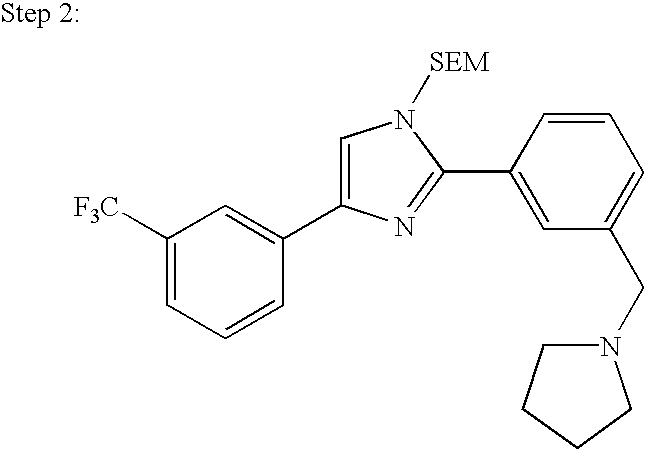
A mixture of the product of Step 1 (30 mg, 0.067 mmol), pyrrolidine (15 μl, 0.18 mmol), and sodium triacetoxyborohydride (22 mg, 0.10 mmol) in 1,2-dichloroethane (2 ml) was strirred overnight. The mixture was partitioned between CH2Cl2 (35 ml) and 1 N NaOH (10 ml). The organic layer was dried (MgSO4), filtered and evaporated. Purification of the residue by PTLC (5:95 CH3OH/CH2Cl2) gave the product (31 mg, 93%). 1H NMR (400 MHz, CDCl3): δ8.09 (s, 1H), 8.02 (m, 1H), 7.73 (m, 1H), 7.67 (m, 1H), 7.53-7.37 (m, 5H), 5.31 (s, 2H), 3.67 (s, 2H), 3.56 (m, 2H), 2.54 (bm, 4H), 1.78 (bm, 4H), 0.92 (m, 2H), −0.04 (s, 9H).
Step 3
Reaction of the product of Step 2 (31 mg, 0.063 mmol) with aqueous HCl/CH3OH using the procedure of Example 2, Step 4, afforded the product (19 mg, 81%). 1H NMR (400 MHz, CD3OD): δ8.13 (s, 1H), 8.03 (m, 1H), 7.92 (s, 1H), 7.86 (m, 1H), 7.65 (s, 1H), 7.60-7.40 (m, 4H), 3.72 (s, 2H), 2.60 (m, 4H), 1.82 (m, 4H). MS (Cl) m/e 372 (M+H)+.
Using appropriate starting materials and essentially the same procedure, the following compounds were prepared: 
Using appropriate amines, the following compounds were prepared from the product of Example 4, Step 1 by the procedure of Example 4, except that the order of the reductive amination and the cleavage of the (2-trimethylsilyl)-ethoxymethyl group (Steps 2 and 3) was reversed:
 |
| Ex. | W | Data |
| 4C |
 |
MS (Cl) 358 (M + H)+ |
| 4D | —CH2NHCH2CH2OH | MS (FAB) 362 |
| (M + H)+ | ||
| 4E | —CH2NH(CH2)2N(CH3)2 | MS (Cl) 389 |
| (M + H)+ | ||
| 4F |
 |
MS (FAB) 497 (M + H)+ |
| 4G |
 |
MS (Cl) 429 (M + H)+ |
| 4H |
 |
MS (Cl) 408 (M + H)+ |
| 4I |
 |
MS (Cl) 476 (M + H)+ |
| 4J |
 |
MS (FAB) 400 (M + H)+ |
| 4K |
 |
MS (Cl) 416 (M + H)+ |
| 4L |
 |
MS (Cl) 434 (M + H)+ |
| 4M |
 |
MS (Cl) 473 (M + H)+ |
| 4N |
 |
MS (Cl) 484 (M + H)+ |


To a stirred, ice-cold solution of the product of Example 1 (3.70 g, 11.1 mmol) in THF (95 ml) was added NaH (0.32 g, 13 mmol). After 10 min., (2-trimethylsilyl)ethoxymethyl chloride (2.2 ml, 12 mmol) was added, and the reaction mixture was stirred at RT for 6 h. The reaction mixture was diluted with Et2O, washed with H2O and sat'd NaCl, dried (MgSO4), filtered and evaporated. Flash chromatography (4:1 hexanes/EtOAc) afforded the product (4.08 g, 79%). 1H NMR (400 MHz, CDCl3) δ9.86 (1H, t, J=2.0 Hz), 8.35 (1H, m), 8.33 (1H, m), 8.14 (1H, m), 8.08 (1H, m), 7.72 (1H, t, J=8.0 Hz), 7.56 (3H, m), 5.38 (2H, s), 3.76 (2H, t, J=8.6 Hz), 1.08 (2H, t, J=8.6 Hz), 0.06 (9H, s). HRMS (FAB): Calcd. for C22H24N3O3F3Si (M+H)+: 464.1617. Found: 464.1629. 
To a solution of the product of Step 1 (3.91 g, 8.40 mmol) in EtOH (100 ml) was added 10% Pd/C (0.4 g) and the mixture was purged with H2. After 8 h under H2 balloon pressure, the mixture was filtered through celite and the filter pad was washed with EtOH. The combined filtrate and washings were concentrated under vacuum to give the product (3.47 g, 95%) which was used in Step 3 without further purification. An analytical sample was isolated by PTLC (1:99 CH3OH/CH2Cl2). 1H NMR (400 MHz, CDCl3) δ8.15 (1H, s), 8.07 (1H, m), 7.53 (2H, m), 7.50 (1H, s), 7.29 (1H, m), 7.18 (2H, m), 6.81 (1H, m), 5.35 (2H, s), 3.63 (2H, t, J=8.2 Hz), 0.97 (2H, t, J=8.2 Hz), 0.04 (9H, s). MS (Cl) 434 (M+H)+. 
To solution of the product of Step 2 (123 mg, 0.29 mmol) in CH2Cl2 (5 ml) under N2 was added pyridine (400 μl) and n-propylsulfonyl chloride (160 μl, 1.4 mmol). The reaction mixture was stirred at R.T. for 16 h, then partitioned between water and CH2Cl2. The organic layer was dried (K2CO3), filtered and concentrated. The residue was subjected to PTLC (2:98 CH3OH/CH2Cl2) to afford the product (114 mg, 73%). 1H NMR (400 MHz, CDCl3) δ8.15 (1H, s), 8.06 (1H, m), 7.78 (2H, m), 7.48-7.59 (3H, m), 7.41 (1H, m), 6.79 (1H, bs), 5.38 (2H, s), 3.69 (2H, t, J=8.2 Hz), 3.16 (2H, m), 1.92 (2H, m), 1.08 (3H, t, J=7.4 Hz), 1.02 (2H, t, J=8.2 Hz), 0.06 (9H, s). HRMS (FAB): Calcd. for C25H32N3O3SF3Si (M+H)+: 540.1963 Found: 540.1937.
Step 4
A mixture of the product of Step 3 (114 mg, 0.21 mmol), 5 N HCl (5 ml), and CH3OH (5 ml) was refluxed for 3 h. The reaction mixture was allowed to cool, sat'd NaHCO3 was cautiously added, and the whole was extracted with CH2Cl2. The organic layer was dried (MgSO4), filtered, and evaporated. The residue was subjected to PTLC to afford the product (84 mg, 95%). 1H NMR (400 MHz, CDCl3) δ8.07 (s, 1H), 7.96 (1H, d, J=7.3 Hz), 7.80 (1H, d, J=7.7 Hz), 7.76 (1H, m), 7.65-7.46 (3H, m), 7.38 (1H, t, J=7.9 Hz), 7.28 (1H, m), 3.15 (2H, m), 1.89 (2H, m), 1.03 (3H, t, J=7.4 Hz). HRMS (FAB): Calcd. for C19H18N3O2SF3 (M+H)+: 410.1150 Found: 410.1160.
Using appropriate starting materials and essentially the same procedure, the following compounds were prepared:
 |
| Ex. | W | Data |
| 5A |
 |
MS (FAB) 382 (M + H)+ |
| 5B |
 |
MS (FAB) 396 (M + H)+ |
| 5C |
 |
MS (Cl) 512 (M + H)+ |
| 5D |
 |
MS (FAB) 458 (M + H)+ |
| 5E |
 |
MS (FAB) 410 (M + H)+ |
| 5F |
 |
MS (FAB) 444 (M + H)+ |


To a solution of the product of Example 5, Step 2 (581 mg, 1.34 mmol) and diisopropylamine (0.30 ml, 1.7 mmol) in CH2Cl2 (10 ml) at 0° C. was added benzyl chloroformate (0.22 ml, 1.5 mmol). The mixture was allowed to warm to R.T. and stirred for 60 h. The solution was diluted with CH2Cl2 (75 ml) and washed with 1 N HCl (25 ml) and 1 N NaOH (25 ml). The organic layer was dried (MgSO4), filtered, and concentrated. Purification of the residue by column chromatograpy (CH2Cl2, then gradient of increasing concentration to 6:1000 CH3OH/CH2Cl2 gave the product (732 mg, 96%). MS (ES) m/e 568 (M+H)+. 
A mixture of the product of Step 1 (732 mg, 1.29 mmol) and 60% NaH in mineral oil (94 mg, 2.4 mmol) in anhydrous DMF (6 ml) was stirred for 1 h. CH3I (0.15 ml, 2.4 mmol) was added and the stirring continued overnight. The mixture was diluted with CH2Cl2 (50 ml) and washed with 20 water (2×40 ml). The organic layer was dried (MgSO4), filtered, and concentrated. Purification of the residue by column chromatography (hexanes, then gradient of increasing concentration to 1:5 EtOAc/hexanes) afforded the product (723 mg, 97%). 1H NMR (400 MHz, CDCl3) δ8.08 (s, 1H), 8.00 (m, 1H), 7.74 (s, 1H), 7.68 (d, 1H, J=8 Hz), 7.27-7.50 (m, 10H), 5.23 (s, 2H), 5.16 (s, 2H), 3.59 (t, 2H, J=8 Hz), 3.36 (s, 3H), 0.92 (t, 2H, J=8 Hz), −0.02 (s, 9H). 
A mixture of the product of Step 2 (732 mg, 1.25 mmol) and 10% Pd/C (112 mg) in 200 proof EtOH (25 ml) was stirred under H2 (1 atm) for 24 h. The mixture was filtered and the filtrate evaporated to dryness. Purification of the residue by column chromatography (hexanes, then gradient of increasing concentration to 1:9 EtOAc/hexanes) afforded the product (434 mg, 78%). 1H NMR (400 MHz, CDCl3) δ8.11 (s, 1H), 8.01 (m, 1 H), 7.47 (m, 3H), 7.27 (m, 1H), 7.04 (m, 2H), 6.67 (m, 1H), 5.31 (s, 2H), 3.85 (b, 1H), 3.56 (t, 2H, J=8 Hz), 2.87 (s, 3H), 0.91 (t, 2H, J=8 Hz), −0.02 (s, 9H). 
A solution of the product of Step 3 (49 mg, 0.11 mmol), CH3CH2SO2Cl (78 mg, 0.61 mmol) and pyridine (0.24 ml, 3.0 mmol) in anhydrous CH2Cl2 (6 ml) was stirred for 7 days. The mixture was diluted with CH2Cl2 (45 ml) and washed with 1 N NaOH (15 ml), water (20 ml) and saturated NH4Cl (20 ml). The organic layer was dried (MgSO4), filtered and concentrated. Purification of the residue by PTLC (1:99 CH3OH/CH2Cl2) gave the product (51 mg, 86%). 1H NMR (400 MHz, CDCl3) δ8.11 (s, 1H), 8.02 (m, 1H), 7.88 (s, 1H), 7.80 (m, 1H), 7.50 (m, 5H), 5.32 (s, 2H), 3.66 (t, 2H, J=8 Hz), 3.41 (s, 3H), 3.09 (q, 2H, J=7.4 Hz), 1.39 (t, 3H, J=7.4 Hz), 0.97 (t, 2H, J=8 Hz), −0.01 (s, 9H).
Step 5
A solution of the product of Step 4 (51 mg, 0.095 mmol) in CH3OH (7 ml) and 5N HCl (5 ml) was heated to 90° C. for 4 h. After the mixture was cooled, it was partitioned between CH2Cl2 (50 ml) and aqueous NH4OH (20 ml). The organic layer was dried (MgSO4), filtered and concentrated. Purification of the residue by PTLC (1:66 CH3OH/CH2Cl2) gave the product (38 mg, 98%). 1H NMR (400 MHz, CDCl3) δ8.02 (s, 1H), 7.91 (m, 2H), 7.72 (m, 1H), 7.32-7.47 (m, 5H), 3.33 (s, 3H), 3.05 (q, 2H, J=7.4 Hz), 1.35 (t, 3H, J=7.4 Hz). MS (ES) m/e 410 (M+H)+.
By using appropriate starting materials and essentially the same procedure, the following compounds were prepared:
 |
| Ex. | R7 | (M + H)+ | ||
| 6A | —CH3 | 396 | ||
| 6B | —CH2CH2CH3 | 424 | ||
| 6C |
 |
424 | ||

Step 1
To a suspension of NH4Cl (1.35 g, 25.2 mmol) in anhydrous toluene (15 ml) at 0° C. was added 2.0 M trimethylaluminum in toluene (12.6 ml, 25.2 mmol). After the addition was complete, the reaction mixture was allowed to warm to room temperature and stirred for 3 h. This reagent, CH3Al(Cl)NH2, was used directly in Step 2. 
A mixture of the product of Step 1 (22.6 ml, 20.6 mmol) and 5-bromopyridine-3-carbonitrile (1.915 g, 10.46 mmol) in a sealed tube was heated to 95° C. overnight. The mixture was cooled and poured into a slurry of silica gel (40 g) in CHCl3 (100 ml). This slurry was stirred for 1 h and the silica was filtered off. The filter cake was washed with CH3OH (200 ml). Evaporation of the filtrate gave the product (2.65 g, 65%). 1H NMR (CD3OD, 400 MHz): δ9.00 (d, 1H, J=2.4 Hz), 8.91 (d, 1H, J=2 Hz), 8.45 (t, 1H, J=2.4 Hz). MS (Cl) m/e 200 (M+H)+. 
A mixture of the product of Step 2 (1.303 g, 6.6 mmol), Preparation 1 (1.199 g, 4.51 mmol), and Na2CO3 (1.15 g, 10.9 mmol) in acetone (20 ml) and DMF (20 ml) was refluxed for 5 h. The solvents were removed under vacuum and the residue was partitioned between water (50 ml) and CH2Cl2 (100 ml). The organic layer was washed with water (50 ml), dried (MgSO4), filtered, and evaporated to dryness. The crude product was purified by column chromatography (gradient 0.5:99.5 CH3OH/CH2Cl2 to 1.5:98.5 CH3OH/CH2Cl2) to give a light-yellow solid (0.705 g, 42%). 1H NMR (CD3OD, 400 MHz): δ9.10 (d, 1H, J=1.6 Hz), 8.66 (d, 1H, J=2 Hz), 8.57 (t, 1H, J=2 Hz), 8.14 (s, 1H), 8.06 (d, 1H, J=6.8 Hz), 7.75 (s, 1H), 7.57 (m, 2H). MS (Cl) m/e 368 (M+H)+. 
Using the procedure of Example 5, Step 1, reaction of the product of Step 3 (311 mg, 0.845 mmol) with NaH (60% disp., 43 mg, 1.1 mmol) and (2-trimethylsilyl)ethoxymethyl chloride (0.21 ml, 1.07 mmol) afforded the product (292 mg, 69%). 1H NMR (CDCl3, 400 MHz): δ9.05 (d, 1H, J=2 Hz), 8.74 (d, 1H, J=2 Hz), 8.42 (t, 1H, J=2 Hz), 8.08 (s, 1H), 8.01 (m, 1H), 7.51 (m, 3H), 5.31 (s, 2H), 3.68 (t, 2H, J=8 Hz), 0.99 (t, 2H, J=8 Hz), 0.02 (s, 9H). 
A mixture of the product of Step 4 (114 mg, 0.229 mmol), benzophenone imine (52 mg, 0.29 mmol), sodium t-butoxide (35 mg, 0.36 mmol), (R)-(+)-2,2′-bis(diphenylphosphino)-1,1′-binaphthyl (13 mg, 0.02 mmol), and tris(dibenzylideneacetone)dipalladium(0) (8 mg, 0.009 mmol) in anhydrous toluene (3 ml) was purged with N2 for 5 min. The mixture was heated to 80° C. in a sealed tube for 18 h. The mixture was cooled, diluted with Et2O (20 ml) and CH2Cl2 (20 ml), and filtered. After evaporation of the filtrate, the crude product was purified by PTLC (1.5:98.5 CH3OH/CH2Cl2) to give an oil (127 mg, 93%). 1H NMR (CDCl3, 400 MHz): δ8.67 (s, 1H), 8.13 (d, 1H, J=1.6 Hz), 8.06 (s, 1H), 7.97 (m, 1H), 7.77 (m, 2H), 7.5-7.2 (m, 10H), 7.15 (m, 2H), 5.06 (s, 2H), 3.52 (t, 2H, J=8 Hz), 0.90 (t, 2H, J=8 Hz), 0.03 (s, 9H). 
A solution of the product of Step 5 (127.4 mg, 0.213 mmol), sodium acetate (43 mg, 0.52 mmol), and H2NOH.HCl (29 mg, 0.42 mmol) in CH3OH (3 ml) was stirred for 40 min. The solution was partitioned between 0.1 M aqueous NaOH (30 ml) and CH2Cl2 (50 ml). The organic layer was dried (MgSO4), filtered and evaporated to dryness. PTLC (2:98 CH3OH/CH2Cl2) gave a solid (82 mg, 89%). 1H NMR (CDCl3, 400 MHz): δ8.43 (d, 1H, J=2 Hz), 8.16 (d, 1H, J=2.8 Hz), 8.09 (s, 1H), 8.00 (m, 1H), 7.49 (m, 4H), 5.32 (s, 2H), 3.87 (bs, 2H), 3.62 (t, 2H, J=8 Hz), 0.95 (t, 2H, J=8 Hz), 0.00 (s, 9H). 
A solution of the product of Step 6 (37 mg, 0.085 mmol), ethane-sulfonyl chloride (13 mg, 0.10 mmol), and pyridine (0.1 ml, 1.2 mmol) in anhydrous CH2Cl2 (5 ml) was stirred overnight. The reaction mixture was diluted with CH2Cl2 (40 ml) and washed with water (20 ml). The organic layer was dried (MgSO4) and evaporated to dryness. PTLC (5:95 CH3OH/CH2Cl2) gave an oil (28 mg, 63%). 1H NMR (CDCl3, 400 MHz): δ8.89 (bs, 1H), 8.53 (bs, 1H), 8.14 (s, 1H), 8.05 (s, 1H), 7.99 (m, 2H), 7.48 (m, 3H), 5.30 (s, 2H), 3.64 (t, 2H, J=8.4 Hz), 3.20 (q, 2H, J=7.2 Hz), 1.39 (t, 3H, J=7.2 Hz), 0.97(t, 2H, J=8.4 Hz), 0.02 (s, 9H).
Step 8
Reaction of the product of Step 7 (28 mg, 0.053 mmol) with 5 N aqueous HCl by the procedure of Example 5, Step 4, gave the product (10.5 mg, 49%). 1H NMR (CD3OD, 400 MHz): δ8.70 (bs, 1H), 8.43 (bs, 1H), 8.00 (t, 1H, J=2 Hz), 7.94 (s, 1H), 7.86 (m, 1H), 7.45 (m, 2H), 7.40 (s, 1H), 3.10 (q, 2H, J=7.2 Hz), 1.31 (t, 3H, J=7.2 Hz). MS (Cl) m/e 397 (M+H)+.
Using appropriate starting materials and essentially the same procedure, the following compounds were prepared: 
1H NMR (CD3OD, 400 MHz): δ8.90 (bs, 1H), 8.45 (bs, 1 H), 8.29 (s, 1H), 8.15 (s, 1H), 8.07 (d, 1H, J=7.6 z), (bs, 1H, 7.6 (m, 2H), 3.13 (s, 3H). MS (ES) m/e 383.1 (M+H)+. 
1H NMR (CD3OD, 400 MHz): δ8.84 (bs, 1H), 8.42 (bs, 1H), 8.26 (m, 1H), 8.14 (s, 1H), 8.05 (d, 1H, J=6.4 Hz), 7.75 (bs, 1H), 7.59 (m, 2H), 3.23 (m, 2H), 1.86 (m, 2H), 1.05 (t, 3H, J=7.2 Hz). MS (ES) m/e 411.1 (M+H)+. 
1H NMR (CD3OD, 400 MHz): δ8.83 (bs, 1H), 8.45 (bs, 1H), 8.28 (m, 1H), 8.14 (s, 1H), 8.06 (d, 1H, J=7.6 Hz), 7.75 (bs, 1H), 7.59 (m, 2H), 3.43 (sept, 1H, J=6.8 Hz), 1.40 (d, 6H, J=6.8 Hz). MS (ES) m/e 411.1 (M+H)+.


A mixture of the product of Example 7, Step 4 (146 mg, 0.29 mmol), palladium acetate (16 mg, 0.07 mmol), (S)-(−)-2,2′-bis(diphenylphosphino)-1,1′-binaphthyl (67 mg, 0.11 mmol), and Cs2CO3 (320 mg, 0.98 mmol) in toluene (3 ml) was purged with N2 for 10 min. CH3NH2 (2 M in THF, 4 ml) was added, and the reaction mixture was heated at 80° C. in a sealed tube for 16 h. The reaction mixture was allowed to cool, diluted with CH2Cl2 (60 ml), and filtered. The filtrate was washed with H2O (20 ml), dried (MgSO4), filtered and concentrated. The residue was subjected to PTLC (5:95 CH3OH/CH2Cl2) to give the product (47 mg, 36%). 1H NMR (CDCl3, 400 MHz): δ8.33 (1H, s), 8.10 (2H, m), 8.00 (1H, m), 7.48 (3H, m), 7.36 (1H, s), 5.31 (2H, s), 4.11 (1H, bs), 3.59 (2H, t, J=8 Hz), 2.91 (3H, s), 0.93 (2H, t, J=8 Hz), −0.02 (9H, s). 
A mixture of the product of Step 1 (16 mg, 0.04 mmol), CH3SO2Cl (24 mg, 0.21 mmol), and pyridine (0.07 ml, 0.9 mmol) in CH2Cl2 (2.5 ml) was stirred for 4 days. The reaction mixture was diluted with CH2Cl2 (30 ml), washed with 1N NaOH (10 ml) and H2OH (20 ml), dried (MgSO4), filtered and concentrated. PTLC of the residue (5:95 CH3OH/CH2Cl2) gave the product (16 mg, 75%). 1H NMR (CDCl3, 400 MHz): δ9.04 (1H, s), 8.72 (1H, s), 8.27 (1H, m), 8.08 (1H, s), 8.02 (1H, m), 7.52 (3H, m), 5.32 (2H, s), 3.68 (2H, t, J=8 Hz), 3.42 (3H, s), 2.93 (3H, s), 0.98 (2H, t, J=8 Hz), 0.00 (9H, s).
Step 3
Reaction of the product of Step 2 (16 mg, 0.03 mmol) with 5N HCl by the procedure of Example 5, Step 4 gave the product (11 mg, 93%). 1H NMR (CD3OD, 400 MHz): δ9.02 (1H, s), 8.65 (1H, m), 8.45 (1H, m), 8.15 (1H, s), 8.06 (1H, d, J=8 Hz), 7.77 (1H, s), 7.57 (2H, m), 3.43 (3H, s), 3.02 (3H, s). MS (ES) m/e 397 (M+H)+.

THF (1.8 ml) was added to LAH (2.5 mg, 0.066 mmol) under N2 at 0° C. The product of Example 1B (20 mg, 0.058 mmol) was dissolved in THF (1.4 ml) and added dropwise over 5 min. to the LAH/THF slurry. After 0.5 h, more LAH (3.8 mg, 0.10 mmol) was added and the reaction was stirred at 0° C. for 1.25 h. 10% NaOH (0.1 ml) and EtOAc (2.0 ml) was added to the reaction, followed by MgSO4. The mixture was stirred, filtered and concentrated under vacuum to give the product (16 mg, 88%) as a white solid. 1H NMR (CD3OD, 400 MHz): δ8.15 (bs, 1H), 8.05 (m, 1H), 7.96 (s, 1H), 7.86 (m, 1H), 7.72-7.39 (m, 5H), 4.70 (s, 2H). HRMS (FAB): Calcd for C17H13N2OF3 (M+H)+: 319.1058. Found: 319.1059.

Step 1
A solution of the product of Example 5, Step 2 (68 mg, 0.16 mmol), acetic anhydride (26 μl, 0.28 mmol) and pyridine (0.13 ml, 1.55 mmol) in CH2Cl2 (4 ml) was stirred for 3 days. The reaction mixture was diluted with CH2Cl2 (40 ml) and washed with aq. NH4Cl (2×20 ml). The organic layer was dried (MgSO4), filtered and evaporated. Purification of the residue by PTLC (3:97 CH3OH/CH2Cl2) gave the product (62 mg,84%). 1H NMR (400 MHz, CDCl3): δ8.09 (s, 1H), 8.00 (m, 2H), 7.85 (s, 1H), 7.77 (m, 1H), 7.49 (m, 3H), 7.40 (m, 1H), 5.33 (s, 2H), 3.61 (t, 2H, J=8 Hz), 2.65 (bs, 1H), 2.11 (s, 3H), 0.94 (t, 2H, J=8 Hz), 0.01 (s, 9H).
Step 2
The product of Step 1 (62 mg, 0.13 mmol) and 1.0M TBAF in THF (3.0 ml, 3.0 mmol) was stirred at R.T. until no starting material remained. The reaction mixture was diluted with CH2Cl2 and washed with water several times, dried (K2CO3), filtered and evaporated. PTLC (2:98 CH3OH/CH2Cl2) gave the product (37 mg, 78%). 1H NMR (400 MHz, CDCl3): δ8.01 (s, 1H), 7.98 (s, 1H), 7.89 (s, 1H), 7.85 (d, 1H, J=7.2 Hz), 7.55 (d, 1H, J=8.0 Hz), 7.42 (m, 2H), 7.32 (s, 1H), 7.29 (d, 1H, J=8.4 Hz), 7.19 (t, 1H, J=7.6 Hz), 2.10 (s, 3H). MS (FAB) m/e 364 (M+H)+.
Using appropriate starting materials and essentially the same procedure, the following compounds were prepared: 


A mixture of the product of Example 4, Step 1 (759 mg, 1.70 mmol), tert-butyl 1-piperazine carboxylate (356 mg, 1.91 mmol), and sodium triacetoxyborohydride (565 mg, 2.67 mmol) in dichloroethane (9 ml) was stirred at R.T. overnight. The mixture was diluted with CH2Cl2 (100 ml) and washed with 1N aqueous NaOH (20 ml). The organic layer was dried (MgSO4), filtered, and evaporated. Purification of the residue by flash chromatography (gradient; CH2Cl2 to 1.5:98.5 CH3OH/CH2Cl2) afforded the product (902 mg, 86%). 1H NMR (400 MHz, CDCl3) δ8.09 (1H, s), 8.00 (1H, m), 7.76 (1H, bs), 7.69 (1H, m), 7.23-7.48 (5H, m), 5.29 (2H, s), 3.58 (4H, m), 3.42 (4H, bm), 2.40 (4H, bm), 1.43 (9H, s), 0.92 (2H, t, J=8 Hz), −0.02 (9H, s). MS m/e 617 (M+H)+. 
A solution of the product of Step 1 (701 mg, 1.14 mmol) in CH3OH (5 ml) and 5N aqueous HCl (10 ml) was refluxed for 8 h. The reaction mixture was allowed to cool, then partitioned between CH2Cl2 (60 ml) and aqueous NH4OH (20 ml). The aqueous layer was extracted with CH2Cl2 (40 ml) and the combined organic layers were dried (MgSO4), filtered and evaporated. Purification of the residue by flash chromatography (gradient; 5:95 to 8:92 2.0 M NH3 in CH3OH/CH2Cl2) afforded the product (451 mg, 100%). 1H NMR (400 MHz, CD3OD) δ8.14 (1H, s), 8.04 (1H, d, J=7.6 Hz), 7.94 (1H, s), 7.86 (1H, d, J=7.6 Hz), 7.66 (1H, s), 7.57 (2H, m), 7.44 (2H, m), 3.61 (2H, s), 2.87 (4H, t, J=5 Hz), 2.51 (4H, bm). MS m/e 387 (M+H)+.
Step 3
A mixture of the product of Step 2 (12 mg, 0.031 mmol), 1.0 M acetaldehyde in dichloroethane (33 μL, 0.033 mmol), and sodium triacetoxyborohydride (15 mg, 0.071 mmol) in dichloroethane (2 ml) was stirred overnight. The mixture was evaporated to dryness and the residue was purified by PTLC (5:95 2M NH3 in CH3OH/CH2Cl2) to give the product (8.4 mg, 65%). 1H NMR (400 MHz, CD3OD) δ8.14 (1H, s), 8.04 (1H, d, J=7.6 Hz), 7.93 (1H, s), 7.86 (1H, d, J=7.6 Hz), 7.65 (1H, bs), 7.56 (2H, m), 7.44 (2H, m), 3.62 (2H, s), 2.57 (8H, bm), 2.46 (2H, q, J=7.6 Hz), 1.09 (3H, t, J=7.6 Hz). MS m/e 415 (M+H)+.
By using appropriate starting materials and essentially the same procedure, the following compounds were prepared: 
wherein R12 is as defined in the following table:
| Ex. | R12 | (M + H)+ | ||
| 11A |
 |
429 | ||
| 11B |
 |
455 | ||
| 11C |
 |
469 | ||
| 11D |
 |
471 | ||
| 11E |
 |
483 | ||
| 11F |
 |
477 | ||
| 11G |
 |
478 | ||

A solution of the product of Example 11, Step 2 (15 mg, 0.039 mmol), CH3SO2Cl (5 mg, 0.04 mmol), and pyridine (6 mg, 0.08 mmol) in CH2Cl2 (2.5 ml) was stirred overnight. The mixture was diluted with CH2Cl2 (30 ml) and washed with aqueous 1N NaOH (10 ml). The organic layer was dried (MgSO4), filtered, and evaporated. Purification of the residue by TLC (5:95 2M NH3 in CH3OH/CH2Cl2) gave the product (14 mg, 79%). 1H NMR (400 MHz, CD3OD) δ8.14 (1H, s), 8.04 (1H, d, J=7.2 Hz), 7.96 (1H, s), 7.85 (1H, d, J=7.2 Hz), 7.66 (1H, s), 7.56 (2H, m), 7.43 (2H, m), 3.66 (2H, s), 3.25 (4H, m), 2.83 (3H, s), 2.61 (4H, m). MS m/e 465 (M+H)+.
By using the appropriate sulfonyl chloride and essentially the same procedure as described in Example 12, the following compounds were prepared: 
wherein R7 is as defined in the following table:
| Ex. | R7 | (M + H)+ | ||
| 12A |
 |
479 | ||
| 12B |
 |
493 | ||
| 12C |
 |
541 | ||
| 12D |
 |
527 | ||
| 12E |
 |
569 | ||


To a stirred, ice-cold solution of 3-bromobenzonitrile (6.0 g, 33 mmol) in THF (20 ml) was added a solution of lithium bistrimethylsilylamide in THF (1.0 M; 34.5 ml, 34.5 mmol). The reaction mixture was allowed to attain R.T., stirred for 16 h, then evaporated to dryness. The residue was partitioned between 9:1 CHCl3/CH3OH (50 ml) and 10% NaOH (50 ml). The organic layer was dried (MgSO4), filtered and concentrated to give the product (7.2 g). 1H NMR (400 MHz, CD3OD) δ7.92 (1H, t, J=2 Hz), 7.72 (2H, m), 7.40 (1H, t, J=8 Hz). 
A mixture of Preparation 1 (3.8 g, 14 mmol), the product of Step 1 (7.2 g), and Na2CO3 (2.96 g, 27.9 mmol) in DMF (60 ml) was stirred for 16 h. The reaction mixture was concentrated, the residue was taken up in CH2Cl2 (150 ml), and washed with water (3×100 ml). The organic layer was dried (MgSO4), filtered, and evaporated. The residue was subjected to flash chromatography (3:2 EtOAc/hexanes) to give the product as a solid (4.74 g, 91%). 1H NMR (400 MHz, CDCl3) δ9.75 (1H, bs), 8.00 (1H, s), 7.93 (2H, m), 7.71 (1H, d, J=8 Hz), 7.43 (4H, m), 7.19 (1H, t, J=8 Hz). 
By using the procedure of Preparation 2, Step 2, the product of Step 2 (4.74 g, 12.9 mmol) was reacted with (2-trimethylsilyl)ethoxymethyl chloride (2.7 ml, 15 mmol) to give the product (5.31 g, 82%). 1H NMR (400 MHz, CDCl3) δ8.07 (1H, s), 8.02 (2H, m), 7.79 (1H, d, J=7.2 Hz), 7.58 (1H, d, J=8.8 Hz), 7.48 (3H, m), 7.35 (1H, t, J=7.8 Hz), 5.29 (2H, s), 3.63 (2H, t, J=8.3 Hz), 0.96 (2H, t, J=8.3 Hz), −0.01 (9H, s). MS m/e 499 (M+H)+. 
A mixture of the product of Step 3 (1.275 g, 2.56 mmol), palladium acetate (63 mg, 0.28 mmol), (S)-(−)-2,2′-bis(diphenylphosphino)-1,1′-binaphthyl (328 mg, 0.52 mmol), (N-tert-butoxycarbonyl)piperazine (1.025 g, 5.503 mmol), and Cs2CO3 (2.53 g, 7.75 mmol) in toluene (35 ml) was purged with N2 for 10 min, then heated at 80° C. for 16 h. The reaction mixture was allowed to cool, solids were removed by filtration, and the filtrate was concentrated. The residue was partitioned between H2O (50 ml) and CH2Cl2 (100 ml), and the organic layer was dried (MgSO4), filtered and concentrated. The residue was subjected to flash chromatography (1:9 EtOAc/hexanes) to give the product (1.07 g, 69%). 1H NMR (400 MHz, CDCl3) δ8.10 (1H, s), 8.02 (1H, bs), 7.47 (3H, m), 7.35 (2H, m), 7.26 (1H, m), 7.00 (1H, m), 5.30 (2H, s), 3.57 (6H, m), 3.20 (4H, m), 1.46 (9H, s), 0.92 (2H, m), −0.03 (9H, s). MS m/e 603 (M+H)+. 
Reaction of the product of Step 4 (1.07 g, 1.78 mmol) with 5 N HCl by the procedure of Example 11, Step 2 gave the product (584 mg, 88%). 1H NMR (400 MHz, CD3OD) δ8.12 (1H, s), 8.03 (1H, d, J=7.6 Hz), 7.63 (1H, s), 7.56 (3H, m), 7.40 (1H, m), 7.34 (1H, t, J=7.8 Hz), 7.01 (1H, m), 3.23 (4H, m), 3.00 (4H, m). MS m/e 373 (M+H)+.
Step 6
Reaction of the product of Step 5 (10 mg, 0.027 mmol) with acetaldehyde by the procedure of Example 11, Step 3 gave the product (6.6 mg, 61%). 1H NMR (400 MHz, CD3OD) δ8.13 (1H, s), 8.03 (1H, d, J=7.6 Hz), 7.58 (4H, m), 7.40 (1H, m), 7.35 (1H, t, J=7.8 Hz), 7.03 (1H, m), 3.33 (4H, m), 2.70 (4H, m), 2.53 (2H, q, J=7.2 Hz), 1.17 (3H, t, J=7.2 Hz). MS m/e 401 (M+H)+.
Using a similar procedure, the following compounds were prepared: 
wherein R12 is as defined in the table
| Ex. | R12 | (M + H)+ | ||
| 13A | —CH3 | 387 | ||
| 13B |
 |
415 | ||
| 13C |
 |
415 | ||
| 13D |
 |
455 | ||
| 13E |
 |
429 | ||
| 13F |
 |
469 | ||
| 13G |
 |
463 | ||
| 13H |
 |
464 | ||

Reaction of the product of Example 13, Step 5 (15 mg, 0.040 mmol) with CH3SO2Cl (7.2 mg, 0.063 mmol) by the procedure of Example 12 afforded the product (15.4 mg, 85%). 1H NMR (400 MHz, CDCl3) δ8.02 (1H, s), 7.95 (1H, m), 7.57 (1H, s), 7.48 (2H, m), 7.41 (1H, s), 7.34 (1H, m), 7.27 (1H, m), 6.87 (1H, m), 3.27 (8H, m), 2.77 (3H, s). MS m/e 451 (M+H)+.
By using the appropriate sulfonyl chloride and essentially the same procedure, the following compounds were prepared: 
wherein R7 is as defined in the following table:
| Ex. | R7 | (M + H)+ | ||
| 14A |
 |
465 | ||
| 14B |
 |
479 | ||
| 14C |
 |
479 | ||
| 14D |
 |
527 | ||
| 14E |
 |
513 | ||

A solution of the product of Example 13, Step 5 (12 mg, 0.032 mmol), acetic anhydride (3.6 mg, 0.035 mmol), and triethylamine (3.4 mg, 0.034 mmol) in CH2Cl2 (1.5 ml) was stirred overnight. Purification by TLC (1:20 CH3OH/CH2Cl2) gave the product (13.4 mg, 100%). 1H NMR (400 MHz, CDCl3) δ8.04 (1H, s), 7.97 (1H, m), 7.60 (1H, s), 7.47 (3H, m), 7.43 (1H, s), 7.28 (1H, t, J=8 Hz), 6.89 (1H, m), 3.73 (2H, t, J=5.2 Hz), 3.57 (2H, t, J=5 Hz), 3.19 (2H, t, J=5.2 Hz), 3.11 (2H, t, J=5 Hz), 2.08 (3H, s). MS m/e 415 (M+H)+.
By using the appropriate acid chloride and essentially the same procedure, the following compounds were prepared: 
wherein R12a is as defined in the following table:
| Ex. | R12a | (M + H)+ | ||
| 15A |
 |
429 | ||
| 15B |
 |
443 | ||
| 15C |
 |
443 | ||
| 15D |
 |
457 | ||
| 15E |
 |
441 | ||
| 15F |
 |
483 | ||
| 15G |
 |
491 | ||
| 15H |
 |
477 | ||
| 15I |
 |
478 | ||

A solution of the product of Example 13, Step 5 (12 mg, 0.032 mmol), 1.0 M dimethylcarbamyl chloride in dichloroethane (0.04 ml, 0.04 mmol), and triethylamine (5 mg, 0.05 mmol) in CH2Cl2 (1.5 ml) was stirred overnight. Purification by TLC (1:20 CH3OH/CH2Cl2) gave the product (10.6 mg, 75%). 1H NMR (400 MHz, CDCl3) δ8.03 (1H, s), 7.93 (1H, m), 7.52 (1H, s), 7.44 (2H, m), 7.41 (1H, s), 7.37 (1H, d, J=7.6 Hz), 7.24 (1H, t, J=7.2 Hz), 6.83 (1H, m), 3.28 (4H, m), 3.06 (4H, m), 2.80 (6H, s). MS m/e 444 (M+H)+.
By using the appropriate carbamyl chloride and essentially the same procedure as described in Example 16, the following compounds were prepared: 
wherein R12a is as defined in the following table:
| Ex. | R12a | (M + H)+ | ||
| 16A |
 |
500 | ||
| 16B |
 |
472 | ||


A solution of Preparation 2, Step 2 (0.18 g, 0.51 mmol) in THF (5 ml) under N2 was cooled to −78° C. and n-BuLi (0.48 ml, 0.77 mmol) was added dropwise. The reaction was stirred for 10 min., then N-tert-butoxycarbonyl-4-piperidone (0.11 g, 0.56 mmol) in THF (2 ml) was added dropwise. After stirring for 2.5 h, the reaction was quenched with water, extracted with EtOAc, dried over K2CO3, filtered and concentrated under vacuum to give a residue (0.28 g, 100%) which was used in the next reaction without further purification.
To solution of the residue (0.28 g, 0.51 mmol) in CH2Cl2 (7 ml) under N2 was added TFA (0.6 ml). After stirring at R.T. for 40 min., the reaction was washed with water, treated with 1 N NaOH, extracted with CH2Cl2, dried over K2CO3, filtered and concentrated under vacuum to give the residue (0.19 g, 80%) which was used in the next reaction without further purification.
The residue (0.13 g, 0.29 mmol) was dissolved in CH2Cl2 (3 ml) under N2 and Et3N (80 μL, 0.58 mmol) was added, followed by the dropwise addition of 1-naphthalenesulfonyl chloride (0.079 g, 0.34 mmol) in CH2Cl2 (1 ml). After stirring at R.T. for 18 h, the reaction was treated with 1 N NaOH, extracted with CH2Cl2, dried over K2CO3, filtered and concentrated under vacuum. Purification via PTLC (40:60 EtOAc/hexanes) yielded the product (0.15 g, 84%). MS (Cl) m/e 632 (M+H)+.
Step 2
To solution of the product of Step 1 (0.15 g, 0.24 mmol) in CH3OH (4.5 ml) under N2 was added HCl (6 N in CH3OH, 4 ml). The reaction was heated to 80° C. in a sealed tube. After stirring for 15 min., the reaction was treated with 1 N NaOH, extracted with CH2Cl2, dried over K2CO3, filtered and concentrated under vacuum to yield the free imidazole (0.092 g, 77%) which was used in the next reaction without further purification.
The imidazole (0.092 g, 0.18 mmol) in AcOH (3 ml) and Ac2O (90 μL, 0.90 mmol) was heated to 140° C. After 2.25 h, the AcOH was evaporated off and water was added, followed by a few drops of EtOAc. The mixture was stirred for a few minutes, then basified with K2CO3, extracted with EtOAc, dried over K2CO3 and concentrated under vacuum. The residue was subjected to PTLC (4:96 2 M NH3 in CH3OH/CH2Cl2) to yield the product (0.059 g, 68%). 1H NMR (400 MHz, CDCl3): δ8.76 (d, 1H, J=8.8 Hz), 8.30 (dd, 1H, J=1.2, 7.4 Hz), 8.14 (d, 1H, J=8.2 Hz), 8.03-7.91 (m, 3H), 7.73-7.58 (m, 3H), 7.54-7.46 (m, 2H), 7.35 (s, 1H), 6.41 (bs, 1H), 4.00 (m, 2H), 3.56 (t, 2H, J=5.7 Hz), 2.79 (m, 2H). HRMS: Calc'd for C25H20N3O2SF3 (M+H)+: 484.1307. Found: 484.1317.
Using appropriate starting materials and essentially the same procedure, the following compound was prepared: 
HRMS: Calc'd for C22H20N3O2SF3 (M+H)+: 448.1307. Found: 448.1308.

To a solution of Example 17 (0.037 g, 0.077 mmol) in EtOH (2.5 ml) was added 10% Pd/C. The mixture was stirred under a balloon of H2 for 16 h, then filtered through celite, and the filter pad was washed with EtOH. The combined filtrate and washings were concentrated under vacuum. The residue was subjected to PTLC (4:96 2 M NH3 in CH3OH/CH2Cl2) to yield the product (0.019 g, 50%). 1H NMR (400 MHz, CDCl3): δ8.77 (d, 1H, J=8.8 Hz), 8.27 (dd, 1H, J=1.2, 7.4 Hz), 8.14 (d, 1H, J=8.2 Hz), 8.03-7.92 (m, 2H), 7.86 (bd, 1H, J=7.0 Hz), 7.74-7.58 (m, 3H), 7.51-7.42 (m, 2H), 7.30 (s, 1H), 4.01 (m, 2H), 2.90 (m, 2H), 2.78 (m, 2H), 2.20-2.08 (m, 2H), 2.01-1.86 (m, 2H). HRMS: Calc'd for C25H22N3O2SF3 (M+H)+: 486.1463. Found: 486.1466.
Using appropriate starting materials and essentially the same procedure, the following compound was prepared: 
HRMS: Calcd for C22H22N3O2SF3 (M+H)+: 450.1463. Found: 450.1457.


A solution of 1-Boc-4-piperidone (2.629 g, 13.19 mmol) in THF (7.5 ml) was added dropwise to freshly prepared LDA (9.3 ml of 1.6 M butyllithium in hexanes and 1.54 g diisopropylamine) in THF (15 ml) in a dry ice-acetone bath. After 1 h a solution of N-phenyltrifluoromethane-sulfonimide (4.851 g, 13.58 mmol) in THF (10 ml) was added and the solution was allowed to warm up to 0° C. and stirred in an ice-water bath for 4 h. The volatiles were evaporated and the residue was subjected to a flash column (neutral alumina, hexanes, then gradient of increasing EtOAc concentration to 4:96 EtOAc/hexanes) to give the product (1.440 g, 33%). 1H-NMR (400 MHz, CDCl3) δ5.74 (1H, b), 4.02 (2H, m), 3.61 (2H, m), 2.42 (2H, m), 1.45 (9H, s). 
To a solution of the product of Preparation 2, Step 2 (359 mg, 1.05 mmol) in THF (5 ml) in a dry ice-acetone bath was added 1.6 M butyllithium in hexanes (0.80 ml, 1.3 mmol). The solution was stirred for 15 min. then zinc chloride (442 mg, 3.25 mmol) in THF (3 ml) was added. The mixture was stirred at −78° C. for 10 min. and warmed to R.T. over 30 min. 1,1′-Bis(diphenylphosphino)ferrocene-palladium dichloride (68 mg, 0.083 mmol) and the product of Step 1 (480 mg, 1.45 mmol) were added. The mixture was purged with nitrogen for 5 min. and then heated at 90° C. for 16 h. The reaction mixture was cooled down and poured into 10% aqueous NH4OH (50 ml). The whole was extracted with CH2Cl2 (2×50 ml), dried (MgSO4), concentrated, and purified by PTLC (1:4 EtOAc/hexanes) to give the product (114 mg, 21%). MS (ES) m/e 524 (M+H)+. 
A solution of the product of Step 2 (114 mg, 0.218 mmol) in 10% TFA/CH2Cl2 (5 ml) was stirred in an ice-water bath for 10 min. then at R.T. for 2 h. The solution was partitioned between CH2Cl2 (30 ml) and 1N NaOH (20 ml). The aqueous layer was extracted again with CH2Cl2 (20 ml) and the combined organic layer was dried over MgSO4. The crude mixture after concentration was subjected to PTLC (8:92 2M NH3-MeOH/CH2Cl2) to give the product (67 mg, 73%). MS (ES) m/e 424 (M+H)+. 
A mixture of the product of Step 3 (67 mg, 0.16 mmol), 2-bromopyridine (61 mg, 0.38 mmol), sodium t-butoxide (53 mg, 0.55 mmol), bis(diphenylphosphino)propane (16 mg, 0.039 mmol), and palladium(II) acetate (7 mg, 0.03 mmol) in toluene (4 ml) was heated at 100° C. in a sealed vessel for 16 h. The mixture was diluted with CH2Cl2 (40 ml) and filtered. The filtrate was evaporated to dryness and subjected to PTLC (3:97 MeOH/CH2Cl2) to give the product (36 mg, 45%). MS (ES) m/e 501 (M+H)+.
Step 5
Reaction of the product of Step 4 with HCl/MeOH by the procedure of Example 5, Step 4 afforded the product (13 mg, 48%). 1H-NMR (400 MHz, CDCl3) δ8.16 (1H, m), 7.99 (1H, s), 7.90 (1H, m), 7.53 (1H, m), 7.47 (2H, m), 7.34 (1H, s), 6.68 (1H, m), 6.63 (1H, m), 6.51 (1H, m), 4.17 (2H, m), 3.83 (2H, m), 2.79 (2H, m). MS (ES) m/e 371 (M+H)+.


A mixture of Preparation 3 (0.693 g, 1.40 mmol), 3-fluorophenyl-boronic acid (0.410 g, 2.93 mmol), potassium phosphate (0.650 g, 3.07 mmol), and 1,1′-bis(diphenylphosphino)ferrocene-palladium dichloride (0.064 g, 0.078 mmol) in DME (5 ml) was heated at 80° C. in a sealed vessel for 16 h. The mixture was diluted with CH2Cl2 (50 ml) and filtered. The filtrate was washed with water (30 ml), dried (MgSO4), concentrated, and purified by PTLC (2.5:97.5 MeOH/CH2Cl2) to give isomer A (0.214 g, 30%) and isomer B (0.263 g, 37%). MS (ES) m/e 510 (M+H)+.
Coupling of Preparation 3 with the appropriate boronic acids by essentially the same procedure gave: 

A mixture of 20-1-1 (0.214 g, 0.421 mmol) and 10% Pd/C (0.023 g) in EtOH (8 ml) was stirred under H2 (1 atm) for 16 h. The mixture was filtered and the filtrate was evaporated to dryness to give the product (0.158 g, 100%). MS (ES) m/e 376 (M+H)+. 
Additional piperidine derivatives were prepared from 20-1-4 according to the following procedure. 
A mixture of 20-1-4 (179 mg, 0.319 mmol), 50% aq. KOH (6 ml), and EtOH (6 ml) was heated at 100° C. for 3 h. The mixture was concentrated and the residue was partitioned between CH2Cl2 (50 ml) and water (20 ml). The aqueous layer was washed with CH2Cl2 (20 ml). The combined organic layer was dried (Na2SO4) and concentrated to give the product (164 mg), which was used without further purification. MS (ES) m/e 426 (M+H)+. 
A mixture of 20-2-1 (81 mg, 0.21 mmol), 2-bromopyridine (88 mg, 0.56 mmol), palladium(II) acetate (10 mg, 0.045 mmol), bis(diphenylphosphino)propane (26 mg, 0.063 mmol), and sodium t-butoxide (88 mg, 0.92 mmol) in anhydrous toluene (4 ml) was heated at 110° C. in a sealed vessel for 16 h. The mixture was diluted with CH2Cl2 (40 ml) and filtered. The filtrate was evaporated to dryness and purified by PTLC (2:98 MeOH/CH2Cl2) to give the product (58 mg, 61%). MS (ES) m/e 453 (M+H)+.
Step 4
Reaction of 20-3-1 with HCl/MeOH by the procedure of Example 5, Step 4 afforded the product (43 mg, 100%). 1H-NMR (400 MHz, CDCl3) δ8.16 (1H, m), 7.45 (3H, m), 7.28 (1H, m), 7.19 (1H, s), 6.88 (1H, m), 6.67 (1H, m), 6.59 (1H, m), 4.35 (2H, m), 3.04 (1H, m), 2.95 (2H, m), 2.11 (2H, m), 1.81 (2H, m). MS (ES) m/e 323 (M+H)+.
The following examples were prepared from the corresponding products of Step 2 using essentially the same procedures described in Step 3 and Step 4:
 |
| Ex. | K | (M + H)+ | ||
| 20A |
 |
373 | ||
| 20B |
 |
341 | ||
| 20C |
 |
373 | ||


A solution of 20-2-1 (40 mg, 0.11 mmol), methanesulfonyl chloride (14 mg, 0.12 mmol), and triethylamine (20 mg, 0.20 mmol) in CH2Cl2 (4 ml) was stirred at R.T. for 16 h. The mixture was diluted with CH2Cl2 (40 ml) and washed with 1N NaOH (10 ml). The organic layer was dried (MgSO4), concentrated, and purified by PTLC (2:98 MeOH/CH2Cl2) to give the product (34 mg, 68%). MS (ES) m/e 454 (M+H)+.
Step 2
Reaction of the product of Step 1 with HCl/MeOH by the procedure of Example 5, Step 4 afforded the product (23 mg, 96%). 1H-NMR (400 MHz, CDCl3) δ7.42 (2H, m), 7.29 (1H, m), 7.22 (1H, s), 6.90 (1H, m), 3.86 (2H, m), 2.96 (1H, m), 2.82 (5H, m), 2.14 (2H, m), 1.91 (2H, m). MS (ES) m/e 324 (M+H)+.
The following examples were prepared from the corresponding products of Example 20, Step 2 using essentially the same procedures described in Step 1 and Step 2:
 |
| Ex. | K | (M + H)+ | ||
| 21A |
 |
374 | ||
| 21B |
 |
342 | ||
| 21C |
 |
374 | ||


A solution of 20-2-1 (40 mg, 0.11 mmol), acetic anhydride (12 mg, 0.12 mmol), and triethylamine (24 mg, 0.24 mmol) in CH2Cl2 (4 ml) was stirred at R.T. for 16 h. The mixture was diluted with CH2Cl2 (40 ml) and washed with 1N NaOH (10 ml). The organic layer was dried (MgSO4), concentrated, and purified by PTLC (2:98 MeOH/CH2Cl2) to give the product (30 mg, 69%). MS (ES) m/e 418 (M+H)+.
Step 2
A solution of the product of Step 1 (30 mg, 0.072 mmol) in MeOH (1 ml) and 5N HCl (3 ml) was refluxed for 4 h. The mixture was partitioned between CH2Cl2 (30 ml) and aqueous NH4OH (15 ml). The organic layer was concentrated and the residue was reacted with acetic anhydride (8 mg, 0.08 mmol) in CH2Cl2 (5 ml) at R.T. for 16 h. The mixture was diluted with CH2Cl2 (30 ml) and washed with 1N NaOH (10 ml). The organic layer was dried (MgSO4), concentrated, and purified by PTLC (5:95 MeOH/CH2Cl2) to give the product (14 mg, 66%). 1H-NMR (400 MHz, CDCl3) δ7.42 (2H, m), 7.29 (1H, m), 7.23 (1H, s), 6.88 (1H, m), 4.66 (1H, m), 3.91 (1H, m), 3.21 (1H, m), 3.09 (1H, m), 2.73 (1H, m), 2.14 (1H, m), 2.11 (3H, s), 2.01 (1H, m), 1.74 (2H, m). MS (ES) m/e 288 (M+H)+.
The following examples were prepared from the corresponding products of Example 20, Step 2 using essentially the same procedures described in Step 1 and Step 2:
 |
| Ex. | K | (M + H)+ | ||
| 22A |
 |
306 | ||
| 22B |
 |
338 | ||


To a solution of Preparation 2 (8.734 g, 18.65 mmol) in anhydrous THF (35 ml) at −78° C. was added 2.5 M butyllithium in hexanes (9.50 ml, 23.8 mmol). The solution was stirred at −78° C. for 40 min and a solution of hexachloroethane (9.69 g, 40.9 mmol) in THF (25 ml) was added through a cannular. The resulting solution was allowed to warm to R.T. and stirred for 16 h. The solution was evaporated to dryness and the residue was partitioned between CH2Cl2 (300 ml) and water (200 ml). The organic layer was dried (MgSO4), concentrated, and purified by column chromatography (hexanes, then gradient of increasing EtOAc concentration to 4:96 EtOAc/hexanes) to give the product (6.189 g, 88%). MS (ES) m/e 377 (M+H)+. 
A mixture of the product of Step 1 (5.142 g, 13.64 mmol), piperazine (53.06 g, 615.9 mmol), copper(II) sulfate (9.05 g, 56.7 mmol) in diglyme (10 ml) was heated to 170° C. for 48 h in a sealed vessel. The reaction mixture was cooled to R.T. and treated with CH2Cl2 (600 ml). The mixture was filtered and the filtrate was washed with water (2×350 ml). The organic layer was dried (MgSO4), concentrated, and purified by column chromatography (CH2Cl2, then gradient of increasing MeOH concentration to 1:9 MeOH/CH2Cl2) to give the product (4.116 g, 71%). MS (ES) m/e 427 (M+H)+. 
A solution of the product of Step 2 (75 mg, 0.18 mmol), methanesulfonyl chloride (29 mg, 0.26 mmol), and triethylamine (38 mg, 0.38 mmol) in CH2Cl2 (5 ml) was stirred at R.T. for 16 h. The mixture was diluted with CH2Cl2 (50 ml) and washed with 1N NaOH (20 ml), then sat'd aq. NH4Cl (20 ml). The organic layer was dried (MgSO4), concentrated, and subjected to PTLC (2:98 MeOH/CH2Cl2) to give the product (73 mg, 81%). MS (ES) m/e 505 (M+H)+.
Step 4
A solution of the product of Step 3 (73 mg, 0.14 mmol) in MeOH (3 ml) and 5N HCl (7 ml) was refluxed for 4 h. The reaction mixture was partitioned between CH2Cl2 (40 ml) and aq. NH4OH (20 ml). The organic layer was dried (MgSO4), concentrated, and subjected to PTLC (5:95 MeOH/CH2Cl2) to give the product (52 mg, 97%). 1H-NMR (400 MHz, CDCl3) δ7.87 (1H, s), 7.80 (1H, m), 7.42 (2H, m), 7.04 (1H, s), 3.50 (4H t, J=5 Hz), 3.34 (4H, t, J=5 Hz), 2.80 (3H, s). MS (ES) m/e 375 (M+H)+.
By using appropriate starting materials and essentially the same procedure, the following compounds were prepared:
 |
| Ex. | R7 | (M + H)+ | ||
| 23A | —CH2CH3 | 389 | ||
| 23B | —CH2CH2CH3 | 403 | ||
| 23C |
 |
403 | ||
| 23D |
 |
437 | ||
| 23E | —CF3 | 429 | ||


A solution of the product of Example 23, Step 2 (602 mg, 1.41 mmol) in MeOH (5 ml) and 5N HCl (9 ml) was refluxed for 3 h. The reaction mixture was partitioned between CH2Cl2 (3×60 ml) and aq. NH4OH (50 ml). The organic layer was dried (MgSO4), concentrated, and subjected to PTLC (16:84 2M NH3 in MeOH/CH2Cl2) to give the product (343 mg, 82%). MS (ES) m/e 297 (M+H)+.
Step 2
A solution of the product of Step 1 (31 mg, 0.11 mmol), acetyl chloride (8 mg, 0.1 mmol), and triethylamine (11 mg, 0.11 mmol) in CH2Cl2 (2 ml) was stirred at R.T. for 16 h. The mixture was diluted with CH2Cl2 (25 ml) and washed with water (20 ml). The organic layer was dried (MgSO4), concentrated, and subjected to PTLC (5:95 MeOH/CH2Cl2) to give the product (17 mg, 47%). 1H-NMR (400 MHz, CDCl3) δ8.75 (1H, b), 7.85 (2H, m), 7.41 (2H, m), 7.05 (1H, s), 3.73 (2H, m), 3.60 (2H, m), 3.47 (2H, m), 3.29 (2H, m), 2.13 (3H, s). MS (ES) m/e 339 (M+H)+.
By using appropriate starting materials and essentially the same procedure, the following compounds were prepared:
 |
| Ex. | R8a | (M + H)+ | ||
| 24A |
 |
365 | ||
| 24B |
 |
401 | ||
| 24C |
 |
402 | ||
| 24D |
 |
402 | ||
| 24E |
 |
402 | ||

To a solution of the product of Example 24, Step 1 (31 mg, 0.10 mmol) and triethylamine (11 mg, 0.11 mmol) in CH2Cl2 (2 ml) was added phenylisocyanate (13 mg, 0.11 mmol) in CH2Cl2 (1 ml) dropwise. The mixture was stirred at R.T. for 16 h and then evaporated to dryness. The residue was purified by PTLC (5:95 MeOH/CH2Cl2) to give the product (23 mg, 54%). 1H-NMR (400 MHz, CDCl3) δ7.86 (1H, b), 7.75 (1H, b), 7.2-7.4 (6H, m), 7.07 (1H, m), 6.72 (2H, b), 3.53 (4H, m), 3.38 (4H, m). MS (ES) m/e 416 (M+H)+.
By using appropriate starting materials and essentially the same procedure, the following compounds were prepared:
 |
| Ex. | Z | (M + H)+ |
| 25A | —H | 340 |
| 25B |
 |
396 |
| 25C |
 |
422 |


A mixture of the product of Example 23, Step 2 (123 mg, 0.288 mmol), palladium acetate (7 mg, 0.03 mmol), bis(diphenylphosphino)propane (10 mg, 0.024 mmol), sodium t-butoxide (87 mg, 0.91 mmol), and 2-bromopyridine (114 mg, 0.722 mmol) in anhydrous toluene (2.5 ml) was heated to 80° C. in a sealed vessel for 16 h. The mixture was diluted with CH2Cl2 (50 ml) and filtered. The filtrate was evaporated to dryness and purified by PTLC (3:97 MeOH/CH2Cl2) to give the product (120 mg, 83%). MS (ES) m/e 504 ((M+H)+.
Coupling of the product of Example 23, Step 2 with the appropriate aryl or heteroaryl halides by essentially the same procedure gave: 

Additional (4′-aryl or 4′-heteroarylpiperazinyl)imidazoles were prepared according to the following procedure. 
A mixture of the product of Example 23, Step 2 (132 mg, 0.309 mmol), 2,5-dibromopyridine (151 mg, 0.637 mmol), bis(dibenzylideneacetone)palladium (10 mg, 0.017 mmol), (±)-2,2′-bis(diphenylphosphino)-1,1′-binaphthyl (23 mg, 0.037 mmol), and sodium t-butoxide (85 mg, 0.88 mmol) in anhydrous toluene (2.5 ml) was heated to 110° C. in a sealed vessel for 16 h. The mixture was diluted with CH2Cl2 (40 ml) and filtered. The filtrate was evaporated to dryness and purified by PTLC (1.5:98.5 MeOH/CH2Cl2) to give the product (118 mg, 65%). MS (ES) m/e 582 (M+H)+.
Using the appropriate aryl or heteroaryl halides and essentially the same procedure, the following compounds were prepared. 

Step 2
A solution of 26-1-1 (120 mg, 0.238 mmol) in MeOH (3 ml) and 5N HCl (5 ml) was refluxed for 4 h. The reaction mixture was partitioned between CH2Cl2 (50 ml) and aq. NH4OH (20 ml). The organic layer was dried (MgSO4), concentrated, and purified by PTLC (5:95 MeOH/CH2Cl2) to give the product (89 mg, 100%). 1H-NMR (400 MHz, CDCl3) δ8.18 (1H, m), 7.88 (1H, s), 7.80 (1H, m), 7.49 (1H, m), 7.40 (2H, m), 7.05 (1H, s), 6.66 (2H, m), 3.65 (4H, m), 3.48 (4H, m). MS (ES) m/e 374 (M+H)+.
The following examples were prepared from the corresponding products of Step 1 using essentially the same procedure.
 |
| Ex. | R8 | (M + H)+ |
| 26A |
 |
374 |
| 26B |
 |
374 |
| 26C |
 |
442 |
| 26D |
 |
375 |
| 26E |
 |
391 |
| 26F |
 |
373 |
| 26G |
 |
452 |
| 26H |
 |
388 |
| 26I |
 |
388 |
| 26J |
 |
442 |
| 26K |
 |
375 |
| 26L |
 |
391 |
| 26M |
 |
391 |


A mixture of the product of Example 23, Step 2 (107 mg, 0.251 mmol), 2-bromothiazole (93 mg, 0.57 mmol), and anhydrous potassium carbonate (98 mg, 0.71 mmol) in anhydrous DMF (2.5 ml) was heated at 160° C. for 16 h. The volatiles were evaporated in vacuo and the residue was partitioned between CH2Cl2 (50 ml) and 1N NaOH (20 ml). The organic layer was washed with water (30 ml) and brine (20 ml), dried (MgSO4), concentrated, and purified by PTLC (2:98 MeOH/CH2Cl2) to give the product (71 mg, 55%). MS (ES) m/e 510 (M+H)+.
Step 2
Reaction of the product of Step 1 with HCl/MeOH by the procedure of Example 5, Step 4 afforded the product (52 mg, 99%). 1H-NMR (400 MHz, CDCl3) δ7.88 (1H, s), 7.81 (1H, m), 7.42 (2H, m), 7.20 (1H, d, J=3.6 Hz), 7.05 (1H, s), 6.62 (1H, d, J=3.6 Hz), 3.61 (4H, m), 3.51 (4H, m). MS (ES) m/e 380 (M+H)+.


A solution of the product of Example 23, Step 2 (129 mg, 0.303 mmol), 2-chloropyridine N-oxide hydrochloride (77 mg, 0.46 mmol), and triethylamine (282 mg, 2.78 mmol) in EtOH (5 ml) was refluxed for 16 h. The volatiles were evaporated and the residue was partitioned between CH2Cl2 (40 ml) and water (20 ml). The organic layer was dried (MgSO4), concentrated, and purified by PTLC (6:94 MeOH/CH2Cl2) to give the product (40 mg, 25%). MS (ES) m/e 520 (M+H)+.
Step 2
Reaction of the product of Step 1 with HCl/MeOH by the procedure of Example 5, Step 4 afforded the product (28 mg, 94%). 1H-NMR (400 MHz, CD3OD) δ8.22 (1H, m), 7.95 (1H, s), 7.87 (1H, m), 7.4-7.6 (3H, m), 7.22 (2H, m), 7.13 (1H, m), 3.60 (4H, m), 3.55 (4H, m). MS (ES) m/e 390 (M+H)+.


A stirred ice-cold solution of 2-chloro-5-aminopyridine (5.56 g, 43.2 mmol) in EtOH (50 ml) was treated with 50% aqueous HBF4 (16 ml, 90 mmol). The mixture was cooled to −5° C. and isoamyl nitrite (6.1 ml, 45 mmol) was added dropwise over 5 min. The mixture was stirred for another 30 min. at −5° C. and then filtered. The filtercake was washed with absolute EtOH and ether to give a pale yellow solid (6.77 g). The solid in dry heptane (35 ml) was gently refluxed for 3 h. Upon cooling to R.T. the upper layer was decanted, and the residue was stirred with ether (60 ml). After ether was evaporated at 10° C. under reduced pressure, the residue was stirred with concentrated sulfuric acid (1 ml) for 16 h. The supernatant layer was decanted and the lower layer was rinsed with pentane (3×4 ml). Ice was added, followed by 5N NaOH (8 ml). The mixture was extracted with ether (50 ml, then 2×20 ml), dried (MgSO4), and concentrated to give the product (1.5 g). 1H-NMR (400 MHz, CDCl3) δ8.26 (1H, d, J=3.2 Hz), 7.40 (1H, m), 7.32 (1H, dd, J=3.6, 8.8 Hz). 
A mixture of the product of Example 23, Step 2 (97 mg, 0.23 mmol), the product of Step 1 (45 mg, 0.34 mmol), palladium(II) acetate (6 mg, 0.03 mmol), 2-(di-t-butylphosphino)biphenyl (7 mg, 0.02 mmol), and sodium t-butoxide (69 mg, 0.72 mmol) in toluene (2 ml) was heated to 100° C. in a sealed vessel for 3 h. The mixture was diluted with CH2Cl2 (40 ml) and filtered. The filtrate was evaporated to dryness and purified by PTLC (2:98 MeOH/CH2Cl2) to give the product (60 mg, 50%). MS (ES) m/e 522 (M+H)+.
Coupling of the product of Example 23, Step 2 with 2-chloropyridine-5-carbonitrile by essentially the same procedure gave: 
Step 3
A solution of 29-2-1 (59 mg, 0.11 mmol) in MeOH (2 ml) and 5N HCl (5 ml) was refluxed for 3 h. The reaction mixture was partitioned between CH2Cl2 (50 ml) and aq. NH4OH (25 ml). The organic layer was dried (MgSO4), concentrated, and purified by PTLC (4:96 MeOH/CH2Cl2) to give the product (38 mg, 89%). 1H-NMR (400 MHz, CDCl3) δ8.05 (1H, d, J=3.2 Hz), 7.89 (1H, m), 7.81 (1H, m), 7.41 (2H, m), 7.26 (1H, m), 7.05 (1H, s), 6.66 (1H, dd, J=3.6, 9.2 Hz), 3.58 (4H, m), 3.48 (4H, m). MS (ES) m/e 392 (M+H)+.
Reaction of 29-2-2 with HCl/MeOH by the procedure of Example 5, Step 4 afforded the following compounds: 


To an ice-cold solution of N-t-butoxycarbonyl-4-methylenepiperidine (Tetrahedron Letters, 37 (1996), 5233) (151 mg, 0.77 mmol) in THF (3 ml) was slowly added 9-BBN (0.5N in THF; 1.5 ml, 5.7 mmol). After 5 min. the cold bath was removed and stirring was continued at R.T. for 3 h to give solution A. Preparation 2 (350 mg, 0.75 mmol), CsCO3 (299 mg, 0.92 mmol), triphenylarsine (24 mg, 0.08 mmol), and Pd(dppf)Cl2 (24 mg, 0.03 mmol) in DMF (5 ml) and water (0.2 ml) was purged with N2, and solution A was added via cannula. The reaction mixture was stirred overnight, then poured into ice-water and extracted with EtOAc (50 ml). The aqueous layer was basified to pH 10-11 and extracted with EtOAc (50 ml). The combined EtOAc layers were dried (MgSO4), filtered and evaporated. Purification of the residue by PTLC (1:99 2 M NH3 in CH3OH/CH2Cl2) gave the product (177 mg, 49%). 1H NMR (400 MHz, CD3OD): δ8.03 (s, 1H), 7.94 (d, 1H, J=8 Hz), 7.65 (s, 1H), 7.53 (m, 2H), 5.35 (s, 2H), 4.06 (m, 2H), 3.62 (t, 2H, J=8.2 Hz), 2.77 (m, 4H), 2.07 (m, 1H), 1.67 (m, 2H), 1.42 (s, 9H), 1.22 (m, 2H), 0.93 (t, 2H, J=8.2 Hz), −0.02 (s, 9H). 
A solution of the product of Step 1 (558 mg, 1.18 mmol) in TFA (1.25 ml) and CH2Cl2 (10 ml) was stirred in an ice bath for 5 min., then at R.T. for 45 min. The reaction mixture was cooled in ice, then 1 N NaOH (20 ml) and CH2Cl2 (30 ml) was added. The organic layer was dried (MgSO4), filtered and evaporated. The residue was purified by PTLC (6:94 2 M NH3 in CH3OH/CH2Cl2) to give the product (215 mg, 42%). 1H NMR (400 MHz, CDCl3): δ7.99 (s, 1H), 7.93 (m, 1H), 7.46 (m, 2H), 7.25 (s, 1H), 5.22 (s, 2H), 3.51 (t, 2H, J=8.2 Hz), 3.09 (m, 2H), 2.70 (m, 2H), 2.62 (m, 2H), 2.04 (m, 1H), 1.93 (bs, 1H), 1.75 (m, 2H), 1.27 (m, 2H), 0.93 (t, 2H, J=8.6 Hz), −0.02 (s, 9H). 
Reaction of the product of Step 2 (51 mg, 0.12 mmol) with CH3SO2Cl by the procedure of Example 5, Step 3, gave the product (55 mg, 100%). 1H NMR (400 MHz, CDCl3): δ8.00 (s, 1H), 7.91 (m, 1H), 7.46 (m, 2H), 7.25 (s, 1H), 5.23 (s, 2H), 3.81 (m, 2H), 3.54 (t, 2H, J=8.6 Hz), 2.77 (s, 3H), 2.70 (m, 4H), 2.15 (m, 1H), 1.89 (m, 2H), 1.45 (m, 2H), 0.92 (t, 2H, J=8.6 Hz), −0.02 (s, 9H).
Step 4
Using the procedure of Example 2, Step 4, reaction of the product of Step 3 (55 mg, 0.12 mmol) with HCl/CH3OH afforded the product (38 mg, 100%). 1H NMR (400 MHz, CD3OD): δ8.00 (s, 1H), 7.91 (d, J=7.2 Hz, 1H), 7.50 (m, 3H), 3.70 (m, 2H), 2.79 (s, 3H), 2.71 (m, 4H), 1.90 (m, 1H), 1.77 (m, 2H), 1.37 (m, 2H). MS (FAB) m/e 388 (M+H)+.
Using appropriate starting materials and essentially the same procedure, the following compounds were prepared:
 |
| Ex. | R | Data |
| 30A |
 |
MS (Cl) m/e 450 (M + H)+ |
| 30B |
 |
MS (Cl) m/e 464 (M + H)+ |
| 30C |
 |
MS (FAB) m/e 416 (M + H)+ |


Using the procedure of Example 2, Step 4, reaction of the product of Example 30, Step 2 (177 mg, 0.40 mmol) with 5M HCl/CH3OH afforded the product (74 mg, 60%). MS (Cl) m/e 310 (M+H)+.
Step 2
Using a procedure analogous to Example 4, Step 2, reductive alkylation of the product of Step 1 (33 mg, 0.11 mmol) with acetone gave the product (25 mg, 65%). 1H NMR (400 MHz, CD3OD): δ7.99 (s, 1H), 7.91 (d, 1H, J=7.6 Hz), 7.51 (m, 2H), 7.43 (s, 1H), 2.91 (m, 2H), 2.69 (m, 3H), 2.20 (m, 2H), 1.79 (m, 1H), 1.70 (m, 2H), 1.35 (m, 2H), 1.06 (d, 6H, J=6.6 Hz). MS (Cl) m/e 352 (M+H)+.
Using appropriate starting materials and procedures, the following compounds were prepared: 

A solution of Example 31, Step 1 (27 mg, 0.087 mmol), acetic anhydride (15 μL, 0.16 mmol), Et3N (45 μL, 0.32 mmol), and a catalytic amount of DMAP in CH2Cl2 (5 ml) was stirred at R.T. overnight. The reaction mixture was diluted with CH2Cl2 (30 ml) and washed with sat'd NH4Cl (20 ml). The organic layer was dried (MgSO4), filtered and evaporated. The residue was purified by PTLC (5:95 CH3OH/CH2Cl2) to give the product (14 mg, 46%). 1H NMR (400 MHz, CD3OD): δ8.00 (s, 1H), 7.93 (m, 1H), 7.65-7.50 (m, 3H), 4.51 (m, 1H), 3.92 (m, 1H), 3.10 (m, 1H), 2.74 (m, 1H), 2.63 (m, 1H), 2.08 (s, 3H), 2.04 (m, 1H), 1.73 (m, 2H), 1.35-1.10 (m, 3H). MS (FAB) m/e 352 (M+H)+.
Claims (8)
1. A compound having the structural formula 
or a pharmaceutically acceptable salt, solvate or N-oxide thereof, wherein
X is ═CH— or ═N—;
Y is 1 to 3 substituents independently selected from the group consisting of H, halogen, trihaloalkyl, C1-C6 alkyl, C1-C6 alkenyl, C3-C7-cycloalkyl, C1-C6 alkyl substituted by C3-C7-cycloalkyl, —OH, —O(C1-C6)alkyl, —SH, —S(C1-C6)alkyl, or —CN; 
R4 is hydrogen or C1-C6 alkyl;
R5 is C1-C6 alkyl, aryl or heteroaryl; provided R4 and R5 are not both C1-C6 alkyl, and provided that when R4 is hydrogen, R5 is not C1-C6 alkyl; or R4 and R5 together are C3-C6 alkylene and together with the nitrogen to which they are attached form a 4-7 membered ring; or R4 and R5, together with the nitrogen to which they are attached, form a 5, 6 or 7-membered ring, wherein 1 or 2 ring members are independently selected from the group consisting of —O—, —S— and —NR12—;
R7 is C1-C6 alkyl, C3-C7 cycloalkyl, benzyl, aryl, or heteroaryl;
R8 is hydrogen, C1-C6 alkyl, —C(O)—(C1-C6 alkyl), —C(O)—(C3-C7 cycloalkyl), —C(O)-aryl, —C(O)-heteroaryl, —SO2—R7, aryl, heteroaryl, —CONR4R5 or —C(O)—O—(C1-C6)alkyl;
R9 is 1 to 3 substituents independently selected from the group consisting of hydrogen, C1-C6 alkyl, C1-C6 alkoxy, halogeno and —CF3;
R12 is hydrogen, C1-C6 alkyl, —C(O)—(C1-C6 alkyl), —SO2—R7, R9-phenyl, —CONR4R5, —C(O)—O—(C1-C6)alkyl, —CHO, C3-C7 cycloalkyl, (C3-C7)cycloalkyl(C1-C6)alkyl, benzyl, benzoyl, —C(O)(C3-C7)cycloalkyl, —C(O)(C1-C6)alkylphenyl, pyridylmethyl, —C(O)pyridyl, —C(O)N(di-(C1-C6)-alkyl) or 4-tetrahydropyranyl.
2. The compound of claim 1 selected from the group consisting of compounds of the formula 
wherein Y is 1-3 substituents selected from the group consisting of H, halogen, trihaloalkyl, or C1-C6 alkyl, and wherein R is 
3. The compound of claim 2 wherein R8 is C(O)—(C1-C6 alkyl), —C(O)—(C3-C7 cycloalkyl), —C(O)-aryl, —C(O)-heteroaryl, —SO2—R7, aryl, heteroaryl, or —CONR4R5.
4. The compound of claim 1 selected from the group consisting of 
5. A pharmaceutical composition comprising a compound as defined in claim 1 in combination with a pharmaceutically acceptable carrier.
6. A method for treating an eating disorder or diabetes comprising administering to a mammal in need of such treatment an effective amount of a compound of claim 1 .
7. A pharmaceutical composition comprising a compound as defined in claim 4 in combination with a pharmaceutically acceptable carrier.
8. A method for treating an eating disorder or diabetes comprising administering to a mammal in need of such treatment an effective amount of a compound of claim 4 .
Priority Applications (1)
| Application Number | Priority Date | Filing Date | Title |
|---|---|---|---|
| US10/200,966 US6632828B2 (en) | 1999-12-16 | 2002-07-23 | Substituted imidazole neuropeptide Y Y5 receptor antagonists |
Applications Claiming Priority (3)
| Application Number | Priority Date | Filing Date | Title |
|---|---|---|---|
| US17122399P | 1999-12-16 | 1999-12-16 | |
| US09/737,141 US6444687B1 (en) | 1999-12-16 | 2000-12-14 | Substituted imidazole neuropeptide Y Y5 receptor antagonists |
| US10/200,966 US6632828B2 (en) | 1999-12-16 | 2002-07-23 | Substituted imidazole neuropeptide Y Y5 receptor antagonists |
Related Parent Applications (1)
| Application Number | Title | Priority Date | Filing Date |
|---|---|---|---|
| US09/737,141 Division US6444687B1 (en) | 1999-12-16 | 2000-12-14 | Substituted imidazole neuropeptide Y Y5 receptor antagonists |
Publications (2)
| Publication Number | Publication Date |
|---|---|
| US20030114465A1 US20030114465A1 (en) | 2003-06-19 |
| US6632828B2 true US6632828B2 (en) | 2003-10-14 |
Family
ID=22622991
Family Applications (2)
| Application Number | Title | Priority Date | Filing Date |
|---|---|---|---|
| US09/737,141 Expired - Fee Related US6444687B1 (en) | 1999-12-16 | 2000-12-14 | Substituted imidazole neuropeptide Y Y5 receptor antagonists |
| US10/200,966 Expired - Fee Related US6632828B2 (en) | 1999-12-16 | 2002-07-23 | Substituted imidazole neuropeptide Y Y5 receptor antagonists |
Family Applications Before (1)
| Application Number | Title | Priority Date | Filing Date |
|---|---|---|---|
| US09/737,141 Expired - Fee Related US6444687B1 (en) | 1999-12-16 | 2000-12-14 | Substituted imidazole neuropeptide Y Y5 receptor antagonists |
Country Status (26)
| Country | Link |
|---|---|
| US (2) | US6444687B1 (en) |
| EP (1) | EP1237875B1 (en) |
| JP (2) | JP4180276B2 (en) |
| KR (1) | KR20020062342A (en) |
| CN (1) | CN1227236C (en) |
| AR (1) | AR032292A1 (en) |
| AT (1) | ATE303364T1 (en) |
| AU (1) | AU2261401A (en) |
| BR (1) | BR0017025A (en) |
| CA (1) | CA2393821C (en) |
| CZ (1) | CZ20022100A3 (en) |
| DE (1) | DE60022386T2 (en) |
| ES (1) | ES2243337T3 (en) |
| HK (1) | HK1045503A1 (en) |
| HU (1) | HUP0301218A2 (en) |
| IL (1) | IL149872A0 (en) |
| MX (1) | MXPA02006016A (en) |
| MY (1) | MY138524A (en) |
| NO (1) | NO20022835L (en) |
| NZ (1) | NZ519272A (en) |
| PL (1) | PL356485A1 (en) |
| RU (1) | RU2002119019A (en) |
| SK (1) | SK8452002A3 (en) |
| TR (1) | TR200201568T2 (en) |
| WO (1) | WO2001044201A1 (en) |
| ZA (1) | ZA200204350B (en) |
Cited By (3)
| Publication number | Priority date | Publication date | Assignee | Title |
|---|---|---|---|---|
| US20030229091A1 (en) * | 2001-09-06 | 2003-12-11 | Andreas Termin | Heteroaromatic substituted cyclopropane as corticotropin releasing hormone ligands |
| US20090213731A1 (en) * | 2005-04-15 | 2009-08-27 | Regenertech Pty Limited | Use of neuropeptide y (npy) and agonists and antagonists thereof for tissue regeneration |
| WO2018140504A1 (en) * | 2017-01-24 | 2018-08-02 | Patel Manoj K | Compositions and methods for blocking sodium channels |
Families Citing this family (91)
| Publication number | Priority date | Publication date | Assignee | Title |
|---|---|---|---|---|
| AU775166B2 (en) | 1999-04-22 | 2004-07-22 | H. Lundbeck A/S | Selective NPY (Y5) antagonists |
| US6989379B1 (en) | 1999-04-22 | 2006-01-24 | H. Lundbick A/S | Selective NPY (Y5) antagonists |
| US6340683B1 (en) | 1999-04-22 | 2002-01-22 | Synaptic Pharmaceutical Corporation | Selective NPY (Y5) antagonists (triazines) |
| US7273880B2 (en) | 1999-06-30 | 2007-09-25 | H. Lunbeck A/S | Selective NPY (Y5) antagonists |
| EP1194421B1 (en) * | 1999-06-30 | 2005-10-12 | H. Lundbeck A/S | Selective npy (y5) antagonists |
| DE10035908A1 (en) | 2000-07-21 | 2002-03-07 | Asta Medica Ag | New heteroaryl derivatives and their use as medicines |
| FR2818978B1 (en) * | 2000-12-28 | 2003-02-28 | Sod Conseils Rech Applic | MODULATORS OF SODIUM CHANNELS DERIVED FROM 2-PIPERIDYLIMIDAZOLES |
| FR2825926A1 (en) * | 2001-06-14 | 2002-12-20 | Sod Conseils Rech Applic | DERIVATIVES OF IMIDAZOLES MODULATING SODIUM CHANNELS |
| EP1405636A4 (en) * | 2001-06-26 | 2009-04-15 | Takeda Pharmaceutical | REGULATOR OF RECTINTOR FUNCTION RELATING TO RETINOIDS |
| CA2403307A1 (en) * | 2001-10-23 | 2003-04-23 | Neurogen Corporation | Substituted 2-cyclohexyl-4-phenyl-1h-imidazole derivatives |
| EP1474401A2 (en) * | 2002-02-05 | 2004-11-10 | Novo Nordisk A/S | Novel aryl- and heteroarylpiperazines |
| RU2361869C2 (en) * | 2002-02-05 | 2009-07-20 | ХАЙ ПОЙНТ ФАРМАСЬЮТИКАЛЗ, ЭлЭлСи | New aryl - and heteroarylpiperazines |
| US7105526B2 (en) | 2002-06-28 | 2006-09-12 | Banyu Pharmaceuticals Co., Ltd. | Benzimidazole derivatives |
| FR2846655B1 (en) * | 2002-11-05 | 2004-12-24 | Servier Lab | NOVEL PYRIDINE DERIVATIVES, THEIR PREPARATION PROCESS AND THE PHARMACEUTICAL COMPOSITIONS CONTAINING THEM |
| US7332508B2 (en) | 2002-12-18 | 2008-02-19 | Novo Nordisk A/S | Substituted homopiperidine, piperidine or pyrrolidine derivatives |
| US7772188B2 (en) | 2003-01-28 | 2010-08-10 | Ironwood Pharmaceuticals, Inc. | Methods and compositions for the treatment of gastrointestinal disorders |
| CA2514363A1 (en) * | 2003-02-12 | 2004-08-26 | Transtech Pharma, Inc. | Substituted azole derivatives as therapeutic agents |
| FR2855520B1 (en) * | 2003-05-27 | 2007-06-29 | Sod Conseils Rech Applic | NOVEL IMIDAZOLE DERIVATIVES, THEIR PREPARATION AND THEIR USE AS A MEDICINAL PRODUCT |
| MXPA05012679A (en) * | 2003-05-27 | 2006-02-08 | Sod Conseils Rech Applic | Novel imidazole derivatives, the production thereof, and the use of the same as a medicament. |
| ATE547404T1 (en) | 2003-09-22 | 2012-03-15 | Msd Kk | PIPERIDINE DERIVATIVES |
| EP1734963A4 (en) | 2004-04-02 | 2008-06-18 | Merck & Co Inc | METHOD FOR TREATING MEN WITH METABOLIC AND ANTHROPOMETRIC DISORDERS |
| US7858800B2 (en) * | 2004-06-30 | 2010-12-28 | Banyu Pharmaceutical Co., Ltd. | Biaryl derivatives |
| EP2402323A3 (en) * | 2004-10-13 | 2012-05-30 | PTC Therapeutics, Inc. | Pyrazole or triazole compounds and their use for the manufacture of a medicament for treating somatic mutation-related diseases |
| WO2006044527A1 (en) * | 2004-10-15 | 2006-04-27 | Amgen Inc. | Imidazole derivatives as vanilloid receptor ligands |
| CN101094689B (en) | 2004-11-01 | 2013-06-12 | 安米林药品有限责任公司 | Methods of treating obesity and obesity-related diseases and conditions |
| TW200633990A (en) | 2004-11-18 | 2006-10-01 | Takeda Pharmaceuticals Co | Amide compound |
| WO2007022123A2 (en) | 2005-08-11 | 2007-02-22 | Amylin Pharmaceuticals, Inc. | Hybrid polypeptides with selectable properties |
| US7737155B2 (en) | 2005-05-17 | 2010-06-15 | Schering Corporation | Nitrogen-containing heterocyclic compounds and methods of use thereof |
| GB0510141D0 (en) * | 2005-05-18 | 2005-06-22 | Addex Pharmaceuticals Sa | Novel compounds B3 |
| BRPI0610580B8 (en) | 2005-05-30 | 2021-05-25 | Banyu Pharma Co Ltd | piperidine derivative compound |
| RU2444516C2 (en) * | 2005-06-29 | 2012-03-10 | Янссен Фармацевтика Нв | Method for synthesis of imidazole amino acid derivatives and related compounds |
| MX2007015675A (en) | 2005-07-04 | 2008-02-20 | Novo Nordisk As | Hists1mine h3 receptor antagonists. |
| JPWO2007018248A1 (en) | 2005-08-10 | 2009-02-19 | 萬有製薬株式会社 | Pyridone compounds |
| EP2330125A3 (en) | 2005-08-11 | 2012-12-12 | Amylin Pharmaceuticals, Inc. | Hybrid polypeptides with selectable properties |
| WO2007024004A1 (en) | 2005-08-24 | 2007-03-01 | Banyu Pharmaceutical Co., Ltd. | Phenylpyridone derivative |
| WO2007029847A1 (en) | 2005-09-07 | 2007-03-15 | Banyu Pharmaceutical Co., Ltd. | Bicyclic aromatic substituted pyridone derivative |
| EP1940842B1 (en) | 2005-09-29 | 2012-05-30 | Merck Sharp & Dohme Corp. | Acylated spiropiperidine derivatives as melanocortin-4 receptor modulators |
| JP2009512715A (en) | 2005-10-21 | 2009-03-26 | ノバルティス アクチエンゲゼルシャフト | Combination of renin inhibitor and anti-dyslipidemic agent and / or anti-obesity agent |
| EP1944301A4 (en) | 2005-10-27 | 2012-01-04 | Msd Kk | NEW BENZOXATHINE DERIVATIVE |
| ES2381205T3 (en) | 2005-11-10 | 2012-05-24 | Msd K.K. | Aza-substituted spiro derivative |
| NZ571869A (en) * | 2006-04-06 | 2011-11-25 | Prosidion Ltd | Heterocyclic GPCR agonists |
| EP2038256A1 (en) | 2006-05-23 | 2009-03-25 | TransTech Pharma, Inc | 6- (4-cyclopropylpiperazin-1-yl) -2 ' -methyl- [3, 4 ']-bipyridine and its use as a medicament |
| EP2402324A1 (en) | 2006-05-29 | 2012-01-04 | High Point Pharmaceuticals, LLC | Benzodioxolylcyclopropylpiperazinylpyridazines |
| PE20080948A1 (en) * | 2006-07-25 | 2008-09-10 | Irm Llc | IMIDAZOLE DERIVATIVES AS MODULATORS OF THE HEDGEHOG PATH |
| US8173629B2 (en) | 2006-09-22 | 2012-05-08 | Merck Sharp & Dohme Corp. | Method of treatment using fatty acid synthesis inhibitors |
| US20090247560A1 (en) | 2006-09-28 | 2009-10-01 | Banyu Pharmaceutical Co., Ltd. | Diaryl ketimine derivative |
| JP5319518B2 (en) | 2007-04-02 | 2013-10-16 | Msd株式会社 | Indoledione derivative |
| US8372859B2 (en) | 2007-04-11 | 2013-02-12 | Merck, Sharp & Dohme Corp. | CGRP receptor antagonists with tertiary amide, sulfonamide, carbamate and urea end groups |
| MX354786B (en) | 2007-06-04 | 2018-03-21 | Synergy Pharmaceuticals Inc | AGONISTS OF GUANYLATE CYCLASE USEFUL FOR THE TREATMENT OF GASTROINTESTINAL DISORDERS, INFLAMMATION, CANCER and OTHER DISORDERS. |
| US8969514B2 (en) | 2007-06-04 | 2015-03-03 | Synergy Pharmaceuticals, Inc. | Agonists of guanylate cyclase useful for the treatment of hypercholesterolemia, atherosclerosis, coronary heart disease, gallstone, obesity and other cardiovascular diseases |
| EP2152271B1 (en) * | 2007-06-08 | 2015-10-21 | Janssen Pharmaceutica, N.V. | Piperidine/piperazine derivatives |
| EP2014656A3 (en) | 2007-06-11 | 2011-08-24 | High Point Pharmaceuticals, LLC | New heteocyclic h3 antagonists |
| EP2264026A4 (en) | 2008-03-06 | 2012-03-28 | Msd Kk | ALKYLAMINOPYRIDINE DERIVATIVE |
| WO2009119726A1 (en) | 2008-03-28 | 2009-10-01 | 萬有製薬株式会社 | Diarylmethylamide derivative having antagonistic activity on melanin-concentrating hormone receptor |
| CL2009000904A1 (en) | 2008-04-21 | 2010-04-30 | Shionogi & Co | Compounds derived from cyclohexyl sulfonamides having antagonist activity at the npy y5 receptor, pharmaceutical composition and pharmaceutical formulation comprising them. |
| ES2522968T3 (en) | 2008-06-04 | 2014-11-19 | Synergy Pharmaceuticals Inc. | Guanylate cyclase agonists useful for the treatment of gastrointestinal disorders, inflammation, cancer and other disorders |
| JPWO2009154132A1 (en) | 2008-06-19 | 2011-12-01 | Msd株式会社 | Spirodiamine-diarylketoxime derivatives |
| AU2009270833B2 (en) | 2008-07-16 | 2015-02-19 | Bausch Health Ireland Limited | Agonists of guanylate cyclase useful for the treatment of gastrointestinal, inflammation, cancer and other disorders |
| EP2319841A1 (en) | 2008-07-30 | 2011-05-11 | Msd K.K. | (5-membered)-(5-membered) or (5-membered)-(6-membered) fused ring cycloalkylamine derivative |
| EP2348857B1 (en) | 2008-10-22 | 2016-02-24 | Merck Sharp & Dohme Corp. | Novel cyclic benzimidazole derivatives useful anti-diabetic agents |
| MX2011004551A (en) | 2008-10-30 | 2011-05-25 | Merck Sharp & Dohme | Isonicotinamide orexin receptor antagonists. |
| US8329914B2 (en) | 2008-10-31 | 2012-12-11 | Merck Sharp & Dohme Corp | Cyclic benzimidazole derivatives useful as anti-diabetic agents |
| EP2379547A1 (en) | 2008-12-16 | 2011-10-26 | Schering Corporation | Pyridopyrimidine derivatives and methods of use thereof |
| US20110243940A1 (en) | 2008-12-16 | 2011-10-06 | Schering Corporation | Bicyclic pyranone derivatives and methods of use thereof |
| JP5642661B2 (en) * | 2009-03-05 | 2014-12-17 | 塩野義製薬株式会社 | Piperidine and pyrrolidine derivatives having NPYY5 receptor antagonistic activity |
| NZ596302A (en) | 2009-05-15 | 2014-01-31 | Novartis Ag | Aryl pyridine as aldosterone synthase inhibitors |
| JP2013520502A (en) | 2010-02-25 | 2013-06-06 | メルク・シャープ・エンド・ドーム・コーポレイション | Novel cyclic benzimidazole derivatives that are useful anti-diabetic drugs |
| US9616097B2 (en) | 2010-09-15 | 2017-04-11 | Synergy Pharmaceuticals, Inc. | Formulations of guanylate cyclase C agonists and methods of use |
| SG192941A1 (en) | 2011-02-25 | 2013-09-30 | Merck Sharp & Dohme | Novel cyclic azabenzimidazole derivatives useful as anti-diabetic agents |
| AR088352A1 (en) | 2011-10-19 | 2014-05-28 | Merck Sharp & Dohme | ANTAGONISTS OF THE RECEIVER OF 2-PIRIDILOXI-4-NITRILE OREXINE |
| RU2015106909A (en) | 2012-08-02 | 2016-09-27 | Мерк Шарп И Доум Корп. | ANTI-DIABETIC TRICYCLIC COMPOUNDS |
| KR20150118158A (en) | 2013-02-22 | 2015-10-21 | 머크 샤프 앤드 돔 코포레이션 | Antidiabetic bicyclic compounds |
| WO2014139388A1 (en) | 2013-03-14 | 2014-09-18 | Merck Sharp & Dohme Corp. | Novel indole derivatives useful as anti-diabetic agents |
| AU2014235215A1 (en) | 2013-03-15 | 2015-10-01 | Synergy Pharmaceuticals Inc. | Agonists of guanylate cyclase and their uses |
| AU2014235209B2 (en) | 2013-03-15 | 2018-06-14 | Bausch Health Ireland Limited | Guanylate cyclase receptor agonists combined with other drugs |
| BR112015030326A2 (en) | 2013-06-05 | 2017-08-29 | Synergy Pharmaceuticals Inc | ULTRAPURE GUANYLATE CYCLASE C AGONISTS, METHOD OF MANUFACTURING AND USING THEM |
| JP6513021B2 (en) * | 2013-07-04 | 2019-05-15 | 原 英彰 | Phenylimidazole derivatives, and therapeutic or prophylactic agents such as inflammatory diseases |
| SI3038622T1 (en) * | 2013-08-28 | 2018-08-31 | Medivation Technologies Llc | Heterocyclic compounds and methods of use |
| WO2015051496A1 (en) | 2013-10-08 | 2015-04-16 | Merck Sharp & Dohme Corp. | Antidiabetic tricyclic compounds |
| KR102431436B1 (en) | 2014-08-29 | 2022-08-10 | 테스 파마 에스.알.엘. | INHIBITORS OF α-AMINO-β-CARBOXYMUCONIC ACID SEMIALDEHYDE DECARBOXYLASE |
| US10183015B2 (en) | 2015-03-04 | 2019-01-22 | Medivation Technologies Llc | Heterocyclic compounds and methods of use |
| EP3265457A1 (en) | 2015-03-04 | 2018-01-10 | Medivation Technologies LLC | Sterol regulatory element-binding proteins (srebps) inhibitors |
| WO2018069532A1 (en) | 2016-10-14 | 2018-04-19 | Tes Pharma S.R.L. | Inhibitors of alpha-amino-beta-carboxymuconic acid semialdehyde decarboxylase |
| US11072602B2 (en) | 2016-12-06 | 2021-07-27 | Merck Sharp & Dohme Corp. | Antidiabetic heterocyclic compounds |
| EP3558298B1 (en) | 2016-12-20 | 2026-03-11 | Merck Sharp & Dohme LLC | Antidiabetic spirochroman compounds |
| AR117122A1 (en) | 2018-11-20 | 2021-07-14 | Tes Pharma S R L | A-AMINO-b-CARBOXIMUCONIC ACID INHIBITORS SEMIALDEHYDE DECARBOXYLASE |
| US11098029B2 (en) | 2019-02-13 | 2021-08-24 | Merck Sharp & Dohme Corp. | 5-alkyl pyrrolidine orexin receptor agonists |
| WO2020167701A1 (en) | 2019-02-13 | 2020-08-20 | Merck Sharp & Dohme Corp. | Pyrrolidine orexin receptor agonists |
| WO2021026047A1 (en) | 2019-08-08 | 2021-02-11 | Merck Sharp & Dohme Corp. | Heteroaryl pyrrolidine and piperidine orexin receptor agonists |
| BR112023002957A2 (en) | 2020-08-18 | 2023-04-04 | Merck Sharp & Dohme Llc | COMPOUND, PHARMACEUTICAL COMPOSITION, AND, METHODS FOR TREATING NARCOLEPSY AND FOR TREATING HYPERSONIA IN A MAMMAL SUBJECT |
| WO2022125989A1 (en) * | 2020-12-11 | 2022-06-16 | Scripps Research Institute, The | Compounds and use thereof for treatment of neurodegenerative, degenerative and metabolic disorders |
Citations (15)
| Publication number | Priority date | Publication date | Assignee | Title |
|---|---|---|---|---|
| US3657441A (en) | 1970-07-30 | 1972-04-18 | Merck & Co Inc | Method of inhibiting the formation of phenylethanolamine n-methyl transferase with imidazoles |
| EP0074130A2 (en) | 1981-07-31 | 1983-03-16 | ZAMBON S.p.A. | New imidazole compounds, process for the preparation thereof and pharmaceutical compositions containing them |
| EP0131973A1 (en) | 1983-07-18 | 1985-01-23 | ISTITUTO DE ANGELI S.p.A. | New amidine derivatives of 2-substituted 4-phenilimidazole |
| US4642311A (en) | 1975-03-03 | 1987-02-10 | Merck & Co., Inc. | β-adrenergic blocking imidazolylphenoxy propanolamines |
| EP0257897A1 (en) | 1986-08-15 | 1988-03-02 | Fujisawa Pharmaceutical Co., Ltd. | Imidazole compounds, processes for the preparation thereof and pharmaceutical composition comprising the same |
| EP0353606A2 (en) | 1988-07-30 | 1990-02-07 | Konica Corporation | Non-linear optical material and non-linear optical device employing it |
| EP0627499A1 (en) | 1993-05-10 | 1994-12-07 | Shikoku Chemicals Corporation | Agent for treating surfaces of copper and copper alloys |
| EP0712847A1 (en) | 1993-08-11 | 1996-05-22 | Nippon Soda Co., Ltd. | Imidazole derivative, process for producing the same, and pest control drug |
| US5712285A (en) * | 1995-04-07 | 1998-01-27 | Merck, Sharp & Dohme, Ltd. | Pyrrolo-pyridine derivatives |
| WO1998024785A1 (en) | 1996-12-02 | 1998-06-11 | Fujisawa Pharmaceutical Co., Ltd. | Indole-urea derivatives with 5-ht antagonist properties |
| WO1999001128A1 (en) | 1997-07-03 | 1999-01-14 | Neurogen Corporation | Certain diarylimidazole derivatives; a new class of npy specific ligands |
| WO1999031089A1 (en) | 1997-12-12 | 1999-06-24 | Sanofi-Synthelabo | 1-(1h-imidazol-2-yl)pyrrolidine and 1-(1h-imidazol-2-ylpiperidine) derivatives, preparation and therapeutic application |
| WO1999048873A1 (en) | 1998-03-25 | 1999-09-30 | Bristol-Myers Squibb Company | Imidazolone anorectic agents: i. acyclic derivatives |
| WO2000064880A1 (en) | 1999-04-22 | 2000-11-02 | Synaptic Pharmaceutical Corporation | Selective npy (y5) antagonists |
| WO2000066578A1 (en) | 1999-04-30 | 2000-11-09 | Pfizer Products Inc. | Compounds for the treatment of obesity |
-
2000
- 2000-12-14 EP EP00986362A patent/EP1237875B1/en not_active Expired - Lifetime
- 2000-12-14 US US09/737,141 patent/US6444687B1/en not_active Expired - Fee Related
- 2000-12-14 KR KR1020027007619A patent/KR20020062342A/en not_active Ceased
- 2000-12-14 AR ARP000106641A patent/AR032292A1/en unknown
- 2000-12-14 AT AT00986362T patent/ATE303364T1/en not_active IP Right Cessation
- 2000-12-14 AU AU22614/01A patent/AU2261401A/en not_active Abandoned
- 2000-12-14 MX MXPA02006016A patent/MXPA02006016A/en not_active Application Discontinuation
- 2000-12-14 HU HU0301218A patent/HUP0301218A2/en unknown
- 2000-12-14 CA CA002393821A patent/CA2393821C/en not_active Expired - Fee Related
- 2000-12-14 ES ES00986362T patent/ES2243337T3/en not_active Expired - Lifetime
- 2000-12-14 SK SK845-2002A patent/SK8452002A3/en unknown
- 2000-12-14 PL PL00356485A patent/PL356485A1/en unknown
- 2000-12-14 NZ NZ519272A patent/NZ519272A/en unknown
- 2000-12-14 CN CNB008189250A patent/CN1227236C/en not_active Expired - Fee Related
- 2000-12-14 WO PCT/US2000/033832 patent/WO2001044201A1/en not_active Ceased
- 2000-12-14 TR TR2002/01568T patent/TR200201568T2/en unknown
- 2000-12-14 IL IL14987200A patent/IL149872A0/en unknown
- 2000-12-14 BR BR0017025-9A patent/BR0017025A/en not_active Application Discontinuation
- 2000-12-14 CZ CZ20022100A patent/CZ20022100A3/en unknown
- 2000-12-14 JP JP2001544691A patent/JP4180276B2/en not_active Expired - Fee Related
- 2000-12-14 RU RU2002119019/04A patent/RU2002119019A/en not_active Application Discontinuation
- 2000-12-14 HK HK02106766.7A patent/HK1045503A1/en unknown
- 2000-12-14 DE DE60022386T patent/DE60022386T2/en not_active Expired - Lifetime
- 2000-12-15 MY MYPI20005922A patent/MY138524A/en unknown
-
2002
- 2002-05-30 ZA ZA200204350A patent/ZA200204350B/en unknown
- 2002-06-14 NO NO20022835A patent/NO20022835L/en not_active Application Discontinuation
- 2002-07-23 US US10/200,966 patent/US6632828B2/en not_active Expired - Fee Related
-
2006
- 2006-04-12 JP JP2006110338A patent/JP2006199710A/en not_active Withdrawn
Patent Citations (15)
| Publication number | Priority date | Publication date | Assignee | Title |
|---|---|---|---|---|
| US3657441A (en) | 1970-07-30 | 1972-04-18 | Merck & Co Inc | Method of inhibiting the formation of phenylethanolamine n-methyl transferase with imidazoles |
| US4642311A (en) | 1975-03-03 | 1987-02-10 | Merck & Co., Inc. | β-adrenergic blocking imidazolylphenoxy propanolamines |
| EP0074130A2 (en) | 1981-07-31 | 1983-03-16 | ZAMBON S.p.A. | New imidazole compounds, process for the preparation thereof and pharmaceutical compositions containing them |
| EP0131973A1 (en) | 1983-07-18 | 1985-01-23 | ISTITUTO DE ANGELI S.p.A. | New amidine derivatives of 2-substituted 4-phenilimidazole |
| EP0257897A1 (en) | 1986-08-15 | 1988-03-02 | Fujisawa Pharmaceutical Co., Ltd. | Imidazole compounds, processes for the preparation thereof and pharmaceutical composition comprising the same |
| EP0353606A2 (en) | 1988-07-30 | 1990-02-07 | Konica Corporation | Non-linear optical material and non-linear optical device employing it |
| EP0627499A1 (en) | 1993-05-10 | 1994-12-07 | Shikoku Chemicals Corporation | Agent for treating surfaces of copper and copper alloys |
| EP0712847A1 (en) | 1993-08-11 | 1996-05-22 | Nippon Soda Co., Ltd. | Imidazole derivative, process for producing the same, and pest control drug |
| US5712285A (en) * | 1995-04-07 | 1998-01-27 | Merck, Sharp & Dohme, Ltd. | Pyrrolo-pyridine derivatives |
| WO1998024785A1 (en) | 1996-12-02 | 1998-06-11 | Fujisawa Pharmaceutical Co., Ltd. | Indole-urea derivatives with 5-ht antagonist properties |
| WO1999001128A1 (en) | 1997-07-03 | 1999-01-14 | Neurogen Corporation | Certain diarylimidazole derivatives; a new class of npy specific ligands |
| WO1999031089A1 (en) | 1997-12-12 | 1999-06-24 | Sanofi-Synthelabo | 1-(1h-imidazol-2-yl)pyrrolidine and 1-(1h-imidazol-2-ylpiperidine) derivatives, preparation and therapeutic application |
| WO1999048873A1 (en) | 1998-03-25 | 1999-09-30 | Bristol-Myers Squibb Company | Imidazolone anorectic agents: i. acyclic derivatives |
| WO2000064880A1 (en) | 1999-04-22 | 2000-11-02 | Synaptic Pharmaceutical Corporation | Selective npy (y5) antagonists |
| WO2000066578A1 (en) | 1999-04-30 | 2000-11-09 | Pfizer Products Inc. | Compounds for the treatment of obesity |
Non-Patent Citations (6)
| Title |
|---|
| Browne, <HIL><PDAT>Aust. J. Chem., 28 </ITALIC><PDAT>(1975), p. 2543-2546. </STEXT> |
| Browne, Aust. J. Chem., 28 (1975), p. 2543-2546. |
| Chen et al, <HIL><PDAT>Tet. Lett., 37</ITALIC><PDAT>, 30 (1996), p. 5233-5234. </STEXT> |
| Chen et al, Tet. Lett., 37, 30 (1996), p. 5233-5234. |
| Tanaka et al, <HIL><PDAT>Chem. Pharm. Bull., 40</ITALIC><PDAT>, 12 (1992), p. 3206-3213.</STEXT> |
| Tanaka et al, Chem. Pharm. Bull., 40, 12 (1992), p. 3206-3213. |
Cited By (6)
| Publication number | Priority date | Publication date | Assignee | Title |
|---|---|---|---|---|
| US20030229091A1 (en) * | 2001-09-06 | 2003-12-11 | Andreas Termin | Heteroaromatic substituted cyclopropane as corticotropin releasing hormone ligands |
| US7297708B2 (en) * | 2001-09-06 | 2007-11-20 | Bristol-Myers Squibb Company | Heteroaromatic substituted cyclopropane as corticotropin releasing hormone ligands |
| US20090213731A1 (en) * | 2005-04-15 | 2009-08-27 | Regenertech Pty Limited | Use of neuropeptide y (npy) and agonists and antagonists thereof for tissue regeneration |
| WO2018140504A1 (en) * | 2017-01-24 | 2018-08-02 | Patel Manoj K | Compositions and methods for blocking sodium channels |
| US11090289B2 (en) | 2017-01-24 | 2021-08-17 | University Of Virginia Patent Foundation | Compositions and methods for blocking sodium channels |
| US12403128B2 (en) | 2017-01-24 | 2025-09-02 | Univerity of Virginia Patent Foundation | Compositions and methods for blocking sodium channels |
Also Published As
Similar Documents
| Publication | Publication Date | Title |
|---|---|---|
| US6632828B2 (en) | Substituted imidazole neuropeptide Y Y5 receptor antagonists | |
| US6506747B1 (en) | Substituted 1-(4-aminophenyl)pyrazoles and their use as anti-inflammatory agents | |
| US12358907B2 (en) | Substituted pyrrolidine amides III | |
| EP0418845B1 (en) | Pyrazole derivatives, processes for preparation thereof and pharmaceutical composition comprising the same | |
| JP4714673B2 (en) | Novel benzimidazole and imidazopyridine derivatives and their use as pharmaceuticals | |
| EP1257539B1 (en) | Amino pyrazole derivatives useful for the treatment of obesity and other disorders | |
| EP1343761B1 (en) | Piperidine mch antagonists and their use in the treatment of obesity | |
| KR100660309B1 (en) | Cyanophenyl derivative | |
| CN103857668B (en) | As the ethynyl derivatives serving of MGLUR5 allosteric modulators | |
| AU2004210127A1 (en) | Substituted pyrazoles, compositions containing such compounds and methods of use | |
| JP2006514110A (en) | Phenyl or heteroarylaminoalkane derivatives as IP receptor antagonists | |
| US5574042A (en) | Imidazo [1,2-a] pyridines and their pharmaceutical use | |
| KR19980702030A (en) | 5- (4-substituted piperidinyl-1) -3-aryl-pentanoic acid derivatives that are antagonists of the tachykinin receptor | |
| DE69409534T2 (en) | METHOD FOR PRODUCING BENZODIAZEPINE COMPOUNDS USED AS CCK OR GASTRIN ANTAGONISTS | |
| MX2007015643A (en) | Pyrrolobenzodiazepine pyridine carboxamides and derivatives as follicle-stimulating hormone receptor antagonists. | |
| MXPA06004055A (en) | Amides that inhibit vanilloid receptor subtype 1 (vr1) receptor | |
| KR20050016991A (en) | Mchir antagonists |
Legal Events
| Date | Code | Title | Description |
|---|---|---|---|
| CC | Certificate of correction | ||
| FPAY | Fee payment |
Year of fee payment: 4 |
|
| FPAY | Fee payment |
Year of fee payment: 8 |
|
| REMI | Maintenance fee reminder mailed | ||
| LAPS | Lapse for failure to pay maintenance fees | ||
| STCH | Information on status: patent discontinuation |
Free format text: PATENT EXPIRED DUE TO NONPAYMENT OF MAINTENANCE FEES UNDER 37 CFR 1.362 |
|
| STCH | Information on status: patent discontinuation |
Free format text: PATENT EXPIRED DUE TO NONPAYMENT OF MAINTENANCE FEES UNDER 37 CFR 1.362 |
|
| FP | Lapsed due to failure to pay maintenance fee |
Effective date: 20151014 |