US6630506B1 - Bicyclic acyl guanidine sodium/proton exchange inhibitors and method - Google Patents
Bicyclic acyl guanidine sodium/proton exchange inhibitors and method Download PDFInfo
- Publication number
- US6630506B1 US6630506B1 US09/556,739 US55673900A US6630506B1 US 6630506 B1 US6630506 B1 US 6630506B1 US 55673900 A US55673900 A US 55673900A US 6630506 B1 US6630506 B1 US 6630506B1
- Authority
- US
- United States
- Prior art keywords
- alkyl
- compound
- aryl
- heteroaryl
- alkoxy
- Prior art date
- Legal status (The legal status is an assumption and is not a legal conclusion. Google has not performed a legal analysis and makes no representation as to the accuracy of the status listed.)
- Expired - Lifetime, expires
Links
- 238000000034 method Methods 0.000 title claims abstract description 34
- 239000003112 inhibitor Substances 0.000 title abstract description 6
- -1 Acyl guanidines Chemical class 0.000 claims abstract description 68
- 229910052760 oxygen Inorganic materials 0.000 claims abstract description 15
- 229910052717 sulfur Inorganic materials 0.000 claims abstract description 15
- 208000018262 Peripheral vascular disease Diseases 0.000 claims abstract description 10
- 239000003795 chemical substances by application Substances 0.000 claims abstract description 10
- 208000037265 diseases, disorders, signs and symptoms Diseases 0.000 claims abstract description 9
- 206010022562 Intermittent claudication Diseases 0.000 claims abstract description 8
- 208000021156 intermittent vascular claudication Diseases 0.000 claims abstract description 8
- 230000002253 anti-ischaemic effect Effects 0.000 claims abstract description 7
- 201000010099 disease Diseases 0.000 claims abstract description 7
- 210000003141 lower extremity Anatomy 0.000 claims abstract description 6
- 208000010125 myocardial infarction Diseases 0.000 claims abstract description 6
- 208000024891 symptom Diseases 0.000 claims abstract description 5
- 206010002383 Angina Pectoris Diseases 0.000 claims abstract description 4
- 206010003119 arrhythmia Diseases 0.000 claims abstract description 4
- 230000003143 atherosclerotic effect Effects 0.000 claims abstract description 4
- 230000000747 cardiac effect Effects 0.000 claims abstract description 4
- 230000004064 dysfunction Effects 0.000 claims abstract description 4
- 230000002093 peripheral effect Effects 0.000 claims abstract description 4
- 208000002193 Pain Diseases 0.000 claims abstract description 3
- 208000003782 Raynaud disease Diseases 0.000 claims abstract description 3
- 208000012322 Raynaud phenomenon Diseases 0.000 claims abstract description 3
- 210000001217 buttock Anatomy 0.000 claims abstract description 3
- 208000011580 syndromic disease Diseases 0.000 claims abstract description 3
- 150000001875 compounds Chemical class 0.000 claims description 82
- 125000000217 alkyl group Chemical group 0.000 claims description 59
- 125000003118 aryl group Chemical group 0.000 claims description 52
- 125000003545 alkoxy group Chemical group 0.000 claims description 27
- 125000001072 heteroaryl group Chemical group 0.000 claims description 27
- 125000000753 cycloalkyl group Chemical group 0.000 claims description 24
- 238000011282 treatment Methods 0.000 claims description 23
- 229910052739 hydrogen Inorganic materials 0.000 claims description 19
- 239000001257 hydrogen Substances 0.000 claims description 18
- 125000003710 aryl alkyl group Chemical group 0.000 claims description 16
- 125000004104 aryloxy group Chemical group 0.000 claims description 16
- 229910052736 halogen Inorganic materials 0.000 claims description 16
- 150000002367 halogens Chemical class 0.000 claims description 16
- 150000003839 salts Chemical class 0.000 claims description 16
- 125000003342 alkenyl group Chemical group 0.000 claims description 14
- 125000000304 alkynyl group Chemical group 0.000 claims description 13
- RAXXELZNTBOGNW-UHFFFAOYSA-N imidazole Natural products C1=CNC=N1 RAXXELZNTBOGNW-UHFFFAOYSA-N 0.000 claims description 12
- 125000004414 alkyl thio group Chemical group 0.000 claims description 11
- 125000001188 haloalkyl group Chemical group 0.000 claims description 10
- 125000005553 heteroaryloxy group Chemical group 0.000 claims description 10
- 125000000392 cycloalkenyl group Chemical group 0.000 claims description 9
- 150000002148 esters Chemical class 0.000 claims description 8
- 125000004435 hydrogen atom Chemical group [H]* 0.000 claims description 8
- 230000000302 ischemic effect Effects 0.000 claims description 8
- 125000002252 acyl group Chemical group 0.000 claims description 7
- 125000005110 aryl thio group Chemical group 0.000 claims description 7
- 125000004446 heteroarylalkyl group Chemical group 0.000 claims description 7
- 125000006684 polyhaloalkyl group Polymers 0.000 claims description 7
- 125000002924 primary amino group Chemical group [H]N([H])* 0.000 claims description 6
- 125000000446 sulfanediyl group Chemical group *S* 0.000 claims description 6
- 125000004453 alkoxycarbonyl group Chemical group 0.000 claims description 5
- 125000004457 alkyl amino carbonyl group Chemical group 0.000 claims description 5
- 125000004448 alkyl carbonyl group Chemical group 0.000 claims description 5
- 125000005100 aryl amino carbonyl group Chemical group 0.000 claims description 5
- 125000004658 aryl carbonyl amino group Chemical group 0.000 claims description 5
- 125000005129 aryl carbonyl group Chemical group 0.000 claims description 5
- 125000005135 aryl sulfinyl group Chemical group 0.000 claims description 5
- 125000001589 carboacyl group Chemical group 0.000 claims description 5
- 125000005222 heteroarylaminocarbonyl group Chemical group 0.000 claims description 5
- 125000005368 heteroarylthio group Chemical group 0.000 claims description 5
- 208000031225 myocardial ischemia Diseases 0.000 claims description 5
- 125000000449 nitro group Chemical group [O-][N+](*)=O 0.000 claims description 5
- 206010020772 Hypertension Diseases 0.000 claims description 4
- ZCQWOFVYLHDMMC-UHFFFAOYSA-N Oxazole Chemical compound C1=COC=N1 ZCQWOFVYLHDMMC-UHFFFAOYSA-N 0.000 claims description 4
- 206010063837 Reperfusion injury Diseases 0.000 claims description 4
- 125000003302 alkenyloxy group Chemical group 0.000 claims description 4
- 125000003282 alkyl amino group Chemical group 0.000 claims description 4
- 125000004644 alkyl sulfinyl group Chemical group 0.000 claims description 4
- 125000004390 alkyl sulfonyl group Chemical group 0.000 claims description 4
- 125000005133 alkynyloxy group Chemical group 0.000 claims description 4
- 125000004391 aryl sulfonyl group Chemical group 0.000 claims description 4
- 125000002837 carbocyclic group Chemical group 0.000 claims description 4
- 125000005114 heteroarylalkoxy group Chemical group 0.000 claims description 4
- 125000005223 heteroarylcarbonyl group Chemical group 0.000 claims description 4
- 125000005150 heteroarylsulfinyl group Chemical group 0.000 claims description 4
- 125000005143 heteroarylsulfonyl group Chemical group 0.000 claims description 4
- 229940002612 prodrug Drugs 0.000 claims description 4
- 239000000651 prodrug Substances 0.000 claims description 4
- 150000003852 triazoles Chemical class 0.000 claims description 4
- 206010019280 Heart failures Diseases 0.000 claims description 3
- UFHFLCQGNIYNRP-UHFFFAOYSA-N Hydrogen Chemical compound [H][H] UFHFLCQGNIYNRP-UHFFFAOYSA-N 0.000 claims description 3
- 125000003806 alkyl carbonyl amino group Chemical group 0.000 claims description 3
- 125000005196 alkyl carbonyloxy group Chemical group 0.000 claims description 3
- 125000001691 aryl alkyl amino group Chemical group 0.000 claims description 3
- 125000001769 aryl amino group Chemical group 0.000 claims description 3
- 125000005199 aryl carbonyloxy group Chemical group 0.000 claims description 3
- 125000004657 aryl sulfonyl amino group Chemical group 0.000 claims description 3
- 201000002818 limb ischemia Diseases 0.000 claims description 3
- VDFVNEFVBPFDSB-UHFFFAOYSA-N 1,3-dioxane Chemical compound C1COCOC1 VDFVNEFVBPFDSB-UHFFFAOYSA-N 0.000 claims description 2
- WNXJIVFYUVYPPR-UHFFFAOYSA-N 1,3-dioxolane Chemical compound C1COCO1 WNXJIVFYUVYPPR-UHFFFAOYSA-N 0.000 claims description 2
- 208000010444 Acidosis Diseases 0.000 claims description 2
- 206010062542 Arterial insufficiency Diseases 0.000 claims description 2
- 108010028554 LDL Cholesterol Proteins 0.000 claims description 2
- 238000008214 LDL Cholesterol Methods 0.000 claims description 2
- 230000007950 acidosis Effects 0.000 claims description 2
- 208000026545 acidosis disease Diseases 0.000 claims description 2
- 125000006323 alkenyl amino group Chemical group 0.000 claims description 2
- 125000005091 alkenylcarbonylamino group Chemical group 0.000 claims description 2
- 125000004466 alkoxycarbonylamino group Chemical group 0.000 claims description 2
- 125000004949 alkyl amino carbonyl amino group Chemical group 0.000 claims description 2
- 125000005195 alkyl amino carbonyloxy group Chemical group 0.000 claims description 2
- 125000004656 alkyl sulfonylamino group Chemical group 0.000 claims description 2
- 125000006319 alkynyl amino group Chemical group 0.000 claims description 2
- 125000005088 alkynylcarbonylamino group Chemical group 0.000 claims description 2
- 125000006598 aminocarbonylamino group Chemical group 0.000 claims description 2
- 125000005162 aryl oxy carbonyl amino group Chemical group 0.000 claims description 2
- 208000035475 disorder Diseases 0.000 claims description 2
- 125000005241 heteroarylamino group Chemical group 0.000 claims description 2
- 125000005224 heteroarylcarbonylamino group Chemical group 0.000 claims description 2
- 125000005204 heteroarylcarbonyloxy group Chemical group 0.000 claims description 2
- 125000005419 heteroarylsulfonylamino group Chemical group 0.000 claims description 2
- 230000003834 intracellular effect Effects 0.000 claims description 2
- 208000017169 kidney disease Diseases 0.000 claims description 2
- 150000002431 hydrogen Chemical class 0.000 claims 7
- 239000003937 drug carrier Substances 0.000 claims 1
- 125000003106 haloaryl group Chemical group 0.000 claims 1
- 125000002887 hydroxy group Chemical group [H]O* 0.000 claims 1
- 239000008194 pharmaceutical composition Substances 0.000 claims 1
- 239000011734 sodium Substances 0.000 abstract description 10
- DGAQECJNVWCQMB-PUAWFVPOSA-M Ilexoside XXIX Chemical group C[C@@H]1CC[C@@]2(CC[C@@]3(C(=CC[C@H]4[C@]3(CC[C@@H]5[C@@]4(CC[C@@H](C5(C)C)OS(=O)(=O)[O-])C)C)[C@@H]2[C@]1(C)O)C)C(=O)O[C@H]6[C@@H]([C@H]([C@@H]([C@H](O6)CO)O)O)O.[Na+] DGAQECJNVWCQMB-PUAWFVPOSA-M 0.000 abstract description 7
- 229910052708 sodium Inorganic materials 0.000 abstract description 7
- 230000006793 arrhythmia Effects 0.000 abstract description 3
- 229940045200 cardioprotective agent Drugs 0.000 abstract description 3
- 239000012659 cardioprotective agent Substances 0.000 abstract description 2
- 230000003257 anti-anginal effect Effects 0.000 abstract 1
- 230000002792 vascular Effects 0.000 abstract 1
- ZRALSGWEFCBTJO-UHFFFAOYSA-N Guanidine Chemical compound NC(N)=N ZRALSGWEFCBTJO-UHFFFAOYSA-N 0.000 description 22
- ZMXDDKWLCZADIW-UHFFFAOYSA-N N,N-Dimethylformamide Chemical compound CN(C)C=O ZMXDDKWLCZADIW-UHFFFAOYSA-N 0.000 description 22
- 239000002253 acid Substances 0.000 description 21
- 125000001424 substituent group Chemical group 0.000 description 20
- VEXZGXHMUGYJMC-UHFFFAOYSA-N Hydrochloric acid Chemical compound Cl VEXZGXHMUGYJMC-UHFFFAOYSA-N 0.000 description 15
- OKKJLVBELUTLKV-UHFFFAOYSA-N Methanol Chemical compound OC OKKJLVBELUTLKV-UHFFFAOYSA-N 0.000 description 15
- 239000000243 solution Substances 0.000 description 15
- CSNNHWWHGAXBCP-UHFFFAOYSA-L Magnesium sulfate Chemical compound [Mg+2].[O-][S+2]([O-])([O-])[O-] CSNNHWWHGAXBCP-UHFFFAOYSA-L 0.000 description 14
- XEKOWRVHYACXOJ-UHFFFAOYSA-N Ethyl acetate Chemical compound CCOC(C)=O XEKOWRVHYACXOJ-UHFFFAOYSA-N 0.000 description 13
- CHJJGSNFBQVOTG-UHFFFAOYSA-N N-methyl-guanidine Natural products CNC(N)=N CHJJGSNFBQVOTG-UHFFFAOYSA-N 0.000 description 12
- SWSQBOPZIKWTGO-UHFFFAOYSA-N dimethylaminoamidine Natural products CN(C)C(N)=N SWSQBOPZIKWTGO-UHFFFAOYSA-N 0.000 description 12
- RTZKZFJDLAIYFH-UHFFFAOYSA-N Diethyl ether Chemical compound CCOCC RTZKZFJDLAIYFH-UHFFFAOYSA-N 0.000 description 11
- 0 [1*]C1([2*])[Y]*C2=C(C=CC=C2)C([3*])=C1C(=O)N=C(N)N.[4*]C.[5*]C.[6*]C Chemical compound [1*]C1([2*])[Y]*C2=C(C=CC=C2)C([3*])=C1C(=O)N=C(N)N.[4*]C.[5*]C.[6*]C 0.000 description 11
- 239000000047 product Substances 0.000 description 11
- 230000002829 reductive effect Effects 0.000 description 10
- XLYOFNOQVPJJNP-UHFFFAOYSA-N water Substances O XLYOFNOQVPJJNP-UHFFFAOYSA-N 0.000 description 10
- HEMHJVSKTPXQMS-UHFFFAOYSA-M Sodium hydroxide Chemical compound [OH-].[Na+] HEMHJVSKTPXQMS-UHFFFAOYSA-M 0.000 description 9
- 125000002023 trifluoromethyl group Chemical group FC(F)(F)* 0.000 description 9
- 125000004432 carbon atom Chemical group C* 0.000 description 8
- 238000006243 chemical reaction Methods 0.000 description 8
- 229910052943 magnesium sulfate Inorganic materials 0.000 description 7
- QTBSBXVTEAMEQO-UHFFFAOYSA-N Acetic acid Chemical compound CC(O)=O QTBSBXVTEAMEQO-UHFFFAOYSA-N 0.000 description 6
- UHOVQNZJYSORNB-UHFFFAOYSA-N Benzene Chemical compound C1=CC=CC=C1 UHOVQNZJYSORNB-UHFFFAOYSA-N 0.000 description 6
- YMWUJEATGCHHMB-UHFFFAOYSA-N Dichloromethane Chemical compound ClCCl YMWUJEATGCHHMB-UHFFFAOYSA-N 0.000 description 6
- 239000002585 base Substances 0.000 description 6
- 235000019439 ethyl acetate Nutrition 0.000 description 6
- 125000005842 heteroatom Chemical group 0.000 description 6
- 239000000203 mixture Substances 0.000 description 6
- 239000012044 organic layer Substances 0.000 description 6
- 239000002904 solvent Substances 0.000 description 6
- 150000007513 acids Chemical class 0.000 description 5
- 125000004450 alkenylene group Chemical group 0.000 description 5
- 125000002947 alkylene group Chemical group 0.000 description 5
- 239000003153 chemical reaction reagent Substances 0.000 description 5
- 239000000460 chlorine Substances 0.000 description 5
- 229910052801 chlorine Inorganic materials 0.000 description 5
- 229910052731 fluorine Inorganic materials 0.000 description 5
- 125000005843 halogen group Chemical group 0.000 description 5
- 230000002401 inhibitory effect Effects 0.000 description 5
- 229920000137 polyphosphoric acid Polymers 0.000 description 5
- 239000012279 sodium borohydride Substances 0.000 description 5
- 229910000033 sodium borohydride Inorganic materials 0.000 description 5
- 229910052727 yttrium Inorganic materials 0.000 description 5
- IJGRMHOSHXDMSA-UHFFFAOYSA-N Atomic nitrogen Chemical compound N#N IJGRMHOSHXDMSA-UHFFFAOYSA-N 0.000 description 4
- JUJWROOIHBZHMG-UHFFFAOYSA-N Pyridine Chemical compound C1=CC=NC=C1 JUJWROOIHBZHMG-UHFFFAOYSA-N 0.000 description 4
- 125000004419 alkynylene group Chemical group 0.000 description 4
- 239000012267 brine Substances 0.000 description 4
- 206010008118 cerebral infarction Diseases 0.000 description 4
- 239000003638 chemical reducing agent Substances 0.000 description 4
- 239000013058 crude material Substances 0.000 description 4
- 238000003818 flash chromatography Methods 0.000 description 4
- 125000004356 hydroxy functional group Chemical group O* 0.000 description 4
- 229910052757 nitrogen Inorganic materials 0.000 description 4
- 238000002360 preparation method Methods 0.000 description 4
- 238000000746 purification Methods 0.000 description 4
- 230000009467 reduction Effects 0.000 description 4
- 229910000104 sodium hydride Inorganic materials 0.000 description 4
- HPALAKNZSZLMCH-UHFFFAOYSA-M sodium;chloride;hydrate Chemical compound O.[Na+].[Cl-] HPALAKNZSZLMCH-UHFFFAOYSA-M 0.000 description 4
- 150000003573 thiols Chemical class 0.000 description 4
- DTQVDTLACAAQTR-UHFFFAOYSA-N trifluoroacetic acid Substances OC(=O)C(F)(F)F DTQVDTLACAAQTR-UHFFFAOYSA-N 0.000 description 4
- 125000000876 trifluoromethoxy group Chemical group FC(F)(F)O* 0.000 description 4
- PFKFTWBEEFSNDU-UHFFFAOYSA-N 1,1'-Carbonyldiimidazole Substances C1=CN=CN1C(=O)N1C=CN=C1 PFKFTWBEEFSNDU-UHFFFAOYSA-N 0.000 description 3
- COLOHWPRNRVWPI-UHFFFAOYSA-N 1,1,1-trifluoroethane Chemical compound [CH2]C(F)(F)F COLOHWPRNRVWPI-UHFFFAOYSA-N 0.000 description 3
- 108010058207 Anistreplase Proteins 0.000 description 3
- 201000006474 Brain Ischemia Diseases 0.000 description 3
- SZGFNBOMDHZMEO-UHFFFAOYSA-N CC1OC2=CC=CC=C2C=C1C(=O)N=C(N)N Chemical compound CC1OC2=CC=CC=C2C=C1C(=O)N=C(N)N SZGFNBOMDHZMEO-UHFFFAOYSA-N 0.000 description 3
- ATUOYWHBWRKTHZ-UHFFFAOYSA-N CCC Chemical compound CCC ATUOYWHBWRKTHZ-UHFFFAOYSA-N 0.000 description 3
- 206010008120 Cerebral ischaemia Diseases 0.000 description 3
- FYYHWMGAXLPEAU-UHFFFAOYSA-N Magnesium Chemical compound [Mg] FYYHWMGAXLPEAU-UHFFFAOYSA-N 0.000 description 3
- OFOBLEOULBTSOW-UHFFFAOYSA-N Propanedioic acid Natural products OC(=O)CC(O)=O OFOBLEOULBTSOW-UHFFFAOYSA-N 0.000 description 3
- RWRDLPDLKQPQOW-UHFFFAOYSA-N Pyrrolidine Chemical compound C1CCNC1 RWRDLPDLKQPQOW-UHFFFAOYSA-N 0.000 description 3
- 108090000373 Tissue Plasminogen Activator Proteins 0.000 description 3
- 102000003978 Tissue Plasminogen Activator Human genes 0.000 description 3
- 125000002915 carbonyl group Chemical group [*:2]C([*:1])=O 0.000 description 3
- 150000001735 carboxylic acids Chemical class 0.000 description 3
- 238000012512 characterization method Methods 0.000 description 3
- KRKNYBCHXYNGOX-UHFFFAOYSA-N citric acid Chemical compound OC(=O)CC(O)(C(O)=O)CC(O)=O KRKNYBCHXYNGOX-UHFFFAOYSA-N 0.000 description 3
- 125000004093 cyano group Chemical group *C#N 0.000 description 3
- 125000001316 cycloalkyl alkyl group Chemical group 0.000 description 3
- 208000028867 ischemia Diseases 0.000 description 3
- 150000002576 ketones Chemical class 0.000 description 3
- 239000011777 magnesium Substances 0.000 description 3
- 229910052749 magnesium Inorganic materials 0.000 description 3
- 230000008569 process Effects 0.000 description 3
- 150000003254 radicals Chemical class 0.000 description 3
- 239000011541 reaction mixture Substances 0.000 description 3
- 229920006395 saturated elastomer Polymers 0.000 description 3
- 238000002560 therapeutic procedure Methods 0.000 description 3
- 229960000187 tissue plasminogen activator Drugs 0.000 description 3
- VZCYOOQTPOCHFL-UHFFFAOYSA-N trans-butenedioic acid Natural products OC(=O)C=CC(O)=O VZCYOOQTPOCHFL-UHFFFAOYSA-N 0.000 description 3
- 125000004214 1-pyrrolidinyl group Chemical group [H]C1([H])N(*)C([H])([H])C([H])([H])C1([H])[H] 0.000 description 2
- QGZKDVFQNNGYKY-UHFFFAOYSA-N Ammonia Chemical compound N QGZKDVFQNNGYKY-UHFFFAOYSA-N 0.000 description 2
- CIWBSHSKHKDKBQ-JLAZNSOCSA-N Ascorbic acid Natural products OC[C@H](O)[C@H]1OC(=O)C(O)=C1O CIWBSHSKHKDKBQ-JLAZNSOCSA-N 0.000 description 2
- GTXGEXZUVDQJQI-UHFFFAOYSA-N CC1=C2OC(C(F)(F)F)C(C(=O)N=C(N)N)=CC2=C(Cl)C=C1 Chemical compound CC1=C2OC(C(F)(F)F)C(C(=O)N=C(N)N)=CC2=C(Cl)C=C1 GTXGEXZUVDQJQI-UHFFFAOYSA-N 0.000 description 2
- NJUQXZHKHQWDNJ-UHFFFAOYSA-N CC1OC2=CC=CC(Cl)=C2C=C1C(=O)N=C(N)N Chemical compound CC1OC2=CC=CC(Cl)=C2C=C1C(=O)N=C(N)N NJUQXZHKHQWDNJ-UHFFFAOYSA-N 0.000 description 2
- ZAMOUSCENKQFHK-UHFFFAOYSA-N Chlorine atom Chemical compound [Cl] ZAMOUSCENKQFHK-UHFFFAOYSA-N 0.000 description 2
- JZUFKLXOESDKRF-UHFFFAOYSA-N Chlorothiazide Chemical compound C1=C(Cl)C(S(=O)(=O)N)=CC2=C1NCNS2(=O)=O JZUFKLXOESDKRF-UHFFFAOYSA-N 0.000 description 2
- IAZDPXIOMUYVGZ-WFGJKAKNSA-N Dimethyl sulfoxide Chemical compound [2H]C([2H])([2H])S(=O)C([2H])([2H])[2H] IAZDPXIOMUYVGZ-WFGJKAKNSA-N 0.000 description 2
- LFQSCWFLJHTTHZ-UHFFFAOYSA-N Ethanol Chemical compound CCO LFQSCWFLJHTTHZ-UHFFFAOYSA-N 0.000 description 2
- PXGOKWXKJXAPGV-UHFFFAOYSA-N Fluorine Chemical compound FF PXGOKWXKJXAPGV-UHFFFAOYSA-N 0.000 description 2
- AEMRFAOFKBGASW-UHFFFAOYSA-N Glycolic acid Natural products OCC(O)=O AEMRFAOFKBGASW-UHFFFAOYSA-N 0.000 description 2
- JVTAAEKCZFNVCJ-UHFFFAOYSA-N Lactic Acid Natural products CC(O)C(O)=O JVTAAEKCZFNVCJ-UHFFFAOYSA-N 0.000 description 2
- AFVFQIVMOAPDHO-UHFFFAOYSA-N Methanesulfonic acid Chemical compound CS(O)(=O)=O AFVFQIVMOAPDHO-UHFFFAOYSA-N 0.000 description 2
- YNAVUWVOSKDBBP-UHFFFAOYSA-N Morpholine Chemical compound C1COCCN1 YNAVUWVOSKDBBP-UHFFFAOYSA-N 0.000 description 2
- KDGZJTHYUXDPNM-VIFPVBQESA-N NC(N)=NC(=O)C1=CC2=C(C=CC=C2Cl)O[C@@H]1C(F)(F)F Chemical compound NC(N)=NC(=O)C1=CC2=C(C=CC=C2Cl)O[C@@H]1C(F)(F)F KDGZJTHYUXDPNM-VIFPVBQESA-N 0.000 description 2
- KDGZJTHYUXDPNM-SECBINFHSA-N NC(N)=NC(=O)C1=CC2=C(C=CC=C2Cl)O[C@H]1C(F)(F)F Chemical compound NC(N)=NC(=O)C1=CC2=C(C=CC=C2Cl)O[C@H]1C(F)(F)F KDGZJTHYUXDPNM-SECBINFHSA-N 0.000 description 2
- PNLBGSOWCVEOBE-UHFFFAOYSA-N NC(N)=NC(=O)C1=CC2=CC=CC(C3=NC=NO3)=C2OC1C(F)(F)F Chemical compound NC(N)=NC(=O)C1=CC2=CC=CC(C3=NC=NO3)=C2OC1C(F)(F)F PNLBGSOWCVEOBE-UHFFFAOYSA-N 0.000 description 2
- CXXGYZGBHBYGLX-UHFFFAOYSA-N NC(N)=NC(=O)C1=CC2=CC=CC(N3C=CC=N3)=C2OC1C(F)(F)F Chemical compound NC(N)=NC(=O)C1=CC2=CC=CC(N3C=CC=N3)=C2OC1C(F)(F)F CXXGYZGBHBYGLX-UHFFFAOYSA-N 0.000 description 2
- MUBZPKHOEPUJKR-UHFFFAOYSA-N Oxalic acid Natural products OC(=O)C(O)=O MUBZPKHOEPUJKR-UHFFFAOYSA-N 0.000 description 2
- NBIIXXVUZAFLBC-UHFFFAOYSA-N Phosphoric acid Chemical compound OP(O)(O)=O NBIIXXVUZAFLBC-UHFFFAOYSA-N 0.000 description 2
- NQRYJNQNLNOLGT-UHFFFAOYSA-N Piperidine Chemical compound C1CCNCC1 NQRYJNQNLNOLGT-UHFFFAOYSA-N 0.000 description 2
- ZLMJMSJWJFRBEC-UHFFFAOYSA-N Potassium Chemical compound [K] ZLMJMSJWJFRBEC-UHFFFAOYSA-N 0.000 description 2
- VYPSYNLAJGMNEJ-UHFFFAOYSA-N Silicium dioxide Chemical compound O=[Si]=O VYPSYNLAJGMNEJ-UHFFFAOYSA-N 0.000 description 2
- KEAYESYHFKHZAL-UHFFFAOYSA-N Sodium Chemical compound [Na] KEAYESYHFKHZAL-UHFFFAOYSA-N 0.000 description 2
- NINIDFKCEFEMDL-UHFFFAOYSA-N Sulfur Chemical compound [S] NINIDFKCEFEMDL-UHFFFAOYSA-N 0.000 description 2
- QAOWNCQODCNURD-UHFFFAOYSA-N Sulfuric acid Chemical compound OS(O)(=O)=O QAOWNCQODCNURD-UHFFFAOYSA-N 0.000 description 2
- FEWJPZIEWOKRBE-UHFFFAOYSA-N Tartaric acid Natural products [H+].[H+].[O-]C(=O)C(O)C(O)C([O-])=O FEWJPZIEWOKRBE-UHFFFAOYSA-N 0.000 description 2
- KKEYFWRCBNTPAC-UHFFFAOYSA-N Terephthalic acid Chemical compound OC(=O)C1=CC=C(C(O)=O)C=C1 KKEYFWRCBNTPAC-UHFFFAOYSA-N 0.000 description 2
- XGTQYSZQOORQSQ-UHFFFAOYSA-N [Rb]C[RaH] Chemical compound [Rb]C[RaH] XGTQYSZQOORQSQ-UHFFFAOYSA-N 0.000 description 2
- 230000003213 activating effect Effects 0.000 description 2
- 239000013543 active substance Substances 0.000 description 2
- 125000005236 alkanoylamino group Chemical group 0.000 description 2
- 150000003973 alkyl amines Chemical class 0.000 description 2
- 239000004004 anti-anginal agent Substances 0.000 description 2
- 229940124345 antianginal agent Drugs 0.000 description 2
- 125000002102 aryl alkyloxo group Chemical group 0.000 description 2
- QVGXLLKOCUKJST-UHFFFAOYSA-N atomic oxygen Chemical compound [O] QVGXLLKOCUKJST-UHFFFAOYSA-N 0.000 description 2
- WPYMKLBDIGXBTP-UHFFFAOYSA-N benzoic acid Chemical compound OC(=O)C1=CC=CC=C1 WPYMKLBDIGXBTP-UHFFFAOYSA-N 0.000 description 2
- 230000037396 body weight Effects 0.000 description 2
- 229910052794 bromium Inorganic materials 0.000 description 2
- 150000001732 carboxylic acid derivatives Chemical class 0.000 description 2
- 125000000596 cyclohexenyl group Chemical group C1(=CCCCC1)* 0.000 description 2
- IEJIGPNLZYLLBP-UHFFFAOYSA-N dimethyl carbonate Chemical compound COC(=O)OC IEJIGPNLZYLLBP-UHFFFAOYSA-N 0.000 description 2
- USIUVYZYUHIAEV-UHFFFAOYSA-N diphenyl ether Chemical compound C=1C=CC=CC=1OC1=CC=CC=C1 USIUVYZYUHIAEV-UHFFFAOYSA-N 0.000 description 2
- 239000002934 diuretic Substances 0.000 description 2
- 230000009977 dual effect Effects 0.000 description 2
- 125000001495 ethyl group Chemical group [H]C([H])([H])C([H])([H])* 0.000 description 2
- 239000000284 extract Substances 0.000 description 2
- 239000011737 fluorine Substances 0.000 description 2
- 125000004447 heteroarylalkenyl group Chemical group 0.000 description 2
- 230000007062 hydrolysis Effects 0.000 description 2
- 238000006460 hydrolysis reaction Methods 0.000 description 2
- 125000002768 hydroxyalkyl group Chemical group 0.000 description 2
- 125000001449 isopropyl group Chemical group [H]C([H])([H])C([H])(*)C([H])([H])[H] 0.000 description 2
- 239000010410 layer Substances 0.000 description 2
- VZCYOOQTPOCHFL-UPHRSURJSA-N maleic acid Chemical compound OC(=O)\C=C/C(O)=O VZCYOOQTPOCHFL-UPHRSURJSA-N 0.000 description 2
- 125000002496 methyl group Chemical group [H]C([H])([H])* 0.000 description 2
- 125000004433 nitrogen atom Chemical group N* 0.000 description 2
- QWVGKYWNOKOFNN-UHFFFAOYSA-N o-cresol Chemical compound CC1=CC=CC=C1O QWVGKYWNOKOFNN-UHFFFAOYSA-N 0.000 description 2
- XNGIFLGASWRNHJ-UHFFFAOYSA-N o-dicarboxybenzene Natural products OC(=O)C1=CC=CC=C1C(O)=O XNGIFLGASWRNHJ-UHFFFAOYSA-N 0.000 description 2
- 125000002524 organometallic group Chemical group 0.000 description 2
- CTSLXHKWHWQRSH-UHFFFAOYSA-N oxalyl chloride Chemical compound ClC(=O)C(Cl)=O CTSLXHKWHWQRSH-UHFFFAOYSA-N 0.000 description 2
- 239000001301 oxygen Substances 0.000 description 2
- 125000001997 phenyl group Chemical group [H]C1=C([H])C([H])=C(*)C([H])=C1[H] 0.000 description 2
- 125000000587 piperidin-1-yl group Chemical group [H]C1([H])N(*)C([H])([H])C([H])([H])C([H])([H])C1([H])[H] 0.000 description 2
- 229910052700 potassium Inorganic materials 0.000 description 2
- 239000011591 potassium Substances 0.000 description 2
- BWHMMNNQKKPAPP-UHFFFAOYSA-L potassium carbonate Chemical compound [K+].[K+].[O-]C([O-])=O BWHMMNNQKKPAPP-UHFFFAOYSA-L 0.000 description 2
- UMJSCPRVCHMLSP-UHFFFAOYSA-N pyridine Natural products COC1=CC=CN=C1 UMJSCPRVCHMLSP-UHFFFAOYSA-N 0.000 description 2
- 239000000741 silica gel Substances 0.000 description 2
- 229910002027 silica gel Inorganic materials 0.000 description 2
- 239000012312 sodium hydride Substances 0.000 description 2
- 241000894007 species Species 0.000 description 2
- 239000007858 starting material Substances 0.000 description 2
- 238000003756 stirring Methods 0.000 description 2
- 239000011593 sulfur Substances 0.000 description 2
- 125000000999 tert-butyl group Chemical group [H]C([H])([H])C(*)(C([H])([H])[H])C([H])([H])[H] 0.000 description 2
- VZGDMQKNWNREIO-UHFFFAOYSA-N tetrachloromethane Chemical compound ClC(Cl)(Cl)Cl VZGDMQKNWNREIO-UHFFFAOYSA-N 0.000 description 2
- FYSNRJHAOHDILO-UHFFFAOYSA-N thionyl chloride Chemical compound ClS(Cl)=O FYSNRJHAOHDILO-UHFFFAOYSA-N 0.000 description 2
- JOXIMZWYDAKGHI-UHFFFAOYSA-N toluene-4-sulfonic acid Chemical compound CC1=CC=C(S(O)(=O)=O)C=C1 JOXIMZWYDAKGHI-UHFFFAOYSA-N 0.000 description 2
- AOSZTAHDEDLTLQ-AZKQZHLXSA-N (1S,2S,4R,8S,9S,11S,12R,13S,19S)-6-[(3-chlorophenyl)methyl]-12,19-difluoro-11-hydroxy-8-(2-hydroxyacetyl)-9,13-dimethyl-6-azapentacyclo[10.8.0.02,9.04,8.013,18]icosa-14,17-dien-16-one Chemical compound C([C@@H]1C[C@H]2[C@H]3[C@]([C@]4(C=CC(=O)C=C4[C@@H](F)C3)C)(F)[C@@H](O)C[C@@]2([C@@]1(C1)C(=O)CO)C)N1CC1=CC=CC(Cl)=C1 AOSZTAHDEDLTLQ-AZKQZHLXSA-N 0.000 description 1
- HFVMEOPYDLEHBR-UHFFFAOYSA-N (2-fluorophenyl)-phenylmethanol Chemical compound C=1C=CC=C(F)C=1C(O)C1=CC=CC=C1 HFVMEOPYDLEHBR-UHFFFAOYSA-N 0.000 description 1
- NVXFXLSOGLFXKQ-JMSVASOKSA-N (2s)-1-[(2r,4r)-5-ethoxy-2,4-dimethyl-5-oxopentanoyl]-2,3-dihydroindole-2-carboxylic acid Chemical compound C1=CC=C2N(C(=O)[C@H](C)C[C@@H](C)C(=O)OCC)[C@H](C(O)=O)CC2=C1 NVXFXLSOGLFXKQ-JMSVASOKSA-N 0.000 description 1
- BIDNLKIUORFRQP-XYGFDPSESA-N (2s,4s)-4-cyclohexyl-1-[2-[[(1s)-2-methyl-1-propanoyloxypropoxy]-(4-phenylbutyl)phosphoryl]acetyl]pyrrolidine-2-carboxylic acid Chemical compound C([P@@](=O)(O[C@H](OC(=O)CC)C(C)C)CC(=O)N1[C@@H](C[C@H](C1)C1CCCCC1)C(O)=O)CCCC1=CC=CC=C1 BIDNLKIUORFRQP-XYGFDPSESA-N 0.000 description 1
- MIOPJNTWMNEORI-GMSGAONNSA-N (S)-camphorsulfonic acid Chemical compound C1C[C@@]2(CS(O)(=O)=O)C(=O)C[C@@H]1C2(C)C MIOPJNTWMNEORI-GMSGAONNSA-N 0.000 description 1
- BJEPYKJPYRNKOW-REOHCLBHSA-N (S)-malic acid Chemical compound OC(=O)[C@@H](O)CC(O)=O BJEPYKJPYRNKOW-REOHCLBHSA-N 0.000 description 1
- RYHBNJHYFVUHQT-UHFFFAOYSA-N 1,4-Dioxane Chemical compound C1COCCO1 RYHBNJHYFVUHQT-UHFFFAOYSA-N 0.000 description 1
- 125000001637 1-naphthyl group Chemical group [H]C1=C([H])C([H])=C2C(*)=C([H])C([H])=C([H])C2=C1[H] 0.000 description 1
- 238000005160 1H NMR spectroscopy Methods 0.000 description 1
- SGTNSNPWRIOYBX-UHFFFAOYSA-N 2-(3,4-dimethoxyphenyl)-5-{[2-(3,4-dimethoxyphenyl)ethyl](methyl)amino}-2-(propan-2-yl)pentanenitrile Chemical compound C1=C(OC)C(OC)=CC=C1CCN(C)CCCC(C#N)(C(C)C)C1=CC=C(OC)C(OC)=C1 SGTNSNPWRIOYBX-UHFFFAOYSA-N 0.000 description 1
- 125000004974 2-butenyl group Chemical group C(C=CC)* 0.000 description 1
- 125000000069 2-butynyl group Chemical group [H]C([H])([H])C#CC([H])([H])* 0.000 description 1
- JIVPVXMEBJLZRO-CQSZACIVSA-N 2-chloro-5-[(1r)-1-hydroxy-3-oxo-2h-isoindol-1-yl]benzenesulfonamide Chemical compound C1=C(Cl)C(S(=O)(=O)N)=CC([C@@]2(O)C3=CC=CC=C3C(=O)N2)=C1 JIVPVXMEBJLZRO-CQSZACIVSA-N 0.000 description 1
- 125000006040 2-hexenyl group Chemical group 0.000 description 1
- 125000001622 2-naphthyl group Chemical group [H]C1=C([H])C([H])=C2C([H])=C(*)C([H])=C([H])C2=C1[H] 0.000 description 1
- 125000000094 2-phenylethyl group Chemical group [H]C1=C([H])C([H])=C(C([H])=C1[H])C([H])([H])C([H])([H])* 0.000 description 1
- 125000003903 2-propenyl group Chemical group [H]C([*])([H])C([H])=C([H])[H] 0.000 description 1
- 125000001494 2-propynyl group Chemical group [H]C#CC([H])([H])* 0.000 description 1
- 125000004975 3-butenyl group Chemical group C(CC=C)* 0.000 description 1
- 125000000474 3-butynyl group Chemical group [H]C#CC([H])([H])C([H])([H])* 0.000 description 1
- NHQDETIJWKXCTC-UHFFFAOYSA-N 3-chloroperbenzoic acid Chemical compound OOC(=O)C1=CC=CC(Cl)=C1 NHQDETIJWKXCTC-UHFFFAOYSA-N 0.000 description 1
- 125000006041 3-hexenyl group Chemical group 0.000 description 1
- QISOBCMNUJQOJU-UHFFFAOYSA-N 4-bromo-1h-pyrazole-5-carboxylic acid Chemical compound OC(=O)C=1NN=CC=1Br QISOBCMNUJQOJU-UHFFFAOYSA-N 0.000 description 1
- ZCYVEMRRCGMTRW-UHFFFAOYSA-N 7553-56-2 Chemical compound [I] ZCYVEMRRCGMTRW-UHFFFAOYSA-N 0.000 description 1
- HBAQYPYDRFILMT-UHFFFAOYSA-N 8-[3-(1-cyclopropylpyrazol-4-yl)-1H-pyrazolo[4,3-d]pyrimidin-5-yl]-3-methyl-3,8-diazabicyclo[3.2.1]octan-2-one Chemical class C1(CC1)N1N=CC(=C1)C1=NNC2=C1N=C(N=C2)N1C2C(N(CC1CC2)C)=O HBAQYPYDRFILMT-UHFFFAOYSA-N 0.000 description 1
- 239000005541 ACE inhibitor Substances 0.000 description 1
- 208000004476 Acute Coronary Syndrome Diseases 0.000 description 1
- NLXLAEXVIDQMFP-UHFFFAOYSA-N Ammonia chloride Chemical class [NH4+].[Cl-] NLXLAEXVIDQMFP-UHFFFAOYSA-N 0.000 description 1
- 239000004475 Arginine Substances 0.000 description 1
- CKLJMWTZIZZHCS-UHFFFAOYSA-N Aspartic acid Chemical compound OC(=O)C(N)CC(O)=O CKLJMWTZIZZHCS-UHFFFAOYSA-N 0.000 description 1
- 201000001320 Atherosclerosis Diseases 0.000 description 1
- 239000005711 Benzoic acid Substances 0.000 description 1
- 206010048962 Brain oedema Diseases 0.000 description 1
- WKBOTKDWSSQWDR-UHFFFAOYSA-N Bromine atom Chemical compound [Br] WKBOTKDWSSQWDR-UHFFFAOYSA-N 0.000 description 1
- DSVQSOKEPNSMPF-UHFFFAOYSA-N C.CC(C)(C)C.CC(C)([Rb])[RaH] Chemical compound C.CC(C)(C)C.CC(C)([Rb])[RaH] DSVQSOKEPNSMPF-UHFFFAOYSA-N 0.000 description 1
- QWDSFDGSYGHUCW-UHFFFAOYSA-N C/C(N)=N/C(=O)C1=CC2=C(N3C=CN=C3)C=CC=C2OC1C(F)(F)F Chemical compound C/C(N)=N/C(=O)C1=CC2=C(N3C=CN=C3)C=CC=C2OC1C(F)(F)F QWDSFDGSYGHUCW-UHFFFAOYSA-N 0.000 description 1
- MRQZKUCUAKJOKO-MYXFFJBJSA-N C1=C\C2CCCC(C/1)CCC2.C1C2CC3CC1CC(C2)C3.C1CC2CCCC(C1)CCC2.C1CCC2CCCCC2C1 Chemical compound C1=C\C2CCCC(C/1)CCC2.C1C2CC3CC1CC(C2)C3.C1CC2CCCC(C1)CCC2.C1CCC2CCCCC2C1 MRQZKUCUAKJOKO-MYXFFJBJSA-N 0.000 description 1
- OJRUSAPKCPIVBY-KQYNXXCUSA-N C1=NC2=C(N=C(N=C2N1[C@H]3[C@@H]([C@@H]([C@H](O3)COP(=O)(CP(=O)(O)O)O)O)O)I)N Chemical compound C1=NC2=C(N=C(N=C2N1[C@H]3[C@@H]([C@@H]([C@H](O3)COP(=O)(CP(=O)(O)O)O)O)O)I)N OJRUSAPKCPIVBY-KQYNXXCUSA-N 0.000 description 1
- WVUWHLSDDMPCFO-UHFFFAOYSA-N C1CCCNCC1.C1CCCOCC1.C1CCNCC1.C1CCOC1.C1CCOCC1.C1CCSC1.C1COCCN1.C1COCOC1.C1COCSC1.CC.CC.CC.CC.CC.CC.CC.CC.CC.CC.O=C1CCCN1 Chemical compound C1CCCNCC1.C1CCCOCC1.C1CCNCC1.C1CCOC1.C1CCOCC1.C1CCSC1.C1COCCN1.C1COCOC1.C1COCSC1.CC.CC.CC.CC.CC.CC.CC.CC.CC.CC.O=C1CCCN1 WVUWHLSDDMPCFO-UHFFFAOYSA-N 0.000 description 1
- WSFSSNUMVMOOMR-UHFFFAOYSA-N C=O Chemical compound C=O WSFSSNUMVMOOMR-UHFFFAOYSA-N 0.000 description 1
- RPEHCBLNXBYIFU-UHFFFAOYSA-N CC(=O)C1=C(C)OC2=CC=CC=C2C1=O.CC1OC2=CC=CC=C2C=C1C(=O)N=C(N)N Chemical compound CC(=O)C1=C(C)OC2=CC=CC=C2C1=O.CC1OC2=CC=CC=C2C=C1C(=O)N=C(N)N RPEHCBLNXBYIFU-UHFFFAOYSA-N 0.000 description 1
- RNQWNBAIMGIYGT-UHFFFAOYSA-N CC(=O)C1=CC2=CC=CC=C2OC1C Chemical compound CC(=O)C1=CC2=CC=CC=C2OC1C RNQWNBAIMGIYGT-UHFFFAOYSA-N 0.000 description 1
- AKZXMYXPZSBHRI-UHFFFAOYSA-N CC(=O)C1=CC2=CC=CC=C2OC1C(F)(F)F.NC(N)=NC(=O)C1=CC2=CC=CC=C2OC1C(F)(F)F Chemical compound CC(=O)C1=CC2=CC=CC=C2OC1C(F)(F)F.NC(N)=NC(=O)C1=CC2=CC=CC=C2OC1C(F)(F)F AKZXMYXPZSBHRI-UHFFFAOYSA-N 0.000 description 1
- ZKLCUSOMYKEYAU-UHFFFAOYSA-N CC(=O)C1=COC2=C(C)C=CC=C2C1=O.CC1=C2OC(C)C(C(=O)N=C(N)N)=CC2=CC=C1 Chemical compound CC(=O)C1=COC2=C(C)C=CC=C2C1=O.CC1=C2OC(C)C(C(=O)N=C(N)N)=CC2=CC=C1 ZKLCUSOMYKEYAU-UHFFFAOYSA-N 0.000 description 1
- IGZLHMHNBNXIIA-UHFFFAOYSA-N CC(=O)C1C(=O)C2=CC=CC(C)=C2OC1C Chemical compound CC(=O)C1C(=O)C2=CC=CC(C)=C2OC1C IGZLHMHNBNXIIA-UHFFFAOYSA-N 0.000 description 1
- PZHYJXNAJVEHBS-UHFFFAOYSA-N CC1(C)OC2=CC=CC=C2C=C1C(=O)N=C(N)N Chemical compound CC1(C)OC2=CC=CC=C2C=C1C(=O)N=C(N)N PZHYJXNAJVEHBS-UHFFFAOYSA-N 0.000 description 1
- SQFIXYFUXUMYQF-UHFFFAOYSA-N CC1=C2C=C(C(=O)N=C(N)N)C(C(F)(F)F)OC2=CC=C1 Chemical compound CC1=C2C=C(C(=O)N=C(N)N)C(C(F)(F)F)OC2=CC=C1 SQFIXYFUXUMYQF-UHFFFAOYSA-N 0.000 description 1
- CGAQBSOFBOYFSF-UHFFFAOYSA-N CC1=C2OC(C(F)(F)F)C(C(=O)N=C(N)N)=CC2=CC(S(C)(=O)=O)=C1 Chemical compound CC1=C2OC(C(F)(F)F)C(C(=O)N=C(N)N)=CC2=CC(S(C)(=O)=O)=C1 CGAQBSOFBOYFSF-UHFFFAOYSA-N 0.000 description 1
- YFNDSJDNYFKGFA-UHFFFAOYSA-N CC1=C2OC(C(F)(F)F)C(C(=O)N=C(N)N)=CC2=CC=C1 Chemical compound CC1=C2OC(C(F)(F)F)C(C(=O)N=C(N)N)=CC2=CC=C1 YFNDSJDNYFKGFA-UHFFFAOYSA-N 0.000 description 1
- LNMZDABULRTALJ-UHFFFAOYSA-N CC1=C2OC(C)C(C(=O)N=C(N)N)=CC2=CC=C1 Chemical compound CC1=C2OC(C)C(C(=O)N=C(N)N)=CC2=CC=C1 LNMZDABULRTALJ-UHFFFAOYSA-N 0.000 description 1
- RLURUPZWRQRUQQ-UHFFFAOYSA-N CC1=C2OCCC(C(=O)N=C(N)N)=CC2=CC=C1 Chemical compound CC1=C2OCCC(C(=O)N=C(N)N)=CC2=CC=C1 RLURUPZWRQRUQQ-UHFFFAOYSA-N 0.000 description 1
- QJSOVYDTWUFMPX-UHFFFAOYSA-N CC1=C2OCCC(C(=O)N=C(N)N)=CC2=CC=C1.CC1=C2OCCCC(=O)C2=CC=C1 Chemical compound CC1=C2OCCC(C(=O)N=C(N)N)=CC2=CC=C1.CC1=C2OCCCC(=O)C2=CC=C1 QJSOVYDTWUFMPX-UHFFFAOYSA-N 0.000 description 1
- QRALKFHDLGTPCS-UHFFFAOYSA-N CC1=C2OCCC(C(=O)O)=CC2=CC=C1 Chemical compound CC1=C2OCCC(C(=O)O)=CC2=CC=C1 QRALKFHDLGTPCS-UHFFFAOYSA-N 0.000 description 1
- KWAQJRCZAPOZKS-UHFFFAOYSA-N CC1=CC=C(C)C2=C1C=C(C(=O)N=C(N)N)C(C)O2 Chemical compound CC1=CC=C(C)C2=C1C=C(C(=O)N=C(N)N)C(C)O2 KWAQJRCZAPOZKS-UHFFFAOYSA-N 0.000 description 1
- YSWWIMHSDYOSQW-UHFFFAOYSA-N CC1=CC=C2C=C(C(=O)N=C(N)N)C(C)OC2=C1 Chemical compound CC1=CC=C2C=C(C(=O)N=C(N)N)C(C)OC2=C1 YSWWIMHSDYOSQW-UHFFFAOYSA-N 0.000 description 1
- BUSIIVIZZHZBOO-UHFFFAOYSA-N CC1=CC=C2C=C(C(=O)N=C(N)N)CCOC2=C1 Chemical compound CC1=CC=C2C=C(C(=O)N=C(N)N)CCOC2=C1 BUSIIVIZZHZBOO-UHFFFAOYSA-N 0.000 description 1
- SQTPBHKXANTXAZ-UHFFFAOYSA-N CC1=CC=C2OCCC(C(=O)N=C(N)N)=CC2=C1 Chemical compound CC1=CC=C2OCCC(C(=O)N=C(N)N)=CC2=C1 SQTPBHKXANTXAZ-UHFFFAOYSA-N 0.000 description 1
- YFNDSJDNYFKGFA-SNVBAGLBSA-N CC1=CC=CC2=C1O[C@@H](C(F)(F)F)C(C(=O)N=C(N)N)=C2 Chemical compound CC1=CC=CC2=C1O[C@@H](C(F)(F)F)C(C(=O)N=C(N)N)=C2 YFNDSJDNYFKGFA-SNVBAGLBSA-N 0.000 description 1
- YFNDSJDNYFKGFA-JTQLQIEISA-N CC1=CC=CC2=C1O[C@H](C(F)(F)F)C(C(=O)N=C(N)N)=C2 Chemical compound CC1=CC=CC2=C1O[C@H](C(F)(F)F)C(C(=O)N=C(N)N)=C2 YFNDSJDNYFKGFA-JTQLQIEISA-N 0.000 description 1
- HFDLSZWIBSMJSW-UHFFFAOYSA-N CC1OC2=C(C=C(Cl)C=C2)C=C1C(=O)N=C(N)N Chemical compound CC1OC2=C(C=C(Cl)C=C2)C=C1C(=O)N=C(N)N HFDLSZWIBSMJSW-UHFFFAOYSA-N 0.000 description 1
- KRPZTTICNIOJHA-UHFFFAOYSA-N CC1OC2=C(C=CC=C2C(F)(F)F)C=C1C(=O)N=C(N)N Chemical compound CC1OC2=C(C=CC=C2C(F)(F)F)C=C1C(=O)N=C(N)N KRPZTTICNIOJHA-UHFFFAOYSA-N 0.000 description 1
- KANAFFXHXGBIHW-UHFFFAOYSA-N CC1OC2=C(Cl)C=CC=C2C=C1C(=O)N=C(N)N Chemical compound CC1OC2=C(Cl)C=CC=C2C=C1C(=O)N=C(N)N KANAFFXHXGBIHW-UHFFFAOYSA-N 0.000 description 1
- PWVNBOKHKJTMRT-UHFFFAOYSA-N CC1OC2=CC(Cl)=CC=C2C=C1C(=O)N=C(N)N Chemical compound CC1OC2=CC(Cl)=CC=C2C=C1C(=O)N=C(N)N PWVNBOKHKJTMRT-UHFFFAOYSA-N 0.000 description 1
- INKWMSRDJFPJRB-UHFFFAOYSA-N CC1SC2=C(C=CC=C2)C=C1C(=O)N=C(N)N Chemical compound CC1SC2=C(C=CC=C2)C=C1C(=O)N=C(N)N INKWMSRDJFPJRB-UHFFFAOYSA-N 0.000 description 1
- HZVFWWDCMRRPSG-UHFFFAOYSA-N COC1=C2C=C(C(=O)N=C(N)N)C(C(F)(F)F)OC2=C(F)C=C1 Chemical compound COC1=C2C=C(C(=O)N=C(N)N)C(C(F)(F)F)OC2=C(F)C=C1 HZVFWWDCMRRPSG-UHFFFAOYSA-N 0.000 description 1
- ZNZOKLGIZMOPDP-UHFFFAOYSA-N COC1=C2C=C(C(=O)N=C(N)N)C(C(F)(F)F)OC2=CC=C1F Chemical compound COC1=C2C=C(C(=O)N=C(N)N)C(C(F)(F)F)OC2=CC=C1F ZNZOKLGIZMOPDP-UHFFFAOYSA-N 0.000 description 1
- DVARZNTWSLGQFM-UHFFFAOYSA-N CS(=O)(=O)C1=C2C=C(C(=O)N=C(N)N)C(C(F)(F)F)OC2=CC=C1 Chemical compound CS(=O)(=O)C1=C2C=C(C(=O)N=C(N)N)C(C(F)(F)F)OC2=CC=C1 DVARZNTWSLGQFM-UHFFFAOYSA-N 0.000 description 1
- DEZPDDLQFAMNGO-UHFFFAOYSA-N CSC1=CC(C)=C2OC(C(F)(F)F)C(C(=O)N=C(N)N)=CC2=C1 Chemical compound CSC1=CC(C)=C2OC(C(F)(F)F)C(C(=O)N=C(N)N)=CC2=C1 DEZPDDLQFAMNGO-UHFFFAOYSA-N 0.000 description 1
- KANAFFXHXGBIHW-ZCFIWIBFSA-N C[C@H]1OC2=C(C=CC=C2Cl)C=C1C(=O)N=C(N)N Chemical compound C[C@H]1OC2=C(C=CC=C2Cl)C=C1C(=O)N=C(N)N KANAFFXHXGBIHW-ZCFIWIBFSA-N 0.000 description 1
- OYPRJOBELJOOCE-UHFFFAOYSA-N Calcium Chemical compound [Ca] OYPRJOBELJOOCE-UHFFFAOYSA-N 0.000 description 1
- 241000282472 Canis lupus familiaris Species 0.000 description 1
- 206010007559 Cardiac failure congestive Diseases 0.000 description 1
- 206010007572 Cardiac hypertrophy Diseases 0.000 description 1
- 208000006029 Cardiomegaly Diseases 0.000 description 1
- 208000024172 Cardiovascular disease Diseases 0.000 description 1
- 229940126657 Compound 17 Drugs 0.000 description 1
- 208000002249 Diabetes Complications Diseases 0.000 description 1
- 206010012655 Diabetic complications Diseases 0.000 description 1
- SNRUBQQJIBEYMU-UHFFFAOYSA-N Dodecane Natural products CCCCCCCCCCCC SNRUBQQJIBEYMU-UHFFFAOYSA-N 0.000 description 1
- 108010061435 Enalapril Proteins 0.000 description 1
- 241000282326 Felis catus Species 0.000 description 1
- VZCYOOQTPOCHFL-OWOJBTEDSA-N Fumaric acid Natural products OC(=O)\C=C\C(O)=O VZCYOOQTPOCHFL-OWOJBTEDSA-N 0.000 description 1
- WHUUTDBJXJRKMK-UHFFFAOYSA-N Glutamic acid Natural products OC(=O)C(N)CCC(O)=O WHUUTDBJXJRKMK-UHFFFAOYSA-N 0.000 description 1
- 206010019668 Hepatic fibrosis Diseases 0.000 description 1
- 241000282412 Homo Species 0.000 description 1
- 206010020880 Hypertrophy Diseases 0.000 description 1
- ODKSFYDXXFIFQN-BYPYZUCNSA-P L-argininium(2+) Chemical compound NC(=[NH2+])NCCC[C@H]([NH3+])C(O)=O ODKSFYDXXFIFQN-BYPYZUCNSA-P 0.000 description 1
- WHUUTDBJXJRKMK-VKHMYHEASA-N L-glutamic acid Chemical compound OC(=O)[C@@H](N)CCC(O)=O WHUUTDBJXJRKMK-VKHMYHEASA-N 0.000 description 1
- KDXKERNSBIXSRK-YFKPBYRVSA-N L-lysine Chemical compound NCCCC[C@H](N)C(O)=O KDXKERNSBIXSRK-YFKPBYRVSA-N 0.000 description 1
- 108010007859 Lisinopril Proteins 0.000 description 1
- WHXSMMKQMYFTQS-UHFFFAOYSA-N Lithium Chemical compound [Li] WHXSMMKQMYFTQS-UHFFFAOYSA-N 0.000 description 1
- KDXKERNSBIXSRK-UHFFFAOYSA-N Lysine Natural products NCCCCC(N)C(O)=O KDXKERNSBIXSRK-UHFFFAOYSA-N 0.000 description 1
- 239000004472 Lysine Substances 0.000 description 1
- 241000124008 Mammalia Species 0.000 description 1
- 150000001204 N-oxides Chemical class 0.000 description 1
- XBKIWIVFKCDCQD-UHFFFAOYSA-N NC(N)=NC(=O)C1=CC2=C(C3=CC=NO3)C=CC=C2OC1C(F)(F)F Chemical compound NC(N)=NC(=O)C1=CC2=C(C3=CC=NO3)C=CC=C2OC1C(F)(F)F XBKIWIVFKCDCQD-UHFFFAOYSA-N 0.000 description 1
- UVSXMDLBNKWQDQ-UHFFFAOYSA-N NC(N)=NC(=O)C1=CC2=C(C3=NC=CO3)C=CC=C2OC1C(F)(F)F Chemical compound NC(N)=NC(=O)C1=CC2=C(C3=NC=CO3)C=CC=C2OC1C(F)(F)F UVSXMDLBNKWQDQ-UHFFFAOYSA-N 0.000 description 1
- YIAFPXKLKBELOP-UHFFFAOYSA-N NC(N)=NC(=O)C1=CC2=C(C3=NC=NS3)C=CC=C2OC1C(F)(F)F Chemical compound NC(N)=NC(=O)C1=CC2=C(C3=NC=NS3)C=CC=C2OC1C(F)(F)F YIAFPXKLKBELOP-UHFFFAOYSA-N 0.000 description 1
- KDGZJTHYUXDPNM-UHFFFAOYSA-N NC(N)=NC(=O)C1=CC2=C(C=CC=C2Cl)OC1C(F)(F)F Chemical compound NC(N)=NC(=O)C1=CC2=C(C=CC=C2Cl)OC1C(F)(F)F KDGZJTHYUXDPNM-UHFFFAOYSA-N 0.000 description 1
- CDQGWRZKYJBTEK-UHFFFAOYSA-N NC(N)=NC(=O)C1=CC2=C(Cl)C=CC(Cl)=C2OC1C(F)(F)F Chemical compound NC(N)=NC(=O)C1=CC2=C(Cl)C=CC(Cl)=C2OC1C(F)(F)F CDQGWRZKYJBTEK-UHFFFAOYSA-N 0.000 description 1
- SMHORGAIZWENSC-UHFFFAOYSA-N NC(N)=NC(=O)C1=CC2=C(N3C=CN=C3)C=CC=C2OC1C(F)(F)F Chemical compound NC(N)=NC(=O)C1=CC2=C(N3C=CN=C3)C=CC=C2OC1C(F)(F)F SMHORGAIZWENSC-UHFFFAOYSA-N 0.000 description 1
- CEJPBUXVNKGACX-UHFFFAOYSA-N NC(N)=NC(=O)C1=CC2=CC=CC(C3=NC=CO3)=C2OC1C(F)(F)F Chemical compound NC(N)=NC(=O)C1=CC2=CC=CC(C3=NC=CO3)=C2OC1C(F)(F)F CEJPBUXVNKGACX-UHFFFAOYSA-N 0.000 description 1
- UNRYUXXPRCHXCD-UHFFFAOYSA-N NC(N)=NC(=O)C1=CC2=CC=CC(C3=NC=NS3)=C2OC1C(F)(F)F Chemical compound NC(N)=NC(=O)C1=CC2=CC=CC(C3=NC=NS3)=C2OC1C(F)(F)F UNRYUXXPRCHXCD-UHFFFAOYSA-N 0.000 description 1
- PJRUPCKOWLDWSH-UHFFFAOYSA-N NC(N)=NC(=O)C1=CC2=CC=CC=C2OC1C(F)(F)F Chemical compound NC(N)=NC(=O)C1=CC2=CC=CC=C2OC1C(F)(F)F PJRUPCKOWLDWSH-UHFFFAOYSA-N 0.000 description 1
- RFRNOOJDKSHSBL-UHFFFAOYSA-N NC(N)=NC(=O)C1=CC2=CC=CC=C2OCC1 Chemical compound NC(N)=NC(=O)C1=CC2=CC=CC=C2OCC1 RFRNOOJDKSHSBL-UHFFFAOYSA-N 0.000 description 1
- 229910002651 NO3 Inorganic materials 0.000 description 1
- 239000007832 Na2SO4 Substances 0.000 description 1
- NHNBFGGVMKEFGY-UHFFFAOYSA-N Nitrate Chemical compound [O-][N+]([O-])=O NHNBFGGVMKEFGY-UHFFFAOYSA-N 0.000 description 1
- QSLSQLYQCKEGMS-UHFFFAOYSA-N O=C(O)C1=CC2=CC=CC=C2OC1C(F)(F)F Chemical compound O=C(O)C1=CC2=CC=CC=C2OC1C(F)(F)F QSLSQLYQCKEGMS-UHFFFAOYSA-N 0.000 description 1
- 229910019142 PO4 Inorganic materials 0.000 description 1
- CYLWJCABXYDINA-UHFFFAOYSA-N Polythiazide Polymers ClC1=C(S(N)(=O)=O)C=C2S(=O)(=O)N(C)C(CSCC(F)(F)F)NC2=C1 CYLWJCABXYDINA-UHFFFAOYSA-N 0.000 description 1
- 108091006649 SLC9A3 Proteins 0.000 description 1
- PMZURENOXWZQFD-UHFFFAOYSA-L Sodium Sulfate Chemical compound [Na+].[Na+].[O-]S([O-])(=O)=O PMZURENOXWZQFD-UHFFFAOYSA-L 0.000 description 1
- 102100030980 Sodium/hydrogen exchanger 1 Human genes 0.000 description 1
- 102100030375 Sodium/hydrogen exchanger 3 Human genes 0.000 description 1
- 208000007718 Stable Angina Diseases 0.000 description 1
- 108010023197 Streptokinase Proteins 0.000 description 1
- 208000006011 Stroke Diseases 0.000 description 1
- KDYFGRWQOYBRFD-UHFFFAOYSA-N Succinic acid Natural products OC(=O)CCC(O)=O KDYFGRWQOYBRFD-UHFFFAOYSA-N 0.000 description 1
- FNYLWPVRPXGIIP-UHFFFAOYSA-N Triamterene Chemical compound NC1=NC2=NC(N)=NC(N)=C2N=C1C1=CC=CC=C1 FNYLWPVRPXGIIP-UHFFFAOYSA-N 0.000 description 1
- GSEJCLTVZPLZKY-UHFFFAOYSA-N Triethanolamine Chemical compound OCCN(CCO)CCO GSEJCLTVZPLZKY-UHFFFAOYSA-N 0.000 description 1
- ZMANZCXQSJIPKH-UHFFFAOYSA-N Triethylamine Chemical group CCN(CC)CC ZMANZCXQSJIPKH-UHFFFAOYSA-N 0.000 description 1
- 108090000435 Urokinase-type plasminogen activator Proteins 0.000 description 1
- 102000003990 Urokinase-type plasminogen activator Human genes 0.000 description 1
- HCHKCACWOHOZIP-UHFFFAOYSA-N Zinc Chemical compound [Zn] HCHKCACWOHOZIP-UHFFFAOYSA-N 0.000 description 1
- 125000005396 acrylic acid ester group Chemical group 0.000 description 1
- 230000004913 activation Effects 0.000 description 1
- 230000001154 acute effect Effects 0.000 description 1
- 150000001299 aldehydes Chemical class 0.000 description 1
- 229910052783 alkali metal Inorganic materials 0.000 description 1
- 229910001413 alkali metal ion Inorganic materials 0.000 description 1
- 150000001340 alkali metals Chemical class 0.000 description 1
- 229910052784 alkaline earth metal Inorganic materials 0.000 description 1
- 229910001420 alkaline earth metal ion Inorganic materials 0.000 description 1
- 125000004183 alkoxy alkyl group Chemical group 0.000 description 1
- 125000005907 alkyl ester group Chemical group 0.000 description 1
- 230000002152 alkylating effect Effects 0.000 description 1
- BJEPYKJPYRNKOW-UHFFFAOYSA-N alpha-hydroxysuccinic acid Natural products OC(=O)C(O)CC(O)=O BJEPYKJPYRNKOW-UHFFFAOYSA-N 0.000 description 1
- 229910052782 aluminium Inorganic materials 0.000 description 1
- XAGFODPZIPBFFR-UHFFFAOYSA-N aluminium Chemical compound [Al] XAGFODPZIPBFFR-UHFFFAOYSA-N 0.000 description 1
- 229910000147 aluminium phosphate Inorganic materials 0.000 description 1
- XSDQTOBWRPYKKA-UHFFFAOYSA-N amiloride Chemical compound NC(=N)NC(=O)C1=NC(Cl)=C(N)N=C1N XSDQTOBWRPYKKA-UHFFFAOYSA-N 0.000 description 1
- 229960002576 amiloride Drugs 0.000 description 1
- 150000001412 amines Chemical class 0.000 description 1
- 235000001014 amino acid Nutrition 0.000 description 1
- 150000001413 amino acids Chemical class 0.000 description 1
- 229910021529 ammonia Inorganic materials 0.000 description 1
- 238000002399 angioplasty Methods 0.000 description 1
- 229940044094 angiotensin-converting-enzyme inhibitor Drugs 0.000 description 1
- 150000001448 anilines Chemical class 0.000 description 1
- 230000003276 anti-hypertensive effect Effects 0.000 description 1
- 230000001028 anti-proliverative effect Effects 0.000 description 1
- 239000003416 antiarrhythmic agent Substances 0.000 description 1
- 239000003146 anticoagulant agent Substances 0.000 description 1
- 239000002220 antihypertensive agent Substances 0.000 description 1
- 229960004676 antithrombotic agent Drugs 0.000 description 1
- ODKSFYDXXFIFQN-UHFFFAOYSA-N arginine Natural products OC(=O)C(N)CCCNC(N)=N ODKSFYDXXFIFQN-UHFFFAOYSA-N 0.000 description 1
- 235000009697 arginine Nutrition 0.000 description 1
- 125000003435 aroyl group Chemical group 0.000 description 1
- 125000004659 aryl alkyl thio group Chemical group 0.000 description 1
- 125000005160 aryl oxy alkyl group Chemical group 0.000 description 1
- 125000005164 aryl thioalkyl group Chemical group 0.000 description 1
- 235000003704 aspartic acid Nutrition 0.000 description 1
- 238000010533 azeotropic distillation Methods 0.000 description 1
- 229960003515 bendroflumethiazide Drugs 0.000 description 1
- HDWIHXWEUNVBIY-UHFFFAOYSA-N bendroflumethiazidum Chemical compound C1=C(C(F)(F)F)C(S(=O)(=O)N)=CC(S(N2)(=O)=O)=C1NC2CC1=CC=CC=C1 HDWIHXWEUNVBIY-UHFFFAOYSA-N 0.000 description 1
- 235000010233 benzoic acid Nutrition 0.000 description 1
- 125000004196 benzothienyl group Chemical group S1C(=CC2=C1C=CC=C2)* 0.000 description 1
- 229960001541 benzthiazide Drugs 0.000 description 1
- NDTSRXAMMQDVSW-UHFFFAOYSA-N benzthiazide Chemical compound C1=C(Cl)C(S(=O)(=O)N)=CC(S(N2)(=O)=O)=C1N=C2CSCC1=CC=CC=C1 NDTSRXAMMQDVSW-UHFFFAOYSA-N 0.000 description 1
- 125000001797 benzyl group Chemical group [H]C1=C([H])C([H])=C(C([H])=C1[H])C([H])([H])* 0.000 description 1
- OQFSQFPPLPISGP-UHFFFAOYSA-N beta-carboxyaspartic acid Natural products OC(=O)C(N)C(C(O)=O)C(O)=O OQFSQFPPLPISGP-UHFFFAOYSA-N 0.000 description 1
- 239000011230 binding agent Substances 0.000 description 1
- 230000015572 biosynthetic process Effects 0.000 description 1
- 208000006752 brain edema Diseases 0.000 description 1
- GDTBXPJZTBHREO-UHFFFAOYSA-N bromine Substances BrBr GDTBXPJZTBHREO-UHFFFAOYSA-N 0.000 description 1
- MAEIEVLCKWDQJH-UHFFFAOYSA-N bumetanide Chemical compound CCCCNC1=CC(C(O)=O)=CC(S(N)(=O)=O)=C1OC1=CC=CC=C1 MAEIEVLCKWDQJH-UHFFFAOYSA-N 0.000 description 1
- 229960004064 bumetanide Drugs 0.000 description 1
- 125000000484 butyl group Chemical group [H]C([*])([H])C([H])([H])C([H])([H])C([H])([H])[H] 0.000 description 1
- 239000011575 calcium Substances 0.000 description 1
- 229910052791 calcium Inorganic materials 0.000 description 1
- 239000000480 calcium channel blocker Substances 0.000 description 1
- 239000002775 capsule Substances 0.000 description 1
- 229960000830 captopril Drugs 0.000 description 1
- FAKRSMQSSFJEIM-RQJHMYQMSA-N captopril Chemical compound SC[C@@H](C)C(=O)N1CCC[C@H]1C(O)=O FAKRSMQSSFJEIM-RQJHMYQMSA-N 0.000 description 1
- STIAPHVBRDNOAJ-UHFFFAOYSA-N carbamimidoylazanium;carbonate Chemical compound NC(N)=N.NC(N)=N.OC(O)=O STIAPHVBRDNOAJ-UHFFFAOYSA-N 0.000 description 1
- 125000003917 carbamoyl group Chemical group [H]N([H])C(*)=O 0.000 description 1
- 229910052799 carbon Inorganic materials 0.000 description 1
- BVKZGUZCCUSVTD-UHFFFAOYSA-N carbonic acid Chemical class OC(O)=O BVKZGUZCCUSVTD-UHFFFAOYSA-N 0.000 description 1
- 230000006315 carbonylation Effects 0.000 description 1
- 238000005810 carbonylation reaction Methods 0.000 description 1
- 239000003054 catalyst Substances 0.000 description 1
- 208000015114 central nervous system disease Diseases 0.000 description 1
- 208000026106 cerebrovascular disease Diseases 0.000 description 1
- 150000001805 chlorine compounds Chemical class 0.000 description 1
- 229960002155 chlorothiazide Drugs 0.000 description 1
- 229960001523 chlortalidone Drugs 0.000 description 1
- 230000001684 chronic effect Effects 0.000 description 1
- 235000015165 citric acid Nutrition 0.000 description 1
- 229940125758 compound 15 Drugs 0.000 description 1
- 238000009833 condensation Methods 0.000 description 1
- 230000005494 condensation Effects 0.000 description 1
- 238000007796 conventional method Methods 0.000 description 1
- 238000001816 cooling Methods 0.000 description 1
- GBRBMTNGQBKBQE-UHFFFAOYSA-L copper;diiodide Chemical compound I[Cu]I GBRBMTNGQBKBQE-UHFFFAOYSA-L 0.000 description 1
- 238000007887 coronary angioplasty Methods 0.000 description 1
- 230000008878 coupling Effects 0.000 description 1
- 239000007822 coupling agent Substances 0.000 description 1
- 238000010168 coupling process Methods 0.000 description 1
- 238000005859 coupling reaction Methods 0.000 description 1
- 239000012043 crude product Substances 0.000 description 1
- 125000005112 cycloalkylalkoxy group Chemical group 0.000 description 1
- 125000001995 cyclobutyl group Chemical group [H]C1([H])C([H])([H])C([H])(*)C1([H])[H] 0.000 description 1
- 125000001162 cycloheptenyl group Chemical group C1(=CCCCCC1)* 0.000 description 1
- 125000000582 cycloheptyl group Chemical group [H]C1([H])C([H])([H])C([H])([H])C([H])([H])C([H])(*)C([H])([H])C1([H])[H] 0.000 description 1
- 125000003678 cyclohexadienyl group Chemical group C1(=CC=CCC1)* 0.000 description 1
- 125000000113 cyclohexyl group Chemical group [H]C1([H])C([H])([H])C([H])([H])C([H])(*)C([H])([H])C1([H])[H] 0.000 description 1
- 125000000522 cyclooctenyl group Chemical group C1(=CCCCCCC1)* 0.000 description 1
- 125000000640 cyclooctyl group Chemical group [H]C1([H])C([H])([H])C([H])([H])C([H])([H])C([H])(*)C([H])([H])C([H])([H])C1([H])[H] 0.000 description 1
- 125000002433 cyclopentenyl group Chemical group C1(=CCCC1)* 0.000 description 1
- 125000001511 cyclopentyl group Chemical group [H]C1([H])C([H])([H])C([H])([H])C([H])(*)C1([H])[H] 0.000 description 1
- 125000001559 cyclopropyl group Chemical group [H]C1([H])C([H])([H])C1([H])* 0.000 description 1
- 230000006378 damage Effects 0.000 description 1
- 125000002704 decyl group Chemical group [H]C([H])([H])C([H])([H])C([H])([H])C([H])([H])C([H])([H])C([H])([H])C([H])([H])C([H])([H])C([H])([H])C([H])([H])* 0.000 description 1
- 230000018044 dehydration Effects 0.000 description 1
- 238000006297 dehydration reaction Methods 0.000 description 1
- WOUOLAUOZXOLJQ-MBSDFSHPSA-N delapril Chemical compound C([C@@H](C(=O)OCC)N[C@@H](C)C(=O)N(CC(O)=O)C1CC2=CC=CC=C2C1)CC1=CC=CC=C1 WOUOLAUOZXOLJQ-MBSDFSHPSA-N 0.000 description 1
- 229960005227 delapril Drugs 0.000 description 1
- 238000010511 deprotection reaction Methods 0.000 description 1
- 206010012601 diabetes mellitus Diseases 0.000 description 1
- 150000001991 dicarboxylic acids Chemical class 0.000 description 1
- 150000005690 diesters Chemical class 0.000 description 1
- PRHVDTPQGCSBCY-UHFFFAOYSA-N diethyl 2-(chloromethylidene)propanedioate Chemical compound CCOC(=O)C(=CCl)C(=O)OCC PRHVDTPQGCSBCY-UHFFFAOYSA-N 0.000 description 1
- PQZTVWVYCLIIJY-UHFFFAOYSA-N diethyl(propyl)amine Chemical group CCCN(CC)CC PQZTVWVYCLIIJY-UHFFFAOYSA-N 0.000 description 1
- UAOMVDZJSHZZME-UHFFFAOYSA-N diisopropylamine Chemical group CC(C)NC(C)C UAOMVDZJSHZZME-UHFFFAOYSA-N 0.000 description 1
- HSUGRBWQSSZJOP-RTWAWAEBSA-N diltiazem Chemical compound C1=CC(OC)=CC=C1[C@H]1[C@@H](OC(C)=O)C(=O)N(CCN(C)C)C2=CC=CC=C2S1 HSUGRBWQSSZJOP-RTWAWAEBSA-N 0.000 description 1
- 229960004166 diltiazem Drugs 0.000 description 1
- 230000001882 diuretic effect Effects 0.000 description 1
- 125000003438 dodecyl group Chemical group [H]C([H])([H])C([H])([H])C([H])([H])C([H])([H])C([H])([H])C([H])([H])C([H])([H])C([H])([H])C([H])([H])C([H])([H])C([H])([H])C([H])([H])* 0.000 description 1
- 239000002552 dosage form Substances 0.000 description 1
- 230000008030 elimination Effects 0.000 description 1
- 238000003379 elimination reaction Methods 0.000 description 1
- 239000003480 eluent Substances 0.000 description 1
- 229960000873 enalapril Drugs 0.000 description 1
- GBXSMTUPTTWBMN-XIRDDKMYSA-N enalapril Chemical compound C([C@@H](C(=O)OCC)N[C@@H](C)C(=O)N1[C@@H](CCC1)C(O)=O)CC1=CC=CC=C1 GBXSMTUPTTWBMN-XIRDDKMYSA-N 0.000 description 1
- 229960003199 etacrynic acid Drugs 0.000 description 1
- AVOLMBLBETYQHX-UHFFFAOYSA-N etacrynic acid Chemical compound CCC(=C)C(=O)C1=CC=C(OCC(O)=O)C(Cl)=C1Cl AVOLMBLBETYQHX-UHFFFAOYSA-N 0.000 description 1
- PQVSTLUFSYVLTO-UHFFFAOYSA-N ethyl n-ethoxycarbonylcarbamate Chemical compound CCOC(=O)NC(=O)OCC PQVSTLUFSYVLTO-UHFFFAOYSA-N 0.000 description 1
- 239000003527 fibrinolytic agent Substances 0.000 description 1
- 210000002950 fibroblast Anatomy 0.000 description 1
- 239000000796 flavoring agent Substances 0.000 description 1
- 235000019634 flavors Nutrition 0.000 description 1
- RGUQWGXAYZNLMI-UHFFFAOYSA-N flumethiazide Chemical compound C1=C(C(F)(F)F)C(S(=O)(=O)N)=CC2=C1NC=NS2(=O)=O RGUQWGXAYZNLMI-UHFFFAOYSA-N 0.000 description 1
- 229960003028 flumethiazide Drugs 0.000 description 1
- 125000001153 fluoro group Chemical group F* 0.000 description 1
- 229960002490 fosinopril Drugs 0.000 description 1
- 238000001640 fractional crystallisation Methods 0.000 description 1
- ZZUFCTLCJUWOSV-UHFFFAOYSA-N furosemide Chemical compound C1=C(Cl)C(S(=O)(=O)N)=CC(C(O)=O)=C1NCC1=CC=CO1 ZZUFCTLCJUWOSV-UHFFFAOYSA-N 0.000 description 1
- 229960003883 furosemide Drugs 0.000 description 1
- 239000000499 gel Substances 0.000 description 1
- 230000001434 glomerular Effects 0.000 description 1
- 235000013922 glutamic acid Nutrition 0.000 description 1
- 239000004220 glutamic acid Substances 0.000 description 1
- 108010093115 growth factor-activatable Na-H exchanger NHE-1 Proteins 0.000 description 1
- 150000002357 guanidines Chemical class 0.000 description 1
- 150000004820 halides Chemical class 0.000 description 1
- 125000004438 haloalkoxy group Chemical group 0.000 description 1
- 208000019622 heart disease Diseases 0.000 description 1
- 125000003187 heptyl group Chemical group [H]C([*])([H])C([H])([H])C([H])([H])C([H])([H])C([H])([H])C([H])([H])C([H])([H])[H] 0.000 description 1
- 125000000623 heterocyclic group Chemical group 0.000 description 1
- 125000004051 hexyl group Chemical group [H]C([H])([H])C([H])([H])C([H])([H])C([H])([H])C([H])([H])C([H])([H])* 0.000 description 1
- 238000004128 high performance liquid chromatography Methods 0.000 description 1
- 229930195733 hydrocarbon Natural products 0.000 description 1
- 150000002430 hydrocarbons Chemical class 0.000 description 1
- 229960002003 hydrochlorothiazide Drugs 0.000 description 1
- 229960003313 hydroflumethiazide Drugs 0.000 description 1
- DMDGGSIALPNSEE-UHFFFAOYSA-N hydroflumethiazide Chemical compound C1=C(C(F)(F)F)C(S(=O)(=O)N)=CC2=C1NCNS2(=O)=O DMDGGSIALPNSEE-UHFFFAOYSA-N 0.000 description 1
- QAOWNCQODCNURD-UHFFFAOYSA-M hydrogensulfate Chemical compound OS([O-])(=O)=O QAOWNCQODCNURD-UHFFFAOYSA-M 0.000 description 1
- 125000002883 imidazolyl group Chemical group 0.000 description 1
- 125000001041 indolyl group Chemical group 0.000 description 1
- 208000014674 injury Diseases 0.000 description 1
- 229910052500 inorganic mineral Inorganic materials 0.000 description 1
- 238000007918 intramuscular administration Methods 0.000 description 1
- 238000007912 intraperitoneal administration Methods 0.000 description 1
- 238000001990 intravenous administration Methods 0.000 description 1
- 229910052740 iodine Inorganic materials 0.000 description 1
- 239000011630 iodine Substances 0.000 description 1
- 208000037906 ischaemic injury Diseases 0.000 description 1
- 208000012947 ischemia reperfusion injury Diseases 0.000 description 1
- 125000000959 isobutyl group Chemical group [H]C([H])([H])C([H])(C([H])([H])[H])C([H])([H])* 0.000 description 1
- 125000004491 isohexyl group Chemical group C(CCC(C)C)* 0.000 description 1
- 238000002955 isolation Methods 0.000 description 1
- 125000002183 isoquinolinyl group Chemical class C1(=NC=CC2=CC=CC=C12)* 0.000 description 1
- 210000003734 kidney Anatomy 0.000 description 1
- 230000003907 kidney function Effects 0.000 description 1
- 239000004310 lactic acid Substances 0.000 description 1
- 235000014655 lactic acid Nutrition 0.000 description 1
- 230000000670 limiting effect Effects 0.000 description 1
- 125000005647 linker group Chemical group 0.000 description 1
- 150000002632 lipids Chemical class 0.000 description 1
- 229960002394 lisinopril Drugs 0.000 description 1
- RLAWWYSOJDYHDC-BZSNNMDCSA-N lisinopril Chemical compound C([C@H](N[C@@H](CCCCN)C(=O)N1[C@@H](CCC1)C(O)=O)C(O)=O)CC1=CC=CC=C1 RLAWWYSOJDYHDC-BZSNNMDCSA-N 0.000 description 1
- GLXDVVHUTZTUQK-UHFFFAOYSA-M lithium hydroxide monohydrate Substances [Li+].O.[OH-] GLXDVVHUTZTUQK-UHFFFAOYSA-M 0.000 description 1
- 229940040692 lithium hydroxide monohydrate Drugs 0.000 description 1
- 229910001416 lithium ion Inorganic materials 0.000 description 1
- 235000018977 lysine Nutrition 0.000 description 1
- 159000000003 magnesium salts Chemical class 0.000 description 1
- NXPHGHWWQRMDIA-UHFFFAOYSA-M magnesium;carbanide;bromide Chemical compound [CH3-].[Mg+2].[Br-] NXPHGHWWQRMDIA-UHFFFAOYSA-M 0.000 description 1
- 239000001630 malic acid Substances 0.000 description 1
- 235000011090 malic acid Nutrition 0.000 description 1
- 210000003584 mesangial cell Anatomy 0.000 description 1
- 229910052751 metal Inorganic materials 0.000 description 1
- 239000002184 metal Substances 0.000 description 1
- 229910021645 metal ion Inorganic materials 0.000 description 1
- 125000000956 methoxy group Chemical group [H]C([H])([H])O* 0.000 description 1
- YHXYRISRGHSPNV-UHFFFAOYSA-N methyl 3-(2-hydroxyphenyl)propanoate Chemical compound COC(=O)CCC1=CC=CC=C1O YHXYRISRGHSPNV-UHFFFAOYSA-N 0.000 description 1
- QAWFLJGZSZIZHO-UHFFFAOYSA-N methyl 4-bromobutanoate Chemical compound COC(=O)CCCBr QAWFLJGZSZIZHO-UHFFFAOYSA-N 0.000 description 1
- 239000011707 mineral Substances 0.000 description 1
- 150000007522 mineralic acids Chemical class 0.000 description 1
- 125000000896 monocarboxylic acid group Chemical group 0.000 description 1
- 125000002950 monocyclic group Chemical group 0.000 description 1
- 125000004573 morpholin-4-yl group Chemical group N1(CCOCC1)* 0.000 description 1
- ZUHZZVMEUAUWHY-UHFFFAOYSA-N n,n-dimethylpropan-1-amine Chemical compound CCCN(C)C ZUHZZVMEUAUWHY-UHFFFAOYSA-N 0.000 description 1
- 125000001624 naphthyl group Chemical group 0.000 description 1
- 201000009925 nephrosclerosis Diseases 0.000 description 1
- HYIMSNHJOBLJNT-UHFFFAOYSA-N nifedipine Chemical compound COC(=O)C1=C(C)NC(C)=C(C(=O)OC)C1C1=CC=CC=C1[N+]([O-])=O HYIMSNHJOBLJNT-UHFFFAOYSA-N 0.000 description 1
- 229960001597 nifedipine Drugs 0.000 description 1
- YCWSUKQGVSGXJO-NTUHNPAUSA-N nifuroxazide Chemical group C1=CC(O)=CC=C1C(=O)N\N=C\C1=CC=C([N+]([O-])=O)O1 YCWSUKQGVSGXJO-NTUHNPAUSA-N 0.000 description 1
- 125000001400 nonyl group Chemical group [H]C([*])([H])C([H])([H])C([H])([H])C([H])([H])C([H])([H])C([H])([H])C([H])([H])C([H])([H])C([H])([H])[H] 0.000 description 1
- 125000002347 octyl group Chemical group [H]C([*])([H])C([H])([H])C([H])([H])C([H])([H])C([H])([H])C([H])([H])C([H])([H])C([H])([H])[H] 0.000 description 1
- 210000000056 organ Anatomy 0.000 description 1
- 239000003960 organic solvent Substances 0.000 description 1
- 239000007800 oxidant agent Substances 0.000 description 1
- 125000004043 oxo group Chemical group O=* 0.000 description 1
- 125000004430 oxygen atom Chemical group O* 0.000 description 1
- 238000007911 parenteral administration Methods 0.000 description 1
- 229950008492 pentopril Drugs 0.000 description 1
- 125000001147 pentyl group Chemical group C(CCCC)* 0.000 description 1
- 239000000546 pharmaceutical excipient Substances 0.000 description 1
- 150000002989 phenols Chemical class 0.000 description 1
- NBIIXXVUZAFLBC-UHFFFAOYSA-K phosphate Chemical compound [O-]P([O-])([O-])=O NBIIXXVUZAFLBC-UHFFFAOYSA-K 0.000 description 1
- 239000010452 phosphate Substances 0.000 description 1
- 229960005483 polythiazide Drugs 0.000 description 1
- 229920000046 polythiazide Polymers 0.000 description 1
- 229910000027 potassium carbonate Inorganic materials 0.000 description 1
- 238000002953 preparative HPLC Methods 0.000 description 1
- 239000003755 preservative agent Substances 0.000 description 1
- 230000002335 preservative effect Effects 0.000 description 1
- 230000035755 proliferation Effects 0.000 description 1
- RZWZRACFZGVKFM-UHFFFAOYSA-N propanoyl chloride Chemical compound CCC(Cl)=O RZWZRACFZGVKFM-UHFFFAOYSA-N 0.000 description 1
- 125000001436 propyl group Chemical group [H]C([*])([H])C([H])([H])C([H])([H])[H] 0.000 description 1
- 210000002307 prostate Anatomy 0.000 description 1
- 208000005069 pulmonary fibrosis Diseases 0.000 description 1
- JSDRRTOADPPCHY-HSQYWUDLSA-N quinapril Chemical compound C([C@@H](C(=O)OCC)N[C@@H](C)C(=O)N1[C@@H](CC2=CC=CC=C2C1)C(O)=O)CC1=CC=CC=C1 JSDRRTOADPPCHY-HSQYWUDLSA-N 0.000 description 1
- 229960001455 quinapril Drugs 0.000 description 1
- 229910052705 radium Inorganic materials 0.000 description 1
- HDACQVRGBOVJII-JBDAPHQKSA-N ramipril Chemical compound C([C@@H](C(=O)OCC)N[C@@H](C)C(=O)N1[C@@H](C[C@@H]2CCC[C@@H]21)C(O)=O)CC1=CC=CC=C1 HDACQVRGBOVJII-JBDAPHQKSA-N 0.000 description 1
- 229960003401 ramipril Drugs 0.000 description 1
- 238000011084 recovery Methods 0.000 description 1
- 238000010992 reflux Methods 0.000 description 1
- 201000002793 renal fibrosis Diseases 0.000 description 1
- 208000037803 restenosis Diseases 0.000 description 1
- 238000006798 ring closing metathesis reaction Methods 0.000 description 1
- 238000007363 ring formation reaction Methods 0.000 description 1
- 229910052701 rubidium Inorganic materials 0.000 description 1
- 108010073863 saruplase Proteins 0.000 description 1
- 210000002966 serum Anatomy 0.000 description 1
- 230000035939 shock Effects 0.000 description 1
- 210000000329 smooth muscle myocyte Anatomy 0.000 description 1
- 229910052938 sodium sulfate Inorganic materials 0.000 description 1
- LXMSZDCAJNLERA-ZHYRCANASA-N spironolactone Chemical compound C([C@@H]1[C@]2(C)CC[C@@H]3[C@@]4(C)CCC(=O)C=C4C[C@H]([C@@H]13)SC(=O)C)C[C@@]21CCC(=O)O1 LXMSZDCAJNLERA-ZHYRCANASA-N 0.000 description 1
- 229960002256 spironolactone Drugs 0.000 description 1
- 239000003381 stabilizer Substances 0.000 description 1
- 239000008174 sterile solution Substances 0.000 description 1
- 229960005202 streptokinase Drugs 0.000 description 1
- 238000007920 subcutaneous administration Methods 0.000 description 1
- 239000000126 substance Substances 0.000 description 1
- 150000003457 sulfones Chemical class 0.000 description 1
- 150000003460 sulfonic acids Chemical class 0.000 description 1
- 150000003462 sulfoxides Chemical class 0.000 description 1
- 125000004434 sulfur atom Chemical group 0.000 description 1
- 238000001356 surgical procedure Methods 0.000 description 1
- 239000000725 suspension Substances 0.000 description 1
- 239000011975 tartaric acid Substances 0.000 description 1
- 235000002906 tartaric acid Nutrition 0.000 description 1
- 125000004001 thioalkyl group Chemical group 0.000 description 1
- BRNULMACUQOKMR-UHFFFAOYSA-N thiomorpholine Chemical compound C1CSCCN1 BRNULMACUQOKMR-UHFFFAOYSA-N 0.000 description 1
- 229960000103 thrombolytic agent Drugs 0.000 description 1
- 210000001519 tissue Anatomy 0.000 description 1
- 238000002054 transplantation Methods 0.000 description 1
- 230000008733 trauma Effects 0.000 description 1
- 229960001288 triamterene Drugs 0.000 description 1
- IMFACGCPASFAPR-UHFFFAOYSA-N tributylamine Chemical group CCCCN(CCCC)CCCC IMFACGCPASFAPR-UHFFFAOYSA-N 0.000 description 1
- 229960004813 trichlormethiazide Drugs 0.000 description 1
- LMJSLTNSBFUCMU-UHFFFAOYSA-N trichlormethiazide Chemical compound C1=C(Cl)C(S(=O)(=O)N)=CC2=C1NC(C(Cl)Cl)NS2(=O)=O LMJSLTNSBFUCMU-UHFFFAOYSA-N 0.000 description 1
- 125000002948 undecyl group Chemical group [H]C([*])([H])C([H])([H])C([H])([H])C([H])([H])C([H])([H])C([H])([H])C([H])([H])C([H])([H])C([H])([H])C([H])([H])C([H])([H])[H] 0.000 description 1
- 229960005356 urokinase Drugs 0.000 description 1
- 229960001722 verapamil Drugs 0.000 description 1
- 125000000391 vinyl group Chemical group [H]C([*])=C([H])[H] 0.000 description 1
- 229920002554 vinyl polymer Polymers 0.000 description 1
- 238000010626 work up procedure Methods 0.000 description 1
- 229910052725 zinc Inorganic materials 0.000 description 1
- 239000011701 zinc Substances 0.000 description 1
- 229960002769 zofenopril Drugs 0.000 description 1
- IAIDUHCBNLFXEF-MNEFBYGVSA-N zofenopril Chemical compound C([C@@H](C)C(=O)N1[C@@H](C[C@@H](C1)SC=1C=CC=CC=1)C(O)=O)SC(=O)C1=CC=CC=C1 IAIDUHCBNLFXEF-MNEFBYGVSA-N 0.000 description 1
Classifications
-
- C—CHEMISTRY; METALLURGY
- C07—ORGANIC CHEMISTRY
- C07D—HETEROCYCLIC COMPOUNDS
- C07D335/00—Heterocyclic compounds containing six-membered rings having one sulfur atom as the only ring hetero atom
- C07D335/04—Heterocyclic compounds containing six-membered rings having one sulfur atom as the only ring hetero atom condensed with carbocyclic rings or ring systems
- C07D335/06—Benzothiopyrans; Hydrogenated benzothiopyrans
-
- A—HUMAN NECESSITIES
- A61—MEDICAL OR VETERINARY SCIENCE; HYGIENE
- A61P—SPECIFIC THERAPEUTIC ACTIVITY OF CHEMICAL COMPOUNDS OR MEDICINAL PREPARATIONS
- A61P3/00—Drugs for disorders of the metabolism
- A61P3/06—Antihyperlipidemics
-
- A—HUMAN NECESSITIES
- A61—MEDICAL OR VETERINARY SCIENCE; HYGIENE
- A61P—SPECIFIC THERAPEUTIC ACTIVITY OF CHEMICAL COMPOUNDS OR MEDICINAL PREPARATIONS
- A61P9/00—Drugs for disorders of the cardiovascular system
-
- A—HUMAN NECESSITIES
- A61—MEDICAL OR VETERINARY SCIENCE; HYGIENE
- A61P—SPECIFIC THERAPEUTIC ACTIVITY OF CHEMICAL COMPOUNDS OR MEDICINAL PREPARATIONS
- A61P9/00—Drugs for disorders of the cardiovascular system
- A61P9/04—Inotropic agents, i.e. stimulants of cardiac contraction; Drugs for heart failure
-
- A—HUMAN NECESSITIES
- A61—MEDICAL OR VETERINARY SCIENCE; HYGIENE
- A61P—SPECIFIC THERAPEUTIC ACTIVITY OF CHEMICAL COMPOUNDS OR MEDICINAL PREPARATIONS
- A61P9/00—Drugs for disorders of the cardiovascular system
- A61P9/06—Antiarrhythmics
-
- A—HUMAN NECESSITIES
- A61—MEDICAL OR VETERINARY SCIENCE; HYGIENE
- A61P—SPECIFIC THERAPEUTIC ACTIVITY OF CHEMICAL COMPOUNDS OR MEDICINAL PREPARATIONS
- A61P9/00—Drugs for disorders of the cardiovascular system
- A61P9/10—Drugs for disorders of the cardiovascular system for treating ischaemic or atherosclerotic diseases, e.g. antianginal drugs, coronary vasodilators, drugs for myocardial infarction, retinopathy, cerebrovascula insufficiency, renal arteriosclerosis
-
- A—HUMAN NECESSITIES
- A61—MEDICAL OR VETERINARY SCIENCE; HYGIENE
- A61P—SPECIFIC THERAPEUTIC ACTIVITY OF CHEMICAL COMPOUNDS OR MEDICINAL PREPARATIONS
- A61P9/00—Drugs for disorders of the cardiovascular system
- A61P9/12—Antihypertensives
-
- A—HUMAN NECESSITIES
- A61—MEDICAL OR VETERINARY SCIENCE; HYGIENE
- A61P—SPECIFIC THERAPEUTIC ACTIVITY OF CHEMICAL COMPOUNDS OR MEDICINAL PREPARATIONS
- A61P9/00—Drugs for disorders of the cardiovascular system
- A61P9/14—Vasoprotectives; Antihaemorrhoidals; Drugs for varicose therapy; Capillary stabilisers
-
- C—CHEMISTRY; METALLURGY
- C07—ORGANIC CHEMISTRY
- C07D—HETEROCYCLIC COMPOUNDS
- C07D231/00—Heterocyclic compounds containing 1,2-diazole or hydrogenated 1,2-diazole rings
- C07D231/02—Heterocyclic compounds containing 1,2-diazole or hydrogenated 1,2-diazole rings not condensed with other rings
- C07D231/10—Heterocyclic compounds containing 1,2-diazole or hydrogenated 1,2-diazole rings not condensed with other rings having two or three double bonds between ring members or between ring members and non-ring members
- C07D231/12—Heterocyclic compounds containing 1,2-diazole or hydrogenated 1,2-diazole rings not condensed with other rings having two or three double bonds between ring members or between ring members and non-ring members with only hydrogen atoms, hydrocarbon or substituted hydrocarbon radicals, directly attached to ring carbon atoms
-
- C—CHEMISTRY; METALLURGY
- C07—ORGANIC CHEMISTRY
- C07D—HETEROCYCLIC COMPOUNDS
- C07D233/00—Heterocyclic compounds containing 1,3-diazole or hydrogenated 1,3-diazole rings, not condensed with other rings
- C07D233/54—Heterocyclic compounds containing 1,3-diazole or hydrogenated 1,3-diazole rings, not condensed with other rings having two double bonds between ring members or between ring members and non-ring members
- C07D233/56—Heterocyclic compounds containing 1,3-diazole or hydrogenated 1,3-diazole rings, not condensed with other rings having two double bonds between ring members or between ring members and non-ring members with only hydrogen atoms or radicals containing only hydrogen and carbon atoms, attached to ring carbon atoms
-
- C—CHEMISTRY; METALLURGY
- C07—ORGANIC CHEMISTRY
- C07D—HETEROCYCLIC COMPOUNDS
- C07D249/00—Heterocyclic compounds containing five-membered rings having three nitrogen atoms as the only ring hetero atoms
- C07D249/02—Heterocyclic compounds containing five-membered rings having three nitrogen atoms as the only ring hetero atoms not condensed with other rings
- C07D249/08—1,2,4-Triazoles; Hydrogenated 1,2,4-triazoles
-
- C—CHEMISTRY; METALLURGY
- C07—ORGANIC CHEMISTRY
- C07D—HETEROCYCLIC COMPOUNDS
- C07D311/00—Heterocyclic compounds containing six-membered rings having one oxygen atom as the only hetero atom, condensed with other rings
- C07D311/02—Heterocyclic compounds containing six-membered rings having one oxygen atom as the only hetero atom, condensed with other rings ortho- or peri-condensed with carbocyclic rings or ring systems
- C07D311/04—Benzo[b]pyrans, not hydrogenated in the carbocyclic ring
- C07D311/58—Benzo[b]pyrans, not hydrogenated in the carbocyclic ring other than with oxygen or sulphur atoms in position 2 or 4
-
- C—CHEMISTRY; METALLURGY
- C07—ORGANIC CHEMISTRY
- C07D—HETEROCYCLIC COMPOUNDS
- C07D311/00—Heterocyclic compounds containing six-membered rings having one oxygen atom as the only hetero atom, condensed with other rings
- C07D311/02—Heterocyclic compounds containing six-membered rings having one oxygen atom as the only hetero atom, condensed with other rings ortho- or peri-condensed with carbocyclic rings or ring systems
- C07D311/04—Benzo[b]pyrans, not hydrogenated in the carbocyclic ring
- C07D311/58—Benzo[b]pyrans, not hydrogenated in the carbocyclic ring other than with oxygen or sulphur atoms in position 2 or 4
- C07D311/70—Benzo[b]pyrans, not hydrogenated in the carbocyclic ring other than with oxygen or sulphur atoms in position 2 or 4 with two hydrocarbon radicals attached in position 2 and elements other than carbon and hydrogen in position 6
-
- C—CHEMISTRY; METALLURGY
- C07—ORGANIC CHEMISTRY
- C07D—HETEROCYCLIC COMPOUNDS
- C07D313/00—Heterocyclic compounds containing rings of more than six members having one oxygen atom as the only ring hetero atom
- C07D313/02—Seven-membered rings
- C07D313/06—Seven-membered rings condensed with carbocyclic rings or ring systems
- C07D313/08—Seven-membered rings condensed with carbocyclic rings or ring systems condensed with one six-membered ring
-
- C—CHEMISTRY; METALLURGY
- C07—ORGANIC CHEMISTRY
- C07D—HETEROCYCLIC COMPOUNDS
- C07D413/00—Heterocyclic compounds containing two or more hetero rings, at least one ring having nitrogen and oxygen atoms as the only ring hetero atoms
- C07D413/02—Heterocyclic compounds containing two or more hetero rings, at least one ring having nitrogen and oxygen atoms as the only ring hetero atoms containing two hetero rings
- C07D413/04—Heterocyclic compounds containing two or more hetero rings, at least one ring having nitrogen and oxygen atoms as the only ring hetero atoms containing two hetero rings directly linked by a ring-member-to-ring-member bond
-
- C—CHEMISTRY; METALLURGY
- C07—ORGANIC CHEMISTRY
- C07D—HETEROCYCLIC COMPOUNDS
- C07D417/00—Heterocyclic compounds containing two or more hetero rings, at least one ring having nitrogen and sulfur atoms as the only ring hetero atoms, not provided for by group C07D415/00
- C07D417/02—Heterocyclic compounds containing two or more hetero rings, at least one ring having nitrogen and sulfur atoms as the only ring hetero atoms, not provided for by group C07D415/00 containing two hetero rings
- C07D417/04—Heterocyclic compounds containing two or more hetero rings, at least one ring having nitrogen and sulfur atoms as the only ring hetero atoms, not provided for by group C07D415/00 containing two hetero rings directly linked by a ring-member-to-ring-member bond
Definitions
- the present invention relates to bicyclic acyl guanidine compounds which are sodium/proton exchange (NHE) inhibitors and are useful as antianginal agents, and cardioprotective agents and for treating peripheral vascular disease including intermittent claudication.
- NHE sodium/proton exchange
- novel bicyclic acyl guanidines which are sodium/proton exchange (NHE) inhibitors and have the structure I
- R 1 and R 2 are the same or different and are independently H, alkyl, alkenyl, alkynyl, alkoxy, alkenyloxy, alkynyloxy, (alkyl or aryl) 3 Si (where each alkyl or aryl group is independent), cycloalkyl, cycloalkenyl, aryl, arylalkyl, aryloxy, cycloheteroalkyl, cycloheteroalkylalkyl, heteroaryl, heteroaryloxy, arylthio, arylsulfinyl, arylsulfonyl, thio, alkylthio, alkylsulfinyl, alkylsulfonyl, heteroarylthio, heteroarylsulfinyl, hetero-arylsulfonyl, halogen, haloalkyl, polyhaloalkyl such as CF 3 and CF 3 CH 2 , polyhaloalkyl
- R 1 and R 2 can be optionally joined together to form a non-aromatic substituted or unsubstituted carbocyclic ring (namely, a cycloalkyl or cycloalkenyl ring), or a cycloheteroalkyl ring (which includes one, two or three hetero atoms such as O, S and/or N), which ring contains 3 to 8 members.
- a non-aromatic substituted or unsubstituted carbocyclic ring namely, a cycloalkyl or cycloalkenyl ring
- a cycloheteroalkyl ring which includes one, two or three hetero atoms such as O, S and/or N
- X is a bond, O, S, SO, SO 2 , CO,
- R 7 is H, lower alkyl, alkanoyl, or —SO 2 alkyl
- Y is a bond, O, S, SO, SO 2 , CO,
- R 7′ is H, lower alkyl, alkanoyl, or SO 2 alkyl
- n is an integer from 1 to 4.
- n′ is an integer from 1 to 4; with the proviso that at least one of X and Y is other than a bond;
- R a , R b , R c and R d may be the same or different and are any of the groups set out under the definition of R 1 and R 2 , and may be the same as or different from R 1 or R 2 ;
- R a and R b in repeating groups may be the same of different, and R c and R d in repeating groups may be the same or different.
- R 3 , R 4 , R 5 and R 6 are the same or different and are independently selected from H, alkyl, alkenyl, alkynyl, alkoxy, alkenyloxy, alkynyloxy, (alkyl or aryl) 3 Si (where each alkyl or aryl group is independent), cycloalkyl, cycloalkenyl, aryl, arylalkyl, aryloxy, cycloheteroalkyl, cycloheteroalkylalkyl, heteroaryl, heteroaryloxy, arylthio, arylsulfinyl, arylsulfonyl, thio, alkylthio, alkylsulfinyl, alkylsulfonyl, heteroarylthio, heteroarylsulfinyl, hetero-arylsulfonyl, halogen, haloalkyl, polyhaloalkyl such as CF 3 and CF 3
- R 10 and R 11 are the same or different and are independently hydrogen, alkyl, haloalkyl, aryl, alkoxy, aryloxy, cycloalkyl, heteroaryl, arylalkyl, or cycloheteroalkyl.
- any two adjacent R 4 , R 5 and R 6 substituents can be joined together to form an aromatic or non-aromatic, substituted or unsubstituted ring (such as a cycloalkyl or cycloalkenyl ring), a cycloheteroalkyl ring or a heteroaryl ring, which ring contains 5 to 8 members.
- an aromatic or non-aromatic, substituted or unsubstituted ring such as a cycloalkyl or cycloalkenyl ring
- a cycloheteroalkyl ring or a heteroaryl ring which ring contains 5 to 8 members.
- X is O or S; more preferably, X is O; preferably R 1 and R 2 are the same or different and are independently hydrogen, lower alkyl, perhaloalkyl, halogen, lower alkoxy, or aryl, at least one of R 1 and R 2 being other than hydrogen; more preferably R 1 and R 2 are the same or different and are independently hydrogen, lower alkyl, or perhaloalkyl, and R 3 is H; preferably R 4 , R 5 and R 6 are the same or different and are independently H, lower alkyl, lower alkoxy, aryl, perhaloalkyl, or halogen; more preferably R 4 , R 5 and R 6 are the same or different and are independently hydrogen, lower alkyl,lower alkoxy or halogen.
- R 1 and R 2 groups include methyl, ethyl, isopropyl, t-butyl, trifluoromethyl or phenyl.
- Preferred examples of R 4 , R 5 and R 6 groups include fluoro, chloro, methyl, trifluoromethyl or methoxy.
- a compound of formula I of the invention is administered in a therapeutically effective amount which inhibits sodium/proton exchange.
- a method for the relief of symptoms of pain, parethesia or discomfort in the lower limb and gluteal regions produced by arterial insufficiency where symptoms are initiated or worsened with ambulation, which includes the step of administering to a mammalian species in need of treatment a therapeutically effective amount of a compound of formula I.
- lower alkyl as employed herein alone or as part of another group includes both straight and branched chain hydrocarbons, containing 1 to 40 carbons, preferably 1 to 20 carbons, more preferably 1 to 12 carbons, in the normal chain,such as methyl, ethyl, propyl, isopropyl, butyl, t-butyl, isobutyl, pentyl, hexyl, isohexyl, heptyl, 4,4-dimethylpentyl, octyl, 2,2,4-trimethylpentyl, nonyl, decyl, undecyl, dodecyl, the various additional branched chain isomers thereof, and the like as well as such groups including 1 to 4 substituents which may be halo, for example F, Br, Cl or CF 3 , alkoxy, aryl, aryloxy, aryl(aryl)
- cycloalkyl as employed herein alone or as part of another group includes saturated or partially unsaturated (containing 1 or 2 double bonds) cyclic hydrocarbon groups containing 1 to 3 rings, including monocyclicalkyl, bicyclicalkyl and tricyclicalkyl, containing a total of 3 to 20 carbons forming the rings, preferably 4 to 12 carbons, forming the ring and which may be fused to one aromatic ring as described for aryl; examples include cyclopropyl, cyclobutyl, cyclopentyl, cyclohexyl, cycloheptyl, cyclooctyl, cyclodecyl and cyclododecyl, cyclohexenyl,
- cycloalkenyl as employed herein alone or as part of another group refers to cyclic hydrocarbons containing 5 to 20 carbons, preferably 6 to 12 carbons and 1 or 2 double bonds.
- exemplary cycloalkenyl groups include cyclopentenyl, cyclohexenyl, cycloheptenyl, cyclooctenyl, cyclohexadienyl, and cycloheptadienyl, which may be optionally substituted as defined for cycloalkyl.
- aryl refers to monocyclic and bicyclic aromatic groups containing 6 to 10 carbons in the ring portion (such as phenyl or naphthyl including 1-naphthyl and 2-naphthyl) and may optionally include one to three additional rings fused to a carbocyclic ring or a heterocyclic ring (such as aryl, cycloalkyl, heteroaryl or cycloheteroalkyl rings) and may be optionally substituted through available carbon atoms with 1, 2, or 3 groups selected from hydrogen, halo, haloalkyl, alkyl, polyhaloalkyl, alkoxy, haloalkoxy, alkenyl, trifluoromethyl, trifluoromethoxy, alkynyl, cycloalkyl-alkyl, cycloheteroalkyl, cycloheteroalkylalkyl, aryl, heteroaryl, aryl, aryl, aryl, aryl
- aralkyl refers to alkyl groups as discussed above having an aryl substituent, such as benzyl or phenethyl, or naphthylpropyl, or an aryl as defined above.
- lower alkoxy as employed herein alone or as part of another group includes any of the above alkyl, aralkyl or aryl groups linked to an oxygen atom.
- amino as employed herein alone or as part of another group may optionally be independently substituted with one or two substituents (substituted amino), which may be the same or different, such as alkyl, aryl, arylalkyl, heteroaryl, heteroarylalkyl, cycloheteroalkyl, cycloheteroalkylalkyl, cycloalkyl, cycloalkylalkyl, haloalkyl, hydroxyalkyl, alkoxyalkyl or thioalkyl. These substituents may be further substituted with a carboxylic acid or substituents for alkyl as set out above.
- amino substituents may be taken together with the nitrogen atom to which they are attached to form 1-pyrrolidinyl, 1-piperidinyl, 1-azepinyl, 4-morpholinyl, 4-thiamorpholinyl, 1-piperazinyl, 4-alkyl-1-piperazinyl, 4-arylalkyl-1-piperazinyl, 4-diarylalkyl-1-piperazinyl, 1-pyrrolidinyl, 1-piperidinyl, or 1-azepinyl, optionally substituted with alkyl, alkoxy, alkylthio, halo, trifluoromethyl or hydroxy.
- lower alkylthio alkylthio
- arylthio arylthio
- aralkylthio as employed herein alone or as part of another group includes any of the above alkyl, aralkyl or aryl groups linked to a sulfur atom.
- lower alkylamino as employed herein alone or as part of another group includes any of the above alkyl, aryl or arylalkyl groups linked to a nitrogen atom.
- acyl as employed herein by itself or part of another group, as defined herein, refers to an organic radical linked to a carbonyl
- acyl groups include any of the R 1 groups attached to a carbonyl, such as alkanoyl, alkenoyl, aroyl, aralkanoyl, heteroaroyl, cycloalkanoyl, cycloheteroalkanoyl and the like.
- alkanoyl as used herein alone or as part of another group refers to alkyl linked to a carbonyl group.
- lower alkenyl or “alkenyl” as used herein by itself or as part of another group refers to straight or branched chain radicals of 2 to 20 carbons, preferably 3 to 12 carbons, and more preferably 1 to 8 carbons in the normal chain, which include one to six double bonds in the normal chain, such as vinyl, 2-propenyl, 3-butenyl, 2-butenyl, 4-pentenyl, 3-pentenyl, 2-hexenyl, 3-hexenyl, 2-heptenyl, 3-heptenyl, 4-heptenyl, 3-octenyl, 3-nonenyl, 4-decenyl, 3-undecenyl, 4-dodecenyl, 4,8,12-tetradecatrienyl, and the like, and which may be optionally substituted with 1 to 4 substituents, namely, halogen, haloalkyl, alkyl, alkoxy, alkenyl, alkyn
- lower alkynyl or “alkynyl” as used herein by itself or as part of another group refers to straight or branched chain radicals of 2 to 20 carbons, preferably 2 to 12 carbons and more preferably 2 to 8 carbons in the normal chain, which include one triple bond in the normal chain, such as 2-propynyl, 3-butynyl, 2-butynyl, 4-pentynyl, 3-pentynyl, 2-hexynyl, 3-hexynyl, 2-heptynyl, 3-heptynyl, 4-heptynyl, 3-octynyl, 3-nonynyl, 4-decynyl, 3-undecynyl, 4-dodecynyl and the like, and which may be optionally substituted with 1 to 4 substituents, namely, halogen, haloalkyl, alkyl, alkoxy, alkenyl, al
- alkyl groups as defined above have single bonds for attachment to other groups at two different carbon atoms, they are termed “alkylene” groups and may optionally be substituted as defined above for “alkyl”.
- alkenyl groups as defined above and alkynyl groups as defined above, respectively, have single bonds for attachment at two different carbon atoms, they are termed “alkenylene groups” and “alkynylene groups”, respectively, and may optionally be substituted as defined above for “alkenyl” and “alkynyl”.
- Suitable alkylene, alkenylene or alkynylene groups (CH 2 ) p (where p is 1 to 8, preferably 1 to 5) (which may include alkylene, alkenylene or alkynylene groups) as defined herein, may optionally include 1, 2, or 3 substituents which include any of the substituents for alkyl.
- alkylene, alkenylene and alkynylene examples include
- halogen or “halo” as used herein alone or as part of another group refers to chlorine, bromine, fluorine, and iodine as well as CF 3 , with chlorine or fluorine being preferred.
- metal ion refers to alkali metal ions such as sodium, potassium or lithium and alkaline earth metal ions such as magnesium and calcium, as well as zinc and aluminum.
- cycloheteroalkyl refers to a 5-, 6- or 7-membered saturated or partially unsaturated ring which includes 1 to 2 hetero atoms such as nitrogen, oxygen and/or sulfur, linked through a carbon atom or a heteroatom, where possible, optionally via the linker (CH 2 ) p (which is defined above), such as
- the above groups may include 1 to 4 substituents such as alkyl, halo, oxo and/or any of of the substituents for alkyl.
- any of the above rings can be fused to a cycloalkyl, aryl, heteroaryl or cycloheteroalkyl ring.
- heteroaryl refers to a 5- or 6-membered aromatic ring which includes 1, 2, 3 or 4 hetero atoms such as nitrogen, oxygen or sulfur, and such rings fused to an aryl, cycloalkyl, heteroaryl or cycloheteroalkyl ring (e.g. benzothiophenyl, indolyl), and includes possible N-oxides.
- the heteroaryl group may optionally include 1 to 4 substituents such as any of the substituents for alkyl. Examples of heteroaryl groups include the following:
- cycloheteroalkylalkyl as used herein alone or as part of another group refers to cycloheteroalkyl groups as defined above linked through a C atom or heteroatom to a (CH 2 ) p chain.
- heteroarylalkyl or “heteroarylalkenyl” as used herein alone or as part of another group refers to a heteroaryl group as defined above linked through a C atom or heteroatom to a —(CH 2 ) p — chain, alkylene or alkenylene as defined above.
- polyhaloalkyl or “perhaloalkyl” as used herein refers to an “alkyl” group as defined above which includes from 2 to 9, preferably from 2 to 5, halo substituents, such as F or Cl, preferably F, such as CF 3 CH 2 , CF 3 or CF 3 CF 2 CH 2 .
- polyhaloalkyloxy refers to an “alkoxy” or “alkyloxy” group as defined above which includes from 2 to 9, preferably from 2 to 5, halo substituents, such as F or Cl, preferably F, such as CF 3 CH 2 O, CF 3 O or CF 3 CF 2 CH 2 O.
- the compounds of formula I can be present as salts, in particular pharmaceutically acceptable salts. If the compounds of formula I have, for example, at least one basic center, they can form acid addition salts. These are formed, for example, with strong inorganic acids, such as mineral acids, for example sulfuric acid, phosphoric acid or a hydrohalic acid, with strong organic carboxylic acids, such as alkanecarboxylic acids of 1 to 4 carbon atoms which are unsubstituted or substituted, for example, by halogen, for example acetic acid, such as saturated or unsaturated dicarboxylic acids, for example oxalic, malonic, succinic, maleic, fumaric, phthalic or terephthalic acid, such as hydroxycarboxylic acids, for example ascorbic, glycolic, lactic, malic, tartaric or citric acid, such as amino acids, (for example aspartic or glutamic acid or lysine or arginine), or benzoic acid, or with organic sul
- Corresponding acid addition salts can also be formed having, if desired, an additionally present basic center.
- the compounds of formula I having at least one acid group can also form salts with bases.
- Suitable salts with bases are, for example, metal salts, such as alkali metal or alkaline earth metal salts, for example sodium, potassium or magnesium salts, or salts with ammonia or an organic amine, such as morpholine, thiomorpholine, piperidine, pyrrolidine, a mono-, di- or tri-lower alkylamine, for example ethyl-, tert-butyl-, diethyl-, diisopropyl-, triethyl-, tributyl- or dimethyl-propylamine, or a mono-, di- or trihydroxy lower alkylamine, for example mono-, di- or triethanolamine.
- Corresponding internal salts may furthermore be formed. Salts which are unsuitable for pharmaceutical uses but which can be employed, for example
- Preferred salts of the compounds of formula I include monohydrochloride, hydrogensulfate, methanesulfonate, phosphate, nitrate or maleate.
- All stereoisomers of the compounds of the instant invention are contemplated, either in admixture or in pure or substantially pure form.
- the compounds of the present invention can have asymmetric centers at any of the carbon atoms including any one of the R substituents. Consequently, compounds of formula I can exist in enantiomeric or diastereomeric forms or in mixtures thereof.
- the processes for preparation can utilize racemates, enantiomers or diastereomers as starting materials. When diastereomeric or enantiomeric products are prepared, they can be separated by conventional methods for example, chromatographic or fractional crystallization.
- the present invention includes prodrug forms of the compounds of formula I such as alkylesters of acids or any of the prodrugs for guanidines disclosed in U.S. application Ser. No. 08/641,718, filed May 2, 1996, and in U.S. Pat. No. 5,561,146 which are incorporated herein by reference.
- the compounds of the instant invention may, for example, be in the free or hydrate form, and may be obtained by methods exemplified by the following descriptions.
- the compounds of formula I may be prepared by the preferred processes described in the following reaction schemes. Exemplary reagents and procedures for these reactions appear hereinafter and in the working Examples.
- the carboxylic acids of formula 1 can either be commercially available or they can be prepared by methods known in the art or via the routes shown in Schemes 2, 3, 4, 5, 6 and 7.
- (L a leaving group such as halide, alkoxy, aryloxy or imidazolyl).
- esters a used in this preparation are either commercially available or they can be prepared by methods known to those skilled in the art. Thus, condensation of esters 3 with the acid chlorides gives 4 which upon reduction and elimination yields esters 5. Treatment of esters 5 with guanidine in an appropriate solvent such as dimethylformamide gives the desired compounds IA of the invention.
- the starting aldehydes 6 are either commercially available or they can be prepared by methods well known to those skilled in the art.
- Compound 6 is treated with the appropriate acrylic acid ester in the presence of a base such as potassium carbonate to provide a compound of formula 7.
- Compound 7 is converted to the desired product IB of the invention by deprotection of the acid under appropriate conditions followed by coupling of the resulting acid 8 with guanidine (employing a molar ratio of guanidine:8 within the range from about 1:1 to about 20:1) utilizing a coupling agent such as 1,1′-carbonyldiimidazole.
- the starting phenols or thiols 9 are either commercially available or they can be prepared by methods well known to those skilled in the art.
- Compound of formula 9 is treated with the diester 16 in the presence of a base such as pyridine.
- the product of this reaction is then treated with an acid such as polyphosphoric acid (PPA) to provide a compound of formula 17.
- PPA polyphosphoric acid
- Compound 17 is converted to the desired product IA in a four step sequence by first treatment with an appropriate organometallic reagent R 1 MgX, followed by reduction with a reducing agent such as sodium borohydride, treatment of this with an acid such as camphorsulfonic acid in a solvent such as benzene with the azeotropic removal of water followed by treatment of the product with guanidine in an appropriate solvent such as dimethylformamide.
- a reducing agent such as sodium borohydride
- the starting isoquinolines 18 are either commercially available or they can be prepared by methods well known to those skilled in the art.
- Compound of formula 18 is treated with an appropriate alkylating or acylating reagent R 7 X′, followed by the treatment of a reducing agent such as sodium borohydride to give 19 which is then converted to 1A with guanidine in an appropriate solvent such as dimethylformamide.
- a reducing agent such as sodium borohydride
- the starting anilines 20 are either commercially available or they can be prepared by methods well known to those skilled in the art.
- Compound of formula 20 can be treated with compounds of formula 21 to give 22.
- 22 may be cyclized to 23 using an appropriate reagent such as polyphosphoric acid or diphenylether.
- 23 may be further alkylated with an appropriate organometallic agent in the presence of a catalyst such as copper iodide to give 24.
- 24 may be treated with a reducing agent such as sodium borohydride followed by an acid such as hydrochloric acid to give 25 which is then converted to 1B with guanidine in an appropriate solvent such as dimethylformamide.
- the compounds of formula I of the invention exhibit Na+/H+ exchange inhibitory activity, and hence, are useful for treating or preventing disorders caused by intracellular acidosis during myocardial ischemia, such as cardiac dysfunction, myocardial necrosis, arrhythmia, reperfusion injury, and the like which are observed in ischemic heart diseases (e.g., myocardial infarction and angina pectoris).
- ischemic heart diseases e.g., myocardial infarction and angina pectoris.
- compounds of formula I of the invention may be used as antiischemic agents, i.e., for the treatment of ischemic conditions including acute and chronic ischemic conditions such as myocardial ischemia, cerebral ischemia, peripheral vascular diseases or disorders including lower limb ischemia peripheral atherosclerotic disease, tissue ischemia and intermittent claudication, LeRiches Syndrome and Raynaud's disease.
- ischemic conditions including acute and chronic ischemic conditions such as myocardial ischemia, cerebral ischemia, peripheral vascular diseases or disorders including lower limb ischemia peripheral atherosclerotic disease, tissue ischemia and intermittent claudication, LeRiches Syndrome and Raynaud's disease.
- a composition containing one (or a combination) of the compounds of this invention may be administered to a species of mammal (e.g., humans, dogs or cats) suffering from an ischemic condition or any of the conditions set out above.
- the substance is preferably administered orally, but parenteral routes such as the subcutaneous, intramuscular, intravenous or intraperitoneal routes or any other suitable delivery system, such as intranasal or transdermal routes can also be employed.
- these compounds are also useful in the treatment of cardiovascular disorders.
- compounds of the present invention are useful as therapy for congestive heart failure, intermittent claudication and therapy for hypertension, as anti-anginal agents, as antifibrillatory agents, and in limiting myocardial infarction.
- Compounds of the present invention are additionally expected to be useful in the treatment of cerebral ischemia (e.g., stroke).
- the compounds of this invention can also be used for the treatment of diseases associated with proliferation of smooth muscle cells, mesangial cells, and fibroblasts.
- diseases include restenosis after angioplasty, renal fibrosis, atherosclerosis, hepatic fibrosis, prostate hypertrophy, pulmonary fibrosis and glomerular nephrosclerosis.
- PTCA percutaneous transluminal coronary angioplasty
- compounds of this invention can also be used for CNS disorders associated with cerebral ischemia such as cerebral infarction, cerebral edema and like. Additionally, they can be used for ischemia and ischemia-reperfusion injury resulting from shock and trauma.
- the compounds of the invention are also anti-thrombotic agents and antiproliferative agents and are also useful in treating renal disease.
- the compounds of the invention are also dual inhibitors of NHE-1 and NHE-3 and thus can be used as cardioprotectants for the treatment of heart disease, whilst also improving renal function by protecting against renal damage, or reversing hypertension by a direct modulation of sodium resorbtion in the kidney.
- the compounds of the invention are also useful in a combination of therapies, for example, hypertension in patients with acute coronary syndromes, MI, recovery from MI and chronic stable angina. They are also useful for heart failure when an anti-hypertensive or diuretic agent is required for treatment.
- Compounds of this invention can be additionally used for the treatment of diabetes mellitus and other diabetic complications and for lowering serum lipids such as lowering LDL-cholesterol.
- the compounds of this invention can also be formulated in combination with a diuretic such as chlorothiazide, hydrochlorothiazide, flumethiazide, hydroflumethiazide, bendroflumethiazide, methylchlorthiazide, trichloromethiazide, polythiazide or benzthiazide as well as ethacrynic acid tricrynafen, chlorthalidone, furosemide, musolimine, bumetanide, triamterene, amiloride and spironolactone and salts of such compounds, angiotensin converting enzyme inhibitors such as captopril, zofenopril, fosinopril, enalapril, ceranopril, cilazopril, delapril, pentopril, quinapril, ramipril, lisinopril, and salts of such compounds, thrombolytic agents such as tissue plasm
- the compounds of formula I, and combinations thereof, can be formulated, as described above, in compositions such as tablets, capsules or elixirs for oral administration, in sterile solutions or suspensions for parenteral administration, and may also be administered via transdermal patch or nasal inhalation solutions.
- compositions such as tablets, capsules or elixirs for oral administration, in sterile solutions or suspensions for parenteral administration, and may also be administered via transdermal patch or nasal inhalation solutions.
- About 10 to about 500 milligrams of a compound of formula I is compounded with physiologically acceptable vehicle, carrier, excipient, binder, preservative, stabilizer, flavor, etc., in a unit dosage form as called for by accepted pharmaceutical practice.
- the amount of active substance in these compositions or preparations is such that a suitable dosage in the range indicated is obtained.
- Examples 2-5 were prepared following the method described in Example 1.
- O-Cresol (1.08 g, 10.0 mmol) was treated with diethyl (chloromethylene)malonate (1.03 g, 5.0 mmol) in pyridine (0.6 mL) at rt for 12 h.
- the solution was diluted with ether, washed with 1 N HCl, 1 M NaOH, and brine, dried (MgSO 4 ), and concentrated under reduced pressure to yield 1.4 g (100%) of the coupled adduct.
- a polyphosphoric acid ring closure was carried out on the crude material as described in the literature (Ref: Hormi, O. E., Moisio, M. R., Sund, B. C. J. Org. Chem . 1987, 52, 5272.) to yield 470 mg (36%) of the desired product after purification by flash chromatography on gel.
- Examples 7-14 were prepared following the method described in Example 5.
- Part A intermediate (0.38 g) in MeOH (9 mL) and water (1 mL) was treated with lithium hydroxide monohydrate (0.2 g) and the reaction mixture was stirred at ambient temperature overnight. It was then diluted with water and extracted with diethyl ether. The aqueous layer was separated and acidified with conc. hydrochloric acid and extracted with dichlormethane. The organic layer was separated washed with water and brine and concentrated to give the desired compound (0.3 g). This was used without further purification.
- Examples 16-22 were prepared following the method described in Example 15.
- the crude material from part A was added to a solution of NaH (240 mg, 2 eq) in dimethyl carbonate (20 mL) and heated at 90 C for 5 h.
- the reaction was diluted with EtOAc and washed with 1N HCl.
- the organic layer was concentrated and treated with 50 mL of 1N NaOH in 50 mL of MeOH. After 1 h at rt, the solution was diluted with water, acidified with 1N HCl, and extracted with EtOAc.
- the combined organic layers were dried over MgSO 4 , filtered, and concentrated under reduced pressure.
- the crude material was taken up in 20 mL of dioxane, treated with 10 mL of conc. HCl, and refluxed for 18 h.
- the solution was cooled, diluted with water, and extracted with EtOAc.
- the organic layers were dried over MgSO 4 , filtered, and concentrated under reduced pressure to yield 370 mg of the desired acid.
- Examples 32-34 were prepared following the method described in Example 31.
- Examples 35-41 were prepared following the method described in Example 15.
Landscapes
- Chemical & Material Sciences (AREA)
- Organic Chemistry (AREA)
- Health & Medical Sciences (AREA)
- Engineering & Computer Science (AREA)
- Bioinformatics & Cheminformatics (AREA)
- Life Sciences & Earth Sciences (AREA)
- General Health & Medical Sciences (AREA)
- Cardiology (AREA)
- Veterinary Medicine (AREA)
- Chemical Kinetics & Catalysis (AREA)
- General Chemical & Material Sciences (AREA)
- Medicinal Chemistry (AREA)
- Nuclear Medicine, Radiotherapy & Molecular Imaging (AREA)
- Pharmacology & Pharmacy (AREA)
- Public Health (AREA)
- Animal Behavior & Ethology (AREA)
- Heart & Thoracic Surgery (AREA)
- Vascular Medicine (AREA)
- Urology & Nephrology (AREA)
- Hospice & Palliative Care (AREA)
- Diabetes (AREA)
- Hematology (AREA)
- Obesity (AREA)
- Pharmaceuticals Containing Other Organic And Inorganic Compounds (AREA)
- Heterocyclic Compounds Containing Sulfur Atoms (AREA)
- Pyrane Compounds (AREA)
- Plural Heterocyclic Compounds (AREA)
- Acyclic And Carbocyclic Compounds In Medicinal Compositions (AREA)
Abstract
Acyl guanidines are provided which are sodium/proton exchange (NHE) inhibitors which have the structure 
wherein n is 0 to 4; X is a bond, O, S, SO, SO2, CO, 
or NR7; Y is a bond, O, S, SO, SO2, CO, 
or NR7′ wherein at least one of X and Y is other than a bond; and R1, R2, R3, R4, R5, R6, R7 and Ra, Rb, Rc, Rd are as defined herein, and are useful as antianginal, cardioprotective agents, antiischemic agents, and agents for peripheral vascular disease including intermittent claudication. In addition, a method is provided for preventing or treating angina pectoris, cardiac dysfunction, myocardial necrosis, arrhythmia, peripheral vascular diseases (PVD), including peripheral atherosclerotic disease (PAD), including intermittent claudication, Raynaud's diseases, and LeRiches Syndrome, pain, parethesia or discomfort in the lower limb and gluteal regions produced by vascular (e.g. arterial) insufficiency (where symptoms are initiated or worsened with ambulation), employing the above acyl guanidines.
Description
This application claims priority from provisional U.S. application Serial No. 60/137,326 filed Jun. 3, 1999 and from provisional U.S. application Serial No. 60/130,667 filed Apr. 23, 1999, the entirety of which applications is incorporated herein by reference.
The present invention relates to bicyclic acyl guanidine compounds which are sodium/proton exchange (NHE) inhibitors and are useful as antianginal agents, and cardioprotective agents and for treating peripheral vascular disease including intermittent claudication.
In accordance with the present invention, novel bicyclic acyl guanidines are provided which are sodium/proton exchange (NHE) inhibitors and have the structure I 
including pharmaceutically acceptable salts thereof, all stereoisomers thereof, and prodrug esters thereof,
wherein
R1 and R2 are the same or different and are independently H, alkyl, alkenyl, alkynyl, alkoxy, alkenyloxy, alkynyloxy, (alkyl or aryl)3Si (where each alkyl or aryl group is independent), cycloalkyl, cycloalkenyl, aryl, arylalkyl, aryloxy, cycloheteroalkyl, cycloheteroalkylalkyl, heteroaryl, heteroaryloxy, arylthio, arylsulfinyl, arylsulfonyl, thio, alkylthio, alkylsulfinyl, alkylsulfonyl, heteroarylthio, heteroarylsulfinyl, hetero-arylsulfonyl, halogen, haloalkyl, polyhaloalkyl such as CF3 and CF3CH2, polyhaloalkyloxy such as CF3O and CF3CH2O, alkylaminocarbonyl, arylaminocarbonyl, heteroarylaminocarbonyl, acyl, carboxy, aminocarbonyl, alkylcarbonyl, alkoxycarbonyl, arylcarbonyl, heteroarylcarbonyl, cyano, tetrazolyl, imidazole, oxazole or triazole, —PO(R8) (R9), S(O)2R8, R9 (where R1 and R9 are the same or different and are independently hydrogen, alkyl, aryl, alkoxy, aryloxy, cycloalkyl, heteroaryl, heteroarylalkyl, heteroaryloxy, heteroarylalkoxy, cycloheteroalkyl, cycloheteroalkylalkyl, cycloheteroalkoxy, or cycloheteroalkylalkoxy);
Additionally R1 and R2 can be optionally joined together to form a non-aromatic substituted or unsubstituted carbocyclic ring (namely, a cycloalkyl or cycloalkenyl ring), or a cycloheteroalkyl ring (which includes one, two or three hetero atoms such as O, S and/or N), which ring contains 3 to 8 members.
X is a bond, O, S, SO, SO2, CO, 
or NR7 (wherein R7 is H, lower alkyl, alkanoyl, or —SO2alkyl);
Y is a bond, O, S, SO, SO2, CO, 
or NR7′ (wherein R7′ is H, lower alkyl, alkanoyl, or SO2alkyl);
n is an integer from 1 to 4;
n′ is an integer from 1 to 4; with the proviso that at least one of X and Y is other than a bond;
Ra, Rb, Rc and Rd may be the same or different and are any of the groups set out under the definition of R1 and R2, and may be the same as or different from R1 or R2;
where n is >1 and/or n′>1, then in the repeating 
groups, Ra and Rb in repeating groups may be the same of different, and Rc and Rd in repeating groups may be the same or different.
R3, R4, R5 and R6 are the same or different and are independently selected from H, alkyl, alkenyl, alkynyl, alkoxy, alkenyloxy, alkynyloxy, (alkyl or aryl)3Si (where each alkyl or aryl group is independent), cycloalkyl, cycloalkenyl, aryl, arylalkyl, aryloxy, cycloheteroalkyl, cycloheteroalkylalkyl, heteroaryl, heteroaryloxy, arylthio, arylsulfinyl, arylsulfonyl, thio, alkylthio, alkylsulfinyl, alkylsulfonyl, heteroarylthio, heteroarylsulfinyl, hetero-arylsulfonyl, halogen, haloalkyl, polyhaloalkyl such as CF3 and CF3CH2, polyhaloalkyloxy such as CF3O and CF3CH2O, acyl, carboxy, aminocarbonyl, alkylcarbonyl, alkoxycarbonyl, arylcarbonyl, heteroarylcarbonyl, cyano, tetrazolyl, imidazole, oxazole or triazole, —PO(R12) (R13), S(O)2R12, R13 (where R12 and R13 are the same or different and are independently hydrogen, alkyl, aryl, alkoxy, aryloxy, cycloalkyl, heteroaryl, heteroarylalkyl, heteroaryloxy, heteroarylalkoxy, cycloheteroalkyl, cycloheteroalkylalkyl, cycloheteroalkoxy, or cycloheteroalkylalkoxy), amino, alkylamino, alkenylamino, alkynylamino, arylalkylamino, arylamino, heteroarylamino, thio, alkylsulfonylamino, alkenylsulfonylamino, alkynylsulfonylamino, arylsulfonylamino, heteroarylsulfonylamino, alkylaminocarbonyl, arylaminocarbonyl, heteroarylaminocarbonyl, hydroxy, alkylcarbonyloxy, alkylcarbonylamino, arylcarbonyloxy, arylcarbonylamino, heteroarylcarbonyloxy, heteroarylcarbonylamino, nitro, alkenylcarbonylamino, alkynylcarbonylamino, alkylaminocarbonylamino, alkenylaminocarbonylamino, alkynylaminocarbonylamino, arylaminocarbonylamino, heteroarylaminocarbonylamino, alkoxycarbonylamino, alkenyloxycarbonylamino, alkynyloxycarbonylamino, aryloxycarbonylamino, heteroaryloxycarbonylamino, aminocarbonylamino, alkylaminocarbonyloxy, 1,1-(alkoxyl or aryloxy)2alkyl (where the two aryl or alkyl substituents can be independently defined, or linked to one another to form a ring, such as 1,3-dioxane or 1,3-dioxolane), —NR10(C═NR11)alkyl, —NR10(C═NR11)alkenyl, —NR10(C═NR11)alkynyl, —NR10(C═NR11)heteroaryl, or —NR10(C═NCN)-amino;
R10 and R11 are the same or different and are independently hydrogen, alkyl, haloalkyl, aryl, alkoxy, aryloxy, cycloalkyl, heteroaryl, arylalkyl, or cycloheteroalkyl.
Additionally any two adjacent R4, R5 and R6 substituents can be joined together to form an aromatic or non-aromatic, substituted or unsubstituted ring (such as a cycloalkyl or cycloalkenyl ring), a cycloheteroalkyl ring or a heteroaryl ring, which ring contains 5 to 8 members.
Preferred are compounds of formula I of the invention wherein Y is a bond; that is 
Preferably X is O or S; more preferably, X is O; preferably R1 and R2 are the same or different and are independently hydrogen, lower alkyl, perhaloalkyl, halogen, lower alkoxy, or aryl, at least one of R1 and R2 being other than hydrogen; more preferably R1 and R2 are the same or different and are independently hydrogen, lower alkyl, or perhaloalkyl, and R3 is H; preferably R4, R5 and R6 are the same or different and are independently H, lower alkyl, lower alkoxy, aryl, perhaloalkyl, or halogen; more preferably R4, R5 and R6 are the same or different and are independently hydrogen, lower alkyl,lower alkoxy or halogen.
Preferred examples of R1 and R2 groups include methyl, ethyl, isopropyl, t-butyl, trifluoromethyl or phenyl. Preferred examples of R4, R5 and R6 groups include fluoro, chloro, methyl, trifluoromethyl or methoxy.
In addition, in accordance with the present invention, methods for preventing, inhibiting or treating angina (stable or unstable), cardiac dysfunction, myocardial necrosis, arrhythmia, peripheral vascular disease including intermittent claudication are provided, wherein a compound of formula I of the invention is administered in a therapeutically effective amount which inhibits sodium/proton exchange.
In addition, a method is provided for the relief of symptoms of pain, parethesia or discomfort in the lower limb and gluteal regions produced by arterial insufficiency where symptoms are initiated or worsened with ambulation, which includes the step of administering to a mammalian species in need of treatment a therapeutically effective amount of a compound of formula I.
The following definitions apply to the terms as used throughout this specification, unless otherwise limited in specific instances.
Unless otherwise indicated, the term “lower alkyl”, “alkyl” or “alk” as employed herein alone or as part of another group includes both straight and branched chain hydrocarbons, containing 1 to 40 carbons, preferably 1 to 20 carbons, more preferably 1 to 12 carbons, in the normal chain,such as methyl, ethyl, propyl, isopropyl, butyl, t-butyl, isobutyl, pentyl, hexyl, isohexyl, heptyl, 4,4-dimethylpentyl, octyl, 2,2,4-trimethylpentyl, nonyl, decyl, undecyl, dodecyl, the various additional branched chain isomers thereof, and the like as well as such groups including 1 to 4 substituents which may be halo, for example F, Br, Cl or CF3, alkoxy, aryl, aryloxy, aryl(aryl) or diaryl, arylalkyl, arylalkyloxy, alkenyl, cycloalkyl, cycloalkylalkyl, cycloalkylalkyloxy, amino, hydroxy, hydroxyalkyl, acyl, heteroaryl, heteroaryloxy, nitro, cyano, haloalkyl, polyhaloalkyl (or perhaloalkyl) and/or alkylthio and/or any of the R1 groups.
Unless otherwise indicated, the term “cycloalkyl” as employed herein alone or as part of another group includes saturated or partially unsaturated (containing 1 or 2 double bonds) cyclic hydrocarbon groups containing 1 to 3 rings, including monocyclicalkyl, bicyclicalkyl and tricyclicalkyl, containing a total of 3 to 20 carbons forming the rings, preferably 4 to 12 carbons, forming the ring and which may be fused to one aromatic ring as described for aryl; examples include cyclopropyl, cyclobutyl, cyclopentyl, cyclohexyl, cycloheptyl, cyclooctyl, cyclodecyl and cyclododecyl, cyclohexenyl, 
any of which groups may be optionally substituted with 1 to 4 substituents which may be any of the substituents set out for alkyl.
The term “cycloalkenyl” as employed herein alone or as part of another group refers to cyclic hydrocarbons containing 5 to 20 carbons, preferably 6 to 12 carbons and 1 or 2 double bonds. Exemplary cycloalkenyl groups include cyclopentenyl, cyclohexenyl, cycloheptenyl, cyclooctenyl, cyclohexadienyl, and cycloheptadienyl, which may be optionally substituted as defined for cycloalkyl.
The term “aryl” as employed herein alone or as part of another group refers to monocyclic and bicyclic aromatic groups containing 6 to 10 carbons in the ring portion (such as phenyl or naphthyl including 1-naphthyl and 2-naphthyl) and may optionally include one to three additional rings fused to a carbocyclic ring or a heterocyclic ring (such as aryl, cycloalkyl, heteroaryl or cycloheteroalkyl rings) and may be optionally substituted through available carbon atoms with 1, 2, or 3 groups selected from hydrogen, halo, haloalkyl, alkyl, polyhaloalkyl, alkoxy, haloalkoxy, alkenyl, trifluoromethyl, trifluoromethoxy, alkynyl, cycloalkyl-alkyl, cycloheteroalkyl, cycloheteroalkylalkyl, aryl, heteroaryl, arylalkyl, aryloxy, aryloxyalkyl, arylalkoxy, arylthio, arylazo, heteroarylalkyl, heteroarylalkenyl, heteroarylheteroaryl, heteroaryloxy, hydroxy, nitro, cyano, amino, substituted amino wherein the amino includes 1 or 2 substituents (which are alkyl, aryl or any of the other aryl compounds mentioned in the definitions), thiol, alkylthio, arylthio, heteroarylthio, arylthioalkyl, alkoxyarylthio, alkylcarbonyl, arylcarbonyl, alkyl-aminocarbonyl, arylaminocarbonyl, alkoxycarbonyl, aminocarbonyl, alkylcarbonyloxy, arylcarbonyloxy, alkylcarbonylamino, arylcarbonylamino, arylsulfinyl, arylsulfinylalkyl, arylsulfonylamino or arylsulfon-aminocarbonyl, or any of the substituents set out for alkyl.
The term “aralkyl”, “aryl-alkyl” or “aryllower alkyl” as used herein alone or as part of another group refers to alkyl groups as discussed above having an aryl substituent, such as benzyl or phenethyl, or naphthylpropyl, or an aryl as defined above.
The term “lower alkoxy”, “alkoxy”, “aryloxy” or “aralkoxy” as employed herein alone or as part of another group includes any of the above alkyl, aralkyl or aryl groups linked to an oxygen atom.
The term “amino” as employed herein alone or as part of another group may optionally be independently substituted with one or two substituents (substituted amino), which may be the same or different, such as alkyl, aryl, arylalkyl, heteroaryl, heteroarylalkyl, cycloheteroalkyl, cycloheteroalkylalkyl, cycloalkyl, cycloalkylalkyl, haloalkyl, hydroxyalkyl, alkoxyalkyl or thioalkyl. These substituents may be further substituted with a carboxylic acid or substituents for alkyl as set out above. In addition, the amino substituents may be taken together with the nitrogen atom to which they are attached to form 1-pyrrolidinyl, 1-piperidinyl, 1-azepinyl, 4-morpholinyl, 4-thiamorpholinyl, 1-piperazinyl, 4-alkyl-1-piperazinyl, 4-arylalkyl-1-piperazinyl, 4-diarylalkyl-1-piperazinyl, 1-pyrrolidinyl, 1-piperidinyl, or 1-azepinyl, optionally substituted with alkyl, alkoxy, alkylthio, halo, trifluoromethyl or hydroxy.
The term “lower alkylthio”, alkylthio”, “arylthio” or “aralkylthio” as employed herein alone or as part of another group includes any of the above alkyl, aralkyl or aryl groups linked to a sulfur atom.
The term “lower alkylamino”, “alkylamino”, “arylamino”, or “arylalkylamino” as employed herein alone or as part of another group includes any of the above alkyl, aryl or arylalkyl groups linked to a nitrogen atom.
The term “acyl” as employed herein by itself or part of another group, as defined herein, refers to an organic radical linked to a carbonyl 
group; examples of acyl groups include any of the R1 groups attached to a carbonyl, such as alkanoyl, alkenoyl, aroyl, aralkanoyl, heteroaroyl, cycloalkanoyl, cycloheteroalkanoyl and the like.
The term “alkanoyl” as used herein alone or as part of another group refers to alkyl linked to a carbonyl group.
Unless otherwise indicated, the term “lower alkenyl” or “alkenyl” as used herein by itself or as part of another group refers to straight or branched chain radicals of 2 to 20 carbons, preferably 3 to 12 carbons, and more preferably 1 to 8 carbons in the normal chain, which include one to six double bonds in the normal chain, such as vinyl, 2-propenyl, 3-butenyl, 2-butenyl, 4-pentenyl, 3-pentenyl, 2-hexenyl, 3-hexenyl, 2-heptenyl, 3-heptenyl, 4-heptenyl, 3-octenyl, 3-nonenyl, 4-decenyl, 3-undecenyl, 4-dodecenyl, 4,8,12-tetradecatrienyl, and the like, and which may be optionally substituted with 1 to 4 substituents, namely, halogen, haloalkyl, alkyl, alkoxy, alkenyl, alkynyl, aryl, arylalkyl, cycloalkyl, amino, hydroxy, heteroaryl, cycloheteroalkyl, alkanoylamino, alkylamido, arylcarbonyl-amino, nitro, cyano, thiol, alkylthio or any of the substituents for alkyl.
Unless otherwise indicated, the term “lower alkynyl” or “alkynyl” as used herein by itself or as part of another group refers to straight or branched chain radicals of 2 to 20 carbons, preferably 2 to 12 carbons and more preferably 2 to 8 carbons in the normal chain, which include one triple bond in the normal chain, such as 2-propynyl, 3-butynyl, 2-butynyl, 4-pentynyl, 3-pentynyl, 2-hexynyl, 3-hexynyl, 2-heptynyl, 3-heptynyl, 4-heptynyl, 3-octynyl, 3-nonynyl, 4-decynyl, 3-undecynyl, 4-dodecynyl and the like, and which may be optionally substituted with 1 to 4 substituents, namely, halogen, haloalkyl, alkyl, alkoxy, alkenyl, alkynyl, aryl, arylalkyl, cycloalkyl, amino, heteroaryl, cycloheteroalkyl, hydroxy, alkanoylamino, alkylamido, arylcarbonylamino, nitro, cyano, thiol, and/or alkylthio, or any of the substituents for alkyl.
Where alkyl groups as defined above have single bonds for attachment to other groups at two different carbon atoms, they are termed “alkylene” groups and may optionally be substituted as defined above for “alkyl”.
Where alkenyl groups as defined above and alkynyl groups as defined above, respectively, have single bonds for attachment at two different carbon atoms, they are termed “alkenylene groups” and “alkynylene groups”, respectively, and may optionally be substituted as defined above for “alkenyl” and “alkynyl”.
Suitable alkylene, alkenylene or alkynylene groups (CH2)p (where p is 1 to 8, preferably 1 to 5) (which may include alkylene, alkenylene or alkynylene groups) as defined herein, may optionally include 1, 2, or 3 substituents which include any of the substituents for alkyl.
Examples of alkylene, alkenylene and alkynylene include 
The term “halogen” or “halo” as used herein alone or as part of another group refers to chlorine, bromine, fluorine, and iodine as well as CF3, with chlorine or fluorine being preferred.
The term “metal ion” refers to alkali metal ions such as sodium, potassium or lithium and alkaline earth metal ions such as magnesium and calcium, as well as zinc and aluminum.
The term “cycloheteroalkyl” as used herein alone or as part of another group refers to a 5-, 6- or 7-membered saturated or partially unsaturated ring which includes 1 to 2 hetero atoms such as nitrogen, oxygen and/or sulfur, linked through a carbon atom or a heteroatom, where possible, optionally via the linker (CH2)p (which is defined above), such as 
and the like. The above groups may include 1 to 4 substituents such as alkyl, halo, oxo and/or any of of the substituents for alkyl. In addition, any of the above rings can be fused to a cycloalkyl, aryl, heteroaryl or cycloheteroalkyl ring.
The term “heteroaryl” as used herein alone or as part of another group refers to a 5- or 6-membered aromatic ring which includes 1, 2, 3 or 4 hetero atoms such as nitrogen, oxygen or sulfur, and such rings fused to an aryl, cycloalkyl, heteroaryl or cycloheteroalkyl ring (e.g. benzothiophenyl, indolyl), and includes possible N-oxides. The heteroaryl group may optionally include 1 to 4 substituents such as any of the substituents for alkyl. Examples of heteroaryl groups include the following: 
and the like.
The term “cycloheteroalkylalkyl” as used herein alone or as part of another group refers to cycloheteroalkyl groups as defined above linked through a C atom or heteroatom to a (CH2)p chain.
The term “heteroarylalkyl” or “heteroarylalkenyl” as used herein alone or as part of another group refers to a heteroaryl group as defined above linked through a C atom or heteroatom to a —(CH2)p— chain, alkylene or alkenylene as defined above.
The term “polyhaloalkyl” or “perhaloalkyl” as used herein refers to an “alkyl” group as defined above which includes from 2 to 9, preferably from 2 to 5, halo substituents, such as F or Cl, preferably F, such as CF3CH2, CF3 or CF3CF2CH2.
The term “polyhaloalkyloxy” as used herein refers to an “alkoxy” or “alkyloxy” group as defined above which includes from 2 to 9, preferably from 2 to 5, halo substituents, such as F or Cl, preferably F, such as CF3CH2O, CF3O or CF3CF2CH2O.
The compounds of formula I can be present as salts, in particular pharmaceutically acceptable salts. If the compounds of formula I have, for example, at least one basic center, they can form acid addition salts. These are formed, for example, with strong inorganic acids, such as mineral acids, for example sulfuric acid, phosphoric acid or a hydrohalic acid, with strong organic carboxylic acids, such as alkanecarboxylic acids of 1 to 4 carbon atoms which are unsubstituted or substituted, for example, by halogen, for example acetic acid, such as saturated or unsaturated dicarboxylic acids, for example oxalic, malonic, succinic, maleic, fumaric, phthalic or terephthalic acid, such as hydroxycarboxylic acids, for example ascorbic, glycolic, lactic, malic, tartaric or citric acid, such as amino acids, (for example aspartic or glutamic acid or lysine or arginine), or benzoic acid, or with organic sulfonic acids, such as (C1-C4)-alkyl- or aryl-sulfonic acids which are unsubstituted or substituted, for example by halogen, for example methane- or p-toluene-sulfonic acid. Corresponding acid addition salts can also be formed having, if desired, an additionally present basic center. The compounds of formula I having at least one acid group (for example COOH) can also form salts with bases. Suitable salts with bases are, for example, metal salts, such as alkali metal or alkaline earth metal salts, for example sodium, potassium or magnesium salts, or salts with ammonia or an organic amine, such as morpholine, thiomorpholine, piperidine, pyrrolidine, a mono-, di- or tri-lower alkylamine, for example ethyl-, tert-butyl-, diethyl-, diisopropyl-, triethyl-, tributyl- or dimethyl-propylamine, or a mono-, di- or trihydroxy lower alkylamine, for example mono-, di- or triethanolamine. Corresponding internal salts may furthermore be formed. Salts which are unsuitable for pharmaceutical uses but which can be employed, for example, for the isolation or purification of free compounds I or their pharmaceutically acceptable salts, are also included.
Preferred salts of the compounds of formula I include monohydrochloride, hydrogensulfate, methanesulfonate, phosphate, nitrate or maleate.
All stereoisomers of the compounds of the instant invention are contemplated, either in admixture or in pure or substantially pure form. The compounds of the present invention can have asymmetric centers at any of the carbon atoms including any one of the R substituents. Consequently, compounds of formula I can exist in enantiomeric or diastereomeric forms or in mixtures thereof. The processes for preparation can utilize racemates, enantiomers or diastereomers as starting materials. When diastereomeric or enantiomeric products are prepared, they can be separated by conventional methods for example, chromatographic or fractional crystallization.
It should be understood that the present invention includes prodrug forms of the compounds of formula I such as alkylesters of acids or any of the prodrugs for guanidines disclosed in U.S. application Ser. No. 08/641,718, filed May 2, 1996, and in U.S. Pat. No. 5,561,146 which are incorporated herein by reference.
The compounds of the instant invention may, for example, be in the free or hydrate form, and may be obtained by methods exemplified by the following descriptions.
The compounds of formula I may be prepared by the preferred processes described in the following reaction schemes. Exemplary reagents and procedures for these reactions appear hereinafter and in the working Examples.
Compounds of formula I of the invention can be prepared from the corresponding carboxylic acids by using the sequence of steps outlined in Scheme 1 set out below. Activation of carboxylic acid 1 with various activating reagents (e.g. 1,1′-carbonyldiimidazole (CDI), thionyl chloride, oxalyl chloride, and the like) (employing a molar ratio of activating agent:acid 1 within the range from about 1:1 to about 10:1) in an organic solvent such as THF or methylene chloride, convert acids 1 to 2. Subsequent treatment of compounds of formula 2 with guanidine in DMF or THF (employing a molar ratio of guanidine:2 within the range from about 1:1 to about 20:1) gives compounds of the formula I.
The carboxylic acids of formula 1 can either be commercially available or they can be prepared by methods known in the art or via the routes shown in Schemes 2, 3, 4, 5, 6 and 7. 
(L=a leaving group such as halide, alkoxy, aryloxy or imidazolyl).
Compounds of formula IA of the invention where X is O, Y is a bond, and R2 is H can be prepared as shown in Scheme 2. 
The esters a used in this preparation are either commercially available or they can be prepared by methods known to those skilled in the art. Thus, condensation of esters 3 with the acid chlorides gives 4 which upon reduction and elimination yields esters 5. Treatment of esters 5 with guanidine in an appropriate solvent such as dimethylformamide gives the desired compounds IA of the invention.
Compounds of formula IB of the invention wherein X is O or S, Y is a bond and R2 and R3 are other than H can be prepared as shown in Scheme 3. 
The starting aldehydes 6 are either commercially available or they can be prepared by methods well known to those skilled in the art. Compound 6 is treated with the appropriate acrylic acid ester in the presence of a base such as potassium carbonate to provide a compound of formula 7. Compound 7 is converted to the desired product IB of the invention by deprotection of the acid under appropriate conditions followed by coupling of the resulting acid 8 with guanidine (employing a molar ratio of guanidine:8 within the range from about 1:1 to about 20:1) utilizing a coupling agent such as 1,1′-carbonyldiimidazole.
Compounds of formula IC of the invention wherein X=O or S, Y is 
can be prepared according to Scheme 4. 
The reaction of 9 with 10 in the presence of a base (such as sodium hydride) gives compound of formula 11 which can be converted to the ketone 12 after hydrolysis of the ester and cyclization of the resulting acid. 12 can then be converted to 11 by the carbonylation of the ketone with an agent such as dimethylcarbonate in the presence of a base such as sodium hydride. Compound 15 can be made from 13 by the reduction of the ketone with a reducing agent such as sodium borohydride and hydrolysis of the ester to give 14 which upon treatment with a strong acid such as hydrochloric acid yields 15. The desired compounds of formula 1C of the invention can then be obtained by reacting the acids 15 with guanidine as described in Scheme 2. Compounds of formula 9 are commercially available or they can be prepared by methods described in the literature.
Compounds of formula I of the invention where X is S can be oxidized to the corresponding sulfoxide or sulfone employing oxidizing agents known in the literature, such as m-chloroperbenzoic acid or oxone.
The compounds of formula IA of the invention where X=O or S, and Y is a bond can also be prepared as in Scheme 5. 
The starting phenols or thiols 9 are either commercially available or they can be prepared by methods well known to those skilled in the art. Compound of formula 9 is treated with the diester 16 in the presence of a base such as pyridine. The product of this reaction is then treated with an acid such as polyphosphoric acid (PPA) to provide a compound of formula 17. Compound 17 is converted to the desired product IA in a four step sequence by first treatment with an appropriate organometallic reagent R1MgX, followed by reduction with a reducing agent such as sodium borohydride, treatment of this with an acid such as camphorsulfonic acid in a solvent such as benzene with the azeotropic removal of water followed by treatment of the product with guanidine in an appropriate solvent such as dimethylformamide.
The compounds of formula IA were X=NR7, Y is a bond, and R2 is H and R1 is other than H, can be prepared as in Scheme 6. 
The starting isoquinolines 18 are either commercially available or they can be prepared by methods well known to those skilled in the art. Compound of formula 18 is treated with an appropriate alkylating or acylating reagent R7X′, followed by the treatment of a reducing agent such as sodium borohydride to give 19 which is then converted to 1A with guanidine in an appropriate solvent such as dimethylformamide.
The compounds of formula IB (where X=NR7 and R1≠H and Y is a bond) may also be prepared as in Scheme 7. 
The starting anilines 20 are either commercially available or they can be prepared by methods well known to those skilled in the art. Compound of formula 20 can be treated with compounds of formula 21 to give 22. 22 may be cyclized to 23 using an appropriate reagent such as polyphosphoric acid or diphenylether. 23 may be further alkylated with an appropriate organometallic agent in the presence of a catalyst such as copper iodide to give 24. 24 may be treated with a reducing agent such as sodium borohydride followed by an acid such as hydrochloric acid to give 25 which is then converted to 1B with guanidine in an appropriate solvent such as dimethylformamide.
The compounds of formula I of the invention exhibit Na+/H+ exchange inhibitory activity, and hence, are useful for treating or preventing disorders caused by intracellular acidosis during myocardial ischemia, such as cardiac dysfunction, myocardial necrosis, arrhythmia, reperfusion injury, and the like which are observed in ischemic heart diseases (e.g., myocardial infarction and angina pectoris).
Thus, compounds of formula I of the invention may be used as antiischemic agents, i.e., for the treatment of ischemic conditions including acute and chronic ischemic conditions such as myocardial ischemia, cerebral ischemia, peripheral vascular diseases or disorders including lower limb ischemia peripheral atherosclerotic disease, tissue ischemia and intermittent claudication, LeRiches Syndrome and Raynaud's disease. Thus, a composition containing one (or a combination) of the compounds of this invention, may be administered to a species of mammal (e.g., humans, dogs or cats) suffering from an ischemic condition or any of the conditions set out above.
A single dose, or two to four divided daily doses, provided on a basis of about 0.001 to about 100 mg per kilogram of body weight per day, preferably about 0.1 to about 25 mg per kilogram of body weight per day is appropriate. The substance is preferably administered orally, but parenteral routes such as the subcutaneous, intramuscular, intravenous or intraperitoneal routes or any other suitable delivery system, such as intranasal or transdermal routes can also be employed.
As a result of the Na+/H+ exchange inhibiting and antiischemic activity of the compounds of this invention, these compounds are also useful in the treatment of cardiovascular disorders. For example, compounds of the present invention are useful as therapy for congestive heart failure, intermittent claudication and therapy for hypertension, as anti-anginal agents, as antifibrillatory agents, and in limiting myocardial infarction.
Compounds of the present invention are additionally expected to be useful in the treatment of cerebral ischemia (e.g., stroke).
As a result of the Na/H exchange inhibiting activity, the compounds of this invention can also be used for the treatment of diseases associated with proliferation of smooth muscle cells, mesangial cells, and fibroblasts. Such diseases include restenosis after angioplasty, renal fibrosis, atherosclerosis, hepatic fibrosis, prostate hypertrophy, pulmonary fibrosis and glomerular nephrosclerosis.
Other uses for compounds of this invention which inhibit Na/H exchange and ischemia include treatments for diseases such as cardiac hypertrophy, ischemic/reperfusion injury associated with organ transplantation, and other surgical procedures such as percutaneous transluminal coronary angioplasty (PTCA).
Due to their Na/H exchange inhibiting and antiischemic properties, compounds of this invention can also be used for CNS disorders associated with cerebral ischemia such as cerebral infarction, cerebral edema and like. Additionally, they can be used for ischemia and ischemia-reperfusion injury resulting from shock and trauma.
The compounds of the invention are also anti-thrombotic agents and antiproliferative agents and are also useful in treating renal disease.
The compounds of the invention are also dual inhibitors of NHE-1 and NHE-3 and thus can be used as cardioprotectants for the treatment of heart disease, whilst also improving renal function by protecting against renal damage, or reversing hypertension by a direct modulation of sodium resorbtion in the kidney. As dual inhibitors, the compounds of the invention are also useful in a combination of therapies, for example, hypertension in patients with acute coronary syndromes, MI, recovery from MI and chronic stable angina. They are also useful for heart failure when an anti-hypertensive or diuretic agent is required for treatment.
Compounds of this invention can be additionally used for the treatment of diabetes mellitus and other diabetic complications and for lowering serum lipids such as lowering LDL-cholesterol.
The compounds of this invention can also be formulated in combination with a diuretic such as chlorothiazide, hydrochlorothiazide, flumethiazide, hydroflumethiazide, bendroflumethiazide, methylchlorthiazide, trichloromethiazide, polythiazide or benzthiazide as well as ethacrynic acid tricrynafen, chlorthalidone, furosemide, musolimine, bumetanide, triamterene, amiloride and spironolactone and salts of such compounds, angiotensin converting enzyme inhibitors such as captopril, zofenopril, fosinopril, enalapril, ceranopril, cilazopril, delapril, pentopril, quinapril, ramipril, lisinopril, and salts of such compounds, thrombolytic agents such as tissue plasminogen activator (tPA), recombinant tPA, streptokinase, urokinase, prourokinase, and anisoylated plasminogen streptokinase activator complex (APSAC, Eminase, Beecham Laboratories), or calcium channel blocking agents such as verapamil, nifedipine or diltiazem. Such combination products if formulated as a fixed dose employ the compounds of this invention within the dose range described above and the other pharmaceutically active agent within its approved dose range.
The compounds of formula I, and combinations thereof, can be formulated, as described above, in compositions such as tablets, capsules or elixirs for oral administration, in sterile solutions or suspensions for parenteral administration, and may also be administered via transdermal patch or nasal inhalation solutions. About 10 to about 500 milligrams of a compound of formula I is compounded with physiologically acceptable vehicle, carrier, excipient, binder, preservative, stabilizer, flavor, etc., in a unit dosage form as called for by accepted pharmaceutical practice. The amount of active substance in these compositions or preparations is such that a suitable dosage in the range indicated is obtained.
The following examples and preparations describe the manner and process of making and using the invention and are of preferred embodiments of the invention. It should be understood that there may be other embodiments which fall within the spirit and scope of the invention as defined by the claims appended hereto.

A solution containing methyl salicylacetate (1.55 g, 8.0 mmol), magnesium (0.19 g, 8.0 mg-atom), and CCl4 (10 drops) in EtOH (50 mL) was heated at 50-55° C. until all of the magnesium dissolved (6 h). The solvent was then removed at reduced pressure and a solution of propionyl chloride (170 mg, 1.84 mmol) in benzene (100 mL) was added. This solution was heated at reflux for 6 h, cooled to rt, treated with 80 mL of 10% aqueous acetic acid, and extracted with CH2Cl2. The combined organic extracts were washed with brine and dried over Na2SO4. Flash chromatography of the crude residue remaining after concentration at reduced pressure gave 1.1 g of the desired compound (59% yield); MS 233 (M+1). 
A solution of Part A intermediate (500 mg) in MeOH was treated with NaBH4 portionwise until none of the starting compound could be detected by TLC. The reaction was diluted with ether, washed with 1 N HCl and brine, dried (MgSO4), and concentrated at reduced pressure. The crude residue was dissolved in 5 mL of TFA and stirred at rt for 2 h. Removal of the TFA at reduced pressure followed by flash chromatography on silica gel gave the desired product (205 mg, 46% yield); MS 219 (M+1). 
Intermediate from Part B (122 mg, 0.59 mmol) was taken up in dimethylformamide (5 mL) and treated with 5 eq of guanidine (180 mg, 3 mmol). The solution was stirred at rt overnight, concentrated at reduced pressure, and purified by preperative HPLC to yield the desired product as the trifluoroacetic acid salt.
1H NMR (400 MHz, DMSO-d6) 8.73 (br s, 2), 8.41 (br s, 2), 7.66 (s, 1), 7.36 (dd, 1, J=8.1, 7.3), 7.32 (d, 1, J=7.5), 7.12 (s, 1), 7.02 (dd, 1, J=7.5, 7.3), 6.95 (d, 1, J=8.1), 5.10 (dd, 1, J=9.2, 3.7), 1.65 (m, 1), 1.56 (m, 1), 0.93 (t, 3, J=7.3); MS 246 (M+1).
Examples 2-5 were prepared following the method described in Example 1.
| Characterization | ||
| Example | Structure | (MS) |
| 2 |
 |
(M+H) +294 |
| 3 |
 |
(M+H) +232 |
| 4 |
 |
(M+H) +246 |
| 5 |
 |
(M+H) +248 |

O-Cresol (1.08 g, 10.0 mmol) was treated with diethyl (chloromethylene)malonate (1.03 g, 5.0 mmol) in pyridine (0.6 mL) at rt for 12 h. The solution was diluted with ether, washed with 1 N HCl, 1 M NaOH, and brine, dried (MgSO4), and concentrated under reduced pressure to yield 1.4 g (100%) of the coupled adduct. A polyphosphoric acid ring closure was carried out on the crude material as described in the literature (Ref: Hormi, O. E., Moisio, M. R., Sund, B. C. J. Org. Chem. 1987, 52, 5272.) to yield 470 mg (36%) of the desired product after purification by flash chromatography on gel. 
A solution of Part A intermediate (430 mg, 1.97 mmol) and CuI (111 mg) in 40 mL of THF was treated with MeMgBr (1.0 mL of 3.0 M in ether) at −78° C. The solution was stirred at that temperature for 1.5 h and quenched by the addition of saturated NH4Cl. Standard aqueous workup and purification by flash chromatography on silica gel gave 373 mg (86%) of the desired product. 
Sequential reduction, acid induced dehydration, and acyl guanidine formation were carried out on Part B intermediate in a similar manner to that described for Example 1 in Parts B and C.
Examples 7-14 were prepared following the method described in Example 5.
| Characterization | ||
| Example | Structure | (MS) |
| 7 |
 |
(M+H) +266 |
| 8 |
 |
(M+H) +266 |
| 9 |
 |
(M+H) +266 |
| 10 |
 |
(M+H) +266 |
| 11 |
 |
(M+H) +262 |
| 12 |
 |
(M+H) +300 |
| 13 |
 |
(M+H) +276 |
| 14 |
 |
(M+H) +266 |

These compounds were synthesized following procedures reported in the literature (Ref: WO 9847890 A1). 
A solution of Part A intermediate (0.38 g) in MeOH (9 mL) and water (1 mL) was treated with lithium hydroxide monohydrate (0.2 g) and the reaction mixture was stirred at ambient temperature overnight. It was then diluted with water and extracted with diethyl ether. The aqueous layer was separated and acidified with conc. hydrochloric acid and extracted with dichlormethane. The organic layer was separated washed with water and brine and concentrated to give the desired compound (0.3 g). This was used without further purification. 
Intermediate from Part B (50 mg) was taken up in dimethylformamide (1.5 mL) and treated with carbony diimidazole (50 mg). After stirring for 2 h at ambient temperature the reaction mixture was treated with excess guanidine carbonate and the reaction mixture was stirred overnight. It was then diluted with water and extracted with ethyl acetate. The oragnic layer was separated, concentrated and the crude mixture was purifed on a preparative HPLC system using MeOH/Water/TFA as eluent to give the desired product as the TFA salt (56 mg).
Examples 16-22 were prepared following the method described in Example 15.
| Characterization | ||
| Example | Structure | (MS) |
| 16 |
 |
(M+H) +294 |
| 17 |
 |
(M+H) +316 |
| 18 |
 |
(M+H) +320 |
| 19 |
 |
(M+H) +294 |
| 20 |
 |
(M+H) +294 |
| 21 |
 |
(M+H) +320 |
| 22 |
 |
(M+H) +320 |
The following compounds may be prepared employing set out hereinbefore.
| 23 |
 |
| 24 |
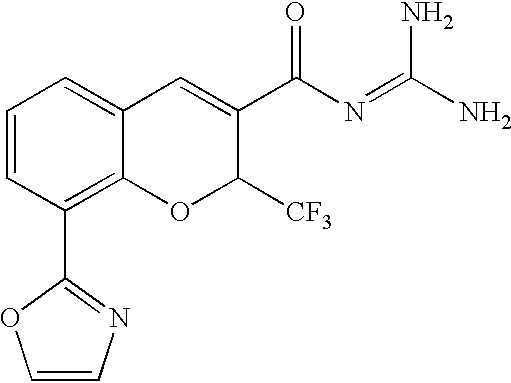 |
| 25 |
 |
| 26 |
 |
| 27 |
 |
| 28 |
 |
| 29 |
 |
| 30 |
 |

A solution containing o-cresol (1.3 g, 12 mmol) and NaH (333 mg, 13.9 mmol) in 5 mL of DMF was stirred for 10 min at rt and then methyl 4-bromobutyrate (1.5 g, 8.3 mmol) was added. The reaction was stirred for another 18 h, diluted with ethyl ether, and washed with 1N HCl. The organic layer was dried over MgSO4, filtered, and concentrated. The crude residue was taken up in 20 mL of MeOH and treated with 50 mL of 1N NaOH. After stirring at rt for 1 h, the solution was diluted with water, acidified with 1N HCl, and extracted with EtOAc. The organic extracts were dried over MgSO4, filtered, and concentrated under reduced pressure. This crude material was treated with 20 g of PPA and heated to 85 C for 2.5 h. After cooling to rt, the mixture was diluted with water and extracted with EtOAc. The combined organic layers were washed with 1N HCl, dried (MgSO4), filtered, and concentrated under reduced pressure to yield 900 mg of the crude product. 
The crude material from part A was added to a solution of NaH (240 mg, 2 eq) in dimethyl carbonate (20 mL) and heated at 90 C for 5 h. The reaction was diluted with EtOAc and washed with 1N HCl. The organic layer was concentrated and treated with 50 mL of 1N NaOH in 50 mL of MeOH. After 1 h at rt, the solution was diluted with water, acidified with 1N HCl, and extracted with EtOAc. The combined organic layers were dried over MgSO4, filtered, and concentrated under reduced pressure. The crude material was taken up in 20 mL of dioxane, treated with 10 mL of conc. HCl, and refluxed for 18 h. The solution was cooled, diluted with water, and extracted with EtOAc. The organic layers were dried over MgSO4, filtered, and concentrated under reduced pressure to yield 370 mg of the desired acid. 
Conversion of the acid to the acyl guanidine was carried out in a similar manner to that described for example 15 in Part C to yield the title compound. (M+H) +246.
Examples 32-34 were prepared following the method described in Example 31.
| Exam- | Character- | |
| ple | Structure | ization (MS) |
| 32 |
 |
(M+H) +232 |
| 33 |
 |
(M+H) +246 |
| 34 |
 |
(M+H) +246 |
Examples 35-41 were prepared following the method described in Example 15.
| Charactertization | ||
| Example | Structure | (MS) |
| 35 |
 |
(M+H) +355 |
| 36 |
 |
(M+H) +334 |
| 37 |
 |
(M+H) +334 |
| 38 |
 |
(M+H) +334 |
| 39 |
 |
(M+H) +364 |
| 40 |
 |
(M+H) +346 |
| 41 |
 |
(M+H) +378 |
Claims (26)
1. A compound having the structure 
wherein
R1 and R2 are the same or different and are independently selected from H, alkyl, alkenyl, alkynyl, alkoxy, alkenyloxy, alkynyloxy, (alkyl or aryl)3Si (where each alkyl or aryl group is independent), cycloalkyl, cycloalkenyl, aryl, arylalkyl, aryloxy, cycloheteroalkyl, cycloheteroalkylalkyl, heteroaryl, heteroaryloxy, arylthio, arylsulfinyl, arylsulfonyl, thio, alkylthio, alkylsulfinyl, alkylsulfonyl, heteroarylthio, heteroarylsulfinyl, heteroarylsulfonyl, halogen, haloalkyl, polyhaloalkyl, polyhaloalkoxy, alkylaminocarbonyl, arylaminocarbonyl, heteroarylaminocarbonyl, acyl, carboxy, aminocarbonyl, alkylcarbonyl, alkoxycarbonyl, arylcarbonyl, heteroarylcarbonyl, cyano, tetrazolyl, imidazole, oxazole or triazole, —PO(R8) (R9), S(O)2R8, R9 (where R8 and R9 are the same or different and are independently hydrogen, alkyl, aryl, alkoxy, aryloxy, cycloalkyl, heteroaryl, heteroarylalkyl, heteroaryloxy, heteroarylalkoxy, cycloheteroalkyl, cycloheteroalkylalkyl, cycloheteroalkoxy, or cycloheteroalkylalkoxy);
with the proviso that when
R3 is H; and
R4 is H; and
R5 and R6 are independently H, halogen, alkyl, alkoxy, nitro, amino, aryl, cycloheteroalkyl or heteroaryl;
at least one of R1 and R2 is other than H;
and where R1 and R2 may optionally be joined together to form a non-aromatic substituted or unsubstituted carbocyclic ring, a cycloalkyl or cycloalkenyl ring, or a cycloheteroalkyl ring, which ring contains 3 to 8 members;
X is O, S, SO, S2, CO, or NR7 (wherein R is H, lower alkyl, alkanoyl, or —SO2alkyl);
Y is a bond;
R3, R4, R5 and R6 are the same or different and are selected from H, alkyl, alkenyl, alkynyl, alkoxy, alkenyloxy, alkynyloxy, (alkyl or aryl)3Si (where each alkyl or aryl group is independent), cycloalkyl, cycloalkenyl, aryl, arylalkyl, aryloxy, cycloheteroalkyl, cycloheteroalkylalkyl, heteroaryl, heteroaryloxy, arylthio, arylsulfinyl, arylsulfonyl, thio, alkylthio, alkylsulfinyl, alkylsulfonyl, heteroarylthio, heteroarylsulfinyl, heteroarylsulfonyl, halogen, haloalkyl, polyhaloalkyl, polyhaloalkoxy, heteroarylaminocarbonyl, acyl, carboxy, aminocarbonyl, alkylcarbonyl, alkoxycarbonyl, arylcarbonyl, heteroarylcarbonyl, cyano, tetrazolyl, imidazole, oxazole or triazole, —PO(R12) (R13), S(O)2R12, R13 (where R12 and R13 are the same or different and are independently hydrogen, alkyl, aryl, alkoxy, aryloxy, cycloalkyl, heteroaryl, heteroarylalkyl, heteroaryloxy, heteroarylalkoxy, cycloheteroalkyl, cycloheteroalkylalkyl, cycloheteroalkoxy, or cycloheteroalkylalkoxy), amino, alkylamino, alkenylamino, alkynylamino, arylalkylamino, arylamino, heteroarylamino, thio, alkylsulfonylamino, alkenylsulfonylamino, alkynylsulfonylamino, arylsulfonylamino, heteroarylsulfonylamino, alkylaminocarbonyl, arylaminocarbonyl, heteroarylaminocarbonyl, hydroxy, alkylcarbonyloxy, alkylcarbonylamino, arylcarbonyloxy, arylcarbonylamino, heteroarylcarbonyloxy, heteroarylcarbonylamino, nitro, alkenylcarbonylamino, alkynylcarbonylamino, alkylaminocarbonylamino, alkenylaminocarbonylamino, alkynylaminocarbonylamino, arylaminocarbonylamino, heteroarylaminocarbonylamino, alkoxycarbonylamino, alkenyloxycarbonylamino, alkynyloxycarbonylamino, aryloxycarbonylamino, heteroaryloxycarbonylamino, aminocarbonylamino, alkylaminocarbonyloxy, 1,1-(alkoxyl or aryloxy)2alkyl (where the two aryl or alkyl substituents can be independently defined, or linked to one another to form a ring, such as 1,3-dioxane or 1,3-dioxolane), —NR10(C═NR11)alkyl, —NR10(C═NR11)alkenyl, —NR10(C═NR11)alkynyl, —NR10 (C═NR11)heteroaryl, or —NR10(C═NCN)-amino;
where R10 and R11 are the same or different and are independently selected from hydrogen, alkyl, haloaryl, aryl, alkoxy, aryloxy, cycloalkyl, heteroaryl, arylalkyl, or cycloheteroalkyl,
and optionally any two adjacent R4, R5 and R6 groups can be joined together to form a non-aromatic substituted or unsubstituted carbocyclic ring, or a cycloheteroalkyl ring or a heteroaryl ring;
including pharmaceutically acceptable salts thereof, prodrug esters thereof, and all stereoisomers thereof.
2. The compound as defined in claim 1 wherein X is O or S.
3. The compound is defined in claim 1 wherein R1 and R2 are the same or different and are independently selected from hydrogen, lower alkyl, perhaloalkyl, halogen, lower alkoxy or aryl, at least one of R1 and R2 being other than hydrogen.
4. The compound as defined in claim 1 wherein R3 is H.
5. The compound as defined in claim 1 wherein R4, R5 and R6 are the same or different and are independently selected from H, lower alkyl, lower alkoxy, aryl, perhaloalkyl or halogen.
6. The compound as defined in claim 1 wherein n is 1, X is O, R1 and R2 are the same or different and are independently selected from hydrogen, lower alkyl or perhaloalkyl, at least one of R1 and R2 being other than hydrogen; R3 is H, and R4, R5 and R6 are the same or different and are independently selected from H, lower alkyl, lower alkoxy or halogen.
7. The compound as defined in claim 1 which has the structure 
and X is O, S, SO, SO2 or NR7.
8. The compound as defined in claim 7 wherein X is O, either R1 or R2 are independently hydrogen, aryl, perhaloalkyl, or lower alkyl, at least one of R1 and R2 being other than hydrogen, and R3 is hydrogen.
9. The compound as defined in claim 1 which is 


10. The compound as defined in claim 1 which is 
11. The compound as defined in claim 1 which is 

12. The compound as defined in claim 1 which is 
13. A pharmaceutical composition comprising a compound as defined in claim 1 and a pharmaceutically acceptable carrier therefor.
14. A method for preventing or treating disorders caused by intracellular acidosis during myocardial ischemia, hypertension, angina pectoris, cardiac arrhythmia, reperfusion injury, myocardial necrosis, cardiac dysfunction, LDL-cholesterol, renal disease or heart failure, which comprises administering to a mammalian species in need of treatment a therapeutically effective amount of a compound as defined in claim 1 .
15. A method for preventing or treating myocardial ischemia, which comprises administering to a mammalian species in need of treatment a therapeutically effective amount of a compound as defined in claim 1 .
16. A method for preventing or treating an ischemic condition, which comprises administering to a mammalian species in need of treatment a therapeutically effective amount of an antiischemic agent which is a compound as defined in claim 1 .
17. A method for preventing or treating a peripheral vascular disorder, which comprises administering to a mammalian species in need of treatment a therapeutically effective amount of an antiischemic agent which is a compound as defined in claim 1 .
18. A method for preventing or treating lower limb ischemia, which comprises administering to a mammalian species in need of treatment a therapeutically effective amount of an antiischemic agent which is a compound as defined in claim 1 .
19. The method as defined in claim 16 wherein the peripheral vascular disorder is an ischemic condition.
20. The method as defined in claim 15 wherein the ischemic condition is lower limb ischemia.
21. The method as defined in claim 15 wherein the ischemic condition is peripheral atherosclerotic disease.
22. The method as defined in claim 18 wherein the peripheral atherosclerotic disease involves intermittent claudication.
23. The method as defined in claim 16 wherein the peripheral vascular disorder is Raynaud's disease or LeRiches Syndrome.
24. A method for the relief of symptoms of pain, parethesia or discomfort in the lower limb and gluteal regions produced by arterial insufficiency where symptoms are initiated or worsened with ambulation, which comprises administering to a mammalian species in need of treatment a therapeutically effective amount of a compound as defined in claim 1 .
25. A method for preventing or treating intermittent claudication, which comprises administering to a patient in need of treatment a therapeutically effective amount of a compound as defined in claim 1 .
26. A compound selected from 
Priority Applications (1)
| Application Number | Priority Date | Filing Date | Title |
|---|---|---|---|
| US09/556,739 US6630506B1 (en) | 1999-04-23 | 2000-04-21 | Bicyclic acyl guanidine sodium/proton exchange inhibitors and method |
Applications Claiming Priority (3)
| Application Number | Priority Date | Filing Date | Title |
|---|---|---|---|
| US13066799P | 1999-04-23 | 1999-04-23 | |
| US13732699P | 1999-06-03 | 1999-06-03 | |
| US09/556,739 US6630506B1 (en) | 1999-04-23 | 2000-04-21 | Bicyclic acyl guanidine sodium/proton exchange inhibitors and method |
Publications (1)
| Publication Number | Publication Date |
|---|---|
| US6630506B1 true US6630506B1 (en) | 2003-10-07 |
Family
ID=26828696
Family Applications (1)
| Application Number | Title | Priority Date | Filing Date |
|---|---|---|---|
| US09/556,739 Expired - Lifetime US6630506B1 (en) | 1999-04-23 | 2000-04-21 | Bicyclic acyl guanidine sodium/proton exchange inhibitors and method |
Country Status (6)
| Country | Link |
|---|---|
| US (1) | US6630506B1 (en) |
| EP (1) | EP1180029A4 (en) |
| JP (1) | JP2002542291A (en) |
| AU (1) | AU4360200A (en) |
| CA (1) | CA2370607A1 (en) |
| WO (1) | WO2000064445A1 (en) |
Cited By (1)
| Publication number | Priority date | Publication date | Assignee | Title |
|---|---|---|---|---|
| WO2005063727A1 (en) * | 2003-12-27 | 2005-07-14 | Korea Research Institute Of Chemical Technology | Furancarbonylguanidine derivatives, their preparation and pharmaceutical compositions containing them |
Families Citing this family (4)
| Publication number | Priority date | Publication date | Assignee | Title |
|---|---|---|---|---|
| FI20011507A0 (en) * | 2001-07-10 | 2001-07-10 | Orion Corp | New compounds |
| DE10204989A1 (en) * | 2002-02-07 | 2003-08-21 | Aventis Pharma Gmbh | Dihydro-thia-phenanthren-carbonyl-guanidines, process for their preparation, their use as a medicament or diagnostic agent, and medicament containing them |
| FI20030030A0 (en) | 2003-01-09 | 2003-01-09 | Orion Corp | New compounds |
| TW200614995A (en) | 2004-11-10 | 2006-05-16 | Nicholas Piramal India Ltd | Tricyclic guanidine derivatives as sodium-proton exchange inhibitors |
Citations (23)
| Publication number | Priority date | Publication date | Assignee | Title |
|---|---|---|---|---|
| US3728332A (en) | 1971-09-03 | 1973-04-17 | Nat Starch Chem Corp | Preparation of starch esters |
| US5336689A (en) | 1990-03-02 | 1994-08-09 | State Of Oregon, Acting By And Through The Oregon State Board Of Higher Education, Acting For And On Behalf Of The Oregon Health Sciences University And The University Of Oregon | Tri- and tetra-substituted guanidines and their use as excitatory amino acid antagonists |
| EP0622356A1 (en) | 1993-04-28 | 1994-11-02 | Sumitomo Pharmaceuticals Company, Limited | Indoloylguanidine derivatives as inhibitors of sodium-hydrogen exchange |
| JPH0710839A (en) | 1993-04-28 | 1995-01-13 | Sumitomo Pharmaceut Co Ltd | Indoylguanidine derivative |
| EP0639573A1 (en) | 1993-08-03 | 1995-02-22 | Hoechst Aktiengesellschaft | Benzocondensed five membered heterocycles, process of their preparation, their use as drug, as diagnostic means and pharmaceuticals containing it |
| WO1996004241A2 (en) | 1994-08-05 | 1996-02-15 | Fujisawa Pharmaceutical Co., Ltd. | Benzoylguanidine derivatives as medicaments |
| JPH0853336A (en) | 1994-08-11 | 1996-02-27 | Shiseido Co Ltd | Dermal agent for external use |
| US5561146A (en) | 1994-06-10 | 1996-10-01 | Bristol-Myers Squibb Company | Modified guanidino and amidino thrombin inhibitors |
| EP0738712A1 (en) | 1995-04-18 | 1996-10-23 | Hoechst Aktiengesellschaft | Anti-arrhythmic and cardioprotective substituted indenoylguanidines |
| EP0744397A2 (en) | 1995-05-22 | 1996-11-27 | Hoechst Aktiengesellschaft | Fluorophenyl substituted alkenyl carboxylic acid guanidines as Na+/H+ exchange inhibitors, process for their preparation, their use as medicinal or diagnostic agent as well as a medicament containing them |
| JPH0959245A (en) | 1995-08-25 | 1997-03-04 | Yamanouchi Pharmaceut Co Ltd | N-(2-propenoyl)guanidine derivative |
| JPH0967340A (en) | 1995-09-01 | 1997-03-11 | Yamanouchi Pharmaceut Co Ltd | N-(2-propenoyl)guanidine derivative |
| EP0790245A1 (en) | 1996-02-15 | 1997-08-20 | Hoechst Aktiengesellschaft | Substituted Thiophenylalkenylcarbonylguanidide, method for their preparation, their use as medicinal or diagnostic agent as well as medicament containing them |
| EP0803501A1 (en) | 1996-04-24 | 1997-10-29 | Sumitomo Pharmaceuticals Company, Limited | Substituted guanidine derivatives and their use as Na+/H+ exchange inhibitors |
| WO1997046226A2 (en) | 1996-06-03 | 1997-12-11 | Hoechst Aktiengesellschaft | USE OF INHIBITORS OF THE CELLULAR Na+/H+ EXCHANGER (NHE) FOR PREPARING A MEDICAMENT FOR NORMALIZING SERUM LIPIDS |
| JPH10237073A (en) | 1996-02-02 | 1998-09-08 | Sumitomo Pharmaceut Co Ltd | Novel substituted guanidine derivatives and their preparation |
| JPH10316647A (en) | 1997-03-04 | 1998-12-02 | Fujisawa Pharmaceut Co Ltd | Guanidine derivative and its use |
| WO1998055475A1 (en) | 1997-06-02 | 1998-12-10 | Fujisawa Pharmaceutical Co., Ltd. | Guanidine deriviatives as inhibitors of na+/h+ exchange in cells |
| US5852046A (en) | 1993-08-03 | 1998-12-22 | Hoechst Aktiengesellschaft | Benzo-fused heterocyclic compounds having a 5-membered ring processes for their preparation their use as medicaments their use as diagnostic agents and medicaments containing them |
| US5977100A (en) | 1996-02-02 | 1999-11-02 | Sumitomo Pharmaceuticals Company, Limited | Substituted guanidine derivatives, process for production thereof, and pharmaceutical uses thereof |
| WO1999055690A1 (en) | 1998-04-24 | 1999-11-04 | Fujisawa Pharmaceutical Co., Ltd. | Guanidine derivatives |
| WO1999061414A1 (en) * | 1998-05-26 | 1999-12-02 | Sumitomo Pharmaceuticals Company, Limited | Novel substituted guanidine derivatives and process for producing the same |
| US6011059A (en) | 1997-12-24 | 2000-01-04 | Bristol-Myers Squibb Company | Acyl guanidine sodium/proton exchange inhibitors and method |
-
2000
- 2000-04-18 JP JP2000613436A patent/JP2002542291A/en active Pending
- 2000-04-18 WO PCT/US2000/010434 patent/WO2000064445A1/en not_active Ceased
- 2000-04-18 CA CA002370607A patent/CA2370607A1/en not_active Abandoned
- 2000-04-18 AU AU43602/00A patent/AU4360200A/en not_active Abandoned
- 2000-04-18 EP EP00923486A patent/EP1180029A4/en not_active Withdrawn
- 2000-04-21 US US09/556,739 patent/US6630506B1/en not_active Expired - Lifetime
Patent Citations (28)
| Publication number | Priority date | Publication date | Assignee | Title |
|---|---|---|---|---|
| US3728332A (en) | 1971-09-03 | 1973-04-17 | Nat Starch Chem Corp | Preparation of starch esters |
| US5336689A (en) | 1990-03-02 | 1994-08-09 | State Of Oregon, Acting By And Through The Oregon State Board Of Higher Education, Acting For And On Behalf Of The Oregon Health Sciences University And The University Of Oregon | Tri- and tetra-substituted guanidines and their use as excitatory amino acid antagonists |
| EP0622356A1 (en) | 1993-04-28 | 1994-11-02 | Sumitomo Pharmaceuticals Company, Limited | Indoloylguanidine derivatives as inhibitors of sodium-hydrogen exchange |
| JPH0710839A (en) | 1993-04-28 | 1995-01-13 | Sumitomo Pharmaceut Co Ltd | Indoylguanidine derivative |
| EP0639573A1 (en) | 1993-08-03 | 1995-02-22 | Hoechst Aktiengesellschaft | Benzocondensed five membered heterocycles, process of their preparation, their use as drug, as diagnostic means and pharmaceuticals containing it |
| US5852046A (en) | 1993-08-03 | 1998-12-22 | Hoechst Aktiengesellschaft | Benzo-fused heterocyclic compounds having a 5-membered ring processes for their preparation their use as medicaments their use as diagnostic agents and medicaments containing them |
| US5561146A (en) | 1994-06-10 | 1996-10-01 | Bristol-Myers Squibb Company | Modified guanidino and amidino thrombin inhibitors |
| WO1996004241A2 (en) | 1994-08-05 | 1996-02-15 | Fujisawa Pharmaceutical Co., Ltd. | Benzoylguanidine derivatives as medicaments |
| JPH0853336A (en) | 1994-08-11 | 1996-02-27 | Shiseido Co Ltd | Dermal agent for external use |
| US5733934A (en) | 1995-04-18 | 1998-03-31 | Hoechst Aktiengesellschaft | Antiarrythmic and cardioprotective substituted indenoylguanidines |
| EP0738712A1 (en) | 1995-04-18 | 1996-10-23 | Hoechst Aktiengesellschaft | Anti-arrhythmic and cardioprotective substituted indenoylguanidines |
| EP0744397A2 (en) | 1995-05-22 | 1996-11-27 | Hoechst Aktiengesellschaft | Fluorophenyl substituted alkenyl carboxylic acid guanidines as Na+/H+ exchange inhibitors, process for their preparation, their use as medicinal or diagnostic agent as well as a medicament containing them |
| JPH0959245A (en) | 1995-08-25 | 1997-03-04 | Yamanouchi Pharmaceut Co Ltd | N-(2-propenoyl)guanidine derivative |
| JPH0967340A (en) | 1995-09-01 | 1997-03-11 | Yamanouchi Pharmaceut Co Ltd | N-(2-propenoyl)guanidine derivative |
| US5977100A (en) | 1996-02-02 | 1999-11-02 | Sumitomo Pharmaceuticals Company, Limited | Substituted guanidine derivatives, process for production thereof, and pharmaceutical uses thereof |
| JPH10237073A (en) | 1996-02-02 | 1998-09-08 | Sumitomo Pharmaceut Co Ltd | Novel substituted guanidine derivatives and their preparation |
| EP0790245A1 (en) | 1996-02-15 | 1997-08-20 | Hoechst Aktiengesellschaft | Substituted Thiophenylalkenylcarbonylguanidide, method for their preparation, their use as medicinal or diagnostic agent as well as medicament containing them |
| US5756535A (en) | 1996-02-15 | 1998-05-26 | Hoechst Aktiengesellschaft | Substituted thiophenylalkenylcarboxylic acid guanidines, processes for their preparation, their use as a medicament or diagnositc, and a medicament containing them |
| EP0803501A1 (en) | 1996-04-24 | 1997-10-29 | Sumitomo Pharmaceuticals Company, Limited | Substituted guanidine derivatives and their use as Na+/H+ exchange inhibitors |
| US5814654A (en) | 1996-04-24 | 1998-09-29 | Sumitomo Pharmaceuticals Company, Limited | Substituted guanidine derivatives |
| WO1997046226A2 (en) | 1996-06-03 | 1997-12-11 | Hoechst Aktiengesellschaft | USE OF INHIBITORS OF THE CELLULAR Na+/H+ EXCHANGER (NHE) FOR PREPARING A MEDICAMENT FOR NORMALIZING SERUM LIPIDS |
| JPH10316647A (en) | 1997-03-04 | 1998-12-02 | Fujisawa Pharmaceut Co Ltd | Guanidine derivative and its use |
| WO1998055475A1 (en) | 1997-06-02 | 1998-12-10 | Fujisawa Pharmaceutical Co., Ltd. | Guanidine deriviatives as inhibitors of na+/h+ exchange in cells |
| US6011059A (en) | 1997-12-24 | 2000-01-04 | Bristol-Myers Squibb Company | Acyl guanidine sodium/proton exchange inhibitors and method |
| WO1999055690A1 (en) | 1998-04-24 | 1999-11-04 | Fujisawa Pharmaceutical Co., Ltd. | Guanidine derivatives |
| US6346527B1 (en) * | 1998-04-24 | 2002-02-12 | Fujisawa Pharmaceutical Co., Ltd. | Guanidine derivatives |
| WO1999061414A1 (en) * | 1998-05-26 | 1999-12-02 | Sumitomo Pharmaceuticals Company, Limited | Novel substituted guanidine derivatives and process for producing the same |
| US6369110B1 (en) * | 1998-05-26 | 2002-04-09 | Sumitomo Pharmaceuticals Company | Substituted guanidine derivatives and process for producing the same |
Non-Patent Citations (6)
| Title |
|---|
| Derwent Abstract of JP 10316647, Fujisawa Pharm. Co. Ltd. (1998). |
| Derwent Abstract of JP 8053336, Shiseido Co. Ltd (1996). |
| Dialog Abstract of JP 10237073; Sumitomo Pharm. (1997). |
| Dialog Abstract of JP 7010839, Sumitomo Phar. (1994). |
| Dialog Abstract of JP 9059245; Yamanouchi Pharm. (1995). |
| Dialog Abstract of JP 9067340; Yamanouchi Pharm. (1995). |
Cited By (2)
| Publication number | Priority date | Publication date | Assignee | Title |
|---|---|---|---|---|
| WO2005063727A1 (en) * | 2003-12-27 | 2005-07-14 | Korea Research Institute Of Chemical Technology | Furancarbonylguanidine derivatives, their preparation and pharmaceutical compositions containing them |
| CN100519544C (en) * | 2003-12-27 | 2009-07-29 | 韩国化学研究所 | Furancarbonylguanidine derivatives, their preparation and pharmaceutical compositions containing them |
Also Published As
| Publication number | Publication date |
|---|---|
| JP2002542291A (en) | 2002-12-10 |
| CA2370607A1 (en) | 2000-11-02 |
| EP1180029A4 (en) | 2002-10-02 |
| WO2000064445A1 (en) | 2000-11-02 |
| AU4360200A (en) | 2000-11-10 |
| EP1180029A1 (en) | 2002-02-20 |
Similar Documents
| Publication | Publication Date | Title |
|---|---|---|
| US6784189B2 (en) | Potassium channel inhibitors and method | |
| JP2923742B2 (en) | 4-Aminoquinazoline derivative, method for producing the same, and pharmaceutical containing the same | |
| EP1041980B1 (en) | Acyl guanidine sodium/proton exchange inhibitors and method | |
| US4855301A (en) | 1,2,3,4-Tetrahydro-6-substituted-4-aryl(or heterocyclo)-3-((substituted amino)carbonyl)-2-thioxo (or oxo)-5-pyrimidinecarboxylic acids and esters | |
| HUT61984A (en) | Process for producing condensed imidazole derivatives and pharmaceutical compositions comprising same | |
| EP0481342A1 (en) | Quinazoline derivatives and their preparation | |
| EP0204317A2 (en) | 2-Thio or oxo-4-aryl or heterocyclo-1,5(2H)-pyrimidinedicarboxylic acid diesters and 3-acyl-5-pyrimidinecarboxylic acids and esters | |
| CZ235894A3 (en) | 4-arylaminobenzopyran derivatives and related compounds | |
| EP0234830A1 (en) | 2-(Substituted imino)-6-aryl-3,6-dihydro-4-substituted-1,5(2H)-pyrimidinecarboxylic acids and analogs | |
| US6544981B2 (en) | Lactam inhibitors of factor Xa and method | |
| US4847379A (en) | 3,6-dihydro-1,5(2H)-pyrimidinecarboxylic acid esters | |
| EP0237347B1 (en) | 1,2,3,4-Tetrahydro-6-substituted-4-aryl (or heterocyclo)-3-[(substituted amino)carbonyl]-2-thioxo (or oxo)-5-pyrimidinecarboxylic acids and esters | |
| US6630506B1 (en) | Bicyclic acyl guanidine sodium/proton exchange inhibitors and method | |
| EP0211429A1 (en) | 1,5-Benzodiazepine compounds | |
| AU756174B2 (en) | Lactam inhibitors of FXa and method | |
| US6160134A (en) | Process for preparing chiral cyclopropane carboxylic acids and acyl guanidines | |
| EP0329691B1 (en) | Cardiotonic imidazolylphenylpyrrol-2-ones | |
| EP0261633A2 (en) | 6-(Imidazolylphenyl)-4-imino-pyrimidinones hypotensive agents |
Legal Events
| Date | Code | Title | Description |
|---|---|---|---|
| AS | Assignment |
Owner name: BRISTOL-MYERS SQUIBB COMPANY, NEW JERSEY Free format text: ASSIGNMENT OF ASSIGNORS INTEREST;ASSIGNORS:DUGAR, SUNDEEP;O'NEIL, STEVEN V.;REEL/FRAME:010761/0730;SIGNING DATES FROM 20000322 TO 20000405 |
|
| STCF | Information on status: patent grant |
Free format text: PATENTED CASE |
|
| FEPP | Fee payment procedure |
Free format text: PAYOR NUMBER ASSIGNED (ORIGINAL EVENT CODE: ASPN); ENTITY STATUS OF PATENT OWNER: LARGE ENTITY |
|
| FPAY | Fee payment |
Year of fee payment: 4 |
|
| FPAY | Fee payment |
Year of fee payment: 8 |
|
| FPAY | Fee payment |
Year of fee payment: 12 |