US6610707B1 - Heterocyclic compounds as inhibitors of rotomase enzymes - Google Patents
Heterocyclic compounds as inhibitors of rotomase enzymes Download PDFInfo
- Publication number
- US6610707B1 US6610707B1 US09/380,427 US38042799A US6610707B1 US 6610707 B1 US6610707 B1 US 6610707B1 US 38042799 A US38042799 A US 38042799A US 6610707 B1 US6610707 B1 US 6610707B1
- Authority
- US
- United States
- Prior art keywords
- oxadiazol
- alkylene
- piperidyl
- benzyl
- benzo
- Prior art date
- Legal status (The legal status is an assumption and is not a legal conclusion. Google has not performed a legal analysis and makes no representation as to the accuracy of the status listed.)
- Expired - Fee Related
Links
- 0 [1*]C1*N1[Y][W][2*] Chemical compound [1*]C1*N1[Y][W][2*] 0.000 description 29
- PPBRXRYQALVLMV-UHFFFAOYSA-N [CH2-][CH+]C1=CC=CC=C1 Chemical compound [CH2-][CH+]C1=CC=CC=C1 PPBRXRYQALVLMV-UHFFFAOYSA-N 0.000 description 3
- XZCPIKZHYXKFQO-QMMMGPOBSA-N CC(C)(C)OC(N(CCCC1)[C@@H]1/C(/N)=N/O)=O Chemical compound CC(C)(C)OC(N(CCCC1)[C@@H]1/C(/N)=N/O)=O XZCPIKZHYXKFQO-QMMMGPOBSA-N 0.000 description 2
- OEWGZEWXAWCRCL-NSHDSACASA-N OC([C@H](CCCC1)N1S(c(cc1)ccc1F)(=O)=O)=O Chemical compound OC([C@H](CCCC1)N1S(c(cc1)ccc1F)(=O)=O)=O OEWGZEWXAWCRCL-NSHDSACASA-N 0.000 description 2
- JMYIVCWBHMSDCQ-UHFFFAOYSA-M BrCC1CCCC1.O=S(=O)([O-])CC1CCCC1.[Na+] Chemical compound BrCC1CCCC1.O=S(=O)([O-])CC1CCCC1.[Na+] JMYIVCWBHMSDCQ-UHFFFAOYSA-M 0.000 description 1
- YSBIYHINDUFRCX-UHFFFAOYSA-N BrCC1CCCC1.OCC1CCCC1 Chemical compound BrCC1CCCC1.OCC1CCCC1 YSBIYHINDUFRCX-UHFFFAOYSA-N 0.000 description 1
- WSFZRESZCQOHCZ-UHFFFAOYSA-M BrCC1CCCCCC1.O=S(=O)([O-])CC1CCCCCC1.[Na+] Chemical compound BrCC1CCCCCC1.O=S(=O)([O-])CC1CCCCCC1.[Na+] WSFZRESZCQOHCZ-UHFFFAOYSA-M 0.000 description 1
- QWAJCIZOLWYWTD-UHFFFAOYSA-N BrCC1CCCCCC1.OCC1CCCCCC1 Chemical compound BrCC1CCCCCC1.OCC1CCCCCC1 QWAJCIZOLWYWTD-UHFFFAOYSA-N 0.000 description 1
- NSCXRQCKUXOXSS-UHFFFAOYSA-M BrCC1CCOC1.O=[SH]([O-])(O)CC1CCOC1.[Na+] Chemical compound BrCC1CCOC1.O=[SH]([O-])(O)CC1CCOC1.[Na+] NSCXRQCKUXOXSS-UHFFFAOYSA-M 0.000 description 1
- FGBKAFIUHDAWQJ-UHFFFAOYSA-N BrCC1CCOC1.OCC1CCOC1 Chemical compound BrCC1CCOC1.OCC1CCOC1 FGBKAFIUHDAWQJ-UHFFFAOYSA-N 0.000 description 1
- OUICIDUQAOXMST-NBIVLDMFSA-N C#C.C[C@@H]1CCCCN1S(=O)(=O)CC1CCCCC1.NC(=O)[C@@H]1CCCCN1S(=O)(=O)CC1CCCCC1 Chemical compound C#C.C[C@@H]1CCCCN1S(=O)(=O)CC1CCCCC1.NC(=O)[C@@H]1CCCCN1S(=O)(=O)CC1CCCCC1 OUICIDUQAOXMST-NBIVLDMFSA-N 0.000 description 1
- KLVDOHVLWORJQL-FMPLROAISA-N C#C.C[C@@H]1CCCN1S(=O)(=O)C1=CC=C(F)C=C1.NC(=O)[C@@H]1CCCN1S(=O)(=O)C1=CC=C(F)C=C1 Chemical compound C#C.C[C@@H]1CCCN1S(=O)(=O)C1=CC=C(F)C=C1.NC(=O)[C@@H]1CCCN1S(=O)(=O)C1=CC=C(F)C=C1 KLVDOHVLWORJQL-FMPLROAISA-N 0.000 description 1
- MYCHFPBZURMPDS-CQSZACIVSA-N C#C[C@H](CCCC1)N1S(CC1CCCCC1)(=O)=O Chemical compound C#C[C@H](CCCC1)N1S(CC1CCCCC1)(=O)=O MYCHFPBZURMPDS-CQSZACIVSA-N 0.000 description 1
- ARGUKKNKMLJYQX-VTHZGJPESA-N C#N.CC(C)(C)OC(=O)N1CCCC[C@H]1/C(N)=N/O.C[C@@H]1CCCCN1C(=O)OC(C)(C)C Chemical compound C#N.CC(C)(C)OC(=O)N1CCCC[C@H]1/C(N)=N/O.C[C@@H]1CCCCN1C(=O)OC(C)(C)C ARGUKKNKMLJYQX-VTHZGJPESA-N 0.000 description 1
- UOXPCEWRGSRABP-VTHZGJPESA-N C#N.CC(C)(C)OC(=O)N1CCCC[C@H]1C(N)=O.C[C@@H]1CCCCN1C(=O)OC(C)(C)C Chemical compound C#N.CC(C)(C)OC(=O)N1CCCC[C@H]1C(N)=O.C[C@@H]1CCCCN1C(=O)OC(C)(C)C UOXPCEWRGSRABP-VTHZGJPESA-N 0.000 description 1
- WEPAMDUZBHDJLF-NBIVLDMFSA-N C#N.C[C@@H]1CCCCN1S(=O)(=O)CC1CCCCC1.N/C(=N\O)[C@@H]1CCCCN1S(=O)(=O)CC1CCCCC1 Chemical compound C#N.C[C@@H]1CCCCN1S(=O)(=O)CC1CCCCC1.N/C(=N\O)[C@@H]1CCCCN1S(=O)(=O)CC1CCCCC1 WEPAMDUZBHDJLF-NBIVLDMFSA-N 0.000 description 1
- BNXDPBLSLARFOT-NQAFTKOZSA-N C/C(CC(=O)[C@@H]1CCCCN1S(=O)(=O)C1=CC=C(F)C=C1)=N\O.CC1=NOC([C@@H]2CCCCN2S(=O)(=O)C2=CC=C(F)C=C2)=C1 Chemical compound C/C(CC(=O)[C@@H]1CCCCN1S(=O)(=O)C1=CC=C(F)C=C1)=N\O.CC1=NOC([C@@H]2CCCCN2S(=O)(=O)C2=CC=C(F)C=C2)=C1 BNXDPBLSLARFOT-NQAFTKOZSA-N 0.000 description 1
- XPIBIMGMEWSMLV-ZOUNWOJOSA-N C/C(CC(=O)[C@@H]1CCCCN1S(=O)(=O)C1=CC=C(F)C=C1)=N\O.COC(=O)[C@@H]1CCCCN1S(=O)(=O)C1=CC=C(F)C=C1 Chemical compound C/C(CC(=O)[C@@H]1CCCCN1S(=O)(=O)C1=CC=C(F)C=C1)=N\O.COC(=O)[C@@H]1CCCCN1S(=O)(=O)C1=CC=C(F)C=C1 XPIBIMGMEWSMLV-ZOUNWOJOSA-N 0.000 description 1
- JMIMRZWLVBLUJF-CHNGVTQJSA-N C/C(N)=N/OC(=O)[C@@H]1CCCCN1S(=O)(=O)C1=CC=C(F)C=C1.CC1=NOC([C@@H]2CCCCN2S(=O)(=O)C2=CC=C(F)C=C2)=N1 Chemical compound C/C(N)=N/OC(=O)[C@@H]1CCCCN1S(=O)(=O)C1=CC=C(F)C=C1.CC1=NOC([C@@H]2CCCCN2S(=O)(=O)C2=CC=C(F)C=C2)=N1 JMIMRZWLVBLUJF-CHNGVTQJSA-N 0.000 description 1
- OBLSMWGLDLLPMJ-DMGMNCNXSA-N C/C(N)=N/OC(=O)[C@@H]1CCCCN1S(=O)(=O)C1=CC=C(F)C=C1.O=C(O)[C@@H]1CCCCN1S(=O)(=O)C1=CC=C(F)C=C1 Chemical compound C/C(N)=N/OC(=O)[C@@H]1CCCCN1S(=O)(=O)C1=CC=C(F)C=C1.O=C(O)[C@@H]1CCCCN1S(=O)(=O)C1=CC=C(F)C=C1 OBLSMWGLDLLPMJ-DMGMNCNXSA-N 0.000 description 1
- MMQBEQGHHRGFBR-UPABHRTGSA-N C1=CC=C(CC2=NC([C@@H]3CCCCN3)=NO2)C=C1.CC(C)(C)CNC(=O)N1CCCC[C@H]1C1=NOC(CC2=CC=CC=C2)=N1.Cl Chemical compound C1=CC=C(CC2=NC([C@@H]3CCCCN3)=NO2)C=C1.CC(C)(C)CNC(=O)N1CCCC[C@H]1C1=NOC(CC2=CC=CC=C2)=N1.Cl MMQBEQGHHRGFBR-UPABHRTGSA-N 0.000 description 1
- KLYWITJFFAILSJ-XEICFRNYSA-N C1=CC=C(CC2=NC([C@@H]3CCCCN3)=NO2)C=C1.Cl.O=C(NCC1=CC=CC=C1)N1CCCC[C@H]1C1=NOC(CC2=CC=CC=C2)=N1 Chemical compound C1=CC=C(CC2=NC([C@@H]3CCCCN3)=NO2)C=C1.Cl.O=C(NCC1=CC=CC=C1)N1CCCC[C@H]1C1=NOC(CC2=CC=CC=C2)=N1 KLYWITJFFAILSJ-XEICFRNYSA-N 0.000 description 1
- YVMQWJLMWCRIMY-JMQBOMQOSA-N C1=CC=C(CC2=NC([C@@H]3CCCCN3)=NO2)C=C1.Cl.O=C(NCCC1=CC=CC=C1)N1CCCC[C@H]1C1=NOC(CC2=CC=CC=C2)=N1 Chemical compound C1=CC=C(CC2=NC([C@@H]3CCCCN3)=NO2)C=C1.Cl.O=C(NCCC1=CC=CC=C1)N1CCCC[C@H]1C1=NOC(CC2=CC=CC=C2)=N1 YVMQWJLMWCRIMY-JMQBOMQOSA-N 0.000 description 1
- SQEGJIDUIIOSFJ-NFSZIDIXSA-N C1=CC=C(CC2=NC([C@@H]3CCCCN3)=NO2)C=C1.Cl.O=S(=O)(C1=NC2=C(C=C(Br)C=C2)N1)N1CCCC[C@H]1C1=NOC(CC2=CC=CC=C2)=N1 Chemical compound C1=CC=C(CC2=NC([C@@H]3CCCCN3)=NO2)C=C1.Cl.O=S(=O)(C1=NC2=C(C=C(Br)C=C2)N1)N1CCCC[C@H]1C1=NOC(CC2=CC=CC=C2)=N1 SQEGJIDUIIOSFJ-NFSZIDIXSA-N 0.000 description 1
- CRMKYMBXWKDVMI-NFSZIDIXSA-N C1=CC=C(CC2=NC([C@@H]3CCCCN3)=NO2)C=C1.Cl.O=S(=O)(C1=NC2=C(C=CC=C2)N1)N1CCCC[C@H]1C1=NOC(CC2=CC=CC=C2)=N1 Chemical compound C1=CC=C(CC2=NC([C@@H]3CCCCN3)=NO2)C=C1.Cl.O=S(=O)(C1=NC2=C(C=CC=C2)N1)N1CCCC[C@H]1C1=NOC(CC2=CC=CC=C2)=N1 CRMKYMBXWKDVMI-NFSZIDIXSA-N 0.000 description 1
- XZTCHPCBNSBYGJ-UHFFFAOYSA-N C=S(=O)(=O)C1=CN(C)C=N1 Chemical compound C=S(=O)(=O)C1=CN(C)C=N1 XZTCHPCBNSBYGJ-UHFFFAOYSA-N 0.000 description 1
- QKKYVEIIAMJPBW-UHFFFAOYSA-N C=S(=O)(=O)CC1CCCC1 Chemical compound C=S(=O)(=O)CC1CCCC1 QKKYVEIIAMJPBW-UHFFFAOYSA-N 0.000 description 1
- RZLPICREXVHPHL-UHFFFAOYSA-N C=S(=O)(=O)CC1CCCCC1 Chemical compound C=S(=O)(=O)CC1CCCCC1 RZLPICREXVHPHL-UHFFFAOYSA-N 0.000 description 1
- QAPGRRLDHBXRRE-UHFFFAOYSA-N C=S(=O)(=O)CC1CCCCCC1 Chemical compound C=S(=O)(=O)CC1CCCCCC1 QAPGRRLDHBXRRE-UHFFFAOYSA-N 0.000 description 1
- ZGCKCWQDLFBCQG-UHFFFAOYSA-N C=S(=O)(=O)CC1CCCN(C(=O)OCC2=CC=CC=C2)C1 Chemical compound C=S(=O)(=O)CC1CCCN(C(=O)OCC2=CC=CC=C2)C1 ZGCKCWQDLFBCQG-UHFFFAOYSA-N 0.000 description 1
- WEBGOZVCVIZJQU-UHFFFAOYSA-N C=S(=O)(=O)CC1CCN(C(=O)OCC2=CC=CC=C2)C1 Chemical compound C=S(=O)(=O)CC1CCN(C(=O)OCC2=CC=CC=C2)C1 WEBGOZVCVIZJQU-UHFFFAOYSA-N 0.000 description 1
- AQNRZIMTECBFKE-UHFFFAOYSA-N C=S(=O)(=O)CC1CCOC1 Chemical compound C=S(=O)(=O)CC1CCOC1 AQNRZIMTECBFKE-UHFFFAOYSA-N 0.000 description 1
- TZMMECXFBUEORD-LMUFUKQCSA-N CC(=O)CNC(=O)[C@@H]1CCCCN1S(=O)(=O)C1=CC=C(F)C=C1.CC(O)CNC(=O)[C@@H]1CCCCN1S(=O)(=O)C1=CC=C(F)C=C1 Chemical compound CC(=O)CNC(=O)[C@@H]1CCCCN1S(=O)(=O)C1=CC=C(F)C=C1.CC(O)CNC(=O)[C@@H]1CCCCN1S(=O)(=O)C1=CC=C(F)C=C1 TZMMECXFBUEORD-LMUFUKQCSA-N 0.000 description 1
- RFZHUCFDYXQMBF-DXZWIFNPSA-N CC(=O)CNC(=O)[C@@H]1CCCCN1S(=O)(=O)C1=CC=C(F)C=C1.CC1=CN=C([C@@H]2CCCCN2S(=O)(=O)C2=CC=C(F)C=C2)S1 Chemical compound CC(=O)CNC(=O)[C@@H]1CCCCN1S(=O)(=O)C1=CC=C(F)C=C1.CC1=CN=C([C@@H]2CCCCN2S(=O)(=O)C2=CC=C(F)C=C2)S1 RFZHUCFDYXQMBF-DXZWIFNPSA-N 0.000 description 1
- RQQLWYJZAUPMNJ-CHNGVTQJSA-N CC(=O)NNC(=O)[C@@H]1CCCCN1S(=O)(=O)C1=CC=C(F)C=C1.CC1=NN=C([C@@H]2CCCCN2S(=O)(=O)C2=CC=C(F)C=C2)O1 Chemical compound CC(=O)NNC(=O)[C@@H]1CCCCN1S(=O)(=O)C1=CC=C(F)C=C1.CC1=NN=C([C@@H]2CCCCN2S(=O)(=O)C2=CC=C(F)C=C2)O1 RQQLWYJZAUPMNJ-CHNGVTQJSA-N 0.000 description 1
- YYOHODGTQJUYOV-CHNGVTQJSA-N CC(=O)NNC(=O)[C@@H]1CCCCN1S(=O)(=O)C1=CC=C(F)C=C1.CC1=NN=C([C@@H]2CCCCN2S(=O)(=O)C2=CC=C(F)C=C2)S1 Chemical compound CC(=O)NNC(=O)[C@@H]1CCCCN1S(=O)(=O)C1=CC=C(F)C=C1.CC1=NN=C([C@@H]2CCCCN2S(=O)(=O)C2=CC=C(F)C=C2)S1 YYOHODGTQJUYOV-CHNGVTQJSA-N 0.000 description 1
- FGWFAZBDDXAAHU-DMGMNCNXSA-N CC(=O)NNC(=O)[C@@H]1CCCCN1S(=O)(=O)C1=CC=C(F)C=C1.O=C(O)[C@@H]1CCCCN1S(=O)(=O)C1=CC=C(F)C=C1 Chemical compound CC(=O)NNC(=O)[C@@H]1CCCCN1S(=O)(=O)C1=CC=C(F)C=C1.O=C(O)[C@@H]1CCCCN1S(=O)(=O)C1=CC=C(F)C=C1 FGWFAZBDDXAAHU-DMGMNCNXSA-N 0.000 description 1
- XNVUKBPACYHYMA-UFRHTXTISA-N CC(=O)O/N=C(\N)[C@@H]1CCCCN1S(=O)(=O)CC1CCCCC1.N/C(=N\O)[C@@H]1CCCCN1S(=O)(=O)CC1CCCCC1 Chemical compound CC(=O)O/N=C(\N)[C@@H]1CCCCN1S(=O)(=O)CC1CCCCC1.N/C(=N\O)[C@@H]1CCCCN1S(=O)(=O)CC1CCCCC1 XNVUKBPACYHYMA-UFRHTXTISA-N 0.000 description 1
- ZLFBLSWVWCCPLN-UHFFFAOYSA-N CC(C)(C)OC(=O)COC1CCN(C(=O)OCC2=CC=CC=C2)CC1.O=C(O)COC1CCN(C(=O)OCC2=CC=CC=C2)CC1 Chemical compound CC(C)(C)OC(=O)COC1CCN(C(=O)OCC2=CC=CC=C2)CC1.O=C(O)COC1CCN(C(=O)OCC2=CC=CC=C2)CC1 ZLFBLSWVWCCPLN-UHFFFAOYSA-N 0.000 description 1
- CKCFSZCFPMTTPK-UHFFFAOYSA-N CC(C)(C)OC(=O)N1CCCCC1C1=NOC(COC2=CC=C(CN3C(=O)C4=C(C=CC=C4)C3=O)C=C2)=N1.Cl.[H]N1CCCCC1C1=NOC(COC2=CC=C(CN3C(=O)C4=C(C=CC=C4)C3=O)C=C2)=N1 Chemical compound CC(C)(C)OC(=O)N1CCCCC1C1=NOC(COC2=CC=C(CN3C(=O)C4=C(C=CC=C4)C3=O)C=C2)=N1.Cl.[H]N1CCCCC1C1=NOC(COC2=CC=C(CN3C(=O)C4=C(C=CC=C4)C3=O)C=C2)=N1 CKCFSZCFPMTTPK-UHFFFAOYSA-N 0.000 description 1
- PLSAPXDRBOMCMT-TZTJCCGVSA-N CC(C)(C)OC(=O)N1CCCC[C@H]1/C(N)=N/O.CC(C)(C)OC(=O)N1CCCC[C@H]1/C(N)=N/OC(=O)CC1=CC=CC=C1 Chemical compound CC(C)(C)OC(=O)N1CCCC[C@H]1/C(N)=N/O.CC(C)(C)OC(=O)N1CCCC[C@H]1/C(N)=N/OC(=O)CC1=CC=CC=C1 PLSAPXDRBOMCMT-TZTJCCGVSA-N 0.000 description 1
- DTTRYWAHPCLAIW-QGHYAWGZSA-N CC(C)(C)OC(=O)N1CCCC[C@H]1/C(N)=N/O.CC(C)(C)OC(=O)N1CCCC[C@H]1/C(N)=N/OC(=O)COC1=CC=C(CO)C=C1 Chemical compound CC(C)(C)OC(=O)N1CCCC[C@H]1/C(N)=N/O.CC(C)(C)OC(=O)N1CCCC[C@H]1/C(N)=N/OC(=O)COC1=CC=C(CO)C=C1 DTTRYWAHPCLAIW-QGHYAWGZSA-N 0.000 description 1
- DINSEWBJQCSRMA-BFMWWZTFSA-N CC(C)(C)OC(=O)N1CCCC[C@H]1/C(N)=N/O.CC(C)(C)OC(=O)N1CCCC[C@H]1/C(N)=N/OC(=O)COC1CCN(C(=O)OCC2=CC=CC=C2)CC1 Chemical compound CC(C)(C)OC(=O)N1CCCC[C@H]1/C(N)=N/O.CC(C)(C)OC(=O)N1CCCC[C@H]1/C(N)=N/OC(=O)COC1CCN(C(=O)OCC2=CC=CC=C2)CC1 DINSEWBJQCSRMA-BFMWWZTFSA-N 0.000 description 1
- PHEDGJLYSRTUPI-RIOQODNNSA-N CC(C)(C)OC(=O)N1CCCC[C@H]1/C(N)=N/O.CC(C)(C)OC(=O)N1CCCC[C@H]1/C(N)=N/OC(=O)[C@H](NC(=O)OCC1=CC=CC=C1)C1=CC=CC=C1 Chemical compound CC(C)(C)OC(=O)N1CCCC[C@H]1/C(N)=N/O.CC(C)(C)OC(=O)N1CCCC[C@H]1/C(N)=N/OC(=O)[C@H](NC(=O)OCC1=CC=CC=C1)C1=CC=CC=C1 PHEDGJLYSRTUPI-RIOQODNNSA-N 0.000 description 1
- KJLOTZPFKCKNKF-HJIBXMCBSA-N CC(C)(C)OC(=O)N1CCCC[C@H]1/C(N)=N/OC(=O)CC1=CC=CC=C1.CC(C)(C)OC(=O)N1CCCC[C@H]1C1=NOC(CC2=CC=CC=C2)=N1 Chemical compound CC(C)(C)OC(=O)N1CCCC[C@H]1/C(N)=N/OC(=O)CC1=CC=CC=C1.CC(C)(C)OC(=O)N1CCCC[C@H]1C1=NOC(CC2=CC=CC=C2)=N1 KJLOTZPFKCKNKF-HJIBXMCBSA-N 0.000 description 1
- WHOBRLAPEJWWCZ-QSZVZPBDSA-N CC(C)(C)OC(=O)N1CCCC[C@H]1/C(N)=N/OC(=O)COC1=CC=C(CO)C=C1.CC(C)(C)OC(=O)N1CCCC[C@H]1C1=NOC(COC2=CC=C(CO)C=C2)=N1 Chemical compound CC(C)(C)OC(=O)N1CCCC[C@H]1/C(N)=N/OC(=O)COC1=CC=C(CO)C=C1.CC(C)(C)OC(=O)N1CCCC[C@H]1C1=NOC(COC2=CC=C(CO)C=C2)=N1 WHOBRLAPEJWWCZ-QSZVZPBDSA-N 0.000 description 1
- SICRLYYSBBTXQQ-WBWGXLNPSA-N CC(C)(C)OC(=O)N1CCCC[C@H]1/C(N)=N/OC(=O)COC1CCN(C(=O)OCC2=CC=CC=C2)CC1.CC(C)(C)OC(=O)N1CCCC[C@H]1C1=NOC(COC2CCN(C(=O)OCC3=CC=CC=C3)CC2)=N1 Chemical compound CC(C)(C)OC(=O)N1CCCC[C@H]1/C(N)=N/OC(=O)COC1CCN(C(=O)OCC2=CC=CC=C2)CC1.CC(C)(C)OC(=O)N1CCCC[C@H]1C1=NOC(COC2CCN(C(=O)OCC3=CC=CC=C3)CC2)=N1 SICRLYYSBBTXQQ-WBWGXLNPSA-N 0.000 description 1
- MASMCVAZFSETOH-UUUTVWHWSA-N CC(C)(C)OC(=O)N1CCCC[C@H]1/C(N)=N/OC(=O)[C@H](NC(=O)OCC1=CC=CC=C1)C1=CC=CC=C1.CC(C)(C)OC(=O)N1CCCC[C@H]1C1=N=OC([C@H](NC(=O)OCC2=CC=CC=C2)C2=CC=CC=C2)=N1 Chemical compound CC(C)(C)OC(=O)N1CCCC[C@H]1/C(N)=N/OC(=O)[C@H](NC(=O)OCC1=CC=CC=C1)C1=CC=CC=C1.CC(C)(C)OC(=O)N1CCCC[C@H]1C1=N=OC([C@H](NC(=O)OCC2=CC=CC=C2)C2=CC=CC=C2)=N1 MASMCVAZFSETOH-UUUTVWHWSA-N 0.000 description 1
- UKCAYFPEHWKIAH-GRHHLOCNSA-N CC(C)(C)OC(=O)N1CCCC[C@H]1C(=O)O.CC(C)(C)OC(=O)N1CCCC[C@H]1C(N)=O Chemical compound CC(C)(C)OC(=O)N1CCCC[C@H]1C(=O)O.CC(C)(C)OC(=O)N1CCCC[C@H]1C(N)=O UKCAYFPEHWKIAH-GRHHLOCNSA-N 0.000 description 1
- ALKMCKKHNKFLGU-JUUVMNCLSA-N CC(C)(C)OC(=O)N1CCCC[C@H]1C(=O)O.O=C(O)[C@@H]1CCCCN1 Chemical compound CC(C)(C)OC(=O)N1CCCC[C@H]1C(=O)O.O=C(O)[C@@H]1CCCCN1 ALKMCKKHNKFLGU-JUUVMNCLSA-N 0.000 description 1
- UUMFBEYTTREJMZ-NHSCMDEKSA-N CC(C)(C)OC(=O)N1CCCC[C@H]1C1=N=OC([C@H](NC(=O)OCC2=CC=CC=C2)C2=CC=CC=C2)=N1.Cl.O=C(N[C@H](C1=CC=CC=C1)C1=NC([C@@H]2CCCCN2)=N=O1)OCC1=CC=CC=C1 Chemical compound CC(C)(C)OC(=O)N1CCCC[C@H]1C1=N=OC([C@H](NC(=O)OCC2=CC=CC=C2)C2=CC=CC=C2)=N1.Cl.O=C(N[C@H](C1=CC=CC=C1)C1=NC([C@@H]2CCCCN2)=N=O1)OCC1=CC=CC=C1 UUMFBEYTTREJMZ-NHSCMDEKSA-N 0.000 description 1
- DFNDYJHXBXRXFJ-AYKMAULUSA-N CC(C)(C)OC(=O)N1CCCC[C@H]1C1=NOC(CC2=CC=CC=C2)=N1.Cl.[H]N1CCCC[C@H]1C1=NOC(CC2=CC=CC=C2)=N1 Chemical compound CC(C)(C)OC(=O)N1CCCC[C@H]1C1=NOC(CC2=CC=CC=C2)=N1.Cl.[H]N1CCCC[C@H]1C1=NOC(CC2=CC=CC=C2)=N1 DFNDYJHXBXRXFJ-AYKMAULUSA-N 0.000 description 1
- TXYIYYOSUHTVMQ-SNYGGUCCSA-N CC(C)(C)OC(=O)N1CCCC[C@H]1C1=NOC(COC2=CC=C(CN3C(=O)C4=C(C=CC=C4)C3=O)C=C2)=N1.CC(C)(C)OC(=O)N1CCCC[C@H]1C1=NOC(COC2=CC=C(CO)C=C2)=N1 Chemical compound CC(C)(C)OC(=O)N1CCCC[C@H]1C1=NOC(COC2=CC=C(CN3C(=O)C4=C(C=CC=C4)C3=O)C=C2)=N1.CC(C)(C)OC(=O)N1CCCC[C@H]1C1=NOC(COC2=CC=C(CO)C=C2)=N1 TXYIYYOSUHTVMQ-SNYGGUCCSA-N 0.000 description 1
- CISVWGOHUROMEC-WPNSFFRFSA-N CC(C)(C)OC(=O)N1CCCC[C@H]1C1=NOC(COC2CCN(C(=O)OCC3=CC=CC=C3)CC2)=N1.O=C(OCC1=CC=CC=C1)N1CCC(OCC2=NC([C@@H]3CCCCN3)=NO2)CC1 Chemical compound CC(C)(C)OC(=O)N1CCCC[C@H]1C1=NOC(COC2CCN(C(=O)OCC3=CC=CC=C3)CC2)=N1.O=C(OCC1=CC=CC=C1)N1CCC(OCC2=NC([C@@H]3CCCCN3)=NO2)CC1 CISVWGOHUROMEC-WPNSFFRFSA-N 0.000 description 1
- SSFDWHGXHQIKJG-UHFFFAOYSA-N CC(C)(C)OC(=O)N1CCN(CCC(=O)O)CC1.CCOC(=O)CCN1CCN(C(=O)OC(C)(C)C)CC1 Chemical compound CC(C)(C)OC(=O)N1CCN(CCC(=O)O)CC1.CCOC(=O)CCN1CCN(C(=O)OC(C)(C)C)CC1 SSFDWHGXHQIKJG-UHFFFAOYSA-N 0.000 description 1
- UGCNDIDBBRAPNY-WBWGXLNPSA-N CC(C)(C)OC(=O)N1CCN(CCC(=O)O/N=C(\N)[C@@H]2CCCCN2S(=O)(=O)CC2CCCCC2)CC1.CC(C)(C)OC(=O)N1CCN(CCC2=NC([C@@H]3CCCCN3S(=O)(=O)CC3CCCCC3)=NO2)CC1 Chemical compound CC(C)(C)OC(=O)N1CCN(CCC(=O)O/N=C(\N)[C@@H]2CCCCN2S(=O)(=O)CC2CCCCC2)CC1.CC(C)(C)OC(=O)N1CCN(CCC2=NC([C@@H]3CCCCN3S(=O)(=O)CC3CCCCC3)=NO2)CC1 UGCNDIDBBRAPNY-WBWGXLNPSA-N 0.000 description 1
- HYTKNPNJHANSOB-KCILKQHXSA-N CC(C)(C)OC(=O)N1CCN(CCC(=O)O/N=C(\N)[C@@H]2CCCCN2S(=O)(=O)CC2CCCCC2)CC1.N/C(=N\O)[C@@H]1CCCCN1S(=O)(=O)CC1CCCCC1 Chemical compound CC(C)(C)OC(=O)N1CCN(CCC(=O)O/N=C(\N)[C@@H]2CCCCN2S(=O)(=O)CC2CCCCC2)CC1.N/C(=N\O)[C@@H]1CCCCN1S(=O)(=O)CC1CCCCC1 HYTKNPNJHANSOB-KCILKQHXSA-N 0.000 description 1
- KIACERFCHIYGOD-WPNSFFRFSA-N CC(C)(C)OC(=O)N1CCN(CCC2=NC([C@@H]3CCCCN3S(=O)(=O)CC3CCCCC3)=NO2)CC1.O=S(=O)(CC1CCCCC1)N1CCCC[C@H]1C1=NOC(CCN2CCNCC2)=N1 Chemical compound CC(C)(C)OC(=O)N1CCN(CCC2=NC([C@@H]3CCCCN3S(=O)(=O)CC3CCCCC3)=NO2)CC1.O=S(=O)(CC1CCCCC1)N1CCCC[C@H]1C1=NOC(CCN2CCNCC2)=N1 KIACERFCHIYGOD-WPNSFFRFSA-N 0.000 description 1
- IEFRQYHIQVGEIN-UHFFFAOYSA-N CC(C)(C)OC(=O)N1CCNCC1.CCOC(=O)CCN1CCN(C(=O)OC(C)(C)C)CC1 Chemical compound CC(C)(C)OC(=O)N1CCNCC1.CCOC(=O)CCN1CCN(C(=O)OC(C)(C)C)CC1 IEFRQYHIQVGEIN-UHFFFAOYSA-N 0.000 description 1
- PIZDYGOMDWGTFX-UHFFFAOYSA-N CC(C)(C)OC(=O)NC(C(=O)O)C1=CC=CC=C1.NC(C(=O)O)C1=CC=CC=C1 Chemical compound CC(C)(C)OC(=O)NC(C(=O)O)C1=CC=CC=C1.NC(C(=O)O)C1=CC=CC=C1 PIZDYGOMDWGTFX-UHFFFAOYSA-N 0.000 description 1
- FCCJRSVASRUNGM-FNIWYHECSA-N CC(C)(C)OC(=O)NC(C(=O)O/N=C(\N)[C@@H]1CCCCN1S(=O)(=O)CC1CCCCC1)C1=CC=CC=C1.N/C(=N\O)[C@@H]1CCCCN1S(=O)(=O)CC1CCCCC1 Chemical compound CC(C)(C)OC(=O)NC(C(=O)O/N=C(\N)[C@@H]1CCCCN1S(=O)(=O)CC1CCCCC1)C1=CC=CC=C1.N/C(=N\O)[C@@H]1CCCCN1S(=O)(=O)CC1CCCCC1 FCCJRSVASRUNGM-FNIWYHECSA-N 0.000 description 1
- KUHWFRAUPRADLC-XMIMCLSOSA-N CC(C)(C)OC(=O)NC(C1=CC=CC=C1)C1=NC([C@@H]2CCCCN2S(=O)(=O)CC2CCCCC2)=NO1.NC(C1=CC=CC=C1)C1=NC([C@@H]2CCCCN2S(=O)(=O)CC2CCCCC2)=NO1 Chemical compound CC(C)(C)OC(=O)NC(C1=CC=CC=C1)C1=NC([C@@H]2CCCCN2S(=O)(=O)CC2CCCCC2)=NO1.NC(C1=CC=CC=C1)C1=NC([C@@H]2CCCCN2S(=O)(=O)CC2CCCCC2)=NO1 KUHWFRAUPRADLC-XMIMCLSOSA-N 0.000 description 1
- WZRWECRYDXXXAN-UHFFFAOYSA-N CC(C)(C)OC(=O)NCC(=O)O/N=C(\N)C1CCCCN1N(=O)(=O)C1=NC2=C(C=CC=C2)N1.CC(C)(C)OC(=O)NCC1=NC(C2CCCCN2N(=O)(=O)C2=NC3=C(C=CC=C3)N2)=NO1 Chemical compound CC(C)(C)OC(=O)NCC(=O)O/N=C(\N)C1CCCCN1N(=O)(=O)C1=NC2=C(C=CC=C2)N1.CC(C)(C)OC(=O)NCC1=NC(C2CCCCN2N(=O)(=O)C2=NC3=C(C=CC=C3)N2)=NO1 WZRWECRYDXXXAN-UHFFFAOYSA-N 0.000 description 1
- WVILOXFPDBSANK-UHFFFAOYSA-N CC(C)(C)OC(=O)NCC(=O)O/N=C(\N)C1CCCCN1N(=O)(=O)C1=NC2=C(C=CC=C2)N1.N/C(=N\O)C1CCCCN1N(=O)(=O)C1=NC2=C(C=CC=C2)N1 Chemical compound CC(C)(C)OC(=O)NCC(=O)O/N=C(\N)C1CCCCN1N(=O)(=O)C1=NC2=C(C=CC=C2)N1.N/C(=N\O)C1CCCCN1N(=O)(=O)C1=NC2=C(C=CC=C2)N1 WVILOXFPDBSANK-UHFFFAOYSA-N 0.000 description 1
- MALPVNIITXGAPN-UHFFFAOYSA-N CC(C)(C)OC(=O)NCC1=NC(C2CCCCN2N(=O)(=O)C2=NC3=C(C=CC=C3)N2)=NO1.NCC1=NC(C2CCCCN2N(=O)(=O)C2=NC3=C(C=CC=C3)N2)=NO1 Chemical compound CC(C)(C)OC(=O)NCC1=NC(C2CCCCN2N(=O)(=O)C2=NC3=C(C=CC=C3)N2)=NO1.NCC1=NC(C2CCCCN2N(=O)(=O)C2=NC3=C(C=CC=C3)N2)=NO1 MALPVNIITXGAPN-UHFFFAOYSA-N 0.000 description 1
- AFUXOWZWAJULFS-UHFFFAOYSA-N CC(C)(C)OC(COC(CC1)CCN1C(OCc1ccccc1)=O)=O Chemical compound CC(C)(C)OC(COC(CC1)CCN1C(OCc1ccccc1)=O)=O AFUXOWZWAJULFS-UHFFFAOYSA-N 0.000 description 1
- HIOAHOCIOWLOJT-FCHUYYIVSA-N CC(C)(C)OC(N(CCCC1)[C@@H]1/C(/N)=N/OC([C@@H](c1ccccc1)NC(OCc1ccccc1)=O)=O)=O Chemical compound CC(C)(C)OC(N(CCCC1)[C@@H]1/C(/N)=N/OC([C@@H](c1ccccc1)NC(OCc1ccccc1)=O)=O)=O HIOAHOCIOWLOJT-FCHUYYIVSA-N 0.000 description 1
- LKAJZBMOVZIKHA-VIFPVBQESA-N CC(C)(C)OC(N(CCCC1)[C@@H]1C#N)=O Chemical compound CC(C)(C)OC(N(CCCC1)[C@@H]1C#N)=O LKAJZBMOVZIKHA-VIFPVBQESA-N 0.000 description 1
- DNMRKADTHRNRAR-WUEQHMQFSA-N CC(O)CNC(=O)[C@@H]1CCCCN1S(=O)(=O)C1=CC=C(F)C=C1.O=C(O)[C@@H]1CCCCN1S(=O)(=O)C1=CC=C(F)C=C1 Chemical compound CC(O)CNC(=O)[C@@H]1CCCCN1S(=O)(=O)C1=CC=C(F)C=C1.O=C(O)[C@@H]1CCCCN1S(=O)(=O)C1=CC=C(F)C=C1 DNMRKADTHRNRAR-WUEQHMQFSA-N 0.000 description 1
- GSNUFIFRDBKVIE-UHFFFAOYSA-N CC1=CC=C(C)O1 Chemical compound CC1=CC=C(C)O1 GSNUFIFRDBKVIE-UHFFFAOYSA-N 0.000 description 1
- ZRLDBDZSLLGDOX-UHFFFAOYSA-N CC1=NC(C)=C(C)O1 Chemical compound CC1=NC(C)=C(C)O1 ZRLDBDZSLLGDOX-UHFFFAOYSA-N 0.000 description 1
- CTCZCBFAPZCOBD-UHFFFAOYSA-N CC1=NC(N(C)C)=NC(N)=N1.CC1=NC(N2CCOCC2)=NC(N)=N1 Chemical compound CC1=NC(N(C)C)=NC(N)=N1.CC1=NC(N2CCOCC2)=NC(N)=N1 CTCZCBFAPZCOBD-UHFFFAOYSA-N 0.000 description 1
- VMHWCHOXWFHHRS-CHNGVTQJSA-N CC1=NN=C([C@@H]2CCCCN2S(=O)(=O)C2=CC=C(F)C=C2)N1.CCOC(=N)[C@@H]1CCCCN1S(=O)(=O)C1=CC=C(F)C=C1 Chemical compound CC1=NN=C([C@@H]2CCCCN2S(=O)(=O)C2=CC=C(F)C=C2)N1.CCOC(=N)[C@@H]1CCCCN1S(=O)(=O)C1=CC=C(F)C=C1 VMHWCHOXWFHHRS-CHNGVTQJSA-N 0.000 description 1
- USLQTZWQSMIXHS-DMGMNCNXSA-N CCOC(=N)[C@@H]1CCCCN1S(=O)(=O)C1=CC=C(F)C=C1.NC(=O)[C@@H]1CCCCN1S(=O)(=O)C1=CC=C(F)C=C1 Chemical compound CCOC(=N)[C@@H]1CCCCN1S(=O)(=O)C1=CC=C(F)C=C1.NC(=O)[C@@H]1CCCCN1S(=O)(=O)C1=CC=C(F)C=C1 USLQTZWQSMIXHS-DMGMNCNXSA-N 0.000 description 1
- AIFMYWALOFRSMU-IMECTCCJSA-N CCOC(=N)[C@@H]1CCCCN1S(=O)(=O)C1=CC=C(F)C=C1.O=S(=O)(C1=CC=C(F)C=C1)N1CCCC[C@H]1C1=NNC=N1 Chemical compound CCOC(=N)[C@@H]1CCCCN1S(=O)(=O)C1=CC=C(F)C=C1.O=S(=O)(C1=CC=C(F)C=C1)N1CCCC[C@H]1C1=NNC=N1 AIFMYWALOFRSMU-IMECTCCJSA-N 0.000 description 1
- QCERQCGFYJUPOO-UKXIYRFWSA-N CN(C)CC1=CC=C(OCC2=NC([C@@H]3CCCCN3S(=O)(=O)C3=NC4=C(C=CC=C4)N3)=NO2)C=C1.NCC1=CC=C(OCC2=NC([C@@H]3CCCCN3S(=O)(=O)C3=NC4=C(C=CC=C4)N3)=NO2)C=C1 Chemical compound CN(C)CC1=CC=C(OCC2=NC([C@@H]3CCCCN3S(=O)(=O)C3=NC4=C(C=CC=C4)N3)=NO2)C=C1.NCC1=CC=C(OCC2=NC([C@@H]3CCCCN3S(=O)(=O)C3=NC4=C(C=CC=C4)N3)=NO2)C=C1 QCERQCGFYJUPOO-UKXIYRFWSA-N 0.000 description 1
- YYFMONJYUIXURO-UPABHRTGSA-N CN(C)CCC(=O)O/N=C(\N)[C@@H]1CCCCN1S(=O)(=O)CC1CCCCC1.N/C(=N\O)[C@@H]1CCCCN1S(=O)(=O)CC1CCCCC1 Chemical compound CN(C)CCC(=O)O/N=C(\N)[C@@H]1CCCCN1S(=O)(=O)CC1CCCCC1.N/C(=N\O)[C@@H]1CCCCN1S(=O)(=O)CC1CCCCC1 YYFMONJYUIXURO-UPABHRTGSA-N 0.000 description 1
- PGZLDGWQAUSQBD-XEICFRNYSA-N CN1C(CC2=CC=CC=C2)=NN=C1[C@@H]1CCCCN1S(=O)(=O)C1=CC=C(F)C=C1.CNC(=S)[C@@H]1CCCCN1S(=O)(=O)C1=CC=C(F)C=C1 Chemical compound CN1C(CC2=CC=CC=C2)=NN=C1[C@@H]1CCCCN1S(=O)(=O)C1=CC=C(F)C=C1.CNC(=S)[C@@H]1CCCCN1S(=O)(=O)C1=CC=C(F)C=C1 PGZLDGWQAUSQBD-XEICFRNYSA-N 0.000 description 1
- ADMITIWYUZBZDP-ILSZIBLNSA-N CNC(=O)[C@@H]1CCCCN1S(=O)(=O)C1=CC=C(F)C=C1.CNC(=S)[C@@H]1CCCCN1S(=O)(=O)C1=CC=C(F)C=C1 Chemical compound CNC(=O)[C@@H]1CCCCN1S(=O)(=O)C1=CC=C(F)C=C1.CNC(=S)[C@@H]1CCCCN1S(=O)(=O)C1=CC=C(F)C=C1 ADMITIWYUZBZDP-ILSZIBLNSA-N 0.000 description 1
- JYKSOCRNPNINBC-VBQDKOLLSA-N CNC(=O)[C@@H]1CCCCN1S(=O)(=O)C1=CC=C(F)C=C1.O=C(O)[C@@H]1CCCCN1S(=O)(=O)C1=CC=C(F)C=C1 Chemical compound CNC(=O)[C@@H]1CCCCN1S(=O)(=O)C1=CC=C(F)C=C1.O=C(O)[C@@H]1CCCCN1S(=O)(=O)C1=CC=C(F)C=C1 JYKSOCRNPNINBC-VBQDKOLLSA-N 0.000 description 1
- HWDLMFJAFKVCDA-UHFFFAOYSA-N CNCC1=CC=C(OCC2=NC(C3CCCCN3S(=O)(=O)C3=NC4=C(C=CC=C4)N3)=NO2)C=C1.[H]C(=O)C1=CC=C(OCC2=NC(C3CCCCN3S(=O)(=O)C3=NC4=C(C=CC=C4)N3)=NO2)C=C1 Chemical compound CNCC1=CC=C(OCC2=NC(C3CCCCN3S(=O)(=O)C3=NC4=C(C=CC=C4)N3)=NO2)C=C1.[H]C(=O)C1=CC=C(OCC2=NC(C3CCCCN3S(=O)(=O)C3=NC4=C(C=CC=C4)N3)=NO2)C=C1 HWDLMFJAFKVCDA-UHFFFAOYSA-N 0.000 description 1
- NESHYMUWWOPKHC-UHFFFAOYSA-N COC(=O)CCOC1CCN(CC2=CC=CC=C2)CC1.N#CCCOC1CCN(CC2=CC=CC=C2)CC1 Chemical compound COC(=O)CCOC1CCN(CC2=CC=CC=C2)CC1.N#CCCOC1CCN(CC2=CC=CC=C2)CC1 NESHYMUWWOPKHC-UHFFFAOYSA-N 0.000 description 1
- RBWGDWNUXFXHKP-UHFFFAOYSA-N COC(=O)CCOC1CCN(CC2=CC=CC=C2)CC1.O=C(O)CCOC1CCN(CC2=CC=CC=C2)CC1 Chemical compound COC(=O)CCOC1CCN(CC2=CC=CC=C2)CC1.O=C(O)CCOC1CCN(CC2=CC=CC=C2)CC1 RBWGDWNUXFXHKP-UHFFFAOYSA-N 0.000 description 1
- BHAGGTPUYMNKRO-HIBAQLOWSA-N COC(=O)[C@@H]1CCCCN1.COC(=O)[C@@H]1CCCCN1S(=O)(=O)CC1CCCCC1.Cl Chemical compound COC(=O)[C@@H]1CCCCN1.COC(=O)[C@@H]1CCCCN1S(=O)(=O)CC1CCCCC1.Cl BHAGGTPUYMNKRO-HIBAQLOWSA-N 0.000 description 1
- MJETUGCQTDWAIT-MENMJLHVSA-N COC(=O)[C@@H]1CCCCN1.Cl.O=C(O)[C@@H]1CCCCN1 Chemical compound COC(=O)[C@@H]1CCCCN1.Cl.O=C(O)[C@@H]1CCCCN1 MJETUGCQTDWAIT-MENMJLHVSA-N 0.000 description 1
- WLBYAAHLIWCIRR-VBQDKOLLSA-N COC(=O)[C@@H]1CCCCN1S(=O)(=O)C1=CC=C(F)C=C1.O=C(O)[C@@H]1CCCCN1S(=O)(=O)C1=CC=C(F)C=C1 Chemical compound COC(=O)[C@@H]1CCCCN1S(=O)(=O)C1=CC=C(F)C=C1.O=C(O)[C@@H]1CCCCN1S(=O)(=O)C1=CC=C(F)C=C1 WLBYAAHLIWCIRR-VBQDKOLLSA-N 0.000 description 1
- URVLVZPVRLMRAK-IMECTCCJSA-N COC(=O)[C@@H]1CCCCN1S(=O)(=O)CC1CCCCC1.NC(=O)[C@@H]1CCCCN1S(=O)(=O)CC1CCCCC1 Chemical compound COC(=O)[C@@H]1CCCCN1S(=O)(=O)CC1CCCCC1.NC(=O)[C@@H]1CCCCN1S(=O)(=O)CC1CCCCC1 URVLVZPVRLMRAK-IMECTCCJSA-N 0.000 description 1
- RPOJTELJJXGECD-LBPRGKRZSA-N COC([C@H](CCCC1)N1S(c(cc1)ccc1F)(=O)=O)=O Chemical compound COC([C@H](CCCC1)N1S(c(cc1)ccc1F)(=O)=O)=O RPOJTELJJXGECD-LBPRGKRZSA-N 0.000 description 1
- BVAKMPBNPRYAOR-UHFFFAOYSA-N CS(CC1CCCC1)(=O)=O Chemical compound CS(CC1CCCC1)(=O)=O BVAKMPBNPRYAOR-UHFFFAOYSA-N 0.000 description 1
- KXQRKMAVJKISCJ-BVNVUJHNSA-N Cl.O=C(N[C@H](C1=CC=CC=C1)C1=NC([C@@H]2CCCCN2)=NO1)OCC1=CC=CC=C1.O=C(N[C@H](C1=CC=CC=C1)C1=NC([C@@H]2CCCCN2S(=O)(=O)CC2CCCCC2)=NO1)OCC1=CC=CC=C1 Chemical compound Cl.O=C(N[C@H](C1=CC=CC=C1)C1=NC([C@@H]2CCCCN2)=NO1)OCC1=CC=CC=C1.O=C(N[C@H](C1=CC=CC=C1)C1=NC([C@@H]2CCCCN2S(=O)(=O)CC2CCCCC2)=NO1)OCC1=CC=CC=C1 KXQRKMAVJKISCJ-BVNVUJHNSA-N 0.000 description 1
- KKMUWHORUUOXOJ-GZXCOZKISA-N Cl.O=C(OCC1=CC=CC=C1)[C@@H]1CCCN1.O=C(OCC1=CC=CC=C1)[C@@H]1CCCN1S(=O)(=O)C1=CC=C(F)C=C1 Chemical compound Cl.O=C(OCC1=CC=CC=C1)[C@@H]1CCCN1.O=C(OCC1=CC=CC=C1)[C@@H]1CCCN1S(=O)(=O)C1=CC=C(F)C=C1 KKMUWHORUUOXOJ-GZXCOZKISA-N 0.000 description 1
- KWWGWXSEPYWCNZ-SWAGEPMWSA-N Cl.O=C1C2=C(C=CC=C2)C(=O)N1CC1=CC=C(OCC2=NC([C@@H]3CCCCN3S(=O)(=O)C3=NC4=C(C=CC(Br)=C4)N3)=NO2)C=C1.[H]N1CCCC[C@H]1C1=NOC(COC2=CC=C(CN3C(=O)C4=C(C=CC=C4)C3=O)C=C2)=N1 Chemical compound Cl.O=C1C2=C(C=CC=C2)C(=O)N1CC1=CC=C(OCC2=NC([C@@H]3CCCCN3S(=O)(=O)C3=NC4=C(C=CC(Br)=C4)N3)=NO2)C=C1.[H]N1CCCC[C@H]1C1=NOC(COC2=CC=C(CN3C(=O)C4=C(C=CC=C4)C3=O)C=C2)=N1 KWWGWXSEPYWCNZ-SWAGEPMWSA-N 0.000 description 1
- RRPHMUUJYFDSHA-SWAGEPMWSA-N Cl.O=C1C2=C(C=CC=C2)C(=O)N1CC1=CC=C(OCC2=NC([C@@H]3CCCCN3S(=O)(=O)C3=NC4=C(C=CC=C4)N3)=NO2)C=C1.[H]N1CCCC[C@H]1C1=NOC(COC2=CC=C(CN3C(=O)C4=C(C=CC=C4)C3=O)C=C2)=N1 Chemical compound Cl.O=C1C2=C(C=CC=C2)C(=O)N1CC1=CC=C(OCC2=NC([C@@H]3CCCCN3S(=O)(=O)C3=NC4=C(C=CC=C4)N3)=NO2)C=C1.[H]N1CCCC[C@H]1C1=NOC(COC2=CC=C(CN3C(=O)C4=C(C=CC=C4)C3=O)C=C2)=N1 RRPHMUUJYFDSHA-SWAGEPMWSA-N 0.000 description 1
- ILSCOIVUEBJIGP-XKOTXLQXSA-N Cl.O=C1C2=C(C=CC=C2)C(=O)N1CC1=CC=C(OCC2=NC([C@@H]3CCCCN3S(=O)(=O)CC3CCCCC3)=NO2)C=C1.[H]N1CCCC[C@H]1C1=NOC(COC2=CC=C(CN3C(=O)C4=C(C=CC=C4)C3=O)C=C2)=N1 Chemical compound Cl.O=C1C2=C(C=CC=C2)C(=O)N1CC1=CC=C(OCC2=NC([C@@H]3CCCCN3S(=O)(=O)CC3CCCCC3)=NO2)C=C1.[H]N1CCCC[C@H]1C1=NOC(COC2=CC=C(CN3C(=O)C4=C(C=CC=C4)C3=O)C=C2)=N1 ILSCOIVUEBJIGP-XKOTXLQXSA-N 0.000 description 1
- KHZHVIFINDOEME-UHFFFAOYSA-N N#CC(CCCC1)N1S(c1nc2ccccc2[nH]1)(=O)=O Chemical compound N#CC(CCCC1)N1S(c1nc2ccccc2[nH]1)(=O)=O KHZHVIFINDOEME-UHFFFAOYSA-N 0.000 description 1
- SNDCSGZYFOCMKR-UHFFFAOYSA-N N#CC1CCCCN1S(=O)(=O)C1=NC2=C(C=CC=C2)N1.N/C(=N\O)C1CCCCN1S(=O)(=O)C1=NC2=C(C=CC=C2)N1 Chemical compound N#CC1CCCCN1S(=O)(=O)C1=NC2=C(C=CC=C2)N1.N/C(=N\O)C1CCCCN1S(=O)(=O)C1=NC2=C(C=CC=C2)N1 SNDCSGZYFOCMKR-UHFFFAOYSA-N 0.000 description 1
- SVERQSBLNPFBMY-UHFFFAOYSA-N N#CC1CCCCN1S(=O)(=O)C1=NC2=C(C=CC=C2)N1.NC(=O)C1CCCCN1S(=O)(=O)C1=NC2=C(C=CC=C2)N1 Chemical compound N#CC1CCCCN1S(=O)(=O)C1=NC2=C(C=CC=C2)N1.NC(=O)C1CCCCN1S(=O)(=O)C1=NC2=C(C=CC=C2)N1 SVERQSBLNPFBMY-UHFFFAOYSA-N 0.000 description 1
- BJRPZJJPSRIJDJ-UHFFFAOYSA-N N#CCCOC1CCN(CC2=CC=CC=C2)CC1.OC1CCN(CC2=CC=CC=C2)CC1 Chemical compound N#CCCOC1CCN(CC2=CC=CC=C2)CC1.OC1CCN(CC2=CC=CC=C2)CC1 BJRPZJJPSRIJDJ-UHFFFAOYSA-N 0.000 description 1
- WRFFLVUPNMHDLU-QHUNOZLZSA-N N#C[C@@H]1CCCCN1S(=O)(=O)C1=CC=C(F)C=C1.N/C(=N\O)[C@@H]1CCCCN1S(=O)(=O)C1=CC=C(F)C=C1 Chemical compound N#C[C@@H]1CCCCN1S(=O)(=O)C1=CC=C(F)C=C1.N/C(=N\O)[C@@H]1CCCCN1S(=O)(=O)C1=CC=C(F)C=C1 WRFFLVUPNMHDLU-QHUNOZLZSA-N 0.000 description 1
- SOJNILZSNURFJO-QHUNOZLZSA-N N#C[C@@H]1CCCCN1S(=O)(=O)C1=CC=C(F)C=C1.NC(=O)[C@@H]1CCCCN1S(=O)(=O)C1=CC=C(F)C=C1 Chemical compound N#C[C@@H]1CCCCN1S(=O)(=O)C1=CC=C(F)C=C1.NC(=O)[C@@H]1CCCCN1S(=O)(=O)C1=CC=C(F)C=C1 SOJNILZSNURFJO-QHUNOZLZSA-N 0.000 description 1
- MJNFIOSZEUYQJZ-QHUNOZLZSA-N N#C[C@@H]1CCCCN1S(=O)(=O)C1=CC=C(F)C=C1.O=S(=O)(C1=CC=C(F)C=C1)N1CCCC[C@H]1C1=NNN=N1 Chemical compound N#C[C@@H]1CCCCN1S(=O)(=O)C1=CC=C(F)C=C1.O=S(=O)(C1=CC=C(F)C=C1)N1CCCC[C@H]1C1=NNN=N1 MJNFIOSZEUYQJZ-QHUNOZLZSA-N 0.000 description 1
- ISUIMKRBQGOLMI-LARVRRBISA-N N#C[C@@H]1CCCN1S(=O)(=O)C1=CC=C(F)C=C1.N/C(=N\O)[C@@H]1CCCN1S(=O)(=O)C1=CC=C(F)C=C1 Chemical compound N#C[C@@H]1CCCN1S(=O)(=O)C1=CC=C(F)C=C1.N/C(=N\O)[C@@H]1CCCN1S(=O)(=O)C1=CC=C(F)C=C1 ISUIMKRBQGOLMI-LARVRRBISA-N 0.000 description 1
- KQYFZBIUGTWDRG-UHFFFAOYSA-N N/C(/C(CCCC1)N1S(c1nc2ccccc2[nH]1)(=O)=O)=N\O Chemical compound N/C(/C(CCCC1)N1S(c1nc2ccccc2[nH]1)(=O)=O)=N\O KQYFZBIUGTWDRG-UHFFFAOYSA-N 0.000 description 1
- BFVSJGULSAXXCP-UHFFFAOYSA-N N/C(=N\O)C1CCCCN1S(=O)(=O)C1=NC2=C(C=CC=C2)N1.N/C(=N\OC(=O)CC1=CC=C(OCCNC(=O)OCC2=CC=CC=C2)C=C1)C1CCCCN1S(=O)(=O)C1=NC2=C(C=CC=C2)N1 Chemical compound N/C(=N\O)C1CCCCN1S(=O)(=O)C1=NC2=C(C=CC=C2)N1.N/C(=N\OC(=O)CC1=CC=C(OCCNC(=O)OCC2=CC=CC=C2)C=C1)C1CCCCN1S(=O)(=O)C1=NC2=C(C=CC=C2)N1 BFVSJGULSAXXCP-UHFFFAOYSA-N 0.000 description 1
- XAEDRFMDEJRHMZ-UHFFFAOYSA-N N/C(=N\O)C1CCCCN1S(=O)(=O)C1=NC2=C(C=CC=C2)N1.N/C(=N\OC(=O)CCNC(=O)OCC1=CC=CC=C1)C1CCCCN1S(=O)(=O)C1=NC2=C(C=CC=C2)N1 Chemical compound N/C(=N\O)C1CCCCN1S(=O)(=O)C1=NC2=C(C=CC=C2)N1.N/C(=N\OC(=O)CCNC(=O)OCC1=CC=CC=C1)C1CCCCN1S(=O)(=O)C1=NC2=C(C=CC=C2)N1 XAEDRFMDEJRHMZ-UHFFFAOYSA-N 0.000 description 1
- OKNQEMQPQLJQGW-UHFFFAOYSA-N N/C(=N\O)C1CCCCN1S(=O)(=O)C1=NC2=C(C=CC=C2)N1.N/C(=N\OC(=O)COC1=CC=C(CO)C=C1)C1CCCCN1S(=O)(=O)C1=NC2=C(C=CC=C2)N1 Chemical compound N/C(=N\O)C1CCCCN1S(=O)(=O)C1=NC2=C(C=CC=C2)N1.N/C(=N\OC(=O)COC1=CC=C(CO)C=C1)C1CCCCN1S(=O)(=O)C1=NC2=C(C=CC=C2)N1 OKNQEMQPQLJQGW-UHFFFAOYSA-N 0.000 description 1
- MZPSBDBONQRUPJ-GZXCOZKISA-N N/C(=N\O)[C@@H]1CCCCN1S(=O)(=O)C1=CC=C(F)C=C1.N/C(=N\OC(=O)C1=CC=CC=C1)[C@@H]1CCCCN1S(=O)(=O)C1=CC=C(F)C=C1 Chemical compound N/C(=N\O)[C@@H]1CCCCN1S(=O)(=O)C1=CC=C(F)C=C1.N/C(=N\OC(=O)C1=CC=CC=C1)[C@@H]1CCCCN1S(=O)(=O)C1=CC=C(F)C=C1 MZPSBDBONQRUPJ-GZXCOZKISA-N 0.000 description 1
- WFXVOHIWALJQAJ-XNICRKRISA-N N/C(=N\O)[C@@H]1CCCCN1S(=O)(=O)C1=CC=C(F)C=C1.N/C(=N\OC(=O)C1=CN=CC=N1)[C@@H]1CCCCN1S(=O)(=O)C1=CC=C(F)C=C1 Chemical compound N/C(=N\O)[C@@H]1CCCCN1S(=O)(=O)C1=CC=C(F)C=C1.N/C(=N\OC(=O)C1=CN=CC=N1)[C@@H]1CCCCN1S(=O)(=O)C1=CC=C(F)C=C1 WFXVOHIWALJQAJ-XNICRKRISA-N 0.000 description 1
- LVRCQYRSGMDLCX-RYNMZVCSSA-N N/C(=N\O)[C@@H]1CCCCN1S(=O)(=O)C1=CC=C(F)C=C1.N/C(=N\OC(=O)CC1=CC=CC=C1)[C@@H]1CCCCN1S(=O)(=O)C1=CC=C(F)C=C1 Chemical compound N/C(=N\O)[C@@H]1CCCCN1S(=O)(=O)C1=CC=C(F)C=C1.N/C(=N\OC(=O)CC1=CC=CC=C1)[C@@H]1CCCCN1S(=O)(=O)C1=CC=C(F)C=C1 LVRCQYRSGMDLCX-RYNMZVCSSA-N 0.000 description 1
- OLUZKTLKVSZCIX-BECKMDDISA-N N/C(=N\O)[C@@H]1CCCCN1S(=O)(=O)C1=CC=C(F)C=C1.N/C(=N\OC(=O)COC1=CC=C(CO)C=C1)[C@@H]1CCCCN1S(=O)(=O)C1=CC=C(F)C=C1 Chemical compound N/C(=N\O)[C@@H]1CCCCN1S(=O)(=O)C1=CC=C(F)C=C1.N/C(=N\OC(=O)COC1=CC=C(CO)C=C1)[C@@H]1CCCCN1S(=O)(=O)C1=CC=C(F)C=C1 OLUZKTLKVSZCIX-BECKMDDISA-N 0.000 description 1
- LFWSERQGXYKFML-WUSPCOQVSA-N N/C(=N\O)[C@@H]1CCCCN1S(=O)(=O)C1=NC2=C(C=CC=C2)N1.N/C(=N\OC(=O)C1=NC=CC=N1)C1CCCCN1S(=O)(=O)C1=NC2=C(C=CC=C2)N1 Chemical compound N/C(=N\O)[C@@H]1CCCCN1S(=O)(=O)C1=NC2=C(C=CC=C2)N1.N/C(=N\OC(=O)C1=NC=CC=N1)C1CCCCN1S(=O)(=O)C1=NC2=C(C=CC=C2)N1 LFWSERQGXYKFML-WUSPCOQVSA-N 0.000 description 1
- HKSCZKULDSVZMP-TULGMVFLSA-N N/C(=N\O)[C@@H]1CCCCN1S(=O)(=O)CC1CCCCC1.N/C(=N\OC(=O)C1=CC=C(CN2C(=O)C3=C(C=CC=C3)C2=O)O1)[C@@H]1CCCCN1S(=O)(=O)CC1CCCCC1 Chemical compound N/C(=N\O)[C@@H]1CCCCN1S(=O)(=O)CC1CCCCC1.N/C(=N\OC(=O)C1=CC=C(CN2C(=O)C3=C(C=CC=C3)C2=O)O1)[C@@H]1CCCCN1S(=O)(=O)CC1CCCCC1 HKSCZKULDSVZMP-TULGMVFLSA-N 0.000 description 1
- SYKPENCRJHGOPK-ULGKCZHHSA-N N/C(=N\O)[C@@H]1CCCCN1S(=O)(=O)CC1CCCCC1.N/C(=N\OC(=O)CCOC1CCN(CC2=CC=CC=C2)CC1)[C@@H]1CCCCN1S(=O)(=O)CC1CCCCC1 Chemical compound N/C(=N\O)[C@@H]1CCCCN1S(=O)(=O)CC1CCCCC1.N/C(=N\OC(=O)CCOC1CCN(CC2=CC=CC=C2)CC1)[C@@H]1CCCCN1S(=O)(=O)CC1CCCCC1 SYKPENCRJHGOPK-ULGKCZHHSA-N 0.000 description 1
- LNNCLLWDVKKUHY-XVVSVBONSA-N N/C(=N\O)[C@@H]1CCCCN1S(=O)(=O)CC1CCCCC1.N/C(=N\OC(=O)CN1CCOCC1)[C@@H]1CCCCN1S(=O)(=O)CC1CCCCC1 Chemical compound N/C(=N\O)[C@@H]1CCCCN1S(=O)(=O)CC1CCCCC1.N/C(=N\OC(=O)CN1CCOCC1)[C@@H]1CCCCN1S(=O)(=O)CC1CCCCC1 LNNCLLWDVKKUHY-XVVSVBONSA-N 0.000 description 1
- STIRKOMCINVVEX-HHRCRFTJSA-N N/C(=N\O)[C@@H]1CCCCN1S(=O)(=O)CC1CCCCC1.N/C(=N\OC(=O)COC1CCN(CC2=CC=CC=C2)CC1)[C@@H]1CCCCN1S(=O)(=O)CC1CCCCC1 Chemical compound N/C(=N\O)[C@@H]1CCCCN1S(=O)(=O)CC1CCCCC1.N/C(=N\OC(=O)COC1CCN(CC2=CC=CC=C2)CC1)[C@@H]1CCCCN1S(=O)(=O)CC1CCCCC1 STIRKOMCINVVEX-HHRCRFTJSA-N 0.000 description 1
- ABBJPYWXQPRMQO-MSGQKHPESA-N N/C(=N\O)[C@@H]1CCCCN1S(=O)(=O)CC1CCCCC1.N/C(=N\OC(=O)[C@@H](NC(=O)OCC1=CC=CC=C1)C1=CC=CC=C1)[C@@H]1CCCCN1S(=O)(=O)CC1CCCCC1 Chemical compound N/C(=N\O)[C@@H]1CCCCN1S(=O)(=O)CC1CCCCC1.N/C(=N\OC(=O)[C@@H](NC(=O)OCC1=CC=CC=C1)C1=CC=CC=C1)[C@@H]1CCCCN1S(=O)(=O)CC1CCCCC1 ABBJPYWXQPRMQO-MSGQKHPESA-N 0.000 description 1
- DPBPMUJEEHBLIC-IMECTCCJSA-N N/C(=N\O)[C@@H]1CCCCN1S(=O)(=O)CC1CCCCC1.[H]C(=O)O/N=C(\N)[C@@H]1CCCCN1S(=O)(=O)CC1CCCCC1 Chemical compound N/C(=N\O)[C@@H]1CCCCN1S(=O)(=O)CC1CCCCC1.[H]C(=O)O/N=C(\N)[C@@H]1CCCCN1S(=O)(=O)CC1CCCCC1 DPBPMUJEEHBLIC-IMECTCCJSA-N 0.000 description 1
- CSVDGJBORYLXRK-AKTVYDGUSA-N N/C(=N\O)[C@@H]1CCCN1S(=O)(=O)C1=CC=C(F)C=C1.N/C(=N\OC(=O)CC1=CC=CC=C1)[C@@H]1CCCN1S(=O)(=O)C1=CC=C(F)C=C1 Chemical compound N/C(=N\O)[C@@H]1CCCN1S(=O)(=O)C1=CC=C(F)C=C1.N/C(=N\OC(=O)CC1=CC=CC=C1)[C@@H]1CCCN1S(=O)(=O)C1=CC=C(F)C=C1 CSVDGJBORYLXRK-AKTVYDGUSA-N 0.000 description 1
- ONKLCGNIWUYAML-DKHSGRLGSA-N N/C(=N\OC(=O)C1=CC=C(CN2C(=O)C3=C(C=CC=C3)C2=O)O1)[C@@H]1CCCCN1S(=O)(=O)CC1CCCCC1.O=C1C2=C(C=CC=C2)C(=O)N1CC1=CC=C(C2=ONC([C@@H]3CCCCN3S(=O)(=O)CC3CCCCC3)=N2)O1 Chemical compound N/C(=N\OC(=O)C1=CC=C(CN2C(=O)C3=C(C=CC=C3)C2=O)O1)[C@@H]1CCCCN1S(=O)(=O)CC1CCCCC1.O=C1C2=C(C=CC=C2)C(=O)N1CC1=CC=C(C2=ONC([C@@H]3CCCCN3S(=O)(=O)CC3CCCCC3)=N2)O1 ONKLCGNIWUYAML-DKHSGRLGSA-N 0.000 description 1
- GDODGQIICLCNAX-UHFFFAOYSA-N N/C(=N\OC(=O)C1=NC=CC=N1)C1CCCCN1S(=O)(=O)C1=NC2=C(C=CC=C2)N1.O=S(=O)(C1=NC2=C(C=CC=C2)N1)N1CCCCC1C1=NOC(C2=NC=CC=N2)=N1 Chemical compound N/C(=N\OC(=O)C1=NC=CC=N1)C1CCCCN1S(=O)(=O)C1=NC2=C(C=CC=C2)N1.O=S(=O)(C1=NC2=C(C=CC=C2)N1)N1CCCCC1C1=NOC(C2=NC=CC=N2)=N1 GDODGQIICLCNAX-UHFFFAOYSA-N 0.000 description 1
- DXAZXBKFEFCPGD-UHFFFAOYSA-N N/C(=N\OC(=O)CC1=CC=C(OCCNC(=O)OCC2=CC=CC=C2)C=C1)C1CCCCN1S(=O)(=O)C1=NC2=C(C=CC=C2)N1.O=C(NCCOC1=CC=C(CC2=NC(C3CCCCN3S(=O)(=O)C3=NC4=C(C=CC=C4)N3)=NO2)C=C1)OCC1=CC=CC=C1 Chemical compound N/C(=N\OC(=O)CC1=CC=C(OCCNC(=O)OCC2=CC=CC=C2)C=C1)C1CCCCN1S(=O)(=O)C1=NC2=C(C=CC=C2)N1.O=C(NCCOC1=CC=C(CC2=NC(C3CCCCN3S(=O)(=O)C3=NC4=C(C=CC=C4)N3)=NO2)C=C1)OCC1=CC=CC=C1 DXAZXBKFEFCPGD-UHFFFAOYSA-N 0.000 description 1
- WMUDFXTUFXXJRQ-USPCTWCJSA-N N/C(=N\OC(=O)CC1=CC=CC=C1)[C@@H]1CCCN1S(=O)(=O)C1=CC=C(F)C=C1.O=S(=O)(C1=CC=C(F)C=C1)N1CCC[C@H]1C1=NOC(CC2=CC=CC=C2)=N1 Chemical compound N/C(=N\OC(=O)CC1=CC=CC=C1)[C@@H]1CCCN1S(=O)(=O)C1=CC=C(F)C=C1.O=S(=O)(C1=CC=C(F)C=C1)N1CCC[C@H]1C1=NOC(CC2=CC=CC=C2)=N1 WMUDFXTUFXXJRQ-USPCTWCJSA-N 0.000 description 1
- YFLYLHBSJZZZAL-UHFFFAOYSA-N N/C(=N\OC(=O)COC1=CC=C(CO)C=C1)C1CCCCN1S(=O)(=O)C1=NC2=C(C=CC=C2)N1.O=S(=O)(C1=NC2=C(C=CC=C2)N1)N1CCCCC1C1=NOC(COC2=CC=C(CO)C=C2)=N1 Chemical compound N/C(=N\OC(=O)COC1=CC=C(CO)C=C1)C1CCCCN1S(=O)(=O)C1=NC2=C(C=CC=C2)N1.O=S(=O)(C1=NC2=C(C=CC=C2)N1)N1CCCCC1C1=NOC(COC2=CC=C(CO)C=C2)=N1 YFLYLHBSJZZZAL-UHFFFAOYSA-N 0.000 description 1
- MLHUNDGHKYCVSS-TVYLAEMUSA-N N/C(=N\OC(=O)COC1CCN(CC2=CC=CC=C2)CC1)[C@@H]1CCCCN1S(=O)(=O)CC1CCCCC1.O=S(=O)(CC1CCCCC1)N1CCCC[C@H]1C1=NOC(COC2CCN(CC3=CC=CC=C3)CC2)=N1 Chemical compound N/C(=N\OC(=O)COC1CCN(CC2=CC=CC=C2)CC1)[C@@H]1CCCCN1S(=O)(=O)CC1CCCCC1.O=S(=O)(CC1CCCCC1)N1CCCC[C@H]1C1=NOC(COC2CCN(CC3=CC=CC=C3)CC2)=N1 MLHUNDGHKYCVSS-TVYLAEMUSA-N 0.000 description 1
- RBHJGBDICCTQMP-JHIYJDBSSA-N N/C(=N\OC(=O)[C@@H](NC(=O)OCC1=CC=CC=C1)C1=CC=CC=C1)[C@@H]1CCCCN1S(=O)(=O)CC1CCCCC1.O=C(N[C@@H](C1=CC=CC=C1)C1=NC([C@@H]2CCCCN2S(=O)(=O)CC2CCCCC2)=NO1)OCC1=CC=CC=C1 Chemical compound N/C(=N\OC(=O)[C@@H](NC(=O)OCC1=CC=CC=C1)C1=CC=CC=C1)[C@@H]1CCCCN1S(=O)(=O)CC1CCCCC1.O=C(N[C@@H](C1=CC=CC=C1)C1=NC([C@@H]2CCCCN2S(=O)(=O)CC2CCCCC2)=NO1)OCC1=CC=CC=C1 RBHJGBDICCTQMP-JHIYJDBSSA-N 0.000 description 1
- DINMRUVAAFSEOK-UHFFFAOYSA-N NC(=NOC(=O)CCNC(=O)OCC1=CC=CC=C1)C1CCCCN1S(=O)(=O)C1=NC2=C(C=CC=C2)N1.O=C(NCCC1=NC(C2CCCCN2S(=O)(=O)C2=NC3=C(C=CC=C3)N2)=NO1)OCC1=CC=CC=C1 Chemical compound NC(=NOC(=O)CCNC(=O)OCC1=CC=CC=C1)C1CCCCN1S(=O)(=O)C1=NC2=C(C=CC=C2)N1.O=C(NCCC1=NC(C2CCCCN2S(=O)(=O)C2=NC3=C(C=CC=C3)N2)=NO1)OCC1=CC=CC=C1 DINMRUVAAFSEOK-UHFFFAOYSA-N 0.000 description 1
- QTXZFGKFLKKZTR-UHFFFAOYSA-N NC(=O)C1CCCCC1S(=O)(=O)C1=NC2=C(C=CC=C2)N1.O=C(O)C1CCCCN1S(=O)(=O)C1=NC2=C(C=CC=C2)N1 Chemical compound NC(=O)C1CCCCC1S(=O)(=O)C1=NC2=C(C=CC=C2)N1.O=C(O)C1CCCCN1S(=O)(=O)C1=NC2=C(C=CC=C2)N1 QTXZFGKFLKKZTR-UHFFFAOYSA-N 0.000 description 1
- FMEBOXYYQHDCIS-QHUNOZLZSA-N NC(=O)[C@@H]1CCCCN1S(=O)(=O)C1=CC=C(F)C=C1.O=C(O)[C@@H]1CCCCN1S(=O)(=O)C1=CC=C(F)C=C1 Chemical compound NC(=O)[C@@H]1CCCCN1S(=O)(=O)C1=CC=C(F)C=C1.O=C(O)[C@@H]1CCCCN1S(=O)(=O)C1=CC=C(F)C=C1 FMEBOXYYQHDCIS-QHUNOZLZSA-N 0.000 description 1
- CMOWBNOHAZDDEX-LARVRRBISA-N NC(=O)[C@@H]1CCCN1S(=O)(=O)C1=CC=C(F)C=C1.O=C(O)[C@@H]1CCCN1S(=O)(=O)C1=CC=C(F)C=C1 Chemical compound NC(=O)[C@@H]1CCCN1S(=O)(=O)C1=CC=C(F)C=C1.O=C(O)[C@@H]1CCCN1S(=O)(=O)C1=CC=C(F)C=C1 CMOWBNOHAZDDEX-LARVRRBISA-N 0.000 description 1
- GVXRZOFHJGZLPI-QHUNOZLZSA-N NC(=S)NNC(=O)[C@@H]1CCCCN1S(=O)(=O)C1=CC=C(F)C=C1.NC1=NN=C([C@@H]2CCCCN2S(=O)(=O)C2=CC=C(F)C=C2)O1 Chemical compound NC(=S)NNC(=O)[C@@H]1CCCCN1S(=O)(=O)C1=CC=C(F)C=C1.NC1=NN=C([C@@H]2CCCCN2S(=O)(=O)C2=CC=C(F)C=C2)O1 GVXRZOFHJGZLPI-QHUNOZLZSA-N 0.000 description 1
- CVSGEFFZUZXOAD-QHUNOZLZSA-N NC(=S)NNC(=O)[C@@H]1CCCCN1S(=O)(=O)C1=CC=C(F)C=C1.O=C(O)[C@@H]1CCCCN1S(=O)(=O)C1=CC=C(F)C=C1 Chemical compound NC(=S)NNC(=O)[C@@H]1CCCCN1S(=O)(=O)C1=CC=C(F)C=C1.O=C(O)[C@@H]1CCCCN1S(=O)(=O)C1=CC=C(F)C=C1 CVSGEFFZUZXOAD-QHUNOZLZSA-N 0.000 description 1
- UKQNMGWHHGJJLT-NSHDSACASA-N NC(NNC([C@H](CCCC1)N1S(c(cc1)ccc1F)(=O)=O)=O)=S Chemical compound NC(NNC([C@H](CCCC1)N1S(c(cc1)ccc1F)(=O)=O)=O)=S UKQNMGWHHGJJLT-NSHDSACASA-N 0.000 description 1
- IFVPCDLYDYZKRU-LBPRGKRZSA-N NC([C@H](CCCC1)N1S(CC1CCCCC1)(=O)=O)=O Chemical compound NC([C@H](CCCC1)N1S(CC1CCCCC1)(=O)=O)=O IFVPCDLYDYZKRU-LBPRGKRZSA-N 0.000 description 1
- JUCCCFIQLRBZGZ-UHFFFAOYSA-N NC1=CC=C(Br)C=C1[N+](=O)[O-].SC1=NC2=CC=C(Br)C=C2N1 Chemical compound NC1=CC=C(Br)C=C1[N+](=O)[O-].SC1=NC2=CC=C(Br)C=C2N1 JUCCCFIQLRBZGZ-UHFFFAOYSA-N 0.000 description 1
- ZFQXOUMQRSWXEK-GZXCOZKISA-N NC1=NN=C([C@@H]2CCCCN2S(=O)(=O)C2=CC=C(F)C=C2)O1.O=S(=O)(C1=CC=C(F)C=C1)N1CCCC[C@H]1C1=NN=C(N=C2CCCCC2)O1 Chemical compound NC1=NN=C([C@@H]2CCCCN2S(=O)(=O)C2=CC=C(F)C=C2)O1.O=S(=O)(C1=CC=C(F)C=C1)N1CCCC[C@H]1C1=NN=C(N=C2CCCCC2)O1 ZFQXOUMQRSWXEK-GZXCOZKISA-N 0.000 description 1
- GJADFHNRXAAWSV-RYNMZVCSSA-N NC1=NN=C([C@@H]2CCCCN2S(=O)(=O)C2=CC=C(F)C=C2)O1.O=S(=O)(C1=CC=C(F)C=C1)N1CCCC[C@H]1C1=NN=C(NCC2=CC=CC=C2)O1 Chemical compound NC1=NN=C([C@@H]2CCCCN2S(=O)(=O)C2=CC=C(F)C=C2)O1.O=S(=O)(C1=CC=C(F)C=C1)N1CCCC[C@H]1C1=NN=C(NCC2=CC=CC=C2)O1 GJADFHNRXAAWSV-RYNMZVCSSA-N 0.000 description 1
- YJCQKAVTIFVTCG-SNYGGUCCSA-N NCC1=CC=C(C2=NC([C@@H]3CCCCN3S(=O)(=O)CC3CCCCC3)=NO2)O1.O=C1C2=C(C=CC=C2)C(=O)N1CC1=CC=C(C2=NC([C@@H]3CCCCN3S(=O)(=O)CC3CCCCC3)=NO2)O1 Chemical compound NCC1=CC=C(C2=NC([C@@H]3CCCCN3S(=O)(=O)CC3CCCCC3)=NO2)O1.O=C1C2=C(C=CC=C2)C(=O)N1CC1=CC=C(C2=NC([C@@H]3CCCCN3S(=O)(=O)CC3CCCCC3)=NO2)O1 YJCQKAVTIFVTCG-SNYGGUCCSA-N 0.000 description 1
- CRAXUBWYXUXITI-SWAGEPMWSA-N NCC1=CC=C(OCC2=NC([C@@H]3CCCCN3S(=O)(=O)C3=NC4=C(C=CC(Br)=C4)N3)=NO2)C=C1.O=C1C2=C(C=CC=C2)C(=O)N1CC1=CC=C(OCC2=NC([C@@H]3CCCCN3S(=O)(=O)C3=NC4=C(C=CC(Br)=C4)N3)=NO2)C=C1 Chemical compound NCC1=CC=C(OCC2=NC([C@@H]3CCCCN3S(=O)(=O)C3=NC4=C(C=CC(Br)=C4)N3)=NO2)C=C1.O=C1C2=C(C=CC=C2)C(=O)N1CC1=CC=C(OCC2=NC([C@@H]3CCCCN3S(=O)(=O)C3=NC4=C(C=CC(Br)=C4)N3)=NO2)C=C1 CRAXUBWYXUXITI-SWAGEPMWSA-N 0.000 description 1
- BCUJTXJHUBTQJS-SWAGEPMWSA-N NCC1=CC=C(OCC2=NC([C@@H]3CCCCN3S(=O)(=O)C3=NC4=C(C=CC=C4)N3)=NO2)C=C1.O=C1C2=C(C=CC=C2)C(=O)N1CC1=CC=C(OCC2=NC([C@@H]3CCCCN3S(=O)(=O)C3=NC4=C(C=CC=C4)N3)=NO2)C=C1 Chemical compound NCC1=CC=C(OCC2=NC([C@@H]3CCCCN3S(=O)(=O)C3=NC4=C(C=CC=C4)N3)=NO2)C=C1.O=C1C2=C(C=CC=C2)C(=O)N1CC1=CC=C(OCC2=NC([C@@H]3CCCCN3S(=O)(=O)C3=NC4=C(C=CC=C4)N3)=NO2)C=C1 BCUJTXJHUBTQJS-SWAGEPMWSA-N 0.000 description 1
- ABQYJBPGSQDKDK-OOHQZIJYSA-N NCC1=CC=C(OCC2=NC([C@@H]3CCCCN3S(=O)(=O)CC3CCCCC3)=NO2)C=C1.O=C1C2=C(C=CC=C2)C(=O)N1CC1=CC=C(OCC2=NC([C@@H]3CCCCN3S(=O)(=O)CC3CCCCC3)=NO2)C=C1 Chemical compound NCC1=CC=C(OCC2=NC([C@@H]3CCCCN3S(=O)(=O)CC3CCCCC3)=NO2)C=C1.O=C1C2=C(C=CC=C2)C(=O)N1CC1=CC=C(OCC2=NC([C@@H]3CCCCN3S(=O)(=O)CC3CCCCC3)=NO2)C=C1 ABQYJBPGSQDKDK-OOHQZIJYSA-N 0.000 description 1
- ZDAJOBVMNLNJTQ-UHFFFAOYSA-N NCC1=NC(C2CCCCN2S(=O)(=O)C2=NC3=C(C=CC=C3)N2)=NO1.O=S(=O)(C1=NC2=C(C=CC=C2)N1)N1CCCCC1C1=NOC(CNCC2=CC=CC=C2)=N1 Chemical compound NCC1=NC(C2CCCCN2S(=O)(=O)C2=NC3=C(C=CC=C3)N2)=NO1.O=S(=O)(C1=NC2=C(C=CC=C2)N1)N1CCCCC1C1=NOC(CNCC2=CC=CC=C2)=N1 ZDAJOBVMNLNJTQ-UHFFFAOYSA-N 0.000 description 1
- YLUTVVQPESVYJK-UHFFFAOYSA-N NCCC1=NC(C2CCCCN2S(=O)(=O)C2=NC3=C(C=CC=C3)N2)=NO1.O=C(NCCC1=NC(C2CCCCN2S(=O)(=O)C2=NC3=C(C=CC=C3)N2)=NO1)C1=CC=CC=C1 Chemical compound NCCC1=NC(C2CCCCN2S(=O)(=O)C2=NC3=C(C=CC=C3)N2)=NO1.O=C(NCCC1=NC(C2CCCCN2S(=O)(=O)C2=NC3=C(C=CC=C3)N2)=NO1)C1=CC=CC=C1 YLUTVVQPESVYJK-UHFFFAOYSA-N 0.000 description 1
- PRXUXFWSDNGLFL-UHFFFAOYSA-N NCCC1=NC(C2CCCCN2S(=O)(=O)C2=NC3=C(C=CC=C3)N2)=NO1.O=C(NCCC1=NC(C2CCCCN2S(=O)(=O)C2=NC3=C(C=CC=C3)N2)=NO1)OCC1=CC=CC=C1 Chemical compound NCCC1=NC(C2CCCCN2S(=O)(=O)C2=NC3=C(C=CC=C3)N2)=NO1.O=C(NCCC1=NC(C2CCCCN2S(=O)(=O)C2=NC3=C(C=CC=C3)N2)=NO1)OCC1=CC=CC=C1 PRXUXFWSDNGLFL-UHFFFAOYSA-N 0.000 description 1
- OOWZPRSGRYQLFE-UHFFFAOYSA-N NCCC1=NC(C2CCCCN2S(=O)(=O)C2=NC3=C(C=CC=C3)N2)=NO1.O=S(=O)(C1=NC2=C(C=CC=C2)N1)N1CCCCC1C1=NOC(CCNCC2=CC=CC=C2)=N1 Chemical compound NCCC1=NC(C2CCCCN2S(=O)(=O)C2=NC3=C(C=CC=C3)N2)=NO1.O=S(=O)(C1=NC2=C(C=CC=C2)N1)N1CCCCC1C1=NOC(CCNCC2=CC=CC=C2)=N1 OOWZPRSGRYQLFE-UHFFFAOYSA-N 0.000 description 1
- OOEHGIBMEYGZOX-UHFFFAOYSA-N NCCOC1=CC=C(CC(=O)O)C=C1.O=C(O)CC1=CC=C(OCCNC(=O)OCC2=CC=CC=C2)C=C1 Chemical compound NCCOC1=CC=C(CC(=O)O)C=C1.O=C(O)CC1=CC=C(OCCNC(=O)OCC2=CC=CC=C2)C=C1 OOEHGIBMEYGZOX-UHFFFAOYSA-N 0.000 description 1
- HPSFDHMVMLYAKI-UHFFFAOYSA-N NCCOC1=CC=C(CC2=NC(C3CCCCN3S(=O)(=O)C3=NC4=C(C=CC=C4)N3)=NO2)C=C1.O=C(NCCOC1=CC=C(CC2=NC(C3CCCCN3S(=O)(=O)C3=NC4=C(C=CC=C4)N3)=NO2)C=C1)OCC1=CC=CC=C1 Chemical compound NCCOC1=CC=C(CC2=NC(C3CCCCN3S(=O)(=O)C3=NC4=C(C=CC=C4)N3)=NO2)C=C1.O=C(NCCOC1=CC=C(CC2=NC(C3CCCCN3S(=O)(=O)C3=NC4=C(C=CC=C4)N3)=NO2)C=C1)OCC1=CC=CC=C1 HPSFDHMVMLYAKI-UHFFFAOYSA-N 0.000 description 1
- WHDAXNPINTUMEH-JPHLANIVSA-N N[C@@H](C1=CC=CC=C1)C1=NC([C@@H]2CCCCN2S(=O)(=O)CC2CCCCC2)=NO1.O=C(N[C@@H](C1=CC=CC=C1)C1=NC([C@@H]2CCCCN2S(=O)(=O)CC2CCCCC2)=NO1)OCC1=CC=CC=C1 Chemical compound N[C@@H](C1=CC=CC=C1)C1=NC([C@@H]2CCCCN2S(=O)(=O)CC2CCCCC2)=NO1.O=C(N[C@@H](C1=CC=CC=C1)C1=NC([C@@H]2CCCCN2S(=O)(=O)CC2CCCCC2)=NO1)OCC1=CC=CC=C1 WHDAXNPINTUMEH-JPHLANIVSA-N 0.000 description 1
- WHDAXNPINTUMEH-BVNVUJHNSA-N N[C@H](C1=CC=CC=C1)C1=NC([C@@H]2CCCCN2S(=O)(=O)CC2CCCCC2)=NO1.O=C(N[C@H](C1=CC=CC=C1)C1=NC([C@@H]2CCCCN2S(=O)(=O)CC2CCCCC2)=NO1)OCC1=CC=CC=C1 Chemical compound N[C@H](C1=CC=CC=C1)C1=NC([C@@H]2CCCCN2S(=O)(=O)CC2CCCCC2)=NO1.O=C(N[C@H](C1=CC=CC=C1)C1=NC([C@@H]2CCCCN2S(=O)(=O)CC2CCCCC2)=NO1)OCC1=CC=CC=C1 WHDAXNPINTUMEH-BVNVUJHNSA-N 0.000 description 1
- LFQSSLHJJIZKSU-RYNMZVCSSA-N O=C(CC1=CC=CC=C1)NNC(=O)[C@@H]1CCCCN1S(=O)(=O)C1=CC=C(F)C=C1.O=C(O)[C@@H]1CCCCN1S(=O)(=O)C1=CC=C(F)C=C1 Chemical compound O=C(CC1=CC=CC=C1)NNC(=O)[C@@H]1CCCCN1S(=O)(=O)C1=CC=C(F)C=C1.O=C(O)[C@@H]1CCCCN1S(=O)(=O)C1=CC=C(F)C=C1 LFQSSLHJJIZKSU-RYNMZVCSSA-N 0.000 description 1
- OWFCXEDWFYZKFL-BECKMDDISA-N O=C(CCC1=CC=CC=C1)NNC(=O)[C@@H]1CCCCN1S(=O)(=O)C1=CC=C(F)C=C1.O=C(O)[C@@H]1CCCCN1S(=O)(=O)C1=CC=C(F)C=C1 Chemical compound O=C(CCC1=CC=CC=C1)NNC(=O)[C@@H]1CCCCN1S(=O)(=O)C1=CC=C(F)C=C1.O=C(O)[C@@H]1CCCCN1S(=O)(=O)C1=CC=C(F)C=C1 OWFCXEDWFYZKFL-BECKMDDISA-N 0.000 description 1
- UEKNZRKTWVVEFY-UHFFFAOYSA-N O=C(O)C1=CC=C(CN2C(=O)C3=CC=CC=C3C2=O)O1.O=C(O)C1=CC=CO1 Chemical compound O=C(O)C1=CC=C(CN2C(=O)C3=CC=CC=C3C2=O)O1.O=C(O)C1=CC=CO1 UEKNZRKTWVVEFY-UHFFFAOYSA-N 0.000 description 1
- CFJRANZXYMGLFK-ZSCHJXSPSA-N O=C(O)C1CCCCN1S(=O)(=O)C1=NC2=C(C=CC=C2)N1.O=C(O)[C@@H]1CCCCN1 Chemical compound O=C(O)C1CCCCN1S(=O)(=O)C1=NC2=C(C=CC=C2)N1.O=C(O)[C@@H]1CCCCN1 CFJRANZXYMGLFK-ZSCHJXSPSA-N 0.000 description 1
- OJUXDYGCJYDIQF-FIZIFZEPSA-N O=C(O)[C@@H]1CCCCN1.O=C(O)[C@@H]1CCCCN1S(=O)(=O)C1=CC=C(F)C=C1 Chemical compound O=C(O)[C@@H]1CCCCN1.O=C(O)[C@@H]1CCCCN1S(=O)(=O)C1=CC=C(F)C=C1 OJUXDYGCJYDIQF-FIZIFZEPSA-N 0.000 description 1
- LQCUQLYWIBHLKD-AKTVYDGUSA-N O=C(O)[C@@H]1CCCN1S(=O)(=O)C1=CC=C(F)C=C1.O=C(OCC1=CC=CC=C1)[C@@H]1CCCN1S(=O)(=O)C1=CC=C(F)C=C1 Chemical compound O=C(O)[C@@H]1CCCN1S(=O)(=O)C1=CC=C(F)C=C1.O=C(OCC1=CC=CC=C1)[C@@H]1CCCN1S(=O)(=O)C1=CC=C(F)C=C1 LQCUQLYWIBHLKD-AKTVYDGUSA-N 0.000 description 1
- FRJGLHDVEQSSDP-UHFFFAOYSA-N O=C(OCC1=CC=CC=C1)N1CCC(CS(=O)(=O)Cl)C1.O=C(OCC1=CC=CC=C1)N1CCC(CS(=O)(=O)O)C1 Chemical compound O=C(OCC1=CC=CC=C1)N1CCC(CS(=O)(=O)Cl)C1.O=C(OCC1=CC=CC=C1)N1CCC(CS(=O)(=O)O)C1 FRJGLHDVEQSSDP-UHFFFAOYSA-N 0.000 description 1
- IXCHDZFUMSATBR-UHFFFAOYSA-N O=C(OCC1=CC=CC=C1)N1CCC(CS(=O)(=O)O)C1.O=S(=O)(O)CC1CCNC1 Chemical compound O=C(OCC1=CC=CC=C1)N1CCC(CS(=O)(=O)O)C1.O=S(=O)(O)CC1CCNC1 IXCHDZFUMSATBR-UHFFFAOYSA-N 0.000 description 1
- KDMQFXIZXAULAF-DIZOHVQXSA-N O=C(OCC1=CC=CC=C1)N1CCC(OCC2=NC([C@@H]3CCCCN3)=NO2)CC1.O=C(OCC1=CC=CC=C1)N1CCC(OCC2=NC([C@@H]3CCCCN3S(=O)(=O)C3=NC4=C(C=CC=C4)N3)=NO2)CC1 Chemical compound O=C(OCC1=CC=CC=C1)N1CCC(OCC2=NC([C@@H]3CCCCN3)=NO2)CC1.O=C(OCC1=CC=CC=C1)N1CCC(OCC2=NC([C@@H]3CCCCN3S(=O)(=O)C3=NC4=C(C=CC=C4)N3)=NO2)CC1 KDMQFXIZXAULAF-DIZOHVQXSA-N 0.000 description 1
- XHZWWCHBGCLDDN-OGGACVMKSA-N O=C(OCC1=CC=CC=C1)N1CCC(OCC2=NC([C@@H]3CCCCN3S(=O)(=O)C3=NC4=C(C=CC=C4)N3)=NO2)CC1.O=S(=O)(C1=NC2=C(C=CC=C2)N1)N1CCCC[C@H]1C1=NOC(COC2CCNCC2)=N1 Chemical compound O=C(OCC1=CC=CC=C1)N1CCC(OCC2=NC([C@@H]3CCCCN3S(=O)(=O)C3=NC4=C(C=CC=C4)N3)=NO2)CC1.O=S(=O)(C1=NC2=C(C=CC=C2)N1)N1CCCC[C@H]1C1=NOC(COC2CCNCC2)=N1 XHZWWCHBGCLDDN-OGGACVMKSA-N 0.000 description 1
- JHIDUKMIKAQFSR-UHFFFAOYSA-N O=C(OCC1=CC=CC=C1)N1CCCC(CBr)C1.O=C(OCC1=CC=CC=C1)N1CCCC(CO)C1 Chemical compound O=C(OCC1=CC=CC=C1)N1CCCC(CBr)C1.O=C(OCC1=CC=CC=C1)N1CCCC(CO)C1 JHIDUKMIKAQFSR-UHFFFAOYSA-N 0.000 description 1
- JUEFRKVRLIKHBF-UHFFFAOYSA-N O=C(OCC1=CC=CC=C1)N1CCCC(CBr)C1.O=C(OCC1=CC=CC=C1)N1CCCC(CS(=O)(=O)O)C1 Chemical compound O=C(OCC1=CC=CC=C1)N1CCCC(CBr)C1.O=C(OCC1=CC=CC=C1)N1CCCC(CS(=O)(=O)O)C1 JUEFRKVRLIKHBF-UHFFFAOYSA-N 0.000 description 1
- HYGWJIIHZJKNKZ-UHFFFAOYSA-N O=C(OCC1=CC=CC=C1)N1CCCC(CO)C1.OCC1CCCNC1 Chemical compound O=C(OCC1=CC=CC=C1)N1CCCC(CO)C1.OCC1CCCNC1 HYGWJIIHZJKNKZ-UHFFFAOYSA-N 0.000 description 1
- ZGFDJSZARHTRFC-UHFFFAOYSA-N O=C(OCC1=CC=CC=C1)N1CCCC(CS(=O)(=O)Cl)C1.O=C(OCC1=CC=CC=C1)N1CCCC(CS(=O)(=O)O)C1 Chemical compound O=C(OCC1=CC=CC=C1)N1CCCC(CS(=O)(=O)Cl)C1.O=C(OCC1=CC=CC=C1)N1CCCC(CS(=O)(=O)O)C1 ZGFDJSZARHTRFC-UHFFFAOYSA-N 0.000 description 1
- LQUMKRLDJRRBGZ-KRWDZBQOSA-N O=C([C@H](CCC1)N1S(c(cc1)ccc1F)(=O)=O)OCc1ccccc1 Chemical compound O=C([C@H](CCC1)N1S(c(cc1)ccc1F)(=O)=O)OCc1ccccc1 LQUMKRLDJRRBGZ-KRWDZBQOSA-N 0.000 description 1
- XNUWVZYUUJKYQK-XEICFRNYSA-N O=S(=O)(C1=CC=C(F)C=C1)N1CCCC[C@H]1C1=NN(CC2=CC=CC=C2)C=N1.O=S(=O)(C1=CC=C(F)C=C1)N1CCCC[C@H]1C1=NNC=N1 Chemical compound O=S(=O)(C1=CC=C(F)C=C1)N1CCCC[C@H]1C1=NN(CC2=CC=CC=C2)C=N1.O=S(=O)(C1=CC=C(F)C=C1)N1CCCC[C@H]1C1=NNC=N1 XNUWVZYUUJKYQK-XEICFRNYSA-N 0.000 description 1
- OCKYBVPKMYOWTF-USPCTWCJSA-N O=S(=O)(C1=CC=C(F)C=C1)N1CCCC[C@H]1C1=NN=C(N=C2CCCCC2)O1.O=S(=O)(C1=CC=C(F)C=C1)N1CCCC[C@H]1C1=NN=C(NC2CCCCC2)O1 Chemical compound O=S(=O)(C1=CC=C(F)C=C1)N1CCCC[C@H]1C1=NN=C(N=C2CCCCC2)O1.O=S(=O)(C1=CC=C(F)C=C1)N1CCCC[C@H]1C1=NN=C(NC2CCCCC2)O1 OCKYBVPKMYOWTF-USPCTWCJSA-N 0.000 description 1
- SGVBZCCSTDIHFZ-UHFFFAOYSA-N O=S(=O)(C1=NC2=C(C=CC=C2)N1)N1CCCCC1C1=NOC(COC2=CC=C(CN3CCCC3)C=C2)=N1.[H]C(=O)C1=CC=C(OCC2=NC(C3CCCCN3S(=O)(=O)C3=NC4=C(C=CC=C4)N3)=NO2)C=C1 Chemical compound O=S(=O)(C1=NC2=C(C=CC=C2)N1)N1CCCCC1C1=NOC(COC2=CC=C(CN3CCCC3)C=C2)=N1.[H]C(=O)C1=CC=C(OCC2=NC(C3CCCCN3S(=O)(=O)C3=NC4=C(C=CC=C4)N3)=NO2)C=C1 SGVBZCCSTDIHFZ-UHFFFAOYSA-N 0.000 description 1
- QHHDIUXLFNEHFR-UHFFFAOYSA-N O=S(=O)(C1=NC2=C(C=CC=C2)N1)N1CCCCC1C1=NOC(COC2=CC=C(CO)C=C2)=N1.[H]C(=O)C1=CC=C(OCC2=NC(C3CCCCN3S(=O)(=O)C3=NC4=C(C=CC=C4)N3)=NO2)C=C1 Chemical compound O=S(=O)(C1=NC2=C(C=CC=C2)N1)N1CCCCC1C1=NOC(COC2=CC=C(CO)C=C2)=N1.[H]C(=O)C1=CC=C(OCC2=NC(C3CCCCN3S(=O)(=O)C3=NC4=C(C=CC=C4)N3)=NO2)C=C1 QHHDIUXLFNEHFR-UHFFFAOYSA-N 0.000 description 1
- AZVQNQVGDHLYCI-DJMLMHBKSA-N O=S(=O)(C1=NC2=C(C=CC=C2)N1)N1CCCC[C@H]1C1=NOC(COC2CCN(CC3CC3)CC2)=N1.O=S(=O)(C1=NC2=C(C=CC=C2)N1)N1CCCC[C@H]1C1=NOC(COC2CCNCC2)=N1 Chemical compound O=S(=O)(C1=NC2=C(C=CC=C2)N1)N1CCCC[C@H]1C1=NOC(COC2CCN(CC3CC3)CC2)=N1.O=S(=O)(C1=NC2=C(C=CC=C2)N1)N1CCCC[C@H]1C1=NOC(COC2CCNCC2)=N1 AZVQNQVGDHLYCI-DJMLMHBKSA-N 0.000 description 1
- NAKIMBHGTZIEHQ-DHZQVLBSSA-N O=S(=O)(CC1CCCCC1)N1CCCC[C@H]1C1=NOC(COC2CCN(CC3=CC=CC=C3)CC2)=N1.O=S(=O)(CC1CCCCC1)N1CCCC[C@H]1C1=NOC(COC2CCNCC2)=N1 Chemical compound O=S(=O)(CC1CCCCC1)N1CCCC[C@H]1C1=NOC(COC2CCN(CC3=CC=CC=C3)CC2)=N1.O=S(=O)(CC1CCCCC1)N1CCCC[C@H]1C1=NOC(COC2CCNCC2)=N1 NAKIMBHGTZIEHQ-DHZQVLBSSA-N 0.000 description 1
- UQLDJJKLFCMQKP-UHFFFAOYSA-M O=S(=O)(CC1CCOC1)O[Na].O=S(=O)(Cl)CC1CCOC1 Chemical compound O=S(=O)(CC1CCOC1)O[Na].O=S(=O)(Cl)CC1CCOC1 UQLDJJKLFCMQKP-UHFFFAOYSA-M 0.000 description 1
- KDOMWQVOTLWFQV-UHFFFAOYSA-N O=S(=O)(Cl)C1=NC2=CC=C(Br)C=C2N1.SC1=NC2=CC=C(Br)C=C2N1 Chemical compound O=S(=O)(Cl)C1=NC2=CC=C(Br)C=C2N1.SC1=NC2=CC=C(Br)C=C2N1 KDOMWQVOTLWFQV-UHFFFAOYSA-N 0.000 description 1
- HTTCEUHBVFUKPY-UHFFFAOYSA-N O=S(=O)(Cl)C1=NC2=CC=CC=C2N1.SC1=NC2=CC=CC=C2N1 Chemical compound O=S(=O)(Cl)C1=NC2=CC=CC=C2N1.SC1=NC2=CC=CC=C2N1 HTTCEUHBVFUKPY-UHFFFAOYSA-N 0.000 description 1
- DLEQFNHSSNYTET-UHFFFAOYSA-M O=S(=O)(Cl)CC1CCCC1.O=S(=O)([O-])CC1CCCC1.[Na+] Chemical compound O=S(=O)(Cl)CC1CCCC1.O=S(=O)([O-])CC1CCCC1.[Na+] DLEQFNHSSNYTET-UHFFFAOYSA-M 0.000 description 1
- GPPLTGPOGMVJJT-UHFFFAOYSA-M O=S(=O)(Cl)CC1CCCCCC1.O=S(=O)([O-])CC1CCCCCC1.[Na+] Chemical compound O=S(=O)(Cl)CC1CCCCCC1.O=S(=O)([O-])CC1CCCCCC1.[Na+] GPPLTGPOGMVJJT-UHFFFAOYSA-M 0.000 description 1
- WMFVDLNUEFUSES-UHFFFAOYSA-N OC(COC(CC1)CCN1C(OCc1ccccc1)=O)=O Chemical compound OC(COC(CC1)CCN1C(OCc1ccccc1)=O)=O WMFVDLNUEFUSES-UHFFFAOYSA-N 0.000 description 1
- ISYUAFVYETYRPO-JTQLQIEISA-N OC([C@H](CCC1)N1S(c(cc1)ccc1F)(=O)=O)=O Chemical compound OC([C@H](CCC1)N1S(c(cc1)ccc1F)(=O)=O)=O ISYUAFVYETYRPO-JTQLQIEISA-N 0.000 description 1
- FNECWCBXYVZUGA-UHFFFAOYSA-N [CH2-][C+](NC(=O)OC(C)(C)C)C1=CC=CC=C1 Chemical compound [CH2-][C+](NC(=O)OC(C)(C)C)C1=CC=CC=C1 FNECWCBXYVZUGA-UHFFFAOYSA-N 0.000 description 1
- SLRMQYXOBQWXCR-UHFFFAOYSA-N [CH2-][C+]1=CC=CC=C1 Chemical compound [CH2-][C+]1=CC=CC=C1 SLRMQYXOBQWXCR-UHFFFAOYSA-N 0.000 description 1
- ZWWHMUOLRVRJLB-UHFFFAOYSA-N [CH2-][C+]1=CN=CC=N1 Chemical compound [CH2-][C+]1=CN=CC=N1 ZWWHMUOLRVRJLB-UHFFFAOYSA-N 0.000 description 1
- HJWLCRVIBGQPNF-UHFFFAOYSA-N [CH2-][CH+]CC1=CC=CC=C1 Chemical compound [CH2-][CH+]CC1=CC=CC=C1 HJWLCRVIBGQPNF-UHFFFAOYSA-N 0.000 description 1
- GBCKRQRXNXQQPW-UHFFFAOYSA-N [CH2-][CH+]CN(C)C Chemical compound [CH2-][CH+]CN(C)C GBCKRQRXNXQQPW-UHFFFAOYSA-N 0.000 description 1
- KVVFQURGYHDJGX-UHFFFAOYSA-N [CH2-][CH+]COC1CCN(CC2=CC=CC=C2)CC1 Chemical compound [CH2-][CH+]COC1CCN(CC2=CC=CC=C2)CC1 KVVFQURGYHDJGX-UHFFFAOYSA-N 0.000 description 1
- CFZDMXAOSDDDRT-UHFFFAOYSA-N [CH2-][CH+]N1CCOCC1 Chemical compound [CH2-][CH+]N1CCOCC1 CFZDMXAOSDDDRT-UHFFFAOYSA-N 0.000 description 1
- HUFNLDSKVVIJMC-UHFFFAOYSA-N [CH2-][CH+]OC1=CC=C(CO)C=C1 Chemical compound [CH2-][CH+]OC1=CC=C(CO)C=C1 HUFNLDSKVVIJMC-UHFFFAOYSA-N 0.000 description 1
Classifications
-
- C—CHEMISTRY; METALLURGY
- C07—ORGANIC CHEMISTRY
- C07D—HETEROCYCLIC COMPOUNDS
- C07D401/00—Heterocyclic compounds containing two or more hetero rings, having nitrogen atoms as the only ring hetero atoms, at least one ring being a six-membered ring with only one nitrogen atom
- C07D401/02—Heterocyclic compounds containing two or more hetero rings, having nitrogen atoms as the only ring hetero atoms, at least one ring being a six-membered ring with only one nitrogen atom containing two hetero rings
- C07D401/04—Heterocyclic compounds containing two or more hetero rings, having nitrogen atoms as the only ring hetero atoms, at least one ring being a six-membered ring with only one nitrogen atom containing two hetero rings directly linked by a ring-member-to-ring-member bond
-
- A—HUMAN NECESSITIES
- A61—MEDICAL OR VETERINARY SCIENCE; HYGIENE
- A61P—SPECIFIC THERAPEUTIC ACTIVITY OF CHEMICAL COMPOUNDS OR MEDICINAL PREPARATIONS
- A61P19/00—Drugs for skeletal disorders
-
- A—HUMAN NECESSITIES
- A61—MEDICAL OR VETERINARY SCIENCE; HYGIENE
- A61P—SPECIFIC THERAPEUTIC ACTIVITY OF CHEMICAL COMPOUNDS OR MEDICINAL PREPARATIONS
- A61P21/00—Drugs for disorders of the muscular or neuromuscular system
-
- A—HUMAN NECESSITIES
- A61—MEDICAL OR VETERINARY SCIENCE; HYGIENE
- A61P—SPECIFIC THERAPEUTIC ACTIVITY OF CHEMICAL COMPOUNDS OR MEDICINAL PREPARATIONS
- A61P21/00—Drugs for disorders of the muscular or neuromuscular system
- A61P21/04—Drugs for disorders of the muscular or neuromuscular system for myasthenia gravis
-
- A—HUMAN NECESSITIES
- A61—MEDICAL OR VETERINARY SCIENCE; HYGIENE
- A61P—SPECIFIC THERAPEUTIC ACTIVITY OF CHEMICAL COMPOUNDS OR MEDICINAL PREPARATIONS
- A61P25/00—Drugs for disorders of the nervous system
-
- A—HUMAN NECESSITIES
- A61—MEDICAL OR VETERINARY SCIENCE; HYGIENE
- A61P—SPECIFIC THERAPEUTIC ACTIVITY OF CHEMICAL COMPOUNDS OR MEDICINAL PREPARATIONS
- A61P25/00—Drugs for disorders of the nervous system
- A61P25/04—Centrally acting analgesics, e.g. opioids
-
- A—HUMAN NECESSITIES
- A61—MEDICAL OR VETERINARY SCIENCE; HYGIENE
- A61P—SPECIFIC THERAPEUTIC ACTIVITY OF CHEMICAL COMPOUNDS OR MEDICINAL PREPARATIONS
- A61P25/00—Drugs for disorders of the nervous system
- A61P25/14—Drugs for disorders of the nervous system for treating abnormal movements, e.g. chorea, dyskinesia
-
- A—HUMAN NECESSITIES
- A61—MEDICAL OR VETERINARY SCIENCE; HYGIENE
- A61P—SPECIFIC THERAPEUTIC ACTIVITY OF CHEMICAL COMPOUNDS OR MEDICINAL PREPARATIONS
- A61P25/00—Drugs for disorders of the nervous system
- A61P25/14—Drugs for disorders of the nervous system for treating abnormal movements, e.g. chorea, dyskinesia
- A61P25/16—Anti-Parkinson drugs
-
- A—HUMAN NECESSITIES
- A61—MEDICAL OR VETERINARY SCIENCE; HYGIENE
- A61P—SPECIFIC THERAPEUTIC ACTIVITY OF CHEMICAL COMPOUNDS OR MEDICINAL PREPARATIONS
- A61P25/00—Drugs for disorders of the nervous system
- A61P25/28—Drugs for disorders of the nervous system for treating neurodegenerative disorders of the central nervous system, e.g. nootropic agents, cognition enhancers, drugs for treating Alzheimer's disease or other forms of dementia
-
- A—HUMAN NECESSITIES
- A61—MEDICAL OR VETERINARY SCIENCE; HYGIENE
- A61P—SPECIFIC THERAPEUTIC ACTIVITY OF CHEMICAL COMPOUNDS OR MEDICINAL PREPARATIONS
- A61P27/00—Drugs for disorders of the senses
-
- A—HUMAN NECESSITIES
- A61—MEDICAL OR VETERINARY SCIENCE; HYGIENE
- A61P—SPECIFIC THERAPEUTIC ACTIVITY OF CHEMICAL COMPOUNDS OR MEDICINAL PREPARATIONS
- A61P27/00—Drugs for disorders of the senses
- A61P27/02—Ophthalmic agents
-
- A—HUMAN NECESSITIES
- A61—MEDICAL OR VETERINARY SCIENCE; HYGIENE
- A61P—SPECIFIC THERAPEUTIC ACTIVITY OF CHEMICAL COMPOUNDS OR MEDICINAL PREPARATIONS
- A61P27/00—Drugs for disorders of the senses
- A61P27/16—Otologicals
-
- C—CHEMISTRY; METALLURGY
- C07—ORGANIC CHEMISTRY
- C07D—HETEROCYCLIC COMPOUNDS
- C07D207/00—Heterocyclic compounds containing five-membered rings not condensed with other rings, with one nitrogen atom as the only ring hetero atom
- C07D207/02—Heterocyclic compounds containing five-membered rings not condensed with other rings, with one nitrogen atom as the only ring hetero atom with only hydrogen or carbon atoms directly attached to the ring nitrogen atom
- C07D207/04—Heterocyclic compounds containing five-membered rings not condensed with other rings, with one nitrogen atom as the only ring hetero atom with only hydrogen or carbon atoms directly attached to the ring nitrogen atom having no double bonds between ring members or between ring members and non-ring members
- C07D207/10—Heterocyclic compounds containing five-membered rings not condensed with other rings, with one nitrogen atom as the only ring hetero atom with only hydrogen or carbon atoms directly attached to the ring nitrogen atom having no double bonds between ring members or between ring members and non-ring members with hetero atoms or with carbon atoms having three bonds to hetero atoms with at the most one bond to halogen, e.g. ester or nitrile radicals, directly attached to ring carbon atoms
- C07D207/16—Carbon atoms having three bonds to hetero atoms with at the most one bond to halogen, e.g. ester or nitrile radicals
-
- C—CHEMISTRY; METALLURGY
- C07—ORGANIC CHEMISTRY
- C07D—HETEROCYCLIC COMPOUNDS
- C07D211/00—Heterocyclic compounds containing hydrogenated pyridine rings, not condensed with other rings
- C07D211/04—Heterocyclic compounds containing hydrogenated pyridine rings, not condensed with other rings with only hydrogen or carbon atoms directly attached to the ring nitrogen atom
- C07D211/06—Heterocyclic compounds containing hydrogenated pyridine rings, not condensed with other rings with only hydrogen or carbon atoms directly attached to the ring nitrogen atom having no double bonds between ring members or between ring members and non-ring members
- C07D211/36—Heterocyclic compounds containing hydrogenated pyridine rings, not condensed with other rings with only hydrogen or carbon atoms directly attached to the ring nitrogen atom having no double bonds between ring members or between ring members and non-ring members with hetero atoms or with carbon atoms having three bonds to hetero atoms with at the most one bond to halogen, e.g. ester or nitrile radicals, directly attached to ring carbon atoms
- C07D211/40—Oxygen atoms
-
- C—CHEMISTRY; METALLURGY
- C07—ORGANIC CHEMISTRY
- C07D—HETEROCYCLIC COMPOUNDS
- C07D211/00—Heterocyclic compounds containing hydrogenated pyridine rings, not condensed with other rings
- C07D211/04—Heterocyclic compounds containing hydrogenated pyridine rings, not condensed with other rings with only hydrogen or carbon atoms directly attached to the ring nitrogen atom
- C07D211/06—Heterocyclic compounds containing hydrogenated pyridine rings, not condensed with other rings with only hydrogen or carbon atoms directly attached to the ring nitrogen atom having no double bonds between ring members or between ring members and non-ring members
- C07D211/36—Heterocyclic compounds containing hydrogenated pyridine rings, not condensed with other rings with only hydrogen or carbon atoms directly attached to the ring nitrogen atom having no double bonds between ring members or between ring members and non-ring members with hetero atoms or with carbon atoms having three bonds to hetero atoms with at the most one bond to halogen, e.g. ester or nitrile radicals, directly attached to ring carbon atoms
- C07D211/60—Carbon atoms having three bonds to hetero atoms with at the most one bond to halogen, e.g. ester or nitrile radicals
-
- C—CHEMISTRY; METALLURGY
- C07—ORGANIC CHEMISTRY
- C07D—HETEROCYCLIC COMPOUNDS
- C07D413/00—Heterocyclic compounds containing two or more hetero rings, at least one ring having nitrogen and oxygen atoms as the only ring hetero atoms
- C07D413/02—Heterocyclic compounds containing two or more hetero rings, at least one ring having nitrogen and oxygen atoms as the only ring hetero atoms containing two hetero rings
- C07D413/04—Heterocyclic compounds containing two or more hetero rings, at least one ring having nitrogen and oxygen atoms as the only ring hetero atoms containing two hetero rings directly linked by a ring-member-to-ring-member bond
-
- C—CHEMISTRY; METALLURGY
- C07—ORGANIC CHEMISTRY
- C07D—HETEROCYCLIC COMPOUNDS
- C07D413/00—Heterocyclic compounds containing two or more hetero rings, at least one ring having nitrogen and oxygen atoms as the only ring hetero atoms
- C07D413/14—Heterocyclic compounds containing two or more hetero rings, at least one ring having nitrogen and oxygen atoms as the only ring hetero atoms containing three or more hetero rings
-
- C—CHEMISTRY; METALLURGY
- C07—ORGANIC CHEMISTRY
- C07D—HETEROCYCLIC COMPOUNDS
- C07D417/00—Heterocyclic compounds containing two or more hetero rings, at least one ring having nitrogen and sulfur atoms as the only ring hetero atoms, not provided for by group C07D415/00
- C07D417/02—Heterocyclic compounds containing two or more hetero rings, at least one ring having nitrogen and sulfur atoms as the only ring hetero atoms, not provided for by group C07D415/00 containing two hetero rings
- C07D417/04—Heterocyclic compounds containing two or more hetero rings, at least one ring having nitrogen and sulfur atoms as the only ring hetero atoms, not provided for by group C07D415/00 containing two hetero rings directly linked by a ring-member-to-ring-member bond
Definitions
- This invention relates to 2-heteroaryl-pyrrolidine, -piperidine and -homopiperidine derivatives and to processes for the preparation of, intermediates used in the preparation of, compositions containing and the uses of, such derivatives.
- WO-A-96/40140, WO-A-96/40633 and WO-A-97/16190 disclose compounds that have neurotrophic activity but which lack inhibitory action at the protein phosphatase calcineurin and therefore which have no immunosuppressive activity.
- the present compounds are neurotrophic agents which have an affinity for FKBP-type immunophilins.
- they are potent inhibitors of the enzyme activity and especially of the cis-trans prolyl isomerase (rotamase) activity of FKBP-type immunophilins, particularly the immunophilin FKBP-12.
- the present compounds do not significantly inhibit the protein phosphatase calcineurin and therefore lack any significant immunosuppressive activity.
- the present compounds therefore moderate neuronal degeneration and promote neuronal regeneration and outgrowth and can be used for treating neurological disorders arising from neurodegenerative diseases or other disorders involving nerve damage.
- the neurological disorders that may be treated include senile dementia (Alzheimer's disease) and other dementias, amyotrophic lateral sclerosis and other forms of motor neuron disease, Parkinson's disease, Huntington's disease, neurological deficits associated with stroke, all forms of degenerative disease affecting the central or peripheral nervous system (e.g. cerebellar-brainstem atrophies, syndromes of progressive ataxias), all forms of muscular dystrophy, progressive muscular atrophies, progressive bulbar muscular atrophy, physical or traumatic damage to the central or peripheral nervous system (e.g.
- peripheral neuropathy both diabetic and non-diabetic
- trigeminal neuralgia glossopharyngeal neuralgia
- Bell's Palsy all forms of auto-immune related disease resulting in damage of the central or peripheral nervous system (e.g. multiple sclerosis, myasthenia gravis, Guillain-Barré syndrome), AIDS related disorders of the nervous system, dapsone ticks, bulbar and retrobulbar affections of the optic nerve (e.g. retinopathies and retrobulbar neuritis), hearing disorders such as tinnitus, and prion diseases.
- the present compounds can be used for treating senile dementia (Alzheimer's disease) or another dementia, amyotrophic lateral sclerosis or another form of motor neuron disease, Parkinson's disease, Huntingdon's disease, a neurological deficit associated with stroke, physical or traumatic damage to the central or peripheral nervous system (e.g. spinal cord), a peripheral neuropathy (either diabetic or non-diabetic), multiple sclerosis or a hearing disorder such as tinnitus.
- senile dementia Alzheimer's disease
- another dementia amyotrophic lateral sclerosis or another form of motor neuron disease
- Parkinson's disease Huntingdon's disease
- a neurological deficit associated with stroke e.g. spinal cord
- peripheral neuropathy either diabetic or non-diabetic
- multiple sclerosis either diabetic or non-diabetic
- hearing disorder such as tinnitus.
- the present invention provides a compound of the formula:
- R 1 is a 5- or 6-membered ring heteroaryl group containing either 1, 2, 3 or 4 nitrogen heteroatoms, or 1 oxygen or sulphur heteroatom and, optionally, 1 or 2 nitrogen heteroatoms, said heteroaryl group being linked to the adjacent carbon atom by a ring carbon atom and optionally substituted by from 1 to 3 substituents each independently selected from C 1 -C 6 alkyl, C 2 -C 6 alkenyl, —X—(C 3 -C 7 cycloalkyl), —X-aryl, —X-het, —X—OH, —X—(C 1 -C 4 alkoxy), —X—CO 2 R 5 , —X—CN, and —X—NR 3 R 4 ;
- R 2 is H, phenyl or C 3 -C 7 cycloalkyl, said phenyl or cycloalkyl being optionally benzo- or C 3 -C 7 cycloalkyl-fused and optionally substituted, including in the benzo- or cycloalkyl-fused portion, by from 1 to 3 substituents each independently selected from C 1 -C 6 alkyl, C 1 -C 6 alkoxy, —OH, —(C 1 -C 6 alkylene)OH, halo and halo(C 1 -C 6 alkylene)—,
- R 2 is a 5-, 6- or 7-membered ring heterocyclic group containing either 1, 2, 3 or 4 nitrogen heteroatoms, or 1 oxygen or sulphur heteroatom and, optionally, 1 or 2 nitrogen heteroatoms, said heterocyclic group being saturated or partially or fully unsaturated, optionally benzo-fused and optionally substituted, including in the benzo-fused portion, by from 1 to 3 substituents each independently selected from C 1 -C 6 alkyl, C 1 -C 6 alkoxy, halo, halo(C 1 -C 6 alkylene)— and —CO 2 R 5 ; said R 2 group being attached to W by any mono- or bicyclic ring carbon atom or heteroatom;
- R 3 and R 4 are either each independently selected from H, C 1 -C 6 alkyl, C 3 -C 6 cycloalkyl and —(C 1 -C 6 alkylene)(C 3 -C 6 cycloalkyl), or, when taken together, represent unbranched C 3 -C 6 alkylene optionally containing O or NR 5 ;
- R 5 is H, C 1 -C 6 alkyl, C 3 -C 6 cycloalkyl, —(C 1 -C 6 alkylene)(C 3 -C 6 cycloalkyl) or —(C 1 -C 6 alkylene)aryl;
- A is unbranched C 3 -C 5 alkylene optionally substituted by C 1 -C 6 alkyl;
- W is a direct link, C 1 -C 6 alkylene or C 2 -C 6 alkenylene;
- X is a direct link, C 1 -C 6 alkylene or —(C 0 -C 6 alkylene)—Z—(C 0 -C 6 alkylene)—;
- Y is SO 2 , carbonyl, —CONR 5 —, —CO.CO—, —CH 2 CO—, —CS.CO—, —CO.CS— or —CO.CH(OH)—;
- Z is O, S, —CR 5 NR 3 R 4 —, —CR 5 NR 5 (CO 2 R 5 )—, —CR 5 (aryl 1 )—, —NR 5 —, —NR 5 CO 2 —, —CONR 5 — or —NR 5 CO—;
- aryl is phenyl optionally substituted by from 1 to 3 substituents each independently selected from C 1 -C 6 alkyl, —(C 1 -C 6 alkylene)OH, C 1 -C 6 alkoxy, —(C 1 -C 6 alkylene)(C 1 -C 6 alkoxy), halo, halo(C 1 -C 6 alkylene)—, —NR 3 R 4 , —(C 1 -C 6 alkylene)NR 3 R 4 , —O(C 1 -C 6 alkylene)NR 3 R 4 and —(C 1 -C 6 alkylene)(phthalimido);
- aryl is phenyl optionally substituted by from 1 to 3 substituents each independently selected from C 1 -C 6 alkyl, C 1 -C 6 alkoxy, —(C 1 -C 6 alkylene)(C 1 -C 6 alkoxy), halo and halo(C 1 -C 6 alkylene)—; and
- “het” is a 5-, 6- or 7-membered ring heterocyclic group containing either 1, 2, 3 or 4 nitrogen heteroatoms, or 1 oxygen or sulphur heteroatom and, optionally, 1 or 2 nitrogen heteroatoms, said heterocyclic group being saturated or partially or fully unsaturated, or “het” is azetidinyl, said “het” being optionally substituted by from 1 to 3 substituents each independently selected from C 1 -C 6 alkyl, —(C 1 -C 6 alkylene)(C 3 -C 7 cycloalkyl), C 1 -C 6 alkoxy, C 3 -C 7 cycloalkyl, —(C 1 -C 6 alkylene)(C 1 -C 6 alkoxy), halo, halo(C 1 -C 6 alkylene)—, —NR 3 R 4 , —CO 2 R 5 , —(C 1 -C 6 alkylene)aryl and —(C 1 -C
- the heteroaryl group of R 1 is not substituted by —(C 0 -C 6 alkylene)—Z—(C 0 alkylene)(—OH or —C 1 -C 4 alkoxy or —CN or —NR 3 R 4 ) when Z is O, S, —NR 5 —, —NR 5 CO 2 — or —CONR 5 —; and
- halo means fluoro, chloro, bromo or iodo and alkyl, alkoxy, alkenyl, alkylene and alkenylene groups containing the requisite number of carbon atoms, except where indicated, can be unbranched- or branched-chain.
- R 3 and R 4 when taken together, represent unbranched C 3 -C 6 alkylene optionally containing O or NR 5 , the heteroatom may be positioned either at a terminal position of, or in an intermediate position in, the unbranched C 3 -C 6 alkylene group.
- —NR 3 R 4 groups include piperazino and morpholino.
- the pharmaceutically acceptable salts of the compounds of the formula (I) include the acid addition and the base salts thereof.
- Suitable acid addition salts are formed from acids which form non-toxic salts and examples are the hydrochloride, hydrobromide, hydroiodide, sulphate, bisulphate, nitrate, phosphate, hydrogen phosphate, acetate, maleate, fumarate, lactate, tartrate, citrate, gluconate, succinate, saccharate, benzoate, methanesulphonate, ethanesulphonate, benzenesulphonate, p-toluenesulphonate and pamoate salts.
- Suitable base salts are formed from bases which form non-toxic salts and examples are the sodium, potassium, aluminium, calcium, magnesium, zinc and diethanolamine salts.
- the pharmaceutically acceptable solvates of the compounds of the formula (I) include the hydrates thereof.
- a compound of the formula (I) contains one or more asymmetric carbon atoms and therefore exists in two or more stereoisomeric forms. Where a compound of the formula (I) contains an alkenyl or alkenylene group, cis (E) and trans (Z) isomerism may also occur.
- the present invention includes the individual stereoisomers of the compounds of the formula (I) and, where appropriate, the individual tautomeric forms thereof, together with mixtures thereof.
- Separation of diastereoisomers or cis and trans isomers may be achieved by conventional techniques, e.g. by fractional crystallisation, chromatography or H.P.L.C. of a stereoisomeric mixture of a compound of the formula (I) or a suitable salt or derivative thereof.
- An individual enantiomer of a compound of the formula (I) may also be prepared from a corresponding optically pure intermediate or by resolution, such as by H.P.L.C. of the corresponding racemate using a suitable chiral support or by fractional crystallisation of the diastereoisomeric salts formed by reaction of the corresponding racemate with a suitable optically active acid or base, as appropriate.
- R 1 , R 2 , A, W and Y are as previously defined for a compound of the formula (I).
- R 1 is triazolyl, isoxazolyl, oxadiazolyl, tetraazolyl, thiazolyl or thiadiazolyl, that is linked to the adjacent carbon atom by a ring carbon atom and optionally substituted by 1, 2 or 3 substituents each independently selected from C 1 -C 6 alkyl, —X-aryl, —X-het, —X—CO 2 R 5 and —X—NR 3 R 4 .
- R 1 is triazolyl, isoxazolyl, oxadiazolyl, tetraazolyl, thiazolyl or thiadiazolyl, that is linked to the adjacent carbon atom by a ring carbon atom and optionally substituted by 1, 2 or 3 substituents each independently selected from C 1 -C 6 alkyl, —X-aryl, —X-het, —X—CO 2 R 5 and —X—NR 3 R 4 , wherein
- X is a direct link, C 1 -C 6 alkylene or —(C 0 -C 6 alkylene)—Z—(C 0 -C 6 alkylene)—;
- Z is O, —CR 5 NR 3 R 4 , —CR 5 NR 5 (CO 2 R 5 )—, —NR 5 — or —NR 5 CO 2 —;
- aryl is phenyl optionally substituted by from 1 to 3 substituents each independently selected from —(C 1 -C 6 alkylene)NR 3 R 4 , —O—(C 1 -C 6 alkylene)NR 3 R 4 , —(C 1 -C 6 alkylene)(phthalimido) and —(C 1 -C 6 alkylene)OH;
- “het” is piperidyl, pyrazinyl, furyl, piperazinyl, pyrimidinyl or morpholinyl, optionally substituted by from 1 to 3 —(C 1 -C 6 alkylene)aryl, —(C 1 -C 6 alkylene)(C 3 -C 7 cycloalkyl) substituents, or —CO 2 R 5 where R 5 is —(C 1 -C 6 alkylene)aryl or C 1 -C 6 alkyl; or —(C 1 -C 6 alkylene)NR 3 R 4 where “het” is furyl;
- R 3 and R 4 are either each independently selected from H and C 1 -C 6 alkyl or, when taken together, represent unbranched C 3 -C 6 alkylene;
- R 5 is H or C 1 -C 6 alkyl.
- R 1 is 1,2,4-triazolyl, isoxazolyl, 1,2,4-oxadiazolyl, 1,3,4-oxadiazolyl or 1,3,4-thiadiazolyl, that is linked to the adjacent carbon atom by a ring carbon atom and optionally substituted by 1, 2 or 3 substituents each independently selected from methyl, benzyl, ⁇ -(amino)benzyl, ⁇ -(tert-butoxycarbonylamino)benzyl, benzylamino, benzylaminoethyl, aminomethylphenoxymethyl, methylaminomethylphenoxymethyl, dimethylaminomethylphenoxymethyl, pyrrolidinylmethylphenoxymethyl, aminoethoxybenzyl, phthalimidomethylphenoxymethyl, piperidyloxymethyl, benzylpiperidyloxymethyl, benzylpiperidyloxyethyl, morpholinomethyl, benzyloxycarbonylaminoethyl
- R 1 is
- R 1 is
- R 2 is H, phenyl or C 3 -C 7 cycloalkyl, said phenyl or cycloalkyl being optionally substituted by from 1 to 3 halo substituents, or R 2 is a 5- or 6-membered ring heterocyclic group containing either 1 or 2 nitrogen heteroatoms or 1 oxygen heteroatom, said heterocyclic group being saturated or partially or fully unsaturated, optionally benzo-fused and optionally substituted, including in the benzo-fused portion, by from 1 to 3 C 1 -C 6 alkyl, arylalkoxycarbonyl (e.g. benzyloxycarbonyl), halo or halo (C 1 -C 6 ) alkyl, substituents,
- R 2 group being attached to W by any mono- or bicyclic ring carbon atom or heteroatom.
- R 2 is H, phenyl, cyclopentyl, cyclohexyl or cycloheptyl, said phenyl being optionally substituted by from 1 to 3 fluoro substituents, or R 2 is imidazoly, pyrrolidinyl, piperidinyl or tetrahydrofuranyl, said imidazolyl or tetrahydrofuranyl group being optionally benzo-fused and optionally substituted, including in the benzo-fused portion, by from by from 1 to 3 methyl or bromine or fluorine substituents,
- R 2 group being attached to W by any mono- or bicyclic ring carbon atom.
- R 2 is H, fluorophenyl, cyclohexyl, methylimidazolyl, benzimidazolyl, furanyl, cyclopentyl, cycloheptyl, bromobenzimidazolyl or fluorobenzimidazoyl.
- R 2 is H, 4-fluorophenyl, cyclohexyl, 1-methyl-1H-imidazol-4-yl, 1H-benzo[d]imidazol-2-yl, tetrahydrofuran-3-yl, cyclopentyl, cycloheptyl or 5-bromo-1H-benzo[d]imidazol-2-yl.
- W is a direct link or C 1 -C 6 alkylene.
- W is a direct link, methylene, ethylene or 2,2-dimethyl-1,3-propylene. Most preferably, W is a direct link or methylene.
- Y is SO 2 or —CONR 5 —.
- Y is SO 2 or —CONH—.
- Y—W—R 2 Preferred examples of —Y—W—R 2 include:
- —Y—W—R 2 Highly preferred examples include:
- A is unbranched C 3 -C 4 alkylene (i.e. 1,3-propylene or 1,4-butylene). Most preferably A is C 4 alkylene.
- R 1 is 1,2,4 or 1,3,4 oxadiazole, that is linked to the adjacent carbon atom by a ring carbon atom which is optionally preferably-mono-substituted by one of —X-aryl or —X-het wherein X is preferably selected from —(C 0 -C 2 alkylene)—Z—(C 0 -C 2 alkylene), more preferably —(C 1 alkylene)—Z—(C 0 alkylene) where Z is —O—; or X is a direct link or —(C 1 -C 2 alkylene); or X is —(C 0 alkylene)—Z—(C 0 alkylene) where Z is —CR 5 NR 3 R 4 , or —CR 5 NR 5 (CO 2 R 5 ) where R 3 and R 4 are selected from H, —(C 1 -C 3 alkylene), more preferably H, —(C 1 -
- aryl of —X-aryl is phenyl optionally substituted by from 1 to 3 substituents independently selected from —(C 1 -C 3 alkylene) NR 3 R 4 , —(C 1 -C 6 alkylene)(phthalimido); —O(C 1 -C 3 alkylene) NR 3 R 4 or —C 0 2 R 5 wherein R 3 and R 4 are each independently selected from H, C 1 -C 3 alkyl or, when taken together, represent unbranched C 3 -C 5 alkylene; and R 5 is H, C 1 -C 4 alkyl or —(C 1 -C 2 alkylene)aryl;
- het of —X-het is piperidinyl, furyl, pyrazinyl, pyrimidinyl or piperazinyl optionally substituted by —(C 1 -C 3 alkylene)(—C 3 -C 6 cycloalkyl), —CO 2 R 5 , —(C 1 -C 3 alkylene)NR 3 R 4 or —(C 1 -C 2 alkylene)aryl wherein aryl is phenyl and wherein R 3 and R 4 are selected from H, —(C 1 -C 3 alkylene), more preferably H, —(C 1 -C 2 alkylene) and R 5 is H or —(C 1 -C 4 alkylene), or —(C 1 -C 2 alkylene)aryl;
- X is —(C 1 -C 2 alkylene)—Z—(C 1 -C 2 alkylene)(aryl) where Z is NR 5 and R 5 is H or —(C 1 -C 2 alkylene)—.
- the compounds of the formula (I) can be prepared using conventional procedures such as by the following illustrative methods.
- R 1 and A are as previously defined for a compound of the formula (I), with a compound of the formula:
- R 2 , W and Y are as previously defined for a compound of the formula (I) and L 1 is a suitable leaving group, e.g. fluoro, chloro or bromo; or
- an acid addition salt of a compound of the formula (II) is used as the starting material, this may be converted to the free base in situ using a suitable acid acceptor, e.g. ethyldiisopropylamine.
- L 1 may be chloro and the reaction can be carried out in the presence of a suitable additional acid acceptor, e.g. ethyldiisopropylamine or triethylamine, and in a suitable solvent, e.g. dichloromethane.
- a suitable additional acid acceptor e.g. ethyldiisopropylamine or triethylamine
- a suitable solvent e.g. dichloromethane.
- L 1 may be fluoro and the reaction can be carried out under similar conditions.
- L 1 may also be a group that forms an activated derivative of a carboxylic acid, e.g. an activated ester or imidazol-1-yl. The reaction may be carried out under conventional conditions.
- the intermediate compounds of the formula (II) may be prepared by conventional methods, for example, where the heteroaryl group of R 1 is a 1,2,4-oxadiazol-3-yl group, by the route shown in Scheme 1.
- A is as previously defined for a compound of the formula (I) and R 1A is a relevant group corresponding to an optional substituent on the heteroaryl group as previously defined for R 1 for a compound of the formula (I).
- a salt of the formula (IIA) is usually used directly in the reaction with a compound of the formula (III) where it may be converted to the corresponding free base of the formula (II) in situ using a suitable acid acceptor, e.g. ethyldiisopropylamine.
- the intermediate compounds of the formula (III) may be prepared by conventional methods.
- R 2 and W are as previously defined for a compound of the formula (I).
- the reaction may be carried out in a suitable solvent, e.g. dichloromethane.
- the intermediate compounds of the formula (XI) can be prepared by conventional methods.
- the compounds of the formula (I) wherein Y is —CONR 5 — and R 1 , R 2 , R 5 , A and W are as previously defined for a compound of the formula (I) can be prepared by reaction of a compound of the formula (II) wherein R 1 and A are as previously defined for a compound of the formula (I), first with a suitable carbonylation reagent, e.g. phosgene [or an equivalent thereof (e.g. triphosgene)] or 1,1′-carbonyldiimidazole, and then with a compound of the formula:
- a suitable carbonylation reagent e.g. phosgene [or an equivalent thereof (e.g. triphosgene)] or 1,1′-carbonyldiimidazole
- R 2 , R 5 and W are as previously defined for a compound of the formula (I), the reaction being optionally carried out in the presence of a suitable acid acceptor, e.g. triethylamine.
- a suitable acid acceptor e.g. triethylamine.
- the reaction may be carried out in a suitable solvent, e.g. dichloromethane.
- the intermediate amines of the formula (XII) can be prepared by conventional methods.
- R 2 , A, W and Y are as previously defined for a compound of the formula (I) and R 1A is a relevant group corresponding to an optional substituent on the heteroaryl group as previously defined for R 1 for a compound of the formula (I).
- the reaction may be carried out in a suitable solvent, e.g. xylene or pyridine, and at the reflux temperature thereof.
- a suitable solvent e.g. xylene or pyridine
- the intermediate compounds of the formula (XIIA) can be prepared by a similar method to that used to prepare a compound of the formula (IX) in Scheme 1 by initially converting a compound of the formula (IV) to a compound of the formula:
- R 2 , A, W and Y are as previously defined for a compound of the formula (I), using a conventional method, and then by following the route indicated therein.
- R 2 , A, W and Y are as previously defined for a compound of the formula (I) and R 1A is a relevant group corresponding to an optional substituent on the heteroaryl group as previously defined for R 1 for a compound of the formula (I).
- a compound of the formula (XIV) can be prepared by reaction of a compound of the formula (XIII) with a compound of the formula:
- R 1 is a 1,3,4-oxadiazolyl heteroaryl group bearing an optionally substituted amino substituent (R 1B ) (as previously defined for R 1 ) and R 2 , A, W and Y are as previously defined for a compound of the formula (I)
- R 1B is a 1,3,4-oxadiazolyl heteroaryl group bearing an optionally substituted amino substituent
- R 2 , A, W and Y are as previously defined for a compound of the formula (I) and R 1B is a relevant optionally substituted amino substituent as defined above.
- the reaction may be carried out using mercuric oxide in 1,4-dioxane and at the reflux temperature.
- a compound of the formula (XVI) can be prepared by reaction of a compound of the formula (XIII) first with a carboxyl group activating reagent (e.g. 1,1′-carbonyldiimidazole) followed by a compound of the formula:
- a carboxyl group activating reagent e.g. 1,1′-carbonyldiimidazole
- R 1B is as previously defined for this method, under conventional conditions.
- the compounds of the formula (I) wherein R 1 is an optionally substituted 1,3,4-thiadiazolyl heteroaryl group and R 2 , A, W and Y are as previously defined for a compound of the formula (I) can be prepared by reaction of a compound of the formula (XIV) wherein R 2 , A, W, Y and R 1A are as previously defined for a compound of the formula (XIV) with a thionating agent, e.g. P 4 S 10 or Lawesson's reagent (2,4-bis(4-methoxyphenyl)-1,3-dithia-2,4-diphosphetane-2,4-disulphide) in a suitable solvent, e.g. toluene, preferably at the reflux temperature thereof.
- a thionating agent e.g. P 4 S 10 or Lawesson's reagent (2,4-bis(4-methoxyphenyl)-1,3-dithia-2,4-
- R 2 , A, W and Y are as previously defined for a compound of the formula (I) and R 10 is C 1 -C 4 alkyl, e.g. methyl or ethyl, with a compound of the formula:
- R 1A is a relevant group corresponding to an optional substituent on the heteroaryl group as previously defined for R 1 for a compound of the formula (I).
- a compound of the formula (XVIII) can be prepared by reaction of a compound of the formula:
- R 2 , A, Y and W are as previously defined for a compound of the formula (I), with a tri(C 1 -C 4 alkyl)oxonium hexafluorophosphate in dichloromethane.
- a compound of the formula (XX) can be prepared as described in Method (4) above or by treatment of a compound of the formula (XXIV) with ammonia.
- R 2 , A, W and Y are as previously defined for a compound of the formula (I) and R 1C is relevant group corresponding to a substituent on the heteroaryl group as previously defined for R 1 for a compound of the formula (I) that is linked to the ring nitrogen atom by a methylene group, can be prepared by alkylation of a compound of the formula:
- R 2 , A, W and Y are as previously defined for a compound of the formula (I) (a compound of the formula (IB) is prepared by the route described in Method (8) above, i.e. where R 1A is H) using an appropriate alkylating agent and under conventional conditions. Regioisomers may be formed in this reaction and they may be separated by chromatography.
- R 2 , A, W and Y are as previously defined for a compound of the formula (I), with a compound of the formula (XV) wherein R 1A is as previously defined for a compound of the formula (XV), in the presence of mercuric oxide.
- the reaction may be carried out in a suitable solvent, e.g. 1,4-dioxane or dimethylacetamide, and at the reflux temperature.
- a suitable solvent e.g. 1,4-dioxane or dimethylacetamide
- a compound of the formula (XXI) can be prepared under conventional conditions as shown in Scheme 2.
- R 2 , A, W and Y are as previously defined for a compound of the formula (I).
- R 2 , A, W and Y are as previously defined for a compound of the formula (I) and R 1A is a relevant group corresponding to an optional substituent on the heteroaryl group as previously defined for R 1 for a compound of the formula (I).
- the reaction may be carried out using mesyl chloride, triethylamine and dichloromethane as the solvent.
- a compound of the formula (XXIII) can be prepared as shown in Scheme 3.
- R 2 , A, W, Y and R 1A are as previously defined for this method.
- R 2 , A, W and Y are as previously defined for a compound of the formula (I) with trimethylsilyl azide and dibutyltin oxide.
- the reaction may be carried out in a suitable solvent such as toluene and at the reflux temperature thereof.
- Compounds such as formula (XXV) can be N-alkylated using an appropriate alkylating agent and under conventional conditions regioisomers may be formed which can be separated be standard chromatogaphical methods.
- R 2 , A, W and Y are as previously defined for a compound of the formula (I), in a suitable solvent such as xylene at reflux temperature.
- the compound of the formula (XXVI) can be prepared by reacting a compound of the formula (XIII) with a N 1 -hydroxyimidamide, such as N 1 -hydroxyethanimidamide. Suitable reaction conditions would be for example, in the presence of hydroxybenzotriazole hydrate, N-methyl morpholine, and 1-(3-dimethylaminopropyl)-3-ethylcarbodiimide hydrochloride, in a solvent such as dichloromethane, at room temperature.
- a pharmaceutically acceptable salt of a compound of the formula (I) may be readily prepared by mixing together solutions of a compound of the formula (I) and the desired acid or base, as appropriate.
- the salt may precipitate from solution and be collected by filtration or may be recovered by evaporation of the solvent.
- the affinity of the compounds of the formula (I) for FKBP-12 can be determined in vitro in a coupled colorimetric PPlase assay using similar procedures to published methods (e.g. see Kofron, J. L., et al., Biochemistry, 1991, 30, 6127-6134, Zarnt, T., et al., Biochem. J. 1995, 305, 159-164, Holt, D. A., et al., J. Am. Chem. Soc., 1993,115, 9925-9938).
- the cis-trans isomerisation of a hydrophobic amino acid-proline bond in a tetrapeptide substrate e.g.
- the phenylalanine-proline bond in N-succinyl-ala-phepro-phe-p-nitroanilide can be determined by monitoring cleavage of pNA from the transPro-containing peptide by an excess of chymotrypsin.
- the IC 50 (the concentration of the compound of the formula (I) producing 50% inhibition) values were determined using the following assay methodology.
- Assay buffer (2.175 ml) (50 mM 4-(2-hydroxyethyl)-1-piperazineethanesulphonic acid (HEPES), 100 mM NaCl, 1 mM dithiothreitol (DTT), pH 8.0) is equilibrated to 10° C. in a cuvette.
- K i,app (the apparent inhibition constant) was determined for the present compounds using the assay procedure described below.
- Assay buffer (2.175 ml) (50 mM HEPES, 100 mM NaCl, 1 mM DTT, pH 8.0) is equilibrated to 10° C. in a cuvette. 12.5 ⁇ l of a solution of the present compound in DMSO, 250 ⁇ l of a 60 mg/ml solution of ⁇ -chymotrypsin in 1 mM aqueous hydrochloric acid and then 50 ⁇ L of a solution of human recombinant FKBP-12 (1.5 ⁇ M) in assay buffer are added and mixed.
- the reaction is initiated by adding 12.5 ⁇ l of a solution of anhydrous succinyl-ALPF-pNA (100 ⁇ M final concentration) in a 400 mM solution of LiCl in trifluoroethanol.
- the absorbance at 390 nM is monitored for 3 minutes collecting data every 0.5 second.
- Data are fitted with a first order rate equation with offset and the initial velocity (v) is calculated from the concentration of cis (re leu-pro bond)succinyl-ALPF-pNA at t 0 and the first order rate constant at different inhibitor concentrations (I).
- Data in the form v inh /v control v. [I] are fitted with an equation for reversible tight binding inhibition to generate values for K i,app (see Morrison, J.
- the compounds of the invention have inhibitory activity against the FKBP-12 enzyme. Early experimentation suggests that the compounds of the invention also have inhibitory activity against the FKPB-52 enzyme.
- the neurite outgrowth promoting activity of the compounds of the formula (I) can be determined in explant cultures of embryonic chick dorsal root ganglia.
- Dorsal root ganglia (DRG) are isolated aseptically according to the method of Bray (see “Culturing Nerve Cells”, Ed. G. Banker and K. Goslin, MIT Press, Cambridge, Mass., 1991, p.119).
- the individual ganglia were kept in Ca 2+ /Mg 2+ -free Tyrodes buffer on ice until a number of ganglia had been collected.
- Individual ganglia were then transferred into collagen-coated 24-well culture plates containing Neurobasal medium plus B27 supplements and incubated at 37° C. in a 5% CO 2 atmosphere.
- the present compound was added after allowing 4 hours for the ganglia to attach.
- the explants were fixed and stained with Coomassie blue after 24 or 48 hours in culture.
- For each treatment 4 to 6 ganglia were analysed and scored by estimating the extent of neurite outgrowth relative to the diameter of the explant using image analysis.
- the present compounds were tested with and without 10 ng/ml nerve growth factor (NGF) present and compared to outgrowth in the presence of 10 ng/ml nerve growth factor alone.
- NGF nerve growth factor
- An alternative system for measuring neurite outgrowth promoting activity of FKBP-12 PPlase inhibitors is the SH-SY-5Y neuroblastoma model described by Gold, B. G., et al, in Exp. Neurol., 1997, 147(2), 269-278.
- Cells are maintained in Dulbecco's Modified Eagle's Medium (DMEM) supplemented with 10% Fetal calf serum (FCS), 50 U/ml penicillin, 50 ⁇ g/ml streptomycin at 37° C. in a 7% CO 2 atmosphere.
- DMEM Dulbecco's Modified Eagle's Medium
- FCS Fetal calf serum
- 50 U/ml penicillin 50 U/ml penicillin
- 50 ⁇ g/ml streptomycin 50 ⁇ g/ml streptomycin at 37° C. in a 7% CO 2 atmosphere.
- Cells are plated at 1 ⁇ 10 6 cells per well and treated for 5 days with 400 nM aphidicolin.
- the neurotrophic activity of the present compounds can be evaluated in vivo using the sciatic nerve crush model in rat as a model for peripheral nerve regeneration (see Bridge, P. M., et al. , Experimental Neurology, 1994, 127, 284-290, Medinaceli, L., et al., Expl. Neurology, 1982, 77, 634-643, Gold, B. G.,et al., Restorative Neurology and Neuroscience, 1994, 6, 287-296), the 1-methyl-4-phenyl-1,2,3,6-tetrahydropyridine (MPTP) and 6-hydroxydopamine models in various species as a model for regeneration in Parkinson's disease (see Mokry, J., Physiol.
- the compounds of the formula (I) can be administered alone but will generally be administered in admixture with a suitable pharmaceutical excipient diluent or carrier selected with regard to the intended route of administration and standard pharmaceutical practice.
- the compounds of the formula (I) can be administered orally or sublingually in the form of tablets, capsules, ovules, elixirs, solutions or suspensions, which may contain flavouring or colouring agents, for immediate or controlled release applications.
- Such tablets may contain excipients such as microcrystalline cellulose, lactose, sodium citrate, calcium carbonate, dicalcium phosphate and glycine, disintegrants such as starch (preferably corn, potato or tapioca starch), alginic acid and certain complex silicates, and granulation binders such as polyvinylpyrrolidone, sucrose, gelatin and acacia. Additionally, lubricating agents such as magnesium stearate, sodium lauryl sulfate and talc may be included.
- excipients such as microcrystalline cellulose, lactose, sodium citrate, calcium carbonate, dicalcium phosphate and glycine
- disintegrants such as starch (preferably corn, potato or tapioca starch), alginic acid and certain complex silicates, and granulation binders such as polyvinylpyrrolidone, sucrose, gelatin and acacia.
- lubricating agents such as magnesium stearate, sodium lauryl
- Solid compositions of a similar type may also be employed as fillers in gelatin capsules.
- Preferred excipients in this regard include lactose or milk sugar as well as high molecular weight polyethylene glycols.
- the compounds of the formula (I) may be combined with various sweetening or flavouring agents, colouring matter or dyes, with emulsifying and/or suspending agents and with diluents such as water, ethanol, propylene glycol and glycerin, and combinations thereof.
- the compounds of the formula (I) can also be injected parenterally, for example, intravenously, intraperitoneally, intrathecally, intraventricularly, intrasternally, intracranially, intramuscularly or subcutaneously, or they may be administered by infusion techniques. They are best used in the form of a sterile aqueous solution which may contain other substances, for example, enough salts or glucose to make the solution isotonic with blood.
- aqueous solutions should be suitably buffered (preferably to a pH of from 3 to 9), if necessary.
- the preparation of suitable parenteral formulations under sterile conditions is readily accomplished by standard pharmaceutical techniques well-known to those skilled in the art.
- the daily dosage level of the compounds of the formula (I) will usually be from 1 microgram/kg to 25 mg/kg (in single or divided doses).
- tablets or capsules of the compound of the formula (I) may contain from 0.05 mg to 1.0 g of active compound for administration singly or two or more at a time, as appropriate.
- the physician in any event will determine the actual dosage which will be most suitable for any individual patient and it will vary with the age, weight and response of the particular patient.
- the above dosages are exemplary of the average case. There can, of course, be individual instances where higher or lower dosage ranges are merited and such are within the scope of this invention.
- the compounds of formula (I) can also be administered intranasally or by inhalation and are conveniently delivered in the form of a dry powder inhaler or an aerosol spray presentation from a pressurised container or a nebuliser with the use of a suitable propellant, e.g. dichlorodifluoromethane, trichlorofluoromethane, dichlorotetrafluoroethane, a hydrofluoroalkane such as 1,1,1,2-tetrafluoroethane (HFA 134A [trade mark] or 1,1,1,2,3,3,3-heptafluoropropane (HFA 227EA [trade mark]), carbon dioxide or other suitable gas.
- a suitable propellant e.g. dichlorodifluoromethane, trichlorofluoromethane, dichlorotetrafluoroethane, a hydrofluoroalkane such as 1,1,1,2-tetrafluoroethane (HFA 134
- the dosage unit may be determined by providing a valve to deliver a metered amount.
- the pressurised container or nebuliser may contain a solution or suspension of the active compound, e.g. using a mixture of ethanol and the propellant as the solvent, which may additionally contain a lubricant, e.g. sorbitan trioleate.
- a lubricant e.g. sorbitan trioleate.
- Capsules and cartridges (made, for example, from gelatin) for use in an inhaler or insufflator may be formulated to contain a powder mix of a compound of the formula (I) and a suitable powder base such as lactose or starch.
- Aerosol or dry powder formulations are preferably arranged so that each metered dose or “puff” contains from 20 ⁇ g to 20 mg of a compound of the formula (I) for delivery to the patient.
- the overall daily dose with an aerosol will be in the range of from 20 ⁇ g to 20 mg which may be administered in a single dose or, more usually, in divided doses throughout the day.
- the compounds of the formula (I) can be administered in the form of a suppository or pessary, or they may be applied topically in the form of a lotion, solution, cream, ointment or dusting powder.
- the compounds of the formula (I) may also be transdermally administered by the use of a skin patch. They may also be administered by the ocular route, particularly for treating neurological disorders of the eye.
- the compounds can be formulated as micronised suspensions in isotonic, pH adjusted, sterile saline, or, preferably, as solutions in isotonic, pH adjusted, sterile saline, optionally in combination with a preservative such as a benzylalkonium chloride.
- a preservative such as a benzylalkonium chloride.
- they may be formulated in an ointment such as petrolatum.
- the compounds of the formula (I) can be formulated as a suitable ointment containing the active compound suspended or dissolved in, for example, a mixture with one or more of the following: mineral oil, liquid petrolatum, white petrolatum, propylene glycol, polyoxyethylene polyoxypropylene compound, emulsifying wax and water.
- they can be formulated as a suitable lotion or cream, suspended or dissolved in, for example, a mixture of one or more of the following: mineral oil, sorbitan monostearate, a polyethylene glycol, liquid paraffin, polysorbate 60, cetyl esters wax, cetearyl alcohol, 2-octyldodecanol, benzyl alcohol and water.
- the compounds of the formula (I) can also be administered together with other neutrophic agents such as neurotrophic growth factor (NGF), glial derived growth factor, brain derived growth factor, ciliary neurotrophic factor and/or neurotrophin-3.
- neutrophic agents such as neurotrophic growth factor (NGF), glial derived growth factor, brain derived growth factor, ciliary neurotrophic factor and/or neurotrophin-3.
- the dosage level of the neurotrophic agent will depend upon the neurotrophic effectiveness of the combination and the route of administration used.
- composition comprising a compound of the formula (I) or a pharmaceutically acceptable salt or solvate thereof, together with a pharmaceutically acceptable excipient, diluent or carrier,
- the neurological disease or disorder is selected from the group consisting of senile dementia (Alzheimer's disease) and other dementias, amyotrophic lateral sclerosis and other forms of motor neuron disease, Parkinson's disease, Huntington's disease, neurological deficits associated with stroke, all forms of degenerative disease affecting the central or peripheral nervous system (e.g. cerebellar-brainstem atrophies, syndromes of progressive ataxias), all forms of muscular dystrophy, progressive muscular atrophies, progressive bulbar muscular atrophy, physical or traumatic damage to the central or peripheral nervous system (e.g.
- senile dementia Alzheimer's disease
- other dementias amyotrophic lateral sclerosis and other forms of motor neuron disease
- Parkinson's disease Huntington's disease
- neurological deficits associated with stroke all forms of degenerative disease affecting the central or peripheral nervous system (e.g. cerebellar-brainstem atrophies, syndromes of progressive ataxias), all forms of muscular dystrophy
- peripheral neuropathy both diabetic and non-diabetic
- trigeminal neuralgia glossopharyngeal neuralgia
- Bell's Palsy all forms of auto-immune related disease resulting in damage of the central or peripheral nervous system (e.g. multiple sclerosis, myasthenia gravis, Guillain-Barré syndrome), AIDS related disorders of the nervous system, dapsone ticks, bulbar and retrobulbar affections of the optic nerve (e.g. retinopathies and retrobulbar neuritis), hearing disorders such as tinnitus, and prion diseases;
- the neurological disease or disorder is senile dementia (Alzheimer's disease) or another dementia, amyotrophic lateral sclerosis or another form of motor neuron disease, Parkinson's disease, Huntington's disease, a neurological deficit associated with stroke, physical or traumatic damage to the central or peripheral nervous system (e.g. spinal cord), a peripheral neuropathy (either diabetic or non-diabetic), multiple sclerosis or a hearing disorder such as tinnitus;
- (ix) a method of treatment of a human to promote neuronal regeneration and outgrowth which comprises treating said human with an effective amount of a compound of the formula (I) or with a pharmaceutically acceptable salt, solvate or composition thereof;
- (x) a method of treatment of a human to treat a neurological disease or disorder such as a neurodegenerative disease which comprises treating said human with an effective amount of a compound of the formula (I) or with a pharmaceutically acceptable salt, solvate or composition thereof;
- (xi) a method as in (x) where the neurological disease or disorder is selected from the group consisting of senile dementia (Alzheimer's disease) and other dementias, amyotrophic lateral sclerosis and other forms of motor neuron disease, Parkinson's disease, Huntington's disease, neurological deficits associated with stroke, all forms of degenerative disease affecting the central or peripheral nervous system (e.g. cerebellar-brainstem atrophies, syndromes of progressive ataxias), all forms of muscular dystrophy, progressive muscular atrophies, progressive bulbar muscular atrophy, physical or traumatic damage to the central or peripheral nervous system (e.g.
- peripheral neuropathy both diabetic and non-diabetic
- trigeminal neuralgia glossopharyngeal neuralgia
- Bell's Palsy all forms of auto-immune related disease resulting in damage of the central or peripheral nervous system (e.g. multiple sclerosis, myasthenia gravis, Guillain-Barré syndrome), AIDS related disorders of the nervous system, dapsone ticks, bulbar and retrobulbar affections of the optic nerve (e.g. retinopathies and retrobulbar neuritis), hearing disorders such as tinnitus, and prion diseases;
- (xii) a method as in (xi) where the neurological disease or disorder is senile dementia (Alzheimer's disease) or another dementia, amyotrophic lateral sclerosis or another form of motor neuron disease, Parkinson's disease, Huntington's disease, a neurological deficit associated with stroke, physical or traumatic damage to the central or peripheral nervous system (e.g. spinal cord), a peripheral neuropathy (either diabetic or non-diabetic), multiple sclerosis or a hearing disorder such as tinnitus; and (xiii) any novel intermediates described herein.
- senile dementia Alzheimer's disease
- Alzheimer's disease Alzheimer's disease
- Huntington's disease Huntington's disease
- a neurological deficit associated with stroke e.g. spinal cord
- the central or peripheral nervous system e.g. spinal cord
- a peripheral neuropathy either diabetic or non-diabetic
- multiple sclerosis or a hearing disorder such as tinnitus
- Ethyldiisopropylamine (383 ⁇ l) was added to a mixture of 5-benzyl-3-[(2S)-2-piperidyl-1,2,4-oxadiazole hydrochloride (279.8 mg) [see Preparation 7] and 1H-benzo[d]imidazole-2-sulfonyl chloride (325 mg) [see Preparation 8] in dichloromethane (5 ml).
- the reaction mixture was stirred at room temperature for 18 hours after which time the mixture was diluted with dichloromethane and washed with aqueous sodium hydrogen carbonate solution. The organic layer was separated, dried over magnesium sulphate, and the solvent removed under reduced pressure.
- Example 2 were prepared by a similar method to that of Example 1 using the appropriate sulphonyl chloride and 5-benzyl-3-[(2S)-2-piperidyl]-1,2,4-oxadiazole hydrochloride [see Preparation 7].
- the title compound was prepared by a similar method to Example 1 from 2-[4-(3-[(2S)-2-piperidyl]-1,2,4-oxadiazol-5-ylmethoxy)benzyl]-1,3-isoindolinedione hydrochloride [see Preparation 15] and 1H-benzo[d]imidazole-2-sulfonyl chloride [see Preparation 8] to afford 2-[4-(3-[(2S)-1-(1H-benzo[d]imidazol-2-ylsulfonyl)-2-piperidyl]-1,2,4-oxadiazol-5-ylmethoxy)benzyl]-1,3-isoindolinedione (956 mg).
- the crude product was purified by column chromatography on silica gel eluting with a solvent gradient of 97.5:2.5:0.25 changing to 95:5:0.5, by volume, dichloromethane:methanol:0.88 aqueous ammonia solution to afford 3-[1-(1H-benzo[d]imidazol-2-ylsulfonyl)-2-piperidyl]-5-[4-(1-pyrrolidylmethyl)phenoxy]methyl-1,2,4-oxadiazole (90 mg) as a white solid.
- the title compound was prepared by a similar method to Example 13 from 4-(3-[1-(1H-benzo[d]imidazol-2-ylsulfonyl)-2-piperidyl]-1,2,4-oxadiazol-5-ylmethoxy)benzaldehyde [see Preparation 22] and methylamine hydrochloride to afford N-[4-(3-[1l-(1H-benzo[d]imidazol-2-ylsulfonyl)-2-piperidyl]-1,2,4-oxadiazol-5-ylmethoxy)benzyl]-N-methylamine as a white solid.
- the title compound was prepared by a similar method to Example 11 from 2-[4-(3-[(2S)-1-cyclohexylmethylsulfonyl-2-piperidyl]-1,2,4-oxadiazol-5-ylmethoxy)benzyl]-1,3-isoindolinedione [see Preparation 23] and methylamine.
- the crude product was purified by column chromatography on silica gel eluting with a solvent gradient of 99:0.4:0.2 changing to 93:7:1, by volume, dichloromethane:methanol:0.88 aqueous ammonia solution to afford 5-[(1-benzyl-4-piperidyl)oxymethyl]-3-[(2S)-1-cyclohexylmethylsulfonyl-2-piperidyl]-1,2,4-oxadiazole (357 mg) as a yellow oil.
- Example 16 were prepared by a similar method to Example 16 from the corresponding hydroxyamidine derivatives and pyridine.
- the title compound was prepared by the method of Preparation 7 from tert-butyl N-[(3-[(2S)-1-cyclohexylmethylsulfonyl-2-piperidyl]-1,2,4-oxadiazol-5-yl)(phenyl)methyl]carbamate [see Example 17].
- the crude product was purified by high pressure liquid chromatography eluting with 30:70:0.1, by volume, acetonitrile:water:trifluoroacetic acid to afford (3-[(2S)-1-cyclohexylmethylsulfonyl-2-piperidyl]-1,2,4-oxadiazol-5-yl)(phenyl)methylamine as a colourless oil.
- the title compound was prepared by a similar method to Example 11 from 2-[5-(3-(2S)-1-[(cyclohexylmethyl)sulfonyl]-2-piperidyl-1,2,4-oxadiazol-5-yl)-2-furyl]methyl-1,3-isoindolinedione [see Preparation 100] and methylamine.
- the title compound was prepared by a similar method to Example 16 from the compound of Preparation 37 and pyddine.
- the crude product was purified by column chromatography on silica gel eluting with a 'solvent gradient of 70:30 changing to 60:40, by volume, hexane:ethyl acetate to afford benzyl N-(2-(3-[1-(1H-benzo[d]imidazol-2-ylsulfonyl)-2-piperidyl]-1,2,4-oxadiazol-5-yl)ethyl)carbamate as a colourless oil.
- the title compound was prepared by a similar method to Example 13 from 2-(3-[1-(1H-benzo[d]imidazol-2-ylsulfonyl)-2-piperidyl]-1,2,4-oxadiazol-5-yl)ethylamine [see Example 27] and benzaldehyde.
- Lawesson's reagent (2,4-bis(4-methoxyphenyl)-1,3-dithia-2,4-diphosphetane-2,4-disulphide] (271 mg) was added to a solution of N′2-acetyl-(2S)-1-[(4-fluorophenyl)sulfonyl]-2-piperidinecarbohydrazide (192 mg) [see Preparation 39] in toluene (10 ml).
- reaction mixture was heated under reflux for 3 hours and the cooled mixture was then purified by column chromatography on silica gel eluting with a solvent gradient of 0:100 changing to 30:70 (in 10% increments), by volume, hexane:ethyl acetate, to afford 2-[(2S)-1-[(4-fluorophenyl)sulfonyl]-2-piperidyl]-5-methyl-1,3,4-thiadiazole (106 mg) as a clear oil.
- Phenylacetic hydrazide 180 mg was added to a solution of N2-methyl-(2S)-1-[(4-fluorophenyl)sulfonyl]-2-piperidinecarbothioamide (270 mg) [see Preparation 44] and mercuric oxide (202 mg) in 1,4-dioxane (10 ml). The reaction mixture was heated under reflux and stirred for 18 hours. The dioxane was then removed under reduced pressure and dimethylacetamide (10 ml) added followed by phenylacetic hydrazide (180 mg) and mercuric oxide (202 mg). The reaction mixture was heated to 140° C. and stirred for 18 hours.
- Benzaldehyde (101 ⁇ l) was added to a solution of 2-amino-5-[(2S)-1-[(4-fluorophenyl)sulfonyl]-2-piperidyl]-1,3,4-oxadiazole (163 mg) [see Example 32] in tetrahydrofuran (2 ml), followed by acetic acid (172 ⁇ l) and sodium triacetoxyborohydride (297 mg).
- the reaction mixture was stirred at room temperature for 18 hours, after which time the solvent was removed under reduced pressure and the residue partitioned between dichloromethane and saturated aqueous sodium hydrogen carbonate solution. The organic layer was separated, dried over magnesium sulphate and the solvent removed under reduced pressure.
- the title compound was prepared by a similar method to Preparation 6 from the compound of Preparation 53 and xylene.
- the crude product was purified by column chromatography on silica gel eluting with a solvent gradient of 0:100 changing to 30:70, by volume, ethyl acetate:hexane. This gave 5-benzyl-3-[(2S)-1-[(4-fluorophenyl)sulfonyl]-2-pyrrolidyl]-1,2,4-oxadiazole as a colourless oil.
- Example 40 were prepared by a similar method to Example 40 from the corresponding hydrazide, iodine, triphenylphosphine and triethylamine.
- Example 43 was prepared from (2S)-1-[(4-Fluorophenyl)sulfonyl]-2-(2H-1,2,3,4-tetraazol-5-yl)piperidine [see Preparation 79] and benzyl bromide.
- Example 44 was prepared from (2S)-1-[(4-Fluorophenyl)sulfonyl]-2-(2H-1,2,3,4-tetraazol-5-yl)piperidine [see Preparation 79] and methyl iodide.
- Acetyl chloride (91 ml) was added to a stirred solution of ethyl (2S)-1-[(4-fluorophenyl)sulfonyl]-2-piperidinecarboximidate (288 mg) [see Preparation 41] and triethylamine (178 ml) in toluene (5 ml). The reaction mixture was stirred at room temperature for 1 hr after which time hydrazine hydrate (62 ml) was added.
- the title compound was prepared by a similar method to Example 29 from (2S)-1-[(4-fluorophenyl)sulfonyl]-N 2 -(2-oxopropyl)-2-piperidinecarboxamide [see Preparation 81] and Lawesson's reagent.
- the crude product was purified by column chromatography on silica gel eluting with a solvent gradient of 100:0 changing to 75:25, by volume, hexane:ethyl acetate, in 5% increments, to afford (2S)-1-[(4-fluorophenyl)sulfonyl]-2-(5-methyl-1,3-thiazol-2-yl)piperidine as a white solid.
- the title compound was prepared by a similar method to Preparation 6 from N′ 1 -[((2S)-1-[(4-fluorophenyl)sulfonyl]-2-piperidylcarbonyl)oxy]ethanimidamide [see Preparation 82] and xylene.
- the crude product was purified by column chromatography on silica gel eluting with a solvent gradient of 100:0 changing to 80:20, by volume, hexane:ethyl acetate in 10% increments, to afford (2S)-1-[(4-fluorophenyl)sulfonyl]-2-(3-methyl-1,2,4-oxadiazol-5-yl)piperidine as an oil.
- the aqueous layer was separated and basified to pH 8 with 0.88 aqueous ammonia, the product was re-extracted with dichloromethane, dried over magnesium sulphate and the solvent was removed under reduced pressure.
- the crude product was purified by column chromatography on silica gel eluting with a solvent gradient of 100:0 changing to 50:50, by volume, hexane:ethyl acetate, in 5% increments, to afford N 2 -cyclohexyl-5-(2S)-1-[(4-fluorophenyl)sulfonyl]-2-piperidyl-1,3,4-oxadiazol-2-amine (59 mg) as a white gum.
- the title compound was prepared by a similar method to Example 27 from benzyl N-(2-[4-(3-[1-(1H-benzo[d]imidazol-2-ylsulfonyl)2-piperidyl]-1,2,4-oxadiazol-5-yl methyl)phenoxy]ethyl)carbamate [see Preparation 56] and 45% w/w hydrogen bromide in glacial acetic acid to afford 2-[4-(3-[1-(1H-benzo[d]imidazol-2-ylsulfonyl)-2-piperidyl]-1,2,4-oxadiazol-5-ylmethyl)phenoxy]ethylamine as a white solid.
- Benzoyl chloride (0.07 ml) was added to a solution of 2-3-[1-(1H-benzo[d]imidazol-2-ylsulfonyl)-2-piperidyl]-1,2,4-oxadiazol-5-ylethylamine (0.2 g) [see Example 27] and triethylamine (0.11 ml) in dichloromethane (5 ml).
- the reaction mixture was stirred at room temperature for 18 hrs, after which time a white solid was filtered off, and the filtrate concentrated under reduced pressure. The remaining residue was dissolved in ethyl acetate and washed with water and 1N aqueous hydrochloric acid.
- Benzaldehyde (0.06 ml) was added to a solution of 3-[1-(1H-benzo[d]imidazol-2-ylsulfonyl)-2-piperidyl]-1,2,4-oxadiazol-5-ylmethylamine (0.2 g) [see Preparation 86] in tetrahydrofuran (5 ml).
- the reaction mixture was stirred at room temperature for 30 mins, after which time sodium triacetoxyborohydride (0.16 g) and glacial acetic acid (0.03 ml) were added, and the mixture was then stirred for 18 hrs.
- the mixture was then diluted with water and basified with saturated sodium hydrogen carbonate, and the product was extracted with ethyl acetate.
- the title compound was prepared by the method of Example 27 from benzyl 4-(3-[(2 S)-1-(1H-benzo[d]imidazol-2-ylsulfonyl)-2-piperidyl]-1,2,4-oxadiazol-5-ylmethoxy)-1-piperidinecarboxylate [see Preparation 96] and hydrogen bromide in glacial acetic acid.
- the crude product was recrystallised from isopropanol to afford 2-[(2S)-2-5-[(4-piperidyloxy)methyl]-1,2,4-oxadiazol-3-yl-1-piperidyl]sulfonyl-1H-benzo[d]imidazole as an off-white solid.
- the title compound was prepared by a similar method to Example 1 from 2-[4-(3-[(2S)-2-piperidyl]-1,2,4-oxadiazol-5-ylmethoxy)benzyl]-1,3-isoindolinedione hydrochloride [see Preparation 15] and 5-bromo-1H-benzo[d]imidazole-2-sulfonyl chloride [see Preparation 88].
- the title compound was prepared by a similar method to Example 11 from 2-4-[(3-(2S)-1-[(5-bromo-1H-benzo[d]imidazol-2-yl)sulfonyl]-2-piperidyl-1,2,4-oxadiazol-5-yl)methoxy]benzyl-1,3-isoindolinedione [see Example 55] and 33% methylamine in ethanol.
- the title compound was prepared by a similar method to Example 16 from tert-butyl 4-(3-[((Z)-amino(1S)-2-[(cyclohexylmethyl)sulfonyl]-2-piperidylmethylidene)amino]oxy-3-oxopropyl)-1-piperazinecarboxylate [see Preparation 91] and pyridine.
- the crude product was purified by column chromatography on silica gel eluting with a solvent gradient of 90:10 changing to 50:50, by volume, hexane:ethyl acetate, to afford tert-butyl 4-[2-(3-(1S)-2-[(cyclohexylmethyl)sulfonyl]-2-piperidyl-1,2,4-oxadiazol-5-yl)ethyl]-1-piperazinecarboxylate as a gum.
- Trifluoroacetic acid (10 ml) was added to a solution of tert-butyl 4-[2-(3-(1S)-2-[(cyclohexylmethyl)sulfonyl]-2-piperidyl-1,2,4-oxadiazol-5-yl)ethyl]-1-piperazinecarboxylate (265 mg) [see Example 57] in dichloromethane (10 ml).
- the reaction mixture was stirred at room temperature for 3 hrs, after which time the solvent was removed under reduced pressure and the residue partitioned between ethyl acetate and saturated sodium hydrogen carbonate.
- Benzyl isocyanate (68 ml) was added to a suspension of 5-benzyl-3-[(2S)-2-piperidyl]-1,2,4-oxadiazole hydrochloride (279.8 mg) [see Preparation 7] (140 mg) and triethylamine (70 ml) in dichloromethane (5 ml).
- reaction mixture was stirred for 2 hrs, the crude product was then purified by column chromatography on silica gel eluting with a solvent gradient of 100:0 changing to 50:50, by volume, hexane:ethyl acetate, to afford a solid which was triturated with diethylether to afford (2S)-M-benzyl-2-(5-benzyl-1,2,4-oxadiazol-3-yl)-1-piperidinecarboxamide (150 mg) as a white solid.
- the title compound was prepared and purified by a similar method to Example 1 from benzyl N-[(R)-phenyl ⁇ 3-[(2S)-2-piperidyl]-1,2,4-oxadiazol-5-yl ⁇ methyl]carbamate hydrochloride [see Preparation 103] and cyclohexylmethylsulphonyl chloride to afford benzyl N-[(R)-(3- ⁇ (2S)-1-(cyclohexylmethyl)sulfonyl-2-piperidyl ⁇ -1,2,4-oxadiazol-5-yl)(phenyl)methyl]carbamate as a gum.
- the title compound was prepared by the method of Preparation 13 from 1-(1H-benzo[d]imidazol-2-ylsulfonyl)-N′ 2 -[(2-pyrimidinylcarbonyl)oxy]-2-piperidinecarboximidamide [see Preparation 105] and pyridine, to afford 2-( ⁇ (2-[5-(2-pyrimidinyl)-1,2,4-oxadiazol-3-yl]-2-piperidyl ⁇ sulfonyl)-1H-benzo[d]imidazole as a solid.
- (2S)-2-Piperidinecarboxylic acid L-tartrate (55.0g) (see WO-A-96/11185) was dissolved in water (200 ml). The resulting solution was cooled to 0° C. and di-t-butyldicarbonate (86g) in 1,4-dioxane (203 ml) was added followed by 1N aqueous sodium hydroxide solution (610 ml) over a period of 20 mins. The reaction mixture was stirred at 0° C. for 1 hour and then at room temperature for 56 hours. The solvent was then removed under reduced pressure and the resulting solid was dissolved in water (100 ml) and washed with diethyl ether (1000 ml).
- the aqueous layer was acidified to pH 2.0 with 1M aqueous citric acid solution (500 ml) and the product was extracted with ethyl acetate (4 ⁇ 500 ml).
- the combined organic layers were dried over magnesium sulphate and the solvent was removed under reduced pressure to afford (2S)-1-(tert butoxycarbonyl)-2-piperidinecarboxylic acid (19.55 g) as a white solid.
- Triethylamine 14.46 ml was added to a solution of (2S)-1-(tert-butoxycarbonyl)-2-piperidinecarboxylic acid (18.3 g) [see Preparation 1] in tetrahydrofuran (240 ml) at ⁇ 20° C. under an atmosphere of nitrogen.
- Ethyl chloroformate (7.52 ml) was then added to the mixture and the resulting solution was stirred for 40 mins. at ⁇ 10° C. and then 0.88 aqueous ammonia solution (32 ml) added.
- the reaction mixture was stirred for 10 mins. after which time the solvent was removed under reduced pressure and the residue diluted with ethyl acetate and water.
- Oxalyl chloride (8.54 ml) was added to a stirred solution of dimethylformamide (7.57 ml) in acetonitrile (440 ml) at ⁇ 5° C. under an atmosphere of nitrogen. The mixture was stirred for 15 mins., after which time a solution of tert-butyl (2S)-2-(aminocarbonyly)-1-piperidinecarboxylate (18.63 g) [see Preparation 2] and pyridine (16.50 ml) in acetonitrile (100 ml) was added and the resulting solution was stirred for 10 mins.
- tert-Butyl (Z)-(2S)-2-(amino[(2-phenylacetyl)oxy[iminomethyl)-1-piperidinecarboxylate (17.5 g) [see Preparation 5] was dissolved in xylene (500 ml) and heated under reflux for 17 hours. The crude reaction mixture was chromatographed on silica gel eluting with a solvent gradient of 0:100 changing to 20:80, by volume, ethyl acetate: hexane to afford tert-butyl (2S)-2-(5-benzyl-1,2,4-oxadiazol-3-yl)-1-piperidinecarboxylate (10.56 g) as a yellow oil.
- 1H-2-Benzo[d]imidazolethiol (1.5 g) was suspended in 20% v/v acetic acid/water (60 ml) and cooled to 0° C. Chlorine gas was bubbled through the mixture until a point of saturation. The reaction mixture was stirred for 1 hour after which time it was filtered and the resulting solid was washed with ice-cold water and dried under reduced pressure to afford 1H-benzo[d]imidazole-2-sulfonyl chloride (2.38 g) as a light brown solid.
- reaction mixture was stirred for 56 hours, after which time it was diluted with dichloromethane (200 ml) and washed with 1M aqueous hydrochloric acid solution (50 ml) followed by saturated aqueous sodium hydrogen carbonate solution (50 ml). The organic layer was separated, dried over magnesium sulphate and the solvent was removed under reduced pressure to afford tert-butyl (Z)-(2S)-2-amino[(2-[4-(hydroxymethyl)phenoxy]acetyloxy)imino]methyl-1-piperidinecarboxylate (2.94 g).
- Phthalimide (480 mg) was added to a solution of tert-butyl (2S)-2-(5-[4-(hydroxymethyl)phenoxymethyl]-1,2,4-oxadiazol-3-yl)-1-piperidinecarboxylate [see Preparation 13] (1.06 g) in tetrahydrofuran (10 ml). The mixture was cooled to 0° C. and triphenylphosphine (1.07 g) was added followed by diethylazodicarboxylate (0.642 ml). The resulting yellow solution was stirred at 0° C. for 10 mins. and then at room temperature for 1 hour. The mixture was evaporated to a low volume under reduced pressure and partitioned between dichloromethane and water.
- (2S)-2-Piperidinecarboxylic acid L-tartrate (42 g) [see Preparation 1] was dissolved in 10% w/w aqueous sodium hydroxide solution (600 ml) and 1H-benzo[d]imidazole-2-sulfonyl chloride (39 g) [see Preparation 8] was added. The reaction mixture was stirred at room temperature for 56 hours after which time the product was extracted with ethyl acetate. The organic layer was separated, 2N aqueous hydrochloric acid solution added and the acidic aqueous layer extracted twice with ethyl acetate. The combined organic layers were dried over magnesium sulphate and the solvent removed under reduced pressure.
- Oxalyl chloride (5.00 ml) was added dropwise to a solution of dimethylformamide (4.43 ml) in acetonitrile (200 ml) at 0° C. The mixture was stirred for 20 mins. and a suspension of pyridine (9.66 ml) and 1-(1H-benzo[d]imidazol-2-ylsulfonyl-2-piperidinecarboxamide (14.73 g) [see Preparation 17] in acetonitrile (100 ml) was added over a period of 10 mins. The reaction mixture was stirred for a further 20 mins. after which time the solvent was removed under reduced pressure.
- Tetrapropylammonium perruthenate (14.4 mg) was added to a stirred suspension of 4-(3-[1-(1H-benzo[d]imidazol-2-ylsulfonyl)-2-piperidyl]-1,2,4-oxadiazol-5-ylmethoxy)phenylmethanol (384 mg) [see Preparation 21], N-methylmorpholine oxide (166 mg) and 4 ⁇ molecular sieves in 10% v/v acetonitrile/dichloromethane (4 ml). The reaction mixture was stirred for 1 hour after which time the solvent was removed under reduced pressure.
- the mixture was diluted with dichloromethane and washed with dilute aqueous hydrochloric acid solution, the organic layer dried over magnesium sulphate and the solvent removed under reduced pressure.
- the crude product was purified by column chromatography on silica gel eluting with a solvent gradient of 100:0 changing to 75:25, by volume, hexane:ethyl acetate to afford 2-[4-(3-[(2S)-1-cyclohexylmethylsulfonyl-2-piperidyl]-1,2,4-oxadiazol-5-ylmethoxy)benzyl]-1,3-isoindolinedione (192 mg).
- Triethylamine (22.15 ml) was added to a solution of (2S)-2-(methoxycarbonyl)piperidine hydrochloride (10 g) [see Preparation 24] and cyclohexylmethanesulfonyl chloride (16.42 g) [King. J. F. et al,. J. Am. Chem. Soc., 1992, 114(5), 1743-9] in dichloromethane (100 ml). The reaction mixture was stirred for 18 hours after which time the solvent was removed under reduced pressure and the residue diluted with ethyl acetate. The organic layer was washed with water, brine, dried over magnesium sulphate and the solvent was removed under reduced pressure.
- the title compound was prepared by a similar method to Preparation 3 from (2S)-1-[(cyclohexylmethyl)sulfonyl]-2-piperidinecarboxamide [see Preparation 26], oxalyl chloride, dimethylformamide and pyridine.
- the crude product was purified by column chromatography on silica gel eluting with a solvent gradient of 80:20 changing to 20:80, by volume (in 10% increments), hexane:ethyl acetate to afford (2S)-1-[(cyclohexylmethyl)sulfonyl]-2-piperidinecarbonitrile as an oil.
- the title compound was prepared by a similar method to Preparation 5 from the compound of Preparation 28, sodium 2-[(1-benzyl-4-piperidyl)oxy]acetate [J. Med. Chem., 1987, 30(8), 999-1003], N-methylmorpholine, 1-hydroxybenzotriazole hydrate and 1-(3-dimethylaminopropyl)-3-ethylcarbodiimide hydrochloride.
- the title compound was obtained as a brown liquid.
- the title compound was prepared by a similar method to Preparation 1 from alpha-aminophenylacetic acid and di-t-butyldicarbonate to afford alpha-[(tert-butoxycarbonyl)amino]phenylacetic acid as a white solid.
- the title compound was prepared by a similar method to Preparation 5 from the compound of Preparation 28 and alpha-[(tert-butoxycarbonyl)amino]phenylacetic acid [see Preparation 30].
- the crude product was purified by column chromatography on silica gel eluting with 80:20, by volume, hexane:ethyl acetate to afford the title compound as an oil.
- the title compound was prepared by a similar method to Preparation 5 from the compound of Preparation 28 and 2-morpholinoacetic acid [J. Med. Chem., 1993, 36(3), 320] to afford the title compound (240 mg) as a clear oil.
- the title compound was prepared by a similar method to Preparation 5 from the compound of Preparation 19 and N-benzyloxycarbonyl-beta-alanine to afford the title compound as an oil.
- (2S)-2-Piperidinecarboxylic acid L-tartrate (10 g) [see Preparation 1] was dissolved in 1N aqueous sodium hydroxide solution (107.4 ml) and diethylisopropylamine (9.35 ml) was added followed by a solution of 4-fluorobenzenesulphonyl chloride (10.45 g) in acetone (107 ml) at 0° C. The reaction mixture was warmed to room temperature and stirred for 18 hours after which time the solvent was removed under reduced pressure and the residue diluted with 1N aqueous sodium hydroxide solution. The aqueous solution was washed with diethyl ether and acidified with concentrated hydrochloric acid.
- the title compound was prepared by a similar method to Preparation 2 from (2S)-1-[(4-fluorophenyl)sulfonyl]-2-piperidinecarboxylic acid [see Preparation 38].
- the crude product was purified by column chromatography on silica gel eluting with a solvent gradient of 50:50 changing to 0:100 (in 10% increments), by volume, hexane:ethyl acetate to afford (2S)-1-[(4-fluorophenyl)sulfonyl]-2-piperidinecarboxamide as a white solid.
- the title compound was prepared by a similar method to Example 20 from N2-methyl-(2S)-1-[(4-fluorophenyl)sulfonyl]-2-piperidinecarboxamide [see Preparation 43] and Lawesson's reagent.
- the crude product was purified by column chromatography on silica gel eluting with a solvent gradient of 0:100 changing to 25:75 (in 5% increments), by volume, ethyl acetate:hexane, to afford N2-methyl-(2S)-1-[(4-fluorophenyl)sulfonyl]-2-piperidinecarbothioamide as a white solid.
- 1,1′-Carbonyidimidazole (195 mg) was added to a solution of (2S)-1-[(4-fluorophenyl)sulfonyl]-2-piperidinecarboxylic acid (287 mg) [see Preparation 38] in tetrahydrofuran (5 ml). The reaction mixture was stirred and heated under reflux for 1 hour and then evaporated under reduced pressure to afford a yellow gum. The gum was dissolved in 1,4-dioxane (5 ml) and thiosemicarbazide (182 mg) was added. The reaction mixture was heated under reflux for 1.25 hour.
- n-Butyllithium (1.98 ml) [1.6M in hexane] was added dropwise to a solution of acetone oxime (116 mg) in tetrahydrofuran (5 ml) at 0° C.
- the reaction mixture was stirred for 1 hour at 0° C. and a solution of methyl (2S)-1-[(4-fluorophenyl)sulfonyl]-2-piperidinecarboxylate (239 mg) [see Preparation 46] in tetrahydrofuran (1.5 ml) was added.
- the mixture was stirred for 4 hours after which time saturated aqueous ammonium chloride solution (3 ml) was added.
- the mixture was partitioned between dichloromethane and aqueous ammonium chloride solution, the aqueous phase was separated and acidified with 1N aqueous hydrochloric acid solution and the product was extracted with dichloromethane. The organic layer was separated, dried over magnesium sulphate, and the solvent removed under reduced pressure to afford the title compound (211 mg). The crude product was used without further purification.
- the title compound was prepared by a similar method to Example 1 from L-proline benzyl ester hydrochloride and 4-fluorobenzenesulphonyl chloride.
- the crude product was purified by column chromatography on silica gel eluting with dichloromethane to afford benzyl (2S)-1-[(4-fluorophenyl)sulfonyl]-2-pyrrolidinecarboxylate as a clear oil.
- the title compound was prepared by a similar method to Preparation 3 from (2S)-1-[(4-fluorophenyl)sulfonyl]-2-pyrrolidinecarboxamide [see Preparation 50] and oxalyl chloride.
- the crude product was purified by column chromatography on silica gel eluting with dichloromethane to afford (2S)-1-[(4-fluorophenyl)sulfonyl]-2-pyrrolidinecarbonitrile as a white solid.
- the aqueous layer was acidified with 2N aqueous hydrochloric acid solution and the product was extracted with ethyl acetate.
- the organic solution was dried over magnesium sulphate and the solvent removed under reduced pressure to afford 2-[4-(2-[benzyloxycarbonylamino]ethoxy)phenyl]acetic acid (375 mg) as a solid.
- the title compound was prepared by a similar method to Example 16 from the compound of Preparation 55 and pyridine.
- the crude product was purified by column chromatography on silica gel eluting with 100:0 changing to 60:40, by volume, hexane:ethyl acetate (in 10% increments) to afford benzyl N-(2-[4-(3-[1-(1H-benzo[d]imidazol-2-ylsulfonyl)-2-piperidyl]-1,2,4-oxadiazol-5-ylmethyl)phenoxy]ethyl)carbamate as an oil.
- the title compound was prepared by the method of Preparation 9 from benzyl 3-(hydroxymethyl)-1-piperidinecarboxylate [Preparation 59] and carbon tetrabromide.
- the crude product was purified by column chromatography on silica gel eluting with a solvent gradient of 0:100 changing to 80:20, by volume ethyl acetate:hexane, in 10% increments, to afford benzyl 3-(bromomethyl)-1-piperidinecarboxylate as an oil.
- the subtitle compound was prepared by the method of Preparation 9 from cyclopentylmethanol and carbon tetrabromide.
- the crude product was purified by fractional distillation b.pt. 80° C. @ 30 mmHg to afford 1-(bromomethyl)cyclopentane as a colourless oil.
- the subtitle compound was prepared by the method of Preparation 61 from 1-(bromomethyl)cyclopentane [Preparation 63] and sodium sulphite.
- the crude product was purified by recrystallisation from water to afford sodium cyclopentylmethanesulfonate as a white solid.
- the subtitle compound was prepared by the method of Preparation 58 from sodium cyclopentylmethanesulfonate [Preparation 64] and thionyl chloride, to afford cyclopentylmethanesulfonyl chloride as a solid.
- the subtitle compound was prepared by the method of Preparation 9 from cycloheptylmethanol and carbon tetrabromide.
- the crude product was purified by fractional distillation, b.pt. 115° C.-120° C. @ 30mmHg to afford 1-(bromomethyl)cycloheptane as an oil.
- the subtitle compound was prepared by the method of Preparation 61 from 1-(bromomethyl)cycloheptane [Preparation 66] and sodium sulfite.
- the crude product was purified by recrystallisation from water to afford sodium cycloheptylmethanesulfonate as a white solid.
- the subtitle compound was prepared by the method of Preparation 58 from sodium cycloheptylmethanesulfonate [Preparation 67] and thionyl chloride, to afford cycloheptylmethanesulfonyl chloride as a colourless oil.
- the title compound was prepared by the method of Preparation 5 from (Z)-(2S)-1-[cyclohexylmethylsulfonyl]-N′ 2 -hydroxy-2-piperidinecarboximidamide [see Preparation 28], 3-(dimethylamino)propanoic acid [Papapoulos, et al, WO 9619998A1], N-methyl morpholine, hydroxybenzotriazole hydrate and 1-(3-dimethylaminopropyl)-3-ethylcarbodiimide hydrochloride, to afford (Z)-(2S)-1-[(cyclohexylmethyl)sulfonyl]-N′ 2 -[3-(dimethylamino)propanoyl]oxy-2-piperidinecarboximidamide as an oil.
- the title compound was prepared by a similar method to Preparation 5 from (Z)-(2S)-1-[cyclohexylmethylsulfonyl]-N′ 2 -hydroxy-2-piperidinecarboximidamide [see Preparation 28], formic acid, N-methyl morpholine, hydroxybenzotriazole hydrate and 1-(3-dimethylaminopropyl)-3-ethylcarbodiimide hydrochloride, to afford (Z)-(2S)-1-[(cyclohexylmethyl)sulfonyl]-N′ 2 -(formyloxy)-2-piperidinecarboximidamide as a colourless oil.
- the title compound was prepared by a similar method to Preparation 5 from (Z)-(2S)-1-[cyclohexylmethylsulfonyl]-N′ 2 -hydroxy-2-piperidinecarboximidamide [see Preparation 28], acetic acid, N-methyl morpholine, hydroxybenzotriazole hydrate and 1-(3-dimethylaminopropyl)-3-ethylcarbodiimide hydrochloride, to afford (Z)-(2S)-N′ 2 -(acetyloxy)-1-[(cyclohexylmethyl)sulfonyl]-2-piperidinecarboximidamide as a colourless oil.
- the title compound was prepared by a similar method to Preparation 3 from (2S)-1-[(4-fluorophenyl)sulfonyl]-2-piperidinecarboxamide [see Preparation 40] and oxalyl chloride.
- the crude product was filtered through a pad of silica eluting with dichloromethane to afford (2S)-1-[(4-fluorophenyl)sulfonyl]-2-piperidylcarbonitrile as an oil.
- the title compound was prepared by a similar method to Preparation 53 from (Z)-(2S)-1-[(4-fluorophenyl)sulfonyl]-N′ 1 -hydroxy-2-piperidylcarboximidamide [see Preparation 73] and phenylacetyl chloride, to afford (Z)-(2S)-1-[(4-fluorophenyl)sulfonyl]-N′ 1 -[(2-phenylacetyl)oxy]-2-piperidylcarboximidamide, which was used immediately without isolation.
- the title compound was prepared by a similar method to Preparation 5 from (Z)-(2S)-1-[(4-fluorophenyl)sulfonyl]-N′ 1 -hydroxy-2-piperidylcarboximidamide [see Preparation 73], 4-(hydroxymethyl)phenoxyacetic acid, N-methyl morpholine, hydroxybenzotriazole hydrate, and 1-(3-dimethylaminopropyl-3-ethylcarbodiimide hydrochloride, to afford (Z)-(2S)-1-[(4-fluorophenyl)sulfonyl]-N′ 1 -(2-[4-(hydroxymethyl)phenoxy]acetyloxy)-2-piperidylcarboximidamide as a white solid.
- the title compound was prepared by a similar method to Preparation 5 from (Z)-(2S)-1-[(4-fluorophenyl)sulfonyl]-N′ 1 -hydroxy-2-piperidylcarboximidamide [see Preparation 73], benzoic acid, N-methyl morpholine, hydroxybenzotriazole hydrate and 1-(3-dimethylaminopropyl)-3-ethylcarbodiimide hydrochloride, to afford (Z)-(2S)-N′ 1 -(benzoyloxy)-1-[(4-fluorophenyl)sulfonyl]-2-piperidylcarboximidamide as a white solid.
- the title compound was prepared by a similar method to Preparation 39 from (2S)-1-[(4-fluorophenyl)sulfonyl]-2-piperidinecarboxylic acid [see Preparation 38], phenylacetic acid hydrazide, N-methyl morpholine, hydroxybenzotriazole hydrate and 1-(3-dimethylaminopropyl)-3-ethylcarbodiimide hydrochloride, to afford (2S)-1-[(4-fluorophenyl)sulfonyl]-N′ 1 -(2-phenylacetyl)-2-piperidylcarbohydrazide as a white foam.
- Trimethylsilyl azide (0.66 ml) and dibutyltin oxide (62 mg) were added to a solution of (2S)-1-[(4-Fluorophenyl)sulfonyl]-2-piperidylcarbonitrile (670 mg) [see Preparation 72] in toluene (10 ml).
- reaction mixture was heated to reflux and stirred for 18 hrs, after which time the cooled reaction mixture was purified by coloumn chromatography on silica gel eluting with a solvent gradient of 100:0 changing to 98:2, by volume, dichloromethane: methanol followed by 98:1.98:0.02 changing to 95:4.95:0.05, by volume, dichloromethane:methanol acetic acid.
- the fractions containing the product were evaporated under reduced pressure and the residue partitioned between diethyl ether and saturated sodium bicarbonate solution. The aqueous layer was separated and acidified with conc.
- Tosic acid (2.0 mg) was added to a solution of 5-(2S)-1-[(4-fluorophenyl)sulfonyl]-2-piperidyl-1,3,4-oxadiazol-2-amine (245 mg) [see Example 32] and cyclohexanone (155 ml) in toluene (20 ml).
- the reaction mixture was fitted with a dean-stark tube and heated to reflux for 22 hrs, after which time the mixture was evaporated under reduced pressure to a low volume and used immediately for Example 48.
- the subtitle compound was prepared by a similar method to Preparation 5 from (Z)-1-(1H-benzo[d]imidazol-2-ylsulfonyl)-N′ 2 -hydroxy-2-piperidinecarboximidamide [see Preparation 19], 4-(hydroxymethyl)phenoxyacetic acid, N-methyl morpholine, hydroxybenzotriazole hydrate and 1-(3-dimethylaminopropyl)-3-ethylcarbodiimide hydrochloride, to afford, tert-butyl N-2-[((Z)-amino[1-(1H-benzo[d]imidazol-2-ylsulfonyl)-2-piperidyl]methylideneamino)oxy]-2-oxoethylcarbamate as an oil.
Landscapes
- Organic Chemistry (AREA)
- Chemical & Material Sciences (AREA)
- Health & Medical Sciences (AREA)
- Bioinformatics & Cheminformatics (AREA)
- Engineering & Computer Science (AREA)
- Veterinary Medicine (AREA)
- General Health & Medical Sciences (AREA)
- Nuclear Medicine, Radiotherapy & Molecular Imaging (AREA)
- General Chemical & Material Sciences (AREA)
- Pharmacology & Pharmacy (AREA)
- Life Sciences & Earth Sciences (AREA)
- Animal Behavior & Ethology (AREA)
- Medicinal Chemistry (AREA)
- Public Health (AREA)
- Chemical Kinetics & Catalysis (AREA)
- Neurology (AREA)
- Biomedical Technology (AREA)
- Neurosurgery (AREA)
- Physical Education & Sports Medicine (AREA)
- Orthopedic Medicine & Surgery (AREA)
- Psychology (AREA)
- Pain & Pain Management (AREA)
- Hospice & Palliative Care (AREA)
- Psychiatry (AREA)
- Ophthalmology & Optometry (AREA)
- Pharmaceuticals Containing Other Organic And Inorganic Compounds (AREA)
- Plural Heterocyclic Compounds (AREA)
- Hydrogenated Pyridines (AREA)
- Pyrrole Compounds (AREA)
- Enzymes And Modification Thereof (AREA)
- Glass Compositions (AREA)
Abstract
Compounds of the formula:wherein R1, Y, W, A and R2 are as defined above are inhibitors of rotamase enzymes in particular FKBP-12 and FKBP-52. The compounds therefore moderate neuronal regeneration and outgrowth and can be used for treating neurological disorders arising from neurodegenerative diseases and nerve damage.
Description
This application is a 371 of PCT/IB99/00259 filed Feb. 15, 1999.
This invention relates to 2-heteroaryl-pyrrolidine, -piperidine and -homopiperidine derivatives and to processes for the preparation of, intermediates used in the preparation of, compositions containing and the uses of, such derivatives.
It has been reported that the immunosuppressant FK-506 promotes neurite outgrowth in vitro in neuronal cell line and culture models (see Lyons et al, Pro. Natl. Acad. Sci., 1994, 91, 3191-95 and Snyder et al, Nature Medicine, 1995, 1, 32-37). WO-A-96/40140, WO-A-96/40633 and WO-A-97/16190 disclose compounds that have neurotrophic activity but which lack inhibitory action at the protein phosphatase calcineurin and therefore which have no immunosuppressive activity.
It has been suggested in WO-A-96/40140 and WO-A-96/40633 that the neurotrophic effect of these compounds is mediated, at least in part, by a high affinity interaction with the FK-506 binding proteins, such as FKBP-12, or FKBP-52. However, the mechanism by which this interaction with FKBP-type immunophilins results in a neurotrophic effect is at present unknown. The range of neurotrophic activity that can be realised through this neurotrophic/non-immunosuppressant class of compounds has been explored and it has been found that axon regeneration can be promoted after facial nerve crush and sciatic nerve crush in the rat. It has also been observed that the functional regeneration of dopamine neurons damaged with the toxin MPTP was promoted by the compounds disclosed therein in mice. Additionally, it was reported that restoration of striatal innervation in the rat was promoted by the compounds disclosed therein following 6-hydroxydopamine lesioning of dopaminergic neurons (see Hamilton & Steiner, Current Pharmaceutical Design, 1997, 3, 405-428).
It has now been found that the present compounds are neurotrophic agents which have an affinity for FKBP-type immunophilins. In particular, they are potent inhibitors of the enzyme activity and especially of the cis-trans prolyl isomerase (rotamase) activity of FKBP-type immunophilins, particularly the immunophilin FKBP-12. The present compounds do not significantly inhibit the protein phosphatase calcineurin and therefore lack any significant immunosuppressive activity.
The present compounds therefore moderate neuronal degeneration and promote neuronal regeneration and outgrowth and can be used for treating neurological disorders arising from neurodegenerative diseases or other disorders involving nerve damage. The neurological disorders that may be treated include senile dementia (Alzheimer's disease) and other dementias, amyotrophic lateral sclerosis and other forms of motor neuron disease, Parkinson's disease, Huntington's disease, neurological deficits associated with stroke, all forms of degenerative disease affecting the central or peripheral nervous system (e.g. cerebellar-brainstem atrophies, syndromes of progressive ataxias), all forms of muscular dystrophy, progressive muscular atrophies, progressive bulbar muscular atrophy, physical or traumatic damage to the central or peripheral nervous system (e.g. spinal cord), hemiated, ruptured or prolapsed intervertebrae disc syndromes, cervical spondylosis, plexus disorders, thoracic outlet syndromes, all forms of peripheral neuropathy (both diabetic and non-diabetic), trigeminal neuralgia, glossopharyngeal neuralgia, Bell's Palsy, all forms of auto-immune related disease resulting in damage of the central or peripheral nervous system (e.g. multiple sclerosis, myasthenia gravis, Guillain-Barré syndrome), AIDS related disorders of the nervous system, dapsone ticks, bulbar and retrobulbar affections of the optic nerve (e.g. retinopathies and retrobulbar neuritis), hearing disorders such as tinnitus, and prion diseases.
Preferably, the present compounds can be used for treating senile dementia (Alzheimer's disease) or another dementia, amyotrophic lateral sclerosis or another form of motor neuron disease, Parkinson's disease, Huntingdon's disease, a neurological deficit associated with stroke, physical or traumatic damage to the central or peripheral nervous system (e.g. spinal cord), a peripheral neuropathy (either diabetic or non-diabetic), multiple sclerosis or a hearing disorder such as tinnitus.
The present invention provides a compound of the formula: 
or a pharmaceutically acceptable salt or solvate thereof, wherein
R1 is a 5- or 6-membered ring heteroaryl group containing either 1, 2, 3 or 4 nitrogen heteroatoms, or 1 oxygen or sulphur heteroatom and, optionally, 1 or 2 nitrogen heteroatoms, said heteroaryl group being linked to the adjacent carbon atom by a ring carbon atom and optionally substituted by from 1 to 3 substituents each independently selected from C1-C6 alkyl, C2-C6 alkenyl, —X—(C3-C7 cycloalkyl), —X-aryl, —X-het, —X—OH, —X—(C1-C4alkoxy), —X—CO2R5, —X—CN, and —X—NR3R4;
R2 is H, phenyl or C3-C7 cycloalkyl, said phenyl or cycloalkyl being optionally benzo- or C3-C7 cycloalkyl-fused and optionally substituted, including in the benzo- or cycloalkyl-fused portion, by from 1 to 3 substituents each independently selected from C1-C6 alkyl, C1-C6 alkoxy, —OH, —(C1-C6 alkylene)OH, halo and halo(C1-C6 alkylene)—,
or R2 is a 5-, 6- or 7-membered ring heterocyclic group containing either 1, 2, 3 or 4 nitrogen heteroatoms, or 1 oxygen or sulphur heteroatom and, optionally, 1 or 2 nitrogen heteroatoms, said heterocyclic group being saturated or partially or fully unsaturated, optionally benzo-fused and optionally substituted, including in the benzo-fused portion, by from 1 to 3 substituents each independently selected from C1-C6 alkyl, C1-C6 alkoxy, halo, halo(C1-C6 alkylene)— and —CO2R5; said R2 group being attached to W by any mono- or bicyclic ring carbon atom or heteroatom;
R3 and R4 are either each independently selected from H, C1-C6 alkyl, C3-C6 cycloalkyl and —(C1-C6 alkylene)(C3-C6 cycloalkyl), or, when taken together, represent unbranched C3-C6 alkylene optionally containing O or NR5;
R5 is H, C1-C6 alkyl, C3-C6 cycloalkyl, —(C1-C6 alkylene)(C3-C6 cycloalkyl) or —(C1-C6 alkylene)aryl;
A is unbranched C3-C5 alkylene optionally substituted by C1-C6 alkyl;
W is a direct link, C1-C6 alkylene or C2-C6 alkenylene;
X is a direct link, C1-C6 alkylene or —(C0-C6 alkylene)—Z—(C0-C6 alkylene)—;
Y is SO2 , carbonyl, —CONR5—, —CO.CO—, —CH2CO—, —CS.CO—, —CO.CS— or —CO.CH(OH)—;
Z is O, S, —CR5NR3R4—, —CR5NR5(CO2R5)—, —CR5(aryl1)—, —NR5—, —NR5CO2—, —CONR5— or —NR5CO—;
“aryl” is phenyl optionally substituted by from 1 to 3 substituents each independently selected from C1-C6 alkyl, —(C1-C6 alkylene)OH, C1-C6 alkoxy, —(C1-C6 alkylene)(C1-C6 alkoxy), halo, halo(C1-C6 alkylene)—, —NR3R4, —(C1-C6 alkylene)NR3R4, —O(C1-C6 alkylene)NR3R4 and —(C1-C6 alkylene)(phthalimido);
“aryl” is phenyl optionally substituted by from 1 to 3 substituents each independently selected from C1-C6 alkyl, C1-C6 alkoxy, —(C1-C6 alkylene)(C1-C6 alkoxy), halo and halo(C1-C6 alkylene)—; and
“het” is a 5-, 6- or 7-membered ring heterocyclic group containing either 1, 2, 3 or 4 nitrogen heteroatoms, or 1 oxygen or sulphur heteroatom and, optionally, 1 or 2 nitrogen heteroatoms, said heterocyclic group being saturated or partially or fully unsaturated, or “het” is azetidinyl, said “het” being optionally substituted by from 1 to 3 substituents each independently selected from C1-C6 alkyl, —(C1-C6 alkylene)(C3-C7 cycloalkyl), C1-C6 alkoxy, C3-C7 cycloalkyl, —(C1-C6 alkylene)(C1-C6 alkoxy), halo, halo(C1-C6 alkylene)—, —NR3R4, —CO2R5, —(C1-C6 alkylene)aryl and —(C1-C6 alkylene)NR3R4:
with the provisos that
(a) the heteroaryl group of R1 is not substituted by —(C0-C6 alkylene)—Z—(C0 alkylene)(—OH or —C1-C4alkoxy or —CN or —NR3R4) when Z is O, S, —NR5—, —NR5CO2 — or —CONR5—; and
(b) when W is a direct link, R2 is only H when Y is —CONR5—;
(c) when A is C3 alkylene, Y is sulphonyl, W is a direct link, and R2 is para methyl substituted phenyl, then R1 is not 
(d) when A is C4 alkylene, Y is carbonyl, W is C, alkylene and R2 is H, then R1 is not 
(e) when A is C4 alkylene, Y is carbonyl, W is a direct link and R2 is 3-hydroxy phenyl,
then R1 is not 
(f) when A is C3 alkylene, Y is carbonyl, W is a direct link and R2 is phenyl, then R1 is not 2-furyl.
Disclaimers (c) to (f) are based on the following documents: Agr. Biol. Chem. (1971), 35(10), 1572-7; Tetrahedron Lett. (1981), 22(2), 141-4; WO-A-9703973 published Feb. 6, 1997 and Chemical Abstracts, vol. 56, no. 11, abstract no. 13001g.
With the aforementioned disclaimers (c ) to (f), the aforementioned compounds for formula (I) are novel. However, if one or more broader disclaimers are required for validity they may be based on the following disclaimers:
(c) wherein when A is C3 alkylene and Y is sulphonyl, W is a direct link, and R2 is substituted phenyl, then R1 is not a diamino substituted triazine (relates to aforementioned disclaimer (c));
(d) wherein Y—W—R1 does not represent a C1-C4 acyl group, when R1 is an optionally substituted furanyl group (relates to aforementioned disclaimers (d) and (f)); and
(e) wherein R1 is not an oxazole disubstituted by aryl (relates to aforementioned disclaimer (e)).
Throughout the above definitions, “halo” means fluoro, chloro, bromo or iodo and alkyl, alkoxy, alkenyl, alkylene and alkenylene groups containing the requisite number of carbon atoms, except where indicated, can be unbranched- or branched-chain.
When R3 and R4, when taken together, represent unbranched C3-C6 alkylene optionally containing O or NR5, the heteroatom may be positioned either at a terminal position of, or in an intermediate position in, the unbranched C3-C6 alkylene group. Examples of such —NR3R4 groups include piperazino and morpholino.
The pharmaceutically acceptable salts of the compounds of the formula (I) include the acid addition and the base salts thereof.
Suitable acid addition salts are formed from acids which form non-toxic salts and examples are the hydrochloride, hydrobromide, hydroiodide, sulphate, bisulphate, nitrate, phosphate, hydrogen phosphate, acetate, maleate, fumarate, lactate, tartrate, citrate, gluconate, succinate, saccharate, benzoate, methanesulphonate, ethanesulphonate, benzenesulphonate, p-toluenesulphonate and pamoate salts.
Suitable base salts are formed from bases which form non-toxic salts and examples are the sodium, potassium, aluminium, calcium, magnesium, zinc and diethanolamine salts.
For a review on suitable salts see Berge et al, J. Pharm. Sci., 1977, 66, 1-19.
The pharmaceutically acceptable solvates of the compounds of the formula (I) include the hydrates thereof.
Also included within the present scope of the compounds of the formula (I) are polymorphs and radiolabelled derivatives thereof.
A compound of the formula (I) contains one or more asymmetric carbon atoms and therefore exists in two or more stereoisomeric forms. Where a compound of the formula (I) contains an alkenyl or alkenylene group, cis (E) and trans (Z) isomerism may also occur. The present invention includes the individual stereoisomers of the compounds of the formula (I) and, where appropriate, the individual tautomeric forms thereof, together with mixtures thereof.
Separation of diastereoisomers or cis and trans isomers may be achieved by conventional techniques, e.g. by fractional crystallisation, chromatography or H.P.L.C. of a stereoisomeric mixture of a compound of the formula (I) or a suitable salt or derivative thereof. An individual enantiomer of a compound of the formula (I) may also be prepared from a corresponding optically pure intermediate or by resolution, such as by H.P.L.C. of the corresponding racemate using a suitable chiral support or by fractional crystallisation of the diastereoisomeric salts formed by reaction of the corresponding racemate with a suitable optically active acid or base, as appropriate.
Particularly preferred are compounds of the formula (I′): 
wherein R1, R2, A, W and Y are as previously defined for a compound of the formula (I).
In the above definitions of a compound of the formula (I) and (I′), the following definitions are preferred.
Preferably, R1 is triazolyl, isoxazolyl, oxadiazolyl, tetraazolyl, thiazolyl or thiadiazolyl, that is linked to the adjacent carbon atom by a ring carbon atom and optionally substituted by 1, 2 or 3 substituents each independently selected from C1-C6 alkyl, —X-aryl, —X-het, —X—CO2R5 and —X—NR3R4.
More preferably, R1 is triazolyl, isoxazolyl, oxadiazolyl, tetraazolyl, thiazolyl or thiadiazolyl, that is linked to the adjacent carbon atom by a ring carbon atom and optionally substituted by 1, 2 or 3 substituents each independently selected from C1-C6 alkyl, —X-aryl, —X-het, —X—CO2R5 and —X—NR3R4, wherein
X is a direct link, C1-C6 alkylene or —(C0-C6 alkylene)—Z—(C0-C6 alkylene)—;
Z is O, —CR5NR3R4, —CR5NR5(CO2R5)—, —NR5— or —NR5CO2—;
“aryl” is phenyl optionally substituted by from 1 to 3 substituents each independently selected from —(C1-C6 alkylene)NR3R4, —O—(C1-C6 alkylene)NR3R4, —(C1-C6 alkylene)(phthalimido) and —(C1-C6 alkylene)OH;
“het” is piperidyl, pyrazinyl, furyl, piperazinyl, pyrimidinyl or morpholinyl, optionally substituted by from 1 to 3 —(C1-C6 alkylene)aryl, —(C1-C6 alkylene)(C3-C7 cycloalkyl) substituents, or —CO2R5 where R5 is —(C1-C6 alkylene)aryl or C1-C6 alkyl; or —(C1-C6 alkylene)NR3R4 where “het” is furyl;
R3 and R4 are either each independently selected from H and C1-C6 alkyl or, when taken together, represent unbranched C3-C6 alkylene; and
R5 is H or C1-C6 alkyl.
Yet more preferably, R1 is 1,2,4-triazolyl, isoxazolyl, 1,2,4-oxadiazolyl, 1,3,4-oxadiazolyl or 1,3,4-thiadiazolyl, that is linked to the adjacent carbon atom by a ring carbon atom and optionally substituted by 1, 2 or 3 substituents each independently selected from methyl, benzyl, α-(amino)benzyl, α-(tert-butoxycarbonylamino)benzyl, benzylamino, benzylaminoethyl, aminomethylphenoxymethyl, methylaminomethylphenoxymethyl, dimethylaminomethylphenoxymethyl, pyrrolidinylmethylphenoxymethyl, aminoethoxybenzyl, phthalimidomethylphenoxymethyl, piperidyloxymethyl, benzylpiperidyloxymethyl, benzylpiperidyloxyethyl, morpholinomethyl, benzyloxycarbonylaminoethyl, amino, aminoethyl, R-∝-(amino)benzyl, S-∝-(amino)benzyl, pyrazinyl, benzyloxycarbonylpiperidinyloxymethyl, methylaminofuryl, cyclopropylmethylpiperidyloxymethyl, hydroxymethylphenoxymethyl, tertbutyloxycarbonylpiperazinylethyl, pyrimidinyl, benzylaminomethyl, (S)-α-(benzyloxycarbonylamino)benzyl, piperazinoethyl, phenylcarbonylaminoethyl, dimethylaminomethyl, hydrogen, phenyl, cyclohexylamino or (R)-α-(benzyloxycarbonylamino)benzyl.
More preferably still, R1 is
5-benzyl-1,2,4-oxadiazol-3-yl,
5-(4-[phthalimidomethyl]phenoxymethyl)-1,2,4-oxadiazol-3-yl,
5-(4-aminomethylphenoxymethyl-1,2,4-oxadiazol-3-yl,
5-(4-dimethylaminomethylphenoxymethyl)-1,2,4-oxadiazol-3-yl,
5-(4-pyrrolidinomethylphenoxymethyl)-1,2,4-oxadiazol-3-yl,
5-(4-methylaminomethylphenoxymethyl)-1,2,4-oxadiazol-3-yl,
5-(1-benzylpiperid-4-yloxymethyl)-1,2,4-oxadiazol-3-yl,
5-(α-[tert-butoxycarbonylamino]benzyl)-1,2,4-oxadiazol-3-yl,
5-morpholinomethyl-1,2,4-oxadiazol-3-yl,
5-(2-[1-benzylpiperid-4-yloxy]ethyl)-1,2,4-oxadiazol-3-yl,
5-(1H-piperid-4-yloxymethyl)-1,2,4-oxadiazol-3-yl,
5-[α-[amino]benzyl)-1,2,4-oxadiazol-3-yl,
5-(2-[benzyloxycarbonylamino]ethyl)-1,2,4-oxadiazol-3-yl,
5-(2-aminoethyl)-1,2,4-oxadiazol-3-yl,
5-(2-[benzylamino]ethyl)-1,2,4-oxadiazol-3-yl,
5-(4-[2-aminoethoxy]benzyl)-1,2,4-oxadiazol-3-yl,
5-methyl-1,3,4-thiadiazol-2-yl,
1H-1,2,4-triazol-3-yl,
1-benzyl-1H-1,2,4-triazol-3-yl,
5-benzyl-4-methyl-4H-1,2,4-triazol-3-yl,
5-amino-1,3,4-oxadiazol-2-yl,
5-benzylamino-1,3,4-oxadiazol-2-yl,
3-methylisoxazol-5-yl,
5-(pyrazin-2-yl)-1,2,4-oxodiazol-3-yl,
5-(R)-[α-(amino)benzyl]-1,2,4-oxadiazol-3-yl,
5-(S)-[α-(amino)benzyl]-1,2,4-oxadiazol-3-yl,
5-(5-methylaminofuran-2-yl)-1,2,4-oxadiazol-3-yl,
5-(1-benzyloxycarbonylpiperid-4-yloxymethyl)-1,2,4-oxadiazol-3-yl,
5-(1-cyclopropylmethylpiperid-4-yloxymethyl)-1,2,4-oxadiazol-3-yl,
5-(4-hydroxymethylphenoxymethyl)-1,2,4-oxadiazol-3-yl,
5-[2-(4-tert-butoxycarbonylpiperazin-4-yl)ethyl]-1,2,4-oxadiazol-3-yl,
5-(pyrimidin-2-yl)-1,2,4-oxadiazol-3-yl,
5-methyl-1,2,4-oxadiazol-3-yl,
5-benzylaminomethyl-1,2,4-oxadiazol-3-yl,
5-(S)-(α-[benzyloxycarbonylamino]benzyl)-1,2,4-oxadiazol-3-yl,
5-(R)-(α-[benzyloxycarbonylamino]benzyl)-1,2,4-oxadiazol-3-yl,
5-[2-(4H-piperazin-1-yl)ethyl]-1,2,4-oxadiazol-3-yl,
5-[2-(phenylcarbonylamino)ethyl]-1,2,4-oxadiazol-3-yl,
5-[2-(dimethylamino)ethyl]-1,2,4-oxadiazol-3-yl,
1,2,4-oxadiazol-3-yl,
5-phenyl-1,2,4-oxadiazol-3-yl,
2-benzyl-2H-1,2,3,4-tetraazol-5-yl,
5-benzyl-1,3,4-oxadiazol-2-yl,
5-[2-(phenyl)ethyl]-1,3,4-oxadiazol-2-yl,
5-methyl-2H-1,2,3,4-tetraazol-5-yl,
5-cyclohexylamino-1,3,4-oxadiazol-2-yl,
5-methyl-1,3,4-oxadiazol-2-yl,
3-methyl-1,2,4-oxadiazol-3-yl,
5-methyl-1,3-thiazol-2-yl,
5-methyl-1H-1,2,4-triazol-3-yl,
5aminomethyl-1,2,4-oxadiazol-3-yl or
2H-1,2,3,4-tetraazol-5-yl.
Most preferably R1 is
5-benzyl-1,2,4-oxadiazol-3-yl,
5-(4-[phthalimidomethyl]phenoxymethyl)-1,2,4-oxadiazol-3-yl,
5-(4-aminomethylphenoxymethyl)-1,2,4-oxadiazol-3-yl,
5-(4-dimethylaminomethylphenoxymethyl)-1,2,4-oxadiazol-3-yl,
5-(4-pyrrolidinomethylphenoxymethyl)-1,2,4-oxadiazol-3-yl,
5-(4-methylaminomethylphenoxymethyl)-1,2,4-oxadiazol-3-yl,
5-(1-benzylpiperid-4-yloxymethyl)-1,2,4-oxadiazol-3-yl,
5-(α-[tert-butoxycarbonylamino]benzyl)-1,2,4-oxadiazol-3-yl,
5-(2-[1-benzylpiperid-4-yloxy]ethyl)-1,2,4-oxadiazol-3-yl,
5-(1H-piperid-4-yloxymethyl)-1,2,4-oxadiazol-3-yl,
5-[α-[amino]benzyl)-1,2,4-oxadiazol-3-yl,
5-(2-[benzylamino]ethyl)-1,2,4-oxadiazol-3-yl,
5-(4-[2-aminoethoxy]benzyl)-1,2,4-oxadiazol-3-yl,
5-(pyrazin-2-yl)-1,2,4-oxodiazol-3-yl,
5-(R)-[α-(amino)benzyl]-1,2,4-oxadiazol-3-yl,
5-(S)-[α-(amino)benzyl]-1,2,4-oxadiazol-3-yl,
5-(5-methylaminofuran-2-yl)-1,2,4-oxadiazol-3-yl,
5-(1-benzyloxycarbonylpiperid-4-yloxymethyl)-1,2,4-oxadiazol-3-yl,
5-(1-cyclopropylmethylpiperid-4-yloxymethyl)-1,2,4-oxadiazol-3-yl,
5-(4-hydroxymethylphenoxymethyl)-1,2,4-oxadiazol-3-yl,
5-[2-(4-tert-butoxycarbonylpiperazin-4-yl)ethyl]-1,2,4-oxadiazol-3-yl,
5-(pyrimidin-2-yl)-1,2,4-oxadiazol-3-yl,
5-benzylaminomethyl-1,2,4-oxadiazol-3-yl,
5-(S)(α-[benzyloxycarbonylamino]benzyl)-1,2,4-oxadiazol-3-yl or
5-[2-(4H-piperazin-1-yl)ethyl]-1,2,4-oxadiazol-3-yl.
Preferably, R2 is H, phenyl or C3-C7 cycloalkyl, said phenyl or cycloalkyl being optionally substituted by from 1 to 3 halo substituents, or R2 is a 5- or 6-membered ring heterocyclic group containing either 1 or 2 nitrogen heteroatoms or 1 oxygen heteroatom, said heterocyclic group being saturated or partially or fully unsaturated, optionally benzo-fused and optionally substituted, including in the benzo-fused portion, by from 1 to 3 C1-C6 alkyl, arylalkoxycarbonyl (e.g. benzyloxycarbonyl), halo or halo (C1-C6) alkyl, substituents,
said R2 group being attached to W by any mono- or bicyclic ring carbon atom or heteroatom.
More preferably, R2 is H, phenyl, cyclopentyl, cyclohexyl or cycloheptyl, said phenyl being optionally substituted by from 1 to 3 fluoro substituents, or R2 is imidazoly, pyrrolidinyl, piperidinyl or tetrahydrofuranyl, said imidazolyl or tetrahydrofuranyl group being optionally benzo-fused and optionally substituted, including in the benzo-fused portion, by from by from 1 to 3 methyl or bromine or fluorine substituents,
said R2 group being attached to W by any mono- or bicyclic ring carbon atom.
Yet more preferably, R2 is H, fluorophenyl, cyclohexyl, methylimidazolyl, benzimidazolyl, furanyl, cyclopentyl, cycloheptyl, bromobenzimidazolyl or fluorobenzimidazoyl.
Most preferably, R2 is H, 4-fluorophenyl, cyclohexyl, 1-methyl-1H-imidazol-4-yl, 1H-benzo[d]imidazol-2-yl, tetrahydrofuran-3-yl, cyclopentyl, cycloheptyl or 5-bromo-1H-benzo[d]imidazol-2-yl.
Preferably, W is a direct link or C1-C6 alkylene.
More preferably, W is a direct link, methylene, ethylene or 2,2-dimethyl-1,3-propylene. Most preferably, W is a direct link or methylene.
Preferably, Y is SO2 or —CONR5—.
Most preferably, Y is SO2 or —CONH—.
Preferred examples of —Y—W—R2 include:
5-bromo1H-benzo[d]imidazol-2-ylsulphonyl,
1H-benzo[d]imidazol-2-ylsulphonyl,
1-methyl-1H-imidazol4-ylsulphonyl,
tetrahydrofuran-3-ylmethylsulphonyl,
cyclohexylmethylsulphonyl,
4-fluorophenylsulphonyl,
N-(2,2-dimethylprop-1-yl)aminocarbonyl,
cyclopentylmethyl sulphonyl,
cycloheptylmethyl sulphonyl,
1-(benzyloxycarbonyl)pyrrolidin-3-ylmethylsulphonyl,
1-(benzyloxycarbonyl)piperid-3-ylmethylsulphonyl,
benzylaminocarbonyl or
phenethylaminocarbonyl.
Highly preferred examples of —Y—W—R2 include:
5-bromo1H-benzo[d]imidazol-2-ylsulphonyl,
1H-benzo[d]imidazol-2-ylsulphonyl,
cyclohexylmethylsulphonyl,
4-fluorophenylsulphonyl,
cyclopentylmethyl sulphonyl or
cycloheptylmethyl sulphonyl.
Preferably, A is unbranched C3-C4 alkylene (i.e. 1,3-propylene or 1,4-butylene). Most preferably A is C4 alkylene.
In a preferred embodiment of the present invention R1 is 1,2,4 or 1,3,4 oxadiazole, that is linked to the adjacent carbon atom by a ring carbon atom which is optionally preferably-mono-substituted by one of —X-aryl or —X-het wherein X is preferably selected from —(C0-C2 alkylene)—Z—(C0-C2 alkylene), more preferably —(C1 alkylene)—Z—(C0 alkylene) where Z is —O—; or X is a direct link or —(C1-C2 alkylene); or X is —(C0 alkylene)—Z—(C0 alkylene) where Z is —CR5NR3R4, or —CR5NR5(CO2R5) where R3 and R4 are selected from H, —(C1-C3 alkylene), more preferably H, —(C1-C2 alkylene) and R5 is H or —(C1-C4 alkylene), or —(C1-C2 alkylene)aryl; or X is —(C1-C2 alkylene)—Z—(C1-C2 alkylene)(aryl) where Z is NR5 and R5 is H or —(C1-C2 alkylene)-;
wherein aryl of —X-aryl is phenyl optionally substituted by from 1 to 3 substituents independently selected from —(C1-C3 alkylene) NR3 R4, —(C1-C6 alkylene)(phthalimido); —O(C1-C3 alkylene) NR3R4 or —C0 2R5 wherein R3 and R4 are each independently selected from H, C1-C3 alkyl or, when taken together, represent unbranched C3-C5 alkylene; and R5 is H, C1-C4 alkyl or —(C1-C2 alkylene)aryl;
wherein “het” of —X-het is piperidinyl, furyl, pyrazinyl, pyrimidinyl or piperazinyl optionally substituted by —(C1-C3 alkylene)(—C3-C6 cycloalkyl), —CO2R5, —(C1-C3 alkylene)NR3R4 or —(C1-C2 alkylene)aryl wherein aryl is phenyl and wherein R3 and R4 are selected from H, —(C1-C3 alkylene), more preferably H, —(C1-C2 alkylene) and R5 is H or —(C1-C4 alkylene), or —(C1-C2 alkylene)aryl;
or X is —(C1-C2 alkylene)—Z—(C1-C2 alkylene)(aryl) where Z is NR5 and R5 is H or —(C1-C2 alkylene)—.
Further preferred embodiments of the present invention are as follows:
1H-Benzo[d]imidzol-2-yl[2S]-2-(5-benzyl-1,2,4-oxadiazol-3-yl)-1-piperidylsulphone, 2-[4-(3-[(2S)-1-(1H-Benzo[d]imidazol-2-ylsulfonyl)piperidyl-1,2,4-oxadiazol-5-ylmethoxy)benzyl]-1,3-isoindolinedione, 4-(3-[(2S)-1-(1H-Benzo[d]imidazol-2-ylsulfonyl)-2-piperidyl]-1,2,4-oxadiazol-5-ylmethoxy)benzylamine, N-[4-(3-[(2S)-1-(1H-Benzo[d]imidazol-2-ylsulfonyl)-2-piperidyl]-1,2,4-oxadiazol-5-ylmethoxy)benzyl]-N,N-dimethylamine, 3-[1-(1H-Benzo[d]imidazol-2-ylsulfonyl)-2-piperidyl]-5-[4-(1-pyrrolidylmethyl)phenoxy]methyl-1,2,4-oxadiazole, N-[4-(3-[1-(1H-Benzo[d]imidazol-2-ylsulfonyl)-2-piperidyl]-1,2,4-oxadiazol-5-ylmethoxy)benzyl]-N-methylamine, 4-[3-((2S)-1-[Cyclohexylmethylsulfonyl]-2-piperidyl)-1,2,4-oxadiazol-5-ylmethoxy]benzylamine, 5-[(1-Benzyl-4-piperidyl)oxymethyl]-3-[(2S)-1-cyclohexylmethylsulfonyl-2-piperidyl]-1,2,4-oxadiazole, 3-[(2S)-1-Cyclohexylmethylsulfonyl-2-piperidyl]-5-[4-piperidyloxymethyl]-1,2,4-oxadiazole, (3-[(2S)-1-Cyclohexylmethylsulfonyl-2-piperidyl]-1,2,4-oxadiazol-5-yl)(phenyl)methylamine, 5-(3-(2S)-1-[(Cyclohexylmethyl)sulfonyl]-2-piperidyl-1,2,4-oxadiazol-5-yl)-2-furyl]methylamine, N-(2-(3-[1-(1H-Benzo[d]imidazol-2-ylsulfonyl)-2-piperidyl]-1,2,4-oxadiazol-5-yl)ethyl)benzylamine, 2-[4-(3-[1-(1H-Benzo[d]imidazol-2-ylsulfonyl)-2-piperidyl]-1,2,4-oxadiazol-5-ylmethyl)phenoxy]ethylamine, N-(3-[1-(1H-benzo[d]imidazol-2-ylsulfonyl)-2-piperidyl]-1,2,4-oxadiazol-5-ylmethyl)-N-benzylamine, 2-[(2S)-2-5-[(4-Piperidyloxy)methyl]-1,2,4-oxadiazol-3-yl-1-piperidyl]sulfonyl-1H-benzo[d]imidazole, 2-[(2S)-2-[5-([1-(Cyclopropylmethyl)-4-piperidyl]oxymethyl)-1,2,4-oxadiazol-3-yl]-1-piperidyl]sulfonyl-1H-benzo[d]imidazole, 2-[(2S)-2-(5-Benzyl-1,2,4-oxadiazol-3-yl)-1-piperidyl]sulfonyl-5-bromo-1H-benzo[d]imidazole, 2-4-[(3-(2S)-1-[(5-Bromo-1H-benzo[d]imidazol-2-yl)sulfonyl]-2-piperidyl-1,2,4-oxadiazol-5-yl)methoxy]benzyl-1,3-isoindolinedione, 4-[(3-(2S)-1-[(5-Bromo-1H-benzo[d]imidazol-2-yl)sulfonyl]-2-piperidyl-1,2,4-oxadiazol-5-yl)methoxy]benzylamine, tert-Butyl 4-[2-(3-(1S)-2-[(cyclohexylmethyl)sulfonyl]-2-piperidyl-1,2,4-oxadiazol-5-yl)ethyl]-1-piperazinecarboxylate, (R)-(3-{(2S)-1-[(Cyclohexylmethyl)sulfonyl]-2-piperidyl}-1,2,4-oxadiazol-5-yl)(phenyl)methylamine, (S)-(3-{(2S)-1-[(Cyclohexylmethyl)sulfonyl]-2-piperidyl}-1,2,4-oxadiazol-5-yl)(phenyl)methylamine, 2-({2-[5-(2-pyrimidinyl)-1,2,4-oxadiazol-3-yl]-2-piperidyl}sulfonyl)-1H-benzo[d]imidazole, Benzyl 4-(3-[(2S)-1-(1H-benzo[d]imidazol-2-ylsulfonyl)-2-piperidyl]-1,2,4-oxadiazol-5-ylmethoxy)-1-piperidinecarboxylate, (2S)-2-(5-Benzyl-1,2,4-oxadiazol-3-yl)-1-[(cyclopentylmethyl)sulphonyl]piperidine, (2S)-2-(5-Benzyl-1,2,4-oxadiazol-3-yl)-1-[(cyclohexylmethyl)sulphonyl]piperidine, (2S)-2-(5-Benzyl-1,2,4-oxadiazol-3-yl)-1-[(cycloheptylmethyl)sulphonyl]piperidine, tert-Butyl-N-(3-{(2S)-1-(cyclohexylmethyl)sulphonyl-2-piperidyl}-1,2,4-oxadiazol 5-yl)(phenyl)methylcarbamate, (2S)-2-(5-{2-[(1-Benzyl-4-piperidyl)oxy]ethyl}-1,2,4-oxadiazol-3-yl)-1-(cyclohexylmethyl)sulphonyl]piperidine, {4-{3-{2S-1-[4-Fluorophenyl)sulphonyl]piperidyl}-1,2,4-oxadiazol-5-yl)methoxy]phenyll}methanol, 2-(3-{(2S)-1-[4-Fluorophenyl)sulphonyl]piperidyl}-1,2,4-oxadiazol-5-yl)pyrazine or 1-[2-(3-(1S)-2-[(Cyclohexylmethyl)sulphonyl]-2-piperidyl-1,2,4-oxadiazol-5-yl)ethyl]piperazine.
According to a further aspect of the invention there are provided compounds of formula (I) as defined herein before but wherein the optional substituent on R2, where R2 is a 5-, 6-, or 7-membered ring heterocyclic group, is not, CO2R5; or wherein the optional substituent on the “aryl” group of —X-aryl or R5 is not —(C1-C6 alkylene)OH; or wherein the optional substituent on the —X-het group is not C3-C7 cycloalkyl or —(C1-C6 alkylene)(C3-C7 cycloalkyl).
Particularly preferred examples of the compounds of the formula (I) are as described in the Examples section hereafter.
The compounds of the formula (I) can be prepared using conventional procedures such as by the following illustrative methods.
1. All the compounds of the formula (I) can be prepared by
(a) reaction of a compound of the formula: 
wherein R1 and A are as previously defined for a compound of the formula (I), with a compound of the formula:
wherein R2, W and Y are as previously defined for a compound of the formula (I) and L1 is a suitable leaving group, e.g. fluoro, chloro or bromo; or
(b) by ring formation or ring closure of a corresponding open ring structure, to formula (II), wherein the said open ring corresponds to an optionally substituted heterocycle R1 followed by reaction with a compound of formula (III) as detailed herein before; or
(c) by ring formation or ring closure of a corresponding open ring structure, to formula (I), wherein the said open ring corresponds to an optionally substituted heterocycle R1.
If an acid addition salt of a compound of the formula (II) is used as the starting material, this may be converted to the free base in situ using a suitable acid acceptor, e.g. ethyldiisopropylamine.
For all definitions of Y, L1 may be chloro and the reaction can be carried out in the presence of a suitable additional acid acceptor, e.g. ethyldiisopropylamine or triethylamine, and in a suitable solvent, e.g. dichloromethane. Where Y is SO2, L1 may be fluoro and the reaction can be carried out under similar conditions.
Where Y is carbonyl, —CONR5—, —CO.CO—, —CO.CS— or —CO.CH(OH)—, L1 may also be a group that forms an activated derivative of a carboxylic acid, e.g. an activated ester or imidazol-1-yl. The reaction may be carried out under conventional conditions.
The intermediate compounds of the formula (II) may be prepared by conventional methods, for example, where the heteroaryl group of R1 is a 1,2,4-oxadiazol-3-yl group, by the route shown in Scheme 1. 

wherein A is as previously defined for a compound of the formula (I) and R1A is a relevant group corresponding to an optional substituent on the heteroaryl group as previously defined for R1 for a compound of the formula (I).
A salt of the formula (IIA) is usually used directly in the reaction with a compound of the formula (III) where it may be converted to the corresponding free base of the formula (II) in situ using a suitable acid acceptor, e.g. ethyldiisopropylamine.
The intermediate compounds of the formula (III) may be prepared by conventional methods.
2. The compounds of the formula (I) wherein Y is —CONH— and R1, R2, A and W are as previously defined for a compound of the formula (I) can be prepared by reaction of a compound of the formula (II) wherein R1 and A are as previously defined for a compound of the formula (I), with an isocyanate of the formula:
wherein R2 and W are as previously defined for a compound of the formula (I).
The reaction may be carried out in a suitable solvent, e.g. dichloromethane.
The intermediate compounds of the formula (XI) can be prepared by conventional methods.
3. The compounds of the formula (I) wherein Y is —CONR5— and R1, R2, R5, A and W are as previously defined for a compound of the formula (I) can be prepared by reaction of a compound of the formula (II) wherein R1 and A are as previously defined for a compound of the formula (I), first with a suitable carbonylation reagent, e.g. phosgene [or an equivalent thereof (e.g. triphosgene)] or 1,1′-carbonyldiimidazole, and then with a compound of the formula:
wherein R2, R5 and W are as previously defined for a compound of the formula (I), the reaction being optionally carried out in the presence of a suitable acid acceptor, e.g. triethylamine.
The reaction may be carried out in a suitable solvent, e.g. dichloromethane.
The intermediate amines of the formula (XII) can be prepared by conventional methods.
4. The compounds of the formula (I) wherein R1 is an optionally substituted 1,2,4-oxadiazol-3-yl heteroaryl group and R2, A, W and Y are as previously defined for a compound of the formula (I) can be prepared by ring closure of a compound of the formula: 
wherein R2, A, W and Y are as previously defined for a compound of the formula (I) and R1A is a relevant group corresponding to an optional substituent on the heteroaryl group as previously defined for R1 for a compound of the formula (I).
The reaction may be carried out in a suitable solvent, e.g. xylene or pyridine, and at the reflux temperature thereof.
The intermediate compounds of the formula (XIIA) can be prepared by a similar method to that used to prepare a compound of the formula (IX) in Scheme 1 by initially converting a compound of the formula (IV) to a compound of the formula: 
wherein R2, A, W and Y are as previously defined for a compound of the formula (I), using a conventional method, and then by following the route indicated therein.
5. The compounds of the formula (I) wherein R1 is an optionally substituted 1,3,4-oxadiazolyl heteroaryl group and R2, A, W and Y are as previously
6. defined for a compound of the formula (I) can be prepared by ring closure of a compound of the formula: 
wherein R2, A, W and Y are as previously defined for a compound of the formula (I) and R1A is a relevant group corresponding to an optional substituent on the heteroaryl group as previously defined for R1 for a compound of the formula (I).
The reaction may be carried out under suitable conditions such as using a mixture of triphenylphosphine, iodine and triethylamine in dichloromethane. A compound of the formula (XIV) can be prepared by reaction of a compound of the formula (XIII) with a compound of the formula:
under conventional dehydration conditions.
6. The compounds of the formula (I) wherein R1 is a 1,3,4-oxadiazolyl heteroaryl group bearing an optionally substituted amino substituent (R1B) (as previously defined for R1) and R2, A, W and Y are as previously defined for a compound of the formula (I) can be prepared by ring closure of a compound of the formula: 
wherein R2, A, W and Y are as previously defined for a compound of the formula (I) and R1B is a relevant optionally substituted amino substituent as defined above.
The reaction may be carried out using mercuric oxide in 1,4-dioxane and at the reflux temperature.
A compound of the formula (XVI) can be prepared by reaction of a compound of the formula (XIII) first with a carboxyl group activating reagent (e.g. 1,1′-carbonyldiimidazole) followed by a compound of the formula:
wherein R1B is as previously defined for this method, under conventional conditions.
7. The compounds of the formula (I) wherein R1 is an optionally substituted 1,3,4-thiadiazolyl heteroaryl group and R2, A, W and Y are as previously defined for a compound of the formula (I) can be prepared by reaction of a compound of the formula (XIV) wherein R2, A, W, Y and R1A are as previously defined for a compound of the formula (XIV) with a thionating agent, e.g. P4S10 or Lawesson's reagent (2,4-bis(4-methoxyphenyl)-1,3-dithia-2,4-diphosphetane-2,4-disulphide) in a suitable solvent, e.g. toluene, preferably at the reflux temperature thereof.
8. The compounds of the formula (I) wherein R1 is an optionally substituted 1,2,4-triazol-3-yl heteroaryl group and R2, A, W and Y are as previously defined for a compound of the formula (I) can be prepared by reaction of a compound of the formula: 
where R2, A, W and Y are as previously defined for a compound of the formula (I) and R10 is C1-C4 alkyl, e.g. methyl or ethyl, with a compound of the formula:
wherein R1A is a relevant group corresponding to an optional substituent on the heteroaryl group as previously defined for R1 for a compound of the formula (I).
The reaction may be carried out in a suitable solvent such as a mixture of toluene and 1,4-dioxane, and at the reflux temperature thereof. A compound of the formula (XVIII) can be prepared by reaction of a compound of the formula: 
wherein R2, A, Y and W are as previously defined for a compound of the formula (I), with a tri(C1-C4 alkyl)oxonium hexafluorophosphate in dichloromethane.
A compound of the formula (XX) can be prepared as described in Method (4) above or by treatment of a compound of the formula (XXIV) with ammonia.
9. The compounds of the formula: 
wherein R2, A, W and Y are as previously defined for a compound of the formula (I) and R1C is relevant group corresponding to a substituent on the heteroaryl group as previously defined for R1 for a compound of the formula (I) that is linked to the ring nitrogen atom by a methylene group, can be prepared by alkylation of a compound of the formula: 
wherein R2, A, W and Y are as previously defined for a compound of the formula (I) (a compound of the formula (IB) is prepared by the route described in Method (8) above, i.e. where R1A is H) using an appropriate alkylating agent and under conventional conditions. Regioisomers may be formed in this reaction and they may be separated by chromatography.
10. The compounds of the formula (I) wherein R1 is an optionally substituted 4-(C1-C6 alkyl)-4H-1,2,4-triazol-3-yl heteroaryl group and R2, A, W and Y are as previously defined for a compound of the formula (I) can be prepared by reaction of a compound of the formula: 
wherein R2, A, W and Y are as previously defined for a compound of the formula (I), with a compound of the formula (XV) wherein R1A is as previously defined for a compound of the formula (XV), in the presence of mercuric oxide.
The reaction may be carried out in a suitable solvent, e.g. 1,4-dioxane or dimethylacetamide, and at the reflux temperature.
A compound of the formula (XXI) can be prepared under conventional conditions as shown in Scheme 2. 
wherein R2, A, W and Y are as previously defined for a compound of the formula (I).
11. The compounds of the formula (I) wherein R1 is an optionally 3-substituted isoxazol-5-yl heteroaryl group and R2, A, W and Y are as previously defined for a compound of the formula (I) can be prepared by ring closure of a compound of the formula: 
wherein R2, A, W and Y are as previously defined for a compound of the formula (I) and R1A is a relevant group corresponding to an optional substituent on the heteroaryl group as previously defined for R1 for a compound of the formula (I).
The reaction may be carried out using mesyl chloride, triethylamine and dichloromethane as the solvent.
A compound of the formula (XXIII) can be prepared as shown in Scheme 3. 
wherein R2, A, W, Y and R1A are as previously defined for this method.
12. The compounds of the formula (I) wherein R1 is an optionally substituted 1,2,3,4-tetraazol-5-yl heteroaryl group and R2, A, W and Y are as previously defined for a compound of the formula (I) can be prepared by known methods such as, for example, by reaction of a compound of the formula (XXV): 
where R2, A, W and Y are as previously defined for a compound of the formula (I) with trimethylsilyl azide and dibutyltin oxide. The reaction may be carried out in a suitable solvent such as toluene and at the reflux temperature thereof. Compounds such as formula (XXV) can be N-alkylated using an appropriate alkylating agent and under conventional conditions regioisomers may be formed which can be separated be standard chromatogaphical methods.
13. The compounds of the formula (I) wherein R1 is an optionally substituted 1,2,4-oxadiazol-5-yl heteroaryl group and R2, A, W and Y are as previously defined for a compound of the formula (I) can be prepared by standard methods such as for example, by heat treatment of a compound of the formula (XXVI): 
where R2, A, W and Y are as previously defined for a compound of the formula (I), in a suitable solvent such as xylene at reflux temperature. The compound of the formula (XXVI) can be prepared by reacting a compound of the formula (XIII) with a N1-hydroxyimidamide, such as N1-hydroxyethanimidamide. Suitable reaction conditions would be for example, in the presence of hydroxybenzotriazole hydrate, N-methyl morpholine, and 1-(3-dimethylaminopropyl)-3-ethylcarbodiimide hydrochloride, in a solvent such as dichloromethane, at room temperature.
14. It will be appreciated that certain compounds of the formula (I) can be converted to other compounds of the formula (I) by conventional methods, e.g. using standard functional group interconversion techniques.
All of the above reactions and the preparations of novel starting materials using in the preceding methods are conventional and appropriate reagents and reaction conditions for their performance or preparation as well as procedures for isolating the desired products will be well-known to those skilled in the art with reference to literature precedents and the Examples and Preparations hereto.
A pharmaceutically acceptable salt of a compound of the formula (I) may be readily prepared by mixing together solutions of a compound of the formula (I) and the desired acid or base, as appropriate. The salt may precipitate from solution and be collected by filtration or may be recovered by evaporation of the solvent.
The affinity of the compounds of the formula (I) for FKBP-12 can be determined in vitro in a coupled colorimetric PPlase assay using similar procedures to published methods (e.g. see Kofron, J. L., et al., Biochemistry, 1991, 30, 6127-6134, Zarnt, T., et al., Biochem. J. 1995, 305, 159-164, Holt, D. A., et al., J. Am. Chem. Soc., 1993,115, 9925-9938). In these methods, the cis-trans isomerisation of a hydrophobic amino acid-proline bond in a tetrapeptide substrate (e.g. the phenylalanine-proline bond in N-succinyl-ala-phepro-phe-p-nitroanilide [succinyl-AFPF-pNA]) can be determined by monitoring cleavage of pNA from the transPro-containing peptide by an excess of chymotrypsin.
The IC50 (the concentration of the compound of the formula (I) producing 50% inhibition) values were determined using the following assay methodology. Assay buffer (2.175 ml) (50 mM 4-(2-hydroxyethyl)-1-piperazineethanesulphonic acid (HEPES), 100 mM NaCl, 1 mM dithiothreitol (DTT), pH 8.0) is equilibrated to 10° C. in a cuvette. 12.5 μl of a solution of the present compound in DMSO, 250 μl of a 60 mg/ml solution of a-chymotrypsin in 1 mM aqueous hydrochloric acid and then 50 μl of a solution of human recombinant FKBP-12 (4.5 μM) in assay buffer are added and mixed. The reaction is initiated by addition of 12.5 μl of a solution of 20 mM succinyl-AFPF-pNA in DMSO. The absorbance at 390 nM is monitored for one minute collecting data every 0.25 second. Data are fitted with a first order rate equation with offset and the rate constant obtained corrected for the rate of uncatalysed isomerisation of the substrate. The rate constant determined at different inhibitor concentrations (10 nM to 100 μM) is expressed as % inhibition of the control rate constant. The IC50 is estimated using a nonlinear least squares curve fitting routine of the sigmoidal dose response data.
Ki,app (the apparent inhibition constant) was determined for the present compounds using the assay procedure described below. Assay buffer (2.175 ml) (50 mM HEPES, 100 mM NaCl, 1 mM DTT, pH 8.0) is equilibrated to 10° C. in a cuvette. 12.5 μl of a solution of the present compound in DMSO, 250 μl of a 60 mg/ml solution of α-chymotrypsin in 1 mM aqueous hydrochloric acid and then 50 μL of a solution of human recombinant FKBP-12 (1.5 μM) in assay buffer are added and mixed. The reaction is initiated by adding 12.5 μl of a solution of anhydrous succinyl-ALPF-pNA (100 μM final concentration) in a 400 mM solution of LiCl in trifluoroethanol. The absorbance at 390 nM is monitored for 3 minutes collecting data every 0.5 second. Data are fitted with a first order rate equation with offset and the initial velocity (v) is calculated from the concentration of cis (re leu-pro bond)succinyl-ALPF-pNA at t0 and the first order rate constant at different inhibitor concentrations (I). Data in the form vinh/vcontrol v. [I] are fitted with an equation for reversible tight binding inhibition to generate values for Ki,app (see Morrison, J. F., et al, Comments Mol. Cell Biophys., 1985, 2, 347-368). This analysis is used when the Ki,app approaches the concentration of FKBP-12 in the assay (30 nM). Dixon analysis (see Dixon, M., Biochem. J.,1953, 55, 170-171) is used for generating values of Ki,app for less potent compounds.
The same methodology is used to generate Ki,app for FKBP52 with the following modifications: Forty microliters human recombinant FKBP52 (5.2 μM) is substituted for FKBP12 and 2.185 ml assay buffer are used in the assay.
The compounds of the invention have inhibitory activity against the FKBP-12 enzyme. Early experimentation suggests that the compounds of the invention also have inhibitory activity against the FKPB-52 enzyme.
The neurite outgrowth promoting activity of the compounds of the formula (I) can be determined in explant cultures of embryonic chick dorsal root ganglia. Dorsal root ganglia (DRG) are isolated aseptically according to the method of Bray (see “Culturing Nerve Cells”, Ed. G. Banker and K. Goslin, MIT Press, Cambridge, Mass., 1991, p.119). The individual ganglia were kept in Ca2+/Mg2+-free Tyrodes buffer on ice until a number of ganglia had been collected. Individual ganglia were then transferred into collagen-coated 24-well culture plates containing Neurobasal medium plus B27 supplements and incubated at 37° C. in a 5% CO2 atmosphere. The present compound was added after allowing 4 hours for the ganglia to attach. The explants were fixed and stained with Coomassie blue after 24 or 48 hours in culture. For each treatment 4 to 6 ganglia were analysed and scored by estimating the extent of neurite outgrowth relative to the diameter of the explant using image analysis. The present compounds were tested with and without 10 ng/ml nerve growth factor (NGF) present and compared to outgrowth in the presence of 10 ng/ml nerve growth factor alone.
An alternative system for measuring neurite outgrowth promoting activity of FKBP-12 PPlase inhibitors is the SH-SY-5Y neuroblastoma model described by Gold, B. G., et al, in Exp. Neurol., 1997, 147(2), 269-278. Cells are maintained in Dulbecco's Modified Eagle's Medium (DMEM) supplemented with 10% Fetal calf serum (FCS), 50 U/ml penicillin, 50 μg/ml streptomycin at 37° C. in a 7% CO2 atmosphere. Cells are plated at 1×10⁶ cells per well and treated for 5 days with 400 nM aphidicolin. Cells are then washed and treated with NGF at 10 ng/ml±various compound concentrations for 7 days to determine if the compounds promote neurite outgrowth in the presence of suboptimal NGF concentrations (and/or in the absence of NGF). Neurite outgrowth is determined by using image analysis to measure neurite lengths in 20 random fields.
The neurotrophic activity of the present compounds can be evaluated in vivo using the sciatic nerve crush model in rat as a model for peripheral nerve regeneration (see Bridge, P. M., et al. , Experimental Neurology, 1994, 127, 284-290, Medinaceli, L., et al., Expl. Neurology, 1982, 77, 634-643, Gold, B. G.,et al., Restorative Neurology and Neuroscience, 1994, 6, 287-296), the 1-methyl-4-phenyl-1,2,3,6-tetrahydropyridine (MPTP) and 6-hydroxydopamine models in various species as a model for regeneration in Parkinson's disease (see Mokry, J., Physiol. Res., 1995, 44(3), 143-150) and fimbria-fornix lesions as a model for regeneration in Alzheimer's disease (see Cassel, J. C., Duconseille, E., Jeltsch, H. and Will, B., Prog. Neurol., 1997, 51, 663-716).
The compounds of the formula (I) can be administered alone but will generally be administered in admixture with a suitable pharmaceutical excipient diluent or carrier selected with regard to the intended route of administration and standard pharmaceutical practice.
For example, the compounds of the formula (I) can be administered orally or sublingually in the form of tablets, capsules, ovules, elixirs, solutions or suspensions, which may contain flavouring or colouring agents, for immediate or controlled release applications.
Such tablets may contain excipients such as microcrystalline cellulose, lactose, sodium citrate, calcium carbonate, dicalcium phosphate and glycine, disintegrants such as starch (preferably corn, potato or tapioca starch), alginic acid and certain complex silicates, and granulation binders such as polyvinylpyrrolidone, sucrose, gelatin and acacia. Additionally, lubricating agents such as magnesium stearate, sodium lauryl sulfate and talc may be included.
Solid compositions of a similar type may also be employed as fillers in gelatin capsules. Preferred excipients in this regard include lactose or milk sugar as well as high molecular weight polyethylene glycols. For aqueous suspensions and/or elixirs, the compounds of the formula (I) may be combined with various sweetening or flavouring agents, colouring matter or dyes, with emulsifying and/or suspending agents and with diluents such as water, ethanol, propylene glycol and glycerin, and combinations thereof.
The compounds of the formula (I) can also be injected parenterally, for example, intravenously, intraperitoneally, intrathecally, intraventricularly, intrasternally, intracranially, intramuscularly or subcutaneously, or they may be administered by infusion techniques. They are best used in the form of a sterile aqueous solution which may contain other substances, for example, enough salts or glucose to make the solution isotonic with blood. The aqueous solutions should be suitably buffered (preferably to a pH of from 3 to 9), if necessary. The preparation of suitable parenteral formulations under sterile conditions is readily accomplished by standard pharmaceutical techniques well-known to those skilled in the art.
For oral and parenteral administration to human patients, the daily dosage level of the compounds of the formula (I) will usually be from 1 microgram/kg to 25 mg/kg (in single or divided doses).
Thus tablets or capsules of the compound of the formula (I) may contain from 0.05 mg to 1.0 g of active compound for administration singly or two or more at a time, as appropriate. The physician in any event will determine the actual dosage which will be most suitable for any individual patient and it will vary with the age, weight and response of the particular patient. The above dosages are exemplary of the average case. There can, of course, be individual instances where higher or lower dosage ranges are merited and such are within the scope of this invention.
The compounds of formula (I) can also be administered intranasally or by inhalation and are conveniently delivered in the form of a dry powder inhaler or an aerosol spray presentation from a pressurised container or a nebuliser with the use of a suitable propellant, e.g. dichlorodifluoromethane, trichlorofluoromethane, dichlorotetrafluoroethane, a hydrofluoroalkane such as 1,1,1,2-tetrafluoroethane (HFA 134A [trade mark] or 1,1,1,2,3,3,3-heptafluoropropane (HFA 227EA [trade mark]), carbon dioxide or other suitable gas. In the case of a pressurised aerosol, the dosage unit may be determined by providing a valve to deliver a metered amount. The pressurised container or nebuliser may contain a solution or suspension of the active compound, e.g. using a mixture of ethanol and the propellant as the solvent, which may additionally contain a lubricant, e.g. sorbitan trioleate. Capsules and cartridges (made, for example, from gelatin) for use in an inhaler or insufflator may be formulated to contain a powder mix of a compound of the formula (I) and a suitable powder base such as lactose or starch.
Aerosol or dry powder formulations are preferably arranged so that each metered dose or “puff” contains from 20 μg to 20 mg of a compound of the formula (I) for delivery to the patient. The overall daily dose with an aerosol will be in the range of from 20 μg to 20 mg which may be administered in a single dose or, more usually, in divided doses throughout the day.
Alternatively, the compounds of the formula (I) can be administered in the form of a suppository or pessary, or they may be applied topically in the form of a lotion, solution, cream, ointment or dusting powder. The compounds of the formula (I) may also be transdermally administered by the use of a skin patch. They may also be administered by the ocular route, particularly for treating neurological disorders of the eye.
For ophthalmic use, the compounds can be formulated as micronised suspensions in isotonic, pH adjusted, sterile saline, or, preferably, as solutions in isotonic, pH adjusted, sterile saline, optionally in combination with a preservative such as a benzylalkonium chloride. Alternatively, they may be formulated in an ointment such as petrolatum.
For application topically to the skin, the compounds of the formula (I) can be formulated as a suitable ointment containing the active compound suspended or dissolved in, for example, a mixture with one or more of the following: mineral oil, liquid petrolatum, white petrolatum, propylene glycol, polyoxyethylene polyoxypropylene compound, emulsifying wax and water. Alternatively, they can be formulated as a suitable lotion or cream, suspended or dissolved in, for example, a mixture of one or more of the following: mineral oil, sorbitan monostearate, a polyethylene glycol, liquid paraffin, polysorbate 60, cetyl esters wax, cetearyl alcohol, 2-octyldodecanol, benzyl alcohol and water.
The compounds of the formula (I) can also be administered together with other neutrophic agents such as neurotrophic growth factor (NGF), glial derived growth factor, brain derived growth factor, ciliary neurotrophic factor and/or neurotrophin-3. The dosage level of the neurotrophic agent will depend upon the neurotrophic effectiveness of the combination and the route of administration used.
It is to be appreciated that all references herein to treatment include curative, palliative and prophylactic treatment.
Thus the invention further provides:
(i) a pharmaceutical composition comprising a compound of the formula (I) or a pharmaceutically acceptable salt or solvate thereof, together with a pharmaceutically acceptable excipient, diluent or carrier,
(ii) a compound of the formula (I) or a pharmaceutically acceptable salt, solvate or composition thereof, for use as a medicament;
(iii) the use of a compound of the formula (I) or of a pharmaceutically acceptable salt, solvate or composition thereof, for the manufacture of a medicament for the treatment of neuronal degeneration;
(iv) the use of a compound of the formula (I) or of a pharmaceutically acceptable salt, solvate or composition thereof, for the manufacture of a medicament for the promotion of neuronal regeneration and outgrowth;
(v) the use of a compound of the formula (I) or of a pharmaceutically acceptable salt, solvate or composition thereof, for the manufacture of a medicament for the treatment of a neurological disease or disorder such as a neurodegenerative disease;
(vi) use as in (v) where the neurological disease or disorder is selected from the group consisting of senile dementia (Alzheimer's disease) and other dementias, amyotrophic lateral sclerosis and other forms of motor neuron disease, Parkinson's disease, Huntington's disease, neurological deficits associated with stroke, all forms of degenerative disease affecting the central or peripheral nervous system (e.g. cerebellar-brainstem atrophies, syndromes of progressive ataxias), all forms of muscular dystrophy, progressive muscular atrophies, progressive bulbar muscular atrophy, physical or traumatic damage to the central or peripheral nervous system (e.g. spinal cord), herniated, ruptured or prolapsed intervertebrae disc syndromes, cervical spondylosis, plexus disorders, thoracic outlet syndromes, all forms of peripheral neuropathy (both diabetic and non-diabetic), trigeminal neuralgia, glossopharyngeal neuralgia, Bell's Palsy, all forms of auto-immune related disease resulting in damage of the central or peripheral nervous system (e.g. multiple sclerosis, myasthenia gravis, Guillain-Barré syndrome), AIDS related disorders of the nervous system, dapsone ticks, bulbar and retrobulbar affections of the optic nerve (e.g. retinopathies and retrobulbar neuritis), hearing disorders such as tinnitus, and prion diseases;
vii) use as (vi) where the neurological disease or disorder is senile dementia (Alzheimer's disease) or another dementia, amyotrophic lateral sclerosis or another form of motor neuron disease, Parkinson's disease, Huntington's disease, a neurological deficit associated with stroke, physical or traumatic damage to the central or peripheral nervous system (e.g. spinal cord), a peripheral neuropathy (either diabetic or non-diabetic), multiple sclerosis or a hearing disorder such as tinnitus;
(viii) a method of treatment of a human to treat neuronal degeneration which comprises treating said human with an effective amount of a compound of the formula (I) or with a pharmaceutically acceptable salt, solvate or composition thereof;
(ix) a method of treatment of a human to promote neuronal regeneration and outgrowth which comprises treating said human with an effective amount of a compound of the formula (I) or with a pharmaceutically acceptable salt, solvate or composition thereof;
(x) a method of treatment of a human to treat a neurological disease or disorder such as a neurodegenerative disease which comprises treating said human with an effective amount of a compound of the formula (I) or with a pharmaceutically acceptable salt, solvate or composition thereof;
(xi) a method as in (x) where the neurological disease or disorder is selected from the group consisting of senile dementia (Alzheimer's disease) and other dementias, amyotrophic lateral sclerosis and other forms of motor neuron disease, Parkinson's disease, Huntington's disease, neurological deficits associated with stroke, all forms of degenerative disease affecting the central or peripheral nervous system (e.g. cerebellar-brainstem atrophies, syndromes of progressive ataxias), all forms of muscular dystrophy, progressive muscular atrophies, progressive bulbar muscular atrophy, physical or traumatic damage to the central or peripheral nervous system (e.g. spinal cord), herniated, ruptured or prolapsed intervertebrae disc syndromes, cervical spondylosis, plexus disorders, thoracic outlet syndromes, all forms of peripheral neuropathy (both diabetic and non-diabetic), trigeminal neuralgia, glossopharyngeal neuralgia, Bell's Palsy, all forms of auto-immune related disease resulting in damage of the central or peripheral nervous system (e.g. multiple sclerosis, myasthenia gravis, Guillain-Barré syndrome), AIDS related disorders of the nervous system, dapsone ticks, bulbar and retrobulbar affections of the optic nerve (e.g. retinopathies and retrobulbar neuritis), hearing disorders such as tinnitus, and prion diseases;
(xii) a method as in (xi) where the neurological disease or disorder is senile dementia (Alzheimer's disease) or another dementia, amyotrophic lateral sclerosis or another form of motor neuron disease, Parkinson's disease, Huntington's disease, a neurological deficit associated with stroke, physical or traumatic damage to the central or peripheral nervous system (e.g. spinal cord), a peripheral neuropathy (either diabetic or non-diabetic), multiple sclerosis or a hearing disorder such as tinnitus; and (xiii) any novel intermediates described herein.
The following Examples illustrate the preparation of the compounds of the formula (I). The ACD/IUPAC Pro software programme was used as the basis for naming the prepared compounds.

Ethyldiisopropylamine (383 μl) was added to a mixture of 5-benzyl-3-[(2S)-2-piperidyl-1,2,4-oxadiazole hydrochloride (279.8 mg) [see Preparation 7] and 1H-benzo[d]imidazole-2-sulfonyl chloride (325 mg) [see Preparation 8] in dichloromethane (5 ml). The reaction mixture was stirred at room temperature for 18 hours after which time the mixture was diluted with dichloromethane and washed with aqueous sodium hydrogen carbonate solution. The organic layer was separated, dried over magnesium sulphate, and the solvent removed under reduced pressure. The residue was chromatographed on silica gel eluting with a solvent gradient of 0:100 changing to 20:80, by volume, ethyl acetate:hexane to give the product as a white solid. This solid was dissolved in dichloromethane and the solvent was removed under reduced pressure to give 1H-benzo[d]imidazol-2-yl[(2S)-2-(5-benzyl-1,2,4-oxadiazol-3-yl)-1-piperidyl]sulfone (245 mg) as a white solid. 1H-NMR (CDCl3) δ: 10.80 (1H, s), 7.80 (1H, s), 7.40-7.10 (8H, m), 5.50 (1H, m), 3.95 (1H, d), 3.85 (2H, q), 3.20 (1H, m), 2.25 (1H, d), 2.05 (1H, m), 1.80-150 (4H, m) ppm. MS (mass spectrometry): 424 (MH+). Analysis: Found C, 58.07; H, 4.97; N, 15.81; C21H21N5O3S.0.6H2O requires C, 58.08; H, 5.15; N, 16.13%. Rotation: [α]D 25=−56.37° (c=0.1, methanol).
The compounds of the following tabulated Examples (Table 1) of the general formula: 
were prepared by a similar method to that of Example 1 using the appropriate sulphonyl chloride and 5-benzyl-3-[(2S)-2-piperidyl]-1,2,4-oxadiazole hydrochloride [see Preparation 7].
| TABLE 1 | |||
| Starting | |||
| Example | material | ||
| no. | prep. no. | Y—W—R2 | Analytical data |
| 2 |
 |
1H-NMR (CDCl3) δ: 7.40-7.2 (6H, m), 7.15 (1H, s), 5.40(1H, m), 4.20(2H, s), 3.90(1H, d), 3.60(3H, s), 3.45(1H, m), 2.00 (2H, m), 1.60(4H, m). Analysis: Found C, 55.61; H, 5.50; N, 17.87, C18H21N5O3S requires C, 55.80; H, 5.46; N, 18.07%. | |
| 3 | 11 |
 |
1H-NMR (CDCl3) δ: 7.40-7.20 (5H, m), 5.25(1H, s), 4.20(2H, s), 3.95(1H, m), 3.80-3.60(3H, m), 3.45(1H, m), 3.20-3.00(3H, m), 2.70(1H, m), 2.25(1H, m), 2.10(1H, m), 1.95(1H, m), 1.80- 1.40(5H, m). Analysis: Found C, 56.98; H, 6.39; N, 10.21; C19H25N3O4S 0.1 CH2Cl2 requires C, 57.17; H, 6.33; N, 10.46%. |
| 4 | 58 |
 |
1H-NMR (CDCl3) δ: 7.40-7.20 (10H, m), 5.30(1H, m), 5.15 (2H, s), 4.20(2H, s), 3.80(2H, m), 3.55(1H, m), 3.35(1H, m), 3.20-3.00(4H, m), 2.70(1H, m), 2.40(1H, d), 2.00(1H, m), 1.80- 1.50(6H, m). Analysis: Found C, 61.52; H, 6.11; N, 10.61; C27H32N4O5S requires C, 61.81; H, 6.15; N, 10.68%. |
| 5 | 62 |
 |
1H-NMR (d6-DMSO) δ: 7.40- 7.20(10H, m), 5.15(1H, m), 5.00(2H, s), 4.30(2H, s), 4.15 (1H, d), 4.05(1H, m), 3.80(1H, m), 3.60(1H, m), 3.00(3H, m), 2.80(1H, m), 2.60(1H, m), 2.05 (1H, d), 1.80(3H, m), 1.55(3H, m), 1.40-1.10(3H, m). Analysis: Found C, 62.11; H, 6.34; N, 10.27; C28H34N4O5S requires C, 62.43; H, 6.36; N, 10.40%. |
| 6 | 65 |
 |
MS: 390(MH+). Analysis: Found C, 61.40; H, 6.96; N, 10.76; C20H27N3O3S requires C, 61.67; H, 6.99; N, 10.79%. [α]D = −41.93° (C = 0.1, methanol). |
| 7 |
 |
1H-NMR (CDCl3) δ: 7.40-7.20 (5H, m), 5.35(1H, m), 4.25(2H, s), 3.80(1H, d), 3.20(1H, m), 2.90(2H, m), 2.25(1H, d), 2.00 (3H, m), 1.80-1.40(8H, m), 1.30- 1.10(3H, m), 1.00(2H, m). Analysis: Found C, 62.47; H, 7.29; N, 10.33; C21H29N3O3S requires C, 62.50; H, 7.24; N, 10.41% | |
| 8 | 68 |
 |
1H-NMR (CDCl3) δ: 7.40-7.20 (5H, m), 5.25(1H, d), 4.20(2H, m), 3.75(1H, d), 3.20(1H, t), 2.90(2H, m), 2.25(1H, d), 2.10 (1H, m), 2.00-1.80(3H, m), 1.70- 1.40(12H, m), 1.25(2H, m). Analysis: Found C, 62.97; H, 7.42; N, 9.99; C22H31N3O3S requires C, 63.28; H, 7.48; N, 10.06% |

Triphosgene (45 mg) in dichloromethane (2 ml) was added dropwise to a solution of 5-benzyl-3-[(2S)-2-piperidyl]-1,2,4-oxadiazole hydrochloride (140 mg) [see Preparation 7] and triethylamine (139 ml) in dichloromethane (2 ml). The reaction mixture was stirred at room temperature for 1 hour. A solution of neopentylamine (78 mg) and triethylamine (70 μl) in dichloromethane was added to the mixture and stirred for 18 hours. The reaction mixture was then diluted with dichloromethane and water, the organic phase was separated, dried over magnesium sulphate and the solvent removed under reduced pressure. The crude product was purified by column chromatography on silica gel eluting with a solvent gradient of 90:10 changing to 83:17, by volume, hexane:ethyl acetate to afford N1-neopentyl-((2S)-2-(5-benzyl-1,2,4-oxadiazol-3-yl))-1-piperidinecarboxamide (66 mg) as a clear oil.
1H-NMR (CDCl3) δ: 7.30 (5H, m), 5.50 (1H, s), 4.80 (1H, s), 4.20 (2H, s), 3.70 (1H, d), 3.20-3.00 (3H, m), 2.25 (1H, d), 1.90 (1H, m), 1.70-1.40 (4H, m), 0.90 (9H, s). Rotation: [α]D 25=−43.41° (c=0.1, methanol). Analysis: Found C, 66.95; H, 7.99; N, 15.18; C20H28N4O2.0.2H2O requires C, 66.71; H, 7.95; N, 15.56%.

The title compound was prepared by a similar method to Example 1 from 2-[4-(3-[(2S)-2-piperidyl]-1,2,4-oxadiazol-5-ylmethoxy)benzyl]-1,3-isoindolinedione hydrochloride [see Preparation 15] and 1H-benzo[d]imidazole-2-sulfonyl chloride [see Preparation 8] to afford 2-[4-(3-[(2S)-1-(1H-benzo[d]imidazol-2-ylsulfonyl)-2-piperidyl]-1,2,4-oxadiazol-5-ylmethoxy)benzyl]-1,3-isoindolinedione (956 mg).
1H-NMR (CDCl3) δ: 7.85 (2H, m), 7.75 (2H, m), 7.70 (2H, bs), 7.40 (2H, d), 7.30 (2H, d), 6.80 (2H, d), 5.60 (1H, d), 4.80 (4H, 2×d), 4.00 (1H, d), 3.20 (1H, t), 2.30 (1H, d), 2.10 (1H, m), 1.80-1.40 (4H, m). Analysis: Found C, 59.04; H, 4.60; N, 13.24; C30H26N6O6S.0.3EtOAc.0.5H2O requires C, 59.10; H, 4.67; N, 13.25% (EtOAc=ethyl acetate). [α]D 25=−46° (c=0.1, methanol).

2-[4-(3-[(2S)-1-(1H-benzo[d]imidazol-2-ylsulfonyl)-2-piperidyl]-1,2,4-oxadiazol-5-ylmethoxy)benzyl]-1,3-isoindolinedione (885 mg) [see Example 10] was added to a solution of 33% w/w methylamine in ethanol (2.2 ml). The reaction mixture was stirred at room temperature for 5 hours after which time the solvent was removed under reduced pressure. The resulting solid was dissolved in 1N aqueous hydrochloric acid solution and dichloromethane. The aqueous layer was then separated and basified to pH 12 with 0.88 aqueous ammonia solution. The mixture was then extracted with ethyl acetate, the organic layer dried over magnesium sulphate and the solvent removed under reduced pressure to afford 4-(3-[(2S)-1-(1H-benzo[d]imidazol-2-ylsulfonyl)-2-piperidyl]-1,2,4-oxadiazol-5-ylmethoxy)benzylamine (369 mg) as a white solid.
1H-NMR (d6-DMSO) δ: 7.60 (2H, d), 7.35 (2H, d), 7.20 (2H, d), 7.00 (2H, d), 5.40 (1H, s), 5.20 (2H, q), 3.90 (1H, d), 3.80 (2H, s), 3.20 (3H, bs), 1.90 (1H, d), 1.80 (1H, m), 1.50 (2H, t), 1.30 (2H, m). Analysis: Found C, 55.91; H, 5.10; N, 17.68; C22H24N6O4S.0.1H2O requires C, 56.18; H, 5.19; N, 17.87%. [α]D 25=−54° (c=0.1, methanol).

Formaldehyde (37% w/w aqueous solution) (65 μl) was added to a solution of 4-(3-[(2S)-1-(1H-benzo[d]imidazol-2-ylsulfonyl)-2-piperidyl]-1,2,4-oxadiazol-5-ylmethoxy)benzylamine (75 mg) [see Example 11] in acetonitrile (2 ml), followed by sodium triacetoxyborohydride (170 mg). The reaction mixture was stirred at room temperature for 18 hours, after which time glacial acetic acid was added until the solution was at pH 7.0. The mixture was then diluted with dichloromethane and washed with saturated aqueous sodium hydrogen is carbonate solution. The organic layer was separated, dried over magnesium sulphate and the solvent removed under reduced pressure. The crude product was purified by column chromatography on silica gel eluting with a solvent
1H-NMR (CDCl3) δ: 7.70 (2H, m), 7.40 (2H, d), 7.25 (2H, d), 6.80 (2H, d), 5.60 (1H, d), 4.90 (2H, q), 4.00 (1H, d), 3.40 (2H, s), 3.20 (1H, m), 2.40 (1H, d), 2.20 (6H, s), 2.16 (1H, m), 1.80 (1H, m), 1.30 (1H, m), 0.90 (2H, m). Rotation: [α]D 25=−48.41° (c=0.1, methanol). Analysis: Found C, 58.15; H, 6.01; N, 16.02; C24H28N6O4S.0.2hexane.0.5H2O requires C, 58.07; H, 5.84; N, 16.12%.

Pyrrolidine (19 μl) was added to a solution of 4-(3-[1-(1H-benzo[d]imidazol-2-ylsulfonyl)-2-piperidyl]-1,2,4-oxadiazol-5-ylmethoxy)benzaldehyde (85 mg) [see Preparation 22] in tetrahydrofuran (10 ml). Sodium triacetoxyborohydride (64 mg) was added followed by glacial acetic acid (11.5 μl). The reaction mixture was stirred under an atmosphere of nitrogen for 6 hours. Sodium triacetoxyborohydride (21 mg) was added and the mixture was stirred for 56 hours after which time the solvent was removed under reduced pressure. The crude product was purified by column chromatography on silica gel eluting with a solvent gradient of 97.5:2.5:0.25 changing to 95:5:0.5, by volume, dichloromethane:methanol:0.88 aqueous ammonia solution to afford 3-[1-(1H-benzo[d]imidazol-2-ylsulfonyl)-2-piperidyl]-5-[4-(1-pyrrolidylmethyl)phenoxy]methyl-1,2,4-oxadiazole (90 mg) as a white solid.
1H-NMR (CDCl3) δ: 7.70 (2H, s), 7.40 (2H, m), 7.30 (2H, m), 6.80 (2H, m), 5.60 (1H, d), 4.90 (2H, q), 4.00 (1H, d), 3.60 (2H, s), 3.20 (1H, m), 2.60 (4H, bs), 2.30 (1H, d), 2.00-0.95 (8H, m). Analysis: Found C, 59.24; H, 5.94; N, 15.10; C26H30N6O4S.H2O.0.3hexane requires C, 59.20; H, 6.04; N, 14.90%.

The title compound was prepared by a similar method to Example 13 from 4-(3-[1-(1H-benzo[d]imidazol-2-ylsulfonyl)-2-piperidyl]-1,2,4-oxadiazol-5-ylmethoxy)benzaldehyde [see Preparation 22] and methylamine hydrochloride to afford N-[4-(3-[1l-(1H-benzo[d]imidazol-2-ylsulfonyl)-2-piperidyl]-1,2,4-oxadiazol-5-ylmethoxy)benzyl]-N-methylamine as a white solid.
1H-NMR (CDCl3) δ: 7.70 (2H, bs), 7.40 (2H, m), 7.30 (2H, m), 6.80 (2H, m), 5.60 (1H, d), 4.90 (2H, q), 4.00 (1H, d), 3.75 (2H, s), 3.20 (1H, m), 2.50 (3H, s), 2.40-2.00 (4H, m), 1.80 (2H, m). Analysis: Found C, 54.74; H, 5.50; N, 15.56; C23H26N6O4S.H2O.0.2CH2Cl2. 0.2 hexane requires C, 54.97; H, 5.60; N, 15.76%.

The title compound was prepared by a similar method to Example 11 from 2-[4-(3-[(2S)-1-cyclohexylmethylsulfonyl-2-piperidyl]-1,2,4-oxadiazol-5-ylmethoxy)benzyl]-1,3-isoindolinedione [see Preparation 23] and methylamine. The crude product was purified by column chromatography on silica gel eluting with a solvent gradient of 100:0:0 changing to 90:10:1, by volume, dichloromethane:methanol:0.88 aqueous ammonia solution to afford 4-[3-((2S)-1-[cyclohexylmethylsulfonyl]-2-piperidyl)-1,2,4-oxadiazol-5-ylmethoxy]benzylamine as a colourless oil.
1H-NMR (CDCl3) δ: 7.30 (2H, d), 7.00 (2H, d), 5.40 (1H, d), 5.30 (2H, s), 3.85 (2H, s), 3.80 (1H, d), 3.20 (1H, m), 2.90 (2H, m), 2.30 (1H, d), 2.00-1.00 (18H, m). Accurate MS: 449.2216 (MH+).

The compound of Preparation 29 (464 mg) was dissolved in pyridine (5 ml) and heated under reflux for 18 hours. The reaction mixture was then cooled and the solvent removed under reduced pressure. The residue was partitioned between ethyl acetate and water, the organic layer was separated, dried over magnesium sulphate and the solvent removed under reduced pressure. The crude product was purified by column chromatography on silica gel eluting with a solvent gradient of 99:0.4:0.2 changing to 93:7:1, by volume, dichloromethane:methanol:0.88 aqueous ammonia solution to afford 5-[(1-benzyl-4-piperidyl)oxymethyl]-3-[(2S)-1-cyclohexylmethylsulfonyl-2-piperidyl]-1,2,4-oxadiazole (357 mg) as a yellow oil.
1H-NMR (CDCl3) δ: 7.30 (5H, m), 5.30 (1H, d), 4.80 (2H, s), 3.80 (1H, d), 3.55 (1H, m), 3.50 (2H, s), 3.20 (1H, m), 2.90 (2H, m), 2.75 (2H, m), 2.20 (3H, m), 2.00 (6H, m), 1.70 (8H, m), 1.50-1.00 (6H, m). Analysis: Found C, 62.53; H, 7.84; N, 10.82; C27H40N4O4S requires C, 62.76; H, 7.80; N, 10.84%.
The compounds of the following tabulated Examples (Table 2) of the general formula: 
were prepared by a similar method to Example 16 from the corresponding hydroxyamidine derivatives and pyridine.
| TABLE 2 | |||
| Starting | |||
| Example | material | ||
| no. | prep. no. | R1A | Analytical data |
| 17 | 31 |
 |
1H-NMR (CDCl3) δ: 7.40(5H, m), 6.10(1H, bs), 5.50(1H, s), 5.35(1H, s), 3.80(1H, d), 3.20 (1H, q), 2.90(2H, m), 2.25(1H, d), 2.00(4H, m), 1.80-1.00(21H, m). Analysis: Found C, 58.53; H, 7.33; N, 10.18; C26H38N4O5S. 0.8 H2O requires C, 58.58; H, 7.48; N, 10.51%. |
| 18 | 32 |
 |
1H-NMR (CDCl3) δ: 5.35(1H, d), 3.80(2H, m), 3.75(4H, m), 3.25 (1H, t), 2.90(2H, m), 2.60(4H, t), 2.25(1H, d), 2.00(4H, m), 1.70(6H, m), 1.40-1.00(7H, m). Analysis: Found C, 54.67; H, 7.82; N, 13.23; C19H32N4O4S. 0.1 CH2Cl2 requires C, 54.49; H, 7.71; N, 13.31%. |
| 19 | 36 |
 |
1H-NMR (CDCl3) δ: 7.30(5H, m), 5.30(1H, s), 3.90(2H, m), 3.80(1H, d), 3.45(2H, s), 3.40 (1H, m), 3.20(1H, m), 3.15(2H, m), 2.95(2H, m), 2.70(2H, m), 2.25(1H, d), 2.10(2H, t), 2.00- 1.00(20H, m). Analysis: Found C, 61.49; H, 7.82; N, 10.07; C28H42N4O4S. 0.75 H2O requires C, 61.79; H, 8.06; N, 10.29%. |
| 20 | 69 |
 |
1H-NMR (CDCl3) δ: 5.30(1H, d), 3.80(1H, d), 3.20(1H, t), 3.05 (2H, t), 2.90(2H, m), 2.80(2H, t), 2.25(6H, s), 2.20(1H, s), 2.00-1.85(4H, m), 1.70(6H, m), 1.50(1H, m), 1.30-1.00(5H, m). Analysis: Found C, 56.13; H, 8.44; N, 14.44; C18H32N4O3S requires C, 56.22; H, 8.39; N, 14.57%. Rotation: [α]D = −25.81° (c = 0.1, methanol). |
| 21 | 70 | H | 1H-NMR (CDCl3) δ: 8.70(1H, s), |
| 5.40(1H, d), 3.80(1H, d), 3.25 | |||
| (1H, t), 2.95(2H, m), 2.30(1H, | |||
| d), 2.00(4H, m), 1.80-1.60(6H, | |||
| m), 1.50(1H, m), 1.35-1.05(5H, | |||
| m). | |||
| Analysis: Found C, 53.61; H, | |||
| 7.43; N, 13.09; C14H23N3O3S | |||
| requires C, 53.65; H, 7.40; N, | |||
| 13.41%. | |||
| Rotation: [α]D = −27.60° (c = 0.1, | |||
| methanol). | |||
| 22 | 71 | CH3 | 1H-NMR (CDCl3) δ: 5.30(1H, d), |
| 3.80(1H, d), 3.25(1H, t), 2.95 | |||
| (2H, m), 2.60(3H, s), 2.25(1H, | |||
| d), 2.00(4H, m), 1.80-1.60(6H, | |||
| m), 1.50(1H, m), 1.40-1.05(5H, | |||
| m). | |||
| Analysis: Found C, 55.19; H, | |||
| 7.80; N, 12.40; C15H25N3O3S. | |||
| 0.1EtOAc requires C, 55.01; H, | |||
| 7.73; N, 12.50%. | |||
| Rotation: [α]D = −26.70° (c = 0.1, | |||
| methanol). | |||

α-Chloroethyl chloroformate (95 μl) was added to a solution of 5-[(1-benzyl-4-piperidyl)oxymethyl]-3-[(2S)-1-cyclohexylmethylsulfonyl-2-piperidyl]-1,2,4-oxadiazole (325 mg) [see Example 16] in dichloromethane (20 ml) at 0° C. The reaction mixture was stirred for 1.5 hours after which time the dichloromethane was removed under reduced pressure and the residue dissolved in methanol. The mixture was then heated under reflux for 2 hours, the solvent removed under reduced pressure and the residue partitioned between diethyl ether and 2N aqueous hydrochloric acid solution. The aqueous layer was washed twice with diethyl ether and then neutralised (pH7) with sodium hydrogen carbonate. The aqueous layer was extracted with ethyl acetate, dried over magnesium sulphate and the solvent removed under reduced pressure to afford 3-[(2S)-1-cyclohexylmethylsulfonyl-2-piperidyl]-5-[4-piperidyloxymethyl]-1,2,4-oxadiazole (170 mg) as a brown oil.
1H-NMR (CDCl3) δ: 5.30 (1H, d), 4.80 (2H, s), 3.80 (1H, d), 3.60 (1H, m), 3.25 (1H, m), 3.15 (2H, m), 2.90 (2H, m), 2.75 (2H, m), 2.30 (1H, d), 2.00 (6H, m), 1.80-1.00 (15H, m). Analysis: Found C, 54.69; H, 8.06; N, 12.71; C20H34N4O4S.0.2CH2Cl2 requires C, 54.70; H, 7.82; N, 12.63%.

The title compound was prepared by the method of Preparation 7 from tert-butyl N-[(3-[(2S)-1-cyclohexylmethylsulfonyl-2-piperidyl]-1,2,4-oxadiazol-5-yl)(phenyl)methyl]carbamate [see Example 17]. The crude product was purified by high pressure liquid chromatography eluting with 30:70:0.1, by volume, acetonitrile:water:trifluoroacetic acid to afford (3-[(2S)-1-cyclohexylmethylsulfonyl-2-piperidyl]-1,2,4-oxadiazol-5-yl)(phenyl)methylamine as a colourless oil.
1H-NMR (d4-CH3OH) δ: 7.50-7.30 (5H, m), 5.45 (1H, s), 5.25 (1H, s), 3.75 (1H, d), 3.30 (1H, m), 2.90 (2H, d), 2.25 (1H, d), 2.00-1.00 (18H, m). Accurate MS: 419.2123 (MH+).

The title compound was prepared by a similar method to Example 11 from 2-[5-(3-(2S)-1-[(cyclohexylmethyl)sulfonyl]-2-piperidyl-1,2,4-oxadiazol-5-yl)-2-furyl]methyl-1,3-isoindolinedione [see Preparation 100] and methylamine. The crude product was purified by column chromatography on silica gel eluting with 95:5:0.5, by volume, dichloromethane:methanol:0.88 ammonia to afford [5-(3-(2S)-1-[(cyclohexylmethyl)sulfonyl]-2-piperidyl-1,2,4-oxadiazol-5-yl)-2-furyl]methylamine as a solid.
1H-NMR (d4-MeOH) δ: 7.40 (1H, d), 6.60 (1H, d), 5.30 (1H, d), 3.90 (2H, s), 3.80 (1H, d), 3.30 (1H, m), 3.05 (2H, m), 2.30 (1H, d), 2.00-1.90 (4H, m), 1.80-1.60 (7H, m), 1.40-1.00 (5H, m). Accurate MS: Found 409.1928 (MH+). C19H28N4O4S requires 409.1910 (MH+).

The title compound was prepared by a similar method to Example 16 from the compound of Preparation 37 and pyddine. The crude product was purified by column chromatography on silica gel eluting with a 'solvent gradient of 70:30 changing to 60:40, by volume, hexane:ethyl acetate to afford benzyl N-(2-(3-[1-(1H-benzo[d]imidazol-2-ylsulfonyl)-2-piperidyl]-1,2,4-oxadiazol-5-yl)ethyl)carbamate as a colourless oil.
1H-NMR (d6-DMSO) δ: 13.60 (1H, bs), 7.80 (1H, bs), 7.60 (1H, bs), 7.30 (7H, m), 5.40 (1H, d), 5.00 (2H, s), 3.90 (2H, d), 3.140 (1H, d), 3.20 (2H, t), 2.75 (2H, m), 2.00 (1H, d), 1.80 (1H, m), 1.60 (1H, d), 1.50-1.20 (2H, m). Analysis: Found C, 55.48; H, 5.22; N, 15.57; C24H26N6O5S.0.1EtOAc.0.5H2O requires C, 55.46; H, 5.30; N, 15.90%. (EtOAc=ethyl acetate).

Benzyl N-(2-(3-[1-(1H-benzo[d]imidazol-2-ylsulfonyl)-2-piperidyl]-1,2,4-oxadiazol-5-yl)ethyl)carbamate (1.88 g) [see Example 26] was dissolved in 45% w/w hydrogen bromide in glacial acetic acid (30 ml). The reaction mixture was stirred at room temperature for 3.5 hours after which time the mixture was diluted with water and washed with diethyl ether. The aqueous layer was then basified with potassium carbonate and then extracted with ethyl acetate. The organic layer was dried over magnesium sulphate, and the solution was left to stand for 18 hours after which time a solid had formed. This was filtered off to afford 2-(3-[1-(1H-benzo[d]imidazol-2-ylsulfonyl)-2-piperidyl]-1,2,4-oxadiazol-6-yl)ethylamine (0.71g) as a white solid.
1H-NMR (CDCl3) δ: 11.50 (1H, s), 7.80 (4H, d), 5.60 (1H, s), 4.00 (1H, d), 3.80 (2H, d), 3.45 (3H, m), 3.30 (1H, m), 2.60 (1H, d), 2.20 (1H, m), 1.90-1.60 (3H, m), 1.40 (1H, m). Analysis: Found C, 48.93; H, 5.25; N, 21.09; C16H20N6SO3.0.9H2O requires C, 48.94; H, 5.60; N, 21.40%.

The title compound was prepared by a similar method to Example 13 from 2-(3-[1-(1H-benzo[d]imidazol-2-ylsulfonyl)-2-piperidyl]-1,2,4-oxadiazol-5-yl)ethylamine [see Example 27] and benzaldehyde. The crude product was purified by column chromatography on silica gel eluting with a solvent gradient of 99:1 changing to 98:2, by volume, dichloromethane:methanol to afford N-(2-(3-[1-(1H-benzo[d]imidazol-2-ylsulfonyl)-2-piperidyl]-1,2,4-oxadiazol-5-yl)ethyl)-benzylamine.
1H-NMR (d4-CH3OH) δ: 7.60 (2H, d), 7.40-7.20 (7H, m), 5.45 (1H, d), 4.10 (1H, d), 3.60 (2H, s), 3.40 (1H, t), 2.60 (4H, m), 2.10 (1H, d), 2.00 (1H, m), 1.70 (1H, m), 1.50 (3H, m). Analysis: Found C, 57.42; H, 5.61; N, 17.43; C23H26N6O3S.0.8H2O requires C, 57.44; H, 5.78; N, 17.47%.

Lawesson's reagent (2,4-bis(4-methoxyphenyl)-1,3-dithia-2,4-diphosphetane-2,4-disulphide] (271 mg) was added to a solution of N′2-acetyl-(2S)-1-[(4-fluorophenyl)sulfonyl]-2-piperidinecarbohydrazide (192 mg) [see Preparation 39] in toluene (10 ml). The reaction mixture was heated under reflux for 3 hours and the cooled mixture was then purified by column chromatography on silica gel eluting with a solvent gradient of 0:100 changing to 30:70 (in 10% increments), by volume, hexane:ethyl acetate, to afford 2-[(2S)-1-[(4-fluorophenyl)sulfonyl]-2-piperidyl]-5-methyl-1,3,4-thiadiazole (106 mg) as a clear oil.
1H-NMR (CDCl3) δ: 7.85 (2H, m), 7.20 (2H, m), 5.60 (1H, s), 3.90 (1H, d), 3.20 (1H, t), 2.80 (3H, s), 2.40 (1H, d), 1.80-1.40 (5H, m). Analysis: Found C, 48.07; H, 4.63; N, 11.60; C14H16N3O2S.0.5H2O requires C, 47.98; H, 4.89; N, 11.99%. Rotation: [α]D 25=−64.01°. (c=0.1, methanol).

Benzyl bromide (40 μl) was added to a solution of (2S)-1-[(4-fluorophenyl)sulfonyl]-2-(1H-1,2,4-triazol-3-yl)piperidine (95 mg) [see Preparation 42] and potassium carbonate (47 mg) in dimethylformamide (5 ml). The reaction mixture was stirred at 50° C. for 7 hours, after which time the solvent was removed under reduced pressure and the residue diluted with ethyl acetate. The organic solution was washed with water, dried over magnesium sulphate and the solvent removed under reduced pressure. The crude product was purified by column chromatography on silica gel eluting with 100:0 changing to 50:50, by volume, hexane:ethyl acetate (in 10% increments), to afford (2S)-2-(1-benzyl-1H-1,2,4-triazol-3-yl)-1-[(4-fluorophenyl)sulfonyl]piperidine (35 mg) as a white solid.
1H-NMR (CDCl3) δ: 7.70 (1H, s), 7.60 (2H, t), 7.40 (2H, d), 7.20 (3H, m), 6.80 (2H, t), 5.40 (1H, s), 5.10 (2H, s), 3.80 (1H, d), 3.40 (1H, t), 2.05 (1H, m), 1.90 (1H, m), 1.70-1.50 (4H, m). Analysis: Found C, 59.42; H, 5.25; N, 13.66; C20H21N4O2S.0.05CH2Cl2 requires C, 59.50; H, 5.25; N, 13.84%.

Phenylacetic hydrazide (180 mg) was added to a solution of N2-methyl-(2S)-1-[(4-fluorophenyl)sulfonyl]-2-piperidinecarbothioamide (270 mg) [see Preparation 44] and mercuric oxide (202 mg) in 1,4-dioxane (10 ml). The reaction mixture was heated under reflux and stirred for 18 hours. The dioxane was then removed under reduced pressure and dimethylacetamide (10 ml) added followed by phenylacetic hydrazide (180 mg) and mercuric oxide (202 mg). The reaction mixture was heated to 140° C. and stirred for 18 hours. After this time the solvent was removed under reduced pressure and the residue partitioned between ethyl acetate and water. The organic layer was separated and washed with 1N aqueous hydrochloric acid solution, dried over magnesium sulphate and the solvent was removed under reduced pressure. The crude product was purified by column chromatography on silica gel eluting with a solvent gradient of 100:0 changing to 0:100, by volume, hexane:ethyl acetate (in 10% increments). The product was further purified on a MCI (trade mark) reverse phase gel column eluting with a solvent gradient of 50:50 changing to 0:100 (in 5% increments), by volume, water: methanol. This gave (2S)-2-(5-benzyl-4-methyl-4H-1,2,4-triazol-3-yl)-1-[(4-fluorophenyl)sulfonyl]piperidine (57 mg) as a yellow solid.
1H-NMR (CDCl3) δ: 7.60 (2H, d), 7.30 (2H, m), 7.25 (1H, m), 7.20 (2H, d). 7.10 (2H, t), 5.10 (1H, s), 4.10 (2H, s), 3.60 (1H, d), 3.50 (3H, s), 3.40 (1H, t), 2.25 (1H, m), 2.00 (1H, d), 1.75 (1H, m), 1.50 (2H, m), 1.25 (1H, m). Rotation: [α]D 25=0.21° (c=0.1, methanol). Analysis: Found C, 60.44; H, 5.56; N, 13.33; C21H23FN4O2S requires C, 60.85; H, 5.59; N, 13.52%.

Mercuric oxide (204 mg) was added to a solution of 2-((2S)-1-[(4-fluorophenyl)sulfonyl]-2-piperidylcarbonyl)-1-hydrazinecarbothioamide (170 mg) [see Preparation 45] in 1,4-dioxane (5 ml). The reaction mixture was heated under reflux and stirred for 4 hours. The resulting suspension was filtered through a plug of ARBOCEL (trade mark) filter aid, washing with dichloromethane:methanol (90:10, by volume). The filtrate was evaporated under reduced pressure and purified by column chromatography on silica gel eluting with, 100:0 changing to 90:10 (in 5% increments), by volume, dichloromethane:methanol. The product was further purified by column chromatography on silica gel eluting with 0:100 changing to 60:40, by volume, ethyl acetate:hexane, to afford 2-amino-5-[(2S)-1-[(4-fluorophenyl)sulfonyl]-2-piperidyl]-1,3,4-oxadiazole (64 mg) as a white solid.
1H-NMR (CDCl3) δ: 7.80 (2H, m), 7.10 (2H, m), 5.30 (1H, s), 5.00 (2H, s), 3.80 (1H, d), 3.10 (1H, t), 2.10 (1H, d), 1.90-1.60 (5H, m). Rotation: [α]D 25=−39.21° (c=0.1, methanol). Analysis: Found C, 47.49; H, 4.59; N, 16.79; C13H15FN4O3S.0.2H2O requires C, 47.32; H, 4.70; N, 16.98%.

Benzaldehyde (101 μl) was added to a solution of 2-amino-5-[(2S)-1-[(4-fluorophenyl)sulfonyl]-2-piperidyl]-1,3,4-oxadiazole (163 mg) [see Example 32] in tetrahydrofuran (2 ml), followed by acetic acid (172 μl) and sodium triacetoxyborohydride (297 mg). The reaction mixture was stirred at room temperature for 18 hours, after which time the solvent was removed under reduced pressure and the residue partitioned between dichloromethane and saturated aqueous sodium hydrogen carbonate solution. The organic layer was separated, dried over magnesium sulphate and the solvent removed under reduced pressure. The crude product was purified by column chromatography on silica gel eluting with a solvent gradient of 0:100 changing to 40:60 (in 10% increments), by volume, ethyl acetate:hexane, to afford 2-benzylamino-5-[(2S)-1-[(4-fluorophenyl)sulfonyl]-2-piperidyl]-1,3,4-oxadiazole (6 mg) as a white solid.
1H-NMR (CDCl3) δ: 7.80 (2H, m), 7.35 (5H, m), 7.05 (2H, t), 5.25 (1H, s), 5.00 (1H, s), 4.40 (2H, s), 3.70 (1H, d), 3.10 (1H, t), 2.05 (1H, t), 1.80 (1H, m), 1.50-1.35 (4H, m). MS: 417 (MH+).

Mesyl chloride (57 μl) was added to a solution of the compound of Preparation 47 (211 mg) and triethylamine (111 μl) in dichloromethane (4 ml) at 0° C. The reaction mixture was stirred at room temperature for 18 hours. After this time the mixture was purified by column chromatography on silica gel eluting with a solvent gradient of 0:100 changing to 10:90 (in 5% increments), by volume, ethyl acetate:hexane. The product was further purified by column chromatography on silica gel as above to afford 5-[(2S)-1-[(4-fluorophenyl)sulfonyl]-2-piperidyl]-3-methylisoxazole (26 mg) as a clear oil.
1H-NMR (CDCl3) δ: 7.80 (2H, t), 7.10 (2H, t), 5.80 (1H, s), 5.30 (1H, d), 3.75 (1H, d), 3.05 (1H, t), 2.20 (3H, s), 2.10 (1H, d), 1.80 (1H, m), 1.60 (2H, m), 1.40 (2H, m). Rotation: [α]D 25=−49.61 ° (c=0.1, methanol). MS: 325 (MH+).

The title compound was prepared by a similar method to Preparation 6 from the compound of Preparation 53 and xylene. The crude product was purified by column chromatography on silica gel eluting with a solvent gradient of 0:100 changing to 30:70, by volume, ethyl acetate:hexane. This gave 5-benzyl-3-[(2S)-1-[(4-fluorophenyl)sulfonyl]-2-pyrrolidyl]-1,2,4-oxadiazole as a colourless oil.
1H-NMR (CDCl3) δ: 7.80 (2H, t), 7.40 (5H, m), 7.05 (2H, t), 5.00 (1H, d), 4.15 (2H, s), 3.50 (2H, m), 2.20 (3H, m), 1.90 (1H, m). Rotation: [α]D 25=−100.22° (c=0.1, methanol). Analysis: Found C, 58.24; H, 4.65; N, 10.64; C19H18N3FO3S.0.05CH2Cl2 requires C, 58.42; H, 4.66; N, 10.73%.
The compounds of the following tabulated Examples (Table 3) of the general formula: 
were prepared by a similar method to Preparation 6, either from the corresponding hydroxyamidine derivative and xylene (Examples 36,38) or from the corresponding hydroxyamidine derivative and pyridine (Examples 37,39).
| TABLE 3 | |||
| Starting | |||
| Example | material | ||
| No. | prep. No. | R1A | Analytical data |
| 36 | 74 |
 |
1H-NMR (CDCl3) δ: 7.70(2H, m), 7.40-7.20(5H, m), 6.90(2H, t), 5.40(1H, d), 4.10(2H, s), 3.80(1H, d), 3.30(1H, t), 2.00(2H, m), 1.80- 1.60(4H, m). Analysis: Found C, 59.72; H, 4.83; N, 10.34; C20H20N3O3SF requires C, 59.84; H, 5.02; N, 10.47%. |
| 37 | 75 |
 |
1H-NMR (CDCl3) δ: 7.70(2H, m), 7.30(2H, d), 7.00(2H, t), 6.95(2H, d), 5.40(1H, d), 5.15(2H, s), 4.60 (2H, d), 3.80(1H, d), 3.25(1H, t), 2.10(1H, m), 2.00(1H, m), 1.70- 1.40(4H, m). Analysis: Found C, 55.22; H, 4.88; N, 8.98; C21H22N3O5SF.0.5 H2O requires C, 55.25; H, 5.08; N, 9.20%. |
| 38 | 76 |
 |
1H-NMR (CDCl3) δ: 8.00(2H, d), 7.75(2H, m), 7.55(1H, m), 7.50 (2H, m), 7.00(2H, m), 5.45(1H, d), 3.80(1H, d), 3.40(1H, t), 2.20(1H, d), 2.00(1H, m), 1.80-1.50(4H, m). Analysis: Found C; 58.87; H, 4.60; N, 10.72; C19H18N3O3SF requires C, 58.90; H, 4.68; N, 10.85%. Rotation: [α]D = −33.21° (c = 0.1, methanol). |
| 39 | 97 |
 |
1H-NMR (CDCl3) δ: 9.25(1H, s), 8.80(2H, m), 7.80(2H, m), 7.00 (2H, m), 5.50(1H, d), 3.85(1H, d), 3.40(1H, t), 2.20(1H, d), 2.00(1H, m), 1.80-1.40(4H, m). Analysis: Found C, 52.50; H, 4.09; N, 17.85; C17H16N5O3SF requires C, 52.44; H, 4.14; N, 17.98%. Rotation: [α]D = −55.61° (c = 0.1, methanol). |

Iodine (239 mg) was added to a stirred solution of triphenylphosphine (247 mg) in dichloromethane (6 ml) at room temperature under an atmosphere of nitrogen. The reaction mixture was stirred for 10 mins, then triethylamine (0.269 ml) was added followed by N′2-acetyl-(2S)-1-[(4-fluorophenyl)sulfonyl]-2-piperidinecarbohydrazide (160 mg) [see Preparation 39] in dichloromethane (2 ml). The reaction mixture was stirred for 18 hrs, after which time the solvent was removed under reduced pressure. The crude product was pre-absorbed onto silica gel and purified by column chromatography on silica gel eluting with a solvent gradient of 0:100 changing to 30:70, by volume, ethyl acetate:hexane, to afford 2-(1S)-2-[(4-fluorophenyl)sulfonyl]cyclohexyl-5-methyl-1,3,4-oxadiazole (87 mg) as an oil.
1H-NMR (CDCl3) δ: 7.80 (2H, m), 7.20 (2H, m), 5.40 (1H, m), 3.80 (1H, d), 3.20 (1H, t), 2.40 (3H, s), 2.15 (1H, d), 2.00 (1H, m), 1.80-1.50 (4H, m). Analysis: Found C, 51.52; H, 4.97; N, 12.57; C14H16N3O3SF requires C, 51.68; H, 4.96; N, 12.91%. Rotation: [α]D 25=−71.41° (c=0.1, methanol).
The compounds of the following tabulated Examples (Table 4) of the general formula: 
were prepared by a similar method to Example 40 from the corresponding hydrazide, iodine, triphenylphosphine and triethylamine.
| TABLE 4 | |||
| Starting | |||
| Example | material | ||
| No. | prep. No. | R1A | Analytical data |
| 41 | 77 |
 |
1H-NMR (CDCl3) δ: 7.75(2H, m), 7.45-7.20(5H, m), 7.00(2H, t), 5.40(1H, d), 4.10(2H, d), 3.80(1H, d), 3.20(1H, t), 2.20-1.90(2H, m), 1.80-1.50(4H, m), Analysis: Found C, 58.43; H, 4.98; N, 10.06; C20H20N3O3SF.0.15 CH2Cl2 requires C, 58.43; H, 4.94; N, 10.14%. Rotation: [α]D = −42.01° (c = 0.1, methanol). |
| 42 | 78 |
 |
1H-NMR (CDCl3) δ: 7.75(2H, m), 7.30-7.10(7H, m), 5.40(1H, s), 3.80(1H, d), 3.20-3.00(5H, m), 2.10(1H, d), 2.00(1H, m), 1.70- 1.50(4H, m). Analysis: Found C, 58.40; H, 5.18; N, 9.57; C21H22N3O3SF.0.1CH2Cl2.0.5H2O requires C, 58.53; H, 5.40; N, 9.70%. Rotation: [α]D = −49.41° (c = 0.1, methanol). |
The compounds of the following tabulated Examples (Table 5) of the general formula: 
were prepared by a similar method to Example 30. Example 43 was prepared from (2S)-1-[(4-Fluorophenyl)sulfonyl]-2-(2H-1,2,3,4-tetraazol-5-yl)piperidine [see Preparation 79] and benzyl bromide. Example 44 was prepared from (2S)-1-[(4-Fluorophenyl)sulfonyl]-2-(2H-1,2,3,4-tetraazol-5-yl)piperidine [see Preparation 79] and methyl iodide.
Purification of both Examples was achieved by chromatography on silica, eluting with 100:0, changing to 75:25, by volume, ethyl acetate:hexane, with desired product isolated as the less polar regioisomer
| TABLE 5 | |||
| Starting | |||
| Example | material | ||
| No. | Prep. No. | R1A | Analytical data |
| 43 | 79 |
 |
1H-NMR (CDCl3) δ: 7.60(2H, m), 7.40- 7.30(5H, m), 6.80(2H, t), 5.60(3H, m), 3.85(1H, d), 3.35(1H, t), 2.05(2H, m), 1.80-1.60(4H, m). Analysis: Found C, 56.64; H, 4.98; N, 17.34; C19H20N5O2SF requires C, 56.84; H, 5.02; N, 17.44%. Rotation: [α]D = −37.3° (c = 0.1, methanol). |
| 44 | 79 | CH3 | 1H-NMR (CDCl3) δ: 7.70(2H, m), 7.05 |
| (2H, t), 5.60(1H, s), 4.20(3H, s), 3.85 | |||
| (1H, d), 3.35(1H, t), 2.05(2H, m), 1.80- | |||
| 1.60(4H, m). | |||
| Analysis: Found C, 47.69; H, 4.89; N, | |||
| 21.27; C13H16N5O2SF requires C, 47.99; | |||
| H, 4.96; N, 21.52%. | |||
| Rotation: [α]D = −54.34° (c = 0.1, | |||
| methanol). | |||

Acetyl chloride (91 ml) was added to a stirred solution of ethyl (2S)-1-[(4-fluorophenyl)sulfonyl]-2-piperidinecarboximidate (288 mg) [see Preparation 41] and triethylamine (178 ml) in toluene (5 ml). The reaction mixture was stirred at room temperature for 1 hr after which time hydrazine hydrate (62 ml) was added. The mixture was stirred for 18 hrs and then poured into a column containing silica gel, and the product eluted with a solvent gradient of 1:1, by volume, ethyl acetate: hexane followed by 95:5 ethyl acetate:methanol. The fractions containing the product were combined and the solvent removed under reduced pressure, the remaining residue was dissolved in toluene (10 ml) and the reaction mixture was heated to reflux for 1 hr. Tosic acid (5 mg) was then added and the mixture was heated to reflux for a further 18 hrs. The cooled reaction mixture was then purified by column chromatography on silica gel eluting with a solvent gradient of 1:1, changing to 0:100, by volume, hexane:ethyl acetate, in 10% increments, to afford (2S)-1-[(4-fluorophenyl)sulfonyl]-2-(5-methyl-4H-1,2,4-triazol-3-yl)piperidine (60 mg) as a white solid.
1H-NMR (CDCl3) δ: 7.80 (2H, m), 7.15 (2H, t), 5.30 (1H, s), 3.80 (1H, d), 3.30 (1H, bs), 2.40 (3H, s), 2.30 (1H, d), 1.80 (1H, bs), 1.50 (3H, m), 1.45 (1H, m). Analysis: Found C, 51.53; H, 5.25; N, 17.15; C14H17N4O2SF requires C, 51.84; H, 5.28; N, 17.27%. Rotation: [α]D 25=−136.76° (c=1.0, methanol).

The title compound was prepared by a similar method to Example 29 from (2S)-1-[(4-fluorophenyl)sulfonyl]-N2-(2-oxopropyl)-2-piperidinecarboxamide [see Preparation 81] and Lawesson's reagent. The crude product was purified by column chromatography on silica gel eluting with a solvent gradient of 100:0 changing to 75:25, by volume, hexane:ethyl acetate, in 5% increments, to afford (2S)-1-[(4-fluorophenyl)sulfonyl]-2-(5-methyl-1,3-thiazol-2-yl)piperidine as a white solid.
1H-NMR (CDCl3) δ: 7.85 (2H, m), 7.25 (1H, s), 7.20 (2H, t), 5.40 (1H, d), 3.90 (1H, d), 3.25 (1H, t), 2.45 (3H, s), 2.40 (1H, d), 1.80 (1H, m), 1.60 (3H, m), 1.40 (1H, m). Analysis: Found C, 52.78; H. 5.03; N, 8.12; C15H17N2O2S2F requires C, 52.92; H, 5.03; N, 8.23%. Rotation: [α]D 25=−47.32° (c=0.1, methanol).

The title compound was prepared by a similar method to Preparation 6 from N′1-[((2S)-1-[(4-fluorophenyl)sulfonyl]-2-piperidylcarbonyl)oxy]ethanimidamide [see Preparation 82] and xylene. The crude product was purified by column chromatography on silica gel eluting with a solvent gradient of 100:0 changing to 80:20, by volume, hexane:ethyl acetate in 10% increments, to afford (2S)-1-[(4-fluorophenyl)sulfonyl]-2-(3-methyl-1,2,4-oxadiazol-5-yl)piperidine as an oil.
1H-NMR (CDCl3) δ: 7.75 (2H, m), 7.10 (2H, t), 5.50 (1H, d), 3.85 (1H, d), 3.30 (1H, t), 2.25 (3H, s), 2.05 (2H, m), 1.80-1.60 (3H, m), 1.50 (1H, m). Analysis: Found C, 51.30; H, 4.89; N, 12.38; C14H16N3O3SF.0.25H2O requires C, 50.98; H, 5.04; N, 12.74%. Rotation: [α]D 25=−71.01° (c=0.1, methanol).

Sodium borohydride (71 mg) was added to a stirred solution of N2-cyclohexyliden-5-(2S)-1-[(4-fluorophenyl)sulfonyl]-2-piperidyl-1,3,4-oxadiazol-2-amine [see Preparation 83] in ethanol (15 ml) and methanol (5 ml). The reaction mixture was stirred for 3 hrs after which time further sodium borohydride (30 mg) was added to the mixture. The mixture was stirred for a further 18 hrs and then the solvent was removed under reduced pressure, the residue was partitioned between dichloromethane and 1N aqueous hydrochloric acid. The aqueous layer was separated and basified to pH 8 with 0.88 aqueous ammonia, the product was re-extracted with dichloromethane, dried over magnesium sulphate and the solvent was removed under reduced pressure. The crude product was purified by column chromatography on silica gel eluting with a solvent gradient of 100:0 changing to 50:50, by volume, hexane:ethyl acetate, in 5% increments, to afford N2-cyclohexyl-5-(2S)-1-[(4-fluorophenyl)sulfonyl]-2-piperidyl-1,3,4-oxadiazol-2-amine (59 mg) as a white gum.
1H-NMR (CDCl3) δ: 7.75 (2H, m), 7.10 (2H, t), 5.25 (1H, d), 4.30 (1H, d), 3.75 (1H, d), 3.40 (1H, m), 3.10 (1H, t), 2.00 (3H, m), 1.85 (1H, m), 1.70-1.60 (5H, m), 1.40 (2H, m), 1.25 (4H, m), 0.95 (1H, m). Analysis: Found C, 55.28; H, 6.35; N, 12.22; C19H25N4O3SF0.3hexane.H2O requires C, 55.52; H, 6.45; N, 12.45%. Rotation: [α]D 25=−13.00° (c=0.1, methanol).

The title compound was prepared by a similar method to Example 27 from benzyl N-(2-[4-(3-[1-(1H-benzo[d]imidazol-2-ylsulfonyl)2-piperidyl]-1,2,4-oxadiazol-5-yl methyl)phenoxy]ethyl)carbamate [see Preparation 56] and 45% w/w hydrogen bromide in glacial acetic acid to afford 2-[4-(3-[1-(1H-benzo[d]imidazol-2-ylsulfonyl)-2-piperidyl]-1,2,4-oxadiazol-5-ylmethyl)phenoxy]ethylamine as a white solid.
1H-NMR (CDCl3) δ: 7.40 (2H, m), 7.25 (2H, m), 7.10 (2H, d), 6.85 (2H, d), 5.55 (1H, d), 4.00 (3H, m), 3.90 (2H, s), 3.20 (1H, m), 3.10 (2H, m), 2.30 (1H, d), 2.10 (1H, m), 1.80-1.40 (7H, m). Analysis: Found C, 55.33; H, 5.49; N, 15.84; C23H26N6O4S.0.6EtOAc.0.7H2O requires C, 55.67; H, 5.92; N, 15.33%. (EtOAc=ethyl acetate).

Benzoyl chloride (0.07 ml) was added to a solution of 2-3-[1-(1H-benzo[d]imidazol-2-ylsulfonyl)-2-piperidyl]-1,2,4-oxadiazol-5-ylethylamine (0.2 g) [see Example 27] and triethylamine (0.11 ml) in dichloromethane (5 ml). The reaction mixture was stirred at room temperature for 18 hrs, after which time a white solid was filtered off, and the filtrate concentrated under reduced pressure. The remaining residue was dissolved in ethyl acetate and washed with water and 1N aqueous hydrochloric acid. The organic layer was then dried over magnesium sulphate and the solvent removed under reduced pressure. The crude product was purified by column chromatography on silica gel eluting with 1:1, by volume, ethyl acetate:hexane, to afford N1-(2-3-[1-(1H-benzo[d]imidazol-2-ylsulfonyl)-2-piperidinyl]-1,2,4-oxadiazol-5-ylethyl)benzamide (63 mg) as a white solid.
1H-NMR (d6-DMSO) δ: 13.60 (1H, bs), 8.60 (1H, bs), 7.80 (2H, d), 7.70 (2H, m), 7.60-7.20 (5H, m), 5.40 (1H, m), 3.90 (1H, d), 3.50 (2H, m), 3.30 (1H, m), 2.90 (2H, m), 2.00 (1H, m), 1.80 (1H, m), 1.50 (1H, d), 1.40 (1H, m), 1.35-1.10 (2H, m). Analysis: Found C, 57.23; H, 5.03; N, 17.15; C23H24N6O4S requires C, 57.49; H, 5.03, 17.49%.

Benzaldehyde (0.06 ml) was added to a solution of 3-[1-(1H-benzo[d]imidazol-2-ylsulfonyl)-2-piperidyl]-1,2,4-oxadiazol-5-ylmethylamine (0.2 g) [see Preparation 86] in tetrahydrofuran (5 ml). The reaction mixture was stirred at room temperature for 30 mins, after which time sodium triacetoxyborohydride (0.16 g) and glacial acetic acid (0.03 ml) were added, and the mixture was then stirred for 18 hrs. The mixture was then diluted with water and basified with saturated sodium hydrogen carbonate, and the product was extracted with ethyl acetate.
The organic layer was separated, dried over magnesium sulphate and the solvent removed under reduced pressure. The crude product was purified by column chromatography on silica gel eluting with a solvent gradient of 80:20 changing to 50:50, by volume, hexane:ethyl acetate, in 10% increments, to afford N-(3-[1-(1H-benzo[d]imidazol-2-ylsulfonyl)-2-piperidyl]-1,2,4-oxadiazol-5-ylmethyl)-N-benzylamine (0.08g) as a white solid.
1H-NMR (d6-DMSO) δ: 7.75 (1H, bs), 7.55 (1H, bs), 7.40-7.20 (9H, m), 5.40 (1H, d), 3.90 (1H, d), 3.60 (4H, m), 3.40 (1H, m), 2.00 (1H, m), 1.80 (1H, m), 1.65 (1H, m), 1.55 (1H, m), 1.40 (2H, m). Analysis: Found C, 57.38; H, 5.45; N, 17.91; C22H24N6O3S.0.5 H2O requires C, 57.25; H, 5.46; N, 18.21%.

The title compound was prepared by the method of Example 27 from benzyl 4-(3-[(2 S)-1-(1H-benzo[d]imidazol-2-ylsulfonyl)-2-piperidyl]-1,2,4-oxadiazol-5-ylmethoxy)-1-piperidinecarboxylate [see Preparation 96] and hydrogen bromide in glacial acetic acid. The crude product was recrystallised from isopropanol to afford 2-[(2S)-2-5-[(4-piperidyloxy)methyl]-1,2,4-oxadiazol-3-yl-1-piperidyl]sulfonyl-1H-benzo[d]imidazole as an off-white solid.
1H-NMR (d6-DMSO) δ: 7.65 (2H, m), 7.35 (2H, m), 5.40 (1H, d), 4.50 (2H, s), 3.95 (1H, d), 3.60 (1H, m), 3.35 (1H, t), 3.15 (2H, m), 2.95 (2H, m), 2.00-1.80 (4H, m), 1.75-1.30 (6H, m). Rotation: [α]D 25=−19.10° (c=0.05, methanol).

Cyclopropyl methyl bromide (21.4 ml) was added to a solution of 2-[(2S)-2-5-[(4-piperidyloxy)methyl]-1,2,4-oxadiazol-3-yl-1-piperidyl]sulfonyl-1H-benzo[d]imidazole (100 mg) [see Example 52], sodium hydrogen carbonate (18.8 mg) and sodium iodide (33.6 mg) in acetonitrile (2 ml). The reaction mixture was stirred for 18 hrs at room temperature under an atmosphere of nitrogen, after which time the mixture was diluted with ethyl acetate and water. The organic layer was separated and washed with saturated sodium hydrogen carbonate, brine, dried over magnesium sulphate and the solvent removed under reduced pressure. The crude product was purified by column chromatography on silica gel eluting with a solvent gradient of 98:1.75:0.25, changing to 80:20:3, by volume dichloromethane:methanol:0.88 aqueous ammonia to afford 2-[(2S)-2-[5-([1-(cyclopropylmethyl)-4-piperidyl]oxymethyl)-1,2,4-oxadiazol-3-yl]-1-piperidyl]sulfonyl-1H-1,3-benzo[d]imidazole (35 mg) as a white solid.
1H-NMR (CDCl3) δ: 7.75 (2H, m), 7.40 (2H, m), 5.60 (1H, d), 4.45 (2H, s), 3.95 (1H, d), 3.40 (1H, m), 3.15 (1H, m), 2.85 (2H, m), 2.35 (1H, d), 2.20-2.00 (4H, m), 1.90 (2H, m), 1.80-1.60 (7H, m), 0.90 (1H, m), 0.50 (2H, d), 0.10 (2H, d). Analysis: Found C, 57.30; H, 6.54; N, 16.13; C24H32N6O4S.0.5CH3OH requires C, 56.96; H, 6.63; N, 16.27%. Rotation: [α]D 25=−52.00° (c=0.05, methanol).

The title compound was prepared by a similar method to Example 1 from 5-benzyl-3-[(2S)-2-piperidyl]-1,2,4-oxadiazole hydrochloride [see-Preparation 7] and 5-bromo-1H-benzo[d]imidazole-2-sulfonyl chloride [see Preparation 88]. The crude product was purified by column chromatography on silica gel eluting with a solvent gradient of 90:10 changing to 70:30, by volume, hexane:ethyl acetate, in 10% increments, to afford 2-[(2S)-2-(5-benzyl-1,2,4-oxadiazol-3-yl)-1-piperidyl]sulfonyl-5-bromo-1H-benzo[d]imidazole as a white solid.
1H-NMR (d6-DMSO) δ: 7.85 (1H, s), 7.60 (1H, d), 7.45 (1H, m), 7.30 (3H, m), 7.20 (2H, m), 5.35 (1H, d), 4.05 (2H, s), 3.95 (1H, d), 3.20 (1H, d), 2.00 (1H, d), 1.80 (1H, m), 1.60 (1H, d), 1.55 (1H, m), 1.40-1.20 (2H, m). Analysis: Found C, 50.17; H, 4.16; N, 13.75; C21H20N5O3SBr requires C, 50.21; H, 4.01; N, 13.94%. Rotation: [α]D 25=−29.41° (c=0.1, methanol).

The title compound was prepared by a similar method to Example 1 from 2-[4-(3-[(2S)-2-piperidyl]-1,2,4-oxadiazol-5-ylmethoxy)benzyl]-1,3-isoindolinedione hydrochloride [see Preparation 15] and 5-bromo-1H-benzo[d]imidazole-2-sulfonyl chloride [see Preparation 88]. The crude product was purified by column chromatography on silica gel eluting with a solvent gradient of 90:10 changing to 40:60, by volume, hexane:ethyl acetate, in 10% increments, to afford 2-4-[(3-(2S)-1-[(5-bromo-1H-benzo[d]imidazol-2-yl)sulfonyl]-2-piperidyl-1,2,4-oxadiazol-5-yl)methoxy]benzyl-1,3-isoindolinedione as a white solid.
1H-NMR (d6-DMSO) δ: 7.85 (5H, m), 7.60 (1H, d), 7.40 (1H, d), 7.20 (2H, m), 6.90 (2H, d), 5.40 (1H, d), 5.20 (2H, d), 4.70 (2H, s), 3.90 (1H, d), 3.20 (1H, m), 2.00 (1H, d), 1.80 (1H, m), 1.60 (2H, m), 1.40-1.20 (2H, m). Analysis: Found C, 52.20; H, 3.54; N, 11.92; C30H25N6O6SBr0.6H2O requires C, 52.21; H, 3.86; N, 12.18%.

The title compound was prepared by a similar method to Example 11 from 2-4-[(3-(2S)-1-[(5-bromo-1H-benzo[d]imidazol-2-yl)sulfonyl]-2-piperidyl-1,2,4-oxadiazol-5-yl)methoxy]benzyl-1,3-isoindolinedione [see Example 55] and 33% methylamine in ethanol. The crude product was purified by recrystallisation from methanol and diethyl ether, to afford 4-[(3-(2S)-1-[(5-bromo-1H-benzo[d]imidazol-2-yl)sulfonyl]-2-piperidyl-1,2,4-oxadiazol-5-yl)methoxy]benzylamine as a white solid.
1H-NMR (d4-CH3OH) δ: 7.75 (1H, m), 7.50 (1H, m), 7.40-7.30 (3H, m), 6.95 (2H, m), 5.50 (1H, m), 4.80 (2H, s), 4.10 (1H, m), 3.95 (2H, m), 3.35 (1H, m), 2.05 (1H, m), 1.95 (1H, m), 1.60 (1H, m), 1.40 (3H, m). Analysis: Round C, 47.83; H, 3.98; N, 14.97; C22H23N6O4SBr requires C, 48.27; H, 4.23; N, 15.35%.

The title compound was prepared by a similar method to Example 16 from tert-butyl 4-(3-[((Z)-amino(1S)-2-[(cyclohexylmethyl)sulfonyl]-2-piperidylmethylidene)amino]oxy-3-oxopropyl)-1-piperazinecarboxylate [see Preparation 91] and pyridine. The crude product was purified by column chromatography on silica gel eluting with a solvent gradient of 90:10 changing to 50:50, by volume, hexane:ethyl acetate, to afford tert-butyl 4-[2-(3-(1S)-2-[(cyclohexylmethyl)sulfonyl]-2-piperidyl-1,2,4-oxadiazol-5-yl)ethyl]-1-piperazinecarboxylate as a gum.
1H-NMR (CDCl3) δ: 5.30 (1H, d), 3.80 (1H, d), 3.40 (4H, m), 3.20 (1H, m), 3.10 (2H, m), 3.00-2.80 (4H, m), 2.45 (4H, m), 2.25 (1H, d), 2.00 (4H, m), 1.80-1.60 (6H, m), 1.50 (9H, s), 1.40-1.00 (6H, m). MS=527.7 (MH+).

Trifluoroacetic acid (10 ml) was added to a solution of tert-butyl 4-[2-(3-(1S)-2-[(cyclohexylmethyl)sulfonyl]-2-piperidyl-1,2,4-oxadiazol-5-yl)ethyl]-1-piperazinecarboxylate (265 mg) [see Example 57] in dichloromethane (10 ml). The reaction mixture was stirred at room temperature for 3 hrs, after which time the solvent was removed under reduced pressure and the residue partitioned between ethyl acetate and saturated sodium hydrogen carbonate. The organic layer was separated and washed with brine, dried over magnesium sulphate and the solvent removed under reduced pressure to afford 1-[2-(3-(1S)-2-[(cyclohexylmethyl)sulfonyl]-2-piperidyl-1,2,4-oxadiazol-5-yl)ethyl]piperazine (136 mg) as a brown oil.
1H-NMR (CDCl3) δ: 5.30 (1H, d), 3.80 (1H, d), 3.25 (1H, t), 3.10 (2H, m), 3.00-2.80 (8H, m), 2.55 (4H, s), 2.25 (1H, d), 2.00 (5H, m), 1.80-1.60 (5H, m), 1.50 (1H, m), 1.40-1.00 (5H, m). Analysis: Found C, 53.50; H, 8.08; N, 14.97; C20H35N5O3S.1.5H2O requires C, 53.07; H, 8.46; N, 15.47%.

Benzyl isocyanate (68 ml) was added to a suspension of 5-benzyl-3-[(2S)-2-piperidyl]-1,2,4-oxadiazole hydrochloride (279.8 mg) [see Preparation 7] (140 mg) and triethylamine (70 ml) in dichloromethane (5 ml). The reaction mixture was stirred for 2 hrs, the crude product was then purified by column chromatography on silica gel eluting with a solvent gradient of 100:0 changing to 50:50, by volume, hexane:ethyl acetate, to afford a solid which was triturated with diethylether to afford (2S)-M-benzyl-2-(5-benzyl-1,2,4-oxadiazol-3-yl)-1-piperidinecarboxamide (150 mg) as a white solid.
1H-NMR (CDCl3) δ: 7.25 (10H, m), 5.60 (1H, d), 4.95 (1H, bs), 4.40 (2H, s), 4.20 (2H, s), 3.70 (1H, d), 3.10 (1H, t), 2.25 (1H, d), 1.85 (1H, t), 1.65 (2H, m), 1.45 (2H, m). Analysis: Found C, 70.02; H, 6.44; N, 14.87; C22H24N4O2 requires C, 70.19; H, 6.43; N, 14.88%.

The title compound was prepared and purified by a similar method to Example 59 from 5-benzyl-3-[(2S)-2-piperidyl]-1,2,4-oxadiazole hydrochloride [see Preparation 7] and phenethyl isocyanate to afford (2S)-2-(5-benzyl-1,2,4-oxadiazol-3-yl)-N1-phenethyl-1-piperidinecarboxamide as a gum.
1H-NMR (CDCl3) δ: 7.35-7.15 (10H, m), 5.55 (1H, d), 4.65 (1H, bs), 4.20 (2H, s), 3.45 (3H, m), 3.10 (1H, t), 2.80 (2H, m), 2.20 (1H, d), 1.85 (1H, m), 1.65 (2H, m), 1.50-1.35 (2H, m). Analysis: Found C, 70.43; H, 6.77; N, 14.22; C23H26N4O2 requires C, 70.75; H, 6.71; N, 14.35%.

The title compound was prepared and purified by a similar method to Example 1 from benzyl N-[(R)-phenyl{3-[(2S)-2-piperidyl]-1,2,4-oxadiazol-5-yl}methyl]carbamate hydrochloride [see Preparation 103] and cyclohexylmethylsulphonyl chloride to afford benzyl N-[(R)-(3-{(2S)-1-(cyclohexylmethyl)sulfonyl-2-piperidyl}-1,2,4-oxadiazol-5-yl)(phenyl)methyl]carbamate as a gum.
1H-NMR (CDCl3) δ: 7.35 (10H, m), 6.20 (1H, d), 5.75 (1H, d), 5.30 (1H, m), 5.05 (2H, m), 3.75 (1H, d), 3.20 (1H, m), 2.80 (2H, m), 2.10 (1H, d), 1.90 (4H, m), 1.60 (6H, m), 1.40 (1H, m), 1.10 (2H, m), 1.05 (1H, m), 0.95 (2H, m). Analysis: Found C, 62.66; H, 6.55; N, 9.91; C29H36N4SO5.0.2H2O requires C, 62.61; H, 6.60; N, 10.07%. Rotation: [α]D 25=−30° (C=0.1, methanol).

The title compound was prepared and purified by a similar method to Example 27 from benzyl N-[(R)-(3-{(2S)-1-(cyclohexylmethyl)sulfonyl-2-piperidyl}-1,2,4-oxadiazol-5-yl)(phenyl)methyl]carbamate [see Example 61 ] and 45% w/w hydrogen bromide in glacial acetic acid to afford (R)-(3-{(2S)-1-[(cyclohexylmethyl)sulfonyl]-2-piperidyl}-1,2,4-oxadiazol-5-yl)(phenyl)methylamine as a gum.
1H-NMR (CDCl3) δ: 7.40 (5H, m), 5.40 (1H, s), 5.30 (1H, m), 3.75 (1H, d), 3.20 (1H, m), 2.85 (2H, m), 2.30 (1H, m), 1.95 (6H, m), 1.65 (6H, m), 1.50 (1H, m), 1.20 (3H, m), 0.95 (2H, m). Analysis: Found C, 59.97; H, 7.21; N, 13.00; C21H30N4SO3 requires C, 60.26; H, 7.22; N, 13.39%. Rotation: [α]D 25=−49° (c=0.1, methanol).

The title compound was prepared and purified by a similar method to Example 16 from benzyl-N-[(1S)-2{[((Z)-amino{(2S)-1-[(cyclohexylmethyl)sulfonyl]-2-piperidyl}methylidene)amino]oxy}-2-oxo-1-phenylethyl]carbamate [see Preparation 104] and toluene to afford benzyl N-[(S)-(3-{(2S)-1-(cyclohexylmethyl)sulfonyl-2-piperidyl}-1,2,4-oxadiazol-5-yl)(phenyl)methyl]carbamate as a gum.
1H-NMR (CDCl3) δ: 7.40 (10H, m), 6.20 (1H, d), 5.70 (1H, s), 5.30 (1H, m), 5.15 (2H, m), 3.75 (1H, d), 3.20 (1H, m), 2.80 (2H, m), 2.15 (1H, m), 1.90 (4H, m), 1.60 (6H, m), 1.40 (1H, m), 1.20 (3H, m), 0.95 (2H,m). Analysis: Found C, 62.92; H, 6.59; N, 10.05; C29H36N4SO5. requires C, 63.02; H, 6.57; N, 10.14%. Rotation: [α]D 25=−20° (c=0.1, methanol).

The title compound was prepared and purified by a similar method to Example 27 from benzyl N-[(S)-(3-{(2S)-1-(cyclohexylmethyl)sulfonyl-2-piperidyl}-1,2,4-oxadiazol-5-yl)(phenyl)methyl]carbamate [see Example 63 ] to afford (S)-(3-{(2S)-1-[(cyclohexylmethyl)sulfonyl]-2-piperidyl}-1,2,4-oxadiazol-5-yl)(phenyl)methylamine as a gum.
1H-NMR (CDCl3) δ: 7.30 (5H, m), 5.40 (1H, s), 5.30 (1H, d), 3.75 (1H, d), 3.20 (1H, m), 2.85 (2H, m), 2.25 (1H, m), 2.10 (2H, m), 1.90 (4H, m), 1.60 (6H, m), 1.45 (1H, m), 1.20 (3H, m), 0.95 (2H, m). Analysis: Found C, 60.07; H, 7.21; N, 13.04; C21H30N4SO3. requires C, 60.26; H, 7.22; N, 13.39%. Rotation: [α]D 25=−46.2° (c=0.1, methanol).

The title compound was prepared by the method of Preparation 13 from 1-(1H-benzo[d]imidazol-2-ylsulfonyl)-N′2-[(2-pyrimidinylcarbonyl)oxy]-2-piperidinecarboximidamide [see Preparation 105] and pyridine, to afford 2-({(2-[5-(2-pyrimidinyl)-1,2,4-oxadiazol-3-yl]-2-piperidyl}sulfonyl)-1H-benzo[d]imidazole as a solid.
1H-NMR (CDCl3) δ: 9.10 (2H, s), 7.85 (1H, d), 7.65 (2H, m), 7.35 (2H, m), 5.80 (1H, s), 3.90 (1H, d), 3.00 (1H, t), 2.55 (1H, d), 2.15 (1H, m), 1.90-1.60 (4H, m). Analysis: Found C, 52.12; H, 4.13; N, 23.09; C18H17N7SO3.0.1CH2Cl2 requires C, 51.77; H, 4.13; N, 23.35%.
It should be noted that Preparations 21, 23, 42, 79, 86 and 96 in the following Preparations section also illustrate the syntheses of compounds of the formula (I).
The following Preparations describe the preparation of certain intermediates used in the preceding Examples.

(2S)-2-Piperidinecarboxylic acid L-tartrate (55.0g) (see WO-A-96/11185) was dissolved in water (200 ml). The resulting solution was cooled to 0° C. and di-t-butyldicarbonate (86g) in 1,4-dioxane (203 ml) was added followed by 1N aqueous sodium hydroxide solution (610 ml) over a period of 20 mins. The reaction mixture was stirred at 0° C. for 1 hour and then at room temperature for 56 hours. The solvent was then removed under reduced pressure and the resulting solid was dissolved in water (100 ml) and washed with diethyl ether (1000 ml). The aqueous layer was acidified to pH 2.0 with 1M aqueous citric acid solution (500 ml) and the product was extracted with ethyl acetate (4×500 ml). The combined organic layers were dried over magnesium sulphate and the solvent was removed under reduced pressure to afford (2S)-1-(tert butoxycarbonyl)-2-piperidinecarboxylic acid (19.55 g) as a white solid.
1H-NMR (d6-DMSO) δ: 12.7 (1H, bs), 4.55 (1H, d), 3.80 (1H, s), 2.90-2.60 (1H, m), 2.05 (1H, m), 1.60 (3H, m), 1.30 (1OH, d), 1.10 (1H, m).

Triethylamine (14.46 ml) was added to a solution of (2S)-1-(tert-butoxycarbonyl)-2-piperidinecarboxylic acid (18.3 g) [see Preparation 1] in tetrahydrofuran (240 ml) at −20° C. under an atmosphere of nitrogen. Ethyl chloroformate (7.52 ml) was then added to the mixture and the resulting solution was stirred for 40 mins. at −10° C. and then 0.88 aqueous ammonia solution (32 ml) added. The reaction mixture was stirred for 10 mins. after which time the solvent was removed under reduced pressure and the residue diluted with ethyl acetate and water. The organic layer was separated and dried over magnesium sulphate and the solvent was removed under reduced pressure to afford tert-butyl (2S)-2-(aminocarbonyl)-1-piperidinecarboxylate (18.65 g) as a white solid. 1H-NMR (CDCl3) δ: 6.0 (1H, bs), 5.40 (1H, bs), 4.80 (1H, s), 4.00 (1H, m), 2.85 (1H, t), 2.30 (1H, d), 1.80-1.40 (14H, m).

Oxalyl chloride (8.54 ml) was added to a stirred solution of dimethylformamide (7.57 ml) in acetonitrile (440 ml) at −5° C. under an atmosphere of nitrogen. The mixture was stirred for 15 mins., after which time a solution of tert-butyl (2S)-2-(aminocarbonyly)-1-piperidinecarboxylate (18.63 g) [see Preparation 2] and pyridine (16.50 ml) in acetonitrile (100 ml) was added and the resulting solution was stirred for 10 mins. The mixture was then reduced to low volume under reduced pressure and diluted with ethyl acetate (1000 ml) and water (1000 ml). The organic layer was separated, dried over magnesium sulphate and the solvent removed under reduced pressure to afford tert-butyl (2S)-2-cyano-1-piperidinecarboxylate (13.7g) as a white solid.
1H-NMR (CDCl3) δ: 5.20 (1H, s), 4.00 (1H, m), 2.90 (1H, t), 1.90 (1H, d), 1.80-1.60 (4H, m), 1.40 (9H, s), 1.40 (1H, m). Rotation: [α]D 25=−136.83° (c=0.1, methanol).

A solution of tert-butyl (2S)-2-cyano-1-piperidinecarboxylate (13.10 g) [see Preparation 3] in methanol (500 ml) was added to a solution of hydroxylamine hydrochloride (21.6 g) and sodium carbonate (33.0 g) in water (600 ml). The reaction mixture was warmed to the reflux temperature and stirred for 8 hours after which time the methanol was removed under reduced pressure and the product extracted from the aqueous layer with ethyl acetate (3×500 ml). The combined organic layers were washed with water (500 ml), dried over magnesium sulphate and the solvent removed under reduced pressure to afford tert-butyl (Z)-(2S)-2-[amino(hydroxyimino)methyl]-1-piperidinecarboxylate (14.1 g) as a white solid.
1H-NMR (CDCl3) δ: 7.10 (1H, bs), 4.95 (1H, s), 4.70 (2H, bs), 4.00 (1H, d), 2.90 (1H, t), 2.15 (1H, d), 1.80 (1H, t), 1.60-1.30 (13H, m). MS: 244 (MH+).

1-Hydroxybenzotriazole hydrate (8.67 g), phenylacetic acid (8.0 g), N-methylmorpholine (14.69 ml), 4-dimethylaminopyridine (3.3 g) and 1-(3-dimethylaminopropyl)-3-ethylcarbodiimide hydrochloride (12.29 g) were added to a solution of tert-butyl (Z)-(2S)-2-[amino(hydroxyimino)methyl]-1-piperidinecarboxylate (13.0 g) [see Preparation 4] in dichloromethane (180 ml). The reaction mixture was stirred for 2 hours under an atmosphere of nitrogen, after which time the mixture was diluted with dichloromethane and 1N aqueous citric acid solution. The organic layer was separated, washed with saturated aqueous sodium hydrogen carbonate solution, dried over magnesium sulphate and the solvent was removed under reduced pressure to afford tert-butyl (Z)-(2S)-2-(amino[(2-phenylacetyl)oxy]iminomethyl)-1-piperidinecarboxylate (17.63 g) as a white solid.
1H-NMR (CDCl3) δ: 7.30 (5H, m), 4.90 (1H, s), 4.80 (2H, bs), 4.00 (1H, d), 3.75 (2H, s), 2.75 (1H, t), 2.20 (1H, d), 1.80 (1H, m), 1.60-1.30 (13H, m). Rotation: [α]D 25=−64.0° (c=0.1, methanol).

tert-Butyl (Z)-(2S)-2-(amino[(2-phenylacetyl)oxy[iminomethyl)-1-piperidinecarboxylate (17.5 g) [see Preparation 5] was dissolved in xylene (500 ml) and heated under reflux for 17 hours. The crude reaction mixture was chromatographed on silica gel eluting with a solvent gradient of 0:100 changing to 20:80, by volume, ethyl acetate: hexane to afford tert-butyl (2S)-2-(5-benzyl-1,2,4-oxadiazol-3-yl)-1-piperidinecarboxylate (10.56 g) as a yellow oil.
1H-NMR (CDCl3) δ: 7.30 (5H, m), 5.40 (1H, s), 4.20 (2H, s), 4.00 (1H, d), 3.00 (1H, t), 2.20 (1H, d), 1.80 (1H, m), 1.60-1.30 (13H, m).

tert-Butyl (2S)-2-(5-benzyl-1,2,4-oxadiazol-3-yl)-1-piperidinecarboxylate (10.59 g) [see Preparation 6] was dissolved in dichloromethane (150 ml) and cooled to 0° C. Hydrogen chloride gas was then bubbled through until the point of saturation. The reaction mixture was then stirred for 30 mins. at 0° C., the solvent was removed under reduced pressure and the product azeotroped with dichloromethane to afford 5-benzyl-3-[(2S)-2-piperidyl]-1,2,4-oxadiazole hydrochloride (8.3 g) as a yellow solid.
1H-NMR (CDCl3): δ10.00 (1H, bs), 7.30 (5H, m), 4.45 (1H, s), 4.20 (2H, s), 3.65 (1H, m), 3.20 (1H, m), 2.40 (1H, m), 2.10 (1H, m), 2.00 (1H, m), 1.90-1.60 (3H, m). Rotation: [α]D 25=−15.20° (c=0. 1, methanol). Analysis: Found C, 59.38; H, 6.47; N, 14.76; C14H17N3O.HCl.0.05CH2Cl2 requires C, 59.42; H, 6.42; N, 14.79%.

1H-2-Benzo[d]imidazolethiol (1.5 g) was suspended in 20% v/v acetic acid/water (60 ml) and cooled to 0° C. Chlorine gas was bubbled through the mixture until a point of saturation. The reaction mixture was stirred for 1 hour after which time it was filtered and the resulting solid was washed with ice-cold water and dried under reduced pressure to afford 1H-benzo[d]imidazole-2-sulfonyl chloride (2.38 g) as a light brown solid.
1H-NMR (d6-DMSO) δ: 7.70 (2H, d), 7.55 (2H, d).

A solution of triphenylphosphine (7.34 g) in dichloromethane (65 ml) was added to a solution of 3-(hydroxymethyl)tetrahydrofuran (1.93 ml) and carbon tetrabromide (7.95 g) in dichloromethane (55 ml) at 0° C. The solution was warmed to room temperature and the reaction mixture was stirred for 3.5 hours after which time the solvent was removed under reduced pressure. The residue was chromatographed on silica gel eluting with a solvent gradient of 15:1 changing to 10:1, by volume, hexane:ethyl acetate to afford 3-(bromomethyl)tetrahydrofuran (2.49 g) as a colourless oil.
1H-NMR (CDCl3) δ: 3.85 (2H, m), 3.75 (1H, q), 3.58 (1H, m), 3.40 (2H, q), 2.65 (1H, m), 2.10 (1H, m), 1.65 (1H, m).

Sodium sulfite heptahydrate (6.10 g) was added to a solution of 3-(bromomethyl)tetrahydrofuran (2.0 g) [see Preparation 9] in 1,4-dioxane (9 ml) and water (9 ml). The reaction mixture was then heated under reflux and stirred for 18 hours, cooled and the solvent removed under reduced pressure. The resulting solid was dissolved in water and concentrated to a low volume. The solid formed was then collected to afford sodium tetrahydrofuran-3-ylmethanesulfonate (1.30 g) as a white solid.
1H-NMR (D2O) δ: 3.95 (1H, m), 3.80-3.60 (2H, m), 3.45 (1H, m), 3.00 (2H, m), 2.60 (1H, m), 2.20 (1H, m), 1.65 (1H, m).

Sodium tetrahydrofuran-3-ylmethanesulfonate (1.0 g) [see Preparation 10] was dissolved in dimethylformamide (0.05m)) and thionyl chloride (5.3 ml) was added. The reaction mixture was heated under reflux for 5 hours, cooled and toluene (10 ml) added. The solvent was removed under reduced pressure. The residue was partitioned between ethyl acetate and water, the organic layer was separated, washed with brine, dried over magnesium sulphate and the solvent removed under reduced pressure to afford tetrahydrofuran-3-ylmethanesulfonyl chloride (0.22 g) as a yellow oil. 1H-NMR (CDCl3) δ: 3.95 (1H, m), 3.90-3.60 (2H, m), 3.45 (1H, m), 3.00 (2H, m), 2.30 (1H, m), 2.10 (1H, m), 1.80 (1H, m).

To a stirred solution of tert-butyl (Z(2S)-2-[amino(hydroxyimino)methyl]-1-piperidinecarboxylate [see Preparation 4] (2.43 g) in dichloromethane (75 ml) was added 4-(hydroxymethyl)phenoxyacetic acid (2.19 g), 1-(3-dimethylaminopropyl)-3-ethylcarbodimide hydrochloride (2.30 g), 4-dimethylaminopyridine (0.611 g) and N-methylmorpholine (1.30 ml). The reaction mixture was stirred for 56 hours, after which time it was diluted with dichloromethane (200 ml) and washed with 1M aqueous hydrochloric acid solution (50 ml) followed by saturated aqueous sodium hydrogen carbonate solution (50 ml). The organic layer was separated, dried over magnesium sulphate and the solvent was removed under reduced pressure to afford tert-butyl (Z)-(2S)-2-amino[(2-[4-(hydroxymethyl)phenoxy]acetyloxy)imino]methyl-1-piperidinecarboxylate (2.94 g).
1H-NMR (CDCl3) δ: 7.30 (2H, m), 7.00 (2H, m), 6.85 (1H, d), 5.55 (1H, bs), 5.30 (2H, s), 5.20 (1H, s), 4.60 (3H, m), 4.00 (1H, d), 3.00 (1H, d), 2.30 (1H, d), 1.90 (1H, m), 1.80-1.30 (13H, m).

tert-Butyl (Z)-(2S)-2-amino[(2-[4-(hydroxymethyl)phenoxy]acetyloxy)imino]methyl-1-piperidinecarboxylate (see Preparation 12] (2.94 g) was dissolved in pyridine (30 ml) and heated under reflux for 18 hours. The reaction mixture was cooled and the solvent removed under reduced pressure. The residue was partitioned between ethyl acetate and water, the organic layer was separated, dried over magnesium sulphate and the solvent removed under reduced pressure. The crude product was purified by column chromatography on silica gel eluting with a solvent gradient of 50:50 changing to 0:100 (in 10% increments), by volume, hexane:ethyl acetate to afford tert-butyl (2S)-2-(5-[4-(hydroxymethyl)phenoxymethyl]-1,2,4-oxadiazol-3-yl)-1-piperidinecarboxylate (1.06 g).
1H-NMR (CDCl3) δ: 7.30 (2H, d), 7.00 (2H, d), 5.50 (1H, bs), 5.25 (2H, s), 4.65 (2H, d), 4.00 (1H, d), 3.00 (1H, t), 2.25 (1H, d), 1.90 (1H, m), 1.75-1.40 (13H, m).

Phthalimide (480 mg) was added to a solution of tert-butyl (2S)-2-(5-[4-(hydroxymethyl)phenoxymethyl]-1,2,4-oxadiazol-3-yl)-1-piperidinecarboxylate [see Preparation 13] (1.06 g) in tetrahydrofuran (10 ml). The mixture was cooled to 0° C. and triphenylphosphine (1.07 g) was added followed by diethylazodicarboxylate (0.642 ml). The resulting yellow solution was stirred at 0° C. for 10 mins. and then at room temperature for 1 hour. The mixture was evaporated to a low volume under reduced pressure and partitioned between dichloromethane and water. The organic layer was separated, washed with brine, dried over magnesium sulphate and the solvent was removed under reduced pressure. The crude product was purified by column chromatography on silica gel eluting with a solvent gradient of 90:10 changing to 70:30, by volume, hexane:ethyl acetate to afford tert-butyl (2S)-2-[5-(4-[(1,3-dioxo-2,3-dihydro-1H-2-isoindolyl)methyl]phenoxymethyl)-1,2,4-oxadiazol-3-yl]-1-piperidinecarboxylate (1.09 g) as a white solid.
1H-NMR (CDCl3) δ: 7.90 (2H, s), 7.70 (2H, s), 7.40 (2H, m), 6.90 (2H, m), 5.45 (1H, bs), 5.20 (2H, d), 4.80 (2H, d), 4.00 (1H, m), 3.00 (1H, bs), 2.25 (1H, m), 1.80 (1H, bs), 1.70-1.30 (13H, m). Analysis: Found C, 63.85; H, 5.91; N, 10.03; C28H30N4O6.0.5EtOAc requires C, 64.04; H, 6.09; N, 9.96%. (EtOAc=ethyl acetate).

The title compound was prepared by the method of Preparation 7 from tert-butyl (2S)-2-[5-(4-[(1,3-dioxo-2,3-dihydro-1H-2-isoindolyl)methyl]-phenoxymethyl)-1,2,4-oxadiazol-3-yl]-1-piperidinecarboxylate [see Preparation 14] and hydrogen chloride gas to afford 2-[4-(3-[(2S)-2-piperidyl]-1,2,4-oxadiazol-5-ylmethoxy)benzyl]-1,3-isoindolinedione hydrochloride as a white solid.
1H-NMR (d6-DMSO) δ: 7.85 (4H, m), 7.30 (2H, d), 7.00 (2H, d), 5.60 (2H, s), 4.70 (3H, d), 3.05 (1H, t), 2.20 (1H, d), 1.90-1.50 (6H, m).

(2S)-2-Piperidinecarboxylic acid L-tartrate (42 g) [see Preparation 1] was dissolved in 10% w/w aqueous sodium hydroxide solution (600 ml) and 1H-benzo[d]imidazole-2-sulfonyl chloride (39 g) [see Preparation 8] was added. The reaction mixture was stirred at room temperature for 56 hours after which time the product was extracted with ethyl acetate. The organic layer was separated, 2N aqueous hydrochloric acid solution added and the acidic aqueous layer extracted twice with ethyl acetate. The combined organic layers were dried over magnesium sulphate and the solvent removed under reduced pressure. The crude product was purified by column chromatography on silica gel eluting with 95:5:0.5, by volume, dichloromethane:methanol:glacial acetic acid to afford 1-(1H-benzo[d]imidazol-2-ylsulfonyl)-2-piperidinecarboxylic acid (17.5 g).
1H-NMR (d6-DMSO) δ: 7.25 (2H, m), 7.10 (2H, m), 4.65 (1H, s), 3.85 (1H, d), 3.20 (1H, t), 2.30 (1H, d), 1.50 (3H, m), 1.20 (2H, m).

1-(1H-Benzo[d]imidazol-2-ylsulfonyl)-2-piperidinecarboxylic acid (17.5 g) [see Preparation 16] was dissolved in tetrahydrofuran (180 ml) and cooled to −20° C. Triethylamine (10.2 ml) was added to the mixture followed by ethyl chloroformate (5.4 ml). The reaction mixture was stirred for 1 hour at −20° C. and 0.88 aqueous ammonia solution (25 ml) was added. The mixture was then stirred for a further 2 hours at room temperature. The organic solvent was removed under reduced pressure and ethyl acetate added. The organic layer was separated, washed with water, dried over magnesium sulphate and the solvent removed under reduced pressure to afford 1-(1H-benzo[d]imidazol-2-ylsulfonyl)-2-piperidinecarboxamide (14.73 g).
1H-NMR (CDCl3) δ: 8.80 (1H, s), 7.70 (2H, m), 7.40 (2H, m), 6.00 (1H, bs), 5.00 (1H, s), 3.80 (1H, d), 3.20 (1H, t), 2.60 (1H, d), 1.80-1.50 (5H, m).

Oxalyl chloride (5.00 ml) was added dropwise to a solution of dimethylformamide (4.43 ml) in acetonitrile (200 ml) at 0° C. The mixture was stirred for 20 mins. and a suspension of pyridine (9.66 ml) and 1-(1H-benzo[d]imidazol-2-ylsulfonyl-2-piperidinecarboxamide (14.73 g) [see Preparation 17] in acetonitrile (100 ml) was added over a period of 10 mins. The reaction mixture was stirred for a further 20 mins. after which time the solvent was removed under reduced pressure. The residue was diluted with diethyl ether and washed with water, brine, dried over magnesium sulphate and the solvent was removed under reduced pressure. The crude product was purified by column chromatography on silica gel eluting with 70:30, by volume, hexane:ethyl acetate to afford 1-(1H-benzo[d]imidazol-2-ylsulfonyl)-2-piperidinecarbonitrile (4.9 g).
1H-NMR (CDCl3) δ: 7.80 (1H, m), 7.60 (1H, m), 7.30 (2H, m), 5.20 (1H, s), 4.00 (1H, d), 3.00 (1H, t), 2.00 (1H, m), 1.80 (2H, m), 1.40 (3H, m).

The title compound was prepared by a similar method to Preparation 4 from 1-(1H-benzo[d]imidazol-2-ylsulfonyl)-2-piperidinecarbonitrile [see Preparation 18] to afford the title compound as an oil.
1H-NMR (d6-DMSO) δ: 9.40 (1H, bs), 7.70 (2H, s), 7.40 (2H, m), 5.60 (2H, bs), 4.80 (1H, s), 3.80 (1H, d), 3.20 (1H, t), 2.00 (1H, d), 1.60-1.30 (5H, m).

The title compound was prepared by a similar method to Preparation 12 from the compound of Preparation 19 and 4-(hydroxymethyl)phenoxyacetic acid. The crude title compound was used without purification in Preparation 21.

The title compound was prepared by a similar method to Preparation 13 from the compound of Preparation 20 and pyridine to afford 4-(3-[1-(1H-benzo[d]imidazol-2-ylsulfonyl)-2-piperidyl]-1,2,4-oxadiazol-5-ylmethoxy)phenylmethanol as an oil.
1H-NMR (CDCl3) δ: 7.80 (1H, m), 7.50 (1H, m), 7.30 (4H, m), 6.80 (2H, m), 5.60 (1H, d), 4.80 (2H, d), 4.60 (2H, s), 4.00 (1H, d), 3.20 (1H, m), 2.30 (1H, d), 2.10 (1H, m), 1.80 (4H, m).

Tetrapropylammonium perruthenate (14.4 mg) was added to a stirred suspension of 4-(3-[1-(1H-benzo[d]imidazol-2-ylsulfonyl)-2-piperidyl]-1,2,4-oxadiazol-5-ylmethoxy)phenylmethanol (384 mg) [see Preparation 21], N-methylmorpholine oxide (166 mg) and 4 Å molecular sieves in 10% v/v acetonitrile/dichloromethane (4 ml). The reaction mixture was stirred for 1 hour after which time the solvent was removed under reduced pressure. The crude product was purified by column chromatography on silica gel eluting with ethyl acetate to afford 4-(3-[1-(1H-benzo[d]imidazol-2-ylsulfonyl)-2-piperidyl]-1,2,4-oxadiazol-5-ylmethoxy)benzaldehyde (342 mg).
1H-NMR (CDCl3) δ: 10.40 (1H, bs), 9.95 (1H, s), 7.85 (2H, d), 7.50-7.20 (4H, m), 7.00 (2H, d), 5.50 (1H, d), 4.80 (2H, q), 4.05 (1H, d), 3.25 (1H, t), 2.25 (1H, m), 2.10 (1H, m),1.80 (4H, m).

Cyclohexylmethanesulfonyl chloride (359 mg) [King. J. F. et al., J. Am. Chem. Soc., 1992, 114(5), 1743-9] was added to a solution of 2-[4-(3-[(2S)-2-piperidyl]-1,2,4-oxadiazol-5-ylmethoxy)benzyl]-1,3-isoindolinedione hydrochloride (627 mg) [see Preparation 153 and triethylamine (0.4 ml) in dichloromethane (2 ml). The reaction mixture was stirred at room temperature for 18 hours after which time it was heated to 30° C. and stirred for a further 56 hours. The mixture was diluted with dichloromethane and washed with dilute aqueous hydrochloric acid solution, the organic layer dried over magnesium sulphate and the solvent removed under reduced pressure. The crude product was purified by column chromatography on silica gel eluting with a solvent gradient of 100:0 changing to 75:25, by volume, hexane:ethyl acetate to afford 2-[4-(3-[(2S)-1-cyclohexylmethylsulfonyl-2-piperidyl]-1,2,4-oxadiazol-5-ylmethoxy)benzyl]-1,3-isoindolinedione (192 mg).
1H-NMR (CDCl3) δ: 7.85 (2H, d), 7.70 (2H, d), 7.40 (2H, d), 6.95 (2H, d), 5.40 (1H, d), 5.20 (2H, s), 4.80 (2H, s), 3.80 (1H, d), 3.20 (1H, t), 2.90 (2H, m), 2.20 (1H, d), 2.00-1.00 (16H, m).

Thionyl chloride (161 ml) was added dropwise to a suspension of (2S)-2-piperidinecarboxylic acid L-tartrate (60 g) [see Preparation 1] in methanol (800 ml) at 0° C. The reaction mixture was stirred for 18 hours at room temperature after which time the solvent was removed under reduced pressure and the product azeotroped with toluene, precipitated out using methanol and filtered to afford (2S)-2-(methoxycarbonyl)piperidine hydrochloride (37.7 g) as a white solid.
1H-NMR (D2O) δ: 3.95 (1H, d), 3.70 (3H, s), 3.40 (1H, d), 3.00 (1H, t), 2.20 (1H, d), 1.80 (2H, d), 1.70-1.40 (3H, m).

Triethylamine (22.15 ml) was added to a solution of (2S)-2-(methoxycarbonyl)piperidine hydrochloride (10 g) [see Preparation 24] and cyclohexylmethanesulfonyl chloride (16.42 g) [King. J. F. et al,. J. Am. Chem. Soc., 1992, 114(5), 1743-9] in dichloromethane (100 ml). The reaction mixture was stirred for 18 hours after which time the solvent was removed under reduced pressure and the residue diluted with ethyl acetate. The organic layer was washed with water, brine, dried over magnesium sulphate and the solvent was removed under reduced pressure. The crude product was purified by column chromatography on silica gel eluting with a solvent gradient of 95:5 changing to 80:20, by volume, hexane:ethyl acetate to afford methyl (2S)-1-[(cyclohexylmethyl)sulfonyl]-2-piperidinecarboxylate (11.9 g) as a white solid.
1H-NMR (CDCl3) δ: 4.70 (1H, d), 3.75 (3H, s), 3.70 (1H, d), 3.20 (1H, t), 2.80 (2H, d), 2.20 (1H, d), 2.00-1.00 (16H, m).

Methyl (2S)-1-[(cyclohexylmethyl)sulfonyl]-2-piperidinecarboxylate (3.0 g) [see Preparation 25) was dissolved in 1,4-dioxane (30 ml) and 0.88 aqueous ammonia solution (25 ml) was added. Ammonia gas was bubbled through the mixture for 20 mins. and the reaction mixture was heated to 100° C. in a sealed vessel for 56 hours. After this time the mixture was cooled and the solvent removed under reduced pressure. The residue was taken up in ethyl acetate and washed with saturated aqueous sodium hydrogen carbonate solution, brine, dried over magnesium sulphate and the solvent was removed under reduced pressure to afford (2S)-1-[(cyclohexylmethyl)sulfonyl]-2-piperidinecarboxamide (1.77 g) as a colourless oil.
1H-NMR (CDCl3) δ: 4.80 (1H, d), 3.70 (1H, d), 3.20 (1H, t), 2.95 (2H, d), 2.30 (1H, d), 2.00-1.00 (16H, m). Rotation: [α]D 25=−15.8° (c=0.1, methanol).

The title compound was prepared by a similar method to Preparation 3 from (2S)-1-[(cyclohexylmethyl)sulfonyl]-2-piperidinecarboxamide [see Preparation 26], oxalyl chloride, dimethylformamide and pyridine. The crude product was purified by column chromatography on silica gel eluting with a solvent gradient of 80:20 changing to 20:80, by volume (in 10% increments), hexane:ethyl acetate to afford (2S)-1-[(cyclohexylmethyl)sulfonyl]-2-piperidinecarbonitrile as an oil.
1H-NMR (CDCl3) δ: 4.90 (1H, s), 3.80 (1H, d), 3.00-2.80 (3H, m), 2.00-1.00 (17H, m).

The title compound was prepared by a similar method to Preparation 4 from (2S)-1l-[(cyclohexylmethyl)sulfonyl]-2-piperidinecarbonitrile [see Preparation 27], hydroxy]amine hydrochloride and sodium carbonate. The title compound was obtained as a white solid.
1H-NMR (CDCl3) δ: 7.00 (1H, bs), 5.00 (2H, bs), 4.50 (1H, s), 3.75 (1H, d), 3.05 (1H, d), 2.85 (2H, d), 2.20 (1H, d), 2.00-1.00 (16H, m).

The title compound was prepared by a similar method to Preparation 5 from the compound of Preparation 28, sodium 2-[(1-benzyl-4-piperidyl)oxy]acetate [J. Med. Chem., 1987, 30(8), 999-1003], N-methylmorpholine, 1-hydroxybenzotriazole hydrate and 1-(3-dimethylaminopropyl)-3-ethylcarbodiimide hydrochloride. The title compound was obtained as a brown liquid.
1H-NMR (CDCl3) δ: 7.30 (5H, m), 5.20 (1H, d), 4.60 (1H, d), 4.30 (2H, s), 3.80 (1H, d), 3.55 (3H, s), 3.10 (1H, m), 2.95 (2H, d), 2.75 (2H, m), 2.35 (1H, d), 2.15 (2H, t), 2.00-1.00 (20H, m).

The title compound was prepared by a similar method to Preparation 1 from alpha-aminophenylacetic acid and di-t-butyldicarbonate to afford alpha-[(tert-butoxycarbonyl)amino]phenylacetic acid as a white solid.
1H-NMR (CDCl3) δ: 7.40 (5H, m), 5.40-5.10 (1H, bs), 1.50-1.20 (9H, bs).

The title compound was prepared by a similar method to Preparation 5 from the compound of Preparation 28 and alpha-[(tert-butoxycarbonyl)amino]phenylacetic acid [see Preparation 30]. The crude product was purified by column chromatography on silica gel eluting with 80:20, by volume, hexane:ethyl acetate to afford the title compound as an oil.
1H-NMR (CDCl3) δ: 7.50 (5H, m), 5.50 (2H, m), 5.20 (2H, bs), 4.60 (1H, s), 3.75 (1H, d), 3.05 (1H, m), 2.90 (2H, s), 2.30 (1H, t), 2.00-1.00 (25H, m).

The title compound was prepared by a similar method to Preparation 5 from the compound of Preparation 28 and 2-morpholinoacetic acid [J. Med. Chem., 1993, 36(3), 320] to afford the title compound (240 mg) as a clear oil.
1H-NMR (CDCl3) δ: 5.25 (2H, s), 4.60 (1H, s), 3.80 (5H, m), 3.40 (2H, s), 3.10 (1H, t), 2.95 (2H, d), 2.65 (4H, m), 2.40 (1H, d), 2.00-1.00 (16H, m).

Sodium hydride [50% w/w in mineral oil] (2.0 g) was added to a slurry of 1-benzyl-4-piperidinol (400 g) and acrylonitrile (530 g) at 0° C. over 1 hour. The reaction mixture was warmed slowly to room temperature and stirred for 18 hours after which time the acrylonitrile was removed under reduced pressure and the residue taken up in isopropanol (1 L). The resulting yellow precipitate was filtered off. The filtrate was evaporated under reduced pressure to afford an orange oil which was dissolved in dichloromethane and washed with water. The organic layer was separated, dried over magnesium sulphate and the solvent removed under reduced pressure. The crude product was purified by distillation to afford 2-[(1-benzyl-4-piperidyl)oxy]ethyl cyanide (308 g), b.p. 150-160° C. @ 0.2 mmHg.
1H-NMR (CDCl3) δ: 7.70 (2H, m), 7.45 (3H, m), 4.10 (2H, m), 3.80 (1H, s), 3.65 (2H, t), 3.25 (2H, m), 3.00 (2H, m), 2.60 (4H, m), 2.00 (2H, d).

2-[(1-Benzyl-4-piperidyl)oxy]ethyl cyanide (10 g) [see Preparation 33] was dissolved in a 20% w/w solution of hydrogen chloride in methanol (100 ml). The reaction mixture was then heated under reflux for 3 hours. After this time the mixture was cooled and the white precipitate was filtered off. The filtrate was evaporated under reduced pressure and the residue was dissolved in dichloromethane and washed with aqueous sodium carbonate solution. The organic layer was separated, dried over magnesium sulphate and the solvent was removed under reduced pressure to afford methyl 3-[(1-benzyl-4-piperidyl)oxy]propanoate (7.8 g) as an oil.
1H-NMR (CDCl3) δ: 7.30-7.20 (5H, m), 3.75 (5H, m), 3.50 (2H, s), 3.30 (1H, m), 2.75 (2H, m), 2.60 (2H, m), 2.20 (2H, m), 1.90 (2H, m), 1.60 (2H, m).

Lithium hydroxide (7.21 ml of a 1N aqueous solution) was added to a solution of methyl 3-[(1-benzyl-4-piperidyl)oxy]propanoate (1.00 g) [see Preparation 34) in methanol (43.3 ml). The reaction mixture was stirred for 36 hours at room temperature after which time the methanol was evaporated under reduced pressure. The crude product was dissolved in a small amount of water and purified on a Dowex 50WX8-200 (trade mark) ion-exchange resin eluting with 0:100 changing to 50:50 (in 10% increments), by volume, water: 0.88 aqueous ammonia solution. The aqueous eluted solution was concentrated under reduced pressure and the residue was frozen and lyophilised to afford 3-[(1-benzyl-4-piperidyl)oxy]propanoic acid (269 mg) as an off-white solid.
1H-NMR (d6-DMSO) δ: 7.30 (5H, m), 3.60 (3H, t), 3.25 (2H, m), 2.60 (2H, m), 2.40 (2H, t), 2.00 (2H, m), 1.80 (2H, m), 1.40 (2H, m).

The title compound was prepared by a similar method to Preparation 5 from the compound of Preparation 28 and 3-[(1-benzyl-4-piperidyl)oxy]propanoic acid [see Preparation 35] to afford the title compound as a clear gum.
1H-NMR (CDCl3) δ: 7.30 (5H, m), 5.25 (2H, s), 4.60 (1H, s), 3.80 (3H, m), 3.50 (2H, m), 3.40 (1H, bs), 3.10 (1H, t), 3.00 (2H, m), 2.70 (4H, m), 2.40 (1H, d), 2.10-1.00 (20H, m).

The title compound was prepared by a similar method to Preparation 5 from the compound of Preparation 19 and N-benzyloxycarbonyl-beta-alanine to afford the title compound as an oil.
1H-NMR (d6-DMSO) δ: 7.70 (2H, d), 7.30 (5H, m), 6.65 (2H, s), 5.05 (2H, s), 4.85 (1H, s), 3.70 (1H, d), 3.30 (1H, t), 3.25 (2H, m), 2.55 (2H, m), 2.05 (1H, d), 1.50 (4H, m), 1.20 (1H, m).

(2S)-2-Piperidinecarboxylic acid L-tartrate (10 g) [see Preparation 1] was dissolved in 1N aqueous sodium hydroxide solution (107.4 ml) and diethylisopropylamine (9.35 ml) was added followed by a solution of 4-fluorobenzenesulphonyl chloride (10.45 g) in acetone (107 ml) at 0° C. The reaction mixture was warmed to room temperature and stirred for 18 hours after which time the solvent was removed under reduced pressure and the residue diluted with 1N aqueous sodium hydroxide solution. The aqueous solution was washed with diethyl ether and acidified with concentrated hydrochloric acid. The product was extracted with ethyl acetate, the organic layers dried over magnesium sulphate and the solvent was removed under reduced pressure to afford (2S)-1-[(4-fluorophenyl)sulfonyl]-2-piperidinecarboxylic acid (9.89 g).
1H-NMR (d6-DMSO) δ: 7.80 (2H, d), 7.40 (2H, d), 4.50 (1H, s), 3.60 (1H, d), 3.20 (1H, t), 2.00 (1H, d), 1.55 (3H, m), 1.20 (2H, m).

1-Hydroxybenzotriazole hydrate (162 mg), acethydrazide (81 mg), N-methylmorpholine (275 μl) and 1-(3-dimethylaminopropyl)-3-ethylcarbodiimide (230 mg) were added to a stirred solution of (2S)-1-[(4-fluorophenyl)sulfonyl]-2-piperidinecarboxylic acid [see Preparation 38] (287 mg) in dichloromethane (3 ml). The reaction mixture was stirred for 3 hours after which time the mixture was partitioned between dichloromethane and water. The organic layer was separated, dried over magnesium sulphate and the solvent removed under reduced pressure to afford N′2-acetyl-(2S)-1-[(4-fluorophenyl)sulfonyl]-2-piperidinecarbohydrazide (340 mg) as a white solid.
1H-NMR (CDCl3) δ: 8.00 (2H, d), 7.20 (2H, d), 4.60 (1H, d), 3.90 (1H, d), 3.40 (1H, t), 2.25 (1H, d), 2.05 (3H, s), 1.50-1.00 (5H, m).

The title compound was prepared by a similar method to Preparation 2 from (2S)-1-[(4-fluorophenyl)sulfonyl]-2-piperidinecarboxylic acid [see Preparation 38]. The crude product was purified by column chromatography on silica gel eluting with a solvent gradient of 50:50 changing to 0:100 (in 10% increments), by volume, hexane:ethyl acetate to afford (2S)-1-[(4-fluorophenyl)sulfonyl]-2-piperidinecarboxamide as a white solid.
1H-NMR (CDCl3) δ: 8.00 (2H, d), 7.40 (2H, d), 6.60 (1h, bs), 5.50 (1H, bs), 4.60 (1H, d), 4.00 (1H, d), 3.20 (1H, t), 2.25 (1H, d), 1.50 (3H, m), 1.10 (2H, m). Rotation: [α]D 25=−43.01° (c=0.1, methanol).

(2S)-1-[(4-Fluorophenyl)sulfonyl]-2-piperidinecarboxamide (286 mg) [see Preparation 40] was added to a solution of triethyloxonium hexafluorophosphate (304 mg) in dichloromethane (5 ml). The reaction mixture was stirred at room temperature for 18 hours after which time the mixture was diluted with dichloromethane and washed with saturated aqueous sodium hydrogen carbonate solution. The organic layer was separated, dried over magnesium sulphate and the solvent was removed under reduced pressure to afford ethyl (2S)-1-[(4-fluorophenyl)sulfonyl]-2-piperidinecarboximidate (290 mg).
1H-NMR (CDCl3) δ: 7.90 (2H, d), 7.20 (2H, d), 4.70 (1H, d), 4.20 (2H, m), 3.80 (1H, d), 3.10 (1H, t), 2.20 (1H, d), 1.60-1.20 (8H, m).

Formylhydrazine (120 mg) was added to a solution of ethyl (2S)-1-[(4-fluorophenyl)sulfonyl]-2-piperidinecarboximidate (295 mg) [see Preparation 41] in toluene (5 ml) and 1,4-dioxane (5 ml). The reaction mixture was stirred at reflux for 26 hours after which time the solvent was removed under reduced pressure. The residue was diluted with ethyl acetate and washed with water. The organic layer was separated, dried over magnesium sulphate and the solvent removed under reduced pressure. The crude product was purified by column chromatography on silica gel eluting with a solvent gradient of 100:0 changing to 0:100 (in 10% increments), by volume, hexane:ethyl acetate to afford (2S)-1-[(4-fluorophenyl)sulfonyl]-2-(1H-1,2,4-triazol-3-yl)piperidine (95 mg) as an off-white foam.
1H-NMR (CDCl3) δ: 8.05 (1H, s), 7.80 (2H, d), 7.10 (2H, t), 5.40 (1H, bs), 3.75 (1H, d), 3.20 (1H, t), 2.30 (1H, d), 1.80-1.40 (5H, m).

The title compound was prepared by a similar method to Preparation 39 from (2S)-1-[(4-fluorophenyl)sulfonyl]-2-piperidinecarboxylic acid [see Preparation 38] and methylamine to afford N2-methyl-(2S)-1-[(4-fluorophenyl)sulfonyl]-2-piperidinecarboxamide as an oil.
1H-NMR (CDCl3) δ: 7.90 (2H, t), 7.20 (2H, m), 6.60 (1H, bs), 4.45 (1H, s), 3.90 (1H, d), 3.10 (1H, t), 2.85 (3H, s), 2.30 (1H, d), 1.45 (3H, m), 1.10 (2H, m). Rotation: [α]D 25=−44.4° (c=0.1, methanol).

The title compound was prepared by a similar method to Example 20 from N2-methyl-(2S)-1-[(4-fluorophenyl)sulfonyl]-2-piperidinecarboxamide [see Preparation 43] and Lawesson's reagent. The crude product was purified by column chromatography on silica gel eluting with a solvent gradient of 0:100 changing to 25:75 (in 5% increments), by volume, ethyl acetate:hexane, to afford N2-methyl-(2S)-1-[(4-fluorophenyl)sulfonyl]-2-piperidinecarbothioamide as a white solid.
1H-NMR (CDCl3) δ: 8.60 (1H, bs), 7.90 (2H, t), 7.30 (2H, m), 4.65 (1H, s), 3.95 (1H, d), 3.30 (3H, d), 2.95 (2H, d), 1.45 (3H, m), 1.10 (2H, m).

1,1′-Carbonyidimidazole (195 mg) was added to a solution of (2S)-1-[(4-fluorophenyl)sulfonyl]-2-piperidinecarboxylic acid (287 mg) [see Preparation 38] in tetrahydrofuran (5 ml). The reaction mixture was stirred and heated under reflux for 1 hour and then evaporated under reduced pressure to afford a yellow gum. The gum was dissolved in 1,4-dioxane (5 ml) and thiosemicarbazide (182 mg) was added. The reaction mixture was heated under reflux for 1.25 hour. After this time the cooled mixture was purified by column chromatography on MCI (trade mark) reverse phase gel eluting with a solvent gradient of 30:70 changing to 70:30, by volume, methanol:water to afford 2-((2S)-1-[(4-fluorophenyl)sulfonyl]-2-piperidylcarbonyl)-1-hydrazinecarbothioamide (178 mg) as a white foam.
1H-NMR (d6-DMSO) δ: 9.90 (1H, bs), 9.20 (1H, bs), 7.80 (2H, d), 7.40 (2H, d), 4.60 (1H, s), 3.60 (1H, m), 3.40 (1H, m), 2.10 (1H, d), 1.60-1.00 (5H, m).

4-Dimethylaminopyridine (61 mg), methanol (45 μl) and 1-(3-dimethylaminopropyl)-3-ethylcarbodiimide hydrochloride (192 mg) were added to a solution of (2S)-1-[(4-fluorophenyl)sulfonyl]-2-piperidinecarboxylic acid (287 mg) [see Preparation 38] in dichloromethane (6 ml). The reaction mixture was stirred at room temperature for 56 hours after which time it was diluted with dichloromethane and washed with 1N aqueous hydrochloric acid solution followed by saturated aqueous sodium hydrogen carbonate solution. The organic layer was dried over magnesium sulphate and the solvent removed under reduced pressure. The crude product was purified by column chromatography on silica gel eluting with a solvent gradient of 90:10 changing to 50:50, by volume, hexane:ethyl acetate, to afford methyl (2S)-1-[(4-fluorophenyl)sulfonyl]-2-piperidinecarboxylate (239 mg) as an oil.
1H-NMR (CDCl3) δ: 7.80 (2H, t), 7.10 (2H, t), 4.70 (1H, d), 3.70 (1H, d), 3.50 (3H, s), 3.20 (1H, t), 2.10 (1H, d), 1.80-1.20 (5H, m).

n-Butyllithium (1.98 ml) [1.6M in hexane] was added dropwise to a solution of acetone oxime (116 mg) in tetrahydrofuran (5 ml) at 0° C. The reaction mixture was stirred for 1 hour at 0° C. and a solution of methyl (2S)-1-[(4-fluorophenyl)sulfonyl]-2-piperidinecarboxylate (239 mg) [see Preparation 46] in tetrahydrofuran (1.5 ml) was added. The mixture was stirred for 4 hours after which time saturated aqueous ammonium chloride solution (3 ml) was added. The mixture was partitioned between dichloromethane and aqueous ammonium chloride solution, the aqueous phase was separated and acidified with 1N aqueous hydrochloric acid solution and the product was extracted with dichloromethane. The organic layer was separated, dried over magnesium sulphate, and the solvent removed under reduced pressure to afford the title compound (211 mg). The crude product was used without further purification.

The title compound was prepared by a similar method to Example 1 from L-proline benzyl ester hydrochloride and 4-fluorobenzenesulphonyl chloride. The crude product was purified by column chromatography on silica gel eluting with dichloromethane to afford benzyl (2S)-1-[(4-fluorophenyl)sulfonyl]-2-pyrrolidinecarboxylate as a clear oil.
1H-NMR (CDCl3) δ: 7.90 (2H, m), 7.40 (5H, m), 7.20 (2H, t), 5.10 (2H, s), 4.45 (1H, m), 3.40 (2H, m), 2.20-1.80 (4H, m). Rotation: [α]D 25=−93.62° (c=0.1, methanol).

Benzyl (2S)-1-[(4-fluorophenyl)sulfonyl]-2-pyrrolidinecarboxylate (10.03 g) [see Preparation 48] was dissolved in ethanol (200 ml) and hydrogenated over 10% w/w palladium-on-charcoal (2.0 g) at 60 psi (414 kPa) for 18 hours. The reaction mixture was then filtered through a plug of ARBOCEL (trade mark) filter aid and the filtrate evaporated under reduced pressure. The residue was azeotroped with dichloromethane to afford (2S)-1-[(4-fluorophenyl)sulfonyl]-2-pyrrolidinecarboxylic acid (5.50 g) as a white solid.
1H-NMR (CDCl3) δ: 8.00 (2H, t), 7.20 (2H, t), 4.40 (1H, s), 3.50 (1H, m), 3.30 (1H, m), 2.20-2.00 (3H, m), 1.80 (1H, m). Rotation: [α]D 25=−92.62° (c=0.1 methanol).

The title compound was prepared by a similar method to Preparation 2 from (2S)-1-[(4-fluorophenyl)sulfonyl]-2-pyrrolidinecarboxylic acid [see Preparation 49] to afford (2S)-1-[(4-fluorophenyl)sulfonyl]-2-pyrrolidinecarboxamide as an oil.
1H-NMR (CDCl3) δ: 7.85 (2H, m), 7.20 (2H, t), 6.80 (1H, bs), 5.60 (1H, bs), 4.00 (1H, t), 3.60 (1H, m), 3.10 (1H, m), 2.20 (1H, m), 1.80 (1H, m), 1.60 (2H, m).

The title compound was prepared by a similar method to Preparation 3 from (2S)-1-[(4-fluorophenyl)sulfonyl]-2-pyrrolidinecarboxamide [see Preparation 50] and oxalyl chloride. The crude product was purified by column chromatography on silica gel eluting with dichloromethane to afford (2S)-1-[(4-fluorophenyl)sulfonyl]-2-pyrrolidinecarbonitrile as a white solid.
1H-NMR (CDCl3) δ: 7.90 (2H, m), 7.20 (2H, t), 4.60 (1H, m), 3.40 (1H, m), 3.25 (1H, m), 2.25-2.00 (4H, m). Rotation: [α]D 25=−118° (c=0.1, methanol).

The title compound was prepared by the method of Preparation 4 from (2S)-1-[(4-fluorophenyl)sulfonyl]-2-pyrrolidinecarbonitrile [see Preparation 51] and hydroxylamine hydrochloride to afford the title compound as a white solid.
1H-NMR (CDCl3) δ: 7.90 (2H, m), 7.30 (2H, t), 6.50 (1H, bs), 5.00 (2H, bs), 4.10 (1H, m), 3.60 (1H, m), 3.20 (1H, m), 2.20 (1H, m), 2.00 (1H, m), 1.60 (2H, m). Rotation: [α]D 25=−124.22° (c=0.1, methanol).

Saturated aqueous sodium hydrogen carbonate solution (10 ml) was added to a solution of the compound of Preparation 52 (250 mg) in dichloromethane (10 ml), followed by phenylacetyl chloride (127 μl). The reaction mixture was stirred at room temperature for 1 hour after which time the mixture was diluted with dichloromethane. The organic layer was separated, dried over magnesium sulphate and the solvent removed under reduced pressure. The crude product was purified by column chromatography on silica gel eluting with 90:10 changing to 70:30 (in 10% increments), by volume, dichloromethane:ethyl acetate, to afford the title compound (186 mg) as a white foam.
1H-NMR (CDCl3) δ: 7.90 (2H, m), 7.40-7.10 (7H, m), 5.10 (2H, bs), 4.20 (1H, m), 3.80 (2H, s), 3.60 (1H, m), 3.20 (1H, q), 2.25 (1H, m), 1.90 (1H, m), 1.80-1.60 (2H, m).

Sodium hydroxide (222 mg) was added to a solution of 2-[4-(2-aminoethoxy)-phenyl]acetic acid (394 mg) (see DE-A-2250400) in 1,4-dioxane: water (1:1, by volume) (20 ml) at 0° C. The reaction mixture was stirred for 20 minutes then benzyl chloroformate (319 mg) was added to the mixture and the solution was stirred for 4 hours. Additional benzyl chloroformate (70 mg) was added to the reaction mixture and it was stirred for a further 1 hour. The solvent was removed under reduced pressure. The resulting solid was dissolved in water and washed with diethyl ether. The aqueous layer was acidified with 2N aqueous hydrochloric acid solution and the product was extracted with ethyl acetate. The organic solution was dried over magnesium sulphate and the solvent removed under reduced pressure to afford 2-[4-(2-[benzyloxycarbonylamino]ethoxy)phenyl]acetic acid (375 mg) as a solid.
1H-NMR (CDCl3) δ: 7.40 (5H, m), 7.20 (2H, d), 6.90 (2H, d), 5.25 (1H, bs), 5.15 (2H, s), 4.05 (2H, s), 3.60 (4H, s).

2-[4-(2-(Benzyloxycarbonylamino]ethoxy)phenyl]acetic acid (350 mg) [see Preparation 54] was dissolved in dichloromethane (10 ml) and the compound of Preparation 19 (323 mg) was added followed by 1-(3-dimethylaminopropyl)-3-ethylcarbodiimide hydrochloride (230 mg) and N-methylmorpholine (132 μl). The reaction mixture was stirred for 56 hours after which time the crude mixture was purified by column chromatography on silica gel eluting with 100:0 changing to 60:40, by volume, hexane:ethyl acetate (in 10% increments), to afford the title compound (384 mg) as an oil.
1H-NMR (CDCl3) δ: 7.85 (2H, bs), 7.40-7.20 (9H, m), 6.90 (2H, d), 5.20 (3H, bs), 5.15 (2H, s), 4.90 (1H, m), 4.10 (2H, m), 3.80 (2H, s), 3.65 (2H, q), 3.50 (1H, d), 3.30 (1H, m), 2.10 (1H, m), 1.90 (1H, m), 1.80-1.50 (4H, m).

The title compound was prepared by a similar method to Example 16 from the compound of Preparation 55 and pyridine. The crude product was purified by column chromatography on silica gel eluting with 100:0 changing to 60:40, by volume, hexane:ethyl acetate (in 10% increments) to afford benzyl N-(2-[4-(3-[1-(1H-benzo[d]imidazol-2-ylsulfonyl)-2-piperidyl]-1,2,4-oxadiazol-5-ylmethyl)phenoxy]ethyl)carbamate as an oil.
1H-NMR (CDCl3) δ: 7.80 (1H, d), 7.40-7.20 (8H, m), 7.05 (2H, d), 6.80 (2H, d), 5.50 (1H, d), 5.20 (1H, bs), 5.10 (2H, s), 4.00 (3H, m), 3.85 (2H, s), 3.60 (2H, m), 3.20 (1H, m), 2.30 (1H, d), 2.10 (1H, m), 1.80-1.60 (4H, m).

1H-3-Pyrrolidinylmethanesulfonic acid (1.55 g) [Labouta, Ibrahim M, et al Acta Chem Scand, Ser B, (1982), B36(10), 669-74] was dissolved in dioxan (20 ml) and 1N aqueous sodium hydroxide (40 ml) was added followed by benzyl chloroformate (1.62 ml). The reaction mixture was stirred at room temperature for 1 hr, after which time the solvent was removed under reduced pressure and the residue partitioned between dichloromethane and water. The aqueous phase was separated and acidified with conc. aqueous hydrochloric-acid, the product was then extracted with ethyl acetate. The organic layer was dried over magnesium sulphate and the solvent removed under reduced pressure to afford 1-[(benzyloxy)carbonyl]-3-pyrrolidinylmethanesulfonic acid (2.20 g) as a gum.
1H-NMR (D2O) δ: 7.35 (5H, m), 5.05 (2H, s), 3.65 (1H, m), 3.60 (1H, m), 3.30 (1H, m), 3.10 (1H, m), 2.90 (2H, m), 2.55 (1H, m), 2.10 (1H, m), 1.60 (1H, m).

Thionyl chloride (5 ml) was added to a solution of 1-[(benzyloxy)carbonyl]-3-pyrrolidinylmethanesulfonic acid (600 mg) [Preparation 57] in dimethylformamide (50 ml). The reaction mixture was heated to reflux for 20 mins after which time the cooled mixture was evaporated to dryness. The residue was partitioned between ethyl acetate and water. The organic layer was separated, dried over magnesium sulphate and the solvent removed under reduced pressure to afford benzyl 3-(chlorosulfonylmethyl)-1-pyrrolidinecarboxylate (560 mg) as an oil.
1H-NMR (CDCl3) δ: 7.35 (5H, m), 5.15 (2H, s), 3.90 (1H, m), 3.80 (2H, m), 3.60 (1H, m), 3.40 (1H, m), 3.20 (1H, t), 2.90 (1H, m), 2.30 (1H, bs), 1.80 (1H, m).

Benzyl chloroformate (7.88 ml) was added over ten minutes to an ice-cold solution of 3-hydroxymethyl piperidine (5.76 g) and ethyldiisopropylamine (9.58 ml) in dichloromethane (300 ml). The reaction mixture was allowed to warm to room temperature and stirred for 1 hr. The reaction was then diluted with dichloromethane (500 ml), washed with 1N aqueous hydrochloric acid (200 ml), dried over magnesium sulphate, and evaporated to afford benzyl 3-(hydroxymethyl)-1-piperidinecarboxylate as an oil (12.4 g).
1H-NMR (d6-DMSO) δ: 7.30 (5H, m), 5.00 (2H, s), 4.45 (1H, t), 4.00 (1H, d), 3.85 (1H, d), 3.25 (2H, m), 3.15 (1H, m), 2.75 (1H, bs), 1.60 (2H, m), 1.50 (1H, m), 1.30 (1H, m), 1.10 (1H, m).

The title compound was prepared by the method of Preparation 9 from benzyl 3-(hydroxymethyl)-1-piperidinecarboxylate [Preparation 59] and carbon tetrabromide. The crude product was purified by column chromatography on silica gel eluting with a solvent gradient of 0:100 changing to 80:20, by volume ethyl acetate:hexane, in 10% increments, to afford benzyl 3-(bromomethyl)-1-piperidinecarboxylate as an oil.
1H-NMR (d6-DMSO) δ: 7.30 (5H, m), 5.00 (2H, s), 4.05 (1H, d), 3.80 (1H, d), 3.40 (2H, m), 2.80-2.60 (2H, m), 1.80 (1H, m), 1.75 (1H, m), 1.60 (1H, m), 1.40 (1H, m), 1.20 (1H, m).

Sodium sulphite (12.6 g) in water (25 ml) was added to a stirred solution of benzyl 3-(bromomethyl)-1-piperidinecarboxylate (7.8 g) [Preparation 60] in dioxan (25 ml). The reaction mixture was stirred at reflux for 18 hrs, after which time the solvent was removed under reduced pressure and the residue partitioned between ethyl acetate and water. The aqueous solution was separated and acidified with 2N aqueous hydrochloric acid. The product was then extracted with ethyl acetate, dried over magnesium sulphate and the solvent removed under reduced pressure to afford 1-[(benzyloxy)carbonyl]-3-piperidylmethanesulfonic acid as a hygroscopic solid (4.5 g).
1H-NMR (d6-DMSO) δ: 7.30-7.25 (5H, m), 5.00 (2H, s), 4.20 (1H, d), 4.00 (1H, m), 3.80-3.20 (2H, m), 2.80 (1H, m), 2.15 (1H, d), 1.90 (1H, s), 1.80 (1H, m), 1.55 (1H, m), 1.30 (1H, m), 1.10 (1H, m).

The title compound was prepared by the method of Preparation 58 from 1-[(benzyloxy)carbonyl]-3-piperidylmethanesulfonic acid [see Preparation 61]and thionyl chloride to afford benzyl 3-[(chlorosulfonyl)methyl]-1-piperidinecarboxylate as an oil.
1H-NMR (CDCl3) δ: 7.30 (5H, m), 5.10 (2H, s), 4.00 (1H, d), 3.75 (1H, m), 3.70-3.55 (2H, m), 3.20-3.05 (2H, m), 2.45 (1H, m), 2.10 (1H, m), 1.80-1.50 (3H, m).

The subtitle compound was prepared by the method of Preparation 9 from cyclopentylmethanol and carbon tetrabromide. The crude product was purified by fractional distillation b.pt. 80° C. @ 30 mmHg to afford 1-(bromomethyl)cyclopentane as a colourless oil.

The subtitle compound was prepared by the method of Preparation 61 from 1-(bromomethyl)cyclopentane [Preparation 63] and sodium sulphite. The crude product was purified by recrystallisation from water to afford sodium cyclopentylmethanesulfonate as a white solid.
1H-NMR (D2O) δ: 2.85 (2H, d), 2.10 (1H, m), 1.80 (2H, m), 1.60-1.40 (4H, m), 1.20 (2H, m).
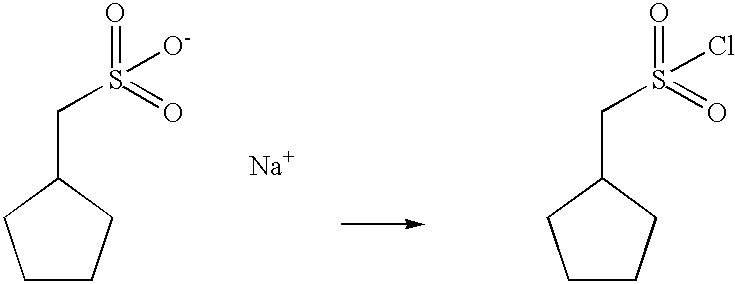
The subtitle compound was prepared by the method of Preparation 58 from sodium cyclopentylmethanesulfonate [Preparation 64] and thionyl chloride, to afford cyclopentylmethanesulfonyl chloride as a solid.
1H-NMR (CDCl3) δ: 3.75 (2H, d), 2.60 (1H, m), 2.05 (2H, m), 1.80-1.60 (4H, m), 1.40 (2H, m).

The subtitle compound was prepared by the method of Preparation 9 from cycloheptylmethanol and carbon tetrabromide. The crude product was purified by fractional distillation, b.pt. 115° C.-120° C. @ 30mmHg to afford 1-(bromomethyl)cycloheptane as an oil.
1H-NMR (CDCl3) δ: 3.25 (2H, d), 1.80 (2H, m), 1.70-1.20 (11H, m).

The subtitle compound was prepared by the method of Preparation 61 from 1-(bromomethyl)cycloheptane [Preparation 66] and sodium sulfite. The crude product was purified by recrystallisation from water to afford sodium cycloheptylmethanesulfonate as a white solid.
1H-NMR (D2O) δ: 2.75 (2H, d), 1.90 (1H, m), 1.75 (2H, m), 1.60-1.20 (10 H, m).

The subtitle compound was prepared by the method of Preparation 58 from sodium cycloheptylmethanesulfonate [Preparation 67] and thionyl chloride, to afford cycloheptylmethanesulfonyl chloride as a colourless oil.
1H-NMR (CDCl3) δ: 3.65 (2H, d), 2.40 (1H, m), 2.00 (2H, m), 1.70-1.40 (10H, m).

The title compound was prepared by the method of Preparation 5 from (Z)-(2S)-1-[cyclohexylmethylsulfonyl]-N′2-hydroxy-2-piperidinecarboximidamide [see Preparation 28], 3-(dimethylamino)propanoic acid [Papapoulos, et al, WO 9619998A1], N-methyl morpholine, hydroxybenzotriazole hydrate and 1-(3-dimethylaminopropyl)-3-ethylcarbodiimide hydrochloride, to afford (Z)-(2S)-1-[(cyclohexylmethyl)sulfonyl]-N′2-[3-(dimethylamino)propanoyl]oxy-2-piperidinecarboximidamide as an oil.
1H-NMR (CDCl3) δ: 4.60 (1H, d), 3.75 (1H, d), 3.20 (1H, t), 2.90 (2H, m), 2.60 (4H, m), 2.30 (1H, d), 2.25 (6H, s), 2.00 (4H, m), 1.80-1.60 (6H, m), 1.50 (1H, m), 1.35-1.05 (5H, m).

The title compound was prepared by a similar method to Preparation 5 from (Z)-(2S)-1-[cyclohexylmethylsulfonyl]-N′2-hydroxy-2-piperidinecarboximidamide [see Preparation 28], formic acid, N-methyl morpholine, hydroxybenzotriazole hydrate and 1-(3-dimethylaminopropyl)-3-ethylcarbodiimide hydrochloride, to afford (Z)-(2S)-1-[(cyclohexylmethyl)sulfonyl]-N′2-(formyloxy)-2-piperidinecarboximidamide as a colourless oil.
1H-NMR (CDCl3) δ: 8.55 (1H, s), 5.35 (2H, bs), 4.60 (1H, d), 3.80 (1H, d), 3.10 (1H, t), 2.95 (2H, d), 2.35 (1H, d), 2.00 (3H, m), 1.80-1.40 (7H, m), 1.35-1.05 (6H, m).

The title compound was prepared by a similar method to Preparation 5 from (Z)-(2S)-1-[cyclohexylmethylsulfonyl]-N′2-hydroxy-2-piperidinecarboximidamide [see Preparation 28], acetic acid, N-methyl morpholine, hydroxybenzotriazole hydrate and 1-(3-dimethylaminopropyl)-3-ethylcarbodiimide hydrochloride, to afford (Z)-(2S)-N′2-(acetyloxy)-1-[(cyclohexylmethyl)sulfonyl]-2-piperidinecarboximidamide as a colourless oil.
1H-NMR (CDCl3) δ: 5.20 (2H, bs), 4.60 (1H, d), 3.80 (1H, d), 3.10 (1H, t), 2.95 (2H, d), 2.40 (1H, d), 2.20 (3H, s), 2.00 (3H, m), 1.90 (1H, m), 1.80-1.40 (7H, m), 1.35-1.05 (5H, m).

The title compound was prepared by a similar method to Preparation 3 from (2S)-1-[(4-fluorophenyl)sulfonyl]-2-piperidinecarboxamide [see Preparation 40] and oxalyl chloride. The crude product was filtered through a pad of silica eluting with dichloromethane to afford (2S)-1-[(4-fluorophenyl)sulfonyl]-2-piperidylcarbonitrile as an oil.
1H-NMR (CDCl3) δ: 7.90 (2H, m), 7.30 (2H, m), 5.00 (1H, s), 3.85 (1H, d), 2.75 (1H, t), 2.00-1.50 (6H, m). Rotation: [α]D 25=−111.40° (c=0.1, methanol).

The title compound was prepared by a similar method to Preparation 4 from (2S)-1-[(4-fluorophenyl)sulfonyl]-2-piperidylcarbonitrile [see Preparation 72] and hydroxylamine, to afford (Z)-(2S)-1l-[(4-fluorophenyl)sulfonyl]-N′1-hydroxy-2-piperidylcarboximidamide as an oil.
1H-NMR (CDCl3) δ: 7.90 (2H, m), 7.25 (2H, m), 6.45 (1H, bs), 5.00 (2H, bs), 4.60 (1H, d), 3.90 (1H, d), 3.10 (1H, m), 2.00 (1H, d), 1.80 (1H, m), 1.50 (2H, m), 1.20 (2H, m).

The title compound was prepared by a similar method to Preparation 53 from (Z)-(2S)-1-[(4-fluorophenyl)sulfonyl]-N′1-hydroxy-2-piperidylcarboximidamide [see Preparation 73] and phenylacetyl chloride, to afford (Z)-(2S)-1-[(4-fluorophenyl)sulfonyl]-N′1-[(2-phenylacetyl)oxy]-2-piperidylcarboximidamide, which was used immediately without isolation.

The title compound was prepared by a similar method to Preparation 5 from (Z)-(2S)-1-[(4-fluorophenyl)sulfonyl]-N′1-hydroxy-2-piperidylcarboximidamide [see Preparation 73], 4-(hydroxymethyl)phenoxyacetic acid, N-methyl morpholine, hydroxybenzotriazole hydrate, and 1-(3-dimethylaminopropyl-3-ethylcarbodiimide hydrochloride, to afford (Z)-(2S)-1-[(4-fluorophenyl)sulfonyl]-N′1-(2-[4-(hydroxymethyl)phenoxy]acetyloxy)-2-piperidylcarboximidamide as a white solid.
1H-NMR (CDCl3) δ: 7.85 (2H, m), 7.25 (2H, m), 6.85 (2H, m), 6.80 (2H, m), 5.15 (3H, m), 4.80 (2H, s), 4.60 (2H, m), 3.80 (1H, d), 3.10 (1H, t), 2.15 (1H, d), 1.80 (1H, m), 1.50 (2H, m), 1.20 (2H, m).

The title compound was prepared by a similar method to Preparation 5 from (Z)-(2S)-1-[(4-fluorophenyl)sulfonyl]-N′1-hydroxy-2-piperidylcarboximidamide [see Preparation 73], benzoic acid, N-methyl morpholine, hydroxybenzotriazole hydrate and 1-(3-dimethylaminopropyl)-3-ethylcarbodiimide hydrochloride, to afford (Z)-(2S)-N′1-(benzoyloxy)-1-[(4-fluorophenyl)sulfonyl]-2-piperidylcarboximidamide as a white solid.
1H-NMR (CDCl3) δ: 8.05 (2H, d), 7.90 (2H, t), 7.60 (1H, m), 7.45 (2H, m), 7.25 (2H, m), 5.25 (2H, m), 4.60 (1H, d), 3.85 (1H, d), 3.20 (1H, t), 2.30 (1H, d), 1.90 (1H, m), 1.50 (2H, m), 1.20 (2H, m).

The title compound was prepared by a similar method to Preparation 39 from (2S)-1-[(4-fluorophenyl)sulfonyl]-2-piperidinecarboxylic acid [see Preparation 38], phenylacetic acid hydrazide, N-methyl morpholine, hydroxybenzotriazole hydrate and 1-(3-dimethylaminopropyl)-3-ethylcarbodiimide hydrochloride, to afford (2S)-1-[(4-fluorophenyl)sulfonyl]-N′1-(2-phenylacetyl)-2-piperidylcarbohydrazide as a white foam.
1H-NMR (CDCl3) δ: 7.90 (2H, m), 7.70 (1H, bs), 7.40-7.20 (7H, m), 4.60 (1H, d), 3.90 (1H, d), 3.65 (2H, s), 3.40 (1H, t), 2.20 (1H, d), 1.60-1.40 (3H, m), 1.30-1.10 (2H, m).

The title compound was prepared by a similar method to Preparation 39 from (2S)-1-[(4-fluorophenyl)sulfonyl]-2-piperidinecarboxylic acid [see Preparation 38], 3-phenylpropanohydrazide, N-methyl morpholine, hydroxybenzotriazole hydrate and 1-(3-dimethylaminopropyl)-3-ethylcarbodiimide hydrochloride, to afford (2S)-1-[(4-fluorophenyl)sulfonyl]-N′1-(3-phenylpropanoyl)-2-piperidylcarbohydrazide as a colourless gum.
1H-NMR (CDCl3) δ: 8.60 (1H, bs), 7.95 (2H, m), 7.65 (1H, bs), 7.40-7.20 (7H, m), 4.65 (1H, s), 3.95 (1H, d), 3.40 (1H, t), 3.00 (2H, t), 2.60 (2H, t), 2.25 (1H, d), 1.60-1.40 (3H, m), 1.30-1.15 (2H, m).

Trimethylsilyl azide (0.66 ml) and dibutyltin oxide (62 mg) were added to a solution of (2S)-1-[(4-Fluorophenyl)sulfonyl]-2-piperidylcarbonitrile (670 mg) [see Preparation 72] in toluene (10 ml). The reaction mixture was heated to reflux and stirred for 18 hrs, after which time the cooled reaction mixture was purified by coloumn chromatography on silica gel eluting with a solvent gradient of 100:0 changing to 98:2, by volume, dichloromethane: methanol followed by 98:1.98:0.02 changing to 95:4.95:0.05, by volume, dichloromethane:methanol acetic acid. The fractions containing the product were evaporated under reduced pressure and the residue partitioned between diethyl ether and saturated sodium bicarbonate solution. The aqueous layer was separated and acidified with conc. aqueous hydrochloric acid and the product extracted with dichloromethane, dried over magnesium sulphate and the solvent removed under reduced pressure to afford (2S)-1-[(4-fluorophenyl)sulfonyl]-2-(2H-1,2,3,4-tetraazol-5-yl)piperidine (735 mg) as a white foam.
1H-NMR (CDCl3) δ: 7.90 (2H, m), 7.25 (2H, m), 5.20 (1H, s), 3.80 (1H, d), 2.95 (1H, t), 2.55 (1H, d), 1.80-1.60 (4H, m), 1.40 (1H, m). Rotation: [α]D 25=−43.46° (c=0.1, methanol).

Hydroxybenzotriazole hydrate (297 mg), (3-dimethylminopropyl)-3-ethylcarbodiimide (421 mg) and N-methylmorpholine (241 ml) were added to a solution of (2S)-1-[(4-fluorophenyl)sulfonyl]-2-piperidinecarboxylic acid (575 mg) [see Preparation 38]. The reaction mixture was stirred for 15 mins, then 2-aminopropanol (170 ml) was added and stirring continued for 18 hrs at room temperature. The mixture was then diluted with ethyl acetate and washed with 2M aqueous hydrochloric acid, saturated sodium hydrogen carbonate and water. The organic layer was separated, dried over magnesium sulphate and the solvent removed under reduced pressure to afford (2S)-1-[(4-fluorophenyl)sulfonyl]-N2-(2-hydroxypropyl)-2-piperidinecarboxamide (555 mg) as an oil.
1H-NMR (CDCl3) δ: 7.90 (2H, m), 7.30 (2H, m), 6.95 (1H, bs), 4.55 (1H, m), 3.90 (2H, m), 3.50 (1H, m), 3.20 (2H, m), 2.30 (1H, d), 1.50 (3H, m), 1.20 (5H, s).

Dess-Martin reagent (814 mg) was added to a stirred solution of (2S)-1-[(4-fluorophenyl)sulfonyl]-N2-(2-hydroxypropyl)-2-piperidinecarboxamide (548 mg) [see Preparation 80) and triethylamine (0.89 ml) in dichloromethane (20 ml). The reaction mixture was stirred for 1 hr after which time the mixture was filtered through a pad of basic alumina and washed through with dichloromethane to afford (2S)-1-[(4-fluorophenyl)sulfonyl]-N2-(2-oxopropyl)-2-piperidinecarboxamide (300 mg).

The title compound was prepared by a similar method to Preparation 39 from (2S)-1-[(4-fluorophenyl)sulfonyl]-2-piperidinecarboxylic acid [see Preparation 38], N′1-hydroxyethanimidamide [La Manna, et al, Theochem (1990), 69, 161-68], N-methyl morpholine, hydroxybenzotriazole hydrate and 1-(3-dimethylaminopropyl)-3-ethylcarbodiimide hydrochloride, to afford N′1-[((2S)-1-[(4-fluorophenyl)sulfonyl]-2-piperidylcarbonyl)oxy]ethanimidamide as a colourless gum.
1H-NMR (CDCl3) δ: 7.90 (2H, m), 7.20 (2H, t), 4.90 (1H, bs), 3.50 (1H, d), 3.20 (1H, t), 2.00 (3H, s), 1.70 (4H, m), 1.50 (1H, m), 1.30 (1H, m).

Tosic acid (2.0 mg) was added to a solution of 5-(2S)-1-[(4-fluorophenyl)sulfonyl]-2-piperidyl-1,3,4-oxadiazol-2-amine (245 mg) [see Example 32] and cyclohexanone (155 ml) in toluene (20 ml). The reaction mixture was fitted with a dean-stark tube and heated to reflux for 22 hrs, after which time the mixture was evaporated under reduced pressure to a low volume and used immediately for Example 48.

The subtitle compound was prepared by a similar method to Preparation 5 from (Z)-1-(1H-benzo[d]imidazol-2-ylsulfonyl)-N′2-hydroxy-2-piperidinecarboximidamide [see Preparation 19], 4-(hydroxymethyl)phenoxyacetic acid, N-methyl morpholine, hydroxybenzotriazole hydrate and 1-(3-dimethylaminopropyl)-3-ethylcarbodiimide hydrochloride, to afford, tert-butyl N-2-[((Z)-amino[1-(1H-benzo[d]imidazol-2-ylsulfonyl)-2-piperidyl]methylideneamino)oxy]-2-oxoethylcarbamate as an oil.
1H-NMR (CDCl3) δ: 7.70 (2H, d), 7.35 (2H, m), 6.80 (2H, bs), 4.90 (1H, s), 3.85 (2H, d), 3.70 (1H, m), 3.35 (1H, t), 2.10 (1H, m), 1.60 (4H, m), 1.40 (9H, s), 1.25 (1H, m).

The title compound was prepared by the method of Example 16 from tert-butyl N-2-[((Z)-amino[1-(1H-benzo[d]imidazol-2-ylsulfonyl)-2-piperidyl]methylideneamino)oxy]-2-oxoethylcarbamate [see Preparation 84] and pyridine. The crude product was purified by column chromatography on silica gel eluting with 70:30, by volume, hexane:ethyl acetate, to afford tert-butyl N-(3-[1-(1H-benzo[d]imidazol-2-ylsulfonyl)-2-piperidyl]-1,2,4-oxadiazol-5-ylmethyl)carbamate as an oil.
1H-NMR (d6-DMSO) δ: 13.65 (1H, bs), 7.80 (1H, d), 7.60 (2H, m), 7.40-7.30 (2H, m), 5.40 (1H, d), 4.20 (2H, d), 3.95 (1H, d), 3.40 (1H, m), 2.00 (1H, m), 1.80 (1H, m), 1.60-1.50 (2H, m), 1.40 (9H, s), 1.30-1.20 (2H, m).

tert-Butyl N-(3-[1-(1H-benzo[d]imidazol-2-ylsulfonyl)-2-piperidyl]-1,2,4-oxadiazol-5-ylmethyl)carbamate (0.88 g) [see Preparation 85] was dissolved in dioxan (20 ml) and cooled to 0° C. Hydrogen chloride gas was then bubbled through for 10 mins. The reaction mixture was then stirred at room temperature for 1 hr. the solvent was then removed under reduced pressure to afford 3-[1-(1H-benzo[d]imidazol-2-ylsulfonyl)-2-piperidyl]-1,2,4-oxadiazol-5-ylmethylamine (0.67 g) as the hydrochloride salt as a white solid.
1H-NMR (d6-DMSO) δ: 9.00 (3H, bs), 7.70 (2H, d), 7.40 (2H, m), 5.45 (1H, m), 4.40 (2H, s), 3.90 (1H, d), 3.40 (1H, t), 2.05 (1H, bs), 1.80 (1H, m), 1.55 (2H, m), 1.40-1.15 (2H, m).

Platinum dioxide (5.7 g) was hydrogenated in ethanol (300 ml) at 50 psi for 30 mins, 4-bromo-2-nitroaniline (15.0 g) was then added and the solution was hydrogenated at 50 psi for a further 3 hrs. The mixture was then filtered through a plug of Arbocel and the ethanolic solution added to a solution of potassium hydroxide (5.8 g) and carbon disulphide (17.51 ml) in water (50 ml). The reaction mixture was then refluxed at 85° C. for 2 hrs, after which time the cooled reaction mixture was diluted with water and acidified with 2M aqueous hydrochloric acid. A green solid formed which was filtered off and washed with water. The solid was dissolved in ethyl acetate and washed with 2M aqueous hydrochloric acid, dried over magnesium sulphate and the solvent was removed under reduced pressure to afford crude product. The filtration mother liquors were then extracted with ethyl acetate, the organic layer was washed with 2M aqueous hydrochloric acid, dried over magnesium sulphate and the solvent was removed under reduced pressure to afford further crude product. The combined crude products were purified by column chromatography on silica gel eluting with a solvent gradient of 70:30 changing to 0:100, by volume, hexane:ethyl acetate, in 10% increments, to afford 5-bromo-1H-benzo[d]imidazole-2-thiol (5.64 g) as a white solid.
1H-NMR (d6-DMSO) δ: 7.25 (2H, d), 7.05 (1H, d).

Chlorine gas was bubbled through a solution of 5-bromo-1H-benzo[d]imidazole-2-thiol (4.98 g) [see Preparation 87] in 20% glacial acetic acid (100 ml) at 0° C. for 8 mins. The precipitate formed was quickly filtered and the solid washed with ice cold water to afford 5-bromo-1H-benzo[d]imidazole-2-sulfonyl chloride as a solid which was used immediately for Examples 54 and 55.

Ethyl-3-bromoproprionate (1.67 ml) was added to a suspension of tert-butyl-1-piperazine carboxylate (2.43 g) and potassium carbonate (2.16 g) in acetonitrile (30 ml). The reaction mixture was stirred for 56 hrs at room temperature, after which time the solvent was removed under reduced pressure and the residue partitioned between dichloromethane and water. The organic layer was separated, dried over magnesium sulphate and the solvent removed under reduced pressure to afford tert-butyl 4-(3-ethoxy-3-oxopropyl)-1-piperazinecarboxylate (2.44 g) as an oil.
1H-NMR (CDCl3) δ: 4.20 (2H, q), 3.40 (4H, m), 2.70 (2H, t), 2.50 (2H, t), 2.40 (4H, m), 1.45 (9H, s), 1.25 (3H, t).

1N Aqueous lithium hydroxide (15.6 ml) was added to a solution of tert-butyl 4-(3-ethoxy-3-oxopropyl)-1-piperazinecarboxylate (2.23 g) [see Preparation 89] in ethanol (95 ml). The reaction mixture was stirred for 18 hrs at room temperature, after which time the solvent was removed under reduced pressure. The crude product was purified by column chromatography on reverse phase MCI gel eluting with 1:1, acetonitrile:water and further purified on Dowex 50W-X8-100 ion-exchange resin eluting with water and then 10% ammonia to afford 3-[4-(tert-butoxycarbonyl)piperazino]propanoic acid (1.33 g) as a white solid.
1H-NMR (d4-CH3OH) δ: 3.55 (2H, m), 3.20 (2H, m), 2.80 (4H, m), 2.50-2.40 (4H, m), 1.45 (9H, s).

The title compound was prepared by a similar method to Preparation 5 from (Z)-(2S)-1-[cyclohexylmethylsulfonyl]-N′2-hydroxy-2-piperidinecarboximidamide [see Preparation 28] and 3-[4-(tert-butoxycarbonyl)piperazino]propanoic acid [see Preparation 90] to afford tert-butyl 4-(3-[((Z)-amino(2S)-1-[(cyclohexylmethyl)sulfonyl]-2-piperidylmethylidene)amino]oxy-3-oxopropyl)-1-piperazinecarboxylate as a brown oil.
1H-NMR (CDCl3) δ: 5.50 (2H, bs), 4.60 (1H, d), 3.80 (1H, d), 3.45 (6H, m), 3.15 (1H, t), 2.95 (2H, m), 2.75 (3H, m), 2.65 (2H, m), 2.50 (6H, m), 2.00 (4H, m), 1.80-1.60 (4H, m), 1.50 (9H, s), 1.35 (2H, m), 1.20 (2H, m).

Trifluoroacetic acid (25 ml) was added to a solution of benzyl 4-[2-tert-butoxy)-2-oxoethoxy]-1-piperidinecarboxylate (5.90 g) [J. Med. Chem, (1992), 35(23), 4405] in dichloromethane (50 ml) at 0° C. The reaction mixture was then stirred at room temperature for 2 hrs, after which time the solvent was removed under reduced pressure and the residue partitioned between water and ethyl acetate. The organic layer was separated and washed with 2N aqueous hydrochloric acid, brine, dried over magnesium sulphate and the solvent was removed under reduced pressure to afford 2-(1-[(benzyloxy)carbonyl]-4-piperidyloxy)acetic acid (5.13 g) as a clear oil.
1H-NMR (CDCl3) δ: 9.45 (1H, bs), 7.20 (5H, m), 5.20 (2H, s), 4.20 (2H, s), 3.85 (2H, m), 3.65 (1H, m), 3.30 (2H, m), 1.90 (2H, m), 1.65 (2H, m).

The title compound was prepared by a similar method to Preparation 5 from tert-butyl (Z)-(2S)-2-[amino(hydroxyimino)methyl]-1-piperidinecarboxylate [see Preparation 4] and 2-(1-[(benzyloxy)carbonyl]-4-piperidyloxy)acetic acid [see Preparation 92] to afford tert-butyl (Z)(2S)-2-[amino([2-(1-[(benzyloxy)carbonyl]-4 piperidyloxy)acetyl]oxyimino)methyl]-1-piperidinecarboxylate as a brown oil.
1H-NMR (CDCl3) δ: 7.40 (5H, m), 5.15 (2H, s), 5.05 (2H, bs), 4.95 (1H, d), 4.35 (2H, s), 4.05 (1H, d), 3.80 (2H, m), 3.65 (1H, m), 3.25 (2H, m), 2.80 (1H, t), 2.25 (1H, d), 1.90-1.60 (8H, m), 1.55 (9H, m), 1.40 (1H, m).

The title compound was prepared by a similar method to Preparation 13 from (Z)-(2S)-2-[amino([2-(1-[(benzyloxy)carbonyl]-4-piperidyloxy)acetyl]oxyimino)methyl]-1-piperidinecarboxylate [see Preparation 93] and pyridine. The crude product was purified by column chromatography on silica gel eluting with a solvent gradient of 80:20, changing to 50:50, by volume, hexane:ethyl acetate, in 5% increments, to afford tert-butyl (2S)-2-{5-[(1-[(benzyloxy)carbonyl]-4-piperidyloxy)methyl]-1,2,4-oxadiazol-3-yl}-1-piperidinecarboxylate.
1H-NMR (CDCl3) δ: 7.40 (5H, m), 5.50 (1H, bs), 5.15 (2H, s), 4.75 (2H, s), 4.10 (1H, m), 3.80 (2H, m), 3.50 (1H, m), 3.30 (2H, m), 3.00 (1H, t), 2.25 (1H, d), 1.90 (3H, m), 1.65 (5H, m), 1.45 (9H, s), 1.40 (1H, m).

Trifluoroacetic acid (25 ml) was added to a solution of tert-butyl (2S)-2-{5-[(1-[(benzyloxy)carbonyl]-4-piperidyloxy)methyl]-1,2,4-oxadiazol-3-yl}-1-piperidinecarboxylate (1.73 g) [see Preparation 94] in dichloromethane (25 ml) at 0° C. The reaction mixture was stirred for 2 hrs at room temperature, after which time the solvent was removed under reduced pressure and the residue partitioned between ethyl acetate and water. The organic layer was separated and washed with 2N aqueous hydrochloric acid and brine, the combined aqueous layers were then neutralised with saturated sodium hydrogen carbonate and the product re-extracted with ethyl acetate. The organic layer was then separated, dried over magnesium sulphate and the solvent removed under reduced pressure to afford benzyl 4-(3-[(2S)-2-piperidyl]-1,2,4-oxadiazol-5-ylmethoxy)-1-piperidinecarboxylate (1.33 g) as a brown oil.
1H-NMR (CDCl3) δ: 7.40 (5H, m), 5.15 (2H, s), 4.75 (2H, s), 4.00 (1H, d), 3.80 (2H, m), 3.70 (1H, m), 3.30-3.15 (3H, m), 2.80 (1H, t), 2.10 (1H, m), 1.90 (3H, m), 1.80-1.55 (6H, m).

The title compound was prepared by a similar method to Example 1 from benzyl 4-(3-[(2S)-2-piperidyl]-1,2,4-oxadiazol-5-ylmethoxy)-1-piperidinecarboxylate [see Preparation 95] and 1H-benzo[d]imidazol-2-sulfonyl chloride [see Preparation 8]. The crude product was purified by column chromatography on silica gel eluting with a solvent gradient of 80:20 changing to 0:100, by volume, hexane:ethyl acetate, in 5% increments, to afford benzyl 4-(3-[(2S)-1-(1H-benzo[d]imidazol-2-ylsulfonyl)-2-piperidyl]-1,2,4-oxadiazol-5-ylmethoxy)-1-piperidinecarboxylate as a clear oil.
1H-NMR (CDCl3) δ: 10.65 (1H, bs), 7.85 (1H, d), 7.60 (1H, d), 7.40 (7H, m), 5.60 (1H, d), 5.15 (2H, s), 4.40 (2H, s), 4.00 (1H, d), 3.80 (2H, m), 3.55 (1H, m), 3.20 (3H, m), 2.30 (1H, d), 2.05 (1H, m), 1.85-1.50 (8H, m).

The title compound was prepared by a similar method to Preparation 5 from (Z)-(1S)-2-[(4-fluorophenyl)sulfonyl]-N′1-hydroxy-2-piperidylcarboximidamide [see Preparation 73], 2-pyrazinecarboxylic acid, N-methyl morpholine, hydroxybenzotriazole hydrate, dimethylaminopyridine and 1-(3-dimethylaminopropyl)-3-ethylcarbodiimide hydrochloride, to afford (Z)-(2S)-1-[(4-fluorophenyl)sulfonyl]-N′2-[(2-pyrazinylcarbonyl)oxy]-2-piperidinecarboximidamide as a white solid.
1H-NMR (CDCl3) δ: 9.40 (1H, s), 8.80 (1H, s), 8.75 (1H, s), 7.95 (2H, m), 7.25 (2H, m), 5.50 (2H, bs), 4.70 (1H, m), 3.90 (1H, d), 3.20 (1H, t), 2.30 (1H, d), 1.90 (1H, m), 1.55 (2H, m), 1.20 (2H, m).

2-Furoic acid (10.0 g) was dissolved in cold concentrated sulphuric acid (50 ml). The mixture was then added to N-hydroxy methylphthalimide (12.0 g) and the reaction mixture allowed to stand for 18 hrs at room temperature. The mixture was then poured into ice and the product extracted with dichloromethane, dried over magnesium sulphate and the solvent removed under reduced pressure. The crude product was triturated with diethyl ether and recrystallised from methanol to afford 5-[(1,3-dioxo-2,3-dihydro-1H-2-isoindolyl)methyl]-2-furoic acid (9.70 g) as a brown solid.
Analysis: Found C, 59.48; H, 3.72; N, 5.03; C14H9NO5.0.5H2O requires C, 60.00; H, 3.60; N, 5.04%.

The title compound was prepared by a similar method to Preparation 5 from (Z)-(2S)-1-[(cyclohexylmethyl)sulfonyl]-N′2-hydroxy-2-piperidinecarboximidamide [see Preparation 28] and 5-[(1,3-dioxo-2,3-dihydro-1H-2-isoindolyl)methyl]-2-furoic acid (see Preparation 98], to afford (Z)-(2S)-1-[(cyclohexylmethyl)sulfonyl]-N′2-[(5-[(1,3-dioxo-2,3-dihydro-1H-2-isoindolyl)methyl]-2-furylcarbonyl)oxy]-2-piperidinecarboximidamide as a yellow oil.
1H-NMR (CDCl3) δ: 7.90 (2H, m), 7.80 (2H, m), 7.20 (1H, s), 6.45 (1H, d), 5.30 (2H, bs), 4.95 (2H, s), 4.65 (1H, d), 3.80 (1H, d), 3.20 (1H, t), 2.95 (2H, m), 2.40 (1H, d), 2.00 (4H, m), 1.80-1.60 (7H, m), 1.50 (1H, m), 1.40-1.10 (4H, m).

(Z)-(2S)-1-[(Cyclohexylmethyl)sulfonyl]-N′2-[(5-[(1,3-dioxo-2,3-dihydro-1H-2-isoindolyl)methyl]-2-furylcarbonyl)oxy]-2-piperidinecarboximidamide (154 mg) (see Preparation 99) was dissolved in toluene (4 ml) and heated to reflux for 18 hrs. The toluene was removed under reduced pressure and the crude product was purified by column chromatography on silica gel eluting with 2:1, by volume, hexane:ethyl acetate, to afford 2-[5-(3-(2S)-1-[(cyclohexylmethyl)sulfonyl]-2-piperidyl-1,2,4-oxadiazol-5-yl)-2-furyl]methyl-1,3-isoindolinedione (62 mg) as an oil.
1H-NMR (CDCl3) δ: 7.90 (2H, m), 7.75 (2H, m), 7.25 (1H, d), 6.60 (1H, s), 5.40 (1H, d), 5.35 (1H, s), 5.00 (2H, s), 3.80 (1H, d), 3.25 (1H, t), 3.00 (2H, m), 2.30 (1H, d), 2.00 (4H, m) 1.80-1.60 (6H, m), 1.50 (1H, m), 1.40-1.00 (4H, m).
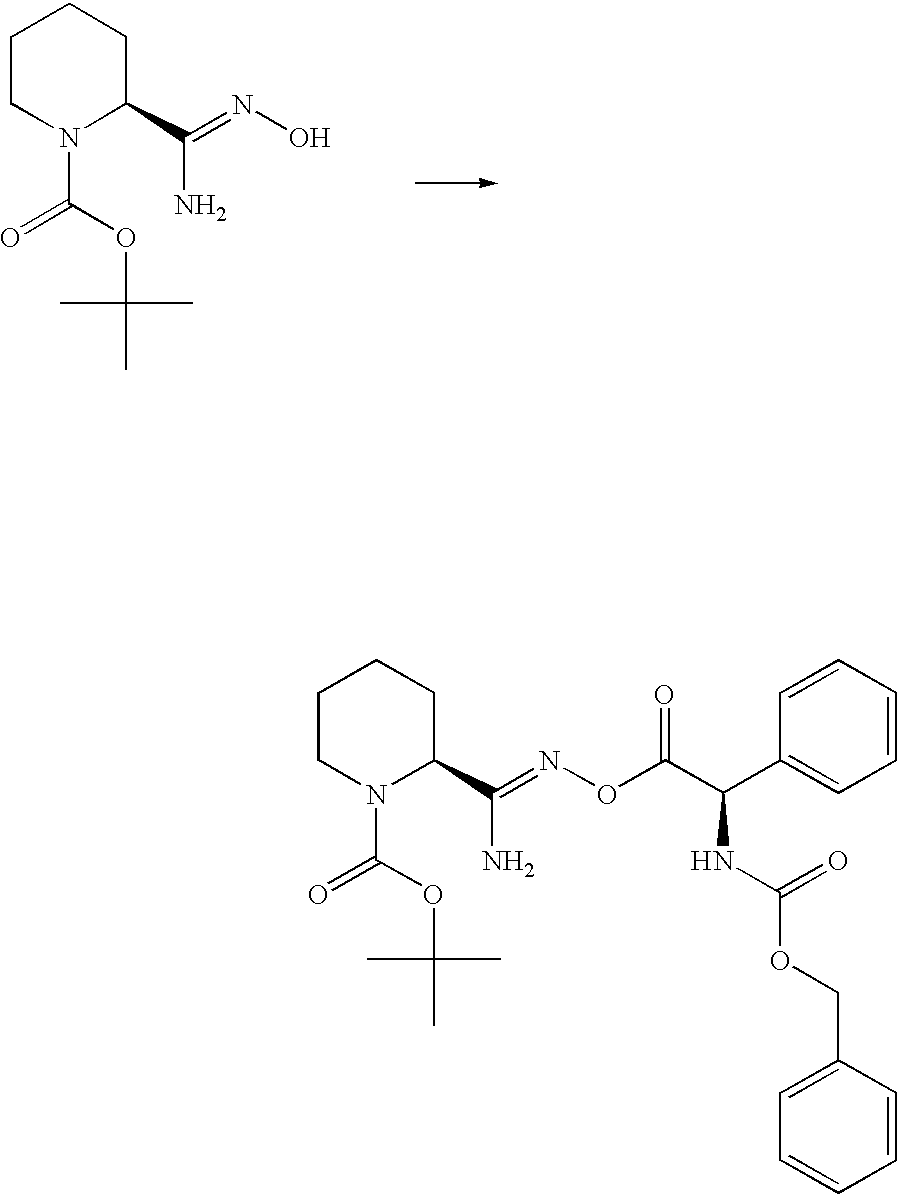
The title compound was prepared by a similar method to Preparation 5 from tert-butyl (Z)-(2S)-2-[amino(hydroxyimino)methyl]-1-piperidinecarboxylate [see Preparation 4] and (2R)-2-{[(benzyloxy)carbonyl]amino}-2-phenylethanoic acid to afford tert-butyl (2S)-2-[(Z,5R)-1-amino-4,7-dioxo-5,9-diphenyl-3,8-dioxa-2,6-diaza-1-nonen-1-yl]-1-piperidinecarboxylate as an oil.
1H-NMR (CDCl3) δ: 8.20 (0.5H, d), 7.35 (10H, m), 6.55 (0.5H, d), 5.90 (1H, m), 5.55 (1H, d), 5.10 (2H, m), 4.90 (2H, m), 3.95 (1H, m), 2.70 (1H, m), 2.40 (1H, m), 2.20 (1H, m), 1.80 (2H, m), 1.60 (2H, m), 1.45 (9H, s).

The title compound was prepared by a similar method to Preparation 6 from tert-butyl (2S)-2-[(Z,5R)-1-amino-4,7-dioxo-5,9-diphenyl-3,8-dioxa-2,6-diaza-1-nonen-1-yl]-1-piperidinecarboxylate [see Preparation 10 1] and pyridine to afford tert-butyl (2S)-2-{5-[(R)-{[(benzyloxy)carbonyl]amino}(phenyl)methyl]-1,2,4-oxadiazol-3-yl}-1-piperidinecarboxylate as an oil.
1H-NMR (CDCl3) δ: 7.40 (10H, m), 6.20 (1H, d), 5.85 (1H, s), 5.45 (4H, s), 5.10 (2H, m), 4.00 (1H, d), 2.95 (1H, m), 2.15 (1H, d), 1.85 (1H, m), 1.60 (2H, m), 1.45 (11H, m).

The title compound was prepared by a similar method to Preparation 7 from tert-butyl (2S)-2-{5-[(R)-{[(benzyloxy)carbonyl]amino}(phenyl)methyl]-1,2,4-oxadiazol-3-yl}-1-piperidinecarboxylate [see Preparation 102] and anhydrous hydrogen chloride gas to afford benzyl (R)-phenyl{3-[(2S)-piperidyl]-1,2,4-oxadiazol-5-yl}methylcarbamate hydrochloride as a foam.
1H-NMR (CDCl3) δ: 7.30 (10H, m), 6.25 (1H, s), 6.20 (1H, s), 5.10 (2H, s), 4.40 (1H, s), 3.55 (1H, s), 2.30 (1H, s), 1.95 (5H, m), 1.60 (1H, m).

The title compound was prepared by a similar method to Preparation 5 from (Z)-(2S)-1-[cyclohexylmethylsulfonyl]-N′2-hydroxy-2-piperidinecarboximidamide [see Preparation 28] and (2S)-2-{[(benzyloxy)carbonyl]amino}-2-phenylethanoic acid to afford benzyl N-[(1S)-2-{[((Z)-amino{(2S)-1-[(cyclohexylmethyl)sulfonyl]piperidyl}methylidene)amino]oxy}-2-oxo-1-phenylethyl]carbamate as an oil.
1H-NMR (CDCl3) δ: 7.40 (10H, m), 5.90 (2/3H, m), 5.80 (1/3H, m), 5.55 (2/3H, m), 5.40 (1/3H, m), 5.10 (4H, m), 4.55 (1H, s), 3.70 (1H, m), 3.00 (1H, m), 2.90 (2H, m), 2.15 (1H, m), 1.95 (3H, m), 1.70 (6H, m), 1.40 (1H, m), 1.30 (3H, m), 1.05 (3H, m).

The title compound was prepared by a similar method to Preparation 20 from (Z)-1-(1H-benzo[d]imidazol-2-ylsulfonyl)-N′2-hydroxy-2-piperidinecarboximidamide [see Preparation 19] and pyrimidine-2-carboxylic acid (see Chem. Ind. (London), 1954, 786) to afford 1-(1H-benzo[d]imidazol-2-ylsulfonyl)-N′2-[(2-pyrimidinylcarbonyl)oxy]-2-piperidinecarboximidamide as a gum. The title compound was used directly in Example 65.
It will be appreciated that what will be claimed is as follows:
(i) a compound of the formula (I) or a pharmaceutically acceptable salt or solvate thereof;
(ii) a process for the preparation of a compound of the formula (I) or a pharmaceutically acceptable salt or solvate thereof;
(iii) a pharmaceutical composition comprising a compound of the formula (I) or a pharmaceutically acceptable salt or solvate thereof, together with a pharmaceutically acceptable excipient, diluent or carrier;
(iv) a compound of the formula (I) or a pharmaceutically acceptable salt, solvate or composition thereof, for use as a medicament;
(v) the use of a compound of the formula (I) or of a pharmaceutically acceptable salt, solvate or composition thereof, for the manufacture of a medicament for the treatment of neuronal degeneration;
(vi) the use of a compound of the formula (I) or of a pharmaceutically acceptable salt, solvate or composition thereof, for the manufacture of a medicament for the promotion of neuronal regeneration and outgrowth;
(vii) the use of a compound of the formula (I) or of a pharmaceutically acceptable salt, solvate or composition thereof, for the manufacture of a medicament for the treatment of a neurological disease or disorder such as a neurodegenerative disease;
(viii) use as in (vii) where the neurological disease or disorder is selected from the group consisting of senile dementia (Alzheimer's disease) and other dementias, amyotrophic lateral sclerosis and other forms of motor neuron disease, Parkinson's disease, Huntington's disease, neurological deficits associated with stroke, all forms of degenerative disease affecting the central or peripheral nervous system (e.g. cerebellar-brainstem atrophies, syndromes of progressive ataxias), all forms of muscular dystrophy, progressive muscular atrophies, progressive bulbar muscular atrophy, physical or traumatic damage to the central or peripheral nervous system (e.g. spinal cord), herniated, ruptured or prolapsed intervertebrae disc syndromes, cervical spondylosis, plexus disorders, thoracic outlet syndromes, all forms of peripheral neuropathy (both diabetic and non-diabetic), trigeminal neuralgia, glossopharyngeal neuralgia, Bell's Palsy, all forms of auto-immune related disease resulting in damage of the central or peripheral nervous system (e.g. multiple sclerosis, myasthenia gravis, Guillain-Barré syndrome), AIDS related disorders of the nervous system, dapsone ticks, bulbar and retrobulbar affections of the optic nerve (e.g. retinopathies and retrobulbar neuritis), hearing disorders such as tinnitus, and prion diseases;
(ix) use as (viii) where the neurological disease or disorder is senile dementia (Alzheimer's disease) or another dementia, amyotrophic lateral sclerosis or another form of motor neuron disease, Parkinson's disease, Huntington's disease, a neurological deficit associated with stroke, physical or traumatic damage to the central or peripheral nervous system (e.g. spinal cord), a peripheral neuropathy (either diabetic or non-diabetic), multiple sclerosis or a hearing disorder such as tinnitus;
(x) a method of treatment of a human to treat neuronal degeneration which comprises treating said human with an effective amount of a compound of the formula (I) or with a pharmaceutically acceptable salt, solvate or composition thereof;
(xi) a method of treatment of a human to promote neuronal regeneration and outgrowth which comprises treating said human with an effective amount of a compound of the formula (I) or with a pharmaceutically acceptable salt, solvate or composition thereof;
(xii) a method of treatment of a human to treat a neurological disease or disorder such as a neurodegenerative disease which comprises treating said human with an effective amount of a compound of the formula (I) or with a pharmaceutically acceptable salt, solvate or composition thereof;
(xiii) a method as in (xii) where the neurological disease or disorder is selected from the group consisting of senile dementia (Alzheimer's disease) and other dementias, amyotrophic lateral sclerosis and other forms of motor neuron disease, Parkinson's disease, Huntington's disease, neurological deficits associated with stroke, all forms of degenerative disease affecting the central or peripheral nervous system (e.g. cerebellar-brainstem atrophies, syndromes of progressive ataxias), all forms of muscular dystrophy, progressive muscular atrophies, progressive bulbar muscular atrophy, physical or traumatic damage to the central or peripheral nervous system (e.g. spinal cord), herniated, ruptured or prolapsed intervertebrae disc syndromes, cervical spondylosis, plexus disorders, thoracic outlet syndromes, all forms of peripheral neuropathy (both diabetic and non-diabetic), trigeminal neuralgia, glossopharyngeal neuralgia, Bell's Palsy, all forms of auto-immune related disease resulting in damage of the central or peripheral nervous system (e.g. multiple sclerosis, myasthenia gravis, Guillain-Barré syndrome), AIDS related disorders of the nervous system, dapsone ticks, bulbar and retrobulbar affections of the optic nerve (e.g. retinopathies and retrobulbar neuritis), hearing disorders such as tinnitus, and prion diseases;
(xiv) a method as in (xiii) where the neurological disease or disorder is senile dementia (Alzheimer's disease) or another dementia, amyotrophic lateral sclerosis or another form of motor neuron disease, Parkinson's disease, Huntington's disease, a neurological deficit associated with stroke, physical or traumatic damage to the central or peripheral nervous system (e.g. spinal cord), a peripheral neuropathy (either diabetic or non-diabetic), multiple sclerosis or a hearing disorder such as tinnitus; and
(xv) any novel intermediates described herein.
| TABLE 6 | |||
| EXAMPLE | IC50 (nm) FKBP-12 | ||
| 25 | 81 | ||
| 14 | 91 | ||
| 1 | 95 | ||
| 23 | 336 | ||
| 65 | 442 | ||
| 43 | 1675 | ||
| 42 | 2010 | ||
| 11 | 685 (FKBP-52, Ki) | ||
Claims (16)
1. A compound of the formula: 
or a pharmaceutically acceptable salt or solvate thereof, wherein
R1 is triazolyl, isoxazolyl, oxadiazolyl, tetraazolyl, thiazolyl or thiadiazolyl, that is linked to the adjacent carbon atom by a ring carbon atom substituted by 1, 2 or 3 substituents each independently selected from C1-C6 alkyl, —X-aryl, X-het, —X—CO2R5 and —X—NR3R4 R2 is H, phenyl or C3-C7cycloalkyl, said phenyl or cycloalkyl being optionally benzo- or C3-C7cycloalkyl fused and optionally substituted, including in the benzo- or cycloalkyl-fused portion, by from 1 to 3 substituents each independently selected from C1-C6alkyl, C1-C6alkoxy, —OH, —(C1-C6alkylene) OH, halo and halo(C1-C6alkylene)—,
or R2 is a 5-, 6- or 7-membered ring heterocyclic group containing either 1,2,3 or 4 nitrogen heteroatoms, or 1 oxygen or sulphur heteroatom and, optionally, 1 or 2 nitrogen heteroatoms, said heterocyclic group being saturated or partially or fully unsaturated, optionally benzo-fused and optionally substituted, including in the benzofused portion, by from 1 to 3 substituents each independently selected from C1-C6alkyl, C1-C6alkoxy, halo, halo(C1-C6alkylene- and —CO2R5, said R2 group being attached to W by by any mono- or bicyclic ring carbon atom or heteratom: R3 and R4 are either each independently selected from H, C1-C6alkyl C3-C6cycloalkyl and —(C1-C6alkylene)(C3-C6cycloalkyl), or, when taken together, represent unbranched C3-C6alkylene optionally containing 0 or NR5;
R5 is H, C1-C6alkyl, C3-C6cycloalkyl, —(C1-C6alkyne)(C3-C6cycloalkyl) or —(C1-C6alkylene)aryl;
A is unbranched C4 alkylene optionally substituted by C1-C6alkyl;
W is a direct link, C1-C6alkylene or C2-C6alkenylene;
X is direct link, C1-C6alkylene or (C0-C6alkylene)—Z—(C0-C6alkylene)-;
Y is SO2;
Z is O, S, —CR5NR3R4—, —CR5NR5(CO2R5)—, —CR5(aryl1)—, —NR5—, —NR5CO2, —CONR5— or —NR5CO—;
“aryl” is phenyl optionally substituted by from 1 to 3 substituents each independently selected from C1-C6alkyl, C1-C6alkoxy, —(C1-C6alkylene)(C1-C6alkoxy), halo, halo(C1-C6alkylene)—, —NR3R4, —(C1-C6alkylene)NR3R4, —(C1-C6alkylene)OH, —O(—C1-C6alkylene)NR3R4 and -alkylene)(phthalimido);
“aryl” is phenyl optionally substituted by from 1 to 3 substituents each independently selected from C1-C6alkyl, C1-C6alkoxy, —(C1-C6alkylene)(C1-C6alkoxy), halo and halo(C1-C6alkylene)—; and
“het” is a 5-, 6-, or 7-membered ring heterocyclic group containing either 1,2,3 or 4 nitrogen heteroatoms, or 1 oxygen or sulphur heteroatom and, optionally, 1 or 2 nitrogen heteratoms, said heterocyclic group being saturated or partially or fully unsaturated, or “het” is azetidinyl, said “het” being optionally substituted by from 1 to 3 substituted each independently selected from C1-C6alkyl, C1-C6alkoxy, C3-C7 cycloalkyl, —(C1-C6alkylene)(C1-C6alkoxy), (C1-C6alkylene)(C3-C7cycloaklyl), halo, halo(C1-C6alkylene)—, —NR3R4, —CO2R5, —(C1-C6alkylene)aryl and (C1-C6alkylene)NR3R4:
with the provisos that
(a) the heteroaryl group of R1 is not substituted by C0-C6alkylene)—Z—(C0alkylene)(—OH or —C1-C4alkoxy or —CN or —NR3R4) when Z is O,S, —NR5—, —CONR5—.
2. A compound as claimed in claim 1 having the stereochemical formula (I′) 
wherein R1, R2, A, W and Y are as defined in claim 1 formula (I).
3. A compound as claimed in claim 1 wherein X is a directed link, C1-C6 alkylene or —(C0-C6alkyene)—Z—(C0-C6alkylene—; Z is O, —CR5NR3R4, —CR5NR5(CO2R5)—, —NR— or —NR5CO2—;
wherein said aryl of —X-aryl is phenyl optionally substituted by from 1 to 3 substitutents each independently selected from —(C1-C6alkylene)OH, —(C1-C6alkylene)NR3R4, —O(C1-C6alkylene)NR3R4 and —(C1-C6alkyene)(phthalimido); and said “het” of -x het is piperidyl, pyrazinyl, furyl, piperazinyl, pyrimidinyl or morphonlinyl, optionally substituted by from 1 to 3 —(C1-C6alkylene)(C3-C7cycloakyl), —(C1-C6)alkyl; or (C1-C6alkyene)NR3R4 where “het” is furyl
R3 and R4 are either each independently selected form H and C1-C6alkyl or, when taken together, represent unbranched C3-C6 alkylene; and
R5 is H or C1-C6 alkyl.
4. A compound as claimed in claim 1 wherein R1 is 1,2,4-triazolyl, isoxazolyl, 1,2,4-oxadiazolyl, 1,3,4-oxadiazolyl or 1,3,4-thiadiazolyl, that is linked to the adjacent carbon atom by a ring carbon atom and optionally substituted by 1, 2 or 3 substituents each independently selected from methyl, benzyl, α-(amino)benzyl, R or S-′-(amino)benzyl, α-(tert-butoxycarbonylamino)benzyl, benzylamino, benzylaminoethyl, aminomethylphenoxymethyl, methylaminomethylphenoxymethyl, dimethylaminomethylphenoxymethyl, amino methylphenoxymethyl, hydroxymethylphenoxymethyl, benzylaminoethyl, butoxycarbonylethylpiperazinyl, benzoaminomethyl, pyrrolidinylmethylphenoxymethyl, aminoethoxybenzyl, pyrazinyl, cyclopropylmethylpiperidyloxymethyl, hydroxymethylphenoxymethyl, tertbutyloxycarbonylpiperazinylethyl, pyrimidinyl, (S)-α-(benzyloxycarbonylamino)benzyl, piperazinoethyl, phenylcarbonylaminoethyl, dimethylaminoethyl, hydrogen, phenyl, phenethyl, cyclohexylamino phthalimidomethylphenoxymethyl, piperidyloxymethyl, benzylpiperidyloxymethyl, benzylpiperidyloxyethyl, morpholinomethyl, benzyloxycarbonylaminoethyl, amino, aminoethyl, benzyloxycarbonylpiperidinyloxymethyl, methylaminofuranyl or (R)-α-(benzyloxycarbonylamino)benzyl.
5. A compound as claimed in claim 3 wherein R1 is
5-benzyl-1,2,4-oxadiazol-3-yl,
5-(4-[phthalimidomethyl]phenoxymethyl)-1,2,4-oxadiazol-3-yl,
5-(4-aminomethylphenoxymethyl)-1,2,4-oxadiazol-3-yl,
5-(4-dimethylaminomethylphenoxymethyl)-1,2,4-oxadiazol-3-yl,
5-(4-pyrrolidinomethylphenoxymethyl)-1,2,4-oxadiazol-3-yl,
5-(4-methylaminomethylphenoxymethyl)-1,2,4-oxadiazol-3-yl,
5-(1-benzylpiperid-4-yloxymethyl)-1,2,4-oxadiazol-3-yl,
5-(α-[tert-butoxycarbonylamino]benzyl)-1,2,4-oxadiazol-3-yl,
5-morpholinomethyl-1,2,4-oxadiazol-3-yl,
5-(2-[1-benzylpiperid-4-yloxy]ethyl)-1,2,4-oxadiazol-3-yl,
5-(1H-piperid-4-yloxymethyl)-1,2,4-oxadiazol-3-yl,
5-[α-[amino]benzyl)-1,2,4-oxadiazol-3-yl,
5-(2-[benzyloxycarbonylamino]ethyl)-1,2,4-oxadiazol-3-yl,
5-(2-aminoethyl)-1,2,4-oxadiazol-3-yl,
5-(2-[benzylamino]ethyl)-1,2,4-oxadiazol-3-yl,
5-(4-[2-aminoethoxy]benzyl)-1,2,4-oxadiazol-3-yl,
5-methyl-1,3,4-thiadiazol-2-yl,
1-benzyl-1H-1,2,4-triazol-3-yl,
5-benzyl-4-methyl-4H-1,2,4-triazol-3-yl,
5-amino-1,4-oxadiazol-2-yl,
5-benzylamino-1,3,4-oxadiazol-2-yl,
3-methylisoxazol-5-yl,
5-(pyrazin-2-yl)-1,2,4-oxodiazol-3-yl,
5-(R)-[(α(amino)benzyl]1,2,4-oxadiazol-3-yl,
5-(S)-[α-(amino)benzyl]-1,2,4-oxadiazol-3-yl,
5-(5-methylaminofuran-2-yl)-1,2,4-oxadiazol-3-yl,
5-(1-benzyloxycarbonylpiperid-4-yloxymethyl)-1,2,4-oxadiazol-3-yl,
5-(1-cyclopropylmethylpiperid-4-yloxymethyl)-1,2,4-oxadiazol-3-yl,
5-(4-hydroxymethylphenoxymethyl)-1,2,4-oxadiazol-3-yl,
5[2-(4-tert-butoxycarbonylpiperazin-4-yl)ethyl]-1,2,4-oxadiazol-3-yl,
5-(pyrimidin-2-yl)-1,2,4-oxadiazol-3-yl,
5-methyl-1,2,4-oxadiazol-3-yl,
5-benzylaminoethyl-1,2,4-oxadiazol-3-yl,
5-(S)-(α-[benzyloxycarbonylamino]benzyl)-1,2,4-oxadiazol-3-yl,
5-(R)-(α-[benzyloxycarbonylamino]benzyl)-1,2,4-oxadiazol-3-yl,
5-[2-(4H-piperazin-1-yl)ethyl]-1,2,4-oxadiazol-3-yl,
5[2-(phenylcarbonylamino)ethyl]-1,2,4-oxadiazol-3-yl,
1[2-(dimethylamino)ethyl]-1,2,4-oxadiazol-3-yl,
5-phenyl-1,2,4-oxadiazol-3-yl,
2-benzyl-2H-1,2,3,4-tetraazol-5-yl,
5-benzyl-1,3,4-oxadiazol-2-yl,
5[2-(phenyl)ethyl]-1,3,4-oxadiazol-2-yl,
5-methyl-2H-1,2,3,4-tetraazol-5-yl,
5-cyclohexylamino-1,3,4-oxadiazol-2-yl,
5-methyl-1,3,4-oxadiazol-2-yl, 3-methyl-1,2,4-oxadiazol-3-yl,
5-methyl-1,3-thiazol-2-yl,
5-methyl-1H-1,2,4-tetriazol-3-yl,
5-aminomethyl-1,2,4-oxadiazol-3-yl.
6. A compound according to claim 1 wherein R1 is 1,2,4 or 1,3,4 oxadiazole, that is linked to the adjacent carbon atom by a ring carbon atom which is mono-substituted by one of —X-aryl or —X-het wherein X is selected from —(C0-C2 alkylene)—Z—(C0-C2 alkylene), where Z is —O—; or X is a direct link or —(C1-C2 alkylene); or X is —(C0 alkylene)—Z—(C0 alkylene) where Z is —CR5NR3R4, or —CR5NR5(CO2R5) where R3 and R4 are selected from H, —(C1—C3 alkylene), and R5 is H or —(C1-C4 alkylene), or —(C1-C2 alkylene)aryl; or X is —(C1-C2 alkylene)—Z—(C1-C2 alkylene)(aryl) where Z is NR5 and R5 is H or —(C1-C2 alkylene)—;
wherein aryl of —X-aryl is phenyl optionally substituted by from 1 to 3 substituents independently selected from —(C1-C3 alkylene)NR3R4, —(C1-C6 alkylene)(phthalimido); —O(C1-C3 alkylene)NR3R4 or —CO2R5 wherein R3 and R4 are each independently selected from H, C1-C3 alkyl or, when taken together, represent unbranched C3-C5 alkylene; and R5 is H, C1-C4 alkyl or —(C1-C2 alkylene)aryl;
wherein “het” of —X-het is piperidinyl, furyl, pyrazinyl, pyrimidinyl or piperazinyl optionally substituted by —(C1-C3 alkylene)(—C3-C6 cycloalkyl), —CO2R5, —(C1-C3 alkylene)NR3R4 or —(C1-C2 alkylene)aryl wherein aryl is phenyl and wherein R3 and R4 are selected from H, —(C1-C3 alkylene), more preferably H, —(C1-C2 alkylene) and R5 is H or —(C1-C4 alkylene), or —(C1-C2 alkylene)aryl;
or X is —(C1-C2 alkylene)—Z—(C1-C2 alkylene)(aryl) where Z is NR5 and R5 is H or —(C1-C2 alkylene)—.
7. A compound as claimed in claim 1 wherein R2 is H, phenyl or C3-C7 cycloalkyl, said phenyl or cycloalkyl being optionally substituted by from 1 to 3 halo substituents, or R2 is a 5- or 6-membered ring heterocyclic group containing either 1 or 2 nitrogen heteroatoms or 1 oxygen heteroatom, said heterocyclic group being saturated or partially or fully unsaturated, optionally benzo-fused and optionally substituted, including in the benzo-fused portion, by from 1 to 3 halo, halo(C1-C6 alkyl), C1-C6 alkyl substituents, said R2 group being attached to W by any mono- or bicyclic ring carbon atom or heteroatom.
8. A compound as claimed in claim 7 wherein R2 is H, phenyl, cyclopentyl cyclohexyl or cycloheptyl, said phenyl being optionally substituted by from 1 to 3 fluoro substituents, or R2 is imidazolyl, pyrrolidinyl, piperidinyl or tetrahydrofuranyl, said imidazolyl or tetrahydrofuranyl group being optionally benzo-fused and optionally substituted, including in the benzo-fused portion, by from 1 to 3 methyl, bromine or fluorine substituents, said R2 group being attached to W by any mono- or bicyclic ring carbon atom.
9. A compound as claimed in claim 8 wherein R2 is H, fluorophenyl, cyclopentyl, cyclohexyl, cycloheptyl, methylimidazolyl, benzimidazolyl, bromobenzimidazolyl or furanyl.
10. A compound as claimed in claim 9 wherein R2 is H, 4-fluorophenyl, cyclopentyl, cyclohexyl, cycloheptyl, 1-methyl-1H-imidazol-4-yl, 1H-benzo[d]imidazol-2-yl, 5-bromo-1H-benzo[d]imidazol-2-yl or tetrahydrofuran-3-yl.
11. A compound as claimed in claim 1 wherein W is a direct link, methylene, ethylene or 2,2-dimethyl-1,3-propylene.
12. A compound as claimed in claim 1 wherein —Y—W—R2 are
5-bromo-1H-benzo[d]imidazolll-2-ylsulphonyl,
1H-benzo[d]imidazol-2-ylsulphonyl,
1-methyl-1H-imidazol-4-ylsulphonyl,
tetrahydrofuran-3-ylmethylsulphonyl,
cyclohexylmethylsulphonyl,
4-fluorophenylsulphonyl,
cyclopentylmethylsulphonyl,
cycloheptylmethylsulphonyl,
1-(benzyloxycarbonyl)pyrrolidin-3-ylmethylsulphonyl, or
1-(benzyloxycarbonyl)piperid-3-ylmethylsulphonyl.
13. A compound as claimed in claim 1 selected from the group consisting of:
1H-Benzo[d]imidzol-2-yl[2S]-2-(5-benzyl-1,2,4-oxadiazol-3-yl)-1-piperidylsulphone,
2-[4-(3-[(2S)-1-(1H-Benzo[d]imidazol-2-ylsulfonyl)-2-piperidyl]-1,2,4-oxadiazol-5-ylmethoxy)benzyl]-1,3-isoindolinedione,
4-(3-[(2S)-1-(1H-Benzo[d]imidazol-2-ylsulfonyl)-2-piperidyl]-1,2,4-oxadiazol-5-ylmethoxy)benzylamine,
N-[4-(3-[(2S)-1-(1H-Benzo[d]imidazol-2-ylsulfonyl)-2-piperidyl]-1,2,4-oxadiazol-5-ylmethoxy)benzyl]-N,N-dimethylamine,
3-[1-(1H-Benzo[d]imidazol-2-ylsulfonyl)-2-piperidyl]-5-[4-(1-pyrrolidylmethyl)phenoxy]methyl-1,2,4-oxadiazole,
N-[4-(3-[1-(1H-Benzo[d]imidazol-2-ylsulfonyl)-2-piperidyl]-1,2,4-oxadiazol-5-ylmethoxy)benzyl]-N-methylamine,
4-[3-((2S)-1-[Cyclohexylmethylsulfonyl]-2-piperidyl)-1,2,4-oxadiazol-5-ylmethoxy]benzylamine,
5-[(1-Benzyl4-piperidyl)oxymethyl]-3-[(2S)-1-cyclohexylmethylsulfonyl-2-piperidyl]-1,2,4-oxadiazole,
3-[(2S)1-Cyclohexylmethylsulfonyl-2-piperidyl]-5-[4-piperidyloxymethyl]-1,2,4-oxadiazole,
(3-[(2S)-1-Cyclohexylmethylsulfonyl-2-piperidyl]-1,2,4-oxadiazol-5-yl)(phenyl)methylamine,
5-(3-(2S)-1-[(Cyclohexylmethyl)sulfonyl]-2-piperidyl-1,2,4-oxadiazol-5-yl)-2-furyl]methylamine,
N-(2-(3-[1-(1H-Benzo[d]imidazol-2-ylsulfonyl)-2-piperidyl]-1,2,4-oxadiazol-5-yl)ethyl)benzylamine,
2-[4-(3-[1-(1H-Benzo[d]imidazol-2-ylsulfonyl)-2-piperidyl]-1,2,4-oxadiazol-5-ylmethyl)phenoxy]ethylamine,
N-(3-[1-(1H-benzo[d]imidazol-2-ylsulfonyl)-2-piperidyl]-1,2,4-oxadiazol-5-ylmethyl)-N-benzylamine,
2-[(2S)-2-5-[(4-Piperidyloxy)methyl]-1,2,4-oxadiazol-3-yl-1-piperidyl]sulfonyl-1H-benzo[d]imidazole,
2-[(2S)-2-[5-([1-(Cyclopropylmethyl)-4-piperidyl]oxymethyl)-1,2,4-oxadiazol-3-yl]-1-piperidyl]sulfonyl-1H-benzo[d]imidazole,
2-[(2S)-2-(5-Benzyl-1,2,4-oxadiazol-3-yl)-1-piperidyl]sulfonyl-5-bromo-1H-benzo[d]imidazole,
2-4-[(3-(2S)-1-[(5-Bromo-1H-benzo[d]imidazol-2-yl)sulfonyl]-2-piperidyl-1,2,4-oxadiazol-5-yl)methoxy]benzyl-1,3-isoindolinedione,
4-[(3-(2S)-1-[(5-Bromo-1H-benzo[d]imidazol-2-yl)sulfonyl]-2-piperidyl-1,2,4-oxadiazol-5-yl)methoxy]benzylamine,
tert-Butyl 4-[2-(3-(1S)-2-[(cyclohexylmethyl)sulfonyl]-2-piperidyl-1,2,4-oxadiazol-5-yl)ethyl]-1-piperazinecarboxylate,
(R)-(3-{(2S)-1-[(Cyclohexylmethyl)sulfonyl]-2-piperidyl}-1,2,4-oxadiazol-5-yl)(phenyl)methylamine,
(S)-(3-{(2S)-1-[(Cyclohexylmethyl)sulfonyl]-2-piperidyl}-1,2,4-oxadiazol-5-yl)(phenyl)methylamine,
2-({2-[5-(2-pyrimidinyl)-1,2,4-oxadiazol-3-yl]-2-piperidyl}sulfonyl)-1H-benzo[d]imidazole,
Benzyl 4-(3-[(2S)-1-(1H-benzo[d]imidazol-2-ylsulfonyl)-2-piperidyl]-1,2,4-oxadiazol-5-ylmethoxy)-1-piperidinecarboxylate,
(2S)-2-(5-Benzyl-1,2,4-oxadiazol-3-yl)-1-[(cyclopentylmethyl)sulphonylpiperidine,
(2S)-2-(5-Benzyl-1,2,4-oxadiazol-3-yl)-1-[(cyclohexylmethyl)sulphonylpiperidine,
(2S)-2-(5-Benzyl-1,2,4-oxadiazol-3-yl)-1-[(cycloheptylmethyl)sulphonylpiperidine,
tert-Butyl-N-(3{(2S)-1-(cyclohexylmethyl)sulphonyl-2-piperidyl}-1,2,4-oxadiazol 5-yl)(phenyl)methylcarbamate,
(2S)-2-(5-{2-[(1-Benzyl-4-piperidyl)oxy]ethyl}-1,2,4-oxadiazol-3-yl)-1-[(cyclohexylmethyl)sulphonyl]piperidine,
{4-{3-{2S-1-[4-Fluorophenyl)sulphonyl]piperidyl}-1,2,4-oxadiazol-5-yl)methoxy]phenyll}methanol,
2-(3-{(2S)-1-[4-Fluorophenyl)sulphonyl]piperidyl}-1,2,4-oxadiazol-5-yl)pyrazine
or 1-[2-(3-(1S)-2-[(Cyclohexylmethyl)sulphonyl]-2-piperidyl-1,2,4-oxadiazol-5-yl)ethyl]piperazine.
14. A pharmaceutical composition comprising a compound as claimed in claim 1 or a pharmaceutically acceptable salt or solvate thereof, together with a pharmaceutically acceptable excipient, diluent or carrier.
15. A method of treatment of a human to treat neuronal degeneration which comprises treating said human with an effective amount of a compound as claimed in claim 1 with a pharmaceutically acceptable salt, solvate or composition thereof.
16. A process for the preparation of a compound of formula (I) comprising:
(a) reaction of a compound of the formula: 
wherein R1 and A are as defined in claim 1 for a compound of formula (I), with a compound of the formula (III):
wherein R2, W and Y are as previously defined in claim 1 for a compound of the formula (I) and L1 is a suitable leaving group; or
(b) by ring formation of R1 or ring closure of a corresponding open ring structure of R1, in formula (II) wherein A is as defined in claim 1 for a compound of formula (I), and wherein the said open ring corresponds to an optionally substituted heterocycle R1, as is defined in claim 1 for a compound of formula (I), followed by reaction with a compound of formula (III); or
(c) by ring formation of R1 or ring closure of a corresponding open ring structure of R1, in formula (I): 
wherein A is as defined in claim 1 for a compound of formula (I), and wherein the said open ring corresponds to an optionally substituted heterocycle R1, as is defined in claim 1 .
Applications Claiming Priority (3)
| Application Number | Priority Date | Filing Date | Title |
|---|---|---|---|
| GB9804426 | 1998-03-02 | ||
| GBGB9804426.6A GB9804426D0 (en) | 1998-03-02 | 1998-03-02 | Heterocycles |
| PCT/IB1999/000259 WO1999045006A1 (en) | 1998-03-02 | 1999-02-15 | Heterocyclic compounds as inhibitors of rotamase enzymes |
Publications (1)
| Publication Number | Publication Date |
|---|---|
| US6610707B1 true US6610707B1 (en) | 2003-08-26 |
Family
ID=10827859
Family Applications (1)
| Application Number | Title | Priority Date | Filing Date |
|---|---|---|---|
| US09/380,427 Expired - Fee Related US6610707B1 (en) | 1998-03-02 | 1999-02-15 | Heterocyclic compounds as inhibitors of rotomase enzymes |
Country Status (20)
| Country | Link |
|---|---|
| US (1) | US6610707B1 (en) |
| EP (1) | EP1060178B1 (en) |
| JP (1) | JP3668133B2 (en) |
| AP (1) | AP9901479A0 (en) |
| AR (1) | AR015528A1 (en) |
| AT (1) | ATE248836T1 (en) |
| AU (1) | AU2181099A (en) |
| BR (1) | BR9908480A (en) |
| CA (1) | CA2322442A1 (en) |
| CO (1) | CO4790154A1 (en) |
| DE (1) | DE69910984T2 (en) |
| DK (1) | DK1060178T3 (en) |
| ES (1) | ES2204101T3 (en) |
| GB (1) | GB9804426D0 (en) |
| GT (1) | GT199900029A (en) |
| MA (1) | MA26611A1 (en) |
| PA (1) | PA8468501A1 (en) |
| PT (1) | PT1060178E (en) |
| TN (1) | TNSN99031A1 (en) |
| WO (1) | WO1999045006A1 (en) |
Cited By (1)
| Publication number | Priority date | Publication date | Assignee | Title |
|---|---|---|---|---|
| US20070270473A1 (en) * | 2005-06-10 | 2007-11-22 | Saunders Jeffrey O | Sulfonamide Compounds and Uses Thereof |
Families Citing this family (27)
| Publication number | Priority date | Publication date | Assignee | Title |
|---|---|---|---|---|
| US6331537B1 (en) | 1998-06-03 | 2001-12-18 | Gpi Nil Holdings, Inc. | Carboxylic acids and carboxylic acid isosteres of N-heterocyclic compounds |
| WO1999062880A1 (en) | 1998-06-03 | 1999-12-09 | Gpi Nil Holdings, Inc. | N-linked sulfonamides of n-heterocyclic carboxylic acids or carboxylic acid isosteres |
| US7265150B1 (en) * | 1998-08-14 | 2007-09-04 | Gpi Nil Holdings Inc. | Carboxylic acids and carboxylic acid isosteres of N-heterocyclic compounds for vision and memory disorders |
| US7338976B1 (en) * | 1998-08-14 | 2008-03-04 | Gpi Nil Holdings, Inc. | Heterocyclic esters or amides for vision and memory disorders |
| US6284779B1 (en) | 1999-02-03 | 2001-09-04 | Schering Aktiiengesellschaft | Heteroaromatic compounds |
| US6544976B1 (en) | 1999-07-09 | 2003-04-08 | Ortho-Mcneil Pharmaceutical, Inc. | Neurotrophic 2-azetidinecarboxylic acid derivatives, and related compositions and methods |
| WO2001004090A2 (en) | 1999-07-09 | 2001-01-18 | Ortho-Mcneil Pharmaceutical, Inc. | Neurotrophic tetrahydroisoquinolines and tetrahydrothienopyridines, and related compositions and methods |
| RU2241709C2 (en) | 1999-07-09 | 2004-12-10 | Орто-Макнейл Фармасьютикал, Инк. | Derivatives of nitrogen-containing heterocyclic compounds and method for treatment of disorders with neurons injury |
| DOP2000000107A (en) * | 1999-12-01 | 2002-09-16 | Agouron Pharmaceutical Inc | COMPOUNDS, COMPOSITIONS AND METHODS TO STIMULATE THE GROWTH AND LENGTH OF NEURONS |
| US6589978B2 (en) * | 2000-06-30 | 2003-07-08 | Hoffman-La Roche Inc. | 1-sulfonyl pyrrolidine derivatives |
| CA2423792A1 (en) | 2000-10-20 | 2002-04-25 | Pfizer Products Inc. | Alpha-aryl ethanolamines and their use as beta-3 adrenergic receptor agonists |
| US7256186B2 (en) | 2002-02-06 | 2007-08-14 | Schering Corporation | Gamma secretase inhibitors |
| TW200302717A (en) | 2002-02-06 | 2003-08-16 | Schering Corp | Novel gamma secretase inhibitors |
| US20040171614A1 (en) * | 2002-02-06 | 2004-09-02 | Schering-Plough Corporation | Novel gamma secretase inhibitors |
| AU2003209527A1 (en) | 2002-02-27 | 2003-09-09 | Pfizer Products Inc. | Crystal forms of (r)-2-(2-(4-oxazol-4-yl-phenoxy)-ethylamino)-1-pyridin-3-yl-ethanol |
| US6864268B2 (en) | 2002-02-27 | 2005-03-08 | Pfizer Inc. | β3 adrenergic receptor agonists |
| MXPA04008298A (en) | 2002-02-27 | 2004-11-26 | Pfizer Prod Inc | PROCESSES AND INTERMEDIATES USEFUL IN PREPARING beta3. |
| AU2003303373B8 (en) * | 2002-12-18 | 2010-06-10 | Cytovia, Inc. | 3,5-disubstituted-[1,2,4]-oxadiazoles and analogs as activators of caspases and inducers of apoptosis and the use thereof |
| EA008596B1 (en) | 2003-04-29 | 2007-06-29 | Пфайзер Инк. | 5,7-DIAMINOPYRAZOLO[4,3-d]PYRIMIDINES USEFUL IN THE TREATMENT OF HYPERTENSION |
| US7572799B2 (en) | 2003-11-24 | 2009-08-11 | Pfizer Inc | Pyrazolo[4,3-d]pyrimidines as Phosphodiesterase Inhibitors |
| DK1742950T3 (en) | 2004-04-07 | 2009-03-16 | Pfizer Ltd | The pyrazolo [4,3-d] pyrimidines |
| EP1893569A4 (en) * | 2005-06-10 | 2009-08-05 | Elixir Pharmaceuticals Inc | Sulfonamide compounds and uses thereof |
| CA2673841A1 (en) | 2006-12-20 | 2008-06-26 | Taisho Pharmaceutical Co., Ltd. | Prophylactic or therapeutic agent for alopecia |
| WO2011098451A1 (en) | 2010-02-10 | 2011-08-18 | Glaxosmithkline Llc | Purine derivatives and their pharmaceutical uses |
| TWI534142B (en) | 2011-03-15 | 2016-05-21 | 大正製藥股份有限公司 | Azole derivatives |
| JP6020396B2 (en) * | 2012-09-12 | 2016-11-02 | 大正製薬株式会社 | Medicaments containing azole derivatives |
| EP3650447A1 (en) * | 2018-11-08 | 2020-05-13 | Universite de Nantes | New selective modulators of insect nicotinic acetylcholine receptors |
Citations (8)
| Publication number | Priority date | Publication date | Assignee | Title |
|---|---|---|---|---|
| JPS55153763A (en) * | 1979-05-21 | 1980-11-29 | Kyowa Hakko Kogyo Co Ltd | Modifier for citrus fruits |
| WO1992021313A2 (en) * | 1991-05-24 | 1992-12-10 | Vertex Pharmaceuticals Incorporated | Novel immunosuppressive compounds |
| WO1996040633A1 (en) | 1995-06-07 | 1996-12-19 | Guilford Pharmaceuticals Inc. | Small molecule inhibitors of rotamase enzyme activity |
| WO1997003973A1 (en) | 1995-07-21 | 1997-02-06 | Fujisawa Pharmaceutical Co., Ltd. | 4,5-diaryl oxazole derivatives |
| US5721256A (en) * | 1997-02-12 | 1998-02-24 | Gpi Nil Holdings, Inc. | Method of using neurotrophic sulfonamide compounds |
| US5874449A (en) * | 1996-12-31 | 1999-02-23 | Gpi Nil Holdings, Inc. | N-linked sulfonamides of heterocyclic thioesters |
| US6339101B1 (en) * | 1998-08-14 | 2002-01-15 | Gpi Nil Holdings, Inc. | N-linked sulfonamides of N-heterocyclic carboxylic acids or isosteres for vision and memory disorders |
| US20020052510A1 (en) * | 1998-06-03 | 2002-05-02 | Gregory S. Hamilton | N-linked sulfonamides of n-heterocyclic carboxylic acids or carboxylic acid isosteres |
-
1998
- 1998-03-02 GB GBGB9804426.6A patent/GB9804426D0/en not_active Ceased
-
1999
- 1999-02-15 WO PCT/IB1999/000259 patent/WO1999045006A1/en not_active Ceased
- 1999-02-15 AT AT99901847T patent/ATE248836T1/en not_active IP Right Cessation
- 1999-02-15 CA CA002322442A patent/CA2322442A1/en not_active Abandoned
- 1999-02-15 DK DK99901847T patent/DK1060178T3/en active
- 1999-02-15 PT PT99901847T patent/PT1060178E/en unknown
- 1999-02-15 EP EP99901847A patent/EP1060178B1/en not_active Expired - Lifetime
- 1999-02-15 US US09/380,427 patent/US6610707B1/en not_active Expired - Fee Related
- 1999-02-15 DE DE69910984T patent/DE69910984T2/en not_active Expired - Fee Related
- 1999-02-15 BR BR9908480-5A patent/BR9908480A/en not_active Application Discontinuation
- 1999-02-15 ES ES99901847T patent/ES2204101T3/en not_active Expired - Lifetime
- 1999-02-15 AU AU21810/99A patent/AU2181099A/en not_active Abandoned
- 1999-02-15 JP JP2000534548A patent/JP3668133B2/en not_active Expired - Fee Related
- 1999-02-25 AP APAP/P/1999/001479A patent/AP9901479A0/en unknown
- 1999-02-26 AR ARP990100828A patent/AR015528A1/en unknown
- 1999-02-26 GT GT199900029A patent/GT199900029A/en unknown
- 1999-03-01 TN TNTNSN99031A patent/TNSN99031A1/en unknown
- 1999-03-01 PA PA19998468501A patent/PA8468501A1/en unknown
- 1999-03-01 MA MA25479A patent/MA26611A1/en unknown
- 1999-03-02 CO CO99012808A patent/CO4790154A1/en unknown
Patent Citations (8)
| Publication number | Priority date | Publication date | Assignee | Title |
|---|---|---|---|---|
| JPS55153763A (en) * | 1979-05-21 | 1980-11-29 | Kyowa Hakko Kogyo Co Ltd | Modifier for citrus fruits |
| WO1992021313A2 (en) * | 1991-05-24 | 1992-12-10 | Vertex Pharmaceuticals Incorporated | Novel immunosuppressive compounds |
| WO1996040633A1 (en) | 1995-06-07 | 1996-12-19 | Guilford Pharmaceuticals Inc. | Small molecule inhibitors of rotamase enzyme activity |
| WO1997003973A1 (en) | 1995-07-21 | 1997-02-06 | Fujisawa Pharmaceutical Co., Ltd. | 4,5-diaryl oxazole derivatives |
| US5874449A (en) * | 1996-12-31 | 1999-02-23 | Gpi Nil Holdings, Inc. | N-linked sulfonamides of heterocyclic thioesters |
| US5721256A (en) * | 1997-02-12 | 1998-02-24 | Gpi Nil Holdings, Inc. | Method of using neurotrophic sulfonamide compounds |
| US20020052510A1 (en) * | 1998-06-03 | 2002-05-02 | Gregory S. Hamilton | N-linked sulfonamides of n-heterocyclic carboxylic acids or carboxylic acid isosteres |
| US6339101B1 (en) * | 1998-08-14 | 2002-01-15 | Gpi Nil Holdings, Inc. | N-linked sulfonamides of N-heterocyclic carboxylic acids or isosteres for vision and memory disorders |
Non-Patent Citations (14)
| Title |
|---|
| Database Crossfire, Beilstein BRN=121325, XP002100247 & Vecchietti: Journal of Medicinal Chemistry., vol. 34, No. 1, 1991, pp. 397-403, Washington US. |
| Database Crossfire, Beilstein BRN=5012306, XP002100257 & Tokuyama: Tetrahedron., vol. 39, No. 1, 1983, pp. 41-47, Oxford GB. |
| Database Crossfire, Beilstein BRN=5814911, XP002100251 & Stolle: Journal of Organic Chemistry., vol. 57, No. 11, 1992, pp. 3000-3007, Easton US. |
| Database Crossfire, Beilstein BRN=6922736, XP002100252 & Mahboobi: Arch. Pharm., vol. 327, No. 7, 1994, pp. 417-428. |
| Database Crossfire, Beilstein BRN=7587535, XP002100256 & Wabber: Journal of Organic Chemistry, vol. 61, No. 16, 1996, pp. 5581-5586, Easton US. |
| Database Crossfire, Beilstein BRN=81965m XP002100255 & Alberici: Tetrahedron Letters., vol. 24, No. 18, 1983, pp. 1937-1940, Oxford GB. |
| Database Crossfire, Beilstein BRN=82637, XP002100254 & Sadykow: ZH. Obshch. KHIM., vol. 17, 1947, p. 1212. |
| Database Crossfire, Beilstein BRN=958008, XP002100253 & Prokai-Tatrai: Tetrahedron. vol. 50, No. 33, 1994, pp. 9909-9918, Oxford GB. |
| Hamilton et al. "Preparation of prolinylalkanediones . . . " CA 2000:30959, 2000.* * |
| King "Bioiososteres, conformational restriction and prodrugs . . . " med. Chem. Principle and Practice, p. 206-209, 1994.* * |
| Kiyooka, Syun-Ichi et al.: "A short synthesis of pyrrole derivative having a chiral subsituent"; Synthesis (1988), (9), pp. 745-746, 1988. |
| Patani et al. "Bioiososterism; a rational approach in drug design" Chem. Rev. v.96, p. 3147 and 3168, 1996.* * |
| Pfenninger et al. "N-phenylsulfonylpipecolinic acids their ester . . . " CA 70:87863, 1969.* * |
| Zymalkowski et al. "aminoacylation products of nornicotine" CA 65:758g, 1964.* * |
Cited By (2)
| Publication number | Priority date | Publication date | Assignee | Title |
|---|---|---|---|---|
| US20070270473A1 (en) * | 2005-06-10 | 2007-11-22 | Saunders Jeffrey O | Sulfonamide Compounds and Uses Thereof |
| US7829589B2 (en) | 2005-06-10 | 2010-11-09 | Elixir Pharmaceuticals, Inc. | Sulfonamide compounds and uses thereof |
Also Published As
| Publication number | Publication date |
|---|---|
| BR9908480A (en) | 2000-12-05 |
| DE69910984T2 (en) | 2004-07-15 |
| PT1060178E (en) | 2003-12-31 |
| ATE248836T1 (en) | 2003-09-15 |
| TNSN99031A1 (en) | 2005-11-10 |
| DE69910984D1 (en) | 2003-10-09 |
| JP2002505329A (en) | 2002-02-19 |
| EP1060178B1 (en) | 2003-09-03 |
| AP9901479A0 (en) | 1999-03-31 |
| DK1060178T3 (en) | 2003-11-24 |
| CA2322442A1 (en) | 1999-09-10 |
| WO1999045006A1 (en) | 1999-09-10 |
| EP1060178A1 (en) | 2000-12-20 |
| AU2181099A (en) | 1999-09-20 |
| ES2204101T3 (en) | 2004-04-16 |
| JP3668133B2 (en) | 2005-07-06 |
| PA8468501A1 (en) | 2000-09-29 |
| CO4790154A1 (en) | 1999-05-31 |
| GT199900029A (en) | 2000-08-19 |
| AR015528A1 (en) | 2001-05-02 |
| GB9804426D0 (en) | 1998-04-29 |
| MA26611A1 (en) | 2004-12-20 |
Similar Documents
| Publication | Publication Date | Title |
|---|---|---|
| EP1060178B1 (en) | Heterocyclic compounds as inhibitors of rotamase enzymes | |
| US6562964B1 (en) | Heterocyclic compounds as inhibitors of rotamase enzymes | |
| EP2013201B1 (en) | Heterocyclic gpcr agonists | |
| US20090325924A1 (en) | GPCR Agonists | |
| US20090221644A1 (en) | Gpcr Agonists | |
| KR20070052693A (en) | Polyheterocyclic Compounds and Their Uses as Metabolic Glutamate Receptor Antagonists | |
| AU2003284188A1 (en) | Piperidinyl cyclopentyl aryl benzylamide modulators of chemokine receptor activity | |
| KR20100126706A (en) | Indazole derivatives | |
| EP1098894B1 (en) | Fkbp inhibitors | |
| WO2007109615A2 (en) | β -LACTAMYL VASOPRESSIN V2 ANTAGONISTS | |
| US6686357B1 (en) | FKBP inhibitors | |
| MXPA00008623A (en) | Heterocyclic compounds as inhibitors of rotamase enzymes |
Legal Events
| Date | Code | Title | Description |
|---|---|---|---|
| AS | Assignment |
Owner name: PFIZER INC., NEW YORK Free format text: ASSIGNMENT OF ASSIGNORS INTEREST;ASSIGNORS:BULL, DAVID JOHN;MAGUIRE, ROBERT JOHN;PALMER, MICHAEL JOHN;AND OTHERS;REEL/FRAME:010473/0365 Effective date: 19990823 |
|
| FPAY | Fee payment |
Year of fee payment: 4 |
|
| REMI | Maintenance fee reminder mailed | ||
| LAPS | Lapse for failure to pay maintenance fees | ||
| STCH | Information on status: patent discontinuation |
Free format text: PATENT EXPIRED DUE TO NONPAYMENT OF MAINTENANCE FEES UNDER 37 CFR 1.362 |
|
| FP | Lapsed due to failure to pay maintenance fee |
Effective date: 20110826 |