US6608232B1 - Method for preparing a benzylic-type ether - Google Patents
Method for preparing a benzylic-type ether Download PDFInfo
- Publication number
- US6608232B1 US6608232B1 US09/869,743 US86974301A US6608232B1 US 6608232 B1 US6608232 B1 US 6608232B1 US 86974301 A US86974301 A US 86974301A US 6608232 B1 US6608232 B1 US 6608232B1
- Authority
- US
- United States
- Prior art keywords
- group
- process according
- carbon atoms
- linear
- aromatic
- Prior art date
- Legal status (The legal status is an assumption and is not a legal conclusion. Google has not performed a legal analysis and makes no representation as to the accuracy of the status listed.)
- Expired - Fee Related
Links
- 238000000034 method Methods 0.000 title claims abstract description 143
- RTZKZFJDLAIYFH-UHFFFAOYSA-N Diethyl ether Chemical compound CCOCC RTZKZFJDLAIYFH-UHFFFAOYSA-N 0.000 title abstract description 12
- 239000010457 zeolite Substances 0.000 claims abstract description 105
- HNPSIPDUKPIQMN-UHFFFAOYSA-N dioxosilane;oxo(oxoalumanyloxy)alumane Chemical compound O=[Si]=O.O=[Al]O[Al]=O HNPSIPDUKPIQMN-UHFFFAOYSA-N 0.000 claims abstract description 78
- 229910021536 Zeolite Inorganic materials 0.000 claims abstract description 72
- 239000003054 catalyst Substances 0.000 claims abstract description 66
- WVDDGKGOMKODPV-UHFFFAOYSA-N Benzyl alcohol Chemical compound OCC1=CC=CC=C1 WVDDGKGOMKODPV-UHFFFAOYSA-N 0.000 claims abstract description 61
- LFQSCWFLJHTTHZ-UHFFFAOYSA-N Ethanol Chemical compound CCO LFQSCWFLJHTTHZ-UHFFFAOYSA-N 0.000 claims abstract description 42
- 150000001491 aromatic compounds Chemical class 0.000 claims abstract description 40
- 150000001875 compounds Chemical class 0.000 claims abstract description 35
- OKKJLVBELUTLKV-UHFFFAOYSA-N Methanol Chemical compound OC OKKJLVBELUTLKV-UHFFFAOYSA-N 0.000 claims abstract description 27
- 239000003795 chemical substances by application Substances 0.000 claims abstract description 24
- 125000002887 hydroxy group Chemical group [H]O* 0.000 claims abstract description 17
- 125000002915 carbonyl group Chemical group [*:2]C([*:1])=O 0.000 claims abstract description 7
- 238000005727 Friedel-Crafts reaction Methods 0.000 claims abstract description 4
- 125000004432 carbon atom Chemical group C* 0.000 claims description 159
- 230000008569 process Effects 0.000 claims description 137
- -1 benzyl ether compound Chemical class 0.000 claims description 107
- 229920006395 saturated elastomer Polymers 0.000 claims description 74
- 125000003118 aryl group Chemical group 0.000 claims description 64
- 125000001931 aliphatic group Chemical group 0.000 claims description 49
- 125000001424 substituent group Chemical group 0.000 claims description 49
- 235000019441 ethanol Nutrition 0.000 claims description 48
- 125000000217 alkyl group Chemical group 0.000 claims description 44
- 125000002950 monocyclic group Chemical group 0.000 claims description 35
- 125000001997 phenyl group Chemical group [H]C1=C([H])C([H])=C(*)C([H])=C1[H] 0.000 claims description 33
- 238000005917 acylation reaction Methods 0.000 claims description 31
- 238000006243 chemical reaction Methods 0.000 claims description 31
- 125000003367 polycyclic group Chemical group 0.000 claims description 29
- 125000004435 hydrogen atom Chemical group [H]* 0.000 claims description 26
- 125000001797 benzyl group Chemical group [H]C1=C([H])C([H])=C(C([H])=C1[H])C([H])([H])* 0.000 claims description 25
- 230000010933 acylation Effects 0.000 claims description 24
- ABDKAPXRBAPSQN-UHFFFAOYSA-N veratrole Chemical compound COC1=CC=CC=C1OC ABDKAPXRBAPSQN-UHFFFAOYSA-N 0.000 claims description 24
- 235000019445 benzyl alcohol Nutrition 0.000 claims description 23
- WFDIJRYMOXRFFG-UHFFFAOYSA-N Acetic anhydride Chemical compound CC(=O)OC(C)=O WFDIJRYMOXRFFG-UHFFFAOYSA-N 0.000 claims description 21
- UHOVQNZJYSORNB-UHFFFAOYSA-N Benzene Chemical compound C1=CC=CC=C1 UHOVQNZJYSORNB-UHFFFAOYSA-N 0.000 claims description 21
- YXFVVABEGXRONW-UHFFFAOYSA-N Toluene Chemical compound CC1=CC=CC=C1 YXFVVABEGXRONW-UHFFFAOYSA-N 0.000 claims description 18
- 125000002496 methyl group Chemical group [H]C([H])([H])* 0.000 claims description 18
- 125000005843 halogen group Chemical group 0.000 claims description 17
- 125000000623 heterocyclic group Chemical group 0.000 claims description 17
- 125000001495 ethyl group Chemical group [H]C([H])([H])C([H])([H])* 0.000 claims description 16
- 125000005842 heteroatom Chemical group 0.000 claims description 16
- 125000002837 carbocyclic group Chemical group 0.000 claims description 15
- 230000003197 catalytic effect Effects 0.000 claims description 15
- 125000001183 hydrocarbyl group Chemical group 0.000 claims description 15
- 125000002015 acyclic group Chemical group 0.000 claims description 14
- WUOACPNHFRMFPN-UHFFFAOYSA-N alpha-terpineol Chemical compound CC1=CCC(C(C)(C)O)CC1 WUOACPNHFRMFPN-UHFFFAOYSA-N 0.000 claims description 14
- 229910052680 mordenite Inorganic materials 0.000 claims description 14
- 239000003960 organic solvent Substances 0.000 claims description 14
- 229910052751 metal Inorganic materials 0.000 claims description 13
- GLZPCOQZEFWAFX-UHFFFAOYSA-N Geraniol Chemical compound CC(C)=CCCC(C)=CCO GLZPCOQZEFWAFX-UHFFFAOYSA-N 0.000 claims description 12
- NINIDFKCEFEMDL-UHFFFAOYSA-N Sulfur Chemical group [S] NINIDFKCEFEMDL-UHFFFAOYSA-N 0.000 claims description 12
- 230000000737 periodic effect Effects 0.000 claims description 12
- 150000003568 thioethers Chemical class 0.000 claims description 12
- 125000003342 alkenyl group Chemical group 0.000 claims description 11
- 150000008378 aryl ethers Chemical class 0.000 claims description 11
- 125000000113 cyclohexyl group Chemical group [H]C1([H])C([H])([H])C([H])([H])C([H])(*)C([H])([H])C1([H])[H] 0.000 claims description 11
- 238000005984 hydrogenation reaction Methods 0.000 claims description 11
- 150000003839 salts Chemical group 0.000 claims description 11
- 125000004429 atom Chemical group 0.000 claims description 10
- QMVPMAAFGQKVCJ-UHFFFAOYSA-N citronellol Chemical compound OCCC(C)CCC=C(C)C QMVPMAAFGQKVCJ-UHFFFAOYSA-N 0.000 claims description 10
- VURFVHCLMJOLKN-UHFFFAOYSA-N diphosphane Chemical compound PP VURFVHCLMJOLKN-UHFFFAOYSA-N 0.000 claims description 10
- 239000011541 reaction mixture Substances 0.000 claims description 10
- 125000003545 alkoxy group Chemical group 0.000 claims description 9
- 125000004122 cyclic group Chemical group 0.000 claims description 9
- 229910052760 oxygen Inorganic materials 0.000 claims description 9
- KFZMGEQAYNKOFK-UHFFFAOYSA-N Isopropanol Chemical compound CC(C)O KFZMGEQAYNKOFK-UHFFFAOYSA-N 0.000 claims description 8
- PXHVJJICTQNCMI-UHFFFAOYSA-N Nickel Chemical compound [Ni] PXHVJJICTQNCMI-UHFFFAOYSA-N 0.000 claims description 8
- DKGAVHZHDRPRBM-UHFFFAOYSA-N Tert-Butanol Chemical compound CC(C)(C)O DKGAVHZHDRPRBM-UHFFFAOYSA-N 0.000 claims description 8
- RDOXTESZEPMUJZ-UHFFFAOYSA-N anisole Chemical compound COC1=CC=CC=C1 RDOXTESZEPMUJZ-UHFFFAOYSA-N 0.000 claims description 8
- QVGXLLKOCUKJST-UHFFFAOYSA-N atomic oxygen Chemical compound [O] QVGXLLKOCUKJST-UHFFFAOYSA-N 0.000 claims description 8
- 238000006266 etherification reaction Methods 0.000 claims description 8
- 125000000524 functional group Chemical group 0.000 claims description 8
- 239000001301 oxygen Substances 0.000 claims description 8
- 125000000951 phenoxy group Chemical group [H]C1=C([H])C([H])=C(O*)C([H])=C1[H] 0.000 claims description 8
- 125000000484 butyl group Chemical group [H]C([*])([H])C([H])([H])C([H])([H])C([H])([H])[H] 0.000 claims description 7
- 125000000959 isobutyl group Chemical group [H]C([H])([H])C([H])(C([H])([H])[H])C([H])([H])* 0.000 claims description 7
- 125000001449 isopropyl group Chemical group [H]C([H])([H])C([H])(*)C([H])([H])[H] 0.000 claims description 7
- 239000011159 matrix material Substances 0.000 claims description 7
- 239000002184 metal Substances 0.000 claims description 7
- 125000004430 oxygen atom Chemical group O* 0.000 claims description 7
- 125000001436 propyl group Chemical group [H]C([*])([H])C([H])([H])C([H])([H])[H] 0.000 claims description 7
- 125000002914 sec-butyl group Chemical group [H]C([H])([H])C([H])([H])C([H])(*)C([H])([H])[H] 0.000 claims description 7
- 125000000999 tert-butyl group Chemical group [H]C([H])([H])C(*)(C([H])([H])[H])C([H])([H])[H] 0.000 claims description 7
- PRNCMAKCNVRZFX-UHFFFAOYSA-N 3,7-dimethyloctan-1-ol Chemical compound CC(C)CCCC(C)CCO PRNCMAKCNVRZFX-UHFFFAOYSA-N 0.000 claims description 6
- QTBSBXVTEAMEQO-UHFFFAOYSA-N Acetic acid Chemical compound CC(O)=O QTBSBXVTEAMEQO-UHFFFAOYSA-N 0.000 claims description 6
- FPCCDPXRNNVUOM-UHFFFAOYSA-N Hydroxycitronellol Chemical compound OCCC(C)CCCC(C)(C)O FPCCDPXRNNVUOM-UHFFFAOYSA-N 0.000 claims description 6
- LRHPLDYGYMQRHN-UHFFFAOYSA-N N-Butanol Chemical compound CCCCO LRHPLDYGYMQRHN-UHFFFAOYSA-N 0.000 claims description 6
- WONIGEXYPVIKFS-UHFFFAOYSA-N Verbenol Chemical compound CC1=CC(O)C2C(C)(C)C1C2 WONIGEXYPVIKFS-UHFFFAOYSA-N 0.000 claims description 6
- 125000004423 acyloxy group Chemical group 0.000 claims description 6
- 125000003302 alkenyloxy group Chemical group 0.000 claims description 6
- 125000002947 alkylene group Chemical group 0.000 claims description 6
- 125000005333 aroyloxy group Chemical group 0.000 claims description 6
- WPYMKLBDIGXBTP-UHFFFAOYSA-N benzoic acid Chemical compound OC(=O)C1=CC=CC=C1 WPYMKLBDIGXBTP-UHFFFAOYSA-N 0.000 claims description 6
- 125000003178 carboxy group Chemical group [H]OC(*)=O 0.000 claims description 6
- 229910052731 fluorine Inorganic materials 0.000 claims description 6
- 125000001188 haloalkyl group Chemical group 0.000 claims description 6
- CDOSHBSSFJOMGT-UHFFFAOYSA-N linalool Chemical compound CC(C)=CCCC(C)(O)C=C CDOSHBSSFJOMGT-UHFFFAOYSA-N 0.000 claims description 6
- 239000007791 liquid phase Substances 0.000 claims description 6
- 229910052752 metalloid Inorganic materials 0.000 claims description 6
- MGSRCZKZVOBKFT-UHFFFAOYSA-N thymol Chemical compound CC(C)C1=CC=C(C)C=C1O MGSRCZKZVOBKFT-UHFFFAOYSA-N 0.000 claims description 6
- 125000005336 allyloxy group Chemical group 0.000 claims description 5
- XAGFODPZIPBFFR-UHFFFAOYSA-N aluminium Chemical compound [Al] XAGFODPZIPBFFR-UHFFFAOYSA-N 0.000 claims description 5
- JGQFVRIQXUFPAH-UHFFFAOYSA-N beta-citronellol Natural products OCCC(C)CCCC(C)=C JGQFVRIQXUFPAH-UHFFFAOYSA-N 0.000 claims description 5
- NEEDEQSZOUAJMU-UHFFFAOYSA-N but-2-yn-1-ol Chemical compound CC#CCO NEEDEQSZOUAJMU-UHFFFAOYSA-N 0.000 claims description 5
- 229910052801 chlorine Inorganic materials 0.000 claims description 5
- 235000000484 citronellol Nutrition 0.000 claims description 5
- 125000000753 cycloalkyl group Chemical group 0.000 claims description 5
- DLRJIFUOBPOJNS-UHFFFAOYSA-N phenetole Chemical compound CCOC1=CC=CC=C1 DLRJIFUOBPOJNS-UHFFFAOYSA-N 0.000 claims description 5
- OEGPRYNGFWGMMV-UHFFFAOYSA-N (3,4-dimethoxyphenyl)methanol Chemical compound COC1=CC=C(CO)C=C1OC OEGPRYNGFWGMMV-UHFFFAOYSA-N 0.000 claims description 4
- FTNJQNQLEGKTGD-UHFFFAOYSA-N 1,3-benzodioxole Chemical compound C1=CC=C2OCOC2=C1 FTNJQNQLEGKTGD-UHFFFAOYSA-N 0.000 claims description 4
- RTWOAVKBRMACKZ-UHFFFAOYSA-N 1-(3,4-dimethoxyphenyl)ethanol Chemical compound COC1=CC=C(C(C)O)C=C1OC RTWOAVKBRMACKZ-UHFFFAOYSA-N 0.000 claims description 4
- NOGFHTGYPKWWRX-UHFFFAOYSA-N 2,2,6,6-tetramethyloxan-4-one Chemical compound CC1(C)CC(=O)CC(C)(C)O1 NOGFHTGYPKWWRX-UHFFFAOYSA-N 0.000 claims description 4
- MSXVEPNJUHWQHW-UHFFFAOYSA-N 2-methylbutan-2-ol Chemical compound CCC(C)(C)O MSXVEPNJUHWQHW-UHFFFAOYSA-N 0.000 claims description 4
- TWRXJAOTZQYOKJ-UHFFFAOYSA-L Magnesium chloride Chemical compound [Mg+2].[Cl-].[Cl-] TWRXJAOTZQYOKJ-UHFFFAOYSA-L 0.000 claims description 4
- AMQJEAYHLZJPGS-UHFFFAOYSA-N N-Pentanol Chemical compound CCCCCO AMQJEAYHLZJPGS-UHFFFAOYSA-N 0.000 claims description 4
- 239000007868 Raney catalyst Substances 0.000 claims description 4
- 229910000564 Raney nickel Inorganic materials 0.000 claims description 4
- 125000004450 alkenylene group Chemical group 0.000 claims description 4
- 125000002070 alkenylidene group Chemical group 0.000 claims description 4
- 229910052782 aluminium Inorganic materials 0.000 claims description 4
- VSCWAEJMTAWNJL-UHFFFAOYSA-K aluminium trichloride Chemical compound Cl[Al](Cl)Cl VSCWAEJMTAWNJL-UHFFFAOYSA-K 0.000 claims description 4
- PASDCCFISLVPSO-UHFFFAOYSA-N benzoyl chloride Chemical compound ClC(=O)C1=CC=CC=C1 PASDCCFISLVPSO-UHFFFAOYSA-N 0.000 claims description 4
- WTEOIRVLGSZEPR-UHFFFAOYSA-N boron trifluoride Chemical compound FB(F)F WTEOIRVLGSZEPR-UHFFFAOYSA-N 0.000 claims description 4
- BTANRVKWQNVYAZ-UHFFFAOYSA-N butan-2-ol Chemical compound CCC(C)O BTANRVKWQNVYAZ-UHFFFAOYSA-N 0.000 claims description 4
- 125000001153 fluoro group Chemical group F* 0.000 claims description 4
- 230000004907 flux Effects 0.000 claims description 4
- 150000004820 halides Chemical class 0.000 claims description 4
- 229930195733 hydrocarbon Natural products 0.000 claims description 4
- PHTQWCKDNZKARW-UHFFFAOYSA-N isoamylol Chemical compound CC(C)CCO PHTQWCKDNZKARW-UHFFFAOYSA-N 0.000 claims description 4
- ZXEKIIBDNHEJCQ-UHFFFAOYSA-N isobutanol Chemical compound CC(C)CO ZXEKIIBDNHEJCQ-UHFFFAOYSA-N 0.000 claims description 4
- 239000000463 material Substances 0.000 claims description 4
- UZKWTJUDCOPSNM-UHFFFAOYSA-N methoxybenzene Substances CCCCOC=C UZKWTJUDCOPSNM-UHFFFAOYSA-N 0.000 claims description 4
- 229910000510 noble metal Inorganic materials 0.000 claims description 4
- BVJSUAQZOZWCKN-UHFFFAOYSA-N p-hydroxybenzyl alcohol Chemical compound OCC1=CC=C(O)C=C1 BVJSUAQZOZWCKN-UHFFFAOYSA-N 0.000 claims description 4
- WYVAMUWZEOHJOQ-UHFFFAOYSA-N propionic anhydride Chemical compound CCC(=O)OC(=O)CC WYVAMUWZEOHJOQ-UHFFFAOYSA-N 0.000 claims description 4
- 229910052761 rare earth metal Inorganic materials 0.000 claims description 4
- CQRYARSYNCAZFO-UHFFFAOYSA-N salicyl alcohol Chemical compound OCC1=CC=CC=C1O CQRYARSYNCAZFO-UHFFFAOYSA-N 0.000 claims description 4
- HNKJADCVZUBCPG-UHFFFAOYSA-N thioanisole Chemical compound CSC1=CC=CC=C1 HNKJADCVZUBCPG-UHFFFAOYSA-N 0.000 claims description 4
- QAEDZJGFFMLHHQ-UHFFFAOYSA-N trifluoroacetic anhydride Chemical compound FC(F)(F)C(=O)OC(=O)C(F)(F)F QAEDZJGFFMLHHQ-UHFFFAOYSA-N 0.000 claims description 4
- 229910052727 yttrium Inorganic materials 0.000 claims description 4
- DTGKSKDOIYIVQL-WEDXCCLWSA-N (+)-borneol Chemical compound C1C[C@@]2(C)[C@@H](O)C[C@@H]1C2(C)C DTGKSKDOIYIVQL-WEDXCCLWSA-N 0.000 claims description 3
- 239000001490 (3R)-3,7-dimethylocta-1,6-dien-3-ol Substances 0.000 claims description 3
- QMVPMAAFGQKVCJ-SNVBAGLBSA-N (R)-(+)-citronellol Natural products OCC[C@H](C)CCC=C(C)C QMVPMAAFGQKVCJ-SNVBAGLBSA-N 0.000 claims description 3
- CDOSHBSSFJOMGT-JTQLQIEISA-N (R)-linalool Natural products CC(C)=CCC[C@@](C)(O)C=C CDOSHBSSFJOMGT-JTQLQIEISA-N 0.000 claims description 3
- LUZDYPLAQQGJEA-UHFFFAOYSA-N 2-Methoxynaphthalene Chemical compound C1=CC=CC2=CC(OC)=CC=C21 LUZDYPLAQQGJEA-UHFFFAOYSA-N 0.000 claims description 3
- 239000004215 Carbon black (E152) Substances 0.000 claims description 3
- IRZWAJHUWGZMMT-UHFFFAOYSA-N Chrysanthenol Natural products CC1=CCC2C(C)(C)C1C2O IRZWAJHUWGZMMT-UHFFFAOYSA-N 0.000 claims description 3
- 239000005792 Geraniol Substances 0.000 claims description 3
- GLZPCOQZEFWAFX-YFHOEESVSA-N Geraniol Natural products CC(C)=CCC\C(C)=C/CO GLZPCOQZEFWAFX-YFHOEESVSA-N 0.000 claims description 3
- 229910021578 Iron(III) chloride Inorganic materials 0.000 claims description 3
- DTGKSKDOIYIVQL-MRTMQBJTSA-N Isoborneol Natural products C1C[C@@]2(C)[C@H](O)C[C@@H]1C2(C)C DTGKSKDOIYIVQL-MRTMQBJTSA-N 0.000 claims description 3
- GLZPCOQZEFWAFX-JXMROGBWSA-N Nerol Natural products CC(C)=CCC\C(C)=C\CO GLZPCOQZEFWAFX-JXMROGBWSA-N 0.000 claims description 3
- 239000005844 Thymol Substances 0.000 claims description 3
- 150000008064 anhydrides Chemical class 0.000 claims description 3
- CKDOCTFBFTVPSN-UHFFFAOYSA-N borneol Natural products C1CC2(C)C(C)CC1C2(C)C CKDOCTFBFTVPSN-UHFFFAOYSA-N 0.000 claims description 3
- 150000001735 carboxylic acids Chemical class 0.000 claims description 3
- 125000001309 chloro group Chemical group Cl* 0.000 claims description 3
- 239000010941 cobalt Substances 0.000 claims description 3
- 229910017052 cobalt Inorganic materials 0.000 claims description 3
- GUTLYIVDDKVIGB-UHFFFAOYSA-N cobalt atom Chemical compound [Co] GUTLYIVDDKVIGB-UHFFFAOYSA-N 0.000 claims description 3
- DTGKSKDOIYIVQL-UHFFFAOYSA-N dl-isoborneol Natural products C1CC2(C)C(O)CC1C2(C)C DTGKSKDOIYIVQL-UHFFFAOYSA-N 0.000 claims description 3
- 125000001301 ethoxy group Chemical group [H]C([H])([H])C([H])([H])O* 0.000 claims description 3
- 229910001657 ferrierite group Inorganic materials 0.000 claims description 3
- 229940113087 geraniol Drugs 0.000 claims description 3
- 229910052500 inorganic mineral Inorganic materials 0.000 claims description 3
- RBTARNINKXHZNM-UHFFFAOYSA-K iron trichloride Chemical compound Cl[Fe](Cl)Cl RBTARNINKXHZNM-UHFFFAOYSA-K 0.000 claims description 3
- KXUHSQYYJYAXGZ-UHFFFAOYSA-N isobutylbenzene Chemical compound CC(C)CC1=CC=CC=C1 KXUHSQYYJYAXGZ-UHFFFAOYSA-N 0.000 claims description 3
- 229930007744 linalool Natural products 0.000 claims description 3
- 238000004519 manufacturing process Methods 0.000 claims description 3
- 125000000956 methoxy group Chemical group [H]C([H])([H])O* 0.000 claims description 3
- 239000011707 mineral Substances 0.000 claims description 3
- BDERNNFJNOPAEC-UHFFFAOYSA-N propan-1-ol Chemical compound CCCO BDERNNFJNOPAEC-UHFFFAOYSA-N 0.000 claims description 3
- 150000002910 rare earth metals Chemical class 0.000 claims description 3
- 229960000790 thymol Drugs 0.000 claims description 3
- 125000000391 vinyl group Chemical group [H]C([*])=C([H])[H] 0.000 claims description 3
- 229920002554 vinyl polymer Polymers 0.000 claims description 3
- NOOLISFMXDJSKH-UTLUCORTSA-N (+)-Neomenthol Chemical compound CC(C)[C@@H]1CC[C@@H](C)C[C@@H]1O NOOLISFMXDJSKH-UTLUCORTSA-N 0.000 claims description 2
- SRQGZQPUPABHCN-RQOWECAXSA-N (z)-3-chlorobut-2-en-1-ol Chemical compound C\C(Cl)=C\CO SRQGZQPUPABHCN-RQOWECAXSA-N 0.000 claims description 2
- ZHKALZZEGVFZQA-UHFFFAOYSA-N 1-(1,3-benzodioxol-5-yl)ethanol Chemical compound CC(O)C1=CC=C2OCOC2=C1 ZHKALZZEGVFZQA-UHFFFAOYSA-N 0.000 claims description 2
- BUMYVRKKPXKLGQ-UHFFFAOYSA-N 1-(3,4-diethoxyphenyl)-2-methylpropan-1-ol Chemical compound CCOC1=CC=C(C(O)C(C)C)C=C1OCC BUMYVRKKPXKLGQ-UHFFFAOYSA-N 0.000 claims description 2
- UJBOGVMFJDOUDP-UHFFFAOYSA-N 1-(3,4-diethoxyphenyl)ethanol Chemical compound CCOC1=CC=C(C(C)O)C=C1OCC UJBOGVMFJDOUDP-UHFFFAOYSA-N 0.000 claims description 2
- AHNPSXRKYWCRBA-UHFFFAOYSA-N 1-(3,4-dimethoxyphenyl)-2-methylpropan-1-ol Chemical compound COC1=CC=C(C(O)C(C)C)C=C1OC AHNPSXRKYWCRBA-UHFFFAOYSA-N 0.000 claims description 2
- HNZOLCDWNWTGFJ-UHFFFAOYSA-N 1-(4,5-dimethoxy-2-propylphenyl)ethanol Chemical compound CCCC1=CC(OC)=C(OC)C=C1C(C)O HNZOLCDWNWTGFJ-UHFFFAOYSA-N 0.000 claims description 2
- JVSFQJZRHXAUGT-UHFFFAOYSA-N 2,2-dimethylpropanoyl chloride Chemical compound CC(C)(C)C(Cl)=O JVSFQJZRHXAUGT-UHFFFAOYSA-N 0.000 claims description 2
- HKZOBICNEHHXFA-UHFFFAOYSA-N 2-(3,4-dimethoxyphenyl)propan-2-ol Chemical compound COC1=CC=C(C(C)(C)O)C=C1OC HKZOBICNEHHXFA-UHFFFAOYSA-N 0.000 claims description 2
- RZNHSEZOLFEFGB-UHFFFAOYSA-N 2-methoxybenzoyl chloride Chemical compound COC1=CC=CC=C1C(Cl)=O RZNHSEZOLFEFGB-UHFFFAOYSA-N 0.000 claims description 2
- DGMOBVGABMBZSB-UHFFFAOYSA-N 2-methylpropanoyl chloride Chemical compound CC(C)C(Cl)=O DGMOBVGABMBZSB-UHFFFAOYSA-N 0.000 claims description 2
- 125000003903 2-propenyl group Chemical group [H]C([*])([H])C([H])=C([H])[H] 0.000 claims description 2
- MSHFRERJPWKJFX-UHFFFAOYSA-N 4-Methoxybenzyl alcohol Chemical compound COC1=CC=C(CO)C=C1 MSHFRERJPWKJFX-UHFFFAOYSA-N 0.000 claims description 2
- SKDHHIUENRGTHK-UHFFFAOYSA-N 4-nitrobenzoyl chloride Chemical compound [O-][N+](=O)C1=CC=C(C(Cl)=O)C=C1 SKDHHIUENRGTHK-UHFFFAOYSA-N 0.000 claims description 2
- QTBSBXVTEAMEQO-UHFFFAOYSA-M Acetate Chemical compound CC([O-])=O QTBSBXVTEAMEQO-UHFFFAOYSA-M 0.000 claims description 2
- 229910015900 BF3 Inorganic materials 0.000 claims description 2
- 239000005711 Benzoic acid Substances 0.000 claims description 2
- VGCXGMAHQTYDJK-UHFFFAOYSA-N Chloroacetyl chloride Chemical compound ClCC(Cl)=O VGCXGMAHQTYDJK-UHFFFAOYSA-N 0.000 claims description 2
- NOOLISFMXDJSKH-UHFFFAOYSA-N DL-menthol Natural products CC(C)C1CCC(C)CC1O NOOLISFMXDJSKH-UHFFFAOYSA-N 0.000 claims description 2
- AFVFQIVMOAPDHO-UHFFFAOYSA-M Methanesulfonate Chemical compound CS([O-])(=O)=O AFVFQIVMOAPDHO-UHFFFAOYSA-M 0.000 claims description 2
- XBDQKXXYIPTUBI-UHFFFAOYSA-M Propionate Chemical compound CCC([O-])=O XBDQKXXYIPTUBI-UHFFFAOYSA-M 0.000 claims description 2
- 229910021627 Tin(IV) chloride Inorganic materials 0.000 claims description 2
- RHQDFWAXVIIEBN-UHFFFAOYSA-N Trifluoroethanol Chemical compound OCC(F)(F)F RHQDFWAXVIIEBN-UHFFFAOYSA-N 0.000 claims description 2
- WETWJCDKMRHUPV-UHFFFAOYSA-N acetyl chloride Chemical compound CC(Cl)=O WETWJCDKMRHUPV-UHFFFAOYSA-N 0.000 claims description 2
- 239000012346 acetyl chloride Substances 0.000 claims description 2
- 125000005530 alkylenedioxy group Chemical group 0.000 claims description 2
- 125000001118 alkylidene group Chemical group 0.000 claims description 2
- 125000003277 amino group Chemical group 0.000 claims description 2
- BDRRAMWDUCXAKG-UHFFFAOYSA-N apocynol Chemical compound COC1=CC(C(C)O)=CC=C1O BDRRAMWDUCXAKG-UHFFFAOYSA-N 0.000 claims description 2
- 235000010233 benzoic acid Nutrition 0.000 claims description 2
- MUALRAIOVNYAIW-UHFFFAOYSA-N binap Chemical group C1=CC=CC=C1P(C=1C(=C2C=CC=CC2=CC=1)C=1C2=CC=CC=C2C=CC=1P(C=1C=CC=CC=1)C=1C=CC=CC=1)C1=CC=CC=C1 MUALRAIOVNYAIW-UHFFFAOYSA-N 0.000 claims description 2
- YHASWHZGWUONAO-UHFFFAOYSA-N butanoyl butanoate Chemical compound CCCC(=O)OC(=O)CCC YHASWHZGWUONAO-UHFFFAOYSA-N 0.000 claims description 2
- 150000001805 chlorine compounds Chemical class 0.000 claims description 2
- 150000004696 coordination complex Chemical class 0.000 claims description 2
- FBCCMZVIWNDFMO-UHFFFAOYSA-N dichloroacetyl chloride Chemical compound ClC(Cl)C(Cl)=O FBCCMZVIWNDFMO-UHFFFAOYSA-N 0.000 claims description 2
- 229940035429 isobutyl alcohol Drugs 0.000 claims description 2
- LSACYLWPPQLVSM-UHFFFAOYSA-N isobutyric acid anhydride Chemical compound CC(C)C(=O)OC(=O)C(C)C LSACYLWPPQLVSM-UHFFFAOYSA-N 0.000 claims description 2
- 125000000654 isopropylidene group Chemical group C(C)(C)=* 0.000 claims description 2
- 229910001629 magnesium chloride Inorganic materials 0.000 claims description 2
- 229940041616 menthol Drugs 0.000 claims description 2
- 125000000325 methylidene group Chemical group [H]C([H])=* 0.000 claims description 2
- 238000002156 mixing Methods 0.000 claims description 2
- NSNPSJGHTQIXDO-UHFFFAOYSA-N naphthalene-1-carbonyl chloride Chemical compound C1=CC=C2C(C(=O)Cl)=CC=CC2=C1 NSNPSJGHTQIXDO-UHFFFAOYSA-N 0.000 claims description 2
- 229910052759 nickel Inorganic materials 0.000 claims description 2
- WTBAHSZERDXKKZ-UHFFFAOYSA-N octadecanoyl chloride Chemical compound CCCCCCCCCCCCCCCCCC(Cl)=O WTBAHSZERDXKKZ-UHFFFAOYSA-N 0.000 claims description 2
- RVTZCBVAJQQJTK-UHFFFAOYSA-N oxygen(2-);zirconium(4+) Chemical compound [O-2].[O-2].[Zr+4] RVTZCBVAJQQJTK-UHFFFAOYSA-N 0.000 claims description 2
- JYVLIDXNZAXMDK-UHFFFAOYSA-N pentan-2-ol Chemical compound CCCC(C)O JYVLIDXNZAXMDK-UHFFFAOYSA-N 0.000 claims description 2
- RZWZRACFZGVKFM-UHFFFAOYSA-N propanoyl chloride Chemical compound CCC(Cl)=O RZWZRACFZGVKFM-UHFFFAOYSA-N 0.000 claims description 2
- QPRQEDXDYOZYLA-UHFFFAOYSA-N sec-pentyl alcohol Natural products CCC(C)CO QPRQEDXDYOZYLA-UHFFFAOYSA-N 0.000 claims description 2
- 239000010703 silicon Substances 0.000 claims description 2
- 229910052814 silicon oxide Inorganic materials 0.000 claims description 2
- HPGGPRDJHPYFRM-UHFFFAOYSA-J tin(iv) chloride Chemical compound Cl[Sn](Cl)(Cl)Cl HPGGPRDJHPYFRM-UHFFFAOYSA-J 0.000 claims description 2
- ITMCEJHCFYSIIV-UHFFFAOYSA-M triflate Chemical compound [O-]S(=O)(=O)C(F)(F)F ITMCEJHCFYSIIV-UHFFFAOYSA-M 0.000 claims description 2
- ZENOXNGFMSCLLL-UHFFFAOYSA-N vanillyl alcohol Chemical compound COC1=CC(CO)=CC=C1O ZENOXNGFMSCLLL-UHFFFAOYSA-N 0.000 claims description 2
- WCJYTPVNMWIZCG-UHFFFAOYSA-N xylylcarb Chemical compound CNC(=O)OC1=CC=C(C)C(C)=C1 WCJYTPVNMWIZCG-UHFFFAOYSA-N 0.000 claims description 2
- 229910001928 zirconium oxide Inorganic materials 0.000 claims description 2
- GDTBXPJZTBHREO-UHFFFAOYSA-N bromine Chemical compound BrBr GDTBXPJZTBHREO-UHFFFAOYSA-N 0.000 claims 2
- CPELXLSAUQHCOX-UHFFFAOYSA-M Bromide Chemical compound [Br-] CPELXLSAUQHCOX-UHFFFAOYSA-M 0.000 claims 1
- VEXZGXHMUGYJMC-UHFFFAOYSA-M Chloride anion Chemical compound [Cl-] VEXZGXHMUGYJMC-UHFFFAOYSA-M 0.000 claims 1
- XUIMIQQOPSSXEZ-UHFFFAOYSA-N Silicon Chemical compound [Si] XUIMIQQOPSSXEZ-UHFFFAOYSA-N 0.000 claims 1
- QAOWNCQODCNURD-UHFFFAOYSA-L Sulfate Chemical compound [O-]S([O-])(=O)=O QAOWNCQODCNURD-UHFFFAOYSA-L 0.000 claims 1
- 150000001555 benzenes Chemical class 0.000 claims 1
- NYENCOMLZDQKNH-UHFFFAOYSA-K bis(trifluoromethylsulfonyloxy)bismuthanyl trifluoromethanesulfonate Chemical compound [Bi+3].[O-]S(=O)(=O)C(F)(F)F.[O-]S(=O)(=O)C(F)(F)F.[O-]S(=O)(=O)C(F)(F)F NYENCOMLZDQKNH-UHFFFAOYSA-K 0.000 claims 1
- 229910052794 bromium Inorganic materials 0.000 claims 1
- 239000004927 clay Substances 0.000 claims 1
- XMBWDFGMSWQBCA-UHFFFAOYSA-N hydrogen iodide Chemical compound I XMBWDFGMSWQBCA-UHFFFAOYSA-N 0.000 claims 1
- TVDSBUOJIPERQY-UHFFFAOYSA-N prop-2-yn-1-ol Chemical compound OCC#C TVDSBUOJIPERQY-UHFFFAOYSA-N 0.000 claims 1
- 229910021653 sulphate ion Inorganic materials 0.000 claims 1
- PUGUQINMNYINPK-UHFFFAOYSA-N tert-butyl 4-(2-chloroacetyl)piperazine-1-carboxylate Chemical compound CC(C)(C)OC(=O)N1CCN(C(=O)CCl)CC1 PUGUQINMNYINPK-UHFFFAOYSA-N 0.000 claims 1
- HIXDQWDOVZUNNA-UHFFFAOYSA-N 2-(3,4-dimethoxyphenyl)-5-hydroxy-7-methoxychromen-4-one Chemical compound C=1C(OC)=CC(O)=C(C(C=2)=O)C=1OC=2C1=CC=C(OC)C(OC)=C1 HIXDQWDOVZUNNA-UHFFFAOYSA-N 0.000 abstract description 10
- 0 *N(C)C.*N(C)C(C)=O.CC(C)=O.COC.COC(=O)OC.COC(C)=O.COSC.CSC.CSO(C)O Chemical compound *N(C)C.*N(C)C(C)=O.CC(C)=O.COC.COC(=O)OC.COC(C)=O.COSC.CSC.CSO(C)O 0.000 description 25
- 239000000758 substrate Substances 0.000 description 15
- 239000000376 reactant Substances 0.000 description 14
- 239000002904 solvent Substances 0.000 description 14
- 150000001298 alcohols Chemical class 0.000 description 12
- 230000009466 transformation Effects 0.000 description 11
- 239000007789 gas Substances 0.000 description 10
- 239000001257 hydrogen Substances 0.000 description 10
- 229910052739 hydrogen Inorganic materials 0.000 description 10
- 239000000203 mixture Substances 0.000 description 10
- 239000000047 product Substances 0.000 description 10
- XTHFKEDIFFGKHM-UHFFFAOYSA-N Dimethoxyethane Chemical compound COCCOC XTHFKEDIFFGKHM-UHFFFAOYSA-N 0.000 description 9
- IJGRMHOSHXDMSA-UHFFFAOYSA-N Atomic nitrogen Chemical compound N#N IJGRMHOSHXDMSA-UHFFFAOYSA-N 0.000 description 8
- KDLHZDBZIXYQEI-UHFFFAOYSA-N Palladium Chemical compound [Pd] KDLHZDBZIXYQEI-UHFFFAOYSA-N 0.000 description 8
- WYURNTSHIVDZCO-UHFFFAOYSA-N Tetrahydrofuran Chemical compound C1CCOC1 WYURNTSHIVDZCO-UHFFFAOYSA-N 0.000 description 8
- 239000007810 chemical reaction solvent Substances 0.000 description 8
- UFHFLCQGNIYNRP-UHFFFAOYSA-N Hydrogen Chemical compound [H][H] UFHFLCQGNIYNRP-UHFFFAOYSA-N 0.000 description 7
- 238000004587 chromatography analysis Methods 0.000 description 7
- YLQBMQCUIZJEEH-UHFFFAOYSA-N Furan Chemical compound C=1C=COC=1 YLQBMQCUIZJEEH-UHFFFAOYSA-N 0.000 description 6
- XEEYBQQBJWHFJM-UHFFFAOYSA-N Iron Chemical compound [Fe] XEEYBQQBJWHFJM-UHFFFAOYSA-N 0.000 description 6
- ZMXDDKWLCZADIW-UHFFFAOYSA-N N,N-Dimethylformamide Chemical compound CN(C)C=O ZMXDDKWLCZADIW-UHFFFAOYSA-N 0.000 description 6
- SBZXBUIDTXKZTM-UHFFFAOYSA-N diglyme Chemical compound COCCOCCOC SBZXBUIDTXKZTM-UHFFFAOYSA-N 0.000 description 6
- 150000002170 ethers Chemical class 0.000 description 6
- VLKZOEOYAKHREP-UHFFFAOYSA-N n-Hexane Chemical compound CCCCCC VLKZOEOYAKHREP-UHFFFAOYSA-N 0.000 description 6
- BASFCYQUMIYNBI-UHFFFAOYSA-N platinum Chemical compound [Pt] BASFCYQUMIYNBI-UHFFFAOYSA-N 0.000 description 6
- VYPSYNLAJGMNEJ-UHFFFAOYSA-N Silicium dioxide Chemical compound O=[Si]=O VYPSYNLAJGMNEJ-UHFFFAOYSA-N 0.000 description 5
- 239000002253 acid Substances 0.000 description 5
- 238000004821 distillation Methods 0.000 description 5
- 229910052757 nitrogen Inorganic materials 0.000 description 5
- 235000007586 terpenes Nutrition 0.000 description 5
- 125000002023 trifluoromethyl group Chemical group FC(F)(F)* 0.000 description 5
- OTMSDBZUPAUEDD-UHFFFAOYSA-N *.CC Chemical compound *.CC OTMSDBZUPAUEDD-UHFFFAOYSA-N 0.000 description 4
- KOWXKIHEBFTVRU-UHFFFAOYSA-N *.CC.CC Chemical compound *.CC.CC KOWXKIHEBFTVRU-UHFFFAOYSA-N 0.000 description 4
- XKRFYHLGVUSROY-UHFFFAOYSA-N Argon Chemical compound [Ar] XKRFYHLGVUSROY-UHFFFAOYSA-N 0.000 description 4
- SECXISVLQFMRJM-UHFFFAOYSA-N N-Methylpyrrolidone Chemical compound CN1CCCC1=O SECXISVLQFMRJM-UHFFFAOYSA-N 0.000 description 4
- 239000004411 aluminium Substances 0.000 description 4
- 150000004945 aromatic hydrocarbons Chemical class 0.000 description 4
- LHGVFZTZFXWLCP-UHFFFAOYSA-N guaiacol Chemical compound COC1=CC=CC=C1O LHGVFZTZFXWLCP-UHFFFAOYSA-N 0.000 description 4
- 239000012074 organic phase Substances 0.000 description 4
- 229910052763 palladium Inorganic materials 0.000 description 4
- 239000012429 reaction media Substances 0.000 description 4
- ITMCEJHCFYSIIV-UHFFFAOYSA-N triflic acid Chemical class OS(=O)(=O)C(F)(F)F ITMCEJHCFYSIIV-UHFFFAOYSA-N 0.000 description 4
- RYHBNJHYFVUHQT-UHFFFAOYSA-N 1,4-Dioxane Chemical compound C1COCCO1 RYHBNJHYFVUHQT-UHFFFAOYSA-N 0.000 description 3
- ZWEHNKRNPOVVGH-UHFFFAOYSA-N 2-Butanone Chemical compound CCC(C)=O ZWEHNKRNPOVVGH-UHFFFAOYSA-N 0.000 description 3
- WEVYAHXRMPXWCK-UHFFFAOYSA-N Acetonitrile Chemical compound CC#N WEVYAHXRMPXWCK-UHFFFAOYSA-N 0.000 description 3
- WKBOTKDWSSQWDR-UHFFFAOYSA-N Bromine atom Chemical group [Br] WKBOTKDWSSQWDR-UHFFFAOYSA-N 0.000 description 3
- KAKOUNRRKSHVJO-UHFFFAOYSA-N CC.CC1=CC=CC=C1 Chemical compound CC.CC1=CC=CC=C1 KAKOUNRRKSHVJO-UHFFFAOYSA-N 0.000 description 3
- YMWUJEATGCHHMB-UHFFFAOYSA-N Dichloromethane Chemical compound ClCCl YMWUJEATGCHHMB-UHFFFAOYSA-N 0.000 description 3
- ZAFNJMIOTHYJRJ-UHFFFAOYSA-N Diisopropyl ether Chemical compound CC(C)OC(C)C ZAFNJMIOTHYJRJ-UHFFFAOYSA-N 0.000 description 3
- XEKOWRVHYACXOJ-UHFFFAOYSA-N Ethyl acetate Chemical compound CCOC(C)=O XEKOWRVHYACXOJ-UHFFFAOYSA-N 0.000 description 3
- PEDCQBHIVMGVHV-UHFFFAOYSA-N Glycerine Chemical compound OCC(O)CO PEDCQBHIVMGVHV-UHFFFAOYSA-N 0.000 description 3
- DNIAPMSPPWPWGF-UHFFFAOYSA-N Propylene glycol Chemical compound CC(O)CO DNIAPMSPPWPWGF-UHFFFAOYSA-N 0.000 description 3
- 239000005864 Sulphur Substances 0.000 description 3
- 150000001338 aliphatic hydrocarbons Chemical class 0.000 description 3
- PNEYBMLMFCGWSK-UHFFFAOYSA-N aluminium oxide Inorganic materials [O-2].[O-2].[O-2].[Al+3].[Al+3] PNEYBMLMFCGWSK-UHFFFAOYSA-N 0.000 description 3
- JFDZBHWFFUWGJE-UHFFFAOYSA-N benzonitrile Chemical compound N#CC1=CC=CC=C1 JFDZBHWFFUWGJE-UHFFFAOYSA-N 0.000 description 3
- HPXRVTGHNJAIIH-UHFFFAOYSA-N cyclohexanol Chemical compound OC1CCCCC1 HPXRVTGHNJAIIH-UHFFFAOYSA-N 0.000 description 3
- MTHSVFCYNBDYFN-UHFFFAOYSA-N diethylene glycol Chemical compound OCCOCCO MTHSVFCYNBDYFN-UHFFFAOYSA-N 0.000 description 3
- USIUVYZYUHIAEV-UHFFFAOYSA-N diphenyl ether Chemical compound C=1C=CC=CC=1OC1=CC=CC=C1 USIUVYZYUHIAEV-UHFFFAOYSA-N 0.000 description 3
- 239000011521 glass Substances 0.000 description 3
- 239000008187 granular material Substances 0.000 description 3
- 229910052742 iron Inorganic materials 0.000 description 3
- 239000007788 liquid Substances 0.000 description 3
- 150000002739 metals Chemical class 0.000 description 3
- 229910052697 platinum Inorganic materials 0.000 description 3
- 229910052706 scandium Inorganic materials 0.000 description 3
- SIXSYDAISGFNSX-UHFFFAOYSA-N scandium atom Chemical compound [Sc] SIXSYDAISGFNSX-UHFFFAOYSA-N 0.000 description 3
- 238000000926 separation method Methods 0.000 description 3
- XLYOFNOQVPJJNP-UHFFFAOYSA-N water Substances O XLYOFNOQVPJJNP-UHFFFAOYSA-N 0.000 description 3
- OOOOFOPLSIWRAR-UHFFFAOYSA-N (+/-)-(E)-2,3-dihydrofarnesol Natural products OCCC(C)CCC=C(C)CCC=C(C)C OOOOFOPLSIWRAR-UHFFFAOYSA-N 0.000 description 2
- LBUJPTNKIBCYBY-UHFFFAOYSA-N 1,2,3,4-tetrahydroquinoline Chemical compound C1=CC=C2CCCNC2=C1 LBUJPTNKIBCYBY-UHFFFAOYSA-N 0.000 description 2
- CRUILBNAQILVHZ-UHFFFAOYSA-N 1,2,3-trimethoxybenzene Chemical compound COC1=CC=CC(OC)=C1OC CRUILBNAQILVHZ-UHFFFAOYSA-N 0.000 description 2
- LKUDPHPHKOZXCD-UHFFFAOYSA-N 1,3,5-trimethoxybenzene Chemical compound COC1=CC(OC)=CC(OC)=C1 LKUDPHPHKOZXCD-UHFFFAOYSA-N 0.000 description 2
- DPZNOMCNRMUKPS-UHFFFAOYSA-N 1,3-Dimethoxybenzene Chemical compound COC1=CC=CC(OC)=C1 DPZNOMCNRMUKPS-UHFFFAOYSA-N 0.000 description 2
- OCJBOOLMMGQPQU-UHFFFAOYSA-N 1,4-dichlorobenzene Chemical compound ClC1=CC=C(Cl)C=C1 OCJBOOLMMGQPQU-UHFFFAOYSA-N 0.000 description 2
- KBPLFHHGFOOTCA-UHFFFAOYSA-N 1-Octanol Chemical compound CCCCCCCCO KBPLFHHGFOOTCA-UHFFFAOYSA-N 0.000 description 2
- IANQTJSKSUMEQM-UHFFFAOYSA-N 1-benzofuran Chemical compound C1=CC=C2OC=CC2=C1 IANQTJSKSUMEQM-UHFFFAOYSA-N 0.000 description 2
- DURPTKYDGMDSBL-UHFFFAOYSA-N 1-butoxybutane Chemical compound CCCCOCCCC DURPTKYDGMDSBL-UHFFFAOYSA-N 0.000 description 2
- NIEHEMAZEULEKB-UHFFFAOYSA-N 1-ethyl-2-methoxybenzene Chemical compound CCC1=CC=CC=C1OC NIEHEMAZEULEKB-UHFFFAOYSA-N 0.000 description 2
- BBMCTIGTTCKYKF-UHFFFAOYSA-N 1-heptanol Chemical compound CCCCCCCO BBMCTIGTTCKYKF-UHFFFAOYSA-N 0.000 description 2
- NQMUGNMMFTYOHK-UHFFFAOYSA-N 1-methoxynaphthalene Chemical compound C1=CC=C2C(OC)=CC=CC2=C1 NQMUGNMMFTYOHK-UHFFFAOYSA-N 0.000 description 2
- KJCVRFUGPWSIIH-UHFFFAOYSA-N 1-naphthol Chemical compound C1=CC=C2C(O)=CC=CC2=C1 KJCVRFUGPWSIIH-UHFFFAOYSA-N 0.000 description 2
- NPGPPCSBEMHHCR-UHFFFAOYSA-N 2-(2,2,3-trimethyl-1-cyclopent-3-enyl)ethanol Chemical compound CC1=CCC(CCO)C1(C)C NPGPPCSBEMHHCR-UHFFFAOYSA-N 0.000 description 2
- YIWUKEYIRIRTPP-UHFFFAOYSA-N 2-ethylhexan-1-ol Chemical compound CCCCC(CC)CO YIWUKEYIRIRTPP-UHFFFAOYSA-N 0.000 description 2
- JWAZRIHNYRIHIV-UHFFFAOYSA-N 2-naphthol Chemical compound C1=CC=CC2=CC(O)=CC=C21 JWAZRIHNYRIHIV-UHFFFAOYSA-N 0.000 description 2
- WRMNZCZEMHIOCP-UHFFFAOYSA-N 2-phenylethanol Chemical compound OCCC1=CC=CC=C1 WRMNZCZEMHIOCP-UHFFFAOYSA-N 0.000 description 2
- WRYLYDPHFGVWKC-UHFFFAOYSA-N 4-terpineol Chemical compound CC(C)C1(O)CCC(C)=CC1 WRYLYDPHFGVWKC-UHFFFAOYSA-N 0.000 description 2
- QGZKDVFQNNGYKY-UHFFFAOYSA-N Ammonia Chemical compound N QGZKDVFQNNGYKY-UHFFFAOYSA-N 0.000 description 2
- PAYRUJLWNCNPSJ-UHFFFAOYSA-N Aniline Chemical compound NC1=CC=CC=C1 PAYRUJLWNCNPSJ-UHFFFAOYSA-N 0.000 description 2
- OKTJSMMVPCPJKN-UHFFFAOYSA-N Carbon Chemical compound [C] OKTJSMMVPCPJKN-UHFFFAOYSA-N 0.000 description 2
- BAVONGHXFVOKBV-UHFFFAOYSA-N Carveol Chemical compound CC(=C)C1CC=C(C)C(O)C1 BAVONGHXFVOKBV-UHFFFAOYSA-N 0.000 description 2
- KZBUYRJDOAKODT-UHFFFAOYSA-N Chlorine Chemical compound ClCl KZBUYRJDOAKODT-UHFFFAOYSA-N 0.000 description 2
- XDTMQSROBMDMFD-UHFFFAOYSA-N Cyclohexane Chemical compound C1CCCCC1 XDTMQSROBMDMFD-UHFFFAOYSA-N 0.000 description 2
- IAZDPXIOMUYVGZ-UHFFFAOYSA-N Dimethylsulphoxide Chemical compound CS(C)=O IAZDPXIOMUYVGZ-UHFFFAOYSA-N 0.000 description 2
- PXGOKWXKJXAPGV-UHFFFAOYSA-N Fluorine Chemical compound FF PXGOKWXKJXAPGV-UHFFFAOYSA-N 0.000 description 2
- GYHNNYVSQQEPJS-UHFFFAOYSA-N Gallium Chemical compound [Ga] GYHNNYVSQQEPJS-UHFFFAOYSA-N 0.000 description 2
- VEXZGXHMUGYJMC-UHFFFAOYSA-N Hydrochloric acid Chemical compound Cl VEXZGXHMUGYJMC-UHFFFAOYSA-N 0.000 description 2
- SIKJAQJRHWYJAI-UHFFFAOYSA-N Indole Chemical compound C1=CC=C2NC=CC2=C1 SIKJAQJRHWYJAI-UHFFFAOYSA-N 0.000 description 2
- RRHGJUQNOFWUDK-UHFFFAOYSA-N Isoprene Chemical compound CC(=C)C=C RRHGJUQNOFWUDK-UHFFFAOYSA-N 0.000 description 2
- UFWIBTONFRDIAS-UHFFFAOYSA-N Naphthalene Chemical compound C1=CC=CC2=CC=CC=C21 UFWIBTONFRDIAS-UHFFFAOYSA-N 0.000 description 2
- ISWSIDIOOBJBQZ-UHFFFAOYSA-N Phenol Chemical compound OC1=CC=CC=C1 ISWSIDIOOBJBQZ-UHFFFAOYSA-N 0.000 description 2
- JUJWROOIHBZHMG-UHFFFAOYSA-N Pyridine Chemical compound C1=CC=NC=C1 JUJWROOIHBZHMG-UHFFFAOYSA-N 0.000 description 2
- SMWDFEZZVXVKRB-UHFFFAOYSA-N Quinoline Chemical compound N1=CC=CC2=CC=CC=C21 SMWDFEZZVXVKRB-UHFFFAOYSA-N 0.000 description 2
- KJTLSVCANCCWHF-UHFFFAOYSA-N Ruthenium Chemical compound [Ru] KJTLSVCANCCWHF-UHFFFAOYSA-N 0.000 description 2
- CDBYLPFSWZWCQE-UHFFFAOYSA-L Sodium Carbonate Chemical compound [Na+].[Na+].[O-]C([O-])=O CDBYLPFSWZWCQE-UHFFFAOYSA-L 0.000 description 2
- YTPLMLYBLZKORZ-UHFFFAOYSA-N Thiophene Chemical compound C=1C=CSC=1 YTPLMLYBLZKORZ-UHFFFAOYSA-N 0.000 description 2
- MCMNRKCIXSYSNV-UHFFFAOYSA-N Zirconium dioxide Chemical compound O=[Zr]=O MCMNRKCIXSYSNV-UHFFFAOYSA-N 0.000 description 2
- PQLAYKMGZDUDLQ-UHFFFAOYSA-K aluminium bromide Chemical compound Br[Al](Br)Br PQLAYKMGZDUDLQ-UHFFFAOYSA-K 0.000 description 2
- 239000008346 aqueous phase Substances 0.000 description 2
- 229910052786 argon Inorganic materials 0.000 description 2
- 239000011324 bead Substances 0.000 description 2
- 125000002619 bicyclic group Chemical group 0.000 description 2
- 229910052797 bismuth Inorganic materials 0.000 description 2
- JCXGWMGPZLAOME-UHFFFAOYSA-N bismuth atom Chemical compound [Bi] JCXGWMGPZLAOME-UHFFFAOYSA-N 0.000 description 2
- 238000009835 boiling Methods 0.000 description 2
- 239000000460 chlorine Substances 0.000 description 2
- 238000004320 controlled atmosphere Methods 0.000 description 2
- RWGFKTVRMDUZSP-UHFFFAOYSA-N cumene Chemical compound CC(C)C1=CC=CC=C1 RWGFKTVRMDUZSP-UHFFFAOYSA-N 0.000 description 2
- MWKFXSUHUHTGQN-UHFFFAOYSA-N decan-1-ol Chemical compound CCCCCCCCCCO MWKFXSUHUHTGQN-UHFFFAOYSA-N 0.000 description 2
- 229940117389 dichlorobenzene Drugs 0.000 description 2
- 229960001760 dimethyl sulfoxide Drugs 0.000 description 2
- POLCUAVZOMRGSN-UHFFFAOYSA-N dipropyl ether Chemical compound CCCOCCC POLCUAVZOMRGSN-UHFFFAOYSA-N 0.000 description 2
- LQZZUXJYWNFBMV-UHFFFAOYSA-N dodecan-1-ol Chemical compound CCCCCCCCCCCCO LQZZUXJYWNFBMV-UHFFFAOYSA-N 0.000 description 2
- 239000011737 fluorine Substances 0.000 description 2
- 229910052733 gallium Inorganic materials 0.000 description 2
- 229960001867 guaiacol Drugs 0.000 description 2
- 238000010438 heat treatment Methods 0.000 description 2
- GNOIPBMMFNIUFM-UHFFFAOYSA-N hexamethylphosphoric triamide Chemical compound CN(C)P(=O)(N(C)C)N(C)C GNOIPBMMFNIUFM-UHFFFAOYSA-N 0.000 description 2
- ZSIAUFGUXNUGDI-UHFFFAOYSA-N hexan-1-ol Chemical compound CCCCCCO ZSIAUFGUXNUGDI-UHFFFAOYSA-N 0.000 description 2
- 150000002430 hydrocarbons Chemical class 0.000 description 2
- 150000002431 hydrogen Chemical class 0.000 description 2
- BTFJIXJJCSYFAL-UHFFFAOYSA-N icosan-1-ol Chemical compound CCCCCCCCCCCCCCCCCCCCO BTFJIXJJCSYFAL-UHFFFAOYSA-N 0.000 description 2
- 239000011261 inert gas Substances 0.000 description 2
- 229910052741 iridium Inorganic materials 0.000 description 2
- GKOZUEZYRPOHIO-UHFFFAOYSA-N iridium atom Chemical compound [Ir] GKOZUEZYRPOHIO-UHFFFAOYSA-N 0.000 description 2
- 229910052747 lanthanoid Inorganic materials 0.000 description 2
- 150000002602 lanthanoids Chemical class 0.000 description 2
- UODXCYZDMHPIJE-UHFFFAOYSA-N menthanol Chemical compound CC1CCC(C(C)(C)O)CC1 UODXCYZDMHPIJE-UHFFFAOYSA-N 0.000 description 2
- 235000010755 mineral Nutrition 0.000 description 2
- LQNUZADURLCDLV-UHFFFAOYSA-N nitrobenzene Chemical compound [O-][N+](=O)C1=CC=CC=C1 LQNUZADURLCDLV-UHFFFAOYSA-N 0.000 description 2
- ZWRUINPWMLAQRD-UHFFFAOYSA-N nonan-1-ol Chemical compound CCCCCCCCCO ZWRUINPWMLAQRD-UHFFFAOYSA-N 0.000 description 2
- QWVGKYWNOKOFNN-UHFFFAOYSA-N o-cresol Chemical compound CC1=CC=CC=C1O QWVGKYWNOKOFNN-UHFFFAOYSA-N 0.000 description 2
- GLDOVTGHNKAZLK-UHFFFAOYSA-N octadecan-1-ol Chemical compound CCCCCCCCCCCCCCCCCCO GLDOVTGHNKAZLK-UHFFFAOYSA-N 0.000 description 2
- 239000008188 pellet Substances 0.000 description 2
- NDTYTMIUWGWIMO-UHFFFAOYSA-N perillyl alcohol Chemical compound CC(=C)C1CCC(CO)=CC1 NDTYTMIUWGWIMO-UHFFFAOYSA-N 0.000 description 2
- 239000012071 phase Substances 0.000 description 2
- WVDDGKGOMKODPV-ZQBYOMGUSA-N phenyl(114C)methanol Chemical compound O[14CH2]C1=CC=CC=C1 WVDDGKGOMKODPV-ZQBYOMGUSA-N 0.000 description 2
- LCYXQUJDODZYIJ-UHFFFAOYSA-N pinocarveol Chemical compound C1C2C(C)(C)C1CC(O)C2=C LCYXQUJDODZYIJ-UHFFFAOYSA-N 0.000 description 2
- 229920005862 polyol Polymers 0.000 description 2
- 239000000843 powder Substances 0.000 description 2
- 230000009257 reactivity Effects 0.000 description 2
- 238000001953 recrystallisation Methods 0.000 description 2
- 229910052703 rhodium Inorganic materials 0.000 description 2
- 239000010948 rhodium Substances 0.000 description 2
- MHOVAHRLVXNVSD-UHFFFAOYSA-N rhodium atom Chemical compound [Rh] MHOVAHRLVXNVSD-UHFFFAOYSA-N 0.000 description 2
- 229910052707 ruthenium Inorganic materials 0.000 description 2
- 239000000377 silicon dioxide Substances 0.000 description 2
- 239000011949 solid catalyst Substances 0.000 description 2
- 238000003756 stirring Methods 0.000 description 2
- HXJUTPCZVOIRIF-UHFFFAOYSA-N sulfolane Chemical compound O=S1(=O)CCCC1 HXJUTPCZVOIRIF-UHFFFAOYSA-N 0.000 description 2
- HLZKNKRTKFSKGZ-UHFFFAOYSA-N tetradecan-1-ol Chemical compound CCCCCCCCCCCCCCO HLZKNKRTKFSKGZ-UHFFFAOYSA-N 0.000 description 2
- 239000008096 xylene Substances 0.000 description 2
- 150000003738 xylenes Chemical class 0.000 description 2
- VWQVUPCCIRVNHF-UHFFFAOYSA-N yttrium atom Chemical compound [Y] VWQVUPCCIRVNHF-UHFFFAOYSA-N 0.000 description 2
- JIAARYAFYJHUJI-UHFFFAOYSA-L zinc dichloride Chemical compound [Cl-].[Cl-].[Zn+2] JIAARYAFYJHUJI-UHFFFAOYSA-L 0.000 description 2
- 229930007631 (-)-perillyl alcohol Natural products 0.000 description 1
- BAVONGHXFVOKBV-ZJUUUORDSA-N (-)-trans-carveol Natural products CC(=C)[C@@H]1CC=C(C)[C@@H](O)C1 BAVONGHXFVOKBV-ZJUUUORDSA-N 0.000 description 1
- YYWZKGZIIKPPJZ-WEDXCCLWSA-N (1r,4s,5s)-4,6,6-trimethylbicyclo[3.1.1]heptan-4-ol Chemical compound C1[C@@]2([H])C(C)(C)[C@]1([H])CC[C@@]2(O)C YYWZKGZIIKPPJZ-WEDXCCLWSA-N 0.000 description 1
- DMXUBGVVJLVCPB-UHFFFAOYSA-N (2,4,6-trimethylcyclohex-3-en-1-yl)methanol Chemical compound CC1CC(C)=CC(C)C1CO DMXUBGVVJLVCPB-UHFFFAOYSA-N 0.000 description 1
- ALSTYHKOOCGGFT-KTKRTIGZSA-N (9Z)-octadecen-1-ol Chemical compound CCCCCCCC\C=C/CCCCCCCCO ALSTYHKOOCGGFT-KTKRTIGZSA-N 0.000 description 1
- DNIAPMSPPWPWGF-GSVOUGTGSA-N (R)-(-)-Propylene glycol Chemical compound C[C@@H](O)CO DNIAPMSPPWPWGF-GSVOUGTGSA-N 0.000 description 1
- WUOACPNHFRMFPN-SECBINFHSA-N (S)-(-)-alpha-terpineol Chemical compound CC1=CC[C@@H](C(C)(C)O)CC1 WUOACPNHFRMFPN-SECBINFHSA-N 0.000 description 1
- RUJPNZNXGCHGID-UHFFFAOYSA-N (Z)-beta-Terpineol Natural products CC(=C)C1CCC(C)(O)CC1 RUJPNZNXGCHGID-UHFFFAOYSA-N 0.000 description 1
- ODIGIKRIUKFKHP-UHFFFAOYSA-N (n-propan-2-yloxycarbonylanilino) acetate Chemical compound CC(C)OC(=O)N(OC(C)=O)C1=CC=CC=C1 ODIGIKRIUKFKHP-UHFFFAOYSA-N 0.000 description 1
- PDEQKAVEYSOLJX-RQGDDBKYSA-N (z)-5-[(1r,3r,6s)-2,3-dimethyl-4,5,6,7-tetrahydro-1h-tricyclo[2.2.1.0^{2,6}]heptan-3-yl]-2-methylpent-2-en-1-ol Chemical compound C1[C@@H]2C3(C)[C@@H]2CC1[C@@]3(C)CC/C=C(CO)/C PDEQKAVEYSOLJX-RQGDDBKYSA-N 0.000 description 1
- WSLDOOZREJYCGB-UHFFFAOYSA-N 1,2-Dichloroethane Chemical compound ClCCCl WSLDOOZREJYCGB-UHFFFAOYSA-N 0.000 description 1
- QZYDOKBVZJLQCK-UHFFFAOYSA-N 1,2-diethoxybenzene Chemical compound CCOC1=CC=CC=C1OCC QZYDOKBVZJLQCK-UHFFFAOYSA-N 0.000 description 1
- XUIKECLBCZBUCM-UHFFFAOYSA-N 1,2-dipropoxybenzene Chemical compound CCCOC1=CC=CC=C1OCCC XUIKECLBCZBUCM-UHFFFAOYSA-N 0.000 description 1
- CPEDYIVPGWUOGI-UHFFFAOYSA-N 1,3,5-triethoxybenzene Chemical compound CCOC1=CC(OCC)=CC(OCC)=C1 CPEDYIVPGWUOGI-UHFFFAOYSA-N 0.000 description 1
- MKGFYMKFBCWNCP-UHFFFAOYSA-N 1,3-diethoxybenzene Chemical compound CCOC1=CC=CC(OCC)=C1 MKGFYMKFBCWNCP-UHFFFAOYSA-N 0.000 description 1
- UTFRNSPYRPYKDV-UHFFFAOYSA-N 1,3-dipropoxybenzene Chemical compound CCCOC1=CC=CC(OCCC)=C1 UTFRNSPYRPYKDV-UHFFFAOYSA-N 0.000 description 1
- 150000005590 1,4-dimethoxybenzenes Chemical class 0.000 description 1
- JMXZLWGJVDCQPR-UHFFFAOYSA-N 1-(2,2,3-trimethylcyclopentyl)ethanol Chemical compound CC(O)C1CCC(C)C1(C)C JMXZLWGJVDCQPR-UHFFFAOYSA-N 0.000 description 1
- OSIGJGFTADMDOB-UHFFFAOYSA-N 1-Methoxy-3-methylbenzene Chemical compound COC1=CC=CC(C)=C1 OSIGJGFTADMDOB-UHFFFAOYSA-N 0.000 description 1
- JWJSKGVHLIHVPB-UHFFFAOYSA-N 1-benzyl-2-methoxybenzene Chemical compound COC1=CC=CC=C1CC1=CC=CC=C1 JWJSKGVHLIHVPB-UHFFFAOYSA-N 0.000 description 1
- JVEQWIQHHWNMQX-UHFFFAOYSA-N 1-bromo-2-ethoxybenzene Chemical compound CCOC1=CC=CC=C1Br JVEQWIQHHWNMQX-UHFFFAOYSA-N 0.000 description 1
- HTDQSWDEWGSAMN-UHFFFAOYSA-N 1-bromo-2-methoxybenzene Chemical compound COC1=CC=CC=C1Br HTDQSWDEWGSAMN-UHFFFAOYSA-N 0.000 description 1
- LQBMPJSTUHWGDE-UHFFFAOYSA-N 1-bromo-3-ethoxybenzene Chemical compound CCOC1=CC=CC(Br)=C1 LQBMPJSTUHWGDE-UHFFFAOYSA-N 0.000 description 1
- PLDWAJLZAAHOGG-UHFFFAOYSA-N 1-bromo-3-methoxybenzene Chemical compound COC1=CC=CC(Br)=C1 PLDWAJLZAAHOGG-UHFFFAOYSA-N 0.000 description 1
- ASJCVVGLGXVRGQ-UHFFFAOYSA-N 1-butyl-2-methoxybenzene Chemical compound CCCCC1=CC=CC=C1OC ASJCVVGLGXVRGQ-UHFFFAOYSA-N 0.000 description 1
- MBSSCIJIRKKVFU-UHFFFAOYSA-N 1-butyl-3-methoxybenzene Chemical compound CCCCC1=CC=CC(OC)=C1 MBSSCIJIRKKVFU-UHFFFAOYSA-N 0.000 description 1
- IRYSAAMKXPLGAM-UHFFFAOYSA-N 1-chloro-2-ethoxybenzene Chemical compound CCOC1=CC=CC=C1Cl IRYSAAMKXPLGAM-UHFFFAOYSA-N 0.000 description 1
- QGRPVMLBTFGQDQ-UHFFFAOYSA-N 1-chloro-2-methoxybenzene Chemical compound COC1=CC=CC=C1Cl QGRPVMLBTFGQDQ-UHFFFAOYSA-N 0.000 description 1
- HNMYSCABMYNGTP-UHFFFAOYSA-N 1-chloro-3-ethoxybenzene Chemical compound CCOC1=CC=CC(Cl)=C1 HNMYSCABMYNGTP-UHFFFAOYSA-N 0.000 description 1
- YUKILTJWFRTXGB-UHFFFAOYSA-N 1-chloro-3-methoxybenzene Chemical compound COC1=CC=CC(Cl)=C1 YUKILTJWFRTXGB-UHFFFAOYSA-N 0.000 description 1
- QHDHNVFIKWGRJR-UHFFFAOYSA-N 1-cyclohexenol Chemical compound OC1=CCCCC1 QHDHNVFIKWGRJR-UHFFFAOYSA-N 0.000 description 1
- CMMWEZJMZPQGJL-UHFFFAOYSA-N 1-cyclohexyl-2-methoxybenzene Chemical compound COC1=CC=CC=C1C1CCCCC1 CMMWEZJMZPQGJL-UHFFFAOYSA-N 0.000 description 1
- OSMLONWXLNJOPG-UHFFFAOYSA-N 1-ethoxy-2-ethylbenzene Chemical compound CCOC1=CC=CC=C1CC OSMLONWXLNJOPG-UHFFFAOYSA-N 0.000 description 1
- YYVPGRKKLXODNX-UHFFFAOYSA-N 1-ethoxy-3-ethylbenzene Chemical compound CCOC1=CC=CC(CC)=C1 YYVPGRKKLXODNX-UHFFFAOYSA-N 0.000 description 1
- DWLZULQNIPIABE-UHFFFAOYSA-N 1-ethyl-3-methoxybenzene Chemical compound CCC1=CC=CC(OC)=C1 DWLZULQNIPIABE-UHFFFAOYSA-N 0.000 description 1
- BLMBNEVGYRXFNA-UHFFFAOYSA-N 1-methoxy-2,3-dimethylbenzene Chemical compound COC1=CC=CC(C)=C1C BLMBNEVGYRXFNA-UHFFFAOYSA-N 0.000 description 1
- NAMDIHYPBYVYAP-UHFFFAOYSA-N 1-methoxy-2-(2-methoxyethoxy)ethane Chemical compound COCCOCCOC.COCCOCCOC NAMDIHYPBYVYAP-UHFFFAOYSA-N 0.000 description 1
- BCINBJDCXBFCDT-UHFFFAOYSA-N 1-methoxy-2-prop-2-enylbenzene Chemical compound COC1=CC=CC=C1CC=C BCINBJDCXBFCDT-UHFFFAOYSA-N 0.000 description 1
- RQUBLQRVLBWBLZ-UHFFFAOYSA-N 1-methoxy-2-propylbenzene Chemical compound CCCC1=CC=CC=C1OC RQUBLQRVLBWBLZ-UHFFFAOYSA-N 0.000 description 1
- HWINBBUYLKWIBO-UHFFFAOYSA-N 1-methoxy-3-propan-2-ylbenzene Chemical compound COC1=CC=CC(C(C)C)=C1 HWINBBUYLKWIBO-UHFFFAOYSA-N 0.000 description 1
- NZSPOOBIPDPNNX-UHFFFAOYSA-N 1-methoxy-3-propylbenzene Chemical compound CCCC1=CC=CC(OC)=C1 NZSPOOBIPDPNNX-UHFFFAOYSA-N 0.000 description 1
- XFFKAYOHINCUNU-UHFFFAOYSA-N 1-methylcycloheptan-1-ol Chemical compound CC1(O)CCCCCC1 XFFKAYOHINCUNU-UHFFFAOYSA-N 0.000 description 1
- JSZOAYXJRCEYSX-UHFFFAOYSA-N 1-nitropropane Chemical compound CCC[N+]([O-])=O JSZOAYXJRCEYSX-UHFFFAOYSA-N 0.000 description 1
- LBVYOCXVSZXQQN-UHFFFAOYSA-N 18-phenyloctadecan-1-ol Chemical compound OCCCCCCCCCCCCCCCCCCC1=CC=CC=C1 LBVYOCXVSZXQQN-UHFFFAOYSA-N 0.000 description 1
- GSSDZVRLQDXOPL-UHFFFAOYSA-N 2,2-dimethylhexan-1-ol Chemical compound CCCCC(C)(C)CO GSSDZVRLQDXOPL-UHFFFAOYSA-N 0.000 description 1
- GUMOJENFFHZAFP-UHFFFAOYSA-N 2-Ethoxynaphthalene Chemical compound C1=CC=CC2=CC(OCC)=CC=C21 GUMOJENFFHZAFP-UHFFFAOYSA-N 0.000 description 1
- LXUNZSDDXMPKLP-UHFFFAOYSA-N 2-Methylbenzenethiol Chemical compound CC1=CC=CC=C1S LXUNZSDDXMPKLP-UHFFFAOYSA-N 0.000 description 1
- DXYGJDUJLDXFOD-UHFFFAOYSA-N 2-[2-[2-(2-acetyloxyethoxy)ethoxy]ethoxy]ethyl acetate Chemical compound CC(=O)OCCOCCOCCOCCOC(C)=O DXYGJDUJLDXFOD-UHFFFAOYSA-N 0.000 description 1
- ONIKNECPXCLUHT-UHFFFAOYSA-N 2-chlorobenzoyl chloride Chemical class ClC(=O)C1=CC=CC=C1Cl ONIKNECPXCLUHT-UHFFFAOYSA-N 0.000 description 1
- HUTHUTALXJNNRS-UHFFFAOYSA-N 2-cyclohexylpyridine Chemical compound C1CCCCC1C1=CC=CC=N1 HUTHUTALXJNNRS-UHFFFAOYSA-N 0.000 description 1
- ZNQVEEAIQZEUHB-UHFFFAOYSA-N 2-ethoxyethanol Chemical compound CCOCCO ZNQVEEAIQZEUHB-UHFFFAOYSA-N 0.000 description 1
- FHWNGXNIVXHCES-UHFFFAOYSA-N 2-ethyl-8-methyl-5-propan-2-ylnona-2,7-dien-1-ol Chemical compound CCC(CO)=CCC(C(C)C)CC=C(C)C FHWNGXNIVXHCES-UHFFFAOYSA-N 0.000 description 1
- SJZAUIVYZWPNAS-UHFFFAOYSA-N 2-methoxy-1,4-dimethylbenzene Chemical compound COC1=CC(C)=CC=C1C SJZAUIVYZWPNAS-UHFFFAOYSA-N 0.000 description 1
- DTFKRVXLBCAIOZ-UHFFFAOYSA-N 2-methylanisole Chemical compound COC1=CC=CC=C1C DTFKRVXLBCAIOZ-UHFFFAOYSA-N 0.000 description 1
- ONNUYWHIJSKABC-UHFFFAOYSA-N 2-methylpropoxybenzene Chemical compound CC(C)COC1=CC=CC=C1 ONNUYWHIJSKABC-UHFFFAOYSA-N 0.000 description 1
- WBPAQKQBUKYCJS-ZCFIWIBFSA-N 2-methylpropyl (2r)-2-hydroxypropanoate Chemical compound CC(C)COC(=O)[C@@H](C)O WBPAQKQBUKYCJS-ZCFIWIBFSA-N 0.000 description 1
- WBPAQKQBUKYCJS-UHFFFAOYSA-N 2-methylpropyl 2-hydroxypropanoate Chemical compound CC(C)COC(=O)C(C)O WBPAQKQBUKYCJS-UHFFFAOYSA-N 0.000 description 1
- FGLBSLMDCBOPQK-UHFFFAOYSA-N 2-nitropropane Chemical compound CC(C)[N+]([O-])=O FGLBSLMDCBOPQK-UHFFFAOYSA-N 0.000 description 1
- VAJVDSVGBWFCLW-UHFFFAOYSA-N 3-Phenyl-1-propanol Chemical compound OCCCC1=CC=CC=C1 VAJVDSVGBWFCLW-UHFFFAOYSA-N 0.000 description 1
- HPOHAUWWDDPHRS-UHFFFAOYSA-N 3-methyl-6-propan-2-ylcyclohex-2-en-1-ol Chemical compound CC(C)C1CCC(C)=CC1O HPOHAUWWDDPHRS-UHFFFAOYSA-N 0.000 description 1
- WRXOZRLZDJAYDR-UHFFFAOYSA-N 3-methylbenzenethiol Chemical compound CC1=CC=CC(S)=C1 WRXOZRLZDJAYDR-UHFFFAOYSA-N 0.000 description 1
- KCHLDNLIJVSRPK-UHFFFAOYSA-N 3-methylsulfanylaniline Chemical compound CSC1=CC=CC(N)=C1 KCHLDNLIJVSRPK-UHFFFAOYSA-N 0.000 description 1
- JGKJMBOJWVAMIJ-UHFFFAOYSA-N 4-(2-hydroxypropan-2-yl)-1-methylcyclohexan-1-ol;hydrate Chemical compound O.CC(C)(O)C1CCC(C)(O)CC1 JGKJMBOJWVAMIJ-UHFFFAOYSA-N 0.000 description 1
- WRYLYDPHFGVWKC-SNVBAGLBSA-N 4-Terpineol Natural products CC(C)[C@]1(O)CCC(C)=CC1 WRYLYDPHFGVWKC-SNVBAGLBSA-N 0.000 description 1
- WLHCBQAPPJAULW-UHFFFAOYSA-N 4-methylbenzenethiol Chemical compound CC1=CC=C(S)C=C1 WLHCBQAPPJAULW-UHFFFAOYSA-N 0.000 description 1
- MQWCXKGKQLNYQG-UHFFFAOYSA-N 4-methylcyclohexan-1-ol Chemical compound CC1CCC(O)CC1 MQWCXKGKQLNYQG-UHFFFAOYSA-N 0.000 description 1
- ZVHAANQOQZVVFD-UHFFFAOYSA-N 5-methylhexan-1-ol Chemical compound CC(C)CCCCO ZVHAANQOQZVVFD-UHFFFAOYSA-N 0.000 description 1
- BWDBEAQIHAEVLV-UHFFFAOYSA-N 6-methylheptan-1-ol Chemical compound CC(C)CCCCCO BWDBEAQIHAEVLV-UHFFFAOYSA-N 0.000 description 1
- QDTDKYHPHANITQ-UHFFFAOYSA-N 7-methyloctan-1-ol Chemical compound CC(C)CCCCCCO QDTDKYHPHANITQ-UHFFFAOYSA-N 0.000 description 1
- LPEKGGXMPWTOCB-UHFFFAOYSA-N 8beta-(2,3-epoxy-2-methylbutyryloxy)-14-acetoxytithifolin Natural products COC(=O)C(C)O LPEKGGXMPWTOCB-UHFFFAOYSA-N 0.000 description 1
- 239000005995 Aluminium silicate Substances 0.000 description 1
- ZOXJGFHDIHLPTG-UHFFFAOYSA-N Boron Chemical compound [B] ZOXJGFHDIHLPTG-UHFFFAOYSA-N 0.000 description 1
- DKPFZGUDAPQIHT-UHFFFAOYSA-N Butyl acetate Natural products CCCCOC(C)=O DKPFZGUDAPQIHT-UHFFFAOYSA-N 0.000 description 1
- BKVRCGAQQQELPJ-UHFFFAOYSA-N C1CC2CCC1C2.C1CC2CCC2C1.C1CCC2CC2C1.CC.CC.CC.CC12CC3CC(C1)C32 Chemical compound C1CC2CCC1C2.C1CC2CCC2C1.C1CCC2CC2C1.CC.CC.CC.CC12CC3CC(C1)C32 BKVRCGAQQQELPJ-UHFFFAOYSA-N 0.000 description 1
- VYZAMTAEIAYCRO-UHFFFAOYSA-N Chromium Chemical compound [Cr] VYZAMTAEIAYCRO-UHFFFAOYSA-N 0.000 description 1
- LYCAIKOWRPUZTN-UHFFFAOYSA-N Ethylene glycol Chemical class OCCO LYCAIKOWRPUZTN-UHFFFAOYSA-N 0.000 description 1
- 239000004439 Isononyl alcohol Substances 0.000 description 1
- 229910052765 Lutetium Inorganic materials 0.000 description 1
- FYYHWMGAXLPEAU-UHFFFAOYSA-N Magnesium Chemical compound [Mg] FYYHWMGAXLPEAU-UHFFFAOYSA-N 0.000 description 1
- NTIZESTWPVYFNL-UHFFFAOYSA-N Methyl isobutyl ketone Chemical compound CC(C)CC(C)=O NTIZESTWPVYFNL-UHFFFAOYSA-N 0.000 description 1
- UIHCLUNTQKBZGK-UHFFFAOYSA-N Methyl isobutyl ketone Natural products CCC(C)C(C)=O UIHCLUNTQKBZGK-UHFFFAOYSA-N 0.000 description 1
- FXHOOIRPVKKKFG-UHFFFAOYSA-N N,N-Dimethylacetamide Chemical compound CN(C)C(C)=O FXHOOIRPVKKKFG-UHFFFAOYSA-N 0.000 description 1
- SUAKHGWARZSWIH-UHFFFAOYSA-N N,N‐diethylformamide Chemical compound CCN(CC)C=O SUAKHGWARZSWIH-UHFFFAOYSA-N 0.000 description 1
- MHABMANUFPZXEB-UHFFFAOYSA-N O-demethyl-aloesaponarin I Natural products O=C1C2=CC=CC(O)=C2C(=O)C2=C1C=C(O)C(C(O)=O)=C2C MHABMANUFPZXEB-UHFFFAOYSA-N 0.000 description 1
- 229910019142 PO4 Inorganic materials 0.000 description 1
- CYTYCFOTNPOANT-UHFFFAOYSA-N Perchloroethylene Chemical group ClC(Cl)=C(Cl)Cl CYTYCFOTNPOANT-UHFFFAOYSA-N 0.000 description 1
- DYUQAZSOFZSPHD-UHFFFAOYSA-N Phenylpropyl alcohol Natural products CCC(O)C1=CC=CC=C1 DYUQAZSOFZSPHD-UHFFFAOYSA-N 0.000 description 1
- 229920003171 Poly (ethylene oxide) Polymers 0.000 description 1
- 229910003910 SiCl4 Inorganic materials 0.000 description 1
- UIIMBOGNXHQVGW-DEQYMQKBSA-M Sodium bicarbonate-14C Chemical compound [Na+].O[14C]([O-])=O UIIMBOGNXHQVGW-DEQYMQKBSA-M 0.000 description 1
- ATJFFYVFTNAWJD-UHFFFAOYSA-N Tin Chemical compound [Sn] ATJFFYVFTNAWJD-UHFFFAOYSA-N 0.000 description 1
- RTAQQCXQSZGOHL-UHFFFAOYSA-N Titanium Chemical compound [Ti] RTAQQCXQSZGOHL-UHFFFAOYSA-N 0.000 description 1
- WGLPBDUCMAPZCE-UHFFFAOYSA-N Trioxochromium Chemical compound O=[Cr](=O)=O WGLPBDUCMAPZCE-UHFFFAOYSA-N 0.000 description 1
- 229910052769 Ytterbium Inorganic materials 0.000 description 1
- HCHKCACWOHOZIP-UHFFFAOYSA-N Zinc Chemical compound [Zn] HCHKCACWOHOZIP-UHFFFAOYSA-N 0.000 description 1
- QCWXUUIWCKQGHC-UHFFFAOYSA-N Zirconium Chemical compound [Zr] QCWXUUIWCKQGHC-UHFFFAOYSA-N 0.000 description 1
- 238000010521 absorption reaction Methods 0.000 description 1
- 230000021736 acetylation Effects 0.000 description 1
- 238000006640 acetylation reaction Methods 0.000 description 1
- 239000006230 acetylene black Substances 0.000 description 1
- 150000008065 acid anhydrides Chemical class 0.000 description 1
- 150000004996 alkyl benzenes Chemical class 0.000 description 1
- 125000000304 alkynyl group Chemical group 0.000 description 1
- NPGPPCSBEMHHCR-SECBINFHSA-N alpha-Campholenol Natural products CC1=CC[C@H](CCO)C1(C)C NPGPPCSBEMHHCR-SECBINFHSA-N 0.000 description 1
- OVKDFILSBMEKLT-UHFFFAOYSA-N alpha-Terpineol Natural products CC(=C)C1(O)CCC(C)=CC1 OVKDFILSBMEKLT-UHFFFAOYSA-N 0.000 description 1
- 229940088601 alpha-terpineol Drugs 0.000 description 1
- 229910000323 aluminium silicate Inorganic materials 0.000 description 1
- 235000012211 aluminium silicate Nutrition 0.000 description 1
- JEWHCPOELGJVCB-UHFFFAOYSA-N aluminum;calcium;oxido-[oxido(oxo)silyl]oxy-oxosilane;potassium;sodium;tridecahydrate Chemical compound O.O.O.O.O.O.O.O.O.O.O.O.O.[Na].[Al].[K].[Ca].[O-][Si](=O)O[Si]([O-])=O JEWHCPOELGJVCB-UHFFFAOYSA-N 0.000 description 1
- JYIBXUUINYLWLR-UHFFFAOYSA-N aluminum;calcium;potassium;silicon;sodium;trihydrate Chemical compound O.O.O.[Na].[Al].[Si].[K].[Ca] JYIBXUUINYLWLR-UHFFFAOYSA-N 0.000 description 1
- 229910021529 ammonia Inorganic materials 0.000 description 1
- 150000001601 aromatic carbocyclic compounds Chemical class 0.000 description 1
- 238000010923 batch production Methods 0.000 description 1
- 239000000440 bentonite Substances 0.000 description 1
- 229910000278 bentonite Inorganic materials 0.000 description 1
- SVPXDRXYRYOSEX-UHFFFAOYSA-N bentoquatam Chemical compound O.O=[Si]=O.O=[Al]O[Al]=O SVPXDRXYRYOSEX-UHFFFAOYSA-N 0.000 description 1
- BNBQRQQYDMDJAH-UHFFFAOYSA-N benzodioxan Chemical compound C1=CC=C2OCCOC2=C1 BNBQRQQYDMDJAH-UHFFFAOYSA-N 0.000 description 1
- 238000006480 benzoylation reaction Methods 0.000 description 1
- KCXMKQUNVWSEMD-UHFFFAOYSA-N benzyl chloride Chemical class ClCC1=CC=CC=C1 KCXMKQUNVWSEMD-UHFFFAOYSA-N 0.000 description 1
- 239000011230 binding agent Substances 0.000 description 1
- 150000001621 bismuth Chemical class 0.000 description 1
- JHXKRIRFYBPWGE-UHFFFAOYSA-K bismuth chloride Chemical compound Cl[Bi](Cl)Cl JHXKRIRFYBPWGE-UHFFFAOYSA-K 0.000 description 1
- 229910052796 boron Inorganic materials 0.000 description 1
- 150000001649 bromium compounds Chemical class 0.000 description 1
- YFNONBGXNFCTMM-UHFFFAOYSA-N butoxybenzene Chemical compound CCCCOC1=CC=CC=C1 YFNONBGXNFCTMM-UHFFFAOYSA-N 0.000 description 1
- UNYSKUBLZGJSLV-UHFFFAOYSA-L calcium;1,3,5,2,4,6$l^{2}-trioxadisilaluminane 2,4-dioxide;dihydroxide;hexahydrate Chemical compound O.O.O.O.O.O.[OH-].[OH-].[Ca+2].O=[Si]1O[Al]O[Si](=O)O1.O=[Si]1O[Al]O[Si](=O)O1 UNYSKUBLZGJSLV-UHFFFAOYSA-L 0.000 description 1
- 229910052799 carbon Inorganic materials 0.000 description 1
- 239000006229 carbon black Substances 0.000 description 1
- 229930007646 carveol Natural products 0.000 description 1
- 229910052676 chabazite Inorganic materials 0.000 description 1
- 239000003610 charcoal Substances 0.000 description 1
- 239000007795 chemical reaction product Substances 0.000 description 1
- 150000008280 chlorinated hydrocarbons Chemical class 0.000 description 1
- 229910052804 chromium Inorganic materials 0.000 description 1
- 239000011651 chromium Substances 0.000 description 1
- 229910000423 chromium oxide Inorganic materials 0.000 description 1
- YYWZKGZIIKPPJZ-UHFFFAOYSA-N cis-2-pinanol Natural products C1C2C(C)(C)C1CCC2(O)C YYWZKGZIIKPPJZ-UHFFFAOYSA-N 0.000 description 1
- ALSTYHKOOCGGFT-UHFFFAOYSA-N cis-oleyl alcohol Natural products CCCCCCCCC=CCCCCCCCCO ALSTYHKOOCGGFT-UHFFFAOYSA-N 0.000 description 1
- 229910001603 clinoptilolite Inorganic materials 0.000 description 1
- 238000009833 condensation Methods 0.000 description 1
- 230000005494 condensation Effects 0.000 description 1
- 239000013256 coordination polymer Substances 0.000 description 1
- 239000013078 crystal Substances 0.000 description 1
- 238000002425 crystallisation Methods 0.000 description 1
- 150000001923 cyclic compounds Chemical class 0.000 description 1
- KTHXBEHDVMTNOH-UHFFFAOYSA-N cyclobutanol Chemical compound OC1CCC1 KTHXBEHDVMTNOH-UHFFFAOYSA-N 0.000 description 1
- SFVWPXMPRCIVOK-UHFFFAOYSA-N cyclododecanol Chemical compound OC1CCCCCCCCCCC1 SFVWPXMPRCIVOK-UHFFFAOYSA-N 0.000 description 1
- QCRFMSUKWRQZEM-UHFFFAOYSA-N cycloheptanol Chemical compound OC1CCCCCC1 QCRFMSUKWRQZEM-UHFFFAOYSA-N 0.000 description 1
- HHNHBFLGXIUXCM-GFCCVEGCSA-N cyclohexylbenzene Chemical compound [CH]1CCCC[C@@H]1C1=CC=CC=C1 HHNHBFLGXIUXCM-GFCCVEGCSA-N 0.000 description 1
- FHADSMKORVFYOS-UHFFFAOYSA-N cyclooctanol Chemical compound OC1CCCCCCC1 FHADSMKORVFYOS-UHFFFAOYSA-N 0.000 description 1
- XCIXKGXIYUWCLL-UHFFFAOYSA-N cyclopentanol Chemical compound OC1CCCC1 XCIXKGXIYUWCLL-UHFFFAOYSA-N 0.000 description 1
- NWZXFAYYQNFDCA-UHFFFAOYSA-N cyclopenten-1-ol Chemical compound OC1=CCCC1 NWZXFAYYQNFDCA-UHFFFAOYSA-N 0.000 description 1
- 125000001511 cyclopentyl group Chemical group [H]C1([H])C([H])([H])C([H])([H])C([H])(*)C1([H])[H] 0.000 description 1
- YOXHCYXIAVIFCZ-UHFFFAOYSA-N cyclopropanol Chemical compound OC1CC1 YOXHCYXIAVIFCZ-UHFFFAOYSA-N 0.000 description 1
- 230000009849 deactivation Effects 0.000 description 1
- GUJOJGAPFQRJSV-UHFFFAOYSA-N dialuminum;dioxosilane;oxygen(2-);hydrate Chemical compound O.[O-2].[O-2].[O-2].[Al+3].[Al+3].O=[Si]=O.O=[Si]=O.O=[Si]=O.O=[Si]=O GUJOJGAPFQRJSV-UHFFFAOYSA-N 0.000 description 1
- XXJWXESWEXIICW-UHFFFAOYSA-N diethylene glycol monoethyl ether Chemical compound CCOCCOCCO XXJWXESWEXIICW-UHFFFAOYSA-N 0.000 description 1
- 229940075557 diethylene glycol monoethyl ether Drugs 0.000 description 1
- UZZWBUYVTBPQIV-UHFFFAOYSA-N dme dimethoxyethane Chemical compound COCCOC.COCCOC UZZWBUYVTBPQIV-UHFFFAOYSA-N 0.000 description 1
- ODQWQRRAPPTVAG-GZTJUZNOSA-N doxepin Chemical compound C1OC2=CC=CC=C2C(=C/CCN(C)C)/C2=CC=CC=C21 ODQWQRRAPPTVAG-GZTJUZNOSA-N 0.000 description 1
- 230000008030 elimination Effects 0.000 description 1
- 238000003379 elimination reaction Methods 0.000 description 1
- 229910052675 erionite Inorganic materials 0.000 description 1
- 150000002148 esters Chemical class 0.000 description 1
- 238000004880 explosion Methods 0.000 description 1
- 238000001125 extrusion Methods 0.000 description 1
- 239000012013 faujasite Substances 0.000 description 1
- 238000001914 filtration Methods 0.000 description 1
- 239000012467 final product Substances 0.000 description 1
- UPWPDUACHOATKO-UHFFFAOYSA-K gallium trichloride Chemical compound Cl[Ga](Cl)Cl UPWPDUACHOATKO-UHFFFAOYSA-K 0.000 description 1
- 150000002334 glycols Chemical class 0.000 description 1
- 229910052736 halogen Inorganic materials 0.000 description 1
- 150000002367 halogens Chemical group 0.000 description 1
- VHHHONWQHHHLTI-UHFFFAOYSA-N hexachloroethane Chemical compound ClC(Cl)(Cl)C(Cl)(Cl)Cl VHHHONWQHHHLTI-UHFFFAOYSA-N 0.000 description 1
- BXWNKGSJHAJOGX-UHFFFAOYSA-N hexadecan-1-ol Chemical compound CCCCCCCCCCCCCCCCO BXWNKGSJHAJOGX-UHFFFAOYSA-N 0.000 description 1
- FUZZWVXGSFPDMH-UHFFFAOYSA-N hexanoic acid Chemical compound CCCCCC(O)=O FUZZWVXGSFPDMH-UHFFFAOYSA-N 0.000 description 1
- 238000007172 homogeneous catalysis Methods 0.000 description 1
- 230000007062 hydrolysis Effects 0.000 description 1
- 238000006460 hydrolysis reaction Methods 0.000 description 1
- 239000012535 impurity Substances 0.000 description 1
- 229910052738 indium Inorganic materials 0.000 description 1
- APFVFJFRJDLVQX-UHFFFAOYSA-N indium atom Chemical compound [In] APFVFJFRJDLVQX-UHFFFAOYSA-N 0.000 description 1
- PSCMQHVBLHHWTO-UHFFFAOYSA-K indium(iii) chloride Chemical compound Cl[In](Cl)Cl PSCMQHVBLHHWTO-UHFFFAOYSA-K 0.000 description 1
- PZOUSPYUWWUPPK-UHFFFAOYSA-N indole Natural products CC1=CC=CC2=C1C=CN2 PZOUSPYUWWUPPK-UHFFFAOYSA-N 0.000 description 1
- RKJUIXBNRJVNHR-UHFFFAOYSA-N indolenine Natural products C1=CC=C2CC=NC2=C1 RKJUIXBNRJVNHR-UHFFFAOYSA-N 0.000 description 1
- 229910052909 inorganic silicate Inorganic materials 0.000 description 1
- 150000004694 iodide salts Chemical class 0.000 description 1
- NLYAJNPCOHFWQQ-UHFFFAOYSA-N kaolin Chemical compound O.O.O=[Al]O[Si](=O)O[Si](=O)O[Al]=O NLYAJNPCOHFWQQ-UHFFFAOYSA-N 0.000 description 1
- 150000002576 ketones Chemical class 0.000 description 1
- 229910052746 lanthanum Inorganic materials 0.000 description 1
- FZLIPJUXYLNCLC-UHFFFAOYSA-N lanthanum atom Chemical compound [La] FZLIPJUXYLNCLC-UHFFFAOYSA-N 0.000 description 1
- 239000003446 ligand Substances 0.000 description 1
- OHSVLFRHMCKCQY-UHFFFAOYSA-N lutetium atom Chemical compound [Lu] OHSVLFRHMCKCQY-UHFFFAOYSA-N 0.000 description 1
- 239000011777 magnesium Substances 0.000 description 1
- 229910052749 magnesium Inorganic materials 0.000 description 1
- LPEKGGXMPWTOCB-GSVOUGTGSA-N methyl (R)-lactate Chemical compound COC(=O)[C@@H](C)O LPEKGGXMPWTOCB-GSVOUGTGSA-N 0.000 description 1
- 229940043265 methyl isobutyl ketone Drugs 0.000 description 1
- 229940057867 methyl lactate Drugs 0.000 description 1
- 125000001570 methylene group Chemical group [H]C([H])([*:1])[*:2] 0.000 description 1
- PYLWMHQQBFSUBP-UHFFFAOYSA-N monofluorobenzene Chemical compound FC1=CC=CC=C1 PYLWMHQQBFSUBP-UHFFFAOYSA-N 0.000 description 1
- 229910052901 montmorillonite Inorganic materials 0.000 description 1
- 238000000465 moulding Methods 0.000 description 1
- AJFDBNQQDYLMJN-UHFFFAOYSA-N n,n-diethylacetamide Chemical compound CCN(CC)C(C)=O AJFDBNQQDYLMJN-UHFFFAOYSA-N 0.000 description 1
- 150000002790 naphthalenes Chemical class 0.000 description 1
- 125000001624 naphthyl group Chemical group 0.000 description 1
- 150000002823 nitrates Chemical class 0.000 description 1
- MCSAJNNLRCFZED-UHFFFAOYSA-N nitroethane Chemical compound CC[N+]([O-])=O MCSAJNNLRCFZED-UHFFFAOYSA-N 0.000 description 1
- LYGJENNIWJXYER-UHFFFAOYSA-N nitromethane Chemical compound C[N+]([O-])=O LYGJENNIWJXYER-UHFFFAOYSA-N 0.000 description 1
- UXEJQBNEJVFMAZ-UHFFFAOYSA-N o-phenyl propanethioate Chemical compound CCC(=S)OC1=CC=CC=C1 UXEJQBNEJVFMAZ-UHFFFAOYSA-N 0.000 description 1
- SJWFXCIHNDVPSH-UHFFFAOYSA-N octan-2-ol Chemical compound CCCCCCC(C)O SJWFXCIHNDVPSH-UHFFFAOYSA-N 0.000 description 1
- 239000003921 oil Substances 0.000 description 1
- 238000011017 operating method Methods 0.000 description 1
- 229910052762 osmium Inorganic materials 0.000 description 1
- SYQBFIAQOQZEGI-UHFFFAOYSA-N osmium atom Chemical compound [Os] SYQBFIAQOQZEGI-UHFFFAOYSA-N 0.000 description 1
- 235000005693 perillyl alcohol Nutrition 0.000 description 1
- 150000002978 peroxides Chemical class 0.000 description 1
- 239000003208 petroleum Substances 0.000 description 1
- 150000002989 phenols Chemical class 0.000 description 1
- SUSQOBVLVYHIEX-UHFFFAOYSA-N phenylacetonitrile Chemical compound N#CCC1=CC=CC=C1 SUSQOBVLVYHIEX-UHFFFAOYSA-N 0.000 description 1
- 125000003884 phenylalkyl group Chemical group 0.000 description 1
- 150000005359 phenylpyridines Chemical class 0.000 description 1
- 229910001743 phillipsite Inorganic materials 0.000 description 1
- 235000021317 phosphate Nutrition 0.000 description 1
- 150000003013 phosphoric acid derivatives Chemical class 0.000 description 1
- 125000004585 polycyclic heterocycle group Chemical group 0.000 description 1
- 150000003077 polyols Chemical class 0.000 description 1
- 239000011148 porous material Substances 0.000 description 1
- 238000002360 preparation method Methods 0.000 description 1
- 150000003138 primary alcohols Chemical class 0.000 description 1
- ZYNMJJNWXVKJJV-UHFFFAOYSA-N propan-2-yloxybenzene Chemical compound CC(C)OC1=CC=CC=C1 ZYNMJJNWXVKJJV-UHFFFAOYSA-N 0.000 description 1
- 125000003186 propargylic group Chemical group 0.000 description 1
- FVSKHRXBFJPNKK-UHFFFAOYSA-N propionitrile Chemical compound CCC#N FVSKHRXBFJPNKK-UHFFFAOYSA-N 0.000 description 1
- DSNYFFJTZPIKFZ-UHFFFAOYSA-N propoxybenzene Chemical compound CCCOC1=CC=CC=C1 DSNYFFJTZPIKFZ-UHFFFAOYSA-N 0.000 description 1
- 238000010926 purge Methods 0.000 description 1
- UMJSCPRVCHMLSP-UHFFFAOYSA-N pyridine Natural products COC1=CC=CN=C1 UMJSCPRVCHMLSP-UHFFFAOYSA-N 0.000 description 1
- GGWBHVILAJZWKJ-KJEVSKRMSA-N ranitidine hydrochloride Chemical compound [H+].[Cl-].[O-][N+](=O)\C=C(/NC)NCCSCC1=CC=C(CN(C)C)O1 GGWBHVILAJZWKJ-KJEVSKRMSA-N 0.000 description 1
- 229910001404 rare earth metal oxide Inorganic materials 0.000 description 1
- WBISVCLTLBMTDS-UHFFFAOYSA-N s-phenyl ethanethioate Chemical compound CC(=O)SC1=CC=CC=C1 WBISVCLTLBMTDS-UHFFFAOYSA-N 0.000 description 1
- 150000003333 secondary alcohols Chemical class 0.000 description 1
- 238000010517 secondary reaction Methods 0.000 description 1
- FDNAPBUWERUEDA-UHFFFAOYSA-N silicon tetrachloride Chemical compound Cl[Si](Cl)(Cl)Cl FDNAPBUWERUEDA-UHFFFAOYSA-N 0.000 description 1
- 229910000029 sodium carbonate Inorganic materials 0.000 description 1
- 239000007787 solid Substances 0.000 description 1
- 229910001220 stainless steel Inorganic materials 0.000 description 1
- 239000010935 stainless steel Substances 0.000 description 1
- 239000007858 starting material Substances 0.000 description 1
- 229910052717 sulfur Inorganic materials 0.000 description 1
- 150000003467 sulfuric acid derivatives Chemical class 0.000 description 1
- QJVXKWHHAMZTBY-GCPOEHJPSA-N syringin Chemical compound COC1=CC(\C=C\CO)=CC(OC)=C1O[C@H]1[C@H](O)[C@@H](O)[C@H](O)[C@@H](CO)O1 QJVXKWHHAMZTBY-GCPOEHJPSA-N 0.000 description 1
- 239000000454 talc Substances 0.000 description 1
- 229910052623 talc Inorganic materials 0.000 description 1
- 229910052645 tectosilicate Inorganic materials 0.000 description 1
- 229910052714 tellurium Inorganic materials 0.000 description 1
- PORWMNRCUJJQNO-UHFFFAOYSA-N tellurium atom Chemical compound [Te] PORWMNRCUJJQNO-UHFFFAOYSA-N 0.000 description 1
- 150000003505 terpenes Chemical class 0.000 description 1
- 125000004213 tert-butoxy group Chemical group [H]C([H])([H])C(O*)(C([H])([H])[H])C([H])([H])[H] 0.000 description 1
- 229950011008 tetrachloroethylene Drugs 0.000 description 1
- CXWXQJXEFPUFDZ-UHFFFAOYSA-N tetralin Chemical compound C1=CC=C2CCCCC2=C1 CXWXQJXEFPUFDZ-UHFFFAOYSA-N 0.000 description 1
- 125000000101 thioether group Chemical group 0.000 description 1
- 229930192474 thiophene Natural products 0.000 description 1
- 229910052719 titanium Inorganic materials 0.000 description 1
- 239000010936 titanium Substances 0.000 description 1
- LCYXQUJDODZYIJ-VGMNWLOBSA-N trans-Pinocarveol Natural products C1[C@@H]2C(C)(C)[C@H]1C[C@H](O)C2=C LCYXQUJDODZYIJ-VGMNWLOBSA-N 0.000 description 1
- KPUQGVXQKLUIES-UHFFFAOYSA-N trichloromethoxymethylbenzene Chemical compound ClC(Cl)(Cl)OCC1=CC=CC=C1 KPUQGVXQKLUIES-UHFFFAOYSA-N 0.000 description 1
- ZIBGPFATKBEMQZ-UHFFFAOYSA-N triethylene glycol Chemical compound OCCOCCOCCO ZIBGPFATKBEMQZ-UHFFFAOYSA-N 0.000 description 1
- GQHWSLKNULCZGI-UHFFFAOYSA-N trifluoromethoxybenzene Chemical compound FC(F)(F)OC1=CC=CC=C1 GQHWSLKNULCZGI-UHFFFAOYSA-N 0.000 description 1
- YQQKTCBMKQQOSM-UHFFFAOYSA-N trifluoromethylsulfanylbenzene Chemical compound FC(F)(F)SC1=CC=CC=C1 YQQKTCBMKQQOSM-UHFFFAOYSA-N 0.000 description 1
- 238000005406 washing Methods 0.000 description 1
- NAWDYIZEMPQZHO-UHFFFAOYSA-N ytterbium Chemical compound [Yb] NAWDYIZEMPQZHO-UHFFFAOYSA-N 0.000 description 1
- 229910052725 zinc Inorganic materials 0.000 description 1
- 239000011701 zinc Substances 0.000 description 1
- 239000011592 zinc chloride Substances 0.000 description 1
- 235000005074 zinc chloride Nutrition 0.000 description 1
- 229910052726 zirconium Inorganic materials 0.000 description 1
- DUNKXUFBGCUVQW-UHFFFAOYSA-J zirconium tetrachloride Chemical compound Cl[Zr](Cl)(Cl)Cl DUNKXUFBGCUVQW-UHFFFAOYSA-J 0.000 description 1
Classifications
-
- C—CHEMISTRY; METALLURGY
- C07—ORGANIC CHEMISTRY
- C07C—ACYCLIC OR CARBOCYCLIC COMPOUNDS
- C07C45/00—Preparation of compounds having >C = O groups bound only to carbon or hydrogen atoms; Preparation of chelates of such compounds
- C07C45/45—Preparation of compounds having >C = O groups bound only to carbon or hydrogen atoms; Preparation of chelates of such compounds by condensation
- C07C45/46—Friedel-Crafts reactions
-
- C—CHEMISTRY; METALLURGY
- C07—ORGANIC CHEMISTRY
- C07C—ACYCLIC OR CARBOCYCLIC COMPOUNDS
- C07C41/00—Preparation of ethers; Preparation of compounds having groups, groups or groups
- C07C41/01—Preparation of ethers
- C07C41/09—Preparation of ethers by dehydration of compounds containing hydroxy groups
-
- C—CHEMISTRY; METALLURGY
- C07—ORGANIC CHEMISTRY
- C07C—ACYCLIC OR CARBOCYCLIC COMPOUNDS
- C07C41/00—Preparation of ethers; Preparation of compounds having groups, groups or groups
- C07C41/01—Preparation of ethers
- C07C41/18—Preparation of ethers by reactions not forming ether-oxygen bonds
- C07C41/30—Preparation of ethers by reactions not forming ether-oxygen bonds by increasing the number of carbon atoms, e.g. by oligomerisation
-
- Y—GENERAL TAGGING OF NEW TECHNOLOGICAL DEVELOPMENTS; GENERAL TAGGING OF CROSS-SECTIONAL TECHNOLOGIES SPANNING OVER SEVERAL SECTIONS OF THE IPC; TECHNICAL SUBJECTS COVERED BY FORMER USPC CROSS-REFERENCE ART COLLECTIONS [XRACs] AND DIGESTS
- Y02—TECHNOLOGIES OR APPLICATIONS FOR MITIGATION OR ADAPTATION AGAINST CLIMATE CHANGE
- Y02P—CLIMATE CHANGE MITIGATION TECHNOLOGIES IN THE PRODUCTION OR PROCESSING OF GOODS
- Y02P20/00—Technologies relating to chemical industry
- Y02P20/50—Improvements relating to the production of bulk chemicals
- Y02P20/582—Recycling of unreacted starting or intermediate materials
Definitions
- the aim of the present invention is to provide a process for producing a benzyl type ether from an aromatic compound that can avoid the disadvantages mentioned above.
- acylation agent is used in a generic manner and designates any agent that can enable a carbonyl group to be attached to an aromatic nucleus, in particular benzoylation agents.
- A represents the residue of a cycle forming all or a portion of a monocyclic or polycyclic, aromatic carbocyclic system comprising at least one YR′ group; said cyclic residue may carry one or more substituents;
- R represents one of the following groups:
- the quantity of catalyst used in the process of the invention can vary within wide limits.
- the aromatic compound and acylation agent can be introduced into the reactor separately or as a mixture.
- the hydroxyl group is etherified. This consists of reacting the benzyl type alcohol with a further alcohol in the presence of an effective quantity of a zeolite.
- the aromatic cycle is generally a benzene ring.
- the benzyl alcohol with formula (IV) can be reacted with the alkanol with formula (V) in the presence or absence of an organic solvent, one of the reactants possibly being used as a reaction solvent.
Landscapes
- Chemical & Material Sciences (AREA)
- Organic Chemistry (AREA)
- Chemical Kinetics & Catalysis (AREA)
- Organic Low-Molecular-Weight Compounds And Preparation Thereof (AREA)
- Low-Molecular Organic Synthesis Reactions Using Catalysts (AREA)
Abstract
The invention concerns a method for preparing a benzylic-type ether from an aromatic compound. The inventive method for preparing a benzylic-type ether from an aromatic compound is characterised in that it consists in: in a first step, acylating an aromatic compound by reacting said aromatic compound with an acylating agent, in the presence of an efficient amount of zeolite or a Friedel-Crafts catalyst leading to a ketonic compound; in a second step, reducing the carbonyl group into carbinol leading to a benzylic alcohol; in a third step, etherifying the hydroxyl group, by reacting the benzylic alcohol with another alcohol, in the presence of an efficient amount of zeolite.
Description
This application is an application under 35 U.S.C. Section 371 of International Application Number PCT/FR00/00024 filed on Jan. 07, 2000.
The present invention relates to a process for preparing a benzyl type ether from an aromatic compound.
The term “benzyl type ether” means a compound comprising at least one aromatic carbocycle or heterocycle wherein one hydrogen directly bonded to the aromatic ring is replaced by an ether finction.
Benzyl type ethers are not easy to produce on an industrial scale.
Not only are the reactants generally expensive, but also secondary reactions are possible since the starting alcohols and the ethers obtained readily form peroxides, which carry a large risk of explosion.
The aim of the present invention is to provide a process for producing a benzyl type ether from an aromatic compound that can avoid the disadvantages mentioned above.
More precisely, the invention provides a process for preparing a benzyl type ether from an aromatic compound, characterized in that it consists of;
in a first step, acylating an aromatic compound by reacting said compound with an acylation agent in the presence of an effective quantity of a zeolite or a Friedel-Crafts catalyst to produce a ketone compound;
in a second step, reducing the carbonyl group to a carbinol group to produce a benzyl type alcohol;
in a third step, etherifying the hydroxyl group by reacting the benzyl type alcohol with a further alcohol in the presence of an effective quantity of a zeolite.
In accordance with the process of the invention, in the first step, an aromatic compound is acylated by reacting it with an acylation agent.
The term “aromatic compound” as used in the present invention defines the conventional notion of aromaticity as defined in the literature, in particular by Jerry MARCH, “Advanced Organic Chemistry”, 4th edition, John Wiley & Sons, 1992, pp. 40 ff.
The term “acylation agent” is used in a generic manner and designates any agent that can enable a carbonyl group to be attached to an aromatic nucleus, in particular benzoylation agents.
More precisely, the present invention provides a process for acylating an aromatic compound with general formula (I): 
in which:
A represents the residue of a cycle forming all or a portion of an aromatic, monocyclic or polycyclic, carbocyclic or heterocyclic system: said cyclic residue may carry a group R representing a hydrogen atom or one or more identical or different substituents;
n represents the number of substituents on the cycle.
The invention is of particular application to aromatic compounds with formula (I) in which A is a residue of a cyclic compound preferably containing at least 4 atoms in the cycle, preferably 5 or 6, which may be substituted, and representing at least one of the following cycles:
an aromatic, monocyclic or polycyclic carbocycle;
an aromatic, monocyclic or polycyclic heterocycle containing at least one of the heteroatoms O, N or S.
Without in any way limiting the scope of the invention, residue A, which may be substituted, represents the following residue:
1. of a monocyclic or polycyclic, aromatic carbocyclic compound. The term “polycyclic carbocyclic compound” means:
a compound constituted by at least two aromatic carbocycles forming ortho- or ortho- and peri-condensed systems between them;
a compound constituted by at least two carbocycles only one of which is aromatic and forming-ortho- or ortho- and peri-condensed systems between them.
2. of an aromatic, monocyclic or polycyclic heterocyclic compound. The term “polycyclic heterocyclic compound” means:
a compound constituted by at least 2 heterocycles containing at least one heteroatom in each cycle wherein at least one of the two cycles is aromatic and between them they form ortho- or ortho- and peri-condensed systems;
a compound constituted by at least one hydrocarbon cycle and at least one heterocycle wherein at least one of the cycles is aromatic and between them they form ortho- or ortho- and peri-condensed systems.
3. of a compound constituted by a concatenation of cycles, as defined in paragraphs 1 and/or 2 bonded together:
by a covalent bond;
by an alkylene or alkylidene group containing 1 to 4 carbon atoms, preferably a methylene or isopropylidene group;
by one of the following groups: 
in which formulae, R0 represents a hydrogen atom or an alkyl group containing 1 to 4 carbon atoms, a cyclohexyl group or a phenyl group.
More particularly, residue A, which may be substituted, represents the residue:
of an aromatic monocyclic carbocyclic compound such as benzene, toluene, isobutylbenzene, anisole, thioanisole, phenetole or veratrole, guaiacol, guetol;
of an aromatic condensed polycyclic compound such as naphthalene or 2-methoxynaphthalene;
of an aromatic, carbocyclic, non condensed polycyclic compound such as phenoxybenzene;
of a partially aromatic, carbocyclic condensed polycyclic compound such as tetrahydronaphthalene or 1,2-methylenedioxybenzene;
of a partially aromatic, carbocyclic non condensed polycyclic compound such as cyclohexylbenzene;
of an aromatic, heterocyclic, monocyclic compound such as pyridine, furan or thiophene;
of an aromatic, partially heterocyclic, condensed polycyclic compound such as quinoline, indole or benzofuran;
of an aromatic, partially heterocyclic, non condensed polycyclic compound such as phenylpyridines or naphthylpyridines;
of a partially aromatic, partially heterocyclic condensed polycyclic compound such as tetrahydroquinoline;
of a partially aromatic, partially heterocyclic non condensed polycyclic compound such as cyclohexylpyridine.
In the process of the invention, an aromatic compound with formula (I) is preferably used in which A represents an aromatic nucleus, preferably a benzene or naphthalene nucleus.
The aromatic compound with formula (I) may carry one or more substituents.
The number of substituents present on the cycle depends on the carbon condensation of the cycle and the presence or otherwise of unsaturated bonds on the cycle.
The maximum number of substituents that can be carried by a cycle can readily be determined by the skilled person.
In the present text, the term “plurality” generally means less than five substituents on an aromatic nucleus.
Examples of substituents are given below but this list is not limiting in nature. Particular examples that can be cited are:
linear or branched alkyl groups, preferably containing 1 to 6 carbon atoms, more preferably 1 to 4 carbon atoms;
linear or branched alkenyl groups, preferably containing 2 to 6 carbon atoms, more preferably 2 to 4 carbon atoms;
linear or branched halogenoalkyl groups, preferably containing 1 to 6 carbon atoms and 1to 13 halogen atoms, more preferably 1 to 4 carbon atoms and 1 to 9 halogen atoms;
cycloalkyl groups containing 3 to 6 carbon atoms, preferably cyclohexyl;
the phenyl group;
the benzyl group;
the hydroxyl group;
the NO2 group;
R1—O— alkoxy groups or R1—S— thioether groups in which R1 represents a linear or branched alkyl group containing 1 to 6 carbon atoms, preferably 1 to 4 carbon atoms, or the phenoxy group; and alkenyloxy groups, preferably an allyloxy group;
—N—(R2)2 groups, in which groups R2, which may be identical or different, represent a hydrogen atom, a linear or branched alkyl group containing 1 to 6 carbon atoms, more preferably 1 to 4 carbon atoms, or a phenyl group;
—NH—CO—R2 groups, where group R2 has the meaning defined above;
carboxy groups or R2—O—CO— derivatives in which group R2 has the meaning defined above;
acyloxy or aroyloxy R1—CO—O— groups in which group R1 has the meaning defined above;
a halogen atom, preferably a fluorine atom;
a CF3 group;
two groups R placed on two neighbouring carbon atoms may together with the carbon atoms carrying them form a cycle containing 5 to 7 atoms, optionally comprising a further heteroatom.
When n is 2 or more, two groups R and two successive atoms of the aromatic cycle can be bonded together by an alkylene, alkenylene or alkenylidene group containing 2 to 4 carbon atoms to form a saturated, unsaturated or aromatic heterocycle containing 5 to 7 carbon atoms. One or more carbon atoms can be replaced by a further heteroatom, preferably oxygen or sulphur. Groups R may represent a methylenedioxy or ethylenedioxy group or a methylenedithio or ethylenedithio group.
More particularly, the present invention is applicable to aromatic compounds with formula (I) where group or groups R represent an electron-donating group.
The term “electron-donating group” means a group as defined by H. C. BROWN in the work by Jerry MARCH—“Advanced Organic Chemistry”, Chapter 9, pages 243 and 244 (1985).
The aromatic compounds used preferably have formula (Ia): 
in which:
A represents the residue of a cycle forming all or a portion of a monocyclic or polycyclic aromatic carbocyclic or heterocyclic system: said cyclic residue may carry a group R representing a hydrogen atom or one or more electron-donating substituents, which may be identical or different;
n represents the number of substituents on the cycle.
Examples of preferred electron-donating groups R that can be cited are:
a linear or branched alkyl group containing 1 to 6 carbon atoms, preferably 1 to 4 carbon atoms, such as methyl, ethyl, propyl, isopropyl, butyl, isobutyl, sec-butyl or tert-butyl;
a linear or branched alkenyl group containing 2 to 6 carbon atoms, preferably 2 to 4 carbon atoms, such as vinyl or allyl;
a cyclohexyl, phenyl or benzyl group;
a linear or branched alkoxy group containing 1 to 6 carbon atoms, preferably 1 to 4 carbon atoms, such as methoxy, ethoxy, propoxy, isopropoxy, butoxy or an alkenyloxy group, preferably an allyloxy group, or a phenoxy group;
a hydroxyl group;
a substituted amino group —N—(R2)2 in which R2 has the meaning defined above;
two groups R may be bonded together to form alkylenedioxy or alkylenedithio groups, preferably a methylenedioxy, ethylenedioxy, methylenedithio or ethylenedithio group.
In formula (Ia), n is a number equal to 4 or less, preferably 1 or 2.
As mentioned above, the process of the invention is particularly applicable for acylating aromatic ethers and thioethers.
Preferred formulae for said compounds are as follows: 
in which:
Y represents an oxygen atom or a sulphur atom;
A represents the residue of a cycle forming all or a portion of a monocyclic or polycyclic, aromatic carbocyclic system comprising at least one YR′ group; said cyclic residue may carry one or more substituents;
R represents one or more substituents which may be identical or different;
R′ represents a hydrocarbon group containing 1 to 24 carbon atoms, which may be a linear or branched, saturated or unsaturated acyclic aliphatic group; a saturated, unsaturated or aromatic, monocyclic or polycyclic cycloaliphatic group; or a linear or branched, saturated or unsaturated aliphatic group carrying a cyclic substituent;
R′ and R can form a cycle optionally containing a further heteroatom;
n is a number equal to 4 or less.
In the present text, for simplification, the terms “alkoxy or thioether groups” respectively mean groups of the type R′—O— or R′—S—in which R′ has the meaning defined above. Thus R′ represents both a saturated, unsaturated or aromatic, aliphatic, acyclic or cycloaliphatic group and a saturated or unsaturated aliphatic group carrying a cyclic substituent.
The aromatic ether or thioether involved in the process of the invention has formula (I′) in which R′ represents a linear or branched, saturated or unsaturated acyclic aliphatic group.
More preferably, R′ represents a linear or branched alkyl group containing 1 to 12 carbon atoms, preferably 1 to 6 carbon atoms: the hydrocarbon chain can optionally be interrupted by a heteroatom (for example oxygen), by a functional group (for example —CO—) and/or may carry substituents (for example, one or more halogen atoms).
The linear or branched, saturated or unsaturated acyclic aliphatic group can optionally carry a cyclic substituent. The term “cycle” preferably means a saturated, unsaturated or aromatic carbocyclic cycle, preferably cycloaliphatic or aromatic, in particular cycloaliphatic containing 6 carbon atoms in the cycle, or benzenic.
The acyclic aliphatic group may be bonded to the cycle by a covalent bond, a heteroatom or a functional group; examples will be given below.
The cycle can optionally be substituted; examples of cyclic substituents that can be envisaged include substituents such as R, the meanings of which were given above for formula (I′).
R′ can also represent a carbocyclic group that is saturated or contains 1 or 2 unsaturated bonds in the cycle, generally containing 3 to 8 carbon atoms, preferably 6 carbon atoms in the cycle; said cycle can be substituted by substituents such as R.
R′ can also represent an aromatic carbocyclic group, preferably monocyclic, generally containing at least 4 carbon atoms, preferably 6 carbon atoms in the cycle; said cycle can be substituted by substituents such as R.
In general formula (I′) for aromatic ethers or thioethers, residue A can represent the residue of an aromatic monocyclic carbocyclic compound containing at least 4 carbon atoms, preferably 6 carbon atoms, or the residue of a polycyclic carbocycle compound that can be constituted by at least 2 aromatic carbocycles and form ortho- or ortho- and peri-condensed systems between them, or by at least 2 carbocycles at least one of which is aromatic and forms ortho- or ortho- and peri-condensed systems between them. More particularly, a naphthalene residue can be cited.
Residue A can carry one or more substituents on the aromatic nucleus.
Reference can be made to the examples of substituents given for formula (I), but this list is in no way limiting in nature. Any substituent can be present on the cycle provided that it does not interfere with the desired product.
Residue A can, inter alia, carry more than one alkoxy group. In accordance with the process of the invention, it is possible to acylate polyalkoxylated compounds.
More preferably, in formula (I′), R represents one of the following groups:
a linear or branched alkyl group containing 1 to 6 carbon atoms, preferably 1 to 4 carbon atoms, such as methyl, ethyl, propyl, isopropyl, butyl, isobutyl, sec-butyl, tert-butyl;
a linear or branched alkoxy group containing 1 to 6 carbon atoms, preferably 1 to 4 carbon atoms, such as methoxy, ethoxy, propoxy, isopropoxy, butoxy, isobutoxy, sec-butoxy, tert-butoxy;
a halogen atom, preferably a fluorine, chlorine or bromine atom, or a trifluoromethyl group.
More particularly, the process of the invention is applicable to aromatic ethers or thioethers with formula (I′a): 
in which:
n is a number equal to 4 or less, preferably 0 or 1;
Y represents an oxygen atom or sulphur;
group R′ represents a linear or branched alkyl group containing 1 to 6 carbon atoms, preferably 1 to 4 carbon atoms, such as methyl, ethyl, propyl, isopropyl, butyl, isobutyl, sec-butyl, tert-butyl, or a phenyl group;
group or groups R, which may be identical or different, represent one of the following groups:
a hydrogen atom;
a linear or branched alkyl group, preferably containing 1 to 6 carbon atoms, more preferably 1 to 4 carbon atoms;
a linear or branched alkenyl group, preferably containing 2 to 6 carbon atoms, more preferably 2 to 4 carbon atoms;
a linear or branched halogenoalkyl group, preferably containing 1 to 6 carbon atoms and 1 to 13 halogen atoms, more preferably 1 to 4 carbon atoms and 1 to 9 halogen atoms;
a cycloalkyl group containing 3 to 6 carbon atoms, preferably a cyclohexyl group;
a phenyl group;
a benzyl group;
a hydroxyl group;
a NO2 group;
an R1—O— alkoxy group or an R1—S— thioether group in which R1 represents a linear or branched alkyl group containing 1 to 6 carbon atoms, more preferably 1 to 4 carbon atoms, or a phenyl group; or an alkenyloxy group, preferably an allyloxy group;
a —N—(R2)2 group where groups R2, which may be identical or different, represent a hydrogen atom, a linear or branched alkyl group containing 1 to 6 carbon atoms, more preferably 1 to 4 carbon atoms, or a phenyl group;
a —NH—CO—R2 group, where group R2 has the meaning defined above; a carboxy group or a R2—O—CO— derivative in which R2 has the meaning defined above;
an acyloxy or aroyloxy group R1—CO—O— in which group R1 has the meaning defined above;
a halogen atom, preferably a fluorine atom;
a CF3 group;
groups R′ and R placed on two neighbouring carbon atoms can together with the carbon atoms carrying them form a cycle containing 5 to 7 atoms, optionally containing a further heteroatom.
When n is 1 or more, groups R′ and R and the two successive atoms on the benzene ring can be bonded together and form an alkylene, alkenylene or alkenylidene group containing 2 to 4 carbon atoms to form a saturated, unsaturated or aromatic heterocycle containing 5 to 7 atoms. One or more carbon atoms can be replaced by a further heteroatom, preferably oxygen or sulphur. Groups OR′ and R can represent a methylenedioxy or ethylenedioxy group and groups SR′ and R can represent a methylenedithio or ethylenedithio group.
In formula (I′a), R′ preferably represents a linear or branched alkyl group containing 1 to 6 carbon atoms, preferably a methyl or ethyl group or a phenyl group.
The benzene nucleus carries one or more substituents R, which may be identical or different. R preferably represents a linear or branched alkyl group containing 1 to 6 carbon atoms, preferably a methyl or ethyl group; or a linear or branched alkoxy group containing 1 to 4 carbon atoms, preferably a methoxy or ethoxy group.
More particularly, the process of the invention is applicable to aromatic ethers or thioethers with formula (I′) or (I′a) in which:
n is 0 or 1;
R′ represents a linear or branched alkyl group containing 1 to 6 carbon atoms or a phenyl group, preferably a methyl or ethyl group;
R represents a linear or branched alkyl group containing 1 to 6 carbon atoms, preferably a methyl or ethyl group; or a linear or branched alkoxy group containing 1 to 4 carbon atoms, preferably a methoxy or ethoxy group;
Groups YR′ and R form a methylenedioxy, ethylenedioxy, methylenedithio or ethylenedithio group.
Illustrative examples of compounds with formula (I) or (I′) that can in particular be mentioned are:
aromatic compounds such as benzene, toluene, fluorobenzene, chlorotoluenes, fluorotoluenes, trifluoromethoxybenzene, trichloromethoxytoluene, trifluoromethylthiobenzene;
aminated aromatic compounds such as aniline;
phenolic compounds such as phenol, o-cresol, guaiacol, guetol, α-naphthol, β-naphthol;
monoethers such as anisole, ethoxybenzene (phenetole), propoxybenzene, isopropoxybenzene, butoxybenzene, isobutoxybenzene, 1-methoxynaphthalene, 2-ethoxynaphthalene; substituted monoethers such as 2-chloroanisole, 3-chloroanisole, 2-bromoanisole, 3-bromoanisole, 2-methylanisole, 3-methylanisole, 2-ethylanisole, 3-ethylanisole, 2-isopropaylanisole, 3-isopropylanisole, 2-propylanisole, 3-propylanisole, 2-allylanisole, 2-butylanisole, 3-butylanisole, 2-benzylanisole, 2-cyclohexylanisole, 1-bromo-2-ethoxybenzene, 1-bromo-3-ethoxybenzene, 1-chloro-2-ethoxybenzene, 1-chloro-3-ethoxybenzene, 1-ethoxy-2-ethylbenzene, 1-ethoxy-3-ethylbenzene, 1-methoxy-2-allyloxybenzene, 2,3-dimethylanisole, 2,5-dimethylanisole;
diethers such as veratrole, 1,3-dimethoxybenzene, 1,4-dimethoxybenzenes, 1,2-diethoxybenzene, 1,3-diethoxybenzene, 1,2-dipropoxybenzene, 1,3-dipropoxybenzene, 1,2-methylenedioxybenzene, 1,2-ethylenedioxybenzene;
triethers such as 1,2,3-trimethoxybenzene, 1,3,5-trimethoxybenzene, 1,3,5-triethoxybenzene;
thioethers such as thioanisole, o-thiocresol, m-thiocresol, p-thiocresol, 2-thioethylnaphthalene, S-phenylthioacetate, 3-(methylmercapto)aniline, phenylthiopropionate.
Compounds for which the process of the invention is of particular interest are benzene, toluene, isobutylbenzene, anisole, phenetole, veratrole, 1,2-methylenedioxybenzene, 2-methoxynaphthalene and thioanisole.
Regarding the acylation reactant, it is possible to use carboxylic acids and their derivatives, halides or anhydrides, preferably anhydrides.
More particularly, the acylation reactant has formula (II): 
in which:
R3 represents:
a linear or branched, saturated or unsaturated aliphatic group containing 1 to 24 carbon atoms; a monocyclic or polycyclic, saturated, unsaturated or aromatic cycloaliphatic group containing 3 to 8 carbon atoms; or a linear or branched, saturated or unsaturated aliphatic group carrying a cyclic substituent;
X′ represents:
a halogen atom, preferably a chorine or bromine atom;
a hydroxyl group;
a—O—CO—R4 group, in which R4, which may be identical to or different from R3, has the same meaning as R3; or R3 and R4 may together form a divalent linear or branched, saturated or unsaturated aliphatic group containing at least 2 carbon atoms.
The term “cyclic substituent” has been defined above.
More preferably, R3 represents a linear or branched alkyl group containing 1 to 12 carbon atoms, preferably 1 to 6 carbon atoms: the hydrocarbon chain can optionally be interrupted by a heteroatom (for example oxygen), by a functional group (for example —CO—) and/or can carry a substituent (for example a halogen or a CF3 group).
R3 preferably represents an alkyl group containing 1 to 4 carbon atoms, such as methyl, ethyl, propyl, isopropyl, butyl, isobutyl, sec-butyl or tert-butyl, or a cycloalkyl group containing 3 to 8 carbon atoms, preferably a cyclopentyl or cyclohexyl group.
R3 also represents an alkenyl group containing 2 to 10 carbon atoms, in particular a vinyl, propen-yl, buten-yl, penten-yl, hexen-yl, octen-yl or decen-yl group.
Group R3 also preferably represents a phenyl group that can optionally be substituted. Any substituent can be present on the cycle provided that it does not interfere with the desired product.
R3 also represents a phenylalkyl group containing 7 to 12 carbon atoms, preferably a benzyl group.
More particular examples of substituents that can be cited are:
a linear or branched alkyl group containing 1 to 6 carbon atoms, preferably 1 to 4 carbon atoms, such as methyl, ethyl, propyl, isopropyl, butyl, isobutyl, sec-butyl or tert-butyl;
a linear or branched alkoxy group containing 1 to 6 carbon atoms, preferably 1 to 4 carbon atoms, such as a methoxy, ethoxy, propoxy, isopropoxy, butoxy, isobutoxy, sec-butoxy or tert-butoxy group;
a hydroxyl group;
a halogen atom, preferably a fluorine, chlorine or bromine atom.
Preferred acylation agents are acid anhydrides. More particularly, they have formula (II) in which R3 and R4 are identical and represent an alkyl group containing 1 to 4 carbon atoms, or a phenyl group.
When the acylation agent is an acid halide, it preferably has formula (II) where X′ represents a chlorine atom and R3 represents a methyl, ethyl or phenyl group.
Particular illustrative examples of acylation agents with formula (II) that can be cited are:
acetic anhydride;
propanoic anhydride;
butyric anhydride;
isobutyric anhydride;
trifluoroacetic anhydride;
benzoic anhydride;
monochloroacetyl anhydride;
dichloroacetyl anhydride;
acetyl chloride;
monochloroacetyl chloride;
dichloroacetyl chloride;
propanoyl chloride;
isobutanoyl chloride;
pivaloyl chloride;
stearoyl chloride;
crotonyl chloride;
benzoyl chloride;
chlorobenzoyl chlorides;
p-nitrobenzoyl chloride;
methoxybenzoyl chloride;
naphthoyl chloride;
acetic acid;
benzoic acid.
Acetic anhydride, propanoic anhydride, benzoic anhydride, monochloroacetyl anhydride, dichloroacetyl anhydride and benzoyl chlorides are preferred acylation agents.
In accordance with the process of the invention, in a first step, the aromatic compound with formula (I), preferably (I′), (Ia) and more preferably (I′a) is acylated using a compound with formula (II) in the presence of a catalyst.
In a first variation of the process of the invention, t he aromatic compound with formula (I) is acylated in the presence of a zeolitic catalyst.
The term “zeolite” means a crystalline tectosilicate of natural or synthetic origin the crystals of which result from a three dimensional assembly of tetrahedral SiO4 and TO4 units: T represents a trivalent element such as aluminium, gallium or iron, preferably aluminium.
Aluminosilicate type zeolites are the best known.
Within the crystalline matrix, zeolites have a system of cavities interconnected by channels with a well defined diameter known as pores.
The zeolites can have a unidimensional, bidimensional or three-dimensional channel matrix.
A natural or synthetic zeolite can be used in the process of the invention.
Examples of natural zeolites that can be cited are: chabazite, clinoptilolite, erionite, phillipsite and offretite.
Synthetic zeolites are also suitable for use in the invention.
Examples of unidimensional synthetic zeolites that can be cited include ZSM-4, L zeolite, ZSM-12 zeolite, ZSM-22 zeolite, ZSM-23 zeolite and ZSM-48 zeolite.
Examples of two-dimensional zeolites that can be used include mordenite and ferrierite.
Particular examples of three-dimensional zeolites that can be mentioned are: β zeolite, Y zeolite, X zeolite, ZSM-5 zeolite, ZSM-11 zeolite and offretite.
Preferably, synthetic zeolites are used, in particular zeolites with the following forms:
mazzite with a Si/Al mole ratio of 3.4;
L zeolite with a Si/Al mole ratio of 1.5 to 3.5;
mordenite with a Si/Al mole ratio of 5 to 100, preferably 5 to 50;
ferrierite with a Si/Al mole ratio of 3 to 10;
offretite with a Si/Al mole ratio of 4 to 8.5;
β zeolites with a Si/Al mole ratio of more than 8, preferably in the range 10 to 100, more preferably in the range 12 to 50;
Y zeolites, in particular zeolites obtained after dealumination treatment (for example hydrotreatment, washing with hydrochloric acid or treatment with SiCl4), more particularly US-Y zeolites with a Si/Al mole ratio of more than 2, preferably in the range 4to60;
Faujasite type X zeolite with a Si/Al mole ratio of 0.7 to 1.5;
ZSM-5 zeolites or aluminium silicalite with a Si/Al mole ratio of 10 to 500;
ZSM-11 zeolite with a Si/Al mole ratio of 5 to 30;
Mesoporous MCM type zeolite, more particular MCM-22 and MCM-41 with a Si/Al mole ratio in the range 10 to 100, preferably in the range 15 to 40.
The zeolites are advantageously used in the acid form.
Of the zeolites, mordenite, β or Y zeolites in the acid form are preferably used in the process of the invention.
The zeolites used in the process of the invention are known products described in the literature (see “Atlas of Zeolite Structure Types” by W. M. Meier and D. H. Olson, published by the Structure Commission of the International Zeolite Association (1978)).
Commercially available zeolites or zeolites synthesised using the processes described in the literature can be used.
Reference in this respect should be made to the above Atlas, more particularly for the preparation:
of L zeolite, to the publication by Barrer R. M. et al., Z. Kristallogr., 128, pp. 352 (1969);
of ZSM-12 zeolite, to U.S. Pat. No. 3,832,449 and the article by La Pierre et al., Zeolites 5, pp. 346 (1985);
of ZSM-22 zeolite, to the publication by Kokotailo G. T. et al., Zeolites 5, pp. 349 (1985);
of ZSM-23 zeolite, to U.S. Pat. No. 4,076,842 and the article by Rohrman A. C. et al., Zeolites 5, pp. 352 (1985);
of ZSM-48 zeolite, to the work by Schenkler J. L. et al., Zeolites 5, pp. 355 (1985);
of β zeolite, to U.S. Pat. No. 3,308,069 and the article by Caullet P. et al., Zeolites 12, pp. 240 (1992);
of mordenite, to the work by Itabashi et al., Zeolites 6, pp. 30 (1986);
of X and Y,zeolites, respectively to U.S. Pat. No. 2,882,244 and U.S. Pat. No. 3,130,007;
of ZSM-5 zeolite, to U.S. Pat. No. 3,702,836 and to the article by Shiralkar V. P. et al., Zeolites 9, pp. 363 (1989);
of ZSM-11 zeolite, to the work by Harrison I. D. et al., Zeolites 7, pp. 21 (1987);
of mesoporous MCM type zeolite, to the article by Beck et al., J. Am. Chem. Soc., 114, (27), pp. 10834-43 (1992).
The zeolite constitutes the catalytic phase. It can be used alone or mixed with a mineral matrix. In the description, the term “catalyst” means the catalyst formed entirely from zeolite or mixed with a matrix prepared using techniques that are known to the skilled person.
To this end, the matrix can be selected from oxides of metals such as aluminium, silicon and/or zirconium oxides, or from clays, more particularly kaolin, talc or montmorillonite.
In the catalyst, the amount of active phase represents 5% to 100% by weight of the catalyst.
The catalysts can be in different forms in the process of the invention: powder, formed products such as granules (for example extrudates or beads) or pellets, which are obtained by extrusion, moulding, compacting or any other known process. In practice, on an industrial scale, granules or beads are the most advantageous both as regards effectiveness and as regards ease of processing.
In accordance with the invention, the acylation reaction is advantageously carried out in the liquid phase comprising the aromatic compound and the acylation agent in the presence of a catalyst.
One of the starting reactants can act as a reaction solvent but it is also possible to use an organic solvent.
An organic solvent is selected that is less activated than the starting substrate and which preferably dissolves the latter.
Examples of suitable solvents that can in particular be cited are aliphatic or aromatic hydrocarbons, which may or may not be halogenated, and aliphatic, cycloaliphatic or aromatic ether-oxides.
Particular examples of aliphatic hydrocarbons that can be cited are paraffins such as hexane and cyclohexane, aromatic hydrocarbons, in particular aromatic hydrocarbons such as benzene, toluene, xylenes, cumene, and petroleum cuts constituted by a mixture of alkylbenzenes, in particular Solvesso® type cuts.
Particular examples of aliphatic or aromatic halogenated hydrocarbons that can be mentioned are: perchlorinated hydrocarbons such as tetrachloroethylene or hexachloroethane; and partially chlorinated hydrocarbons such as 1,2-dichloroethane or dichlorobenzene.
It is also possible to use organic solvents such as aliphatic, cycloaliphatic or aromatic ether-oxides, more particularly dipropyl oxide, diisopropyl oxide, dibutyl oxide, methyltertiobutylether, ethylene glycol dimethylether (glyme), di-ethylene glycol dimethylether (diglyme); phenyl oxide; dioxane, tetrahydrofuran (THF).
Examples of more polar aprotic organic solvents that can be used in the process of the invention that can be cited are nitrated compounds such as nitromethane, nitroethane, 1-nitropropane, 2-nitropropane or mixtures thereof, nitrobenzene; aliphatic or aromatic nitriles such as acetonitrile, propionitrile, benzonitrile, benzyl cyanide; linear or cyclic carboxamides such as N,N-dimethylacetamide (DMAC), N,N-diethylacetamide, dimethylformamide (DMF), diethylformamide or 1-methyl-2-pyrrolidinone (NMP); dimethylsulphoxide (DMSO); tetramethylensulphone (sulpholane); hexamethyl-phosphotriamide (HMPT).
Preferred solvents are: dichloromethane, dichlorobenzene, ethylene glycol dimethylether (glyme), di-ethylene glycol dimethylether (diglyme) and dioxane.
It is also possible to use a mixture of organic solvents.
Preferably, the starting substrate is used as the reaction solvent.
As mentioned above, the aromatic compound is reacted with an acylation agent, optionally in the presence of a reaction solvent as defined and in the presence of a zeolitic catalyst.
The ratio between the number of moles of aromatic compound and the number of moles of acylation agent can vary as the substrate can act as the reaction solvent. The ratio can be from 0.1 to 10, and is preferably in the range 0.5 to 4.0.
The quantity of catalyst used in the process of the invention can vary within wide limits.
When the process is a batch process, the catalyst can represent 0.01% to 50%, preferably 5% to 25% by weight of the aromatic compound employed. However, if the process is carried out continuously, for example by reacting a mixture of the aromatic compound and the acylation agent on a fixed catalyst bed, these catalyst/aromatic compound ratios have no meaning at a given moment, there may be an excess of catalyst with respect to the weight of aromatic starting compound.
The quantity of organic solvent employed is generally selected such that the ratio between the number of moles of organic solvent and the number of moles of aromatic compound is preferably in the range 0 to 100, more preferably in the range 0 to 50.
The temperature at which the acylation reaction is carried out depends on the reactivity of the starting substrate and that of the acylation agent.
It is in the range 20° C. to 300° C., preferably in the range 40° C. to 150° C.
In general, the reaction is carried out at atmospheric pressure, but lower or higher pressures can also be used. Autogenous pressure is applied when the reaction temperature is higher than the boiling point of the reactants and/or products.
From a practical viewpoint, the process can be carried out batchwise or continuously.
In the first variation, there are no constraints as regards how the reactants are used. They can be introduced in any order.
After bringing the reactants into contact, the reaction mixture is heated to the desired temperature.
In the other variation, the reaction is carried out continuously in a tube reactor comprising the solid catalyst disposed in a fixed bed.
The aromatic compound and acylation agent can be introduced into the reactor separately or as a mixture.
Said mixture is passed over a catalytic bed comprising at least one zeolite then the reaction mixture from the catalytic bed is re-circulated over the catalytic bed for the number of times required to obtain the desired degree of substrate conversion.
Acylation of an aromatic compound on a zeolite catalytic bed with re-circulation of the reaction mixture is a technique that has been described in PCT/FR97/01066, publication number WO-A-97/48665, which is hereby incorporated by reference.
The reaction mixture traverses the catalytic bed, preferably from bottom to top and at its outlet, it is returned to the reactant mixing zone to be recycled for the number of times required to obtain the desired substrate degree of conversion, preferably more than 20%, more preferably in the range 50% to 100%. The substrate degree of conversion is defined as the ratio of the number of moles of substrate transformed to the number of moles of substrate introduced.
The linear velocity of the liquid flux over the catalytic bed is advantageously in the range 0.1 to 10 cm/s, preferably in the range 0.1 to 5 cm/s.
The residence time for the material flux on the catalytic bed is, for example, in the range 15 min to 10 h, preferably in the range 30 min to 5 h.
At the end of the reaction, a liquid phase is recovered comprising the aromatic ketone compound which can be recovered conventionally, by distillation or by re-crystallisation from a suitable solvent, for example water or alcohols (methanol, ethanol), after prior elimination of the excess reactants.
More particularly, the product obtained has the following formula (III): 
in which R, R3, A and n have the meanings defined above.
Preferably, the process of the invention can produce the compound with formula (III′): 
in which R, R′, R3, Y, A and n have the meanings defined above.
Preferably, the compounds obtained have formula (IIIa): 
in which R, R′, R3, Y and n have the meanings defined above.
In a further variation, the invention consists of using homogeneous catalysis, employing organic or mineral type Friedel-Crafts catalysts.
Examples of salts comprising an organic counter-ion that can be cited include the acetate, propionate, benzoate, methanesulphonate, trifluoromethanesulphonate of metallic or metalloid elements from groups (IIIa), (IVa), (VIII), (IIb), (IIIb), (IVb), (Vb) and (VIb) of the periodic table.
Salts comprising an inorganic counter-ion that can be cited are: chlorides, bromides, iodides, sulphates, phosphates, nitrates, oxides and analogous products of metallic or metalloid elements from groups (IIa), (IIIa), (IVa), (VIII), (IIb), (IIIb), (IVb), (Vb) and (VIb) of the periodic table.
In the present text, reference to the periodic table means that published in the Bulletin de la Société Chimique de France, no 1 (1966).
More particularly, the salts used in the process of the invention are those of elements from group (IIa) of the periodic table, preferably magnesium; group (IIIa), preferably scandium, yttrium and the lanthanides; group (IVa), preferably titanium, zirconium; group (VIII), preferably iron; group (IIb), preferably zinc; group (IIIb), preferably boron, aluminiun, gallium, indium; group (IVb), preferably tin; group (Vb), preferably bismuth; group (VIb), preferably tellurium.
Inorganic salts that can be cited include metallic halides, preferably magnesium chloride, zirconium chloride, ferric chloride, zinc chloride, aluminium chloride, aluminium bromide, gallium chloride, indium chloride, stannic chloride, bismuth chloride and boron trifluoride.
Regarding the organic salts, rare earth and/or bismuth salts of trifluoromethanesulphonic acid, commonly known as triflic acid, are preferably used.
The term “rare earth” means lanthanides with an atomic number of 57 to 71 and yttrium, as well as scandium.
More particularly, the process of the invention envisages using the following rare earths: lanthanum, ytterbium, lutetium and/or scandium.
Rare earth triflates are known products that have been described in the literature, in particular in U.S. Pat. No. 3,615,169. They are generally obtained by reacting a rare earth oxide and trifluoromethanesulphonic acid.
The salts of bismuth and triflic acid described in PCT patent application PCT/FR96/01488 can also be employed in the process of the invention.
In accordance with the process of the invention, the compound with formula (I) is acylated.
The process of the invention can be carried out in an organic solvent, for example isopropyl ether, but one of the reactants can also be used as the reaction solvent.
Preferably, the solvent is anhydrous.
The ratio between the number of moles of compound with formula (I) and the number of moles of acylation agent (compound with formula (II)) can vary as the substrate may act as the reaction solvent. The ratio can be from 1 to 10, preferably 1 to 4.0.
The quantity of catalyst used is determined such that the ratio between the number of moles of catalyst and the number of moles of compound with formula (II) is preferably in the range 0.001 to 2.0, more preferably in the range 0.05 to 1.0.
The temperature at which the acylation reaction is carried out depends on the reactivity of the starting substrate and that of the acylation agent.
It is in the range 20° C. to 200° C., preferably in the range 40° C. to 120° C.
In general, the reaction is carried out at atmospheric pressure, but lower or higher pressures may also be suitable.
Preferably, the reaction is carried out under a controlled atmosphere of inert gas such as nitrogen or rare gases, for example argon.
From a practical viewpoint, the compound with formula (I), the catalyst and then the compound with formula (II) are processed in that order.
After bringing the reactants into contact, the reaction mixture is heated to the desired temperature.
The reaction period is a function of a number of parameters. It is usually in the range 1 hour to 8 hours.
After acylating the compound with formula (I), an aromatic ketone compound with formula (III), preferably (III′) and more preferably (IIIa) is obtained.
It is recovered from the reaction medium conventionally. To this end, a catalyst deactivation treatment is usually carried out first, either by extracting with water or by adding a solution of a basic agent, preferably ammonia or sodium carbonate or bicarbonate, then separating the aqueous and organic phases.
It is then recovered from the organic phase using known techniques, in particular by distillation or re-crystallisation from a suitable solvent, possibly in the presence of water, preferably an alcohol, for example methanol, isopropanol or butanol; or a ketone, for example methylethyl ketone or methylisobutyl ketone.
The acylation step is preferably carried out in the presence of a zeolite type catalyst.
In accordance with the process of the invention, in the second step the carbonyl group is hydrogenated to a carbinol group: 
In a first variation of the process of the invention, hydrogenation is carried out in the presence of conventional hydrogenation catalysts.
Preferred catalysts employ metals from group VIII of the periodic table, preferably noble metals, cobalt or nickel.
In the present text, reference to the periodic table means that published in the Bulletin de la Société Chimique de France, no 1 (1966).
A finely divided noble metal from group VIII of the periodic table can be used such as platinum, palladium, rhodium, iridium, ruthenium or osmium.
Said metal can be supplied in a finely divided form or it can be deposited on a support. Examples of supports that can be mentioned are charcoal, acetylene black, silica, alumina, zirconia, chromium oxide, bentonite, etc.
The metal can be deposited on a support in the metallic form or in the form of a compound that will be reduced to the metal in the presence of hydrogen. This can, inter alia, be an oxide of one of the noble metals cited above.
Preferred metals are platinum and palladium, preferably deposited on carbon black.
Preferably, the platinum and/or palladium is deposited on a support. In general, it is deposited in an amount of 0.5% to 5% by weight of catalyst.
The quantity of hydrogenation catalyst employed, expressed as the weight of catalyst per unit weight of aromatic ketone compound, can be between 0.5% and 20%, preferably between 1% and 5%, for example.
Other hydrogenation catalysts that are also suitable for the process of the invention are Raney nickel and Raney cobalt.
Commercially available forms of Raney nickel can be used that may contain impurities that are routinely found in that type of catalyst, namely chromium and/or iron, but cause no problems.
In that case, the quantity of hydrogenation catalyst used, expressed as the weight of catalyst per unit weight of aromatic ketone compound, can be in the range 1% to 10%, preferably in the range 3% to 6%, for example.
The catalyst can be employed in the form of a powder, pellets or as granules.
The quantity of hydrogenation catalyst used, expressed as the weight of catalyst per mole of aromatic ketone compound, can be in the range 0.5% to 20%, preferably in the range 1% to 5%, for example.
The process of the invention is carried out at a temperature selected from a range of temperatures from 50° C. to 120° C., more particularly 60° C. to 100° C.
The reaction is carried out under hydrogen pressure from a pressure slightly higher than atmospheric pressure to a pressure of several tens of bars. Advantageously, the hydrogen pressure is in the range 1 to 50 bars, more preferably in the range 3 to 10 bars.
The reaction is carried out until hydrogen consumption ceases.
The process of the invention is carried out in the liquid phase.
In a first variation of the process of the invention, the ketone compound is hydrogenated in bulk when the latter and the final product are in the liquid form.
In a further variation of the process of the invention, the reaction is carried out in an organic solvent.
An organic solvent is selected that is less activated than the starting substrate and which preferably dissolves the latter.
A solvent can be used that is inert under the reaction conditions. Saturated cycloaliphatic or aliphatic hydrocarbons can be used such as hexane or cyclohexane, or aromatic hydrocarbons such as benzene, toluene, xylenes; alcohols such as methanol, ethanol, propanol or cyclohexanol; esters such as ethyl acetate or butyl acetate; polyol esters or ethers such as tetraethylene glycol diacetate; or ethers such as ethylene glycol dimethylether (glyme) or diethylene glycol dimethylether (diglyme).
Methanol and ethanol are preferred solvents.
The concentration of ketone compound with formula (III) or (III′) or (IIIa) used in the solvent can vary widely up to saturation under the operating conditions. In general, it is not of economic interest to use less than 5% by weight of ketone compound per unit volume of solvent.
In general, the concentration by weight of ketone compound per unit volume of solvent is in the range 20% to 75%, preferably in the range 40% to 60%.
In practice, the process of the invention can be implemented by introducing the ketone compound with formula (III) or (III′) or (IIIa), the catalyst and the solvent into an inert autoclave then, after the normal purges, by supplying the autoclave with a suitable pressure of hydrogen; the contents of the autoclave are then heated with stirring to a suitable temperature until absorption ceases. The pressure in the autoclave can be kept constant throughout the reaction by means of a reserve of gas mixture, which is supplied at the selected pressure.
At the end of the reaction, the autoclave is cooled and degassed. The reaction mixture is recovered and the catalyst is separated using conventional solid/liquid separation techniques.
A benzyl type alcohol is obtained, i.e., a compound comprising at least one aromatic heterocycle or carbocycle wherein one hydrogen atom directly bonded to the aromatic nucleus is replaced by the group 
The process of the invention produces benzyl type alcohols preferably with formula (IV): 
in which R, R3, A and n have the meanings defined above.
The process of the invention preferentially produces a compound with formula (IV′): 
in which R, R′, R3, Y, A and n have the meanings defined above.
More particularly, preferred compounds of the invention have formula (IVa): 
in which R, R3 and n have the meanings defined above.
The reaction medium that is free of the catalyst and comprises the benzyl type alcohol can be directly used in the next step, etherification, if the latter is carried out using methanol or ethanol.
In other cases, the benzyl type alcohol obtained is separated using conventional separation methods, for example distillation or crystallisation, before engaging it in the etherification step.
When the benzyl alcohol obtained with formulae (IV), IV′) or (IVa) is a chiral alcohol, a further variation of the process of the invention consists in carrying out enantioselective hydrogenation of the ketone compound, in the presence of a metal complex, preferably based on rhodium, iridium, ruthenium or palladium and comprising an optically active diphosphine type ligand.
The diphosphine can be BINAP or BIPNOR {bis-(1-phospha-2,3-diphenyl-4,5-dimethylnorbomadiene)}.
Hydrogenation of a carbonyl group to a carbinol group in the presence of a metallic complex comprising an optically active diphosphine as mentioned above can be carried out as described in PCT/FR97/01154 published with publication number WO-A-98/00375, which is hereby incorporated into the present application by reference.
In accordance with the process of the invention, in a third step, the hydroxyl group is etherified. This consists of reacting the benzyl type alcohol with a further alcohol in the presence of an effective quantity of a zeolite.
More particularly, the benzyl alcohol obtained has formulae (IV), more preferably formula (IV′) and (IVa).
For convenience, the generic term “alkanol” will be used for the other alcohol employed even though it also designates alcohols comprising cycles, in particular aromatic cycles.
Preferred benzyl type alcohols used in the process of the invention are:
vanillic alcohol;
p-hydroxybenzyl alcohol;
1-(4-hydroxy-3-methoxyphenyl)ethanol;
2-hydroxybenzyl alcohol;
3,4-dimethoxybenzyl alcohol;
p-methoxybenzyl alcohol;
6-n-propyl-3,4-dimethoxybenzyl alcohol;
(3,4-dimethoxyphenyl)dimethylcarbinol;
1-(3,4-dimethoxyphenyl)ethanol;
1-[1-hydroxy-2-methylpropyl]-3,4-dimethoxybenzene;
1-[1-hydroxy-2-methylpropyl]-3,4-diethoxybenzene;
1-[1-hydroxyethyl]-3,4-diethoxybenzene;
1-[1-hydroxyethyl]-3,4-dimethoxy-6-propylbenzene;
5-[1-hydroxyethyl]-1,3-benzodioxol;
naphthalene-2-methylol.
More particularly, the alkanol has general formula (V):
in which formula (V):
R5 represents a hydrocarbon containing 1 to 24 carbon atoms, which may be a linear or branched, saturated or unsaturated acyclic aliphatic group; a saturated, unsaturated or aromatic cycloaliphatic group or a linear or branched, saturated or unsaturated aliphatic group carrying a cyclic substituent.
The alkanol used in the process of the invention has formula (V) in which R5 represents a linear or branched, saturated or unsaturated acyclic aliphatic group.
More precisely, R5 represents a linear or branched alkyl, alkenyl, alkadienyl or alkynyl group preferably containing 1 to 24 carbon atoms.
The hydrocarbon chain can optionally be:
interrupted by one of the following groups: 
in which R6 represents hydrogen or a linear or branched alkyl group containing 1 to 4 carbon atoms, preferably a methyl or ethyl group;
and/or carries one of the following substituents:
—OH, —OCOO—, —COOR6, —CHO, —NO2, —X, —CF3
in which R6 has the meaning defined above.
The linear or branched, saturated or unsaturated acyclic aliphatic residue can optionally carry a cyclic substituent. The term “cycle” as used here means a saturated, unsaturated or aromatic carbocyclic or heterocyclic cycle.
The acyclic aliphatic residue can be bonded to the cycle by a covalent bond or one of the following groups: 
in which R6 has the meaning defined above.
Examples of cyclic substituents that can be envisaged are cycloaliphatic, aromatic or heterocyclic substituents, in particular cycloaliphatic substituents containing 6 carbon atoms in the cycle, or benzenes, these cyclic substituents themselves optionally carrying 1, 2, 3, 4 or 5 groups “R”, which may be identical or different, R″ having the meaning defined above for group R carried by the cycle with formula (I).
In general formula (V) for alkanols, R5 can also represent a carbocyclic group that is saturated or comprises 1 or 2 unsaturated bonds in the cycle, generally containing 3 to 7 carbon atoms, preferably 6 carbon atoms in the cycle; said cycle can be substituted by 1 to 5 groups R″, preferably 1 to 3, R″ having the meanings defined above for R.
Preferred examples of groups R5 that can be cited are cyclohexyl or cyclohexen-yl groups, optionally substituted by linear or branched alkyl groups containing 1 to 4 carbon atoms.
The process is readily carried out with the majority of alkanols.
Examples of alkanols that can be cited are:
lower aliphatic alkanols containing 1 to 5 carbon atoms, such as methanol, ethanol, trifluoroethanol, propanol, isopropyl alcohol, butanol, isobutyl alcohol, sec-butyl alcohol, tert-butyl alcohol, pentanol, isopentyl alcohol, sec-pentyl alcohol and tert-pentyl alcohol, ethylene glycol monoethyl ether, methyl lactate, isobutyl lactate, methyl D-lactate, isobutyl D-lactate, propargylic alcohol, 3-chlorobut-2-en-1-ol, 2-butyn-1-ol;
higher aliphatic alcohols containing at least 6 and up to about 20 carbon atoms, such as hexanol, heptanol, isoheptyl alcohol, octanol, isooctyl alcohol, 2-ethylhexanol, sec-octyl alcohol, tert-octyl alcohol, nonanol, isononyl alcohol, decanol, dodecanol, tetradecanol, octadecanol, hexadecanol, oleic alcohol, eicosyl alcohol, diethylene glycol monoethyl ether;
cycloaliphatic alcohols containing 3 to about 20 carbon atoms, such as cyclopropanol, cyclobutanol, cyclopentanol, cyclohexanol, cycloheptanol, cyclooctanol, cyclododecanol, tirpropylcyclohexanol, methylcyclohexanol and methylcycloheptanol, cyclopenten-ol, cyclohexen-ol;
an aliphatic alcohol carrying an aromatic group containing 7 to about 20 carbon atoms, for example benzyl alcohol, phenethyl alcohol, phenylpropyl alcohol, phenyloctadecyl alcohol and naphthyldecyl alcohol.
It is also possible to use polyols, in particular polyoxyethylene glycols such as ethylene glycols, diethylene glycol, triethylene glycol, propylene glycol and glycerol.
Preferred alcohols from those listed above are aliphatic or cycloaliphatic alcohols, preferably primary or secondary alcohols containing 1 to 4 carbon atoms, and cyclohexanol.
In a preferred variation of the process of the invention, a terpene alcohol is used, more particularly a terpene alcohol with formula (Va):
in which formula (Va):
T represents a residue of a terpene alcohol containing multiples of 5 carbon atoms.
The term “terpene” as used in the present invention means oligomers derived from isoprene.
More precisely, the alcohol used has general formula (Va) where residue T represents a hydrocarbon group containing 5 to 40 carbon atoms, more particularly a linear or branched, saturated or unsaturated aliphatic group; or a monocyclic or polycyclic, saturated, unsaturated or aromatic cycloaliphatic group containing cycles containing 3 to 8 carbon atoms.
Without in any way limiting the scope of the invention, residue T can represent the residue of:
a linear or branched, saturated or unsaturated aliphatic terpene alcohol;
a saturated, unsaturated or aromatic, monocyclic cycloaliphatic terpene alcohol;
a polycyclic cycloaliphatic terpene alcohol comprising at least two saturated and/or unsaturated carbocycles.
If residue T is a linear or branched, saturated or unsaturated aliphatic terpene alcohol, the number of carbon atoms is in the range 5 to 40. More specific examples of residue T that can be mentioned are groups comprising 8 carbon atoms, saturated or with a double bond, and carrying methyl groups, preferably in the 3 and 7 position.
When a monocyclic compound is used, the number of carbon atoms in the cycle can vary widely from 3 to 8 carbon atoms, but is preferably 5 or 6 carbon atoms, usually carried by the aliphatic chain.
The carbocycle can be saturated or comprise 1 or 2 unsaturated bonds in the cycle, preferably 1 or 2 double bonds which are usually in the position α to the oxygen atom.
In the case of an aromatic terpene alcohol, the aromatic cycle is generally a benzene ring.
The compound can also be polycyclic, preferably bicyclic, meaning that at least two cycles have two carbon atoms in common. In the case of polycyclic compounds, the number of carbon atoms in each cycle is in the range 3 to 6: the total number of carbon atoms is preferably 7.
Examples of routine bicyclic structures are given below: 
In the case of one cycle, the presence of substituents is not excluded provided that they are compatible with the envisaged application. The most common substituents to be carried by the carbocycle are one or more alkyl groups, preferably three methyl groups, a methylene group (corresponding to an exocyclic bond), or an alkenyl group, preferably an isopropen-yl group.
Examples of terpene alcohols that can be employee will now be cited:
saturated or unsaturated aliphatic terpene alcohols such as:
3,7-dimethyloctanol;
tetrahydro-allocimenol;
hydroxycitronellol;
1-hydroxy-3,7-dimethyl-7-octene;
nerol;
geraniol;
linalool;
citronellol;
3,7-dimethyloct-6-en-1-ol;
1-hydroxy-2-ethyl-5-isopropyl-8-methyl-2,7-nonadiene;
1-hydroxy-3,7,11-trimethyl-6,10-dodecadiene;
aromatic cycloaliphatic terpene alcohols such as:
thymol;
saturated or unsaturated, monocyclic or polycyclic cycloaliphatic terpene alcohols such as:
chrysanthemic alcohol;
1-hydroxyethyl-2,2,3-trimethylcyclopentane;
terpinol hydrate;
1,8-terpine;
dihydroterpineol;
β-terpineol;
perillyl alcohol;
1-methyl-3-hydroxy-4-isopropylcyclohexene;
α-terpineol;
terpinen-4-ol;
1,3,5-trimethyl-4-hydroxymethylcyclohexene;
carveol;
cis-2-pinanol;
cis-3-pinanol;
isoborneol;
verbenol;
trans-pinocarveol;
campholenic alcohol;
5-(2,3-dimethyltricyclo[2.2.1.0(2,6)]-hept-3-yl)-2-methyl-2-penten-1-ol, or santanol.
Of the alcohols cited above, preferred alcohols are:
chrysanthemic alcohol;
3,7-dimethyloctanol;
geraniol;
linalool;
citronellol;
hydroxycitronellol;
nerol;
thymol;
menthol;
isoborneol;
verbenol.
In accordance with the process of the invention, the etherification reaction is carried out in the presence of a catalyst constituted by a zeolite.
A natural or synthetic zeolite can be used; reference in this regard should be made to the description above.
In this step, preferred zeolites are mordenite, β or Y zeolites in the acid form.
The benzyl alcohol with formula (IV) can be reacted with the alkanol with formula (V) in the presence or absence of an organic solvent, one of the reactants possibly being used as a reaction solvent.
Preferably, the-alkanol is used as the reaction solvent, although other organic solvents can be used.
Non-limiting examples of suitable solvents that can be used are aliphatic, cycloaliphatic or aromatic ether-oxides, more particularly dipropyl oxide, diisopropyl oxide, dibutyl oxide, methyltertiobutyl ether, ethylene glycol dimethyl ether (glyme), diethylene glycol dimethyl ether (diglyme); phenyl oxide; dioxane or tetrahydrofuran (THF).
When the process is carried out batchwise, the catalyst can be present in an amount of 2% to 50%, preferably 5% to 20% with respect to the minor reactant. However, if the process is carried out continuously, for example by reacting a mixture of benzyl alcohol and alkanol on a fixed catalyst bed, these catalyst/benzyl alcohol ratios have no meaning and at a given moment there may be an excess weight of catalyst with respect to the starting benzyl alcohol.
The quantity of alkanol with formula (V), expressed as moles of alkanol per mole of benzyl alcohol with formula (IV), can also vary within wide limits. The mole ratio of alkanol with formula (V)/benzyl alcohol with formula (IV) can be in the range 1 to 30. The upper limit is not critical in nature, however for reasons of economy, there is no reason to exceed it.
The temperature of the etherification reaction can vary widely. It is advantageously in the range 50° C. to 200° C., more preferably in the range 50° C. to 100° C.
Generally, the reaction is carried out at atmospheric pressure but higher pressures of 1 to 50 bars, preferably 1 to 25 bars, are also suitable. Autogenous pressure is employed when the reaction temperature is higher than the boiling point of the reactants and/or products.
Preferably, the reaction is carried out under a controlled atmosphere of an inert gas such as nitrogen or rare gas such as argon.
The reaction period can vary widely. It is usually in the range 15 minutes to 10 hours, preferably in the range 30 minutes to 5 hours.
From a practical viewpoint, the process can be carried out continuously or batchwise.
In the first variation, the catalyst, alkanol preferably with formula (V), and optional organic solvent are charged then the benzyl alcohol, preferably with formula (IV), is introduced. In a preferred implementation, the benzyl alcohol is slowly introduced in fractions or continuously then the reaction mixture is heated to the desired temperature.
The other variation of the invention consists of carrying out the reaction continuously, in a tube reactor comprising the solid catalyst disposed in a fixed bed.
The benzyl alcohol and alkanol are preferably introduced separately.
They can also be introduced into a solvent as mentioned above.
The residence time for the material on the catalytic bed is, for example, between 15 min and 10 hours, preferably between 30 min and 5 hours.
At the end of the reaction, a liquid phase is recovered comprising etherified benzyl alcohol that can be recover conventionally.
The process of the invention produces etherified benzyl type alcohols preferably with formula (VI): 
in which R, R3, R5, A and n have the meanings defined above.
The process of the invention preferably produces the compound with formula (VI′): 
in which R, R′, R3, R5, Y, A and n have the meanings defined above.
More particularly, preferred compounds of the invention have formula (VIa): 
in which R, R3, R5 and n have the meanings defined above.
The process of the invention is particularly suitable for preparing mixed ethers i.e., ethers where group R5 is different from the benzyl type group.
Examples will now be given. These examples are illustrative and are in no way limiting in nature.
In the examples, the degree of conversion and the yield obtained are defined.
The degree of conversion (TT) corresponds to the ratio between the number of moles of substrate transformed and the number of moles of substrate engaged.
The yield (RR) corresponds to the ratio between the number of moles of product formed and the number of moles of substrate engaged.
100 g of acetoveratrole and 73.8 g of acetic anhydride were introduced into a 500 ml glass reactor.
It was stirred and 10 g of a catalyst comprising 60% of binder (silica) and 40% of a SPRAY-DRIED H-Y zeolite (Si/Al ratio of 15) was added.
It was heated to 90° C. and the temperature was maintained for 3 hours under those conditions.
The temperature was then brought back to 50° C. and filtration was carried out through sintered glass.
Gas chromatographic analysis was used to determine that the degree of veratrole transformation (TT) was 44% and the acetoveratrole yield (RR) was 43%.
The above example was repeated, using a non-supported zeolite, namely 4 g of H-Y 720 zeolite from Zeolyst (Si/Al ratio of 15).
Gas chromatographic analysis was used to determine that the degree of veratrole transformation (TT) was 58% and the acetoveratrole yield (RR) was 55%.
The above example was repeated, using a non-supported zeolite, namely 4 g of H-β CP 811 zeolite from Zeolyst (Si/Al ratio of 12.5).
Gas chromatographic analysis was used to determine that the degree of veratrole transformation (TT) was 36% and the acetoveratrole yield (RR) was 30%.
40 g of a zeolitic catalyst in the form of extrudates containing 20% of alumina and 80% of a H-Y 712 zeolite (Si/Al ratio of 5.0) were charged into a 100 ml glass reactor.
400 g of veratrole and 147.6 g of acetic anhydride were added.
It was stirred and the mixture was continuously circulated over the fixed bed.
The reaction medium was then heated using a thermostatted bath to produce a constant temperature of 90° C. at the top of the catalytic bed.
These conditions were maintained, re-circulating the reaction mixture over the fixed bed for 5 hours.
Gas chromatographic analysis was used to determine that the degree of veratrole transformation (TT) was 17% and the acetoveratrole yield (RR) was 32%.
44.2 g (0.32 mole) of veratrole, 16.4 g (0.161 mole) of acetic anhydride and 0.13 g (0.0008 mole) of anhydrous FeCl3 were charged in that order into a 100 ml reactor.
The mixture was stirred for 30 minutes without heating.
The internal temperature rose to 30° C.
The reaction was continued for 2.5 hours, with stirring and heating to 110° C.
Gas chromatographic analysis showed that the reaction product contained 26.1 g of unreacted veratrole and 24.1 g of acetoveratrole, corresponding to a yield of 83%.
The acetoveratrole obtained was recovered conventionally by hydrolysis of the reaction medium, separation of the aqueous and organic phases and distillation of the organic phase.
50 g of acetoveratrole and 100 g of 96% ethyl alcohol were introduced into a 300 ml stainless steel reactor.
1.5 g of Raney nickel was added.
The reactor was purged with a stream of nitrogen and then with 2×10 bars of hydrogen.
The reactor was placed under a pressure of 10 bars of hydrogen, stirred and heated to 70° C.
The pressure in the reactor was kept constant at 10 bars throughout the reaction.
The conditions were maintained for 15 minutes following cessation of hydrogen consumption.
The reactor was then purged with 2×10 bars of nitrogen.
The catalyst was filtered off.
The solvent was then distilled.
49.8 g of a pale yellow oil was recovered.
Gas chromatographic analysis was used to determine that the degree of acetoveratrole transformation (TT) was 100% and the 1-(3,4-dimethoxyphenyl)ethanol yield (RR) was 98%.
The etherification reaction was carried out using different zeolitic catalysts, which were in the acid form.
In Examples 1 and 2, commercially available zeolites from PQ were used: a H-Y CBV 400 zeolite with a Si/Al ratio of 2.6 (Example 1) and a H-Y CBV 760 zeolite with a Si/Al ratio of 25 (Example 2).
Examples 3 and 4 used H-mordenite type zeolites: H-mordenite 20A with a Si/Al ratio of 10 (Example 3) and H-mordenite 90A with a Si/Al ratio of 45 (Example 4).
Example 5 used a H-β CBV 811 zeolite sold by PQ with a Si/Al ratio of 12.5.
100 g of 1-(3,4-dimethoxyphenyl)ethanol and 120 g of 2-butyn-1-ol were introduced into a stirred reactor.
It was stirred and 30 g of a zeolitic catalyst was added.
It was heated to 80° C.
After reacting for 4 hours, the reaction was terminated.
The catalyst was filtered off.
The results shown in Table (I) were obtained by gas chromatographic analysis.
The excess 2-butyne-1-ol was recovered by distillation.
| TABLE (I) | ||||
| Examples | Zeolite | Si/Al | TT | RR ether |
| 1 | H—Y | 2.6 | 98 | 96 |
| 2 | H—Y | 25 | 99 | 18 |
| 3 | H-mordenite | 10 | 98 | 82 |
| 4 | H-mordenite | 45 | 98 | 82 |
| 5 | H-β | 12.5 | 100 | 85 |
The operating procedure of Examples 1 to 5 was repeated, this time using 200 g of 2-butyn-1-ol.
The following results were obtained
| TABLE (II) | ||||
| Examples | Zeolite | Si/Al | TT | RR ether |
| 6 | H—Y | 2.6 | 100 | 98 |
| 7 | H—Y | 25 | 100 | 56 |
| 8 | H-mordenite | 10 | 100 | 93 |
| 9 | H-mordenite | 45 | 100 | 85 |
| 10 | H-β | 12.5 | 100 | 87 |
Claims (86)
1. A process for preparing a benzyl ether compound from an aromatic compound, consisting of:
in a first step, acylating an aromatic compound by reacting said aromatic compound with an acylation agent in the presence of an effective quantity of a
zeolite or a Friedel-Crafts catalyst to produce a ketone compound comprising a carbonyl group,
in a second step, reducing the carbonyl group to a carbinol group, to produce a benzyl alcohol compound comprising a hydroxyl group, and then
in a third step, etherifying the hydroxyl group by reacting the benzyl alcohol compound with a further alcohol in the presence of a effective quantity of a zeolite.
2. A process according to claim 1 , wherein the aromatic compound has general formula (I): 
wherein:
A represents the residue of a ring forming all or a portion of an aromatic, monocyclic or polycyclic, carbocyclic or heterocyclic system, said cyclic residue optionally carrying a group R representing a hydrogen atom or one or more identical or different substituents, and
n represents the number of substituents on the ring.
3. A process according to claim 2 , wherein residue A, which is optionally substituted, represents the a residue of:
1) a monocyclic or polycyclic aromatic carbocyclic compound,
2) a monocyclic or polycyclic aromatic heterocyclic compound, or
3) a compound constituted by a concatenation of cycles, as defined in paragraphs 1) or 2), bonded together by:
a covalent bond,
an alkylene or alkylidene group comprising 1 to 4 carbon atoms, or
one of the following groups: 
wherein R0 represents a hydrogen atom, an alkyl group comprising 1 to 4 carbon atoms, a cyclohexyl group or a phenyl group.
4. A process according to claim 2 , wherein residue A, which is optionally substituted, represents the a residue of a compound constituted by a concatenation of cycles, as defined in paragraphs 1) or 2), bonded together by a methylene or isopropylidene group.
5. A process according to claim 2 , wherein group or groups R, which are identical or different, represent:
a hydrogen atom;
a linear or branched alkyl group;
a linear or branched alkenyl group;
a linear or branched halogenoalkyl group;
a cycloalkyl group comprising 3 to 6 carbon atoms;
a phenyl group;
a benzyl group;
a hydroxyl group;
a NO2 group;
a R1—O— alkoxy group or R1—S— thioether groups wherein R1 represents a linear or branched alkyl group comprising 1 to 6 carbon atoms;
a phenoxy group;
an alkenyloxy group;
a —N—(R2)2 group, wherein groups R2, which are identical or different, represent a hydrogen atom, a linear or branched alkyl group comprising 1 to 6 carbon atoms;
a —NH—CO—R2 group, where group R2 has the meaning defined above;
carboxy groups;
a R2—O—CO— group wherein group R2 has the meaning defined above;
an acyloxy or aroyloxy group R1—CO—O— wherein group R1 has the meaning defined above;
a halogen atom; or
a CF3 group.
6. A process according to claim 2 , wherein group or groups R, which are identical or different, represent:
a hydrogen atom;
a linear or branched alkyl group comprising 1 to 4 carbon atoms;
a linear or branched alkenyl group comprising 2 to 4 carbon atoms;
a linear or branched halogenoalkyl group comprising 1 to 4 carbon atoms and 1 to 9 halogen atoms;
a cyclohexyl group;
a phenyl group;
a benzyl group;
a hydroxyl group;
a NO2 group;
a R1—O— alkoxy group or R1—S— thioether groups wherein R1 represents a linear or branched alkyl group comprising 1 to 4 carbon atoms;
a phenoxy group;
an allyloxy group;
a —N—(R2)2 group, wherein groups R2, which are identical or different, represent a hydrogen atom, a linear or branched alkyl group comprising 1 to 4 carbon atoms, or a phenyl group;
a —NH—CO—R2 group, where group R2 has the meaning defined above;
carboxy groups;
a R2—O—CO— group wherein group R2 has the meaning defined above;
an acyloxy or aroyloxy group R1—CO—O— wherein group R1 has the meaning defined above;
a fluorine atom; or
a CF3 group.
7. A process according to claim 2 , wherein n is 2 or more, two groups R and the two successive atoms of the aromatic cycle being bonded together by an alkylene, alkenylene or alkenylidene group comprising 2 to 4 carbon atoms, to form a saturated, unsaturated or aromatic heterocycle comprising 5 to 7 carbon atoms, one or more carbon atoms being optionally replaced by a further oxygen or sulphur heteroatom.
8. A process according to claim 1 , wherein the aromatic compound has general formula (Ia): 
wherein:
A represents the residue of a cycle forming all or a portion of a monocyclic or polycyclic, aromatic carbocyclic or heterocyclic system, said cyclic residue optionally carrying a group R representing a hydrogen atom or one or more electron-donating substituents, which may be identical or different, and
n represents the number of substituents on the cycle.
9. A process according to claim 8 , wherein group or groups R, which are identical or different, represent:
a linear or branched alkyl group comprising 1 to 6 carbon atoms;
a linear or branched alkenyl group comprising 2 to 6 carbon atoms;
a cyclohexyl, phenyl or benzyl group;
a linear or branched alkoxy group comprising 1 to 6 carbon atoms;
an alkenyloxy group;
a phenoxy group;
a hydroxyl group;
a substituted amnino group, —N—(R2)2 wherein R2 represent a hydrogen atom, a linear or branched alkyl group , or a phenyl group; or
two groups R bonded together and forming alkylenedioxy or alkylenedithio groups.
10. A process according to claim 8 , wherein group or groups R, which are identical or different, represent:
a methyl, ethyl, propyl, isopropyl, butyl, isobutyl, sec-butyl, or tert-butyl group;
a vinyl or allyl group;
a cyclohexyl, phenyl or benzyl group;
a methoxy, ethoxy, propoxy, isopropoxy, butoxy group;
an allyloxy group;
a phenoxy group;
a hydroxyl group;
a substituted amino group —N—(R2)2 wherein R2 represent a hydrogen atom, a linear or branched alkyl group, or a phenyl group; or
two groups R bonded together forming a methylenedioxy, ethylenedioxy, methylenedithio or ethylenedithio group.
11. A process according to claim 1 , wherein the aromatic compound is an aromatic ether or thioether with general formula (I′): 
wherein
Y represents an oxygen atom or a sulphur atom;
A represents the residue of a cycle forming all or a portion of a monocyclic or polycyclic aromatic carbocyclic system comprising at least one YR′ group, said residue optionally carrying one or a plurality of substituents;
R represents one or more substituents, which are identical or different;
R′ represents a hydrocarbon group comprising 1 to 24 carbon atoms; and
n is a number equal to 4 or less.
12. A process according to claim 11 , wherein the aromatic compound is an aromatic ether or thioether with general formula (I′): 
wherein:
Y represents an oxygen atom or a sulphur atom;
A represents the residue of a cycle forming all or a portion of a monocyclic or polycyclic aromatic carbocyclic system comprising at least one YR′ group, said residue optionally carrying one or a plurality of substituents;
R represents one or more substituents, which are identical or different;
R′ represents a hydrocarbon group comprising 1 to 24 carbon atoms which is a linear or branched, saturated or unsaturated acyclic aliphatic group; a saturated, unsaturated or aromatic, monocyclic or polycyclic cycloaliphatic group; or a linear or branched, saturated or unsaturated aliphatic group carrying a cyclic substituent; and
n is a number equal to 4 or less.
13. A process according to claim 11 , wherein the aromatic compound is an aromatic ether or thioether with general formula (I′): 
wherein:
Y represents an oxygen atom or a sulphur atom;
A represents the residue of a cycle forming all or a portion of a monocyclic or polycyclic aromatic carbocyclic system comprising at least one YR′ group, said residue optionally carrying one or a plurality of substituents;
R represents one or more substituents, which are identical or different;
R′ represents a hydrocarbon group comprising 1 to 24 carbon atoms;
R′ and R form a cycle optionally comprising a further heteroatom; and
n is a number equal to 4 or less.
14. A process according to claim 11 , wherein the aromatic ether or thioether has general formula (I′) wherein R′ represents:
a linear or branched, saturated or unsaturated acyclic aliphatic group, comprising 1 to 12 carbon atoms, with an hydrocarbon chain optionally being interrupted by a heteroatom or a functional group, or carrying substituents;
a linear or branched, saturated or unsaturated acyclic aliphatic group carrying a cyclic substituent, optionally substituted, said acyclic group being optionally bonded to the cycle by a covalent bond, a heteroatom or a functional group;
a carbocyclic group that is saturated or comprise 1 or 2 unsaturated bonds in the cycle, said cycle being optionally substituted; or
an aromatic carbocyclic group, said cycle being optionally substituted.
15. A process according to claim 11 , wherein R′ represents a methyl, ethyl or phenyl group.
16. A process according to claim 11 , wherein residue A represents the residue of an aromatic monocyclic carbocyclic compound comprising at least 4 carbon atoms, or the residue of a polycyclic carbocyclic compound, said residue A optionally carrying one or more substituents on the aromatic nucleus.
17. A process according to claim 11 , wherein the aromatic ether or thioether has formula (I′a): 
wherein:
n is a number equal to 4 or less;
Y represents an oxygen or sulphur atom;
group R′ represents a linear or branched alkyl group comprising 1 to 6 carbon atoms; and
group or groups R, which are identical or different, represent:
a hydrogen atom;
a linear or branched alkyl;
a linear or branched alkenyl group;
a linear or branched halogenoalkyl group;
a cycloalkyl group comprising 3 to 6 carbon atoms;
a phenyl group;
a benzyl group;
a hydroxyl group;
a NO2 group;
a R1—O— alkoxy group or R1—S— thioether groups wherein R1 represents a linear or branched alkyl group comprising 1 to 6 carbon atoms;
a phenoxy group;
an alkenyloxy group;
a —N—(R2)2 group, wherein groups R2, which are identical or different, represent a hydrogen atom, a linear or branched alkyl group comprising 1 to 6 carbon atoms;
a —NH—CO—R2 group, where group R2 has the meaning defined above;
carboxy groups;
a R2—O—CO— group wherein group R2 has the meaning defined above;
an acyloxy or aroyloxy group R1—CO—O— wherein group R1 has the meaning defined above;
a halogen atom; or
a CF3 group.
18. A process according to claim 11 , wherein the aromatic ether or thioether has formula (I′a): 
wherein:
n is a number equal to 0 or 1;
Y represents an oxygen or sulphur atom;
group R′ represents a methyl, ethyl, propyl, isopropyl, butyl, isobutyl, sec-butyl, tert-butyl, or phenyl group; and
group or groups R, which are identical or different, represent:
a hydrogen atom;
a linear or branched alkyl group comprising 1 to 4 carbon atoms;
a linear or branched alkenyl group comprising 2 to 4 carbon atoms;
a linear or branched halogenoalkyl group comprising 1 to 4 carbon atoms and 1 to 9 halogen atoms;
a cyclohexyl group;
a phenyl group;
a benzyl group;
a hydroxyl group;
a NO2 group;
a R1—O— alkoxy group or R1—S— thioether groups wherein R1 represents a linear or branched alkyl group comprising 1 to 4 carbon atoms;
a phenoxy group;
an allylloxy group;
a —N—(R2)2 group, wherein groups R2, which are identical or different, represent a hydrogen atom, a linear or branched alkyl group comprising 1 to 4 carbon atoms, or a phenyl group;
a —NH—CO—R2 group, where group R2 has the meaning defined above;
carboxy groups;
a R2—O—CO— group wherein group R2 has the meaning defined above;
an acyloxy or aroyloxy group R1—CO—O— wherein group R1 has the meaning defined above;
a fluorine atom; or
a CF3group.
19. A process according to claim 17 , wherein R′ and R are placed on two neighbouring carbon atoms, and form together with the carbon atoms carrying them a cycle containing 5 to 7 atoms, optionally comprising a further heteroatom.
20. A process according to claim 12 , wherein n is 1 or more, and groups R′ and R and two successive atoms on a benzene nucleus are bonded together and form an alkylene, alkenylene or alkenylidene group comprising 2 to 4 carbon atoms to form a saturated, unsaturated or aromatic heterocycle comprising 5 to 7 atoms wherein one or more carbon atoms is optionally replaced by a further oxygen or sulphur heteroatom.
21. A process according to claim 20 , wherein groups YR′ and R form a methylenedioxy, ethylenedioxy methylenedithio or ethylenedithio group.
22. A process according to claim 11 , wherein:
n is 0 or 1;
R′ represents a linear or branched alkyl group comprising 1 to 6 carbon atoms or a phenyl group;
R represents a linear or branched alkyl group comprising 1 to 6 carbon atoms, or a linear or branched alkoxy group comprising 1 to 4 carbon atoms; and
groups YR′ and R form a methylenedioxy, ethylenedioxy, methylenedithio or ethylenedithio group.
23. A process according to claim 11 , wherein:
n is 0 or 1;
R′ represents a methyl or ethyl group;
R represents a methyl, ethyl, methoxy or ethoxy group group; and
groups YR′ and R form a methylenedioxy, ethylenedioxy, methylenedithio or ethylenedithio group.
24. A process according to claim 1 , wherein the aromatic compound is benzene, toluene, isobutylbenzene, anisole, phenetole, veratrole, 1,2-methylenedioxybenzene, 2-methoxynaphthalene or thioanisole.
25. A process according to claim 1 , wherein the acylation agent is selected from the group consisting of carboxylic acids, halides of carboxylic acids, and anhydrides.
26. A process according to claim 25 , wherein the acylation agent has formula (II): 
wherein:
R3 represents a linear or branched, saturated or unsaturated aliphatic group comprising 1 to 24 carbon atoms; a monocyclic or polycyclic, saturated, unsaturated or aromatic cycloaliphatic group comprising 3 to 8 carbon atoms; or a linear or branched, saturated or unsaturated aliphatic group carrying a cyclic substituent; and
X′ represents:
a halogen atom;
a hydroxyl group; or
a —O—CO—R4 group, wherein R4, which is identical to or different from R3, has the same meaning as R3; R3 and R4 optionally forming together a divalent, linear or branched, saturated or unsaturated, aliphatic group comprising at least 2 carbon atoms.
27. A process according to claim 26 , wherein the halogen atom is a bromine or chlorine atom.
28. A process according to claim 26 , wherein:
represents a chlorine atom; and
represents a linear or branched alkyl group comprising 1 to 12 carbon atoms, with a hydrocarbon chain optionally being interrupted by a heteroatom or by a functional group or carrying substituents; or R3 represents a phenyl group.
29. A process according to claim 26 , wherein X′ represents a —O—CO—R4 group wherein R3 and R4 are identical and represent an alkyl group comprising 1 to 4 carbon atoms, optionally carrying halogen atoms, or a phenyl group.
30. A process according to claim 26 , wherein the acylation agent is selected from the group consisting in:
acetic anhydride;
propanoic anhydride;
butyric anhydride;
isobutyric anhydride;
trifluoroacetic anhydride;
benzoic anhydride;
monochloroacetyl anhydride;
dichloroacetyl anhydride;
acetyl chloride;
monochloroacetyl chloride;
dichloroacetyl chloride;
propanoyl chloride;
isobutanoyl chloride;
pivaloyl chloride;
stearoyl chloride;
crotonyl chloride;
benzoyl chloride;
chiorobenzoyl chlorides;
p-nitrobenzoyl chloride;
methoxybenzoyl chloride;
naphthoyl chloride;
acetic acid; and
benzoic acid.
31. A process according to claim 25 , wherein the acylation agent is acetic anhydride, propanoic anhydride, benzoic anhydride, monochloroacetyl anhydride, dichloroacetyl anhydride or benzoyl chloride.
32. A process according to claim 1 , wherein the zeolite is a synthetic zeolite selected from the group consisting in:
unidimensional synthetic zeolites;
two-dimensional zeolites;
three-dimensional zeolites; and
mesoporos MCM zeolite.
33. A process according to claim 1 , wherein the zeolite is a synthetic zeolite selected from the group consisting of:
ZSM-4, L zeolite, ZSM-12 zeolite, ZSM-22 zeolite, ZSM-23 zeolite or ZSM-48 zeolite;
mordenite or ferrierite;
β zeolite, Y zeolite, X zeolite, ZSM-5 zeolite, ZSM-11 zeolite or offretite; and
mesoporos MCM zeolite.
34. A process according to claim 32 , wherein the zeolite is a H-mordenite, a H-β zeolite, or a H-Y zeolite.
35. A process according to claim 1 , wherein the zeolite is used alone or mixed with a mineral matrix.
36. A process according to claim 1 , wherein the zeolite is used alone or mixed with an aluminum, silicon or zirconium oxide, or with a clay matrix.
37. A process according to claim 1 , wherein the quantity of catalyst represents 0.01% to 50%, by weight with respect to the aromatic compound employed.
38. A process according to claim 37 , wherein the quantity of catalyst represents 1.0% to 20%, by weight with respect to the aromatic compound employed.
39. A process according to claim 1 , wherein the acylation reaction is carried out at a temperature in the range from 20° C. to 300° C.
40. A process according to claim 39 , wherein the acylation reaction is carried out at a temperature in the range from 40° C. to 150° C.
41. A process according to claim 1 , wherein the reaction mixtures traverse a catalytic bed.
42. A process according to claim 41 , wherein reaction mixtures are returned in a mixing zone before being recycled for a number of times required to obtain a desired degree of conversion.
43. A process according to claim 42 , wherein the degree of conversion is more than 20%.
44. A process according to claim 43 , wherein the degree of conversion is in the range from 50% to 100%.
45. A process according to claim 1 , wherein the catalyst is a salt comprising an organic counter-ion of metallic or metalloid elements from groups (IIIa), (IVa), (VIII), (IIb), (IIIb), (IVb), (Vb) and (VIb) of the periodic table.
46. A process according to claim 1 , wherein the catalyst is a salt comprising an acetate, propionate, benzoate, methanesulphonate or trifluoromethanesulphonate of metallic or metalloid elements from groups (IIIa), (IVa), (VIII), (IIb), (IIIb), (IVb), (Vb) and (VIb) of the periodic table.
47. A process according to claim 1 , wherein the catalyst is a salt comprising an organic counter-ion of a rare earth, or bismuth trifluoromethanesulphonate.
48. A process according to claim 1 , wherein the catalyst is a salt comprising an inorganic counter-ion of metallic or metalloid elements from groups (IIa), (IIIa), (IVa), (VIII), (IIb), (IIIb), (IVb), (Vb) and (VIb) of the periodic table.
49. A process according to claim 1 , wherein the catalyst is a salt comprising an a chloride, bromide, iodide, sulphate or oxide of metallic or metalloid elements from groups (IIa), (IIIa), (IVa), (VIII), (IIb), (IIIb), (IVb), (Vb) and (VIb) of the periodic table.
50. A process according to claim 48 , wherein the catalyst is selected from the group consisting of magnesium chloride, aluminum chloride, aluminum bromide, ferric chloride, stannic chloride and boron trifluoride.
51. A process according to claim 26 , wherein the quantity of catalyst is such that the ratio between the number of moles of catalyst and the number of moles of compound with formula (II) is in the range from 0.001 to 2.0.
52. A process according to claim 51 , wherein the quantity of catalyst is such that the ratio between the number of moles of catalyst and the number of moles of compound with formula (II) is in the range from 0.05 to 1.0.
53. A process according to claim 45 , wherein the acylation reaction is carried out at temperature in the range from 20° C. to 200° C.
54. A process according to claim 53 , wherein the acylation reaction is carried out at temperature in the range from 40° C. to 120° C.
55. A process according to claim 26 , wherein the ketone compound obtained has general formula (III): 
wherein: R3 and n have the meanings defined above in claim 26 ,
A represents the residue of a ring forming all or a portion of an aromatic, monocyclic or polycyclic, carbocyclic or heterocyclic system, said cyclic residue optionally carrying a group R representing a hydrogen atom or one or more identical or different substituents.
56. A process according to claim 11 , wherein the ketone compound has formula (III′): 
wherein R, R′, Y, A and n have the meanings defined in claim 11 , and
R3 represents a linear or branched, saturated or unsaturated aliphatic group comprising 1 to 24 carbon atoms; a monocyclic or polycyclic, saturated, unsaturated or aromatic cycloaliphatic group comprising 3 to 8 carbon atoms; or a linear or branched, saturated or unsaturated aliphatic group carrying a cyclic substituent.
57. A process according claim 17 , wherein the ketone compound has formula (IIIa): 
wherein R, R′, Y, and n have the meanings defined in claim 17 , and
R3 represents a linear or branched, saturated or unsaturated aliphatic group comprising 1 to 24 carbon atoms; a monocyclic or polycyclic, saturated, unsaturated or aromatic cycloaliphatic group comprising 3 to 8 carbon atoms; or a linear or branched, saturated or unsaturated aliphatic group carrying a cyclic substituent.
58. A process according to claim 1 , wherein the ketone compound is hydrogenated in the presence of a catalyst comprising a metal from group VIII of the periodic table.
59. A process according to claim 1 , wherein the ketone compound is hydrogenated in the presence of a catalyst comprising a noble metal, cobalt or nickel.
60. A process according to claim 59 , wherein catalyst is Raney nickel.
61. A process according to claim 58 , wherein the ketone compound is hydrogenated at a temperature in the range from 50° C. to 120° C.
62. A process according to claim 61 , wherein the ketone compound is hydrogenated at a temperature in the range from 60° C. to 100° C.
63. A process according to claim 58 , wherein hydrogenation is carried out in a liquid phase in the presence or absence of an organic solvent.
64. A process according to claim 26 , wherein the benzyl alcohol compound obtained has formula (IV): 
wherein R3 has the meanings defined above in claim 26 ,
A represents the residue of a ring forming all or a portion of an aromatic, monocyclic or polycyclic, carbocyclic or heterocyclic system, said cyclic residue optionally carrying a group R representing a hydrogen atom or one or more identical or different substituents, and
n represents the number of substituents on the ring.
65. A process according to claim 11 , wherein the benzyl alcohol compound obtained has formula (IV′): 
wherein R, R′, Y, A and n have the meanings defined in claim 11 , and
R3 represents a linear or branched, saturated or unsaturated aliphatic group comprising 1 to 24 carbon atoms; a monocyclic or polycyclic, saturated, unsaturated or aromatic cycloaliphatic group comprising 3 to 8 carbon atoms; or a linear or branched, saturated or unsaturated aliphatic group carrying a cyclic substituent.
66. A process according to claim 17 , wherein the benzyl alcohol compound obtained has formula (IVa): 
wherein R, and n have the meanings in claim 17 , and
R3 represents a linear or branched, saturated or unsaturated aliphatic group comprising 1 to 24 carbon atoms; a monocyclic or polycyclic, saturated, unsaturated or aromatic cycloaliphatic group comprising 3 to 8 carbon atoms;
or a linear or branched, saturated or unsaturated aliphatic group carrying a cyclic substituent.
67. A process according to claim 1 , wherein an enantioselective hydrogenation of the ketone compound is carried out in the presence of a metal complex comprising an optically active diphosphine.
68. A process according to claim 67 , wherein the optically active diphosphine is BINAP or BIPNOR [bis-(1-phospha-2,3-diphenyl-4,5-dimethylnorbornadiene)].
69. A process according to claim 1 , wherein the benzyl alcohol compound is etherified by reacting it with a further alcohol in the presence of an effective quantity of a zeolite.
70. A process according to claim 69 , wherein the benzyl alcohol compound is selected from the group consisting of:
vanillic alcohol;
p-hydroxybenzyl alcohol;
1-(4-hydroxy-3-methoxyphenyl)ethanol;
2-hydroxybenzyl alcohol;
p-methoxybenzyl alcohol;
3,4-dimethoxybenzyl alcohol;
6-n-propyl-3,4-dimethoxybenzyl alcohol;
(3,4-dimethoxyphenyl)dimethylcarbinol;
1-(3,4-dimethoxyphenyl)ethanol;
1-[1-hydroxy-2-methylpropyl]-3,4-dimethoxybenzene;
1-[1-hydroxy-2-methylpropyl]-3,4-diethoxybenzene;
1-[1-hydroxyethyl]-3,4-diethoxybenzene;
1-[1-hydroxyethyl]-3,4-dimethoxy-6-propylbenzene;
5-[1-hydroxyethyl]-1,3-benzodioxol; and
naphthalene-2-methylol.
71. A process according to claim 69 , wherein the alcohol is an alkanol has general formula (V):
wherein R5 represents a hydrocarbon comprising 1 to 24 carbon atoms.
72. A process according to claim 71 , wherein the alkanol has formula (V) wherein R5 represents:
a linear or branched, saturated or unsaturated, acyclic aliphatic group, with a hydrocarbon chain optionally being interrupted by a functional group or carrying substituents;
a linear or branched, saturated or unsaturated acyclic aliphatic group carrying a cyclic substituent that is optioanlly substituted, said acyclic group being optinally bonded to the cycle by a covalent bond, a heteroatom or a functional group; or
a carbocyclic group that is saturated or contains 1 or 2 unsaturated bonds in the cycle, said cycle being optionally substituted.
73. A process according to claim 71 , wherein the alkanol is a terpene alcohol of formula (Va):
wherein T represents a residue of a terpene alcohol comprising multiples of 5 carbon atoms.
74. A process according to claim 73 , wherein the terpene alcohol has general formula (Va) wherein residue T represents a hydrocarbon group comprising 5 to 40 carbon atoms, and is a linear or branched, saturated or unsaturated aliphatic group, or a monocyclic or polycyclic, saturated, unsaturated or aromatic cycloaliphatic group comprising cycles comprising 3 to 8 carbon atoms.
75. A process according to claim 73 , wherein residue T represents the residue of:
a linear or branched, saturated or unsaturated aliphatic terpene alcohol;
a saturated, unsaturated or aromatic, monocyclic cycloaliphatic terpene alcohol; or
a polycyclic cycloaliphatic terpene alcohol comprising at least two saturated or unsaturated carbocycles.
76. A process according to claim 71 , wherein the alcohol with formula (V) is selected from the group consisting of:
methanol;
ethanol;
trifluoroethanol;
propanol, isopropyl alcohol;
butanol, isobutyl alcohol, sec-butyl alcohol, tert-butyl alcohol;
pentanol, isopentyl alcohol, sec-pentyl alcohol and tert-pentyl alcohol;
propargyl alcohol;
3-chlorobut-2-en-1-ol;
2-butyn-1-ol;
3,7-dimethyloct-6-en-1-ol;
chrysanthemic alcohol;
3,7-dimethyloctanol;
geraniol;
linalool;
citronellol;
hydroxycitronellol;
nerol;
thymol;
menthol;
isoborneol; and
verbenol.
77. A process according to claim 69 , wherein the catalyst is a synthetic zeolite.
78. A process according to claim 69 , wherein the alcohol is an alkanol, and the number of moles of alkanol is such that the ratio between the number of moles of alkanol and the number of moles of benzyl alcohol compound is in the range from 1 to 30.
79. A process according to claim 69 , wherein the etherification reaction is carried out at a temperature in the range from 50° C. to 200° C.
80. A process according to claim 79 , wherein the etherification reaction is carried out at a temperature in the range from 50° C. to 100° C.
81. A process according to claim 69 , wherein a catalytic bed is used, with a the residence time for material flux on the catalytic bed being in the range from 15 min to 10 h.
82. A process according to claim 69 , wherein a catalytic bed is used, with a the residence time for material flux on the catalytic bed being in the range from 30 min to 5 h.
83. A process according to claim 69 , wherein at the end of the reaction, a liquid phase is obtained, comprising an etherified benzyl alcohol compound, which is then recovered conventionally.
84. A process according to claim 71 , wherein the etherified benzyl alcohol compound obtained has formula (VI): 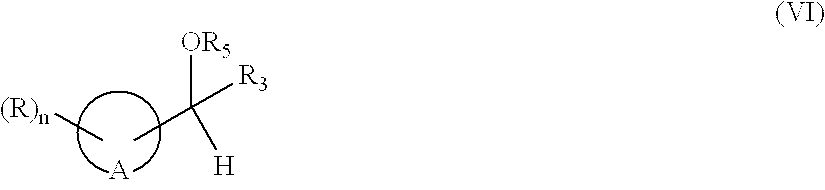
wherein R5, has the meanings given in claim 71 ,
R3 represents a linear or branched, saturated or unsaturated aliphatic group comprising 1 to 24 carbon atoms; a monocyclic or polycyclic, saturated, unsaturated or aromatic cycloaliphatic group comprising 3 to 8 carbon atoms;
or a linear or branched, saturated or unsaturated aliphatic group carrying a cyclic substituent,
A represents the residue of a ring forming all or a portion of an aromatic, monocyclic or polycyclic, carbocyclic or heterocyclic system, said cyclic residue optionally carrying a group R representing a hydrogen atom or one or more identical or different substituents, and
n represents the number of substituents on the ring.
85. A process according to claim 71 , wherein the etherified benzyl alcohol compound obtained has formula (VI′): 
wherein R5 has the meanings given in claim 71 ,
R3 represents a linear or branched, saturated or unsaturated aliphatic group comprising 1 to 24 carbon atoms; a monocyclic or polycyclic, saturated, unsaturated or aromatic cycloaliphatic group comprising 3 to 8 carbon atoms; or a linear or branched, saturated or unsaturated aliphatic group carrying a cyclic substituent,
Y represents an oxygen atom or a sulphur atom,
R′ represents a hydrocarbon group comprising 1 to 24 carbon atoms,
A represents the residue of a ring forming all or a portion of an aromatic, monocyclic or polycyclic, carbocyclic or heterocyclic system, said cyclic residue optionally carrying a group R representing a hydrogen atom or one or more identical or different substituents, and
n represents the number of substituents on the ring.
86. A process according to claim 71 , wherein the etherified benzyl alcohol compound obtained has formula (VIa): 
wherein R5 has the meanings given in claim 71 ,
R3 represents a linear or branched, saturated or unsaturated aliphatic group comprising 1 to 24 carbon atoms; a monocyclic or polycyclic, saturated, unsaturated or aromatic cycloaliphatic group comprising 3 to 8 carbon atoms;
or a linear or branched, saturated or unsaturated aliphatic group carrying a cyclic substituent,
R represents a hydrogen atom or one or more identical or different substituents, and
n represents the number of substituents on the ring.
Applications Claiming Priority (3)
| Application Number | Priority Date | Filing Date | Title |
|---|---|---|---|
| FR9900171 | 1999-01-08 | ||
| FR9900171A FR2788269B1 (en) | 1999-01-08 | 1999-01-08 | PROCESS FOR THE PREPARATION OF A BENZYL ETHER |
| PCT/FR2000/000024 WO2000040535A1 (en) | 1999-01-08 | 2000-01-07 | Method for preparing a benzylic-type ether |
Publications (1)
| Publication Number | Publication Date |
|---|---|
| US6608232B1 true US6608232B1 (en) | 2003-08-19 |
Family
ID=9540733
Family Applications (1)
| Application Number | Title | Priority Date | Filing Date |
|---|---|---|---|
| US09/869,743 Expired - Fee Related US6608232B1 (en) | 1999-01-08 | 2000-01-07 | Method for preparing a benzylic-type ether |
Country Status (9)
| Country | Link |
|---|---|
| US (1) | US6608232B1 (en) |
| EP (1) | EP1140758A1 (en) |
| JP (1) | JP2002534403A (en) |
| CN (1) | CN1341090A (en) |
| AU (1) | AU3051400A (en) |
| FR (1) | FR2788269B1 (en) |
| HU (1) | HUP0104918A3 (en) |
| IL (1) | IL144176A0 (en) |
| WO (1) | WO2000040535A1 (en) |
Cited By (5)
| Publication number | Priority date | Publication date | Assignee | Title |
|---|---|---|---|---|
| US20090326280A1 (en) * | 2008-06-27 | 2009-12-31 | Todd Coleman | Systems and Methods for the Preparation of Alkyl Aryl Ethers |
| US20110130482A1 (en) * | 2004-09-29 | 2011-06-02 | Pretor Roger | Process for preparing armatic thiophenyl ketones |
| WO2012123714A1 (en) | 2011-03-11 | 2012-09-20 | Rothamsted Research Limited | Compositions and methods for controlling pesticide resistant pests |
| US8759597B2 (en) | 2012-04-18 | 2014-06-24 | Uop Llc | Methods for producing zeolite catalysts and methods for producing alkylated aromatic compounds using the zeolite catalysts |
| CN112811991A (en) * | 2021-02-01 | 2021-05-18 | 惠泽化学科技(濮阳)有限公司 | Synthesis method of p-methoxystyrene |
Families Citing this family (9)
| Publication number | Priority date | Publication date | Assignee | Title |
|---|---|---|---|---|
| US7166756B2 (en) * | 2003-02-14 | 2007-01-23 | Exxonmobil Research And Engineering Company | Method for hydrocarbon isomerization |
| JP5747348B2 (en) * | 2011-11-25 | 2015-07-15 | 東レ・ファインケミカル株式会社 | Method for producing benzyl ether compound |
| CN103304392A (en) * | 2012-03-06 | 2013-09-18 | 北京澳林森科技有限公司 | Green synthesizing method of p-isobutyl acetophenone |
| CN103951548B (en) * | 2014-04-23 | 2015-06-17 | 宿迁科思化学有限公司 | Preparation method of intermediate for synthesizing anise camphor |
| CN105622363B (en) * | 2014-11-04 | 2017-12-08 | 南京工业大学 | Process for preparing vanillyl alcohol ether by one-step method |
| CN108658734A (en) * | 2017-04-01 | 2018-10-16 | 滕州市天水生物科技有限公司 | A kind of technique producing vanillic alcohol butyl ether |
| CN116440889A (en) * | 2018-07-02 | 2023-07-18 | 帝斯曼知识产权资产管理有限公司 | Method for selectively acylating primary hydroxyl groups in the presence of secondary hydroxyl groups and catalysts therefor |
| FR3099478B1 (en) * | 2019-07-30 | 2021-07-09 | Rhodia Operations | Process for treating a composition comprising natural vanillin |
| CN112058304B (en) * | 2019-11-20 | 2023-04-25 | 榆林学院 | A bifunctional catalyst capable of adjusting solid acidity, preparation method and application thereof |
Citations (7)
| Publication number | Priority date | Publication date | Assignee | Title |
|---|---|---|---|---|
| DE4434823A1 (en) | 1994-09-29 | 1996-04-04 | Merck Patent Gmbh | Continuous prodn. of hydroxy-benzyl alkyl ether |
| US5614641A (en) * | 1992-07-02 | 1997-03-25 | Elf Aquitaine | Process for enantioselective hydrogenation of the oxo C═O double bond |
| US5648548A (en) * | 1995-03-14 | 1997-07-15 | Takasago International Corporation | Optically active asymmetric diphosphine and process for producing optically active substance in its presence |
| WO1997048665A1 (en) | 1996-06-20 | 1997-12-24 | Rhodia Chimie | Acylation method for an aromatic compound |
| WO1998022416A1 (en) | 1996-11-18 | 1998-05-28 | Agro-Chemie Növényvédöszer Gyártó Értékesitó És Forgalmazó Kft. | Process for the preparation of benzyl-ethers |
| WO1999002475A1 (en) | 1997-07-09 | 1999-01-21 | Rhodia Chimie | Method for etherifying a benzyl alcohol, resulting products and applications |
| WO1999006343A1 (en) | 1997-07-31 | 1999-02-11 | Agro-Chemie Növenyvedöszer Gyarto Ertekesitö Es Forgalmazo Kft. | Process for the preparation of 1-(3,4-dimethoxyphenyl)ethanol |
-
1999
- 1999-01-08 FR FR9900171A patent/FR2788269B1/en not_active Expired - Fee Related
-
2000
- 2000-01-07 US US09/869,743 patent/US6608232B1/en not_active Expired - Fee Related
- 2000-01-07 EP EP00900536A patent/EP1140758A1/en not_active Withdrawn
- 2000-01-07 IL IL14417600A patent/IL144176A0/en unknown
- 2000-01-07 HU HU0104918A patent/HUP0104918A3/en unknown
- 2000-01-07 AU AU30514/00A patent/AU3051400A/en not_active Abandoned
- 2000-01-07 WO PCT/FR2000/000024 patent/WO2000040535A1/en not_active Ceased
- 2000-01-07 JP JP2000592247A patent/JP2002534403A/en not_active Withdrawn
- 2000-01-07 CN CN00804086A patent/CN1341090A/en active Pending
Patent Citations (9)
| Publication number | Priority date | Publication date | Assignee | Title |
|---|---|---|---|---|
| US5614641A (en) * | 1992-07-02 | 1997-03-25 | Elf Aquitaine | Process for enantioselective hydrogenation of the oxo C═O double bond |
| DE4434823A1 (en) | 1994-09-29 | 1996-04-04 | Merck Patent Gmbh | Continuous prodn. of hydroxy-benzyl alkyl ether |
| US5648548A (en) * | 1995-03-14 | 1997-07-15 | Takasago International Corporation | Optically active asymmetric diphosphine and process for producing optically active substance in its presence |
| WO1997048665A1 (en) | 1996-06-20 | 1997-12-24 | Rhodia Chimie | Acylation method for an aromatic compound |
| US6194616B1 (en) * | 1996-06-20 | 2001-02-27 | Rhodia Chimie | Acylation method for an aromatic compound |
| WO1998022416A1 (en) | 1996-11-18 | 1998-05-28 | Agro-Chemie Növényvédöszer Gyártó Értékesitó És Forgalmazó Kft. | Process for the preparation of benzyl-ethers |
| WO1999002475A1 (en) | 1997-07-09 | 1999-01-21 | Rhodia Chimie | Method for etherifying a benzyl alcohol, resulting products and applications |
| US6362378B1 (en) * | 1997-07-09 | 2002-03-26 | Rhodia Chimie | Method for etherifying a benzyl alcohol, resulting products and applications |
| WO1999006343A1 (en) | 1997-07-31 | 1999-02-11 | Agro-Chemie Növenyvedöszer Gyarto Ertekesitö Es Forgalmazo Kft. | Process for the preparation of 1-(3,4-dimethoxyphenyl)ethanol |
Non-Patent Citations (2)
| Title |
|---|
| International Search Report. |
| XP-002056679 M.J. Climent: "Hydride transfer reactions of benzylic alcohols catalyzed by acid faujasites" Recueil Des Travaux Chimiques Des Pays-Bas, vol. 110, No. 6, Jun. 1991, pp. 275-278. |
Cited By (6)
| Publication number | Priority date | Publication date | Assignee | Title |
|---|---|---|---|---|
| US20110130482A1 (en) * | 2004-09-29 | 2011-06-02 | Pretor Roger | Process for preparing armatic thiophenyl ketones |
| US20090326280A1 (en) * | 2008-06-27 | 2009-12-31 | Todd Coleman | Systems and Methods for the Preparation of Alkyl Aryl Ethers |
| WO2012123714A1 (en) | 2011-03-11 | 2012-09-20 | Rothamsted Research Limited | Compositions and methods for controlling pesticide resistant pests |
| US10104890B2 (en) | 2011-03-11 | 2018-10-23 | Rothamsted Research Limited | Compositions and methods for controlling pesticide resistant pests |
| US8759597B2 (en) | 2012-04-18 | 2014-06-24 | Uop Llc | Methods for producing zeolite catalysts and methods for producing alkylated aromatic compounds using the zeolite catalysts |
| CN112811991A (en) * | 2021-02-01 | 2021-05-18 | 惠泽化学科技(濮阳)有限公司 | Synthesis method of p-methoxystyrene |
Also Published As
| Publication number | Publication date |
|---|---|
| AU3051400A (en) | 2000-07-24 |
| HUP0104918A2 (en) | 2002-04-29 |
| WO2000040535A1 (en) | 2000-07-13 |
| FR2788269A1 (en) | 2000-07-13 |
| EP1140758A1 (en) | 2001-10-10 |
| CN1341090A (en) | 2002-03-20 |
| JP2002534403A (en) | 2002-10-15 |
| HUP0104918A3 (en) | 2003-08-28 |
| IL144176A0 (en) | 2002-05-23 |
| FR2788269B1 (en) | 2001-02-09 |
Similar Documents
| Publication | Publication Date | Title |
|---|---|---|
| US6194616B1 (en) | Acylation method for an aromatic compound | |
| HUP0104918A2 (en) | Method for preparing a benzylic-type ether derivatives | |
| JP5688093B2 (en) | Method for producing Gerve alcohol | |
| EP2319621A2 (en) | Base stable ionic liquids | |
| Shen et al. | Catalytic O-methylation of phenols with dimethyl carbonate to aryl methyl ethers using [BMIm] Cl | |
| JP4685314B2 (en) | Method for producing cyclohexanol | |
| Patil et al. | Benzoylation of anisole over borate zirconia solid acid catalyst | |
| WO2000073256A1 (en) | Process for co-production of dialkyl carbonate and alkanediol | |
| US5817878A (en) | Process for the acylation of aromatic ethers | |
| US6184418B1 (en) | Aromatic compound acylation method | |
| US5298650A (en) | Process for producing organic esters by reacting a carboxylic acid and a dialkyl ether | |
| JP2003521436A (en) | Method for etherifying benzylic alcohol, resulting product and use | |
| Blanco et al. | Alkylation of naphthalene using three different ionic liquids | |
| JP5825027B2 (en) | Method for producing diol compound | |
| US20020120169A1 (en) | Process facilitating the regeneration of a catalyst based on a zeolite used in an acylation reaction, catalyst and use | |
| Selva et al. | Esters and orthoesters as alkylating agents at high temperature. Applications to continuous-flow processes | |
| JP3825474B2 (en) | Process for hydroxyalkylation of carbocyclic aromatic ethers | |
| KR100618367B1 (en) | Process for production of 4-alkylphenols | |
| US6013840A (en) | Process for the acylation of aromatic ethers | |
| US6900359B2 (en) | Production of 3-alkylcycloalkanols | |
| EP0594283A1 (en) | Synthesis of alkyl tert-alkyl ether using fluorophosphoric acid-modified clay catalysts | |
| MXPA99000055A (en) | Acilation process for an aromat compound | |
| Yu et al. | Cyclotrimerization of aliphatic aldehydes catalyzed by ionic liquids | |
| EP0227331B1 (en) | Process for producing 2-hydroxyphenyl lower alkyl ketones | |
| EP0434517A2 (en) | Process for the preparation of mono- or poly-alkoxylated aromatic compounds |
Legal Events
| Date | Code | Title | Description |
|---|---|---|---|
| AS | Assignment |
Owner name: RHODIA CHIMIE, FRANCE Free format text: ASSIGNMENT OF ASSIGNORS INTEREST;ASSIGNORS:JACQUOT, ROLAND;SPAGNOL, MICHEL;REEL/FRAME:012193/0402 Effective date: 20010719 |
|
| REMI | Maintenance fee reminder mailed | ||
| LAPS | Lapse for failure to pay maintenance fees | ||
| STCH | Information on status: patent discontinuation |
Free format text: PATENT EXPIRED DUE TO NONPAYMENT OF MAINTENANCE FEES UNDER 37 CFR 1.362 |
|
| FP | Lapsed due to failure to pay maintenance fee |
Effective date: 20070819 |