US6558117B1 - Variable displacement turbo supercharger - Google Patents

Variable displacement turbo supercharger Download PDF

Info

Publication number
US6558117B1
US6558117B1 US09/623,199 US62319901A US6558117B1 US 6558117 B1 US6558117 B1 US 6558117B1 US 62319901 A US62319901 A US 62319901A US 6558117 B1 US6558117 B1 US 6558117B1
Authority
US
United States
Prior art keywords
guide vane
flow passage
variable geometry
turbine rotor
geometry turbocharger
Prior art date
Legal status (The legal status is an assumption and is not a legal conclusion. Google has not performed a legal analysis and makes no representation as to the accuracy of the status listed.)
Expired - Fee Related
Application number
US09/623,199
Inventor
Masashi Fukaya
Yasunori Murakami
Tetsuo Udagawa
Tsutomu Okazaki
Current Assignee (The listed assignees may be inaccurate. Google has not performed a legal analysis and makes no representation or warranty as to the accuracy of the list.)
Hitachi Ltd
Hitachi Astemo Ltd
Original Assignee
Hitachi Ltd
Hitachi Car Engineering Co Ltd
Priority date (The priority date is an assumption and is not a legal conclusion. Google has not performed a legal analysis and makes no representation as to the accuracy of the date listed.)
Filing date
Publication date
Application filed by Hitachi Ltd, Hitachi Car Engineering Co Ltd filed Critical Hitachi Ltd
Assigned to HITACHI, LTD., HITACHI CAR ENGINEERING CO., LTD. reassignment HITACHI, LTD. ASSIGNMENT OF ASSIGNORS INTEREST (SEE DOCUMENT FOR DETAILS). Assignors: MURAKAMI, YASUNORI, OKAZAKI, TSUTOMU, UDAGAWA, TETSUO, FUKAYA, MASASHI
Application granted granted Critical
Publication of US6558117B1 publication Critical patent/US6558117B1/en
Anticipated expiration legal-status Critical
Expired - Fee Related legal-status Critical Current

Links

Images

Classifications

    • FMECHANICAL ENGINEERING; LIGHTING; HEATING; WEAPONS; BLASTING
    • F01MACHINES OR ENGINES IN GENERAL; ENGINE PLANTS IN GENERAL; STEAM ENGINES
    • F01DNON-POSITIVE DISPLACEMENT MACHINES OR ENGINES, e.g. STEAM TURBINES
    • F01D17/00Regulating or controlling by varying flow
    • F01D17/10Final actuators
    • F01D17/12Final actuators arranged in stator parts
    • F01D17/14Final actuators arranged in stator parts varying effective cross-sectional area of nozzles or guide conduits
    • F01D17/16Final actuators arranged in stator parts varying effective cross-sectional area of nozzles or guide conduits by means of nozzle vanes
    • F01D17/165Final actuators arranged in stator parts varying effective cross-sectional area of nozzles or guide conduits by means of nozzle vanes for radial flow, i.e. the vanes turning around axes which are essentially parallel to the rotor centre line
    • FMECHANICAL ENGINEERING; LIGHTING; HEATING; WEAPONS; BLASTING
    • F02COMBUSTION ENGINES; HOT-GAS OR COMBUSTION-PRODUCT ENGINE PLANTS
    • F02BINTERNAL-COMBUSTION PISTON ENGINES; COMBUSTION ENGINES IN GENERAL
    • F02B37/00Engines characterised by provision of pumps driven at least for part of the time by exhaust
    • F02B37/12Control of the pumps
    • F02B37/24Control of the pumps by using pumps or turbines with adjustable guide vanes
    • YGENERAL TAGGING OF NEW TECHNOLOGICAL DEVELOPMENTS; GENERAL TAGGING OF CROSS-SECTIONAL TECHNOLOGIES SPANNING OVER SEVERAL SECTIONS OF THE IPC; TECHNICAL SUBJECTS COVERED BY FORMER USPC CROSS-REFERENCE ART COLLECTIONS [XRACs] AND DIGESTS
    • Y02TECHNOLOGIES OR APPLICATIONS FOR MITIGATION OR ADAPTATION AGAINST CLIMATE CHANGE
    • Y02TCLIMATE CHANGE MITIGATION TECHNOLOGIES RELATED TO TRANSPORTATION
    • Y02T10/00Road transport of goods or passengers
    • Y02T10/10Internal combustion engine [ICE] based vehicles
    • Y02T10/12Improving ICE efficiencies

Definitions

  • the present invention relates to a variable geometry turbocharger in which rotatable guide vanes surrounding a turbine rotor are arranged within a turbine chamber and a keeping function for keeping a gap between both side walls sectioning the turbine chamber and the guide vanes is provided.
  • variable turbine nozzle provided with rod-like flow passage spacers, in which the flow passage spacers are arranged in an outer edge portion of a whole of the vanes in a radial direction and the axial length of the flow passage spacer is set to be slightly longer than the axial length of the vane.
  • one of the flow passage spacers is preferably press fitted into and fixed within a hole portion provided in a nozzle ring.
  • At least three additional flow passage spacers are arranged so as to be apart from each other with a uniform interval and have a predetermined space between the nozzle ring and an inner wall.
  • the structure is made such that guide vanes are arranged within a turbine chamber of a turbocharger so as to surround a turbine rotor, at least one of the guide vanes is fixed between both of the side walls of the turbine chamber and a blade angle of the other guide vanes can be adjusted.
  • it is possible to keep a gap between both of the side walls of the turbine chamber and the movable guide vane minimum and it is possible to keep a high turbine efficiency.
  • a separation area is formed at the back of each of the flow passage spacers with respect to a stream of gas and a hydraulic energy loss is generated. Further, the separation area extends downstream as a wake so as to reduce an average flow speed at a position of an inlet of the turbine rotor and generate an uneven flow speed distribution in a peripheral direction, whereby a reduction of the turbine efficiency is caused. Further, due to some rotational angles of the guide vane, a stream between the flow passage spacer and the guide vane does not move along the guide vane and there is generated a state that the separation area is formed inside the guide vane. At this time, the wake from the guide vane involving the separation area increases its length downstream, whereby the turbine efficiency is further reduced.
  • Japanese Patent Unexamined Publication No. 2-196131 does not refer to the gas stream and does not describe a shape and a size of the guide vane with taking the separation area into consideration.
  • An object of the present invention is to provide a variable geometry turbocharger which can achieve a high turbine efficiency by preventing a gas stream from being separated at the back of a flow passage spacer and inside a guide vane so as to reduce a hydraulic energy loss and realize a uniform and high average flow speed distribution at a position of an inlet of a turbine rotor.
  • a bill-like projection portion is arranged in a part of an outer periphery of a flow passage spacer, and the projection portion is protruded to a turbine rotor side at a predetermined angle or the projection portion is movably provided.
  • a rod-like member is arranged in a part of an outer periphery of a flow passage spacer and the rod-like member is arranged so as to be adjacent to the turbine rotor side at a predetermined angle.
  • a guide vane in which the leading edge side of the rotational shaft is eliminated is arranged in a part of an outer periphery of a flow passage spacer and the rotational shaft is arranged so as to be adjacent to the turbine rotor side at a predetermined angle. Accordingly, the gas stream is prevented from being separated at the back of the flow passage spacer and inside the guide vane, and a high turbine efficiency can be obtained.
  • a heat resisting cast steel having a little carbon content is employed as a material for a casing sectioning the turbine chamber and a guide vane table.
  • a casing wall and the wall of the guide vane table themselves keep a gap with respect to the guide vane minimum. Accordingly, it is possible to prevent the gas separation from being generated due to the flow passage spacer, and a high turbine efficiency can be obtained.
  • FIG. 1 is a cross sectional view of a turbine portion of a variable geometry turbocharger in accordance with a first embodiment of the present invention
  • FIG. 2 is a cross sectional view taken along a line A-A′ of the turbine portion in FIG. 1;
  • FIG. 3 is a view which shows a periphery of a flow passage spacer in a cross section taken along a line B-B′ in FIG. 1;
  • FIG. 4 is a view which shows a gas flow in a periphery of a flow passage spacer and a guide vane in accordance with a conventional embodiment employing no bill-like projection portion;
  • FIG. 5 is a view which shows a difference of a flow speed distribution in a peripheral direction at a position of an inlet of a turbine rotor in accordance with the conventional embodiment and the present embodiment in the invention
  • FIG. 6 is a view which shows a gas stream in a periphery of a flow passage spacer and a guide vane in accordance with the first embodiment of the present invention
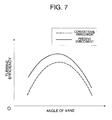
  • FIG. 7 is a view which shows a difference of a turbine efficiency in accordance with the conventional embodiment and the present embodiment in the invention.
  • FIG. 8 is a perspective view which shows a structure in a periphery of a flow passage spacer and a bill-like projection portion in the case of making the bill-like projection portion movable;
  • FIG. 9 is a view which shows a gas stream in a periphery of a flow passage spacer and a guide vane in the case of employing a movable bill-like projection portion;
  • FIG. 10 is a view which shows a gas stream in a periphery of a flow passage spacer and a guide vane in accordance with a second embodiment of the present invention.
  • FIG. 11 is a cross sectional view of a flow passage spacer and a rod-like member in accordance with the second embodiment of the present invention.
  • FIG. 12 is a cross sectional view of a turbine portion of a variable geometry turbocharger in accordance with a third embodiment of the present invention.
  • FIGS. 13A to 13 C are views which show a flow passage spacer shape in the case of changing an arrangement of a flow passage spacer and a guide vane, in the third embodiment of the present invention.
  • FIG. 14 is a cross sectional view of a turbine portion of a variable geometry turbocharger in accordance with a fourth embodiment of the present invention.
  • FIG. 15 is a cross sectional view taken along a line A-A′ of the turbine portion in FIG. 14 .
  • FIG. 1 shows a first embodiment of a turbine portion of a variable geometry turbocharger in accordance with the present invention.
  • the turbine portion is constituted of a casing 1 , rotatable guide vanes 2 arranged within the casing 1 , a flow passage spacer 3 having a cylindrical figuration and arranged between pitches of guide vanes 2 , a bill-like projection portion 4 positioned in a part of an outer periphery of the flow passage spacer 3 , and a turbine rotor 5 positioned inside the guide vanes 2 , the flow passage spacer 3 and the bill-like projection portion 4 .
  • an angle ⁇ is defined by a magnitude of an angle OO′P formed by an axial center O of the turbine rotor 5 , a center O′ of the flow passage spacer 3 and a projection edge point P of the bill-like projection portion 4 .
  • the angle ⁇ is preferably set to about 45 degrees.
  • Each of the guide vanes 2 is supported by a rotational shaft 7 extending outward of a guide vane table 6 , and is rotated together with the rotational shaft 7 by an external drive mechanism (not shown).
  • an outer diameter of the turbine rotor 5 is about 40 mm, and a distance between an axial center of the rotational shaft 7 of the guide vane 2 and an axial center O of the turbine rotor 5 is about 35 mm. Further, a distance between a center O′ of the flow passage spacer 3 and the axial center O of the turbine rotor 5 is about 38 mm.
  • a chord length of the guide vane 2 is about 20 mm and a maximum vane thickness is about 3 mm. Taking a stress due to a thermal deformation of the casing 1 and the guide vane table 6 into consideration, an outer diameter of the flow passage spacer 3 is set to about 9 mm. Further, a width C and a length L of the bill-like projection portion 4 are substantially the same as the outer diameter of the flow passage spacer 3 .
  • the number of the flow passage spacer 3 is three and the flow passage spacers 3 are placed at positions uniformly separating the periphery into three portions in a peripheral direction. Each three of nine guide vanes 2 are periodically symmetrically arranged, and the guide vanes 2 are arranged in an uneven pitch on the whole.
  • FIG. 2 shows a cross section taken along a line A-A′ in FIG. 1.
  • a bolt 8 extends through the guide vane table 6 and the flow passage spacer 3 , and is fastened to the casing 1 .
  • a material having the same coefficient of linear expansion as that of the guide vanes 2 (for example, SCH22 (JIS standard)) is employed for a material of the flow passage spacer 3 and the bolt 8 .
  • a width hs of the flow passage spacer 3 is designed to be slightly larger than a width hn of the guide vanes 2 , whereby a gap between both of the side walls of the casing 1 and the guide vane table 6 sectioning the turbine chamber, and the guide vanes 2 can be kept minimum.
  • the bill-like projection portion 4 Only the pin 9 supports the bill-like projection portion 4 , however, a part of the bill-like projection portion 4 is structured such as to be closely attached along a cylindrical figuration of the flow passage spacer 3 as shown in FIG. 1, so that the bill-like projection portion 4 does not widely swing around the pin 9 .
  • the bill-like projection portion 4 may be supported by utilizing any one of the side wall of the casing 1 and the side wall of the guide vane table 6 . Further, in place of the pin 9 , the bill-like projection portion 4 may be supported by screws or welding.
  • gas introduced from an inlet of the casing 1 is introduced to the turbine rotor 5 via a flow passage formed between the guide vanes 2 or between the guide vane 2 and the flow passage spacer 3 . It is possible to simultaneously reduce a flow passage width Wn between the guide vanes 2 and a flow passage width Ws between the guide vane 2 and the flow passage spacer 3 by changing a rotational angle of the guide vane 2 , and it is possible to increase a speed of the gas so as to flow the gas into the turbine rotor 5 . Accordingly, since the number of rotation of the turbine rotor 5 can be increased and a compressor impeller (not shown) being concentric with the turbine rotor 5 is also rotated at a high speed, a turbocharging effect can be obtained.
  • the bill-like projection portion 4 is arranged in a part of the outer periphery of the flow passage spacer 3 having a cylindrical figuration, however, in the conventional case which does not employ this structure, as shown in FIG. 4, a separation area Rs is formed at the back of the flow passage spacer 3 with respect to the stream of the gas supplied from the inlet of the casing 1 . Further, in a state that a leading edge 2 a of the guide vane comes near the flow passage spacer 3 as shown in FIG. 4, the stream between the flow passage spacer 3 and the guide vane 2 does not flow along the guide vane 2 and a separation area Rn is also formed inside the guide vane 2 .
  • a hydraulic energy loss due to the separation of the stream mentioned above causes a reduction of the turbine efficiency. Further, a wake having a low flow speed long extends downstream from the separation area generated around the flow passage spacer 3 or the guide vane 2 . Accordingly, as shown in FIG. 5, a flow speed distribution in a peripheral direction at an inlet position of the turbine rotor 5 becomes an uneven distribution having a peak X of a low flow speed. Accordingly, the loss in the turbine rotor 5 is increased, and a high turbine efficiency can not be obtained.
  • FIG. 6 shows a state of the stream of the gas in the periphery of the flow passage spacer 3 and the guide vane 2 in accordance with the present embodiment.
  • the present embodiment it is possible to prevent the separation area from being generated at the back of the flow passage spacer 3 by providing the bill-like projection portion 4 .
  • the bill-like projection portion 4 presses the stream between the flow passage spacer 3 and the guide vane 2 to the guide vane 2 side, and the stream moves along the inner side of the guide vane 2 , the separation area is not formed. Accordingly, it is possible to prevent the hydraulic energy loss from being generated due to the separation of the stream.
  • the separation area is not generated, the length of the wake from the flow passage spacer 3 or the guide vane 2 can be shortened.
  • the peak X of the low flow speed is reduced, and the flow speed distribution in the peripheral direction at the inlet position of the turbine rotor 5 becomes more uniform in comparison with the conventional one, as shown in FIG. 5, so that the loss in the turbine rotor 5 is reduced.
  • an average flow speed in the peripheral direction at the inlet position of the turbine rotor 5 is increased, whereby an amount of work performed by the stream of the gas in the turbine rotor 5 is increased.
  • the bill-like projection portion 4 and the flow passage spacer 3 are constituted by independent parts, however, the same operations and effects can be obtained even by integrally forming the flow passage spacer 3 with the bill-like projection portion 4 .
  • FIG. 8 shows an embodiment in which the bill-like projection portion 4 is movably provided.
  • the bill-like projection portion 4 is bonded to the rotational shaft 7 via an arm 10 by welding or the like.
  • the flow passage spacer 3 is fixed to the side wall of the casing 1 and the side wall of the guide vane table 6 by welding or the like without using the bolts 8 .
  • a notch portion 3 a is provided in a part of the cylindrical flow passage spacer 3 .
  • the rotational shaft 7 is arranged within the flow passage spacer 3
  • the arm 10 is structured such as to be movable in a peripheral direction within the notch portion 3 a of the flow passage spacer 3 .
  • the bill-like projection portion 4 in accordance with the present embodiment can rotate within a range between 15 degrees and 75 degrees via the rotational shaft 7 by an external drive mechanism (not shown).
  • the external drive mechanism for moving the bill-like projection portion 4 is structured such as to commonly serve a drive mechanism for moving the guide vane 2 , whereby it is not necessary to add another drive mechanism.
  • the structure shown in FIG. 8 can change states from a state shown by a chain line to a state shown by a solid line in FIG. 9 .
  • the state (shown by the solid line) that the leading edge 2 a of the guide vane comes near the flow passage spacer 3 it is possible to move the edge point P of the bill-like projection portion 4 closer to the guide vane 2 than the state shown in FIG. 6 .
  • the stream between the flow passage spacer 3 and the guide vane 2 can be contracted due to the reduction of the flow passage area, and a speed increasing effect can be improved.
  • the flow speed distribution in the peripheral direction at the inlet position of the turbine rotor 5 becomes more uniform and the average flow speed is increased, whereby a turbine efficiency can be improved.
  • the bill-like projection portion 4 moves to a position shown by a chain line, so that the rotation of the guide vane 2 is not prevented.
  • the bill-like projection 4 , the rotational shaft 7 and the arm 10 may be integrally structured.
  • FIG. 10 shows a second embodiment of a turbine portion of a variable geometry turbocharger in accordance with the present invention.
  • a structure of the present embodiment is substantially the same as the structure of the first embodiment, however, there is a difference in view that a rod-like member 11 having an outer diameter of about 4 mm is arranged in place of the bill-like projection portion 4 .
  • the angle ⁇ is defined by a magnitude of an angle OO′Q using a center Q of the rod-like member 11 .
  • FIG. 11 shows a cross sectional view of the flow passage spacer 3 and the rod-like member 11 .
  • Holes respectively having depths hc and hg are provided in the side walls of the casing 1 and the guide vane table 6 , and both end portions of the rod-like member 11 are inserted into the respective holes.
  • a length hL of the rod-like member 11 is larger than the width hs of the flow passage spacer 3 and smaller than the width (hs+hc+hg).
  • the rod-like member 11 may be fixed by utilizing any one of the side wall of the casing 1 and the side wall of the guide vane table 6 . Further, the rod-like member 11 may be fixed by the screw or welding without providing the holes in the side walls of the casing 1 and the guide vane table 6 .
  • the separation area is reduced, the length of the wake from the flow passage spacer 3 or the guide vane 2 can be shortened.
  • the flow speed distribution in the peripheral direction at the inlet position of the turbine rotor 5 becomes more uniform in comparison with the conventional one, so that the loss in the turbine rotor 5 is reduced.
  • an average flow speed in the peripheral direction at the inlet position of the turbine rotor 5 is increased, whereby an amount of work performed by the stream of the gas in the turbine rotor 5 is increased. Therefore, in accordance with the present embodiment, a higher turbine efficiency than the conventional case can be realized by employing the rod-like member 11 .
  • FIG. 12 shows a third embodiment of a turbine portion of a variable geometry turbocharger in accordance with the present invention.
  • the bill-like projection portion 4 is arranged at the back of the flow passage spacer 3 in accordance with the first embodiment shown in FIG. 1, however, a guide vane 12 in which a leading edge side of the rotational shaft 7 is eliminated is arranged in accordance with the present embodiment.
  • the angle ⁇ is defined by a magnitude of an angle OO′R using a center R of the rotational shift 7 of the guide vane 12 .
  • the guide vanes 2 and 12 are supported by the rotational shafts 7 extending outward the guide vane table 6 and are simultaneously rotated via the rotational shafts 7 by an external drive mechanism (not shown).
  • a distance between an axial center of the rotational shafts 7 of the guide vanes 2 and 12 and the axial center O of the turbine rotor 5 is about 33 mm, and a distance between the center O′ of the flow passage spacer 3 and the axial center of the turbine rotor 5 is about 42 mm.
  • the guide vanes 2 and 12 are all arranged at an equal pitch by arranging the flow passage spacer 3 to an outer side and the rotational shafts 7 to an inner side in comparison with the first embodiment.
  • the guide vane 12 prevents the separation area from being generated at the back of the flow passage spacer 3 . Further, the guide vane 12 presses the stream between the flow passage spacer 3 and the guide vane 2 to the guide vane 2 side even in the state that the leading edge 2 a of the guide vane comes near the flow passage spacer 3 , the separation area is not generated inside the guide vane 2 . Accordingly, it is possible to reduce the fluid energy loss generated by the separation of the stream.
  • the guide vanes 2 and 12 are arranged to the inner side in comparison with the first embodiment. Accordingly, between the guide vanes 2 and 12 and the inlet of the turbine rotor 5 , it is possible to reduce a damping of the flow speed due to a friction on the side walls of the casing 1 and the guide vane table 6 A.
  • the gap between the flow passage spacer 3 and the guide vane 12 generates a turbulence of the stream and generates a hydraulic energy loss.
  • the guide vane 12 is preferably arranged close to the flow passage spacer 3 .
  • a recess is provided in a part of the outer periphery of the flow passage spacer 3 and in FIG. 13B, a part of the outer periphery of the flow passage spacer 3 is notched out, whereby the guide vane 12 is arranged closer than the case shown in FIG. 12 . Further, in FIG.
  • the flow passage spacer 3 having a part of the outer periphery being notched out is fixed to the casing 1 and the guide vane table 6 by welding or the like without using the bolts 8 , whereby the guide vane 12 is arranged close to the flow passage spacer 3 .
  • FIG. 14 is a fourth embodiment of a turbine portion of a variable geometry turbocharger in accordance with the present invention.
  • the flow passage spacer 3 for keeping the gap between both of the side walls and the guide vanes 2 minimum is employed.
  • the flow passage spacer 3 is not used and twelve guide vanes 2 are arranged at an equal pitch.
  • a distance between the axial center of the rotational shaft 7 of each of the guide vanes 2 and the axial center O of the turbine rotor 5 is about 35 mm.
  • Three bolts 13 each having an outer diameter of 5 mm are arranged at positions uniformly separated into three portions in a peripheral direction. Further, a distance between the center of the bolt 13 and the axial center O of the turbine rotor is about 58 mm.
  • FIG. 15 shows a cross section taken along a line A-A′ in FIG. 14.
  • a bolt 13 having an outer diameter of 5 mm extends through a portion of the guide vane table 6 that extended to the casing 1 side and fastens the guide vane table 6 to the casing 1 .
  • a resist D5S (ATSM standard) is employed for a material of the casing 1
  • SUS304 JIS standard
  • SCH22 JIS standard
  • a heat resisting cast steel HK40 (ATSM standard) having a little amount of carbon is employed for a material of the casing 1 , the guide vane table 6 and the guide vane 2 .
  • HK40 a coefficient of linear expansion is 18.2 ⁇ 10 ⁇ 6 mm/° C. in a range between about 20 and 1000° C. which is smaller than the coefficient of linear expansion of the resist D5S 20.8 ⁇ 10 ⁇ 6 mm/° C.
  • the HK40 is substantially the same material as the SCH 22.
  • a distance between both of the side walls of the casing 1 and the guide vane table 6 is defined by ha ⁇ hb in FIG. 15, and is designed to be slightly larger than the width hn of the guide vane 2 .
  • a heating resisting cast steel having a small thermal deformation is employed for a material of the casing 1 and the guide vane table 6 . That is, since both of the side walls sectioning the turbine chamber are hardly thermally deformed, the structure is made such as to keep the gap with respect to the guide vane minimum. Since the flow passage spacer 3 is omitted, it is possible to prevent the separation of the gas generated by the flow passage spacer 3 , and it is possible to prevent the stream between the guide vanes 2 from being uneven by arranging the guide vanes at a uniform interval.
  • a high turbine efficiency can be obtained by reducing the fluid energy loss and realizing a high average flow speed at the inlet position of the turbine rotor 5 and a uniform flow speed distribution in the peripheral direction. Further, since the heat resisting cast steel contains a reduced amount of carbon, an oxidation resistance is improved and a deterioration of the material is suppressed.
  • the HK40 is employed as the heat resisting cast steel, however, the material is not limited to this, a material having a smaller coefficient of linear expansion than the HK40 may be employed for the material of each of the casing 1 , the guide vane table 6 and the guide vane 2 . Further, the number and the mounting position in the peripheral direction of the bolts 13 for fixing the guide vane table 6 to the casing 1 are not limited to those shown in the embodiments.
  • the straight vane member is employed for the guide vanes 2 and 12 , however, the present invention can be similarly applied to a variable geometry turbocharger employing a curved vane member.
  • the shape and the size of the bill-like projection portion 4 or the rod-like member 11 are not limited to those shown in the embodiments.
  • variable geometry turbocharger in accordance with the present invention is suitable for being used as an apparatus in an energy converting system of an automobile, a ship, an airplane, a power generator and the like.

Landscapes

  • Engineering & Computer Science (AREA)
  • Mechanical Engineering (AREA)
  • General Engineering & Computer Science (AREA)
  • Chemical & Material Sciences (AREA)
  • Combustion & Propulsion (AREA)
  • Supercharger (AREA)

Abstract

A variable geometry turbocharger in which a bill-like projection portion is arranged in a part of an outer periphery of a flow passage spacer, and the projection portion is protruded to a turbine rotor side at a predetermined angle or the projection portion is movably provided. Alternatively, a rod-like member is arranged in a part of an outer periphery of a flow passage spacer and the rod-like member is arranged so as to be adjacent to the turbine rotor side at a predetermined angle. Alternatively, a guide vane in which a leading edge side of a rotational shaft is eliminated is arranged in a part of an outer periphery of a flow passage spacer and the rotational shaft is arranged so as to be adjacent to the turbine rotor side at a predetermined angle. Further, a heat resisting cast steel having a little amount of carbon is employed as a material for a casing and a guide vane table sectioning the turbine chamber, and without using the flow passage spacer and in place of the flow passage spacer, both side walls sectioning the turbine chamber themselves keep a gap with respect to the guide vane minimum. Accordingly, a high turbine efficiency can be obtained by preventing a gas stream from being separated at the back of a flow passage spacer and inside a guide vane, since a hydraulic energy loss is reduced and a uniform and high average flow speed distribution is realized at a position of an inlet of a turbine rotor.

Description

FIELD OF THE INVENTION
The present invention relates to a variable geometry turbocharger in which rotatable guide vanes surrounding a turbine rotor are arranged within a turbine chamber and a keeping function for keeping a gap between both side walls sectioning the turbine chamber and the guide vanes is provided.
BACKGROUND ART
In a turbine of a conventional variable geometry turbocharger, in order to prevent a stick of the guide vanes (that is, the phenomenon that the guide vanes do not move) due to a thermal deformation of both of the side walls sectioning the turbine chamber, it is necessary to provide a gap between both of the side walls and the guide vanes, so that there is a problem that an efficiency of the turbine is reduced when the gap is increased.
In Japanese Patent Examined Publication No. 7-13468, there is shown an embodiment of a variable turbine nozzle provided with rod-like flow passage spacers, in which the flow passage spacers are arranged in an outer edge portion of a whole of the vanes in a radial direction and the axial length of the flow passage spacer is set to be slightly longer than the axial length of the vane. Further, one of the flow passage spacers is preferably press fitted into and fixed within a hole portion provided in a nozzle ring. At least three additional flow passage spacers are arranged so as to be apart from each other with a uniform interval and have a predetermined space between the nozzle ring and an inner wall.
Further, in Japanese Patent Unexamined Publication No. 2-196131, the structure is made such that guide vanes are arranged within a turbine chamber of a turbocharger so as to surround a turbine rotor, at least one of the guide vanes is fixed between both of the side walls of the turbine chamber and a blade angle of the other guide vanes can be adjusted. In accordance with the structure mentioned above, it is possible to keep a gap between both of the side walls of the turbine chamber and the movable guide vane minimum and it is possible to keep a high turbine efficiency.
However, in the case of employing the rod-like flow passage spacer described in the Japanese Patent Examined Publication No. 7-13468, a separation area is formed at the back of each of the flow passage spacers with respect to a stream of gas and a hydraulic energy loss is generated. Further, the separation area extends downstream as a wake so as to reduce an average flow speed at a position of an inlet of the turbine rotor and generate an uneven flow speed distribution in a peripheral direction, whereby a reduction of the turbine efficiency is caused. Further, due to some rotational angles of the guide vane, a stream between the flow passage spacer and the guide vane does not move along the guide vane and there is generated a state that the separation area is formed inside the guide vane. At this time, the wake from the guide vane involving the separation area increases its length downstream, whereby the turbine efficiency is further reduced.
Further, the Japanese Patent Unexamined Publication No. 2-196131 does not refer to the gas stream and does not describe a shape and a size of the guide vane with taking the separation area into consideration.
DISCLOSURE OF THE INVENTION
An object of the present invention is to provide a variable geometry turbocharger which can achieve a high turbine efficiency by preventing a gas stream from being separated at the back of a flow passage spacer and inside a guide vane so as to reduce a hydraulic energy loss and realize a uniform and high average flow speed distribution at a position of an inlet of a turbine rotor.
In accordance with the present invention, a bill-like projection portion is arranged in a part of an outer periphery of a flow passage spacer, and the projection portion is protruded to a turbine rotor side at a predetermined angle or the projection portion is movably provided. Alternatively, a rod-like member is arranged in a part of an outer periphery of a flow passage spacer and the rod-like member is arranged so as to be adjacent to the turbine rotor side at a predetermined angle. Alternatively, a guide vane in which the leading edge side of the rotational shaft is eliminated is arranged in a part of an outer periphery of a flow passage spacer and the rotational shaft is arranged so as to be adjacent to the turbine rotor side at a predetermined angle. Accordingly, the gas stream is prevented from being separated at the back of the flow passage spacer and inside the guide vane, and a high turbine efficiency can be obtained.
Further, a heat resisting cast steel having a little carbon content is employed as a material for a casing sectioning the turbine chamber and a guide vane table. In place of the flow passage spacer, a casing wall and the wall of the guide vane table themselves keep a gap with respect to the guide vane minimum. Accordingly, it is possible to prevent the gas separation from being generated due to the flow passage spacer, and a high turbine efficiency can be obtained.
BRIEF DESCRIPTION OF THE DRAWINGS
FIG. 1 is a cross sectional view of a turbine portion of a variable geometry turbocharger in accordance with a first embodiment of the present invention;
FIG. 2 is a cross sectional view taken along a line A-A′ of the turbine portion in FIG. 1;
FIG. 3 is a view which shows a periphery of a flow passage spacer in a cross section taken along a line B-B′ in FIG. 1;
FIG. 4 is a view which shows a gas flow in a periphery of a flow passage spacer and a guide vane in accordance with a conventional embodiment employing no bill-like projection portion;
FIG. 5 is a view which shows a difference of a flow speed distribution in a peripheral direction at a position of an inlet of a turbine rotor in accordance with the conventional embodiment and the present embodiment in the invention;
FIG. 6 is a view which shows a gas stream in a periphery of a flow passage spacer and a guide vane in accordance with the first embodiment of the present invention;
FIG. 7 is a view which shows a difference of a turbine efficiency in accordance with the conventional embodiment and the present embodiment in the invention;
FIG. 8 is a perspective view which shows a structure in a periphery of a flow passage spacer and a bill-like projection portion in the case of making the bill-like projection portion movable;
FIG. 9 is a view which shows a gas stream in a periphery of a flow passage spacer and a guide vane in the case of employing a movable bill-like projection portion;
FIG. 10 is a view which shows a gas stream in a periphery of a flow passage spacer and a guide vane in accordance with a second embodiment of the present invention;
FIG. 11 is a cross sectional view of a flow passage spacer and a rod-like member in accordance with the second embodiment of the present invention;
FIG. 12 is a cross sectional view of a turbine portion of a variable geometry turbocharger in accordance with a third embodiment of the present invention;
FIGS. 13A to 13C are views which show a flow passage spacer shape in the case of changing an arrangement of a flow passage spacer and a guide vane, in the third embodiment of the present invention;
FIG. 14 is a cross sectional view of a turbine portion of a variable geometry turbocharger in accordance with a fourth embodiment of the present invention; and
FIG. 15 is a cross sectional view taken along a line A-A′ of the turbine portion in FIG. 14.
BEST MODE FOR CARRYING OUT THE INVENTION
In order to describe the present invention in more detail, the present invention will be described with reference to the accompanying drawings.
FIG. 1 shows a first embodiment of a turbine portion of a variable geometry turbocharger in accordance with the present invention.
The turbine portion is constituted of a casing 1, rotatable guide vanes 2 arranged within the casing 1, a flow passage spacer 3 having a cylindrical figuration and arranged between pitches of guide vanes 2, a bill-like projection portion 4 positioned in a part of an outer periphery of the flow passage spacer 3, and a turbine rotor 5 positioned inside the guide vanes 2, the flow passage spacer 3 and the bill-like projection portion 4. The bill-like projection portion 4 is arranged so as to protrude a projection portion thereof to a side of the turbine rotor 5 at a predetermined angle θ=45 degrees. In this case, an angle θ is defined by a magnitude of an angle OO′P formed by an axial center O of the turbine rotor 5, a center O′ of the flow passage spacer 3 and a projection edge point P of the bill-like projection portion 4. When the angle θ is within a range between 15 degrees and 75 degrees, it is possible to prevent the separation from being generated, however, the angle θ is preferably set to about 45 degrees.
Each of the guide vanes 2 is supported by a rotational shaft 7 extending outward of a guide vane table 6, and is rotated together with the rotational shaft 7 by an external drive mechanism (not shown). In the present embodiment, an outer diameter of the turbine rotor 5 is about 40 mm, and a distance between an axial center of the rotational shaft 7 of the guide vane 2 and an axial center O of the turbine rotor 5 is about 35 mm. Further, a distance between a center O′ of the flow passage spacer 3 and the axial center O of the turbine rotor 5 is about 38 mm.
A chord length of the guide vane 2 is about 20 mm and a maximum vane thickness is about 3 mm. Taking a stress due to a thermal deformation of the casing 1 and the guide vane table 6 into consideration, an outer diameter of the flow passage spacer 3 is set to about 9 mm. Further, a width C and a length L of the bill-like projection portion 4 are substantially the same as the outer diameter of the flow passage spacer 3. The number of the flow passage spacer 3 is three and the flow passage spacers 3 are placed at positions uniformly separating the periphery into three portions in a peripheral direction. Each three of nine guide vanes 2 are periodically symmetrically arranged, and the guide vanes 2 are arranged in an uneven pitch on the whole.
FIG. 2 shows a cross section taken along a line A-A′ in FIG. 1. A bolt 8 extends through the guide vane table 6 and the flow passage spacer 3, and is fastened to the casing 1. A material having the same coefficient of linear expansion as that of the guide vanes 2 (for example, SCH22 (JIS standard)) is employed for a material of the flow passage spacer 3 and the bolt 8. A width hs of the flow passage spacer 3 is designed to be slightly larger than a width hn of the guide vanes 2, whereby a gap between both of the side walls of the casing 1 and the guide vane table 6 sectioning the turbine chamber, and the guide vanes 2 can be kept minimum.
FIG. 3 shows a periphery of the flow passage spacer 3 in a cross section taken along a line B-B′ in FIG. 1. Holes respectively having depths hc and hg are provided in the side walls of the casing 1 and the guide vane table 6. A cylindrical pin 9 passes through the bill-like projection portion 4, and both end portions thereof are inserted into the respective holes. Accordingly, the bill-like projection portion 4 is fixed within the turbine chamber, and the angle θ mentioned above is determined in accordance with a position of the pin 9. A width hf of the bill-like projection portion 4 is smaller than the width hs of the flow passage spacer 3 and is substantially equal to the width hn of the guide vanes 2. Further, a length hp of the pin 9 is larger than the width hs of the flow passage spacer 3 and is smaller than a width (hs+hc+hg).
Only the pin 9 supports the bill-like projection portion 4, however, a part of the bill-like projection portion 4 is structured such as to be closely attached along a cylindrical figuration of the flow passage spacer 3 as shown in FIG. 1, so that the bill-like projection portion 4 does not widely swing around the pin 9. In this case, the bill-like projection portion 4 may be supported by utilizing any one of the side wall of the casing 1 and the side wall of the guide vane table 6. Further, in place of the pin 9, the bill-like projection portion 4 may be supported by screws or welding.
In FIG. 1, gas introduced from an inlet of the casing 1 is introduced to the turbine rotor 5 via a flow passage formed between the guide vanes 2 or between the guide vane 2 and the flow passage spacer 3. It is possible to simultaneously reduce a flow passage width Wn between the guide vanes 2 and a flow passage width Ws between the guide vane 2 and the flow passage spacer 3 by changing a rotational angle of the guide vane 2, and it is possible to increase a speed of the gas so as to flow the gas into the turbine rotor 5. Accordingly, since the number of rotation of the turbine rotor 5 can be increased and a compressor impeller (not shown) being concentric with the turbine rotor 5 is also rotated at a high speed, a turbocharging effect can be obtained.
In accordance with the present invention, the bill-like projection portion 4 is arranged in a part of the outer periphery of the flow passage spacer 3 having a cylindrical figuration, however, in the conventional case which does not employ this structure, as shown in FIG. 4, a separation area Rs is formed at the back of the flow passage spacer 3 with respect to the stream of the gas supplied from the inlet of the casing 1. Further, in a state that a leading edge 2 a of the guide vane comes near the flow passage spacer 3 as shown in FIG. 4, the stream between the flow passage spacer 3 and the guide vane 2 does not flow along the guide vane 2 and a separation area Rn is also formed inside the guide vane 2. A hydraulic energy loss due to the separation of the stream mentioned above causes a reduction of the turbine efficiency. Further, a wake having a low flow speed long extends downstream from the separation area generated around the flow passage spacer 3 or the guide vane 2. Accordingly, as shown in FIG. 5, a flow speed distribution in a peripheral direction at an inlet position of the turbine rotor 5 becomes an uneven distribution having a peak X of a low flow speed. Accordingly, the loss in the turbine rotor 5 is increased, and a high turbine efficiency can not be obtained.
FIG. 6 shows a state of the stream of the gas in the periphery of the flow passage spacer 3 and the guide vane 2 in accordance with the present embodiment. In the present embodiment, it is possible to prevent the separation area from being generated at the back of the flow passage spacer 3 by providing the bill-like projection portion 4. Further, even in the state that the leading edge 2 a of the guide vane comes close to the flow passage spacer 3, the bill-like projection portion 4 presses the stream between the flow passage spacer 3 and the guide vane 2 to the guide vane 2 side, and the stream moves along the inner side of the guide vane 2, the separation area is not formed. Accordingly, it is possible to prevent the hydraulic energy loss from being generated due to the separation of the stream. Further, since the separation area is not generated, the length of the wake from the flow passage spacer 3 or the guide vane 2 can be shortened. As a result, the peak X of the low flow speed is reduced, and the flow speed distribution in the peripheral direction at the inlet position of the turbine rotor 5 becomes more uniform in comparison with the conventional one, as shown in FIG. 5, so that the loss in the turbine rotor 5 is reduced. Further, an average flow speed in the peripheral direction at the inlet position of the turbine rotor 5 is increased, whereby an amount of work performed by the stream of the gas in the turbine rotor 5 is increased.
In accordance with the structure of the present embodiment, as shown in FIG. 7, a higher turbine efficiency can be realized in the case that the bill-like projection portion 4 is provided, in comparison with the conventional case that the bill-like projection portion 4 is not provided. In this case, in accordance with the present embodiment, the bill-like projection portion 4 and the flow passage spacer 3 are constituted by independent parts, however, the same operations and effects can be obtained even by integrally forming the flow passage spacer 3 with the bill-like projection portion 4.
Further, FIG. 8 shows an embodiment in which the bill-like projection portion 4 is movably provided. The bill-like projection portion 4 is bonded to the rotational shaft 7 via an arm 10 by welding or the like. The flow passage spacer 3 is fixed to the side wall of the casing 1 and the side wall of the guide vane table 6 by welding or the like without using the bolts 8. Further, a notch portion 3 a is provided in a part of the cylindrical flow passage spacer 3. The rotational shaft 7 is arranged within the flow passage spacer 3, and the arm 10 is structured such as to be movable in a peripheral direction within the notch portion 3 a of the flow passage spacer 3. The bill-like projection portion 4 in accordance with the present embodiment can rotate within a range between 15 degrees and 75 degrees via the rotational shaft 7 by an external drive mechanism (not shown). In this case, the external drive mechanism for moving the bill-like projection portion 4 is structured such as to commonly serve a drive mechanism for moving the guide vane 2, whereby it is not necessary to add another drive mechanism.
The structure shown in FIG. 8 can change states from a state shown by a chain line to a state shown by a solid line in FIG. 9. In the state (shown by the solid line) that the leading edge 2 a of the guide vane comes near the flow passage spacer 3, it is possible to move the edge point P of the bill-like projection portion 4 closer to the guide vane 2 than the state shown in FIG. 6. Accordingly, the stream between the flow passage spacer 3 and the guide vane 2 can be contracted due to the reduction of the flow passage area, and a speed increasing effect can be improved. As a result, the flow speed distribution in the peripheral direction at the inlet position of the turbine rotor 5 becomes more uniform and the average flow speed is increased, whereby a turbine efficiency can be improved. In the case that the leading edge 2 a of the guide vane moves apart from the flow passage spacer 3 and is arranged as shown by the chain line, the bill-like projection portion 4 moves to a position shown by a chain line, so that the rotation of the guide vane 2 is not prevented. In this case, the bill-like projection 4, the rotational shaft 7 and the arm 10 may be integrally structured.
FIG. 10 shows a second embodiment of a turbine portion of a variable geometry turbocharger in accordance with the present invention. There is shown a state of a stream of a gas in the periphery of the flow passage spacer 3 and the guide vane 2. A structure of the present embodiment is substantially the same as the structure of the first embodiment, however, there is a difference in view that a rod-like member 11 having an outer diameter of about 4 mm is arranged in place of the bill-like projection portion 4. In this case, the rod-like member 11 is made of a material having the same coefficient of linear expansion as that of the guide vane 2 and is arranged adjacent to the turbine rotor 5 side at a predetermined angle θ=45 degrees. In this case, the angle θ is defined by a magnitude of an angle OO′Q using a center Q of the rod-like member 11.
FIG. 11 shows a cross sectional view of the flow passage spacer 3 and the rod-like member 11. Holes respectively having depths hc and hg are provided in the side walls of the casing 1 and the guide vane table 6, and both end portions of the rod-like member 11 are inserted into the respective holes. Further, a length hL of the rod-like member 11 is larger than the width hs of the flow passage spacer 3 and smaller than the width (hs+hc+hg). In this case, the rod-like member 11 may be fixed by utilizing any one of the side wall of the casing 1 and the side wall of the guide vane table 6. Further, the rod-like member 11 may be fixed by the screw or welding without providing the holes in the side walls of the casing 1 and the guide vane table 6.
It is possible to reduce the space of the separation area Rs generated at the back of the flow passage spacer 3 by the rod-like member 11, and it is possible to reduce the hydraulic energy loss due to the separation of the stream. Further, since the rod-like member 11 presses the stream between the flow passage spacer 3 and the guide vane 2 to the guide vane 2 in the state that the leading edge 2 a of the guide vane comes near the flow passage spacer 3, the width of the separating area Rn inside the guide vane 2 becomes smaller than the case that the rod-like member 11 is not used. Accordingly, it is possible to reduce the hydraulic energy loss due to the separation of the stream.
Further, since the separation area is reduced, the length of the wake from the flow passage spacer 3 or the guide vane 2 can be shortened. As a result, the flow speed distribution in the peripheral direction at the inlet position of the turbine rotor 5 becomes more uniform in comparison with the conventional one, so that the loss in the turbine rotor 5 is reduced. Further, an average flow speed in the peripheral direction at the inlet position of the turbine rotor 5 is increased, whereby an amount of work performed by the stream of the gas in the turbine rotor 5 is increased. Therefore, in accordance with the present embodiment, a higher turbine efficiency than the conventional case can be realized by employing the rod-like member 11.
FIG. 12 shows a third embodiment of a turbine portion of a variable geometry turbocharger in accordance with the present invention. The bill-like projection portion 4 is arranged at the back of the flow passage spacer 3 in accordance with the first embodiment shown in FIG. 1, however, a guide vane 12 in which a leading edge side of the rotational shaft 7 is eliminated is arranged in accordance with the present embodiment. The rotational shaft 7 of the guide vane 12 is arranged so as to be adjacent to the turbine rotor 5 side at a predetermined angle θ=35 degrees. In this case, the angle θ is defined by a magnitude of an angle OO′R using a center R of the rotational shift 7 of the guide vane 12.
The guide vanes 2 and 12 are supported by the rotational shafts 7 extending outward the guide vane table 6 and are simultaneously rotated via the rotational shafts 7 by an external drive mechanism (not shown). A distance between an axial center of the rotational shafts 7 of the guide vanes 2 and 12 and the axial center O of the turbine rotor 5 is about 33 mm, and a distance between the center O′ of the flow passage spacer 3 and the axial center of the turbine rotor 5 is about 42 mm. In accordance with the present invention, the guide vanes 2 and 12 are all arranged at an equal pitch by arranging the flow passage spacer 3 to an outer side and the rotational shafts 7 to an inner side in comparison with the first embodiment.
The guide vane 12 prevents the separation area from being generated at the back of the flow passage spacer 3. Further, the guide vane 12 presses the stream between the flow passage spacer 3 and the guide vane 2 to the guide vane 2 side even in the state that the leading edge 2 a of the guide vane comes near the flow passage spacer 3, the separation area is not generated inside the guide vane 2. Accordingly, it is possible to reduce the fluid energy loss generated by the separation of the stream.
Since the separation area is not generated, the length of the wake from the flow passage spacer 3 or the guide vane 2 can be shortened. Further, in the same way as that of the movable bill-like projection portion 4 shown in FIG. 9, a speed increasing effect can be improved, since the stream can be contracted by the reduction of the flow passage area between the flow passage spacer 3 and the guide vane 2. Further, in accordance with the present invention, the guide vanes 2 and 12 are arranged to the inner side in comparison with the first embodiment. Accordingly, between the guide vanes 2 and 12 and the inlet of the turbine rotor 5, it is possible to reduce a damping of the flow speed due to a friction on the side walls of the casing 1 and the guide vane table 6A. Further, in accordance with the present embodiment, since all of the guide vanes 2 and 12 are arranged at an equal pitch, a difference of the stream between the guide vanes is small. As mentioned above, at the inlet position of the turbine rotor 5, a high average flow speed and a uniform distribution in a peripheral direction can be obtained, whereby a turbine efficiency can be improved.
The gap between the flow passage spacer 3 and the guide vane 12 generates a turbulence of the stream and generates a hydraulic energy loss. Accordingly, the guide vane 12 is preferably arranged close to the flow passage spacer 3. In FIG. 13A, a recess is provided in a part of the outer periphery of the flow passage spacer 3 and in FIG. 13B, a part of the outer periphery of the flow passage spacer 3 is notched out, whereby the guide vane 12 is arranged closer than the case shown in FIG. 12. Further, in FIG. 13C, the flow passage spacer 3 having a part of the outer periphery being notched out is fixed to the casing 1 and the guide vane table 6 by welding or the like without using the bolts 8, whereby the guide vane 12 is arranged close to the flow passage spacer 3.
FIG. 14 is a fourth embodiment of a turbine portion of a variable geometry turbocharger in accordance with the present invention. In the first embodiment shown in FIG. 1, in order to prevent a stick of the guide vanes (that is, the guide vanes do not move) due to the thermal deformation of the side wall of the casing 1 and the side wall of the guide vane table 6 sectioning the turbine chamber, the flow passage spacer 3 for keeping the gap between both of the side walls and the guide vanes 2 minimum is employed. However, in accordance with the present embodiment, the flow passage spacer 3 is not used and twelve guide vanes 2 are arranged at an equal pitch. A distance between the axial center of the rotational shaft 7 of each of the guide vanes 2 and the axial center O of the turbine rotor 5 is about 35 mm. Three bolts 13 each having an outer diameter of 5 mm are arranged at positions uniformly separated into three portions in a peripheral direction. Further, a distance between the center of the bolt 13 and the axial center O of the turbine rotor is about 58 mm.
FIG. 15 shows a cross section taken along a line A-A′ in FIG. 14. A bolt 13 having an outer diameter of 5 mm extends through a portion of the guide vane table 6 that extended to the casing 1 side and fastens the guide vane table 6 to the casing 1. In conventional, a resist D5S (ATSM standard) is employed for a material of the casing 1, SUS304 (JIS standard) is employed for a material of the guide vane table 6, and SCH22 (JIS standard)) is employed for a material of the guide vane 2, however, the resist D5S and SUS304 have a larger coefficient of linear expansion than the SCH22 and are easily thermally deformed. In accordance with the present embodiment, in place of these materials, a heat resisting cast steel HK40 (ATSM standard) having a little amount of carbon is employed for a material of the casing 1, the guide vane table 6 and the guide vane 2. In HK40, a coefficient of linear expansion is 18.2×10⁻⁶ mm/° C. in a range between about 20 and 1000° C. which is smaller than the coefficient of linear expansion of the resist D5S 20.8×10⁻⁶ mm/° C. In this case, the HK40 is substantially the same material as the SCH 22. A distance between both of the side walls of the casing 1 and the guide vane table 6 is defined by ha−hb in FIG. 15, and is designed to be slightly larger than the width hn of the guide vane 2.
In the present embodiment, a heating resisting cast steel having a small thermal deformation is employed for a material of the casing 1 and the guide vane table 6. That is, since both of the side walls sectioning the turbine chamber are hardly thermally deformed, the structure is made such as to keep the gap with respect to the guide vane minimum. Since the flow passage spacer 3 is omitted, it is possible to prevent the separation of the gas generated by the flow passage spacer 3, and it is possible to prevent the stream between the guide vanes 2 from being uneven by arranging the guide vanes at a uniform interval. Accordingly, a high turbine efficiency can be obtained by reducing the fluid energy loss and realizing a high average flow speed at the inlet position of the turbine rotor 5 and a uniform flow speed distribution in the peripheral direction. Further, since the heat resisting cast steel contains a reduced amount of carbon, an oxidation resistance is improved and a deterioration of the material is suppressed.
In this case, in the present embodiment, the HK40 is employed as the heat resisting cast steel, however, the material is not limited to this, a material having a smaller coefficient of linear expansion than the HK40 may be employed for the material of each of the casing 1, the guide vane table 6 and the guide vane 2. Further, the number and the mounting position in the peripheral direction of the bolts 13 for fixing the guide vane table 6 to the casing 1 are not limited to those shown in the embodiments.
In the embodiments mentioned above, the straight vane member is employed for the guide vanes 2 and 12, however, the present invention can be similarly applied to a variable geometry turbocharger employing a curved vane member. Further, the shape and the size of the bill-like projection portion 4 or the rod-like member 11 are not limited to those shown in the embodiments.
INDUSTRIAL APPLICABILITY
A variable geometry turbocharger in accordance with the present invention is suitable for being used as an apparatus in an energy converting system of an automobile, a ship, an airplane, a power generator and the like.

Claims (18)

What is claimed is:
1. A variable geometry turbocharger comprising:
rotatable guide vanes arranged within a turbine chamber as to surround a turbine rotor; and
flow passage spacers for keeping a gap between both side walls of a casing and a guide vane table sectioning the turbine chamber and the guide vanes,
wherein a bill-like projection portion is arranged in a part of an outer periphery of said flow passage spacer, and a front end of said projection portion is protruded to said turbine rotor side at a predetermined angle θ with respect to a line connecting a center of said flow passage spacer and a center of said turbine rotor.
2. A variable geometry turbocharger as claimed in claim 1, wherein said predetermined angle θ is within a range between 15 degrees and 75 degrees.
3. A variable geometry turbocharger as claimed in claim 1, wherein said projection portion is capable of rotating within a range between 15 degrees and 75 degrees.
4. A variable geometry turbocharger comprising:
rotatable guide vanes arranged within a turbine chamber as to surround a turbine rotor; and
flow passage spacers for keeping a gap between both side walls of a casing and a guide vane table sectioning the turbine chamber and the guide vanes,
wherein a rod-like member is arranged on an outer periphery of said flow passage spacer and adjacent to said turbine rotor side at a predetermined angle θ with respect to a line connecting a center of said flow passage spacer and a center of said turbine rotor.
5. A variable geometry turbocharger as claimed in claim 4, wherein said predetermined angle θ is within a range between 15 degrees and 75 degrees.
6. A variable geometry turbocharger comprising:
rotatable guide vanes arranged within a turbine chamber as to surround a turbine rotor; and
flow passage spacers for keeping a gap between both side walls of a casing and a guide vane table sectioning the turbine chamber and the guide vanes,
wherein a guide vane having a leading edge side with respect to a rotational shaft being eliminated is arranged adjacent to said turbine rotor side in an outer periphery of the flow passage spacer, and is arranged so that a line connecting a center of said turbine rotor and a center of said flow passage spacer and a line connecting a center of said rotational shaft and said flow passage spacer make a predetermined angle θ.
7. A variable geometry turbocharger as claimed in claim 6, wherein the rotational shaft of said guide vane in which the leading edge side of said rotational shaft is eliminated is arranged in said turbine rotor side so that said predetermined angle θ is within a range between 15 degrees and 75 degrees.
8. A variable geometry turbocharger comprising:
rotatable guide vanes arranged within a turbine chamber as to surround a turbine rotor,
wherein a carbon-containing heat resisting cast steel is used for a material of a casing and a guide vane table sectioning said turbine chamber and the guide vanes, and a gap between the guide vane and the casing is minimized by both side walls of the casing and the guide vane table sectioning the turbine chamber.
9. A variable geometry turbocharger as claimed in claim 8, wherein the carbon-containing heat resisting cast steel used for a material of the guide vane table has less carbon than SUS304 in JIS standard.
10. A variable geometry turbocharger as claimed in claim 8, wherein the carbon-containing heat resisting cast steel used for a material of the guide vane table has a smaller thermal expansion than resist D5S in ATSM standard.
11. A variable geometry turbocharger as claimed in claim 8, wherein a material having smaller coefficient of thermal expansion than 20.8×10⁻⁶ mm/° C. (at 20° C.-1000° C.) is employed for a material of said guide vane table.
12. A variable geometry turbocharger as claimed in claim 8, wherein SCH22 in JIS standard (HK40 in ATSM standard) is employed for a material of said guide vane table.
13. A variable geometry turbocharger as claimed in claim 8, wherein the carbon-containing heat resisting cast steel used for a material of the guide vane table has less carbon than resist D5S in ATSM standard.
14. A variable geometry turbocharger as claimed in claim 8, wherein the carbon-containing heat resisting cast steel used for a material of the guide vane table has a smaller thermal expansion than resist D5S in ATSM standard.
15. A variable geometry turbocharger as claimed in claim 8, wherein a material having smaller coefficient of thermal expansion than 20.8×10⁻⁶ mm/° C. (at 20° C.-1000° C.) is employed for a material of said casing.
16. A variable geometry turbocharger as claimed in claim 8, wherein SCH22 in JIS standard (HK40 in ATSM standard) is employed for a material of said casing.
17. A variable geometry turbocharger as claimed in claim 8, wherein SCH22 in JIS standard (HK40 in ATSM standard) is employed for a material of said guide vane table and said casing.
18. A variable geometry turbocharger as claimed in claim 8, wherein SCH22 in JIS standard (HK40 in ATSM standard) is employed for a material of said guide vane table, said casing and said vane.
US09/623,199 1999-05-20 2000-05-18 Variable displacement turbo supercharger Expired - Fee Related US6558117B1 (en)

Applications Claiming Priority (3)

Application Number Priority Date Filing Date Title
JP13966899A JP2001289050A (en) 1999-05-20 1999-05-20 Variable capacity turbocharger
JP11-139668 1999-05-20
PCT/JP2000/003198 WO2000071873A1 (en) 1999-05-20 2000-05-18 Variable displacement turbo supercharger

Publications (1)

Publication Number Publication Date
US6558117B1 true US6558117B1 (en) 2003-05-06

Family

ID=15250649

Family Applications (1)

Application Number Title Priority Date Filing Date
US09/623,199 Expired - Fee Related US6558117B1 (en) 1999-05-20 2000-05-18 Variable displacement turbo supercharger

Country Status (5)

Country Link
US (1) US6558117B1 (en)
EP (1) EP1099838B1 (en)
JP (1) JP2001289050A (en)
DE (1) DE60035757T2 (en)
WO (1) WO2000071873A1 (en)

Cited By (23)

* Cited by examiner, † Cited by third party
Publication number Priority date Publication date Assignee Title
US20030039543A1 (en) * 2000-10-20 2003-02-27 Katsuyuki Osako Variable displacement turbine
US20050005603A1 (en) * 2002-08-26 2005-01-13 Michael Stilgenbauer Turbocharger and vane support ring for it
US20050005605A1 (en) * 2003-06-26 2005-01-13 Jidosha Denki Kogyo Co., Ltd. Apparatus for controlling variable nozzle of turbocharger
US20050092307A1 (en) * 2003-10-31 2005-05-05 Middlebrook James K. Supercharger
US20050106040A1 (en) * 2002-12-30 2005-05-19 Repple Walter O. Thermal control of flowrate in engine coolant system
US20060188367A1 (en) * 2004-12-10 2006-08-24 Dr. Ing. H.C.F. Porsche Ag Turbine housing of an exhaust gas turbocharger with a variable turbine geometry
US20070180825A1 (en) * 2004-08-10 2007-08-09 Peter Fledersbacher Exhaust gas turbocharger for an internal combustion engine
US20080223956A1 (en) * 2007-02-28 2008-09-18 Yasuaki Jinnai Mounting structure for variable nozzle mechanism in variable-throat exhaust turbocharger
US20090022580A1 (en) * 2007-07-16 2009-01-22 Borgwarner Inc. Variable geometry turbocharger, vane ring assembly with retaining member
EP2143909A2 (en) 2008-07-10 2010-01-13 BorgWarner Inc. Vane ring assembly with stepped spacer for a turbocharger with variable turbine geometry
US20100154415A1 (en) * 2007-06-23 2010-06-24 Jan Ehrhard Exhaust gas turbocharger for an internal combustion engine
CN101012772B (en) * 2006-02-02 2010-09-29 石川岛播磨重工业株式会社 Turbocharger with variable nozzle
US20120177482A1 (en) * 2009-09-14 2012-07-12 Continental Automotive Gmbh Guide vane for a turbo-compressor, guide vane arrangement, turbo-compressor, motor vehicle and method
US8641372B2 (en) 2009-01-23 2014-02-04 Bosch Mahle Turbo Systems Gmbh & Co. Kg Charging device
US20140050573A1 (en) * 2011-05-10 2014-02-20 Borgwarner Inc. Turbocharger with variable turbine geometry
US8806867B2 (en) 2009-02-26 2014-08-19 Mitsubishi Heavy Industries, Ltd. Variable geometry exhaust turbocharger
US20160146037A1 (en) * 2014-11-21 2016-05-26 Borgwarner Inc. Variable turbine geometry vane with single-axle, self-centering pivot feature
US20160230585A1 (en) * 2015-02-05 2016-08-11 Honeywell International Inc. Variable geometry nozzle for partitioned volute
US20170002830A1 (en) * 2013-12-23 2017-01-05 Fisher & Paykel Healthcare Limited Blower for breathing apparatus
US9932888B2 (en) 2016-03-24 2018-04-03 Borgwarner Inc. Variable geometry turbocharger
US20190242262A1 (en) * 2018-02-04 2019-08-08 Garrett Transportation I Inc. Turbocharger turbine assembly
US11131319B2 (en) * 2017-08-31 2021-09-28 Mitsubishi Heavy Industries Compressor Corporation Centrifugal compressor
US12012861B2 (en) * 2015-09-16 2024-06-18 Borgwarner Inc. Cartridge for pulse-separated variable turbine geometry turbochargers

Families Citing this family (18)

* Cited by examiner, † Cited by third party
Publication number Priority date Publication date Assignee Title
US6419464B1 (en) 2001-01-16 2002-07-16 Honeywell International Inc. Vane for variable nozzle turbocharger
WO2003074850A1 (en) * 2002-03-01 2003-09-12 Honeywell International Inc. Improved vane design for use in variable geometry_turbocharger
DE10337495B4 (en) * 2003-08-14 2016-09-22 Volkswagen Ag Exhaust gas turbocharger for an internal combustion engine
EP1528225B1 (en) 2003-10-27 2006-08-16 BorgWarner Inc. Turbomachine and production method for a stator assembly
DE102005011482B4 (en) * 2005-03-12 2018-05-30 Daimler Ag Exhaust gas turbocharger with a compressor and an exhaust gas turbine
DE602005020701D1 (en) * 2005-10-18 2010-05-27 Honeywell Int Inc TURBOLADER AND CARTRIDGE WITH VARIABLE NOZZLE FOR IT
KR20070060383A (en) * 2005-12-08 2007-06-13 현대자동차주식회사 Variable-capacity control turbocharger structure with minimum flow path for vanes
DE102006003539B3 (en) 2006-01-24 2007-04-12 Dr.Ing.H.C. F. Porsche Ag Adjustment method for an actual value of a turbine's cross section of flow in a turbo-supercharger on an internal combustion engine (ICE) works during the ICE's change from greater to smaller loads
EP1984611A1 (en) * 2006-02-16 2008-10-29 Borgwarner, Inc. Blade bearing ring assembly of a turbocharger with a variable turbine geometry
US8186944B2 (en) * 2006-02-16 2012-05-29 Borgwarner Inc. Turbocharger comprising adjustable guide blades, blade lever and adjusting ring therefor
CN101191425B (en) * 2006-11-25 2010-08-18 萍乡市德博科技发展有限公司 Internal combustion engine variable geometry turbine supercharger nozzle ring components
DE102008053169A1 (en) * 2008-10-24 2010-04-29 Bosch Mahle Turbo Systems Gmbh & Co. Kg loader
DE102010004897A1 (en) * 2010-01-19 2011-07-21 Bosch Mahle Turbo Systems GmbH & Co. KG, 70376 Exhaust turbocharger for internal combustion engine for motor vehicle, comprises variable turbine or compressor geometry and guide vane device with rotated guide vane, where guide vane retainer comprises covering disk area
DE102012003213A1 (en) * 2012-02-17 2013-08-22 Ihi Charging Systems International Gmbh Adjustable distributor for a turbine of an exhaust gas turbocharger and turbine for an exhaust gas turbocharger
DE102012211417A1 (en) * 2012-07-02 2014-01-02 Bosch Mahle Turbo Systems Gmbh & Co. Kg Guide vane arrangement for exhaust gas supercharger in internal combustion engine of motor car, has sleeve-like spacing element arranged coaxial to vane bearing pins and holding guide vane carrier rings at spacing to cover disk
JP6037712B2 (en) * 2012-08-08 2016-12-07 三菱重工業株式会社 Variable displacement exhaust turbocharger
JP6261756B1 (en) * 2016-07-29 2018-01-17 三菱製鋼株式会社 Heat-resistant casting
EP3659541B1 (en) * 2018-11-27 2021-07-28 Sirona Dental Systems GmbH Reverse-flow brake for rotors in dental preparation instruments

Citations (8)

* Cited by examiner, † Cited by third party
Publication number Priority date Publication date Assignee Title
US4643640A (en) * 1984-04-20 1987-02-17 The Garrett Corporation Gas seal vanes of variable nozzle turbine
US4654941A (en) * 1984-04-20 1987-04-07 The Garrett Corporation Method of assembling a variable nozzle turbocharger
US4659295A (en) * 1984-04-20 1987-04-21 The Garrett Corporation Gas seal vanes of variable nozzle turbine
US4702672A (en) * 1985-05-09 1987-10-27 Mtu Friedrichschafen Gmbh Fluid flow machine
US4804316A (en) * 1985-12-11 1989-02-14 Allied-Signal Inc. Suspension for the pivoting vane actuation mechanism of a variable nozzle turbocharger
US5146752A (en) * 1989-12-18 1992-09-15 Dr. Ing. H.C.F. Porsche Ag Exhaust gas turbocharger on an internal-combustion engine
JPH07197209A (en) 1993-11-25 1995-08-01 Hitachi Metals Ltd Ferritic heat resistant cast steel excellent in castability and exhaust system parts made thereof
JPH10103070A (en) 1996-09-27 1998-04-21 Toyota Motor Corp Variable capacity turbocharger

Family Cites Families (7)

* Cited by examiner, † Cited by third party
Publication number Priority date Publication date Assignee Title
US2428830A (en) * 1942-04-18 1947-10-14 Turbo Engineering Corp Regulation of combustion gas turbines arranged in series
US2895295A (en) * 1952-04-04 1959-07-21 Solar Aircraft Co Variable speed gas turbine
FR1442174A (en) * 1964-10-01 1966-06-10 Escher Wyss Ag Device for controlling a ring of vanes capable of pivoting along axes parallel to the axis of the ring
US4657476A (en) * 1984-04-11 1987-04-14 Turbotech, Inc. Variable area turbine
JPS6137404U (en) * 1984-08-09 1986-03-08 トヨタ自動車株式会社 Exhaust supercharger with variable vane
CA1270120A (en) * 1985-12-11 1990-06-12 Alliedsignal Inc. Suspension for the pivoting vane actuation mechanism of a variable nozzle turbocharger
US4880351A (en) * 1986-05-30 1989-11-14 Honda Giken Kogyo Kabushiki Kaisha Variable capacity turbine

Patent Citations (8)

* Cited by examiner, † Cited by third party
Publication number Priority date Publication date Assignee Title
US4643640A (en) * 1984-04-20 1987-02-17 The Garrett Corporation Gas seal vanes of variable nozzle turbine
US4654941A (en) * 1984-04-20 1987-04-07 The Garrett Corporation Method of assembling a variable nozzle turbocharger
US4659295A (en) * 1984-04-20 1987-04-21 The Garrett Corporation Gas seal vanes of variable nozzle turbine
US4702672A (en) * 1985-05-09 1987-10-27 Mtu Friedrichschafen Gmbh Fluid flow machine
US4804316A (en) * 1985-12-11 1989-02-14 Allied-Signal Inc. Suspension for the pivoting vane actuation mechanism of a variable nozzle turbocharger
US5146752A (en) * 1989-12-18 1992-09-15 Dr. Ing. H.C.F. Porsche Ag Exhaust gas turbocharger on an internal-combustion engine
JPH07197209A (en) 1993-11-25 1995-08-01 Hitachi Metals Ltd Ferritic heat resistant cast steel excellent in castability and exhaust system parts made thereof
JPH10103070A (en) 1996-09-27 1998-04-21 Toyota Motor Corp Variable capacity turbocharger

Cited By (42)

* Cited by examiner, † Cited by third party
Publication number Priority date Publication date Assignee Title
US6742986B2 (en) * 2000-10-20 2004-06-01 Mitsubishi Heavy Industries, Ltd. Variable displacement turbine
US20030039543A1 (en) * 2000-10-20 2003-02-27 Katsuyuki Osako Variable displacement turbine
US7533529B2 (en) * 2002-08-26 2009-05-19 Borgwarner Inc. Turbocharger and vane support ring for it
US20050005603A1 (en) * 2002-08-26 2005-01-13 Michael Stilgenbauer Turbocharger and vane support ring for it
US7010915B2 (en) * 2002-08-26 2006-03-14 Borgwarner Inc. Turbocharger and vane support ring for it
US20060053787A1 (en) * 2002-08-26 2006-03-16 Michael Stilgenbauer Turbocharger and vane support ring for it
US20050106040A1 (en) * 2002-12-30 2005-05-19 Repple Walter O. Thermal control of flowrate in engine coolant system
US20050005605A1 (en) * 2003-06-26 2005-01-13 Jidosha Denki Kogyo Co., Ltd. Apparatus for controlling variable nozzle of turbocharger
US6990813B2 (en) * 2003-06-26 2006-01-31 Jidosha Denki Kogyo Co., Ltd. Apparatus for controlling variable nozzle of turbocharger
US20050092307A1 (en) * 2003-10-31 2005-05-05 Middlebrook James K. Supercharger
US7128061B2 (en) 2003-10-31 2006-10-31 Vortech Engineering, Inc. Supercharger
US20070180825A1 (en) * 2004-08-10 2007-08-09 Peter Fledersbacher Exhaust gas turbocharger for an internal combustion engine
US7600379B2 (en) * 2004-08-10 2009-10-13 Daimler Ag Exhaust gas turbocharger for an internal combustion engine
US7399156B2 (en) * 2004-12-10 2008-07-15 Dr. Ing. H.C.F. Porsche Aktiengesellschaft Turbine housing of an exhaust gas turbocharger with a variable turbine geometry
US20060188367A1 (en) * 2004-12-10 2006-08-24 Dr. Ing. H.C.F. Porsche Ag Turbine housing of an exhaust gas turbocharger with a variable turbine geometry
CN101012772B (en) * 2006-02-02 2010-09-29 石川岛播磨重工业株式会社 Turbocharger with variable nozzle
US20080223956A1 (en) * 2007-02-28 2008-09-18 Yasuaki Jinnai Mounting structure for variable nozzle mechanism in variable-throat exhaust turbocharger
US8418460B2 (en) * 2007-06-23 2013-04-16 Ihi Charging Systems International Gmbh Exhaust gas turbocharger for an internal combustion engine
US20100154415A1 (en) * 2007-06-23 2010-06-24 Jan Ehrhard Exhaust gas turbocharger for an internal combustion engine
US8061976B2 (en) 2007-07-16 2011-11-22 Borgwarner Inc. Variable geometry turbocharger, vane ring assembly with retaining member
US20090022580A1 (en) * 2007-07-16 2009-01-22 Borgwarner Inc. Variable geometry turbocharger, vane ring assembly with retaining member
EP2143909A2 (en) 2008-07-10 2010-01-13 BorgWarner Inc. Vane ring assembly with stepped spacer for a turbocharger with variable turbine geometry
EP2143909A3 (en) * 2008-07-10 2014-04-23 BorgWarner Inc. Vane ring assembly with stepped spacer for a turbocharger with variable turbine geometry
US8641372B2 (en) 2009-01-23 2014-02-04 Bosch Mahle Turbo Systems Gmbh & Co. Kg Charging device
US8806867B2 (en) 2009-02-26 2014-08-19 Mitsubishi Heavy Industries, Ltd. Variable geometry exhaust turbocharger
US20120177482A1 (en) * 2009-09-14 2012-07-12 Continental Automotive Gmbh Guide vane for a turbo-compressor, guide vane arrangement, turbo-compressor, motor vehicle and method
US9140134B2 (en) * 2009-09-14 2015-09-22 Continental Automotive Gmbh Guide vane for a turbo-compressor, guide vane arrangement, turbo-compressor, motor vehicle and method
US20140050573A1 (en) * 2011-05-10 2014-02-20 Borgwarner Inc. Turbocharger with variable turbine geometry
US9556882B2 (en) * 2011-05-10 2017-01-31 Borgwarner Inc. Turbocharger with variable turbine geometry
US20170002830A1 (en) * 2013-12-23 2017-01-05 Fisher & Paykel Healthcare Limited Blower for breathing apparatus
US11073165B2 (en) * 2013-12-23 2021-07-27 Fisher & Paykel Healthcare Limited Blower for breathing apparatus
US11873838B2 (en) 2013-12-23 2024-01-16 Fisher & Paykel Healthcare Limited Blower for breathing apparatus
US20160146037A1 (en) * 2014-11-21 2016-05-26 Borgwarner Inc. Variable turbine geometry vane with single-axle, self-centering pivot feature
US10240480B2 (en) * 2014-11-21 2019-03-26 Borgwarner Inc. Variable turbine geometry vane with single-axle, self-centering pivot feature
US20160230585A1 (en) * 2015-02-05 2016-08-11 Honeywell International Inc. Variable geometry nozzle for partitioned volute
US10227889B2 (en) * 2015-02-05 2019-03-12 Garrett Transportation I Inc. Variable geometry nozzle for partitioned volute
US12012861B2 (en) * 2015-09-16 2024-06-18 Borgwarner Inc. Cartridge for pulse-separated variable turbine geometry turbochargers
US20240337199A1 (en) * 2015-09-16 2024-10-10 Borgwarner Inc. Cartridge for pulse-separated variable turbine geometry turbochargers
US9932888B2 (en) 2016-03-24 2018-04-03 Borgwarner Inc. Variable geometry turbocharger
US11131319B2 (en) * 2017-08-31 2021-09-28 Mitsubishi Heavy Industries Compressor Corporation Centrifugal compressor
US20190242262A1 (en) * 2018-02-04 2019-08-08 Garrett Transportation I Inc. Turbocharger turbine assembly
US10731488B2 (en) * 2018-02-04 2020-08-04 Garrett Transportation I Inc. Turbocharger turbine assembly

Also Published As

Publication number Publication date
JP2001289050A (en) 2001-10-19
EP1099838A1 (en) 2001-05-16
EP1099838A4 (en) 2004-09-22
DE60035757T2 (en) 2008-04-30
EP1099838B1 (en) 2007-08-01
WO2000071873A1 (en) 2000-11-30
DE60035757D1 (en) 2007-09-13

Similar Documents

Publication Publication Date Title
US6558117B1 (en) Variable displacement turbo supercharger
US8376693B2 (en) Variable vane assembly
EP2692994B1 (en) Turbine of a turbocharger
EP3026225B1 (en) Variable geometry exhaust turbocharger and method of manufacturing
KR100530824B1 (en) Mixed flow turbine and mixed flow turbine rotor blade
US8591177B2 (en) Structure of radial turbine scroll
EP1375826B1 (en) Radial turbine with guide vanes for reducing vibrations
JP4222777B2 (en) Variable shape turbine
KR101304115B1 (en) Variable capacity type exhaust turbo-supercharger
US10167774B2 (en) Turbomachine
EP1705341B1 (en) Variable stator vane mounting ring segment
JP4991765B2 (en) Adjustable guide device
EP3794220B1 (en) Vanes and shrouds for a turbo-machine
EP2486259A2 (en) Variable geometry turbine
US11441435B2 (en) Vane arrangement for a turbo-machine
GB2458191A (en) Variable geometry turbine for a turbocharger
EP3421754B1 (en) Variable geometry turbocharger
US20030026693A1 (en) Stator of a variable-geometry axial turbine for aeronautical applications
US11697997B2 (en) Vanes and shrouds for a turbo-machine
JP3959236B2 (en) Variable capacity turbocharger
JPH11190219A (en) Turbocharger variable capacity turbine
JP2001263083A (en) Variable capacity turbocharger
JP7688780B2 (en) Variable nozzle unit, turbine and turbocharger
JPH11141343A (en) Variable capacity turbine
JPWO2000071873A1 (en) variable geometry turbocharger

Legal Events

Date Code Title Description
AS Assignment

Owner name: HITACHI, LTD., JAPAN

Free format text: ASSIGNMENT OF ASSIGNORS INTEREST;ASSIGNORS:FUKAYA, MASASHI;MURAKAMI, YASUNORI;UDAGAWA, TETSUO;AND OTHERS;REEL/FRAME:012452/0611;SIGNING DATES FROM 20010305 TO 20010307

Owner name: HITACHI CAR ENGINEERING CO., LTD., JAPAN

Free format text: ASSIGNMENT OF ASSIGNORS INTEREST;ASSIGNORS:FUKAYA, MASASHI;MURAKAMI, YASUNORI;UDAGAWA, TETSUO;AND OTHERS;REEL/FRAME:012452/0611;SIGNING DATES FROM 20010305 TO 20010307

FEPP Fee payment procedure

Free format text: PAYOR NUMBER ASSIGNED (ORIGINAL EVENT CODE: ASPN); ENTITY STATUS OF PATENT OWNER: LARGE ENTITY

FPAY Fee payment

Year of fee payment: 4

REMI Maintenance fee reminder mailed
LAPS Lapse for failure to pay maintenance fees
STCH Information on status: patent discontinuation

Free format text: PATENT EXPIRED DUE TO NONPAYMENT OF MAINTENANCE FEES UNDER 37 CFR 1.362

FP Lapsed due to failure to pay maintenance fee

Effective date: 20110506