US6512082B2 - Polymers, their preparation and uses - Google Patents
Polymers, their preparation and uses Download PDFInfo
- Publication number
- US6512082B2 US6512082B2 US09/754,744 US75474401A US6512082B2 US 6512082 B2 US6512082 B2 US 6512082B2 US 75474401 A US75474401 A US 75474401A US 6512082 B2 US6512082 B2 US 6512082B2
- Authority
- US
- United States
- Prior art keywords
- polymer
- polymer according
- formula
- group
- nar
- Prior art date
- Legal status (The legal status is an assumption and is not a legal conclusion. Google has not performed a legal analysis and makes no representation as to the accuracy of the status listed.)
- Expired - Lifetime, expires
Links
- 0 C*N(c1ccc(*)cc1)c1ccc(*)cc1 Chemical compound C*N(c1ccc(*)cc1)c1ccc(*)cc1 0.000 description 7
- LASVAZQZFYZNPK-UHFFFAOYSA-N CC1=NC(C)=NC(C)=N1 Chemical compound CC1=NC(C)=NC(C)=N1 LASVAZQZFYZNPK-UHFFFAOYSA-N 0.000 description 3
- LHHGJBCCMUIWNH-UHFFFAOYSA-N C.CC1=CC=C(N(C)C2=CC=C(C)C=C2)C=C1 Chemical compound C.CC1=CC=C(N(C)C2=CC=C(C)C=C2)C=C1 LHHGJBCCMUIWNH-UHFFFAOYSA-N 0.000 description 2
- YGXMMMPUTDCEAF-UHFFFAOYSA-N C1=CC=C(N(C2=CC=CC=C2)C2=NC(N(C3=CC=CC=C3)C3=CC=CC=C3)=NC(N(C3=CC=CC=C3)C3=CC=CC=C3)=N2)C=C1 Chemical compound C1=CC=C(N(C2=CC=CC=C2)C2=NC(N(C3=CC=CC=C3)C3=CC=CC=C3)=NC(N(C3=CC=CC=C3)C3=CC=CC=C3)=N2)C=C1 YGXMMMPUTDCEAF-UHFFFAOYSA-N 0.000 description 2
- DNGWTENJTFNXTD-UHFFFAOYSA-N CC1=CC=C(N(C2=CC=C(C)C=C2)C2=NC(C3=CC=CC=C3)=NC(C3=CC=CC=C3)=N2)C=C1 Chemical compound CC1=CC=C(N(C2=CC=C(C)C=C2)C2=NC(C3=CC=CC=C3)=NC(C3=CC=CC=C3)=N2)C=C1 DNGWTENJTFNXTD-UHFFFAOYSA-N 0.000 description 2
- SGKSBDBCAVITEG-UHFFFAOYSA-N CC1=CC=C(N(C2=CC=C(C)C=C2)C2=NC(C3=CC=CC=C3)=NC(N(C3=CC=C(C)C=C3)C3=CC=C(C)C=C3)=N2)C=C1 Chemical compound CC1=CC=C(N(C2=CC=C(C)C=C2)C2=NC(C3=CC=CC=C3)=NC(N(C3=CC=C(C)C=C3)C3=CC=C(C)C=C3)=N2)C=C1 SGKSBDBCAVITEG-UHFFFAOYSA-N 0.000 description 2
- SJOJIOSTDYOUMP-UHFFFAOYSA-N CC1=CC=C(N(C2=CC=C(C)C=C2)C2=NC(N(C3=CC=C(C)C=C3)C3=CC=C(C)C=C3)=NC(N(C3=CC=C(C)C=C3)C3=CC=C(C)C=C3)=N2)C=C1 Chemical compound CC1=CC=C(N(C2=CC=C(C)C=C2)C2=NC(N(C3=CC=C(C)C=C3)C3=CC=C(C)C=C3)=NC(N(C3=CC=C(C)C=C3)C3=CC=C(C)C=C3)=N2)C=C1 SJOJIOSTDYOUMP-UHFFFAOYSA-N 0.000 description 2
- NQEKMPPJHDCYPQ-UHFFFAOYSA-N CC1=CC=NC=C1.CC1=CN=CC=N1.CC1=NC=CC=N1.CC1=NN=CC=N1 Chemical compound CC1=CC=NC=C1.CC1=CN=CC=N1.CC1=NC=CC=N1.CC1=NN=CC=N1 NQEKMPPJHDCYPQ-UHFFFAOYSA-N 0.000 description 2
- MRNHFBYNGSSBFN-UHFFFAOYSA-N CCC1=CC=C(N(C)C2=CC=C(C)C=C2)C=C1 Chemical compound CCC1=CC=C(N(C)C2=CC=C(C)C=C2)C=C1 MRNHFBYNGSSBFN-UHFFFAOYSA-N 0.000 description 2
- PVBMWWHFDVWRJS-UHFFFAOYSA-N BrC1=CC=C(N(C2=CC=C(Br)C=C2)C2=NC(C3=CC=CC=C3)=NC(C3=CC=CC=C3)=N2)C=C1.C1=CC=C(C2=NC(C3=CC=CC=C3)=NC(N(C3=CC=CC=C3)C3=CC=CC=C3)=N2)C=C1 Chemical compound BrC1=CC=C(N(C2=CC=C(Br)C=C2)C2=NC(C3=CC=CC=C3)=NC(C3=CC=CC=C3)=N2)C=C1.C1=CC=C(C2=NC(C3=CC=CC=C3)=NC(N(C3=CC=CC=C3)C3=CC=CC=C3)=N2)C=C1 PVBMWWHFDVWRJS-UHFFFAOYSA-N 0.000 description 1
- NLENJRQXMAHVKG-UHFFFAOYSA-N BrC1=CC=C(N(C2=CC=C(Br)C=C2)C2=NC(C3=CC=CC=C3)=NC(C3=CC=CC=C3)=N2)C=C1.C1=CC=C(C2=NC(C3=CC=CC=C3)=NC(N(C3=CC=CC=C3)C3=CC=CC=C3)=N2)C=C1.C1=CC=C(NC2=CC=CC=C2)C=C1.ClC1=NC(Cl)=NC(Cl)=N1.ClC1=NC(Cl)=NC(N(C2=CC=CC=C2)C2=CC=CC=C2)=N1 Chemical compound BrC1=CC=C(N(C2=CC=C(Br)C=C2)C2=NC(C3=CC=CC=C3)=NC(C3=CC=CC=C3)=N2)C=C1.C1=CC=C(C2=NC(C3=CC=CC=C3)=NC(N(C3=CC=CC=C3)C3=CC=CC=C3)=N2)C=C1.C1=CC=C(NC2=CC=CC=C2)C=C1.ClC1=NC(Cl)=NC(Cl)=N1.ClC1=NC(Cl)=NC(N(C2=CC=CC=C2)C2=CC=CC=C2)=N1 NLENJRQXMAHVKG-UHFFFAOYSA-N 0.000 description 1
- LZPUCBUDTLJCEY-UHFFFAOYSA-N BrC1=CC=C(N(C2=CC=NC=C2)C2=CC=C(Br)C=C2)C=C1.BrC1=CC=C(NC2=CC=C(Br)C=C2)C=C1.C.IC1=CC=NC=C1 Chemical compound BrC1=CC=C(N(C2=CC=NC=C2)C2=CC=C(Br)C=C2)C=C1.BrC1=CC=C(NC2=CC=C(Br)C=C2)C=C1.C.IC1=CC=NC=C1 LZPUCBUDTLJCEY-UHFFFAOYSA-N 0.000 description 1
- SLRQRMFZAQOXFO-UHFFFAOYSA-N BrC1=CC=C(N(C2=CC=NC=C2)C2=CC=C(Br)C=C2)C=C1.CCCCCCCCC1(CCCCCCCC)C2=C(C=CC(B3OCCO3)=C2)C2=C1C=C([SH]1OCCO1)C=C2.CCCCCCCCC1(CCCCCCCC)C2=C(C=CC(Br)=C2)C2=C1C=C(Br)C=C2.CCCCCCCCC1(CCCCCCCC)C2=C(C=CC(C)=C2)C2=C1C=C(C1=CC=C(N(C3=CC=NC=C3)C3=CC=C(C)C=C3)C=C1)C=C2 Chemical compound BrC1=CC=C(N(C2=CC=NC=C2)C2=CC=C(Br)C=C2)C=C1.CCCCCCCCC1(CCCCCCCC)C2=C(C=CC(B3OCCO3)=C2)C2=C1C=C([SH]1OCCO1)C=C2.CCCCCCCCC1(CCCCCCCC)C2=C(C=CC(Br)=C2)C2=C1C=C(Br)C=C2.CCCCCCCCC1(CCCCCCCC)C2=C(C=CC(C)=C2)C2=C1C=C(C1=CC=C(N(C3=CC=NC=C3)C3=CC=C(C)C=C3)C=C1)C=C2 SLRQRMFZAQOXFO-UHFFFAOYSA-N 0.000 description 1
- QJQGDNIIUUMFPU-UHFFFAOYSA-N C.C.CCC(C)N.C[Ar].[Ar] Chemical compound C.C.CCC(C)N.C[Ar].[Ar] QJQGDNIIUUMFPU-UHFFFAOYSA-N 0.000 description 1
- DQXMKKGUMLGLQF-UHFFFAOYSA-N C.C.CCN([Ar]C)[Ar]C Chemical compound C.C.CCN([Ar]C)[Ar]C DQXMKKGUMLGLQF-UHFFFAOYSA-N 0.000 description 1
- YLIOKSGRXGWHLJ-UHFFFAOYSA-N C.C.CC[Ar]N(C)[Ar]C Chemical compound C.C.CC[Ar]N(C)[Ar]C YLIOKSGRXGWHLJ-UHFFFAOYSA-N 0.000 description 1
- HIVYNXQTQBEBMW-UHFFFAOYSA-N C.C=CC(=C)N(C1=CC=C(C(C)CC)C=C1)C1=NC(C2=CC=CC=C2)=NC(N(C2=CC=CC=C2)C2=CC=C(C(C)CC)C=C2)=N1.CC1=CC=CC=C1.CCC(C)C1=CC=C(NC2=NC(NC3=CC=C(C(C)CC)C=C3)=NC(C3=CC=CC=C3)=N2)C=C1 Chemical compound C.C=CC(=C)N(C1=CC=C(C(C)CC)C=C1)C1=NC(C2=CC=CC=C2)=NC(N(C2=CC=CC=C2)C2=CC=C(C(C)CC)C=C2)=N1.CC1=CC=CC=C1.CCC(C)C1=CC=C(NC2=NC(NC3=CC=C(C(C)CC)C=C3)=NC(C3=CC=CC=C3)=N2)C=C1 HIVYNXQTQBEBMW-UHFFFAOYSA-N 0.000 description 1
- MOIRPADWNUTRMC-UHFFFAOYSA-N C1=CC=C(C2=NC(C3=CC=CC=C3)=NC(N(C3=CC=CC=C3)C3=CC=CC=C3)=N2)C=C1.ClC1=NC(Cl)=NC(N(C2=CC=CC=C2)C2=CC=CC=C2)=N1 Chemical compound C1=CC=C(C2=NC(C3=CC=CC=C3)=NC(N(C3=CC=CC=C3)C3=CC=CC=C3)=N2)C=C1.ClC1=NC(Cl)=NC(N(C2=CC=CC=C2)C2=CC=CC=C2)=N1 MOIRPADWNUTRMC-UHFFFAOYSA-N 0.000 description 1
- ZGJQGRIXWUEUGE-UHFFFAOYSA-N CC1=CC=C(N(C)C2=CC=C(C)C=C2)C=C1.CCC1=CC=C(N(C)C2=CC=C(C)C=C2)C=C1.CN(C1=CC=CC=C1)C1=CC=CC=C1 Chemical compound CC1=CC=C(N(C)C2=CC=C(C)C=C2)C=C1.CCC1=CC=C(N(C)C2=CC=C(C)C=C2)C=C1.CN(C1=CC=CC=C1)C1=CC=CC=C1 ZGJQGRIXWUEUGE-UHFFFAOYSA-N 0.000 description 1
- LIDUWVRSXXVYJW-UHFFFAOYSA-N CCC(C)C1=CC=C(N(C2=CC=C(C)C=C2)C2=NC(C3=CC=CC=C3)=NC(N(C3=CC=C(C)C=C3)C3=CC=C(C(C)CC)C=C3)=N2)C=C1 Chemical compound CCC(C)C1=CC=C(N(C2=CC=C(C)C=C2)C2=NC(C3=CC=CC=C3)=NC(N(C3=CC=C(C)C=C3)C3=CC=C(C(C)CC)C=C3)=N2)C=C1 LIDUWVRSXXVYJW-UHFFFAOYSA-N 0.000 description 1
- JWUQWLHLAZZAJT-UHFFFAOYSA-N CCC(C)C1=CC=C(N(C2=CC=C(I)C=C2)C2=NC(C3=CC=CC=C3)=NC(N(C3=CC=C(Br)C=C3)C3=CC=C(C(C)CC)C=C3)=N2)C=C1.CCC(C)C1=CC=C(N(C2=CC=CC=C2)C2=NC(C3=CC=CC=C3)=NC(N(C3=CC=CC=C3)C3=CC=C(C(C)CC)C=C3)=N2)C=C1 Chemical compound CCC(C)C1=CC=C(N(C2=CC=C(I)C=C2)C2=NC(C3=CC=CC=C3)=NC(N(C3=CC=C(Br)C=C3)C3=CC=C(C(C)CC)C=C3)=N2)C=C1.CCC(C)C1=CC=C(N(C2=CC=CC=C2)C2=NC(C3=CC=CC=C3)=NC(N(C3=CC=CC=C3)C3=CC=C(C(C)CC)C=C3)=N2)C=C1 JWUQWLHLAZZAJT-UHFFFAOYSA-N 0.000 description 1
- PIOMXIXXGHNWEM-UHFFFAOYSA-N CCC(C)C1=CC=C(N)C=C1.CCC(C)C1=CC=C(NC2=NC(NC3=CC=C(C(C)CC)C=C3)=NC(C3=CC=CC=C3)=N2)C=C1.ClC1=NC(Cl)=NC(C2=CC=CC=C2)=N1 Chemical compound CCC(C)C1=CC=C(N)C=C1.CCC(C)C1=CC=C(NC2=NC(NC3=CC=C(C(C)CC)C=C3)=NC(C3=CC=CC=C3)=N2)C=C1.ClC1=NC(Cl)=NC(C2=CC=CC=C2)=N1 PIOMXIXXGHNWEM-UHFFFAOYSA-N 0.000 description 1
- VFVVLGWOUFHGCW-UHFFFAOYSA-N CCC(C)N.C[Ar].[Ar] Chemical compound CCC(C)N.C[Ar].[Ar] VFVVLGWOUFHGCW-UHFFFAOYSA-N 0.000 description 1
- KDLOSKDOGHLWSH-UHFFFAOYSA-N CCN(C)CC(C)CC(C)=CCC=C(C)C Chemical compound CCN(C)CC(C)CC(C)=CCC=C(C)C KDLOSKDOGHLWSH-UHFFFAOYSA-N 0.000 description 1
- IZSGIOWIMHMJCT-UHFFFAOYSA-N CCN([Ar]C)[Ar]C Chemical compound CCN([Ar]C)[Ar]C IZSGIOWIMHMJCT-UHFFFAOYSA-N 0.000 description 1
- VGLVOTVDWDFYSL-UHFFFAOYSA-N CC[Ar]N(C)[Ar]C Chemical compound CC[Ar]N(C)[Ar]C VGLVOTVDWDFYSL-UHFFFAOYSA-N 0.000 description 1
- JAODRFZIXQNERI-UHFFFAOYSA-N ClC1=NC(Cl)=NC(C2=CC=CC=C2)=N1.ClC1=NC(Cl)=NC(Cl)=N1 Chemical compound ClC1=NC(Cl)=NC(C2=CC=CC=C2)=N1.ClC1=NC(Cl)=NC(Cl)=N1 JAODRFZIXQNERI-UHFFFAOYSA-N 0.000 description 1
- JSWVUYGLMAATPJ-UHFFFAOYSA-N ClC1=NC(Cl)=NC(Cl)=N1.ClC1=NC(Cl)=NC(N(C2=CC=CC=C2)C2=CC=CC=C2)=N1 Chemical compound ClC1=NC(Cl)=NC(Cl)=N1.ClC1=NC(Cl)=NC(N(C2=CC=CC=C2)C2=CC=CC=C2)=N1 JSWVUYGLMAATPJ-UHFFFAOYSA-N 0.000 description 1
- DXVHCDUNFFCUET-UHFFFAOYSA-N NC1=CC=NC=C1.NC1=CN=CC=N1.NC1=NC=CC=N1.NC1=NN=CC=N1 Chemical compound NC1=CC=NC=C1.NC1=CN=CC=N1.NC1=NC=CC=N1.NC1=NN=CC=N1 DXVHCDUNFFCUET-UHFFFAOYSA-N 0.000 description 1
Images


Classifications
-
- C—CHEMISTRY; METALLURGY
- C08—ORGANIC MACROMOLECULAR COMPOUNDS; THEIR PREPARATION OR CHEMICAL WORKING-UP; COMPOSITIONS BASED THEREON
- C08G—MACROMOLECULAR COMPOUNDS OBTAINED OTHERWISE THAN BY REACTIONS ONLY INVOLVING UNSATURATED CARBON-TO-CARBON BONDS
- C08G61/00—Macromolecular compounds obtained by reactions forming a carbon-to-carbon link in the main chain of the macromolecule
- C08G61/12—Macromolecular compounds containing atoms other than carbon in the main chain of the macromolecule
- C08G61/121—Macromolecular compounds containing atoms other than carbon in the main chain of the macromolecule derived from organic halides
-
- C—CHEMISTRY; METALLURGY
- C08—ORGANIC MACROMOLECULAR COMPOUNDS; THEIR PREPARATION OR CHEMICAL WORKING-UP; COMPOSITIONS BASED THEREON
- C08G—MACROMOLECULAR COMPOUNDS OBTAINED OTHERWISE THAN BY REACTIONS ONLY INVOLVING UNSATURATED CARBON-TO-CARBON BONDS
- C08G61/00—Macromolecular compounds obtained by reactions forming a carbon-to-carbon link in the main chain of the macromolecule
- C08G61/12—Macromolecular compounds containing atoms other than carbon in the main chain of the macromolecule
- C08G61/122—Macromolecular compounds containing atoms other than carbon in the main chain of the macromolecule derived from five- or six-membered heterocyclic compounds, other than imides
-
- H—ELECTRICITY
- H10—SEMICONDUCTOR DEVICES; ELECTRIC SOLID-STATE DEVICES NOT OTHERWISE PROVIDED FOR
- H10K—ORGANIC ELECTRIC SOLID-STATE DEVICES
- H10K85/00—Organic materials used in the body or electrodes of devices covered by this subclass
- H10K85/10—Organic polymers or oligomers
- H10K85/111—Organic polymers or oligomers comprising aromatic, heteroaromatic, or aryl chains, e.g. polyaniline, polyphenylene or polyphenylene vinylene
-
- H—ELECTRICITY
- H10—SEMICONDUCTOR DEVICES; ELECTRIC SOLID-STATE DEVICES NOT OTHERWISE PROVIDED FOR
- H10K—ORGANIC ELECTRIC SOLID-STATE DEVICES
- H10K85/00—Organic materials used in the body or electrodes of devices covered by this subclass
- H10K85/10—Organic polymers or oligomers
- H10K85/151—Copolymers
-
- H—ELECTRICITY
- H10—SEMICONDUCTOR DEVICES; ELECTRIC SOLID-STATE DEVICES NOT OTHERWISE PROVIDED FOR
- H10K—ORGANIC ELECTRIC SOLID-STATE DEVICES
- H10K85/00—Organic materials used in the body or electrodes of devices covered by this subclass
- H10K85/60—Organic compounds having low molecular weight
- H10K85/631—Amine compounds having at least two aryl rest on at least one amine-nitrogen atom, e.g. triphenylamine
-
- H—ELECTRICITY
- H10—SEMICONDUCTOR DEVICES; ELECTRIC SOLID-STATE DEVICES NOT OTHERWISE PROVIDED FOR
- H10K—ORGANIC ELECTRIC SOLID-STATE DEVICES
- H10K85/00—Organic materials used in the body or electrodes of devices covered by this subclass
- H10K85/60—Organic compounds having low molecular weight
- H10K85/631—Amine compounds having at least two aryl rest on at least one amine-nitrogen atom, e.g. triphenylamine
- H10K85/636—Amine compounds having at least two aryl rest on at least one amine-nitrogen atom, e.g. triphenylamine comprising heteroaromatic hydrocarbons as substituents on the nitrogen atom
-
- H—ELECTRICITY
- H10—SEMICONDUCTOR DEVICES; ELECTRIC SOLID-STATE DEVICES NOT OTHERWISE PROVIDED FOR
- H10K—ORGANIC ELECTRIC SOLID-STATE DEVICES
- H10K2102/00—Constructional details relating to the organic devices covered by this subclass
- H10K2102/10—Transparent electrodes, e.g. using graphene
- H10K2102/101—Transparent electrodes, e.g. using graphene comprising transparent conductive oxides [TCO]
- H10K2102/103—Transparent electrodes, e.g. using graphene comprising transparent conductive oxides [TCO] comprising indium oxides, e.g. ITO
-
- H—ELECTRICITY
- H10—SEMICONDUCTOR DEVICES; ELECTRIC SOLID-STATE DEVICES NOT OTHERWISE PROVIDED FOR
- H10K—ORGANIC ELECTRIC SOLID-STATE DEVICES
- H10K50/00—Organic light-emitting devices
- H10K50/10—OLEDs or polymer light-emitting diodes [PLED]
- H10K50/11—OLEDs or polymer light-emitting diodes [PLED] characterised by the electroluminescent [EL] layers
-
- H—ELECTRICITY
- H10—SEMICONDUCTOR DEVICES; ELECTRIC SOLID-STATE DEVICES NOT OTHERWISE PROVIDED FOR
- H10K—ORGANIC ELECTRIC SOLID-STATE DEVICES
- H10K85/00—Organic materials used in the body or electrodes of devices covered by this subclass
- H10K85/10—Organic polymers or oligomers
- H10K85/111—Organic polymers or oligomers comprising aromatic, heteroaromatic, or aryl chains, e.g. polyaniline, polyphenylene or polyphenylene vinylene
- H10K85/113—Heteroaromatic compounds comprising sulfur or selene, e.g. polythiophene
- H10K85/1135—Polyethylene dioxythiophene [PEDOT]; Derivatives thereof
-
- H—ELECTRICITY
- H10—SEMICONDUCTOR DEVICES; ELECTRIC SOLID-STATE DEVICES NOT OTHERWISE PROVIDED FOR
- H10K—ORGANIC ELECTRIC SOLID-STATE DEVICES
- H10K85/00—Organic materials used in the body or electrodes of devices covered by this subclass
- H10K85/10—Organic polymers or oligomers
- H10K85/111—Organic polymers or oligomers comprising aromatic, heteroaromatic, or aryl chains, e.g. polyaniline, polyphenylene or polyphenylene vinylene
- H10K85/115—Polyfluorene; Derivatives thereof
-
- H—ELECTRICITY
- H10—SEMICONDUCTOR DEVICES; ELECTRIC SOLID-STATE DEVICES NOT OTHERWISE PROVIDED FOR
- H10K—ORGANIC ELECTRIC SOLID-STATE DEVICES
- H10K85/00—Organic materials used in the body or electrodes of devices covered by this subclass
- H10K85/60—Organic compounds having low molecular weight
- H10K85/649—Aromatic compounds comprising a hetero atom
- H10K85/654—Aromatic compounds comprising a hetero atom comprising only nitrogen as heteroatom
-
- Y—GENERAL TAGGING OF NEW TECHNOLOGICAL DEVELOPMENTS; GENERAL TAGGING OF CROSS-SECTIONAL TECHNOLOGIES SPANNING OVER SEVERAL SECTIONS OF THE IPC; TECHNICAL SUBJECTS COVERED BY FORMER USPC CROSS-REFERENCE ART COLLECTIONS [XRACs] AND DIGESTS
- Y10—TECHNICAL SUBJECTS COVERED BY FORMER USPC
- Y10S—TECHNICAL SUBJECTS COVERED BY FORMER USPC CROSS-REFERENCE ART COLLECTIONS [XRACs] AND DIGESTS
- Y10S428/00—Stock material or miscellaneous articles
- Y10S428/917—Electroluminescent
Definitions
- the present invention relates to a conjugated polymer and uses thereof such as in an optical device, and to a process for preparing such a polymer.
- Organic electroluminescent devices which use an organic material as the light-emissive material are known in this art.
- organic materials simple aromatic molecules such as anthracene, perilene and coronene are known to show electroluminescence.
- U.S. Pat. No. 4,539,507 discloses the use of small molecule organic materials as the light-emissive material, for example, 8-hydroxy quinoline (aluminium).
- PCT/WO90/13148 discloses an electroluminescent device comprising a semiconducting layer comprising a polymer film as the light-emissive layer which comprises at least one conjugated polymer.
- the polymer film comprises a poly(para-phenylene vinylene)(PPV) film.
- the semiconductive conjugated copolymer comprises at least two chemically different monomers which, when existing in their individual homopolymer forms, typically have different semiconductor bandgaps.
- the proportion of the chemically different monomer units in the copolymer can be selected to control the semiconductor bandgap of the copolymer so as to control the optical properties of the copolymer.
- the extent of conjugation of the copolymer affects the n—n* bandgap of the copolymer. This property may be exploited so that the semiconductor bandgap is modulated to control the wavelength of radiation emitted during luminescence.
- the semiconductor bandgap of the copolymer by modulating the semiconductor bandgap of the copolymer it is possible to increase the quantum efficiency of the copolymer when exited to luminesce. Furthermore, the semiconductor bandgap is a factor affecting the refractive index of the copolymer.
- a method of preparation for aryl-containing conjugated polymers is the Suzuki reaction.
- U.S. Pat. No. 5,777,070 is directed to attempts to improve the Suzuki reaction to form conjugated polymers from aromatic monomers.
- the process involves contacting (i) monomers having two reactive groups selected from boronic acid, C 1 -C 6 boronic acid ester C 1 -C 6 borane and combinations thereof with aromatic dihalide functional monomers or (ii) monomers having one reactive boronic acid, boronic acid ester or borane group and one reactive halide functional group with each other.
- Various aromatic monomers are proposed including those containing triarylamines.
- a triarylamine unit has the general structure Ar 1 Ar 2 Ar 3 N where each Ar is the same or different and is an aryl or heteroaryl group.
- U.S. Pat. No. 5,633,337, U.S. Pat. No. 5,536,866 and U.S. Pat. No. 5,534,613 each discloses a polymer which comprises triarylamine units.
- a repeat unit can be defined which comprises a heteroaryl group.
- the heteroaryl group is not directly linked to a nitrogen group. Instead, the heteroaryl group is indirectly linked to a nitrogen group via a phenylene group.
- this is an essential feature of the described polymer structure. This structure is essential for achieving the advantageous properties of the described polymers.
- U.S. Pat. No. 5,814,244 is concerned broadly with an electroluminescence material comprising one or more polymers which comprise structural units of the formula:
- Ar 1 , Ar 2 , Ar 3 , Ar 4 , Ar 5 , Ar 6 are identical or different, monocyclic and/or polycyclic aryl and/or heteroaryl groups which may be linked via one or more bridges and/or be condensed and may be unsubstituted or substituted, where Ar 1 , Ar 3 , Ar 5 and Ar 6 are each divalent and Ar 2 and Ar 4 are each monovalent;
- R 1 is H, a hydrocarbon radical having from 1 to 22 carbon atoms, which may be unsubstituted or substituted, preferably by F, and can also contain heteroatoms, preferably 0, or Ar, where Ar 7 is, independently of Ar 1-6 , as defined for Ar 1-6 ;
- n 0, 1 or 2.
- the polymers disclosed in this document have low molecular weight and, thus, would have relatively low processability.
- the presence of vinyl groups in the polymer makes the polymer relatively unstable.
- the polymers disclosed in this document are not end-capped.
- the present invention aims to provide such a new polymer.
- the present invention provides a polymer which comprises triarylamine units.
- the polymer comprises one or more structural units comprising Ar h -NAr 2 where N is directly linked to Ar h and in which each Ar is the same or different and comprises a substituted or unsubstituted aryl or heteroaryl group and N is directly linked to Ar h .
- FIG. 1 shows the structure of an exemplary optical device, which contains layers comprising polymers in accordance with an invention.
- incorporation of triarylamine units into polymers according to the present invention provides materials with the attractive physical and processing properties of polymers and the ability in their synthesis to select the aryl or heteroaryl groups and their substituents so as to modulate the bandgap of the polymers. This is an important feature, particularly in the design of electroluminescent devices whose efficiency can depend upon the matching of the highest occupied molecular orbital and lowest unoccupied molecular orbital levels of the polymer with the cathode and anode and device host material.
- polymer should be interpreted as including linear and branched polymers, oligomers, dendrimers, homopolymers, copolymers and terpolymers.
- Ar h comprises a substituted or unsubstituted nitrogen-containing heteroaryl group.
- the heteroaryl group should comprise an electron-deficient heteroatom.
- each Ar is a substituted or unsubstituted phenyl group.
- the polymer is an oligomer.
- substituents may be of a nature so as simply to build up the polymer chain and/or to control the bandgap of the polymer or to confer on the polymer solubility in a particular solvent system.
- Typical solvents include non-polar solvents. For these purposes it is preferred that the polymer bears one or more substituents.
- the polymer comprises a linear polymer in which the or each structural unit comprises Ar h (NAr 2 ) Ar co , wherein Ar co comprises a substituted or unsubstituted aryl or heteroaryl group, Ar h comprises a substituted or unsubstituted heteroaryl group and each Ar is the same or different and comprises a substituted or unsubstituted aryl or heteroaryl group. It is preferred that Ar co is different from Ar h . As discussed above, a substituent on Ar co can modulate the semiconductor bandgap of the polymer.
- copolymer where the polymer backbone contains one or more divinylenearylene units may be excluded from the scope of the present invention. Furthermore, a homopolymer where the backbone contains one or more divinylenearylene units can be excluded from the present invention. Generally, this copolymer and this homopolymer are not excluded from the present invention.
- Ar h is pendent from the polymer backbone.
- the polymer comprises a plurality of structural units, having a formula as shown in formula (13):
- the polymer comprises a plurality of structural units, having a formula as shown in formula (8):
- Ar h preferably comprises a group as shown in any one of formulae (1) to (4):
- the polymer comprises a plurality of structural units having a formula as shown in formula (14):
- Ar h may be further substituted.
- Increasing the number of substituents on Ar h is one way of increasing the solubility of the polymer.
- the polymer comprises a plurality of structural units, having a formula as shown in formula (15):
- the triazine ring is stable and is easily substituted.
- groups such as any isomer of diazine or pyridene could be used in place of the triazine ring.
- a polymer comprising a repeat unit having a formula as shown in one of formulas (8), (13), (14) or (15) may comprise a copolymer or co-oligomer.
- the polymer may comprise a homopolymer or homo-oligomer that is made from a single type of monomer.
- a monomer is distinguished from a repeat unit in so far as a homopolymer, for example (AB) n may be defined as having one or more different repeat units (i.e. a single repeat unit AB, or a repeat unit A and a repeat unit B).
- a typical process for preparation of a polymer according to the first subgroup of the first aspect of the first embodiment is as follows.
- each Hal is preferably Br.
- the conditions in step 3 are any conditions under which the reactants polymerise such as under Suzuki polymerisation conditions which may typically involve the use of a palladium catalyst.
- Step 1 is typically a palladium or copper coupling reaction where the starting material, Ar h NH 2 , is reacted with iodobenzene or bromobenzene
- Step 2 is a halogenation reaction.
- Ar h comprises a group as shown in any one of formulae (1) to (4)
- Ar h NH 2 as referred to in the above reaction scheme may be:
- Ar h forms a part of the polymer backbone.
- Ar h comprises an amino substituted heteroaryl group, more preferably, an amino substituted heteroaryl group having formula (5):
- Ar co is a substituted or unsubstituted phenyl group.
- Ar co is chosen having regard to steric hinderance and possible twisting of the polymer chain with a view to controlling the extent of conjugation of the polymer.
- Ar co is pendent from the polymer backbone, in this regard, it is still further preferred that the or each structural unit comprises a group having formula (11):
- Ar h , Ar co are as defined above and (Ar 2 N) is the same or different from (NAr 2 ).
- (NAr 2 ) and (Ar 2 N) are the same. More preferably, (NAr 2 ) and (Ar 2 N) each comprise a group having general formula (9) that is substituted or unsubstituted:
- the or each structural unit is a repeat unit in the present polymer.
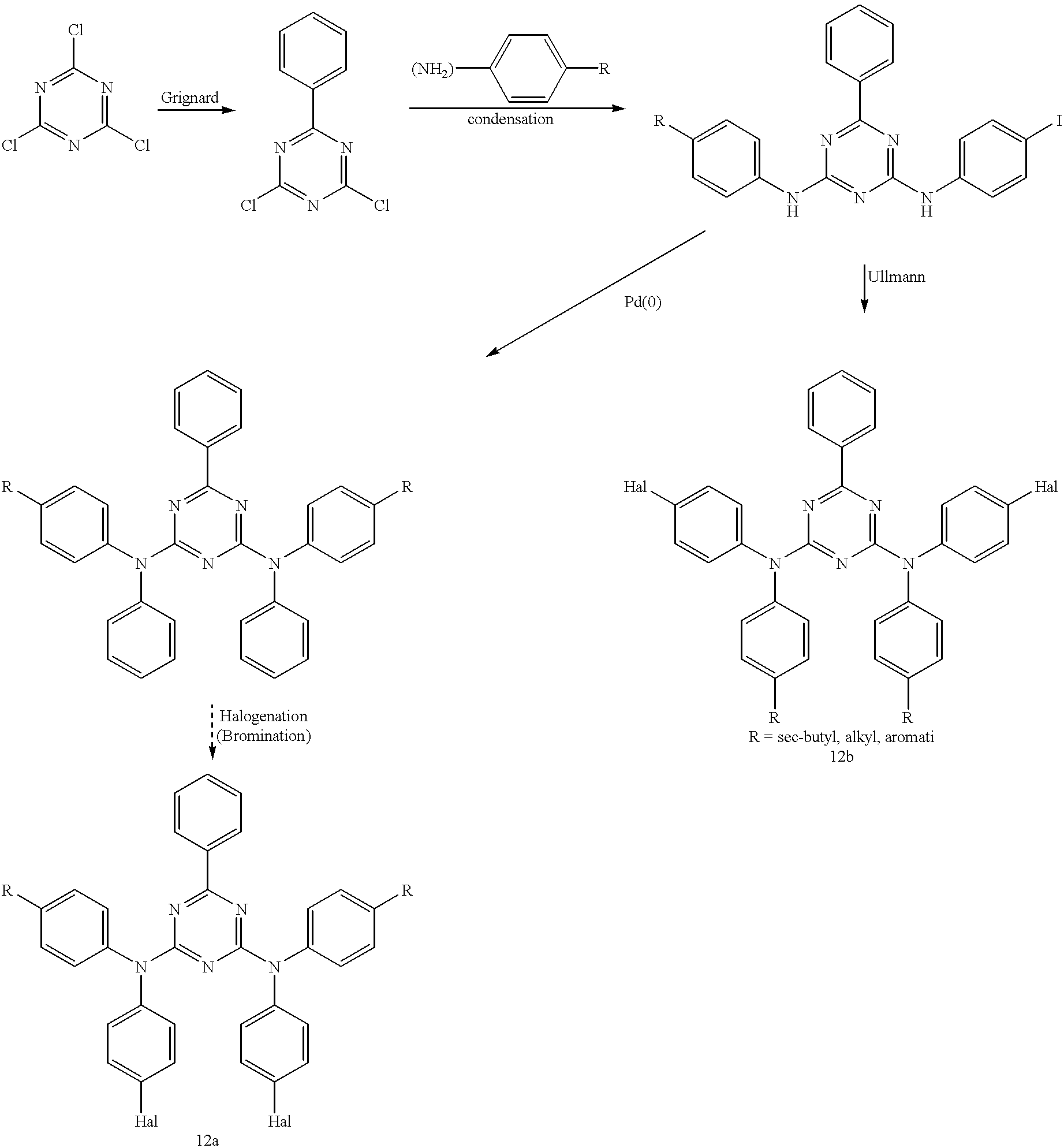
- Preferred structural units that are each a repeat unit according to the second aspect of the first embodiment are shown by Formulae (12a) and (12b) and (16a) and (16b):
- R, R 1 , R 2 and R 3 are the same or different and each R is a substituent group, preferably hydrocarbyl, optionally containing one or more heteroatoms, more preferably aryl, alkyl, heteroaryl, heteroalkyl, arylalkyl, aromatic or heteroaromatic.
- R and R′ are the same.
- the present inventors envisage that a homopolymer comprising a repeat unit having general formula (12), (13) or (16) would be useful as an electron transport material in an optical device, particularly an electroluminescent device.
- Product 12a or 12b then can be used in any suitable polymerisation reaction to obtain a polymer according to the second aspect of the first embodiment.
- each Hal is preferably Br.
- a preferred polymer in accordance with the second aspect of the first embodiment is a copolymer.
- Such polymers are envisaged as being useful for transporting electrons when used in an optical device, particularly an electroluminescent device. At the same time as being capable of transporting electrons, such polymers also may be capable of transporting protons and/or combining protons and electrons so as to generate light.
- a polymer according to the first or second aspect of the fist embodiment is at least 100, preferably at least 105, monomers in length.
- a typical upper limit for the polymer length is about 300 monomers, although the length could be up to 1000 monomers.
- the polymer comprises a dendrimer comprising an initiator core or core unit and branch units.
- the one or more structural units comprises a core unit.
- the polymer has a single structural unit.
- the dendrimer more preferably comprises a branch unit, specifically one type of branch unit, the most preferred branch unit being as shown in formula (9) which is substituted or unsubstituted.
- the dendrimers according to the second embodiment of the present invention are from 1 st to 10 th generation dendrimers.
- one or more structural units comprises Ar h (NAr 2 ) 3 , where each N is directly linked to Ar h and each (NAr 2 ) is the same or different.
- each (NAr 2 ) is the same and is a substituted or unsubstituted phenyl group.
- each (NAr 2 ) is chosen so as to control the bandgap of the polymer.
- Ar h comprises a group as shown in formula (5):
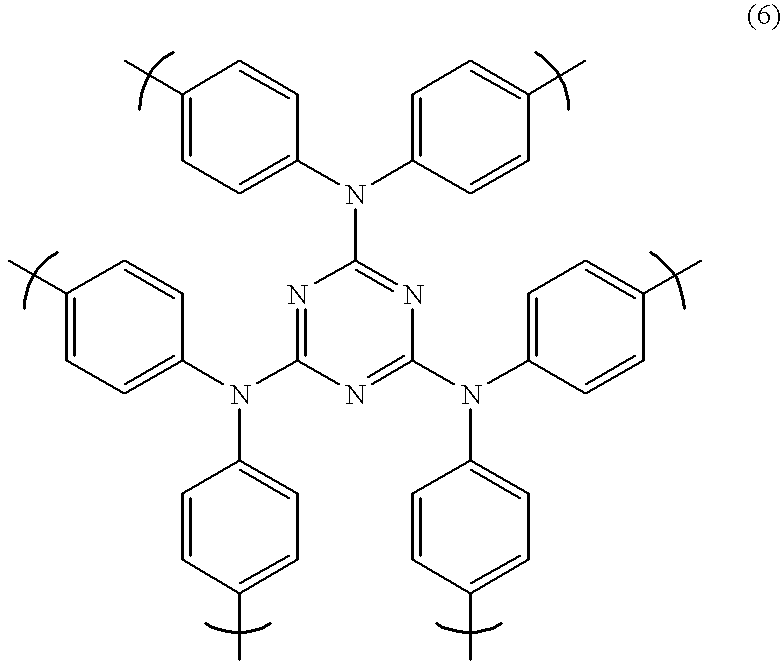
- the polymer comprises a single structural unit comprising a group as shown in formula (6):
- structural unit comprises the core unit.
- the structural unit comprises Ar h (NAr 2 ) 2 Ar′′, where Ar′′ is a substituted or unsubstituted aryl or heteroaryl group and each (NAr 2 ) is the same or different.
- each (NAr 2 ) is the same and is a substituted or unsubstituted phenyl group.
- Ar′′ is a substituted or unsubstituted phenyl group.
- Ar′′ should be chosen having regard to steric hinderance and possible twisting of the polymer chain with a view to controlling the extent of conjugation of the polymer.
- the polymer comprises a single structural unit comprising a group having the formula as shown in formula (7):
- the single structural unit comprises the core unit.
- a typical process for preparation of a polymer according to the first aspect of the second embodiment involves melamine as a starting material. This may be subjected to a palladium coupling reaction with iodobenzene or bromobenzene to produce a structure as shown in formula (10):
- Further generations of the dendrimer may be built by subjecting the compound having formula 10 to one or more cycles of halogenation, preferably bromination, followed by a reaction with (Ph) 2 NB(OH) 2 , under appropriate conditions. This may conveniently be carried out using a Suzuki reaction.
- a corresponding process may be used to prepare a polymer according to the second aspect of the second invention where 2,4,diamino-6-phenyl-1,3,5-triazine (a melamine derivative) is used in place of the melamine starting material.
- the core unit may comprise a structure as shown in formula (6) or (7).
- linear repeat units such as those shown in formula (12) or (15) may be attached to the core unit.
- Such polymers may be defined as “linear” but dendrimeric. These polymers are envisaged to be useful as charge (electron or hole) transport materials and/or as emissive materials.
- Such a polymer preferably is at least 100, preferably at least 150, monomers in length.
- a typical upper limit for the polymer length is about 300 monomers, although the length could be up to 1000 monomers.
- a polymer according to the first or second embodiment of the present invention in an optical device such as a luminescent device, preferably an electroluminescent device.
- Other devices include photoluminescent devices, photovoltaic devices and waveguides.
- Uses include the use of the polymer as an emissive material, a hole transporter or an electron transporter, typically in an electroluminescent device.
- the polymers may also be used in a dye composition, in a fiber or in a sensor.
- an optical device comprising a substrate and a composition supported by the substrate, which composition comprises a polymer according to the present invention.
- the substrate may itself be an electrode or any other type of substrate suitable for supporting the composition.
- the composition may include various layers such as an emissive layer optionally in contact with one or more hole and/or electron-transporting layer.
- the optical device comprises an electroluminescent device
- the composition includes an electroluminescent emissive layer which may be the polymer or another emissive polymer.
- a typical electroluminescent device will have an anode layer, a cathode layer and a light-emissive layer situated between the anode and the cathode.
- a charge transport layer may be situated between the anode and/or the cathode and the light-emissive layer.
- a blend of materials including a polymer according to the present invention may be used as the light-emissive layer in an electroluminescent device.
- the polymer according to the present invention is blended with one or more hole and/or electron-transporting materials, even more preferably hole and/or electron-transporting polymers.
- the polymer according to the present invention may be blended with an electroluminescent material, preferably any electroluminescent polymer.
- Polymers according to the present invention which have been produced by this method are particularly advantageous. This is because reaction times are short and residual catalyst, e.g. palladium, levels are low.
- polymers according to the present invention may be end-capped to remove the halogen end-groups.
- This end-capping for example by the addition of halobenzene or phenyl boronic acid. This is exemplified in Example 3(ii).
- a further polymerisation method is known from “Macromolecules”, 31, 1099-1103 (1998).
- the polymerisation reaction involves nickel-mediated coupling of dibromide monomers. This method commonly is known as “Yamamoto Polymerisation”.
- reaction mixture was allowed to cool to room temperature then treated with toluene (100 mL) and water (100 mL). The solid residue remaining was filtered off.
- the aqueous phase was removed and washed with toluene (2 ⁇ 30 mL).
- the combined toluene layers were washed with water (3 ⁇ 100 mL) until neutral then they were treated with 2N hydrochloric acid (2 ⁇ 50 mL) and washed with water.
- the product started to precipitate as the acid salt.
- This suspension was washed with ether (3 ⁇ 50 mL) then basified with 2N sodium hydroxide.
- the yellow solid precipitate was extracted into dichloromethane (3 ⁇ 20 mL).
- the combined dichloromethane layers were washed with water (100 mL), saturated sodium chloride (100 mL), dried over MgSO 4 , filtered and evaporated to give 9 g of a dark oil.
- tetraethylammonium hydroxide (20% wt in water, 30 mL) was added. The reaction mixture was heated to 115° C. and maintained at reflux overnight. Bromobenzene was added (1.5 mL) and the mixture was allowed to stir at reflux for 45 min. Phenyl boronic acid (1.5 g) was added and the solution refluxed for a further 1 h 30 then allowed to cool to room temperature.
- the polymer was precipitated into 3 L of methanol and then redissolved in toluene (300 mL) by heating at 115° C. for few hours.
- the mixture was allowed to cool to room temperature and the aqueous phase was separated from the organic phase.
- the salt wash was then repeated with diethyldithiocarbamic acid sodium salt trihydrate (10 g in 110 mL of water) and the mixture was again stirred for 4 hours under nitrogen at 65° C.
- the aqueous phase was separated from the organic phase. 1 ⁇ 5 of the organic phase was filtered through 60 g of celite and washed with toluene. The solvent was concentrated to 70 mL then added dropwise into 600 mL of methanol. The precipitated polymer was filtered then dried to afford 0.92 g, Mp 260,000. The rest of the organic phase (4 ⁇ 5) was also filtered through 60 g of celite and washed with toluene. The solvent was concentrated to 250 mL then added dropwise into 2.5 L of methanol. The dried polymer gave 5.39 g, Mp 256,000.
- the anode 2 is a layer of transparent indium-tin oxide (“ITO”) supported on a glass or plastic substrate 1 .
- the anode 2 layer has a thickness between 1000-2000 ⁇ , usually about 1500 ⁇ .
- the cathode 5 is a Ca layer having an approximate thickness of 1500 ⁇ .
- Between the electrodes is a light emissive layer 4 having a thickness up to about 1000 ⁇ .
- the emissive layer 4 comprises between 0.5 to 30% by weight of the present polymer with the remainder of the emissive layer consisting of hole and/or electron transport material and/or emissive material.
- the device includes a hole transport material layer 3 of PEDOT having a thickness of about 1000 ⁇ .
- Layer 6 is an encapsulant layer of a suitable thickness.
Landscapes
- Chemical & Material Sciences (AREA)
- Engineering & Computer Science (AREA)
- Materials Engineering (AREA)
- Health & Medical Sciences (AREA)
- Chemical Kinetics & Catalysis (AREA)
- Medicinal Chemistry (AREA)
- Polymers & Plastics (AREA)
- Organic Chemistry (AREA)
- Physics & Mathematics (AREA)
- Spectroscopy & Molecular Physics (AREA)
- Electroluminescent Light Sources (AREA)
- Polyoxymethylene Polymers And Polymers With Carbon-To-Carbon Bonds (AREA)
Abstract
Description




Claims (38)



Priority Applications (1)
| Application Number | Priority Date | Filing Date | Title |
|---|---|---|---|
| US09/754,744 US6512082B2 (en) | 2000-01-05 | 2001-01-04 | Polymers, their preparation and uses |
Applications Claiming Priority (5)
| Application Number | Priority Date | Filing Date | Title |
|---|---|---|---|
| GBGB0000095.0A GB0000095D0 (en) | 2000-01-05 | 2000-01-05 | Polymers their preparation and uses |
| GB0000095 | 2000-01-05 | ||
| GB0000095.0 | 2000-01-05 | ||
| US18573700P | 2000-02-29 | 2000-02-29 | |
| US09/754,744 US6512082B2 (en) | 2000-01-05 | 2001-01-04 | Polymers, their preparation and uses |
Publications (2)
| Publication Number | Publication Date |
|---|---|
| US20010037012A1 US20010037012A1 (en) | 2001-11-01 |
| US6512082B2 true US6512082B2 (en) | 2003-01-28 |
Family
ID=27255452
Family Applications (1)
| Application Number | Title | Priority Date | Filing Date |
|---|---|---|---|
| US09/754,744 Expired - Lifetime US6512082B2 (en) | 2000-01-05 | 2001-01-04 | Polymers, their preparation and uses |
Country Status (1)
| Country | Link |
|---|---|
| US (1) | US6512082B2 (en) |
Cited By (5)
| Publication number | Priority date | Publication date | Assignee | Title |
|---|---|---|---|---|
| US20030186079A1 (en) * | 2000-01-05 | 2003-10-02 | Carl Towns | Luminescent polymer |
| US20040146743A1 (en) * | 2001-04-11 | 2004-07-29 | O'dell Richard | Polymer, its preparation and uses |
| US6861502B1 (en) * | 1999-03-12 | 2005-03-01 | Dow Global Technologies Inc. | Polymers, their preparation and uses |
| US20060158106A1 (en) * | 2005-01-14 | 2006-07-20 | Seiko Epson Corporation | Method of manufacturing light-emitting element, light-emitting element, display device and electronic equipment |
| US20100044695A1 (en) * | 2007-03-26 | 2010-02-25 | Nippon Steel Chemical Co., Ltd. | Compound for organic electroluminescent device and organic electroluminescent device |
Families Citing this family (8)
| Publication number | Priority date | Publication date | Assignee | Title |
|---|---|---|---|---|
| US20040115475A1 (en) * | 2002-08-14 | 2004-06-17 | Matsushita Electric Industrial Co., Ltd. | Aromatic methylidene compound, methylstyrul compound for producing the same, production electroluminescent element |
| TWI280973B (en) * | 2002-08-28 | 2007-05-11 | Sumitomo Chemical Co | Polymer compound and polymer light-emitting device using the same |
| DE10304819A1 (en) * | 2003-02-06 | 2004-08-19 | Covion Organic Semiconductors Gmbh | Carbazole-containing conjugated polymers and blends, their preparation and use |
| US20080274303A1 (en) * | 2004-02-26 | 2008-11-06 | Katsumi Agata | Polymer Compound and Polymer Light Emitting Device Using the Same |
| GB0428445D0 (en) * | 2004-12-29 | 2005-02-02 | Cambridge Display Tech Ltd | Blue-shifted triarylamine polymer |
| DE102005026651A1 (en) * | 2005-06-09 | 2006-12-14 | Merck Patent Gmbh | New materials for organic electroluminescent devices |
| WO2008117826A1 (en) * | 2007-03-27 | 2008-10-02 | Nippon Steel Chemical Co., Ltd. | Compound for organic electroluminescent device and organic electroluminescent device |
| US9783734B2 (en) | 2011-02-28 | 2017-10-10 | Kyulux, Inc. | Delayed fluorescence material and organic electroluminescence device |
Citations (6)
| Publication number | Priority date | Publication date | Assignee | Title |
|---|---|---|---|---|
| US5534613A (en) | 1995-01-26 | 1996-07-09 | The United States Of America As Represented By The Secretary Of The Air Force | Benzobisazole polymers containing triarylamino moieties |
| US5536866A (en) | 1995-01-26 | 1996-07-16 | The United States Of America As Represented By The Secretary Of The Air Force | Triarylamine-based dinitrile and dicarboxylic acid monomers |
| US5633337A (en) | 1995-01-26 | 1997-05-27 | The United States Of America As Represented By The Secretary Of The Air Force | Aromatic benzobisazole polymers and copolymers incorporating diphenylamino moieties |
| US5777070A (en) | 1997-10-23 | 1998-07-07 | The Dow Chemical Company | Process for preparing conjugated polymers |
| US5814244A (en) | 1995-09-04 | 1998-09-29 | Hoechst Aktiengesellschaft | Polymers comprising triaylamine units as electroluminescence materials |
| WO1999054385A1 (en) | 1998-04-21 | 1999-10-28 | The Dow Chemical Company | Fluorene-containing polymers and electroluminescent devices therefrom |
-
2001
- 2001-01-04 US US09/754,744 patent/US6512082B2/en not_active Expired - Lifetime
Patent Citations (6)
| Publication number | Priority date | Publication date | Assignee | Title |
|---|---|---|---|---|
| US5534613A (en) | 1995-01-26 | 1996-07-09 | The United States Of America As Represented By The Secretary Of The Air Force | Benzobisazole polymers containing triarylamino moieties |
| US5536866A (en) | 1995-01-26 | 1996-07-16 | The United States Of America As Represented By The Secretary Of The Air Force | Triarylamine-based dinitrile and dicarboxylic acid monomers |
| US5633337A (en) | 1995-01-26 | 1997-05-27 | The United States Of America As Represented By The Secretary Of The Air Force | Aromatic benzobisazole polymers and copolymers incorporating diphenylamino moieties |
| US5814244A (en) | 1995-09-04 | 1998-09-29 | Hoechst Aktiengesellschaft | Polymers comprising triaylamine units as electroluminescence materials |
| US5777070A (en) | 1997-10-23 | 1998-07-07 | The Dow Chemical Company | Process for preparing conjugated polymers |
| WO1999054385A1 (en) | 1998-04-21 | 1999-10-28 | The Dow Chemical Company | Fluorene-containing polymers and electroluminescent devices therefrom |
Non-Patent Citations (2)
| Title |
|---|
| International Search Report for PCT/GB01/00029 dated Apr. 10, 2001. |
| Patent Act 1977-Search Report under Section 17 for Application GB 0000095.0 Date of Search: Jun. 15, 2000. |
Cited By (9)
| Publication number | Priority date | Publication date | Assignee | Title |
|---|---|---|---|---|
| US6861502B1 (en) * | 1999-03-12 | 2005-03-01 | Dow Global Technologies Inc. | Polymers, their preparation and uses |
| US20030186079A1 (en) * | 2000-01-05 | 2003-10-02 | Carl Towns | Luminescent polymer |
| US20040146743A1 (en) * | 2001-04-11 | 2004-07-29 | O'dell Richard | Polymer, its preparation and uses |
| US7985815B2 (en) * | 2001-04-11 | 2011-07-26 | Cambridge Display Technology Limited | Polymer, its preparation and uses |
| US20110279028A1 (en) * | 2001-04-11 | 2011-11-17 | O'dell Richard | Polymer, Its Preparation and Uses |
| US8933182B2 (en) * | 2001-04-11 | 2015-01-13 | Cambridge Display Technology Limited | Polymer, its preparation and uses |
| US20060158106A1 (en) * | 2005-01-14 | 2006-07-20 | Seiko Epson Corporation | Method of manufacturing light-emitting element, light-emitting element, display device and electronic equipment |
| US20100044695A1 (en) * | 2007-03-26 | 2010-02-25 | Nippon Steel Chemical Co., Ltd. | Compound for organic electroluminescent device and organic electroluminescent device |
| US8227798B2 (en) * | 2007-03-26 | 2012-07-24 | Nippon Steel Chemical Co., Ltd. | Compound for organic electroluminescent device and organic electroluminescent device |
Also Published As
| Publication number | Publication date |
|---|---|
| US20010037012A1 (en) | 2001-11-01 |
Similar Documents
| Publication | Publication Date | Title |
|---|---|---|
| EP1246860B1 (en) | Polymers, their preparation and uses | |
| CN1882632B (en) | Crosslinkable substituted fluorene compounds and conjugated oligomers or polymers based thereon | |
| JP4874792B2 (en) | New materials for electroluminescence | |
| EP1366046B1 (en) | Monomer for use in preparation of a polymer to be used in optical devices | |
| US7125952B2 (en) | (Partially) conjugated polymer process for its preparation and use in electroluminescent devices | |
| WO2004039859A1 (en) | High-molecular compounds and polymerer light emitting devices made by using the same | |
| US6512082B2 (en) | Polymers, their preparation and uses | |
| US20010017155A1 (en) | Hole-transporting polymers | |
| EP1322692B1 (en) | Polymer and uses thereof | |
| KR20010050735A (en) | Electroluminescent devices having phenylanthracene-based polymers | |
| CN1211999A (en) | Partially conjugated polymers with spirocenters and their use as electroluminescent materials | |
| JP5697460B2 (en) | Functional electronic device containing boron-containing polymer | |
| JP7251065B2 (en) | Conjugated polymer compounds and their uses | |
| JP6379705B2 (en) | Arylamine polymer, production method thereof and use thereof | |
| CN116478182B (en) | Based on bridged triphenylamine derivative unit, small molecule containing the unit, polymer and preparation method and application thereof | |
| JP5716392B2 (en) | Novel arylamine dendrimer-like compound, production method thereof and use thereof | |
| JP2005509068A (en) | Process for preparing aromatic polymers | |
| KR100451440B1 (en) | Tin-based electroluminescent polymer | |
| EP0633614A1 (en) | Polymer based tunable light emitting diode | |
| KR100466494B1 (en) | Organic electroluminescent device | |
| Fáber et al. | New polymers based on fluorenylidene‐linked conjugated oligo (p‐phenylene) s | |
| HK1063810A (en) | Electroactive fluorene polymers having perfluoroalkyl groups, process for preparing such polymers and devices made with such polymers | |
| AU2002357693A1 (en) | Process for preparing aromatic polymers |
Legal Events
| Date | Code | Title | Description |
|---|---|---|---|
| AS | Assignment |
Owner name: CAMBRIDGE DISPLAY TECHNOLOGY LIMITED, UNITED KINGD Free format text: ASSIGNMENT OF ASSIGNORS INTEREST;ASSIGNORS:TOWNS, CARL R.;O'DELL, RICHARD;REEL/FRAME:011678/0801 Effective date: 20010307 |
|
| STCF | Information on status: patent grant |
Free format text: PATENTED CASE |
|
| AS | Assignment |
Owner name: IPIFS GUARANTEE CORP., NORTH CAROLINA Free format text: CONDITIONAL ASSIGNMENT;ASSIGNOR:CAMBRIDGE DISPLAY TECHNOLOGY LIMITED;REEL/FRAME:015541/0504 Effective date: 20040701 Owner name: IPIFS GUARANTEE CORP.,NORTH CAROLINA Free format text: CONDITIONAL ASSIGNMENT;ASSIGNOR:CAMBRIDGE DISPLAY TECHNOLOGY LIMITED;REEL/FRAME:015541/0504 Effective date: 20040701 |
|
| AS | Assignment |
Owner name: CAMBRIDGE DISPLAY TECHNOLOGY LIMITED,GREAT BRITAIN Free format text: CANCELLATION OF CONDITIONAL ASSIGNMENT;ASSIGNOR:IPIFS GUARANTEE CORP.;REEL/FRAME:017776/0220 Effective date: 20060606 Owner name: CAMBRIDGE DISPLAY TECHNOLOGY LIMITED, GREAT BRITAIN Free format text: CANCELLATION OF CONDITIONAL ASSIGNMENT;ASSIGNOR:IPIFS GUARANTEE CORP.;REEL/FRAME:017776/0220 Effective date: 20060606 Owner name: CAMBRIDGE DISPLAY TECHNOLOGY LIMITED, GREAT BRITAI Free format text: CANCELLATION OF CONDITIONAL ASSIGNMENT;ASSIGNOR:IPIFS GUARANTEE CORP.;REEL/FRAME:017776/0220 Effective date: 20060606 |
|
| FPAY | Fee payment |
Year of fee payment: 4 |
|
| FPAY | Fee payment |
Year of fee payment: 8 |
|
| FPAY | Fee payment |
Year of fee payment: 12 |