US6500976B2 - Organosilicon compounds - Google Patents
Organosilicon compounds Download PDFInfo
- Publication number
- US6500976B2 US6500976B2 US09/970,685 US97068501A US6500976B2 US 6500976 B2 US6500976 B2 US 6500976B2 US 97068501 A US97068501 A US 97068501A US 6500976 B2 US6500976 B2 US 6500976B2
- Authority
- US
- United States
- Prior art keywords
- carbon atoms
- hydrocarbon group
- monovalent hydrocarbon
- substituted
- group
- Prior art date
- Legal status (The legal status is an assumption and is not a legal conclusion. Google has not performed a legal analysis and makes no representation as to the accuracy of the status listed.)
- Expired - Lifetime
Links
- 150000003961 organosilicon compounds Chemical class 0.000 title claims abstract description 22
- 125000004432 carbon atom Chemical group C* 0.000 claims abstract description 31
- 150000001244 carboxylic acid anhydrides Chemical group 0.000 claims abstract description 13
- 125000004430 oxygen atom Chemical group O* 0.000 claims abstract description 12
- 125000005010 perfluoroalkyl group Chemical group 0.000 claims abstract description 12
- 125000001183 hydrocarbyl group Chemical group 0.000 claims abstract 24
- 125000004435 hydrogen atom Chemical group [H]* 0.000 claims description 20
- 229910052739 hydrogen Inorganic materials 0.000 claims description 18
- 239000001257 hydrogen Substances 0.000 claims description 18
- 125000000962 organic group Chemical group 0.000 claims description 11
- 125000002947 alkylene group Chemical group 0.000 claims description 5
- 125000003258 trimethylene group Chemical group [H]C([H])([*:2])C([H])([H])C([H])([H])[*:1] 0.000 claims description 3
- 125000000816 ethylene group Chemical group [H]C([H])([*:1])C([H])([H])[*:2] 0.000 claims 2
- 239000000203 mixture Substances 0.000 abstract description 7
- 229920001971 elastomer Polymers 0.000 abstract description 5
- 239000000806 elastomer Substances 0.000 abstract description 5
- 229920001187 thermosetting polymer Polymers 0.000 abstract description 4
- 229910052751 metal Inorganic materials 0.000 abstract description 3
- 239000002184 metal Substances 0.000 abstract description 3
- 150000002739 metals Chemical class 0.000 abstract description 3
- 229910045601 alloy Inorganic materials 0.000 abstract description 2
- 239000000956 alloy Substances 0.000 abstract description 2
- 239000000919 ceramic Substances 0.000 abstract description 2
- 239000000463 material Substances 0.000 abstract description 2
- 239000004033 plastic Substances 0.000 abstract description 2
- 229920003023 plastic Polymers 0.000 abstract description 2
- YXFVVABEGXRONW-UHFFFAOYSA-N Toluene Chemical compound CC1=CC=CC=C1 YXFVVABEGXRONW-UHFFFAOYSA-N 0.000 description 12
- 0 [4*]C1([6*])CCCC1 Chemical compound [4*]C1([6*])CCCC1 0.000 description 12
- 150000002430 hydrocarbons Chemical group 0.000 description 12
- 239000000243 solution Substances 0.000 description 12
- 150000001875 compounds Chemical class 0.000 description 8
- 238000005160 1H NMR spectroscopy Methods 0.000 description 6
- WUMMIJWEUDHZCL-UHFFFAOYSA-N 3-prop-2-enyloxolane-2,5-dione Chemical compound C=CCC1CC(=O)OC1=O WUMMIJWEUDHZCL-UHFFFAOYSA-N 0.000 description 6
- OKTJSMMVPCPJKN-UHFFFAOYSA-N Carbon Chemical compound [C] OKTJSMMVPCPJKN-UHFFFAOYSA-N 0.000 description 6
- 239000000853 adhesive Substances 0.000 description 6
- 230000001070 adhesive effect Effects 0.000 description 6
- 238000000921 elemental analysis Methods 0.000 description 6
- 239000007788 liquid Substances 0.000 description 6
- 125000002496 methyl group Chemical group [H]C([H])([H])* 0.000 description 6
- BASFCYQUMIYNBI-UHFFFAOYSA-N platinum Chemical compound [Pt] BASFCYQUMIYNBI-UHFFFAOYSA-N 0.000 description 5
- SJBBXFLOLUTGCW-UHFFFAOYSA-N 1,3-bis(trifluoromethyl)benzene Chemical compound FC(F)(F)C1=CC=CC(C(F)(F)F)=C1 SJBBXFLOLUTGCW-UHFFFAOYSA-N 0.000 description 4
- 238000006243 chemical reaction Methods 0.000 description 4
- 239000002904 solvent Substances 0.000 description 4
- 239000002253 acid Substances 0.000 description 3
- 238000004458 analytical method Methods 0.000 description 3
- BITPLIXHRASDQB-UHFFFAOYSA-N ethenyl-[ethenyl(dimethyl)silyl]oxy-dimethylsilane Chemical compound C=C[Si](C)(C)O[Si](C)(C)C=C BITPLIXHRASDQB-UHFFFAOYSA-N 0.000 description 3
- 239000000706 filtrate Substances 0.000 description 3
- 238000004817 gas chromatography Methods 0.000 description 3
- 230000005484 gravity Effects 0.000 description 3
- QHGSGZLLHBKSAH-UHFFFAOYSA-N hydridosilicon Chemical group [SiH] QHGSGZLLHBKSAH-UHFFFAOYSA-N 0.000 description 3
- 238000010992 reflux Methods 0.000 description 3
- XEEYBQQBJWHFJM-UHFFFAOYSA-N Iron Chemical compound [Fe] XEEYBQQBJWHFJM-UHFFFAOYSA-N 0.000 description 2
- IYABWNGZIDDRAK-UHFFFAOYSA-N allene Chemical group C=C=C IYABWNGZIDDRAK-UHFFFAOYSA-N 0.000 description 2
- -1 for example Chemical group 0.000 description 2
- 125000005843 halogen group Chemical group 0.000 description 2
- 238000006459 hydrosilylation reaction Methods 0.000 description 2
- QQONPFPTGQHPMA-UHFFFAOYSA-N propylene Chemical group CC=C QQONPFPTGQHPMA-UHFFFAOYSA-N 0.000 description 2
- 125000004805 propylene group Chemical group [H]C([H])([H])C([H])([*:1])C([H])([H])[*:2] 0.000 description 2
- 239000004925 Acrylic resin Substances 0.000 description 1
- 229920000178 Acrylic resin Polymers 0.000 description 1
- WPSFRUWZIOZZKF-UHFFFAOYSA-N C.C.CCCCC1CC(=O)OC1=O Chemical compound C.C.CCCCC1CC(=O)OC1=O WPSFRUWZIOZZKF-UHFFFAOYSA-N 0.000 description 1
- ZXMWHRYTMLOOST-UHFFFAOYSA-N C=C(C#CC#CC#CC(F)(F)(F)(F)(F)(F)(F)(F)(F)(F)(F)(F)(F)(F)(F)(F)F)C[Si](O[SiH3])(O[SiH3])O[SiH](C)C Chemical compound C=C(C#CC#CC#CC(F)(F)(F)(F)(F)(F)(F)(F)(F)(F)(F)(F)(F)(F)(F)(F)F)C[Si](O[SiH3])(O[SiH3])O[SiH](C)C ZXMWHRYTMLOOST-UHFFFAOYSA-N 0.000 description 1
- GBLXJRKWYRXZDZ-MIIBGCIDSA-N CCCC1CC(=O)OC1=O.CCCCC1CC(=O)OC1=O.CCCCCC/C=C/CC1CC(=O)OC1=O Chemical compound CCCC1CC(=O)OC1=O.CCCCC1CC(=O)OC1=O.CCCCCC/C=C/CC1CC(=O)OC1=O GBLXJRKWYRXZDZ-MIIBGCIDSA-N 0.000 description 1
- PJSYIEZEDOUBRR-UHFFFAOYSA-N C[SiH]1(C)(C)OC1C(C)(C)(C)(C)(C)C Chemical compound C[SiH]1(C)(C)OC1C(C)(C)(C)(C)(C)C PJSYIEZEDOUBRR-UHFFFAOYSA-N 0.000 description 1
- 229910000599 Cr alloy Inorganic materials 0.000 description 1
- 229910000881 Cu alloy Inorganic materials 0.000 description 1
- GTNSXRBJSLPMCD-UHFFFAOYSA-N N[N]1(CCCC1)N Chemical compound N[N]1(CCCC1)N GTNSXRBJSLPMCD-UHFFFAOYSA-N 0.000 description 1
- 229910000990 Ni alloy Inorganic materials 0.000 description 1
- 239000004677 Nylon Substances 0.000 description 1
- CTQNGGLPUBDAKN-UHFFFAOYSA-N O-Xylene Chemical compound CC1=CC=CC=C1C CTQNGGLPUBDAKN-UHFFFAOYSA-N 0.000 description 1
- 239000007977 PBT buffer Substances 0.000 description 1
- 239000004642 Polyimide Substances 0.000 description 1
- 239000004734 Polyphenylene sulfide Substances 0.000 description 1
- 229910052581 Si3N4 Inorganic materials 0.000 description 1
- 125000004018 acid anhydride group Chemical group 0.000 description 1
- 150000008065 acid anhydrides Chemical class 0.000 description 1
- 238000007259 addition reaction Methods 0.000 description 1
- 125000004450 alkenylene group Chemical group 0.000 description 1
- 125000005370 alkoxysilyl group Chemical group 0.000 description 1
- 125000000217 alkyl group Chemical group 0.000 description 1
- 229910052782 aluminium Inorganic materials 0.000 description 1
- XAGFODPZIPBFFR-UHFFFAOYSA-N aluminium Chemical compound [Al] XAGFODPZIPBFFR-UHFFFAOYSA-N 0.000 description 1
- PNEYBMLMFCGWSK-UHFFFAOYSA-N aluminium oxide Inorganic materials [O-2].[O-2].[O-2].[Al+3].[Al+3] PNEYBMLMFCGWSK-UHFFFAOYSA-N 0.000 description 1
- 125000003118 aryl group Chemical group 0.000 description 1
- 125000000732 arylene group Chemical group 0.000 description 1
- 239000003054 catalyst Substances 0.000 description 1
- 239000000788 chromium alloy Substances 0.000 description 1
- 125000000753 cycloalkyl group Chemical group 0.000 description 1
- 125000002993 cycloalkylene group Chemical group 0.000 description 1
- 125000000113 cyclohexyl group Chemical group [H]C1([H])C([H])([H])C([H])([H])C([H])(*)C([H])([H])C1([H])[H] 0.000 description 1
- 125000004956 cyclohexylene group Chemical group 0.000 description 1
- 230000002708 enhancing effect Effects 0.000 description 1
- 239000003822 epoxy resin Substances 0.000 description 1
- 125000001495 ethyl group Chemical group [H]C([H])([H])C([H])([H])* 0.000 description 1
- LNEPOXFFQSENCJ-UHFFFAOYSA-N haloperidol Chemical compound C1CC(O)(C=2C=CC(Cl)=CC=2)CCN1CCCC(=O)C1=CC=C(F)C=C1 LNEPOXFFQSENCJ-UHFFFAOYSA-N 0.000 description 1
- 229910052742 iron Inorganic materials 0.000 description 1
- 238000000034 method Methods 0.000 description 1
- 238000012986 modification Methods 0.000 description 1
- 230000004048 modification Effects 0.000 description 1
- 229920001778 nylon Polymers 0.000 description 1
- 125000001997 phenyl group Chemical group [H]C1=C([H])C([H])=C(*)C([H])=C1[H] 0.000 description 1
- 125000000843 phenylene group Chemical group C1(=C(C=CC=C1)*)* 0.000 description 1
- 229910052697 platinum Inorganic materials 0.000 description 1
- 229920001707 polybutylene terephthalate Polymers 0.000 description 1
- 229920000647 polyepoxide Polymers 0.000 description 1
- 239000005020 polyethylene terephthalate Substances 0.000 description 1
- 229920000139 polyethylene terephthalate Polymers 0.000 description 1
- 229920001721 polyimide Polymers 0.000 description 1
- 229920000069 polyphenylene sulfide Polymers 0.000 description 1
- 239000004800 polyvinyl chloride Substances 0.000 description 1
- 229920000915 polyvinyl chloride Polymers 0.000 description 1
- 125000001436 propyl group Chemical group [H]C([*])([H])C([H])([H])C([H])([H])[H] 0.000 description 1
- 239000000376 reactant Substances 0.000 description 1
- HQVNEWCFYHHQES-UHFFFAOYSA-N silicon nitride Chemical compound N12[Si]34N5[Si]62N3[Si]51N64 HQVNEWCFYHHQES-UHFFFAOYSA-N 0.000 description 1
- 239000010935 stainless steel Substances 0.000 description 1
- 229910001220 stainless steel Inorganic materials 0.000 description 1
- 239000007858 starting material Substances 0.000 description 1
- 229910052717 sulfur Inorganic materials 0.000 description 1
- 125000003944 tolyl group Chemical group 0.000 description 1
- 239000008096 xylene Substances 0.000 description 1
Classifications
-
- C—CHEMISTRY; METALLURGY
- C07—ORGANIC CHEMISTRY
- C07F—ACYCLIC, CARBOCYCLIC OR HETEROCYCLIC COMPOUNDS CONTAINING ELEMENTS OTHER THAN CARBON, HYDROGEN, HALOGEN, OXYGEN, NITROGEN, SULFUR, SELENIUM OR TELLURIUM
- C07F7/00—Compounds containing elements of Groups 4 or 14 of the Periodic Table
- C07F7/02—Silicon compounds
- C07F7/08—Compounds having one or more C—Si linkages
- C07F7/0896—Compounds with a Si-H linkage
Definitions
- This invention relates to novel organosilicon compounds which are added to various thermosetting elastomer compositions as adhesive aids.
- thermosetting elastomer compositions include those having alkoxysilyl groups, acid anhydride groups and SiH groups. Although some adhesive aids achieve good adherence, there is a desire to have compounds more effective as adhesive aids.
- organosilicon compounds having in a molecule (A) a perfluoroalkyl group of at least 3 carbon atoms which may be separated by an etheric oxygen atom, (B) a monovalent hydrocarbon group containing a carboxylic acid anhydride structure, and (C) a hydrosilyl group are effective as adhesive aids, especially as adhesive aids in elastomer compositions containing fluorinated compounds for enhancing their adhesion to metals.
- the organosilicon compound of the invention has in a molecule (A) a perfluoroalkyl group of at least 3 carbon atoms which may be separated by an etheric oxygen atom, (B) a monovalent hydrocarbon group containing a carboxylic acid anhydride structure, and (C) a hydrosilyl (SiH) group.
- the organosilicon compound has the average compositional formula (1) and preferably the general formula (2), (3) or (4).
- Rf is a monovalent organic group containing a perfluoroalkyl group of at least 3 carbon atoms which may be separated by an etheric oxygen atom,
- R 1 is a substituted or unsubstituted monovalent hydrocarbon group
- R 2 is a monovalent hydrocarbon group containing a carboxylic acid anhydride structure
- a, b, c and d are numbers satisfying:
- R 3 is a substituted or unsubstituted divalent hydrocarbon group
- R 4 and R 5 each are a substituted or unsubstituted monovalent hydrocarbon group
- R 6 is independently hydrogen, Rf, R 1 or R 2 , wherein Rf, R 1 and R 2 are as defined above, at least one hydrogen, at least one Rf and at least one R 2 are contained in a molecule, and
- e is an integer of 0 or 1.
- R 4 is a substituted or unsubstituted monovalent hydrocarbon group
- R 6 is independently hydrogen, Rf, R 1 or R 2 , wherein Rf, R 1 and R 2 are as defined above; at least one hydrogen, at least one Rf and at least one R 2 are contained in a molecule
- m is a positive integer of at least 3 and preferably 3 to 8.
- R 4 is a substituted or unsubstituted monovalent hydrocarbon group
- R 6 is independently hydrogen, Rf, R 1 or R 2 , wherein Rf, R 1 and R 2 are as defined above; at least one hydrogen, at least one Rf and at least one R 2 are contained in a molecule
- n is a positive integer of at least 1, preferably 1 to 500 and more preferably 5 to 200
- R 7 is R 4 or a group of the following formula (5):
- R 4 and R 6 are as defined above.
- the substituted or unsubstituted monovalent hydrocarbon groups represented by R 1 , R 4 and R 5 are preferably those of 1 to 12 carbon atoms, more preferably 1 to 8 carbon atoms, for example, alkyl groups such as methyl, ethyl and propyl, cycloalkyl groups such as cyclohexyl, aryl groups such as phenyl and tolyl, and the foregoing groups in which some hydrogen atoms are substituted with halogen atoms.
- the monovalent hydrocarbon group containing a carboxylic acid anhydride structure, represented by R 2 is not critical as long has it has a carboxylic acid anhydride structure. Groups of the following formula are preferred.
- R 7 is a divalent hydrocarbon group having 1 to 15 carbon atoms, and especially 2 to 10 carbon atoms, for example, an alkylene or alkenylene group.
- the substituted or unsubstituted divalent hydrocarbon groups represented by R 3 are preferably those of 1 to 12 carbon atoms, more preferably 1 to 8 carbon atoms, for example, alkylene groups such as methylene, ethylene and propylene, cycloalkylene groups such as cyclohexylene, arylene groups such as phenylene, and the foregoing groups in which some hydrogen atoms are substituted with halogen atoms.
- the monovalent organic groups containing a perfluoroalkyl group of at least 3 carbon atoms which may be separated by an etheric oxygen atom, represented by Rf, include
- x is 3 to 20, y is 1 to 4, z is 1 to 10, p is 1 to 100, y multiplied by p is at least 2, and A is a divalent organic group, for example, an alkylene group such as methylene, ethylene or propylene.
- organosilicon compounds according to the invention are given below. They are typical examples, and the inventive compounds are not limited thereto. Note that Me is methyl.
- the organosilicon compounds of the invention can be synthesized, for example, by the following method.
- the starting compound is an organosilicon compound having fluorine-modified groups, represented by the formula:
- Rf and R 1 are as defined above, and 0.01 ⁇ a ⁇ 0.5, 0 ⁇ b ⁇ 2, 0.01 ⁇ d ⁇ 0.5, and 2 ⁇ a+b+d ⁇ 3.
- the reaction temperature is usually about 50 to 150° C., preferably about 70 to 120° C. If necessary, the reactants are diluted with a solvent such as toluene, xylene or 1,3-bistrifluoromethylbenzene.
- a solvent such as toluene, xylene or 1,3-bistrifluoromethylbenzene.
- the organosilicon compounds of the invention are added to thermosetting elastomer compositions as adhesion aids whereby the compositions are improved in adhesion to various materials including metals and alloys such as aluminum, iron, stainless steel, nickel alloys, chromium alloys and copper alloys, plastics such as acrylic resins, nylon, PPS, PBT, PET, epoxy resins, polyimides and polyvinyl chloride, and ceramics such as alumina and silicon nitride.
- metals and alloys such as aluminum, iron, stainless steel, nickel alloys, chromium alloys and copper alloys
- plastics such as acrylic resins, nylon, PPS, PBT, PET, epoxy resins, polyimides and polyvinyl chloride, and ceramics such as alumina and silicon nitride.
- Me is methyl.
- a 300-ml four-necked flask equipped with a stirrer, thermometer, reflux condenser and dropping funnel was charged with 70.0 g of an organosilicon compound of structure (i) below and 35.0 g of 1,3-bistrifluoromethyl-benzene and heated to an internal temperature of 80° C.
- reaction solution was ripened at 80° C. for one hour. After the consumption of allylsuccinic anhydride was confirmed by gas chromatography, the solution was cooled.
- a 300-ml four-necked flask equipped with a stirrer, thermometer, reflux condenser and dropping funnel was charged with 70.0 g of an organosilicon compound of structure (iii) below and 35.0 g of 1,3-bistrifluoromethyl-benzene and heated to an internal temperature of 80° C.
- reaction solution was ripened at 80° C. for one hour. After the consumption of allylsuccinic anhydride was confirmed by gas chromatography, the solution was cooled.
- a 300-ml four-necked flask equipped with a stirrer, thermometer, reflux condenser and dropping funnel was charged with 100.0 g of an organosilicon compound of structure (v) below (SiH group content 0.10 mol) and 50.0 g of 1,3-bistrifluoromethylbenzene and heated to an internal temperature of 80° C.
- reaction solution was ripened at 80° C. for one hour. After the consumption of allylsuccinic anhydride was confirmed by gas chromatography, the solution was cooled.
Landscapes
- Chemical & Material Sciences (AREA)
- Organic Chemistry (AREA)
- Silicon Polymers (AREA)
Abstract
Organosilicon compounds each having in a molecule (A) a perfluoroalkyl group of at least 3 carbon atoms which may be separated by an etheric oxygen atom, (B) a monovalent hydrocarbon group containing a carboxylic acid anhydride structure, and (C) a hydrosilyl (SiH) group are novel and added to thermosetting elastomer compositions as adhesion aids whereby the compositions are improved in adhesion to various materials including metals, alloys, plastics, and ceramics.
Description
1. Technical Field
This invention relates to novel organosilicon compounds which are added to various thermosetting elastomer compositions as adhesive aids.
2. Background Art
Known adhesive aids added to conventional thermosetting elastomer compositions include those having alkoxysilyl groups, acid anhydride groups and SiH groups. Although some adhesive aids achieve good adherence, there is a desire to have compounds more effective as adhesive aids.
It has been found that organosilicon compounds having in a molecule (A) a perfluoroalkyl group of at least 3 carbon atoms which may be separated by an etheric oxygen atom, (B) a monovalent hydrocarbon group containing a carboxylic acid anhydride structure, and (C) a hydrosilyl group are effective as adhesive aids, especially as adhesive aids in elastomer compositions containing fluorinated compounds for enhancing their adhesion to metals.
The organosilicon compound of the invention has in a molecule (A) a perfluoroalkyl group of at least 3 carbon atoms which may be separated by an etheric oxygen atom, (B) a monovalent hydrocarbon group containing a carboxylic acid anhydride structure, and (C) a hydrosilyl (SiH) group.
Specifically, the organosilicon compound has the average compositional formula (1) and preferably the general formula (2), (3) or (4).
RfaR1 bR2 cHdSiO(4−a−b−c−d)/2 (1)
In formula (1), Rf is a monovalent organic group containing a perfluoroalkyl group of at least 3 carbon atoms which may be separated by an etheric oxygen atom,
R1 is a substituted or unsubstituted monovalent hydrocarbon group,
R2 is a monovalent hydrocarbon group containing a carboxylic acid anhydride structure,
a, b, c and d are numbers satisfying:
0.01≦a≦50.5, preferably 0.05≦a≦0.3,
0≦b≦2, preferably 0.5≦b≦1.5,
0.01≦c≦0.5, preferably 0.05≦c≦0.3,
0.01≦d≦0.5, preferably 0.05≦d≦0.3, and
2≦a+b+c+d≦3. 
In formula (2), R3 is a substituted or unsubstituted divalent hydrocarbon group,
R4 and R5 each are a substituted or unsubstituted monovalent hydrocarbon group,
R6 is independently hydrogen, Rf, R1 or R2, wherein Rf, R1 and R2 are as defined above, at least one hydrogen, at least one Rf and at least one R2 are contained in a molecule, and
e is an integer of 0 or 1. 
In formula (3), R4 is a substituted or unsubstituted monovalent hydrocarbon group; R6 is independently hydrogen, Rf, R1 or R2, wherein Rf, R1 and R2 are as defined above; at least one hydrogen, at least one Rf and at least one R2 are contained in a molecule; and m is a positive integer of at least 3 and preferably 3 to 8. 
In formula (4), R4 is a substituted or unsubstituted monovalent hydrocarbon group; R6 is independently hydrogen, Rf, R1 or R2, wherein Rf, R1 and R2 are as defined above; at least one hydrogen, at least one Rf and at least one R2 are contained in a molecule; n is a positive integer of at least 1, preferably 1 to 500 and more preferably 5 to 200; and R7 is R4 or a group of the following formula (5): 
wherein R4 and R6 are as defined above.
More illustratively, the substituted or unsubstituted monovalent hydrocarbon groups represented by R1, R4 and R5 are preferably those of 1 to 12 carbon atoms, more preferably 1 to 8 carbon atoms, for example, alkyl groups such as methyl, ethyl and propyl, cycloalkyl groups such as cyclohexyl, aryl groups such as phenyl and tolyl, and the foregoing groups in which some hydrogen atoms are substituted with halogen atoms.
The monovalent hydrocarbon group containing a carboxylic acid anhydride structure, represented by R2, is not critical as long has it has a carboxylic acid anhydride structure. Groups of the following formula are preferred. 
Herein R7 is a divalent hydrocarbon group having 1 to 15 carbon atoms, and especially 2 to 10 carbon atoms, for example, an alkylene or alkenylene group.
Illustrative examples are given below. 
The substituted or unsubstituted divalent hydrocarbon groups represented by R3 are preferably those of 1 to 12 carbon atoms, more preferably 1 to 8 carbon atoms, for example, alkylene groups such as methylene, ethylene and propylene, cycloalkylene groups such as cyclohexylene, arylene groups such as phenylene, and the foregoing groups in which some hydrogen atoms are substituted with halogen atoms.
The monovalent organic groups containing a perfluoroalkyl group of at least 3 carbon atoms which may be separated by an etheric oxygen atom, represented by Rf, include
F(CxF2x)CH2CH2—,
F(CxF2x)CH2CH2CH2—, and
F(CyF2yO)pCzF2z—A—,
wherein x is 3 to 20, y is 1 to 4, z is 1 to 10, p is 1 to 100, y multiplied by p is at least 2, and A is a divalent organic group, for example, an alkylene group such as methylene, ethylene or propylene.
Illustrative, non-limiting examples of the organic groups represented by Rf are given below. Note that Me is methyl.
C4F9CH2CH—
C8F17CH2CH2CH2— 
C3F7O(CF2CF2CF2O) hCF2CF2CH2CH2—(e.g., h=1 to 50)
F—(CF2O)h(CF2CF2O) iCF2CH2CH2—(e.g., h=1 to 50, i=1 to 50)
Illustrative examples of the organosilicon compounds according to the invention are given below. They are typical examples, and the inventive compounds are not limited thereto. Note that Me is methyl. 

The organosilicon compounds of the invention can be synthesized, for example, by the following method. The starting compound is an organosilicon compound having fluorine-modified groups, represented by the formula:
wherein Rf and R1 are as defined above, and 0.01≦a≦0.5, 0≦b≦2, 0.01≦d≦0.5, and 2≦a+b+d≦3. By effecting addition or hydrosilylation reaction of an acid anhydride having an ethylenically unsaturated group to the organosilicon compound having fluorine-modified groups in the presence of a hydrosilylation catalyst such as a platinum complex compound, the end compound is obtainable.
The reaction temperature is usually about 50 to 150° C., preferably about 70 to 120° C. If necessary, the reactants are diluted with a solvent such as toluene, xylene or 1,3-bistrifluoromethylbenzene.
Most often, the organosilicon compounds of the invention are added to thermosetting elastomer compositions as adhesion aids whereby the compositions are improved in adhesion to various materials including metals and alloys such as aluminum, iron, stainless steel, nickel alloys, chromium alloys and copper alloys, plastics such as acrylic resins, nylon, PPS, PBT, PET, epoxy resins, polyimides and polyvinyl chloride, and ceramics such as alumina and silicon nitride.
Examples of the invention are given below by way of illustration and not by way of limitation. Me is methyl.
A 300-ml four-necked flask equipped with a stirrer, thermometer, reflux condenser and dropping funnel was charged with 70.0 g of an organosilicon compound of structure (i) below and 35.0 g of 1,3-bistrifluoromethyl-benzene and heated to an internal temperature of 80° C. 
Then, 0.02 g of a toluene solution of the complex of chloroplatinic acid with 1,3-divinyl-1,1,3,3-tetramethyl-disiloxane (concentration 0.5 wt % calculated as platinum metal) was added to the flask, and 14.0 g of allylsuccinic anhydride was added dropwise from the dropping funnel.
After the completion of dropwise addition, the reaction solution was ripened at 80° C. for one hour. After the consumption of allylsuccinic anhydride was confirmed by gas chromatography, the solution was cooled.
Thereafter, 1.0 g of activated carbon was added to the solution, which was stirred for one hour and filtered. The filtrate was stripped at 120° C./3 mmHg for removing the solvent, leaving 74.3 g of a colorless clear liquid (viscosity 335 cs, specific gravity 1.393, refractive index 1.389).
On analysis by 1H-NMR, IR and elemental analysis, the liquid was identified to be the following compound (ii). 
1H-NMR
δ 60.25(s, Si—CH3: 12H)
δ 60.75(m, Si—CH2—: 4H)
δ 1.6 to 2.4(m, Si—CH2—CH 2—CH 2—: 8H)
δ 2.63(m, CO—CH: 1H)
δ 3.18(m, CO—CH2—: 2H)
δ 4.85(s, Si—H: 2H)
IR
1788, 1865 cm−1νC═O
2170 cm−1νSi—H
| Elemental analysis |
| C | H | O | Si | F | ||
| Found (%) | 31.7 | 3.2 | 13.5 | 13.3 | 38.3 | ||
| Calcd. (%) | 31.4 | 3.5 | 13.3 | 13.3 | 38.5 | ||
A 300-ml four-necked flask equipped with a stirrer, thermometer, reflux condenser and dropping funnel was charged with 70.0 g of an organosilicon compound of structure (iii) below and 35.0 g of 1,3-bistrifluoromethyl-benzene and heated to an internal temperature of 80° C. 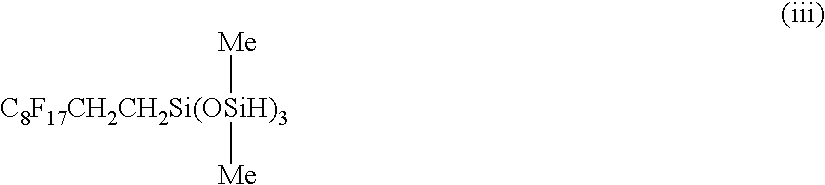
Then, 0.02 g of a toluene solution of the complex of chloroplatinic acid with 1,3-divinyl-1,1,3,3-tetramethyl-disiloxane (concentration 0.5 wt % calculated as platinum metal) was added to the flask, and 14.0 g of allylsuccinic anhydride was added dropwise from the dropping funnel.
After the completion of dropwise addition, the reaction solution was ripened at 80° C. for one hour. After the consumption of allylsuccinic anhydride was confirmed by gas chromatography, the solution was cooled.
Thereafter, 1.0 g of activated carbon was added to the solution, which was stirred for one hour and filtered. The filtrate was stripped at 120° C./3 mmHg for removing the solvent, leaving 75.2 g of a colorless clear liquid (viscosity 92 cs, specific gravity 1.375, refractive index 1.385).
On analysis by 1H-NMR, IR and elemental analysis, the liquid was identified to be the following compound (iv). 
1H-NMR
δ 0.09(s, C—Si—CH 3: 6H)
δ 0.16(s, H—Si—CH 3: 12H)
δ 0.65(m, Si—CH 2—CH2—CH2—: 2H)
δ 0.72(m, Si—CH 2—CH2—CF2—: 2H)
δ 1.4 to 2.2(m, Si—CH2—CH 2—CH2— and Si—CH2—CH 2—CF2—: 6H)
δ 2.52(m, CO—CH: 1H)
δ 3.01(m, CO—CH2—: 2H)
δ 4.72(s, Si—H: 2H)
IR
1787, 1867 cm−1νC═O
2133 cm−1νSi—H
| Elemental analysis |
| C | H | O | Si | F | ||
| Found (%) | 32.2 | 3.8 | 11.1 | 13.6 | 39.3 | ||
| Calcd. (%) | 32.9 | 3.9 | 11.4 | 13.3 | 38.5 | ||
A 300-ml four-necked flask equipped with a stirrer, thermometer, reflux condenser and dropping funnel was charged with 100.0 g of an organosilicon compound of structure (v) below (SiH group content 0.10 mol) and 50.0 g of 1,3-bistrifluoromethylbenzene and heated to an internal temperature of 80° C. 
Then, 0.02 g of a toluene solution of the complex of chloroplatinic acid with 1,3-divinyl-1,1,3,3-tetramethyl-disiloxane (concentration 0.5 wt % calculated as platinum metal) was added to the flask, and 2.8 g (0.020 mol) of allylsuccinic anhydride was added dropwise from the dropping funnel.
After the completion of dropwise addition, the reaction solution was ripened at 80° C. for one hour. After the consumption of allylsuccinic anhydride was confirmed by gas chromatography, the solution was cooled.
Thereafter, 1.5 g of activated carbon was added to the solution, which was stirred for one hour and filtered. The filtrate was stripped at 120° C./3 mmHg for removing the solvent, leaving 95.3 g of a colorless clear liquid (viscosity 25,000 cp, specific gravity 1.664, refractive index 1.343).
On analysis by 1H-NMR, IR and elemental analysis, the liquid was identified to be the following compound (vi). 
Note that of five R′ groups, on the average, four are R′=H, and one is 
1H-NMR
δ 0.09(S, C—Si—CH 3: 12H)
δ 0.16(s, H—Si—CH 3: 24H)
δ 0.31(s, arom.—Si—CH 3: 6H)
δ 0.6 to 1.3(m, Si—CH 2—: 10H)
δ 1.4 to 2.2(m, Si—CH2—CH 2—CH 2—: 4H)
δ 2.52(m, CO—CH: 1H)
δ 3.01(m, CO—CH2—: 2H)
δ 3.23(s, N—CH3: 3H)
δ 4.72(s, Si—H: 4H)
δ 7.2 to 7.7(m, arom.: 4H)
IR
1788, 1865 cm−1νC═O
2130 cm−1νSi—H
| Elemental analysis |
| C | H | O | Si | F | N | ||
| Found (%) | 25.4 | 1.3 | 10.8 | 5.1 | 57.1 | 0.3 | ||
| Calcd. (%) | 25.7 | 1.4 | 10.9 | 5.0 | 56.7 | 0.3 | ||
Japanese Patent Application No. 2000-306309 is incorporated herein by reference.
Although some preferred embodiments have been described, many modifications and variations may be made thereto in light of the above teachings. It is therefore to be understood that the invention may be practiced otherwise than as specifically described without departing from the scope of the appended claims.
Claims (8)
1. An organosilicon compound having the average compositional formula (1):
wherein
Rf is a monovalent organic group containing a perfluoroalkyl group of at least 3 carbon atoms which may be separated by an etheric oxygen atom,
R1 is a substituted or unsubstituted monovalent hydrocarbon group,
R2 is a monovalent hydrocarbon group containing a carboxylic acid anhydride structure, and
a, b, c, and d are numbers satisfying the relationships 0.01≦a≦0.5, 0≦b≦2, 0.01≦c≦0.5, 0.01≦d≦0.5, and 2≦a+b+c+d≦3.
2. An organosilicon compound having the general formula (2): 
wherein
Rf is a monovalent organic group containing a perfluoroalkyl group of at least 3 carbon atoms which may be separated by an etheric oxygen atom,
R1 is a substituted or unsubstituted monovalent hydrocarbon group,
R2 is a monovalent hydrocarbon group containing a carboxylic acid anhydride structure,
R3 is a substituted or unsubstituted divalent hydrocarbon group,
R4 and R5 each are a substituted or unsubstituted monovalent hydrocarbon group,
R6 is independently hydrogen, Rf, R1, or R2, at least one hydrogen, Rf, and R2 each being contained in a molecule, and
e is an integer of 0 or 1.
3. An organosilicon compound having the general formula (3) or (4): 
wherein
R4 is a substituted or unsubstituted monovalent hydrocarbon group;
Rf is a monovalent organic group containing a perfluoroalkyl group of at least 3 carbon atoms which may be separated by an etheric oxygen atom,
R1 is a substituted or unsubstituted monovalent hydrocarbon group,
R2 is a monovalent hydrocarbon group containing a carboxylic acid anhydride structure,
R6 is independently hydrogen, Rf, R1, or R2, at least one hydrogen, Rf, and R2 each being contained in a molecule; and
m is a positive integer of at least 3, and 
wherein
R4 is a substituted or unsubstituted monovalent hydrocarbon group;
Rf is a monovalent organic group containing a perfluoroalkyl group of at least 3 carbon atoms which may be separated by an etheric oxygen atom,
R1 is a substituted or unsubstituted monovalent hydrocarbon group,
R2 is a monovalent hydrocarbon group containing a carboxylic acid anhydride structure,
R6 is independently hydrogen, Rf, R1, or R2, at least one hydrogen, Rf, and R2 each being contained in a molecule;
n is a positive integer of at least 1; and
R7 is R4 or a group of the following formula (5): 
wherein R4 and R6 are as defined above.
4. The organosilicon compound of claim 1 , wherein Rf is F(CxF2x)CH2CH2—, F(CxF2x)CH2CH2CH2—, or F(CyF2yO)pCzF2z—A— in which x is 3 to 20, y is 1 to 4, z is 1 to 10, p is 1 to 100, y multiplied by p is at least 2, and A is a divalent alkylene group,
R1 has 1 to 8 carbon atoms, and
R2 is a group of the formula 
wherein R7 is a divalent hydrocarbon group having 2 to 10 carbon atoms.
5. The organosilicon compound of claim 3 , wherein
Rf is F(CxF2x)CH2CH2—, F(CxF2x)CH2CH2CH2—, or F(CyF2yO)pCzF2z—A— in which x is 3 to 20, y is 1 to 4, z is 1 to 10, p is 1 to 100, y multiplied by p is at least 2, and A is a divalent alkylene group,
R1 has 1 to 8 carbon atoms, and
R2 is a group of the following formula wherein R7 is a divalent hydrocarbon group having 2 to 10 carbon atoms 
R3 has 1 to 8 carbon atoms,
R4 has 1 to 8 carbon atoms, and
R5 has 1 to 8 carbon atoms.
6. The organosilicon compound of claim 3 , having the formula (3) wherein
R4 is a substituted or unsubstituted monovalent hydrocarbon group of 1 to 8 carbon atoms;
Rf is a monovalent organic group containing a perfluoroalkyl group of at least 3 carbon atoms which may be separated by an etheric oxygen atom,
R1 is a substituted or unsubstituted monovalent hydrocarbon group of 1 to 8 carbon atoms,
R2 is a monovalent hydrocarbon group containing a carboxylic acid anhydride structure,
R6 is independently hydrogen, Rf, R1, or R2, at least one hydrogen, Rf, and R2 each being contained in a molecule; and
m is a positive integer of at least 3.
7. The organosilicon compound of claim 3 , having the formula (4) wherein
R4 is a substituted or unsubstituted monovalent hydrocarbon group of 1 to 8 carbon atoms,
Rf is a monovalent organic group containing a perfluoroalkyl group of at least 3 carbon atoms which may be separated by an etheric oxygen atom,
R1 is a substituted or unsubstituted monovalent hydrocarbon group of 1 to 8 carbon atoms,
R2 is a monovalent hydrocarbon group containing a carboxylic acid anhydride structure,
R6 is independently hydrogen, Rf, R1, or R2, at least one hydrogen, Rf, and R2 each being contained in a molecule;
n is a positive integer of at least 1; and
R7 is R4.
8. The organosilicon compound of claim 3 , having the formula (4) wherein
R4 is a substituted or unsubstituted monovalent hydrocarbon group of 1 to 8 carbon atoms,
Rf is a monovalent organic group containing a perfluoroalkyl group of at least 3 carbon atoms which may be separated by an etheric oxygen atom,
R1 is a substituted or unsubstituted monovalent hydrocarbon group of 1 to 8 carbon atoms,
R2 is a monovalent hydrocarbon group of containing a carboxylic acid anhydride structure,
R6 is independently hydrogen, Rf, R1, or R2, at least one hydrogen, Rf, and R2 each being contained in a molecule;
n is a positive integer of at least 1; and
R7 is a group of the formula (5): 
wherein R4 and R6 are as defined above.
Applications Claiming Priority (2)
| Application Number | Priority Date | Filing Date | Title |
|---|---|---|---|
| JP2000-306309 | 2000-10-05 | ||
| JP2000306309A JP4013023B2 (en) | 2000-10-05 | 2000-10-05 | Organosilicon compound |
Publications (2)
| Publication Number | Publication Date |
|---|---|
| US20020087019A1 US20020087019A1 (en) | 2002-07-04 |
| US6500976B2 true US6500976B2 (en) | 2002-12-31 |
Family
ID=18787023
Family Applications (1)
| Application Number | Title | Priority Date | Filing Date |
|---|---|---|---|
| US09/970,685 Expired - Lifetime US6500976B2 (en) | 2000-10-05 | 2001-10-05 | Organosilicon compounds |
Country Status (2)
| Country | Link |
|---|---|
| US (1) | US6500976B2 (en) |
| JP (1) | JP4013023B2 (en) |
Cited By (3)
| Publication number | Priority date | Publication date | Assignee | Title |
|---|---|---|---|---|
| US6784306B2 (en) * | 2001-02-20 | 2004-08-31 | Shin-Etsu Chemical Co., Ltd. | Fluorinated organosilicon compounds |
| US8729195B2 (en) | 2009-12-28 | 2014-05-20 | Dow Corning Toray Co., Ltd. | Organosilicon compound, method for producing thereof, and curable silicone composition containing the same |
| TWI508970B (en) * | 2014-03-07 | 2015-11-21 | Daxin Materials Corp | Siloxane-containing trianhydride, polymer, liquid crystal alignment agent, liquid crystal alignment film, and liquid crystal display device |
Families Citing this family (9)
| Publication number | Priority date | Publication date | Assignee | Title |
|---|---|---|---|---|
| JP5282400B2 (en) * | 2006-12-15 | 2013-09-04 | 信越化学工業株式会社 | Addition-curing silicone adhesive composition and cured product thereof |
| JP5353357B2 (en) * | 2008-04-03 | 2013-11-27 | 信越化学工業株式会社 | Organopolysiloxane having a carboxyl group |
| JP5776634B2 (en) * | 2011-07-06 | 2015-09-09 | 信越化学工業株式会社 | Succinic anhydride group-containing cyclic organosiloxane, process for producing the same, organosiloxane composition, and thermosetting resin composition |
| KR101745608B1 (en) * | 2011-11-25 | 2017-06-09 | 신에쓰 가가꾸 고교 가부시끼가이샤 | Acid anhydride group-containing organosiloxane and method for producing the same |
| CN105940068A (en) * | 2013-12-17 | 2016-09-14 | 瓦克化学股份公司 | Crosslinkable silicone composition |
| US20210317335A1 (en) * | 2018-09-13 | 2021-10-14 | Momentive Performance Materials Gmbh | Functional polysiloxanes |
| JP7540897B2 (en) * | 2020-04-09 | 2024-08-27 | モメンティブ・パフォーマンス・マテリアルズ・ジャパン合同会社 | Succinic anhydride group-containing cyclic organosiloxane, addition-curable silicone composition containing said succinic anhydride group-containing cyclic organosiloxane, and use thereof |
| JP2024044155A (en) | 2022-09-20 | 2024-04-02 | 信越化学工業株式会社 | Cyclic organopolysiloxanes, silicone compositions, adhesion aids, and adhesives |
| JP2024044151A (en) | 2022-09-20 | 2024-04-02 | 信越化学工業株式会社 | Cyclic organopolysiloxane, silicone composition, adhesive aid, and adhesive |
Citations (2)
| Publication number | Priority date | Publication date | Assignee | Title |
|---|---|---|---|---|
| US5117001A (en) * | 1990-02-28 | 1992-05-26 | Shin-Etsu Chemical Co., Ltd. | Siloxane compound containing tetrahydrophthalic anhydride group and method of producing the same |
| US5362887A (en) * | 1993-03-23 | 1994-11-08 | Shin-Etsu Chemical Co., Ltd. | Fluorine - modified acid anhydrides |
-
2000
- 2000-10-05 JP JP2000306309A patent/JP4013023B2/en not_active Expired - Fee Related
-
2001
- 2001-10-05 US US09/970,685 patent/US6500976B2/en not_active Expired - Lifetime
Patent Citations (2)
| Publication number | Priority date | Publication date | Assignee | Title |
|---|---|---|---|---|
| US5117001A (en) * | 1990-02-28 | 1992-05-26 | Shin-Etsu Chemical Co., Ltd. | Siloxane compound containing tetrahydrophthalic anhydride group and method of producing the same |
| US5362887A (en) * | 1993-03-23 | 1994-11-08 | Shin-Etsu Chemical Co., Ltd. | Fluorine - modified acid anhydrides |
Cited By (4)
| Publication number | Priority date | Publication date | Assignee | Title |
|---|---|---|---|---|
| US6784306B2 (en) * | 2001-02-20 | 2004-08-31 | Shin-Etsu Chemical Co., Ltd. | Fluorinated organosilicon compounds |
| US8729195B2 (en) | 2009-12-28 | 2014-05-20 | Dow Corning Toray Co., Ltd. | Organosilicon compound, method for producing thereof, and curable silicone composition containing the same |
| TWI508970B (en) * | 2014-03-07 | 2015-11-21 | Daxin Materials Corp | Siloxane-containing trianhydride, polymer, liquid crystal alignment agent, liquid crystal alignment film, and liquid crystal display device |
| US9464233B2 (en) | 2014-03-07 | 2016-10-11 | Daxin Materials Corporation | Siloxane-containing trianhydride, polymer, liquid crystal alignment agent, liquid crystal alignment film, and liquid crystal display device |
Also Published As
| Publication number | Publication date |
|---|---|
| US20020087019A1 (en) | 2002-07-04 |
| JP2002114793A (en) | 2002-04-16 |
| JP4013023B2 (en) | 2007-11-28 |
Similar Documents
| Publication | Publication Date | Title |
|---|---|---|
| US6500976B2 (en) | Organosilicon compounds | |
| US5200543A (en) | Siloxane compounds | |
| EP1013653A2 (en) | An organosilicon endcapper having one silicon-bonded hydrogen atom | |
| US20120157703A1 (en) | Synthesis of fluorosilicones and their derivatives | |
| US4801725A (en) | Organosilicon compound | |
| US5508369A (en) | Organopolysiloxanes having a silanol group and process of making them | |
| EP1013656A2 (en) | A cyclic organosilicon endcapper having one siliconbonded hydrogen atom | |
| US5194648A (en) | Fluorinated carboxylic acid derivatives and methods for making | |
| KR20070061551A (en) | (Trimethylsilyloxy) silylalkylglycerol methacrylate production method | |
| JPH054995A (en) | Organosilicon compound and production thereof | |
| US7053233B2 (en) | Silane compound having at least two protected functional groups and method for preparing the same | |
| US6521774B2 (en) | Organosilicon compounds | |
| US4472590A (en) | Silicone compounds | |
| US6013753A (en) | Organosilicon endcapper having one aliphatic unsaturation | |
| US6114562A (en) | Organosilicon compounds and method of making | |
| US4788311A (en) | Novel organosilicon compounds useful as a stabilizer for organopolysiloxane compositions | |
| US5101057A (en) | Fluorinated carboxylic acid derivatives and methods for making | |
| US6303811B1 (en) | Cyclic organosilicon endcapper having one aliphatic unsaturation | |
| US5196558A (en) | Siloxane compounds | |
| US4623741A (en) | Chlorosilane compounds | |
| US4876363A (en) | Epoxy-containing organic silicon compounds | |
| US6787662B2 (en) | Fluorinated organosilicon compounds | |
| EP1233020B1 (en) | Fluorinated organosilicon compounds | |
| EP0488681A1 (en) | N, N-dialkylaminoalkyl-N', N'-dialkylaminodimethylsilane | |
| US5117026A (en) | Fluorine-containing organic silicon compounds |
Legal Events
| Date | Code | Title | Description |
|---|---|---|---|
| AS | Assignment |
Owner name: SHIN-ETSU CHEMICAL CO., LTD., JAPAN Free format text: ASSIGNMENT OF ASSIGNORS INTEREST;ASSIGNORS:MATSUDA, TAKASHI;SHIONO, MIKIO;FUKUDA, KENICHI;REEL/FRAME:012235/0025;SIGNING DATES FROM 20010903 TO 20010904 |
|
| FEPP | Fee payment procedure |
Free format text: PAYOR NUMBER ASSIGNED (ORIGINAL EVENT CODE: ASPN); ENTITY STATUS OF PATENT OWNER: LARGE ENTITY |
|
| STCF | Information on status: patent grant |
Free format text: PATENTED CASE |
|
| FPAY | Fee payment |
Year of fee payment: 4 |
|
| FPAY | Fee payment |
Year of fee payment: 8 |
|
| FPAY | Fee payment |
Year of fee payment: 12 |