US6500951B1 - Process for preparing pyridazin-3-on derivatives - Google Patents

Process for preparing pyridazin-3-on derivatives Download PDF

Info

Publication number
US6500951B1
US6500951B1 US09/857,033 US85703301A US6500951B1 US 6500951 B1 US6500951 B1 US 6500951B1 US 85703301 A US85703301 A US 85703301A US 6500951 B1 US6500951 B1 US 6500951B1
Authority
US
United States
Prior art keywords
group
acid
formula
process according
alkyl group
Prior art date
Legal status (The legal status is an assumption and is not a legal conclusion. Google has not performed a legal analysis and makes no representation as to the accuracy of the status listed.)
Expired - Fee Related
Application number
US09/857,033
Inventor
Masao Yanagawa
Masahiko Mizuno
Yoshiaki Oda
Current Assignee (The listed assignees may be inaccurate. Google has not performed a legal analysis and makes no representation or warranty as to the accuracy of the list.)
Sumitomo Chemical Co Ltd
Original Assignee
Sumitomo Chemical Co Ltd
Priority date (The priority date is an assumption and is not a legal conclusion. Google has not performed a legal analysis and makes no representation as to the accuracy of the date listed.)
Filing date
Publication date
Application filed by Sumitomo Chemical Co Ltd filed Critical Sumitomo Chemical Co Ltd
Assigned to SUMITOMO CHEMICAL COMPANY, LIMITED reassignment SUMITOMO CHEMICAL COMPANY, LIMITED ASSIGNMENT OF ASSIGNORS INTEREST (SEE DOCUMENT FOR DETAILS). Assignors: ODA, YOSHIAKI, MIZUNO, MASAHIKO, YANAGAWA, MASAO
Application granted granted Critical
Publication of US6500951B1 publication Critical patent/US6500951B1/en
Anticipated expiration legal-status Critical
Expired - Fee Related legal-status Critical Current

Links

Classifications

    • CCHEMISTRY; METALLURGY
    • C07ORGANIC CHEMISTRY
    • C07DHETEROCYCLIC COMPOUNDS
    • C07D237/00Heterocyclic compounds containing 1,2-diazine or hydrogenated 1,2-diazine rings
    • C07D237/02Heterocyclic compounds containing 1,2-diazine or hydrogenated 1,2-diazine rings not condensed with other rings
    • C07D237/06Heterocyclic compounds containing 1,2-diazine or hydrogenated 1,2-diazine rings not condensed with other rings having three double bonds between ring members or between ring members and non-ring members
    • C07D237/10Heterocyclic compounds containing 1,2-diazine or hydrogenated 1,2-diazine rings not condensed with other rings having three double bonds between ring members or between ring members and non-ring members with hetero atoms or with carbon atoms having three bonds to hetero atoms with at the most one bond to halogen, e.g. ester or nitrile radicals, directly attached to ring carbon atoms
    • C07D237/14Oxygen atoms
    • BPERFORMING OPERATIONS; TRANSPORTING
    • B01PHYSICAL OR CHEMICAL PROCESSES OR APPARATUS IN GENERAL
    • B01JCHEMICAL OR PHYSICAL PROCESSES, e.g. CATALYSIS OR COLLOID CHEMISTRY; THEIR RELEVANT APPARATUS
    • B01J31/00Catalysts comprising hydrides, coordination complexes or organic compounds
    • B01J31/02Catalysts comprising hydrides, coordination complexes or organic compounds containing organic compounds or metal hydrides
    • B01J31/12Catalysts comprising hydrides, coordination complexes or organic compounds containing organic compounds or metal hydrides containing organo-metallic compounds or metal hydrides
    • B01J31/14Catalysts comprising hydrides, coordination complexes or organic compounds containing organic compounds or metal hydrides containing organo-metallic compounds or metal hydrides of aluminium or boron
    • B01J31/146Catalysts comprising hydrides, coordination complexes or organic compounds containing organic compounds or metal hydrides containing organo-metallic compounds or metal hydrides of aluminium or boron of boron
    • CCHEMISTRY; METALLURGY
    • C07ORGANIC CHEMISTRY
    • C07CACYCLIC OR CARBOCYCLIC COMPOUNDS
    • C07C57/00Unsaturated compounds having carboxyl groups bound to acyclic carbon atoms
    • C07C57/52Unsaturated compounds having carboxyl groups bound to acyclic carbon atoms containing halogen

Definitions

  • the present invention relates to a process for preparing pyridazin-3-on derivatives.
  • WO97/7104 discloses that pyridazin-3-on derivatives have good herbicidal activities
  • WO98/17632 discloses that carboxylic acids derivatives and their salts are useful intermediates for the preparation of pyridazin-3-on derivatives, and a process for preparing pyridazin-3-on derivatives from such intermediates.
  • WO98/17632 discloses a process of reacting a lower carboxylic acid and a base with such an intermediate.
  • One object of the. present invention is to provide a process for preparing pyridazin-3-on derivatives from carboxylic acid derivatives or their salts advantageously in an industrial scale.
  • R 2 is a hydrogen atom or a C 1 -C 3 alkyl group
  • R 3 is a hydrogen atom or a C 1 -C 3 alkyl group
  • Q is a phenyl group which may optionally be substituted, comprising the step of ring closing a carboxylic acid derivative of the formula (2):
  • R 2 , R 3 and Q are the same as defined above, or its salt in the presence of a nitrogen-containing aromatic compound and a boron compound.
  • examples of a substituent which may optionally present on the phenyl group Q include halogen atoms, and a group of the formula: —ZR 1 in which Z is an oxygen atom or a sulfur atom, and R 1 is a hydrogen atom, a C 1 -C 6 alkyl group, a C 1 -C 6 haloalkyl group, a C 3 -C 8 cycloalkyl group, a benzyl group, a C 3 -C 6 alkenyl group, a C 3 -C 6 haloalkenyl group, a C 3 -C 6 alkynyl group, a C 3 -C 6 haloalkynyl group, a cyano-C 1 -C 6 alkyl group, a C 2 -C 8 (alkoxyalkyl) group, a C 2 -C, (alkoxythioalkyl) group, a carboxy
  • the group Q is an optionally substituted phenyl group of the formula (3):
  • X is a hydrogen atom or a halogen atom
  • Y is a halogen atom
  • W is a hydrogen atom or a group of the formula: —ZR 1 in which Z and R 1 are the same as defined above.
  • halogen atom for X and Y examples include a fluorine atom, a chlorine atom, a bromine atom, etc.
  • Examples of the C 1 -C 6 alkyl group for R 1 include a methyl group, an ethyl group, a propyl group, an isopropyl group, a butyl group, an isobutyl group, a tert.-butyl group, an amyl group, an isoamyl group, a tert.-amyl group, etc.
  • Examples of the C 1 -C 6 haloalkyl group include a 2-chloroethyl group, a 2-bromoethyl group, a 2,2,2-trifluoroethyl group, etc.
  • Examples of the C 3 -C 8 cycloalkyl group include a cyclopropyl group, a cyclobutyl group, a cyclopentyl group, a cyclohexyl group, etc.
  • Examples of the C 3 -C 6 alkenyl group include an allyl group, a 1-methyl-2-propenyl group, a 3-butenyl group, a 2-butenyl group, a 3-methyl-2-butenyl group, a 2-methyl-3-butenyl group, etc.
  • Examples of the C 3 -C 6 haloalkenyl group include a 2-chloro-2-propenyl group, a 3,3-dichloro-2-propenyl group, etc.
  • Examples of the C 3 -C 6 alkynyl group include a propargyl group, a 1-methyl-2-propynyl group, a 2-butynyl group, a 1,1-dimethyl-2-propynyl group, etc.
  • Examples of the C 3 -C 6 haloalkynyl group include 3-bromopropargyl group, etc.
  • Examples of the cyano-C 1 -C 6 alkyl group include a cyanomethyl group, etc.
  • Examples of the C 2 -C 8 alkoxyalkyl group include a methoxymethyl group, a methoxyethyl group, an ethoxymethyl group, an ethoxyethyl group, etc.
  • Examples of the C 2 -C 8 alkylthioalkyl group include a methylthiomethyl group, a methylthioethyl group, etc.
  • Examples of the carboxy-C 1 -C 6 alkyl group include a carboxymethyl group, a 1-carboxyethyl group, a 2-carboxyethyl group, etc.
  • Examples of the (C 1 -C 8 alkoxy)carbonyl-C 1 -C 6 alkyl group include a methoxycarbonylmethyl group, an ethoxycarbonylmethyl group, a propoxycarbonylmethyl group, an isopropoxycarbonylmethyl group, a butoxycarbony.methyl group, an isobutoxycarbonylmethyl group, a tert.-butoxycarbonylmethyl group, an amyloxycarbonylmethyl group, an isoamyloxycarbonylmethyl group, a tert.-amyloxy-carbonylmethyl group, a 1-methoxycarbonylethyl group, a 1-ethoxycarbonylethyl group, a 1-propoxycarbonylethyl group, a 1-isopropoxycarbonylethyl group, a 1-butoxycarbonylethyl group, a 1-isobutoxycarbonylethyl group, a 1-tert.-butoxycarbonylethyl group, a 1-
  • Examples of the [(C 1 -C 4 alkoxy)-C 1 -C 4 alkoxy]carbonyl-C 1 -C 6 alkyl group include a methoxymethoxycarbonylmethyl group, a methoxyethoxycarbonylmethyl group, a 1-methoxyethoxycarbonylethyl group, etc.
  • Examples of the (C 3 -C 8 cycloalkoxy)carbonyl-C 1 -C 6 alkyl group include a cyclobutyloxycarbonylmethyl group, a cyclopentyloxycarbonylmethyl group, a cyclohexyloxycarbonyl-methyl group, a 1-cyclobutyloxycarbonylethyl group, a 1-cyclopentyloxycarbonylethyl group, a 1-cyclohexyloxy-carbonylethyl group, etc.
  • Examples of the [(C 1 -C 6 alkoxy)carbonyl-C 1 -C 6 alkyl]oxy-carbonyl-C 1 -C 6 alkyl group include a (methoxycarbonyl)methoxycarbonylmethyl group, an (ethoxycarbonyl)methoxycarbonylmethyl group, etc.
  • Examples of the C 1 -C 3 alkyl group for R 2 and R 3 include a methyl group, an ethyl group, a propyl group, etc.
  • the salts of the carboxylic acid derivative of the formula (2) may be the salts of the above exemplified carboxylic acids and organic bases.
  • organic bases include nitrogen-containing aromatic compounds (e.g. pyridine, 4-dimethylaminopyridine, 2-picoline, 3-picoline, 4-picoline, 5-ethyl-2-methylpyridine, etc.), dialkylaniline derivatives (e.g. N,N-dimethylaniline, N,N-diethylaniline, etc.), tertiary amines (e.g. triethylamine, diisopropylethylamine, tri-n-propylamine, tri-n-butylamine, etc.), and the like.
  • nitrogen-containing aromatic compounds e.g. pyridine, 4-dimethylaminopyridine, 2-picoline, 3-picoline, 4-picoline, 5-ethyl-2-methylpyridine, etc.
  • dialkylaniline derivatives e.g. N
  • Carboxylic acid derivatives of the formula (2) Compound Carboxylic acid No. derivative 2-1 2-2 2-3 2-4 2-5 2-6 2-7 2-8 2-9 2-10 2-11 2-12 2-13 2-14 2-15 2-16 2-17 2-18
  • raw materials that can be used in the present invention are not limited thereto.
  • Examples of the a boron compound to be used in the process of the present invention are as follows:
  • R 4 , R 1 and R 6 are the same and different and represent a hydroxyl group, a C 1 -C 6 alkyl group, a C 1 -C 6 alkoxy group, a phenyl group which may optionally be substituted with at least one substituent (e.g.
  • a halogen atom a C 1 -C 4 alkyl group, a C 1 -C 3 haloalkyl group, a C 1 -C 3 alkoxy group, a nitro group, an amino group, a carboxyl group, a C 1 -C 3 amide group, a formyl group, a C 1 -C 3 alkylthio group, a dihydroxylboryl group, or a phenyl group which may optionally be substituted with a dihydroxyboryl group), a naphthyl group which may optionally be substituted with at least one substituent (e.g.,
  • a halogen atom, a C 1 -C 4 alkyl group or a C 1 -C 3 haloalkyl group a thienyl group which may optionally be substituted with at least one substituent (e.g. a halogen atom or a C 1 -C 4 alkyl group), a furyl group which may optionally be substituted with at least one substituent (e.g. a halogen atom or a C 1 -C 4 alkyl group), a benzofuranyl group the benzene group of which may optionally be substituted with at least one substituent (e.g. a halogen atom, a C 1 -C 4 alkyl group or a C 1 -C 3 haloalkyl group), or R 4 and R 5 together form a ring;
  • R 4 and R 5 are the same as defined above, or R 4 and R 5 together form a ring, and n is an integer of at least 1; or a boroxine derivative of the formula (6):
  • R 4 is the same as defined above; or mixtures thereof.
  • Examples of the C 1 -C 6 alkoxy group for R 4 , R 5 and R 6 in the formulae (4), (5) and (6) include a methoxy group, an ethoxy group, an isopropoxy group, a n-butoxy group, a tert.-butyl group, etc.
  • Examples of the C 1 -C 6 alkyl group include a methyl group, an ethyl group, a n-propyl group, an isopropyl group, a n-butyl group, a sec.-butyl group, a tert.-butyl group, a n-pentyl group, a cyclopentyl group, a n-hexyl group, a cyclohexyl group, etc.
  • phenyl group which may optionally be substituted include a phenyl group, a 2-fluorophenyl group, a 3-fluorophenyl group, a 4-fluorophenyl group, a 2-chlorophenyl group, a 3-chlorophenyl group, a 4-chlorophenyl group, a 2-bromophenyl group, a 3-bromophenyl group, a 4-bromophenyl group, a 2,3-difluorophenyl group, a 3,4-difluorophenyl group, a 2,4-difluorophenyl group, a 2,5-difluorophenyl group, a 2,6-difluorophenyl group, a 3,5-difluorophenyl group, 2,3-dichlorophenyl group, a 3,4-dichlorophenyl group, a 2,4-dichlorophenyl group,;a 2,
  • naphthyl group which may optionally be substituted include a 1-naphthyl group, 2-naphthyl group, a 3-fluoro-1-naphthyl group, a 4-fluoro-1-naphthyl group, a 5-fluoro-1-naphthyl group, a 6-fluoro-1-naphthyl group, a 3-fluoro-2-naphthyl group, a 4-fluoro-2-naphthyl group, a 5-fluoro-2-naphthyl group, a 6-fluoro-2-naphthyl group, a 3-chloro-1-naphthyl group, a 4-chloro-1-naphthyl group, a 5-chloro-1-naphthyl group, a 6-chloro-1-naphthyl group, a 3-chloro-2-naphthy
  • Examples of the thienyl group which may optionally be substituted include a 2-thienyl group, a 3-thienyl group, a 3-fluoro-2-thienyl group, a 4-fluoro-2-thienyl group, a 5-fluoro-2-thienyl group, a 2-fluoro-3-thienyl group, a 4-fluoro-3-thienyl group, a 5-fluoro-3-thienyl group, a 3-chloro-2-thienyl group, a 4-chloro-2-thienyl group, a 5-chloro-2-thienyl group, a 2-chloro-3-thienyl group, a 4-chloro-3-thienyl group, a 5-chloro-3-thienyl group, a 3-bromo-2-thienyl group, a 4-bromo-2-thienyl group, a 5-bromo-2-thienyl group, a 2-bromo-3-thi
  • Examples of the furyl group which may optionally be substituted include a-2-furyl group, a 3-furyl group, a 3-fluoro-2-furyl group, a 4-fluoro-2-furyl group, a 5-fluoro-2-furyl group, a 2-fluoro-3-furyl group, a 4-fluoro-3-furyl group, a 5-fluoro-3-furyl group, a 3-chloro-2-furyl group, a 4-chloro-2-furyl group,-a 5-chloro-2-furyl group, a 2-chloro-3-furyl group, a 4-chloro-3-furyl group, a 5-chloro-3-furyl group, a 3-bromo-2-furyl group, a 4-bromo-2-furyl group, a 5-bromo-2-furyl group, a 2-bromo-3-furyl group, a 4-bromo-3-furyl group, a
  • benzofuranyl group which may optionally be substituted include a 2-benzofuranyl group, a 3-benzofuranyl group, a 4-fluoro-2-benzofuranyl group, a 5-fluoro-2-benzofuranyl group, a 6-fluoro-2-benzofuranyl group, a 7-fluoro-2-benzofuranyl group, a 4-fluoro-3-benzofuranyl group, a 5-fluoro-3-benzofuranyl group, a 6-fluoro-3-benzofuranyl group, a 7-fluoro-3-benzofuranyl group, a 4-chloro-2-benzofuranyl group, a 5-chloro-2-benzofuranyl group, a 6-chloro-2-benzofuranyl group, a 7-chloro-2-benzofuranyl group, a 4-chloro-3-benzofuranyl group, a 5-chloro-3-benzofuranyl group, a 6-chloro-2
  • Examples of the combined group of R 4 and R 5 which form a ring include a C 4 -C 5 alkylene group which may be substituted with at least one methyl group such as a 1,4-tetramethylene group, or a 1,5-pentamethylene group, and a C 2 -C 4 alkylenedioxy group !which may be substituted with at least one methyl group such as a 1,2-ethylenedioxy group, a 1,2-(1,1,2,2-tetramethyl)ethylene-dioxy group or a 1,3-tetramethylenedioxy group, and a 1,2-phenylenedioxy group, etc.
  • borane compound of the formula (4) examples include boric acid derivatives (e.g. methylboric acid, ethylboric acid, isopropylboric acid, n-butylboric acid, n-pentylboric acid, cyclopentylboric acid, n-hexylboric acid, cyclohexylboric acid, phenylboric acid, 2-flutiorophenylboric acid, 3-fluorophenylboric acid, 4-fluorophenylboric acid, 2-chlorophenylboric acid, 3-chlorophenylboric acid, 4-chlorophenylboric acid, 2-bromo-phenylboric acid, 3-bromophenylboric acid, 4-bromophenylboric acid, 3,5-difluorophenylboric acid, 2,3-dichlorophenylboric acid, 3,4-dichlorophenylboric acid, 2,4-d
  • borinic acid derivatives e.g. dimethylborinic acid, diethylborinic acid, diphenylborinic acid, bis(3,4,5-trifluorophenyl)borinic acid, bis(2,3,4,5,6-pentafluorophenyl) borinic acid, bis (4-methylphenyl)borinic acid, bis[3,5-bis(trifluoromethyl)-phenyl]borinic acid, etc.
  • n is an integer of 1 or more, and preferably from 1 to 5.
  • Examples of the polymeric boric acid of the formula (5) include boric acid derivatives or borinic acid derivative, and their anhydrides among the above borane compounds of the formula (4).
  • Examples of thelboroxine derivative of the formula (6) include trimethylboroxine, triethylboroxine, triphenylboroxine, tris(3,4,5-trifluorophneyl)boroxine, tris(2,3,4,5,6-pentafluorophenyl)boroxine, tris(4-methylphenyl)boroxine, tris[3,5-bis(trifluoromethyl)phenyl]boroxine, tris(3-nitrophenyl)boroxine, etc.
  • Preferred examples of the borane compound (4), the polymeric boric acid (5) or the boroxine derivative (6) include methylboric acid, n-butylboric acid, phenylboric acid, 3-fluorophenylboric acid, 4-fluorophenylboric acid, 4-chlorophenylboric acid, 4-bromophenylboric acid, 3,5-dichlorophenylboric acid, 3-chloro-4-fluorophenylboric acid, 4-tolylboric acid, 3-trifluoromethylphenylboric acid, 4-trifluoromethylphenylboric acid, 3,5-bis(trifluoromethyl)phenylboric acid, 3-anisylboric acid, 3-nitrophenylboric acid; 4-carboxyphenylboric acid, 3-acetamidophenylboric acid, 3-formylphenylboric acid, 4-formylphenylboric acid, 4-methylthiophenylboric acid, 2-
  • borane compounds of the formula (4) borinic acid derivatives in which one of R 4 , R 5 and R 6 is a hydroxyl group, or boric acid derivatives in which two of R 4 , R 5 and R 6 are hydroxyl groups may also form polymeric derivatives (anhydrides) represented by the formula (5) or (6).
  • polymeric derivatives anhydrides represented by the formula (5) or (6).
  • monomeric compounds, polymeric compounds and their mixtures can be used.
  • a nitrogen-containing aromatic compound used in the process of the present invention is usually pyridine, quinoline or isoquinoline, which may optionally be substituted with at least one substituent is selected from a halogen atom (e.g. a fluorine atom, a chlorine atom, a bromine atom and an iodine atom), a C 1 -C 3 alkyl group (e.g. a methyl group, an ethyl group, a propyl group, an isopropyl group, etc.) and a di-(C 1 -C 3 alkyl)amino group.
  • a halogen atom e.g. a fluorine atom, a chlorine atom, a bromine atom and an iodine atom
  • a C 1 -C 3 alkyl group e.g. a methyl group, an ethyl group, a propyl group, an isopropyl group, etc.
  • nitrogen-containing aromatic compound examples include pyridine, quinoline, isoquinoline, 4-dimethylaminopyridine, 2-picoline, 3-picoline, 4-picoline, 2,3-lutidine, 2,4-lutidine, 2,5-lutidine, 2,6-lutidine, 3,4-lutidine, 3,5-lutidine, 3-chloropyridine, 2-ethyl-3-methylpyridine, 5-ethyl-2-methylpyridine, etc.
  • Preferred nitrogen-containing aromatic compounds are pyridines which may be substituted with at least one alkyl group, in particular, at least one C 1 -C 3 alkyl group, for example, 2-picoline, 2,3-lutidine, 2,4-lutidine, 2,5-lutidine, 2,6-lutidine, 2-ethyl-3-methylpyridine, 5-ethyl-2-methylpyridine,etc.
  • pyridines having a substituent at the 2-position for example, 5-ethyl-2-methylpyridine are particularly preferred.
  • the combination of a boron compound and a nitrogen-containing aromatic compound can be the combination of the above exemplified compounds.
  • the combination of phenylboric acid and 5-ethyl-2-methylpyridine, the combination of 4-tolylboric acid and 5-ethyl-2-methylpyridine, the combination of triphenylboroxine and 5-ethyl-2-methylpyridine, and the combination of tris(4-methylphenyl)boroxine and 5-ethyl-2-methylpyridine are preferred from the viewpoint of overall properties.
  • the process of the present invention is usually carried out in a solvent.
  • a reaction temperature is usually in the range between about 50° C. and about 250° C., preferably in the range between about 100° C. and about 200° C.
  • a reaction time is usually from split second to about 48 hours, preferably from 1 to 24 hours.
  • Examples of a solvent which may be used in the process of the present invention include aliphatic hydrocarbons (e.g. heptane, octane, ligroin, etc.), aromatic hydrocarbons (e.g. benzene, toluene, ethylbenzene, xylene, mesitylene, etc.), halogeneated hydrocarbons (e.g. 1,2-dichloroethane, chlorobenzene, dichlorobenzene, trichlorobenzene, etc.), ethers (e.g.
  • 1,4-dioxane ethylene glycol dimethyl ether, methyl tert.-butyl ether, etc.
  • ketones e.g. methyl isobutyl ketone, cyclohexanone, etc.
  • acid amides e.g. N,N-dimethylformamide, etc.
  • alcohols e.g. propanol, butanol, amyl alcohol, ethylene glycol, diethylene glycol, etc.
  • the amount of a nitrogen-containing compound is usually from 0.01 to a solvent amount, preferably from 0.1 to 20 moles, per 1 mole of a carboxylic acid derivative of the formula (2).
  • the amount of a boron compound is usually from 0.0001 to 5 moles, preferably from 0.001 to 3 moles, in terms of a boron atom, per 1 mole of a carboxylic acid derivative of the formula (2).
  • the carboxylic acid of the formula (2) is a known compound from WO98/17632, or can be prepared by the method described in this WO publication.
  • the carboxylic acid of the formula (2) or its salt has geometric isomers due to the presence of a double bond, optical isomers due to the presence of an asymmetric carbon atom and diastereomers. Any one of such isomers or a mixture thereof may be used in the process of the present invention.
  • the raw material, a solvent and the like can be charged at once, although it is possible to charge a carboxylic acid derivative of the formula (2), a nitrogen-containing compound and the like by several portions to carry out the reaction.
  • the reaction mixture is post-treated, for example, the reaction mixture as such is concentrated, or it is washed with an aqueous solution of an inorganic acid such as hydrochloric acid, sulfuric acid, etc. and the organic layer is dried and concentrated. If necessary, the concentrated product may be purified by recrystallization or with column chromatography to recover a pyridazin-3-on of the formula (1).
  • the reaction may be carried out with azeotropic dehydration and/or in the presence of a dehydrator.
  • a dehydrator examples include zeolites such as molecular sieves, silica gel, magnesium sulfate, sodium sulfate, calcium sulfate, copper sulfate, etc.
  • zeolites such as molecular sieves, in particular, Molecular Sieve 3A, are used.
  • a solid dehydrator When a solid dehydrator is used, it is removed by filtration from a reaction mixture, and then the reaction mixture is subjected to the above post-treatment to recover a pyridazin-3-one of the formula (1).
  • Pyridazin-3-on derviatives of the formula (1) Compound Pyridazine-3-on No. derivative 1-1 1-2 1-3 1-4 1-5 1-6 1-7 1-8 1-9 1-10 1-11 1-12 1-13 1-14 1-15 1-16 1-17 1-18
  • pyridazin-3-on derivatives having good herbicidal activities can be obtained at a high yield and high purity.
  • Solutions containing a beforehand isolated objective compound and a standard compound, which is used as the standard of a peak area, in various compositions are prepared, and detected intensities of those solutions are measured by liquid chromatography analysis. Then, a calibration curve is drawn from the weight ratios and the peak area ratios of the objective compound to the standard compound.
  • the precise amount of the standard compound is added to the specific amount of a reaction mixture after the completion of a reaction, and the mixture is analyzed by liquid chromatography.
  • the concentration of the objective compound is calculated using the calibration curve from the obtained peak area ratio of the objective compound to the standard compound.
  • Example 1 The same procedures as those in Example 1 were repeated except that a boric acid derivative shown in Table 1 was used in place of phenylboric acid (0.38 g). Then, the supernatant of the reaction mixture was analyzed by the internal standard method. The yield of 2-(2-fluoro-4-chloro-5-hydroxyphenyl)-thyl-5-trifluoromethylpyridazin-3-on is shown in Table 1.
  • Example 11 The same procedures as those in Example 11 were repeated except that 0.75 g of 3-nitrophenylboric acid and 3.76 g of 5-ethyl-2-methylpyridine were used. Then, the supernatant of the reaction mixture was analyzed by the internal standard method. The yield of 2-(2-fluoro-4-chloro-5-hydroxyphenyl)-4-methyl-5-trifluoromethylpyridazin-3-on was 91.6%.
  • Example 23 The same procedures as those in Example 23 were repeated except that 0.61 g of phenylboric acid and 18.83 g of 5-ethyl-2-methylpyridine were used. Then, the filtrate was analyzed with LC by the internal standard method. The yield of 2-(2-fluoro-4-chloro-5-hydroxyphenyl)-4-methyl-5-trifluoromethylpyridazin-3-on was 98.2%.
  • Example 25 The same procedures as those in Example 25 were repeated except that formed water was azeotropically removed. The filtrate was analyzed with LC by an internal standard method. The yield of 2-(2-fluoro-4-chloro-5-hydroxyphenyl)-4-methyl-5-trifluoromethylpyridazin-3-on was 92.1%.
  • Example 26 The same procedures as those in Example 26 were repeated except that monochlorobenzene (80.76 g) was used in place of toluene.
  • the filtrate was analyzed with LC by an internal standard method.
  • the yield of 2-(2-fluoro-4-chloro-5-hydroxyphenyl)-4-methyl-5-trifluoromethylpyridazin-3-on was 93.7%.
  • 3-carboxy-2-trifluoromethyl-2-hydroxy-1-butanal-1-(4-chloro-2-fluoro-5-hydroxyphenylhydrazone) (5.63 g) and 5-ethyl-2-methylpyridine (2.51 g) were charged.
  • 3-carboxy-2-trifluoromethyl-2-hydroxy-1-butanal-1-(4-chloro-2-fluoro-5-hydroxyphenylhydrazone) (5.63 g) and 5-ethyl-2-methylpyridine (2.50 g) were charged.
  • Example 23 The same procedures as those in Example 23 were repeated except that 2,6-lutidine (8.10 g) was used in place of 5-ethyl-2-methylpyridine (4.69 g), and the mixture was stirred at a temperature between 115° C. and 116° C. for 15 hours. The filtrate was analyzed with LC by an internal standard method. The yield of 2-(2-fluoro-4-chloro-5-hydroxyphenyl)-4-methyl-5-trifluoromethylpyridazin-3-on was 90.9%.
  • Example 31 The same procedures as those in Example 31 were repeated except that diphenylborinic acid (0.81 g) was used in place of triphenylboroxine (0.48 g). After the reaction mixture was cooled to room temperature, the molecular sieve was removed by filtration, and the filtrate was analyzed with LC by an internal standard method. The yield of 2-(2-fluoro-4-chloro-5-hydroxyphenyl)-4-methyl-5-trifluoromethylpyridazin-3-on was 93.4%.

Landscapes

  • Chemical & Material Sciences (AREA)
  • Organic Chemistry (AREA)
  • Engineering & Computer Science (AREA)
  • Materials Engineering (AREA)
  • Chemical Kinetics & Catalysis (AREA)
  • Low-Molecular Organic Synthesis Reactions Using Catalysts (AREA)
  • Catalysts (AREA)
  • Pharmaceuticals Containing Other Organic And Inorganic Compounds (AREA)

Abstract

A pyridazin-3-on derivative of the formula (1):in which R2 is a hydrogen atom or a C1-C3 alkyl group, R3 is a hydrogen atom or a C1-C3 alkyl group, and Q is an optionally substituted phenyl group can be prepared at a high yield and high purity by ring closing a carboxylic acid derivative of the formula (2):in which R2, R3 and Q are the same as defined above, or its salt in the presence of a nitrogen-containing aromatic compound and a boron compound.

Description

This application is the national phase under 35 U.S.C. § 371 of PCT, International Application Ser. No. PCT/JP99/06842 which has an International filing date of Dec. 7, 1999, which designated the United States of America and was published in English.
FIELD OF THE INVENTION
The present invention relates to a process for preparing pyridazin-3-on derivatives.
BACKGROUND ART
WO97/7104 discloses that pyridazin-3-on derivatives have good herbicidal activities, and WO98/17632 discloses that carboxylic acids derivatives and their salts are useful intermediates for the preparation of pyridazin-3-on derivatives, and a process for preparing pyridazin-3-on derivatives from such intermediates. For example, WO98/17632 discloses a process of reacting a lower carboxylic acid and a base with such an intermediate.
However, the disclosed process does not always produce a desired product at an industrially satisfactory yield and purity.
SUMMARY OF THE INVENTION
One object of the. present invention is to provide a process for preparing pyridazin-3-on derivatives from carboxylic acid derivatives or their salts advantageously in an industrial scale.
This and other objects are accomplished by a method for preparing a pyridazin-3-on derivative of the formula (1):
Figure US06500951-20021231-C00003
wherein R2 is a hydrogen atom or a C1-C3 alkyl group, R3 is a hydrogen atom or a C1-C3 alkyl group, and Q is a phenyl group which may optionally be substituted, comprising the step of ring closing a carboxylic acid derivative of the formula (2):
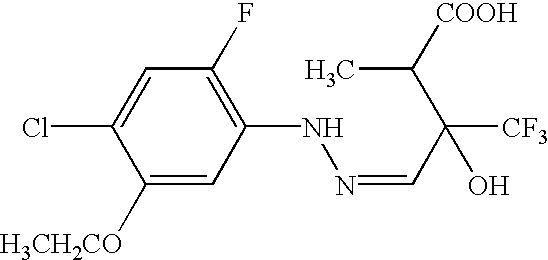
Figure US06500951-20021231-C00004
wherein R2, R3 and Q are the same as defined above, or its salt in the presence of a nitrogen-containing aromatic compound and a boron compound.
DETAILED DESCRIPTION OF THE INVENTION
The carboxylic acid of the formula (2) or its salt, which is a raw material used; in the process of the present invention, will be explained.
In the carboxylic acid of the formula (2) or its salt, examples of a substituent which may optionally present on the phenyl group Q include halogen atoms, and a group of the formula: —ZR1 in which Z is an oxygen atom or a sulfur atom, and R1 is a hydrogen atom, a C1-C6 alkyl group, a C1-C6 haloalkyl group, a C3-C8 cycloalkyl group, a benzyl group, a C3-C6 alkenyl group, a C3-C6 haloalkenyl group, a C3-C6 alkynyl group, a C3-C6 haloalkynyl group, a cyano-C1-C6 alkyl group, a C2-C8 (alkoxyalkyl) group, a C2-C, (alkoxythioalkyl) group, a carboxy-C1-C6 alkyl group, (C1-C8 alkoxy) carbonyl-C1-C6 alkyl group, [(C1-C4 alkoxy)-C1-C4 alkoxy]carbonyl-C1-C6 alkyl group, a (C3-C8 cycloalkoxy)carbonyl-C1-C6 alkyl group or a [(C1-C6 alkoxy)carbonyl-C1-C6 alkyl]oxycarbonyl-C1-C6 alkyl group, wherein the positions and number of the substituents are arbitrary.
Preferably, the group Q is an optionally substituted phenyl group of the formula (3):
Figure US06500951-20021231-C00005
wherein X is a hydrogen atom or a halogen atom, Y is a halogen atom, and W is a hydrogen atom or a group of the formula: —ZR1 in which Z and R1 are the same as defined above.
Examples of the halogen atom for X and Y include a fluorine atom, a chlorine atom, a bromine atom, etc.
Examples of the C1-C6 alkyl group for R1 include a methyl group, an ethyl group, a propyl group, an isopropyl group, a butyl group, an isobutyl group, a tert.-butyl group, an amyl group, an isoamyl group, a tert.-amyl group, etc.
Examples of the C1-C6 haloalkyl group include a 2-chloroethyl group, a 2-bromoethyl group, a 2,2,2-trifluoroethyl group, etc.
Examples of the C3-C8 cycloalkyl group include a cyclopropyl group, a cyclobutyl group, a cyclopentyl group, a cyclohexyl group, etc.
Examples of the C3-C6 alkenyl group include an allyl group, a 1-methyl-2-propenyl group, a 3-butenyl group, a 2-butenyl group, a 3-methyl-2-butenyl group, a 2-methyl-3-butenyl group, etc.
Examples of the C3-C6 haloalkenyl group include a 2-chloro-2-propenyl group, a 3,3-dichloro-2-propenyl group, etc.
Examples of the C3-C6 alkynyl group include a propargyl group, a 1-methyl-2-propynyl group, a 2-butynyl group, a 1,1-dimethyl-2-propynyl group, etc.
Examples of the C3-C6 haloalkynyl group include 3-bromopropargyl group, etc.
Examples of the cyano-C1-C6 alkyl group include a cyanomethyl group, etc.
Examples of the C2-C8 alkoxyalkyl group include a methoxymethyl group, a methoxyethyl group, an ethoxymethyl group, an ethoxyethyl group, etc.
Examples of the C2-C8 alkylthioalkyl group include a methylthiomethyl group, a methylthioethyl group, etc.
Examples of the carboxy-C1-C6 alkyl group include a carboxymethyl group, a 1-carboxyethyl group, a 2-carboxyethyl group, etc.
Examples of the (C1-C8 alkoxy)carbonyl-C1-C6 alkyl group include a methoxycarbonylmethyl group, an ethoxycarbonylmethyl group, a propoxycarbonylmethyl group, an isopropoxycarbonylmethyl group, a butoxycarbony.methyl group, an isobutoxycarbonylmethyl group, a tert.-butoxycarbonylmethyl group, an amyloxycarbonylmethyl group, an isoamyloxycarbonylmethyl group, a tert.-amyloxy-carbonylmethyl group, a 1-methoxycarbonylethyl group, a 1-ethoxycarbonylethyl group, a 1-propoxycarbonylethyl group, a 1-isopropoxycarbonylethyl group, a 1-butoxycarbonylethyl group, a 1-isobutoxycarbonylethyl group, a 1-tert.-butoxycarbonylethyl group, a 1-amyloxycarbonylethyl group, a 1-isoamyloxycarbony-ethyl group, a 1-tert.-amyloxycarbonylethyl group, etc.
Examples of the [(C1-C4 alkoxy)-C1-C4 alkoxy]carbonyl-C1-C6 alkyl group include a methoxymethoxycarbonylmethyl group, a methoxyethoxycarbonylmethyl group, a 1-methoxyethoxycarbonylethyl group, etc.
Examples of the (C3-C8 cycloalkoxy)carbonyl-C1-C6 alkyl group include a cyclobutyloxycarbonylmethyl group, a cyclopentyloxycarbonylmethyl group, a cyclohexyloxycarbonyl-methyl group, a 1-cyclobutyloxycarbonylethyl group, a 1-cyclopentyloxycarbonylethyl group, a 1-cyclohexyloxy-carbonylethyl group, etc.
Examples of the [(C1-C6 alkoxy)carbonyl-C1-C6 alkyl]oxy-carbonyl-C1-C6 alkyl group include a (methoxycarbonyl)methoxycarbonylmethyl group, an (ethoxycarbonyl)methoxycarbonylmethyl group, etc.
Examples of the C1-C3 alkyl group for R2 and R3 include a methyl group, an ethyl group, a propyl group, etc.
The salts of the carboxylic acid derivative of the formula (2) may be the salts of the above exemplified carboxylic acids and organic bases. Examples of such organic bases include nitrogen-containing aromatic compounds (e.g. pyridine, 4-dimethylaminopyridine, 2-picoline, 3-picoline, 4-picoline, 5-ethyl-2-methylpyridine, etc.), dialkylaniline derivatives (e.g. N,N-dimethylaniline, N,N-diethylaniline, etc.), tertiary amines (e.g. triethylamine, diisopropylethylamine, tri-n-propylamine, tri-n-butylamine, etc.), and the like.
Hereinafter, the specific carboxylic acid derivatives of the formula (2) as the raw materials are exemplified:
Carboxylic acid derivatives of the formula (2)
Compound Carboxylic acid
No. derivative
2-1
Figure US06500951-20021231-C00006
2-2
Figure US06500951-20021231-C00007
2-3
Figure US06500951-20021231-C00008
2-4
Figure US06500951-20021231-C00009
2-5
Figure US06500951-20021231-C00010
2-6
Figure US06500951-20021231-C00011
2-7
Figure US06500951-20021231-C00012
2-8
Figure US06500951-20021231-C00013
2-9
Figure US06500951-20021231-C00014
2-10
Figure US06500951-20021231-C00015
2-11
Figure US06500951-20021231-C00016
2-12
Figure US06500951-20021231-C00017
2-13
Figure US06500951-20021231-C00018
2-14
Figure US06500951-20021231-C00019
2-15
Figure US06500951-20021231-C00020
2-16
Figure US06500951-20021231-C00021
2-17
Figure US06500951-20021231-C00022
2-18
Figure US06500951-20021231-C00023
However, the raw materials that can be used in the present invention are not limited thereto.
Examples of the a boron compound to be used in the process of the present invention are as follows:
Figure US06500951-20021231-C00024
wherein R4, R1 and R6 are the same and different and represent a hydroxyl group, a C1-C6 alkyl group, a C1-C6 alkoxy group, a phenyl group which may optionally be substituted with at least one substituent (e.g. a halogen atom, a C1-C4 alkyl group, a C1-C3 haloalkyl group, a C1-C3alkoxy group, a nitro group, an amino group, a carboxyl group, a C1-C3 amide group, a formyl group, a C1-C3 alkylthio group, a dihydroxylboryl group, or a phenyl group which may optionally be substituted with a dihydroxyboryl group), a naphthyl group which may optionally be substituted with at least one substituent (e.g. a halogen atom, a C1-C4 alkyl group or a C1-C3 haloalkyl group), a thienyl group which may optionally be substituted with at least one substituent (e.g. a halogen atom or a C1-C4 alkyl group), a furyl group which may optionally be substituted with at least one substituent (e.g. a halogen atom or a C1-C4 alkyl group), a benzofuranyl group the benzene group of which may optionally be substituted with at least one substituent (e.g. a halogen atom, a C1-C4 alkyl group or a C1-C3 haloalkyl group), or R4 and R5 together form a ring;
a polymeric boric acid of the formula (5):
Figure US06500951-20021231-C00025
wherein R4 and R5 are the same as defined above, or R4 and R5 together form a ring, and n is an integer of at least 1; or a boroxine derivative of the formula (6):
Figure US06500951-20021231-C00026
wherein R4 is the same as defined above; or mixtures thereof.
Examples of the C1-C6 alkoxy group for R4, R5 and R6 in the formulae (4), (5) and (6) include a methoxy group, an ethoxy group, an isopropoxy group, a n-butoxy group, a tert.-butyl group, etc.
Examples of the C1-C6 alkyl group include a methyl group, an ethyl group, a n-propyl group, an isopropyl group, a n-butyl group, a sec.-butyl group, a tert.-butyl group, a n-pentyl group, a cyclopentyl group, a n-hexyl group, a cyclohexyl group, etc.
Examples of the phenyl group which may optionally be substituted include a phenyl group, a 2-fluorophenyl group, a 3-fluorophenyl group, a 4-fluorophenyl group, a 2-chlorophenyl group, a 3-chlorophenyl group, a 4-chlorophenyl group, a 2-bromophenyl group, a 3-bromophenyl group, a 4-bromophenyl group, a 2,3-difluorophenyl group, a 3,4-difluorophenyl group, a 2,4-difluorophenyl group, a 2,5-difluorophenyl group, a 2,6-difluorophenyl group, a 3,5-difluorophenyl group, 2,3-dichlorophenyl group, a 3,4-dichlorophenyl group, a 2,4-dichlorophenyl group,;a 2,5-dichlorophenyl group, a 2,6-dichlorophenyl group, a 3,5-dichlorophenyl group, a 2,3-dibromophenyl group, a 3,4-dibromophenyl group, a 2,4-dibromophenyl group, a 2,5-dibromophenyl group, a 2,6-dibromophenyl group, a 3,5-dibromophenyl group, a 2-chloro-3-fluorophenyl group, a 3-chloro-2-fluorophenyl group, a 2-chloro-4-fluorophenyl group, a 4-chloro -2-fluorophenyl group, a 2-chloro-5-fluorophenyl group, a 5-chloro-2-fluorophenyl group, a 2-chloro-6-fluorophenyl group, a 3-chloro-4-fluorophenyl group, a 4-chloro-3-fluorophenyl group, a 3-chloro-5-fluorophenyl group, a 2-bromo-3-fluorophenyl group, a 3-bromo-2-fluorophenyl group, a 2-bromo-4-fluorophenyl group, a 4-bromo-2-fluorophenyl group, a 2-bromo-5-fluorophenyl group, a 5-bromo-2-fluorophenyl group, a 2-bromo-6-fluorophenyl group, a 3-bromo-4-fluorophenyl group, a 4-bromo-3-fluorophenyl group, a 3-bromo-5-fluorophenyl group, a 2-bromo-3-chlorophenyl group, a 3-bromo-2-chlorophenyl group, a 2-bromo-4-chlorophenyl group, a 4-bromo-2-chlorophenyl group, a 2-bromo-5-chlorophenyl group, a 5-bromo-2-chlorophenyl group, a 2-bromo-6-chlorophenyl group, a 3-bromo-4-chlorophenyl group, a 4-bromo-3-chlorophenyl group, a 3-bromo-5-chlorophenyl group, a 2,3,4-trifluorophenyl group, a 3,4,5-trifluorophenyl group, a 2,3,4-trichlorophenyl group, a 3,4,5-trichlorophenyl group, a 2,3,4-tribromophenyl group, a 3,4,5-tribromophenyl group, a 2-tolyl group, a 3-tolyl group, a 4-tolyl group, a 2-ethylphenyl group, a 3-ethylphenyl group, a 4-ethylphenyl group, a 2,3-xylyl group, a 3,4-xylyl group, a 2,4-xylyl group, a 2,5-xylyl group, a 2,6-xylyl group, a 3,5-xylyl group, a mesityl group, a 2-trifluoromethylphenyl group, a 3-trifluoromethylphenyl group, a 4-trifluoromethylphenyl group, a 3,5-bis (trifluoromethyl)phenyl group, a 2-anisyl group, a 3-anisyl group, a 4-anisyl group, a 2-nitrophenyl group, a 3-nitrophenyl group, a 4-nitrophenyl group, a 2-aminophenyl group, a 3-aminophenyl group, a 4-aminophenyl group, a 2-carboxyphenyl group, a 3-carboxyphenyl group, a 4-carboxyphenyl group, a 2-acetamidophenyl group, a 3-acetamidophenyl group, a 4-acetamidophenyl group, a 2-formylphenyl group, a 3-formylphenyl group, a 4-formylphenyl group, a 2-methylthiophenyl group, a 3-methylthiophenyl group, a 4-methylthiophenyl group, a 2-(dihydroxyboryl)phenyl group, a 3-(dihydroxyboryl)phenyl group, a 4-(dihydroxyboryl)phenyl group, a 2-biphenyl group, a 3-biphenyl group, a 4-biphenyl group, a 4-[4′-(dihydroxyboryl)phenyl]phenyl group, etc.
Examples of the naphthyl group which may optionally be substituted include a 1-naphthyl group, 2-naphthyl group, a 3-fluoro-1-naphthyl group, a 4-fluoro-1-naphthyl group, a 5-fluoro-1-naphthyl group, a 6-fluoro-1-naphthyl group, a 3-fluoro-2-naphthyl group, a 4-fluoro-2-naphthyl group, a 5-fluoro-2-naphthyl group, a 6-fluoro-2-naphthyl group, a 3-chloro-1-naphthyl group, a 4-chloro-1-naphthyl group, a 5-chloro-1-naphthyl group, a 6-chloro-1-naphthyl group, a 3-chloro-2-naphthyl group, a 4-chloro-2-naphthyl group, a 5-chloro-2-naphthyl group, a 6-chloro-2-naphthyl group, a 3-bromo-1-naphthyl group, a 4-bromo-1-naphthyl group, a 5-bromo-1-naphthyl group, a 6-bromo-1-naphthyl group, a 3-bromo-2-naphthyl group, a 4-bromo-2-naphthyl group, a 5-bromo-2-naphthyl group, a 6-bromo-2-naphthyl group, a 3-methyl-o-naphthyl group, a 4-methyl-1-naphthyl group, a 5-methyl-1-naphthyl group, a 6-methyl-1-naphthyl group, a 3-methyl-2-naphthyl group, a 4-methyl-2-naphthyl group, a 5-methyl-2-naphthyl group, a 4-methyl-2-naphthyl group, a 5-methyl-2-naphthyl group, a 6-methyl-2-naphthyl group, a 3-trifluoromethyl-1-naphthyl group, a 4-trifluoromethyl-1-naphthyl group, a 5-trifluoromethyl-1-naphthyl group, a 6-trifluoromethyl-1-naphthyl group, a 3-trifluoromethyl-2-naphthyl group, a 4-trifluoromethyl-2-naphthyl group, a 5-trifluoromethyl-2-naphthyl group, a 6-trifluoromethyl-2-naphthyl group, etc.
Examples of the thienyl group which may optionally be substituted include a 2-thienyl group, a 3-thienyl group, a 3-fluoro-2-thienyl group, a 4-fluoro-2-thienyl group, a 5-fluoro-2-thienyl group, a 2-fluoro-3-thienyl group, a 4-fluoro-3-thienyl group, a 5-fluoro-3-thienyl group, a 3-chloro-2-thienyl group, a 4-chloro-2-thienyl group, a 5-chloro-2-thienyl group, a 2-chloro-3-thienyl group, a 4-chloro-3-thienyl group, a 5-chloro-3-thienyl group, a 3-bromo-2-thienyl group, a 4-bromo-2-thienyl group, a 5-bromo-2-thienyl group, a 2-bromo-3-thienyl group, a 4-bromo-3-thienyl group, a 5-bromo-3-thienyl group, a 3-methyl-2-thienyl group, a 4-methyl-2-thienyl group, a 5-methyl-2-thienyl group, a 2-methyl-3-thienyl group, a 4-methyl-3-thienyl group, a 5-methyl-3-thienyl group, etc.
Examples of the furyl group which may optionally be substituted include a-2-furyl group, a 3-furyl group, a 3-fluoro-2-furyl group, a 4-fluoro-2-furyl group, a 5-fluoro-2-furyl group, a 2-fluoro-3-furyl group, a 4-fluoro-3-furyl group, a 5-fluoro-3-furyl group, a 3-chloro-2-furyl group, a 4-chloro-2-furyl group,-a 5-chloro-2-furyl group, a 2-chloro-3-furyl group, a 4-chloro-3-furyl group, a 5-chloro-3-furyl group, a 3-bromo-2-furyl group, a 4-bromo-2-furyl group, a 5-bromo-2-furyl group, a 2-bromo-3-furyl group, a 4-bromo-3-furyl group, a 5-bromo-3-furyl group, a 3-methyl-2-furyl group, a 4-methyl-2-furyl group, a 5-methyl-2-furyl group, a 2-methyl-3-furyl group, a 4-methyl-3-furyl group, a 2-methyl-3-furyl group, etc.
Examples of the benzofuranyl group which may optionally be substituted include a 2-benzofuranyl group, a 3-benzofuranyl group, a 4-fluoro-2-benzofuranyl group, a 5-fluoro-2-benzofuranyl group, a 6-fluoro-2-benzofuranyl group, a 7-fluoro-2-benzofuranyl group, a 4-fluoro-3-benzofuranyl group, a 5-fluoro-3-benzofuranyl group, a 6-fluoro-3-benzofuranyl group, a 7-fluoro-3-benzofuranyl group, a 4-chloro-2-benzofuranyl group, a 5-chloro-2-benzofuranyl group, a 6-chloro-2-benzofuranyl group, a 7-chloro-2-benzofuranyl group, a 4-chloro-3-benzofuranyl group, a 5-chloro-3-benzofuranyl group, a 6-chloro-3-benzofuranyl group, a 7-chloro-3-benzofuranyl group, a 4-bromo-2-benzofuranyl group, a 5-bromo-2-benzofuranyl group, a 6-bromo-2-benzofuranyl group, a 7-bromo-2-benzofuranyl group, a 4-bromo-3-benzofuranyl group, a 5-bromo-3-benzofuranyl group, a 6-bromo-3-benzofuranyl group, a 7-bromo-3-benzofuranyl group, a 4-methyl-2-benzofuranyl group, a 5-methyl-2-benzofuranyl group, a 6-methyl-2-benzofuranyl group, a 7-methyl-2-benzofuranyl group, a 4-methyl-3-benzofuranyl group, a 5-methyl-3-benzofuranyl group, a 6-methyl-3-benzofuranyl group, a 7-methyl-3-benzofuranyl group, a 4-trifluoromethyl-2-benzofuranyl group, a 5-trifluoromethyl-2-benzofuranyl group, a 6-trifluoromethyl-2-benzofuranyl group, a 7-trifluoromethyl-2-benzofuranyl group, a 4-trifluoromethyl-3-benzofuranyl group, a 5-trifluoromethyl-3-benzofuranyl group, a 6-trifluoromethyl-3-benzofuranyl group, a 7-trifluoromethyl-3-benzofuranyl group, etc.
Examples of the combined group of R4 and R5 which form a ring include a C4-C5 alkylene group which may be substituted with at least one methyl group such as a 1,4-tetramethylene group, or a 1,5-pentamethylene group, and a C2-C4 alkylenedioxy group !which may be substituted with at least one methyl group such as a 1,2-ethylenedioxy group, a 1,2-(1,1,2,2-tetramethyl)ethylene-dioxy group or a 1,3-tetramethylenedioxy group, and a 1,2-phenylenedioxy group, etc.
Examples of the borane compound of the formula (4) include boric acid derivatives (e.g. methylboric acid, ethylboric acid, isopropylboric acid, n-butylboric acid, n-pentylboric acid, cyclopentylboric acid, n-hexylboric acid, cyclohexylboric acid, phenylboric acid, 2-flutiorophenylboric acid, 3-fluorophenylboric acid, 4-fluorophenylboric acid, 2-chlorophenylboric acid, 3-chlorophenylboric acid, 4-chlorophenylboric acid, 2-bromo-phenylboric acid, 3-bromophenylboric acid, 4-bromophenylboric acid, 3,5-difluorophenylboric acid, 2,3-dichlorophenylboric acid, 3,4-dichlorophenylboric acid, 2,4-dichlorophenylboric acid, 3, 5-dichlorophenylboric acid, 3, 5-dibromophenylboric acid, 3-chloro-4-fluorophenylboric acid, 3,4,5-trifluorophenylboric acid, 3,4,5-trichlorophenylboric acid, 3,4,5-tribromophenyl-boric acid, 2,3,4,5,6-pentafluorophenylboric acid, 2-tolylboric acid, 3-tolylboric acid, 4-tolylboric acid, 4-ethylphenylboric acid, 3,4-xylylboric acid, mesitylboric acid, 2-trifluoromethylphenylboric acid, 3-trifluoromethylphenylboric acid, 4-trifluoromethylphenylboric acid, 3,5-bis(trifluoromethyl)phenylboric acid, 2-anisylboric acid, 3-anisylboric acid, 4-anisylboric acid, 3-nitrophenylboric acid, 4-nitrophenylboric acid, 3-aminophenylboric acid, 2-carboxyphenylboric acid, 4-carboxyphenylboric acid, 3-acetamidophenylboric acid, 2-formylphenylboric acid, 3-formylphenylboric acid, 4-formylphenylboric acid, 2-methylthiophenylboric acid, 4-methylthiophenylboric acid, 4-biphenylboric acid, 1,2-phenylenediboric acid, 1,3-phenylenediboric acid, 1,4-phenylenediboric acid, 4,4′-biphenyleneboric acid, 1-naphthylboric acid, 2-naphthylboric acid, 2-thienylboric acid, 3-thienylboric acid, 5-chloro-2-thienylboric acid, 2-furylboric acid, 3-furylboric acid, 2-benzofuranylboric acid, 3-benzofuranylboric acid, etc.);
borinic acid derivatives (e.g. dimethylborinic acid, diethylborinic acid, diphenylborinic acid, bis(3,4,5-trifluorophenyl)borinic acid, bis(2,3,4,5,6-pentafluorophenyl) borinic acid, bis (4-methylphenyl)borinic acid, bis[3,5-bis(trifluoromethyl)-phenyl]borinic acid, etc.);
trimethylborane, triethylborane, triphenylborane, tris(3,4,5-trifluorophenyl)borane, tris(2,3,4,5,6-pentafluorophenyl)borane, tris(4-methylphenyl)borane, tris[3,5-bis(trifluorqmethyl)phenyl]borane, tris(3-nitrophenyl)borane, dimethoxyphenylborane, 2-phenyl-1,3,2-dioxabororane, 2-phenyl-4,4,5,5-tetramethyl-1,3,2-dioxabororane, dimethdxy-(4-methylphenyl)borane, 2-(4-methyl)phenyl-1,3,2-dioxabororane, 2-(4-methyl)phenyl-4,4,5,5-tetramethyl-1,3,2-dioxabororane, dimethoxy-(3,4,5-trifluorophenyl)borane, 2-(3,4,5-trifluoro)phenyl-1,3,2-dioxabororane, 2-(3,4,5-trifluoro)phenyl-4,4,5,5-tetramethyl-1,3,2-dioxabororane, dimethoxy-(2,3,4,5,6-pentafluorophenyl)borane, 2-(2,3,4,5,6-pentafluoro)phenyl-1,3,2-dioxabororane, 2-(2,3,4,5,6-pentafluoro)phenyl-4,4,5,5-tetramethyl-1,3,2-dioxabororane, dimethoxy-(3,5-bistrifluoro-methyl)phenylborane, 2-(3,5-bistrifluoromethyl)phenyl-1,3,2-dioxabororane, 2-(3,5-bistrifluoromethyl)phenyl-4,4,5,5-tetramethyl-1,3,2-dioxabororane, dimethoxy-(3-nitrophenyl)-borane, 2-(3-nitro)phenyl-1,3,2-dioxabororane, 2-(3-nitro)phenyl-4,4,5,5-tetramethyl-1,3,2-dioxabororane, etc.
In a polymeric boric acid of the formula (5), n is an integer of 1 or more, and preferably from 1 to 5.
Examples of the polymeric boric acid of the formula (5) include boric acid derivatives or borinic acid derivative, and their anhydrides among the above borane compounds of the formula (4).
Examples of thelboroxine derivative of the formula (6) include trimethylboroxine, triethylboroxine, triphenylboroxine, tris(3,4,5-trifluorophneyl)boroxine, tris(2,3,4,5,6-pentafluorophenyl)boroxine, tris(4-methylphenyl)boroxine, tris[3,5-bis(trifluoromethyl)phenyl]boroxine, tris(3-nitrophenyl)boroxine, etc.
Preferred examples of the borane compound (4), the polymeric boric acid (5) or the boroxine derivative (6) include methylboric acid, n-butylboric acid, phenylboric acid, 3-fluorophenylboric acid, 4-fluorophenylboric acid, 4-chlorophenylboric acid, 4-bromophenylboric acid, 3,5-dichlorophenylboric acid, 3-chloro-4-fluorophenylboric acid, 4-tolylboric acid, 3-trifluoromethylphenylboric acid, 4-trifluoromethylphenylboric acid, 3,5-bis(trifluoromethyl)phenylboric acid, 3-anisylboric acid, 3-nitrophenylboric acid; 4-carboxyphenylboric acid, 3-acetamidophenylboric acid, 3-formylphenylboric acid, 4-formylphenylboric acid, 4-methylthiophenylboric acid, 2-naphthylboric acid, 1,4-phenylenediboric acid, diphenylborinic acid, bis(4-methylphenyl)borinic acid, and their polymeric derivatives (anhydrides); triphenylborane, tris(4-methylphenyl)borane, triphenylboroxine, tris(4-methylphenyl)boroxine, and the like. Particularly preferred compounds are phenylboric acid, 4-tolylboric acid and their anhydrides; triphenylboroxine and tris(4-methyl)phenylboroxine.
Among the borane compounds of the formula (4), borinic acid derivatives in which one of R4, R5 and R6 is a hydroxyl group, or boric acid derivatives in which two of R4, R5and R6 are hydroxyl groups may also form polymeric derivatives (anhydrides) represented by the formula (5) or (6). In the present invention, monomeric compounds, polymeric compounds and their mixtures can be used.
Now, a nitrogen-containing aromatic compound used in the process of the present invention is explained.
A nitrogen-containing aromatic compound used in the process of the present invention is usually pyridine, quinoline or isoquinoline, which may optionally be substituted with at least one substituent is selected from a halogen atom (e.g. a fluorine atom, a chlorine atom, a bromine atom and an iodine atom), a C1-C3 alkyl group (e.g. a methyl group, an ethyl group, a propyl group, an isopropyl group, etc.) and a di-(C1-C3 alkyl)amino group.
Specific examples of such a nitrogen-containing aromatic compound include pyridine, quinoline, isoquinoline, 4-dimethylaminopyridine, 2-picoline, 3-picoline, 4-picoline, 2,3-lutidine, 2,4-lutidine, 2,5-lutidine, 2,6-lutidine, 3,4-lutidine, 3,5-lutidine, 3-chloropyridine, 2-ethyl-3-methylpyridine, 5-ethyl-2-methylpyridine, etc.
Preferred nitrogen-containing aromatic compounds are pyridines which may be substituted with at least one alkyl group, in particular, at least one C1-C3 alkyl group, for example, 2-picoline, 2,3-lutidine, 2,4-lutidine, 2,5-lutidine, 2,6-lutidine, 2-ethyl-3-methylpyridine, 5-ethyl-2-methylpyridine,etc. Among them, pyridines having a substituent at the 2-position, for example, 5-ethyl-2-methylpyridine are particularly preferred.
The combination of a boron compound and a nitrogen-containing aromatic compound can be the combination of the above exemplified compounds. In particular, the combination of phenylboric acid and 5-ethyl-2-methylpyridine, the combination of 4-tolylboric acid and 5-ethyl-2-methylpyridine, the combination of triphenylboroxine and 5-ethyl-2-methylpyridine, and the combination of tris(4-methylphenyl)boroxine and 5-ethyl-2-methylpyridine are preferred from the viewpoint of overall properties.
The process of the present invention is usually carried out in a solvent. A reaction temperature is usually in the range between about 50° C. and about 250° C., preferably in the range between about 100° C. and about 200° C. A reaction time is usually from split second to about 48 hours, preferably from 1 to 24 hours.
Examples of a solvent which may be used in the process of the present invention:include aliphatic hydrocarbons (e.g. heptane, octane, ligroin, etc.), aromatic hydrocarbons (e.g. benzene, toluene, ethylbenzene, xylene, mesitylene, etc.), halogeneated hydrocarbons (e.g. 1,2-dichloroethane, chlorobenzene, dichlorobenzene, trichlorobenzene, etc.), ethers (e.g. 1,4-dioxane, ethylene glycol dimethyl ether, methyl tert.-butyl ether, etc.), ketones (e.g. methyl isobutyl ketone, cyclohexanone, etc.), acid amides (e.g. N,N-dimethylformamide, etc.), alcohols (e.g. propanol, butanol, amyl alcohol, ethylene glycol, diethylene glycol, etc.), and their mixtures.
The amount of a nitrogen-containing compound is usually from 0.01 to a solvent amount, preferably from 0.1 to 20 moles, per 1 mole of a carboxylic acid derivative of the formula (2).
The amount of a boron compound is usually from 0.0001 to 5 moles, preferably from 0.001 to 3 moles, in terms of a boron atom, per 1 mole of a carboxylic acid derivative of the formula (2).
The carboxylic acid of the formula (2) is a known compound from WO98/17632, or can be prepared by the method described in this WO publication.
The carboxylic acid of the formula (2) or its salt has geometric isomers due to the presence of a double bond, optical isomers due to the presence of an asymmetric carbon atom and diastereomers. Any one of such isomers or a mixture thereof may be used in the process of the present invention.
In the process of the present invention, the raw material, a solvent and the like can be charged at once, although it is possible to charge a carboxylic acid derivative of the formula (2), a nitrogen-containing compound and the like by several portions to carry out the reaction.
After the completion of the reaction, the reaction mixture is post-treated, for example, the reaction mixture as such is concentrated, or it is washed with an aqueous solution of an inorganic acid such as hydrochloric acid, sulfuric acid, etc. and the organic layer is dried and concentrated. If necessary, the concentrated product may be purified by recrystallization or with column chromatography to recover a pyridazin-3-on of the formula (1).
In the process of the present invention, the reaction may be carried out with azeotropic dehydration and/or in the presence of a dehydrator. Examples of such a dehydrator include zeolites such as molecular sieves, silica gel, magnesium sulfate, sodium sulfate, calcium sulfate, copper sulfate, etc. Preferably zeolites such as molecular sieves, in particular, Molecular Sieve 3A, are used.
When a solid dehydrator is used, it is removed by filtration from a reaction mixture, and then the reaction mixture is subjected to the above post-treatment to recover a pyridazin-3-one of the formula (1).
Preferred but unlimiting examples of pyridazin-3-on derivatives of the formula (1) are as follows:
Pyridazin-3-on derviatives of the formula (1)
Compound Pyridazine-3-on
No. derivative
1-1
Figure US06500951-20021231-C00027
1-2
Figure US06500951-20021231-C00028
1-3
Figure US06500951-20021231-C00029
1-4
Figure US06500951-20021231-C00030
1-5
Figure US06500951-20021231-C00031
1-6
Figure US06500951-20021231-C00032
1-7
Figure US06500951-20021231-C00033
1-8
Figure US06500951-20021231-C00034
1-9
Figure US06500951-20021231-C00035
1-10
Figure US06500951-20021231-C00036
1-11
Figure US06500951-20021231-C00037
1-12
Figure US06500951-20021231-C00038
1-13
Figure US06500951-20021231-C00039
1-14
Figure US06500951-20021231-C00040
1-15
Figure US06500951-20021231-C00041
1-16
Figure US06500951-20021231-C00042
1-17
Figure US06500951-20021231-C00043
1-18
Figure US06500951-20021231-C00044
EFFECTS OF THE INVENTION
According to the present invention, pyridazin-3-on derivatives having good herbicidal activities can be obtained at a high yield and high purity.
EXAMPLES
The present invention will be illustrated by the following examples, which do not limit the scope of the invention in any way.
Example 1
3-Carboxy-2-trifluoromethyl-2-hydroxy-1-butanal-1-(4-chloro-2-fluoro-5-hydroxyphenylhydrazone) (Compound 2-2) (5.62 g), phenylboric acid (0.38 g), Molecular Sieve 4A (powder) (2.70 g), toluene (16.14 g) and 5-ethyl-2-methylpyridine (2.82 g) were charged in a reactor, and stirred at a temperature between 110° C. and 115° C. for 10 hours. After the reaction mixture was cooled to room temperature, methanol (10.0 g) was added to the mixture, and the supernatant was analyzed with LC by an internal standard method, which is explained below. The yield of 2-(2-fluoro-4-chloro-5-hydroxyphenyl)-4-methyl-5-trifluoromethylpyridazin-3-on (Compound 1-2) was 91.2%.
Internal Standard Method
Solutions containing a beforehand isolated objective compound and a standard compound, which is used as the standard of a peak area, in various compositions are prepared, and detected intensities of those solutions are measured by liquid chromatography analysis. Then, a calibration curve is drawn from the weight ratios and the peak area ratios of the objective compound to the standard compound.
Thereafter, the precise amount of the standard compound is added to the specific amount of a reaction mixture after the completion of a reaction, and the mixture is analyzed by liquid chromatography. The concentration of the objective compound is calculated using the calibration curve from the obtained peak area ratio of the objective compound to the standard compound.
In the examples, ethoxybenzene was used as a standard compound.
Examples 2 to 21
The same procedures as those in Example 1 were repeated except that a boric acid derivative shown in Table 1 was used in place of phenylboric acid (0.38 g). Then, the supernatant of the reaction mixture was analyzed by the internal standard method. The yield of 2-(2-fluoro-4-chloro-5-hydroxyphenyl)-thyl-5-trifluoromethylpyridazin-3-on is shown in Table 1.
TABLE 1
Ex. Amount Yield
No. Boric acid derivative (g) (%)
 2 n-Butylboric acid 0.33 88.3
 3 4-Tolylboric acid 0.41 89.8
 4 3-Fluorophenylboric acid 0.42 90.0
 5 4-Fluorophenylboric acid 0.42 87.4
 6 3-Formylphenylboric acid 0.45 86.8
 7 4-Formylphenylboric acid 0.45 87.9
 8 3-Anisylphenylboric acid 0.46 89.2
 9 4-Chlorophenylboric acid 0.47 92.2
10 4-Carboxyphenylboric acid 0.50 87.7
11 3-Nitrophenylboric acid 0.50 86.1
12 4-Methylthiophenylboric acid 0.50 88.7
13 2-Naphthylboric acid 0.52 91.8
14 3-Chloro-4-fluorophenylboric acid 0.52 88.9
15 3-Acetamidophenylboric acid 0.67 91.9
16 3-(Trifluoromethyl)phenylboric acid 0.57 86.5
17 4-(Trifluoromethyl)phenylboric acid 0.58 85.1
18 3,5-Dichlorophenylboric acid 0.57 87.6
19 4-Bromophenylboric acid 0.60 86.5
20 3,5-Bis(trifluoromethyl)phenylboric acid 0.77 89.8
21 1,4-Phenylenediboric acid 0.50 92.7
Example 22
The same procedures as those in Example 11 were repeated except that 0.75 g of 3-nitrophenylboric acid and 3.76 g of 5-ethyl-2-methylpyridine were used. Then, the supernatant of the reaction mixture was analyzed by the internal standard method. The yield of 2-(2-fluoro-4-chloro-5-hydroxyphenyl)-4-methyl-5-trifluoromethylpyridazin-3-on was 91.6%.
Example 23
3-Carboxy-2-trifluoromethyl-2-hydroxy-1-butanal-1-(4-chloro-2-fluoro-5-hydroxyphenylhydrazone) (9.43 g), phenylboric acid (0.31 g), Molecular Sieve 3A (powder) (8.97 g), toluene (44.72 g) and 5-ethyl-2-methylpyridine (4.69 g) were charged in a reactor, and stirred at 114° C. for 7 hours. After the reaction mixture was cooled to room temperature, the molecular sieve was removed by filtration, and the filtrate was analyzed with LC by an: internal standard method. The yield of 2-(2-fluoro-4-chloro-5-hydroxyphenyl)-4-methyl-5-trifluoromethylpyridazin-3-on was 93.5%.
Example 24
The same procedures as those in Example 23 were repeated except that 0.61 g of phenylboric acid and 18.83 g of 5-ethyl-2-methylpyridine were used. Then, the filtrate was analyzed with LC by the internal standard method. The yield of 2-(2-fluoro-4-chloro-5-hydroxyphenyl)-4-methyl-5-trifluoromethylpyridazin-3-on was 98.2%.
Example 25
3-Carboxy-2-trifluoromethyl-2-hydroxy-1-butanal-1-(4-chloro-2-fluoro-5-hydroxyphenylhydrazone) (4.62 g), phenylboric acid (0.55 g), Molecular Sieve 4A (powder) (8.09 g), toluene (80.69 g) and 5-ethyl-2-methylpyridine (2.83 g) were charged in a reactor, and stirred at a temperature between 109° C. and 112° C. for 3 hours. Then, 3-carboxy-2-trifluoromethyl-2-hydroxy-1-butanal-1-(4-chloro-2-fluoro-5-hydroxyphenylhydrazone) (4.61 g) and 5-ethyl-2-methylpyridine (1.84 g) were charged. After further 3 hours, 3-carboxy-2-trifluoromethyl-2-hydroxy-1-butanal-1-(4-chloro-2-fluoro-5-hydroxyphenylhydrazone) (4.59 g) and 5-ethyl-2-methylpyridine (1.88 g) were charged. After another 3 hours, 3-carboxy-2-trifluoromethyl-2-hydroxy-1-butanal-1-(4-chloro-2-fluoro-5-hydroxyphenylhydrazone) (4.61 g) and 5-ethyl-2-methylpyridine (1.85 g) were charged, and the mixture was heated at the same temperature as above for 11 hours.
After the reaction mixture was cooled to room temperature, the molecular sieve was removed by filtration, and the filtrate was analyzed with LC by an internal standard method. The yield of 2-(2-fluoro-4-chloro-5-hydroxyphenyl)-4-methyl-5-trifluoromethylpyridazin-3-on was 88.0%.
Example 26
The same procedures as those in Example 25 were repeated except that formed water was azeotropically removed. The filtrate was analyzed with LC by an internal standard method. The yield of 2-(2-fluoro-4-chloro-5-hydroxyphenyl)-4-methyl-5-trifluoromethylpyridazin-3-on was 92.1%.
Example 27
The same procedures as those in Example 26 were repeated except that monochlorobenzene (80.76 g) was used in place of toluene. The filtrate was analyzed with LC by an internal standard method. The yield of 2-(2-fluoro-4-chloro-5-hydroxyphenyl)-4-methyl-5-trifluoromethylpyridazin-3-on was 93.7%.
Example 28
3-Carboxy-2-trifluoromethyl-2-hydroxy-1-butanal-1-(4-chloro-2-fluoro-5-hydroxyphenylhydrazone) (5.65 g), phenylboric acid (0.73 g), Molecular Sieve 3A (powder) (21.52 g), toluene (107.41 g) and 5-ethyl-2-methylpyridine (3.75 g) were charged in a reactor, and stirred at a temperature between 113° C. and 115° C. for 3 hours. Then, 3-carboxy-2-trifluoromethyl-2-hydroxy-1-butanal-1-(4-chloro-2-fluoro-5-hydroxyphenylhydrazone) (5.63 g) and 5-ethyl-2-methylpyridine (2.51 g) were charged. After further 3 hours, 3-carboxy-2-trifluoromethyl-2-hydroxy-1-butanal-1-(4-chloro-2-fluoro-5-hydroxyphenylhydrazone) (5.63 g) and 5-ethyl-2-methylpyridine (2.50 g) were charged. After another 3 hours, 3-carboxy-2-trifluoromethyl-2-hydroxy-1-butanal-1-(4-chloro-2-fluoro-5-hydroxyphenylhydrazone) (5.66 g) and 5-ethyl-2-methylpyridine (2.49 g) were charged, and the mixture was heated at the same temperature as above for 6 hours.
After the reaction mixture was cooled to room temperature, the molecular sieve was removed by filtration, and the filtrate was analyzed with LC by an internal standard method. The yield of 2-(2-fluoro-4-chloro-5-hydroxyphenyl)-4-methyl-5-trifluoromethylpyridazin-3-on 99.3%.
Example 29
The same procedures as those in Example 23 were repeated except that 2,6-lutidine (8.10 g) was used in place of 5-ethyl-2-methylpyridine (4.69 g), and the mixture was stirred at a temperature between 115° C. and 116° C. for 15 hours. The filtrate was analyzed with LC by an internal standard method. The yield of 2-(2-fluoro-4-chloro-5-hydroxyphenyl)-4-methyl-5-trifluoromethylpyridazin-3-on was 90.9%.
Example 30
3-Carboxy-2-trifluoromethyl-2-hydroxy-1-butanal-1-(4-chloro-2-fluoro-5-hydroxyphenylhydrazone) (16.68 g), phenylboric acid (0.55 g), Molecular Sieve 3A (powder) (16.24 g), toluene (80.83 g) and 2-picolin (12.61 g) were charged in a reactor, and stirred at a temperature between 114 and 115° C. for 7 hours. After the reaction mixture was cooled to room temperature, the molecular sieve was removed by filtration, and the filtrate was analyzed with LC by an internal standard method. The yield of 2-(2-fluoro-4-chloro-5-hydroxyphenyl)-4-methyl-5-trifluoromethylpyridazin-3-on was 91.0%.
Example 31
3-Carboxy-2-trifluoromethyl-2-hydroxy-1-butanal-1-(4-chloro-2-fluoro-5-hydroxyphenylhydrazone) (16.48 g), triphenylboroxine (0.48 g), Molecular Sieve 3A (powder) (16.37 g), toluene (84.91 g) and 5-ethyl-2-methylpyridine (17.06 g) were charged in a reactor, and stirred at a temperature between 114 and 115° C. for 6 hours. After the reaction mixture was cooled to room temperature, the molecular sieve was removed by filtration, and the filtrate was analyzed with LC by an internal standard method. The yield of 2-(2-fluoro-4-chloro-5-hydroxyphenyl)-4-methyl-5-trifluoromethylpyridazin-3-on was 93.6%.
Example 32
The same procedures as those in Example 31 were repeated except that diphenylborinic acid (0.81 g) was used in place of triphenylboroxine (0.48 g). After the reaction mixture was cooled to room temperature, the molecular sieve was removed by filtration, and the filtrate was analyzed with LC by an internal standard method. The yield of 2-(2-fluoro-4-chloro-5-hydroxyphenyl)-4-methyl-5-trifluoromethylpyridazin-3-on was 93.4%.
Example 33
The same procedures as those in Example 31 were repeated except that triphenylborane (1.14 g) was used in place of triphenylboroxine (0.48 g). After the reaction mixture was cooled to room temperature, the molecular sieve was removed by filtration, and the filtrate was analyzed with LC by an internal standard method. The yield of 2-(2-fluoro-4-chloro-5-hydroxyphenyl)-4-methyl-5-trifluoromethylpyridazin-3-on was 95.4%.
Reference Example 1
3-Carboxy-2-trifluoromethyl-2-hydroxy-1-butanal-1-(4-chloro-2-fluoro-5-hydroxyphenylhydrazone) (0.315 g) was dissolved in the mixture of acetic acid (1.0 ml) and pyridine (1.0 ml) under a nitrogen atmosphere, and stirred at 120° C. for 8 hours. After the reaction mixture was cooled to room temperature, it was concentrated under reduced pressure, and the residue was diluted with diethyl ether (100 ml). Then, the diluted solution was washed with 3N hydrochloric acid (each 20 ml) twice, and saturated sodium bicarbonate (30 ml) once, dried over magnesium sulfate, filtrated and concentrated under reduced pressure. The residue was subjected to column chromatography. Thus, 2-(2-fluoro-4-chloro-5-hydroxyphenyl)-4-methyl-5-trifluoromethylpyridazin-3-on (0.227 g) was obtained.

Claims (18)

What is claimed is:
1. A method for preparing a pyridazin-3-on derivative of the formula (1):
Figure US06500951-20021231-C00045
wherein R2 is a hydrogen atom or a C1-C3 alkyl group, R3 is a hydrogen atom or a C1-C3 alkyl group, and Q is an optionally substituted phenyl group of the formula (3):
Figure US06500951-20021231-C00046
wherein X is a hydrogen atom or a halogen atom, Y is a halogen atom, and W is a hydrogen atom or a group of the formula: —ZR1 in which Z is an oxygen atom or a sulfur atom, and R1 is a hydrogen atom, a C1-C6 alkyl group, a C1-C6 haloalkyl group, a C3-C8 cycloalkyl group, a benzyl group, a C3-C6 alkenyl group, a C3-C6 haloalkenyl group, a C3-C6 alkynyl group, a C3-C6 haloalkynyl group, a cyano-C1-C6 alkyl group, a C2-C8 (alkoxyalkyl) group, a C2-C8 (alkoxythioalkyl) group, a carboxy-C1-C6 alkyl group, (C1-C8 alkoxy)carbonyl-C1-C6 alkyl group, a [(C1-C4 alkoxy)-C1-C4 alkoxy]carbonyl-C1-C6 alkyl group, a (C3-C8 cycloalkoxy)carbonyl-C1-C6 alkyl group or a [(C1-C6 alkoxy)carbonyl-C1-C6 alkyl]oxycarbonyl-C1-C6 alkyl; comprising the step of ring closing a carboxylic acid derivative of the formula (2):
Figure US06500951-20021231-C00047
wherein R2, R3 and Q are the same as defined above, or its salt in the presence of a nitrogen-containing aromatic compound and at least one boron compound selected from formula (4), (5) and (6);
a borane compound of the formula (4):
Figure US06500951-20021231-C00048
wherein R4, R5 and R6 are the same or different and represent a hydroxyl group, a C1-C6 alkyl group, a C1-C6 alkoxy group, a phenyl group which may optionally be substituted with at least one substituent selected from a halogen atom, a C1-C4 alkyl group, a C1-C3 haloalkyl group, a C1-C3 alkoxy group, a nitro group, an amino group, a carboxyl group, a C1-C3 amide group, a formyl group, a C1-C3 alkylthio group, a dihydroxylboryl group and a phenyl group that may optionally be substituted with a dihydroxyboryl group,
a naphthyl group which may optionally be substituted with at least one substituent selected from a halogen atom, a C1-C4 alkyl group and a C1-C3 haloalkyl group, a thienyl group which may optionally be substituted with at least one substituent selected from a halogen atom and a C1-C4 alkyl group,
a furyl group which may optionally be substituted with at least one substituent selected from a halogen atom and a C1-C4 alkyl group, a benzofuranyl group. the benzene group of which may optionally be substituted with at least one substituent selected from a halogen atom, a C1-C4 alkyl group and a C1-C3 haloalkyl group, or R4 and R5 together form a ring;
a polymeric boric acid of the formula (5):
Figure US06500951-20021231-C00049
wherein R4 and R5 are the same as defined above, or R4 and R5 together form a ring, and n is an integer of at least 1; and
a boroxine derivative of the formula (6):
Figure US06500951-20021231-C00050
wherein R4 is the same as defined above.
2. A process according to claim 1, wherein Z in the formula (3) is an oxygen atom.
3. A process according to claim 1, wherein W in the formula (3) is a hydroxyl group.
4. A process according to claim 1, wherein X in the formula (3) is a fluorine atom.
5. A process according to claim 1, wherein X and Y in the formula (3) are a fluorine atom and a chlorine atom, respectively.
6. A process according to claim 1, wherein R2 and R3 in the formulae (1) and (2) independently represent a hydrogen atom or a methyl group.
7. A process according to claim 1, wherein R2 and R3 in the formulae (1) and (2) are a methyl group and a hydrogen atom, respectively.
8. A process according to claim 1, wherein said nitrogen-containing aromatic compound is pyridine which may option ally be substituted with at least one alkyl group.
9. A process according to claim 1, wherein said nitrogen-containing aromatic compound is 5-ethyl-2-methylpyridine.
10. A process according to claim 1, wherein said borane compound of the formula (4) is phenylboric acid or 4-tolylboric acid.
11. A process according to claim 1, wherein said boroxine derivative of the formula (6) is triphenylboroxine or tris (4-methylphenyl) boroxine.
12. A process according to claim 1, wherein said nitrogen-containing compound is 5-ethyl-2-methylpyridine, and said borane compound of the formula (4) is phenylboric acid.
13. A process according to claim 1, wherein said nitrogen-containing compound is 5-ethyl-2-methylpyridine, and said boroxine derivative of the formula (6) is triphenylboroxine.
14. A process according to claim 1, wherein said boron compound is used in an amount of from 0.001 to 3 moles, in terms of a boron atom, per 1 mole of said carboxylic acid derivative of the formula (2) or its salt.
15. A process according to claim 1, wherein the reaction is carried out with azeotropic dehydration and/or in the presence of a dehydrator.
16. A process according to claim 15, wherein said dehydrator is a molecular sieve.
17. A process according to claim 15, wherein said molecular sieve is Molecular Sieve 3A.
18. A process according to claim 1, wherein the reaction is carried out at a temperature of from 100° C. to 200° C.
US09/857,033 1998-12-09 1999-12-07 Process for preparing pyridazin-3-on derivatives Expired - Fee Related US6500951B1 (en)

Applications Claiming Priority (5)

Application Number Priority Date Filing Date Title
JP35027498 1998-12-09
JP10-350274 1998-12-09
JP11-172464 1999-06-18
JP17246499A JP3890816B2 (en) 1998-12-09 1999-06-18 Method for producing pyridazin-3-one derivative
PCT/JP1999/006842 WO2000034249A1 (en) 1998-12-09 1999-12-07 Process for preparing pyridazin-3-on derivatives

Publications (1)

Publication Number Publication Date
US6500951B1 true US6500951B1 (en) 2002-12-31

Family

ID=26494812

Family Applications (1)

Application Number Title Priority Date Filing Date
US09/857,033 Expired - Fee Related US6500951B1 (en) 1998-12-09 1999-12-07 Process for preparing pyridazin-3-on derivatives

Country Status (11)

Country Link
US (1) US6500951B1 (en)
EP (1) EP1137641B1 (en)
JP (1) JP3890816B2 (en)
KR (1) KR100661779B1 (en)
CN (1) CN1204126C (en)
AR (1) AR021563A1 (en)
AU (1) AU1512800A (en)
BR (1) BR9916028B1 (en)
DE (1) DE69921849T2 (en)
IL (2) IL143239A0 (en)
WO (1) WO2000034249A1 (en)

Families Citing this family (1)

* Cited by examiner, † Cited by third party
Publication number Priority date Publication date Assignee Title
CN106316962B (en) * 2015-07-01 2020-03-10 中国科学院上海有机化学研究所 3-Aryl pyridazinone compound, preparation method, pesticide composition and use

Citations (4)

* Cited by examiner, † Cited by third party
Publication number Priority date Publication date Assignee Title
WO1998017632A1 (en) 1996-10-21 1998-04-30 Sumitomo Chemical Company, Limited Production of pyridazine herbicides
WO1998017633A1 (en) 1996-10-21 1998-04-30 Sumitomo Chemical Company, Limited Production of pyridazine herbicides
DE19754348A1 (en) 1996-12-11 1998-06-18 Ciba Geigy Ag New 2-(hetero)aryl-2(3H)-pyridazinone derivatives
WO1999052878A1 (en) 1998-04-09 1999-10-21 Bayer Aktiengesellschaft Substituted phenyl pyridazinones

Patent Citations (4)

* Cited by examiner, † Cited by third party
Publication number Priority date Publication date Assignee Title
WO1998017632A1 (en) 1996-10-21 1998-04-30 Sumitomo Chemical Company, Limited Production of pyridazine herbicides
WO1998017633A1 (en) 1996-10-21 1998-04-30 Sumitomo Chemical Company, Limited Production of pyridazine herbicides
DE19754348A1 (en) 1996-12-11 1998-06-18 Ciba Geigy Ag New 2-(hetero)aryl-2(3H)-pyridazinone derivatives
WO1999052878A1 (en) 1998-04-09 1999-10-21 Bayer Aktiengesellschaft Substituted phenyl pyridazinones

Also Published As

Publication number Publication date
IL143239A0 (en) 2002-04-21
JP2000229948A (en) 2000-08-22
JP3890816B2 (en) 2007-03-07
AU1512800A (en) 2000-06-26
AR021563A1 (en) 2002-07-24
EP1137641B1 (en) 2004-11-10
IL143239A (en) 2006-08-01
EP1137641A1 (en) 2001-10-04
CN1204126C (en) 2005-06-01
DE69921849T2 (en) 2005-12-08
DE69921849D1 (en) 2004-12-16
KR20010080737A (en) 2001-08-22
WO2000034249A1 (en) 2000-06-15
BR9916028A (en) 2001-08-28
BR9916028B1 (en) 2010-09-08
CN1334805A (en) 2002-02-06
KR100661779B1 (en) 2006-12-28

Similar Documents

Publication Publication Date Title
CN116854630A (en) Methods and intermediates for the preparation of therapeutic compounds useful in the treatment of viral infections of the family Retroviridae
CN105541891B (en) Ba Rui prepares methods of the Ba Rui for Buddhist nun for intermediate of Buddhist nun and preparation method thereof and by the intermediate
SK280940B6 (en) Process for the synthesis of (4r-cis)-1,1-dimethylethyl-6- -cyanomethyl-2,2-dimethyl-1,3-dioxane-4-acetate, and intermediates of this process
WO2014023191A1 (en) N-substituted pyrazolo [3, 4-d] pyrimidine ketone compound and preparation method and application thereof
US6500951B1 (en) Process for preparing pyridazin-3-on derivatives
JPS63145278A (en) Bicylic aminocarboxylic acid derivative
EP0653421B1 (en) Process for preparing 2-cyanoimidazole compounds
KR20240012344A (en) Improved synthesis of CRAC channel inhibitors
JP2855337B2 (en) Substituted difluorobenzo-1,3-dioxole and method for producing the same
JPS58172336A (en) Manufacture of methylketones
US5663383A (en) Process for the preparation of 3-hydroxyoxetanes
CA2057259A1 (en) Process for the preparation of insecticidal, acaricidal and molluscicidal 2-halopyrrole-3-carbonitrile compounds
RU2278116C2 (en) Method and intermediate compounds for preparing pyridazinone antidiabetic agents
EP2835371B1 (en) Industrial method for manufacturing high-purity methiozoline
CN116063216B (en) Palladium catalyzed decarboxylation [3+2] cycloaddition reaction
CA1090359A (en) Process for preparing a 6,6,6-trichloro-4-hexenoate
JPH0625221A (en) Method for producing 3-amino-2-thiophenecarboxylic acid derivative
Song et al. Harnessing Amino Acids as Dual Synthons: I₂–DMSO/FeCl3-Promoted [3+ 2+ 1] Cyclization for Pyrazolo [3, 4-d] pyrimidine Synthesis
JP4971176B2 (en) Novel process for the preparation of 3- [5 '-(3,4-bis (hydroxymethyl) benzyloxy) -2'-ethyl-2-propylbiphenyl-4-yl] pentan-3-ol
WO2025104624A1 (en) Synthesis of 1,5-anhydro-3-({5-chloro-4-[4-fluoro-2-(2-hydroxypropan-2-yl)-1-(propan-2-yl)-1h-benzimidazol-6-yl]pyrimidin-2-yl}amino)-2,3-dideoxy-d-threo-pentitol
JP2005504004A (en) Method for producing tetrasubstituted imidazole derivatives and novel crystal structure thereof
JPS588056A (en) Manufacture of hydrazidines
CN120379994A (en) Process for the preparation of 7- (4-chlorobenzyl) -1- (3-hydroxypropyl) -3-methyl-8- (3- (trifluoromethoxy) -phenoxy) -3, 7-dihydro-1H-purine-2, 6-dione
JP2023063620A (en) Method for producing 2-(fluoroalkyl) nicotinic acid derivative
CN119775118A (en) Novel synthesis method of alpha, alpha-dichlorophenylacetone compound

Legal Events

Date Code Title Description
AS Assignment

Owner name: SUMITOMO CHEMICAL COMPANY, LIMITED, JAPAN

Free format text: ASSIGNMENT OF ASSIGNORS INTEREST;ASSIGNORS:YANAGAWA, MASAO;MIZUNO, MASAHIKO;ODA, YOSHIAKI;REEL/FRAME:011940/0434;SIGNING DATES FROM 20010518 TO 20010524

CC Certificate of correction
FPAY Fee payment

Year of fee payment: 4

FEPP Fee payment procedure

Free format text: PAYOR NUMBER ASSIGNED (ORIGINAL EVENT CODE: ASPN); ENTITY STATUS OF PATENT OWNER: LARGE ENTITY

FPAY Fee payment

Year of fee payment: 8

REMI Maintenance fee reminder mailed
LAPS Lapse for failure to pay maintenance fees
STCH Information on status: patent discontinuation

Free format text: PATENT EXPIRED DUE TO NONPAYMENT OF MAINTENANCE FEES UNDER 37 CFR 1.362

STCH Information on status: patent discontinuation

Free format text: PATENT EXPIRED DUE TO NONPAYMENT OF MAINTENANCE FEES UNDER 37 CFR 1.362

FP Lapsed due to failure to pay maintenance fee

Effective date: 20141231