US6482824B1 - Use of n-substituted (3,6-dihydro)-2h-1,2-oxazine derivatives as selective mglur1 antagonists - Google Patents
Use of n-substituted (3,6-dihydro)-2h-1,2-oxazine derivatives as selective mglur1 antagonists Download PDFInfo
- Publication number
- US6482824B1 US6482824B1 US09/830,873 US83087301A US6482824B1 US 6482824 B1 US6482824 B1 US 6482824B1 US 83087301 A US83087301 A US 83087301A US 6482824 B1 US6482824 B1 US 6482824B1
- Authority
- US
- United States
- Prior art keywords
- dihydro
- oxazine
- alkyl
- dimethyl
- unsubstituted
- Prior art date
- Legal status (The legal status is an assumption and is not a legal conclusion. Google has not performed a legal analysis and makes no representation as to the accuracy of the status listed.)
- Expired - Fee Related
Links
- 239000005557 antagonist Substances 0.000 title claims abstract description 10
- 150000001875 compounds Chemical class 0.000 claims abstract description 56
- 125000004169 (C1-C6) alkyl group Chemical group 0.000 claims abstract description 30
- 150000003839 salts Chemical class 0.000 claims abstract description 29
- 125000003107 substituted aryl group Chemical group 0.000 claims abstract description 23
- 150000002148 esters Chemical class 0.000 claims abstract description 20
- 239000001257 hydrogen Substances 0.000 claims abstract description 17
- 229910052739 hydrogen Inorganic materials 0.000 claims abstract description 17
- 125000000882 C2-C6 alkenyl group Chemical group 0.000 claims abstract description 12
- 125000004454 (C1-C6) alkoxycarbonyl group Chemical group 0.000 claims abstract description 7
- UFHFLCQGNIYNRP-UHFFFAOYSA-N Hydrogen Chemical compound [H][H] UFHFLCQGNIYNRP-UHFFFAOYSA-N 0.000 claims abstract description 7
- 125000003178 carboxy group Chemical group [H]OC(*)=O 0.000 claims abstract description 6
- 125000005809 3,4,5-trimethoxyphenyl group Chemical group [H]C1=C(OC([H])([H])[H])C(OC([H])([H])[H])=C(OC([H])([H])[H])C([H])=C1* 0.000 claims abstract description 5
- 102100036834 Metabotropic glutamate receptor 1 Human genes 0.000 claims abstract description 3
- 108010014719 metabotropic glutamate receptor type 1 Proteins 0.000 claims abstract description 3
- 150000002431 hydrogen Chemical class 0.000 claims abstract 7
- 125000001475 halogen functional group Chemical group 0.000 claims abstract 4
- 238000000034 method Methods 0.000 claims description 33
- 241001465754 Metazoa Species 0.000 claims description 11
- 208000019695 Migraine disease Diseases 0.000 claims description 11
- 206010027599 migraine Diseases 0.000 claims description 11
- 125000004191 (C1-C6) alkoxy group Chemical group 0.000 claims description 8
- ZUXXXLPBAFEQBJ-UHFFFAOYSA-N 4-[[6-(4-ethoxyphenyl)-3,5-dimethyl-3,6-dihydrooxazin-2-yl]sulfonyl]-n-methylbenzamide Chemical compound C1=CC(OCC)=CC=C1C1C(C)=CC(C)N(S(=O)(=O)C=2C=CC(=CC=2)C(=O)NC)O1 ZUXXXLPBAFEQBJ-UHFFFAOYSA-N 0.000 claims description 8
- 125000004442 acylamino group Chemical group 0.000 claims description 8
- FLMPLAVUZTWCQO-UHFFFAOYSA-N n-[4-[[6-(4-ethoxyphenyl)-3,5-dimethyl-3,6-dihydrooxazin-2-yl]sulfonyl]phenyl]acetamide Chemical compound C1=CC(OCC)=CC=C1C1C(C)=CC(C)N(S(=O)(=O)C=2C=CC(NC(C)=O)=CC=2)O1 FLMPLAVUZTWCQO-UHFFFAOYSA-N 0.000 claims description 8
- 208000002193 Pain Diseases 0.000 claims description 6
- YNXFJLDAVCTYCB-UHFFFAOYSA-N n-[4-[[6-(4-methoxyphenyl)-3,5-dimethyl-3,6-dihydrooxazin-2-yl]sulfonyl]phenyl]acetamide Chemical compound C1=CC(OC)=CC=C1C1C(C)=CC(C)N(S(=O)(=O)C=2C=CC(NC(C)=O)=CC=2)O1 YNXFJLDAVCTYCB-UHFFFAOYSA-N 0.000 claims description 6
- 125000002924 primary amino group Chemical group [H]N([H])* 0.000 claims description 6
- 125000006376 (C3-C10) cycloalkyl group Chemical group 0.000 claims description 5
- 239000003814 drug Substances 0.000 abstract description 9
- 238000004519 manufacturing process Methods 0.000 abstract description 7
- 125000000753 cycloalkyl group Chemical group 0.000 abstract 1
- YMWUJEATGCHHMB-UHFFFAOYSA-N Dichloromethane Chemical compound ClCCl YMWUJEATGCHHMB-UHFFFAOYSA-N 0.000 description 90
- RTZKZFJDLAIYFH-UHFFFAOYSA-N Diethyl ether Chemical compound CCOCC RTZKZFJDLAIYFH-UHFFFAOYSA-N 0.000 description 72
- 239000000243 solution Substances 0.000 description 48
- OKKJLVBELUTLKV-UHFFFAOYSA-N Methanol Chemical compound OC OKKJLVBELUTLKV-UHFFFAOYSA-N 0.000 description 39
- HEDRZPFGACZZDS-MICDWDOJSA-N Trichloro(2H)methane Chemical compound [2H]C(Cl)(Cl)Cl HEDRZPFGACZZDS-MICDWDOJSA-N 0.000 description 36
- VYPSYNLAJGMNEJ-UHFFFAOYSA-N Silicium dioxide Chemical compound O=[Si]=O VYPSYNLAJGMNEJ-UHFFFAOYSA-N 0.000 description 34
- XLYOFNOQVPJJNP-UHFFFAOYSA-N water Chemical compound O XLYOFNOQVPJJNP-UHFFFAOYSA-N 0.000 description 27
- 0 *C1([1*])c([2*])c([3*])C([Y])(CC)ON1CC Chemical compound *C1([1*])c([2*])c([3*])C([Y])(CC)ON1CC 0.000 description 25
- CSNNHWWHGAXBCP-UHFFFAOYSA-L Magnesium sulfate Chemical compound [Mg+2].[O-][S+2]([O-])([O-])[O-] CSNNHWWHGAXBCP-UHFFFAOYSA-L 0.000 description 24
- 229960004132 diethyl ether Drugs 0.000 description 24
- 239000000203 mixture Substances 0.000 description 22
- XEKOWRVHYACXOJ-UHFFFAOYSA-N Ethyl acetate Chemical compound CCOC(C)=O XEKOWRVHYACXOJ-UHFFFAOYSA-N 0.000 description 21
- ZMANZCXQSJIPKH-UHFFFAOYSA-N Triethylamine Chemical compound CCN(CC)CC ZMANZCXQSJIPKH-UHFFFAOYSA-N 0.000 description 21
- 239000003921 oil Substances 0.000 description 19
- 238000005160 1H NMR spectroscopy Methods 0.000 description 18
- 238000006243 chemical reaction Methods 0.000 description 16
- 239000000377 silicon dioxide Substances 0.000 description 16
- HEDRZPFGACZZDS-UHFFFAOYSA-N Chloroform Chemical compound ClC(Cl)Cl HEDRZPFGACZZDS-UHFFFAOYSA-N 0.000 description 14
- LFQSCWFLJHTTHZ-UHFFFAOYSA-N Ethanol Chemical compound CCO LFQSCWFLJHTTHZ-UHFFFAOYSA-N 0.000 description 14
- HEMHJVSKTPXQMS-UHFFFAOYSA-M Sodium hydroxide Chemical compound [OH-].[Na+] HEMHJVSKTPXQMS-UHFFFAOYSA-M 0.000 description 12
- 125000000217 alkyl group Chemical group 0.000 description 12
- 229910052943 magnesium sulfate Inorganic materials 0.000 description 12
- 235000019341 magnesium sulphate Nutrition 0.000 description 12
- 239000012074 organic phase Substances 0.000 description 12
- -1 prop-2-enyl Chemical group 0.000 description 12
- 239000000725 suspension Substances 0.000 description 12
- 239000006260 foam Substances 0.000 description 11
- 239000000543 intermediate Substances 0.000 description 11
- IJGRMHOSHXDMSA-UHFFFAOYSA-N Atomic nitrogen Chemical compound N#N IJGRMHOSHXDMSA-UHFFFAOYSA-N 0.000 description 10
- 239000004480 active ingredient Substances 0.000 description 10
- HQKMJHAJHXVSDF-UHFFFAOYSA-L magnesium stearate Chemical compound [Mg+2].CCCCCCCCCCCCCCCCCC([O-])=O.CCCCCCCCCCCCCCCCCC([O-])=O HQKMJHAJHXVSDF-UHFFFAOYSA-L 0.000 description 10
- VLKZOEOYAKHREP-UHFFFAOYSA-N n-Hexane Chemical compound CCCCCC VLKZOEOYAKHREP-UHFFFAOYSA-N 0.000 description 10
- 239000011541 reaction mixture Substances 0.000 description 10
- WEVYAHXRMPXWCK-UHFFFAOYSA-N Acetonitrile Chemical compound CC#N WEVYAHXRMPXWCK-UHFFFAOYSA-N 0.000 description 9
- YXFVVABEGXRONW-UHFFFAOYSA-N Toluene Chemical compound CC1=CC=CC=C1 YXFVVABEGXRONW-UHFFFAOYSA-N 0.000 description 9
- 239000012267 brine Substances 0.000 description 9
- 238000004587 chromatography analysis Methods 0.000 description 9
- HPALAKNZSZLMCH-UHFFFAOYSA-M sodium;chloride;hydrate Chemical compound O.[Na+].[Cl-] HPALAKNZSZLMCH-UHFFFAOYSA-M 0.000 description 9
- 238000003756 stirring Methods 0.000 description 9
- 239000003826 tablet Substances 0.000 description 9
- VEXZGXHMUGYJMC-UHFFFAOYSA-N Hydrochloric acid Chemical compound Cl VEXZGXHMUGYJMC-UHFFFAOYSA-N 0.000 description 8
- 239000002253 acid Substances 0.000 description 8
- 229920002472 Starch Polymers 0.000 description 7
- 229940093499 ethyl acetate Drugs 0.000 description 7
- 235000019439 ethyl acetate Nutrition 0.000 description 7
- 238000010992 reflux Methods 0.000 description 7
- 239000007787 solid Substances 0.000 description 7
- 235000019698 starch Nutrition 0.000 description 7
- QIGBRXMKCJKVMJ-UHFFFAOYSA-N Hydroquinone Chemical compound OC1=CC=C(O)C=C1 QIGBRXMKCJKVMJ-UHFFFAOYSA-N 0.000 description 6
- ZMXDDKWLCZADIW-UHFFFAOYSA-N N,N-Dimethylformamide Chemical compound CN(C)C=O ZMXDDKWLCZADIW-UHFFFAOYSA-N 0.000 description 6
- WYURNTSHIVDZCO-UHFFFAOYSA-N Tetrahydrofuran Chemical compound C1CCOC1 WYURNTSHIVDZCO-UHFFFAOYSA-N 0.000 description 6
- 239000012298 atmosphere Substances 0.000 description 6
- 238000007796 conventional method Methods 0.000 description 6
- 239000000706 filtrate Substances 0.000 description 6
- 125000002496 methyl group Chemical group [H]C([H])([H])* 0.000 description 6
- 239000008107 starch Substances 0.000 description 6
- YLQBMQCUIZJEEH-UHFFFAOYSA-N Furan Chemical compound C=1C=COC=1 YLQBMQCUIZJEEH-UHFFFAOYSA-N 0.000 description 5
- 125000003118 aryl group Chemical group 0.000 description 5
- 125000001309 chloro group Chemical group Cl* 0.000 description 5
- ZKQFHRVKCYFVCN-UHFFFAOYSA-N ethoxyethane;hexane Chemical compound CCOCC.CCCCCC ZKQFHRVKCYFVCN-UHFFFAOYSA-N 0.000 description 5
- 125000005843 halogen group Chemical group 0.000 description 5
- 235000019359 magnesium stearate Nutrition 0.000 description 5
- 229910052757 nitrogen Inorganic materials 0.000 description 5
- 239000002904 solvent Substances 0.000 description 5
- 125000001424 substituent group Chemical group 0.000 description 5
- DUCWGHWZWPBZLD-UHFFFAOYSA-N 6-(4-ethoxyphenyl)-3,5-dimethyl-3,6-dihydro-2h-oxazine;hydrochloride Chemical compound Cl.C1=CC(OCC)=CC=C1C1C(C)=CC(C)NO1 DUCWGHWZWPBZLD-UHFFFAOYSA-N 0.000 description 4
- HBAQYPYDRFILMT-UHFFFAOYSA-N 8-[3-(1-cyclopropylpyrazol-4-yl)-1H-pyrazolo[4,3-d]pyrimidin-5-yl]-3-methyl-3,8-diazabicyclo[3.2.1]octan-2-one Chemical class C1(CC1)N1N=CC(=C1)C1=NNC2=C1N=C(N=C2)N1C2C(N(CC1CC2)C)=O HBAQYPYDRFILMT-UHFFFAOYSA-N 0.000 description 4
- QGZKDVFQNNGYKY-UHFFFAOYSA-N Ammonia Chemical compound N QGZKDVFQNNGYKY-UHFFFAOYSA-N 0.000 description 4
- MZRVEZGGRBJDDB-UHFFFAOYSA-N N-Butyllithium Chemical compound [Li]CCCC MZRVEZGGRBJDDB-UHFFFAOYSA-N 0.000 description 4
- JUJWROOIHBZHMG-UHFFFAOYSA-N Pyridine Chemical compound C1=CC=NC=C1 JUJWROOIHBZHMG-UHFFFAOYSA-N 0.000 description 4
- CDBYLPFSWZWCQE-UHFFFAOYSA-L Sodium Carbonate Chemical compound [Na+].[Na+].[O-]C([O-])=O CDBYLPFSWZWCQE-UHFFFAOYSA-L 0.000 description 4
- 150000007513 acids Chemical class 0.000 description 4
- WPYMKLBDIGXBTP-UHFFFAOYSA-N benzoic acid Chemical compound OC(=O)C1=CC=CC=C1 WPYMKLBDIGXBTP-UHFFFAOYSA-N 0.000 description 4
- 125000001246 bromo group Chemical group Br* 0.000 description 4
- 210000003169 central nervous system Anatomy 0.000 description 4
- 125000001495 ethyl group Chemical group [H]C([H])([H])C([H])([H])* 0.000 description 4
- VNWKTOKETHGBQD-UHFFFAOYSA-N methane Chemical compound C VNWKTOKETHGBQD-UHFFFAOYSA-N 0.000 description 4
- ZRSNZINYAWTAHE-UHFFFAOYSA-N p-methoxybenzaldehyde Chemical compound COC1=CC=C(C=O)C=C1 ZRSNZINYAWTAHE-UHFFFAOYSA-N 0.000 description 4
- 125000001997 phenyl group Chemical group [H]C1=C([H])C([H])=C(*)C([H])=C1[H] 0.000 description 4
- 239000000047 product Substances 0.000 description 4
- 239000012258 stirred mixture Substances 0.000 description 4
- 125000004890 (C1-C6) alkylamino group Chemical group 0.000 description 3
- 125000006700 (C1-C6) alkylthio group Chemical group 0.000 description 3
- LLPZJDLJMCHBPD-AISFQEEOSA-N 1-ethoxy-4-[(1e,3e)-2-methylpenta-1,3-dienyl]benzene Chemical compound CCOC1=CC=C(\C=C(/C)\C=C\C)C=C1 LLPZJDLJMCHBPD-AISFQEEOSA-N 0.000 description 3
- VHUQEFAWBCDBSC-UHFFFAOYSA-N 2-(triphenyl-$l^{5}-phosphanylidene)propanal Chemical compound C=1C=CC=CC=1P(C=1C=CC=CC=1)(=C(C=O)C)C1=CC=CC=C1 VHUQEFAWBCDBSC-UHFFFAOYSA-N 0.000 description 3
- WYUFIGXSSPBSAX-UHFFFAOYSA-N 3-(4-ethoxyphenyl)-2-methylprop-2-enal Chemical compound CCOC1=CC=C(C=C(C)C=O)C=C1 WYUFIGXSSPBSAX-UHFFFAOYSA-N 0.000 description 3
- ZEALUMMQZVCDTP-UHFFFAOYSA-N 4-[[6-(4-ethoxyphenyl)-3,5-dimethyl-3,6-dihydrooxazin-2-yl]sulfonyl]aniline Chemical compound C1=CC(OCC)=CC=C1C1C(C)=CC(C)N(S(=O)(=O)C=2C=CC(N)=CC=2)O1 ZEALUMMQZVCDTP-UHFFFAOYSA-N 0.000 description 3
- GRDXCFKBQWDAJH-UHFFFAOYSA-N 4-acetamidobenzenesulfonyl chloride Chemical compound CC(=O)NC1=CC=C(S(Cl)(=O)=O)C=C1 GRDXCFKBQWDAJH-UHFFFAOYSA-N 0.000 description 3
- APOIIRTXPMVKIF-UHFFFAOYSA-N 6-(4-methoxyphenyl)-3,5-dimethyl-3,6-dihydro-2h-oxazine;hydrochloride Chemical compound Cl.C1=CC(OC)=CC=C1C1C(C)=CC(C)NO1 APOIIRTXPMVKIF-UHFFFAOYSA-N 0.000 description 3
- QTBSBXVTEAMEQO-UHFFFAOYSA-N Acetic acid Chemical compound CC(O)=O QTBSBXVTEAMEQO-UHFFFAOYSA-N 0.000 description 3
- CSCPPACGZOOCGX-UHFFFAOYSA-N Acetone Chemical compound CC(C)=O CSCPPACGZOOCGX-UHFFFAOYSA-N 0.000 description 3
- VEXZGXHMUGYJMC-UHFFFAOYSA-M Chloride anion Chemical compound [Cl-] VEXZGXHMUGYJMC-UHFFFAOYSA-M 0.000 description 3
- 108010027915 Glutamate Receptors Proteins 0.000 description 3
- 102000018899 Glutamate Receptors Human genes 0.000 description 3
- KWYUFKZDYYNOTN-UHFFFAOYSA-M Potassium hydroxide Chemical compound [OH-].[K+] KWYUFKZDYYNOTN-UHFFFAOYSA-M 0.000 description 3
- 125000003342 alkenyl group Chemical group 0.000 description 3
- 230000015572 biosynthetic process Effects 0.000 description 3
- 239000002775 capsule Substances 0.000 description 3
- 239000013078 crystal Substances 0.000 description 3
- 239000003085 diluting agent Substances 0.000 description 3
- 208000037265 diseases, disorders, signs and symptoms Diseases 0.000 description 3
- 239000002552 dosage form Substances 0.000 description 3
- 125000001301 ethoxy group Chemical group [H]C([H])([H])C([H])([H])O* 0.000 description 3
- 125000004435 hydrogen atom Chemical class [H]* 0.000 description 3
- RAXXELZNTBOGNW-UHFFFAOYSA-N imidazole Natural products C1=CNC=N1 RAXXELZNTBOGNW-UHFFFAOYSA-N 0.000 description 3
- 125000002346 iodo group Chemical group I* 0.000 description 3
- 102000006239 metabotropic receptors Human genes 0.000 description 3
- 108020004083 metabotropic receptors Proteins 0.000 description 3
- QFLPDFGDFGEDAG-UHFFFAOYSA-N n-[4-[[6-(4-ethoxyphenyl)-3-(hydroxymethyl)-5-methyl-3,6-dihydrooxazin-2-yl]sulfonyl]phenyl]acetamide Chemical compound C1=CC(OCC)=CC=C1C1C(C)=CC(CO)N(S(=O)(=O)C=2C=CC(NC(C)=O)=CC=2)O1 QFLPDFGDFGEDAG-UHFFFAOYSA-N 0.000 description 3
- 230000004770 neurodegeneration Effects 0.000 description 3
- 208000015122 neurodegenerative disease Diseases 0.000 description 3
- 239000012299 nitrogen atmosphere Substances 0.000 description 3
- CHKVPAROMQMJNQ-UHFFFAOYSA-M potassium bisulfate Chemical compound [K+].OS([O-])(=O)=O CHKVPAROMQMJNQ-UHFFFAOYSA-M 0.000 description 3
- 239000001120 potassium sulphate Substances 0.000 description 3
- 239000011734 sodium Substances 0.000 description 3
- 229910052708 sodium Inorganic materials 0.000 description 3
- 239000008259 solid foam Substances 0.000 description 3
- 239000006188 syrup Substances 0.000 description 3
- 235000020357 syrup Nutrition 0.000 description 3
- 239000000454 talc Substances 0.000 description 3
- 229910052623 talc Inorganic materials 0.000 description 3
- 235000012222 talc Nutrition 0.000 description 3
- VPWOAAKTQGYDDQ-RUZVOTRSSA-N (2e,4e)-5-(4-ethoxyphenyl)-4-methylpenta-2,4-dienal Chemical compound CCOC1=CC=C(\C=C(/C)\C=C\C=O)C=C1 VPWOAAKTQGYDDQ-RUZVOTRSSA-N 0.000 description 2
- RRRLZNDCDUIEOW-UHFFFAOYSA-N (4-methoxyphenyl)-[6-(4-methoxyphenyl)-3,5-dimethyl-3,6-dihydrooxazin-2-yl]methanone Chemical compound C1=CC(OC)=CC=C1C1C(C)=CC(C)N(C(=O)C=2C=CC(OC)=CC=2)O1 RRRLZNDCDUIEOW-UHFFFAOYSA-N 0.000 description 2
- 125000004178 (C1-C4) alkyl group Chemical group 0.000 description 2
- ZGZSARHRFOFAIM-UHFFFAOYSA-N 1-(4-ethoxyphenyl)-2-methylpent-1-en-3-ol Chemical compound CCOC1=CC=C(C=C(C)C(O)CC)C=C1 ZGZSARHRFOFAIM-UHFFFAOYSA-N 0.000 description 2
- FRBJQBKEQMTJBO-UHFFFAOYSA-N 1-(4-methoxyphenyl)-2-methylpent-1-en-3-ol Chemical compound CCC(O)C(C)=CC1=CC=C(OC)C=C1 FRBJQBKEQMTJBO-UHFFFAOYSA-N 0.000 description 2
- NJGFNBVUIGJGOK-UHFFFAOYSA-N 1-chloro-1-nitrosocyclohexane Chemical compound O=NC1(Cl)CCCCC1 NJGFNBVUIGJGOK-UHFFFAOYSA-N 0.000 description 2
- UOKUYFSGSXTPDE-UHFFFAOYSA-N 2-(4-acetamidophenyl)sulfonyl-6-(4-ethoxyphenyl)-5-methyl-3,6-dihydrooxazine-3-carboxylic acid Chemical compound C1=CC(OCC)=CC=C1C1C(C)=CC(C(O)=O)N(S(=O)(=O)C=2C=CC(NC(C)=O)=CC=2)O1 UOKUYFSGSXTPDE-UHFFFAOYSA-N 0.000 description 2
- PLMSAWDKGNXXBH-UHFFFAOYSA-N 2-[(3,4-dimethoxyphenyl)methyl]-6-(4-methoxyphenyl)-3,5-dimethyl-3,6-dihydrooxazine Chemical compound C1=CC(OC)=CC=C1C1C(C)=CC(C)N(CC=2C=C(OC)C(OC)=CC=2)O1 PLMSAWDKGNXXBH-UHFFFAOYSA-N 0.000 description 2
- BNBBFUJNMYQYLA-UHFFFAOYSA-N 3-(4-methoxyphenyl)-2-methylprop-2-enal Chemical compound COC1=CC=C(C=C(C)C=O)C=C1 BNBBFUJNMYQYLA-UHFFFAOYSA-N 0.000 description 2
- ZEYHEAKUIGZSGI-UHFFFAOYSA-N 4-methoxybenzoic acid Chemical compound COC1=CC=C(C(O)=O)C=C1 ZEYHEAKUIGZSGI-UHFFFAOYSA-N 0.000 description 2
- OGXBXVPZKBGCFL-UHFFFAOYSA-N 6-(4-methoxyphenyl)-3,5-dimethyl-2-(3-methylphenyl)sulfonyl-3,6-dihydrooxazine Chemical compound C1=CC(OC)=CC=C1C1C(C)=CC(C)N(S(=O)(=O)C=2C=C(C)C=CC=2)O1 OGXBXVPZKBGCFL-UHFFFAOYSA-N 0.000 description 2
- NDOWTCJTXMFCSO-UHFFFAOYSA-N 6-(4-methoxyphenyl)-3,5-dimethyl-3,6-dihydro-2h-oxazine Chemical compound C1=CC(OC)=CC=C1C1C(C)=CC(C)NO1 NDOWTCJTXMFCSO-UHFFFAOYSA-N 0.000 description 2
- DLFVBJFMPXGRIB-UHFFFAOYSA-N Acetamide Chemical compound CC(N)=O DLFVBJFMPXGRIB-UHFFFAOYSA-N 0.000 description 2
- 239000005711 Benzoic acid Substances 0.000 description 2
- VZWIJSKUHMHFMT-PMXBNEBOSA-N COC1=CC=C(\C=C(/C)\C=C\C)C=C1 Chemical compound COC1=CC=C(\C=C(/C)\C=C\C)C=C1 VZWIJSKUHMHFMT-PMXBNEBOSA-N 0.000 description 2
- 238000005698 Diels-Alder reaction Methods 0.000 description 2
- SIKJAQJRHWYJAI-UHFFFAOYSA-N Indole Chemical compound C1=CC=C2NC=CC2=C1 SIKJAQJRHWYJAI-UHFFFAOYSA-N 0.000 description 2
- 102000006541 Ionotropic Glutamate Receptors Human genes 0.000 description 2
- 108010008812 Ionotropic Glutamate Receptors Proteins 0.000 description 2
- 229920000168 Microcrystalline cellulose Polymers 0.000 description 2
- KDLHZDBZIXYQEI-UHFFFAOYSA-N Palladium Chemical compound [Pd] KDLHZDBZIXYQEI-UHFFFAOYSA-N 0.000 description 2
- KAESVJOAVNADME-UHFFFAOYSA-N Pyrrole Chemical compound C=1C=CNC=1 KAESVJOAVNADME-UHFFFAOYSA-N 0.000 description 2
- UIIMBOGNXHQVGW-UHFFFAOYSA-M Sodium bicarbonate Chemical compound [Na+].OC([O-])=O UIIMBOGNXHQVGW-UHFFFAOYSA-M 0.000 description 2
- YTPLMLYBLZKORZ-UHFFFAOYSA-N Thiophene Chemical compound C=1C=CSC=1 YTPLMLYBLZKORZ-UHFFFAOYSA-N 0.000 description 2
- VWUDCJKUOBQISD-UHFFFAOYSA-N [6-(4-ethoxyphenyl)-5-methyl-3,6-dihydro-2h-oxazin-3-yl]methanol;hydrochloride Chemical compound Cl.C1=CC(OCC)=CC=C1C1C(C)=CC(CO)NO1 VWUDCJKUOBQISD-UHFFFAOYSA-N 0.000 description 2
- ZKJOXOJMGXFSPF-QYZPTAICSA-N [[(2r,3r,4r,5r)-5-(6-aminopurin-9-yl)-3-hydroxy-4-phosphonooxyoxolan-2-yl]methoxy-hydroxyphosphoryl] [(2r,3s,4r,5r)-5-(3-carbamoylpyridin-1-ium-1-yl)-3,4-dihydroxyoxolan-2-yl]methyl phosphate;hydrate Chemical compound O.NC(=O)C1=CC=C[N+]([C@H]2[C@@H]([C@H](O)[C@@H](COP([O-])(=O)OP(O)(=O)OC[C@@H]3[C@H]([C@@H](OP(O)(O)=O)[C@@H](O3)N3C4=NC=NC(N)=C4N=C3)O)O2)O)=C1 ZKJOXOJMGXFSPF-QYZPTAICSA-N 0.000 description 2
- 239000002250 absorbent Substances 0.000 description 2
- 230000002745 absorbent Effects 0.000 description 2
- 125000000738 acetamido group Chemical group [H]C([H])([H])C(=O)N([H])[*] 0.000 description 2
- DPXJVFZANSGRMM-UHFFFAOYSA-N acetic acid;2,3,4,5,6-pentahydroxyhexanal;sodium Chemical compound [Na].CC(O)=O.OCC(O)C(O)C(O)C(O)C=O DPXJVFZANSGRMM-UHFFFAOYSA-N 0.000 description 2
- 230000001154 acute effect Effects 0.000 description 2
- 125000003545 alkoxy group Chemical group 0.000 description 2
- 229910021529 ammonia Inorganic materials 0.000 description 2
- 239000000730 antalgic agent Substances 0.000 description 2
- 230000000561 anti-psychotic effect Effects 0.000 description 2
- 239000001961 anticonvulsive agent Substances 0.000 description 2
- 239000002111 antiemetic agent Substances 0.000 description 2
- 229940125683 antiemetic agent Drugs 0.000 description 2
- 235000010233 benzoic acid Nutrition 0.000 description 2
- 239000001768 carboxy methyl cellulose Substances 0.000 description 2
- 150000001735 carboxylic acids Chemical class 0.000 description 2
- 239000001913 cellulose Substances 0.000 description 2
- 235000010980 cellulose Nutrition 0.000 description 2
- 229920002678 cellulose Polymers 0.000 description 2
- 238000001023 centrifugal evaporation Methods 0.000 description 2
- 239000003153 chemical reaction reagent Substances 0.000 description 2
- KRVSOGSZCMJSLX-UHFFFAOYSA-L chromic acid Substances O[Cr](O)(=O)=O KRVSOGSZCMJSLX-UHFFFAOYSA-L 0.000 description 2
- 239000012043 crude product Substances 0.000 description 2
- 208000035475 disorder Diseases 0.000 description 2
- 238000004821 distillation Methods 0.000 description 2
- 230000000694 effects Effects 0.000 description 2
- OAYLNYINCPYISS-UHFFFAOYSA-N ethyl acetate;hexane Chemical compound CCCCCC.CCOC(C)=O OAYLNYINCPYISS-UHFFFAOYSA-N 0.000 description 2
- 239000000284 extract Substances 0.000 description 2
- 239000000796 flavoring agent Substances 0.000 description 2
- 235000019634 flavors Nutrition 0.000 description 2
- 125000001153 fluoro group Chemical group F* 0.000 description 2
- AWJWCTOOIBYHON-UHFFFAOYSA-N furo[3,4-b]pyrazine-5,7-dione Chemical compound C1=CN=C2C(=O)OC(=O)C2=N1 AWJWCTOOIBYHON-UHFFFAOYSA-N 0.000 description 2
- 239000007903 gelatin capsule Substances 0.000 description 2
- 239000008187 granular material Substances 0.000 description 2
- 238000004128 high performance liquid chromatography Methods 0.000 description 2
- IXCSERBJSXMMFS-UHFFFAOYSA-N hydrogen chloride Substances Cl.Cl IXCSERBJSXMMFS-UHFFFAOYSA-N 0.000 description 2
- 229910000041 hydrogen chloride Inorganic materials 0.000 description 2
- 238000002347 injection Methods 0.000 description 2
- 239000007924 injection Substances 0.000 description 2
- 230000001057 ionotropic effect Effects 0.000 description 2
- FRIJBUGBVQZNTB-UHFFFAOYSA-M magnesium;ethane;bromide Chemical compound [Mg+2].[Br-].[CH2-]C FRIJBUGBVQZNTB-UHFFFAOYSA-M 0.000 description 2
- QARBMVPHQWIHKH-UHFFFAOYSA-N methanesulfonyl chloride Chemical compound CS(Cl)(=O)=O QARBMVPHQWIHKH-UHFFFAOYSA-N 0.000 description 2
- HDEUJHWMQVPYJG-UHFFFAOYSA-N methyl 2-(4-acetamidophenyl)sulfonyl-6-(4-ethoxyphenyl)-5-methyl-3,6-dihydrooxazine-3-carboxylate Chemical compound C1=CC(OCC)=CC=C1C1C(C)=CC(C(=O)OC)N(S(=O)(=O)C=2C=CC(NC(C)=O)=CC=2)O1 HDEUJHWMQVPYJG-UHFFFAOYSA-N 0.000 description 2
- 235000019813 microcrystalline cellulose Nutrition 0.000 description 2
- 239000008108 microcrystalline cellulose Substances 0.000 description 2
- 229940016286 microcrystalline cellulose Drugs 0.000 description 2
- 150000007522 mineralic acids Chemical class 0.000 description 2
- JRMVLQXKYJCGSL-UHFFFAOYSA-N n-[4-[[6-(4-methoxyphenyl)-5-methyl-3,6-dihydrooxazin-2-yl]sulfonyl]phenyl]acetamide Chemical compound C1=CC(OC)=CC=C1C1C(C)=CCN(S(=O)(=O)C=2C=CC(NC(C)=O)=CC=2)O1 JRMVLQXKYJCGSL-UHFFFAOYSA-N 0.000 description 2
- KVBGVZZKJNLNJU-UHFFFAOYSA-N naphthalene-2-sulfonic acid Chemical class C1=CC=CC2=CC(S(=O)(=O)O)=CC=C21 KVBGVZZKJNLNJU-UHFFFAOYSA-N 0.000 description 2
- 150000007524 organic acids Chemical class 0.000 description 2
- 235000005985 organic acids Nutrition 0.000 description 2
- 239000003960 organic solvent Substances 0.000 description 2
- 239000008194 pharmaceutical composition Substances 0.000 description 2
- 235000011007 phosphoric acid Nutrition 0.000 description 2
- 150000003016 phosphoric acids Chemical class 0.000 description 2
- 239000001267 polyvinylpyrrolidone Substances 0.000 description 2
- 235000013855 polyvinylpyrrolidone Nutrition 0.000 description 2
- 229920000036 polyvinylpyrrolidone Polymers 0.000 description 2
- 238000000746 purification Methods 0.000 description 2
- UMJSCPRVCHMLSP-UHFFFAOYSA-N pyridine Natural products COC1=CC=CN=C1 UMJSCPRVCHMLSP-UHFFFAOYSA-N 0.000 description 2
- 102000005962 receptors Human genes 0.000 description 2
- 108020003175 receptors Proteins 0.000 description 2
- 239000011347 resin Substances 0.000 description 2
- 229920005989 resin Polymers 0.000 description 2
- 239000012047 saturated solution Substances 0.000 description 2
- 229910000029 sodium carbonate Inorganic materials 0.000 description 2
- 235000019812 sodium carboxymethyl cellulose Nutrition 0.000 description 2
- 229920001027 sodium carboxymethylcellulose Polymers 0.000 description 2
- HRZFUMHJMZEROT-UHFFFAOYSA-L sodium disulfite Chemical compound [Na+].[Na+].[O-]S(=O)S([O-])(=O)=O HRZFUMHJMZEROT-UHFFFAOYSA-L 0.000 description 2
- 239000004296 sodium metabisulphite Substances 0.000 description 2
- 235000010262 sodium metabisulphite Nutrition 0.000 description 2
- 235000011149 sulphuric acid Nutrition 0.000 description 2
- UWBRRELFGPJQSQ-UHFFFAOYSA-N tert-butyl 6-(4-ethoxyphenyl)-3,5-dimethyl-3,6-dihydrooxazine-2-carboxylate Chemical compound C1=CC(OCC)=CC=C1C1C(C)=CC(C)N(C(=O)OC(C)(C)C)O1 UWBRRELFGPJQSQ-UHFFFAOYSA-N 0.000 description 2
- AAGFOMRHUSWLFJ-UHFFFAOYSA-N tert-butyl 6-(4-ethoxyphenyl)-3-(hydroxymethyl)-5-methyl-3,6-dihydrooxazine-2-carboxylate Chemical compound C1=CC(OCC)=CC=C1C1C(C)=CC(CO)N(C(=O)OC(C)(C)C)O1 AAGFOMRHUSWLFJ-UHFFFAOYSA-N 0.000 description 2
- FYSNRJHAOHDILO-UHFFFAOYSA-N thionyl chloride Chemical compound ClS(Cl)=O FYSNRJHAOHDILO-UHFFFAOYSA-N 0.000 description 2
- WJUFSDZVCOTFON-UHFFFAOYSA-N veratraldehyde Chemical compound COC1=CC=C(C=O)C=C1OC WJUFSDZVCOTFON-UHFFFAOYSA-N 0.000 description 2
- 229920002554 vinyl polymer Polymers 0.000 description 2
- 238000005303 weighing Methods 0.000 description 2
- LNAZSHAWQACDHT-XIYTZBAFSA-N (2r,3r,4s,5r,6s)-4,5-dimethoxy-2-(methoxymethyl)-3-[(2s,3r,4s,5r,6r)-3,4,5-trimethoxy-6-(methoxymethyl)oxan-2-yl]oxy-6-[(2r,3r,4s,5r,6r)-4,5,6-trimethoxy-2-(methoxymethyl)oxan-3-yl]oxyoxane Chemical compound CO[C@@H]1[C@@H](OC)[C@H](OC)[C@@H](COC)O[C@H]1O[C@H]1[C@H](OC)[C@@H](OC)[C@H](O[C@H]2[C@@H]([C@@H](OC)[C@H](OC)O[C@@H]2COC)OC)O[C@@H]1COC LNAZSHAWQACDHT-XIYTZBAFSA-N 0.000 description 1
- GEQYQGQLKHJJDQ-UHFFFAOYSA-N (4-chlorophenyl)-[6-(4-methoxyphenyl)-3,5-dimethyl-3,6-dihydrooxazin-2-yl]methanone Chemical compound C1=CC(OC)=CC=C1C1C(C)=CC(C)N(C(=O)C=2C=CC(Cl)=CC=2)O1 GEQYQGQLKHJJDQ-UHFFFAOYSA-N 0.000 description 1
- GMZUGKGCAPUMLE-UHFFFAOYSA-N (4-fluorophenyl)-[6-(4-methoxyphenyl)-3,5-dimethyl-3,6-dihydrooxazin-2-yl]methanone Chemical compound C1=CC(OC)=CC=C1C1C(C)=CC(C)N(C(=O)C=2C=CC(F)=CC=2)O1 GMZUGKGCAPUMLE-UHFFFAOYSA-N 0.000 description 1
- MGRVRXRGTBOSHW-UHFFFAOYSA-N (aminomethyl)phosphonic acid Chemical compound NCP(O)(O)=O MGRVRXRGTBOSHW-UHFFFAOYSA-N 0.000 description 1
- LMDZBCPBFSXMTL-UHFFFAOYSA-N 1-ethyl-3-(3-dimethylaminopropyl)carbodiimide Chemical compound CCN=C=NCCCN(C)C LMDZBCPBFSXMTL-UHFFFAOYSA-N 0.000 description 1
- MBDUIEKYVPVZJH-UHFFFAOYSA-N 1-ethylsulfonylethane Chemical compound CCS(=O)(=O)CC MBDUIEKYVPVZJH-UHFFFAOYSA-N 0.000 description 1
- QIBBQQUTTQCBED-UHFFFAOYSA-N 2-(2-acetamidophenyl)sulfonyl-6-(4-ethoxyphenyl)-5-methyl-3,6-dihydrooxazine-3-carboxylic acid Chemical compound C1=CC(OCC)=CC=C1C1C(C)=CC(C(O)=O)N(S(=O)(=O)C=2C(=CC=CC=2)NC(C)=O)O1 QIBBQQUTTQCBED-UHFFFAOYSA-N 0.000 description 1
- PIZCMTBTXKPUGD-UHFFFAOYSA-N 2-(4-fluorophenyl)sulfonyl-6-(4-methoxyphenyl)-3,5-dimethyl-3,6-dihydrooxazine Chemical compound C1=CC(OC)=CC=C1C1C(C)=CC(C)N(S(=O)(=O)C=2C=CC(F)=CC=2)O1 PIZCMTBTXKPUGD-UHFFFAOYSA-N 0.000 description 1
- 125000005273 2-acetoxybenzoic acid group Chemical class 0.000 description 1
- QZJOQNHOOVSESC-UHFFFAOYSA-M 2-hydroxyethyl(triphenyl)phosphanium;bromide Chemical compound [Br-].C=1C=CC=CC=1[P+](C=1C=CC=CC=1)(CCO)C1=CC=CC=C1 QZJOQNHOOVSESC-UHFFFAOYSA-M 0.000 description 1
- BCHZICNRHXRCHY-UHFFFAOYSA-N 2h-oxazine Chemical compound N1OC=CC=C1 BCHZICNRHXRCHY-UHFFFAOYSA-N 0.000 description 1
- 125000004975 3-butenyl group Chemical group C(CC=C)* 0.000 description 1
- KFPMLWUKHQMEBU-UHFFFAOYSA-N 3-methylbenzenesulfonyl chloride Chemical compound CC1=CC=CC(S(Cl)(=O)=O)=C1 KFPMLWUKHQMEBU-UHFFFAOYSA-N 0.000 description 1
- VHYFNPMBLIVWCW-UHFFFAOYSA-N 4-Dimethylaminopyridine Chemical compound CN(C)C1=CC=NC=C1 VHYFNPMBLIVWCW-UHFFFAOYSA-N 0.000 description 1
- ULZVJMPGJUJYIA-UHFFFAOYSA-N 4-[[5-ethyl-6-(4-methoxyphenyl)-3,6-dihydrooxazin-2-yl]sulfonyl]aniline Chemical compound CCC1=CCN(S(=O)(=O)C=2C=CC(N)=CC=2)OC1C1=CC=C(OC)C=C1 ULZVJMPGJUJYIA-UHFFFAOYSA-N 0.000 description 1
- HNWVPLJLIDTLGP-UHFFFAOYSA-N 4-[[5-ethyl-6-(4-methoxyphenyl)-3-methyl-3,6-dihydrooxazin-2-yl]sulfonyl]aniline Chemical compound CCC1=CC(C)N(S(=O)(=O)C=2C=CC(N)=CC=2)OC1C1=CC=C(OC)C=C1 HNWVPLJLIDTLGP-UHFFFAOYSA-N 0.000 description 1
- DTEZJMJCLVBZEJ-UHFFFAOYSA-N 4-[[6-(4-methoxyphenyl)-3,5-dimethyl-3,6-dihydrooxazin-2-yl]sulfonyl]aniline Chemical compound C1=CC(OC)=CC=C1C1C(C)=CC(C)N(S(=O)(=O)C=2C=CC(N)=CC=2)O1 DTEZJMJCLVBZEJ-UHFFFAOYSA-N 0.000 description 1
- JRHHJNMASOIRDS-UHFFFAOYSA-N 4-ethoxybenzaldehyde Chemical compound CCOC1=CC=C(C=O)C=C1 JRHHJNMASOIRDS-UHFFFAOYSA-N 0.000 description 1
- ONURHVVSQZXBIX-UHFFFAOYSA-N 6-(4-ethoxyphenyl)-2,5-dimethyl-3,6-dihydrooxazine;hydrochloride Chemical compound Cl.C1=CC(OCC)=CC=C1C1C(C)=CCN(C)O1 ONURHVVSQZXBIX-UHFFFAOYSA-N 0.000 description 1
- VLBSHBHKSVXFDZ-UHFFFAOYSA-N 6-(4-methoxyphenyl)-3,5-dimethyl-2-[(4-nitrophenyl)methyl]-3,6-dihydrooxazine Chemical compound C1=CC(OC)=CC=C1C1C(C)=CC(C)N(CC=2C=CC(=CC=2)[N+]([O-])=O)O1 VLBSHBHKSVXFDZ-UHFFFAOYSA-N 0.000 description 1
- 208000030507 AIDS Diseases 0.000 description 1
- 244000215068 Acacia senegal Species 0.000 description 1
- 235000006491 Acacia senegal Nutrition 0.000 description 1
- GUBGYTABKSRVRQ-XLOQQCSPSA-N Alpha-Lactose Chemical compound O[C@@H]1[C@@H](O)[C@@H](O)[C@@H](CO)O[C@H]1O[C@@H]1[C@@H](CO)O[C@H](O)[C@H](O)[C@H]1O GUBGYTABKSRVRQ-XLOQQCSPSA-N 0.000 description 1
- 208000024827 Alzheimer disease Diseases 0.000 description 1
- 241000416162 Astragalus gummifer Species 0.000 description 1
- PTHCMJGKKRQCBF-UHFFFAOYSA-N Cellulose, microcrystalline Chemical compound OC1C(O)C(OC)OC(CO)C1OC1C(O)C(O)C(OC)C(CO)O1 PTHCMJGKKRQCBF-UHFFFAOYSA-N 0.000 description 1
- 206010008120 Cerebral ischaemia Diseases 0.000 description 1
- 206010008748 Chorea Diseases 0.000 description 1
- 208000000094 Chronic Pain Diseases 0.000 description 1
- 208000028698 Cognitive impairment Diseases 0.000 description 1
- FBPFZTCFMRRESA-FSIIMWSLSA-N D-Glucitol Natural products OC[C@H](O)[C@H](O)[C@@H](O)[C@H](O)CO FBPFZTCFMRRESA-FSIIMWSLSA-N 0.000 description 1
- FBPFZTCFMRRESA-KVTDHHQDSA-N D-Mannitol Chemical compound OC[C@@H](O)[C@@H](O)[C@H](O)[C@H](O)CO FBPFZTCFMRRESA-KVTDHHQDSA-N 0.000 description 1
- FBPFZTCFMRRESA-JGWLITMVSA-N D-glucitol Chemical compound OC[C@H](O)[C@@H](O)[C@H](O)[C@H](O)CO FBPFZTCFMRRESA-JGWLITMVSA-N 0.000 description 1
- 206010012289 Dementia Diseases 0.000 description 1
- YXHKONLOYHBTNS-UHFFFAOYSA-N Diazomethane Chemical compound C=[N+]=[N-] YXHKONLOYHBTNS-UHFFFAOYSA-N 0.000 description 1
- 102000003688 G-Protein-Coupled Receptors Human genes 0.000 description 1
- 108090000045 G-Protein-Coupled Receptors Proteins 0.000 description 1
- 108010010803 Gelatin Proteins 0.000 description 1
- WQZGKKKJIJFFOK-GASJEMHNSA-N Glucose Natural products OC[C@H]1OC(O)[C@H](O)[C@@H](O)[C@@H]1O WQZGKKKJIJFFOK-GASJEMHNSA-N 0.000 description 1
- 229920000084 Gum arabic Polymers 0.000 description 1
- DGAQECJNVWCQMB-PUAWFVPOSA-M Ilexoside XXIX Chemical compound C[C@@H]1CC[C@@]2(CC[C@@]3(C(=CC[C@H]4[C@]3(CC[C@@H]5[C@@]4(CC[C@@H](C5(C)C)OS(=O)(=O)[O-])C)C)[C@@H]2[C@]1(C)O)C)C(=O)O[C@H]6[C@@H]([C@H]([C@@H]([C@H](O6)CO)O)O)O.[Na+] DGAQECJNVWCQMB-PUAWFVPOSA-M 0.000 description 1
- 206010061218 Inflammation Diseases 0.000 description 1
- VLSMHEGGTFMBBZ-OOZYFLPDSA-M Kainate Chemical compound CC(=C)[C@H]1C[NH2+][C@H](C([O-])=O)[C@H]1CC([O-])=O VLSMHEGGTFMBBZ-OOZYFLPDSA-M 0.000 description 1
- 229930195714 L-glutamate Natural products 0.000 description 1
- WHUUTDBJXJRKMK-VKHMYHEASA-N L-glutamic acid Chemical compound OC(=O)[C@@H](N)CCC(O)=O WHUUTDBJXJRKMK-VKHMYHEASA-N 0.000 description 1
- GUBGYTABKSRVRQ-QKKXKWKRSA-N Lactose Natural products OC[C@H]1O[C@@H](O[C@H]2[C@H](O)[C@@H](O)C(O)O[C@@H]2CO)[C@H](O)[C@@H](O)[C@H]1O GUBGYTABKSRVRQ-QKKXKWKRSA-N 0.000 description 1
- 108090000543 Ligand-Gated Ion Channels Proteins 0.000 description 1
- 102000004086 Ligand-Gated Ion Channels Human genes 0.000 description 1
- WHXSMMKQMYFTQS-UHFFFAOYSA-N Lithium Chemical group [Li] WHXSMMKQMYFTQS-UHFFFAOYSA-N 0.000 description 1
- 229930195725 Mannitol Natural products 0.000 description 1
- 108010065028 Metabotropic Glutamate 5 Receptor Proteins 0.000 description 1
- 102100038357 Metabotropic glutamate receptor 5 Human genes 0.000 description 1
- 102000016193 Metabotropic glutamate receptors Human genes 0.000 description 1
- 108010010914 Metabotropic glutamate receptors Proteins 0.000 description 1
- HOKKHZGPKSLGJE-GSVOUGTGSA-N N-Methyl-D-aspartic acid Chemical compound CN[C@@H](C(O)=O)CC(O)=O HOKKHZGPKSLGJE-GSVOUGTGSA-N 0.000 description 1
- 206010028980 Neoplasm Diseases 0.000 description 1
- 208000012902 Nervous system disease Diseases 0.000 description 1
- 208000025966 Neurological disease Diseases 0.000 description 1
- ZCQWOFVYLHDMMC-UHFFFAOYSA-N Oxazole Chemical compound C1=COC=N1 ZCQWOFVYLHDMMC-UHFFFAOYSA-N 0.000 description 1
- 208000018737 Parkinson disease Diseases 0.000 description 1
- 239000004793 Polystyrene Substances 0.000 description 1
- KEAYESYHFKHZAL-UHFFFAOYSA-N Sodium Chemical compound [Na] KEAYESYHFKHZAL-UHFFFAOYSA-N 0.000 description 1
- UIIMBOGNXHQVGW-DEQYMQKBSA-M Sodium bicarbonate-14C Chemical compound [Na+].O[14C]([O-])=O UIIMBOGNXHQVGW-DEQYMQKBSA-M 0.000 description 1
- 235000021355 Stearic acid Nutrition 0.000 description 1
- 229930006000 Sucrose Natural products 0.000 description 1
- CZMRCDWAGMRECN-UGDNZRGBSA-N Sucrose Chemical compound O[C@H]1[C@H](O)[C@@H](CO)O[C@@]1(CO)O[C@@H]1[C@H](O)[C@@H](O)[C@H](O)[C@@H](CO)O1 CZMRCDWAGMRECN-UGDNZRGBSA-N 0.000 description 1
- NINIDFKCEFEMDL-UHFFFAOYSA-N Sulfur Chemical group [S] NINIDFKCEFEMDL-UHFFFAOYSA-N 0.000 description 1
- FZWLAAWBMGSTSO-UHFFFAOYSA-N Thiazole Chemical compound C1=CSC=N1 FZWLAAWBMGSTSO-UHFFFAOYSA-N 0.000 description 1
- 229920001615 Tragacanth Polymers 0.000 description 1
- 238000007239 Wittig reaction Methods 0.000 description 1
- 235000010489 acacia gum Nutrition 0.000 description 1
- WETWJCDKMRHUPV-UHFFFAOYSA-N acetyl chloride Chemical compound CC(Cl)=O WETWJCDKMRHUPV-UHFFFAOYSA-N 0.000 description 1
- 239000012346 acetyl chloride Substances 0.000 description 1
- 239000011149 active material Substances 0.000 description 1
- 208000005298 acute pain Diseases 0.000 description 1
- 239000000556 agonist Substances 0.000 description 1
- 235000010443 alginic acid Nutrition 0.000 description 1
- 229920000615 alginic acid Polymers 0.000 description 1
- 125000001931 aliphatic group Chemical group 0.000 description 1
- 125000004450 alkenylene group Chemical group 0.000 description 1
- 125000005907 alkyl ester group Chemical group 0.000 description 1
- 125000002947 alkylene group Chemical group 0.000 description 1
- 125000003368 amide group Chemical group 0.000 description 1
- 150000001408 amides Chemical class 0.000 description 1
- 229940024606 amino acid Drugs 0.000 description 1
- 150000001413 amino acids Chemical class 0.000 description 1
- 230000000202 analgesic effect Effects 0.000 description 1
- 229940035676 analgesics Drugs 0.000 description 1
- 230000001773 anti-convulsant effect Effects 0.000 description 1
- 229940125681 anticonvulsant agent Drugs 0.000 description 1
- 239000000935 antidepressant agent Substances 0.000 description 1
- 229960003965 antiepileptics Drugs 0.000 description 1
- 239000000164 antipsychotic agent Substances 0.000 description 1
- 239000002249 anxiolytic agent Substances 0.000 description 1
- 230000000949 anxiolytic effect Effects 0.000 description 1
- 239000008346 aqueous phase Substances 0.000 description 1
- QVGXLLKOCUKJST-UHFFFAOYSA-N atomic oxygen Chemical compound [O] QVGXLLKOCUKJST-UHFFFAOYSA-N 0.000 description 1
- RFRXIWQYSOIBDI-UHFFFAOYSA-N benzarone Chemical compound CCC=1OC2=CC=CC=C2C=1C(=O)C1=CC=C(O)C=C1 RFRXIWQYSOIBDI-UHFFFAOYSA-N 0.000 description 1
- BNBQRQQYDMDJAH-UHFFFAOYSA-N benzodioxan Chemical compound C1=CC=C2OCCOC2=C1 BNBQRQQYDMDJAH-UHFFFAOYSA-N 0.000 description 1
- 125000001797 benzyl group Chemical group [H]C1=C([H])C([H])=C(C([H])=C1[H])C([H])([H])* 0.000 description 1
- WQZGKKKJIJFFOK-VFUOTHLCSA-N beta-D-glucose Chemical compound OC[C@H]1O[C@@H](O)[C@H](O)[C@@H](O)[C@@H]1O WQZGKKKJIJFFOK-VFUOTHLCSA-N 0.000 description 1
- 125000000484 butyl group Chemical group [H]C([*])([H])C([H])([H])C([H])([H])C([H])([H])[H] 0.000 description 1
- 239000001506 calcium phosphate Substances 0.000 description 1
- 229910000389 calcium phosphate Inorganic materials 0.000 description 1
- 235000011010 calcium phosphates Nutrition 0.000 description 1
- 201000011510 cancer Diseases 0.000 description 1
- 125000004432 carbon atom Chemical group C* 0.000 description 1
- 125000002915 carbonyl group Chemical group [*:2]C([*:1])=O 0.000 description 1
- 239000000969 carrier Substances 0.000 description 1
- 238000012512 characterization method Methods 0.000 description 1
- 208000012601 choreatic disease Diseases 0.000 description 1
- 230000001684 chronic effect Effects 0.000 description 1
- 208000010877 cognitive disease Diseases 0.000 description 1
- 239000012141 concentrate Substances 0.000 description 1
- 235000008504 concentrate Nutrition 0.000 description 1
- 239000010779 crude oil Substances 0.000 description 1
- 125000001995 cyclobutyl group Chemical group [H]C1([H])C([H])([H])C([H])(*)C1([H])[H] 0.000 description 1
- 125000000113 cyclohexyl group Chemical group [H]C1([H])C([H])([H])C([H])([H])C([H])(*)C([H])([H])C1([H])[H] 0.000 description 1
- 125000001511 cyclopentyl group Chemical group [H]C1([H])C([H])([H])C([H])([H])C([H])(*)C1([H])[H] 0.000 description 1
- 125000001559 cyclopropyl group Chemical group [H]C1([H])C([H])([H])C1([H])* 0.000 description 1
- 230000007423 decrease Effects 0.000 description 1
- 239000012024 dehydrating agents Substances 0.000 description 1
- 238000006297 dehydration reaction Methods 0.000 description 1
- 230000003111 delayed effect Effects 0.000 description 1
- 239000008121 dextrose Substances 0.000 description 1
- 125000004177 diethyl group Chemical group [H]C([H])([H])C([H])([H])* 0.000 description 1
- 201000010099 disease Diseases 0.000 description 1
- RMGVZKRVHHSUIM-UHFFFAOYSA-L dithionate(2-) Chemical compound [O-]S(=O)(=O)S([O-])(=O)=O RMGVZKRVHHSUIM-UHFFFAOYSA-L 0.000 description 1
- 239000003937 drug carrier Substances 0.000 description 1
- 238000010828 elution Methods 0.000 description 1
- 206010015037 epilepsy Diseases 0.000 description 1
- SRCZQMGIVIYBBJ-UHFFFAOYSA-N ethoxyethane;ethyl acetate Chemical compound CCOCC.CCOC(C)=O SRCZQMGIVIYBBJ-UHFFFAOYSA-N 0.000 description 1
- MDKXBBPLEGPIRI-UHFFFAOYSA-N ethoxyethane;methanol Chemical compound OC.CCOCC MDKXBBPLEGPIRI-UHFFFAOYSA-N 0.000 description 1
- 125000004494 ethyl ester group Chemical group 0.000 description 1
- 125000000031 ethylamino group Chemical group [H]C([H])([H])C([H])([H])N([H])[*] 0.000 description 1
- 125000004705 ethylthio group Chemical group C(C)S* 0.000 description 1
- 230000002461 excitatory amino acid Effects 0.000 description 1
- 239000003257 excitatory amino acid Substances 0.000 description 1
- 230000009540 excitatory neurotransmission Effects 0.000 description 1
- 239000007789 gas Substances 0.000 description 1
- 229920000159 gelatin Polymers 0.000 description 1
- 239000008273 gelatin Substances 0.000 description 1
- 235000019322 gelatine Nutrition 0.000 description 1
- 235000011852 gelatine desserts Nutrition 0.000 description 1
- 125000001072 heteroaryl group Chemical group 0.000 description 1
- 230000007062 hydrolysis Effects 0.000 description 1
- 238000006460 hydrolysis reaction Methods 0.000 description 1
- 125000004356 hydroxy functional group Chemical group O* 0.000 description 1
- PZOUSPYUWWUPPK-UHFFFAOYSA-N indole Natural products CC1=CC=CC2=C1C=CN2 PZOUSPYUWWUPPK-UHFFFAOYSA-N 0.000 description 1
- RKJUIXBNRJVNHR-UHFFFAOYSA-N indolenine Natural products C1=CC=C2CC=NC2=C1 RKJUIXBNRJVNHR-UHFFFAOYSA-N 0.000 description 1
- 230000004054 inflammatory process Effects 0.000 description 1
- 239000004615 ingredient Substances 0.000 description 1
- 239000003112 inhibitor Substances 0.000 description 1
- 208000014674 injury Diseases 0.000 description 1
- 239000002198 insoluble material Substances 0.000 description 1
- 230000003993 interaction Effects 0.000 description 1
- 125000000959 isobutyl group Chemical group [H]C([H])([H])C([H])(C([H])([H])[H])C([H])([H])* 0.000 description 1
- 125000000555 isopropenyl group Chemical group [H]\C([H])=C(\*)C([H])([H])[H] 0.000 description 1
- 125000001449 isopropyl group Chemical group [H]C([H])([H])C([H])(*)C([H])([H])[H] 0.000 description 1
- 239000008101 lactose Substances 0.000 description 1
- 201000010901 lateral sclerosis Diseases 0.000 description 1
- 239000007788 liquid Substances 0.000 description 1
- 239000011344 liquid material Substances 0.000 description 1
- 229910052744 lithium Inorganic materials 0.000 description 1
- 238000011068 loading method Methods 0.000 description 1
- 239000007937 lozenge Substances 0.000 description 1
- 239000011777 magnesium Substances 0.000 description 1
- 230000014759 maintenance of location Effects 0.000 description 1
- 239000000594 mannitol Substances 0.000 description 1
- 235000010355 mannitol Nutrition 0.000 description 1
- 230000001404 mediated effect Effects 0.000 description 1
- 239000002609 medium Substances 0.000 description 1
- 125000000956 methoxy group Chemical group [H]C([H])([H])O* 0.000 description 1
- 125000001160 methoxycarbonyl group Chemical group [H]C([H])([H])OC(*)=O 0.000 description 1
- 229920000609 methyl cellulose Polymers 0.000 description 1
- XMJHPCRAQCTCFT-UHFFFAOYSA-N methyl chloroformate Chemical compound COC(Cl)=O XMJHPCRAQCTCFT-UHFFFAOYSA-N 0.000 description 1
- PXQWDWGLZDPBET-UHFFFAOYSA-N methyl n-(4-chlorosulfonylphenyl)carbamate Chemical compound COC(=O)NC1=CC=C(S(Cl)(=O)=O)C=C1 PXQWDWGLZDPBET-UHFFFAOYSA-N 0.000 description 1
- IAGUPODHENSJEZ-UHFFFAOYSA-N methyl n-phenylcarbamate Chemical compound COC(=O)NC1=CC=CC=C1 IAGUPODHENSJEZ-UHFFFAOYSA-N 0.000 description 1
- 125000000250 methylamino group Chemical group [H]N(*)C([H])([H])[H] 0.000 description 1
- 239000001923 methylcellulose Substances 0.000 description 1
- 235000010981 methylcellulose Nutrition 0.000 description 1
- LXCFILQKKLGQFO-UHFFFAOYSA-N methylparaben Chemical group COC(=O)C1=CC=C(O)C=C1 LXCFILQKKLGQFO-UHFFFAOYSA-N 0.000 description 1
- 239000002480 mineral oil Substances 0.000 description 1
- 235000010446 mineral oil Nutrition 0.000 description 1
- 238000002156 mixing Methods 0.000 description 1
- 208000005264 motor neuron disease Diseases 0.000 description 1
- PWUMGCZMGCXCOT-UHFFFAOYSA-N n-[4-[(5-methyl-6-phenyl-3,6-dihydrooxazin-2-yl)sulfonyl]phenyl]acetamide Chemical compound C1=CC(NC(=O)C)=CC=C1S(=O)(=O)N1OC(C=2C=CC=CC=2)C(C)=CC1 PWUMGCZMGCXCOT-UHFFFAOYSA-N 0.000 description 1
- JNSHGCLAVZIPLI-UHFFFAOYSA-N n-[4-[[5-ethyl-6-(4-methoxyphenyl)-3-methyl-3,6-dihydrooxazin-2-yl]sulfonyl]phenyl]acetamide Chemical compound CCC1=CC(C)N(S(=O)(=O)C=2C=CC(NC(C)=O)=CC=2)OC1C1=CC=C(OC)C=C1 JNSHGCLAVZIPLI-UHFFFAOYSA-N 0.000 description 1
- GGXAJKYURQIKTH-UHFFFAOYSA-N n-[4-[[6-(4-ethoxyphenyl)-3,5-dimethyl-3,6-dihydrooxazin-2-yl]sulfonyl]phenyl]ethanesulfonamide Chemical compound C1=CC(OCC)=CC=C1C1C(C)=CC(C)N(S(=O)(=O)C=2C=CC(NS(=O)(=O)CC)=CC=2)O1 GGXAJKYURQIKTH-UHFFFAOYSA-N 0.000 description 1
- YGGFDWOFNHUITA-UHFFFAOYSA-N n-[4-[[6-(4-ethoxyphenyl)-3,5-dimethyl-3,6-dihydrooxazin-2-yl]sulfonyl]phenyl]methanesulfonamide Chemical compound C1=CC(OCC)=CC=C1C1C(C)=CC(C)N(S(=O)(=O)C=2C=CC(NS(C)(=O)=O)=CC=2)O1 YGGFDWOFNHUITA-UHFFFAOYSA-N 0.000 description 1
- LLGWCWZUFWXQPN-UHFFFAOYSA-N n-[4-[[6-(4-ethoxyphenyl)-5-ethyl-3,6-dihydrooxazin-2-yl]sulfonyl]phenyl]acetamide Chemical compound C1=CC(OCC)=CC=C1C1C(CC)=CCN(S(=O)(=O)C=2C=CC(NC(C)=O)=CC=2)O1 LLGWCWZUFWXQPN-UHFFFAOYSA-N 0.000 description 1
- MILOPEGHNFZQBH-UHFFFAOYSA-N n-[4-[[6-(4-ethoxyphenyl)-5-methyl-3,6-dihydrooxazin-2-yl]sulfonyl]phenyl]acetamide Chemical compound C1=CC(OCC)=CC=C1C1C(C)=CCN(S(=O)(=O)C=2C=CC(NC(C)=O)=CC=2)O1 MILOPEGHNFZQBH-UHFFFAOYSA-N 0.000 description 1
- ICTGBOFCIDHVPA-UHFFFAOYSA-N n-methylsulfonylmethanesulfonamide Chemical compound CS(=O)(=O)NS(C)(=O)=O ICTGBOFCIDHVPA-UHFFFAOYSA-N 0.000 description 1
- 231100000252 nontoxic Toxicity 0.000 description 1
- 230000003000 nontoxic effect Effects 0.000 description 1
- QIQXTHQIDYTFRH-UHFFFAOYSA-N octadecanoic acid Chemical compound CCCCCCCCCCCCCCCCCC(O)=O QIQXTHQIDYTFRH-UHFFFAOYSA-N 0.000 description 1
- OQCDKBAXFALNLD-UHFFFAOYSA-N octadecanoic acid Natural products CCCCCCCC(C)CCCCCCCCC(O)=O OQCDKBAXFALNLD-UHFFFAOYSA-N 0.000 description 1
- 239000002674 ointment Substances 0.000 description 1
- 125000001979 organolithium group Chemical group 0.000 description 1
- 239000001301 oxygen Substances 0.000 description 1
- 229910052760 oxygen Inorganic materials 0.000 description 1
- 239000000546 pharmaceutical excipient Substances 0.000 description 1
- ISWSIDIOOBJBQZ-UHFFFAOYSA-N phenol group Chemical group C1(=CC=CC=C1)O ISWSIDIOOBJBQZ-UHFFFAOYSA-N 0.000 description 1
- 150000003906 phosphoinositides Chemical class 0.000 description 1
- 229920000352 poly(styrene-co-divinylbenzene) Polymers 0.000 description 1
- 229920002223 polystyrene Polymers 0.000 description 1
- 239000000843 powder Substances 0.000 description 1
- 238000002360 preparation method Methods 0.000 description 1
- 125000001436 propyl group Chemical group [H]C([*])([H])C([H])([H])C([H])([H])[H] 0.000 description 1
- QELSKZZBTMNZEB-UHFFFAOYSA-N propylparaben Chemical compound CCCOC(=O)C1=CC=C(O)C=C1 QELSKZZBTMNZEB-UHFFFAOYSA-N 0.000 description 1
- 229960003415 propylparaben Drugs 0.000 description 1
- 102000004169 proteins and genes Human genes 0.000 description 1
- 108090000623 proteins and genes Proteins 0.000 description 1
- 239000008213 purified water Substances 0.000 description 1
- 229920006395 saturated elastomer Polymers 0.000 description 1
- 239000012056 semi-solid material Substances 0.000 description 1
- 229910000030 sodium bicarbonate Inorganic materials 0.000 description 1
- 235000017557 sodium bicarbonate Nutrition 0.000 description 1
- 239000012312 sodium hydride Substances 0.000 description 1
- 229910000104 sodium hydride Inorganic materials 0.000 description 1
- 239000012321 sodium triacetoxyborohydride Substances 0.000 description 1
- 239000011343 solid material Substances 0.000 description 1
- 239000000600 sorbitol Substances 0.000 description 1
- 235000010356 sorbitol Nutrition 0.000 description 1
- 210000000278 spinal cord Anatomy 0.000 description 1
- 239000007858 starting material Substances 0.000 description 1
- 239000008117 stearic acid Substances 0.000 description 1
- 239000012058 sterile packaged powder Substances 0.000 description 1
- 239000005720 sucrose Substances 0.000 description 1
- 125000001174 sulfone group Chemical group 0.000 description 1
- HHVIBTZHLRERCL-UHFFFAOYSA-N sulfonyldimethane Chemical compound CS(C)(=O)=O HHVIBTZHLRERCL-UHFFFAOYSA-N 0.000 description 1
- XTHPWXDJESJLNJ-UHFFFAOYSA-N sulfurochloridic acid Chemical compound OS(Cl)(=O)=O XTHPWXDJESJLNJ-UHFFFAOYSA-N 0.000 description 1
- 239000000829 suppository Substances 0.000 description 1
- 238000001356 surgical procedure Methods 0.000 description 1
- 230000002459 sustained effect Effects 0.000 description 1
- 230000005062 synaptic transmission Effects 0.000 description 1
- 238000003786 synthesis reaction Methods 0.000 description 1
- DRDVJQOGFWAVLH-UHFFFAOYSA-N tert-butyl n-hydroxycarbamate Chemical compound CC(C)(C)OC(=O)NO DRDVJQOGFWAVLH-UHFFFAOYSA-N 0.000 description 1
- 230000001225 therapeutic effect Effects 0.000 description 1
- VLLMWSRANPNYQX-UHFFFAOYSA-N thiadiazole Chemical compound C1=CSN=N1.C1=CSN=N1 VLLMWSRANPNYQX-UHFFFAOYSA-N 0.000 description 1
- 229930192474 thiophene Natural products 0.000 description 1
- 235000010487 tragacanth Nutrition 0.000 description 1
- 239000000196 tragacanth Substances 0.000 description 1
- 229940116362 tragacanth Drugs 0.000 description 1
- 230000008733 trauma Effects 0.000 description 1
- QORWJWZARLRLPR-UHFFFAOYSA-H tricalcium bis(phosphate) Chemical compound [Ca+2].[Ca+2].[Ca+2].[O-]P([O-])([O-])=O.[O-]P([O-])([O-])=O QORWJWZARLRLPR-UHFFFAOYSA-H 0.000 description 1
- 125000002023 trifluoromethyl group Chemical group FC(F)(F)* 0.000 description 1
- 238000002525 ultrasonication Methods 0.000 description 1
- 239000003981 vehicle Substances 0.000 description 1
- 125000000391 vinyl group Chemical group [H]C([*])=C([H])[H] 0.000 description 1
- 238000005406 washing Methods 0.000 description 1
- 238000010626 work up procedure Methods 0.000 description 1
Classifications
-
- C—CHEMISTRY; METALLURGY
- C07—ORGANIC CHEMISTRY
- C07D—HETEROCYCLIC COMPOUNDS
- C07D265/00—Heterocyclic compounds containing six-membered rings having one nitrogen atom and one oxygen atom as the only ring hetero atoms
- C07D265/02—1,2-Oxazines; Hydrogenated 1,2-oxazines
-
- A—HUMAN NECESSITIES
- A61—MEDICAL OR VETERINARY SCIENCE; HYGIENE
- A61P—SPECIFIC THERAPEUTIC ACTIVITY OF CHEMICAL COMPOUNDS OR MEDICINAL PREPARATIONS
- A61P25/00—Drugs for disorders of the nervous system
-
- A—HUMAN NECESSITIES
- A61—MEDICAL OR VETERINARY SCIENCE; HYGIENE
- A61P—SPECIFIC THERAPEUTIC ACTIVITY OF CHEMICAL COMPOUNDS OR MEDICINAL PREPARATIONS
- A61P25/00—Drugs for disorders of the nervous system
- A61P25/04—Centrally acting analgesics, e.g. opioids
-
- A—HUMAN NECESSITIES
- A61—MEDICAL OR VETERINARY SCIENCE; HYGIENE
- A61P—SPECIFIC THERAPEUTIC ACTIVITY OF CHEMICAL COMPOUNDS OR MEDICINAL PREPARATIONS
- A61P25/00—Drugs for disorders of the nervous system
- A61P25/06—Antimigraine agents
-
- A—HUMAN NECESSITIES
- A61—MEDICAL OR VETERINARY SCIENCE; HYGIENE
- A61P—SPECIFIC THERAPEUTIC ACTIVITY OF CHEMICAL COMPOUNDS OR MEDICINAL PREPARATIONS
- A61P43/00—Drugs for specific purposes, not provided for in groups A61P1/00-A61P41/00
Definitions
- This invention relates to novel chemical compounds and their use as pharmaceuticals.
- This invention relates to use of a compound of formula I
- R 1 , R 2 and R 3 are independently hydrogen, (C 1 -C 6 )alkyl, (C 2 -C 6 )alkenyl, (C 3 -C 10 )cycloalkyl, unsubstituted or substituted aryl, unsubstituted or substituted aryl(C 1 -C 6 )alkyl, unsubstituted or substituted aryl(C 2 -C 6 )alkenyl, halo, carboxy, (C 1 -C 6 )alkoxycarbonyl or —(CH 2 ) m —OH, wherein m is 1, 2 or 3;
- X and Y are each independently hydrogen, or X and Y together represent a bridge of the formula —(CH 2 ) n —, where n is 1 or 2;
- a 1 and A 2 are each independently an unsubstituted or substituted aryl
- Z is —CO—, —SO 2 — or —CH 2 —;
- a 1 is not 3,4,5-trimethoxyphenyl
- the present invention also provides a method of treating an animal, including a human, suffering from or susceptible to a condition indicating the administration of a selective mnGluR1 antagonist which comprises administering a compound as defined above or a pharmaceutically acceptable salt or ester thereof.
- a selective mnGluR1 antagonist which comprises administering a compound as defined above or a pharmaceutically acceptable salt or ester thereof.
- the compounds of the invention have been found to be active in tests indicative of their use in the treatment of diseases of the central nervous system such as neurological diseases, for example, neurodegenerative diseases, and as antipsychotic, anticonvulsant, analgesic and anti-emetic agents.
- a (C 1 -C 6 )alkyl group can be straight or branched chain, such as, for example, methyl, ethyl, propyl, isopropyl, butyl and isobutyl, and is preferably methyl or ethyl.
- a (C 2 -C 6 )alkenyl group includes, for example, vinyl, prop-2-enyl, but-3-enyl, pent-4-enyl and. isopropenyl, and an alkenyl group can contain more than one double bond and, in addition, one or more triple bonds.
- a preferred alkenyl group is of the formula R′—CH ⁇ CH— where R′ is C 1 -C 4 alkyl.
- a (C 3 -C 10 )cycloalkyl group is preferably, for example, cyclopropyl, cyclobutyl; cyclopentyl or cyclohexyl and these groups may optionally be substituted by one or two C 1 -C 4 alkyl, for example methyl, or ethyl substituents.
- An unsubstituted or substituted aryl group includes aromatic and heteroaromatic rings, such as phenyl, napththalene, benzodioxan, thiophene, furan, pyrrole, imidazole, thiadiazole, pyridine, oxazole, benzofuran, indole and thiazole.
- An unsubstituted or substituted aryl(C 1 -C 6 )alkyl group is one such aryl group linked through an alkylene chain, for example, aryl- (CH 2 ) n where n is 1 to 6, and a most preferred example is benzyl.
- An unsubstituted or substituted aryl(C 2 -C 6 )alkenyl is one such aryl group linked through an alkenylene chain derived from an alkenyl group as defined above, and preferably of the formula arly- (CH 2 ) n CH ⁇ CH— where n is 1 to 4.
- an aryl group when substituted, it is substituted with, for example, one or ore substituents, preferably 1 to 3 substituents, selected from (C 1 -C 6 )alkyl, hydroxy, (C 1 -C 6 )alkoxy, (C 1 -C 6 )alkylthio, halo, trifluoromethyl, cyano, nitro, amino, (C 1 -C 6 )alkylamino, (C 1 -C 6 )acylamino, —NHCOO—(C 1 -C 6 )alkyl, —NHSO 2 (C 1 -C 6 )alkyl (C 1 -C 6 )alkylsulphone or amide.
- substituents preferably 1 to 3 substituents, selected from (C 1 -C 6 )alkyl, hydroxy, (C 1 -C 6 )alkoxy, (C 1 -C 6 )alkylthio, halo, trifluoromethyl,
- a halo includes for example fluoro, chloro and bromo, preferably fluoro or chloro.
- a (C 1 -C 6 )alkoxy or a (C 1 -C 6 )alkylthio is an alkyl group linked to an oxygen or a sulphur atom, where the alkyl is as defined above.
- a (C 1 -C 6 )alkoxy or a (C 1 -C 6 )alkylthio group includes for example methoxy, ethoxy, methylthio or ethylthio.
- a (C 1 -C 6 )alkylamino is an alkyl group linked to a —NH— group, where the alkyl is as defined above.
- a (C 1 -C 6 )alkylamino group includes for example methylamino or ethylamino.
- a (C 1 -C 6 )acylamino group is an alkyl group linked to an amide group, where the alkyl is as defined above, and is preferably of the formula R—CO—NH— where R is (C 1 -C 5 )alkyl.
- a (C 1 -C 6 )acylamino group includes for example acetamido.
- a (C 1 -C 6 )alkoxycarbonyl group is an alkoxy group linked to a carbonyl group, where the alkoxy group is as defined above.
- a (C 1 -C 6 )alkoxycarbonyl group includes for example methoxycarbonyl.
- a —NHCOO—(C 1 -C 6 )alkyl, or a —NHSO 2 (C 1 -C 6 )alkyl group is an alkyl group linked to a group of the formula —NHCOO— or a —NHSO 2 —, where the alkyl is as defined above.
- a —NHCOO—(C 1 -C 6 )alkyl, or a —NHSO 2 (C 1 -C 6 )alkyl group includes for example methylcarbamoyl, or methylsulfonylamino.
- a (C 1 -C 6 )alkylsulphone group is an alkyl group linked to a sulphone group, where the alkyl is as defined above.
- a (C 1 -C 6 )alkylsulphone group includes for example methylsulphone or ethylsulphone. It will be understood that - - - in formula (I) indicates that the bond can be either a single or a double bond.
- a preferred group of compounds according to formula (I) is one in which - - - indicates a double bond.
- R 1 , R 2 and R 3 are each independently hydrogen, (C 1 -C 6 )alkyl, especially methyl or ethyl, carboxy or —(CH 2 ) m —OH, wherein m is 1, 2 or 3.
- X and Y are each independently hydrogen.
- a 1 is a phenyl substituted 1 to 3 times with a amino, (C 1 -C 6 )acylamino, especially acetamido or a —NHCOO—(C 1 -C 6 )alkyl, especially methylcarbamoyl. It is also preferred that A 2 is a phenyl substituted 1 to 3 times with a (C 1 -C 6 )alkoxy, especially ethoxy or ethoxy.
- Z is —SO 2 — or —CH 2 —, especially —SO 2 —.
- R 1 and R 3 are each independently hydrogen, or (C 1 -C 6 )alkyl, especially methyl;
- R 4 is amino, (C 1 -C 6 )acylamino, especially acetamide, or a —NHCOO—(C 1 -C 6 ) alkyl, especially methylcarbamoyl;
- R 5 is (C 1 -C 6 )alkoxy, especially methoxy or ethoxy, and
- p and q are each independently 1 or 2, especially 1;
- R 5 substituents can be different.
- R 4 substituents can be different. It is further preferred that the R 4 substituent is in the 4 position of the phenyl ring.
- Particularly useful compounds of invention are 2-(4-Acetamidobenzenesulphonyl)-3,6-dihydro-3, 5-dimethyl-6-(4-methoxyphenyl)-2H-1,2-oxazine, 2-(4-Acetamidobenzenesulphonyl)-3,6-dihydro-3,5-dimethyl-6-(4-ethoxyphenyl)-2H1,2-oxazine, and 3,6-dihydro-3,5-dimethyl-6-(4-ethoxyphenyl)-2-(4-methylcarbamoylbenzenesulphonyl)-2H-1,2-oxazine, or a pharmaceutically-acceptable salt or ester thereof.
- esters of the compounds of the invention can be prepared and such esters are included in the invention. They can be aliphatic or aromatic such as, for example, alkyl and phenolic esters. The most preferred esters are alkyl esters derived from C 1 -C 6 alkanols, especially methyl and ethyl esters.
- salts of the compounds of the invention can be prepared and such salts are included in the invention. They can be any of the well known acid addition salts.
- Acid addition salts are preferably the pharmaceutically-acceptable, non-toxic addition salts with suitable acids, such as those with inorganic acids, for example hydrochloric, hydrobromic, nitric, sulphuric or phosphoric acids, or with organic acids, such as organic carboxylic acids, for example glycollic, maleic, fumaric, malic, tartaric, citric, salicyclic or o -acetoxybenzoic acids, or organic sulphonic acids, methane sulphonic, 2-hydroxyethane sulphonic, toluene-p-sulphonic or naphthalene-2-sulphonic acids.
- salts are included in the invention. They may serve as intermediates in the purification of compounds or in the preparation of other, for example pharmaceutically-acceptable, salts, or are useful for identification, characterisation or purification.
- the compounds of the invention can contain 1, 2, 3 or 4 asymmetric carbon atoms as indicated by the asterisks in formula (III), and these gives rise to enantiomers.
- the compounds can be prepared as racemates or as enantiomers, and individual enantiomers can be isolated from racemates by conventional techniques if so desired. Such racemates and individual enantiomers form part of the present invention.
- the invention also includes a process for the production of compounds of formula (I), which comprises reacting a compound of formula (I), which comprises reacting a compound of formula
- a 1 —Z—L wherein A 1 , A 2 , R 1 , R 2 , R 3 , X, Y and Z have the values defined above, and L is a leaving group, such as for example chloro, bromo or iodo. It is preferred that the intermediate (Ia) is n the form of an acid addition salt.
- This acid addition salt is preferably addition salt with suitable acids, such as those with inorganic acids, for example hydrochloric, hydrobromic, nitric, sulphuric or phosphoric acids, or with organic acids, such as organic carboxylic acids, for example, maleic, fumaric, malic, or organic sulphonic acids, methane sulphonic, 2-hydroxyethane sulphonic, toluene-p-sulphonic or naphthalene-2-sulphonic acids.
- suitable acids such as those with inorganic acids, for example hydrochloric, hydrobromic, nitric, sulphuric or phosphoric acids
- organic acids such as organic carboxylic acids, for example, maleic, fumaric, malic, or organic sulphonic acids, methane sulphonic, 2-hydroxyethane sulphonic, toluene-p-sulphonic or naphthalene-2-sulphonic acids.
- the reaction is carried out preferably at a range of temperatures varying from 0° C. up to reflux. It is also preferred that the reaction is carried out in the presence of a suitable base such as for example triethylamine. It is further preferred that the reaction is carried out in a suitable organic solvent such as dichloromethane.
- a suitable base such as for example triethylamine. It is further preferred that the reaction is carried out in a suitable organic solvent such as dichloromethane.
- the intermediates A 1 —Z—L are readily available or are synthesized by conventional methods.
- the intermediate (Ia) is prepared via Diels Alder reaction of compounds of formula
- the Diels Alder reaction is carried out preferably at a range of temperatures varying from 0° C. up to reflux. It is also preferred that the reaction is carried out in a suitable organic solvent such as diethylether, dichloromethane or ethanol.
- a suitable organic solvent such as diethylether, dichloromethane or ethanol.
- the reagents O ⁇ N—Q are readily available.
- the intermediate (Ib) is prepared by conventional methods, such as for example by dehydrating compounds of formula
- a 2 , R 1 , R 2 , R 3 , X and Y have the values defined above.
- the dehydration reaction is carried out preferably at a range of temperatures varying from 80° C. up to 150° C., and more preferably under vacuum, such as for example at 4 mbar. It is also preferred that the reaction is-carried out in the presence of a suitable dehydrating agent such as for example potassium hydrogen sulphate. It is further preferred that the reaction is carried out in the presence of a polymerisation inhibitor such as for example hydroquinone.
- the intermediate (Ic) is prepared by conventional methods, such as for example reacting-compounds of formula (Id) with organometalic compounds of formula (Ie)
- the reagent (Ie) is an organometalic compound, such as an organolithium where M is lithium, or a grignard, where M is a(L 1 Mg) group, wherein L 1 is a halo, such as for example chloro, bromo or iodo.
- This reaction is carried out preferably at a range of temperatures varying from ⁇ 20° C. up to reflux. It is also preferred that the reaction is carried out in a suitable solvent such as for example diethylether.
- R 1 and X have the values defined above, and M′ is a group of the formula ⁇ (PO)—(OR′′) 2 or —P(R′′) 3 L 2′ , wherein R′′ is a C 1 -C 6 alkyl and L 2 is a halo, such as for example chloro, bromo or iodo.
- This reaction is carried out preferably at a range of temperatures varying from ⁇ 60° C. up to reflux. It is also preferred that the reaction as carried out in a suitable solvent such as for example tetrahydrofuran. It is further preferred that the reaction is carried out in the presence of a suitable base such as for example, n-butyllithium or sodium hydride.
- the intermediate (If) is readily available or is synthesized by conventional methods.
- the present invention also provides novel intermediates of formula
- a 1 , A 2 , R 1 , R 2 1 , R 3 , X and Y have the values defined above.
- the compounds described above have pharmaceutical activity. They have been shown to possess affinity for glutamate receptors.
- Ionotropic glutamate receptors are ligand gated ion channels that are composed of multiple subunit proteins forming multimeric complexes. Ionotropic glutamate receptors are selectively activated by the agonists N-methyl-D-aspartate, AMPA, and kainate (Sommer B. and Seeburg P. H., Trends Pharmacol. Sci. 13: 291-296, 1993). Metabotropic glutamate receptors are a family of G-protein coupled receptors which are coupled to increases in phosphoinositide hydrolysis and decreases in cAMP formation. (Schoepp D. D. and Conn J. P., Trends Pharmacol. Sci. 14: 13-20, 1993).
- the compounds of the present invention are active in a screen for activity in metabotropic receptors as described in Springfield et al, Neuropharmacology 1995, 34, 887-894. They have been shown to possess affinity for group 1 metabotropic receptors, especially mnGluR1 receptors. They are particularly useful as selective mGluR1 antagonists.
- the compounds of the invention are thus indicated for use in the treatment of disorders of the central nervous system such as cognitive impairment and acute neurodegenerative diseases, for example stroke, cerebral ischaemia and head and spinal cord trauma, and chronic neurodegenerative diseases such as, for example, Alzheimer's disease, Parkinson's disease, Amyotropic lateral sclerosis, AIDS-induced dementia and Huntington,s Chorea.
- the compounds are also indicated for use as antipsychotic, anti-emetic agents and as anticonvulsant agents, for example in the treatment of epilepsy. They are also of potential use as anxiolytic and antidepressant agents.
- the compounds are also indicated for use as analgesics, especially for the treatment of acute and chronic pain conditions associated with inflammation, cancer surgery and migraine.
- the present invention also provides the use of a selective mnGluR1 antagonist for the manufacture of a medicament for the treatment of migraine.
- the selective mnGluR1 antagonist is preferably at least 10 fold selective for mGlur1 over mGluR5, more preferably at least 100 fold selective.
- the present invention also provides the use of a compound of formula (I) or formula (II) or a pharmaceutically-acceptable salt or ester thereof, for the manufacture of a medicament for the treatment of migraine.
- the present invention further provides the use of a compound of formula (I) or formula (II) or a pharmaceutically-acceptable salt or ester thereof, for the manufacture of a medicament for the treatment of pain associated with migraine.
- test compounds go treat migraine may be demonstrated as described in U.S. Pat. No. 5,817,671 (Oct. 6, 1998) U.S. Pat. No. 5,792,763 (Aug. 11, 1998) and J. Neurosci, Methods (1998), 81 (1, 2) 19-24.
- the compounds are preferably administered in a pharmaceutical formulation comprising a pharmaceutically-acceptable diluent or carrier in association with a compound of formula (I), or a pharmaceutically-acceptable salt thereof.
- the compounds may be administered by various routes, for example, by the oral or rectal route, topically or parenterally, for example by injection, and are usually employed in the form of a pharmaceutical composition.
- Such compositions form part of the present invention and are prepared in a manner well known in the pharmaceutical art and normally comprise at least one active compound in association with a pharmaceutically-acceptable diluent or carrier.
- the active ingredient will usually be mixed with a carrier, or diluted by a carrier, and/or enclosed with a carrier which may, for example, be in the form of a capsule, sachet, paper or other container.
- the carrier may be a solid, semi-solid, or liquid material which acts as a vehicle, excipient or medium for the active ingredient.
- the composition may be in the form of tablets, lozenges, sachets, cachets, elixirs, suspensions, as a solid or in a liquid medium, ointments containing, for example, up to 10% by weight of the active compound, soft and hard gelatin capsules, suppositories, injection solutions and suspensions and sterile packaged powders.
- compositions in injectable form may, as it is well known in the art, be formulated so as to provide quick, sustained or delayed release of the active ingredient after administration to the patient.
- each unit dosage form contains from 5 mg to 500 mg, for example, from 15 mg to 200 mg.
- unit dosage form refers to physically discrete units suitable as unit dosages for human subjects and animals. Each unit contains a predetermined quantity of active material calculated to produce the desired therapeutic effect, in association with the required pharmaceutical carrier.
- the active compounds are effective over a wide dosage range and, for example, dosages per day will normally fall within the range of from 0.5 to 300 mg/kg, more usually in the range of from 5 to 100 mg/kg.
- dosages per day will normally fall within the range of from 0.5 to 300 mg/kg, more usually in the range of from 5 to 100 mg/kg.
- the amount administered will be determined by the physician in the light of the relevant circumstances, including the condition to be treated, the choice of compound to be administered and the chosen route of administration, and therefore the above dosage ranges are not intended to limit the scope of the invention in any way.
- Acetyl chloride (30 ml) was added dropwise over 10 mins to a cooled solution of methanol (300 ml) The resulting solution of hydrogen chloride in methanol was added to a stirred solution of 2-t-butoxycarbonyl-3, 6-dihydro-3,5-dimethyl-6-(4-ethoxyphenyl)-2H-1, 2-oxazine (11.6 g, 34.8 mmol) in methanol (50 ml).
- the residual oil was purified by chromatography on silica using ethyl acetate:n-hexane 3:2 as eluant to give 2-(4-aminobenzenesulphonyl)-3,6-dihydro-3,5-dimethyl-6-(4-ethoxyphenyl)-2H-1,2-oxazine as a colourless foam.
- reaction solution was diluted with chloroform (3 ml) and chromatographed directly on silica eluting with dichloromethane:diethyl ether 19:1 to give 3,6-dihydro-3,5-dimethyl-6-(4-ethoxyphenyl)-2-(4-methylcarbamoylbenzenesulphonyl)-2H-1,2-oxazine as a glassy solid.
- dichloromethane solution was dried over magnesium sulphate, filtered and evaporated to a white solid foam. This was purified by chromatography on silica eluting with dichloromethane:diethyl ether 19:1 to give 3,6-dihydro-3,5-dimethyl-6-(4-ethoxyphenyl)-2-(4-methylcarbamoylbenzenesulphonyl)-2H-1,2-oxazine as a solid foam.
- the absorbent was washed with methanol (2.5 ml) and then eluted with 2M ammonia in methanol (2.5 ml).
- the eluate was concentrated to dryness using a centrifugal evaporator and the residue dissolved in chloroform (2 ml) and added to methylisocyanate-polystyrene (loading 1.0 meq/g, 100 mg). This suspension was shaken gently for 19 h, then filtered and resin washed with chloroform (2 ⁇ 2 ml).
- a tablet is prepared using the ingredients below:
- the components are blended and compressed to form tablets each weighing 665 mg.
- Tablets each containing 60 mg of active ingredient are made as follows:
- the active ingredient, starch, and cellulose are passed through a No. 45 mesh U.S. sieve and mixed thoroughly.
- the solution of polyvinylpyrrolidone is mixed with the resultant powders which are then passed through a No. 14 mesh U.S. sieve.
- the granules so produced are dried at 50° C. and passed through a No. 18 mesh U.S. sieve.
- the sodium carboxymethyl starch, magnesium stearate, and talc previously passed through a No. 60 mesh U.S. sieve, are then added to the granules which, after mixing, are compressed on a tablet machine to yield tablets each weighing 150 mg.
- Capsules each containing 80 mg medicament are made as follows:
- the active ingredient, cellulose, starch, and magnesium stearate are blended, passed through a No. 45 sieve, and filled into hard gelatin capsules in 200 mg quantities.
- Active Ingredient 50 mg Sodium carboxymethyl cellulose 50 mg Syrup 1.25 ml Benzoic acid solution 0.10 ml Flavor q.v. Color q.v. Purified water to total 5 ml
- the medicament is passed through a No. 45 mesh U.S. sieve and mixed with the sodium carboxymethyl cellulose and syrup to form a smooth paste.
- the benzoic acid solution, flavor and color are diluted with some of the water and added, with stirring. Sufficient water is then added to produce the required volume.
Landscapes
- Health & Medical Sciences (AREA)
- Chemical & Material Sciences (AREA)
- Organic Chemistry (AREA)
- Life Sciences & Earth Sciences (AREA)
- General Health & Medical Sciences (AREA)
- General Chemical & Material Sciences (AREA)
- Medicinal Chemistry (AREA)
- Nuclear Medicine, Radiotherapy & Molecular Imaging (AREA)
- Bioinformatics & Cheminformatics (AREA)
- Pharmacology & Pharmacy (AREA)
- Engineering & Computer Science (AREA)
- Animal Behavior & Ethology (AREA)
- Chemical Kinetics & Catalysis (AREA)
- Public Health (AREA)
- Veterinary Medicine (AREA)
- Biomedical Technology (AREA)
- Neurology (AREA)
- Neurosurgery (AREA)
- Pain & Pain Management (AREA)
- Heterocyclic Carbon Compounds Containing A Hetero Ring Having Nitrogen And Oxygen As The Only Ring Hetero Atoms (AREA)
- Pharmaceuticals Containing Other Organic And Inorganic Compounds (AREA)
Abstract

Description
This application is a 371 of PCT/GB99/03607, filed Nov. 1,2000
This invention relates to novel chemical compounds and their use as pharmaceuticals.
It is known that excitatory neurotransmission in the mammalian central nervous system is primarily mediated by the amino acid, L-glutamate, acting on ionotropic and metabotropic receptors, and compounds that modify neurotransmission by interaction with these receptors are of interest for their potential use in the treatment of disorders of the central nervous system.
This invention relates to use of a compound of formula I 
in which,
R1, R2 and R3 are independently hydrogen, (C1-C6)alkyl, (C2-C6)alkenyl, (C3-C10)cycloalkyl, unsubstituted or substituted aryl, unsubstituted or substituted aryl(C1-C6)alkyl, unsubstituted or substituted aryl(C2-C6)alkenyl, halo, carboxy, (C1-C6)alkoxycarbonyl or —(CH2)m—OH, wherein m is 1, 2 or 3;
- - - indicates a single or a double bond;
X and Y are each independently hydrogen, or X and Y together represent a bridge of the formula —(CH2)n—, where n is 1 or 2;
A1 and A2 are each independently an unsubstituted or substituted aryl;
Z is —CO—, —SO2— or —CH2—;
provided that, when Z is —CO—, A1 is not 3,4,5-trimethoxyphenyl;
or a pharmaceutically-acceptable salt or ester thereof, for the manufacture of a medicament for the treatment of a condition indicating the administration of a selective mnGluR1 antagonist.
The present invention also provides a method of treating an animal, including a human, suffering from or susceptible to a condition indicating the administration of a selective mnGluR1 antagonist which comprises administering a compound as defined above or a pharmaceutically acceptable salt or ester thereof. The compounds of the invention have been found to be active in tests indicative of their use in the treatment of diseases of the central nervous system such as neurological diseases, for example, neurodegenerative diseases, and as antipsychotic, anticonvulsant, analgesic and anti-emetic agents.
In the above general formula, a (C1-C6)alkyl group can be straight or branched chain, such as, for example, methyl, ethyl, propyl, isopropyl, butyl and isobutyl, and is preferably methyl or ethyl. A (C2-C6)alkenyl group includes, for example, vinyl, prop-2-enyl, but-3-enyl, pent-4-enyl and. isopropenyl, and an alkenyl group can contain more than one double bond and, in addition, one or more triple bonds. A preferred alkenyl group is of the formula R′—CH═CH— where R′ is C1-C4 alkyl.
A (C3-C10)cycloalkyl group is preferably, for example, cyclopropyl, cyclobutyl; cyclopentyl or cyclohexyl and these groups may optionally be substituted by one or two C1-C4 alkyl, for example methyl, or ethyl substituents.
An unsubstituted or substituted aryl group includes aromatic and heteroaromatic rings, such as phenyl, napththalene, benzodioxan, thiophene, furan, pyrrole, imidazole, thiadiazole, pyridine, oxazole, benzofuran, indole and thiazole. An unsubstituted or substituted aryl(C1-C6)alkyl group is one such aryl group linked through an alkylene chain, for example, aryl- (CH2)n where n is 1 to 6, and a most preferred example is benzyl. An unsubstituted or substituted aryl(C2-C6)alkenyl is one such aryl group linked through an alkenylene chain derived from an alkenyl group as defined above, and preferably of the formula arly- (CH2)nCH═CH— where n is 1 to 4.
In the above general formula, when an aryl group is substituted, it is substituted with, for example, one or ore substituents, preferably 1 to 3 substituents, selected from (C1-C6)alkyl, hydroxy, (C1-C6)alkoxy, (C1-C6)alkylthio, halo, trifluoromethyl, cyano, nitro, amino, (C1-C6)alkylamino, (C1-C6)acylamino, —NHCOO—(C1-C6)alkyl, —NHSO2(C1-C6)alkyl (C1-C6)alkylsulphone or amide.
A halo includes for example fluoro, chloro and bromo, preferably fluoro or chloro.
A (C1-C6)alkoxy or a (C1-C6)alkylthio is an alkyl group linked to an oxygen or a sulphur atom, where the alkyl is as defined above. A (C1-C6)alkoxy or a (C1-C6)alkylthio group includes for example methoxy, ethoxy, methylthio or ethylthio.
A (C1-C6)alkylamino, is an alkyl group linked to a —NH— group, where the alkyl is as defined above. A (C1-C6)alkylamino group includes for example methylamino or ethylamino.
A (C1-C6)acylamino group is an alkyl group linked to an amide group, where the alkyl is as defined above, and is preferably of the formula R—CO—NH— where R is (C1-C5)alkyl.
A (C1-C6)acylamino group includes for example acetamido.
A (C1-C6)alkoxycarbonyl group is an alkoxy group linked to a carbonyl group, where the alkoxy group is as defined above. A (C1-C6)alkoxycarbonyl group includes for example methoxycarbonyl.
A —NHCOO—(C1-C6)alkyl, or a —NHSO2(C1-C6)alkyl group is an alkyl group linked to a group of the formula —NHCOO— or a —NHSO2—, where the alkyl is as defined above. A —NHCOO—(C1-C6)alkyl, or a —NHSO2(C1-C6)alkyl group includes for example methylcarbamoyl, or methylsulfonylamino.
A (C1-C6)alkylsulphone group is an alkyl group linked to a sulphone group, where the alkyl is as defined above. A (C1-C6)alkylsulphone group includes for example methylsulphone or ethylsulphone. It will be understood that - - - in formula (I) indicates that the bond can be either a single or a double bond. A preferred group of compounds according to formula (I) is one in which - - - indicates a double bond.
It is preferred that R1, R2 and R3 are each independently hydrogen, (C1-C6)alkyl, especially methyl or ethyl, carboxy or —(CH2)m—OH, wherein m is 1, 2 or 3.
It is also preferred that X and Y are each independently hydrogen.
It is especially preferred that A1 is a phenyl substituted 1 to 3 times with a amino, (C1-C6)acylamino, especially acetamido or a —NHCOO—(C1-C6)alkyl, especially methylcarbamoyl. It is also preferred that A2 is a phenyl substituted 1 to 3 times with a (C1-C6)alkoxy, especially ethoxy or ethoxy.
It is further preferred that Z is —SO2— or —CH2—, especially —SO2—.
Especially preferred compounds are of the formula 
wherein,
R1 and R3 are each independently hydrogen, or (C1-C6)alkyl, especially methyl;
R4 is amino, (C1-C6)acylamino, especially acetamide, or a —NHCOO—(C1-C6) alkyl, especially methylcarbamoyl;
R5 is (C1-C6)alkoxy, especially methoxy or ethoxy, and
p and q are each independently 1 or 2, especially 1;
or a pharmaceutically-acceptable salt or ester thereof.
It will be appreciated that when P is other than one, then the R5 substituents can be different. Similarly. when q is other than one, then the R4 substituents can be different. It is further preferred that the R4 substituent is in the 4 position of the phenyl ring.
Particularly useful compounds of invention are 2-(4-Acetamidobenzenesulphonyl)-3,6-dihydro-3, 5-dimethyl-6-(4-methoxyphenyl)-2H-1,2-oxazine, 2-(4-Acetamidobenzenesulphonyl)-3,6-dihydro-3,5-dimethyl-6-(4-ethoxyphenyl)-2H1,2-oxazine, and 3,6-dihydro-3,5-dimethyl-6-(4-ethoxyphenyl)-2-(4-methylcarbamoylbenzenesulphonyl)-2H-1,2-oxazine, or a pharmaceutically-acceptable salt or ester thereof.
It will also be understood that esters of the compounds of the invention can be prepared and such esters are included in the invention. They can be aliphatic or aromatic such as, for example, alkyl and phenolic esters. The most preferred esters are alkyl esters derived from C1-C6 alkanols, especially methyl and ethyl esters.
It will also be understood that salts of the compounds of the invention can be prepared and such salts are included in the invention. They can be any of the well known acid addition salts. Acid addition salts are preferably the pharmaceutically-acceptable, non-toxic addition salts with suitable acids, such as those with inorganic acids, for example hydrochloric, hydrobromic, nitric, sulphuric or phosphoric acids, or with organic acids, such as organic carboxylic acids, for example glycollic, maleic, fumaric, malic, tartaric, citric, salicyclic or o-acetoxybenzoic acids, or organic sulphonic acids, methane sulphonic, 2-hydroxyethane sulphonic, toluene-p-sulphonic or naphthalene-2-sulphonic acids.
In addition to pharmaceutically-acceptable salts, other salts are included in the invention. They may serve as intermediates in the purification of compounds or in the preparation of other, for example pharmaceutically-acceptable, salts, or are useful for identification, characterisation or purification.
It will be appreciated that the compounds of the invention can contain 1, 2, 3 or 4 asymmetric carbon atoms as indicated by the asterisks in formula (III), and these gives rise to enantiomers. The compounds can be prepared as racemates or as enantiomers, and individual enantiomers can be isolated from racemates by conventional techniques if so desired. Such racemates and individual enantiomers form part of the present invention. 
It is preferred that when - - - is a double bond, the remaining two asymmetric carbons are in a cis disposition regarding R1 and A2, as shown in formulae (IV)a and (IV)b. 
The invention also includes a process for the production of compounds of formula (I), which comprises reacting a compound of formula 
in the presence of a compound A1—Z—L, wherein A1, A2, R1, R2, R3, X, Y and Z have the values defined above, and L is a leaving group, such as for example chloro, bromo or iodo. It is preferred that the intermediate (Ia) is n the form of an acid addition salt. This acid addition salt is preferably addition salt with suitable acids, such as those with inorganic acids, for example hydrochloric, hydrobromic, nitric, sulphuric or phosphoric acids, or with organic acids, such as organic carboxylic acids, for example, maleic, fumaric, malic, or organic sulphonic acids, methane sulphonic, 2-hydroxyethane sulphonic, toluene-p-sulphonic or naphthalene-2-sulphonic acids.
The reaction is carried out preferably at a range of temperatures varying from 0° C. up to reflux. It is also preferred that the reaction is carried out in the presence of a suitable base such as for example triethylamine. It is further preferred that the reaction is carried out in a suitable organic solvent such as dichloromethane. The intermediates A1—Z—L are readily available or are synthesized by conventional methods. The intermediate (Ia) is prepared via Diels Alder reaction of compounds of formula 
with a compound of formula O═N—Q, wherein A2, R1, R2, R3, X and Y have the values defined above, and Q is for example —COOtBu or 1-chlorocyclohexyl.
The Diels Alder reaction is carried out preferably at a range of temperatures varying from 0° C. up to reflux. It is also preferred that the reaction is carried out in a suitable organic solvent such as diethylether, dichloromethane or ethanol. The reagents O═N—Q are readily available. The intermediate (Ib) is prepared by conventional methods, such as for example by dehydrating compounds of formula 
wherein A2, R1, R2, R3, X and Y have the values defined above.
The dehydration reaction is carried out preferably at a range of temperatures varying from 80° C. up to 150° C., and more preferably under vacuum, such as for example at 4 mbar. It is also preferred that the reaction is-carried out in the presence of a suitable dehydrating agent such as for example potassium hydrogen sulphate. It is further preferred that the reaction is carried out in the presence of a polymerisation inhibitor such as for example hydroquinone.
The intermediate (Ic) is prepared by conventional methods, such as for example reacting-compounds of formula (Id) with organometalic compounds of formula (Ie) 
wherein A2, R1, R2 1 R3, X and Y have the values defined above. The reagent (Ie) is an organometalic compound, such as an organolithium where M is lithium, or a grignard, where M is a(L1Mg) group, wherein L1 is a halo, such as for example chloro, bromo or iodo.
This reaction is carried out preferably at a range of temperatures varying from −20° C. up to reflux. It is also preferred that the reaction is carried out in a suitable solvent such as for example diethylether.
The intermediates (Id) and (Ie) are readily available or are synthesized by conventional methods.
An alternative method for the synthesis of intermediate (Ic) is via a Wittig reaction. Compounds of formula (Id) are reacted with compounds of formula (If) 
wherein R1 and X have the values defined above, and M′ is a group of the formula−(PO)—(OR″)2 or —P(R″)3L2′, wherein R″ is a C1-C6 alkyl and L2 is a halo, such as for example chloro, bromo or iodo.
This reaction is carried out preferably at a range of temperatures varying from −60° C. up to reflux. It is also preferred that the reaction as carried out in a suitable solvent such as for example tetrahydrofuran. It is further preferred that the reaction is carried out in the presence of a suitable base such as for example, n-butyllithium or sodium hydride.
The intermediate (If) is readily available or is synthesized by conventional methods.
The present invention also provides novel intermediates of formula 
wherein A1 , A2, R1, R2 1, R3, X and Y have the values defined above.
It will be appreciated that the production of compounds of formula (I) and any novel intermediates, may be optionally followed by the formation of esters or salts thereof.
According to a further aspect of the invention the compounds described above have pharmaceutical activity. They have been shown to possess affinity for glutamate receptors.
Excitatory amino acid or glutamate receptors are subdivided into two types, ionotropic and metabotropic. Ionotropic glutamate receptors are ligand gated ion channels that are composed of multiple subunit proteins forming multimeric complexes. Ionotropic glutamate receptors are selectively activated by the agonists N-methyl-D-aspartate, AMPA, and kainate (Sommer B. and Seeburg P. H., Trends Pharmacol. Sci. 13: 291-296, 1993). Metabotropic glutamate receptors are a family of G-protein coupled receptors which are coupled to increases in phosphoinositide hydrolysis and decreases in cAMP formation. (Schoepp D. D. and Conn J. P., Trends Pharmacol. Sci. 14: 13-20, 1993).
The compounds of the present invention are active in a screen for activity in metabotropic receptors as described in Kingston et al, Neuropharmacology 1995, 34, 887-894. They have been shown to possess affinity for group 1 metabotropic receptors, especially mnGluR1 receptors. They are particularly useful as selective mGluR1 antagonists.
The compounds of the invention are thus indicated for use in the treatment of disorders of the central nervous system such as cognitive impairment and acute neurodegenerative diseases, for example stroke, cerebral ischaemia and head and spinal cord trauma, and chronic neurodegenerative diseases such as, for example, Alzheimer's disease, Parkinson's disease, Amyotropic lateral sclerosis, AIDS-induced dementia and Huntington,s Chorea. The compounds are also indicated for use as antipsychotic, anti-emetic agents and as anticonvulsant agents, for example in the treatment of epilepsy. They are also of potential use as anxiolytic and antidepressant agents. The compounds are also indicated for use as analgesics, especially for the treatment of acute and chronic pain conditions associated with inflammation, cancer surgery and migraine.
The present invention also provides the use of a selective mnGluR1 antagonist for the manufacture of a medicament for the treatment of migraine. The selective mnGluR1 antagonist is preferably at least 10 fold selective for mGlur1 over mGluR5, more preferably at least 100 fold selective. The present invention also provides the use of a compound of formula (I) or formula (II) or a pharmaceutically-acceptable salt or ester thereof, for the manufacture of a medicament for the treatment of migraine.
The present invention further provides the use of a compound of formula (I) or formula (II) or a pharmaceutically-acceptable salt or ester thereof, for the manufacture of a medicament for the treatment of pain associated with migraine.
The ability of test compounds go treat migraine may be demonstrated as described in U.S. Pat. No. 5,817,671 (Oct. 6, 1998) U.S. Pat. No. 5,792,763 (Aug. 11, 1998) and J. Neurosci, Methods (1998), 81 (1, 2) 19-24.
The compound of Example 5, 3,6-Dihydro-3,5-dimethyl-6-(4-ethoxyphenyl)-2-(4-methylcarbamoylbenzenesulphonyl)-2H-1,2-oxazine, has been found particularly effective.
In the method of invention the compounds are preferably administered in a pharmaceutical formulation comprising a pharmaceutically-acceptable diluent or carrier in association with a compound of formula (I), or a pharmaceutically-acceptable salt thereof.
The compounds may be administered by various routes, for example, by the oral or rectal route, topically or parenterally, for example by injection, and are usually employed in the form of a pharmaceutical composition. Such compositions form part of the present invention and are prepared in a manner well known in the pharmaceutical art and normally comprise at least one active compound in association with a pharmaceutically-acceptable diluent or carrier. In making the compositions of the present invention, the active ingredient will usually be mixed with a carrier, or diluted by a carrier, and/or enclosed with a carrier which may, for example, be in the form of a capsule, sachet, paper or other container. Where the carrier serves as a diluent, it may be a solid, semi-solid, or liquid material which acts as a vehicle, excipient or medium for the active ingredient. Thus, the composition may be in the form of tablets, lozenges, sachets, cachets, elixirs, suspensions, as a solid or in a liquid medium, ointments containing, for example, up to 10% by weight of the active compound, soft and hard gelatin capsules, suppositories, injection solutions and suspensions and sterile packaged powders.
Some examples of suitable carriers are lactose, dextrose, sucrose, sorbitol, mannitol, starches, gum acacia, calcium phosphate, alginates, tragacanth, gelatin, syrup, methyl cellulose, methyl- and propyl- hydroxybenzoate, talc, magnesium stearate and mineral oil. Compositions in injectable form may, as it is well known in the art, be formulated so as to provide quick, sustained or delayed release of the active ingredient after administration to the patient.
When the compositions are formulated in unit dosage form, it is preferred that each unit dosage form contains from 5 mg to 500 mg, for example, from 15 mg to 200 mg. The term ‘unit dosage form’ refers to physically discrete units suitable as unit dosages for human subjects and animals. Each unit contains a predetermined quantity of active material calculated to produce the desired therapeutic effect, in association with the required pharmaceutical carrier.
The active compounds are effective over a wide dosage range and, for example, dosages per day will normally fall within the range of from 0.5 to 300 mg/kg, more usually in the range of from 5 to 100 mg/kg. However, it will be understood that the amount administered will be determined by the physician in the light of the relevant circumstances, including the condition to be treated, the choice of compound to be administered and the chosen route of administration, and therefore the above dosage ranges are not intended to limit the scope of the invention in any way.
The invention is illustrated by the following Examples.
2-(4-Acetamidobenzenesulphonyl)-3,6-dihydro-3,5-dimethyl-6-(4-methoxyphenyl)-2H-1,2-oxazine.
i) A suspension of 4-methoxybenzaldehyde (10 g, 0.073 mol) and α-formylethylidenetriphenylphosphorane (25.7 g, 0.081 mol) in dried toluene (200 ml)was heated with stirring at reflux under an atmosphere of nitrogen for 24 h. The cooled reaction mixture was decanted to removed insoluble material and evaporated to give a brown oil. The oil was taken up in diethylether and the resulting suspension purified on flash silica eluting with hexane-diethyl ether (3:2). The resulting oil was a mixture of required product and 4-methoxybenzaldehyde and therefore dissolved in dried toluene (150 ml) and reaction continued as described above with α-formylethylidenetriphenylphosphorane (5.76 g, 0.018 ml) for 7 h. Following the work up and chromatography as above 3-(4-methoxyphenyl)-2-methylpropenaldehyde was obtained as a yellow oil.
ii) To a solution of 3-(4-methoxyphenyl)-2-methylpropenaldehyde (10.3 g, 0.058 mol) in dried diethyl ether (150 ml) cooled to −15° C. and stirred under an atmosphere of nitrogen was added a solution of ethylmagnesium bromide in diethylether (3M, 21.4 ml). The reaction mixture was allowed to warm to room temperature and after ½ hour poured onto ice cold aqueous hydrochloric acid (2M, 50 ml). The organic phase was separated, washed with water, a saturated solution of sodium bicarbonate and brine. The organic phase was dried over magnesium sulphate, filtered and evaporated to give 3-hydroxy-1-(4-methoxyphenyl)-2-methylpent-1-ene as a yellow oil.
iii) A mixture of 3-hydroxy-1-(4-methoxyphenyl)-2-methylpent-1-ene (11.88 g, 0.058 mol), potassium hydrogen sulphate (0.78 g, 5.7 mmol) and hydroquinone (0.01 g) was heated with stirring at 105° C. under vacuum (4 mbar) for ½ hour. The temperature of the reaction mixture was then raised and 1-(4-methoxyphenyl)-2-methylpent-1E, 3E-diene collected by distillation as an oil which crystallised on standing.
iv) To a solution of 1-chloro-1-nitrosocyclohexane (4.13 g, 28.07 mmol) in ethanol (4 ml) and diethylether (8 ml) cooled in an ice bath was added a solution of 1-(4-methoxyphenyl)-2-methylpent-1E, 3E-diene (4.4 g, 23.4 mmol) in diethylether (4 ml). The reaction vessel was sealed and stood at 0° C. for 3 days, the resulting crystals were filtered and washed with diethylether to give 3,6-dihydro-3,5-dimethyl-6-(4-methoxyphenyl)-2H-1,2-oxazine hydrochloride.
v) To a stirred suspension of 4-N-acetylsulphanilyl chloride (2.7 g, 11.55 mmol) and triethylamine (1.95 g, 19.25 mmol) in dichloromethane (50 ml) was added portionwise solid 3,6-dihydro-3,5-dimethyl-6-(4-methoxyphenyl)-2H-1,2-oxazine hydrochloride (1.97 g, 7.70 mmol). The resulting solution was stirred at room temperature for 5 h then washed with water three times, aqueous sodium hydroxide (2M), water and brine. The organic phase was dried over magnesium sulphate, filtered and evaporated, the resulting foam was purified on flash silica eluting with ethylacetate-hexane (3:2) to give 2-(4-acetamidobenzenesulphonyl)-3,6-dihydro-3,5-dimethyl-6-(4-methoxyphenyl)-2H-1,2-oxazine as a white foam. 1H NMR (CDCl3) δ 1.39(3H,s), 1.41(3H, d), 2.20(3H, s), 3.79(3H, s), 4.45(1H, m), 5.19(1H, s), 5.68(1H, d), 6.80(2H, d), 7.13(2H, d), 7.57(1H, bs), 7.59(2H, d), 7.80(2H, d).
The following compounds were made by a similar method. 2-(4-Acetamidobenzenesulphonyl)-3,6-dihydro-6-(4-methoxyphenyl)-5-methyl-2H-1,2-oxazine. 1H NMR (CDCl3)
δ 1.28(3H, s), 1.33(3H, d), 3.74(3H, s), 4.23(1H, m), 5.12(1H, br, s), 5.71(1H, m), 6.03(2H, br, s), 6.60(2H, d), 6.93(2H, d), 7.17(2H, d), 7.46(2H, d).
2-(4-Acetamidobenzenesulphonyl)-3,6-dihydro-5-ethyl-6-(4-methoxyphenyl)-3-methyl-2H-1,2-oxazine.
2-(4-Acetamidobenzenesulphonyl)-3,6-dihydro-5-methyl-6-phenyl-2H-1,2-oxazine.
2-(4-Acetamidobenzenesulphonyl)-3,6-dihydro -6-(4-ethoxyphenyl)-5-ethyl-2H-1,2-oxazine.
2-(4-Acetamidobenzenesulphonyl)-3,6-dihydro-6-(4-ethoxy phenyl)-5-methyl-2H-1,2-oxazine.
2-(4-Acetamidobenzenesulphonyl)-3,6-dihydro-3,5-dimethyl-6-(4-ethoxyphenyl)-2H-1,2-oxazine.
i) A suspension of 4-ethoxybenzaldehyde (20 g, 0.133 mol) and α-formylethylidenetriphenylphosphorane (46.6 g, 0.146 mol) in dried toluene (400 ml) was heated with stirring at reflux under an atmosphere of nitrogen for 40 h. The mixture was cooled, diethyl ether added and filtered through a pad of celite. The filtrate was evaporated and the residue taken up in diethyl e;her and the resulting suspension purified on flash silica eluting with hexane-diethyl ether (4:1). The resulting oil was crystallised from hexane-diethyl ether to give 3-(4-ethoxyphenyl)-2-methylpropenaldehyde as yellow crystals.
ii) To a solution of 3-(4-ethoxyphenyl)-2-methylpropenaldehyde (10 g, 0.053 mol) in dried diethyl ether (150 ml) cooled to −15° C. and stirred under an atmosphere of nitrogen was added a solution of ethylmagnesium bromide in diethylether (3M, 19.3 ml) The reaction mixture was allowed to warm to room temperature and after ½ h poured onto ice cold aqueous hydrochloric acid (2M, 50 ml) and the organic phase washed with water and brine. The organic phase was dried over magnesium sulphate, filtered and evaporated to give 1-(4-ethoxyphenyl)-3-hydroxy-2-methylpent-1-ene as a colourless oil.
iii) A mixture of 1-(4-ethoxyphenyl)-3-hydroxy-2-methylpent-1-ene (11.14 g, 0.051 mol), potassium hydrogen sulphate (0.70 g, 5.1 mmol) and hydroquinone (0.01 g) was heated with stirring at 100° C. under vacuum (4 mbar) for ½h. 1-(4-Ethoxyphenyl)-2-methylpent-1E,3E-diene was then collected by distillation at 0.6 mbar/96° C.
iv) To a solution of 1-chloro-1-nitrosocyclohexane (3.22 g, 21.86 mmol) in ethanol (2.31 ml) and diethyl ether (8 ml) cooled in an ice bath was added a solution of 1-(4-ethoxyphenyl)-2-methylpent-1E,3E-diene (4.0 g, 19.88 mmol) in diethyl ether (4 ml). The reaction vessel was sealed and kept in a fridge at 0° C. over a period of 4 weeks yielding three crops of 3,6-dihydro-3,5-dimethyl-6-(4-ethoxyphenyl)-2H-1,2-oxazine hydrochloride as white crystals.
v) To a stirred suspension of 4-N-acetylsulphanilyl chloride (1.14 g, 4.9 mmol) and triethylamine (0.82 g, 8.15 mmol) in dichloromethane (15 ml) was added a solution of 3,6-dihydro-3,5-dimethyl-6-(4-ethoxyphenyl)-2H-1,2-oxazine hydrochloride (0.88 g, 3.26 mmol) in dichloromethane (15 ml). The resulting solution was stirred at room temperature for 8 h then washed with water three times, aqueous sodium hydroxide (2M), water and brine. The organic phase was dried over magnesium sulphate, filtered and evaporated to a foam. The crude product was purified on flash silica eluting with ethylacetate-hexane (3:2) to give 2-(4-acetamidobenzenesulphonyl)-3,6-dihydro-3,5-dimethyl-6-(4-ethoxyphenyl)-2H-1,2-oxazine as a white foam. 1H NMR (CDCl3) δ 1.41(9H, m), 2.14(3H, s), 4.01(2H, q), 4.43(1H, m), 5.17(1H, s), 5.66(1H, d), 6.79(2H, d), 7.11(2H, d), 7.60(2H, d), 7.79(2H, d), 7.89(1H, bs).
i) A solution of t-butyl N-hydroxycarbamate (11.14 g, 84 mmol) in dichloromethane (300 ml) was added dropwise over 25 mins to a stirred mixture of 1-(4-ethoxyphenyl)-2-methyl-pent-1E,3E-diene (8.46 g, 42 mmol) and tetrabutylammonium periodate (32.6 g, 75 mmol) in dichloromethane (300 ml) cooled to 4° C. under nitrogen atmosphere. After stirring for 4 h at 3-4° C. the reaction mixture was washed with 2M aqueous sodium carbonate containing sodium metabisulphite and then twice with water. The dichloromethane solution was dried over magnesium sulphate, filtered and evaporated to an oil (33.1 g). This was purified by chromatography twice on silica eluting with n-hexane: diethyl ether 4:1 to give 2-t-butoxycarbonyl-3,6-dihydro-3,5-dimethyl-6-(4-ethoxyphenyl)-2H-1,2-oxazine as a yellow oil.
ii) Acetyl chloride (30 ml) was added dropwise over 10 mins to a cooled solution of methanol (300 ml) The resulting solution of hydrogen chloride in methanol was added to a stirred solution of 2-t-butoxycarbonyl-3, 6-dihydro-3,5-dimethyl-6-(4-ethoxyphenyl)-2H-1, 2-oxazine (11.6 g, 34.8 mmol) in methanol (50 ml). After 4 h at room temperature the mixture was evaporated to a solid (8.35 g), triturated with diethyl ether and the solid filtered to give 3,6-dihydro-3,5-dimethyl-6-(4-ethoxyphenyl)-2H-1,2-oxazine hydrochloride.
iii) The 3,6-dihydro-3,5-dimethyl-6-(4-ethoxyphenyl)-2H-1,2-oxazine hydrochloride was reacted with 4-N-acetylsulphamidyl chloride as described in Example 2 Method 1 to give 2-(4-acetamidobenzenesulphonyl)-3,6-dihydro-3,5-dimethyl-6-(4-ethoxyphenyl)-2H-1,2-oxazine.
2-(4-aminobenzenesulphonyl) -3,6-dihydro-3,5-dimethyl-6-(4-thoxyphenyl)-2H-1,2-oxazine.
i) A stirred mixture of 2-(4-acetamidobenzenesulphonyl)-3, 6-dihydro-3,5-dimethyl-6-(4-ethoxyphenyl) -2H-1,2-oxazine (0.153 g) and powdered potassium hydroxide (40mg) in methanol (5 ml) was-heated under reflux for 24 h. The cooled mixture was diluted with dichloromethane and the solution washed with water. The dichloromethane solution was separated, dried over magnesium sulphate, filtered and evaporated to dryness. The residual oil was purified by chromatography on silica using ethyl acetate:n-hexane 3:2 as eluant to give 2-(4-aminobenzenesulphonyl)-3,6-dihydro-3,5-dimethyl-6-(4-ethoxyphenyl)-2H-1,2-oxazine as a colourless foam. 1H NMR (CDCl3) δ 1.44(9H, m), 4.02(2H, q), 4.13(2H, br s), 4.44 (1H, m), 5.02(1H, br s), 5.70(1H, m), 6.61(2H, d), 6.83(2H, d), 7.13(2H, d), 7.65(2H, d).
The following compounds were made by a similar method.
2-(4-Aminobenzenesulphonyl)-3,6-dihydro-3,5-dimethyl-6-(4-methoxyphenyl)-2H-1,2-oxazine. 1H NMR (CDCl3) δ 1.28(3H, s), 1.33(3H, d), 3.74(3H, s), 4.23(1H, m), 5.12(1H, br, s), 5.71(1H, m), 6.03(2H, br, s), 6.60(2H, d), 6.93(2H, d), 7.17(2H, d), 7.46(2H, d)
2-(4-Aminobenzenesulphonyl)-3,6-dihydro-5-ethyl-6-(4-methoxyphenyl)-2H-1,2-oxazine.
2-(4-Aminobenzenesulphonyl)-3,6-dihydro-5-ethyl-3-methyl-6-(4-methoxyphenyl)-2H-1,2-oxazine.
3,6-Dihydro-3,5-dimethyl-6(4-ethoxyphenyl)-2-(4-ethanesulphonamidophenyl)sulphonyl-2H-1,2-oxazine.
i) A solution of methanesulphonyl chloride (36 mg, 0.31 mmol) in dichloromethane (0.24 ml) was added dropwise over 5 min to a stirred solution of 2-(4-aminobenzenesulphonyl)-3,6-dihydro-3,5-dimethyl-6-(4-ethoxyphenyl)-2H-1,2-oxazine (0.10 g, 0.26 mmol) and triethylamine (37 mg, 0.36 mmol) in dichloromethane (4 ml) under nitrogen atmosphere. After 3 h at room temperature extra triethylamine (37 mg) and methanesulphonyl chloride (36 mg) were added. After a further 1h the mixture was diluted with water (5 ml) and stirred vigorously for ½ h. The dichloromethane solution was separated, dried, filtered and evaporated to a brown oil (0.17 g). This was purified by chromatography on silica eluting with dichloromethane:diethyl ether 19:1 to give 3,6-dihydro-3,5-dimethyl-6-(4-ethoxyphenyl)-2-[4-bis(methane-sulphonyl)amidophenyl)-2H-1,2-oxazine as a foam.
ii) The bis(methanesulphonyl)amide (50 mg) was dissolved in methanol(0.5 ml) and 2M sodium hydroxide (0.1 ml) at room temperature. After 3 h stirring the mixture was diluted with water (1.2 ml) and 2M hydrochloric acid (0.2 ml) and extracted with dichloromethane (2×1 ml). The extracts were dried, filtered and evaporated. The residue was purified by chromatography on silica eluting with dichloromethane:diethyl ether 4:1 to give 3,6-Dihydro-3,5-dimethyl-6(4-ethoxyphenyl)-2-(4-methanesulphonamidophenyl)sulphonyl-2H-1,2-oxazine as a colourless foam. 1H NMR (CDCl3)δ 1.46(9H, m), 3.10(3H, s), 4.04(2H, q), 44.50(1H, m), 5.15(1H, br, s), 5.71(1H, m), 6.76(1H, br, s), 6.83(2H, d), 7.11(2H, d), 7.20(2H, d), 7.84(2H, d)
The following compound was made by a similar method.
2-(4-[4-Acetamidophenyl)sulphonamido]benzenesulphonyl)-3,6-dihydro-3,5-dimethyl-6-(4-methoxyphenyl)-2H-1,2-oxazine.
3,6-Dihydro-3,5-dimethyl-6-(4-ethoxyphenyl)-2-(4-methylcarbamoylbenzenesulphonyl)-2H-1,2-oxazine.
A solution of methyl chloroformate (0.1 g) was added to a stirred mixture of 2-(4-aminobenzenesulphonyl)-3,6-dihydro-3,5-dimethyl-6-(4-ethoxyphenyl)-2H-1,2-oxazine (80 mg) and 4-(dimethylamino)pyridine (94 mg) in chloroform (1.3ml). After 3 days at 40° C., the reaction solution was diluted with chloroform (3 ml) and chromatographed directly on silica eluting with dichloromethane:diethyl ether 19:1 to give 3,6-dihydro-3,5-dimethyl-6-(4-ethoxyphenyl)-2-(4-methylcarbamoylbenzenesulphonyl)-2H-1,2-oxazine as a glassy solid. 1H NMR (CDCl3) δ 1.43(9H, m), 3.82(3H, s), 4.03(2H, q), 4.48(1H, m), 5.20(1H, br s), 6.80(1H, br s), 6.83(2H, d), 7.12(2H, d) 7.47(2H, d), 7.82(2H, d).
i) Chlorosulphonic acid (2.4 ml) followed by thionyl chloride (7.5 ml) were added to a stirred solution of methyl N-phenyl-carbamate (5.0 g, 33 mmol) and dimethylformamide (2.5 ml) cooled in an ice bath under nitrogen atmosphere. After 1.5 h the reaction mixture was filtered to remove solid and washed with dichloromethane. The filtrate was evaporated to dryness in vacuum (45° C. @ 1 mmhg) and the residue (7.0 g) chromatographed on silica eluting with ethyl acetate to give an oil (2.6 g). This was redissolved in dichloromethane, filtered and the filtrate evaporated to give N-carbomethoxvsulfanilyl chloride.
ii) Triethylamine (1.3 ml) followed by a solution of 3,6-dihydro-2,5-dimethyl-6-(4-ethoxyphenyl)-2H-1,2-oxazine hydrochloride (1.0 g, 3.7 mmol) in dried dichloromethane (15 ml) were added to a stirred mixture of N-carbomethoxysulfanilyl chloride (1.3 g, 5.56 mmol) in dichloromethane (15 ml). After 15 h at room temperature the reaction mixture was washed with water and then stirred overnight with 2M sodium hydroxide to remove excess of the sulfanilyl chloride. The dichloromethane solution was dried over magnesium sulphate, filtered and evaporated to a white solid foam. This was purified by chromatography on silica eluting with dichloromethane:diethyl ether 19:1 to give 3,6-dihydro-3,5-dimethyl-6-(4-ethoxyphenyl)-2-(4-methylcarbamoylbenzenesulphonyl)-2H-1,2-oxazine as a solid foam.
2-(4-Acetamidobenzenesulphonyl)-3,6-dihydro-6-(4-ethoxyphenyl)-3-hydroxymethyl-5-methyl-2H-1,2-oxazine.
i) To a stirred suspension of 2-hydroxyethyltriphenylphosphonium bromide (30 g, 0.077 mol) in dried tetrahydrofuran (300 ml) cooled to −40° C. under an atmosphere of nitrogen was added a solution of n-butyllithium in hexane (2.5M, 58.5 ml) dropwise. The resulting orange suspension was then stirred at 50° C. with occasional ultrasonication for 3 h, cooled to −60° C. and a solution of 3-(4-ethoxyphenyl)-2-methylpropenaldehyde (7.4 g, 0.039 ml) in dried tetrahydrofuran (25 ml) added dropwise and allowed to warm to 0° C. After ½ h, water was added and the organic phase separated. The aqueous phase was extracted with diethyl ether and the combined organic phases washed four times with water and then brine. The organic phase was dried over magnesium sulphate, filtered and evaporated to an oil. The oil was dissolved in a minimum of diethyl ether and chromatographed on flash silica eluting with hexane then hexane-diethyl ether (3:2) to give 5-(4-ethoxyphenyl)-4-methylpent-2E,4E-dienal as a white solid.
ii) To a stirred solution of 5-(4-ethoxyphenyl)-4-methylpent-2E,4E-dienal (1.55 g, 7.10 mmol) and tetrabutylammonium periodate (5.54 g, 12.78 mml) in dichloromethane (30 ml) cooled to 0° C. for 2 h and then washed with aqueous sodium carbonate mixed with sodium metabisulphate, two times with water and brine. The organic phase was dried over magnesium sulphate, filtered and evaporated to give an oil. The crude product was purified on flash silica eluting with diethyl ether-hexane (16:9) to give 2-t-butyloxycarbonyl-3,6-dihydro-6-(4-ethoxyphenyl)-3-hydroxymethyl-5-methyl-2H-1,2-oxazine as a colourless oil.
ii) A solution of 2-t-butyloxycarbonyl-3,6-dihydro-6-(4-ethoxyphenyl)-3-hydroxymethyl-5-methyl-2H-1,2-oxazine (2.02 g, 5.78 mmol) in methanol (10 ml) saturated with hydrogen chloride gas was stirred at room temperature for 2 h. The solvent was evaporated and the residue crystallised from methanol-diethyl ether to give 3,6-dihydro-6-(4-ethoxyphenyl)-3-hydroxymethyl-5-methyl-2H-1,2-oxazine hydrochloride as a crystalline product.
iv) To a stirred solution of 3,6-dihydro-6-(4-ethoxyphenyl)-3-hydroxymethyl-5-methyl-2H-1,2-oxazine hydrochloride (1.31 g, 4.59 mmol) and triethylamine (1.34 ml, 9.63 mmol) in dichloromethane (50 ml) was added 4-N-acetylsulphanilyl chloride (1.07 g, 4.59 mmol). After 4 h at room temperature, the reaction mixture was washed twice with water and brine. The organic phase was dried over magnesium sulphate, filtered and evaporated to a foam, purified on flash silica eluting with ethylacetate to give 2-(4-acetamidobenzenesulphonyl)-3,6-dihydro-6-(4-ethoxyphenyl)-3-hydroxymethyl-5-methyl-2H-1,2-oxazine as a white foam. 1H NMR (CDCl3)δ 1.39(3H, t), 2.21(3H, s), 3.85(2H, m), 4.00(2H, q), 4.54(1H, m), 5.32(1H, s), 5.70(1H, m), 6.80(2H, d), 7.09(2H, d), 7.54(1H, bs) 7.63(2H, d), 7.85(2H, d).
2-(4-Acetamidobenzenesulphonyl)-3-carboxy-3,6-dihydro-6-(4-ethoxyphenyl)-5-methyl-2H-1,2-oxazine.
To a stirred solution of 2-(4-acetamidobenzenesulphonyl)-3,6-dihydro-6-(4-ethoxyphenyl)-3-hydroxymethyl-5-methyl-2H-1,2-oxazine (1.02 g, 2.28 mmol) in acetone (20 ml) at 10° C. was added a solution of aaueous chromic acid (8M, 1.2 ml) dropwise. Stirred at room temperature for 2.5 h with addition of aqueous chromic acid (8M, 1.2 ml and 0.4ml) at intervals. Aqueous sodium metabisulphite was then added to terminate the reaction and the mixture concentrated in vacuo. The concentrate was diluted with water and extracted twice with ethyl acetate. The combined extracts was washed with water and brine, dried over magnesium sulphate, filtered and evaporated to a foam. 2-(4-Acetamidobenzenesulphonyl)-3-carboxy-3,6-dihydro-6-(4-ethoxyphenyl)-5-methyl-2H-1,2-oxazine crystallised as a white power from chloroform. 1H NMR (CDCl3)δ 1.40(3H, t) 1.48(3H, s), 2.15(2H, s), 4.01(2H, q), 4.97(1H, d), 5.29(1H, s), 5.85(1H, d), 6.75(2H, d), 7.19(2H, d), 7.68(2H, d), 7.22(2H, d).
2-(4-Acetamidobenzenesulphonyl)-3,6-dihydro-6-(4-ethoxyphenyl)-3-methoxycarbonyl-5-methyl-2H-1,2-oxazine.
To a stirred solution of 2-(acetamidobenzenesulphonyl)-3-carboxy-3,6-dihydro-6-(4-ethoxyphenyl)-5-methyl-2H-1,2-oxazine (100 mg, 0.22 mmol) in ethyl acetate (15 ml) cooled to 5° C. was added a solution of diazomethane in diethyl ether dropwise at intervals over a period of ½ h until all starting material had been consumed. Acetic acid was added and the reaction mixture washed with a saturated solution of sodium bicarbonate, two times with water and brine. The organic phase was dried over magnesium sulphate, filtered and evaporated to an oil. The crude oil was purified on flash silica eluting with diethyl ether and then diethyl ether-ethyl acetate (4:1) to give 2-(4-acetamidobenzenesulphonyl)-3,6-dihydro-6-(4-ethoxyphenyl)-3-methoxycarbonyl-5-methyl-2H-1,2-oxazine as a white foam. 1H NMR (CDCl3) δ 1.38(3H, t), 2.20(3H, s), 3.86(3H, s) 3.99 (2H, q), 5.05(1H, m), 5.33(1H, s), 5.80(1H, d), 5.79(2H, d), 7.14(2H, d), 7.66(2H, d), 7.79(2H, d).
3,6-Dihydro-3,5-dimethyl-6-(4-methoxyphenyl)-2-(3-methyl benzenesulphonyl)-2H-1,2-oxazine.
To a solution of 3-methylbenzenesulphonyl chloride (0.075 mmol) in acetonitrile (1.5 ml) was added a solution of 3,6-dihydro-3,5-dimethyl-6-(4-methoxyphenyl)-2H-1,2-oxazine hydrochloride(0.403 mmol) in chloroform (0.5 ml) followed by poly(4-vinyl)pyridine (53 mg). The mixture was shaken at room temperature for 24 h then added polystyrene (co-divinylbenzene)amino methylated (100 mg) and the mixture shaken at room temperature for a further 24 h. The mixture was then filtered and the resin washed twice with chloroform. The filtrate was evaporated to give 3,6-dihydro-3,5-dimethyl-6-(4-methoxyphenyl)-2-(3-methylbenzenesulphonyl)-2H-1,2-oxazine as an oil. 1H NMR (CDCl3)δ 1.56(3H, d), 2.39(3H, s), 3.82(3H, s) 4.49(1H, m), 5.20(1H, s), 5.69(1H, d), 6.81(2H, d), 7.11(2H, d), 7.34(2H, m), 7.67(2H, d)
The following compounds were made by a similar method.
3,6-Dihydro-3,5-dimethyl-2-(4-fluorobenzenesulphonyl)-6-(4-methoxyphenyl)-2H-1,2-oxazine. 1H NMR (CDCl3)δ 1.44(3H, d), 1.53(3H, s), 3.80(2H, s), 4.48(1H, m), 5.18(1H, s), 5.70(1H, d), 6.82(2H, d), 7.10(2H, d), 7.88(4H, m) 2-Benzenesulphonyl-3,6-dihydro-3,5-dimethyl-6-(4-methoxyyphenyl)-2H-1,2-oxazine. 1H NMR (CDCl3)δ 1.45a(3H, d) 3.80(3H, s), 4.51(1H, m) 5.21 (1H, s) 5.70(1H, m), 6.84(2H, d) 7.11 (2H, d) 7.44(2H, m) 7.56 (1H, m), 7.88 (2H, d).
2-(4-Cyanobenzenesulphonyl-3,6-dihydro-3,5-dimethyl-6-(4-methoxyphenyl)-2H-1,2-oxazine. 1H NMR (CDCl3)δ 1.53 (3H, d), 3.82 (3H, s), 4.52 (1H, m), 5.19 (1H, s), 5.70(1H, d), 6.84(2H, d), 7.07(2H, d), 7.71(2H, d), 7.92(2H, d),
2-(4-Bromobenzenesulphonyl -3,5-dimethyl-6-(4-methoxyphenyl)-2H-1,2-oxazine. 1H NMR (CDCl3) δ 1.43(3H, d), 3.83(3H, s), 4.48(1H, m), 5.17(1H, s) 5.70(1H, d), 6.80(2H, d), 7.08(2H, d), 7.55(2H, d), 7.67(2H, d).
2-(4-Acetamidbenzensulphonyl)-5-methyl-6-(4-methoxyphenyl)-3,4,5,6-tetrahydro-2H-1,2-oxazine.
A solution of 2-(4-acetamidobenzenesulphonyl)-3,6-dihydro-5-methyl-6-(4-methoxyphenyl)-2H-1,2-oxazine (90 mg, 0.22 mmol) in ethanol (3 ml) was shaken with 10% palladium on carbon (60 mg) under hydrogen atmosphere at 60 psi for 7 h. The reaction mixture was regularly mon itored by HPLC. to avoid over-reduction of the oxazine N—O bond. The mixture. was filtered and the filtrate evaporated. The residue was chromatographed on silica eluting with dichloromethane:diethyl ether 9:1 to give the title product as a white solid foam (60 mg, 67%). HPLC. using KR100-5C18 column with 60% acetonitrile: 40% water: 0.2% ammonia showed two diastereomeric products ratio 42:58 with retention times 8.7 and 9.3 minutes.
3,5-Dimethyl-2-(4-methoxybenzoyl)-6-(4-methoxyphenyl)-3,6-dihydro-2H-1,2-oxazine.
A mixture of 0.75 ml of a 0.05M solution of 3,5-dimethyl-6-(4-methoxyphenyl)-3,6-dihydro-2H-1,2-oxazine in dichloromethane, 0.5 ml of a 0.05M solution of 4-methoxybenzoic acid in dimethylformamide, and 0.5 ml of a 0.075M solution of N-ethyl-N′-dimethylaminopropyl-carbodiimide hydrochloroide in acetonitrile was stirred at ambient temperature for 18 h. Methanol (1 ml) was added with stirring and the mixture applied to a methanol washed 500 mg Isolute SCX cartridge (Jones Chromatography). The absorbent was then washed with methanol (2.5 ml) and the combined run through and washing concentrated to dryness using a centrifugal evaporator. The residue was dissolved in ethyl acetate (0.5 ml) and applied to a 100 mg Isolute SI cartridge (Jones Chromatography). Elution with ethyl acetate (2 ml) followed by removal of the solvent by centrifugal evaporation gave 3,5-dimethyl-2-(4-methoxybenzoyl)-6-(4-methoxyphenyl)-3,6-dihydro-2H-1,2-oxazine.
The following compounds were made by a similar method.
3,5-Dimethyl-2-(4-chlorobenzoyl)-6-(4-methoxyphenyl)-3,6-dihydro-2H-1,2-oxazine.
3,5-Dimethyl-2-(4-fluorobenzoyl)-6-(4-methoxyphenyl)-3,6-dihydro-2H-1,2-oxazine. 1H NMR (CDCl3)δ 1.40(3H, s), 1.51(3H, d), 3.80(3H, s), 5.08(2H, m), 5.80(1H, d), 6.87 (2H, d), 7.04(2H, t), 7.12(2H, d), 7.81(2H, dd).
3,5-Dimethyl-2-(3,4-dimethoxybenzyl)-6-(4-methoxyphenyl)-3,6-dihydro-2H-1,2-oxazine.
A mixture of 0.5 ml of a 0.05M solution of 3,5-dimethyl-6-(4-methoxyphenyl)-3,6-dihydro-2H-1,2-oxazine in dichloromethane. 0.5 ml of a 0.75M solution of 3,4-dimethoxybenzaldehyde in dichloromethane, and 0.5 ml of a 0.75M solution of sodium triacetoxyborohydride in dichloromethane was stirred at ambient temperature for 19 h. Methanol (1.0 ml) was added with stirring and the mixture applied to a methanol washed 500 mg Isolute SCX cartridge (Jones Chromatography). The absorbent was washed with methanol (2.5 ml) and then eluted with 2M ammonia in methanol (2.5 ml). The eluate was concentrated to dryness using a centrifugal evaporator and the residue dissolved in chloroform (2 ml) and added to methylisocyanate-polystyrene (loading 1.0 meq/g, 100 mg). This suspension was shaken gently for 19 h, then filtered and resin washed with chloroform (2×2 ml). Removal of the solvent from the combined filtrates by centrifugal evaporation gave 3,5-dimethyl-2-(3,4-dimethoxybenzyl)-6-(4-methoxyphenyl)-3,6-dihydro-2H-1,2-oxazine. 1H NMR (CDCl3) δ 1.23(3H, d), 1.49(3H, s), 3.39(1H, m), 3.62(1H, d), 3.70(3H, s), 3.79(3H, s), 3.83(3H, s), 4.05(1H, d), 4.92(1H, s), 5.61 (1H, d), 6.64 (3 H, m),6.81 (2H, d), 7.22 (2H, d).
The following compounds were made by a similar method.
3,5-Dimethyl-2-(4-nitrobenzyl)-6-(4-methoxyphenyl)-3,6-dihydro-2H-1,2-oxazine. 1H NMR (CDCl3)δ 1.26(3H, d), 1.58(3H, s), 3.44(1H, m), 3.64(1H, d), 3.85(3H, s), 4.13(1H, d), 4.85(1H, s), 5.62(1H, bs), 6.81(2H, d), 7.02(2H, d), 7.16(2H, d), 7.88(2H, d).
A tablet is prepared using the ingredients below:
| Quantity (mg/tablet) |
| Active Ingredient | 250 | |||
| Cellulose, microcrystalline | 400 | |||
| Silicon dioxide, fumed | 10 | |||
| Stearic acid | 5 | |||
| Total | 665 | mg | ||
The components are blended and compressed to form tablets each weighing 665 mg.
Tablets each containing 60 mg of active ingredient are made as follows:
| Active Ingredient | 60 mg | ||
| Starch | 45 mg | ||
| Microcrystalline cellulose | 35 mg | ||
| Polyvinylpyrrolidone | 4 mg | ||
| Sodium carboxymethyl starch | 4.5 mg | ||
| Magnesium stearate | 0.5 mg | ||
| Talc | 1 mg | ||
| Total | 150 mg | ||
The active ingredient, starch, and cellulose are passed through a No. 45 mesh U.S. sieve and mixed thoroughly. The solution of polyvinylpyrrolidone is mixed with the resultant powders which are then passed through a No. 14 mesh U.S. sieve. The granules so produced are dried at 50° C. and passed through a No. 18 mesh U.S. sieve. The sodium carboxymethyl starch, magnesium stearate, and talc, previously passed through a No. 60 mesh U.S. sieve, are then added to the granules which, after mixing, are compressed on a tablet machine to yield tablets each weighing 150 mg.
Capsules each containing 80 mg medicament are made as follows:
| Active Ingredient | 80 mg | ||
| Starch | 59 mg | ||
| Microcrystalline cellulose | 59 mg | ||
| Magnesium stearate | 2 mg | ||
| Total | 200 mg | ||
The active ingredient, cellulose, starch, and magnesium stearate are blended, passed through a No. 45 sieve, and filled into hard gelatin capsules in 200 mg quantities.
Suspensions each containing 50 mg of medicament per 5 ml dose are made as follows:
| Active Ingredient | 50 | mg | ||
| Sodium carboxymethyl cellulose | 50 | mg | ||
| Syrup | 1.25 | ml | ||
| Benzoic acid solution | 0.10 | ml | ||
| Flavor | q.v. | |||
| Color | q.v. | |||
| Purified water to total | 5 | ml | ||
The medicament is passed through a No. 45 mesh U.S. sieve and mixed with the sodium carboxymethyl cellulose and syrup to form a smooth paste. The benzoic acid solution, flavor and color are diluted with some of the water and added, with stirring. Sufficient water is then added to produce the required volume.
Claims (9)
1. A method of treating an animal, including a human, suffering from or susceptible to a condition indicating the administration of a selective mGluR1 antagonist which method comprises administering a compound of the formula 
in which, R1, R2 and R3 are independently hydrogen, (C1-C6)alkyl, (C2-C6)alkenyl, (C3-C10)cycloalkyl, unsubstituted or substituted aryl, unsubstituted or substituted aryl(C1-C6)alkyl, unsubstituted or substituted aryl(C2-C6)alkenyl, halo, carboxy, (C1-C 6)alkoxycarbonyl or —(CH2)m—OH, wherein m is 1, 2 or 3;
- - - indicates a single or a double bond;
X and Y are each independently hydrogen, or X and Y together represent a bridge of the formula —(CH2)n—, where n is 1 or 2;
A1 and A2 are each independently an unsubstituted or substituted aryl; Z is —CO—, —SO2— or —CH2—; provided that, when Z is —CO—, A1 is not 3,4,5-trimethoxyphenyl;
or a pharmaceutically-acceptable salt or ester thereof.
2. A method of treating an animal, including a human, suffering from or susceptible to migraine, which method comprises administering a compound of the formula 
in which, R1, R2, and R3 are independently hydrogen, (C1-C6)alkyl, (C2-C6)alkenyl, (C3-C10)cycloalkyl, unsubstituted or substituted aryl, unsubstituted or substituted aryl(C1-C6)alkyl, unsubstituted or substituted aryl(C2-C6)alkenyl, halo, carboxy, (C1-C6)alkoxycarbonyl or —(CH2)m—OH, wherein m is 1, 2 or 3;
- - - indicates a single or a double bond;
X and Y are each independently hydrogen, or X and Y together represent a bridge of the formula —(CH2)n—, where n is 1 or 2;
A1 and A2 are each independently an unsubstituted or substituted aryl;
Z is —CO—, —SO2— or —CH2—;
provided that, when Z is —CO—, A1 is not 3,4,5-trimethoxyphenyl;
or a pharmaceutically-acceptable salt or ester thereof.
3. A method of treating an animal, including a human, suffering from or susceptible to pain associated with migraine, which method comprises administering a compound of the formula 
in which,
R1, R2, and R3 are independently hydrogen, (C1-C6)alkyl, (C2-C6)alkenyl, (C3-C10)cycloalkyl, unsubstituted or substituted aryl, unsubstituted or substituted aryl(C1-C6)alkyl, unsubstituted or substituted aryl(C2-C6)alkenyl, halo, carboxy, (C1-C6)alkoxycarbonyl or —(CH2)m—OH, wherein m is 1, 2 or 3;
- - - indicates a single or a double bond;
X and Y are each independently hydrogen, or X and Y together represent a bridge of the formula —(CH2)n—, where n is 1 or 2;
A1 and A2 are each independently an unsubstituted or substituted aryl;
Z is —CO—, —SO2— or —CH2—;
provided that, when Z is —CO—, A1 is not 3,4,5-trimethoxyphenyl;
or a pharmaceutically-acceptable salt or ester thereof.
4. A method of treating an animal, including a human, suffering from or susceptible to a condition indicating the administration of a selective mnGluR1 antagonist which method comprises administering a compound of the formula 
wherein,
R1 and R3 are each independently hydrogen, or (C1-C6) alkyl;
R4 is amino, (C1-C6)acylamino, or a —NHCOO—(C1-C6)alkyl;
R5 is (C1-C6)alkoxy; and
p and q are each independently 1 or 2, or a pharmaceutically-acceptable salt or ester thereof.
5. A method of treating an animal, including a human, suffering from or susceptible to migraine, which method comprises administering a compound of the formula 
wherein,
R1 and R3 are each independently hydrogen, or (C1-C6) alkyl;
R4 is amino, (C1-C6)acylamino, or a —NHCOO—(C1-C6)alkyl;
R5 is (C1-C6)alkoxy; and
p and q are each independently 1 or 2, or a pharmaceutically-acceptable salt or ester thereof.
6. A method of treating an animal, including a human, suffering from or susceptible to pain associated with migraine, which method comprises administering a compound of the formula 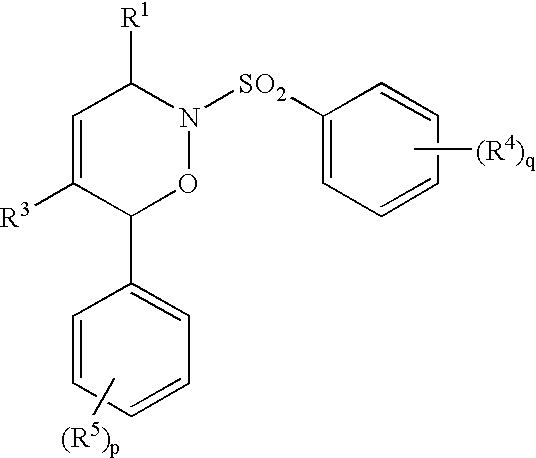
wherein,
R1 and R3 are each independently hydrogen, or (C1-C6) alkyl;
R4 is amino, (C1-C6)acylamino, or a —NHCOO—(C1-C6)alkyl;
R5 is (C1-C6)alkoxy; and
p and q are each independently 1 or 2, or a pharmaceutically-acceptable salt or ester thereof.
7. A method of treating an animal, including a human, suffering from or susceptible to a condition indicating the administration of a selective mnGluR1 antagonist which method comprises administering a compound selected from the group consisting of 2-(4-Acetamidobenzenesulphonyl)-3,6-dihydro-3,5-dimethyl-6-(4-methoxyphenyl)-2H-1,2-oxazine, 2-(4-Acetamidobenzenesulphonyl)-3,6-dihydro-3,5-dimethyl-6-(4-ethoxyphenyl)-2H-1,2-oxazine, and 3,6-dihydro-3,5-dimethyl-6-(4-ethoxyphenyl)-2-(4-methylcarbamoylbenzenesulphonyl)-2H-1,2-oxazine, or a pharmaceutically-acceptable salt or ester thereof.
8. A method of treating an animal, including a human, suffering from or susceptible to migraine which method comprises administering a compound selected from the group consisting of 2-(4-Acetamidobenzenesulphonyl)-3,6-dihydro-3,5-dimethyl-6-(4-methoxyphenyl)-2H-1,2-oxazine, 2-(4-Acetamidobenzenesulphonyl)-3,6-dihydro-3,5-dimethyl-6-(4-ethoxyphenyl)-2H-1,2-oxazine, and 3,6-dihydro-3,5-dimethyl-6-(4-ethoxyphenyl)-2-(4-methylcarbamoylbenzenesulphonyl)-2H-1,2-oxazine, or a pharmaceutically-acceptable salt or ester thereof.
9. A method of treating an animal, including a human, suffering from or susceptible to pain associated with migraine which method comprises administering a compound selected from the group consisting of 2-(4-Acetamidobenzenesulphonyl)-3,6-dihydro-3,5-dimethyl-6-(4-methoxyphenyl)-2H-1,2-oxazine, 2-(4-Acetamidobenzenesulphonyl)-3,6-dihydro-3,5-dimethyl-6-(4-ethoxyphenyl)-2H-1,2-oxazine, and 3,6-dihydro-3,5-dimethyl-6-(4-ethoxyphenyl)-2-(4-methylcarbamoylbenzenesulphonyl)-2H-1,2-oxazine, or a pharmaceutically-acceptable salt or ester thereof.
Applications Claiming Priority (3)
| Application Number | Priority Date | Filing Date | Title |
|---|---|---|---|
| GBGB9823845.4A GB9823845D0 (en) | 1998-11-02 | 1998-11-02 | Pharmaceutical compounds |
| GB9823845 | 1998-11-02 | ||
| PCT/GB1999/003607 WO2000026199A2 (en) | 1998-11-02 | 1999-11-01 | Use of n-substituted (3,6-dihydro)-2h-1,2-oxazine derivatives as selective mglur1 antagonists |
Publications (1)
| Publication Number | Publication Date |
|---|---|
| US6482824B1 true US6482824B1 (en) | 2002-11-19 |
Family
ID=10841619
Family Applications (1)
| Application Number | Title | Priority Date | Filing Date |
|---|---|---|---|
| US09/830,873 Expired - Fee Related US6482824B1 (en) | 1998-11-02 | 2000-11-01 | Use of n-substituted (3,6-dihydro)-2h-1,2-oxazine derivatives as selective mglur1 antagonists |
Country Status (7)
| Country | Link |
|---|---|
| US (1) | US6482824B1 (en) |
| EP (1) | EP1124806A2 (en) |
| JP (1) | JP2002528534A (en) |
| AU (1) | AU6480299A (en) |
| CA (1) | CA2349482A1 (en) |
| GB (1) | GB9823845D0 (en) |
| WO (1) | WO2000026199A2 (en) |
Cited By (1)
| Publication number | Priority date | Publication date | Assignee | Title |
|---|---|---|---|---|
| WO2012168162A1 (en) | 2011-06-06 | 2012-12-13 | F. Hoffmann-La Roche Ag | Benzocycloheptene acetic acids |
Families Citing this family (7)
| Publication number | Priority date | Publication date | Assignee | Title |
|---|---|---|---|---|
| AU1071301A (en) * | 1999-11-01 | 2001-05-14 | Eli Lilly And Company | Pharmaceutical compounds |
| SE0303492D0 (en) * | 2003-12-19 | 2003-12-19 | Astrazeneca Ab | New use VII |
| PL2083811T3 (en) | 2006-11-22 | 2017-05-31 | Clinical Research Associates, Llc | Methods of treating down's syndrome, fragile x syndrome and autism |
| US20130058915A1 (en) | 2010-03-02 | 2013-03-07 | Children's Medica Center Corporation | Methods and compositions for treatment of angelman syndrome and autism spectrum disorders |
| US20110294879A1 (en) | 2010-05-28 | 2011-12-01 | Xenoport, Inc. | Method of treatment of fragile x syndrome, down's syndrome, autism and related disorders |
| WO2012009646A1 (en) | 2010-07-15 | 2012-01-19 | Xenoport, Inc. | Methods of treating fragile x syndrome, down's syndrome, autism and related disorders |
| WO2012054724A1 (en) | 2010-10-21 | 2012-04-26 | Massachusetts Institute Of Technology | Methods of treating seizure disorders |
Citations (4)
| Publication number | Priority date | Publication date | Assignee | Title |
|---|---|---|---|---|
| GB1221734A (en) | 1968-03-04 | 1971-02-10 | Ct Europ De Rech S Mauvernay | Substituted phenyl morpholines, their preparation, and pharmaceutical compositions containing them |
| WO1996005828A1 (en) | 1994-08-24 | 1996-02-29 | Eli Lilly And Company | Pyrrolidinyl di-carboxylic acid derivatives as metabotropic glutamate receptor antagonists |
| WO1999026927A2 (en) | 1997-11-21 | 1999-06-03 | Nps Pharmaceuticals, Inc. | Metabotropic glutamate receptor antagonists for treating central nervous system diseases |
| WO1999054280A1 (en) | 1998-04-17 | 1999-10-28 | Kenneth Curry | Cubane derivatives as metabotropic glutamate receptor antagonists and process for their preparation |
Family Cites Families (4)
| Publication number | Priority date | Publication date | Assignee | Title |
|---|---|---|---|---|
| DE1191379B (en) * | 1963-02-19 | 1965-04-22 | Esso A G | Process for the preparation of N-substituted 3, 6-dihydro-1, 2-oxazines |
| JP3993651B2 (en) * | 1994-10-21 | 2007-10-17 | アスビオファーマ株式会社 | Cyclopropachromene carboxylic acid derivative |
| WO1998015545A1 (en) * | 1996-10-08 | 1998-04-16 | Eli Lilly And Company | New serotonin 5-ht1f agonists |
| ZA979961B (en) * | 1996-11-15 | 1999-05-05 | Lilly Co Eli | 5-HT1F agonists |
-
1998
- 1998-11-02 GB GBGB9823845.4A patent/GB9823845D0/en not_active Ceased
-
1999
- 1999-11-01 EP EP99952687A patent/EP1124806A2/en not_active Withdrawn
- 1999-11-01 CA CA002349482A patent/CA2349482A1/en not_active Abandoned
- 1999-11-01 JP JP2000579588A patent/JP2002528534A/en active Pending
- 1999-11-01 WO PCT/GB1999/003607 patent/WO2000026199A2/en not_active Ceased
- 1999-11-01 AU AU64802/99A patent/AU6480299A/en not_active Abandoned
-
2000
- 2000-11-01 US US09/830,873 patent/US6482824B1/en not_active Expired - Fee Related
Patent Citations (4)
| Publication number | Priority date | Publication date | Assignee | Title |
|---|---|---|---|---|
| GB1221734A (en) | 1968-03-04 | 1971-02-10 | Ct Europ De Rech S Mauvernay | Substituted phenyl morpholines, their preparation, and pharmaceutical compositions containing them |
| WO1996005828A1 (en) | 1994-08-24 | 1996-02-29 | Eli Lilly And Company | Pyrrolidinyl di-carboxylic acid derivatives as metabotropic glutamate receptor antagonists |
| WO1999026927A2 (en) | 1997-11-21 | 1999-06-03 | Nps Pharmaceuticals, Inc. | Metabotropic glutamate receptor antagonists for treating central nervous system diseases |
| WO1999054280A1 (en) | 1998-04-17 | 1999-10-28 | Kenneth Curry | Cubane derivatives as metabotropic glutamate receptor antagonists and process for their preparation |
Non-Patent Citations (1)
| Title |
|---|
| Labaziewicz H. et al.: The synthesis and spectral properties of N-(3,4,5-trimethoxybenzoyl)-3,6-dihydro-1, 2-oxazines and N-(3,4,5-trimethoxybenzoyl)tetrahydro-1,2-oxazines: HETEROCYCLES, NL., ELSEVIER SCIENCE PUBLISHERS B.V., AMSTERDAM, vol. 34, No. 4, Apr. 1992, pp. 699-711, XP002131089 formulae (4) and (5), p. 701. |
Cited By (1)
| Publication number | Priority date | Publication date | Assignee | Title |
|---|---|---|---|---|
| WO2012168162A1 (en) | 2011-06-06 | 2012-12-13 | F. Hoffmann-La Roche Ag | Benzocycloheptene acetic acids |
Also Published As
| Publication number | Publication date |
|---|---|
| EP1124806A2 (en) | 2001-08-22 |
| AU6480299A (en) | 2000-05-22 |
| WO2000026199A3 (en) | 2000-08-17 |
| WO2000026199A2 (en) | 2000-05-11 |
| CA2349482A1 (en) | 2000-05-11 |
| GB9823845D0 (en) | 1998-12-23 |
| JP2002528534A (en) | 2002-09-03 |
Similar Documents
| Publication | Publication Date | Title |
|---|---|---|
| JP2771328B2 (en) | N-phenylalkyl-substituted α-aminocarboxamide derivatives and method for producing the same | |
| CN1993346B (en) | Thiophene compound | |
| US6140532A (en) | O-carbamoyl-phenylalaninol having substituent at benzene ring, its pharmaceutically useful salts and method for preparing the same | |
| RU2435756C2 (en) | Selective androgen receptor modulators | |
| CN111936476B (en) | Aromatic compound and preparation method and application thereof | |
| US5756817A (en) | O-carbamoyl-phenylalaninol compounds, their pharmaceutically useful salts and process for preparing the same | |
| KR100479811B1 (en) | Aminothiophene carboxylic acid amides and the use thereof as phosphodiesterase inhibitors | |
| US7285680B2 (en) | β-alanine derivatives and the use thereof | |
| AU1188192A (en) | Benzamides | |
| JPH04230681A (en) | 1,4-benzothiazepine derivatives | |
| JP2023543066A (en) | Benzamide compounds and their use | |
| CN1367775A (en) | Cubane derivatives as metabotropic glutamate receptor antagonists and process for their preparation | |
| US20220204468A1 (en) | Dp antagonist | |
| WO2000026198A1 (en) | N-substituted (3,6-dihydro)-2h-1,2-oxazine derivatives, their preparation and their use as selective mglur1 antagonists | |
| EP1124806A2 (en) | Use of n-substituted (3,6-dihydro)-2h-1,2-oxazine derivatives as selective mglur1 antagonists | |
| EP0453960B1 (en) | Sulfonylamino substituted bicyclyl hydroxamic acid derivatives | |
| US9676719B2 (en) | Phenyl derivative | |
| US5538966A (en) | Carbonic anhydrase inhibitors | |
| US12485113B2 (en) | Pharmaceutical use of (e)-3-arylheterocyclylprop-2-enoic acid derivatives | |
| JP2003523993A (en) | New phenylheteroalkylamine derivatives | |
| KR100556157B1 (en) | Simplified resiniferatoxin analogues as vanilloid receptor agonist showing excellent analgesic activity and the pharmaceutical compositions containing the same | |
| CZ110694A3 (en) | Nitroxyalkylamide derivatives, process of their preparation and pharmaceutical compositions containing thereof | |
| KR100721087B1 (en) | New Uses of Phenylheteroalkylamine Derivatives | |
| US5906985A (en) | Pharmaceutical compounds | |
| TW200835499A (en) | Non-steroidal progesterone receptor modulators |
Legal Events
| Date | Code | Title | Description |
|---|---|---|---|
| AS | Assignment |
Owner name: ELI LILLY AND COMPANY, INDIANA Free format text: ASSIGNMENT OF ASSIGNORS INTEREST;ASSIGNORS:CLARK, BARRY PETER;HARRIS, JOHN RICHARD;KINGSTON, ANN ELIZABETH;REEL/FRAME:012032/0706;SIGNING DATES FROM 20010529 TO 20010712 |
|
| CC | Certificate of correction | ||
| REMI | Maintenance fee reminder mailed | ||
| LAPS | Lapse for failure to pay maintenance fees | ||
| STCH | Information on status: patent discontinuation |
Free format text: PATENT EXPIRED DUE TO NONPAYMENT OF MAINTENANCE FEES UNDER 37 CFR 1.362 |
|
| FP | Lapsed due to failure to pay maintenance fee |
Effective date: 20061119 |