US6469017B1 - Method of inhibiting interleukin-12 signaling - Google Patents
Method of inhibiting interleukin-12 signaling Download PDFInfo
- Publication number
- US6469017B1 US6469017B1 US09/008,020 US802098A US6469017B1 US 6469017 B1 US6469017 B1 US 6469017B1 US 802098 A US802098 A US 802098A US 6469017 B1 US6469017 B1 US 6469017B1
- Authority
- US
- United States
- Prior art keywords
- cells
- cell
- signaling
- disease
- alkyl
- Prior art date
- Legal status (The legal status is an assumption and is not a legal conclusion. Google has not performed a legal analysis and makes no representation as to the accuracy of the status listed.)
- Expired - Lifetime
Links
- 108010065805 Interleukin-12 Proteins 0.000 title claims abstract description 75
- 102000013462 Interleukin-12 Human genes 0.000 title claims abstract description 75
- 238000000034 method Methods 0.000 title claims abstract description 41
- 230000011664 signaling Effects 0.000 title claims abstract description 24
- 230000002401 inhibitory effect Effects 0.000 title claims description 17
- 229940117681 interleukin-12 Drugs 0.000 title claims 3
- 150000001875 compounds Chemical class 0.000 claims abstract description 42
- 125000002496 methyl group Chemical group [H]C([H])([H])* 0.000 claims abstract description 22
- YBJHBAHKTGYVGT-ZKWXMUAHSA-N (+)-Biotin Chemical compound N1C(=O)N[C@@H]2[C@H](CCCCC(=O)O)SC[C@@H]21 YBJHBAHKTGYVGT-ZKWXMUAHSA-N 0.000 claims abstract description 20
- 150000003839 salts Chemical class 0.000 claims abstract description 17
- 125000000217 alkyl group Chemical group 0.000 claims abstract description 13
- 229910019142 PO4 Inorganic materials 0.000 claims abstract description 12
- 239000010452 phosphate Substances 0.000 claims abstract description 12
- QAOWNCQODCNURD-UHFFFAOYSA-L Sulfate Chemical compound [O-]S([O-])(=O)=O QAOWNCQODCNURD-UHFFFAOYSA-L 0.000 claims abstract description 10
- 229960002685 biotin Drugs 0.000 claims abstract description 10
- 235000020958 biotin Nutrition 0.000 claims abstract description 10
- 239000011616 biotin Substances 0.000 claims abstract description 10
- NBIIXXVUZAFLBC-UHFFFAOYSA-K phosphate Chemical compound [O-]P([O-])([O-])=O NBIIXXVUZAFLBC-UHFFFAOYSA-K 0.000 claims abstract description 10
- 125000004183 alkoxy alkyl group Chemical group 0.000 claims abstract description 7
- 125000004983 dialkoxyalkyl group Chemical group 0.000 claims abstract description 7
- 210000000447 Th1 cell Anatomy 0.000 claims description 24
- 230000001404 mediated effect Effects 0.000 claims description 23
- 208000037265 diseases, disorders, signs and symptoms Diseases 0.000 claims description 21
- 230000028709 inflammatory response Effects 0.000 claims description 21
- 201000010099 disease Diseases 0.000 claims description 17
- 208000023275 Autoimmune disease Diseases 0.000 claims description 15
- 206010061218 Inflammation Diseases 0.000 claims description 13
- 230000004054 inflammatory process Effects 0.000 claims description 13
- 206010067584 Type 1 diabetes mellitus Diseases 0.000 claims description 9
- 241000124008 Mammalia Species 0.000 claims description 5
- 201000006417 multiple sclerosis Diseases 0.000 claims description 5
- 208000022559 Inflammatory bowel disease Diseases 0.000 claims description 4
- 208000035475 disorder Diseases 0.000 claims description 4
- 208000035408 type 1 diabetes mellitus 1 Diseases 0.000 claims description 4
- 208000024340 acute graft versus host disease Diseases 0.000 claims description 3
- 206010003246 arthritis Diseases 0.000 claims description 3
- 230000001684 chronic effect Effects 0.000 claims description 3
- 206010039073 rheumatoid arthritis Diseases 0.000 claims description 3
- 201000004681 Psoriasis Diseases 0.000 claims description 2
- 208000006673 asthma Diseases 0.000 claims description 2
- 208000037976 chronic inflammation Diseases 0.000 claims description 2
- 208000037893 chronic inflammatory disorder Diseases 0.000 claims description 2
- 230000000968 intestinal effect Effects 0.000 claims description 2
- 206010025135 lupus erythematosus Diseases 0.000 claims description 2
- 230000000903 blocking effect Effects 0.000 abstract description 4
- NSMXQKNUPPXBRG-SECBINFHSA-N (R)-lisofylline Chemical compound O=C1N(CCCC[C@H](O)C)C(=O)N(C)C2=C1N(C)C=N2 NSMXQKNUPPXBRG-SECBINFHSA-N 0.000 description 89
- 210000001744 T-lymphocyte Anatomy 0.000 description 38
- 210000004027 cell Anatomy 0.000 description 31
- 241000699670 Mus sp. Species 0.000 description 29
- 239000000243 solution Substances 0.000 description 28
- 102100037850 Interferon gamma Human genes 0.000 description 25
- 108010074328 Interferon-gamma Proteins 0.000 description 25
- 102000004127 Cytokines Human genes 0.000 description 21
- 108090000695 Cytokines Proteins 0.000 description 21
- 239000000203 mixture Substances 0.000 description 21
- 230000004069 differentiation Effects 0.000 description 20
- 230000028327 secretion Effects 0.000 description 19
- OKKJLVBELUTLKV-UHFFFAOYSA-N Methanol Chemical compound OC OKKJLVBELUTLKV-UHFFFAOYSA-N 0.000 description 18
- 230000000694 effects Effects 0.000 description 13
- 210000002540 macrophage Anatomy 0.000 description 13
- 206010033799 Paralysis Diseases 0.000 description 11
- 239000000427 antigen Substances 0.000 description 11
- 108091007433 antigens Proteins 0.000 description 11
- 102000036639 antigens Human genes 0.000 description 11
- 238000000338 in vitro Methods 0.000 description 11
- 238000011282 treatment Methods 0.000 description 11
- 241001465754 Metazoa Species 0.000 description 10
- JUJWROOIHBZHMG-UHFFFAOYSA-N Pyridine Chemical compound C1=CC=NC=C1 JUJWROOIHBZHMG-UHFFFAOYSA-N 0.000 description 10
- FAPWRFPIFSIZLT-UHFFFAOYSA-M Sodium chloride Chemical compound [Na+].[Cl-] FAPWRFPIFSIZLT-UHFFFAOYSA-M 0.000 description 10
- 239000003921 oil Substances 0.000 description 10
- 235000019198 oils Nutrition 0.000 description 10
- XEKOWRVHYACXOJ-UHFFFAOYSA-N Ethyl acetate Chemical compound CCOC(C)=O XEKOWRVHYACXOJ-UHFFFAOYSA-N 0.000 description 9
- 238000004519 manufacturing process Methods 0.000 description 9
- 238000012546 transfer Methods 0.000 description 9
- 208000016192 Demyelinating disease Diseases 0.000 description 8
- 206010012305 Demyelination Diseases 0.000 description 8
- 241001529936 Murinae Species 0.000 description 8
- 0 [1*]O[C@H](C)CCCCN1C(=O)C2=C(N=CN2[3*])N([2*])C1=O Chemical compound [1*]O[C@H](C)CCCCN1C(=O)C2=C(N=CN2[3*])N([2*])C1=O 0.000 description 8
- 238000002474 experimental method Methods 0.000 description 8
- 229920006395 saturated elastomer Polymers 0.000 description 8
- 210000000278 spinal cord Anatomy 0.000 description 8
- XLYOFNOQVPJJNP-UHFFFAOYSA-N water Substances O XLYOFNOQVPJJNP-UHFFFAOYSA-N 0.000 description 8
- VEXZGXHMUGYJMC-UHFFFAOYSA-N Hydrochloric acid Chemical compound Cl VEXZGXHMUGYJMC-UHFFFAOYSA-N 0.000 description 7
- 238000011161 development Methods 0.000 description 7
- 230000018109 developmental process Effects 0.000 description 7
- 238000009472 formulation Methods 0.000 description 7
- 238000001727 in vivo Methods 0.000 description 7
- 230000006698 induction Effects 0.000 description 7
- 230000008595 infiltration Effects 0.000 description 7
- 238000001764 infiltration Methods 0.000 description 7
- 210000004698 lymphocyte Anatomy 0.000 description 7
- 230000002829 reductive effect Effects 0.000 description 7
- 239000007787 solid Substances 0.000 description 7
- YMWUJEATGCHHMB-UHFFFAOYSA-N Dichloromethane Chemical compound ClCCl YMWUJEATGCHHMB-UHFFFAOYSA-N 0.000 description 6
- 108090000978 Interleukin-4 Proteins 0.000 description 6
- 238000011803 SJL/J (JAX™ mice strain) Methods 0.000 description 6
- UIIMBOGNXHQVGW-UHFFFAOYSA-M Sodium bicarbonate Chemical compound [Na+].OC([O-])=O UIIMBOGNXHQVGW-UHFFFAOYSA-M 0.000 description 6
- 230000004913 activation Effects 0.000 description 6
- 230000003053 immunization Effects 0.000 description 6
- 238000002649 immunization Methods 0.000 description 6
- IAZDPXIOMUYVGZ-UHFFFAOYSA-N Dimethylsulphoxide Chemical compound CS(C)=O IAZDPXIOMUYVGZ-UHFFFAOYSA-N 0.000 description 5
- 102000003814 Interleukin-10 Human genes 0.000 description 5
- 108090000174 Interleukin-10 Proteins 0.000 description 5
- CSNNHWWHGAXBCP-UHFFFAOYSA-L Magnesium sulfate Chemical compound [Mg+2].[O-][S+2]([O-])([O-])[O-] CSNNHWWHGAXBCP-UHFFFAOYSA-L 0.000 description 5
- BYPFEZZEUUWMEJ-UHFFFAOYSA-N Pentoxifylline Chemical compound O=C1N(CCCCC(=O)C)C(=O)N(C)C2=C1N(C)C=N2 BYPFEZZEUUWMEJ-UHFFFAOYSA-N 0.000 description 5
- 238000003556 assay Methods 0.000 description 5
- 239000000284 extract Substances 0.000 description 5
- 210000000987 immune system Anatomy 0.000 description 5
- 230000002757 inflammatory effect Effects 0.000 description 5
- 239000007788 liquid Substances 0.000 description 5
- 210000000822 natural killer cell Anatomy 0.000 description 5
- UMJSCPRVCHMLSP-UHFFFAOYSA-N pyridine Natural products COC1=CC=CN=C1 UMJSCPRVCHMLSP-UHFFFAOYSA-N 0.000 description 5
- 239000011780 sodium chloride Substances 0.000 description 5
- 238000002560 therapeutic procedure Methods 0.000 description 5
- VYPSYNLAJGMNEJ-UHFFFAOYSA-N Silicium dioxide Chemical compound O=[Si]=O VYPSYNLAJGMNEJ-UHFFFAOYSA-N 0.000 description 4
- 230000024245 cell differentiation Effects 0.000 description 4
- 210000003169 central nervous system Anatomy 0.000 description 4
- UREBWPXBXRYXRJ-UHFFFAOYSA-N ethyl acetate;methanol Chemical compound OC.CCOC(C)=O UREBWPXBXRYXRJ-UHFFFAOYSA-N 0.000 description 4
- 238000003818 flash chromatography Methods 0.000 description 4
- 239000007903 gelatin capsule Substances 0.000 description 4
- 230000001965 increasing effect Effects 0.000 description 4
- 230000005764 inhibitory process Effects 0.000 description 4
- 230000019734 interleukin-12 production Effects 0.000 description 4
- 238000007912 intraperitoneal administration Methods 0.000 description 4
- 239000008194 pharmaceutical composition Substances 0.000 description 4
- 230000004044 response Effects 0.000 description 4
- 230000003393 splenic effect Effects 0.000 description 4
- 238000003756 stirring Methods 0.000 description 4
- 238000007920 subcutaneous administration Methods 0.000 description 4
- 239000000725 suspension Substances 0.000 description 4
- NSMXQKNUPPXBRG-VIFPVBQESA-N (S)-lisofylline Chemical compound O=C1N(CCCC[C@@H](O)C)C(=O)N(C)C2=C1N(C)C=N2 NSMXQKNUPPXBRG-VIFPVBQESA-N 0.000 description 3
- LFQSCWFLJHTTHZ-UHFFFAOYSA-N Ethanol Chemical compound CCO LFQSCWFLJHTTHZ-UHFFFAOYSA-N 0.000 description 3
- 102000000588 Interleukin-2 Human genes 0.000 description 3
- 108010002350 Interleukin-2 Proteins 0.000 description 3
- 241000699666 Mus <mouse, genus> Species 0.000 description 3
- PMZURENOXWZQFD-UHFFFAOYSA-L Sodium Sulfate Chemical compound [Na+].[Na+].[O-]S([O-])(=O)=O PMZURENOXWZQFD-UHFFFAOYSA-L 0.000 description 3
- 210000000612 antigen-presenting cell Anatomy 0.000 description 3
- 210000003719 b-lymphocyte Anatomy 0.000 description 3
- 239000002775 capsule Substances 0.000 description 3
- 238000006243 chemical reaction Methods 0.000 description 3
- 238000007796 conventional method Methods 0.000 description 3
- 231100000433 cytotoxic Toxicity 0.000 description 3
- 230000001472 cytotoxic effect Effects 0.000 description 3
- 230000001419 dependent effect Effects 0.000 description 3
- 229960001760 dimethyl sulfoxide Drugs 0.000 description 3
- 239000002552 dosage form Substances 0.000 description 3
- 239000003814 drug Substances 0.000 description 3
- 230000001712 encephalitogenic effect Effects 0.000 description 3
- 230000001747 exhibiting effect Effects 0.000 description 3
- 210000003414 extremity Anatomy 0.000 description 3
- 239000000706 filtrate Substances 0.000 description 3
- 230000006870 function Effects 0.000 description 3
- 238000003304 gavage Methods 0.000 description 3
- RAXXELZNTBOGNW-UHFFFAOYSA-N imidazole Natural products C1=CNC=N1 RAXXELZNTBOGNW-UHFFFAOYSA-N 0.000 description 3
- 230000028993 immune response Effects 0.000 description 3
- 208000027866 inflammatory disease Diseases 0.000 description 3
- 230000008506 pathogenesis Effects 0.000 description 3
- 229960001476 pentoxifylline Drugs 0.000 description 3
- 239000000843 powder Substances 0.000 description 3
- 238000002360 preparation method Methods 0.000 description 3
- 230000009696 proliferative response Effects 0.000 description 3
- 238000011084 recovery Methods 0.000 description 3
- 239000000741 silica gel Substances 0.000 description 3
- 229910002027 silica gel Inorganic materials 0.000 description 3
- 235000017557 sodium bicarbonate Nutrition 0.000 description 3
- 229910000030 sodium bicarbonate Inorganic materials 0.000 description 3
- FVAUCKIRQBBSSJ-UHFFFAOYSA-M sodium iodide Chemical compound [Na+].[I-] FVAUCKIRQBBSSJ-UHFFFAOYSA-M 0.000 description 3
- 229910052938 sodium sulfate Inorganic materials 0.000 description 3
- 235000011152 sodium sulphate Nutrition 0.000 description 3
- 210000000952 spleen Anatomy 0.000 description 3
- 150000003431 steroids Chemical class 0.000 description 3
- 125000001424 substituent group Chemical group 0.000 description 3
- 210000000115 thoracic cavity Anatomy 0.000 description 3
- 210000001519 tissue Anatomy 0.000 description 3
- MZOFCQQQCNRIBI-VMXHOPILSA-N (3s)-4-[[(2s)-1-[[(2s)-1-[[(1s)-1-carboxy-2-hydroxyethyl]amino]-4-methyl-1-oxopentan-2-yl]amino]-5-(diaminomethylideneamino)-1-oxopentan-2-yl]amino]-3-[[2-[[(2s)-2,6-diaminohexanoyl]amino]acetyl]amino]-4-oxobutanoic acid Chemical compound OC[C@@H](C(O)=O)NC(=O)[C@H](CC(C)C)NC(=O)[C@H](CCCN=C(N)N)NC(=O)[C@H](CC(O)=O)NC(=O)CNC(=O)[C@@H](N)CCCCN MZOFCQQQCNRIBI-VMXHOPILSA-N 0.000 description 2
- KISWVXRQTGLFGD-UHFFFAOYSA-N 2-[[2-[[6-amino-2-[[2-[[2-[[5-amino-2-[[2-[[1-[2-[[6-amino-2-[(2,5-diamino-5-oxopentanoyl)amino]hexanoyl]amino]-5-(diaminomethylideneamino)pentanoyl]pyrrolidine-2-carbonyl]amino]-3-hydroxypropanoyl]amino]-5-oxopentanoyl]amino]-5-(diaminomethylideneamino)p Chemical compound C1CCN(C(=O)C(CCCN=C(N)N)NC(=O)C(CCCCN)NC(=O)C(N)CCC(N)=O)C1C(=O)NC(CO)C(=O)NC(CCC(N)=O)C(=O)NC(CCCN=C(N)N)C(=O)NC(CO)C(=O)NC(CCCCN)C(=O)NC(C(=O)NC(CC(C)C)C(O)=O)CC1=CC=C(O)C=C1 KISWVXRQTGLFGD-UHFFFAOYSA-N 0.000 description 2
- SUGGFJXAJVWFHC-PFEQFJNWSA-N 3-(6-aminohexyl)-1-[(5r)-5-hydroxyhexyl]-7-methylpurine-2,6-dione;hydrochloride Chemical compound Cl.O=C1N(CCCC[C@H](O)C)C(=O)N(CCCCCCN)C2=C1N(C)C=N2 SUGGFJXAJVWFHC-PFEQFJNWSA-N 0.000 description 2
- IOOFDPQRABOHJD-UHFFFAOYSA-N 6-(7-methyl-2,6-dioxopurin-3-yl)hexanenitrile Chemical compound N#CCCCCCN1C(=O)NC(=O)C2=C1N=CN2C IOOFDPQRABOHJD-UHFFFAOYSA-N 0.000 description 2
- SCMPSVLJCQKIFT-CQSZACIVSA-N 6-[1-[(5r)-5-hydroxyhexyl]-7-methyl-2,6-dioxopurin-3-yl]hexanenitrile Chemical compound O=C1N(CCCC[C@H](O)C)C(=O)N(CCCCCC#N)C2=C1N(C)C=N2 SCMPSVLJCQKIFT-CQSZACIVSA-N 0.000 description 2
- PFWLFWPASULGAN-UHFFFAOYSA-N 7-methylxanthine Chemical compound N1C(=O)NC(=O)C2=C1N=CN2C PFWLFWPASULGAN-UHFFFAOYSA-N 0.000 description 2
- CSCPPACGZOOCGX-UHFFFAOYSA-N Acetone Chemical compound CC(C)=O CSCPPACGZOOCGX-UHFFFAOYSA-N 0.000 description 2
- 208000032116 Autoimmune Experimental Encephalomyelitis Diseases 0.000 description 2
- 108091003079 Bovine Serum Albumin Proteins 0.000 description 2
- 238000002965 ELISA Methods 0.000 description 2
- PEDCQBHIVMGVHV-UHFFFAOYSA-N Glycerine Chemical compound OCC(O)CO PEDCQBHIVMGVHV-UHFFFAOYSA-N 0.000 description 2
- WZUVPPKBWHMQCE-UHFFFAOYSA-N Haematoxylin Chemical compound C12=CC(O)=C(O)C=C2CC2(O)C1C1=CC=C(O)C(O)=C1OC2 WZUVPPKBWHMQCE-UHFFFAOYSA-N 0.000 description 2
- 101000852992 Homo sapiens Interleukin-12 subunit beta Proteins 0.000 description 2
- 206010062016 Immunosuppression Diseases 0.000 description 2
- 102100036701 Interleukin-12 subunit beta Human genes 0.000 description 2
- 102000047918 Myelin Basic Human genes 0.000 description 2
- 101710107068 Myelin basic protein Proteins 0.000 description 2
- KDLHZDBZIXYQEI-UHFFFAOYSA-N Palladium Chemical compound [Pd] KDLHZDBZIXYQEI-UHFFFAOYSA-N 0.000 description 2
- 239000002202 Polyethylene glycol Substances 0.000 description 2
- 241000283984 Rodentia Species 0.000 description 2
- KEAYESYHFKHZAL-UHFFFAOYSA-N Sodium Chemical compound [Na] KEAYESYHFKHZAL-UHFFFAOYSA-N 0.000 description 2
- VMHLLURERBWHNL-UHFFFAOYSA-M Sodium acetate Chemical compound [Na+].CC([O-])=O VMHLLURERBWHNL-UHFFFAOYSA-M 0.000 description 2
- 230000024932 T cell mediated immunity Effects 0.000 description 2
- 210000004241 Th2 cell Anatomy 0.000 description 2
- 108060008682 Tumor Necrosis Factor Proteins 0.000 description 2
- 102100040247 Tumor necrosis factor Human genes 0.000 description 2
- UEHQGCYBYOVNCO-OAHLLOKOSA-N [(2r)-6-[3-(5-cyanopentyl)-7-methyl-2,6-dioxopurin-1-yl]hexan-2-yl] acetate Chemical compound O=C1N(CCCC[C@@H](C)OC(C)=O)C(=O)N(CCCCCC#N)C2=C1N(C)C=N2 UEHQGCYBYOVNCO-OAHLLOKOSA-N 0.000 description 2
- KRESVOGBVUPENZ-SSDOTTSWSA-N [(2r)-6-iodohexan-2-yl] acetate Chemical compound CC(=O)O[C@H](C)CCCCI KRESVOGBVUPENZ-SSDOTTSWSA-N 0.000 description 2
- 230000001464 adherent effect Effects 0.000 description 2
- 239000000443 aerosol Substances 0.000 description 2
- 238000010171 animal model Methods 0.000 description 2
- 230000003110 anti-inflammatory effect Effects 0.000 description 2
- 230000008901 benefit Effects 0.000 description 2
- 230000015572 biosynthetic process Effects 0.000 description 2
- 239000000969 carrier Substances 0.000 description 2
- 230000000052 comparative effect Effects 0.000 description 2
- 230000003013 cytotoxicity Effects 0.000 description 2
- 231100000135 cytotoxicity Toxicity 0.000 description 2
- 230000034994 death Effects 0.000 description 2
- 230000007423 decrease Effects 0.000 description 2
- 230000002939 deleterious effect Effects 0.000 description 2
- 230000003210 demyelinating effect Effects 0.000 description 2
- 229940079593 drug Drugs 0.000 description 2
- 239000000839 emulsion Substances 0.000 description 2
- 238000011124 ex vivo culture Methods 0.000 description 2
- 210000002443 helper t lymphocyte Anatomy 0.000 description 2
- 208000010726 hind limb paralysis Diseases 0.000 description 2
- 230000004727 humoral immunity Effects 0.000 description 2
- 230000004957 immunoregulator effect Effects 0.000 description 2
- 230000001506 immunosuppresive effect Effects 0.000 description 2
- 238000009169 immunotherapy Methods 0.000 description 2
- 230000001939 inductive effect Effects 0.000 description 2
- 230000003993 interaction Effects 0.000 description 2
- 238000007918 intramuscular administration Methods 0.000 description 2
- 238000001990 intravenous administration Methods 0.000 description 2
- 239000010410 layer Substances 0.000 description 2
- 229910052943 magnesium sulfate Inorganic materials 0.000 description 2
- 235000019341 magnesium sulphate Nutrition 0.000 description 2
- 230000001769 paralizing effect Effects 0.000 description 2
- 238000007911 parenteral administration Methods 0.000 description 2
- 239000006201 parenteral dosage form Substances 0.000 description 2
- 210000001539 phagocyte Anatomy 0.000 description 2
- 239000000546 pharmaceutical excipient Substances 0.000 description 2
- XHXFXVLFKHQFAL-UHFFFAOYSA-N phosphoryl trichloride Chemical compound ClP(Cl)(Cl)=O XHXFXVLFKHQFAL-UHFFFAOYSA-N 0.000 description 2
- 229920001223 polyethylene glycol Polymers 0.000 description 2
- 230000003389 potentiating effect Effects 0.000 description 2
- 230000035755 proliferation Effects 0.000 description 2
- 238000010992 reflux Methods 0.000 description 2
- 238000003118 sandwich ELISA Methods 0.000 description 2
- 239000002002 slurry Substances 0.000 description 2
- 239000001632 sodium acetate Substances 0.000 description 2
- 235000017281 sodium acetate Nutrition 0.000 description 2
- 239000012312 sodium hydride Substances 0.000 description 2
- 229910000104 sodium hydride Inorganic materials 0.000 description 2
- GRONZTPUWOOUFQ-UHFFFAOYSA-M sodium;methanol;hydroxide Chemical compound [OH-].[Na+].OC GRONZTPUWOOUFQ-UHFFFAOYSA-M 0.000 description 2
- UCSJYZPVAKXKNQ-HZYVHMACSA-N streptomycin Chemical compound CN[C@H]1[C@H](O)[C@@H](O)[C@H](CO)O[C@H]1O[C@@H]1[C@](C=O)(O)[C@H](C)O[C@H]1O[C@@H]1[C@@H](NC(N)=N)[C@H](O)[C@@H](NC(N)=N)[C@H](O)[C@H]1O UCSJYZPVAKXKNQ-HZYVHMACSA-N 0.000 description 2
- UDYFLDICVHJSOY-UHFFFAOYSA-N sulfur trioxide-pyridine complex Substances O=S(=O)=O.C1=CC=NC=C1 UDYFLDICVHJSOY-UHFFFAOYSA-N 0.000 description 2
- 239000006228 supernatant Substances 0.000 description 2
- 238000003786 synthesis reaction Methods 0.000 description 2
- 239000006188 syrup Substances 0.000 description 2
- 235000020357 syrup Nutrition 0.000 description 2
- 230000003827 upregulation Effects 0.000 description 2
- 230000035899 viability Effects 0.000 description 2
- DGVVWUTYPXICAM-UHFFFAOYSA-N β‐Mercaptoethanol Chemical compound OCCS DGVVWUTYPXICAM-UHFFFAOYSA-N 0.000 description 2
- YMXHPSHLTSZXKH-RVBZMBCESA-N (2,5-dioxopyrrolidin-1-yl) 5-[(3as,4s,6ar)-2-oxo-1,3,3a,4,6,6a-hexahydrothieno[3,4-d]imidazol-4-yl]pentanoate Chemical compound C([C@H]1[C@H]2NC(=O)N[C@H]2CS1)CCCC(=O)ON1C(=O)CCC1=O YMXHPSHLTSZXKH-RVBZMBCESA-N 0.000 description 1
- RYHBNJHYFVUHQT-UHFFFAOYSA-N 1,4-Dioxane Chemical compound C1COCCO1 RYHBNJHYFVUHQT-UHFFFAOYSA-N 0.000 description 1
- IIZPXYDJLKNOIY-JXPKJXOSSA-N 1-palmitoyl-2-arachidonoyl-sn-glycero-3-phosphocholine Chemical compound CCCCCCCCCCCCCCCC(=O)OC[C@H](COP([O-])(=O)OCC[N+](C)(C)C)OC(=O)CCC\C=C/C\C=C/C\C=C/C\C=C/CCCCC IIZPXYDJLKNOIY-JXPKJXOSSA-N 0.000 description 1
- 238000010600 3H thymidine incorporation assay Methods 0.000 description 1
- XZKIHKMTEMTJQX-UHFFFAOYSA-N 4-Nitrophenyl Phosphate Chemical compound OP(O)(=O)OC1=CC=C([N+]([O-])=O)C=C1 XZKIHKMTEMTJQX-UHFFFAOYSA-N 0.000 description 1
- PHOSWLARCIBBJZ-UHFFFAOYSA-N 6-bromohexanenitrile Chemical compound BrCCCCCC#N PHOSWLARCIBBJZ-UHFFFAOYSA-N 0.000 description 1
- LRFVTYWOQMYALW-UHFFFAOYSA-N 9H-xanthine Chemical class O=C1NC(=O)NC2=C1NC=N2 LRFVTYWOQMYALW-UHFFFAOYSA-N 0.000 description 1
- 206010048998 Acute phase reaction Diseases 0.000 description 1
- 102000011767 Acute-Phase Proteins Human genes 0.000 description 1
- 108010062271 Acute-Phase Proteins Proteins 0.000 description 1
- 235000003911 Arachis Nutrition 0.000 description 1
- 244000105624 Arachis hypogaea Species 0.000 description 1
- 208000023328 Basedow disease Diseases 0.000 description 1
- HDRMMMYSIAMERS-GSPKCXJESA-N CC(=O)O[C@H](C)CCCCI.CC(=O)O[C@H](C)CCCCI.CN1C=NC2=C1C(=O)NC(=O)N2.CN1C=NC2=C1C(=O)NC(=O)N2CCCCCC#N.C[C@@H](O)CCCCN1C(=O)C2=C(N=CN2C)N(CCCCCC#N)C1=O.C[C@@H](O)CCCCN1C(=O)C2=C(N=CN2C)N(CCCCCC#N)C1=O.C[C@@H](O)CCCCN1C(=O)C2=C(N=CN2C)N(CCCCCCNC(=O)CCCC[C@@H]2SC[C@@H]3NC(=O)N[C@H]23)C1=O.N#CCCCCCBr.O=C1N[C@@H]2[C@H](CCCCC(=O)ON3C(=O)CCC3=O)SC[C@@H]2N1 Chemical compound CC(=O)O[C@H](C)CCCCI.CC(=O)O[C@H](C)CCCCI.CN1C=NC2=C1C(=O)NC(=O)N2.CN1C=NC2=C1C(=O)NC(=O)N2CCCCCC#N.C[C@@H](O)CCCCN1C(=O)C2=C(N=CN2C)N(CCCCCC#N)C1=O.C[C@@H](O)CCCCN1C(=O)C2=C(N=CN2C)N(CCCCCC#N)C1=O.C[C@@H](O)CCCCN1C(=O)C2=C(N=CN2C)N(CCCCCCNC(=O)CCCC[C@@H]2SC[C@@H]3NC(=O)N[C@H]23)C1=O.N#CCCCCCBr.O=C1N[C@@H]2[C@H](CCCCC(=O)ON3C(=O)CCC3=O)SC[C@@H]2N1 HDRMMMYSIAMERS-GSPKCXJESA-N 0.000 description 1
- 210000001266 CD8-positive T-lymphocyte Anatomy 0.000 description 1
- ZOKQCQHAUXJUFX-QNVKHASXSA-M CO[C@@H](C)CCCCN1C(=O)C2=C(N=CN2C)N(C)C1=O.CO[C@H](C)CCCCN1C(=O)C2=C(N=CN2C)N(C)C1=O.C[C@H](CCCCN1C(=O)C2=C(N=CN2C)N(C)C1=O)OS(=O)(=O)[O-].[Na+] Chemical compound CO[C@@H](C)CCCCN1C(=O)C2=C(N=CN2C)N(C)C1=O.CO[C@H](C)CCCCN1C(=O)C2=C(N=CN2C)N(C)C1=O.C[C@H](CCCCN1C(=O)C2=C(N=CN2C)N(C)C1=O)OS(=O)(=O)[O-].[Na+] ZOKQCQHAUXJUFX-QNVKHASXSA-M 0.000 description 1
- FCPMMMSOSFCXMR-OVBUKSLJSA-N C[C@@H](O)CCCCN1C(=O)C2=C(N=CN2C)N(C)C1=O.C[C@@H](O)CCCCN1C(=O)C2=C(N=CN2C)N(CC2=CC=CC=C2)C1=O.C[C@@H](O)CCCCN1C(=O)C2=C(N=CN2C)N(CC2=CC=CO2)C1=O.C[C@@H](O)CCCCN1C(=O)C2=C(N=CN2C)N(CCCCCCNC(=O)CCCC[C@@H]2SC[C@@H]3NC(=O)N[C@H]23)C1=O.C[C@@H](O)CCCCN1C(=O)C2=C(N=CN2CC2=CC=CC=C2)N(C)C1=O.C[C@H](CCCCN1C(=O)C2=C(N=CN2C)N(C)C1=O)O(O)(O)=P Chemical compound C[C@@H](O)CCCCN1C(=O)C2=C(N=CN2C)N(C)C1=O.C[C@@H](O)CCCCN1C(=O)C2=C(N=CN2C)N(CC2=CC=CC=C2)C1=O.C[C@@H](O)CCCCN1C(=O)C2=C(N=CN2C)N(CC2=CC=CO2)C1=O.C[C@@H](O)CCCCN1C(=O)C2=C(N=CN2C)N(CCCCCCNC(=O)CCCC[C@@H]2SC[C@@H]3NC(=O)N[C@H]23)C1=O.C[C@@H](O)CCCCN1C(=O)C2=C(N=CN2CC2=CC=CC=C2)N(C)C1=O.C[C@H](CCCCN1C(=O)C2=C(N=CN2C)N(C)C1=O)O(O)(O)=P FCPMMMSOSFCXMR-OVBUKSLJSA-N 0.000 description 1
- JKHGQJUCTYIOAW-USJXWOKUSA-N C[C@@H](O)CCCCN1C(=O)C2=C(N=CN2C)N(C)C1=O.C[C@H](CCCCN1C(=O)C2=C(N=CN2C)N(C)C1=O)OP(=O)(O)O Chemical compound C[C@@H](O)CCCCN1C(=O)C2=C(N=CN2C)N(C)C1=O.C[C@H](CCCCN1C(=O)C2=C(N=CN2C)N(C)C1=O)OP(=O)(O)O JKHGQJUCTYIOAW-USJXWOKUSA-N 0.000 description 1
- IYMHUTGEAKMBSG-VXANPPKJSA-M C[C@@H](O)CCCCN1C(=O)C2=C(N=CN2C)N(C)C1=O.C[C@H](CCCCN1C(=O)C2=C(N=CN2C)N(C)C1=O)OS(=O)(=O)[O-].C[C@H](CCCCN1C(=O)C2=C(N=CN2C)N(C)C1=O)OS(=O)(=O)[O-].O=[Ac-]CO[Na].[H][N+]1=CC=CC=C1.[Na+] Chemical compound C[C@@H](O)CCCCN1C(=O)C2=C(N=CN2C)N(C)C1=O.C[C@H](CCCCN1C(=O)C2=C(N=CN2C)N(C)C1=O)OS(=O)(=O)[O-].C[C@H](CCCCN1C(=O)C2=C(N=CN2C)N(C)C1=O)OS(=O)(=O)[O-].O=[Ac-]CO[Na].[H][N+]1=CC=CC=C1.[Na+] IYMHUTGEAKMBSG-VXANPPKJSA-M 0.000 description 1
- RTPHBOCVXXQYAQ-SECBINFHSA-N C[C@H](CCCCN1C(=O)C2=C(N=CN2C)N(C)C1=O)OP(=O)(O)O Chemical compound C[C@H](CCCCN1C(=O)C2=C(N=CN2C)N(C)C1=O)OP(=O)(O)O RTPHBOCVXXQYAQ-SECBINFHSA-N 0.000 description 1
- GFWXERAUCAQJRI-SECBINFHSA-M C[C@H](CCCCN1C(=O)C2=C(N=CN2C)N(C)C1=O)OS(=O)(=O)[O-].[Na+] Chemical compound C[C@H](CCCCN1C(=O)C2=C(N=CN2C)N(C)C1=O)OS(=O)(=O)[O-].[Na+] GFWXERAUCAQJRI-SECBINFHSA-M 0.000 description 1
- 206010009900 Colitis ulcerative Diseases 0.000 description 1
- 208000011231 Crohn disease Diseases 0.000 description 1
- CMSMOCZEIVJLDB-UHFFFAOYSA-N Cyclophosphamide Chemical compound ClCCN(CCCl)P1(=O)NCCCO1 CMSMOCZEIVJLDB-UHFFFAOYSA-N 0.000 description 1
- PMATZTZNYRCHOR-CGLBZJNRSA-N Cyclosporin A Chemical compound CC[C@@H]1NC(=O)[C@H]([C@H](O)[C@H](C)C\C=C\C)N(C)C(=O)[C@H](C(C)C)N(C)C(=O)[C@H](CC(C)C)N(C)C(=O)[C@H](CC(C)C)N(C)C(=O)[C@@H](C)NC(=O)[C@H](C)NC(=O)[C@H](CC(C)C)N(C)C(=O)[C@H](C(C)C)NC(=O)[C@H](CC(C)C)N(C)C(=O)CN(C)C1=O PMATZTZNYRCHOR-CGLBZJNRSA-N 0.000 description 1
- 108010036949 Cyclosporine Proteins 0.000 description 1
- 206010061818 Disease progression Diseases 0.000 description 1
- 238000008157 ELISA kit Methods 0.000 description 1
- 206010015866 Extravasation Diseases 0.000 description 1
- 108010010803 Gelatin Proteins 0.000 description 1
- 206010018364 Glomerulonephritis Diseases 0.000 description 1
- SXRSQZLOMIGNAQ-UHFFFAOYSA-N Glutaraldehyde Chemical compound O=CCCCC=O SXRSQZLOMIGNAQ-UHFFFAOYSA-N 0.000 description 1
- 208000015023 Graves' disease Diseases 0.000 description 1
- 208000001204 Hashimoto Disease Diseases 0.000 description 1
- 208000030836 Hashimoto thyroiditis Diseases 0.000 description 1
- 101001033233 Homo sapiens Interleukin-10 Proteins 0.000 description 1
- 101001010600 Homo sapiens Interleukin-12 subunit alpha Proteins 0.000 description 1
- 101001013648 Homo sapiens Methionine synthase Proteins 0.000 description 1
- UFHFLCQGNIYNRP-UHFFFAOYSA-N Hydrogen Chemical compound [H][H] UFHFLCQGNIYNRP-UHFFFAOYSA-N 0.000 description 1
- 108090000176 Interleukin-13 Proteins 0.000 description 1
- 108010002616 Interleukin-5 Proteins 0.000 description 1
- 102000015696 Interleukins Human genes 0.000 description 1
- 108010063738 Interleukins Proteins 0.000 description 1
- ZDXPYRJPNDTMRX-VKHMYHEASA-N L-glutamine Chemical compound OC(=O)[C@@H](N)CCC(N)=O ZDXPYRJPNDTMRX-VKHMYHEASA-N 0.000 description 1
- 229930182816 L-glutamine Natural products 0.000 description 1
- 241000186779 Listeria monocytogenes Species 0.000 description 1
- LUWJPTVQOMUZLW-UHFFFAOYSA-N Luxol fast blue MBS Chemical compound [Cu++].Cc1ccccc1N\C(N)=N\c1ccccc1C.Cc1ccccc1N\C(N)=N\c1ccccc1C.OS(=O)(=O)c1cccc2c3nc(nc4nc([n-]c5[n-]c(nc6nc(n3)c3ccccc63)c3c(cccc53)S(O)(=O)=O)c3ccccc43)c12 LUWJPTVQOMUZLW-UHFFFAOYSA-N 0.000 description 1
- 206010062049 Lymphocytic infiltration Diseases 0.000 description 1
- 108010074338 Lymphokines Proteins 0.000 description 1
- 102000008072 Lymphokines Human genes 0.000 description 1
- 102000004083 Lymphotoxin-alpha Human genes 0.000 description 1
- 108090000542 Lymphotoxin-alpha Proteins 0.000 description 1
- 108700018351 Major Histocompatibility Complex Proteins 0.000 description 1
- 102000006386 Myelin Proteins Human genes 0.000 description 1
- 108010083674 Myelin Proteins Proteins 0.000 description 1
- 229930040373 Paraformaldehyde Natural products 0.000 description 1
- 229930182555 Penicillin Natural products 0.000 description 1
- JGSARLDLIJGVTE-MBNYWOFBSA-N Penicillin G Chemical compound N([C@H]1[C@H]2SC([C@@H](N2C1=O)C(O)=O)(C)C)C(=O)CC1=CC=CC=C1 JGSARLDLIJGVTE-MBNYWOFBSA-N 0.000 description 1
- 229940099471 Phosphodiesterase inhibitor Drugs 0.000 description 1
- 102000004160 Phosphoric Monoester Hydrolases Human genes 0.000 description 1
- 108090000608 Phosphoric Monoester Hydrolases Proteins 0.000 description 1
- 229920001213 Polysorbate 20 Polymers 0.000 description 1
- 241000288906 Primates Species 0.000 description 1
- XBDQKXXYIPTUBI-UHFFFAOYSA-M Propionate Chemical compound CCC([O-])=O XBDQKXXYIPTUBI-UHFFFAOYSA-M 0.000 description 1
- 206010037660 Pyrexia Diseases 0.000 description 1
- 239000012980 RPMI-1640 medium Substances 0.000 description 1
- 241000700159 Rattus Species 0.000 description 1
- 239000004133 Sodium thiosulphate Substances 0.000 description 1
- 230000006044 T cell activation Effects 0.000 description 1
- 210000000662 T-lymphocyte subset Anatomy 0.000 description 1
- 208000007536 Thrombosis Diseases 0.000 description 1
- IQFYYKKMVGJFEH-XLPZGREQSA-N Thymidine Chemical compound O=C1NC(=O)C(C)=CN1[C@@H]1O[C@H](CO)[C@@H](O)C1 IQFYYKKMVGJFEH-XLPZGREQSA-N 0.000 description 1
- 206010053614 Type III immune complex mediated reaction Diseases 0.000 description 1
- 201000006704 Ulcerative Colitis Diseases 0.000 description 1
- 206010047115 Vasculitis Diseases 0.000 description 1
- 241000251539 Vertebrata <Metazoa> Species 0.000 description 1
- CCAJQWQPQNZYTE-SSDOTTSWSA-N [(2r)-6-chlorohexan-2-yl] acetate Chemical compound CC(=O)O[C@H](C)CCCCCl CCAJQWQPQNZYTE-SSDOTTSWSA-N 0.000 description 1
- 238000002835 absorbance Methods 0.000 description 1
- KXKVLQRXCPHEJC-UHFFFAOYSA-N acetic acid trimethyl ester Natural products COC(C)=O KXKVLQRXCPHEJC-UHFFFAOYSA-N 0.000 description 1
- 230000009471 action Effects 0.000 description 1
- 230000001154 acute effect Effects 0.000 description 1
- 230000004658 acute-phase response Effects 0.000 description 1
- 239000002671 adjuvant Substances 0.000 description 1
- 230000000172 allergic effect Effects 0.000 description 1
- 239000003708 ampul Substances 0.000 description 1
- 238000004458 analytical method Methods 0.000 description 1
- 239000005557 antagonist Substances 0.000 description 1
- 229940121363 anti-inflammatory agent Drugs 0.000 description 1
- 239000002260 anti-inflammatory agent Substances 0.000 description 1
- 230000000890 antigenic effect Effects 0.000 description 1
- 239000008365 aqueous carrier Substances 0.000 description 1
- 208000010668 atopic eczema Diseases 0.000 description 1
- 208000010928 autoimmune thyroid disease Diseases 0.000 description 1
- 230000005784 autoimmunity Effects 0.000 description 1
- LMEKQMALGUDUQG-UHFFFAOYSA-N azathioprine Chemical compound CN1C=NC([N+]([O-])=O)=C1SC1=NC=NC2=C1NC=N2 LMEKQMALGUDUQG-UHFFFAOYSA-N 0.000 description 1
- 229960002170 azathioprine Drugs 0.000 description 1
- 230000033228 biological regulation Effects 0.000 description 1
- 210000004369 blood Anatomy 0.000 description 1
- 239000008280 blood Substances 0.000 description 1
- 230000017531 blood circulation Effects 0.000 description 1
- 210000004204 blood vessel Anatomy 0.000 description 1
- 229940098773 bovine serum albumin Drugs 0.000 description 1
- 210000004556 brain Anatomy 0.000 description 1
- 239000007894 caplet Substances 0.000 description 1
- 230000020411 cell activation Effects 0.000 description 1
- 230000010261 cell growth Effects 0.000 description 1
- 230000011748 cell maturation Effects 0.000 description 1
- 230000004663 cell proliferation Effects 0.000 description 1
- 238000001516 cell proliferation assay Methods 0.000 description 1
- 239000006285 cell suspension Substances 0.000 description 1
- 230000001413 cellular effect Effects 0.000 description 1
- 230000036755 cellular response Effects 0.000 description 1
- 235000010980 cellulose Nutrition 0.000 description 1
- 229920002678 cellulose Polymers 0.000 description 1
- 229960001265 ciclosporin Drugs 0.000 description 1
- 239000003240 coconut oil Substances 0.000 description 1
- 235000019864 coconut oil Nutrition 0.000 description 1
- 239000003086 colorant Substances 0.000 description 1
- 230000000295 complement effect Effects 0.000 description 1
- 238000001816 cooling Methods 0.000 description 1
- 230000002596 correlated effect Effects 0.000 description 1
- 239000003246 corticosteroid Substances 0.000 description 1
- 229960001334 corticosteroids Drugs 0.000 description 1
- 239000012043 crude product Substances 0.000 description 1
- 229960004397 cyclophosphamide Drugs 0.000 description 1
- 229930182912 cyclosporin Natural products 0.000 description 1
- 230000016396 cytokine production Effects 0.000 description 1
- 230000006378 damage Effects 0.000 description 1
- 230000003247 decreasing effect Effects 0.000 description 1
- 230000008021 deposition Effects 0.000 description 1
- 206010012601 diabetes mellitus Diseases 0.000 description 1
- WGLUMOCWFMKWIL-UHFFFAOYSA-N dichloromethane;methanol Chemical compound OC.ClCCl WGLUMOCWFMKWIL-UHFFFAOYSA-N 0.000 description 1
- 230000005750 disease progression Effects 0.000 description 1
- OOYIOIOOWUGAHD-UHFFFAOYSA-L disodium;2',4',5',7'-tetrabromo-4,5,6,7-tetrachloro-3-oxospiro[2-benzofuran-1,9'-xanthene]-3',6'-diolate Chemical compound [Na+].[Na+].O1C(=O)C(C(=C(Cl)C(Cl)=C2Cl)Cl)=C2C21C1=CC(Br)=C([O-])C(Br)=C1OC1=C(Br)C([O-])=C(Br)C=C21 OOYIOIOOWUGAHD-UHFFFAOYSA-L 0.000 description 1
- 239000006185 dispersion Substances 0.000 description 1
- 231100000673 dose–response relationship Toxicity 0.000 description 1
- 239000003937 drug carrier Substances 0.000 description 1
- 238000005538 encapsulation Methods 0.000 description 1
- 206010014599 encephalitis Diseases 0.000 description 1
- OAYLNYINCPYISS-UHFFFAOYSA-N ethyl acetate;hexane Chemical compound CCCCCC.CCOC(C)=O OAYLNYINCPYISS-UHFFFAOYSA-N 0.000 description 1
- 208000012997 experimental autoimmune encephalomyelitis Diseases 0.000 description 1
- 230000036251 extravasation Effects 0.000 description 1
- 230000008713 feedback mechanism Effects 0.000 description 1
- 239000012091 fetal bovine serum Substances 0.000 description 1
- 238000001914 filtration Methods 0.000 description 1
- 239000000796 flavoring agent Substances 0.000 description 1
- 235000019634 flavors Nutrition 0.000 description 1
- 239000012530 fluid Substances 0.000 description 1
- 239000008273 gelatin Substances 0.000 description 1
- 229920000159 gelatin Polymers 0.000 description 1
- 235000019322 gelatine Nutrition 0.000 description 1
- 235000011852 gelatine desserts Nutrition 0.000 description 1
- 235000011187 glycerol Nutrition 0.000 description 1
- 230000012010 growth Effects 0.000 description 1
- 239000001963 growth medium Substances 0.000 description 1
- 238000003306 harvesting Methods 0.000 description 1
- 230000002962 histologic effect Effects 0.000 description 1
- 102000052620 human IL10 Human genes 0.000 description 1
- 229910052739 hydrogen Inorganic materials 0.000 description 1
- IXCSERBJSXMMFS-UHFFFAOYSA-N hydrogen chloride Substances Cl.Cl IXCSERBJSXMMFS-UHFFFAOYSA-N 0.000 description 1
- 229910000041 hydrogen chloride Inorganic materials 0.000 description 1
- 230000016178 immune complex formation Effects 0.000 description 1
- 208000026278 immune system disease Diseases 0.000 description 1
- 238000011534 incubation Methods 0.000 description 1
- 230000003960 inflammatory cascade Effects 0.000 description 1
- 210000004969 inflammatory cell Anatomy 0.000 description 1
- 239000007924 injection Substances 0.000 description 1
- 238000002347 injection Methods 0.000 description 1
- 239000007925 intracardiac injection Substances 0.000 description 1
- 235000010445 lecithin Nutrition 0.000 description 1
- 229940067606 lecithin Drugs 0.000 description 1
- 239000000787 lecithin Substances 0.000 description 1
- 210000000265 leukocyte Anatomy 0.000 description 1
- 206010024378 leukocytosis Diseases 0.000 description 1
- 238000011694 lewis rat Methods 0.000 description 1
- 239000006194 liquid suspension Substances 0.000 description 1
- 230000007774 longterm Effects 0.000 description 1
- 210000003141 lower extremity Anatomy 0.000 description 1
- 239000007937 lozenge Substances 0.000 description 1
- 210000004705 lumbosacral region Anatomy 0.000 description 1
- 210000001165 lymph node Anatomy 0.000 description 1
- 210000003810 lymphokine-activated killer cell Anatomy 0.000 description 1
- 230000035800 maturation Effects 0.000 description 1
- 239000012528 membrane Substances 0.000 description 1
- 229940071648 metered dose inhaler Drugs 0.000 description 1
- 230000000116 mitigating effect Effects 0.000 description 1
- 238000012986 modification Methods 0.000 description 1
- 230000004048 modification Effects 0.000 description 1
- 210000001616 monocyte Anatomy 0.000 description 1
- 210000005012 myelin Anatomy 0.000 description 1
- 230000001537 neural effect Effects 0.000 description 1
- 239000012044 organic layer Substances 0.000 description 1
- 229920002866 paraformaldehyde Polymers 0.000 description 1
- 230000001575 pathological effect Effects 0.000 description 1
- 230000007170 pathology Effects 0.000 description 1
- 230000037361 pathway Effects 0.000 description 1
- 239000008188 pellet Substances 0.000 description 1
- 229940049954 penicillin Drugs 0.000 description 1
- 239000002571 phosphodiesterase inhibitor Substances 0.000 description 1
- 239000006187 pill Substances 0.000 description 1
- 235000010486 polyoxyethylene sorbitan monolaurate Nutrition 0.000 description 1
- 239000000256 polyoxyethylene sorbitan monolaurate Substances 0.000 description 1
- 235000013855 polyvinylpyrrolidone Nutrition 0.000 description 1
- 229920000036 polyvinylpyrrolidone Polymers 0.000 description 1
- 239000001267 polyvinylpyrrolidone Substances 0.000 description 1
- 230000037452 priming Effects 0.000 description 1
- 108090000765 processed proteins & peptides Proteins 0.000 description 1
- 239000003380 propellant Substances 0.000 description 1
- 108020003175 receptors Proteins 0.000 description 1
- 102000005962 receptors Human genes 0.000 description 1
- 230000009467 reduction Effects 0.000 description 1
- 238000011160 research Methods 0.000 description 1
- 230000000284 resting effect Effects 0.000 description 1
- 238000011808 rodent model Methods 0.000 description 1
- 210000002966 serum Anatomy 0.000 description 1
- 239000008159 sesame oil Substances 0.000 description 1
- 235000011803 sesame oil Nutrition 0.000 description 1
- 230000035939 shock Effects 0.000 description 1
- 150000004760 silicates Chemical class 0.000 description 1
- 235000009518 sodium iodide Nutrition 0.000 description 1
- AKHNMLFCWUSKQB-UHFFFAOYSA-L sodium thiosulfate Chemical compound [Na+].[Na+].[O-]S([O-])(=O)=S AKHNMLFCWUSKQB-UHFFFAOYSA-L 0.000 description 1
- 235000019345 sodium thiosulphate Nutrition 0.000 description 1
- 239000002904 solvent Substances 0.000 description 1
- 241000894007 species Species 0.000 description 1
- 210000000130 stem cell Anatomy 0.000 description 1
- 230000000707 stereoselective effect Effects 0.000 description 1
- 230000000638 stimulation Effects 0.000 description 1
- 229960005322 streptomycin Drugs 0.000 description 1
- 239000000126 substance Substances 0.000 description 1
- 230000020382 suppression by virus of host antigen processing and presentation of peptide antigen via MHC class I Effects 0.000 description 1
- 208000024891 symptom Diseases 0.000 description 1
- 230000009885 systemic effect Effects 0.000 description 1
- 230000008718 systemic inflammatory response Effects 0.000 description 1
- 239000003826 tablet Substances 0.000 description 1
- 230000000699 topical effect Effects 0.000 description 1
- 239000012049 topical pharmaceutical composition Substances 0.000 description 1
- 230000001988 toxicity Effects 0.000 description 1
- 231100000419 toxicity Toxicity 0.000 description 1
- 230000032258 transport Effects 0.000 description 1
- 230000006433 tumor necrosis factor production Effects 0.000 description 1
- 230000024883 vasodilation Effects 0.000 description 1
Images




Classifications
-
- C—CHEMISTRY; METALLURGY
- C07—ORGANIC CHEMISTRY
- C07D—HETEROCYCLIC COMPOUNDS
- C07D473/00—Heterocyclic compounds containing purine ring systems
- C07D473/02—Heterocyclic compounds containing purine ring systems with oxygen, sulphur, or nitrogen atoms directly attached in positions 2 and 6
- C07D473/04—Heterocyclic compounds containing purine ring systems with oxygen, sulphur, or nitrogen atoms directly attached in positions 2 and 6 two oxygen atoms
-
- A—HUMAN NECESSITIES
- A61—MEDICAL OR VETERINARY SCIENCE; HYGIENE
- A61K—PREPARATIONS FOR MEDICAL, DENTAL OR TOILETRY PURPOSES
- A61K31/00—Medicinal preparations containing organic active ingredients
-
- C—CHEMISTRY; METALLURGY
- C07—ORGANIC CHEMISTRY
- C07D—HETEROCYCLIC COMPOUNDS
- C07D473/00—Heterocyclic compounds containing purine ring systems
- C07D473/02—Heterocyclic compounds containing purine ring systems with oxygen, sulphur, or nitrogen atoms directly attached in positions 2 and 6
- C07D473/04—Heterocyclic compounds containing purine ring systems with oxygen, sulphur, or nitrogen atoms directly attached in positions 2 and 6 two oxygen atoms
- C07D473/06—Heterocyclic compounds containing purine ring systems with oxygen, sulphur, or nitrogen atoms directly attached in positions 2 and 6 two oxygen atoms with radicals containing only hydrogen and carbon atoms, attached in position 1 or 3
-
- C—CHEMISTRY; METALLURGY
- C07—ORGANIC CHEMISTRY
- C07D—HETEROCYCLIC COMPOUNDS
- C07D487/00—Heterocyclic compounds containing nitrogen atoms as the only ring hetero atoms in the condensed system, not provided for by groups C07D451/00 - C07D477/00
- C07D487/02—Heterocyclic compounds containing nitrogen atoms as the only ring hetero atoms in the condensed system, not provided for by groups C07D451/00 - C07D477/00 in which the condensed system contains two hetero rings
- C07D487/04—Ortho-condensed systems
-
- C—CHEMISTRY; METALLURGY
- C07—ORGANIC CHEMISTRY
- C07D—HETEROCYCLIC COMPOUNDS
- C07D495/00—Heterocyclic compounds containing in the condensed system at least one hetero ring having sulfur atoms as the only ring hetero atoms
- C07D495/02—Heterocyclic compounds containing in the condensed system at least one hetero ring having sulfur atoms as the only ring hetero atoms in which the condensed system contains two hetero rings
- C07D495/04—Ortho-condensed systems
-
- C—CHEMISTRY; METALLURGY
- C07—ORGANIC CHEMISTRY
- C07D—HETEROCYCLIC COMPOUNDS
- C07D513/00—Heterocyclic compounds containing in the condensed system at least one hetero ring having nitrogen and sulfur atoms as the only ring hetero atoms, not provided for in groups C07D463/00, C07D477/00 or C07D499/00 - C07D507/00
- C07D513/02—Heterocyclic compounds containing in the condensed system at least one hetero ring having nitrogen and sulfur atoms as the only ring hetero atoms, not provided for in groups C07D463/00, C07D477/00 or C07D499/00 - C07D507/00 in which the condensed system contains two hetero rings
- C07D513/04—Ortho-condensed systems
Definitions
- the present invention relates to a method of inhibiting Interleukin (“IL”)-12 signaling in inflammatory disorders, more particularly in inhibiting IL-12 signaling in CD4+ Th1 cell-mediated inflammatory disorders.
- IL Interleukin
- Inflammatory responses are a component of the pathogenesis of many vertebrate disorders, including those in man.
- the term “inflammation” denotes local as well as systemic responses.
- Increased blood flow, vasodilation, fluid transudation from the vessels, infiltration of the tissues by leukocytes and, in some severe cases, intravascular thrombosis, damage to the blood vessels and extravasation of blood characterize local inflammation.
- the systemic inflammatory response also denoted as an acute phase response, is characterized by various reactions including, for example, fever, leukocytosis and release of acute phase reactants into the serum. In severe cases, shock and death may occur.
- the inflammatory response is controlled by a variety of cellular events. Cytokines are primary factors in the cascade of events that regulate inflammatory responses. Some cytokines induce or release other known mediators of inflammation. These systems are controlled by related feed-back mechanisms. Thus, inflammatory responses are not due to a single cytokine being released in large quantities, but rather to a set of cytokines acting collectively via a network of intercellular signals to incite the inflammatory response. Ibid.
- cytokine also known as natural killer cell stimulatory factor (“NKSF”) and cytotoxic lymphocyte maturation factor (“CLMF”)
- NKSF natural killer cell stimulatory factor
- CLMF cytotoxic lymphocyte maturation factor
- IL-12 is known to play a specific role in diseases exhibiting an inflammatory component, namely, diseases that exhibit cell-mediated inflammatory responses, such as, multiple sclerosis, diabetes, and chronic inflammatory bowel disease. Ibid.
- IL-12 is produced by phagocytic cells, such as monocytes/ macrophages, B-cells and other antigen-presenting cells (“APC”). Functionally, IL-12 affects both natural killer (“NK”) and T-lymphocytes (“T cells”), and stimulates IFN- ⁇ production by both of these cell types. For example, in NK cells, IL-12 stimulates: NK cell proliferation, membrane surface antigen up-regulation, LAK cell generation and NK cell activity elevation; induces IFN- ⁇ and TNF- ⁇ production and the growth and expansion of either resting or IL-2 activated NK cells; and increases soluble p55 and soluble p75 TNF receptor production and NK cell cytotoxicity. R&D Systems Catalog, pp. 67-69 (1995).
- T-cell recognition of antigen occurs via interaction of a heterodimeric (alpha/beta, or gamma/delta) receptor with short peptide antigenic determinants that are associated with major histocompatibility complex (“MHC”) molecules.
- MHC major histocompatibility complex
- T cells can be divided broadly into two functional categories by the presence of two mutually exclusive antigens on their cell surface, CD4 (helper) and CD8 (cytotoxic).
- the CD4 and CD8 antigens regulate T-cell interaction with MHC and their mutually exclusive expression derives from their strict specificity for MHC.
- Class II MHC-restricted T cells are primarily CD4+ and class I MHC-restricted T-cells are CD8+.
- the T cells further differentiate into helper, cytotoxic and suppressor cells.
- IL-12 also affects T-cells. As mentioned above, IL-12 also affects T cells, including stimulation of T cell IFN- ⁇ production in response to antigen.
- T cells are broadly divided into two major subsets based on the expression of two mutually exclusive surface antigens, namely CD4 and CD8. While CD8+ T cells are associated with cytotoxicity functions, CD4+ T cells are associated with helper function and secrete various cytokines which regulate and modulate immune responses. CD4+ T cells can be further subdivided into T helper 1 (Th1) and T helper 2 (Th2) subsets, according to the profile of cytokines they secrete.
- Th1 T helper 1
- Th2 T helper 2
- Th1 cells produce predominantly inflammatory cytokines, including IL-2, TNF- ⁇ and IFN- ⁇ , while Th2 cells produce anti-inflammatory cytokines such as IL-4, IL-5, IL-10, and IL-13 which are linked to B cell growth and differentiation.
- Th1 and Th2 CD4+ T cell subsets are derived from a common progenitor cell, termed Th 0 cells.
- Th1 and Th2 are derived from a common progenitor cell, termed Th 0 cells.
- cytokines two key cytokines, namely IL-12 and IL-4, which induce the differentiation of Th0 into Th1 and Th2, respectively.
- the development of Th1 and Th2 cells is primarily influenced by the cytokine milieu during the initial phase of the immune response, in which IL-12 and IL-4, respectively, play decisive roles.
- the cytokines produced by each Th-cell phenotype are inhibitory for the opposing phenotype.
- Th1 cytokines enhance cell-mediated immunities and inhibit humoral immunity.
- Th2 cytokines enhance humoral immunity and inhibit cell-mediated immunities. Trembleau et. al., Immunology Today 16(8): 383-386 (1995).
- CD4+ Th1 cells play a role in the pathogenesis of immunological disorders. These cells primarily secrete cytokines associated with inflammation such as IFN- ⁇ , TNF- ⁇ , TNF- ⁇ , and IL-2. IFN- ⁇ is an important component of the inflammatory response and resultant pathology of those diseases exhibiting an inflammatory response. Heremans, et al. In addition to its role in inflammatory response, IFN- ⁇ also contributes to phagocytic cell activation (i.e., macrophage activation), and up-regulation of MHC expression on the surface of antigen-presenting cells (“APC”) and other cells. Furthermore, this cytokine is implicated generally in inflammatory immune responses, and in autoimmune diseases, such as MS, specifically.
- cytokines associated with inflammation such as IFN- ⁇ , TNF- ⁇ , TNF- ⁇ , and IL-2.
- IFN- ⁇ is an important component of the inflammatory response and resultant pathology of those diseases exhibiting an inflammatory response.
- IFN- ⁇ In addition
- steroid treatment broadly attenuates cytokine production, but it cannot modulate it selectively, e.g., just the Th0, the Th1 or the Th2 pathways.
- IL-12 plays a role in the induction of Th1-cell-mediated autoimmunity. Recent evidence points to a critical role for IL-12 in the pathogenesis of rodent models of Th1-mediated autoimmune diseases such as type-1 diabetes, multiple sclerosis, rheumatoid arthritis, inflammatory bowel disease, and acute graft-versus-host disease. Thus, Th1 cells are considered to be involved in the induction of experimental autoimmune diseases. Evidence for this is based on adoptive transfer experiments demonstrating the CD4+ cells producing Th1-type lymphokines can transfer disease, as shown in models of experimental autoimmune disease, such as experimental allergic encephalomyelitis (“EAE”) (also known as experimental allergic encephalitis) and insulin-dependent diabetes mellitus (“IDDM”).
- EAE experimental allergic encephalomyelitis
- IDDM insulin-dependent diabetes mellitus
- EAE is an inflammatory T cell mediated, paralytic, demyelinating, autoimmune disease that can be induced in a number of rodents as well as primates.
- MBP myelin basic protein
- Ibid administration of IL-12 induces rapid onset of IDDM in 100% of NOD female mice.
- one goal of immunotherapy has been to limit the inflammatory response while leaving the specificity of the immune system, deemed necessary for host protection, intact.
- steroid therapy is the most common treatment for one such IL-12 mediated disease, Multiple Sclerosis (“MS”), particularly, corticosteroids.
- MS Multiple Sclerosis
- corticosteroids alter the trafficking of cells into the brain or reduce the secretion of cytokines by inflammatory cells in areas of inflammation.
- lymphocyte cytotoxic drugs such as cyclophosphamide and azathioprine. These drugs act as sledgehammers, suppressing the entire immune system, with the problems that attend broad-spectrum immunosuppression. The same problems also are likely with newer therapies such as cyclosporine, anti-CD4 monoclonal antibodies, and others.
- Other treatments for IL-12 mediated diseases, including MS, can involve the administration of anti-IL-12 antagonists such as antibodies.
- Anti-IL-12 antibodies have been shown to inhibit the development of IDDM and EAE. Trinichieri. However, antibody based immunotherapy may result in immune complex formation and deposition, thus leading to glomerulonephritis, vasculitis and arthritis.
- PTX pentoxyifylline
- PTX has been used as an anti-inflammatory agent in T-cell mediated autoimmune disease, exemplified by the animal model of EAE in Lewis rats. Rott et al., Eur. J. Immunol. 23:1745-1751, (1993).
- EAE in rodents is a well-characterized animal model for the study of demyelinating inflammation in the central nervous system (“CNS”) and autoimmune diseases in general, including MS.
- CNS central nervous system
- autoimmune diseases in general, including MS.
- PTX is able to suppress efficiently the activation of Th1 cells in vitro and in vivo without resulting in an overall immunosuppression or causing obvious severe side effects. Ibid.
- R 1 is H, CH 3 , sulfate, phosphate, or salt thereof;
- R 2 is alkyl (C 1-12 ), alkoxyalkyl (C 1-11 ), dialkoxyalkyl, CH 2 C 6 H 5 , —CH 2 -furan, biotin; and
- R 3 is H, CH 3 or CH 2 C 6 H 5 .
- the present invention provides a method for affecting The inflammatory response associated with CD4+ Th1 cell-mediated diseases; without affecting The other components of the immune system, deemed necessary for host protection.
- the present methods short-circuit the inflammatory cascade by inhibiting IL-12-dependent Th1 development, emphasizing the inventive methods importance in disease therapy by inhibiting IL-12 signaling in the regulation of CD4+ Th1-mediated inflammatory disorders.
- FIG. 1 shows the ability of (R)-1-(5-hydroxyhexyl)-3,7-dimethylxanthine (“CT 1501R”) to prevent of the induction of active EAE after MSCH immunization.
- FIG. 2 shows the ability of CT 1501R to prevent the induction of passive EAE after adoptive transfer of MBP-sensitized T cells.
- FIGS. 3 a and 3 b show the ability of CT 1501R to prevent CNS inflammation and demyelination in an EAE model.
- FIGS. 4 a, 4 b, 4 c, and 4 d show the ability of CT 1501R to reduce encephalitogenic potential and Th1 phenotype in donor cells, without reducing lymphocyte proliferation.
- FIGS. 5 a and 5 b show the inability of CT 1501R to block IL-12 secretion from murine macrophage.
- FIGS. 6 a and 6 b show the inability of PTX as compared with The ability of CT 1501R to reduce Th1 differentiation, in vitro.
- FIG. 7 shows the inability of CT 1501R to inhibit IL-12 production.
- FIGS. 8 a and 8 b show the ability of CT 1501R to inhibit IL-12 induced Th1 cell differentiation.
- FIG. 9 shows the inability of CT 1501R to effect the viability or recovery of T-cells in culture.
- FIG. 10 shows the inability of CT 1501R to enhance IL-10 secretion.
- FIGS. 11 a and 11 b show the inability of (S)-1-(5-hydroxyhexyl)-3,7-dimehylxanthine to effect Th1 cell maturation.
- the present invention is directed to a method of inhibiting IL-12 signaling in a mammal having a CD4+ Th1 cell-mediated inflammatory response by administering a signal inhibiting amount of the compound of the following formula:
- R 1 is H, CH 3 , sulfate, phosphate, or salt thereof;
- R 2 is alkyl (C 1-12 ), alkoxyalkyl (C 1-11 ), dialkoxyalkyl, CH 2 C 6 H 5 , —CH 2 -ftiran, biotin; and
- R 3 is H, CH 3 or CH 2 C 6 H 5 .
- the methods of the present invention employ compounds characterized by their ability to inhibit IL-12 signaling. Inhibition of IL-12 signaling decreases the production of IFN- ⁇ , thus mitigating the inflammatory response in disease conditions mediated by CD4+ Th1 cells. Specifically, the present invention impedes signaling that induces differentiation of T cells to Th1 cells. In general, differentiated Th1 cells produce high levels of IFN- ⁇ , which incites inflammation, a component of many disease conditions that the inventive methods target.
- the methods of the present invention generally comprise administering a therapeutically effective amount of a compound as described herein to a patient in need of such treatment.
- a patient will need treatment when exhibiting a deleterious inflammatory response in the course of a disease condition mediated by CD4+ Th1 cells.
- Such need is determinable by skilled clinicians and investigators in the medical arts.
- Preferred CD4+ Th1 cell-mediated disease conditions which involve an inflammatory response may include, but are not limited to, the following exemplary conditions: chronic inflammatory disease, chronic intestinal inflammation, arthritis, psoriasis, asthma, and autoimmune disorders.
- Autoimmune disorders include multiple sclerosis, type-1 insulin dependent diabetes mellitus, rheumatoid arthritis, lupus disorders, acute graft-versus-host disease, autoimmune thyroid diseases, such as Graves' Disease and Hashimoto's Disease, and inflammatory bowel diseases, such as Crohn's Disease and ulcerative colitis.
- the patient may be a human or non-human mammal.
- the method of the present invention is particularly useful in the treatment of autoimmune diseases, preferably as a therapy for treating MS and type-1-insulin dependent diabetes mellitus.
- inventive methods employ variously substituted xanthine compounds having the ability to inhibit IL-12 signaling.
- administered compounds have the following formula:
- R 1 substituent is independently selected from the group consisting of H, CH 3 , sulfate, phosphate, or salt.
- R 1 is independently selected from the group consisting of H, CH 3 , sulfate, phosphate, or salt.
- Other preferred compounds of the present invention have R 1 as a sulfate or phosphate or salt thereof.
- the R 2 substituent is independently substituted or unsubstituted alkyl (C 1-12 ), alkoxyalkyl (C 1-11 ), dialkoxyalkyl, CH 2 C 6 H 5 , a —CH 2 -furan, biotin.
- the administered compounds have R 2 as alkyl (C 1-12 ), biotin, or —CH 2 -furan. More preferably, R 2 is alkyl (C 1-12 ). In the most preferred compounds, R 2 is methyl.
- R 3 is independently H, CH 3 or CH 2 C 6 H 5 . More preferably, R 3 is H or methyl. In the most preferred compounds, R 3 is methyl.
- the preferred compounds administered in the inventive method are compounds in which R 1 is H, CH 3 , sulfate, phosphate, or a salt thereof, R 2 is independently substituted or unsubstituted alkyl (C 1-12 ), alkoxyalkyl (C 1-11 ), dialkoxyalkyl, CH 2 C 6 H 5 , CH 2 -furan, biotin and R 3 is methyl. More preferably, compounds administered in the inventive method are compounds in which R 1 is H, CH 3 , sulfate, phosphate, or a salt thereof, R 2 is substituted or unsubstituted alkyl (C 1-12 ), and R 3 is methyl. The most preferred compounds are those compounds in which R 2 and R 3 are both methyl.
- Species illustrating preferred compounds within the scope of the inventive method include, without limitation: (R)-1-(5-Hydroxyhexyl)-3,7-dimethylxanthine 5′-sulfate, sodium salt, and (R)-1-(5-Hydroxyhexyl)-3,7-dimethylxanthine 5′-phosphate (R)-3-(6-Biotinylamidohexyl)-1-(5-hydroxyhexyl)-7-methylxanthine and (R)-1-(5-hydroxyhexyl)-3,7-dimethylxanthine.
- Representative compounds according to the present invention may include:
- the compounds of the present invention share an ability to inhibit IL-12 signaling.
- a scientist using routine assays may readily confirm the inhibition of the compounds.
- An example of one such assay is the Th1 differentiation assay, which is included in Comparative Example 1.
- inventive methods are for administering pharmaceutical compositions, which generally contain a therapeutically effective amount of one or more of the foregoing compounds, or their pharmaceutically acceptable salts.
- Pharmaceutically acceptable salts will be readily apparent to the skilled clinician.
- these one or more compounds, or their pharmaceutically acceptable salts are admixed with a pharmaceutically acceptable excipient.
- the pharmaceutical formulations can contain isolated R- or S-enantiomers or racemic mixtures of these compounds.
- a suitable formulation will depend on the nature of the disorder to be treated, the nature of the medicament chosen, and the judgment of the attending physician.
- the compounds are formulated either for oral administration or injection, although other modes of administration such as transmucosal or transdermal routes may be employed.
- Suitable formulations for these compounds, including pharmaceutically acceptable excipients, can be found, for example, in Remington's Pharmaceutical Sciences, Chapters 83-92, pages 1519-1714 (Mack Publishing Company 1990)(Remington's), which is hereby incorporated by reference.
- the compounds and their pharmaceutically acceptable salts can be employed in a wide variety of pharmaceutical forms.
- the preparation of pharmaceutically acceptable salts is largely determined by the chemical nature of the compound itself, and can be prepared by conventional techniques readily available.
- the preparation can be tableted, placed in a hard gelatin capsule in powder or pellet form or in the form of a troche or lozenge.
- the amount of solid carrier will vary widely but preferably will be from about 25 mg to about 1 gram.
- composition is in the form of a capsule
- any routine encapsulation is suitable, for example, using the aforementioned carriers in a hard gelatin capsule shell.
- composition is in the form of a soft gelatin shell capsule
- any pharmaceutical carrier routinely used for preparing dispersions of suspensions may be considered, for example, aqueous gums, celluloses, silicates or oils and are incorporated in a soft gelatin capsule shell.
- the preparation may be in the form of a syrup, emulsion, soft gelatin capsule, sterile injectable liquid such as an ampule or nonaqueous liquid suspension.
- a syrup formulation will generally consist of a suspension or solution of the compound or salt thereof in a liquid carrier with a flavor or coloring agent.
- liquid carriers include ethanol, polyethylene glycol, coconut oil, glycerine and water.
- compositions of the invention preferably are suitable for oral, intravenous, intraperitoneal, intramuscular, subcutaneous, parenteral, ex vivo culture, or topical delivery. Preferred administration is accomplished orally.
- Parenteral administration can include intravenous (“i.v.”), intramuscular (“i.m.”), subcutaneous (“s.c.”), intranasal, intrarectal, intravaginal or intraperitoneal (“i.p.”) administration.
- the compounds may be administered by, for example, intranasal or oral inhalation.
- Appropriate dosage forms for inhalation include an aerosol or a metered dose inhaler, as prepared by conventional techniques.
- Typical compounds for inhalation are in the form of a solution, suspension or emulsion that may be administered as a dry powder or in the form of an aerosol using a conventional propellant.
- Appropriate dosage forms for each specific route of administration may be prepared by conventional techniques.
- a typical dosage form for parenteral administration is a solution or suspension of at least one inventive compound, or its pharmaceutically acceptable salt.
- the parenteral dosage form typically contains a parenterally acceptable sterile aqueous or non-aqueous carrier.
- the parenteral dosage form optionally contains a parenterally acceptable oil. Examples of such oils include polyethylene glycol, polyvinylpyrrolidone, lecithin, arachis oil, and sesame oil. Parenteral acceptability is known to the skilled clinician.
- compositions of the invention can be formulated, for example, for oral use in dosage unit form as a pill, a tablet, a caplet, or a capsule.
- These dosage units may each contain a therapeutically effective amount of one or more compounds of the invention.
- These dosage units also may contain subtherapeutically effective amounts, where multiple units may be combined to achieve a therapeutically effective amount.
- the amount of compound in a unit dose will depend on many factors considered by the skilled clinician. Generally, however, dosage units prepared for oral use will contain from about 5 mg to about 5000 mg of compound of the invention.
- Preferred oral formulations contain from about 100 mg to about 2500 mg of compound, whereas other preferred formulations contain from about 500 mg to about 1500 mg.
- Such formulation conveniently can be administered one to six, and preferably, two or three times daily.
- a typical parenteral unit does can be from about 1 g to about 5 g and may be administered (i.v., i.p., i.m., or s.c.) over a course of 24 hours.
- a typical topical formulation contains from about 1% to about 4% by weight.
- An ex vivo culture concentration can be maintained from about 10 ⁇ M to about 500 ⁇ M.
- the white solid residue was purified by flash chromatography, (26 g of silica gel) eluting with 200 ml of a 20% methanol-ethyl acetate solution, after concentrating under vacuum, to remove the water.
- the yield was 70 mg (R)-1-(5-Hydroxyhexyl)-3,7-dimethylxanthine 5′-phosphate (0.19 mmol) as a clear viscous oil which solidified.
- CT 1501R Inhibits Induction of Active and Passive Experimental Autoimmune Encephalomyelitis (“EAE”)
- MBP myelin basic protein
- the cells were cultured at 4 ⁇ 10 6 cells/well in RPMI 1640 (Gibco, Gaithersburg, Md.) containing 10% fetal bovine serum (Hyclone Labs, Logan, Utah), 2 mM L-glutamine (Gibco, Gaithersburg, Md.), five times 10 ⁇ 5 M 2-mercaptoethanol (Gibco, Gaithersburg, Md.), 1% penicillin/streptomycin (Gibco, Gaithersburg, Md.), and 100 ⁇ g/ml of MBP. After four days, viable T cell blasts were harvested, washed twice in PBS, and injected intraperitoneally into recipient mice (1.0 ⁇ 10 7 to 1.5 ⁇ 10 7 cells in 500 ⁇ l of PBS).
- mice were administered either CT 1501R or PBS twice daily by gavage needle in volumes of 0.25 or 0.5 ml/dose for 6 days.
- paralysis was scored according to the following clinical conditions:
- mice were euthanized on day 25 and perfused by intracardiac injection of 4% paraformaldehyde (Gibco, Gaithersburg, Md.) and 1% glutaraldehyde (Gibco, Gaithersburg, Md.) in PBS.
- Transverse sections of the cervical, upper thoracic, lower thoracic and lumbar region of the spinal cord were stained with luxol fast blue (Sigma, St. Louis, Mo.) or with hematoxylin blue (Sigma, St. Louis, Mo.) and eosin blue (Sigma, St. Louis, Mo.).
- Each spinal cord section was further subdivided into an anterior, posterior and two lateral columns.
- the stained spinal cord sections were viewed to determine lymphocyte infiltration and demyelination, with any subsection displaying infiltration or demyelination receiving a score of one. Therefore, each animal had a potential maximum score of 16.
- Spinal cords were isolated from PBS- or CT 1501R-treated mice on day 25, following induction of passive EAE by adoptive transfer of MBP-specific T cells. Demyelination and infiltration were scored in 3 mice per group (FIG. 3 ).
- CT 1501R prevented the development of active EAE induced by MSCH immunization.
- the control groups seven out of 10 animals receiving PBS developed hind limb paralysis, with a mean clinical score of 2.4 on day 20.
- two of 13 animals receiving CT 1501R developed paralysis with a mean clinical score of 0.75 (p ⁇ 0.025). No significant difference in the day of onset of paralysis was seen.
- CT 1501R also prevented the development of passive EAE induced by adoptive transfer of MBP-sensitized T cells.
- FIG. 3 b Panels A-D show the histologic sections of the spinal cord of PBS- and CT 1501R-treated mice.
- Panel A of FIG. 3 b shows a section of thoracic cord of a PBS-treated mouse stained with H&E. The arrow in that figure points to an area of lymphocytic infiltration.
- FIG. 3 b shows the same region as in Panel A but stained with LFB/PAS. This shows the lack of myelin stain (arrow).
- Panels C and D of FIG. 3 b show comparable regions of spinal cord from a CT 1501R treated mouse. These mice showed no signs of inflammation or demyelination with CT 1501R treatment.
- CT 1501R Reduces in vivo Th1 Differentiation of MBP-Specific T Cells
- Example 5 illustrated the ability of CT 1501R to decrease the severity of paralysis in both active and passive EAE models. This example illustrates the effects of CT 1501R in vivo on the potency and phenotype of T cells developing in MBP immunized mice.
- Donor SJL/J mice were treated with PBS or CT 1501R (1.0 mg twice daily) and immunized with 800 ⁇ g of MBP in CFA. The mice were immunized on day zero and boosted on day seven. LNC and spleen were harvested on day 14, cultured in the presence of 100 ⁇ g/ml of MBP for four days, and the T cell blasts ( ⁇ 10 ⁇ 10 7 ) were assessed for their ability to transfer EAE to naive recipients in two separate experiments (FIGS. 4 a and 4 b ), to proliferate in response to MBP in vitro (FIG. 4 c ) and to secrete IFN- ⁇ after antigen re-stimulation in vitro (FIG. 4 d ).
- mice receiving PBS treated cells were 3.25, whereas the mice receiving CT 1501R-treated cells had a mean clinical score of 2.0 (FIG. 4 b ).
- the following proliferation assay was performed: 15 days after MBP immunization, PBS- or CT 1501R-treated donor cells were cultured at two times 10 5 /well with MBP for 72 h, and pulsed during The last 18 h with 3 H-thymidine (0.5 ⁇ Ci/well). 3 H-thymidine incorporation was measured on a betaplate liquid scintillation counter (Wallac, Turku, Finland).
- IL-12 secretion was determined by sandwich ELISA. Plates were coated with 2 ⁇ g/ml of anti-IL-12 antibody (C17.5 and C15.6) (gift of Dr. G. Trinchieri, Wistar Institute, Philadelphia, Pa.) and blocked with 3% bovine serum albumin in PBS. After overnight incubation at 4° C., sample wells were washed with PB S/0.05% Tween-20, and incubated with biotinylated anti-IL-12 (C17.5) at 0.2 ⁇ g/ml.
- IFN- ⁇ production was also determined by the sandwich ELISA procedure, as described above, except R4-6A2 antibody (ATCC No. HB-170) was used as the capture antibody and the biotinylated anti-IFN- ⁇ antibody, MM700, (Endogen, Woburn, Mass.) was used as the second step antibody.
- CT 1501R was determined to ameliorate disease progression by examining ex vivo proliferative responses of LNC from CT 1501R-treated mice and their profiles of cytokine secretion. CT 1501R administration in vivo did not inhibit the ex vivo T cell proliferative response to MBP (FIG. 4 C), indicating that CT 1501R does not induce tolerance, block antigen-specific priming, or inhibit the cellular response to subsequent antigen challenge.
- CT 1501R in vivo treatment with CT 1501R did not diminish IL-12 secretion by MBP-stimulated APC ex vivo implying that CT 1501R was not effective as to APC function and cytokine secretion.
- CT 1501R treatment reduced the amount of IFN- ⁇ secreted by ex vivo activated T cells (FIG. 4 D), implying that Th1 differentiation had been inhibited in vivo.
- CT 1501R inhibited Th1 differentiation by blocking IL-12 signaling and not by inhibiting IL-12 secretion from APC (FIG. 5 ), since IL-12-dependent Th1 differentiation was suppressed in vitro (FIG. 6 ).
- the reduced capacity to produce IFN- ⁇ correlated with a reduced capacity to adoptively transfer EAE to susceptible, naive recipients.
- donor cells from CT 1501R-treated animals were less encephalitogenic, which led ultimately, to lower clinical scores (FIGS. 4 a and b ).
- CT 1501R inhibits IL-12 signaling in T cells but does not block IL-12 secretion from antigen-presenting cells such as macrophages, suggesting inhibition Th1 differentiation in vivo by blocking IL-12 signaling.
- Murine macrophages were induced to secrete IL-12 after activation with anti-CD40 (HM40-3; Pharmingen, San Diego, Calif.) or LPS (Sigma, St. Louis, Mo.) (FIG. 5 a ).
- Total IL-12 production was assessed from macrophages activated in vitro in the presence of CT 1501R, using CT 1501R concentrations that were detectable in patients' sera collected during clinical trials, and up to four-fold higher.
- Normal macrophages were enriched from single cell suspensions of Balb/c mice (Charles River Labs, B&K Universal, Fremont, Calif.) spleens by adherence to tissue culture plates at 37° C. for one h. Plates were rinsed four times with PBS before harvesting the adherent cells.
- Adherent Balb/c mice splenic cells (10 6 /ml) were stimulated with either anti-CD40 or LPS at the indicated concentrations for 48 h in the absence or presence of increasing concentrations of CT 1501R.
- CT 1501R might inhibit IL-12 secretion from a murine macrophage cell line.
- the murine macrophage cell line J774A.1 (ATCC # TIB-67) (10 6 /ml) was either left untreated, or stimulated with both one ng/ml LPS and 10 U/ml IFN- ⁇ plus or minus increasing concentrations of CT 1501R, or plus 10 ng/ml human recombinant IL-10 (PeproTech, Rocky Hill, N.J.) without CT 1501R.
- Normal macrophage or The J774A.1 cell line was incubated for 48 h and the culture media collected and assayed for IL-12 by ELISA.
- CT 1501R did not inhibit IL-12 secretion [values for IL-12 in unstimulated cultures was 68 pg/ml. (FIG. 5 a )]. CT 1501R was not even inhibitory at concentrations of anti-CD40 which induce suboptimal IL-12 production. Furthermore, CT 1501R did not block IL-12 secretion from a murine macrophage line stimulated with LPS and IFN- ⁇ (FIG. 5 b ), whereas recombinant human IL-10 (PeproTech, Rocky Hill, N.J.) completely abolished IL-12 secretion.
- CT 1501R This assay illustrates CT 1501R's ability to suppress Th1 differentiation in vitro by blocking IL-12 signaling.
- CT 1501R was tested in an IL-12 dependent in vitro T-helper cell differentiation assay as described in LeGross et al., J. Exp. Med, Vol. 172, pp. 921-929, (1990). Recombinant IL-12 was used to induce Th1 differentiation.
- Splenic T cells were purified utilizing The antibodies RA3-3A1/6.1 (anti-B220), J11d and MAR18.5 (anti-rat kappa chain) to deplete the B cells via complement mediated toxicity following the procedure set forth in Klaus et al. J. Immunol. 149:1867-1875 (1992).
- Splenic T cells were stimulated at five times 105/ml with insoluble anti-CD3 alone (145-2C11, Pharmingen, San Diego, Calif.), or anti-CD3 and 5 U/ml IL-12, with or without CT 1501R, at the concentrations indicated. After seven days, equal numbers of viable cells were restimulated for 24 h with anti-CD3 without CT 1501R, and the supernatants were collected and assayed for IFN- ⁇ production. IFN- ⁇ and IL-4 levels were measured by Intertest kits from Genzyme specific for IFN- ⁇ and IL-4.
- CT 1501R did not augment Th2 differentiation at the expense of Th1 development, since IL-4 and IL-10 secretion was not enhanced (see FIG. 10, data for IL-10 only).
- PTX Pentoxifylline
- CT 1501R CT 1501R to inhibit in vitro Th1 differentiation driven by addition of exogenous IL-12.
- PTX is a known anti-inflammatory molecule and is known to inhibit induction of EAE in rats. Rott et al., Eur. J. Immunol., 23:1745-1751(1993). It is also known that high doses of PTX inhibit IL-12 secretion in vitro. Moller et al., Immunology, 91:197-203 (1997).
- Example 7 The methodology described in Example 7 was also employed in this experiment. Splenic T cells were stimulated with anti-CD3 and IL-12 as above, and incubated with either CT 1501R or PTX as indicated. The levels of IFN- ⁇ produced by T cells stimulated with anti-CD3 and no IL-12 were 5.8 ng/ml (FIG. 6 b ).
- CT 1501R inhibited Th1 differentiation in a dose-dependent fashion, resulting in a >85% blockade at 50 ⁇ M, when cells were stimulated with anti-CD3 and exogenous IL-12 (FIG. 6 b ).
- equimolar concentrations of PTX had no effect on IL-12 induced Th1 differentiation.
- PTX had no effect on IL-12 signaling.
- the stereochemical enantiomer of CT 1501R, CT 1501S also had no effect on Th1 differentiation, i.e. IL-12 signaling (FIGS. 11 a and 11 b ).
- CT 1501R Although PTX is structurally similar to CT 1501R, in this example, CT 1501R, but not PTX, inhibited IL-12-induced Th1 differentiation (FIG. 6 B). With regard to inhibition of IL-12 signaling, CT 1501R was also selectively inhibitory when compared to its stereospecific S-enantiomer.
Landscapes
- Chemical & Material Sciences (AREA)
- Organic Chemistry (AREA)
- Health & Medical Sciences (AREA)
- Medicinal Chemistry (AREA)
- Pharmacology & Pharmacy (AREA)
- Epidemiology (AREA)
- Life Sciences & Earth Sciences (AREA)
- Animal Behavior & Ethology (AREA)
- General Health & Medical Sciences (AREA)
- Public Health (AREA)
- Veterinary Medicine (AREA)
- Pharmaceuticals Containing Other Organic And Inorganic Compounds (AREA)
Abstract
A method for blocking IL-12 signaling by administration of the following compound:wherein, R1 is H, CH3, sulfate, phosphate, or salt thereof; R2 is alkyl (C1-12), alkoxyalkyl (C1-11), dialkoxyalkyl, CH2C6H5, -CH2-furan, biotin; and R3 is H, CH3 or CH2C6H5.
Description
The present invention relates to a method of inhibiting Interleukin (“IL”)-12 signaling in inflammatory disorders, more particularly in inhibiting IL-12 signaling in CD4+ Th1 cell-mediated inflammatory disorders.
Inflammatory responses are a component of the pathogenesis of many vertebrate disorders, including those in man. In its broadest meaning, the term “inflammation” denotes local as well as systemic responses. Increased blood flow, vasodilation, fluid transudation from the vessels, infiltration of the tissues by leukocytes and, in some severe cases, intravascular thrombosis, damage to the blood vessels and extravasation of blood characterize local inflammation. The systemic inflammatory response, also denoted as an acute phase response, is characterized by various reactions including, for example, fever, leukocytosis and release of acute phase reactants into the serum. In severe cases, shock and death may occur. Heremans et al., Lymphokine Research 8(3): 329-333 (1989).
The inflammatory response is controlled by a variety of cellular events. Cytokines are primary factors in the cascade of events that regulate inflammatory responses. Some cytokines induce or release other known mediators of inflammation. These systems are controlled by related feed-back mechanisms. Thus, inflammatory responses are not due to a single cytokine being released in large quantities, but rather to a set of cytokines acting collectively via a network of intercellular signals to incite the inflammatory response. Ibid.
One particular cytokine, IL-12, also known as natural killer cell stimulatory factor (“NKSF”) and cytotoxic lymphocyte maturation factor (“CLMF”), is a potent immunoregulatory molecule which plays a role in a wide range of diseases. In particular, IL-12 is known to play a specific role in diseases exhibiting an inflammatory component, namely, diseases that exhibit cell-mediated inflammatory responses, such as, multiple sclerosis, diabetes, and chronic inflammatory bowel disease. Ibid.
IL-12 is produced by phagocytic cells, such as monocytes/ macrophages, B-cells and other antigen-presenting cells (“APC”). Functionally, IL-12 affects both natural killer (“NK”) and T-lymphocytes (“T cells”), and stimulates IFN-γ production by both of these cell types. For example, in NK cells, IL-12 stimulates: NK cell proliferation, membrane surface antigen up-regulation, LAK cell generation and NK cell activity elevation; induces IFN-γ and TNF-α production and the growth and expansion of either resting or IL-2 activated NK cells; and increases soluble p55 and soluble p75 TNF receptor production and NK cell cytotoxicity. R&D Systems Catalog, pp. 67-69 (1995).
T-cell recognition of antigen occurs via interaction of a heterodimeric (alpha/beta, or gamma/delta) receptor with short peptide antigenic determinants that are associated with major histocompatibility complex (“MHC”) molecules. T cells can be divided broadly into two functional categories by the presence of two mutually exclusive antigens on their cell surface, CD4 (helper) and CD8 (cytotoxic). The CD4 and CD8 antigens regulate T-cell interaction with MHC and their mutually exclusive expression derives from their strict specificity for MHC. Class II MHC-restricted T cells are primarily CD4+ and class I MHC-restricted T-cells are CD8+. The T cells further differentiate into helper, cytotoxic and suppressor cells. As mentioned above, IL-12 also affects T-cells. As mentioned above, IL-12 also affects T cells, including stimulation of T cell IFN-γ production in response to antigen. T cells are broadly divided into two major subsets based on the expression of two mutually exclusive surface antigens, namely CD4 and CD8. While CD8+ T cells are associated with cytotoxicity functions, CD4+ T cells are associated with helper function and secrete various cytokines which regulate and modulate immune responses. CD4+ T cells can be further subdivided into T helper 1 (Th1) and T helper 2 (Th2) subsets, according to the profile of cytokines they secrete. Therefore, Th1 cells produce predominantly inflammatory cytokines, including IL-2, TNF-α and IFN-γ, while Th2 cells produce anti-inflammatory cytokines such as IL-4, IL-5, IL-10, and IL-13 which are linked to B cell growth and differentiation.
The Th1 and Th2 CD4+ T cell subsets are derived from a common progenitor cell, termed Th0 cells. During initial encounter with antigen, the differentiation into Th1 and Th2 is controlled by the opposing actions of two key cytokines, namely IL-12 and IL-4, which induce the differentiation of Th0 into Th1 and Th2, respectively. The development of Th1 and Th2 cells is primarily influenced by the cytokine milieu during the initial phase of the immune response, in which IL-12 and IL-4, respectively, play decisive roles. The cytokines produced by each Th-cell phenotype are inhibitory for the opposing phenotype. For example, Th1 cytokines enhance cell-mediated immunities and inhibit humoral immunity. Th2 cytokines enhance humoral immunity and inhibit cell-mediated immunities. Trembleau et. al., Immunology Today 16(8): 383-386 (1995).
Furthermore, CD4+ Th1 cells play a role in the pathogenesis of immunological disorders. These cells primarily secrete cytokines associated with inflammation such as IFN-γ, TNF-α, TNF-β, and IL-2. IFN-γ is an important component of the inflammatory response and resultant pathology of those diseases exhibiting an inflammatory response. Heremans, et al. In addition to its role in inflammatory response, IFN-γ also contributes to phagocytic cell activation (i.e., macrophage activation), and up-regulation of MHC expression on the surface of antigen-presenting cells (“APC”) and other cells. Furthermore, this cytokine is implicated generally in inflammatory immune responses, and in autoimmune diseases, such as MS, specifically. Owens et al., Neurologic Clinics, Volume 13(1):51-73 (1995). Furthermore, steroid treatment broadly attenuates cytokine production, but it cannot modulate it selectively, e.g., just the Th0, the Th1 or the Th2 pathways.
IL-12 plays a role in the induction of Th1-cell-mediated autoimmunity. Recent evidence points to a critical role for IL-12 in the pathogenesis of rodent models of Th1-mediated autoimmune diseases such as type-1 diabetes, multiple sclerosis, rheumatoid arthritis, inflammatory bowel disease, and acute graft-versus-host disease. Thus, Th1 cells are considered to be involved in the induction of experimental autoimmune diseases. Evidence for this is based on adoptive transfer experiments demonstrating the CD4+ cells producing Th1-type lymphokines can transfer disease, as shown in models of experimental autoimmune disease, such as experimental allergic encephalomyelitis (“EAE”) (also known as experimental allergic encephalitis) and insulin-dependent diabetes mellitus (“IDDM”). Trinchieri, Annu. Rev. Immunol. 13(1):251-276 (1995). EAE is an inflammatory T cell mediated, paralytic, demyelinating, autoimmune disease that can be induced in a number of rodents as well as primates. Owens et al. One of the ways that EAE can be induced is by immunization of animals with myelin basic protein (“MBP”). Ibid. Administration of IL-12 induces rapid onset of IDDM in 100% of NOD female mice. Trinchieri. Thus, one goal of immunotherapy has been to limit the inflammatory response while leaving the specificity of the immune system, deemed necessary for host protection, intact.
For example, steroid therapy is the most common treatment for one such IL-12 mediated disease, Multiple Sclerosis (“MS”), particularly, corticosteroids. This suggests that steroids alter the trafficking of cells into the brain or reduce the secretion of cytokines by inflammatory cells in areas of inflammation. Ibid. Although their effect in reversing some of the acute symptoms of autoimmune disease, such as MS, are well known, their side effects have precluded long-term use. Ibid.
Other treatments that target immune system components include lymphocyte cytotoxic drugs such as cyclophosphamide and azathioprine. These drugs act as sledgehammers, suppressing the entire immune system, with the problems that attend broad-spectrum immunosuppression. The same problems also are likely with newer therapies such as cyclosporine, anti-CD4 monoclonal antibodies, and others. Other treatments for IL-12 mediated diseases, including MS, can involve the administration of anti-IL-12 antagonists such as antibodies. Anti-IL-12 antibodies have been shown to inhibit the development of IDDM and EAE. Trinichieri. However, antibody based immunotherapy may result in immune complex formation and deposition, thus leading to glomerulonephritis, vasculitis and arthritis.
Still other treatments for IL-12 mediated diseases involve the phosphodiesterase inhibitor, pentoxyifylline (“PTX”). For example, PTX has been used as an anti-inflammatory agent in T-cell mediated autoimmune disease, exemplified by the animal model of EAE in Lewis rats. Rott et al., Eur. J. Immunol. 23:1745-1751, (1993). EAE in rodents is a well-characterized animal model for the study of demyelinating inflammation in the central nervous system (“CNS”) and autoimmune diseases in general, including MS. Ibid. PTX is able to suppress efficiently the activation of Th1 cells in vitro and in vivo without resulting in an overall immunosuppression or causing obvious severe side effects. Ibid. Pretreatment with IFN-γ reduced the suppressive effects of pentoxifylline on production of IL-12, and thus, is not a suitable therapy when there occurs an ongoing production of IFN-γ. Moller et al., Immunology 91:197-203 (1997).
Thus, there remains a need for compounds and methods that singularly inhibit the deleterious effects of inflammatory responses mediated by specific cytokines, such as IL-12, without effecting the other components of the immune system deemed necessary for protection of the host. The present invention fulfills this need and provides for further related advantages.
It is an object of the present invention to provide a method of inhibiting IL-12 signaling in a mammal having a CD4+ Th1 cell-mediated inflammatory response by administering a signal inhibiting amount of the compound of the following formula: 
wherein, R1 is H, CH3, sulfate, phosphate, or salt thereof; R2 is alkyl (C1-12), alkoxyalkyl (C1-11), dialkoxyalkyl, CH2C6H5, —CH2-furan, biotin; and R3 is H, CH3 or CH2C6H5. In accomplishing this and other objectives, the present invention provides a method for affecting The inflammatory response associated with CD4+ Th1 cell-mediated diseases; without affecting The other components of the immune system, deemed necessary for host protection. The present methods short-circuit the inflammatory cascade by inhibiting IL-12-dependent Th1 development, emphasizing the inventive methods importance in disease therapy by inhibiting IL-12 signaling in the regulation of CD4+ Th1-mediated inflammatory disorders.
These and other features, aspects, and advantages of the present invention will become better understood with reference to the following description, appended, and accompanying drawings where:
FIG. 1 shows the ability of (R)-1-(5-hydroxyhexyl)-3,7-dimethylxanthine (“CT 1501R”) to prevent of the induction of active EAE after MSCH immunization.
FIG. 2 shows the ability of CT 1501R to prevent the induction of passive EAE after adoptive transfer of MBP-sensitized T cells.
FIGS. 3a and 3 b show the ability of CT 1501R to prevent CNS inflammation and demyelination in an EAE model.
FIGS. 4a, 4 b, 4 c, and 4 d show the ability of CT 1501R to reduce encephalitogenic potential and Th1 phenotype in donor cells, without reducing lymphocyte proliferation.
FIGS. 5a and 5 b show the inability of CT 1501R to block IL-12 secretion from murine macrophage.
FIGS. 6a and 6 b show the inability of PTX as compared with The ability of CT 1501R to reduce Th1 differentiation, in vitro.
FIG. 7 shows the inability of CT 1501R to inhibit IL-12 production.
FIGS. 8a and 8 b show the ability of CT 1501R to inhibit IL-12 induced Th1 cell differentiation.
FIG. 9 shows the inability of CT 1501R to effect the viability or recovery of T-cells in culture.
FIG. 10 shows the inability of CT 1501R to enhance IL-10 secretion.
FIGS. 11a and 11 b show the inability of (S)-1-(5-hydroxyhexyl)-3,7-dimehylxanthine to effect Th1 cell maturation.
The present invention is directed to a method of inhibiting IL-12 signaling in a mammal having a CD4+ Th1 cell-mediated inflammatory response by administering a signal inhibiting amount of the compound of the following formula: 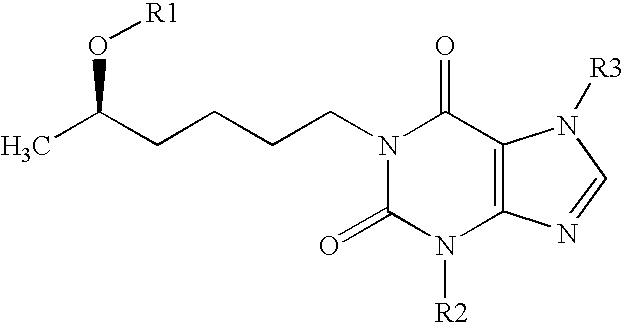
wherein, R1 is H, CH3, sulfate, phosphate, or salt thereof; R2 is alkyl (C1-12), alkoxyalkyl (C1-11), dialkoxyalkyl, CH2C6H5, —CH2-ftiran, biotin; and R3 is H, CH3 or CH2C6H5.
The methods of the present invention employ compounds characterized by their ability to inhibit IL-12 signaling. Inhibition of IL-12 signaling decreases the production of IFN-γ, thus mitigating the inflammatory response in disease conditions mediated by CD4+ Th1 cells. Specifically, the present invention impedes signaling that induces differentiation of T cells to Th1 cells. In general, differentiated Th1 cells produce high levels of IFN-γ, which incites inflammation, a component of many disease conditions that the inventive methods target.
The methods of the present invention generally comprise administering a therapeutically effective amount of a compound as described herein to a patient in need of such treatment. A patient will need treatment when exhibiting a deleterious inflammatory response in the course of a disease condition mediated by CD4+ Th1 cells. Such need is determinable by skilled clinicians and investigators in the medical arts. Preferred CD4+ Th1 cell-mediated disease conditions which involve an inflammatory response may include, but are not limited to, the following exemplary conditions: chronic inflammatory disease, chronic intestinal inflammation, arthritis, psoriasis, asthma, and autoimmune disorders. Autoimmune disorders, include multiple sclerosis, type-1 insulin dependent diabetes mellitus, rheumatoid arthritis, lupus disorders, acute graft-versus-host disease, autoimmune thyroid diseases, such as Graves' Disease and Hashimoto's Disease, and inflammatory bowel diseases, such as Crohn's Disease and ulcerative colitis. The patient may be a human or non-human mammal.
The method of the present invention is particularly useful in the treatment of autoimmune diseases, preferably as a therapy for treating MS and type-1-insulin dependent diabetes mellitus.
The inventive methods employ variously substituted xanthine compounds having the ability to inhibit IL-12 signaling. In more preferred methods, administered compounds have the following formula: 
wherein the R1 substituent is independently selected from the group consisting of H, CH3, sulfate, phosphate, or salt. Other preferred compounds of the present invention have R1 as a sulfate or phosphate or salt thereof.
The R2 substituent is independently substituted or unsubstituted alkyl (C1-12), alkoxyalkyl (C1-11), dialkoxyalkyl, CH2C6H5, a —CH2-furan, biotin. Preferably, the administered compounds have R2 as alkyl (C1-12), biotin, or —CH2-furan. More preferably, R2 is alkyl (C1-12). In the most preferred compounds, R2 is methyl.
The R3 substituent is independently H, CH3 or CH2C6H5. More preferably, R3 is H or methyl. In the most preferred compounds, R3 is methyl.
The preferred compounds administered in the inventive method are compounds in which R1 is H, CH3, sulfate, phosphate, or a salt thereof, R2 is independently substituted or unsubstituted alkyl (C1-12), alkoxyalkyl (C1-11), dialkoxyalkyl, CH2C6H5, CH2-furan, biotin and R3 is methyl. More preferably, compounds administered in the inventive method are compounds in which R1 is H, CH3, sulfate, phosphate, or a salt thereof, R2 is substituted or unsubstituted alkyl (C1-12), and R3 is methyl. The most preferred compounds are those compounds in which R2 and R3 are both methyl. Species illustrating preferred compounds within the scope of the inventive method, include, without limitation: (R)-1-(5-Hydroxyhexyl)-3,7-dimethylxanthine 5′-sulfate, sodium salt, and (R)-1-(5-Hydroxyhexyl)-3,7-dimethylxanthine 5′-phosphate (R)-3-(6-Biotinylamidohexyl)-1-(5-hydroxyhexyl)-7-methylxanthine and (R)-1-(5-hydroxyhexyl)-3,7-dimethylxanthine. Representative compounds according to the present invention may include: 

Other compounds that may be employed in the methods of the present invention are described, for example, in copending U.S. Ser. Nos. 08/932,834, and 08/472,296.
In addition to their structural characteristics, the compounds of the present invention share an ability to inhibit IL-12 signaling. A scientist using routine assays may readily confirm the inhibition of the compounds. An example of one such assay is the Th1 differentiation assay, which is included in Comparative Example 1.
The inventive methods are for administering pharmaceutical compositions, which generally contain a therapeutically effective amount of one or more of the foregoing compounds, or their pharmaceutically acceptable salts. Pharmaceutically acceptable salts will be readily apparent to the skilled clinician. Preferably, these one or more compounds, or their pharmaceutically acceptable salts, are admixed with a pharmaceutically acceptable excipient. The pharmaceutical formulations can contain isolated R- or S-enantiomers or racemic mixtures of these compounds.
A suitable formulation will depend on the nature of the disorder to be treated, the nature of the medicament chosen, and the judgment of the attending physician. In general, the compounds are formulated either for oral administration or injection, although other modes of administration such as transmucosal or transdermal routes may be employed. Suitable formulations for these compounds, including pharmaceutically acceptable excipients, can be found, for example, in Remington's Pharmaceutical Sciences, Chapters 83-92, pages 1519-1714 (Mack Publishing Company 1990)(Remington's), which is hereby incorporated by reference.
The compounds and their pharmaceutically acceptable salts can be employed in a wide variety of pharmaceutical forms. The preparation of pharmaceutically acceptable salts is largely determined by the chemical nature of the compound itself, and can be prepared by conventional techniques readily available.
Thus, if a solid carrier is used then the preparation can be tableted, placed in a hard gelatin capsule in powder or pellet form or in the form of a troche or lozenge. The amount of solid carrier will vary widely but preferably will be from about 25 mg to about 1 gram.
Where the composition is in the form of a capsule, any routine encapsulation is suitable, for example, using the aforementioned carriers in a hard gelatin capsule shell. Where the composition is in the form of a soft gelatin shell capsule, any pharmaceutical carrier routinely used for preparing dispersions of suspensions may be considered, for example, aqueous gums, celluloses, silicates or oils and are incorporated in a soft gelatin capsule shell.
When a liquid carrier is used, the preparation may be in the form of a syrup, emulsion, soft gelatin capsule, sterile injectable liquid such as an ampule or nonaqueous liquid suspension.
A syrup formulation will generally consist of a suspension or solution of the compound or salt thereof in a liquid carrier with a flavor or coloring agent. Examples of liquid carriers include ethanol, polyethylene glycol, coconut oil, glycerine and water.
Although other routes of administration are contemplated, the pharmaceutical compositions of the invention preferably are suitable for oral, intravenous, intraperitoneal, intramuscular, subcutaneous, parenteral, ex vivo culture, or topical delivery. Preferred administration is accomplished orally.
Parenteral administration can include intravenous (“i.v.”), intramuscular (“i.m.”), subcutaneous (“s.c.”), intranasal, intrarectal, intravaginal or intraperitoneal (“i.p.”) administration.
Additionally, the compounds may be administered by, for example, intranasal or oral inhalation. Appropriate dosage forms for inhalation include an aerosol or a metered dose inhaler, as prepared by conventional techniques. Typical compounds for inhalation are in the form of a solution, suspension or emulsion that may be administered as a dry powder or in the form of an aerosol using a conventional propellant.
Appropriate dosage forms for each specific route of administration may be prepared by conventional techniques. A typical dosage form for parenteral administration is a solution or suspension of at least one inventive compound, or its pharmaceutically acceptable salt. The parenteral dosage form typically contains a parenterally acceptable sterile aqueous or non-aqueous carrier. The parenteral dosage form optionally contains a parenterally acceptable oil. Examples of such oils include polyethylene glycol, polyvinylpyrrolidone, lecithin, arachis oil, and sesame oil. Parenteral acceptability is known to the skilled clinician.
Formulation as a standard unit dose also is contemplated. Thus, the pharmaceutical compositions of the invention can be formulated, for example, for oral use in dosage unit form as a pill, a tablet, a caplet, or a capsule. These dosage units may each contain a therapeutically effective amount of one or more compounds of the invention. These dosage units also may contain subtherapeutically effective amounts, where multiple units may be combined to achieve a therapeutically effective amount. The amount of compound in a unit dose will depend on many factors considered by the skilled clinician. Generally, however, dosage units prepared for oral use will contain from about 5 mg to about 5000 mg of compound of the invention. Preferred oral formulations contain from about 100 mg to about 2500 mg of compound, whereas other preferred formulations contain from about 500 mg to about 1500 mg. Such formulation conveniently can be administered one to six, and preferably, two or three times daily.
A typical parenteral unit does can be from about 1 g to about 5 g and may be administered (i.v., i.p., i.m., or s.c.) over a course of 24 hours. A typical topical formulation contains from about 1% to about 4% by weight. An ex vivo culture concentration can be maintained from about 10 μM to about 500 μM.
The invention is further described by the presentation of the following examples, offered by way of illustration and not by limitation.

To a stirring slurry of 2.69 g 7-methylxanthine (16.2 mmol) (Aldrich, Milwaukee, Wis.) in 50 ml methyl sulfoxide was added 0.39 g sodium hydride (16.2 mmol). After 1 hour, 2.85 g of 6-bromocapronitrile (16.2 mmol) (Lancaster Synthesis, Inc., Windham, N.H.) was added neat and the reaction was stirred for 72 h at room temperature. The mixture was then quenched with 150 mL water and extracted five times with 35 ml methyl acetate. The combined extracts were washed two times with 40 ml saturated aqueous sodium bicarbonate solution and two times with 40 ml saturated aqueous sodium chloride solution and then dried over sodium sulfate. After concentration under vacuum, the residual white powder was recrystallized with ethyl acetate-hexane solution to yield 0.64 g 3-(cyanopentyl)-7-methylxanthine (15% yield) as a white solid.
A solution of 4.80 g (R)-5-acetoxy-1-chlorohexane (26.89 mmol) (prepared in accordance with procedures set forth in U.S. Pat. No. 5,629,423) was added to 5.39 g sodium iodide (36 mmol) in a round bottomed flask fitted with magnetic stirrer bar and a reflux condenser and refluxed for 12 h with stirring. Acetone was removed under reduced pressure. The crude product was partitioned between 60 ml ethyl acetate and 60 ml water layer. The organic layer was washed with 10% sodium thiosulphate solution followed by 20 ml water and then dried over anhydrous magnesium sulfate and concentrated under reduced pressure to yield 7 g (96%) (R)-5-Acetoxy-1-iodohexane.
To a stirring solution of 0.31 g 3-(cyanopentyl)-7-methylxanthine (1.2 mmol) in 20 ml dimethyl sulfoxide was added 30 mg sodium hydride (1.3 mmol). After 25 minutes, 0.34 g of (R)-5-acetoxy-1-iodohexane (1.3 mol) was added and the mixture was stirred for 24 h. The mixture was then quenched with 70 ml water and extracted three times with 30 ml ethyl acetate. The combined extracts were washed two times with 35 ml saturated aqueous sodium chloride solution and dried over sodium sulfate, and concentrated under vacuum. The residue was purified by flash chromatography (silica gel) eluting with 5% methanol-ethyl acetate to give 0.42 g (R)-1-(5-acetoxyhexyl)-3-(5-cyanopentyl)-7-methylxanthine (88% yield) as a viscous oil.
To a stirring solution of 0.37 g (R)-1-(5-acetoxyhexyl)-3-(5-cyanopentyl)-7-methylxanthine (0.92 mmol) in 20 ml methanol was added a solution of 4M hydrogen chloride in 70 ml 1,4-dioxane (2.77 mmol). The reaction was heated at reflux (80° C.) for five hours and then cooled to room temperature. The solvent was removed under reduced pressure and the resulting oil was treated with 25 ml saturated aqueous sodium bicarbonate solution and extracted three times with 25 ml dichloromethane. The combined extracts were washed 2× with 25 ml saturated aqueous sodium chloride solution dried over sodium sulfate, and concentrated under vacuum. The resulting residue was purified by flash chromatography eluting with 10% methanol-ethyl acetate to give 0.15 g (R)-3-(5-cyanopentyl)-1-(5-hydroxyhexyl)-7-methylxanthine (47% yield) as a viscous oil.
A slurry of 0.14 g (R)-3-(5-cyanopentyl)-1-(5-hydroxyhexyl)-7-methylxanthine (0.39 mmol), 15 mg 10% Palladium on carbon, seven drops hydrochloric acid, and 35 ml absolute ethanol was treated with 70 psi hydrogen gas on a Parr shaker for 4 h. After filtration through a pad of celite, the solution was concentrated under vacuum to give 84 mg (R)-3-(6-aminohexyl)-1-(5-hydroxyhexyl)-7-methylxanthine hydrochloride (54% yield).
A solution of 24 mg (R)-3-(6-aminohexyl)-1-(5-hydroxyhexyl)-7-methylxanthine hydrochloride (0.07 mmol), 27 mg biotin N-hydroxysuccinimide ester (0.08 mmol) (CalBiochem, San Diego, Calif.), and nine mg imidazole (0.13 mmol) in 1 ml dimethyl sulfoxide was stirred for six h. The solution was treated with 10 ml saturated aqueous sodium chloride solution and extracted two times with 15 ml dichloromethane. The combined extracts were dried over magnesium sulfate and concentrated under vacuum. The residue was purified by flash chromatography (silica gel) eluting with 7% methanol-ethyl acetate followed by 100% methanol to provide (R)-3-(6-Biotinylamidohexyl)-1-(5-hydroxyhexyl)-7-methylxanthine. The compound was further purified by treating with 10 ml of 1.5 M aqueous hydrochloric acid and extracting with 30 ml ethyl acetate. The aqueous layer was neutralized by the addition of 25 ml saturated aqueous sodium bicarbonate solution and saturated with solid sodium chloride, and extracted three times with 15 ml 20% methanol-dichloromethane. The combined extracts were dried over magnesium sulfate and concentrated under vacuum to give 7 mg (R)-3-(6-Biotinylamidohexyl)-1-(5-hydroxyhexyl)-7-methylxanthine (18% yield).

To a 25 ml round bottomed flask was added 300 mg of (R)-1-(5-hydroxyhexyl)-3,7-dimethylxanthine 250 mg, (1.07 mmol) and 6mL pyridine, prepared in accordance with procedures set forth in Bianco et al., U.S. Pat. No. 5,648,357, for example). Then 375 mg of sulfur trioxide pyridine complex (2.36 mmol) was added and the resulting mixture was stirred for 18 h at room temperature. The resulting solution was concentrated under vacuum to remove most of the pyridine. The residue was then diluted in 10 ml of methanol and 10 ml 0.2M sodium hydroxide-methanol was added to the solution. The mixture was filtered and the resulting solid was washed two times with 10 ml with methanol. The combined filtrates were concentrated under vacuum. To the residue was added 5 ml of a 0.2M aqueous sodium acetate solution and The mixture was stirred at room temperature until homogeneous. The mixture was then concentrated under vacuum to remove water yielded 410 mg (R)-1-(5-Hydroxyhexyl)-3,7-dimethylxanthine 5′-sulfate, sodium salt as a clear viscous oil.
To a 25 ml round bottomed flask 250 mg (S)-1-(5-Hydroxyhexyl)-3,7-dimethylxanthine (0.9 mmol) (prepared in accordance with procedures set forth in Bianco et al., U.S. Pat. No. 5,648,352), six ml pyridine, and 375 mg sulfur trioxide pyridine complex (2.36 mmol) was added and stirred for 18 h. The solution was concentrated under vacuum to remove most of the pyridine. The resulting residue was added to 10 ml methanol and 10 ml 0.2M sodium hydroxide-methanol solution. The mixture was then filtered and the solid was washed twice with 10 ml methanol. The combined filtrates were then concentrated under vacuum. To the concentrated filtrates was added 5 ml of a 0.2M aqueous sodium acetate solution and the mixture was stirred until homogeneous. The resulting residue was concentrated under vacuum to remove water to yield 410 mg (S)-1-(5-Hydroxyhexyl)-3,7-dimethylxanthine 5′-sulfate, sodium salt (CT 7556S) (1.07 mmol) as a clear viscous oil.

To a 25 ml round bottomed flask 303 mg of (R)-1-(5-Hydroxyhexyl)-3,7-dimethylxanthine (1.1 mmol) and 5 ml pyridine were added. The mixture was cooled in an ice bath and 200 μL of phosphorus oxychloride (2.2 mmol) (Aldrich, Milwaukee, Wis.) was added. After 2 min in the cooling bath, the mixture was removed and stirred for an additional 5 min. The solution was then concentrated under vacuum and 10 ml 1N aqueous hydrochloric acid solution was added. The white solid residue was purified by flash chromatography, (26 g of silica gel) eluting with 200 ml of a 20% methanol-ethyl acetate solution, after concentrating under vacuum, to remove the water. The yield was 70 mg (R)-1-(5-Hydroxyhexyl)-3,7-dimethylxanthine 5′-phosphate (0.19 mmol) as a clear viscous oil which solidified.
Example 5 illustrates the effect of CT 1501R on decreasing the severity of paralysis in both active and passive models of murine EAE.
a) Active EAE
Active EAE was induced by immunization of female SJL/J mice (Clarence Reader (NIH, Bethesda, Md.)) with 800 μg of mouse spinal cord homogenate (“MSCH”) in complete Freund's adjuvant (“CFA”) on days zero and seven; following the procedure described in Racke et al., J. Neuroimmunol., Vol 46:175-184, (1993). The mice were treated with either CT 1501R (“CT 1501R”) (1 mg per dose, i.e. 50 mg/kg) or PBS by gavage twice daily for 15 days.
b) Passive EAE
Passive EAE was induced by adoptive transfer of myelin basic protein (“MBP”)-sensitized T lymphocytes as follows: female SJL/J mice (four- to six-weeks-old) were immunized on days zero and seven with 400 μg of MBP in CFA. On day 14 the regional draining lymph node cells and spleen were harvested and cultured. The cells were cultured at 4×10⁶ cells/well in RPMI 1640 (Gibco, Gaithersburg, Md.) containing 10% fetal bovine serum (Hyclone Labs, Logan, Utah), 2 mM L-glutamine (Gibco, Gaithersburg, Md.), five times 10−5 M 2-mercaptoethanol (Gibco, Gaithersburg, Md.), 1% penicillin/streptomycin (Gibco, Gaithersburg, Md.), and 100 μg/ml of MBP. After four days, viable T cell blasts were harvested, washed twice in PBS, and injected intraperitoneally into recipient mice (1.0×10⁷ to 1.5×10⁷ cells in 500 μl of PBS).
As stated above, mice were administered either CT 1501R or PBS twice daily by gavage needle in volumes of 0.25 or 0.5 ml/dose for 6 days. At the time of disease onset, paralysis was scored according to the following clinical conditions:
0, no paralysis; 0.5, stiff tail; 1, limp tail; 1.5, limp tail with inability to right; 2, paralysis of one limb; 2.5, paralysis of one limb and weakness of one other limb; 3, complete paralysis of both hind limbs; 4, moribund state; and 5, death.
To assess the degree of inflammation, mice were euthanized on day 25 and perfused by intracardiac injection of 4% paraformaldehyde (Gibco, Gaithersburg, Md.) and 1% glutaraldehyde (Gibco, Gaithersburg, Md.) in PBS. Transverse sections of the cervical, upper thoracic, lower thoracic and lumbar region of the spinal cord were stained with luxol fast blue (Sigma, St. Louis, Mo.) or with hematoxylin blue (Sigma, St. Louis, Mo.) and eosin blue (Sigma, St. Louis, Mo.). Each spinal cord section was further subdivided into an anterior, posterior and two lateral columns. To determine the degree of inflammation, the stained spinal cord sections were viewed to determine lymphocyte infiltration and demyelination, with any subsection displaying infiltration or demyelination receiving a score of one. Therefore, each animal had a potential maximum score of 16. Spinal cords were isolated from PBS- or CT 1501R-treated mice on day 25, following induction of passive EAE by adoptive transfer of MBP-specific T cells. Demyelination and infiltration were scored in 3 mice per group (FIG. 3).
1. Active EAE
2. Passive EAE
The marked differences in clinical scores for animals in the passive model were consistent with histological studies of three randomly selected animals from each group following recovery. In mice receiving PBS, the pathologic scores were 6.6 and 7.2 for demyelination and infiltration respectively, whereas no demyelination or lymphocyte infiltration into the CNS was observed in CT 1501R-treated mice (FIG. 3a and FIG. 3b). FIG. 3b, Panels A-D show the histologic sections of the spinal cord of PBS- and CT 1501R-treated mice. Panel A of FIG. 3b; shows a section of thoracic cord of a PBS-treated mouse stained with H&E. The arrow in that figure points to an area of lymphocytic infiltration. Panel B of FIG. 3b shows the same region as in Panel A but stained with LFB/PAS. This shows the lack of myelin stain (arrow). Panels C and D of FIG. 3b show comparable regions of spinal cord from a CT 1501R treated mouse. These mice showed no signs of inflammation or demyelination with CT 1501R treatment.
This example demonstrates the potent immunoregulatory properties of CT 1501R in a murine EAE model, which is felt to simulate human MS. CT 1501R inhibited the clinical manifestations of EAE induced either by immunization with MSCH or by adoptively transferred, encephalitogenic T cells (FIGS. 1 and 2). CT 1501R treated mice were protected from lymphocyte infiltration into neural tissues and demyelination, as demonstrated histologically by analysis of spinal cord sections (FIG. 3). Thus, CT 1501R blocked progression of an inflammatory, Th1 cell-mediated autoimmune disease.
Example 5 illustrated the ability of CT 1501R to decrease the severity of paralysis in both active and passive EAE models. This example illustrates the effects of CT 1501R in vivo on the potency and phenotype of T cells developing in MBP immunized mice.
Donor SJL/J mice were treated with PBS or CT 1501R (1.0 mg twice daily) and immunized with 800 μg of MBP in CFA. The mice were immunized on day zero and boosted on day seven. LNC and spleen were harvested on day 14, cultured in the presence of 100 μg/ml of MBP for four days, and the T cell blasts (˜10×107) were assessed for their ability to transfer EAE to naive recipients in two separate experiments (FIGS. 4a and 4 b), to proliferate in response to MBP in vitro (FIG. 4c) and to secrete IFN-γ after antigen re-stimulation in vitro (FIG. 4d).
a) Potency at Adoptively Transferring EAE
When compared to cells from PBS-treated mice, donor cells from CT 1501R-treated animals were less effective at inducing passive EAE after transfer into naive hosts. As shown in FIG. 4a, all six animals that received PBS-treated donor cells developed clinical paralysis (mean clinical score=4.5), and four died at the height of disease. In contrast, none of the mice that received cells from CT 1501R-treated mice died, their mean clinical score was 3.8, and all animals recovered to a mean clinical score of 1.8 by day 24.
In the second experiment, the mean clinical score for mice receiving PBS treated cells was 3.25, whereas the mice receiving CT 1501R-treated cells had a mean clinical score of 2.0 (FIG. 4b).
b) Proliferative Response to MBP
The following proliferation assay was performed: 15 days after MBP immunization, PBS- or CT 1501R-treated donor cells were cultured at two times 105/well with MBP for 72 h, and pulsed during The last 18 h with 3H-thymidine (0.5 μCi/well). 3H-thymidine incorporation was measured on a betaplate liquid scintillation counter (Wallac, Turku, Finland).
The reduction in clinical severity of EAE induced by CT 1501R-treated donor cells versus those treated with PBS-treated donor cells was significant (p<0.001), and was not due to differences in lymphocyte activation, since both populations proliferated equally well in response to MBP in vitro (FIG. 4c).
c) Capacity to Produce IFN-γ
To assess the T-helper cell phenotype of donor cells from PBS-treated and CT 1501R-treated mice supernatants from antigen-stimulated cultures were analyzed for the presence of Th1 type cytokines.
An ELISA for IL-12 secretion and IFN-γ production was performed. IL-12 secretion was determined by sandwich ELISA. Plates were coated with 2 μg/ml of anti-IL-12 antibody (C17.5 and C15.6) (gift of Dr. G. Trinchieri, Wistar Institute, Philadelphia, Pa.) and blocked with 3% bovine serum albumin in PBS. After overnight incubation at 4° C., sample wells were washed with PB S/0.05% Tween-20, and incubated with biotinylated anti-IL-12 (C17.5) at 0.2 μg/ml. After 1 h at room temperature The plates were washed, incubated for 1 h with avidin-alkaline phosphatase (Genzyme, Cambridge, Mass.), and washed again before addition of 1 mg/ml of p-nitrophenyl phosphate (Genzyme, Cambridge, Mass.). Absorbance was read at 405 nm (Biotech, Winooski, Vt.). The IL-12 concentration was calculated by interpolation from a standard curve.
IFN-γ production was also determined by the sandwich ELISA procedure, as described above, except R4-6A2 antibody (ATCC No. HB-170) was used as the capture antibody and the biotinylated anti-IFN-γ antibody, MM700, (Endogen, Woburn, Mass.) was used as the second step antibody.
In the alternative, the total IL-12 and IFN-γ levels were assayed using the commercially available Intertest-12 and the Intertest-γ ELISA kit, (Genzyme, Cambridge, Mass.). (FIG. 5 and FIG. 6).
Although no differences in IL-12 production were observed between cells from PBS-treated mice and CT 1501R-treated mice (FIG. 7), cells from CT 1501R-treated mice produced significantly less IFN-γ (FIG. 4d). CT 1501R was determined to ameliorate disease progression by examining ex vivo proliferative responses of LNC from CT 1501R-treated mice and their profiles of cytokine secretion. CT 1501R administration in vivo did not inhibit the ex vivo T cell proliferative response to MBP (FIG. 4C), indicating that CT 1501R does not induce tolerance, block antigen-specific priming, or inhibit the cellular response to subsequent antigen challenge. Furthermore, in vivo treatment with CT 1501R did not diminish IL-12 secretion by MBP-stimulated APC ex vivo implying that CT 1501R was not effective as to APC function and cytokine secretion. CT 1501R treatment reduced the amount of IFN-γ secreted by ex vivo activated T cells (FIG. 4D), implying that Th1 differentiation had been inhibited in vivo. CT 1501R inhibited Th1 differentiation by blocking IL-12 signaling and not by inhibiting IL-12 secretion from APC (FIG. 5), since IL-12-dependent Th1 differentiation was suppressed in vitro (FIG. 6). More recently, we have extended these observations to show that CT 1501R abrogates IL-12-induced proliferation of anti-CD3 activated T cell blasts (SJK, unpublished observation). The reduced capacity to produce IFN-γ correlated with a reduced capacity to adoptively transfer EAE to susceptible, naive recipients. Thus, donor cells from CT 1501R-treated animals were less encephalitogenic, which led ultimately, to lower clinical scores (FIGS. 4a and b).
This experiment demonstrates that CT 1501R inhibits IL-12 signaling in T cells but does not block IL-12 secretion from antigen-presenting cells such as macrophages, suggesting inhibition Th1 differentiation in vivo by blocking IL-12 signaling.
a) Inability of CT 1501R to Block IL-12 Secretion from APC
Murine macrophages were induced to secrete IL-12 after activation with anti-CD40 (HM40-3; Pharmingen, San Diego, Calif.) or LPS (Sigma, St. Louis, Mo.) (FIG. 5a). Total IL-12 production was assessed from macrophages activated in vitro in the presence of CT 1501R, using CT 1501R concentrations that were detectable in patients' sera collected during clinical trials, and up to four-fold higher.
Normal macrophages were enriched from single cell suspensions of Balb/c mice (Charles River Labs, B&K Universal, Fremont, Calif.) spleens by adherence to tissue culture plates at 37° C. for one h. Plates were rinsed four times with PBS before harvesting the adherent cells. Adherent Balb/c mice splenic cells (106/ml) were stimulated with either anti-CD40 or LPS at the indicated concentrations for 48 h in the absence or presence of increasing concentrations of CT 1501R. We also tested whether CT 1501R might inhibit IL-12 secretion from a murine macrophage cell line. The murine macrophage cell line J774A.1 (ATCC # TIB-67) (106/ml) was either left untreated, or stimulated with both one ng/ml LPS and 10 U/ml IFN-γ plus or minus increasing concentrations of CT 1501R, or plus 10 ng/ml human recombinant IL-10 (PeproTech, Rocky Hill, N.J.) without CT 1501R. Normal macrophage or The J774A.1 cell line was incubated for 48 h and the culture media collected and assayed for IL-12 by ELISA.
Normal murine macrophages were induced to secrete IL-12 after activation with anti-CD40 or LPS, but CT 1501R did not inhibit IL-12 secretion [values for IL-12 in unstimulated cultures was 68 pg/ml. (FIG. 5a)]. CT 1501R was not even inhibitory at concentrations of anti-CD40 which induce suboptimal IL-12 production. Furthermore, CT 1501R did not block IL-12 secretion from a murine macrophage line stimulated with LPS and IFN-γ (FIG. 5b), whereas recombinant human IL-10 (PeproTech, Rocky Hill, N.J.) completely abolished IL-12 secretion.
b) Ability of CT 1501R to Inhibit IL-12 Signaling in T Cells
This assay illustrates CT 1501R's ability to suppress Th1 differentiation in vitro by blocking IL-12 signaling. CT 1501R was tested in an IL-12 dependent in vitro T-helper cell differentiation assay as described in LeGross et al., J. Exp. Med, Vol. 172, pp. 921-929, (1990). Recombinant IL-12 was used to induce Th1 differentiation. Splenic T cells were purified utilizing The antibodies RA3-3A1/6.1 (anti-B220), J11d and MAR18.5 (anti-rat kappa chain) to deplete the B cells via complement mediated toxicity following the procedure set forth in Klaus et al. J. Immunol. 149:1867-1875 (1992). Splenic T cells were stimulated at five times 105/ml with insoluble anti-CD3 alone (145-2C11, Pharmingen, San Diego, Calif.), or anti-CD3 and 5 U/ml IL-12, with or without CT 1501R, at the concentrations indicated. After seven days, equal numbers of viable cells were restimulated for 24 h with anti-CD3 without CT 1501R, and the supernatants were collected and assayed for IFN-γ production. IFN-γ and IL-4 levels were measured by Intertest kits from Genzyme specific for IFN-γ and IL-4.
Anti-CD3 stimulated T cells differentiated into Th1 cells, and as expected Th1 cell differentiation was increased in the presence of recombinant IL-12 (FIG. 6a). Strikingly, the presence of CT 1501R during T cell activation inhibited Th1 differentiation, whether or not Th1 maturation had been enhanced by IL-12 (FIG. 6a). CT 1501R also inhibited Th1 differentiation induced by addition of heat killed Listeria monocytogenes (see FIGS. 8a and 8 b), which enhances Th1 development by inducing IL-12 secretion from macrophages. CT 1501R did not affect the viability or recovery of T cells after one week of culture (see FIG. 9), consistent with its inability to block lymphocyte activation (FIG. 4c). Furthermore, CT 1501R did not augment Th2 differentiation at the expense of Th1 development, since IL-4 and IL-10 secretion was not enhanced (see FIG. 10, data for IL-10 only).
This experiment compares the efficacy of Pentoxifylline (“PTX”), [3,7-dimethyl-1-(5-oxohexyl) xanthine], (Sigma, St Louis, Mo.) and CT 1501R to inhibit in vitro Th1 differentiation driven by addition of exogenous IL-12. PTX is a known anti-inflammatory molecule and is known to inhibit induction of EAE in rats. Rott et al., Eur. J. Immunol., 23:1745-1751(1993). It is also known that high doses of PTX inhibit IL-12 secretion in vitro. Moller et al., Immunology, 91:197-203 (1997).
The methodology described in Example 7 was also employed in this experiment. Splenic T cells were stimulated with anti-CD3 and IL-12 as above, and incubated with either CT 1501R or PTX as indicated. The levels of IFN-γ produced by T cells stimulated with anti-CD3 and no IL-12 were 5.8 ng/ml (FIG. 6b).
The experiments showed that CT 1501R inhibited Th1 differentiation in a dose-dependent fashion, resulting in a >85% blockade at 50 μM, when cells were stimulated with anti-CD3 and exogenous IL-12 (FIG. 6b). In contrast, equimolar concentrations of PTX had no effect on IL-12 induced Th1 differentiation. Thus, PTX had no effect on IL-12 signaling. Similarly, the stereochemical enantiomer of CT 1501R, CT 1501S, also had no effect on Th1 differentiation, i.e. IL-12 signaling (FIGS. 11a and 11 b).
Although PTX is structurally similar to CT 1501R, in this example, CT 1501R, but not PTX, inhibited IL-12-induced Th1 differentiation (FIG. 6B). With regard to inhibition of IL-12 signaling, CT 1501R was also selectively inhibitory when compared to its stereospecific S-enantiomer.
All publications and patent applications mentioned in this specification are herein incorporated by reference to the same extent as if each individual publication or patent application was specifically and individually incorporated by reference.
From the foregoing it will be appreciated that, although specific embodiments of the invention have been described herein for the purpose of illustration, various modifications may be made without deviating from the spirit and scope of the invention.
Claims (11)
1. A method of inhibiting Interleukin-12 signaling in a mammal having a CD4+ Th1 cell-mediated inflammatory response, the method comprising administering a signal inhibiting amount of a compound of the following formula: 
wherein, R1 is CH3, sulfate, phosphate, or salt thereof; R2 is alkyl (C1-12), alkoxyalkyl (C1-11), dialkoxyalkyl, CH2C6H5, —CH2-furan, biotin; and R3 is H, CH3 or CH2C6H5.
2. The method of claim 1 , wherein R2 is alkyl (C1-12), CH2C6H5, —CH2-furan, or biotin and R3 is H or methyl.
3. The method of claim 2 , wherein R2 is alkyl (C1-12), biotin or —CH2-furan.
4. The method of claim 3 , wherein R1 is sulfate or phosphate or a salt thereof, and R2 and R3 are CH3.
5. The method of claim 1 , wherein the compound is of the following formula: 
6. The method of claim 1 , wherein the compound is of the following formula: 
7. A method of inhibiting Interleukin-12 signaling in a mammal having a CD4+ Th1 cell-mediated inflammatory response, the method comprising administering a signal inhibiting amount of a compound of the following formula: 
wherein, R1 is H, CH3, sulfate, phosphate, or salt thereof; R2 is alkyl (C1-12), alkoxyalkyl (C1-11), dialkoxyalkyl, CH2C6H5, —CH2-furan, biotin; and R3 is H, CH3 or CH2C6H5, provided that when R1 is H, R2 is not alkyl (C1-12) and R3 is not CH3.
8. The method of claim 7 , wherein a disease condition, which exhibits The CD4+ Th1 cell-mediated inflammatory response, is selected from the group consisting of chronic inflammatory disease, chronic intestinal inflammation, arthritis, psoriasis, asthma, and autoimmune disorders.
9. The method of claim 7 , wherein an autoimmune disorder generates the CD4+ Th1 cell-mediated inflammatory response.
10. The method of claim 9 , wherein the autoimmune disorder is selected from the group consisting of type-1 insulin dependent diabetes mellitus (“IDDM”), multiple sclerosis, rheumatoid arthritis, inflammatory bowel disease, lupus disorders, and acute graft-versus-host disease.
11. The method of claim 7 , wherein the mammal is a human.
Priority Applications (8)
| Application Number | Priority Date | Filing Date | Title |
|---|---|---|---|
| US09/008,020 US6469017B1 (en) | 1998-01-16 | 1998-01-16 | Method of inhibiting interleukin-12 signaling |
| PCT/US1998/027848 WO1999036073A1 (en) | 1998-01-16 | 1998-12-30 | Method of inhibiting interleukin-12 signaling |
| AU20987/99A AU2098799A (en) | 1998-01-16 | 1998-12-30 | Method of inhibiting interleukin-12 signaling |
| US09/288,556 US6774130B2 (en) | 1998-01-16 | 1999-04-09 | Therapeutic compounds for inhibiting interleukin-12 signaling and methods for using same |
| US09/361,145 US6693105B1 (en) | 1992-11-16 | 1999-07-27 | Hydroxyl-containing compounds |
| US09/544,984 US6878715B1 (en) | 1994-02-18 | 2000-04-07 | Therapeutic compounds for inhibiting interleukin-12 signals and method for using same |
| US10/909,321 US20050032748A1 (en) | 1998-01-16 | 2004-08-03 | Therapeutic compounds for inhibiting interleukin-12 signaling and methods for using same |
| US10/918,709 US20050049262A1 (en) | 1994-02-18 | 2004-08-16 | Therapeutic compounds for inhibiting interleukin-12 signaling and methods for using same |
Applications Claiming Priority (1)
| Application Number | Priority Date | Filing Date | Title |
|---|---|---|---|
| US09/008,020 US6469017B1 (en) | 1998-01-16 | 1998-01-16 | Method of inhibiting interleukin-12 signaling |
Related Parent Applications (1)
| Application Number | Title | Priority Date | Filing Date |
|---|---|---|---|
| US08/486,264 Continuation-In-Part US6103730A (en) | 1994-02-18 | 1995-06-07 | Amine substituted compounds |
Related Child Applications (1)
| Application Number | Title | Priority Date | Filing Date |
|---|---|---|---|
| US09/288,556 Continuation-In-Part US6774130B2 (en) | 1992-11-16 | 1999-04-09 | Therapeutic compounds for inhibiting interleukin-12 signaling and methods for using same |
Publications (1)
| Publication Number | Publication Date |
|---|---|
| US6469017B1 true US6469017B1 (en) | 2002-10-22 |
Family
ID=21729392
Family Applications (3)
| Application Number | Title | Priority Date | Filing Date |
|---|---|---|---|
| US09/008,020 Expired - Lifetime US6469017B1 (en) | 1992-11-16 | 1998-01-16 | Method of inhibiting interleukin-12 signaling |
| US09/288,556 Expired - Fee Related US6774130B2 (en) | 1992-11-16 | 1999-04-09 | Therapeutic compounds for inhibiting interleukin-12 signaling and methods for using same |
| US10/909,321 Abandoned US20050032748A1 (en) | 1998-01-16 | 2004-08-03 | Therapeutic compounds for inhibiting interleukin-12 signaling and methods for using same |
Family Applications After (2)
| Application Number | Title | Priority Date | Filing Date |
|---|---|---|---|
| US09/288,556 Expired - Fee Related US6774130B2 (en) | 1992-11-16 | 1999-04-09 | Therapeutic compounds for inhibiting interleukin-12 signaling and methods for using same |
| US10/909,321 Abandoned US20050032748A1 (en) | 1998-01-16 | 2004-08-03 | Therapeutic compounds for inhibiting interleukin-12 signaling and methods for using same |
Country Status (3)
| Country | Link |
|---|---|
| US (3) | US6469017B1 (en) |
| AU (1) | AU2098799A (en) |
| WO (1) | WO1999036073A1 (en) |
Cited By (5)
| Publication number | Priority date | Publication date | Assignee | Title |
|---|---|---|---|---|
| US20030207901A1 (en) * | 1999-07-27 | 2003-11-06 | Cell Therapeutics, Inc. | Hydroxyl-containing compounds |
| US6706264B1 (en) * | 1994-03-14 | 2004-03-16 | Genetics Institute, Llc | Use of IL-12 antagonists in the treatment of conditions promoted by an increase in levels of IFN-y |
| US20060160736A1 (en) * | 2004-12-30 | 2006-07-20 | Diakine Therapeutics, Inc. | Pharmaceutical compositions and methods for restoring beta-cell mass and function |
| US20070135456A1 (en) * | 2004-02-14 | 2007-06-14 | Pinto Ivan L | Medicaments with hm74a receptor activity |
| US20100168122A1 (en) * | 2005-08-10 | 2010-07-01 | Smithkline Beecham Corporation | Xanthine derivatives as selective hm74a agonists |
Families Citing this family (19)
| Publication number | Priority date | Publication date | Assignee | Title |
|---|---|---|---|---|
| WO2000066101A2 (en) * | 1999-04-30 | 2000-11-09 | City Of Hope | Method of inhibiting glycation product formation |
| US6346247B1 (en) * | 1999-10-28 | 2002-02-12 | Promega Corporation | Prevention and treatment of autoimmune disease with luminally administered polyclonal antibodies |
| US6586429B2 (en) * | 2000-11-29 | 2003-07-01 | Cell Therapeutics, Inc. | Tricyclic fused xanthine compounds and their uses |
| US6825180B2 (en) * | 2001-05-18 | 2004-11-30 | Cell Therapeutics, Inc. | Pyridopyrimidine compounds and their uses |
| AR039385A1 (en) | 2002-04-19 | 2005-02-16 | Astrazeneca Ab | THIOXANTINE DERIVATIVES AS INHIBITORS OF MIELOPEROXIDASA |
| WO2004009091A1 (en) | 2002-06-17 | 2004-01-29 | Glaxo Group Limited | Purine derivatives as liver x receptor agonists |
| CA2545260A1 (en) * | 2003-11-10 | 2005-05-26 | Synta Pharmaceuticals, Corp. | Compositions and methods for modulating c-rel-dependent cytokine production |
| MY140748A (en) | 2004-12-06 | 2010-01-15 | Astrazeneca Ab | Novel pyrrolo [3,2-d] pyrimidin-4-one derivatives and their use in therapy |
| US20070032493A1 (en) * | 2005-05-26 | 2007-02-08 | Synta Pharmaceuticals Corp. | Method for treating B cell regulated autoimmune disorders |
| JP5259408B2 (en) * | 2005-08-29 | 2013-08-07 | ユニバーシティ オブ バージニア パテント ファンデーション | Lysophylline analogs and methods of use |
| US8871764B2 (en) | 2005-08-29 | 2014-10-28 | University Of Virginia Patent Foundation | Lisofylline analogs and methods for use |
| US20070105878A1 (en) * | 2005-10-03 | 2007-05-10 | Andrew Reaume | Purine formulations and methods for managing disorders |
| TW200804383A (en) | 2006-06-05 | 2008-01-16 | Astrazeneca Ab | New compounds |
| WO2007146786A1 (en) * | 2006-06-08 | 2007-12-21 | Diakine Therapeutics, Inc. | Pharmaceutical compositions and methods for restoring b-cell mass and function |
| WO2011028820A1 (en) * | 2009-09-02 | 2011-03-10 | Concert Pharmaceuticals, Inc. | Substituted derivatives of bicyclic [4.3.0] heteroaryl compounds |
| WO2013106547A1 (en) | 2012-01-10 | 2013-07-18 | President And Fellows Of Harvard College | Beta-cell replication promoting compounds and methods of their use |
| CN120796168A (en) | 2013-06-11 | 2025-10-17 | 哈佛学院校长同事会 | SC-beta cells, compositions and methods for producing the same |
| US12589097B2 (en) | 2018-02-21 | 2026-03-31 | OrphAl Therapeutics Inc. | Apilimod compositions and methods of use |
| TW202000205A (en) | 2018-02-21 | 2020-01-01 | 美商Ai治療公司 | Combination therapy with apilimod and glutamatergic agents |
Citations (3)
| Publication number | Priority date | Publication date | Assignee | Title |
|---|---|---|---|---|
| US4515795A (en) * | 1968-11-25 | 1985-05-07 | Hoechst Aktiengesellschaft | Pharmaceutical compositions |
| US5629423A (en) | 1994-05-16 | 1997-05-13 | Cell Therapeutics, Inc. | Asymmetric synthesis of chiral secondary alcohols |
| US5648357A (en) | 1992-03-04 | 1997-07-15 | Cell Therapeutics, Inc. | Enatiomerically pure hydroxylated xanthine compounds |
Family Cites Families (19)
| Publication number | Priority date | Publication date | Assignee | Title |
|---|---|---|---|---|
| US4207321A (en) * | 1977-04-02 | 1980-06-10 | Hoechst Aktiengesellschaft | Pharmaceutical compositions containing xanthines |
| DE3138397A1 (en) * | 1981-09-26 | 1983-04-07 | Hoechst Ag, 6230 Frankfurt | "MEDICINAL PRODUCTS CONTAINING VICINALS OF DIHYDROXYALKYLXANTHINE AND PRODUCTION METHOD FOR THESE XANTHINE COMPOUNDS" |
| FR2558162B1 (en) * | 1984-01-17 | 1986-04-25 | Adir | NOVEL XANTHINE DERIVATIVES, PROCESSES FOR THEIR PREPARATION AND PHARMACEUTICAL COMPOSITIONS CONTAINING THEM |
| GB8906792D0 (en) | 1989-03-23 | 1989-05-10 | Beecham Wuelfing Gmbh & Co Kg | Treatment and compounds |
| US5039666A (en) * | 1990-10-30 | 1991-08-13 | Hoechst-Roussel Pharmaceuticals Inc. | Aminoglycoside composition having substantially reduced nephrotoxicity induced by the aminoglycoside |
| US5484920A (en) * | 1992-04-08 | 1996-01-16 | Kyowa Hakko Kogyo Co., Ltd. | Therapeutic agent for Parkinson's disease |
| US5340813A (en) * | 1992-11-09 | 1994-08-23 | Cell Therapeutics, Inc. | Substituted aminoalkyl xanthine compounds |
| US5473070A (en) * | 1992-11-16 | 1995-12-05 | Cell Therapeutics, Inc. | Substituted long chain alcohol xanthine compounds |
| US5804584A (en) * | 1992-11-16 | 1998-09-08 | Cell Therapeutics, Inc. | Therapeutic compounds containing a monocyclic five- to six- membered ring structure having one to two nitrogen atoms |
| US5354756A (en) * | 1993-01-12 | 1994-10-11 | Cell Therapeutics, Inc. | Olefin-substituted long chain xanthine compounds |
| AU6092794A (en) * | 1993-01-19 | 1994-08-15 | Cell Therapeutics, Inc. | Oxime-substituted therapeutic compounds |
| IL109161A0 (en) | 1993-03-31 | 1994-06-24 | Cell Therapeutics Inc | Amino alcohol derivatives, methods for the preparation thereof, and pharmaceutical compositions containing the same |
| US5670506A (en) | 1993-04-05 | 1997-09-23 | Cell Therapeutics, Inc. | Halogen, isothiocyanate or azide substituted xanthines |
| WO1994024133A1 (en) | 1993-04-09 | 1994-10-27 | Cell Therapeutics, Inc. | Ring-substituted cell signaling inhibitors |
| AU1868195A (en) | 1994-01-28 | 1995-08-15 | Cell Therapeutics, Inc. | Cell signaling inhibitors |
| US6103730A (en) * | 1994-03-24 | 2000-08-15 | Cell Therapeutics, Inc. | Amine substituted compounds |
| JPH09511496A (en) | 1994-02-18 | 1997-11-18 | セル・セラピューティックス・インコーポレーテッド | Intracellular messenger |
| US5807861A (en) * | 1994-03-24 | 1998-09-15 | Cell Therapeutics, Inc. | Amine substituted xanthinyl compounds |
| US5801182A (en) | 1994-03-24 | 1998-09-01 | Cell Therapeutics, Inc. | Amine substituted compounds |
-
1998
- 1998-01-16 US US09/008,020 patent/US6469017B1/en not_active Expired - Lifetime
- 1998-12-30 AU AU20987/99A patent/AU2098799A/en not_active Abandoned
- 1998-12-30 WO PCT/US1998/027848 patent/WO1999036073A1/en not_active Ceased
-
1999
- 1999-04-09 US US09/288,556 patent/US6774130B2/en not_active Expired - Fee Related
-
2004
- 2004-08-03 US US10/909,321 patent/US20050032748A1/en not_active Abandoned
Patent Citations (3)
| Publication number | Priority date | Publication date | Assignee | Title |
|---|---|---|---|---|
| US4515795A (en) * | 1968-11-25 | 1985-05-07 | Hoechst Aktiengesellschaft | Pharmaceutical compositions |
| US5648357A (en) | 1992-03-04 | 1997-07-15 | Cell Therapeutics, Inc. | Enatiomerically pure hydroxylated xanthine compounds |
| US5629423A (en) | 1994-05-16 | 1997-05-13 | Cell Therapeutics, Inc. | Asymmetric synthesis of chiral secondary alcohols |
Non-Patent Citations (12)
Cited By (17)
| Publication number | Priority date | Publication date | Assignee | Title |
|---|---|---|---|---|
| US8012475B2 (en) | 1994-03-14 | 2011-09-06 | Genetics Institute, Llc | Use of IL-12 and IL-12 antagonists in the treatment of autoimmune diseases |
| US6706264B1 (en) * | 1994-03-14 | 2004-03-16 | Genetics Institute, Llc | Use of IL-12 antagonists in the treatment of conditions promoted by an increase in levels of IFN-y |
| US6830751B1 (en) * | 1994-03-14 | 2004-12-14 | Genetics Institute, Llc | Use of IL-12 antagonists in the treatment of rheumatoid arthritis |
| US20050079177A1 (en) * | 1994-03-14 | 2005-04-14 | Genetics Institute, Llc | Use of IL-12 and IL-12 antagonists in the treatment of autoimmune diseases |
| US20070020233A1 (en) * | 1994-03-14 | 2007-01-25 | Genetics Institute, L.L.C. | Use of IL-12 and IL-12 antagonists in the treatment of autoimmune diseases |
| US7534430B2 (en) | 1994-03-14 | 2009-05-19 | Genetics Institute, Llc | Use of IL-12 and IL-12 antagonists in the treatment of autoimmune diseases |
| US20030207901A1 (en) * | 1999-07-27 | 2003-11-06 | Cell Therapeutics, Inc. | Hydroxyl-containing compounds |
| US8394808B2 (en) | 2004-02-14 | 2013-03-12 | Glaxosmithkline Llc | HM74 receptor agonists:xanthine derivatives, corresponding pharmaceutical compositions, treatment methods and processes |
| US20070135456A1 (en) * | 2004-02-14 | 2007-06-14 | Pinto Ivan L | Medicaments with hm74a receptor activity |
| US8268839B2 (en) | 2004-02-14 | 2012-09-18 | Glaxosmithkline Llc | Compounds |
| US20100010021A1 (en) * | 2004-02-14 | 2010-01-14 | Glaxo Group Limited | Novel compounds |
| US7713982B2 (en) | 2004-02-14 | 2010-05-11 | Smithkline Beecham Corporation | Xanthines with HM74A receptor activity |
| US20080300189A1 (en) * | 2004-12-30 | 2008-12-04 | Diakine Therapeutics, Inc. | Pharmaceutical compositions and methods for restoring beta-cell mass and function |
| US7393827B2 (en) | 2004-12-30 | 2008-07-01 | Diakine Therapeutics, Inc. | Pharmaceutical compositions and methods for restoring β-cell mass and function |
| US20060160736A1 (en) * | 2004-12-30 | 2006-07-20 | Diakine Therapeutics, Inc. | Pharmaceutical compositions and methods for restoring beta-cell mass and function |
| US20100168122A1 (en) * | 2005-08-10 | 2010-07-01 | Smithkline Beecham Corporation | Xanthine derivatives as selective hm74a agonists |
| US8143264B2 (en) | 2005-08-10 | 2012-03-27 | Glaxosmithkline Llc | Xanthine derivatives as selective HM74A agonists |
Also Published As
| Publication number | Publication date |
|---|---|
| US6774130B2 (en) | 2004-08-10 |
| WO1999036073A1 (en) | 1999-07-22 |
| US20050032748A1 (en) | 2005-02-10 |
| AU2098799A (en) | 1999-08-02 |
| US20020028823A1 (en) | 2002-03-07 |
Similar Documents
| Publication | Publication Date | Title |
|---|---|---|
| US6469017B1 (en) | Method of inhibiting interleukin-12 signaling | |
| Meierhofer et al. | Theoretical basis for the activity of thalidomide | |
| US20230144869A1 (en) | Methods for treating cytokine release syndrome | |
| JP2016539927A (en) | JAK1 selective inhibitors and uses thereof | |
| CA2268041A1 (en) | Xanthines and their therapeutic use | |
| TWI745271B (en) | Treatment of systemic lupus erythematosus | |
| WO2007020018A1 (en) | Use of purinergic and pyrimidinergic receptor agonists for dendritic cells based immunotherapies | |
| US20110178050A1 (en) | Use of cyclolignans for the treatment of a hyperactive immune system | |
| Barrie III et al. | The interleukin-12 family of cytokines: Therapeutic targets for inflammatory disease mediation | |
| EP1690864B1 (en) | Tricyclic purine compounds and their analogs as inhibitors of cytokine signalling | |
| KR102700476B1 (en) | Differentiation method of mature dendritic cell enriched in immunomodulatory molecules | |
| US11969397B2 (en) | Composition for preventing and treating transplant rejection or transplant rejection diseases, comprising novel compound and calcineurin inhibitor | |
| Wang et al. | Targeting pre-ligand assembly domain of TNFR1 ameliorates autoimmune diseases–An unrevealed role in downregulation of Th17 cells | |
| Nicoletti et al. | Early prophylaxis with recombinant human interleukin-11 prevents spontaneous diabetes in NOD mice. | |
| JPH07316051A (en) | Berberine as an immunosuppressant | |
| US10105418B2 (en) | Oral administration of tocilizumab treatment of autoimmune disease | |
| KR0175313B1 (en) | Novel carbocyclic nucleoside analogs useful as immunosuppressants | |
| CN114073700B (en) | Use of IOX1 in the prevention and/or treatment of autoimmune diseases | |
| US20230285371A1 (en) | Use of sorafenib in treatment of type 1 diabetes | |
| JP2004131481A (en) | NKT cell activator containing α-glycosylceramide | |
| EP3621628B1 (en) | Method for treating multiple sclerosis using arsenic trioxide | |
| JP2009518387A (en) | Compositions and methods for modulating immune responses | |
| CN120025367A (en) | A class of phosphoenol compounds and their preparation method and application in inflammatory diseases of the body | |
| KR102809273B1 (en) | Method for preparing CD103+ Fcgr3+ dendritic cells with improved immunogenicity by treating interleukin-33, and pharmaceutical composition for immunotherapy comprising the dendritic cells | |
| JP3411595B2 (en) | Pharmaceutical composition containing furanone derivative |
Legal Events
| Date | Code | Title | Description |
|---|---|---|---|
| AS | Assignment |
Owner name: CELL THERAPEUTICS, INC., WASHINGTON Free format text: ASSIGNMENT OF ASSIGNORS INTEREST;ASSIGNORS:KLAUS, STEPHEN J.;KLEIN, J. PETER;KUMAR, ANIL M.;REEL/FRAME:009610/0714 Effective date: 19981111 |
|
| STCF | Information on status: patent grant |
Free format text: PATENTED CASE |
|
| FPAY | Fee payment |
Year of fee payment: 4 |
|
| FPAY | Fee payment |
Year of fee payment: 8 |
|
| FPAY | Fee payment |
Year of fee payment: 12 |