US6462218B1 - Method for preparing 3-cyano-2,4-dihalogeno-5-fluoro-Benzoic acid - Google Patents

Method for preparing 3-cyano-2,4-dihalogeno-5-fluoro-Benzoic acid Download PDF

Info

Publication number
US6462218B1
US6462218B1 US09/463,272 US46327200A US6462218B1 US 6462218 B1 US6462218 B1 US 6462218B1 US 46327200 A US46327200 A US 46327200A US 6462218 B1 US6462218 B1 US 6462218B1
Authority
US
United States
Prior art keywords
formula
cyano
acid
dihalogeno
reaction
Prior art date
Legal status (The legal status is an assumption and is not a legal conclusion. Google has not performed a legal analysis and makes no representation as to the accuracy of the status listed.)
Expired - Lifetime
Application number
US09/463,272
Inventor
Werner Hallenbach
Albrecht Marhold
Current Assignee (The listed assignees may be inaccurate. Google has not performed a legal analysis and makes no representation or warranty as to the accuracy of the list.)
Elanco Animal Health GmbH
Original Assignee
Bayer AG
Priority date (The priority date is an assumption and is not a legal conclusion. Google has not performed a legal analysis and makes no representation as to the accuracy of the date listed.)
Filing date
Publication date
Application filed by Bayer AG filed Critical Bayer AG
Assigned to BAYER AKTIENGESELLSCHAFT PATENTE UND LIZENZEN reassignment BAYER AKTIENGESELLSCHAFT PATENTE UND LIZENZEN ASSIGNMENT OF ASSIGNORS INTEREST (SEE DOCUMENT FOR DETAILS). Assignors: MARHOLD, ALBRECHT, HALLENBACH, WERNER
Application granted granted Critical
Publication of US6462218B1 publication Critical patent/US6462218B1/en
Assigned to BAYER ANIMAL HEALTH GMBH reassignment BAYER ANIMAL HEALTH GMBH ASSIGNMENT OF ASSIGNORS INTEREST (SEE DOCUMENT FOR DETAILS). Assignors: BAYER AKTIENGESELLSCHAFT
Anticipated expiration legal-status Critical
Expired - Lifetime legal-status Critical Current

Links

Classifications

    • CCHEMISTRY; METALLURGY
    • C07ORGANIC CHEMISTRY
    • C07CACYCLIC OR CARBOCYCLIC COMPOUNDS
    • C07C253/00Preparation of carboxylic acid nitriles
    • C07C253/30Preparation of carboxylic acid nitriles by reactions not involving the formation of cyano groups

Definitions

  • the present invention relates to a process for preparing 3-cyano-2,4-dihalogeno-5-fluoro-benzoic acids, to intermediates for carrying out the process and to processes for preparing these intermediates.
  • 3-Cyano-2,4-dichloro-5-fluoro-benzoic acid is known from DE-A-3 702 393. It is prepared from 3-amino-2,4-dichloro-5-fluoro-benzoic acid by diazotization and reaction of the diazonium salt with cyanide salts. This process is unfavourable, in particular when it is carried out on a relatively large scale.
  • the present invention provides
  • X and Y independently of one another each represent halogen by hydrolytic cleavage of
  • X and Y independently of one another each represent halogen, or
  • X and Y independently of one another each represent halogen, or
  • X and Y independently of one another each represent halogen
  • R represents C 1-4 -alkyl which may optionally be substituted.
  • X and Y independently of one another each represent halogen
  • R represents C 1-4 -alkyl which may optionally be substituted
  • X and Y are each as defined above,
  • X and Y represent different radicals from the group consisting of fluorine and chlorine, or both radicals represent chlorine.
  • X and Y represent different radicals from the group consisting of fluorine and chlorine
  • X and Y each preferably represent fluorine or chlorine.
  • X and Y each preferably represent fluorine or chlorine.
  • they particularly preferably represent identical radicals fluorine or chlorine.
  • R preferably represents methyl, ethyl, propyl or benzyl.
  • the hydrolysis is carried out in the presence of acids and water.
  • acids are organic and inorganic strong acids. Examples which may be mentioned are HCl, HBr, sulphuric acid, methanesulphonic acid, trifluoromethanesulphonic acid, benzenesulphonic acid, toluenesulphonic acid and strongly acidic ion exchangers in the presence of water.
  • the solvent used can be an excess of the acid used as reagent, or an organic solvent.
  • Suitable organic solvents are acids, such as formic acid, acetic acid, propionic acid, ethers, such as dimethoxyethane, dioxane, ketones, such as acetone, butanone.
  • reaction components may be added in any order.
  • the mixture is subsequently heated to the required temperature.
  • the reaction temperature is in the range from 0 to 200° C., preferably from 20 to 150° C.
  • the reaction can be carried out under atmospheric pressure or under a pressure of from 0 to 50 bar, preferably from 0 to 6 bar.
  • the products are filtered off from the reaction mixture, if appropriate after dilution with water. If a large excess of acid or a solvent is used, it may be advantageous to carry out a distillation and to isolate the product by extraction.
  • the hydrolysis with acids is carried out in the presence of water.
  • Suitable for use as acids are organic and inorganic strong acids. Examples which may be mentioned are HCl, HBr, sulphuric acid, methanesulphonic acid, trifluoromethanesulphonic acid, benzenesulphonic acid, toluenesulphonic acid and strongly acidic ion exchangers in the presence of water.
  • the solvent used can be an excess of the acid used as reagent, or an organic solvent.
  • Suitable organic solvents are acids, such as formic acid, acetic acid, propionic acid, ethers, such as dimethoxyethane, dioxane, ketones, such as acetone, butanone.
  • reaction components may be added in any order.
  • the mixture is subsequently heated to the required temperature.
  • the reaction temperature is in the range from 0 to 200° C., preferably from 20 to 150° C.
  • the reaction can be carried out under atmospheric pressure or under a pressure of from 0 to 50 bar, preferably from 0 to 6 bar.
  • the products are filtered off from the reaction mixture, if appropriate after dilution with water. If a large excess of acid or a solvent is used, it may be advantageous to carry out a distillation and to isolate the product by extraction.
  • esters of the formula (IV) used as starting materials are novel. Their preparation is described further below.
  • the hydrolysis is carried out in the presence of acids and water.
  • acids are organic and inorganic strong acids. Examples which may be mentioned are HCl, HBr, sulphuric acid, methanesulphonic acid, trifluoromethanesulphonic acid, benzenesulphonic acid, toluenesulphonic acid and strongly acidic ion exchangers in the presence of water.
  • the solvent used can be an excess of the acid used as reagent, or an organic solvent.
  • Suitable organic solvents are acids, such as formic acid, acetic acid, propionic acid, ethers, such as dimethoxyethane, dioxane, ketones, such as acetone, butanone.
  • reaction components may be added in any order.
  • the mixture is subsequently heated to the required temperature.
  • the reaction temperature is in the range from 0 to 200° C., preferably from 20 to 150° C.
  • the reaction can be carried out under atmospheric pressure or under a pressure of from 0 to 50 bar, preferably from 0 to 6 bar.
  • the products are extracted from the reaction mixture, if appropriate after dilution with water. If a large excess of acid or a solvent is used, it may be advantageous to carry out a distillation.
  • the reaction proceeds via the iminoester intermediate and its hydrolysis with water.
  • the formation of the corresponding amide is observed as a side reaction. If no water is added, the amide formation becomes the predominant reaction (see below).
  • the compound of the formula (II) is prepared by hydrolysis of the corresponding dinitriles with acids in the presence of water and alcohols.
  • the reaction is carried out in the presence of from 1 to 10 equivalents of water and primary and secondary aliphatic alcohols. Preference is given to methanol, ethanol, propanol and butanol.
  • Acids used can be organic and inorganic strong acids, such as HCl, HBr, sulphuric acid, methanesulphonic acid, trifluoromethanesulphonic acid, benzenesulphonic acid, toluenesulphonic acid and strongly acidic ion exchangers.
  • the reaction can be carried out in the presence or absence of solvent.
  • the solvent used can be an excess of the alcohol used as reagent, or an inert organic solvent.
  • Suitable inert solvents are: all inert organic solvents, such as hydrocarbons, for example pentane, hexane, heptane, petroleum ether, benzine, ligroine, benzene, toluene; halogenated hydrocarbons, for example dichloromethane, chloroform, chlorobenzene, dichlorobenzene, trichloroethane; ethers, for example diethyl ether, dipropyl ether, dibutyl ether, ethylene glycol dimethyl ether, diethylene glycol diethyl ether.
  • the reaction temperature is in the range from ⁇ 20 to 150° C. Preference is given to temperatures from 10 to 100° C.
  • the reaction can be carried out at atmospheric pressure or elevated pressure of from 0 to 50 bar. Preference is given to a pressure from 0 to 6 bar.
  • reaction mixture is diluted with water and extracted. If a large excess of alcohol or an inert solvent were used, the solvent can be distilled off first. Any amide formed as reaction by-product can be separated off.
  • reaction proceeds via the intermediate imino esters, from which the amides are formed by elimination of the alkyl radical.
  • the reaction is carried out with primary or secondary aliphatic alcohols in the presence of acids.
  • acids Preference is given to methanol, ethanol, propanol and butanol. Particular preference is given to methanol.
  • acids are organic and inorganic strong acids, such as HCl, HBr.
  • From 1 to 10 mol of alcohol can be used per mole of dinitrile.
  • the reaction can be carried out in the presence or absence of solvent.
  • the solvent used can be an excess of the alcohol used as reagent, or an inert organic solvent.
  • Suitable inert solvents are: all inert organic solvents, such as hydrocarbons, for example pentane, hexane, heptane, petroleum ether, benzine, ligroine, benzene, toluene; halogenated hydrocarbons, for example dichloromethane, chloroform, chlorobenzene, dichlorobenzene, trichloroethane; ethers, for example diethyl ether, dipropyl ether, dibutyl ether, ethylene glycol dimethyl ether, diethylene glycol diethyl ether.
  • the reaction temperature is in the range from ⁇ 20 to 150° C. Preference is given to temperatures from ⁇ 0° to 100° C.
  • the reaction can be carried out at atmospheric pressure or an elevated pressure of from 0 to 50 bar. Preference is given to a pressure from 0 to 6 bar.
  • the products are filtered off from the reaction mixture, if appropriate after dilution with water. If a large excess of alcohol or an inert solvent was used, this can be preceded by distillation.
  • the halogen exchange is carried out by reaction with inorganic chloride salts.
  • Suitable for use as inorganic chloride salts are MgCl 2 and CaCl 2 . It is also possible to catalyse the reaction, for example using tetraalkylammonium salts, crown ethers, etc.
  • the reaction can be carried out in the presence or absence of solvent.
  • suitable solvents are all inert organic solvents, for example pentane, hexane, heptane, petroleum ether, benzine, ligroine, benzene, toluene, dichloromethane, chloroform, chlorobenzene, dichlorobenzene, trichloroethane, ethers, such as dibutyl ether, ethylene glycol dimethyl ether, diethylene glycol diethyl ether, ketones, such as acetone, methyl ethyl ketone, cyclohexanone, and also N-methylpyrrolidinone, dimethyl sulphone, sulpholane.
  • the substances are mixed and heated to the required temperature.
  • the order of addition is immaterial. Depending on how the reaction is carried out, it is possible to exchange one or two fluorine atoms for chlorine.
  • the reaction temperature is in the range from 50 to 350° C. Preference is given to temperatures from 90 to 250° C.
  • the reaction can be carried out under atmospheric or elevated pressure. If low-boiling solvents are used, it may be favourable to carry out the reaction under elevated pressure. Pressure range: a superatmospheric pressure of from 0 to 100 bar. Preferably: from 0 to 50 bar.
  • the products are isolated by filtering off the inorganic salts and subjecting the filtrate to fractional distillation. If a water-miscible solvent was employed, it is also possible to pour the mixture into water and extract the product.
  • 3-Cyano-2,4-dihalogeno-5-fluoro-benzoic acid can be used, for example, for preparing the following compounds (VIII) known from U.S. Pat. No. 4,990,517:
  • X represents halogen, in particular fluorine or chlorine
  • R 6 represents C 1-4 -alkyl, in particular methyl or ethyl.
  • the acid chloride of 3-cyano-2,4,5-trifluorobenzoic acid can be prepared from the esters of the formula (IV) according to the following scheme:
  • antibacterially active compounds can be prepared by reaction with suitable amines.
  • Amount Mol Text 2 g 8.7 m of ethyl 3-cyano-2,4,5-trifluoro-benzoate (purity 79%), 10 ml of glacial acetic acid, 10 ml of water and 1 ml of 96% strength sulphuric acid are heated at reflux for 7.5 hours. The mixture is then cooled, poured into 100 ml of water and extracted three times with dichloromethane. The extract is admixed with 100 ml of water and the PH of the aqueous phase is adjusted to 8.5 with stirring. The organic phase is separated off, and the aqueous phase is re-extracted with dichloromethane. The organic extracts are discarded.
  • Amount Mol Text 5.52 g 30 m of 2,4,5-trifluoro-isophthalonitrile (purity 86%) are initially charged in 60 ml of dry ethanol, and gaseous hydrochloric acid is introduced with ice-cooling until the mixture is saturated. The mixture is stirred at room temperature for four hours, then 4.8 ml 0.266 m of water are added and the mixture is heated at reflux for four hours. The mixture is then concentrated and the residue is partitioned between water and chloroform. The organic phase is separated off and the aqueous phase is re-extracted twice with chloroform. The combined extracts are dried using Na 2 SO 4 and concentrated. The residue is distilled using a kugelrohr. Boiling point: 220° C.
  • Amount Mol Text 13.5 g 74 m of 2,4,5-trifluoro-isophthalonitrile, 125 ml of sulpholane and 17.7 g of freshly powdered calcium chloride are heated at 200° C. for 24 hours. The mixture is subsequently poured into 1200 ml of water. The fine precipitate is filtered off with suction and dried. Yield: 13.8 g For purification, the product can be filtered through silica gel using toluene/hexane. Yield: 12.8 g Purity: 96% HPLC area Melting point: 119° C.

Landscapes

  • Chemical & Material Sciences (AREA)
  • Organic Chemistry (AREA)
  • Chemical Kinetics & Catalysis (AREA)
  • Organic Low-Molecular-Weight Compounds And Preparation Thereof (AREA)

Abstract

The present invention relates to a process for preparing 3-cyano-2,4-dihalogeno-5-fluoro-benzoic acid, to intermediates for carrying out the process and to processes for preparing these intermediates.

Description

The present invention relates to a process for preparing 3-cyano-2,4-dihalogeno-5-fluoro-benzoic acids, to intermediates for carrying out the process and to processes for preparing these intermediates.
3-Cyano-2,4-dichloro-5-fluoro-benzoic acid is known from DE-A-3 702 393. It is prepared from 3-amino-2,4-dichloro-5-fluoro-benzoic acid by diazotization and reaction of the diazonium salt with cyanide salts. This process is unfavourable, in particular when it is carried out on a relatively large scale.
The present invention provides
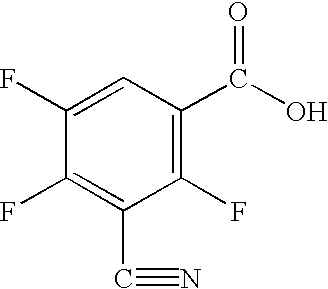
1. Process for preparing 3-cyano-2,4-dihalogeno-5-fluorobenzoic acids of the formula (I)
Figure US06462218-20021008-C00001
in which
X and Y independently of one another each represent halogen by hydrolytic cleavage of
a) 3-cyano-2,4-dihalogeno-5-fluorobenzamides of the formula (II)
Figure US06462218-20021008-C00002
 in which
X and Y independently of one another each represent halogen, or
b) 1,3-dicyano-2,4-dihalogeno-5-fluorobenzenes of the formula (III)
Figure US06462218-20021008-C00003
 in which
X and Y independently of one another each represent halogen, or
c) 3-cyano-2,4-dihalogeno-5-fluorobenzoic esters of the formula (IV)
Figure US06462218-20021008-C00004
 in which
X and Y independently of one another each represent halogen and
R represents C1-4-alkyl which may optionally be substituted.
2. The novel compounds of the formulae (II)
Figure US06462218-20021008-C00005
and (IV)
Figure US06462218-20021008-C00006
in which
X and Y independently of one another each represent halogen and
R represents C1-4-alkyl which may optionally be substituted,
except for methyl3-cyano-2,4,5-trifluorobenzoate.
3. Process for preparing 3-cyano-2,4-dihalogeno-5-fluoro-benzamides of the formula (II)
Figure US06462218-20021008-C00007
or esters of the formula (IV)
Figure US06462218-20021008-C00008
characterized in that 1,3-dicyano-2,4-dihalogeno-5-fluorobenzenes of the formula (III)
Figure US06462218-20021008-C00009
 in which
X and Y are each as defined above,
are hydrolyzed in the presence of water or in the presence of alcohols.
4. The novel compounds of the formula (III)
Figure US06462218-20021008-C00010
in which
X and Y represent different radicals from the group consisting of fluorine and chlorine, or both radicals represent chlorine.
5. Process for preparing the compounds of the formula (III)
Figure US06462218-20021008-C00011
in which
X and Y represent different radicals from the group consisting of fluorine and chlorine,
characterized in that 1,2,4-trifluoro-3,5-dicyanobenzene(2,4,5-trifluoro-isophthalonitrile) is reacted with a metal halide.
1,2,4-Trifluoro-3,5-dicyanobenzene and its preparation are known from EP-A-307 897.
In the above formulae, X and Y each preferably represent fluorine or chlorine. In the compounds of the formulae (II) and (IV), they particularly preferably represent identical radicals fluorine or chlorine.
Among the compounds of the formula (III), particular preference is given to 2,4-dichloro-5-fluoroisophthalonitrile.
R preferably represents methyl, ethyl, propyl or benzyl.
If 3-cyano-2,4,5-trifluorobenzamide is used as starting material in the process a) for preparing 3-cyano-2,4,5-trifluorobenzoic acid, the reaction can be illustrated by the following formula scheme:
Figure US06462218-20021008-C00012
The amides of the formula (II) used as starting materials are novel. Their preparation is described further below.
The hydrolysis is carried out in the presence of acids and water. Suitable for use as acids are organic and inorganic strong acids. Examples which may be mentioned are HCl, HBr, sulphuric acid, methanesulphonic acid, trifluoromethanesulphonic acid, benzenesulphonic acid, toluenesulphonic acid and strongly acidic ion exchangers in the presence of water.
The solvent used can be an excess of the acid used as reagent, or an organic solvent. Suitable organic solvents are acids, such as formic acid, acetic acid, propionic acid, ethers, such as dimethoxyethane, dioxane, ketones, such as acetone, butanone.
The reaction components may be added in any order. The mixture is subsequently heated to the required temperature.
The reaction temperature is in the range from 0 to 200° C., preferably from 20 to 150° C.
The reaction can be carried out under atmospheric pressure or under a pressure of from 0 to 50 bar, preferably from 0 to 6 bar.
The products are filtered off from the reaction mixture, if appropriate after dilution with water. If a large excess of acid or a solvent is used, it may be advantageous to carry out a distillation and to isolate the product by extraction.
If 4-chloro-2,5-difluoro-isophthalonitrile is used as starting material for preparing 4-chloro-2,5-difluoro-3-cyanobenzoic acid according to process 1b), the reaction can be illustrated by the reaction scheme below:
Figure US06462218-20021008-C00013
2,4,5-Trifluoro-isophthalonitrile is known from the literature (EP-A-307 897). 2,4-Dichloro-5-fluoro-isophthalonitrile is novel. Its preparation is described further below.
The hydrolysis with acids is carried out in the presence of water. Suitable for use as acids are organic and inorganic strong acids. Examples which may be mentioned are HCl, HBr, sulphuric acid, methanesulphonic acid, trifluoromethanesulphonic acid, benzenesulphonic acid, toluenesulphonic acid and strongly acidic ion exchangers in the presence of water.
The solvent used can be an excess of the acid used as reagent, or an organic solvent. Suitable organic solvents are acids, such as formic acid, acetic acid, propionic acid, ethers, such as dimethoxyethane, dioxane, ketones, such as acetone, butanone.
The reaction components may be added in any order. The mixture is subsequently heated to the required temperature.
The reaction temperature is in the range from 0 to 200° C., preferably from 20 to 150° C.
The reaction can be carried out under atmospheric pressure or under a pressure of from 0 to 50 bar, preferably from 0 to 6 bar.
The products are filtered off from the reaction mixture, if appropriate after dilution with water. If a large excess of acid or a solvent is used, it may be advantageous to carry out a distillation and to isolate the product by extraction.
If methyl 3-cyano-2,4,5-trifluoro-benzoate is used as starting material in the process 1c) for preparing 3-cyano-2,4,5-trifluorobenzoic acid, the reaction can be illustrated by the formula scheme below:
Figure US06462218-20021008-C00014
The esters of the formula (IV) used as starting materials are novel. Their preparation is described further below.
The hydrolysis is carried out in the presence of acids and water. Suitable for use as acids are organic and inorganic strong acids. Examples which may be mentioned are HCl, HBr, sulphuric acid, methanesulphonic acid, trifluoromethanesulphonic acid, benzenesulphonic acid, toluenesulphonic acid and strongly acidic ion exchangers in the presence of water.
The solvent used can be an excess of the acid used as reagent, or an organic solvent. Suitable organic solvents are acids, such as formic acid, acetic acid, propionic acid, ethers, such as dimethoxyethane, dioxane, ketones, such as acetone, butanone.
The reaction components may be added in any order. The mixture is subsequently heated to the required temperature.
The reaction temperature is in the range from 0 to 200° C., preferably from 20 to 150° C.
The reaction can be carried out under atmospheric pressure or under a pressure of from 0 to 50 bar, preferably from 0 to 6 bar.
The products are extracted from the reaction mixture, if appropriate after dilution with water. If a large excess of acid or a solvent is used, it may be advantageous to carry out a distillation.
As already mentioned, the compounds of the formula (IV) are novel.
If 2,4-dichloro-5-fluoro-isophthalonitrile is used as starting material for their preparation according to process 3), the reaction can be represented by the formula scheme below:
Figure US06462218-20021008-C00015
The reaction proceeds via the iminoester intermediate and its hydrolysis with water. The formation of the corresponding amide is observed as a side reaction. If no water is added, the amide formation becomes the predominant reaction (see below).
2,4,5-Trifluoro-isophthalonitrile is known from the literature (EP-A-307 897). 2,4-Dichloro-5-fluoro-isophthalonitrile is novel, its preparation is described further below.
The compound of the formula (II) is prepared by hydrolysis of the corresponding dinitriles with acids in the presence of water and alcohols.
The reaction is carried out in the presence of from 1 to 10 equivalents of water and primary and secondary aliphatic alcohols. Preference is given to methanol, ethanol, propanol and butanol. Acids used can be organic and inorganic strong acids, such as HCl, HBr, sulphuric acid, methanesulphonic acid, trifluoromethanesulphonic acid, benzenesulphonic acid, toluenesulphonic acid and strongly acidic ion exchangers.
In addition to from I to 10 mol of alcohol, it is also possible to employ from 1 to 10 mol of water per mole of dinitrile.
The reaction can be carried out in the presence or absence of solvent. The solvent used can be an excess of the alcohol used as reagent, or an inert organic solvent. Suitable inert solvents are: all inert organic solvents, such as hydrocarbons, for example pentane, hexane, heptane, petroleum ether, benzine, ligroine, benzene, toluene; halogenated hydrocarbons, for example dichloromethane, chloroform, chlorobenzene, dichlorobenzene, trichloroethane; ethers, for example diethyl ether, dipropyl ether, dibutyl ether, ethylene glycol dimethyl ether, diethylene glycol diethyl ether.
Dintrile and alcohol are initially charged and acid is added, and the water is then added. However, it is also possible to initially charge the water required for the reaction directly.
The reaction temperature is in the range from −20 to 150° C. Preference is given to temperatures from 10 to 100° C.
The reaction can be carried out at atmospheric pressure or elevated pressure of from 0 to 50 bar. Preference is given to a pressure from 0 to 6 bar.
The reaction mixture is diluted with water and extracted. If a large excess of alcohol or an inert solvent were used, the solvent can be distilled off first. Any amide formed as reaction by-product can be separated off.
As already mentioned, the compounds of the formula (II) are novel.
If 2,4,5-trifluoro-isophthalonitrile is used as starting material for their preparation according to process 3), the reaction can be represented by the formula scheme below:
Figure US06462218-20021008-C00016
The reaction proceeds via the intermediate imino esters, from which the amides are formed by elimination of the alkyl radical.
2,4,5-Trifluoro-isophthalonitrile is known from the literature (EP-A-307 897). 2,4-Dichloro-5-fluoro-isophthalonitrile is novel, the preparation is described further below.
The reaction is carried out with primary or secondary aliphatic alcohols in the presence of acids. Preference is given to methanol, ethanol, propanol and butanol. Particular preference is given to methanol. Suitable for use as acids are organic and inorganic strong acids, such as HCl, HBr.
From 1 to 10 mol of alcohol can be used per mole of dinitrile.
The reaction can be carried out in the presence or absence of solvent. The solvent used can be an excess of the alcohol used as reagent, or an inert organic solvent. Suitable inert solvents are: all inert organic solvents, such as hydrocarbons, for example pentane, hexane, heptane, petroleum ether, benzine, ligroine, benzene, toluene; halogenated hydrocarbons, for example dichloromethane, chloroform, chlorobenzene, dichlorobenzene, trichloroethane; ethers, for example diethyl ether, dipropyl ether, dibutyl ether, ethylene glycol dimethyl ether, diethylene glycol diethyl ether.
Dinitrile and alcohol are initially charged, and acid is added.
The reaction temperature is in the range from −20 to 150° C. Preference is given to temperatures from −0° to 100° C.
The reaction can be carried out at atmospheric pressure or an elevated pressure of from 0 to 50 bar. Preference is given to a pressure from 0 to 6 bar.
The products are filtered off from the reaction mixture, if appropriate after dilution with water. If a large excess of alcohol or an inert solvent was used, this can be preceded by distillation.
Compounds of the formula (III) in which X and Y do not simultaneously represent F are novel. Starting from 2,4,5-trifluoro-isophthalonitrile, their preparation according to process 5) can be represented by the formula scheme below:
Figure US06462218-20021008-C00017
2,4,5-Trifluoro-isophthalonitrile is known from the literature (EP-A-307 897).
The halogen exchange is carried out by reaction with inorganic chloride salts.
Suitable for use as inorganic chloride salts are MgCl2 and CaCl2. It is also possible to catalyse the reaction, for example using tetraalkylammonium salts, crown ethers, etc.
From 0.5 to 10 mol of inorganic salt are employed per fluorine to be exchanged. Preference is given to from 0.5 to 2 mol.
The reaction can be carried out in the presence or absence of solvent. Suitable solvents are all inert organic solvents, for example pentane, hexane, heptane, petroleum ether, benzine, ligroine, benzene, toluene, dichloromethane, chloroform, chlorobenzene, dichlorobenzene, trichloroethane, ethers, such as dibutyl ether, ethylene glycol dimethyl ether, diethylene glycol diethyl ether, ketones, such as acetone, methyl ethyl ketone, cyclohexanone, and also N-methylpyrrolidinone, dimethyl sulphone, sulpholane.
The substances are mixed and heated to the required temperature. The order of addition is immaterial. Depending on how the reaction is carried out, it is possible to exchange one or two fluorine atoms for chlorine.
The reaction temperature is in the range from 50 to 350° C. Preference is given to temperatures from 90 to 250° C.
The reaction can be carried out under atmospheric or elevated pressure. If low-boiling solvents are used, it may be favourable to carry out the reaction under elevated pressure. Pressure range: a superatmospheric pressure of from 0 to 100 bar. Preferably: from 0 to 50 bar.
The products are isolated by filtering off the inorganic salts and subjecting the filtrate to fractional distillation. If a water-miscible solvent was employed, it is also possible to pour the mixture into water and extract the product.
3-Cyano-2,4-dihalogeno-5-fluoro-benzoic acid can be used, for example, for preparing the following compounds (VIII) known from U.S. Pat. No. 4,990,517:
7-chloro-8-cyano-1-cyclopropyl-6-fluoro-1,4-dihydro-4-oxo-3-quinolinecarboxylic acid,
methyl7-chloro-8-cyano-1-cyclopropyl-6-fluoro- 1 ,4-dihydro-4-oxo-3-quinolinecarboxylate,
8-cyano-1-cyclopropyl-6,7-difluoro-1,4-dihydro-4-oxo-3-quinolinecarboxylic acid, ethyl 8-cyano-1 -cyclopropyl-6,7-difluoro- 1,4-dihydro-4-oxo-3-quinolinecarboxylate.
To this end, for example, 3-cyano-2,4,5-trifluorobenzoic acid is reacted in the form of its acid chloride with the β-dimethylamino-acrylic acid ester of the formula (V), and the resulting product of the formula (VI) is further reacted with cyclopropylamine to give a compound of the formula (VII), and the abovementioned compound (VII) is subsequently obtained:
Figure US06462218-20021008-C00018
In the formula scheme above
X represents halogen, in particular fluorine or chlorine,
R6 represents C1-4-alkyl, in particular methyl or ethyl.
It is also possible to react a compound of the formula (IV) directly with β-cyclopropylamino-acrylic acid ester:
Figure US06462218-20021008-C00019
(In the formulae, X and R6 -are each as defined above.)
The acid chloride of 3-cyano-2,4,5-trifluorobenzoic acid can be prepared from the esters of the formula (IV) according to the following scheme:
Figure US06462218-20021008-C00020
From the compounds of the formula (VIII), antibacterially active compounds can be prepared by reaction with suitable amines.
If, for example, 7-chloro-8-cyano-1-cyclopropyl-6-fluoro-1,4-dihydro-4-oxo-3-quinolinecarboxylic acid and 2,8-diazabicyclo[4.3.0]nonane are reacted, the course of the reaction can be represented by the formula scheme below:
Figure US06462218-20021008-C00021
The preparation of these compounds is described in DE-A-196 33 805 of the applicant, which is not a prior art document.
The examples below illustrate the present invention without limiting its scope.
EXAMPLE 1
(Process 1a)
Figure US06462218-20021008-C00022
Figure US06462218-20021008-C00023
Amount Mol Text
0.4 g 1.72 m of 3-cyano-2,4-dichloro-5-fluoro-benzamide and
5 ml of concentrated hydrochloric acid were heated under
reflux for three hours. The mixture was then
concentrated and the residue was dried over sulphuric
acid in a dessicator.
Yield: 370 mg
Purity: 84% (HPLC area) 3-cyano-2,4-dichloro-5-
fluoro-benzoic acid
12% (HPLC area) 3-cyano-2,4-dichloro-5-fluoro-
benzamide (starting material)
EXAMPLE 2
(Process 1b)
Figure US06462218-20021008-C00024
Figure US06462218-20021008-C00025
Amount Mol Text
2.5 g 12 m of 2,4-dichloro-5-fluoro-isophthalonitrile were
suspended in
25 ml of methanol, and the mixture was cooled to 0° C. and
saturated with gaseous hydrochloric acid. The reaction
mixture was allowed to stand at −16° C. for 60 hours
and was then concentrated. The residue was admixed
with
38 ml of concentrated hydrochloric acid and heated at reflux
for three hours. The mixture was then poured into
120 ml of water, and the precipitate was filtered off with
suction and dried over sulphuric acid in a dessicator.
Yield: 1.86 g Purity:
87% of 3-cyano-2,4-dichloro-5-fluoro-benzoic acid
10% of 3-cyano-2,4-dichloro-5-fluoro-benzamide
EXAMPLE 3
(Process 1b)
Figure US06462218-20021008-C00026
Figure US06462218-20021008-C00027
Amount Mol Text
1 g 5.5 m of 2,4,5-trifluoro-isophthalonitrile,
6.3 ml of water,
6.3 ml of glacial acetic acid and
0.63 ml of 96% strength sulphuric acid were heated at reflux
for 24 hours. The mixture was then poured into
50 ml of water and admixed with
25 ml of dichloromethane. The aqueous phase was then
adjusted to pH 9 using 45% strength NaOH, and the
organic phase was then separated off and re-extracted
twice with dichloromethane. The extracts were
discarded. The aqueous phase that remained was then
adjusted to pH 2 using concentrated hydrochloric acid
and extracted three times altogether with in each case
25 ml of dichloromethane. The combined extracts were dried
using sodium sulphate and concentrated.
Residue: 470 mg
Purity: 80% (GC/MS area)
EXAMPLE 4
(Process 1c)
Figure US06462218-20021008-C00028
Amount Mol Text
2 g 8.7 m of ethyl 3-cyano-2,4,5-trifluoro-benzoate
(purity 79%),
10 ml of glacial acetic acid,
10 ml of water and
1 ml of 96% strength sulphuric acid are heated at reflux for
7.5 hours. The mixture is then cooled, poured into
100 ml of water and extracted three times with
dichloromethane. The extract is admixed with
100 ml of water and the PH of the aqueous phase is adjusted
to 8.5 with stirring. The organic phase is separated
off, and the aqueous phase is re-extracted with
dichloromethane. The organic extracts are discarded.
50 ml of dichloromethane are then added to the aqueous
phase, and the mixture is acidified using sulphuric
acid. The dichloromethane is separated off and the
mixture is re-extracted with dichloromethane. The
combined extracts are then dried using Na2SO4 and
concentrated. The residue is dried over KOH in a
dessicator.
Yield: 1.2 g (81% of theory)
Purity: 95% (HPLC area)
Melting point: 146° C.
EXAMPLE 5
(Process 3)
Figure US06462218-20021008-C00029
Figure US06462218-20021008-C00030
Amount Mol Text
9 g 42 m of 2,4-dichloro-5-fluoro-isophthalonitrile were
suspended in
90 ml of methanol, the mixture was cooled to 5° C. and
gaseous hydrochloric acid was introduced until the
mixture was saturated. The resulting solution was
stirred at room temperature for 24 hours. The solution
was then concentrated and the residue was stirred with
dichloromethane and filtered off with suction.
Yield: 8.04 g
Purity: 95% (HPLC area)
Melting point: 178° C.
EXAMPLE 6
(Process 3)
Figure US06462218-20021008-C00031
Amount Mol Text
5.52 g 30 m of 2,4,5-trifluoro-isophthalonitrile
(purity 86%) are initially charged in
60 ml of dry ethanol, and gaseous hydrochloric acid is
introduced with ice-cooling until the mixture is
saturated. The mixture is stirred at room temperature
for four hours, then
4.8 ml 0.266 m of water are added and the mixture is heated at reflux
for four hours. The mixture is then concentrated and
the residue is partitioned between water and
chloroform. The organic phase is separated off and the
aqueous phase is re-extracted twice with chloroform.
The combined extracts are dried using Na2SO4 and
concentrated. The residue is distilled using
a kugelrohr.
Boiling point: 220° C. (42 mbar)
Yield: 4.21 g (55% of theory)
Purity: 79% (HPLC area)
1H NMR (CDCl3):
8.1 ppm (m, 1H, Ar—H)
4.4 ppm (q, J = 8 Hz, 2H, —OCH2—)
1.4 ppm (t, J = 8 Hz, 3H, —CH3)
EXAMPLE 7
(Process 3)
Figure US06462218-20021008-C00032
Figure US06462218-20021008-C00033
Amount Mol Text
0.5 g 2.3 m of 2,4-dichloro-5-fluoro-isophthalonitrile was
dissolved in
10 ml of methanol and, with efficient cooling at 0° C., the
mixture was saturated with gaseous HCl. The mixture
was subsequently allowed to stand at -10° C. for 72
hours.
1 ml of 96% pure aqueous methanol was then added, and
the mixture was heated under reflux for three hours.
The mixture was subsequently concentrated under
reduced pressure, the residue was partitioned between
chloroform and saturated bicarbonate solution and the
organic phase was separated off, dried with sodium
sulphate and concentrated.
Residue: 410 mg
According to HPLC, this contains
10% of starting material
7.5% of amide
76% of methyl ester.
EXAMPLE 8
(Process 5)
Figure US06462218-20021008-C00034
Figure US06462218-20021008-C00035
Amount Mol Text
13.5 g 74 m of 2,4,5-trifluoro-isophthalonitrile,
125 ml of sulpholane and
17.7 g of freshly powdered calcium chloride are heated at
200° C. for 24 hours. The mixture is subsequently
poured into
1200 ml of water. The fine precipitate is filtered off with
suction and dried.
Yield: 13.8 g
For purification, the product can be filtered through
silica gel using toluene/hexane.
Yield: 12.8 g
Purity: 96% HPLC area
Melting point: 119° C.
EXAMPLE 9
(Process 5)
Figure US06462218-20021008-C00036
Figure US06462218-20021008-C00037
Amount Mol Text
0.55 g 3 m of 2,4,5-trifluoro-isophthalonitrile,
5 ml of sulpholane and
0.37 g 3.3 m of freshly powdered calcium chloride were heated at
200° C. for 1.5 hours. The mixture was subsequently
poured into
100 ml of water and extracted twice with ether. The extract
was dried using sodium sulphate and concentrated.
Yield: 0.56 g
Composition: 75% of 4-chloro-2,5-difluoro-
isophthalonitrile
25% of 5-fluoro-2,4-dichloro-isophthalonitrile (HPLC
area)

Claims (5)

What is claimed is:
1. Process for preparing 3-cyano-2,4-dihalogeno-5-fluorobenzoic acids of the formula (I)
Figure US06462218-20021008-C00038
 in which
X and Y independently of one another each represent halogen by hydrolytic cleavage of
a) 3-cyano-2,4-dihalogeno-5-fluorobenzamides of the formula (II)
Figure US06462218-20021008-C00039
 in which
X and Y independently of one another each represent halogen, or
b) 1,3-dicyano-2,4-dihalogeno-5-fluorobenzenes of the formula (III)
Figure US06462218-20021008-C00040
 in which
X and Y independently of one another each represent halogen, or
c) 3-cyano-2,4-dihalogeno-5-fluorobenzoic esters of the formula (IV)
Figure US06462218-20021008-C00041
 in which
X and Y independently of one another each represent halogen and
R represents C1-4-alkyl which may optionally be substituted.
2. Compounds of the formulae (II)
Figure US06462218-20021008-C00042
and (IV)
Figure US06462218-20021008-C00043
in which
X and Y independently of one another each represent halogen and
R represents C1-4-alkyl which is optionally substituted,
except for methyl 3-cyano-2,4,5-trifluorobenzoate.
3. Process for preparing 3-cyano-2,4-dihalogeno-5-fluoro-benzamides of the formula (II)
Figure US06462218-20021008-C00044
or esters of the formula (IV)
Figure US06462218-20021008-C00045
in which
X and Y independently of one another each represent halogen and
R represents C1-4-alkyl which is optionally substituted,
characterized in that 1,3-dicyano-2,4-dihalogeno-5-fluorobenzenes of the formula (III)
Figure US06462218-20021008-C00046
 in which
X and Y are each as defined above,
are hydrolyzed in the presence of water or in the presence of alcohols.
4. The novel compounds of the formula (III)
Figure US06462218-20021008-C00047
in which
X and Y represent different radicals from the group consisting of fluorine and chlorine, or both radicals represent chlorine.
5. Process for preparing the compounds of the formula (III)
Figure US06462218-20021008-C00048
in which
X and Y represent different radicals from the group consisting of fluorine and chlorine,
characterized in that 1,2,4-trifluoro-3,5-dicyanobenzene (2,4,5-trifluoro-isophthalonitrile) is reacted with a metal halide.
US09/463,272 1997-08-01 1998-07-18 Method for preparing 3-cyano-2,4-dihalogeno-5-fluoro-Benzoic acid Expired - Lifetime US6462218B1 (en)

Applications Claiming Priority (3)

Application Number Priority Date Filing Date Title
DE19733243A DE19733243A1 (en) 1997-08-01 1997-08-01 Process for the preparation of 3-cyano-2,4-dihalogen-5-fluoro-benzoic acid
DE19733243 1997-08-01
PCT/EP1998/004468 WO1999006360A1 (en) 1997-08-01 1998-07-18 Method for preparing 3-cyano-2,4-dihalogen-5-fluor-benzoic acid

Publications (1)

Publication Number Publication Date
US6462218B1 true US6462218B1 (en) 2002-10-08

Family

ID=7837650

Family Applications (1)

Application Number Title Priority Date Filing Date
US09/463,272 Expired - Lifetime US6462218B1 (en) 1997-08-01 1998-07-18 Method for preparing 3-cyano-2,4-dihalogeno-5-fluoro-Benzoic acid

Country Status (20)

Country Link
US (1) US6462218B1 (en)
EP (1) EP1001929B1 (en)
JP (1) JP4404476B2 (en)
KR (1) KR100517632B1 (en)
CN (1) CN1125042C (en)
AT (1) ATE235461T1 (en)
AU (1) AU744367B2 (en)
BR (1) BR9811579B1 (en)
CA (1) CA2298805C (en)
DE (2) DE19733243A1 (en)
DK (1) DK1001929T3 (en)
ES (1) ES2190602T3 (en)
HU (1) HU224131B1 (en)
IL (1) IL133923A (en)
NZ (1) NZ502587A (en)
PL (1) PL191606B1 (en)
PT (1) PT1001929E (en)
RU (1) RU2214998C2 (en)
UA (1) UA54539C2 (en)
WO (1) WO1999006360A1 (en)

Cited By (4)

* Cited by examiner, † Cited by third party
Publication number Priority date Publication date Assignee Title
US20040030173A1 (en) * 2000-10-04 2004-02-12 Toru Sasaki Process for producing fluorinated dicyanobenzene
WO2007035161A1 (en) * 2005-09-22 2007-03-29 Astrazeneca Ab New process for converting aromatic halo-substituted dinitriles into halo-substituted cyanocarboxylic acids
US20090302508A1 (en) * 2005-11-07 2009-12-10 Christopher Francis Lucas Method of construction
US20090318700A1 (en) * 2006-10-20 2009-12-24 Thomas Adam Process for preparing pradofloxacin

Families Citing this family (2)

* Cited by examiner, † Cited by third party
Publication number Priority date Publication date Assignee Title
EP1508567B1 (en) * 1998-09-24 2006-11-15 Showa Denko Kabushiki Kaisha Process for producing cyanobenzoic acid derivatives
CN102603531B (en) * 2012-02-22 2014-04-02 仙居县力天化工有限公司 Method for preparing 2,3,4,5-tetrafluoro methyl benzoate in series reaction

Citations (7)

* Cited by examiner, † Cited by third party
Publication number Priority date Publication date Assignee Title
CA1255330A (en) 1984-09-27 1989-06-06 Fritz Maurer Process for the preparation of 2,4-dichloro-5-fluoro- benzoic acid
US4908366A (en) 1987-01-28 1990-03-13 Bayer Aktiengesellschaft Antibacterial 8-cyano-1-cyclopropyl-1,4-dihydro-4-oxo-3-quinolinecarboxylic acids
US4925966A (en) 1987-09-14 1990-05-15 Sds Biotech K.K. Process for producing trifluorobenzene compounds
US4990661A (en) 1986-09-19 1991-02-05 Bayer Aktiengesellschaft Process for the preparation of benzoic acid derivatives
US5190955A (en) 1987-01-28 1993-03-02 Bayer Aktiengesellschaft Antibacterial 8-cyano-1-cyclopropyl-1,4-dihydro-4-oxo-3-quinolinecarboxylic acids
WO1997031001A1 (en) 1996-02-23 1997-08-28 Bayer Aktiengesellschaft Possibly substituted 8-cyano-1-cyclopropyl-7-(2,8-diazabicyclo-[4.3.0]-nonan-8-yl)-6-fluoro-1,4-dihydro-4-oxo-3-quinolin carboxylic acids and their derivatives
WO1998026768A2 (en) 1996-12-16 1998-06-25 Bayer Aktiengesellschaft Use of 7-(1-aminomethyl-2-oxa-7-aza-bicyclo[3.3.0]oct-7-yl)-quinolone carboxylic acid and naphthyridone carboxylic acid derivatives for treating helicobacter pylori infections and the gastroduodenal diseases associated therewith

Patent Citations (10)

* Cited by examiner, † Cited by third party
Publication number Priority date Publication date Assignee Title
CA1255330A (en) 1984-09-27 1989-06-06 Fritz Maurer Process for the preparation of 2,4-dichloro-5-fluoro- benzoic acid
US4990661A (en) 1986-09-19 1991-02-05 Bayer Aktiengesellschaft Process for the preparation of benzoic acid derivatives
US4908366A (en) 1987-01-28 1990-03-13 Bayer Aktiengesellschaft Antibacterial 8-cyano-1-cyclopropyl-1,4-dihydro-4-oxo-3-quinolinecarboxylic acids
US5051418A (en) 1987-01-28 1991-09-24 Bayer Aktiengesellschaft Antibacterial 8-cyano-1-cyclopropyl-1,4-dihydro-4-oxo-3-quinolinecarboxylic acids
US5190955A (en) 1987-01-28 1993-03-02 Bayer Aktiengesellschaft Antibacterial 8-cyano-1-cyclopropyl-1,4-dihydro-4-oxo-3-quinolinecarboxylic acids
US4925966A (en) 1987-09-14 1990-05-15 Sds Biotech K.K. Process for producing trifluorobenzene compounds
US5021605A (en) 1987-09-14 1991-06-04 Sds Biotech K.K. Trifluorobenzene compounds
US5068411A (en) * 1987-09-14 1991-11-26 Sds Biotech K.K. Trifluorobenzene compounds and process for producing the same
WO1997031001A1 (en) 1996-02-23 1997-08-28 Bayer Aktiengesellschaft Possibly substituted 8-cyano-1-cyclopropyl-7-(2,8-diazabicyclo-[4.3.0]-nonan-8-yl)-6-fluoro-1,4-dihydro-4-oxo-3-quinolin carboxylic acids and their derivatives
WO1998026768A2 (en) 1996-12-16 1998-06-25 Bayer Aktiengesellschaft Use of 7-(1-aminomethyl-2-oxa-7-aza-bicyclo[3.3.0]oct-7-yl)-quinolone carboxylic acid and naphthyridone carboxylic acid derivatives for treating helicobacter pylori infections and the gastroduodenal diseases associated therewith

Cited By (6)

* Cited by examiner, † Cited by third party
Publication number Priority date Publication date Assignee Title
US20040030173A1 (en) * 2000-10-04 2004-02-12 Toru Sasaki Process for producing fluorinated dicyanobenzene
US7132561B2 (en) 2000-10-04 2006-11-07 Showa Denko K.K. Process for producing fluorinated dicyanobenzene
WO2007035161A1 (en) * 2005-09-22 2007-03-29 Astrazeneca Ab New process for converting aromatic halo-substituted dinitriles into halo-substituted cyanocarboxylic acids
US20090302508A1 (en) * 2005-11-07 2009-12-10 Christopher Francis Lucas Method of construction
US20090318700A1 (en) * 2006-10-20 2009-12-24 Thomas Adam Process for preparing pradofloxacin
US8497377B2 (en) 2006-10-20 2013-07-30 Bayer Intellectual Property Gmbh Process for preparing pradofloxacin

Also Published As

Publication number Publication date
CN1125042C (en) 2003-10-22
IL133923A0 (en) 2001-04-30
DK1001929T3 (en) 2003-06-23
UA54539C2 (en) 2003-03-17
HUP0002930A2 (en) 2001-01-29
DE59807664D1 (en) 2003-04-30
CA2298805C (en) 2007-12-04
JP4404476B2 (en) 2010-01-27
ATE235461T1 (en) 2003-04-15
JP2001512098A (en) 2001-08-21
NZ502587A (en) 2002-05-31
CN1265644A (en) 2000-09-06
DE19733243A1 (en) 1999-02-04
KR20010022058A (en) 2001-03-15
CA2298805A1 (en) 1999-02-11
EP1001929B1 (en) 2003-03-26
HU224131B1 (en) 2005-05-30
KR100517632B1 (en) 2005-09-28
BR9811579A (en) 2000-08-22
PL338215A1 (en) 2000-10-09
RU2214998C2 (en) 2003-10-27
HK1030598A1 (en) 2001-05-11
IL133923A (en) 2004-09-27
PT1001929E (en) 2003-07-31
ES2190602T3 (en) 2003-08-01
WO1999006360A1 (en) 1999-02-11
HUP0002930A3 (en) 2001-02-28
AU9154498A (en) 1999-02-22
BR9811579B1 (en) 2009-12-01
PL191606B1 (en) 2006-06-30
EP1001929A1 (en) 2000-05-24
AU744367B2 (en) 2002-02-21

Similar Documents

Publication Publication Date Title
KR20170026444A (en) Process for the preparation of 3-hydroxypicolinic acids
US6462218B1 (en) Method for preparing 3-cyano-2,4-dihalogeno-5-fluoro-Benzoic acid
JP3756205B2 (en) Method for producing aromatic nitrile
US5925764A (en) Process and intermediated for the manufacture of pyridine-2, 3-dicarboxylate compounds
KR0172014B1 (en) Process and intermediate products for preparing hydroxylamine-ethers and their salts
US20040199002A1 (en) Process for producing(2-nitrophenyl)acetonitrile derivative and intermediate therefor
US6080867A (en) Process and intermediates for the manufacture of pyridine-2,3-dicarboxylate compounds
US20130060031A1 (en) Process for the preparation of highly pure ambrisentan
US6291674B2 (en) Process for preparing alkoxypyrazine derivatives
CZ259498A3 (en) A process for preparing heteroarylcarboxylic acid amides and esters
KR910004177B1 (en) Anilinopyrimidine derivatives
MXPA00000861A (en) Method for preparing 3-cyano-2,4-dihalogen-5-fluor-benzoic acid
FI76789B (en) PROCEDURE FOR FRAMSTATION OF 2,4-DIAMINO-5- (3 ', 4', 5'-TRIMETOXYBENYL) PYRIMIDINE.
JP3293676B2 (en) Process for producing halomaleic acid and halofumarate esters
US7368592B1 (en) Process for the preparation of alkyl n-alkylanthranilate
EP2922824A1 (en) New process for the synthesis of trichloropyrimidine-amine derivatives
JP2000327629A (en) Phenylacetic acid derivative, benzonitrile derivative and production thereof
US20060100217A9 (en) Preparation of 4-haloalkylnicotinamides
JPH11140062A (en) Production of 2-substituted 5-formylthiazole
HK1030598B (en) Method for preparing 3-cyano-2, 4-dihalogen-5-fluor-benzoic acid
HK1024238A (en) Process and intermediates for the manufacture of pyridine-2,3-dicarboxylate compounds

Legal Events

Date Code Title Description
AS Assignment

Owner name: BAYER AKTIENGESELLSCHAFT PATENTE UND LIZENZEN, GER

Free format text: ASSIGNMENT OF ASSIGNORS INTEREST;ASSIGNORS:HALLENBACH, WERNER;MARHOLD, ALBRECHT;REEL/FRAME:010597/0004;SIGNING DATES FROM 19991130 TO 19991206

STCF Information on status: patent grant

Free format text: PATENTED CASE

FPAY Fee payment

Year of fee payment: 4

FEPP Fee payment procedure

Free format text: PAYOR NUMBER ASSIGNED (ORIGINAL EVENT CODE: ASPN); ENTITY STATUS OF PATENT OWNER: LARGE ENTITY

AS Assignment

Owner name: BAYER ANIMAL HEALTH GMBH, GERMANY

Free format text: ASSIGNMENT OF ASSIGNORS INTEREST;ASSIGNOR:BAYER AKTIENGESELLSCHAFT;REEL/FRAME:022203/0937

Effective date: 20081204

FPAY Fee payment

Year of fee payment: 8

FEPP Fee payment procedure

Free format text: PAYOR NUMBER ASSIGNED (ORIGINAL EVENT CODE: ASPN); ENTITY STATUS OF PATENT OWNER: LARGE ENTITY

Free format text: PAYER NUMBER DE-ASSIGNED (ORIGINAL EVENT CODE: RMPN); ENTITY STATUS OF PATENT OWNER: LARGE ENTITY

FPAY Fee payment

Year of fee payment: 12