US6444851B1 - Process for the preparation of Midodrine - Google Patents
Process for the preparation of Midodrine Download PDFInfo
- Publication number
- US6444851B1 US6444851B1 US10/040,385 US4038502A US6444851B1 US 6444851 B1 US6444851 B1 US 6444851B1 US 4038502 A US4038502 A US 4038502A US 6444851 B1 US6444851 B1 US 6444851B1
- Authority
- US
- United States
- Prior art keywords
- groups
- formula
- ppm
- process according
- dimethoxyphenyl
- Prior art date
- Legal status (The legal status is an assumption and is not a legal conclusion. Google has not performed a legal analysis and makes no representation as to the accuracy of the status listed.)
- Expired - Fee Related
Links
- 238000000034 method Methods 0.000 title claims abstract description 17
- 238000002360 preparation method Methods 0.000 title claims abstract description 9
- 229960001094 midodrine Drugs 0.000 title description 20
- PTKSEFOSCHHMPD-SNVBAGLBSA-N 2-amino-n-[(2s)-2-(2,5-dimethoxyphenyl)-2-hydroxyethyl]acetamide Chemical compound COC1=CC=C(OC)C([C@H](O)CNC(=O)CN)=C1 PTKSEFOSCHHMPD-SNVBAGLBSA-N 0.000 title description 12
- PTKSEFOSCHHMPD-UHFFFAOYSA-N midodrine Chemical compound COC1=CC=C(OC)C(C(O)CNC(=O)CN)=C1 PTKSEFOSCHHMPD-UHFFFAOYSA-N 0.000 claims abstract description 14
- 238000007327 hydrogenolysis reaction Methods 0.000 claims abstract description 4
- 125000003118 aryl group Chemical group 0.000 claims abstract description 3
- DLFVBJFMPXGRIB-UHFFFAOYSA-N Acetamide Chemical compound CC(N)=O DLFVBJFMPXGRIB-UHFFFAOYSA-N 0.000 claims abstract 4
- LFQSCWFLJHTTHZ-UHFFFAOYSA-N Ethanol Chemical compound CCO LFQSCWFLJHTTHZ-UHFFFAOYSA-N 0.000 claims description 14
- 238000006243 chemical reaction Methods 0.000 claims description 13
- XAVXFUOLBMBEOC-UHFFFAOYSA-N 2-chloro-n-[2-(2,5-dimethoxyphenyl)-2-hydroxyethyl]acetamide Chemical compound COC1=CC=C(OC)C(C(O)CNC(=O)CCl)=C1 XAVXFUOLBMBEOC-UHFFFAOYSA-N 0.000 claims description 7
- 125000001997 phenyl group Chemical group [H]C1=C([H])C([H])=C(*)C([H])=C1[H] 0.000 claims description 7
- KDLHZDBZIXYQEI-UHFFFAOYSA-N Palladium Chemical compound [Pd] KDLHZDBZIXYQEI-UHFFFAOYSA-N 0.000 claims description 6
- UFHFLCQGNIYNRP-UHFFFAOYSA-N Hydrogen Chemical compound [H][H] UFHFLCQGNIYNRP-UHFFFAOYSA-N 0.000 claims description 5
- 239000001257 hydrogen Substances 0.000 claims description 5
- 229910052739 hydrogen Inorganic materials 0.000 claims description 5
- BWLUMTFWVZZZND-UHFFFAOYSA-N Dibenzylamine Chemical class C=1C=CC=CC=1CNCC1=CC=CC=C1 BWLUMTFWVZZZND-UHFFFAOYSA-N 0.000 claims description 4
- 239000003054 catalyst Substances 0.000 claims description 4
- 125000004178 (C1-C4) alkyl group Chemical group 0.000 claims description 3
- 125000000229 (C1-C4)alkoxy group Chemical group 0.000 claims description 2
- 125000005843 halogen group Chemical group 0.000 claims description 2
- 125000001424 substituent group Chemical group 0.000 claims description 2
- 239000012429 reaction media Substances 0.000 claims 2
- 150000001875 compounds Chemical class 0.000 claims 1
- 125000004663 dialkyl amino group Chemical group 0.000 claims 1
- YMWUJEATGCHHMB-UHFFFAOYSA-N Dichloromethane Chemical compound ClCCl YMWUJEATGCHHMB-UHFFFAOYSA-N 0.000 description 24
- 239000000203 mixture Substances 0.000 description 15
- PXIPVTKHYLBLMZ-UHFFFAOYSA-N Sodium azide Chemical compound [Na+].[N-]=[N+]=[N-] PXIPVTKHYLBLMZ-UHFFFAOYSA-N 0.000 description 10
- YXFVVABEGXRONW-UHFFFAOYSA-N Toluene Chemical compound CC1=CC=CC=C1 YXFVVABEGXRONW-UHFFFAOYSA-N 0.000 description 9
- IAZDPXIOMUYVGZ-WFGJKAKNSA-N Dimethyl sulfoxide Chemical compound [2H]C([2H])([2H])S(=O)C([2H])([2H])[2H] IAZDPXIOMUYVGZ-WFGJKAKNSA-N 0.000 description 8
- KWYUFKZDYYNOTN-UHFFFAOYSA-M Potassium hydroxide Chemical compound [OH-].[K+] KWYUFKZDYYNOTN-UHFFFAOYSA-M 0.000 description 8
- 239000002585 base Substances 0.000 description 8
- 239000000047 product Substances 0.000 description 7
- VOWFSTQCEXIMLP-UHFFFAOYSA-N 2-amino-1-(2,5-dimethoxyphenyl)ethanol;hydrochloride Chemical group [Cl-].COC1=CC=C(OC)C(C(O)C[NH3+])=C1 VOWFSTQCEXIMLP-UHFFFAOYSA-N 0.000 description 6
- MGCQZNBCJBRZDT-UHFFFAOYSA-N midodrine hydrochloride Chemical compound [H+].[Cl-].COC1=CC=C(OC)C(C(O)CNC(=O)CN)=C1 MGCQZNBCJBRZDT-UHFFFAOYSA-N 0.000 description 6
- 230000015572 biosynthetic process Effects 0.000 description 5
- 239000000543 intermediate Substances 0.000 description 5
- TWUQRGQDUFJYLT-UHFFFAOYSA-N 2-(dibenzylamino)-n-[2-(2,5-dimethoxyphenyl)-2-hydroxyethyl]acetamide Chemical compound COC1=CC=C(OC)C(C(O)CNC(=O)CN(CC=2C=CC=CC=2)CC=2C=CC=CC=2)=C1 TWUQRGQDUFJYLT-UHFFFAOYSA-N 0.000 description 4
- VMLNLNZFQUVOIY-UHFFFAOYSA-N 2-azido-n-[2-(2,5-dimethoxyphenyl)-2-hydroxyethyl]acetamide Chemical compound COC1=CC=C(OC)C(C(O)CNC(=O)CN=[N+]=[N-])=C1 VMLNLNZFQUVOIY-UHFFFAOYSA-N 0.000 description 4
- VEXZGXHMUGYJMC-UHFFFAOYSA-N Hydrochloric acid Chemical compound Cl VEXZGXHMUGYJMC-UHFFFAOYSA-N 0.000 description 4
- KFZMGEQAYNKOFK-UHFFFAOYSA-N Isopropanol Chemical compound CC(C)O KFZMGEQAYNKOFK-UHFFFAOYSA-N 0.000 description 4
- 238000001816 cooling Methods 0.000 description 4
- 239000002360 explosive Substances 0.000 description 4
- 238000003786 synthesis reaction Methods 0.000 description 4
- VGCXGMAHQTYDJK-UHFFFAOYSA-N Chloroacetyl chloride Chemical compound ClCC(Cl)=O VGCXGMAHQTYDJK-UHFFFAOYSA-N 0.000 description 3
- 125000006295 amino methylene group Chemical group [H]N(*)C([H])([H])* 0.000 description 3
- 238000001914 filtration Methods 0.000 description 3
- 229960002728 midodrine hydrochloride Drugs 0.000 description 3
- HSPSCWZIJWKZKD-UHFFFAOYSA-N n-chloroacetamide Chemical class CC(=O)NCl HSPSCWZIJWKZKD-UHFFFAOYSA-N 0.000 description 3
- 238000010992 reflux Methods 0.000 description 3
- 231100000331 toxic Toxicity 0.000 description 3
- 230000002588 toxic effect Effects 0.000 description 3
- XLYOFNOQVPJJNP-UHFFFAOYSA-N water Substances O XLYOFNOQVPJJNP-UHFFFAOYSA-N 0.000 description 3
- 238000001644 13C nuclear magnetic resonance spectroscopy Methods 0.000 description 2
- 238000005160 1H NMR spectroscopy Methods 0.000 description 2
- QCQCHGYLTSGIGX-GHXANHINSA-N 4-[[(3ar,5ar,5br,7ar,9s,11ar,11br,13as)-5a,5b,8,8,11a-pentamethyl-3a-[(5-methylpyridine-3-carbonyl)amino]-2-oxo-1-propan-2-yl-4,5,6,7,7a,9,10,11,11b,12,13,13a-dodecahydro-3h-cyclopenta[a]chrysen-9-yl]oxy]-2,2-dimethyl-4-oxobutanoic acid Chemical compound N([C@@]12CC[C@@]3(C)[C@]4(C)CC[C@H]5C(C)(C)[C@@H](OC(=O)CC(C)(C)C(O)=O)CC[C@]5(C)[C@H]4CC[C@@H]3C1=C(C(C2)=O)C(C)C)C(=O)C1=CN=CC(C)=C1 QCQCHGYLTSGIGX-GHXANHINSA-N 0.000 description 2
- IJGRMHOSHXDMSA-UHFFFAOYSA-N Atomic nitrogen Chemical compound N#N IJGRMHOSHXDMSA-UHFFFAOYSA-N 0.000 description 2
- CSNNHWWHGAXBCP-UHFFFAOYSA-L Magnesium sulfate Chemical compound [Mg+2].[O-][S+2]([O-])([O-])[O-] CSNNHWWHGAXBCP-UHFFFAOYSA-L 0.000 description 2
- 150000001540 azides Chemical class 0.000 description 2
- 125000005266 diarylamine group Chemical group 0.000 description 2
- 229940079593 drug Drugs 0.000 description 2
- 239000003814 drug Substances 0.000 description 2
- 239000010410 layer Substances 0.000 description 2
- 239000000463 material Substances 0.000 description 2
- 238000003756 stirring Methods 0.000 description 2
- ONFCHSQQUCYWMP-UHFFFAOYSA-N C=C=C.C=C=C.C=C=C.CCN(C[Ar])CC(=O)NCC(O)C1=C(OC)C=CC(OC)=C1.CCN(C[Ar])CC(=O)NCC(O)C1=C(OC)C=CC(OC)=C1.COC1=CC(C(O)CN)=C(OC)C=C1.COC1=CC(C(O)CNC(=O)CCl)=C(OC)C=C1.COC1=CC(C(O)CNC(=O)CCl)=C(OC)C=C1.COC1=CC(C(O)CNC(=O)CN)=C(OC)C=C1.COC1=CC(C(O)CNC(=O)CN)=C(OC)C=C1.COC1=CC(C(O)CNC(=O)CN)=C(OC)C=C1.Cl.Cl.O=C(Cl)CCl Chemical compound C=C=C.C=C=C.C=C=C.CCN(C[Ar])CC(=O)NCC(O)C1=C(OC)C=CC(OC)=C1.CCN(C[Ar])CC(=O)NCC(O)C1=C(OC)C=CC(OC)=C1.COC1=CC(C(O)CN)=C(OC)C=C1.COC1=CC(C(O)CNC(=O)CCl)=C(OC)C=C1.COC1=CC(C(O)CNC(=O)CCl)=C(OC)C=C1.COC1=CC(C(O)CNC(=O)CN)=C(OC)C=C1.COC1=CC(C(O)CNC(=O)CN)=C(OC)C=C1.COC1=CC(C(O)CNC(=O)CN)=C(OC)C=C1.Cl.Cl.O=C(Cl)CCl ONFCHSQQUCYWMP-UHFFFAOYSA-N 0.000 description 1
- HAYLQDZLLXQCTQ-UHFFFAOYSA-N CCN(C[Ar])CC(=O)NCC(O)C1=C(OC)C=CC(OC)=C1.COC1=CC(C(O)CNC(=O)CN)=C(OC)C=C1 Chemical compound CCN(C[Ar])CC(=O)NCC(O)C1=C(OC)C=CC(OC)=C1.COC1=CC(C(O)CNC(=O)CN)=C(OC)C=C1 HAYLQDZLLXQCTQ-UHFFFAOYSA-N 0.000 description 1
- SHGOAQXCHYIDCA-UHFFFAOYSA-N CCN(C[Ar])CC(=O)NCC(O)C1=C(OC)C=CC(OC)=C1.COC1=CC(C(O)CNC(=O)CN)=C(OC)C=C1.Cl Chemical compound CCN(C[Ar])CC(=O)NCC(O)C1=C(OC)C=CC(OC)=C1.COC1=CC(C(O)CNC(=O)CN)=C(OC)C=C1.Cl SHGOAQXCHYIDCA-UHFFFAOYSA-N 0.000 description 1
- VMFLVTWWYMOGLS-UHFFFAOYSA-N COC1=CC(C(O)CN)=C(OC)C=C1.COC1=CC(C(O)CNC(=O)CCl)=C(OC)C=C1.COC1=CC(C(O)CNC(=O)CCl)=C(OC)C=C1.COC1=CC(C(O)CNC(=O)CN)=C(OC)C=C1.COC1=CC(C(O)CNC(=O)CN=[N+]=[N-])=C(OC)C=C1.COC1=CC(C(O)CNC(=O)CN=[N+]=[N-])=C(OC)C=C1.Cl.O=C(Cl)CCl.[N-]=[N+]=N[Na] Chemical compound COC1=CC(C(O)CN)=C(OC)C=C1.COC1=CC(C(O)CNC(=O)CCl)=C(OC)C=C1.COC1=CC(C(O)CNC(=O)CCl)=C(OC)C=C1.COC1=CC(C(O)CNC(=O)CN)=C(OC)C=C1.COC1=CC(C(O)CNC(=O)CN=[N+]=[N-])=C(OC)C=C1.COC1=CC(C(O)CNC(=O)CN=[N+]=[N-])=C(OC)C=C1.Cl.O=C(Cl)CCl.[N-]=[N+]=N[Na] VMFLVTWWYMOGLS-UHFFFAOYSA-N 0.000 description 1
- VFRCNXKYZVQYLX-UHFFFAOYSA-N COC1=CC(C(O)CN)=C(OC)C=C1.Cl Chemical compound COC1=CC(C(O)CN)=C(OC)C=C1.Cl VFRCNXKYZVQYLX-UHFFFAOYSA-N 0.000 description 1
- VYPSYNLAJGMNEJ-UHFFFAOYSA-N Silicium dioxide Chemical compound O=[Si]=O VYPSYNLAJGMNEJ-UHFFFAOYSA-N 0.000 description 1
- 230000001476 alcoholic effect Effects 0.000 description 1
- 150000001412 amines Chemical class 0.000 description 1
- 230000002959 anti-hypotensive effect Effects 0.000 description 1
- 229940124572 antihypotensive agent Drugs 0.000 description 1
- 239000003153 chemical reaction reagent Substances 0.000 description 1
- 238000004821 distillation Methods 0.000 description 1
- 239000000706 filtrate Substances 0.000 description 1
- 238000009472 formulation Methods 0.000 description 1
- 239000007789 gas Substances 0.000 description 1
- 238000005984 hydrogenation reaction Methods 0.000 description 1
- 238000011065 in-situ storage Methods 0.000 description 1
- 229910052943 magnesium sulfate Inorganic materials 0.000 description 1
- 235000019341 magnesium sulphate Nutrition 0.000 description 1
- 125000000956 methoxy group Chemical group [H]C([H])([H])O* 0.000 description 1
- 238000012986 modification Methods 0.000 description 1
- 230000004048 modification Effects 0.000 description 1
- 229910052757 nitrogen Inorganic materials 0.000 description 1
- 238000010899 nucleation Methods 0.000 description 1
- 239000012044 organic layer Substances 0.000 description 1
- 230000020477 pH reduction Effects 0.000 description 1
- 239000007858 starting material Substances 0.000 description 1
- 239000000725 suspension Substances 0.000 description 1
Classifications
-
- C—CHEMISTRY; METALLURGY
- C07—ORGANIC CHEMISTRY
- C07C—ACYCLIC OR CARBOCYCLIC COMPOUNDS
- C07C237/00—Carboxylic acid amides, the carbon skeleton of the acid part being further substituted by amino groups
- C07C237/02—Carboxylic acid amides, the carbon skeleton of the acid part being further substituted by amino groups having the carbon atoms of the carboxamide groups bound to acyclic carbon atoms of the carbon skeleton
- C07C237/04—Carboxylic acid amides, the carbon skeleton of the acid part being further substituted by amino groups having the carbon atoms of the carboxamide groups bound to acyclic carbon atoms of the carbon skeleton the carbon skeleton being acyclic and saturated
- C07C237/08—Carboxylic acid amides, the carbon skeleton of the acid part being further substituted by amino groups having the carbon atoms of the carboxamide groups bound to acyclic carbon atoms of the carbon skeleton the carbon skeleton being acyclic and saturated having the nitrogen atom of at least one of the carboxamide groups bound to an acyclic carbon atom of a hydrocarbon radical substituted by singly-bound oxygen atoms
-
- C—CHEMISTRY; METALLURGY
- C07—ORGANIC CHEMISTRY
- C07C—ACYCLIC OR CARBOCYCLIC COMPOUNDS
- C07C231/00—Preparation of carboxylic acid amides
- C07C231/12—Preparation of carboxylic acid amides by reactions not involving the formation of carboxamide groups
Definitions
- the present invention is related to a novel process for the preparation of 2-amino-N-[2-(2,5-dimethoxyphenyl)-2-hydroxyethyl]acetamide hydrochloride, also known as Midodrine hydrochloride, having the following formula (1).
- Midodrine is classified as an antihypotensive drug. It was first described and claimed in the U.S. Pat. No., 3,340,298. The drug is dispensed in tablet form as the hydrochloride salt having the structure (1).
- the key intermediate required for preparing Midodrine is 1-(2,5-dimethoxyphenyl)-2-aminoethanol hydrochloride having the structure (2).
- Midodrine HCl The synthesis of Midodrine HCl consists of reacting the key intermediate (2) with chloroacetyl chloride to afford 2-chloro-N-[2-(2,5-dimethoxyphenyl)-2-hydroxyethyl]acetamide (3).
- the reaction of (3) with sodium azide will provide 2-azido-N-[2-(2,5-dimethoxyphenyl)-2-hydroxyethyl]acetamide (4) which is subsequently subjected to hydrogenation to afford Midodrine base (6).
- Midodrine hydrochloride (1) a process is now available for the preparation of Midodrine hydrochloride (1) via a safe process.
- all of the intermediates involved in the preparation of (1) are safe to handle.
- the toxic and potentially explosive sodium azide is replaced by a safe to handle bis (substituted) diaryl amine, preferably dibenzylamine.
- the new synthesis of Midodrine HCl consists of reacting 1-(2,5-dimethoxy- phenyl)-2-aminoethanol hydrochloride (2) with chloroacetyl chloride in a mixture of methylene chloride and aqueous potassium hydroxide solution at 5°-10° C. to produce 2-chloro-N-[2-(2,5-dimethoxyphenyl)-2-hydroxyethyl]-acetamide (3).
- the chloro acetamide derivative (3) is not isolated but reacted in situ, after removal of the methylene chloride, with a bis (substituted) diarylamine having formula (6) in refluxing toluene for a period of about 10 hours.
- Ar and Ar′ groups in formula (6) are independently phenyl or substituted phenyl groups.
- the substituents can be chosen from C 1 -C 4 alkyl groups, C 1 -C 4 alkoxy groups, C 1 -C 4 dialkylamino groups and halo groups.
- the preferred amine of formula (6) is dibenzyl amine of formula (8) wherein both Ar and Ar′ groups are phenyl groups.
- the product, 2-(substituted)-dibenzylamino-N-[2-(2,5-dimethoxyphenyl)-2-hydroxyethyl]acetamide (5) is isolated by filtration.
- the intermediate (5) is hydrogenolyzed to give Midodrine free base (9).
- the hydrogenolysis is performed at 40°-70° C., preferably 50° C., and 4-6 bar hydrogen pressure using 5% Pd/C as catalyst.
- the reaction is performed in an alcoholic medium, preferably ethanol. After removal of the alcohol, the Midodrine base (9) is isolated by filtration.
- the Midodrine base (9) is dissolved in ethanol.
- the addition of a solution of HCl gas in isopropanol causes the hydrochloride salt of Midodrine to separate from solution.
- a filtration will afford Midodrine HCl (1) in a highly pure form.
- the reaction vessel is charged with 15.5 g 1-(2,5-dimethoxyphenyl)-2-amino-ethanol hydrochloride, 115 ml methylene chloride and 100 ml water. The mixture is stirred at 25°-30° C. to afford a clear two-phase mixture. The mixture is cooled to 5°-10° C. and a solution of 18.7 g of 50% potassium hydroxide and 18.5 ml water is added in portions at 50°-10° C.
- the mixture is stirred at 5°-10° C. for 15 min. 8.0 ml of chloroacetyl chloride is added in portions at 5°-10° C. causing an exothermic reaction to occur.
- the pH should be adjusted to 3-6.
- the mixture is allowed to warm to 25°-30° C. and the pH is adjusted again to 3-6.
- the pH is adjusted to 6-7 with 5% aqueous potassium hydroxide solution. The stirring is stopped and the layers are separated.
- the reaction vessel is charged with the methylene chloride solution of 2-chloro-N-[2-(2,5-dimethoxyphenyl)-2-hydroxyethyl]acetamide prepared in example 1.
- the majority of the methylene chloride is distilled off at atmospheric pressure.
- 155 ml toluene are added.
- the mixture is stirred to obtain a solution.
- 45 to 50 ml of the toluene is distilled to remove the remainder of methylene chloride.
- the mixture is cooled to 85°-90° C. and 28.4 g dibenzylamine is added in portions at 85°-90° C. On completion of the addition, the mixture is heated to reflux for a period of 10 hours.
- An autoclave is charged with 15.0 g of 2-dibenzylamino-N-[2-(2,5-dimethoxyphenyl)-2-hydroxyethyl]acetamide, 200 ml ethanol and 1.5 g of 5% Pd/C catalyst.
- the system is flushed three times with nitrogen followed by hydrogen.
- the pressure of hydrogen is adjusted to 4-6 bar.
- the temperature is adjusted to 45°-50° C.
- the mixture is stirred and heated at 45°-50° C. for 24 hours.
- the reaction vessel is charged with 5.0 g Midodrine base and 60 ml ethanol. The mixture is heated to reflux to obtain a clear solution. To the hot mixture is added 6.3 ml of a 22% solution of hydrochloric acid in isopropanol in portions. During the addition, the Midodrine HCl will crystallize from solution. After cooling to 5°-10° C., the product is filtered to afford 4.8 g (96% yield) of Midodrine HCl (m.p.: 200.8°-201.8° C.).
Landscapes
- Chemical & Material Sciences (AREA)
- Organic Chemistry (AREA)
- Chemical Kinetics & Catalysis (AREA)
- Organic Low-Molecular-Weight Compounds And Preparation Thereof (AREA)
- Pharmaceuticals Containing Other Organic And Inorganic Compounds (AREA)
- Acyclic And Carbocyclic Compounds In Medicinal Compositions (AREA)
- Medicinal Preparation (AREA)
- Preparation Of Compounds By Using Micro-Organisms (AREA)
- Low-Molecular Organic Synthesis Reactions Using Catalysts (AREA)
Abstract
The invention provides a process for the preparation of 2-amino-N-[2-(2,5-dimethoxyphenyl)-2-hydroxyethyl]acetamide of the formula 1 by hydrogenolysis of substituted 2-dibenzylamino-N-[2-(2′,5′-dimethoxyphenyl)-2-hydroxy-ethyl]acetamide having the formula (5), wherein Ar and Ar′ are aryl groups, 
Description
This application claims the benefit of and incorporates by reference Israeli application No. 141,655 filed Feb. 26, 2001.
The present invention is related to a novel process for the preparation of 2-amino-N-[2-(2,5-dimethoxyphenyl)-2-hydroxyethyl]acetamide hydrochloride, also known as Midodrine hydrochloride, having the following formula (1). 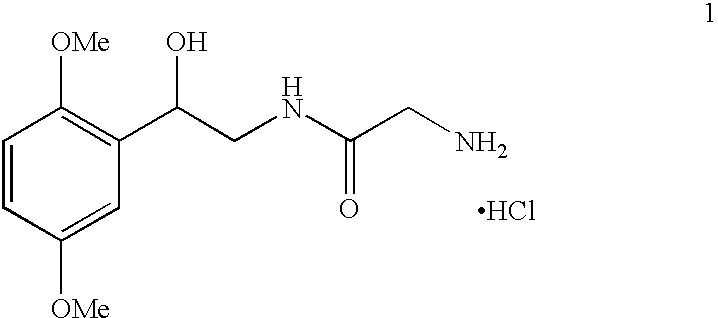
Midodrine is classified as an antihypotensive drug. It was first described and claimed in the U.S. Pat. No., 3,340,298. The drug is dispensed in tablet form as the hydrochloride salt having the structure (1).
The key intermediate required for preparing Midodrine is 1-(2,5-dimethoxyphenyl)-2-aminoethanol hydrochloride having the structure (2). 
The synthesis of Midodrine HCl consists of reacting the key intermediate (2) with chloroacetyl chloride to afford 2-chloro-N-[2-(2,5-dimethoxyphenyl)-2-hydroxyethyl]acetamide (3). The reaction of (3) with sodium azide will provide 2-azido-N-[2-(2,5-dimethoxyphenyl)-2-hydroxyethyl]acetamide (4) which is subsequently subjected to hydrogenation to afford Midodrine base (6).
Acidification with aqueous HCl will provide Midodrine HCl (1). The above sequence of reactions are outlined in the following scheme (see for example Austrian patent AT 336584). 
A serious drawback in the above synthesis of Midodrine HCl involves the use of the dangerously explosive sodium azide. In addition, the above synthesis will involve the formation of the organic azide (4), which is also a potentially explosive material. Both sodium azide and the azide (4) are also toxic materials.
The development of a process for Midodrine HCl, which avoids the use of the highly toxic and explosive sodium azide, will be of great benefit.
According to the present invention, a process is now available for the preparation of Midodrine hydrochloride (1) via a safe process. In addition, all of the intermediates involved in the preparation of (1) are safe to handle. In the present invention, the toxic and potentially explosive sodium azide is replaced by a safe to handle bis (substituted) diaryl amine, preferably dibenzylamine. The new synthesis of Midodrine HCl consists of reacting 1-(2,5-dimethoxy- phenyl)-2-aminoethanol hydrochloride (2) with chloroacetyl chloride in a mixture of methylene chloride and aqueous potassium hydroxide solution at 5°-10° C. to produce 2-chloro-N-[2-(2,5-dimethoxyphenyl)-2-hydroxyethyl]-acetamide (3).
The chloro acetamide derivative (3) is not isolated but reacted in situ, after removal of the methylene chloride, with a bis (substituted) diarylamine having formula (6) in refluxing toluene for a period of about 10 hours. Ar and Ar′ groups in formula (6) are independently phenyl or substituted phenyl groups.
The substituents can be chosen from C1-C4 alkyl groups, C1-C4alkoxy groups, C1-C4dialkylamino groups and halo groups. The preferred amine of formula (6) is dibenzyl amine of formula (8) wherein both Ar and Ar′ groups are phenyl groups The product, 2-(substituted)-dibenzylamino-N-[2-(2,5-dimethoxyphenyl)-2-hydroxyethyl]acetamide (5) is isolated by filtration. In the next step, the intermediate (5) is hydrogenolyzed to give Midodrine free base (9). The hydrogenolysis is performed at 40°-70° C., preferably 50° C., and 4-6 bar hydrogen pressure using 5% Pd/C as catalyst. The reaction is performed in an alcoholic medium, preferably ethanol. After removal of the alcohol, the Midodrine base (9) is isolated by filtration.
In the final step, the Midodrine base (9) is dissolved in ethanol. The addition of a solution of HCl gas in isopropanol causes the hydrochloride salt of Midodrine to separate from solution. A filtration will afford Midodrine HCl (1) in a highly pure form.
It should be pointed out that all of the reagents as well as the intermediates involved in the process can be safely handled and provide no safety risks. The above sequence of reactions is outlined in the following scheme. 
While the invention will now be described in connection with certain preferred embodiments in the following examples so that aspects thereof may be more fully understood and appreciated, it is not intended to limit the invention to these particular embodiments. On the contrary, it is intended to cover all alternatives, modifications and equivalents as may be included within the scope of the invention as defined by the appended claims. Thus, the following examples which include preferred embodiments will serve to illustrate the practice of this invention, it being understood that the particulars shown are by way of example and for purposes of illustrative discussion of preferred embodiments of the present invention only and are presented in the cause of providing what is believed to be the most useful and readily understood description of formulation procedures as well as of the principles and conceptual aspects of the invention.
The reaction vessel is charged with 15.5 g 1-(2,5-dimethoxyphenyl)-2-amino-ethanol hydrochloride, 115 ml methylene chloride and 100 ml water. The mixture is stirred at 25°-30° C. to afford a clear two-phase mixture. The mixture is cooled to 5°-10° C. and a solution of 18.7 g of 50% potassium hydroxide and 18.5 ml water is added in portions at 50°-10° C.
The mixture is stirred at 5°-10° C. for 15 min. 8.0 ml of chloroacetyl chloride is added in portions at 5°-10° C. causing an exothermic reaction to occur. On completion of the addition, the pH should be adjusted to 3-6. The mixture is allowed to warm to 25°-30° C. and the pH is adjusted again to 3-6. After stirring for one hour at 25°-30° C., the pH is adjusted to 6-7 with 5% aqueous potassium hydroxide solution. The stirring is stopped and the layers are separated.
The upper aqueous layer is washed with 25 ml of methylene chloride. The organic layers are combined and dried over magnesium sulfate. The solution of 2-chloro-N-[2-(2,5-dimethoxyphenyl)-2-hydroxyethyl]acetamide in methylene chloride is used as is in the next step.
The reaction vessel is charged with the methylene chloride solution of 2-chloro-N-[2-(2,5-dimethoxyphenyl)-2-hydroxyethyl]acetamide prepared in example 1. The majority of the methylene chloride is distilled off at atmospheric pressure. On completion of the distillation 155 ml toluene are added. The mixture is stirred to obtain a solution. 45 to 50 ml of the toluene is distilled to remove the remainder of methylene chloride. The mixture is cooled to 85°-90° C. and 28.4 g dibenzylamine is added in portions at 85°-90° C. On completion of the addition, the mixture is heated to reflux for a period of 10 hours.
On completion of reaction, the resulting suspension is cooled to 45°-50° C. 110 ml water are added followed by 7.5 g of 50% potassium hydroxide. The mixture is stirred at 25°-30° C. for a period of 2-3 hours during which time the product crystallizes from solution. After cooling to 5°-10° C., the product is filtered to afford 21.7 g of 2-dibenzylamino-N-[2-(2,5-dimethoxyphenyl)-2-hydroxyethyl]acetamide. This represents a 75% yield based on the starting material from example 1. The product is characterized as follows:
m.p.: 110.0-111.1° C.
MS: 434 (M+)
1H-NMR (DMSO-d6): 7.65 ppm, triplet, J=6 Hz, CH2—NH, 1H; 7.35-7.26 ppm, multiplet, benzyl aromatic protons, 10H; 7.06-6.81 ppm, multiplet, dimethoxy aromatic protons, 3H; 5.60 ppm, doublet, J=5 Hz, CH—OH, 1H; 4.95 ppm, multiplet, CH—OH, 1H; 3.71 and 3.65 ppm, two singlets, two OCH3, 6H; 3.54 ppm, broad singlet, two CH 2—Ph, 4H; 3.36 ppm, singlet, H 2O; 3.45 and 3.15 ppm, two multiplets, CH2—NH, 2H; 2.93 ppm, broad singlet, CH 2—N, 2H.
13C-NMR (DMSO-d6): 169.62 ppm, C11; 153.19+149.82 ppm, C1+C4; 138.21 ppm, C15/C21; 132.26 ppm, C6; 128.78 ppm, C16/C20/C22/C26; 128.31 ppm, C17/C19/C23/C25; 127.14 ppm, C18/C24; 112.79+112.25+111.59 ppm, C2+C3+C5; 65.49 ppm, C9; 57.72 ppm, C13/C14; 56.45 ppm, C12; 55.80+55.18 ppm, C7+C8; 44.38 ppm, C10. 
An autoclave is charged with 15.0 g of 2-dibenzylamino-N-[2-(2,5-dimethoxyphenyl)-2-hydroxyethyl]acetamide, 200 ml ethanol and 1.5 g of 5% Pd/C catalyst. The system is flushed three times with nitrogen followed by hydrogen. The pressure of hydrogen is adjusted to 4-6 bar. The temperature is adjusted to 45°-50° C. The mixture is stirred and heated at 45°-50° C. for 24 hours.
On reaction completion, the mixture is cooled to 25°-30° C. and filtered through a Celite pad to separate the catalyst. The clear filtrate is transferred to a clean reaction vessel. About ½ of the ethanol is distilled out at atmospheric pressure. On cooling and seeding, Midodrine base will crystallize from solution. After cooling to 5°-10° C., the product is filtered to afford 6.3 g (71% yield) of white Midodrine base. The product is characterized as follows:
m.p.: 105.8°-106.8° C.
MS: 254 (M+)
1H-NMR (DMSO-d6): 7.88 ppm, triplet, J=6 HZ, CH2—NH, 1H 7.02-6.76 ppm, multiplet, aromatic protons, 3H; 5.42 ppm: broad singlet, CH—OH, 1H; 4.90 ppm, multiplet, CH—OH, 1H; 3.73+3.70 ppm, two singlets, two OCH 3, 6H; 3.45+3.01 ppm, two multiplets, CH 2—NH, 2H, 3.06 ppm, broad singlet, CH 2—NH2, 2H.
13C-NMR(DMSO-d6): 172.75 ppm, C11; 153.11+149.65 ppm, C1+C4; 132.45 ppm, C6; 112.53+112.17+111.48 ppm, C2+C3+C5; 65.64 ppm, C9; 55.74+55.18 ppm, C7+C8; 44.82+44.54 ppm, C10+C12. 
The reaction vessel is charged with 5.0 g Midodrine base and 60 ml ethanol. The mixture is heated to reflux to obtain a clear solution. To the hot mixture is added 6.3 ml of a 22% solution of hydrochloric acid in isopropanol in portions. During the addition, the Midodrine HCl will crystallize from solution. After cooling to 5°-10° C., the product is filtered to afford 4.8 g (96% yield) of Midodrine HCl (m.p.: 200.8°-201.8° C.).
It will be evident to those skilled in the art that the invention is not limited to the details of the foregoing illustrative examples and that the present invention may be embodied in other specific forms without departing from the essential attributes thereof, and it is therefore desired that the present embodiments and examples be considered in all respects as illustrative and not restrictive, reference being made to the appended claims, rather than to the foregoing description, and all changes which come within the meaning and range of equivalency of the claims are therefore intended to be embraced therein.
Claims (9)
1. A process for the preparation of 2-amino-N-[2-(2,5-dimethoxyphenyl)-2-hydroxyethyl]acetamide HCl of the formula 1 by hydrogenolysis of substituted 2-dibenzylamino-N-[2-(2′,5′-dimethoxyphenyl)-2-hydroxyethyl]acetamide having the formula (5), wherein Ar and Ar′ are aryl groups, 
2. A process according to claim 1 in which the compound of formula (5) is prepared by reacting 2-chloro-N-[2-(2,5-dimethoxyphenyl)-2-hydroxy-ethyl]acetamide of formula (3) with a substituted dibenzylamine of the formula (6): 
ArCH2NHCH2Ar′ 6
wherein Ar and Ar′ are optionally substituted phenyl groups.
3. A process according to claim 2 wherein the ary Ar and Ar′ groups are independently phenyl or substituted phenyl groups wherein these substituents are chosen from C1-C4 alkyl groups, C1-C4 alkoxy groups, C1-C4 dialkylamino groups and halo groups.
4. A process according to claim 3 wherein both Ar and Ar′ groups in formula (6) are phenyl groups.
5. A process according to claim 1 wherein the hydrogenolysis reaction is done by hydrogen over a palladium on carbon catalyst.
6. A process according to claim 3 wherein the hydrogen pressure is between 4-6 bars.
7. A process according to claim 3 or 4 wherein the reaction temperature is between 40°-70° C.
8. A process according to claim 3 , 4, or 5 wherein the reaction medium is an alcohol of the formula ROH in which R is a C1-C4 alkyl group.
9. A process according to claim 6 wherein the reaction medium is ethanol.
Priority Applications (1)
| Application Number | Priority Date | Filing Date | Title |
|---|---|---|---|
| US10/206,968 US6610886B2 (en) | 2001-02-26 | 2002-07-30 | Intermediate for preparing midodrine |
Applications Claiming Priority (3)
| Application Number | Priority Date | Filing Date | Title |
|---|---|---|---|
| IL14165501A IL141655A0 (en) | 2001-02-26 | 2001-02-26 | A process for the preparation of midodrine |
| IL141,655 | 2001-02-26 | ||
| IL141655 | 2001-02-26 |
Related Child Applications (1)
| Application Number | Title | Priority Date | Filing Date |
|---|---|---|---|
| US10/206,968 Division US6610886B2 (en) | 2001-02-26 | 2002-07-30 | Intermediate for preparing midodrine |
Publications (2)
| Publication Number | Publication Date |
|---|---|
| US6444851B1 true US6444851B1 (en) | 2002-09-03 |
| US20020128511A1 US20020128511A1 (en) | 2002-09-12 |
Family
ID=11075177
Family Applications (2)
| Application Number | Title | Priority Date | Filing Date |
|---|---|---|---|
| US10/040,385 Expired - Fee Related US6444851B1 (en) | 2001-02-26 | 2002-01-09 | Process for the preparation of Midodrine |
| US10/206,968 Expired - Fee Related US6610886B2 (en) | 2001-02-26 | 2002-07-30 | Intermediate for preparing midodrine |
Family Applications After (1)
| Application Number | Title | Priority Date | Filing Date |
|---|---|---|---|
| US10/206,968 Expired - Fee Related US6610886B2 (en) | 2001-02-26 | 2002-07-30 | Intermediate for preparing midodrine |
Country Status (11)
| Country | Link |
|---|---|
| US (2) | US6444851B1 (en) |
| EP (1) | EP1234817B1 (en) |
| JP (1) | JP2002255915A (en) |
| AT (1) | ATE265421T1 (en) |
| CA (1) | CA2366311A1 (en) |
| CZ (1) | CZ2002138A3 (en) |
| DE (1) | DE60200406T2 (en) |
| HU (1) | HUP0200034A2 (en) |
| IL (1) | IL141655A0 (en) |
| PL (1) | PL352455A1 (en) |
| PT (1) | PT1234817E (en) |
Families Citing this family (5)
| Publication number | Priority date | Publication date | Assignee | Title |
|---|---|---|---|---|
| CA2421550C (en) * | 2003-03-11 | 2008-06-03 | Brantford Chemicals Inc. | Process for the preparation of midodrine, pharmaceutically-acceptable salts thereof and intermediates |
| US20070082070A1 (en) * | 2005-10-11 | 2007-04-12 | Stookey Evangeline L | Treating skin disorders |
| CN101641344A (en) * | 2007-03-30 | 2010-02-03 | 巴斯夫欧洲公司 | Process for preparing cyclic formaldehyde derivatives from polyoxy dialkyl ethers |
| KR101356471B1 (en) | 2011-12-09 | 2014-01-29 | 고려대학교 산학협력단 | Compound for prevention and treatment of hypertension |
| US12032578B1 (en) | 2023-01-24 | 2024-07-09 | Sap Se | Data compression, store, and search system |
Citations (1)
| Publication number | Priority date | Publication date | Assignee | Title |
|---|---|---|---|---|
| GB1003659A (en) * | 1963-06-11 | 1965-09-08 | Chemie Linz Ag | Novel phenylalkanolamine derivatives and a method for their production |
Family Cites Families (2)
| Publication number | Priority date | Publication date | Assignee | Title |
|---|---|---|---|---|
| AT336584B (en) * | 1975-02-25 | 1977-05-10 | Chemie Linz Ag | PROCESS FOR THE PREPARATION OF 1-PHENYL-2-GLYCINAMIDOATHANOLEN- (1) AND THE SALT THEREOF |
| JPH07285921A (en) * | 1994-04-15 | 1995-10-31 | Sanyo Kagaku Kenkyusho:Kk | Method for producing 2-amino-N- (β-hydroxyphenethyl) acetamide derivative |
-
2001
- 2001-02-26 IL IL14165501A patent/IL141655A0/en unknown
- 2001-12-31 CA CA002366311A patent/CA2366311A1/en not_active Abandoned
-
2002
- 2002-01-04 HU HU0200034A patent/HUP0200034A2/en unknown
- 2002-01-09 US US10/040,385 patent/US6444851B1/en not_active Expired - Fee Related
- 2002-01-11 CZ CZ2002138A patent/CZ2002138A3/en unknown
- 2002-02-07 EP EP02002042A patent/EP1234817B1/en not_active Expired - Lifetime
- 2002-02-07 PT PT02002042T patent/PT1234817E/en unknown
- 2002-02-07 JP JP2002030646A patent/JP2002255915A/en active Pending
- 2002-02-07 DE DE60200406T patent/DE60200406T2/en not_active Expired - Lifetime
- 2002-02-07 AT AT02002042T patent/ATE265421T1/en not_active IP Right Cessation
- 2002-02-25 PL PL02352455A patent/PL352455A1/en not_active IP Right Cessation
- 2002-07-30 US US10/206,968 patent/US6610886B2/en not_active Expired - Fee Related
Patent Citations (2)
| Publication number | Priority date | Publication date | Assignee | Title |
|---|---|---|---|---|
| GB1003659A (en) * | 1963-06-11 | 1965-09-08 | Chemie Linz Ag | Novel phenylalkanolamine derivatives and a method for their production |
| US3340298A (en) * | 1963-06-11 | 1967-09-05 | Chemie Linz Ag | Phenylalkanolamine derivatives |
Also Published As
| Publication number | Publication date |
|---|---|
| CZ2002138A3 (en) | 2002-10-16 |
| DE60200406D1 (en) | 2004-06-03 |
| US20020193635A1 (en) | 2002-12-19 |
| EP1234817A1 (en) | 2002-08-28 |
| JP2002255915A (en) | 2002-09-11 |
| US6610886B2 (en) | 2003-08-26 |
| HU0200034D0 (en) | 2002-03-28 |
| DE60200406T2 (en) | 2004-09-02 |
| IL141655A0 (en) | 2002-03-10 |
| ATE265421T1 (en) | 2004-05-15 |
| PT1234817E (en) | 2004-08-31 |
| CA2366311A1 (en) | 2002-08-26 |
| PL352455A1 (en) | 2002-09-09 |
| HUP0200034A2 (en) | 2002-12-28 |
| US20020128511A1 (en) | 2002-09-12 |
| EP1234817B1 (en) | 2004-04-28 |
Similar Documents
| Publication | Publication Date | Title |
|---|---|---|
| US5225585A (en) | Production of fluoxetine and new intermediates | |
| KR20060126965A (en) | Process for preparing O-carbamoyl compound in the presence of active amine group | |
| WO2008035380A2 (en) | An improved process for the preparation of high purity formoterol and its pharmaceutically acceptable salts | |
| US6444851B1 (en) | Process for the preparation of Midodrine | |
| WO2012038974A1 (en) | Process for preparing l-phenyl-3-dimethylaminopropane derivative | |
| US7019137B2 (en) | Process for making chiral 1,4-disubstituted piperazines | |
| CN101218218B (en) | Novel Pyrocatechol Derivatives | |
| JP3489319B2 (en) | Carboxylic acid derivatives, their production and use | |
| JPH05239005A (en) | N- (2-aminoethyl) benzamides and novel intermediates thereof | |
| JP2835413B2 (en) | Phenothiazine derivative and method for producing the same | |
| US6458957B1 (en) | α,α-dibromo-α-chloro-acetophenones as synthons | |
| JP5198707B2 (en) | Method for producing acylamide by synthesizing and acylating benzoxazine | |
| EP3746425B1 (en) | Methods for producing (6s,15s)-3,8,13,18-tetraazaicosane-6,15-diol | |
| US6362376B1 (en) | Process for the preparation of 2-hydroxyalkyl halophenones | |
| JPH11255743A (en) | Production of optically active indole derivative and intermediate for producing the same | |
| JP3959178B2 (en) | Method for producing hydrazine derivative, intermediate thereof and method for producing intermediate | |
| US20100168385A1 (en) | Process for preparing enantiomerically enriched amino-alcohols | |
| JP2005272417A (en) | Process for producing 2-chloro-4-aminomethylpyridines | |
| KR100639551B1 (en) | Process for preparing 5- (substituted phenylalkyl) aminosalicylic acid compound | |
| ES2288376A1 (en) | Process for obtaining valine derivatives useful for obtaining a pharmaceutically active compound | |
| JP2004149477A (en) | Method for producing benzocycloheptene derivative | |
| CZ302993B6 (en) | Process for preparing (2R,3R)-N,N-dimethyl-3-(hydroxyphenyl)-2-methylpentylamine (tapentadol) | |
| WO2009104557A1 (en) | Process for production of n-(3-pyrrolidinyl)glycine derivative | |
| JP2002322136A (en) | N-substituted-aminomethylcyclopropyl ketone derivatives or salts thereof and methods for producing them | |
| JP2009508961A (en) | Production method of amino acid derivatives |
Legal Events
| Date | Code | Title | Description |
|---|---|---|---|
| AS | Assignment |
Owner name: CHEMAGIS LTD., ISRAEL Free format text: ASSIGNMENT OF ASSIGNORS INTEREST;ASSIGNORS:BRAND, MICHAEL;CHEN, RONIT;YIGAL, DEBY;AND OTHERS;REEL/FRAME:012472/0119 Effective date: 20011227 |
|
| CC | Certificate of correction | ||
| REMI | Maintenance fee reminder mailed | ||
| LAPS | Lapse for failure to pay maintenance fees | ||
| STCH | Information on status: patent discontinuation |
Free format text: PATENT EXPIRED DUE TO NONPAYMENT OF MAINTENANCE FEES UNDER 37 CFR 1.362 |
|
| FP | Lapsed due to failure to pay maintenance fee |
Effective date: 20060903 |