US6444830B1 - Electron acceptors for polymeric thin film waveguide media - Google Patents
Electron acceptors for polymeric thin film waveguide media Download PDFInfo
- Publication number
- US6444830B1 US6444830B1 US09/675,967 US67596700A US6444830B1 US 6444830 B1 US6444830 B1 US 6444830B1 US 67596700 A US67596700 A US 67596700A US 6444830 B1 US6444830 B1 US 6444830B1
- Authority
- US
- United States
- Prior art keywords
- substituted
- unsubstituted
- alkyl
- compound
- alkynyl
- Prior art date
- Legal status (The legal status is an assumption and is not a legal conclusion. Google has not performed a legal analysis and makes no representation as to the accuracy of the status listed.)
- Expired - Lifetime
Links
- 239000000370 acceptor Substances 0.000 title abstract description 16
- 239000010409 thin film Substances 0.000 title abstract description 5
- 238000000034 method Methods 0.000 claims abstract description 19
- 150000001875 compounds Chemical class 0.000 claims description 41
- 229910052799 carbon Inorganic materials 0.000 claims description 28
- OKTJSMMVPCPJKN-UHFFFAOYSA-N Carbon Chemical compound [C] OKTJSMMVPCPJKN-UHFFFAOYSA-N 0.000 claims description 26
- 125000000008 (C1-C10) alkyl group Chemical group 0.000 claims description 24
- 125000000304 alkynyl group Chemical group 0.000 claims description 17
- 125000001424 substituent group Chemical group 0.000 claims description 13
- 239000000460 chlorine Chemical group 0.000 claims description 12
- ZAMOUSCENKQFHK-UHFFFAOYSA-N Chlorine atom Chemical group [Cl] ZAMOUSCENKQFHK-UHFFFAOYSA-N 0.000 claims description 11
- 229910052801 chlorine Chemical group 0.000 claims description 11
- 239000011737 fluorine Substances 0.000 claims description 11
- 229910052731 fluorine Inorganic materials 0.000 claims description 11
- CUONGYYJJVDODC-UHFFFAOYSA-N malononitrile Chemical compound N#CCC#N CUONGYYJJVDODC-UHFFFAOYSA-N 0.000 claims description 7
- 125000001843 C4-C10 alkenyl group Chemical group 0.000 claims description 6
- 125000004178 (C1-C4) alkyl group Chemical group 0.000 claims description 5
- 125000004399 C1-C4 alkenyl group Chemical group 0.000 claims description 3
- 150000004703 alkoxides Chemical class 0.000 claims description 3
- 229910052751 metal Inorganic materials 0.000 claims description 3
- 239000002184 metal Substances 0.000 claims description 3
- 235000019000 fluorine Nutrition 0.000 claims 11
- 125000001153 fluoro group Chemical group F* 0.000 claims 11
- 125000006374 C2-C10 alkenyl group Chemical group 0.000 claims 5
- 125000005865 C2-C10alkynyl group Chemical group 0.000 claims 5
- VSOKESYUJDXOOC-UHFFFAOYSA-N 2-(3h-furan-2-ylidene)propanedinitrile Chemical compound N#CC(C#N)=C1CC=CO1 VSOKESYUJDXOOC-UHFFFAOYSA-N 0.000 abstract description 6
- 238000002360 preparation method Methods 0.000 abstract description 4
- LFQSCWFLJHTTHZ-UHFFFAOYSA-N Ethanol Chemical compound CCO LFQSCWFLJHTTHZ-UHFFFAOYSA-N 0.000 description 26
- WYURNTSHIVDZCO-UHFFFAOYSA-N Tetrahydrofuran Chemical compound C1CCOC1 WYURNTSHIVDZCO-UHFFFAOYSA-N 0.000 description 20
- 239000000203 mixture Substances 0.000 description 19
- 239000002585 base Substances 0.000 description 13
- XLYOFNOQVPJJNP-UHFFFAOYSA-N water Substances O XLYOFNOQVPJJNP-UHFFFAOYSA-N 0.000 description 13
- OKKJLVBELUTLKV-UHFFFAOYSA-N Methanol Chemical compound OC OKKJLVBELUTLKV-UHFFFAOYSA-N 0.000 description 12
- -1 carbocycles Chemical group 0.000 description 11
- 125000000623 heterocyclic group Chemical group 0.000 description 11
- 239000000243 solution Substances 0.000 description 11
- YMWUJEATGCHHMB-UHFFFAOYSA-N Dichloromethane Chemical compound ClCCl YMWUJEATGCHHMB-UHFFFAOYSA-N 0.000 description 10
- FJKIXWOMBXYWOQ-UHFFFAOYSA-N ethenoxyethane Chemical compound CCOC=C FJKIXWOMBXYWOQ-UHFFFAOYSA-N 0.000 description 10
- 125000001997 phenyl group Chemical group [H]C1=C([H])C([H])=C(*)C([H])=C1[H] 0.000 description 10
- YLQBMQCUIZJEEH-UHFFFAOYSA-N tetrahydrofuran Natural products C=1C=COC=1 YLQBMQCUIZJEEH-UHFFFAOYSA-N 0.000 description 10
- UIIMBOGNXHQVGW-UHFFFAOYSA-M Sodium bicarbonate Chemical compound [Na+].OC([O-])=O UIIMBOGNXHQVGW-UHFFFAOYSA-M 0.000 description 9
- 0 [1*]C1([2*])OC(=C(C#N)C#N)C(C#N)=C1[3*] Chemical compound [1*]C1([2*])OC(=C(C#N)C#N)C(C#N)=C1[3*] 0.000 description 9
- 125000003118 aryl group Chemical group 0.000 description 9
- RTZKZFJDLAIYFH-UHFFFAOYSA-N Diethyl ether Chemical compound CCOCC RTZKZFJDLAIYFH-UHFFFAOYSA-N 0.000 description 8
- 125000002877 alkyl aryl group Chemical group 0.000 description 8
- 125000000113 cyclohexyl group Chemical group [H]C1([H])C([H])([H])C([H])([H])C([H])(*)C([H])([H])C1([H])[H] 0.000 description 8
- 230000003287 optical effect Effects 0.000 description 8
- 235000019441 ethanol Nutrition 0.000 description 7
- PXGOKWXKJXAPGV-UHFFFAOYSA-N Fluorine Chemical compound FF PXGOKWXKJXAPGV-UHFFFAOYSA-N 0.000 description 6
- CSNNHWWHGAXBCP-UHFFFAOYSA-L Magnesium sulfate Chemical compound [Mg+2].[O-][S+2]([O-])([O-])[O-] CSNNHWWHGAXBCP-UHFFFAOYSA-L 0.000 description 6
- 125000003342 alkenyl group Chemical group 0.000 description 6
- 239000007787 solid Substances 0.000 description 6
- 125000000325 methylidene group Chemical group [H]C([H])=* 0.000 description 5
- 239000002904 solvent Substances 0.000 description 5
- 239000002253 acid Substances 0.000 description 4
- 150000004820 halides Chemical class 0.000 description 4
- 150000002576 ketones Chemical class 0.000 description 4
- UBJFKNSINUCEAL-UHFFFAOYSA-N lithium;2-methylpropane Chemical compound [Li+].C[C-](C)C UBJFKNSINUCEAL-UHFFFAOYSA-N 0.000 description 4
- 239000011368 organic material Substances 0.000 description 4
- 229920000642 polymer Polymers 0.000 description 4
- BWHMMNNQKKPAPP-UHFFFAOYSA-L potassium carbonate Chemical compound [K+].[K+].[O-]C([O-])=O BWHMMNNQKKPAPP-UHFFFAOYSA-L 0.000 description 4
- 229910000030 sodium bicarbonate Inorganic materials 0.000 description 4
- XEKOWRVHYACXOJ-UHFFFAOYSA-N Ethyl acetate Chemical compound CCOC(C)=O XEKOWRVHYACXOJ-UHFFFAOYSA-N 0.000 description 3
- KWYUFKZDYYNOTN-UHFFFAOYSA-M Potassium hydroxide Chemical compound [OH-].[K+] KWYUFKZDYYNOTN-UHFFFAOYSA-M 0.000 description 3
- HEMHJVSKTPXQMS-UHFFFAOYSA-M Sodium hydroxide Chemical compound [OH-].[Na+] HEMHJVSKTPXQMS-UHFFFAOYSA-M 0.000 description 3
- 239000012267 brine Substances 0.000 description 3
- 125000006575 electron-withdrawing group Chemical group 0.000 description 3
- 238000001704 evaporation Methods 0.000 description 3
- 125000003983 fluorenyl group Chemical group C1(=CC=CC=2C3=CC=CC=C3CC12)* 0.000 description 3
- 229910052943 magnesium sulfate Inorganic materials 0.000 description 3
- VLKZOEOYAKHREP-UHFFFAOYSA-N n-Hexane Chemical compound CCCCCC VLKZOEOYAKHREP-UHFFFAOYSA-N 0.000 description 3
- HPALAKNZSZLMCH-UHFFFAOYSA-M sodium;chloride;hydrate Chemical compound O.[Na+].[Cl-] HPALAKNZSZLMCH-UHFFFAOYSA-M 0.000 description 3
- 238000003756 stirring Methods 0.000 description 3
- 125000000547 substituted alkyl group Chemical group 0.000 description 3
- WKBOTKDWSSQWDR-UHFFFAOYSA-N Bromine atom Chemical compound [Br] WKBOTKDWSSQWDR-UHFFFAOYSA-N 0.000 description 2
- OFBQJSOFQDEBGM-UHFFFAOYSA-N Pentane Chemical compound CCCCC OFBQJSOFQDEBGM-UHFFFAOYSA-N 0.000 description 2
- 125000000217 alkyl group Chemical group 0.000 description 2
- 230000015572 biosynthetic process Effects 0.000 description 2
- GDTBXPJZTBHREO-UHFFFAOYSA-N bromine Substances BrBr GDTBXPJZTBHREO-UHFFFAOYSA-N 0.000 description 2
- 229910052794 bromium Inorganic materials 0.000 description 2
- BVKZGUZCCUSVTD-UHFFFAOYSA-N carbonic acid Chemical compound OC(O)=O BVKZGUZCCUSVTD-UHFFFAOYSA-N 0.000 description 2
- JHIVVAPYMSGYDF-UHFFFAOYSA-N cyclohexanone Chemical compound O=C1CCCCC1 JHIVVAPYMSGYDF-UHFFFAOYSA-N 0.000 description 2
- 239000000463 material Substances 0.000 description 2
- 125000001624 naphthyl group Chemical group 0.000 description 2
- 238000006386 neutralization reaction Methods 0.000 description 2
- 229910000027 potassium carbonate Inorganic materials 0.000 description 2
- 239000000047 product Substances 0.000 description 2
- 125000006238 prop-1-en-1-yl group Chemical group [H]\C(*)=C(/[H])C([H])([H])[H] 0.000 description 2
- 239000013557 residual solvent Substances 0.000 description 2
- 150000003839 salts Chemical class 0.000 description 2
- QDRKDTQENPPHOJ-UHFFFAOYSA-N sodium ethoxide Chemical compound [Na+].CC[O-] QDRKDTQENPPHOJ-UHFFFAOYSA-N 0.000 description 2
- 239000007858 starting material Substances 0.000 description 2
- 238000003786 synthesis reaction Methods 0.000 description 2
- 238000005292 vacuum distillation Methods 0.000 description 2
- 125000006726 (C1-C5) alkenyl group Chemical group 0.000 description 1
- 125000006527 (C1-C5) alkyl group Chemical group 0.000 description 1
- RYHBNJHYFVUHQT-UHFFFAOYSA-N 1,4-Dioxane Chemical compound C1COCCO1 RYHBNJHYFVUHQT-UHFFFAOYSA-N 0.000 description 1
- WBPAOUHWPONFEQ-UHFFFAOYSA-N 1-(3,4-dichlorophenyl)ethanone Chemical compound CC(=O)C1=CC=C(Cl)C(Cl)=C1 WBPAOUHWPONFEQ-UHFFFAOYSA-N 0.000 description 1
- YFGPJQSJHGRKRC-UHFFFAOYSA-N C.C.CC1CCCC2CCCCC12.CC1CCCc2ccccc21.CC1CCOCC1 Chemical compound C.C.CC1CCCC2CCCCC12.CC1CCCc2ccccc21.CC1CCOCC1 YFGPJQSJHGRKRC-UHFFFAOYSA-N 0.000 description 1
- 125000006725 C1-C10 alkenyl group Chemical group 0.000 description 1
- BGSRIRBCWOMGJO-UHFFFAOYSA-N Cc1ccc(C)cc1.Cc1ccc(C2CCCCC2)cc1.Cc1ccc(Cl)c(Cl)c1.Cc1ccc(Cl)c(Cl)c1Cl.Cc1ccc(F)cc1F Chemical compound Cc1ccc(C)cc1.Cc1ccc(C2CCCCC2)cc1.Cc1ccc(Cl)c(Cl)c1.Cc1ccc(Cl)c(Cl)c1Cl.Cc1ccc(F)cc1F BGSRIRBCWOMGJO-UHFFFAOYSA-N 0.000 description 1
- XRKCTERJFBZPMZ-UHFFFAOYSA-N Cc1ccc(C)cc1.Cc1ccc(Cl)c(Cl)c1.Cc1ccc(Cl)c(Cl)c1Cl.Cc1ccc(F)cc1F Chemical compound Cc1ccc(C)cc1.Cc1ccc(Cl)c(Cl)c1.Cc1ccc(Cl)c(Cl)c1Cl.Cc1ccc(F)cc1F XRKCTERJFBZPMZ-UHFFFAOYSA-N 0.000 description 1
- XUIMIQQOPSSXEZ-UHFFFAOYSA-N Silicon Chemical compound [Si] XUIMIQQOPSSXEZ-UHFFFAOYSA-N 0.000 description 1
- QAOWNCQODCNURD-UHFFFAOYSA-N Sulfuric acid Chemical compound OS(O)(=O)=O QAOWNCQODCNURD-UHFFFAOYSA-N 0.000 description 1
- 229910052783 alkali metal Inorganic materials 0.000 description 1
- QVGXLLKOCUKJST-UHFFFAOYSA-N atomic oxygen Chemical group [O] QVGXLLKOCUKJST-UHFFFAOYSA-N 0.000 description 1
- 125000001797 benzyl group Chemical group [H]C1=C([H])C([H])=C(C([H])=C1[H])C([H])([H])* 0.000 description 1
- 125000002837 carbocyclic group Chemical group 0.000 description 1
- 125000002915 carbonyl group Chemical group [*:2]C([*:1])=O 0.000 description 1
- 230000003197 catalytic effect Effects 0.000 description 1
- 238000006243 chemical reaction Methods 0.000 description 1
- 238000004587 chromatography analysis Methods 0.000 description 1
- 238000004440 column chromatography Methods 0.000 description 1
- 239000012043 crude product Substances 0.000 description 1
- 125000000392 cycloalkenyl group Chemical group 0.000 description 1
- 125000000753 cycloalkyl group Chemical group 0.000 description 1
- BMFYCFSWWDXEPB-UHFFFAOYSA-N cyclohexyl(phenyl)methanone Chemical compound C=1C=CC=CC=1C(=O)C1CCCCC1 BMFYCFSWWDXEPB-UHFFFAOYSA-N 0.000 description 1
- 230000008020 evaporation Effects 0.000 description 1
- 229910052744 lithium Inorganic materials 0.000 description 1
- WGOPGODQLGJZGL-UHFFFAOYSA-N lithium;butane Chemical compound [Li+].CC[CH-]C WGOPGODQLGJZGL-UHFFFAOYSA-N 0.000 description 1
- 238000004519 manufacturing process Methods 0.000 description 1
- XJRBAMWJDBPFIM-UHFFFAOYSA-N methyl vinyl ether Chemical group COC=C XJRBAMWJDBPFIM-UHFFFAOYSA-N 0.000 description 1
- 239000000178 monomer Substances 0.000 description 1
- 229910052757 nitrogen Inorganic materials 0.000 description 1
- 150000002894 organic compounds Chemical class 0.000 description 1
- 239000012074 organic phase Substances 0.000 description 1
- 229910052760 oxygen Inorganic materials 0.000 description 1
- 239000012071 phase Substances 0.000 description 1
- 238000010992 reflux Methods 0.000 description 1
- 229910052710 silicon Inorganic materials 0.000 description 1
- 239000010703 silicon Substances 0.000 description 1
- 239000011877 solvent mixture Substances 0.000 description 1
- 238000006467 substitution reaction Methods 0.000 description 1
- 229910052717 sulfur Inorganic materials 0.000 description 1
Classifications
-
- C—CHEMISTRY; METALLURGY
- C07—ORGANIC CHEMISTRY
- C07D—HETEROCYCLIC COMPOUNDS
- C07D307/00—Heterocyclic compounds containing five-membered rings having one oxygen atom as the only ring hetero atom
- C07D307/94—Heterocyclic compounds containing five-membered rings having one oxygen atom as the only ring hetero atom spiro-condensed with carbocyclic rings or ring systems, e.g. griseofulvins
-
- C—CHEMISTRY; METALLURGY
- C07—ORGANIC CHEMISTRY
- C07D—HETEROCYCLIC COMPOUNDS
- C07D307/00—Heterocyclic compounds containing five-membered rings having one oxygen atom as the only ring hetero atom
- C07D307/02—Heterocyclic compounds containing five-membered rings having one oxygen atom as the only ring hetero atom not condensed with other rings
- C07D307/34—Heterocyclic compounds containing five-membered rings having one oxygen atom as the only ring hetero atom not condensed with other rings having two or three double bonds between ring members or between ring members and non-ring members
- C07D307/56—Heterocyclic compounds containing five-membered rings having one oxygen atom as the only ring hetero atom not condensed with other rings having two or three double bonds between ring members or between ring members and non-ring members with hetero atoms or with carbon atoms having three bonds to hetero atoms with at the most one bond to halogen, e.g. ester or nitrile radicals, directly attached to ring carbon atoms
- C07D307/68—Carbon atoms having three bonds to hetero atoms with at the most one bond to halogen
Definitions
- the present invention relates generally to electron acceptors (or withdrawing groups) which can be used in the preparation of polymeric thin films for waveguide media, and specifically to dicyanomethylendihydrofuran-based electron acceptors, and methods of making the same.
- Thin films of organic or polymeric materials with large second order nonlinearities in combination with silicon-based electronic circuitry can be used in systems for laser modulation and deflection, information control in optical circuitry, as well as in numerous other waveguide applications.
- novel processes through third order nonlinearity such as degenerate four-wave nixing, whereby real-time processing of optical fields occurs, have utility in such diverse fields as optical communications and integrated circuit fabrication.
- the utility of organic materials with large second order and third order nonlinearities for very high frequency application contrasts with the bandwidth limitations of conventional inorganic electrooptic materials currently in use.
- thermally stable electron accepting (or withdrawing) groups for organic nonlinear optical applications are generally known in the art. Although many different electron acceptors have been reported in the literature, few, if any, have showed both suitable thermal stability and very high electron acceptance at the same time. Accordingly, electron acceptors which exhibit both thermal stability and very high electron acceptance are desired.
- the present invention is directed to compounds which can serve as electron acceptors in, for example, thin films for waveguides.
- Preferred compounds of the invention have Formula (I):
- R 1 and R 2 are base stable moieties.
- R 1 can be substituted and unsubstituted C 1 -C 10 alkyl
- R 2 can be substituted and unsubstituted C 2 -C 10 alkyl
- R 1 and R 2 each, independently, can be substituted and unsubstituted C 4 -C 10 alkenyl, substituted and unsubstituted C 4 -C 10 alkynyl, substituted and unsubstituted aryl, substituted and unsubstituted alkylaryl, substituted and unsubstituted carbocycles, substituted and unsubstituted heterocycles, substituted and unsubstituted cyclohexyl, or (CH 2 ) n —O—(CH 2 ) n where n is 1-10; provided there is no methylene between the * carbon and an sp2 or sp hybridized carbon.
- R 1 and R 2 together form a ring structure or a substituted ring structure.
- R 3 is either substituted and unsubstituted C 1 -C 5 alkyl, substituted and unsubstituted C 1 -C 5 alkenyl, substituted and unsubstituted C 1 -C 5 alkynyl.
- alkylaryl does not include benzyl.
- the present invention is also directed to a method of preparing compounds having Formula I comprising the steps 1) providing an alkylvinylether, 2) contacting the alkylvinylether with a strong base to form a first intermediate compound, 3) contacting the first intermediate compound with a ketone to form a second intermediate compound, and 4) reacting the second intermediate compound with dicyanomethane in the presence of a metal alkoxide base, or other appropriate base known to those skilled in the art, to form a compound having Formula I.
- electronegative organic compounds or substituents which attract electron density from the pi-electron system when the conjugated electron structure is polarized by the input of electromagnetic energy.
- the present invention relates, in part, to novel electron acceptors which have utility in organic nonlinear optical applications and methods of preparing the same.
- the compounds of the invention function as electron acceptors (or as electron withdrawing groups) which exhibit both thermal stability and very high electron acceptance simultaneously.
- the compounds of the invention can be used in, for example, polymeric organic materials for optical waveguides. Such polymeric organic materials are described in, for example, U.S. Pat. Nos.
- the electron acceptor compounds are dicyanomethylenedihydrofuran-based compounds comprising Formula I:
- R 1 can be substituted and unsubstituted C 1 -C 10 alkyl
- R 2 can be substituted and unsubstituted C 2 -C 10 alkyl
- R 1 and R 2 each, independently, can be selected from the group consisting of substituted and unsubstituted C 2 -C 10 alkyl, substituted and unsubstituted C 4 -C 10 alkenyl, substituted and unsubstituted C 4 -C 10 alkynyl, substituted and unsubstituted aryl, substituted and unsubstituted alkylaryl, substituted and unsubstituted carbocycles, substituted and unsubstituted heterocycles, substituted and unsubstituted cyclohexyl, and (CH 2 ) n —O—(CH 2 ) n where n is 1-10; provided there is no methylene between the * carbon and an sp2 or sp hybridized carbon.
- the substituted alkyl, alkenyl, alkynyl, carbocyclic, and heterocyclic groups can comprise one or a plurality of substituents including, for example, fluorine, chlorine, D, and the like.
- the heterocyclic groups can comprise O, N, S, and the like.
- the aryl groups preferably include, but are not limited to, phenyl, fluorenyl, and naphthyl.
- the aryl groups, carbocycles, heterocycles, and cyclohexyl can also be substituted by one or a plurality of substituents including, for example, D, halides, including fluorine, chlorine and bromine.
- the alkylaryl groups preferably comprise C 1 -C 10 alkyl and the substituted alkylaryl groups comprise the substitutions for the alkyl and aryl groups described above.
- R 1 and R 2 each, independently, are selected from the group consisting of, carbocycle, heterocycle, cyclohexyl, phenyl, cycloalkyl, cycloalkenyl, and substituted phenyl. Additional moieties for R 1 and/or R 2 , independently, include, but are not limited to the following:
- R 1 is CH 3 and R 2 is a substituted phenyl.
- the substituted phenyl is selected from the group consisting of, but not limited to:
- R 1 and R 2 together form a ring structure or a substituted ring structure from 3 to 7 atoms total with 5 or 6 atoms being preferred.
- the ring structure is substituted or unsubstituted carbocycle, substituted or unsubstituted heterocycle, or substituted or unsubstituted cyclohexyl.
- the substituted ring structure can comprise substituents including, but not limited to, halides, including fluorine, chlorine and bromine.
- a preferred compound having a ring structure formed by R 1 and R 2 comprises
- the substituted alkyl, alkenyl, and alkynyl groups can comprise one or a plurality of substituents including, for example, F, D, or Cl.
- R 3 is selected from the group consisting of C 1 -C 4 alkyl, C 1 -C 4 alkenyl, and C 1 -C 4 alkynyl. In more preferred embodiments of the invention, R 3 is CH 3 .
- the present invention is also directed to methods of preparing electron acceptors of the invention.
- R 3 is CH 3
- the product can be prepared by the following steps depicted in Scheme I: a) providing an alkylvinylether, b) contacting the alkylvinylether with a strong base to form a first intermediate compound, c) contacting the first intermediate compound with a ketone to form a second intermediate compound, and d) reacting the second intermediate compound with dicyanomethane in the presence of a second base to form a compound having Formula I.
- an alkylvinylether in a solvent is the starting material.
- the solvent is, preferably, tetrahydrofuran (THF), 1,4-dioxane, or the like.
- THF tetrahydrofuran
- the alkylvinylether depicted in Scheme I is ethylvinylether, other alkylvinylethers can be used.
- the alkylvinylether preferably comprises the formula CH 3 —(CH 2 ) x —O—CH ⁇ CHR 4 , where x is 1-3 and R 4 is H or C 1 -C 4 alkyl.
- the alkylvinylether is methylvinylether or ethylvinylether.
- the alkylvinylether is contacted with a strong base to form a first intermediate compound.
- the strong base has a pK a greater than the ethylinic C-H bond ⁇ to the oxygen function of the alkylvinylether.
- the strong base is an alkyl lithium, or an alkali metal salt of an alkyl anion, including, but not limited to, t-BuLi or sec-BuLi.
- the alkylvinylether is preferably contacted with the strong base between about ⁇ 70° C. and ⁇ 85° C., most preferably at about ⁇ 78° C.
- the first intermediate compound is contacted with a ketone and then an acid/alcohol/water solution to form a second intermediate compound.
- an acid/alcohol/water solution known to those skilled in the art can be used in the present invention.
- the acid/alcohol/water solution is preferably HCl/MeOH/H 2 O, HBr/EtOH/H 2 O, or H 2 SO 4 /EtOH/H 2 O.
- the contacting is at room temperature.
- the pH is adjusted between 1 and 4.
- the ketone comprises the formula
- R 1 can be substituted and unsubstituted C 1 -C 10 alkyl
- R 2 can be substituted and unsubstituted C 2 -C 10 alkyl
- R 1 and R 2 each, independently, can be selected from the group consisting of, substituted and unsubstituted C 1 -C 10 alkyl, substituted and unsubstituted C 1 -C 10 alkenyl, substituted and unsubstituted C 1 -C 10 alkynyl, substituted and unsubstituted aryl, substituted and unsubstituted alkylaryl, substituted and unsubstituted carbocycles, substituted and unsubstituted heterocycles, substituted and unsubstituted cyclohexyl, and (CH 2 ) n —O—(CH 2 ) n where n is 1-10.
- R 1 and R 2 together form a ring structure or a substituted ring structure, as described above.
- the C ⁇ C and C ⁇ C bonds of the alkenyl and alkynyl groups are not immediately adjacent the carbonyl group of the ketone compound.
- the substituted alkyl, alkenyl, and alkynyl groups can comprise one or a plurality of substituents including, for example, fluorine, D, and chlorine.
- the aryl groups preferably include, but are not limited to, fluorenyl, phenyl, and naphthyl.
- the aryl groups, carbocycle groups, heterocycle groups, and cyclohexyl can also be substituted by, for example, D, halides, including fluorine and chlorine.
- the alkylaryl groups comprise C 1 -C 10 alkyl and the substituted alkylaryl groups can comprise the substituents for the alkyl and aryl groups described above.
- R 1 and R 2 each, independently, are selected from the group consisting of, cyclohexyl, phenyl, and substituted phenyl.
- R 1 is CH 3 and R 2 is a substituted phenyl.
- the substituted phenyl is selected from the following:
- R 1 and R 2 together form a ring structure or a substituted ring structure or a heterocyclic ring structure.
- the ring structure is substituted or unsubstituted 5 or 6 member rings, including, but not limited to, 5 or 6 member heterocyclic rings and fluorenyl.
- the substituted ring structure can comprise substituents including, but not limited to, halides, including fluorine, chlorine and D.
- the second intermediate compound is reacted with dicyanomethane in the presence of a second base at the appropriate temperature to form a compound having Formula I.
- the second base is preferably a metal alkoxide including, but not limited to, NaOC 2 H 5 , NaOH, KOH, and K 2 CO 3 .
- dilute acid such as, for example, HCl, is added for neutralization of the resultant electron acceptor compound.
- the hydroxy ketone synthesized above (0.02 mol) was mixed with malononitrile (0.04 mol) and potassium carbonate (0.02 mol) in THF (40 ml) and EtOH (2 ml). To this mixture, a catalytic amount of 18-crown ether was added. The mixture was stirred and allowed to reflux overnight. The solid was filtered off, followed by evaporation of most of the solvent. The crude mixture was purified by colum chromatography (CH 2 Cl 2 ) to give the dicyanomethylenedihydrofuran compound (1.5 g).
Landscapes
- Chemical & Material Sciences (AREA)
- Organic Chemistry (AREA)
- Organic Low-Molecular-Weight Compounds And Preparation Thereof (AREA)
Abstract
The present invention is directed to dicyanomethylenedihydrofuran-based electron acceptors which can be used in the preparation of polymeric thin films for waveguide media, and methods of making the same.
Description
This application is a continuation-in-part of co-pending U.S. patent application Ser. No. 09/596,069, filed Jun. 16, 2000.
The present invention relates generally to electron acceptors (or withdrawing groups) which can be used in the preparation of polymeric thin films for waveguide media, and specifically to dicyanomethylendihydrofuran-based electron acceptors, and methods of making the same.
Thin films of organic or polymeric materials with large second order nonlinearities in combination with silicon-based electronic circuitry can be used in systems for laser modulation and deflection, information control in optical circuitry, as well as in numerous other waveguide applications. In addition, novel processes through third order nonlinearity such as degenerate four-wave nixing, whereby real-time processing of optical fields occurs, have utility in such diverse fields as optical communications and integrated circuit fabrication. The utility of organic materials with large second order and third order nonlinearities for very high frequency application contrasts with the bandwidth limitations of conventional inorganic electrooptic materials currently in use.
Numerous optically responsive monomers and polymers have been developed for use in organic materials which, in turn, can be used in the waveguide applications described above. For example, U.S. Pat. No. 5,044,725, which is incorporated herein by reference in its entirety, describes numerous polymer compositions which provide suitable nonlinear optical response. U.S. Pat. No. 5,044,725 describes, for example, a preferred polymer composition comprising an organic structure containing an electron donating group and an electron withdrawing group at opposing termini of a bridge. To achieve nonlinear optic (NLO) stability, however, thermally stable electron acceptors must be obtained.
Most recently, U.S. Pat. No. 6,067,186 (the '186 patent), disclosed a class of organic chromophores which can result in hardened electro-optic polymers suitable for electro-optic modulators and other devices such as optical switch.
The synthesis of thermally stable electron accepting (or withdrawing) groups for organic nonlinear optical applications are generally known in the art. Although many different electron acceptors have been reported in the literature, few, if any, have showed both suitable thermal stability and very high electron acceptance at the same time. Accordingly, electron acceptors which exhibit both thermal stability and very high electron acceptance are desired.
The present invention is directed to compounds which can serve as electron acceptors in, for example, thin films for waveguides. Preferred compounds of the invention have Formula (I): 
where R1 and R2 are base stable moieties. R1 can be substituted and unsubstituted C1-C10 alkyl, R2 can be substituted and unsubstituted C2-C10 alkyl, and R1 and R2 each, independently, can be substituted and unsubstituted C4-C10 alkenyl, substituted and unsubstituted C4-C10 alkynyl, substituted and unsubstituted aryl, substituted and unsubstituted alkylaryl, substituted and unsubstituted carbocycles, substituted and unsubstituted heterocycles, substituted and unsubstituted cyclohexyl, or (CH2)n—O—(CH2)n where n is 1-10; provided there is no methylene between the * carbon and an sp2 or sp hybridized carbon. Alternatively, R1 and R2 together form a ring structure or a substituted ring structure. R3 is either substituted and unsubstituted C1-C5 alkyl, substituted and unsubstituted C1-C5 alkenyl, substituted and unsubstituted C1-C5 alkynyl. As contemplated herein, the term “alkylaryl” does not include benzyl.
The present invention is also directed to a method of preparing compounds having Formula I comprising the steps 1) providing an alkylvinylether, 2) contacting the alkylvinylether with a strong base to form a first intermediate compound, 3) contacting the first intermediate compound with a ketone to form a second intermediate compound, and 4) reacting the second intermediate compound with dicyanomethane in the presence of a metal alkoxide base, or other appropriate base known to those skilled in the art, to form a compound having Formula I.
As used herein, the phrase “electron acceptor” is used synonymously with “electron accepting group” and “electron withdrawing group”, and refers to electronegative organic compounds or substituents which attract electron density from the pi-electron system when the conjugated electron structure is polarized by the input of electromagnetic energy.
The present invention relates, in part, to novel electron acceptors which have utility in organic nonlinear optical applications and methods of preparing the same. The compounds of the invention function as electron acceptors (or as electron withdrawing groups) which exhibit both thermal stability and very high electron acceptance simultaneously. The compounds of the invention can be used in, for example, polymeric organic materials for optical waveguides. Such polymeric organic materials are described in, for example, U.S. Pat. Nos. 5,044,725, 4,795,664, 5,247,042, 5,196,509, 4,810,338, 4,936,645, 4,767,169, 5,326,661, 5,187,234, 5,170,461, 5,133,037, 5,106,211, and 5,006,285, each of which is incorporated herein by reference in its entirety.
In preferred embodiments of the invention, the electron acceptor compounds are dicyanomethylenedihydrofuran-based compounds comprising Formula I: 
where, R1 can be substituted and unsubstituted C1-C10 alkyl, R2 can be substituted and unsubstituted C2-C10 alkyl, and R1 and R2 each, independently, can be selected from the group consisting of substituted and unsubstituted C2-C10 alkyl, substituted and unsubstituted C4-C10 alkenyl, substituted and unsubstituted C4-C10 alkynyl, substituted and unsubstituted aryl, substituted and unsubstituted alkylaryl, substituted and unsubstituted carbocycles, substituted and unsubstituted heterocycles, substituted and unsubstituted cyclohexyl, and (CH2)n—O—(CH2)n where n is 1-10; provided there is no methylene between the * carbon and an sp2 or sp hybridized carbon.
The substituted alkyl, alkenyl, alkynyl, carbocyclic, and heterocyclic groups can comprise one or a plurality of substituents including, for example, fluorine, chlorine, D, and the like. In addition, the heterocyclic groups can comprise O, N, S, and the like.
The aryl groups preferably include, but are not limited to, phenyl, fluorenyl, and naphthyl. The aryl groups, carbocycles, heterocycles, and cyclohexyl can also be substituted by one or a plurality of substituents including, for example, D, halides, including fluorine, chlorine and bromine. The alkylaryl groups preferably comprise C1-C10 alkyl and the substituted alkylaryl groups comprise the substitutions for the alkyl and aryl groups described above.
In more preferred embodiments of the invention, R1 and R2 each, independently, are selected from the group consisting of, carbocycle, heterocycle, cyclohexyl, phenyl, cycloalkyl, cycloalkenyl, and substituted phenyl. Additional moieties for R1 and/or R2, independently, include, but are not limited to the following: 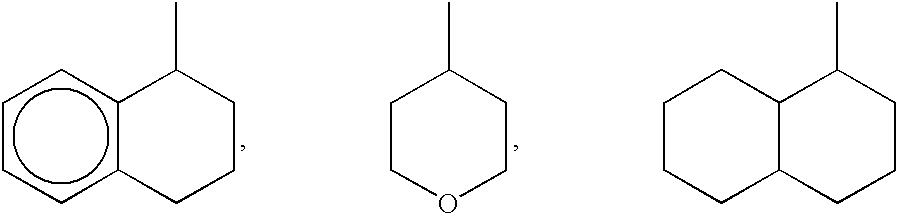
and the like.
In even more preferred embodiments of the invention, R1 is CH3 and R2 is a substituted phenyl. Preferably, the substituted phenyl is selected from the group consisting of, but not limited to: 
and the like.
Alternatively, R1 and R2 together form a ring structure or a substituted ring structure from 3 to 7 atoms total with 5 or 6 atoms being preferred. Preferably, the ring structure is substituted or unsubstituted carbocycle, substituted or unsubstituted heterocycle, or substituted or unsubstituted cyclohexyl. The substituted ring structure can comprise substituents including, but not limited to, halides, including fluorine, chlorine and bromine. A preferred compound having a ring structure formed by R1 and R2 comprises 
R3 is preferably selected from the group consisting of substituted and unsubstituted C1-C4 alkyl, substituted and unsubstituted C1-C4 alkenyl, substituted and unsubstituted C1-C4 alkynyl. More preferably, R3 is C3 alkenyl (-CH=CH-CH3), C5 alkenyl (—CH═CH—CH═CH—CH3), C2 alkynyl (—C≡CH), or C4 alkynyl (—≡C—C≡CH). Most preferably, R3 is CH3. The substituted alkyl, alkenyl, and alkynyl groups can comprise one or a plurality of substituents including, for example, F, D, or Cl.
In preferred embodiments of the invention, R3 is selected from the group consisting of C1-C4 alkyl, C1-C4 alkenyl, and C1-C4 alkynyl. In more preferred embodiments of the invention, R3 is CH3.
The present invention is also directed to methods of preparing electron acceptors of the invention. In a particularly preferred embodiment of the compound of Formula I, R3 is CH3, and the product can be prepared by the following steps depicted in Scheme I: a) providing an alkylvinylether, b) contacting the alkylvinylether with a strong base to form a first intermediate compound, c) contacting the first intermediate compound with a ketone to form a second intermediate compound, and d) reacting the second intermediate compound with dicyanomethane in the presence of a second base to form a compound having Formula I. 
Compounds having an R3 moiety other than CH3 can be prepared by substituting the appropriate starting compound as is well known to persons skilled in the art. Each of the above mentioned steps is described in greater detail below.
In preferred embodiments of the invention, an alkylvinylether in a solvent is the starting material. The solvent is, preferably, tetrahydrofuran (THF), 1,4-dioxane, or the like. Although the alkylvinylether depicted in Scheme I is ethylvinylether, other alkylvinylethers can be used. The alkylvinylether preferably comprises the formula CH3—(CH2)x—O—CH═CHR4, where x is 1-3 and R4 is H or C1-C4 alkyl. Most preferably, the alkylvinylether is methylvinylether or ethylvinylether.
The alkylvinylether is contacted with a strong base to form a first intermediate compound. Preferably, the strong base has a pKa greater than the ethylinic C-H bond α to the oxygen function of the alkylvinylether. For example, see Advanced Organic Chemistry, Third Ed., Jerry March, 1985, Table 1, pp. 220-222. In preferred embodiments of the invention, the strong base is an alkyl lithium, or an alkali metal salt of an alkyl anion, including, but not limited to, t-BuLi or sec-BuLi. The alkylvinylether is preferably contacted with the strong base between about −70° C. and −85° C., most preferably at about −78° C.
The first intermediate compound is contacted with a ketone and then an acid/alcohol/water solution to form a second intermediate compound. Numerous acid/alcohol/water solutions known to those skilled in the art can be used in the present invention. The acid/alcohol/water solution is preferably HCl/MeOH/H2O, HBr/EtOH/H2O, or H2SO4/EtOH/H2O. Preferably, the contacting is at room temperature. Preferably, the pH is adjusted between 1 and 4.
Preferably, the ketone comprises the formula 
wherein R1 can be substituted and unsubstituted C1-C10 alkyl, R2 can be substituted and unsubstituted C2-C10 alkyl, and R1 and R2 each, independently, can be selected from the group consisting of, substituted and unsubstituted C1-C10 alkyl, substituted and unsubstituted C1-C10 alkenyl, substituted and unsubstituted C1-C10 alkynyl, substituted and unsubstituted aryl, substituted and unsubstituted alkylaryl, substituted and unsubstituted carbocycles, substituted and unsubstituted heterocycles, substituted and unsubstituted cyclohexyl, and (CH2)n—O—(CH2)n where n is 1-10. Alternatively, R1 and R2 together form a ring structure or a substituted ring structure, as described above.
Preferably, the C═C and C≡C bonds of the alkenyl and alkynyl groups are not immediately adjacent the carbonyl group of the ketone compound.
The substituted alkyl, alkenyl, and alkynyl groups can comprise one or a plurality of substituents including, for example, fluorine, D, and chlorine.
The aryl groups preferably include, but are not limited to, fluorenyl, phenyl, and naphthyl. The aryl groups, carbocycle groups, heterocycle groups, and cyclohexyl can also be substituted by, for example, D, halides, including fluorine and chlorine. Preferably, the alkylaryl groups comprise C1-C10 alkyl and the substituted alkylaryl groups can comprise the substituents for the alkyl and aryl groups described above.
In more preferred embodiments of the invention, R1 and R2 each, independently, are selected from the group consisting of, cyclohexyl, phenyl, and substituted phenyl.
In even more preferred embodiments of the invention, R1 is CH3 and R2 is a substituted phenyl. Preferably, the substituted phenyl is selected from the following: 
Alternatively, R1 and R2 together form a ring structure or a substituted ring structure or a heterocyclic ring structure. Preferably, the ring structure is substituted or unsubstituted 5 or 6 member rings, including, but not limited to, 5 or 6 member heterocyclic rings and fluorenyl. The substituted ring structure can comprise substituents including, but not limited to, halides, including fluorine, chlorine and D.
The second intermediate compound is reacted with dicyanomethane in the presence of a second base at the appropriate temperature to form a compound having Formula I. The second base is preferably a metal alkoxide including, but not limited to, NaOC2H5, NaOH, KOH, and K2CO3. After contacting the second intermediate compound with dicyanomethane in the presence of a second base, dilute acid such as, for example, HCl, is added for neutralization of the resultant electron acceptor compound.
The invention is further illustrated by way of the following examples which are intended to elucidate the invention. These examples are not intended, nor are they to be construed, as limiting the scope of the disclosure.
To a solution of 0.33 mol of ethyl vinyl ether in 150 ml of dry THF, 0.3 mol of t-BuLi in pentane was added dropwise at −78° C. The mixture was stirred and allowed to warm up slowly 0° C. and subsequently cooled to −78° C. again. Next, 0.25 mol of cyclohexyl phenyl ketone dissolved in a minimum of dry THF was added dropwise. The mixture was stirred overnight at room temperature, then acidified using HCl/MeOH/THF/H2O solution to pH 1-4. After stirring this mixture for two hours, most of the solvent mixture was evaporated using a rotary evaporator. The rest of the mixture was extracted with ethyl ether (3×100 ml). The organic solution was washed with NaHCO3, brine, and DI water. This mixture was then dried over anhydrous MgSO4. After evaporating the ether, the cruded product was purified by column chromatography (5% ethyl acetate in hexane) to give pure alpha-hydroxy ketone (30 g).
The hydroxy ketone synthesized above (0.02 mol) was mixed with malononitrile (0.04 mol) in ethyl alcohol cooled in an ice bath. To this, 20 ml of 1 M NaOC2H5/EtOH was added dropwise. The mixture was allowed to stir overnight. After neutralization by concentrated HCl to pH 6, the solvent was evaporated by vacuum. The rest of the solid was dissolved into CH2Cl2 and filtered to remove the undissolved solid. After evaporating the CH2Cl2, the crude product was purified by recrystalization from ethanol to give the dicyanomethylenedihydrofuran compound (1.25 g).
Alternatively, and more preferably, the hydroxy ketone synthesized above (0.02 mol) was mixed with malononitrile (0.04 mol) and potassium carbonate (0.02 mol) in THF (40 ml) and EtOH (2 ml). To this mixture, a catalytic amount of 18-crown ether was added. The mixture was stirred and allowed to reflux overnight. The solid was filtered off, followed by evaporation of most of the solvent. The crude mixture was purified by colum chromatography (CH2Cl2) to give the dicyanomethylenedihydrofuran compound (1.5 g).
To a solution of ethyl vinyl ether (28.8 g in 300 ml of THF) was added 176 ml of t-BuLi dropwise at −78° C. The mixture was slowly warmed to 0° C. and subsequently cooled to −78° C. again. Cyclohexanone (30 g in 30 ml of THF) was added dropwise and the mixture was slowly warmed to room temperature and stirred for an additional four hours. A solution of methanol (70 ml), water (20 ml) and conc. HCl(10 ml) was slowly added until a pH of about 2-3 was obtained. The mixture was stirred overnight at room temperature and neutralized to pH 7 by addition of NaHCO3 and water and the solvent was evaporated. The residual solvent was extracted by ether (100 ml). The solid was washed with NaHCO3 (50 ml), brine (100 ml), and dried over MgSO4. Vacuum distillation of the intermediate yielded 36 g. The residue was dissolved in EtOH, CH2Cl2 extracted, and salt precipitated. The rest of the mixture was recrystallized from ethanol (150 ml) to give 6.1 g of the final compound.
To a solution of ethylvinylether (21.6 g in 300 ml of THF) was added 110 ml of t-BuLi dropwise at −78° C. The mixture was warmed to 0° C. and subsequently cooled to −78° C. again. 5′, 4′-dichloroacetophenone (30.5 g) was dissolved into 150 ml of THF and then added dropwise. This mixture was run overnight at room temperature. A solution of HCl (10 ml), methanol (70 ml), and water (20 ml) was added after the reaction was finished. The mixture was adjusted to pH 4 and allowed to stir overnight. NaHCO3 was added to neutralize this solution to about pH 7. The water phase was separated and the organic phase was evaporated to yield a solid. The residual solvent was extracted by ether (100 ml). The solid was washed with saturated NaHCO3 (50 ml), brine (100 ml), and dried over MgSO4. Vacuum distillation of the intermediate yielded 55 g. The residue was dissolved in EtOH, CH2Cl2 extracted, and salt precipitated. The rest of the mixture was recrystallized from ethanol (150 ml) to give 5.5 g of the final compound.
Although the invention has been described in detail for the purpose of illustration, it is understood that such detail is solely for that purpose, and variations can be made therein by those skilled in the art without departing from the spirit and scope of the invention which is defined by the following claims.
Claims (22)
1. A compound having Formula I: 
wherein:
R1 is a C1-C10 alkyl substituted with one or more substituents selected from the group consisting of fluorine and chlorine and wherein R2 is selected from the group consisting of substituted and unsubstituted C1-C10 alkyl, substituted and unsubstituted C2-C10 alkenyl, substituted and unsubstituted C2-C10 alkynyl, and (CH2)n—O—(CH2)n where n is 1-10; and
R3 is selected from the group consisting of substituted and unsubstituted C1-C4 alkyl, substituted and unsubstituted C1-C4 alkenyl, and substituted and unsubstituted C1-C4 alkynyl.
2. The compound of claim 1 , wherein R1 is a C1-C10 alkyl substituted with a plurality of fluorines and wherein R2 is an unsubstituted C1-C10 alkyl.
3. The compound of claim 1 , wherein R1 represents a C1-C10 alkyl substituted with one or more substituents selected from the group consisting of fluorine and chlorine and wherein R2 represents a different C1-C10 alkyl substituted with one or more substituents selected from the group consisting of fluorine and chlorine.
4. The compound of claim 1 , wherein R1 represents a C1-C10 alkyl substituted with a plurality of fluorines and wherein R2 represents a different C1-C10 alkyl substituted with a plurality of fluorines.
5. The compound of claim 1 , wherein R2 is an unsubstituted C1-C10 alkyl.
6. The compound of claim 1 , wherein R2 is an substituted C1-C10 alkyl.
7. The compound of claim 1 , wherein R2 is a substituted or unsubstituted C2-C10 alkenyl containing a sp2 hybridized carbon or a substituted or unsubstituted C2-C10 alkynyl containing a sp hybridized carbon; and wherein the sp2 or sp hybridized carbon is bonded directly to the * carbon via a single bond.
8. The compound of claim 1 , wherein the substituted or unsubstituted C2-C10 alkenyl is a substituted or unsubstituted C4-C10 alkenyl and wherein the substituted or unsubstituted C2-C10 alkynyl is a substituted or unsubstituted C4-C10 alkynyl.
9. The compound of claim 1 , wherein R2 is a substituted or unsubstituted C4-C10 alkenyl containing a sp2 hybridized carbon or a substituted or unsubstituted C4-C10 alkynyl containing a sp hybridized carbon; and wherein the sp2 or sp hybridized carbon is bonded directly to the * carbon via a single bond.
10. The compound of claim 1 , wherein, when R1 and/or R2 contains a sp2 or sp hybridized carbon, the sp2 or sp hybridized carbon is bonded directly to the * carbon via a single bond.
11. A method of preparing a compound according to claim 1 , said method comprising:
a) providing an alpha-hydroxy ketone having the formula: 
wherein R1 and R2 are defined as in claim 1 and wherein R4 is H or C1-C4 alkyl; and
b) reacting said alpha-hydroxy ketone with a dicyanomethane in the presence of a base to form a compound according to claim 1 .
12. The method of claim 11 , wherein the alpha-hydroxy ketone has the formula: 
13. The method of claim 11 , wherein R1 is a C1-C10 alkyl substituted with a plurality of fluorines and wherein R2 is an unsubstituted C1-C10 alkyl.
14. The method of claim 11 , wherein R1 represents a C1-C10 alkyl substituted with one or more substituents selected from the group consisting of fluorine and chlorine and wherein R2 represents a different C1-C10 alkyl substituted with one or more substituents selected from the group consisting of fluorine and chlorine.
15. The method of claim 11 , wherein R1 represents a C1-C10 alkyl substituted with a plurality of fluorines and wherein R2 represents a different C1-C10 alkyl substituted with a plurality of fluorines.
16. The method of claim 11 , wherein R2 is an unsubstituted C1-C10 alkyl.
17. The method of claim 11 , wherein R2 is an unsubstituted C1-C10 alkyl.
18. The method of claim 11 , wherein R2 is a substituted or unsubstituted C2-C10 alkenyl containing a sp2 hybridized carbon or a substituted or unsubstituted C2-C10 alkynyl containing a sp hybridized carbon; and wherein the sp2 or sp hybridized carbon is bonded directly to the * carbon via a single bond.
19. The method of claim 11 , wherein the substituted or unsubstituted C2-C10 alkenyl is a substituted or unsubstituted C4-C10 alkenyl and wherein the substituted or unsubstituted C2-C10 alkynyl is a substituted or unsubstituted C4-C10 alkynyl.
20. The method of claim 11 , wherein R2 is a substituted or unsubstituted C4-C10 alkenyl containing a sp2 hybridized carbon or a substituted or unsubstituted C4-C10 alkynyl containing a sp hybridized carbon; and wherein the sp2 or sp hybridized carbon is bonded directly to the * carbon via a single bond.
21. The method of claim 11 , wherein, when R1 and/or R2 contains a sp2 or sp hybridized carbon, the sp2 or sp hybridized carbon is bonded directly to the * carbon via a single bond.
22. The method of claim 11 , wherein said second base is a metal alkoxide.
Priority Applications (5)
| Application Number | Priority Date | Filing Date | Title |
|---|---|---|---|
| US09/675,967 US6444830B1 (en) | 2000-06-16 | 2000-09-29 | Electron acceptors for polymeric thin film waveguide media |
| PCT/US2001/015826 WO2001098287A1 (en) | 2000-06-16 | 2001-05-16 | Novel electron acceptors for polymeric thin film waveguide media |
| EP01935588A EP1289978B1 (en) | 2000-06-16 | 2001-05-16 | Novel electron acceptors for polymeric thin film waveguide media |
| EP06075134A EP1666475B1 (en) | 2000-06-16 | 2001-05-16 | Elektronenakzeptoren für Polymere Dünnschicht-Wellenleitermedien |
| AU2001261668A AU2001261668A1 (en) | 2000-06-16 | 2001-05-16 | Novel electron acceptors for polymeric thin film waveguide media |
Applications Claiming Priority (2)
| Application Number | Priority Date | Filing Date | Title |
|---|---|---|---|
| US09/596,069 US6448416B1 (en) | 2000-06-16 | 2000-06-16 | Electron acceptors for polymeric thin film waveguide media |
| US09/675,967 US6444830B1 (en) | 2000-06-16 | 2000-09-29 | Electron acceptors for polymeric thin film waveguide media |
Related Parent Applications (1)
| Application Number | Title | Priority Date | Filing Date |
|---|---|---|---|
| US09/596,069 Continuation-In-Part US6448416B1 (en) | 2000-06-16 | 2000-06-16 | Electron acceptors for polymeric thin film waveguide media |
Publications (1)
| Publication Number | Publication Date |
|---|---|
| US6444830B1 true US6444830B1 (en) | 2002-09-03 |
Family
ID=27082453
Family Applications (1)
| Application Number | Title | Priority Date | Filing Date |
|---|---|---|---|
| US09/675,967 Expired - Lifetime US6444830B1 (en) | 2000-06-16 | 2000-09-29 | Electron acceptors for polymeric thin film waveguide media |
Country Status (4)
| Country | Link |
|---|---|
| US (1) | US6444830B1 (en) |
| EP (2) | EP1289978B1 (en) |
| AU (1) | AU2001261668A1 (en) |
| WO (1) | WO2001098287A1 (en) |
Cited By (11)
| Publication number | Priority date | Publication date | Assignee | Title |
|---|---|---|---|---|
| US20040135130A1 (en) * | 2003-01-15 | 2004-07-15 | University Of Washington | Nonlinear optical compounds and methods for their preparation |
| US20050179013A1 (en) * | 2000-07-24 | 2005-08-18 | University Of Washington | Hyperpolarizable organic chromophores |
| US7425643B1 (en) | 2004-01-26 | 2008-09-16 | University Of Washington | Electron acceptors for nonlinear optical chromophores |
| US20090148717A1 (en) * | 2007-12-07 | 2009-06-11 | Washington, University Of | Crosslinkable polymer host having pendant nonlinear optical chromophores and containing a nonlinear optical chromophore guest |
| US20090149618A1 (en) * | 2007-12-07 | 2009-06-11 | Washington, University Of | Crosslinkable polymer host containing a nonlinear optical chromophore guest |
| EP2308882A1 (en) | 2004-09-14 | 2011-04-13 | Corning Incorporated | Fused thiophenes and uses thereof |
| US11921401B2 (en) | 2020-06-25 | 2024-03-05 | Lightwave Logic, Inc. | Nonlinear optical chromophores having a diamondoid group attached thereto, methods of preparing the same, and uses thereof |
| US11927868B2 (en) | 2018-09-17 | 2024-03-12 | Lightwave Logic, Inc. | Electro-optic polymer devices having high performance claddings, and methods of preparing the same |
| US11976232B2 (en) | 2021-12-10 | 2024-05-07 | Lightwave Logic, Inc. | Nonlinear optical chromophores having tetrahydrocarbazole donor groups, lyotropic compositions containing the same, and methods of poling such compositions |
| US12043628B2 (en) | 2017-10-03 | 2024-07-23 | Lightwave Logic, Inc. | Nonlinear optical chromophores, nonlinear optical materials containing the same, and uses thereof in optical devices |
| US12565587B2 (en) | 2022-01-05 | 2026-03-03 | Lightwave Logic, Inc. | Nonlinear optical chromophores having short-chain bridge structures, low optical loss materials containing the same, and methods for preparing the same |
Families Citing this family (1)
| Publication number | Priority date | Publication date | Assignee | Title |
|---|---|---|---|---|
| US7723462B2 (en) | 2006-05-03 | 2010-05-25 | Corning Incorporated | Mercaptofunctional high mubeta EO chromophores and high Tg, low optical loss, covalently bonded, high mubeta EO chromophore containing polymers and methods of synthesizing EO materials |
Citations (15)
| Publication number | Priority date | Publication date | Assignee | Title |
|---|---|---|---|---|
| US4767169A (en) | 1987-02-26 | 1988-08-30 | Hoechst Celanese Corporation | Thin film waveguide electrooptic modulator |
| US4795664A (en) | 1986-01-24 | 1989-01-03 | Hoechst Celanese Corp. | Side chain liquid crystalline condensation polymers exhibiting nonlinear optical response |
| US4810338A (en) | 1986-01-24 | 1989-03-07 | Hoecast Celanese Corp. | Side chain liquid crystalline polymers exhibiting nonlinear optical response |
| US4936645A (en) | 1989-08-24 | 1990-06-26 | Hoechst Celanese Corp. | Waveguide electrooptic light modulator with low optical loss |
| US5006285A (en) | 1988-07-28 | 1991-04-09 | Lockheed Missiles & Space Company, Inc. | Electro-optic channel waveguide |
| US5044725A (en) | 1986-01-24 | 1991-09-03 | Hoechst Celanese Corp. | Polymeric thin film waveguide media |
| US5106211A (en) | 1991-02-14 | 1992-04-21 | Hoechst Celanese Corp. | Formation of polymer channel waveguides by excimer laser ablation and method of making same |
| US5133037A (en) | 1991-06-07 | 1992-07-21 | Hoechst Celanese Corp | Polymeric optical modulator and waveguiding media |
| US5170461A (en) | 1991-12-11 | 1992-12-08 | Hoechst Celanese Corp. | Polymeric electrooptic waveguide devices using a polymeric substrate |
| US5187234A (en) | 1990-10-23 | 1993-02-16 | Hoechst Celanese Corp. | Vinyl polymers exhibiting nonlinear optical response |
| US5196509A (en) | 1991-03-25 | 1993-03-23 | Hoechst Celanese Corp. | Side chain condensation polymer which exhibits nonlinear optical response |
| US5247042A (en) | 1989-09-11 | 1993-09-21 | Hoechst Celanese Corp. | Isotropic acrylic polymer exhibiting nonlinear optical response |
| US5326661A (en) | 1991-11-13 | 1994-07-05 | Hoechst Celanese Corp. | Photorefractive polymers containing discrete photoconductive and electrooptical units |
| WO1998056749A1 (en) | 1997-06-10 | 1998-12-17 | Minnesota Mining And Manufacturing Company | Halogenated acrylates and polymers derived therefrom |
| US6067186A (en) | 1998-07-27 | 2000-05-23 | Pacific Wave Industries, Inc. | Class of high hyperpolarizability organic chromophores and process for synthesizing the same |
Family Cites Families (2)
| Publication number | Priority date | Publication date | Assignee | Title |
|---|---|---|---|---|
| US6348992B1 (en) * | 1998-07-27 | 2002-02-19 | Pacific Wave Industries, Inc. | Sterically stabilized polyene-bridged second-order nonlinear optical chromophores and devices incorporating the same |
| US6616865B1 (en) * | 1998-07-27 | 2003-09-09 | Pacific Wave Industries, Inc. | Sterically stabilized second-order nonlinear optical chromophores with improved stability and devices incorporating the same |
-
2000
- 2000-09-29 US US09/675,967 patent/US6444830B1/en not_active Expired - Lifetime
-
2001
- 2001-05-16 EP EP01935588A patent/EP1289978B1/en not_active Expired - Lifetime
- 2001-05-16 EP EP06075134A patent/EP1666475B1/en not_active Expired - Lifetime
- 2001-05-16 AU AU2001261668A patent/AU2001261668A1/en not_active Abandoned
- 2001-05-16 WO PCT/US2001/015826 patent/WO2001098287A1/en not_active Ceased
Patent Citations (15)
| Publication number | Priority date | Publication date | Assignee | Title |
|---|---|---|---|---|
| US4795664A (en) | 1986-01-24 | 1989-01-03 | Hoechst Celanese Corp. | Side chain liquid crystalline condensation polymers exhibiting nonlinear optical response |
| US4810338A (en) | 1986-01-24 | 1989-03-07 | Hoecast Celanese Corp. | Side chain liquid crystalline polymers exhibiting nonlinear optical response |
| US5044725A (en) | 1986-01-24 | 1991-09-03 | Hoechst Celanese Corp. | Polymeric thin film waveguide media |
| US4767169A (en) | 1987-02-26 | 1988-08-30 | Hoechst Celanese Corporation | Thin film waveguide electrooptic modulator |
| US5006285A (en) | 1988-07-28 | 1991-04-09 | Lockheed Missiles & Space Company, Inc. | Electro-optic channel waveguide |
| US4936645A (en) | 1989-08-24 | 1990-06-26 | Hoechst Celanese Corp. | Waveguide electrooptic light modulator with low optical loss |
| US5247042A (en) | 1989-09-11 | 1993-09-21 | Hoechst Celanese Corp. | Isotropic acrylic polymer exhibiting nonlinear optical response |
| US5187234A (en) | 1990-10-23 | 1993-02-16 | Hoechst Celanese Corp. | Vinyl polymers exhibiting nonlinear optical response |
| US5106211A (en) | 1991-02-14 | 1992-04-21 | Hoechst Celanese Corp. | Formation of polymer channel waveguides by excimer laser ablation and method of making same |
| US5196509A (en) | 1991-03-25 | 1993-03-23 | Hoechst Celanese Corp. | Side chain condensation polymer which exhibits nonlinear optical response |
| US5133037A (en) | 1991-06-07 | 1992-07-21 | Hoechst Celanese Corp | Polymeric optical modulator and waveguiding media |
| US5326661A (en) | 1991-11-13 | 1994-07-05 | Hoechst Celanese Corp. | Photorefractive polymers containing discrete photoconductive and electrooptical units |
| US5170461A (en) | 1991-12-11 | 1992-12-08 | Hoechst Celanese Corp. | Polymeric electrooptic waveguide devices using a polymeric substrate |
| WO1998056749A1 (en) | 1997-06-10 | 1998-12-17 | Minnesota Mining And Manufacturing Company | Halogenated acrylates and polymers derived therefrom |
| US6067186A (en) | 1998-07-27 | 2000-05-23 | Pacific Wave Industries, Inc. | Class of high hyperpolarizability organic chromophores and process for synthesizing the same |
Non-Patent Citations (9)
Cited By (21)
| Publication number | Priority date | Publication date | Assignee | Title |
|---|---|---|---|---|
| US20050179013A1 (en) * | 2000-07-24 | 2005-08-18 | University Of Washington | Hyperpolarizable organic chromophores |
| US7507840B2 (en) | 2000-07-24 | 2009-03-24 | University Of Washington | Acceptor compounds useful for making hyperpolarizable organic chromophores |
| US7014796B2 (en) * | 2003-01-15 | 2006-03-21 | University Of Washington | Nonlinear optical compounds and methods for their preparation |
| US20040135130A1 (en) * | 2003-01-15 | 2004-07-15 | University Of Washington | Nonlinear optical compounds and methods for their preparation |
| US7425643B1 (en) | 2004-01-26 | 2008-09-16 | University Of Washington | Electron acceptors for nonlinear optical chromophores |
| EP2308882A1 (en) | 2004-09-14 | 2011-04-13 | Corning Incorporated | Fused thiophenes and uses thereof |
| US20090149618A1 (en) * | 2007-12-07 | 2009-06-11 | Washington, University Of | Crosslinkable polymer host containing a nonlinear optical chromophore guest |
| US8394499B2 (en) | 2007-12-07 | 2013-03-12 | University Of Washington | Crosslinkable polymer host having pendant nonlinear optical chromophores and containing a nonlinear optical chromophore guest |
| US8409713B2 (en) | 2007-12-07 | 2013-04-02 | University Of Washington | Crosslinkable polymer host containing a nonlinear optical chromophore guest |
| US20090148717A1 (en) * | 2007-12-07 | 2009-06-11 | Washington, University Of | Crosslinkable polymer host having pendant nonlinear optical chromophores and containing a nonlinear optical chromophore guest |
| US12286438B2 (en) | 2017-10-03 | 2025-04-29 | Lightwave Logic, Inc. | Nonlinear optical chromophores, nonlinear optical materials containing the same, and uses thereof in optical devices |
| US12043628B2 (en) | 2017-10-03 | 2024-07-23 | Lightwave Logic, Inc. | Nonlinear optical chromophores, nonlinear optical materials containing the same, and uses thereof in optical devices |
| US11927868B2 (en) | 2018-09-17 | 2024-03-12 | Lightwave Logic, Inc. | Electro-optic polymer devices having high performance claddings, and methods of preparing the same |
| US12547041B2 (en) | 2018-09-17 | 2026-02-10 | Lightwave Logic, Inc. | Electro-optic polymer devices having high performance claddings, and methods of preparing the same |
| US11921401B2 (en) | 2020-06-25 | 2024-03-05 | Lightwave Logic, Inc. | Nonlinear optical chromophores having a diamondoid group attached thereto, methods of preparing the same, and uses thereof |
| US12228840B2 (en) | 2020-06-25 | 2025-02-18 | Lightwave Logic, Inc. | Nonlinear optical chromophores having a diamondoid group attached thereto, methods of preparing the same, and uses thereof |
| US12259633B2 (en) | 2020-06-25 | 2025-03-25 | Lightwave Logic, Inc. | Nonlinear optical chromophores having a diamondoid group attached thereto, methods of preparing the same, and uses thereof |
| US12498617B2 (en) | 2020-06-25 | 2025-12-16 | Lightwave Logic, Inc. | Nonlinear optical chromophores having a diamondoid group attached thereto, methods of preparing the same, and uses thereof |
| US12173217B2 (en) | 2021-12-10 | 2024-12-24 | Lightwave Logic, Inc. | Nonlinear optical chromophores having tetrahydrocarbazole donor groups, lyotropic compositions containing the same, and methods of poling such compositions |
| US11976232B2 (en) | 2021-12-10 | 2024-05-07 | Lightwave Logic, Inc. | Nonlinear optical chromophores having tetrahydrocarbazole donor groups, lyotropic compositions containing the same, and methods of poling such compositions |
| US12565587B2 (en) | 2022-01-05 | 2026-03-03 | Lightwave Logic, Inc. | Nonlinear optical chromophores having short-chain bridge structures, low optical loss materials containing the same, and methods for preparing the same |
Also Published As
| Publication number | Publication date |
|---|---|
| EP1289978B1 (en) | 2006-08-02 |
| AU2001261668A1 (en) | 2002-01-02 |
| EP1666475A1 (en) | 2006-06-07 |
| EP1289978A1 (en) | 2003-03-12 |
| EP1666475B1 (en) | 2009-11-11 |
| EP1289978A4 (en) | 2004-06-30 |
| WO2001098287A1 (en) | 2001-12-27 |
Similar Documents
| Publication | Publication Date | Title |
|---|---|---|
| US6584266B1 (en) | Chromophores for polymeric thin films and optical waveguides and devices comprising the same | |
| US6448416B1 (en) | Electron acceptors for polymeric thin film waveguide media | |
| US6444830B1 (en) | Electron acceptors for polymeric thin film waveguide media | |
| US6514434B1 (en) | Electro-optic chromophore bridge compounds and donor-bridge compounds for polymeric thin film waveguides | |
| US4977264A (en) | Process for the production of 4,5-dichloro-6-ethylpyrimidine | |
| US6174455B1 (en) | Liquid crystalline compounds and process for producing the same | |
| WO2001098310A1 (en) | Novel chromophores for polymeric thin films and optical waveguides and devices comprising the same | |
| KR19990014130A (en) | Method for preparing 1-aminopyrrolidine and 1-aminopyrrolidine prepared therefrom | |
| JP3810858B2 (en) | Process for producing 4-trifluoromethylnicotinic acid | |
| CN103664843B (en) | organic electro-optic chromophore and synthetic method thereof | |
| JPS63239275A (en) | Phenylpyrimidine derivative having substituted fluoroalkyl group | |
| JP2000256663A (en) | Light-induced phase change organic materials | |
| EP0496884B1 (en) | Pyrrole monomer, process for preparing the same, and functional polymer film | |
| CN119874574B (en) | A triarylethylene solid photochromic dye and its crystal preparation | |
| JP2002097170A (en) | Method for producing aromatic carboxylic acid and method for producing aromatic aldehyde | |
| JP2876531B1 (en) | 1,8-bis (substituted ethyl) naphthalene compound and method for producing the same | |
| JPS59222430A (en) | Fluorocyclopropane derivative | |
| JP2508790B2 (en) | 1-biphenylylethanol derivative and process for producing the same | |
| EP1174411A2 (en) | Process for the preparation of aromatic carboxylic acid | |
| US6720039B1 (en) | Liquid crystalline compounds and process for producing the same | |
| JP3398185B2 (en) | Polymer nonlinear optical material | |
| JP3837463B2 (en) | Second-order nonlinear optical material | |
| JPS58113168A (en) | Production of 5-(1-carboxyethyl)-2-phenylthiophenyl- acetic acid | |
| JPH05331136A (en) | Pyrrole derivative and method for producing the same | |
| JPH05125016A (en) | Liquid crystal intermediate and manufacturing method thereof |
Legal Events
| Date | Code | Title | Description |
|---|---|---|---|
| AS | Assignment |
Owner name: CORNING INCORPORATED, NEW YORK Free format text: ASSIGNMENT OF ASSIGNORS INTEREST;ASSIGNORS:HE, MINGQIAN;LESLIE, THOMAS M.;REEL/FRAME:011180/0087 Effective date: 20000928 |
|
| STCF | Information on status: patent grant |
Free format text: PATENTED CASE |
|
| FPAY | Fee payment |
Year of fee payment: 4 |
|
| FPAY | Fee payment |
Year of fee payment: 8 |
|
| FPAY | Fee payment |
Year of fee payment: 12 |