US6402828B1 - Azo lake pigment composition - Google Patents
Azo lake pigment composition Download PDFInfo
- Publication number
- US6402828B1 US6402828B1 US09/503,265 US50326500A US6402828B1 US 6402828 B1 US6402828 B1 US 6402828B1 US 50326500 A US50326500 A US 50326500A US 6402828 B1 US6402828 B1 US 6402828B1
- Authority
- US
- United States
- Prior art keywords
- formula
- group
- pigment
- alkoxy
- hydrogen
- Prior art date
- Legal status (The legal status is an assumption and is not a legal conclusion. Google has not performed a legal analysis and makes no representation as to the accuracy of the status listed.)
- Expired - Fee Related
Links
- 239000000049 pigment Substances 0.000 title claims abstract description 65
- 239000000203 mixture Substances 0.000 title claims abstract description 44
- 238000005859 coupling reaction Methods 0.000 claims abstract description 23
- 230000008878 coupling Effects 0.000 claims abstract description 22
- 238000010168 coupling process Methods 0.000 claims abstract description 22
- ALKYHXVLJMQRLQ-UHFFFAOYSA-N 3-Hydroxy-2-naphthoate Chemical compound C1=CC=C2C=C(O)C(C(=O)O)=CC2=C1 ALKYHXVLJMQRLQ-UHFFFAOYSA-N 0.000 claims abstract description 17
- 229910052739 hydrogen Inorganic materials 0.000 claims description 25
- 239000001257 hydrogen Substances 0.000 claims description 25
- 238000000034 method Methods 0.000 claims description 17
- 125000000229 (C1-C4)alkoxy group Chemical group 0.000 claims description 16
- 125000004178 (C1-C4) alkyl group Chemical group 0.000 claims description 13
- 150000001412 amines Chemical class 0.000 claims description 13
- 125000000449 nitro group Chemical group [O-][N+](*)=O 0.000 claims description 11
- 229910052751 metal Inorganic materials 0.000 claims description 10
- 239000002184 metal Substances 0.000 claims description 10
- 125000001997 phenyl group Chemical group [H]C1=C([H])C([H])=C(*)C([H])=C1[H] 0.000 claims description 10
- GWIAAIUASRVOIA-UHFFFAOYSA-N 2-aminonaphthalene-1-sulfonic acid Chemical compound C1=CC=CC2=C(S(O)(=O)=O)C(N)=CC=C21 GWIAAIUASRVOIA-UHFFFAOYSA-N 0.000 claims description 9
- OYPRJOBELJOOCE-UHFFFAOYSA-N Calcium Chemical compound [Ca] OYPRJOBELJOOCE-UHFFFAOYSA-N 0.000 claims description 9
- FYYHWMGAXLPEAU-UHFFFAOYSA-N Magnesium Chemical compound [Mg] FYYHWMGAXLPEAU-UHFFFAOYSA-N 0.000 claims description 9
- PWHULOQIROXLJO-UHFFFAOYSA-N Manganese Chemical compound [Mn] PWHULOQIROXLJO-UHFFFAOYSA-N 0.000 claims description 9
- 229910052788 barium Inorganic materials 0.000 claims description 9
- DSAJWYNOEDNPEQ-UHFFFAOYSA-N barium atom Chemical compound [Ba] DSAJWYNOEDNPEQ-UHFFFAOYSA-N 0.000 claims description 9
- 229910052791 calcium Inorganic materials 0.000 claims description 9
- 239000011575 calcium Substances 0.000 claims description 9
- 229910052736 halogen Inorganic materials 0.000 claims description 9
- 150000002367 halogens Chemical class 0.000 claims description 9
- 150000002431 hydrogen Chemical class 0.000 claims description 9
- 229910052749 magnesium Inorganic materials 0.000 claims description 9
- 239000011777 magnesium Substances 0.000 claims description 9
- 239000011572 manganese Substances 0.000 claims description 9
- 229910052748 manganese Inorganic materials 0.000 claims description 9
- 229910052712 strontium Inorganic materials 0.000 claims description 9
- CIOAGBVUUVVLOB-UHFFFAOYSA-N strontium atom Chemical compound [Sr] CIOAGBVUUVVLOB-UHFFFAOYSA-N 0.000 claims description 9
- 125000002023 trifluoromethyl group Chemical group FC(F)(F)* 0.000 claims description 9
- UFHFLCQGNIYNRP-UHFFFAOYSA-N Hydrogen Chemical compound [H][H] UFHFLCQGNIYNRP-UHFFFAOYSA-N 0.000 claims description 8
- 229910052782 aluminium Inorganic materials 0.000 claims description 8
- XAGFODPZIPBFFR-UHFFFAOYSA-N aluminium Chemical compound [Al] XAGFODPZIPBFFR-UHFFFAOYSA-N 0.000 claims description 8
- 150000001768 cations Chemical group 0.000 claims description 8
- 125000004435 hydrogen atom Chemical group [H]* 0.000 claims description 8
- 125000003178 carboxy group Chemical group [H]OC(*)=O 0.000 claims description 7
- 125000002496 methyl group Chemical group [H]C([H])([H])* 0.000 claims description 5
- 239000000843 powder Substances 0.000 claims description 5
- 238000004519 manufacturing process Methods 0.000 claims description 2
- 229910006069 SO3H Inorganic materials 0.000 claims 7
- XLYOFNOQVPJJNP-UHFFFAOYSA-N water Substances O XLYOFNOQVPJJNP-UHFFFAOYSA-N 0.000 abstract description 25
- -1 aromatic diazonium compound Chemical class 0.000 abstract description 7
- 238000011065 in-situ storage Methods 0.000 abstract description 2
- HEMHJVSKTPXQMS-UHFFFAOYSA-M Sodium hydroxide Chemical compound [OH-].[Na+] HEMHJVSKTPXQMS-UHFFFAOYSA-M 0.000 description 39
- 239000000243 solution Substances 0.000 description 31
- 238000003756 stirring Methods 0.000 description 30
- 239000000725 suspension Substances 0.000 description 19
- VEXZGXHMUGYJMC-UHFFFAOYSA-N Hydrochloric acid Chemical compound Cl VEXZGXHMUGYJMC-UHFFFAOYSA-N 0.000 description 17
- LPXPTNMVRIOKMN-UHFFFAOYSA-M sodium nitrite Chemical compound [Na+].[O-]N=O LPXPTNMVRIOKMN-UHFFFAOYSA-M 0.000 description 16
- 125000000664 diazo group Chemical group [N-]=[N+]=[*] 0.000 description 13
- 239000000976 ink Substances 0.000 description 11
- 230000000052 comparative effect Effects 0.000 description 10
- UXVMQQNJUSDDNG-UHFFFAOYSA-L Calcium chloride Chemical compound [Cl-].[Cl-].[Ca+2] UXVMQQNJUSDDNG-UHFFFAOYSA-L 0.000 description 8
- 239000001110 calcium chloride Substances 0.000 description 8
- 229910001628 calcium chloride Inorganic materials 0.000 description 8
- 239000011347 resin Substances 0.000 description 8
- 229920005989 resin Polymers 0.000 description 8
- 235000010288 sodium nitrite Nutrition 0.000 description 8
- LTPSRQRIPCVMKQ-UHFFFAOYSA-N 2-amino-5-methylbenzenesulfonic acid Chemical compound CC1=CC=C(N)C(S(O)(=O)=O)=C1 LTPSRQRIPCVMKQ-UHFFFAOYSA-N 0.000 description 5
- 239000002002 slurry Substances 0.000 description 5
- 0 *OC(=O)C1=CC2=C(C=CC=C2)C(/N=N/C2=CC=C(C)C=C2)=C1O.C.CC.CC.CC.CS(=O)(=O)O Chemical compound *OC(=O)C1=CC2=C(C=CC=C2)C(/N=N/C2=CC=C(C)C=C2)=C1O.C.CC.CC.CC.CS(=O)(=O)O 0.000 description 4
- VRLPHBSFRWMMPW-UHFFFAOYSA-N 2-amino-4-chloro-5-methylbenzenesulfonic acid Chemical compound CC1=CC(S(O)(=O)=O)=C(N)C=C1Cl VRLPHBSFRWMMPW-UHFFFAOYSA-N 0.000 description 3
- RSWGJHLUYNHPMX-UHFFFAOYSA-N Abietic-Saeure Chemical class C12CCC(C(C)C)=CC2=CCC2C1(C)CCCC2(C)C(O)=O RSWGJHLUYNHPMX-UHFFFAOYSA-N 0.000 description 3
- KHPCPRHQVVSZAH-HUOMCSJISA-N Rosin Chemical class O(C/C=C/c1ccccc1)[C@H]1[C@H](O)[C@@H](O)[C@@H](O)[C@@H](CO)O1 KHPCPRHQVVSZAH-HUOMCSJISA-N 0.000 description 3
- 239000002253 acid Substances 0.000 description 3
- 239000004411 aluminium Substances 0.000 description 3
- 238000010438 heat treatment Methods 0.000 description 3
- 239000003973 paint Substances 0.000 description 3
- 150000003839 salts Chemical class 0.000 description 3
- KHPCPRHQVVSZAH-UHFFFAOYSA-N trans-cinnamyl beta-D-glucopyranoside Chemical class OC1C(O)C(O)C(CO)OC1OCC=CC1=CC=CC=C1 KHPCPRHQVVSZAH-UHFFFAOYSA-N 0.000 description 3
- MVBZEUDTTYLRTM-UHFFFAOYSA-N *.C.CC.CC.CC.CC1=CC=C(N=NC2=C(O)C(C)=CC3=CC=CC=C32)C=C1.CS(=O)(=O)O Chemical compound *.C.CC.CC.CC.CC1=CC=C(N=NC2=C(O)C(C)=CC3=CC=CC=C32)C=C1.CS(=O)(=O)O MVBZEUDTTYLRTM-UHFFFAOYSA-N 0.000 description 2
- BTXXTMOWISPQSJ-UHFFFAOYSA-N 4,4,4-trifluorobutan-2-one Chemical class CC(=O)CC(F)(F)F BTXXTMOWISPQSJ-UHFFFAOYSA-N 0.000 description 2
- PHRVUZBVVPSWRO-UHFFFAOYSA-N C.CC1=CC2=C(C=CC=C2)C(N=NC2=C(C)C(C)=C(C)C(C)=C2C)=C1O Chemical compound C.CC1=CC2=C(C=CC=C2)C(N=NC2=C(C)C(C)=C(C)C(C)=C2C)=C1O PHRVUZBVVPSWRO-UHFFFAOYSA-N 0.000 description 2
- YFVYXCPSEFVZDG-UHFFFAOYSA-N C.CC1=CC2=C(C=CC=C2)C(N=NC2=C(C)C(C)=C(C)C(C)=C2C)=C1O.II Chemical compound C.CC1=CC2=C(C=CC=C2)C(N=NC2=C(C)C(C)=C(C)C(C)=C2C)=C1O.II YFVYXCPSEFVZDG-UHFFFAOYSA-N 0.000 description 2
- FXZJWBHKRVJXTH-UHFFFAOYSA-N CC.CC.CC.CC1=CC=C(C)C=C1.CS(=O)(=O)O Chemical compound CC.CC.CC.CC1=CC=C(C)C=C1.CS(=O)(=O)O FXZJWBHKRVJXTH-UHFFFAOYSA-N 0.000 description 2
- DYQIIIPSLAWLIB-UHFFFAOYSA-M CC1=C(C)C(C)=C(C)C(C)=C1C.[V]I Chemical compound CC1=C(C)C(C)=C(C)C(C)=C1C.[V]I DYQIIIPSLAWLIB-UHFFFAOYSA-M 0.000 description 2
- DCBKKCYNUSINPI-UHFFFAOYSA-N CC1=C(C)C(C)=C(N)C(C)=C1C Chemical compound CC1=C(C)C(C)=C(N)C(C)=C1C DCBKKCYNUSINPI-UHFFFAOYSA-N 0.000 description 2
- OXFXSELOMHLHJG-UHFFFAOYSA-N CC1=CC2=C(C=CC=C2)C(N=NC2=CC(C)=C(C)C=C2)=C1O.CS(=O)(=O)O Chemical compound CC1=CC2=C(C=CC=C2)C(N=NC2=CC(C)=C(C)C=C2)=C1O.CS(=O)(=O)O OXFXSELOMHLHJG-UHFFFAOYSA-N 0.000 description 2
- MFOYJNFJZQNCRY-UHFFFAOYSA-N CC1=CC=C(N=NC2=C(O)C(C)=CC3=C2C=CC=C3)C=C1.COC Chemical compound CC1=CC=C(N=NC2=C(O)C(C)=CC3=C2C=CC=C3)C=C1.COC MFOYJNFJZQNCRY-UHFFFAOYSA-N 0.000 description 2
- YPQGUXIYEWTCMZ-UHFFFAOYSA-N [H]C1=C(O)C(C)=CC2=C1C=CC=C2.[V] Chemical compound [H]C1=C(O)C(C)=CC2=C1C=CC=C2.[V] YPQGUXIYEWTCMZ-UHFFFAOYSA-N 0.000 description 2
- 150000001408 amides Chemical class 0.000 description 2
- 239000007864 aqueous solution Substances 0.000 description 2
- 235000010290 biphenyl Nutrition 0.000 description 2
- 125000001309 chloro group Chemical group Cl* 0.000 description 2
- ZUOUZKKEUPVFJK-UHFFFAOYSA-N diphenyl Chemical class C1=CC=CC=C1C1=CC=CC=C1 ZUOUZKKEUPVFJK-UHFFFAOYSA-N 0.000 description 2
- 230000000694 effects Effects 0.000 description 2
- 150000002148 esters Chemical class 0.000 description 2
- 238000002156 mixing Methods 0.000 description 2
- 239000003921 oil Substances 0.000 description 2
- 239000002245 particle Substances 0.000 description 2
- 239000004033 plastic Substances 0.000 description 2
- 229920003023 plastic Polymers 0.000 description 2
- 238000002360 preparation method Methods 0.000 description 2
- 239000002966 varnish Substances 0.000 description 2
- DVWQNBIUTWDZMW-UHFFFAOYSA-N 1-naphthalen-1-ylnaphthalen-2-ol Chemical group C1=CC=C2C(C3=C4C=CC=CC4=CC=C3O)=CC=CC2=C1 DVWQNBIUTWDZMW-UHFFFAOYSA-N 0.000 description 1
- WTFUTSCZYYCBAY-SXBRIOAWSA-N 6-[(E)-C-[[4-[2-(2,3-dihydro-1H-inden-2-ylamino)pyrimidin-5-yl]piperazin-1-yl]methyl]-N-hydroxycarbonimidoyl]-3H-1,3-benzoxazol-2-one Chemical compound C1C(CC2=CC=CC=C12)NC1=NC=C(C=N1)N1CCN(CC1)C/C(=N/O)/C1=CC2=C(NC(O2)=O)C=C1 WTFUTSCZYYCBAY-SXBRIOAWSA-N 0.000 description 1
- PAYRUJLWNCNPSJ-UHFFFAOYSA-N Aniline Chemical compound NC1=CC=CC=C1 PAYRUJLWNCNPSJ-UHFFFAOYSA-N 0.000 description 1
- BQVZDEUQESXUOD-UHFFFAOYSA-N CC.CC.CC.CC.CC1=CC=C(N)C=C1 Chemical compound CC.CC.CC.CC.CC1=CC=C(N)C=C1 BQVZDEUQESXUOD-UHFFFAOYSA-N 0.000 description 1
- MSEFBVWDKLQIEH-UHFFFAOYSA-N CC.CC.CC.CC1=CC=C(N)C=C1.CS(=O)(=O)O Chemical compound CC.CC.CC.CC1=CC=C(N)C=C1.CS(=O)(=O)O MSEFBVWDKLQIEH-UHFFFAOYSA-N 0.000 description 1
- XUHXTWHWRXBIRV-UHFFFAOYSA-N CC1=CC2=C(C=CC=C2)C(N=NC2=C(C)C(C)=C(C)C(C)=C2C)=C1O Chemical compound CC1=CC2=C(C=CC=C2)C(N=NC2=C(C)C(C)=C(C)C(C)=C2C)=C1O XUHXTWHWRXBIRV-UHFFFAOYSA-N 0.000 description 1
- ZFBLJAUGNVZZEB-UHFFFAOYSA-N CC1=CC2=C(C=CC=C2)C(N=NC2=C(C)C(C)=C(C)C(C)=C2C)=C1O.II Chemical compound CC1=CC2=C(C=CC=C2)C(N=NC2=C(C)C(C)=C(C)C(C)=C2C)=C1O.II ZFBLJAUGNVZZEB-UHFFFAOYSA-N 0.000 description 1
- ULUAUXLGCMPNKK-UHFFFAOYSA-N Sulfobutanedioic acid Chemical compound OC(=O)CC(C(O)=O)S(O)(=O)=O ULUAUXLGCMPNKK-UHFFFAOYSA-N 0.000 description 1
- 239000000654 additive Substances 0.000 description 1
- 230000000996 additive effect Effects 0.000 description 1
- 125000001931 aliphatic group Chemical group 0.000 description 1
- 159000000013 aluminium salts Chemical class 0.000 description 1
- 239000003945 anionic surfactant Substances 0.000 description 1
- 150000004982 aromatic amines Chemical class 0.000 description 1
- 239000004305 biphenyl Substances 0.000 description 1
- 150000004074 biphenyls Chemical class 0.000 description 1
- 159000000007 calcium salts Chemical class 0.000 description 1
- 239000003093 cationic surfactant Substances 0.000 description 1
- 239000003086 colorant Substances 0.000 description 1
- 150000001875 compounds Chemical class 0.000 description 1
- 239000002537 cosmetic Substances 0.000 description 1
- 235000014113 dietary fatty acids Nutrition 0.000 description 1
- 239000006185 dispersion Substances 0.000 description 1
- 239000000194 fatty acid Substances 0.000 description 1
- 229930195729 fatty acid Natural products 0.000 description 1
- 150000004665 fatty acids Chemical class 0.000 description 1
- 238000000227 grinding Methods 0.000 description 1
- 125000000956 methoxy group Chemical group [H]C([H])([H])O* 0.000 description 1
- 239000002736 nonionic surfactant Substances 0.000 description 1
- BHAAPTBBJKJZER-UHFFFAOYSA-N p-anisidine Chemical compound COC1=CC=C(N)C=C1 BHAAPTBBJKJZER-UHFFFAOYSA-N 0.000 description 1
- WXWCDTXEKCVRRO-UHFFFAOYSA-N para-Cresidine Chemical compound COC1=CC=C(C)C=C1N WXWCDTXEKCVRRO-UHFFFAOYSA-N 0.000 description 1
- 238000000053 physical method Methods 0.000 description 1
- 229940099800 pigment red 48 Drugs 0.000 description 1
- 150000003141 primary amines Chemical class 0.000 description 1
- 239000012266 salt solution Substances 0.000 description 1
- 150000003335 secondary amines Chemical class 0.000 description 1
- 239000000126 substance Substances 0.000 description 1
- 125000001424 substituent group Chemical group 0.000 description 1
- BDHFUVZGWQCTTF-UHFFFAOYSA-N sulfonic acid Chemical compound OS(=O)=O BDHFUVZGWQCTTF-UHFFFAOYSA-N 0.000 description 1
- 239000004094 surface-active agent Substances 0.000 description 1
- 230000002195 synergetic effect Effects 0.000 description 1
- 150000003512 tertiary amines Chemical class 0.000 description 1
Classifications
-
- C—CHEMISTRY; METALLURGY
- C09—DYES; PAINTS; POLISHES; NATURAL RESINS; ADHESIVES; COMPOSITIONS NOT OTHERWISE PROVIDED FOR; APPLICATIONS OF MATERIALS NOT OTHERWISE PROVIDED FOR
- C09B—ORGANIC DYES OR CLOSELY-RELATED COMPOUNDS FOR PRODUCING DYES, e.g. PIGMENTS; MORDANTS; LAKES
- C09B63/00—Lakes
- C09B63/005—Metal lakes of dyes
-
- C—CHEMISTRY; METALLURGY
- C09—DYES; PAINTS; POLISHES; NATURAL RESINS; ADHESIVES; COMPOSITIONS NOT OTHERWISE PROVIDED FOR; APPLICATIONS OF MATERIALS NOT OTHERWISE PROVIDED FOR
- C09B—ORGANIC DYES OR CLOSELY-RELATED COMPOUNDS FOR PRODUCING DYES, e.g. PIGMENTS; MORDANTS; LAKES
- C09B67/00—Influencing the physical, e.g. the dyeing or printing properties of dyestuffs without chemical reactions, e.g. by treating with solvents grinding or grinding assistants, coating of pigments or dyes; Process features in the making of dyestuff preparations; Dyestuff preparations of a special physical nature, e.g. tablets, films
- C09B67/0033—Blends of pigments; Mixtured crystals; Solid solutions
- C09B67/0046—Mixtures of two or more azo dyes
Definitions
- the invention relates to a pigment composition which comprises azo pigments and auxochromes, a process for the preparation of the composition by coupling an aromatic diazonium compound with 3-hydroxy-2-naphthoic acid, a process for toning an azo lake pigment composition and the use of auxochromes with azo lake pigments.
- Azo pigments produced by using 3-hydroxy-2-naphthoic acid as a coupling component are known and particularly useful. For example, they include Pigment Red 57:1 and Pigment Red 48:2. These azo pigments find a diversity of applications and are mainly used to colour printing inks, paints, oil and water colors, plastics and cosmetics. There is a wide range of requirements expected from the pigments used in these applications. For example, a high degree of brilliance and transparency is required for printing inks; durability and hiding power for paints; and heat resistance for plastics. Due to the diversity and extent of these requirements, there is a high demand for pigment compositions which contain known and well-established azo pigments, but permit a wide range of uses according to the intended fields of application.
- toning means the control and improvement of properties, such as hue and brilliance.
- Brilliance, transparency or hiding power of a pigment composition can be intensified by applying physical methods, such as varying the fineness, form, shape and surface properties of the pigment particles.
- the prior art also proposes alternative routes for achieving these goals. It has been recommended to modify the chemical structure of a small amount of pigment in the composition. This can either be achieved by modifying the structure of the 2-hydroxy-3-naphthoic acid. These chemically modified additives present in pigment compositions may be defined as auxochromes.
- the carboxy group in the 2-hydroxy-3-naphthoic acid coupling component is derivatised to an amide or to a substituted amide.
- part of the 2-hydroxy-3-naphthoic acid is replaced with binaphthol.
- the object of this invention was to provide azo lake pigment compositions with an improved quality of shading.
- the masstone, particularly for heatset applications, and transparency of the ink in an oil ink system should be improved.
- the claimed pigment composition has been found wherein the auxochrome component of the pigment compositions can be prepared by coupling a 2-hydroxy-3-naphthoic acid component with a phenyl amine component, wherein the phenyl group is substituted by at least one C 1 -C 4 -alkoxy substituent, particularly methoxy.
- the present invention relates to a pigment composition which comprises at least one pigment of the formula:
- R 1 , R 2 and R 3 represent hydrogen or members from the group consisting of C 1 -C 4 -alkyl, phenyl, halogen, —NO 2 and —CF 3
- R 4 is as defined as R 1 , R 2 and R 3 or represents a group of the partial formula
- X′ is as defined as X above and R 1 ′, R 2 ′ and R 3 ′ are as defined as R 1 , R 2 and R 3 under the formula (I) above, and at least one auxochrome of the formula
- R 5 , R 6 , R 7 , R 8 and R 9 represents C 1 -C 4 -alkoxy and R 5 , R 6 , R 7 , R 8 and R 9 independently of one another additionally represent members selected from the group consisting of hydrogen, C 1 -C 4 -alkyl, phenyl, halogen, —SO 3 —H, —NO 2 and —CF 3 and R 7 additionally represents a group of the partial formula
- X′′′ is as defined as X under the formula (I) above
- R 5 , R 6 , R 8 and R 9 are as defined as R 5 , R 6 , R 7 and R 8 under the formula (II) above.
- a preferred embodiment of the present invention relates to a composition, which comprises at least one pigment of the formula (I), wherein X represents hydrogen or a cation from a metal selected from calcium, barium, strontium, magnesium, manganese and aluminium and R 1 , R 2 , R 3 and R 4 represent hydrogen or members from the group consisting of C 1 -C 4 -alkyl, phenyl, halogen, —NO 2 and —CF 3 , and an auxochrome of the formula (II), wherein X is as defined under the formula (I) above, at least one of R 5 , R 6 , R 7 , R 8 , and R 9 represents C 1 -C 4 -alkoxy and R 5 , R 6 , R 7 , R 8 , and R 9 independently of one another additionally represent members selected from the group consisting of hydrogen, C 1 -C 4 -alkyl, phenyl, halogen, —SO 3 —H, —NO 2 and —CF 3
- composition which comprises at least one pigment of the formula
- R 1 and R 2 are different, R 1 represents hydrogen, C 1 -C 4 -alkyl or halogen and R 2 represents C 1 -C 4 -alkyl or halogen and X represents hydrogen or a cation from a metal selected from calcium, barium, strontium, magnesium, manganese and aluminium, and an auxochrome (II).
- composition which comprises a pigment (I′), wherein R 1 and R 2 are different, R 1 represents hydrogen, methyl or chloro and R 2 represents methyl or chloro, and an auxochrome (II).
- composition which comprises Pigment Red 57:1 and an auxochrome (II) such as an auxochrome obtained by the coupling of ortho-nitro-para-anisidine (ONPA), para-cresidine-orthosulphonic acid (PCOS) or para-nitro-ortho-anisidine (PNOA) with 2-hydroxy-3-naphthoic acid (BONA).
- auxochrome such as an auxochrome obtained by the coupling of ortho-nitro-para-anisidine (ONPA), para-cresidine-orthosulphonic acid (PCOS) or para-nitro-ortho-anisidine (PNOA) with 2-hydroxy-3-naphthoic acid (BONA).
- compositions comprising preferred auxochromes.
- a composition is particularly preferred, which comprises at least one pigment (I) and an auxochrome of the formula
- X′′ is as defined as X under the formula (I) above and R 7 represents hydrogen or —NO 2 .
- the amount of auxo-chrome (II) added to the pigment (I) is from about 0.01 to 10.0%, particularly 0.1 to 5.0%, and especially 0.2 to 2.0% by weight based on the weight of the pigment.
- the present invention also relates to a composition, which comprises at least one pigment of the formula (I) of above, an auxochrome of the formula (II) of above and the coupling product of 2-napthylamine-1-sulphonic acid (Tobias acid) with the coupling component (V), particularly 2-hydroxy-3-naphthoic acid.
- a composition which comprises at least one pigment of the formula (I) of above, an auxochrome of the formula (II) of above and the coupling product of 2-napthylamine-1-sulphonic acid (Tobias acid) with the coupling component (V), particularly 2-hydroxy-3-naphthoic acid.
- the pigment composition according to the present invention usually is prepared by methods which are known per se, e.g. by diazotising in situ an aromatic amine and coupling the resulting aromatic diazonium compound with 3-hydroxy-2-naphthoic acid.
- the present invention also relates to the process for the preparation of the pigment composition, which comprises diazotising at least one amine of the formula
- R 1 , R 2 and R 3 are as defined above and R 4 is as defined as R 1 , R 2 and R 3 or represents a group of the partial formula
- R 1 , R 2 and R 3 are as defined as R 1 , R 2 and R 3 above; and at least one amine of the formula
- R 5 , R 6 , R 7 , R 8 , and R 9 represents C 1 -C 4 -alkoxy and R 5 , R 6 , R 7 , R 8 , and R 9 are as defined above and R 7 additionally represents a group of the partial formula
- R 5 ′, R 6 ′, R 8 ′ and R 9 ′ are as defined above, and coupling the diazotised amines (III) and (IV) with a coupling component of the formula
- the process for preparing the pigment composition can be carried out in a customary way and is not particularly restricted.
- the mixture of amines (III) and (IV) preferably is diazotised at ⁇ 10 to 10° C. to prepare the diazo component.
- the coupling component (V) usually is dissolved in an aqueous solution of sodium hydroxide to prepare the solution of the coupling component.
- the diazo component is added dropwise to the aqueous solution containing the coupling component to perform the coupling reaction at a temperature of generally ⁇ 5 to 50° C., preferably ⁇ 2 to 20° C.
- the resulting slurry may then be laked with an aqueous salt solution containing metal salts selected from calcium, barium, strontium, magnesium, manganese and aluminium salts or mixtures thereof.
- auxochromes are prepared by diazotising 2- or 4-nitro para anisidine, ortho anisidine-5-sulphonic acid, or para cresidine ortho sulphonic acid and coupling with 3-hydroxy-2-naphthoic acid.
- a diazo auxochrome derived from 4,4′-diamino substituted biphenyl is obtained.
- the present invention also relates to pigment mixtures containing diazo-pigments and diazo-auxochromes, which are both derived from diazotised 4,4′-diamino-substituted biphenyls.
- the resulting slurry or wet cake of the azo pigment lake may be further processed by treating with an anionic surfactant, such as a fatty acid, a dialkyl sulfosuccinate or resin ester or rosin, or a metal salt, e.g. calcium salt thereof, or with a cationic surfactant, e.g. aliphatic, primary, secondary or tertiary amines, aliphatic diamines or an alkyl quaternary ammonium chloride, or with various known non-ionic surfactants.
- an anionic surfactant such as a fatty acid, a dialkyl sulfosuccinate or resin ester or rosin, or a metal salt, e.g. calcium salt thereof
- a cationic surfactant e.g. aliphatic, primary, secondary or tertiary amines, aliphatic diamines or an alkyl quaternary ammonium chloride, or with various known
- the azo lake pigment slurry obtained may then be filtered and washed with water.
- the particles may be “aged” by stirring the slurry at elevated temperatures, particularly at 70 to 95° C. for about 30 minutes up to 3 hours.
- the composition is further processed to a granular or powder form.
- the wet cake of the pigments obtained may be flushed and kneaded directly into a varnish for inks or a resin for paints to prepare a so-called base colour.
- the wet cake of the composition is further processed to a granular or powder form.
- the invention also relates to the process of toning an azo lake pigment composition, which comprises doping the above-mentioned azo lake pigment (I) with an auxochrome (II).
- the toning may be effected by mixing the azo lake pigment (I) with the auxochrome (II).
- the present invention also relates to the use of an auxochrome (II) for toning any azo lake pigments.
- the invention particularly relates to the use of an auxochrome (II) for toning azo lake pigments (I) as defined above.
- the pigment composition according to the present invention can be produced in a fixed quality with excellent reproducibility, and has excellent transparency, a high color strength and a clear and vivid hue.
- modified abietic acid rosin (Burez® S3075 as supplied by EKA Nobel) are dissolved in 480 ml of water with 5.2 g of sodium hydroxide solution (as above) by heating to 80° C. with stirring. Once a resin solution is obtained, the solution is cooled to 50° C. by addition of 250 ml of water. 30 g of sodium hydroxide solution (47%) and 35.5 g of 2-hydroxy-3-naphthoic acid (BONA) are added with stirring. The volume of the solution is adjusted to 800 ml at 0 to 5° C. by ice addition.
- BONA 2-hydroxy-3-naphthoic acid
- the diazo component and the resin/BONA solution are added simultaneously over a period of 48 minutes with stirring and maintaining the temperature at 5 to 60° C. and a pH of 10.8 to 11.0.
- the suspension is stirred for a further 15 minutes at the above conditions.
- the pH of the slurry is then adjusted to 7.0 using dilute hydrochloric acid (ca. 10%) before steam heating to 80° C.
- the suspension is then cooled to 60° C. by addition of cold water and filtered and washed salt free.
- the product is then dried overnight at 90° C. before grinding to a powder.
- modified abietic acid rosin (Burez® S3075 as supplied by EKA Nobel) are dissolved in 240 ml of water with 2.6 g of sodium hydroxide liquor (47%) by heating to 80° C. with stirring. Once a resin solution is obtained, the solution is cooled to 50° C. by addition of 125 ml of water. 30 g of sodium hydroxide liquor (47%) and 35.5 g of 2-hydroxy-3-naphthoic acid (BONA) are added with stirring. 19 g of a 50% w/w resin ester dispersion known as Snowtack® 380A (as supplied by EKA Nobel) are added to the solution. The volume of the suspension is adjusted to 800 ml at 0 to 5° C. by ice addition.
- Snowtack® 380A Snowtack® 380A
- Masstone and transparency are assessed by visually assessing the inks.
- Example 1 Pigment used to prepare ink Masstone of ink Transparency of ink
- Example 2 (comparative) 5 deep 1 TR
- Example 3 7 deep 2 TR
- Example 4 (comparative) std. std.
- Example 5 4 deep 1 TR
- Example 6 (comparative) std. std.
- Example 7 (comparative) 6 deep 1 TR
- Example 8 7 deep 1 TR (std. means “standard”; “deep” means the degree of the masstone (in contrast to “pale”, wherein the higher the number the deeper the masstone; “TR” stands for transparency, the higher the number the more transparent the ink compared to the used standards)
Landscapes
- Chemical & Material Sciences (AREA)
- Organic Chemistry (AREA)
- Chemical Kinetics & Catalysis (AREA)
- Inks, Pencil-Leads, Or Crayons (AREA)
- Paints Or Removers (AREA)
- Organic Low-Molecular-Weight Compounds And Preparation Thereof (AREA)
- Cosmetics (AREA)
Abstract
Pigment composition which comprises azo pigments and auxochromes. The composition is prepared in-situ by coupling an aromatic diazonium compound with 3-hydroxy-2-naphthoic acid and can be produced in a fixed quality with excellent reproducibility, transparency, a high color strength, clear and vivid hue and good water resistance.
Description
The invention relates to a pigment composition which comprises azo pigments and auxochromes, a process for the preparation of the composition by coupling an aromatic diazonium compound with 3-hydroxy-2-naphthoic acid, a process for toning an azo lake pigment composition and the use of auxochromes with azo lake pigments.
Azo pigments produced by using 3-hydroxy-2-naphthoic acid as a coupling component are known and particularly useful. For example, they include Pigment Red 57:1 and Pigment Red 48:2. These azo pigments find a diversity of applications and are mainly used to colour printing inks, paints, oil and water colors, plastics and cosmetics. There is a wide range of requirements expected from the pigments used in these applications. For example, a high degree of brilliance and transparency is required for printing inks; durability and hiding power for paints; and heat resistance for plastics. Due to the diversity and extent of these requirements, there is a high demand for pigment compositions which contain known and well-established azo pigments, but permit a wide range of uses according to the intended fields of application.
There is a specific need for improving the toning of azo lake pigment compositions. The term toning, as used in the context of the instant specification, means the control and improvement of properties, such as hue and brilliance.
Brilliance, transparency or hiding power of a pigment composition can be intensified by applying physical methods, such as varying the fineness, form, shape and surface properties of the pigment particles.
The prior art also proposes alternative routes for achieving these goals. It has been recommended to modify the chemical structure of a small amount of pigment in the composition. This can either be achieved by modifying the structure of the 2-hydroxy-3-naphthoic acid. These chemically modified additives present in pigment compositions may be defined as auxochromes. According to EP-A-202 906, the carboxy group in the 2-hydroxy-3-naphthoic acid coupling component is derivatised to an amide or to a substituted amide. According to EP-A-259 007, part of the 2-hydroxy-3-naphthoic acid is replaced with binaphthol.
It is also known to add an auxochrome to azo pigments such as Pigment Red 57:1 in order to obtain shading and depth effects. Auxochromes for Pigment Red 57:1 to obtain blue shading effects have been produced by coupling Tobias acid (2-amino-1-napthalenesulfonic acid) onto 2-hydroxy-3-naphthoic acid. However, the resulting blue shade products still appear “dirty”.
Therefore, the object of this invention was to provide azo lake pigment compositions with an improved quality of shading. Preferably, the masstone, particularly for heatset applications, and transparency of the ink in an oil ink system should be improved.
Accordingly, the claimed pigment composition has been found wherein the auxochrome component of the pigment compositions can be prepared by coupling a 2-hydroxy-3-naphthoic acid component with a phenyl amine component, wherein the phenyl group is substituted by at least one C1-C4-alkoxy substituent, particularly methoxy.
The present invention relates to a pigment composition which comprises at least one pigment of the formula: 
wherein X represents hydrogen or a cation from a metal selected from calcium, barium, strontium, magnesium, manganese and aluminium, R1, R2 and R3 represent hydrogen or members from the group consisting of C1-C4-alkyl, phenyl, halogen, —NO2 and —CF3, and R4 is as defined as R1, R2 and R3 or represents a group of the partial formula 
wherein X′ is as defined as X above and R1′, R2′ and R3′ are as defined as R1, R2 and R3 under the formula (I) above, and at least one auxochrome of the formula 
wherein X″ is as defined as X under the formula (I) above, at least one of R5, R6, R7, R8 and R9 represents C1-C4-alkoxy and R5, R6, R7, R8 and R9 independently of one another additionally represent members selected from the group consisting of hydrogen, C1-C4-alkyl, phenyl, halogen, —SO3—H, —NO2 and —CF3 and R7 additionally represents a group of the partial formula 
wherein X′″ is as defined as X under the formula (I) above, R5, R6, R8 and R9 are as defined as R5, R6, R7 and R8 under the formula (II) above.
A preferred embodiment of the present invention relates to a composition, which comprises at least one pigment of the formula (I), wherein X represents hydrogen or a cation from a metal selected from calcium, barium, strontium, magnesium, manganese and aluminium and R1, R2, R3 and R4 represent hydrogen or members from the group consisting of C1-C4-alkyl, phenyl, halogen, —NO2 and —CF3, and an auxochrome of the formula (II), wherein X is as defined under the formula (I) above, at least one of R5, R6, R7, R8, and R9 represents C1-C4-alkoxy and R5, R6, R7, R8, and R9 independently of one another additionally represent members selected from the group consisting of hydrogen, C1-C4-alkyl, phenyl, halogen, —SO3—H, —NO2 and —CF3.
A particularly preferred embodiment of the present invention relates to composition, which comprises at least one pigment of the formula 
wherein R1 and R2 are different, R1 represents hydrogen, C1-C4-alkyl or halogen and R2 represents C1-C4-alkyl or halogen and X represents hydrogen or a cation from a metal selected from calcium, barium, strontium, magnesium, manganese and aluminium, and an auxochrome (II).
Particularly preferred is a composition, which comprises a pigment (I′), wherein R1 and R2 are different, R1 represents hydrogen, methyl or chloro and R2 represents methyl or chloro, and an auxochrome (II).
Especially preferred is a composition, which comprises Pigment Red 57:1 and an auxochrome (II) such as an auxochrome obtained by the coupling of ortho-nitro-para-anisidine (ONPA), para-cresidine-orthosulphonic acid (PCOS) or para-nitro-ortho-anisidine (PNOA) with 2-hydroxy-3-naphthoic acid (BONA).
The present invention also relates to compositions comprising preferred auxochromes. In this context a composition is particularly preferred, which comprises at least one pigment (I) and an auxochrome of the formula 
wherein X″ is as defined as X under the formula (I) above and R7 represents hydrogen or —NO2.
In the pigment composition according to the present invention, the amount of auxo-chrome (II) added to the pigment (I) is from about 0.01 to 10.0%, particularly 0.1 to 5.0%, and especially 0.2 to 2.0% by weight based on the weight of the pigment.
The present invention also relates to a composition, which comprises at least one pigment of the formula (I) of above, an auxochrome of the formula (II) of above and the coupling product of 2-napthylamine-1-sulphonic acid (Tobias acid) with the coupling component (V), particularly 2-hydroxy-3-naphthoic acid.
The pigment composition according to the present invention usually is prepared by methods which are known per se, e.g. by diazotising in situ an aromatic amine and coupling the resulting aromatic diazonium compound with 3-hydroxy-2-naphthoic acid.
The present invention also relates to the process for the preparation of the pigment composition, which comprises diazotising at least one amine of the formula 
wherein R1, R2 and R3 are as defined above and R4 is as defined as R1, R2 and R3 or represents a group of the partial formula 
wherein R1, R2 and R3 are as defined as R1, R2 and R3 above; and at least one amine of the formula 
wherein at least one of R5, R6, R7, R8, and R9 represents C1-C4-alkoxy and R5, R6, R7, R8, and R9 are as defined above and R7 additionally represents a group of the partial formula 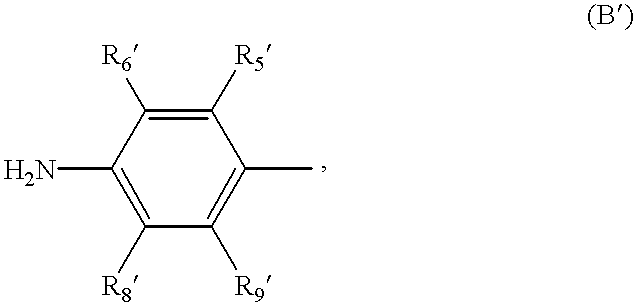
wherein R5′, R6′, R8′ and R9′ are as defined above, and coupling the diazotised amines (III) and (IV) with a coupling component of the formula 
wherein X is as defined above under formula (I).
The process for preparing the pigment composition can be carried out in a customary way and is not particularly restricted. For example the mixture of amines (III) and (IV) preferably is diazotised at −10 to 10° C. to prepare the diazo component. The coupling component (V) usually is dissolved in an aqueous solution of sodium hydroxide to prepare the solution of the coupling component. As a rule the diazo component is added dropwise to the aqueous solution containing the coupling component to perform the coupling reaction at a temperature of generally −5 to 50° C., preferably −2 to 20° C. The resulting slurry may then be laked with an aqueous salt solution containing metal salts selected from calcium, barium, strontium, magnesium, manganese and aluminium salts or mixtures thereof.
In a preferred embodiment of the process, auxochromes are prepared by diazotising 2- or 4-nitro para anisidine, ortho anisidine-5-sulphonic acid, or para cresidine ortho sulphonic acid and coupling with 3-hydroxy-2-naphthoic acid.
In the event that an amine (III) is diazotised which is substituted in para-position by the group of the formula A′, a diazo pigment of the formula 
derived from 4,4′-diamino-substituted biphenyl is obtained, wherein the various substituents are as defined above. In the event that an amine (IV) is diazotised, which is substituted in para-position by the group of the formula B′, a diazo auxochrome derived from 4,4′-diamino substituted biphenyl is obtained. The present invention also relates to pigment mixtures containing diazo-pigments and diazo-auxochromes, which are both derived from diazotised 4,4′-diamino-substituted biphenyls.
If required, the resulting slurry or wet cake of the azo pigment lake may be further processed by treating with an anionic surfactant, such as a fatty acid, a dialkyl sulfosuccinate or resin ester or rosin, or a metal salt, e.g. calcium salt thereof, or with a cationic surfactant, e.g. aliphatic, primary, secondary or tertiary amines, aliphatic diamines or an alkyl quaternary ammonium chloride, or with various known non-ionic surfactants. Usually the amout of surfactants is chosen in the range of from 0 to 50%, preferably from 2 to 35%, most preferably from 5 to 25% by weight, based on the amount of compound I.
The azo lake pigment slurry obtained may then be filtered and washed with water. To improve the dispersibility of the pigments and retain their transparency, the particles may be “aged” by stirring the slurry at elevated temperatures, particularly at 70 to 95° C. for about 30 minutes up to 3 hours. In a preferred embodiment of the process the composition is further processed to a granular or powder form.
The wet cake of the pigments obtained may be flushed and kneaded directly into a varnish for inks or a resin for paints to prepare a so-called base colour. In a preferred embodiment of the process the wet cake of the composition is further processed to a granular or powder form.
The invention also relates to the process of toning an azo lake pigment composition, which comprises doping the above-mentioned azo lake pigment (I) with an auxochrome (II). The toning may be effected by mixing the azo lake pigment (I) with the auxochrome (II).
The present invention also relates to the use of an auxochrome (II) for toning any azo lake pigments. The invention particularly relates to the use of an auxochrome (II) for toning azo lake pigments (I) as defined above.
The pigment composition according to the present invention can be produced in a fixed quality with excellent reproducibility, and has excellent transparency, a high color strength and a clear and vivid hue.
The combination of the anisidine-based auxochromes (II) mentioned above with Tobias acid coupled onto 2-hydroxy-3-naphthoic acid gives unexpected synergistic improvements in shade, depth and colour strength. The extent of these advantages are unpredictable from additive effects of the auxochrome (II) and the coupling product of 2-napthylamine-1-sulphonic acid (Tobias acid) with the coupling component (V), particularly 2-hydroxy-3-naphthoic acid, in compositions containing pigments of the formula (I).
The following examples illustrate the invention without limiting its scope:
35.9 g of 4-aminotoluene-3-sulphonic acid (98.2%) are dissolved in 265 ml of water using 16.2 g of 47% sodium hydroxide solution with stirring. The temperature of the solution is reduced to 2° C. by ice addition before adding 12.2 g of sodium nitrite which has previously been dissolved in 50 ml of water. 48 ml of concentrated hydrochloric acid (35%) is added to the solution with stirring to form the diazo salt. Stirring is continued for 20 minutes while maintaining a temperature of 0 to 5° C. by addition of ice. 33.2 g of calcium chloride (80%) are added to the suspension before the volume of the suspension is adjusted to 800 ml at 0 to 5°C.
19.0 g of modified abietic acid rosin (Burez® S3075 as supplied by EKA Nobel) are dissolved in 480 ml of water with 5.2 g of sodium hydroxide solution (as above) by heating to 80° C. with stirring. Once a resin solution is obtained, the solution is cooled to 50° C. by addition of 250 ml of water. 30 g of sodium hydroxide solution (47%) and 35.5 g of 2-hydroxy-3-naphthoic acid (BONA) are added with stirring. The volume of the solution is adjusted to 800 ml at 0 to 5° C. by ice addition.
To a vessel containing 800 ml of water at 5° C., the diazo component and the resin/BONA solution are added simultaneously over a period of 48 minutes with stirring and maintaining the temperature at 5 to 60° C. and a pH of 10.8 to 11.0.
After the coupling is complete, the suspension is stirred for a further 15 minutes at the above conditions. The pH of the slurry is then adjusted to 7.0 using dilute hydrochloric acid (ca. 10%) before steam heating to 80° C. The suspension is then cooled to 60° C. by addition of cold water and filtered and washed salt free. The product is then dried overnight at 90° C. before grinding to a powder.
34.7 g of 4-aminotoluene-3-sulphonic acid (98.2%) and 1.2 g of 2-naphthyl-amine-1-sulphonic acid (Tobias acid) are dissolved in 265 ml of water using 16.2 g of 47% sodium hydroxide solution with stirring. The temperature of the solution is reduced to 2° C. by ice addition before adding 12.2 g of sodium nitrite which has previously been dissolved in 50 ml of water. 48 ml of concentrated hydrochloric acid (35%) is added to the solution with stirring to form the diazo salt. Stirring is continued for 20 minutes while maintaining a temperature of 0 to 5° C. by addition of ice. 33.2 g of calcium chloride (80%) is added to the suspension before the volume of the suspension is adjusted to 800 ml at 0 to 5° C.
The process is completed according to example 1.
34.7 g of 4-aminotoluene-3-sulphonic acid (98.2%) and 1.2 g of para-nitro-orthoanisidine (PNOA) are dissolved in 265 ml of water using 16.2 g of 47% sodium hydroxide solution with stirring. The temperature of the solution is reduced to 2° C. by ice addition before adding 12.2 g of sodium nitrite which has previously been dissolved in 50 ml of water. 48 ml of concentrated hydrochloric acid (35%) is added to the solution with stirring to form the diazo salt. Stirring is continued for 20 minutes while maintaining a temperature of 0 to 5° C. by addition of ice. 33.2 g of calcium chloride (80%) is added to the suspension before the volume of the suspension is adjusted to 800 ml at 0 to 5° C.
The process is completed according to example 1.
34.7 g of 4-aminotoluene-3-sulphonic acid (98.2%) and 1.2 g of 2-naphthyl-amine-1-sulphonic acid (Tobias acid) are dissolved in 265 ml of water using 16.2 g of 47% sodium hydroxide solution with stirring. The temperature of the solution is reduced to 2° C. by ice addition before adding 12.2 g of sodium nitrite which has previously been dissolved in 50 ml of water. 48 ml of concentrated hydrochloric acid (35%) is added to the solution with stirring to form the diazo salt. Stirring is continued for 20 minutes while maintaining a temperature of 0 to 5° C. by addition of ice. 33.2 g of calcium chloride (80%) is added to the suspension before the volume of the suspension is adjusted to 800 ml at 0 to 5° C.
9.5 g of modified abietic acid rosin (Burez® S3075 as supplied by EKA Nobel) are dissolved in 240 ml of water with 2.6 g of sodium hydroxide liquor (47%) by heating to 80° C. with stirring. Once a resin solution is obtained, the solution is cooled to 50° C. by addition of 125 ml of water. 30 g of sodium hydroxide liquor (47%) and 35.5 g of 2-hydroxy-3-naphthoic acid (BONA) are added with stirring. 19 g of a 50% w/w resin ester dispersion known as Snowtack® 380A (as supplied by EKA Nobel) are added to the solution. The volume of the suspension is adjusted to 800 ml at 0 to 5° C. by ice addition.
The process is completed according to example 1.
34.7 g of 4-aminotoluene-3-sulphonic acid (98.2%), 0.4 g of 2-naphthylamine-1-sulphonic acid (Tobias acid) and 0.8 g of para-cresidine-orthosulphonic acid (PCOS) are dissolved in 265 ml of water using 16.2 g of 47% sodium hydroxide liquor with stirring. The temperature of the solution is reduced to 2° C. by ice addition before adding 12.2 g of sodium nitrite which has previously been dissolved in 50 ml of water. 48 ml of concentrated hydrochloric acid (35%) is added to the solution with stirring to form the diazo salt. Stirring is continued for 20 minutes while maintaining a temperature of 0 to 5° C. by addition of ice. 33.2 g of calcium chloride (80%) is added to the suspension before the volume of the suspension is adjusted to 800 ml at 0 to 5° C.
The process is completed according to example 4.
43.0 g of 2-amino-4-chloro-5-methylbenzenesulphonic acid are dissolved in 265 ml of water using 16.2 g of 47% sodium hydroxide liquor with stirring. The temperature of the solution is reduced to 2° C. by ice addition before adding 12.2 g of sodium nitrite which has previously been dissolved in 50 ml of water. 48 ml of concentrated hydrochloric acid (35%) is added to the solution with stirring to form the diazo salt. Stirring is continued for 20 minutes while maintaining a temperature of 0 to 5° C. by addition of ice. 33.2 g of calcium chloride (80%) is added to the suspension before the volume of the suspension is adjusted to 800 ml at 0 to 5° C.
The process is completed according to example 1.
41.4 g of 2-amino-4-chloro-5-methylbenzenesulphonic acid and 1.2 g of 2-naphthylamine-1-sulphonic acid (Tobias acid) are dissolved in 265 ml of water using 16.2 g of 47% sodium hydroxide solution with stirring. The temperature of the solution is reduced to 2° C. by ice addition before adding 12.2 g of sodium nitrite which has previously been dissolved in 50 ml of water. 48 ml of concentrated hydrochloric acid (35%) is added to the solution with stirring to form the diazo salt. Stirring is continued for 20 minutes while maintaining a temperature of 0 to 5° C. by addition of ice. 33.2 g of calcium chloride (80%) is added to the suspension before the volume of the suspension is adjusted to 800 ml at 0 to 5° C.
The process is completed according to example 1.
41.4 g of 2-amino-4-chloro-5-methylbenzenesulphonic acid and 1.2 g of ortho-nitro-para-anisidine (ONPA) are dissolved in 265 ml of water using 16.2 g of 47% sodium hydroxide liquor with stirring. The temperature of the solution is reduced to 2° C. by ice addition before adding 12.2 g of sodium nitrite which has previously been dissolved in 50 ml of water. 48 ml of concentrated hydrochloric acid (35%) is added to the solution with stirring to form the diazo salt. Stirring is continued for 20 minutes while maintaining a temperature of 0 to 5° C. by addition of ice. 33.2 g of calcium chloride (80%) is added to the suspension before the volume of the suspension is adjusted to 800 ml at 0 to 5° C.
The process is completed according to example 1.
20 g of the finished pigment powders (Examples 1-8) are incorporated into 80 g of an ink varnish consisting of 1 part distillate (PKWF 4/7 New supplied by Halterman), 4 parts resin (known as Sparkle 609 supplied by Lawter International) and 6 parts gelled hard resin (known as Luminex 11 supplied by Lawter International). Mixing is performed on the back rolls of a Buhler SDY-200 three roll mill at 23° C. and 10 bar pressure for 5 minutes . The mixtures are then given 2×10 bar passes over the three roll mill at 23° C .
Masstone and transparency are assessed by visually assessing the inks.
| Pigment used to prepare ink | Masstone of ink | Transparency of ink |
| Example 1 (comparative) | std. | std. |
| Example 2 (comparative) | 5 deep | 1 TR |
| Example 3 | 7 deep | 2 TR |
| Example 4 (comparative) | std. | std. |
| Example 5 | 4 deep | 1 TR |
| Example 6 (comparative) | std. | std. |
| Example 7 (comparative) | 6 deep | 1 TR |
| Example 8 | 7 deep | 1 TR |
| (std. means “standard”; “deep” means the degree of the masstone (in contrast to “pale”, wherein the higher the number the deeper the masstone; “TR” stands for transparency, the higher the number the more transparent the ink compared to the used standards) | ||
Claims (9)
1. A pigment composition which comprises
a) at least one pigment of the formula: 
wherein X represents hydrogen or a cation from a metal selected from the group consisting of calcium, barium, strontium, magnesium, manganese and aluminum, R1, R2 and R3 represent hydrogen or members selected from the group consisting of C1-C4-alkyl, phenyl, —NO2 and —CF3, and R4 is as defined as R1, R2 and R3 or represents a group of the formula 
wherein X′ is as defined as X above and R1′, R2′ and R3′ are as defined as R1, R2 and R3 under the formula (I) above, and
b) an effective shading amount of at least one auxochrome of the formula 
wherein X″ is as defined as X under the formula (I) above, at least one of R5, R6, R7, R8 and R9 represents C1-C4-alkoxy and R5, R6, R7, R8 and R9 independently of one another additionally represent members selected from the group consisting of hydrogen, C1-C4-alkyl, phenyl, halogen, —SO3—H, —NO2 and —CF3 and R7 additionally represents a group of the formula 
wherein X′″ is as defined as X under the formula (I) above, R5′, R6′, R8′ and R9′ are as defined as R5, R6, R7 and R8 under the formula (II) above, with the proviso, that (a) if only one of R5, R6, R7, R8 and R9 stands for C1-C4-alkoxy and (b) if one additional member of R5, R6, R7, R8 and R9 (less the one which stands for C1-C4-alkoxy) stands for —COOH or —SO3H, then no other member of R5, R6, R7, R8 and R9 (less the ones which stand for C1-C4-alkoxy and —COOH respectively —SO3H) stands for methyl or hydrogen.
2. A composition according to claim 1 which comprises at least one pigment of the formula (I), wherein X represents hydrogen or a cation from a metal selected from the group consisting of calcium, barium, strontium, magnesium, manganese and aluminum and R1, R2, R3 and R4 represent hydrogen or members from the group consisting of C1-C4-alkyl, phenyl, —NO2 and —CF3, and an auxochrome of the formula (II), wherein X″ is as defined as X under the formula (I) above, at least one of R5, R6, R7, R8, and R9 represents C1-C4-alkoxy and R5, R6, R7, R8 and R9 independently of one another additionally represent members selected from the group consisting of hydrogen, C1-C4-alkyl, phenyl, halogen, —SO3H, —NO2 and —CF3.
3. A composition according to claim 1 which comprises at least one pigment of the formula 
wherein R1 and R2 are different, R1 represents hydrogen, or C1-C4-alkyl and R2 represents C1-C4-alkyl and X represents hydrogen or a cation from a metal selected from the group consisting of calcium, barium, strontium, magnesium, manganese and aluminum, and an auxochrome (II).
4. A composition according to claim 1 , which comprises at least one pigment (I) and an auxochrome of the formula 
wherein X″ is as defined as X under the formula (I) and R7 represents hydrogen or —NO2.
5. A composition according to claim 1 , which comprises at least one pigment (I) and an auxochrome (II), wherein the amount of auxochrome added to the pigment is from 0.01 to 10.0% by weight based on the weight of the pigment.
6. A composition according to claim 1 , which comprises at least one pigment of the formula (I), an auxochrome of the formula (II) and the coupling product of 2-napthylamine-1-sulphonic acid (Tobias acid) with 2-hydroxy-3-naphthoic acid.
7. A process for preparing a composition according to claim 1 , which comprises diazotising at least one amine of the formula 
wherein R4 is as defined as R1, R2 and R3 or represents a group of the formula 
wherein R1′, R2′ and R3′ are as defined as R1, R2 and R3;
and at least one amine of the formula 
wherein at least one of R5, R6, R7, R8, and R9 represents C1-C4-alkoxy and R7 additionally represents a group of the formula 
with the proviso, that (a) if only one of R5, R6, R7, R8 and R9 stands for C1-C4-alkoxy and (b) if one additional member of R5, R6, R7, R8 and R9 (less the one which stands for C1-C4-alkoxy) stands for —COOH or —SO3H, then no other member of R5, R6, R7, R8 and R9 (less the ones which stand for C1-C4-alkoxy and —COOH respectively —SO3H) stands for methyl or hydrogen, and coupling the diazotised amines (III) and (IV) with a coupling component of the formula 
wherein X is as defined above under formula (I).
8. A process according to claim 7 , which comprises further processing the composition to a granular or powder form.
9. A process of toning an azo lake pigment composition, which comprising doping the azo lake pigment with an auxochrome (II) 
wherein X″ represents hydrogen or a cation from a metal selected from the group consisting of calcium, barium, strontium, magnesium, manganese and aluminum, at least one of R5, R6, R7, R8 and R9 represents C1-C4-alkoxy and R5, R6, R7, R8 and R9 independently of one another additionally represent members selected from the group consisting of hydrogen, C1-C4-alkyl, phenyl, halogen, —SO3—H, —NO2 and —CF3 and R7 additionally represents a group of the partial formula 
wherein X′″ represents hydrogen or a cation from a metal selected from the group consisting of calcium, barium, strontium, magnesium, manganese and aluminum, R5′, R6′, R8′ and R9′ are as defined as R5, R6, R7 and R8 under the formula (II) above, with the proviso, that (a) if only one of R5, R6, R7, R8 and R9 stands for C1-C4-alkoxy and (b) if one additional member of R5, R6, R7, R8 and R9 (less the one which stands for C1-C4-alkoxy) stands for —COOH or —SO3H, then no other member of R5, R6, R7, R8 and R9 (less the ones which stand for C1-C4-alkoxy and —COOH respectively —SO3H) stands for methyl or hydrogen.
Applications Claiming Priority (2)
| Application Number | Priority Date | Filing Date | Title |
|---|---|---|---|
| GB9906673 | 1999-03-24 | ||
| GBGB9906673.0A GB9906673D0 (en) | 1999-03-24 | 1999-03-24 | Azo lake pigment composition |
Publications (1)
| Publication Number | Publication Date |
|---|---|
| US6402828B1 true US6402828B1 (en) | 2002-06-11 |
Family
ID=10850196
Family Applications (1)
| Application Number | Title | Priority Date | Filing Date |
|---|---|---|---|
| US09/503,265 Expired - Fee Related US6402828B1 (en) | 1999-03-24 | 2000-02-14 | Azo lake pigment composition |
Country Status (8)
| Country | Link |
|---|---|
| US (1) | US6402828B1 (en) |
| EP (1) | EP1038925A3 (en) |
| JP (1) | JP2000273345A (en) |
| KR (1) | KR20000062997A (en) |
| CN (1) | CN1268532A (en) |
| BR (1) | BR0001388A (en) |
| CA (1) | CA2301984A1 (en) |
| GB (1) | GB9906673D0 (en) |
Cited By (3)
| Publication number | Priority date | Publication date | Assignee | Title |
|---|---|---|---|---|
| US6613140B2 (en) * | 2000-09-21 | 2003-09-02 | Ciba Specialty Chemicals Corporation | Azo orange pigment composition |
| US20180305566A1 (en) * | 2015-10-30 | 2018-10-25 | Nippon Kayaku Kabushiki Kaisha | Ink emulsion composition and water-based ink |
| US20240228786A9 (en) * | 2021-04-01 | 2024-07-11 | Dic Corporation | Pigment composition and ink using the same |
Families Citing this family (7)
| Publication number | Priority date | Publication date | Assignee | Title |
|---|---|---|---|---|
| DE10122374A1 (en) * | 2001-05-09 | 2002-11-14 | Clariant Gmbh | Monoazo pigments based on lacquered naphtholsulfonic acids |
| CN100363434C (en) * | 2005-09-30 | 2008-01-23 | 河南黄河旋风股份有限公司 | Method for preparing Nano red organic pigment |
| CN101942217B (en) * | 2010-07-28 | 2013-04-03 | 吴江市屯村颜料厂 | Preparation method for special pigment for aqueous printing ink |
| CN103254661B (en) * | 2013-05-14 | 2014-06-04 | 嘉兴科隆化工有限公司 | Industrialized production method of transference-resistant blue light red pigment for PU (Poly Urethane) |
| CN104419274A (en) * | 2013-09-10 | 2015-03-18 | Dic株式会社 | Azo pigment composition as well as preparation method thereof and gravure ink composition |
| CN106566280A (en) * | 2015-10-09 | 2017-04-19 | Dic株式会社 | Coated pigment composition and production method thereof |
| KR102850555B1 (en) * | 2019-01-11 | 2025-08-25 | 산요 시키소 가부시키가이샤 | Azo pigment composition and manufacturing method thereof |
Citations (7)
| Publication number | Priority date | Publication date | Assignee | Title |
|---|---|---|---|---|
| US2224574A (en) | 1939-10-06 | 1940-12-10 | Du Pont | Azo pigment composition |
| US2229049A (en) | 1937-08-05 | 1941-01-21 | Du Pont | Azo pigment |
| US2508448A (en) | 1948-02-03 | 1950-05-23 | Du Pont | Azo pigments and coating compositions containing same |
| US2744027A (en) | 1952-11-26 | 1956-05-01 | Du Pont | Azo pigment production |
| EP0202906A1 (en) | 1985-05-20 | 1986-11-26 | Dainippon Ink And Chemicals, Inc. | Process for producing azo lake pigments |
| EP0259007A1 (en) | 1986-08-04 | 1988-03-09 | Kabushiki Kaisha Ueno Seiyaku Oyo Kenkyujo | Process for producing azo pigment |
| US6007612A (en) | 1996-12-10 | 1999-12-28 | Ciba Specialty Chemicals Corporation | Pigment compositions |
Family Cites Families (2)
| Publication number | Priority date | Publication date | Assignee | Title |
|---|---|---|---|---|
| JPS617367A (en) * | 1984-06-22 | 1986-01-14 | Sumika Color Kk | Red pigment for process ink |
| JPH0826243B2 (en) * | 1989-09-08 | 1996-03-13 | 東洋インキ製造株式会社 | Monoazo lake pigment and pigment dispersion composition |
-
1999
- 1999-03-24 GB GBGB9906673.0A patent/GB9906673D0/en not_active Ceased
-
2000
- 2000-02-14 US US09/503,265 patent/US6402828B1/en not_active Expired - Fee Related
- 2000-03-15 JP JP2000071663A patent/JP2000273345A/en active Pending
- 2000-03-17 EP EP00810227A patent/EP1038925A3/en not_active Withdrawn
- 2000-03-21 BR BR0001388-9A patent/BR0001388A/en not_active Application Discontinuation
- 2000-03-22 CA CA002301984A patent/CA2301984A1/en not_active Abandoned
- 2000-03-23 KR KR1020000014769A patent/KR20000062997A/en not_active Withdrawn
- 2000-03-24 CN CN00104724A patent/CN1268532A/en active Pending
Patent Citations (7)
| Publication number | Priority date | Publication date | Assignee | Title |
|---|---|---|---|---|
| US2229049A (en) | 1937-08-05 | 1941-01-21 | Du Pont | Azo pigment |
| US2224574A (en) | 1939-10-06 | 1940-12-10 | Du Pont | Azo pigment composition |
| US2508448A (en) | 1948-02-03 | 1950-05-23 | Du Pont | Azo pigments and coating compositions containing same |
| US2744027A (en) | 1952-11-26 | 1956-05-01 | Du Pont | Azo pigment production |
| EP0202906A1 (en) | 1985-05-20 | 1986-11-26 | Dainippon Ink And Chemicals, Inc. | Process for producing azo lake pigments |
| EP0259007A1 (en) | 1986-08-04 | 1988-03-09 | Kabushiki Kaisha Ueno Seiyaku Oyo Kenkyujo | Process for producing azo pigment |
| US6007612A (en) | 1996-12-10 | 1999-12-28 | Ciba Specialty Chemicals Corporation | Pigment compositions |
Non-Patent Citations (4)
| Title |
|---|
| copy of specification for application No. 09/545,749 (Apr. 2000). |
| copy of specification for application No. 09/664,812 (Sep. 2000). |
| Patent abstracts of Japan, vol. 015, No. 282 of JP 03 097762 (Apr. 1991). |
| Patent abstracts of Japan, vol. 101, No. 148 of JP 61007367 (Jan. 1986). |
Cited By (4)
| Publication number | Priority date | Publication date | Assignee | Title |
|---|---|---|---|---|
| US6613140B2 (en) * | 2000-09-21 | 2003-09-02 | Ciba Specialty Chemicals Corporation | Azo orange pigment composition |
| US20180305566A1 (en) * | 2015-10-30 | 2018-10-25 | Nippon Kayaku Kabushiki Kaisha | Ink emulsion composition and water-based ink |
| US11034849B2 (en) * | 2015-10-30 | 2021-06-15 | Nippon Kayaku Kabushiki Kaisha | Ink emulsion composition and water-based ink |
| US20240228786A9 (en) * | 2021-04-01 | 2024-07-11 | Dic Corporation | Pigment composition and ink using the same |
Also Published As
| Publication number | Publication date |
|---|---|
| CN1268532A (en) | 2000-10-04 |
| KR20000062997A (en) | 2000-10-25 |
| EP1038925A2 (en) | 2000-09-27 |
| EP1038925A3 (en) | 2001-04-18 |
| GB9906673D0 (en) | 1999-05-19 |
| JP2000273345A (en) | 2000-10-03 |
| CA2301984A1 (en) | 2000-09-24 |
| BR0001388A (en) | 2000-10-17 |
Similar Documents
| Publication | Publication Date | Title |
|---|---|---|
| JP5179753B2 (en) | Modified organic colorants and dispersions and methods for their production | |
| US20040163569A1 (en) | Methods of preparing aqueous colored pigment dispersions, and inkjet ink compositions | |
| DE2135468B2 (en) | Pigment composition, process for its preparation and its use | |
| CA1141755A (en) | Production of pigments | |
| CN1649972A (en) | Compositions and methods for imparting improved rheology on pigment based inks and paints | |
| CA1184704A (en) | Stabilised opaque form of c.i. pigment yellow 74 | |
| JPS6342672B2 (en) | ||
| EP1038925A2 (en) | Azo lake pigment composition | |
| US3763182A (en) | Method for producing metal phthalocyanine type pigment | |
| KR100361942B1 (en) | Pigment Compositions | |
| CN101747656A (en) | Green glow yellow bisazo mordant pigment | |
| JP2924973B2 (en) | Colorant mixture, and printing ink containing the colorant mixture | |
| JP2682749B2 (en) | Disazo pigment and printing ink composition | |
| US6261354B1 (en) | Pigmentary azo composition, preparation method and use | |
| US6254671B1 (en) | Very green-shade yellow metallized disazo pigment | |
| JP4161238B2 (en) | Pigment composition and pigment dispersion | |
| JPH0662876B2 (en) | Method for producing monoazo lake pigment | |
| KR930010509B1 (en) | Process for producing azo pigment | |
| JPH1088016A (en) | Azo lake pigment composition, method for producing the same, and pigment dispersion | |
| EP0222335B1 (en) | Non-bronzing reddish lake pigment | |
| JP4536912B2 (en) | Disazo pigment composition and printing ink composition | |
| JPH1088020A (en) | Azo lake pigment composition, method for producing the same, and pigment dispersion | |
| CN101287802B (en) | Azo pigment preparation | |
| US6482257B1 (en) | Solid solutions of monoazo pigments | |
| JP2682747B2 (en) | Disazo pigment and printing ink composition |
Legal Events
| Date | Code | Title | Description |
|---|---|---|---|
| AS | Assignment |
Owner name: CIBA SPECIALTY CHEMICALS CORP., NEW YORK Free format text: ASSIGNMENT OF ASSIGNORS INTEREST;ASSIGNORS:CHISHOLM, GREIG;KERWIN, PAUL;NICOL, MAIRI;REEL/FRAME:010777/0195;SIGNING DATES FROM 19991201 TO 19991217 |
|
| REMI | Maintenance fee reminder mailed | ||
| LAPS | Lapse for failure to pay maintenance fees | ||
| STCH | Information on status: patent discontinuation |
Free format text: PATENT EXPIRED DUE TO NONPAYMENT OF MAINTENANCE FEES UNDER 37 CFR 1.362 |
|
| FP | Lapsed due to failure to pay maintenance fee |
Effective date: 20060611 |