US6344447B2 - Treatment of chemotherapeutic agent and antiviral agent toxicity with acylated pyrimidine nucleosides - Google Patents
Treatment of chemotherapeutic agent and antiviral agent toxicity with acylated pyrimidine nucleosides Download PDFInfo
- Publication number
- US6344447B2 US6344447B2 US09/249,790 US24979099A US6344447B2 US 6344447 B2 US6344447 B2 US 6344447B2 US 24979099 A US24979099 A US 24979099A US 6344447 B2 US6344447 B2 US 6344447B2
- Authority
- US
- United States
- Prior art keywords
- uridine
- tau
- acyl derivative
- group
- administering
- Prior art date
- Legal status (The legal status is an assumption and is not a legal conclusion. Google has not performed a legal analysis and makes no representation as to the accuracy of the status listed.)
- Expired - Lifetime, expires
Links
- 150000003230 pyrimidines Chemical class 0.000 title claims abstract description 81
- 239000002718 pyrimidine nucleoside Substances 0.000 title claims abstract description 79
- 238000011282 treatment Methods 0.000 title abstract description 104
- 230000001988 toxicity Effects 0.000 title abstract description 66
- 231100000419 toxicity Toxicity 0.000 title abstract description 66
- 239000002246 antineoplastic agent Substances 0.000 title abstract description 42
- 229940127089 cytotoxic agent Drugs 0.000 title abstract description 17
- 239000003443 antiviral agent Substances 0.000 title abstract description 16
- 150000001875 compounds Chemical class 0.000 claims abstract description 104
- 238000000034 method Methods 0.000 claims abstract description 74
- 230000000118 anti-neoplastic effect Effects 0.000 claims abstract description 22
- DRTQHJPVMGBUCF-XVFCMESISA-N Uridine Natural products O[C@@H]1[C@H](O)[C@@H](CO)O[C@H]1N1C(=O)NC(=O)C=C1 DRTQHJPVMGBUCF-XVFCMESISA-N 0.000 claims description 354
- GHASVSINZRGABV-UHFFFAOYSA-N Fluorouracil Chemical compound FC1=CNC(=O)NC1=O GHASVSINZRGABV-UHFFFAOYSA-N 0.000 claims description 295
- 229960002949 fluorouracil Drugs 0.000 claims description 295
- AUFUWRKPQLGTGF-FMKGYKFTSA-N uridine triacetate Chemical group CC(=O)O[C@@H]1[C@H](OC(C)=O)[C@@H](COC(=O)C)O[C@H]1N1C(=O)NC(=O)C=C1 AUFUWRKPQLGTGF-FMKGYKFTSA-N 0.000 claims description 202
- DRTQHJPVMGBUCF-UHFFFAOYSA-N uracil arabinoside Natural products OC1C(O)C(CO)OC1N1C(=O)NC(=O)C=C1 DRTQHJPVMGBUCF-UHFFFAOYSA-N 0.000 claims description 195
- DRTQHJPVMGBUCF-PSQAKQOGSA-N beta-L-uridine Natural products O[C@H]1[C@@H](O)[C@H](CO)O[C@@H]1N1C(=O)NC(=O)C=C1 DRTQHJPVMGBUCF-PSQAKQOGSA-N 0.000 claims description 181
- 229940045145 uridine Drugs 0.000 claims description 181
- 125000002252 acyl group Chemical group 0.000 claims description 127
- 206010028980 Neoplasm Diseases 0.000 claims description 114
- ISAKRJDGNUQOIC-UHFFFAOYSA-N Uracil Chemical compound O=C1C=CNC(=O)N1 ISAKRJDGNUQOIC-UHFFFAOYSA-N 0.000 claims description 112
- -1 arabinosyl 5-azacytosine Chemical compound 0.000 claims description 61
- 229940035893 uracil Drugs 0.000 claims description 61
- UHDGCWIWMRVCDJ-UHFFFAOYSA-N 1-beta-D-Xylofuranosyl-NH-Cytosine Natural products O=C1N=C(N)C=CN1C1C(O)C(O)C(CO)O1 UHDGCWIWMRVCDJ-UHFFFAOYSA-N 0.000 claims description 50
- UHDGCWIWMRVCDJ-PSQAKQOGSA-N Cytidine Natural products O=C1N=C(N)C=CN1[C@@H]1[C@@H](O)[C@@H](O)[C@H](CO)O1 UHDGCWIWMRVCDJ-PSQAKQOGSA-N 0.000 claims description 50
- 239000002777 nucleoside Substances 0.000 claims description 48
- 229960001674 tegafur Drugs 0.000 claims description 45
- WFWLQNSHRPWKFK-ZCFIWIBFSA-N tegafur Chemical compound O=C1NC(=O)C(F)=CN1[C@@H]1OCCC1 WFWLQNSHRPWKFK-ZCFIWIBFSA-N 0.000 claims description 45
- 229940002612 prodrug Drugs 0.000 claims description 43
- 239000000651 prodrug Substances 0.000 claims description 43
- UHDGCWIWMRVCDJ-ZAKLUEHWSA-N cytidine Chemical compound O=C1N=C(N)C=CN1[C@H]1[C@H](O)[C@@H](O)[C@H](CO)O1 UHDGCWIWMRVCDJ-ZAKLUEHWSA-N 0.000 claims description 42
- CKTSBUTUHBMZGZ-UHFFFAOYSA-N Deoxycytidine Natural products O=C1N=C(N)C=CN1C1OC(CO)C(O)C1 CKTSBUTUHBMZGZ-UHFFFAOYSA-N 0.000 claims description 36
- UHDGCWIWMRVCDJ-CCXZUQQUSA-N Cytarabine Chemical compound O=C1N=C(N)C=CN1[C@H]1[C@@H](O)[C@H](O)[C@@H](CO)O1 UHDGCWIWMRVCDJ-CCXZUQQUSA-N 0.000 claims description 33
- 239000003112 inhibitor Substances 0.000 claims description 33
- 230000015572 biosynthetic process Effects 0.000 claims description 31
- 150000003833 nucleoside derivatives Chemical class 0.000 claims description 30
- MXHRCPNRJAMMIM-UHFFFAOYSA-N desoxyuridine Natural products C1C(O)C(CO)OC1N1C(=O)NC(=O)C=C1 MXHRCPNRJAMMIM-UHFFFAOYSA-N 0.000 claims description 26
- 201000011510 cancer Diseases 0.000 claims description 25
- 108010066455 Dihydrouracil Dehydrogenase (NADP) Proteins 0.000 claims description 23
- IQFYYKKMVGJFEH-XLPZGREQSA-N Thymidine Chemical compound O=C1NC(=O)C(C)=CN1[C@@H]1O[C@H](CO)[C@@H](O)C1 IQFYYKKMVGJFEH-XLPZGREQSA-N 0.000 claims description 23
- 239000003795 chemical substances by application Substances 0.000 claims description 22
- MXHRCPNRJAMMIM-SHYZEUOFSA-N 2'-deoxyuridine Chemical compound C1[C@H](O)[C@@H](CO)O[C@H]1N1C(=O)NC(=O)C=C1 MXHRCPNRJAMMIM-SHYZEUOFSA-N 0.000 claims description 18
- 102100022334 Dihydropyrimidine dehydrogenase [NADP(+)] Human genes 0.000 claims description 18
- 230000015556 catabolic process Effects 0.000 claims description 17
- FHIDNBAQOFJWCA-UAKXSSHOSA-N 5-fluorouridine Chemical class O[C@@H]1[C@H](O)[C@@H](CO)O[C@H]1N1C(=O)NC(=O)C(F)=C1 FHIDNBAQOFJWCA-UAKXSSHOSA-N 0.000 claims description 16
- 230000011132 hemopoiesis Effects 0.000 claims description 15
- 231100000682 maximum tolerated dose Toxicity 0.000 claims description 15
- TXWCDJYEKHLJSO-MYINAIGISA-N 1-[(2s,4s,5r)-2-fluoro-4-hydroxy-5-(hydroxymethyl)oxolan-2-yl]pyrimidine-2,4-dione Chemical compound C1[C@H](O)[C@@H](CO)O[C@@]1(F)N1C(=O)NC(=O)C=C1 TXWCDJYEKHLJSO-MYINAIGISA-N 0.000 claims description 14
- IZEKFCXSFNUWAM-UHFFFAOYSA-N dipyridamole Chemical compound C=12N=C(N(CCO)CCO)N=C(N3CCCCC3)C2=NC(N(CCO)CCO)=NC=1N1CCCCC1 IZEKFCXSFNUWAM-UHFFFAOYSA-N 0.000 claims description 14
- 229960002768 dipyridamole Drugs 0.000 claims description 14
- JOZGNYDSEBIJDH-UHFFFAOYSA-N eniluracil Chemical group O=C1NC=C(C#C)C(=O)N1 JOZGNYDSEBIJDH-UHFFFAOYSA-N 0.000 claims description 13
- UCKYOOZPSJFJIZ-FMDGEEDCSA-N (4r)-1-[(2r,3r,4s,5r)-3,4-dihydroxy-5-(hydroxymethyl)oxolan-2-yl]-4-hydroxy-1,3-diazinan-2-one Chemical compound O[C@@H]1[C@H](O)[C@@H](CO)O[C@H]1N1C(=O)N[C@H](O)CC1 UCKYOOZPSJFJIZ-FMDGEEDCSA-N 0.000 claims description 11
- DWRXFEITVBNRMK-UHFFFAOYSA-N Beta-D-1-Arabinofuranosylthymine Natural products O=C1NC(=O)C(C)=CN1C1C(O)C(O)C(CO)O1 DWRXFEITVBNRMK-UHFFFAOYSA-N 0.000 claims description 11
- IQFYYKKMVGJFEH-UHFFFAOYSA-N beta-L-thymidine Natural products O=C1NC(=O)C(C)=CN1C1OC(CO)C(O)C1 IQFYYKKMVGJFEH-UHFFFAOYSA-N 0.000 claims description 11
- 238000006731 degradation reaction Methods 0.000 claims description 11
- 125000003835 nucleoside group Chemical group 0.000 claims description 11
- 229940104230 thymidine Drugs 0.000 claims description 11
- CKTSBUTUHBMZGZ-ULQXZJNLSA-N 4-amino-1-[(2r,4s,5r)-4-hydroxy-5-(hydroxymethyl)oxolan-2-yl]-5-tritiopyrimidin-2-one Chemical compound O=C1N=C(N)C([3H])=CN1[C@@H]1O[C@H](CO)[C@@H](O)C1 CKTSBUTUHBMZGZ-ULQXZJNLSA-N 0.000 claims description 10
- CZPWVGJYEJSRLH-UHFFFAOYSA-N Pyrimidine Chemical compound C1=CN=CN=C1 CZPWVGJYEJSRLH-UHFFFAOYSA-N 0.000 claims description 10
- 210000001072 colon Anatomy 0.000 claims description 10
- KOKTUHPFPWFELE-HCWSKCQFSA-N 1-[(2s,3r,4s,5r)-2-fluoro-3,4-dihydroxy-5-methyloxolan-2-yl]pyrimidine-2,4-dione Chemical compound O[C@@H]1[C@H](O)[C@@H](C)O[C@@]1(F)N1C(=O)NC(=O)C=C1 KOKTUHPFPWFELE-HCWSKCQFSA-N 0.000 claims description 9
- WYXSYVWAUAUWLD-SHUUEZRQSA-N 6-azauridine Chemical compound O[C@@H]1[C@H](O)[C@@H](CO)O[C@H]1N1C(=O)NC(=O)C=N1 WYXSYVWAUAUWLD-SHUUEZRQSA-N 0.000 claims description 9
- 108010019092 Uridine phosphorylase Proteins 0.000 claims description 8
- 229940125717 barbiturate Drugs 0.000 claims description 8
- RWQNBRDOKXIBIV-UHFFFAOYSA-N thymine Chemical compound CC1=CNC(=O)NC1=O RWQNBRDOKXIBIV-UHFFFAOYSA-N 0.000 claims description 8
- OZQDLJNDRVBCST-SHUUEZRQSA-N 5-amino-2-[(2r,3r,4s,5r)-3,4-dihydroxy-5-(hydroxymethyl)oxolan-2-yl]-1,2,4-triazin-3-one Chemical compound O=C1N=C(N)C=NN1[C@H]1[C@H](O)[C@H](O)[C@@H](CO)O1 OZQDLJNDRVBCST-SHUUEZRQSA-N 0.000 claims description 7
- XAUDJQYHKZQPEU-KVQBGUIXSA-N 5-aza-2'-deoxycytidine Chemical compound O=C1N=C(N)N=CN1[C@@H]1O[C@H](CO)[C@@H](O)C1 XAUDJQYHKZQPEU-KVQBGUIXSA-N 0.000 claims description 7
- BFLOJGKOEFRZPU-MYINAIGISA-N 1-[(2s,4s,5r)-4-hydroxy-5-(hydroxymethyl)-2-(trifluoromethyl)oxolan-2-yl]pyrimidine-2,4-dione Chemical compound C1[C@H](O)[C@@H](CO)O[C@@]1(C(F)(F)F)N1C(=O)NC(=O)C=C1 BFLOJGKOEFRZPU-MYINAIGISA-N 0.000 claims description 6
- CBOKZNLSFMZJJA-PEBGCTIMSA-N 3-Deazauridine Chemical compound O[C@@H]1[C@H](O)[C@@H](CO)O[C@H]1N1C(=O)C=C(O)C=C1 CBOKZNLSFMZJJA-PEBGCTIMSA-N 0.000 claims description 6
- FBOZXECLQNJBKD-ZDUSSCGKSA-N L-methotrexate Chemical compound C=1N=C2N=C(N)N=C(N)C2=NC=1CN(C)C1=CC=C(C(=O)N[C@@H](CCC(O)=O)C(O)=O)C=C1 FBOZXECLQNJBKD-ZDUSSCGKSA-N 0.000 claims description 6
- XESARGFCSKSFID-UHFFFAOYSA-N Pyrazofurin Natural products OC1=C(C(=O)N)NN=C1C1C(O)C(O)C(CO)O1 XESARGFCSKSFID-UHFFFAOYSA-N 0.000 claims description 6
- 229950000242 ancitabine Drugs 0.000 claims description 6
- KZOWNALBTMILAP-JBMRGDGGSA-N ancitabine hydrochloride Chemical compound Cl.N=C1C=CN2[C@@H]3O[C@H](CO)[C@@H](O)[C@@H]3OC2=N1 KZOWNALBTMILAP-JBMRGDGGSA-N 0.000 claims description 6
- QQOBRRFOVWGIMD-OJAKKHQRSA-N azaribine Chemical compound CC(=O)O[C@@H]1[C@H](OC(C)=O)[C@@H](COC(=O)C)O[C@H]1N1C(=O)NC(=O)C=N1 QQOBRRFOVWGIMD-OJAKKHQRSA-N 0.000 claims description 6
- 229950010054 azaribine Drugs 0.000 claims description 6
- XRECTZIEBJDKEO-UHFFFAOYSA-N flucytosine Chemical compound NC1=NC(=O)NC=C1F XRECTZIEBJDKEO-UHFFFAOYSA-N 0.000 claims description 6
- 229960000485 methotrexate Drugs 0.000 claims description 6
- XESARGFCSKSFID-FLLFQEBCSA-N pirazofurin Chemical compound OC1=C(C(=O)N)NN=C1[C@H]1[C@H](O)[C@H](O)[C@@H](CO)O1 XESARGFCSKSFID-FLLFQEBCSA-N 0.000 claims description 6
- WXNWGKGGBCIEAY-PPSWKLDYSA-N ethyl (2s,3r,4s,5r)-2-(2,4-dioxopyrimidin-1-yl)-3,4-dihydroxy-5-(hydroxymethyl)oxolane-2-carboxylate Chemical group C1=CC(=O)NC(=O)N1[C@]1(C(=O)OCC)O[C@H](CO)[C@@H](O)[C@H]1O WXNWGKGGBCIEAY-PPSWKLDYSA-N 0.000 claims description 5
- 102100026846 Cytidine deaminase Human genes 0.000 claims description 4
- 108010031325 Cytidine deaminase Proteins 0.000 claims description 4
- 201000001441 melanoma Diseases 0.000 claims description 4
- 230000026731 phosphorylation Effects 0.000 claims description 4
- 238000006366 phosphorylation reaction Methods 0.000 claims description 4
- 229940113082 thymine Drugs 0.000 claims description 4
- BLXGZIDBSXVMLU-UHFFFAOYSA-N 5-(2-bromoethenyl)-1h-pyrimidine-2,4-dione Chemical compound BrC=CC1=CNC(=O)NC1=O BLXGZIDBSXVMLU-UHFFFAOYSA-N 0.000 claims description 3
- ZCYWEZYLYFWMSI-UHFFFAOYSA-N 5-benzyl-6-phenylmethoxy-1H-pyrimidine-2,4-dione Chemical compound C(C1=CC=CC=C1)OC1=C(C(NC(N1)=O)=O)CC1=CC=CC=C1 ZCYWEZYLYFWMSI-UHFFFAOYSA-N 0.000 claims description 3
- HNYOPLTXPVRDBG-UHFFFAOYSA-N barbituric acid Chemical compound O=C1CC(=O)NC(=O)N1 HNYOPLTXPVRDBG-UHFFFAOYSA-N 0.000 claims description 3
- 210000000481 breast Anatomy 0.000 claims description 3
- 230000002708 enhancing effect Effects 0.000 claims description 3
- 125000002496 methyl group Chemical group [H]C([H])([H])* 0.000 claims description 3
- 210000000496 pancreas Anatomy 0.000 claims description 3
- 210000000664 rectum Anatomy 0.000 claims description 3
- 210000002784 stomach Anatomy 0.000 claims description 3
- ZBIAKUMOEKILTF-UHFFFAOYSA-N 2-[4-[4,4-bis(4-fluorophenyl)butyl]-1-piperazinyl]-N-(2,6-dimethylphenyl)acetamide Chemical compound CC1=CC=CC(C)=C1NC(=O)CN1CCN(CCCC(C=2C=CC(F)=CC=2)C=2C=CC(F)=CC=2)CC1 ZBIAKUMOEKILTF-UHFFFAOYSA-N 0.000 claims description 2
- MCZGXIYFNUHVBI-JUDXGUMMSA-N 4-amino-1-[(2s,3r,4r,5r)-2,3,4-triacetyl-3,4-dihydroxy-5-(hydroxymethyl)oxolan-2-yl]pyrimidin-2-one Chemical group CC(=O)[C@@]1(O)[C@](C(=O)C)(O)[C@@H](CO)O[C@@]1(C(C)=O)N1C(=O)N=C(N)C=C1 MCZGXIYFNUHVBI-JUDXGUMMSA-N 0.000 claims description 2
- RSRNLJYSWSSQMW-CZLDRYSHSA-N 4-hydroxy-1-[(2r,4s,5r)-4-hydroxy-5-(hydroxymethyl)oxolan-2-yl]-1,3-diazinan-2-one Chemical compound C1[C@H](O)[C@@H](CO)O[C@H]1N1C(=O)NC(O)CC1 RSRNLJYSWSSQMW-CZLDRYSHSA-N 0.000 claims description 2
- SPJAGILXQBHHSZ-UHFFFAOYSA-N 5-benzyl-1-(2-hydroxyethoxymethyl)uracil Chemical compound O=C1NC(=O)N(COCCO)C=C1CC1=CC=CC=C1 SPJAGILXQBHHSZ-UHFFFAOYSA-N 0.000 claims description 2
- ZDRFDHHANOYUTE-IOSLPCCCSA-N 6-methylthioinosine Chemical compound C1=NC=2C(SC)=NC=NC=2N1[C@@H]1O[C@H](CO)[C@@H](O)[C@H]1O ZDRFDHHANOYUTE-IOSLPCCCSA-N 0.000 claims description 2
- QVZCXCJXTMIDME-UHFFFAOYSA-N Biopropazepan Trimethoxybenzoate Chemical compound COC1=C(OC)C(OC)=CC(C(=O)OCCCN2CCN(CCCOC(=O)C=3C=C(OC)C(OC)=C(OC)C=3)CCC2)=C1 QVZCXCJXTMIDME-UHFFFAOYSA-N 0.000 claims description 2
- 206010058467 Lung neoplasm malignant Diseases 0.000 claims description 2
- DYCJFJRCWPVDHY-LSCFUAHRSA-N NBMPR Chemical compound O[C@@H]1[C@H](O)[C@@H](CO)O[C@H]1N1C2=NC=NC(SCC=3C=CC(=CC=3)[N+]([O-])=O)=C2N=C1 DYCJFJRCWPVDHY-LSCFUAHRSA-N 0.000 claims description 2
- 206010033128 Ovarian cancer Diseases 0.000 claims description 2
- 206010038389 Renal cancer Diseases 0.000 claims description 2
- 208000006265 Renal cell carcinoma Diseases 0.000 claims description 2
- 229960001079 dilazep Drugs 0.000 claims description 2
- 229960001941 lidoflazine Drugs 0.000 claims description 2
- 201000005202 lung cancer Diseases 0.000 claims description 2
- 208000020816 lung neoplasm Diseases 0.000 claims description 2
- DBABZHXKTCFAPX-UHFFFAOYSA-N probenecid Chemical compound CCCN(CCC)S(=O)(=O)C1=CC=C(C(O)=O)C=C1 DBABZHXKTCFAPX-UHFFFAOYSA-N 0.000 claims description 2
- 201000010174 renal carcinoma Diseases 0.000 claims description 2
- NOYPYLRCIDNJJB-UHFFFAOYSA-N trimetrexate Chemical compound COC1=C(OC)C(OC)=CC(NCC=2C(=C3C(N)=NC(N)=NC3=CC=2)C)=C1 NOYPYLRCIDNJJB-UHFFFAOYSA-N 0.000 claims description 2
- 229960001099 trimetrexate Drugs 0.000 claims description 2
- KSPDSMOWMQFPBL-UHFFFAOYSA-N 5-fluoropyrimidine Chemical class FC1=CN=CN=C1 KSPDSMOWMQFPBL-UHFFFAOYSA-N 0.000 claims 5
- STRZQWQNZQMHQR-UAKXSSHOSA-N 5-fluorocytidine Chemical class C1=C(F)C(N)=NC(=O)N1[C@H]1[C@H](O)[C@H](O)[C@@H](CO)O1 STRZQWQNZQMHQR-UAKXSSHOSA-N 0.000 claims 4
- KDCGOANMDULRCW-UHFFFAOYSA-N 7H-purine Chemical compound N1=CNC2=NC=NC2=C1 KDCGOANMDULRCW-UHFFFAOYSA-N 0.000 claims 4
- ZZKNRXZVGOYGJT-VKHMYHEASA-N (2s)-2-[(2-phosphonoacetyl)amino]butanedioic acid Chemical compound OC(=O)C[C@@H](C(O)=O)NC(=O)CP(O)(O)=O ZZKNRXZVGOYGJT-VKHMYHEASA-N 0.000 claims 3
- 102000006405 Uridine phosphorylase Human genes 0.000 claims 2
- 230000003432 anti-folate effect Effects 0.000 claims 2
- 229940127074 antifolate Drugs 0.000 claims 2
- 229960004413 flucytosine Drugs 0.000 claims 2
- 239000004052 folic acid antagonist Substances 0.000 claims 2
- 210000003128 head Anatomy 0.000 claims 2
- 210000003739 neck Anatomy 0.000 claims 2
- ZVYKRBPJQHWSPO-UHFFFAOYSA-N 1-(2-hydroxyethoxymethyl)-5-[3-(3-phenylmethoxyphenyl)propanoyl]-1,3-diazinane-2,4,6-trione Chemical compound C(C1=CC=CC=C1)OC=1C=CC=C(CCC(=O)C2C(NC(N(C2=O)COCCO)=O)=O)C=1 ZVYKRBPJQHWSPO-UHFFFAOYSA-N 0.000 claims 1
- 102100036360 Cadherin-3 Human genes 0.000 claims 1
- 101000714553 Homo sapiens Cadherin-3 Proteins 0.000 claims 1
- 206010061902 Pancreatic neoplasm Diseases 0.000 claims 1
- 206010060862 Prostate cancer Diseases 0.000 claims 1
- 208000000236 Prostatic Neoplasms Diseases 0.000 claims 1
- QAWIHIJWNYOLBE-OKKQSCSOSA-N acivicin Chemical compound OC(=O)[C@@H](N)[C@@H]1CC(Cl)=NO1 QAWIHIJWNYOLBE-OKKQSCSOSA-N 0.000 claims 1
- 229950008427 acivicin Drugs 0.000 claims 1
- PHEZJEYUWHETKO-UHFFFAOYSA-N brequinar Chemical compound N1=C2C=CC(F)=CC2=C(C(O)=O)C(C)=C1C(C=C1)=CC=C1C1=CC=CC=C1F PHEZJEYUWHETKO-UHFFFAOYSA-N 0.000 claims 1
- 229950010231 brequinar Drugs 0.000 claims 1
- 208000037841 lung tumor Diseases 0.000 claims 1
- 208000015486 malignant pancreatic neoplasm Diseases 0.000 claims 1
- 201000002528 pancreatic cancer Diseases 0.000 claims 1
- 208000008443 pancreatic carcinoma Diseases 0.000 claims 1
- 241001465754 Metazoa Species 0.000 abstract description 56
- 239000000203 mixture Substances 0.000 abstract description 49
- 230000000840 anti-viral effect Effects 0.000 abstract description 38
- 230000006378 damage Effects 0.000 abstract description 37
- 238000002512 chemotherapy Methods 0.000 abstract description 30
- 210000000777 hematopoietic system Anatomy 0.000 abstract description 15
- 230000002265 prevention Effects 0.000 abstract description 5
- 241000699670 Mus sp. Species 0.000 description 139
- WFWLQNSHRPWKFK-UHFFFAOYSA-N Tegafur Chemical compound O=C1NC(=O)C(F)=CN1C1OCCC1 WFWLQNSHRPWKFK-UHFFFAOYSA-N 0.000 description 68
- HBOMLICNUCNMMY-XLPZGREQSA-N zidovudine Chemical compound O=C1NC(=O)C(C)=CN1[C@@H]1O[C@H](CO)[C@@H](N=[N+]=[N-])C1 HBOMLICNUCNMMY-XLPZGREQSA-N 0.000 description 68
- 229960002555 zidovudine Drugs 0.000 description 63
- 125000004432 carbon atom Chemical group C* 0.000 description 37
- 210000003743 erythrocyte Anatomy 0.000 description 37
- 210000001772 blood platelet Anatomy 0.000 description 35
- 238000004820 blood count Methods 0.000 description 34
- 210000004027 cell Anatomy 0.000 description 34
- 230000037396 body weight Effects 0.000 description 32
- 238000007912 intraperitoneal administration Methods 0.000 description 31
- 230000000694 effects Effects 0.000 description 30
- 230000003394 haemopoietic effect Effects 0.000 description 28
- 210000000952 spleen Anatomy 0.000 description 28
- 230000003442 weekly effect Effects 0.000 description 28
- 238000002474 experimental method Methods 0.000 description 27
- 238000005534 hematocrit Methods 0.000 description 26
- 230000000259 anti-tumor effect Effects 0.000 description 25
- 210000000265 leukocyte Anatomy 0.000 description 25
- 229910052739 hydrogen Inorganic materials 0.000 description 24
- 239000001257 hydrogen Substances 0.000 description 24
- 210000000440 neutrophil Anatomy 0.000 description 24
- 210000004369 blood Anatomy 0.000 description 22
- 239000008280 blood Substances 0.000 description 22
- CKTSBUTUHBMZGZ-SHYZEUOFSA-N 2'‐deoxycytidine Chemical compound O=C1N=C(N)C=CN1[C@@H]1O[C@H](CO)[C@@H](O)C1 CKTSBUTUHBMZGZ-SHYZEUOFSA-N 0.000 description 21
- 229940034982 antineoplastic agent Drugs 0.000 description 20
- 235000014113 dietary fatty acids Nutrition 0.000 description 20
- 229930195729 fatty acid Natural products 0.000 description 20
- 239000000194 fatty acid Substances 0.000 description 20
- 125000001424 substituent group Chemical group 0.000 description 20
- XLYOFNOQVPJJNP-UHFFFAOYSA-N water Substances O XLYOFNOQVPJJNP-UHFFFAOYSA-N 0.000 description 20
- FAPWRFPIFSIZLT-UHFFFAOYSA-M Sodium chloride Chemical compound [Na+].[Cl-] FAPWRFPIFSIZLT-UHFFFAOYSA-M 0.000 description 19
- DHMQDGOQFOQNFH-UHFFFAOYSA-N Glycine Chemical compound NCC(O)=O DHMQDGOQFOQNFH-UHFFFAOYSA-N 0.000 description 18
- 239000012829 chemotherapy agent Substances 0.000 description 18
- 150000003839 salts Chemical class 0.000 description 18
- 239000011780 sodium chloride Substances 0.000 description 18
- 150000001732 carboxylic acid derivatives Chemical class 0.000 description 17
- 230000003111 delayed effect Effects 0.000 description 17
- 210000004698 lymphocyte Anatomy 0.000 description 17
- UFHFLCQGNIYNRP-UHFFFAOYSA-N Hydrogen Chemical compound [H][H] UFHFLCQGNIYNRP-UHFFFAOYSA-N 0.000 description 16
- 210000001519 tissue Anatomy 0.000 description 16
- OKKJLVBELUTLKV-UHFFFAOYSA-N Methanol Chemical compound OC OKKJLVBELUTLKV-UHFFFAOYSA-N 0.000 description 15
- 102000001554 Hemoglobins Human genes 0.000 description 14
- 108010054147 Hemoglobins Proteins 0.000 description 14
- 229940024606 amino acid Drugs 0.000 description 14
- 235000001014 amino acid Nutrition 0.000 description 14
- 150000001413 amino acids Chemical class 0.000 description 14
- 210000001185 bone marrow Anatomy 0.000 description 14
- 150000004665 fatty acids Chemical class 0.000 description 14
- 230000001965 increasing effect Effects 0.000 description 14
- 239000007924 injection Substances 0.000 description 14
- 238000002347 injection Methods 0.000 description 14
- PXQPEWDEAKTCGB-UHFFFAOYSA-N orotic acid Chemical compound OC(=O)C1=CC(=O)NC(=O)N1 PXQPEWDEAKTCGB-UHFFFAOYSA-N 0.000 description 14
- 231100001274 therapeutic index Toxicity 0.000 description 13
- 238000005303 weighing Methods 0.000 description 13
- JVTAAEKCZFNVCJ-UHFFFAOYSA-N lactic acid Chemical compound CC(O)C(O)=O JVTAAEKCZFNVCJ-UHFFFAOYSA-N 0.000 description 12
- 210000001995 reticulocyte Anatomy 0.000 description 12
- 239000000243 solution Substances 0.000 description 12
- 231100000331 toxic Toxicity 0.000 description 12
- 230000002588 toxic effect Effects 0.000 description 12
- 102000004190 Enzymes Human genes 0.000 description 11
- 108090000790 Enzymes Proteins 0.000 description 11
- PVNIIMVLHYAWGP-UHFFFAOYSA-N Niacin Chemical compound OC(=O)C1=CC=CN=C1 PVNIIMVLHYAWGP-UHFFFAOYSA-N 0.000 description 11
- 230000001093 anti-cancer Effects 0.000 description 11
- 229940079593 drug Drugs 0.000 description 11
- 239000003814 drug Substances 0.000 description 11
- ODKNJVUHOIMIIZ-RRKCRQDMSA-N floxuridine Chemical compound C1[C@H](O)[C@@H](CO)O[C@H]1N1C(=O)NC(=O)C(F)=C1 ODKNJVUHOIMIIZ-RRKCRQDMSA-N 0.000 description 11
- 238000001802 infusion Methods 0.000 description 11
- 239000002773 nucleotide Substances 0.000 description 11
- 125000003729 nucleotide group Chemical group 0.000 description 11
- 230000002829 reductive effect Effects 0.000 description 11
- 230000001225 therapeutic effect Effects 0.000 description 11
- 239000003981 vehicle Substances 0.000 description 11
- ALYNCZNDIQEVRV-UHFFFAOYSA-N 4-aminobenzoic acid Chemical compound NC1=CC=C(C(O)=O)C=C1 ALYNCZNDIQEVRV-UHFFFAOYSA-N 0.000 description 10
- CKLJMWTZIZZHCS-REOHCLBHSA-N L-aspartic acid Chemical compound OC(=O)[C@@H](N)CC(O)=O CKLJMWTZIZZHCS-REOHCLBHSA-N 0.000 description 10
- OFOBLEOULBTSOW-UHFFFAOYSA-N Malonic acid Chemical compound OC(=O)CC(O)=O OFOBLEOULBTSOW-UHFFFAOYSA-N 0.000 description 10
- 229910019142 PO4 Inorganic materials 0.000 description 10
- JUJWROOIHBZHMG-UHFFFAOYSA-N Pyridine Chemical compound C1=CC=NC=C1 JUJWROOIHBZHMG-UHFFFAOYSA-N 0.000 description 10
- WREGKURFCTUGRC-POYBYMJQSA-N Zalcitabine Chemical compound O=C1N=C(N)C=CN1[C@@H]1O[C@H](CO)CC1 WREGKURFCTUGRC-POYBYMJQSA-N 0.000 description 10
- 239000002253 acid Substances 0.000 description 10
- 231100000135 cytotoxicity Toxicity 0.000 description 10
- 230000003013 cytotoxicity Effects 0.000 description 10
- 230000006870 function Effects 0.000 description 10
- 230000002496 gastric effect Effects 0.000 description 10
- 208000015181 infectious disease Diseases 0.000 description 10
- 238000007911 parenteral administration Methods 0.000 description 10
- 235000021317 phosphate Nutrition 0.000 description 10
- 239000000725 suspension Substances 0.000 description 10
- MTCFGRXMJLQNBG-REOHCLBHSA-N (2S)-2-Amino-3-hydroxypropansäure Chemical compound OC[C@H](N)C(O)=O MTCFGRXMJLQNBG-REOHCLBHSA-N 0.000 description 9
- PHIQHXFUZVPYII-ZCFIWIBFSA-O (R)-carnitinium Chemical compound C[N+](C)(C)C[C@H](O)CC(O)=O PHIQHXFUZVPYII-ZCFIWIBFSA-O 0.000 description 9
- 239000004475 Arginine Substances 0.000 description 9
- LEVWYRKDKASIDU-QWWZWVQMSA-N D-cystine Chemical compound OC(=O)[C@H](N)CSSC[C@@H](N)C(O)=O LEVWYRKDKASIDU-QWWZWVQMSA-N 0.000 description 9
- WHUUTDBJXJRKMK-UHFFFAOYSA-N Glutamic acid Natural products OC(=O)C(N)CCC(O)=O WHUUTDBJXJRKMK-UHFFFAOYSA-N 0.000 description 9
- 239000004471 Glycine Substances 0.000 description 9
- PMMYEEVYMWASQN-DMTCNVIQSA-N Hydroxyproline Chemical compound O[C@H]1CN[C@H](C(O)=O)C1 PMMYEEVYMWASQN-DMTCNVIQSA-N 0.000 description 9
- XUJNEKJLAYXESH-REOHCLBHSA-N L-Cysteine Chemical compound SC[C@H](N)C(O)=O XUJNEKJLAYXESH-REOHCLBHSA-N 0.000 description 9
- AHLPHDHHMVZTML-BYPYZUCNSA-N L-Ornithine Chemical compound NCCC[C@H](N)C(O)=O AHLPHDHHMVZTML-BYPYZUCNSA-N 0.000 description 9
- ONIBWKKTOPOVIA-BYPYZUCNSA-N L-Proline Chemical compound OC(=O)[C@@H]1CCCN1 ONIBWKKTOPOVIA-BYPYZUCNSA-N 0.000 description 9
- QNAYBMKLOCPYGJ-REOHCLBHSA-N L-alanine Chemical compound C[C@H](N)C(O)=O QNAYBMKLOCPYGJ-REOHCLBHSA-N 0.000 description 9
- ODKSFYDXXFIFQN-BYPYZUCNSA-P L-argininium(2+) Chemical compound NC(=[NH2+])NCCC[C@H]([NH3+])C(O)=O ODKSFYDXXFIFQN-BYPYZUCNSA-P 0.000 description 9
- WHUUTDBJXJRKMK-VKHMYHEASA-N L-glutamic acid Chemical compound OC(=O)[C@@H](N)CCC(O)=O WHUUTDBJXJRKMK-VKHMYHEASA-N 0.000 description 9
- HNDVDQJCIGZPNO-YFKPBYRVSA-N L-histidine Chemical compound OC(=O)[C@@H](N)CC1=CN=CN1 HNDVDQJCIGZPNO-YFKPBYRVSA-N 0.000 description 9
- AGPKZVBTJJNPAG-WHFBIAKZSA-N L-isoleucine Chemical compound CC[C@H](C)[C@H](N)C(O)=O AGPKZVBTJJNPAG-WHFBIAKZSA-N 0.000 description 9
- ROHFNLRQFUQHCH-YFKPBYRVSA-N L-leucine Chemical compound CC(C)C[C@H](N)C(O)=O ROHFNLRQFUQHCH-YFKPBYRVSA-N 0.000 description 9
- KDXKERNSBIXSRK-YFKPBYRVSA-N L-lysine Chemical compound NCCCC[C@H](N)C(O)=O KDXKERNSBIXSRK-YFKPBYRVSA-N 0.000 description 9
- AYFVYJQAPQTCCC-GBXIJSLDSA-N L-threonine Chemical compound C[C@@H](O)[C@H](N)C(O)=O AYFVYJQAPQTCCC-GBXIJSLDSA-N 0.000 description 9
- OUYCCCASQSFEME-QMMMGPOBSA-N L-tyrosine Chemical compound OC(=O)[C@@H](N)CC1=CC=C(O)C=C1 OUYCCCASQSFEME-QMMMGPOBSA-N 0.000 description 9
- KZSNJWFQEVHDMF-BYPYZUCNSA-N L-valine Chemical compound CC(C)[C@H](N)C(O)=O KZSNJWFQEVHDMF-BYPYZUCNSA-N 0.000 description 9
- ROHFNLRQFUQHCH-UHFFFAOYSA-N Leucine Natural products CC(C)CC(N)C(O)=O ROHFNLRQFUQHCH-UHFFFAOYSA-N 0.000 description 9
- KDXKERNSBIXSRK-UHFFFAOYSA-N Lysine Natural products NCCCCC(N)C(O)=O KDXKERNSBIXSRK-UHFFFAOYSA-N 0.000 description 9
- 239000004472 Lysine Substances 0.000 description 9
- ZMXDDKWLCZADIW-UHFFFAOYSA-N N,N-Dimethylformamide Chemical compound CN(C)C=O ZMXDDKWLCZADIW-UHFFFAOYSA-N 0.000 description 9
- AHLPHDHHMVZTML-UHFFFAOYSA-N Orn-delta-NH2 Natural products NCCCC(N)C(O)=O AHLPHDHHMVZTML-UHFFFAOYSA-N 0.000 description 9
- UTJLXEIPEHZYQJ-UHFFFAOYSA-N Ornithine Natural products OC(=O)C(C)CCCN UTJLXEIPEHZYQJ-UHFFFAOYSA-N 0.000 description 9
- ONIBWKKTOPOVIA-UHFFFAOYSA-N Proline Natural products OC(=O)C1CCCN1 ONIBWKKTOPOVIA-UHFFFAOYSA-N 0.000 description 9
- MTCFGRXMJLQNBG-UHFFFAOYSA-N Serine Natural products OCC(N)C(O)=O MTCFGRXMJLQNBG-UHFFFAOYSA-N 0.000 description 9
- AYFVYJQAPQTCCC-UHFFFAOYSA-N Threonine Natural products CC(O)C(N)C(O)=O AYFVYJQAPQTCCC-UHFFFAOYSA-N 0.000 description 9
- 239000004473 Threonine Substances 0.000 description 9
- KZSNJWFQEVHDMF-UHFFFAOYSA-N Valine Natural products CC(C)C(N)C(O)=O KZSNJWFQEVHDMF-UHFFFAOYSA-N 0.000 description 9
- 229960003767 alanine Drugs 0.000 description 9
- 235000004279 alanine Nutrition 0.000 description 9
- ODKSFYDXXFIFQN-UHFFFAOYSA-N arginine Natural products OC(=O)C(N)CCCNC(N)=N ODKSFYDXXFIFQN-UHFFFAOYSA-N 0.000 description 9
- 229960003121 arginine Drugs 0.000 description 9
- 235000009697 arginine Nutrition 0.000 description 9
- 229960005261 aspartic acid Drugs 0.000 description 9
- 235000003704 aspartic acid Nutrition 0.000 description 9
- OQFSQFPPLPISGP-UHFFFAOYSA-N beta-carboxyaspartic acid Natural products OC(=O)C(N)C(C(O)=O)C(O)=O OQFSQFPPLPISGP-UHFFFAOYSA-N 0.000 description 9
- 229960004203 carnitine Drugs 0.000 description 9
- XUJNEKJLAYXESH-UHFFFAOYSA-N cysteine Natural products SCC(N)C(O)=O XUJNEKJLAYXESH-UHFFFAOYSA-N 0.000 description 9
- 229960002433 cysteine Drugs 0.000 description 9
- 235000018417 cysteine Nutrition 0.000 description 9
- 229960003067 cystine Drugs 0.000 description 9
- 230000001627 detrimental effect Effects 0.000 description 9
- PMMYEEVYMWASQN-UHFFFAOYSA-N dl-hydroxyproline Natural products OC1C[NH2+]C(C([O-])=O)C1 PMMYEEVYMWASQN-UHFFFAOYSA-N 0.000 description 9
- 229960002989 glutamic acid Drugs 0.000 description 9
- 235000013922 glutamic acid Nutrition 0.000 description 9
- 239000004220 glutamic acid Substances 0.000 description 9
- 229960002885 histidine Drugs 0.000 description 9
- HNDVDQJCIGZPNO-UHFFFAOYSA-N histidine Natural products OC(=O)C(N)CC1=CN=CN1 HNDVDQJCIGZPNO-UHFFFAOYSA-N 0.000 description 9
- 235000014304 histidine Nutrition 0.000 description 9
- 229960002591 hydroxyproline Drugs 0.000 description 9
- 230000002401 inhibitory effect Effects 0.000 description 9
- 229960000310 isoleucine Drugs 0.000 description 9
- AGPKZVBTJJNPAG-UHFFFAOYSA-N isoleucine Natural products CCC(C)C(N)C(O)=O AGPKZVBTJJNPAG-UHFFFAOYSA-N 0.000 description 9
- 229960003136 leucine Drugs 0.000 description 9
- 229960003646 lysine Drugs 0.000 description 9
- 235000018977 lysine Nutrition 0.000 description 9
- 239000002207 metabolite Substances 0.000 description 9
- 229960003104 ornithine Drugs 0.000 description 9
- NBIIXXVUZAFLBC-UHFFFAOYSA-K phosphate Chemical compound [O-]P([O-])([O-])=O NBIIXXVUZAFLBC-UHFFFAOYSA-K 0.000 description 9
- 239000010452 phosphate Substances 0.000 description 9
- 230000003389 potentiating effect Effects 0.000 description 9
- 229960002429 proline Drugs 0.000 description 9
- 229960001153 serine Drugs 0.000 description 9
- 229960002898 threonine Drugs 0.000 description 9
- FGMPLJWBKKVCDB-UHFFFAOYSA-N trans-L-hydroxy-proline Natural products ON1CCCC1C(O)=O FGMPLJWBKKVCDB-UHFFFAOYSA-N 0.000 description 9
- 229960004441 tyrosine Drugs 0.000 description 9
- OUYCCCASQSFEME-UHFFFAOYSA-N tyrosine Natural products OC(=O)C(N)CC1=CC=C(O)C=C1 OUYCCCASQSFEME-UHFFFAOYSA-N 0.000 description 9
- 229960004295 valine Drugs 0.000 description 9
- 239000004474 valine Substances 0.000 description 9
- GHOKWGTUZJEAQD-ZETCQYMHSA-N (D)-(+)-Pantothenic acid Chemical compound OCC(C)(C)[C@@H](O)C(=O)NCCC(O)=O GHOKWGTUZJEAQD-ZETCQYMHSA-N 0.000 description 8
- WHBMMWSBFZVSSR-UHFFFAOYSA-N 3-hydroxybutyric acid Chemical compound CC(O)CC(O)=O WHBMMWSBFZVSSR-UHFFFAOYSA-N 0.000 description 8
- KCXVZYZYPLLWCC-UHFFFAOYSA-N EDTA Chemical compound OC(=O)CN(CC(O)=O)CCN(CC(O)=O)CC(O)=O KCXVZYZYPLLWCC-UHFFFAOYSA-N 0.000 description 8
- AEMRFAOFKBGASW-UHFFFAOYSA-N Glycolic acid Chemical compound OCC(O)=O AEMRFAOFKBGASW-UHFFFAOYSA-N 0.000 description 8
- LCTONWCANYUPML-UHFFFAOYSA-N Pyruvic acid Chemical compound CC(=O)C(O)=O LCTONWCANYUPML-UHFFFAOYSA-N 0.000 description 8
- 241000700159 Rattus Species 0.000 description 8
- 239000002775 capsule Substances 0.000 description 8
- CVSVTCORWBXHQV-UHFFFAOYSA-N creatine Chemical compound NC(=[NH2+])N(C)CC([O-])=O CVSVTCORWBXHQV-UHFFFAOYSA-N 0.000 description 8
- 150000002431 hydrogen Chemical class 0.000 description 8
- 230000006872 improvement Effects 0.000 description 8
- 239000007928 intraperitoneal injection Substances 0.000 description 8
- 230000004060 metabolic process Effects 0.000 description 8
- 238000003786 synthesis reaction Methods 0.000 description 8
- 238000012360 testing method Methods 0.000 description 8
- 210000000689 upper leg Anatomy 0.000 description 8
- 229910052799 carbon Inorganic materials 0.000 description 7
- 230000010437 erythropoiesis Effects 0.000 description 7
- 229960000961 floxuridine Drugs 0.000 description 7
- 238000009472 formulation Methods 0.000 description 7
- 125000002887 hydroxy group Chemical group [H]O* 0.000 description 7
- 230000005764 inhibitory process Effects 0.000 description 7
- 210000004877 mucosa Anatomy 0.000 description 7
- 229960005010 orotic acid Drugs 0.000 description 7
- 230000004044 response Effects 0.000 description 7
- 238000010242 retro-orbital bleeding Methods 0.000 description 7
- 239000002904 solvent Substances 0.000 description 7
- 230000004614 tumor growth Effects 0.000 description 7
- VVIAGPKUTFNRDU-UHFFFAOYSA-N 6S-folinic acid Natural products C1NC=2NC(N)=NC(=O)C=2N(C=O)C1CNC1=CC=C(C(=O)NC(CCC(O)=O)C(O)=O)C=C1 VVIAGPKUTFNRDU-UHFFFAOYSA-N 0.000 description 6
- PAFBUDQCMJUHHS-UHFFFAOYSA-N CNC1=NC(=O)N(C2CC(OC)C(COC)O2)C=C1 Chemical compound CNC1=NC(=O)N(C2CC(OC)C(COC)O2)C=C1 PAFBUDQCMJUHHS-UHFFFAOYSA-N 0.000 description 6
- TXQNLIBYYRUTPK-UHFFFAOYSA-N CNC1=NC(=O)N(C2OC(COC)C(OC)C2OC)C=C1 Chemical compound CNC1=NC(=O)N(C2OC(COC)C(OC)C2OC)C=C1 TXQNLIBYYRUTPK-UHFFFAOYSA-N 0.000 description 6
- OKTJSMMVPCPJKN-UHFFFAOYSA-N Carbon Chemical compound [C] OKTJSMMVPCPJKN-UHFFFAOYSA-N 0.000 description 6
- 230000002238 attenuated effect Effects 0.000 description 6
- 230000008901 benefit Effects 0.000 description 6
- 239000008298 dragée Substances 0.000 description 6
- VVIAGPKUTFNRDU-ABLWVSNPSA-N folinic acid Chemical compound C1NC=2NC(N)=NC(=O)C=2N(C=O)C1CNC1=CC=C(C(=O)N[C@@H](CCC(O)=O)C(O)=O)C=C1 VVIAGPKUTFNRDU-ABLWVSNPSA-N 0.000 description 6
- 239000011672 folinic acid Substances 0.000 description 6
- 235000008191 folinic acid Nutrition 0.000 description 6
- 238000003304 gavage Methods 0.000 description 6
- 239000004310 lactic acid Substances 0.000 description 6
- 235000014655 lactic acid Nutrition 0.000 description 6
- 229960001691 leucovorin Drugs 0.000 description 6
- 238000007920 subcutaneous administration Methods 0.000 description 6
- 229960000523 zalcitabine Drugs 0.000 description 6
- 208000030507 AIDS Diseases 0.000 description 5
- QOSSAOTZNIDXMA-UHFFFAOYSA-N Dicylcohexylcarbodiimide Chemical compound C1CCCCC1N=C=NC1CCCCC1 QOSSAOTZNIDXMA-UHFFFAOYSA-N 0.000 description 5
- LFQSCWFLJHTTHZ-UHFFFAOYSA-N Ethanol Chemical compound CCO LFQSCWFLJHTTHZ-UHFFFAOYSA-N 0.000 description 5
- 208000001382 Experimental Melanoma Diseases 0.000 description 5
- 241000282412 Homo Species 0.000 description 5
- 241000725303 Human immunodeficiency virus Species 0.000 description 5
- 206010027476 Metastases Diseases 0.000 description 5
- HSHXDCVZWHOWCS-UHFFFAOYSA-N N'-hexadecylthiophene-2-carbohydrazide Chemical compound CCCCCCCCCCCCCCCCNNC(=O)c1cccs1 HSHXDCVZWHOWCS-UHFFFAOYSA-N 0.000 description 5
- PYMYPHUHKUWMLA-LMVFSUKVSA-N Ribose Natural products OC[C@@H](O)[C@@H](O)[C@@H](O)C=O PYMYPHUHKUWMLA-LMVFSUKVSA-N 0.000 description 5
- 102100020892 Uridine phosphorylase 1 Human genes 0.000 description 5
- XJLXINKUBYWONI-DQQFMEOOSA-N [[(2r,3r,4r,5r)-5-(6-aminopurin-9-yl)-3-hydroxy-4-phosphonooxyoxolan-2-yl]methoxy-hydroxyphosphoryl] [(2s,3r,4s,5s)-5-(3-carbamoylpyridin-1-ium-1-yl)-3,4-dihydroxyoxolan-2-yl]methyl phosphate Chemical compound NC(=O)C1=CC=C[N+]([C@@H]2[C@H]([C@@H](O)[C@H](COP([O-])(=O)OP(O)(=O)OC[C@@H]3[C@H]([C@@H](OP(O)(O)=O)[C@@H](O3)N3C4=NC=NC(N)=C4N=C3)O)O2)O)=C1 XJLXINKUBYWONI-DQQFMEOOSA-N 0.000 description 5
- 238000010521 absorption reaction Methods 0.000 description 5
- HMFHBZSHGGEWLO-UHFFFAOYSA-N alpha-D-Furanose-Ribose Natural products OCC1OC(O)C(O)C1O HMFHBZSHGGEWLO-UHFFFAOYSA-N 0.000 description 5
- 229960004050 aminobenzoic acid Drugs 0.000 description 5
- 150000001735 carboxylic acids Chemical class 0.000 description 5
- 230000008859 change Effects 0.000 description 5
- 239000000039 congener Substances 0.000 description 5
- 230000002435 cytoreductive effect Effects 0.000 description 5
- 230000020176 deacylation Effects 0.000 description 5
- 238000005947 deacylation reaction Methods 0.000 description 5
- 230000000994 depressogenic effect Effects 0.000 description 5
- 231100000673 dose–response relationship Toxicity 0.000 description 5
- 238000011156 evaluation Methods 0.000 description 5
- 239000001866 hydroxypropyl methyl cellulose Substances 0.000 description 5
- 235000010979 hydroxypropyl methyl cellulose Nutrition 0.000 description 5
- 229920003088 hydroxypropyl methyl cellulose Polymers 0.000 description 5
- 238000001990 intravenous administration Methods 0.000 description 5
- 208000032839 leukemia Diseases 0.000 description 5
- 239000007788 liquid Substances 0.000 description 5
- 235000001968 nicotinic acid Nutrition 0.000 description 5
- 229960003512 nicotinic acid Drugs 0.000 description 5
- 239000011664 nicotinic acid Substances 0.000 description 5
- 230000037361 pathway Effects 0.000 description 5
- 229920001223 polyethylene glycol Polymers 0.000 description 5
- 239000002243 precursor Substances 0.000 description 5
- 238000002360 preparation method Methods 0.000 description 5
- UMJSCPRVCHMLSP-UHFFFAOYSA-N pyridine Natural products COC1=CC=CN=C1 UMJSCPRVCHMLSP-UHFFFAOYSA-N 0.000 description 5
- 239000002719 pyrimidine nucleotide Substances 0.000 description 5
- 230000009467 reduction Effects 0.000 description 5
- 239000000829 suppository Substances 0.000 description 5
- 208000016261 weight loss Diseases 0.000 description 5
- YYYMMNHARVESJE-MWKWWEEBSA-N 1-[(2s,3r,4s,5r)-2-benzoyl-3,4-dihydroxy-5-(hydroxymethyl)oxolan-2-yl]pyrimidine-2,4-dione Chemical compound O[C@@H]1[C@H](O)[C@@H](CO)O[C@]1(N1C(NC(=O)C=C1)=O)C(=O)C1=CC=CC=C1 YYYMMNHARVESJE-MWKWWEEBSA-N 0.000 description 4
- SEHFUALWMUWDKS-UHFFFAOYSA-N 5-fluoroorotic acid Chemical compound OC(=O)C=1NC(=O)NC(=O)C=1F SEHFUALWMUWDKS-UHFFFAOYSA-N 0.000 description 4
- WDJHALXBUFZDSR-UHFFFAOYSA-N Acetoacetic acid Natural products CC(=O)CC(O)=O WDJHALXBUFZDSR-UHFFFAOYSA-N 0.000 description 4
- IJGRMHOSHXDMSA-UHFFFAOYSA-N Atomic nitrogen Chemical compound N#N IJGRMHOSHXDMSA-UHFFFAOYSA-N 0.000 description 4
- DRVULBWIVCAWLC-UHFFFAOYSA-N COCC1OC(N2C=CC(=O)N(C)C2=O)CC1OC Chemical compound COCC1OC(N2C=CC(=O)N(C)C2=O)CC1OC DRVULBWIVCAWLC-UHFFFAOYSA-N 0.000 description 4
- CQSANRRCLONMRY-UHFFFAOYSA-N COCC1OC(N2C=CC(=O)NC2=O)C(OC)C1OC Chemical compound COCC1OC(N2C=CC(=O)NC2=O)C(OC)C1OC CQSANRRCLONMRY-UHFFFAOYSA-N 0.000 description 4
- GHOKWGTUZJEAQD-UHFFFAOYSA-N Chick antidermatitis factor Natural products OCC(C)(C)C(O)C(=O)NCCC(O)=O GHOKWGTUZJEAQD-UHFFFAOYSA-N 0.000 description 4
- HEDRZPFGACZZDS-UHFFFAOYSA-N Chloroform Chemical compound ClC(Cl)Cl HEDRZPFGACZZDS-UHFFFAOYSA-N 0.000 description 4
- 206010012735 Diarrhoea Diseases 0.000 description 4
- 206010059024 Gastrointestinal toxicity Diseases 0.000 description 4
- 108010010803 Gelatin Proteins 0.000 description 4
- 102000004269 Granulocyte Colony-Stimulating Factor Human genes 0.000 description 4
- 108010017080 Granulocyte Colony-Stimulating Factor Proteins 0.000 description 4
- XQFRJNBWHJMXHO-RRKCRQDMSA-N IDUR Chemical compound C1[C@H](O)[C@@H](CO)O[C@H]1N1C(=O)NC(=O)C(I)=C1 XQFRJNBWHJMXHO-RRKCRQDMSA-N 0.000 description 4
- UIIMBOGNXHQVGW-UHFFFAOYSA-M Sodium bicarbonate Chemical compound [Na+].OC([O-])=O UIIMBOGNXHQVGW-UHFFFAOYSA-M 0.000 description 4
- 229920002472 Starch Polymers 0.000 description 4
- 208000036142 Viral infection Diseases 0.000 description 4
- 125000002777 acetyl group Chemical group [H]C([H])([H])C(*)=O 0.000 description 4
- 239000013543 active substance Substances 0.000 description 4
- 125000003277 amino group Chemical group 0.000 description 4
- 208000007502 anemia Diseases 0.000 description 4
- 229940041181 antineoplastic drug Drugs 0.000 description 4
- 230000009286 beneficial effect Effects 0.000 description 4
- 210000000601 blood cell Anatomy 0.000 description 4
- 238000009104 chemotherapy regimen Methods 0.000 description 4
- 229960003624 creatine Drugs 0.000 description 4
- 239000006046 creatine Substances 0.000 description 4
- OPTASPLRGRRNAP-UHFFFAOYSA-N cytosine Chemical compound NC=1C=CNC(=O)N=1 OPTASPLRGRRNAP-UHFFFAOYSA-N 0.000 description 4
- 230000001472 cytotoxic effect Effects 0.000 description 4
- WOWBFOBYOAGEEA-UHFFFAOYSA-N diafenthiuron Chemical compound CC(C)C1=C(NC(=S)NC(C)(C)C)C(C(C)C)=CC(OC=2C=CC=CC=2)=C1 WOWBFOBYOAGEEA-UHFFFAOYSA-N 0.000 description 4
- 231100000414 gastrointestinal toxicity Toxicity 0.000 description 4
- 210000001035 gastrointestinal tract Anatomy 0.000 description 4
- 239000008273 gelatin Substances 0.000 description 4
- 229920000159 gelatin Polymers 0.000 description 4
- 235000019322 gelatine Nutrition 0.000 description 4
- 235000011852 gelatine desserts Nutrition 0.000 description 4
- 210000003714 granulocyte Anatomy 0.000 description 4
- NOESYZHRGYRDHS-UHFFFAOYSA-N insulin Chemical compound N1C(=O)C(NC(=O)C(CCC(N)=O)NC(=O)C(CCC(O)=O)NC(=O)C(C(C)C)NC(=O)C(NC(=O)CN)C(C)CC)CSSCC(C(NC(CO)C(=O)NC(CC(C)C)C(=O)NC(CC=2C=CC(O)=CC=2)C(=O)NC(CCC(N)=O)C(=O)NC(CC(C)C)C(=O)NC(CCC(O)=O)C(=O)NC(CC(N)=O)C(=O)NC(CC=2C=CC(O)=CC=2)C(=O)NC(CSSCC(NC(=O)C(C(C)C)NC(=O)C(CC(C)C)NC(=O)C(CC=2C=CC(O)=CC=2)NC(=O)C(CC(C)C)NC(=O)C(C)NC(=O)C(CCC(O)=O)NC(=O)C(C(C)C)NC(=O)C(CC(C)C)NC(=O)C(CC=2NC=NC=2)NC(=O)C(CO)NC(=O)CNC2=O)C(=O)NCC(=O)NC(CCC(O)=O)C(=O)NC(CCCNC(N)=N)C(=O)NCC(=O)NC(CC=3C=CC=CC=3)C(=O)NC(CC=3C=CC=CC=3)C(=O)NC(CC=3C=CC(O)=CC=3)C(=O)NC(C(C)O)C(=O)N3C(CCC3)C(=O)NC(CCCCN)C(=O)NC(C)C(O)=O)C(=O)NC(CC(N)=O)C(O)=O)=O)NC(=O)C(C(C)CC)NC(=O)C(CO)NC(=O)C(C(C)O)NC(=O)C1CSSCC2NC(=O)C(CC(C)C)NC(=O)C(NC(=O)C(CCC(N)=O)NC(=O)C(CC(N)=O)NC(=O)C(NC(=O)C(N)CC=1C=CC=CC=1)C(C)C)CC1=CN=CN1 NOESYZHRGYRDHS-UHFFFAOYSA-N 0.000 description 4
- 230000000968 intestinal effect Effects 0.000 description 4
- AGBQKNBQESQNJD-UHFFFAOYSA-N lipoic acid Chemical compound OC(=O)CCCCC1CCSS1 AGBQKNBQESQNJD-UHFFFAOYSA-N 0.000 description 4
- 235000019136 lipoic acid Nutrition 0.000 description 4
- 210000004185 liver Anatomy 0.000 description 4
- HQKMJHAJHXVSDF-UHFFFAOYSA-L magnesium stearate Chemical compound [Mg+2].CCCCCCCCCCCCCCCCCC([O-])=O.CCCCCCCCCCCCCCCCCC([O-])=O HQKMJHAJHXVSDF-UHFFFAOYSA-L 0.000 description 4
- BDAGIHXWWSANSR-UHFFFAOYSA-N methanoic acid Natural products OC=O BDAGIHXWWSANSR-UHFFFAOYSA-N 0.000 description 4
- 229930027945 nicotinamide-adenine dinucleotide Natural products 0.000 description 4
- 229940055726 pantothenic acid Drugs 0.000 description 4
- 235000019161 pantothenic acid Nutrition 0.000 description 4
- 239000011713 pantothenic acid Substances 0.000 description 4
- 244000045947 parasite Species 0.000 description 4
- 239000000825 pharmaceutical preparation Substances 0.000 description 4
- 235000010482 polyoxyethylene sorbitan monooleate Nutrition 0.000 description 4
- 229920000053 polysorbate 80 Polymers 0.000 description 4
- 230000008569 process Effects 0.000 description 4
- 239000000047 product Substances 0.000 description 4
- 230000002035 prolonged effect Effects 0.000 description 4
- 229940107700 pyruvic acid Drugs 0.000 description 4
- 238000011084 recovery Methods 0.000 description 4
- 230000002269 spontaneous effect Effects 0.000 description 4
- 239000000126 substance Substances 0.000 description 4
- 229960002663 thioctic acid Drugs 0.000 description 4
- 238000002054 transplantation Methods 0.000 description 4
- 150000003626 triacylglycerols Chemical class 0.000 description 4
- 230000009385 viral infection Effects 0.000 description 4
- KPQFKCWYCKXXIP-XLPZGREQSA-N 1-[(2r,4s,5r)-4-hydroxy-5-(hydroxymethyl)oxolan-2-yl]-5-(methylamino)pyrimidine-2,4-dione Chemical compound O=C1NC(=O)C(NC)=CN1[C@@H]1O[C@H](CO)[C@@H](O)C1 KPQFKCWYCKXXIP-XLPZGREQSA-N 0.000 description 3
- BTOTXLJHDSNXMW-POYBYMJQSA-N 2,3-dideoxyuridine Chemical compound O1[C@H](CO)CC[C@@H]1N1C(=O)NC(=O)C=C1 BTOTXLJHDSNXMW-POYBYMJQSA-N 0.000 description 3
- WOVKYSAHUYNSMH-RRKCRQDMSA-N 5-bromodeoxyuridine Chemical compound C1[C@H](O)[C@@H](CO)O[C@H]1N1C(=O)NC(=O)C(Br)=C1 WOVKYSAHUYNSMH-RRKCRQDMSA-N 0.000 description 3
- QTBSBXVTEAMEQO-UHFFFAOYSA-M Acetate Chemical compound CC([O-])=O QTBSBXVTEAMEQO-UHFFFAOYSA-M 0.000 description 3
- WOVKYSAHUYNSMH-UHFFFAOYSA-N BROMODEOXYURIDINE Natural products C1C(O)C(CO)OC1N1C(=O)NC(=O)C(Br)=C1 WOVKYSAHUYNSMH-UHFFFAOYSA-N 0.000 description 3
- 208000031648 Body Weight Changes Diseases 0.000 description 3
- 201000000274 Carcinosarcoma Diseases 0.000 description 3
- AOCCBINRVIKJHY-UHFFFAOYSA-N Carmofur Chemical compound CCCCCCNC(=O)N1C=C(F)C(=O)NC1=O AOCCBINRVIKJHY-UHFFFAOYSA-N 0.000 description 3
- 206010009944 Colon cancer Diseases 0.000 description 3
- FBPFZTCFMRRESA-FSIIMWSLSA-N D-Glucitol Natural products OC[C@H](O)[C@H](O)[C@@H](O)[C@H](O)CO FBPFZTCFMRRESA-FSIIMWSLSA-N 0.000 description 3
- FBPFZTCFMRRESA-JGWLITMVSA-N D-glucitol Chemical compound OC[C@H](O)[C@@H](O)[C@H](O)[C@H](O)CO FBPFZTCFMRRESA-JGWLITMVSA-N 0.000 description 3
- HMFHBZSHGGEWLO-SOOFDHNKSA-N D-ribofuranose Chemical compound OC[C@H]1OC(O)[C@H](O)[C@@H]1O HMFHBZSHGGEWLO-SOOFDHNKSA-N 0.000 description 3
- 102100038076 DNA dC->dU-editing enzyme APOBEC-3G Human genes 0.000 description 3
- YMWUJEATGCHHMB-UHFFFAOYSA-N Dichloromethane Chemical compound ClCCl YMWUJEATGCHHMB-UHFFFAOYSA-N 0.000 description 3
- 102000003951 Erythropoietin Human genes 0.000 description 3
- 108090000394 Erythropoietin Proteins 0.000 description 3
- PEDCQBHIVMGVHV-UHFFFAOYSA-N Glycerine Chemical compound OCC(O)CO PEDCQBHIVMGVHV-UHFFFAOYSA-N 0.000 description 3
- COLNVLDHVKWLRT-QMMMGPOBSA-N L-phenylalanine Chemical compound OC(=O)[C@@H](N)CC1=CC=CC=C1 COLNVLDHVKWLRT-QMMMGPOBSA-N 0.000 description 3
- 241000124008 Mammalia Species 0.000 description 3
- 241001529936 Murinae Species 0.000 description 3
- 0 OCC1OC(*(C=CC(*2)=O)C2=O)C=C1O Chemical compound OCC1OC(*(C=CC(*2)=O)C2=O)C=C1O 0.000 description 3
- DNIAPMSPPWPWGF-UHFFFAOYSA-N Propylene glycol Chemical compound CC(O)CO DNIAPMSPPWPWGF-UHFFFAOYSA-N 0.000 description 3
- VYPSYNLAJGMNEJ-UHFFFAOYSA-N Silicium dioxide Chemical compound O=[Si]=O VYPSYNLAJGMNEJ-UHFFFAOYSA-N 0.000 description 3
- HDYANYHVCAPMJV-LXQIFKJMSA-N UDP-alpha-D-glucuronic acid Chemical compound C([C@@H]1[C@H]([C@H]([C@@H](O1)N1C(NC(=O)C=C1)=O)O)O)OP(O)(=O)OP(O)(=O)O[C@H]1O[C@H](C(O)=O)[C@@H](O)[C@H](O)[C@H]1O HDYANYHVCAPMJV-LXQIFKJMSA-N 0.000 description 3
- 208000025865 Ulcer Diseases 0.000 description 3
- 150000001323 aldoses Chemical group 0.000 description 3
- 150000008064 anhydrides Chemical class 0.000 description 3
- 230000000078 anti-malarial effect Effects 0.000 description 3
- DRTQHJPVMGBUCF-CCXZUQQUSA-N arauridine Chemical compound O[C@H]1[C@H](O)[C@@H](CO)O[C@H]1N1C(=O)NC(=O)C=C1 DRTQHJPVMGBUCF-CCXZUQQUSA-N 0.000 description 3
- 230000004579 body weight change Effects 0.000 description 3
- 210000002798 bone marrow cell Anatomy 0.000 description 3
- 239000001768 carboxy methyl cellulose Substances 0.000 description 3
- 229960003261 carmofur Drugs 0.000 description 3
- 238000004113 cell culture Methods 0.000 description 3
- 230000001413 cellular effect Effects 0.000 description 3
- 230000000973 chemotherapeutic effect Effects 0.000 description 3
- 238000000576 coating method Methods 0.000 description 3
- 231100000433 cytotoxic Toxicity 0.000 description 3
- 108010083618 deoxycytidine deaminase Proteins 0.000 description 3
- 230000001419 dependent effect Effects 0.000 description 3
- 208000037265 diseases, disorders, signs and symptoms Diseases 0.000 description 3
- 238000009826 distribution Methods 0.000 description 3
- XACKNLSZYYIACO-DJLDLDEBSA-N edoxudine Chemical compound O=C1NC(=O)C(CC)=CN1[C@@H]1O[C@H](CO)[C@@H](O)C1 XACKNLSZYYIACO-DJLDLDEBSA-N 0.000 description 3
- 210000000981 epithelium Anatomy 0.000 description 3
- 230000000913 erythropoietic effect Effects 0.000 description 3
- 229940105423 erythropoietin Drugs 0.000 description 3
- 239000010685 fatty oil Substances 0.000 description 3
- 230000023611 glucuronidation Effects 0.000 description 3
- 231100000226 haematotoxicity Toxicity 0.000 description 3
- 210000000987 immune system Anatomy 0.000 description 3
- 238000002513 implantation Methods 0.000 description 3
- 238000011065 in-situ storage Methods 0.000 description 3
- 238000010348 incorporation Methods 0.000 description 3
- 230000000670 limiting effect Effects 0.000 description 3
- 210000004072 lung Anatomy 0.000 description 3
- 238000012423 maintenance Methods 0.000 description 3
- 238000005259 measurement Methods 0.000 description 3
- 231100000252 nontoxic Toxicity 0.000 description 3
- 239000000546 pharmaceutical excipient Substances 0.000 description 3
- COLNVLDHVKWLRT-UHFFFAOYSA-N phenylalanine Natural products OC(=O)C(N)CC1=CC=CC=C1 COLNVLDHVKWLRT-UHFFFAOYSA-N 0.000 description 3
- 229960005190 phenylalanine Drugs 0.000 description 3
- OXCMYAYHXIHQOA-UHFFFAOYSA-N potassium;[2-butyl-5-chloro-3-[[4-[2-(1,2,4-triaza-3-azanidacyclopenta-1,4-dien-5-yl)phenyl]phenyl]methyl]imidazol-4-yl]methanol Chemical compound [K+].CCCCC1=NC(Cl)=C(CO)N1CC1=CC=C(C=2C(=CC=CC=2)C2=N[N-]N=N2)C=C1 OXCMYAYHXIHQOA-UHFFFAOYSA-N 0.000 description 3
- 125000000714 pyrimidinyl group Chemical group 0.000 description 3
- 150000004666 short chain fatty acids Chemical group 0.000 description 3
- 235000021391 short chain fatty acids Nutrition 0.000 description 3
- 239000000600 sorbitol Substances 0.000 description 3
- 239000003381 stabilizer Substances 0.000 description 3
- 235000019698 starch Nutrition 0.000 description 3
- 210000000130 stem cell Anatomy 0.000 description 3
- 235000000346 sugar Nutrition 0.000 description 3
- 230000002459 sustained effect Effects 0.000 description 3
- 239000006188 syrup Substances 0.000 description 3
- 235000020357 syrup Nutrition 0.000 description 3
- 239000000454 talc Substances 0.000 description 3
- 229910052623 talc Inorganic materials 0.000 description 3
- 235000012222 talc Nutrition 0.000 description 3
- 231100000816 toxic dose Toxicity 0.000 description 3
- 238000002627 tracheal intubation Methods 0.000 description 3
- 230000036269 ulceration Effects 0.000 description 3
- 230000004580 weight loss Effects 0.000 description 3
- YDYOYUPJKSJCMF-UHFFFAOYSA-N 1-(2-hydroxyethoxymethyl)pyrimidine-2,4-dione Chemical class OCCOCN1C=CC(=O)NC1=O YDYOYUPJKSJCMF-UHFFFAOYSA-N 0.000 description 2
- UJQBOUAGWGVOTI-XSSZXYGBSA-N 1-[(2r,4s,5r)-4-azido-4-hydroxy-5-(hydroxymethyl)oxolan-2-yl]-5-methylpyrimidine-2,4-dione Chemical compound O=C1NC(=O)C(C)=CN1[C@@H]1O[C@H](CO)[C@](O)(N=[N+]=[N-])C1 UJQBOUAGWGVOTI-XSSZXYGBSA-N 0.000 description 2
- ASJSAQIRZKANQN-CRCLSJGQSA-N 2-deoxy-D-ribose Chemical group OC[C@@H](O)[C@@H](O)CC=O ASJSAQIRZKANQN-CRCLSJGQSA-N 0.000 description 2
- OSWFIVFLDKOXQC-UHFFFAOYSA-N 4-(3-methoxyphenyl)aniline Chemical compound COC1=CC=CC(C=2C=CC(N)=CC=2)=C1 OSWFIVFLDKOXQC-UHFFFAOYSA-N 0.000 description 2
- GPWUYKPIDBYTPT-UHFFFAOYSA-N 5-chloro-6-hydroxy-1h-pyridin-2-one Chemical compound OC1=CC=C(Cl)C(O)=N1 GPWUYKPIDBYTPT-UHFFFAOYSA-N 0.000 description 2
- DHMYGZIEILLVNR-UHFFFAOYSA-N 5-fluoro-1-(oxolan-2-yl)pyrimidine-2,4-dione;1h-pyrimidine-2,4-dione Chemical compound O=C1C=CNC(=O)N1.O=C1NC(=O)C(F)=CN1C1OCCC1 DHMYGZIEILLVNR-UHFFFAOYSA-N 0.000 description 2
- GUBGYTABKSRVRQ-XLOQQCSPSA-N Alpha-Lactose Chemical compound O[C@@H]1[C@@H](O)[C@@H](O)[C@@H](CO)O[C@H]1O[C@@H]1[C@@H](CO)O[C@H](O)[C@H](O)[C@H]1O GUBGYTABKSRVRQ-XLOQQCSPSA-N 0.000 description 2
- 206010051779 Bone marrow toxicity Diseases 0.000 description 2
- LDPZDAJIDZMVLA-UHFFFAOYSA-N COCC1OC(N2C=CC(=O)N(C)C2=O)C(OC)C1OC Chemical compound COCC1OC(N2C=CC(=O)N(C)C2=O)C(OC)C1OC LDPZDAJIDZMVLA-UHFFFAOYSA-N 0.000 description 2
- LXAZSJCREWRDFB-UHFFFAOYSA-N COCC1OC(N2C=CC(=O)NC2=O)CC1OC Chemical compound COCC1OC(N2C=CC(=O)NC2=O)CC1OC LXAZSJCREWRDFB-UHFFFAOYSA-N 0.000 description 2
- CURLTUGMZLYLDI-UHFFFAOYSA-N Carbon dioxide Chemical compound O=C=O CURLTUGMZLYLDI-UHFFFAOYSA-N 0.000 description 2
- 201000009030 Carcinoma Diseases 0.000 description 2
- CMSMOCZEIVJLDB-UHFFFAOYSA-N Cyclophosphamide Chemical compound ClCCN(CCCl)P1(=O)NCCCO1 CMSMOCZEIVJLDB-UHFFFAOYSA-N 0.000 description 2
- AEMOLEFTQBMNLQ-AQKNRBDQSA-N D-glucopyranuronic acid Chemical compound OC1O[C@H](C(O)=O)[C@@H](O)[C@H](O)[C@H]1O AEMOLEFTQBMNLQ-AQKNRBDQSA-N 0.000 description 2
- AOJJSUZBOXZQNB-TZSSRYMLSA-N Doxorubicin Chemical compound O([C@H]1C[C@@](O)(CC=2C(O)=C3C(=O)C=4C=CC=C(C=4C(=O)C3=C(O)C=21)OC)C(=O)CO)[C@H]1C[C@H](N)[C@H](O)[C@H](C)O1 AOJJSUZBOXZQNB-TZSSRYMLSA-N 0.000 description 2
- LVGKNOAMLMIIKO-UHFFFAOYSA-N Elaidinsaeure-aethylester Natural products CCCCCCCCC=CCCCCCCCC(=O)OCC LVGKNOAMLMIIKO-UHFFFAOYSA-N 0.000 description 2
- IAJILQKETJEXLJ-UHFFFAOYSA-N Galacturonsaeure Natural products O=CC(O)C(O)C(O)C(O)C(O)=O IAJILQKETJEXLJ-UHFFFAOYSA-N 0.000 description 2
- WQZGKKKJIJFFOK-GASJEMHNSA-N Glucose Natural products OC[C@H]1OC(O)[C@H](O)[C@@H](O)[C@@H]1O WQZGKKKJIJFFOK-GASJEMHNSA-N 0.000 description 2
- NYHBQMYGNKIUIF-UUOKFMHZSA-N Guanosine Chemical compound C1=NC=2C(=O)NC(N)=NC=2N1[C@@H]1O[C@H](CO)[C@@H](O)[C@H]1O NYHBQMYGNKIUIF-UUOKFMHZSA-N 0.000 description 2
- 102000004877 Insulin Human genes 0.000 description 2
- 108090001061 Insulin Proteins 0.000 description 2
- 108010002352 Interleukin-1 Proteins 0.000 description 2
- 102000015696 Interleukins Human genes 0.000 description 2
- 108010063738 Interleukins Proteins 0.000 description 2
- GUBGYTABKSRVRQ-QKKXKWKRSA-N Lactose Natural products OC[C@H]1O[C@@H](O[C@H]2[C@H](O)[C@@H](O)C(O)O[C@@H]2CO)[C@H](O)[C@@H](O)[C@H]1O GUBGYTABKSRVRQ-QKKXKWKRSA-N 0.000 description 2
- 206010028116 Mucosal inflammation Diseases 0.000 description 2
- 201000010927 Mucositis Diseases 0.000 description 2
- 241000699666 Mus <mouse, genus> Species 0.000 description 2
- FXHOOIRPVKKKFG-UHFFFAOYSA-N N,N-Dimethylacetamide Chemical compound CN(C)C(C)=O FXHOOIRPVKKKFG-UHFFFAOYSA-N 0.000 description 2
- 241001310757 Phortica tau Species 0.000 description 2
- 241000223960 Plasmodium falciparum Species 0.000 description 2
- 241000223830 Plasmodium yoelii Species 0.000 description 2
- 239000002202 Polyethylene glycol Substances 0.000 description 2
- XNKLLVCARDGLGL-JGVFFNPUSA-N Stavudine Chemical compound O=C1NC(=O)C(C)=CN1[C@H]1C=C[C@@H](CO)O1 XNKLLVCARDGLGL-JGVFFNPUSA-N 0.000 description 2
- 108010022394 Threonine synthase Proteins 0.000 description 2
- 102000005497 Thymidylate Synthase Human genes 0.000 description 2
- GWEVSGVZZGPLCZ-UHFFFAOYSA-N Titan oxide Chemical compound O=[Ti]=O GWEVSGVZZGPLCZ-UHFFFAOYSA-N 0.000 description 2
- 206010070863 Toxicity to various agents Diseases 0.000 description 2
- 238000002835 absorbance Methods 0.000 description 2
- DPXJVFZANSGRMM-UHFFFAOYSA-N acetic acid;2,3,4,5,6-pentahydroxyhexanal;sodium Chemical compound [Na].CC(O)=O.OCC(O)C(O)C(O)C(O)C=O DPXJVFZANSGRMM-UHFFFAOYSA-N 0.000 description 2
- 150000008065 acid anhydrides Chemical class 0.000 description 2
- 238000005917 acylation reaction Methods 0.000 description 2
- WNLRTRBMVRJNCN-UHFFFAOYSA-N adipic acid Chemical compound OC(=O)CCCCC(O)=O WNLRTRBMVRJNCN-UHFFFAOYSA-N 0.000 description 2
- YXJDFQJKERBOBM-TXICZTDVSA-N alpha-D-ribose 1-phosphate Chemical compound OC[C@H]1O[C@H](OP(O)(O)=O)[C@H](O)[C@@H]1O YXJDFQJKERBOBM-TXICZTDVSA-N 0.000 description 2
- 230000001668 ameliorated effect Effects 0.000 description 2
- 230000000798 anti-retroviral effect Effects 0.000 description 2
- 239000007864 aqueous solution Substances 0.000 description 2
- 125000004429 atom Chemical group 0.000 description 2
- BLFLLBZGZJTVJG-UHFFFAOYSA-N benzocaine Chemical compound CCOC(=O)C1=CC=C(N)C=C1 BLFLLBZGZJTVJG-UHFFFAOYSA-N 0.000 description 2
- WPYMKLBDIGXBTP-UHFFFAOYSA-N benzoic acid Chemical compound OC(=O)C1=CC=CC=C1 WPYMKLBDIGXBTP-UHFFFAOYSA-N 0.000 description 2
- WQZGKKKJIJFFOK-VFUOTHLCSA-N beta-D-glucose Chemical compound OC[C@H]1O[C@@H](O)[C@H](O)[C@@H](O)[C@@H]1O WQZGKKKJIJFFOK-VFUOTHLCSA-N 0.000 description 2
- 239000011230 binding agent Substances 0.000 description 2
- 230000004071 biological effect Effects 0.000 description 2
- 238000001574 biopsy Methods 0.000 description 2
- 231100001018 bone marrow damage Toxicity 0.000 description 2
- 231100000366 bone marrow toxicity Toxicity 0.000 description 2
- 239000001506 calcium phosphate Substances 0.000 description 2
- 150000001720 carbohydrates Chemical class 0.000 description 2
- 235000014633 carbohydrates Nutrition 0.000 description 2
- 150000001721 carbon Chemical group 0.000 description 2
- 150000007942 carboxylates Chemical class 0.000 description 2
- 230000005779 cell damage Effects 0.000 description 2
- 208000037887 cell injury Diseases 0.000 description 2
- 230000004700 cellular uptake Effects 0.000 description 2
- 229920002678 cellulose Polymers 0.000 description 2
- 239000001913 cellulose Substances 0.000 description 2
- 238000005119 centrifugation Methods 0.000 description 2
- 238000006243 chemical reaction Methods 0.000 description 2
- 239000003153 chemical reaction reagent Substances 0.000 description 2
- DQLATGHUWYMOKM-UHFFFAOYSA-L cisplatin Chemical compound N[Pt](N)(Cl)Cl DQLATGHUWYMOKM-UHFFFAOYSA-L 0.000 description 2
- 229960004316 cisplatin Drugs 0.000 description 2
- 229960004397 cyclophosphamide Drugs 0.000 description 2
- 229940104302 cytosine Drugs 0.000 description 2
- 230000002950 deficient Effects 0.000 description 2
- 230000002939 deleterious effect Effects 0.000 description 2
- 239000005549 deoxyribonucleoside Substances 0.000 description 2
- VILAVOFMIJHSJA-UHFFFAOYSA-N dicarbon monoxide Chemical group [C]=C=O VILAVOFMIJHSJA-UHFFFAOYSA-N 0.000 description 2
- 150000001991 dicarboxylic acids Chemical class 0.000 description 2
- NMXIQTLNOSPPEB-UHFFFAOYSA-N diethoxy carbonate Chemical compound CCOOC(=O)OOCC NMXIQTLNOSPPEB-UHFFFAOYSA-N 0.000 description 2
- 201000010099 disease Diseases 0.000 description 2
- 231100000371 dose-limiting toxicity Toxicity 0.000 description 2
- 239000003651 drinking water Substances 0.000 description 2
- 235000020188 drinking water Nutrition 0.000 description 2
- 239000003937 drug carrier Substances 0.000 description 2
- 230000003028 elevating effect Effects 0.000 description 2
- 239000000839 emulsion Substances 0.000 description 2
- LVGKNOAMLMIIKO-QXMHVHEDSA-N ethyl oleate Chemical compound CCCCCCCC\C=C/CCCCCCCC(=O)OCC LVGKNOAMLMIIKO-QXMHVHEDSA-N 0.000 description 2
- 229940093471 ethyl oleate Drugs 0.000 description 2
- 230000029142 excretion Effects 0.000 description 2
- 239000000945 filler Substances 0.000 description 2
- 239000012530 fluid Substances 0.000 description 2
- 235000019253 formic acid Nutrition 0.000 description 2
- 210000004051 gastric juice Anatomy 0.000 description 2
- 239000008103 glucose Substances 0.000 description 2
- 229940097043 glucuronic acid Drugs 0.000 description 2
- 239000008187 granular material Substances 0.000 description 2
- 230000012010 growth Effects 0.000 description 2
- 229930195733 hydrocarbon Natural products 0.000 description 2
- 150000002430 hydrocarbons Chemical class 0.000 description 2
- 238000001727 in vivo Methods 0.000 description 2
- 229940102223 injectable solution Drugs 0.000 description 2
- 229940125396 insulin Drugs 0.000 description 2
- 230000000290 insulinogenic effect Effects 0.000 description 2
- 210000004347 intestinal mucosa Anatomy 0.000 description 2
- 210000000936 intestine Anatomy 0.000 description 2
- 230000003834 intracellular effect Effects 0.000 description 2
- 238000010255 intramuscular injection Methods 0.000 description 2
- 239000007927 intramuscular injection Substances 0.000 description 2
- 238000010253 intravenous injection Methods 0.000 description 2
- 239000008101 lactose Substances 0.000 description 2
- 239000000314 lubricant Substances 0.000 description 2
- 235000019359 magnesium stearate Nutrition 0.000 description 2
- 201000004792 malaria Diseases 0.000 description 2
- 238000004519 manufacturing process Methods 0.000 description 2
- GLVAUDGFNGKCSF-UHFFFAOYSA-N mercaptopurine Chemical compound S=C1NC=NC2=C1NC=N2 GLVAUDGFNGKCSF-UHFFFAOYSA-N 0.000 description 2
- 229920000609 methyl cellulose Polymers 0.000 description 2
- 239000001923 methylcellulose Substances 0.000 description 2
- 235000010981 methylcellulose Nutrition 0.000 description 2
- 230000004048 modification Effects 0.000 description 2
- 238000012986 modification Methods 0.000 description 2
- 239000002324 mouth wash Substances 0.000 description 2
- 210000003643 myeloid progenitor cell Anatomy 0.000 description 2
- 229910052757 nitrogen Inorganic materials 0.000 description 2
- 230000003000 nontoxic effect Effects 0.000 description 2
- 239000012188 paraffin wax Substances 0.000 description 2
- 230000036961 partial effect Effects 0.000 description 2
- 239000001267 polyvinylpyrrolidone Substances 0.000 description 2
- 229920000036 polyvinylpyrrolidone Polymers 0.000 description 2
- 235000013855 polyvinylpyrrolidone Nutrition 0.000 description 2
- 239000008057 potassium phosphate buffer Substances 0.000 description 2
- 238000012545 processing Methods 0.000 description 2
- 150000003254 radicals Chemical class 0.000 description 2
- 238000011160 research Methods 0.000 description 2
- 125000000548 ribosyl group Chemical group C1([C@H](O)[C@H](O)[C@H](O1)CO)* 0.000 description 2
- 229920006395 saturated elastomer Polymers 0.000 description 2
- 210000002966 serum Anatomy 0.000 description 2
- 239000008159 sesame oil Substances 0.000 description 2
- 235000011803 sesame oil Nutrition 0.000 description 2
- 235000019812 sodium carboxymethyl cellulose Nutrition 0.000 description 2
- 229920001027 sodium carboxymethylcellulose Polymers 0.000 description 2
- 238000010561 standard procedure Methods 0.000 description 2
- 239000008107 starch Substances 0.000 description 2
- 208000003265 stomatitis Diseases 0.000 description 2
- 239000002511 suppository base Substances 0.000 description 2
- 230000001629 suppression Effects 0.000 description 2
- 230000009885 systemic effect Effects 0.000 description 2
- 239000003826 tablet Substances 0.000 description 2
- 238000011200 topical administration Methods 0.000 description 2
- 231100000167 toxic agent Toxicity 0.000 description 2
- QORWJWZARLRLPR-UHFFFAOYSA-H tricalcium bis(phosphate) Chemical class [Ca+2].[Ca+2].[Ca+2].[O-]P([O-])([O-])=O.[O-]P([O-])([O-])=O QORWJWZARLRLPR-UHFFFAOYSA-H 0.000 description 2
- 238000004260 weight control Methods 0.000 description 2
- HFVMEOPYDLEHBR-UHFFFAOYSA-N (2-fluorophenyl)-phenylmethanol Chemical compound C=1C=CC=C(F)C=1C(O)C1=CC=CC=C1 HFVMEOPYDLEHBR-UHFFFAOYSA-N 0.000 description 1
- JNYAEWCLZODPBN-JGWLITMVSA-N (2r,3r,4s)-2-[(1r)-1,2-dihydroxyethyl]oxolane-3,4-diol Chemical class OC[C@@H](O)[C@H]1OC[C@H](O)[C@H]1O JNYAEWCLZODPBN-JGWLITMVSA-N 0.000 description 1
- LNAZSHAWQACDHT-XIYTZBAFSA-N (2r,3r,4s,5r,6s)-4,5-dimethoxy-2-(methoxymethyl)-3-[(2s,3r,4s,5r,6r)-3,4,5-trimethoxy-6-(methoxymethyl)oxan-2-yl]oxy-6-[(2r,3r,4s,5r,6r)-4,5,6-trimethoxy-2-(methoxymethyl)oxan-3-yl]oxyoxane Chemical compound CO[C@@H]1[C@@H](OC)[C@H](OC)[C@@H](COC)O[C@H]1O[C@H]1[C@H](OC)[C@@H](OC)[C@H](O[C@H]2[C@@H]([C@@H](OC)[C@H](OC)O[C@@H]2COC)OC)O[C@@H]1COC LNAZSHAWQACDHT-XIYTZBAFSA-N 0.000 description 1
- WKKCYLSCLQVWFD-UHFFFAOYSA-N 1,2-dihydropyrimidin-4-amine Chemical compound N=C1NCNC=C1 WKKCYLSCLQVWFD-UHFFFAOYSA-N 0.000 description 1
- ZSNNBSPEFVIUDS-SHYZEUOFSA-N 1-[(2r,4s,5s)-4-azido-5-(hydroxymethyl)oxolan-2-yl]pyrimidine-2,4-dione Chemical compound C1[C@H](N=[N+]=[N-])[C@@H](CO)O[C@H]1N1C(=O)NC(=O)C=C1 ZSNNBSPEFVIUDS-SHYZEUOFSA-N 0.000 description 1
- GFDUSNQQMOENLR-PEBGCTIMSA-N 1-[(3ar,4r,6r,6ar)-6-(hydroxymethyl)-2,2-dimethyl-3a,4,6,6a-tetrahydrofuro[3,4-d][1,3]dioxol-4-yl]pyrimidine-2,4-dione Chemical compound N1([C@@H]2O[C@H](CO)[C@H]3OC(O[C@H]32)(C)C)C=CC(=O)NC1=O GFDUSNQQMOENLR-PEBGCTIMSA-N 0.000 description 1
- DGHHQBMTXTWTJV-BQAIUKQQSA-N 119413-54-6 Chemical compound Cl.C1=C(O)C(CN(C)C)=C2C=C(CN3C4=CC5=C(C3=O)COC(=O)[C@]5(O)CC)C4=NC2=C1 DGHHQBMTXTWTJV-BQAIUKQQSA-N 0.000 description 1
- YKBGVTZYEHREMT-KVQBGUIXSA-N 2'-deoxyguanosine Chemical compound C1=NC=2C(=O)NC(N)=NC=2N1[C@H]1C[C@H](O)[C@@H](CO)O1 YKBGVTZYEHREMT-KVQBGUIXSA-N 0.000 description 1
- NHBKXEKEPDILRR-UHFFFAOYSA-N 2,3-bis(butanoylsulfanyl)propyl butanoate Chemical compound CCCC(=O)OCC(SC(=O)CCC)CSC(=O)CCC NHBKXEKEPDILRR-UHFFFAOYSA-N 0.000 description 1
- CWILTJXCVZEEBJ-UHFFFAOYSA-N 2-(2-phenylethylamino)-N-propan-2-ylethanesulfonamide hydrochloride Chemical compound Cl.CC(C)NS(=O)(=O)CCNCCc1ccccc1 CWILTJXCVZEEBJ-UHFFFAOYSA-N 0.000 description 1
- VWUVOHLUOBJYHD-UHFFFAOYSA-N 2-[tert-butyl(dimethyl)silyl]oxypropanoic acid Chemical compound OC(=O)C(C)O[Si](C)(C)C(C)(C)C VWUVOHLUOBJYHD-UHFFFAOYSA-N 0.000 description 1
- OTDJAMXESTUWLO-UUOKFMHZSA-N 2-amino-9-[(2R,3R,4S,5R)-3,4-dihydroxy-5-(hydroxymethyl)-2-oxolanyl]-3H-purine-6-thione Chemical compound C12=NC(N)=NC(S)=C2N=CN1[C@@H]1O[C@H](CO)[C@@H](O)[C@H]1O OTDJAMXESTUWLO-UUOKFMHZSA-N 0.000 description 1
- AOJJSUZBOXZQNB-VTZDEGQISA-N 4'-epidoxorubicin Chemical compound O([C@H]1C[C@@](O)(CC=2C(O)=C3C(=O)C=4C=CC=C(C=4C(=O)C3=C(O)C=21)OC)C(=O)CO)[C@H]1C[C@H](N)[C@@H](O)[C@H](C)O1 AOJJSUZBOXZQNB-VTZDEGQISA-N 0.000 description 1
- QISOBCMNUJQOJU-UHFFFAOYSA-N 4-bromo-1h-pyrazole-5-carboxylic acid Chemical compound OC(=O)C=1NN=CC=1Br QISOBCMNUJQOJU-UHFFFAOYSA-N 0.000 description 1
- ZAYHVCMSTBRABG-UHFFFAOYSA-N 5-Methylcytidine Natural products O=C1N=C(N)C(C)=CN1C1C(O)C(O)C(CO)O1 ZAYHVCMSTBRABG-UHFFFAOYSA-N 0.000 description 1
- PQGCEDQWHSBAJP-TXICZTDVSA-N 5-O-phosphono-alpha-D-ribofuranosyl diphosphate Chemical compound O[C@H]1[C@@H](O)[C@@H](O[P@](O)(=O)OP(O)(O)=O)O[C@@H]1COP(O)(O)=O PQGCEDQWHSBAJP-TXICZTDVSA-N 0.000 description 1
- RYYCJUAHISIHTL-UHFFFAOYSA-N 5-azaorotic acid Chemical compound OC(=O)C1=NC(=O)NC(=O)N1 RYYCJUAHISIHTL-UHFFFAOYSA-N 0.000 description 1
- HFEKDTCAMMOLQP-RRKCRQDMSA-N 5-fluorodeoxyuridine monophosphate Chemical compound O1[C@H](COP(O)(O)=O)[C@@H](O)C[C@@H]1N1C(=O)NC(=O)C(F)=C1 HFEKDTCAMMOLQP-RRKCRQDMSA-N 0.000 description 1
- ZAYHVCMSTBRABG-JXOAFFINSA-N 5-methylcytidine Chemical compound O=C1N=C(N)C(C)=CN1[C@H]1[C@H](O)[C@H](O)[C@@H](CO)O1 ZAYHVCMSTBRABG-JXOAFFINSA-N 0.000 description 1
- STQGQHZAVUOBTE-UHFFFAOYSA-N 7-Cyan-hept-2t-en-4,6-diinsaeure Natural products C1=2C(O)=C3C(=O)C=4C(OC)=CC=CC=4C(=O)C3=C(O)C=2CC(O)(C(C)=O)CC1OC1CC(N)C(O)C(C)O1 STQGQHZAVUOBTE-UHFFFAOYSA-N 0.000 description 1
- 244000215068 Acacia senegal Species 0.000 description 1
- USFZMSVCRYTOJT-UHFFFAOYSA-N Ammonium acetate Chemical compound N.CC(O)=O USFZMSVCRYTOJT-UHFFFAOYSA-N 0.000 description 1
- 239000005695 Ammonium acetate Substances 0.000 description 1
- 206010003445 Ascites Diseases 0.000 description 1
- 241000416162 Astragalus gummifer Species 0.000 description 1
- 208000026310 Breast neoplasm Diseases 0.000 description 1
- 238000011740 C57BL/6 mouse Methods 0.000 description 1
- 229920002134 Carboxymethyl cellulose Polymers 0.000 description 1
- VWFCHDSQECPREK-LURJTMIESA-N Cidofovir Chemical compound NC=1C=CN(C[C@@H](CO)OCP(O)(O)=O)C(=O)N=1 VWFCHDSQECPREK-LURJTMIESA-N 0.000 description 1
- 208000003322 Coinfection Diseases 0.000 description 1
- 102000007644 Colony-Stimulating Factors Human genes 0.000 description 1
- 108010071942 Colony-Stimulating Factors Proteins 0.000 description 1
- 208000001333 Colorectal Neoplasms Diseases 0.000 description 1
- 229920002261 Corn starch Polymers 0.000 description 1
- MIKUYHXYGGJMLM-GIMIYPNGSA-N Crotonoside Natural products C1=NC2=C(N)NC(=O)N=C2N1[C@H]1O[C@@H](CO)[C@H](O)[C@@H]1O MIKUYHXYGGJMLM-GIMIYPNGSA-N 0.000 description 1
- FBPFZTCFMRRESA-KVTDHHQDSA-N D-Mannitol Chemical compound OC[C@@H](O)[C@@H](O)[C@H](O)[C@H](O)CO FBPFZTCFMRRESA-KVTDHHQDSA-N 0.000 description 1
- NYHBQMYGNKIUIF-UHFFFAOYSA-N D-guanosine Natural products C1=2NC(N)=NC(=O)C=2N=CN1C1OC(CO)C(O)C1O NYHBQMYGNKIUIF-UHFFFAOYSA-N 0.000 description 1
- 230000006820 DNA synthesis Effects 0.000 description 1
- 229920002307 Dextran Polymers 0.000 description 1
- 108010088106 Dihydrouracil Dehydrogenase (NAD+) Proteins 0.000 description 1
- 206010014418 Electrolyte imbalance Diseases 0.000 description 1
- 241000792859 Enema Species 0.000 description 1
- HTIJFSOGRVMCQR-UHFFFAOYSA-N Epirubicin Natural products COc1cccc2C(=O)c3c(O)c4CC(O)(CC(OC5CC(N)C(=O)C(C)O5)c4c(O)c3C(=O)c12)C(=O)CO HTIJFSOGRVMCQR-UHFFFAOYSA-N 0.000 description 1
- VZCYOOQTPOCHFL-OWOJBTEDSA-N Fumaric acid Natural products OC(=O)\C=C\C(O)=O VZCYOOQTPOCHFL-OWOJBTEDSA-N 0.000 description 1
- 206010064147 Gastrointestinal inflammation Diseases 0.000 description 1
- 229920001503 Glucan Polymers 0.000 description 1
- 229920000084 Gum arabic Polymers 0.000 description 1
- 208000031886 HIV Infections Diseases 0.000 description 1
- 208000037357 HIV infectious disease Diseases 0.000 description 1
- 239000012630 HPLC buffer Substances 0.000 description 1
- 208000032843 Hemorrhage Diseases 0.000 description 1
- LCWXJXMHJVIJFK-UHFFFAOYSA-N Hydroxylysine Natural products NCC(O)CC(N)CC(O)=O LCWXJXMHJVIJFK-UHFFFAOYSA-N 0.000 description 1
- 208000031641 Ideal Body Weight Diseases 0.000 description 1
- 102000014150 Interferons Human genes 0.000 description 1
- 108010050904 Interferons Proteins 0.000 description 1
- FFEARJCKVFRZRR-BYPYZUCNSA-N L-methionine Chemical compound CSCC[C@H](N)C(O)=O FFEARJCKVFRZRR-BYPYZUCNSA-N 0.000 description 1
- QIVBCDIJIAJPQS-VIFPVBQESA-N L-tryptophane Chemical compound C1=CC=C2C(C[C@H](N)C(O)=O)=CNC2=C1 QIVBCDIJIAJPQS-VIFPVBQESA-N 0.000 description 1
- HLFSDGLLUJUHTE-SNVBAGLBSA-N Levamisole Chemical compound C1([C@H]2CN3CCSC3=N2)=CC=CC=C1 HLFSDGLLUJUHTE-SNVBAGLBSA-N 0.000 description 1
- 102000003960 Ligases Human genes 0.000 description 1
- 108090000364 Ligases Proteins 0.000 description 1
- 102000007651 Macrophage Colony-Stimulating Factor Human genes 0.000 description 1
- 108010046938 Macrophage Colony-Stimulating Factor Proteins 0.000 description 1
- 235000019759 Maize starch Nutrition 0.000 description 1
- 229930195725 Mannitol Natural products 0.000 description 1
- NQTADLQHYWFPDB-UHFFFAOYSA-N N-Hydroxysuccinimide Chemical class ON1C(=O)CCC1=O NQTADLQHYWFPDB-UHFFFAOYSA-N 0.000 description 1
- 206010061309 Neoplasm progression Diseases 0.000 description 1
- 206010067482 No adverse event Diseases 0.000 description 1
- 206010030094 Odynophagia Diseases 0.000 description 1
- 108091034117 Oligonucleotide Proteins 0.000 description 1
- 208000001388 Opportunistic Infections Diseases 0.000 description 1
- 208000007117 Oral Ulcer Diseases 0.000 description 1
- 102000029785 Orotate phosphoribosyltransferase Human genes 0.000 description 1
- 108010055012 Orotidine-5'-phosphate decarboxylase Proteins 0.000 description 1
- 206010038997 Retroviral infections Diseases 0.000 description 1
- 235000021355 Stearic acid Nutrition 0.000 description 1
- KDYFGRWQOYBRFD-UHFFFAOYSA-N Succinic acid Natural products OC(=O)CCC(O)=O KDYFGRWQOYBRFD-UHFFFAOYSA-N 0.000 description 1
- 229930006000 Sucrose Natural products 0.000 description 1
- CZMRCDWAGMRECN-UGDNZRGBSA-N Sucrose Chemical compound O[C@H]1[C@H](O)[C@@H](CO)O[C@@]1(CO)O[C@@H]1[C@H](O)[C@@H](O)[C@H](O)[C@@H](CO)O1 CZMRCDWAGMRECN-UGDNZRGBSA-N 0.000 description 1
- 229920001615 Tragacanth Polymers 0.000 description 1
- QIVBCDIJIAJPQS-UHFFFAOYSA-N Tryptophan Natural products C1=CC=C2C(CC(N)C(O)=O)=CNC2=C1 QIVBCDIJIAJPQS-UHFFFAOYSA-N 0.000 description 1
- 229940122803 Vinca alkaloid Drugs 0.000 description 1
- 208000021017 Weight Gain Diseases 0.000 description 1
- SMEGJBVQLJJKKX-HOTMZDKISA-N [(2R,3S,4S,5R,6R)-5-acetyloxy-3,4,6-trihydroxyoxan-2-yl]methyl acetate Chemical compound CC(=O)OC[C@@H]1[C@H]([C@@H]([C@H]([C@@H](O1)O)OC(=O)C)O)O SMEGJBVQLJJKKX-HOTMZDKISA-N 0.000 description 1
- SRLQBOIASWUQBN-FMKGYKFTSA-N [(2r,3s,4r,5r)-5-(2,4-dioxopyrimidin-1-yl)-3,4-dihydroxyoxolan-2-yl]methyl benzoate Chemical compound C([C@@H]1[C@H]([C@H]([C@@H](O1)N1C(NC(=O)C=C1)=O)O)O)OC(=O)C1=CC=CC=C1 SRLQBOIASWUQBN-FMKGYKFTSA-N 0.000 description 1
- AXJBWIKTOJFBFW-HCWSKCQFSA-N [(2r,3s,4r,5s)-5-(2,4-dioxopyrimidin-1-yl)-5-fluoro-3,4-dihydroxyoxolan-2-yl]methyl dihydrogen phosphate Chemical compound O[C@@H]1[C@H](O)[C@@H](COP(O)(O)=O)O[C@@]1(F)N1C(=O)NC(=O)C=C1 AXJBWIKTOJFBFW-HCWSKCQFSA-N 0.000 description 1
- YOGCNWSFLSPGCR-MYINAIGISA-N [(2r,3s,5s)-5-(2,4-dioxopyrimidin-1-yl)-5-fluoro-3-hydroxyoxolan-2-yl]methyl dihydrogen phosphate Chemical compound O1[C@H](COP(O)(O)=O)[C@@H](O)C[C@]1(F)N1C(=O)NC(=O)C=C1 YOGCNWSFLSPGCR-MYINAIGISA-N 0.000 description 1
- JLCPHMBAVCMARE-UHFFFAOYSA-N [3-[[3-[[3-[[3-[[3-[[3-[[3-[[3-[[3-[[3-[[3-[[5-(2-amino-6-oxo-1H-purin-9-yl)-3-[[3-[[3-[[3-[[3-[[3-[[5-(2-amino-6-oxo-1H-purin-9-yl)-3-[[5-(2-amino-6-oxo-1H-purin-9-yl)-3-hydroxyoxolan-2-yl]methoxy-hydroxyphosphoryl]oxyoxolan-2-yl]methoxy-hydroxyphosphoryl]oxy-5-(5-methyl-2,4-dioxopyrimidin-1-yl)oxolan-2-yl]methoxy-hydroxyphosphoryl]oxy-5-(6-aminopurin-9-yl)oxolan-2-yl]methoxy-hydroxyphosphoryl]oxy-5-(6-aminopurin-9-yl)oxolan-2-yl]methoxy-hydroxyphosphoryl]oxy-5-(6-aminopurin-9-yl)oxolan-2-yl]methoxy-hydroxyphosphoryl]oxy-5-(6-aminopurin-9-yl)oxolan-2-yl]methoxy-hydroxyphosphoryl]oxyoxolan-2-yl]methoxy-hydroxyphosphoryl]oxy-5-(5-methyl-2,4-dioxopyrimidin-1-yl)oxolan-2-yl]methoxy-hydroxyphosphoryl]oxy-5-(4-amino-2-oxopyrimidin-1-yl)oxolan-2-yl]methoxy-hydroxyphosphoryl]oxy-5-(5-methyl-2,4-dioxopyrimidin-1-yl)oxolan-2-yl]methoxy-hydroxyphosphoryl]oxy-5-(5-methyl-2,4-dioxopyrimidin-1-yl)oxolan-2-yl]methoxy-hydroxyphosphoryl]oxy-5-(6-aminopurin-9-yl)oxolan-2-yl]methoxy-hydroxyphosphoryl]oxy-5-(6-aminopurin-9-yl)oxolan-2-yl]methoxy-hydroxyphosphoryl]oxy-5-(4-amino-2-oxopyrimidin-1-yl)oxolan-2-yl]methoxy-hydroxyphosphoryl]oxy-5-(4-amino-2-oxopyrimidin-1-yl)oxolan-2-yl]methoxy-hydroxyphosphoryl]oxy-5-(4-amino-2-oxopyrimidin-1-yl)oxolan-2-yl]methoxy-hydroxyphosphoryl]oxy-5-(6-aminopurin-9-yl)oxolan-2-yl]methoxy-hydroxyphosphoryl]oxy-5-(4-amino-2-oxopyrimidin-1-yl)oxolan-2-yl]methyl [5-(6-aminopurin-9-yl)-2-(hydroxymethyl)oxolan-3-yl] hydrogen phosphate Polymers Cc1cn(C2CC(OP(O)(=O)OCC3OC(CC3OP(O)(=O)OCC3OC(CC3O)n3cnc4c3nc(N)[nH]c4=O)n3cnc4c3nc(N)[nH]c4=O)C(COP(O)(=O)OC3CC(OC3COP(O)(=O)OC3CC(OC3COP(O)(=O)OC3CC(OC3COP(O)(=O)OC3CC(OC3COP(O)(=O)OC3CC(OC3COP(O)(=O)OC3CC(OC3COP(O)(=O)OC3CC(OC3COP(O)(=O)OC3CC(OC3COP(O)(=O)OC3CC(OC3COP(O)(=O)OC3CC(OC3COP(O)(=O)OC3CC(OC3COP(O)(=O)OC3CC(OC3COP(O)(=O)OC3CC(OC3COP(O)(=O)OC3CC(OC3COP(O)(=O)OC3CC(OC3COP(O)(=O)OC3CC(OC3COP(O)(=O)OC3CC(OC3CO)n3cnc4c(N)ncnc34)n3ccc(N)nc3=O)n3cnc4c(N)ncnc34)n3ccc(N)nc3=O)n3ccc(N)nc3=O)n3ccc(N)nc3=O)n3cnc4c(N)ncnc34)n3cnc4c(N)ncnc34)n3cc(C)c(=O)[nH]c3=O)n3cc(C)c(=O)[nH]c3=O)n3ccc(N)nc3=O)n3cc(C)c(=O)[nH]c3=O)n3cnc4c3nc(N)[nH]c4=O)n3cnc4c(N)ncnc34)n3cnc4c(N)ncnc34)n3cnc4c(N)ncnc34)n3cnc4c(N)ncnc34)O2)c(=O)[nH]c1=O JLCPHMBAVCMARE-UHFFFAOYSA-N 0.000 description 1
- AREUQFTVCMGENT-UAKXSSHOSA-N [[(2r,3s,4r,5r)-5-(5-fluoro-2,4-dioxopyrimidin-1-yl)-3,4-dihydroxyoxolan-2-yl]methoxy-hydroxyphosphoryl] phosphono hydrogen phosphate Chemical compound O1[C@H](COP(O)(=O)OP(O)(=O)OP(O)(O)=O)[C@@H](O)[C@@H](O)[C@@H]1N1C(=O)NC(=O)C(F)=C1 AREUQFTVCMGENT-UAKXSSHOSA-N 0.000 description 1
- 235000010489 acacia gum Nutrition 0.000 description 1
- 239000000205 acacia gum Substances 0.000 description 1
- 229940081735 acetylcellulose Drugs 0.000 description 1
- 150000007513 acids Chemical class 0.000 description 1
- 150000003855 acyl compounds Chemical class 0.000 description 1
- 230000010933 acylation Effects 0.000 description 1
- 230000006978 adaptation Effects 0.000 description 1
- 239000001361 adipic acid Substances 0.000 description 1
- 235000011037 adipic acid Nutrition 0.000 description 1
- 150000001298 alcohols Chemical class 0.000 description 1
- PPQRONHOSHZGFQ-LMVFSUKVSA-N aldehydo-D-ribose 5-phosphate Chemical compound OP(=O)(O)OC[C@@H](O)[C@@H](O)[C@@H](O)C=O PPQRONHOSHZGFQ-LMVFSUKVSA-N 0.000 description 1
- 150000007933 aliphatic carboxylic acids Chemical class 0.000 description 1
- 229940100198 alkylating agent Drugs 0.000 description 1
- 239000002168 alkylating agent Substances 0.000 description 1
- 229960003459 allopurinol Drugs 0.000 description 1
- OFCNXPDARWKPPY-UHFFFAOYSA-N allopurinol Chemical compound OC1=NC=NC2=C1C=NN2 OFCNXPDARWKPPY-UHFFFAOYSA-N 0.000 description 1
- 230000004075 alteration Effects 0.000 description 1
- 150000001408 amides Chemical class 0.000 description 1
- 150000001412 amines Chemical group 0.000 description 1
- 229940043376 ammonium acetate Drugs 0.000 description 1
- 235000019257 ammonium acetate Nutrition 0.000 description 1
- 239000003242 anti bacterial agent Substances 0.000 description 1
- 230000000843 anti-fungal effect Effects 0.000 description 1
- 230000000719 anti-leukaemic effect Effects 0.000 description 1
- 230000001028 anti-proliverative effect Effects 0.000 description 1
- 229940088710 antibiotic agent Drugs 0.000 description 1
- 239000003430 antimalarial agent Substances 0.000 description 1
- 239000004599 antimicrobial Substances 0.000 description 1
- 238000013459 approach Methods 0.000 description 1
- 239000012736 aqueous medium Substances 0.000 description 1
- 229940009098 aspartate Drugs 0.000 description 1
- 238000003556 assay Methods 0.000 description 1
- QVGXLLKOCUKJST-UHFFFAOYSA-N atomic oxygen Chemical group [O] QVGXLLKOCUKJST-UHFFFAOYSA-N 0.000 description 1
- 230000001580 bacterial effect Effects 0.000 description 1
- 229960005274 benzocaine Drugs 0.000 description 1
- 201000008274 breast adenocarcinoma Diseases 0.000 description 1
- 244000309464 bull Species 0.000 description 1
- FUFJGUQYACFECW-UHFFFAOYSA-L calcium hydrogenphosphate Chemical compound [Ca+2].OP([O-])([O-])=O FUFJGUQYACFECW-UHFFFAOYSA-L 0.000 description 1
- 235000011010 calcium phosphates Nutrition 0.000 description 1
- CJZGTCYPCWQAJB-UHFFFAOYSA-L calcium stearate Chemical compound [Ca+2].CCCCCCCCCCCCCCCCCC([O-])=O.CCCCCCCCCCCCCCCCCC([O-])=O CJZGTCYPCWQAJB-UHFFFAOYSA-L 0.000 description 1
- 239000008116 calcium stearate Substances 0.000 description 1
- 235000013539 calcium stearate Nutrition 0.000 description 1
- 239000001569 carbon dioxide Substances 0.000 description 1
- 229910002092 carbon dioxide Inorganic materials 0.000 description 1
- 235000010948 carboxy methyl cellulose Nutrition 0.000 description 1
- 239000008112 carboxymethyl-cellulose Substances 0.000 description 1
- 238000012754 cardiac puncture Methods 0.000 description 1
- 230000032823 cell division Effects 0.000 description 1
- 229920002301 cellulose acetate Polymers 0.000 description 1
- 239000013043 chemical agent Substances 0.000 description 1
- 208000022605 chemotherapy-induced alopecia Diseases 0.000 description 1
- YZIYKJHYYHPJIB-UUPCJSQJSA-N chlorhexidine gluconate Chemical compound OC[C@@H](O)[C@@H](O)[C@H](O)[C@@H](O)C(O)=O.OC[C@@H](O)[C@@H](O)[C@H](O)[C@@H](O)C(O)=O.C1=CC(Cl)=CC=C1NC(=N)NC(=N)NCCCCCCNC(=N)NC(=N)NC1=CC=C(Cl)C=C1 YZIYKJHYYHPJIB-UUPCJSQJSA-N 0.000 description 1
- 229960003333 chlorhexidine gluconate Drugs 0.000 description 1
- 150000001805 chlorine compounds Chemical class 0.000 description 1
- 230000001684 chronic effect Effects 0.000 description 1
- 230000007012 clinical effect Effects 0.000 description 1
- 238000011281 clinical therapy Methods 0.000 description 1
- 238000011260 co-administration Methods 0.000 description 1
- 239000003240 coconut oil Substances 0.000 description 1
- 235000019864 coconut oil Nutrition 0.000 description 1
- 208000029742 colonic neoplasm Diseases 0.000 description 1
- 201000010989 colorectal carcinoma Diseases 0.000 description 1
- 238000004440 column chromatography Methods 0.000 description 1
- 238000009096 combination chemotherapy Methods 0.000 description 1
- 238000002648 combination therapy Methods 0.000 description 1
- 230000001010 compromised effect Effects 0.000 description 1
- 239000000470 constituent Substances 0.000 description 1
- 239000002285 corn oil Substances 0.000 description 1
- 235000005687 corn oil Nutrition 0.000 description 1
- 230000008878 coupling Effects 0.000 description 1
- 238000010168 coupling process Methods 0.000 description 1
- 238000005859 coupling reaction Methods 0.000 description 1
- 230000001186 cumulative effect Effects 0.000 description 1
- 239000002254 cytotoxic agent Substances 0.000 description 1
- 231100000599 cytotoxic agent Toxicity 0.000 description 1
- 238000011393 cytotoxic chemotherapy Methods 0.000 description 1
- 231100000050 cytotoxic potential Toxicity 0.000 description 1
- STQGQHZAVUOBTE-VGBVRHCVSA-N daunorubicin Chemical compound O([C@H]1C[C@@](O)(CC=2C(O)=C3C(=O)C=4C=CC=C(C=4C(=O)C3=C(O)C=21)OC)C(C)=O)[C@H]1C[C@H](N)[C@H](O)[C@H](C)O1 STQGQHZAVUOBTE-VGBVRHCVSA-N 0.000 description 1
- 229960000975 daunorubicin Drugs 0.000 description 1
- 230000009615 deamination Effects 0.000 description 1
- 238000006481 deamination reaction Methods 0.000 description 1
- YSMODUONRAFBET-UHFFFAOYSA-N delta-DL-hydroxylysine Natural products NCC(O)CCC(N)C(O)=O YSMODUONRAFBET-UHFFFAOYSA-N 0.000 description 1
- 238000010511 deprotection reaction Methods 0.000 description 1
- 238000001514 detection method Methods 0.000 description 1
- 235000019700 dicalcium phosphate Nutrition 0.000 description 1
- 235000005911 diet Nutrition 0.000 description 1
- 230000000378 dietary effect Effects 0.000 description 1
- 230000003292 diminished effect Effects 0.000 description 1
- XPPKVPWEQAFLFU-UHFFFAOYSA-J diphosphate(4-) Chemical compound [O-]P([O-])(=O)OP([O-])([O-])=O XPPKVPWEQAFLFU-UHFFFAOYSA-J 0.000 description 1
- 235000011180 diphosphates Nutrition 0.000 description 1
- 208000035475 disorder Diseases 0.000 description 1
- 229960004679 doxorubicin Drugs 0.000 description 1
- 238000001647 drug administration Methods 0.000 description 1
- 230000008030 elimination Effects 0.000 description 1
- 238000003379 elimination reaction Methods 0.000 description 1
- 239000007920 enema Substances 0.000 description 1
- 229940095399 enema Drugs 0.000 description 1
- 230000002255 enzymatic effect Effects 0.000 description 1
- 229960001904 epirubicin Drugs 0.000 description 1
- 230000008378 epithelial damage Effects 0.000 description 1
- YSMODUONRAFBET-UHNVWZDZSA-N erythro-5-hydroxy-L-lysine Chemical compound NC[C@H](O)CC[C@H](N)C(O)=O YSMODUONRAFBET-UHNVWZDZSA-N 0.000 description 1
- 230000000925 erythroid effect Effects 0.000 description 1
- 150000002148 esters Chemical class 0.000 description 1
- 125000003754 ethoxycarbonyl group Chemical group C(=O)(OCC)* 0.000 description 1
- RIFGWPKJUGCATF-UHFFFAOYSA-N ethyl chloroformate Chemical compound CCOC(Cl)=O RIFGWPKJUGCATF-UHFFFAOYSA-N 0.000 description 1
- 238000001704 evaporation Methods 0.000 description 1
- 230000008020 evaporation Effects 0.000 description 1
- 230000004136 fatty acid synthesis Effects 0.000 description 1
- 239000001530 fumaric acid Substances 0.000 description 1
- 230000002538 fungal effect Effects 0.000 description 1
- 208000018925 gastrointestinal mucositis Diseases 0.000 description 1
- 230000002068 genetic effect Effects 0.000 description 1
- 230000004153 glucose metabolism Effects 0.000 description 1
- 238000000227 grinding Methods 0.000 description 1
- 239000003102 growth factor Substances 0.000 description 1
- 229940029575 guanosine Drugs 0.000 description 1
- 229910052736 halogen Inorganic materials 0.000 description 1
- 150000002367 halogens Chemical class 0.000 description 1
- 230000035876 healing Effects 0.000 description 1
- 208000006454 hepatitis Diseases 0.000 description 1
- 231100000283 hepatitis Toxicity 0.000 description 1
- 238000004128 high performance liquid chromatography Methods 0.000 description 1
- 210000005260 human cell Anatomy 0.000 description 1
- 208000033519 human immunodeficiency virus infectious disease Diseases 0.000 description 1
- 235000011167 hydrochloric acid Nutrition 0.000 description 1
- 230000007062 hydrolysis Effects 0.000 description 1
- 238000006460 hydrolysis reaction Methods 0.000 description 1
- QJHBJHUKURJDLG-UHFFFAOYSA-N hydroxy-L-lysine Natural products NCCCCC(NO)C(O)=O QJHBJHUKURJDLG-UHFFFAOYSA-N 0.000 description 1
- 229940031704 hydroxypropyl methylcellulose phthalate Drugs 0.000 description 1
- 229920003132 hydroxypropyl methylcellulose phthalate Polymers 0.000 description 1
- 230000036737 immune function Effects 0.000 description 1
- 229960003444 immunosuppressant agent Drugs 0.000 description 1
- 230000001861 immunosuppressant effect Effects 0.000 description 1
- 239000003018 immunosuppressive agent Substances 0.000 description 1
- 238000000338 in vitro Methods 0.000 description 1
- 239000012678 infectious agent Substances 0.000 description 1
- 230000003993 interaction Effects 0.000 description 1
- 229940079322 interferon Drugs 0.000 description 1
- 229940047122 interleukins Drugs 0.000 description 1
- 239000000543 intermediate Substances 0.000 description 1
- 238000011835 investigation Methods 0.000 description 1
- 229960004768 irinotecan Drugs 0.000 description 1
- GURKHSYORGJETM-WAQYZQTGSA-N irinotecan hydrochloride (anhydrous) Chemical compound Cl.C1=C2C(CC)=C3CN(C(C4=C([C@@](C(=O)OC4)(O)CC)C=4)=O)C=4C3=NC2=CC=C1OC(=O)N(CC1)CCC1N1CCCCC1 GURKHSYORGJETM-WAQYZQTGSA-N 0.000 description 1
- 239000013038 irreversible inhibitor Substances 0.000 description 1
- 125000000654 isopropylidene group Chemical group C(C)(C)=* 0.000 description 1
- 239000004922 lacquer Substances 0.000 description 1
- 229960000448 lactic acid Drugs 0.000 description 1
- 231100001022 leukopenia Toxicity 0.000 description 1
- 201000002364 leukopenia Diseases 0.000 description 1
- 229960001614 levamisole Drugs 0.000 description 1
- 150000002632 lipids Chemical class 0.000 description 1
- 239000002502 liposome Substances 0.000 description 1
- 229940057995 liquid paraffin Drugs 0.000 description 1
- 239000003589 local anesthetic agent Substances 0.000 description 1
- 229960005015 local anesthetics Drugs 0.000 description 1
- 239000006210 lotion Substances 0.000 description 1
- 231100000053 low toxicity Toxicity 0.000 description 1
- 210000002751 lymph Anatomy 0.000 description 1
- 210000002540 macrophage Anatomy 0.000 description 1
- 210000004962 mammalian cell Anatomy 0.000 description 1
- 239000000594 mannitol Substances 0.000 description 1
- 235000010355 mannitol Nutrition 0.000 description 1
- 239000003550 marker Substances 0.000 description 1
- 239000000463 material Substances 0.000 description 1
- 229960004961 mechlorethamine Drugs 0.000 description 1
- HAWPXGHAZFHHAD-UHFFFAOYSA-N mechlorethamine Chemical class ClCCN(C)CCCl HAWPXGHAZFHHAD-UHFFFAOYSA-N 0.000 description 1
- 229960001428 mercaptopurine Drugs 0.000 description 1
- 230000002503 metabolic effect Effects 0.000 description 1
- 230000009401 metastasis Effects 0.000 description 1
- 229930182817 methionine Natural products 0.000 description 1
- 229960004452 methionine Drugs 0.000 description 1
- 238000002156 mixing Methods 0.000 description 1
- 238000012544 monitoring process Methods 0.000 description 1
- 210000001616 monocyte Anatomy 0.000 description 1
- 238000010172 mouse model Methods 0.000 description 1
- 229940051866 mouthwash Drugs 0.000 description 1
- 210000003205 muscle Anatomy 0.000 description 1
- 230000003525 myelopoietic effect Effects 0.000 description 1
- 208000004235 neutropenia Diseases 0.000 description 1
- 239000002736 nonionic surfactant Substances 0.000 description 1
- 150000007523 nucleic acids Chemical class 0.000 description 1
- 108020004707 nucleic acids Proteins 0.000 description 1
- 102000039446 nucleic acids Human genes 0.000 description 1
- 230000000269 nucleophilic effect Effects 0.000 description 1
- 229940127073 nucleoside analogue Drugs 0.000 description 1
- QIQXTHQIDYTFRH-UHFFFAOYSA-N octadecanoic acid Chemical compound CCCCCCCCCCCCCCCCCC(O)=O QIQXTHQIDYTFRH-UHFFFAOYSA-N 0.000 description 1
- OQCDKBAXFALNLD-UHFFFAOYSA-N octadecanoic acid Natural products CCCCCCCC(C)CCCCCCCCC(O)=O OQCDKBAXFALNLD-UHFFFAOYSA-N 0.000 description 1
- 239000003921 oil Substances 0.000 description 1
- 235000019198 oils Nutrition 0.000 description 1
- 238000005457 optimization Methods 0.000 description 1
- 239000003960 organic solvent Substances 0.000 description 1
- 239000003791 organic solvent mixture Substances 0.000 description 1
- 229950000193 oteracil Drugs 0.000 description 1
- 229910052760 oxygen Inorganic materials 0.000 description 1
- 239000001301 oxygen Substances 0.000 description 1
- 230000001575 pathological effect Effects 0.000 description 1
- 230000000737 periodic effect Effects 0.000 description 1
- 210000004976 peripheral blood cell Anatomy 0.000 description 1
- 210000001428 peripheral nervous system Anatomy 0.000 description 1
- 208000033808 peripheral neuropathy Diseases 0.000 description 1
- 230000000144 pharmacologic effect Effects 0.000 description 1
- 208000001297 phlebitis Diseases 0.000 description 1
- 235000011007 phosphoric acid Nutrition 0.000 description 1
- 150000003016 phosphoric acids Chemical class 0.000 description 1
- XNGIFLGASWRNHJ-UHFFFAOYSA-L phthalate(2-) Chemical compound [O-]C(=O)C1=CC=CC=C1C([O-])=O XNGIFLGASWRNHJ-UHFFFAOYSA-L 0.000 description 1
- 239000002504 physiological saline solution Substances 0.000 description 1
- 239000000049 pigment Substances 0.000 description 1
- 239000004014 plasticizer Substances 0.000 description 1
- 229920000642 polymer Polymers 0.000 description 1
- 229920000056 polyoxyethylene ether Polymers 0.000 description 1
- 229920000136 polysorbate Polymers 0.000 description 1
- 229920001592 potato starch Polymers 0.000 description 1
- 238000004321 preservation Methods 0.000 description 1
- 230000001737 promoting effect Effects 0.000 description 1
- 210000002307 prostate Anatomy 0.000 description 1
- 125000006239 protecting group Chemical group 0.000 description 1
- AHUJXUYEELPHRR-UHFFFAOYSA-N pyrimidine;1h-pyrimidine-2,4-dione Chemical compound C1=CN=CN=C1.O=C1C=CNC(=O)N1 AHUJXUYEELPHRR-UHFFFAOYSA-N 0.000 description 1
- 238000004007 reversed phase HPLC Methods 0.000 description 1
- 230000002441 reversible effect Effects 0.000 description 1
- 229940100486 rice starch Drugs 0.000 description 1
- 238000002390 rotary evaporation Methods 0.000 description 1
- 238000009118 salvage therapy Methods 0.000 description 1
- 238000005070 sampling Methods 0.000 description 1
- 210000004761 scalp Anatomy 0.000 description 1
- 230000035945 sensitivity Effects 0.000 description 1
- 239000000741 silica gel Substances 0.000 description 1
- 229910002027 silica gel Inorganic materials 0.000 description 1
- 239000000377 silicon dioxide Substances 0.000 description 1
- 239000007901 soft capsule Substances 0.000 description 1
- 239000007787 solid Substances 0.000 description 1
- 239000012439 solid excipient Substances 0.000 description 1
- 238000013222 sprague-dawley male rat Methods 0.000 description 1
- 238000011301 standard therapy Methods 0.000 description 1
- 239000007858 starting material Substances 0.000 description 1
- 239000008117 stearic acid Substances 0.000 description 1
- 239000008223 sterile water Substances 0.000 description 1
- 238000003756 stirring Methods 0.000 description 1
- 239000001384 succinic acid Substances 0.000 description 1
- MNQYNQBOVCBZIQ-JQOFMKNESA-A sucralfate Chemical compound O[Al](O)OS(=O)(=O)O[C@@H]1[C@@H](OS(=O)(=O)O[Al](O)O)[C@H](OS(=O)(=O)O[Al](O)O)[C@@H](COS(=O)(=O)O[Al](O)O)O[C@H]1O[C@@]1(COS(=O)(=O)O[Al](O)O)[C@@H](OS(=O)(=O)O[Al](O)O)[C@H](OS(=O)(=O)O[Al](O)O)[C@@H](OS(=O)(=O)O[Al](O)O)O1 MNQYNQBOVCBZIQ-JQOFMKNESA-A 0.000 description 1
- 229960004291 sucralfate Drugs 0.000 description 1
- 239000005720 sucrose Substances 0.000 description 1
- 150000008163 sugars Chemical class 0.000 description 1
- 239000006228 supernatant Substances 0.000 description 1
- 239000004094 surface-active agent Substances 0.000 description 1
- 238000013268 sustained release Methods 0.000 description 1
- 239000012730 sustained-release form Substances 0.000 description 1
- 208000024891 symptom Diseases 0.000 description 1
- 239000012622 synthetic inhibitor Substances 0.000 description 1
- 238000007910 systemic administration Methods 0.000 description 1
- 231100000057 systemic toxicity Toxicity 0.000 description 1
- FGTJJHCZWOVVNH-UHFFFAOYSA-N tert-butyl-[tert-butyl(dimethyl)silyl]oxy-dimethylsilane Chemical class CC(C)(C)[Si](C)(C)O[Si](C)(C)C(C)(C)C FGTJJHCZWOVVNH-UHFFFAOYSA-N 0.000 description 1
- BCNZYOJHNLTNEZ-UHFFFAOYSA-N tert-butyldimethylsilyl chloride Chemical compound CC(C)(C)[Si](C)(C)Cl BCNZYOJHNLTNEZ-UHFFFAOYSA-N 0.000 description 1
- 239000004408 titanium dioxide Substances 0.000 description 1
- 230000000699 topical effect Effects 0.000 description 1
- 229940100613 topical solution Drugs 0.000 description 1
- 229960000303 topotecan Drugs 0.000 description 1
- 235000010487 tragacanth Nutrition 0.000 description 1
- 239000000196 tragacanth Substances 0.000 description 1
- 229940116362 tragacanth Drugs 0.000 description 1
- VZCYOOQTPOCHFL-UHFFFAOYSA-N trans-butenedioic acid Natural products OC(=O)C=CC(O)=O VZCYOOQTPOCHFL-UHFFFAOYSA-N 0.000 description 1
- 238000013519 translation Methods 0.000 description 1
- 238000011269 treatment regimen Methods 0.000 description 1
- 229940078499 tricalcium phosphate Drugs 0.000 description 1
- 235000019731 tricalcium phosphate Nutrition 0.000 description 1
- 229910000391 tricalcium phosphate Inorganic materials 0.000 description 1
- 229960004799 tryptophan Drugs 0.000 description 1
- 230000005751 tumor progression Effects 0.000 description 1
- 235000015112 vegetable and seed oil Nutrition 0.000 description 1
- 239000008158 vegetable oil Substances 0.000 description 1
- 230000003612 virological effect Effects 0.000 description 1
- 239000002569 water oil cream Substances 0.000 description 1
- 235000019786 weight gain Nutrition 0.000 description 1
- 229940100445 wheat starch Drugs 0.000 description 1
- 239000000230 xanthan gum Substances 0.000 description 1
- 229920001285 xanthan gum Polymers 0.000 description 1
- 235000010493 xanthan gum Nutrition 0.000 description 1
- 229940082509 xanthan gum Drugs 0.000 description 1
Classifications
-
- A—HUMAN NECESSITIES
- A61—MEDICAL OR VETERINARY SCIENCE; HYGIENE
- A61K—PREPARATIONS FOR MEDICAL, DENTAL OR TOILETRY PURPOSES
- A61K45/00—Medicinal preparations containing active ingredients not provided for in groups A61K31/00 - A61K41/00
- A61K45/06—Mixtures of active ingredients without chemical characterisation, e.g. antiphlogistics and cardiaca
-
- A—HUMAN NECESSITIES
- A61—MEDICAL OR VETERINARY SCIENCE; HYGIENE
- A61K—PREPARATIONS FOR MEDICAL, DENTAL OR TOILETRY PURPOSES
- A61K31/00—Medicinal preparations containing organic active ingredients
- A61K31/33—Heterocyclic compounds
- A61K31/395—Heterocyclic compounds having nitrogen as a ring hetero atom, e.g. guanethidine or rifamycins
- A61K31/495—Heterocyclic compounds having nitrogen as a ring hetero atom, e.g. guanethidine or rifamycins having six-membered rings with two or more nitrogen atoms as the only ring heteroatoms, e.g. piperazine or tetrazines
- A61K31/505—Pyrimidines; Hydrogenated pyrimidines, e.g. trimethoprim
-
- A—HUMAN NECESSITIES
- A61—MEDICAL OR VETERINARY SCIENCE; HYGIENE
- A61K—PREPARATIONS FOR MEDICAL, DENTAL OR TOILETRY PURPOSES
- A61K31/00—Medicinal preparations containing organic active ingredients
- A61K31/33—Heterocyclic compounds
- A61K31/395—Heterocyclic compounds having nitrogen as a ring hetero atom, e.g. guanethidine or rifamycins
- A61K31/495—Heterocyclic compounds having nitrogen as a ring hetero atom, e.g. guanethidine or rifamycins having six-membered rings with two or more nitrogen atoms as the only ring heteroatoms, e.g. piperazine or tetrazines
- A61K31/505—Pyrimidines; Hydrogenated pyrimidines, e.g. trimethoprim
- A61K31/513—Pyrimidines; Hydrogenated pyrimidines, e.g. trimethoprim having oxo groups directly attached to the heterocyclic ring, e.g. cytosine
-
- A—HUMAN NECESSITIES
- A61—MEDICAL OR VETERINARY SCIENCE; HYGIENE
- A61K—PREPARATIONS FOR MEDICAL, DENTAL OR TOILETRY PURPOSES
- A61K31/00—Medicinal preparations containing organic active ingredients
- A61K31/33—Heterocyclic compounds
- A61K31/395—Heterocyclic compounds having nitrogen as a ring hetero atom, e.g. guanethidine or rifamycins
- A61K31/495—Heterocyclic compounds having nitrogen as a ring hetero atom, e.g. guanethidine or rifamycins having six-membered rings with two or more nitrogen atoms as the only ring heteroatoms, e.g. piperazine or tetrazines
- A61K31/505—Pyrimidines; Hydrogenated pyrimidines, e.g. trimethoprim
- A61K31/513—Pyrimidines; Hydrogenated pyrimidines, e.g. trimethoprim having oxo groups directly attached to the heterocyclic ring, e.g. cytosine
- A61K31/515—Barbituric acids; Derivatives thereof, e.g. sodium pentobarbital
-
- A—HUMAN NECESSITIES
- A61—MEDICAL OR VETERINARY SCIENCE; HYGIENE
- A61K—PREPARATIONS FOR MEDICAL, DENTAL OR TOILETRY PURPOSES
- A61K31/00—Medicinal preparations containing organic active ingredients
- A61K31/70—Carbohydrates; Sugars; Derivatives thereof
-
- A—HUMAN NECESSITIES
- A61—MEDICAL OR VETERINARY SCIENCE; HYGIENE
- A61K—PREPARATIONS FOR MEDICAL, DENTAL OR TOILETRY PURPOSES
- A61K31/00—Medicinal preparations containing organic active ingredients
- A61K31/70—Carbohydrates; Sugars; Derivatives thereof
- A61K31/7042—Compounds having saccharide radicals and heterocyclic rings
- A61K31/7052—Compounds having saccharide radicals and heterocyclic rings having nitrogen as a ring hetero atom, e.g. nucleosides, nucleotides
- A61K31/706—Compounds having saccharide radicals and heterocyclic rings having nitrogen as a ring hetero atom, e.g. nucleosides, nucleotides containing six-membered rings with nitrogen as a ring hetero atom
- A61K31/7064—Compounds having saccharide radicals and heterocyclic rings having nitrogen as a ring hetero atom, e.g. nucleosides, nucleotides containing six-membered rings with nitrogen as a ring hetero atom containing condensed or non-condensed pyrimidines
- A61K31/7068—Compounds having saccharide radicals and heterocyclic rings having nitrogen as a ring hetero atom, e.g. nucleosides, nucleotides containing six-membered rings with nitrogen as a ring hetero atom containing condensed or non-condensed pyrimidines having oxo groups directly attached to the pyrimidine ring, e.g. cytidine, cytidylic acid
-
- A—HUMAN NECESSITIES
- A61—MEDICAL OR VETERINARY SCIENCE; HYGIENE
- A61K—PREPARATIONS FOR MEDICAL, DENTAL OR TOILETRY PURPOSES
- A61K31/00—Medicinal preparations containing organic active ingredients
- A61K31/70—Carbohydrates; Sugars; Derivatives thereof
- A61K31/7042—Compounds having saccharide radicals and heterocyclic rings
- A61K31/7052—Compounds having saccharide radicals and heterocyclic rings having nitrogen as a ring hetero atom, e.g. nucleosides, nucleotides
- A61K31/706—Compounds having saccharide radicals and heterocyclic rings having nitrogen as a ring hetero atom, e.g. nucleosides, nucleotides containing six-membered rings with nitrogen as a ring hetero atom
- A61K31/7064—Compounds having saccharide radicals and heterocyclic rings having nitrogen as a ring hetero atom, e.g. nucleosides, nucleotides containing six-membered rings with nitrogen as a ring hetero atom containing condensed or non-condensed pyrimidines
- A61K31/7068—Compounds having saccharide radicals and heterocyclic rings having nitrogen as a ring hetero atom, e.g. nucleosides, nucleotides containing six-membered rings with nitrogen as a ring hetero atom containing condensed or non-condensed pyrimidines having oxo groups directly attached to the pyrimidine ring, e.g. cytidine, cytidylic acid
- A61K31/7072—Compounds having saccharide radicals and heterocyclic rings having nitrogen as a ring hetero atom, e.g. nucleosides, nucleotides containing six-membered rings with nitrogen as a ring hetero atom containing condensed or non-condensed pyrimidines having oxo groups directly attached to the pyrimidine ring, e.g. cytidine, cytidylic acid having two oxo groups directly attached to the pyrimidine ring, e.g. uridine, uridylic acid, thymidine, zidovudine
-
- A—HUMAN NECESSITIES
- A61—MEDICAL OR VETERINARY SCIENCE; HYGIENE
- A61P—SPECIFIC THERAPEUTIC ACTIVITY OF CHEMICAL COMPOUNDS OR MEDICINAL PREPARATIONS
- A61P35/00—Antineoplastic agents
-
- A—HUMAN NECESSITIES
- A61—MEDICAL OR VETERINARY SCIENCE; HYGIENE
- A61P—SPECIFIC THERAPEUTIC ACTIVITY OF CHEMICAL COMPOUNDS OR MEDICINAL PREPARATIONS
- A61P39/00—General protective or antinoxious agents
- A61P39/02—Antidotes
-
- C—CHEMISTRY; METALLURGY
- C07—ORGANIC CHEMISTRY
- C07H—SUGARS; DERIVATIVES THEREOF; NUCLEOSIDES; NUCLEOTIDES; NUCLEIC ACIDS
- C07H19/00—Compounds containing a hetero ring sharing one ring hetero atom with a saccharide radical; Nucleosides; Mononucleotides; Anhydro-derivatives thereof
- C07H19/02—Compounds containing a hetero ring sharing one ring hetero atom with a saccharide radical; Nucleosides; Mononucleotides; Anhydro-derivatives thereof sharing nitrogen
- C07H19/04—Heterocyclic radicals containing only nitrogen atoms as ring hetero atom
- C07H19/06—Pyrimidine radicals
-
- C—CHEMISTRY; METALLURGY
- C07—ORGANIC CHEMISTRY
- C07H—SUGARS; DERIVATIVES THEREOF; NUCLEOSIDES; NUCLEOTIDES; NUCLEIC ACIDS
- C07H19/00—Compounds containing a hetero ring sharing one ring hetero atom with a saccharide radical; Nucleosides; Mononucleotides; Anhydro-derivatives thereof
- C07H19/02—Compounds containing a hetero ring sharing one ring hetero atom with a saccharide radical; Nucleosides; Mononucleotides; Anhydro-derivatives thereof sharing nitrogen
- C07H19/04—Heterocyclic radicals containing only nitrogen atoms as ring hetero atom
- C07H19/06—Pyrimidine radicals
- C07H19/10—Pyrimidine radicals with the saccharide radical esterified by phosphoric or polyphosphoric acids
-
- Y—GENERAL TAGGING OF NEW TECHNOLOGICAL DEVELOPMENTS; GENERAL TAGGING OF CROSS-SECTIONAL TECHNOLOGIES SPANNING OVER SEVERAL SECTIONS OF THE IPC; TECHNICAL SUBJECTS COVERED BY FORMER USPC CROSS-REFERENCE ART COLLECTIONS [XRACs] AND DIGESTS
- Y02—TECHNOLOGIES OR APPLICATIONS FOR MITIGATION OR ADAPTATION AGAINST CLIMATE CHANGE
- Y02A—TECHNOLOGIES FOR ADAPTATION TO CLIMATE CHANGE
- Y02A50/00—TECHNOLOGIES FOR ADAPTATION TO CLIMATE CHANGE in human health protection, e.g. against extreme weather
- Y02A50/30—Against vector-borne diseases, e.g. mosquito-borne, fly-borne, tick-borne or waterborne diseases whose impact is exacerbated by climate change
Definitions
- This invention relates generally to treatment of chemotherapeutic agent and antiviral agent toxicity with acylated derivatives of non-methylated pyrimidine nucleosides. These compounds are capable of attenuating damage to the hematopoietic system in animals receiving antiviral or antineoplastic chemotherapy. This invention also relates to protection of other tissues affected by antiviral or antineoplastic chemotherapy, including the gastrointestinal epithelium.
- a major complication of cancer chemotherapy and of antiviral chemotherapy is damage to bone marrow cells or suppression of their function. Specifically, chemotherapy damages or destroys hematopoietic precursor cells, primarily found in the bone marrow and spleen, impairing the production of new blood cells (granulocytes, lymphocytes, erythrocytes, monocytes, platelets, etc.).
- Treatment of cancer patients with 5-fluorouracil for example, reduces the number of leukocytes (lymphocytes and/or granulocytes), and can result in enhanced susceptibility of the patients to infection. Many cancer patients die of infection or other consequences of hematopoietic failure subsequent to chemotherapy.
- Chemotherapeutic agents can also result in subnormal formation of platelets which produces a propensity toward hemorrhage. Inhibition of erythrocyte production can result in anemia. The risk of damage to the hematopoietic system or other important tissues can prevent utilization of doses of chemotherapy agents high enough to provide good antitumor or antiviral efficacy.
- antineoplastic or antiviral chemotherapy agents act by inhibiting nucleotide biosynthesis, metabolism, or function, or are in fact nucleoside analogs that substitute for the normal nucleosides in nucleic acids, producing defective RNA or DNA.
- 5-Fluorouracil is a clinically important cytoreductive antineoplastic chemotherapy agent that acts in part through incorporation into RNA, producing defective RNA; inhibition of thymidylate synthetase by fluorodeoxyuridine monophosphate may also contribute to the cytotoxicity of 5-FU.
- the clinical utility of 5-FU is limited by its toxicity (especially to bone marrow). Specifically, its clinical utility is limited by a low therapeutic ratio (the ratio of toxic dose to effective dose; a high therapeutic ratio implies that a drug has efficacy with little toxicity).
- 5-FU and many other chemotherapy agents also affect other tissues, especially gastrointestinal mucosa, producing mucositis, diarrhea and ulceration.
- Stomatitis (ulceration of mucosa in the mouth), is particularly troublesome to patients, making eating and swallowing painful.
- Uridine is poorly absorbed after oral administration; diarrhea is dose limiting in humans (van Groeningen et al., Proceedings of the AACR 28:195 [1987]). Consequently, parenteral administration of uridine is necessary for clinically significant reversal of 5-FU toxicity, which requires use of a central venous catheter, since phlebitis has been a problem in early clinical trials when uridine was administered via a small intravenous catheter (van Groeningen et al. Cancer Treat Rep. 70:745-50 [1986]). Prolonged infusion via central venous catheters requires hospitalization of the patients. Further, there is considerable discomfort and inconvenience to the patients.
- Orally-active prodrugs of 5FU have been developed which are enzymatically or spontaneously converted to 5FU, generally after absorption from the intestine into the bloodstream. This permits self-administration by patients, without the discomfort of intravenous administration. Moreover, in some chemotherapy regimens, sustained exposure, e.g. a constant intravenous infusion for several days or weeks, of tumors to 5FU is attempted. Oral administration of 5FU prodrugs can in principle provide such sustained availability of 5FU to tumors.
- 5-Fluoro-1-(tetrahydro-2-furfuryl)uracil is an orally active prodrug of 5-fluorouracil. It is enzymatically converted to 5-fluorouracil primarily in the liver. The liver, however, has relatively high levels of the enzyme dihydropyrimidine dehydrogenase, which degrades 5FU, producing metabolites which are not useful in cancer chemotherapy and which furthermore contribute to 5-FU toxicity.
- the cytotoxicity of 5FU is believed to be a result of its incorporation into nucleotide pools, where certain anabolites exert toxic effects, e.g. 5-fluorodeoxyuridine monophosphate inhibits thymidylate synthetase, thus depriving cells of thymidine for DNA synthesis, and 5-fluorouridine triphosphate incorporation into RNA impairs its normal functions in translation of genetic information.
- pyrimidine uracil inhibits the catabolism of 5FU without inhibiting its cytotoxicity.
- the most widely used clinical formulation of FT contains uracil in a 1:4 molar ratio. This permits a significant reduction in the dose of FT required to achieve a therapeutic effect.
- Other pyridimines, including uridine, thymidine, thymine, and cytosine are either less effective than uracil or no better in potentiating the antitumor efficacy of FT without unacceptably potentiating toxicity.
- DHPDHase dihydropyrimidine dehydrogenase
- FT or 5FU 5-chloro-2,6-dihydroxypyridine
- CDHP 5-chloro-2,6-dihydroxypyridine
- this compound also enhances the toxicity of 5FU, so that, in its intended clinical implementation, a third component, oxonic acid, is co-administered to reduce the intestinal toxicity.
- deoxyuridine by inhibiting the catabolism of the fluoropyrimdines permitted adminstration of lower doses, deoxyuridine there was no improvement in antitumor activity at equitoxic doses of the combination versus FU or FUDR alone.
- Ara-C Arabinosyl cytosine
- Rha-C is an important agent in the treatment of leukemia, and is also useful as an immunosuppressant. Bone marrow toxicity (myeloid and erythroid) associated with Ara-C administration can be partially prevented by administration of deoxycytidine (Belyanchikova et al. Bull. Exp. Biol. Med. 91:83-85 [1981]), while the toxicity of Ara-C to lymphocytes is not as strongly attenuated by deoxycytidine. In cell cultures, normal myeloid progenitor cells are protected from Ara-C by deoxycytidine better than are leukemic cells (K. Bhalla et al.
- Deoxycytidine also attenuates toxicity of 5-aza-2′-deoxycytidine and arabinosyl 5-azacytosine in cell cultures (K. Bhalla et al. Leukemia 1:814-819 [1987]). Prolonged (5 day) infusion of high doses of deoxycytidine via a central venous catheter was proposed as a means for clinical implementation of modulation of Ara-C toxicity with deoxycytidine (K. Bhalla et al. Leukemia 2:709-710 [1988]).
- N-phosphonoacetyl-L-aspartic acid is an antineoplastic agent that inhibits the enzyme aspartate transcarbamoylase, an enzyme indirectly involved in biosynthesis of pyrimidine nucleotides.
- Side effects of PALA primarily involve damage to gastrointestinal toxicity and mucositis.
- Pyrazofurin a carbon linked pyrimidine analog
- 6-azauridine a carbon linked pyrimidine analog
- 6-azacytidine all interfere with pyrimidine nucleotide synthesis and metabolism.
- 3′-Azidodeoxythymidine is used clinically in patients infected with Human Immunodeficiency Virus (HIV, the infectious agent in AIDS).
- HIV Human Immunodeficiency Virus
- AZT prolongs the lifespan of patients infected with HIV, but also impairs hematopoiesis, producing leukopenia and anemia.
- uridine ameliorates AZT-induced toxicity to granulocyte/macrophage progenitor cells without impairing the antiviral actions of AZT (Sommadossi et al., (1988) Antimicrobial Agents and Chemotherapy, 32:997-1001); thymidine attenuated both toxicity and antiviral activity.
- mice parenteral administration of high doses of uridine provided some amelioration of AZT-induced anemia, but only at uridine doses which increased mortality during the study; a low, non-toxic dose of uridine (500 mg/kg/d) did not reduce AZT-induced hematologic toxicity (A. Falcone, et al. Blood 76:2216-21 [1990]). Sommadossi and el Kouni (U.S. Pat. No. 5,077,280) proposed the administration of uridine by periodic intravenous injection in order to attenuate AZT toxicity. Bhalla et al. ( Blood 74:1923-1928 [1989]) reported that deoxycytidine protects normal human bone marrow progenitor cells in vitro against the cytotoxicity of AZT with preservation of antiretroviral activity.
- 5-Fluoroorotate an analog of the pyrimidine nucleotide precursor orotic acid, has antiproliferative effects on human cells, but is especially useful for treating infections with malarial parasites, e.g., Plasmodium yoelii or Plasmodium falciparum, which are dependent on de novo pyrimidine biosynthesis.
- Administration of uridine to mice treated with 5-fluoroorotate attenuated host toxicity due to the latter without impairing its antimalarial activity (Z. M. Gomez and P. K. Rathod, Antimicrob. Agents Chemother. 34:1371-1375 (1990).
- Dideoxycytidine (ddC) is also useful against retroviral infections including HIV; side effects of ddC include peripheral neuropathy, mouth ulcers, and reduced platelet counts.
- the toxicity of ddC on human myeloid progenitor cells in culture can be ameliorated by deoxycytidine without thereby impairing the antiretroviral efficacy of ddC (K. Bhalla et al., AIDS 4:427-31 [1990]).
- acyl derivatives of pyrimidine nucleosides have been synthesized for use as protected intermediates in the synthesis of oligonucleotides or nucleoside analogs, e.g. 5′-O-benzoyluridine, triacetylcytidine, and triacetyluridine. See Sigma Chemical Company 1991 catalog, pages 155, 980, and 981 respectively.
- a further object of the invention is to provide compounds and methods to permit administration of higher doses of the chemotherapy agents.
- a further object of the invention is to provide methods of increasing blood and tissue levels of uridine and cytidine, and their corresponding deoxyribonucleosides deoxycytidine and deoxyuridine through oral administration of a compound or compounds.
- a further object of the invention is to provide a method for preventing or ameliorating gastrointestinal epithelium damage due to cytotoxic chemotherapy agents.
- acylated derivatives of non-methylated pyrimidine nucleosides e.g. acylated derivatives of uridine, deoxyuridine, cytidine, or deoxycytidine
- acylated derivatives of uridine, deoxyuridine, cytidine, or deoxycytidine which are administered to animals, including mammals such as humans.
- the administration of these compounds alone, or in combination, is useful in preventing or ameliorating toxic effects of cytoreductive chemotherapy in animals.
- the compounds of the invention are useful in the treatment of disorders of hematopoiesis induced by chemical agents; are useful as adjuncts to cancer and antiviral chemotherapy; and are useful for the treatment of other pathological conditions.
- An important aspect of this invention is the discovery that acyl derivatives of non-methylated pyrimidine nucleosides have unexpected therapeutic properties.
- the compounds useful in attenuating toxicity due to anticancer or antiviral agents have the following general structures:
- R 1 , R 2 , R 3 and R 4 are the same or different and each is hydrogen or an acyl radical of a metabolite, provided that at least one of said R substituents is not hydrogen, or a pharmaceutically acceptable salt thereof.
- R 1 , R 2 , R 3 and R 4 are the same or different and each is hydrogen or an acyl radical of a metabolite, provided that at least one of said R substituents is not hydrogen, or a pharmaceutically acceptable salt thereof.
- R 1 , R 2 , and R 3 are the same or different and each is hydrogen or an acyl radical of a metabolite, provided that at least one of said R substituents is not hydrogen, or a pharmaceutically acceptable salt thereof.
- R 1 , R 2 , and R 3 are the same or different and each is hydrogen or an acyl radical of a metabolite, provided that at least one of said R substituents is not hydrogen, or a pharmaceutically acceptable salt thereof.
- Compounds of the invention useful in ameliorating toxicity due to anticancer or antiviral chemotherapy agents include the following:
- R 1 , R 2 , and R 3 are the same, or different, and each is hydrogen or an acyl radical of
- an amino acid selected from the group consisting of glycine, the L forms of alanine, valine, leucine, isoleucine, tyrosine, proline, hydroxyproline, serine, threonine, cystine, cysteine, aspartic acid, glutamic acid, arginine, lysine, histidine, carnitine and ornithine,
- a carboxylic acid selected from one or more of the group consisting of glycolic acid, pyruvic acid, lactic acid, enolpyruvic acid, lipoic acid, pantothenic acid, acetoacetic acid, p-aminobenzoic acid, betahydroxybutyric acid, orotic acid, and creatine.
- R 1 , R 2 , R 3 , and R 4 are the same, or different, and each is hydrogen or an acyl radical of
- an amino acid selected from the group consisting of glycine, the L forms of phenylalanine, alanine, valine, leucine, isoleucine, tyrosine, proline, hydroxyproline, serine, threonine, cystine, cysteine, aspartic acid, glutamic acid, arginine, lysine, histidine carnitine and ornithine,
- a carboxylic acid selected from one or more of the group consisting of glycolic acid, pyruvic acid, lactic acid, enolpyruvic acid, lipoic acid, pantothenic acid, acetoacetic acid, p-aminobenzoic acid, betahydroxybutyric acid, orotic acid, and creatine.
- R 1 , R 2 , and R 3 are the same, or different, and each is hydrogen or an acyl radical derived from
- an amino acid selected from the group consisting of glycine, the L forms of alanine, valine, leucine, isoleucine, tyrosine, proline, hydroxyproline, serine, threonine,l cystine, cysteine, aspartic acid, glutamic acid, arginine, lysine, histidine, carnitine and ornithine,
- R 1 and/or R 2 may also be acetyl, or a pharmaceutically acceptable salt thereof.
- R 1 , R 2 , and R 3 are the same, or different, and each is hydrogen or an acyl radical derived from
- an amino acid selected from the group consisting of glycine, the L forms of alanine, valine, leucine, isoleucine, tyrosine, proline, hydroxyproline, serine, threonine, cystine, cysteine, aspartic acid, glutamic acid, arginine, lysine, histidine, carnitine and ornithine,
- R 1 and/or R 2 may also be acetyl, or a pharmaceutically acceptable salt thereof.
- R 1 , R 2 , or R 3 is a hydrocarbyloxycarbonyl moiety containing 2-26 carbon atoms and the remaining R substituents are independently a hydrocarbyloxycarbonyl or hydrocarbylcarbonyl moiety or H or phosphate.
- R 1 , R 2 , R 3 or R 4 is a hydrocarbyloxycarbonyl moiety containing 2-26 carbon atoms and the remaining R substituents are independently a hydrocarbyloxycarbanyl or hydrocarbylcarbonyl moiety or H or phosphate.
- R 1 , R 2 , or R 3 is a hydrocarbyloxycarbonyl moiety containing 2-26 carbon atoms and the remaining R substituents are independently a hydrocarbyloxycarbonyl or hydrocarbylcarbonyl moiety or H or phosphate.
- R 1 or R 2 is a hydrocarbyloxycarbonyl moiety containing 2-26 carbon atoms and the remaining R substituents are independently a hydrocarbyloxycarbonyl or hydrocarbylcarbonyl moiety or H or phosphate.
- the subject invention relates to the use of acylated derivatives of non-methylated pyrimidine nucleosides, i.e. acylated derivatives of uridine, deoxyuridine, cytidine, or deoxycytidine, such as triacetyluridine (TAU), to attenuate toxicity of chemotherapeutic agents and antiviral agents in vivo.
- acylated derivatives of non-methylated pyrimidine nucleosides i.e. acylated derivatives of uridine, deoxyuridine, cytidine, or deoxycytidine, such as triacetyluridine (TAU)
- TAU triacetyluridine
- the invention also relates to the administration of these pyrimidine nucleoside compounds, alone or in combinations, with or without other agents, to animals.
- antineoplastic and antiviral chemotherapy agents In the case of many antineoplastic and antiviral chemotherapy agents, exposure of affected cells to appropriate natural nucleosides can prevent or ameliorate damage to those cells.
- the compounds and methods of the subject invention make it possible to reduce toxicity while maintaining therapeutic efficacy of the antiviral or antineoplastic agent, and conversely, to increase the dose of the chemotherapeutic agent while maintaining an acceptable degree of toxicity.
- the present invention provides compounds and methods for treating or preventing toxic symptoms of antiviral or anticancer chemotherapy through oral or parenteral administration of acyl derivatives of non-methylated pyrimidine nucleosides.
- non-methylated pyrimidine nucleoside as used herein means naturally occurring nucleosides other than thymidine (5-methyldeoxyuridine) or 5-methylcytidine and other similar naturally-occurring methylated nucleosides.
- non-methylated pyridimidine nucleosides include uridine, cytidine, deoxyuridine, and deoxycytidine.
- acyl derivative as used herein means a derivative of a non-methylated pyrimidine nucleoside in which a substantially nontoxic organic acyl substituent derived from a carboxylic acid is attached to one or more of the free hydroxyl groups of the ribose moiety of a non-methylated pyrimidine nucleoside with an ester linkage and/or where such a substituent is attached to the amine substituent on the pyrimidine ring of cytidine or deoxycytidine, with an amide linkage.
- Such acyl substituents are derived from carboxylic acids which include, but are not limited to, compounds selected from the group consisting of a fatty acid, an amino acid, nicotinic acid, dicarboxylic acids, lactic acid, p-aminobenzoic acid and orotic acid.
- Advantageous acyl substituents are carboxylic acids which are normally present in the body, either as dietary constituents or as intermediary metabolites.
- nucleoside analogs in the context of this invention, are drugs with structural similarities to the naturally occurring nucleosides, but with antiviral, antineoplastic, or cytotoxic properties.
- antineoplastic nucleoside analogs include but are not limited to the following: 5-fluorouracil (5-FU), 5-FU prodrugs (e.g.
- ftorafur 5′-deoxyfluorouridine, carmofur
- fluorouridine 2′-deoxyfluorouridine
- fluorocytosine arabinosyl cytosine
- prodrugs of arabinosyl cytosine cyclocytidine, 5-aza-2′-deoxycytidine
- arabinosyl 5-azacytosine 6-azauridine
- azaribine 6-azacytidine
- trifluoro-methyl-2′-deoxyuridine thymidine
- 3-deazauridine trifluoro-methyl-2′-deoxyuridine
- antiviral nucleoside analogs include but are not limited to the following: 5-ethyl-2′-deoxyuridine, 5-iodo-2′-deoxyuridine, 5-bromo-2′-deoxyuridine, 5-methylamino-2′-deoxyuridine, arabinosyluracil, dideoxyuridine, dideoxycytidine, 2′,3′-dideoxycytidin-2′-ene, 3′-deoxythymidin-2′-ene, 3,-azido-2 ′, 3′-dideoxyuridine, and 3′-azidodeoxythymidine (AZT).
- Analogs of pyrimidine nucleoside precursors e.g. N-phosphonoacetyl-L-aspartic acid (PALA), are encompassed by this term.
- nucleoside analogs are considered to have structural similarities to particular naturally-occurring nucleosides.
- nucleoside analogs are divided into cytidine analogs if they have an exocyclic amino group in the 4 position of the pyrimidine ring (an amino group in that position signifies the distinction between cytidine and uridine).
- Nucleoside analogs that are specifically analogs of cytidine include but are not limited to: fluorocytosine, arabinosyl cytosine, prodrugs of arabinosyl cytosine, cyclocytidine, 5-aza-2′-deoxycytidine, arabinosyl 5-azacytosine, 6-azacytidine, and dideoxycytidine.
- Nucleoside analogs that are specifically considered to be analogs of uridine include but are not limited to: 5-fluorouracil (5-FU), 5-FU prodrugs (e.g.
- cytotoxic nucleoside analogs are also specifically analogs of thymidine, e.g. AZT.
- pharmaceutically acceptable salts means salts with pharmaceutically acceptable acid addition salts of the derivatives, which include, but are not limited to, sulfuric, hydrochloric, or phosphoric acids.
- coadministered means that at least two of the compounds of the invention are administered during a time frame wherein the respective periods of pharmacological activity overlap.
- hydrocarbylcarbonyl as used herein means an acyl radical of a carboxylic acid in which the atom adjacent to the carbonyl carbon atom is another carbon atom.
- the parent carboxylic acid may, for example, be a fatty acid, an aromatic acid (e.g. benzoate, nicotinoate, or their congeners), an amino acid, a cycloalkylcarboxylic acid, or a dicarboxylic acid.
- hydrocarbyloxycarbonyl as used herein means an acyl radical of a carboxylic acid in which the atom adjacent to the carbonyl carbon atom is oxygen which is furthermore covalently linked to another carbon atom.
- This can also be described as a radical of a carbonate ester of an alcohol, which, when cleaved from a non-methylated pyrimidine nucleoside following administration, degrades further into carbon dioxide and an alcohol.
- Advantageous alcohols are those which are of low toxicity, particularly those which enter readily into normal metabolic or eliminative pathways.
- fatty acids as used herein means aliphatic carboxylic acids having 2-22 carbon atoms. Such fatty acids may be saturated, partially saturated or polyunsaturated.
- amino acids as used herein includes, but is not limited to, glycine, the L forms of alanine, valine, leucine, isoleucine, phenylalanine, tyrosine, proline, hydroxyproline, serine, threonine, cysteine, cystine, methionine, tryptophan, aspartic acid, glutamic acid, arginine, lysine, histidine, ornithine, hydroxylysine, carnitine, and other naturally occurring amino acids.
- dicarboxylic acids as used herein means fatty acids with a second carboxylic acid substituent.
- terapéuticaally effective amount refers to that amount which provides therapeutic effects for a given condition and administration regime.
- the compounds useful in attenuating toxicity due to anticancer or antiviral agents have the following general structures:
- R 1 , R 2 , R 3 and R 4 are the same or different and each is hydrogen or an acyl radical of a metabolite, provided that at least one of said R substituents is not hydrogen, or a pharmaceutically acceptable salt thereof.
- R 1 , R 2 ,R 3 and R 4 are the same or different and each is hydrogen or an acyl radical of a metabolite, provided that at least one of said R substituents is not hydrogen, or a pharmaceutically acceptable salt thereof.
- R 1 , R 2 , and R 3 are the same or different and each is hydrogen or an acyl radical of a metabolite, provided that at least one of said R substituents is not hydrogen, or a pharmaceutically acceptable salt thereof.
- R 1 , R 2 , and R 3 are the same or different and each is hydrogen or an acyl radical of a metacolic, provided that at least one of said R substituents is not hydrogen, or a pharmaceutically acceptable salt thereof.
- Compounds of the invention useful in ameliorating toxicity due to anticancer or antiviral chemotherapy agents include the following:
- R 1 , R 2 , and R 3 are the same, or different, and each is hydrogen or an acyl radical of
- an amino acid selected from the group consisting of glycine, the L forms of alanine, valine, leucine, isoleucine, tyrosine, proline, hydroxyproline, serine, threonine, cystine, cysteine, aspartic acid, glutamic acid, arginine, lysine, histidine, carnitine and ornithine,
- a carboxylic acid selected from one or more of the group consisting of glycolic acid, pyruvic acid, lactic acid, enolpyruvic acid, lipoic acid, pantothenic acid, acetoacetic acid, p-aminobenzoic acid, betahydroxybutyric acid, orotic acid, and creatine.
- R 1 , R 2 , R 3 , and R 4 are the same, or different, and each is hydrogen or an acyl radical of
- an amino acid selected from the group consisting of glycine, the L forms of phenylalanine, alanine, valine, leucine, isoleucine, tyrosine, proline, hydroxyproline, serine, threonine, cystine, cysteine, aspartic acid, glutamic acid, arginine, lysine, histidine carnitine and ornithine,
- a carboxylic acid selected from one or more of the group consisting of glycolic acid, pyruvic acid, lactic acid, enolpyruvic acid, lipoic acid, pantothenic acid, acetoacetic acid, p-aminobenzoic acid, betahydroxybutyric acid, orotic acid, and creatine.
- R 1 , R 2 , and R 3 are the same, or different, and each is hydrogen or an acyl radical derived from
- an amino acid selected from the group consisting of glycine, the L forms of alanine, valine, leucine, isoleucine, tyrosine, proline, hydroxyproline, serine, threonine, cystine, cysteine, aspartic acid, glutamic acid, arginine, lysine, histidine, carnitine and ornithine,
- R 1 and/or R 2 may also be acetyl, or a pharmaceutically acceptable salt thereof.
- R 1 , R 2 , and R 3 are the same, or different, and each is hydrogen or an acyl radical derived from
- an amino acid selected from the group consisting of glycine, the L forms of alanine, valine, leucine, isoleucine, tyrosine, proline, hydroxyproline, serine, threonine, cystine, cysteine, aspartic acid, glutamic acid, arginine, lysine, histidine, carnitine and ornithine,
- R 1 and/or R 2 may also be acetyl, or a pharmaceutically acceptable salt thereof.
- R 1 , R 2 , or R 3 is a hydrocarbyloxycarbonyl moiety containing 2-26 carbon atoms and the remaining R substituents are independently a hydrocarbyloxycarbonyl or hydrocarbylcarbonyl moiety or H or phosphate.
- R 1 , R 2 , R 3 or R 4 is a hydrocarbyloxycarbonyl moiety containing 2-26 carbon atoms and the remaining R substituents are independently a hydrocarbyloxycarbonyl or hydrocarbylcarbonyl moiety or H or phosphate.
- R 1 , R 2 , or R 3 is a hydrocarbyloxycarbonyl moiety containing 2-26 carbon atoms and the remaining R substituents are independently a hydrocarbyloxycarbonyl or hydrocarbylcarbonyl moiety or H or phosphate.
- R 1 or R 2 is a hydrocarbyloxycarbonyl moiety containing 2-26 carbon atoms and the remaining R substituents are independently a hydrocarbyloxycarbonyl or hydrocarbylcarbonyl moiety or H or phosphate.
- Advantageous compounds of the invention are fatty acid esters of uridine and deoxycytidine, especially those with 4 or fewer carbon atoms in the acyl substituent. Particularly advantageous compounds are fatty acid esters of uridine or deoxycytidine with 2 or 3 carbon atoms in the acyl substituent.
- compositions of the invention are hydrocarbyloxycarbonyl derivatives of uridine and deoxycytidine, particularly those with 3 to 6 carbon atoms in the hydrocarbyloxycarbonyl moiety.
- prodrugs of the compounds of the invention with enhanced water solubility are prepared by attaching phosphate to a free hydroxyl group on the aldose moiety of the acylated non-methylated pyrimidine nucleoside.
- compositions of the invention include one or more of the above-noted compounds along with a pharmaceutically acceptable carrier.
- compositions of the invention include in addition to one or more compounds of the invention and at least one of the following agents which enhance hematopoiesis: oxypurine nucleosides, congeners of oxypurine nucleosides, and acyl derivatives of oxypurine nucleosides and their congeners, e.g. fatty acid esters of guanosine or deoxyguanosine (see U.S. Ser. No. 653,882, filed, Feb.
- a nonionic surfactant such as IL-1,-2,-3,-4,-5,-6,-7,-8 (advantageously IL-1, 3, or 6), a colony-stimulating factor, for example granulocyte colony-stimulating factor (G-CSF), granulocyte/macrophage colony-stimulating factor (GM-CSF), stem cell factor (SCF), erythropoietin (EPO), glucan, polyinosine-polycytidine, or any other agent having beneficial effects on hematopoiesis.
- G-CSF granulocyte colony-stimulating factor
- GM-CSF granulocyte/macrophage colony-stimulating factor
- SCF stem cell factor
- EPO erythropoietin
- glucan polyinosine-polycytidine, or any other agent having beneficial effects on hematopoiesis.
- R A H or an acyl radical of a carboxylic acid with 2 to 30 carbon atoms
- R B H or an acyl radical of a carboxylic acid with 2 to 30 carbon atoms
- Z H, OH, ⁇ O, or NHR c
- R c H or an acyl radical of a carboxylic acid with 2 to 30 carbon atoms
- R E H or an acyl radical of a carboxylic acid with 2 to 30 carbon atoms, with the proviso that at least one of L and M is H, and
- Q H, a halogen, NHR F where R F is H or an acyl or alkyl radical containing 1 to 10 carbon atoms, S divalently bound to the carbon in which case the adjacent carbon-nitrogen double bond is a single bond and an H is then attached to that nitrogen, SR G where R G is H or an acyl or alkyl radical containing 1 to 10 carbon atoms, O divalently bound to the carbon, in which case the adjacent carbon-nitrogen double bond is a single bond and an H is then attached to that nitrogen, or OR H where R H is H or an acyl or alkyl radical containing 1 to 10 carbon atoms, and
- the C—C bond between the 2′ and 3′ positions of the aldose moiety is optionally present.
- an acylated non-methylated pyrimidine nucleoside is formulated with a compound capable of enhancing the uptake and phosphorylation of nucleosides into cells such as insulin or an insulinogenic carbohydrate.
- the composition comprises at least one compound of the invention and an antiviral or antineoplastic agent (see detailed discussion of these agents in the section below entitled Therapeutic Uses of the Compounds and Compositions of the Invention).
- compositions of the invention comprise an acyl derivative of uridine or deoxyuridine and a compound capable of inhibiting uridine phosphorylase.
- Uridine phosphorylase is the primary enzyme involved in the catabolism of uridine, forming uracil and ribose phosphate.
- Administration of a compound which inhibits uridine phosphorylase will modify the pharmacokinetics and biological activity of uridine or deoxyuridine produced by deacylation of acylated derivatives of these two non-methylated pyrimidine nucleosides.
- Suitable inhibitors of uridine phosphorylase include but are not limited to 5-benzyl barbiturate or 5-benzylidene barbiturate derivatives including 5-benzyl barbiturate, 5-benzyloxybenzyl barbiturate, 5-benzyloxybenzyl-1-[(1-hydroxy-2-ethoxy)methyl] barbiturate, 5-benzyloxybenzylacetyl-1-[(1-hydroxy-2-ethoxy)methyl] barbiturate, and 5-methoxybenzylacetylacyclobarbiturate, 2,2′-anhydro-5-ethyluridine, and acyclouridine compounds, particularly 5-benzyl substituted acyclouridine congeners including but not limited to benzylacyclouridine, benzyloxy-benzylacyclouridine, aminomethyl-benzylacyclouridine, aminomethyl-benzyloxybenzylacyclouridine, hydroxymethyl-benzylacyclouridine, and hydroxymethyl-benzyloxybenzyl-acycl
- the composition comprises an acyl derivative of a non-methylated pyrimidine nucleoside and a compound which inhibits cellular uptake or excretion of non-methylated pyrimidine nucleosides, and thereby promotes maintenance of blood nucleoside levels after enzymatic deacylation of administered doses of acylated derivatives of non-methylated pyrimidine nucleosides.
- modulators of uridine transport or excretion include but are not limited to dipyridamole, dilazep, probenicid, lidoflazine or nitrobenzylthioinosine.
- the composition comprises an acyl derivative of cytidine and a compound. capable of inhibiting the enzyme uridine phosphorylase. Inhibition of this enzyme is useful in conjunction with cytidine since cytidine is in part deaminated in the bloodstream after deacylation of its acyl derivatives, providing uridine to the tissues.
- the composition comprises an acyl derivative of cytidine or deoxycytidine and a compound capable of inhibiting deoxycytidine deaminase.
- a compound capable of inhibiting deoxycytidine deaminase By inhibiting the deamination of deoxycytidine or cytidine, inhibitors of cytidine deaminase or deoxycytidine deaminase such as tetrahydrouridine or tetrahydro-2′-deoxyuridine modify the efficacy of acyl derivatives of cytidine or deoxycytidine.
- an inhibitor of cytidine deaminase or deoxycytidine deaminase is used to modify the toxicity of an antiviral or anticancer nucleoside analog (see Example 11).
- the composition comprises an acyl derivative of a non-methylated pyrimidine nucleoside and an agent or agents with utility in promoting mucosal healing or in reducing discomfort.
- agents include but are not limited to sucralfate, mixtures of two or more deoxyribonucleosides as disclosed in U.S. patent application Ser. No. 341,925, filed Apr. 21, 1989 (hereby incorporated by reference), allopurinol, antibiotics like chlorhexidine gluconate or local anesthetics like benzocaine.
- the composition comprises a combination of an acyl derivative of a non-methylated pyrimidine nucleoside and an orally-active antineoplastic nucleoside analog.
- An advantageous combination is an acyl derivative of uridine with an orally active fluorinated pyrimidines, especially prodrugs of 5-fluorouracil.
- the acyl derivative of a non-methylated pyrimidine nucleoside is mixed with (or otherwise adminstered with) the antineoplastic nucleoside analog in molar ratios, ranging from 1:1 to 12:1. Molar ratios ranging from 2:1 to 8:1 are generally advantageous.
- Suitable orally-active fluorinated pyrimidines include tegafur, 5′-deoxyfluorouridine, 5-fluorouracil, 5-fluorouridine, 2′-deoxy-5-fluorouridine, N 4 -trimethoxybenzoyl-5′-deoxy-5-fluorocytidine, or acyl derivatives thereof.
- compositions are manufactured in the form of a liquid, a suspension, a tablet, a capsule, a dragee, an injectable solution, a topical solution, or a suppository (see discussion of formulation below).
- compositions containing a compound of the invention and another active agent are coadministered with the other active agents.
- the compounds of the invention are useful to prevent or treat damage to the process of hematopoiesis and immune system function in animals.
- the compounds reduce damage to the process of hematopoiesis by minimizing loss in blood cell counts after bone marrow damage or suppression caused by antiviral or antineoplastic agents which affect nucleotide biosynthesis, metabolism, or utilization.
- the compounds of the invention are useful in treating humans; however, the invention is not intended to be so limited, it being within the contemplation of the invention to treat all animals that experience a beneficial effect from the administration of the active compounds of the invention.
- the invention is furthermore embodied in the administration of a pharmaceutical compound or composition of the invention, or in combinations, for the purpose of preventing, attenuating, or ameliorating toxicity associated with administration of antiviral or antineoplastic agents which affect nucleotide biosynthesis, metabolism, or utilization.
- Specific conditions where advantages are achieved using the compounds, compositions, and methods of the invention include situations where the hematopoietic system has suffered or is likely to suffer damage from chemotherapy, particularly chemotherapy that affects nucleotide biosynthesis, metabolism, or utilization.
- Such conditions include treating animals, e.g. human patients, subjected to cytoreductive cancer chemotherapy or antiviral chemotherapy.
- veterinary applications requiring maintenance of blood cell counts.
- the compounds and compositions are also useful for preventing or treating damage caused by anticancer or antiviral chemotherapy agents to other tissues, including but not limited to gastrointestinal epithelium.
- the compounds and compositions are optionally administered orally, as a suppository, or parenterally.
- the compounds and methods of the invention reduce the risk of susceptibility to opportunistic or secondary infections (bacterial, viral, or fungal).
- agents which stimulate the uptake and phosphorylation of pyrimidine nucleosides by cells include hematopoietic growth factors (e.g. G-CSF, GM-CSF, SCF, acylated oxypurine nucleosides and their congeners, erythropoietin, and interleukins), insulin, and insulinogenic carbohydrates such as glucose or glucose polymers.
- hematopoietic growth factors e.g. G-CSF, GM-CSF, SCF, acylated oxypurine nucleosides and their congeners, erythropoietin, and interleukins
- insulin e.g. G-CSF, GM-CSF, SCF, acylated oxypurine nucleosides and their congeners, erythropoietin, and interleukins
- insulinogenic carbohydrates such as glucose or glucose polymers.
- the white blood cell counts, and particularly the neutrophil counts, of patients treated with standard anti-neoplastic chemotherapy agents are often greatly diminished.
- standard anti-neoplastic chemotherapy agents e.g., 5-fluorouracil, fluorodeoxyuridine, vinca alkaloids, cyclophosphamide and other nitrogen mustard alkylating agents, daunorubicin, doxorubicin, methotrexate, cytosine arabinoside, 6-mercaptopurine, thioguanosine, podophyllotoxins, cisplatin or combinations of such cytoreductive agents
- cytotoxic agents which act by affecting nucleotide biosynthesis, metabolism, or utilization
- daily administration (oral or parenteral) of an effective dose for example, 0.1-10.0 grams
- a compound of the invention such as triacetyluridine (or other acyl derivatives of uridine, cytidine, deoxycytidine, or deoxyuridine) for several days reduces the severity of the neutropenia which typically occurs several days to several weeks after chemotherapy is initiated. This reduces the likelihood of infection throughout the course of treatment, and makes it possible for the patient to receive larger doses of the chemotherapeutic agents and/or to receive repeated doses sooner than comparable patients not treated with the uridine derivative(s).
- chemotherapy-induced alterations in counts of other blood cell types are ameliorated by administration of the compounds and compositions of the invention.
- Antineoplastic agents with which the compounds and methods of the invention are particularly useful include: 5-fluorouracil (5-FU), 5-FU prodrugs (e.g. ftorafur, 5′-deoxyfluorouridine, carmofur), fluorouridine, 2′-deoxyfluorouridine, prodrug derivatives of fluorouridine or 2′-deoxyfluorouridine, fluorocytosine (which also has antifungal activity), arabinosyl cytosine, prodrugs of arabinosyl cytosine, cyclocytidine, 5-aza-2′-deoxycytidine, arabinosyl 5-azacytosine, N-phosphonoacetyl-L-aspartic acid (PALA), pyrazofurin, 6-azauridine, azaribine, 6-azacytidine, trifluoro-methyl-2′-deoxyuridine, thymidine, and 3-deazauridine.
- 5-FU 5-fluorouracil
- acyl derivatives of nonmethylated pyrimidine nucleosides are also useful for reduction of toxicity of antineoplastic agents that are cleared from the body via glucuronidation.
- Antineoplastic agents that are eliminated by glucuronidation include but are not limited to epirubicin and camptothecins like irinotecan and topotecan.
- glucuronic acid is attached to toxic compounds to facilitate their elimination.
- Uridine diphosphoglucuronic acid (UDPGA) is necessary for attachment of glucuronic acid to other molecules.
- an acyl derivative of either uridine or cytidine increases cellular UDPGA levels and thereby enhances glucuronidation of toxic compounds.
- the acyl derivative of cytidine or uridine is administered before or at the same time as the antineoplastic agent.
- 1 to 10 grams of an acyl derivative of uridine is administered once to four times prior to or during administration of the antineoplastic compound.
- the compounds of the invention are administered before, during, and/or after administration of the anti-neoplastic or antiviral agents.
- the compounds of the invention are administered after a dose of a cancer chemotherapy agent, as a means of “rescuing” normal tissues after administration of an effective antineoplastic dose of the agent.
- Gastrointestinal epithelium is sensitive to cancer chemotherapy agents like fluorouracil. Mucositis, stomatitis, or ulceration of the gastrointestinal mucosa are common side effects of cancer chemotherapy, resulting in discomfort, diarrhea, electrolyte imbalances and weight loss.
- the compounds of and compositions of the invention are useful in preventing or treating damage to the gastrointestinal tract (including the mouth) caused by cancer chemotherapy agents.
- the compounds and compositions of the invention are optionally administered for this purpose as a solution or suspension in liquid form (as a mouthwash, as a composition to be swallowed, or as an enema), as a capsule, dragee, or tablet, as an injectable solution, or as a suppository.
- systemic administration of the compounds and compositions of the invention also reduces damage to gastrointestinal mucosa caused by anticancer or antiviral nucleoside analogs.
- Topical application of the compounds (e.g. to the scalp) of the invention is useful for preventing chemotherapy-induced alopecia.
- Acyl derivatives of uridine are advantageous in preventing or treating toxicity due to fluorouracil or related fluorinated analogs of uridine (e.g. fluorouridine or prodrugs thereof, fluorodeoxyuridine or prodrugs thereof, ftorafur, 5′-deoxyfluorouridine).
- advantageous acyl derivatives of uridine are those substituted with short-chain fatty acids, (especially acetate) or with short chain carbyloxycarbonates (e.g. ethoxycarbonate).
- Acyl derivatives of cytidine or deoxyuridine are also useful in treating toxicity due to fluorouracil or related fluorinated pyrimidine analogs.
- a patient receives a dose of fluorouracil, either as a single treatment agent or as part of a regimen also involving administration of other antineoplastic drugs like methotrexate, leucovorin, PALA, or cyclophosphamide.
- antineoplastic drugs like methotrexate, leucovorin, PALA, or cyclophosphamide.
- the patient receives an oral dose of 1 to 10 grams of triacetyluridine.
- the patient receives additional doses of TAU of similar size every 6 to 8 hours over the course of the next 1 to 4 days.
- the patient may receive additional courses of 5-FU plus TAU on a weekly basis or less frequently.
- 5FU is often administered as a weekly bolus injection, for a period of six weeks.
- the normal maximum tolerated dose of 5FU in such a regimen is 500 to 600 mg/m 2 .
- Delayed administration (2 to 24 hours after 5FU) of an acyl derivative of a nonmethylated pyrimidine nucleoside permits escalation of the weekly 5FU dose to levels greater than 1.5 times the normal maximum tolerated dose (i.e. greater than 900 mg/m 2) , advantageously 900 to 2000 mg/m 2 , more advantageously 1000 to 1600 mg/m 2 .
- An alternative method for use of 5FU in the clinic involves injection of doses from 400 to 500 mg/m 2 daily for four or five days in a row.
- This administration regimen is repeated every three to four weeks. Delayed administration of an acyl derivative of a nonmethylated pyrimidine nucleoside in this case permits similar 5FU dose escalation to levels at least 1.5 fold greater than normal tolerated doses, advantageously 600 to 1000 mg/m 2 , more advantageously 700 to 900 mg/m 2 . In the case of daily 5FU administration, delayed administration of an acyl derivative of a nonmethylated pyrimidine nucleoside occurs 2 to 12 hours after each 5FU dose.
- Another dosing regimen for 5FU involves infusion of a total dose of 1800 to 2600 mg/m 2 over 24 hours repeated once every week to once every three to four weeks.
- an acyl derivative of a nonmethylated pyrimidine nucleoside is administered 2 to 24 hours after the termination of the 5FU infusion, permitting escalation of the 5FU dose by at least 1.5 fold over normal tolerated doses, advantageously 2800 to 4000 mg/m 2 /24 hours.
- An alternative regimen for use of high-dose 5FU with delayed administration of an acyl derivative of a nonmethylated pyrimidine nucleoside is weekly bolus administration of 5FU for 3 weeks, followed by one or more weeks of rest. This regimen permits administration of higher 5FU doses per week than the common weekly ⁇ 6 regimen described above.
- bolus 5FU doses in the range of 1000 to 2400 mg/m 2 are advantageous.
- the maximum dose of the antineoplastic nucleoside analog is the dose which produces the maximum clinically acceptable degree of toxicity to the recipient.
- 5FU dose escalation in conjunction with delayed administration of an acyl derivative of a nonmethylated pyrimidine nucleoside increases the antitumor efficacy of 5FU.
- modulators of 5FU efficacy including but not limited to methotrexate, trimetrexate, methylmercaptopurine riboside, PALA, leucovorin, inhibitors of 5FU catabolism, levamisole, interferon, or cisplatin are optionally administered in conjunction with 5FU and an acyl derivative of a nonmethylated pyrimidine nucleoside.
- modulators When used with 5FU in conjunction with an acyl derivative of a nonmethylated pyrimidine nucleoside, such modulators are administered in doses and schedules similar or identical to thoses determined suitable for their use with 5FU in the absence of delayed administration of a an acyl derivative of a nonmethylated pyrimidine nucleoside.
- Some such modulators also increase 5FU toxicity and thereby reduce the maximum tolerated dose that may be administered to patients.
- delayed administration of an acyl derivative of a nonmethylated pyrimidine nucleoside permits escalation of the 5FU dose to levels more than 1.5 fold greater than could be tolerated in the absence of an acyl derivative of a nonmethylated pyrimidine nucleoside.
- delayed administration of an acyl derivative of a nonmethylated pyrimidine nucleoside permits escalation of the normal maximum tolerated dose of other fluorinated pyrimidines, 5FU prodrugs, or other cytotoxic nucleoside analogues.
- acyl derivative of a nonmethylated pyrimidine nucleoside in conjunction with 5FU permits dose escalation of the fluorinated pyrimidine to at least 1.5 fold greater than the normal maximum tolerated dose.
- the normal maximum tolerated dose of 5FU for any individual patient is determined either by 5FU challenge, by judgment based on a physician's experience, or by estimation guided by measurements of enzymes involved in 5FU degradation or anabolism.
- 5FU itself can be administered in conjunction with a compound which inhibits 5FU degradation by the enzyme dihydropyrimidine dehydrogenase (DPD).
- DPD is the initial enzyme in 5FU degradation and is found in high concentrations in the liver. Inhibition of this enzyme reduces the rate of 5FU clearance from the bloodstream by the liver and other tissues and thereby permits oral administration of 5FU. DPD inhibition also reduces the formation of 5FU catabolites which might contribute to its toxicity or which might reduce its antitumor efficacy.
- Examples of inhibitors of DPD include but are not limited to 5-ethynyluracil, bromovinyluracil, uracil, thymine, or benzyloxybenzyluracil (BBU).
- 5FU or a 5FU prodrug is administered in conjunction with an inhibitor of the enzyme DPD.
- an inhibitor of DPD is administered prior to, or at the same time as, a 5FU or another cytotoxic fluorinated pyrimidine.
- An acyl derivative of uridine or cytidine is administered 2 to 24 hours after the 5FU. Delayed administration of an acyl derivative of uridine or cytidine permits safe administration of higher doses of 5FU than are normally tolerated in conjunction, with a consequent improvement in antitumor efficacy.
- Acyl derivatives of uridine and, secondarily, cytidine are also advantageous for treatment or prevention of toxicity due to N-phosphonoacetyl-L-aspartic acid (PALA), pyrazofurin, 6-azauridine, azaribine, trifluoro-methyl-2′-deoxyuridine, and 3-deazauridine.
- PKA N-phosphonoacetyl-L-aspartic acid
- pyrazofurin 6-azauridine
- azaribine trifluoro-methyl-2′-deoxyuridine
- 3-deazauridine 3-deazauridine
- orally-active fluorinated pyrimidine or prodrugs of fluorinated pyrimidines such as 5′ deoxyfluorouridine derivatives like tegafur (5-fluoro-1-(tetrahydro-2-furfuryl)uracil), 5′-deoxyfluorouridine, or related derivatives
- acyl derivatives of non-methylated pyrimidine nucleosides may be used in several ways.
- the acyl derivative of a non-methylated pyrimidine nucleoside is administered several hours to one day after a dose of a fluorouracil prodrug such as tegafur, similar to the situation with parenteral administration of fluorouracil described above.
- a fluorouracil prodrug such as tegafur
- the delayed administration of the acyl derivative of a non-methylated pyrimidine nucleoside results in reduced toxicity of the fluorinated pyrimidine toward normal tissues.
- the acyl derivative of a non-methylated pyrimidine nucleoside is administered at the same time as, or within about an hour of, the orally-active antineoplastic agent.
- Tegafur an orally active 5-fluorouracil prodrug
- uracil potentiates the antitumor efficacy of 5-fluorouracil produced by degradation of tegafur (during and after absorption from the intestinal tract into the bloodstream) by competing with 5-fluorouracil for the enzyme which breaks down both pyrimidine molecules, dihydropyrimidine dehydrogenase.
- uracil also potentiates the toxicity of 5-fluorouracil toward normal tissues, particularly the intestine.
- Gastrointestinal damage is the primary dose-limiting toxicity of a mixture of tegafur and uracil.
- Co-administration of tegafur (or other orally active antineoplastic pyrimidine analogs) with an acyl derivative of a non-methylated pyrimidine nucleoside results in the desirable potentiation of the systemic toxicity of, for example, 5-fluorouracil derived from tegafur, without potentiating its toxicity toward the intestinal mucosa as drastically as does uracil itself.
- acyl derivative of a non-methylated pyrimidine nucleoside and the orally active antineoplastic nucleoside analog are administered in ways and at dosages and molar ratios typically used for administration of uracil and an orally active antineoplastic agent. See, for example, U.S. Pat. No. 4,328,229, hereby incorporated by reference. Higher doses of the orally active antineoplastic agent are also possible with the use of the acyl derivatives of the subject invention. This embodiment of the invention is experimentally demonstrated in Examples 13 and 14 below.
- Acyl derivatives of deoxycytidine are advantageous in treating or preventing toxicity due to antineoplastic nucleoside analogs that are specifcally analogs of cytidine, e.g. arabinosyl cytosine or prodrugs thereof, cyclocytidine, 5-aza-2′-deoxycytidine, arabinosyl 5-azacytosine, or 6-azacytidine.
- advantageous acyl derivatives of deoxycytidine are those substituted with short-chain fatty acids, especially acetate.
- the acyl derivative(s) of deoxycytidine are administered orally, in a dose of 0.5 to 10 grams, either before or after administration of a dose of Ara-C is completed, or concurrently with the dose of Ara-C. Further doses of the acyl derivative of deoxycytidine are administered every six to eight hours for 1 to 4 days. Repetitions of this treatment regimen are initiated once per week or less frequently, depending on the clinical response.
- the antineoplastic agents be used for treating the types of tumors for which they are normally utilized, e.g. Ara-C and its related cytidine analogs are effective in leukemias, fluorouracil and related fluorinated uridine analogs are useful in treating tumors of the colon, stomach, pancreas, breast, and head-and-neck.
- the antineoplastic agents are administered in their normal doses, in which case the compounds of the invention primarily reduce the severity of toxic side effects.
- the antineoplastic agents are administered in doses higher than normal, in which case acyl derivatives of nonmethylated pyrimidine nucleosides permit safer administration of such higher, therapeutically aggressive doses of the anticancer drugs.
- the increases in therapeutic index of anticancer agents resulting from use of the compounds and compositions of the invention permit the use of particular antineoplastic agents for treating tumors for which they are not currently standard therapy, including but not limited to melanoma, prostate, renal carcinoma, ovarian carcinoma, or lung cancer.
- a method for identifying tumor types or individual cancer patients with a high probability of responding to high-dose fluorinated pyrimidines in conjunction with an acyl derivative of nonmethylated pyrimidine nucleosides involves measurement of the enzyme fatty acid synthetase (FAS) in serum or in tumor biopsies.
- FAS fatty acid synthetase
- FAS is highly expressed in many cancers, where it may have a role in providing lipids necessary for rapid cell division (Kuhajda et al., Proc. Nat. Acad. Sci. 91:6379-6383 [1994]).
- FAS requires a supply of NADPH as a cofactor.
- HMP shunt hexose monophosphate shunt pathway of glucose metabolism.
- the HMP shunt is activated by depletion of cellular NADPH.
- a product of NADPH generation through the HMP shunt is ribose and various ribose phosphates.
- phosphoribosyl pyrophosphate PRPP
- ribose-1-phosphate R-1-P
- High levels of FAS in serum or tumor biopsies is a marker for tumors which are actively producing ribose necessary for efficient anabolism of 5FU, and which are particularly responsive to high doses of 5FU.
- HIV-infected patients especially those whose infection has progressed to “acquired immunodeficiency syndrome” (AIDS), suffer from a variety of symptoms and diseases which result from and, in some cases, further exacerbate a severely compromised immune system.
- Many of these patients are given antiviral chemotherapeutic agents, such as AZT, which also have detrimental effects on the body's immune function and upon hematopoiesis, further lowering resistance to infections of all kinds.
- Administration of the compounds of the invention orally, intravenously, or by parenteral injection—raises the low blood cell counts due to antiviral chemotherapy agents, particularly those that modify nucleotide synthesis, metabolism, or utilization, such as AZT or dideoxycytidine.
- chemotherapeutic side effects (and thus improves the quality of life) and, if appropriate, permits a more intensive chemotherapeutic regimen to be employed.
- AZT and dideoxycytidine produce deleterious side effects in tissues other than bone marrow, including muscle and the peripheral nervous system.
- the compounds and compositions of the invention are also useful for treating or preventing such side effects.
- antiviral nucleoside analogs other than AZT and dideoxycytidine are used to treat viral infections, including but not limited to HIV, herpes, or hepatitis.
- examples of such agents include 5-ethyl-2′-deoxyuridine, 5-iodo-2′-deoxyuridine, 5-bromo-2′-deoxyuridine, 5-methylamino-2′-deoxyuridine, 2′,3′-dideoxycytidin-2′-ene, 3′-deoxythymidin-2′-ene, 3′-azido-2′,3′-dideoxyuridine, arabinosyluracil, dideoxyuridine, 2′,3′-dideoxy-3′-fluorothymidine and (S)-1-(3-hydroxy-2-phosphonyl-methoxypropyl) cytosine (HPMPC); see also WO 89/09603, hereby incorporated by reference.
- the compounds of the invention are used to treat
- the compounds and compositions are administered prior to, during and/or after administration of the antiviral agents.
- Typical antiviral chemotherapy regimens especially for chronic viral infections such as HIV infection, involve daily (often multiple daily) administration of the antiviral agent or agents.
- the compounds of the invention are administered, several times daily, daily, or less frequently, depending on the clinical effect observed.
- the antiviral drugs are typically administered in their normal regimens for the types of viral infections for which they are clinically useful. Treatment of patients receiving antiviral nucleoside analogs is undertaken either to reduce side effects of a standard dose or to permit administration of doses of antiviral agents higher than are normally tolerated or utilized.
- acyl derivatives of either or both uridine, cytidine, or deoxycytidine are useful. Particularly advantageous are acyl derivatives of deoxycytidine.
- acyl derivatives of deoxycytidine, uridine, and cytidine substituted with short chain fatty acids (particularly acetate) or with short chain carbyloxycarbonates (e.g. ethoxycarbonate), are advantageous.
- a patient receives AZT two to four times daily, and must generally do so indefinitely.
- Doses of 1 to 10 grams of acyl derivatives of uridine, cytidine, or deoxycytidine (or mixtures of two or all three) are administered orally once per week up to about four times per day, depending on the clinical response.
- acyl derivatives of deoxycytidine are advantageous.
- Malarial parasites e.g. Plasmodium yoelii or Plasmodium falciparum
- mammalian cells in general can utilize either de novo pathways or “salvage” pathways, through which advanced nucleotide precursors such as uridine or cytidine are incorporated into intracellular nucleotide pools.
- 5-Fluoroorotate an analog of the pyrimidine nucleotide precursor orotic acid, is toxic toward malarial parasites which are dependent on de novo pyrimidine biosynthesis.
- inhibitors of de novo pyrimidine biosynthesis such as PALA, pyrazofurin or 6-azauridine are also similarly toxic toward malaria parasites.
- Inhibitors of pyrimidine biosynthesis including especially fluoroorotate, are also toxic toward mammals.
- administration of uridine to mammals treated with 5-fluoroorotate (or other inhibitors of pyrimidine biosynthesis) attenuates host toxicity due to the latter without impairing its antimalarial activity.
- Orally active agents which elevate blood uridine levels are advantageous sources of uridine in this context.
- agents include the acyl derivatives of uridine or cytidine of the invention.
- an effective anti-malarial dose of fluoroorotate is administered.
- an acyl derivative of uridine or cytidine (triacetyluridine is particularly advantageous) is administered, in a dose sufficient to attenuate fluoroorotate toxicity.
- Typical doses of an acylated uridine or cytidine derivative such as triacetyl uridine range from 1 to 10 grams, administered as often as needed to minimized fluoroorotate toxicity, e.g. one to four times per day.
- Doses of fluoroorotate or uridine are optionally repeated as necessary to overcome the malarial infection and to reduce host toxicity respectively.
- compositions of the invention are administered orally, by parenteral injection, intravenously, topically, or by other means, depending on the condition being treated.
- triacetyluridine or other acyl derivatives of uridine, cytidine, deoxycytidine or deoxyuridine
- uridine or other acyl derivatives of uridine, cytidine, deoxycytidine or deoxyuridine
- the compounds and compositions of the invention are administered chronically or intermittently.
- the compounds and compositions are administered prior to, during, or after an exposure to cytoreductive or antiviral chemotherapy agents, depending on the characteristics of the toxicity of the chemotherapy agents.
- acyl derivatives of uridine, cytidine, deoxycytidine, or deoxyuridine for oral administration are those substituted with short chain (2-6 carbon) fatty acids on the hydroxyl groups of their ribose or deoxyribose rings.
- pyrimidine nucleosides substituted on their hydroxyl groups with hydrocarbyloxycarbonyl radicals containing 3-7 carbon atoms.
- Dosages for orally adminstered acyl derivatives of uridine, cytidine, deoxycytidine or deoxyuridine typically range from 0.5 to 20 grams per day, most commonly 2 to 10 grams per day.
- Powdered acyl derivatives of uridine, cytidine, deoxycytidine or deoxyuridine are administered orally in capsule or tablet form, although solutions, emulsions, or suspensions are also useful for oral administration.
- the compounds of the invention are optionally formulated in biodegradable, bioerodible, or other gradual-release matrices for sustained release of the compounds after oral administration or subcutaneous implantation.
- the compounds are optionally formulated in liposomes.
- the pharmacologically active compounds optionally are combined with suitable pharmaceutically acceptable carriers comprising excipients and auxiliaries which facilitate processing of the active compounds. These are administered as tablets, dragees, capsules, and suppositories.
- suitable pharmaceutically acceptable carriers comprising excipients and auxiliaries which facilitate processing of the active compounds. These are administered as tablets, dragees, capsules, and suppositories.
- the compositions are administered, for example, orally, rectally, vaginally, or released through the buccal pouch of the mouth, and are optionally applied in solution form by injection, orally or by topical administration.
- the compositions may contain from about 0.1 to 99 percent, preferably from about 50 to 90 percent, of the active compound(s), together with the excipient(s).
- the active compounds are suspended or dissolved in aqueous medium such as sterile water or saline solution.
- aqueous medium such as sterile water or saline solution.
- injectable solutions or suspensions optionally contain a surfactant agent such as polyoxyethylenesorbitan esters, sorbitan esters, polyoxyethylene ethers, or solubilizing agents like propylene glycol or ethanol.
- the solution typically contains 0.01 to 5% of the active compounds.
- the active compounds optionally are dissolved in pharmaceutical grade vegetable oil for intramuscular injection. Such preparations contain about 1% to 50% of the active compound(s) in oil.
- Suitable excipients include fillers such as sugars, for example lactose, sucrose, mannitol or sorbitol, cellulose preparations and/or calcium phosphates, for example tricalcium phosphate or calcium hydrogen phosphate, as well as binders such as starch paste, using, for example, maize starch, wheat starch, rice starch or potato starch, gelatin, tragacanth, methyl cellulose, hydroxypropylmethyl cellulose, sodium carboxymethyl cellulose and/or polyvinyl pyrrolidone.
- fillers such as sugars, for example lactose, sucrose, mannitol or sorbitol, cellulose preparations and/or calcium phosphates, for example tricalcium phosphate or calcium hydrogen phosphate, as well as binders such as starch paste, using, for example, maize starch, wheat starch, rice starch or potato starch, gelatin, tragacanth, methyl cellulose, hydroxypropylmethyl
- Auxiliaries include flow-regulating agents and lubricants, for example, silica, talc, stearic acid or salts thereof, such as magnesium stearate or calcium stearate and/or polyethylene glycol.
- Dragee cores are provided with suitable coatings which, if desired, are resistant to gastric juices.
- suitable coatings which, if desired, are resistant to gastric juices.
- concentrated sugar solutions are used, which optionally contain gum arabic, talc, polyvinyl pyrrolidone, polyethylene glycol and/or titanium dioxide, lacquer solutions and suitable organic solvents or solvent mixtures.
- suitable cellulose preparations such as acetylcellulose phthalate or hydroxypropylmethylcellulose phthalate are used.
- Dyestuffs or pigments are optionally added to the tablets or dragee coatings, for example, for identification or in order to characterize different compound doses.
- compositions of the present invention are manufactured in a manner which is itself known, for example, by means of conventional mixing, granulating, dragee-making, dissolving, or lyophilizing processes.
- pharmaceutical preparations for oral use are obtained by combining the active compound(s) with solid excipients, optionally grinding the resulting mixture and processing the mixture of granules, after adding suitable auxiliaries, if desired or necessary, to obtain tablets or dragee cores.
- compositions which are useful for oral delivery include push-fit capsules made of gelatin, as well as soft-sealed capsules made of gelatin and a plasticizer such as glycerol or sorbitol.
- the push-fit capsules contain the active compound(s) in the form of granules which optionally are mixed with fillers such as lactose, binders such as starches and/or lubricants such as talc or magnesium stearate, and, optionally stabilizers.
- the active compounds are preferably dissolved or suspended in suitable liquids such as fatty oils, liquid paraffin, or polyethylene glycols.
- stabilizers optionally are added.
- Suitable formulations for parenteral administration include aqueous solutions of the active compounds in water soluble form, for example, water soluble salts.
- suspensions of the active compounds as appropriate in oily injection suspensions are administered.
- Suitable lipophilic solvents or vehicles include fatty oils, for example, sesame oil, or synthetic fatty acid esters, for example, ethyl oleate or tri-glycerides.
- Aqueous injection suspensions optionally include substances which increase the viscosity of the suspension which include, for example, sodium carboxymethylcellulose, sorbitol and/or dextran.
- the suspension optionally contains stabilizers.
- the active compounds are formulated as part of a skin lotion for topical administration.
- Suitable lipophilic solvents or vehicles include fatty oils, for example sesame oil or coconut oil, or synthetic fatty acid esters, for example ethyl oleate or triglycerides.
- the active compounds are formulated in vehicles suitable for direct treatment of gastrointestinal mucosa.
- vehicles suitable for direct treatment of gastrointestinal mucosa include mouthwashes, liquids (solutions or suspensions) to be swallowed, or viscous fluids (e.g. solutions of methylcellulose, carboxymethylcellulose, xanthan gum, etc.) which are administereded orally or rectally.
- suppositories which consist of a combination of active compounds with a suppository base.
- Suitable suppository bases are, for example, natural or synthetic triglycerides, paraffin hydrocarbons, polyethylene glycols or higher alkanols.
- gelatin rectal capsules which consist of a combination of the active compounds with a base are useful.
- Base materials include, for example, liquid triglycerides, polyethylene glycols, or paraffin hydrocarbons.
- Acylated derivatives of non-methylated pyrimidine nucleosides are synthesized by reacting a pyrimidine nucleoside with an activated carboxylic acid.
- An activated carboxylic acid is one that has been treated with appropriate reagents to render its carboxylate carbon more susceptible to nucleophilic attack than is the case in the original carboxylic acid.
- Examples of useful activated carboxylic acids for synthesis of the compounds of the invention are acid chlorides, acid anhydrides, n-hydroxysuccinimide esters, or carboxylic acids activated with BOP-DC.
- Carboxylic acids are alternatively linked to pyrimidine nucleosides with coupling reagents like dicyclohexylcarbodiimide (DCC).
- acyl compounds of the invention when the acid source of the desired acyl derivative has groups which interfere with the acylation reactions, e.g., hydroxyl or amino groups, these groups are blocked with protecting groups, e.g., t-butyldimethylsilyl ethers or t-BOC groups, respectively, before preparation of the anhydride.
- protecting groups e.g., t-butyldimethylsilyl ethers or t-BOC groups, respectively.
- lactic acid is converted to 2-t-butyldimethylsiloxypropionic acid with t-butyl-dimethylchlorosilane, followed by hydrolysis of the resulting silyl ester with aqueous base.
- the anhydride is formed by reacting the protected acid with DCC.
- the N-t-BOC or N-CBZ derivative is prepared, using standard techniques, which is then converted to the anhydride with DCC.
- acids containing more than one carboxylate group e.g., succinic, fumaric, or adipic acid
- the acid anhydride of the desired dicarboxylic acid is reacted with a pyrimidine nucleoside in pyridine or pyridine plus dimethylformamide or dimethylacetamide.
- Amino acids are coupled to the exocyclic amino groups of cytosine and deoxycytosine, and to hydroxyl groups on the aldose moiety of pyrimidine nucleosides, by standard methods using DCC in a suitable solvent, particularly a mixture of (i) methylene chloride and (ii) dimethylacetamide or dimethylformamide.
- Carbyloxycarbonyl derivatives of non-methylated pyrimidine nucleosides are prepared by reacting the nucleoside with the appropriate carbylchloroformate in a solvent such as pyridine or pyridine plus dimethylformamide under anhydrous conditions. The solvent is removed under vacuum, and the residue is purified by column chromatography.
- Triacetyluridine Ameliorates Hematologic Toxicity of 5-fluorouracil
- mice Forty-five female Balb/C mice (20 grams each) were given 5-fluorouracil (150 mg/kg, i.p.) at 12:00 noon on the initial day of the experiment. These animals were then divided into 5 groups: control (water, p.o.), oral uridine at 400 mg/kg/dose, oral uridine at 800 mg/kg/dose, parenteral (i.p.) uridine at 400 mg/kg/dose, and oral TAU at 500 mg/kg/dose.
- control water, p.o.
- oral uridine 400 mg/kg/dose
- oral uridine 800 mg/kg/dose
- parenteral (i.p.) uridine at 400 mg/kg/dose
- oral TAU at 500 mg/kg/dose.
- mice in each group Seven days after administration of 5-FU, blood (0.2-0.3 ml) from five mice in each group was collected from the suborbital sinus into EDTA for subsequent differential blood cell counting. Mice were sacrificed by cervical dislocation; femurs were removed, and their cell contents were expelled for counting; spleens were also removed and weighed. Thirteen days after administration of 5-FU, the remaining four mice in each group were bled, sacrificed, and their spleens removed.
- 5-FU administration resulted in declines in counts of all blood cell types examined. Seven days after administration of 5-FU, neutrophil, lymphocyte, and platelet counts in animals treated with oral TAU were significantly higher than in control animals (Table 1). It is particularly noteworthy that leukocyte counts in the mice that received TAU were higher than in mice that received an equimolar dose of uridine by intraperitoneal injection. Cell counts in the mice that received oral TAU were also higher than in mice that received uridine orally at either equimolar (400 mg/kg/dose) or twice equimolar doses (800 mg/kg/dose).
- Platelet counts were within the normal range (700-800 K/ ⁇ l) in the mice that received oral TAU and i.p. uridine. They were subnormal in the other groups, and lowest in the control mice (Table 1).
- neutrophil and RBC levels were higher in the group that received TAU than in the other treatment groups, including mice that received an equimolar dose of uridine by intraperitoneal injection (Table 3).
- Spleen weight is an index of hematopoietic activity in mice recovering from bone marrow damage. Eleven days after 5-FU, spleen weight was significantly higher in mice given oral TAU compared to the other treatment groups; spleens were smallest in the control group (Table 4).
- TAU Accelerates Hematopoietic Recovery in 5-FU-treated Animals in a Dose Dependent Manner
- mice Seventy female Balb/C mice weighing approximately twenty grams were each given an i.p. injection of 5-FU (150 mg/kg) at 1:00 p.m. on the initial day of the study. These animals were then divided into five different treatment groups: control (water), and oral TAU at doses of 100, 250, 500, and 1,000 mg/kg/treatment. The test compounds were then given at 3:00, 5:00, 7:30, and 10:00 p.m. on the day of 5-FU administration; at 9:00 a.m., 11:00 a.m., and 1:00, 3:00, 6:00, and 10:00 p.m. the following day; and a final administration at 11:00 a.m. two days following the single 5-FU injection. Each treatment was given orally in a volume of 0.2 ml water (by gavage), except the highest dose of TAU which was administered in 0.4 ml of water.
- Treatment with TAU at doses of 500 and 1,000 mg/kg/treatment resulted in white blood cell counts significantly greater than those in the control group.
- lymphocyte counts were significantly elevated compared to those in the control group.
- Red blood cell counts were significantly increased in the TAU 500 group (8.72 ⁇ 0.18 ⁇ 10 6 per microliter) and the TAU 1000 group (8.63 ⁇ 0.16 ⁇ 10 6 per microliter) compared to controls (7.90 ⁇ 0.09 ⁇ 10 6 per microliter).
- the hematocrit followed a similar pattern (Table 7).
- the purpose of this experiment was to test and compare the efficacy of uridine and derivatives of uridine in attenuating damage to the hematopoietic system of mice caused by the chemotherapeutic agent 5-flourouracil (5-FU).
- mice Ninety-eight female Balb/C mice weighing approximately 20 grams each were given a one-time 150 mg/kg injection (i.p.) of 5-FU at 1 p.m. on the initial day of the study. These animals were then divided into seven groups: control (saline), uridine (300 mg/kg/treatment), triacetyluridine (TAU; 455 mg/kg/treatment), benzoyluridine (BU; 428 mg/kg/treatment), ethoxycarbonyl (ECU; 389 mg/kg/treatment), octanoyluridine (OU; 455 mg/kg/treatment), and valeryluridine (VU; 403 mg/kg/treatment).
- control saline
- uridine 300 mg/kg/treatment
- TAU triacetyluridine
- BU benzoyluridine
- ECU ethoxycarbonyl
- VU valeryluridine
- TAU increased bone marrow cellularity by 40% over control values (4.50 ⁇ 0.77 ⁇ 10 3 per microliter versus 2.78 ⁇ 0.45 ⁇ 10 3 per microliter, respectively).
- Platelet counts were significantly greater in the groups treated with uridine (785.3 ⁇ 57.5 ⁇ 10 3 per microliter; p ⁇ 0.02), BU (829.6 ⁇ 10 3 per microliter; p ⁇ 0.01), and VU (825.7 ⁇ 26.7 ⁇ 10 3 per microliter; p ⁇ 0.002) than those in the saline-treated controls (523.2 ⁇ 71.4 ⁇ 10 3 per microliter).
- Lymphocyte counts were significantly greater in the groups treated with ECU (7.19 ⁇ 0.32 ⁇ 10 3 per microliter; p ⁇ 0.01) and VU (6.42 ⁇ 0.49 ⁇ 10 3 per microliter) than in the saline-treated controls (4.59 ⁇ 0.70 ⁇ 10 3 per microliter).
- octanoyluridine having the longest carbon chain of any of the other derivatives, proved to be somewhat detrimental. There were not enough animals from this group to provide day 11 data. However, in dose optimization studies (see Example 3A), octanoyluridine administered at a lower dose showed very beneficial effects on hematopoietic recovery following 5-FU.
- a wide variety of the uridine derivatives of the invention are effective in ameliorating damage caused by administration of the chemotherapeutic agent 5-FU.
- mice Fourteen Balb/C female mice weighing approximately 20 grams each were given a one-time 75 mg/kg i.p. injection of 5-FU at 11:00 a.m. on the initial day of the study. Half of these animals were subsequently treated with Oct-U (100 mg/kg/treatment, i.p.), while the other half (controls) were injected with physiological saline. Administration of Oct-U and saline occurred at 2:30, 4:30, and 7:00 p.m. on the initial day, and at 9:30 a.m., 12:00 noon, 2:30, and 5:00 p.m the following day. An additional group of seven mice (basals) received no 5-FU and no treatments.
- mice receiving 5-FU with octanoyl uridine ameliorates the toxic effects of 5-FU on hematopoiesis.
- Plasma uridine levels were determined in mice at various times (15 minutes, 30 minutes, 1 hour, and 2 hours) after administration of the acyl derivatives of uridine utilized in Example 3 for attenuation of toxicity caused by 5-FU.
- Groups of mice received intraperitoneal injections of uridine (300 mg/kg), triacetyluridine (TAU; 455 mg/kg/treatment), benzoyluridine (BU; 428 mg/kg/treatment), ethoxycarbonyluridine (ECU; 389 mg/kg/treatment), octanoyluridine (OU; 455 mg/kg/treatment), and valeryluridine (VU; 403 mg/kg/treatment).
- the doses of the acyl derivatives of uridine are the molar equivalent of 300 mg/kg uridine.
- blood samples 200 ⁇ l were taken from mice via the retro-orbital sinus and immediately centrifuged.
- 75 ⁇ l of the resulting plasma was deproteinized with 2 volumes of methanol followed by centrifugation.
- the supernatant was lyophilized and reconstituted with 50 EM potassium phosphate buffer, pH 6.0, and analyzed for uridine content by HPLC on a reverse phase (C 18 ) column.
- Uridine was separated from other plasma components in 50 mM potassium phosphate buffer, pH 6.0, with a methanol gradient (2% to 35% over 15 minutes). Uridine was detected and quantified by UV absorbance at 260 nM.
- Plasma uridine levels in control animals were 1.1 ⁇ 0.1 ⁇ M.
- acyl derivatives of uridine results in elevated plasma uridine levels.
- the acyl derivatives provide sustained formation of uridine via gradual deacylation. This may not be reflected in plasma uridine levels, since cellular uptake of uridine can remove uridine from the circulation as it is formed by deacylation of the acylated uridine derivatives. It is important to note that the acylated uridine derivatives are generally superior to an equimolar quantity of uridine in attenuating toxicity due to 5-FU (Table 8 in Example 3)
- the purpose of this experiment was to assess and compare the ability of uridine and TAU to increase the therapeutic index of 5-FU in a tumor-bearing mouse model.
- CD8F1 Female mice with first generation transplants of CD8F1 spontaneous mammary adenocarcinoma were treated with a weekly chemotherapy regimen which included a single dose of 5-FU (150 mg/kg) followed by various rescue strategies.
- the average tumor size was 157 mg at the start of the chemotherapy.
- the weekly chemotherapy course was completed three times.
- 5-FU + oral TAU 5-FU (150 mg/kg i.p.) + TAU (7,582 mg/kg p.o.) 2 1 1:1 oil-water emulsion + 2.5% Tween-80 2 7,582 mg TAU and 5,000 mg uridine are molar equivalent doses.
- TAU and uridine are effective in rescuing tumor-bearing mice from the toxic effects of 5-FU. Both agents increase the therapeutic index of 5-FU in tumor-bearing mice, and allow higher doses of the drug to be tolerated, with a commensurate increase in anti-cancer effect.
- the purpose of this experiment was to assess and compare the ability of TAU and uridine to increase the therapeutic index of 5-FU when used in combination with Phosphonacetyl-L-aspartate (PALA), methotrexate (MTX), and leucovorin (LV), in a drug dosing regimen which increases the cytotoxic potential of 5-FU.
- Phosphonacetyl-L-aspartate Phosphonacetyl-L-aspartate
- MTX methotrexate
- LV leucovorin
- mice were divided into four groups of ten animals each.
- TAU and uridine improve the therapeutic index of 5-FU used in this clinically relevant combination of agents.
- Oral TAU was as effective as intraperitoneally-administered uridine and more effective than an equimolar dose of orally-administered uridine.
- Diacetyldeoxycytidine Attenuates Hematopoietic Toxicity of Arabinosyl Cytosine
- DSC diacetyldeoxycytidine
- PdC palmitoyldeoxycytidine
- mice Twenty-one Balb/C female mice weighing approximately 20 grams each received a daily intraperitoneal injection of Ara-C (100 mg/kg) for five days. These mice were divided into three treatment groups: oral administration of water (controls); oral administration of DAdC (411 mg/kg/treatment); and intraperitoneal administration of PdC (200 mg/kg/treatment in 0.2% Tween 80). Mice were treated with either water, DAdC, or PdC twice daily, at 9 a.m. and 6 p.m. Treatment volume in each case was 0.2 ml. An additional seven mice received no Ara-C and no treatment at all (basals).
- Ara-C administration resulted in significantly depressed spleen weights, WBC counts, total neutrophil counts, lymphocyte counts, and platelet counts in the control mice compared to the basal mice (Table 14). No toxic effects of Ara-C were observed on erythropoiesis per se (RBC counts, hemoglobin, and hematocrit).
- TAU Ameliorates the Detrimental Effects on the Hematopoietic System of the Antiviral Chemotherapeutic Agent Azidothymidine (AZT) in Drinking Water
- TAU triacetyluridine
- AAT antiviral chemotherapeutic agent azidothymidine
- AZT Basal (no AZT, no treatment), control (AZT, water), and TAU (AZT, TAU at 460 mg/kg/treatment).
- AZT was administered ad libitum in the drinking water at a concentration of 1.5 mg/ml throughout the course of the experiment.
- the volume of AZT solution consumed in all treatment groups was similar and averaged 2.25 ml per day per mouse, resulting in a daily AZT dose of about 170 mg/kg per day.
- Water and TAU were administered in a volume of 0.2 mL three times per day for the first 24 days of the study, and twice each day thereafter.
- mice All of the animals were weighed on the day the experiment began, once each week, and immediately prior to sacrifice. After weighing the mice on days 24 and 35, blood (0.2-0.3 ml) was collected from seven mice in each group by retro-orbital bleeding into EDTA for subsequent differential blood cell counting, including reticulocytes. Mice were then sacrificed by cervical dislocation; their right femurs removed and the contents expelled for cell counting; and their spleens removed and weighed.
- mice receiving AZT alone were significantly reduced (17.55 ⁇ 0.47 grams, p ⁇ 0.002) compared to those of basal animals (19.78 ⁇ 0.38) at day 7, while the body weights of mice treated with TAU (19.51 ⁇ 0.38) were nearly identical to those of basals and significantly greater (p ⁇ 0.005) than those of controls at this same time point. This trend was also observed on day 13, although there were no statistically significant differences between groups.
- the body weights of the AZT controls were statistically depressed compared to both basals (p ⁇ 0.001) and TAU-treated mice (p ⁇ 0.05). At this time point the body weights of the TAU-treated animals were also less than those of basal animals.
- the RBC counts of the mice receiving AZT only (8.49 ⁇ 0.16) were significantly reduced (p ⁇ 0.01) compared to basals (9.07 ⁇ 0.11).
- the RBC counts of those animals treated with TAU (9.01 ⁇ 0.09) were not significantly different from basals and were significantly greater (p ⁇ 0.02) than those of controls.
- mice treated with TAU had reticulocyte levels significantly higher (0.371 ⁇ 10 6 per microliter) than both basals (p ⁇ 0.001) and controls (p ⁇ 0.01).
- TAU ameliorates the detrimental effects of AZT on erythropoiesis in mice.
- Red blood cell (RBC) counts are in M/ ⁇ l, hematocrit (HCT) is expressed as a percentage, and hemoglobin (HGB) is gm/dl.
- TABLE 16 TAU attenuates AZT-induced cell damage.
- Platelet counts (PLT) are in K/ ⁇ l
- mean cell volume (MCV) is in fl
- mean cell hematocrit (MCH) is measured in picograms.
- the purpose of this experiment was to test the efficacy of orally administered TAU in reversing the hematopoietic damage caused by parenteral administration of azidothymidine (AZT).
- AZT 100 mg/kg i.p.
- mice were given three times daily at 9 a.m., 4 p.m., and at 10 p.m. to fifty-six female Balb/C mice weighing approximately 19 grams each.
- Treatment volume was 0.2 ml for the control and TAU 460 groups, 0.1 ml for the TAU 230 group, and 0.4 ml for the TAU 920 group.
- One additional group of fourteen mice was not given AZT or any treatments (basal).
- Bone marrow cellularity was significantly greater (p ⁇ 0.05) in the group treated with the 230 mg/kg TAU (8.89 ⁇ 0.46) than in the group receiving AZT alone (7.54 ⁇ 0.23).
- AZT reduced the WBC count to 6.8 ⁇ 0.66 ⁇ 10 3 per microliter, but when mice were treated with TAU (920 mg/kg) in addition to receiving AZT, WBC counts were restored to basal levels (8.46 ⁇ 0.63 ⁇ 10 3 per microliter).
- AZT administration resulted in a drop in RBC levels from 9.14 ⁇ 0.10 ⁇ 10 6 per microliter (basals) to 8.80 ⁇ 0.31 ⁇ 10 6 per microliter (controls). No such decrement was seen in mice receiving TAU (460 mg/kg/treatment) and AZT (9.15 ⁇ 0.07 ⁇ 10 6 per microliter).
- mice given AZT alone for 13 days showed statistically significant evidence of hematopoietic damage.
- WBC counts, RBC counts, hemoglobin, hematocrit, reticulocyte counts, total neutrophil counts, and lymphocyte counts were all significantly depressed, while mean cell hematocrit and platelet counts were significantly elevated.
- Concomitant treatment of mice receiving AZT with TAU resulted in statistically significant improvement in each and all of these measures (Table 17 and 18).
- DBA Mice Diacetyldeoxycytidine Ameliorates Hematopoietic Toxicity Produced by Intraperitoneally Administered AZT in DBA Mice
- the purpose of this experiment was to test the efficacy of orally administered DAdC in reversing the hematopoietic damage caused by parenteral administration of the antiviral chemotherapeutic agent azidothymidine (AZT).
- AZT 100 mg/kg i.p.
- AZT 100 mg/kg i.p.
- mice were given three times daily at 9 a.m., 4 p.m., and at 10 p.m. to twenty-eight female DBA mice weighing approximately 20 grams each.
- Treatment volume was 0.2 ml.
- One additional group of fourteen mice was not given AZT or any treatment (basal).
- mice During the first few days of treatment a total of eight mice died from accidents occurring during oral administration of the water and DAdC. Therefore, the number of animals in the control group and the DAdC group were reduced on the days of sacrifice as follows: On day 6 there were four mice in the control group and five in the DAdC group; on day 13 there were seven in the control group and three in the DAdc group. The number of basal animals was seven at both time points.
- mice in each group On days six and thirteen blood (0.2-0.3 ml) was collected from mice in each group by retro-orbital bleeding into EDTA for subsequent differential blood cell counting, including reticulocytes. The animals were then sacrificed by cervical dislocation; their right femurs removed and the contents expelled for cell counting; and their spleens removed and weighed.
- mice receiving AZT but also treated with DAdC had only a slight (2.5%) reduction in bone marrow cellularity and were not statistically different from basals.
- RBC counts, HGB, HCT, and reticulocyte counts in the DAdC group were not different from those in the basal group, but were significantly greater than those in the control group (Table 19).
- mice given AZT alone for 13 days showed statistically significant evidence of hematopoietic damage in nearly every category compared to basal animals.
- Concomitant treatment of mice with DAdC markedly attenuated or reversed the AZT-induced erythropoietic damage (Table 20) as was seen on day 6.
- Platelet counts were also significantly improved in mice treated with DAdC (769 ⁇ 32; p ⁇ 0.02) compared to control animals (950 ⁇ 34). ps Conclusions
- mice receiving AZT with DAdC significantly improves hematopoietic function, especially erythropoiesis.
- DADC Diacetyldeoxycytidine
- TNU Tetrahydrouridine
- the purpose of this experiment was to test the efficacy or orally administered DAdC or parenterally administered THU in reversing the hematopoietic damage caused by parenteral administration of the antiviral chemotherapeutic agent azidothymidine (AZT).
- AZT 100 mg/kg i.p.
- AZT 100 mg/kg i.p.
- mice were given three times daily at 9 a.m., 4 p.m., and 10 p.m. to twenty-one female Balb/C mice weighing approximately 20 grams each.
- Treatment volume was 0.2 ml.
- One group of seven mice was not given AZT or any treatment (basal).
- mice in each group On day thirteen blood (0.2-0.3 ml) was collected from mice in each group by retro-orbital bleeding into EDTA for subsequent differential blood cell counting, including reticulocytes. The animals were then sacrificed by cervical dislocation; their right femurs removed and the contents expelled for cell counting; and their spleens removed and weighed.
- mice with DAdC markedly attenuated or reversed AZT-induced erythropoietic damage (Table 21).
- Total neutrophil counts were also significantly improved in mice treated with DAdC (1.39 ⁇ 0.14; p ⁇ 0.01) compared to control animals (0.74 ⁇ 0.10).
- mice given AZT and receiving THU treatment showed significant improvements in myelopoiesis compared to controls as well as erythropoiesis.
- Total white blood cell counts were significantly greater in the THU group (6.06 ⁇ 0.35; p ⁇ 0.05) than in the control group (4.73 ⁇ 0.36).
- significant differences were also observed comparing the total neutrophils counts in the THU-treated group (1.16 ⁇ 0.15) with those of the controls (0.74 ⁇ 0.10). Lymphocyte counts were improved, but the differences did not reach statistical significance in this experiment.
- reticulocyte indices (percent and M/ ⁇ l) were significantly greater (p ⁇ 0.05) in the THU-treated group compared to those in the control group.
- TAU is a more effective orally-active agent for elevating plasma uridine levels than is uridine itself, and furthermore to demonstrate the effect of dipyridamole (DPM), a nucleoside uptake-blocker which also has antiviral activity, on plasma uridine levels after administration of TAU or uridine.
- DPM dipyridamole
- mice with a body weight of 20 grams were divided into four groups of 8 animals each:
- Dipyridamole was administered by intraperitoneal injection 30 minutes prior to uridine or TAU
- Uridine was administered orally by gavage as an aqueous solution in a volume of 0.4 ml.
- TAU was administered by gavage in an emulsion vehicle (1:1 corn oil/water with 2.5% Tween 80).
- mice from each group were bled from the suborbital plexus at each time point: 0 (Basal uridine levels before TAU or uridine administration), 0.5, 1, 2, and 4 hours after administration of TAU or uridine
- Plasma samples (0.1 ml) were deproteinized by addition of 0.2 ml methanol followed by centrifugation. Samples were lyophilized and then reconstituted with HPLC buffer (100 mM ammonium acetate, pH 6.5, for subsequent assay of uridine by reverse phase HPLC with UV absorbance detection (254 nm).
- HPLC buffer 100 mM ammonium acetate, pH 6.5
- Data points are the mean of two samples for each time point.
- Dipyridamole further enhanced (approximately two-fold) the amplitude (peak uridine levels of 460 micromolar) and duration of blood uridine levels after oral administration of TAU.
- Dipyridamole similarly improved blood uridine level maintenance after oral uridine, although levels were much lower than in the corresponding mice that received TAU (peak plasma uridine levels of 20 micromolar).
- Plasma uridine concentrations after oral administration of uridine or TAU, with or without dipyridamole Plasma uridine levels ( ⁇ M) after TAU or uridine administration Treatment 0 hr 0.5 hr 1 hr 2 hr 4 hr Uridine 2 4 6 4 2 TAU 2 240 260 110 12 Uridine + DPM 2 10 20 10 4 TAU + DPM 2 280 460 440 32
- Plasma uridine levels after oral administration of TAU were much higher than were observed after oral administration of uridine.
- TAU is thus a much better source of plasma uridine after oral administration than is uridine itself. Dipyridamole inhibits uridine uptake into some cell types, and thereby enhances the amplitude and duration of plasma uridine concentrations after administration of TAU or uridine.
- Tegafur (5-fluoro-1-(tetrahydro-2-furfuryl)uracil) is an orally active prodrug of 5-fluorouracil; it is enzymatically converted to 5-FU during and after absorption from the intestinal tract into the bloodstream.
- tegafur is typically administered orally in a formulation also containing uracil, in a 1:4 molar ratio of tegafur to uracil; tegafur formulated with uracil is currently used clinically in humans.
- Uracil potentiates the activity of the 5-FU formed from tegafur by competitively inhibiting dihydrouracil dehydrogenase, an enzyme which degrades 5-FU.
- mice After administration of high doses of tegafur+uracil, mice lose a substantial amount of body weight, indicating gastrointestinal toxicity. After oral administration, it is believed that uracil potentiates the local toxicity of 5-FU formed in intestinal cells during passage of Tegafur into the bloodstream. It is therefore desirable to utilize with tegafur, or other orally active prodrugs of 5-FU, an agent which inhibits breakdown of 5-FU (or otherwise potentiates its activity) primarily in the circulation (after absorption) rather than locally in the gut.
- Triacetyluridine like other acyl derivatives of uridine and cytidine of the invention, is converted to uridine and uracil during and after absorption into the bloodstream; when present at the same time as 5-FU, both uridine and uracil are capable of potentiating 5-FU cytotoxicity. Therefore, the cytotoxicity of oral tegafur+uracil versus tegafur+TAU was assessed. Blood cell counts were utilized as an index of cytotoxicity of 5-FU in the circulation (and by extension, of antitumor potency). Body weight loss was used as an index of gastrointestinal toxicity.
- mice received tegafur by oral intubation in a dose of 400 mg/kg per mouse.
- the initial body weight of mice in each group was 19.0 ⁇ 0.6 grams.
- One of these groups also received uracil in a molar ratio of 4:1 to the tegafur dose, and another group received TAU, also in a 4:1 molar ratio to tegafur.
- Body weights were monitored.
- Tegafur alone at a dose of 400 mg/kg produced a significant drop in neutrophil numbers, but did not significantly affect platelet counts; body weight was reduced only slightly (7%) compared to untreated (basal) animals.
- Tegafur plus uracil produced a more severe drop in neutrophil counts than did tegafur alone, and also reduced platelet counts and caused a substantial (29%) loss of body weight.
- Tegafur plus TAU produced blood cell count changes similar to those found after tegafur plus uracil, but did not cause a change in body weight.
- the blood cell counts found after oral administration of either tegafur+TAU or tegafur+uracil are similar to those observed after a therapeutically effective dose of 5-fluorouracil (e.g. 150 mg/kg) administered systemically.
- Combination of an orally active fluorouracil prodrug with an acylated non-methylated pyrimidine nucleoside derivative therefore permits better oral delivery of therapeutically effective amounts of the important antineoplastic drug fluorouracil than is obtained with current methods and compositions.
- Tegafur is an orally active prodrug of fluorouracil.
- Uracil at an optimum molar ratio of 4:1, potentiates the antitumor efficacy of FT.
- the dose limiting toxicity of the FT-uracil combination is damage to the intestinal mucosa. Increasing doses of FT-uracil also result in hematopoietic damage.
- the purpose of the present study was to compare the antitumor efficacy of FT in combination with either uracil or triacetyluridine (TAU) in rats bearing the Walker 256 carcinosarcoma.
- TAU triacetyluridine
- the essential question addressed in this experiment was whether or not FT+TAU inhibits tumor growth as well as FT+uracil, while causing less intestinal toxicity (body weight changes). Blood cell damage was also assessed and compared.
- FT was administered at doses of 40, 60, and 80 mg/kg/day in a 1:4 molar ratio with either uracil or TAU.
- the vehicle used was 1% hydroxypropylmethylcellulose.
- Treatment was initiated (day 1) five days after tumor implantation. Vehicle and vehicle plus drugs were administered orally by gavage each day for seven days (day 1 through 7) in a volume of 1.2 milliliters per 100 grams of body weight. Tumor size was measured in situ on day 8. On day 10 blood samples were obtained and, after sacrifice of the animals, tumor size and weight were determined.
- Body weights were determined prior to treatment on days 1, 3, 5, and 7. On day 10 the animals were weighed prior to sampling and sacrifice. Body weights are expressed as the percent of body weight change over the course of the experiment.
- Tumor size was measured in situ on day 8 and the tumor volume was then calculated using the following formula: length ⁇ width 2 2
- T/C % is: mean ⁇ ⁇ tumor ⁇ ⁇ size ⁇ ⁇ in ⁇ ⁇ drug ⁇ - ⁇ treated ⁇ ⁇ rats mean ⁇ ⁇ tumor ⁇ ⁇ size ⁇ ⁇ in ⁇ ⁇ control ⁇ ⁇ rats ⁇ 100
- FT+uracil and FT+TAU have greater anti-tumor efficacy and preserves body weight better than equivalent doses of FT+uracil at each dose of FT.
- FT 60 the tumor volume and T/C percent for the FT-TAU treated group are less than half those of the uracil-treated group.
- the body weight change is 52.1% in the FT-TAU group compared to 7.8% in the FT-uracil group. Higher doses of FT are more effective in preventing tumor growth than lower doses.
- Tumor and body weight data obtained on day 10 are presented in Table 25. Tumor values—T/C percent, tumor volume and tumor weight—are significantly lower and body weight gains significantly greater in the rats treated with FT-TAU than in those treated with FT-uracil.
- FT-TAU hematopoietic effects of FT treatment are recorded in Table 26.
- Platelet counts are preserved at all FT dose levels in the FT-TAU treated animals, while dropping precipitously at increasing doses of FT in the FT-uracil groups.
- Total white blood cell counts and lymphocytes are also maintained better in the FT-TAU groups at the higher, more effective doses of FT.
- neutrophil counts are less severely attenuated in the FT-TAU group than in the equivalent FT-uracil group. In fact, at each FT-TAU dose level, neutrophil counts are approximately twice those observed in the corresponding FT-uracil group.
- FT-TAU has greater anti-tumor activity than equivalent doses of FT-uracil while causing less intestinal and hematopoietic damage.
- the murine tumor Colon 26 is a colon carcinoma that is relatively resistant to 5FU. Maximum tolerated doses of 5FU alone or 5FU plus leucovorin slow down the growth of Colon 26 but do not produce regressions of established tumors and do not ultimately prevent tumor-related death of the host animal.
- mice approximately 8 weeks old and weighing about 20 grams were used in all experiments.
- the maximum tolerated dose of 5FU in these mice on a weekly bolus ⁇ 3 schedule is 100 mg/kg.
- Colon 26 was obtained from the Frederick Cancer Research and Development Center and maintained by serial transplantation as a subcutaneous solid tumor.
- 0.3 ml of a 5% brei was injected subcutaneously on the left flank. Tumor length and width were determined with a vernier caliper and tumor volume was estimated according to the formula:
- Tumors were allowed to grow for 10 days to a size of 100 to 200 MM 2 and mice were then sorted into groups of 10 mice each containing approximately equal distributions of tumor size. Tumor volumes were measured at least weekly during treatments; body weights were recorded at the same times. Mice received three weekly bolus doses of 5FU (with or without TAU), and the final evaluation of tumor size and body weight were recorded seven days after the last dose of 5FU.
- 5-Fluorouracil was dissolved in saline and administered by intraperitoneal injection in a volume of 0.2 ml.
- TAU was suspended in 0.75% hydroxypropylmethylcellulose with a tissue homogenizer at a concentration of 200 mg/ml. TAU was administered in 5 doses administered every 8 hours, beginning two hours after 5FU administration.
- 5FU dose-response Effect of 5FU dose escalation with TAU rescue in advanced colorectal carcinoma in mice.
- the lifespan of the animals treated with 5FU at 175 or 200 mg/kg was substantially prolonged. All of the animals in groups A and B died of tumor progression within 40 days after tumor transplantation. The animals in groups D and E were alive and maintaining normal body weights even after 50 days. The complete regressions as determined by absence of palpable tumor tissue were durable; tumors did not regrow in these animals during a subsequent observation period of more than 90 days.
- mice Female C57BL/6 mice approximately 8 weeks old and weighing about 20 grams were used in this experiment.
- the maximum tolerated dose of 5FU in these mice on a weekly bolus ⁇ 3 schedule is 100 mg/kg.
- Murine B16 melanoma was obtained from the Frederick Cancer Research Foundation and maintained by serial transplantation as a subcutaneous solid tumor. For studies on antitumor efficacy, 0.3 ml of a 5% brei was injected subcutaneously on the left flank. Tumor length and width were determined with a vernier caliper and tumor volume was estimated according to the formula:
- Tumors were allowed to grow for 10 days to a size of approximately 300 mm 2 and mice were then sorted into groups of eight mice each containing approximately equal distributions of tumor size. Tumor volumes were measured at least weekly during treatments; body weights were recorded at the same times. Mice received three weekly bolus doses of 5FU (with or without TAU), and the final evaluation of tumor size and body weight were recorded seven days after the last dose of 5FU.
- 5-Fluorouracil was dissolved in saline and administered by intraperitoneal injection in a volume of 0.4 ml.
- TAU was suspended in 0.75% hydroxypropylmethylcellulose with a tissue homogenizer at a concentration of 200 mg/ml. TAU was administered in 5 doses given once every 8 hours, beginning two hours after 5FU administration.
- B16 melanoma like human melanomas in general, is relatively resistant to chemotherapy.
- 5FU at the normal maximum tolerated dose of 100 mg/kg has little effect on tumor growth and spontaneous metastases to the lung.
- Escalation of the weekly 5FU dose to 225 mg/kg with delayed administration of TAU to reduce 5FU toxicity resulted in a significant inhibition of tumor growth and a strong reduction in spontaneous metastases to the lungs.
- melanomas are not ordinarily responsive to fluorouracil, the observation that significant activity was obtained with 5FU dose escalation and TAU suggests that this approach can be effective in tumor types for which 5FU is not normally a drug of choice.
- Triacetyluridine Improves the Therapeutic Activity of Oral 5FU Administered With an Inhibitor of 5FU Degradation
- 5-fluorouracil 5-fluorouracil
- DPD dihydropyrimidine dehydrogenase
- Administration of an inhibitor of this enzyme permits oral administration of 5FU (Baccanari et al. Proc. Nat. Acad. Sci. 90:11064-11068, 1994). Since the acyl derivatives of nonmethylated pyrimidine nucleosides are active after oral administration, their use with oral 5FU results in an improvement in efficacy and therapeutic index. A completely oral treatment for some types of cancer presents advantages in terms of hospital expenses and convenience.
- One goal of oral administration of 5FU in conjunction with an inhibitor of DPD is to provide 5FU exposure similar to a continuous intravenous infusion. This involves daily (or more frequent) administration of 5FU plus a DPD inhibitor. Alternatively, higher doses of 5FU are given less frequently, e.g. weekly. The following experiment was designed to determine the effect of weekly oral high dose 5FU with delayed oral administration of TAU upon antitumor efficacy. 5-ethynyluracil, a potent, irreversible inhibitor of DPD, was used to permit oral administration of 5FU.
- mice approximately 8 weeks old and weighing about 20 grams.
- Colon 26 was obtained from the Frederick Cancer Research Foundation and maintained by serial transplantation as a subcutaneous solid tumor.
- 0.3 ml of a 5% brei was injected subcutaneously on the left flank. Tumor length and width were determined with a vernier caliper and tumor volume was estimated according to the formula:
- Tumors were allowed to grow for 10 days to a size of 100 to 200 mm 2 and mice were then sorted into groups of 10 mice each containing approximately equal distributions of tumor size. Tumor volumes were measured at least weekly during treatments; body weights were recorded at the same times. Mice received three weekly bolus doses of 5FU (with or without TAU), and the final evaluation of tumor size and body weight were recorded seven days after the last dose of 5FU.
- 5-ethynyluracil was dissolved in saline and administered orally to mice in a volume of 0.2 ml one hour before 5FU.
- 5-Fluorouracil was dissolved in saline and administered orally by gavage in a volume of 0.2 ml.
- TAU was suspended in 0.75% hydroxypropylmethylcellulose with a tissue homogenizer at a concentration of 200 mg/ml. TAU was administered in 5 doses administered every 8 hours, beginning two hours after 5FU administration.
- 5FU dose escalation with delayed TAU rescue Oral 5FU with 5-ethynyluracil Tumor Vol. Body wt Regressions Group (mm 3 ) (% change) CR PR Control 1230 ⁇ 154 ⁇ 14 0/10 0/10 EU + 5FU 20 mg/kg 319 ⁇ 79 ⁇ 6 0/10 2/10 Weekly ⁇ 2 EU + 5FU 50 mg/kg + TAU 15 ⁇ 11 ⁇ 3 4/10 5/10 Weekly ⁇ 2 EU + 5FU 2 mg/kg Daily ⁇ 9 924 ⁇ 98 ⁇ 7 0/10 0/10 Tumor: Colon 26 carcinoma, initial size 82 ⁇ 9 mm 3 EU + 5FU: 5-ethynyluracil (EU) 2 mg/kg p.o.
- EU 5-ethynyluracil
- Delayed administration of oral TAU permitted 5FU dose escalation in conjunction with an inhibitor of 5FU degradation.
- the maximum tolerated dose of 5FU is reduced in the presence of a DPD inhibitor, since the clearance of 5FU is inhibited. Normally, more than 90% of an administered dose of 5FU is degraded by DPD rather than incorporated into cellular nucleotide pools. Therefore, inhibition of 5FU degradation has the potential to strongly increase the toxicity of 5FU.
- the approximate maximum tolerated dose of oral 5FU in mice pretreated with 5-ethynyluracil is 20 mg/kg on a weekly ⁇ 3 schedule. Delayed administration of TAU permitted 5FU dose escalation to 50 mg/kg/week with a consequent improvement in antitumor efficacy. Daily administration of a lower dose of 5FU (2 mg/kg daily for 9 days), which approximates a continuous infusion of 5FU, was less effective in inhibiting tumor growth than was a weekly schedule of 5FU administration.
Landscapes
- Health & Medical Sciences (AREA)
- Chemical & Material Sciences (AREA)
- Life Sciences & Earth Sciences (AREA)
- General Health & Medical Sciences (AREA)
- Medicinal Chemistry (AREA)
- Pharmacology & Pharmacy (AREA)
- Animal Behavior & Ethology (AREA)
- Public Health (AREA)
- Veterinary Medicine (AREA)
- Epidemiology (AREA)
- Molecular Biology (AREA)
- Organic Chemistry (AREA)
- Engineering & Computer Science (AREA)
- Biochemistry (AREA)
- Biotechnology (AREA)
- Genetics & Genomics (AREA)
- Chemical Kinetics & Catalysis (AREA)
- General Chemical & Material Sciences (AREA)
- Nuclear Medicine, Radiotherapy & Molecular Imaging (AREA)
- Toxicology (AREA)
- Pharmaceuticals Containing Other Organic And Inorganic Compounds (AREA)
- Saccharide Compounds (AREA)
Abstract
The subject invention discloses compounds, compositions and methods for treatment and prevention of toxicity due to chemotherapeutic agents and antiviral agents. Disclosed are acylated derivatives of non-methylated pyrimidine nucleosides. These compounds are capable of attenuating damage to the hematopoietic system in animals receiving antiviral or antineoplastic chemotherapy.
Description
This is a continuation of application Ser. No. 08/472,210, filed Jun. 7, 1995, now U.S. Pat. No. 5,968,914.
This invention relates generally to treatment of chemotherapeutic agent and antiviral agent toxicity with acylated derivatives of non-methylated pyrimidine nucleosides. These compounds are capable of attenuating damage to the hematopoietic system in animals receiving antiviral or antineoplastic chemotherapy. This invention also relates to protection of other tissues affected by antiviral or antineoplastic chemotherapy, including the gastrointestinal epithelium.
A major complication of cancer chemotherapy and of antiviral chemotherapy is damage to bone marrow cells or suppression of their function. Specifically, chemotherapy damages or destroys hematopoietic precursor cells, primarily found in the bone marrow and spleen, impairing the production of new blood cells (granulocytes, lymphocytes, erythrocytes, monocytes, platelets, etc.). Treatment of cancer patients with 5-fluorouracil, for example, reduces the number of leukocytes (lymphocytes and/or granulocytes), and can result in enhanced susceptibility of the patients to infection. Many cancer patients die of infection or other consequences of hematopoietic failure subsequent to chemotherapy. Chemotherapeutic agents can also result in subnormal formation of platelets which produces a propensity toward hemorrhage. Inhibition of erythrocyte production can result in anemia. The risk of damage to the hematopoietic system or other important tissues can prevent utilization of doses of chemotherapy agents high enough to provide good antitumor or antiviral efficacy.
Many antineoplastic or antiviral chemotherapy agents act by inhibiting nucleotide biosynthesis, metabolism, or function, or are in fact nucleoside analogs that substitute for the normal nucleosides in nucleic acids, producing defective RNA or DNA.
5-Fluorouracil is a clinically important cytoreductive antineoplastic chemotherapy agent that acts in part through incorporation into RNA, producing defective RNA; inhibition of thymidylate synthetase by fluorodeoxyuridine monophosphate may also contribute to the cytotoxicity of 5-FU. The clinical utility of 5-FU is limited by its toxicity (especially to bone marrow). Specifically, its clinical utility is limited by a low therapeutic ratio (the ratio of toxic dose to effective dose; a high therapeutic ratio implies that a drug has efficacy with little toxicity).
5-FU and many other chemotherapy agents also affect other tissues, especially gastrointestinal mucosa, producing mucositis, diarrhea and ulceration. Stomatitis (ulceration of mucosa in the mouth), is particularly troublesome to patients, making eating and swallowing painful.
D. S. Martin et al. (Cancer Res. 42:3964-70 [1982]) reported that a toxic dose of 5-FU (with strong anti-tumor activity) could be safely administered to mice if followed by administration of a high dose of uridine beginning several hours later. This “rescue” strategy has been shown to increase the therapeutic index of 5-FU in animal tumor models, allowing administration of the high, toxic doses of 5-FU that are necessary for causing tumor regresssion or preventing tumor growth while preferentially protecting normal tissues (especially important is bone marrow) by subsequent administration of uridine (D. S. Martin et al., Cancer Res. 43:4653-61 [1983]).
Clinical trials involving the administration of uridine have been complicated due to the biological properties of uridine itself. Uridine is poorly absorbed after oral administration; diarrhea is dose limiting in humans (van Groeningen et al., Proceedings of the AACR 28:195 [1987]). Consequently, parenteral administration of uridine is necessary for clinically significant reversal of 5-FU toxicity, which requires use of a central venous catheter, since phlebitis has been a problem in early clinical trials when uridine was administered via a small intravenous catheter (van Groeningen et al. Cancer Treat Rep. 70:745-50 [1986]). Prolonged infusion via central venous catheters requires hospitalization of the patients. Further, there is considerable discomfort and inconvenience to the patients.
Orally-active prodrugs of 5FU have been developed which are enzymatically or spontaneously converted to 5FU, generally after absorption from the intestine into the bloodstream. This permits self-administration by patients, without the discomfort of intravenous administration. Moreover, in some chemotherapy regimens, sustained exposure, e.g. a constant intravenous infusion for several days or weeks, of tumors to 5FU is attempted. Oral administration of 5FU prodrugs can in principle provide such sustained availability of 5FU to tumors.
5-Fluoro-1-(tetrahydro-2-furfuryl)uracil (FT) is an orally active prodrug of 5-fluorouracil. It is enzymatically converted to 5-fluorouracil primarily in the liver. The liver, however, has relatively high levels of the enzyme dihydropyrimidine dehydrogenase, which degrades 5FU, producing metabolites which are not useful in cancer chemotherapy and which furthermore contribute to 5-FU toxicity.
The cytotoxicity of 5FU, the active metabolite of FT, is believed to be a result of its incorporation into nucleotide pools, where certain anabolites exert toxic effects, e.g. 5-fluorodeoxyuridine monophosphate inhibits thymidylate synthetase, thus depriving cells of thymidine for DNA synthesis, and 5-fluorouridine triphosphate incorporation into RNA impairs its normal functions in translation of genetic information.
In order to inhibit the catabolism of 5FU derived from FT, other compounds have been administered with the FT. In particular, the pyrimidine uracil inhibits the catabolism of 5FU without inhibiting its cytotoxicity. The most widely used clinical formulation of FT contains uracil in a 1:4 molar ratio. This permits a significant reduction in the dose of FT required to achieve a therapeutic effect. Other pyridimines, including uridine, thymidine, thymine, and cytosine are either less effective than uracil or no better in potentiating the antitumor efficacy of FT without unacceptably potentiating toxicity. Potent synthetic inhibitors of dihydropyrimidine dehydrogenase (DHPDHase) have also been utilized with FT or 5FU. 5-chloro-2,6-dihydroxypyridine (CDHP) is more potent than uracil as an inhibitor of DHPDHase. However, this compound also enhances the toxicity of 5FU, so that, in its intended clinical implementation, a third component, oxonic acid, is co-administered to reduce the intestinal toxicity.
Several investigators have administered pyrimidines with 5FU attempting to improve the therapeutic index of this antineoplastic agent. In vivo, uridine and thymidine when administered at the same time as 5FU increased both the antitumor efficacy of 5FU and its toxicity, so that there was no net increase in therapeutic index (Hartman and Bollag, Med. Oncol. & Tumor Pharmacother., 3:111-118 [1986]). Burchenal et al. (Cancer Chemother. Rep., 6:1-5 [1960]) summarized comprehensive studies on interactions of 5FU and 5-fluorodeoxyuridine (FUDR) and pyrimidine compounds. They noted that despite the fact that pyrimidines and pyrimidine nucleosides, at doses which are inactive alone, markedly potentiate the antileukemic effects of small doses of FUDR or FU, it has not been possible with any combination to improve significantly and with any degree of regularity the results which can be obtained with maximum tolerated doses of FU or FUDR alone. Similarly, Jato et al. (J. Pharm Sci., 64:943-945 [1975]), in an investigation of combinations of deoxyuridine with 5FU and FUDR report that any therapeutic benefit of the combination therapy could be duplicated with either 5FU or FUDR at a higher dose. Although deoxyuridine, by inhibiting the catabolism of the fluoropyrimdines permitted adminstration of lower doses, deoxyuridine there was no improvement in antitumor activity at equitoxic doses of the combination versus FU or FUDR alone.
As in the case of uridine, problems of poor bioavailability after oral administration limit the clinical utility of administration of deoxycytidine, cytidine, and deoxyuridine themselves for modulation of toxicity of chemotherapy agents.
Arabinosyl cytosine (Ara-C) is an important agent in the treatment of leukemia, and is also useful as an immunosuppressant. Bone marrow toxicity (myeloid and erythroid) associated with Ara-C administration can be partially prevented by administration of deoxycytidine (Belyanchikova et al. Bull. Exp. Biol. Med. 91:83-85 [1981]), while the toxicity of Ara-C to lymphocytes is not as strongly attenuated by deoxycytidine. In cell cultures, normal myeloid progenitor cells are protected from Ara-C by deoxycytidine better than are leukemic cells (K. Bhalla et al. Blood 70:568-571 [1987]). Deoxycytidine also attenuates toxicity of 5-aza-2′-deoxycytidine and arabinosyl 5-azacytosine in cell cultures (K. Bhalla et al. Leukemia 1:814-819 [1987]). Prolonged (5 day) infusion of high doses of deoxycytidine via a central venous catheter was proposed as a means for clinical implementation of modulation of Ara-C toxicity with deoxycytidine (K. Bhalla et al. Leukemia 2:709-710 [1988]).
N-phosphonoacetyl-L-aspartic acid (PALA) is an antineoplastic agent that inhibits the enzyme aspartate transcarbamoylase, an enzyme indirectly involved in biosynthesis of pyrimidine nucleotides. Side effects of PALA primarily involve damage to gastrointestinal toxicity and mucositis. Pyrazofurin (a carbon linked pyrimidine analog), 6-azauridine, and 6-azacytidine all interfere with pyrimidine nucleotide synthesis and metabolism.
3′-Azidodeoxythymidine (AZT) is used clinically in patients infected with Human Immunodeficiency Virus (HIV, the infectious agent in AIDS). AZT prolongs the lifespan of patients infected with HIV, but also impairs hematopoiesis, producing leukopenia and anemia. In cell cultures, uridine ameliorates AZT-induced toxicity to granulocyte/macrophage progenitor cells without impairing the antiviral actions of AZT (Sommadossi et al., (1988) Antimicrobial Agents and Chemotherapy, 32:997-1001); thymidine attenuated both toxicity and antiviral activity. In mice, parenteral administration of high doses of uridine provided some amelioration of AZT-induced anemia, but only at uridine doses which increased mortality during the study; a low, non-toxic dose of uridine (500 mg/kg/d) did not reduce AZT-induced hematologic toxicity (A. Falcone, et al. Blood 76:2216-21 [1990]). Sommadossi and el Kouni (U.S. Pat. No. 5,077,280) proposed the administration of uridine by periodic intravenous injection in order to attenuate AZT toxicity. Bhalla et al. (Blood 74:1923-1928 [1989]) reported that deoxycytidine protects normal human bone marrow progenitor cells in vitro against the cytotoxicity of AZT with preservation of antiretroviral activity.
5-Fluoroorotate, an analog of the pyrimidine nucleotide precursor orotic acid, has antiproliferative effects on human cells, but is especially useful for treating infections with malarial parasites, e.g., Plasmodium yoelii or Plasmodium falciparum, which are dependent on de novo pyrimidine biosynthesis. Administration of uridine to mice treated with 5-fluoroorotate attenuated host toxicity due to the latter without impairing its antimalarial activity (Z. M. Gomez and P. K. Rathod, Antimicrob. Agents Chemother. 34:1371-1375 (1990).
Dideoxycytidine (ddC) is also useful against retroviral infections including HIV; side effects of ddC include peripheral neuropathy, mouth ulcers, and reduced platelet counts. The toxicity of ddC on human myeloid progenitor cells in culture can be ameliorated by deoxycytidine without thereby impairing the antiretroviral efficacy of ddC (K. Bhalla et al., AIDS 4:427-31 [1990]).
The methods disclosed in the prior art cited above for administering these pyrimidine nucleosides to modify chemotherapy in the clinical setting are neither practical (prolonged infusion of deoxycytidine or uridine via a central venous catheter requires hospitalization, risk of infection, and discomfort to the patient) or satisfactory (orally administered uridine is poorly absorbed; therapeutically adequate doses of oral uridine produce diarrhea).
Commonly owned U.S. patent application Ser. No. 438,493 demonstrates the use of acylated derivatives of cytidine and uridine to increase blood cytidine or uridine levels.
Some acyl derivatives of pyrimidine nucleosides have been synthesized for use as protected intermediates in the synthesis of oligonucleotides or nucleoside analogs, e.g. 5′-O-benzoyluridine, triacetylcytidine, and triacetyluridine. See Sigma Chemical Company 1991 catalog, pages 155, 980, and 981 respectively.
It is a primary object of this invention to provide a method for effectively preventing or treating toxic symptoms of antiviral or anticancer chemotherapy, including but not limited to damage to the hematopoietic system and to gastrointestinal mucosa.
A further object of the invention is to provide compounds and methods to permit administration of higher doses of the chemotherapy agents.
A further object of the invention is to provide methods of increasing blood and tissue levels of uridine and cytidine, and their corresponding deoxyribonucleosides deoxycytidine and deoxyuridine through oral administration of a compound or compounds.
A further object of the invention is to provide a method for preventing or ameliorating gastrointestinal epithelium damage due to cytotoxic chemotherapy agents.
These and other objects of the invention are achieved by oral or parenteral administration of acylated derivatives of non-methylated pyrimidine nucleosides, e.g. acylated derivatives of uridine, deoxyuridine, cytidine, or deoxycytidine, which are administered to animals, including mammals such as humans. The administration of these compounds alone, or in combination, is useful in preventing or ameliorating toxic effects of cytoreductive chemotherapy in animals.
Thus, the compounds of the invention, alone or in combinations, are useful in the treatment of disorders of hematopoiesis induced by chemical agents; are useful as adjuncts to cancer and antiviral chemotherapy; and are useful for the treatment of other pathological conditions.
An important aspect of this invention is the discovery that acyl derivatives of non-methylated pyrimidine nucleosides have unexpected therapeutic properties.
In all cases except where indicated, letters and letters with subscripts symbolizing variable substituents in the chemical structures of the compounds of the invention are applicable only to the structure immediately preceding the description of the symbol.
The compounds useful in attenuating toxicity due to anticancer or antiviral agents have the following general structures:
(1) An acyl derivative of uridine having the formula: 
wherein R1, R2, R3 and R4 are the same or different and each is hydrogen or an acyl radical of a metabolite, provided that at least one of said R substituents is not hydrogen, or a pharmaceutically acceptable salt thereof.
(2) An acyl derivative of cytidine having the formula: 
wherein R1, R2, R3 and R4 are the same or different and each is hydrogen or an acyl radical of a metabolite, provided that at least one of said R substituents is not hydrogen, or a pharmaceutically acceptable salt thereof.
(3) An acyl derivative of deoxycytidine having the formula: 
wherein R1, R2, and R3 are the same or different and each is hydrogen or an acyl radical of a metabolite, provided that at least one of said R substituents is not hydrogen, or a pharmaceutically acceptable salt thereof.
(4) An acyl derivative of deoxyuridine having the formula: 
wherein R1, R2, and R3 are the same or different and each is hydrogen or an acyl radical of a metabolite, provided that at least one of said R substituents is not hydrogen, or a pharmaceutically acceptable salt thereof.
Compounds of the invention useful in ameliorating toxicity due to anticancer or antiviral chemotherapy agents include the following:
(5) An acyl derivative of uridine having the formula: 
wherein R1, R2, and R3 are the same, or different, and each is hydrogen or an acyl radical of
a. an unbranched fatty acid with 5 to 22 carbon atoms,
b. an amino acid selected from the group consisting of glycine, the L forms of alanine, valine, leucine, isoleucine, tyrosine, proline, hydroxyproline, serine, threonine, cystine, cysteine, aspartic acid, glutamic acid, arginine, lysine, histidine, carnitine and ornithine,
c. a dicarboxylic acid having 3-22 carbon atoms,
d. a carboxylic acid selected from one or more of the group consisting of glycolic acid, pyruvic acid, lactic acid, enolpyruvic acid, lipoic acid, pantothenic acid, acetoacetic acid, p-aminobenzoic acid, betahydroxybutyric acid, orotic acid, and creatine.
(6) An acyl derivatives of cytidine having the formula: 
wherein R1, R2, R3, and R4 are the same, or different, and each is hydrogen or an acyl radical of
a. an unbranched fatty acid with 5 to 22 carbon atoms,
b. an amino acid selected from the group consisting of glycine, the L forms of phenylalanine, alanine, valine, leucine, isoleucine, tyrosine, proline, hydroxyproline, serine, threonine, cystine, cysteine, aspartic acid, glutamic acid, arginine, lysine, histidine carnitine and ornithine,
c. a dicarboxylic acid having 3-22 carbon atoms,
d. a carboxylic acid selected from one or more of the group consisting of glycolic acid, pyruvic acid, lactic acid, enolpyruvic acid, lipoic acid, pantothenic acid, acetoacetic acid, p-aminobenzoic acid, betahydroxybutyric acid, orotic acid, and creatine.
(7) An acyl derivative of deoxycytidine, having the formula 
wherein R1, R2, and R 3are the same, or different, and each is hydrogen or an acyl radical derived from
a. an unbranched fatty acid with 3 to 22 carbon atoms,
b. an amino acid selected from the group consisting of glycine, the L forms of alanine, valine, leucine, isoleucine, tyrosine, proline, hydroxyproline, serine, threonine,l cystine, cysteine, aspartic acid, glutamic acid, arginine, lysine, histidine, carnitine and ornithine,
c. nicotinic acid
d. a dicarboxylic acid having 3-22 carbon atoms, provided that not all of R1, R2, and R3 are H, and where R3 is not H, then R1 and/or R2 may also be acetyl, or a pharmaceutically acceptable salt thereof.
(8) An acyl derivative of deoxyuridine, having the formula 
wherein R1, R2, and R3 are the same, or different, and each is hydrogen or an acyl radical derived from
a. an unbranched fatty acid with 3 to 22 carbon atoms,
b. an amino acid selected from the group consisting of glycine, the L forms of alanine, valine, leucine, isoleucine, tyrosine, proline, hydroxyproline, serine, threonine, cystine, cysteine, aspartic acid, glutamic acid, arginine, lysine, histidine, carnitine and ornithine,
c. nicotinic acid
d. a dicarboxylic acid having 3-22 carbon atoms, provided that not all of R1, R2, and R3 are H, and where R3 is not H, then R1and/or R2 may also be acetyl, or a pharmaceutically acceptable salt thereof.
(9) An acyl derivative of uridine having the formula: 
wherein at least one of R1, R2, or R3 is a hydrocarbyloxycarbonyl moiety containing 2-26 carbon atoms and the remaining R substituents are independently a hydrocarbyloxycarbonyl or hydrocarbylcarbonyl moiety or H or phosphate.
(10) An acyl derivative of cytidine having the formula: 
wherein at least one of R1, R2, R3 or R4 is a hydrocarbyloxycarbonyl moiety containing 2-26 carbon atoms and the remaining R substituents are independently a hydrocarbyloxycarbanyl or hydrocarbylcarbonyl moiety or H or phosphate.
(11) An acyl derivative of deoxycytidine having the formula: 
wherein at least one of R1, R2, or R3 is a hydrocarbyloxycarbonyl moiety containing 2-26 carbon atoms and the remaining R substituents are independently a hydrocarbyloxycarbonyl or hydrocarbylcarbonyl moiety or H or phosphate.
(12) An acyl derivative of deoxyuridine having the formula: 
wherein at least one of R1 or R2 is a hydrocarbyloxycarbonyl moiety containing 2-26 carbon atoms and the remaining R substituents are independently a hydrocarbyloxycarbonyl or hydrocarbylcarbonyl moiety or H or phosphate.
The invention, as well as other objects, features and advantages thereof will be understood more clearly and fully from the following detailed description, when read with reference to the accompanying results of the experiments discussed in the examples below.
The subject invention relates to the use of acylated derivatives of non-methylated pyrimidine nucleosides, i.e. acylated derivatives of uridine, deoxyuridine, cytidine, or deoxycytidine, such as triacetyluridine (TAU), to attenuate toxicity of chemotherapeutic agents and antiviral agents in vivo. The invention also relates to the administration of these pyrimidine nucleoside compounds, alone or in combinations, with or without other agents, to animals.
In the case of many antineoplastic and antiviral chemotherapy agents, exposure of affected cells to appropriate natural nucleosides can prevent or ameliorate damage to those cells. The compounds and methods of the subject invention make it possible to reduce toxicity while maintaining therapeutic efficacy of the antiviral or antineoplastic agent, and conversely, to increase the dose of the chemotherapeutic agent while maintaining an acceptable degree of toxicity.
The present invention provides compounds and methods for treating or preventing toxic symptoms of antiviral or anticancer chemotherapy through oral or parenteral administration of acyl derivatives of non-methylated pyrimidine nucleosides.
A. Definitions
The term “non-methylated pyrimidine nucleoside” as used herein means naturally occurring nucleosides other than thymidine (5-methyldeoxyuridine) or 5-methylcytidine and other similar naturally-occurring methylated nucleosides. Examples of non-methylated pyridimidine nucleosides include uridine, cytidine, deoxyuridine, and deoxycytidine.
The term “acyl derivative” as used herein means a derivative of a non-methylated pyrimidine nucleoside in which a substantially nontoxic organic acyl substituent derived from a carboxylic acid is attached to one or more of the free hydroxyl groups of the ribose moiety of a non-methylated pyrimidine nucleoside with an ester linkage and/or where such a substituent is attached to the amine substituent on the pyrimidine ring of cytidine or deoxycytidine, with an amide linkage. Such acyl substituents are derived from carboxylic acids which include, but are not limited to, compounds selected from the group consisting of a fatty acid, an amino acid, nicotinic acid, dicarboxylic acids, lactic acid, p-aminobenzoic acid and orotic acid. Advantageous acyl substituents are carboxylic acids which are normally present in the body, either as dietary constituents or as intermediary metabolites.
The term “analog” as used herein means a nucleoside chemically modified in either the pyrimidine ring or the ribose (or deoxyribose) moiety by a means other than acylation or attachment of other biologically labile substituents (e.g. phosphorylation of hydroxyl groups on the sugar). Specifically, nucleoside analogs, in the context of this invention, are drugs with structural similarities to the naturally occurring nucleosides, but with antiviral, antineoplastic, or cytotoxic properties. Examples of antineoplastic nucleoside analogs include but are not limited to the following: 5-fluorouracil (5-FU), 5-FU prodrugs (e.g. ftorafur, 5′-deoxyfluorouridine, carmofur), fluorouridine, 2′-deoxyfluorouridine, prodrug derivatives of fluorouridine or, 2′-deoxyfluorouridine, fluorocytosine, arabinosyl cytosine, prodrugs of arabinosyl cytosine, cyclocytidine, 5-aza-2′-deoxycytidine, arabinosyl 5-azacytosine, 6-azauridine, azaribine, 6-azacytidine, trifluoro-methyl-2′-deoxyuridine, thymidine, and 3-deazauridine. Examples of antiviral nucleoside analogs include but are not limited to the following: 5-ethyl-2′-deoxyuridine, 5-iodo-2′-deoxyuridine, 5-bromo-2′-deoxyuridine, 5-methylamino-2′-deoxyuridine, arabinosyluracil, dideoxyuridine, dideoxycytidine, 2′,3′-dideoxycytidin-2′-ene, 3′-deoxythymidin-2′-ene, 3,-azido-2 ′, 3′-dideoxyuridine, and 3′-azidodeoxythymidine (AZT). Analogs of pyrimidine nucleoside precursors, e.g. N-phosphonoacetyl-L-aspartic acid (PALA), are encompassed by this term.
Some nucleoside analogs are considered to have structural similarities to particular naturally-occurring nucleosides. In the context of the compounds of the invention, nucleoside analogs are divided into cytidine analogs if they have an exocyclic amino group in the 4 position of the pyrimidine ring (an amino group in that position signifies the distinction between cytidine and uridine). Nucleoside analogs that are specifically analogs of cytidine include but are not limited to: fluorocytosine, arabinosyl cytosine, prodrugs of arabinosyl cytosine, cyclocytidine, 5-aza-2′-deoxycytidine, arabinosyl 5-azacytosine, 6-azacytidine, and dideoxycytidine. Nucleoside analogs that are specifically considered to be analogs of uridine include but are not limited to: 5-fluorouracil (5-FU), 5-FU prodrugs (e.g. ftorafur, 5′-deoxyfluorouridine, carmofur), fluorouridine, 2′-deoxyfluorouridine, prodrug derivatives of fluorouridine, prodrug derivatives of 2′-deoxyfluorouridine, trifluoromethyl-2′-deoxyuridine, 6-azauridine, azaribine, 3-deazauridine, 5-ethyl-2′-deoxyuridine, 5-iodo-2′-deoxyuridine, 5-bromo-2′-deoxyuridine, 5-methylamino-2′-deoxyuridine, arabinosyluracil, and dideoxyuridine. Some cytotoxic nucleoside analogs are also specifically analogs of thymidine, e.g. AZT.
The term “pharmaceutically acceptable salts” as used herein means salts with pharmaceutically acceptable acid addition salts of the derivatives, which include, but are not limited to, sulfuric, hydrochloric, or phosphoric acids.
The term “coadministered” as used herein means that at least two of the compounds of the invention are administered during a time frame wherein the respective periods of pharmacological activity overlap.
The term “hydrocarbylcarbonyl” as used herein means an acyl radical of a carboxylic acid in which the atom adjacent to the carbonyl carbon atom is another carbon atom. The parent carboxylic acid may, for example, be a fatty acid, an aromatic acid (e.g. benzoate, nicotinoate, or their congeners), an amino acid, a cycloalkylcarboxylic acid, or a dicarboxylic acid.
The term “hydrocarbyloxycarbonyl” as used herein means an acyl radical of a carboxylic acid in which the atom adjacent to the carbonyl carbon atom is oxygen which is furthermore covalently linked to another carbon atom. This can also be described as a radical of a carbonate ester of an alcohol, which, when cleaved from a non-methylated pyrimidine nucleoside following administration, degrades further into carbon dioxide and an alcohol. Advantageous alcohols are those which are of low toxicity, particularly those which enter readily into normal metabolic or eliminative pathways.
The term “fatty acids” as used herein means aliphatic carboxylic acids having 2-22 carbon atoms. Such fatty acids may be saturated, partially saturated or polyunsaturated.
The term “amino acids” as used herein includes, but is not limited to, glycine, the L forms of alanine, valine, leucine, isoleucine, phenylalanine, tyrosine, proline, hydroxyproline, serine, threonine, cysteine, cystine, methionine, tryptophan, aspartic acid, glutamic acid, arginine, lysine, histidine, ornithine, hydroxylysine, carnitine, and other naturally occurring amino acids.
The term “dicarboxylic acids” as used herein means fatty acids with a second carboxylic acid substituent.
The term “therapeutically effective amount” as used herein refers to that amount which provides therapeutic effects for a given condition and administration regime.
B. Compounds of the Invention
In all cases except where indicated, letters and letters with subscripts symbolizing variable substituents in the chemical structures of the compounds of the invention are applicable only to the structure immediately preceding the description of the symbol.
The compounds useful in attenuating toxicity due to anticancer or antiviral agents have the following general structures:
(1) An acyl derivative of uridine having the formula: 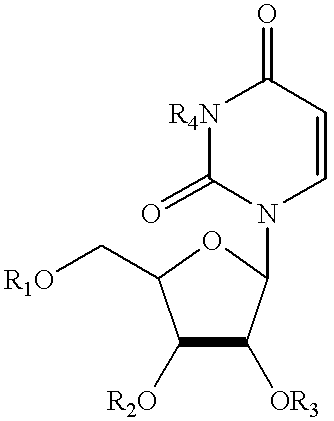
wherein R1, R2, R3 and R4 are the same or different and each is hydrogen or an acyl radical of a metabolite, provided that at least one of said R substituents is not hydrogen, or a pharmaceutically acceptable salt thereof.
(2) An acyl derivative of cytidine having the formula: 
wherein R1, R2,R3 and R4 are the same or different and each is hydrogen or an acyl radical of a metabolite, provided that at least one of said R substituents is not hydrogen, or a pharmaceutically acceptable salt thereof.
(3) An acyl derivative of deoxycytidine having the formula: 
wherein R1, R2, and R3 are the same or different and each is hydrogen or an acyl radical of a metabolite, provided that at least one of said R substituents is not hydrogen, or a pharmaceutically acceptable salt thereof.
(4) An acyl derivative of deoxyuridine having the formula: 
wherein R1, R2, and R3 are the same or different and each is hydrogen or an acyl radical of a metacolic, provided that at least one of said R substituents is not hydrogen, or a pharmaceutically acceptable salt thereof.
Compounds of the invention useful in ameliorating toxicity due to anticancer or antiviral chemotherapy agents include the following:
(5) An acyl derivative of uridine having the formula: 
wherein R1, R2, and R3 are the same, or different, and each is hydrogen or an acyl radical of
a. an unbranched fatty acid with 5 to 22 carbon atoms,
b. an amino acid selected from the group consisting of glycine, the L forms of alanine, valine, leucine, isoleucine, tyrosine, proline, hydroxyproline, serine, threonine, cystine, cysteine, aspartic acid, glutamic acid, arginine, lysine, histidine, carnitine and ornithine,
c. a dicarboxylic acid having 3-22 carbon atoms,
d. a carboxylic acid selected from one or more of the group consisting of glycolic acid, pyruvic acid, lactic acid, enolpyruvic acid, lipoic acid, pantothenic acid, acetoacetic acid, p-aminobenzoic acid, betahydroxybutyric acid, orotic acid, and creatine.
(6) An acyl derivatives of cytidine having the formula: 
wherein R1, R2, R3, and R4 are the same, or different, and each is hydrogen or an acyl radical of
a. an unbranched fatty acid with 5 to 22 carbon atoms,
b. an amino acid selected from the group consisting of glycine, the L forms of phenylalanine, alanine, valine, leucine, isoleucine, tyrosine, proline, hydroxyproline, serine, threonine, cystine, cysteine, aspartic acid, glutamic acid, arginine, lysine, histidine carnitine and ornithine,
c. a dicarboxylic acid having 3-22 carbon atoms,
d. a carboxylic acid selected from one or more of the group consisting of glycolic acid, pyruvic acid, lactic acid, enolpyruvic acid, lipoic acid, pantothenic acid, acetoacetic acid, p-aminobenzoic acid, betahydroxybutyric acid, orotic acid, and creatine.
(7) An acyl derivative of deoxycytidine, having the formula 
wherein R1, R2, and R3 are the same, or different, and each is hydrogen or an acyl radical derived from
a. an unbranched fatty acid with 3 to 22 carbon atoms,
b. an amino acid selected from the group consisting of glycine, the L forms of alanine, valine, leucine, isoleucine, tyrosine, proline, hydroxyproline, serine, threonine, cystine, cysteine, aspartic acid, glutamic acid, arginine, lysine, histidine, carnitine and ornithine,
c. nicotinic acid
d. a dicarboxylic acid having 3-22 carbon atoms, provided that not all of R1, R2, and R3 are H, and where R3 is not H, then R1 and/or R2 may also be acetyl, or a pharmaceutically acceptable salt thereof.
(8) An acyl derivative of deoxyuridine, having the formula 
wherein R1, R2, and R3 are the same, or different, and each is hydrogen or an acyl radical derived from
a. an unbranched fatty acid with 3 to 22 carbon atoms,
b. an amino acid selected from the group consisting of glycine, the L forms of alanine, valine, leucine, isoleucine, tyrosine, proline, hydroxyproline, serine, threonine, cystine, cysteine, aspartic acid, glutamic acid, arginine, lysine, histidine, carnitine and ornithine,
c. nicotinic acid
d. a dicarboxylic acid having 3-22 carbon atoms, provided that not all of R1, R2, and R3 are H, and where R3 is not H, then R1 and/or R2 may also be acetyl, or a pharmaceutically acceptable salt thereof.
(9) An acyl derivative of uridine having the formula: 
wherein at least one of R1, R2, or R3 is a hydrocarbyloxycarbonyl moiety containing 2-26 carbon atoms and the remaining R substituents are independently a hydrocarbyloxycarbonyl or hydrocarbylcarbonyl moiety or H or phosphate.
(10) An acyl derivative of cytidine having the formula: 
wherein at least one of R1, R2, R3 or R4 is a hydrocarbyloxycarbonyl moiety containing 2-26 carbon atoms and the remaining R substituents are independently a hydrocarbyloxycarbonyl or hydrocarbylcarbonyl moiety or H or phosphate.
(11) An acyl derivative of deoxycytidine having the formula: 
wherein at least one of R1, R2, or R3 is a hydrocarbyloxycarbonyl moiety containing 2-26 carbon atoms and the remaining R substituents are independently a hydrocarbyloxycarbonyl or hydrocarbylcarbonyl moiety or H or phosphate.
(12) An acyl derivative of deoxyuridine having the formula: 
wherein at least one of R1 or R2 is a hydrocarbyloxycarbonyl moiety containing 2-26 carbon atoms and the remaining R substituents are independently a hydrocarbyloxycarbonyl or hydrocarbylcarbonyl moiety or H or phosphate.
Also encompassed by the invention are the pharmaceutically acceptable salts of the above-noted compounds.
Advantageous compounds of the invention are fatty acid esters of uridine and deoxycytidine, especially those with 4 or fewer carbon atoms in the acyl substituent. Particularly advantageous compounds are fatty acid esters of uridine or deoxycytidine with 2 or 3 carbon atoms in the acyl substituent.
Other advantageous compounds of the invention are hydrocarbyloxycarbonyl derivatives of uridine and deoxycytidine, particularly those with 3 to 6 carbon atoms in the hydrocarbyloxycarbonyl moiety.
In one embodiment of the invention, prodrugs of the compounds of the invention with enhanced water solubility are prepared by attaching phosphate to a free hydroxyl group on the aldose moiety of the acylated non-methylated pyrimidine nucleoside.
C. Compositions of the Invention
Compositions of the invention include one or more of the above-noted compounds along with a pharmaceutically acceptable carrier.
In another embodiment, the compositions of the invention include in addition to one or more compounds of the invention and at least one of the following agents which enhance hematopoiesis: oxypurine nucleosides, congeners of oxypurine nucleosides, and acyl derivatives of oxypurine nucleosides and their congeners, e.g. fatty acid esters of guanosine or deoxyguanosine (see U.S. Ser. No. 653,882, filed, Feb. 8, 1991, hereby incorporated by reference), a nonionic surfactant, an interleukin such as IL-1,-2,-3,-4,-5,-6,-7,-8 (advantageously IL-1, 3, or 6), a colony-stimulating factor, for example granulocyte colony-stimulating factor (G-CSF), granulocyte/macrophage colony-stimulating factor (GM-CSF), stem cell factor (SCF), erythropoietin (EPO), glucan, polyinosine-polycytidine, or any other agent having beneficial effects on hematopoiesis.
Acyl derivatives of oxypurine nucleosides which enhance hematopoiesis and which are optionally administered in conjunction with the compounds of the invention have the following general structure: 
RA=H or an acyl radical of a carboxylic acid with 2 to 30 carbon atoms, and
RB=H or an acyl radical of a carboxylic acid with 2 to 30 carbon atoms, and
Z=H, OH, ═O, or NHRc where Rc=H or an acyl radical of a carboxylic acid with 2 to 30 carbon atoms, and
L=H or ORD, where RD=H or an acyl radical of a carboxylic acid with 2 to 30 carbon atoms, and
M=H or ORE, where RE=H or an acyl radical of a carboxylic acid with 2 to 30 carbon atoms, with the proviso that at least one of L and M is H, and
Q=H, a halogen, NHRF where RF is H or an acyl or alkyl radical containing 1 to 10 carbon atoms, S divalently bound to the carbon in which case the adjacent carbon-nitrogen double bond is a single bond and an H is then attached to that nitrogen, SRG where RG is H or an acyl or alkyl radical containing 1 to 10 carbon atoms, O divalently bound to the carbon, in which case the adjacent carbon-nitrogen double bond is a single bond and an H is then attached to that nitrogen, or ORH where RH is H or an acyl or alkyl radical containing 1 to 10 carbon atoms, and
the C—C bond between the 2′ and 3′ positions of the aldose moiety is optionally present.
In another embodiment of the invention, an acylated non-methylated pyrimidine nucleoside is formulated with a compound capable of enhancing the uptake and phosphorylation of nucleosides into cells such as insulin or an insulinogenic carbohydrate.
In another embodiment of the invention, the composition comprises at least one compound of the invention and an antiviral or antineoplastic agent (see detailed discussion of these agents in the section below entitled Therapeutic Uses of the Compounds and Compositions of the Invention).
In another embodiment, the compositions of the invention comprise an acyl derivative of uridine or deoxyuridine and a compound capable of inhibiting uridine phosphorylase. Uridine phosphorylase is the primary enzyme involved in the catabolism of uridine, forming uracil and ribose phosphate. Administration of a compound which inhibits uridine phosphorylase will modify the pharmacokinetics and biological activity of uridine or deoxyuridine produced by deacylation of acylated derivatives of these two non-methylated pyrimidine nucleosides. Examples of suitable inhibitors of uridine phosphorylase include but are not limited to 5-benzyl barbiturate or 5-benzylidene barbiturate derivatives including 5-benzyl barbiturate, 5-benzyloxybenzyl barbiturate, 5-benzyloxybenzyl-1-[(1-hydroxy-2-ethoxy)methyl] barbiturate, 5-benzyloxybenzylacetyl-1-[(1-hydroxy-2-ethoxy)methyl] barbiturate, and 5-methoxybenzylacetylacyclobarbiturate, 2,2′-anhydro-5-ethyluridine, and acyclouridine compounds, particularly 5-benzyl substituted acyclouridine congeners including but not limited to benzylacyclouridine, benzyloxy-benzylacyclouridine, aminomethyl-benzylacyclouridine, aminomethyl-benzyloxybenzylacyclouridine, hydroxymethyl-benzylacyclouridine, and hydroxymethyl-benzyloxybenzyl-acyclouridine. See also WO 89/09603 and WO 91/16315, hereby incorporated by reference.
In another embodiment of the invention, the composition comprises an acyl derivative of a non-methylated pyrimidine nucleoside and a compound which inhibits cellular uptake or excretion of non-methylated pyrimidine nucleosides, and thereby promotes maintenance of blood nucleoside levels after enzymatic deacylation of administered doses of acylated derivatives of non-methylated pyrimidine nucleosides. Such modulators of uridine transport or excretion include but are not limited to dipyridamole, dilazep, probenicid, lidoflazine or nitrobenzylthioinosine.
In another embodiment of the invention, the composition comprises an acyl derivative of cytidine and a compound. capable of inhibiting the enzyme uridine phosphorylase. Inhibition of this enzyme is useful in conjunction with cytidine since cytidine is in part deaminated in the bloodstream after deacylation of its acyl derivatives, providing uridine to the tissues.
In another embodiment of the invention, the composition comprises an acyl derivative of cytidine or deoxycytidine and a compound capable of inhibiting deoxycytidine deaminase. By inhibiting the deamination of deoxycytidine or cytidine, inhibitors of cytidine deaminase or deoxycytidine deaminase such as tetrahydrouridine or tetrahydro-2′-deoxyuridine modify the efficacy of acyl derivatives of cytidine or deoxycytidine. In another embodiment of the invention, an inhibitor of cytidine deaminase or deoxycytidine deaminase is used to modify the toxicity of an antiviral or anticancer nucleoside analog (see Example 11).
In another embodiment of the invention, especially for prevention or treatment of damage to the gastrointesinal mucosa, the composition comprises an acyl derivative of a non-methylated pyrimidine nucleoside and an agent or agents with utility in promoting mucosal healing or in reducing discomfort. Examples of such agents include but are not limited to sucralfate, mixtures of two or more deoxyribonucleosides as disclosed in U.S. patent application Ser. No. 341,925, filed Apr. 21, 1989 (hereby incorporated by reference), allopurinol, antibiotics like chlorhexidine gluconate or local anesthetics like benzocaine.
In another embodiment of the invention, the composition comprises a combination of an acyl derivative of a non-methylated pyrimidine nucleoside and an orally-active antineoplastic nucleoside analog. An advantageous combination is an acyl derivative of uridine with an orally active fluorinated pyrimidines, especially prodrugs of 5-fluorouracil. In such compositions, the acyl derivative of a non-methylated pyrimidine nucleoside is mixed with (or otherwise adminstered with) the antineoplastic nucleoside analog in molar ratios, ranging from 1:1 to 12:1. Molar ratios ranging from 2:1 to 8:1 are generally advantageous. Suitable orally-active fluorinated pyrimidines include tegafur, 5′-deoxyfluorouridine, 5-fluorouracil, 5-fluorouridine, 2′-deoxy-5-fluorouridine, N4-trimethoxybenzoyl-5′-deoxy-5-fluorocytidine, or acyl derivatives thereof.
The compositions, depending on the intended use, are manufactured in the form of a liquid, a suspension, a tablet, a capsule, a dragee, an injectable solution, a topical solution, or a suppository (see discussion of formulation below).
As an alternative to formulation of compositions containing a compound of the invention and another active agent (as discussed above), in another embodiment, the compounds of the invention are coadministered with the other active agents.
D. Therapeutic Uses of the Compounds and Compositions of the Invention
The compounds of the invention are useful to prevent or treat damage to the process of hematopoiesis and immune system function in animals. The compounds reduce damage to the process of hematopoiesis by minimizing loss in blood cell counts after bone marrow damage or suppression caused by antiviral or antineoplastic agents which affect nucleotide biosynthesis, metabolism, or utilization. The compounds of the invention are useful in treating humans; however, the invention is not intended to be so limited, it being within the contemplation of the invention to treat all animals that experience a beneficial effect from the administration of the active compounds of the invention.
The invention is furthermore embodied in the administration of a pharmaceutical compound or composition of the invention, or in combinations, for the purpose of preventing, attenuating, or ameliorating toxicity associated with administration of antiviral or antineoplastic agents which affect nucleotide biosynthesis, metabolism, or utilization.
Specific conditions where advantages are achieved using the compounds, compositions, and methods of the invention include situations where the hematopoietic system has suffered or is likely to suffer damage from chemotherapy, particularly chemotherapy that affects nucleotide biosynthesis, metabolism, or utilization. Such conditions include treating animals, e.g. human patients, subjected to cytoreductive cancer chemotherapy or antiviral chemotherapy. Specifically included are veterinary applications requiring maintenance of blood cell counts.
The compounds and compositions are also useful for preventing or treating damage caused by anticancer or antiviral chemotherapy agents to other tissues, including but not limited to gastrointestinal epithelium. For this purpose, the compounds and compositions are optionally administered orally, as a suppository, or parenterally.
By attenuating damage to the hematopoietic and immune systems caused by anticancer or antiviral chemotherapy, the compounds and methods of the invention reduce the risk of susceptibility to opportunistic or secondary infections (bacterial, viral, or fungal).
The efficacy of the compounds of the invention is enhanced by coadministration of agents which stimulate the uptake and phosphorylation of pyrimidine nucleosides by cells. Such agents include hematopoietic growth factors (e.g. G-CSF, GM-CSF, SCF, acylated oxypurine nucleosides and their congeners, erythropoietin, and interleukins), insulin, and insulinogenic carbohydrates such as glucose or glucose polymers.
Treatment of Complications Associated with Cancer Chemotherapy
The white blood cell counts, and particularly the neutrophil counts, of patients treated with standard anti-neoplastic chemotherapy agents (e.g., 5-fluorouracil, fluorodeoxyuridine, vinca alkaloids, cyclophosphamide and other nitrogen mustard alkylating agents, daunorubicin, doxorubicin, methotrexate, cytosine arabinoside, 6-mercaptopurine, thioguanosine, podophyllotoxins, cisplatin or combinations of such cytoreductive agents) are often greatly diminished. In the case of cytotoxic agents which act by affecting nucleotide biosynthesis, metabolism, or utilization, daily administration (oral or parenteral) of an effective dose, (for example, 0.1-10.0 grams) of a compound of the invention such as triacetyluridine (or other acyl derivatives of uridine, cytidine, deoxycytidine, or deoxyuridine) for several days reduces the severity of the neutropenia which typically occurs several days to several weeks after chemotherapy is initiated. This reduces the likelihood of infection throughout the course of treatment, and makes it possible for the patient to receive larger doses of the chemotherapeutic agents and/or to receive repeated doses sooner than comparable patients not treated with the uridine derivative(s). Similarly, chemotherapy-induced alterations in counts of other blood cell types (lymphocytes, platelets, erythrocytes, etc.) are ameliorated by administration of the compounds and compositions of the invention.
Antineoplastic agents with which the compounds and methods of the invention are particularly useful include: 5-fluorouracil (5-FU), 5-FU prodrugs (e.g. ftorafur, 5′-deoxyfluorouridine, carmofur), fluorouridine, 2′-deoxyfluorouridine, prodrug derivatives of fluorouridine or 2′-deoxyfluorouridine, fluorocytosine (which also has antifungal activity), arabinosyl cytosine, prodrugs of arabinosyl cytosine, cyclocytidine, 5-aza-2′-deoxycytidine, arabinosyl 5-azacytosine, N-phosphonoacetyl-L-aspartic acid (PALA), pyrazofurin, 6-azauridine, azaribine, 6-azacytidine, trifluoro-methyl-2′-deoxyuridine, thymidine, and 3-deazauridine. Such antineoplastic agents and various other therapeutic nucleoside analogs act by affecting nucleoside or nucleotide biosynthesis, utilization, or metabolism; hence, amelioration of their toxic effects is accomplished by administration of the pyrimidine compounds of the invention.
In addition to reduction of toxicity of antineoplastic nucleoside analogs, acyl derivatives of nonmethylated pyrimidine nucleosides are also useful for reduction of toxicity of antineoplastic agents that are cleared from the body via glucuronidation. Antineoplastic agents that are eliminated by glucuronidation include but are not limited to epirubicin and camptothecins like irinotecan and topotecan. In this process, glucuronic acid is attached to toxic compounds to facilitate their elimination. Uridine diphosphoglucuronic acid (UDPGA) is necessary for attachment of glucuronic acid to other molecules. Administration of an acyl derivative of either uridine or cytidine increases cellular UDPGA levels and thereby enhances glucuronidation of toxic compounds. In this situation, the acyl derivative of cytidine or uridine is administered before or at the same time as the antineoplastic agent. In a typical clinical situation, 1 to 10 grams of an acyl derivative of uridine is administered once to four times prior to or during administration of the antineoplastic compound.
The compounds of the invention are administered before, during, and/or after administration of the anti-neoplastic or antiviral agents. Typically, the compounds of the invention are administered after a dose of a cancer chemotherapy agent, as a means of “rescuing” normal tissues after administration of an effective antineoplastic dose of the agent.
Gastrointestinal epithelium is sensitive to cancer chemotherapy agents like fluorouracil. Mucositis, stomatitis, or ulceration of the gastrointestinal mucosa are common side effects of cancer chemotherapy, resulting in discomfort, diarrhea, electrolyte imbalances and weight loss. The compounds of and compositions of the invention are useful in preventing or treating damage to the gastrointestinal tract (including the mouth) caused by cancer chemotherapy agents. The compounds and compositions of the invention are optionally administered for this purpose as a solution or suspension in liquid form (as a mouthwash, as a composition to be swallowed, or as an enema), as a capsule, dragee, or tablet, as an injectable solution, or as a suppository. systemic administration of the compounds and compositions of the invention also reduces damage to gastrointestinal mucosa caused by anticancer or antiviral nucleoside analogs.
Topical application of the compounds (e.g. to the scalp) of the invention is useful for preventing chemotherapy-induced alopecia.
Acyl derivatives of uridine are advantageous in preventing or treating toxicity due to fluorouracil or related fluorinated analogs of uridine (e.g. fluorouridine or prodrugs thereof, fluorodeoxyuridine or prodrugs thereof, ftorafur, 5′-deoxyfluorouridine). For oral administration, advantageous acyl derivatives of uridine are those substituted with short-chain fatty acids, (especially acetate) or with short chain carbyloxycarbonates (e.g. ethoxycarbonate). Acyl derivatives of cytidine or deoxyuridine are also useful in treating toxicity due to fluorouracil or related fluorinated pyrimidine analogs.
In a typical therapeutic situation, a patient receives a dose of fluorouracil, either as a single treatment agent or as part of a regimen also involving administration of other antineoplastic drugs like methotrexate, leucovorin, PALA, or cyclophosphamide. Several hours to one day (i.e. 2 to 24 hours) after administration of the 5-FU, the patient receives an oral dose of 1 to 10 grams of triacetyluridine. The patient receives additional doses of TAU of similar size every 6 to 8 hours over the course of the next 1 to 4 days. The patient may receive additional courses of 5-FU plus TAU on a weekly basis or less frequently.
For treatment of cancer in humans, 5FU is often administered as a weekly bolus injection, for a period of six weeks. The normal maximum tolerated dose of 5FU in such a regimen is 500 to 600 mg/m2. Delayed administration (2 to 24 hours after 5FU) of an acyl derivative of a nonmethylated pyrimidine nucleoside permits escalation of the weekly 5FU dose to levels greater than 1.5 times the normal maximum tolerated dose (i.e. greater than 900 mg/m2), advantageously 900 to 2000 mg/m2, more advantageously 1000 to 1600 mg/m2. An alternative method for use of 5FU in the clinic involves injection of doses from 400 to 500 mg/m2 daily for four or five days in a row. This administration regimen is repeated every three to four weeks. Delayed administration of an acyl derivative of a nonmethylated pyrimidine nucleoside in this case permits similar 5FU dose escalation to levels at least 1.5 fold greater than normal tolerated doses, advantageously 600 to 1000 mg/m2, more advantageously 700 to 900 mg/m2. In the case of daily 5FU administration, delayed administration of an acyl derivative of a nonmethylated pyrimidine nucleoside occurs 2 to 12 hours after each 5FU dose. Another dosing regimen for 5FU involves infusion of a total dose of 1800 to 2600 mg/m2 over 24 hours repeated once every week to once every three to four weeks. When 5FU is administered as an infusion (compared to a bolus) high cumulative doses are administered because of extensive degradation of 5FU. In the case of a 24 hour 5FU infusion, an acyl derivative of a nonmethylated pyrimidine nucleoside is administered 2 to 24 hours after the termination of the 5FU infusion, permitting escalation of the 5FU dose by at least 1.5 fold over normal tolerated doses, advantageously 2800 to 4000 mg/m2/24 hours.
An alternative regimen for use of high-dose 5FU with delayed administration of an acyl derivative of a nonmethylated pyrimidine nucleoside is weekly bolus administration of 5FU for 3 weeks, followed by one or more weeks of rest. This regimen permits administration of higher 5FU doses per week than the common weekly ×6 regimen described above. In a weekly ×3 regimen utilizing an acyl derivative of a nonmethylated pyrimidine nucleoside for reducing 5FU toxicity, bolus 5FU doses in the range of 1000 to 2400 mg/m2 are advantageous.
In all regimens involving escalation of the dose of an antineolastic nucleoside analog with delayed administration of an acyl derivative of a nonmethylated pyrimidine nucleoside, the maximum dose of the antineoplastic nucleoside analog is the dose which produces the maximum clinically acceptable degree of toxicity to the recipient.
Clinical response to 5FU is a function of weekly dose intensity (Hryniuk et al. Seminars in Oncology, 14 (No. 4; Suppl 4): 3-11 [1987]). 5FU dose escalation in conjunction with delayed administration of an acyl derivative of a nonmethylated pyrimidine nucleoside increases the antitumor efficacy of 5FU. Other modulators of 5FU efficacy including but not limited to methotrexate, trimetrexate, methylmercaptopurine riboside, PALA, leucovorin, inhibitors of 5FU catabolism, levamisole, interferon, or cisplatin are optionally administered in conjunction with 5FU and an acyl derivative of a nonmethylated pyrimidine nucleoside. When used with 5FU in conjunction with an acyl derivative of a nonmethylated pyrimidine nucleoside, such modulators are administered in doses and schedules similar or identical to thoses determined suitable for their use with 5FU in the absence of delayed administration of a an acyl derivative of a nonmethylated pyrimidine nucleoside. Some such modulators also increase 5FU toxicity and thereby reduce the maximum tolerated dose that may be administered to patients. However, in these cases, delayed administration of an acyl derivative of a nonmethylated pyrimidine nucleoside permits escalation of the 5FU dose to levels more than 1.5 fold greater than could be tolerated in the absence of an acyl derivative of a nonmethylated pyrimidine nucleoside. Similarly, delayed administration of an acyl derivative of a nonmethylated pyrimidine nucleoside permits escalation of the normal maximum tolerated dose of other fluorinated pyrimidines, 5FU prodrugs, or other cytotoxic nucleoside analogues.
There are individual differences in the sensitivity of patients to 5FU. However, in any individual patient, use of an acyl derivative of a nonmethylated pyrimidine nucleoside in conjunction with 5FU permits dose escalation of the fluorinated pyrimidine to at least 1.5 fold greater than the normal maximum tolerated dose. The normal maximum tolerated dose of 5FU for any individual patient is determined either by 5FU challenge, by judgment based on a physician's experience, or by estimation guided by measurements of enzymes involved in 5FU degradation or anabolism.
5FU itself can be administered in conjunction with a compound which inhibits 5FU degradation by the enzyme dihydropyrimidine dehydrogenase (DPD). DPD is the initial enzyme in 5FU degradation and is found in high concentrations in the liver. Inhibition of this enzyme reduces the rate of 5FU clearance from the bloodstream by the liver and other tissues and thereby permits oral administration of 5FU. DPD inhibition also reduces the formation of 5FU catabolites which might contribute to its toxicity or which might reduce its antitumor efficacy. Examples of inhibitors of DPD include but are not limited to 5-ethynyluracil, bromovinyluracil, uracil, thymine, or benzyloxybenzyluracil (BBU).
In one embodiment of the invention, 5FU or a 5FU prodrug is administered in conjunction with an inhibitor of the enzyme DPD. In this embodiment, an inhibitor of DPD is administered prior to, or at the same time as, a 5FU or another cytotoxic fluorinated pyrimidine. An acyl derivative of uridine or cytidine is administered 2 to 24 hours after the 5FU. Delayed administration of an acyl derivative of uridine or cytidine permits safe administration of higher doses of 5FU than are normally tolerated in conjunction, with a consequent improvement in antitumor efficacy.
Acyl derivatives of uridine and, secondarily, cytidine, are also advantageous for treatment or prevention of toxicity due to N-phosphonoacetyl-L-aspartic acid (PALA), pyrazofurin, 6-azauridine, azaribine, trifluoro-methyl-2′-deoxyuridine, and 3-deazauridine.
For modulating toxicity and efficacy of orally-active antineoplastic drugs, particularly orally-active fluorinated pyrimidine or prodrugs of fluorinated pyrimidines (such as 5′ deoxyfluorouridine derivatives like tegafur (5-fluoro-1-(tetrahydro-2-furfuryl)uracil), 5′-deoxyfluorouridine, or related derivatives), acyl derivatives of non-methylated pyrimidine nucleosides may be used in several ways. In one embodiment of the invention, the acyl derivative of a non-methylated pyrimidine nucleoside is administered several hours to one day after a dose of a fluorouracil prodrug such as tegafur, similar to the situation with parenteral administration of fluorouracil described above. In this context, the delayed administration of the acyl derivative of a non-methylated pyrimidine nucleoside results in reduced toxicity of the fluorinated pyrimidine toward normal tissues. In another embodiment of the invention, the acyl derivative of a non-methylated pyrimidine nucleoside is administered at the same time as, or within about an hour of, the orally-active antineoplastic agent.
Tegafur, an orally active 5-fluorouracil prodrug, is currently administered clinically in a formulation containing uracil in a molar ratio of four parts uracil to one part tegafur. In this context, uracil potentiates the antitumor efficacy of 5-fluorouracil produced by degradation of tegafur (during and after absorption from the intestinal tract into the bloodstream) by competing with 5-fluorouracil for the enzyme which breaks down both pyrimidine molecules, dihydropyrimidine dehydrogenase. However, uracil also potentiates the toxicity of 5-fluorouracil toward normal tissues, particularly the intestine. Gastrointestinal damage is the primary dose-limiting toxicity of a mixture of tegafur and uracil. Co-administration of tegafur (or other orally active antineoplastic pyrimidine analogs) with an acyl derivative of a non-methylated pyrimidine nucleoside results in the desirable potentiation of the systemic toxicity of, for example, 5-fluorouracil derived from tegafur, without potentiating its toxicity toward the intestinal mucosa as drastically as does uracil itself. The acyl derivative of a non-methylated pyrimidine nucleoside and the orally active antineoplastic nucleoside analog are administered in ways and at dosages and molar ratios typically used for administration of uracil and an orally active antineoplastic agent. See, for example, U.S. Pat. No. 4,328,229, hereby incorporated by reference. Higher doses of the orally active antineoplastic agent are also possible with the use of the acyl derivatives of the subject invention. This embodiment of the invention is experimentally demonstrated in Examples 13 and 14 below.
Acyl derivatives of deoxycytidine are advantageous in treating or preventing toxicity due to antineoplastic nucleoside analogs that are specifcally analogs of cytidine, e.g. arabinosyl cytosine or prodrugs thereof, cyclocytidine, 5-aza-2′-deoxycytidine, arabinosyl 5-azacytosine, or 6-azacytidine. For oral administration, advantageous acyl derivatives of deoxycytidine are those substituted with short-chain fatty acids, especially acetate.
In a typical clinical situation involving the use of arabinosyl cytosine or related antineoplastic analogs of cytidine, which are primarily utilized for treatment of leukemias, the acyl derivative(s) of deoxycytidine are administered orally, in a dose of 0.5 to 10 grams, either before or after administration of a dose of Ara-C is completed, or concurrently with the dose of Ara-C. Further doses of the acyl derivative of deoxycytidine are administered every six to eight hours for 1 to 4 days. Repetitions of this treatment regimen are initiated once per week or less frequently, depending on the clinical response.
It is intended that the antineoplastic agents be used for treating the types of tumors for which they are normally utilized, e.g. Ara-C and its related cytidine analogs are effective in leukemias, fluorouracil and related fluorinated uridine analogs are useful in treating tumors of the colon, stomach, pancreas, breast, and head-and-neck. In one embodiment, the antineoplastic agents are administered in their normal doses, in which case the compounds of the invention primarily reduce the severity of toxic side effects. In another embodiment, the antineoplastic agents are administered in doses higher than normal, in which case acyl derivatives of nonmethylated pyrimidine nucleosides permit safer administration of such higher, therapeutically aggressive doses of the anticancer drugs. Furthermore, the increases in therapeutic index of anticancer agents resulting from use of the compounds and compositions of the invention permit the use of particular antineoplastic agents for treating tumors for which they are not currently standard therapy, including but not limited to melanoma, prostate, renal carcinoma, ovarian carcinoma, or lung cancer.
A method for identifying tumor types or individual cancer patients with a high probability of responding to high-dose fluorinated pyrimidines in conjunction with an acyl derivative of nonmethylated pyrimidine nucleosides involves measurement of the enzyme fatty acid synthetase (FAS) in serum or in tumor biopsies. FAS is highly expressed in many cancers, where it may have a role in providing lipids necessary for rapid cell division (Kuhajda et al., Proc. Nat. Acad. Sci. 91:6379-6383 [1994]). FAS requires a supply of NADPH as a cofactor. A substantial fraction of NADPH utilized for fatty acid synthesis is regenerated from NADP through the hexose monophosphate shunt (HMP shunt) pathway of glucose metabolism. The HMP shunt is activated by depletion of cellular NADPH. A product of NADPH generation through the HMP shunt is ribose and various ribose phosphates. In order for cells to rapidly anabolize high concentrations of 5FU, a supply of either phosphoribosyl pyrophosphate (PRPP) or ribose-1-phosphate (R-1-P) is necessary, depending on whether the 5FU is converted to intracellular fluorouridine monophosphate via the enzyme orotate phosphoribosyl transferase or uridine phosphorylase respectively. High levels of FAS in serum or tumor biopsies is a marker for tumors which are actively producing ribose necessary for efficient anabolism of 5FU, and which are particularly responsive to high doses of 5FU.
Treatment of Complications Associated with Viral Infection
HIV-infected patients, especially those whose infection has progressed to “acquired immunodeficiency syndrome” (AIDS), suffer from a variety of symptoms and diseases which result from and, in some cases, further exacerbate a severely compromised immune system. Many of these patients are given antiviral chemotherapeutic agents, such as AZT, which also have detrimental effects on the body's immune function and upon hematopoiesis, further lowering resistance to infections of all kinds. Administration of the compounds of the invention—orally, intravenously, or by parenteral injection—raises the low blood cell counts due to antiviral chemotherapy agents, particularly those that modify nucleotide synthesis, metabolism, or utilization, such as AZT or dideoxycytidine. Because anemia and greater susceptibility to infections are dose- and rate-limiting factors in chemotherapeutic treatment of AIDS patients, treatment of the patients with these compounds reduces chemotherapeutic side effects (and thus improves the quality of life) and, if appropriate, permits a more intensive chemotherapeutic regimen to be employed. AZT and dideoxycytidine produce deleterious side effects in tissues other than bone marrow, including muscle and the peripheral nervous system. The compounds and compositions of the invention are also useful for treating or preventing such side effects.
Various antiviral nucleoside analogs other than AZT and dideoxycytidine are used to treat viral infections, including but not limited to HIV, herpes, or hepatitis. Examples of such agents include 5-ethyl-2′-deoxyuridine, 5-iodo-2′-deoxyuridine, 5-bromo-2′-deoxyuridine, 5-methylamino-2′-deoxyuridine, 2′,3′-dideoxycytidin-2′-ene, 3′-deoxythymidin-2′-ene, 3′-azido-2′,3′-dideoxyuridine, arabinosyluracil, dideoxyuridine, 2′,3′-dideoxy-3′-fluorothymidine and (S)-1-(3-hydroxy-2-phosphonyl-methoxypropyl) cytosine (HPMPC); see also WO 89/09603, hereby incorporated by reference. The compounds of the invention are used to treat or prevent deleterious side effects of these and related other antiviral nucleoside analogs.
In treatment or prevention of toxicity due to antiviral chemotherapy, the compounds and compositions are administered prior to, during and/or after administration of the antiviral agents. Typical antiviral chemotherapy regimens, especially for chronic viral infections such as HIV infection, involve daily (often multiple daily) administration of the antiviral agent or agents. The compounds of the invention are administered, several times daily, daily, or less frequently, depending on the clinical effect observed. In all cases, the antiviral drugs are typically administered in their normal regimens for the types of viral infections for which they are clinically useful. Treatment of patients receiving antiviral nucleoside analogs is undertaken either to reduce side effects of a standard dose or to permit administration of doses of antiviral agents higher than are normally tolerated or utilized.
For treatment of toxicity due to AZT, acyl derivatives of either or both uridine, cytidine, or deoxycytidine are useful. Particularly advantageous are acyl derivatives of deoxycytidine. For oral administration, acyl derivatives of deoxycytidine, uridine, and cytidine substituted with short chain fatty acids (particularly acetate) or with short chain carbyloxycarbonates (e.g. ethoxycarbonate), are advantageous.
In a typical clinical situation, a patient receives AZT two to four times daily, and must generally do so indefinitely. Doses of 1 to 10 grams of acyl derivatives of uridine, cytidine, or deoxycytidine (or mixtures of two or all three) are administered orally once per week up to about four times per day, depending on the clinical response.
For treatment or prevention of toxicity due to dideoxycytidine, acyl derivatives of deoxycytidine are advantageous.
Treatment of Complications Associated with Malarial Infection
Malarial parasites, e.g. Plasmodium yoelii or Plasmodium falciparum, are dependent upon de novo synthesis pathways for pyrimidine nucleotide biosynthesis; mammalian cells in general can utilize either de novo pathways or “salvage” pathways, through which advanced nucleotide precursors such as uridine or cytidine are incorporated into intracellular nucleotide pools. 5-Fluoroorotate, an analog of the pyrimidine nucleotide precursor orotic acid, is toxic toward malarial parasites which are dependent on de novo pyrimidine biosynthesis. Other inhibitors of de novo pyrimidine biosynthesis, such as PALA, pyrazofurin or 6-azauridine are also similarly toxic toward malaria parasites. Inhibitors of pyrimidine biosynthesis, including especially fluoroorotate, are also toxic toward mammals. However, administration of uridine to mammals treated with 5-fluoroorotate (or other inhibitors of pyrimidine biosynthesis) attenuates host toxicity due to the latter without impairing its antimalarial activity. Orally active agents which elevate blood uridine levels are advantageous sources of uridine in this context. Such agents include the acyl derivatives of uridine or cytidine of the invention. In treatment of malaria, an effective anti-malarial dose of fluoroorotate is administered. Before, after, or at the same time as fluoroorotate administration, an acyl derivative of uridine or cytidine (triacetyluridine is particularly advantageous) is administered, in a dose sufficient to attenuate fluoroorotate toxicity. Typical doses of an acylated uridine or cytidine derivative such as triacetyl uridine range from 1 to 10 grams, administered as often as needed to minimized fluoroorotate toxicity, e.g. one to four times per day. Doses of fluoroorotate or uridine are optionally repeated as necessary to overcome the malarial infection and to reduce host toxicity respectively.
E. Administration and Formulation of Compounds and Compositions of the Invention
The compounds and compositions of the invention are administered orally, by parenteral injection, intravenously, topically, or by other means, depending on the condition being treated.
The optimal doses and dose schedules for triacetyluridine (or other acyl derivatives of uridine, cytidine, deoxycytidine or deoxyuridine) are readily determined by one skilled in the art, by monitoring the therapeutic effect.
The compounds and compositions of the invention are administered chronically or intermittently. The compounds and compositions are administered prior to, during, or after an exposure to cytoreductive or antiviral chemotherapy agents, depending on the characteristics of the toxicity of the chemotherapy agents.
Advantageous acyl derivatives of uridine, cytidine, deoxycytidine, or deoxyuridine for oral administration are those substituted with short chain (2-6 carbon) fatty acids on the hydroxyl groups of their ribose or deoxyribose rings. Also advantageous for oral administration are pyrimidine nucleosides substituted on their hydroxyl groups with hydrocarbyloxycarbonyl radicals containing 3-7 carbon atoms.
Dosages for orally adminstered acyl derivatives of uridine, cytidine, deoxycytidine or deoxyuridine typically range from 0.5 to 20 grams per day, most commonly 2 to 10 grams per day.
Powdered acyl derivatives of uridine, cytidine, deoxycytidine or deoxyuridine are administered orally in capsule or tablet form, although solutions, emulsions, or suspensions are also useful for oral administration.
The compounds of the invention are optionally formulated in biodegradable, bioerodible, or other gradual-release matrices for sustained release of the compounds after oral administration or subcutaneous implantation. In the case of intravenous or intramuscular injection, the compounds are optionally formulated in liposomes.
The pharmacologically active compounds optionally are combined with suitable pharmaceutically acceptable carriers comprising excipients and auxiliaries which facilitate processing of the active compounds. These are administered as tablets, dragees, capsules, and suppositories. The compositions are administered, for example, orally, rectally, vaginally, or released through the buccal pouch of the mouth, and are optionally applied in solution form by injection, orally or by topical administration. The compositions may contain from about 0.1 to 99 percent, preferably from about 50 to 90 percent, of the active compound(s), together with the excipient(s).
For parenteral administration by injection or intravenous infusion, the active compounds are suspended or dissolved in aqueous medium such as sterile water or saline solution. Injectable solutions or suspensions optionally contain a surfactant agent such as polyoxyethylenesorbitan esters, sorbitan esters, polyoxyethylene ethers, or solubilizing agents like propylene glycol or ethanol. The solution typically contains 0.01 to 5% of the active compounds. The active compounds optionally are dissolved in pharmaceutical grade vegetable oil for intramuscular injection. Such preparations contain about 1% to 50% of the active compound(s) in oil.
Suitable excipients include fillers such as sugars, for example lactose, sucrose, mannitol or sorbitol, cellulose preparations and/or calcium phosphates, for example tricalcium phosphate or calcium hydrogen phosphate, as well as binders such as starch paste, using, for example, maize starch, wheat starch, rice starch or potato starch, gelatin, tragacanth, methyl cellulose, hydroxypropylmethyl cellulose, sodium carboxymethyl cellulose and/or polyvinyl pyrrolidone.
Auxiliaries include flow-regulating agents and lubricants, for example, silica, talc, stearic acid or salts thereof, such as magnesium stearate or calcium stearate and/or polyethylene glycol. Dragee cores are provided with suitable coatings which, if desired, are resistant to gastric juices. For this purpose, concentrated sugar solutions are used, which optionally contain gum arabic, talc, polyvinyl pyrrolidone, polyethylene glycol and/or titanium dioxide, lacquer solutions and suitable organic solvents or solvent mixtures. In order to produce coatings resistant to gastric juices, solutions of suitable cellulose preparations such as acetylcellulose phthalate or hydroxypropylmethylcellulose phthalate are used. Dyestuffs or pigments are optionally added to the tablets or dragee coatings, for example, for identification or in order to characterize different compound doses.
The pharmaceutical preparations of the present invention are manufactured in a manner which is itself known, for example, by means of conventional mixing, granulating, dragee-making, dissolving, or lyophilizing processes. Thus, pharmaceutical preparations for oral use are obtained by combining the active compound(s) with solid excipients, optionally grinding the resulting mixture and processing the mixture of granules, after adding suitable auxiliaries, if desired or necessary, to obtain tablets or dragee cores.
Other pharmaceutical preparations which are useful for oral delivery include push-fit capsules made of gelatin, as well as soft-sealed capsules made of gelatin and a plasticizer such as glycerol or sorbitol. The push-fit capsules contain the active compound(s) in the form of granules which optionally are mixed with fillers such as lactose, binders such as starches and/or lubricants such as talc or magnesium stearate, and, optionally stabilizers. In soft capsules, the active compounds are preferably dissolved or suspended in suitable liquids such as fatty oils, liquid paraffin, or polyethylene glycols. In addition, stabilizers optionally are added.
Suitable formulations for parenteral administration include aqueous solutions of the active compounds in water soluble form, for example, water soluble salts. In addition, suspensions of the active compounds as appropriate in oily injection suspensions are administered. Suitable lipophilic solvents or vehicles include fatty oils, for example, sesame oil, or synthetic fatty acid esters, for example, ethyl oleate or tri-glycerides. Aqueous injection suspensions optionally include substances which increase the viscosity of the suspension which include, for example, sodium carboxymethylcellulose, sorbitol and/or dextran. The suspension optionally contains stabilizers.
In another embodiment, the active compounds are formulated as part of a skin lotion for topical administration. Suitable lipophilic solvents or vehicles include fatty oils, for example sesame oil or coconut oil, or synthetic fatty acid esters, for example ethyl oleate or triglycerides.
In another embodiment, the active compounds are formulated in vehicles suitable for direct treatment of gastrointestinal mucosa. Examples include mouthwashes, liquids (solutions or suspensions) to be swallowed, or viscous fluids (e.g. solutions of methylcellulose, carboxymethylcellulose, xanthan gum, etc.) which are administereded orally or rectally.
Other pharmaceutical preparations which are used rectally, especially for treatment of the colon and rectum, include, for example, suppositories which consist of a combination of active compounds with a suppository base. Suitable suppository bases are, for example, natural or synthetic triglycerides, paraffin hydrocarbons, polyethylene glycols or higher alkanols. In addition, gelatin rectal capsules which consist of a combination of the active compounds with a base are useful. Base materials include, for example, liquid triglycerides, polyethylene glycols, or paraffin hydrocarbons.
F. Synthesis of the Compounds of the Invention
Acylated derivatives of non-methylated pyrimidine nucleosides are synthesized by reacting a pyrimidine nucleoside with an activated carboxylic acid. An activated carboxylic acid is one that has been treated with appropriate reagents to render its carboxylate carbon more susceptible to nucleophilic attack than is the case in the original carboxylic acid. Examples of useful activated carboxylic acids for synthesis of the compounds of the invention are acid chlorides, acid anhydrides, n-hydroxysuccinimide esters, or carboxylic acids activated with BOP-DC. Carboxylic acids are alternatively linked to pyrimidine nucleosides with coupling reagents like dicyclohexylcarbodiimide (DCC).
During preparation of the acyl compounds of the invention, when the acid source of the desired acyl derivative has groups which interfere with the acylation reactions, e.g., hydroxyl or amino groups, these groups are blocked with protecting groups, e.g., t-butyldimethylsilyl ethers or t-BOC groups, respectively, before preparation of the anhydride. For example, lactic acid is converted to 2-t-butyldimethylsiloxypropionic acid with t-butyl-dimethylchlorosilane, followed by hydrolysis of the resulting silyl ester with aqueous base. The anhydride is formed by reacting the protected acid with DCC. With amino acids, the N-t-BOC or N-CBZ derivative is prepared, using standard techniques, which is then converted to the anhydride with DCC. With acids containing more than one carboxylate group (e.g., succinic, fumaric, or adipic acid) the acid anhydride of the desired dicarboxylic acid is reacted with a pyrimidine nucleoside in pyridine or pyridine plus dimethylformamide or dimethylacetamide.
Amino acids are coupled to the exocyclic amino groups of cytosine and deoxycytosine, and to hydroxyl groups on the aldose moiety of pyrimidine nucleosides, by standard methods using DCC in a suitable solvent, particularly a mixture of (i) methylene chloride and (ii) dimethylacetamide or dimethylformamide.
Carbyloxycarbonyl derivatives of non-methylated pyrimidine nucleosides are prepared by reacting the nucleoside with the appropriate carbylchloroformate in a solvent such as pyridine or pyridine plus dimethylformamide under anhydrous conditions. The solvent is removed under vacuum, and the residue is purified by column chromatography.
It will be obvious to the person skilled in the art that other methods of synthesis may be used to prepare the compounds of the invention.
The following examples are illustrative, but not limiting of the methods and compositions of the present invention. Other suitable modifications and adaptations of a variety of conditions and parameters normally encountered in clinical therapy which are obvious to those skilled in the art are within the spirit and scope of this invention.
Oral Administration of Triacetyluridine Ameliorates Hematologic Toxicity of 5-fluorouracil
Purpose
This study was undertaken in order to determine if oral administration of TAU could rescue mice from 5-FU toxicity more effectively than oral administration of uridine itself. Bone marrow cellularity and peripheral blood cell counts were used as an index of 5-FU toxicity.
Methods
Forty-five female Balb/C mice (20 grams each) were given 5-fluorouracil (150 mg/kg, i.p.) at 12:00 noon on the initial day of the experiment. These animals were then divided into 5 groups: control (water, p.o.), oral uridine at 400 mg/kg/dose, oral uridine at 800 mg/kg/dose, parenteral (i.p.) uridine at 400 mg/kg/dose, and oral TAU at 500 mg/kg/dose.
Two hours after administration of 5-FU, the rescue treatments with uridine or triacetyluridine were begun. Groups received their designated treatment at 2:00 p.m., 4:00 p.m., and 6:00 p.m. on the day of 5-FU administration, and at 9 a.m., 11:00 a.m., 1:00 p.m., 3:00 p.m. and 5:00 p.m. on the following day. Each dose of uridine or TAU was administered in 0.2 ml of water by gavage or in 0.2 ml of saline by i.p. injection, as appropriate.
Seven days after administration of 5-FU, blood (0.2-0.3 ml) from five mice in each group was collected from the suborbital sinus into EDTA for subsequent differential blood cell counting. Mice were sacrificed by cervical dislocation; femurs were removed, and their cell contents were expelled for counting; spleens were also removed and weighed. Thirteen days after administration of 5-FU, the remaining four mice in each group were bled, sacrificed, and their spleens removed.
Results
Day Seven
5-FU administration resulted in declines in counts of all blood cell types examined. Seven days after administration of 5-FU, neutrophil, lymphocyte, and platelet counts in animals treated with oral TAU were significantly higher than in control animals (Table 1). It is particularly noteworthy that leukocyte counts in the mice that received TAU were higher than in mice that received an equimolar dose of uridine by intraperitoneal injection. Cell counts in the mice that received oral TAU were also higher than in mice that received uridine orally at either equimolar (400 mg/kg/dose) or twice equimolar doses (800 mg/kg/dose).
Platelet counts were within the normal range (700-800 K/μl) in the mice that received oral TAU and i.p. uridine. They were subnormal in the other groups, and lowest in the control mice (Table 1).
Bone marrow cell counts were significantly greater in the mice treated with TAU orally and with uridine parenterally than any of the other groups (Table 2)
Day Eleven
Importantly, neutrophil and RBC levels were higher in the group that received TAU than in the other treatment groups, including mice that received an equimolar dose of uridine by intraperitoneal injection (Table 3).
Spleen weight is an index of hematopoietic activity in mice recovering from bone marrow damage. Eleven days after 5-FU, spleen weight was significantly higher in mice given oral TAU compared to the other treatment groups; spleens were smallest in the control group (Table 4).
Conclusion
The results of this study show that oral administration of TAU rescues mice from 5-FU toxicity more effectively than oral administration of equimolar and twice equimolar uridine itself, and more effectively than an equimolar dose of uridine given by intraperitoneal injection.
| TABLE 1 |
| Blood cell counts 7 days after 5-FU |
| Lympho- | ||||||
| WBC | Neutrophils | cytes | Platelets | RBC | ||
| Control | 3.4 ± .1 | 0.24 ± .05 | 3.18 ± .07 | 387 ± | 8.05 ± .11 |
| 72 K/μl | |||||
| Urd | 4.4 ± .5* | 0.48 ± .23 | 3.01 ± .77 | 434 ± | 7.66 ± .12 |
| 400 | 114 | ||||
| oral | |||||
| Urd | 4.6 ± .4* | 0.88 ± .22* | 3.76 ± .27 | 646 ± | 8.24 ± .26 |
| 800 | 108 | ||||
| oral | |||||
| Urd | 4.6 ± .4* | 0.83 ± .24* | 3.80 ± .30 | 773 ± | 8.06 ± .05 |
| 400 | 54** | ||||
| i.p. | |||||
| TAU | 5.9 ± .4* | 1.20 ± .23** | 4.72 ± .36** | 723 ± | 8.27 ± .16 |
| 500 | 57** | ||||
| oral | |||||
| All blood cell count units are K/μl except RBC's, which are M/μl | |||||
| *= greater than control value, P < .05 | |||||
| **= greater than control value, P < .01 | |||||
| TABLE 2 |
| Marrow cell counts and spleen weight 7 days after |
| 5-FU |
| Marrow cell counts | Spleen weight | ||
| Control | 1.5 ± .2 × 16/femur | 71 ± 2.6 mg | ||
| Urd 400 oral | 1.6 ± .2 × 106 | 74 ± 2.4 | ||
| Urd 800 oral | 2.9 ± .9 × 106 | 74 ± 6.4 | ||
| Urd 400 i.p. | 5.0 ± .7 × 106** | 78 ± 5.5 | ||
| TAU 500 oral | 3.0 ± .5 × 106* | 78 ± 3.5 | ||
| * = greater than control value, P < .05 | ||||
| ** = greater than control value, P < .01 | ||||
| TABLE 3 |
| Blood cell counts 11 days after 5-FU |
| Lympho- | ||||||
| WBC | Neutrophils | cytes | Platelets | RBC | ||
| Control | 5.2 ± .3 | 0.48 ± .12 | 4.68 ± .11 | 2280 ± 193 | 7.31 ± .05 |
| Urd | 4.6 ± .5 | 0.84 ± .19 | 3.65 ± .27 | 1940 ± 177 | 7.44 ± .14 |
| 400 | |||||
| oral | |||||
| Urd | 4.9 ± .4 | 0.82 ± .19 | 4.07 ± .38 | 2127 ± 143 | 7.33 ± .16 |
| 800 | |||||
| oral | |||||
| Urd | 5.1 ± .5 | 1.20 ± .21* | 3.84 ± .38 | 1706 ± 88 | 7.78 ± .22 |
| 400 | |||||
| i.p. | |||||
| TAU | 5.4 ± .5 | 1.89 ± .12** | 3.29 ± .36 | 1446 ± 160 | 8.05 ± .16** |
| 500 | |||||
| oral | |||||
| All blood cell count units are K/μl except RBC's, which are M/μl | |||||
| *= greater than control value, P < .05 | |||||
| **= greater than control value, P < .01 | |||||
| TABLE 4 |
| Spleen weight 11 days after 5-FU |
| Spleen weight | ||
| Control | 76 ± 7 mg | ||
| Urd 400 oral | 103 ± 15 | ||
| Urd 800 oral | 99 ± 6* | ||
| Urd 400 i.p. | 104 ± 6* | ||
| TAU 500 oral | 143 ± 11** | ||
| * = greater than control value, P < .05 | |||
| ** = greater than control value, P < .01 | |||
TAU Accelerates Hematopoietic Recovery in 5-FU-treated Animals in a Dose Dependent Manner
Purpose
The purpose of this experiment was to confirm and extend the previous findings that orally administered TAU accelerates hematopoietic recovery in mice treated with 5-fluoruracil (5-FU), and to observe the relationship between increasing doses of TAU and the responses of the hematopoietic system of these 5-FU-treated mice.
Methods
Seventy female Balb/C mice weighing approximately twenty grams were each given an i.p. injection of 5-FU (150 mg/kg) at 1:00 p.m. on the initial day of the study. These animals were then divided into five different treatment groups: control (water), and oral TAU at doses of 100, 250, 500, and 1,000 mg/kg/treatment. The test compounds were then given at 3:00, 5:00, 7:30, and 10:00 p.m. on the day of 5-FU administration; at 9:00 a.m., 11:00 a.m., and 1:00, 3:00, 6:00, and 10:00 p.m. the following day; and a final administration at 11:00 a.m. two days following the single 5-FU injection. Each treatment was given orally in a volume of 0.2 ml water (by gavage), except the highest dose of TAU which was administered in 0.4 ml of water.
On days seven and eleven following 5-FU administration, blood (0.2-0.3 ml) was collected from seven mice in each group by retro-orbital bleeding into EDTA for subsequent differential blood cell counting. Mice were sacrificed by cervical dislocation; their right femurs removed and the contents expelled for cell counting; and their spleens removed and weighed.
Results
Day Seven
With increasing doses of TAU there were increasing numbers of nucleated cells in the bone marrow. While the number of such cells in the group receiving TAU 100 was approximately equal to that in the control group, differences in bone marrow cellularity were significantly greater in the TAU 500 and TAU 1,000 groups compared that of controls (Table 5).
Treatment with TAU at doses of 500 and 1,000 mg/kg/treatment resulted in white blood cell counts significantly greater than those in the control group.
Total neutrophil counts also appeared to increase in a dose-dependent manner, reaching approximately three-fold higher levels in the TAU 1,000 group compared to controls.
In both the TAU 500 and TAU 1,000 groups lymphocyte counts were significantly elevated compared to those in the control group.
Platelet counts were significantly elevated in the TAU 250, 500, and 1,000 groups. The dose-response curve appeared to plateau at about 500 mg/kg/treatment (Table 6).
| TABLE 5 |
| Effect of increasing doses of TAU on hematopoiesis |
| in mice seven days after 5-FU administration. All blood cell |
| counts are K/μl. |
| Marrow | WBC | Neut | Lym | ||
| Control | 1.70 ± .35 | 2.46 ± .13 | .026 ± .011 | 2.43 ± .13 |
| TAU 100 | 1.77 ± .18 | 2.47 ± .04 | .014 ± .008 | 2.46 ± .04 |
| TAU 250 | 2.91 ± .48 | 2.76 ± .20 | .027 ± .012 | 2.71 ± .20 |
| TAU 500 | 3.93 ± .39* | 4.06 ± .14* | .037 ± .020 | 3.99 ± .15* |
| TAU 1000 | 4.42 ± .34* | 3.57 ± .25* | .071 ± .027 | 3.44 ± .23* |
| *indicates different from control, p < .01 | ||||
| TABLE 6 |
| Effect of increasing doses of TAU on red blood cells |
| (RBC) and platelets (PLT) in mice seven days after 5-FU |
| administration. |
| RBC | PLT | ||
| (M/μl) | (K/μl) | ||
| Control | 8.38 ± .18 | 308 ± 52 | ||
| TAU 100 | 8.20 ± .07 | 440 ± 46 | ||
| TAU 250 | 8.51 ± .06 | 601 ± 46** | ||
| TAU 500 | 8.43 ± .16 | 712 ± 42** | ||
| TAU 1000 | 8.65 ± .15 | 715 ± 35** | ||
| **indicates different from control, p < .01 | ||||
Day Eleven
Spleen weight was somewhat elevated at every dose of TAU compared to controls, but reached statistical significance only in the TAU 250 group (104.2±3.5 mg versus 79.7±3.1; p<.05)
Total neutrophil counts were significantly greater than control values in the TAU 250, 500, and 1,000 groups.
Red blood cell counts were significantly increased in the TAU 500 group (8.72±0.18×10⁶ per microliter) and the TAU 1000 group (8.63±0.16×10⁶ per microliter) compared to controls (7.90±0.09×10⁶ per microliter). The hematocrit followed a similar pattern (Table 7).
| TABLE 7 |
| Effect of increasing doses of TAU on hematocrit |
| (HCT) in mice seven (7 d) and eleven (11 d) days after 5-FU |
| administration. |
| Control | T 100 | T 250 | T 500 | T 1000 | ||
| HCT | 38.50 ± | 37.77 ± .37 | 40.04 ± | 39.50 ± .61 | 40.84 ± .68 |
| (7 d) | .88 | .38 | |||
| HCT | 36.94 ± | 36.80 ± .88 | 37.47 ± | 41.16 ± .88 | 41.55 ± .77 |
| (11 d) | 0.51 | .83 | p < .01 | p < .001 | |
Conclusions
The results of this experiment confirm and extend the previous findings that treatment of animals receiving the chemotherapeutic agent 5-FU with TAU dramatically reverses the detrimental effects of 5-FU on the hematopoietic system, and that it does so in a dose-dependent manner.
Acyl Derivatives of Uridine Ameliorate Bone Marrow Toxicity of 5-fluorouracil
Purpose
The purpose of this experiment was to test and compare the efficacy of uridine and derivatives of uridine in attenuating damage to the hematopoietic system of mice caused by the chemotherapeutic agent 5-flourouracil (5-FU).
Methods
Ninety-eight female Balb/C mice weighing approximately 20 grams each were given a one-time 150 mg/kg injection (i.p.) of 5-FU at 1 p.m. on the initial day of the study. These animals were then divided into seven groups: control (saline), uridine (300 mg/kg/treatment), triacetyluridine (TAU; 455 mg/kg/treatment), benzoyluridine (BU; 428 mg/kg/treatment), ethoxycarbonyl (ECU; 389 mg/kg/treatment), octanoyluridine (OU; 455 mg/kg/treatment), and valeryluridine (VU; 403 mg/kg/treatment). All of these doses are equimolar, and were administered in a volume of 0.4 ml by i.p. injection. The groups were treated at 3:30, 6:00, and 8:30 p.m. on the initial day with their respective agents. On the following day these compounds were administered at 9:30 a.m., 12:00 noon, 2:30, and 5:00 p.m. One final treatment was given on the next day at 10:00 a.m.
On days seven and eleven following 5-FU administration, blood (0.2-0.3 ml) was collected from seven mice in each group by retro-orbital bleeding into EDTA for subsequent differential blood cell counting. Mice were sacrificed by cervical dislocation; their right femurs removed and the contents expelled for cell counting; and their spleens removed and weighed.
Results
Day Seven
Even at this first time point each of the uridine derivatives accelerated one or more aspects of hematopoietic recovery following 5-FU damage. Thus, spleen weight was elevated in all of the groups compared to saline controls. These differences reached statistical significance (p<0.05) in the uridine (80.4±7.8 mg), ECU (75.7±5.0 mg), and VU (69.1±1.7 mg) groups when compared to controls (62.7±1.8).
TAU increased bone marrow cellularity by 40% over control values (4.50±0.77×10³ per microliter versus 2.78±0.45×10³ per microliter, respectively).
White blood cell counts were significantly elevated in both the ECU-treated (7.26±0.31×10³ per microliter; p<0.01) and VU-treated (6.57±0.49×10³ per microliter; p<0.05) groups compared to saline controls (4.60±0.70×10³ per microliter).
Platelet counts were significantly greater in the groups treated with uridine (785.3±57.5×10³ per microliter; p<0.02), BU (829.6±×103 per microliter; p<0.01), and VU (825.7±26.7×10³ per microliter; p<0.002) than those in the saline-treated controls (523.2±71.4×10³ per microliter).
There was a trend toward higher total neutrophil counts in nearly all of the treatment groups, but only VU (0.141±0.027×10³ per microliter) was actually statistically significantly greater (p<0.002) than saline controls (0.013±0.009×10³ per microliter).
Lymphocyte counts were significantly greater in the groups treated with ECU (7.19±0.32×10³ per microliter; p<0.01) and VU (6.42±0.49×10³ per microliter) than in the saline-treated controls (4.59±0.70×10³ per microliter).
At the doses used in this particular experiment, octanoyluridine, having the longest carbon chain of any of the other derivatives, proved to be somewhat detrimental. There were not enough animals from this group to provide day 11 data. However, in dose optimization studies (see Example 3A), octanoyluridine administered at a lower dose showed very beneficial effects on hematopoietic recovery following 5-FU.
Day Eleven
Virtually every index of hematopoietic function, including spleen weight, white blood cell counts, red blood cell counts, hematocrit, neutrophil counts, and lymphocyte count, was significantly improved by treatment with the uridine derivatives used in this experiment (Table 8). Spleen weights were elevated above those of controls (94.7±7.4) in each treatment group, reaching statistical significance (p<0.05) in the uridine (121.6±9.7), BU (126.9±12.3), and VU (139.4±8.0) groups.
Conclusions
A wide variety of the uridine derivatives of the invention are effective in ameliorating damage caused by administration of the chemotherapeutic agent 5-FU.
| TABLE 8 |
| Effect of uridine and derivatives of uridine on |
| hematopoiesis in mice eleven days after 5-FU administration. |
| White blood cell counts (WBC), neutrophil counts (Neut), and |
| lymphocyte counts (lym) are all expressed in K/μl; red blood |
| cell counts (RBC) in M/μl. |
| WBC | RBC | HCT % | Neut | Lym | ||
| Con | 3.37 ± .68 | 7.11 ± .1 | 32.97 ± 0.4 | .09 ± | 3.3 ± .7 |
| .047 | |||||
| Urd | 5.20 ± .47* | 7.32 ± .2 | 34.67 ± 0.9 | .60 ± | 4.6 ± .4 |
| .180** | |||||
| TAU | 6.23 ± .55** | 7.35 ± .2 | 35.01 ± 1.2 | .55 ± | 5.6 ± .4* |
| .164** | |||||
| BU | 6.20 ± .49** | 7.62 ± .1** | 36.87 ± 0.6** | 1.04 ± | 5.1 ± .4* |
| .295** | |||||
| ECU | 5.51 ± .64* | 7.65 ± .2* | 37.54 ± 1.0** | .66 ± | 4.8 ± .5* |
| .166** | |||||
| VU | 6.31 ± .42** | 7.83 ± .1** | 38.31 ± 0.8** | .97 ± | 5.2 ± .4* |
| .136** | |||||
| *indicates different from Control, p < .05 | |||||
| **indicates different from Control, p < .01 | |||||
| Con = control; | |||||
| Urd = uridine; | |||||
| TAU = triacetyluridine; | |||||
| BU = benzoyluridine; | |||||
| ECU = ethoxycarbonyluridine; | |||||
| VU = valeryluridine | |||||
Octanoyl Uridine Attenuates Hematological Toxicity of 5-FU
Purpose
The purpose of this experiment was to test the efficacy of octanoyluridine (Oct-U) in ameliorating the toxic effects of 5-flourouracil (5-FU) on hematopoiesis.
Methods
Fourteen Balb/C female mice weighing approximately 20 grams each were given a one-time 75 mg/kg i.p. injection of 5-FU at 11:00 a.m. on the initial day of the study. Half of these animals were subsequently treated with Oct-U (100 mg/kg/treatment, i.p.), while the other half (controls) were injected with physiological saline. Administration of Oct-U and saline occurred at 2:30, 4:30, and 7:00 p.m. on the initial day, and at 9:30 a.m., 12:00 noon, 2:30, and 5:00 p.m the following day. An additional group of seven mice (basals) received no 5-FU and no treatments.
Results
Administration of 5-FU resulted in statistically significant damage to the hematopoietic system as measured by each and every index employed in this study, including spleen weight, bone marrow cellularity, WBC count, total neutrophil count, lymphocyte counts, RBC count, hematocrit percent, and platelet count (Tables 9 and 10). Subsequent treatment of mice receiving 5-FU with Oct-U resulted in substantial improvement in each and all of these parameters of hematopoietic function (Table 9 and 10).
Conclusion
Treatment of mice receiving 5-FU with octanoyl uridine ameliorates the toxic effects of 5-FU on hematopoiesis.
| TABLE 9 |
| Effect of octanoyluridine on bone marrow cellularity |
| and myelopoiesis in mice seven days after 5-FU administration. |
| All counts are in thousands per microliter. |
| Marrow | WBC | Neut | Lym | ||
| Basal | 8.96 ± .32 | 6.89 ± .25 | 1.85 ± .24 | 4.78 ± .23 |
| Control | 4.16 ± .40* | 4.04 ± .19* | 0.26 ± .03* | 3.74 ± .19* |
| Oct-U | 7.73 ± .68** | 5.96 ± .47** | 1.19 ± .22** | 4.62 ± .29** |
| *indicates p < .01 versus basals | ||||
| **indicates p < .01 versus controls | ||||
| TABLE 10 |
| Effect of octanoyluridine on red blood cells (RBC), |
| platelets (PLT), and spleen weight in mice seven days after |
| 5-FU administration. |
| RBC | PLT | Spleen weight | ||
| (M/μl) | (K/μl) | (mg) | ||
| Basal | 8.56 ± .17 | 897 ± 21 | 83.6 ± 1.7 | ||
| Control | 7.98 ± .13* | 963 ± 13* | 75.4 ± 2.4* | ||
| Oct-U | 8.13 ± .14 | 1243 ± 59** | 87.2 ± 3.7** | ||
| *indicates p < .05 versus basal | |||||
| **indicates p < .05 versus control | |||||
Plasma Uridine Levels After Administration of Acyl Derivatives of Uridine
Methods
Plasma uridine levels were determined in mice at various times (15 minutes, 30 minutes, 1 hour, and 2 hours) after administration of the acyl derivatives of uridine utilized in Example 3 for attenuation of toxicity caused by 5-FU. Groups of mice (n=3 per compound per time point) received intraperitoneal injections of uridine (300 mg/kg), triacetyluridine (TAU; 455 mg/kg/treatment), benzoyluridine (BU; 428 mg/kg/treatment), ethoxycarbonyluridine (ECU; 389 mg/kg/treatment), octanoyluridine (OU; 455 mg/kg/treatment), and valeryluridine (VU; 403 mg/kg/treatment). The doses of the acyl derivatives of uridine are the molar equivalent of 300 mg/kg uridine. At the appropriate time points, blood samples (200 μl) were taken from mice via the retro-orbital sinus and immediately centrifuged. 75 μl of the resulting plasma was deproteinized with 2 volumes of methanol followed by centrifugation. The supernatant was lyophilized and reconstituted with 50 EM potassium phosphate buffer, pH 6.0, and analyzed for uridine content by HPLC on a reverse phase (C18) column. Uridine was separated from other plasma components in 50 mM potassium phosphate buffer, pH 6.0, with a methanol gradient (2% to 35% over 15 minutes). Uridine was detected and quantified by UV absorbance at 260 nM.
Results
Administration of all of the acyl derivatives of uridine tested resulted in increased plasma uridine levels, as shown in Table 11. Plasma uridine levels in control animals (mice that received no exogenous uridine or cytidine derivatives) were 1.1±0.1 μM.
| TABLE 11 |
| Plasma uridine concentration in mice after |
| administration of acyl derivatives of uridine |
| Time: | 15 min | 30 min | 1 hr | 2 hr |
| Compound: | Plasma Uridine Concentration (μM) |
| Uridine | 911 ± | 415 ± | 185 ± | 5.3 ± |
| 35 | 86 | 21 | 1.5 | |
| Triacetyluridine | 666 ± | 348 ± | 24.5 ± | 15.1 ± |
| 70 | 28 | 7.5 | 1.6 | |
| Benzoyluridine | 1160 ± | 353 ± | 178 ± | 8.6 ± |
| 45 | 87 | 54 | 1.7 | |
| Valeryluridine | 1001 ± | 347 ± | 266 ± | 7.4 ± |
| 113 | 117 | 41 | 0.4 | |
| Octanoyluridine | 56 ± | 14 ± | 17 ± | 2.2 ± |
| 22 | 7.4 | 2.9 | 0.04 | |
| Ethoxycarbonyluridine | 250 ± | 83 ± | 44 ± | 2.0 ± |
| 18 | 0.1 | 12 | 1.6 | |
Administration of all of the acyl derivatives of uridine results in elevated plasma uridine levels. The acyl derivatives provide sustained formation of uridine via gradual deacylation. This may not be reflected in plasma uridine levels, since cellular uptake of uridine can remove uridine from the circulation as it is formed by deacylation of the acylated uridine derivatives. It is important to note that the acylated uridine derivatives are generally superior to an equimolar quantity of uridine in attenuating toxicity due to 5-FU (Table 8 in Example 3)
Improved Therapeutic Index of 5-FU (I): TAU Rescue With 5-FU Alone in Tumor-bearing Mice
Purpose
The purpose of this experiment was to assess and compare the ability of uridine and TAU to increase the therapeutic index of 5-FU in a tumor-bearing mouse model.
Methods
Sixty CD8F1 (BALB/C×DBA/8) female mice with first generation transplants of CD8F1 spontaneous mammary adenocarcinoma were treated with a weekly chemotherapy regimen which included a single dose of 5-FU (150 mg/kg) followed by various rescue strategies. The average tumor size was 157 mg at the start of the chemotherapy. The weekly chemotherapy course was completed three times.
In order to evaluate the various rescue therapies, the animals were divided into six groups of ten animals each as follows:
| 1. | Saline: | Saline (no 5-FU) | ||
| 2. | 5-FU alone: | 5-FU (150 mg/kg i.p.) | ||
| 3. | 5-FU + vehicle: | 5-FU (150 mg/kg i.p.) + | ||
| vehicle1 | ||||
| 4. | 5-FU + i.p. uridine: | 5-FU (150 mg/kg i.p.) + | ||
| Uridine (3,500 mg/kg i.p.) | ||||
| 5. | 5-FU + oral uridine: | 5-FU (150 mg/kg i.p.) + | ||
| Uridine (5,000 mg/kg p.o.)2 | ||||
| 6. | 5-FU + oral TAU: | 5-FU (150 mg/kg i.p.) + TAU | ||
| (7,582 mg/kg p.o.)2 | ||||
| 11:1 oil-water emulsion + 2.5% Tween-80 | ||||
| 27,582 mg TAU and 5,000 mg uridine are molar equivalent doses. | ||||
Results
At the conclusion of three weeks of chemotherapy, mortality in each group was compared and, where a sufficient number of animals survived, body weight and tumor size were compared. The results are summarized as follows in Table 12:
| TABLE 12 |
| Effect of combined administration of 5-FU and TAU or |
| uridine |
| Average Final | ||||
| Group | Mortality | Tumor Weight (mg) | ||
| 1. Saline | 3/10 | 7,391 | ||
| 2. 5-FU alone | 9/10 | * | ||
| 3. 5-FU + vehicle | 10/10 | * | ||
| 4. 5-FU + i.p. uridine | 1/10 | 1,604 | ||
| 5. 5-FU + oral uridine | 0/10 | 896 | ||
| 6. 5-FU + oral TAU | 1/10 | 1,013 | ||
| *Not meaningful due to high mortality. | ||||
Mortality in the group receiving only saline was due to the progress of the disease, whereas mortality among the groups receiving 5-FU but no rescue was due to the toxicity of 5-FU itself.
Conclusion
TAU and uridine are effective in rescuing tumor-bearing mice from the toxic effects of 5-FU. Both agents increase the therapeutic index of 5-FU in tumor-bearing mice, and allow higher doses of the drug to be tolerated, with a commensurate increase in anti-cancer effect.
Improved Therapeutic Index of 5-FU (II): TAU Rescue With Combination Chemotherapy in Tumor-bearing Mice
Purpose
The purpose of this experiment was to assess and compare the ability of TAU and uridine to increase the therapeutic index of 5-FU when used in combination with Phosphonacetyl-L-aspartate (PALA), methotrexate (MTX), and leucovorin (LV), in a drug dosing regimen which increases the cytotoxic potential of 5-FU.
Methods
Forty male CD8F1 mice with transplanted CD8F1 spontaneous breast tumors (initial tumor weight of 155 mg) were treated weekly with the following regimen:
| PALA--19 hr--> | MTX--2.5 hr--> | 5-FU--2 hr--> | LV--19 hr--> | LV |
| 100 mg/kg | 300 mg/kg | 150 mg/kg | 300 mg/kg | 300 mg/kg |
In order to evaluate and compare the efficacy of TAU and uridine, the mice were divided into four groups of ten animals each.
| 1. Control: | Saline | ||
| 2. Uridine i.p.: | Uridine (3,500 mg/kg) | ||
| 3. Uridine (oral): | Uridine (4,000 mg/kg) | ||
| 4. TAU (oral): | TAU (6,066 mg/kg1) | ||
| 1Molar equivalent of 4000 mg/kg uridine. | |||
Saline, uridine, or TAU was administered every eight hours for a total of 5 treatments starting two hours after each weekly dose of 5-FU. This weekly regimen was repeated for three successive weeks. One week after the third course of chemotherapy regimen, mortality in each group was assessed and, where a sufficient number of animals survived, body weight and tumor weight were also measured.
Results
| TABLE 13 |
| Effect of TAU on mortality of tumor-bearing mice |
| receiving combined chemotherapy |
| Average Final | ||||
| Group | Mortality | Tumor Weight (mg) | ||
| Control | 10/10 | ** | ||
| Uridine i.p. | 0/10 | 110 | ||
| Uridine p.o. | 5/10 | ** | ||
| TAU p.o. | 1/10 | 162 | ||
| **Not meaningful due to high mortality. | ||||
Mortality in the control group was due to toxicity of 5-FU. The tumor weight in untreated mice at this time point averages approximately 3000 milligrams.
Conclusion
TAU and uridine improve the therapeutic index of 5-FU used in this clinically relevant combination of agents. Oral TAU was as effective as intraperitoneally-administered uridine and more effective than an equimolar dose of orally-administered uridine.
Oral Administration of Diacetyldeoxycytidine Attenuates Hematopoietic Toxicity of Arabinosyl Cytosine
Purpose
The purpose of this experiment was to test the efficacy of diacetyldeoxycytidine (DAdC) and palmitoyldeoxycytidine (PdC) in ameliorating the toxic effects of the chemotherapeutic agent arabinosylcytosine (Ara-C) on the hematopoietic system.
Methods
Twenty-one Balb/C female mice weighing approximately 20 grams each received a daily intraperitoneal injection of Ara-C (100 mg/kg) for five days. These mice were divided into three treatment groups: oral administration of water (controls); oral administration of DAdC (411 mg/kg/treatment); and intraperitoneal administration of PdC (200 mg/kg/treatment in 0.2% Tween 80). Mice were treated with either water, DAdC, or PdC twice daily, at 9 a.m. and 6 p.m. Treatment volume in each case was 0.2 ml. An additional seven mice received no Ara-C and no treatment at all (basals).
On days seven and eleven following 5-FU administration, blood (0.2-0.3 ml) was collected from the seven mice in each group by retro-orbital bleeding into EDTA for subsequent differential blood cell counting. Mice were sacrificed by cervical dislocation, and their spleens removed and weighed.
Results
Ara-C administration resulted in significantly depressed spleen weights, WBC counts, total neutrophil counts, lymphocyte counts, and platelet counts in the control mice compared to the basal mice (Table 14). No toxic effects of Ara-C were observed on erythropoiesis per se (RBC counts, hemoglobin, and hematocrit).
Treatment of mice with DAdC orally and treatment with PdC intraperitoneally significantly reversed the detrimental effects of Ara-C on hematopoiesis. Spleen weight, WBC counts, total neutrophil counts, and platelet counts were all significantly greater than those in control mice (Table 14).
Conclusions
Administration of DAdC or PdC to mice receiving Ara-C ameliorates the toxic effects of Ara-C on the hematopoietic system.
| TABLE 14 |
| The effect of diacetyldeoxycytidine (DAdC) or palmitoyldeoxycytidine |
| (PdC) treatment on hematopoiesis in mice receiving arabinosylcytosine |
| (Ara-C) for five days. Spleen weight is in milligrams, WBC, |
| neutrophil, and platelet counts are expressed as K/μl. |
| Spleen | WBC | Neut | PLT | ||
| Basal | 93.0 ± 2.5 | 8.66 ± .53 | 1.84 ± .12 | 854 ± 30 |
| Control | 37.1 ± 1.3 | 3.60 ± .55 | 0.04 ± .02 | 230 ± 21 |
| DAdC | 87.8 ± 3.5** | 5.00 ± .42 | 0.42 ± .05** | 728 ± 64** |
| PdC | 126.0 ± 5.3** | 5.20 ± .35* | 1.22 ± .27** | 327 ± 30* |
| *indicates p < .05 versus control | ||||
| **indicates p < .001 versus control | ||||
Orally Administered TAU Ameliorates the Detrimental Effects on the Hematopoietic System of the Antiviral Chemotherapeutic Agent Azidothymidine (AZT) in Drinking Water
Purpose
The purpose of this experiment was to test the efficacy of orally administered triacetyluridine (TAU) in attenuating the hematopoietic damage caused by the antiviral chemotherapeutic agent azidothymidine (AZT).
Methods
Forty-two Balb/C female mice, each weighing approximately 19 grams, were divided into three different groups of 14 animals each. The three groups were: basal (no AZT, no treatment), control (AZT, water), and TAU (AZT, TAU at 460 mg/kg/treatment). AZT was administered ad libitum in the drinking water at a concentration of 1.5 mg/ml throughout the course of the experiment. The volume of AZT solution consumed in all treatment groups was similar and averaged 2.25 ml per day per mouse, resulting in a daily AZT dose of about 170 mg/kg per day. Water and TAU were administered in a volume of 0.2 mL three times per day for the first 24 days of the study, and twice each day thereafter.
All of the animals were weighed on the day the experiment began, once each week, and immediately prior to sacrifice. After weighing the mice on days 24 and 35, blood (0.2-0.3 ml) was collected from seven mice in each group by retro-orbital bleeding into EDTA for subsequent differential blood cell counting, including reticulocytes. Mice were then sacrificed by cervical dislocation; their right femurs removed and the contents expelled for cell counting; and their spleens removed and weighed.
Results
Body weights of the mice receiving AZT alone were significantly reduced (17.55±0.47 grams, p<0.002) compared to those of basal animals (19.78±0.38) at day 7, while the body weights of mice treated with TAU (19.51±0.38) were nearly identical to those of basals and significantly greater (p<0.005) than those of controls at this same time point. This trend was also observed on day 13, although there were no statistically significant differences between groups. Again on day 24 of this experiment, the body weights of the AZT controls were statistically depressed compared to both basals (p<0.001) and TAU-treated mice (p<0.05). At this time point the body weights of the TAU-treated animals were also less than those of basal animals.
Day 24
The RBC counts of the mice receiving AZT only (8.49±0.16) were significantly reduced (p<0.01) compared to basals (9.07±0.11). The RBC counts of those animals treated with TAU (9.01±0.09) were not significantly different from basals and were significantly greater (p<0.02) than those of controls.
Total neutrophil counts were also significantly reduced (p<0.02) in the mice receiving only AZT (0.67±0.09) compared to basals (1.02±0.08). Neutrophil levels in those animals treated with TAU (0.91±0.06) were not significantly different from basals, and were significantly greater (p<0.05) than those in the AZT-only group.
Day 35
Significant detrimental effects of AZT were seen with virtually every parameter employed at this time point. Bone marrow cellularity, WBC counts, and lymphocyte counts were significantly depressed as were RBC counts, hemoglobin, hematocrit compared to those from basal mice (Table 15). Mean cell volume, mean cell hematocrit, and platelet counts of the control mice were significantly elevated compared to those of the basal mice (Table 14). All of these parameters indicate AZT-induced hematopoietic damage.
Treatment with oral TAU resulted in significantly higher RBC counts, hemoglobin, and hematocrit compared to AZT controls (Table 15), as well as significantly lower mean cell volume, mean cell hematocrit, and platelet counts compared to the control values (Table 16).
While reticulocyte number was significantly elevated in the control group (0.256×10⁶ per microliter; p<0.001) versus basal counts (0.129×10⁶ per microliter), those mice treated with TAU had reticulocyte levels significantly higher (0.371×10⁶ per microliter) than both basals (p<0.001) and controls (p<0.01).
Conclusions
From these data it is clear that orally administered TAU has beneficial effects in animals with AZT-induced hematopoietic damage.
| TABLE 15 |
| TAU ameliorates the detrimental effects of AZT on erythropoiesis |
| in mice. Red blood cell (RBC) counts are in M/μl, hematocrit (HCT) |
| is expressed as a percentage, and hemoglobin (HGB) is gm/dl. |
| RBC | HCT | HGB | ||
| Basal | 9.04 ± .08 | 42.52 ± .34 | 15.57 ± .09 | ||
| Control | 7.53 ± .13 | 39.29 ± .59 | 14.57 ± .26 | ||
| TAU | 8.20 ± .20** | 41.26 ± .62* | 15.14 ± .12* | ||
| *indicates p < .05 versus control | |||||
| **indicates p < .01 versus control | |||||
| TABLE 16 |
| TAU attenuates AZT-induced cell damage. Platelet counts (PLT) |
| are in K/μl, mean cell volume (MCV) is in fl, and |
| mean cell hematocrit (MCH) is measured in picograms. |
| PLT | MCV | MCH | ||
| Basal | 736 ± 24 | 47.03 ± .16 | 17.23 ± .13 | ||
| Control | 903 ± 18 | 52.16 ± .37 | 19.37 ± .20 | ||
| TAU | 809 ± 06** | 50.41 ± .48* | 18.49 ± .28* | ||
| *indicates p < .05 versus control | |||||
| **indicates p < .01 versus control | |||||
Orally Administered TAU Ameliorates the Detrimental Effects on the Hematopoietic System of Intraperitoneally Administered AZT
Purpose
The purpose of this experiment was to test the efficacy of orally administered TAU in reversing the hematopoietic damage caused by parenteral administration of azidothymidine (AZT).
Methods
AZT (100 mg/kg i.p.) was given three times daily at 9 a.m., 4 p.m., and at 10 p.m. to fifty-six female Balb/C mice weighing approximately 19 grams each. Three times each day, at 9 a.m., 4 p.m., and 10 p.m., animals were treated with either water (control) or TAU at doses of 230, 460, or 920 mg/kg/treatment by oral intubation. Treatment volume was 0.2 ml for the control and TAU 460 groups, 0.1 ml for the TAU 230 group, and 0.4 ml for the TAU 920 group. One additional group of fourteen mice was not given AZT or any treatments (basal).
All of the animals were weighed on the day the experiment began, on day six and on day 13. After weighing the mice on days six and thirteen blood (0.2-0.3 ml) was collected from seven mice in each group by retro-orbital bleeding into EDTA for subsequent differential blood cell counting, including reticulocytes. Mice were then sacrificed by cervical dislocation; their right femurs removed and the contents expelled for cell counting; and their spleens removed and weighed.
Results
Day Six
Bone marrow cellularity was significantly greater (p<0.05) in the group treated with the 230 mg/kg TAU (8.89±0.46) than in the group receiving AZT alone (7.54±0.23).
White blood cell counts were 8.23=0.38×10³ per microliter in the basal group. AZT reduced the WBC count to 6.8±0.66×10³ per microliter, but when mice were treated with TAU (920 mg/kg) in addition to receiving AZT, WBC counts were restored to basal levels (8.46±0.63×10³ per microliter).
AZT administration resulted in a drop in RBC levels from 9.14±0.10×10⁶ per microliter (basals) to 8.80±0.31×10⁶ per microliter (controls). No such decrement was seen in mice receiving TAU (460 mg/kg/treatment) and AZT (9.15±0.07×10⁶ per microliter).
Day Thirteen
For virtually every parameter employed in this study those mice given AZT alone for 13 days showed statistically significant evidence of hematopoietic damage. Thus, WBC counts, RBC counts, hemoglobin, hematocrit, reticulocyte counts, total neutrophil counts, and lymphocyte counts were all significantly depressed, while mean cell hematocrit and platelet counts were significantly elevated. Concomitant treatment of mice receiving AZT with TAU (460 mg/kg/treatment) resulted in statistically significant improvement in each and all of these measures (Table 17 and 18).
Conclusions
Concomitant treatment of mice with AZT and TAU significantly improves hematopoietic function. This is true for both the white blood cell and red blood cell indices.
| TABLE 17 |
| Oral TAU attenuates AZT-induced damage to the myelopoietic system |
| in mice. These data were obtained on day 13 of the study. |
| WBC | Neutro. | Lymph. | Platelets | ||
| K/μl | K/μl | K/μl | K/μl | ||
| Basal | 6.8 ± | 1.27 ± | 5.14 ± | 680 ± | ||
| 0.6 | 0.11 | 0.33 | 30 | |||
| Control | 5.1 * ± | 0.49 * ± | 4.02 * ± | 1025 * ± | ||
| 0.28 | 0.07 | 0.27 | 44 | |||
| TAU | 7.0 ** ± | 0.62 ± | 6.06 ** ± | 863 ** ± | ||
| 0.37 | 0.03 | 0.38 | 26 | |||
| * = different from Basal group, P < .05 | ||||||
| ** = different from Control group, P < .05 | ||||||
| TABLE 18 |
| Oral TAU attenuates AZT-induced damage to the erythropoietic |
| system in mice. These data were obtained on day 13 of the study. |
| RBC | HGB | HCT | Retic. | ||
| M/μl | G/dL | % | M/μl | ||
| Basal | 9.16 ± | 15.32 ± | 43.18 ± | 0.298 ± | ||
| 0.06 | 0.18 | 0.54 | 0.028 | |||
| Control | 8.15 * ± | 14.08 * ± | 38.90 * ± | 0.086 * ± | ||
| 0.07 | 0.13 | 0.43 | 0.007 | |||
| TAU | 8.58 ** ± | 14.54 ** ± | 40.83 ** ± | 0.162 ** ± | ||
| 0.08 | 0.13 | 0.37 | 0.014 | |||
| * = different from Basal group, P < .05 | ||||||
| ** = different from Control group, P < .05 | ||||||
Oral Administration of Diacetyldeoxycytidine (DAdC) Ameliorates Hematopoietic Toxicity Produced by Intraperitoneally Administered AZT in DBA Mice
Purpose
The purpose of this experiment was to test the efficacy of orally administered DAdC in reversing the hematopoietic damage caused by parenteral administration of the antiviral chemotherapeutic agent azidothymidine (AZT).
Methods
AZT (100 mg/kg i.p.) was given three times daily at 9 a.m., 4 p.m., and at 10 p.m. to twenty-eight female DBA mice weighing approximately 20 grams each. Three times each day, at 9 a.m., 4 p.m., and 10 p.m., animals were treated with either water (control) or DAdC (411 mg/kg/treatment) by oral intubation. Treatment volume was 0.2 ml. One additional group of fourteen mice was not given AZT or any treatment (basal).
During the first few days of treatment a total of eight mice died from accidents occurring during oral administration of the water and DAdC. Therefore, the number of animals in the control group and the DAdC group were reduced on the days of sacrifice as follows: On day 6 there were four mice in the control group and five in the DAdC group; on day 13 there were seven in the control group and three in the DAdc group. The number of basal animals was seven at both time points.
On days six and thirteen blood (0.2-0.3 ml) was collected from mice in each group by retro-orbital bleeding into EDTA for subsequent differential blood cell counting, including reticulocytes. The animals were then sacrificed by cervical dislocation; their right femurs removed and the contents expelled for cell counting; and their spleens removed and weighed.
Results
Day Six
By day 6 AZT administration resulted in statistically significant hematopoietic damage, especially in those mice not receiving DAdC (controls). Thus, WBC and lymphocyte counts were significantly depressed in the controls compared to the basals, as were RBC counts, hemoglobin (HGB), hematocrit (HCT), and reticulocyte counts (Table 17). Platelet counts were significantly elevated in these control mice. Bone marrow cell counts were also reduced 23% in the control group compared to the basals.
In contrast, those mice receiving AZT but also treated with DAdC had only a slight (2.5%) reduction in bone marrow cellularity and were not statistically different from basals. RBC counts, HGB, HCT, and reticulocyte counts in the DAdC group were not different from those in the basal group, but were significantly greater than those in the control group (Table 19).
Day Thirteen
Mice given AZT alone for 13 days showed statistically significant evidence of hematopoietic damage in nearly every category compared to basal animals. Concomitant treatment of mice with DAdC markedly attenuated or reversed the AZT-induced erythropoietic damage (Table 20) as was seen on day 6. Platelet counts were also significantly improved in mice treated with DAdC (769±32; p<0.02) compared to control animals (950±34). ps Conclusions
Treatment of mice receiving AZT with DAdC significantly improves hematopoietic function, especially erythropoiesis.
| TABLE 19 |
| The effect of diacetyldeoxycytidine (DAdC) |
| treatment on erythropoiesis in mice receiving AZT for six |
| days. |
| RBC | HGB | HCT | Reticulocytes | ||
| Basal | 9.47 ± .18 | 13.93 ± .20 | 40.83 ± 0.83 | .326 ± .039 |
| Control | 8.53 ± .33* | 12.60 ± .40* | 36.32 ± 1.54* | .017 ± .004* |
| DAdC | 9.49 ± .32** | 13.96 ± .40** | 40.84 ± 1.35** | .205 ± .075** |
| *indicates different from Basal, p < .05 | ||||
| **indicates different from Control p < .05 | ||||
| TABLE 20 |
| The effect of diacetyldeoxycytidine (DAdC) |
| treatment on erythropoiesis in mice receiving AZT for thirteen |
| days. |
| RBC | HGB | HCT | Reticulocytes | ||
| Basal | 9.95 ± .13 | 14.83 ± .19 | 42.83 ± 0.41 | .637 ± .044 |
| Control | 8.51 ± .05* | 13.06 ± .07* | 37.21 ± 0.13* | .365 ± .022* |
| DAdC | 9.16 ± .32** | 13.97 ± .39** | 41.53 ± 1.17** | .814 ± .069** |
| *indicates different from Basal, p < .05 | ||||
| **indicates different from Control, p < .05 | ||||
Orally Administered Diacetyldeoxycytidine (DAdC) or Tetrahydrouridine (THU) Ameliorate the Detrimental Effects on the Hematopoietic System of Intraperitoneally Administered AZT in Balb/C Mice
Purpose
The purpose of this experiment was to test the efficacy or orally administered DAdC or parenterally administered THU in reversing the hematopoietic damage caused by parenteral administration of the antiviral chemotherapeutic agent azidothymidine (AZT).
Methods
AZT (100 mg/kg i.p.) was given three times daily at 9 a.m., 4 p.m., and 10 p.m. to twenty-one female Balb/C mice weighing approximately 20 grams each. Three times each day, at 9 a.m., 4 p.m., and 10 p.m., seven animals were treated with either water (control, p.o.) or DAdC (300 mg/kg/treatment, p.o.), or THU (12.5 mg/kg/treatment in 0.2% Tween 80, i.p.). Treatment volume was 0.2 ml. One group of seven mice was not given AZT or any treatment (basal).
On day thirteen blood (0.2-0.3 ml) was collected from mice in each group by retro-orbital bleeding into EDTA for subsequent differential blood cell counting, including reticulocytes. The animals were then sacrificed by cervical dislocation; their right femurs removed and the contents expelled for cell counting; and their spleens removed and weighed.
Results
Concomitant treatment of mice with DAdC markedly attenuated or reversed AZT-induced erythropoietic damage (Table 21). Total neutrophil counts were also significantly improved in mice treated with DAdC (1.39±0.14; p<0.01) compared to control animals (0.74±0.10).
Mice given AZT and receiving THU treatment showed significant improvements in myelopoiesis compared to controls as well as erythropoiesis. Total white blood cell counts were significantly greater in the THU group (6.06±0.35; p<0.05) than in the control group (4.73±0.36). significant differences (p<0.05) were also observed comparing the total neutrophils counts in the THU-treated group (1.16±0.15) with those of the controls (0.74±0.10). Lymphocyte counts were improved, but the differences did not reach statistical significance in this experiment. In addition, reticulocyte indices (percent and M/μl) were significantly greater (p<0.05) in the THU-treated group compared to those in the control group.
Conclusions
Treatment of Balb/C mice receiving AZT with DAdC or THU significantly improves hematopoietic function.
| TABLE 21 |
| The effect of diacetyldeoxycytidine (DAdC) |
| treatment on erythropoiesis in Balb/C mice receiving AZT for |
| thirteen days. |
| RBC | HGB | HCT | Retic | ||
| Basal | 8.63 ± .11 | 15.37 ± .08 | 41.01 ± 0.52 | .089 ± .009 |
| Control | 7.55 ± .11* | 13.71 ± .22* | 35.96 ± 0.46* | .039 ± .004* |
| DAdC | 8.26 ± .13** | 14.97 ± .15** | 39.51 ± 0.61** | .059 ± .006** |
| *indicates different from Basal, p < .05 | ||||
| **indicates different from Control, p < .05 | ||||
Plasma Uridine Levels After Oral Administration of Uridine or Triacetyluridine (TAU), With or Without Dipyridamole
Purpose
The purpose of this experiment was to demonstrate that TAU is a more effective orally-active agent for elevating plasma uridine levels than is uridine itself, and furthermore to demonstrate the effect of dipyridamole (DPM), a nucleoside uptake-blocker which also has antiviral activity, on plasma uridine levels after administration of TAU or uridine.
Methods
Female Balb/C mice with a body weight of 20 grams were divided into four groups of 8 animals each:
1. Uridine (1000 mg/kg) p.o.
2. TAU (1500 mg/kg) p.o.
3. Uridine (1000 mg/kg) p.o.+DPM (25 mg/kg i.p.)
4. TAU (1500 mg/kg) p.o.+DPM (25 mg/kg i.p.)
(1500 mg/kg TAU is the molar equivalent of 1000 mg/kg uridine)
Dipyridamole was administered by intraperitoneal injection 30 minutes prior to uridine or TAU
Uridine was administered orally by gavage as an aqueous solution in a volume of 0.4 ml.
TAU was administered by gavage in an emulsion vehicle (1:1 corn oil/water with 2.5% Tween 80).
Two mice from each group were bled from the suborbital plexus at each time point: 0 (Basal uridine levels before TAU or uridine administration), 0.5, 1, 2, and 4 hours after administration of TAU or uridine
Plasma samples (0.1 ml) were deproteinized by addition of 0.2 ml methanol followed by centrifugation. Samples were lyophilized and then reconstituted with HPLC buffer (100 mM ammonium acetate, pH 6.5, for subsequent assay of uridine by reverse phase HPLC with UV absorbance detection (254 nm).
Data points are the mean of two samples for each time point.
Results
After oral administration of uridine, plasma uridine reached peak concentrations of 6 micromolar. In contrast, oral administration of an equimolar dose of TAU resulted in peak plasma uridine levels of 260 micromolar, thus demonstrating the marked advantage of TAU over uridine as an orally active means of elevating plasma uridine levels.
Dipyridamole further enhanced (approximately two-fold) the amplitude (peak uridine levels of 460 micromolar) and duration of blood uridine levels after oral administration of TAU.
Dipyridamole similarly improved blood uridine level maintenance after oral uridine, although levels were much lower than in the corresponding mice that received TAU (peak plasma uridine levels of 20 micromolar).
These results are summarized in Table 22.
| TABLE 22 |
| Plasma uridine concentrations after oral administration |
| of uridine or TAU, with or without dipyridamole. |
| Plasma uridine levels (μM) after TAU or uridine administration |
| Treatment | 0 hr | 0.5 hr | 1 hr | 2 hr | 4 hr | ||
| Uridine | 2 | 4 | 6 | 4 | 2 | ||
| TAU | 2 | 240 | 260 | 110 | 12 | ||
| Uridine + DPM | 2 | 10 | 20 | 10 | 4 | ||
| TAU + DPM | 2 | 280 | 460 | 440 | 32 | ||
Conclusions
Plasma uridine levels after oral administration of TAU were much higher than were observed after oral administration of uridine. TAU is thus a much better source of plasma uridine after oral administration than is uridine itself. Dipyridamole inhibits uridine uptake into some cell types, and thereby enhances the amplitude and duration of plasma uridine concentrations after administration of TAU or uridine.
Modulation of Toxicity of Oral Tegafur With TAU and Uracil
Purpose
Tegafur (5-fluoro-1-(tetrahydro-2-furfuryl)uracil) is an orally active prodrug of 5-fluorouracil; it is enzymatically converted to 5-FU during and after absorption from the intestinal tract into the bloodstream. For treatment of cancer, tegafur is typically administered orally in a formulation also containing uracil, in a 1:4 molar ratio of tegafur to uracil; tegafur formulated with uracil is currently used clinically in humans. Uracil potentiates the activity of the 5-FU formed from tegafur by competitively inhibiting dihydrouracil dehydrogenase, an enzyme which degrades 5-FU.
After administration of high doses of tegafur+uracil, mice lose a substantial amount of body weight, indicating gastrointestinal toxicity. After oral administration, it is believed that uracil potentiates the local toxicity of 5-FU formed in intestinal cells during passage of Tegafur into the bloodstream. It is therefore desirable to utilize with tegafur, or other orally active prodrugs of 5-FU, an agent which inhibits breakdown of 5-FU (or otherwise potentiates its activity) primarily in the circulation (after absorption) rather than locally in the gut.
Triacetyluridine (TAU), like other acyl derivatives of uridine and cytidine of the invention, is converted to uridine and uracil during and after absorption into the bloodstream; when present at the same time as 5-FU, both uridine and uracil are capable of potentiating 5-FU cytotoxicity. Therefore, the cytotoxicity of oral tegafur+uracil versus tegafur+TAU was assessed. Blood cell counts were utilized as an index of cytotoxicity of 5-FU in the circulation (and by extension, of antitumor potency). Body weight loss was used as an index of gastrointestinal toxicity.
Methods
Three groups of mice received tegafur by oral intubation in a dose of 400 mg/kg per mouse. The initial body weight of mice in each group was 19.0±0.6 grams. One of these groups also received uracil in a molar ratio of 4:1 to the tegafur dose, and another group received TAU, also in a 4:1 molar ratio to tegafur. Body weights were monitored. Six days after tegafur administration, blood samples were taken for differential cell counts.
Results
Tegafur alone at a dose of 400 mg/kg produced a significant drop in neutrophil numbers, but did not significantly affect platelet counts; body weight was reduced only slightly (7%) compared to untreated (basal) animals. Tegafur plus uracil produced a more severe drop in neutrophil counts than did tegafur alone, and also reduced platelet counts and caused a substantial (29%) loss of body weight. Tegafur plus TAU produced blood cell count changes similar to those found after tegafur plus uracil, but did not cause a change in body weight. The blood cell counts found after oral administration of either tegafur+TAU or tegafur+uracil are similar to those observed after a therapeutically effective dose of 5-fluorouracil (e.g. 150 mg/kg) administered systemically. However, the weight loss caused by tegafur+uracil is unacceptable in the context of cancer chemotherapy. The excellent systemic cytotoxicity of oral tegafur+TAU (better than tegafur alone and at least equivalent to tegafur+uracil) and the absence of a loss in body weight (especially in contrast to the marked weight loss in animals receiving tegafur+TAU) indicate that TAU is useful in potentiating systemic cytotoxicity (and therefore antitumor potency) of orally-active fluorouracil prodrugs without a proportional increase in gastrointestinal toxicity. Combination of an orally active fluorouracil prodrug with an acylated non-methylated pyrimidine nucleoside derivative therefore permits better oral delivery of therapeutically effective amounts of the important antineoplastic drug fluorouracil than is obtained with current methods and compositions.
| TABLE 23 |
| Uracil vs TAU for enhancing cytotoxicity of Tegafur |
| Body weight | Neutrophils | Platelets | ||
| (grams) | (K/μl) | (K/μl) | ||
| Basal | 19.6 ± 0.5 | 2.60 ± 0.510 | 984 ± 25 | ||
| Tegafur-400 | 18.2 ± 0.7 | 0.40 ± 0.085* | 956 ± 30 | ||
| Tegafur-400 + | 14.0 ± 0.3* | 0.02 ± 0.002* | 448 ± 31* | ||
| Uracil | |||||
| FT-400 + | 19.8 ± 0.4 | 0.02 ± 0.003* | 334 ± 33* | ||
| TAU | |||||
| *Different from Basal values, P < .01 | |||||
All drugs were administered orally in a single dose. Blood samples were taken for cell counts 6 days after drug administration; body weights were also recorded at this time.
Antitumor Efficacy of Tegafur and TAU vs Tegafur and Uracil
Purpose
Tegafur (FT) is an orally active prodrug of fluorouracil. Uracil, at an optimum molar ratio of 4:1, potentiates the antitumor efficacy of FT. The dose limiting toxicity of the FT-uracil combination is damage to the intestinal mucosa. Increasing doses of FT-uracil also result in hematopoietic damage.
The purpose of the present study was to compare the antitumor efficacy of FT in combination with either uracil or triacetyluridine (TAU) in rats bearing the Walker 256 carcinosarcoma. The essential question addressed in this experiment was whether or not FT+TAU inhibits tumor growth as well as FT+uracil, while causing less intestinal toxicity (body weight changes). Blood cell damage was also assessed and compared.
Methods
Animals
Male Sprague-Dawley rats with an initial body weight of approximately 120 grams.
Tumors
Pooled ascites fluid containing Walker 256 cells at a density of 2.47×10⁸ cells/milliliter was collected from three donor rats. An aliquot containing 4.94×10⁷ cells was injected subcutaneously in the right flank of each rat in the anti-tumor efficacy study. This resulted in formation of solid subcutaneous tumors.
Treatment
FT was administered at doses of 40, 60, and 80 mg/kg/day in a 1:4 molar ratio with either uracil or TAU. The vehicle used was 1% hydroxypropylmethylcellulose. Treatment was initiated (day 1) five days after tumor implantation. Vehicle and vehicle plus drugs were administered orally by gavage each day for seven days (day 1 through 7) in a volume of 1.2 milliliters per 100 grams of body weight. Tumor size was measured in situ on day 8. On day 10 blood samples were obtained and, after sacrifice of the animals, tumor size and weight were determined.
Treatment Groups
1. Vehicle (control)
2. FT 40 mg/kg+uracil
3. FT 60 mg/kg+uracil
4. FT 80 mg/kg+uracil
5. FT 40 mg/kg+TAU
6. FT 60 mg/kg+TAU
7. FT 80 mg/kg+TAU
n=7 animals/group
Measurements
Body weights were determined prior to treatment on days 1, 3, 5, and 7. On day 10 the animals were weighed prior to sampling and sacrifice. Body weights are expressed as the percent of body weight change over the course of the experiment.
Tumor size was measured in situ on day 8 and the tumor volume was then calculated using the following formula: 
Following sacrifice on day 10 the tumor was exposed, the size measured in situ, and the tumor volume calculated using the formula above. The tumor was then removed and the tumor weight determined. Tumor data are also expressed as T/C %. T/C % is: 
Complete blood cell counts with differential were determined using blood samples obtained by cardiac puncture immediately prior to sacrifice on day 10.
Results
The effects of FT+uracil and FT+TAU on tumors and on body weights as assessed on day 8 are summarized in Table 24. The data show that FT+TAU has greater anti-tumor efficacy and preserves body weight better than equivalent doses of FT+uracil at each dose of FT. For example, at the FT 60 dose the tumor volume and T/C percent for the FT-TAU treated group are less than half those of the uracil-treated group. At that same dose level (FT 60) the body weight change is 52.1% in the FT-TAU group compared to 7.8% in the FT-uracil group. Higher doses of FT are more effective in preventing tumor growth than lower doses.
Tumor and body weight data obtained on day 10 are presented in Table 25. Tumor values—T/C percent, tumor volume and tumor weight—are significantly lower and body weight gains significantly greater in the rats treated with FT-TAU than in those treated with FT-uracil.
The hematopoietic effects of FT treatment are recorded in Table 26. Platelet counts are preserved at all FT dose levels in the FT-TAU treated animals, while dropping precipitously at increasing doses of FT in the FT-uracil groups. Total white blood cell counts and lymphocytes are also maintained better in the FT-TAU groups at the higher, more effective doses of FT. At the FT 40 dose, neutrophil counts are less severely attenuated in the FT-TAU group than in the equivalent FT-uracil group. In fact, at each FT-TAU dose level, neutrophil counts are approximately twice those observed in the corresponding FT-uracil group.
The results of this experiment indicate that the use of oral TAU in combination with FT has significant advantages over the FT-uracil combination. FT-TAU has greater anti-tumor activity than equivalent doses of FT-uracil while causing less intestinal and hematopoietic damage.
| TABLE 24 |
| Antitumor effects of FT with uracil or TAU in rats bearing |
| Walker 256 Carcinosarcoma: Day 8 |
| Group | Tumor volume | T/C | Body wt. | ||
| change | (mm3 ± SE) | (%) | (%) | ||
| Control | 3098 ± 372 | 100.0 | 100.0 | ||
| FT 40 + Uracil | 1651 ± 135 | 53.3 | 51.0 | ||
| FT 60 + Uracil | 1051 ± 123 | 30.8 | −1.7 | ||
| FT 80 + Uracil | 848 ± 124 | 27.4 | −26.0 | ||
| FT 40 + TAU | 1244 ± 209 | 40.2 | 78.0 | ||
| FT 60 + TAU | 1006 ± 114 | 32.5 | 52.0 | ||
| FT 80 + TAU | 557 ± 49 | 18.0 | 23.7 | ||
| FT dose = mg/kg/day for 7 days | |||||
| FT/Uracil = 1:4 molar ratio | |||||
| FT/TAU = 1:4 molar ratio | |||||
| TABLE 25 |
| Antitumor effects of FT with uracil or TAU in rats bearing |
| Walker 256 Carcinosarcoma: Day 10 |
| Group | Tumor weight | T/C | Body wt. | ||
| change | (g ± SE) | (%) | (%) | ||
| Control | 4.16 ± 0.55 | 100.0 | 100.0 | ||
| FT 40 + Uracil | 3.62 ± 0.35 | 87.0 | 62.2 | ||
| FT 60 + Uracil | 2.80 ± 0.28 | 67.3 | 39.0 | ||
| FT 80 + Uracil | 1.50 ± 0.58 | 36.1 | −7.5 | ||
| FT 40 + TAU | 2.14 ± 0.31 | 51.4 | 93.2 | ||
| FT 60 + TAU | 2.18 ± 0.42 | 52.4 | 58.9 | ||
| FT 80 + TAU | 1.77 ± 0.25 | 42.5 | 30.3 | ||
| FT dose = mg/kg/day for 7 days | |||||
| FT/Uracil = 1:4 molar ratio | |||||
| FT/TAU = 1:4 molar ratio | |||||
| TABLE 26 |
| Blood cell counts after FT + uracil and FT + TAU: Day 10 |
| WBC | Neutrophils | Lymphocytes | Platelets | ||
| Control | 11.8 ± 0.8 | 1.84 ± .24 | 9.9 ± 0.8 | 844 ± 44 |
| FT 40 + Uracil | 9.7 ± 1.8 | 0.68 ± .18 | 8.5 ± 1.5 | 866 ± 117 |
| FT 60 + Uracil | 5.9 ± 1.1 | 0.27 ± .11 | 5.6 ± 1.0 | 602 ± 147 |
| FT 80 + Uracil | 3.6 ± 1.0 | 0.14 ± .12 | 4.3 ± 1.1 | 171 ± 49 |
| FT 40 + TAU | 8.2 ± 0.9 | 0.91 ± .21 | 7.0 ± 0.8 | 913 ± 117 |
| FT 60 + TAU | 5.3 ± 0.9 | 0.27 ± .05 | 5.0 ± 0.9 | 830 ± 83 |
| FT 80 + TAU | 5.6 ± 0.8 | 0.12 ± .07 | 5.4 ± 0.7 | 534 ± 136 |
| All blood cell count units are K/μl | ||||
| FT dose = mg/kg/day for 7 days | ||||
| FT/Uracil = 1:4 molar ratio | ||||
| FT/PN401 = 1:4 molar ratio | ||||
5FU Dose Escalation With Delayed Triacetyluridine Improves Efficacy in Murine Colon Cancer
The murine tumor Colon 26 is a colon carcinoma that is relatively resistant to 5FU. Maximum tolerated doses of 5FU alone or 5FU plus leucovorin slow down the growth of Colon 26 but do not produce regressions of established tumors and do not ultimately prevent tumor-related death of the host animal.
Mice
Female Balb/C mice approximately 8 weeks old and weighing about 20 grams were used in all experiments. The maximum tolerated dose of 5FU in these mice on a weekly bolus×3 schedule is 100 mg/kg.
Tumors
Colon 26 was obtained from the Frederick Cancer Research and Development Center and maintained by serial transplantation as a subcutaneous solid tumor. For studies on antitumor efficacy, 0.3 ml of a 5% brei was injected subcutaneously on the left flank. Tumor length and width were determined with a vernier caliper and tumor volume was estimated according to the formula:
Tumors were allowed to grow for 10 days to a size of 100 to 200 MM2 and mice were then sorted into groups of 10 mice each containing approximately equal distributions of tumor size. Tumor volumes were measured at least weekly during treatments; body weights were recorded at the same times. Mice received three weekly bolus doses of 5FU (with or without TAU), and the final evaluation of tumor size and body weight were recorded seven days after the last dose of 5FU.
Drugs
5-Fluorouracil was dissolved in saline and administered by intraperitoneal injection in a volume of 0.2 ml.
TAU was suspended in 0.75% hydroxypropylmethylcellulose with a tissue homogenizer at a concentration of 200 mg/ml. TAU was administered in 5 doses administered every 8 hours, beginning two hours after 5FU administration. 5FU dose-response: Effect of 5FU dose escalation with TAU rescue in advanced colorectal carcinoma in mice.
| Tumor | |||||
| Volume | Body wt | Regressions* | |||
| Group | (mm3) | (% change) | Dead | PR | CR |
| A. Control (no 5FU) | 3406 ± 263 | −5% | 3/10 | — | — |
| B. 5FU 100 mg/kg | 1503 ± 267 | −7% | 4/10 | — | — |
| C. 5FU 150 mg/kg + | 691 ± 256 | −1% | 0/10 | 1/10 | — |
| TAU | |||||
| D. 5FU 175 mg/kg + | 19 ± 15 | +2% | 0/10 | 9/10 | 4/10 |
| TAU | |||||
| E. 5FU 200 mg/kg + | 12 ± 10 | −1% | 0/10 | 10/10 | 8/10 |
| TAU | |||||
| *PR = Partial Response; >50% decrease in tumor size (includes CR) | |||||
| *CR = Complete Response; no tumor detectable | |||||
| Tumor: Colon 26 carcinoma, initial size 198 ± 14 mm3 | |||||
| 5FU: i.p. injection, weekly × 3 | |||||
| TAU: 4000 mg/kg p.o. × 5 at 8 hr intervals, beginning 2 hours after 5FU | |||||
| Evaluation: 7 days after last 5FU dose | |||||
Discussion
There is a strong improvement in antitumor efficacy when the 5FU dose is elevated to 175 mg/kg/week. Further elevation to 200 mg/kg increases the incidence of complete responses. It is important to note that a high incidence of regressions was obtained without significant toxicity as measured by body weight loss. 5FU at the normal maximum tolerated dose (100 mg/kg) failed to produce regressions, and only inhibited tumor growth by about 50%.
The lifespan of the animals treated with 5FU at 175 or 200 mg/kg was substantially prolonged. All of the animals in groups A and B died of tumor progression within 40 days after tumor transplantation. The animals in groups D and E were alive and maintaining normal body weights even after 50 days. The complete regressions as determined by absence of palpable tumor tissue were durable; tumors did not regrow in these animals during a subsequent observation period of more than 90 days.
Treatment of B16 Melanoma With High-dose 5-fluorouracil and Triacetyluridine
Nice
Female C57BL/6 mice approximately 8 weeks old and weighing about 20 grams were used in this experiment. The maximum tolerated dose of 5FU in these mice on a weekly bolus ×3 schedule is 100 mg/kg.
Tumors
Murine B16 melanoma was obtained from the Frederick Cancer Research Foundation and maintained by serial transplantation as a subcutaneous solid tumor. For studies on antitumor efficacy, 0.3 ml of a 5% brei was injected subcutaneously on the left flank. Tumor length and width were determined with a vernier caliper and tumor volume was estimated according to the formula:
Tumors were allowed to grow for 10 days to a size of approximately 300 mm2 and mice were then sorted into groups of eight mice each containing approximately equal distributions of tumor size. Tumor volumes were measured at least weekly during treatments; body weights were recorded at the same times. Mice received three weekly bolus doses of 5FU (with or without TAU), and the final evaluation of tumor size and body weight were recorded seven days after the last dose of 5FU.
Drugs
5-Fluorouracil was dissolved in saline and administered by intraperitoneal injection in a volume of 0.4 ml.
TAU was suspended in 0.75% hydroxypropylmethylcellulose with a tissue homogenizer at a concentration of 200 mg/ml. TAU was administered in 5 doses given once every 8 hours, beginning two hours after 5FU administration.
| Effect of 5FU dose escalation with TAU rescue on |
| growth and metastasis of B16 melanoma |
| Tumor wt. | Mice with | Metastases | |
| Groups | (g) | metastases | per lung |
| Control (no 5FU) | 5.8 ± 1.1 | 100% | 7.9 |
| 5FU 100 mg/kg (MTD) | 4.7 ± 1.4 | 86% | 5.6 |
| 5FU 225 mg/kg + TAU | 0.9 ± 0.3 | 12% | 0.38 |
| Tumor: s.c. B16 melanoma, initial size 344 ± 58 mg | |||
Discussion
B16 melanoma, like human melanomas in general, is relatively resistant to chemotherapy. 5FU at the normal maximum tolerated dose of 100 mg/kg has little effect on tumor growth and spontaneous metastases to the lung. Escalation of the weekly 5FU dose to 225 mg/kg with delayed administration of TAU to reduce 5FU toxicity resulted in a significant inhibition of tumor growth and a strong reduction in spontaneous metastases to the lungs. Since melanomas are not ordinarily responsive to fluorouracil, the observation that significant activity was obtained with 5FU dose escalation and TAU suggests that this approach can be effective in tumor types for which 5FU is not normally a drug of choice.
Triacetyluridine Improves the Therapeutic Activity of Oral 5FU Administered With an Inhibitor of 5FU Degradation
The bioavailability of orally administered 5-fluorouracil (5FU) is low and variable because of degradation of 5FU by the enzyme dihydropyrimidine dehydrogenase (DPD). Administration of an inhibitor of this enzyme permits oral administration of 5FU (Baccanari et al. Proc. Nat. Acad. Sci. 90:11064-11068, 1994). Since the acyl derivatives of nonmethylated pyrimidine nucleosides are active after oral administration, their use with oral 5FU results in an improvement in efficacy and therapeutic index. A completely oral treatment for some types of cancer presents advantages in terms of hospital expenses and convenience.
One goal of oral administration of 5FU in conjunction with an inhibitor of DPD is to provide 5FU exposure similar to a continuous intravenous infusion. This involves daily (or more frequent) administration of 5FU plus a DPD inhibitor. Alternatively, higher doses of 5FU are given less frequently, e.g. weekly. The following experiment was designed to determine the effect of weekly oral high dose 5FU with delayed oral administration of TAU upon antitumor efficacy. 5-ethynyluracil, a potent, irreversible inhibitor of DPD, was used to permit oral administration of 5FU.
Mice
Female Balb/C mice approximately 8 weeks old and weighing about 20 grams.
Tumors
Colon 26 was obtained from the Frederick Cancer Research Foundation and maintained by serial transplantation as a subcutaneous solid tumor. For studies on antitumor efficacy, 0.3 ml of a 5% brei was injected subcutaneously on the left flank. Tumor length and width were determined with a vernier caliper and tumor volume was estimated according to the formula:
Tumors were allowed to grow for 10 days to a size of 100 to 200 mm2 and mice were then sorted into groups of 10 mice each containing approximately equal distributions of tumor size. Tumor volumes were measured at least weekly during treatments; body weights were recorded at the same times. Mice received three weekly bolus doses of 5FU (with or without TAU), and the final evaluation of tumor size and body weight were recorded seven days after the last dose of 5FU.
Drugs
5-ethynyluracil was dissolved in saline and administered orally to mice in a volume of 0.2 ml one hour before 5FU.
5-Fluorouracil was dissolved in saline and administered orally by gavage in a volume of 0.2 ml.
TAU was suspended in 0.75% hydroxypropylmethylcellulose with a tissue homogenizer at a concentration of 200 mg/ml. TAU was administered in 5 doses administered every 8 hours, beginning two hours after 5FU administration.
| 5FU dose escalation with delayed TAU rescue: |
| Oral 5FU with 5-ethynyluracil |
| Tumor Vol. | Body wt | Regressions |
| Group | (mm3) | (% change) | CR | PR |
| Control | 1230 ± 154 | −14 | 0/10 | 0/10 |
| EU + 5FU 20 mg/kg | 319 ± 79 | −6 | 0/10 | 2/10 |
| Weekly × 2 | ||||
| EU + 5FU 50 mg/kg + TAU | 15 ± 11 | −3 | 4/10 | 5/10 |
| Weekly × 2 | ||||
| EU + 5FU 2 mg/kg | ||||
| Daily × 9 | 924 ± 98 | −7 | 0/10 | 0/10 |
| Tumor: Colon 26 carcinoma, initial size 82 ± 9 mm3 | ||||
| EU + 5FU: 5-ethynyluracil (EU) 2 mg/kg p.o. 1 hr before 5FU | ||||
| TAU: 4000 mg/kg p.o. × 5 at 8 hr intervals, beginning 2 hours after 5FU | ||||
| Evaluations: 14 days after first treatment dose (24 days after tumor implantation) | ||||
| Regressions: CR = Complete regression; PR = partial (>50%) regression | ||||
Delayed administration of oral TAU permitted 5FU dose escalation in conjunction with an inhibitor of 5FU degradation. The maximum tolerated dose of 5FU is reduced in the presence of a DPD inhibitor, since the clearance of 5FU is inhibited. Normally, more than 90% of an administered dose of 5FU is degraded by DPD rather than incorporated into cellular nucleotide pools. Therefore, inhibition of 5FU degradation has the potential to strongly increase the toxicity of 5FU. The approximate maximum tolerated dose of oral 5FU in mice pretreated with 5-ethynyluracil is 20 mg/kg on a weekly×3 schedule. Delayed administration of TAU permitted 5FU dose escalation to 50 mg/kg/week with a consequent improvement in antitumor efficacy. Daily administration of a lower dose of 5FU (2 mg/kg daily for 9 days), which approximates a continuous infusion of 5FU, was less effective in inhibiting tumor growth than was a weekly schedule of 5FU administration.
Synthesis of Ethoxycarbonyluridine
To an ice cold solution of 0.5 grams (1.76 millimoles) grams of 2′, 3′-isopropylidene uridine in 10 ml pyridine, 2.64 mmoles (1.5 equivalents) of ethylchloroformate was added dropwise while stirring. The reaction was allowed to warm up to room temperature (25° C.) and stirred overnight (18 hours), at which point TLC (9:1 chloroform/methanol) showed complete conversion of starting material to a single product. The solvent was removed by rotary evaporation under high vacuum, giving a light beige syrup which was carried over into the subsequent deprotection step.
The syrup was dissolved in 15 ml of 50% formic acid and heated at 60-70° C. for two hours, at which point TLC showed quantitative removal of the isopropylidene group. Water and formic acid were removed by evaporation under high vacuum, giving a light beige-pink syrup which was applied to a silica gel column and eluted with 95:5 chloroform/methanol. Fractions containing the product were collected, pooled, and evaporated, giving a faintly pink glassy product.
The foregoing is intended as illustrative of the present invention but not limiting. Numerous variations and modifications may be effected without departing from the true spirit and scope of the invention.
Claims (39)
1. A method for treating cancer comprising:
(a) administering a pyrimidine nucleoside analog in a dose at least 1.5 fold greater than the normal maximum tolerated dose, and
(b) administering a pharmaceutically effective amount of an acyl derivative of a non-methylated pyrimidine nucleoside selected from the group consisting of an acyl derivative of uridine, an acyl derivative of cytidine, an acyl derivative of 2′-deoxycytidine and an acyl derivative of 2′-deoxyuridine;
wherein the cancer is selected from the group consisting of melanoma, prostate cancer, renal carcinoma, ovarian carcinoma, lung cancer and tumors of the colon, rectum, stomach, pancreas, breast, head and neck.
2. The method as in claim 1 wherein said pyrimidine nucleoside analog is selected from the group consisting of 5-fluorouracil (5-FU), 5-FU prodrugs, prodrug derivatives of fluorouridine or 2′-deoxyfluorouridine, fluorocytosine, trifluoro-methyl-2′-deoxyuridine, arabinosyl cytosine, prodrugs of arabinosyl cytosine, cyclocytidine, 5-aza-2′-deoxycytidine, arabinosyl 5-azacytosine, 6-azacytidine, N-phosphonoacetyl-L-aspartic acid (PALA), pyrazofurin, 6-azauridine, azaribine, thymidine, and 3-deazauridine.
3. The method as in claim 1 wherein said pyrimidine nucleoside analog is a 5-fluoropyrimidine or 5-fluoropyrimidine nucleoside analog and said acyl derivative of a non-methylated pyrimidine nucleoside is an acyl derivative of uridine, cytidine, or deoxyuridine.
4. The method as in claim 3 wherein said 5-fluoropyrimidine or 5-fluoropyrimidine nucleoside analog is selected from the group consisting of 5-fluorouracil, 5-fluorouracil prodrugs fluorouridine, 2′-deoxyfluorouridine, prodrug derivatives of fluorouridine, prodrug derivatives of 2′-deoxyfluorouridine, 5-fluorocytosine, 5-fluorocytidine, or prodrug derivatives of 5-fluorocytidine.
5. The method as in claim 3 wherein said 5-fluoropyrimidine or 5-fluoropyrimidine nucleoside analog is 5-fluorouracil.
6. The method as in claim 5 wherein said administering step (a) comprises administering a bolus of 900 to 2400 mg/m2 of 5-fluorouracil, and said administering step (b) comprises administering 2 to 24 hours after step (a) 1 to 10 grams of an acyl derivative of a nonmethylated pyrimidine nucleoside, wherein steps (a) and (b) are repeated 3-6 times.
7. The method as in claim 6 wherein the time interval between each repetition of step (a) is 4 to 14 days.
8. The method as in claim 5 wherein said administering step (a) comprises administering a bolus of 600 to 1000 mg/m2 of 5-fluorouracil daily for 4 to 5 consecutive days, and said administering step (b) comprises administering 2 to 12 hours after each step (a) 1 to 10 grams of an acyl derivative of a nonmethylated pyrimidine nucleoside.
9. The method as in claim 1 wherein said pyrimidine nucleoside analog is N-phosphonoacetyl-L-aspartic acid (PALA), pyrazofurin, 6-azauridine, azaribine, trifluoro-methyl-2′-deoxyuridine, or 3-deazauridine and said acyl derivative of a non-methylated pyrimidine nucleoside is an acyl derivative of uridine or cytidine.
10. The method as in claim 1 wherein said acyl derivative of a non-methylated pyrimidine nucleoside is triacetyluridine.
11. The method as in claim 1 wherein said acyl derivative of a non-methylated pyrimidine nucleoside is ethoxycarbonyluridine.
12. The method as in claim 1 wherein said acyl derivative of a non-methylated pyrimidine nucleoside is triacetylcytidine.
13. The method as in claim 1 wherein said acyl derivative of a non-methylated pyrimidine nucleoside is diacetyldeoxycytidine.
14. The method as in claim 1 wherein said pyrimidine nucleoside analog is an antineoplastic analog of cytidine and said acyl derivative of a non-methylated pyrimidine nucleoside is an acyl derivative of deoxycytidine.
15. The method as in claim 14 wherein said antineoplastic analog of cytidine is arabinosyl cytosine or prodrugs thereof, cyclocytidine, 5-aza-2′-deoxycytidine, arabinosyl 5-azacytosine, or 6-azacytidine.
16. The method as in claim 1 wherein said pyrimidine nucleoside analog is an analog of uridine, said acylated derivative of a non-methylated pyrimidine nucleoside is an acylated derivative of uridine, deoxyuridine, or cytidine, and said administering step (b) also includes administering an inhibitor of uridine phosphorylase.
17. The method as in claim 16 wherein said inhibitor of uridine phosphorylase is selected from the group consisting of benzylacyclouridine, benzyloxybenzylacyclouridine, aminomethyl-benzylacyclouridine, aminomethylbenzyloxybenzylacyclouridine, hydroxymethylbenzylacyclouridine, hydroxymethyl-benzyloxybenzylacyclouridine, 2,2′-anhydro-5-ethyluridine, 5-benzyl barbiturate, 5-benzyloxybenzyl barbiturate, 5-benzyloxybenzyl-1-[(1-hydroxy-2-ethoxy)methyl] barbiturate, 5-benzyloxybenzylacetyl-1-[(1-hydroxy-2-ethoxy)methyl]barbiturate, and 5-methoxybenzylacetylacyclobarbiturate.
18. The method as in claim 1 wherein said acylated derivative of a non-methylated pyrimidine nucleoside is an acylated derivative of cytidine or deoxycytidine, and said administering step (b) also includes administering an inhibitor of cytidine deaminase.
19. The method as in claim 18 wherein said inhibitor of cytidine deaminase is selected from the group consisting of tetrahydrouridine or tetrahydro-2′-deoxyuridine.
20. The method as in claim 1 wherein said acylated derivative of a non-methylated pyrimidine nucleoside is an acylated derivative of uridine, cytidine or deoxycytidine, and said administering step (b) also includes administering an inhibitor of nucleoside transport.
21. The method as in claim 20 wherein said inhibitor of nucleoside transport is selected from the group consisting of dilazep, dipyridamole, probenicid, lidoflazine and nitrobenzylthioinosine.
22. The method as in claim 1 wherein said administering step (b) also includes administering an agent which enhances hematopoiesis.
23. The method as in claim 1 wherein said administering step (b) also includes administering a compound capable of enhancing the uptake and phosphorylation of nucleosides into cells.
24. The method as in claim 1 wherein said administering step (a) also includes administering AZT.
25. The method as in claim 1 wherein said fluorinated pyrimidine is administered in conjunction with a biochemical modulator of 5-fluorouracil efficacy.
26. The method as in claim 25 wherein said modulator is an inhibitor of purine biosynthesis, an antifolate, an inhibitor of pyrimidine biosynthesis, or an inhibitor of 5-fluorouracil degradation.
27. The method as in claim 26 wherein said inhibitor of purine biosynthesis is methylmercaptopurine riboside.
28. The method as in claim 26 wherein said antifolate is methotrexate or trimetrexate.
29. The method as in claim 26 wherein said inhibitor of pyrimidine biosynthesis is PALA, brequinar, acivicin, or 6-azauridine.
30. The method as in claim 26 wherein said inhibitor of 5-fluorouracil degradation is an inhibitor of the enzyme dihydropyrimidine dehydrogenase.
31. The method as in claim 30 wherein said inhibitor of dihydropyrimidine dehydrogenase is 5-ethynyluracil, bromovinyluracil, CDHP, uracil, thymine, thymidine or benzyloxybenzyluracil.
32. A method for treating cancer comprising:
(a) administering an inhibitor of the enzyme dihydropyrimidine dehydrogenase;
(b) administering a 5-fluoropyrimidine or 5-fluoropyrimidin nucleoside analog;
(c) administering a pharmaceutically effective amount of an acyl derivative of a non-methylated pyrimidine nucleoside selected from the group consisting of an acyl derivative of uridine, an acyl derivative of cytidine, an acyl derivative of 2′-deoxycytidine and an acyl derivative of 2′-deoxyuridine;
wherein the cancer is selected from the group consisting of tumors of the colon, rectum, stomach, pancreas, breast, head and neck.
33. The method as in claim 32 wherein said 5-fluoropyrimidine or 5-fluoropyrimidine nucleoside analog is selected from the group consisting of 5-fluorouracil, 5-fluorouracil prodrugs fluorouridine, 2′-deoxyfluorouridine, prodrug derivatives of fluorouridine, prodrug derivatives of 2′-deoxyfluorouridine, 5-fluorocytosine, 5-fluorocytidine, and prodrug derivatives of 5-fluorocytidine.
34. The method as in claim 32 wherein said inhibitor of dihydropyrimidine dehydrogenase is 5-ethynyluracil, bromovinyluracil, cyanodidhydropyridine, uracil, thymine, thymidine or benzyloxybenzyluracil.
35. The method as in claim 32 wherein said administering step (a) takes place before or at the same time as said administering step (b).
36. A method according to claim 1 , wherein the cancer is pancreatic cancer.
37. The method as in claim 2 wherein said 5-FU prodrugs are selected from the group consisting of tegafur, 5′-deoxyfluorouridine, fluorouridine and 2′-deoxyfluorouridine.
38. The method as in claim 4 wherein said 5-fluorouracil prodrugs are selected from the group consisting of tegafur, 5′-deoxyfluorouridine, fluorouridine and 2′-deoxyfluorouridine.
39. The method as in claim 33 wherein said 5-fluorouracil prodrugs are selected from the group consisting of tegafur, 5′-deoxyfluorouridine, fluorouridine and 2′-deoxyfluorouridine.
Priority Applications (1)
| Application Number | Priority Date | Filing Date | Title |
|---|---|---|---|
| US09/249,790 US6344447B2 (en) | 1987-10-28 | 1999-02-16 | Treatment of chemotherapeutic agent and antiviral agent toxicity with acylated pyrimidine nucleosides |
Applications Claiming Priority (10)
| Application Number | Priority Date | Filing Date | Title |
|---|---|---|---|
| US11592387A | 1987-10-28 | 1987-10-28 | |
| US11592987A | 1987-10-28 | 1987-10-28 | |
| US48798490A | 1990-02-05 | 1990-02-05 | |
| US43849390A | 1990-06-26 | 1990-06-26 | |
| US72434091A | 1991-07-05 | 1991-07-05 | |
| US90310792A | 1992-06-25 | 1992-06-25 | |
| US6138193A | 1993-05-14 | 1993-05-14 | |
| US08/176,485 US5736531A (en) | 1987-10-28 | 1993-12-30 | Compositions of chemotherapeutic agent or antiviral agent with acylated pyrimidine nucleosides |
| US08/472,210 US5968914A (en) | 1987-10-28 | 1995-06-07 | Treatment of chemotherapeutic agent and antiviral agent toxicity with acylated pyrimidine nucleosides |
| US09/249,790 US6344447B2 (en) | 1987-10-28 | 1999-02-16 | Treatment of chemotherapeutic agent and antiviral agent toxicity with acylated pyrimidine nucleosides |
Related Parent Applications (1)
| Application Number | Title | Priority Date | Filing Date |
|---|---|---|---|
| US08/472,210 Continuation US5968914A (en) | 1987-10-28 | 1995-06-07 | Treatment of chemotherapeutic agent and antiviral agent toxicity with acylated pyrimidine nucleosides |
Publications (2)
| Publication Number | Publication Date |
|---|---|
| US20010025032A1 US20010025032A1 (en) | 2001-09-27 |
| US6344447B2 true US6344447B2 (en) | 2002-02-05 |
Family
ID=23874595
Family Applications (2)
| Application Number | Title | Priority Date | Filing Date |
|---|---|---|---|
| US08/472,210 Expired - Lifetime US5968914A (en) | 1987-10-28 | 1995-06-07 | Treatment of chemotherapeutic agent and antiviral agent toxicity with acylated pyrimidine nucleosides |
| US09/249,790 Expired - Lifetime US6344447B2 (en) | 1987-10-28 | 1999-02-16 | Treatment of chemotherapeutic agent and antiviral agent toxicity with acylated pyrimidine nucleosides |
Family Applications Before (1)
| Application Number | Title | Priority Date | Filing Date |
|---|---|---|---|
| US08/472,210 Expired - Lifetime US5968914A (en) | 1987-10-28 | 1995-06-07 | Treatment of chemotherapeutic agent and antiviral agent toxicity with acylated pyrimidine nucleosides |
Country Status (13)
| Country | Link |
|---|---|
| US (2) | US5968914A (en) |
| EP (2) | EP0831849A4 (en) |
| JP (3) | JPH10511689A (en) |
| KR (1) | KR19990022804A (en) |
| CN (1) | CN1192149A (en) |
| AT (1) | ATE320813T1 (en) |
| AU (1) | AU724805B2 (en) |
| CA (1) | CA2223640A1 (en) |
| DE (1) | DE69635941T2 (en) |
| DK (1) | DK1491201T3 (en) |
| ES (1) | ES2257721T3 (en) |
| PT (1) | PT1491201E (en) |
| WO (1) | WO1996040165A1 (en) |
Cited By (19)
| Publication number | Priority date | Publication date | Assignee | Title |
|---|---|---|---|---|
| US20040265323A1 (en) * | 2003-05-16 | 2004-12-30 | Mccormick Beth A. | Compositions comprising pathogen elicited epithelial chemoattractant (eicosanoid hepoxilin A3), inhibitors thereof and methods of use thereof |
| US20070269863A1 (en) * | 2005-12-22 | 2007-11-22 | Bridon Dominique P | Process for the production of preformed conjugates of albumin and a therapeutic agent |
| US20080214606A1 (en) * | 2004-06-18 | 2008-09-04 | The Government of the United States of America as represented by The Secretary of the Dept. of ..... | Methods for the Identification and Use of Compounds Suitable for the Treatment of Drug Resistant Cancer Cells |
| US20090137521A1 (en) * | 2007-10-16 | 2009-05-28 | Hamilton Gregory S | Certain Compounds, Compositions and Methods |
| US7638501B1 (en) | 1999-02-23 | 2009-12-29 | The Regents Of The University Of California | Method of treatment of mitochondrial disorders |
| US20090325969A1 (en) * | 2008-03-03 | 2009-12-31 | Garland William A | Methotrexate adjuvants to reduce toxicity and methods for using the same |
| US7776838B1 (en) * | 1987-10-28 | 2010-08-17 | Wellstat Therapeutics Corporation | Treatment of chemotherapeutic agent and antiviral agent toxicity with acylated pyrimidine nucleosides |
| US20100266565A1 (en) * | 2009-04-15 | 2010-10-21 | Yoshihiro Matsumoto | Combinational Chemotherapy Treatment |
| US20100279967A1 (en) * | 2009-04-06 | 2010-11-04 | Eisai Inc. | Compositions and methods for treating cancer |
| US20100279977A1 (en) * | 2009-04-06 | 2010-11-04 | Eisai Inc. | Compositions and methods for treating cancer |
| US20100279966A1 (en) * | 2009-04-06 | 2010-11-04 | Eisai Inc. | Compositions and methods for treating cancer |
| US20100316655A1 (en) * | 2008-02-11 | 2010-12-16 | Hall Matthew D | Compounds with mdr1-inverse activity |
| US8609631B2 (en) | 2009-04-06 | 2013-12-17 | Eisai Inc. | Compositions and methods for treating cancer |
| US11446303B2 (en) | 2019-06-21 | 2022-09-20 | Tosk, Inc. | Uridine phosphorylase (UPase) inhibitors for treatment of liver conditions |
| US12109222B2 (en) | 2018-08-14 | 2024-10-08 | Tosk, Inc. | Methods and compositions for treating mucositis |
| US12194043B2 (en) | 2020-07-07 | 2025-01-14 | Tosk, Inc. | Uridine phosphorylase inhibitors to treat or prevent pulmonary disease |
| US12419893B2 (en) | 2018-08-14 | 2025-09-23 | Tosk, Inc. | Methods and compositions for maximizing the prevention and/or reduction of various maladies and drug side-effects using uridine |
| US12508265B2 (en) | 2018-08-14 | 2025-12-30 | Tosk, Inc. | Methods and compositions for reducing radiation induced toxicity |
| US12558368B2 (en) | 2018-02-01 | 2026-02-24 | Pharma Cinq, Llc | Compositions and devices for systemic delivery of uridine |
Families Citing this family (53)
| Publication number | Priority date | Publication date | Assignee | Title |
|---|---|---|---|---|
| US5691320A (en) * | 1987-10-28 | 1997-11-25 | Pro-Neuron, Inc. | Acylated pyrimidine nucleosides for treatment of systemic inflammation and inflammatory hepatitis |
| CA2213385A1 (en) * | 1997-08-20 | 1999-02-20 | Eng-Hong Lee | Method of protecting against coccidiosis infections in poultry |
| WO1999008686A1 (en) * | 1997-08-21 | 1999-02-25 | Basf Aktiengesellschaft | Use of uridine to counter 5-fluorouracil toxicity |
| US6136339A (en) * | 1998-08-21 | 2000-10-24 | Gardiner; Paul T. | Food supplements and methods comprising lipoic acid and creatine |
| US7807654B2 (en) | 1998-08-31 | 2010-10-05 | Wellstat Therapeutics Corporation | Compositions and methods for treatment of mitochondrial diseases |
| US6472378B2 (en) | 1998-08-31 | 2002-10-29 | Pro-Neuron, Inc. | Compositions and methods for treatment of mitochondrial diseases |
| US7915233B1 (en) | 1998-08-31 | 2011-03-29 | Wellstat Therapeutics Corporation | Compositions and methods for treatment of mitochondrial diseases |
| US6875751B2 (en) * | 2000-06-15 | 2005-04-05 | Idenix Pharmaceuticals, Inc. | 3′-prodrugs of 2′-deoxy-β-L-nucleosides |
| WO2002011668A2 (en) * | 2000-08-09 | 2002-02-14 | Kolon Industries, Inc. | 5'-deoxy-n-(substituted oxycarbonyl)-5-fluorocytosine and derivatives thereof, method of preparing same, and anticancer composition comprising same as active ingredients |
| US6613753B2 (en) * | 2001-02-21 | 2003-09-02 | Supergen, Inc. | Restore cancer-suppressing functions to neoplastic cells through DNA hypomethylation |
| AU2002306551A1 (en) * | 2001-03-01 | 2002-09-19 | Eli Lilly And Company | Tumor treatement with a combination of a substrate of mrp5 and modulators of mrp5 |
| DE10110355A1 (en) * | 2001-03-03 | 2002-09-12 | Ulrich Walker | Combating side effects |
| US6905669B2 (en) * | 2001-04-24 | 2005-06-14 | Supergen, Inc. | Compositions and methods for reestablishing gene transcription through inhibition of DNA methylation and histone deacetylase |
| US20030082228A1 (en) * | 2001-05-09 | 2003-05-01 | Inex Pharmaceuticals Corporation | Anti-angiogenic therapy using liposome-encapsulated chemotherapeutic agents |
| SE521676C2 (en) * | 2002-01-02 | 2003-11-25 | Dilafor Ab | Use of glycosaminoglycans for the prevention and treatment of pain in full-term pregnancy |
| US6998391B2 (en) * | 2002-02-07 | 2006-02-14 | Supergen.Inc. | Method for treating diseases associated with abnormal kinase activity |
| US20030147813A1 (en) * | 2002-02-07 | 2003-08-07 | John Lyons | Method for treating chronic myelogenous leukemia |
| EP1352910A1 (en) * | 2002-04-10 | 2003-10-15 | Grünenthal GmbH | New analogs of nitrobenzylthioinosine |
| US6982253B2 (en) * | 2002-06-05 | 2006-01-03 | Supergen, Inc. | Liquid formulation of decitabine and use of the same |
| US20040162263A1 (en) * | 2002-10-31 | 2004-08-19 | Supergen, Inc., A Delaware Corporation | Pharmaceutical formulations targeting specific regions of the gastrointesinal tract |
| US20050037992A1 (en) * | 2003-07-22 | 2005-02-17 | John Lyons | Composition and method for treating neurological disorders |
| US20050059682A1 (en) * | 2003-09-12 | 2005-03-17 | Supergen, Inc., A Delaware Corporation | Compositions and methods for treatment of cancer |
| ATE540679T1 (en) * | 2004-04-29 | 2012-01-15 | Taiho Pharmaceutical Co Ltd | METHOD FOR REDUCING GASTROINTESTINAL TOXICITY BY ADMINISTRATION OF TEGAFUR |
| US20060024376A1 (en) * | 2004-07-30 | 2006-02-02 | The University Of Chicago | Methods and compositions for reducing toxicity associated with leflunomide treatment |
| US20080255168A1 (en) * | 2004-12-03 | 2008-10-16 | Adherex Technologies, Inc. | Methods for administering dpd inhibitors in combination with 5-fu and 5-fu prodrugs |
| US20060128653A1 (en) * | 2004-12-10 | 2006-06-15 | Chunlin Tang | Pharmaceutical formulation of decitabine |
| US20060128654A1 (en) * | 2004-12-10 | 2006-06-15 | Chunlin Tang | Pharmaceutical formulation of cytidine analogs and derivatives |
| US7250416B2 (en) * | 2005-03-11 | 2007-07-31 | Supergen, Inc. | Azacytosine analogs and derivatives |
| US7700567B2 (en) | 2005-09-29 | 2010-04-20 | Supergen, Inc. | Oligonucleotide analogues incorporating 5-aza-cytosine therein |
| US20070105792A1 (en) * | 2005-11-04 | 2007-05-10 | Dimartino Jorge F | Administration Of DNA Methylation Inhibitors For Treating Epigenetic Diseases |
| US20070117776A1 (en) * | 2005-11-04 | 2007-05-24 | John Lyons | Low Dose Therapy Of DNA Methylation Inhibitors |
| US7906518B2 (en) | 2006-06-27 | 2011-03-15 | Cbt Development Limited | Therapeutic compounds |
| BRPI0713902A2 (en) | 2006-06-27 | 2012-11-27 | Biovitrum Ab | therapeutic compounds |
| US9265785B2 (en) | 2008-12-22 | 2016-02-23 | The Board Of Trustees Of The University Of Illinois | Compositions comprising decitabine and tetrahydrouridine and uses thereof |
| US9259469B2 (en) | 2008-12-22 | 2016-02-16 | The Board Of Trustees Of The University Of Illinois | Compositions comprising decitabine and tetrahydrouridine and uses thereof |
| EP2455787A1 (en) | 2009-07-15 | 2012-05-23 | Asahi Glass Company, Limited | Process for production of laminate, and laminate |
| EP2348131A1 (en) | 2010-01-22 | 2011-07-27 | Institut Curie | Low levels of cytidine deaminase as a marker for genetic predisposition to develop cancer |
| CN102775458B (en) * | 2011-05-09 | 2015-11-25 | 中国人民解放军军事医学科学院毒物药物研究所 | The preparation of β-D-(2 ' R)-2 '-deoxidation-2 '-fluoro-2'CmeC derivative and purposes |
| EP3431142B1 (en) | 2011-08-30 | 2020-06-17 | Astex Pharmaceuticals, Inc. | Decitabine derivative formulations |
| BR102013022567B1 (en) * | 2013-09-03 | 2021-09-21 | Uniao Brasileira De Educacão E Assistência | USE OF 6-HYDROXY-2-PYRIDONES AND ITS DERIVATIVES IN THE PREPARATION OF A PHARMACEUTICAL COMPOSITION THAT ACT BY INHIBITING THE HUMAN PHOSPHORYLASE ENZYME |
| CN104496972A (en) * | 2014-12-04 | 2015-04-08 | 浙江大学 | Novel pharmaceutical tegafur co-crystal and preparation method thereof |
| JP7381190B2 (en) | 2014-12-26 | 2023-11-15 | エモリー・ユニバーシテイ | N4-hydroxycytidine and derivatives and related antiviral uses |
| SG11201707513QA (en) * | 2015-05-29 | 2017-10-30 | Univ Leland Stanford Junior | Nucleoside agents for the reduction of the deleterious activity of extended nucleotide repeat containing genes |
| AU2016287585B2 (en) | 2015-07-02 | 2020-12-17 | Otsuka Pharmaceutical Co., Ltd. | Lyophilized pharmaceutical compositions |
| CA3027118C (en) * | 2016-06-28 | 2023-08-15 | Cellix Bio Private Limited | Compositions and methods for the treatment of cancer |
| RU2020108580A (en) | 2017-08-03 | 2021-09-03 | Оцука Фармасьютикал Ко., Лтд. | MEDICINAL COMPOUNDS AND METHODS OF ITS PURIFICATION |
| WO2020226889A1 (en) * | 2019-05-07 | 2020-11-12 | Wellstat Therapeutics Corporation | Formulations of uridine triacetate in triacetin |
| US11116737B1 (en) | 2020-04-10 | 2021-09-14 | University Of Georgia Research Foundation, Inc. | Methods of using probenecid for treatment of coronavirus infections |
| KR20230012572A (en) * | 2020-05-19 | 2023-01-26 | 셀릭스 바이오 프라이빗 리미티드 | Pharmaceutical formulations for treating cancer and their preparation |
| PT4210709T (en) | 2020-09-14 | 2026-02-04 | Pharma Cinq Llc | 2¿,3¿-DIACETYLURIDINE SUBSTITUTED WITH ACETOCETYL AT POSITION 5¿ |
| WO2022226312A1 (en) * | 2021-04-22 | 2022-10-27 | Clear Creek Bio, Inc. | Combination nucleotide pool depletion for treatment of viral infections and cancers |
| CN113332305B (en) * | 2021-06-03 | 2022-08-16 | 中国医学科学院医药生物技术研究所 | Lipid composition of cytidine compound |
| CN113336816B (en) * | 2021-06-03 | 2022-05-17 | 中国医学科学院医药生物技术研究所 | Cytidine compounds and anti-tumor application thereof |
Citations (15)
| Publication number | Priority date | Publication date | Assignee | Title |
|---|---|---|---|---|
| GB1297398A (en) | 1969-08-06 | 1972-11-22 | ||
| GB1473148A (en) | 1974-09-16 | 1977-05-11 | ||
| EP0056265A2 (en) | 1981-01-09 | 1982-07-21 | Dr. Thilo & Co. GmbH | Pyrimidinenucleosides esterified in position 5' having antiviral activity, method for their preparation and medicinal compositions containing them |
| JPS60174797A (en) | 1984-02-21 | 1985-09-09 | Funai Corp | N-aroylthymidine derivative and agent for lowering toxicity of antitumor active substance |
| US4757139A (en) | 1983-07-20 | 1988-07-12 | Teijin Limited | 5-fluoro-2'-deoxyuridine derivative, processes for preparing same and antitumor composition containing the same |
| WO1989003837A1 (en) | 1987-10-28 | 1989-05-05 | Pro-Neuron, Inc. | Acylated uridine and cytidine and uses thereof |
| WO1989003838A1 (en) | 1987-10-28 | 1989-05-05 | Pro-Neuron, Inc. | Acyl deoxyribonucleoside derivatives and uses thereof |
| US4874602A (en) | 1988-02-22 | 1989-10-17 | Paul Calabresi | Reduction of the severity 3'-azido-3'-deoxythymidine-induced anemia using benzylacyclouridine |
| WO1989009603A1 (en) | 1988-04-12 | 1989-10-19 | Brown University Research Foundation | Treatment of viral infections |
| WO1990008550A1 (en) | 1989-01-24 | 1990-08-09 | Gensia Pharmaceuticals, Inc. | Antivirals and methods for increasing the antiviral activity of azt |
| US4950466A (en) | 1988-06-22 | 1990-08-21 | Paul Calabresi | Reduction of the severity of 3'-azido-3'-deoxythymidine-induced anemia using a combination of benzylacyclouridine and dipyridamole |
| WO1990009163A2 (en) | 1989-01-24 | 1990-08-23 | Gensia Pharmaceuticals, Inc. | Method and compounds for aica riboside delivery and for lowering blood glucose |
| WO1991016315A1 (en) | 1990-04-12 | 1991-10-31 | Brown University Research Foundation | 5-benzyl barbiturate derivatives |
| WO1994026761A1 (en) | 1993-05-14 | 1994-11-24 | Pro-Neuron, Inc. | Treatment of chemotherapeutic agent and antiviral agent toxicity with acylated pyrimidine nucleosides |
| US5736531A (en) * | 1987-10-28 | 1998-04-07 | Pro-Neuron, Inc. | Compositions of chemotherapeutic agent or antiviral agent with acylated pyrimidine nucleosides |
Family Cites Families (2)
| Publication number | Priority date | Publication date | Assignee | Title |
|---|---|---|---|---|
| US4017606A (en) * | 1973-10-04 | 1977-04-12 | The Upjohn Company | Organic compounds and process |
| CA2111571C (en) * | 1991-07-05 | 2005-08-23 | Reid W. Von Borstel | Treatment of chemotherapeutic agent and antiviral agent toxicity with acylated pyrimidine nucleosides |
-
1995
- 1995-06-07 US US08/472,210 patent/US5968914A/en not_active Expired - Lifetime
-
1996
- 1996-06-06 AT AT04023557T patent/ATE320813T1/en active
- 1996-06-06 JP JP9502184A patent/JPH10511689A/en not_active Withdrawn
- 1996-06-06 KR KR1019970709273A patent/KR19990022804A/en not_active Ceased
- 1996-06-06 WO PCT/US1996/010067 patent/WO1996040165A1/en not_active Ceased
- 1996-06-06 DK DK04023557T patent/DK1491201T3/en active
- 1996-06-06 PT PT04023557T patent/PT1491201E/en unknown
- 1996-06-06 CN CN96195929A patent/CN1192149A/en active Pending
- 1996-06-06 EP EP96918461A patent/EP0831849A4/en not_active Ceased
- 1996-06-06 DE DE69635941T patent/DE69635941T2/en not_active Expired - Lifetime
- 1996-06-06 ES ES04023557T patent/ES2257721T3/en not_active Expired - Lifetime
- 1996-06-06 CA CA002223640A patent/CA2223640A1/en not_active Abandoned
- 1996-06-06 EP EP04023557A patent/EP1491201B1/en not_active Expired - Lifetime
- 1996-06-06 AU AU61114/96A patent/AU724805B2/en not_active Expired
-
1999
- 1999-02-16 US US09/249,790 patent/US6344447B2/en not_active Expired - Lifetime
-
2003
- 2003-01-06 JP JP2003000721A patent/JP2003201240A/en not_active Withdrawn
-
2009
- 2009-04-28 JP JP2009110077A patent/JP2009167213A/en active Pending
Patent Citations (16)
| Publication number | Priority date | Publication date | Assignee | Title |
|---|---|---|---|---|
| GB1297398A (en) | 1969-08-06 | 1972-11-22 | ||
| GB1473148A (en) | 1974-09-16 | 1977-05-11 | ||
| EP0056265A2 (en) | 1981-01-09 | 1982-07-21 | Dr. Thilo & Co. GmbH | Pyrimidinenucleosides esterified in position 5' having antiviral activity, method for their preparation and medicinal compositions containing them |
| US4757139A (en) | 1983-07-20 | 1988-07-12 | Teijin Limited | 5-fluoro-2'-deoxyuridine derivative, processes for preparing same and antitumor composition containing the same |
| JPS60174797A (en) | 1984-02-21 | 1985-09-09 | Funai Corp | N-aroylthymidine derivative and agent for lowering toxicity of antitumor active substance |
| US5736531A (en) * | 1987-10-28 | 1998-04-07 | Pro-Neuron, Inc. | Compositions of chemotherapeutic agent or antiviral agent with acylated pyrimidine nucleosides |
| WO1989003837A1 (en) | 1987-10-28 | 1989-05-05 | Pro-Neuron, Inc. | Acylated uridine and cytidine and uses thereof |
| WO1989003838A1 (en) | 1987-10-28 | 1989-05-05 | Pro-Neuron, Inc. | Acyl deoxyribonucleoside derivatives and uses thereof |
| US4874602A (en) | 1988-02-22 | 1989-10-17 | Paul Calabresi | Reduction of the severity 3'-azido-3'-deoxythymidine-induced anemia using benzylacyclouridine |
| WO1989009603A1 (en) | 1988-04-12 | 1989-10-19 | Brown University Research Foundation | Treatment of viral infections |
| US5077280A (en) | 1988-04-12 | 1991-12-31 | Brown University Research Foundation | Treatment of viral infections |
| US4950466A (en) | 1988-06-22 | 1990-08-21 | Paul Calabresi | Reduction of the severity of 3'-azido-3'-deoxythymidine-induced anemia using a combination of benzylacyclouridine and dipyridamole |
| WO1990009163A2 (en) | 1989-01-24 | 1990-08-23 | Gensia Pharmaceuticals, Inc. | Method and compounds for aica riboside delivery and for lowering blood glucose |
| WO1990008550A1 (en) | 1989-01-24 | 1990-08-09 | Gensia Pharmaceuticals, Inc. | Antivirals and methods for increasing the antiviral activity of azt |
| WO1991016315A1 (en) | 1990-04-12 | 1991-10-31 | Brown University Research Foundation | 5-benzyl barbiturate derivatives |
| WO1994026761A1 (en) | 1993-05-14 | 1994-11-24 | Pro-Neuron, Inc. | Treatment of chemotherapeutic agent and antiviral agent toxicity with acylated pyrimidine nucleosides |
Non-Patent Citations (24)
Cited By (33)
| Publication number | Priority date | Publication date | Assignee | Title |
|---|---|---|---|---|
| US7776838B1 (en) * | 1987-10-28 | 2010-08-17 | Wellstat Therapeutics Corporation | Treatment of chemotherapeutic agent and antiviral agent toxicity with acylated pyrimidine nucleosides |
| US7638501B1 (en) | 1999-02-23 | 2009-12-29 | The Regents Of The University Of California | Method of treatment of mitochondrial disorders |
| US8748408B2 (en) | 1999-02-23 | 2014-06-10 | The Regents Of The University Of California | Methods of treatment of mitochondrial disorders |
| US20040265323A1 (en) * | 2003-05-16 | 2004-12-30 | Mccormick Beth A. | Compositions comprising pathogen elicited epithelial chemoattractant (eicosanoid hepoxilin A3), inhibitors thereof and methods of use thereof |
| US20080214606A1 (en) * | 2004-06-18 | 2008-09-04 | The Government of the United States of America as represented by The Secretary of the Dept. of ..... | Methods for the Identification and Use of Compounds Suitable for the Treatment of Drug Resistant Cancer Cells |
| US20070269863A1 (en) * | 2005-12-22 | 2007-11-22 | Bridon Dominique P | Process for the production of preformed conjugates of albumin and a therapeutic agent |
| US8268800B2 (en) | 2007-10-16 | 2012-09-18 | Eisai Inc. | Certain compounds, compositions and methods |
| US20090137521A1 (en) * | 2007-10-16 | 2009-05-28 | Hamilton Gregory S | Certain Compounds, Compositions and Methods |
| US8618075B2 (en) | 2007-10-16 | 2013-12-31 | Eisai Inc. | Certain compounds, compositions and methods |
| US9567363B2 (en) | 2007-10-16 | 2017-02-14 | Otsuka Pharmaceutical Co., Ltd. | Certain compounds, compositions and methods |
| US8951987B2 (en) | 2007-10-16 | 2015-02-10 | Otsuka Pharmaceuticals Co., Ltd. | Certain compounds, compositions and methods |
| US20100316655A1 (en) * | 2008-02-11 | 2010-12-16 | Hall Matthew D | Compounds with mdr1-inverse activity |
| USRE48253E1 (en) | 2008-03-03 | 2020-10-13 | Tosk, Inc. | Methotrexate adjuvants to reduce toxicity and methods for using the same |
| US7998967B2 (en) | 2008-03-03 | 2011-08-16 | Tosk, Incorporated | Methotrexate adjuvants to reduce toxicity and methods for using the same |
| US9382287B2 (en) | 2008-03-03 | 2016-07-05 | Tosk, Inc. | Methotrexate adjuvants to reduce toxicity and methods for using the same |
| US8853227B2 (en) | 2008-03-03 | 2014-10-07 | Tosk, Incorporated | Methotrexate adjuvants to reduce toxicity and methods for using the same |
| US20090325969A1 (en) * | 2008-03-03 | 2009-12-31 | Garland William A | Methotrexate adjuvants to reduce toxicity and methods for using the same |
| US20100279967A1 (en) * | 2009-04-06 | 2010-11-04 | Eisai Inc. | Compositions and methods for treating cancer |
| US20100279966A1 (en) * | 2009-04-06 | 2010-11-04 | Eisai Inc. | Compositions and methods for treating cancer |
| US8609631B2 (en) | 2009-04-06 | 2013-12-17 | Eisai Inc. | Compositions and methods for treating cancer |
| US8329665B2 (en) | 2009-04-06 | 2012-12-11 | Eisai Inc. | Compositions and methods for treating cancer |
| US8329666B2 (en) | 2009-04-06 | 2012-12-11 | Eisai Inc. | Compositions and methods for treating cancer |
| US8324180B2 (en) | 2009-04-06 | 2012-12-04 | Eisai Inc. | Compositions and methods for treating cancer |
| US9040501B2 (en) | 2009-04-06 | 2015-05-26 | Otsuka Pharmaceutical Co., Ltd. | Compositions and methods for treating cancer |
| US20100279977A1 (en) * | 2009-04-06 | 2010-11-04 | Eisai Inc. | Compositions and methods for treating cancer |
| US8617540B2 (en) * | 2009-04-15 | 2013-12-31 | Fox Chase Cancer Center | Combinational chemotherapy treatment |
| US20100266565A1 (en) * | 2009-04-15 | 2010-10-21 | Yoshihiro Matsumoto | Combinational Chemotherapy Treatment |
| US12558368B2 (en) | 2018-02-01 | 2026-02-24 | Pharma Cinq, Llc | Compositions and devices for systemic delivery of uridine |
| US12109222B2 (en) | 2018-08-14 | 2024-10-08 | Tosk, Inc. | Methods and compositions for treating mucositis |
| US12419893B2 (en) | 2018-08-14 | 2025-09-23 | Tosk, Inc. | Methods and compositions for maximizing the prevention and/or reduction of various maladies and drug side-effects using uridine |
| US12508265B2 (en) | 2018-08-14 | 2025-12-30 | Tosk, Inc. | Methods and compositions for reducing radiation induced toxicity |
| US11446303B2 (en) | 2019-06-21 | 2022-09-20 | Tosk, Inc. | Uridine phosphorylase (UPase) inhibitors for treatment of liver conditions |
| US12194043B2 (en) | 2020-07-07 | 2025-01-14 | Tosk, Inc. | Uridine phosphorylase inhibitors to treat or prevent pulmonary disease |
Also Published As
| Publication number | Publication date |
|---|---|
| DE69635941D1 (en) | 2006-05-11 |
| ATE320813T1 (en) | 2006-04-15 |
| EP1491201B1 (en) | 2006-03-22 |
| DK1491201T3 (en) | 2006-07-31 |
| JP2003201240A (en) | 2003-07-18 |
| HK1072897A1 (en) | 2005-09-16 |
| DE69635941T2 (en) | 2006-11-23 |
| CA2223640A1 (en) | 1996-12-19 |
| JPH10511689A (en) | 1998-11-10 |
| WO1996040165A1 (en) | 1996-12-19 |
| EP0831849A4 (en) | 2003-03-26 |
| EP1491201A1 (en) | 2004-12-29 |
| PT1491201E (en) | 2006-08-31 |
| JP2009167213A (en) | 2009-07-30 |
| CN1192149A (en) | 1998-09-02 |
| EP0831849A1 (en) | 1998-04-01 |
| AU6111496A (en) | 1996-12-30 |
| US20010025032A1 (en) | 2001-09-27 |
| US5968914A (en) | 1999-10-19 |
| ES2257721T3 (en) | 2006-08-01 |
| KR19990022804A (en) | 1999-03-25 |
| AU724805B2 (en) | 2000-09-28 |
Similar Documents
| Publication | Publication Date | Title |
|---|---|---|
| US6344447B2 (en) | Treatment of chemotherapeutic agent and antiviral agent toxicity with acylated pyrimidine nucleosides | |
| US7166581B1 (en) | Treatment of chemotherapeutic agent and antiviral agent toxicity with acylated pyrimidine nucleosides | |
| WO1994026761A1 (en) | Treatment of chemotherapeutic agent and antiviral agent toxicity with acylated pyrimidine nucleosides | |
| EP0594667B1 (en) | Treatment of chemotherapeutic agent and antiviral agent toxicity with acylated pyrimidine nucleosides | |
| EP0768883A1 (en) | Pyrimidine nucleotide precursors for treatment of systemic inflammation and inflammatory hepatitis | |
| US7776838B1 (en) | Treatment of chemotherapeutic agent and antiviral agent toxicity with acylated pyrimidine nucleosides | |
| EP0679160B1 (en) | Pyrimidine nucleotide precursors for treatment of inflammatory hepatitis | |
| US6329350B1 (en) | Pyrimidine nucleotide precursors for treatment of systemic inflammation and inflammatory hepatitis | |
| HK1072897B (en) | Methods of reducing toxicity of 5-fluorouracil with acylated pyrimidine nucleosides | |
| HK1003424B (en) | Treatment of chemotherapeutic agent and antiviral agent toxicity with acylated pyrimidine nucleosides | |
| JPS6345372B2 (en) | ||
| HK1067068A (en) | Pyrimidine nucleotide precursors for treatment of inflammatory hepatitis | |
| AU2005232281A1 (en) | Pyrimidine nucleotide precursors for treatment of systemic inflammation and inflammatory hepatitis | |
| HK1004484B (en) | Pyrimidine nucleotide precursors for treatment of inflammatory hepatitis | |
| AU5262499A (en) | Pyrimidine nucleotide precursors for treatment of systemic inflammation and inflammatory hepatitis | |
| AU2004201154A1 (en) | Pyrimidine Nucleotide Precursors for Treatment of Systemic Inflammation and Inflammatory Hepatitis | |
| AU2006236108A1 (en) | Pyrimidine nucleotide precursors for treatment of systemic inflammation and inflammatory hepatitis |
Legal Events
| Date | Code | Title | Description |
|---|---|---|---|
| STCF | Information on status: patent grant |
Free format text: PATENTED CASE |
|
| FEPP | Fee payment procedure |
Free format text: PAYOR NUMBER ASSIGNED (ORIGINAL EVENT CODE: ASPN); ENTITY STATUS OF PATENT OWNER: LARGE ENTITY |
|
| FPAY | Fee payment |
Year of fee payment: 4 |
|
| CC | Certificate of correction | ||
| FPAY | Fee payment |
Year of fee payment: 8 |
|
| REMI | Maintenance fee reminder mailed | ||
| FPAY | Fee payment |
Year of fee payment: 12 |
|
| SULP | Surcharge for late payment |
Year of fee payment: 11 |