US6335344B1 - Phenylamino-substituted tricyclic derivatives for treatment of hyperproliferative diseases - Google Patents
Phenylamino-substituted tricyclic derivatives for treatment of hyperproliferative diseases Download PDFInfo
- Publication number
- US6335344B1 US6335344B1 US09/202,738 US20273899A US6335344B1 US 6335344 B1 US6335344 B1 US 6335344B1 US 20273899 A US20273899 A US 20273899A US 6335344 B1 US6335344 B1 US 6335344B1
- Authority
- US
- United States
- Prior art keywords
- compound
- formula
- compounds
- alkyl
- ethynyl
- Prior art date
- Legal status (The legal status is an assumption and is not a legal conclusion. Google has not performed a legal analysis and makes no representation as to the accuracy of the status listed.)
- Expired - Fee Related
Links
- 0 *C.CC.CC.CN(c1ccccc1)c1ncnc2ccccc12 Chemical compound *C.CC.CC.CN(c1ccccc1)c1ncnc2ccccc12 0.000 description 3
- BKYCECRTJPCBPZ-UHFFFAOYSA-L *.*.*.*.C.CC.CC.CC.CC.CC(=O)c1ccccc1C.CN(c1ccccc1)c1ncnc2ccccc12.CNc1ccccc1.Cc1ncnc2ccccc12.O=c1[nH]cnc2ccccc12.[V].[V]I.[V]I Chemical compound *.*.*.*.C.CC.CC.CC.CC.CC(=O)c1ccccc1C.CN(c1ccccc1)c1ncnc2ccccc12.CNc1ccccc1.Cc1ncnc2ccccc12.O=c1[nH]cnc2ccccc12.[V].[V]I.[V]I BKYCECRTJPCBPZ-UHFFFAOYSA-L 0.000 description 1
- XINWHYFXMNAQQD-KCVHDBFZSA-N C.C.C.C.CC.CC.CC(C)/C=C\C=C/C(C)C.CC(C)/N=C\N(C)C(C)C.CC(C)/N=C\N(C)C(C)C.CC(C)OCOC(C)C Chemical compound C.C.C.C.CC.CC.CC(C)/C=C\C=C/C(C)C.CC(C)/N=C\N(C)C(C)C.CC(C)/N=C\N(C)C(C)C.CC(C)OCOC(C)C XINWHYFXMNAQQD-KCVHDBFZSA-N 0.000 description 1
- KRENNUJCKZZCQR-UHFFFAOYSA-N CC.CC.CN1C=NC2=C1C=C1C(=C2)N=CN=C1N(C)C1=CC=CC=C1 Chemical compound CC.CC.CN1C=NC2=C1C=C1C(=C2)N=CN=C1N(C)C1=CC=CC=C1 KRENNUJCKZZCQR-UHFFFAOYSA-N 0.000 description 1
- ZRZTZVVCVVYEIJ-UHFFFAOYSA-N CC.CC.CN1C=NC2=CC3=C(C=C21)C(N(C)C1=CC=CC=C1)=NC=N3.II Chemical compound CC.CC.CN1C=NC2=CC3=C(C=C21)C(N(C)C1=CC=CC=C1)=NC=N3.II ZRZTZVVCVVYEIJ-UHFFFAOYSA-N 0.000 description 1
Classifications
-
- C—CHEMISTRY; METALLURGY
- C07—ORGANIC CHEMISTRY
- C07D—HETEROCYCLIC COMPOUNDS
- C07D487/00—Heterocyclic compounds containing nitrogen atoms as the only ring hetero atoms in the condensed system, not provided for by groups C07D451/00 - C07D477/00
- C07D487/02—Heterocyclic compounds containing nitrogen atoms as the only ring hetero atoms in the condensed system, not provided for by groups C07D451/00 - C07D477/00 in which the condensed system contains two hetero rings
- C07D487/04—Ortho-condensed systems
-
- C—CHEMISTRY; METALLURGY
- C07—ORGANIC CHEMISTRY
- C07D—HETEROCYCLIC COMPOUNDS
- C07D239/00—Heterocyclic compounds containing 1,3-diazine or hydrogenated 1,3-diazine rings
- C07D239/70—Heterocyclic compounds containing 1,3-diazine or hydrogenated 1,3-diazine rings condensed with carbocyclic rings or ring systems
-
- C—CHEMISTRY; METALLURGY
- C07—ORGANIC CHEMISTRY
- C07D—HETEROCYCLIC COMPOUNDS
- C07D491/00—Heterocyclic compounds containing in the condensed ring system both one or more rings having oxygen atoms as the only ring hetero atoms and one or more rings having nitrogen atoms as the only ring hetero atoms, not provided for by groups C07D451/00 - C07D459/00, C07D463/00, C07D477/00 or C07D489/00
- C07D491/02—Heterocyclic compounds containing in the condensed ring system both one or more rings having oxygen atoms as the only ring hetero atoms and one or more rings having nitrogen atoms as the only ring hetero atoms, not provided for by groups C07D451/00 - C07D459/00, C07D463/00, C07D477/00 or C07D489/00 in which the condensed system contains two hetero rings
- C07D491/04—Ortho-condensed systems
Definitions
- This invention relates to phenylamino-substituted tricyclic derivatives that are useful in the treatment of hyperproliferative diseases, such as cancers, in mammals.
- This invention also relates to a method of using such compounds in the treatment of hyperproliferative diseases in mammals, especially humans, and to pharmaceutical compositions containing such compounds.
- a cell may become cancerous by virtue of the transformation of a portion of its DNA into an oncogene (i.e. a gene that upon activation leads to the formation of malignant tumor cells).
- oncogenes encode proteins which are aberrant tyrosine kinases capable of causing cell transformation.
- the overexpression of a normal proto-oncogenic tyrosine kinase may also result in proliferative disorders, sometimes resulting in a malignant phenotype.
- Receptor tyrosine kinases are large enzymes that span the cell membrane and possess an extracellular binding domain for growth factors such as epidermal growth factor, a transmembrane domain, and an intracellular portion that functions as a kinase to phosphorylate specific tyrosine residues in proteins and hence to influence cell proliferation. It is known that such kinases are often aberrantly expressed in common human cancers such as breast cancer, gastrointestinal cancer such as colon, rectal or stomach cancer, leukemia, and ovarian, bronchial or pancreatic cancer.
- EGFR epidermal growth factor receptor
- tyrosine kinase activity is mutated or overexpressed in many human cancers such as brain, lung, squamous cell, bladder, gastric, breast, head and neck, oesophageal, gynecological and thyroid cancers.
- inhibitors of receptor tyrosine kinases such as the compounds of the present invention, are useful as selective inhibitors of the growth of mammalian cancer cells.
- EGFR inhibitors may be useful in the treatment of pancreatitis and kidney disease, and may reduce successful blastocyte implantation and therefore be useful as a contraceptive. See PCT international application publication number WO 95/19970 (published Jul. 27, 1995).
- the present invention relates to compounds of the formula
- n 0 to 2;
- R 1 is hydrogen or C 1 -C 6 alkyl optionally substituted by 1 to 3 substituents independently selected from the group consisting of halo, C 1 -C 4 alkoxy, —NR 6 R 7 , and —SO 2 R 5 ;
- each R 2 is independently selected from the group consisting of halo, hydroxy, C 1 -C 6 alkyl, —NR 6 R 7 , and C 1 -C 4 alkoxy, wherein said alkyl group and the alkyl moieties of said R 2 groups are optionally substituted by 1 to 3 substituents independently selected from the group consisting of halo, C 1 -C 4 alkoxy, —NR 6 R 7 , and —SO 2 R 5 ;
- R 3 is azido or -(ethynyl)-R 8 wherein R 8 is hydrogen or C 1 -C 6 alkyl optionally substituted by hydroxy, —OR 6 , or —NR 6 R 7 ;
- R 4 is H, C 1 -C 4 alkyl, (C 1 -C 4 alkoxy)C 1 -C 4 alkyl, C 1 -C 4 alkanoyl, C 1 -C 4 alkoxy or —S(O) x (C 1 -C 4 alkyl) wherein x is 0 to 2, and wherein said alkyl group and the alkyl moieties of said R 4 groups are optionally substituted by 1 to 3 halogens;
- each R 5 is C 1 -C 4 alkyl optionally substituted by 1 to 3 halogens;
- R 6 and R 7 are independently selected from hydrogen and R 5 ;
- Z is a 5 to 8 membered fused ring that includes 0 to 3 heteroatoms selected from O, S and N.
- halo as used herein, unless otherwise indicated, means fluoro, chloro, bromo or iodo. Preferred halo groups are fluoro, chloro and bromo.
- alkyl as used herein, unless otherwise indicated, includes saturated monovalent hydrocarbon radicals having straight, cyclic or branched moieties.
- alkoxy as used herein, unless otherwise indicated, includes O-alkyl groups wherein “alkyl” is defined above.
- alkanoyl as used herein, unless otherwise indicated, includes —C(O)-alkyl groups wherein “alkyl” is defined above.
- the Z moiety of formula I represents a 5 to 8 membered used ring that includes 0 to 3 heteroatoms selected from O, S and N.
- the Z moiety includes saturated and unsaturated fused rings, and aromatic and non-aromatic fused rings.
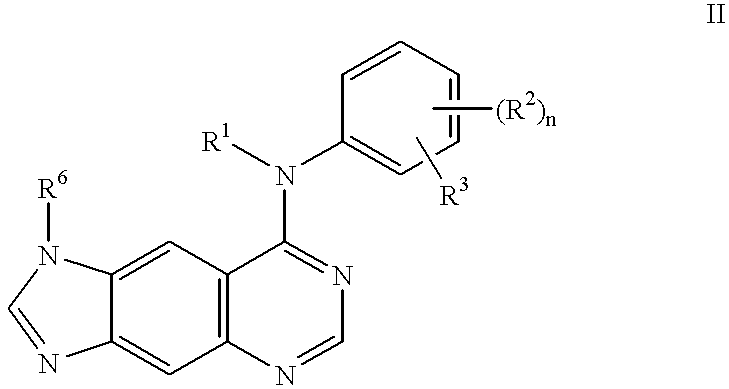
- Preferred compounds of formula I include those wherein R 3 is -(ethynyl)-R 8 .
- R 1 , R 2 , R 3 , R 6 and n are as defined above.
- Preferred compounds of formula II include those wherein n is 0, R 1 is H, R 3 is -(ethynyl)-R 8 , and R 6 is H or methyl. Particularly preferred compounds of formula II include those wherein R 8 is H.
- the invention also relates to a pharmaceutical composition for the treatment of a hyperproliferative disorder in a mammal which comprises a therapeutically effective amount of a compound of formula I, or a pharmaceutically acceptable salt thereof, and a pharmaceutically acceptable carrier.
- the pharmaceutical composition is for the treatment of cancer such as brain, lung, squamous cell, bladder, gastric, pancreatic, breast, head, neck, prostate, colorectal, oesophageal, gynecological or thyroid cancer.
- cancer such as brain, lung, squamous cell, bladder, gastric, pancreatic, breast, head, neck, prostate, colorectal, oesophageal, gynecological or thyroid cancer.
- the pharmaceutical composition is for the treatment of a non-cancerous hyperproliferative disorder such as psoriasis or benign hyperplasia of the skin or prostate.
- the invention also relates to a pharmaceutical composition for the treatment of pancreatitis or kidney disease in a mammal which comprises a therapeutically effective amount of a compound of formula I, or a pharmaceutically acceptable salt thereof, and a pharmaceutically acceptable carrier.
- the invention also relates to a pharmaceutical composition for the prevention of blastocyte implantation in a mammal which comprises a therapeutically effective amount of a compound of formula I, or a pharmaceutically acceptable salt thereof, and a pharmaceutically acceptable carrier.
- the invention also relates to a method of treating a hyperproliferative disorder in a mammal which comprises administering to said mammal a therapeutically effective amount of the compound of formula I or a pharmaceutically acceptable salt thereof.
- the method relates to the treatment of cancer such as brain, lung, squamous cell, bladder, gastric, pancreatic, breast, head, neck, oesophageal, prostate, colorectal, gynecological or thyroid cancer.
- cancer such as brain, lung, squamous cell, bladder, gastric, pancreatic, breast, head, neck, oesophageal, prostate, colorectal, gynecological or thyroid cancer.
- the method relates to the treatment of a non-cancerous hyperproliferative disorder such as psoriasis or benign hyperplasia of the skin or prostate.
- the invention also relates to a method of treating pancreatitis or kidney disease in a mammal which comprises administering to said mammal a therapeutically effective amount of the compound of formula I or a pharmaceutically acceptable salt thereof.
- the invention also relates to a method of blastocyte formation in a mammal which comprises administering to said mammal a therapeutically effective amount of the compound of formula I or a pharmaceutically acceptable salt thereof.
- phrases “pharmaceutically acceptable salt(s)”, as used herein, unless otherwise indicated, includes salts of acidic or basic groups which may be present in the compounds of formulas I and II.
- Certain compounds of formulas I and II may have asymmetric centers and therefore exist in different enantiomeric forms. This invention relates to the use of all optical isomers and stereoisomers of the compounds of formulas I and II and mixtures thereof.
- the compounds of formulas I and II may also exist as tautomers. This invention relates to the use of all such tautomers and mixtures thereof.
- the compounds of formula I can be prepared according to one or more synthetic methods that are disclosed in PCT international application number PCT/US95/00911 (publication number WO 95/19970, published Jul. 27, 1995) (hereafter “WO 95/19970”), which is incorporated herein by reference in its entirety.
- the following reaction Schemes 1 and 2 illustrate the preparation of the compounds of the present invention.
- Z, R 1 , R 2 , R 3 and n are as defined above.
- Scheme 1 provides a general illustration of the preparation of the compounds of formula I.
- Substituents R 2 , R 3 and R 4 can be introduced into the compound of formula I at any suitable point in the synthesis of the compounds of formula I.
- substituents R2 and R3 are included in intermediate VI prior to coupling with intermediate V, but these substituents can be included after the coupling reaction if necessary.
- Synthetic methods of introducing substituents R 2 , R 3 and R 4 into the compound of formula I or the intermediates referred to above will be apparent to those skilled in the art.
- the compound of formula III can be obtained commercially or prepared according to methods known to those skilled in the art.
- the tricyclic compound of formula IV is prepared by condensation of the compound of formula III with formamide. This reaction is done through the addition of the compound of formula III to formamide under nitrogen at a temperature of 120-150° C. for 30 minutes to 1.5 hours, followed by heating the mixture to a temperature of 170-180° C. for 1 to 3 hours to provide the tricyclic compound of formula IV.
- Y 1 is —NH 2 and Y 2 is O
- the compound of formula III is hydrogenated over 5% palladium on carbon under a pressure of about 60 psi for about 1 hour to reduce the nitro group to an amino group.
- the resulting compound is then dissolved in triethyl orthoformate and heated to reflux for about 18 hours to provide the tricyclic compound of formula IV.
- step 2 of Scheme 1 the compound of formula IV is converted to the compound of formula V in which Y 3 is either methylthio or chloro.
- the compound of formula IV, and optionally phosphorus pentachloride is added to phosphorus oxychloride and heated to reflux under nitrogen for about 2 to 4 hours to provide the compound of formula V in which Y 3 is chloro.
- this chlorination reaction can be done by adding the compound of formula IV and styrene-bound triphenylphosphine to dichloroethane and carbon tetrachloride and heating the mixture to reflux for 30 minutes to 2 hours to provide the compound of formula V in which Y 3 is chloro.
- the oxo moiety of the compound of formula IV is converted to a thio moiety by heating a mixture of the compound of formula IV and P 2 S 5 in pyridine to reflux for 14 to 18 hours.
- the resulting compound and KOH in aqueous MeOH is treated with Mel at ambient temperature (20-25° C.) for 30 minutes to 4 hours to provide the compound of formula V in which Y 3 is methylthio.
- step 3 of Scheme 1 the Y 3 group of the compound of formula V is displaced by the aniline compound of formula VI to provide the biaryl amine of formula I.
- the compound of formula V and the aniline of formula VI in a solvent, such as isopropanol or t-butanol are heated to reflux for about 2 to 10 hours to provide the compound of formula I.
- the R 4 substituent can be introduced into the Z moiety of the compound of formula I according to synthetic methods known to those skilled in the art.
- Scheme 2 illustrates preparing the quinazoline portion of the tricyclic ring structure before the addition of the Z moiety, followed by cyclization of the Z moiety on to the quinazoline ring.
- Steps 1 and 2 of Scheme 2 can be done as a single step depending on the type of tricyclic ring structure that is being prepared.
- the compound of formula IV that is prepared according to Scheme 2 is converted to the compound of formula VII in the manner described in steps 2 and 3 of Scheme 1 above.
- Scheme 2 can be illustrated with reference to the preparation of 4-oxo-3H-oxazolo[5,4-g]quinazoline.
- 5-hydroxy-2,4-dinitrobenzamide compound of formula VIII in which Y 1 is amino, Y 2 is O, Y 4 is hydroxy and Y 5 is nitro
- Y 1 is amino
- Y 2 is O
- Y 4 is hydroxy
- Y 5 is nitro
- steps 1 and 2 of Scheme 2 are performed as a single step.
- tricyclic compounds of formula IV are similarly prepared according to one or more synthetic methods disclosed in WO 95/19970, referred to above, in which the general synthetic steps of Scheme 2 are employed.
- 4-oxo-3H-pyrrolo[3,2-g]quinazoline can be prepared according to the process described in Example 3 in WO 95/19970.
- 4-Oxo-3H-oxazolo[5,4-g]quinazoline can be prepared according to the process described in Example 5 in WO 95/19970.
- 4-Oxo-3H-triazolo[4,5-g]quinazoline can be prepared according to the process described in Example 7 in WO 95/19970.
- 6,N-Methyl-3H-imidazo[4,5-g]quinazolin-4-one can be prepared according to the process described in Example 9 in WO 95/19970. Methods to prepare other compounds of formula IV will be apparent to those skilled in the art.
- Suitable pharmaceutically-acceptable salt of the compounds of the present invention include acid-addition salts of said compounds which are prepared from inorganic or organic acids such as hydrochloric, hydrobromic, sulphuric, phosphoric, methanesulfonic, benzenesulfonic, trifluoroacetic, citric, lactic and maleic acid.
- Such salts can be prepared by conventional methods. For example, they can be prepared simply by contacting the acidic and basic entities, usually in a stoichiometric ratio, in either an aqueous, non-aqueous or partially aqueous medium, as appropriate.
- the salts are recovered by filtration; by precipitation with a non-solvent, preferably an etheral or hydrocarbon solvent, followed by filtration and by evaporation of a solvent, or, in the case of aqueous solutions, by lyophilization.
- a non-solvent preferably an etheral or hydrocarbon solvent
- the compounds of the present invention may have asymmetric carbon atoms.
- Such diasteromeric mixtures can be separated into their individual diastereomers on the basis of their physical chemical differences by methods known to those skilled in the art, for example, by chromatography or fractional crystallization.
- Enantiomers can be separated by converting the enantiomeric mixtures into a diastereomric mixture by reaction with an appropriate optically active compound (e.g., alcohol), separating the diastereomers and converting (e.g., hydrolyzing) the individual diastereomers to the corresponding pure enantiomers. All such isomers, including diastereomer mixtures and pure enantiomers are considered as part of the invention.
- the compounds of the present invention are potent inhibitors of the erbB family of oncogenic and protooncogenic protein tyrosine kinases such as epidermal growth factor receptor (EGFR), erbB2, HER3, or HER4 and thus are all adapted to therapeutic use as antiproliferative agents (e.g., anticancer agents) in mammals, particularly humans.
- EGFR epidermal growth factor receptor
- erbB2 HER3, or HER4
- antiproliferative agents e.g., anticancer agents
- the compounds of this invention are therapeutants or prophylactics for the treatment of a variety of human tumors (including renal, liver, kidney, bladder, breast, gastric, ovarian, colorectal, prostate, pancreatic, lung, vulval, thyroid, hepatic carcinomas, sarcomas, glioblastomas, and various head and neck tumors), and other hyperplastic conditions such as benign hyperplasia of the skin (e.g., psoriasis) or prostate (e.g., BPH).
- a quinazoline of the present invention may possess activity against a range of leukemias and lymphoid malignancies.
- the active compounds may also be expected to be useful in the treatment of additional disorders in which aberrant expression ligand/receptor interactions, activation or signalling events related to various protein tyrosine kinases, whose activity is inhibited by the compounds of the present invention, are involved.
- Such disorders may include those of neuronal, glial, astrocytal, hypothalamic, and other glandular, macrophagal, epithelial, stromal, and blastocoelic nature in which aberrant function, expression, activation or signalling of the erbB tyrosine kinases may be involved.
- the compounds of the present invention may have therapeutic utility in inflammatory, angiogenic and immunologic disorders involving both identified and as yet unidentified tyrosine kinases that are inhibited by the compounds of the present invention.
- the in vitro activity of the active compounds in inhibiting the receptor tyrosine kinase may be determined by the procedure detailed below.
- Activity of the active compounds, in vitro can be determined by the amount of inhibition of the phosphorylation of an exogenous substrate (e.g., Lys 3 -Gastrin or polyGluTyr (4:1) random copolymer (I. Posner et. al., J. Biol. Chem. 267 (29), 20638-47 (1992)) on tyrosine by epidermal growth factor receptor kinase by a test compound relative to a control.
- an exogenous substrate e.g., Lys 3 -Gastrin or polyGluTyr (4:1) random copolymer (I. Posner et. al., J. Biol. Chem. 267 (29), 20638-47 (1992)
- Affinity purified, soluble human EGF receptor (96 ng) is obtained according to the procedure in G. N. Gill, W.
- the phosphorylation reaction is initiated by addition of 20 ⁇ l 33 P-ATP/substrate mix (120 ⁇ M Lys 3 -Gastrin (sequence in single letter code for amino acids, KKKGPWLEEEEEAYGWLDF), 50 mM Hepes pH 7.4, 40 ⁇ M ATP, 2 ⁇ Ci ⁇ -[ 33 P]-ATP) to the EGFr/EGF mix and incubated for 20 minutes at room temperature.
- the reaction is stopped by addition of 10 ⁇ l stop solution (0.5 M EDTA, pH 8; 2 mM ATP) and 6 ⁇ l 2N HCl.
- the tubes are centrifuged at 14,000 RPM, 40° C., for 10 minutes.
- Such assays allow the determination of an approximate IC 50 value for the in vitro inhibition of EGFR kinase activity.
- IC 50 0.0001-30 ⁇ M.
- Activity of the active compounds, in vivo can be determined by the amount of inhibition of tumor growth by a test compound relative to a control.
- the tumor growth inhibitory effects of various compounds are measured according to the methods of Corbett T. H., et al. “Tumor Induction Relationships in Development of Transplantable Cancers of the Colon in Mice for Chemotherapy Assays, with a Note on Carcinogen Structure”, Cancer Res., 35, 2434-2439 (1975) and Corbett, T. H., et al., “A Mouse Colon-tumor Model for Experimental Therapy”, Cancer Chemother. Rep. ( Part 2)”, 5, 169-186 (1975), with slight modifications. Tumors are induced in the left flank by s.c.
- test animals injection of 1 ⁇ 10 6 log phase cultured tumor cells (human MDA-MB-468 breast or human HN5 head and neck carcinoma cells) suspended in 0.10 ml RPMI 1640.
- active compound formulated by dissolution in DMSO typically at a concentration of 50 to 100 mg/mL followed by 1:9 dilution into saline or, alternatively, 1:9 dilution into 0.1% Pluronic P105 in 0.9% saline
- ip intraperitoneal
- oral po
- the flank site of tumor implantation provides reproducible dose/response effects for a variety of chemotherapeutic agents, and the method of measurement (tumor diameter) is a reliable method for assessing tumor growth rates.
- Administration of the active compounds can be effected by any method which enables delivery of the compounds to the site of action (e.g., cancer cells). These methods include oral routes, rectal routes, intraduodenal routes, parenteral injection (including intravenous, subcutaneous, intramuscular, intravascular or infusion), topical administration, etc.
- the amount of active compound administered will, of course, be dependent on the subject being treated, on the severity of the affliction, on the manner of administration and on the judgement of the prescribing physician.
- an effective dosage is in the range of approximately 0.001-100 mg/kg, preferably 1 to 35 mg/kg in single or divided doses. For an average 70 kg human, this would amount to 0.05 to 7 g/day, preferably 0.2 to 2.5 g/day.
- the foregoing dosages can be followed for the treatment of hyperproliferative diseases, kidney disease, pancreatitis or the prevention of blastocyte formation (to effect contraception).
- the composition may, for example, be in a form suitable for oral administration such as a tablet, capsule, pill, powder, sustained release formulation, solution, or suspension; for parenteral injection such as a sterile solution, suspension or emulsion; or for topical administration such as an ointment or cream or for rectal administration as a suppository.
- the pharmaceutical composition may be in unit dosage forms suitable for single administration of precise dosages.
- the pharmaceutical composition will include a conventional pharmaceutical carrier or excipient and a compound according to the present invention as an active ingredient. In addition, it may include other medicinal or pharmaceutical agents, carriers, adjuvants, etc.
- compositions according to the invention may contain 0.1%-95% of the active compound, preferably 1%-70%.
- the composition or formulation to be administered will contain a quantity of active compound in an amount effective to alleviate or reduce the signs in the subject being treated, i.e., hyperproliferative diseases, over the course of the treatment.
- Exemplary parenteral administration forms include solutions or suspensions of active compounds in sterile aqueous solutions, for example aqueous propylene glycol or dextrose solutions. Such dosage forms can be suitably buffered, if desired.
- Suitable pharmaceutical carriers include inert diluents or fillers, water and various organic solvents.
- the pharmaceutical compositions may, it desired, contain additional ingredients such as flavorings, binders, excipients and the like.
- excipients such as citric acid
- disintegrants such as starch, alginic acid and certain complex silicates
- binding agents such as sucrose, gelatin and acacia.
- lubricating agents such as magnesium stearate, sodium lauryl sulfate and talc are often useful for tableting purposes.
- Solid compositions of a similar type may also be employed in soft and hard filled gelatin capsules.
- Preferred materials include lactose or milk sugar and high molecular weight polyethylene glycols.
- the active compound therein may be combined with various sweetening or flavoring agents, coloring matters or dyes and, if desired, emulsifying agents or suspending agents, together with diluents such as water, ethanol, propylene glycol, glycerin, or combinations thereof.
- the therapeutic compounds may also be administered to a mammal other than a human.
- the dosage to be administered to a mammal will depend on the animal species and the disease or disorder being treated.
- the therapeutic compounds may be administered to animals in the form of a capsule, bolus, tablet or liquid drench.
- the therapeutic compounds may also be administered to animals by injection or as an implant.
- Such formulations are prepared in a conventional manner in accordance with standard veterinary practice.
- the therapeutic compounds may be administered with the animal feedstuff and for this purpose a concentrated feed additive or premix may be prepared for mixing with the normal animal feed.
- hyperproliferative disease treatment described above may be applied as a sole therapy or may involve, in addition to the active compound, one or more other antitumor substances. Such conjoint treatment may be achieved by way of the simultaneous, sequential, cyclic or separate dosing of the individual components of the treatment.
- HPLC High pressure liquid chromatography
- Perkin-Elmer Pecosphere® 3 ⁇ 3 C. cartridge column (3 mm ⁇ 3 cm, C18; available from Perkin Elmer Corp., Norwalk, Conn. 06859) with a Brownlee (trademark) RP-8 Newguard precolumn (7 micron, 3.2 mm ⁇ 15 mm, available from Applied Biosystems Inc. San Jose, Calif. 95134) which was previously equilibrated in pH 4.50, 200 mM ammonium acetate buffer.
- 6-nitro-benzo[1,3]dioxole-5-carboxylic acid (19 g, 90 mmol) in 500 mL ethanol was hydrogenated at 50 psig over 5 g of 5% palladium on carbon for 2 hours. Catalyst was filtered off with Celite® and solvent was removed in vacuo to give 6-amino-benzo[1,3]dioxole-5-carboxylic acid; 4.5 g (27%) used without further purification.
Landscapes
- Chemical & Material Sciences (AREA)
- Organic Chemistry (AREA)
- Pharmaceuticals Containing Other Organic And Inorganic Compounds (AREA)
- Organic Low-Molecular-Weight Compounds And Preparation Thereof (AREA)
- Acyclic And Carbocyclic Compounds In Medicinal Compositions (AREA)
- Nitrogen Condensed Heterocyclic Rings (AREA)
Abstract
Description




Claims (5)

Priority Applications (1)
| Application Number | Priority Date | Filing Date | Title |
|---|---|---|---|
| US09/202,738 US6335344B1 (en) | 1996-06-24 | 1997-11-06 | Phenylamino-substituted tricyclic derivatives for treatment of hyperproliferative diseases |
Applications Claiming Priority (3)
| Application Number | Priority Date | Filing Date | Title |
|---|---|---|---|
| US2049196P | 1996-06-24 | 1996-06-24 | |
| PCT/IB1997/000675 WO1997049688A1 (en) | 1996-06-24 | 1997-06-11 | Phenylamino-substituted tricyclic derivatives for treatment of hyperproliferative diseases |
| US09/202,738 US6335344B1 (en) | 1996-06-24 | 1997-11-06 | Phenylamino-substituted tricyclic derivatives for treatment of hyperproliferative diseases |
Publications (1)
| Publication Number | Publication Date |
|---|---|
| US6335344B1 true US6335344B1 (en) | 2002-01-01 |
Family
ID=21798898
Family Applications (1)
| Application Number | Title | Priority Date | Filing Date |
|---|---|---|---|
| US09/202,738 Expired - Fee Related US6335344B1 (en) | 1996-06-24 | 1997-11-06 | Phenylamino-substituted tricyclic derivatives for treatment of hyperproliferative diseases |
Country Status (20)
| Country | Link |
|---|---|
| US (1) | US6335344B1 (en) |
| EP (1) | EP0907642B1 (en) |
| JP (1) | JP2000512990A (en) |
| AP (1) | AP9701019A0 (en) |
| AR (1) | AR007440A1 (en) |
| AT (1) | ATE308527T1 (en) |
| AU (1) | AU2912997A (en) |
| BR (1) | BR9709959A (en) |
| CA (1) | CA2258548C (en) |
| DE (1) | DE69734513T2 (en) |
| ES (1) | ES2249800T3 (en) |
| GT (1) | GT199700079A (en) |
| HN (1) | HN1997000083A (en) |
| HR (1) | HRP970346A2 (en) |
| ID (1) | ID19511A (en) |
| MA (1) | MA24439A1 (en) |
| PA (1) | PA8432701A1 (en) |
| TN (1) | TNSN97106A1 (en) |
| WO (1) | WO1997049688A1 (en) |
| ZA (1) | ZA975543B (en) |
Cited By (2)
| Publication number | Priority date | Publication date | Assignee | Title |
|---|---|---|---|---|
| WO2003082830A1 (en) * | 2002-03-28 | 2003-10-09 | Beta Pharma, Inc. | Novel fused quinazoline derivatives useful as tyrosine kinase inhibitors |
| WO2006130673A1 (en) * | 2005-05-31 | 2006-12-07 | Janssen Pharmaceutica, N.V. | 3-benzoimidazolyl-pyrazolopyridines useful in treating kinase disorders |
Families Citing this family (241)
| Publication number | Priority date | Publication date | Assignee | Title |
|---|---|---|---|---|
| US6811779B2 (en) | 1994-02-10 | 2004-11-02 | Imclone Systems Incorporated | Methods for reducing tumor growth with VEGF receptor antibody combined with radiation and chemotherapy |
| JP4471404B2 (en) | 1996-02-13 | 2010-06-02 | アストラゼネカ ユーケイ リミテッド | Quinazoline derivatives as VEGF inhibitors |
| ATE211134T1 (en) | 1996-03-05 | 2002-01-15 | 4-ANILINOQUINAZOLINE DERIVATIVES | |
| PL203782B1 (en) | 1999-11-05 | 2009-11-30 | Astrazeneca Ab | Quinazoline derivatives as vegf inhibitors |
| US6638929B2 (en) | 1999-12-29 | 2003-10-28 | Wyeth | Tricyclic protein kinase inhibitors |
| MXPA02006086A (en) * | 1999-12-29 | 2004-08-23 | Wyeth Corp | Tricyclic protein kinase inhibitors. |
| JP2004523509A (en) | 2000-12-29 | 2004-08-05 | ワイス | Method for regioselective preparation of substituted benzo [g] quinoline-3-carbonitrile and substituted benzo [g] quinazoline |
| EP3342411B1 (en) | 2001-02-19 | 2019-08-21 | Novartis Pharma AG | Rapamycin derivative for treating pancreas cancer |
| KR20080091866A (en) | 2001-05-16 | 2008-10-14 | 노파르티스 아게 | Ν- {5- [4- (4-methyl-piperazino-methyl) -benzoylamido] -2-methylphenyl} -4- (3-pyridyl) -2-pyrimidin-amine and chemotherapeutic agent Formulated to |
| US6995171B2 (en) | 2001-06-21 | 2006-02-07 | Agouron Pharmaceuticals, Inc. | Bicyclic pyrimidine and pyrimidine derivatives useful as anticancer agents |
| DK1474420T3 (en) | 2002-02-01 | 2012-05-21 | Astrazeneca Ab | quinazoline |
| BR0308162A (en) | 2002-03-01 | 2004-12-07 | Pfizer | Thienopyridine indolyl urea derivatives useful as antiangiogenic agents and methods for their use |
| GB0206215D0 (en) | 2002-03-15 | 2002-05-01 | Novartis Ag | Organic compounds |
| NZ560662A (en) | 2002-05-16 | 2009-09-25 | Novartis Ag | Use of EDG receptor binding agents in cancer |
| UA77303C2 (en) | 2002-06-14 | 2006-11-15 | Pfizer | Derivatives of thienopyridines substituted by benzocondensed heteroarylamide useful as therapeutic agents, pharmaceutical compositions and methods for their use |
| WO2005000833A1 (en) | 2003-05-19 | 2005-01-06 | Irm, Llc | Immunosuppressant compounds and compositions |
| MY150088A (en) | 2003-05-19 | 2013-11-29 | Irm Llc | Immunosuppressant compounds and compositions |
| CN1972712A (en) | 2003-06-09 | 2007-05-30 | 塞缪尔·瓦克萨尔 | Methods of inhibiting receptor tyrosine kinases using extracellular and intracellular antagonists |
| EP1660504B1 (en) | 2003-08-29 | 2008-10-29 | Pfizer Inc. | Thienopyridine-phenylacet amides and their derivatives useful as new anti-angiogenic agents |
| KR100807920B1 (en) | 2003-12-23 | 2008-02-27 | 화이자 인코포레이티드 | Novel quinoline derivatives |
| ES2554330T3 (en) * | 2004-02-19 | 2015-12-18 | Rexahn Pharmaceuticals, Inc. | Quinazoline derivatives and therapeutic use thereof |
| PT1735348E (en) | 2004-03-19 | 2012-07-24 | Imclone Llc | Human anti-epidermal growth factor receptor antibody |
| RS52545B (en) | 2004-04-07 | 2013-04-30 | Novartis Ag | INHIBITORI PROTEIN APOPTOZE (IAP) |
| BRPI0511512A (en) | 2004-05-27 | 2007-12-26 | Pfizer Prod Inc | pyrrolpyrimidine derivatives useful in cancer treatment |
| GB0512324D0 (en) | 2005-06-16 | 2005-07-27 | Novartis Ag | Organic compounds |
| GB0510390D0 (en) | 2005-05-20 | 2005-06-29 | Novartis Ag | Organic compounds |
| PT2100618E (en) | 2005-06-17 | 2014-04-07 | Philadelphia Health & Educatio | AN ANTI-PDGFR-ALPHA ANTIBODY FOR THE TREATMENT OF METASTATIC BONE CANCER |
| JP2009505658A (en) | 2005-08-24 | 2009-02-12 | ブリストル−マイヤーズ スクイブ カンパニー | Biomarkers and methods for determining susceptibility to epidermal growth factor receptor modulators |
| NO20220050A1 (en) | 2005-11-21 | 2008-08-12 | Novartis Ag | Neuroendocrine tumor treatment |
| GB0605120D0 (en) | 2006-03-14 | 2006-04-26 | Novartis Ag | Organic Compounds |
| WO2007124252A2 (en) | 2006-04-05 | 2007-11-01 | Novartis Ag | Combinations of therapeutic agents for treating cancer |
| CN102861338A (en) | 2006-04-05 | 2013-01-09 | 诺瓦提斯公司 | Combinations of comprising a bcr-abl, c-kit and pdgf-r tyrosine kinase inhibitor used for treating cancer |
| KR20090007635A (en) | 2006-05-09 | 2009-01-19 | 노파르티스 아게 | Combinations comprising iron chelators and anti-neoplastic agents and uses thereof |
| RU2009115954A (en) | 2006-09-29 | 2010-11-10 | Новартис АГ (CH) | Pyrazolopyrimidines as P13K Lipid Kinase Inhibitors |
| US20100069458A1 (en) | 2007-02-15 | 2010-03-18 | Peter Wisdom Atadja | Combination of lbh589 with other therapeutic agents for treating cancer |
| CN101120945B (en) * | 2007-07-30 | 2010-11-24 | 浙江大学 | Use of 8-arylamino-3H-imidazo[4,5-g]quinazoline derivatives |
| KR101673621B1 (en) | 2008-03-24 | 2016-11-07 | 노파르티스 아게 | Arylsulfonamide-based matrix metalloprotease inhibitors |
| PT2260020E (en) | 2008-03-26 | 2014-10-28 | Novartis Ag | Hydroxamate-based inhibitors of deacetylases b |
| US20110223241A1 (en) | 2008-10-16 | 2011-09-15 | Celator Pharmaceuticals, Inc. | Combination methods and compositions |
| MX2011004824A (en) | 2008-11-07 | 2012-01-12 | Triact Therapeutics Inc | USE OF CATHOLIC BUTANE DERIVATIVES IN THERAPY AGAINST CANCER. |
| ES2478842T3 (en) | 2008-12-18 | 2014-07-23 | Novartis Ag | Salt 1- (4- (1 - ((E) -4-Cyclohexyl-3-trifluoromethyl-benzyloxyimino) -ethyl) -2-ethyl-benzyl) -azetidine-3-carboxylic acid |
| KR20160064245A (en) | 2008-12-18 | 2016-06-07 | 노파르티스 아게 | Hemifumarate salt of 1-[4-[1-(4-cyclohexyl-3-trifluoromethyl-benzyloxyimino)-ethyl]-2-ethyl-benzyl]-azetidine-3-carboxylic acid |
| MX2011006610A (en) | 2008-12-18 | 2011-06-30 | Novartis Ag | New polymorphic form of 1-(4-{l-[(e)-4-cyclohexyl--3-triflu oromethyl-benzyloxyimino]-ethyl)-2-ethyl-benzy l)-azetidine -3-carboxylic. |
| WO2010083617A1 (en) | 2009-01-21 | 2010-07-29 | Oncalis Ag | Pyrazolopyrimidines as protein kinase inhibitors |
| HRP20121006T1 (en) | 2009-01-29 | 2013-01-31 | Novartis Ag | BENZIMIDAZOLES SUBSTITUTED FOR ASTROCYTOMA TREATMENT |
| EP2400985A2 (en) | 2009-02-25 | 2012-01-04 | OSI Pharmaceuticals, LLC | Combination of an either an anti-igf-1r antibody or an igf binding protein and a small molecule igf-1r kinase inhibitor |
| JP2012519170A (en) | 2009-02-26 | 2012-08-23 | オーエスアイ・ファーマシューティカルズ,エルエルシー | INSITU method for monitoring EMT status of tumor cells in vivo |
| EP2401614A1 (en) | 2009-02-27 | 2012-01-04 | OSI Pharmaceuticals, LLC | Methods for the identification of agents that inhibit mesenchymal-like tumor cells or their formation |
| WO2010099138A2 (en) | 2009-02-27 | 2010-09-02 | Osi Pharmaceuticals, Inc. | Methods for the identification of agents that inhibit mesenchymal-like tumor cells or their formation |
| JP2012519282A (en) | 2009-02-27 | 2012-08-23 | オーエスアイ・ファーマシューティカルズ,エルエルシー | Methods for identifying mesenchymal tumor cells or agents that inhibit their production |
| EP2408479A1 (en) | 2009-03-18 | 2012-01-25 | OSI Pharmaceuticals, LLC | Combination cancer therapy comprising administration of an egfr inhibitor and an igf-1r inhibitor |
| UY32730A (en) | 2009-06-26 | 2011-01-31 | Novartis Ag | CYP17 INHIBITORS |
| US8389526B2 (en) | 2009-08-07 | 2013-03-05 | Novartis Ag | 3-heteroarylmethyl-imidazo[1,2-b]pyridazin-6-yl derivatives |
| CA2770873A1 (en) | 2009-08-12 | 2011-02-17 | Novartis Ag | Heterocyclic hydrazone compounds and their uses to treat cancer and inflammation |
| GEP201706639B (en) | 2009-08-17 | 2017-03-27 | Intellikine Llc | Heterocyclic compounds and uses thereof |
| CA2771432A1 (en) | 2009-08-20 | 2011-02-24 | Novartis Ag | Heterocyclic oxime compounds |
| IN2012DN01693A (en) | 2009-08-26 | 2015-06-05 | Novartis Ag | |
| WO2011029915A1 (en) | 2009-09-10 | 2011-03-17 | Novartis Ag | Ether derivatives of bicyclic heteroaryls |
| WO2011053779A2 (en) | 2009-10-30 | 2011-05-05 | Bristol-Myers Squibb Company | Methods for treating cancer in patients having igf-1r inhibitor resistance |
| EA201200651A1 (en) | 2009-11-04 | 2012-12-28 | Новартис Аг | HETEROCYCLIC SULPHONAMIDE DERIVATIVES APPLICABLE AS MEK INHIBITORS |
| JP2013510564A (en) | 2009-11-13 | 2013-03-28 | パンガエア ビオテック、ソシエダッド、リミターダ | Molecular biomarkers for predicting response to tyrosine kinase inhibitors in lung cancer |
| CN102781237A (en) | 2009-11-23 | 2012-11-14 | 天蓝制药公司 | Cyclodextrin-based polymers for delivery of therapeutic agents |
| US20120289501A1 (en) | 2009-11-25 | 2012-11-15 | Novartis Ag | Benzene-fused 6-membered oxygen-containing heterocyclic derivatives of bicyclic heteroaryls |
| ES2484171T3 (en) | 2009-12-08 | 2014-08-11 | Novartis Ag | Heterocyclic sulfonamide derivatives |
| CU24130B1 (en) | 2009-12-22 | 2015-09-29 | Novartis Ag | ISOQUINOLINONES AND REPLACED QUINAZOLINONES |
| US8440693B2 (en) | 2009-12-22 | 2013-05-14 | Novartis Ag | Substituted isoquinolinones and quinazolinones |
| WO2011090940A1 (en) | 2010-01-19 | 2011-07-28 | Cerulean Pharma Inc. | Cyclodextrin-based polymers for therapeutic delivery |
| WO2011119995A2 (en) | 2010-03-26 | 2011-09-29 | Cerulean Pharma Inc. | Formulations and methods of use |
| EP2592083A4 (en) * | 2010-05-21 | 2014-01-22 | Shenzhen Salubris Pharm Co Ltd | CONDENSED QUINAZOLINE DERIVATIVES AND USES THEREOF |
| EP2582681A1 (en) | 2010-06-17 | 2013-04-24 | Novartis AG | Piperidinyl substituted 1,3-dihydro-benzoimidazol-2-ylideneamine derivatives |
| EP2582680A1 (en) | 2010-06-17 | 2013-04-24 | Novartis AG | Biphenyl substituted 1,3-dihydro-benzoimidazol-2-ylideneamine derivatives |
| UA112517C2 (en) | 2010-07-06 | 2016-09-26 | Новартіс Аг | TETRAHYDROPYRIDOPYRIMIDINE DERIVATIVES |
| EP2627648A1 (en) | 2010-09-16 | 2013-08-21 | Novartis AG | 17aHYDROXYLASE/C17,20-LYASE INHIBITORS |
| WO2012085815A1 (en) | 2010-12-21 | 2012-06-28 | Novartis Ag | Bi-heteroaryl compounds as vps34 inhibitors |
| EP2468883A1 (en) | 2010-12-22 | 2012-06-27 | Pangaea Biotech S.L. | Molecular biomarkers for predicting response to tyrosine kinase inhibitors in lung cancer |
| US9134297B2 (en) | 2011-01-11 | 2015-09-15 | Icahn School Of Medicine At Mount Sinai | Method and compositions for treating cancer and related methods |
| JP2014505088A (en) | 2011-02-10 | 2014-02-27 | ノバルティス アーゲー | [1,2,4] Triazolo [4,3-b] pyridazine compounds as C-MET tyrosine kinase inhibitors |
| JP5808826B2 (en) | 2011-02-23 | 2015-11-10 | インテリカイン, エルエルシー | Heterocyclic compounds and uses thereof |
| EP2492688A1 (en) | 2011-02-23 | 2012-08-29 | Pangaea Biotech, S.A. | Molecular biomarkers for predicting response to antitumor treatment in lung cancer |
| US20130338152A1 (en) | 2011-03-08 | 2013-12-19 | Irm Llc | Fluorophenyl bicyclic heteroaryl compounds |
| WO2012129145A1 (en) | 2011-03-18 | 2012-09-27 | OSI Pharmaceuticals, LLC | Nscle combination therapy |
| ITPD20110091A1 (en) * | 2011-03-24 | 2012-09-25 | Univ Padova | USEFUL INHIBITORS FOR RELATED PATHOLOGIES: PHARMACOFORIC MODELS, IDENTIFIED COMPOUNDS BY THESE MODELS, METHODS FOR THEIR PREPARATION, THEIR FORMULATION AND THEIR THERAPEUTIC USE. |
| US9896730B2 (en) | 2011-04-25 | 2018-02-20 | OSI Pharmaceuticals, LLC | Use of EMT gene signatures in cancer drug discovery, diagnostics, and treatment |
| GB201106870D0 (en) | 2011-04-26 | 2011-06-01 | Univ Belfast | Marker |
| MX359399B (en) | 2011-04-28 | 2018-09-27 | Novartis Ag | 17a-HYDROXYLASE/C17,20-LYASE INHIBITORS. |
| KR20140034898A (en) | 2011-06-09 | 2014-03-20 | 노파르티스 아게 | Heterocyclic sulfonamide derivatives |
| US8859535B2 (en) | 2011-06-20 | 2014-10-14 | Novartis Ag | Hydroxy substituted isoquinolinone derivatives |
| WO2012175487A1 (en) | 2011-06-20 | 2012-12-27 | Novartis Ag | Cyclohexyl isoquinolinone compounds |
| AU2012277391A1 (en) | 2011-06-27 | 2013-12-19 | Novartis Ag | Solid forms and salts of tetrahydro-pyrido-pyrimidine derivatives |
| WO2014081405A2 (en) | 2011-08-17 | 2014-05-30 | Dennis Brown | Compositions and methods to improve the therapeutic benefit of suboptimally administered chemical compounds including substituted hexitols such as dibromodulcitol |
| WO2013033380A1 (en) | 2011-08-31 | 2013-03-07 | Genentech, Inc. | Diagnostic markers |
| AU2012310168B2 (en) | 2011-09-15 | 2015-07-16 | Novartis Ag | 6 - substituted 3 - (quinolin- 6 - ylthio) - [1,2,4] triazolo [4, 3 -a] pyradines as tyrosine kinase |
| US20130084287A1 (en) | 2011-09-30 | 2013-04-04 | Genentech, Inc. | Diagnostic markers |
| US20140309229A1 (en) | 2011-10-13 | 2014-10-16 | Bristol-Myers Squibb Company | Methods for selecting and treating cancer in patients with igf-1r/ir inhibitors |
| WO2013080141A1 (en) | 2011-11-29 | 2013-06-06 | Novartis Ag | Pyrazolopyrrolidine compounds |
| US9408885B2 (en) | 2011-12-01 | 2016-08-09 | Vib Vzw | Combinations of therapeutic agents for treating melanoma |
| US20150148377A1 (en) | 2011-12-22 | 2015-05-28 | Novartis Ag | Quinoline Derivatives |
| IN2014CN04174A (en) | 2011-12-22 | 2015-09-04 | Novartis Ag | |
| CA2859873A1 (en) | 2011-12-23 | 2013-06-27 | Novartis Ag | Compounds for inhibiting the interaction of bcl2 with binding partners |
| WO2013096055A1 (en) | 2011-12-23 | 2013-06-27 | Novartis Ag | Compounds for inhibiting the interaction of bcl2 with binding partners |
| MX2014007731A (en) | 2011-12-23 | 2015-01-12 | Novartis Ag | Compounds for inhibiting the interaction of bcl2 with binding partners. |
| BR112014015322A8 (en) | 2011-12-23 | 2017-06-13 | Novartis Ag | compounds and compositions for inhibiting bcl2 interaction with binding partners |
| US20130178520A1 (en) | 2011-12-23 | 2013-07-11 | Duke University | Methods of treatment using arylcyclopropylamine compounds |
| CN104125955A (en) | 2011-12-23 | 2014-10-29 | 诺华股份有限公司 | Compounds for inhibiting interaction of bcl2 with binding partners |
| US8815926B2 (en) | 2012-01-26 | 2014-08-26 | Novartis Ag | Substituted pyrrolo[3,4-D]imidazoles for the treatment of MDM2/4 mediated diseases |
| EP3964513A1 (en) | 2012-04-03 | 2022-03-09 | Novartis AG | Combination products with tyrosine kinase inhibitors and their use |
| WO2013152252A1 (en) | 2012-04-06 | 2013-10-10 | OSI Pharmaceuticals, LLC | Combination anti-cancer therapy |
| CN104321325B (en) | 2012-05-24 | 2016-11-16 | 诺华股份有限公司 | Pyrrolopyrrole alkanone compound |
| BR112014031421A2 (en) | 2012-06-15 | 2017-06-27 | Brigham & Womens Hospital Inc | cancer treatment compositions and methods for producing them |
| WO2013190089A1 (en) | 2012-06-21 | 2013-12-27 | Pangaea Biotech, S.L. | Molecular biomarkers for predicting outcome in lung cancer |
| EP2879675B1 (en) | 2012-08-06 | 2019-11-13 | Duke University | Compounds and methods for targeting hsp90 |
| CN102875570B (en) * | 2012-10-23 | 2015-11-04 | 浙江大学 | Quinazoline derivant and its production and use |
| AU2013337247B2 (en) | 2012-11-05 | 2018-08-09 | Dana-Farber Cancer Institute, Inc. | XBP1, CD138, and CS1 peptides, pharmaceutical compositions that include the peptides, and methods of using such peptides and compositions |
| TW201422625A (en) | 2012-11-26 | 2014-06-16 | Novartis Ag | Solid form of dihydro-pyrido-oxazine derivative |
| WO2014115080A1 (en) | 2013-01-22 | 2014-07-31 | Novartis Ag | Pyrazolo[3,4-d]pyrimidinone compounds as inhibitors of the p53/mdm2 interaction |
| WO2014115077A1 (en) | 2013-01-22 | 2014-07-31 | Novartis Ag | Substituted purinone compounds |
| PL2958943T3 (en) | 2013-02-20 | 2020-04-30 | The Trustees Of The University Of Pennsylvania | Treatment of malignant neoplasm with a humanized chimeric anti-egfrviii antigen receptor |
| WO2014128612A1 (en) | 2013-02-20 | 2014-08-28 | Novartis Ag | Quinazolin-4-one derivatives |
| US9834575B2 (en) | 2013-02-26 | 2017-12-05 | Triact Therapeutics, Inc. | Cancer therapy |
| WO2014151147A1 (en) | 2013-03-15 | 2014-09-25 | Intellikine, Llc | Combination of kinase inhibitors and uses thereof |
| WO2014147246A1 (en) | 2013-03-21 | 2014-09-25 | INSERM (Institut National de la Santé et de la Recherche Médicale) | Method and pharmaceutical composition for use in the treatment of chronic liver diseases associated with a low hepcidin expression |
| WO2014155268A2 (en) | 2013-03-25 | 2014-10-02 | Novartis Ag | Fgf-r tyrosine kinase activity inhibitors - use in diseases associated with lack of or reduced snf5 activity |
| US20150018376A1 (en) | 2013-05-17 | 2015-01-15 | Novartis Ag | Pyrimidin-4-yl)oxy)-1h-indole-1-carboxamide derivatives and use thereof |
| UY35675A (en) | 2013-07-24 | 2015-02-27 | Novartis Ag | SUBSTITUTED DERIVATIVES OF QUINAZOLIN-4-ONA |
| US9227969B2 (en) | 2013-08-14 | 2016-01-05 | Novartis Ag | Compounds and compositions as inhibitors of MEK |
| WO2015022663A1 (en) | 2013-08-14 | 2015-02-19 | Novartis Ag | Compounds and compositions as inhibitors of mek |
| WO2015022664A1 (en) | 2013-08-14 | 2015-02-19 | Novartis Ag | Compounds and compositions as inhibitors of mek |
| CA2923667A1 (en) | 2013-09-09 | 2015-03-12 | Triact Therapeutics, Inc. | Cancer therapy |
| KR20160060100A (en) | 2013-09-22 | 2016-05-27 | 칼리토르 사이언시즈, 엘엘씨 | Substituted aminopyrimidine compounds and methods of use |
| TW201605450A (en) | 2013-12-03 | 2016-02-16 | 諾華公司 | Combination of Mdm2 inhibitor and BRAF inhibitor and their use |
| US10000469B2 (en) | 2014-03-25 | 2018-06-19 | Duke University | Heat shock protein 70 (hsp-70) receptor ligands |
| WO2015145388A2 (en) | 2014-03-27 | 2015-10-01 | Novartis Ag | Methods of treating colorectal cancers harboring upstream wnt pathway mutations |
| WO2015148868A1 (en) | 2014-03-28 | 2015-10-01 | Calitor Sciences, Llc | Substituted heteroaryl compounds and methods of use |
| MX2016012893A (en) | 2014-04-03 | 2017-05-12 | Invictus Oncology Pvt Ltd | SUPRAMOLECULAR COMBINED THERAPEUTIC SUBSTANCES. |
| WO2015156674A2 (en) | 2014-04-10 | 2015-10-15 | Stichting Het Nederlands Kanker Instituut | Method for treating cancer |
| WO2016011658A1 (en) | 2014-07-25 | 2016-01-28 | Novartis Ag | Combination therapy |
| BR112017001695A2 (en) | 2014-07-31 | 2017-11-21 | Novartis Ag | combination therapy |
| EP3237638B1 (en) | 2014-12-24 | 2020-01-15 | F.Hoffmann-La Roche Ag | Therapeutic, diagnostic and prognostic methods for cancer of the bladder |
| CN104530063B (en) * | 2015-01-13 | 2017-01-18 | 北京赛特明强医药科技有限公司 | Quinazoline and heterocyclic ring compounds, preparing method of compounds, and application of compounds serving as epidermal growth factor receptor inhibitors used for treating cancer |
| US9938257B2 (en) | 2015-09-11 | 2018-04-10 | Calitor Sciences, Llc | Substituted heteroaryl compounds and methods of use |
| US11261187B2 (en) | 2016-04-22 | 2022-03-01 | Duke University | Compounds and methods for targeting HSP90 |
| WO2018039203A1 (en) | 2016-08-23 | 2018-03-01 | Oncopep, Inc. | Peptide vaccines and durvalumab for treating multiple myeloma |
| EP3503914A1 (en) | 2016-08-23 | 2019-07-03 | Oncopep, Inc. | Peptide vaccines and durvalumab for treating breast cancer |
| CA3035080A1 (en) | 2016-09-27 | 2018-04-05 | Cero Therapeutics, Inc. | Chimeric engulfment receptor molecules |
| US10207998B2 (en) | 2016-09-29 | 2019-02-19 | Duke University | Substituted benzimidazole and substituted benzothiazole inhibitors of transforming growth factor-β kinase and methods of use thereof |
| US10927083B2 (en) | 2016-09-29 | 2021-02-23 | Duke University | Substituted benzimidazoles as inhibitors of transforming growth factor-β kinase |
| WO2018078143A1 (en) | 2016-10-28 | 2018-05-03 | MAX-PLANCK-Gesellschaft zur Förderung der Wissenschaften e.V. | Means and methods for determining efficacy of anti-egfr inhibitors in colorectal cancer (crc) therapy |
| NZ754994A (en) | 2016-12-22 | 2022-12-23 | Amgen Inc | Benzisothiazole, isothiazolo[3,4-b]pyridine, quinazoline, phthalazine, pyrido[2,3-d]pyridazine and pyrido[2,3-d]pyrimidine derivatives as kras g12c inhibitors for treating lung, pancreatic or colorectal cancer |
| JOP20190272A1 (en) | 2017-05-22 | 2019-11-21 | Amgen Inc | Kras g12c inhibitors and methods of using the same |
| ES2928576T3 (en) | 2017-09-08 | 2022-11-21 | Amgen Inc | KRAS G12C inhibitors and methods of use thereof |
| JP2020536855A (en) * | 2017-09-26 | 2020-12-17 | ザ リージェンツ オブ ザ ユニバーシティ オブ カリフォルニア | Compositions and Methods for Treating Cancer |
| JP7286658B2 (en) | 2017-09-26 | 2023-06-05 | セロ・セラピューティクス・インコーポレイテッド | Chimeric engulfment receptor molecules and methods of use |
| EP3700575A1 (en) | 2017-10-24 | 2020-09-02 | Oncopep, Inc. | Peptide vaccines and pembrolizumab for treating breast cancer |
| WO2019083960A1 (en) | 2017-10-24 | 2019-05-02 | Oncopep, Inc. | Peptide vaccines and hdac inhibitors for treating multiple myeloma |
| US10683297B2 (en) | 2017-11-19 | 2020-06-16 | Calitor Sciences, Llc | Substituted heteroaryl compounds and methods of use |
| AU2017444054B2 (en) | 2017-12-21 | 2021-10-07 | Hefei Institutes Of Physical Science, Chinese Academy Of Sciences | Class of pyrimidine derivative kinase inhibitors |
| CA3083040A1 (en) | 2018-01-20 | 2019-07-25 | Sunshine Lake Pharma Co., Ltd. | Substituted aminopyrimidine compounds and methods of use |
| EP3774906A1 (en) | 2018-03-28 | 2021-02-17 | Cero Therapeutics, Inc. | Chimeric tim4 receptors and uses thereof |
| WO2019191339A1 (en) | 2018-03-28 | 2019-10-03 | Cero Therapeutics, Inc. | Expression vectors for chimeric engulfment receptors, genetically modified host cells, and uses thereof |
| AU2019243154A1 (en) | 2018-03-28 | 2020-10-01 | Cero Therapeutics, Inc. | Cellular immunotherapy compositions and uses thereof |
| CA3099118A1 (en) | 2018-05-04 | 2019-11-07 | Amgen Inc. | Kras g12c inhibitors and methods of using the same |
| MA52501A (en) | 2018-05-04 | 2021-03-10 | Amgen Inc | KRAS G12C INHIBITORS AND THEIR PROCEDURES FOR USE |
| EP3790886B1 (en) | 2018-05-10 | 2024-06-26 | Amgen Inc. | Kras g12c inhibitors for the treatment of cancer |
| EP3802535B1 (en) | 2018-06-01 | 2022-12-14 | Amgen, Inc | Kras g12c inhibitors and methods of using the same |
| CA3099799A1 (en) | 2018-06-11 | 2019-12-19 | Amgen Inc. | Kras g12c inhibitors for treating cancer |
| MA51848A (en) | 2018-06-12 | 2021-04-21 | Amgen Inc | KRAS G12C INHIBITORS AND THEIR PROCEDURES FOR USE |
| US12220423B2 (en) | 2018-07-24 | 2025-02-11 | Hygia Pharmaceuticals, Llc | Compounds, derivatives, and analogs for cancer |
| AU2019352741A1 (en) | 2018-10-04 | 2021-05-06 | Assistance Publique-Hôpitaux De Paris (Aphp) | EGFR inhibitors for treating keratodermas |
| JP7516029B2 (en) | 2018-11-16 | 2024-07-16 | アムジエン・インコーポレーテツド | Improved synthesis of key intermediates for KRAS G12C inhibitor compounds |
| JP7377679B2 (en) | 2018-11-19 | 2023-11-10 | アムジエン・インコーポレーテツド | Combination therapy comprising a KRASG12C inhibitor and one or more additional pharmaceutically active agents for the treatment of cancer |
| US11053226B2 (en) | 2018-11-19 | 2021-07-06 | Amgen Inc. | KRAS G12C inhibitors and methods of using the same |
| MA54550A (en) | 2018-12-20 | 2022-03-30 | Amgen Inc | KIF18A INHIBITORS |
| MA54546A (en) | 2018-12-20 | 2022-03-30 | Amgen Inc | HETEROARYL AMIDES USEFUL AS KIF18A INHIBITORS |
| EA202191730A1 (en) | 2018-12-20 | 2021-08-24 | Эмджен Инк. | KIF18A INHIBITORS |
| AU2019401495B2 (en) | 2018-12-20 | 2025-06-26 | Amgen Inc. | Heteroaryl amides useful as KIF18A inhibitors |
| CN113727758A (en) | 2019-03-01 | 2021-11-30 | 锐新医药公司 | Bicyclic heterocyclic compounds and use thereof |
| KR20210146287A (en) | 2019-03-01 | 2021-12-03 | 레볼루션 메디슨즈, 인크. | Bicyclic heteroaryl compounds and uses thereof |
| EP3738593A1 (en) | 2019-05-14 | 2020-11-18 | Amgen, Inc | Dosing of kras inhibitor for treatment of cancers |
| EP3972973A1 (en) | 2019-05-21 | 2022-03-30 | Amgen Inc. | Solid state forms |
| ES3051918T3 (en) | 2019-08-02 | 2025-12-30 | Amgen Inc | Kif18a inhibitors |
| WO2021026098A1 (en) | 2019-08-02 | 2021-02-11 | Amgen Inc. | Kif18a inhibitors |
| JP7640521B2 (en) | 2019-08-02 | 2025-03-05 | アムジエン・インコーポレーテツド | Heteroaryl amides useful as KIF18A inhibitors - Patents.com |
| CN114391012B (en) | 2019-08-02 | 2025-10-31 | 美国安进公司 | Pyridine derivatives as KIF18A inhibitors |
| WO2021067875A1 (en) | 2019-10-03 | 2021-04-08 | Cero Therapeutics, Inc. | Chimeric tim4 receptors and uses thereof |
| EP4048671B1 (en) | 2019-10-24 | 2026-03-18 | Amgen Inc. | Pyridopyrimidine derivatives useful as kras g12c and kras g12d inhibitors in the treatment of cancer |
| EP4054719B1 (en) | 2019-11-04 | 2026-02-11 | Revolution Medicines, Inc. | Ras inhibitors |
| JP7823816B2 (en) | 2019-11-04 | 2026-03-04 | レヴォリューション・メディスンズ,インコーポレイテッド | RAS inhibitors |
| KR20220109407A (en) | 2019-11-04 | 2022-08-04 | 레볼루션 메디슨즈, 인크. | RAS inhibitors |
| BR112022008858A2 (en) | 2019-11-08 | 2022-09-06 | Revolution Medicines Inc | COMPOUND, PHARMACEUTICAL COMPOSITION AND METHODS FOR INHIBITING SOS1 IN A SUBJECT, FOR INHIBITING THE INTERACTION OF SOS1 AND A PROTEIN, TO TREAT OR PREVENT A DISEASE AND TO TREAT OR PREVENT CANCER |
| US20220395553A1 (en) | 2019-11-14 | 2022-12-15 | Cohbar, Inc. | Cxcr4 antagonist peptides |
| WO2021097207A1 (en) | 2019-11-14 | 2021-05-20 | Amgen Inc. | Improved synthesis of kras g12c inhibitor compound |
| JP2023501528A (en) | 2019-11-14 | 2023-01-18 | アムジエン・インコーポレーテツド | Improved Synthesis of KRAS G12C Inhibitor Compounds |
| WO2021108683A1 (en) | 2019-11-27 | 2021-06-03 | Revolution Medicines, Inc. | Covalent ras inhibitors and uses thereof |
| CN114929279A (en) | 2020-01-07 | 2022-08-19 | 锐新医药公司 | Methods of administering SHP2 inhibitors and treating cancer |
| WO2021185844A1 (en) | 2020-03-16 | 2021-09-23 | Pvac Medical Technologies Ltd | Use of substance and pharmaceutical composition thereof, and medical treatments or uses thereof |
| WO2021233534A1 (en) | 2020-05-20 | 2021-11-25 | Pvac Medical Technologies Ltd | Use of substance and pharmaceutical composition thereof, and medical treatments or uses thereof |
| EP4136228A4 (en) | 2020-04-15 | 2024-09-11 | California Institute of Technology | THERMAL CONTROL OF T-CELL IMMUNOTHERAPY BY MOLECULAR AND PHYSICAL ACTIVATION |
| CA3183032A1 (en) | 2020-06-18 | 2021-12-23 | Mallika Singh | Methods for delaying, preventing, and treating acquired resistance to ras inhibitors |
| EP4192509A1 (en) | 2020-08-05 | 2023-06-14 | Ellipses Pharma Ltd | Treatment of cancer using a cyclodextrin-containing polymer-topoisomerase inhibitor conjugate and a parp inhibitor |
| WO2022036265A1 (en) | 2020-08-14 | 2022-02-17 | Cero Therapeutics, Inc. | Chimeric tim receptors and uses thereof |
| WO2022036287A1 (en) | 2020-08-14 | 2022-02-17 | Cero Therapeutics, Inc. | Anti-cd72 chimeric receptors and uses thereof |
| WO2022036285A1 (en) | 2020-08-14 | 2022-02-17 | Cero Therapeutics, Inc. | Compositions and methods for treating cancer with chimeric tim receptors in combination with inhibitors of poly (adp-ribose) polymerase |
| WO2022047259A1 (en) | 2020-08-28 | 2022-03-03 | California Institute Of Technology | Synthetic mammalian signaling circuits for robust cell population control |
| MX2023002248A (en) | 2020-09-03 | 2023-05-16 | Revolution Medicines Inc | Use of sos1 inhibitors to treat malignancies with shp2 mutations. |
| CR20230165A (en) | 2020-09-15 | 2023-06-02 | Revolution Medicines Inc | Indole derivatives as ras inhibitors in the treatment of cancer |
| TW202237638A (en) | 2020-12-09 | 2022-10-01 | 日商武田藥品工業股份有限公司 | Compositions of guanylyl cyclase c (gcc) antigen binding agents and methods of use thereof |
| CN117396472A (en) | 2020-12-22 | 2024-01-12 | 上海齐鲁锐格医药研发有限公司 | SOS1 inhibitors and their uses |
| IL305411A (en) | 2021-02-26 | 2023-10-01 | Kelonia Therapeutics Inc | Lymphocyte targeted lentiviral vectors |
| CN115260207A (en) * | 2021-04-30 | 2022-11-01 | 赣江新区博瑞创新医药有限公司 | Tricyclic compound, pharmaceutical composition and application thereof |
| CR20230558A (en) | 2021-05-05 | 2024-01-24 | Revolution Medicines Inc | RAS INHIBITORS FOR CANCER TREATMENT |
| WO2022235866A1 (en) | 2021-05-05 | 2022-11-10 | Revolution Medicines, Inc. | Covalent ras inhibitors and uses thereof |
| IL308193A (en) | 2021-05-05 | 2024-01-01 | Revolution Medicines Inc | Ras inhibitors |
| US20250127896A1 (en) | 2021-07-28 | 2025-04-24 | Cero Therapeutics Holdings, Inc. | Chimeric tim4 receptors and uses thereof |
| KR20250005041A (en) | 2021-09-23 | 2025-01-09 | 에라스카, 아이엔씨. | EGFR inhibitor polymorphic forms |
| AR127308A1 (en) | 2021-10-08 | 2024-01-10 | Revolution Medicines Inc | RAS INHIBITORS |
| JP2025500878A (en) | 2021-12-17 | 2025-01-15 | ジェンザイム・コーポレーション | PYRAZOLO-PYRAZINE COMPOUNDS AS SHP2 INHIBITORS |
| EP4227307A1 (en) | 2022-02-11 | 2023-08-16 | Genzyme Corporation | Pyrazolopyrazine compounds as shp2 inhibitors |
| IL314883A (en) | 2022-03-07 | 2024-10-01 | Amgen Inc | Process for preparing 4-methyl-2-propan-2-yl-pyridine-3-carbonitrile |
| CN119136806A (en) | 2022-03-08 | 2024-12-13 | 锐新医药公司 | Methods for treating immune-refractory lung cancer |
| WO2023240263A1 (en) | 2022-06-10 | 2023-12-14 | Revolution Medicines, Inc. | Macrocyclic ras inhibitors |
| IL318710A (en) | 2022-08-02 | 2025-03-01 | Univ Hokkaido Nat Univ Corp | Methods of improving cellular therapy with organelle complexes |
| PE20251879A1 (en) | 2022-10-14 | 2025-07-22 | Black Diamond Therapeutics Inc | Cancer treatment methods using isoquinoline or 6-azaquinoline derivatives |
| AU2024241633A1 (en) | 2023-03-30 | 2025-11-06 | Revolution Medicines, Inc. | Compositions for inducing ras gtp hydrolysis and uses thereof |
| WO2024211663A1 (en) | 2023-04-07 | 2024-10-10 | Revolution Medicines, Inc. | Condensed macrocyclic compounds as ras inhibitors |
| PE20260039A1 (en) | 2023-04-07 | 2026-01-09 | Revolution Medicines Inc | MACROCYCLIC RAS INHIBITORS |
| CN121100123A (en) | 2023-04-14 | 2025-12-09 | 锐新医药公司 | Crystalline forms of Ras inhibitors |
| TW202448897A (en) | 2023-04-14 | 2024-12-16 | 美商銳新醫藥公司 | Crystalline forms of ras inhibitors, compositions containing the same, and methods of use thereof |
| WO2024229406A1 (en) | 2023-05-04 | 2024-11-07 | Revolution Medicines, Inc. | Combination therapy for a ras related disease or disorder |
| US20250049810A1 (en) | 2023-08-07 | 2025-02-13 | Revolution Medicines, Inc. | Methods of treating a ras protein-related disease or disorder |
| TW202530228A (en) | 2023-10-12 | 2025-08-01 | 美商銳新醫藥公司 | Ras inhibitors |
| TW202542151A (en) | 2023-12-22 | 2025-11-01 | 美商銳格醫藥有限公司 | Sos1 inhibitors and uses thereof |
| WO2025171296A1 (en) | 2024-02-09 | 2025-08-14 | Revolution Medicines, Inc. | Ras inhibitors |
| TW202547461A (en) | 2024-05-17 | 2025-12-16 | 美商銳新醫藥公司 | Ras inhibitors |
| WO2025255438A1 (en) | 2024-06-07 | 2025-12-11 | Revolution Medicines, Inc. | Methods of treating a ras protein-related disease or disorder |
| WO2025265060A1 (en) | 2024-06-21 | 2025-12-26 | Revolution Medicines, Inc. | Therapeutic compositions and methods for managing treatment-related effects |
| WO2026006747A1 (en) | 2024-06-28 | 2026-01-02 | Revolution Medicines, Inc. | Ras inhibitors |
| WO2026015801A1 (en) | 2024-07-12 | 2026-01-15 | Revolution Medicines, Inc. | Methods of treating a ras related disease or disorder |
| WO2026015790A1 (en) | 2024-07-12 | 2026-01-15 | Revolution Medicines, Inc. | Methods of treating a ras related disease or disorder |
| WO2026015825A1 (en) | 2024-07-12 | 2026-01-15 | Revolution Medicines, Inc. | Use of ras inhibitor for treating pancreatic cancer |
| WO2026015796A1 (en) | 2024-07-12 | 2026-01-15 | Revolution Medicines, Inc. | Methods of treating a ras related disease or disorder |
| WO2026050446A1 (en) | 2024-08-29 | 2026-03-05 | Revolution Medicines, Inc. | Ras inhibitors |
Citations (1)
| Publication number | Priority date | Publication date | Assignee | Title |
|---|---|---|---|---|
| WO1995019970A1 (en) * | 1994-01-25 | 1995-07-27 | Warner-Lambert Company | Tricyclic compounds capable of inhibiting tyrosine kinases of the epidermal growth factor receptor family |
Family Cites Families (1)
| Publication number | Priority date | Publication date | Assignee | Title |
|---|---|---|---|---|
| DE69522717T2 (en) * | 1995-03-30 | 2002-02-14 | Pfizer Inc., New York | quinazoline derivatives |
-
1997
- 1997-06-11 DE DE69734513T patent/DE69734513T2/en not_active Expired - Fee Related
- 1997-06-11 WO PCT/IB1997/000675 patent/WO1997049688A1/en not_active Ceased
- 1997-06-11 CA CA002258548A patent/CA2258548C/en not_active Expired - Fee Related
- 1997-06-11 BR BR9709959-7A patent/BR9709959A/en not_active IP Right Cessation
- 1997-06-11 AU AU29129/97A patent/AU2912997A/en not_active Abandoned
- 1997-06-11 JP JP10502594A patent/JP2000512990A/en not_active Ceased
- 1997-06-11 EP EP97923290A patent/EP0907642B1/en not_active Expired - Lifetime
- 1997-06-11 ES ES97923290T patent/ES2249800T3/en not_active Expired - Lifetime
- 1997-06-11 AT AT97923290T patent/ATE308527T1/en not_active IP Right Cessation
- 1997-06-16 HN HN1997000083A patent/HN1997000083A/en unknown
- 1997-06-18 PA PA19978432701A patent/PA8432701A1/en unknown
- 1997-06-19 AP APAP/P/1997/001019A patent/AP9701019A0/en unknown
- 1997-06-20 AR ARP970102734A patent/AR007440A1/en unknown
- 1997-06-23 ZA ZA975543A patent/ZA975543B/en unknown
- 1997-06-23 ID IDP972145A patent/ID19511A/en unknown
- 1997-06-23 GT GT199700079A patent/GT199700079A/en unknown
- 1997-06-23 MA MA24676A patent/MA24439A1/en unknown
- 1997-06-23 TN TNTNSN97106A patent/TNSN97106A1/en unknown
- 1997-06-24 HR HR60/020,491A patent/HRP970346A2/en not_active Application Discontinuation
- 1997-11-06 US US09/202,738 patent/US6335344B1/en not_active Expired - Fee Related
Patent Citations (1)
| Publication number | Priority date | Publication date | Assignee | Title |
|---|---|---|---|---|
| WO1995019970A1 (en) * | 1994-01-25 | 1995-07-27 | Warner-Lambert Company | Tricyclic compounds capable of inhibiting tyrosine kinases of the epidermal growth factor receptor family |
Non-Patent Citations (1)
| Title |
|---|
| Burke et al. Protein-tyrosine kinases: potential targets for anticancer drug development, Stem Cell, 12:1-6, Jan. 1994. * |
Cited By (7)
| Publication number | Priority date | Publication date | Assignee | Title |
|---|---|---|---|---|
| WO2003082830A1 (en) * | 2002-03-28 | 2003-10-09 | Beta Pharma, Inc. | Novel fused quinazoline derivatives useful as tyrosine kinase inhibitors |
| US20040048883A1 (en) * | 2002-03-28 | 2004-03-11 | Don Zhang | Novel fused quinazoline derivatives useful as tyrosine kinase inhibitors |
| US7078409B2 (en) | 2002-03-28 | 2006-07-18 | Beta Pharma, Inc. | Fused quinazoline derivatives useful as tyrosine kinase inhibitors |
| CN1305860C (en) * | 2002-03-28 | 2007-03-21 | 浙江贝达药业有限公司 | Condensed quinazoline derirative used as tyrosine kinase inhibitor |
| WO2006130673A1 (en) * | 2005-05-31 | 2006-12-07 | Janssen Pharmaceutica, N.V. | 3-benzoimidazolyl-pyrazolopyridines useful in treating kinase disorders |
| US20090048249A1 (en) * | 2005-05-31 | 2009-02-19 | George Chiu | 3-benzoimidazolyl-pyrazolopyridines useful in treating kinase disorders |
| US7541367B2 (en) | 2005-05-31 | 2009-06-02 | Janssen Pharmaceutica, N.V. | 3-benzoimidazolyl-pyrazolopyridines useful in treating kinase disorders |
Also Published As
| Publication number | Publication date |
|---|---|
| GT199700079A (en) | 1998-12-15 |
| DE69734513D1 (en) | 2005-12-08 |
| EP0907642A1 (en) | 1999-04-14 |
| WO1997049688A1 (en) | 1997-12-31 |
| AP9701019A0 (en) | 1997-07-31 |
| ATE308527T1 (en) | 2005-11-15 |
| AR007440A1 (en) | 1999-10-27 |
| CA2258548A1 (en) | 1997-12-31 |
| EP0907642B1 (en) | 2005-11-02 |
| JP2000512990A (en) | 2000-10-03 |
| DE69734513T2 (en) | 2006-07-27 |
| MA24439A1 (en) | 1998-10-01 |
| CA2258548C (en) | 2005-07-26 |
| ZA975543B (en) | 1999-01-25 |
| HN1997000083A (en) | 1998-02-26 |
| ID19511A (en) | 1998-07-16 |
| ES2249800T3 (en) | 2006-04-01 |
| TNSN97106A1 (en) | 2005-03-15 |
| BR9709959A (en) | 2000-05-09 |
| AU2912997A (en) | 1998-01-14 |
| PA8432701A1 (en) | 2003-02-14 |
| HRP970346A2 (en) | 1998-06-30 |
Similar Documents
| Publication | Publication Date | Title |
|---|---|---|
| US6335344B1 (en) | Phenylamino-substituted tricyclic derivatives for treatment of hyperproliferative diseases | |
| EP3103799B1 (en) | Quinazoline derivatives | |
| US6413971B1 (en) | Fused bicyclic pyrimidine derivatives | |
| KR100296656B1 (en) | Quinazoline derivatives | |
| AU686843B2 (en) | 4-heterocyclyl-substituted quinazoline derivatives, processes for their preparation and their use as anti-cancer agents | |
| US6395733B1 (en) | Heterocyclic ring-fused pyrimidine derivatives | |
| EP0824525B1 (en) | Quinazoline derivatives | |
| US5747498A (en) | Alkynyl and azido-substituted 4-anilinoquinazolines | |
| DE69531558T2 (en) | HETEROCYCLIC CONDENSED PYRIMIDINE DERIVATIVES | |
| US6015814A (en) | Quinazoline derivative | |
| KR100668412B1 (en) | N- (3-ethynylphenyl) -6,7-bis (2-methoxyethoxy) -4-quinazolinamine mesylate anhydrate and monohydrate | |
| JPH11504032A (en) | Quinazoline derivatives | |
| CZ182792A3 (en) | Quinazoline derivatives, process of their preparation and pharmaceutical compositions containing said derivatives | |
| CN111362924B (en) | Deuterated pyrimidine derivatives and uses thereof | |
| HK1231045B (en) | Quinazoline derivatives | |
| HK1038740B (en) | Quinazoline derivatives | |
| HK1231045A1 (en) | Quinazoline derivatives | |
| HK1231045A (en) | Quinazoline derivatives | |
| HK1141804A (en) | Quinazoline derivatives | |
| HK1042083A (en) | Quinazoline derivatives | |
| AU7939101A (en) | Intermediates for the preparation of 4-(substituted phenylamino)quinazoline derivatives |
Legal Events
| Date | Code | Title | Description |
|---|---|---|---|
| AS | Assignment |
Owner name: PFIZER INC, NEW YORK Free format text: ASSIGNMENT OF ASSIGNORS INTEREST;ASSIGNOR:SCHUR, WENDY W. (EXECUTRIX FOR DECEASED INVENTOR, RODNEY C. SCHNUR);REEL/FRAME:010311/0081 Effective date: 19990912 Owner name: PFIZER PRODUCTS INC., CONNECTICUT Free format text: ASSIGNMENT OF ASSIGNORS INTEREST;ASSIGNOR:SCHUR, WENDY W. (EXECUTRIX FOR DECEASED INVENTOR, RODNEY C. SCHNUR);REEL/FRAME:010311/0081 Effective date: 19990912 |
|
| AS | Assignment |
Owner name: PFIZER INC, NEW YORK Free format text: ASSIGNMENT OF ASSIGNORS INTEREST;ASSIGNOR:SCNHUR, WENDY W.;REEL/FRAME:010607/0075 Effective date: 19990912 Owner name: PFIZER PRODUCTS INC, CONNECTICUT Free format text: ASSIGNMENT OF ASSIGNORS INTEREST;ASSIGNOR:SCNHUR, WENDY W.;REEL/FRAME:010607/0075 Effective date: 19990912 |
|
| AS | Assignment |
Owner name: PFIZER INC., NEW YORK Free format text: AMENDMENT TO ESTABLISH ASSIGNOR AUTHORITY PROOF OF EXECUTRIX AUTHORITY - REEL/FRAME 010607/0075;ASSIGNOR:SCHNUR, WENDY W. (AS EXECUTRIX FOR DECEASED INVENTOR, RODNEY C. SCHNUR);REEL/FRAME:012223/0192 Effective date: 19990912 Owner name: PFIZER PRODUCTS INC., CONNECTICUT Free format text: AMENDMENT TO ESTABLISH ASSIGNOR AUTHORITY PROOF OF EXECUTRIX AUTHORITY - REEL/FRAME 010607/0075;ASSIGNOR:SCHNUR, WENDY W. (AS EXECUTRIX FOR DECEASED INVENTOR, RODNEY C. SCHNUR);REEL/FRAME:012223/0192 Effective date: 19990912 |
|
| FPAY | Fee payment |
Year of fee payment: 4 |
|
| REMI | Maintenance fee reminder mailed | ||
| LAPS | Lapse for failure to pay maintenance fees | ||
| STCH | Information on status: patent discontinuation |
Free format text: PATENT EXPIRED DUE TO NONPAYMENT OF MAINTENANCE FEES UNDER 37 CFR 1.362 |
|
| FP | Lapsed due to failure to pay maintenance fee |
Effective date: 20100101 |