US6294701B1 - Method of producing formaldehyde directly from methane - Google Patents
Method of producing formaldehyde directly from methane Download PDFInfo
- Publication number
- US6294701B1 US6294701B1 US09/392,724 US39272499A US6294701B1 US 6294701 B1 US6294701 B1 US 6294701B1 US 39272499 A US39272499 A US 39272499A US 6294701 B1 US6294701 B1 US 6294701B1
- Authority
- US
- United States
- Prior art keywords
- methane
- catalyst
- sma
- formaldehyde
- silica
- Prior art date
- Legal status (The legal status is an assumption and is not a legal conclusion. Google has not performed a legal analysis and makes no representation as to the accuracy of the status listed.)
- Expired - Fee Related
Links
Images




Classifications
-
- B—PERFORMING OPERATIONS; TRANSPORTING
- B01—PHYSICAL OR CHEMICAL PROCESSES OR APPARATUS IN GENERAL
- B01J—CHEMICAL OR PHYSICAL PROCESSES, e.g. CATALYSIS OR COLLOID CHEMISTRY; THEIR RELEVANT APPARATUS
- B01J35/00—Catalysts, in general, characterised by their form or physical properties
- B01J35/60—Catalysts, in general, characterised by their form or physical properties characterised by their surface properties or porosity
-
- B—PERFORMING OPERATIONS; TRANSPORTING
- B01—PHYSICAL OR CHEMICAL PROCESSES OR APPARATUS IN GENERAL
- B01J—CHEMICAL OR PHYSICAL PROCESSES, e.g. CATALYSIS OR COLLOID CHEMISTRY; THEIR RELEVANT APPARATUS
- B01J23/00—Catalysts comprising metals or metal oxides or hydroxides, not provided for in group B01J21/00
- B01J23/16—Catalysts comprising metals or metal oxides or hydroxides, not provided for in group B01J21/00 of arsenic, antimony, bismuth, vanadium, niobium, tantalum, polonium, chromium, molybdenum, tungsten, manganese, technetium or rhenium
- B01J23/24—Chromium, molybdenum or tungsten
- B01J23/28—Molybdenum
-
- C—CHEMISTRY; METALLURGY
- C07—ORGANIC CHEMISTRY
- C07C—ACYCLIC OR CARBOCYCLIC COMPOUNDS
- C07C45/00—Preparation of compounds having >C = O groups bound only to carbon or hydrogen atoms; Preparation of chelates of such compounds
- C07C45/27—Preparation of compounds having >C = O groups bound only to carbon or hydrogen atoms; Preparation of chelates of such compounds by oxidation
- C07C45/32—Preparation of compounds having >C = O groups bound only to carbon or hydrogen atoms; Preparation of chelates of such compounds by oxidation with molecular oxygen
- C07C45/33—Preparation of compounds having >C = O groups bound only to carbon or hydrogen atoms; Preparation of chelates of such compounds by oxidation with molecular oxygen of CHx-moieties
-
- B—PERFORMING OPERATIONS; TRANSPORTING
- B01—PHYSICAL OR CHEMICAL PROCESSES OR APPARATUS IN GENERAL
- B01J—CHEMICAL OR PHYSICAL PROCESSES, e.g. CATALYSIS OR COLLOID CHEMISTRY; THEIR RELEVANT APPARATUS
- B01J21/00—Catalysts comprising the elements, oxides, or hydroxides of magnesium, boron, aluminium, carbon, silicon, titanium, zirconium, or hafnium
- B01J21/06—Silicon, titanium, zirconium or hafnium; Oxides or hydroxides thereof
- B01J21/08—Silica
-
- B—PERFORMING OPERATIONS; TRANSPORTING
- B01—PHYSICAL OR CHEMICAL PROCESSES OR APPARATUS IN GENERAL
- B01J—CHEMICAL OR PHYSICAL PROCESSES, e.g. CATALYSIS OR COLLOID CHEMISTRY; THEIR RELEVANT APPARATUS
- B01J35/00—Catalysts, in general, characterised by their form or physical properties
- B01J35/60—Catalysts, in general, characterised by their form or physical properties characterised by their surface properties or porosity
- B01J35/61—Surface area
- B01J35/617—500-1000 m2/g
-
- Y—GENERAL TAGGING OF NEW TECHNOLOGICAL DEVELOPMENTS; GENERAL TAGGING OF CROSS-SECTIONAL TECHNOLOGIES SPANNING OVER SEVERAL SECTIONS OF THE IPC; TECHNICAL SUBJECTS COVERED BY FORMER USPC CROSS-REFERENCE ART COLLECTIONS [XRACs] AND DIGESTS
- Y02—TECHNOLOGIES OR APPLICATIONS FOR MITIGATION OR ADAPTATION AGAINST CLIMATE CHANGE
- Y02A—TECHNOLOGIES FOR ADAPTATION TO CLIMATE CHANGE
- Y02A50/00—TECHNOLOGIES FOR ADAPTATION TO CLIMATE CHANGE in human health protection, e.g. against extreme weather
- Y02A50/20—Air quality improvement or preservation, e.g. vehicle emission control or emission reduction by using catalytic converters
Definitions
- the present invention relates to a method of producing formaldehyde, particularly to a novel catalyst that permits producing formaldehyde directly from methane at a high yield and a method of producing formaldehyde by using the novel catalyst.
- Formaldehyde is produced by partial oxidation reaction of methanol. Half the methanol produced in an amount of one million tons in a year is used as a raw material for the production of formaldehyde.
- the produced formaldehyde is used as a raw material of synthetic resins such as phenolic resins and urea resins or as a raw material of various medicines.
- Methanol is synthesized from hydrogen and carbon monoxide obtained by water vapor reforming reaction of methane.
- the conventional process of producing formaldehyde is as given below:
- the reaction for preparing H 2 /CO from methane is an endothermic reaction using a large amount of high temperature water vapor, which is one of typical processes consuming a large amount of energy.
- the reaction for synthesizing methanol from H 2 /CO is an exothermic reaction.
- the CO conversion rate must be suppressed to about 10% in operating the process unit.
- the conversion rate of methanol must be suppressed in operating the process unit in the production of formaldehyde by partial oxidation of methanol in order to suppress formation of carbon dioxide and carbon monoxide.
- the conventional process of producing formaldehyde is a process consuming a large amount of energy and requiring a very complex operation of the process unit.
- the yield of methanol or formaldehyde is very low, i.e., less than 1% in general, even in the presence of these catalysts. It is said among the researchers in this field that it is difficult for the yield of methanol or formaldehyde to exceed 4%. In other words, the yield of 4% is said to be a wall that cannot be broken in the direct synthesis of methanol or formaldehyde from methane. Further, the methane conversion rate of at least 10% is required for putting the process to practical use. In conclusion, a process for direct conversion from methane into formaldehyde with a practical yield of formaldehyde has not yet been developed.
- An object of the present invention is to produce formaldehyde with a high yield directly from methane by a process that does not involve a water vapor reforming step of methane, which is a step consuming a large amount of energy, and that does not bring about an air pollution or water contamination problem.
- the present invention provides a novel catalyst and a method of producing formaldehyde by using the novel catalyst.
- the present inventors have conducted an extensive research on a catalyst excellent in its activity of partially oxidizing methane and on the conditions of the reaction carried out in the presence of the particular catalyst, and found that a silica-supported 12-molybdosilicic acid catalyst, in which 12-molybdosilicic acid is supported on silica, is excellent in its activity of partially oxidizing methane and, thus, is very effective when used as a catalyst in the synthesis of formaldehyde directly from methane.
- the formaldehyde yield is markedly improved if the reaction for direct synthesis of formaldehyde from methane is carried out under a water vapor atmosphere in the presence of the particular catalyst.
- a silica-supported 12-molybdosilicic acid catalyst comprising a silica carrier and at least 10% by weight, based on the silica amount, of 12-molybdosilicic acid supported on the carrier.
- the silica carrier prefferably has a specific surface area of at least 500 m 2 /g.
- the present invention also provides a method of directly producing formaldehyde from a mixed gas of methane and oxygen in the presence of a catalyst, wherein the catalyst comprises a silica carrier and at least 10% by weight, based on the silica amount, of 12-molybdosilicic acid supported on the carrier.
- volume ratio of methane to oxygen of the mixed gas it is desirable for the volume ratio of methane to oxygen of the mixed gas to fall within a range of between 9/1 and 4/6 and to carry out the reaction in the presence of the catalyst at 550 to 650° C.
- the present invention makes it possible to synthesize formaldehyde directly from methane at a high yield. This suggests that the conventional process consuming a large amount of energy need not be employed for the production of formaldehyde, leading to a prominent energy saving in the chemical industries.
- FIG. 1 schematically shows an apparatus for evaluating the activity of a silica-supported 12-molybdosilicic acid (SMA) catalyst
- FIG. 2 is a graph showing the relationship between the catalytic activity and the water vapor supply amount
- FIG. 3 shows an infrared ray spectrum denoting the thermal decomposition behavior of a 27 wt % SMA/SiO 2 catalyst
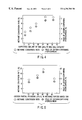
- FIG. 4 is a graph showing the relationship between the catalytic activity and the amount of SMA supported on the carrier
- FIG. 5 is a graph showing the relationship between the catalytic activity and methane/oxygen volume ratio
- FIG. 6 is a graph showing the relationship between the catalytic activity and the specific surface area of silica used as a carrier
- FIG. 7 is a graph showing the relationship between the catalytic activity and the reaction temperature
- FIG. 8 is a graph showing the durability of the catalyst with 9/1 of methane/oxygen ratio.
- FIG. 9 is a graph showing the durability of the catalyst with 6/4 of methane/oxygen ratio.
- reaction between methane and oxygen is carried out in the presence of a catalyst for producing formaldehyde directly from methane.
- the catalyst used in the present invention is prepared by having 12-molybdosilicic acid supported on a silica carrier.
- the silica-supported 12-molybdosilicic acid catalyst used in the present invention can be prepared by an impregnation method as follows. Specifically, 12-molybdosilicic acid (hereinafter referred to as “SMA”) is sufficiently dissolved in pure water at room temperature. Then, a silica powder is dipped in the solution, followed by evaporating the water such that the catalyst is not dried completely. If the catalyst is completely dried and heated at 350°C. or more, SMA within the catalyst is thermally decomposed into silica and molybdenum oxide, as shown below:
- SMA 12-molybdosilicic acid
- the water should be evaporated on, preferably, a water bath while heating and stirring the solution such that the catalyst is not dried completely.
- the catalyst is further dried for obtaining the catalyst of the present invention.
- SMA used as a raw material is a compound having a molecular formula of H 4 SiMo 12 O 40 .
- the silica powder used as a carrier should desirably have a high purity and a specific surface area of at least 500 m 2 /g. If the specific surface area is smaller than 500 m 2 /g, SMA is agglomerated on the surface of the silica carrier so as to inhibit the partial oxidation reaction of methane.
- the silica powder can be prepared by a known method. For example, a silica gel obtained by hydrolyzing ethyl silicate is dried and calcined to obtain a desired silica powder.
- a silica carrier having a desired specific surface area can be obtained by controlling the pH value in the hydrolyzing step. It should be noted that the pores present in the silica obtained by hydrolyzing ethyl silicate have an average diameter of about 40 ⁇ . On the other hand, SMA molecules have an average diameter of about 28 ⁇ even under a water vapor atmosphere described herein later. It follows that the SMA molecules can be held within the pores of the silica carrier, making it possible to suppress elution of the water-soluble SMA molecules so as to improve the durability of the catalyst. However, a silica powder available on the market can also be used satisfactorily in the present invention as the silica carrier.
- SMA SMA
- the silica carrier in an amount of at least 10% by weight, preferably 10 to 50% by weight, and most preferably 25 to 40% by weight, based on the weight of the silica carrier. If the amount of SMA supported on the carrier is less than 10% by weight, the methane conversion rate is low, resulting in failure to obtain formaldehyde at a sufficiently high yield. If the supported SMA amount exceeds 50% by weight, however, it is impossible to obtain formaldehyde at a high yield conforming with the supported SMA amount. It should be noted in this connection that a regeneration reaction of SMA given below, which will be described hereinlater, takes place under a water vapor atmosphere:
- the amount of SMA supported on the carrier can be controlled as desired by controlling the SMA concentration in the aqueous solution of SMA in the catalyst preparation method described above.
- a mixed gas of methane and oxygen is brought into contact with the catalyst of the present invention.
- a mixed gas of methane and oxygen is passed through a bed of the catalyst of the present invention so as to carry out reaction between methane and oxygen.
- SMA is poor in heat resistance. If heated to 350° C. or more, SMA is thermally decomposed easily to form silica and molybdenum oxide. If heated to the formaldehyde synthesizing temperature, e.g., 600° C., SMA is thermally decomposed substantially completely into silica and molybdenum oxide, though the heat resistance of SMA is certainly improved if SMA is supported on silica.
- the reaction for synthesizing formaldehyde proceeds satisfactorily if the volume ratio of methane/oxygen in the mixed gas falls within a range of between 9/1 and 4/6. It is more desirable for the volume ratio of methane/oxygen to fall within a range of between 7/3 and 6/4 in order to obtain formaldehyde efficiently in view of the methane conversion rate and the formaldehyde selectivity.
- the reaction for synthesizing formaldehyde should desirably be carried out at 550 to 650° C. If the reaction temperature is lower than 550° C., the methane conversion rate is lowered, leading to a low formaldehyde yield. Also, if the reaction temperature is higher than 650° C., the selectivity of carbon dioxide or carbon monoxide is increased so as to lower the formaldehyde yield. More preferably, the reaction temperature should be 580 to 620° C.
- the reaction mechanism given below is considered to account for the reaction temperature specified in the present invention:
- the mark “(ad)” represents an adsorbed state, and “s” denotes the oxygen active point on the SMA catalyst.
- Formaldehyde is formed by reactions (1) to (5). However, reactions (6) and (7) also take place to form carbon dioxide and carbon monoxide.
- the mark “H + (ad)” represents a proton present on SMA. A single SMA molecule has four protons. For synthesizing formaldehyde by partial oxidation of methane, it is absolutely necessary to form an adsorbed methoxy group “CH 3 O(ad)”.
- water vapor should be supplied in an amount of 40 to 80% by volume of the total volume of the mixed gas of methane and oxygen and the water vapor.
- water vapor should be supplied in an amount of 60 to 70% by volume of the total volume in order to obtain formaldehyde efficiently in view of the methane conversion rate and the formaldehyde selectivity.
- a novel catalyst excellent in partial oxidation activity of methane which is prepared by having SMA supported on silica, and a method of producing formaldehyde in the presence of the particular catalyst will now be described with reference to Examples.
- a silica gel obtained by hydrolyzing ethyl silicate was dried at 110° C. for 10 hours, followed by calcining the dried silica gel at 600° C. for 3 hours so as to prepare a high purity silica used as a carrier for preparing a silica-supported SMA catalyst of the present invention.
- Three kinds of silica carriers differing from each other in the specific surface area as shown in Table 1 below were prepared by changing the pH value in the hydrolyzing step.
- a silica-supported SMA catalyst was prepared by an impregnation method as follows.
- the silica-containing solution was heated at about 50° C. above a water bath while stirring the solution to evaporate water such that the catalyst was not dried completely.
- the catalyst having water evaporated therefrom was put in a dryer kept at about 110° C. for further drying for 10 hours.
- the resultant catalyst which was found to contain 20% by weight of SMA supported on the silica carrier, was put in a hermetically sealed polyethylene bag and stored in a desiccator.
- Example 2 A method of evaluating the activity of the silica-supported SMA catalyst prepared in Example 1 and a reaction apparatus for evaluating the activity by the particular method will now be described as Example 2.
- FIG. 1 schematically shows a reaction apparatus for evaluating the activity of the silica-supported SMA catalyst of the present invention.
- a methane bomb 1 an oxygen bomb 2 and a water supply device 4 are connected to a gas mixer 3 through pipes.
- the gas mixer 3 is connected to a reaction tube 11 through a pipe 20 .
- the pipe 20 is branched upstream of the reaction tube 11 , and a branched pipe 21 connected at one end to the branched portion of the pipe 20 communicates at the other end with a valve 8 .
- a pipe 22 communicates at one end with the outlet port of the reaction tube 11 and is connected at the other end to gas chromatographs 9 and 10 through branched pipes 22 a , 22 b , respectively.
- the branched pipe 21 communicates with the pipe 22 via the valve 8 .
- a catalyst 6 is loaded in the reaction tube 11 , and a heater 7 is arranged to surround the reaction tube 11 . Further, a thermocouple 5 is inserted into the reaction tube 11 .
- Methane and oxygen are supplied from the bombs 1 and 2 into the gas mixer 3 at supply rates of, generally, 1.8L (liters)/h and 0.2 L/h, respectively.
- the water supplied from the water supply device 4 is converted into water vapor within the gas mixer 3 heated to 250° C.
- the water vapor is mixed completely before entering the catalyst layer with the methane and oxygen by the action of ceramic pieces (not shown) such as glass beads (5 mm ⁇ ) loaded in the mixer 3 .
- a press fitting device for a liquid chromatography is used as the water supply device 4 .
- the water vapor supply rate can be controlled freely within a range of between 0.2 L/h and 4 L/h.
- the mixed gas is supplied into the gas chromatographs 9 and 10 through the branched pipes 22 a and 22 b , respectively.
- Carbosieve S-II is loaded in the column of the gas chromatograph 9 for measuring mainly methane, carbon monoxide and carbon dioxide.
- APS-201 is loaded in the column of the gas chromatograph 10 for measuring mainly methanol, formaldehyde and water. If the valve 8 mounted to the branched pipe 21 is closed, the mixed gas is introduced into the reaction tube 11 having a diameter of 10 mm and loaded with 1.5 g of the catalyst 6 .
- the catalyst layer 6 is heated by the heater 7 set at 550 to 650° C., and the temperature within the reaction tube 11 is measured by the thermocouple 5 .
- the formed gas passing through the catalyst layer 6 is also introduced into the gas chromatographs 9 and 10 for the composition analysis like the mixed gas flowing through the branched pipe 21 .
- the main component of the formed gas is formaldehyde.
- methanol based on the amount of formaldehyde is also contained in the formed gas. Therefore, formaldehyde and methanol are denoted together by the expression “methanol/formaldehyde” in the following description.
- the activity of the catalyst was evaluated by calculating the methane conversion rate and the selectivity of each of methanol/formaldehyde, carbon dioxide and carbon monoxide within the formed gas by the formulas given below:
- Methane Conversion Rate P/the number of mols of introduced methane
- P denotes the total number of mols of (methanol/formaldehyde+CO+CO 2 )
- X denotes the number of mols of methanol/formaldehyde, CO or CO 2 .
- Example 3 The influences given by the water vapor addition amount to the activity of the silica-supported SMA catalyst will now be described as Example 3.
- a catalyst having 27% by weight of SMA supported on the silica powder 2 prepared in Preparation the catalyst was prepared as in Example 1.
- the catalyst thus prepared is abbreviated herein as “27 wt % SMA/SiO 2 ”.
- the catalytic activity was evaluated by the method of Example 2. Specifically, the methane conversion rate and the selectivity of each of methanol/formaldehyde, CO and CO 2 were calculated under the conditions given below:
- Oxygen flow rate 0.2 L/h
- the yield of methanol/formaldehyde was also calculated based on the calculated values of the methane conversion rate and the selectivity. The results are shown in Table 2 and in FIG. 2 .
- the methane conversion rate, the methanol/formaldehyde selectivity and the methanol/formaldehyde yield are increased with increase in the water vapor amount within the total gas.
- the water vapor partial pressure is increased to 60% or more, the methane conversion rate is rapidly increased and the methanol/formaldehyde selectivity is increased to exceed 80%, supporting that methane is efficiently converted into methanol/formaldehyde.
- the methanol/formaldehyde yield exceeds 8%, which is markedly higher than 4% that was regarded as an unbreakable wall in this technical field.
- the amount of methanol in the methanol/formaldehyde was found to be not larger than 5% by weight of the amount of formaldehyde under each of the water vapor partial pressures tested. This was also the case with any of the following Examples.
- Example 3 The catalyst used in Example 3, i.e., 27 wt % SMA/SiO2, was diluted with a KBr powder to form a pellet sample for the IR spectroscopic analysis.
- the pellet sample thus formed was put in a heating type infrared spectroscopic cell for measuring the infrared absorption spectrum.
- FIG. 3 a shows the changes in the infrared absorption spectra when the pellet sample was heated under the air atmosphere. Two absorption peaks observed at 907 cm ⁇ 1 and 954 cm ⁇ 1 are inherent in SMA. If the pellet sample is heated to 400° C. or more, these two peak intensities are attenuated and a single absorption peak is newly observed at 1000 cm ⁇ 1 .
- the new absorption peak is characteristic of molybdenum oxide (MoO 3 ). If the sample is heated to 600° C., the absorption peaks ascribed to SMA disappear substantially completely, and only the absorption peak ascribed to MoO 3 can be observed.
- SMA is poor in heat resistance. If heated to 350° C. or higher, SMA is easily decomposed to form silica and molybdenum oxide as given below:
- FIG. 12 b shows the results.
- two absorption peaks were observed at 907 cm ⁇ 1 and 954 cm ⁇ 1 , and an absorption peak was not observed at 1000 cm ⁇ 1 .
- SMA was gradually regenerated by the treatment with water vapor.
- a small amount of SMA is formed if a silica powder and a molybdenum oxide powder are mixed and stirred within water, as described in, for example, “J. M. Tatibouet, et al., J. Chem. Soc., Chem. Commun., 1260(1988)” and “C. R. Deltcheff, et al., J. Catal., 125, 292 (1990)”:
- the regenerated SMA begins to be thermally decomposed at 400° C. and is thermally decomposed completely at 600° C. to form silica and molybdenum oxide, as in FIG. 3 a.
- Example 3 It has been confirmed in Example 3 that the yield of methanol/formaldehyde is markedly increased where the water vapor supply rate is set at 3.0 to 3.5 L/h (water vapor partial pressure of 60 to 64%).
- Example 5 an experiment was conducted under a water vapor supply rate of 3.5 L/h by changing the amount of SMA supported on silica powder 2 in order to observe the change in the catalytic activity caused by the change in the amount of the supported SMA.
- the other reacting conditions were equal to those in Example 3, as given below:
- Oxygen flow rate 0.2 L/h
- the amount of the supported SMA was changed within a range of 6 to 36% by weight.
- the experimental data are shown in Table 3 and FIG. 4 .
- the experimental data indicate that the methane conversion rate is increased with increase in the supported amount of SMA, leading to an increased yield of methanol/formaldehyde, though the selectivity of methanol/formaldehyde is not appreciably changed by the change in the supported amount of SMA.
- a prominently high yield of methanol/formaldehyde i.e., about 10%, was obtained where the supported amount of SMA exceeded 18% by weight.
- the methane/oxygen ratio of the methane/oxygen mixed gas used in the reaction is 1/1.
- the methane/oxygen ratio was set at 9/1.
- Example 6 1.5 g of 27 wt % SMA/SiO 2 catalyst was used, and the reaction was carried out under a water vapor flow rate of 3.5 L/hr and the reaction temperature of 600° C., while changing the methane/oxygen ratio within a range of 9/1 to 4/6 for evaluating the catalytic activity.
- the flow rate of the methane/oxygen mixed gas was set constant at 2.0 L/h.
- the experimental data are shown in Table 4 and FIG. 5 .
- the methane/oxygen volume ratio was changed stepwise from 9/1 to 4/6.
- the oxygen content of the methane/oxygen mixture was increased stepwise.
- the methanol/formaldehyde yield was found to increase with increase in the oxygen content of the methane/oxygen mixture to reach 17.25% when the methane/oxygen volume ratio was set at 6/4.
- the methane/oxygen volume ratio was held within a range of between 9/1 and 6/4
- the methanol/formaldehyde selectivity of the reaction mixture was held substantially constant at 85% or more. Also, the selectivity of any of carbon monoxide and carbon dioxide was lower than 10%.
- a single SMA molecule has a diameter of about 28 ⁇ and, thus, has a cross sectional area of about 600 ⁇ 2 . Also, SMA has a molecular weight of about 1824. Therefore, in the 27 wt % SMA/SiO 2 catalyst, 0.27 g of SMA, i.e., 0.9 ⁇ 10 20 SMA molecules, are supported by 1 g of silica. It should be noted that the sum of the cross sectional areas of 0.9 ⁇ 10 20 SMA molecules is 5.4 ⁇ 10 22 ⁇ 2 , i.e., 540 m 2 . On the other hand, silica powder 2 shown in Table 1 was used as a silica carrier.
- silica powder 2 has a specific surface area of 570 m 2 /g. It follows that, in the 27 wt % SMA/SiO 2 catalyst, the entire surface of the silica carrier is covered substantially completely with a monolayer of the SMA molecules. In other words, if a larger amount of SMA molecules are supported on the silica carrier, the SMA molecules are caused to form a plurality of layers on the silica surface. According to the experimental data obtained in Example 5, the methanol/formaldehyde yield remains substantially constant if the amount of SMA supported on the carrier is 27% by weight or more. In other words, it is suggested that the catalytic activity substantially reaches saturation if SMA is supported in an amount sufficient to form a monolayer covering the entire surface of the silica carrier.
- Example 7 a 27 wt % SMA/SiO 2 catalyst was prepared as in Example 1 by using each of silica powders 1 , 2 and 3 prepared in Preparation Example 1, the silica powders differing from each other in specific surface area, for evaluating the catalytic activity.
- the reaction was carried out under the methane/oxygen ratio of the mixed gas of 9/1, the water vapor flow rate of 3.5 L/h and the reaction temperature of 600° C. Table 5 and FIG. 6 show the results.
- silica powder 1 having the smallest specific surface area led to a low methane conversion rate and to a low selectivity of methanol/formaldehyde.
- the yield of methanol/formaldehyde for silica powder 1 was lower than those for the other silica powders.
- SMA molecules are agglomerated on the surface of the silica carrier. This clearly suggests that the SMA agglomeration is not desirable for the partial oxidation of methane.
- Example 8 The reaction was carried out under the conditions similar to those for Example 7.
- used was 1.5 g of a 27 wt % SMA/SiO 2 catalyst prepared by using silica powder 2 , and the reaction temperature was changed within a range of between 550° C. and 650° C. so as to evaluate the effect given by the reaction temperature to the catalytic activity.
- Table 6 and FIG. 7 show the results.
- Durability tests were conducted under different conditions by using 1.5 g of a 27 wt % SMA/SiO 2 catalyst. Specifically, one of the tests was conducted for 85 hours under the methane flow rate of 1.8 L/h, the oxygen flow rate of 0.2 L/h, the water vapor flow rate of 3.5 L/h and the reaction temperature of 600° C. Table 7 and FIG. 8 show the results.
- A represents the sum of the unreacted methane, methanol, formaldehyde, CO and CO 2
- B denotes the amount of methane supplied to the reaction system.
Landscapes
- Chemical & Material Sciences (AREA)
- Organic Chemistry (AREA)
- Engineering & Computer Science (AREA)
- Materials Engineering (AREA)
- Chemical Kinetics & Catalysis (AREA)
- Organic Low-Molecular-Weight Compounds And Preparation Thereof (AREA)
- Catalysts (AREA)
Abstract
The present invention provides a silica-supported 12-molybdosilicic acid catalyst comprising a silica carrier and at least 10% by weight, based on the silica amount, of 12-molybdosilicic acid supported on the carrier and a method of producing formaldehyde directly from a mixed gas of methane and oxygen in the presence of the particular catalyst. Formaldehyde can be produced at a high yield in the present invention without requiring a reforming process of methane with water vapor that consumes a large amount of energy. In addition, attentions are also paid to the air pollution and water contamination problems in the present invention.
Description
The present invention relates to a method of producing formaldehyde, particularly to a novel catalyst that permits producing formaldehyde directly from methane at a high yield and a method of producing formaldehyde by using the novel catalyst.
Formaldehyde is produced by partial oxidation reaction of methanol. Half the methanol produced in an amount of one million tons in a year is used as a raw material for the production of formaldehyde. The produced formaldehyde is used as a raw material of synthetic resins such as phenolic resins and urea resins or as a raw material of various medicines.
Methanol is synthesized from hydrogen and carbon monoxide obtained by water vapor reforming reaction of methane. The conventional process of producing formaldehyde is as given below:
The reaction for preparing H2/CO from methane is an endothermic reaction using a large amount of high temperature water vapor, which is one of typical processes consuming a large amount of energy. On the other hand, the reaction for synthesizing methanol from H2/CO is an exothermic reaction. In order to prevent the reaction heat from being generated excessively, the CO conversion rate must be suppressed to about 10% in operating the process unit. Also, the conversion rate of methanol must be suppressed in operating the process unit in the production of formaldehyde by partial oxidation of methanol in order to suppress formation of carbon dioxide and carbon monoxide. In short, the conventional process of producing formaldehyde is a process consuming a large amount of energy and requiring a very complex operation of the process unit.
In order to avoid the large energy-consuming process in the production of formaldehyde, it is necessary to develop a new producing process that permits producing formaldehyde without involving the step of water vapor reformation of methane to produce H2/CO.
It is considered theoretically possible to produce methanol and formaldehyde by partial oxidation of methane, i.e., direct synthesis from methane, as suggested by chemical reaction formulas given below:
Therefore, vigorous researches are being made over more than these 50 years on the method of directly synthesizing methanol or formaldehyde from methane in research institutes over the world. Since a catalyst is required for the reactions given above, the major portion of these researches has been concentrated on the development of an effective catalyst. For example, catalysts having molybdenum oxide, vanadium oxide, chromium oxide, etc. supported by silica are reported in, for example, “Chemistry Letter, 1997, p31-32” and “Catalyst Today, 45, p29-33(1998)”.
However, the yield of methanol or formaldehyde is very low, i.e., less than 1% in general, even in the presence of these catalysts. It is said among the researchers in this field that it is difficult for the yield of methanol or formaldehyde to exceed 4%. In other words, the yield of 4% is said to be a wall that cannot be broken in the direct synthesis of methanol or formaldehyde from methane. Further, the methane conversion rate of at least 10% is required for putting the process to practical use. In conclusion, a process for direct conversion from methane into formaldehyde with a practical yield of formaldehyde has not yet been developed.
An object of the present invention is to produce formaldehyde with a high yield directly from methane by a process that does not involve a water vapor reforming step of methane, which is a step consuming a large amount of energy, and that does not bring about an air pollution or water contamination problem. To achieve the object, the present invention provides a novel catalyst and a method of producing formaldehyde by using the novel catalyst.
The present inventors have conducted an extensive research on a catalyst excellent in its activity of partially oxidizing methane and on the conditions of the reaction carried out in the presence of the particular catalyst, and found that a silica-supported 12-molybdosilicic acid catalyst, in which 12-molybdosilicic acid is supported on silica, is excellent in its activity of partially oxidizing methane and, thus, is very effective when used as a catalyst in the synthesis of formaldehyde directly from methane. The formaldehyde yield is markedly improved if the reaction for direct synthesis of formaldehyde from methane is carried out under a water vapor atmosphere in the presence of the particular catalyst.
According to the present invention, there is provided a silica-supported 12-molybdosilicic acid catalyst, comprising a silica carrier and at least 10% by weight, based on the silica amount, of 12-molybdosilicic acid supported on the carrier.
It is desirable for the silica carrier to have a specific surface area of at least 500 m2/g.
The present invention also provides a method of directly producing formaldehyde from a mixed gas of methane and oxygen in the presence of a catalyst, wherein the catalyst comprises a silica carrier and at least 10% by weight, based on the silica amount, of 12-molybdosilicic acid supported on the carrier.
It is desirable for the volume ratio of methane to oxygen of the mixed gas to fall within a range of between 9/1 and 4/6 and to carry out the reaction in the presence of the catalyst at 550 to 650° C.
It is also desirable to supply water vapor into the mixed gas of methane and oxygen in an amount of 40 to 80% by volume of the total volume of the mixed gas and water vapor.
The present invention makes it possible to synthesize formaldehyde directly from methane at a high yield. This suggests that the conventional process consuming a large amount of energy need not be employed for the production of formaldehyde, leading to a prominent energy saving in the chemical industries.
Additional objects and advantages of the invention will be set forth in the description which follows, and in part will be obvious from the description, or may be learned by practice of the invention. The objects and advantages of the invention may be realized and obtained by means of the instrumentalities and combinations particularly pointed out hereinafter.
The accompanying drawings, which are incorporated in and constitute a part of the specification, illustrate presently preferred embodiments of the invention, and together with the general description given above and the detailed description of the preferred embodiments given below, serve to explain the principles of the invention.
FIG. 1 schematically shows an apparatus for evaluating the activity of a silica-supported 12-molybdosilicic acid (SMA) catalyst;
FIG. 2 is a graph showing the relationship between the catalytic activity and the water vapor supply amount;
FIG. 3 shows an infrared ray spectrum denoting the thermal decomposition behavior of a 27 wt % SMA/SiO2 catalyst;
FIG. 4 is a graph showing the relationship between the catalytic activity and the amount of SMA supported on the carrier;
FIG. 5 is a graph showing the relationship between the catalytic activity and methane/oxygen volume ratio;
FIG. 6 is a graph showing the relationship between the catalytic activity and the specific surface area of silica used as a carrier;
FIG. 7 is a graph showing the relationship between the catalytic activity and the reaction temperature;
FIG. 8 is a graph showing the durability of the catalyst with 9/1 of methane/oxygen ratio; and
FIG. 9 is a graph showing the durability of the catalyst with 6/4 of methane/oxygen ratio.
In the present invention, reaction between methane and oxygen is carried out in the presence of a catalyst for producing formaldehyde directly from methane. The catalyst used in the present invention is prepared by having 12-molybdosilicic acid supported on a silica carrier.
The silica-supported 12-molybdosilicic acid catalyst used in the present invention can be prepared by an impregnation method as follows. Specifically, 12-molybdosilicic acid (hereinafter referred to as “SMA”) is sufficiently dissolved in pure water at room temperature. Then, a silica powder is dipped in the solution, followed by evaporating the water such that the catalyst is not dried completely. If the catalyst is completely dried and heated at 350°C. or more, SMA within the catalyst is thermally decomposed into silica and molybdenum oxide, as shown below:
Therefore, the water should be evaporated on, preferably, a water bath while heating and stirring the solution such that the catalyst is not dried completely.
After the water evaporation, the catalyst is further dried for obtaining the catalyst of the present invention.
SMA used as a raw material is a compound having a molecular formula of H4SiMo12O40. In the present invention, it is possible to use SMA available on the market. The silica powder used as a carrier should desirably have a high purity and a specific surface area of at least 500 m2/g. If the specific surface area is smaller than 500 m2/g, SMA is agglomerated on the surface of the silica carrier so as to inhibit the partial oxidation reaction of methane. The silica powder can be prepared by a known method. For example, a silica gel obtained by hydrolyzing ethyl silicate is dried and calcined to obtain a desired silica powder. A silica carrier having a desired specific surface area can be obtained by controlling the pH value in the hydrolyzing step. It should be noted that the pores present in the silica obtained by hydrolyzing ethyl silicate have an average diameter of about 40 Å. On the other hand, SMA molecules have an average diameter of about 28 Å even under a water vapor atmosphere described herein later. It follows that the SMA molecules can be held within the pores of the silica carrier, making it possible to suppress elution of the water-soluble SMA molecules so as to improve the durability of the catalyst. However, a silica powder available on the market can also be used satisfactorily in the present invention as the silica carrier.
It is desirable for SMA to be supported on the silica carrier in an amount of at least 10% by weight, preferably 10 to 50% by weight, and most preferably 25 to 40% by weight, based on the weight of the silica carrier. If the amount of SMA supported on the carrier is less than 10% by weight, the methane conversion rate is low, resulting in failure to obtain formaldehyde at a sufficiently high yield. If the supported SMA amount exceeds 50% by weight, however, it is impossible to obtain formaldehyde at a high yield conforming with the supported SMA amount. It should be noted in this connection that a regeneration reaction of SMA given below, which will be described hereinlater, takes place under a water vapor atmosphere:
What should be noted is that the SMA formation amount by the regeneration reaction given above is limited to a certain value. As a result, formaldehyde cannot be obtained at a high yield conforming with the SMA amount where the amount of SMA supported on the carrier exceeds 50% by weight, as pointed out above.
Incidentally, the amount of SMA supported on the carrier can be controlled as desired by controlling the SMA concentration in the aqueous solution of SMA in the catalyst preparation method described above.
For producing formaldehyde in the present invention, a mixed gas of methane and oxygen is brought into contact with the catalyst of the present invention.
For example, a mixed gas of methane and oxygen is passed through a bed of the catalyst of the present invention so as to carry out reaction between methane and oxygen.
In the present invention, it is desirable to supply water vapor into the mixed gas of methane and oxygen so as to carry out the formaldehyde synthesizing reaction under a water vapor atmosphere. It should be noted in this connection that SMA is poor in heat resistance. If heated to 350° C. or more, SMA is thermally decomposed easily to form silica and molybdenum oxide. If heated to the formaldehyde synthesizing temperature, e.g., 600° C., SMA is thermally decomposed substantially completely into silica and molybdenum oxide, though the heat resistance of SMA is certainly improved if SMA is supported on silica. However, the thermal decomposition and regeneration of SMA proceed in equilibrium under a water vapor atmosphere, with the result that SMA is constantly present during the reaction for synthesizing formaldehyde. In other words, the thermal decomposition of SMA during the reaction is suppressed in the presence of water vapor so as to permit SMA to produce a catalytic function inherent in SMA.
The reaction for synthesizing formaldehyde proceeds satisfactorily if the volume ratio of methane/oxygen in the mixed gas falls within a range of between 9/1 and 4/6. It is more desirable for the volume ratio of methane/oxygen to fall within a range of between 7/3 and 6/4 in order to obtain formaldehyde efficiently in view of the methane conversion rate and the formaldehyde selectivity.
In the present invention, the reaction for synthesizing formaldehyde should desirably be carried out at 550 to 650° C. If the reaction temperature is lower than 550° C., the methane conversion rate is lowered, leading to a low formaldehyde yield. Also, if the reaction temperature is higher than 650° C., the selectivity of carbon dioxide or carbon monoxide is increased so as to lower the formaldehyde yield. More preferably, the reaction temperature should be 580 to 620° C. The reaction mechanism given below is considered to account for the reaction temperature specified in the present invention:
In the reaction formulas given above, the mark “(ad)” represents an adsorbed state, and “s” denotes the oxygen active point on the SMA catalyst. Formaldehyde is formed by reactions (1) to (5). However, reactions (6) and (7) also take place to form carbon dioxide and carbon monoxide. Also, the mark “H+ (ad)” represents a proton present on SMA. A single SMA molecule has four protons. For synthesizing formaldehyde by partial oxidation of methane, it is absolutely necessary to form an adsorbed methoxy group “CH3O(ad)”. In the case of using an SMA catalyst, it is a strong likelihood that a carbonium cation “CH5 + (ad)” is formed first by the action of H+ (ad) and, then, the carbonium cation CH5 + (ad) is converted into the adsorbed methoxy group CH3O(ad). Where the reaction temperature is low, the activation and adsorption of methane shown in reaction (1) does not proceed. On the other hand, where the reaction temperature is high, the side reactions (6) and (7) are promoted so as to inhibit formation of methanol or formaldehyde.
In the present invention, water vapor should be supplied in an amount of 40 to 80% by volume of the total volume of the mixed gas of methane and oxygen and the water vapor. Preferably, water vapor should be supplied in an amount of 60 to 70% by volume of the total volume in order to obtain formaldehyde efficiently in view of the methane conversion rate and the formaldehyde selectivity.
A novel catalyst excellent in partial oxidation activity of methane, which is prepared by having SMA supported on silica, and a method of producing formaldehyde in the presence of the particular catalyst will now be described with reference to Examples.
First of all, a method of preparing a silica powder used as a carrier of the catalyst will now be described as Preparation Example 1.
A silica gel obtained by hydrolyzing ethyl silicate was dried at 110° C. for 10 hours, followed by calcining the dried silica gel at 600° C. for 3 hours so as to prepare a high purity silica used as a carrier for preparing a silica-supported SMA catalyst of the present invention. Three kinds of silica carriers differing from each other in the specific surface area as shown in Table 1 below were prepared by changing the pH value in the hydrolyzing step.
| TABLE 1 |
| Silica powders having different |
| specific surface areas |
| pH in | Specific | ||
| hydrolyzing | surface | ||
| step | area (m2/g) | ||
| |
1.0 | 390 | ||
| |
2.0 | 570 | ||
| Silica powder 3 | 2.5 | 740 | ||
Preparation of a silica-supported SMA catalyst will now be described as Example 1.
A silica-supported SMA catalyst was prepared by an impregnation method as follows.
In the first step, 5 g of an SMA powder available on the market was dissolved sufficiently in 50 milliliters (mL) of pure water at room temperature, followed by transferring the resultant SMA solution into an evaporating dish and subsequently dipping 20 g of the silica powder prepared in Preparation Example 1 in the SMA solution. Then, the silica-containing solution was heated at about 50° C. above a water bath while stirring the solution to evaporate water such that the catalyst was not dried completely. The catalyst having water evaporated therefrom was put in a dryer kept at about 110° C. for further drying for 10 hours. The resultant catalyst, which was found to contain 20% by weight of SMA supported on the silica carrier, was put in a hermetically sealed polyethylene bag and stored in a desiccator.
A method of evaluating the activity of the silica-supported SMA catalyst prepared in Example 1 and a reaction apparatus for evaluating the activity by the particular method will now be described as Example 2.
FIG. 1 schematically shows a reaction apparatus for evaluating the activity of the silica-supported SMA catalyst of the present invention. As shown in the drawing, a methane bomb 1, an oxygen bomb 2 and a water supply device 4 are connected to a gas mixer 3 through pipes. Also, the gas mixer 3 is connected to a reaction tube 11 through a pipe 20. The pipe 20 is branched upstream of the reaction tube 11, and a branched pipe 21 connected at one end to the branched portion of the pipe 20 communicates at the other end with a valve 8. A pipe 22 communicates at one end with the outlet port of the reaction tube 11 and is connected at the other end to gas chromatographs 9 and 10 through branched pipes 22 a, 22 b, respectively. The branched pipe 21 communicates with the pipe 22 via the valve 8. A catalyst 6 is loaded in the reaction tube 11, and a heater 7 is arranged to surround the reaction tube 11. Further, a thermocouple 5 is inserted into the reaction tube 11.
Methane and oxygen are supplied from the bombs 1 and 2 into the gas mixer 3 at supply rates of, generally, 1.8L (liters)/h and 0.2 L/h, respectively.
The water supplied from the water supply device 4 is converted into water vapor within the gas mixer 3 heated to 250° C. The water vapor is mixed completely before entering the catalyst layer with the methane and oxygen by the action of ceramic pieces (not shown) such as glass beads (5 mmφ) loaded in the mixer 3 . In order to prevent occurrence of a pulsating flow of water during the reaction, a press fitting device for a liquid chromatography is used as the water supply device 4. The water vapor supply rate can be controlled freely within a range of between 0.2 L/h and 4 L/h.
The mixed gas is supplied into the gas chromatographs 9 and 10 through the branched pipes 22 a and 22 b, respectively. Carbosieve S-II is loaded in the column of the gas chromatograph 9 for measuring mainly methane, carbon monoxide and carbon dioxide. On the other hand, APS-201 is loaded in the column of the gas chromatograph 10 for measuring mainly methanol, formaldehyde and water. If the valve 8 mounted to the branched pipe 21 is closed, the mixed gas is introduced into the reaction tube 11 having a diameter of 10 mm and loaded with 1.5 g of the catalyst 6. The catalyst layer 6 is heated by the heater 7 set at 550 to 650° C., and the temperature within the reaction tube 11 is measured by the thermocouple 5. The formed gas passing through the catalyst layer 6 is also introduced into the gas chromatographs 9 and 10 for the composition analysis like the mixed gas flowing through the branched pipe 21. The main component of the formed gas is formaldehyde. However, about 5% by weight of methanol based on the amount of formaldehyde is also contained in the formed gas. Therefore, formaldehyde and methanol are denoted together by the expression “methanol/formaldehyde” in the following description.
The activity of the catalyst was evaluated by calculating the methane conversion rate and the selectivity of each of methanol/formaldehyde, carbon dioxide and carbon monoxide within the formed gas by the formulas given below:
Methane Conversion Rate=P/the number of mols of introduced methane;
Selectivity of Formed Compound X=the number of mols of formed compound X/P
where P denotes the total number of mols of (methanol/formaldehyde+CO+CO2), and X denotes the number of mols of methanol/formaldehyde, CO or CO2.
The influences given by the water vapor addition amount to the activity of the silica-supported SMA catalyst will now be described as Example 3.
A catalyst having 27% by weight of SMA supported on the silica powder 2 prepared in Preparation the catalyst was prepared as in Example 1. The catalyst thus prepared is abbreviated herein as “27 wt % SMA/SiO2”. The catalytic activity was evaluated by the method of Example 2. Specifically, the methane conversion rate and the selectivity of each of methanol/formaldehyde, CO and CO2 were calculated under the conditions given below:
Catalyst loading amount: 1.5 g
Methane flow rate: 1.8 L/h
Oxygen flow rate: 0.2 L/h
Reaction temperature: 600° C.
Water vapor addition rate: 0.5 L/h to 3.5 L/h
The yield of methanol/formaldehyde was also calculated based on the calculated values of the methane conversion rate and the selectivity. The results are shown in Table 2 and in FIG. 2.
| TABLE 2 |
| Change in catalytic activity caused by |
| change in water vapor addition amount |
| Water vapor | |||||||
| addition rate | |||||||
| (L/h) | 0.5 | 1.0 | 1.5 | 2.0 | 2.5 | 3.0 | 3.5 |
| |
20 | 33 | 43 | 50 | 56 | 60 | 64 |
| partial pressure | |||||||
| in total gas (%) | |||||||
| Methane conversion | 3.0 | 3.0 | 3.1 | 4.0 | 8.4 | 10.5 | 11.3 |
| rate (%) | |||||||
| Methanol/ | 37.1 | 59.0 | 45.3 | 67.2 | 77.5 | 81.0 | 83.9 |
| formaldehyde | |||||||
| selectivity (%) | |||||||
| CO selectivity | 24.2 | 20.3 | 22.5 | 12.4 | 4.7 | 9.1 | 7.8 |
| (%) | |||||||
| CO2 selectivity | 38.7 | 20.7 | 32.2 | 20.3 | 17.8 | 9.9 | 9.0 |
| (%) | |||||||
| Methanol/ | 1.11 | 1.75 | 1.42 | 2.70 | 6.53 | 8.52 | 9.44 |
| formaldehyde | |||||||
| yield (%) | |||||||
| *27 wt % SMA/SiO2, specific surface area of silica: 570 m2/g | |||||||
| *Methane flow rate: 1.8 L/h, oxygen flow rate: 0.2 L/h | |||||||
| *Reaction temperature: 600° C. | |||||||
As apparent from the experimental data, the methane conversion rate, the methanol/formaldehyde selectivity and the methanol/formaldehyde yield are increased with increase in the water vapor amount within the total gas. Particularly, it has been confirmed that, if the water vapor partial pressure is increased to 60% or more, the methane conversion rate is rapidly increased and the methanol/formaldehyde selectivity is increased to exceed 80%, supporting that methane is efficiently converted into methanol/formaldehyde. It has also been confirmed that the methanol/formaldehyde yield exceeds 8%, which is markedly higher than 4% that was regarded as an unbreakable wall in this technical field. The amount of methanol in the methanol/formaldehyde was found to be not larger than 5% by weight of the amount of formaldehyde under each of the water vapor partial pressures tested. This was also the case with any of the following Examples.
As described above, it has been found that the water vapor addition to the methane/oxygen mixed gas is highly effective for improving the formaldehyde field, and that the effect produced by the water vapor addition is prominently increased if the water vapor partial pressure is 60% or more. In order to clarify the role played by the water vapor for improving the catalytic function, the structure of the SMA catalyst in the presence of water vapor was studied by an infrared spectroscopic analysis in Example 4 that follows.
The catalyst used in Example 3, i.e., 27 wt % SMA/SiO2, was diluted with a KBr powder to form a pellet sample for the IR spectroscopic analysis. The pellet sample thus formed was put in a heating type infrared spectroscopic cell for measuring the infrared absorption spectrum. FIG. 3a shows the changes in the infrared absorption spectra when the pellet sample was heated under the air atmosphere. Two absorption peaks observed at 907 cm−1 and 954 cm−1 are inherent in SMA. If the pellet sample is heated to 400° C. or more, these two peak intensities are attenuated and a single absorption peak is newly observed at 1000 cm−1. The new absorption peak is characteristic of molybdenum oxide (MoO3). If the sample is heated to 600° C., the absorption peaks ascribed to SMA disappear substantially completely, and only the absorption peak ascribed to MoO3 can be observed.
In general, SMA is poor in heat resistance. If heated to 350° C. or higher, SMA is easily decomposed to form silica and molybdenum oxide as given below:
On the other hand, the experimental data given in FIG. 3a suggest that the heat resistance of SMA may be improved if SMA is supported on silica. Even in this case, SMA is thermally decomposed substantially completely into silica and molybdenum oxide if heated at 600° C.
The sample thermally decomposed completely was cooled to room temperature and left to stand under a water vapor atmosphere for 12 hours, followed by observing the absorption spectra. FIG. 12b shows the results. In this case, two absorption peaks were observed at 907 cm−1 and 954 cm−1, and an absorption peak was not observed at 1000 cm−1. This suggests that SMA was gradually regenerated by the treatment with water vapor. Incidentally, it is known to the art that a small amount of SMA is formed if a silica powder and a molybdenum oxide powder are mixed and stirred within water, as described in, for example, “J. M. Tatibouet, et al., J. Chem. Soc., Chem. Commun., 1260(1988)” and “C. R. Deltcheff, et al., J. Catal., 125, 292 (1990)”:
If heated, the regenerated SMA begins to be thermally decomposed at 400° C. and is thermally decomposed completely at 600° C. to form silica and molybdenum oxide, as in FIG. 3a.
What should be noted is that, under the water vapor atmosphere, the thermal decomposition and regeneration of SMA proceed in equilibrium, with the result that SMA is constantly present during the reaction. In other words, the presence of water vapor serves to suppress decomposition of SMA during the reaction. Under the circumstances, water vapor is considered to regenerate SMA during the reaction so as to permit SMA to produce a catalytic function inherent in SMA.
The influences given by the supported amount of SMA to the catalytic activity will now be described as Example 5.
It has been confirmed in Example 3 that the yield of methanol/formaldehyde is markedly increased where the water vapor supply rate is set at 3.0 to 3.5 L/h (water vapor partial pressure of 60 to 64%). In Example 5, an experiment was conducted under a water vapor supply rate of 3.5 L/h by changing the amount of SMA supported on silica powder 2 in order to observe the change in the catalytic activity caused by the change in the amount of the supported SMA. The other reacting conditions were equal to those in Example 3, as given below:
Methane flow rate: 1.8 L/h
Oxygen flow rate: 0.2 L/h
Reaction temperature: 600° C.
The amount of the supported SMA was changed within a range of 6 to 36% by weight. The experimental data are shown in Table 3 and FIG. 4.
| TABLE 3 |
| Change in catalytic activity caused by |
| change in amount of supported SMA |
| Amount of | |||||||
| supported SMA | |||||||
| (% by weight) | 6 | 12 | 18 | 27 | 36 | ||
| Methane | 4.3 | 6.5 | 7.9 | 11.3 | 11.0 | ||
| conversion | |||||||
| rate (%) | |||||||
| Methanol/ | 84.8 | 71.4 | 83.2 | 83.9 | 86.6 | ||
| formaldehyde | |||||||
| selectivity (%) | |||||||
| CO | 2.6 | 12.9 | 3.6 | 7.8 | 4.8 | ||
| selectivity (%) | |||||||
| CO2 | 12.6 | 15.7 | 13.2 | 9.0 | 8.5 | ||
| selectivity (%) | |||||||
| Methanol/ | 3.67 | 4.66 | 6.60 | 9.44 | 9.56 | ||
| formaldehyde | |||||||
| yield (%) | |||||||
| *Specific surface area of silica: 570 m2/g | |||||||
| *Methane/oxygen/water vapor flow rate (L/h): 1.8/0.2/3.5 | |||||||
| *Reaction temperature: 600° C. | |||||||
The experimental data indicate that the methane conversion rate is increased with increase in the supported amount of SMA, leading to an increased yield of methanol/formaldehyde, though the selectivity of methanol/formaldehyde is not appreciably changed by the change in the supported amount of SMA. Particularly, a prominently high yield of methanol/formaldehyde, i.e., about 10%, was obtained where the supported amount of SMA exceeded 18% by weight.
The influences given by the methane/oxygen ratio of the methane/oxygen mixed gas to the catalytic activity will now be described as Example 6.
The direct synthesis of formaldehyde by partial oxidation of methane proceeds as follows:
Clearly, it is stoichiometrically desirable for the methane/oxygen ratio of the methane/oxygen mixed gas used in the reaction to be 1/1. In each of the experiments conducted in the Examples described above, the methane/oxygen ratio was set at 9/1. In Example 6, 1.5 g of 27 wt % SMA/SiO2 catalyst was used, and the reaction was carried out under a water vapor flow rate of 3.5 L/hr and the reaction temperature of 600° C., while changing the methane/oxygen ratio within a range of 9/1 to 4/6 for evaluating the catalytic activity. On the other hand, the flow rate of the methane/oxygen mixed gas was set constant at 2.0 L/h. The experimental data are shown in Table 4 and FIG. 5.
| TABLE 4 |
| Change in catalytic activity caused by |
| change in methane/oxygen ratio |
| Methane/ | ||||||
| volume ratio | ||||||
| 9/1 | 7/3 | 6/4 | 4/6 | |||
| Methane | 11.3 | 13.9 | 19.7 | 12.2 | ||
| conversion | ||||||
| rate (%) | ||||||
| Methanol/ | 83.9 | 88.1 | 87.6 | 84.1 | ||
| formaldehyde | ||||||
| selectivity (%) | ||||||
| CO | 7.8 | 5.0 | 6.2 | 5.1 | ||
| selectivity (%) | ||||||
| CO2 | 9.0 | 7.0 | 6.2 | 10.8 | ||
| selectivity (%) | ||||||
| Methanol/ | 9.44 | 12.25 | 17.25 | 10.22 | ||
| formaldehyde | ||||||
| yield (%) | ||||||
| *Sum of methane/oxygen: 2.0 L/h | ||||||
| *Water vapor flow rate: 3.5 L/h (water vapor partial pressure: 64%) | ||||||
| *Amount of supported SMA (wt %): 27 wt % | ||||||
| *Reaction temperature: 600° C. | ||||||
As shown in Table 4, the methane/oxygen volume ratio was changed stepwise from 9/1 to 4/6. In other words, the oxygen content of the methane/oxygen mixture was increased stepwise. The methanol/formaldehyde yield was found to increase with increase in the oxygen content of the methane/oxygen mixture to reach 17.25% when the methane/oxygen volume ratio was set at 6/4. Where the methane/oxygen volume ratio was held within a range of between 9/1 and 6/4, the methanol/formaldehyde selectivity of the reaction mixture was held substantially constant at 85% or more. Also, the selectivity of any of carbon monoxide and carbon dioxide was lower than 10%. Where the methane/oxygen volume ratio was set at 4/6, the methane conversion rate was decreased and the selectivity of the carbon dioxide was increased. As a result, the yield of methanol/formaldehyde was also lowered, though the methanol/formaldehyde yield was very high even in this case, i.e., 10.22%.
The effect given to the catalytic activity by the specific surface area of the silica carrier used in the production of the silica-supported SMA catalyst will now be described as Example 7.
A single SMA molecule has a diameter of about 28 Å and, thus, has a cross sectional area of about 600 Å2. Also, SMA has a molecular weight of about 1824. Therefore, in the 27 wt % SMA/SiO2 catalyst, 0.27 g of SMA, i.e., 0.9×10²⁰ SMA molecules, are supported by 1 g of silica. It should be noted that the sum of the cross sectional areas of 0.9×10²⁰ SMA molecules is 5.4×10²²Å2, i.e., 540 m2. On the other hand, silica powder 2 shown in Table 1 was used as a silica carrier. As shown in Table 1, silica powder 2 has a specific surface area of 570 m2/g. It follows that, in the 27 wt % SMA/SiO2 catalyst, the entire surface of the silica carrier is covered substantially completely with a monolayer of the SMA molecules. In other words, if a larger amount of SMA molecules are supported on the silica carrier, the SMA molecules are caused to form a plurality of layers on the silica surface. According to the experimental data obtained in Example 5, the methanol/formaldehyde yield remains substantially constant if the amount of SMA supported on the carrier is 27% by weight or more. In other words, it is suggested that the catalytic activity substantially reaches saturation if SMA is supported in an amount sufficient to form a monolayer covering the entire surface of the silica carrier.
In Example 7, a 27 wt % SMA/SiO2 catalyst was prepared as in Example 1 by using each of silica powders 1, 2 and 3 prepared in Preparation Example 1, the silica powders differing from each other in specific surface area, for evaluating the catalytic activity. The reaction was carried out under the methane/oxygen ratio of the mixed gas of 9/1, the water vapor flow rate of 3.5 L/h and the reaction temperature of 600° C. Table 5 and FIG. 6 show the results.
| TABLE 5 |
| Change in catalytic activity caused by |
| change in specific surface area of silica |
| Specific | 390 | 570 | 740 | ||
| surface area | (Silica | (Silica | (Silica | ||
| of SiO2 (m2/g) | powder 1) | powder 2) | powder 3) | ||
| Methane | 6.4 | 11.3 | 12.1 | ||
| conversion | |||||
| rate (%) | |||||
| Methanol/ | 73.0 | 83.9 | 85.3 | ||
| formaldehyde | |||||
| selectivity (%) | |||||
| CO | 7.4 | 7.8 | 6.3 | ||
| selectivity (%) | |||||
| CO2 | 19.6 | 9.0 | 8.3 | ||
| selectivity (%) | |||||
| Methanol/ | 4.69 | 9.44 | 10.36 | ||
| formaldehyde | |||||
| yield (%) | |||||
| *27 wt % SMA/SiO2 | |||||
| *Methane/oxygen/water vapor flow rate (L/h): 1.8/0.2/3.5 | |||||
| *Reaction temperature: 600° C. | |||||
As apparent from the experimental data, silica powder 1 having the smallest specific surface area led to a low methane conversion rate and to a low selectivity of methanol/formaldehyde. As a result, the yield of methanol/formaldehyde for silica powder 1 was lower than those for the other silica powders. It is considered reasonable to understand that, in the catalyst prepared by using silica powder 1, SMA molecules are agglomerated on the surface of the silica carrier. This clearly suggests that the SMA agglomeration is not desirable for the partial oxidation of methane.
The reactions were carried out at 600° C. in Examples 3, 5, 6 and 7. Then, the effect given by the reaction temperature to the catalytic activity will now be described as Example 8.
The reaction was carried out under the conditions similar to those for Example 7. In Example 8, used was 1.5 g of a 27 wt % SMA/SiO2 catalyst prepared by using silica powder 2, and the reaction temperature was changed within a range of between 550° C. and 650° C. so as to evaluate the effect given by the reaction temperature to the catalytic activity. Table 6 and FIG. 7 show the results.
| TABLE 6 |
| Change in catalytic activity caused by |
| change in reaction temperature |
| Reaction | |||||||
| temperature (° C.) | 550 | 580 | 600 | 620 | 650 | ||
| Methane conversion | 2.7 | 8.6 | 11.3 | 11.5 | 11.8 | ||
| rate (%) | |||||||
| Methanol/formal- | 77.4 | 84.1 | 83.9 | 79.4 | 39.2 | ||
| dehyde selectivity | |||||||
| (%) | |||||||
| CO selectivity (%) | 16.8 | 10.5 | 7.8 | 7.5 | 21.3 | ||
| CO2 selectivity (%) | 5.8 | 5.4 | 9.0 | 13.1 | 39.5 | ||
| Methanol/formal- | 2.09 | 7.23 | 9.44 | 9.13 | 4.62 | ||
| dehyde yield (%) | |||||||
| *27 wt % SMA/SiO2, specific surface area of silica: 570 m2/g | |||||||
| *Methane/oxygen/water vapor flow rate (L/h): 1.8/0.2/3.5 | |||||||
The experimental data clearly support that the reaction of the present invention for synthesizing formaldehyde proceeds satisfactorily under the reaction temperatures of 550° C. to 650° C. Particularly, where the reaction temperature fell within a range of between 580° C. and 620° C., each of the methane conversion rate and the methanol/formaldehyde selectivity was found to be high, making it possible to obtain methanol/formaldehyde at a high yield.
The durability of the catalyst will now be described as Example 9.
Durability tests were conducted under different conditions by using 1.5 g of a 27 wt % SMA/SiO2 catalyst. Specifically, one of the tests was conducted for 85 hours under the methane flow rate of 1.8 L/h, the oxygen flow rate of 0.2 L/h, the water vapor flow rate of 3.5 L/h and the reaction temperature of 600° C. Table 7 and FIG. 8 show the results.
| TABLE 7 |
| Durability test using 27 wt % SMA/SiO2 catalyst |
| Reaction | 1 | 17 | 33 | 49 | 61 | 85 |
| time (h) | ||||||
| Methane | 11.3 | 9.3 | 9.9 | 9.5 | 8.9 | 9.8 |
| conversion | ||||||
| rate (%) | ||||||
| Methanol/ | 83.5 | 83.2 | 84.6 | 82.1 | 87.6 | 85.2 |
| formaldehyde | ||||||
| selectivity | ||||||
| (%) | ||||||
| Methanol/ | 9.44 | 7.52 | 8.36 | 7.77 | 7.17 | 8.39 |
| formaldehyde | ||||||
| yield (%) | ||||||
| *27 wt % SMA/SiO2, specific surface area of silica: 570 m2/g | ||||||
| *Methane/oxygen/water vapor flow rate (L/h): 1.8/0.2/3.5 | ||||||
| *Reaction temperature: 600° C. | ||||||
The other test was conducted for 330 hours under the methane flow rate of 1.2 L/h, the oxygen flow rate of 0.8 L/h, the water vapor flow rate of 3.5 L/h and the reaction temperature of 600° C. Table 8 and FIG. 9 show the results.
| TABLE 8 |
| Durability test using 27 wt % SMA/SiO2 catalyst |
| Reaction | 1 | 43.2 | 100.4 | 193.3 | 250.0 | 330.0 |
| time (h) | ||||||
| Methane | 25.2 | 20.0 | 20.1 | 20.5 | 19.6 | 24.5 |
| conver- | ||||||
| sion rate | ||||||
| (%) | ||||||
| Methanol/ | 80.5 | 93.1 | 86.5 | 91.1 | 90.8 | 85.1 |
| formal- | ||||||
| dehyde | ||||||
| selec- | ||||||
| tivity (%) | ||||||
| Methanol/ | 20.28 | 18.58 | 17.41 | 18.67 | 17.77 | 20.87 |
| formal- | ||||||
| dehyde | ||||||
| yield (%) | ||||||
| Material | 109.5 | 91.0 | 110.3 | 98.9 | 103.6 | 104.3 |
| balance | ||||||
| (%) | ||||||
| *27 wt % SMA/SiO2, specific surface area of silica: 570 m2/g | ||||||
| *Methane/oxygen/water vapor flow rate (L/h): 1.2/0.8/3.5 | ||||||
| *Reaction temperature: 600° C. | ||||||
The experimental data clearly support that the catalyst of the present invention permits stably maintaining the methanol/formaldehyde yield over 300 hours. It has been found that, although SMA is soluble in water, SMA does not elute out of the catalyst layer even under the water vapor atmosphere so as to be held within the pores of the silica carrier, leading to an excellent durability of the catalyst.
The material balance of carbon, which has been determined by the formula given below, is also shown in Table 8:
Material Balance of Carbon=A/B×100
where A represents the sum of the unreacted methane, methanol, formaldehyde, CO and CO2, and B denotes the amount of methane supplied to the reaction system.
The material balance fell within a range of between 90 and 110, supporting that the analysis was performed appropriately.
Additional advantages and modifications will readily occur to those skilled in the art. Therefore, the invention in its broader aspects is not limited to the specific details and representative embodiments shown and described herein. Accordingly, various modifications may be made without departing from the spirit or scope of the general inventive concept as defined by the appended claims and their equivalents.
Claims (16)
1. A method of directly producing formaldehyde from a mixed gas of methane and oxygen in the presence of a catalyst, wherein said catalyst comprises a silica carrier and 12-molybdosilicic acid supported on the silica carrier, and water vapor is supplied to the mixed gas of methane and oxygen such that the water vapor occupies 40 to 80% by volume of the total volume of said mixed gas and water vapor.
2. The method according to claim 1, wherein said 12-molybdosilicic acid is supported on the silica carrier in an amount of at least 10% by weight based on the silica amount.
3. The method according to claim 1, wherein said silica carrier has a specific surface area of at least 500 m2/g.
4. The method according to claim 2, wherein said silica carrier has a specific surface area of at least 500 m2/g.
5. The method according to claim 1, wherein the volume ratio of methane/oxygen of said mixed gas falls within a range of between 9/1 and 4/6.
6. The method according to claim 2, wherein the volume ratio of methane/oxygen of said mixed gas falls within a range of between 9/1 and 4/6.
7. The method according to claim 3, wherein the volume ratio of methane/oxygen of said mixed gas falls within a range of between 9/1 and 4/6.
8. The method according to claim 4, wherein the volume ratio of methane/oxygen of said mixed gas falls within a range of between 9/1 and 4/6.
9. The method according to claim 1, wherein the reaction is carried out in the presence of said catalyst at 550 to 650° C.
10. The method according to claim 2, wherein the reaction is carried out in the presence of said catalyst at 550 to 650° C.
11. The method according to claim 3, wherein the reaction is carried out in the presence of said catalyst at 550 to 650° C.
12. The method according to claim 4, wherein the reaction is carried out in the presence of said catalyst at 550 to 650° C.
13. The method according to claim 5, wherein the reaction is carried out in the presence of said catalyst at 550 to 650° C.
14. The method according to claim 6, wherein the reaction is carried out in the presence of said catalyst at 550 to 650° C.
15. The method according to claim 7, wherein the reaction is carried out in the presence of said catalyst at 550 to 650° C.
16. The method according to claim 8, wherein the reaction is carried out in the presence of said catalyst at 550 to 650° C.
Applications Claiming Priority (2)
| Application Number | Priority Date | Filing Date | Title |
|---|---|---|---|
| JP11-083654 | 1999-03-26 | ||
| JP8365499 | 1999-03-26 |
Publications (1)
| Publication Number | Publication Date |
|---|---|
| US6294701B1 true US6294701B1 (en) | 2001-09-25 |
Family
ID=13808453
Family Applications (1)
| Application Number | Title | Priority Date | Filing Date |
|---|---|---|---|
| US09/392,724 Expired - Fee Related US6294701B1 (en) | 1999-03-26 | 1999-09-09 | Method of producing formaldehyde directly from methane |
Country Status (4)
| Country | Link |
|---|---|
| US (1) | US6294701B1 (en) |
| EP (1) | EP1038578A3 (en) |
| AU (1) | AU733990B2 (en) |
| HU (1) | HUP9903033A3 (en) |
Cited By (3)
| Publication number | Priority date | Publication date | Assignee | Title |
|---|---|---|---|---|
| US6414195B1 (en) * | 2000-03-27 | 2002-07-02 | President Of Shizuoka University | Method of producing formaldehyde directly from methane |
| FR2856398A1 (en) * | 2003-06-17 | 2004-12-24 | Atofina | PROCESS FOR THE PRODUCTION OF FORMALDEHYDE BY SELECTIVE OXIDATION OF METHANE |
| CN103785375A (en) * | 2012-11-01 | 2014-05-14 | 中国石油化工股份有限公司 | Catalyst for synthesis of methanol and formaldehyde through selective oxidation of methane, and preparation method and application thereof |
Family Cites Families (6)
| Publication number | Priority date | Publication date | Assignee | Title |
|---|---|---|---|---|
| DE2404738A1 (en) * | 1974-02-01 | 1975-08-21 | Bayer Ag | Formaldehyde prodn by hydrocarbon oxidn - over a subgroup V, VI or VII oxide (contg) catalyst |
| JPS55125119A (en) * | 1979-03-22 | 1980-09-26 | Makoto Miwa | Production of benzyl alcohol polymer |
| CA1259299A (en) * | 1985-04-16 | 1989-09-12 | Grace (W.R.) & Co. Conn. | Process and low sodium catalyst for the production of formaldehyde from methane |
| JPH07242578A (en) * | 1994-01-13 | 1995-09-19 | Mitsui Toatsu Chem Inc | Method for catalytic hydration of olefins |
| EP0959064B1 (en) * | 1995-08-02 | 2001-12-12 | BP Chemicals Limited | Ester synthesis |
| GB9810928D0 (en) * | 1998-05-22 | 1998-07-22 | Bp Chem Int Ltd | Catalyst and process |
-
1999
- 1999-09-07 AU AU47408/99A patent/AU733990B2/en not_active Ceased
- 1999-09-07 EP EP99117414A patent/EP1038578A3/en not_active Withdrawn
- 1999-09-08 HU HU9903033A patent/HUP9903033A3/en unknown
- 1999-09-09 US US09/392,724 patent/US6294701B1/en not_active Expired - Fee Related
Non-Patent Citations (15)
| Title |
|---|
| C. Rocchiccioli-Deltcheff, et al. "Catalysis by 12-Molybdophosphates", Journal of Catalysis, vol. 164, 1996, pp. 16-27. |
| C. Rocchiccioli-Deltcheff, et al. "Structure and Catalytic Properties of Silica-Supported Polyoxomolybdates", Journal of Catalysis, vol. 125, 1990, pp. 292-310. |
| Chemical Abstacts, vol. 118, AN 46556, 1992. |
| Chemical Abstracts, vol. 108, AN 204092, 1987. |
| Chemical Abstracts, vol. 117, AN 236244, 1992. |
| Chemical Abstracts, vol. 123, AN 209732, 1995. |
| Chemical Abstracts, vol. 126, AN 48569, 1996. |
| Chemical Abstracts, vol. 126, AN 77111, 1995. |
| Chemical Abstracts, vol. 128, AN 61300, 1997. |
| Derwent Abstracts, AN 80-80026, JP 55 125119, Sep. 26, 1980. |
| Derwent Abstracts, AN 95-355203/46, JP 07 242578, Sep. 19, 1995. |
| K. Aoki, et al. "Direct Conversion of Methane into Methanol over MoO3/SiO2Catalyst in an Excess Amount of Water Vapor", Catalysis Today, vol. 45, 1998, pp. 29-33. |
| M. Banares, et al. "Genesis and Stability of Silicomolybdic Acid on Silica-Supported Molybdenum Oxide Catalysts: In Situ Structural-Selectivity Study on Selective Oxidation Reactions", Journal of Catalysis, vol. 155, 1995, pp. 249-255. |
| M. Ohmae, et al. "Effects of Water Vapor upon Partial Oxidation of Methane over Highly-dispersed MoO3/SiO2", Chemistry Letters, 1997, pp. 31-32. |
| S. Kasztelan, et al. "The Oxidation of Methane on Heteropolyoxometalates", Journal of Catalysis, vol. 106, 1987, pp. 512-524. |
Cited By (5)
| Publication number | Priority date | Publication date | Assignee | Title |
|---|---|---|---|---|
| US6414195B1 (en) * | 2000-03-27 | 2002-07-02 | President Of Shizuoka University | Method of producing formaldehyde directly from methane |
| FR2856398A1 (en) * | 2003-06-17 | 2004-12-24 | Atofina | PROCESS FOR THE PRODUCTION OF FORMALDEHYDE BY SELECTIVE OXIDATION OF METHANE |
| WO2004113259A1 (en) * | 2003-06-17 | 2004-12-29 | Arkema | Method of producing formaldehyde by means of selective methane oxidation |
| CN103785375A (en) * | 2012-11-01 | 2014-05-14 | 中国石油化工股份有限公司 | Catalyst for synthesis of methanol and formaldehyde through selective oxidation of methane, and preparation method and application thereof |
| CN103785375B (en) * | 2012-11-01 | 2015-12-16 | 中国石油化工股份有限公司 | A kind of methane selectively oxidizing synthesizing methanol and formaldehyde catalyst and its preparation method and application |
Also Published As
| Publication number | Publication date |
|---|---|
| EP1038578A2 (en) | 2000-09-27 |
| HUP9903033A2 (en) | 2000-12-28 |
| AU733990B2 (en) | 2001-05-31 |
| AU4740899A (en) | 2000-09-28 |
| EP1038578A3 (en) | 2002-01-30 |
| HUP9903033A3 (en) | 2002-02-28 |
Similar Documents
| Publication | Publication Date | Title |
|---|---|---|
| Iwasawa et al. | Reaction mechanism for styrene synthesis over polynaphthoquinone | |
| US4014913A (en) | Process for producing oxygenated two carbon compounds | |
| US6956134B2 (en) | Oxidation of methanol and/or dimethyl ether using supported molybdenum-containing heteropolyacid catalysts | |
| Takita et al. | Surface reactions of oxygen ions. 3. Oxidation of alkanes by ozonide (1-) ion on magnesium oxide | |
| US8697028B2 (en) | Catalytic method for obtaining hydrogen or a hydrogen-rich gas starting from bioethanol and/or ethanol | |
| JPS6118528B2 (en) | ||
| Chen et al. | Effect of vanadium oxide loading on the selective oxidation of methane over vanadium oxide (V2O5)/silica | |
| CN105859555A (en) | Method for preparing methyl formate from methyl alcohol through dehydrogenation conducted at normal pressure | |
| Shter et al. | Organically doped metals—A new approach to metal catalysis: Enhanced Ag‐catalyzed oxidation of methanol | |
| Joshi et al. | Exploiting proximity effects to improve ethyl acetate selectivity in the dehydrogenative coupling of ethanol over supported Cu catalysts | |
| AU733990B2 (en) | Method of producing formaldehyde directly from methane | |
| Kido et al. | Effects of catalyst heating rates upon the activity of silica-supported silicomolybdic acid catalysts for methane partial oxidation | |
| US6414195B1 (en) | Method of producing formaldehyde directly from methane | |
| AU5546786A (en) | Process and low sodium catalyst for the production of formaldehyde from methane | |
| JP2022549727A (en) | Catalyst for producing isopropylbenzene and its production method and use | |
| JP3383841B2 (en) | Method for producing formaldehyde directly from methane | |
| Huang et al. | Influence of Zirconia Promoter on Catalytic Properties of Cu–Cr–Si Catalysts for Methanol Synthesis at High CO Conversion in Slurry Phase. | |
| US4250116A (en) | Production of methyl and ethylamines with rhodium-iron catalysts | |
| Genta et al. | Roles of alkali-metal added to Cu-NaZSM-5 catalysts in the oxidation of benzyl alcohol | |
| Xu et al. | Effect of alkali metals added to Cu ion-exchanged Y-type zeolite catalysts in the gas-phase catalytic oxidation of benzyl alcohol | |
| Matsumura et al. | Mechanism for the formation of carbon dioxide in the catalytic oxidation of carbon monoxide and methane on silica | |
| CN113620802A (en) | Catalyst for synthesizing vinyl acetate by acetylene method | |
| JPH08151346A (en) | Method for producing ketomalonic acid | |
| Gliński et al. | Oxidation of 2-ethylhexanal in the liquid phase: I. Non-catalytic pathway | |
| Chen et al. | Kinetic and mechanistic understanding of methanol conversion on borocarbonitride catalyst |
Legal Events
| Date | Code | Title | Description |
|---|---|---|---|
| AS | Assignment |
Owner name: PRESIDENT OF SHIZUOKA UNIVERSITY, JAPAN Free format text: ASSIGNMENT OF ASSIGNORS INTEREST;ASSIGNORS:UENO, AKIFUMI;AZUMA, NAOTO;AOKI, KIYOFUMI;AND OTHERS;REEL/FRAME:010242/0336 Effective date: 19990817 |
|
| FPAY | Fee payment |
Year of fee payment: 4 |
|
| REMI | Maintenance fee reminder mailed | ||
| LAPS | Lapse for failure to pay maintenance fees | ||
| STCH | Information on status: patent discontinuation |
Free format text: PATENT EXPIRED DUE TO NONPAYMENT OF MAINTENANCE FEES UNDER 37 CFR 1.362 |
|
| FP | Lapsed due to failure to pay maintenance fee |
Effective date: 20090925 |