US6255534B1 - Preparation of carbonyl compounds - Google Patents
Preparation of carbonyl compounds Download PDFInfo
- Publication number
- US6255534B1 US6255534B1 US09/240,851 US24085199A US6255534B1 US 6255534 B1 US6255534 B1 US 6255534B1 US 24085199 A US24085199 A US 24085199A US 6255534 B1 US6255534 B1 US 6255534B1
- Authority
- US
- United States
- Prior art keywords
- phosphorus
- catalyst
- copper
- radical
- silver
- Prior art date
- Legal status (The legal status is an assumption and is not a legal conclusion. Google has not performed a legal analysis and makes no representation as to the accuracy of the status listed.)
- Expired - Fee Related
Links
- 150000001728 carbonyl compounds Chemical class 0.000 title claims abstract description 11
- 238000002360 preparation method Methods 0.000 title description 4
- 239000003054 catalyst Substances 0.000 claims abstract description 162
- 229910052698 phosphorus Inorganic materials 0.000 claims abstract description 83
- 239000011574 phosphorus Substances 0.000 claims abstract description 83
- OAICVXFJPJFONN-UHFFFAOYSA-N Phosphorus Chemical compound [P] OAICVXFJPJFONN-UHFFFAOYSA-N 0.000 claims abstract description 65
- BQCADISMDOOEFD-UHFFFAOYSA-N Silver Chemical compound [Ag] BQCADISMDOOEFD-UHFFFAOYSA-N 0.000 claims abstract description 40
- 229910052709 silver Inorganic materials 0.000 claims abstract description 40
- 239000004332 silver Substances 0.000 claims abstract description 40
- -1 alkyl radical Chemical group 0.000 claims abstract description 39
- 239000007789 gas Substances 0.000 claims abstract description 30
- 125000004435 hydrogen atom Chemical group [H]* 0.000 claims abstract description 16
- 238000007254 oxidation reaction Methods 0.000 claims abstract description 13
- 150000003254 radicals Chemical class 0.000 claims abstract description 13
- 230000003647 oxidation Effects 0.000 claims abstract description 12
- 125000004432 carbon atom Chemical group C* 0.000 claims abstract description 11
- OKKJLVBELUTLKV-UHFFFAOYSA-N Methanol Chemical compound OC OKKJLVBELUTLKV-UHFFFAOYSA-N 0.000 claims abstract description 9
- 150000001298 alcohols Chemical class 0.000 claims abstract description 9
- BQOWUDKEXDCGQS-UHFFFAOYSA-N [CH]1CCCC1 Chemical compound [CH]1CCCC1 BQOWUDKEXDCGQS-UHFFFAOYSA-N 0.000 claims abstract description 8
- QVGXLLKOCUKJST-UHFFFAOYSA-N atomic oxygen Chemical compound [O] QVGXLLKOCUKJST-UHFFFAOYSA-N 0.000 claims abstract description 8
- 125000000113 cyclohexyl group Chemical group [H]C1([H])C([H])([H])C([H])([H])C([H])(*)C([H])([H])C1([H])[H] 0.000 claims abstract description 8
- 229910052760 oxygen Inorganic materials 0.000 claims abstract description 8
- 239000001301 oxygen Substances 0.000 claims abstract description 8
- 125000004430 oxygen atom Chemical group O* 0.000 claims abstract description 6
- LYCAIKOWRPUZTN-UHFFFAOYSA-N Ethylene glycol Chemical compound OCCO LYCAIKOWRPUZTN-UHFFFAOYSA-N 0.000 claims description 63
- 238000000034 method Methods 0.000 claims description 48
- 239000010949 copper Substances 0.000 claims description 42
- 230000008569 process Effects 0.000 claims description 38
- LEQAOMBKQFMDFZ-UHFFFAOYSA-N glyoxal Chemical compound O=CC=O LEQAOMBKQFMDFZ-UHFFFAOYSA-N 0.000 claims description 35
- RYGMFSIKBFXOCR-UHFFFAOYSA-N Copper Chemical compound [Cu] RYGMFSIKBFXOCR-UHFFFAOYSA-N 0.000 claims description 30
- 229910052802 copper Inorganic materials 0.000 claims description 30
- 238000006243 chemical reaction Methods 0.000 claims description 28
- 239000000203 mixture Substances 0.000 claims description 24
- 229940015043 glyoxal Drugs 0.000 claims description 18
- 229910001096 P alloy Inorganic materials 0.000 claims description 16
- RIRXDDRGHVUXNJ-UHFFFAOYSA-N [Cu].[P] Chemical compound [Cu].[P] RIRXDDRGHVUXNJ-UHFFFAOYSA-N 0.000 claims description 15
- LFQSCWFLJHTTHZ-UHFFFAOYSA-N Ethanol Chemical compound CCO LFQSCWFLJHTTHZ-UHFFFAOYSA-N 0.000 claims description 9
- 238000011144 upstream manufacturing Methods 0.000 claims description 6
- QPLDLSVMHZLSFG-UHFFFAOYSA-N Copper oxide Chemical compound [Cu]=O QPLDLSVMHZLSFG-UHFFFAOYSA-N 0.000 claims description 5
- 150000001875 compounds Chemical class 0.000 claims description 5
- 238000004519 manufacturing process Methods 0.000 claims description 5
- RAOSIAYCXKBGFE-UHFFFAOYSA-K [Cu+3].[O-]P([O-])([O-])=O Chemical compound [Cu+3].[O-]P([O-])([O-])=O RAOSIAYCXKBGFE-UHFFFAOYSA-K 0.000 claims description 2
- 238000010438 heat treatment Methods 0.000 claims description 2
- DNIAPMSPPWPWGF-UHFFFAOYSA-N Propylene glycol Chemical compound CC(O)CO DNIAPMSPPWPWGF-UHFFFAOYSA-N 0.000 claims 3
- AIJULSRZWUXGPQ-UHFFFAOYSA-N Methylglyoxal Chemical compound CC(=O)C=O AIJULSRZWUXGPQ-UHFFFAOYSA-N 0.000 claims 2
- YOMVJXWHNWGAMU-UHFFFAOYSA-N [Ag]#P Chemical compound [Ag]#P YOMVJXWHNWGAMU-UHFFFAOYSA-N 0.000 claims 2
- NDVLTYZPCACLMA-UHFFFAOYSA-N silver oxide Chemical compound [O-2].[Ag+].[Ag+] NDVLTYZPCACLMA-UHFFFAOYSA-N 0.000 claims 2
- 125000000954 2-hydroxyethyl group Chemical group [H]C([*])([H])C([H])([H])O[H] 0.000 claims 1
- 239000005751 Copper oxide Substances 0.000 claims 1
- NEIHULKJZQTQKJ-UHFFFAOYSA-N [Cu].[Ag] Chemical compound [Cu].[Ag] NEIHULKJZQTQKJ-UHFFFAOYSA-N 0.000 claims 1
- 229910000431 copper oxide Inorganic materials 0.000 claims 1
- 229910001923 silver oxide Inorganic materials 0.000 claims 1
- IJGRMHOSHXDMSA-UHFFFAOYSA-N Atomic nitrogen Chemical compound N#N IJGRMHOSHXDMSA-UHFFFAOYSA-N 0.000 description 22
- 229940093476 ethylene glycol Drugs 0.000 description 19
- WSFSSNUMVMOOMR-UHFFFAOYSA-N Formaldehyde Chemical compound O=C WSFSSNUMVMOOMR-UHFFFAOYSA-N 0.000 description 18
- 239000012071 phase Substances 0.000 description 12
- 229910052757 nitrogen Inorganic materials 0.000 description 11
- 230000015572 biosynthetic process Effects 0.000 description 10
- 238000003786 synthesis reaction Methods 0.000 description 8
- XLYOFNOQVPJJNP-UHFFFAOYSA-N water Substances O XLYOFNOQVPJJNP-UHFFFAOYSA-N 0.000 description 7
- 230000000052 comparative effect Effects 0.000 description 5
- 239000007788 liquid Substances 0.000 description 5
- 239000000463 material Substances 0.000 description 5
- 150000003018 phosphorus compounds Chemical class 0.000 description 4
- 239000000047 product Substances 0.000 description 4
- AQXAUKHVJHPAHC-UHFFFAOYSA-N CC(C)(C)C.II Chemical compound CC(C)(C)C.II AQXAUKHVJHPAHC-UHFFFAOYSA-N 0.000 description 3
- CSCPPACGZOOCGX-UHFFFAOYSA-N CC(C)=O Chemical compound CC(C)=O CSCPPACGZOOCGX-UHFFFAOYSA-N 0.000 description 3
- MXLMTQWGSQIYOW-UHFFFAOYSA-N CC(C)C(C)O Chemical compound CC(C)C(C)O MXLMTQWGSQIYOW-UHFFFAOYSA-N 0.000 description 3
- WGCNASOHLSPBMP-UHFFFAOYSA-N Glycolaldehyde Chemical compound OCC=O WGCNASOHLSPBMP-UHFFFAOYSA-N 0.000 description 3
- 229910045601 alloy Inorganic materials 0.000 description 3
- 239000000956 alloy Substances 0.000 description 3
- 239000008346 aqueous phase Substances 0.000 description 3
- 239000006227 byproduct Substances 0.000 description 3
- 239000007795 chemical reaction product Substances 0.000 description 3
- 239000008240 homogeneous mixture Substances 0.000 description 3
- 239000012495 reaction gas Substances 0.000 description 3
- 150000003839 salts Chemical class 0.000 description 3
- 239000000243 solution Substances 0.000 description 3
- 239000007858 starting material Substances 0.000 description 3
- 238000010626 work up procedure Methods 0.000 description 3
- NBIIXXVUZAFLBC-UHFFFAOYSA-N Phosphoric acid Chemical compound OP(O)(O)=O NBIIXXVUZAFLBC-UHFFFAOYSA-N 0.000 description 2
- 239000007864 aqueous solution Substances 0.000 description 2
- 230000003197 catalytic effect Effects 0.000 description 2
- 239000003795 chemical substances by application Substances 0.000 description 2
- BERDEBHAJNAUOM-UHFFFAOYSA-N copper(i) oxide Chemical compound [Cu]O[Cu] BERDEBHAJNAUOM-UHFFFAOYSA-N 0.000 description 2
- 125000002887 hydroxy group Chemical group [H]O* 0.000 description 2
- 229910052755 nonmetal Inorganic materials 0.000 description 2
- 239000010935 stainless steel Substances 0.000 description 2
- 229910001220 stainless steel Inorganic materials 0.000 description 2
- DQWPFSLDHJDLRL-UHFFFAOYSA-N triethyl phosphate Chemical compound CCOP(=O)(OCC)OCC DQWPFSLDHJDLRL-UHFFFAOYSA-N 0.000 description 2
- AATNZNJRDOVKDD-UHFFFAOYSA-N 1-[ethoxy(ethyl)phosphoryl]oxyethane Chemical compound CCOP(=O)(CC)OCC AATNZNJRDOVKDD-UHFFFAOYSA-N 0.000 description 1
- NYYLZXREFNYPKB-UHFFFAOYSA-N 1-[ethoxy(methyl)phosphoryl]oxyethane Chemical compound CCOP(C)(=O)OCC NYYLZXREFNYPKB-UHFFFAOYSA-N 0.000 description 1
- ZSSWXNPRLJLCDU-UHFFFAOYSA-N 1-diethylphosphorylethane Chemical compound CCP(=O)(CC)CC ZSSWXNPRLJLCDU-UHFFFAOYSA-N 0.000 description 1
- PHWKFJQHBPMLHL-UHFFFAOYSA-N CC(O)C(C)O.OCCOC1CCCCC1 Chemical compound CC(O)C(C)O.OCCOC1CCCCC1 PHWKFJQHBPMLHL-UHFFFAOYSA-N 0.000 description 1
- UJJLJJBRGZNESD-UHFFFAOYSA-N CC1CCCCC1.OCO Chemical compound CC1CCCCC1.OCO UJJLJJBRGZNESD-UHFFFAOYSA-N 0.000 description 1
- VYZAMTAEIAYCRO-UHFFFAOYSA-N Chromium Chemical compound [Cr] VYZAMTAEIAYCRO-UHFFFAOYSA-N 0.000 description 1
- 229910000881 Cu alloy Inorganic materials 0.000 description 1
- ABLZXFCXXLZCGV-UHFFFAOYSA-N Phosphorous acid Chemical compound OP(O)=O ABLZXFCXXLZCGV-UHFFFAOYSA-N 0.000 description 1
- 241000907663 Siproeta stelenes Species 0.000 description 1
- ATJFFYVFTNAWJD-UHFFFAOYSA-N Tin Chemical compound [Sn] ATJFFYVFTNAWJD-UHFFFAOYSA-N 0.000 description 1
- RTAQQCXQSZGOHL-UHFFFAOYSA-N Titanium Chemical compound [Ti] RTAQQCXQSZGOHL-UHFFFAOYSA-N 0.000 description 1
- HCHKCACWOHOZIP-UHFFFAOYSA-N Zinc Chemical compound [Zn] HCHKCACWOHOZIP-UHFFFAOYSA-N 0.000 description 1
- 125000003172 aldehyde group Chemical group 0.000 description 1
- 229910000147 aluminium phosphate Inorganic materials 0.000 description 1
- 229910052787 antimony Inorganic materials 0.000 description 1
- WATWJIUSRGPENY-UHFFFAOYSA-N antimony atom Chemical compound [Sb] WATWJIUSRGPENY-UHFFFAOYSA-N 0.000 description 1
- 230000008901 benefit Effects 0.000 description 1
- 229910052797 bismuth Inorganic materials 0.000 description 1
- JCXGWMGPZLAOME-UHFFFAOYSA-N bismuth atom Chemical compound [Bi] JCXGWMGPZLAOME-UHFFFAOYSA-N 0.000 description 1
- 229910052804 chromium Inorganic materials 0.000 description 1
- 239000011651 chromium Substances 0.000 description 1
- 238000002485 combustion reaction Methods 0.000 description 1
- 239000000470 constituent Substances 0.000 description 1
- XTVVROIMIGLXTD-UHFFFAOYSA-N copper(II) nitrate Chemical compound [Cu+2].[O-][N+]([O-])=O.[O-][N+]([O-])=O XTVVROIMIGLXTD-UHFFFAOYSA-N 0.000 description 1
- OPQARKPSCNTWTJ-UHFFFAOYSA-L copper(ii) acetate Chemical compound [Cu+2].CC([O-])=O.CC([O-])=O OPQARKPSCNTWTJ-UHFFFAOYSA-L 0.000 description 1
- 239000013078 crystal Substances 0.000 description 1
- 238000000354 decomposition reaction Methods 0.000 description 1
- MTHSVFCYNBDYFN-UHFFFAOYSA-N diethylene glycol Chemical compound OCCOCCO MTHSVFCYNBDYFN-UHFFFAOYSA-N 0.000 description 1
- VONWDASPFIQPDY-UHFFFAOYSA-N dimethyl methylphosphonate Chemical compound COP(C)(=O)OC VONWDASPFIQPDY-UHFFFAOYSA-N 0.000 description 1
- 150000002148 esters Chemical class 0.000 description 1
- GLBMWVFSVUOCHZ-UHFFFAOYSA-N ethane-1,2-diol;oxaldehyde Chemical compound OCCO.O=CC=O GLBMWVFSVUOCHZ-UHFFFAOYSA-N 0.000 description 1
- 150000002170 ethers Chemical class 0.000 description 1
- 125000001495 ethyl group Chemical group [H]C([H])([H])C([H])([H])* 0.000 description 1
- 238000002474 experimental method Methods 0.000 description 1
- 239000008246 gaseous mixture Substances 0.000 description 1
- PCHJSUWPFVWCPO-UHFFFAOYSA-N gold Chemical compound [Au] PCHJSUWPFVWCPO-UHFFFAOYSA-N 0.000 description 1
- 229910052737 gold Inorganic materials 0.000 description 1
- 239000010931 gold Substances 0.000 description 1
- 150000002440 hydroxy compounds Chemical class 0.000 description 1
- 230000006872 improvement Effects 0.000 description 1
- 125000000468 ketone group Chemical group 0.000 description 1
- 238000005259 measurement Methods 0.000 description 1
- 230000008018 melting Effects 0.000 description 1
- 238000002844 melting Methods 0.000 description 1
- 229910052751 metal Inorganic materials 0.000 description 1
- 239000002184 metal Substances 0.000 description 1
- 229910044991 metal oxide Inorganic materials 0.000 description 1
- 150000004706 metal oxides Chemical class 0.000 description 1
- 150000002739 metals Chemical class 0.000 description 1
- 125000002496 methyl group Chemical group [H]C([H])([H])* 0.000 description 1
- 150000002843 nonmetals Chemical class 0.000 description 1
- 150000007524 organic acids Chemical class 0.000 description 1
- 235000005985 organic acids Nutrition 0.000 description 1
- 238000005839 oxidative dehydrogenation reaction Methods 0.000 description 1
- 230000002035 prolonged effect Effects 0.000 description 1
- 125000001436 propyl group Chemical group [H]C([*])([H])C([H])([H])C([H])([H])[H] 0.000 description 1
- 230000009257 reactivity Effects 0.000 description 1
- 230000009467 reduction Effects 0.000 description 1
- 229940100890 silver compound Drugs 0.000 description 1
- 150000003379 silver compounds Chemical class 0.000 description 1
- VFWRGKJLLYDFBY-UHFFFAOYSA-N silver;hydrate Chemical compound O.[Ag].[Ag] VFWRGKJLLYDFBY-UHFFFAOYSA-N 0.000 description 1
- 239000002904 solvent Substances 0.000 description 1
- ISIJQEHRDSCQIU-UHFFFAOYSA-N tert-butyl 2,7-diazaspiro[4.5]decane-7-carboxylate Chemical compound C1N(C(=O)OC(C)(C)C)CCCC11CNCC1 ISIJQEHRDSCQIU-UHFFFAOYSA-N 0.000 description 1
- 229910052718 tin Inorganic materials 0.000 description 1
- 239000010936 titanium Substances 0.000 description 1
- 229910052719 titanium Inorganic materials 0.000 description 1
- 230000002110 toxicologic effect Effects 0.000 description 1
- 231100000723 toxicological property Toxicity 0.000 description 1
- BDZBKCUKTQZUTL-UHFFFAOYSA-N triethyl phosphite Chemical compound CCOP(OCC)OCC BDZBKCUKTQZUTL-UHFFFAOYSA-N 0.000 description 1
- WVLBCYQITXONBZ-UHFFFAOYSA-N trimethyl phosphate Chemical compound COP(=O)(OC)OC WVLBCYQITXONBZ-UHFFFAOYSA-N 0.000 description 1
- CYTQBVOFDCPGCX-UHFFFAOYSA-N trimethyl phosphite Chemical compound COP(OC)OC CYTQBVOFDCPGCX-UHFFFAOYSA-N 0.000 description 1
- OXFUXNFMHFCELM-UHFFFAOYSA-N tripropan-2-yl phosphate Chemical compound CC(C)OP(=O)(OC(C)C)OC(C)C OXFUXNFMHFCELM-UHFFFAOYSA-N 0.000 description 1
- RXPQRKFMDQNODS-UHFFFAOYSA-N tripropyl phosphate Chemical compound CCCOP(=O)(OCCC)OCCC RXPQRKFMDQNODS-UHFFFAOYSA-N 0.000 description 1
- 238000007514 turning Methods 0.000 description 1
- 238000009834 vaporization Methods 0.000 description 1
- 230000008016 vaporization Effects 0.000 description 1
- 229910052725 zinc Inorganic materials 0.000 description 1
- 239000011701 zinc Substances 0.000 description 1
Classifications
-
- C—CHEMISTRY; METALLURGY
- C07—ORGANIC CHEMISTRY
- C07C—ACYCLIC OR CARBOCYCLIC COMPOUNDS
- C07C45/00—Preparation of compounds having >C = O groups bound only to carbon or hydrogen atoms; Preparation of chelates of such compounds
- C07C45/27—Preparation of compounds having >C = O groups bound only to carbon or hydrogen atoms; Preparation of chelates of such compounds by oxidation
- C07C45/32—Preparation of compounds having >C = O groups bound only to carbon or hydrogen atoms; Preparation of chelates of such compounds by oxidation with molecular oxygen
- C07C45/37—Preparation of compounds having >C = O groups bound only to carbon or hydrogen atoms; Preparation of chelates of such compounds by oxidation with molecular oxygen of >C—O—functional groups to >C=O groups
- C07C45/39—Preparation of compounds having >C = O groups bound only to carbon or hydrogen atoms; Preparation of chelates of such compounds by oxidation with molecular oxygen of >C—O—functional groups to >C=O groups being a secondary hydroxyl group
-
- C—CHEMISTRY; METALLURGY
- C07—ORGANIC CHEMISTRY
- C07C—ACYCLIC OR CARBOCYCLIC COMPOUNDS
- C07C45/00—Preparation of compounds having >C = O groups bound only to carbon or hydrogen atoms; Preparation of chelates of such compounds
- C07C45/27—Preparation of compounds having >C = O groups bound only to carbon or hydrogen atoms; Preparation of chelates of such compounds by oxidation
- C07C45/32—Preparation of compounds having >C = O groups bound only to carbon or hydrogen atoms; Preparation of chelates of such compounds by oxidation with molecular oxygen
- C07C45/37—Preparation of compounds having >C = O groups bound only to carbon or hydrogen atoms; Preparation of chelates of such compounds by oxidation with molecular oxygen of >C—O—functional groups to >C=O groups
- C07C45/38—Preparation of compounds having >C = O groups bound only to carbon or hydrogen atoms; Preparation of chelates of such compounds by oxidation with molecular oxygen of >C—O—functional groups to >C=O groups being a primary hydroxyl group
Definitions
- the present invention relates to a novel process for preparing carbonyl compounds by gas-phase oxidation of alcohols by means of an oxygen-containing gas in the presence of a catalyst system comprising at least one phosphorus-containing copper- and/or silver-containing catalyst or a catalyst bed comprising an essentially phosphorus-free and at least one phosphorus-containing copper- and/or silver-containing catalyst.
- EP-A 007 570 describes a process for preparing glyoxal by gas-phase oxidation of ethylene glycol by means of oxygen over a copper-containing oxidation catalyst in the presence of phosphorus compounds which are volatile under the reaction conditions, in which from 1 to 100 ppm of phosphorus, based on ethylene glycol used, are introduced with the starting compounds. These processes give unsatisfactory glyoxal yields of up to 70 mol %, based on ethylene glycol reacted.
- EP-B 0 271 812 proposes, for the preparation of carbonyl compounds such as glyoxal, a gas-phase oxidation of alcohols by means of an oxygen-containing gas in the presence of copper- or silver-containing catalysts and a phosphorus compound which is volatile under the reaction conditions, in which process the phosphorus compound is mixed into the gaseous starting mixture in one portion in an amount of less than 0.5 ppm, based on the weight of alcohol used and calculated as phosphorus, prior to the reaction over the catalyst.
- glyoxal is obtained in yields of up to 80 mol %.
- DE-A 19 23 048 discloses a process for preparing carbonyl compounds by gas-phase oxidation of hydroxy compounds over catalyst beds comprising copper-phosphorus catalysts containing from 1 to 5% by weight of phosphorus. This process gives unsatisfactory glyoxal yields.
- R 1 is a hydrogen atom or an alkyl radical having from 1 to 3 carbon atoms
- R 2 is a hydrogen atom, an unsubstituted or C 1 -C 3 -alkyl-monosubstituted to -trisubstituted C 2 -C 4 -alkenyl radical or a radical of the formula
- R 3 is a hydrogen atom or together with R 4 is an oxygen atom
- R 4 is the radical OR 6 or together with R 3 is an oxygen atom
- R 5 is a hydrogen atom, an unsubstituted or C 1 -C 3 -alkyl-monosubstituted to -trisubstituted C 2 -C 4 -alkenyl radical, an alkyl radical having from 1 to 8 carbon atoms or a cyclohexyl or cyclopentyl radical
- R 6 is an alkyl radical having from 1 to 4 carbon atoms, a cyclohexyl or cyclopentyl radical or a radical of the formula —CH 2 —CHO or —CH 2 —CH 2 —O—CH 2 —CHO, by gas-phase oxidation of methanol or alcohols of the formula
- R 1 and R 5 are as defined above and R 7 is a hydrogen atom or a radical OR 8 and R 8 is a hydrogen atom, an alkyl radical having from 1 to 4 carbon atoms, a cyclohexyl or cyclopentyl radical or a radical of the formula —CH 2 —CH 2 —OH or —CH 2 —CH 2 —O—CH 2 —CH 2 —OH, by means of an oxygen-containing gas in the presence of copper- and/or silver-containing catalysts and in the presence or absence of a phosphorus compound which is volatile under the reaction conditions in such an amount that the amount of phosphorus (calculated as P) is up to 20 ppm, based on the total a mount of alcohol used, by the improvement which comprises using a catalyst system comprising at least one phosphorus-containing copper- and/or silver-containing catalyst.
- the catalyst system used is a catalyst bed comprising an essentially phophorus-free and at least one phosphorus-containing copper- and/or silver-containing catalyst.
- glyoxal is obtained from ethylene glycol in long-term-continuous operation in high yield and purity and with a significantly reduced formaldehyde content.
- the novel process is also technically simple to implement in large-scale plants.
- alkyl radicals are, for example, methyl, ethyl, propyl or butyl radicals.
- terminal hydroxyl groups are converted into aldehyde groups and secondary hydroxyl groups are converted into keto groups.
- the gas-phase oxidation of the alcohol by means of the oxygen-containing gas over the copper- and/or silver-containing catalysts is carried out in a manner known per se, e.g. at from 225 to 500° C.
- suitable copper- and/or silver-containing catalysts are metallic copper or silver, copper-containing or silver-containing alloys or compounds with metals or nonmetals which may further comprise phosphorus or, in the case of the phosphorus-containing catalysts, comprise phosphorus, e.g. copper phosphides, copper bronzes or alloys of copper with silver and/or gold, copper ores such as malachite and copper or silver compounds which can be reduced completely or partially to copper or silver during the reaction, e.g. copper(I) oxide, silver(I) oxide, copper(II) oxide, and compounds which are converted into copper oxides on heating, e.g. copper nitrate and copper acetate.
- Other suitable compounds are copper phosphate and copper antimonate. It is also possible for further metal oxides or nonmetal oxides, e.g. the oxides of zinc, chromium, antimony, tin or bismuth, to be mixed into the copper-containing compounds.
- the essentially phosphorus-free copper- and/or silver-containing catalysts employed in the present invention have a phosphorus content of from 0 to 400 ppm, preferably from 150 to 400 ppm, corresponding to from 0.015 to 0.04% by weight, and particularly preferably from 150 to 250 ppm, corresponding to from 0.015 to 0.025% by weight, and are preferably in the form of alloys.
- An example of an essentially phosphorus-free copper- and/or silver-containing catalyst which is particularly preferred for use in the process of the present invention is copper having the material number 2.0090, which is designated as SF—Cu in accordance with DIN 1708 (cathodes and refinery shapes) and is sold, for example, by Nordered Affinerie AG, Hamburg.
- the phosphorus-containing copper- and/or silver-containing catalyst used is a catalyst having a phosphorus content of from >400 to 50,000 ppm, corresponding to from >0.04 to 5% by weight, preferably from >400 to 10,000 ppm, corresponding to from 0.04 to 1% by weight, more preferably from >400 to 1000 ppm, corresponding to from >0.04 to 0.1% by weight, and in particular from 550 to 1000 ppm, corresponding to from 0.055 to 0.1% by weight, in each case based on the catalyst.
- phosphorus-containing copper- and/or silver-containing catalyst preference is given to using a copper-phosphorus alloy having a phosphorus content of from more than 400 to 10,000 ppm which can be produced, for example, by melting copper cathodes grade 1 ASTM B 170 and the copper-phosphorus alloy designated as V-CuP10 in accordance with DIN 17 657 in appropriate ratios.
- the phosphorus-containing catalyst can be obtained, for example, from Wieland Maschinene AG, Ulm.
- Both the essentially phosphorus-free and the phosphorus- containing copper- and/or silver-containing catalytic composition can also be applied to an inert support or, if desired, diluted with an inert material.
- the catalyst can, if desired, also be subjected to a reducing treatment before use.
- Catalysts which are of particular industrial interest are both essentially phosphorus-free and phosphorus-containing metallic copper or silver and also alloys which comprise copper or silver as a significant constituent.
- the present invention also provides the catalyst bed itself which is used according to the present invention, i.e. a catalyst bed comprising an essentially phosphorus-free and at least one phosphorus-containing copper- and/or silver-containing catalyst, and also a phosphorus-containing and/or silver-containing catalyst which has a phosphorus content of from 550 to 1000 ppm, based on the catalyst.
- the catalyst system used in one embodiment of the process of the present invention which comprises a catalyst bed comprising the essentially phosphorus-free and at least one phosphorus-containing copper- and/or silver-containing catalyst can contain the essentially phosphorus-free and the phosphorus-containing catalyst in various three-dimensional arrangements, i.e. the bed can have various structures.
- the total catalyst bed can consist of a homogeneous mixture of the essentially phosphorus-free and the phosphorus-containing copper- and/or silver-containing catalyst in a weight ratio of from 100:1 to 1:100, preferably from 20:1 to 1:10, particularly preferably from 10:1 to 1:1.
- the essentially phosphorus-free copper- and/or silver-containing catalyst for the upper 0.1-50% of the total height of the catalyst bed, preferably the upper 0.1, 10 or 20%, particularly preferably the upper 30-35%, of the total height after the head of the reactor and to make up the remaining catalyst bed of a homogeneous mixture of the essentially phosphorus-free and the phosphorus-containing copper- and/or silver-containing catalyst in a weight ratio of from 100:1 to 1:100, preferably from 20:1 to 1:10, particularly preferably from 10:1 to 1:1.
- the part of the bed which is downstream of the hot spot consists of the homogeneous mixture of essentially phosphorus-free and phosphorus-containing copper- and/or silver-containing catalysts.
- the catalyst bed in the region of the upper 0.1-50% of the total height of the catalyst bed, particularly preferably in the region of the upper 1-35% of the catalyst bed, after the head of the reactor can consist of the essentially phosphorus-free copper- and/or silver-containing catalyst while the phosphorus-containing catalyst makes up the remainder of the catalyst bed.
- the region of the bed downstream of the hot spot consists of the phosphorus-containing catalyst.
- the hot spot is the part of the catalyst bed at which the highest temperature within the temperature profile of the catalyst bed occurs.
- the temperature profile of the catalyst bed or the position of the hot spot is usually determined by measuring the temperature within the catalyst bed as a function of the bed height. This can be achieved, for example, by introducing a thermocouple sheath containing a moveable thermocouple or else by means of a fixed multiple thermocouple having a plurality of measurement points at various heights within the bed.
- a phosphorus compound which is volatile under the reaction conditions can be introduced at the head of the reactor upstream of the catalyst bed or into the catalyst bed in such an amount that the amount of phosphorus (calculated as P) is up to 20 ppm, preferably 0.05 to 20 ppm, based on the weight of alcohol used.
- the volatile phosphorus compound can be introduced into any of the above-described, different or differently structured structured catalyst systems or beds.
- esters of phosphoric acid, of phosphorous acid or of phosphonic acid e.g. trimethyl phosphate, triethyl phosphate, triisopropyl phosphate, tri-n-propyl phosphate, trimethyl phosphite, triethyl phosphite, triethylphosphine oxide, diethyl methylphosphonate, dimethyl methylphosphonate or diethyl ethylphosphonate.
- the phosphorus is introduced at the head of the reactor upstream of the catalyst system or within the catalyst system, preferably in the region of the upper 0.1-50% of the total height of the catalyst system, particularly preferably in the region of the upper 1-35% of the catalyst system, after the head of the reactor.
- Introduction within the catalyst system is preferably carried out downstream of the hot spot.
- the phosphorus compound which is volatile under the reaction conditions can be added when using the catalyst bed as catalyst system, in which case the above statements relating to the location or region of the addition of this phosphorus compound are then based on the total height of the catalyst bed.
- the phosphorus can be introduced in one or more, preferably two, three or four, parts; the introduction is preferably carried out in two parts of from 0.05 to 10 ppm each, particularly preferably from 0.1 to 3 ppm each.
- the first part is introduced with the gaseous starting mixture upstream of the catalyst system or catalyst bed and
- At least one further part is introduced within the catalyst system or catalyst bed, preferably in the region of the upper 0.1 to 50%, particularly preferably in the region of the upper 1 to 35%, of the total height of the catalyst system or catalyst bed.
- This embodiment of the process of the present invention is, for example, configured such that a gaseous mixture of the alcohol and water in which the water content is from 0.1 to 99% by weight is passed together with air or oxygen in an amount of from 0.5 to 2.0 mol, based on 1 mol of alcohol used, possibly together with nitrogen in an amount of up to 99% by volume of the total gas mixture, over the catalyst held at from 225 to 500° C., with, if desired, the first part of volatile phosphorus compound being added to the gaseous starting mixture and at least one further part being introduced into the catalyst system downstream of the hot spot in the region of 1-35% of the total height of the bed or, if desired, the first part of volatile phosphorus compound being added to the gaseous starting mixture and at least one further part being introduced into the catalyst system downstream of the hot spot in the region of 1-35% of the total height of the system.
- the present invention also provides for a method of improving the selectivity and the conversion in oxidation reactions, e.g. oxidative dehydrogenation of alcohols to form carbonyl compounds by adding a volatile phosphorus compound as defined above which is is volatile under the reaction conditions or of a phosphorus-containing copper- and/or silver-containing catalyst or of a combination of the phosphorus compound and the catalyst into the reactor for and for lowering the COX selectivity in the preparation of carbonyl compounds starting from alcohols and/or for controlling the temperature of the hot spot in the preparation of carbonyl compounds starting from alcohols by adding such a phosphorus compound or such a catalyst or such a combination into the reactor.
- a volatile phosphorus compound as defined above which is is volatile under the reaction conditions or of a phosphorus-containing copper- and/or silver-containing catalyst or of a combination of the phosphorus compound and the catalyst into the reactor for and for lowering the COX selectivity in the preparation of carbonyl compounds starting from alcohols and/or for controlling the temperature of the hot
- the gas mixture leaving the reactor is usually scrubbed with water.
- the phosphorus compound can be introduced as a solution in water, alcohol, preferably the alcohol used, or suitable solvents, for example ethers, in liquid or, by vaporization of the solution, in gaseous form or else in the form of a pure gaseous phosphorus compound, preference being given to introduction as vaporized solution or in pure gaseous form.
- the glyoxal obtained from ethylene glycol according to the process of the present invention which can be obtained directly in the commercial form of a 40% strength by weight aqueous solution, has a high purity which remains untouched even for a long operating time.
- the process of the present invention gives glyoxal in high yields with long catalyst operating lives.
- shaped catalyst bodies of essentially phosphorus-free copper catalyst made of SF—Cu (DIN 1708 material number 2.0090) and shaped catalyst bodies of a copper-phosphorus alloy having a phosphorus content of 1000 ppm were installed with a catalyst height of 300 mm (catalyst volume 95 ml) and with such a structure that the upper 10 cm of the catalyst bed after the head of the reactor consisted of the essentially phosphorus-free catalyst and the remainder of the bed (from 10 to 30 cm after the head of the reactor) consisted of the phosphorus-containing copper-phosphorus alloy.
- a synthesis mixture consisting of 130 l/h (s.t.p.) of nitrogen and air and 12.4 g/h of ethylene glycol was passed through the tube reactor.
- the reactor temperature was set to 360° C. by means of a salt melt.
- the GHSV gas hourly space velocity
- GHSV gas volume/catalyst volume
- the LHSV liquid hourly space velocity
- the residence time defined as the ratio of the catalyst volume and the amount of gas was 2.4 s.
- reaction gas After leaving the reactor, the reaction gas was brought into contact with water, with the reaction products being dissolved in the aqueous phase.
- the permanent gases CO and CO 2 formed in the reaction and unreacted O 2 remained in the tailgas and were analyzed in the gas phase.
- the catalyst bed in the tube reactor described in Example 1 was structured such that the upper 10 cm after the head of the reactor consisted of shaped bodies of the essentially phosphorus-free copper catalyst SF—Cu and the remainder of the bed (from 10 to 30 cm after the head of the reactor) consisted of a 1:10 mixture (on a weight basis) of shaped bodies of a copper-phosphorus alloy having a phosphorus content of 10,000 ppm and shaped bodies of the essentially phosphorus-free catalyst SF—Cu.
- Example 1 The tube reactor described in Example 1 was charged over its total fill height of 300 mm with a 1:5 mixture (on a weight basis) of shaped catalyst bodies of a copper-phosphorus alloy having a phosphorus content of 10,000 ppm and shaped bodies of the essentially phosphorus-free copper catalyst SF—Cu.
- Example 1 The tube reactor described in Example 1 was charged over its total fill height of 300 mm with a 1:10 mixture (on a weight basis) of shaped bodies of a copper-phosphorus alloy having a phosphorus content of 10,000 ppm and shaped bodies of the essentially phosphorus-free copper catalyst SF—Cu.
- Example 1 The tube reactor described in Example 1 was charged over its total bed height with the essentially phosphorus-free, shaped catalyst bodies made of SF—Cu.
- Example 1 The tube reactor described in Example 1 was charged over its total bed height with shaped catalyst bodies of a copper-phosphorus alloy having a phosphorus content of 10,000 ppm.
- shaped catalyst bodies of essentially phosphorus-free copper catalyst SF—Cu (DIN 1708 material number 2.0090) and shaped catalyst bodies of a copper-phosphorus alloy having a phosphorus content of 10,000 ppm were installed such that, of the 250 cm catalyst fill height (catalyst volume 5.7 1), the first 59 cm after the head of the reactor consisted of essentially phosphorus-free copper catalyst and the remainder of the bed (from 60 to 250 cm) consisted of a homogeneous 1:10 mixture (on a weight basis) of shaped bodies of the copper-phosphorus alloy having a phosphorus content of 10,000 ppm and shaped bodies of the essentially phosphorus-free copper catalyst SF—Cu.
- a synthesis gas mixture consisting of 870 g/h of ethylene glycol, 1880 l/h (s.t.p.) of air and 80 l/h (s.t.p.) of nitrogen was passed through the tube reactor.
- the reactor temperature was set to 365° C. by means of a salt melt.
- the GHSV gas hourly space velocity
- the LHSV liquid hourly space velocity
- the residence time was 2.2 s.
- reaction gas After leaving the reactor, the reaction gas was brought into contact with water, with the reaction products being dissolved in the aqueous phase.
- the permanent gases CO and CO 2 formed in the reaction and unreacted O 2 remained in the tailgas and were analyzed in the gas phase.
- shaped catalyst bodies of essentially phosphorus-free copper catalyst SF—Cu (DIN 1708 material number 2.0090) and shaped catalyst bodies of a copper-phosphorus alloy having a phosphorus content of 1000 ppm were installed such that, of the 250 cm catalyst fill height (catalyst volume 5.7 1), the first 16 cm after the head of the reactor consisted of the essentially phosphorus-free copper catalyst and the remainder of the bed (from 17 to 250 cm) consisted of shaped bodies of the phosphorus-containing copper-phosphorus alloy having a phosphorus content of 1000 ppm.
- a synthesis gas mixture consisting of 870 g/h of ethylene glycol, 1760 l/h (s.t.p.) of air and 80 l/h (s.t.p.) of nitrogen was passed through the tube reactor.
- the reactor temperature was set to 365° C. by means of a salt melt.
- the GHSV gas hourly space velocity
- the LHSV liquid hourly space velocity
- the residence time was 2.2 s.
- reaction gas After leaving the reactor, the reaction gas was brought into contact with water, with the reaction products being dissolved in the aqueous phase.
- the permanent gases CO and CO 2 formed in the reaction and unreacted O 2 remained in the tailgas and were analyzed in the gas phase.
- reaction to form glyoxal from ethylene glycol was carried out using a method similar to Example 6 but using 1700 standard 1 of air in place of 1760 standard 1 of air and 140 standard 1 of nitrogen in place of 80 standard 1 of nitrogen in the synthesis gas mixture.
- the work-up was carried out by a method similar to Example 5.
- Example 5 The procedure of Example 5 was repeated. However, the catalyst bed consisted over its total height of shaped bodies of the essentially phosphorus-free copper catalyst SF—Cu. Product work-up was carried out as described in Example 5. The experimental result obtained after a running time of 10 days is summarized in Table 2.
- Example C3 The procedure of Example C3 was repeated. 0.3 ppm of phosphorus (P), based on the weight of ethylene glycol used, in the form of triethyl phosphate was added to the synthesis gas mixture at the head of the reactor upstream of the catalyst bed.
- P phosphorus
Landscapes
- Chemical & Material Sciences (AREA)
- Organic Chemistry (AREA)
- Organic Low-Molecular-Weight Compounds And Preparation Thereof (AREA)
- Catalysts (AREA)
- Low-Molecular Organic Synthesis Reactions Using Catalysts (AREA)
Abstract
Carbonyl compounds of the formula 
where R1 is a hydrogen atom or an alkyl radical having from 1 to 3 carbon atoms, R2 is a hydrogen atom, an unsubstituted or C1-C3-alkyl-monosubstituted to -trisubstituted C2-C4-alkenyl radical or a radical of the formula 
where R3 is a hydrogen atom or together with R4 is an oxygen atom, R4 is the radical OR6 or together with R3 is an oxygen atom, R5 is a hydrogen atom, an alkyl radical having from 1 to 8 carbon atoms, an unsubstituted or C1-C3-alkyl-monosubstituted to -trisubstituted C2-C4-alkenyl radical or a cyclohexyl or cyclopentyl radical and R6 is an alkyl radical having from 1 to 4 carbon atoms, a cyclohexyl or cyclopentyl radical or a radical of the formula —CH2—CHO or —CH2—CH2—O—CH2—CHO, are prepared by gas-phase oxidation of methanol or alcohols of the formula 
where R1 and R5 are as defined above, by means of an oxygen-containing gas in the presence of copper- and/or silver-containing catalysts, the catalyst system used comprising at least one phosphorus-containing copper- and/or silver-containing catalyst.
Description
The present invention relates to a novel process for preparing carbonyl compounds by gas-phase oxidation of alcohols by means of an oxygen-containing gas in the presence of a catalyst system comprising at least one phosphorus-containing copper- and/or silver-containing catalyst or a catalyst bed comprising an essentially phosphorus-free and at least one phosphorus-containing copper- and/or silver-containing catalyst.
Processes for preparing carbonyl compounds by gas-phase oxidation over copper and/or silver catalysts in the presence of volatile phosphorus compounds are known from the prior art.
Thus, EP-A 007 570 describes a process for preparing glyoxal by gas-phase oxidation of ethylene glycol by means of oxygen over a copper-containing oxidation catalyst in the presence of phosphorus compounds which are volatile under the reaction conditions, in which from 1 to 100 ppm of phosphorus, based on ethylene glycol used, are introduced with the starting compounds. These processes give unsatisfactory glyoxal yields of up to 70 mol %, based on ethylene glycol reacted.
According to the processes of U.S. Pat. No. 4,282,374 and U.S. Pat. No. 4,503,261, the gas-phase oxidation of ethylene glycol over copper catalysts or over a layer catalyst comprising copper and silver crystals gives advantageous results in respect of the life of the catalysts and the glyoxal yield if the reaction is carried out in the presence of a volatile phosphorus compound, where the amount of phosphorus (calculated as P) is from 1 to 100 ppm or from 0.5 to 20 ppm, based on the weight of ethylene glycol, and the phosphorus is introduced with the starting compounds upstream of the catalyst bed. However, when these processes are operated for a prolonged period it has been found that the glyoxal yield and product purity become increasingly poor as the duration of the experiment increases. This disadvantage is attributable to increased formation of formaldehyde and of CO/CO2.
EP-B 0 271 812 proposes, for the preparation of carbonyl compounds such as glyoxal, a gas-phase oxidation of alcohols by means of an oxygen-containing gas in the presence of copper- or silver-containing catalysts and a phosphorus compound which is volatile under the reaction conditions, in which process the phosphorus compound is mixed into the gaseous starting mixture in one portion in an amount of less than 0.5 ppm, based on the weight of alcohol used and calculated as phosphorus, prior to the reaction over the catalyst. According to the process described in EP-B 0 271 812, glyoxal is obtained in yields of up to 80 mol %.
Furthermore, DE-A 19 23 048 discloses a process for preparing carbonyl compounds by gas-phase oxidation of hydroxy compounds over catalyst beds comprising copper-phosphorus catalysts containing from 1 to 5% by weight of phosphorus. This process gives unsatisfactory glyoxal yields.
The abovementioned processes of the prior art have the disadvantage of an unsatisfactory yield. In the known processes, glyoxal is obtained as an aqueous solution contaminated by glycol aldehyde, formaldehyde and organic acids. Further undesirable by-products are the combustion products CO, CO2 and H2O. As a consequence of the by-products, the known processes have the additional disadvantages of unsatisfactory catalyst lives.
In addition, the presence of formaldehyde in the glyoxal is highly undesirable for many applications of glyoxal because of the toxicological properties and the high reactivity of formaldehyde. Since formaldehyde can be removed from the crude glyoxal only at considerable expense and with acceptance of yield losses, for instance by treatment with steam or by chemical reaction, an improved process is needed.
It is an object of the present invention to provide a process which allows glyoxal to be prepared by catalytic gas-phase oxidation of ethylene glycol while largely avoiding the formation of undesirable by-products, even for long operating times.
We have found that this object is achieved, in a process for preparing carbonyl compounds of the formula 
where R1 is a hydrogen atom or an alkyl radical having from 1 to 3 carbon atoms, R2 is a hydrogen atom, an unsubstituted or C1-C3-alkyl-monosubstituted to -trisubstituted C2-C4-alkenyl radical or a radical of the formula 
where R3 is a hydrogen atom or together with R4 is an oxygen atom, R4 is the radical OR6 or together with R3 is an oxygen atom, R5 is a hydrogen atom, an unsubstituted or C1-C3-alkyl-monosubstituted to -trisubstituted C2-C4-alkenyl radical, an alkyl radical having from 1 to 8 carbon atoms or a cyclohexyl or cyclopentyl radical and R6 is an alkyl radical having from 1 to 4 carbon atoms, a cyclohexyl or cyclopentyl radical or a radical of the formula —CH2—CHO or —CH2—CH2—O—CH2—CHO, by gas-phase oxidation of methanol or alcohols of the formula 
where R1 and R5 are as defined above and R7 is a hydrogen atom or a radical OR8 and R8 is a hydrogen atom, an alkyl radical having from 1 to 4 carbon atoms, a cyclohexyl or cyclopentyl radical or a radical of the formula —CH2—CH2—OH or —CH2—CH2—O—CH2—CH2—OH, by means of an oxygen-containing gas in the presence of copper- and/or silver-containing catalysts and in the presence or absence of a phosphorus compound which is volatile under the reaction conditions in such an amount that the amount of phosphorus (calculated as P) is up to 20 ppm, based on the total a mount of alcohol used, by the improvement which comprises using a catalyst system comprising at least one phosphorus-containing copper- and/or silver-containing catalyst.
In a further embodiment of the process of the present invention, the catalyst system used is a catalyst bed comprising an essentially phophorus-free and at least one phosphorus-containing copper- and/or silver-containing catalyst. In the novel process, glyoxal is obtained from ethylene glycol in long-term-continuous operation in high yield and purity and with a significantly reduced formaldehyde content. The novel process is also technically simple to implement in large-scale plants.
Reduction of the hot spot temperatures also results in an increased operating life of the catalyst in the reactor.
In the alcohols of the formula III, alkyl radicals are, for example, methyl, ethyl, propyl or butyl radicals. In the process of the present invention, terminal hydroxyl groups are converted into aldehyde groups and secondary hydroxyl groups are converted into keto groups.
Examples of starting compounds of the formula III are:
HO—CH2—CH2—OH, H3COCH2—CH2OH, CH3—CH2OH, C2H5OCH2—CH2OH, H3C—CH(OH)—CH2—OH, C2H5—CH(OH)—CH2OH, 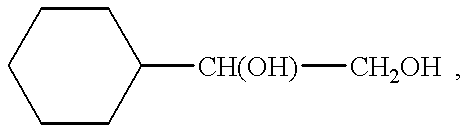
HO—(CH2)2—O—(CH2)2—OH, 
The gas-phase oxidation of the alcohol by means of the oxygen-containing gas over the copper- and/or silver-containing catalysts is carried out in a manner known per se, e.g. at from 225 to 500° C.
Examples of suitable copper- and/or silver-containing catalysts are metallic copper or silver, copper-containing or silver-containing alloys or compounds with metals or nonmetals which may further comprise phosphorus or, in the case of the phosphorus-containing catalysts, comprise phosphorus, e.g. copper phosphides, copper bronzes or alloys of copper with silver and/or gold, copper ores such as malachite and copper or silver compounds which can be reduced completely or partially to copper or silver during the reaction, e.g. copper(I) oxide, silver(I) oxide, copper(II) oxide, and compounds which are converted into copper oxides on heating, e.g. copper nitrate and copper acetate. Other suitable compounds are copper phosphate and copper antimonate. It is also possible for further metal oxides or nonmetal oxides, e.g. the oxides of zinc, chromium, antimony, tin or bismuth, to be mixed into the copper-containing compounds.
The essentially phosphorus-free copper- and/or silver-containing catalysts employed in the present invention have a phosphorus content of from 0 to 400 ppm, preferably from 150 to 400 ppm, corresponding to from 0.015 to 0.04% by weight, and particularly preferably from 150 to 250 ppm, corresponding to from 0.015 to 0.025% by weight, and are preferably in the form of alloys.
An example of an essentially phosphorus-free copper- and/or silver-containing catalyst which is particularly preferred for use in the process of the present invention is copper having the material number 2.0090, which is designated as SF—Cu in accordance with DIN 1708 (cathodes and refinery shapes) and is sold, for example, by Norddeutsche Affinerie AG, Hamburg.
In the process of the present invention, the phosphorus-containing copper- and/or silver-containing catalyst used is a catalyst having a phosphorus content of from >400 to 50,000 ppm, corresponding to from >0.04 to 5% by weight, preferably from >400 to 10,000 ppm, corresponding to from 0.04 to 1% by weight, more preferably from >400 to 1000 ppm, corresponding to from >0.04 to 0.1% by weight, and in particular from 550 to 1000 ppm, corresponding to from 0.055 to 0.1% by weight, in each case based on the catalyst. As phosphorus-containing copper- and/or silver-containing catalyst, preference is given to using a copper-phosphorus alloy having a phosphorus content of from more than 400 to 10,000 ppm which can be produced, for example, by melting copper cathodes grade 1 ASTM B 170 and the copper-phosphorus alloy designated as V-CuP10 in accordance with DIN 17 657 in appropriate ratios. The phosphorus-containing catalyst can be obtained, for example, from Wieland Werke AG, Ulm.
Both the essentially phosphorus-free and the phosphorus- containing copper- and/or silver-containing catalytic composition can also be applied to an inert support or, if desired, diluted with an inert material. The catalyst can, if desired, also be subjected to a reducing treatment before use.
Preference is given to catalysts which do not have a large internal surface area, for example those having a surface area of less than 50 m2 per g. Catalysts which are of particular industrial interest are both essentially phosphorus-free and phosphorus-containing metallic copper or silver and also alloys which comprise copper or silver as a significant constituent.
They are employed, for example, in the form of turnings, woven wire meshes, gauzes or as supported catalysts comprising a, for example, low surface area, inert support. The present invention also provides the catalyst bed itself which is used according to the present invention, i.e. a catalyst bed comprising an essentially phosphorus-free and at least one phosphorus-containing copper- and/or silver-containing catalyst, and also a phosphorus-containing and/or silver-containing catalyst which has a phosphorus content of from 550 to 1000 ppm, based on the catalyst.
The catalyst system used in one embodiment of the process of the present invention which comprises a catalyst bed comprising the essentially phosphorus-free and at least one phosphorus-containing copper- and/or silver-containing catalyst can contain the essentially phosphorus-free and the phosphorus-containing catalyst in various three-dimensional arrangements, i.e. the bed can have various structures.
Thus, the total catalyst bed can consist of a homogeneous mixture of the essentially phosphorus-free and the phosphorus-containing copper- and/or silver-containing catalyst in a weight ratio of from 100:1 to 1:100, preferably from 20:1 to 1:10, particularly preferably from 10:1 to 1:1.
However, it is also possible to use the essentially phosphorus-free copper- and/or silver-containing catalyst for the upper 0.1-50% of the total height of the catalyst bed, preferably the upper 0.1, 10 or 20%, particularly preferably the upper 30-35%, of the total height after the head of the reactor and to make up the remaining catalyst bed of a homogeneous mixture of the essentially phosphorus-free and the phosphorus-containing copper- and/or silver-containing catalyst in a weight ratio of from 100:1 to 1:100, preferably from 20:1 to 1:10, particularly preferably from 10:1 to 1:1. In this preferred structuring of the catalyst bed, the part of the bed which is downstream of the hot spot consists of the homogeneous mixture of essentially phosphorus-free and phosphorus-containing copper- and/or silver-containing catalysts.
Furthermore, the catalyst bed in the region of the upper 0.1-50% of the total height of the catalyst bed, particularly preferably in the region of the upper 1-35% of the catalyst bed, after the head of the reactor can consist of the essentially phosphorus-free copper- and/or silver-containing catalyst while the phosphorus-containing catalyst makes up the remainder of the catalyst bed. In this embodiment of the catalyst bed, the region of the bed downstream of the hot spot consists of the phosphorus-containing catalyst.
For the purposes of the present invention, the hot spot is the part of the catalyst bed at which the highest temperature within the temperature profile of the catalyst bed occurs. The temperature profile of the catalyst bed or the position of the hot spot is usually determined by measuring the temperature within the catalyst bed as a function of the bed height. This can be achieved, for example, by introducing a thermocouple sheath containing a moveable thermocouple or else by means of a fixed multiple thermocouple having a plurality of measurement points at various heights within the bed.
The use of the above-described structured catalyst bed consisting of essentially phosphorus-free and phosphorus-containing copper- and/or silver-containing catalysts has the advantage that the metering-in of phosphorus is technically simple to implement even for large plants.
In a further embodiment of the process of the present invention, a phosphorus compound which is volatile under the reaction conditions can be introduced at the head of the reactor upstream of the catalyst bed or into the catalyst bed in such an amount that the amount of phosphorus (calculated as P) is up to 20 ppm, preferably 0.05 to 20 ppm, based on the weight of alcohol used.
The volatile phosphorus compound can be introduced into any of the above-described, different or differently structured structured catalyst systems or beds.
As far as phosphorus compounds which are volatile under the reaction conditions are concerned, use is advantageously made of phosphorus compounds which can be vaporized without decomposition and undergo no reaction with the components of the synthesis gas under the reaction conditions. These are, for example, esters of phosphoric acid, of phosphorous acid or of phosphonic acid, e.g. trimethyl phosphate, triethyl phosphate, triisopropyl phosphate, tri-n-propyl phosphate, trimethyl phosphite, triethyl phosphite, triethylphosphine oxide, diethyl methylphosphonate, dimethyl methylphosphonate or diethyl ethylphosphonate.
In this embodiment of the process of the present invention, the phosphorus is introduced at the head of the reactor upstream of the catalyst system or within the catalyst system, preferably in the region of the upper 0.1-50% of the total height of the catalyst system, particularly preferably in the region of the upper 1-35% of the catalyst system, after the head of the reactor. Introduction within the catalyst system is preferably carried out downstream of the hot spot. In particular, the phosphorus compound which is volatile under the reaction conditions can be added when using the catalyst bed as catalyst system, in which case the above statements relating to the location or region of the addition of this phosphorus compound are then based on the total height of the catalyst bed.
The phosphorus can be introduced in one or more, preferably two, three or four, parts; the introduction is preferably carried out in two parts of from 0.05 to 10 ppm each, particularly preferably from 0.1 to 3 ppm each.
It is also possible for the phosphorus to be introduced in at least two parts, where
(a) the first part is introduced with the gaseous starting mixture upstream of the catalyst system or catalyst bed and
(b) at least one further part is introduced within the catalyst system or catalyst bed, preferably in the region of the upper 0.1 to 50%, particularly preferably in the region of the upper 1 to 35%, of the total height of the catalyst system or catalyst bed.
This embodiment of the process of the present invention is, for example, configured such that a gaseous mixture of the alcohol and water in which the water content is from 0.1 to 99% by weight is passed together with air or oxygen in an amount of from 0.5 to 2.0 mol, based on 1 mol of alcohol used, possibly together with nitrogen in an amount of up to 99% by volume of the total gas mixture, over the catalyst held at from 225 to 500° C., with, if desired, the first part of volatile phosphorus compound being added to the gaseous starting mixture and at least one further part being introduced into the catalyst system downstream of the hot spot in the region of 1-35% of the total height of the bed or, if desired, the first part of volatile phosphorus compound being added to the gaseous starting mixture and at least one further part being introduced into the catalyst system downstream of the hot spot in the region of 1-35% of the total height of the system.
Accordingly, the present invention also provides for a method of improving the selectivity and the conversion in oxidation reactions, e.g. oxidative dehydrogenation of alcohols to form carbonyl compounds by adding a volatile phosphorus compound as defined above which is is volatile under the reaction conditions or of a phosphorus-containing copper- and/or silver-containing catalyst or of a combination of the phosphorus compound and the catalyst into the reactor for and for lowering the COX selectivity in the preparation of carbonyl compounds starting from alcohols and/or for controlling the temperature of the hot spot in the preparation of carbonyl compounds starting from alcohols by adding such a phosphorus compound or such a catalyst or such a combination into the reactor.
The gas mixture leaving the reactor is usually scrubbed with water.
The phosphorus compound can be introduced as a solution in water, alcohol, preferably the alcohol used, or suitable solvents, for example ethers, in liquid or, by vaporization of the solution, in gaseous form or else in the form of a pure gaseous phosphorus compound, preference being given to introduction as vaporized solution or in pure gaseous form.
The glyoxal obtained from ethylene glycol according to the process of the present invention which can be obtained directly in the commercial form of a 40% strength by weight aqueous solution, has a high purity which remains untouched even for a long operating time. The process of the present invention gives glyoxal in high yields with long catalyst operating lives.
The process of the present invention is illustrated by the following examples.
In a titanium tube reactor having an internal diameter of 20 mm, shaped catalyst bodies of essentially phosphorus-free copper catalyst made of SF—Cu (DIN 1708 material number 2.0090) and shaped catalyst bodies of a copper-phosphorus alloy having a phosphorus content of 1000 ppm were installed with a catalyst height of 300 mm (catalyst volume 95 ml) and with such a structure that the upper 10 cm of the catalyst bed after the head of the reactor consisted of the essentially phosphorus-free catalyst and the remainder of the bed (from 10 to 30 cm after the head of the reactor) consisted of the phosphorus-containing copper-phosphorus alloy. A synthesis mixture consisting of 130 l/h (s.t.p.) of nitrogen and air and 12.4 g/h of ethylene glycol was passed through the tube reactor. The reactor temperature was set to 360° C. by means of a salt melt.
The GHSV (gas hourly space velocity), which is defined as
GHSV=gas volume/catalyst volume,
was 1500 h−1. The LHSV (liquid hourly space velocity), which is defined as
LHSV=liquid volume/catalyst volume,
was 0.12 h−1. The residence time defined as the ratio of the catalyst volume and the amount of gas was 2.4 s.
After leaving the reactor, the reaction gas was brought into contact with water, with the reaction products being dissolved in the aqueous phase. The permanent gases CO and CO2 formed in the reaction and unreacted O2 remained in the tailgas and were analyzed in the gas phase.
The experimental result obtained after a running time of 10 days at different conversions is summarized in Table 1 below.
The catalyst bed in the tube reactor described in Example 1 was structured such that the upper 10 cm after the head of the reactor consisted of shaped bodies of the essentially phosphorus-free copper catalyst SF—Cu and the remainder of the bed (from 10 to 30 cm after the head of the reactor) consisted of a 1:10 mixture (on a weight basis) of shaped bodies of a copper-phosphorus alloy having a phosphorus content of 10,000 ppm and shaped bodies of the essentially phosphorus-free catalyst SF—Cu.
Using a method similar to Example 1, 12.4 g/h of ethylene glycol and 130 l/h (s.t.p.) of a mixture of nitrogen and air were passed through the tube reactor.
The experimental result obtained after a running time of 10 days at various conversions is summarized in Table 1 below.
The tube reactor described in Example 1 was charged over its total fill height of 300 mm with a 1:5 mixture (on a weight basis) of shaped catalyst bodies of a copper-phosphorus alloy having a phosphorus content of 10,000 ppm and shaped bodies of the essentially phosphorus-free copper catalyst SF—Cu.
Using a method similar to Example 1, 12.4 g/h of ethylene glycol and 130 l/h (s.t.p.) of a mixture of nitrogen and air were passed through the tube reactor.
The experimental result obtained after a running time of 10 days at various conversions is summarized in Table 1 below.
The tube reactor described in Example 1 was charged over its total fill height of 300 mm with a 1:10 mixture (on a weight basis) of shaped bodies of a copper-phosphorus alloy having a phosphorus content of 10,000 ppm and shaped bodies of the essentially phosphorus-free copper catalyst SF—Cu.
Using a method similar to Example 1, 12.4 g/h of ethylene glycol and 130 l/h (s.t.p.) of a mixture of nitrogen and air were passed through the reactor.
The experimental result obtained after a running time of 10 days at various conversions is summarized in Table 1 below.
The tube reactor described in Example 1 was charged over its total bed height with the essentially phosphorus-free, shaped catalyst bodies made of SF—Cu.
Using a method similar to Example 1, 12.4 g/h of ethylene glycol and 130 l/h (s.t.p.) of a mixture of nitrogen and air were passed through the reactor.
The experimental result obtained after a running time of 10 days at various conversions is summarized in Table 1 below.
The tube reactor described in Example 1 was charged over its total bed height with shaped catalyst bodies of a copper-phosphorus alloy having a phosphorus content of 10,000 ppm.
Using a method similar to Example 1, 12.4 g/h of ethylene glycol and 130 l/h (s.t.p.) of a mixture of nitrogen and air were passed through the tube reactor.
The experimental result obtained after a running time of 10 days at various conversions is summarized in Table 1 below.
| TABLE 1 | ||||
| Ethylene | ||||
| glycol | Glyoxal | CO/CO2 | ||
| conversion | Selectivity | Selectivity | Air [l/h | |
| Example | [Mol %] | [%] | [%] | (s.t.p.)] |
| 1 | 95.6 | 79.5 | 16.0 | 38 |
| 1 | 97.4 | 75.6 | 18.5 | 40 |
| 1 | 98.2 | 73.1 | 19.6 | 40 |
| 1 | 99.5 | 67.4 | 24.5 | 42 |
| 2 | 91.5 | 81.4 | 12.3 | 34 |
| 2 | 96.5 | 80.7 | 15.4 | 36 |
| 2 | 98.4 | 79.1 | 21.3 | 38 |
| 2 | 99.0 | 74.5 | 27.8 | 40 |
| 3 | 96.7 | 72.1 | 19.3 | 40 |
| 3 | 97.4 | 68.9 | 21.5 | 41 |
| 3 | 97.8 | 67.3 | 23.5 | 42 |
| 4 | 96.4 | 71.0 | 19.5 | 34 |
| 4 | 97.9 | 68.1 | 23.1 | 35 |
| C1 | 95.3 | 70.5 | 19.4 | 37 |
| C1 | 96.7 | 69.3 | 20.5 | 36 |
| C1 | 98.8 | 60.0 | 36.3 | 38 |
| C1 | 99.6 | 54.9 | 41 | 40 |
| C2 | 95.2 | 58.1 | 25.2 | 22 |
| C2 | 96.9 | 55.7 | 27.3 | 24 |
| C2 | 98.2 | 51.4 | 31.4 | 26 |
| C2 | 99.5 | 49.7 | 34.4 | 28 |
In a stainless steel tube reactor having an internal diameter of 54 mm, shaped catalyst bodies of essentially phosphorus-free copper catalyst SF—Cu (DIN 1708 material number 2.0090) and shaped catalyst bodies of a copper-phosphorus alloy having a phosphorus content of 10,000 ppm were installed such that, of the 250 cm catalyst fill height (catalyst volume 5.7 1), the first 59 cm after the head of the reactor consisted of essentially phosphorus-free copper catalyst and the remainder of the bed (from 60 to 250 cm) consisted of a homogeneous 1:10 mixture (on a weight basis) of shaped bodies of the copper-phosphorus alloy having a phosphorus content of 10,000 ppm and shaped bodies of the essentially phosphorus-free copper catalyst SF—Cu.
A synthesis gas mixture consisting of 870 g/h of ethylene glycol, 1880 l/h (s.t.p.) of air and 80 l/h (s.t.p.) of nitrogen was passed through the tube reactor. The reactor temperature was set to 365° C. by means of a salt melt.
The total amount of gas, consisting of circulating gas and synthesis gas, was 9500 l/h (s.t.p.). The GHSV (gas hourly space velocity) was 1650 h−1. The LHSV (liquid hourly space velocity) was 0.13 h−1. The residence time was 2.2 s.
After leaving the reactor, the reaction gas was brought into contact with water, with the reaction products being dissolved in the aqueous phase. The permanent gases CO and CO2 formed in the reaction and unreacted O2 remained in the tailgas and were analyzed in the gas phase.
The experimental result obtained after a running time of 10 days is summarized in Table 2.
In a stainless steel tube reactor having an internal diameter of 54 mm, shaped catalyst bodies of essentially phosphorus-free copper catalyst SF—Cu (DIN 1708 material number 2.0090) and shaped catalyst bodies of a copper-phosphorus alloy having a phosphorus content of 1000 ppm were installed such that, of the 250 cm catalyst fill height (catalyst volume 5.7 1), the first 16 cm after the head of the reactor consisted of the essentially phosphorus-free copper catalyst and the remainder of the bed (from 17 to 250 cm) consisted of shaped bodies of the phosphorus-containing copper-phosphorus alloy having a phosphorus content of 1000 ppm.
A synthesis gas mixture consisting of 870 g/h of ethylene glycol, 1760 l/h (s.t.p.) of air and 80 l/h (s.t.p.) of nitrogen was passed through the tube reactor. The reactor temperature was set to 365° C. by means of a salt melt.
The total amount of gas, consisting of circulating gas and synthesis gas, was 9500 l/h (s.t.p.). The GHSV (gas hourly space velocity) was 1650 h−1. The LHSV (liquid hourly space velocity) was 0.13 h−1. The residence time was 2.2 s.
After leaving the reactor, the reaction gas was brought into contact with water, with the reaction products being dissolved in the aqueous phase. The permanent gases CO and CO2 formed in the reaction and unreacted O2 remained in the tailgas and were analyzed in the gas phase.
The experimental result obtained after a running time of 10 days is summarized in Table 2.
In the tube reactor described in Example 6, 7.8 kg of a Cu catalyst doped with 600 ppm and having the form of rings were installed in place of the catalyst bed described in Example 6. The catalyst fill height was likewise 250 cm (catalyst volume 5.7 1).
Subsequently, the reaction to form glyoxal from ethylene glycol was carried out using a method similar to Example 6 but using 1700 standard 1 of air in place of 1760 standard 1 of air and 140 standard 1 of nitrogen in place of 80 standard 1 of nitrogen in the synthesis gas mixture.
The work-up was carried out by a method similar to Example 5.
The experimental result obtained after a running time of 10 days is shown in Table 2.
The procedure of Example 5 was repeated. However, the catalyst bed consisted over its total height of shaped bodies of the essentially phosphorus-free copper catalyst SF—Cu. Product work-up was carried out as described in Example 5. The experimental result obtained after a running time of 10 days is summarized in Table 2.
The procedure of Example C3 was repeated. 0.3 ppm of phosphorus (P), based on the weight of ethylene glycol used, in the form of triethyl phosphate was added to the synthesis gas mixture at the head of the reactor upstream of the catalyst bed.
Product work-up was carried out as described in Example 5. The experimental result obtained after a running time of 10 days is summarized in Table 2.
A comparison of the results achieved in Example 2 according to the present invention with those obtained in Comparative Examples C3 and C4 which are not according to the present invention is shown in Table 2 below.
In all of the above Examples 5 to 7 and C3 and C4, the air was chosen so as to enable the selectivities at different conversions to be compared.
| TABLE 2 | ||||||
| Ethy- | ||||||
| lene | ||||||
| glycol | CO/ | |||||
| con- | Glyoxal | CO2 | Glycol | Formal- | ||
| version | Select- | Select- | aldehyde | dehyde | Air | |
| Ex- | [Mol | ivity | ivity | Selectivity | Selectivity | [l (s.t.p.) |
| ample | %] | [%] | [%] | [mol %] | [mol %] | /h] |
| 5 | 98.2 | 80.9 | 14.0 | 1.73 | 2.2 | 1880 |
| 6 | 98.3 | 82.5 | 10.3 | 0.65 | 3.8 | 1760 |
| 7 | 98.1 | 85.3 | 7.4 | 0.94 | 2.73 | 1700 |
| C3 | 98.2 | 75.1 | 15.2 | 0.8 | 5.9 | 1800 |
| C4 | 98.8 | 76.9 | 14.0 | 1.1 | 5.9 | 1720 |
Claims (14)
1. A process for preparing carbonyl compounds of the formula 
where R1 is a hydrogen atom or an alkyl radical having from 1 to 3 carbon atoms, R2 is a hydrogen atom, an unsubstituted or C1-C3-alkyl-monosubstituted to -trisubstituted C2-C4-alkenyl radical or a radical of the formula 
where R3 is a hydrogen atom or together with R4 is an oxygen atom, R4 is the radical OR6 or together with R3 is an oxygen atom, R5 is a hydrogen atom, an alkyl radical having from 1 to 8 carbon atoms, and unsubstituted or C1-C3-alkyl-monosubstituted to -trisubstituted C2-C4-alkenyl radical or a cyclohexyl or cyclopentyl radical and R6 is an alkyl radical having from 1 to 4 carbon atoms, a cyclohexyl or cyclopentyl radical or a radical of the formula —CH2—CHO or —CH2—CH2—O—CH2—CHO, by gas-phase oxidation of methanol or alcohols of the formula 
where R1 and R5 are as defined above, and R7 is a hydrogen atom or a radical OR8 wherein R8 is a hydrogen atom, an alkyl radical having from 1 to 4 carbon atoms, a cyclohexyl or cyclopentyl radical or a radical of the formula CH2—CH2—OH or —CH2—CH2—O—CH2—OH, by means of an oxygen-containing gas in the presence of copper- and/or silver-containing catalysts, wherein the catalyst system used comprises at least one phosphorus-containing (>400 to 50,000 ppm phosphorus) copper- and/or silver-containing catalyst, which is not volatile under the reaction conditions and which is selected from the group consisting of a copper-phosphorus alloy, a silver-phosphorus alloy, copper phosphide, copper phosphate, phosphorus-containing metallic copper, or phosphorus-containing metallic silver.
2. A process as claimed in claim 1, wherein said at least one phosphorus-containing copper- and/or silver-containing catalyst has a phosphorus content of from >400 to 110,000 ppm (>0.04 to 1% by weight), based on the catalyst.
3. A process as claimed in claim 1, wherein said at least one phosphorus-containing copper- and/or silver-containing catalyst has a phosphorus content of from 550 to 1000 ppm (0.055 to 0.1% by weight), based on the catalyst.
4. A process as claimed in claim 1, wherein said catalyst system comprises a catalyst bed comprising both an essentially phosphorus-free (0 to 400 ppm phosphorus) copper- and/or silver-containing catalyst and said at least one phosphorus-containing copper- and silver-containing catalyst.
5. A process as claimed in claim 4, wherein the catalyst bed comprises a mixture of said essentially phosphorus-free catalyst and said phosphorus-containing catalyst in a ratio of from 100:1 to 1:100.
6. A process as claimed in claim 5, wherein the upper 0.1-50% of the total height of the catalyst bed after the head of the reactor consists only of said essentially phosphorus-free catalyst and the remainder of the catalyst bed consists of said mixture.
7. A process as claimed in claim 4, wherein the catalyst bed in the region of the upper 0.1-50% of the total height of the catalyst bed consists of said essentially phosphorus-free catalyst and the remainder of the catalyst bed consists of said phosphorus-containing catalyst.
8. A process as claimed in claim 1, wherein a phosphorus compound which is volatile under the reaction conditions is introduced at the head of the reactor or into the catalyst bed in the region of the upper 0.1-50% of the total height of the catalyst system or both.
9. A process as claimed in claim 8, wherein the amount of phosphorus (calculated as P) introduced in the form of the volatile phosphorus compound is from 0.05 to 20 ppm, based on the weight of the alcohol used.
10. A process as claimed in claim 8, wherein the phosphorus introduced in the form of the volatile phosphorus compound is introduced in at least two parts, where
(a) the first part is introduced with the gaseous starting mixture upstream of the catalyst system and
(b) at least one further part is introduced within the catalyst system.
11. A process as claimed in claim 10, wherein said at least one further part b) is introduced into the catalyst system in the region of the upper 0.1-50% of the total height of the catalyst system.
12. A process as claimed in claim 1, wherein glyoxal is prepared from ethylene glycol or methylglyoxal is prepared from propylene glycol.
13. The process as claimed in claim 1, wherein said phosphorus containing catalyst is a copper-phosphorus alloy, a silver-phosphorus alloy or copper phosphide.
14. The process as claimed in claim 1, wherein said essentially phosphorus-free catalyst is a compound which can be converted to copper oxide, silver oxide or metallic copper or silver on heating.
Applications Claiming Priority (2)
| Application Number | Priority Date | Filing Date | Title |
|---|---|---|---|
| DE19811288A DE19811288A1 (en) | 1998-03-16 | 1998-03-16 | Preparation of carbonyl compounds by gas phase oxidation of alcohol, especially glyoxal from ethylene glycol |
| DE19811288 | 1998-03-16 |
Publications (1)
| Publication Number | Publication Date |
|---|---|
| US6255534B1 true US6255534B1 (en) | 2001-07-03 |
Family
ID=7861019
Family Applications (1)
| Application Number | Title | Priority Date | Filing Date |
|---|---|---|---|
| US09/240,851 Expired - Fee Related US6255534B1 (en) | 1998-03-16 | 1999-02-01 | Preparation of carbonyl compounds |
Country Status (6)
| Country | Link |
|---|---|
| US (1) | US6255534B1 (en) |
| EP (1) | EP1064246B1 (en) |
| JP (1) | JP2002506841A (en) |
| CN (1) | CN1293650A (en) |
| DE (2) | DE19811288A1 (en) |
| WO (1) | WO1999047481A1 (en) |
Cited By (1)
| Publication number | Priority date | Publication date | Assignee | Title |
|---|---|---|---|---|
| US20080031767A1 (en) * | 2004-06-25 | 2008-02-07 | Inco Limited | Open Porous Metallic Foam Body And Method For Manufacturing |
Families Citing this family (1)
| Publication number | Priority date | Publication date | Assignee | Title |
|---|---|---|---|---|
| AU2016319203A1 (en) | 2015-09-10 | 2018-02-22 | Grünenthal GmbH | Protecting oral overdose with abuse deterrent immediate release formulations |
Citations (4)
| Publication number | Priority date | Publication date | Assignee | Title |
|---|---|---|---|---|
| US3948997A (en) | 1968-05-06 | 1976-04-06 | Laporte Industries Limited | Vapour phase oxidation process |
| US4282374A (en) | 1978-07-24 | 1981-08-04 | Basf Aktiengesellschaft | Preparation of glyoxal from ethylene glycol |
| US4555583A (en) * | 1982-08-30 | 1985-11-26 | Mitsui Toatsu Chemicals, Incorporated | Preparation process for glyoxal |
| US4814513A (en) | 1986-12-19 | 1989-03-21 | Basf Aktiengesellschaft | Preparation of carbonyl compounds |
Family Cites Families (6)
| Publication number | Priority date | Publication date | Assignee | Title |
|---|---|---|---|---|
| CA1064963A (en) * | 1975-07-31 | 1979-10-23 | American Cyanamid Company | Vapor phase oxidation process for glyoxal |
| JPS5490109A (en) * | 1977-12-24 | 1979-07-17 | Basf Ag | Manufacture of fatty hydroxycarbonyl compound etherified with fatty group |
| JPS5859933A (en) * | 1981-10-06 | 1983-04-09 | Mitsui Toatsu Chem Inc | Preparation of aldehyde or ketone |
| DE4213008A1 (en) * | 1992-04-21 | 1993-10-28 | Basf Ag | Process for the preparation of dicarbonyl compounds |
| DE19654054A1 (en) * | 1996-12-23 | 1998-06-25 | Basf Ag | Process for the preparation of carbonyl compounds |
| DE19654046A1 (en) * | 1996-12-23 | 1998-06-25 | Basf Ag | Process for the preparation of carbonyl compounds |
-
1998
- 1998-03-16 DE DE19811288A patent/DE19811288A1/en not_active Withdrawn
-
1999
- 1999-02-01 US US09/240,851 patent/US6255534B1/en not_active Expired - Fee Related
- 1999-02-25 JP JP2000536679A patent/JP2002506841A/en not_active Withdrawn
- 1999-02-25 EP EP99939843A patent/EP1064246B1/en not_active Expired - Lifetime
- 1999-02-25 DE DE59909810T patent/DE59909810D1/en not_active Expired - Fee Related
- 1999-02-25 CN CN99804033A patent/CN1293650A/en active Pending
- 1999-02-25 WO PCT/EP1999/001215 patent/WO1999047481A1/en not_active Ceased
Patent Citations (4)
| Publication number | Priority date | Publication date | Assignee | Title |
|---|---|---|---|---|
| US3948997A (en) | 1968-05-06 | 1976-04-06 | Laporte Industries Limited | Vapour phase oxidation process |
| US4282374A (en) | 1978-07-24 | 1981-08-04 | Basf Aktiengesellschaft | Preparation of glyoxal from ethylene glycol |
| US4555583A (en) * | 1982-08-30 | 1985-11-26 | Mitsui Toatsu Chemicals, Incorporated | Preparation process for glyoxal |
| US4814513A (en) | 1986-12-19 | 1989-03-21 | Basf Aktiengesellschaft | Preparation of carbonyl compounds |
Cited By (2)
| Publication number | Priority date | Publication date | Assignee | Title |
|---|---|---|---|---|
| US20080031767A1 (en) * | 2004-06-25 | 2008-02-07 | Inco Limited | Open Porous Metallic Foam Body And Method For Manufacturing |
| US7951246B2 (en) * | 2004-06-25 | 2011-05-31 | Alantum Corporation | Method for manufacturing open porous metallic foam body |
Also Published As
| Publication number | Publication date |
|---|---|
| JP2002506841A (en) | 2002-03-05 |
| EP1064246B1 (en) | 2004-06-23 |
| WO1999047481A1 (en) | 1999-09-23 |
| EP1064246A1 (en) | 2001-01-03 |
| DE59909810D1 (en) | 2004-07-29 |
| DE19811288A1 (en) | 1999-09-23 |
| CN1293650A (en) | 2001-05-02 |
Similar Documents
| Publication | Publication Date | Title |
|---|---|---|
| EP0104197B1 (en) | Process for the production of ethanol | |
| JPS63418B2 (en) | ||
| JP2003512344A (en) | Liquid phase catalytic hydrogenation process to convert aldehydes to corresponding alcohols | |
| JP2006509806A (en) | Method for producing 1,6-hexanediol | |
| US4663468A (en) | Hydroformylation of 3-methyl-3-buten-1-ol and analogs thereof and use of such hydroformylation products | |
| US4814513A (en) | Preparation of carbonyl compounds | |
| EP0295361B1 (en) | Preparation of pseudoionones | |
| US4482497A (en) | Preparation of carboxylic acids | |
| EP0037586B1 (en) | Process for the selective hydroformylation of methanol to acetaldehyde | |
| US6072087A (en) | Method for producing carbonyl compounds | |
| US6316676B1 (en) | Process for the preparation of α-diketones from ketols or ketals from ketols | |
| US6133482A (en) | Method for producing carbonyl compounds | |
| KR100651334B1 (en) | Method for preparing unsaturated ketones for use in the preparation of Vitamin E | |
| JP2650100B2 (en) | Method for producing ethylidene diacetate | |
| JP2002506841A (en) | Method for producing carbonyl compound | |
| US4886919A (en) | Process for the production of saturated neo-alcohols | |
| GB1583091A (en) | Process for the manufacture of styrene | |
| EP0082633A1 (en) | Production of toluic acid and catalyst therefor | |
| JP2612026B2 (en) | Preparation of carbonyl compounds | |
| EP0065323B1 (en) | Process for the co-production of dicarboxylates and acids | |
| EP0470651A1 (en) | 1,2-Di(4-isobutylphenyl) ethane and its preparation and use as intermediate | |
| GB2130203A (en) | Preparation of acetic acid | |
| KR960009677B1 (en) | Preparation of 4-isobutyl styrene | |
| GB2121795A (en) | Process for the preparation of acetic acid | |
| JPS6033811B2 (en) | Manufacturing method of monohydric alcohol |
Legal Events
| Date | Code | Title | Description |
|---|---|---|---|
| AS | Assignment |
Owner name: BASF AKTIENGESELLSCHAFT, GERMANY Free format text: ASSIGNMENT OF ASSIGNORS INTEREST;ASSIGNORS:DEMUTH, DIRK;FETZER, THOMAS;PRATSCH, VOLKER;AND OTHERS;REEL/FRAME:009884/0736 Effective date: 19981104 |
|
| FPAY | Fee payment |
Year of fee payment: 4 |
|
| REMI | Maintenance fee reminder mailed | ||
| LAPS | Lapse for failure to pay maintenance fees | ||
| STCH | Information on status: patent discontinuation |
Free format text: PATENT EXPIRED DUE TO NONPAYMENT OF MAINTENANCE FEES UNDER 37 CFR 1.362 |
|
| FP | Lapsed due to failure to pay maintenance fee |
Effective date: 20090703 |