US6235253B1 - Recovering vanadium oxides from petroleum coke by melting - Google Patents
Recovering vanadium oxides from petroleum coke by melting Download PDFInfo
- Publication number
- US6235253B1 US6235253B1 US09/324,333 US32433399A US6235253B1 US 6235253 B1 US6235253 B1 US 6235253B1 US 32433399 A US32433399 A US 32433399A US 6235253 B1 US6235253 B1 US 6235253B1
- Authority
- US
- United States
- Prior art keywords
- vanadium
- dissolved
- bath
- molten metal
- coke
- Prior art date
- Legal status (The legal status is an assumption and is not a legal conclusion. Google has not performed a legal analysis and makes no representation as to the accuracy of the status listed.)
- Expired - Fee Related
Links
Images
Classifications
-
- C—CHEMISTRY; METALLURGY
- C22—METALLURGY; FERROUS OR NON-FERROUS ALLOYS; TREATMENT OF ALLOYS OR NON-FERROUS METALS
- C22B—PRODUCTION AND REFINING OF METALS; PRETREATMENT OF RAW MATERIALS
- C22B7/00—Working up raw materials other than ores, e.g. scrap, to produce non-ferrous metals and compounds thereof; Methods of a general interest or applied to the winning of more than two metals
- C22B7/04—Working-up slag
-
- C—CHEMISTRY; METALLURGY
- C22—METALLURGY; FERROUS OR NON-FERROUS ALLOYS; TREATMENT OF ALLOYS OR NON-FERROUS METALS
- C22B—PRODUCTION AND REFINING OF METALS; PRETREATMENT OF RAW MATERIALS
- C22B34/00—Obtaining refractory metals
- C22B34/20—Obtaining niobium, tantalum or vanadium
- C22B34/22—Obtaining vanadium
- C22B34/225—Obtaining vanadium from spent catalysts
-
- Y—GENERAL TAGGING OF NEW TECHNOLOGICAL DEVELOPMENTS; GENERAL TAGGING OF CROSS-SECTIONAL TECHNOLOGIES SPANNING OVER SEVERAL SECTIONS OF THE IPC; TECHNICAL SUBJECTS COVERED BY FORMER USPC CROSS-REFERENCE ART COLLECTIONS [XRACs] AND DIGESTS
- Y02—TECHNOLOGIES OR APPLICATIONS FOR MITIGATION OR ADAPTATION AGAINST CLIMATE CHANGE
- Y02P—CLIMATE CHANGE MITIGATION TECHNOLOGIES IN THE PRODUCTION OR PROCESSING OF GOODS
- Y02P10/00—Technologies related to metal processing
- Y02P10/20—Recycling
Definitions
- coker gas oil and coker naphtha are essentially free of metals and may be processed by conventional catalytic upgrading processes to produce high quality transportation fuels and other hydrocarbon products.
- coking of these difficult crudes produces large amount of coke, a solid product with an enhanced concentration of vanadium and sulfur and other metals present in the charge to the coker.
- Some coking processes such as fluid bed cokers, especially those employing gasifiers, can produce large amounts of fine, low density coke particles which is especially difficult to treat using conventional technology.
- Vanadium in petroleum containing coke is difficult to recover directly, that is, from the coke, because it is in a form which does not lend itself to conventional leaching approaches.
- the carbon probably present in the form of condensed chelating structures, effectively shields significant portions of the metal from conventional leaching solutions.
- Vanadium in coke can be recovered much more readily after combustion, because the vanadium in the ash produced is more susceptible to leaching, though even here some treatment, such as with sodium carbonate or sodium hydroxide was needed to improve metal recovery during leaching.
- Vanadium is usually found in combination with Ni, and sometimes other metals, present in the petroleum, and separation of V values from Ni values presents a significant problem.
- a molten metal process originally developed to produce high purity hydrogen or synthesis gas from various waste streams, could be modified to process vanadium containing coke, dissolve the vanadium in its metallic state into the iron bath to form a molten metal mixture of Ni, Fe, V and perhaps other metals.
- the separation was not perfect in terms of eliminating Ni, but the vanadium oxide layer was a greatly purified material as compared to the material which originally formed by dissolving the coke in the molten metal bath.
- the process was fast and simple—no special processing of the coke was needed.
- the coke could be dry, but the process tolerated well, and even benefited from, the use of coke containing some water. Heat/utility requirements were low, in fact the worse the feed in terms of % V in the coke, the more heat the process generated.
- the process was tolerant of many other impurities found in coke containing feed, such as Ni and S compounds.
- the present invention provides a method of recovering and purifying vanadium from coke or heavy hydrocarbons containing vanadium and other metals which are considered impurities comprising dissolving coke or heavy hydrocarbon containing both V and at least one other metal, such as Ni in a molten metal bath, preferably a molten iron bath to produce a molten metal bath containing dissolved carbon and dissolved vanadium metal and dissolved Ni metal, exothermically oxidizing at least a majority of the net amount of carbon dissolved in said bath to produce carbon oxides and maintain said bath in a molten state and at least periodically, increasing the amount of oxygen addition, or controlling the amount of carbon present in said bath, to create oxidizing conditions sufficient to selectively oxidize said dissolved vanadium at a greater rate than said dissolved Ni or said molten iron and produce oxidized vanadium species which formed a slag layer on tope of said bath and at least periodically, removing said oxidized vanadium species from said bath.
- one other metal such as
- the vanadium oxidation may be continuous. In this mode of operating, conditions in the bath are maintained to rapidly dissolve metal species in the coke and selectively oxidize vanadium species. Carbon levels will usually be below 1 wt %, and preferably below 0.5 wt %. Vanadium and other feed metals are rapidly dissolved and the vanadium is preferentially oxidized.
- the bath is preferably maintained in a relatively reducing mode of operation, so that little of the vanadium is oxidized.
- the vanadium level is allowed to increase until the bath contains 5 wt % or 10 wt % V, more preferably at least 20 wt % V, and most preferably 40 wt % V, after which conditions are shifted in the bath to promote oxidation of vanadium. This can be done by intermittently stopping addition of coke and/or increasing the addition of oxygen or oxygen containing gas until the desired amount of vanadium has been oxidized and removed from the molten iron bath as a slag product.
- the bath may be continuously or intermittently replenished with fresh iron.
- the bath is run at superatmospheric pressure, preferably 2 to 200 atm. High pressure operation allows higher feedstock rates without excessive carryover of dust. Higher pressures also increase the rate at which carbon in feedstock dissolves in the molten metal bath.
- Presence of large amounts of carbon in the bath permits processing of sulfur rich coke with much or essentially all of the sulfur content released as H2S, which can be readily processed in a refinery Claus unit or other H2S recovery process. If an oxidizing bath is used more of the sulfur will be released as oxides of sulfur which may require sulfur capture with conventional slag forming agents or stack gas processing.
- multiple zone processing of the coke, alone or admixed with a hydrocarbon may be practiced to permit recovery of a relatively pure hydrogen stream.
- Our process is generic as to the bath used. Circulating baths, pressurized single zone baths, multiple zone baths, and the like can all be used.
- a high pressure design such as that developed by Ashland and disclosed in the above four patents discussed above which were assigned to Ashland, it is also possible to use other molten metal bath designs such as the Molten Metal Technology reactor or other molten bath designs now existing or hereafter developed.
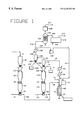
- FIG. 1 is a simplified schematic drawing of a preferred embodiment wherein vanadium containing coke is processed in a molten metal reactor to produce vanadium containing slag as the primary vanadium product.
- the petroleum coke feedstock may be any metal containing coke.
- the coke will contain vanadium, nickel, and sulfur.
- Such materials are well known and widely available, they are produced wherever coking is used as an upgrading step for heavy Venezuelan crudes.
- the coke may be sponge coke from a delayed coker, shot coke, fines from fluid coker, and the like. Some fluidized coking units partially burn some of the coke, yielding a coke product of enhanced vanadium concentration but generally still classified as coke despite the oxidative treatment.
- the feed may also comprise, or consist essentially of, liquid hydrocarbons.
- the process may be used to process Venezuelan or other crudes which are contaminated with vanadium, or liquid or semi-solid fractions derived from such crudes.
- a coke feed typically a fine particulate feed having an average particle size less than 80 microns or even much smaller, is charged via line 5 to feed hopper 10 .
- Coke is discharged via rotary valve 15 through open swing valve 20 into upper hopper 25 .
- Coke is discharged down through swing valve 30 into pressurized hopper 35 , from which it is continuously or intermittently discharged via rotary valve 40 into a flowing stream of steam from line 45 .
- Other fluids may be used besides steam, but steam is preferred due to its ready availability and relative safety.
- the steam/coke mixture flows through line 50 , is mixed with a preferred but optional recycle fines stream from line 150 , and charged via line 70 into the HyMelt reactor 60 .
- the coke/steam mixture is preferably discharged down via outlet 76 towards molten metal bath 80 .
- the nozzle is close enough to the surface of metal bath 80 and is discharged with sufficient force to penetrate the metal bath.
- Oxygen or oxygen containing gas is preferably co-fed with the coke. This allows a significant amount of pre-heating of the coke during its passage through the piping to nozzle outlet 76 .
- a stream of oxidized-vanadium may be continuously or intermittently withdrawn via line 65 as a product of the process.
- the process may also run with essentially all of the vanadium production being accumulated in the bed in the form of elemental vanadium metal along with dissolved elemental Ni, and the accumulated vanadium periodically removed by shifting the bed to more oxidizing conditions to form a V2O5 slag layer which may be removed in the form of “dust” or may be separately tapped and drawn off by means not show.
- Off gas and entrained droplets of iron/vanadium and/or perhaps some slag droplets are removed via line 82 , quenched with relatively cool recycle gas from recycle gas line 84 and charged successively through heat exchanger 86 which produces high pressure steam and heat exchanger 88 which produces lower pressure steam.
- the temperature of the material withdrawn from reactor 60 is typically around 2800 F., while the temperature of the withdrawn vapor is reduced to 1000 F. and 350 F. respectively by passage through exchangers 86 and 88 .
- the reactor off gas and entrained solids are charged to cyclone 92 which recovers a low particulate vapor via vapor outlet line 96 .
- a solids rich, dense phase fluidized phase is discharged via rotary valve 94 , though the cyclone solids rich phase outlet may be sealed by other conventional means such as a flapper valve or immersion of the cyclone dipleg in a dense phase fluidized bed of particulates.
- the cyclone vapor phase is charged via line 96 to bag filter 200 , which may be a conventional bag house or other gas/particulate separation means such as a third stage separator, electrostatic precipitator, or the like.
- a solids phase is continuously or intermittently removed via rotary valve 205 and charged via line 210 to admix with the cyclone 92 solids phase and pass via swing valve 120 into hopper 125 and swing valve 130 into recycle fines pressurized hopper 135 .
- Pressurized fines are discharged via rotary valve 140 into flowing steam in line 145 to be recycled, with fresh fluidized coke feed, via line 70 to the HyMelt reactor.
- a portion of the net addition of V to the molten metal bath may be withdrawn as either a coarse dust product from the cyclone separator via line 94 and collection means 98 or as a finer dust product from the bag house via line 207 and collection means 208 .
- the relatively particulate free vapor withdrawn via line 220 from bag filter means 200 may be further cooled using fin fan coolers, heat exchange with other process streams, or cooling water in cooler 230 to produce cooled vapor.
- a portion of cooled vapor is charged via line 235 to the inlet of recycle gas compressor 240 which discharges compressed recycle gas via line 84 to serve as quench stream.
- the remainder of the particulate free vapor is preferably charged through acid gas scrubber 260 .
- Lean solvent in line 280 from solvent regenerator 270 is charged to an upper portion of the scrubber to contact acid gas.
- a relatively sweet gas stream is withdrawn via line 290 and charged via line 300 into ZnO treater 300 or equivalent clean up means to produce a purified gas stream which may be used as fuel or as a hydrogen rich syngas removed via line 310 .
- the rich solvent, with absorbed acid gas species, is removed via line 265 and recycled to solvent regenerator 270 which preferably recovers at least a portion of absorbed acidic sulfur containing gas species as H2S, which may be converted into elemental sulfur via a conventional Claus unit, not shown.
- a good way to maintain reducing conditions, during vanadium + other metal accumulation, is to operate the bath under reducing conditions, with more than 0.5 wt % carbon, preferably more than 1.0 wt % carbon, and more preferably with more than 2 or 3 wt %, and most preferably with more than 4 wt % carbon. This is especially beneficial when the feed contains large amounts of sulfur which would otherwise contaminate the iron and/or vanadium product. After sufficient vanadium has accumulated, the bed can be shifted to oxidizing conditions which will preferentially oxidize vanadium, leaving other metal components such as Ni and Fe in the bath. It is possible to remove most, or essentially all, of the V entering the process as oxidized vanadium slag. This minimizes the amount of material produced by the process in that the major product is a highly concentrated vanadium oxide material.
Landscapes
- Chemical & Material Sciences (AREA)
- Engineering & Computer Science (AREA)
- Metallurgy (AREA)
- Manufacturing & Machinery (AREA)
- Materials Engineering (AREA)
- Mechanical Engineering (AREA)
- Organic Chemistry (AREA)
- Geology (AREA)
- General Life Sciences & Earth Sciences (AREA)
- Environmental & Geological Engineering (AREA)
- Life Sciences & Earth Sciences (AREA)
- Chemical Kinetics & Catalysis (AREA)
- Manufacture And Refinement Of Metals (AREA)
Abstract
Description
Claims (14)
Priority Applications (1)
| Application Number | Priority Date | Filing Date | Title |
|---|---|---|---|
| US09/324,333 US6235253B1 (en) | 1998-06-09 | 1999-06-02 | Recovering vanadium oxides from petroleum coke by melting |
Applications Claiming Priority (2)
| Application Number | Priority Date | Filing Date | Title |
|---|---|---|---|
| US8858198P | 1998-06-09 | 1998-06-09 | |
| US09/324,333 US6235253B1 (en) | 1998-06-09 | 1999-06-02 | Recovering vanadium oxides from petroleum coke by melting |
Publications (1)
| Publication Number | Publication Date |
|---|---|
| US6235253B1 true US6235253B1 (en) | 2001-05-22 |
Family
ID=26778826
Family Applications (1)
| Application Number | Title | Priority Date | Filing Date |
|---|---|---|---|
| US09/324,333 Expired - Fee Related US6235253B1 (en) | 1998-06-09 | 1999-06-02 | Recovering vanadium oxides from petroleum coke by melting |
Country Status (1)
| Country | Link |
|---|---|
| US (1) | US6235253B1 (en) |
Cited By (8)
| Publication number | Priority date | Publication date | Assignee | Title |
|---|---|---|---|---|
| US20080206129A1 (en) * | 2007-01-16 | 2008-08-28 | Fairstock Technologies Corporation | Methods for transforming compounds using a metal alloy and related apparatus |
| US20090071873A1 (en) * | 2005-10-10 | 2009-03-19 | Fairstock Technologies Corporation | Methods for transforming organic compounds using a liquefied metal alloy and related apparatus |
| US8277766B2 (en) | 2010-12-27 | 2012-10-02 | Hnat James G | Methods for the concentration of vanadium from carbonaceous feedstock materials |
| CN102732736A (en) * | 2012-07-23 | 2012-10-17 | 中南大学 | Method for extracting vanadium from burning slag of stone coal vanadium mine fluidized bed |
| US8815185B1 (en) | 2013-03-04 | 2014-08-26 | Chevron U.S.A. Inc. | Recovery of vanadium from petroleum coke slurry containing solubilized base metals |
| WO2020073813A1 (en) * | 2018-10-12 | 2020-04-16 | 国家能源投资集团有限责任公司 | Method for removing ash from solid carbonaceous material |
| CN112661162A (en) * | 2020-12-16 | 2021-04-16 | 青岛惠城环保科技股份有限公司 | Method for treating petroleum coke hydrogen production ash and mesoporous silicon material |
| CN113564345A (en) * | 2021-07-14 | 2021-10-29 | 中国恩菲工程技术有限公司 | Method for recycling and harmlessly treating vanadium-containing petroleum slag |
Citations (14)
| Publication number | Priority date | Publication date | Assignee | Title |
|---|---|---|---|---|
| US4071355A (en) | 1976-05-13 | 1978-01-31 | Foote Mineral Company | Recovery of vanadium from pig iron |
| US4203759A (en) | 1978-05-01 | 1980-05-20 | Exxon Research & Engineering Co. | Process for the preparation of a vanadium-containing metallic ash concentrate |
| US4243639A (en) | 1979-05-10 | 1981-01-06 | Tosco Corporation | Method for recovering vanadium from petroleum coke |
| US4345990A (en) | 1979-04-12 | 1982-08-24 | Boliden Aktiebolag | Method for recovering oil and/or gas from carbonaceous materials |
| US4443415A (en) | 1982-06-22 | 1984-04-17 | Amax Inc. | Recovery of V2 O5 and nickel values from petroleum coke |
| US4708819A (en) | 1985-04-26 | 1987-11-24 | Texaco Inc. | Reduction of vanadium in recycle petroleum coke |
| US4816236A (en) | 1986-08-28 | 1989-03-28 | U.S. Vanadium Corporation | Recovery of vanadium and nickel from petroleum residues |
| US4957544A (en) * | 1989-09-01 | 1990-09-18 | Texaco, Inc. | Partial oxidation process including the concentration of vanadium and nickel in separate slag phases |
| US5259864A (en) | 1992-10-06 | 1993-11-09 | Bechtel Group, Inc. | Method of disposing of environmentally undesirable material and providing fuel for an iron making process e.g. petroleum coke |
| US5277795A (en) | 1989-06-13 | 1994-01-11 | Thornhill Denis H | Process and apparatus for recovering heavy metal from carbonaceous material |
| US5324341A (en) | 1992-05-05 | 1994-06-28 | Molten Metal Technology, Inc. | Method for chemically reducing metals in waste compositions |
| US5427603A (en) | 1991-11-13 | 1995-06-27 | Metallgesellschaft Aktiengesellschaft | Method of treating a vanadium-containing residue |
| US5484544A (en) | 1991-07-05 | 1996-01-16 | Dion Biro; Guy | Lubricating composition, preparation process and applications, particularly as an additive in oils |
| US5772726A (en) * | 1996-10-08 | 1998-06-30 | Roy F. Weston, Inc. | Method of separating vanadium from ash |
-
1999
- 1999-06-02 US US09/324,333 patent/US6235253B1/en not_active Expired - Fee Related
Patent Citations (14)
| Publication number | Priority date | Publication date | Assignee | Title |
|---|---|---|---|---|
| US4071355A (en) | 1976-05-13 | 1978-01-31 | Foote Mineral Company | Recovery of vanadium from pig iron |
| US4203759A (en) | 1978-05-01 | 1980-05-20 | Exxon Research & Engineering Co. | Process for the preparation of a vanadium-containing metallic ash concentrate |
| US4345990A (en) | 1979-04-12 | 1982-08-24 | Boliden Aktiebolag | Method for recovering oil and/or gas from carbonaceous materials |
| US4243639A (en) | 1979-05-10 | 1981-01-06 | Tosco Corporation | Method for recovering vanadium from petroleum coke |
| US4443415A (en) | 1982-06-22 | 1984-04-17 | Amax Inc. | Recovery of V2 O5 and nickel values from petroleum coke |
| US4708819A (en) | 1985-04-26 | 1987-11-24 | Texaco Inc. | Reduction of vanadium in recycle petroleum coke |
| US4816236A (en) | 1986-08-28 | 1989-03-28 | U.S. Vanadium Corporation | Recovery of vanadium and nickel from petroleum residues |
| US5277795A (en) | 1989-06-13 | 1994-01-11 | Thornhill Denis H | Process and apparatus for recovering heavy metal from carbonaceous material |
| US4957544A (en) * | 1989-09-01 | 1990-09-18 | Texaco, Inc. | Partial oxidation process including the concentration of vanadium and nickel in separate slag phases |
| US5484544A (en) | 1991-07-05 | 1996-01-16 | Dion Biro; Guy | Lubricating composition, preparation process and applications, particularly as an additive in oils |
| US5427603A (en) | 1991-11-13 | 1995-06-27 | Metallgesellschaft Aktiengesellschaft | Method of treating a vanadium-containing residue |
| US5324341A (en) | 1992-05-05 | 1994-06-28 | Molten Metal Technology, Inc. | Method for chemically reducing metals in waste compositions |
| US5259864A (en) | 1992-10-06 | 1993-11-09 | Bechtel Group, Inc. | Method of disposing of environmentally undesirable material and providing fuel for an iron making process e.g. petroleum coke |
| US5772726A (en) * | 1996-10-08 | 1998-06-30 | Roy F. Weston, Inc. | Method of separating vanadium from ash |
Cited By (10)
| Publication number | Priority date | Publication date | Assignee | Title |
|---|---|---|---|---|
| US20090071873A1 (en) * | 2005-10-10 | 2009-03-19 | Fairstock Technologies Corporation | Methods for transforming organic compounds using a liquefied metal alloy and related apparatus |
| US20080206129A1 (en) * | 2007-01-16 | 2008-08-28 | Fairstock Technologies Corporation | Methods for transforming compounds using a metal alloy and related apparatus |
| US8277766B2 (en) | 2010-12-27 | 2012-10-02 | Hnat James G | Methods for the concentration of vanadium from carbonaceous feedstock materials |
| CN102732736A (en) * | 2012-07-23 | 2012-10-17 | 中南大学 | Method for extracting vanadium from burning slag of stone coal vanadium mine fluidized bed |
| CN102732736B (en) * | 2012-07-23 | 2015-01-14 | 中南大学 | Method for extracting vanadium from burning slag of stone coal vanadium mine fluidized bed |
| US8815185B1 (en) | 2013-03-04 | 2014-08-26 | Chevron U.S.A. Inc. | Recovery of vanadium from petroleum coke slurry containing solubilized base metals |
| WO2020073813A1 (en) * | 2018-10-12 | 2020-04-16 | 国家能源投资集团有限责任公司 | Method for removing ash from solid carbonaceous material |
| US12012334B2 (en) | 2018-10-12 | 2024-06-18 | National Institute Of Clean-And-Low-Carbon Energy | Method for removing ash from solid carbonaceous material |
| CN112661162A (en) * | 2020-12-16 | 2021-04-16 | 青岛惠城环保科技股份有限公司 | Method for treating petroleum coke hydrogen production ash and mesoporous silicon material |
| CN113564345A (en) * | 2021-07-14 | 2021-10-29 | 中国恩菲工程技术有限公司 | Method for recycling and harmlessly treating vanadium-containing petroleum slag |
Similar Documents
| Publication | Publication Date | Title |
|---|---|---|
| US4803061A (en) | Partial oxidation process with magnetic separation of the ground slag | |
| US4781731A (en) | Integrated method of charge fuel pretreatment and tail gas sulfur removal in a partial oxidation process | |
| US5441990A (en) | Cleaned, H2 -enriched syngas made using water-gas shift reaction | |
| US4668428A (en) | Partial oxidation process | |
| US4668429A (en) | Partial oxidation process | |
| US5855631A (en) | Catalytic gasification process and system | |
| JPH0642942B2 (en) | Method and apparatus for treating process gas | |
| US6235253B1 (en) | Recovering vanadium oxides from petroleum coke by melting | |
| JPH0454601B2 (en) | ||
| US4692172A (en) | Coal gasification process | |
| US4654164A (en) | Partial oxidation process | |
| US4784670A (en) | Partial oxidation process | |
| EP0386352B1 (en) | Partial oxidation process | |
| US6241806B1 (en) | Recovering vanadium from petroleum coke as dust | |
| US6284214B1 (en) | Low or no slag molten metal processing of coke containing vanadium and sulfur | |
| US6231640B1 (en) | Dissolving petroleum coke in molten iron to recover vanadium metal | |
| US4657702A (en) | Partial oxidation of petroleum coke | |
| KR940005198B1 (en) | Gas mixture production method by partial oxidation | |
| US4826627A (en) | Partial oxidation process | |
| AU741448B2 (en) | Soot filter cake disposal | |
| US4708819A (en) | Reduction of vanadium in recycle petroleum coke | |
| EP0112117A2 (en) | Carbonaceous material conversion process | |
| US4801402A (en) | Partial oxidation process | |
| EP0209261B1 (en) | Partial oxidation process | |
| JP2704761B2 (en) | Method for producing gas mixture containing H2 + CO by partial oxidation of raw material |
Legal Events
| Date | Code | Title | Description |
|---|---|---|---|
| AS | Assignment |
Owner name: ENVIRES LLC, NEW JERSEY Free format text: ASSIGNMENT OF ASSIGNORS INTEREST;ASSIGNOR:HOLCOMBE, THOMAS C.;REEL/FRAME:010011/0537 Effective date: 19990513 Owner name: MARATHON ASHLAND PETROLEUM LLC, OHIO Free format text: ASSIGNMENT OF ASSIGNORS INTEREST;ASSIGNOR:MALONE, DONALD P.;REEL/FRAME:010011/0553 Effective date: 19990514 |
|
| FPAY | Fee payment |
Year of fee payment: 4 |
|
| AS | Assignment |
Owner name: MARATHON ASHLAND PETROLEUM, LLC, OHIO Free format text: ASSIGNMENT OF ASSIGNORS INTEREST;ASSIGNOR:MALONE, DONALD P.;REEL/FRAME:014805/0185 Effective date: 20040406 |
|
| AS | Assignment |
Owner name: MARATHON PETROLEUM COMPANY LLC, OHIO Free format text: CHANGE OF NAME;ASSIGNOR:MARATHON ASHLAND PETROLEUM LLC;REEL/FRAME:016536/0297 Effective date: 20050901 |
|
| FEPP | Fee payment procedure |
Free format text: PAYOR NUMBER ASSIGNED (ORIGINAL EVENT CODE: ASPN); ENTITY STATUS OF PATENT OWNER: LARGE ENTITY |
|
| FPAY | Fee payment |
Year of fee payment: 8 |
|
| FEPP | Fee payment procedure |
Free format text: PAYER NUMBER DE-ASSIGNED (ORIGINAL EVENT CODE: RMPN); ENTITY STATUS OF PATENT OWNER: LARGE ENTITY Free format text: PAYOR NUMBER ASSIGNED (ORIGINAL EVENT CODE: ASPN); ENTITY STATUS OF PATENT OWNER: LARGE ENTITY |
|
| AS | Assignment |
Owner name: MARATHON PETROLEUM COMPANY LP, OHIO Free format text: CONVERSION;ASSIGNOR:MARATHON PETROLEUM COMPANY LLC;REEL/FRAME:025445/0896 Effective date: 20100916 |
|
| REMI | Maintenance fee reminder mailed | ||
| LAPS | Lapse for failure to pay maintenance fees | ||
| STCH | Information on status: patent discontinuation |
Free format text: PATENT EXPIRED DUE TO NONPAYMENT OF MAINTENANCE FEES UNDER 37 CFR 1.362 |
|
| FP | Lapsed due to failure to pay maintenance fee |
Effective date: 20130522 |