US6232040B1 - Method of electron beam exposure utilizing emitter with conductive mesh grid - Google Patents
Method of electron beam exposure utilizing emitter with conductive mesh grid Download PDFInfo
- Publication number
- US6232040B1 US6232040B1 US09/306,287 US30628799A US6232040B1 US 6232040 B1 US6232040 B1 US 6232040B1 US 30628799 A US30628799 A US 30628799A US 6232040 B1 US6232040 B1 US 6232040B1
- Authority
- US
- United States
- Prior art keywords
- electron
- electron beam
- mesh grid
- wehnelt
- gun
- Prior art date
- Legal status (The legal status is an assumption and is not a legal conclusion. Google has not performed a legal analysis and makes no representation as to the accuracy of the status listed.)
- Expired - Lifetime
Links
Images


Classifications
-
- H—ELECTRICITY
- H01—ELECTRIC ELEMENTS
- H01J—ELECTRIC DISCHARGE TUBES OR DISCHARGE LAMPS
- H01J37/00—Discharge tubes with provision for introducing objects or material to be exposed to the discharge, e.g. for the purpose of examination or processing thereof
- H01J37/02—Details
- H01J37/04—Arrangements of electrodes and associated parts for generating or controlling the discharge, e.g. electron-optical arrangement or ion-optical arrangement
- H01J37/06—Electron sources; Electron guns
- H01J37/065—Construction of guns or parts thereof
-
- H—ELECTRICITY
- H10—SEMICONDUCTOR DEVICES; ELECTRIC SOLID-STATE DEVICES NOT OTHERWISE PROVIDED FOR
- H10P—GENERIC PROCESSES OR APPARATUS FOR THE MANUFACTURE OR TREATMENT OF DEVICES COVERED BY CLASS H10
- H10P76/00—Manufacture or treatment of masks on semiconductor bodies, e.g. by lithography or photolithography
-
- H—ELECTRICITY
- H01—ELECTRIC ELEMENTS
- H01J—ELECTRIC DISCHARGE TUBES OR DISCHARGE LAMPS
- H01J2237/00—Discharge tubes exposing object to beam, e.g. for analysis treatment, etching, imaging
- H01J2237/30—Electron or ion beam tubes for processing objects
- H01J2237/317—Processing objects on a microscale
- H01J2237/3175—Lithography
-
- Y—GENERAL TAGGING OF NEW TECHNOLOGICAL DEVELOPMENTS; GENERAL TAGGING OF CROSS-SECTIONAL TECHNOLOGIES SPANNING OVER SEVERAL SECTIONS OF THE IPC; TECHNICAL SUBJECTS COVERED BY FORMER USPC CROSS-REFERENCE ART COLLECTIONS [XRACs] AND DIGESTS
- Y10—TECHNICAL SUBJECTS COVERED BY FORMER USPC
- Y10S—TECHNICAL SUBJECTS COVERED BY FORMER USPC CROSS-REFERENCE ART COLLECTIONS [XRACs] AND DIGESTS
- Y10S430/00—Radiation imagery chemistry: process, composition, or product thereof
- Y10S430/143—Electron beam
Definitions
- This invention relates to electron beam lithography apparatus used for the manufacture of semiconductor integrated circuits.
- Electron beam exposure tools have been used for lithography in semiconductor processing for more than two decades.
- the first e-beam exposure tools were based on the flying spot concept of a highly focused beam, raster scanned over the object plane.
- the electron beam is modulated as it scans so that the beam itself generates the lithographic pattern.
- These tools have been widely used for high precision tasks, such as lithographic mask making, but the raster scan mode is found to be too slow to enable the high throughput required in semiconductor wafer processing.
- the electron source in this equipment is similar to that used in electron microscopes, i.e. a high brightness source focused to a small spot beam.
- the requirements for the electron beam source in SCALPEL exposure tools differ significantly from those of a conventional focused beam exposure tool, or a conventional TEM or SEM. While high resolution imaging is still a primary goal, this must be achieved at relatively high (10-100 ⁇ A) gun currents in order to realize economic wafer throughput.
- the axial brightness required is relatively low, e.g. 10 2 to 10 4 Acm ⁇ 2 sr ⁇ 1 , as compared with a value of 10 6 to 10 9 Acm ⁇ 2 sr ⁇ 1 for a typical focused beam source.
- the beam flux over the larger area must be highly uniform to obtain the required lithographic dose latitude and CD control.
- the beam shaping element is a mesh grid that is installed over the opening in the Wehnelt gun.
- the mesh grid is an equipotential screen with each aperture in the screen acting as a separate Wehnelt emitter with its own funnel-shaped electrical field. The result is a highly uniform wide area electron beam that is ideally suited for SCALPEL tools.
- the optical analog of the proposed gridded Wehnelt is a fly's eye lens, or scatter plates or diffusers, which transform non-uniform light beams into uniform beams in optical illumination systems.
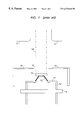
- FIGS. 1 is a schematic diagram of a conventional Wehnelt electron gun with a tantalum disk emitter
- FIG. 2 is a schematic diagram of a Wehnelt electron gun modified in accordance with the invention.
- FIG. 3 is a schematic representation of the electron emission profile from the mesh grid of a conventional Wehnelt electron gun
- FIG. 4 is a schematic representation of the electron emission profile from the mesh grid of the modified Wehnelt electron gun of the invention.
- FIG. 5 is a schematic diagram of a mesh grid of the invention showing the relevant dimensions
- FIG. 6 is a schematic diagram illustrating the principles of the SCALPEL exposure system.
- a conventional Wehnelt electron gun assembly is shown with base 11 , cathode support arms 12 , cathode filament 13 , Wehnelt electrode comprised of Wehnelt support arms 15 and conventional Wehnelt aperture 16 .
- the base 11 may be ceramic
- the support members 12 may be tantalum, steel, or molybdenum.
- the filament 13 may be tungsten wire
- the material forming the Wehnelt aperture may be steel or tantalum
- the electron emitter 14 is, e.g., a tantalum disk.
- the effective area of the electron emitter is typically in the range of 0.5-3 mm 2 .
- the electron emitter is preferably a disk with a diameter in the range 0.5-2.0 mm.
- the anode is shown schematically at 17 , and the electron beam at 18 .
- the beam control apparatus which is conventional and well known in the art, is not shown. It will be appreciated by those skilled in the art that the dimensions in the figures are not necessarily to scale.
- An important feature of the electron source for SCALPEL exposure tools is relatively low electron beam brightness, as mentioned earlier.
- beam brightness be limited to a value less than 10 4 Acm ⁇ 2 sr ⁇ 1 . This is in contrast with conventional scanning electron beam exposure tools which are typically optimized for maximum brightness. See e.g. U.S. Pat. No. 4,588,928 issued May 13, 1986 to Liu et al.
- the improved electron gun according to the invention is shown in FIG. 2 .
- the opening for the Wehnelt is provided with mesh grid 23 , disposed in the path of the electron emission 25 .
- the mesh grid 23 is at a potential equal to the Wehnelt electrode and functions as a secondary emitter with multiple sources.
- FIG. 3 The electron emission pattern from a standard round bore Wehnelt gun, i.e. the gun of FIG. 1, is shown in FIG. 3 .
- the relatively non-uniform, bell curve shaped output from the Wehnelt is evident.
- FIG. 4 The electron emission pattern from the mesh grid equipped Wehnelt gun of the invention, i.e. the gun of FIG. 2, is shown in FIG. 4 .
- the multiple emission patterns can be seen, which serve to spatially distribute the electron flux across a wide aperture and ensure a flat averaged electrical field over the cathode surface.
- the individual electron beams overlap and the integrated electron flux is highly uniform.
- the screen element that forms the mesh grid can have a variety of configurations. The simplest is a conventional woven screen with square apertures. However, the screen may have triangular shaped apertures, hexagonal close packed apertures, or even circular apertures. It can be woven or non-woven. Techniques for forming suitable screens from a continuous layer may occur to those skilled in the art. For example, multiple openings in a continuous metal sheet or foil can be produced by techniques such as laser drilling. Fine meshes can also be formed by electroforming techniques.
- the mesh grid should be electrically conducting but the material of the mesh is otherwise is relatively inconsequential. Tantalum, tungsten, molybdenum, titanium, or even steel are suitable materials.
- the mesh grid preferably has a transparency in the range 40-90%, with transparency defined as the two dimensional void space divided by the overall mesh grid area.
- the spacing between the electron emitter surface and the mesh grid is typically in the range 0.1 to 1.0 mm.
- the mesh grid has bars “b” of approximately 50 ⁇ m, and square cells with “C” approximately 200 ⁇ m.
- This mesh grid has a transparency of approximately 65%.
- Mesh grid structures that were found suitable are represented by the examples in the following table.
- the cell dimension “C” is the width of the opening in a mesh with a square opening.
- the dimension “C” is approximately the square root of the area of the opening. It is preferred that the openings be approximately symmetrical, i.e. square or round.
- the thickness t of the mesh grid is relatively immaterial except that the aspect ratio of the openings, C/t, is preferably greater than 1. Desirable relationships between the mesh grid parameters is given by:
- D is the cathode-to-grid distance
- the electron gun of the invention is most advantageously utilized as the electron source in a SCALPEL electron beam lithography machine.
- Fabrication of semiconductor devices on semiconductor wafers in current industry practice contemplates the exposure of polymer resist materials with fine line patterns of actinic radiation, in this case, electron beam radiation. This is achieved in conventional practice by directing the actinic radiation through a lithographic mask and onto a resist coated substrate.
- the mask may be positioned close to the substrate for proximity printing or may be placed away from the substrate and the image of the mask projected onto the substrate for projection printing.
- SCALPEL lithography tools are characterized by high contrast image patterns at very small linewidths, i.e 0.1 ⁇ m or less. They produce high resolution images with wide process latitude, coupled with the high throughput of optical projection systems.
- the high throughput is made possible by using a flood beam of electrons to expose a relatively large area of the wafer. Electron beam optics, comprising standard magnetic field beam steering and focusing, are used to image the flood beam onto the lithographic mask, and thereafter, onto the substrate, i.e. the resist coated wafer.
- the lithographic mask is composed of regions of high electron scattering and regions of low electron scattering, which regions define the features desired in the mask pattern. Details of suitable mask structures can be found in U.S. Pat. No. 5,079,112 issued Jan. 7, 1992, and U.S. Pat. No. 5,258,246 issued Nov. 2, 1993, both to Berger et al.
- the back focal plane filter functions by blocking the highly scattered electrons while passing the weakly scattered electrons, thus forming the image pattern on the substrate.
- the blocking filter thus absorbs the unwanted radiation in the image. This is in contrast to conventional lithography tools in which the unwanted radiation in the image is absorbed by the mask itself, contributing to heating and distortion of the mask, and to reduced mask lifetime.
- Lithographic mask 52 is illuminated with a uniform flood beam 51 of 100 keV electrons produced by the electron gun of FIG. 2 .
- the membrane mask 52 comprises regions 53 of high scattering material and regions 54 of low scattering material.
- the weakly scattered portions of the beam, i.e. rays 51 a are focused by magnetic lens 55 through the aperture 57 of the back focal plane blocking filter 56 .
- the back focal plane filter 56 may be a silicon wafer or other material suitable for blocking electrons.
- the highly scattered portions of the electron beam, represented here by rays 51 b and 51 c are blocked by the back focal plane filter 56 .
- Regions 60 replicate the features 54 of the lithographic mask 52 , i.e. the regions to be exposed, and regions 61 replicate the features 53 of the lithographic mask, i.e. the regions that are not to be exposed. These regions are interchangeable, as is well known in the art, to produce either negative or positive resist patterns.
- the vitalizing feature of the SCALPEL tool is the positioning of a blocking filter at or near the back focal plane of the electron beam image. Further details of SCALPEL systems can be found in U.S. Pat. No. 5,079,112 issued Jan. 7, 1992, and U.S. Pat. No. 5,258,246 issued Nov. 2, 1993, both to Berger et al. These patents are incorporated herein by reference for such details that may be found useful for the practice of the invention.
- wehnelt emitter is intended to define a solid metal body with an approximately flat emitting surface, said flat emitting surface being symmetrical, i.e. having the shape of a circle or regular polygon.
- substrate is used herein to define the object plane of the electron beam exposure system whether or not there is a semiconductor workpiece present on the substrate.
- electron optics plane may be used to describe an x-y plane in space in the electron beam exposure system between the electron emitting surface of the electron gun and the surface onto which the electron beam image is focused, i.e. the object plane where the semiconductor wafer is situated.
- the grid bias required for far field beam shaping and for regulating exposure dose in the modified Wehnelt gun of the invention is not.
- the cut-off bias in conventional Wehnelt guns is typically 400 V or more. Because of the presence of the mesh grid in the modified Wehnelt gun of the invention, cut-off for the grid bias is less than 100 V, and in most structures, e.g. the embodiment described above, less than 50 V. This voltage can be applied directly to the Wehnelt electrode and can be switched or modulated using semiconductor drive circuits, which sharply reduces the cost of the apparatus and the response time of the beam control system.
- the wobble can be produced by a low frequency, i.e. 1-10 kHz, beam drive signal that is superimposed on the Wehnelt grid bias. This wobble changes the beam pattern at the frequency of the wobble so that any peaks or hot spots in the electron beam front are moved periodically and the integrated flux over time is more spatially equalized.
Landscapes
- Chemical & Material Sciences (AREA)
- Analytical Chemistry (AREA)
- Electron Beam Exposure (AREA)
- Electron Sources, Ion Sources (AREA)
Abstract
Description
| TABLE I | |||
| Cell dimension “C”, μm | Bar width “b”, μm | ||
| Grid #100 | 200 | 50 | ||
| Grid #200 | 88 | 37 | ||
| Grid #300 | 54 | 31 | ||
Claims (3)
Priority Applications (7)
| Application Number | Priority Date | Filing Date | Title |
|---|---|---|---|
| US09/306,287 US6232040B1 (en) | 1999-05-06 | 1999-05-06 | Method of electron beam exposure utilizing emitter with conductive mesh grid |
| KR1020000023964A KR100634727B1 (en) | 1999-05-06 | 2000-05-04 | Electron emitters for lithography tools |
| DE60039551T DE60039551D1 (en) | 1999-05-06 | 2000-05-05 | Electron generator for lithography equipment |
| EP00303780A EP1052677B1 (en) | 1999-05-06 | 2000-05-05 | Electron emitters for lithography tools |
| JP2000135070A JP3492977B2 (en) | 1999-05-06 | 2000-05-08 | Manufacturing method of semiconductor integrated circuit |
| TW089108620A TW591327B (en) | 1999-05-06 | 2000-07-15 | Electron emitters for lithography tools |
| US09/818,799 US6400090B2 (en) | 1999-05-06 | 2001-03-27 | Electron emitters for lithography tools |
Applications Claiming Priority (1)
| Application Number | Priority Date | Filing Date | Title |
|---|---|---|---|
| US09/306,287 US6232040B1 (en) | 1999-05-06 | 1999-05-06 | Method of electron beam exposure utilizing emitter with conductive mesh grid |
Related Child Applications (1)
| Application Number | Title | Priority Date | Filing Date |
|---|---|---|---|
| US09/818,799 Division US6400090B2 (en) | 1999-05-06 | 2001-03-27 | Electron emitters for lithography tools |
Publications (1)
| Publication Number | Publication Date |
|---|---|
| US6232040B1 true US6232040B1 (en) | 2001-05-15 |
Family
ID=23184628
Family Applications (2)
| Application Number | Title | Priority Date | Filing Date |
|---|---|---|---|
| US09/306,287 Expired - Lifetime US6232040B1 (en) | 1999-05-06 | 1999-05-06 | Method of electron beam exposure utilizing emitter with conductive mesh grid |
| US09/818,799 Expired - Lifetime US6400090B2 (en) | 1999-05-06 | 2001-03-27 | Electron emitters for lithography tools |
Family Applications After (1)
| Application Number | Title | Priority Date | Filing Date |
|---|---|---|---|
| US09/818,799 Expired - Lifetime US6400090B2 (en) | 1999-05-06 | 2001-03-27 | Electron emitters for lithography tools |
Country Status (6)
| Country | Link |
|---|---|
| US (2) | US6232040B1 (en) |
| EP (1) | EP1052677B1 (en) |
| JP (1) | JP3492977B2 (en) |
| KR (1) | KR100634727B1 (en) |
| DE (1) | DE60039551D1 (en) |
| TW (1) | TW591327B (en) |
Cited By (6)
| Publication number | Priority date | Publication date | Assignee | Title |
|---|---|---|---|---|
| US6400090B2 (en) * | 1999-05-06 | 2002-06-04 | Agere Systems Guardian Corp | Electron emitters for lithography tools |
| US6670620B1 (en) * | 1998-12-18 | 2003-12-30 | Canon Kabushiki Kaisha | Electron gun, illumination apparatus using the electron gun, and electron beam exposure apparatus using the illumination apparatus |
| US6706609B2 (en) * | 1999-12-07 | 2004-03-16 | Agere Systems Inc. | Method of forming an alignment feature in or on a multi-layered semiconductor structure |
| US20040135515A1 (en) * | 2001-05-01 | 2004-07-15 | Muneki Hamashima | Electron beam apparatus and device manufacturing method using same |
| US20080099693A1 (en) * | 2006-10-30 | 2008-05-01 | Ims Nanofabrication Ag | Charged-particle exposure apparatus |
| US20170148605A1 (en) * | 2015-11-20 | 2017-05-25 | Oregon Physics, Llc | Electron emitter source |
Families Citing this family (13)
| Publication number | Priority date | Publication date | Assignee | Title |
|---|---|---|---|---|
| DE60033767T2 (en) * | 1999-06-22 | 2007-11-15 | Fei Co., Hillsboro | CORPUSCULAR OPTICAL DEVICE WITH A PARTICLE SOURCE SWITCHABLE BETWEEN HIGH BRIGHTNESS AND LARGE RADIATION CURRENT |
| US7345290B2 (en) | 1999-10-07 | 2008-03-18 | Agere Systems Inc | Lens array for electron beam lithography tool |
| JP2002163005A (en) * | 2000-11-29 | 2002-06-07 | Nikon Corp | Control system design method, control system, control system adjustment method, and exposure method |
| AU2002366886A1 (en) * | 2001-12-20 | 2003-07-09 | Koninklijke Philips Electronics N.V. | Cathode ray tube and electron gun |
| US6822241B2 (en) | 2002-10-03 | 2004-11-23 | Hewlett-Packard Development Company, L.P. | Emitter device with focusing columns |
| US7057353B2 (en) * | 2003-01-13 | 2006-06-06 | Hewlett-Packard Development Company, L.P. | Electronic device with wide lens for small emission spot size |
| JP2005088801A (en) | 2003-09-18 | 2005-04-07 | Denso Corp | Information processing system |
| US7454221B1 (en) * | 2005-07-12 | 2008-11-18 | Hewlett-Packard Development Company, L.P. | Electron tube amplification |
| DE102007042108B4 (en) * | 2007-09-05 | 2010-02-11 | Siemens Ag | Electron source with associated measured value acquisition |
| CN101452797B (en) | 2007-12-05 | 2011-11-09 | 清华大学 | Field emission type electronic source and manufacturing method thereof |
| US8340250B2 (en) * | 2009-09-04 | 2012-12-25 | General Electric Company | System and method for generating X-rays |
| GB2619965A (en) * | 2022-06-24 | 2023-12-27 | Aquasium Tech Limited | Electron beam emitting assembly |
| CN119172916B (en) * | 2024-11-25 | 2025-03-25 | 上海福照人间技术有限公司 | Electron beam control device and electron accelerator |
Citations (3)
| Publication number | Priority date | Publication date | Assignee | Title |
|---|---|---|---|---|
| US4588928A (en) * | 1983-06-15 | 1986-05-13 | At&T Bell Laboratories | Electron emission system |
| US5079112A (en) * | 1989-08-07 | 1992-01-07 | At&T Bell Laboratories | Device manufacture involving lithographic processing |
| US5258246A (en) * | 1989-08-07 | 1993-11-02 | At&T Bell Laboratories | Device manufacture involving lithographic processing |
Family Cites Families (8)
| Publication number | Priority date | Publication date | Assignee | Title |
|---|---|---|---|---|
| US3852633A (en) * | 1972-12-13 | 1974-12-03 | Varian Associates | Gridded electron gun |
| US3833482A (en) * | 1973-03-26 | 1974-09-03 | Buckbee Mears Co | Matrix for forming mesh |
| JPS6074336A (en) * | 1983-09-30 | 1985-04-26 | Nec Corp | Rectangular electron beam generator |
| US4767964A (en) * | 1987-02-04 | 1988-08-30 | Tektronix, Inc. | Improved mesh for CRT scan expansion lens and lens fabricated therefrom |
| US5759078A (en) * | 1995-05-30 | 1998-06-02 | Texas Instruments Incorporated | Field emission device with close-packed microtip array |
| JPH10223166A (en) * | 1997-01-31 | 1998-08-21 | Nikon Corp | Electron gun |
| JPH10261380A (en) * | 1997-03-19 | 1998-09-29 | Nikon Corp | Electron optics |
| US6232040B1 (en) * | 1999-05-06 | 2001-05-15 | Agere Systems, Inc. | Method of electron beam exposure utilizing emitter with conductive mesh grid |
-
1999
- 1999-05-06 US US09/306,287 patent/US6232040B1/en not_active Expired - Lifetime
-
2000
- 2000-05-04 KR KR1020000023964A patent/KR100634727B1/en not_active Expired - Fee Related
- 2000-05-05 DE DE60039551T patent/DE60039551D1/en not_active Expired - Lifetime
- 2000-05-05 EP EP00303780A patent/EP1052677B1/en not_active Expired - Lifetime
- 2000-05-08 JP JP2000135070A patent/JP3492977B2/en not_active Expired - Fee Related
- 2000-07-15 TW TW089108620A patent/TW591327B/en not_active IP Right Cessation
-
2001
- 2001-03-27 US US09/818,799 patent/US6400090B2/en not_active Expired - Lifetime
Patent Citations (3)
| Publication number | Priority date | Publication date | Assignee | Title |
|---|---|---|---|---|
| US4588928A (en) * | 1983-06-15 | 1986-05-13 | At&T Bell Laboratories | Electron emission system |
| US5079112A (en) * | 1989-08-07 | 1992-01-07 | At&T Bell Laboratories | Device manufacture involving lithographic processing |
| US5258246A (en) * | 1989-08-07 | 1993-11-02 | At&T Bell Laboratories | Device manufacture involving lithographic processing |
Cited By (13)
| Publication number | Priority date | Publication date | Assignee | Title |
|---|---|---|---|---|
| US6670620B1 (en) * | 1998-12-18 | 2003-12-30 | Canon Kabushiki Kaisha | Electron gun, illumination apparatus using the electron gun, and electron beam exposure apparatus using the illumination apparatus |
| US6400090B2 (en) * | 1999-05-06 | 2002-06-04 | Agere Systems Guardian Corp | Electron emitters for lithography tools |
| US6977128B2 (en) | 1999-12-07 | 2005-12-20 | Agere Systems Inc. | Multi-layered semiconductor structure |
| US6706609B2 (en) * | 1999-12-07 | 2004-03-16 | Agere Systems Inc. | Method of forming an alignment feature in or on a multi-layered semiconductor structure |
| US20040094847A1 (en) * | 1999-12-07 | 2004-05-20 | Boulin David M. | Multi-layered semiconductor structure |
| US7205559B2 (en) * | 2001-05-01 | 2007-04-17 | Ebara Corporation | Electron beam apparatus and device manufacturing method using same |
| US20040135515A1 (en) * | 2001-05-01 | 2004-07-15 | Muneki Hamashima | Electron beam apparatus and device manufacturing method using same |
| US20070164226A1 (en) * | 2001-05-01 | 2007-07-19 | Nikon Corporation | Electron beam apparatus and device manufacturing method using the same |
| US7598471B2 (en) | 2001-05-01 | 2009-10-06 | Ebara Corporation | Method of electric discharge machining a cathode for an electron gun |
| US20080099693A1 (en) * | 2006-10-30 | 2008-05-01 | Ims Nanofabrication Ag | Charged-particle exposure apparatus |
| US7598499B2 (en) | 2006-10-30 | 2009-10-06 | Ims Nanofabrications Ag | Charged-particle exposure apparatus |
| US20170148605A1 (en) * | 2015-11-20 | 2017-05-25 | Oregon Physics, Llc | Electron emitter source |
| US10192708B2 (en) * | 2015-11-20 | 2019-01-29 | Oregon Physics, Llc | Electron emitter source |
Also Published As
| Publication number | Publication date |
|---|---|
| EP1052677A3 (en) | 2006-06-07 |
| US20010022347A1 (en) | 2001-09-20 |
| JP2001023897A (en) | 2001-01-26 |
| EP1052677B1 (en) | 2008-07-23 |
| EP1052677A2 (en) | 2000-11-15 |
| US6400090B2 (en) | 2002-06-04 |
| TW591327B (en) | 2004-06-11 |
| KR100634727B1 (en) | 2006-10-17 |
| JP3492977B2 (en) | 2004-02-03 |
| DE60039551D1 (en) | 2008-09-04 |
| KR20010014869A (en) | 2001-02-26 |
Similar Documents
| Publication | Publication Date | Title |
|---|---|---|
| US6400090B2 (en) | Electron emitters for lithography tools | |
| US6333508B1 (en) | Illumination system for electron beam lithography tool | |
| US6335783B1 (en) | Lithography system | |
| JP2002541623A (en) | Electrostatic Focused Addressable Field Emission Array Chip (AFEA's) for High Speed Massively Parallel Maskless Digital Electron Beam Direct Writing Lithography and Scanning Electron Microscopy | |
| KR100572251B1 (en) | Apparatus and method for suppressing space charge induced aberration in charged particle projection lithography systems | |
| US6218676B1 (en) | Charged-particle-beam image-transfer apparatus exhibiting reduced space-charge effects and device fabrication methods using the same | |
| US6465797B2 (en) | Electron beam illumination apparatus, electron beam exposure apparatus, and device manufacturing method | |
| KR100365880B1 (en) | Shaped shadow projection for an electron beam column | |
| US6091187A (en) | High emittance electron source having high illumination uniformity | |
| US7345290B2 (en) | Lens array for electron beam lithography tool | |
| JPH01159955A (en) | Electronic image projector | |
| Kruit | High throughput electron lithography with the multiple aperture pixel by pixel enhancement of resolution concept | |
| US6492647B1 (en) | Electron guns for lithography tools | |
| JP2002289517A (en) | Electron beam proximity exposure apparatus and method | |
| JPH1186766A (en) | Electron beam transfer exposure equipment | |
| JP2004193157A (en) | Electron beam illumination optical system and electron beam exposure apparatus |
Legal Events
| Date | Code | Title | Description |
|---|---|---|---|
| AS | Assignment |
Owner name: LUCENT TECHNOLOGIES INC., NEW JERSEY Free format text: ASSIGNMENT OF ASSIGNORS INTEREST;ASSIGNORS:KATSAP, VICTOR;LIDDLE, JAMES ALEXANDER;WASKIEWICZ, WARREN KAZMIR;REEL/FRAME:009952/0003 Effective date: 19990429 |
|
| STCF | Information on status: patent grant |
Free format text: PATENTED CASE |
|
| AS | Assignment |
Owner name: DARPA, VIRGINIA Free format text: CONFIRMATORY LICENSE;ASSIGNOR:LUCENT TECHNOLOGIES;REEL/FRAME:012099/0684 Effective date: 20010815 |
|
| FEPP | Fee payment procedure |
Free format text: PAYER NUMBER DE-ASSIGNED (ORIGINAL EVENT CODE: RMPN); ENTITY STATUS OF PATENT OWNER: LARGE ENTITY Free format text: PAYOR NUMBER ASSIGNED (ORIGINAL EVENT CODE: ASPN); ENTITY STATUS OF PATENT OWNER: LARGE ENTITY |
|
| FPAY | Fee payment |
Year of fee payment: 4 |
|
| FPAY | Fee payment |
Year of fee payment: 8 |
|
| FPAY | Fee payment |
Year of fee payment: 12 |
|
| AS | Assignment |
Owner name: DEUTSCHE BANK AG NEW YORK BRANCH, AS COLLATERAL AGENT, NEW YORK Free format text: PATENT SECURITY AGREEMENT;ASSIGNORS:LSI CORPORATION;AGERE SYSTEMS LLC;REEL/FRAME:032856/0031 Effective date: 20140506 Owner name: DEUTSCHE BANK AG NEW YORK BRANCH, AS COLLATERAL AG Free format text: PATENT SECURITY AGREEMENT;ASSIGNORS:LSI CORPORATION;AGERE SYSTEMS LLC;REEL/FRAME:032856/0031 Effective date: 20140506 |
|
| AS | Assignment |
Owner name: AVAGO TECHNOLOGIES GENERAL IP (SINGAPORE) PTE. LTD., SINGAPORE Free format text: ASSIGNMENT OF ASSIGNORS INTEREST;ASSIGNOR:AGERE SYSTEMS LLC;REEL/FRAME:035365/0634 Effective date: 20140804 Owner name: AVAGO TECHNOLOGIES GENERAL IP (SINGAPORE) PTE. LTD Free format text: ASSIGNMENT OF ASSIGNORS INTEREST;ASSIGNOR:AGERE SYSTEMS LLC;REEL/FRAME:035365/0634 Effective date: 20140804 |
|
| AS | Assignment |
Owner name: AGERE SYSTEMS LLC, PENNSYLVANIA Free format text: TERMINATION AND RELEASE OF SECURITY INTEREST IN PATENT RIGHTS (RELEASES RF 032856-0031);ASSIGNOR:DEUTSCHE BANK AG NEW YORK BRANCH, AS COLLATERAL AGENT;REEL/FRAME:037684/0039 Effective date: 20160201 Owner name: LSI CORPORATION, CALIFORNIA Free format text: TERMINATION AND RELEASE OF SECURITY INTEREST IN PATENT RIGHTS (RELEASES RF 032856-0031);ASSIGNOR:DEUTSCHE BANK AG NEW YORK BRANCH, AS COLLATERAL AGENT;REEL/FRAME:037684/0039 Effective date: 20160201 |
|
| AS | Assignment |
Owner name: BANK OF AMERICA, N.A., AS COLLATERAL AGENT, NORTH CAROLINA Free format text: PATENT SECURITY AGREEMENT;ASSIGNOR:AVAGO TECHNOLOGIES GENERAL IP (SINGAPORE) PTE. LTD.;REEL/FRAME:037808/0001 Effective date: 20160201 Owner name: BANK OF AMERICA, N.A., AS COLLATERAL AGENT, NORTH Free format text: PATENT SECURITY AGREEMENT;ASSIGNOR:AVAGO TECHNOLOGIES GENERAL IP (SINGAPORE) PTE. LTD.;REEL/FRAME:037808/0001 Effective date: 20160201 |
|
| AS | Assignment |
Owner name: AVAGO TECHNOLOGIES GENERAL IP (SINGAPORE) PTE. LTD., SINGAPORE Free format text: TERMINATION AND RELEASE OF SECURITY INTEREST IN PATENTS;ASSIGNOR:BANK OF AMERICA, N.A., AS COLLATERAL AGENT;REEL/FRAME:041710/0001 Effective date: 20170119 Owner name: AVAGO TECHNOLOGIES GENERAL IP (SINGAPORE) PTE. LTD Free format text: TERMINATION AND RELEASE OF SECURITY INTEREST IN PATENTS;ASSIGNOR:BANK OF AMERICA, N.A., AS COLLATERAL AGENT;REEL/FRAME:041710/0001 Effective date: 20170119 |
|
| AS | Assignment |
Owner name: BELL SEMICONDUCTOR, LLC, ILLINOIS Free format text: ASSIGNMENT OF ASSIGNORS INTEREST;ASSIGNORS:AVAGO TECHNOLOGIES GENERAL IP (SINGAPORE) PTE. LTD.;BROADCOM CORPORATION;REEL/FRAME:044886/0608 Effective date: 20171208 |
|
| AS | Assignment |
Owner name: CORTLAND CAPITAL MARKET SERVICES LLC, AS COLLATERAL AGENT, ILLINOIS Free format text: SECURITY INTEREST;ASSIGNORS:HILCO PATENT ACQUISITION 56, LLC;BELL SEMICONDUCTOR, LLC;BELL NORTHERN RESEARCH, LLC;REEL/FRAME:045216/0020 Effective date: 20180124 Owner name: CORTLAND CAPITAL MARKET SERVICES LLC, AS COLLATERA Free format text: SECURITY INTEREST;ASSIGNORS:HILCO PATENT ACQUISITION 56, LLC;BELL SEMICONDUCTOR, LLC;BELL NORTHERN RESEARCH, LLC;REEL/FRAME:045216/0020 Effective date: 20180124 |
|
| AS | Assignment |
Owner name: BELL NORTHERN RESEARCH, LLC, ILLINOIS Free format text: RELEASE BY SECURED PARTY;ASSIGNOR:CORTLAND CAPITAL MARKET SERVICES LLC;REEL/FRAME:059720/0719 Effective date: 20220401 Owner name: BELL SEMICONDUCTOR, LLC, ILLINOIS Free format text: RELEASE BY SECURED PARTY;ASSIGNOR:CORTLAND CAPITAL MARKET SERVICES LLC;REEL/FRAME:059720/0719 Effective date: 20220401 Owner name: HILCO PATENT ACQUISITION 56, LLC, ILLINOIS Free format text: RELEASE BY SECURED PARTY;ASSIGNOR:CORTLAND CAPITAL MARKET SERVICES LLC;REEL/FRAME:059720/0719 Effective date: 20220401 |