US6194576B1 - Process for preparing antiviral 2-phosponate nucleotide analogs - Google Patents
Process for preparing antiviral 2-phosponate nucleotide analogs Download PDFInfo
- Publication number
- US6194576B1 US6194576B1 US09/411,980 US41198099A US6194576B1 US 6194576 B1 US6194576 B1 US 6194576B1 US 41198099 A US41198099 A US 41198099A US 6194576 B1 US6194576 B1 US 6194576B1
- Authority
- US
- United States
- Prior art keywords
- mmol
- ylmethyl
- trans
- solution
- cis
- Prior art date
- Legal status (The legal status is an assumption and is not a legal conclusion. Google has not performed a legal analysis and makes no representation as to the accuracy of the status listed.)
- Expired - Fee Related
Links
- 0 C*C1*C(CP(=O)(O)O)*[U]1 Chemical compound C*C1*C(CP(=O)(O)O)*[U]1 0.000 description 47
- LFDDHRCTODAKQI-UHFFFAOYSA-N C[PH](=O)C1OC(CO)CS1 Chemical compound C[PH](=O)C1OC(CO)CS1 LFDDHRCTODAKQI-UHFFFAOYSA-N 0.000 description 3
- KNQFVPDUKATWNM-UHFFFAOYSA-M C.CC1=CN(CC2COC(P(=O)([O-])O)O2)C(=O)NC1=O.CC1=CN(CC2COC([PH](C)=O)O2)C(=O)NC1=O.[NH4+] Chemical compound C.CC1=CN(CC2COC(P(=O)([O-])O)O2)C(=O)NC1=O.CC1=CN(CC2COC([PH](C)=O)O2)C(=O)NC1=O.[NH4+] KNQFVPDUKATWNM-UHFFFAOYSA-M 0.000 description 2
- UMNJZZGHVRIVIM-UHFFFAOYSA-N CC1=C(C)C(C)=C(C)N(C)C1=O.CC1=C(C)N(C)C(=O)N=C1N(C)C.CC1=C(C)N(C)C(=O)N=C1N=CN(C)C.CC1=C(C)N(C)C(C)=C1C.CC1=NC(C)=C(C)N1C.CC1=NC(N(C)C)=NC(=O)N1C.CC1=NN(C)C(=O)N=C1N(C)C.CC1=NN(C)C(C)=C1C Chemical compound CC1=C(C)C(C)=C(C)N(C)C1=O.CC1=C(C)N(C)C(=O)N=C1N(C)C.CC1=C(C)N(C)C(=O)N=C1N=CN(C)C.CC1=C(C)N(C)C(C)=C1C.CC1=NC(C)=C(C)N1C.CC1=NC(N(C)C)=NC(=O)N1C.CC1=NN(C)C(=O)N=C1N(C)C.CC1=NN(C)C(C)=C1C UMNJZZGHVRIVIM-UHFFFAOYSA-N 0.000 description 2
- MVGVBTXUDZNLEX-UHFFFAOYSA-N CC1=CC2=C(C=C1C)N(C)C(C)=N2.CC1=NC(C)=C(C)C2=C1N=C(C)N2C.CC1=NC2=C(C(C)=N1)C(C)=C(C)N2C.CC1=NC2=C(C(C)=N1)C(C)=NN2C.CC1=NC2=C(N=C(C)N2C)C(C)=C1C.CC1=NC2=C(N=C(C)N2C)C(C)=N1.CC1=NC2=C(N=NN2C)C(C)=N1.CC1=NN=C(C)C2=C1N=C(C)N2C.CC1=NN=NC2=C1N=C(C)N2C Chemical compound CC1=CC2=C(C=C1C)N(C)C(C)=N2.CC1=NC(C)=C(C)C2=C1N=C(C)N2C.CC1=NC2=C(C(C)=N1)C(C)=C(C)N2C.CC1=NC2=C(C(C)=N1)C(C)=NN2C.CC1=NC2=C(N=C(C)N2C)C(C)=C1C.CC1=NC2=C(N=C(C)N2C)C(C)=N1.CC1=NC2=C(N=NN2C)C(C)=N1.CC1=NN=C(C)C2=C1N=C(C)N2C.CC1=NN=NC2=C1N=C(C)N2C MVGVBTXUDZNLEX-UHFFFAOYSA-N 0.000 description 2
- WEAGJTUXSMTXMU-UHFFFAOYSA-M CC1=CN(CC2CCC(P(=O)([O-])O)O2)C(=O)NC1=O.CC1=CN(CC2CCC(P(C)(C)=O)O2)C(=O)NC1=O.[NH4+] Chemical compound CC1=CN(CC2CCC(P(=O)([O-])O)O2)C(=O)NC1=O.CC1=CN(CC2CCC(P(C)(C)=O)O2)C(=O)NC1=O.[NH4+] WEAGJTUXSMTXMU-UHFFFAOYSA-M 0.000 description 2
- JRFXIHMLFALNJD-UHFFFAOYSA-N CC1=CN(CC2CCC(P(C)(C)=O)O2)C(=O)NC1=O.CP(C)(=O)C1CCC(CBr)O1 Chemical compound CC1=CN(CC2CCC(P(C)(C)=O)O2)C(=O)NC1=O.CP(C)(=O)C1CCC(CBr)O1 JRFXIHMLFALNJD-UHFFFAOYSA-N 0.000 description 2
- DYOUDNMRDSAWBG-UHFFFAOYSA-N CP(C)(=O)C1CCC(CBr)O1.CP(C)(=O)C1CCC(CN2C=CC(=O)NC2=O)O1 Chemical compound CP(C)(=O)C1CCC(CBr)O1.CP(C)(=O)C1CCC(CN2C=CC(=O)NC2=O)O1 DYOUDNMRDSAWBG-UHFFFAOYSA-N 0.000 description 2
- MIUXEFUHLXDWSU-UHFFFAOYSA-N CP(C)(=O)C1CCC(CBr)O1.CP(C)(=O)C1CCC(CN2C=NC3=C2N=C(N)N=C3Cl)O1 Chemical compound CP(C)(=O)C1CCC(CBr)O1.CP(C)(=O)C1CCC(CN2C=NC3=C2N=C(N)N=C3Cl)O1 MIUXEFUHLXDWSU-UHFFFAOYSA-N 0.000 description 2
- XZNRHPNPYWYFMB-UHFFFAOYSA-M CP(C)(=O)C1CCC(CN2C=CC(=O)NC2=O)O1.O=C1C=CN(CC2CCC(P(=O)([O-])O)O2)C(=O)N1.[NH4+] Chemical compound CP(C)(=O)C1CCC(CN2C=CC(=O)NC2=O)O1.O=C1C=CN(CC2CCC(P(=O)([O-])O)O2)C(=O)N1.[NH4+] XZNRHPNPYWYFMB-UHFFFAOYSA-M 0.000 description 2
- CRZJLFNBHXUIOL-UHFFFAOYSA-M CP(C)(=O)C1CCC(CN2C=NC3=C2N=C(N)N=C3Cl)O1.NC1=NC2=C(N=CN2CC2CCC(P(=O)([O-])O)O2)C(N)=N1.[NH4+] Chemical compound CP(C)(=O)C1CCC(CN2C=NC3=C2N=C(N)N=C3Cl)O1.NC1=NC2=C(N=CN2CC2CCC(P(=O)([O-])O)O2)C(N)=N1.[NH4+] CRZJLFNBHXUIOL-UHFFFAOYSA-M 0.000 description 2
- PMRZIPVWFRKLMA-UHFFFAOYSA-N CP(C)(=O)C1CCC(CN2C=NC3=C2N=CN=C3Cl)O1.NC1=NC=NC2=C1N=CN2CC1CCC(P(=O)(O)O)O1 Chemical compound CP(C)(=O)C1CCC(CN2C=NC3=C2N=CN=C3Cl)O1.NC1=NC=NC2=C1N=CN2CC1CCC(P(=O)(O)O)O1 PMRZIPVWFRKLMA-UHFFFAOYSA-N 0.000 description 2
- VMDYSVBZEMHKFH-UHFFFAOYSA-N C[PH](=O)C1OCC(CBr)O1 Chemical compound C[PH](=O)C1OCC(CBr)O1 VMDYSVBZEMHKFH-UHFFFAOYSA-N 0.000 description 2
- SEPBCPLDUAMVMS-UHFFFAOYSA-N C[PH](=O)C1OCC(CBr)O1.C[PH](=O)C1OCC(CN2C=CC(=O)NC2=O)O1 Chemical compound C[PH](=O)C1OCC(CBr)O1.C[PH](=O)C1OCC(CN2C=CC(=O)NC2=O)O1 SEPBCPLDUAMVMS-UHFFFAOYSA-N 0.000 description 2
- JDWMLOCFSPLCAV-UHFFFAOYSA-N C[PH](=O)C1OCC(CBr)O1.C[PH](=O)C1OCC(CN2C=CC(N)=NC2=O)O1 Chemical compound C[PH](=O)C1OCC(CBr)O1.C[PH](=O)C1OCC(CN2C=CC(N)=NC2=O)O1 JDWMLOCFSPLCAV-UHFFFAOYSA-N 0.000 description 2
- SRNOEDQULUSJEI-UHFFFAOYSA-N C[PH](=O)C1OCC(CBr)O1.C[PH](=O)C1OCC(CN2C=NC3=C2N=C(N)N=C3Cl)O1 Chemical compound C[PH](=O)C1OCC(CBr)O1.C[PH](=O)C1OCC(CN2C=NC3=C2N=C(N)N=C3Cl)O1 SRNOEDQULUSJEI-UHFFFAOYSA-N 0.000 description 2
- ILRGQVZWIZWFIW-UHFFFAOYSA-N C[PH](=O)C1OCC(CBr)O1.C[PH](=O)C1OCC(CN2C=NC3=C2N=CN=C3N)O1 Chemical compound C[PH](=O)C1OCC(CBr)O1.C[PH](=O)C1OCC(CN2C=NC3=C2N=CN=C3N)O1 ILRGQVZWIZWFIW-UHFFFAOYSA-N 0.000 description 2
- QXFTXWQJDGOVAO-UHFFFAOYSA-M C[PH](=O)C1OCC(CN2C=CC(=O)NC2=O)O1.O=C1C=CN(CC2COC(P(=O)([O-])O)O2)C(=O)N1.[NH4+] Chemical compound C[PH](=O)C1OCC(CN2C=CC(=O)NC2=O)O1.O=C1C=CN(CC2COC(P(=O)([O-])O)O2)C(=O)N1.[NH4+] QXFTXWQJDGOVAO-UHFFFAOYSA-M 0.000 description 2
- PGLMZKFNMDQZMM-UHFFFAOYSA-N C[PH](=O)C1OCC(CN2C=NC3=C2N=C(N)N=C3Cl)S1 Chemical compound C[PH](=O)C1OCC(CN2C=NC3=C2N=C(N)N=C3Cl)S1 PGLMZKFNMDQZMM-UHFFFAOYSA-N 0.000 description 2
- QBSCGZMQGIUJJH-UHFFFAOYSA-N C[PH](=O)C1OCC(CN2C=NC3=C2N=CN=C3N)O1.NC1=NC=NC2=C1N=CN2CC1COC([PH](=O)O)O1.O Chemical compound C[PH](=O)C1OCC(CN2C=NC3=C2N=CN=C3N)O1.NC1=NC=NC2=C1N=CN2CC1COC([PH](=O)O)O1.O QBSCGZMQGIUJJH-UHFFFAOYSA-N 0.000 description 2
- KQGQBBCJUBAUJB-UHFFFAOYSA-N C[PH](=O)C1SCC(CN2C=NC3=C2N=C(N)N=C3Cl)S1.C[PH](=O)C1SCC(CO)S1 Chemical compound C[PH](=O)C1SCC(CN2C=NC3=C2N=C(N)N=C3Cl)S1.C[PH](=O)C1SCC(CO)S1 KQGQBBCJUBAUJB-UHFFFAOYSA-N 0.000 description 2
- ZNAOHLTUKYSCPZ-UHFFFAOYSA-M C[PH](=O)C1SCC(CN2C=NC3=C2N=C(N)N=C3Cl)S1.NC1=NC2=C(N=CN2CC2CSC(P(=O)([O-])O)S2)C(=O)N1.[NH4+] Chemical compound C[PH](=O)C1SCC(CN2C=NC3=C2N=C(N)N=C3Cl)S1.NC1=NC2=C(N=CN2CC2CSC(P(=O)([O-])O)S2)C(=O)N1.[NH4+] ZNAOHLTUKYSCPZ-UHFFFAOYSA-M 0.000 description 2
- SWBWXDOCWMAWQC-UHFFFAOYSA-M NC1=NC2=C(N=CN2CC2COC(CP(=O)([O-])O)O2)C(=O)N1.[NH4+] Chemical compound NC1=NC2=C(N=CN2CC2COC(CP(=O)([O-])O)O2)C(=O)N1.[NH4+] SWBWXDOCWMAWQC-UHFFFAOYSA-M 0.000 description 2
- XGSGSNJBKDZKPH-UHFFFAOYSA-M NC1=NC2=C(N=CN2CC2COC(CP(=O)([O-])O)O2)C(N)=N1.[NH4+] Chemical compound NC1=NC2=C(N=CN2CC2COC(CP(=O)([O-])O)O2)C(N)=N1.[NH4+] XGSGSNJBKDZKPH-UHFFFAOYSA-M 0.000 description 2
- XBBGBFUHIUMJPV-UHFFFAOYSA-M NC1=NC=NC2=C1N=CN2CC1COC(CP(=O)([O-])O)O1.[NH4+] Chemical compound NC1=NC=NC2=C1N=CN2CC1COC(CP(=O)([O-])O)O1.[NH4+] XBBGBFUHIUMJPV-UHFFFAOYSA-M 0.000 description 2
- UXFVPFCZQHDBQV-UHFFFAOYSA-N BCC(CO)OCP(=O)(O)O.BCCOCP(=O)(O)O Chemical compound BCC(CO)OCP(=O)(O)O.BCCOCP(=O)(O)O UXFVPFCZQHDBQV-UHFFFAOYSA-N 0.000 description 1
- JLJRCXGEWJADBS-XCEPFJQGSA-N BrC[C@@H]1CCC(O[Ac])O1.CP(C)(=O)C1CC[C@@H](CBr)O1 Chemical compound BrC[C@@H]1CCC(O[Ac])O1.CP(C)(=O)C1CC[C@@H](CBr)O1 JLJRCXGEWJADBS-XCEPFJQGSA-N 0.000 description 1
- CNPMJCYUFUZAOE-RDMYMQRKSA-N BrC[C@@H]1CCC(O[Ac])O1.O=[Ac][Ac].OC1CC[C@@H](CBr)O1 Chemical compound BrC[C@@H]1CCC(O[Ac])O1.O=[Ac][Ac].OC1CC[C@@H](CBr)O1 CNPMJCYUFUZAOE-RDMYMQRKSA-N 0.000 description 1
- RTAQQRCNXZJCML-FHINEINQSA-N BrC[C@H]1CCC(O[Ac])C1.CP(C)(=O)C1CC[C@H](CBr)O1 Chemical compound BrC[C@H]1CCC(O[Ac])C1.CP(C)(=O)C1CC[C@H](CBr)O1 RTAQQRCNXZJCML-FHINEINQSA-N 0.000 description 1
- CNPMJCYUFUZAOE-ABNDQVAISA-N BrC[C@H]1CCC(O[Ac])O1.O=[Ac][Ac].OC1CC[C@H](CBr)O1 Chemical compound BrC[C@H]1CCC(O[Ac])O1.O=[Ac][Ac].OC1CC[C@H](CBr)O1 CNPMJCYUFUZAOE-ABNDQVAISA-N 0.000 description 1
- PYHJNCCTPIREFU-DTXOHQOOSA-N C.C.C.CC1OCC(CO/[3H]=B/[2H]=[PH]=S)S1.C[PH](=O)C1OCC(CO/[3H]=B/[2H]=[PH]=S)S1.OCC(S)CO/[3H]=B/[2H]=[PH]=S Chemical compound C.C.C.CC1OCC(CO/[3H]=B/[2H]=[PH]=S)S1.C[PH](=O)C1OCC(CO/[3H]=B/[2H]=[PH]=S)S1.OCC(S)CO/[3H]=B/[2H]=[PH]=S PYHJNCCTPIREFU-DTXOHQOOSA-N 0.000 description 1
- GFDVQONQYKBDEU-UHFFFAOYSA-I C.C.CC(C)CP(C)(C)=O.CCC([Y])C[Y].CCC1C[Y]C(CP(=O)(O)O)[Y]1.CCC1C[Y]C(CP(C)(C)=O)[Y]1.CP(C)(=O)CC1[Y]CC(C[W])[Y]1.CP(C)(=O)CC=O.I[V](I)I.I[V]I.[V] Chemical compound C.C.CC(C)CP(C)(C)=O.CCC([Y])C[Y].CCC1C[Y]C(CP(=O)(O)O)[Y]1.CCC1C[Y]C(CP(C)(C)=O)[Y]1.CP(C)(=O)CC1[Y]CC(C[W])[Y]1.CP(C)(=O)CC=O.I[V](I)I.I[V]I.[V] GFDVQONQYKBDEU-UHFFFAOYSA-I 0.000 description 1
- PBGYQGAIDIVEJS-UHFFFAOYSA-N C.C.CCC1CSC([PH](C)=O)O1.C[PH](=O)C1OC(CN2C=NC3=C2N=C(N)N=C3Cl)CS1 Chemical compound C.C.CCC1CSC([PH](C)=O)O1.C[PH](=O)C1OC(CN2C=NC3=C2N=C(N)N=C3Cl)CS1 PBGYQGAIDIVEJS-UHFFFAOYSA-N 0.000 description 1
- KNIUWEYGSARFQG-OIJAJPEHSA-N C.C.CP(C)(=O)C1OC(CO/[3H]=B/[2H]=[PH]=S)CS1.OC(CS)CO/[3H]=B\[2H]=[PH]=S Chemical compound C.C.CP(C)(=O)C1OC(CO/[3H]=B/[2H]=[PH]=S)CS1.OC(CS)CO/[3H]=B\[2H]=[PH]=S KNIUWEYGSARFQG-OIJAJPEHSA-N 0.000 description 1
- ONYYCANQXCHKIN-UHFFFAOYSA-N C.C.C[PH](=O)C1OC(CN2C(=O)C=CNC2=O)CS1.C[PH](=O)C1OC(CN2C=CC(=O)NC2=O)CS1.C[PH](=O)C1OC(CO)CS1 Chemical compound C.C.C[PH](=O)C1OC(CN2C(=O)C=CNC2=O)CS1.C[PH](=O)C1OC(CN2C=CC(=O)NC2=O)CS1.C[PH](=O)C1OC(CO)CS1 ONYYCANQXCHKIN-UHFFFAOYSA-N 0.000 description 1
- HTKHULMKYZHQOU-UHFFFAOYSA-N C.CC(C)OP(=O)(O)C1OCC(CN2C=CC(N)=NC2=O)O1.C[PH](=O)C1OCC(CN2C=CC(N)=NC2=O)O1.NC1=NC(=O)N(CC2COC([PH](=O)O)O2)C=C1.O Chemical compound C.CC(C)OP(=O)(O)C1OCC(CN2C=CC(N)=NC2=O)O1.C[PH](=O)C1OCC(CN2C=CC(N)=NC2=O)O1.NC1=NC(=O)N(CC2COC([PH](=O)O)O2)C=C1.O HTKHULMKYZHQOU-UHFFFAOYSA-N 0.000 description 1
- VFZOIQKYOCYGAQ-UHFFFAOYSA-N C.CC1=CN(CC2COC([PH](C)=O)O2)C(=O)NC1=O.C[PH](=O)C1OCC(CBr)O1 Chemical compound C.CC1=CN(CC2COC([PH](C)=O)O2)C(=O)NC1=O.C[PH](=O)C1OCC(CBr)O1 VFZOIQKYOCYGAQ-UHFFFAOYSA-N 0.000 description 1
- NRPSJJQUAMBFBU-UHFFFAOYSA-L C.CC1=CN(CC2CSC(P(=O)([O-])O)O2)C(=O)NC1=O.CC1=CN(CC2CSC([PH](C)=O)O2)C(=O)NC1=O.CC1=CNC(=O)N(CC2CSC(P(=O)([O-])O)O2)C1=O.CC1=CNC(=O)N(CC2CSC([PH](C)=O)O2)C1=O.[NH4+].[NH4+] Chemical compound C.CC1=CN(CC2CSC(P(=O)([O-])O)O2)C(=O)NC1=O.CC1=CN(CC2CSC([PH](C)=O)O2)C(=O)NC1=O.CC1=CNC(=O)N(CC2CSC(P(=O)([O-])O)O2)C1=O.CC1=CNC(=O)N(CC2CSC([PH](C)=O)O2)C1=O.[NH4+].[NH4+] NRPSJJQUAMBFBU-UHFFFAOYSA-L 0.000 description 1
- JNNCOJLODQUHLS-UHFFFAOYSA-N C.CC1=CN(CC2CSC([PH](C)=O)O2)C(=O)NC1=O.CC1=CNC(=O)N(CC2CSC([PH](C)=O)O2)C1=O.C[PH](=O)C1OC(CO)CS1 Chemical compound C.CC1=CN(CC2CSC([PH](C)=O)O2)C(=O)NC1=O.CC1=CNC(=O)N(CC2CSC([PH](C)=O)O2)C1=O.C[PH](=O)C1OC(CO)CS1 JNNCOJLODQUHLS-UHFFFAOYSA-N 0.000 description 1
- RLZPHHXBHGYCDQ-UHFFFAOYSA-N C.CCC1COC(P(C)(C)=O)O1.CCC1COC(P(C)(C)=O)O1.CO.COC(OC)OC.COC1OCC(CBr)O1.CP(C)(=O)C1OCC(CBr)O1.ClP(Cl)Cl.O.OCC(O)CBr Chemical compound C.CCC1COC(P(C)(C)=O)O1.CCC1COC(P(C)(C)=O)O1.CO.COC(OC)OC.COC1OCC(CBr)O1.CP(C)(=O)C1OCC(CBr)O1.ClP(Cl)Cl.O.OCC(O)CBr RLZPHHXBHGYCDQ-UHFFFAOYSA-N 0.000 description 1
- FTOZDMCTRAVIFG-UHFFFAOYSA-N C.CCC1CSC([PH](C)=O)O1.C[PH](=O)C1OC(CO)CS1 Chemical compound C.CCC1CSC([PH](C)=O)O1.C[PH](=O)C1OC(CO)CS1 FTOZDMCTRAVIFG-UHFFFAOYSA-N 0.000 description 1
- CSACLFUUHXVVAR-ZLQOYDCKSA-M C.COC(=O)C(CO/[3H]=B/[2H]=[PH]=S)[SH]=[Ac].COC(=O)C(O)CO/[3H]=B/[2H]=[PH]=S Chemical compound C.COC(=O)C(CO/[3H]=B/[2H]=[PH]=S)[SH]=[Ac].COC(=O)C(O)CO/[3H]=B/[2H]=[PH]=S CSACLFUUHXVVAR-ZLQOYDCKSA-M 0.000 description 1
- WVNGSZBVNIKRAU-UONVFRRZSA-N C.COC(=O)C(O)CO.COC(=O)C(O)CO/[3H]=B/[2H]=[PH]=S Chemical compound C.COC(=O)C(O)CO.COC(=O)C(O)CO/[3H]=B/[2H]=[PH]=S WVNGSZBVNIKRAU-UONVFRRZSA-N 0.000 description 1
- KXDBSLAMXDRBGF-UHFFFAOYSA-N C.C[PH](=O)C1OC(CN2C(=O)C=CNC2=O)CS1.C[PH](=O)C1OC(CN2C=CC(=O)NC2=O)CS1.O=C1C=CN(CC2CSC(P(=O)([O-])O)O2)C(=O)N1.O=C1NCC=C(=O)N1CC1CSC(P(=O)([O-])O)O1.[NH4+].[NH4+] Chemical compound C.C[PH](=O)C1OC(CN2C(=O)C=CNC2=O)CS1.C[PH](=O)C1OC(CN2C=CC(=O)NC2=O)CS1.O=C1C=CN(CC2CSC(P(=O)([O-])O)O2)C(=O)N1.O=C1NCC=C(=O)N1CC1CSC(P(=O)([O-])O)O1.[NH4+].[NH4+] KXDBSLAMXDRBGF-UHFFFAOYSA-N 0.000 description 1
- OARCBCATCKMBLO-UHFFFAOYSA-N C.C[PH](=O)C1OC(CN2C=NC3=C2N=C(N)N=C3Cl)CS1.C[PH](=O)C1OC(CO)CS1 Chemical compound C.C[PH](=O)C1OC(CN2C=NC3=C2N=C(N)N=C3Cl)CS1.C[PH](=O)C1OC(CO)CS1 OARCBCATCKMBLO-UHFFFAOYSA-N 0.000 description 1
- QIHXYEKYPKVXAL-UHFFFAOYSA-M C.C[PH](=O)C1OC(CN2C=NC3=C2N=C(N)N=C3Cl)CS1.NC1=NC2=C(N=CN2CC2CSC(P(=O)([O-])O)O2)C(=O)N1.[NH4+] Chemical compound C.C[PH](=O)C1OC(CN2C=NC3=C2N=C(N)N=C3Cl)CS1.NC1=NC2=C(N=CN2CC2CSC(P(=O)([O-])O)O2)C(=O)N1.[NH4+] QIHXYEKYPKVXAL-UHFFFAOYSA-M 0.000 description 1
- GNIKPNMXQZOWSM-UHFFFAOYSA-N C.C[PH](=O)C1OC(CN2C=NC3=C2N=C(N)N=C3Cl)CS1.NC1=NC2=C(N=CN2CC2CSC([PH](=O)O)O2)C(=O)N1.O Chemical compound C.C[PH](=O)C1OC(CN2C=NC3=C2N=C(N)N=C3Cl)CS1.NC1=NC2=C(N=CN2CC2CSC([PH](=O)O)O2)C(=O)N1.O GNIKPNMXQZOWSM-UHFFFAOYSA-N 0.000 description 1
- KEHCVIKRBQYKQI-UHFFFAOYSA-N C.C[PH](=O)C1OC(CN2C=NC3=C2N=CN=C3N)CS1.C[PH](=O)C1OC(CO)CS1 Chemical compound C.C[PH](=O)C1OC(CN2C=NC3=C2N=CN=C3N)CS1.C[PH](=O)C1OC(CO)CS1 KEHCVIKRBQYKQI-UHFFFAOYSA-N 0.000 description 1
- KWILUDZYXIXRLF-UHFFFAOYSA-M C.C[PH](=O)C1OC(CN2C=NC3=C2N=CN=C3N)CS1.NC1=NC=NC2=C1N=CN2CC1CSC(P(=O)([O-])O)O1.[NH4+] Chemical compound C.C[PH](=O)C1OC(CN2C=NC3=C2N=CN=C3N)CS1.NC1=NC=NC2=C1N=CN2CC1CSC(P(=O)([O-])O)O1.[NH4+] KWILUDZYXIXRLF-UHFFFAOYSA-M 0.000 description 1
- XPMBDXKSPBRESJ-UHFFFAOYSA-N C.C[PH](=O)C1OCC(CN2C=NC3=C2N=C(N)N=C3Cl)S1.C[PH](=O)C1OCC(CO)S1 Chemical compound C.C[PH](=O)C1OCC(CN2C=NC3=C2N=C(N)N=C3Cl)S1.C[PH](=O)C1OCC(CO)S1 XPMBDXKSPBRESJ-UHFFFAOYSA-N 0.000 description 1
- SJXDURTZSHGBOW-UHFFFAOYSA-N C.C[PH](=O)C1OCC(CN2C=NC3=C2N=C(N)N=C3Cl)S1.NC1=NC2=C(N=CN2CC2COC(P(=O)([O-])O)S2)C(=O)=N1.[NH4+] Chemical compound C.C[PH](=O)C1OCC(CN2C=NC3=C2N=C(N)N=C3Cl)S1.NC1=NC2=C(N=CN2CC2COC(P(=O)([O-])O)S2)C(=O)=N1.[NH4+] SJXDURTZSHGBOW-UHFFFAOYSA-N 0.000 description 1
- PQSASGYUZJLOEP-UHFFFAOYSA-M C.C[PH](=O)C1OCC(CN2C=NC3=C2N=C(N)N=C3Cl)S1.NC1=NC2=C(N=CN2CC2COC(P(=O)([O-])O)S2)C(=O)N1.[NH4+] Chemical compound C.C[PH](=O)C1OCC(CN2C=NC3=C2N=C(N)N=C3Cl)S1.NC1=NC2=C(N=CN2CC2COC(P(=O)([O-])O)S2)C(=O)N1.[NH4+] PQSASGYUZJLOEP-UHFFFAOYSA-M 0.000 description 1
- ZKBBLDIZZHHZEP-JHIBGXIESA-N C.OC(CS)CO/[3H]=B\[2H]=[PH]=S.OCC(O)CS.[3H]=B[2H]=P(=S)Cl Chemical compound C.OC(CS)CO/[3H]=B\[2H]=[PH]=S.OCC(O)CS.[3H]=B[2H]=P(=S)Cl ZKBBLDIZZHHZEP-JHIBGXIESA-N 0.000 description 1
- AKHPIFRPDKEJIE-FCDXCBMXSA-N C1=CCCCC1.CP(C)(=O)[C@H]1CC[C@@H](CN2C=NC3=C2N=C(N)N=C3)O1.CP(C)(=O)[C@H]1CC[C@@H](CN2C=NC3=C2N=C(N)N=C3Cl)O1 Chemical compound C1=CCCCC1.CP(C)(=O)[C@H]1CC[C@@H](CN2C=NC3=C2N=C(N)N=C3)O1.CP(C)(=O)[C@H]1CC[C@@H](CN2C=NC3=C2N=C(N)N=C3Cl)O1 AKHPIFRPDKEJIE-FCDXCBMXSA-N 0.000 description 1
- BEWPZLPTEKYFMF-UHFFFAOYSA-N C=CCCC(=O)O.O=C1CCC(CO)O1 Chemical compound C=CCCC(=O)O.O=C1CCC(CO)O1 BEWPZLPTEKYFMF-UHFFFAOYSA-N 0.000 description 1
- KCYITSAJKGYPNN-STXZHTIWSA-N C=O.C[PH](=O)CC1OC(C[SH]=[PH]=[2H]B=[3H]=O)CS1.OC(CS)CO/[3H]=B\[2H]=[PH]=S Chemical compound C=O.C[PH](=O)CC1OC(C[SH]=[PH]=[2H]B=[3H]=O)CS1.OC(CS)CO/[3H]=B\[2H]=[PH]=S KCYITSAJKGYPNN-STXZHTIWSA-N 0.000 description 1
- JLHZVMBXTVNGTI-UHFFFAOYSA-N C=O.C[PH](=O)CC1OCC(CBr)O1.OCC(O)CBr Chemical compound C=O.C[PH](=O)CC1OCC(CBr)O1.OCC(O)CBr JLHZVMBXTVNGTI-UHFFFAOYSA-N 0.000 description 1
- GKIBZYZHTVUBLS-XAPVIXHLSA-N CC(C)([O]([C@H]1[C@@H]2O[C@H](COC(c3ccccc3)=O)[C@@H]1OC(Oc(cc1)ccc1F)=S)#C)[O]2#C Chemical compound CC(C)([O]([C@H]1[C@@H]2O[C@H](COC(c3ccccc3)=O)[C@@H]1OC(Oc(cc1)ccc1F)=S)#C)[O]2#C GKIBZYZHTVUBLS-XAPVIXHLSA-N 0.000 description 1
- XIQCUXFIKYXPTC-UHFFFAOYSA-N CC(C)CP(C)(C)=O.CCC1C[Y]C(CP(C)(C)=O)[Y]1.CCC1C[Y]C(CP(C)(C)=O)[Y]1.CO.COCC1C[Y]C(CP(C)(C)=O)[Y]1.OCC(O)CBr Chemical compound CC(C)CP(C)(C)=O.CCC1C[Y]C(CP(C)(C)=O)[Y]1.CCC1C[Y]C(CP(C)(C)=O)[Y]1.CO.COCC1C[Y]C(CP(C)(C)=O)[Y]1.OCC(O)CBr XIQCUXFIKYXPTC-UHFFFAOYSA-N 0.000 description 1
- DJYKYHUBBZVWLZ-UHFFFAOYSA-N CC(C)OC1OCC(CBr)O1.COC1OCC(CBr)O1 Chemical compound CC(C)OC1OCC(CBr)O1.COC1OCC(CBr)O1 DJYKYHUBBZVWLZ-UHFFFAOYSA-N 0.000 description 1
- HKCIYZAGVVETST-UHFFFAOYSA-N CC(C)OC1OCC(CBr)O1.C[PH](=O)C1OCC(CBr)O1 Chemical compound CC(C)OC1OCC(CBr)O1.C[PH](=O)C1OCC(CBr)O1 HKCIYZAGVVETST-UHFFFAOYSA-N 0.000 description 1
- SLGKBZHJPFMCLB-UHFFFAOYSA-N CC(C)OP(=O)(O)C1OCC(CN2C=CC(N)=NC2=O)O1 Chemical compound CC(C)OP(=O)(O)C1OCC(CN2C=CC(N)=NC2=O)O1 SLGKBZHJPFMCLB-UHFFFAOYSA-N 0.000 description 1
- MSRISLPWMGSRGV-UHFFFAOYSA-N CC([Y])C[Y].[V] Chemical compound CC([Y])C[Y].[V] MSRISLPWMGSRGV-UHFFFAOYSA-N 0.000 description 1
- OGYYEBYODMIFHW-UHFFFAOYSA-N CC1=C(C)N(C)C(C)=C1C.CC1=NC(C)=C(C)N1C.CC1=NN(C)C(C)=C1C.CC1=NN(C)C(C)=N1 Chemical compound CC1=C(C)N(C)C(C)=C1C.CC1=NC(C)=C(C)N1C.CC1=NN(C)C(C)=C1C.CC1=NN(C)C(C)=N1 OGYYEBYODMIFHW-UHFFFAOYSA-N 0.000 description 1
- PYLCFNPEZVHFQG-UHFFFAOYSA-N CC1=CC2=C(C=C1C)N(C)C(C)=N2.CC1=NC(C)=C(C)C2=C1N=C(C)N2C.CC1=NC2=C(C(C)=N1)C(C)=C(C)N2C.CC1=NC2=C(C(C)=N1)C(C)=NN2C.CC1=NC2=C(N=C(C)N(O)=C2C)N1C.CC1=NC2=C(N=C(C)N2C)C(C)=N1.CC1=NC2=C(N=NN2C)C(C)=N1.CC1=NN=C(C)C2=C1N=C(C)N2C.CC1=NN=NC2=C1N=C(C)N2C Chemical compound CC1=CC2=C(C=C1C)N(C)C(C)=N2.CC1=NC(C)=C(C)C2=C1N=C(C)N2C.CC1=NC2=C(C(C)=N1)C(C)=C(C)N2C.CC1=NC2=C(C(C)=N1)C(C)=NN2C.CC1=NC2=C(N=C(C)N(O)=C2C)N1C.CC1=NC2=C(N=C(C)N2C)C(C)=N1.CC1=NC2=C(N=NN2C)C(C)=N1.CC1=NN=C(C)C2=C1N=C(C)N2C.CC1=NN=NC2=C1N=C(C)N2C PYLCFNPEZVHFQG-UHFFFAOYSA-N 0.000 description 1
- WGIXXVVERVOXOG-UHFFFAOYSA-N CC1=CN(CC2COC([PH](C)=O)O2)C(=O)NC1=O.C[PH](=O)C1OCC(CBr)O1 Chemical compound CC1=CN(CC2COC([PH](C)=O)O2)C(=O)NC1=O.C[PH](=O)C1OCC(CBr)O1 WGIXXVVERVOXOG-UHFFFAOYSA-N 0.000 description 1
- VNOZUFFOZHNZOS-UHFFFAOYSA-M CC1=CN(CC2CSC(P(=O)([O-])O)O2)C(=O)NC1=O.[NH4+] Chemical compound CC1=CN(CC2CSC(P(=O)([O-])O)O2)C(=O)NC1=O.[NH4+] VNOZUFFOZHNZOS-UHFFFAOYSA-M 0.000 description 1
- XKTCTTZGTZRWTQ-UHFFFAOYSA-M CC1=CNC(=O)N(CC2CSC(P(=O)([O-])O)O2)C1=O.[NH4+] Chemical compound CC1=CNC(=O)N(CC2CSC(P(=O)([O-])O)O2)C1=O.[NH4+] XKTCTTZGTZRWTQ-UHFFFAOYSA-M 0.000 description 1
- JYMYZWISUWLEKW-UHFFFAOYSA-N CC1=NC2=C(N=C(C)C2C)C(C)=N1.CC1=NC2=C(N=C(C)N2C)C(C)=C1C Chemical compound CC1=NC2=C(N=C(C)C2C)C(C)=N1.CC1=NC2=C(N=C(C)N2C)C(C)=C1C JYMYZWISUWLEKW-UHFFFAOYSA-N 0.000 description 1
- DELGZZJBKQBQRU-UHFFFAOYSA-N CC1=[O]C(C[n]2c(nc(N)nc3Cl)c3nc2)CS1 Chemical compound CC1=[O]C(C[n]2c(nc(N)nc3Cl)c3nc2)CS1 DELGZZJBKQBQRU-UHFFFAOYSA-N 0.000 description 1
- BRFDKEJJJOQBSR-GVFOXGGDSA-N CC1OCC(CO/[3H]=B/[2H]=[PH]=S)S1 Chemical compound CC1OCC(CO/[3H]=B/[2H]=[PH]=S)S1 BRFDKEJJJOQBSR-GVFOXGGDSA-N 0.000 description 1
- OCOVCDSZZQUFEW-UHFFFAOYSA-N CCC1CCC(=O)O1.O=C1CCC(CO)O1 Chemical compound CCC1CCC(=O)O1.O=C1CCC(CO)O1 OCOVCDSZZQUFEW-UHFFFAOYSA-N 0.000 description 1
- ZKQIVNLAUBXDNV-UHFFFAOYSA-N CCC1CCC(O)O1.CCC1CCC(O[Ac])O1 Chemical compound CCC1CCC(O)O1.CCC1CCC(O[Ac])O1 ZKQIVNLAUBXDNV-UHFFFAOYSA-N 0.000 description 1
- WXMGSCIFWHJURN-UHFFFAOYSA-N CCC1CCC(P(C)(C)=O)O1.CCC1CCC([Ac]=O)O1 Chemical compound CCC1CCC(P(C)(C)=O)O1.CCC1CCC([Ac]=O)O1 WXMGSCIFWHJURN-UHFFFAOYSA-N 0.000 description 1
- HEZINUHFVNOCJT-UHFFFAOYSA-M CCC1CCC(P(C)(C)=O)O1.CP(C)(=O)C1CCC(CBr)O1.[Li]Br Chemical compound CCC1CCC(P(C)(C)=O)O1.CP(C)(=O)C1CCC(CBr)O1.[Li]Br HEZINUHFVNOCJT-UHFFFAOYSA-M 0.000 description 1
- QPYDVDGYLXLYST-UHFFFAOYSA-N CCC1CCC(P(C)(C)=O)O1.CP(C)(=O)C1CCC(CN2C=CC(N)=NC2=O)O1 Chemical compound CCC1CCC(P(C)(C)=O)O1.CP(C)(=O)C1CCC(CN2C=CC(N)=NC2=O)O1 QPYDVDGYLXLYST-UHFFFAOYSA-N 0.000 description 1
- GNLWTAFLQBDRFC-UHFFFAOYSA-N CCC1CCC(P(C)(C)=O)O1.CP(C)(=O)C1CCC(CN2C=NC3=C2N=CN=C3Cl)O1 Chemical compound CCC1CCC(P(C)(C)=O)O1.CP(C)(=O)C1CCC(CN2C=NC3=C2N=CN=C3Cl)O1 GNLWTAFLQBDRFC-UHFFFAOYSA-N 0.000 description 1
- QNQZCEWHDMOYNK-UHFFFAOYSA-N CCC1OC(OC(=O)OC)CS1.CCC1OC(P(C)(C)=O)CS1 Chemical compound CCC1OC(OC(=O)OC)CS1.CCC1OC(P(C)(C)=O)CS1 QNQZCEWHDMOYNK-UHFFFAOYSA-N 0.000 description 1
- PCWBZCBAHKJUSQ-UHFFFAOYSA-N CCOP(C1OC(CBr)CC1)(OCC)=O Chemical compound CCOP(C1OC(CBr)CC1)(OCC)=O PCWBZCBAHKJUSQ-UHFFFAOYSA-N 0.000 description 1
- MRABHPOLBPVAGJ-UHFFFAOYSA-N CCOP(C1OC(CN(C=C(C)C(N2)=O)C2=O)CC1)(OCC)=O Chemical compound CCOP(C1OC(CN(C=C(C)C(N2)=O)C2=O)CC1)(OCC)=O MRABHPOLBPVAGJ-UHFFFAOYSA-N 0.000 description 1
- INBHCUDKYBPCRY-MPNPRQBGSA-N CC[C@@H]1C[C@H]2CC(C)(C)O[C@H]2O1.CC[C@H]1O[C@@H]2OC(C)(C)O[C@@H]2[C@H]1OC(=S)OC1=CC=C(F)C=C1 Chemical compound CC[C@@H]1C[C@H]2CC(C)(C)O[C@H]2O1.CC[C@H]1O[C@@H]2OC(C)(C)O[C@@H]2[C@H]1OC(=S)OC1=CC=C(F)C=C1 INBHCUDKYBPCRY-MPNPRQBGSA-N 0.000 description 1
- DURAIJXMFPVZAT-VAVIQVOPSA-N CC[C@H]1O[C@@H]2OC(C)(C)O[C@@H]2[C@H]1O.CC[C@H]1O[C@@H]2OC(C)(C)O[C@@H]2[C@H]1OC(=S)OC1=CC=C(F)C=C1 Chemical compound CC[C@H]1O[C@@H]2OC(C)(C)O[C@@H]2[C@H]1O.CC[C@H]1O[C@@H]2OC(C)(C)O[C@@H]2[C@H]1OC(=S)OC1=CC=C(F)C=C1 DURAIJXMFPVZAT-VAVIQVOPSA-N 0.000 description 1
- XGEVJLLAZXJJIC-UHFFFAOYSA-N COC1OCC(CBr)O1.OCC(O)CBr Chemical compound COC1OCC(CBr)O1.OCC(O)CBr XGEVJLLAZXJJIC-UHFFFAOYSA-N 0.000 description 1
- AHVAVGXWTABSFN-UHFFFAOYSA-N CP(=O)(O)C1CCC(CN2C=CC(N)=NC2=O)O1.CP(C)(=O)C1CCC(CN2C=CC(N)=NC2=O)O1 Chemical compound CP(=O)(O)C1CCC(CN2C=CC(N)=NC2=O)O1.CP(C)(=O)C1CCC(CN2C=CC(N)=NC2=O)O1 AHVAVGXWTABSFN-UHFFFAOYSA-N 0.000 description 1
- MXJOMXFABIKJOC-UHFFFAOYSA-N CP(=O)(O)C1CCC(CN2C=NC3=C2N=C(N)N=C3Cl)O1.CP(C)(=O)C1CCC(CN2C=NC3=C2N=C(N)N=C3Cl)O1 Chemical compound CP(=O)(O)C1CCC(CN2C=NC3=C2N=C(N)N=C3Cl)O1.CP(C)(=O)C1CCC(CN2C=NC3=C2N=C(N)N=C3Cl)O1 MXJOMXFABIKJOC-UHFFFAOYSA-N 0.000 description 1
- QGZLMBATVXZSQV-ISIUIITJSA-N CP(=O)(O)CC1OC[C@@H](CN2C=NC3=C2N=C(N)NC3=O)O1.C[PH](=O)CC1OC[C@@H](CN2C=NC3=C2N=C(N)NC3=O)O1 Chemical compound CP(=O)(O)CC1OC[C@@H](CN2C=NC3=C2N=C(N)NC3=O)O1.C[PH](=O)CC1OC[C@@H](CN2C=NC3=C2N=C(N)NC3=O)O1 QGZLMBATVXZSQV-ISIUIITJSA-N 0.000 description 1
- FQVPFYDDNXHXBE-ACDBESSISA-N CP(=O)(O)CC1OC[C@H](CC2=NC3=C(N=C(N)NC3=O)N2)O1.C[PH](=O)CC1OC[C@H](CC2=NC3=C(N=C(N)NC3=O)N2)O1 Chemical compound CP(=O)(O)CC1OC[C@H](CC2=NC3=C(N=C(N)NC3=O)N2)O1.C[PH](=O)CC1OC[C@H](CC2=NC3=C(N=C(N)NC3=O)N2)O1 FQVPFYDDNXHXBE-ACDBESSISA-N 0.000 description 1
- ANDBXMZKRIZLNQ-CAHLUQPWSA-N CP(=O)(O)C[C@@H]1OC[C@H](CC2=NC3=C(N=C(N)NC3=O)N2)O1 Chemical compound CP(=O)(O)C[C@@H]1OC[C@H](CC2=NC3=C(N=C(N)NC3=O)N2)O1 ANDBXMZKRIZLNQ-CAHLUQPWSA-N 0.000 description 1
- ANDBXMZKRIZLNQ-FSPLSTOPSA-N CP(=O)(O)C[C@H]1OC[C@H](CC2=NC3=C(N=C(N)NC3=O)N2)O1 Chemical compound CP(=O)(O)C[C@H]1OC[C@H](CC2=NC3=C(N=C(N)NC3=O)N2)O1 ANDBXMZKRIZLNQ-FSPLSTOPSA-N 0.000 description 1
- BYLIJNDACYDBMA-URBZKDTQSA-N CP(=O)(O)[C@H]1CC[C@@H](CN2C=NC3=C2N=C(N)NC3=O)O1.CP(C)(=O)[C@H]1CC[C@@H](CN2C=NC3=C2N=C(N)N=C3Cl)O1 Chemical compound CP(=O)(O)[C@H]1CC[C@@H](CN2C=NC3=C2N=C(N)NC3=O)O1.CP(C)(=O)[C@H]1CC[C@@H](CN2C=NC3=C2N=C(N)N=C3Cl)O1 BYLIJNDACYDBMA-URBZKDTQSA-N 0.000 description 1
- BNZUIJZLAQFJAF-UHFFFAOYSA-M CP(C)(=O)C1CCC(CN2C=NC3=C2N=C(N)N=C3Cl)O1.NC1=NC2=C(N=CN2CC2CCC(P(=O)([O-])O)O2)C(=O)N1.[NH4+] Chemical compound CP(C)(=O)C1CCC(CN2C=NC3=C2N=C(N)N=C3Cl)O1.NC1=NC2=C(N=CN2CC2CCC(P(=O)([O-])O)O2)C(=O)N1.[NH4+] BNZUIJZLAQFJAF-UHFFFAOYSA-M 0.000 description 1
- ALNUMZDYYMAKRA-UHFFFAOYSA-M CP(C)(=O)C1CCC(CN2C=NC3=C2N=C(N)N=C3Cl)O1.NC1=NC2=C(N=CN2CC2CCC(P(=O)([O-])O)O2)C(Cl)=N1.[NH4+] Chemical compound CP(C)(=O)C1CCC(CN2C=NC3=C2N=C(N)N=C3Cl)O1.NC1=NC2=C(N=CN2CC2CCC(P(=O)([O-])O)O2)C(Cl)=N1.[NH4+] ALNUMZDYYMAKRA-UHFFFAOYSA-M 0.000 description 1
- RQRQNTOWTSCPGS-NKWVEPMBSA-N CP(C)(=O)[C@@H]1CC[C@@H](CBr)O1 Chemical compound CP(C)(=O)[C@@H]1CC[C@@H](CBr)O1 RQRQNTOWTSCPGS-NKWVEPMBSA-N 0.000 description 1
- MIUXEFUHLXDWSU-LAYJTVFSSA-N CP(C)(=O)[C@@H]1CC[C@@H](CBr)O1.CP(C)(=O)[C@@H]1CC[C@@H](CN2C=NC3=C2N=C(N)N=C3Cl)O1 Chemical compound CP(C)(=O)[C@@H]1CC[C@@H](CBr)O1.CP(C)(=O)[C@@H]1CC[C@@H](CN2C=NC3=C2N=C(N)N=C3Cl)O1 MIUXEFUHLXDWSU-LAYJTVFSSA-N 0.000 description 1
- BNZUIJZLAQFJAF-OVJVOMDYSA-M CP(C)(=O)[C@@H]1CC[C@@H](CN2C=NC3=C2N=C(N)N=C3Cl)O1.NC1=NC2=C(N=CN2C[C@@H]2CCC(P(=O)([O-])O)O2)C(=O)N1.[NH4+] Chemical compound CP(C)(=O)[C@@H]1CC[C@@H](CN2C=NC3=C2N=C(N)N=C3Cl)O1.NC1=NC2=C(N=CN2C[C@@H]2CCC(P(=O)([O-])O)O2)C(=O)N1.[NH4+] BNZUIJZLAQFJAF-OVJVOMDYSA-M 0.000 description 1
- CRZJLFNBHXUIOL-OVJVOMDYSA-M CP(C)(=O)[C@@H]1CC[C@@H](CN2C=NC3=C2N=C(N)N=C3Cl)O1.NC1=NC2=C(N=CN2C[C@@H]2CCC(P(=O)([O-])O)O2)C(N)=N1.[NH4+] Chemical compound CP(C)(=O)[C@@H]1CC[C@@H](CN2C=NC3=C2N=C(N)N=C3Cl)O1.NC1=NC2=C(N=CN2C[C@@H]2CCC(P(=O)([O-])O)O2)C(N)=N1.[NH4+] CRZJLFNBHXUIOL-OVJVOMDYSA-M 0.000 description 1
- RQRQNTOWTSCPGS-RNFRBKRXSA-N CP(C)(=O)[C@@H]1CC[C@H](CBr)O1 Chemical compound CP(C)(=O)[C@@H]1CC[C@H](CBr)O1 RQRQNTOWTSCPGS-RNFRBKRXSA-N 0.000 description 1
- MIUXEFUHLXDWSU-VPZONHJHSA-N CP(C)(=O)[C@@H]1CC[C@H](CBr)O1.CP(C)(=O)[C@@H]1CC[C@H](CN2C=NC3=C2N=C(N)N=C3Cl)O1 Chemical compound CP(C)(=O)[C@@H]1CC[C@H](CBr)O1.CP(C)(=O)[C@@H]1CC[C@H](CN2C=NC3=C2N=C(N)N=C3Cl)O1 MIUXEFUHLXDWSU-VPZONHJHSA-N 0.000 description 1
- BNZUIJZLAQFJAF-BUHWYKHZSA-M CP(C)(=O)[C@@H]1CC[C@H](CN2C=NC3=C2N=C(N)N=C3Cl)O1.NC1=NC2=C(N=CN2C[C@H]2CCC(P(=O)([O-])O)O2)C(=O)N1.[NH4+] Chemical compound CP(C)(=O)[C@@H]1CC[C@H](CN2C=NC3=C2N=C(N)N=C3Cl)O1.NC1=NC2=C(N=CN2C[C@H]2CCC(P(=O)([O-])O)O2)C(=O)N1.[NH4+] BNZUIJZLAQFJAF-BUHWYKHZSA-M 0.000 description 1
- CRZJLFNBHXUIOL-BUHWYKHZSA-M CP(C)(=O)[C@@H]1CC[C@H](CN2C=NC3=C2N=C(N)N=C3Cl)O1.NC1=NC2=C(N=CN2C[C@H]2CCC(P(=O)([O-])O)O2)C(N)=N1.[NH4+] Chemical compound CP(C)(=O)[C@@H]1CC[C@H](CN2C=NC3=C2N=C(N)N=C3Cl)O1.NC1=NC2=C(N=CN2C[C@H]2CCC(P(=O)([O-])O)O2)C(N)=N1.[NH4+] CRZJLFNBHXUIOL-BUHWYKHZSA-M 0.000 description 1
- RQRQNTOWTSCPGS-BQBZGAKWSA-N CP(C)(=O)[C@H]1CC[C@@H](CBr)O1 Chemical compound CP(C)(=O)[C@H]1CC[C@@H](CBr)O1 RQRQNTOWTSCPGS-BQBZGAKWSA-N 0.000 description 1
- MIUXEFUHLXDWSU-URBZKDTQSA-N CP(C)(=O)[C@H]1CC[C@@H](CBr)O1.CP(C)(=O)[C@H]1CC[C@@H](CN2C=NC3=C2N=C(N)N=C3Cl)O1 Chemical compound CP(C)(=O)[C@H]1CC[C@@H](CBr)O1.CP(C)(=O)[C@H]1CC[C@@H](CN2C=NC3=C2N=C(N)N=C3Cl)O1 MIUXEFUHLXDWSU-URBZKDTQSA-N 0.000 description 1
- QUFFYWUWTZPTRU-VITZXWBKSA-M CP(C)(=O)[C@H]1CC[C@@H](CN2C=NC3=C2N=C(N)N=C3)O1.NC1=NC2=C(C=N1)N=CN2C[C@@H]1CCC(P(=O)([O-])O)O1.[NH4+] Chemical compound CP(C)(=O)[C@H]1CC[C@@H](CN2C=NC3=C2N=C(N)N=C3)O1.NC1=NC2=C(C=N1)N=CN2C[C@@H]1CCC(P(=O)([O-])O)O1.[NH4+] QUFFYWUWTZPTRU-VITZXWBKSA-M 0.000 description 1
- CRZJLFNBHXUIOL-DXFFCIHTSA-M CP(C)(=O)[C@H]1CC[C@@H](CN2C=NC3=C2N=C(N)N=C3Cl)O1.NC1=NC2=C(N=CN2C[C@@H]2CCC(P(=O)([O-])O)O2)C(N)=N1.[NH4+] Chemical compound CP(C)(=O)[C@H]1CC[C@@H](CN2C=NC3=C2N=C(N)N=C3Cl)O1.NC1=NC2=C(N=CN2C[C@@H]2CCC(P(=O)([O-])O)O2)C(N)=N1.[NH4+] CRZJLFNBHXUIOL-DXFFCIHTSA-M 0.000 description 1
- RQRQNTOWTSCPGS-RQJHMYQMSA-N CP(C)(=O)[C@H]1CC[C@H](CBr)O1 Chemical compound CP(C)(=O)[C@H]1CC[C@H](CBr)O1 RQRQNTOWTSCPGS-RQJHMYQMSA-N 0.000 description 1
- MIUXEFUHLXDWSU-VBJRSJIDSA-N CP(C)(=O)[C@H]1CC[C@H](CBr)O1.CP(C)(=O)[C@H]1CC[C@H](CN2C=NC3=C2N=C(N)N=C3Cl)O1 Chemical compound CP(C)(=O)[C@H]1CC[C@H](CBr)O1.CP(C)(=O)[C@H]1CC[C@H](CN2C=NC3=C2N=C(N)N=C3Cl)O1 MIUXEFUHLXDWSU-VBJRSJIDSA-N 0.000 description 1
- BNZUIJZLAQFJAF-QGZLGSTQSA-M CP(C)(=O)[C@H]1CC[C@H](CN2C=NC3=C2N=C(N)N=C3Cl)O1.NC1=NC2=C(N=CN2C[C@H]2CCC(P(=O)([O-])O)O2)C(=O)N1.[NH4+] Chemical compound CP(C)(=O)[C@H]1CC[C@H](CN2C=NC3=C2N=C(N)N=C3Cl)O1.NC1=NC2=C(N=CN2C[C@H]2CCC(P(=O)([O-])O)O2)C(=O)N1.[NH4+] BNZUIJZLAQFJAF-QGZLGSTQSA-M 0.000 description 1
- CRZJLFNBHXUIOL-QGZLGSTQSA-M CP(C)(=O)[C@H]1CC[C@H](CN2C=NC3=C2N=C(N)N=C3Cl)O1.NC1=NC2=C(N=CN2C[C@H]2CCC(P(=O)([O-])O)O2)C(N)=N1.[NH4+] Chemical compound CP(C)(=O)[C@H]1CC[C@H](CN2C=NC3=C2N=C(N)N=C3Cl)O1.NC1=NC2=C(N=CN2C[C@H]2CCC(P(=O)([O-])O)O2)C(N)=N1.[NH4+] CRZJLFNBHXUIOL-QGZLGSTQSA-M 0.000 description 1
- YGPBVNQRGDLPQD-UHFFFAOYSA-N CP(C1OC(CN(C=CC(N)=N2)C2=O)CO1)=O Chemical compound CP(C1OC(CN(C=CC(N)=N2)C2=O)CO1)=O YGPBVNQRGDLPQD-UHFFFAOYSA-N 0.000 description 1
- ZZCQWFVYKZFBHH-UHFFFAOYSA-N CP(C1OC(CN(C=CC(N2)=O)C2=O)CO1)=O Chemical compound CP(C1OC(CN(C=CC(N2)=O)C2=O)CO1)=O ZZCQWFVYKZFBHH-UHFFFAOYSA-N 0.000 description 1
- XOHWOSLUIMPPCD-UHFFFAOYSA-N CP(C1SCC(CN(C(N2)O)C=CC2=O)O1)=O Chemical compound CP(C1SCC(CN(C(N2)O)C=CC2=O)O1)=O XOHWOSLUIMPPCD-UHFFFAOYSA-N 0.000 description 1
- IVBDODIQUIJHOK-UHFFFAOYSA-N CP(C1SCC(CN(C(NC=C2)O)C2=O)O1)=O Chemical compound CP(C1SCC(CN(C(NC=C2)O)C2=O)O1)=O IVBDODIQUIJHOK-UHFFFAOYSA-N 0.000 description 1
- APURGHRUPLXPLH-UHFFFAOYSA-N CP(C1SCC(C[n]2c(N=C(N)NC3=O)c3nc2)O1)=O Chemical compound CP(C1SCC(C[n]2c(N=C(N)NC3=O)c3nc2)O1)=O APURGHRUPLXPLH-UHFFFAOYSA-N 0.000 description 1
- MZFZQESOMHFSRY-UHFFFAOYSA-N C[PH](=O)C1OCC(CN2C=CC(N)=NC2=O)O1.NC1=NC(=O)N(CC2COC([PH](=O)O)O2)C=C1.O Chemical compound C[PH](=O)C1OCC(CN2C=CC(N)=NC2=O)O1.NC1=NC(=O)N(CC2COC([PH](=O)O)O2)C=C1.O MZFZQESOMHFSRY-UHFFFAOYSA-N 0.000 description 1
- DDVRCRZSYLTSCQ-UHFFFAOYSA-N C[PH](=O)C1OCC(CN2C=NC3=C2N=C(N)N=C3Cl)O1.NC1=NC2=C(N=CN2CC2COC(P(=O)(O)O)O2)C(=O)N1 Chemical compound C[PH](=O)C1OCC(CN2C=NC3=C2N=C(N)N=C3Cl)O1.NC1=NC2=C(N=CN2CC2COC(P(=O)(O)O)O2)C(=O)N1 DDVRCRZSYLTSCQ-UHFFFAOYSA-N 0.000 description 1
- DDVRCRZSYLTSCQ-UHFFFAOYSA-M C[PH](=O)C1OCC(CN2C=NC3=C2N=C(N)N=C3Cl)O1.NC1=NC2=C(N=CN2CC2COC(P(=O)([O-])O)O2)C(=O)N1.[NH4+] Chemical compound C[PH](=O)C1OCC(CN2C=NC3=C2N=C(N)N=C3Cl)O1.NC1=NC2=C(N=CN2CC2COC(P(=O)([O-])O)O2)C(=O)N1.[NH4+] DDVRCRZSYLTSCQ-UHFFFAOYSA-M 0.000 description 1
- IQWUYTURQKALAW-KKSRAQMHSA-N C[PH](=O)C1OCC(CO/[3H]=B/[2H]=[PH]=S)S1 Chemical compound C[PH](=O)C1OCC(CO/[3H]=B/[2H]=[PH]=S)S1 IQWUYTURQKALAW-KKSRAQMHSA-N 0.000 description 1
- HFARBLHTAWCMJO-UHFFFAOYSA-N C[PH](=O)CC1OCC(CN2C=NC3=C2N=C(N)N=C3Cl)O1.C[PH](=O)CC1OCC(CN2C=NC3=C2N=C(N)NC3=O)O1 Chemical compound C[PH](=O)CC1OCC(CN2C=NC3=C2N=C(N)N=C3Cl)O1.C[PH](=O)CC1OCC(CN2C=NC3=C2N=C(N)NC3=O)O1 HFARBLHTAWCMJO-UHFFFAOYSA-N 0.000 description 1
- ICFDYPRIGGIHGR-UHFFFAOYSA-M C[PH](=O)CC1OCC(CN2C=NC3=C2N=C(N)N=C3Cl)O1.NC1=NC2=C(N=CN2CC2COC(CP(=O)([O-])O)O2)C(N)=N1.[NH4+] Chemical compound C[PH](=O)CC1OCC(CN2C=NC3=C2N=C(N)N=C3Cl)O1.NC1=NC2=C(N=CN2CC2COC(CP(=O)([O-])O)O2)C(N)=N1.[NH4+] ICFDYPRIGGIHGR-UHFFFAOYSA-M 0.000 description 1
- IXAAJRHNGGETCJ-UHFFFAOYSA-M C[PH](=O)CC1OCC(CN2C=NC3=C2N=C(N)NC3=O)O1.NC1=NC2=C(N=CN2CC2COC(CP(=O)([O-])O)O2)C(=O)N1.[NH4+] Chemical compound C[PH](=O)CC1OCC(CN2C=NC3=C2N=C(N)NC3=O)O1.NC1=NC2=C(N=CN2CC2COC(CP(=O)([O-])O)O2)C(=O)N1.[NH4+] IXAAJRHNGGETCJ-UHFFFAOYSA-M 0.000 description 1
- DNURPFZUQIWMDV-UHFFFAOYSA-M C[PH](=O)CC1OCC(CN2C=NC3=C2N=CN=C3N)O1.NC1=NC=NC2=C1N=CN2CC1COC(CP(=O)([O-])O)O1.[NH4+] Chemical compound C[PH](=O)CC1OCC(CN2C=NC3=C2N=CN=C3N)O1.NC1=NC=NC2=C1N=CN2CC1COC(CP(=O)([O-])O)O1.[NH4+] DNURPFZUQIWMDV-UHFFFAOYSA-M 0.000 description 1
- SWBWXDOCWMAWQC-RITPCOANSA-M N.NC1=NC2=C(N=CN2C[C@@H]2CO[C@H](CP(=O)([O-])O)O2)C(=O)N1 Chemical compound N.NC1=NC2=C(N=CN2C[C@@H]2CO[C@H](CP(=O)([O-])O)O2)C(=O)N1 SWBWXDOCWMAWQC-RITPCOANSA-M 0.000 description 1
- WMVVWDCCZZNNEX-NTSWFWBYSA-N NC(NC1=O)=Nc2c1nc[n]2C[C@H](CC1)O[C@@H]1P(O)(O)=O Chemical compound NC(NC1=O)=Nc2c1nc[n]2C[C@H](CC1)O[C@@H]1P(O)(O)=O WMVVWDCCZZNNEX-NTSWFWBYSA-N 0.000 description 1
- HRJVIESFVCXDCG-UHFFFAOYSA-N NC1=NC(=O)N(CC2COC([PH](=O)O)O2)C=C1.O Chemical compound NC1=NC(=O)N(CC2COC([PH](=O)O)O2)C=C1.O HRJVIESFVCXDCG-UHFFFAOYSA-N 0.000 description 1
- GYNZEFKYDFACQX-UHFFFAOYSA-M NC1=NC2=C(N=CN2CC2CCC(P(=O)(O)O)O2)C(Cl)=N1.NC1=NC2=C(N=CN2CC2CCC(P(=O)([O-])O)O2)C(=O)N1.[NH4+] Chemical compound NC1=NC2=C(N=CN2CC2CCC(P(=O)(O)O)O2)C(Cl)=N1.NC1=NC2=C(N=CN2CC2CCC(P(=O)([O-])O)O2)C(=O)N1.[NH4+] GYNZEFKYDFACQX-UHFFFAOYSA-M 0.000 description 1
- SWBWXDOCWMAWQC-PHDIDXHHSA-M NC1=NC2=C(N=CN2C[C@@H]2CO[C@@H](CP(=O)([O-])O)O2)C(=O)N1.[NH4+] Chemical compound NC1=NC2=C(N=CN2C[C@@H]2CO[C@@H](CP(=O)([O-])O)O2)C(=O)N1.[NH4+] SWBWXDOCWMAWQC-PHDIDXHHSA-M 0.000 description 1
- ARRHXXFADXABHI-UHFFFAOYSA-M O=C1C=CN(CC2CSC(P(=O)([O-])O)O2)C(=O)N1.[NH4+] Chemical compound O=C1C=CN(CC2CSC(P(=O)([O-])O)O2)C(=O)N1.[NH4+] ARRHXXFADXABHI-UHFFFAOYSA-M 0.000 description 1
- QDKGHXMCHQTTNG-UHFFFAOYSA-M O=C1C=CNC(=O)N1CC1CSC(P(=O)([O-])O)O1.[NH4+] Chemical compound O=C1C=CNC(=O)N1CC1CSC(P(=O)([O-])O)O1.[NH4+] QDKGHXMCHQTTNG-UHFFFAOYSA-M 0.000 description 1
- BKOAXCQBXKXSHO-UHFFFAOYSA-N OP(C1OC(CN(C=CC(N2)=O)C2=O)CO1)(O)=O Chemical compound OP(C1OC(CN(C=CC(N2)=O)C2=O)CO1)(O)=O BKOAXCQBXKXSHO-UHFFFAOYSA-N 0.000 description 1
- VXKYKARGJZWFLO-OCZOEHNFSA-N [H][C@@](O)(CO)CBr.[H][C@@]1(CO)CO1 Chemical compound [H][C@@](O)(CO)CBr.[H][C@@]1(CO)CO1 VXKYKARGJZWFLO-OCZOEHNFSA-N 0.000 description 1
- HFARBLHTAWCMJO-ISIUIITJSA-N [H][C@@]1(CN2C=NC3=C2N=C(N)N=C3Cl)COC(C[PH](C)=O)O1.[H][C@@]1(CN2C=NC3=C2N=C(N)NC3=O)COC(C[PH](C)=O)O1 Chemical compound [H][C@@]1(CN2C=NC3=C2N=C(N)N=C3Cl)COC(C[PH](C)=O)O1.[H][C@@]1(CN2C=NC3=C2N=C(N)NC3=O)COC(C[PH](C)=O)O1 HFARBLHTAWCMJO-ISIUIITJSA-N 0.000 description 1
- VXKYKARGJZWFLO-OASOTCBPSA-N [H][C@](O)(CO)CBr.[H][C@]1(CO)CO1 Chemical compound [H][C@](O)(CO)CBr.[H][C@]1(CO)CO1 VXKYKARGJZWFLO-OASOTCBPSA-N 0.000 description 1
- HFARBLHTAWCMJO-OGEVOZSFSA-N [H][C@]1(CN2C=NC3=C2N=C(N)N=C3Cl)COC(C[PH](C)=O)O1.[H][C@]1(CN2C=NC3=C2N=C(N)NC3=O)COC(C[PH](C)=O)O1 Chemical compound [H][C@]1(CN2C=NC3=C2N=C(N)N=C3Cl)COC(C[PH](C)=O)O1.[H][C@]1(CN2C=NC3=C2N=C(N)NC3=O)COC(C[PH](C)=O)O1 HFARBLHTAWCMJO-OGEVOZSFSA-N 0.000 description 1
Classifications
-
- C—CHEMISTRY; METALLURGY
- C07—ORGANIC CHEMISTRY
- C07H—SUGARS; DERIVATIVES THEREOF; NUCLEOSIDES; NUCLEOTIDES; NUCLEIC ACIDS
- C07H15/00—Compounds containing hydrocarbon or substituted hydrocarbon radicals directly attached to hetero atoms of saccharide radicals
- C07H15/02—Acyclic radicals, not substituted by cyclic structures
- C07H15/04—Acyclic radicals, not substituted by cyclic structures attached to an oxygen atom of the saccharide radical
-
- C—CHEMISTRY; METALLURGY
- C07—ORGANIC CHEMISTRY
- C07H—SUGARS; DERIVATIVES THEREOF; NUCLEOSIDES; NUCLEOTIDES; NUCLEIC ACIDS
- C07H19/00—Compounds containing a hetero ring sharing one ring hetero atom with a saccharide radical; Nucleosides; Mononucleotides; Anhydro-derivatives thereof
- C07H19/02—Compounds containing a hetero ring sharing one ring hetero atom with a saccharide radical; Nucleosides; Mononucleotides; Anhydro-derivatives thereof sharing nitrogen
- C07H19/04—Heterocyclic radicals containing only nitrogen atoms as ring hetero atom
-
- C—CHEMISTRY; METALLURGY
- C07—ORGANIC CHEMISTRY
- C07H—SUGARS; DERIVATIVES THEREOF; NUCLEOSIDES; NUCLEOTIDES; NUCLEIC ACIDS
- C07H19/00—Compounds containing a hetero ring sharing one ring hetero atom with a saccharide radical; Nucleosides; Mononucleotides; Anhydro-derivatives thereof
- C07H19/02—Compounds containing a hetero ring sharing one ring hetero atom with a saccharide radical; Nucleosides; Mononucleotides; Anhydro-derivatives thereof sharing nitrogen
- C07H19/04—Heterocyclic radicals containing only nitrogen atoms as ring hetero atom
- C07H19/06—Pyrimidine radicals
-
- C—CHEMISTRY; METALLURGY
- C07—ORGANIC CHEMISTRY
- C07H—SUGARS; DERIVATIVES THEREOF; NUCLEOSIDES; NUCLEOTIDES; NUCLEIC ACIDS
- C07H19/00—Compounds containing a hetero ring sharing one ring hetero atom with a saccharide radical; Nucleosides; Mononucleotides; Anhydro-derivatives thereof
- C07H19/02—Compounds containing a hetero ring sharing one ring hetero atom with a saccharide radical; Nucleosides; Mononucleotides; Anhydro-derivatives thereof sharing nitrogen
- C07H19/04—Heterocyclic radicals containing only nitrogen atoms as ring hetero atom
- C07H19/16—Purine radicals
Definitions
- the present invention relates to new nucleotide analogues. Particularly, it is concerned with the use of 2-phosphonate-nucleotide analogues in the treatment of viral infections.
- Cytomegalovirus is recognized as an important pathogen in patients with AIDS. The virus often contributes to the immunosuppression observed in such patients and may cause disseminated disease involving the lungs, gastrointestinal tract, central nervous system, or eyes. CMV retinitis is recognized as an important cause of blindness in patients with AIDS. Also, human cytomegalovirus (HCMV) infection is a major cause of death in AIDS patients.
- HCMV human cytomegalovirus
- Foscarnet presents side effects that are associated with its administration such as reversible renal dysfunction, thrombophlebitis at the infusion site, headaches and anemia. Also, foscarnet is not orally bioavailable, limiting its utility in clinical treatment. It is poorly soluble, and large doses are required because of its relatively low potency. Therefore, the development of a potent and non-toxic anti-CMV agents is highly desired.
- guanine analogues HPMPG and PMEG have been shown to exhibit good anti-HCMV activity and HSV activity.
- PMEA has also demonstrated in vitro activity against retroviruses such as the human immunodeficiency virus (HIV), as well as DNA viruses such as herpes simplex virus (HSV), and in vivo activity against murine cytomegalovirus (CMV).
- retroviruses such as the human immunodeficiency virus (HIV)
- HSV herpes simplex virus
- CMV murine cytomegalovirus
- n is 0 or an integer
- X is O or S, CH 2 , CH-halogen, CH—N 3 , or C ⁇ CH 2 ;
- Q and U are independently selected from: O, S, and CH(R a ) wherein R a is hydrogen, OH, halogen, N 3 ,NH 2 SH, carboxyl, C 1-6 alkyl or R a is CH 2 (R b ) wherein R b is hydrogen, OH, SH, NH 2 , C 1-6 alkyl or carboxyl; or both Q and U are CH when Q and U are linked by a double bond;
- Z is selected from: O, a C 1-6 alkoxy, a C 1-6 thioalkyl, a C 1-6 aminoalkyl, (CH 2 ) m wherein m is 0 or an integer, and N(R c ) 2 wherein both R c are independently hydrogen or a C 1-6 alkyl,; and
- R2 is a purine or pyrimidine base or an analogue or derivative thereof.
- the compounds of formula (I) may contain several chiral centers and thus, amongst other forms, exist in the form of pairs of optical isomers (i.e. enantiomers) and mixtures thereof including racemic mixtures.
- the compounds of formula (I) may be either cis isomers, as represented by formula (IA), or trans isomers, as represented by formula (IB), or mixtures thereof.
- Each of the cis and trans isomers can exist as one of two enantiomers or as mixtures thereof including racemic mixtures. All such isomers and mixtures thereof including racemic mixtures are included within the scope of the invention.
- purine or pyrimidine base or an analogue thereof is meant a purine or pyrimidine base found in a nucleotide or an analogue thereof which mimics such bases in that their structures (the kinds of atoms and their arrangement) are similar to the normal bases but may possess additional or lack certain of the functional properties of the normal bases.
- analogues include imidazopyrimidines, iso-imidazopyrimidines, or those derived by replacement of a CH moiety by a nitrogen atom (for example, 5-azapyrimidines such as 5-azacytosine) or vice versa (for example 7-deazapurines, such as 7-deazadenosine or 7-deazaguanosine) or both (e.g.
- the group R2 is preferably selected from:
- x is oxygen or sulfur
- y is oxygen or sulfur
- R 3 and R 4 are independently selected from the group consisting of hydrogen, hydroxyl, amino, C 1-6 alkyl or C 1-6 alkenyl, C 1-6 alkynyl, C 1-10 acyl, aryl or carboxyl;
- R 5 , R 6 , R 11 , and R 12 are each independently selected from the group consisting of hydrogen, halogen, hydroxyl, amino, cyano, carboxy, carbamoyl, alkoxycarbonyl, hydroxymethyl, trifluoromethyl, thioaryl, C 1-6 alkyl, C 1-6 alkenyl substituted or unsubstituted with halogen or azido, C 1-6 alkynyl, C 1-10 acyloxy, thiocarboxy, thiocarbamoyl, carbamate, ureido, amidino, or aryloxy; and
- R 7 , R 8 , R 9 , and R 10 are each independently selected from the group consisting of hydrogen, hydroxy, alkoxy, thiol, thioalkyl, amino, substituted amino, halogen, azido, cyano, carboxy, alkoxycarbonyl, carbamoyl, C 1-6 alkyl, C 1-6 alkenyl, or C 1-6 alkynyl, C 1-10 acyloxy, aryl, aryloxy, thiocarboxy, thiocarbamoyl, carbamate, ureido, amidino, and aryloxy.
- the purine or pyrimidine base R2 is linked through the linker “Z” at any position on the base, but preferably at N9- for the purines, or N1- or N3-position for the pyrimidines.
- Preferred compounds of formula (I) are in the cis configuration.
- n is 0 to 4.
- X is O, S, CH 2 , CH-halo, or CH—N 3 .
- Q and U are independently O, S, CH 2 , CHOH, CH-halogen, CH—N 3 or both are CH and linked by a double bond.
- Z is a C 1-6 alkoxy or (CH 2 ) m wherein m is preferably from 0 to 6.
- Preferred R2 include: A), B), C), D), E), F), G), H), L) and M), N), O), P), Q), R), S), T), U).
- n is 0 to 2.
- X is O, S, or CH 2 .
- Q and U are independently O, S, CH 2 , CHOH, CH-halo, or CH—N 3 .
- Z is (CH 2 ) m wherein m is preferably 0 to 4. More preferably, R2 is A), F) or M).
- n is 0 or 1.
- X is O or S.
- Q is O, S, CH 2 or CHOH.
- U is CH 2 or S.
- Z is (CH 2 ) m wherein m is preferably from 0 or 1.
- R2 is cytosine, adenine, guanine, uracil, thymine, 2-amino-6-chloropurine, 6-chloropurine, or 2,6-diaminopurine.
- a method for the treatment of a viral infection comprising the step of administering an antivirally effective dose of a compound of formula (I) as defined hereinabove or a pharmaceutically acceptable derivative thereof.
- references herein to treatment extends to prophylaxis as well as to the treatment of established infections of symptoms.
- pharmaceutically acceptable derivative any pharmaceutically acceptable salt, ester, or salt of such ester of a compound of formula (I), or any other compound which, upon administration to the recipient, is capable of providing (directly or indirectly) a compound of formula (I) or an antivirally active metabolite or residue thereof.
- the compounds of formula (I) may be modified to provide pharmaceutically acceptable derivatives thereof, at functional groups in the base moiety, at the phosphonate group or at the 3- or 4-hydroxy groups of the sugar ring. Modifications at all such functional groups are included within the scope of the invention. However, of particular interest are pharmaceutically acceptable derivatives (e.g. esters) obtained by modifications of the 2-alkyl phosphonate group, or of the 3-, or 4-hydroxy group of the sugar ring.
- pharmaceutically acceptable derivatives e.g. esters
- Preferred esters of the compounds of formula (I) include the compounds in which either one or both of the —OH groups of the phosphonate function is replaced by —OR z , wherein R Z is selected from a straight or branched chain alkyl (e.g. methyl, isopropyl), alkoxyalkyl (e.g. methoxymethyl), aralkyl (e.g. benzyl), aryloxyalkyl (e.g. phenoxymethyl), aryl, acyloxyalkyl (e.g.
- —OH function may be replaced by a substituted or unsubstituted amino group. Examples of substituted amino groups are amino acids.
- the —OH function of the phosphonate group may also be replaced by a carboxyl function (CH 2 ) n —C(O)R y , wherein n is 0 to 6 and in which R y is selected from a hydroxy, alkoxy, substituted or unsubstituted aryloxy, or substituted or unsubstituted amino.
- esters of compounds of formula (I) are nucleotides dimers linked by a phosphonate or phosphate linkage:
- R x is a nucleotide analogue of formula (I) or any other known cyclic or acyclic nucleosides or nucleotides, and i is 1, 2 or 3.
- other known nucleosides or nucleotides may be chosen from: AZT, ddT, ddI, D4T, HPMPC, HPMPG, HPMPA, PMEA, PMEG, acyclovir, or 3TC.
- R x is a nucleotide analogue of formula (I).
- esters of the compounds of formula (I) include the compounds in which either one or both of the 3-, or 4-hydroxy group of the sugar ring [when Q or U is CHOH or CH—CH 2 OH] is replaced by a phosphoramidite or by —OR Z wherein R Z is as defined above, or R z is a nucleotide analogue derived from R x wherein R x is as defined above.
- any alkyl moiety present advantageously contains 1 to 16 carbon atoms, particularly 1 to 4 carbon atoms and could contain one or more double bonds.
- the esters may be C 1-16 alkyl esters, C 1-6 alkyl, saturated or unsaturated C 1-6 alkoxy, nitro or trifluoromethyl groups.
- Pharmaceutically acceptable salts of the compounds of formula (I) include those derived from pharmaceutically acceptable inorganic and organic acids and bases.
- suitable acids include hydrochloric, hydrobromic, sulphuric, nitric, perchloric, fumaric, maleic, phosphoric, glycolic, lactic, salicylic, succinic, p-toluenesulphonic, tartaric, acetic, citric, methanesulphonic, formic, benzoic, malonic, naphtalene-2-sulphonic and benzenesulphonic acids.
- Other acids such as oxalic, while not in themselves pharmaceutically acceptable, may be useful in the preparation of salts useful as intermediates in obtaining the compounds of the invention and their pharmaceutically acceptable acid addition salts.
- Salts derived from appropriate bases include alkali metal (e.g. sodium), alkaline earth metal (e.g. magnesium), ammonium and N(R′) 4 + (where R′ is C 1-4 alkyl) salts.
- alkali metal e.g. sodium
- alkaline earth metal e.g. magnesium
- ammonium e.g. sodium
- N(R′) 4 + where R′ is C 1-4 alkyl
- the compounds of formula (I) may be prepared by coupling a 2-dialkylphosphonate derivative of formula (II):
- n, m and X are defined above,
- Q′ and U′ are independently O, S, or CH—W′ wherein W′ is a hydroxy protecting group (such as acyloxy, aracyloxy, or silyloxy) or a displaceable group (such as mesyloxy, tosyloxy, or halogen) or an ester that may be modified to a displaceable group;
- W′ is a hydroxy protecting group (such as acyloxy, aracyloxy, or silyloxy) or a displaceable group (such as mesyloxy, tosyloxy, or halogen) or an ester that may be modified to a displaceable group;
- W is a displaceable group (such as tosylate or halogen) or a hydroxy group
- R v is a hydroxy protecting group such as C 1-6 alkyl or an aryl
- R2′ which is a purine or pyrimidine base or analog or derivative thereof, modified or not, to yield a compound of formula (I):
- This reaction may be carried out directly when W is a displaceable group, or under Mitsunobu reaction conditions when W is hydroxy.
- the ester of (I) may then, optionally, be converted to yield a phosphonate of formula (I).
- modified purine or pyrimidine base or analog or derivative thereof is meant a base that is previously hydroxylated or aminated to a position so that it will be linked to the sugar via an alkoxy or aminoalkyl group respectively.
- Z is thioalkyl, it is the 5 position of the sugar that is thiolated prior to coupling of the base.
- the intermediate of formula (II) may be produced by different processes depending on the different substituents of the sugar ring.
- (II) will be made by different routes when n is 0 or when n>0.
- a third route will be employed when Q and U are independently CH 2 , CHOH, CH-halo, or CH—N 3 , CH—CH 2 (R b ), or are both CH ⁇ CH.
- a fourth route is presented when U is O, or S.
- Y is O or S
- OR w is a leaving group wherein R w is a C 1-6 alkyl (preferably, methyl, ethyl, or isopropyl);
- R v is a hydroxy protecting group such as a C 1-6 alkyl or an aryl (preferably methyl, ethyl, isopropyl, or benzyl);
- R2′ is R2 or a hydroxylated or an aminated R2 (preferably at position N9 for the purine and N1 or N3 for the pyrimidines);
- n is 0 or an integer (preferably 1 to 6);
- W′ is a hydroxy protecting group (such as silyloxy, acyloxy or aracyloxy), a displaceable group (such as mesyloxy, tosyloxy, halogen), or an ester group that may be modified to a displaceable group; and
- W is a displaceable group (such as tosylate or halogen), or a hydroxy group (when the Mitsunobu reaction is carried out).
- R2 can be converted to another R2 if necessary.
- esters (Ia) were converted to the corresponding phosphonate derivatives of formula (Ib) by any method well known in the art such as hydrolysis using TMSI or TMSBr (C. E. McKenna, J. Schmidhauser, J. Chem. Soc. Chem. Commun., 1979, 739).
- Y is S
- it may be oxidized to SO or SO 2 by any method well known in the art.
- the starting compound is chosen from linear 1,2,4-substituted butane-, linear 1,2,5-substituted pentane-, linear 1,2,6-substituted hexane-, etc. such that the linker is also linear.
- the linker is (CH 2 ) m where m is 0.
- the starting compound (V) is:
- the intermediate of formula (II) where m is 0, is condensed with a base previously hydroxylated at position N1 or N3 for the pyrimidines or N9 for the purines.
- hydroxylation is effected by any method known or published in the art (S. Bailey, M. R. Harnden, R. L. Jarnest, A. Parkin and M. R. Boyd, J. Med. Chem., 1991, 34, 57-65).
- Z is alkoxy
- the intermediate (II) where m>0 is condensed with a hydroxylated base.
- esters of formula (Ic) or (Id) can be converted to phosphonates by any means known in the art.
- Scheme 2 outlines an alternative process for producing compounds of formula (I) where X is O or S, Q is O or S, U is CH 2 and the linker chain between the phosphonate group and the sugar ring is elongated to (CH 2 ) n , where n is an integer (preferably 1 to 4).
- Scheme 2 relates to examples 83 to 99 of the present application.
- Y is O or S
- OR w is a leaving group wherein R w is a C 1-6 alkyl (preferably, methyl, ethyl, or isopropyl);
- R v is a hydroxy protecting group such as a C 1-6 alkyl or an aryl (preferably methyl, ethyl, isopropyl, or benzyl);
- R2′ is R2 or a hydroxylated or aminated R2;
- n is 0 or an integer (preferably 1 to 4);
- W′ is a hydroxy protecting group (such as silyloxy, acyloxy or aracyloxy), a displaceable group (such as mesyloxy, tosyloxy, or halogen), or an ester group that may be modified to a displaceable group; and
- W is a displaceable group (such as tosylate or halogen), or hydroxy (when the Mitsunobu reaction is carried out).
- dialkylphosphonate alkylaldehyde (VIII) or its dialkylacetal derivative (VII) (n>0) were condensed with an alkane derivative (V) substituted at positions 1 and 2 by a hydroxy or a thiol function and substituted at position 3 by a displaceable group (W′) in the presence of an acid catalyst under reflux in an organic solvent (preferably benzene or toluene) to yield 2-dialkylphosphinoylalkyl- sugar of formula (IIc) as a mixture of cis and trans isomers;
- the compound of formula (IIc) may be optionally separated in its cis and trans isomers before further steps were carried out;
- R2 can be converted to another R2 if necessary.
- esters (Ie) were converted to the phoshonate derivatives of formula (If) by any means well known in the art such as hydrolysis using TMSI or TMSBr.
- Y is S
- it may be oxidized to SO or SO 2 by any method known in the art.
- Scheme 3 outlines an alternative process for producing compounds of formula (I) where Q and U are independently CH 2 , CHOH, CH-halogen, CH—N 3 , CH—CH 2 (R b ), or both Q and U are CH linked by a double bond.
- Scheme 3 relates to examples 56 to 82 and 100 to 128 of the present application.
- W′ is as defined above;
- W′′ has the same definition as W′ but may be the same or different;
- R 15 ′ and R 16 ′ are independently H or W′, or both form a double bond
- R 15 and R 16 are independently H, OH, halogen, azido, SH, NH 2 , carboxyl, C 1-6 alkyl, or CH—CH 2 (R b ) wherein R b is H, OH, SH, NH 2 , C 1-6 alkyl, or carboxyl, or both R 15 and R 16 form a double bond; and
- X, R2′, R2, R v and Z are as defined above.
- the compound of formula (IIc) may be optionally separated to its cis and trans isomers before further steps were carried out;
- R2 can be converted to another R2 if necessary. Also, if R 15 ′ and R 16 ′ are W′, they may be independently deprotected to R 15 and R 16 .
- esters (Ii) are converted to the corresponding phosphonate derivative of formula (Ij) as described in Schemes 1 and 2.
- Scheme 4 outlines an alternative process for producing compounds of formula (I) where Q is CH 2 and U is O or S.
- Scheme 4 relates to example 131 of the present application.
- W′ and W′′ are as defined above;
- X, R2′, R2, R v and Z are as defined above.
- the compound of formula (IIf) may be optionally separated to its cis and trans isomers before further steps are carried out;
- R2 can be converted to another R2 if necessary.
- esters (Ik) are converted to the corresponding phosphonate derivative of formula (Il) as described in Schemes 1 and 2.
- Y is S
- it may be oxidized to SO or SO 2 by any method known in the art.
- references hereinafter to a compound according to the invention includes both the compound of formula (I) and its pharmaceutically acceptable derivatives.
- Specific compounds of formula (I) include:
- CIS 4-(2′-AMINO-6′-CHLOROPURIN-9′-YLMETHYL)-2-(DIETHYLOXYPHOSPHINOYL)-1,3-OXATHIOLANE, TRANS 4-(2′-AMINO-6′-CHLOROPURIN-9′-YLMETHYL)-2-(DIETHYLOXYPHOSPHINOYL)-1,3-OXATHIOLANE AND MIXTURES THEREOF;
- CIS 4-(2′-AMINO-6′-CHLOROPURIN-9′-YLMETHYL)-2-(DIETHYLOXYPHOSPHINOYL)-1,3-DITHIOLANE, TRANS 4-(2′-AMINO-6′-CHLORO-9′-YLMETHYL)-2-(DIETHYLOXYPHOSPHINOYL)-1,3-DITHIOLANE AND MIXTURES THEREOF;
- Preferred intermediates of the compounds of formula (I) include:
- the compounds of formula (I) either as the racemic mixture or as the individual enantiomer may be useful for the treatment of humans or mammalians to inhibit at least one of the following viruses: HCMV (Human Cytomegalovirus), HSV-1 or HSV-2 (Herpes Simplex 1 or 2), HIV (Human Immunodeficiency Virus), HTLV (Human T-lymphotropic virus), HBV (Hepatitis B Virus), or MCMV (murine cytomegalovirus).
- viruses include HCMV (Human Cytomegalovirus), HSV-1 or HSV-2 (Herpes Simplex 1 or 2), HIV (Human Immunodeficiency Virus), HTLV (Human T-lymphotropic virus), HBV (Hepatitis B Virus), or MCMV (murine cytomegalovirus).
- a suitable dose will be in the range of from about 0.1 to about 750 mg/kg of body weight per day, preferably in the range of 0.5 to 60 mg/kg/day, most preferably in the range of 1 to 20 mg/kg/day.
- the desired dose may conveniently be presented in a single dose or as divided dose administered at appropriate intervals, for example as two, three, four or more sub-doses per day.
- the compound is conveniently administered in unit dosage form; for example containing 10 to 1500 mg, conveniently 20 to 1000 mg, most conveniently 50 to 700 mg of active ingredient per unit dosage form.
- the active ingredient should be administered to achieve peak plasma concentrations of the active compound of from about 1 to about 75 ⁇ M, preferably about 2 to 50 ⁇ M, most preferable about 3 to about 30 ⁇ M. This may be achieved, for example, by the intravenous injection of a 0.1 to 5% solution of the active ingredient, optionally in saline, or orally administered as a bolus containing about 1 to about 100 mg of the active ingredient. Desirable blood levels may be maintained by a continuous infusion to provide about 0.01 to about 5.0 mg/kg/hour or by intermittent infusions containing about 0.4 to about 15 mg/kg of the active ingredient.
- a compound of the invention may be administered as the raw chemical it is preferable to present the active ingredient as a pharmaceutical formulation.
- the invention thus further provides a pharmaceutical formulation comprising a compound of formula (I) or a pharmaceutically acceptable derivative thereof together with one or more pharmaceutically acceptable carriers therefor and, optionally, other therapeutic and/or prophylactic ingredients.
- the carrier(s) must be “acceptable” in the sense of being compatible with the other ingredients of the formulation and not deleterious to the recipient thereof.
- compositions include those suitable for oral, rectal, nasal, topical (including buccal and sub-lingual), vaginal or parenteral (including intramuscular, sub-cutaneous and intravenous) administration or in a form suitable for administration by inhalation or insufflation.
- the formulations may, where appropriate, be conveniently presented in discrete dosage units and may be prepared by any of the methods well known in the art of pharmacy. All methods include the step of bringing into association the active compound with liquid carriers or finely divided solid carriers or both and then, if necessary, shaping the product into the desired formulation.
- compositions suitable for oral administration may conveniently be presented as discrete units such as capsules, cachets or tablets each containing a predetermined amount of the active ingredient; as a powder or granules; as a solution, a suspension or as an emulsion.
- the active ingredient may also be presented as a bolus, electuary or paste.
- Tablets and capsules for oral administration may contain conventional excipients such as binding agents, fillers, lubricants, disintegrants, or wetting agents.
- the tablets may be coated according to methods well known in the art.
- Oral liquid preparations may be in the form of, for example, aqueous or oily suspensions, solutions, emulsions, syrups or elixirs, or may be presented as a dry product for constitution with water or other suitable vehicle before use.
- Such liquid preparations may contain conventional additives such as suspending agents, emulsifying agents, non-aqueous vehicles (which may include edible oils), or preservatives.
- the compounds according to the invention may also be formulated for parenteral administration (e.g. by injection, for example bolus injection or continuous infusion) and may be presented in unit dose form in ampoules, pre-filled syringes, small volume infusion or in multi-dose containers with an added preservative.
- the compositions may take such forms as suspensions, solutions, or emulsions in oily or aqueous vehicles, and may contain formulatory agents such as suspending, stabilizing an/or dispersing agents.
- the active ingredient may be in powder form, obtained by aseptic isolation of sterile solid or by lyophilisation from solution, for constitution with a suitable vehicle, e.g. sterile, pyrogen-free water, before use.
- the compounds according to the invention may be formulated as ointments, creams or lotions, or as a transdermal patch.
- Ointments and creams may, for example, be formulated with an aqueous or oily base with the addition of suitable thickening and/or gelling agents.
- Lotions may be formulated with an aqueous or oily base and will in general also contain one or more emulsifying agents, stabilizing agents, dispersing agents, suspending agents, thickening agents, or coloring agents.
- Formulations suitable for topical administration in the mouth include lozenges comprising active ingredient in a flavoured base, usually sucrose and acacia or tragacanth; pastilles comprising the active ingredient in an inert base such as gelatin and glycerin or sucrose and acacia;
- mouthwashes comprising the active ingredient in a suitable liquid carrier.
- compositions suitable for rectal administration wherein the carrier is a solid are most preferably presented as unit dose suppositories.
- Suitable carriers include cocoa butter and other materials commonly used in the art, and the suppositories may be conveniently formed by admixture of the active compound with the softened or melted carrier(s) followed by chilling and shaping in molds.
- Formulations suitable for vaginal administration may be presented as pessaries, tampons, creams, gels, pastes, foams or sprays containing in addition to the active ingredient such carriers as are known in the art to be appropriate.
- the compounds of the invention may be used as a liquid spray or dispersible powder or in the form of drops.
- Drops may be formulated with an aqueous or non-aqueous base also comprising one more dispersing agents, solubilising agents or suspending agents.
- Liquid sprays are conveniently delivered from pressurized packs.
- the compounds according to the invention are conveniently delivered from an insufflator, nebulizer or a pressurized pack or other convenient means of delivering an aerosol spray.
- Pressurized packs may comprise a suitable propellant such as dichlorodifluoromethane, trichlorofluoromethane, dichlorotetrafluoroethane, carbon dioxide or other suitable gas.
- the dosage unit may be determined by providing a valve to deliver a metered amount.
- the compounds according to the invention may take the form of a dry powder composition, for example a powder mix of the compound and a suitable powder base such as lactose or starch.
- the powder composition may be presented in unit dosage form in, for example, capsules or cartridges or e.g. gelatin or blister packs from which the powder may be administered with the aid of an inhalator or insufflator.
- compositions according to the invention may also contain other active ingredients such as antimicrobial, antifungal, and antiviral agents, immunomodulators or preservatives.
- the compounds of the invention may also be used in combination with other therapeutic or prophylactic agents for example other antiinfective agents.
- the compounds of the invention may be employed together with known antiviral, antimicrobial, or antifungal agents or immunomodulators.
- the invention thus provides, in a further aspect, a combination comprising a compound of formula (I) or a physiologically acceptable derivative thereof together with another therapeutically active agent, in particular an antiviral agent.
- compositions comprising a combination as defined above together with a pharmaceutically acceptable carrier therefor comprise a further aspect of the invention.
- each compound may be either the same as or differ from that when the compound is used alone. Appropriate doses will be readily appreciated by those skilled in the art.
- the crude mixture of cis and trans isomers in a 2:5 ratio was purified by flash chromatography on silica gel using dichloromethane:ethyl acetate 4:1 as eluant to give the cis isomer (0.242 g), a mixture of cis and trans isomers (3.13 g) and the trans isomer (3.15 g) for a total yield of 72%.
- Several chromatographic purifications were performed to obtain the cis and trans isomers in pure form.
- trans-4-(bromomethyl)-2-(diisopropyloxyphosphinoyl)-1,3-dioxolane (example 3) (600 mg, 1.81 mmol) in DMF (50 mL) was added cytosine (221 mg, 1.99 mmol, 1.1 eq.) and Cs 2 CO 3 (1.18 g, 3.62 mmol, 2.0 eq.). The mixture was stirred at 55° C. for 72 hr, then cooled to room temperature and filtered.
- the reaction mixture was stirred at room temperature for a week and successive additions of trimethylsilyliodide after 39 hr (150 ⁇ L, 1.05 mmol) and 64 hr (125 ⁇ L, 0.878 mmol), for a total of 7.3 eq.
- the solvent was removed under reduced pressure and the residue was dissolved in water.
- the mixture was stirred for 12hr, followed by removal of water.
- the product was triturated out upon the addition of dichloromethane and ether.
- the crude solid material was further purified by reverse phase HPLC to give the desired product (36.5 mg) as a white solid in 27% yield.
- trans-4-(bromomethyl)-2-(diisopropyloxyphosphinoyl)-1,3-dioxolane (example 3) (600 mg, 1.81 mmol) in DMF (50 mL) was added adenine (269 mg, 1.99 mmol, 1.1 eq.) and Cs 2 CO 3 (1.18 g, 3.62 mmol, 2.0 eq.) and the mixture was stirred at 60° C. for 54 hr. The solution was cooled to room temperature, filtered and the solvent was removed under reduced pressure. The residue was purified by flash chromatography on silica gel using dichloromethane:methanol 85:15 as eluant to give the desired compound (339 mg) as a foam in 49% yield.
- trans-4-(adenin-9′-ylmethyl)-2-(diisopropyloxyphosphinoyl)-1,3-dioxolane (example 10) (339 mg, 0.880 mmol) in CH 3 CN (40 mL) and DMF (10 mL) was added trimethylsilyliodide (375 ⁇ L, 2.64 mmol, 3.0 eq.) at 0° C.
- the reaction mixture was stirred at room temperature for a week with successive additions of trimethylsilyliodide after 39 hr (300 ⁇ L, 2.11 mmol) and 64 hr (250 ⁇ L (1.76 mmol), for a total of 7.4 eq.
- the crude compound was dissolved in water and poured on a SEPHADEX (microscopic polysaccharide dextran derivative beads) DEAE A-25 column and eluted with a gradient of 0 to 0.2 M of NH 4 HCO 3 (500 mL of water and 500 mL of 0.2 M NH 4 HCO 3 ).
- the appropriate fractions were evaporated to give 110 mg of a white solid, which was purified by reverse phase HPLC to remove the excess of NH 4 HCO 3 and the pure compound was obtained in 58% yield (45.5 mg).
- the crude compound was dissolved in water and poured on a SEPHADEX (microscopic polysaccharide dextran derivative beads) DEAE A-25 column and eluted with a gradient of 0 to 0.3 M of NH 4 HCO 3 (500 mL of water and 500 mL of 0,3 M NH 4 HCO 3 ).
- the appropriate fractions were evaporated to give 70 mg of a white solid, which was purified by reverse phase HPLC to remove the excess of NH 4 HCO 3 and the pure compound was obtained in 61% yield (56.6 mg).
- the crude material was purified by several flash chromatography with a mixture of dichloromethane and methanol (96:4) to give 382 mg of the cis isomer , 1.19 g of the trans isomer and 332 mg of the mixture in a total yield of 80% after the first purification.
- trans-4-(t-butyldimethylsilyloxymethyl)-2-(diethyloxyphosphinoyl)-1,3-dithiolane (example 49) (9.84 g, 25.46 mmol) in anhydrous methanol (150 mL) was added acetyl chloride (12 drops) at 0° C. The solution was stirred at 0° C. for 30 min and then at room temperature for 3.5 hrs. A saturated solution of ammonium chloride (5 drops) was added and the solution was stirred for 15 min followed by evaporation of the solvents. The crude material was purified by flash chromatography with a mixture of dichloromethane and methanol (94:6) to give a white solid (5.97 g) in 86% yield.
- trans-2-(diethyloxyphosphinoyl)-4-(hydroxymethyl)-1,3-dithiolane (example 53) (1.00 g, 3.67 mmol), 2-amino-6-chloropurine (1.26 g 7.34 mmol, 2.0 eq), and triphenylphosphine (1.95 g, 7.34 mmol, 2.0 eq) in dimethylformamide (75 mL) was added slowly diisopropylazodicarboxylate (1.53 ml, 7.34 mmol, 2.0 eq) at ⁇ 10° C. The solution was stirred at ⁇ 10° C.
- Cis isomer (3.825 g, 42%).
- the resulting solid was then applied on a A-25 SEPHADEX(microscopic polysaccharide dextran derivative beads) column eluting with 0 ⁇ 0.3 N ammonium bicarbonate. After concentration of the appropriate fractions, the residue was purified by C 18 reverse phase HPLC eluting with water.
- (+)-(2S,5S)-5-(2′-amino-6′-chloropurin-9′-ylmethyl)-2-diethoxyphosphinoyl-tetrahydrofuran (example 106) (150 mg, 0.39 mmol) in dry methylene chloride (4 mL) was added TMSBr (0.51 mL, 3.9 mmol). After stirring overnight at rt, the reaction mixture was concentrated to dryness and methanol (3 ⁇ 2 mL) was evaporated from the residue. The crude mixture was diluted in water (6 mL) and refluxed for 6 hours. The solution was made basic with ammonium hydroxide. Lyophilization followed by purification on C 18 reverse phase HPLC eluting with 0 to 15% acetonitrile in 0.01 M ammonium acetate gave the desired compound as a white solid (64 mg, 50%).
- (+)-(2S,5S)-5-(2′-amino-6′-chloropurin-9′-ylmethyl)-2-diethoxyphosphinoyl-tetrahydrofuran (example 106) (193 mg, 0.50 mmol), palladium oxide (200 mg) and triethylamine (0.14 mL, 0.99 mmol) in dry ethyl alcohol (15 mL) was added at room temperature cyclohexene (2 mL). The mixture was refluxed for 2 hours and then allowed to cool down at room temperature. The mixture was filtered through CELITE deatomaceous earth and concentrated to dryness. The residue was purified by flash chromatography using 5 to 10% methanol in methylene chloride to give the title compound as an oil (138 mg, 78%).
Landscapes
- Chemical & Material Sciences (AREA)
- Organic Chemistry (AREA)
- Health & Medical Sciences (AREA)
- Life Sciences & Earth Sciences (AREA)
- Engineering & Computer Science (AREA)
- Biochemistry (AREA)
- Biotechnology (AREA)
- General Health & Medical Sciences (AREA)
- Genetics & Genomics (AREA)
- Molecular Biology (AREA)
- Crystallography & Structural Chemistry (AREA)
- Pharmaceuticals Containing Other Organic And Inorganic Compounds (AREA)
Abstract
Nucleotide analogues having the general formula (I) and pharmaceutically acceptable derivatives: 
wherein n is 0 or an integer;
X is O or S, CH2, CH-halogen, CH—N3, or C═CH2;
Q and U are independently selected from: O, S, and CH(Ra) wherein Ra is hydrogen, OH, halogen, N3 ,NH2, SH, carboxyl, C1-6 alkyl or Ra is CH2(Rb) wherein Rb is hydrogen, OH, SH, NH2, C1-6 alkyl or carboxyl; or both Q and U are CH when Q and U are linked by a double bond;
Z is selected from: O, a C1-6 alkoxy, a C1-6 thioalkyl, a C1-6 aminoalkyl, (CH2)m wherein m is 0 or an integer, and N(Rc)2 wherein both Rc are independently hydrogen or a C1-6 alkyl; and
R2 is a purine or pyrimidine base or an analogue or derivative thereof. Members of this series of analogues possess anti-viral activity.
Description
This is a divisional, of application Ser. No. 08/868,782 filed Jun. 4, 1997, now U.S. Pat. No. 6,005,107; which is a divisional of Ser. No. 08/868,706 filed Jun. 4, 1997 now U.S. Pat. No. 5,955,610 (patented); which is a divisional of Ser. No. 08/465,921 filed Jun. 6, 1995 (abandoned); which is a divisional of Ser. No. 08/171,527 filed Dec. 22, 1993 (abandoned).
The present invention relates to new nucleotide analogues. Particularly, it is concerned with the use of 2-phosphonate-nucleotide analogues in the treatment of viral infections.
Cytomegalovirus (CMV) is recognized as an important pathogen in patients with AIDS. The virus often contributes to the immunosuppression observed in such patients and may cause disseminated disease involving the lungs, gastrointestinal tract, central nervous system, or eyes. CMV retinitis is recognized as an important cause of blindness in patients with AIDS. Also, human cytomegalovirus (HCMV) infection is a major cause of death in AIDS patients. Currently, there are only two approved drugs, ganciclovir and foscarnet, for its treatment. Ganciclovir has exhibited bone marrow suppression as a serious side effect and resistant strains have also been isolated. Foscarnet presents side effects that are associated with its administration such as reversible renal dysfunction, thrombophlebitis at the infusion site, headaches and anemia. Also, foscarnet is not orally bioavailable, limiting its utility in clinical treatment. It is poorly soluble, and large doses are required because of its relatively low potency. Therefore, the development of a potent and non-toxic anti-CMV agents is highly desired.
All human herpesviruses have a worldwide distribution and are amongst the most difficult human pathogens to control. Currently, considerable efforts are being directed towards the development of vaccines and antiviral agents that will be active against herpesviruses, particularly Herpes Simplex viruses HSV-1 and HSV-2. A number of nucleoside and nucleotide derivatives are active against primary and recurrent HSV infection; of these, acyclovir is the most used drug. However, among patients with AIDS, acyclovir-resistant HSV-2 may lead to chronic progressive infections. There is therefore a need for development of a potent and non-toxic agent against HSV-1 and HSV-2.
Since their discovery in 1986, the acyclic phosphonate nucleotide analogs have generated considerable attention as broad spectrum antiviral agents. The guanine analogues HPMPG and PMEG, the adenine analogues HPMPA, and the cytosine analogue HPMPC have been shown to exhibit good anti-HCMV activity and HSV activity. PMEA has also demonstrated in vitro activity against retroviruses such as the human immunodeficiency virus (HIV), as well as DNA viruses such as herpes simplex virus (HSV), and in vivo activity against murine cytomegalovirus (CMV). 
Unfortunately, in general these compounds present problems in cytotoxicity, particularly, PMEG is very cytotoxic.
We have designed a novel class of 2-phosphonate-nucleotide analogues having the general formula (I), salts or esters thereof, and pharmaceutically acceptable derivatives. Members of this series of analogues possess anti-viral activity. 
wherein n is 0 or an integer;
X is O or S, CH2, CH-halogen, CH—N3, or C═CH2;
Q and U are independently selected from: O, S, and CH(Ra) wherein Ra is hydrogen, OH, halogen, N3 ,NH2 SH, carboxyl, C1-6 alkyl or Ra is CH2(Rb) wherein Rb is hydrogen, OH, SH, NH2, C1-6 alkyl or carboxyl; or both Q and U are CH when Q and U are linked by a double bond;
Z is selected from: O, a C1-6 alkoxy, a C1-6 thioalkyl, a C1-6 aminoalkyl, (CH2)m wherein m is 0 or an integer, and N(Rc)2 wherein both Rc are independently hydrogen or a C1-6 alkyl,; and
R2 is a purine or pyrimidine base or an analogue or derivative thereof.
Also included within the scope of the invention are compounds of formula (I) when X, Q, or U is S, further oxidized to form SO or SO2.
It will be appreciated by those of skill in the art that the compounds of formula (I) may contain several chiral centers and thus, amongst other forms, exist in the form of pairs of optical isomers (i.e. enantiomers) and mixtures thereof including racemic mixtures. Thus the compounds of formula (I) may be either cis isomers, as represented by formula (IA), or trans isomers, as represented by formula (IB), or mixtures thereof. Each of the cis and trans isomers can exist as one of two enantiomers or as mixtures thereof including racemic mixtures. All such isomers and mixtures thereof including racemic mixtures are included within the scope of the invention. 
By purine or pyrimidine base or an analogue thereof is meant a purine or pyrimidine base found in a nucleotide or an analogue thereof which mimics such bases in that their structures (the kinds of atoms and their arrangement) are similar to the normal bases but may possess additional or lack certain of the functional properties of the normal bases. Such analogues include imidazopyrimidines, iso-imidazopyrimidines, or those derived by replacement of a CH moiety by a nitrogen atom (for example, 5-azapyrimidines such as 5-azacytosine) or vice versa (for example 7-deazapurines, such as 7-deazadenosine or 7-deazaguanosine) or both (e.g. 7-deaza, 8-azapurines). By derivatives of such bases or analogues are meant those compounds wherein ring substituents are either incorporated, removed or modified by conventional substituents known in the art e.g. halogen, hydroxyl, amino, C1-6 alkyl. Such purine or pyrimidine base, analogues and derivatives will be well known to those skilled in the art.
Conveniently, the group R2 is preferably selected from: 

wherein:
x is oxygen or sulfur;
y is oxygen or sulfur;
R3 and R4 are independently selected from the group consisting of hydrogen, hydroxyl, amino, C1-6 alkyl or C1-6 alkenyl, C1-6 alkynyl, C1-10 acyl, aryl or carboxyl;
R5, R6, R11, and R12 are each independently selected from the group consisting of hydrogen, halogen, hydroxyl, amino, cyano, carboxy, carbamoyl, alkoxycarbonyl, hydroxymethyl, trifluoromethyl, thioaryl, C1-6 alkyl, C1-6 alkenyl substituted or unsubstituted with halogen or azido, C1-6 alkynyl, C1-10 acyloxy, thiocarboxy, thiocarbamoyl, carbamate, ureido, amidino, or aryloxy; and 

wherein:
R7, R8, R9, and R10 are each independently selected from the group consisting of hydrogen, hydroxy, alkoxy, thiol, thioalkyl, amino, substituted amino, halogen, azido, cyano, carboxy, alkoxycarbonyl, carbamoyl, C1-6 alkyl, C1-6 alkenyl, or C1-6 alkynyl, C1-10 acyloxy, aryl, aryloxy, thiocarboxy, thiocarbamoyl, carbamate, ureido, amidino, and aryloxy.
The purine or pyrimidine base R2 is linked through the linker “Z” at any position on the base, but preferably at N9- for the purines, or N1- or N3-position for the pyrimidines.
Preferred compounds of formula (I) are in the cis configuration.
Preferably, n is 0 to 4.
Preferably, X is O, S, CH2, CH-halo, or CH—N3.
Preferably, Q and U are independently O, S, CH2, CHOH, CH-halogen, CH—N3 or both are CH and linked by a double bond.
Preferably, Z is a C1-6 alkoxy or (CH2)m wherein m is preferably from 0 to 6.
Preferred R2 include: A), B), C), D), E), F), G), H), L) and M), N), O), P), Q), R), S), T), U).
More preferably, n is 0 to 2.
More preferably, X is O, S, or CH2.
More preferably, Q and U are independently O, S, CH2, CHOH, CH-halo, or CH—N3.
More preferably, Z is (CH2)m wherein m is preferably 0 to 4. More preferably, R2 is A), F) or M).
Most preferably, n is 0 or 1.
Most preferably, X is O or S.
Most preferably, Q is O, S, CH2 or CHOH.
Most preferably, U is CH2 or S.
Most preferably, Z is (CH2)m wherein m is preferably from 0 or 1.
Most preferably, R2 is cytosine, adenine, guanine, uracil, thymine, 2-amino-6-chloropurine, 6-chloropurine, or 2,6-diaminopurine.
In a further or alternative aspect of the invention, there is provided a method for the treatment of a viral infection comprising the step of administering an antivirally effective dose of a compound of formula (I) as defined hereinabove or a pharmaceutically acceptable derivative thereof.
As will be appreciated by those skilled in the art, references herein to treatment extends to prophylaxis as well as to the treatment of established infections of symptoms.
By the term “pharmaceutically acceptable derivative” is meant any pharmaceutically acceptable salt, ester, or salt of such ester of a compound of formula (I), or any other compound which, upon administration to the recipient, is capable of providing (directly or indirectly) a compound of formula (I) or an antivirally active metabolite or residue thereof.
It will be appreciated by those skilled in the art that the compounds of formula (I) may be modified to provide pharmaceutically acceptable derivatives thereof, at functional groups in the base moiety, at the phosphonate group or at the 3- or 4-hydroxy groups of the sugar ring. Modifications at all such functional groups are included within the scope of the invention. However, of particular interest are pharmaceutically acceptable derivatives (e.g. esters) obtained by modifications of the 2-alkyl phosphonate group, or of the 3-, or 4-hydroxy group of the sugar ring.
Preferred esters of the compounds of formula (I) include the compounds in which either one or both of the —OH groups of the phosphonate function is replaced by —ORz, wherein RZ is selected from a straight or branched chain alkyl (e.g. methyl, isopropyl), alkoxyalkyl (e.g. methoxymethyl), aralkyl (e.g. benzyl), aryloxyalkyl (e.g. phenoxymethyl), aryl, acyloxyalkyl (e.g. pivaloyloxymethyl), aryloyloxyalkyl, aracyl, C1-10 acyl, and phosphate to provide a diphosphate or a triphosphate nucleotide analogue. Alternatively, the —OH function may be replaced by a substituted or unsubstituted amino group. Examples of substituted amino groups are amino acids.
The —OH function of the phosphonate group may also be replaced by a carboxyl function (CH2)n—C(O)Ry, wherein n is 0 to 6 and in which Ry is selected from a hydroxy, alkoxy, substituted or unsubstituted aryloxy, or substituted or unsubstituted amino.
Also included as esters of compounds of formula (I) are nucleotides dimers linked by a phosphonate or phosphate linkage: 
wherein Rx is a nucleotide analogue of formula (I) or any other known cyclic or acyclic nucleosides or nucleotides, and i is 1, 2 or 3. Preferably, other known nucleosides or nucleotides may be chosen from: AZT, ddT, ddI, D4T, HPMPC, HPMPG, HPMPA, PMEA, PMEG, acyclovir, or 3TC. Most preferably, Rx is a nucleotide analogue of formula (I).
Other preferred esters of the compounds of formula (I) include the compounds in which either one or both of the 3-, or 4-hydroxy group of the sugar ring [when Q or U is CHOH or CH—CH2OH] is replaced by a phosphoramidite or by —ORZ wherein RZ is as defined above, or Rz is a nucleotide analogue derived from Rx wherein Rx is as defined above.
With regard to the above described esters, unless otherwise specified, any alkyl moiety present advantageously contains 1 to 16 carbon atoms, particularly 1 to 4 carbon atoms and could contain one or more double bonds. In particular the esters may be C1-16 alkyl esters, C1-6 alkyl, saturated or unsaturated C1-6 alkoxy, nitro or trifluoromethyl groups.
Pharmaceutically acceptable salts of the compounds of formula (I) include those derived from pharmaceutically acceptable inorganic and organic acids and bases. Examples of suitable acids include hydrochloric, hydrobromic, sulphuric, nitric, perchloric, fumaric, maleic, phosphoric, glycolic, lactic, salicylic, succinic, p-toluenesulphonic, tartaric, acetic, citric, methanesulphonic, formic, benzoic, malonic, naphtalene-2-sulphonic and benzenesulphonic acids. Other acids such as oxalic, while not in themselves pharmaceutically acceptable, may be useful in the preparation of salts useful as intermediates in obtaining the compounds of the invention and their pharmaceutically acceptable acid addition salts.
Salts derived from appropriate bases include alkali metal (e.g. sodium), alkaline earth metal (e.g. magnesium), ammonium and N(R′)4 +(where R′ is C1-4alkyl) salts.
Generally, the compounds of formula (I) may be prepared by coupling a 2-dialkylphosphonate derivative of formula (II): 
wherein n, m and X, are defined above,
Q′ and U′ are independently O, S, or CH—W′ wherein W′ is a hydroxy protecting group (such as acyloxy, aracyloxy, or silyloxy) or a displaceable group (such as mesyloxy, tosyloxy, or halogen) or an ester that may be modified to a displaceable group;
W is a displaceable group (such as tosylate or halogen) or a hydroxy group; and
Rv is a hydroxy protecting group such as C1-6 alkyl or an aryl;
with R2′ which is a purine or pyrimidine base or analog or derivative thereof, modified or not, to yield a compound of formula (I): 
wherein Z is as defined above.
This reaction may be carried out directly when W is a displaceable group, or under Mitsunobu reaction conditions when W is hydroxy.
The ester of (I) may then, optionally, be converted to yield a phosphonate of formula (I).
By modified purine or pyrimidine base or analog or derivative thereof is meant a base that is previously hydroxylated or aminated to a position so that it will be linked to the sugar via an alkoxy or aminoalkyl group respectively. However, when Z is thioalkyl, it is the 5 position of the sugar that is thiolated prior to coupling of the base.
The intermediate of formula (II) may be produced by different processes depending on the different substituents of the sugar ring. For example, (II) will be made by different routes when n is 0 or when n>0. Similarly, a third route will be employed when Q and U are independently CH2, CHOH, CH-halo, or CH—N3, CH—CH2(Rb), or are both CH═CH. A fourth route is presented when U is O, or S.
The processes illustrated in the present application are not intended to be limiting but are intended to be representative of how a person skilled in the art of nucleotide chemistry may produce such compounds. It will be obvious for people skilled in the art to design similar processes for producing all compounds encompassed by the invention, without undue experimentation, by reading the schemes below.
The compounds of formula (I) where X is O or S, Q is O, S, U is CH2 and n is 0 (i.e. where the phosphinoyl residue is linked directly to the sugar) may be prepared by the process outlined in Scheme 1. This scheme relates to examples 1 to 55, and 129 and 130 of the present application. 
wherein Y is O or S;
ORw is a leaving group wherein Rw is a C1-6 alkyl (preferably, methyl, ethyl, or isopropyl);
Rv is a hydroxy protecting group such as a C1-6 alkyl or an aryl (preferably methyl, ethyl, isopropyl, or benzyl);
Z and R2 is as defined above;
R2′ is R2 or a hydroxylated or an aminated R2 (preferably at position N9 for the purine and N1 or N3 for the pyrimidines);
m is 0 or an integer (preferably 1 to 6);
W′ is a hydroxy protecting group (such as silyloxy, acyloxy or aracyloxy), a displaceable group (such as mesyloxy, tosyloxy, halogen), or an ester group that may be modified to a displaceable group; and
W is a displaceable group (such as tosylate or halogen), or a hydroxy group (when the Mitsunobu reaction is carried out).
The steps illustrated in Scheme 1 can be briefly described as follows:
a) a linear alkane derivative (V) substituted at 1 and 2 positions by alcohol or mercapto groups and substituted at position 3 by a displaceable group was condensed with trialkylorthoformate (VI) in the presence of an acid catalyst (preferably p-toluenesulfonic acid) and refluxed in organic solvent (preferably benzene or toluene) to yield 2-alkoxy-sugar of formula (III) as a mixture of cis and trans isomers;
b) The 2-alkoxy functionality of the compound of formula (III) was converted to a 2-dialkylphosphonate derivative (IIa) with a phosphonate-containing agent such as trialkylphosphite and phosphorus trichloride in the presence of zinc chloride as a catalyst under Michaelis-Arbuzov conditions (A. E. Arbuzov, Pure Applied Chem., 9, 307-335 (1964));
At this stage, the compound of formula (IIa) was optionally separated to its cis and trans isomers before further steps were carried out;
c) After the function W′ had been modified to a displaceable group W (if necessary), the compound (IIa) was condensed with a purine or pyrimidine base, modified or not, derivative or analogue thereof (R2′), by displacing W or by Mitsunobu reaction, to yield (Ia), which is an ester of compounds of formula (I);
At this stage, R2 can be converted to another R2 if necessary.
d) Once made, esters (Ia) were converted to the corresponding phosphonate derivatives of formula (Ib) by any method well known in the art such as hydrolysis using TMSI or TMSBr (C. E. McKenna, J. Schmidhauser, J. Chem. Soc. Chem. Commun., 1979, 739).
Moreover, if Y is S, it may be oxidized to SO or SO2 by any method well known in the art.
As shown in Scheme 1, the length of the alkyl chain between the HY- function and the group W′ can be elongated (m=2, 3, 4, 5, 6, etc.). In this case, the starting compound is chosen from linear 1,2,4-substituted butane-, linear 1,2,5-substituted pentane-, linear 1,2,6-substituted hexane-, etc. such that the linker is also linear. In addition, there is also the possibility of having R2 linked directly to the sugar ring, in which case, the linker is (CH2)m where m is 0. For example, in this case, the starting compound (V) is: 
In the case of compounds of formula (I) when Z is oxygen, the intermediate of formula (II) where m is 0, is condensed with a base previously hydroxylated at position N1 or N3 for the pyrimidines or N9 for the purines. Such hydroxylation is effected by any method known or published in the art (S. Bailey, M. R. Harnden, R. L. Jarnest, A. Parkin and M. R. Boyd, J. Med. Chem., 1991, 34, 57-65). Alternatively, when Z is alkoxy, the intermediate (II) where m>0, is condensed with a hydroxylated base.
Similarly, when Z is N(Rc)2, compound (II) where m is 0 is condensed with a previously aminated base at the same positions respectively, whereas when Z is aminoalkyl, compound (II) where m>0, is condensed with a aminated base.
The process of scheme 1 is illustrated using specific reagents and compounds, for example, in Scheme 1a. 
a) 3-bromo-1,2-propanediol (Va) was condensed with trimethylorthoformate (VIa) in presence of p-toluenesulfonic acid as a catalyst and reflux in benzene to yield 2-methoxy-1,3-dioxolane sugar of formula (IIIa);
b) The 2-methoxy function of (IIIa) was converted to a 2-diisopropyl phosphonate derivative under Michaelis-Arbuzov conditions by treatment with triisopropyl phosphite and phosphorus trichloride in the presence of zinc chloride as a catalyst to give a 2-diisopropylphosphinoyl-1,3-dioxolane of formula (IIb);
c) The compound (IIb) was condensed with a purine or pyrimidine base, derivative or analogue thereof, to yield cis- and/or trans-4-(purin- or pyrimidinyl)-2-(diisopropylphosphinoyl)-1,3-dioxolane of formula (Ic) or with a hydroxylated purine or pyrimidine to give (Id).
The esters of formula (Ic) or (Id) can be converted to phosphonates by any means known in the art.
Scheme 2 outlines an alternative process for producing compounds of formula (I) where X is O or S, Q is O or S, U is CH2 and the linker chain between the phosphonate group and the sugar ring is elongated to (CH2)n, where n is an integer (preferably 1 to 4). Scheme 2 relates to examples 83 to 99 of the present application. 
wherein Y is O or S;
ORw is a leaving group wherein Rw is a C1-6 alkyl (preferably, methyl, ethyl, or isopropyl);
Rv is a hydroxy protecting group such as a C1-6 alkyl or an aryl (preferably methyl, ethyl, isopropyl, or benzyl);
Z and R2 is as defined above;
R2′ is R2 or a hydroxylated or aminated R2;
n is 0 or an integer (preferably 1 to 4);
W′ is a hydroxy protecting group (such as silyloxy, acyloxy or aracyloxy), a displaceable group (such as mesyloxy, tosyloxy, or halogen), or an ester group that may be modified to a displaceable group; and
W is a displaceable group (such as tosylate or halogen), or hydroxy (when the Mitsunobu reaction is carried out).
The steps illustrated in Scheme 2 can be briefly described as follows:
a) dialkylphosphonate alkylaldehyde (VIII) or its dialkylacetal derivative (VII) (n>0) were condensed with an alkane derivative (V) substituted at positions 1 and 2 by a hydroxy or a thiol function and substituted at position 3 by a displaceable group (W′) in the presence of an acid catalyst under reflux in an organic solvent (preferably benzene or toluene) to yield 2-dialkylphosphinoylalkyl- sugar of formula (IIc) as a mixture of cis and trans isomers;
At this stage, the compound of formula (IIc) may be optionally separated in its cis and trans isomers before further steps were carried out;
b) after the function (W′) had been modified to a displaceable group (W) (if necessary), the compound (IIc) was condensed with a purine or pyrimidine base, modified or not, derivative or analogue thereof (R2′), by displacement of W or the Mitsunobu reaction, to yield compound (Ie) which is an ester of compounds of formula (I) where n>0;
At this stage, R2 can be converted to another R2 if necessary.
c) Once made, these esters (Ie) were converted to the phoshonate derivatives of formula (If) by any means well known in the art such as hydrolysis using TMSI or TMSBr.
Moreover, if Y is S, it may be oxidized to SO or SO2 by any method known in the art.
The process of scheme 2 is illustrated using specific reagents and compounds, for example, in Scheme 2a. 
a) Diethylphosphonoacetaldehyde diethylacetal (VIIa) was condensed with 3-bromo-1,2-propanediol (Va) in the presence of p-toluenesulfonic acid as a catalyst and reflux in toluene to yield 2-diethylphosphinoylmethyl-1,3-dioxolane of formula (IId) as a mixture of cis and trans isomers;
b) The compound (IId) was condensed with a purine or pyrimidine base, derivative or analogues thereof, modified or not, to give cis- and/or trans-4-(purin- or pyrimidinyl)-2-(diethylphosphinoylmethyl)-1,3-dioxolane of formula (Ig) or with a hydroxylated purine or pyrimidine to give (Ih).
Scheme 3 outlines an alternative process for producing compounds of formula (I) where Q and U are independently CH2, CHOH, CH-halogen, CH—N3, CH—CH2(Rb), or both Q and U are CH linked by a double bond. Scheme 3 relates to examples 56 to 82 and 100 to 128 of the present application. 
wherein W′ is as defined above;
W″ has the same definition as W′ but may be the same or different;
R15′ and R16′ are independently H or W′, or both form a double bond;
R15 and R16 are independently H, OH, halogen, azido, SH, NH2, carboxyl, C1-6 alkyl, or CH—CH2(Rb) wherein Rb is H, OH, SH, NH2, C1-6 alkyl, or carboxyl, or both R15 and R16 form a double bond; and
X, R2′, R2, Rv and Z are as defined above.
The steps illustrated in Scheme 3 can be briefly described as follows:
a) Both hydroxy groups of compound (IX) were sequentially converted to form compound (IVa) where W′ and W″ are similar or different functional groups;
b) The W′ functionality of compound (IVa) was then converted to a 2-dialkylphosphonate derivative (IIe) under Arbuzov conditions by treatment with trialkyl phosphite with or without the presence of a Lewis acid (such as TiCl4) as a catalyst. Alternatively, when W′ is a displaceable group, the coupling reaction may be carried out under Michaelis-Becker conditions using O═P(ORv)2 −M⊕ wherein M is a metal (such as Li, Na, or K);
At this stage, the compound of formula (IIc) may be optionally separated to its cis and trans isomers before further steps were carried out;
c) After the function W′ had been modified to a displaceable group W (if necessary), the compound (IIe) is condensed with a purine or pyrimidine base, modified or not, derivative or analogue thereof (R2′), to yield (Ii) which is an ester of the compound of formula (I).
At this stage, R2 can be converted to another R2 if necessary. Also, if R15′ and R16′ are W′, they may be independently deprotected to R15 and R16.
d) Once made, esters (Ii) are converted to the corresponding phosphonate derivative of formula (Ij) as described in Schemes 1 and 2.
Scheme 4 outlines an alternative process for producing compounds of formula (I) where Q is CH2 and U is O or S. Scheme 4 relates to example 131 of the present application. 
wherein Y is O or S,
W′ and W″ are as defined above;
X, R2′, R2, Rv and Z are as defined above.
The steps illustrated in Scheme 4 can be briefly described as follows:
a) The W′ functionality of compound (IVb) was converted to a 2-dialkylphosphonate derivative (IIf) under Michaelis-Arbuzov conditions by treatment with trialkyl phosphite in the presence or absence of a Lewis acid (such as TiCl4) as a catalyst. Alternatively, when W′ is a displaceable group, the coupling reaction may be carried out under Michaelis-Becker conditions using O═P(ORv)2 −M⊕ wherein M is a metal (Li, Na, or K).
At this stage, the compound of formula (IIf) may be optionally separated to its cis and trans isomers before further steps are carried out;
b) After the function W′ has been modified to a displaceable group W (if necessary), the compound (IIf) is condensed with a purine or pyrimidine base, modified if necessary, derivative or analogue thereof (R2′), to yield (Ik) which is an ester of the compound of formula (I).
At this stage, R2 can be converted to another R2 if necessary.
c) Once made, esters (Ik) are converted to the corresponding phosphonate derivative of formula (Il) as described in Schemes 1 and 2.
Moreover, if Y is S, it may be oxidized to SO or SO2 by any method known in the art.
Therefore, in a further embodiment of the invention, there is provided processes for the synthesis of 2-phosphonate nucleotide analogs of formula (I) comprising the steps described hereinabove.
Intermediates of the compounds of formula (I) include compounds: 
wherein X, Y, Q, U, W, W′, W″, Rv, and Rw are as defined above.
References hereinafter to a compound according to the invention includes both the compound of formula (I) and its pharmaceutically acceptable derivatives. Specific compounds of formula (I) include:
CIS-4-(CYTOSIN-1′-YLMETHYL)-2-(DIHYDROXYPHOSPHINOYL)-1,3-DIOXOLANE, TRANS-4-(CYTOSIN-1′-YLMETHYL)-2-(DIHYDROXYPHOSPHINOYL)-1,3-DIOXOLANE AND MIXTURES THEREOF;
CIS-4-(ADENIN-9′-YLMETHYL)-2-(DIHYDROXYPHOSPHINOYL)-1,3-DIOXOLANE, TRANS-4-(ADENIN-9′-YLMETHYL)-2-(DIHYDROXYPHOSPHINOYL)-1,3-DIOXOLANE AND MIXTURES THEREOF;
CIS-4-(GUANIN-9′-YLMETHYL)-2-(DIHYDROXYPHOSPHINOYL)-1,3-DIOXOLANE, TRANS-4-(GUANIN-9′-YLMETHYL)-2-(DIHYDROXYPHOSPHINOYL)-1,3-DIOXOLANE AMMONIUM SALT AND MIXTURES THEREOF;
CIS-4-(CYTOSIN-1′-YLMETHYL)-2-(DIISOPROPYLOXYPHOSPHINOYL)-1,3-DIOXOLANE TRANS-4-(CYTOSIN-1′-YLMETHYL)-2-(DIISOPROPYLOXYPHOSPHINOYL)-1,3-DIOXOLANE AND MIXTURES THEREOF;
CIS-4-(ADENIN-9′-YLMETHYL)-2-(DIISOPROPYLOXYPHOSPHINOYL)-1,3-DIOXOLANE, TRANS-4-(ADENIN-9′-YLMETHYL)-2-(DIISOPROPYLOXYPHOSPHINOYL)-1,3-DIOXOLANE AND MIXTURES THEREOF;
CIS-4-(2′-AMINO-6′-CHLOROPURIN-9′-YLMETHYL)-2-(DIISOPROPYLOXYPHOSPHINOYL)-1,3-DIOXOLANE, TRANS-4-(2′-AMINO-6′-CHLOROPURIN-9′-YLMETHYL)-2-(DIISOPROPYLOXYPHOSPHINOYL)-1,3-DIOXOLANE AND MIXTURES THEREOF;
CIS-2-(DIISOPROPYLOXYPHOSPHINOYL)-4-(URACIL-1′-YLMETHYL)-1,3-DIOXOLANE, TRANS-2-(DIISOPROPYLOXYPHOSPHINOYL)-4-(URACIL-1′-YLMETHYL)-1,3-DIOXOLANE AND MIXTURES THEREOF;
CIS-2-(DIHYDROXYPHOSPHINOYL)-4-(URACIL-1′-YLMETHYL)-1,3-DIOXOLANE, MONOAMMONIUM SALT, TRANS-2-(DIHYDROXYPHOSPHINOYL)-4-(URACIL-1′-YLMETHYL)-1,3-DIOXOLANE, MONOAMMONIUM SALT AND MIXTURES THEREOF;
CIS-2-(DIISOPROPYLOXYPHOSPHINOYL)-4-(THYMIN-1′-YLMETHYL)-1,3-DIOXOLANE, TRANS-2-(DIISOPROPYLOXYPHOSPHINOYL)-4-(THYMIN-1′-YLMETHYL)-1,3-DIOXOLANE AND MIXTURES THEREOF;
CIS-2-(DIHYDROXYPHOSPHINOYL)-4-(THYMIN-1′-YLMETHYL)-1,3-DIOXOLANE, MONOAMMONIUM SALT, TRANS-2-(DIHYDROXYPHOSPHINOYL)-4-(THYMIN-1′-YLMETHYL)-1,3-DIOXOLANE, MONOAMMONIUM SALT AND MIXTURES THEREOF;
TRANS-2-DIETHYLOXYPHOSPHINOYL-5-(2′-AMINO-6′-CHLOROPURIN-9′-YLMETHYL)-1,3-OXATHIOLANE, CIS-5-(2′-AMINO-6′-CHLOROPURIN-9′-YLMETHYL)-2-(DIETHYLOXYPHOSPHINOYL)-1,3-OXATHIOLANE AND MIXTURES THEREOF;
TRANS 2-DIHYDROXYPHOSPHINOYL-5-(GUANIN-9′-YLMETHYL)-1,3-OXATHIOLANE (BCH-1550), CIS-2-(DIHYDROXYPHOSPHINOYL)-5-(GUANIN-9′-YLMETHYL)-1,3-OXATHIOLANE, MONOAMMONIUM SALT (BCH-1819) AND MIXTURES THEREOF;
TRANS-2-(DIETHYLOXYPHOSPHINOYL)-5-(THYMIN-1′-YLMETHYL)-1,3-OXATHIOLANE;
TRANS-2-(DIETHYLOXYPHOSPHINOYL)-5-(THYMIN-3′-YLMETHYL)-1,3-OXATHIOLANE;
TRANS-2-(DIHYDROXYPHOSPHINOYL)-5-(THYMIN-1′-YLMETHYL)-1,3-OXATHIOLANE, MONOAMMONIUM SALT (BCH-1820);
TRANS-2-(DIHYDROXYPHOSPHINOYL)-5-(THYMIN-3′-YLMETHYL)-1,3-OXATHIOLANE, MONOAMMONIUM SALT (BCH-1821);
TRANS-2-(DIETHYLOXYPHOSPHINOYL)-5-(URACIL-1′-YLMETHYL)-1,3-OXATHIOLANE;
TRANS-2-(DIETHYLOXYPHOSPHINOYL)-5-(URACIL-3′-YLMETHYL)-1,3-OXATHIOLANE;
TRANS-2-(DIHYDROXYPHOSPHINOYL)-5-(URACIL-1′-YLMETHYL)-1,3-OXATHIOLANE, MONOAMMONIUM SALT;
TRANS-2-(DIHYDROXYPHOSPHINOYL)-5-(URACIL-3′-YLMETHYL)-1,3-OXATHIOLANE, MONOAMMONIUM SALT;
CIS-5-(ADENIN-9′-YLMETHYL)-2-(DIETHYLOXYPHOSPHINOYL)-1,3-OXATHIOLANE;
CIS-5-(ADENIN-9′-YLMETHYL)-2-(DIHYDROXYPHOSPHINOYL)-1,3-OXATHIOLANE, MONOAMMONIUM SALT (BCH-1831);
CIS 4-(2′-AMINO-6′-CHLOROPURIN-9′-YLMETHYL)-2-(DIETHYLOXYPHOSPHINOYL)-1,3-OXATHIOLANE, TRANS 4-(2′-AMINO-6′-CHLOROPURIN-9′-YLMETHYL)-2-(DIETHYLOXYPHOSPHINOYL)-1,3-OXATHIOLANE AND MIXTURES THEREOF;
CIS 2-(DIHYDROXYPHOSPHINOYL)-4-(GUANIN-9′-YLMETHYL)-1,3-OXATHIOLANE, MONOAMMONIUM SALT (BCH-2593), TRANS 2-(DIHYDROXYPHOSPHINOYL)-4-(GUANIN-9′-YLMETHYL)-1,3-OXATHIOLANE, MONOAMMONIUM SALT (BCH-2594) AND MIXTURES THEREOF;
CIS 4-(2′-AMINO-6′-CHLOROPURIN-9′-YLMETHYL)-2-(DIETHYLOXYPHOSPHINOYL)-1,3-DITHIOLANE, TRANS 4-(2′-AMINO-6′-CHLORO-9′-YLMETHYL)-2-(DIETHYLOXYPHOSPHINOYL)-1,3-DITHIOLANE AND MIXTURES THEREOF;
CIS 2-(DIHYDROXYPHOSPHINOYL)-4-(GUANIN-9′-YLMETHYL)-1,3-DITHIOLANE, MONOAMMONIUM SALT (BCH-2599), TRANS 2-(DIHYDROXYPHOSPHINOYL)-4-(GUANIN-9′-YLMETHYL)-1,3-DITHIOLANE, MONOAMMONIUM SALT (BCH-2665) AND MIXTURES THEREOF;
(±)-2-DIETHOXYPHOSPHINOYL-5-(CYTOSIN-1′-YLMETHYL)-TETRAHYDROFURAN;
(±)-CIS-2-DIHYDROXYPHOSPHINOYL-5-(CYTOSIN-1′-YLMETHYL)-TETRAHYDROFURAN MONOAMMONIUM SALT, TRANS-2-DIHYDROXYPHOSPHINOYL-5-(CYTOSIN-1′-YLMETHYL)-TETRAHYDROFURAN MONOAMMONIUM SALT AND MIXTURES THEREOF;
(±)-CIS-5-(6′-CHLOROPURIN-9′-YLMETHYL)-2-DIETHOXYPHOSPHINOYL-TETRAHYDROFURAN, TRANS-5-(6′-CHLOROPURIN-9′-YLMETHYL)-2-DIETHOXYPHOSPHINOYL-TETRAHYDROFURAN AND MIXTURES THEREOF;
(±)-CIS-5-(ADENIN-9′-YLMETHYL)-2-DIHYDROXYPHOSPHINOYL-TETRAHYDROFURAN, (±)-TRANS-5-(ADENIN-9′-YLMETHYL)-2-DIHYDROXYPHOSPHINOYL-TETRAHYDROFURAN AND MIXTURES THEREOF;
(±)-CIS-5-(2′-AMINO-6′-CHLOROPURIN-9′-YLMETHYL)-2-DIETHOXYPHOSPHINOYL-TETRAHYDROFURAN, (±)-TRANS-5-(2′-AMINO-6′-CHLOROPURIN-9′-YLMETHYL)-2-DIETHOXYPHOSPHINOYL-TETRAHYDROFURAN AND MIXTURES THEREOF;
(±)-CIS-5-(2′-AMINO-6′-CHLOROPURIN-9′-YLMETHYL)-2-DIHYDROXYPHOSPHINOYL-TETRAHYDROFURAN, MONOAMMONIUM SALT,
(±)-TRANS-5-(2′-AMINO-6′-CHLOROPURIN-9′-YL)METHYL-2-DIHYDROXYPHOSPHINOYL-TETRAHYDROFURAN MONOAMMONIUM SALT AND MIXTURES THEREOF;
(±)-TRANS-2-DIHYDROXYPHOSPHINOYL-5-(GUANIN-9′-YLMETHYL)-TETRAHYDROFURAN, MONOAMMONIUM SALT (BCH-1573), (±)-CIS-2-30 DIHYDROXYPHOSPHINOYL-5-(GUANIN-9′-YLMETHYL)-TETRAHYDROFURAN, MONOAMMONIUM SALT (BCH-1570) AND MIXTURES THEREOF;
(±)-TRANS-2-DIHYDROXYPHOSPHINOYL-5-(2′,6′-DIAMINOPURIN-9′-YLMETHYL)-TETRAHYDROFURAN, MONOAMMONIUM SALT (BCH-1572),
(±)-CIS-2-DIHYDROXYPHOSPHINOYL-5-(2′,6′-DIAMINOPURIN-9′-YLMETHYL)-TETRAHYDROFURAN, MONOAMMONIUM SALT AND MIXTURES THEREOF;
(±)-CIS-2-DIETHOXYPHOSPHINOYL-5-(THYMIN-1′-YLMETHYL)-TETRAHYDROFURAN, (±)-TRANS-2-DIETHOXYPHOSPHINOYL-5-(THYMIN-1′-YLMETHYL)-TETRAHYDROFURAN AND MIXTURES THEREOF;
(±)-CIS-2-DIHYDROXYPHOSPHINOYL-5-(THYMIN-1′-YLMETHYL)-TETRAHYDROFURAN, MONOAMMONIUM SALT, (±)-TRANS-2-DIHYDROXYPHOSPHINOYL-5-(THYMIN-1′-YLMETHYL)-TETRAHYDROFURAN MONOAMMONIUM SALT AND MIXTURES THEREOF;
(±)-CIS-2-DIETHOXYPHOSPHINOYL-5-(URACIL-1′-YLMETHYL)-TETRAHYDROFURAN, (±)-TRANS-2-DIETHOXYPHOSPHINOYL-5-(URACIL-1′-YLMETHYL)-TETRAHYDROFURAN AND MIXTURES THEREOF;
(±)-CIS-2-DIHYDROXYPHOSPHINOYL-5-(URACIL-1′-YLMETHYL)-TETRAHYDROFURAN, MONOAMMONIUM SALT, (±)-TRANS-2-DIHYDROXYPHOSPHINOYL-5-(URACIL-1′-YLMETHYL)-TETRAHYDROFURAN, MONOAMMONIUM SALT AND MIXTURES THEREOF;
CIS-4-(2′-AMINO-6′-CHLOROPURIN-9′-YLMETHYL)-2-(DIETHYLOXYPHOSPHINOYLMETHYL)-1,3-DIOXOLANE, TRANS-4-(2′-AMINO-6′-CHLOROPURIN-9′-YLMETHYL)-2-(DIETHYLOXYPHOSPHINOYLMETHYL)-1,3-DIOXOLANE AND MIXTURES THEREOF;
CIS-2-(DIETHYLOXYPHOSPHINOYLMETHYL)-4-(GUANIN-9′-YLMETHYL)-1,3-DIOXOLANE, TRANS-2-(DIETHYLOXYPHOSPHINOYLMETHYL)-4-(GUANIN-9′-YLMETHYL)-1,3-DIOXOLANE AND MIXTURES THEREOF;
CIS-2-(DIHYDROXYPHOSPHINOYLMETHYL)-4-(GUANIN-9′-YLMETHYL)-1,3-DIOXOLANE, MONOAMMONIUM SALT (BCH-1845), TRANS-2-(DIHYDROXYPHOSPHINOYLMETHYL)-4-(GUANIN-9′-YLMETHYL)-1,3-DIOXOLANE, MONOAMMONIUM SALT (BCH-1846) AND MIXTURES THEREOF;
CIS-4-(2′,6′-DIAMINOPURIN-9′-YLMETHYL)-2-(DIHYDROXY PHOSPHINOYLMETHYL)-1,3-DIOXOLANE, MONOAMMONIUM SALT, TRANS-4-(2′,6′-DIAMINOPURIN-9′-YLMETHYL)-2-(DIHYDROXY PHOSPHINOYLMETHYL)-1,3-DIOXOLANE, MONOAMMONIUM SALT (BCH-2589) AND MIXTURES THEREOF;
CIS-4-(ADENIN-9′-YLMETHYL)-2-(DIETHYLOXYPHOSPHINOYLMETHYL)-1,3-DIOXOLANE, TRANS-4-(ADENIN-9′-YLMETHYL)-2-(DIETHYLOXYPHOSPHINOYLMETHYL)-1,3-DIOXOLANE AND MIXTURES THEREOF;
CIS-4-(ADENIN-9′-YLMETHYL)-2-(DIHYDROXYPHOSPHINOYLMETHYL)-1,3-DIOXOLANE, MONOAMMONIUM SALT, TRANS-4-(ADENIN-9′-YLMETHYL)-2-(DIHYDROXYPHOSPHINOYLMETHYL)-1,3-DIOXOLANE, MONOAMMONIUM SALT AND MIXTURES THEREOF;
(2R,4S)-4-(2′-AMINO-6′-CHLOROPURIN-9′-YLMETHYL)-2-(DIETHYLOXYPHOSPHINOYLMETHYL)-1,3-DIOXOLANE, (2S,4S)-4-(2′-AMINO-6′-CHLOROPURIN-9′-YLMETHYL)-2-(DIETHYLOXY PHOSPHINOYLMETHYL)-1,3-DIOXOLANE, (2R,4R)-4-(2′-AMINO-6′-CHLOROPURIN-9′-YLMETHYL)-2-(DIETHYLOXYPHOSPHINOYLMETHYL)-1,3-DIOXOLANE, (2S,4R)-4-(2′-AMINO-6′-CHLOROPURIN-9′-YLMETHYL)-2-(DIETHYLOXYPHOSPHINOYLMETHYL)-1,3-DIOXOLANE AND MIXTURES THEREOF;
(2R,4S)-2-(DIETHYLOXYPHOSPHINOYLMETHYL)-4-(GUANIN-9′-YLMETHYL)-1,3-DIOXOLANE, (2S,4S)-2-(DIETHYLOXY PHOSPHINOYLMETHYL)-4-(GUANIN-9′-YLMETHYL)-1,3-DIOXOLANE, (2S,4R)-2-(DIETHYLOXYPHOSPHINOYLMETHYL)-4-(GUANIN-9′-YLMETHYL)-1,3-DIOXOLANE, (2R,4R)-2-(DIETHYLOXY PHOSPHINOYLMETHYL)-4-(GUANIN-9′-YLMETHYL)-1,3-DIOXOLANE AND MIXTURES THEREOF;
(2R,4S)-2-(DIHYDROXYPHOSPHINOYLMETHYL)-4-(GUANIN-9′-YLMETHYL)-1,3-DIOXOLANE, MONOAMMONIUM SALT, (2S,4S)-2-(DIHYDROXYPHOSPHINOYLMETHYL)-4-(GUANIN-91-YLMETHYL)-1,3-DIOXOLANE, MONOAMMONIUM SALT, (2S,4R)-2-(DIHYDROXYPHOSPHINOYLMETHYL)-4-(GUANIN-9′-YLMETHYL)-1,3-DIOXOLANE, MONOAMMONIUM SALT, (2R,4R)-2-(DIHYDROXYPHOSPHINOYLMETHYL)-4-(GUANIN-9′-YLMETHYL)-1,3-DIOXOLANE, MONOAMMONIUM SALT AND MIXTURES THEREOF;
(+)-(2S,5S)-5-(2′-AMINO-6′-CHLOROPURIN-9′-YLMETHYL)-2-DIETHOXYPHOSPHINOYL-TETRAHYDROFURAN, (−)-(2R,5R)-5-(2′-AMINO-6′-CHLOROPURIN-9′-YLMETHYL)-2-DIETHOXYPHOSPHINOYL-TETRAHYDROFURAN, (+)-(2S,5S)-2-DIHYDROXYPHOSPHINOYL-5-(GUANIN-9′-YLMETHYL)-TETRAHYDROFURAN, MONOAMMONIUM SALT (BCH-1850), (−)-(2R,5R)-2-DIHYDROXYPHOSPHINOYL-5-(GUANIN-9′-YLMETHYL)-TETRAHYDROFURAN, MONOAMMONIUM SALT AND MIXTURES THEREOF;
(+)-(2S,5S)-5-(2′,6′-DIAMINOPURIN-9′-YLMETHYL)-2-DIHYDROXYPHOSPHINOYL-TETRAHYDROFURAN, MONOAMMONIUM SALT,
(−)-(2R,5R)-5-(2′,6′-DIAMINOPURIN-9′-YLMETHYL)-2-DIHYDROXY PHOSPHINOYL-TETRAHYDROFURAN, MONOAMMONIUM SALT AND MIXTURES THEREOF;
(+)-(2S,5S)-5-(2′-AMINOPURIN-9′-YLMETHYL)-2-DIETHOXYPHOSPHINOYL-TETRAHYDROFURAN;
(+)-(2S,5S)-5-(2′-AMINOPURIN-9′-YLMETHYL)-2-DIHYDROXYPHOSPHINOYL-TETRAHYDROFURAN, MONOAMMONIUM SALT;
(−)-(2R,5S)-5-(2′-AMINO-6′-CHLOROPURIN-9′-YLMETHYL)-2-DIETHOXYPHOSPHINOYL-TETRAHYDROFURAN;
(+)-(2S,5R)-5-(2′-AMINO-6′-CHLOROPURIN-9′-YLMETHYL)-2-DIETHOXYPHOSPHINOYL-TETRAHYDROFURAN;
(−)-(2R,5S)-2-DIHYDROXYPHOSPHINOYL-5-(GUANIN-9′-YLMETHYL)-TETRAHYDROFURAN, MONOAMMONIUM SALT (BCH-1868), (+)-(2S,5R)-2-DIHYDROXYPHOSPHINOYL-5-(GUANIN-9′-YLMETHYL)-TETRAHYDROFURAN, MONOAMMONIUM SALT (BCH-1867) AND MIXTURES THEREOF;
(−)-(2R,5S)-5-(2′,6′-DIAMINOPURIN-9′-YLMETHYL)-2-DIHYDROXYPHOSPHINOYL-TETRAHYDROFURAN, MONOAMMONIUM SALT,
(+)-(2S,5R)-5-(2′,6′-DIAMINOPURIN-9′-YLMETHYL)-2-DIHYDROXYPHOSPHINOYL-TETRAHYDROFURAN, MONOAMMONIUM SALT AND MIXTURES THEREOF;
(2S,3R,SS)-5-[2′-AMINO-6′-CHLOROPURIN-9′-YLMETHYL]-3-T-BUTYLDIMETHYLSILYLOXY-2-DIISOPROPYLOXYPHOSPHINOYL-TETRAHYDROFURAN; AND
(2S,3R,5S)-2-DIIHYDROXYPHOSPHINOYL-5-(GUANIN-9′-YLMETHYL)-3-HYDROXY-TETRAHYDROFURAN, MONOAMMONIUM SALT.
Preferred intermediates of the compounds of formula (I) include:
CIS-4-(BROMOMETHYL)-2-METHOXY-1,3-DIOXOLANE, TRANS-4-(BROMOMETHYL)-2-METHOXY-1,3-DIOXOLANE AND MIXTURES THEREOF;
CIS-4-(BROMOMETHYL)-2-ISOPROPOXY-1,3-DIOXOLANE, TRANS-4-(BROMOMETHYL)-2-ISOPROPOXY-1,3-DIOXOLANE AND MIXTURES THEREOF;
CIS-4-(BROMOMETHYL)-2-(DIISOPROPYLOXYPHOSPHINOYL)-1,3-DIOXOLANE, TRANS-4-(BROMOMETHYL)-2-(DIISOPROPYLOXYPHOSPHINOYL)-1,3-DIOXOLANE AND MIXTURES THEREOF;
1-T-BUTYLDIPHENYLSILYLOXY-3-MERCAPTO-2-PROPANOL CIS-5-(T-BUTYLDIPHENYLSILYLOXYMETHYL)-2-(DIETHYLOXYPHOSPHINOYL)-1,3-OXATHIOLANE, TRANS-5-(T-BUTYLDIPHENYLSILYLOXYMETHYL)-2-(DIETHYLOXYPHOSPHINOYL)-1,3-OXATHIOLANE AND MIXTURES THEREOF;
TRANS-2-DIETHYLOXYPHOSPHINOYL-5-HYDROXYMETHYL-1,3-OXATHIOLANE;
TRANS-2-DIETHYLOXYPHOSPHINOYL-5-P-TOLUENESULFONYLOXYMETHYL-1,3-OXATHIOLANE;
CIS-2-(DIETHYLOXYPHOSPHINOYL)-5-HYDROXYMETHYL-1,3-OXATHIOLANE, TRANS-2-(DIETHYLOXYPHOSPHINOYL)-5-HYDROXYMETHYL-1,3-OXATHIOLANE AND MIXTURES THEREOF;
METHYL-3-T-BUTYLDIPHENYLSILYLOXY-2-HYDROXYPROPIONATE;
METHYL 3-T-BUTYLDIPHENYLSILYLOXY-2-THIOACETOXYPROPIONATE;
3-T-BUTYLDIPHENYLSILYLOXY-2-MERCAPTOPROPANOL;
CIS-4-(T-BUTYLDIPHENYLSILYLOXYMETHYL)-2-(DIETHYLOXYPHOSPHINOYL)-1,3-OXATHIOLANE, TRANS-4-(T-20 BUTYLDIPHENYLSILYLOXYMETHYL)-2- (DIETHYLOXYPHOSPHINOYL)-1,3-OXATHIOLANE AND MIXTURES THEREOF;
CIS-2-(DIETHYLOXYPHOSPHINOYL)-4-HYDROXYMETHYL-1,3-OXATHIOLANE, TRANS-2-(DIETHYLOXYPHOSPHINOYL)-4-HYDROXYMETHYL-1,3-OXATHIOLANE AND MIXTURES THEREOF;
1-T-BUTYLDIMETHYLSILYLOXY-2,3-DIMERCAPTOPROPANE;
4-T-BUTYLDIMETHYLSILYLOXYMETHYL-2-ETHOXY-1,3-DITHIOLANE;
CIS-4-(T-BUTYLDIMETHYLSILYLOXYMETHYL)-2-(DIETHYLOXYPHOSPHINOYL)-1,3-DITHIOLANE, TRANS-4-(T-BUTYLDIMETHYLSILYLOXYMETHYL)-2-(DIETHYLOXYPHOSPHINOYL)-1,3-DITHIOLANE AND MIXTURES THEREOF;
CIS-2-(DIETHYLOXYPHOSPHINOYL)-4-HYDROXYMETHYL-1,3-DITHIOLANE, TRANS-2-(DIETHYLOXYPHOSPHINOYL)-4-HYDROXYMETHYL-1,3-DITHIOLANE AND MIXTURES THEREOF;
(±)-DIHYDRO-5-HYDROXYMETHYL-2(3H)-FURANONE;
(±)-DIHYDRO-5-(P-TOLUENESULFONYLOXYMETHYL)-2(3H)-FURANONE;
(±)2-HYDROXY-5-(P-TOLUENESULFONYLOXYMETHYL)-TETRAHYDROFURAN;
(±)-2-ACETOXY-5-(P-TOLUENESULFONYLOXYMETHYL)-TETRAHYDROFURAN;
(±)-2-DIETHOXYPHOSPHINOYL-5-(P-TOLUENESULFONYLOXYMETHYL)-TETRAHYDROFURAN;
(±)-CIS-5-BROMOMETHYL-2-DIETHOXYPHOSPHINOYL-TETRAHYDROFURAN. TRANS-5-BROMOMETHYL-2-DIETHOXYPHOSPHINOYL-TETRAHYDROFURAN AND MIXTURES THEREOF;
CIS-4-(BROMOMETHYL)-2-(DIETHYLOXYPHOSPHINOYLMETHYL)-1,3-DIOXOLANE, TRANS-4-(BROMOMETHYL)-2-(DIETHYLOXY PHOSPHINOYLMETHYL)-1,3-DIOXOLANE AND MIXTURES THEREOF;
(2R)-3-BROMO-1,2-PROPANEDIOL;
(2S)-3-BROMO-1,2-PROPANEDIOL;
(2R,4R)-4-(BROMOMETHYL)-2-(DIETHYLOXYPHOSPHINOYLMETHYL)-1,3-DIOXOLANE, (2S,4R)-4-(BROMOMETHYL)-2-(DIETHYLOXY PHOSPHINOYLMETHYL)-1,3-DIOXOLANE, (2R,4S)-4-(BROMOMETHYL)-2-(DIETHYLOXYPHOSPHINOYLMETHYL)-1,3-DIOXOLANE, (2S,4S)-4-(BROMOMETHYL)-2-(DIETHYLOXYPHOSPHINOYLMETHYL)-1,3-DIOXOLANE AND MIXTURES THEREOF;
(5S)-5-(BROMOMETHYL)-2-HYDROXY-TETRAHYDROFURAN, (5R)-5-(BROMOMETHYL)-2-HYDROXY-TETRAHYDROFURAN AND MIXTURES THEREOF;
(5S)-2-O-ACETYL-5-(BROMOMETHYL)-TETRAHYDROFURAN, (5R)-2-O-ACETYL-5-(BROMOMETHYL)-TETRAHYDROFURAN AND MIXTURES THEREOF;
(−)-(2S,5S)-5-(BROMOMETHYL)-2-DIETHOXYPHOSPHINOYL-TETRAHYDROFURAN, (−)-(2R,5S)-5-(BROMOMETHYL)-2-DIETHOXYPHOSPHINOYL-TETRAHYDROFURAN, (+)-(2S,5R)-5-(BROMOMETHYL)-2-DIETHOXYPHOSPHINOYL-TETRAHYDROFURAN, (+)-(2R,5R)-5-(BROMOMETHYL)-2-DIETHOXYPHOSPHINOYL-TETRAHYDROFURAN AND MIXTURES THEREOF;
5-O-BENZOYL 3-O-(4-FLUOROPHENYL THIONOCARBONATE)-1,2-O-ISOPROPYLIDENE-D-XYLOFURANOSE;
5-O-BENZOYL 3-DEOXY-1,2-O-ISOPROPYLIDENE-D-XYLOFURANOSE;
(2-METHOXYETHYL)-5-O-BENZOYL-3-DEOXY-D-XYLOFURANOSE;
(2-METHOXYETHYL)-5-O-BENZOYL-2-O-T-BUTYLDIMETHYLSILYL-3-DEOXY-D-XYLOFURANOSE;
(2S,3R,5S)-5-BENZOYLOXYMETHYL-3-T-BUTYLDIMETHYLSILYLOXY-2-DIISOPROPYLOXYPHOSPHINOYL-TETRAHYDROFURAN;
(2S,3R,5S)-5-HYDROXYMETHYL-3-T-BUTYLDIMETHYLSILYLOXY-2-DIISOPROPYLOXYPHOSPHINOYL-TETRAHYDROFURAN;
(2S,3R,5S)-5-METHANESULFONYLOXYMETHYL-3-T-BUTYLDIMETHYLSILYLOXY-2-DIISOPROPYLOXYPHOSPHINOYL-TETRAHYDROFURAN;
(2S,3R,5S)-5-[2′-AMINO-6′-CHLOROPURIN-9′-YLMETHYL]-3-T-BUTYLDIMETHYLSILYLOXY-2-DIISOPROPYLOXYPHOSPHINOYL-TETRAHYDROFURAN;
CIS-5-(T-BUTYLDIPHENYLSILYLOXYMETHYL)-2-(DIETHYLOXYPHOSPHINOYLMETHYL)-1,3-OXATHIOLANE, TRANS-5-(T-BUTYLDIPHENYLSILYLOXYMETHYL)-2-(DIETHYLOXYPHOSPHINOYLMETHYL)-1,3-OXATHIOLANE AND MIXTURES THEREOF;
CIS-2-(DIETHYLOXYPHOSPHINOYLMETHYL)-5-(HYDROXYMETHYL)-1,3-OXATHIOLANE, TRANS-2-(DIETHYLOXYPHOSPHINOYLMETHYL)-5-(HYDROXYMETHYL)-1,3-OXATHIOLANE AND MIXTURES THEREOF; AND
2-BENZOYLOXYMETHYL-5-DIISOPROPOXYPHOSPHINOYL-1,3-OXATHIOLANE.
The compounds of formula (I) either as the racemic mixture or as the individual enantiomer may be useful for the treatment of humans or mammalians to inhibit at least one of the following viruses: HCMV (Human Cytomegalovirus), HSV-1 or HSV-2 (Herpes Simplex 1 or 2), HIV (Human Immunodeficiency Virus), HTLV (Human T-lymphotropic virus), HBV (Hepatitis B Virus), or MCMV (murine cytomegalovirus).
It will be appreciated that the amount of a compound of the invention required for use in treatment will vary not only with the particular compound selected but also with the route of administration, the nature of the condition for which treatment is required and the age and condition of the patient and will be ultimately at the discretion of the attendant physician or veterinarian. In general however a suitable dose will be in the range of from about 0.1 to about 750 mg/kg of body weight per day, preferably in the range of 0.5 to 60 mg/kg/day, most preferably in the range of 1 to 20 mg/kg/day.
The desired dose may conveniently be presented in a single dose or as divided dose administered at appropriate intervals, for example as two, three, four or more sub-doses per day.
The compound is conveniently administered in unit dosage form; for example containing 10 to 1500 mg, conveniently 20 to 1000 mg, most conveniently 50 to 700 mg of active ingredient per unit dosage form.
Ideally the active ingredient should be administered to achieve peak plasma concentrations of the active compound of from about 1 to about 75 μM, preferably about 2 to 50 μM, most preferable about 3 to about 30 μM. This may be achieved, for example, by the intravenous injection of a 0.1 to 5% solution of the active ingredient, optionally in saline, or orally administered as a bolus containing about 1 to about 100 mg of the active ingredient. Desirable blood levels may be maintained by a continuous infusion to provide about 0.01 to about 5.0 mg/kg/hour or by intermittent infusions containing about 0.4 to about 15 mg/kg of the active ingredient.
While it is possible that, for use in therapy, a compound of the invention may be administered as the raw chemical it is preferable to present the active ingredient as a pharmaceutical formulation. The invention thus further provides a pharmaceutical formulation comprising a compound of formula (I) or a pharmaceutically acceptable derivative thereof together with one or more pharmaceutically acceptable carriers therefor and, optionally, other therapeutic and/or prophylactic ingredients. The carrier(s) must be “acceptable” in the sense of being compatible with the other ingredients of the formulation and not deleterious to the recipient thereof.
Pharmaceutical formulations include those suitable for oral, rectal, nasal, topical (including buccal and sub-lingual), vaginal or parenteral (including intramuscular, sub-cutaneous and intravenous) administration or in a form suitable for administration by inhalation or insufflation. The formulations may, where appropriate, be conveniently presented in discrete dosage units and may be prepared by any of the methods well known in the art of pharmacy. All methods include the step of bringing into association the active compound with liquid carriers or finely divided solid carriers or both and then, if necessary, shaping the product into the desired formulation.
Pharmaceutical formulations suitable for oral administration may conveniently be presented as discrete units such as capsules, cachets or tablets each containing a predetermined amount of the active ingredient; as a powder or granules; as a solution, a suspension or as an emulsion. The active ingredient may also be presented as a bolus, electuary or paste. Tablets and capsules for oral administration may contain conventional excipients such as binding agents, fillers, lubricants, disintegrants, or wetting agents. The tablets may be coated according to methods well known in the art. Oral liquid preparations may be in the form of, for example, aqueous or oily suspensions, solutions, emulsions, syrups or elixirs, or may be presented as a dry product for constitution with water or other suitable vehicle before use. Such liquid preparations may contain conventional additives such as suspending agents, emulsifying agents, non-aqueous vehicles (which may include edible oils), or preservatives.
The compounds according to the invention may also be formulated for parenteral administration (e.g. by injection, for example bolus injection or continuous infusion) and may be presented in unit dose form in ampoules, pre-filled syringes, small volume infusion or in multi-dose containers with an added preservative. The compositions may take such forms as suspensions, solutions, or emulsions in oily or aqueous vehicles, and may contain formulatory agents such as suspending, stabilizing an/or dispersing agents. Alternatively, the active ingredient may be in powder form, obtained by aseptic isolation of sterile solid or by lyophilisation from solution, for constitution with a suitable vehicle, e.g. sterile, pyrogen-free water, before use.
For topical administration to the epidermis, the compounds according to the invention may be formulated as ointments, creams or lotions, or as a transdermal patch. Ointments and creams may, for example, be formulated with an aqueous or oily base with the addition of suitable thickening and/or gelling agents. Lotions may be formulated with an aqueous or oily base and will in general also contain one or more emulsifying agents, stabilizing agents, dispersing agents, suspending agents, thickening agents, or coloring agents.
Formulations suitable for topical administration in the mouth include lozenges comprising active ingredient in a flavoured base, usually sucrose and acacia or tragacanth; pastilles comprising the active ingredient in an inert base such as gelatin and glycerin or sucrose and acacia;
and mouthwashes comprising the active ingredient in a suitable liquid carrier.
Pharmaceutical formulations suitable for rectal administration wherein the carrier is a solid are most preferably presented as unit dose suppositories. Suitable carriers include cocoa butter and other materials commonly used in the art, and the suppositories may be conveniently formed by admixture of the active compound with the softened or melted carrier(s) followed by chilling and shaping in molds.
Formulations suitable for vaginal administration may be presented as pessaries, tampons, creams, gels, pastes, foams or sprays containing in addition to the active ingredient such carriers as are known in the art to be appropriate.
For intra-nasal administration the compounds of the invention may be used as a liquid spray or dispersible powder or in the form of drops. Drops may be formulated with an aqueous or non-aqueous base also comprising one more dispersing agents, solubilising agents or suspending agents. Liquid sprays are conveniently delivered from pressurized packs.
For administration by inhalation the compounds according to the invention are conveniently delivered from an insufflator, nebulizer or a pressurized pack or other convenient means of delivering an aerosol spray. Pressurized packs may comprise a suitable propellant such as dichlorodifluoromethane, trichlorofluoromethane, dichlorotetrafluoroethane, carbon dioxide or other suitable gas. In the case of a pressurized aerosol the dosage unit may be determined by providing a valve to deliver a metered amount.
Alternatively, for administration by inhalation or insufflation, the compounds according to the invention may take the form of a dry powder composition, for example a powder mix of the compound and a suitable powder base such as lactose or starch. The powder composition may be presented in unit dosage form in, for example, capsules or cartridges or e.g. gelatin or blister packs from which the powder may be administered with the aid of an inhalator or insufflator.
When desired the above described formulations adapted to give sustained release of the active ingredient may be employed.
The pharmaceutical compositions according to the invention may also contain other active ingredients such as antimicrobial, antifungal, and antiviral agents, immunomodulators or preservatives.
The compounds of the invention may also be used in combination with other therapeutic or prophylactic agents for example other antiinfective agents. In particular the compounds of the invention may be employed together with known antiviral, antimicrobial, or antifungal agents or immunomodulators.
The invention thus provides, in a further aspect, a combination comprising a compound of formula (I) or a physiologically acceptable derivative thereof together with another therapeutically active agent, in particular an antiviral agent.
The combinations referred to above may conveniently be presented for use in the form of a pharmaceutical formulation and thus pharmaceutical formulations comprising a combination as defined above together with a pharmaceutically acceptable carrier therefor comprise a further aspect of the invention.
The individual components of such combinations may be administered either sequentially or simultaneously in separate or combined pharmaceutical formulations.
When the compound (I) or a pharmaceutically acceptable derivative thereof is used in combination with a second therapeutic agent active against the same virus the dose of each compound may be either the same as or differ from that when the compound is used alone. Appropriate doses will be readily appreciated by those skilled in the art.
The compounds and process of this invention are illustrated by the following examples which should not be interpreted as a limitation thereof.

To a solution of 3-bromo-1,2-propanediol (6.0 g, 38.7 mmol) in benzene (90 mL) was added trimethylorthoformate (4.23 mL, 38.7 mmol, 1 eq.) and p-toluenesulfonic acid (pTSA, few crystals). The mixture was stirred for 20 hr at 85°-90° C., then cooled to room temperature and benzene was removed under reduced pressure. The crude material was obtained in 96% yield (7.26 g) as a mixture of cis and trans isomers in a 1:1 ratio.
1H NMR (300 MHz, CDCl3) δ: 3.34 and 3.35 (2s, 3H, OCH3), 3.35 (m, 1H, CH AHBBr), 3.44 and 3.58 (dd, 0.5H, J=5.0 Hz, 15.0 Hz, and dd, 0.5H, J=5.0 Hz, 9.9 Hz, CHAH BBr), 3.92 (dd, 0.5H, J=8.3 Hz, 10.7 Hz, and d, 0.5H, J=8.2 Hz, H-5a), 4.21 (dd, 0.5H, J=6.9 Hz, 15.0 Hz, and d, 0.5H, J=8.3 Hz, H-5b), 4.45 and 4.55 (2m, 1H, H-4), 5.80 and 5.82 (2s, 1H, H-2).

To a solution of cis and trans 4-(bromomethyl)-2-methoxy-1,3-dioxolane (example 1) (5.37 g, 27.3 mmol) in benzene (100 mL) was added isopropanol (2.2 mL, 28.6 mmol, 1.05 eq.) and p-toluenesulfonic acid (pTSA, few crystals). The mixture was stirred for 24 hr at 88°-90° C. followed by addition of isopropanol (0.5 mL, 0.24 eq.). The mixture was stirred for further 24 hr at 90° C., cooled to room temperature and benzene was removed under reduced pressure. The crude material was obtained in quantitative yield consisting of a mixture of isopropoxy and methoxy orthoesters in a 9:1 ratio respectively. The ratio of cis and trans isomers was about 1:1.
1H NMR (300 MHz, CDCl3) δ: 1.21 (d, 6H, CH(CH3)2), 3.45 (m, 2H, CH2Br), 3.65 (m, 1H, CH(CH3)2), 3.92 (m, 1H, H-5a), 4.21 (m, 1H, H-5b), 4.42 and 4.55 (2m, 1H, H-4), 5.95 and 5.96 (2s, 1H, H-2).

To the mixture of cis and trans 4-(bromomethyl)-2-isopropoxy-1,3-dioxolane (example 2) (6.13 g, 9:1 of isopropoxy:methoxy) was added triisopropyl phosphite (4.43 mL, 18.0 mmol, 0.66 eq.), phosphorus trichloride (0.784 mL, 8.99 mmol, 0.33 eq.) and zinc chloride (few milligrams) at 0° C. The mixture was stirred at 0° C. for 2 hr and at room temperature for 10 hr. The crude mixture of cis and trans isomers in a 2:5 ratio was purified by flash chromatography on silica gel using dichloromethane:ethyl acetate 4:1 as eluant to give the cis isomer (0.242 g), a mixture of cis and trans isomers (3.13 g) and the trans isomer (3.15 g) for a total yield of 72%. Several chromatographic purifications were performed to obtain the cis and trans isomers in pure form.
trans isomer: 
1H NMR•(300 MHz, CDCl3) δ: 1.36 (d, 12H, J=6.1 Hz, CH(CH3)2), 3.36 (dd, 1H, J=8.0 Hz, 10.2 Hz, CH AHBBr), 3.48 (dd, 1H, J=4.4 Hz, 10.5 Hz, CHA H BBr), 3.91 (dd, 1H, J=4.6 Hz, 8.0 Hz, H-5a), 4.39 (dd, 1H, J=6.3 Hz, 8.3 Hz, H-5b), 4.63 (m, 1H, H-4), 4.80 (m, 2H, CH(CH3)2), 5.32 (d, 1H, 2JHP=30.4 Hz, H-2).
cis isomer: 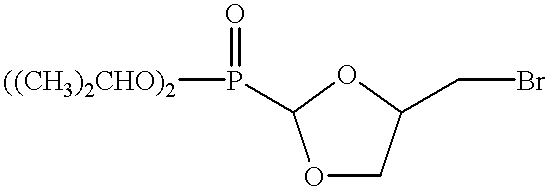
1H NMR (300 MHz, CDCl3) δ: 1.37 (d, 12H, J=6.1 Hz, CH(CH3)2), 3.50 (dd, 1H, J=8.9 Hz, 9.9 Hz, CH AHBBr), 3.58 (dd, 1H, J=5.3 Hz, 9.9 Hz, CHA H BBr), 4.14 (d, 2H, J=6.0 Hz, H-5), 4.41 (m, 1H, H-4), 4.80 (m, 2H, CH(CH3)2) and 5.18 (d, 1H, 2JHP=29.6 Hz, H-2).

To a solution of cis-4-(bromomethyl)-2-(diisopropyloxyphosphinoyl)-1,3-dioxolane (example 3) (400 mg, 1.21 mmol) in DMF (30 mL) was added cytosine (148 mg, 1.33 mmol, 1.1 eq.), and Cs2CO3 (787 mg, 2.42 mmol, 2.0 eq.). The mixture was stirred at 55° C. for 72 hr, then cooled to room temperature and filtered. The filtrate was evaporated to dryness and the residue was purified on silica gel using dichloromethane:methanol 4:1 as eluant to give the desired product (135 mg) as an oil in 31% yield.
1H NMR (300 MHz, CDCl3) δ: 1.37 (d, 12H, J=6.1 Hz, 2 CH(CH3)2), 3.72 (dd, 1H, J=9.9 Hz, 13.7 Hz, CH AHBN), 4.02 (d, 2H, J=5.5 Hz, H-5), 4.25 (dd, 1H, J=2.3 Hz, 13.6 Hz, CHA H BN), 4.68 (bs, 1H, H-4), 4.78 (m, 2H, CH(CH3)2), 5.09 (d, 1H, 2JHP=30.1 Hz, H-2), 5.81 (d, 1H, J=7.2 Hz, H-5′), 6.65 (bs, 2H, NH2) and 7.92 (d, 1H, J=7.2 Hz, H-6′).

To a solution of cis-4-(cytosin-1′-ylmethyl)-2-(diisopropyloxyphosphinoyl)-1,3-dioxolane (example 4) (135 mg, 0.374 mmol) in CH3CN (10 mL) was added trimethylsilyliodide (TMSI, 106 μL, 0.747 mmol, 2.0 eq.) at 0° C. The reaction mixture was stirred at room temperature for 4 days with successive addition of TMSI in two portions of 10 μL (0,2 eq.) after 30 hr and 75 hr. The solvent was removed under reduced pressure. The residue was taken in water and stirred for 18 hr. Water was removed by evaporation and the compound was triturated out upon the addition of methanol and ethyl acetate. The crude solid material (40 mg) was purified by reverse phase HPLC to give the desired product (19 mg) as a pale pink solid in 18% yield.
M.p. >210° C. (dec); UV λmax (H2O): 273 nm;
1H NMR (300 MHz, D2O) δ: 3.64 (dd, 1H, J=8.7 Hz, 14.4 Hz, CH AHBN), 3.80 (dd, 1H, J=4.7 Hz, 8.9 Hz, H-5a), 3.92 (dd, 1H, J=6.6 Hz, 8.8 Hz, H-5b), 4.06 (dd, 1H, J=2.9 Hz, 14.2 Hz, CHA H BN), 4.36 (m, 1H, H-4), 4.83 (d, 1H, 2JHP=23.1 Hz, H-2), 5.93 (d, 1H, J=7.7 Hz, H-5′) and 7.75 (d, 1H, J=7.7 Hz, H-6′).

To a solution of trans-4-(bromomethyl)-2-(diisopropyloxyphosphinoyl)-1,3-dioxolane (example 3) (600 mg, 1.81 mmol) in DMF (50 mL) was added cytosine (221 mg, 1.99 mmol, 1.1 eq.) and Cs2CO3 (1.18 g, 3.62 mmol, 2.0 eq.). The mixture was stirred at 55° C. for 72 hr, then cooled to room temperature and filtered. The filtrate was evaporated to dryness under reduced pressure and the residue was purified by flash chromatography on silica gel using dichloromethane:methanol 75:25 as eluant to give the desired product (269 mg) as a foam in 41% yield.
1H NMR (300 MHz, CDCl3) δ: 1.32 (d, 12H, J=5.5 Hz, CH(CH3)2), 3.77 (dd, 1H, J=5.9 Hz, 8.4 Hz, H-5a), 3.86 (dd, 1H, J=6.6 Hz, 14.3 Hz, CH AHBN), 4.10 (dd, 1H, J=2.5 Hz, 14.6 Hz, CHA H BN), 4.30 (dd, 1H, J=6.6 Hz, 8.2 Hz, H-5b), 4.65 (m, 1H, H-4), 4.75 (m, 2H, CH(CH3)2), 5.22 (d, 1H, 2JHP=30.7 Hz, H-2), 5.88 (d, 1H, J=7.2 Hz, H-5′), 6.9 (bs, 2H, NH2) and 7.37 (d, 1H, J=7.2 Hz, H-6′).

To a solution of trans-4-(cytosin-1′-ylmethyl)-2-(diisopropyloxyphosphinoyl)-1,3-dioxolane (example 6) (269 mg, 0.744 mmol) in CH3CN (20 mL) was added trimethylsilyliodide (212 μL, 1.49 mmol, 2.0 eq.) at 0° C. The reaction mixture was stirred at room temperature for 4 days with successive additions of TMSI in two portions of 20 μL (0,2 eq.) after 30 hr and 75 hr. The solvent was removed under reduced pressure. The residue was taken in water and was stirred for 18 hr. Water was evaporated in vacuo and the product was triturated out upon the addition of methanol and ethyl acetate. This material was then treated again under the same condition using TMSI (318 μL, 3 eq.) in CH3CN:DMF (20 mL:30 mL) for 4 days, and then quenched with water. After removal of water, the residue was crystallized from methanol and dichloromethane and consisted of a mixture of the desired compound and its monoisopropyl derivative in a 1:1 ratio. Further purification on reverse phase HPLC gave the fully deprotected desired product (55 mg) as a white solid in 27% yield. 
M.p. >235° C. (dec); UV λmax (H2O): 272 nm; 1H NMR (300 MHz, D2O) δ: 3.55 (dd, 1H, J=5.7 Hz, 5.7 Hz, H-5a), 3.75 (dd, 1H, J=7.2 Hz, 14.5 Hz, CH AHBN), 3.87 (d, 1H, J=14.5 Hz, CHA H BN), 4.05 (dd, 1H, J=6.5 Hz, 8.5 Hz, H-5b), 4.36 (m, 1H, H-4), 4.88 (d, 1H, 2JHP=22.8 Hz, H-2), 5.83 (d, 1H, J=7.4 Hz, H-5′) and 7.49 (d, 1H, J=7.4 Hz, H-6′);
13C NMR (75.46 MHz, D2O) δ: 57.2 (CH2N), 74.6 (d, 3JCOCP=5.5 Hz, C-5), 81.8 (d, 3JCOCP=5.3 Hz, C-4), 102.6 (C-5′), 107.7 (d, 1JCP=184 Hz, C-2), 154.8 (C-6′), 165 (C-2′) and 173 (C-4′). 
M.p. >180° C. (dec); UV λmax (H2O): 272 nm; 1H NMR (300 MHz, D2O) δ: 1.06 (d, 6H, J=6.2 Hz, CH(CH3)2), 3.59 (dd, 1H, J=5.6 Hz, 8.7 Hz, H-5a), 3.78 (dd, 1H, J=7.7 Hz, 14.5 Hz, CH AHBN), 3.93 (dd, 1H, J=3.0 Hz, 14.5 Hz, CHA H BN), 4.08 (dd, 1H, J=6.3 Hz, 8.5 Hz, H-5b), 4.34 (m, 1H, H-4), 4.39 (m, 1H, CH(CH3)2), 4.94 (d, 1H, 2JHP=24.6 Hz, H-2), 5.92 (d, 1H, J=7.5 Hz, H-5′) and 7.61 (d, 1H, J=7.6 Hz, H-6′).

To a solution of cis-4-(bromomethyl)-2-(diisopropyloxyphosphinoyl)-1,3-dioxolane (example 3) (400 mg, 1.21 mmol) in DMF (30 mL) was added adenine (180 mg, 1.33 mmol, 1.1 eq.) and Cs2CO3 (787 mg, 2.42 mmol, 2.0 eq.). The mixture was stirred at 60° C. for 54 hr, cooled to room temperature and filtered. The filtrate was evaporated to dryness under reduced pressure and the residue was purified by flash chromatography on silica gel using dichloromethane:methanol 85:15 as eluant to give the desired compound (174 mg) as a foam in 37% yield.
1H NMR (300 MHz, CDCl3) δ: 1.38 (d, 12H, J=6.1 Hz, CH(CH3)2), 4.12 (m, 2H, H-5), 4.43 (dd, 1H, J=3.0 Hz, 14.0 Hz, CH AHBN), 4.55 (dd, 1H, J=9.2 Hz, 13.9 Hz, CHA H BN), 4.67 (m, 1H, H-4), 4.83 (m, 2H, CH(CH3)2), 5.14 (d, 1H, 2JHP=29.8 Hz, H-2), 6.30 (bs, 2H, NH2), 8.30 (s, 1H, H-2′) and 8.34 (s, 1H, H-8′).

To a solution of cis-4-(adenin-9′-ylmethyl)-2-(diisopropyloxyphosphinoyl)-1,3-dioxolane (example 8) (174 mg, 0.452 mmol) in CH3CN (20 mL,) and DMF (5 mL) was added trimethylsilyliodide (193 μL, 1.35 mmol, 3.0 eq.) at 0° C. The reaction mixture was stirred at room temperature for a week and successive additions of trimethylsilyliodide after 39 hr (150 μL, 1.05 mmol) and 64 hr (125 μL, 0.878 mmol), for a total of 7.3 eq. The solvent was removed under reduced pressure and the residue was dissolved in water. The mixture was stirred for 12hr, followed by removal of water. The product was triturated out upon the addition of dichloromethane and ether. The crude solid material was further purified by reverse phase HPLC to give the desired product (36.5 mg) as a white solid in 27% yield.
MP >230° C. (dec); UV λmax (H2O): 261 nm; 1H NMR (300 MHz, D2O) δ: 3.87 (dd, 1H, J=4.4 Hz, 8.8 Hz, H-5a), 3.95 (dd, 1H, J=6.7 Hz, 8.8 Hz, H-5b), 4.30 (dd, 1H, J=8.3 Hz, 14.9 Hz, CH AHBN), 4.45 (d, 1H, J=14.9 Hz, CHA H BN), 4.47 (m, 1H, H-4), 4.82 (d, 1H, 2JHP=22.8 Hz, H-2), 8.29 (s, H, H-2′) and 8.32 (s, H, H-8′).

To a solution of trans-4-(bromomethyl)-2-(diisopropyloxyphosphinoyl)-1,3-dioxolane (example 3) (600 mg, 1.81 mmol) in DMF (50 mL) was added adenine (269 mg, 1.99 mmol, 1.1 eq.) and Cs2CO3 (1.18 g, 3.62 mmol, 2.0 eq.) and the mixture was stirred at 60° C. for 54 hr. The solution was cooled to room temperature, filtered and the solvent was removed under reduced pressure. The residue was purified by flash chromatography on silica gel using dichloromethane:methanol 85:15 as eluant to give the desired compound (339 mg) as a foam in 49% yield.
1H NMR (300 MHz, CDCl3) δ: 1.33 (d, 12H, J=6.2 Hz, CH(CH3)2), 3.77 (dd, 1H, J=5.3 Hz, 8.3 Hz, H-5a), 4.40 (m, 3H, CH2N and H-5b), 4.75 (m, 3H, H-4 and CH(CH3)2), 5.24 (d, 1H, 2JHP=29.7 Hz, H-2), 6.06 (bs, 2H, NH2), 7.95 (s, 1H, H-2′) and 8.35 (s, 1H, H-8′).

To a solution of trans-4-(adenin-9′-ylmethyl)-2-(diisopropyloxyphosphinoyl)-1,3-dioxolane (example 10) (339 mg, 0.880 mmol) in CH3CN (40 mL) and DMF (10 mL) was added trimethylsilyliodide (375 μL, 2.64 mmol, 3.0 eq.) at 0° C. The reaction mixture was stirred at room temperature for a week with successive additions of trimethylsilyliodide after 39 hr (300 μL, 2.11 mmol) and 64 hr (250 μL (1.76 mmol), for a total of 7.4 eq. The solvents were removed under reduced pressure, the residue was dissolved in water and the mixture was stirred for12 hr. After removal of water the residue was dissolved in methanol and triturated out upon additions of acetone, dichloromethane and ether. The crude solid material (468 mg) was further purified by reverse phase HPLC to give the desired product (200.5 mg) as a white solid in 76% yield.
M.p. >240° C. (dec); UV λmax (H2O): 258 nm; 1H-NMR (300 MHz, D2O) δ: 3.69 (dd, 1H, J=5.1 Hz, 8.8 Hz, H-5a), 4.14 (dd, 1H, J=6.4 Hz, 8.8 Hz, H-5b), 4.36 (dd, 1H, J=6.8 Hz, 14.5 Hz, CH AHBN), 4.41 (dd, 1H, J=3.5 Hz, 14.5 Hz, CHA H BN), 4.56 (m, 1H, H-4), 4.92 (d, 1H, 2JHP=24.2 Hz, H-2) and 8.28 (s, 2H, H-2′ and H-8′).

To a solution of cis-4-(bromomethyl)-2-(diisopropyloxyphosphinoyl)-1,3-dioxolane (example 3) (819 mg, 2.47 mmol) in DMF (75 mL) was added 6-chloroguanine (478 mg, 2.82 mmol, 1.1 eq.) and Cs2CO3 (1.66 g, 5.09 mmol, 2.1 eq.) and the mixture was stirred at 60° C. for 65 hr. The solution was cooled to room temperature, filtered and the solvent was removed under reduced pressure. The residue was purified by flash chromatography on silica gel using dichloromethane:methanol 93:7 as eluant to give the desired compound (310 mg) as a foam in 30% yield.
1H NMR (300 MHz, CDCl3) δ: 1.37 (d, 12H, J=6.1 Hz, CH(CH3)2), 4.11 (m, 2H, H-5), 4.28 (dd, 1H, J=3.0 Hz, 14.1 Hz, CH AHBN), 4.44 (dd, 1H, J=9.4 Hz, 14.1 Hz, CHA H BN), 4.63 (m, 1H, H-4), 4.81 (m, 2H, CH(CH3)2), 5.15 (bs, 2H, NH2), 5.14 (d, 1H, 2JHP=29.7 Hz, H-2) and 8.16 (s, 1H, H-8′).

To a solution of cis-4-(2′-amino-6′-chloropurin-9′-ylmethyl)-2-(diisopropyloxyphosphinoyl)-1,3-dioxolane (example 12) (310 mg, 0.738 mmol) in CH3CN (20 mL) and DMF (5 mL) was added trimethylsilyliodide (1050 μL, 7.38 mmol, 10.0 eq.) at 0° C. The reaction mixture was stirred at room temperature for 3 days and solvents were removed under reduced pressure. The residue was dissolved in water and the mixture was stirred for 24 hr. After removal of water the residue was dissolved in methanol-acetone and the product was triturated out upon addition of ether. This crude material (120 mg out of 397 mg) was further purified on reverse phase HPLC to give the desired product (37.5 mg) as a white solid in 16% yield
M.p.: >260° C.; UV λmax (H2O): 252 and 272 nm
1H NMR (300 MHz, D2O) δ: 3.88 (dd, 1H, J=4.4 Hz, 9.1 Hz, H-5a), 3.93 (dd, 1H, J=6.4 Hz, 9.1 Hz, H-5b), 4.17 (dd, 1H, J=7.9 Hz, 14.5 Hz, CH AHBN), 4.34 (dd, 1H, J=3.0 Hz, 14.5 Hz, CHA H BN), 4.46 (m, 1H, H-4), 4.82 (d, 1H, 2JHP=22.8 Hz, H-2) and 8.66 (s, 1H, H-8′).

To a solution of trans-4-(bromomethyl)-2-(diisopropyloxyphosphinoyl)-1,3-dioxolane (example 3) (2.50 g, 7.55 mmol) in DMF (180 mL) was added 6-chloro-2-aminopurine (1.41 g, 8.31 mmol, 1.1 eq.) and Cs2CO3 (4.90 g, 15.0 mmol, 2.0 eq.) and the mixture was stirred at 60° C. for 65 hr. The solution was cooled to room temperature, filtered and the solvent was removed under reduced pressure. The residue was purified by flash chromatography on silica gel using dichloromethane:methanol 93:7 as eluant to give the product (1.874 g) as a foam in 59% yield.
1H NMR (300 MHz, CDCl3) δ: 1.32 (2d, 12H, J=6.1 Hz, CH(CH3)2), 3.77 (dd, 1H, J=5.2 Hz, 8.1 Hz, H-5a), 4.24 (dd, 1H, J=5.6 Hz, 14.7 Hz, CH AHBN), 4.32 (dd, 1H, J=3.6 Hz, 14.8 Hz, CHA H BN), 4.37 (dd, 1H, J=6.7 Hz, 8.3 Hz, H-5b), 4.76 (m, 3H, H-4 and CH(CH3)2), 5.12 (bs, 2H, NH2), 5.24 (d, 1H, 2JHP=29.4 Hz, H-2) and 7.88 (s, 1H, H-8′).

To a solution of trans-4-(2′-amino-6′-chloropurin-9′-ylmethyl)-2-(diisopropyloxyphosphinoyl)-1,3-dioxolane (example 14) (818 mg, 1.95 mmol) in CH3CN (40 mL) and DMF (10 mL) was added trimethylsilyliodide (2.25 mL, 15.8 mmol, 8.1 eq.) at 0° C. The reaction mixture was stirred at room temperature for 3 days and the solvents were removed under reduced pressure. The residue was dissolved in water, stirred for 24 hr and water was removed under reduced pressure. The residue was dissolved in methanol and the product was precipitated out by adding acetone and ether. A part of this crude material (450 mg out of 1.041 g) was dissolved in water, poured on a SEPHADEX(microscopic polysaccharide dextran derivative beads) DEAE A-25 column and eluted with a gradient of 0 to 0.3 M of NH4HCO3 solution (1L), and with 0.3 M of NH4HCO3 solution (100 mL) to give the desired product (100 mg) as ammonium salt.
UV λmax (H2O): 251.8 and 270.0 nm 1H NMR (300 MHz, DMSO) δ: 3.58 (dd, 1H, J=5.4 Hz, 7.5 Hz, H-5a), 4.05 (m, 3H, H-5b, CH2N), 4.51 (m, 1H, H-4), 4.93 (d, 1H, 2JHP=22.0 Hz, H-2), 6.54 (s, 2H, NH2), 7.26 (bs, 4H, NH4) and 7.66 (s, 1H, H-8′).

To a solution of uracil (223 mg, 1.99 mmol, 1.1 eq) in DMF (15 mL) was added sodium hydride (80 mg of a 60% dispersion in oil, 1.99 mmol, 1.1 eq) and the mixture was stirred at room temperature for 1 hr. Then a solution of cis-4-(bromomethyl)-2-(diisopropyloxyphosphinoyl)-1,3-dioxolane (600 mg, 1.81 mmol) (example 3) in DMF (15 mL) was added. The mixture was stirred at 70° C. for 48 hr. The solution was cooled to room temperature, and the solvent was evaporated. A saturated solution of ammonium chloride was added and the aqueous phase was extracted with dichloromethane. The organic layer was dried over anhydrous sodium sulphate and evaporated under reduced pressure. The crude material was purified by flash chromatography with a mixture of ethylacetate and methanol (95:5) to give the pure compound (97 mg) in 15% yield.
1H NMR (300 MHz, CDCl3) δ: 1.35 (2d, 12H, J=5.5 Hz, CH(CH3)2), 3.71 (dd, 1H, J=10.2 Hz, 13.8 Hz, CH AHBN), 4.03 (d, 2H, J=5.8 Hz, H-5), 4.17 (dd, 1H, J=2.3 Hz, 13.8 Hz, CHA H BN), 4.63 (m, 1H, H-4), 4.77 (m, 2H, CH(CH3)2), 5.10 (d, 1H, 2JHP=29.9 Hz, H-2), 5.63 (dd, 1H, J=2.2 Hz, 7.9 Hz, H-5′), 7.90 (d, 1H, J=7.9 Hz, H-6′) and 9.40 (bs, 1H, NH).

To a solution of cis-2-(diisopropyloxyphosphinoyl)-4-luracil-1′-ylmethyl)-1,3-dioxolane (example 16) (97 mg, 0.268 mmol) in CH3CN (8 mL) and DMF (2 mL) was added trimethylsilylbromide (800 μL, 6.06 mmol, 23 eq.) at 0° C. The reaction mixture was stirred at R.T. for 2 days and the solvents were evaporated to dryness. Water and ammonium hydroxide were added and the mixture was stirred for 5 hr; then water was evaporated to get a solid. The crude compound was dissolved in water and poured on a SEPHADEX (microscopic polysaccharide dextran derivative beads) DEAE A-25 column and eluted with a gradient of 0 to 0.2 M of NH4HCO3 (500 mL of water and 500 mL of 0.2 M NH4HCO3). The appropriate fractions were evaporated to give 110 mg of a white solid, which was purified by reverse phase HPLC to remove the excess of NH4HCO3 and the pure compound was obtained in 58% yield (45.5 mg).
1H NMR (300 MHz, DMSO) δ: 3.75 (m, 2H, H-5a and CH AHBN), 3.88 (dd, 1H, J=3.2 Hz, 8.3 Hz, H-5b), 3.94 (dd, 1H, J=2.6 Hz, 13.5 Hz, CHA H BN), 4.17 (m, 1H, H-4), 4.74 (d, 1H, 2JHP=20.5 Hz, H-2), 5.45 (d, 1H, J=7.8 Hz, H-5′) and 8.27 (d, 1H, J=7.8 Hz, H-6′). UV λmax (H2O): 264.4 nm.

To a solution of uracil (223 mg, 1.99 mmol, 1.1 eq) in DMF (15 mL) was added sodium hydride (80 mg of a 60% dispersion in oil, 1.99 mmol, 1.1 eq) and the mixture was stirred at room temperature for 1 hr. Then a solution of trans-4-(bromomethyl)-2-(diisopropyloxyphosphinoyl)-1,3-dioxolane (example 3) (600 mg, 1.81 mmol) in DMF (15 mL) was added. The mixture was stirred at 70° C. for 48 hr. The solution was cooled to room temperature, and the solvent was evaporated. A saturated solution of ammonium chloride was added and the aqueous phase was extracted with dichloromethane. The organic layer was dried over anhydrous sodium sulphate and evaporated under reduced pressure. The crude material was purified by flash chromatography with a mixture of ethylacetate and methanol (95:5) to give the pure compound (114 mg) in 17% yield.
1H NMR (300 MHz, CDCl3) δ: 1.33 (2d, 12H, J=5.5 Hz, CH(CH3)2), 3.79 (dd, 1H, J=5.5 Hz, 8.5 Hz, H-5a), 3.86 (dd, 1H, J=6.3 Hz, 14.6 Hz, CH AHBN), 4.02 (dd, 1H, J=3.0 Hz, 14.6 Hz, CHA H BN), 4.36 (dd, 1H, J=6.6 Hz, 8.5 Hz, H-5b), 4.66 (m, 1H, H-4), 4.75 (m, 2H, CH(CH3)2), 5.25 (d, 1H, 2JHP=29.7 Hz, H-2), 5.70 (dd, 1H, J=2.4 Hz, 8.0 Hz, H-5′), 7.29 (d, 1H, J=8.0 Hz, H-6′) and 8.95 (bs, 1H, NH).

To a solution of trans-2-(diisopropyloxyphosphinoyl)-4-(uracil-1′-ylmethyl)-1,3-dioxolane (example 18) (114 mg, 0.315 mmol) in CH3CN (8 mL) and DMF (2 mL) was added trimethylsilylbromide (800 μL, 6.06 mmol, 19 eq.) at 0° C. The reaction mixture was stirred at R.T. for 2 days and the solvents were evaporated to dryness. Water and ammonium hydroxide were added and the mixture was stirred for 5 hr; then water was evaporated to get a solid. The crude compound was dissolved in water and poured on a SEPHADEX (microscopic polysaccharide dextran derivative beads) DEAE A-25 column and eluted with a gradient of 0 to 0.3 M of NH4HCO3 (500 mL of water and 500 mL of 0,3 M NH4HCO3). The appropriate fractions were evaporated to give 70 mg of a white solid, which was purified by reverse phase HPLC to remove the excess of NH4HCO3 and the pure compound was obtained in 61% yield (56.6 mg).
1H NMR (300 MHz, DMSO) δ: 3.49 (dd, 1H, J=5.1 Hz, 7.8 Hz, H-5a), 3.68 (dd, 1H, J=7.5 Hz, 14.2 Hz, CH AHBN), 3.84 (dd, 1H, J=3.6 Hz, 14.2 Hz, CHA H BN), 4.08 (dd, 1H, J=6.9 Hz, 7.8 Hz, H-5b), 4.35 (m, 1H, H-4), 4.85 (d, 1H, 2JHP=19.9 Hz, H-2), 5.54 (d, 1H, J=7.9 Hz, H-5′) and 7.58 (d, 1H, J=7.9 Hz, H-6′).
13C NMR (75.46 MHz, DMSO) δ: 49.6 (CH2N), 67.1 (C-5), 73.6 (C-4), 100.9 (C-5′), 103.1 (d, 1JCP=182 Hz, C-2), 146.8 (C-6′), 151.5 (C-2′) and 164.1 (C-4′). UV λmax (H2O): 264.9 nm.

To a solution of thymine (209 mg, 1.66 mmol, 1.1 eq) in DMF (10 mL) was added sodium hydride (66 mg of a 60% dispersion in oil, 1.66 mmol, 1.1 eq) and the mixture was stirred at room temperature for 2 hr. Then a solution of cis-4-(bromomethyl)-2-(diisopropyloxyphosphinoyl)-1,3-dioxolane (example 3) (502 mg, 1.52 mmol) in DMF (10 mL) was added. The mixture was stirred at 70° C. for 72 hr. The solution was cooled to room temperature, and the solvent was evaporated. A saturated solution of sodium bicarbonate was added and the aqueous phase was extracted with dichloromethane. The organic layer was dried over anhydrous sodium sulphate and evaporated under reduced pressure. The crude material was purified by flash chromatography with a mixture of ethylacetate and methanol (95:5) to give the pure compound (78 mg) in 15% yield.
1H NMR (300 MHz, CDCl3) δ: 1.38 (2d, 12H, J=6.0 Hz, CH(CH3)2), 1.91 (s, 3H, CH3), 3.69 (dd, 1H, J=10.1 Hz, 14.0 Hz, CH AHBN), 4.03 (d, 2H, J=5.7 Hz, H-5), 4.15 (dd, 1H, J=2.4 Hz, 13.9 Hz, CHA H BN), 4.63 (m, 1H, H-4), 4.79 (m, 2H, CH(CH3)2), 5.11 (d, 1H, 2JHP=29.8 Hz, H-2), 7.71 (s, 1H, H-6′) and 8.4 (bs, 1H, NH).

To a solution of cis-2-(diisopropyloxyphosphinoyl)-4-(thymin-1′-ylmethyl)-1,3-dioxolane (example 20) (77 mg, 0.205 mmol) in CH3CN (8 mL) and DMF (2 mL) was added trimethylsilylbromide (900 μL, 6.82 mmol, 33 eq.) at 0° C. The reaction mixture was stirred at R.T. for 4 days and the solvents were evaporated to dryness. Water and ammonium hydroxide were added and the mixture was stirred for a few hr; then water was evaporated to get a solid. The crude compound was dissolved in water and poured on a SEPHADEX (microscopic polysaccharide dextran derivative beads) DEAE A-25 column and eluted with a gradient of 0 to 0.2 M of NH4HCO3 (500 mL of water and 500 mL of 0,2 M NH4HCO3). The appropriate fractions were evaporated to give a white solid, which was purified by reverse phase HPLC to remove the excess of NH4HCO3 and the pure compound was obtained in 17% yield (11 mg).
1H NMR (300 MHz, DMSO) δ: 1.73 (s, 3H, CH3), 3.83 (m, 4H, CH2N and H-5), 4.16 (m, 1H, H-4), 4.74 (d, 1H, 2JHP=20.0 Hz, H-2), and 8.13 (s, 1H, H-6′). UV λmax (H2O): 270.2 nm.

To a solution of thymine (251 mg, 1.99 mmol, 1.1 eq) in DMF (15 mL) was added sodium hydride (80 mg of a 60% dispersion in oil, 1.99 mmol, 1.1 eq) and the mixture was stirred at room temperature for 2 hr. Then a solution of trans-4-(bromomethyl)-2-(diisopropyloxyphosphinoyl)-1,3-dioxolane (example 3) (600 mg, 1.81 mmol) in DMF (10 mL) was added. The mixture was stirred at 70° C. for 72 hr. The solution was cooled to room temperature, and the solvent was evaporated. A saturated solution of ammonium chloride was added and the aqueous phase was extracted with dichloromethane. The organic layer was dried over anhydrous sodium sulphate and evaporated under reduced pressure. The crude material was purified by flash chromatography with a mixture of ethylacetate and methanol (95:5) to give the pure compound (99 mg) in 15% yield.
1H NMR (300 MHz, CDCl3) δ: 1.34 (2d, 12H, J=3.7 Hz, CH(CH3)2), 1.91 (s, 3H, CH3), 3.80 (m, 2H, CH AHBN and H-5a), 4.00 (dd, 1H, J=3.0 Hz, 14.6 Hz, CHA H BN), 4.34 (dd, 1H, J=6.6 Hz, 8.3 Hz, H-5b), 4.65 (m, 1H, H-4), 4.76 (m, 2H, CH(CH3)2), 5.25 (d, 1H, 2JHP=30.0 Hz, H-2), 7.12 (s, 1H, H-6′) and 9.13 (bs, 1H, NH).

To a solution of trans-2-(diisopropyloxyphosphinoyl)-4-(thymin-1′-ylmethyl)-1,3-dioxolane (example 22) (99 mg, 0.263 mmol) in CH3CN (8 mL) and DMF (2 mL) was added trimethylsilylbromide (800 μL, 6.06 mmol, 23 eq.) at 0° C. The reaction mixture was stirred at R.T. for 3 days and the solvents were evaporated to dryness. Water and ammonium hydroxide were added and the mixture was stirred for a few hr; then water was evaporated to get a solid. The crude compound was dissolved in water and poured on a SEPHADEX (microscopic polysaccharide dextran derivative beads) DEAE A-25 column and eluted with a gradient of 0 to 0,2 M of NH4HCO3 (500 mL of water and 500 mL of 0.2 M NH4HCO3). The appropriate fractions were evaporated to give 70 mg of a white solid, which was purified by reverse phase HPLC to remove the excess of NH4HCO3 and the pure compound was obtained in 31% yield (25.3 mg).
1H NMR (300 MHz, DMSO) δ: 1.75 (s, 3H, CH3), 3.50 (dd, 1H, J=5.1 Hz, 7.8 Hz, H-5a), 3.65 (dd, 1H, J=7.7 Hz, 14.1 Hz, CH AHBN), 3.80 (dd, 1H, J=3.6 Hz, 14.0 Hz, CHA H BN), 4.07 (dd, 1H, J=7.3 Hz, 7.3 Hz, H-5b), 4.36 (m, 1H, H-4), 4.88 (d, 1H, 2JHP=20.6 Hz, H-2) and 7.47 (s, 1H, H-6′). UV λmax (H2O): 270.4 nm.

To a solution of 3-mercapto-1,2-propanediol (5.00 g, 46.23 mmol) and imidazole (3.78 g, 55.47 mmol) in dimethylformamide (30 mL) was added t-butyldiphenylsilyl chloride (12.71 g, 46.23 mmol) at room temperature. After stirring for 18 h the reaction was quenched by the addition of saturated sodium bicarbonate and the mixture was extracted with ether (3×). The combined ether extracts were washed with water (2×), brine, dried and concentrated to give a yellow oil. The crude material was purified by flash chromatography with a mixture of hexanes and ethyl acetate (90:10) to give the compound as a colourless oil (14.12 g) in 88% yield.
1H NMR (300 MHz, CDCl3) d: 1.08 (s, 9H, t-butyl), 1.39 (t, 1H, J=9 Hz, SH), 1.95 (bs, 1H, OH), 2.68 (dd, 2H, J=9 Hz, 5.5 Hz, H-3), 3.72 (m, 3H, H-1 and H-2), 7.43 and 7.66 (m, 10H, Ar—H).

A solution of triethylorthoformate (0.64 g, 4.33 mmol), 1-t-butyldiphenylsilyloxy-3-mercapto-2-propanol (example 24) (5.00 g, 46.23 mmol) and p-toluenesulfonic acid (20 mg) in toluene (60 mL) was heated to reflux for 2 h. The solvent was removed under reduced pressure to give a yellow oil. The oil was dissolved in dichloromethane (20 mL), zinc chloride (20 mg) was added along with triethyl phosphite (0.32 g, 1.93 mmol) at 0° C., followed by the addition of phosphorous trichloride (0.13 g, 0.95 mmol). After stirring at room temperature for 18 h the solvent was removed under reduced pressure to give a colorless oil. The crude material was purified by flash chromatography with a mixture of hexanes and ethyl acetate (50:50) to give the compound as a colorless oil (0.97 g) in 67% yield as a mixture of cis and trans isomers (1:3.5).
1H NMR (300 MHz, CDCl3) d: 1.03 (s, 9H, t-butyl), 1.32 (t, 6H, J=7.0 Hz, CH3), 3.02 (m, 1H, H-4a), 3.18 and 3.24 (2dd, 1H, J=10.0 Hz, 6.0 Hz, H-4b), 3.72 (m, 2H, CH2OSi), 4.20 (m, 4H, CH 2CH3), 4.64 (p, 1H, J=6 Hz, H-5), 5.25 and 5.27 (2d, 1H, 2JHP=9 Hz, H-2), 7.38 and 7.63 (m, 10H, Ar—H).

To a solution of cis and trans-5-t-butyldiphenylsilyloxymethyl-2-diethyloxyphosphinoyl-1,3-oxathiolane (example 25) (0.97 g, 1.94 mmol) in tetrahydrofuran (30 mL) was added a solution of tetrabutylammoniun fluoride (1.0 M in THF) (2.33 mL, 2.33 mmol). After stirring at room temperature for 18 hr the reaction was quenched by the addition of saturated ammonium chloride. The resulting mixture was extracted with ethyl acetate (3×), the combined organic extracts were washed with water, dried and concentrated to give a yellow oil. The crude material was purified by flash chromatography with ethyl acetate to give the compound as a colorless oil (0.25 g) in 55% yield.
1H NMR (300 MHz, CDCl3) d: 1.36 and 1.37 (2t, 6H, J=7 Hz, CH3), 2.01 (bs, 1H, OH), 2.99 (dd, 1H, J=10 Hz, 7 Hz, H-4a), 3.25 (dd, 1H, J=10 Hz, 6 Hz, H-4b), 3.69 (dd, 1H, J=12 Hz, 5 Hz, CH AHBOH), 3.86 (dd, 1H, J=12 Hz, 4 Hz, CHA H BOH), 4.23 (m, 4H, CH2CH3), 4.66 (m, 1H, H-5), 5.36 (d, 1H, 2JHP=9 Hz, H-2).

To a solution of trans-2-diethyloxyphosphinoyl-5-hydroxymethyl-1,3-oxathiolane (example 26) (0.24 g, 0.91 mmol) in pyridine (10 mL) was added p-toluenesulfonyl chloride (0.23 g, 1.18 mmol) at 0° C. The mixture was then placed in the refrigerator. After 18 h the reaction mixture was poured into ice-water and extracted with ethyl acetate (2×). The combined organic extracts were washed with water, 0.5N HCl (2×), water, dried and then concentrated to give a yellow oil. The crude material was purified by flash chromatography with a mixture of ethyl acetate and hexanes (60:40) to give the compound as a colorless oil (0.28 g) in 72% yield.
1H NMR (300 MHz, CDCl3) d: 1.31 (t, 6H, J=7 Hz, CH3), 2.45 (s, 3H, ArCH3), 2.88 (dd, 1H, J=11 Hz, 5 Hz, H-4a), 3.28 (dd, 1H, J=11 Hz, 6 Hz, H-4b), 4.05 (dd, 2H, J=5 Hz, 1 Hz, CH2OTs), 4.16 and 4.17 (2q, 4H, CH 2CH3), 4.69 (p, 1H, J=6 Hz, H-5), 5.19 (d, 1H, J=8.5 Hz, H-2), 7.33 and 7.77 (m, 4H, Ar—H).

A mixture of trans-2-diethyloxyphosphinoyl-5-p-toluenesulfonyloxymethyl-1,3-oxathiolane (example 27) (0.27 g, 0.66 mmol), 2-amino-6-chloropurine (0.22 g, 1.29 mmol) and cesium carbonate (0.45 g, 1.24 mmol) in dimethylformamide (30 mL) was stirred at 65° C. for 18 h. The solvent was removed under reduced pressure and the residue was purified by flash chromatography with a mixture of ethyl acetate and methanol (93:7) to give the compound as a white foam (0.15 g) in 60% yield.
1H NMR (300 MHz, CDCl3) d: 1.25 and 1.27 (2t, 6H, J=7 Hz, CH3), 2.76 (dd, 1H, J=11 Hz, 6 Hz, H-4a), 3.33 (dd, 1H, J=11 Hz, 6 Hz, H-4b), 4.12 and 4.13 (2q, 4H, CH 2CH3), 4.24 (dd, 1H, J=14.5 Hz, 6 Hz, CH A H BN), 4.32 (dd, 1H, J=14.5 Hz, 3.5 Hz, CHA H BN), 4.88 (m, 1H, H-5), 5.31 (d, 1H, 2JHP=8 Hz, H-2), 7.82(s, 1H, H-8′).

To a solution of trans-2-diethyloxyphosphinoyl-5-(2′-amino-6′-chloropurin-9′-ylmethyl)-1,3-oxathiolane (example 28) (0.086 g, 0.23 mmol) in dichloromethane (2 mL) was added trimethylsilylbromide (0.35 g, 2.31 mmol) at room temperature. After 18 hr, the solvent was removed under reduced pressure and the residue was triturated in methanol and the solvent removed (2×). The residue was recrystallized from ethanol. Upon heating in ethanol the 2-amino-6-chloropurine was converted to guanine to give the compound as a white solid (0.07 g) in 91% yield.
MP: >300° C.; UV lmax: (H2O): 271, 252 nm.
1H NMR (300 MHz, DMSO) d: 2.90 (dd, 1H, J=10 Hz, 5 Hz, H-4a), 3.16 (dd, 1H, J=10 Hz, 6 Hz, H-4b), 4.12 (dd, 2H, J=4 Hz, 3 Hz, CH2N), 4.76 (p, 1H, J=5.5 Hz, H-5), 5.27 (d, 1H, 2JHP=7 Hz, H-2), 6.46 (s, 2H, NH2), 7.68 (s, 1H, H-8′), 10.54 (s, 1H, NH).
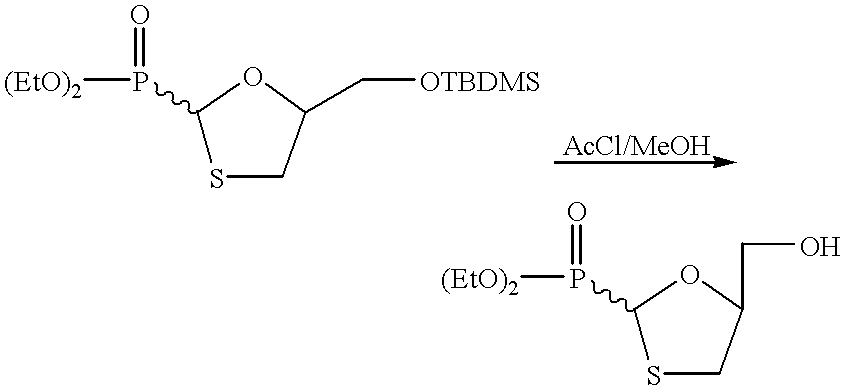
To a solution of cis and trans-5-t-butyldimethylsilyloxymethyl-2-(diethyloxyphosphinoyl)-1,3-oxathiolane (example 25) (4.00 g, 10.8 mmol) in MeOH (30 mL) was added a few drops of acetyl chloride (200 μL) at 0° C. The mixture was stirred at 0° C. for 1 hr. and at room temperature for 18 hr. A few drops of ammonium chloride was added and the solvent was evaporated under reduced pressure. The crude material was purified by several flash chromatography with a mixture of dichloromethane and methanol (96:4) to give 382 mg of the cis isomer , 1.19 g of the trans isomer and 332 mg of the mixture in a total yield of 80% after the first purification.
cis isomer 
1H NMR (300 MHz, CDCl3) δ: 1.37 (t, 6H, J=7.0 Hz, CH3), 3.03 (dd, 1H, J=5.4 Hz, 10.8 Hz, H-4a), 3.31 (dd, 1H, J=9.0 Hz, 10.9 Hz, H-4b), 3.74 (dd, 1H, J=4.0 Hz, 12.3 Hz, CH AHBOH), 3.98 (dd, 1H, J=2.9 Hz, 12.4 Hz, CHA H BOH), 4.24 (m, 4H, CH2), 4.40 (m, 1H, H-5), 5.30 (d, 1H, 2JHP=9.6 Hz, H-2).
trans isomer 
1H NMR (300 MHz, CDCl3) δ: 1.37 (m, 6H, CH3), 2.05 (bs, 1H, OH), 3.00 (dd, 1H, J=7.0 Hz, 10.2 Hz, H-4a), 3.25 (dd, 1H, J=6.3 Hz, 10.4 Hz, H-4b), 3.69 (dd, 1H, J=4.9 Hz, 11.9 Hz, CH AHBOH), 3.85 (dd, 1H, J=3.9 Hz, 11.9 Hz, CHA H BOH), 4.23 (m, 4H, CH2), 4.65 (m, 1H, H-5), 5.36 (d, 1H, 2JHP=8.6 Hz, H-2).

To a solution of cis-2-(diethyloxyphosphinoyl)-5-hydroxymethyl-1,3-oxathiolane (example 30) (220 mg, 0.859 mmol), triphenylphosphine (450 mg, 1.717 mmol, 2 eq) and 6-chloroguanine (291 mg, 1.717 mmol, 2 eq) in DMF (10 mL) was added diisopropylazodicarboxylate (338 μL, 1.717 mmol, 2 eq) at −10° C. The mixture was stirred at −10° C. for 3 hr. and at room temperature for 18 hr. The solvent was evaporated under reduced pressure and the crude material was purified by flash chromatography with a mixture of ethyl acetate and methanol (95:5) to give the compound (105 mg) in a 30% yield.
1H NMR (300 MHz, CDCl3) δ: 1.35 (2t, 6H, J=7.2 Hz, CH3), 3.03 (dd, 1H, J=8.2 Hz, 11.0 Hz, H-4a), 3.18 (dd, 1H, J=5.2 Hz, 10.9 Hz, H-4b), 4.23 (m, 4H, CH2), 4.42 (d, 2H, J=5 Hz, CH2N), 4.59 (m, 1H, H-5), 5.08 (bs, 2H, NH2), 5.28 (d, 1H, 2JHP=8.8 Hz, H-2), 7.99 (s, 1H, H-8′).

To a solution of cis-5-(2′-amino-6′-chloropurin-9′-ylmethyl)-2-(diethyloxyphosphinoyl)-1,3-oxathiolane (example 31) (105 mg, 0.257 mmol) in dichloromethane (10 mL) was added TMSBr (1.02 mL, 7.72 mmol, 30 eq) at room temperature. The mixture was stirred at room temperature for 16 hr and the solvent was evaporated to dryness. Methanol was added and evaporated. Then water was added and the solution was heated at 100° C. for 24 hr to convert 6-chloroguanine to guanine. Water was evaporated, followed by the addition of water and ammonium hydroxide and reevaporated again to get a solid which was purify by reverse phase HPLC to give the compound (13 mg) in a 14% yield.
1H NMR (300 MHz, D2O) δ: 2.60 (dd, 1H, J=7.7 Hz, 10.3 Hz, H-4a), 2.98 (dd, 1H, J=4.8 Hz, 10.3 Hz, H-4b), 4.19 (m, 3H, CH2N and H-5), 4.84 (d, 1H, 2JHP=3.4 Hz, H-2), 7.81 (s, 1H, H-8′). UV λmax (H2O): 253.1 and 270.7 nm.

To a solution of trans-2-(diethyloxyphosphinoyl)-5-hydroxymethyl-1,3-oxathiolane (example 30) (400 mg, 1.56 mmol), triphenylphosphine (819 mg, 3.12 mmol, 2 eq) and thymine (394 mg, 3.12 mmol, 2 eq) in DMF (15 mL) was added DEAD (492 μL, 3.12 mmol, 2 eq) at −30° C. The mixture was stirred at −30° C. for 3 hr. and at room temperature for 18 hr. The solvent was evaporated and the crude material was purified by flash chromatography with a mixture of ethyl acetate and methanol (95:5) to give the compounds (223 mg) in a 39% yield. The ratio of N1:N3 is 1:2.
1H NMR (300 MHz, CDCl3) δ: 1.32 (m, 6H, CH3), 1.90 and 1.91 (2s, 3H, CH3), 2.87 (dd, 0.33H, J=6.0 Hz, 10.5 Hz, H-4a for N1), 3.00 (dd, 0.66H, J=3.0 Hz, 10.7 Hz, H-4a for N3), 3.27 (dd, 0.66H, J=6.0 Hz, 10.8 Hz, H-4b for N3), 3.35 (dd, 0.33H, J=6.0 Hz, 10.8 Hz, H-4b for N1), 3.89 (m, 1H, CH AHBN), 4.03 (dd, 0.33H, J=3.3 Hz, 14.5 Hz, CHA H BN for N1), 4.19 (m, 4H, CH2), 4.41 (dd, 0.66H, J=8.5 Hz, 13.4 Hz, CHA H BN for N3), 4.79 (m, 0.33H, H-5 for N1), 4.97 (m, 0.66H, H-5 for N3), 5.34 (d, 0.33H, 2JHP=8.2 Hz, H-2 for N1), 5.53 (d, 0.66H, 2JHP=10.7 Hz, H-2 for N3), 7.03 (d and s, 1H, H-6′), 9.0 (bs, 0.33H, NH for N1), 9.7 (bs, 0.66H, NH for N3).

To a solution of trans-2-(diethyloxyphosphinoyl)-5-(thymin-1′-ylmethyl)-1,3-oxathiolane and trans-2-(diethyloxyphosphinoyl)-5-(thymin-3′-ylmethyl)-1,3-oxathiolane (example 33) (200 mg, 0.55 mmol) in dichloromethane (10 mL) was added TMSBr (1.8 mL, 13.7 mmol, 25 eq) at room temperature. The mixture was stirred at room temperature for 18 hr and the solvent was evaporated to dryness. Methanol was added and evaporated. Water and ammonium hydroxide were added and evaporated to get a solid which was purifed by reverse phase HPLC to give the compound 25 mg of the N1 isomer, 41 mg of the N3 isomer and 45.8 mg of mixture in a 66% total yield.
N1 isomer 
1H NMR (300 MHz, DMSO) δ: 1.74 (s, 3H, CH3), 2.62 (dd, 1H, J=6.3 Hz, 10.2 Hz, H-4a), 3.04 (dd, 1H, J=6.2 Hz, 10.2 Hz, H-4b), 3.78 (m, 2H, CH2N), 4.61 (m, 1H, H-5), 4.96 (d, 1H, 2JHP=3.5 Hz, H-2), 7.46 (s, 1H, H-6′).
13C NMR (75.46 MHz, DMSO) δ: 12.3 (CH3), 34.1 (C-4), 49.3 (CH2N), 79.9 (d, 3JCP=4.2 Hz, C-5), 81.6 (d, 1JCP=160.8 Hz, C-2), 108.5 (C-5′), 142.5 (C-6′), 151.5 (C-2′), 164.7 (C-4′). UV λmax (H2O): 270.4 nm. MP: >230° C.
N3 isomer 
1H NMR (300 MHz, DMSO) δ: 1.78 (s, 3H, CH3), 2.72 (dd, 1H, J=4.8 Hz, 10.3 Hz, H-4a), 2.98 (dd, 1H, J=6.0 Hz, 10.3 Hz, H-4b), 3.76 (dd, 1H, J=5.8 Hz, 12.9 Hz, CH AHBN), 4.10 (dd, 1H, J=7.1 Hz, 12.9 Hz, CHA H BN), 4.66 (m, 1H, H-5), 4.97 (d, 1H, 2JHP=4.5 Hz, H-2), 7.31 (s, 1H, H-6′).
13C NMR (75.46 MHz, DMSO) δ: 12.9 (CH3), 34.8 (C-4), 42.1 (CH2N), 79.6 (d, 3JCP=4.9 Hz, C-5), 81.3 (d, 1JCP=162.9 Hz, C-2), 107.5 (C-5′), 136.9 (C-6′), 151.9 (C-2′), 164.3 (C-4′). UV λmax (H2O): 264.9 nm. MP: >230° C.

To a solution of trans-2-(diethyloxyphosphinoyl)-5-hydroxymethyl-1,3-oxathiolane (example 30) (300 mg, 1.17 mmol), triphenylphosphine (614 mg, 2.34 mmol, 2 eq) and uracil (262 mg, 2.34 mmol, 2 eq) in DMF (10 mL) was added DIAD (461 μL, 2.34 mmol, 2 eq) at −10° C. The mixture was stirred at −10° C. for 2 hr. and at room temperature for 18 hr. The solvent was evaporated and the crude material was purified by flash chromatography with a mixture of ethyl acetate and methanol (95:5) to give the compounds (139 mg) in a 34% yield. The ratio of N1:N3 is ˜1:1.
1H NMR (300 MHz, CDCl3) δ: 1.34 (m, 6H, CH3), 2.88 (dd, 0.5H, J=6.3 Hz, 10.7 Hz, H-4a for N1), 2.98 (dd, 0.5H, J=3.2 Hz, 10.6 Hz, H-4a for N3), 3.27 (dd, 0.5H, J=5.8 Hz, 10.5 Hz, H-4b for N3), 3.38 (dd, 0.5H, J=6.2 Hz, 10.8 Hz, H-4b for N1), 3.90 (m, 1H, CH AHBN), 4.06 (dd, 0.5H, J=3.3 Hz, 14.8 Hz, CHA H BN for N1), 4.20 (m, 4H, CH2), 4.40 (dd, 0.5H, J=8.8 Hz, 13.7 Hz, CHA H BN for N3), 4.80 (m, 0.5H, H-5 for N1), 4.97 (m, 0.5H, H-5 for N3), 5.33 (d, 0.5H, 2JHP=8.1 Hz, H-2 for N1), 5.52 (d, 0.5H, 2JHP=10.9 Hz, H-2 for N3), 5.71 (m, 1H, H-5′), 7.20 (dd, 0.5H, J=6.5 Hz, 6.5 Hz, H-6′ for N3), 7.27 (d, 0.5H, J=7.8 Hz, H-6′ for N1), 9.18 (bs, 0.5H, NH for N1), 9.96 (bs, 0.5H, NH for N3).

To a solution of trans-2-(diethyloxyphosphinoyl)-5-(uracil-1′-ylmethyl)-1,3-oxathiolane and trans-2-10 (diethyloxyphosphinoyl)-5-(uracil-3′-ylmethyl)-1,3-oxathiolane (example 35) (139 mg, 0.397 mmol) in dichloromethane (10 mL) was added TMSBr (1.3 mL, 9.9 mmol, 25 eq) at room temperature. The mixture was stirred at room temperature for 18 hr and the solvent was evaporated to dryness. Methanol was added and evaporated. Water and ammonium hydroxide were added and evaporated to get a solid which was purified by reverse phase HPLC to give 30 mg of the N1 isomer and 20.6 mg of N3 isomer in a 41% total yield.
N1 isomer 
1H NMR (300 MHz, DMSO) δ: 2.62 (dd, 1H, J=6.3 Hz, 10.4 Hz, H-4a), 3.05 (dd, 1H, J=6.2 Hz, 10.3 Hz, H-4b), 3.82 (m, 2H, CH2N), 4.61 (m, 1H, H-5), 4.95 (d, 1H, 2JHP=3.6 Hz, H-2), 5.52 (d, 1H, J=7.9 Hz, H-5′), 7.57 (d, 1H, J=7.9 Hz, H-6′). UV λmax (H2O): 265.1 nm.
N3 isomer 
1H NMR (300 MHz, DMSO) δ: 2.71 (dd, 1H, J=5.0 Hz, 10.1 Hz, H-4a), 2.98 (dd, 1H, J=5.8 Hz, 10.2 Hz, H-4b), 3.73 (dd, 1H, J=5.6 Hz, 13.1 Hz, CH AHBN), 4.08 (dd, 1H, J=7.1 Hz, 13.0 Hz, CHA H BN), 4.66 (m, 1H, H-5), 4.95 (d, 1H, 2JHP=4.4 Hz, H-2), 5.57 (d, 1H, J=7.6 Hz, H-5′), 7.43 (d, 1H, J=7.6 Hz, H-6′). UV λmax (H2O): 258.9 nm. MP: >230° C.

To a solution of cis-2-(diethyloxyphosphinoyl)-5-hydroxymethyl-1,3-oxathiolane (example 30) (279 mg, 1.09 mmol), triphenylphosphine (571 mg, 2.18 mmol, 2 eq) and adenine (294 mg, 2.18 mmol, 2 eq) in DMF (15 mL) was added DIAD (430 μL, 2.18 mmol, 2 eq) at −10° C. The mixture was stirred at −10° C. for 2 hr. and at room temperature for 44 hr. The solvent was evaporated and the crude material was purified twice by flash chromatography with a mixture of dichloromethane and methanol (90:10) to give the compound (82 mg) in a 20% yield.
1H NMR (300 MHz, CDCl3) δ: 1.31 and 1.36 (2t, 6H, J=7.4 Hz, CH3), 2.99 (dd, 1H, J=8.1 Hz, 10.9 Hz, H-4a), 3.19 (dd, 1H, J=5.2 Hz, 11.0 Hz, H-4b), 4.22 (m, 4H, CH2), 4.54 (d, 2H, J=2.8 Hz, CH2N), 4.61 (m, 1H, H-5), 5.29 (d, 1H, 2JHP=9.0 Hz, H-2), 5.75 (bs, 2H, NH2), 8.02 (s, 1H, H-2′) and 8.35 (s, 1H, H-8′).

To a solution of cis-5-(adenin-9′-ylmethyl)-2-(diethyloxyphosphinoyl)-1,3-oxathiolane (example 37) (80 mg, 0.214 mmol) in dichloromethane (10 mL) was added TMSBr (1.0 mL, 7.58 mmol, 35 eq) at room temperature. The mixture was stirred at room temperature for 48 hr and the solvent was evaporated to dryness. Methanol was added and evaporated then water and ammonium hydroxide were added and evaporated, to get a solid which was purified by reverse phase HPLC to give the compound (24.8 mg) in a 35% yield.
1H NMR (300 MHz, D2O) δ: 2.64 (dd, 1H, J=8.4 Hz, 10.4 Hz, H-4a), 3.03 (dd, 1H, J=5.4 Hz, 10.4 Hz, H-4b), 4.30 (m, 3H, CH2N and H-5), 4.87 (d, 1H, 2JHP=4.2 Hz, H-2), 8.05 and 8.13 (2s, 2H, H-2′ and H-8′).
1H NMR (300 MHz, DMSO) δ: 2.83 (dd, 1H, J=6.4 Hz, 10.3 Hz, H-4a), 3.02 (dd, 1H, J=5.8 Hz, 10.3 Hz, H-4b), 4.33 (m, 2H, CH AHBN and H-5), 4.55 (dd, 1H, J=8.5 Hz, 14.9 Hz, CHA H BN), 4.88 (d, 1H, 2JHP=2.8 Hz, H-2), 7.20 (bs, 2H, NH2), 8.12 and 8.42 (2s, 2H, H-2′ and H-8′).
13C NMR (75.46 MHz, DMSO) δ: 34.3 (C-4), 46.2 (CH2N), 82.4 (C-5), 83.4 (d, 1JCP=167.1 Hz, C-2), 118.7 (C-5′), 142.6 (C-8′), 149.8 (C-4′), 152.6 (C-2′), 156.3 (C-6′). UV λmax (H2O): 259.8 nm. MP: >230° C.

To a solution of methyl glycerate (25.88 g, 215 mmol) and imidazole (22.0 g, 323 mmol, 1.5 eq) in tetrahydrofuran (250 mL) was added t-butyldiphenylsilyl chloride (53.0 mL, 204 mmol, 0.95 eq) at 0° C. After stirring for 18 h the reaction was quenched by the addition of saturated ammonium chloride and the aqueous phase was extracted with dichloromethane. The organic layer was dried with magnesium sulfate and evaporated under reduced pressure. The crude material was purified by flash chromatography with a mixture of hexanes and ethyl acetate (80:20) to give the compound (68.89 g) in 94% yield.
1H NMR (300 MHz, CDCl3) δ: 1.04 (s, 9H, t-butyl), 3.80 (s, 3H, CO2CH3), 3.93 (dd, 1H, J=2.9 Hz, 9.0 Hz, H-3a), 3.98 (dd, 1H, J=2.9 Hz, 9.0 Hz, H-3b), 4.26 (dd, 1H, J=2.9 Hz, 2.9 Hz, H-2), 7.42 and 7.65 (m, 10H, Ar—H).

To a solution of triphenylphosphine (101 g, 385 mmol, 2 eq) in THF (1.5 L) was added diisopropylazodicarboxylate (76 mL, 386 mmol, 2 eq) at 0° C. The mixture was stirred at 0° C. for 1 hr and was followed by the addition of a solution of methyl 3-t-butyldiphenylsilyloxy-2-hydroxypropionate (example 39) (68.89 g, 192 mmol) and thioacetic acid (27.6 mL, 386 mmol, 2 eq.) in THF, to the same temperature. The mixture was stirred at 0° C. for 1 hr and at room temperature for 18 hr. The solution was concentrated to dryness and the solid was washed with hexane (5×300 mL). The organic solution was filtered and evaporated under reduced pressure. The crude material was purified by flash chromatography with a mixture of hexane and ethyl acetate (95:5) to give the pure compound (49.3 g) in 62% yield.
1H NMR (300 MHz, CDCl3) δ: 1.03 (s, 9H, t-butyl), 2.35 (s, 3H, SCOCH3), 3.75 (s, 3H, CO2CH3), 3.93 (dd, 1H, J=6.6 Hz, 9.9 Hz, H-3a), 4.01 (dd, 1H, J=4.9 Hz, 9.9 Hz, H-3b), 4.45 (dd, 1H, J=6.8 Hz, 4.9 Hz, H-2), 7.42 and 7.64 (m, 10H, Ar—H).

To a solution of methyl 3-t-butyldiphenylsilyloxy-2-thioacetoxypropionate (example 40) (14.3 g, 34.4 mmol) in dichloromethane (1.0 L) was added diisobutylaluminium hydride (96 mL of 1.5 M solution in toluene, 144 mmol, 4.2 eq) at −78° C. The solution was stirred at −78° C. for 1 hr and at −50° C. for another 1.5 hr. Sodium sulfate decahydrate (15 g) was added and the mixture was warmed at room temperature for 2 hr. Acetone was added and the solution was stirred overnight. Anhydrous sodium sulfate was added and the solution was stirred for 30 min and filtered over CELITE diatomeceous earth. The solid was washed several times with acetone and the solvents were evaporated under reduced pressure. The crude material was purified by flash chromatography with a mixture of hexane and ethyl acetate (85:15) to give the desired compound (4.25 g) in 36% yield.
1H NMR (300 MHz, CDCl3) δ: 1.08 (s, 9H, t-butyl), 1.56 (d, 1H, J=9.9 Hz, 5H), 3.02 (m, 1H, H-2), 3.7-3.93 (m, 4H, CH2), 7.43 and 7.67 (m, 10H, Ar—H).

To a solution of 3-t-butyldiphenylsilyloxy-2-mercaptopropanol (example 41) (12.17 g, 35.12 mmol) in toluene (600 mL) were added triethylorthoformate (6.4 mL, 38.5 mmol, 1.1 eq) and pyridinium p-toluenesulfonate (catalytic) at 90° C. The solution was stirred at 90° C. for 40 min then was quenched at room temperature with sodium bicarbonate. The aqueous phase was extracted with dichloromethane and the organic layer was washed with water, dried with magnesium sulfate and evaporated under reduced pressure. The crude product was obtained in 92% yield (12.94 g) as a 2:1 mixture and was used without further purification.
To a solution of 4-(t-butyldiphenylsilyloxymethyl)-2-ethoxy-1,3-oxathiolane (12.32 g, 30.6 mmol) and triethylphosphite (3.5 mL, 20.4 mmol, 0.66 eq) in dichloromethane (50 mL) were added phosphorus trichloride (890 μL, 10.2 mmol, 0.33 eq) and zinc chloride (catalytic) at 0° C. The solution was stirred at 0° C. for 1 hr and at room temperature for 3 days. The solvent was evaporated and the crude material was purified by flash chromatography with a mixture of hexane and ethyl acetate (60:40) to give the pure compound (8.02 g) in 53% yield with a ratio of 2:1 (trans:cis).
Orthoester: 
1H NMR (300 MHz, CDCl3) δ: 1.06 (s, 9H, t-butyl), 1.24 (t, 3H, J=7.1 Hz, CH3), 3.5-3.9 (m, 5H, CH2, CH2O, H-4), 4.14 (m, 1H, CH AHBO), 4.22 (dd, 0.33H, J=6.9 Hz, 9.2 Hz, CHA H BO), 4.45 (d, 0.66H, J=10.0 Hz, CHA H BO), 6.17 and 6.30 (2s, 1H, H-2), 7.41 and 7.64 (m, 10H, Ar—H).
Phosphonate: 
1H NMR (300 MHz, CDCl3) δ: 1.05 (s, 9H, t-butyl), 1.36 (m, 6H, CH3), 3.63 (m, 2H, CH2O), 3.85 (m, 0.33H, CH AHBO for cis), 4.09-4.33 (m, 4H, CH2; 1.33H, CH2O for trans; 1H, H-4), 4.61 (d, 0.33H, J=9.0 Hz, CHA H BO for cis), 5.21 (d, 0.33H, 2JHP=9.4 Hz, H-2 for cis), 5.27 (d, 0.66H, 2JHP=9.8 Hz, H-2 for trans), 7.41 and 7.64 (m, 10H, Ar—H).

To a solution of cis and trans 4-(t-butyldiphenylsilyloxymethyl)-2-(diethyloxyphosphinoyl)-1,3-oxathiolane (example 42) (5.00 g, 10.07 mmol) in tetrahydrofurane (300 mL) was added tetrabutylammonium fluoride (15.0 mL, 15.0 mmol, 1.5 eq) at room temperature. The solution was stirred at room temperature for 45 min and acetic acid was added (850 μL) followed by evaporation under reduced pressure. The crude material was purified by flash chromatography with ethyl acetate to give the pure compound (2.47 g) in 96% yield.
1H NMR (300 MHz, CDCl3) δ: 1.36 (2t, 6H, J=7.1 Hz, CH3), 3.20 (m, 0.33H, CH AHBO for cis), 3.64 (m, 1.33H, CH2O for trans), 3.75 (m, 1H, OH and 0.33H, CHA H BO for cis), 3.95 (dd, 0.33H, J=6.1 Hz, 9.9 Hz, CH AHBO for cis), 4.23 (m, 4H, CH2; 1H H-4; 0.66H, CH AHBO for trans), 4.33 (dd, 0.66H, J=7.6 Hz, 9.9 Hz, CHA H BO for trans), 4.49 (dd, 0.33H, J=3.5 Hz, 9.9 Hz, CHA H BO for cis), 5.23 (d, 0.33H, 2JHP=9.9 Hz, H-2 for cis), 5.33 (d, 0.66H, 2JHP=9.3 Hz, H-2 for trans).

To a solution of cis and trans 2-(diethyloxyphosphinoyl)-4-(hydroxymethyl)-1,3-oxathiolane (example 43) (1.596 g, 6.2 mmol), 2-amino-6-chloropurine (2.117 g, 12.5 mmol, 2 eq) and triphenylphosphine (3.286 g, 12.5 mmol, 2 eq) in dimethylformamide (100 mL) was added slowly diisopropylazodicarboxylate (2.45 mL, 12.4 mmol, 2 eq) at −10° C. The solution was stirred at −10° C. for 3 hr and at room temperature for 18 hr and the solvent was evaporated under reduced pressure. The crude material was purified by flash chromatography with ethyl acetate and methanol (96:4) to give the cis compound (405 mg) and the trans (1.227 g) in 64% yield.
cis isomer 
1H NMR (300 MHz, CDCl3) δ: 1.37 and 1.40 (2t, 6H, J=7.1 Hz, CH3), 3.98 (dd, 1H, J=4.2 Hz, 9.6 Hz, H-5a), 4.12-4.31 (m, 6H, H-5b, H-4, CH2), 4.40 (m, 2H, CH2N), 5.13 (s, 2H, NH2), 5.26 (d, 1H, 2JHP=10.1 Hz, H-2), 8.14 (s, 1H, H-8′).
trans isomer 
1H NMR (300 MHz, CDCl3) δ: 1.34 (m, 6H, CH3), 4.14-4.38 (m, 9H, H-5, H-4, CH2), 5.13 (s, 2H, NH2), 5.35 (d, 1H, 2JHP=9.0 Hz, H-2), 7.83 (s, 1H, H-8′).

To a solution of cis 4-(2′-amino-6′-chloropurin-9′-ylmethyl)-2-(diethyloxyphosphinoyl)-1,3-oxathiolane (example 44) (198 mg, 0.486 mmol) in dichloromethane (10 mL) was added trimethylsilylbromide (1.3 mL, 9.7 mmol, 20 eq) at room temperature. The solution was stirred at room temperature for 18 hr and the solvent was evaporated. Water was added and the solution was heated at 100° C. for 48 hr for the conversion to guanine. Then water was evaporated, ammonium hydroxide wad added and the solution was reevaporated again. The crude material was purified by reverse phase HPLC to give the compound (71.3 mg) in 42% yield.
1H NMR (300 MHz, D2O) α: 3.65 (dd, 1H, J=4.3 Hz, 10.1 Hz, H-5a), 3.92 (m, 2H, CH2), 4.18 (m, 2H, CHA H B, H-4), 4.98 (d, 1H, 2JHP=8.0 Hz, H-2), 7.88 (s, 1H, H-8′). MP: >250° C. UV λmax (H2O): 252.4, 270.2 nm.

To a solution of trans 4-(2′-amino-6′-chloropurin-9′-ylmethyl)-2-(diethyloxyphosphinoyl)-1,3-oxathiolane (example 44) (398 mg, 0.976 mmol) in dichloromethane (15 mL) was added trimethylsilylbromide (2.6 mL, 19.5 mmol, 20 eq) at room temperature. The solution was stirred at room temperature for 18 hr and the solvent was evaporated. Water was added and the solution was heated at 100° C. for 48 hr for the conversion to guanine. Then water was evaporated, ammonium hydroxide was added and the solution was evaporated again. Half of the crude material was purified by reverse phase HPLC to give the compound (56.5 mg) in 33% total yield.
1H NMR (300 MHz, D2O) δ: 3.91 (m, 2H, CH2), 4.10 (m, 3H, CH2 and H-4), 5.02 (d, 1H, 2JHP=6.0 Hz, H-2), 7.76 (s, 1H, H-8′). MP: >250° C.; UV λmax (H2O): 252.4, 270.7 nm.

To a solution of 2,3-dimercapto-1-propanol (15.0 ml, 150 mmol) and imidazole (15.3 g, 224 mmol, 1.5 eq) in THF (300 mL) was added t-butyldimethylsilyl chloride (21.4 g, 142 mmol, 0.95 eq) at 0° C. The mixture was stirred at 0° C. for 1 hr and at room temperature for 18 hr. A saturated solution of ammonium chloride was added and the aqueous phase was extracted with dichloromethane. The organic layer was dried with anhydrous sodium sulphate and the solvent was evaporated under reduced pressure. The crude material was purified by flash chromatography with a mixture of hexane and ethyl acetate (90:10) to give the pure compound (32.04 g) in 94.5w yield.
1H NMR (300 MHz, CDCl3) δ: 0.08 (s, 6H, CH3), 0.91 (s, 9H, t-butyl), 1.58 (t, 1H, J=8.5 Hz, 5H), 1.82 (d, 1H, J=9.2 Hz, 5H), 2.85 (m, 2H, H-3), 2.96 (m, 1H, H-2), 3.63 (dd, 1H, J=6.7 Hz, 10.1 Hz, H-1a), 3.86 (dd, 1H, J=4.4 Hz, 10.2 Hz, H-1b).

To a solution of 1-t-butyldimethylsilyloxy-2,3-dimercaptopropane (example 47) (32.00 g, 134 mmol) in toluene (400 mL) were added triethylorthoformate (29.0 mL, 174 mmol, 1.3 eq) and pyridinium p-toluenesulfonate (200 mg). The solution was stirred at 120°-130° C. for 6 hr then was quenched at room temperature with a solution of saturated sodium bicarbonate. The aqueous phase was extracted with dichloromethane and the organic layer was dried with magnesium sulfate and evaporated under reduced pressure. The crude product was obtained in 94% yield (37.17 g) as a 1:1 mixture and was used without further purification.
1H NMR (300 MHz, CDCl3) δ: 0.06 and 0.07 (2s, 6H, CH3), 0.89 (s, 9H, t-butyl), 1.22 and 1.23 (2t, 3H, J=7.0 Hz, CH3), 3.28-3.70 (m, 5H, H-5, CH2Q, H-4), 3.75-4.00 (m, 2H, CH2O), 6.19 and 6.20 (2s, 1H, H-2).

To a solution of 4-(t-butyldimethylsilyloxymethyl)-2-ethoxy-1,3-dithiolane (example 48) (37.1 g, 126 mmol) and triethylphosphite (14.3 mL, 83.0 mmol, 0.66 eq) in dichloromethane (100 mL) were added phosphorus trichloride (3.6 mL, 42.0 mmol, 0.33 eq) and zinc chloride (catalytic) at 0° c. The solution was stirred at 0° C. for 2 hr and at room temperature for 18 hr. The solvent was evaporated and the crude material was purified by flash chromatography with a mixture of hexane and ethyl acetate (80:20 to 60:40) to give 3.64 g of the cis isomer, 8.62 g of the trans isomer and 9.95 g of the mixture (2:1 trans:cis) for a total yield of 46%.
cis isomer 
1H NMR (300 MHz, CDCl3) δ: 0.06 (s, 6H, CH3), 0.89 (s, 9H, t-butyl), 1.35 (t, 6H, J=7.0 Hz, CH3), 3.26 (dd, 1H, J=4.9 Hz, 11.9 Hz, H-5a), 3.38 (dd, 1H, J=6.3 Hz, 12.1 Hz, H-5b), 3.71 (dd, 1H, J=5.7 Hz, 9.9 Hz, CH AHBO), 3.80 (dd, IH, J=8.5 Hz, 9.9 Hz, CHA H BO), 3.90 (m, 1H, H-4), 4.23 (m, 4H, CH2), 4.39 (d, 1H, 2JHP=4.0 Hz, H-2)
trans isomer 
1H NMR (300 MHz, CDCl3) δ: 0.06 (s, 6H, CH3), 0.89 (s, 9H, t-butyl), 1.35 (t, 6H, J=7.1 Hz, CH3), 3.38 (dd, 1H, J=2.5 Hz, 11.9 Hz, H-5a), 3.45 (dd, 1H, J=4.9 Hz, 12.1 Hz, H-5b), 3.52 (dd, 1H, J=5.3 Hz, 10.1 Hz, CH AHBO), 3.65 (dd, 1H, J=9.8 Hz, 10.1 Hz, CHA H BO), 3.90 (m, 1H, H-4), 4.22 (m, 4H, CH2), 4.28 (d, 1H, 2JHP=3.8 Hz, H-2).

To a solution of cis-4-(t-butyldimethylsilyloxymethyl)-2-(diethyloxyphosphinoyl)-1,3-dithiolane (example 49) (3.70 g, 9.56 mmol) in anhydrous methanol (50 mL) was added acetyl chloride (6 drops) at 0° C. The solution was stirred at 0° C. for 30 min and then at room temperature for 4.5 hrs. A saturated solution of ammonium chloride (3 drops) was added and the solution was stirred for 15 min followed by evaporation of solvents. The crude material was purified by flash chromatography with a mixture of dichloromethane and methanol (95:5) to give the compound (2.02 g) in 77% yield.
1H NMR (300 MHz, CDCl3) δ: 1.34 (t, 6H, J=7.0 Hz, CH3) 3.30 (dd, 1H, J=5.5 Hz, 12.0 Hz, H-5a), 3.42 (dd, 1H, J=6.0 Hz, 12.1 Hz, H-5b), 3.80 (m, 2H, CH2OH and 1H, OH), 4.05 (m, 1H, H-4), 4.19 (m, 4H, CH2), 4.35 (d, 1H, 2JHP=4.1 Hz, H-2).

To a solution of cis-2-(diethyloxyphosphinoyl)-4-(hydroxymethyl)-1,3-dithiolane (example 50) (1.00 g, 3.67 mmol), 2-amino-6-chloropurine (1.25 g 7.34 mmol, 2.0 eq), and triphenylphosphine (1.93 g, 7.34 mmol, 2.0 eq) in dimethylformamide (75 mL) was added slowly diisopropylazodicarboxylate (1.53 ml, 7.34 mmol, 2.0 eq) at −10° C. The solution was stirred at −10° C. for 3 hrs, at room temperature for 18 hrs, and then the solvent was evaporated under reduced pressure. The crude material was purified by flash chromatography with a mixture of dichloromethane and methanol (95:5) to give a white foam (0.90 g) in 58% yield.
1H NMR (300 MHz, CDCl3) δ: 1.37 and 1.39 (2t, 6H, J=7.0 Hz, CH3), 3.39 (dd, 1H, J=2.0 Hz, 12.6 Hz, H-5a), 3.45 (dd, 1H, J=4.7 Hz, 12.3 Hz, H-5b), 4.25 (m, 4H, CH2), 4.37-4.46 (m, 3H, CH AHBN, H-4 and H-2), 4.64 (dd, 1H, J=15.4 Hz, 11.3 Hz, CHA H BN), 5.06 (s, 2H, NH2), and 8.28 (s, 1H, H-8′).

To a solution of cis-4-(2′-amino-6′-chloropurin-9′-ylmethyl)-2-(diethyloxyphosphinoyl)-1,3-dithiolane (example 51) (303 mg, 0.715 mmol) in dichloromethane (10 mL) was added trimethylsilylbromide (1.9 ml, 14.3 mmol, 20.0 eq) at room temperature. The solution was stirred at room temperature for 18 hrs and then the solvent was evaporated. Water was added (25 ml) and the solution was heated at 100° C. for 48 hrs for the conversion to guanine. The water was evaporated, ammonium hydroxide was added and the solution was evaporated again. The crude material was purified by reverse phase HPLC to give a white solid (47 mg) in 18% yield.
1H NMR (300 MHz, D2O) δ: 3.05 (d, 2H, J=3.6 Hz, H-5), 4.05-4.13 (m, 2H, CH AHBN and H-4), 4.29 (m, 1H, CHACH BN), 4.34 (d, 1H, 2JHP=5.2 Hz, H-2), and 7.76 (s, 1H, H-8′). UV λmax (H2O): 252.0, 272.7 nm. MP: 250° C. (dec).

To a solution of trans-4-(t-butyldimethylsilyloxymethyl)-2-(diethyloxyphosphinoyl)-1,3-dithiolane (example 49) (9.84 g, 25.46 mmol) in anhydrous methanol (150 mL) was added acetyl chloride (12 drops) at 0° C. The solution was stirred at 0° C. for 30 min and then at room temperature for 3.5 hrs. A saturated solution of ammonium chloride (5 drops) was added and the solution was stirred for 15 min followed by evaporation of the solvents. The crude material was purified by flash chromatography with a mixture of dichloromethane and methanol (94:6) to give a white solid (5.97 g) in 86% yield.
1H NMR (300 MHz, CDCl3) δ: 1.33 (t, 6H, J=7.1 Hz, CH3), 3.30 (dd, 1H, J=2.5 Hz, 12.0 Hz, H-5a), 3.49 (dd, 1H, J=5.2 Hz, 12.1 Hz, H-5b), 3.60 (dd, 1H, J=6.3 Hz, 11.0 Hz, CH AHBOH ), 3.71 (dd, 1H, J=8.0 Hz, 11.1 Hz, CHA H BOH), 3.98 (m, 1H, H-4), 4.19 (m, 4H, CH2), 4.29 (d, 1H, 2JHP=4.1 Hz, H-2).

To a solution of trans-2-(diethyloxyphosphinoyl)-4-(hydroxymethyl)-1,3-dithiolane (example 53) (1.00 g, 3.67 mmol), 2-amino-6-chloropurine (1.26 g 7.34 mmol, 2.0 eq), and triphenylphosphine (1.95 g, 7.34 mmol, 2.0 eq) in dimethylformamide (75 mL) was added slowly diisopropylazodicarboxylate (1.53 ml, 7.34 mmol, 2.0 eq) at −10° C. The solution was stirred at −10° C. for 3 hrs, at room temperature for 18 hrs, and then the solvent was evaporated under reduced pressure. The crude material was purified by flash chromatography with a mixture of dichloromethane and methanol (97:3) to give a yellow foam (0.53 g) in 34% yield.
1H NMR (300 MHz, CDCl3) δ: 1.33 and 1.35 (2t, 6H, J=7.0 Hz, CH3), 3.09 (dd, 1H, J=1.9 Hz, 12.6 Hz, H-5a), 3.58 (dd, 1H, J=5.5 Hz, 12.3 Hz, H-5b), 4.15-4.37 (m, 6H, CH2N and CH2), 4.39 (d, 1H, 2JHP=4.4 Hz, H-2), 4.46 (m, 1H, H-4), 5.12 (s, 2H, NH2), and 7.79 (s, 1H, H-8′).

To a solution of trans-4-(2′-amino-6′-chloropurin-9′-ylmethyl)-2-(diethyloxyphosphinoyl)-1,3-dithiolane (example 54) (250 mg, 0.590 mmol) in dichloromethane (10 mL) was added trimethylsilylbromide (1.6 ml, 11.8 mmol, 2.0 eq) at room temperature. The solution was stirred at room temperature for 18 hrs and then the solvent was evaporated. Water was added (25 ml) and the solution was heated at 100° C. for 48 hrs for the conversion to guanine. The water was evaporated, ammonium hydroxide was added and the solution was evaporated again. The crude material was purified by reverse phase HPLC to give a white solid (40 mg) in 18% yield.
1H NMR (300 MHz, D2O) δ: 2.99 (bd, 1H, J=12.3 Hz, H-5a), 3.22 (dd, 1H, J=4.1 Hz, 12.1 Hz, H-5b), 4.01-4.22 (m, 3H, CH2N and H-4), 4.30 (d, 1H, 2JHP=3.9 Hz, H-2), and 7.71 (s, 1H, H-8′). UV λmax (H2O): 252.2, 275.3 nm. MP: 250° C. (dec).

To a stirring solution of 19% hydrogen peroxide (35 mL, 0.20 mol) in 85% aqueous formic acid (60 mL) at 50-55° C. was added over a 15 min period a solution of 4-pentenoic acid (15 g, 0.15 mol) in 85% aqueous formic acid (30 mL). The solution was maintained at this temperature for 2 h. Concentration gave an oil which comprised of a mixture of the desired compound and the corresponding formate ester. The oil was then stirred in methanol (50 mL) containing concentrated hydrochloric acid (1 mL) for 3 h. Concentration gave the desired compound as an oil (17.2 g, 99%.).
1H NMR (300 MHz, CDCl3) δ: 4.60 (m, 1 H, H-5), 3.89 (dd, 1 H, H-6, J=2.7 HZ and 12.6 Hz), 3.63 (dd, 1H, H-6′, J=4.5 HZ and 12.3 Hz), 2.6 (m, 2 H, H-3), 2.3 (m, 3 H, H-4, OH).

p-Toluenesulfonyl chloride (23.65 g, 124.03 mmol) was added portion wise to a solution of (±)-dihydro-5-hydroxymethyl-2(3H)-furanone (example 56) (11.07 g, 95.43 mmol) and pyridine (15.4 mL, 190.86 mmol) in methylene chloride (300 mL) at 0° C. The solution was allowed to. warm to rt and stirred overnight. The solution was then washed with water (2×100 mL), 0.5 n HCl until the washings were acidic and finally with saturated NaHCO3. After drying and concentrating, the residue was triturated with toluene to give the title compound as a white solid (19.63 g, 76%).
1H NMR (300 MHz, CDCl3) δ: 7.79 (d, 2 H, Ar—H, J=8.3 Hz), 7.38 (d, 2 H, Ar—H, J=8.3 Hz), 4.69 (m, 1 H, H-5), 4.20 (dd, 1 H, H-6, J=3.4 HZ and 11.0 Hz), 4.14 (dd, 1 H, H-6′, J=4.1 HZ and 11.0 Hz), 2.5 (m, 2 H, H-3), 2.44 (s, 3 H, Ar—CH3), 2.3, 2.1 (m, 2 H, H-4).

To a suspension of (±)-dihydro-5-(p-toluensulfonyloxymethyl)-2(3H)-furanone (example 57) (5.20 g, 19.26 mmol) in anhydrous toluene (125 mL) at −78° C. was added DIBAL (1.5 M in toluene, 13.5 mL, 20.22 mmol) dropwise. The solution was allowed to stir at −78° C. for 2 h. water was then added to the mixture and the reaction mixture was brought to rt. The mixture was filtered through a CELITE diatomaceous earth and the organic layer was collected, dried (MgSO4) and concentrated to give the title compound as a 1:1 mixture of cis and trans isomers (4.2 g, 80%).
1H NMR (300 MHz, CDCl3) δ: 7.78 (2 d, 2 H, Ar—H), 7.34 (2 d, 2 H, Ar—H), 5.44 (m, 1 H, H-2), 3.9-4.4 (m, 3 H, H-6, H-6′, H-5), 2.43 (s, 3 H, Ar—CH3), 1.6-2.2 (m, 4 H, H-3 and H-4).

To a stirring solution of (±)2-hydroxy-5-(p-toluenesulfonyloxymethyl)-tetrahydrofuran (example 58) (4.20 g, 15.44 mmol), pyridine (2.75 mL, 33.97 mmol) and DMAP (catalytic) in methylene chloride (100 mL) at rt was added acetic anhydride (2.91 mL, 30.88 mmol). After stirring the solution for 1 h, it was washed with water (50 mL), 1 N HCl (50 mL), saturated NaHCO3 (50 mL), dried (MgSO4) and concentrated to give the title compound as a 1:1 mixture of cis and trans isomers (4.85 g, 100%).
1H NMR (300 MHz, CDCl3) δ: 7.76 (2 d, 2 H, Ar—H), 7.34 (2 d, 2 H, Ar—H), 6.20 (m, 1 H, H-2), 4.0-4.4 (m, 3 H, H6, H-6′, H-5), 2.42 (s, 3 H, Ar—CH3), 1.99 (s, 3 H, C(O)CH3, 1.8-2.2 (m, 4 H, H-3 and H-4).

To a stirring solution of (±)-2-acetoxy-5-(p-toluenesulfonoxymethyl)-tetrahydrofuran (example 59) (1.63 g, 5.19 mmol) and triethyl phosphite (1.16 mL, 6.75 mmol) in methylene chloride (75 mL) at −35° C. was added titanium (IV) chloride (0.57 mL, 5.19 mmol) dropwise. The yellow solution was then stirred at −35° C. for 30 min and then at 0° C. for 30 min. Saturated NaHCO3 (75 mL) was then added to the reaction mixture and the suspension was then filtered through a CELITE diatomaceous earth. The mixture was then partitioned followed by extraction of the aqueous phase with methylene chloride (2×50 mL). The combined extracts were then washed with brine (100 mL), dried (MgSO4) and concentrated. The residue was then purified by chromatography eluting with 75% EtAc/hexanes-EtAc giving the title compound as 1:1 mixture of cis and trans isomers (1.42 g, 78%).
1H NMR (300 MHz, CDCl3) δ: 7.75 (2 d, 2 H, Ar—H), 7.32 (d, 2 H, Ar—H), 4.1 (m, 8 H), 2.43 (s, 3 H, CH3), 1.8 (m, 4 H), 1.25 (m, 6 H).

A mixture of (±)-2-diethoxyphosphinoyl-5-(p-toluenesulfonyloxymethyl)-tetrahydrofuran (example 60) (508 mg, 1.30 mmol), cytosine (288 mg, 2.60 mmol) and cesium carbonate (847 mg, 2.60 mmol) in dry DMF (10 mL) was stirred at 75° C. overnight. The mixture was then cooled and filtered followed by concentration of the filtrate. The residue was then purified by flash chromatography eluting with 10% MeOH in methylene chloride to give the title compound as a 1:1 mixture of cis and trans isomers. The product was also contaminated with N1-ethylcytosine. The yield of desired product was estimated at 42%.
1H NMR (300 MHz, CDCl3) δ: 7.74, 7.38 (d, 1 H, H-6′, J=7.0 Hz), 5.65, 5.61 (d, 1 H, H-5′, J=7.0 Hz), 5.6 (br, 2 H, NH2), 4.32, 4.45 (m, 1H), 4.15 (m, 5 H), 2.15 (m, 3 H), 1.60, 1.85 (m, 1 H), 1.3 (2 t, 6 H).

To a solution of (±)-2-diethoxyphosphinoyl-5-(cytosin-1′-ylmethyl)-tetrahydrofuran (example 61) (312 mg, 0.94 mmol) in dry dichloromethane (10 mL) was added TMSBr (1.2 mL, 9.40 mmol). The solution was stirred overnight at rt and the solution was concentrated to dryness. Methanol (3×5 mL) was then evaporated from the residue. The mixture of cis-trans isomers was then separated by HPLC (ion-exchange column).
Cis-isomer
1H NMR (300 MHz, D2O) δ: 7.65 (d, 1 H, H-6′, J=7.3 Hz), 5.82 (d, 1 H, H-5′, J=7.3 Hz), 4.12 (m, 1 H, H-5), 3.92 (dd, 1 H, H-6a, J=2.8 HZ and 14.0 Hz), 3.82 (t, 1 H, H-2, J=7.9 Hz), 3.51 (dd, 1 H, H-6b, J=9.0 HZ and 14.0 Hz), 1.95 (m, 3 H), 1.67 (m, 1 H).
13C NMR (75.5 MHz, D2O) δ: 167.1, 159.0, 149.0, 95.9, 79.0 (d, JC-p=8 Hz), 77.0 (d, JC-p=162 Hz), 54.1, 29.2 (d, JC-P=7 Hz), 27.5. UV λmax 273 nm.
Trans isomer
1H NMR (300 MHz, D2O) δ: 7.50 (d, 1 H, H-6′, J=7.3 Hz), 5.83 (d, 1 H, H-5′, J=7.3 Hz), 4.17 (m, 1 H, H-5), 3.63-3.81 (m, 3 H), 1.84-1.98 (m, 3 H, 1.45 (m, 1 H) UV λmax (H2O) 274 nm.

A mixture of (±)-2-diethoxyphosphinoyl-5-(p-toluenesulfonyloxymethyl)-tetrahydrofuran (example 60) (2.961 g, 7.55 mmol), 6-chloropurine (1.518 g, 9.82 mmol) and cesium carbonate (3.200 g, 9.82 mmol) in dry DMF (30 mL) was stirred at 75° C. overnight. The mixture was then cooled and filtered followed by concentration of the filtrate. The residue was then purified by flash chromatography eluting with 5% MeOH in ethyl acetate. The mixture of cis and trans isomers could thus be partially separated. Overall yield: 1.467 g, 52%.
Cis-isomer (110 mg).
1H NMR (300 MHz, CDCl3) δ: 8.69 (s, 1 H, H-8′), 8.50 (s, 1 H, H-2′), 4.45 (m, 2 H), 4.30 (m, 1 H), 4.15 (m, 5 H), 2.25 (m, 3 H), 1.90 (m, 1 H), 1.35 (2 t, 6 H).
Trans-isomer (306 mg).
1H NMR (300 MHz, CDCl3) δ: 8.68 (s, 1 H, H-8′), 8.22 (s, 1 H, H-2′), 4.45 (m, 2 H), 4.30 (m, 1 H), 4.05 (m, 5 H), 2.15 (m, 2 H), 2.0 (m, 1 H), 1.88 (m, 1 H), 1.20 (2 t, 6 H).

An ice-cold solution of (±)-cis-5-(6′-chloropurin-9′-ylmethyl)-2-diethoxyphosphinoyl-tetrahydrofuran (example 63) (110 mg, 0.29 mmol) in EtOH (20 mL) was saturated with ammonia. The solution was then heated at 100° C. in a steel bomb for 16 h. The bomb was then cooled in ice and vented. Concentration of the solution gave a residue which was dissolved in dry methylene chloride (5 mL) and treated with TMSBr (0.38 mL, 2.90 mmol). The reaction mixture was then allowed to stir at rt for 16 h. The mixture was concentrated to dryness and methanol (3×5 mL) was evaporated from the residue. Purification by reverse phase HPLC eluting with 0-15% acetonitrile in ammonium acetate (0.01N) gave the title compound (42 mg, 48%)
1H NMR (300 MHz, D2O+NaOD) δ: 8.17 (s, 1 H, H-8′), 7.99 (s, 1 H, H-2′), 4.10 (m, 2 H, H-6), 4.03 (m, 1 H, H-5), 3.62 (br t, 1 H, H-2)1.85 (m, 3 H), 1.56 (m, 1 H).
13C NMR (75.5 MHz, D2O+NaOD) δ: 156.1, 152.9, 149.5, 144.3, 118.8, 78.9 (d, Jp-c=157 Hz), 78.7 (d, Jp-c=9 Hz), 48.4, 29.4 (d, Jp-c=7 Hz), 28.0.
31P NMR (101.2 MHz, D2O+NaOD) δ: 15.93.

An ice-cold solution of (±)-trans-5-(6′-chloropurin-9′-ylmethyl)-2-diethoxyphosphinoyl-tetrahydrofuran (example 63) (174 mg, 0.46 mmol) in EtOH (20 mL) was saturated with ammonia. The solution was then heated at 100° C. in a steel bomb for 16 h. The bomb was then cooled in ice and vented. Concentration of the solution gave a residue which was dissolved in dry methylene chloride (5 mL) and treated with TMSBr (0.61 mL, 4.60 mmol). The reaction mixture was then allowed to stir at rt for 16 h. The mixture was concentrated to dryness and methanol (3×5 mL) was evaporated from the residue. Purification by reverse phase HPLC eluting with 0-15% acetonitrile in ammonium acetate (0.01N) gave the title compound (94 mg, 68%)
1H NMR (300 MHz, D2O+NaOD) δ: 7.99 (s., 1 H, H-8′), 7.94 (s, 1 H, H-2′), 4.20 (m, 1 H, H-5), 4.06 (m, 2 H, H-6), 3.60 (t, 1 H, H-2, J=8.2 Hz), 1.88 (m, 1 H), 1.75 (m, 2 H), 1.30 (m, 1 H).
13C NMR (75.5 MHz, D2O+NaOD) δ: 156.0, 152.9, 149.6, 143.9, 118.6, 78.4 (d, JP-C=7 Hz), 77.9 (d, JP-C=157 Hz), 47.3, 29.5 (d, JP-C=7 Hz), 28.6.
31P NMR (101.2 MHz, D2O+NaOD) δ: 16.75.

To a stirring solution of (±)-2-diethoxyphosphinoyl-5-(p-toluenesulfonyloxymethyl)-tetrahydrofuran (example 60) (12.0 g, 30.61 mmol) in dry DMF (60 mL) was added anhydrous lithium bromide (13.3 g, 153.05 mmol). The solution was then stirred at 80° C. for 4 h. The mixture was cooled and concentrated to dryness under reduced pressure. The residue was then dissolved in methylene chloride and the solution was washed with water (2×50 mL), brine (50 mL), dried (MgSO4) and concentrated. The cis-trans mixture was separated by flash chromatography eluting with 10→20% acetone in hexanes.
Cis isomer (3.825 g, 42%).
1H NMR (300 MHz, CDCl3) δ: 4.15 (m, 6 H, 2 CH 2CH3, H-2, H-5), 3.47 (dd, 1 H, H-6, J=5.4 HZ and 10.1 Hz), 3.34 (dd, 1 H, H-6a, J=7.4 HZ and 10.1 Hz), 2.1 (m, 4 H, H-3 and H-4), 1.33, 1.32 (2 t, 6 H, 2 CH2CH 3, J=7.1 Hz).
Trans isomer (4.124 g, 45%).
1H NMR (300 MHz, CDCl3) δ: 4.31 (M, 1 H), 4.25 (m, 1 H), 4.13 (m, 4 H, 2 CH 2CH3), 3.44 (dd, 1 H, H-6, J=4.4 HZ and 10.4 Hz), 3.36 (dd, 1 H, H-6a, J=6.5 HZ and 10.4 Hz), 2,22 (m, 3 H), 1.32, 1.31 (2 t, 6 H, 2 CH2CH 3, J=7.1 Hz).

A mixture of (±)-cis-5-bromomethyl-2-diethoxyphosphinoyl-tetrahydrofuran (example 66) (544 mg, 1.81 mmol), 2-amino-6-chloropurine (368 mg, 2.17 mmol) and cesium carbonate (885 mg, 2.72 mmol) in dry DMF (2 mL) was stirred at 90° C. for 6 h. The mixture was then cooled and filtered. Concentration of the filtrate gave a residue which was purified by chromatography eluting with 2→5% MeOH in methylene chloride. The desired product was obtained as a foam (357 mg, 51%).
1H NMR (300 MHz, CDCl3) δ: 8.05 (s, 1 H, H-8′), 5.15 (br s, 2 H, NH2), 4.36 (m, 1 H), 4.15 (m, 5 H), 2.23 (m, 2 H), 2.10 (m, 1 H), 1.90 (m, 1 H) 1.31, 1.28 (2 t, 6 H, 2 CH2CH3, J=7.1 Hz).

A mixture of (±)-trans-5-bromomethyl-2-diethoxyphosphinoyl-tetrahydrofuran (example 66) (529 mg, 1.76 mmol), 2-amino-6-chloropurine (358 mg, 2.11 mmol) and cesium carbonate (860 mg, 2.64 mmol) in dry DMF (2 mL) was stirred at 90° C. for 6 h. The mixture was then cooled and filtered. Concentration of the filtrate gave a residue which was purified by chromatography eluting with 2→5% MeOH in methylene chloride. The desired product was obtained as a foam (384 mg, 56%).
1H NMR (300 MHz, CDCl3) δ: 7.89 (s, 1 H, H-8′), 5.14 (br s, 2 H, NH2), 4.42(m, 1 H), 4.15 (m, 5 H), 2.15 (m, 3 H), 1.50 (m, 1 H), 1.28 (t, 6 H, 2 CH2CH 3, J=7.1 Hz).

To a stirring solution of (±)-cis-5-(2′-amino-6′-chloropurin-9′-ylmethyl)-2-diethoxyphosphinoyl-tetrahydrofuran (example 67) (125 mg, 0.32 mmol) in dry methylene chloride (3 mL) was added TMSBr (0.42 mL, 3.2 mmol). After stirring overnight at rt, the reaction mixture was concentrated to dryness and methanol (3×2 mL) was evaporated from the residue. The residue was then dissolved in 0.5 N ammonium hydroxide and lyophilized. The resulting solid was then applied on a A-25 SEPHADEX(microscopic polysaccharide dextran derivative beads) column eluting with 0→0.3 N ammonium bicarbonate. After concentration of the appropriate fractions, the residue was purified by C18 reverse phase HPLC eluting with water.
1H NMR (300 MHz, D2O) δ: 8.09 (s, 1 H, H-8′), 4.32 (m, 1 H, H-5), 4.12 (2 H, H-6), 3.98 (t, 1 H, H-2, J=8.0 Hz), 1.90 (m, 3 H), 1.48 (m, 1 H). UV λmax (H2O) 246 nm, 305 nm.

To a stirring solution of (±)-trans-5-(2′-amino-6′-chloropurin-9′-ylmethyl)-2-diethoxyphosphinoyl-tetrahydrofuran (example 68) (125 mg, 0.32 mmol) in dry methylene chloride (3 ml) was added TMSBr (0.42 ml, 3.2 mmol). After stirring overnight at rt, the reaction mixture was concentrated to dryness and methanol (3×2 ml) was evaporated from the residue. Re-crystallization from water gave a beige solid (77 mg, 72%). An aliquot (24 mg) was dissolved in water (5 ml) containing a few drops of concentrated ammonium hydroxide. The solution was then lyophilized giving the title compound
1H NMR (300 MHz, D2O) δ: 8.09 (s, 1 H, H-8′), 4.32 (m, 1 H, H-5), 4.12 (2 H, H-6), 3.98 (t, 1 H, H-2, J=8.0 Hz), 1.90 (m, 3 H), 1.48 (m, 1 H). UV λmax (H2O) 247 nm, 307 nm.

A solution of (±)-trans-5-(2′-amino-6′-chloropurin-9′-ylmethyl)-2-dihydroxyphosphinoyl-tetrahydrofuran (example 70) (67 mg, 0.20 mmol) in water (5 mL)and 0.1 N HCl (2 mL) was refluxed overnight. The solution was concentrated to dryness and the residue was applied on a A-25 SEPHADEX(microscopic polysaccharide dextran derivative beads) column eluting with 0→0.4 M ammonium bicarbonate. After concentration of the appropriate fractions, the residue was further purified by C18 reverse phase HPLC eluting with 0-15% acetonitrile in ammonium acetate (0.01N).
1H NMR (300 MHz, D2O) δ: 7.69 (s, 1 H, H-8′), 4.27 (m, 1 H, H-5), 3.99 (m, 2 H, H-6), 3.83 (t, 1 H, H-2, J=8.0 Hz), 1.80-2.05 (m, 3 H), 1.48 (m, 1 H). UV λmax (H2O) 252 nm.

To a stirring solution of (±)-cis-5-(2′-amino-6′-chloropurin-9′-ylmethyl)-2-diethoxyphosphinoyl-tetrahydrofuran (example 67) (125 mg, 0.32 mmol) in dry methylene chloride (3 mL) was added TMSBr (0.42 mL, 3.2 mmol). After stirring overnight at rt, the reaction mixture was concentrated to dryness and methanol (3×2 mL) was evaporated from the residue. Attempts to re-crystallize from water resulted in the partial conversion to the guanine derivative. Therefore, a solution of the crude mixture in water (5 mL) was refluxed for 4 h. The solution was then applied on a A-25 SEPHADEX(microscopic polysaccharide dextran derivative beads) column eluting with 0→0.4 M ammonium bicarbonate. After concentration of the appropriate fractions, the residue was further purified by C18 reverse phase HPLC eluting with 0→25% acetonitrile in ammonium acetate (0.01N).
1H NMR (300 MHz, D2O) δ: (7.77, 1 H, H-8′), 4.11 (m, 1 H, H-5), 3.92 (m, 2 H, H-6), 3.73 (t, 1 H, H-2, J=8.2 Hz), 1.91 (m, 3 H), 1.64 (m, 1 H). UV λmax (H2O) 251 nm.

An ice-cold solution of (±)-trans-5-(2′-amino-6′-chloropurin-9′-ylmethyl)-2-diethoxyphosphinoyl-tetrahydrofuran (example 68) (124 mg, 0.32 mmol) in EtOH (20 mL) was saturated with ammonia. The solution was then heated at 100° C. in a steel bomb for 16 h. The bomb was then cooled in ice and vented. Concentration of the solution gave a residue which was dissolved in dry methylene chloride (2.5 mL) and treated with TMSBr (0.42 mL, 3.20 mmol). The reaction mixture was then allowed to stir at rt for 16 h. The mixture was concentrated to dryness and methanol (3×2 mL) was evaporated from the residue. An aqueous solution of the residue was then applied on a A-25 SEPHADEX(microscopic polysaccharide dextran derivative beads) column eluting with 0→0.3 M ammonium bicarbonate. After concentration of the appropriate fractions, the residue was further purified by C18 reverse phase HPLC eluting with 0-25% acetonitrile in ammonium acetate (0.01N).
1H NMR (300 MHz, D2O) δ: 7.75 (s, 1 H, H-8′), 4.24 (m, 1 H, H-5), 4.99 (m, 2 H, H-6), 3.71 (t, 1 H, H-2 J=8.8 Hz), 1.75-1.95 (m, 3 H), 1.39 (m, 1 H).
UV λmax (H2O) 254 nm, 279 nm.

An ice-cold solution of (±)-cis-5-(2′-amino-6′-chloropurin-9′-ylmethyl)-2-diethoxyphosphinoyl-tetrahydrofuran (example 67) (237 mg, 0.61 mmol) in EtOH (20 ml) was saturated with ammonia. The solution was then heated at 100° C. in a steel bomb for 16 h. The bomb was cooled in ice and vented. Concentration of the solution gave a residue which was dissolved in dry methylene chloride (5 ml) and treated with TMSBr (0.80 ml, 6.08 mmol). After stirring for 16 h at rt, the mixture was concentrated to dryness and the residue was dissolved in water (10 ml). The solution was made basic with ammonium hydroxide and it was then washed with dichloromethane (3×5 ml) and pentane (5 ml). Lyophilization followed by purification on C18 reverse phase HPLC eluting with 0-25% acetonitrile in ammonium acetate (0.01N) gave the desired compound as a white solid (90 mg, 45%).
1H NMR (300 MHz, D2O) δ: 7.72 (s, 1 H, H-8′), 4.16 (m, 1 H, H-5), 3.92 (m, 2 H, H6a, b), 3.82 (t, 1 H, H-2, J=8.4 Hz), 1.96 (m, 3 H), 1.72 (m, 1 H).
13C NMR (75.5 MHz, D2O) δ:159.4, 156.1, 150.5, 141.2, 113.0, 79.6 (d, J=8.0 Hz), 77.4 (d, J=160.5 Hz), 48.4, 29.3 (d, J=7.3 Hz), 27.6. UV λmax (H2O) 254 and 279 nm.

To a stirring suspension of thymine (551 mg, 3.32 mmol) in dry DMF (3 mL) was added sodium hydride (60% oil dispersion, 133 mg, 3.32 mmol). After stirring the mixture for 30 min at room temperature, a solution of cis-5-bromomethyl-2-diethoxyphosphinoyl-tetrahydrofuran (example 66) (500 mg, 1.66 mmol) in DMF (3 mL) was added via cannula. The mixture was then stirred at 90° C. for 15 h after which the mixture was cooled and quenched with saturated ammonium chloride (5 mL). The volatiles were removed under vacuo and the residue was dissolved in a mixture of dichloromethane (20 mL) and water (10 mL). The mixture was filtered and the aqueous layer was collected and extracted with dichloromethane (2×20 mL). The combined extracts were then washed with brine (20 mL), dried (MgSO4) and concentrated to dryness. Purification by chromatography eluting with EtAc, 5% MeOH in EtAc then 10% MeOH in EtAc yielded first N1-ethyl thymine (102 mg, 40%) and then the title compound as an oil (126 mg, 22%).
1H NMR (300 MHz, CDCl3) δ: 8.46 (br s, 1 H, NH), 7.55 (d, 1 H, H-6′, J=1.2 Hz), 4.39 (m, 1 H, H-5), 4.15 (m, 6 H, 2 CH 2CH3, H-2 and H-6a), 3.40 (dd, 1 H, H-6b, J=9.5 HZ and 13.8 Hz), 2.20 (m, 4 H, H-3 and H-4), 1.87 (d, 1 H, thymine-CH3, J=1.1 Hz), 1.33 (t, 6 H, 2 CH2CH3, J=7.1 Hz).

To a stirring suspension of thymine (536 mg, 4.18 mmol) in dry DMF (5 mL) was added sodium hydride (60% oil dispersion, 167 mg, 4.18 mmol). After stirring the mixture for 30 min at room temperature, a solution of trans-5-bromomethyl-2-ethoxyphosphinoyl-tetrahydrofuran (example 66) (630 mg, 2.09 mmol) in DMF (3 mL) was added via cannula. The mixture was then stirred at 90° C. for 18 h after which the mixture was cooled and quenched with saturated ammonium chloride (5 mL). The volatiles were removed under vacuo and the residue was dissolved in a mixture of dichloromethane (20 mL) and water (10 mL). The mixture was filtered and the aqueous layer was collected and extracted with dichloromethane (2×20 mL). The combined extracts were then washed with brine (20 mL), dried (MgSO4) and concentrated to dryness. Purification by chromatography eluting with EtAc, 5% MeOH in EtAc then 10% MeOH in EtAc yielded first N1-ethyl thymine (83 mg, 26%) and then the title compound as an oil (186 mg, 26%).
1H NMR (300 MHz, CDCl3) δ: 9.50 (br s, 1 H, NH), 7.11 (d, 1 H, H-6′, J=1.2 Hz), 4.28 (m, 1 H, H-5), 4.1 (m, 5 H, 2 CH 2CH3, H-2), 3.96 (dd, 1 H, H-6a, J=2.7 HZ and 14.4 Hz), 3.66 (dd, 1 H, H-6b, J=6.6 HZ and 14.4 Hz), 2.19 (m, 4 H, H-3 and H-4), 1.85 (d, 1 H, thymine-CH3, J=1.1 Hz), 1.28 (t, 6 H, 2 CH2CH3, J=7.1 Hz).

To a solution of (±)-cis-2-diethoxyphosphinoyl-5-(thymin-1′-ylmethyl)-tetrahydrofuran (example 75) (120 mg, 0.35 mmol) in dry dichloromethane (5 mL) was added TMSBr (0.46 mL, 3.50 mmol). The solution was stirred overnight at rt and the solution was concentrated to dryness. The residue was dissolved in water (10 mL) and the solution was made basic by addition of ammonium hydroxide (1 N). The solution was lyophilized and purified by C18 reverse phase HPLC eluting with 0-15% acetonitrile in ammonium acetate (0.01 M). The appropriate fractions were combined and made basic with ammonium hydroxide. Lyophilization gave the required product as a white solid (60 mg, 56%).
1H NMR (300 MHz, D2O) δ: 7.55 (s, 1 H, H-6′), 4.01 (m, 1 H, H-5), 3.84 (dd, 1 H, H-6a, J=3.4 HZ and 14.3 Hz), 3.72 (t, 1 H, H-2, J=7.6 Hz), 3.54 (dd, 1 H, H-6b, J=8.5 HZ and 14.3 Hz), 1.93 (m, 3 H), 1.70 (s, 3 H, CH3), 1.58 (m, 1H).
13C NMR (75.5 MHz, D2O) δ: 167.7, 153.0, 144.9, 110.9, 78.8, 77.7 (d, J=147.2 Hz), 52.8, 29.3, (d, J=6.6 Hz), 27.5, 11.9. UV λmax (H2O) 266 nm.

To a solution of (±)-trans-2-diethoxyphosphinoyl-5-(thymin-1′-ylmethyl)-tetrahydrofuran (example 76) (180 mg, 0.52 mmol) in dry dichloromethane (5 mL) was added TMSBr (0.69 mL, 5.20 mmol). The solution was stirred overnight at rt and the solution was concentrated to dryness. The residue was dissolved in water (10 mL) and the solution was made basic by addition of ammonium hydroxide (1 N). The solution was lyophilized and purified by C18 reverse phase HPLC eluting with 0-15% acetonitrile in ammonium acetate (0.01 M). The appropriate fractions were combined and made basic with ammonium hydroxide. Lyophilization gave the required product as a white solid (32 mg, 20%).
1H NMR (300 MHz, D2O) δ: 7.36 (s, 1 H, H-6′), 4.12 (m, 1 H, H-5), 3.66 (m, 3 H), 1.93 (m , 2 H), 1.82 (m, 1 H), 1.70 (s, 3 H, CH3), 1.44 (m, 1H). UV λmax (H2O) 272 nm

To a stirring suspension of uracil (372 mg, 3.32 mmol) in dry DMF (15 mL) was added sodium hydride (60% oil dispersion, 133 mg, 3.32 mmol). After stirring the mixture for 30 min at room temperature, a solution of cis-5-bromomethyl-2-diethoxyphosphinoyl-tetrahydrofuran (example 66) (500 mg, 1.66 mmol) in DMF (3 mL) was added via cannula. The mixture was then stirred at 90° C. for 15 h after which the mixture was cooled and quenched with saturated ammonium chloride (5 mL). The volatiles were removed under vacuo and the residue was dissolved in a mixture of dichloromethane (20 mL) and water (10 mL). The mixture was filtered and the aqueous layer was collected and extracted with dichloromethane (2×20 mL). The combined extracts were then washed with brine (20 mL), dried (MgSO4) and concentrated to dryness. Purification by chromatography eluting with 10% MeOH in EtAc yielded the title compound as an oil (129 mg, 23%).
1H NMR (300 MHz, CDCl3) δ: 9.46 (br s, 1 H, NH), 7.73 (d, 1 H, H-6′, J=7.9 Hz), 5.59 (d, 1 H, H-5′, J=7.9), 4.40 y(m, 1 H, H-5), 4.13 (m, 6 H, 2 CH 2CH3, H-2, H-6a), 3.41 (dd, 1 H, H-6b, J=9.6 HZ and 13.8 Hz), 2.17 (m, 2 H), 2.15 (m, 1 H), 1.85 (m, 1 H), 1.30 (t, 6 H, 2 CH2CH 3, J=7.2 Hz).

To a stirring suspension of uracil (468 mg, 4.18 mmol) in dry DMF (15 mL) was added sodium hydride (60% oil dispersion, 167 mg, 4.18 mmol). After stirring the mixture for 30 min at room temperature, a solution of trans-5-bromomethyl-2-diethoxyphosphinoyl-tetrahydrofuran (example 66) (630 mg, 2.09 mmol) in DMF (5 mL) was added via cannula. The mixture was then stirred at 90° C. for 18 h after which the mixture was cooled and quenched with saturated ammonium chloride (5 mL). The volatiles were removed under vacuo and the residue was dissolved in a mixture of dichloromethane (20 mL) and water (10 mL). The mixture was filtered and the aqueous layer was collected and extracted with dichloromethane (2×20 mL). The combined extracts were then washed with brine (20 mL), dried (MgSO4) and concentrated to dryness. Purification by chromatography eluting with 10% MeOH in EtAc yielded the title compound as an oil (282 mg, 41%).
1H NMR (300 MHz, CDCl3) δ: 9.03 (br s, 1 H, NH), 7.31 (d, 1 H, H-6′, J=7.9 Hz), 5.64 (dd, 1 H, H-5′, J=1.4 HZ and 8.0 Hz), 4.42 (m, 1 H, H-5), 4.12 (m, 5 H, 2 CH 2CH3, H-2), 4.00 (dd, 1 H, H-6a, J=2.7 HZ and 14.1 Hz), 3.72 (dd, 1 H, H-6b, J=6.3 HZ and 14.1 Hz), 2.20 (m, 3 H), 1.48 (m, 1 H), 1.30 (t, 6 H, 2 CH2CH 3, J=7.1 Hz).

To a solution of (±)-cis-2-diethoxyphosphinoyl-5-(uracil-1′-ylmethyl)-tetrahydrofuran (example 79) (120 mg, 0.36 mmol) in dry dichloromethane (5 mL) was added TMSBr (0.48 mL, 3.60 mmol). The solution was stirred overnight at rt and the solution was concentrated to dryness. The residue was dissolved in water (10 mL) and the solution was made basic by addition of ammonium hydroxide (1 N). The solution was lyophilized and purified by C18 reverse phase HPLC eluting with 0-15% acetonitrile in ammonium acetate (0.01 M). The appropriate fractions were combined and made basic with ammonium hydroxide. Lyophilization gave the required product as a white solid (92 mg, 87%).
1H NMR (300 MHz, D2O) δ: 7.70 (d, 1 H, H-6′, J=7.9 Hz), 5.60 (d, 1 H, H-5′, J=7.9 Hz), 4.03 (m, 1 H, H-5), 3.87 (dd, 1 H, H-6a, J=3.0 HZ and 14.2 Hz), 3.72 (t, 1 H, H-2, J=8.0 Hz), 3.48 (dd, 1 H, H-6b, J=8.9 HZ and 14.1 Hz), 1.88 (m, 3 H), 1.59 (m, 1H).
13C NMR (75.5 MHz, D2O) δ: 167.5, 152.9, 149.3, 101.6, 78.6 (d, J=5.5 Hz), 77.5 (d, J=148.2 Hz), 29.2, (d, J=7.0 Hz), 27.5. UV λmax (H2O) 266 nm

To a solution of (±)-trans-2-diethoxyphosphinoyl-5-(uracil-1′-ylmethyl)-tetrahydrofuran (example 80) (270 mg, 0.81 mmol) in dry dichloromethane (8 mL) was added TMSBr (1.10 mL, 8.10 mmol). The solution was stirred overnight at rt and the solution was concentrated to dryness. The residue was dissolved in water (10 mL) and the solution was made basic by addition of ammonium hydroxide (1 N). The solution was lyophilized and purified by C18 reverse phase HPLC eluting with 0-15% acetonitrile in ammonium acetate (0.01 M). The appropriate fractions were combined and made basic with ammonium hydroxide. Lyophilization gave the required product as a white solid (180 mg, 76%).
1H NMR (300 MHz, D2O) δ: 7.51 (d, 1 H, H-6′, J=8.0 Hz), 5.63 (d, 1 H, H-5′, J=8.0 Hz), 4.13 (m, 1 H, H-5), 3.72 (m, 2 H), 3.64 (dd, 1 H, H-7, J=7.2 HZ and 14.4 Hz), 1.93 (m, 2 H), 1.83 (m, 1 H), 1.44 (m, 1H).
13C NMR (75.5 MHz, D2O) δ: 167.5, 153.2, 148.7, 101.8, 78.4 (d, J=7.8 Hz), 76.8 (d, J=159.0 Hz), 51.6, 29.4 (J=7.0 Hz), 28.3. UV λmax (H2O) 267 nm.

To a solution of diethylphosphonoacetaldehyde diethylacetal (15.00 g, 59.0 mmol) and 3-bromo-1,2-propanediol (11.00 g, 71.0 mmol, 1.2 eq.) in toluene (60 mL) was added pTSA (few cristals). The mixture was stirred at reflux for 72 hr and was cooled to room temperature. A saturated solution of sodium bicarbonate was added and the aqueous phase was extracted with dichloromethane. The organic phase was dried over anhydrous sodium sulphate and evaporated under reduced pressure. The crude material was pure by TLC and NMR and gave 17.93 g of the compound in a 96% yield.
1H NMR (300 MHz, CDCl3) δ: 1.33 (t, 6H, J=7.0 Hz, CH3), 2.20 (dd, 0.66H, J=5.4 Hz, 2JHP=17 Hz, CH2P for trans), 2.25 (dd, 1.33H, J=5.2 Hz, 2JHP=18.7 Hz, CH2P for cis), 3.32 (dd, 1H, J=7.9 Hz, 10.2 Hz, CH AHBBr), 3.42 and 3.48 (2dd, 1H, J=4.8 Hz, 10.2 Hz, CHA H BBr), 3.74 (dd, 0.33H, J=6.4 Hz, 8.8 Hz, H-5a for trans), 3.98 (d, 1.33H, J=5.2 Hz, H-5 for cis), 4.13 (m, 4H, CH2), 4.26 (dd, 0.33H, J=6.2 Hz, 8.7 Hz, H-5b for trans), 4.35 (m, 1H, H-4), 5.24 (dt, 0.66H, J=5.2 Hz, 3JHP=4.7 Hz, H-2 for cis), 5.37 (dt, 0.33H, J=5.2 Hz, 3JHP=5.2 Hz, H-2 for trans).

To a solution of cis and trans-4-(bromomethyl)-2-(diethyloxyphosphinoylmethyl)-1,3-dioxolane (example 83) (1.01 g, 3.19 mmol) and 6-chloroguanine (588 mg, 3.47 mmol, 1.1 eq.) in DMF (75 mL) was added Cs2CO3 (2.05 g, 6.31 mmol, 2 eq.). The mixture was stirred at 70° C. for 22 hr. After, the solution was cooled to room temperature, the solid was filtered and washed with DMF. The solvent was evaporated under reduced pressure. The crude material was purified by flash chromatography with a mixture of dichloromethane and methanol (95:5) to give the compound (722 mg) in 56% yield.
1H NMR (300 MHz, CDCl3) δ: 1.33 (m, 6H, CH3), 2.20 (dm, 2H, 2JHP=18.6 Hz, CH2P), 3.65 (dd, 0.33H, J=7.5 Hz, 9.0 Hz, H-5a for trans), 3.91 (dd, 0.66H, J=4.5 Hz, 9.0 Hz, H-5a for cis), 3.98 (dd, 0.66H, J=7.0 Hz, 8.9 Hz, H-5b for cis), 4.12 (m, 4H, CH2, and 0.33H, H-5b for trans), 4.27 (m, 2H, CH2N), 4.50 (m, 1H, H-4), 5.09 and 5.13 (bs, 2H, NH2), 5.18 (dt, 0.66H, J=6.1 Hz, 3JHP=6.1 Hz, H-2 for cis), 5.34 (dt, 0.33H, J=5.2 Hz, 3JHP=5.2 Hz, H-2 for trans), 7.90 and 7.95 (2s, 1H, H-8′).

To a solution of cis and trans-4-(21-amino-6′-chloropurin-9′-ylmethyl)-2-(diethyloxyphosphinoylmethyl)-1,3-dioxolane (example 84) (300 mg, 0.739 mmol) in H2O (25 mL) was added Me3N (3.5 ml of a 25% solution, 14.8 mmol, 20 eq.). The mixture was stirred at room temperature for 64 hr then the solution was evaporated under reduced pressure. The crude material was purified by flash chromatography with a mixture of dichloromethane and methanol (80:20) to give the compound (258 mg) in 90% yield.
1H NMR (300 MHz, DMSO) δ: 1.19 (t, 6H, J=7.1 Hz, CH3), 2.18 (ddd, 2H, 2JHP=18.5 Hz, J=5.3 Hz, 5.3 Hz, CH2P), 3.65 (dd, 0.33H, J=5.9 Hz, 8.4 Hz, H-5a for trans), 3.95 (m, 4H, CH2, and 1.66H, H-5b for trans and H-5 for cis), 4.08 (m, 2H, CH2N), 4.40 and 4.46 (2m, 1H, H-4), 5.02 (dt, 0.66H, J=5.0 Hz, 3JHP=5.0 Hz, H-2 for cis), 5.21 (dt, 0.33H, J=5.0 Hz, 3JHP=50 Hz, H-2 for trans), 6.53 (bs, 2H, NH2), 7.65 and 7.68 (2s, 1H, H-8′), 10.64 (bs, 1H, NH).

To a solution of cis and trans-2-(diethyloxyphosphinoylmethyl)-4-(guanin-9′-ylmethyl)-1,3-dioxolane (example 85) (266 mg, 0.687 mmol) in dichloromethane (10 mL) and DMF (0.3 mL), was added TMSBr (5 g, 33.1 mmol, 50 eq.). The mixture was stirred at room temperature for 48 hr then the solution was evaporated under reduced pressure. A solution of ammonium hydroxide was added and the solution was evaporated again. The crude material was purified by reverse phase HPLC to give 42.2 mg of the cis compound, 24 mg of trans and 20 mg of mixture for a total yield of 36%.
cis isomer 
1H NMR (300 MHz, D2O) δ: 1.76 (ddd, 2H, 2JHP=18.0 Hz, J=1.8 Hz, 5.3 Hz, CH2P), 3.81 (d, 2H, J=5.5 Hz, H-5), 4.07 (dd, 1H, J=5.5 Hz, 14.8 Hz, CH AHBN), 4.14 (dd, 1H, J=3.4 Hz, 14.8 Hz, CHA H BN), 4.36 (m, 1H, H-4), 4.90 (dt, 1H, J=5.4 Hz, 3JHP=9.6 Hz, H-2), 7.97 (s, 1H, H-8′). MP: 214° C. (dec); UV λmax (H2O): 252.0, 270.9 nm.
trans isomer 
1H NMR (300 MHz, D2O) δ: 1.80 (dm, 2H, 2JHP=18.0 Hz, CH2P), 3.56 (dd, 1H, J=6.1 Hz, 9.0 Hz, H-5a), 4.07 (m, 3H, H-5b and CH2N), 4.37 (m, 1H, H-4), 5.07 (dt, 1H, J=5.6 Hz, 3JHP=9.7 Hz, H-2), 7.77 (s, 1H, H-8′). MP: 210° C. (dec); UV λmax (H2O): 252.4, 270.2 nm.

To a solution of cis and trans-4-(2′-amino-6′-chloropurin-9′-ylmethyl)-2-(diethyloxyphosphinoylmethyl)-1,3-dioxolane (example 84) (289 mg, 0.712 mmol) in ethanol (15 mL), was saturated with ammonia at 0° C. The mixture was heated at 80° C., in a steel bomb for 18 hr, then the solution was evaporated under reduced pressure. To the crude material in dichloromethane (10 mL) and DMF (0.3 mL), was added TMSBr (2.8 mL, 21.4 mmol, 30 eq.). The mixture was stirred at room temperature for 18 hr then the solution was evaporated under reduced pressure. A solution of ammonium hydroxide was added and the solution was evaporated again. The crude material was purified by reverse phase HPLC to give 28.2 mg of the cis compound, 54.8 mg of trans and 44.3 mg of mixture for a total yield of 51%.
cis isomer 
1H NMR (300 MHz, D2O) δ: 1.74 (ddd, 2H, 2JHP=18.0 Hz, J=5.6 Hz, 6.3 Hz, CH2P), 3.80 (m, 2H, H-5), 4.06 (dd, 1H, J=5.2 Hz, 15 Hz, CH AHBN), 4.13 (dd, 1H, J=3.6 Hz, 15 Hz, CHA H BN), 4.38 (m, 1H, H-4), 4.92 (dt, 1H, J=4.3 Hz, 3JHP=5.3 Hz, H-2), 7.76 (s, 1H, H-8′). MP: 235° C. (dec); UV λmax (H2O): 254.0, 279.1 nm.
trans isomer 
1H NMR (300 MHz, D2O) δ: 1.82 (ddd, 2H, 2JHP=17.8 Hz, J=4.6 Hz,6.0 Hz, CH2P), 3.56 (dd, 1H, J=6.3 Hz, 9.1 Hz, H-5a), 4.10 (m, 3H, H-5b and CH2N), 4.39 (m, 1H, H-4), 5.08 (dt, 1H, J=4.6 Hz, 3JHP=5.2 Hz, H-2), 7.76 (s, 1H, H-8′). MP: 235° C. (dec); UV λmax (H2O): 251.3, 285.3 nm.

To a solution of cis and trans-4-(bromomethyl)-2-(diethyloxyphosphinoylmethyl)-1,3-dioxolane (example 83) (1.00 g, 3.15 mmol) and adenine (469 mg, 3.47 mmol, 1.1 eq.) in DMF (60 mL) was added Cs2CO3 (2.00 g, 6.30 mmol, 2 eq.). The mixture was stirred at 80° C. for 24 hr. After, the solution was cooled to room temperature, the solid was filtered and was washed with DMF. The solvent was evaporated under reduced pressure. The crude material was purified by flash chromatography with a mixture of dichloromethane and methanol (90:10) to give the compound (605 mg) in 52% yield.
1H NMR (300 MHz, CDCl3) δ: 1.32 (m, 6H, CH3), 2.20 (dm, 2H, 2JHP=18.5 Hz, CH2P), 3.65 (dd, 0.33H, J=6.7 Hz, 8.9 Hz, H-5a for trans), 3.92 (dd, 0.66H, J=4.7 Hz, 8.8 Hz, H-5a for cis), 3.99 (dd, 0.66H, J=7.0 Hz, 8.8 Hz, H-5b for cis), 4.12 (m, 4H, CH2), 4.22 to 4.5 (2m, 0.33H, H-5b for trans, and 2H, CH2N), 4.53 (m, 1H, H-4), 5.18 (dt, 0.66H, J=5.1 Hz, 3JHP=5.9 Hz, H-2 for cis), 5.30 (dt, 0.33H, J=5.1 Hz, 3JHP=5.1 Hz, H-2 for trans), 5.70 (bs, 2H, NH2), 7.97 (2s, 1H, H-2′) and 8.36 (s, 1H, H-8′).

To a solution of cis and trans-4-(adenin-9′-ylmethyl)-2-(diethyloxyphosphinoylmethyl)-1,3-dioxolane (example 88) (315 mg, 0.848 mmol) in dichloromethane (10 mL) was added TMSBr (3 mL, 22.7 mmol, 27 eq.). The mixture was stirred at room temperature for 20 hr then the solution was evaporated under reduced pressure. A solution of ammonium hydroxide was added and the solution was evaporated again. The crude material was purified by reverse phase HPLC to give 45.2 mg of the cis compound, 21.1 mg of trans and 28.9 mg of mixture for a total yield of 34%.
cis isomer 
1H NMR (300 MHz, D2O) δ: 1.69 (ddd, 2H, 2JHP=17.5 Hz, J=5.5 Hz, 7.4 Hz, CH2P), 3.77 (dd, 1H, J=4.0 Hz, 9.1 Hz, H-5a), 3.83 (dd, 1H, J=6.9 Hz, 9.3 Hz, H-5b), 4.23 (dd, 1H, J=5.2 Hz, 14.8 Hz, CH AHBN), 4.29 (dd, 1H, J=3.3 Hz, 15.1 Hz, CHA H BN), 4.43 (m, 1H, H-4), 4.90 (dt, 1H, J=5.2 Hz, 3JHP=9.4 Hz, H-2), 8.07 (s, 2H, H-2′ and H-8′). MP: 206° C. (dec); UV λmax (H2O): 259.3 nm.
trans isomer 
1H NMR (300 MHz, D2O) δ: 1.81 (dm, 2H, 2JHP=18.0 Hz, CH2P), 3.57 (dd, 1H, J=6.5 Hz, 9.0 Hz, H-5a), 4.11 (dd, 1H, J=6.8 Hz, 9.0 Hz, H-5b), 4.27 (s, 2H, CH2N), 4.43 (m, 1H, H-4), 5.07 (dt, 1H, J=4.2 Hz, 3JHP=4.9 Hz, H-2), 8.07 (s, 2H, H-2′ and H-8′). MP: 200° C. (dec). UV λmax (H2O): 259.8 nm.

Anhydrous lithium bromide (39.74 g, 0.458 mol, 2 eq) and nickel bromide (50.0 g, 0.229 mol), were stirred in dry THF (575 mL) at room temperature. After 48 hrs, the stirring was stopped and any undissolved material allowed to settle, to reveal a clear dark blue-green solution of Li2NiBr4 (˜0.4M).
To a solution of (R)(+) glycidol (5.0 g, 67.5 mmol) in THF (100 mL) was added Li2NiBr4 (260 mL, 104 mmol, 1.5 eq) at 0° C. The mixture was stirred at 0° C. for 45 min then the solvent was evaporated. The residue was filtrated over silica gel with ethyl acetate to remove most of the inorganic salts. After evaporation of the solvent, the residue was purified by flash chromatography with a mixture of dichloromethane and ethyl acetate (50:50 to 0:100) to give the product (6.75 g) in 65% yield.
1H NMR (300 MHz, DMSO) δ: 3.38 and 3.57 (2m, 5H, H-3, H-1, H-2), 4.72 (t, 1H, J=5.6 Hz, CH2OH), 5.14 (d, 1H, J=5.1 Hz, CH—OH).
[α]D −5.1° (c=1.07, MeOH)

Prepared from (S)(−) glycidol as in example 90.
[α]D+4.9° (c=1.05, MeOH)

To a solution of diethylphosphonoacetaldehyde diethylacetal (4.20 g, 16.5 mmol) and (2R)-3-bromo-1,2-propanediol (example 90) (3.00 g, 19.4 mmol, 1.2 eq.) in toluene (30 mL) was added pTSA (few crystals). The mixture was stirred at reflux for 50 hr. After, the solution was cooled to room temperature, and a saturated solution of sodium bicarbonate was added, and the aqueous phase was extracted with dichloromethane. The organic layer was dried over anhydrous sodium sulphate and evaporated under reduced pressure. The crude material was pure by TLC and NMR, and gave 5.06 g of the compound in a 97% yield. 1H NMR (300 MHz, CDCl3) δ: 1.33 (t, 6H, J=7.0 Hz, CH3), 2.20 (dd, 0.66H, J=5.4 Hz, 2JHP=18 Hz, CH2P for trans), 2.25 (dd, 1.33H, J=5.2 Hz, 2JHP=18.7 Hz, CH2P for cis), 3.32 (2dd, 1H, J=7.9 Hz, 10.2 Hz, CH AHBBr), 3.42 and 3.48 (2dd, 1H, J=4.8 Hz, 10.2 Hz, CHA H BBr), 3.74 (dd, 0.33H, J=6.4 Hz, 8.8 Hz, H-5a for trans), 3.99 (d, 1.33H, J=5.2 Hz, H-5 for cis), 4.13 (m, 4H, CH2), 4.26 (dd, 0.33H, J=6.4 Hz, 8.8 Hz, H-5b for trans), 4.35 (m, 1H, H-4), 5.24 (dt, 0.66H, J=5.2 Hz, 3JHP=4.7 Hz, H-2 for cis), 5.37 (dt, 0.33H, J=5.2 Hz, 3JHP=5.2 Hz, H-2 for trans).

Prepared from (2S)-3-bromo-1,2-propanediol (example 91) as in example 92.

To a solution of (2R,4R) and (2S,4R)-4-(bromomethyl)-2-(diethyloxyphosphinoylmethyl)-1,3-dioxolane (example 92) (4.90 g, 15.45 mmol) and 6-chloroguanine (2.90 g, 17.0 mmol, 1.1 eq.) in DMF (300 mL) was added Cs2CO3 (10.0 g, 30.9 mmol, 2 eq.). The mixture was stirred at 80° C. for 22 hr. After, the solution was cooled to room temperature and the solid was filtered and was washed with DMF. The solvent was evaporated under reduced pressure. The crude material was purified by flash chromatography with a mixture of ethyl acetate and methanol (95:5 to 90:10) to give the pure compound (3.14 g) in 50% yield.
1H NMR (300 MHz, CDCl3) δ: 1.32 (m, 6H, CH3), 2.20 (dm, 2H, 2JHP=18.6 Hz, CH2P), 3.65 (dd, 0.33H, J=6.6 Hz, 8.8 Hz, H-5a for trans), 3.91 (dd, 0.66H, J=4.5 Hz, 8.7 Hz, H-5a for cis), 3.98 (dd, 0.66H, J=7.0 Hz, 8.9 Hz, H-5b for cis), 4.12 (m, 4H, CH2, and 0.33H, H-5b for trans), 4.27 (m, 2H, CH2N), 4.50 (m, 1H, H-4), 5.12 and 5.16 (2bs, 2H, NH2), 5.17 (dt, 0.66H, J=5.1 Hz, 3JHP=6.1 Hz, H-2 for cis), 5.34 (dt, 0.33H, J=5.2 Hz, 3JHP=5.1 Hz, H-2 for trans), 7.90 and 7.95 (2s, 1H, H-8′).

Prepared from (2R,4S) and (2S,4S)-4-(bromomethyl)-2-(diethyloxyphosphinoylmethyl)-1,3-dioxolane (example 93) as in example 94.

To a solution of (2R,4S) and (2S,4S)-4-(2′-amino-6′-chloropurin-9′-ylmethyl)-2-(diethyloxyphosphinoylmethyl)-1,3-dioxolane (example 94) (3.06 g, 7.54 mmol) in H2O (250 mL) was added Me3N (35.5 ml of a 25% solution, 15.0 mmol, 20 eq.). The mixture was stirred at room temperature for 68 hr then the solution was evaporated under reduced pressure. The crude material was purified by flash chromatography with a mixture of dichloromethane and methanol (85:15 to 75:25) to give the pure compound (2.61 g) in 89% yield.
1H NMR (300 MHz, DMSO) δ: 1.19 (t, 6H, J=7.1 Hz, CH3) 2.18 (ddd, 2H, 2JHP=18.5 Hz, J=5.3 Hz, 5.3 Hz, CH2P), 3.65 (dd, 0.33H, J=5.8 Hz, 8.6 Hz, H-5a for trans), 3.95 (m, 4H, CH2, and 1.66H, H-5b for trans and H-5 for cis), 4.08 (m, 2H, CH2N), 4.39 and 4.46 (2m, 1H, H-4), 5.02 (dt, 0.66H, J=5.0 Hz, 3JHP=5.0 Hz, H-2 for cis), 5.21 (dt, 0.33H, J=5.0 Hz, 3JHP=5.0 Hz, H-2 for trans), 6.57 (bs, 2H, NH2), 7.65 and 7.68 (2s, 1H, H-8′), 10.67 (bs, 1H, NH). UV λmax (H2O): 251.3, 270.9 nm.

Prepared from (2S,4R) and (2R,4R)-4-(2′-amino-6′-chloropurin-9′-ylmethyl)-2-(diethyloxyphosphinoylmethyl)-1,3-dioxolane (example 95) as in example 96.

To a solution of (2R,4S) and (2S,4S)-2-(diethyloxyphosphinoylmethyl)-4-(guanin-9′-ylmethyl)-1,3-dioxolane (example 96) (503 mg, 1.30 mmol) in dichloromethane (15 mL) and DMF (1.5 mL), was added TMSBr (3.4 mL, 26.0 mmol, 20 eq.). The mixture was stirred at room temperature for 48 hr then the solution was evaporated under reduced pressure. A solution of ammonium hydroxide was added and the solution was evaporated again to give 670 mg of product. The crude material (400 mg) was purified by HPLC to give 71.6 mg of the cis compound, 60.0 mg of trans and 12.2 mg of mixture for a total yield of 53%.
cis isomer 
1H NMR (300 MHz, D2O) δ 1.73 (ddd, 2H, 2JHP=17.3 Hz, J=5.3 Hz, 5.3 Hz, CH2P), 3.81 (m, 2H, H-5), 4.07 (dd, 1H, J=5.5 Hz, 14.9 Hz, CH AHBN), 4.10 (dd, 1H, J=3.5 Hz, 14.8 Hz, CHA H BN), 4.36 (m, 1H, H-4), 4.92 (dt, 1H, J=5.4 Hz, 3JHP=4.1 Hz, H-2), 7.73 (s, 1H, H-8′).
13C NMR (D2O) δ: 34.9 (CH2P, 1JCP=128 Hz), 46.9 (CH2N), 68.1 (CH2O), 74.8 (CHO), 103.7 (OCHO), 110.1 (C5), 116.9 (C4), 142.1 (C8), 154.9 (C2), 160.2 (C6). UV λmax (H2O): 251.6, 270.9 nm. MP: 210° C. (dec);
[α]D +15.7° (c=0.26, H2O)
trans isomer 
1H NMR (300 MHz, D2O) δ: 1.82 (ddd, 2H, 2JHP=17.6 Hz, J=5.0 Hz, 6.2 Hz, CH2P), 3.58 (dd, 1H, J=6.1 Hz, 9.0 Hz, H-5a), 4.09 (m, 3H, H-5b and CH2N), 4.39 (m, 1H, H-4), 5.11 (dt, 1H, J=4.7 Hz, 3JHP=5.6 Hz, H-2), 7.73 (s, 1H, H-8′). UV λmax (H2O): 251.3, 270.9. MP: 210° C. (dec);
[α]D −29.2° (c=0.24, H2O)

To a solution of (2S,4R) and (2R,4R)-2-(diethyloxyphosphinoylmethyl)-4-(guanin-9′-ylmethyl)-1,3-dioxolane (example 97) (502 mg, 1.30 mmol) in dichloromethane (15 mL) and DMF (1.5 mL), was added TMSBr (3.4 mL, 26.0 mmol, 20 eq.). The mixture was stirred at room temperature for 3.5 days then the solution was evaporated under reduced pressure. A solution of ammonium hydroxide was added and the solution was evaporated again to give 760 mg of the product. The crude material (300 mg) was purified by HPLC to give 41.0 mg of the cis compound, 33.0 mg of trans and 10.4 mg of mixture for a total yield of 47%.
cis isomer 
1H NMR (300 MHz, D2O) δ: 1.76 (ddd, 2H, 2JHP17.6 Hz, J=5.2 Hz, 5.2 Hz, CH2P), 3.83 (d, 2H, J=5.5 Hz, H-5), 4.07 (dd, 1H, J=5.4 Hz, 14.8 Hz, CH AHBN), 4.12 (dd, 1H, J=3.6 Hz, 14.8 Hz, CHA H BN), 4.38 (m, 1H, H-4), 4.94 (dt, 1H, J=5.4 Hz, 3JHP=4.1 Hz, H-2), 7.74 (s, 1H, H-8′). UV λmax (H20): 251.1, 271.1 nm. MP: 210° C. (dec);
[α]D −14.6° (c=0.24, H2O)
trans isomer 
1H NMR (300 MHz, D2O) δ: 1.86 (ddd, 2H, 2JHP=17.7 Hz, J=5.0 Hz, 5.0 Hz, CH2P), 3.60 (dd, 1H, J=6.1 Hz, 9.0 Hz, H-5a), 4.11 (m, 3H, H-5b and CH2N), 4.41 (m, 1H, H-4), 5.12 (dt, 1H, J=4.6 Hz, 3JHP=5.8 Hz, H-2), 7.74 (s, 1H, H-8′). UV λmax (H2O): 251.6, 271.3 nm. MP: 210° C. (dec);
[α]D +31.7° (c=0.255, H2O)

To a stirring solution of (−)-(5S)-5-(bromomethyl)tetrahydrofuran-2-one (Mattes, H.; Benezra, C. J. Org. Chem. 1988, 53, 2732.) (1.642 g, 9.17 mmol) in dry toluene (55 mL) was added dropwise at −78° C. a 1.5 M solution of DIBAL in toluene (7.34 mL, 11.01 mmol). The mixture was stirred at −78° C. for 3 hours and then allowed to warm up until −35° C. (2 hours). Water (20 mL) was added at −35° C., the mixture was allowed to warm up at room temperature and filtered through CELITE diatomaceous earth. The filtrate was washed with water (30 mL), saturated aqueous solution of NaHCO3 (20 mL) and brine (15 mL). It was dried over anhydrous MgSO4, filtered and concentrated under reduced pressure. The residue was purified by flash chromatography using 40% ethyl acetate in hexane to give the title compound as an oil (1.273 g, 77%). Rf 0.33 (40% EtOAc/Hex).
1H NMR (300 MHz, CDCl3) δ: 5.63 (m, 0.5 H, H-2), 5.55 (m, 0.5 H, H-2), 4.48 (qt, 0.5 H, J=6 Hz, H-5), 4.30 (qt, 0.5 H, J=6 Hz, H-5), 3.54 (dd, 0.5 H, J=6 HZ and 10 Hz, H-6), 3.45 (dd, 0.5 H, J=6 HZ and 10 Hz, H-6), 3.39 (d, 1 H, J=5 Hz, H-6), 3.00 (s, 1 H, OH), 2.30-1.70 (m, 4 H, H-3, H-4) ppm.

Prepared from (+)-(5R)-5-(bromomethyl)tetrahydrofuran-2-one as in example 100.

To a stirring solution of (−)-(5S)-5-(bromomethyl)-2-hydroxy-tetrahydrofuran (example 100) (1.273 g, 7.03 mmol), pyridine (1.25 mL, 15.47 mmol) and DMAP (catalytic) in dry methylene chloride (35 mL) was added at room temperature acetic anhydride (1.33 mL, 14.06 mmol). The mixture was stirred at room temperature for 4 hours and then washed with water (30 mL), aqueous HCl (10%, 20 mL) and saturated aqueous solution of NaHCO3 (20 mL). It was dried over anhydrous MgSO4, filtered and concentrated under reduced pressure. The residue was purified by flash chromatography using 15% ethyl acetate in hexane to give the title compound as an oil (1.330 g, 85%). Rf 0.40 (20% EtOAc/Hex).
1H NMR (300 MHz, CDCl3) δ: 6.36 (m, 0.5 H. H-2), 6.31 (m, 0.5 H, H-2), 4.50 (m, 0.5 H, H-5), 4.37 (m, 0.5 H, H-5), 3.55 (dd, 0.5 H, J=5 HZ and 10 Hz, H-6), 3.45 (dd, 0.5 H, J=6 HZ and 10 Hz, H-6), 3.37 (dd, 0.5 H, J=5 HZ and 10 Hz, H-6), 3.35 (dd, 0.5 H, J=6 HZ and 10 Hz, H-6), 2.30-1.70 (m, 4 H, H-3, H-4), 2.05 (s, 3 H, CH3) ppm.

Prepared from (5R)-5-(bromomethyl)-2-hydroxy-tetrahydrofuran (example 101) as in example 102.

To a stirring solution of (5S)-2-O-acetyl-5-(bromomethyl)-tetrahydrofuran (example 102) (1.330 g, 5.96 mmol) and triethylphosphite (1.33 mL, 7.75 mmol) in dry methylene chloride (50 mL) was added dropwise at −35° C. titanium tetrachloride (0.655 mL, 5.96 mmol) over a period of 10 minutes. The yellow solution was stirred at −35° C. for 30 minutes and then 0° C. for another 30 minutes. Saturated aqueous solution of NaHCO3 (40 mL) was added to the reaction mixture and the suspension was filtered through a CELITE diatomaceous earth. The mixture was partitioned followed by extraction of the aqueous phase with methylene chloride (2×30 mL). The combined extracts were washed with brine (60 mL), dried over anhydrous MgSO4, filtered and concentrated under reduced pressure. The residue was purified by flash chromatography eluting with 10 to 20% acetone in hexane to give the cis isomer (821 mg) and the trans isomer (724 mg), both as an oil (total yield: 86%).
(−)-(2S,5S)-5-(bromomethyl)-2-diethoxyphosphinoyl-tetrahydrofuran 
Rf 0.57 (50% EtOAc/Hex).
[α]D −21° (c 3.32, CHCl3).
1H NMR (300 MHz, CDCl3) δ: 4.35-4.10 (m, 6 H, H-5, H-2, CH2CH3), 3.49 (dd, 1 H, J=5 HZ and 10 Hz, H-6), 3.36 (dd, 1 H, J=7 HZ and 10 Hz, H-6), 2.30-1.95 (m, 4 H, H-3, H-4), 1.35 (t, 3 H. J=7 Hz, CH3), 1.33 (t, 3 H, J=7 Hz, CH3) ppm.
(−)-(2R,5S)-5-(bromomethyl)-2-diethoxyphosphinoyl-tetrahydrofuran 
Rf 0.51 (50% EtOAc/Hex).
[α]D −13° (c 4.66, CHCl3).
1H NMR (300 MHz, CDCl3) δ: 4.40-4.10 (m, 6 H, H-5, H-2, CH2CH3), 3.47 (dd, 1 H, J=4 HZ and 10 Hz, H-6), 3.39 (dd, 1 H, J=6 HZ and 10 Hz, H-6), 2.25 (m, 3 H, CH2CH2), 1.85 (m, 1 H, CH2CH2), 1.35 (t, 3 H, J=7 Hz, CH3), 1.34 (t, 3 H, J=7 Hz, CH3) ppm.

Prepared from (5R)-2-O-acetyl-5-(bromomethyl)-tetrahydrofuran (example 103) as in example 104.
(+)-(2R,5R)-5-(bromomethyl)-2-diethoxyphosphinoyl-tetrahydrofuran 
[α]D +24° (c 4.71, CHCl3)
(+)-(2S,5R)-5-(bromomethyl)-2-diethoxyphosphinoyl-tetrahydrofuran 
[α]D +13° (c 4.71, CHCl3)

A solution of (−)-(2S,5S)-5-bromomethyl-2-diethoxyphosphinoyl-tetrahydrofuran (example 104) (704 mg, 2.34 mmol), 2-amino-6-chloropurine (476 mg, 2.81 mmol) and cesium carbonate (1.143 g, 2.50 mmol) in dry DMF (6 mL) was stirred at 90° C. for 6 hours. The mixture was then cooled and filtered. Concentration of the filtrate gave a residue which was purified by chromatography eluting with 2 to 5% methanol in methylene chloride. The desired product was obtained as a foam (406 mg, 45%).
Rf 0.21 (5% MeOH/CH2Cl2). [α]D +78° (c 1.78, CHCl3).
1H NMR (300 MHz, CDCl3) δ: 8.04 (s, 1 H, H-8′), 5.26 (s, 2 H, NH2), 4.38 (m, 1 H, H-5), 4.20 (dd, 1 H, J=3 HZ and 14 Hz, H-2), 4.15-4.09 (m, 6 H, H-6, CH2CH3), 2.30-2.00 (m, 3 H, CH2CH2), 1.85 (m, 1 H, CH2CH2), 1.30 (t, 3 H, J=7 Hz, CH3), 1.27 (t, 3 H, J=7 Hz, CH3) ppm.

Prepared from (+)-(2R,5R)-5-bromomethyl-2-diethoxyphosphinoyl-tetrahydrofuran (example 105) as in example 106.
[α]D −75° (c 1.83, CHCl3).

To a stirring solution of (+)-(2S,5S)-5-(2′-amino-6′-chloropurin-9′-ylmethyl)-2-diethoxyphosphinoyl-tetrahydrofuran (example 106) (150 mg, 0.39 mmol) in dry methylene chloride (4 mL) was added TMSBr (0.51 mL, 3.9 mmol). After stirring overnight at rt, the reaction mixture was concentrated to dryness and methanol (3×2 mL) was evaporated from the residue. The crude mixture was diluted in water (6 mL) and refluxed for 6 hours. The solution was made basic with ammonium hydroxide. Lyophilization followed by purification on C18 reverse phase HPLC eluting with 0 to 15% acetonitrile in 0.01 M ammonium acetate gave the desired compound as a white solid (64 mg, 50%).
Mp >225° C. Rf 0.17 (7:2:1 i-PrOH/H2O/NH4OH [α]D +56° (c 0.45, H2O).
1H NMR (300 MHz, D2O) δ: 7.77 (s, 1 H, H-8′), 4.18 (m, 1 H, H-5), 3.95 (m, 2 H, H-6), 3.84 (t, 1 H, H-2, J=8.2 Hz), 1.94 (m, 3 H), 1.71 (m, 1 H) ppm.
13C NMR (75.5 MHz, D2O) d: 159.4, 154.2, 151.8, 141.4, 116.2, 79.6 (d, J=8 Hz), 76.9 (d, 162 Hz), 48.2, 29.2 (d, 7 Hz), 27.5 ppm. UV λmax 251 nm, 269 nm (H2O).

Prepared from (−)-(2R,5R)-5-(2′-amino-6′-chloropurin-9′-ylmethyl)-2-diethoxyphosphinoyl-tetrahydrofuran (example 107) as in example 108.
[α]D −56° (c 0.40, H2O).

An ice-cold solution of (+)-(2S,5S)-5-(2′-amino-6′-chloropurin-9′-ylmethyl)-2-diethoxyphosphinoyl-tetrahydrofuran (example 106) (68 mg, 0.17 mmol) in ethanol (10 mL) was saturated with ammonia. The solution was then heated at 100° C. in a steel bomb for 16 hours. The bomb was cooled in ice and vented. Concentration of the solution gave a residue which was dissolved in dry methylene chloride (1 mL) and treated with TMSBr (0.23 mL, 1.74 mmol). After stirring for 16 h at room temperature, the mixture was concentrated to dryness and the residue was dissolved in water (3 mL). The solution was made basic with ammonium hydroxide and it was then washed with dichloromethane (2×5 mL) and hexane (5 mL). Lyophilization followed by purification on C18 reverse phase HPLC eluting with 0 to 35% acetonitrile in 0.01 M ammonium acetate gave the desired compound as a white solid (47 mg, 82%).
Mp >225° C. Rf 0.22 (7:2:1 i-PrOH/H2O/NH4OH).
[α]D +42° (c 0.48, H2O).
1H NMR (300 MHz, D2O) δ: 7.73 (s, 1 H, H-8′), 4.20 (m, 1 H, H-5), 3.96 (dd, 1 H, J=3 HZ and 14 Hz, H-2), 3.90-3.80 (m, 3 H, H-6 and H-2), 2.10-1.80 (m, 3 H), 1.73 (m, 1 H) ppm. UV λmax 249 and 280 nm (H2O).

Prepared from (−)-(2R,5R)-5-(2′-amino-6′-chloropurin-9′-ylmethyl)-2-diethoxyphosphinoyl-tetrahydrofuran (example 107) as in example 110.
[α]D −39° (c 0.48, H2O).
13C NMR (75.5 MHz, D2O) δ158.0, 155.4, 149.9, 141.5, 112.7, 79.9 (d, J=8.0 Hz), 77.2 (d, J=160.9 Hz), 48.7, 29.3 (d, J=7.7 Hz), 27.5 ppm.

To a stirring solution of (+)-(2S,5S)-5-(2′-amino-6′-chloropurin-9′-ylmethyl)-2-diethoxyphosphinoyl-tetrahydrofuran (example 106) (193 mg, 0.50 mmol), palladium oxide (200 mg) and triethylamine (0.14 mL, 0.99 mmol) in dry ethyl alcohol (15 mL) was added at room temperature cyclohexene (2 mL). The mixture was refluxed for 2 hours and then allowed to cool down at room temperature. The mixture was filtered through CELITE deatomaceous earth and concentrated to dryness. The residue was purified by flash chromatography using 5 to 10% methanol in methylene chloride to give the title compound as an oil (138 mg, 78%).
Rf 0.28 (10% MeOH/CH2Cl2). [α]D +81° (c 1.27, CHCl3).
1H NMR (300 MHz, CDCl3) δ: 8.56 (s, 1 H, H-6′), 7.94 (s, 1 H, H-8′), 5.31 (s, 2 H, NH2), 4.35 (m, 1 H, H-5), 4.16 (dd, 1 H, J=3 HZ and 14 Hz, H-2), 4.10-4.00 (m, 6 H, H-6 and CH2CH3), 2.15 (m, 2 H, CH2CH2), 2.00 (m, 1 H, CH2CH2), 1.80 (m, 1 H, CH2CH2), 1.24 (t, 3 H, J=7 Hz, CH3), 1.21 (t, 3 H, J=7 Hz, CH3) ppm. UV λmax 307 nm, 244 nm (MeOH).

To a stirring solution of (+)-(2S,5S)-5-(2′-aminopurin-9′-20 ylmethyl)-2-diethoxyphosphinoyl-tetrahydrofuran (example 112) (95 mg, 0.27 mmol) in dry methylene chloride (5 mL) was added TMSBr (0.35 mL, 2.7 mmol). After stirring overnight at rt, the reaction mixture was concentrated to dryness and methanol (3×5 mL) was evaporated from the residue. The crude mixture was diluted in water (4 mL) and made basic with ammonium hydroxide. Lyophilization followed by purification on C18 reverse phase HPLC eluting with 0 to 35% acetonitrile in 0.01 M ammonium acetate gave the title compound as a white solid (78 mg, 93%).
Mp 150° C. (dec.). Rf 0.33 (7:2:1 i-PrOH/H2O/NH4OH).
[α]D +65° (c 0.25, H2O).
1H NMR (300 MHz, D2O) δ: 8.41 (s, 1 H, H-6′), 8.12 (s, 1 H, H-8′), 4.20-4.00 (m, 3 H, H-6, H-5), 3.76 (t, 1 H, J=8 Hz, H-2), 1.98 (m, 3 H, CH2CH2), 1.68 (m, 1 H, CH2CH2) ppm.
13C NMR (75.5 MHz, D2O) d: 160.1, 153.3, 149.4, 146.4, 127.4, 79.0 (d, J=8 Hz), 77.7 (d, 160 Hz), 47.7, 29.2 (d, 7 Hz), 27.6 ppm. UV λmax 303 nm, 242 nm (H2O).

A mixture of (−)-(2R,5S)-5-bromomethyl-2-diethoxyphosphinoyl-tetrahydrofuran (example 104) (504 mg, 1.67 mmol), cesium carbonate (818 mg, 2.51 mmol), 18-crown-6 (885 mg, 3.35 mmol) and 2-amino-6-chloropurine (341 mg, 2.01 mmol) in dry DMF (6 mL) was stirred at 95° C. for 6 hours. The mixture was then cooled and filtered. Concentration of the filtrate gave a residue which was purified by chromatography eluting with 2 to 5% methanol in methylene chloride. The desired product was obtained as a foam (271 mg, 42%).
Rf 0.31 (5% MeOH/CH2Cl2). [α]D −30° (c 1.075, CHCl3).
1H NMR (300 MHz, CDCl3) δ: 7.86 (s, 1 H, H-8′), 5.23 (s, 2 H, NH2), 4.42 (m, 1 H, H-5), 4.25 (dd, 1 H, J=3 HZ and 14 Hz, H-2), 4.19-4.05 (m, 6 H, H=6, CH2CH3), 2.25-2.00 (m, 3 H, CH2CH2), 1.50 (m, 1 H, CH2CH2), 1.27 (t, 6 H, J=7 Hz, CH2CH3) ppm.

Prepared from (+)-(2S,5R)-5-bromomethyl-2-diethoxyphosphinoyl-tetrahydrofuran (example 105) as in example 114.
[α]D +29° (c 1.025, CHCl3).

To a stirring solution of (−)-(2R,5S)-5-(2′-amino-6′-chloropurin-9′-ylmethyl)-2-diethoxyphosphinoyl-tetrahydrofuran (example 114) (168 mg, 0.43 mmol) in dry methylene chloride (3 mL) was added TMSBr (0.57 mL, 4.3 mmol). After stirring overnight at room temperature, the reaction mixture was concentrated to dryness and methanol (3×2 mL) was evaporated from the residue. The crude mixture was diluted in water (6 mL) and refluxed for 6 hours. The solution was made basic with ammonium hydroxide. Lyophilization followed by purification on C18 reverse phase HPLC eluting with 0 to 15% acetonitrile in 0.01 M ammonium acetate gave the desired compound as a white solid (90.0 mg, 60%).
Mp >225° C. Rf 0.24 (7:2:1 i-PrOH/H2O/NH4OH
[α]D −9° (c 0.26, H2O).
1H NMR (300 MHz, D2O) δ: 8.02 (s, 1 H, H-8′), 4.27 (m, 1 H, H-5), 4.80 (dd, 1 H, J=7.1 HZ and 14.6 Hz, H-6), 3.98 (dd, 1 H, J=3.3 HZ and 14.6 Hz, H-6), 3.88 (t, 1 H, J=7.6 Hz, H-2), 2.10-1.80 (m, 3 H), 1.50 (m, 1 H) ppm. UV λmax 252 nm, 270 nm (H2O).

Prepared from (+)-(2S,5R)-5-(2′-amino-6′-chloropurin-9′-ylmethyl)-2-diethoxyphosphinoyl-tetrahydrofuran (example 115) as in example 116.
[α]D +9° (c 0.25, H2O).

An ice-cold solution of (−)-(2R,5S)-5-(2′-amino-6′-chloropurin-9′-ylmethyl)-2-diethoxyphosphinoyl-tetrahydrofuran (example 114) (87 mg, 0.22 mmol) in ethanol (12 mL) was saturated with ammonia. The solution was then heated at 100° C. in a steel bomb for 16 hours. The bomb was cooled in ice and vented. Concentration of the solution gave a residue which was dissolved in dry methylene chloride (3 mL) and treated with TMSBr (0.30 mL, 2.23 mmol). After stirring for 16 h at rt, the mixture was concentrated to dryness and the residue was dissolved in water (5 mL). The solution was made basic with ammonium hydroxide and it was then washed with dichloromethane (2×5 mL) and hexane (5 mL). Lyophilization followed by purification on C18 reverse phase HPLC eluting with 0 to 15% acetonitrile in 0.01 M ammonium acetate gave the desired compound as a white solid (35.5 mg, 48%).
Mp >225° C. Rf 0.18 (7:2:1 i-PrOH/H2O/NH4OH
[α]D −17° (c 0.26, H2O).
1H NMR (300 MHz, D2O) δ: 7.73 (s, 1 H, H-8′), 4.26 (m, 1 H, H-5), 4.02 (dd, 1 H, J=3 HZ and 15 Hz, H-2), 3.93-3.88 (m, 2 H, H-6), 2.10-1.80 (m, 3 H), 1.54 (m, 1 H) ppm.
13C NMR (75.5 MHz, D2O) d: 156.4, 153.2, 151.3, 142.3, 111.9, 79.0 (d, J=6.6 Hz), 76.0 (d, J=162.3 Hz), 47.3, 29.4 (d, J=5.8 Hz), 27.8 ppm. UV λmax 254 and 282 nm (H2O).

Prepared from (+)-(2S,5R)-5-(2′-amino-6′-chloropurin-9′-ylmethyl)-2-diethoxyphosphinoyl-tetrahydrofuran (example 115) as in example 118.
[α]D +16° (c 0.25, H2O).

To a solution of 5-O-benzoyl 1,2-O-isopropylidene-D-xylofuranose (10.60 g, 36.05 mmol) and pyridine (11.7 mL, 144.2 mmol) in dichloromethane (180 mL) at 0° C. was added dropwise 4-fluorophenylchlorothionocarbonate (5.5 mL, 39.66 mmol). The solution was then allowed to proceed overnight at room temperature. The solution was then washed with saturated NaHCO3, brine, dried (MgSO4) and concentrated. Purification by chromatography eluting with 5-15% EtOAc in hexanes to give the desired compound (15.581 g, 96%).
1H NMR (300 MHz, CDCl3) δ: 8.06 (d, 2 H, ArH), 7.53 (t, 1 H, ArH), 7.43 (t, 2 H, ArH), 7.0 (m, 4 H, ArH), 6.05 (d, 1 H, H-1, J=3.8 Hz), 5.79 (d, 1 H, H-3, J=3.0 Hz), 4.78 (dd, 1 H, H-2, J=3.8 Hz), 4.74 (m, 1 H, H-4), 4.64 (m, 1 H, H-5a,b), 1.55 (s, 3 H, CH3), 1.35 (s, 3 H, CH3).

To a solution of 5-O-benzoyl 3-O-(4-fluorophenyl thionocarbonate)-1,2-O-isopropylidene-D-xylofuranose (example 120) (15.52 g, 34.60 mmol) and AIBN (1.135 g, 6.92 mmol) in toluene (346 mL) was added dropwise tributyltin hydride (14.0 mL, 52.0 mmol). The solution was then stirred at 80° C. for 3 h. The solvent was removed and the reaction mixture was purified by chromatography eluting with hexanes then with 10% EtOAc in hexanes to give the desired compound (8.5 g, 80%).
[α]D −9.74 c 1.9 CHCl3
1H NMR (300 MHz, CDCl3) δ: 8.05 (d, 2 H, ArH), 7.53 (t, 1 H, ArH), 7.44 (t, 2 H, ArH), 5.86 (d, 1 H, H-1, J=3.8 Hz), 4.76 (t, 1 H, H-2, J=4.4 Hz), 4.50 (m, 1 H, H-4, H-5a), 4.36 (m, 1 H, H-5b), 2.17 (dd, 1 H, H-3a, J=4.2 and 13.2 Hz), 1.73 (m, 1 H, H-3b), 1.52 (s, 3 H, CH3), 1.31 (s, 3 H, CH3).

A solution of 5-O-benzoyl 3-deoxy-1,2-O-isopropylidene-D-xylofuranose (example 121) (8.5 g, 30.58 mmol) in 2-methoxy ethanol (100 mL ) was stirred at 75° C. in the presence of PTSA (290 mg, 1.53 mmol) for 3 h. The solution was cooled to room temperature and Amberlite IRA-900 (OH−) resin was added to neutralyze. The solution was filtered and the filtrate was concentrated to dryness. Chromatography eluting with 50-75% ETOAc in hexanes gave the title compound (9.0 g, 97%)
[α]D −28.4 c 1.24 CHCl3
1H NMR (300 MHz, CDCl3) δ: 8.07 (d, 2 H, ArH), 7.55 (t, 1 H, ArH), 7.45 (t, 2 H, ArH), 4.99 (s, 1 H, H-1), 4.68 (m, 1 H, H-4), 4.3 (m, 3 H, H-2, H-5a,b), 3.81 (dt, 1 H, OCHCH2OMe), 3.57 (m, 1 H, OCHCH2OMe), 3.45 (t, 2 H, OCHCCH 2OMe, J=4.7 Hz), 3.32 (s, 3 H, OCH3), 2.05 (m, 2 H, H3a,b), 1.94 (d, 1 H, OH, J=4.8 Hz).

To a solution of (2-methoxyethyl)-5-O-benzoyl-3-deoxy-D-xylofuranose (example 122) (9.59 g, 32.40 mmol) and imidazole (3.980 g, 58.47 mmol) in DMF (40 mL ) at room temperature was added t-butyldimethylsilyl chloride (6.35 g, 42.12 mmol). The solution was stirred for 3 h and saturated NaHCO3 was added. The mixture was concentrated under vacuo. The residue was then partitioned between ether (100 mL) and water (50 mL). The aqueous phase was further extracted with ether (2×50 mL). The combined extracts were washed with brine (2×50 mL) dried (MgSO4) and concentrated to give the title compound (13.3 g, 100%)
[α]D −25.7 c 1.89 CHCl3
1H NMR (300 MHz, CDCl3) δ: 8.07 (d, 2 H, ArH), 7.54 (t, 1 H, ArH), 7.44 (t, 2 H, ArH), 4.88 (s, 1 H, H-1), 4.67 (m, 1 H, H-4), 4.34 (m, 1 H, H-5a, J=3.6 and 11.5 Hz), 4.30 (m, 2 H. H-5b and H-2), 3.79 (dt, 1 H, OCHCH2OMe), 3.54 (m, 1 H, OCHCH2OMe), 3.45 (m, 2 H, OCHCCH 2OMe), 3.32 (s, 3 H, OCH3), 2.03 (m, 1 H, H3a), 1.89 (m, 1 H, H-3b), 0.87 (s, 9 H), 0.06 (s, 6 H).

A 500 mL 3-neck flask fitted with a thermometer magnetic, stirrer and septa was charged with (2-methoxyethyl)-5-O-benzoyl-2-O-t-butyldimethylsilyl-3-deoxy-D-xylofuranose (example 123) (12.59 g, 30.71 mmol), triisopropylphosphite (9.85 mL, 39.92 mmol) and dichloromethane (300 mL). The solution was cooled in an ice-salt bath (internal temperature −10° C.). Titanium tetrachloride (3.,37 mL, 30.71 mmol) was then added dropwise. The temperature was maintained at −10° C. for 1 h and the reaction mixture was allowed to warm to room temperature and stirred overnight. The red solution was then poured into cold saturated NaHCO3 (200 mL). The suspension was filtered through Celite washing with dichloromethane. The organic layer was collected and washed with brine dried (MgSO4) and concentrated. Chromatography eluting with 25-40% EtOAc in hexanes gave the title compound (12.85 g, 84%)
[α]D −2.9 c 1.78 CHCl3
1H NMR (300 MHz, CDCl3) δ: 8.01 (d, 2 H, ArH), 7.55 (t, 1 H, ArH), 7.42 (t, 2 H, ArH), 4.7 (m, 4 H), 4.44 (dd, 1 H, H-6a, J 3.5 and 11.8 Hz), 4.34 (dd, 1 H, H-6b, J=5.06 and 11.8 Hz), 4.15 (t, 1 H, H-2, J=4.4 Hz), 2.09 (m, 1 H, H3a), 1.92 (m, 1 H, H-3b), 1.34 (m, 12 H, 2 CH(CH3)2), 0.91 (s, 9 H), 0.10 (s, 6 H).

A solution of (2S,3R,5S)-5-benzoyloxymethyl-3-t-butyldimethylsilyloxy-2-diisopropyloxyphosphinoyl-tetrahydrofuran (example 124) (12.845 g, 25.69 mmol) in dry methanol 100 mL was stirred in the presence of anhydrous potassium carbonate (1.77 g, 12.85 mmol) for 3 h. The reaction mixture was neutralized with DOWEX (styrene-divinylbenzene copolymer ion-exchange resin) 50×8−400 (H+) resin. Filtration followed by removal of the solvent under vacuo gave an oil which was chromatographed eluting with EtOAc then with 3% MeOH in EtOAc. The title compound was thus obtained as an oil. (6.161 g, 61%).
[α]D−5.5 c 1.47 CHCl3
1H NMR (300 MHz, CDCl3) δ: 4.80 (m, 2 H, 2 CH(CH3)2), 4.68 (m, 1 H, H-3), 4.42 (m, 1 H, H-5), 4.10 (t, 1 H, H-2, J=4.6 Hz), 3.80 (dd, 1 H, H-6a, J=3.0 and 12.1 Hz), 3.49 (dd, 1 H, H-6b, J=4.4 and 12.0 Hz), 2.0 (br, 1H, OH), 1.91 (m, 2 H, H-4), 1.31 (d, 12 H, 2 CH(CH3)2, J=6.3 Hz), 0.90 (s, 9 H), 0.12 (s, 3 H), 0.09 (s, 3 H).

To a solution of (2S,3R,5S)-5-hydroxymethyl-3-t-butyldimethylsilyloxy-2-diisopropyloxyphosphinoyl-tetrahydrofuran (example 125) (700 mg, 1.768 mmol) and dry triethylamine (0.37 mL, 2.652 mmol) in dichloromethane (18 mL) at 0° C. was added methanesulfonyl chloride (0.18 mL, 2.298 mmol). After 1 h at 0° C., the solution was washed with saturated NaHCO3, brine, dried (MgSO4) and concentrated to dryness. The title compound was thus obtained as an oil (835 mg, 100%)
1H NMR (300 MHz, CDCl3) δ: 4.79 (m, 2 H, 2 CH(CH3)2), 4.70 (m, 1 H, H-3), 4.4 (m, 1 H, H-5), 4.35 (dd, 1 H, H-6a, J=3.0 and 11.1 Hz), 4.23 (dd, 1 H, H-6b, J=4.8 and 11.3 Hz), 4.10 (t, 1 H, H-2, J=4.7 Hz), 3.04 (s, 3 H, CH3), 2.01 (m, 1 H, H-4a), 1.90 (m, 1 H, H-4b), 1.30 (d, 12 H, 2 CH(CH3)2, J=6.2 Hz), 0.91 (s, 9 H), 0.13 (s, 3 H), 0.10 (s, 3 H).

A suspension of 2-amino-6-chloropurine (716 mg, 4.22 mmol) and cesium carbonate (4.22 mmol) in dry DMF (10 mL) at 100° C. was stirred for 30 min. To that mixture was added dropwise a solution of (2S,3R,5S)-5-methanesulfonyloxymethyl-3-t-butyldimethylsilyloxy-2-diisopropyloxyphosphinoyl-tetrahydrofuran (example 126) (800 mg, 1.688 mmol) in DMF (10 mL). After stirring at 100° C. for 3 h, the reaction mixture was cooled to ambient temperature and the suspension was filtered through a CELITE diatomaceous earth. The filtrate was then concentrated to dryness and the residue was purified by chromatography eluting with 2-5% methanol in dichloromethane. The title compound was thus obtained as a white foam (550 mg, 60%).
[α]D −43.3 c 0.60 CHCl3
1H NMR (300 MHz, CDCl3) δ: 7.90 (s, 1 H, H-8′), 5.0 (br s, 2 H, NH2), 4.7 (m, 3 H. 2 CH(CH3)2 and H-3), 4.45 (m, 1 H, H-5), 4.32 (dd, 1 H, H-6a, J=3.0 and 14.5 Hz), 4.18 (dd, 1 H, H-6b, J=4.7 and 14.7 Hz), 3.99 (t, 1 H, H-2, J=4.5 Hz), 2.05 (m, 1 H, H-4a), 1.55 (m, 1 H, H-4b), 1.29 (m, 12 H, 2 CH(CH3)2), 0.87 (s, 9 H), 0.07 (s, 3 H), 0.04 (s, 3 H).

To a solution of (2S,3R,5S)-5-[2′-amino-6′-chloropurin-9′-ylmethyl]-3-t-butyldimethylsilyloxy-2-diisopropyloxyphosphinoyl-tetrahydrofuran (example 127) (175 mg, 0.32 mmol) in dichloromethane (5 mL) at room temperature was added TMSBr (0.84 ml, 6.393 mmol). The solution was stirred for 24 h and it was concentrated to dryness under vacuo. The residue was dissolved in 0.1 n HCl (10 ml) and refluxed for 6 h. The solution was neutralized with aqueous ammonia and purified by C18 reverse phase HPLC eluting 0-35% acetonitrile in ammonium acetate (0.01 N) giving the title compound as a white solid.
[α]D −15.8 c 0.33 H2O
1H NMR (300 MHz, D2O) δ: 7.73 (s, 1 H, H-8′), 4.48 (m,1 H, H-5), 4.39 (t, 1 H, H-3, J=3.3 Hz), 4.11 (dd, 1 H, H-6a, J=3.0 and 14.8 Hz), 4.01 (dd, 1 H, H-6b, J=6.1 and 14.8 Hz), 3.76 (dd, 1 H, H-2, J=2.9 and 6.6 Hz), 1.97 (m, H-4a), 1.6 (m, H-4b).
13C NMR (75.5 MHz, D2O) δ:159.4, 154.2, 141.3, 116.1, 79.5 (JC-P=157.4 Hz), 77.6 (JC-P=10.3 Hz), 73.1 (JC-P=3.7 Hz), 46.8, 38.3 (JC-P=7.9 Hz). UV λmax 251, 265 (sh).

To a solution of diethylphosphonoacetaldehyde diethylacetal (12.23 g, 48.1 mmol, 1.2 eq.) and t-butyldiphenylsilyloxy-3-mercapto-2-propanol (13.63 g, 38.1 mmol, 1.2 eq.) in toluene (500 mL) was added pTSA (0.73 g, 3.8 mmol, 0.1 eq.). The mixture was stirred at reflux for 72 hr and was cooled to room temperature. A saturated solution of sodium bicarbonate was added and the aqueous phase was extracted with dichloromethane. The organic phase was dried with anhydrous magnesium sulphate and evaporated under reduced pressure. The crude material was purified by flash chromatography with ethyl acetate:hexane (2:1), and gave 16.31 g of the compound in a 87% yield.
1H NMR (300 MHz, CDCl3) δ: 7.64 (m, 4H, Ar—H), 7.38 (m, 6H, Ar—H), 5.43 (dd, 0.35H, J=12 Hz, J=6 Hz, H-2), 5.34 (dd, 0.65H, J=12 Hz, J=6 Hz, H-2), 4.39 (q, 0.35H, J=6 Hz, H-5), 4.09 (m, 4H, CH2 and 0.65H, H-5), 3.86 (dd, 0.65H, J=11Hz, J=5 Hz, CHACH BO), 3.75(dd, 0.65H, J=11 Hz, J=6 Hz, CH ACHBO), 3.72 (d, 0.35H, J=5 Hz, CHACH BO), 3.71 (d, 0.35H, J=6 Hz, CH ACHBO), 3.09 (m, 1.35H, H-4), 2.92 (dd, 0.65H, J=10 Hz, J=9 Hz, H-4), 2.44 (m, 1H, CH 2P), 2.25 (m, 1H, CH 2P), 1.28 (m, 6H, CH 3), 1.03 (s, 9H, 3 t-butyl).

To a solution of cis and trans 5-(t-butyldiphenylsilyloxy methyl)-2-(diethyloxyphosphinoylmethyl)-1,3-oxathiolane (example 129) (15.68 g, 31.83 mmol) in THF (280 mL) was added tetrabutylammoniumfluoride (1 M solution in THF) (38.2 mL, 38.19 mmol, 1.2 eq.) at 0° C. The mixture was stirred at room temperature for 30 min. after which it was evaporated under reduced pressure. The residue was purified by flash chromatography with ethyl acetate: MeOH (95:5 to 93:7) to give 7.39 g of the compound in a 86% yield.
1H NMR (300 MHz, CDCl3) δ: 5.46 (m, 0.35H, H-2), 5.38 (m, 0.65H, H-2), 4.39 (q, 0.35H, J=6 Hz, H-5), 4.08 (m, 4H, CH 2 and 0.65H, H-5), 3.84 (dd, 0.65H, J=12 Hz, J=3 Hz, CHACH BO), 3.66 (d, 0.7 H, J=5 Hz, CH 2O), 3.63 (dd, 0.65H, J=12 Hz, J=5 Hz, CH ACHBO), 3.29 (br, 1H, OH), 3.01 (m, 2H, H-4), 2.43 (m, 1H, CHACH BP), 2.25 (m, 1H, CH ACHBP), 1.30 and 1.29 (2t, 6H, J=7 Hz, CH 3).

To a solution of 2-benzoyloxymethyl-5-(methyloxycarbonyloxy)-1,3-oxathiolane (4.80 g, 16.11 mmol) and triisopropyl phosphite (4.77 ml, 19.33 mmol) in dry dichloromethane (100 ml) at 0° C. was added dropwise titanium tetrachloride (1.77 ml, 16.11 mmol). After 2 h at 0° C., the reaction mixture was allowed to warm to room temperature and stirred overnight. The reaction mixture was then poured into saturated NaHCO3 (100 ml). The mixture was then filtered and the filtrate was partitioned. The aqueous layer was further extracted with dichloromethane (2×) and the combined extracts were washed with brine (1×), dried and concentrated. Chromatography eluting with 25-50% EtAc in hexanes yielded the title compound as a 1:1 cis trans mixture (4.958 g, 79%).
1H NMR (300 MHz, CDCl3) δ: 8.05 (m, 2 H, ArH), 7.58 (m, 1 H, ArH), 7.40 (t, 2 H, ArH), 5.69 (dd, H-2), J=3.5 and 7.7 Hz), 5.54 (t, H-2, J=e5.3 Hz), 4.8 (m, 2 H, 2 CH(CH3)2), 4.6 (m, 2 H), 4.6 and 4.15 (m, 2 H), 3.27 (m, 2 H, H-4), 1.33 (m, 12 H, 2 CH(CH 3)2.
Compounds were tested in vitro by the following methods:
Confluent monolayers of Vero cells in 24-well tissue culture dishes were inoculated with 100 μl of HSV-1 (KOS) or HSV-2 (186) diluted in 199 medium. After adsorption at 37° C. for one hour the monolayers were overlaid with medium containing test compound at several concentrations. Infected but otherwise untreated monolayers were included in the assay as virus controls. After incubation at 37° C. in 5% CO2/air post-infection for 48 hours, the plates were fixed and stained with methanol-acetic acid (3:1) and carbol fuchsin. The monolayers were examined for the presence of plaques under a microscope. The percentage plaque reduction was determined for each compound and the 50% inhibitory concentration (IC50) established.
The CD50 value (cytotoxic dose at 50%) was assessed on virus-free control layers of cells to assess the toxicity of the compounds.
Results of the HSV assay are presented in Table 1:
| TABLE 1 | |||
| HSV-1 | HSV-2 | toxicity | |
| IC50 | IC50 | CD50 | |
| Compounds | (μg/ml) | (μg/ml) | (μg/ml) |
| CIS-2-DIHYDROXYPHOSPHINOYL-4- | 34 | >100 | 20 |
| (GUANIN-9′-YLMETHYL)-1,3- | |||
| DIOXOLANE | |||
| (BCH-1299) (example 13) | |||
| CIS-2-(DIHYDROXYPHOSPHINOYL)-5- | 8.0 | 99.0 | >100 |
| (GUANIN-9′-YLMETHYL)-1,3- | |||
| OXATHIOLANE | |||
| (BCH-1819) (example 32) | |||
| TRANS 2-DIHYDROXYPHOSPHINOYL- | 32 | >100 | >100 |
| 5-(GUANIN-9′-YLMETHYL)-1,3- | |||
| OXATHIOLANE | |||
| (BCH-1550) (example 29) | |||
| CIS-2-DIHYDROXYPHOSPHINOYL-5- | 44 | >100 | >100 |
| (GUANIN-9′-YLMETHYL)- | |||
| TETRAHYDROFURAN | |||
| (BCH-1570) (example 72) | |||
| TRANS-2-DIHYDROXYPHOSPHINOYL- | 12.5 | 15 | >100 |
| 5-(GUANIN-9′-YLMETHYL)- | |||
| TETRAHYDROFURAN | |||
| (BCH-1573) (example 71) | |||
Subconfluent monolayers of Flow 2002 cells in 24 well tissue culture dishes were inoculated with 100 μl (containing 30 pfu) of CMV (WF1 strain) diluted in Glasgow's MEM. After adsorption at 37° C. (2 hours) the monolayers were overlaid with medium containing test compounds and 0.75% w/v carboxymethyl-cellulose. After incubation at 37° C. in 5% CO2/air for 6-7 days the monolayers were fixed. Virus induced plaques were counted and the concentration of compound required to inhibit plaque formation by 50% compared to the untreated control cultures was calculated and expressed as the PD50 value in micrograms per ml. CD50 was assessed on virus-free cell layers.
Visual assessment of the integrity of the treated monolayers at each compound dose was made.
Results of the CMV assay are presented in Table 2:
| TABLE 2 | ||
| HCMV | toxicity | |
| PD50 | CD50 | |
| Compounds | (μg/ml) | (μg/ml) |
| CIS-4-(GUANIN-9′-YLMETHYL)-2-(DIHYDROXY- | 20 | >100 |
| PHOSPHINOYL)-1,3-DIOXOLANE | ||
| (BCH-1299) (example 13) | ||
| CIS-2-DIHYDROXYPHOSPHINOYL-5- | 50 | >100 |
| (GUANIN-9′-YLMETHYL)-TETRAHYDROFURAN | ||
| (BCH-1570) (example 72) | ||
| TRANS-2-DIHYDROXYPHOSPHINOYL-5-(2′,6′- | 65 | >100 |
| DIAMINOPURIN-9′-YLMETHYL)- | ||
| TETRAHYDROFURAN | ||
| (BCH-1572) (example 73) | ||
| TRANS-2-(DIHYDROXYPHOSPHINOYL)-5- | 6.0 | >100 |
| (THYMIN-3′-YLMETHYL)-1,3-OXATHIOLANE | ||
| (BCH-1821) (example 34) | ||
| CIS-5-(ADENIN-9′-YLMETHYL)-2- | 60 | >100 |
| (DIHYDROXYPHOSPHINOYL)-1,3- | ||
| OXATHIOLANE | ||
| (BCH-1831) (example 38) | ||
| CIS-2-(DIHYDROXYPHOSPHINOYLMETHYL)-4- | 0.1-1.0 | 100 |
| (GUANIN-9′-YLMETHYL)-1,3-DIOXOLANE | ||
| (BCH-1845) (example 86) | ||
| TRANS-2-(DIHYDROXYPHOSPHINOYL- | 1.2 | >100 |
| METHYL)-4-(GUANIN-9′-YLMETHYL)-1,3- | ||
| DIOXOLANE | ||
| (BCH-1846) (example 86) | ||
| (+)-(2S,5S)-2-DIHYDROXYPHOSPHINOYL-5- | 0.5 | >100 |
| (GUANIN-9′-Ylmethyl)-TETRAHYDROFURAN | ||
| (BCH-1850) (example 108) | ||
| (+)-(2S,5R)-2-DIHYDROXYPHOSPHINOYL-5- | 15 | >100 |
| (GUANIN-9′-Ylmethyl)-TETRAHYDROFURAN | ||
| (BCH-1867) (example 117) | ||
| (−)-(2R,5S)-2-DIHYDROXYPHOSPHINOYL-5- | 15 | >100 |
| (GUANIN-9′-Ylmethyl)-TETRAHYDROFURAN | ||
| (BCH-1868) (example 116) | ||
| TRANS-4-(2′,6′-DIAMINOPURIN-9′- | 8 | 100 |
| YLMETHYL)-2-(DIHYDROXYPHOSPHINOYL- | ||
| METHYL)-1,3-DIOXOLANE | ||
| (BCH-2589) (example 87) | ||
Claims (20)
1. A process for producing a compound of formula (I): 
wherein
n is 0 or an integer,
X is O, S, CH2, CH-halogen, CH—N3 or C═CH2;
Q is CH2;
U is O or S;
Z is selected from: —O—, —O—C1-6 alkylene, —S—C1-6 alkylene, —NH—C1-6 alkylene, —(CH2)m— wherein m is from 0 to 6, and —NH—C1-6 wherein Rc is hydrogen or a C1-6 alkyl; and
R2 is a purine or pyrimidine nucleotide base or an analogue,
wherein R2 is selected from the group consisting of: 
wherein:
x is oxygen or sulfur;
y is oxygen or sulfur;
R3 and R4 are independently selected from the group consisting of hydrogen, hydroxyl, amino, C1-6 alkyl or C2-6 alkenyl, C2-6 alkynyl, C1-10 carboxylic-acid-acyl, aryl or carboxyl;
R5, R6, R11, and R12 are each independently of the group consisting of hydrogen, halogen, hydroxyl, amino, cyano, carboxy, carbamoyl, alkoxycarbonyl, hydroxymethyl, trifluoromethyl, —S-aryl, C1-6 alkyl, C2-6 alkenyl substituted or unsubstituted with halogen or azido, C2-6 alkynyl, C1-10 carboxylic-acid-acyloxy, —S—COOH, —S-carbamoyl, carbamate, ureido, amidino, or aryloxy; and 
wherein;
R7, R8, R9, and R10 are each independently selected from the group consisting of hydrogen, hydroxy, alkoxy, thiol, —S-alkyl, amino, substituted amino, halogen, azido, cyano, carboxy, alkoxycarbonyl, carbamoyl, C1-6 alkyl, C2-6 alkenyl, or C2-6 alkynyl, C1-10 carboxylic-acid-acyloxy, aryl, aryloxy, —S—COOH, —S-carbamoyl, carbamate, ureido, amidino, and aryloxy,
said process comprising:
a) coupling an intermediate of formula (IIf): 
wherein n, m and X are as defined above;
Y is O or S;
Rv is a hydroxy protecting group; and
W is a displaceable group or a hydroxy group;
with a purine or pyrimidine base, or analogue thereof as defined for R2 above to yield an ester of formula (I), and
b) optionally, converting said ester to obtain a phoshonate derivative of formula (I).
2. The process according to claim 1, wherein when either one of X or U is S, it may be oxidized to SO or SO2.
3. The process according to claim 2, wherein R2 is selected from the group consisting of: 
wherein:
x is oxygen or sulfur;
y is oxygen or sulfur;
R3 and R4 are independently selected from the group consisting of hydrogen, hydroxyl, amino, C1-6 alkyl or C2-6 alkenyl, C2-6 alkynyl, C1-10 carboxylic-acid-acyl, aryl or carboxyl;
R5, R6, R11, and R12 are each independently selected from the group consisting of hydrogen, halogen, hydroxyl, amino, cyano, carboxy, carbamoyl, alkoxycarbonyl, hydroxymethyl, trifluoromethyl, —S-aryl′, C1-6 alkyl, C2-6 alkenyl substituted or unsubstituted with halogen or azido, C2-6 alkynyl, C1-10 carboxylic-acid-acyloxy, —S—COOH, —S-carbamoyl, carbamate, ureido, amidino, or aryloxy; and 
wherein:
R7, R8, R9, and R10 are each independently selected from the group consisting of hydrogen, hydroxy, alkoxy, thiol, —S-alkyl, amino, substituted amino, halogen, azido, cyano, carboxy, alkoxycarbonyl, carbamoyl, C1-6 alkyl, C2-6 alkenyl, or C2-6 alkynyl, C1-10 carboxylic-acid-acyloxy, aryl, aryloxy, —S—COOH, —S-carbamoyl, carbamate, ureido, amidino, and aryloxy.
4. The process according to claim 2, wherein n is 0 or an integer from 1 to 4.
5. The process according to claim 2, wherein Z is (CH2)m or a C1-6 alkoxy.
6. The process according to claim 2, wherein X is O, S, CH2, CH-halogen, or OH—N3.
7. The process according to claim 2, wherein n is 0 or 1.
8. The process according to claim 2, wherein X is O or S.
9. The process according to claim 2, wherein Z is (CH2)m wherein m is 0 or 1.
10. The process according to claim 3, wherein R2 is selected from A), or M).
11. The process according to claim 3, wherein R2 is selected from: cytosine, adenine, guanine, uracil, thymine, 2-amino-6-chloropurine, 6-chloropurine, and 2,6-diaminopurine.
12. The process according to claim 1, wherein said displaceable group W is selected from: tosylate and halogen groups.
13. A process according to claim 1 wherein, when W is a hydroxy group, said coupling step is carried out under Mitsunobu reaction conditions.
14. The process according to claim 1, wherein said intermediate of formula (IIf) is made by coupling an intermediate of formula (IVb): 
wherein W′ and W″ are each independently a hydroxy protecting group, a displaceable group, or an ester radical, —C(O)—OR, that can be modified to a displaceable group with a trialkyl phosphite or phosphonate salt.
15. The process according to claim 14, wherein said phosphorus-containing reagent is PCl3 with P(ORv)3 wherein Rv is a hydroxy protecting group, and the coupling is carried out under Michaelis-Arbuzov conditions with or without the presence of a Lewis acid.
16. The process according to claim 14, wherein said phosphorus-containing reagent is O═P(ORv)2 M⊕′ wherein Rv is a hydroxy protecting group and M is a metal, and the coupling is carried out under Michaelis-Becker conditions.
17. The process according to claim 15, wherein said Lewis acid, when present, is TiCl4.
18. The process according to claim 17, wherein Rv is C1-6 alkyl or aryl.
19. The process according to claim 14, wherein W′ is silyloxy, carboxylic-acid-acyloxy, ar-carboxylic-acid-acyloxy, mesyloxy, tosyloxy, or halogen.
20. The process according to claim 16, wherein Rv is C1-6 alkyl or aryl.
Priority Applications (1)
| Application Number | Priority Date | Filing Date | Title |
|---|---|---|---|
| US09/411,980 US6194576B1 (en) | 1992-12-23 | 1999-10-04 | Process for preparing antiviral 2-phosponate nucleotide analogs |
Applications Claiming Priority (7)
| Application Number | Priority Date | Filing Date | Title |
|---|---|---|---|
| GB9226879 | 1992-12-23 | ||
| GB929226879A GB9226879D0 (en) | 1992-12-23 | 1992-12-23 | Anti-viral compounds |
| US17152793A | 1993-12-22 | 1993-12-22 | |
| US46592195A | 1995-06-06 | 1995-06-06 | |
| US08/868,782 US6005107A (en) | 1992-12-23 | 1997-06-04 | Antiviral compounds |
| US08/868,706 US5955610A (en) | 1992-12-23 | 1997-06-04 | Antiviral compounds |
| US09/411,980 US6194576B1 (en) | 1992-12-23 | 1999-10-04 | Process for preparing antiviral 2-phosponate nucleotide analogs |
Related Parent Applications (1)
| Application Number | Title | Priority Date | Filing Date |
|---|---|---|---|
| US08/868,782 Division US6005107A (en) | 1992-12-23 | 1997-06-04 | Antiviral compounds |
Publications (1)
| Publication Number | Publication Date |
|---|---|
| US6194576B1 true US6194576B1 (en) | 2001-02-27 |
Family
ID=27266521
Family Applications (3)
| Application Number | Title | Priority Date | Filing Date |
|---|---|---|---|
| US08/868,782 Expired - Fee Related US6005107A (en) | 1992-12-23 | 1997-06-04 | Antiviral compounds |
| US09/411,979 Expired - Fee Related US6127540A (en) | 1992-12-23 | 1999-10-04 | Antiviral compounds |
| US09/411,980 Expired - Fee Related US6194576B1 (en) | 1992-12-23 | 1999-10-04 | Process for preparing antiviral 2-phosponate nucleotide analogs |
Family Applications Before (2)
| Application Number | Title | Priority Date | Filing Date |
|---|---|---|---|
| US08/868,782 Expired - Fee Related US6005107A (en) | 1992-12-23 | 1997-06-04 | Antiviral compounds |
| US09/411,979 Expired - Fee Related US6127540A (en) | 1992-12-23 | 1999-10-04 | Antiviral compounds |
Country Status (1)
| Country | Link |
|---|---|
| US (3) | US6005107A (en) |
Cited By (8)
| Publication number | Priority date | Publication date | Assignee | Title |
|---|---|---|---|---|
| US6887690B2 (en) | 2001-06-22 | 2005-05-03 | Pe Corporation | Dye-labeled ribonucleotide triphosphates |
| US20050134791A1 (en) * | 2003-12-17 | 2005-06-23 | Seiko Epson Corporation | Liquid crystal display device manufacturing method, liquid crystal display device manufactured with the liquid crystal display device manufacturing method, and liquid-crystal-display-device-mounted electronic device |
| US10160969B2 (en) | 2014-01-16 | 2018-12-25 | Wave Life Sciences Ltd. | Chiral design |
| US10167309B2 (en) | 2012-07-13 | 2019-01-01 | Wave Life Sciences Ltd. | Asymmetric auxiliary group |
| US10280192B2 (en) | 2011-07-19 | 2019-05-07 | Wave Life Sciences Ltd. | Methods for the synthesis of functionalized nucleic acids |
| US10307434B2 (en) | 2009-07-06 | 2019-06-04 | Wave Life Sciences Ltd. | Nucleic acid prodrugs and methods of use thereof |
| US10329318B2 (en) | 2008-12-02 | 2019-06-25 | Wave Life Sciences Ltd. | Method for the synthesis of phosphorus atom modified nucleic acids |
| US10428019B2 (en) | 2010-09-24 | 2019-10-01 | Wave Life Sciences Ltd. | Chiral auxiliaries |
Families Citing this family (13)
| Publication number | Priority date | Publication date | Assignee | Title |
|---|---|---|---|---|
| AU2583901A (en) * | 1999-12-17 | 2001-06-25 | Ariad Pharmaceuticals, Inc. | Proton pump inhibitors |
| US20070129334A1 (en) * | 2001-10-30 | 2007-06-07 | Conforma Therapeutics Corporation | Orally Active Purine-Based Inhibitors of Heat Shock Protein 90 |
| WO2003037860A2 (en) * | 2001-10-30 | 2003-05-08 | Conforma Therapeutics Corporation | Purine analogs having hsp90-inhibiting activity |
| MXPA06002997A (en) * | 2003-09-18 | 2007-02-08 | Conforma Therapeutics Corp | Novel heterocyclic compounds as hsp90-inhibitors. |
| ES2401285T3 (en) | 2004-12-16 | 2013-04-18 | The Regents Of The University Of California | Drugs with lung as target |
| AU2006230447A1 (en) * | 2005-03-30 | 2006-10-05 | Conforma Therapeutics Corporation | Alkynyl pyrrolopyrimidines and related analogs as HSP90-inhibitors |
| US20090156545A1 (en) * | 2005-04-01 | 2009-06-18 | Hostetler Karl Y | Substituted Phosphate Esters of Nucleoside Phosphonates |
| WO2007035963A2 (en) * | 2005-09-23 | 2007-03-29 | Conforma Therapeutics Corporation | Anti-tumor methods using multi drug resistance independent synthetic hsp90 inhibitors |
| CN103665043B (en) | 2012-08-30 | 2017-11-10 | 江苏豪森药业集团有限公司 | A kind of tenofovir prodrug and its application in medicine |
| SG10201800188SA (en) | 2013-03-15 | 2018-02-27 | Univ California | Acyclic nucleoside phosphonate diesters |
| CN111808136B (en) | 2014-09-15 | 2024-06-11 | 加利福尼亚大学董事会 | Nucleotide analogs |
| EP3350191B9 (en) | 2015-09-15 | 2021-12-22 | The Regents of the University of California | Nucleotide analogs |
| KR20250052378A (en) | 2022-07-21 | 2025-04-18 | 안티바 바이오사이언시즈, 인크. | Compositions and dosage forms for the treatment of HPV infection and HPV-induced neoplasms |
Citations (12)
| Publication number | Priority date | Publication date | Assignee | Title |
|---|---|---|---|---|
| EP0337713A2 (en) | 1988-04-11 | 1989-10-18 | Biochem Pharma Inc | 2-Substituted-4-Substituted-1,3-Dioxolanes, Synthesis and use thereof |
| US4950758A (en) | 1988-01-20 | 1990-08-21 | Regents Of The University Of Minnesota | Optically-active isomers of dideoxycarbocyclic nucleosides |
| GB2230266A (en) | 1989-04-13 | 1990-10-17 | Richard Thomas Walker | Antiviral compounds |
| EP0452935A1 (en) | 1990-04-20 | 1991-10-23 | Institute Of Organic Chemistry And Biochemistry Of The Academy Of Sciences Of The Czech Republic | Chiral 2-(phosphonomethoxy)propyl guanines as antiviral agents |
| EP0468866A1 (en) | 1990-07-24 | 1992-01-29 | Merrell Dow Pharmaceuticals Inc. | Novel carbocyclic analogs of certain nucleosides |
| WO1992008717A1 (en) | 1990-11-13 | 1992-05-29 | Biochem Pharma Inc. | Substituted 1,3-oxathiolanes and substituted 1,3-dithiolanes with antiviral properties |
| US5118672A (en) | 1989-07-10 | 1992-06-02 | University Of Georgia Research Foundation | 5'-diphosphohexose nucleoside pharmaceutical compositions |
| WO1992011269A1 (en) | 1990-12-20 | 1992-07-09 | Leiras Oy | Novel methylenebisphosphonic acid derivatives |
| US5159067A (en) | 1987-01-28 | 1992-10-27 | University Of Georgia Research Foundation Inc. | 5'-Diphosphohexose nucleoside pharmaceutical compositions |
| EP0515156A1 (en) | 1991-05-21 | 1992-11-25 | Biochem Pharma Inc | Processes for the diastereo-selective synthesis of nucleosides |
| EP0382526B1 (en) | 1989-02-08 | 1996-05-15 | Biochem Pharma Inc | Substituted -1,3-oxathiolanes with antiviral properties |
| US5789394A (en) | 1992-12-23 | 1998-08-04 | Nguyen-Ba; Nghe | Anti-viral compounds |
-
1997
- 1997-06-04 US US08/868,782 patent/US6005107A/en not_active Expired - Fee Related
-
1999
- 1999-10-04 US US09/411,979 patent/US6127540A/en not_active Expired - Fee Related
- 1999-10-04 US US09/411,980 patent/US6194576B1/en not_active Expired - Fee Related
Patent Citations (12)
| Publication number | Priority date | Publication date | Assignee | Title |
|---|---|---|---|---|
| US5159067A (en) | 1987-01-28 | 1992-10-27 | University Of Georgia Research Foundation Inc. | 5'-Diphosphohexose nucleoside pharmaceutical compositions |
| US4950758A (en) | 1988-01-20 | 1990-08-21 | Regents Of The University Of Minnesota | Optically-active isomers of dideoxycarbocyclic nucleosides |
| EP0337713A2 (en) | 1988-04-11 | 1989-10-18 | Biochem Pharma Inc | 2-Substituted-4-Substituted-1,3-Dioxolanes, Synthesis and use thereof |
| EP0382526B1 (en) | 1989-02-08 | 1996-05-15 | Biochem Pharma Inc | Substituted -1,3-oxathiolanes with antiviral properties |
| GB2230266A (en) | 1989-04-13 | 1990-10-17 | Richard Thomas Walker | Antiviral compounds |
| US5118672A (en) | 1989-07-10 | 1992-06-02 | University Of Georgia Research Foundation | 5'-diphosphohexose nucleoside pharmaceutical compositions |
| EP0452935A1 (en) | 1990-04-20 | 1991-10-23 | Institute Of Organic Chemistry And Biochemistry Of The Academy Of Sciences Of The Czech Republic | Chiral 2-(phosphonomethoxy)propyl guanines as antiviral agents |
| EP0468866A1 (en) | 1990-07-24 | 1992-01-29 | Merrell Dow Pharmaceuticals Inc. | Novel carbocyclic analogs of certain nucleosides |
| WO1992008717A1 (en) | 1990-11-13 | 1992-05-29 | Biochem Pharma Inc. | Substituted 1,3-oxathiolanes and substituted 1,3-dithiolanes with antiviral properties |
| WO1992011269A1 (en) | 1990-12-20 | 1992-07-09 | Leiras Oy | Novel methylenebisphosphonic acid derivatives |
| EP0515156A1 (en) | 1991-05-21 | 1992-11-25 | Biochem Pharma Inc | Processes for the diastereo-selective synthesis of nucleosides |
| US5789394A (en) | 1992-12-23 | 1998-08-04 | Nguyen-Ba; Nghe | Anti-viral compounds |
Non-Patent Citations (21)
| Title |
|---|
| Aly et al., Liebigs Ann. Chem., pp. 127-129 (1992). |
| Bednarski et al., Biorganic & Medicinal Chemistry Letters, vol. 5, pp. 1741-1744 (1995). |
| Bronson et al., Bioorg. Med. Chem. Lett., pp. 685-690 (1992). |
| Cabasso et al., Journal of Applied Polymer Science, vol. 41 pp. 3025-3042 (1990). |
| Charvet et al., J. Med. Chem., vol. 37, pp. 2216-2223 (1994). |
| D. J. Brown, "The Pyrimidines", 1962, Interscience, New York, p 282. * |
| Duke et al., Antiviral Res., vol. 6, pp. 299-308 (1986). |
| J. H. Lister, "Purines" Wiley-Interscience, 1971, New York, 418-419. * |
| J. Kraus, Nucleosides & Nucleotides, vol. 12, pp. 157-162 (1993). |
| Katrizsky et al, Tet... 46, 1990, 641-648. * |
| Kim et al., Bioorg. Med. Chem. Letters., vol. 2, pp. 367-370 (1992). |
| Kurbanov et al., Russian Journal of Organic Chemistry, pp. 937-939 (1992). |
| Miyasaka et al., Chem. Abstracts, vol. 114, No. 122988w, p. 861 (1991). |
| N. S. Girgis et al, J. Heterocyclic Chem., 24, 1987, 821-827. * |
| Otmar et al., Collect. Czech Chem. Commun., vol. 58 pp. 2159-2179 (1993). |
| Otmar et al., Collect. Czech Chem. Commun., vol. 58, pp. 2180-2196 (1993). |
| Paul G. Stecher et al, The Merck Index, eighth edition, 1968, Rahway, NJ. * |
| Philipp Fresenium, "Organic Chemical Nomenclature", John Wiley, New York, 1989, pp. 86-87 and 142-143. * |
| Secrist III et al., Nucleosides & Nucleotides, vol. 11, pp. 947-956 (1992). |
| Starrett, Jr. et al. Antiviral Res., vol. 19, pp. 267-273 (1992). |
| Tanaka et al., Tetrahedron Letters, vol. 30, pp. 2567-2570 (1989). |
Cited By (15)
| Publication number | Priority date | Publication date | Assignee | Title |
|---|---|---|---|---|
| US7678892B2 (en) | 2001-06-22 | 2010-03-16 | Applied Biosystems, Llc | Dye-labeled ribonucleotide triphosphates |
| US20100292457A1 (en) * | 2001-06-22 | 2010-11-18 | Applied Biosystems, Llc | Dye-labeled ribonucleotide triphosphates |
| US8003769B2 (en) | 2001-06-22 | 2011-08-23 | Applied Biosystems, Llc | Dye-labeled ribonucleotide triphosphates |
| US7262029B2 (en) | 2001-06-22 | 2007-08-28 | Applera Corporation | Dye-labeled ribonucleotide triphosphates |
| US20070293662A1 (en) * | 2001-06-22 | 2007-12-20 | Applera Corporation | Dye-labeled ribonucleotide triphosphates |
| US6887690B2 (en) | 2001-06-22 | 2005-05-03 | Pe Corporation | Dye-labeled ribonucleotide triphosphates |
| US20050100948A1 (en) * | 2001-06-22 | 2005-05-12 | Pe Corporation | Dye-labeled ribonucleotide triphosphates |
| US7433013B2 (en) | 2003-12-17 | 2008-10-07 | Seiko Epson Corporation | Liquid crystal display device manufacturing method, liquid crystal display device manufactured with the liquid crystal display device manufacturing method, and liquid-crystal-display-device-mounted electronic device |
| US20050134791A1 (en) * | 2003-12-17 | 2005-06-23 | Seiko Epson Corporation | Liquid crystal display device manufacturing method, liquid crystal display device manufactured with the liquid crystal display device manufacturing method, and liquid-crystal-display-device-mounted electronic device |
| US10329318B2 (en) | 2008-12-02 | 2019-06-25 | Wave Life Sciences Ltd. | Method for the synthesis of phosphorus atom modified nucleic acids |
| US10307434B2 (en) | 2009-07-06 | 2019-06-04 | Wave Life Sciences Ltd. | Nucleic acid prodrugs and methods of use thereof |
| US10428019B2 (en) | 2010-09-24 | 2019-10-01 | Wave Life Sciences Ltd. | Chiral auxiliaries |
| US10280192B2 (en) | 2011-07-19 | 2019-05-07 | Wave Life Sciences Ltd. | Methods for the synthesis of functionalized nucleic acids |
| US10167309B2 (en) | 2012-07-13 | 2019-01-01 | Wave Life Sciences Ltd. | Asymmetric auxiliary group |
| US10160969B2 (en) | 2014-01-16 | 2018-12-25 | Wave Life Sciences Ltd. | Chiral design |
Also Published As
| Publication number | Publication date |
|---|---|
| US6127540A (en) | 2000-10-03 |
| US6005107A (en) | 1999-12-21 |
Similar Documents
| Publication | Publication Date | Title |
|---|---|---|
| US6194576B1 (en) | Process for preparing antiviral 2-phosponate nucleotide analogs | |
| US5789394A (en) | Anti-viral compounds | |
| US5473063A (en) | Synthesis of furanosyl compounds useful as intermediates in preparation of nucleoside analogues | |
| US6057305A (en) | Antiretroviral enantiomeric nucleotide analogs | |
| EP2012799B1 (en) | Metabolically stable alkoxyalkyl esters of antiviral or antiproliferative phosphonates, nucleoside phosphonates and nucleoside phosphates | |
| EP0398231B1 (en) | Nucleoside analogs | |
| DE69330274T2 (en) | ENANTIOMERICALLY PURE BETA-D-DIOXOLAN NUCLEOSIDES | |
| US5693798A (en) | Phosphonate nucleoside analogs | |
| WO1994004154A9 (en) | ENANTIOMERICALLY PURE β-D-DIOXOLANE-NUCLEOSIDES | |
| US6444656B1 (en) | Antiviral phosphonate nucleotides | |
| EP0560794A1 (en) | Substituted 1,3-oxathiolanes and substituted 1,3-dithiolanes with antiviral properties. | |
| EP0479640A2 (en) | Novel phosphonate derivatives of certain nucleosides | |
| NZ228492A (en) | Fluorophosphate nucleotide derivatives, preparation thereof and pharmaceutical compositions | |
| CA2015671C (en) | Phosphonomethoxytetrahydrofuranyl-purine/pyrimidine derivatives | |
| AU646594B2 (en) | Nucleoside analogs | |
| AU2003200421B2 (en) | Enantiomerically pure beta-D-dioxolane-nucleosides | |
| WO1993006112A1 (en) | Therapeutic nucleosides | |
| HK1011998B (en) | Antiretroviral enantiomeric nucleotide analogs | |
| MX2008004079A (en) | Modified 4'-nucleosides as antiviral agents |
Legal Events
| Date | Code | Title | Description |
|---|---|---|---|
| REMI | Maintenance fee reminder mailed | ||
| LAPS | Lapse for failure to pay maintenance fees | ||
| STCH | Information on status: patent discontinuation |
Free format text: PATENT EXPIRED DUE TO NONPAYMENT OF MAINTENANCE FEES UNDER 37 CFR 1.362 |
|
| FP | Lapsed due to failure to pay maintenance fee |
Effective date: 20040227 |