US6150061A - Clover-leaf solder mask opening - Google Patents
Clover-leaf solder mask opening Download PDFInfo
- Publication number
- US6150061A US6150061A US09/483,851 US48385100A US6150061A US 6150061 A US6150061 A US 6150061A US 48385100 A US48385100 A US 48385100A US 6150061 A US6150061 A US 6150061A
- Authority
- US
- United States
- Prior art keywords
- mask
- land
- solder mask
- pth
- adjacent
- Prior art date
- Legal status (The legal status is an assumption and is not a legal conclusion. Google has not performed a legal analysis and makes no representation as to the accuracy of the status listed.)
- Expired - Fee Related
Links
- 229910000679 solder Inorganic materials 0.000 title claims abstract description 51
- 230000004888 barrier function Effects 0.000 claims description 13
- 239000003989 dielectric material Substances 0.000 claims description 13
- 230000005855 radiation Effects 0.000 claims description 10
- 230000000903 blocking effect Effects 0.000 claims description 8
- 238000000034 method Methods 0.000 claims description 7
- 239000000463 material Substances 0.000 abstract description 12
- 230000003247 decreasing effect Effects 0.000 abstract description 2
- 239000004593 Epoxy Substances 0.000 description 4
- 210000000988 bone and bone Anatomy 0.000 description 3
- RYGMFSIKBFXOCR-UHFFFAOYSA-N Copper Chemical compound [Cu] RYGMFSIKBFXOCR-UHFFFAOYSA-N 0.000 description 2
- 230000008901 benefit Effects 0.000 description 2
- 229910052802 copper Inorganic materials 0.000 description 2
- 239000010949 copper Substances 0.000 description 2
- 238000010438 heat treatment Methods 0.000 description 2
- 238000012986 modification Methods 0.000 description 2
- 230000004048 modification Effects 0.000 description 2
- 238000007747 plating Methods 0.000 description 2
- IYZWUWBAFUBNCH-UHFFFAOYSA-N 2,6-dichlorobiphenyl Chemical compound ClC1=CC=CC(Cl)=C1C1=CC=CC=C1 IYZWUWBAFUBNCH-UHFFFAOYSA-N 0.000 description 1
- 241000736305 Marsilea quadrifolia Species 0.000 description 1
- 208000031481 Pathologic Constriction Diseases 0.000 description 1
- 241000219793 Trifolium Species 0.000 description 1
- 230000009471 action Effects 0.000 description 1
- 238000004140 cleaning Methods 0.000 description 1
- 239000011248 coating agent Substances 0.000 description 1
- 238000000576 coating method Methods 0.000 description 1
- 230000002950 deficient Effects 0.000 description 1
- 230000001419 dependent effect Effects 0.000 description 1
- 239000007788 liquid Substances 0.000 description 1
- 230000000873 masking effect Effects 0.000 description 1
- 230000008569 process Effects 0.000 description 1
- 230000001681 protective effect Effects 0.000 description 1
- 239000000126 substance Substances 0.000 description 1
Images
Classifications
-
- H—ELECTRICITY
- H05—ELECTRIC TECHNIQUES NOT OTHERWISE PROVIDED FOR
- H05K—PRINTED CIRCUITS; CASINGS OR CONSTRUCTIONAL DETAILS OF ELECTRIC APPARATUS; MANUFACTURE OF ASSEMBLAGES OF ELECTRICAL COMPONENTS
- H05K1/00—Printed circuits
- H05K1/02—Details
- H05K1/11—Printed elements for providing electric connections to or between printed circuits
- H05K1/111—Pads for surface mounting, e.g. lay-out
- H05K1/112—Pads for surface mounting, e.g. lay-out directly combined with via connections
- H05K1/114—Pad being close to via, but not surrounding the via
-
- H—ELECTRICITY
- H05—ELECTRIC TECHNIQUES NOT OTHERWISE PROVIDED FOR
- H05K—PRINTED CIRCUITS; CASINGS OR CONSTRUCTIONAL DETAILS OF ELECTRIC APPARATUS; MANUFACTURE OF ASSEMBLAGES OF ELECTRICAL COMPONENTS
- H05K3/00—Apparatus or processes for manufacturing printed circuits
- H05K3/30—Assembling printed circuits with electric components, e.g. with resistor
- H05K3/32—Assembling printed circuits with electric components, e.g. with resistor electrically connecting electric components or wires to printed circuits
- H05K3/34—Assembling printed circuits with electric components, e.g. with resistor electrically connecting electric components or wires to printed circuits by soldering
- H05K3/3452—Solder masks
-
- H—ELECTRICITY
- H05—ELECTRIC TECHNIQUES NOT OTHERWISE PROVIDED FOR
- H05K—PRINTED CIRCUITS; CASINGS OR CONSTRUCTIONAL DETAILS OF ELECTRIC APPARATUS; MANUFACTURE OF ASSEMBLAGES OF ELECTRICAL COMPONENTS
- H05K1/00—Printed circuits
- H05K1/02—Details
- H05K1/11—Printed elements for providing electric connections to or between printed circuits
- H05K1/115—Via connections; Lands around holes or via connections
- H05K1/116—Lands, clearance holes or other lay-out details concerning the surrounding of a via
-
- H—ELECTRICITY
- H05—ELECTRIC TECHNIQUES NOT OTHERWISE PROVIDED FOR
- H05K—PRINTED CIRCUITS; CASINGS OR CONSTRUCTIONAL DETAILS OF ELECTRIC APPARATUS; MANUFACTURE OF ASSEMBLAGES OF ELECTRICAL COMPONENTS
- H05K2201/00—Indexing scheme relating to printed circuits covered by H05K1/00
- H05K2201/09—Shape and layout
- H05K2201/09818—Shape or layout details not covered by a single group of H05K2201/09009 - H05K2201/09809
- H05K2201/099—Coating over pads, e.g. solder resist partly over pads
-
- H—ELECTRICITY
- H05—ELECTRIC TECHNIQUES NOT OTHERWISE PROVIDED FOR
- H05K—PRINTED CIRCUITS; CASINGS OR CONSTRUCTIONAL DETAILS OF ELECTRIC APPARATUS; MANUFACTURE OF ASSEMBLAGES OF ELECTRICAL COMPONENTS
- H05K2201/00—Indexing scheme relating to printed circuits covered by H05K1/00
- H05K2201/10—Details of components or other objects attached to or integrated in a printed circuit board
- H05K2201/10613—Details of electrical connections of non-printed components, e.g. special leads
- H05K2201/10621—Components characterised by their electrical contacts
- H05K2201/10734—Ball grid array [BGA]; Bump grid array
-
- H—ELECTRICITY
- H05—ELECTRIC TECHNIQUES NOT OTHERWISE PROVIDED FOR
- H05K—PRINTED CIRCUITS; CASINGS OR CONSTRUCTIONAL DETAILS OF ELECTRIC APPARATUS; MANUFACTURE OF ASSEMBLAGES OF ELECTRICAL COMPONENTS
- H05K3/00—Apparatus or processes for manufacturing printed circuits
- H05K3/40—Forming printed elements for providing electric connections to or between printed circuits
- H05K3/42—Plated through-holes or plated via connections
- H05K3/429—Plated through-holes specially for multilayer circuits, e.g. having connections to inner circuit layers
Definitions
- the present invention relates to printed circuit boards, and more particularly relates to an improved solder mask design for the surface of a printed circuit board.
- PCB's are often fabricated with a solder mask on the top surface.
- the solder mask is generally a dielectric material that sits over the surface of the PCB, and includes openings for surface lands and the like.
- the solder mask provides a protective barrier between surface lands on the surface of the PCB in order to prevent the inadvertent flow of solder between adjacent surface lands during a heating process.
- the inadvertent flow of solder could occur, for example, when the board is subjected to heat in order to attach components to surface lands.
- the solder mask prevents solder from running between surface lands causing inadvertent short circuits (i.e., solder bridging). Additionally, by placing the solder mask over a wire, the solder mask prevents unwanted "capillary action" of the solder, i.e., it prevents the solder from running along the wire down into a plated through hole (PTH).
- PTH plated through hole
- the solder mask is generally comprised of a clear epoxy material such as a photosensitive dielectric that can be placed on the PCB either as sheet of material or as a liquid coating applied with a curtain process.
- the applied material may then be selectively cured by exposing predetermined areas of the material to radiation to define a final solder mask.
- a radiation mask is typically used to block portions of the radiation thereby masking those areas of the PCB where openings in the solder mask are desired.
- a final cleaning step can be used to remove the uncured areas of the solder mask (i.e., where openings will exist).
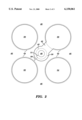
- solder mask design 46 such as that used for a ball grid array is depicted on a surface of a PCB with four surface lands 30, 32, 34 and 36.
- FIG. 2 also depicts a PTH 40 centered in a PTH land 38, along with a dog bone wire 42 connecting PTH 40 to surface land 36 and forming what is generally referred to as a dog bone structure.
- Solder mask 46 includes circular openings defined by dotted line regions 44 that surround each of the surface lands 30, 32, 34, 36, and region 45 that overlays PTH land 38.
- a barrier having no less than a minimum width (e.g., 4 mils) as indicated by arrow 50 must be maintained between the region 45 that surrounds PTH 40 and the dotted line region 44 that surrounds adjacent surface land 32 in order to ensure the mechanical and functional integrity of the solder mask 46.
- the largest possible clearance, as indicated by arrow 51 must be maintained between the PTH 40 and solder mask region 45 in order to prevent the solder mask material from entering PTH 40.
- neither the barrier width 50, nor the clearance 51 can be enlarged without affecting the performance of the other. Because the barrier width 50 must be no less than some predetermined minimum distance, clearance 51 around PTH 40 is often not as large as desired, resulting in a potentially defective PCB.
- the present invention overcomes the above-mentioned problems in the art by providing a solder mask with a novel opening that can be placed around the perimeter of a PTH.
- the solder mask opening comprises a non-circular shape that maintains the necessary barrier (e.g., 4 mils) between the PTH and adjacent lands while providing additional clearance around the PTH.
- the non-circular shape may comprise a clover leaf pattern that includes outwardly extending regions that extend in a direction toward a space in between two adjacent lands.
- the invention also comprises a method of forming such a solder mask and comprises the steps of: (1) applying a photosensitive dielectric material over the printed circuit board; and (2) curing a portion of the photosensitive dielectric material to form openings around the perimeter of a plated through hole, wherein the cured portion of the photosensitive dielectric material forms a non-circular pattern around the plated through hole.
- the non-circular pattern may comprise a clover-leaf pattern that comprises a plurality of outwardly extending regions or humps extending away from the center of the plated through hole, wherein each of the humps is directed at a space between two adjacent lands.
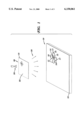
- FIG. 1 depicts a printed circuit board with a solder mask being fabricated in accordance with a preferred embodiment of the present invention
- FIG. 2 depicts a surface of a printed circuit board having a related art solder mask with a circular opening around the perimeter of the PTH;
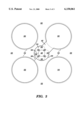
- FIG. 3 depicts a surface of a printed circuit board having a solder mask with a non-circular opening formed in accordance with a preferred embodiment of the present invention.
- a printed circuit board 10 is depicted with a solder mask 12 being formed in accordance with a preferred embodiment.
- the solder mask 12 comprises a layer of dielectric material that includes openings 14 and 17 around the surface lands 16 and plated through hole (PTH) 15.
- the opening 14 around PTH 15 is formed in a clover-leaf shape in order to provide the maximum amount of opening possible around the PTH 15 while maintaining the necessary barriers between the PTH 15 and surface lands 16.
- the solder mask 12 may be formed by applying a photosensitive epoxy material to the surface of the PCB 10, and then selectively exposing the surface of the PCB to radiation 28 with mask 18.
- Mask 18 includes a transparent portion 22 that allows the radiation to pass and cure the photosensitive epoxy material, and a blocking portion 20 that blocks radiation 28 resulting in uncured portions of the photosensitive epoxy material which will then form openings 14 and 17 in the solder mask 12.
- FIG. 3 a similar PCB stricture as that depicted in FIG. 2 is again shown with circuit lands 30, 32, 34 and 36, PTH 40, PTH land 38, and dog bone wire 42.
- an improved solder mask 52 defined by dotted lines 54 and 55 is depicted.
- the openings 54 around the surface lands 30, 32, 34, 36 typically have a diameter of about 30 mils, with about a 2 mil clearance between the land and the opening.
- the improved solder mask 52 does not include a circular opening around PTH 40, but rather includes a clover-leaf pattern opening 55.
- the clover-leaf pattern opening includes inwardly extending portions 58 having a generally smaller radius and outwardly extending portions or humps 56 each having a relatively larger radius.
- an inwardly extending portion 58 has a radius of about 7.5 mils, while an outwardly extending portion 56 has a radius of about 9-11 mils.
- the dimensions of the openings may vary to account for the specific implementation.
- the inwardly extending portions 58 of the opening 55 allow the barrier width 60 of the solder mask 52 between the PTH 40 and adjacent surface lands 30, 32, 34, 36 to be large enough (e.g., 4 mils) to meet the particular design requirements. It is recognized that the required size of the barrier width 60 will depend on various factors, including the solder mask material.
- the outwardly extending portions 56 of the opening 55 provide increased clearance 62 by creating a larger opening around much of the PTH 40, thereby decreasing the likelihood that the solder mask material will be inadvertently drawn into PTH 40.
- the outwardly extending portions 58 of the opening 55 should extend away from the center of the PTH 40 toward a point in between two adjacent lands, or toward an area of the PCB where no closely adjacent opening exists.
- this preferred embodiment generally depicts a four leaf clover opening
- any non-circular solder mask pattern could be utilized that (1) maintains the necessary barrier width between the PTH and an adjacent land, and (2) provides additional clearance around the PTH.
- a spiked or star pattern could potentially be implemented as well as outwardly extending portions that include contoured extensions.
- the general shape and configuration of this opening can be customized to be dependent upon the general configuration of the PCB. Thus, patterns with fewer or greater than four outwardly extending portions can be used.
- the non-circular openings need not be exclusively applied to PTH's, but can be applied around any surface feature on a PCB where similar requirements exist.
Landscapes
- Engineering & Computer Science (AREA)
- Microelectronics & Electronic Packaging (AREA)
- Manufacturing & Machinery (AREA)
- Electric Connection Of Electric Components To Printed Circuits (AREA)
- Non-Metallic Protective Coatings For Printed Circuits (AREA)
Abstract
A solder mask having a clover-leaf shaped opening around a PTH for enhanced performance. The solder mask resides on a surface of a printed circuit board comprising lands and PTH's. The opening around the PTH is configured to maintain a minimum channel width between the PTH and an adjacent land while maximizing the opening around the PTH, thereby decreasing the likelihood that the solder mask material will be inadvertently drawn into the PTH.
Description
This application is a divisional of Ser. No. 09/168,584, filed on Oct. 8, 1998, now U.S. Pat No. 6,078,013.
1. Technical Field
The present invention relates to printed circuit boards, and more particularly relates to an improved solder mask design for the surface of a printed circuit board.
2. Related Art
Printed circuit boards (PCB's) are often fabricated with a solder mask on the top surface. The solder mask is generally a dielectric material that sits over the surface of the PCB, and includes openings for surface lands and the like. The solder mask provides a protective barrier between surface lands on the surface of the PCB in order to prevent the inadvertent flow of solder between adjacent surface lands during a heating process. The inadvertent flow of solder could occur, for example, when the board is subjected to heat in order to attach components to surface lands. The solder mask prevents solder from running between surface lands causing inadvertent short circuits (i.e., solder bridging). Additionally, by placing the solder mask over a wire, the solder mask prevents unwanted "capillary action" of the solder, i.e., it prevents the solder from running along the wire down into a plated through hole (PTH).
The solder mask is generally comprised of a clear epoxy material such as a photosensitive dielectric that can be placed on the PCB either as sheet of material or as a liquid coating applied with a curtain process. The applied material may then be selectively cured by exposing predetermined areas of the material to radiation to define a final solder mask. A radiation mask is typically used to block portions of the radiation thereby masking those areas of the PCB where openings in the solder mask are desired. After the PCB is selectively exposed to the radiation, a final cleaning step can be used to remove the uncured areas of the solder mask (i.e., where openings will exist).
Because of the close spacing of surface lands and wires on a PCB, the imprecise placement and tolerances of openings in the solder mask on the PCB can cause failures. In order to avoid failures, a minimum amount of coverage of the solder mask must be maintained between closely spaced surface lands. In addition, sufficient clearances must be maintained around PTH's in order to ensure that the solder mask material is not drawn into the PTH. This type of problem is precipitated during the heating process, when portions of the solder mask can be inadvertently drawn into a PTH and attach to the copper plating on the walls of the PTH. When such a dielectric material attaches to the copper plating, reservoirs can be created that attract chemicals from a subsequent processing step thereby causing the PCB to fail.
Referring to FIG. 2, a solder mask design 46, such as that used for a ball grid array is depicted on a surface of a PCB with four surface lands 30, 32, 34 and 36. FIG. 2 also depicts a PTH 40 centered in a PTH land 38, along with a dog bone wire 42 connecting PTH 40 to surface land 36 and forming what is generally referred to as a dog bone structure. Solder mask 46 includes circular openings defined by dotted line regions 44 that surround each of the surface lands 30, 32, 34, 36, and region 45 that overlays PTH land 38. In order to provide maximum utility, a barrier having no less than a minimum width (e.g., 4 mils) as indicated by arrow 50, must be maintained between the region 45 that surrounds PTH 40 and the dotted line region 44 that surrounds adjacent surface land 32 in order to ensure the mechanical and functional integrity of the solder mask 46. At the same time, the largest possible clearance, as indicated by arrow 51, must be maintained between the PTH 40 and solder mask region 45 in order to prevent the solder mask material from entering PTH 40. Unfortunately, neither the barrier width 50, nor the clearance 51 can be enlarged without affecting the performance of the other. Because the barrier width 50 must be no less than some predetermined minimum distance, clearance 51 around PTH 40 is often not as large as desired, resulting in a potentially defective PCB.
Therefore, without some way of better ensuring that the dielectric material from the solder mask does not inadvertently get into the PTH's, failures will continue to occur.
The present invention overcomes the above-mentioned problems in the art by providing a solder mask with a novel opening that can be placed around the perimeter of a PTH. The solder mask opening comprises a non-circular shape that maintains the necessary barrier (e.g., 4 mils) between the PTH and adjacent lands while providing additional clearance around the PTH. The non-circular shape may comprise a clover leaf pattern that includes outwardly extending regions that extend in a direction toward a space in between two adjacent lands.
The invention also comprises a method of forming such a solder mask and comprises the steps of: (1) applying a photosensitive dielectric material over the printed circuit board; and (2) curing a portion of the photosensitive dielectric material to form openings around the perimeter of a plated through hole, wherein the cured portion of the photosensitive dielectric material forms a non-circular pattern around the plated through hole. The non-circular pattern may comprise a clover-leaf pattern that comprises a plurality of outwardly extending regions or humps extending away from the center of the plated through hole, wherein each of the humps is directed at a space between two adjacent lands.
It is therefore an advantage of the present invention to provide a solder mask that will maintain the necessary barrier distances between surface lands and provide additional clearances around a plated through hole to better ensure that the dielectric material used to form the solder mask is not inadvertently drawn into the plated through hole.
The foregoing and other objects, features and advantages of the invention will be apparent in the following and more particular description of the preferred embodiments of the invention as illustrated in the accompanying drawings.
The preferred exemplary embodiment of the present invention will hereinafter be described in conjunction with the appended drawings, where like designations denote like elements:
FIG. 1 depicts a printed circuit board with a solder mask being fabricated in accordance with a preferred embodiment of the present invention;
FIG. 2 depicts a surface of a printed circuit board having a related art solder mask with a circular opening around the perimeter of the PTH; and
FIG. 3 depicts a surface of a printed circuit board having a solder mask with a non-circular opening formed in accordance with a preferred embodiment of the present invention.
Referring first to FIG. 1, a printed circuit board 10 is depicted with a solder mask 12 being formed in accordance with a preferred embodiment. The solder mask 12 comprises a layer of dielectric material that includes openings 14 and 17 around the surface lands 16 and plated through hole (PTH) 15. The opening 14 around PTH 15 is formed in a clover-leaf shape in order to provide the maximum amount of opening possible around the PTH 15 while maintaining the necessary barriers between the PTH 15 and surface lands 16. The solder mask 12 may be formed by applying a photosensitive epoxy material to the surface of the PCB 10, and then selectively exposing the surface of the PCB to radiation 28 with mask 18. Mask 18 includes a transparent portion 22 that allows the radiation to pass and cure the photosensitive epoxy material, and a blocking portion 20 that blocks radiation 28 resulting in uncured portions of the photosensitive epoxy material which will then form openings 14 and 17 in the solder mask 12.
Referring now to FIG. 3, a similar PCB stricture as that depicted in FIG. 2 is again shown with circuit lands 30, 32, 34 and 36, PTH 40, PTH land 38, and dog bone wire 42. However, in FIG. 3 an improved solder mask 52, defined by dotted lines 54 and 55 is depicted. The openings 54 around the surface lands 30, 32, 34, 36 typically have a diameter of about 30 mils, with about a 2 mil clearance between the land and the opening. In the embodiment depicted in FIG. 3, it can be seen that the improved solder mask 52 does not include a circular opening around PTH 40, but rather includes a clover-leaf pattern opening 55. The clover-leaf pattern opening includes inwardly extending portions 58 having a generally smaller radius and outwardly extending portions or humps 56 each having a relatively larger radius. In this embodiment, an inwardly extending portion 58 has a radius of about 7.5 mils, while an outwardly extending portion 56 has a radius of about 9-11 mils. Of course, the dimensions of the openings may vary to account for the specific implementation.
The inwardly extending portions 58 of the opening 55 allow the barrier width 60 of the solder mask 52 between the PTH 40 and adjacent surface lands 30, 32, 34, 36 to be large enough (e.g., 4 mils) to meet the particular design requirements. It is recognized that the required size of the barrier width 60 will depend on various factors, including the solder mask material. At the same time, the outwardly extending portions 56 of the opening 55 provide increased clearance 62 by creating a larger opening around much of the PTH 40, thereby decreasing the likelihood that the solder mask material will be inadvertently drawn into PTH 40. In general, the outwardly extending portions 58 of the opening 55 should extend away from the center of the PTH 40 toward a point in between two adjacent lands, or toward an area of the PCB where no closely adjacent opening exists.
Thus, while this preferred embodiment generally depicts a four leaf clover opening, it is recognized that any non-circular solder mask pattern could be utilized that (1) maintains the necessary barrier width between the PTH and an adjacent land, and (2) provides additional clearance around the PTH. For example, a spiked or star pattern could potentially be implemented as well as outwardly extending portions that include contoured extensions. Moreover, the general shape and configuration of this opening can be customized to be dependent upon the general configuration of the PCB. Thus, patterns with fewer or greater than four outwardly extending portions can be used. Finally, it should be recognized that the non-circular openings need not be exclusively applied to PTH's, but can be applied around any surface feature on a PCB where similar requirements exist.
The foregoing description of the preferred embodiments of the invention have been presented for the purposes of illustration and description. They are not intended to be exhaustive or to limit the invention to the precise form disclosed, and obviously many modifications and variations are possible in light of the above teachings. Such modifications and variations that may be apparent to a person skilled in the art are intended to be included with the scope of this invention as defined by the accompanying claims.
Claims (10)
1. A method for forming a solder mask on a surface of a printed circuit board, wherein the solder mask includes openings formed around of each of a plurality of lands, and wherein a barrier having a minimum width is required to exist between adjacent lands, comprising:
providing at least one through-hole proximate at least one surface land;
applying a photosensitive dielectric material over the printed circuit board;
providing an opening in said photosensitive dielectric material, said opening having a non-circular shape, at least one outwardly extending region that provides additional clearance of the photosensitive dielectric material around the through-hole, and an inwardly extending region across from an adjacent land, the inwardly extending region oriented to maintain a barrier of photosensitive dielectric material between the through-hole and the adjacent surface land; and
curing the photosensitive dielectric material around the perimeter of each land.
2. The method of claim 1, wherein the opening surrounds a land that includes a plated through hole (PTH).
3. The method of claim 1, wherein the non-circular shape includes an outwardly extending portion that extends between two adjacent lands.
4. The method of claim 1, wherein the non-circular shape is a clover-leaf pattern.
5. The method of claim 1, wherein:
the curing step is accomplished by passing a beam of radiation through a mask; and
the step of causing the non-circular shape is accomplished by including a corresponding non-circular shape on the mask.
6. A mask for use in the curing of a photosensitive dielectric on a surface of a printed circuit board (PCB), comprising:
a transparent portion for allowing radiation to pass, wherein the transparent portion corresponds to areas on the PCB where a dielectric layer is required;
a blocking portion for blocking radiation, wherein the blocking portion corresponds to areas on the PCB where the dielectric layer is not required, wherein the blocking portion includes a blocking shape for forming a non-circular opening over a surface land;
said non-circular opening having at least one outwardly extending region providing additional clearance of the blocking portion around a through hole, and an inwardly extending region across from an adjacent surface land, said inwardly extending region oriented to maintain a barrier of blocking portion between the through hole and the adjacent surface land.
7. The mask of claim 6, wherein the non-circular opening is a clover-leaf pattern.
8. The mask of claim 7, wherein the clover-leaf pattern includes an outwardly extending portion that extends between two adjacent lands.
9. The mask of claim 8, where the non-circular opening includes an inwardly extending portion having a radius that allows a minimum channel of the dielectric layer to be maintained between the land and an adjacent land, wherein the inwardly extending portion has a radius less than the outwardly extending portion.
10. The mask of claim 8, wherein the non-circular opening includes a first open portion and a second open portion extending in between two adjacent lands, wherein the second open portion includes a radius greater than that of the first open portion.
Priority Applications (1)
| Application Number | Priority Date | Filing Date | Title |
|---|---|---|---|
| US09/483,851 US6150061A (en) | 1998-10-08 | 2000-01-17 | Clover-leaf solder mask opening |
Applications Claiming Priority (2)
| Application Number | Priority Date | Filing Date | Title |
|---|---|---|---|
| US09/168,584 US6078013A (en) | 1998-10-08 | 1998-10-08 | Clover-leaf solder mask opening |
| US09/483,851 US6150061A (en) | 1998-10-08 | 2000-01-17 | Clover-leaf solder mask opening |
Related Parent Applications (1)
| Application Number | Title | Priority Date | Filing Date |
|---|---|---|---|
| US09/168,584 Division US6078013A (en) | 1998-10-08 | 1998-10-08 | Clover-leaf solder mask opening |
Publications (1)
| Publication Number | Publication Date |
|---|---|
| US6150061A true US6150061A (en) | 2000-11-21 |
Family
ID=22612098
Family Applications (2)
| Application Number | Title | Priority Date | Filing Date |
|---|---|---|---|
| US09/168,584 Expired - Lifetime US6078013A (en) | 1998-10-08 | 1998-10-08 | Clover-leaf solder mask opening |
| US09/483,851 Expired - Fee Related US6150061A (en) | 1998-10-08 | 2000-01-17 | Clover-leaf solder mask opening |
Family Applications Before (1)
| Application Number | Title | Priority Date | Filing Date |
|---|---|---|---|
| US09/168,584 Expired - Lifetime US6078013A (en) | 1998-10-08 | 1998-10-08 | Clover-leaf solder mask opening |
Country Status (1)
| Country | Link |
|---|---|
| US (2) | US6078013A (en) |
Cited By (1)
| Publication number | Priority date | Publication date | Assignee | Title |
|---|---|---|---|---|
| US20060268526A1 (en) * | 1999-10-13 | 2006-11-30 | Micron Technology, Inc. | Soldermask opening to prevent delamination |
Families Citing this family (4)
| Publication number | Priority date | Publication date | Assignee | Title |
|---|---|---|---|---|
| US7025640B2 (en) * | 2002-09-23 | 2006-04-11 | Delphi Technologies, Inc. | Circuit board inter-connection system and method |
| US7064279B2 (en) * | 2004-09-23 | 2006-06-20 | Motorola, Inc. | Circuit board having an overlapping via |
| JP2006216711A (en) * | 2005-02-02 | 2006-08-17 | Ibiden Co Ltd | Multilayer printed wiring board |
| US9526180B2 (en) | 2011-12-09 | 2016-12-20 | Intel Corporation | Reducing dielectric loss in solder masks |
Citations (14)
| Publication number | Priority date | Publication date | Assignee | Title |
|---|---|---|---|---|
| US4065850A (en) * | 1975-08-13 | 1978-01-03 | Kollmorgen Technologies Corporation | Method of making multi-wire electrical interconnecting member having a multi-wire matrix of insulated wires mechanically terminated thereon |
| US4088545A (en) * | 1977-01-31 | 1978-05-09 | Supnet Fred L | Method of fabricating mask-over-copper printed circuit boards |
| US4891472A (en) * | 1987-09-10 | 1990-01-02 | Siemens Aktiengesellschaft | Interconnects on a printed circuit board having connecting points for an electronic component with a plurality of terminals |
| US5210940A (en) * | 1990-07-24 | 1993-05-18 | Nippon Cmk Corp. | Method of producing a printed circuit board |
| US5285057A (en) * | 1991-03-22 | 1994-02-08 | Kabushiki Kaisha Toshiba | IC card device |
| US5295299A (en) * | 1991-06-17 | 1994-03-22 | Nhk Spring Co., Ltd. | Method for forming a mounting hole in a method for forming a metallic printed circuit board |
| US5344748A (en) * | 1986-01-13 | 1994-09-06 | Rohm And Haas Company | Microplastic structure and method of manufacture |
| US5386087A (en) * | 1992-02-17 | 1995-01-31 | E. I. Du Pont De Nemours And Company | Printed circuit board having U-shaped solder mask layer separating respective contacts |
| US5414223A (en) * | 1994-08-10 | 1995-05-09 | Ast Research, Inc. | Solder pad for printed circuit boards |
| US5453581A (en) * | 1993-08-30 | 1995-09-26 | Motorola, Inc. | Pad arrangement for surface mount components |
| US5644475A (en) * | 1994-09-30 | 1997-07-01 | Allen-Bradley Company, Inc. | Solder mask for a finger connector on a single in-line package module |
| US5647123A (en) * | 1995-10-16 | 1997-07-15 | Motorola, Inc. | Method for improving distribution of underfill between a flip chip die and a circuit board |
| US5665525A (en) * | 1990-10-30 | 1997-09-09 | Nokia Mobile Phones Ltd. | Method for producing printed circuit boards |
| US6004734A (en) * | 1992-03-02 | 1999-12-21 | Berg; N. Edward | Circuit board substrate for use in fabricating a circuit board on which is formed a light sensitive emulsion layer covering and in direct contact with photoresist |
-
1998
- 1998-10-08 US US09/168,584 patent/US6078013A/en not_active Expired - Lifetime
-
2000
- 2000-01-17 US US09/483,851 patent/US6150061A/en not_active Expired - Fee Related
Patent Citations (14)
| Publication number | Priority date | Publication date | Assignee | Title |
|---|---|---|---|---|
| US4065850A (en) * | 1975-08-13 | 1978-01-03 | Kollmorgen Technologies Corporation | Method of making multi-wire electrical interconnecting member having a multi-wire matrix of insulated wires mechanically terminated thereon |
| US4088545A (en) * | 1977-01-31 | 1978-05-09 | Supnet Fred L | Method of fabricating mask-over-copper printed circuit boards |
| US5344748A (en) * | 1986-01-13 | 1994-09-06 | Rohm And Haas Company | Microplastic structure and method of manufacture |
| US4891472A (en) * | 1987-09-10 | 1990-01-02 | Siemens Aktiengesellschaft | Interconnects on a printed circuit board having connecting points for an electronic component with a plurality of terminals |
| US5210940A (en) * | 1990-07-24 | 1993-05-18 | Nippon Cmk Corp. | Method of producing a printed circuit board |
| US5665525A (en) * | 1990-10-30 | 1997-09-09 | Nokia Mobile Phones Ltd. | Method for producing printed circuit boards |
| US5285057A (en) * | 1991-03-22 | 1994-02-08 | Kabushiki Kaisha Toshiba | IC card device |
| US5295299A (en) * | 1991-06-17 | 1994-03-22 | Nhk Spring Co., Ltd. | Method for forming a mounting hole in a method for forming a metallic printed circuit board |
| US5386087A (en) * | 1992-02-17 | 1995-01-31 | E. I. Du Pont De Nemours And Company | Printed circuit board having U-shaped solder mask layer separating respective contacts |
| US6004734A (en) * | 1992-03-02 | 1999-12-21 | Berg; N. Edward | Circuit board substrate for use in fabricating a circuit board on which is formed a light sensitive emulsion layer covering and in direct contact with photoresist |
| US5453581A (en) * | 1993-08-30 | 1995-09-26 | Motorola, Inc. | Pad arrangement for surface mount components |
| US5414223A (en) * | 1994-08-10 | 1995-05-09 | Ast Research, Inc. | Solder pad for printed circuit boards |
| US5644475A (en) * | 1994-09-30 | 1997-07-01 | Allen-Bradley Company, Inc. | Solder mask for a finger connector on a single in-line package module |
| US5647123A (en) * | 1995-10-16 | 1997-07-15 | Motorola, Inc. | Method for improving distribution of underfill between a flip chip die and a circuit board |
Cited By (2)
| Publication number | Priority date | Publication date | Assignee | Title |
|---|---|---|---|---|
| US20060268526A1 (en) * | 1999-10-13 | 2006-11-30 | Micron Technology, Inc. | Soldermask opening to prevent delamination |
| US7307850B2 (en) * | 1999-10-13 | 2007-12-11 | Micron Technology, Inc. | Soldermask opening to prevent delamination |
Also Published As
| Publication number | Publication date |
|---|---|
| US6078013A (en) | 2000-06-20 |
Similar Documents
| Publication | Publication Date | Title |
|---|---|---|
| US5444188A (en) | Flexible circuit wiring board and method of producing the same | |
| US5402314A (en) | Printed circuit board having through-hole stopped with photo-curable solder resist | |
| US5414223A (en) | Solder pad for printed circuit boards | |
| KR20050062436A (en) | Printed wiring board and semiconductor device | |
| US5510580A (en) | Printed circuit board with landless blind hole for connecting an upper wiring pattern to a lower wiring pattern | |
| US4675786A (en) | Flexible circuit board and method of making the same | |
| US6383603B1 (en) | Printed wiring board and manufacturing method thereof | |
| KR100772623B1 (en) | Film carrier tape for mounting electronic part | |
| US6150061A (en) | Clover-leaf solder mask opening | |
| US7307850B2 (en) | Soldermask opening to prevent delamination | |
| JPH02241077A (en) | Printed-wiring board with shielding layer | |
| US5243143A (en) | Solder snap bar | |
| US5537740A (en) | Method of making printed circuit board | |
| US5010448A (en) | Printed circuit board | |
| CA1197325A (en) | Masking of holes in circuit patterns on circuit boards prior to flow soldering | |
| KR20050061343A (en) | Wiring circuit board | |
| US20060118457A1 (en) | Film carrier tape for mounting electronic component | |
| DE112014000614B4 (en) | A method of producing a multi-layer substrate to place a BGA-type component thereon | |
| US4585528A (en) | Method of providing through hole plating between circuit elements | |
| US6210746B1 (en) | Method of fabricating a solder resist mask | |
| GB2324753A (en) | Manufacturing printed circuit and printed wiring boards | |
| US5616256A (en) | Printed wiring board and process for producing thereof | |
| US4084022A (en) | Method for tin plating printed boards | |
| US5493077A (en) | Printed wiring board having a blind via | |
| JP3042621B1 (en) | Connection structure with chassis ground of circuit board |
Legal Events
| Date | Code | Title | Description |
|---|---|---|---|
| FEPP | Fee payment procedure |
Free format text: PAYOR NUMBER ASSIGNED (ORIGINAL EVENT CODE: ASPN); ENTITY STATUS OF PATENT OWNER: LARGE ENTITY |
|
| REMI | Maintenance fee reminder mailed | ||
| LAPS | Lapse for failure to pay maintenance fees | ||
| STCH | Information on status: patent discontinuation |
Free format text: PATENT EXPIRED DUE TO NONPAYMENT OF MAINTENANCE FEES UNDER 37 CFR 1.362 |
|
| FP | Lapsed due to failure to pay maintenance fee |
Effective date: 20041121 |