US6150009A - Decorative structural panel - Google Patents
Decorative structural panel Download PDFInfo
- Publication number
- US6150009A US6150009A US09/131,142 US13114298A US6150009A US 6150009 A US6150009 A US 6150009A US 13114298 A US13114298 A US 13114298A US 6150009 A US6150009 A US 6150009A
- Authority
- US
- United States
- Prior art keywords
- resin
- release material
- decorative article
- resins
- substrate surface
- Prior art date
- Legal status (The legal status is an assumption and is not a legal conclusion. Google has not performed a legal analysis and makes no representation as to the accuracy of the status listed.)
- Expired - Fee Related
Links
- 229920005989 resin Polymers 0.000 claims abstract description 114
- 239000011347 resin Substances 0.000 claims abstract description 114
- 239000000463 material Substances 0.000 claims abstract description 87
- 239000000758 substrate Substances 0.000 claims abstract description 41
- 229920001187 thermosetting polymer Polymers 0.000 claims abstract description 18
- 229920001296 polysiloxane Polymers 0.000 claims abstract description 11
- 238000004519 manufacturing process Methods 0.000 claims description 20
- 239000000203 mixture Substances 0.000 claims description 15
- 239000000049 pigment Substances 0.000 claims description 13
- 229910052751 metal Inorganic materials 0.000 claims description 10
- 239000002184 metal Substances 0.000 claims description 10
- 239000003086 colorant Substances 0.000 claims description 9
- 239000000123 paper Substances 0.000 claims description 8
- 239000000945 filler Substances 0.000 claims description 7
- 239000004814 polyurethane Substances 0.000 claims description 7
- 229920002635 polyurethane Polymers 0.000 claims description 7
- 239000004593 Epoxy Substances 0.000 claims description 5
- 125000003700 epoxy group Chemical group 0.000 claims description 5
- 229920000647 polyepoxide Polymers 0.000 claims description 5
- 229920006305 unsaturated polyester Polymers 0.000 claims description 5
- 229920006397 acrylic thermoplastic Polymers 0.000 claims description 4
- 229920003229 poly(methyl methacrylate) Polymers 0.000 claims description 4
- 235000013824 polyphenols Nutrition 0.000 claims description 4
- ISXSCDLOGDJUNJ-UHFFFAOYSA-N tert-butyl prop-2-enoate Chemical compound CC(C)(C)OC(=O)C=C ISXSCDLOGDJUNJ-UHFFFAOYSA-N 0.000 claims description 4
- 239000002023 wood Substances 0.000 claims description 4
- 239000004033 plastic Substances 0.000 claims description 3
- 229920003023 plastic Polymers 0.000 claims description 2
- 150000002739 metals Chemical class 0.000 claims 1
- 238000000034 method Methods 0.000 description 14
- 238000000576 coating method Methods 0.000 description 11
- 239000001993 wax Substances 0.000 description 10
- 239000003795 chemical substances by application Substances 0.000 description 8
- 239000002253 acid Substances 0.000 description 7
- WFUGQJXVXHBTEM-UHFFFAOYSA-N 2-hydroperoxy-2-(2-hydroperoxybutan-2-ylperoxy)butane Chemical compound CCC(C)(OO)OOC(C)(CC)OO WFUGQJXVXHBTEM-UHFFFAOYSA-N 0.000 description 6
- 239000011248 coating agent Substances 0.000 description 6
- MHAJPDPJQMAIIY-UHFFFAOYSA-N Hydrogen peroxide Chemical compound OO MHAJPDPJQMAIIY-UHFFFAOYSA-N 0.000 description 5
- 238000013019 agitation Methods 0.000 description 5
- 230000000694 effects Effects 0.000 description 5
- 229920001225 polyester resin Polymers 0.000 description 5
- 239000004645 polyester resin Substances 0.000 description 5
- 229920006395 saturated elastomer Polymers 0.000 description 5
- 239000002904 solvent Substances 0.000 description 5
- 150000005846 sugar alcohols Polymers 0.000 description 5
- 229920006337 unsaturated polyester resin Polymers 0.000 description 5
- PPBRXRYQALVLMV-UHFFFAOYSA-N Styrene Chemical compound C=CC1=CC=CC=C1 PPBRXRYQALVLMV-UHFFFAOYSA-N 0.000 description 4
- 150000007513 acids Chemical class 0.000 description 4
- -1 and the like Substances 0.000 description 4
- 239000004922 lacquer Substances 0.000 description 4
- 238000007639 printing Methods 0.000 description 4
- VYPSYNLAJGMNEJ-UHFFFAOYSA-N silicon dioxide Inorganic materials O=[Si]=O VYPSYNLAJGMNEJ-UHFFFAOYSA-N 0.000 description 4
- LYCAIKOWRPUZTN-UHFFFAOYSA-N Ethylene glycol Chemical compound OCCO LYCAIKOWRPUZTN-UHFFFAOYSA-N 0.000 description 3
- PEDCQBHIVMGVHV-UHFFFAOYSA-N Glycerine Chemical compound OCC(O)CO PEDCQBHIVMGVHV-UHFFFAOYSA-N 0.000 description 3
- MUBZPKHOEPUJKR-UHFFFAOYSA-N Oxalic acid Chemical compound OC(=O)C(O)=O MUBZPKHOEPUJKR-UHFFFAOYSA-N 0.000 description 3
- 229920004552 POLYLITE® Polymers 0.000 description 3
- OFOBLEOULBTSOW-UHFFFAOYSA-N Propanedioic acid Natural products OC(=O)CC(O)=O OFOBLEOULBTSOW-UHFFFAOYSA-N 0.000 description 3
- DNIAPMSPPWPWGF-UHFFFAOYSA-N Propylene glycol Chemical compound CC(O)CO DNIAPMSPPWPWGF-UHFFFAOYSA-N 0.000 description 3
- 229910000831 Steel Inorganic materials 0.000 description 3
- IISBACLAFKSPIT-UHFFFAOYSA-N bisphenol A Chemical class C=1C=C(O)C=CC=1C(C)(C)C1=CC=C(O)C=C1 IISBACLAFKSPIT-UHFFFAOYSA-N 0.000 description 3
- 239000003054 catalyst Substances 0.000 description 3
- 239000000919 ceramic Substances 0.000 description 3
- 238000006243 chemical reaction Methods 0.000 description 3
- 239000000356 contaminant Substances 0.000 description 3
- 238000004132 cross linking Methods 0.000 description 3
- MTHSVFCYNBDYFN-UHFFFAOYSA-N diethylene glycol Chemical compound OCCOCCO MTHSVFCYNBDYFN-UHFFFAOYSA-N 0.000 description 3
- 230000032050 esterification Effects 0.000 description 3
- 238000005886 esterification reaction Methods 0.000 description 3
- 239000003999 initiator Substances 0.000 description 3
- 239000007788 liquid Substances 0.000 description 3
- 230000004048 modification Effects 0.000 description 3
- 238000012986 modification Methods 0.000 description 3
- 239000005056 polyisocyanate Substances 0.000 description 3
- 229920001228 polyisocyanate Polymers 0.000 description 3
- 229920000642 polymer Polymers 0.000 description 3
- 238000002360 preparation method Methods 0.000 description 3
- 239000010959 steel Substances 0.000 description 3
- 239000000126 substance Substances 0.000 description 3
- 239000013008 thixotropic agent Substances 0.000 description 3
- MYRTYDVEIRVNKP-UHFFFAOYSA-N 1,2-Divinylbenzene Chemical compound C=CC1=CC=CC=C1C=C MYRTYDVEIRVNKP-UHFFFAOYSA-N 0.000 description 2
- WXUAQHNMJWJLTG-UHFFFAOYSA-N 2-methylbutanedioic acid Chemical compound OC(=O)C(C)CC(O)=O WXUAQHNMJWJLTG-UHFFFAOYSA-N 0.000 description 2
- XJMMNTGIMDZPMU-UHFFFAOYSA-N 3-methylglutaric acid Chemical compound OC(=O)CC(C)CC(O)=O XJMMNTGIMDZPMU-UHFFFAOYSA-N 0.000 description 2
- UPMLOUAZCHDJJD-UHFFFAOYSA-N 4,4'-Diphenylmethane Diisocyanate Chemical compound C1=CC(N=C=O)=CC=C1CC1=CC=C(N=C=O)C=C1 UPMLOUAZCHDJJD-UHFFFAOYSA-N 0.000 description 2
- CSCPPACGZOOCGX-UHFFFAOYSA-N Acetone Chemical compound CC(C)=O CSCPPACGZOOCGX-UHFFFAOYSA-N 0.000 description 2
- VTYYLEPIZMXCLO-UHFFFAOYSA-L Calcium carbonate Chemical compound [Ca+2].[O-]C([O-])=O VTYYLEPIZMXCLO-UHFFFAOYSA-L 0.000 description 2
- 241000723418 Carya Species 0.000 description 2
- LFQSCWFLJHTTHZ-UHFFFAOYSA-N Ethanol Chemical compound CCO LFQSCWFLJHTTHZ-UHFFFAOYSA-N 0.000 description 2
- VZCYOOQTPOCHFL-OWOJBTEDSA-N Fumaric acid Chemical compound OC(=O)\C=C\C(O)=O VZCYOOQTPOCHFL-OWOJBTEDSA-N 0.000 description 2
- 239000005058 Isophorone diisocyanate Substances 0.000 description 2
- KKEYFWRCBNTPAC-UHFFFAOYSA-N Terephthalic acid Chemical compound OC(=O)C1=CC=C(C(O)=O)C=C1 KKEYFWRCBNTPAC-UHFFFAOYSA-N 0.000 description 2
- GWEVSGVZZGPLCZ-UHFFFAOYSA-N Titan oxide Chemical compound O=[Ti]=O GWEVSGVZZGPLCZ-UHFFFAOYSA-N 0.000 description 2
- 239000003082 abrasive agent Substances 0.000 description 2
- 230000003213 activating effect Effects 0.000 description 2
- 239000000654 additive Substances 0.000 description 2
- WNLRTRBMVRJNCN-UHFFFAOYSA-N adipic acid Chemical compound OC(=O)CCCCC(O)=O WNLRTRBMVRJNCN-UHFFFAOYSA-N 0.000 description 2
- 150000008064 anhydrides Chemical class 0.000 description 2
- WERYXYBDKMZEQL-UHFFFAOYSA-N butane-1,4-diol Chemical compound OCCCCO WERYXYBDKMZEQL-UHFFFAOYSA-N 0.000 description 2
- 239000004203 carnauba wax Substances 0.000 description 2
- 235000013869 carnauba wax Nutrition 0.000 description 2
- 230000000739 chaotic effect Effects 0.000 description 2
- 239000002131 composite material Substances 0.000 description 2
- 230000007423 decrease Effects 0.000 description 2
- 229920001971 elastomer Polymers 0.000 description 2
- 238000010894 electron beam technology Methods 0.000 description 2
- 239000012530 fluid Substances 0.000 description 2
- 239000011521 glass Substances 0.000 description 2
- PCHJSUWPFVWCPO-UHFFFAOYSA-N gold Chemical compound [Au] PCHJSUWPFVWCPO-UHFFFAOYSA-N 0.000 description 2
- 239000010931 gold Substances 0.000 description 2
- 229910052737 gold Inorganic materials 0.000 description 2
- 125000001475 halogen functional group Chemical group 0.000 description 2
- 229910052500 inorganic mineral Inorganic materials 0.000 description 2
- IQPQWNKOIGAROB-UHFFFAOYSA-N isocyanate group Chemical group [N-]=C=O IQPQWNKOIGAROB-UHFFFAOYSA-N 0.000 description 2
- NIMLQBUJDJZYEJ-UHFFFAOYSA-N isophorone diisocyanate Chemical compound CC1(C)CC(N=C=O)CC(C)(CN=C=O)C1 NIMLQBUJDJZYEJ-UHFFFAOYSA-N 0.000 description 2
- QQVIHTHCMHWDBS-UHFFFAOYSA-N isophthalic acid Chemical compound OC(=O)C1=CC=CC(C(O)=O)=C1 QQVIHTHCMHWDBS-UHFFFAOYSA-N 0.000 description 2
- 239000011707 mineral Substances 0.000 description 2
- 238000002156 mixing Methods 0.000 description 2
- 239000000178 monomer Substances 0.000 description 2
- 238000000465 moulding Methods 0.000 description 2
- BDJRBEYXGGNYIS-UHFFFAOYSA-N nonanedioic acid Chemical compound OC(=O)CCCCCCCC(O)=O BDJRBEYXGGNYIS-UHFFFAOYSA-N 0.000 description 2
- TWNQGVIAIRXVLR-UHFFFAOYSA-N oxo(oxoalumanyloxy)alumane Chemical compound O=[Al]O[Al]=O TWNQGVIAIRXVLR-UHFFFAOYSA-N 0.000 description 2
- XNGIFLGASWRNHJ-UHFFFAOYSA-N phthalic acid Chemical compound OC(=O)C1=CC=CC=C1C(O)=O XNGIFLGASWRNHJ-UHFFFAOYSA-N 0.000 description 2
- WLJVNTCWHIRURA-UHFFFAOYSA-N pimelic acid Chemical compound OC(=O)CCCCCC(O)=O WLJVNTCWHIRURA-UHFFFAOYSA-N 0.000 description 2
- 229920000728 polyester Polymers 0.000 description 2
- 238000006116 polymerization reaction Methods 0.000 description 2
- 239000000843 powder Substances 0.000 description 2
- 230000005855 radiation Effects 0.000 description 2
- 238000010526 radical polymerization reaction Methods 0.000 description 2
- 150000003254 radicals Chemical class 0.000 description 2
- 238000011160 research Methods 0.000 description 2
- 229940024463 silicone emollient and protective product Drugs 0.000 description 2
- 238000005507 spraying Methods 0.000 description 2
- TYFQFVWCELRYAO-UHFFFAOYSA-N suberic acid Chemical compound OC(=O)CCCCCCC(O)=O TYFQFVWCELRYAO-UHFFFAOYSA-N 0.000 description 2
- CIHOLLKRGTVIJN-UHFFFAOYSA-N tert‐butyl hydroperoxide Chemical compound CC(C)(C)OO CIHOLLKRGTVIJN-UHFFFAOYSA-N 0.000 description 2
- VZCYOOQTPOCHFL-UHFFFAOYSA-N trans-butenedioic acid Natural products OC(=O)C=CC(O)=O VZCYOOQTPOCHFL-UHFFFAOYSA-N 0.000 description 2
- DNIAPMSPPWPWGF-VKHMYHEASA-N (+)-propylene glycol Chemical compound C[C@H](O)CO DNIAPMSPPWPWGF-VKHMYHEASA-N 0.000 description 1
- WRXCBRHBHGNNQA-UHFFFAOYSA-N (2,4-dichlorobenzoyl) 2,4-dichlorobenzenecarboperoxoate Chemical compound ClC1=CC(Cl)=CC=C1C(=O)OOC(=O)C1=CC=C(Cl)C=C1Cl WRXCBRHBHGNNQA-UHFFFAOYSA-N 0.000 description 1
- ORTVZLZNOYNASJ-UPHRSURJSA-N (z)-but-2-ene-1,4-diol Chemical compound OC\C=C/CO ORTVZLZNOYNASJ-UPHRSURJSA-N 0.000 description 1
- YPFDHNVEDLHUCE-UHFFFAOYSA-N 1,3-propanediol Substances OCCCO YPFDHNVEDLHUCE-UHFFFAOYSA-N 0.000 description 1
- PXGZQGDTEZPERC-UHFFFAOYSA-N 1,4-cyclohexanedicarboxylic acid Chemical compound OC(=O)C1CCC(C(O)=O)CC1 PXGZQGDTEZPERC-UHFFFAOYSA-N 0.000 description 1
- ALVZNPYWJMLXKV-UHFFFAOYSA-N 1,9-Nonanediol Chemical compound OCCCCCCCCCO ALVZNPYWJMLXKV-UHFFFAOYSA-N 0.000 description 1
- BRBMYNGGGPTKKL-UHFFFAOYSA-N 1,9-decanediol Chemical compound CC(O)CCCCCCCCO BRBMYNGGGPTKKL-UHFFFAOYSA-N 0.000 description 1
- UICXTANXZJJIBC-UHFFFAOYSA-N 1-(1-hydroperoxycyclohexyl)peroxycyclohexan-1-ol Chemical compound C1CCCCC1(O)OOC1(OO)CCCCC1 UICXTANXZJJIBC-UHFFFAOYSA-N 0.000 description 1
- WVUYYXUATWMVIT-UHFFFAOYSA-N 1-bromo-4-ethoxybenzene Chemical compound CCOC1=CC=C(Br)C=C1 WVUYYXUATWMVIT-UHFFFAOYSA-N 0.000 description 1
- RTBFRGCFXZNCOE-UHFFFAOYSA-N 1-methylsulfonylpiperidin-4-one Chemical compound CS(=O)(=O)N1CCC(=O)CC1 RTBFRGCFXZNCOE-UHFFFAOYSA-N 0.000 description 1
- AKPLTHZVVWBOPT-UHFFFAOYSA-N 2,2-diethylbutane-1,3-diol Chemical compound CCC(CC)(CO)C(C)O AKPLTHZVVWBOPT-UHFFFAOYSA-N 0.000 description 1
- BTUDGPVTCYNYLK-UHFFFAOYSA-N 2,2-dimethylglutaric acid Chemical compound OC(=O)C(C)(C)CCC(O)=O BTUDGPVTCYNYLK-UHFFFAOYSA-N 0.000 description 1
- GOHPTLYPQCTZSE-UHFFFAOYSA-N 2,2-dimethylsuccinic acid Chemical compound OC(=O)C(C)(C)CC(O)=O GOHPTLYPQCTZSE-UHFFFAOYSA-N 0.000 description 1
- KLZYRCVPDWTZLH-UHFFFAOYSA-N 2,3-dimethylsuccinic acid Chemical compound OC(=O)C(C)C(C)C(O)=O KLZYRCVPDWTZLH-UHFFFAOYSA-N 0.000 description 1
- JGBAASVQPMTVHO-UHFFFAOYSA-N 2,5-dihydroperoxy-2,5-dimethylhexane Chemical compound OOC(C)(C)CCC(C)(C)OO JGBAASVQPMTVHO-UHFFFAOYSA-N 0.000 description 1
- JAHNSTQSQJOJLO-UHFFFAOYSA-N 2-(3-fluorophenyl)-1h-imidazole Chemical compound FC1=CC=CC(C=2NC=CN=2)=C1 JAHNSTQSQJOJLO-UHFFFAOYSA-N 0.000 description 1
- CYVMBANVYOZFIG-UHFFFAOYSA-N 2-ethylbutane-1,4-diol Chemical compound CCC(CO)CCO CYVMBANVYOZFIG-UHFFFAOYSA-N 0.000 description 1
- ZJVMHPVIAUKERS-UHFFFAOYSA-N 2-hexylbutanedioic acid Chemical compound CCCCCCC(C(O)=O)CC(O)=O ZJVMHPVIAUKERS-UHFFFAOYSA-N 0.000 description 1
- DUHQIGLHYXLKAE-UHFFFAOYSA-N 3,3-dimethylglutaric acid Chemical compound OC(=O)CC(C)(C)CC(O)=O DUHQIGLHYXLKAE-UHFFFAOYSA-N 0.000 description 1
- XIRDTMSOGDWMOX-UHFFFAOYSA-N 3,4,5,6-tetrabromophthalic acid Chemical compound OC(=O)C1=C(Br)C(Br)=C(Br)C(Br)=C1C(O)=O XIRDTMSOGDWMOX-UHFFFAOYSA-N 0.000 description 1
- WZHHYIOUKQNLQM-UHFFFAOYSA-N 3,4,5,6-tetrachlorophthalic acid Chemical compound OC(=O)C1=C(Cl)C(Cl)=C(Cl)C(Cl)=C1C(O)=O WZHHYIOUKQNLQM-UHFFFAOYSA-N 0.000 description 1
- FRIBMENBGGCKPD-UHFFFAOYSA-N 3-(2,3-dimethoxyphenyl)prop-2-enal Chemical compound COC1=CC=CC(C=CC=O)=C1OC FRIBMENBGGCKPD-UHFFFAOYSA-N 0.000 description 1
- WOHXXIWTEHLCQK-UHFFFAOYSA-N 3-methylpentane-1,4-diol Chemical compound CC(O)C(C)CCO WOHXXIWTEHLCQK-UHFFFAOYSA-N 0.000 description 1
- JLBJTVDPSNHSKJ-UHFFFAOYSA-N 4-Methylstyrene Chemical compound CC1=CC=C(C=C)C=C1 JLBJTVDPSNHSKJ-UHFFFAOYSA-N 0.000 description 1
- 239000004342 Benzoyl peroxide Substances 0.000 description 1
- OMPJBNCRMGITSC-UHFFFAOYSA-N Benzoylperoxide Chemical compound C=1C=CC=CC=1C(=O)OOC(=O)C1=CC=CC=C1 OMPJBNCRMGITSC-UHFFFAOYSA-N 0.000 description 1
- 229910000906 Bronze Inorganic materials 0.000 description 1
- RYGMFSIKBFXOCR-UHFFFAOYSA-N Copper Chemical compound [Cu] RYGMFSIKBFXOCR-UHFFFAOYSA-N 0.000 description 1
- QPLDLSVMHZLSFG-UHFFFAOYSA-N Copper oxide Chemical compound [Cu]=O QPLDLSVMHZLSFG-UHFFFAOYSA-N 0.000 description 1
- 239000005751 Copper oxide Substances 0.000 description 1
- FBPFZTCFMRRESA-FSIIMWSLSA-N D-Glucitol Natural products OC[C@H](O)[C@H](O)[C@@H](O)[C@H](O)CO FBPFZTCFMRRESA-FSIIMWSLSA-N 0.000 description 1
- FBPFZTCFMRRESA-KVTDHHQDSA-N D-Mannitol Chemical compound OC[C@@H](O)[C@@H](O)[C@H](O)[C@H](O)CO FBPFZTCFMRRESA-KVTDHHQDSA-N 0.000 description 1
- FBPFZTCFMRRESA-JGWLITMVSA-N D-glucitol Chemical compound OC[C@H](O)[C@@H](O)[C@H](O)[C@H](O)CO FBPFZTCFMRRESA-JGWLITMVSA-N 0.000 description 1
- 239000004641 Diallyl-phthalate Substances 0.000 description 1
- 239000004386 Erythritol Substances 0.000 description 1
- UNXHWFMMPAWVPI-UHFFFAOYSA-N Erythritol Natural products OCC(O)C(O)CO UNXHWFMMPAWVPI-UHFFFAOYSA-N 0.000 description 1
- VGGSQFUCUMXWEO-UHFFFAOYSA-N Ethene Chemical compound C=C VGGSQFUCUMXWEO-UHFFFAOYSA-N 0.000 description 1
- 239000005977 Ethylene Substances 0.000 description 1
- YIVJZNGAASQVEM-UHFFFAOYSA-N Lauroyl peroxide Chemical compound CCCCCCCCCCCC(=O)OOC(=O)CCCCCCCCCCC YIVJZNGAASQVEM-UHFFFAOYSA-N 0.000 description 1
- 229930195725 Mannitol Natural products 0.000 description 1
- VVQNEPGJFQJSBK-UHFFFAOYSA-N Methyl methacrylate Chemical compound COC(=O)C(C)=C VVQNEPGJFQJSBK-UHFFFAOYSA-N 0.000 description 1
- ALQSHHUCVQOPAS-UHFFFAOYSA-N Pentane-1,5-diol Chemical compound OCCCCCO ALQSHHUCVQOPAS-UHFFFAOYSA-N 0.000 description 1
- GOOHAUXETOMSMM-UHFFFAOYSA-N Propylene oxide Chemical compound CC1CO1 GOOHAUXETOMSMM-UHFFFAOYSA-N 0.000 description 1
- KDYFGRWQOYBRFD-UHFFFAOYSA-N Succinic acid Natural products OC(=O)CCC(O)=O KDYFGRWQOYBRFD-UHFFFAOYSA-N 0.000 description 1
- ZJCCRDAZUWHFQH-UHFFFAOYSA-N Trimethylolpropane Chemical compound CCC(CO)(CO)CO ZJCCRDAZUWHFQH-UHFFFAOYSA-N 0.000 description 1
- YIMQCDZDWXUDCA-UHFFFAOYSA-N [4-(hydroxymethyl)cyclohexyl]methanol Chemical compound OCC1CCC(CO)CC1 YIMQCDZDWXUDCA-UHFFFAOYSA-N 0.000 description 1
- 238000005270 abrasive blasting Methods 0.000 description 1
- 150000001252 acrylic acid derivatives Chemical class 0.000 description 1
- 239000001361 adipic acid Substances 0.000 description 1
- 235000011037 adipic acid Nutrition 0.000 description 1
- 150000001298 alcohols Chemical class 0.000 description 1
- 125000000217 alkyl group Chemical group 0.000 description 1
- RREGISFBPQOLTM-UHFFFAOYSA-N alumane;trihydrate Chemical compound O.O.O.[AlH3] RREGISFBPQOLTM-UHFFFAOYSA-N 0.000 description 1
- JFCQEDHGNNZCLN-UHFFFAOYSA-N anhydrous glutaric acid Natural products OC(=O)CCCC(O)=O JFCQEDHGNNZCLN-UHFFFAOYSA-N 0.000 description 1
- 235000019400 benzoyl peroxide Nutrition 0.000 description 1
- KQNZLOUWXSAZGD-UHFFFAOYSA-N benzylperoxymethylbenzene Chemical compound C=1C=CC=CC=1COOCC1=CC=CC=C1 KQNZLOUWXSAZGD-UHFFFAOYSA-N 0.000 description 1
- QUDWYFHPNIMBFC-UHFFFAOYSA-N bis(prop-2-enyl) benzene-1,2-dicarboxylate Chemical compound C=CCOC(=O)C1=CC=CC=C1C(=O)OCC=C QUDWYFHPNIMBFC-UHFFFAOYSA-N 0.000 description 1
- 229940106691 bisphenol a Drugs 0.000 description 1
- 239000010974 bronze Substances 0.000 description 1
- OWBTYPJTUOEWEK-UHFFFAOYSA-N butane-2,3-diol Chemical compound CC(O)C(C)O OWBTYPJTUOEWEK-UHFFFAOYSA-N 0.000 description 1
- KDYFGRWQOYBRFD-NUQCWPJISA-N butanedioic acid Chemical compound O[14C](=O)CC[14C](O)=O KDYFGRWQOYBRFD-NUQCWPJISA-N 0.000 description 1
- 229910000019 calcium carbonate Inorganic materials 0.000 description 1
- 239000007795 chemical reaction product Substances 0.000 description 1
- 239000004927 clay Substances 0.000 description 1
- 229910052570 clay Inorganic materials 0.000 description 1
- 150000001875 compounds Chemical class 0.000 description 1
- 238000006482 condensation reaction Methods 0.000 description 1
- 238000011109 contamination Methods 0.000 description 1
- 238000007796 conventional method Methods 0.000 description 1
- 229910052802 copper Inorganic materials 0.000 description 1
- 239000010949 copper Substances 0.000 description 1
- 229910000431 copper oxide Inorganic materials 0.000 description 1
- KUNSUQLRTQLHQQ-UHFFFAOYSA-N copper tin Chemical compound [Cu].[Sn] KUNSUQLRTQLHQQ-UHFFFAOYSA-N 0.000 description 1
- CCQPAEQGAVNNIA-UHFFFAOYSA-N cyclobutane-1,1-dicarboxylic acid Chemical compound OC(=O)C1(C(O)=O)CCC1 CCQPAEQGAVNNIA-UHFFFAOYSA-N 0.000 description 1
- IFDVQVHZEKPUSC-UHFFFAOYSA-N cyclohex-3-ene-1,2-dicarboxylic acid Chemical compound OC(=O)C1CCC=CC1C(O)=O IFDVQVHZEKPUSC-UHFFFAOYSA-N 0.000 description 1
- FOTKYAAJKYLFFN-UHFFFAOYSA-N decane-1,10-diol Chemical compound OCCCCCCCCCCO FOTKYAAJKYLFFN-UHFFFAOYSA-N 0.000 description 1
- 230000003247 decreasing effect Effects 0.000 description 1
- 230000001419 dependent effect Effects 0.000 description 1
- LSXWFXONGKSEMY-UHFFFAOYSA-N di-tert-butyl peroxide Chemical compound CC(C)(C)OOC(C)(C)C LSXWFXONGKSEMY-UHFFFAOYSA-N 0.000 description 1
- 150000001991 dicarboxylic acids Chemical class 0.000 description 1
- SZXQTJUDPRGNJN-UHFFFAOYSA-N dipropylene glycol Chemical compound OCCCOCCCO SZXQTJUDPRGNJN-UHFFFAOYSA-N 0.000 description 1
- 238000004049 embossing Methods 0.000 description 1
- UNXHWFMMPAWVPI-ZXZARUISSA-N erythritol Chemical compound OC[C@H](O)[C@H](O)CO UNXHWFMMPAWVPI-ZXZARUISSA-N 0.000 description 1
- 235000019414 erythritol Nutrition 0.000 description 1
- 229940009714 erythritol Drugs 0.000 description 1
- UHESRSKEBRADOO-UHFFFAOYSA-N ethyl carbamate;prop-2-enoic acid Chemical class OC(=O)C=C.CCOC(N)=O UHESRSKEBRADOO-UHFFFAOYSA-N 0.000 description 1
- 239000000835 fiber Substances 0.000 description 1
- 239000001530 fumaric acid Substances 0.000 description 1
- 229910021485 fumed silica Inorganic materials 0.000 description 1
- 239000007789 gas Substances 0.000 description 1
- 238000010438 heat treatment Methods 0.000 description 1
- SXCBDZAEHILGLM-UHFFFAOYSA-N heptane-1,7-diol Chemical compound OCCCCCCCO SXCBDZAEHILGLM-UHFFFAOYSA-N 0.000 description 1
- 239000008240 homogeneous mixture Substances 0.000 description 1
- 150000002432 hydroperoxides Chemical class 0.000 description 1
- 239000012948 isocyanate Substances 0.000 description 1
- 150000002513 isocyanates Chemical class 0.000 description 1
- VZCYOOQTPOCHFL-UPHRSURJSA-N maleic acid Chemical compound OC(=O)\C=C/C(O)=O VZCYOOQTPOCHFL-UPHRSURJSA-N 0.000 description 1
- 239000011976 maleic acid Substances 0.000 description 1
- 239000000594 mannitol Substances 0.000 description 1
- 235000010355 mannitol Nutrition 0.000 description 1
- 239000004579 marble Substances 0.000 description 1
- LVHBHZANLOWSRM-UHFFFAOYSA-N methylenebutanedioic acid Natural products OC(=O)CC(=C)C(O)=O LVHBHZANLOWSRM-UHFFFAOYSA-N 0.000 description 1
- SLCVBVWXLSEKPL-UHFFFAOYSA-N neopentyl glycol Chemical compound OCC(C)(C)CO SLCVBVWXLSEKPL-UHFFFAOYSA-N 0.000 description 1
- IQOFOAJECLOAGR-UHFFFAOYSA-N nonane-4,5-diol Chemical compound CCCCC(O)C(O)CCC IQOFOAJECLOAGR-UHFFFAOYSA-N 0.000 description 1
- OEIJHBUUFURJLI-UHFFFAOYSA-N octane-1,8-diol Chemical compound OCCCCCCCCO OEIJHBUUFURJLI-UHFFFAOYSA-N 0.000 description 1
- 150000007524 organic acids Chemical class 0.000 description 1
- 235000006408 oxalic acid Nutrition 0.000 description 1
- 239000003973 paint Substances 0.000 description 1
- WXZMFSXDPGVJKK-UHFFFAOYSA-N pentaerythritol Chemical compound OCC(CO)(CO)CO WXZMFSXDPGVJKK-UHFFFAOYSA-N 0.000 description 1
- 125000000864 peroxy group Chemical group O(O*)* 0.000 description 1
- 229920000166 polytrimethylene carbonate Polymers 0.000 description 1
- 239000011148 porous material Substances 0.000 description 1
- 239000012255 powdered metal Substances 0.000 description 1
- 239000002243 precursor Substances 0.000 description 1
- XRVCFZPJAHWYTB-UHFFFAOYSA-N prenderol Chemical compound CCC(CC)(CO)CO XRVCFZPJAHWYTB-UHFFFAOYSA-N 0.000 description 1
- 239000000047 product Substances 0.000 description 1
- HJWLCRVIBGQPNF-UHFFFAOYSA-N prop-2-enylbenzene Chemical compound C=CCC1=CC=CC=C1 HJWLCRVIBGQPNF-UHFFFAOYSA-N 0.000 description 1
- 239000010453 quartz Substances 0.000 description 1
- 239000007870 radical polymerization initiator Substances 0.000 description 1
- 230000002787 reinforcement Effects 0.000 description 1
- 239000011342 resin composition Substances 0.000 description 1
- 238000005096 rolling process Methods 0.000 description 1
- 238000012216 screening Methods 0.000 description 1
- 239000000377 silicon dioxide Substances 0.000 description 1
- 229920002379 silicone rubber Polymers 0.000 description 1
- 239000004945 silicone rubber Substances 0.000 description 1
- 239000007787 solid Substances 0.000 description 1
- 239000000600 sorbitol Substances 0.000 description 1
- 235000010356 sorbitol Nutrition 0.000 description 1
- UFDHBDMSHIXOKF-UHFFFAOYSA-N tetrahydrophthalic acid Natural products OC(=O)C1=C(C(O)=O)CCCC1 UFDHBDMSHIXOKF-UHFFFAOYSA-N 0.000 description 1
- 229920001169 thermoplastic Polymers 0.000 description 1
- 239000004416 thermosoftening plastic Substances 0.000 description 1
- 230000009974 thixotropic effect Effects 0.000 description 1
- 239000004408 titanium dioxide Substances 0.000 description 1
- DVKJHBMWWAPEIU-UHFFFAOYSA-N toluene 2,4-diisocyanate Chemical compound CC1=CC=C(N=C=O)C=C1N=C=O DVKJHBMWWAPEIU-UHFFFAOYSA-N 0.000 description 1
- YHGNXQAFNHCBTK-OWOJBTEDSA-N trans-3-hexenedioic acid Chemical compound OC(=O)C\C=C\CC(O)=O YHGNXQAFNHCBTK-OWOJBTEDSA-N 0.000 description 1
- 238000012546 transfer Methods 0.000 description 1
- 239000012780 transparent material Substances 0.000 description 1
- ZIBGPFATKBEMQZ-UHFFFAOYSA-N triethylene glycol Chemical compound OCCOCCOCCO ZIBGPFATKBEMQZ-UHFFFAOYSA-N 0.000 description 1
- QXJQHYBHAIHNGG-UHFFFAOYSA-N trimethylolethane Chemical compound OCC(C)(CO)CO QXJQHYBHAIHNGG-UHFFFAOYSA-N 0.000 description 1
- 150000003673 urethanes Chemical class 0.000 description 1
- 125000000391 vinyl group Chemical group [H]C([*])=C([H])[H] 0.000 description 1
- 229920002554 vinyl polymer Polymers 0.000 description 1
Images


Classifications
-
- B—PERFORMING OPERATIONS; TRANSPORTING
- B44—DECORATIVE ARTS
- B44C—PRODUCING DECORATIVE EFFECTS; MOSAICS; TARSIA WORK; PAPERHANGING
- B44C1/00—Processes, not specifically provided for elsewhere, for producing decorative surface effects
- B44C1/20—Applying plastic materials and superficially modelling the surface of these materials
-
- B—PERFORMING OPERATIONS; TRANSPORTING
- B05—SPRAYING OR ATOMISING IN GENERAL; APPLYING FLUENT MATERIALS TO SURFACES, IN GENERAL
- B05D—PROCESSES FOR APPLYING FLUENT MATERIALS TO SURFACES, IN GENERAL
- B05D1/00—Processes for applying liquids or other fluent materials
- B05D1/32—Processes for applying liquids or other fluent materials using means for protecting parts of a surface not to be coated, e.g. using stencils, resists
- B05D1/322—Removable films used as masks
-
- B—PERFORMING OPERATIONS; TRANSPORTING
- B05—SPRAYING OR ATOMISING IN GENERAL; APPLYING FLUENT MATERIALS TO SURFACES, IN GENERAL
- B05D—PROCESSES FOR APPLYING FLUENT MATERIALS TO SURFACES, IN GENERAL
- B05D5/00—Processes for applying liquids or other fluent materials to surfaces to obtain special surface effects, finishes or structures
- B05D5/06—Processes for applying liquids or other fluent materials to surfaces to obtain special surface effects, finishes or structures to obtain multicolour or other optical effects
- B05D5/061—Special surface effect
-
- B—PERFORMING OPERATIONS; TRANSPORTING
- B29—WORKING OF PLASTICS; WORKING OF SUBSTANCES IN A PLASTIC STATE IN GENERAL
- B29C—SHAPING OR JOINING OF PLASTICS; SHAPING OF MATERIAL IN A PLASTIC STATE, NOT OTHERWISE PROVIDED FOR; AFTER-TREATMENT OF THE SHAPED PRODUCTS, e.g. REPAIRING
- B29C41/00—Shaping by coating a mould, core or other substrate, i.e. by depositing material and stripping-off the shaped article; Apparatus therefor
- B29C41/02—Shaping by coating a mould, core or other substrate, i.e. by depositing material and stripping-off the shaped article; Apparatus therefor for making articles of definite length, i.e. discrete articles
- B29C41/20—Shaping by coating a mould, core or other substrate, i.e. by depositing material and stripping-off the shaped article; Apparatus therefor for making articles of definite length, i.e. discrete articles incorporating preformed parts or layers, e.g. moulding inserts or for coating articles
-
- B—PERFORMING OPERATIONS; TRANSPORTING
- B29—WORKING OF PLASTICS; WORKING OF SUBSTANCES IN A PLASTIC STATE IN GENERAL
- B29C—SHAPING OR JOINING OF PLASTICS; SHAPING OF MATERIAL IN A PLASTIC STATE, NOT OTHERWISE PROVIDED FOR; AFTER-TREATMENT OF THE SHAPED PRODUCTS, e.g. REPAIRING
- B29C41/00—Shaping by coating a mould, core or other substrate, i.e. by depositing material and stripping-off the shaped article; Apparatus therefor
- B29C41/02—Shaping by coating a mould, core or other substrate, i.e. by depositing material and stripping-off the shaped article; Apparatus therefor for making articles of definite length, i.e. discrete articles
- B29C41/22—Making multilayered or multicoloured articles
-
- B—PERFORMING OPERATIONS; TRANSPORTING
- B44—DECORATIVE ARTS
- B44C—PRODUCING DECORATIVE EFFECTS; MOSAICS; TARSIA WORK; PAPERHANGING
- B44C5/00—Processes for producing special ornamental bodies
- B44C5/04—Ornamental plaques, e.g. decorative panels, decorative veneers
-
- B—PERFORMING OPERATIONS; TRANSPORTING
- B29—WORKING OF PLASTICS; WORKING OF SUBSTANCES IN A PLASTIC STATE IN GENERAL
- B29C—SHAPING OR JOINING OF PLASTICS; SHAPING OF MATERIAL IN A PLASTIC STATE, NOT OTHERWISE PROVIDED FOR; AFTER-TREATMENT OF THE SHAPED PRODUCTS, e.g. REPAIRING
- B29C37/00—Component parts, details, accessories or auxiliary operations, not covered by group B29C33/00 or B29C35/00
- B29C37/0067—Using separating agents during or after moulding; Applying separating agents on preforms or articles, e.g. to prevent sticking to each other
-
- B—PERFORMING OPERATIONS; TRANSPORTING
- B29—WORKING OF PLASTICS; WORKING OF SUBSTANCES IN A PLASTIC STATE IN GENERAL
- B29K—INDEXING SCHEME ASSOCIATED WITH SUBCLASSES B29B, B29C OR B29D, RELATING TO MOULDING MATERIALS OR TO MATERIALS FOR MOULDS, REINFORCEMENTS, FILLERS OR PREFORMED PARTS, e.g. INSERTS
- B29K2105/00—Condition, form or state of moulded material or of the material to be shaped
- B29K2105/0005—Condition, form or state of moulded material or of the material to be shaped containing compounding ingredients
- B29K2105/0032—Pigments, colouring agents or opacifiyng agents
-
- Y—GENERAL TAGGING OF NEW TECHNOLOGICAL DEVELOPMENTS; GENERAL TAGGING OF CROSS-SECTIONAL TECHNOLOGIES SPANNING OVER SEVERAL SECTIONS OF THE IPC; TECHNICAL SUBJECTS COVERED BY FORMER USPC CROSS-REFERENCE ART COLLECTIONS [XRACs] AND DIGESTS
- Y10—TECHNICAL SUBJECTS COVERED BY FORMER USPC
- Y10T—TECHNICAL SUBJECTS COVERED BY FORMER US CLASSIFICATION
- Y10T428/00—Stock material or miscellaneous articles
- Y10T428/24—Structurally defined web or sheet [e.g., overall dimension, etc.]
- Y10T428/24802—Discontinuous or differential coating, impregnation or bond [e.g., artwork, printing, retouched photograph, etc.]
-
- Y—GENERAL TAGGING OF NEW TECHNOLOGICAL DEVELOPMENTS; GENERAL TAGGING OF CROSS-SECTIONAL TECHNOLOGIES SPANNING OVER SEVERAL SECTIONS OF THE IPC; TECHNICAL SUBJECTS COVERED BY FORMER USPC CROSS-REFERENCE ART COLLECTIONS [XRACs] AND DIGESTS
- Y10—TECHNICAL SUBJECTS COVERED BY FORMER USPC
- Y10T—TECHNICAL SUBJECTS COVERED BY FORMER US CLASSIFICATION
- Y10T428/00—Stock material or miscellaneous articles
- Y10T428/24—Structurally defined web or sheet [e.g., overall dimension, etc.]
- Y10T428/24802—Discontinuous or differential coating, impregnation or bond [e.g., artwork, printing, retouched photograph, etc.]
- Y10T428/24826—Spot bonds connect components
-
- Y—GENERAL TAGGING OF NEW TECHNOLOGICAL DEVELOPMENTS; GENERAL TAGGING OF CROSS-SECTIONAL TECHNOLOGIES SPANNING OVER SEVERAL SECTIONS OF THE IPC; TECHNICAL SUBJECTS COVERED BY FORMER USPC CROSS-REFERENCE ART COLLECTIONS [XRACs] AND DIGESTS
- Y10—TECHNICAL SUBJECTS COVERED BY FORMER USPC
- Y10T—TECHNICAL SUBJECTS COVERED BY FORMER US CLASSIFICATION
- Y10T428/00—Stock material or miscellaneous articles
- Y10T428/24—Structurally defined web or sheet [e.g., overall dimension, etc.]
- Y10T428/24802—Discontinuous or differential coating, impregnation or bond [e.g., artwork, printing, retouched photograph, etc.]
- Y10T428/24851—Intermediate layer is discontinuous or differential
-
- Y—GENERAL TAGGING OF NEW TECHNOLOGICAL DEVELOPMENTS; GENERAL TAGGING OF CROSS-SECTIONAL TECHNOLOGIES SPANNING OVER SEVERAL SECTIONS OF THE IPC; TECHNICAL SUBJECTS COVERED BY FORMER USPC CROSS-REFERENCE ART COLLECTIONS [XRACs] AND DIGESTS
- Y10—TECHNICAL SUBJECTS COVERED BY FORMER USPC
- Y10T—TECHNICAL SUBJECTS COVERED BY FORMER US CLASSIFICATION
- Y10T428/00—Stock material or miscellaneous articles
- Y10T428/24—Structurally defined web or sheet [e.g., overall dimension, etc.]
- Y10T428/24802—Discontinuous or differential coating, impregnation or bond [e.g., artwork, printing, retouched photograph, etc.]
- Y10T428/24917—Discontinuous or differential coating, impregnation or bond [e.g., artwork, printing, retouched photograph, etc.] including metal layer
-
- Y—GENERAL TAGGING OF NEW TECHNOLOGICAL DEVELOPMENTS; GENERAL TAGGING OF CROSS-SECTIONAL TECHNOLOGIES SPANNING OVER SEVERAL SECTIONS OF THE IPC; TECHNICAL SUBJECTS COVERED BY FORMER USPC CROSS-REFERENCE ART COLLECTIONS [XRACs] AND DIGESTS
- Y10—TECHNICAL SUBJECTS COVERED BY FORMER USPC
- Y10T—TECHNICAL SUBJECTS COVERED BY FORMER US CLASSIFICATION
- Y10T428/00—Stock material or miscellaneous articles
- Y10T428/24—Structurally defined web or sheet [e.g., overall dimension, etc.]
- Y10T428/24802—Discontinuous or differential coating, impregnation or bond [e.g., artwork, printing, retouched photograph, etc.]
- Y10T428/24926—Discontinuous or differential coating, impregnation or bond [e.g., artwork, printing, retouched photograph, etc.] including ceramic, glass, porcelain or quartz layer
-
- Y—GENERAL TAGGING OF NEW TECHNOLOGICAL DEVELOPMENTS; GENERAL TAGGING OF CROSS-SECTIONAL TECHNOLOGIES SPANNING OVER SEVERAL SECTIONS OF THE IPC; TECHNICAL SUBJECTS COVERED BY FORMER USPC CROSS-REFERENCE ART COLLECTIONS [XRACs] AND DIGESTS
- Y10—TECHNICAL SUBJECTS COVERED BY FORMER USPC
- Y10T—TECHNICAL SUBJECTS COVERED BY FORMER US CLASSIFICATION
- Y10T428/00—Stock material or miscellaneous articles
- Y10T428/24—Structurally defined web or sheet [e.g., overall dimension, etc.]
- Y10T428/24942—Structurally defined web or sheet [e.g., overall dimension, etc.] including components having same physical characteristic in differing degree
-
- Y—GENERAL TAGGING OF NEW TECHNOLOGICAL DEVELOPMENTS; GENERAL TAGGING OF CROSS-SECTIONAL TECHNOLOGIES SPANNING OVER SEVERAL SECTIONS OF THE IPC; TECHNICAL SUBJECTS COVERED BY FORMER USPC CROSS-REFERENCE ART COLLECTIONS [XRACs] AND DIGESTS
- Y10—TECHNICAL SUBJECTS COVERED BY FORMER USPC
- Y10T—TECHNICAL SUBJECTS COVERED BY FORMER US CLASSIFICATION
- Y10T428/00—Stock material or miscellaneous articles
- Y10T428/24—Structurally defined web or sheet [e.g., overall dimension, etc.]
- Y10T428/24942—Structurally defined web or sheet [e.g., overall dimension, etc.] including components having same physical characteristic in differing degree
- Y10T428/2495—Thickness [relative or absolute]
-
- Y—GENERAL TAGGING OF NEW TECHNOLOGICAL DEVELOPMENTS; GENERAL TAGGING OF CROSS-SECTIONAL TECHNOLOGIES SPANNING OVER SEVERAL SECTIONS OF THE IPC; TECHNICAL SUBJECTS COVERED BY FORMER USPC CROSS-REFERENCE ART COLLECTIONS [XRACs] AND DIGESTS
- Y10—TECHNICAL SUBJECTS COVERED BY FORMER USPC
- Y10T—TECHNICAL SUBJECTS COVERED BY FORMER US CLASSIFICATION
- Y10T428/00—Stock material or miscellaneous articles
- Y10T428/31504—Composite [nonstructural laminate]
- Y10T428/31551—Of polyamidoester [polyurethane, polyisocyanate, polycarbamate, etc.]
-
- Y—GENERAL TAGGING OF NEW TECHNOLOGICAL DEVELOPMENTS; GENERAL TAGGING OF CROSS-SECTIONAL TECHNOLOGIES SPANNING OVER SEVERAL SECTIONS OF THE IPC; TECHNICAL SUBJECTS COVERED BY FORMER USPC CROSS-REFERENCE ART COLLECTIONS [XRACs] AND DIGESTS
- Y10—TECHNICAL SUBJECTS COVERED BY FORMER USPC
- Y10T—TECHNICAL SUBJECTS COVERED BY FORMER US CLASSIFICATION
- Y10T428/00—Stock material or miscellaneous articles
- Y10T428/31504—Composite [nonstructural laminate]
- Y10T428/31855—Of addition polymer from unsaturated monomers
Definitions
- the present invention relates generally to decorative structural panels and, more particularly, to surface coatings for decorative structural panels.
- U.S. Pat. No. 4,532,157 to Schmidt et al. describes a printing method for producing paper sheets having a three-dimensional surface structure.
- An aqueous ink containing a lacquer-repelling material is applied to a paper sheet.
- An aqueous lacquer is applied over the ink to produce a three-dimensional effect.
- U.S. Pat. No. 4,393,108 to Barker et al. describes a process for producing a decorative simulated ceramic tile.
- a substrate is coated with a colored material to produce a printable base.
- Ink containing silicone is applied to the printable base in a clearly visible pattern.
- a translucent top coat of pigment-containing material is applied over the ink pattern.
- a decorative article of manufacture having a release material or release image applied to portions of a substrate surface, and one or more curable thermosetting resins applied to the release material and portions of the substrate surface not covered by the release material.
- Suitable substrates may be formed from wood, plastic, and metal.
- Various patterns may be formed in the substrate surface to enhance the aesthetic appeal of the decorative article.
- Each resin has a surface tension greater than that of the release material. Accordingly, the resin or resins are "pulled away" from the release material prior to curing to produce a fish-eye appearance.
- the release material may be selected from wax, oil, and silicone products.
- the release material may be applied to the substrate surface in a pattern or in a random fashion.
- steps for producing a decorative article include: providing a prepared substrate surface; applying a release material to the substrate surface; applying one or more curable resins having surface tension greater than the surface tension of the release material on top of the release material; and commingling and curing the resins.
- a release material to the substrate surface
- one or more curable resins having surface tension greater than the surface tension of the release material on top of the release material
- commingling and curing the resins For a more pronounced fish-eye effect, the difference in surface tension between a resin and release material can be increased.
- the difference in surface tension between a resin and release material can be decreased.
- a wear-resistant top layer may be applied for durability.
- Each resin may have a respective color and may include various fillers and materials.
- the release material may be selected from various wax, oil, and silicone products and can be applied in various ways. Furthermore, the release material may be applied as a pattern or in a random fashion.
- Each resin may also be a thermosetting resin selected from the group consisting of unsaturated polyesters, acrylics, epoxies, phenolics and polyurethanes, and blends and mixtures thereof. Polymerization may take place via free radical polymerization, ultra-violet radiation, and the like.
- the release material is typically less than about 0.1 thousandths of an inch in applied thickness.
- Decorative structural panels, according to the present invention are particularly well-suited for use in walls, floors, countertops, and the like.
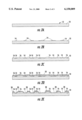
- FIGS. 1A-1B schematically illustrate steps for making a decorative article of manufacture, according to several aspects of the present invention.
- FIGS. 2A-2E illustrate greatly enlarged section views of a process for producing an article of manufacture according to the present invention.
- FIG. 3 is a plan view of a decorative article of manufacture produced in accordance with the present invention.
- steps include: preparing a substrate surface to receive decorative material thereon (Block 100); applying release material of silicone, wax or oil to substrate surface (Block 110); applying curable resin on top of release material (Block 120); and curing the resin (Block 130).
- steps include: preparing a substrate surface to receive decorative material thereon (Block 100); applying release material of silicone, wax or oil to substrate surface (Block 110); applying curable resin on top of release material (Block 120); and curing the resin (Block 130).
- steps include: preparing a substrate surface to receive decorative material thereon (Block 100); applying release material of silicone, wax or oil to substrate surface (Block 110); applying curable resin on top of release material (Block 120); and curing the resin (Block 130).
- steps include: preparing a substrate surface to receive decorative material thereon (Block 200); applying release material of silicone, wax or oil to substrate surface (Block 210); applying a first curable resin on top of release material (Block 220); applying a second curable resin on top of the first curable resin (Block 230); commingling the first and second curable resins (Block 240); curing the first and second resins (Block 250); and applying a wear-resistant layer of material on top of the first and second resins (Block 260).
- a substrate upon which a decorative article can be produced may be formed from virtually any substantially non-porous material, such as metal, plastic, wood, paper, glass, paint, and the like.
- the substrate surface may have one or more colors.
- the substrate surface to receive the various decorative materials thereon may be prepared in a variety of ways.
- the substrate surface may be subjected to conditions sufficient to produce a smooth surface (e.g., sanding with abrasives having 150 grit, or finer, abrasive).
- the substrate may be subjected to conditions sufficient to produce a generally rough surface (e.g., sanding with abrasives having 150 grit, or coarser, abrasive).
- a scratch or abrasive pattern may be formed in the substrate surface via various known techniques including, but not limited to conventional sanding, embossing, and abrasive blasting techniques. Fibrous surfaces such as wood-based composite boards, and the like, may also have rough surfaces sufficient for use with the present invention.
- solvents may be utilized to prepare the substrate surface as desired.
- the present invention is not limited to planar substrates. Various non-planar surface shapes may be utilized without departing from the spirit and intent of the present invention. For example, the present invention may be utilized on the curved surface of glass bottles.
- a coating of release material is applied to the prepared substrate surface.
- the release material is selected to substantially repel the resin materials overlying the release material. Accordingly, different release materials may be selected depending on the resin materials utilized.
- Exemplary release materials include, but are not limited to silicone, oil, and wax. Particularly preferable are waxes in the carnauba wax family.
- the release material may be applied in a pattern or in a random manner.
- Various application methods may be utilized for applying the release material to the substrate surface.
- a pattern of release material may be applied to the substrate surface via a rubber, felt or composite platen.
- the platen may be planar, cylindrical, or other non-planar shape.
- the release material may be applied by various artistic methods, including, but not limited to, selective "ragging", spattered spraying, silk screening, and the like.
- the release material is applied via a volatile solvent, such as naphtha, which serves as a vehicle for adhesively transferring the release material to the substrate surface.
- a volatile solvent such as naphtha
- the solvent is allowed to flash off prior to the application of resin material, as described below.
- a very thin coating of release material is utilized.
- the release material is typically colorless, and is generally invisible after application.
- the release material is applied with a thickness of typically less than 0.0005 inches, and preferably less than 0.0001 inches.
- One or more layers of curable resin may be applied to the substrate surface after the release material is applied thereto.
- the resin may be applied in various ways, including, but not limited to, spraying and rolling.
- Each resin material preferably has a viscosity and a surface tension that is greater than that of the release material. Accordingly, the resin "pulls" away from the release material to provide interesting patterns and configurations.
- Each resin applied may have a different color.
- the plurality of resins When more than one resin is applied in an uncured state (or a partially cured state), the plurality of resins commingle to provide further aesthetic characteristics.
- Various pigments within each resin may enhance the aesthetic quality, as well.
- the use of metal flake and pearlescent pigment can provide molten-metal and jewel-like surfaces, respectively.
- metal flakes When metal flakes are added to one or more of the resins, the metal flakes migrate to the top of the resin, with pigment color forming diffused boundaries adjacent to the release material.
- the commingling of pigments may be similar in richness to the glazes in ceramic pottery or jewelry because of the chaotic blending effects that are possible.
- thermosetting resin relates to a polymer that solidifies or “sets” irreversibly on heating.
- Suitable thermosetting resins include polyesters, epoxies, urethanes, or any other similar resins preferably having various volatile components which cure without releasing solvents and/or gases therein. It is recognized that some polymers although technically "thermoplastics” could be used in the present invention with the proviso that they do not flow under conditions to which the article is typically subjected. Exemplary polymers of this type are the acrylics and vinyls.
- curable thermosetting resins are well known in the art and generally involves mixing resins with various filler materials, fiber reinforcement, appropriate initiators and catalysts, and desired tinting or pigment materials, referred to as a resin system. Filler materials may be selected to impart desired properties to a thermosetting resin. Each resin preferably has a different color pigment mixed therein.
- thermosetting resins useful herein can vary and include unsaturated polyesters, phenolics, epoxies, polyurethanes, and the like, and mixtures and blends thereof.
- Unsaturated polyester resins are a particularly preferred resin.
- Useful unsaturated polyester resins include practically any esterification product of a polybasic organic acid and a polyhydric alcohol, wherein either the acid or the alcohol, or both, provide the ethylenic unsaturation.
- Typical unsaturated polyesters are those thermosetting resins made from the esterification of a dihydric alcohol with an ethylenically unsaturated dicarboxylic acid.
- Examples of useful ethylenically unsaturated polycarboxylic acids include maleic acid, fumaric acid, itaconic acid, dihydromuconic acid, and halo and alkyl derivatives of such acids and anhydrides, and mixtures thereof.
- Exemplary polyhydric alcohols include saturated polyhydric alcohols such as ethylene glycol, 1,3-propanediol, propylene glycol, 2,3-butanediol, 1,4-butanediol, 2-ethylbutane-1,4-diol, 1,5-pentanediol, 1,6-hexandediol, 1,7-heptanediol, 1,8-octanediol, 1,9-nonanediol, 1,10-decanediol, 2,10-decanediol, 1,4-cyclohexandediol, 1,4-dimethylolcyclohexane, 2,2-diethylpropane-1,3-diol, 2,2-dimethylpropane-1,3-diol, 3-methylpentane-1,4-diol, 2,2-diethylbutane-1,3-dio
- Unsaturated polyester resins can also be derived from the esterification of a saturated polycarboxylic acid or anhydride with an unsaturated polyhydric alcohol.
- useful saturated polycarboxylic acids include oxalic acid, malonic acid, succinic acid, methylsuccinic acid, 2,2-dimethylsuccinic acid, 2,3-dimethylsuccinic acid, hexylsuccinic acid, glutaric acid, 2-methylglutaric acid, 3-methylglutaric acid, 2,2-dimethylglutaric acid, 3,3-dimethylglutaric acid, 3-3,-diethylglutaric acid, adipic acid, pimelic acid, suberic acid, azelaic acid, sebaccic acid, phthalic acid, isophthalic acid, terephthalic acid, tetrachlorophthalic acid, tetrabromophthalic acid, tetrahydrophthalic acid, 1,2-hexahydrophthalic acid, 1,3
- Useful unsaturated polyhydric alcohols for reacting with the saturated polycarboxylic acids include ethylenic unsaturation-containing analogs of the above saturated alcohols (e.g., 2-butene-1,4-diol).
- the unsaturated polyester resins are generally crosslinked with a compatible crosslinking monomer such as styrene, vinyl toluene, methyl methacrylate, methyl styrene, divinyl benzene, diallyl phthalate and the like.
- a preferred resin is Polylite® manufactured by Reichhold Chemicals, Durham, N.C.
- the amount of polyester thermosetting resin in the resin system ranges from about 35 percent to about 100 percent by weight of the total resin system.
- the amount of crosslinking monomer is about 10 percent to about 65 percent by weight of the resin system.
- the polyester resin can also be mixed or blended with other thermosetting resins.
- the polyester resin can be mixed with a crosslinking polyurethane such as described in U.S. Pat. No. 4,062,826 to Hutchinson et al., the disclosure of which is incorporated herein by reference. Polymerization of this mixture can occur by a condensation reaction.
- a homogenous mixture of an unsaturated polyester resin and a crosslinkable polyurethane precursor having at least one free isocyanate group to react with the end groups of the polyester resin is formed.
- a crosslinkable polyurethane comprising at least one polyfunctional compound containing groups reactive with isocyanate groups and at least one polyisocyanate can be used.
- the isocyanate is activated by the first reaction conditions and the chain extension reaction takes place to partially polymerize the resin blend to a semi-solid mass.
- exemplary polyisocyanates include methylene di-p-phenylene isocyanate (“MDI”) isophorone diisocyanate (“IPDI”) and toluene diisocyanate (“TDI”).
- MDI methylene di-p-phenylene isocyanate
- IPDI isophorone diisocyanate
- TDI toluene diisocyanate
- the second reaction conditions can be activating additional polyisocyanate to fully polymerize the resin blend or can be activating a free radical initiator in the blend to fully polymerize the same.
- the use of other thermosetting resins will be within the skill of one in the art.
- Exemplary room temperature free radical initiators include hydrogen peroxide and methyl ethyl ketone peroxide ("MEKP”) noting that most commercially available MEKP includes some hydrogen peroxide.
- MEKP methyl ethyl ketone peroxide
- Exemplary peroxy-type free radical polymerization initiators are the hydroperoxides such as tert-butyl hydroperoxide, 2,5-dimethylhexane-2,5-dihydroperoxide, cumene hydroperoxide, para-methane hydroperoxide and the like; peroxy esters such as di-tert-butyl peroxide, dibenzyl peroxide and the like; ketone peroxides such as methyl ethyl ketone peroxide, cyclohexanone peroxide and the like; acyl peroxides such as benzoyl peroxide, parachlorobenzoyl peroxide; 2,4-dichlorobenzoyl peroxide, lauroyl peroxide and the like.
- hydroperoxides such as tert-butyl hydroperoxide, 2,5-dimethylhexane-2,5-dihydroperoxide, cumene hydroperoxide, para-methane
- first and second curing agents such as azobisbutrylnitrile can be used.
- the amount of first and second curing agents used is dependent on the time desired for thermosetting, but is typically a short period of time (i.e., less than 3 hours, typically less than 2 hours and often less than 1 hour).
- the amount used is about 0.01 to about 0.1 percent by weight of the first curing agent and about 0.1 to about 5 percent by weight of the second curing agent.
- the resin system can also include various additives commonly employed in thermosetting resin compositions such as fillers, surfacing agents, colorants, veining pigments, thixotropic agents, and other additives for imparting desirable properties such as hardness, color, flame retardancy, aesthetic appearance, smoothness, clarity and the like. Additionally, resins may be selected having a degree of translucency allowing the colors of other resins used to be visible. A variety of desired aesthetic characteristics can be achieved by selecting resins having different colors and properties, as would be understood by those having skill in the art.
- Exemplary fillers can include, among others, aluminum trihydrate, quartz powder, marble powder, crushed silica, calcium carbonate, clay, powdered metals, metal flakes, mixtures thereof and other mineral and inorganic particulates that contribute to the aesthetics of the final article.
- tinting pigments such as titanium dioxide and the like can be added.
- the amount used is typically less than about 3 percent by weight.
- Thixotropic agents are agents which cause the viscosity of the resin system to vary as a function of its state of agitation and the previous history of motion within the fluid. Generally, the viscosity of a thixotropic fluid decreases as its state of agitation and length of agitation increases, and increases as its state of agitation and length of agitation decreases.
- An exemplary thixotropic agents is fumed silica. The amount used is typically less than about 1 percent by weight.
- Curing the resins preferably takes place using conventional techniques, as described in the above-referenced U.S. Pat. No. 5,166,230 to Stecker, the disclosure of which is incorporated herein by reference in its entirety. Curing may occur at room temperature, for example between about 15° C. and 38° C., or at elevated temperatures, for example, between about 100° C. and 150° C.
- the specific curing temperature and curing time may vary from the above and will depend upon the particular resin or resins and is information which is well known in the art.
- curing may take place via ultra-violet radiation (UV) and via exposure to an electron beam (EB).
- a full curing step or partial curing step may occur after each step of applying a resin layer. After sufficient curing time, the thermosetting resin layers are substantially polymerized.
- a layer of translucent, wear-resistant material is applied on top of the cured resin or resins to give the structural panel a hard, scuff and damage-resistant finish suitable for use as a floor panel, wall panel, or countertop.
- the wear-resistant material is preferably a polymeric material containing a mineral or filler, such as aluminum oxide.
- Preferred wear-resistant materials include, but are not limited to, urethane acrylates and silicone acrylates.
- FIGS. 2A-2E greatly enlarged section views of an article of manufacture according to the present invention are illustrated.
- a substrate 10 is illustrated having a generally rough surface 12.
- a release material 14 has been applied to the substrate surface 12.
- a first curable resin 16 has been applied on top of the substrate surface 12 and release material 14.
- a second curable resin has been applied on top of the first curable resin. Because the two resins are in an "uncured" state, they commingle to form a blended layer of resin 20, as illustrated in FIG. 2E.
- the blended resin "pulls away" from the release material 14 as illustrated. It is to be understood that each separate layer of resin may pull away from the release material to some degree before additional resin is added thereto.
- FIG. 3 A plan view of a decorative article of manufacture 40 produced in accordance with the present invention is illustrated in FIG. 3.
- a resin material 42 is pulled away from a release material 44 applied to the surface 41 of the article 40, resulting in the "fish-eye" appearance.
- Exemplary decorative structural panels produced by the above process include architectural facing, exterior and interior wall panels, counter tops, tabletops, tiles, containers, moldings, furniture, and the like.
- a plurality of the decorative structural panels may be installed on walls, ceilings, and floors to simulate a continuous ceramic tile surface.
- Decorative structural panels may be produced to simulate almost any type of surface and may have almost any pattern and color scheme desired when produced according to the processes of the present invention.
- a 20 gauge steel panel was lightly sanded in a random pattern with 320 grit aluminum oxide abrasive paper on an orbital sander. The panel was cleaned with acetone to eliminate oil and other contamination thereon.
- a silicone rubber stamp with a decorative geometric pattern was coated with a liquid carnauba wax and naphtha. The rubber stamp was pressed against the panel and transferred a thin wax image thereon. The wax image was allowed to dry.
- the two resins had the following compositions:
- Resin #1 was sprayed onto the panel surface to a thickness of 6 wet mils (thousandths of an inch). Immediately thereafter, resin #2 was sprayed on top of resin #2 to a thickness of 4 wet mils.
- the resins pulled away from the wax leaving an exposed gray steel pattern and islands of mottled color with bronze, gold, black and blue-gray colors vignetting a gold pattern.
- the height of the final relief was about 12 dry mils above the surface of the steel panel.
- the resins polymerized in about 20 minutes.
- the panel was then baked at 150° F. (66° C.) for 2 hours to achieve a hard durable finish.
- the resulting decorative article resembled aged, molten metal.
- Example 2 The same procedure was followed as outlined above in Example 1, except that both resins use 2% surfacing agent which lowered the surface tension causing less pull back from release material.
- the pattern had a minimum relief texture of 1 to 2 mils.
- the resulting image after curing was more shadowy and less distinct than in Example 1.
- a "halo" image was produced.
Landscapes
- Engineering & Computer Science (AREA)
- Mechanical Engineering (AREA)
- Laminated Bodies (AREA)
Abstract
Decorative structural panels have a release material of wax, silicone, or oil applied to portions of a substrate surface. One or more curable thermosetting resins are applied on top of the release material and substrate surface and allowed to commingle. The surface tension of each resin is greater than that of the release material such that the resin or resins are pulled away from the release material prior to curing to produce a fish-eye appearance having a strong and durable finish.
Description
The present invention relates generally to decorative structural panels and, more particularly, to surface coatings for decorative structural panels.
In the surface coatings industry, the tendency of liquid coatings to "fish-eye" or pull away from waxy or oily contaminants on a surface is known and is typically undesirable. This phenomenon is caused by different surface energies of the coatings and contaminants. High molecular weight liquids with high surface tension are especially prone to fish-eye. Accordingly, surface preparation in the coatings industry may involve solvent dips and mechanical preparation to rid a surface to be coated of unwanted contaminants. Also, material, such as silicone, may be added to a coating to reduce the surface tension of the coating and, thus, the tendency of the coating to fish-eye.
Printing methods utilizing ink containing a very small amount of silicone to distort and enhance images are known. For example, U.S. Pat. No. 3,811,915 to Burrell et al. describes a printing method for producing simulated wood grain on a substrate. Ink containing between about 0.1% and 3.0% by weight silicone is applied to the substrate in a pattern. A conventional top coat of material which tends to be repelled by the silicone, such as lacquer, is applied over the ink forming a three-dimensional grained or patterned effect.
U.S. Pat. No. 4,532,157 to Schmidt et al. describes a printing method for producing paper sheets having a three-dimensional surface structure. An aqueous ink containing a lacquer-repelling material is applied to a paper sheet. An aqueous lacquer is applied over the ink to produce a three-dimensional effect.
U.S. Pat. No. 4,652,482 to Diesel et al. describes producing colored films of paper having a three-dimensional effect. Paper films are printed with an aqueous ink containing lacquer-repelling material, followed by a coating of lacquer thereover.
U.S. Pat. No. 5,089,351 to Baarns describes a process for creating a work of art wherein crayon is applied to a paper surface followed by the application of ink.
U.S. Pat. No. 4,393,108 to Barker et al. describes a process for producing a decorative simulated ceramic tile. A substrate is coated with a colored material to produce a printable base. Ink containing silicone is applied to the printable base in a clearly visible pattern. A translucent top coat of pigment-containing material is applied over the ink pattern.
Unfortunately, the types of aesthetically pleasing surfaces produced using these ink and lacquer techniques are somewhat limited. The systems described above are limited to discrete aesthetics where an ink image is sharp and distinct. Only Barker et al. softens an ink image with the use of a single semi-transparent material. None of the systems describe chaotic or subtle co-mingling of colors and textures. Furthermore, the systems described above utilizing printing techniques are limited to pressure transfer systems. Articles produced using the above techniques may not have a strong and durable finish which may be necessary for various applications, such as wall panels, counter tops, tabletops, tiles, containers, moldings, furniture, and the like.
It is therefore an object of the present invention to produce decorative structural panels having a strong and durable finish with an aesthetically appealing fish-eye appearance.
It is another object of the present invention to produce decorative structural panels having an aesthetically appealing fish-eye appearance with multiple colors.
These and other objects of the present invention are provided by a decorative article of manufacture having a release material or release image applied to portions of a substrate surface, and one or more curable thermosetting resins applied to the release material and portions of the substrate surface not covered by the release material. Suitable substrates may be formed from wood, plastic, and metal. Various patterns may be formed in the substrate surface to enhance the aesthetic appeal of the decorative article. Each resin has a surface tension greater than that of the release material. Accordingly, the resin or resins are "pulled away" from the release material prior to curing to produce a fish-eye appearance. The release material may be selected from wax, oil, and silicone products. The release material may be applied to the substrate surface in a pattern or in a random fashion.
According to another aspect of the present invention, steps for producing a decorative article include: providing a prepared substrate surface; applying a release material to the substrate surface; applying one or more curable resins having surface tension greater than the surface tension of the release material on top of the release material; and commingling and curing the resins. For a more pronounced fish-eye effect, the difference in surface tension between a resin and release material can be increased. For a less pronounced fish-eye appearance, the difference in surface tension between a resin and release material can be decreased. A wear-resistant top layer may be applied for durability.
Each resin may have a respective color and may include various fillers and materials. The release material may be selected from various wax, oil, and silicone products and can be applied in various ways. Furthermore, the release material may be applied as a pattern or in a random fashion. Each resin may also be a thermosetting resin selected from the group consisting of unsaturated polyesters, acrylics, epoxies, phenolics and polyurethanes, and blends and mixtures thereof. Polymerization may take place via free radical polymerization, ultra-violet radiation, and the like. The release material is typically less than about 0.1 thousandths of an inch in applied thickness.
Decorative structural panels, according to the present invention are particularly well-suited for use in walls, floors, countertops, and the like.
The accompanying drawings, which are incorporated in and constitute a part of the specification, illustrate an embodiment of the invention and, together with the description, serve to explain the principles of the invention.
FIGS. 1A-1B schematically illustrate steps for making a decorative article of manufacture, according to several aspects of the present invention.
FIGS. 2A-2E illustrate greatly enlarged section views of a process for producing an article of manufacture according to the present invention.
FIG. 3 is a plan view of a decorative article of manufacture produced in accordance with the present invention.
The present invention now will be described more fully hereinafter with reference to the accompanying drawings, in which preferred embodiments of the invention are shown. This invention may, however, be embodied in many different forms and should not be construed as limited to the embodiments set forth herein; rather, these embodiments are provided so that this disclosure will be thorough and complete, and will fully convey the scope of the invention to those skilled in the art. Like numbers refer to like elements throughout.
Referring now to FIGS. 1A-1B, steps for making a decorative article of manufacture, according to several aspects of the present invention, are illustrated. According to one aspect illustrated in FIG. 1A, steps include: preparing a substrate surface to receive decorative material thereon (Block 100); applying release material of silicone, wax or oil to substrate surface (Block 110); applying curable resin on top of release material (Block 120); and curing the resin (Block 130). According to another aspect of the present invention illustrated in FIG. 1B, steps include: preparing a substrate surface to receive decorative material thereon (Block 200); applying release material of silicone, wax or oil to substrate surface (Block 210); applying a first curable resin on top of release material (Block 220); applying a second curable resin on top of the first curable resin (Block 230); commingling the first and second curable resins (Block 240); curing the first and second resins (Block 250); and applying a wear-resistant layer of material on top of the first and second resins (Block 260). These steps will now be described in detail hereinbelow.
A substrate upon which a decorative article can be produced, according to the present invention, may be formed from virtually any substantially non-porous material, such as metal, plastic, wood, paper, glass, paint, and the like. The substrate surface may have one or more colors.
The substrate surface to receive the various decorative materials thereon may be prepared in a variety of ways. The substrate surface may be subjected to conditions sufficient to produce a smooth surface (e.g., sanding with abrasives having 150 grit, or finer, abrasive). Alternatively, the substrate may be subjected to conditions sufficient to produce a generally rough surface (e.g., sanding with abrasives having 150 grit, or coarser, abrasive). A scratch or abrasive pattern may be formed in the substrate surface via various known techniques including, but not limited to conventional sanding, embossing, and abrasive blasting techniques. Fibrous surfaces such as wood-based composite boards, and the like, may also have rough surfaces sufficient for use with the present invention. In addition, solvents may be utilized to prepare the substrate surface as desired.
The present invention is not limited to planar substrates. Various non-planar surface shapes may be utilized without departing from the spirit and intent of the present invention. For example, the present invention may be utilized on the curved surface of glass bottles.
A coating of release material is applied to the prepared substrate surface. The release material is selected to substantially repel the resin materials overlying the release material. Accordingly, different release materials may be selected depending on the resin materials utilized. Exemplary release materials include, but are not limited to silicone, oil, and wax. Particularly preferable are waxes in the carnauba wax family.
The release material may be applied in a pattern or in a random manner. Various application methods may be utilized for applying the release material to the substrate surface. For example, a pattern of release material may be applied to the substrate surface via a rubber, felt or composite platen. The platen may be planar, cylindrical, or other non-planar shape. Alternatively, the release material may be applied by various artistic methods, including, but not limited to, selective "ragging", spattered spraying, silk screening, and the like.
Preferably, the release material is applied via a volatile solvent, such as naphtha, which serves as a vehicle for adhesively transferring the release material to the substrate surface. The solvent is allowed to flash off prior to the application of resin material, as described below. A very thin coating of release material is utilized. The release material is typically colorless, and is generally invisible after application. The release material is applied with a thickness of typically less than 0.0005 inches, and preferably less than 0.0001 inches.
One or more layers of curable resin may be applied to the substrate surface after the release material is applied thereto. The resin may be applied in various ways, including, but not limited to, spraying and rolling. Each resin material preferably has a viscosity and a surface tension that is greater than that of the release material. Accordingly, the resin "pulls" away from the release material to provide interesting patterns and configurations. Each resin applied may have a different color.
When more than one resin is applied in an uncured state (or a partially cured state), the plurality of resins commingle to provide further aesthetic characteristics. Various pigments within each resin may enhance the aesthetic quality, as well. For example, the use of metal flake and pearlescent pigment can provide molten-metal and jewel-like surfaces, respectively. When metal flakes are added to one or more of the resins, the metal flakes migrate to the top of the resin, with pigment color forming diffused boundaries adjacent to the release material. The commingling of pigments may be similar in richness to the glazes in ceramic pottery or jewelry because of the chaotic blending effects that are possible.
Although a variety of resin materials will function satisfactorily, the resin materials should preferably be thermosetting resins. The term "thermosetting resin" relates to a polymer that solidifies or "sets" irreversibly on heating. Suitable thermosetting resins include polyesters, epoxies, urethanes, or any other similar resins preferably having various volatile components which cure without releasing solvents and/or gases therein. It is recognized that some polymers although technically "thermoplastics" could be used in the present invention with the proviso that they do not flow under conditions to which the article is typically subjected. Exemplary polymers of this type are the acrylics and vinyls.
The preparation of curable thermosetting resins is well known in the art and generally involves mixing resins with various filler materials, fiber reinforcement, appropriate initiators and catalysts, and desired tinting or pigment materials, referred to as a resin system. Filler materials may be selected to impart desired properties to a thermosetting resin. Each resin preferably has a different color pigment mixed therein.
The thermosetting resins useful herein can vary and include unsaturated polyesters, phenolics, epoxies, polyurethanes, and the like, and mixtures and blends thereof. Unsaturated polyester resins are a particularly preferred resin. Useful unsaturated polyester resins include practically any esterification product of a polybasic organic acid and a polyhydric alcohol, wherein either the acid or the alcohol, or both, provide the ethylenic unsaturation. Typical unsaturated polyesters are those thermosetting resins made from the esterification of a dihydric alcohol with an ethylenically unsaturated dicarboxylic acid. Examples of useful ethylenically unsaturated polycarboxylic acids include maleic acid, fumaric acid, itaconic acid, dihydromuconic acid, and halo and alkyl derivatives of such acids and anhydrides, and mixtures thereof. Exemplary polyhydric alcohols include saturated polyhydric alcohols such as ethylene glycol, 1,3-propanediol, propylene glycol, 2,3-butanediol, 1,4-butanediol, 2-ethylbutane-1,4-diol, 1,5-pentanediol, 1,6-hexandediol, 1,7-heptanediol, 1,8-octanediol, 1,9-nonanediol, 1,10-decanediol, 2,10-decanediol, 1,4-cyclohexandediol, 1,4-dimethylolcyclohexane, 2,2-diethylpropane-1,3-diol, 2,2-dimethylpropane-1,3-diol, 3-methylpentane-1,4-diol, 2,2-diethylbutane-1,3-diol, 4,5-nonanediol, diethylene glycol, triethylene glycol, dipropylene glycol, glycerol, pentaerythritol, erythritol, sorbitol, mannitol, 1,1,1-trimethylolpropane, trimethylolethane, hydrogenated bisphenol-A and the reaction products of bisphenol-A with ethylene or propylene oxide.
Unsaturated polyester resins can also be derived from the esterification of a saturated polycarboxylic acid or anhydride with an unsaturated polyhydric alcohol. Examples of useful saturated polycarboxylic acids include oxalic acid, malonic acid, succinic acid, methylsuccinic acid, 2,2-dimethylsuccinic acid, 2,3-dimethylsuccinic acid, hexylsuccinic acid, glutaric acid, 2-methylglutaric acid, 3-methylglutaric acid, 2,2-dimethylglutaric acid, 3,3-dimethylglutaric acid, 3-3,-diethylglutaric acid, adipic acid, pimelic acid, suberic acid, azelaic acid, sebaccic acid, phthalic acid, isophthalic acid, terephthalic acid, tetrachlorophthalic acid, tetrabromophthalic acid, tetrahydrophthalic acid, 1,2-hexahydrophthalic acid, 1,3-hexahydrophthalic acid, 1,4-hexahydrophthalic acid, 1,1-cyclobutanedicarboxylic acid and trans-1,4-cyclohexanedicarboxylic acid.
Useful unsaturated polyhydric alcohols for reacting with the saturated polycarboxylic acids include ethylenic unsaturation-containing analogs of the above saturated alcohols (e.g., 2-butene-1,4-diol). The unsaturated polyester resins are generally crosslinked with a compatible crosslinking monomer such as styrene, vinyl toluene, methyl methacrylate, methyl styrene, divinyl benzene, diallyl phthalate and the like. A preferred resin is Polylite® manufactured by Reichhold Chemicals, Durham, N.C.
The amount of polyester thermosetting resin in the resin system ranges from about 35 percent to about 100 percent by weight of the total resin system. The amount of crosslinking monomer is about 10 percent to about 65 percent by weight of the resin system.
The polyester resin can also be mixed or blended with other thermosetting resins. For example, the polyester resin can be mixed with a crosslinking polyurethane such as described in U.S. Pat. No. 4,062,826 to Hutchinson et al., the disclosure of which is incorporated herein by reference. Polymerization of this mixture can occur by a condensation reaction. A homogenous mixture of an unsaturated polyester resin and a crosslinkable polyurethane precursor having at least one free isocyanate group to react with the end groups of the polyester resin is formed. For example, a crosslinkable polyurethane comprising at least one polyfunctional compound containing groups reactive with isocyanate groups and at least one polyisocyanate can be used. The isocyanate is activated by the first reaction conditions and the chain extension reaction takes place to partially polymerize the resin blend to a semi-solid mass. Exemplary polyisocyanates include methylene di-p-phenylene isocyanate ("MDI") isophorone diisocyanate ("IPDI") and toluene diisocyanate ("TDI"). The second reaction conditions can be activating additional polyisocyanate to fully polymerize the resin blend or can be activating a free radical initiator in the blend to fully polymerize the same. The use of other thermosetting resins will be within the skill of one in the art.
Exemplary room temperature free radical initiators include hydrogen peroxide and methyl ethyl ketone peroxide ("MEKP") noting that most commercially available MEKP includes some hydrogen peroxide.
Exemplary peroxy-type free radical polymerization initiators are the hydroperoxides such as tert-butyl hydroperoxide, 2,5-dimethylhexane-2,5-dihydroperoxide, cumene hydroperoxide, para-methane hydroperoxide and the like; peroxy esters such as di-tert-butyl peroxide, dibenzyl peroxide and the like; ketone peroxides such as methyl ethyl ketone peroxide, cyclohexanone peroxide and the like; acyl peroxides such as benzoyl peroxide, parachlorobenzoyl peroxide; 2,4-dichlorobenzoyl peroxide, lauroyl peroxide and the like. Also azo promoters such as azobisbutrylnitrile can be used. The amount of first and second curing agents used is dependent on the time desired for thermosetting, but is typically a short period of time (i.e., less than 3 hours, typically less than 2 hours and often less than 1 hour). The amount used is about 0.01 to about 0.1 percent by weight of the first curing agent and about 0.1 to about 5 percent by weight of the second curing agent.
As previously noted, the resin system can also include various additives commonly employed in thermosetting resin compositions such as fillers, surfacing agents, colorants, veining pigments, thixotropic agents, and other additives for imparting desirable properties such as hardness, color, flame retardancy, aesthetic appearance, smoothness, clarity and the like. Additionally, resins may be selected having a degree of translucency allowing the colors of other resins used to be visible. A variety of desired aesthetic characteristics can be achieved by selecting resins having different colors and properties, as would be understood by those having skill in the art.
Exemplary fillers can include, among others, aluminum trihydrate, quartz powder, marble powder, crushed silica, calcium carbonate, clay, powdered metals, metal flakes, mixtures thereof and other mineral and inorganic particulates that contribute to the aesthetics of the final article.
Various colorants and veining pigments can be added for purposes of providing background color and other aesthetically pleasing features to the resin system and shaped article. For example, tinting pigments such as titanium dioxide and the like can be added. The amount used is typically less than about 3 percent by weight.
Thixotropic agents are agents which cause the viscosity of the resin system to vary as a function of its state of agitation and the previous history of motion within the fluid. Generally, the viscosity of a thixotropic fluid decreases as its state of agitation and length of agitation increases, and increases as its state of agitation and length of agitation decreases. An exemplary thixotropic agents is fumed silica. The amount used is typically less than about 1 percent by weight.
Curing the resins preferably takes place using conventional techniques, as described in the above-referenced U.S. Pat. No. 5,166,230 to Stecker, the disclosure of which is incorporated herein by reference in its entirety. Curing may occur at room temperature, for example between about 15° C. and 38° C., or at elevated temperatures, for example, between about 100° C. and 150° C. The specific curing temperature and curing time may vary from the above and will depend upon the particular resin or resins and is information which is well known in the art. In addition, curing may take place via ultra-violet radiation (UV) and via exposure to an electron beam (EB). In addition, a full curing step or partial curing step may occur after each step of applying a resin layer. After sufficient curing time, the thermosetting resin layers are substantially polymerized.
Preferably, a layer of translucent, wear-resistant material is applied on top of the cured resin or resins to give the structural panel a hard, scuff and damage-resistant finish suitable for use as a floor panel, wall panel, or countertop. The wear-resistant material is preferably a polymeric material containing a mineral or filler, such as aluminum oxide. Preferred wear-resistant materials include, but are not limited to, urethane acrylates and silicone acrylates.
Referring now to FIGS. 2A-2E, greatly enlarged section views of an article of manufacture according to the present invention are illustrated. In FIG. 2A, a substrate 10 is illustrated having a generally rough surface 12. In FIG. 2B, a release material 14 has been applied to the substrate surface 12. In FIG. 2C, a first curable resin 16 has been applied on top of the substrate surface 12 and release material 14. In FIG. 2D, a second curable resin has been applied on top of the first curable resin. Because the two resins are in an "uncured" state, they commingle to form a blended layer of resin 20, as illustrated in FIG. 2E. In addition, because the viscosity and surface tension of the resins are greater than that of the release material, the blended resin "pulls away" from the release material 14 as illustrated. It is to be understood that each separate layer of resin may pull away from the release material to some degree before additional resin is added thereto.
A plan view of a decorative article of manufacture 40 produced in accordance with the present invention is illustrated in FIG. 3. A resin material 42 is pulled away from a release material 44 applied to the surface 41 of the article 40, resulting in the "fish-eye" appearance.
The application of the present invention is broad since attractive and durable resin materials may be utilized. Exemplary decorative structural panels produced by the above process include architectural facing, exterior and interior wall panels, counter tops, tabletops, tiles, containers, moldings, furniture, and the like. As would be understood by those having skill in the art, a plurality of the decorative structural panels may be installed on walls, ceilings, and floors to simulate a continuous ceramic tile surface. Decorative structural panels may be produced to simulate almost any type of surface and may have almost any pattern and color scheme desired when produced according to the processes of the present invention.
The present invention can be further understood by reference to the following specific examples.
A 20 gauge steel panel was lightly sanded in a random pattern with 320 grit aluminum oxide abrasive paper on an orbital sander. The panel was cleaned with acetone to eliminate oil and other contamination thereon. A silicone rubber stamp with a decorative geometric pattern was coated with a liquid carnauba wax and naphtha. The rubber stamp was pressed against the panel and transferred a thin wax image thereon. The wax image was allowed to dry. Two layers of resin, each having a different color, were applied to the panel on top of the wax image. The two resins had the following compositions:
______________________________________
Resin #1          Resin #2
______________________________________
80% Polyester resin
                  90% Polyester resin
Polylite 31210 (Reichhold
                  Polylite 31210 (Reichhold
Chemicals, Inc.)  Chemicals, Inc.)
10% Copper metal flake
                  5% Styrene monomer
1% Black pigment  1% Verdigras pigment
                  (copper oxide)
1% Surfacing agent (H&K
                  1% Surfacing agent (H&K
R0059 Resin, HK Research
                  R0059 Resin, HK Research
Corporation, Hickory,
                  Corporation, Hickory,
North Carolina)   North Carolina)
5% Styrene monomer
                  2% MEKP catalyst
                  (Lupersol DDM-9, Atochem
                  North America, Inc.,
                  Buffalo, New York)
2% MEKP catalyst
(Lupersol DDM-9, Atochem
North America, Inc.,
Buffalo, New York)
______________________________________
Resin #1 was sprayed onto the panel surface to a thickness of 6 wet mils (thousandths of an inch). Immediately thereafter, resin #2 was sprayed on top of resin #2 to a thickness of 4 wet mils.
The resins pulled away from the wax leaving an exposed gray steel pattern and islands of mottled color with bronze, gold, black and blue-gray colors vignetting a gold pattern. The height of the final relief was about 12 dry mils above the surface of the steel panel. The resins polymerized in about 20 minutes. The panel was then baked at 150° F. (66° C.) for 2 hours to achieve a hard durable finish. The resulting decorative article resembled aged, molten metal.
The same procedure was followed as outlined above in Example 1, except that both resins use 2% surfacing agent which lowered the surface tension causing less pull back from release material. The pattern had a minimum relief texture of 1 to 2 mils. The resulting image after curing was more shadowy and less distinct than in Example 1. In addition, a "halo" image was produced.
The foregoing is illustrative of the present invention and is not to be construed as limiting thereof. Although a few exemplary embodiments of this invention have been described, those skilled in the art will readily appreciate that many modifications are possible in the exemplary embodiments without materially departing from the novel teachings and advantages of this invention. Accordingly, all such modifications are intended to be included within the scope of this invention as defined in the claims. Therefore, it is to be understood that the foregoing is illustrative of the present invention and is not to be construed as limited to the specific embodiments disclosed, and that modifications to the disclosed embodiments, as well as other embodiments, are intended to be included within the scope of the appended claims. The invention is defined by the following claims, with equivalents of the claims to be included therein.
Claims (11)
1. A decorative article of manufacture, comprising:
a substrate having a surface;
a release material applied to portions of the substrate surface, the release material selected from the group consisting of wax, oil, and silicone; and
a resin applied to the release material and to portions of the substrate surface not covered by the release material, wherein the resin has a surface tension greater than a surface tension of the release material such that the resin pulls away from the release material and wherein the resin has a first color.
2. A decorative article of manufacture according to claim 1 further comprising a second resin applied to the first resin such that the second resin is commingled with the first resin, the second resin having a second color different from the first color.
3. A decorative article of manufacture according to claim 2 further comprising a third resin applied to the second resin such that the third resin is commingled with the first and second resins, the third resin having a third color different from the first and second colors.
4. A decorative article of manufacture according to claim 1 wherein the release material is applied to portions of the substrate surface in a pattern.
5. A decorative article of manufacture according to claim 1 wherein the release material is applied to portions of the substrate surface randomly.
6. A decorative article of manufacture according to claim 5 wherein the release material has a thickness of less than about 0.0005 inches.
7. A decorative article of manufacture according to claim 5 wherein the resin is a thermosetting resin selected from the group consisting of unsaturated polyesters, acrylics, epoxies, phenolics and polyurethanes, and blends and mixtures thereof.
8. A decorative article of manufacture according to claim 3 wherein the second and third curable resins are thermosetting resins selected from the group consisting of unsaturated polyesters, acrylics, epoxies, phenolics and polyurethanes, and blends and mixtures thereof.
9. A decorative article of manufacture according to claim 5 wherein the resin comprises a plurality of pigments and fillers.
10. A decorative article of manufacture according to claim 5 where in the substrate comprises material selected from the group consisting of metals, plastics, wood, and paper.
11. A decorative article of manufacture according to claim 5 wherein the substrate surface comprises a pattern formed therein.
Priority Applications (1)
| Application Number | Priority Date | Filing Date | Title |
|---|---|---|---|
| US09/131,142 US6150009A (en) | 1998-08-07 | 1998-08-07 | Decorative structural panel |
Applications Claiming Priority (1)
| Application Number | Priority Date | Filing Date | Title |
|---|---|---|---|
| US09/131,142 US6150009A (en) | 1998-08-07 | 1998-08-07 | Decorative structural panel |
Publications (1)
| Publication Number | Publication Date |
|---|---|
| US6150009A true US6150009A (en) | 2000-11-21 |
Family
ID=22448082
Family Applications (1)
| Application Number | Title | Priority Date | Filing Date |
|---|---|---|---|
| US09/131,142 Expired - Fee Related US6150009A (en) | 1998-08-07 | 1998-08-07 | Decorative structural panel |
Country Status (1)
| Country | Link |
|---|---|
| US (1) | US6150009A (en) |
Cited By (23)
| Publication number | Priority date | Publication date | Assignee | Title |
|---|---|---|---|---|
| US20030031832A1 (en) * | 2001-08-07 | 2003-02-13 | Olson Barry D. | Decorative materials having geometric patterns and process for preparing the same |
| WO2003035355A1 (en) * | 2001-10-23 | 2003-05-01 | Glasslam Europe Ltd | Decorative panels and methods of manufacturing the same |
| US20040255541A1 (en) * | 2003-06-04 | 2004-12-23 | Thiers Bernard Paul Joseph | Floor panel and method for manufacturing such floor panels |
| US20050281993A1 (en) * | 1999-12-23 | 2005-12-22 | Pergo (Europe) Ab | Process for the manufacturing of surface elements with a structured top surface |
| US20070116879A1 (en) * | 2005-11-22 | 2007-05-24 | United States Gypsum Company | Decorative effect coating compositions and methods of making and applying same |
| US7431979B2 (en) * | 2002-11-12 | 2008-10-07 | Kronotec Ag | Wood fiberboard |
| US7615276B1 (en) | 2004-08-12 | 2009-11-10 | 3Form, Inc. | Architectural resin panel with three-dimensional patterns |
| US20090291276A1 (en) * | 2007-02-02 | 2009-11-26 | Feng Jiansheng | Synthetic ceramic tile and method for producing the same |
| US20120114954A1 (en) * | 2009-07-02 | 2012-05-10 | Recticel Automobilsysteme Gmbh | Method of making an elastomeric skin and skin obtained by that method |
| US20120167522A1 (en) * | 2010-11-19 | 2012-07-05 | Chao Kang Pien | Method and apparatus for floor tiles and planks |
| WO2013049927A1 (en) * | 2011-10-05 | 2013-04-11 | Maax Bath, Inc. | Decorative panel and method for manufacturing the same |
| US20140272124A1 (en) * | 2013-03-13 | 2014-09-18 | Homax Products, Inc. | Coating Systems and Methods for Countertops |
| US20160102394A1 (en) * | 2014-10-09 | 2016-04-14 | Shenyang Fortune Precision Equipment Co., Ltd. | Method for preparing grounding substrate for semiconductor device |
| WO2016107673A1 (en) | 2014-12-30 | 2016-07-07 | Merck Patent Gmbh | Method for producing a pattern that appears three-dimensional in a coating |
| JP2018162627A (en) * | 2017-03-27 | 2018-10-18 | ケイミュー株式会社 | Building board and a production method thereof |
| WO2018228963A1 (en) | 2017-06-12 | 2018-12-20 | Merck Patent Gmbh | Method for producing a virtual three-dimensional pattern in a coating |
| WO2020225210A3 (en) * | 2019-05-03 | 2021-02-04 | Hymmen GmbH Maschinen- und Anlagenbau | Methods for producing a structure on a surface |
| US20210053335A1 (en) * | 2018-01-04 | 2021-02-25 | Unilin, Bv | Methods for manufacturing panels |
| US10933686B2 (en) | 2013-07-19 | 2021-03-02 | Maax Bath Inc. | Decorative panel having a digitally printed pattern |
| US11141759B2 (en) | 2017-06-13 | 2021-10-12 | Hymmen GmbH Maschinen- und Anlagesbas | Method and apparatus for producing a decorative surface |
| CN113735490A (en) * | 2015-12-01 | 2021-12-03 | 乐金华奥斯有限公司 | Artificial marble composition and method for producing artificial marble using same |
| WO2023144744A1 (en) * | 2022-01-27 | 2023-08-03 | Flooring Industries Limited, Sarl | Decorative panel and method for manufacturing a decorative panel |
| US12232664B2 (en) | 2021-03-30 | 2025-02-25 | American Bath Group, Llc | Shower assembly with integrated water collection and dispersion |
Citations (18)
| Publication number | Priority date | Publication date | Assignee | Title |
|---|---|---|---|---|
| US3811915A (en) * | 1971-04-27 | 1974-05-21 | Inmont Corp | Printing method for forming three dimensional simulated wood grain,and product formed thereby |
| US4198457A (en) * | 1974-02-12 | 1980-04-15 | Yoshino Kogyosho Co., Ltd. | Molded article having stereoscopic decorative pattern and fabrication process therefor |
| FR2469263A1 (en) * | 1979-11-09 | 1981-05-22 | Declercq Raymond | Resin coated mouldings with colour concentrated on high relief - to align grain and colour patterns for imitation wood surfaces |
| US4393108A (en) * | 1974-11-15 | 1983-07-12 | J. J. Barker Company Limited | Simulated ceramic tile |
| US4531157A (en) * | 1982-04-28 | 1985-07-23 | West Electric Co., Ltd. | Method and apparatus for automatic focusing in video camera |
| JPS60145824A (en) * | 1984-01-07 | 1985-08-01 | Nichiman Gomme Kogyo Kk | Manufacture of tile with two-color geometrical pattern |
| JPS60224512A (en) * | 1984-04-23 | 1985-11-08 | J S Shoko Kk | Preparation of decorative board |
| US4652482A (en) * | 1983-04-22 | 1987-03-24 | Letron Gmbh | Process for making colored resin impregnated paper sheets with a three-dimensional surface structure and laminates using the sheets |
| JPS62149425A (en) * | 1985-12-24 | 1987-07-03 | Taiyo Jushi Kogyo Kk | Manufacture of resin molded shape |
| JPS63295255A (en) * | 1987-05-28 | 1988-12-01 | Dainippon Printing Co Ltd | Multi-color molded material and its manufacture |
| JPH02159201A (en) * | 1988-12-13 | 1990-06-19 | Toyo Tire & Rubber Co Ltd | Manufacture of sole for revealing diversified shape of different coloring, different hardness, or the like |
| US4971840A (en) * | 1989-07-03 | 1990-11-20 | Robert Boho | Procedure for treatment of fir-wood and leaf-wood |
| US5089351A (en) * | 1990-06-27 | 1992-02-18 | Baarns Antoinette W | Process for creating artworks by application of crayon and ink |
| EP0621575A1 (en) * | 1993-04-23 | 1994-10-26 | Delco Electronics Corporation | Decorative plastics article |
| WO1997003847A1 (en) * | 1995-07-21 | 1997-02-06 | Surface Technologies, Inc. | Process for making a decorative article |
| US5634279A (en) * | 1996-03-07 | 1997-06-03 | Ariyo; Olawumi | Orientation apparatus for planar-surface-mounted items |
| US5654039A (en) * | 1993-05-10 | 1997-08-05 | International Paper Company | Recyclable and compostable coated paper stocks and related methods of manufacture |
| US5720839A (en) * | 1995-03-22 | 1998-02-24 | Kao Corporation | Thermal transfer recording medium |
-
1998
- 1998-08-07 US US09/131,142 patent/US6150009A/en not_active Expired - Fee Related
Patent Citations (18)
| Publication number | Priority date | Publication date | Assignee | Title |
|---|---|---|---|---|
| US3811915A (en) * | 1971-04-27 | 1974-05-21 | Inmont Corp | Printing method for forming three dimensional simulated wood grain,and product formed thereby |
| US4198457A (en) * | 1974-02-12 | 1980-04-15 | Yoshino Kogyosho Co., Ltd. | Molded article having stereoscopic decorative pattern and fabrication process therefor |
| US4393108A (en) * | 1974-11-15 | 1983-07-12 | J. J. Barker Company Limited | Simulated ceramic tile |
| FR2469263A1 (en) * | 1979-11-09 | 1981-05-22 | Declercq Raymond | Resin coated mouldings with colour concentrated on high relief - to align grain and colour patterns for imitation wood surfaces |
| US4531157A (en) * | 1982-04-28 | 1985-07-23 | West Electric Co., Ltd. | Method and apparatus for automatic focusing in video camera |
| US4652482A (en) * | 1983-04-22 | 1987-03-24 | Letron Gmbh | Process for making colored resin impregnated paper sheets with a three-dimensional surface structure and laminates using the sheets |
| JPS60145824A (en) * | 1984-01-07 | 1985-08-01 | Nichiman Gomme Kogyo Kk | Manufacture of tile with two-color geometrical pattern |
| JPS60224512A (en) * | 1984-04-23 | 1985-11-08 | J S Shoko Kk | Preparation of decorative board |
| JPS62149425A (en) * | 1985-12-24 | 1987-07-03 | Taiyo Jushi Kogyo Kk | Manufacture of resin molded shape |
| JPS63295255A (en) * | 1987-05-28 | 1988-12-01 | Dainippon Printing Co Ltd | Multi-color molded material and its manufacture |
| JPH02159201A (en) * | 1988-12-13 | 1990-06-19 | Toyo Tire & Rubber Co Ltd | Manufacture of sole for revealing diversified shape of different coloring, different hardness, or the like |
| US4971840A (en) * | 1989-07-03 | 1990-11-20 | Robert Boho | Procedure for treatment of fir-wood and leaf-wood |
| US5089351A (en) * | 1990-06-27 | 1992-02-18 | Baarns Antoinette W | Process for creating artworks by application of crayon and ink |
| EP0621575A1 (en) * | 1993-04-23 | 1994-10-26 | Delco Electronics Corporation | Decorative plastics article |
| US5654039A (en) * | 1993-05-10 | 1997-08-05 | International Paper Company | Recyclable and compostable coated paper stocks and related methods of manufacture |
| US5720839A (en) * | 1995-03-22 | 1998-02-24 | Kao Corporation | Thermal transfer recording medium |
| WO1997003847A1 (en) * | 1995-07-21 | 1997-02-06 | Surface Technologies, Inc. | Process for making a decorative article |
| US5634279A (en) * | 1996-03-07 | 1997-06-03 | Ariyo; Olawumi | Orientation apparatus for planar-surface-mounted items |
Cited By (43)
| Publication number | Priority date | Publication date | Assignee | Title |
|---|---|---|---|---|
| US20050281993A1 (en) * | 1999-12-23 | 2005-12-22 | Pergo (Europe) Ab | Process for the manufacturing of surface elements with a structured top surface |
| US8741421B2 (en) * | 1999-12-23 | 2014-06-03 | Pergo (Europe) Ab | Process for the manufacturing of surface elements with a structured top surface |
| US20030031832A1 (en) * | 2001-08-07 | 2003-02-13 | Olson Barry D. | Decorative materials having geometric patterns and process for preparing the same |
| WO2003035355A1 (en) * | 2001-10-23 | 2003-05-01 | Glasslam Europe Ltd | Decorative panels and methods of manufacturing the same |
| US8257791B2 (en) | 2002-11-12 | 2012-09-04 | Kronotec Ag | Process of manufacturing a wood fiberboard, in particular floor panels |
| US7431979B2 (en) * | 2002-11-12 | 2008-10-07 | Kronotec Ag | Wood fiberboard |
| US20040255541A1 (en) * | 2003-06-04 | 2004-12-23 | Thiers Bernard Paul Joseph | Floor panel and method for manufacturing such floor panels |
| US7615276B1 (en) | 2004-08-12 | 2009-11-10 | 3Form, Inc. | Architectural resin panel with three-dimensional patterns |
| US7824759B1 (en) | 2004-08-12 | 2010-11-02 | 3Form, Inc. | Decorative architectural resin panels having three-dimensional patterns |
| US8657949B2 (en) | 2005-11-22 | 2014-02-25 | United States Gypsum Company | Decorative effect coating compositions and methods of making and applying same |
| US20070116879A1 (en) * | 2005-11-22 | 2007-05-24 | United States Gypsum Company | Decorative effect coating compositions and methods of making and applying same |
| US20090291276A1 (en) * | 2007-02-02 | 2009-11-26 | Feng Jiansheng | Synthetic ceramic tile and method for producing the same |
| US20120114954A1 (en) * | 2009-07-02 | 2012-05-10 | Recticel Automobilsysteme Gmbh | Method of making an elastomeric skin and skin obtained by that method |
| US9168684B2 (en) * | 2009-07-02 | 2015-10-27 | Recticel Automobilsysteme Gmbh | Method of making an elastomeric skin and skin obtained by that method |
| US20120167522A1 (en) * | 2010-11-19 | 2012-07-05 | Chao Kang Pien | Method and apparatus for floor tiles and planks |
| WO2013049927A1 (en) * | 2011-10-05 | 2013-04-11 | Maax Bath, Inc. | Decorative panel and method for manufacturing the same |
| US9518392B2 (en) | 2011-10-05 | 2016-12-13 | Maax Bath Inc. | Decorative panel and method for manufacturing the same |
| US20140272124A1 (en) * | 2013-03-13 | 2014-09-18 | Homax Products, Inc. | Coating Systems and Methods for Countertops |
| US10933686B2 (en) | 2013-07-19 | 2021-03-02 | Maax Bath Inc. | Decorative panel having a digitally printed pattern |
| US11072200B2 (en) | 2013-07-19 | 2021-07-27 | Maax Bath Inc. | Decorative panel having a digitally printed pattern and printing method therefor |
| US20160102394A1 (en) * | 2014-10-09 | 2016-04-14 | Shenyang Fortune Precision Equipment Co., Ltd. | Method for preparing grounding substrate for semiconductor device |
| WO2016107673A1 (en) | 2014-12-30 | 2016-07-07 | Merck Patent Gmbh | Method for producing a pattern that appears three-dimensional in a coating |
| RU2719670C2 (en) * | 2014-12-30 | 2020-04-21 | Мерк Патент Гмбх | Method of obtaining an image having a three-dimensional form in a coating |
| CN113735490A (en) * | 2015-12-01 | 2021-12-03 | 乐金华奥斯有限公司 | Artificial marble composition and method for producing artificial marble using same |
| JP2018162627A (en) * | 2017-03-27 | 2018-10-18 | ケイミュー株式会社 | Building board and a production method thereof |
| WO2018228963A1 (en) | 2017-06-12 | 2018-12-20 | Merck Patent Gmbh | Method for producing a virtual three-dimensional pattern in a coating |
| US11717851B2 (en) | 2017-06-13 | 2023-08-08 | Hymmen GmbH Maschinen—und Anlagenbau | Method and apparatus for producing a decorative workpiece and workpiece |
| US12194492B2 (en) | 2017-06-13 | 2025-01-14 | Hymmen GmbH Maschinen- und Anlagenbau | Digital printing apparatus and a digital method for producing a structured surface |
| US11141759B2 (en) | 2017-06-13 | 2021-10-12 | Hymmen GmbH Maschinen- und Anlagesbas | Method and apparatus for producing a decorative surface |
| US11420229B2 (en) | 2017-06-13 | 2022-08-23 | Hymmen GmbH Maschinen—und Anlagenbau | Method and apparatus for producing a decorative surface |
| US11511318B2 (en) | 2017-06-13 | 2022-11-29 | Hymmen GmbH Maschinen- und Anlagenbau | Method and apparatus for producing a decorative workpiece and workpiece |
| US12090511B2 (en) | 2017-06-13 | 2024-09-17 | Hymmen GmbH Maschinen—und Anlagenbau | Method and apparatus for producing a decorative surface |
| US11883843B2 (en) | 2017-06-13 | 2024-01-30 | Hymmen Gmbh Maschinen-Und Anlagenbau | Method for producing a structured surface |
| US11717850B2 (en) | 2017-06-13 | 2023-08-08 | Hymmen Gmbh Maschinen-Und Anlagenbau | Method and apparatus for producing a decorative workpiece and workpiece |
| US20240009982A1 (en) * | 2018-01-04 | 2024-01-11 | Flooring Industries Limited, Sarl | Methods for manufacturing panels |
| US11794460B2 (en) * | 2018-01-04 | 2023-10-24 | Flooring Industries Limited, Sarl | Methods for manufacturing panels |
| US20210053335A1 (en) * | 2018-01-04 | 2021-02-25 | Unilin, Bv | Methods for manufacturing panels |
| US12251916B2 (en) * | 2018-01-04 | 2025-03-18 | Unilin, Bv | Methods for manufacturing panels |
| EP4215282A1 (en) * | 2019-05-03 | 2023-07-26 | Hymmen GmbH Maschinen- und Anlagenbau | Method for producing a structure on a surface |
| US11559824B2 (en) | 2019-05-03 | 2023-01-24 | Hymmen Gmbh Maschinen-Und Anlagenbau | Method for producing a structure on a surface |
| WO2020225210A3 (en) * | 2019-05-03 | 2021-02-04 | Hymmen GmbH Maschinen- und Anlagenbau | Methods for producing a structure on a surface |
| US12232664B2 (en) | 2021-03-30 | 2025-02-25 | American Bath Group, Llc | Shower assembly with integrated water collection and dispersion |
| WO2023144744A1 (en) * | 2022-01-27 | 2023-08-03 | Flooring Industries Limited, Sarl | Decorative panel and method for manufacturing a decorative panel |
Similar Documents
| Publication | Publication Date | Title |
|---|---|---|
| US6150009A (en) | Decorative structural panel | |
| US5904886A (en) | Process for making a multi-layered decorative article | |
| US6403004B1 (en) | Process for making a multi-layered solid surface article | |
| US5166230A (en) | Method for producing a synthetic shaped article simulating marble, granite or the like | |
| KR101282553B1 (en) | Decorating material | |
| US5364672A (en) | Artificial stones | |
| CN101850329B (en) | A process for the manufacturing of decorative boards | |
| US5413814A (en) | Techniques for coating articles to have the appearance of wood, leather or other naturally occurring materials | |
| US6238609B1 (en) | Decorative signage with portions in relief and method of making same | |
| DE60133118T2 (en) | METHOD FOR PRODUCING SURFACE ELEMENTS | |
| KR101165111B1 (en) | Dressed lumber | |
| JP2017065261A (en) | Decorative sheet, decorative laminate and decorative resin molding | |
| JP4917774B2 (en) | Wood-covered composite and method for producing the same | |
| US20080093017A1 (en) | Warp-free decorative article of manufacture and method of making same | |
| JP2019151001A (en) | Ceramic decorative sheet and manufacturing method therefor | |
| EP1842652B1 (en) | Shapping sheet and method for the preparation of a decoration plate | |
| JP4569091B2 (en) | Manufacturing method of cosmetic material | |
| WO1999018150A1 (en) | In mold bonded thin composites and a method for manufacturing the composites | |
| JP2001328228A (en) | Cosmetic material | |
| JPH0716850A (en) | Production of artificial stone decorative panel | |
| WO1998003320A2 (en) | Process for making a multi-layered decorative article | |
| KR100481629B1 (en) | Special uv paint and method of manufacturing a floor mat using it | |
| JP4983515B2 (en) | Decorative sheet, method for producing decorative sheet, decorative material | |
| KR20140055740A (en) | Method for forming of an engraving design on the plate | |
| JPH05318694A (en) | Veneer manufacturing method |
Legal Events
| Date | Code | Title | Description |
|---|---|---|---|
| AS | Assignment |
Owner name: SURFACE TECHNOLOGIES, INC., NORTH CAROLINA Free format text: ASSIGNMENT OF ASSIGNORS INTEREST;ASSIGNOR:STECKER, WILLIAM M.;REEL/FRAME:009392/0672 Effective date: 19980807 |
|
| REMI | Maintenance fee reminder mailed | ||
| LAPS | Lapse for failure to pay maintenance fees | ||
| STCH | Information on status: patent discontinuation |
Free format text: PATENT EXPIRED DUE TO NONPAYMENT OF MAINTENANCE FEES UNDER 37 CFR 1.362 |
|
| FP | Lapsed due to failure to pay maintenance fee |
Effective date: 20041121 |