US6144713A - Delay locked loop circuit for controlling delay time with reduced lock-up time - Google Patents
Delay locked loop circuit for controlling delay time with reduced lock-up time Download PDFInfo
- Publication number
- US6144713A US6144713A US08/926,466 US92646697A US6144713A US 6144713 A US6144713 A US 6144713A US 92646697 A US92646697 A US 92646697A US 6144713 A US6144713 A US 6144713A
- Authority
- US
- United States
- Prior art keywords
- delay
- signal
- circuit
- phase
- output
- Prior art date
- Legal status (The legal status is an assumption and is not a legal conclusion. Google has not performed a legal analysis and makes no representation as to the accuracy of the status listed.)
- Expired - Lifetime
Links
Images




Classifications
-
- G—PHYSICS
- G06—COMPUTING OR CALCULATING; COUNTING
- G06F—ELECTRIC DIGITAL DATA PROCESSING
- G06F1/00—Details not covered by groups G06F3/00 - G06F13/00 and G06F21/00
- G06F1/04—Generating or distributing clock signals or signals derived directly therefrom
-
- H—ELECTRICITY
- H03—ELECTRONIC CIRCUITRY
- H03L—AUTOMATIC CONTROL, STARTING, SYNCHRONISATION OR STABILISATION OF GENERATORS OF ELECTRONIC OSCILLATIONS OR PULSES
- H03L7/00—Automatic control of frequency or phase; Synchronisation
- H03L7/06—Automatic control of frequency or phase; Synchronisation using a reference signal applied to a frequency- or phase-locked loop
- H03L7/08—Details of the phase-locked loop
- H03L7/0805—Details of the phase-locked loop the loop being adapted to provide an additional control signal for use outside the loop
-
- G—PHYSICS
- G11—INFORMATION STORAGE
- G11C—STATIC STORES
- G11C7/00—Arrangements for writing information into, or reading information out from, a digital store
- G11C7/22—Read-write [R-W] timing or clocking circuits; Read-write [R-W] control signal generators or management
-
- G—PHYSICS
- G11—INFORMATION STORAGE
- G11C—STATIC STORES
- G11C7/00—Arrangements for writing information into, or reading information out from, a digital store
- G11C7/22—Read-write [R-W] timing or clocking circuits; Read-write [R-W] control signal generators or management
- G11C7/222—Clock generating, synchronizing or distributing circuits within memory device
-
- H—ELECTRICITY
- H03—ELECTRONIC CIRCUITRY
- H03K—PULSE TECHNIQUE
- H03K5/00—Manipulating of pulses not covered by one of the other main groups of this subclass
- H03K5/13—Arrangements having a single output and transforming input signals into pulses delivered at desired time intervals
-
- H—ELECTRICITY
- H03—ELECTRONIC CIRCUITRY
- H03L—AUTOMATIC CONTROL, STARTING, SYNCHRONISATION OR STABILISATION OF GENERATORS OF ELECTRONIC OSCILLATIONS OR PULSES
- H03L7/00—Automatic control of frequency or phase; Synchronisation
- H03L7/06—Automatic control of frequency or phase; Synchronisation using a reference signal applied to a frequency- or phase-locked loop
- H03L7/08—Details of the phase-locked loop
- H03L7/081—Details of the phase-locked loop provided with an additional controlled phase shifter
- H03L7/0812—Details of the phase-locked loop provided with an additional controlled phase shifter and where no voltage or current controlled oscillator is used
- H03L7/0814—Details of the phase-locked loop provided with an additional controlled phase shifter and where no voltage or current controlled oscillator is used the phase shifting device being digitally controlled
-
- H—ELECTRICITY
- H03—ELECTRONIC CIRCUITRY
- H03L—AUTOMATIC CONTROL, STARTING, SYNCHRONISATION OR STABILISATION OF GENERATORS OF ELECTRONIC OSCILLATIONS OR PULSES
- H03L7/00—Automatic control of frequency or phase; Synchronisation
- H03L7/06—Automatic control of frequency or phase; Synchronisation using a reference signal applied to a frequency- or phase-locked loop
- H03L7/08—Details of the phase-locked loop
- H03L7/085—Details of the phase-locked loop concerning mainly the frequency- or phase-detection arrangement including the filtering or amplification of its output signal
-
- H—ELECTRICITY
- H03—ELECTRONIC CIRCUITRY
- H03L—AUTOMATIC CONTROL, STARTING, SYNCHRONISATION OR STABILISATION OF GENERATORS OF ELECTRONIC OSCILLATIONS OR PULSES
- H03L7/00—Automatic control of frequency or phase; Synchronisation
- H03L7/06—Automatic control of frequency or phase; Synchronisation using a reference signal applied to a frequency- or phase-locked loop
- H03L7/08—Details of the phase-locked loop
- H03L7/085—Details of the phase-locked loop concerning mainly the frequency- or phase-detection arrangement including the filtering or amplification of its output signal
- H03L7/087—Details of the phase-locked loop concerning mainly the frequency- or phase-detection arrangement including the filtering or amplification of its output signal using at least two phase detectors or a frequency and phase detector in the loop
Definitions
- the present invention relates to a phase comparator, a DLL (Delay Locked Loop) circuit and a semiconductor integrated circuit, and more particularly, to a phase comparator used in a DLL circuit for controlling delay time by using a delay stage and a shift register.
- a phase comparator used in a DLL circuit for controlling delay time by using a delay stage and a shift register.
- memory devices developed in recent years have attained operation speeds that exceed 100 MHz, and thus, there has been used a method of making the phases of an external input clock signal and an internal clock signal coincide with each other by utilizing DLL techniques to thereby exclude the influence of a delay resulting from an internal clock wire or line so as to remove a delay or fluctuation of an access time.
- a memory device is adapted so that a dummy circuit is provided therein so as to estimate the propagation delay caused by an internal output clock signal line load.
- a synchronous DRAM (SDRAM) is adapted so that signals phase-synchronized with external clock signals by using a DLL circuit are supplied to a plurality of output buffer circuits.
- SDRAM synchronous DRAM
- An object of the present invention is to shorten the time required for lock-up of a DLL circuit at power-up and so forth.
- a phase comparator including a section for outputting a predetermined number of pulse signals corresponding to a phase difference between a comparison reference signal and a comparison object signal to be compared therewith.
- the phase comparator may comprise a phase comparing section for making a judgement by comparing the phase difference between the comparison reference signal and the comparison object signal with a predetermined value; and a pulse number control section for controlling a number of pulses to be output according to a result of the judgement made by the phase comparing section.
- the phase comparing section may include a first phase comparing portion for making a judgment by comparing the phase difference between the comparison reference signal and the comparison object signal with a first value; and a second phase comparing portion for making a judgement by comparing the phase difference between the comparison reference signal and the comparison object signal with a second value, wherein the pulse control section controls a number of pulses to be output according to results of the judgments made by the first and second phase comparing portions.
- the pulse number control section may comprise an oscillator circuit for generating pulse signals; a counter circuit for counting an output of the oscillator circuit; and an oscillator control circuit for controlling an operation of the oscillator circuit according to a count value of the counter circuit and a result of the judgement made by the phase comparing section.
- a delay locked loop circuit comprising a delay circuit for applying a delay amount to a first input control signal and for outputting a second control signal; a dummy delay circuit for receiving a signal corresponding to the first control signal and for outputting a signal to which a same delay amount as applied by the delay circuit is applied; a delay control circuit for controlling both of the delay amounts in the delay circuit and the dummy delay circuit as a same value; and a phase comparator, for receiving a signal corresponding to the first control signal as a comparison reference signal, for receiving an output signal from the dummy delay circuit through a predetermined circuit as a comparison object signal, and for supplying a predetermined number of pulse signals to the delay control circuit according to a phase difference between the comparison reference signal and the comparison object signal, thereby controlling a delay amount in each of the delay circuit and the dummy delay circuit.
- the phase comparator may comprise a phase comparing section for making a judgement by comparing the phase difference between the comparison reference signal and the comparison object signal with a predetermined value; and a pulse number control section for controlling a number of pulses to be output according to a result of the judgement made by the phase comparing section.
- the predetermined value to be compared with the phase difference between the comparison reference signal and the comparison object signal may be determined by using a delay amount of a single delay stage which is a unit element for constituting the delay circuit and the dummy delay circuit.
- the phase comparing section may comprise a first phase comparing portion for making a judgment by comparing the phase difference between the comparison reference signal and the comparison object signal with a first delay amount of m delay stages, where m is a natural number; and a second phase comparing portion for making a judgement by comparing the phase difference between the comparison reference signal and the comparison object signal with a second delay amount of n delay stages, where n is a natural number; and m is smaller than n, wherein the pulse control section controls a number of pulses to be output according to results of the judgments made by the first and second phase comparing portions.
- the phase comparing section may be adapted to set "JUST" as a result of the judgement if the phase difference between the comparison reference signal and the comparison object signal is less than the first delay amount of m delay stages, and to set the number of pulses output by the pulse number control section at zero and to maintain the delay amounts caused in the delay circuit and the dummy delay circuit; wherein the phase comparing section may be adapted to set "FAST” or "SLOW” as a result of the judgement if the phase difference between the comparison reference signal and the comparison object signal is not less than the first delay amount of m delay stages and is not more than the second delay amount of n delay stages, and to set the number of pulses output by the pulse number control section at a first number and to correct the delay amount caused in each of the delay circuit and the dummy delay circuit; and wherein the phase comparing section may be adapted to set "VERY FAST” or "VERY SLOW” as a result of the judgement if the phase difference between the comparison reference signal and the comparison object signal is more than the second delay amount of
- the control signal supplied from the phase comparator to the delay control circuit may include an addition control signal for even-numbered delay stages, an addition control signal for odd-numbered delay stages, a subtraction control signal for even-numbered delay stages, and a subtraction control signal for odd-numbered delay stages; wherein the addition control signal for even-numbered delay stages and/or the addition control signal for odd-numbered delay stages may be output according to the number of pulses, which are output by the pulse number control portion, and the delay amount caused in each of the delay circuit and the dummy delay circuit may be increased when a phase of the comparison object signal is ahead of a phase of the comparison reference signal; and wherein the subtraction control signal for even-numbered delay stages and/or the subtraction control signal for odd-numbered delay stages may be output according to the number of pulses, which are output by the pulse number control portion, and the delay amount caused in each of the delay circuit and the dummy delay circuit may be decreased when the phase of the comparison object signal is behind the phase of the comparison reference signal.
- the pulse number control section may comprise an oscillator circuit for generating pulse signals; a counter circuit for counting an output of the oscillator circuit; and an oscillator control circuit for controlling an operation of the oscillator circuit according to a count value of the counter circuit and a result of the judgement made by the phase comparing section.
- the delay control circuit may include a shift register, and a pulse signal output from the pulse number control signal may be adapted to determine a delay amount caused in each of the delay circuit and the dummy delay circuit which are controlled by the shift register.
- the delay locked loop circuit may further comprise a frequency divider circuit to which the first control signal is supplied, and an output signal of the frequency divider circuit may be supplied to the dummy delay signal and is also supplied as the comparison reference signal for the phase comparator.
- a semiconductor integrated circuit having a delay locked loop circuit, the delay locked loop circuit comprising a delay circuit for applying a delay amount to a first input control signal and for outputting a second control signal; a dummy delay circuit for receiving a signal corresponding to the first control signal and for outputting a signal to which a same delay amount as applied by the delay circuit is applied; a delay control circuit for controlling both of the delay amounts in the delay circuit and the dummy delay circuit as the same value; and a phase comparator, for receiving a signal corresponding to the first control signal as a comparison reference signal, for receiving an output signal from the dummy delay circuit through a predetermined circuit as a comparison object signal, and for supplying a predetermined number of pulse signals to the delay control circuit according to a phase difference between the comparison reference signal and the comparison object signal, thereby controlling a delay amount in each of the delay circuit and the dummy delay circuit, wherein the second control signal output from the delay circuit is supplied to an object circuit through
- the semiconductor integrated circuit may be a synchronous DRAM, wherein the object circuit is an output circuit of the synchronous DRAM.
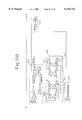
- FIG. 1 is a block diagram showing an example of a semiconductor integrated circuit according to the related art
- FIG. 2 is a block diagram showing another example of a semiconductor integrated circuit according to the related art
- FIG. 3 is a diagram for illustrating the configuration of an example of a phase comparator (namely, a phase comparing section) according to the related art to be used in the semiconductor integrated circuits of FIGS. 1 and 2;
- FIGS. 4A, 4B and 4C are timing charts for illustrating an operation of the phase comparator of FIG. 3;
- FIG. 5 is a diagram for illustrating the configuration of an example of a phase comparator (namely, an amplifying circuit section) according to the related art to be used in the semiconductor integrated circuits of FIGS. 1 and 2;
- FIG. 6 is a timing chart for illustrating an operation of a JK flip-flop of the phase comparator of FIG. 5;
- FIG. 7 is a timing chart for illustrating an operation of the amplifying circuit section provided in the phase comparator of FIG. 5 (when incrementing);
- FIG. 8 is a timing chart for illustrating an operation of the amplifying circuit section provided in the phase comparator of FIG. 5 (when sustaining);
- FIG. 9 is a timing chart for illustrating an operation of the amplifying circuit section provided in the phase comparator of FIG. 5 (when decrementing);
- FIGS. 10A and 10B are circuit diagrams showing an example of a phase comparator provided in the semiconductor integrated circuit of the present invention.
- FIGS. 11A, 11B, 11C, 11D and 11E are diagrams illustrating results of simulation of the phase comparator shown in FIGS. 10A and 10B, respectively;
- FIGS. 12A and 12B are diagrams for illustrating timing provided in the phase comparator shown in FIGS. 10A and 10B;
- FIG. 13 is a circuit diagram showing an example of a (frequency) divider circuit provided in the semiconductor integrated circuit of FIG. 2;
- FIG. 14 is a diagram showing waveforms of signals respectively flowing through nodes of the divider circuit of FIG. 13;
- FIG. 15 is a timing chart for illustrating an operation of a semiconductor integrated circuit using the divider circuit of FIG. 13;
- FIGS. 16A, 16B and 16C are diagrams for illustrating the configurations of examples of the delay circuits provided in the semiconductor integrated circuits of FIGS. 1 and 2, respectively;
- FIG. I7 is a diagram for illustrating the configuration of an example of a delay controller to be provided in the semiconductor circuits of FIGS. 1 and 2;
- FIG. 18 is a timing chart for illustrating an operation of the delay controller of FIG. 17;
- FIG. 19 is a diagram showing the configuration of a synchronous DRAM as an example to which the semiconductor integrated circuit of the present invention is applied;
- FIG. 20 is a timing chart for illustrating an operation of the synchronous DRAM of FIG. 19;
- FIG. 21 is a block diagram schematically showing the configuration of a primary part of the synchronous DRAM of FIG. 19;
- FIG. 22 is a diagram for illustrating the configuration of an example of an output circuit (namely, a data output buffer circuit) provided in the semiconductor integrated circuit of the present invention.
- FIG. 23 is a diagram for illustrating the configuration of an example of a dummy internal output clock line (namely, a dummy line) provided in the semiconductor integrated circuit of the present invention.
- FIG. 1 is a block diagram showing an example of the semiconductor integrated circuit according to the related art.
- reference numeral 1 designates a clock input pad; 21 an input circuit (namely, a clock buffer); 22 a dummy input circuit (namely, a clock buffer); and 3 a DLL circuit.
- reference numeral 41 denotes a clock signal line (namely, a real line); 42 denotes a dummy line, 51 an output circuit (namely, an output buffer); 6 a data output pad; and 7 a dummy load capacitor.
- the DLL circuit 3 comprises a phase comparator (namely, a digital phase comparator) 31, a delay controller 32, a delay circuit 33, and a dummy delay circuit 34.
- An external clock namely, an externally input clock signal
- CLK is supplied to the phase comparator 31 through the input circuit 21 (see signal S1)
- the external clock CLK is also supplied to the phase comparator 31 through the dummy delay circuit 34, the dummy line 42, the dummy output circuit 52 and the dummy input circuit 22 (see signal S0).
- These signals S1 and S0 are phase-compared with each other by the phase comparator 31.
- the delay controller 32 is controlled by output signals of the phase comparator 31.
- the signal S0 supplied to the phase comparator 31 through the dummy input circuit 22 is obtained by delaying the passage of the external clock CLK by just one clock cycle by means of the dummy line 42 and the like when performing a normal operation.
- This signal S0 delayed by just one clock cycle is phase-compared with the signal S1, which is supplied through the input circuit 21, by the phase comparator 31.
- the signal S1 may be phase-compared with the signal S0 delayed by two or several clock cycles owing to a delay caused in operating initial states of the dummy input circuit 22, the dummy line 42 and the dummy output circuit 52.
- phase comparator 31 when the phase difference between the signals S1 and S0 to be input to the phase comparator 31 is 180 degrees, there is no time period when both of the signals S1 and S0 to be compared have a high level "H", so that the phase comparator 31 cannot make a phase comparison therebetween.
- the delay controller 32 is adapted to control the delay circuit 33 and the dummy delay circuit 34 in such a way as to apply a same delay amount in accordance with outputs of the phase comparator 31. Therefore, a clock signal (namely, an internal clock signal) for the output circuit 51 is supplied thereto at timing at which no delay is apparently caused by the input circuit 21, the delay circuit 33, the clock line (namely, the real line) 41, and the output circuit 51.
- a clock signal namely, an internal clock signal
- the aforementioned delay caused by the dummy line 42 and so on becomes longer than one clock cycle of the external clock CLK.
- a total of a delay time of the input circuit 21, a minimum delay time of the delay circuit 33, a delay time of the real line 41 and a delay time of the output circuit 51 (corresponding to a total of a delay time of the dummy input circuit 22, a minimum delay time of the dummy delay circuit 34, a delay time of the dummy line 42, and a delay time of the dummy output circuit 52) is longer than a time period corresponding to one external clock CLK (namely, one clock cycle thereof)
- the phase comparator 31 cannot make a phase comparison between a signal Sl, which is supplied thereto through the input circuit 21, and an output signal S0 of the dummy input circuit 22. Namely, a phase-synchronized internal clock cannot be generated from an external clock CLK
- FIG. 2 is a block diagram showing another example of a semiconductor integrated circuit according to the related art. This semiconductor integrated circuit of FIG. 2 is obtained by improving the configuration of the DLL circuit 3 of the semiconductor integrated circuit shown in FIG. 1. The rest of the configuration of the semiconductor integrated circuit of FIG. 2 is similar to the corresponding section of the semiconductor integrated circuit of FIG. 1.
- the DLL circuit 3 comprises a (frequency) divider circuit 30, a phase comparator (namely, a digital phase comparator) 31, a delay controller 32, a delay circuit 33, and a dummy delay circuit 34.
- the divider circuit 30 is supplied with an external clock CLK (namely, a signal S1: a first control signal) through the input circuit 21 and is adapted to output a signal obtained by dividing a frequency of the external clock CLK. Namely, the divider circuit 30 outputs a first output signal (that is, a signal S2) to the dummy delay circuit 34, and also outputs a second output signal (namely, a signal S3) to a first input terminal of the phase comparator 31.
- a first output signal that is, a signal S2
- a second output signal namely, a signal S3
- the first output signal (namely, a signal S2) of the divider circuit 30 is supplied to a second input terminal of the phase comparator 31 (as a signal S0) through the dummy delay circuit 34, the dummy line 42, the dummy output circuit 52, and the dummy input circuit 22. Further, the aforesaid phase comparator 31 is adapted to control the delay controller 32 by making a phase comparison between these signals S3 and S0.
- the output signal (namely, a second control signal) of the delay circuit 33 is supplied to the output circuit (namely, an object circuit) 51 through the real line 41 as an output signal of the DLL circuit 3.
- the delay controller 32 is adapted to control the delay circuit 33 and the dummy delay circuit 34 in such a manner as to provide the same delay amounts thereto in accordance with outputs (namely, results of the phase comparison) of the phase comparator 31. Therefore, a clock signal (namely, an internal clock signal) for the output circuit 51 is supplied thereto at timing at which no delay is apparently caused by the input circuit 21, the delay circuit 33, the real line 41, and the output circuit. 51.
- the phase comparator 31 is adapted to perform a phase comparison operation at timing delayed by two clock cycles of the external clock CLK.
- phase comparator 31 is provided with the divider circuit 30, which is supplied with an output signal of the input circuit 21, and is adapted so that a first output signal S2 of the aforesaid divider circuit 30 is supplied to the dummy delay circuit 34 and that a second output signal S3 of the divider circuit 30 is supplied to a first input terminal of the phase comparator 31.
- the phase comparison to be made by the phase comparator 31 can be enabled by providing the divider circuit 30 in the semiconductor integrated circuit, because there is a time period in which both of the signals S3 and S0 to be input to the phase comparator 31 have the high level "H" even in the case that the phases of the signals S1 and S0 are different from each other by 180 degrees.
- the power consumption thereof can be reduced by lowering the frequency of sampling (namely, of the phase comparison).
- FIG. 3 is a diagram for illustrating the configuration of an example of the phase comparator (namely, the phase comparing section) according to the related art to be used in the semiconductor integrated circuits of FIGS. 1 and 2.
- FIGS. 4A, 4B and 4C are timing charts for illustrating an operation of the phase comparator of FIG. 3.
- the phase comparator 31 of the semiconductor integrated circuits of FIGS. 1 and 2 is composed of two circuit sections, namely, the phase comparing section shown in FIG. 3 and the amplifying circuit section illustrated in FIG. 5 (to be described later).
- reference characters ⁇ out and ⁇ ext denote an output signal and an external clock signal to be compared in this phase comparator, respectively.
- the phase of the signal (namely, a comparison object signal) ⁇ out to be compared is determined on the basis of a signal (namely, a comparison reference signal) ⁇ ext .
- reference characters ⁇ 1 to ⁇ a designate output signals to be connected to the amplifying circuit section, respectively.
- phase comparator (to be described later), which is illustrated in FIGS. 10A and 10B as an embodiment of the present invention, corresponds to the phase comparator provided with the phase comparing section of FIG. 3 and the amplifying circuit section of FIG. 5 and can be applied to the semiconductor integrated circuit (namely, the DLL circuit 3) illustrated in FIG. 2 as the phase comparator 31 without being modified. Furthermore, the phase comparator illustrated in FIGS. 10A and 10B as an embodiment of the present invention can be also applied to the semiconductor integrated circuit illustrated in FIG. 1 as the phase comparator 31.
- the phase comparing section of the phase comparator 31 comprises: flip-flop circuits 421 and 422, each of which consists of two NAND gates; latch circuits 425 and 426 each for latching the state of a corresponding one of the flip-flop circuits 421 and 422; an activation signal generator 424 for generating activation signals used in the latches 425 and 426; and a delay circuit 423 for causing a time delay by one delay time unit and for obtaining a phase tolerance for the external clock signal ⁇ ext .
- FIG. 4A illustrates the case that the phase of the comparison object signal ⁇ out is ahead of the phase of the comparison reference signal ⁇ ext , namely, the case that the signal level of the signal ⁇ out changes from a low level “L” to the high level “H” before the signal ⁇ ext changes in a similar manner.
- the signal level of the signal ⁇ ext changes from the low level "L” to the high level “H”.
- the signal level of the node 6a-1 changes from the low level “L” to the high level “H”.
- the terminal voltages of the flip-flops 421 and 422 have already been fixed and thus do not change at all. Consequently, the signal level of the node 6a-2 is maintained at the low level "L”; that of the node 6a-3 at the high level "H”; that of the node 6a-4 at the low level “L”; and that of the node 6a-5 at the high level "H”.
- the signal level of the output signal ⁇ a of the generator 424 changes from the high level "H” to the low level "L”. Further, a pulse, whose signal level transitorily becomes the high level "H", is applied to the node 6a-6. Because the node 6a-6 is connected to the NAND gates of the latches 425 and 426, the NAND gates are temporarily activated, so that the latches 425 and 426 latch the terminal voltages of the flip-flips 421 and 422.
- the signal level of the output signal ⁇ b changes to the high level "H”; that of the signal ⁇ c to the low level “L”; that of the signal ⁇ d to the high level “H”; and that of the signal ⁇ e to the low level “L”.
- FIG. 4C illustrates the case that the phase of the comparison object signal ⁇ out is behind the phase of the comparison reference signal ⁇ ext and that the signal level of the signal ⁇ out changes from the low level "L” to the high level “H” after the signal ⁇ ext changes in a similar manner.
- the signal ⁇ ext causes changes in the flip-flops 421 and 422, so that the signal level of the nodes 6a-3 and 6a-5 change from the high level "H” to the low level "L".
- the signal level of the output signal ⁇ b changes to the low level "L”; that of the signal ⁇ c to the high level “H”; that of the signal ⁇ d to the low level “L”; and that of the signal ⁇ e to the high level "H".
- FIG. 5 is a diagram for illustrating the configuration of an example of a phase comparator (namely, an amplifying circuit section) according to the related art to be used in the semiconductor integrated circuits of FIGS. 1 and 2.
- FIG. 6 is a timing chart for illustrating an operation of a JK flip-flop of the phase comparator of FIG. 5.
- the amplifying section of the phase comparing circuit 31 has the JK flip-flop 427 and an amplifier 428 consisting of NAND gates and inverters.
- the output signal ⁇ a is input to the JK flip-flop 427 from the phase comparing section of FIGS. 10A and 10B.
- the electric potentials of nodes 7a-9 and 7a-11 alternately have the high level "H” and the low level "L”.
- the amplifier 428 receives and amplifies an output signal of the JK flip-flip 427 and the signals ⁇ b and ⁇ d and then outputs the amplified signals.
- the signal level of the signal ⁇ a changes from the low level “L” to the high level “H”
- the signal level at the node 7a-8 changes from the high level “T1" to the low level “L”
- the signal level at the node 7a-10 does not change because the signal level at the node 7a-7 is unchanged.
- the signal level at the output node 7a-9 changes from the low level “L” to the high level “H”
- the signal level at the output node 7a-11 is unchanged.
- the signal levels at the output nodes 7a-9 and 7a-11 of the JK flip-flop 427 alternately change between the high level "H” to the low level "L", in response to the change in signal level of the signal ⁇ a .
- FIG. 7 is a timing chart for illustrating an operation of the amplifying section of FIG. 5 provided in the phase comparator, which is performed when incrementing.
- FIG. 8 is a timing chart for illustrating an operation thereof to be performed when sustaining.
- FIG. 9 is a timing chart for illustrating an operation thereof to be performed when decrementing.
- FIG. 7 illustrates the case that the signal level of the comparison object signal ⁇ out changes from the low level "L” to the high level “H” before a rise of the comparison reference signal ⁇ ext .
- Input signals provided from the phase comparing section in this case are as follows. Namely, the signal ⁇ b is at the high signal level “H”; the signal ⁇ c at the low signal level “L”; the signal ⁇ d at the high signal level “H”; and the signal ⁇ e at the low signal level “L”. Consequently, the signal levels at a node 7a-12 becomes the high level "H”; and the signal level at a node 7a-13 is fixed at the low level "L”.
- set signals ⁇ SO and ⁇ SE change according to the state of the JK flip-flop 427, the reset signals ⁇ RO and ⁇ RE are unchanged because of the low signal level "L” of the node 7a-13.
- FIG. 8 illustrates the case that the signal level of the comparison object signal ⁇ out changes from the low level "L” to the high level “H", substantially simultaneously with the comparison reference signal ⁇ ext .
- Input signals provided from the phase comparing section in this case are as follows. Namely, the signal ⁇ b is at the low signal level “L”; the signal ⁇ c at the high level “H”; the signal ⁇ d at the high level “H”; and the signal ⁇ a at the low level “L”. Consequently, the signal levels at the nodes 7a-12 and 7a-13 are fixed at the low level "L”.
- the set signals ⁇ SO and ⁇ SE are not affected by the output of the JK flip-flop. Therefore, the signal levels of the signals ⁇ SO, ⁇ SE, ⁇ RO, and ⁇ RE remain fixed at the low level "L".
- FIG. 9 illustrates the case that the comparison object signal ⁇ out changes from the low level “L” to the high level “H” behind the rise of the comparison reference signal ⁇ ext .
- Input signals provided from the phase comparing section of FIG. 12 in this case are as follows. Namely, the signal level of the signal ⁇ b is at the low level "L”; that of the signal ⁇ c at the high level “H”; that of the signal ⁇ d at the low level “L”; and that of the signal ⁇ e at the high level "H”.
- the signal level at the node 7a-12 is fixed at the low level "L”; the signal level at the node 7a-13 is fixed at the high level “H”; the signal levels of the reset signals ⁇ RO and ⁇ RE change according to the state of the JK flip-flop; and the set signals ⁇ SO and ⁇ SE are unchanged because of the low signal level "L" of the node 7a-12.
- the timing, at which a phase comparison is made by the phase comparator 31 of the DLL circuit 3 is determined by output signals (namely, the first output signal S2 and the second output signal S3) from the (frequency) divider circuit 30.
- the divider circuit 30 divides the frequency of an input signal (S1) by 8 (for instance, similarly as in the case of the signal S3 of FIG.
- a phase comparison is made by the phase comparator 31 at the corresponding timing, namely, once every eight periods of the external clock S1 (CLK).
- a delay amount corresponding to one delay stage is added thereto or subtracted therefrom once every eight periods of the external clock CLK. Therefore, in the case that there are large phase differences among signals (S3, S0, ⁇ ext (namely, the comparison reference signal) and ⁇ out (namely, the comparison object signal)) to be input to the phase comparator 31 at power-up and at power-on/reset and that thus, there is the necessity for providing a large delay amount to the circuit, only a delay amount corresponding to one delay stage is changed every eight periods of the external clock, so that a long time is required to lock up the DLL circuit 3.
- FIGS. 10A and 10B are circuit diagrams showing an embodiment of a phase comparator (or phase comparing circuit (namely, a phase comparing section and an amplifying section)) provided in a semiconductor integrated circuit of the present invention.
- this embodiment of the present invention namely, the phase comparator illustrated in FIGS. 10A and 10B corresponds to the phase comparator provided with the aforementioned phase comparing section of FIG. 3 and the amplifying circuit section of FIG. 5 and can be applied to the phase comparator 31 of the semiconductor integrated circuit (namely, the DLL circuit 3) illustrated in FIG. 2 according to the related art without being modified.
- this embodiment of the present invention namely, the phase comparator shown in FIGS. 10A and 10B can be applied to the semiconductor integrated circuit (namely, the DLL circuit 3) according to the related art as the phase comparator 31 thereof.
- ⁇ RE denotes an addition control signal for an even(-numbered) slage
- ⁇ RO an addition control signal for an odd(-numbered) stage
- ⁇ SE a subtraction control signal for an even(-numbered) stage
- ⁇ SO a subtraction control signal for an odd(numbered) stage.
- a plurality of pulses (namely, four pulses in the case of this embodiment) are output as control signals, and the delay amount can be largely corrected by performing shifts of data, which corresponds to a plurality of stages, in the shift register (namely, the delay controller 32).
- a predetermined value used for comparing the phase of the comparison reference signal ⁇ ext with that of the comparison object signal ⁇ out is determined by using a delay amount (1 td) of one delay stage of the delay circuit (33) and the dummy delay circuit (34), which will be described later, as a (delay time) unit.
- the first phase comparing section 420 phase-compares the comparison object signal ⁇ out (In) with the comparison reference signal ⁇ ext within a range between +1 td and -1 td.
- “1 td” designates a delay time corresponding to one delay stage (namely, one delay element) used in the delay circuit 33 and the dummy delay circuit 34 (see FIGS. 16A to 16C), namely, designates a delay amount corresponding to one delay stage.
- the second phase comparing section 410 is adapted to phase-compare the comparison object signal ⁇ out with the comparison reference signal ⁇ ext within a range between +4 td and -4 td. Further, if the phase difference "tdp" between the comparison object signal ⁇ out and the comparison reference signal ⁇ ext >4 td, the condition of the comparison object signal is judged as being "SLOW" (corresponding to "VERY SLOW"). If 4 td ⁇ tdp ⁇ -4 td, the condition of the comparison object signal is judged as being "JUST". Further, if -4 td>tdp, the object signal is judged as being "FAST" (corresponding to "VERY FAST").
- the second phase comparing section 410 judges the condition of the comparison object signal as being "SLOW” (or “VERY SLOW") or “FAST” (or “VERY FAST”), the signal levels of signals N00 and N01, which are output signals of the latch circuits 415 arid 416, or signals N10 and N11 are changed into the high level “H", so that pulses having low signal levels "L” are output as a signal “Start” in the oscillator control circuit 504.
- the signal level of an oscillator activation (or enabling) signal "OscEn” is changed to the high level "H”. Consequently, the counter circuit 500 and the oscillator circuit 503 are activated (in an enabling condition).
- Counter circuit 500 is operative to count signals oscillated by the oscillator circuit 503.
- the counter circuit 500 counts signals (pulses) oscillated by oscillator circuit 503.
- a signal having the low level “L” is output on a signal line "Stop” in an oscillator control circuit 504, so that the signal level of the oscillator enabling signal "OscEn” is changed to the low level “L”.
- the oscillator circuit 503 stops the oscillation, and the counter circuit 500 is put into a reset state (in which the count is returned to 0).
- the predetermined number of signals (or pulses) oscillated by the oscillator circuit 503, namely, the count thereof, at which the oscillation of the aforesaid oscillator circuit is stopped, can be set at a given number by a composing element of the counter. circuit 500.
- the counter circuit 500, the oscillator circuit 503 and the oscillator control circuit 504 (and the signal selecting circuit 505) compose a pulse number control section for controlling the number of pulses output according to a result of a phase comparison made in the phase comparing sections (namely, the first phase comparing section 420 and the second phase comparing section 410).
- the second phase comparing section 410 judges the conditions of the comparison object signal as being "SLOW” (or “VERY SLOW") or "FAST” (or “VERY FAST")
- one pulse is output in a step of making a phase comparison between the comparison object signal ⁇ out and the comparison reference signal ⁇ ext .
- three pulses are output in response to the oscillation of the oscillator circuit 503. Consequently, these four pulse signals are output, so that the correction of a delay amount corresponding to "4 td" is achieved.
- the oscillator circuit 503 is adapted so that when both of the signal levels at nodes n100 and n101 in the counter circuit 500 become the high level "H", the oscillation of the circuit 503 is stopped.
- the nodes n100 and n101 correspond to a first bit and a second bit of a binary number, respectively. Therefore, the case in which both of the signal levels at the nodes n100 and n101 are the high level "H", the number corresponds to decimal "3".
- the output pulses are put together into a signal Pu( ⁇ a ) by the signal selecting circuit 505. Then, the signal Pu( ⁇ a ) is supplied to the JK flip-flop 427.
- the shift register namely, the delay controller 32
- the JK flip-flop 427 stores information representing whether the register, in which a shift is performed last, is an even-numbered or odd-numbered one.
- the JK flip-flop 427 outputs a selection signal for selecting an even-numbered stage or an odd-numbered stage.
- an output of the JK flip-flop 427 is changed from an output for an even-numbered stage (namely, the control signals ⁇ SE and ⁇ RE) to an output for an odd-numbered stage (namely, the control signals ⁇ SO and ⁇ RO) or, alternatively, from an output for an odd-numbered stage (namely, the control signals ⁇ SO and ⁇ RO) to an output for an even-numbered stage (namely, the control signals ⁇ SE and ⁇ RE).
- the first phase comparing section 420 judges that the condition of the comparison object signal is "SLOW” or "FAST"
- a pulse is output once to the signal lines for the control signals ⁇ SO and ⁇ RO or to the signal lines for the control signals ⁇ SE and ⁇ RE.
- the phase comparing section 31 is provided with: a first phase comparing section 420 for making a judgement by comparing the phase difference tpd between the comparison object signal ⁇ out and the comparison reference signal ⁇ ext with a delay amount mtd (for example, 1 td) corresponding to m stages; and a second phase comparing section 410 for making a judgement by comparing the phase difference tpd between the comparison object signal ⁇ out and the comparison reference signal ⁇ ext with a delay amount ntd (for instance, 4 td) corresponding to n stages (incidentally, m and n are different natural numbers and m ⁇ n).
- m and n are different natural numbers and m ⁇ n.
- the number of pulses output in the case where results of judgments are "VERY FAST” and “VERY SLOW” is not limited to four and that the number of such pulses may be set at, for example, eight.
- the counter circuit 500 is constituted as a three-stage counter obtained by adding an additional one stage counter (which is similar to the counter 501 or 502) to the two stages of counters 501 and 502.
- the number of pulses output in the case of "VERY FAST” and "VERY SLOW” is changed into 3 by extracting an output signal from a node N2 instead of the node n101 in the counter circuit 500.
- the condition of the comparison object signal is judged as being "FAST”. Further, if 1 td ⁇ tdp ⁇ -1 td, the condition of the comparison object signal is judged as being "JUST”. Moreover, if tdp ⁇ 1 td, the condition of the comparison object signal is judged as being "SLOW".
- FIGS. 11A to 11E are diagrams illustrating results of simulation of the phase comparator shown in FIGS. 10A and 10B, respectively.
- FIG. 11A shows the waveform at the time when the result of the judgement is "VERY FAST"
- FIG. 11B the waveform at the time when the result of the judgement is "FAST”
- FIG. 11C shows the waveform at the time when the result of the judgement is "JUST”
- FIG. 11D the waveform at the time when the result of the judgement is "SLOW”
- FIG. 11E the waveform at the time when the result of the judgement is "VERY SLOW”.
- a signal in which an additional delay time corresponding to four delay elements (namely, a delay amount corresponding to four delay stages) is caused, namely, a signal further delayed by a delay time corresponding to four delay elements is output from each of the delay circuit 33 and the dummy delay circuit 34.
- the condition is judged as being "FAST", so that a pulse is output once to the signal line for the control signal ⁇ RO or ⁇ RE.
- a signal in which an additional delay time corresponding to one delay element namely, a delay amount corresponding to one delay stage
- a signal further delayed by a delay time corresponding to one delay element is output from each of the delay circuit 33 and the dummy delay circuit 34.
- the condition is judged as being "SLOW", so that a pulse is output once to the signal line for the control signal ⁇ SO or ⁇ SE.
- a signal in which a delay time corresponding to one delay element namely, a delay amount corresponding to one delay stage
- the delay amount namely, a signal, whose delay amount is reduced by a delay time corresponding to one delay element
- tdp +0.15 nsec.
- the number of pulses output in the case of the conditions "VERY FAST” and “VERY SLOW” is not limited to four but may be changed to various values. Further, a value used for making a judgement on the basis of the phase difference tpd between the comparison object signal ⁇ out and the comparison reference signal ⁇ ext is not limited to 1 td, 0 and ⁇ 4 td.
- FIGS. 12A and 12B are diagrams for illustrating timing provided in the phase comparator shown in FIGS. 10A and 10B.
- FIG. 12A corresponds to a signal input to the phase comparator provided in the semiconductor integrated circuit of FIG. 1.
- FIG. 12B corresponds to a signal input to the phase comparator 3 provided in the semiconductor integrated circuit of FIG. 2.
- one period or cycle of the external clock (S1: the comparison reference signal ⁇ ext ) tCLK 4 nsec.
- the difference between the signals namely, the comparison reference signal ⁇ ext (S1) and the comparison object signal ⁇ out (S0)
- FIG. 12B corresponds to FIG. 14 (to be described later).
- the leading edge of the comparison reference signal ⁇ ext should be adjusted to a position or phase Tb.
- the leading edge of the signal ⁇ ext may be adjusted to a position Ta. Namely, it should be controlled according to the relation between the delay of the comparison object signal ⁇ out from the comparison reference signal ⁇ ext and the length of one period tCLK which of the positions Ta, Tb, Tc, Td, . . . is selected.
- This control operation is attended with difficulties.
- the phase comparator first, the signal levels of input signals to be compared with each other become the low level "L". This is the reset state thereof.
- the phase comparator should pass through a state in which both of the input signals have the high signal level "H". Namely, the phase comparison between the clock signals to be compared with each other (that is, the comparison reference signal ⁇ ext and the comparison object signal ⁇ out ) cannot be performed unless the signal levels of pulses of the signals ⁇ ext and ⁇ out are simultaneously higher than the low level "L".
- the pulses of the signals ⁇ ext and ⁇ out are made to necessarily have the high level "H" at the same time (incidentally, this is important from the viewpoint of the characteristics of the phase comparator) by dividing the frequency of the external clock S1 (namely, ⁇ ext ) by eight and setting the duty ratio of the pulse at 1:3 as shown in FIG. 12B.
- a leading edge of the comparison object signal ⁇ out corresponding to a leading edge of the comparison reference signal is determined uniquely.
- FIG. 13 is a circuit diagram showing an example of a (frequency) divider circuit provided in the semiconductor integrated circuit of FIG. 2.
- FIG. 14 is a diagram showing waveforms of signals respectively flowing through nodes of the divider circuit of FIG. 13. Incidentally, as is obvious from the waveform diagram of FIG. 14, the divider circuit 30 shown in FIG.
- the divider circuit 30 is constituted by three stages of counters 301 to 303 each consisting of a plurality of NAND gates and an inverter, and the signal S1 (namely, the external clock CLK passing through the input circuit 21) is supplied to the divider circuit 30 and the first and second output signals S2 and S3 as illustrated in FIG. 14 are generated therefrom.
- reference character A denotes an output signal of a first counter 301; and B an output signal of a second counter 302.
- the divider circuit 30 is not limited to the circuit constituted by three stages of counters each consisting of a plurality of NAND gates and an inverter. Needless to say, the divider circuit 30 can be constituted by a combination of various logic gates.
- FIG. 15 is a timing chart for illustrating an operation of the semiconductor integrated circuit using the divider circuit of FIG. 13.
- the divider circuit 30 receives the signal S1 (namely, the external clock CLK) which is the output signal of the input circuit 21, and outputs a signal S2 (namely, the first output signal), whose frequency is divided by eight and whose period or cycle is a sum of periods aa+bb (to be described later), and a signal S3 (namely, the second output signal) which is a negative or opposite phase signal of the signal S2.
- a period corresponding to two clock cycles of the external clock CLK namely, the period aa in FIG. 15
- a period corresponding to six clock cycles of the external clock CLK namely, the period bb in FIG. 15
- L low level
- the first output signal S2 of the divider circuit 30 is supplied to the dummy delay circuit 34, and the second output signal S3 of the divider circuit 30 is supplied to an input terminal of the phase comparator 31.
- the signal S0 which is supplied to another input terminal of the phase comparator 31, is a signal obtained by delaying the first output signal S2 by means of the dummy delay circuit 34, the dummy line 4, the dummy output circuit 52 and the dummy input circuit 22.
- the phase comparator (namely, a digital phase comparator) 31 compares the phase of the second output signal S3 of the divider circuit 30 at the rise thereof with the phase of the signal S0 at the rise thereof.
- the delay controller (namely, the shift register) 32 controls to apply the same delay to the delay circuit 33 and the dummy delay circuit 34 in accordance with the comparison result of the phase comparator 31.
- the DLL circuit 3 outputs an internal clock signal which is a signal corresponding to the signal Si output from the input, circuit 21 having a delay caused by the delay circuit 33. Therefore, in the DLL circuit 3, a phase-synchronized internal clock can be generated from the external clock signal CLK which precedes by two clock cycles, and thereby the DLL circuit 3 can be applied to a high-speed operable SDRAM.
- the number of clock cycles, by which the external clock signal CLK used for generating the internal clock signal in the DLL circuit 3 precedes the current external clock signal can be regulated by changing the period aa of the first output signal S2 of the divider circuit 30.
- the DLL circuit 3 can generate a phase-synchronized internal clock from the external clock signal CLK that precedes the current external clock signal by three clock cycles.
- the interval, at which phase comparisons are made can be changed.
- FIGS. 16A to 16C are diagrams for illustrating the configurations of examples of the delay circuits 33 and 34 provided in the semiconductor integrated circuits of FIGS. 1 and 2, respectively.
- FIG. 16A shows a one-bit delay circuit or element
- FIG. 16B is a time chart illustrating an operation of this one-bit delay circuit
- FIG. 16C illustrates the configuration and operation of a plurality of stages of one-bit delay circuits or elements.
- the one-bit delay element has two NAND gates 401 and 402 and an inverter 403. An operation of this one-bit delay element will be described hereinbelow by referring to FIG. 16B.
- An input signal ⁇ E is an activation signal (namely, an enable signal). When the signal level of this signal is the high level "H", the delay circuit operates.
- FIG. 16B illustrates the state of the delay circuit, in which the signal level of the enable signal ⁇ E is the high level "H", and to which a signal comes to be able to get an access.
- reference character "IN” designates an input signal to a one-bit delay circuit or element; ⁇ N an output signal of an adjacent one-bit delay circuit of FIG.
- the output signal OUT corresponds to a signal ⁇ N to another adjacent one-bit delay circuit provided on the left side of this figure.
- the output signal OUT When the signal ⁇ N is at the low level “L”, the output signal OUT always has the low signal level “L”. Further, if the signal ⁇ N is at the high level “H” and the signal ⁇ E is at the low level “L”, the output signal OUT has the high signal level “H”. When the signal ⁇ N has the high signal level “H” and the signal ⁇ E has the high signal level “H”, the output signal OUT has the high signal level "H” if the input signal IN has the low signal level "L”. In contrast, if the input signal IN has the high signal level "H”, the output signal OUT has the high signal level "H".
- FIG. 16C shows a delay circuit in which a plurality of stages of the one-bit delay elements shown in FIG. 16A are cascaded, and this circuit corresponds to an actually used delay circuit.
- FIG. 16C shows only three stages of one-bit delay elements, many stages of one-bit delay elements are actually cascaded.
- a plurality of signal lines such as ⁇ E-1, ⁇ E-2 and ⁇ E-3, corresponding to circuit elements, respectively, for propagating enable signals ⁇ E. These enable signals are controlled by a delay controller (32).
- the enable signal ⁇ E-2 when the central one-bit delay circuit or element is activated, the enable signal ⁇ E-2 has the high signal level "H".
- the NAND gates 401-1 and 401-3 block the input signal IN as indicated by bold or thick lines, because the signal levels of the enable signals ⁇ E-1 and ⁇ E-3 respectively corresponding to the leftmost and rightmost one-bit delay elements are the low level "L”.
- the input signal IN passes through the NAND gate 401-2 because the enable signal ⁇ E-2 corresponding to the central activated one-bit delay element has the high level "H".
- the input signal IN also passes through the NAND gate 402-2 thereof because the output signal OUT of the right-side one-bit delay element has the high signal level "H”.
- a signal having the low signal level "L” is transmitted as the output signal OUT.
- the output signal OUT namely, the enable signal ⁇ N of the right-hand one-bit delay element has the low signal level "L
- the output signal OUT of the one-bit delay element always has the low signal level "L”. Accordingly, this signal having the low signal level "L” is transmitted to the NAND gate and the inverter of the left-side one-bit delay element serially, and is extracted as a final output signal.
- the delay amount can be controlled by selecting which one of the enable signals ⁇ E respectively corresponds to the one-bit delay elements as the signal having the high signal level "H".
- the delay amount corresponding to one bit is determined according to a total signal propagation delay time of the NAND gates and the inverter of the one-bit delay element and is a unit delay time of the DLL circuit. Further, a total delay time is calculated by multiplying the number of one-bit delay elements, through which the input signal IN passes, by the unit delay time.
- FIG. 17 is a diagram for illustrating an example of the delay controller (or control circuit) used in the semiconductor integrated circuits of FIGS. 1 and 2.
- the delay controller comprises one-bit delay control circuits or elements, each of which is a one-bit delay control element 430-2 surrounded by a dotted line in FIG. 17, the number which is equal to that of the stages of one-bit delay elements of the delay circuit.
- An output of each stage of the delay controller provides an enable signal ⁇ E to a corresponding stage of the delay circuit.
- the one-bit delay control circuit or element 430-2 comprises: a flip-flop consisting of a NAND gate 432-2 and an inverter 433-2; transistors 435-2, 437-2, 438-2, and 439-2 connected in series with both ends of the flip-flop; and a NOR gate 431-2.
- the gate of the transistor 438-2 is connected to a node 5a-2 of the preceding one-bit delay control element.
- the gate of the transistor 439-2 is connected to a node 5a-5 of the succeeding one-bit delay control element.
- the delay control element 430-2 is adapted to receive signals from the preceding and succeeding stages.
- each of incrementing signals namely, set signals
- decrementing signals namely, reset signals
- ⁇ RE and ⁇ RO is connected to a corresponding one of other transistors, which are connected in series, every other one-bit delay control element.
- the gate of the transistor 435-2 is supplied with the set signal ⁇ SO. Further, the gate of the transistor 437-2 is supplied with the reset signal ⁇ RO. Moreover, each of the set signal ⁇ SE and the reset signal ⁇ RE is supplied to a corresponding one of the gates of the transistors provided on the sides of the preceding and succeeding one-bit control elements. Furthermore, the NOR gate 431-2 of the element 430-2 is adapted to receive a signal from a node 5a-1 of the left-side (namely, the preceding) element as viewed in this figure, and to also receive a signal from a node 5a-4 thereof. A signal ⁇ R resets the delay controller, and the signal level of the signal ⁇ R is temporarily set at the low level "L" after the power source is turned on, and is thereafter fixed at the high level "H".
- FIG. 18 is a timing chart for illustrating an operation of the delay controller of FIG. 17.
- the signal level of the reset signal ⁇ R is temporarily set at the low level "L", so that the signal levels at the nodes 5a-1, 5a-3 and 5a-5 are set at the high level “H” and that those at the nodes 5a-2, 5a-4 and 5a-6 are reset at the low level "L”. Further, when incrementing, the incrementing signals, namely, the set signals ⁇ SE and ⁇ SO are alternately set at the high level "H” and the low level "L” repeatedly.
- the enable signal (namely, the output signal) ⁇ E-2 changes from the low level “L” to the high level "H”. Because the signal level at the node 5a-2 changes to the high level "H”, the transistor 438-2 is turned on.
- the signal level of the set signal ⁇ SO changes from the low level "L” to the high level "H”
- the node 5a-3 is grounded and is thus at the low level "L”
- the signal level at the node 5a-4 changes to the high level "H”.
- the signal level of the enable signal ⁇ E-2 changes from the high level "H” to the low level "L”. This state is latched by the flip-flop, and therefore, the enable signal ⁇ E-2 remains at the low level “L” even if the signal level of the set signal ⁇ SO returns to the low level "L”.
- the signal level of the enable signal ⁇ E-3 changes from the low level "L” to the high level "H".
- pulses of the set signals ⁇ SE and ⁇ SO are transmitted one by one in the case illustrated in FIG. 11, a large number of stages of one-bit delay control elements are actually connected to one another.
- the position of the stage, namely, the one-bit delay control element, which provides the output signal (namely, the enable signal) ⁇ E having the high level "H” shifts to the right sequentially. Therefore, if the result of the comparison made by the phase comparator 31 indicates the necessity for increasing a delay amount, it is sufficient to input pulses of the set signals ⁇ SE and ⁇ SO alternately.
- pulses of the reset signals ⁇ RE and ⁇ RO are alternately input, so that the position of the stage, namely, the one-bit delay control element, which provides the enable signal ⁇ E having the high level "H", shifts to the left sequentially.
- the position of the stage namely, the one-bit delay control element, which provides an enable signal ⁇ E having the high signal level "H"
- the delay circuit illustrated in FIG. 16C is controlled according to these enable signals ⁇ E, the delay amount can be controlled by one unit delay time at a time.
- FIG. 19 is a diagram showing a synchronous DRAM (SDRAM) as an example of a semiconductor integrated circuit to which the present invention is applied, and FIG. 20 is a timing chart for illustrating an operation of the SDRAM of FIG. 19.
- SDRAM synchronous DRAM
- This SDRAM employs, for instance, a pipeline method and is configured as of the two-bank 8-bit-width 16-Mbit type.
- the SDRAM has a clock buffer 101, a command decoder 102, an address buffer/register & bank address selector (briefly, an address buffer) 103, an I/O data buffer/register 104, control signal latches 105a and 105b, a mode register 106, and column address counters 107a and 107b, in addition to DRAM cores 108a and 108b of a general purpose DRAM.
- /CS, /RAS, /CAS and /WE terminals an operation mode is determined by inputting various kinds of commands by the use of combinations of such terminals, differently from conventional operations.
- the various kinds of commands are decoded by the command decoder 102, so that circuits are controlled according to the operation mode.
- /CS, /RAS, ICAS and /WE signals are also supplied to the control signal latches 105a and 105b, and the states of such signals are latched until the next command is input.
- Address signals are amplified by the address buffer 103, and addresses represented by the address signals are used as load (or loading) addresses for the banks, respectively, and initial values for the column address counters 107a and 107b.
- the clock buffer 101 has an internal clock generator 121 and an output timing controller 122.
- the internal clock generator 121 generates an ordinary internal clock signal from an external clock (signal) CLK.
- the output timing controller 122 is used for generating a clock signal on which an accurate delay control operation (namely, an accurate phase control operation) is performed by applying the aforementioned DLL circuit thereto.
- the I/O data buffer/register 104 has a data input buffer 13 and a data output buffer (namely, an output circuit) 51.
- Data read out of the DRAM cores 108a and 108b is amplified by the data output circuit 51 to a predetermined level.
- the data is output through pads DQ0 to DQ7 according to clock signals provided from the output timing controller 122. Further, concerning input data, input data to the pads DQ0 to DQ7 is captured through the data input buffer 13.
- a real line (RL) corresponds to a line or wire extending between the output timing controller 122 and each of the data output circuits 51.
- an active (ACT) command is input to a command terminal.
- ACT active
- a row address signal is input to an address terminal.
- the SDRAM is activated, and then a word line corresponding to the row address is selected. Further, cell information on the word line is output to a corresponding bit line, and is then amplified by a sense amplifier.
- tRAC denotes a row address access time
- tCAC column address access time
- tAC a clock signal access time
- FIG. 21 is a block diagram, which schematically shows the configuration of a primary part of the SDRAM of FIG. 19, for illustrating a pipeline operation thereof. Further, FIG. 21 illustrates the case that the SDRAM is provided with three stages of pipes, as an example.
- a processing circuit relating to a column address in the SDRAM is divided into a plurality of stages along a process (or processing) flow. Each of the divided stages is referred to as a pipe.
- the clock buffer 101 has the internal clock generator 121 and the output timing controller 122. Outputs (namely, ordinary internal clock signals) of the internal clock generator 121 are supplied to "Pipe 1" and “Pipe 2". Outputs of the output timing controller 122 are supplied to a delay-locked (phase-locked) internal clock signal to the output circuit 51 (namely, the data output buffer) of "Pipe 3".
- Each of the pipes is controlled according to the supplied internal clock signal.
- a switch for controlling the timing of the transmission of a signal between each pair of the adjoining pipes is provided therebetween. These switches are also controlled according to the internal clock signal generated by the clock buffer 101 (namely, the internal clock generator 121).
- the clock buffer 101 namely, the internal clock generator 121.
- an address signal is amplified by a column address buffer 116 and is then sent to a column decoder 118. Subsequently, an address is selected by the column decoder 118.
- Information on the sense amplifier 117 which is stored at the selected address and corresponds to the selected address, is output to a data bus. This is performed until the data on the data bus is amplified by a data bus amplifier 119.
- the "Pipe 3" is constituted by the I/O buffer 104 (namely, the output circuit 51). Incidentally, the data input buffer 13 in the I/O buffer 104 is omitted in FIG. 21.
- the circuits provided in the pipes relay and send out data by opening and closing the switches provided between each pair of the adjoining pipes in synchronization with the clock signal.
- the pipes process data in parallel with one another, so that data is continuously sent to the output terminal in synchronization with the clock signal.
- FIG. 22 is a diagram for illustrating the configuration of an example of the output circuit (namely, the data output buffer circuit 51) provided in the semiconductor integrated circuit of the present invention.
- reference characters "Data1" and “Data2" of FIG. 22 denote signals respectively correspond to stored data read from a cell array 115 through the sense amplifier 117, the data bus amplifier 119, and the data bus controller 120.
- Both of the signals Data1 and Data2 have the low level “L” when the read data is at the high level “H”.
- both of the signals Data1 and Data2 have the low level "H” when the read data is at the low level "L”.
- the read data can be put into a high-impedance state (namely, a high-Z state) in which the data have neither the high level "H” nor the low level “L".
- the signals are converted into data so that data corresponding to the signal Data1 is at the high level "H” and that data corresponding to the signal Data2 is at the low level "L”.
- a signal ⁇ oe corresponds to the output signal (namely, the clock signal) of the output timing controller 122 (corresponding to the delay circuit 33 of FIG. 2) and serves as an enable signal for the output circuit 51.
- the signal level at a node 8a-5 changes to the low level "L” and the signal level at a node 8a-8 changes to the high level "H”. Consequently, a P-channel transistor 81 for output is turned on, and an N-channel transistor 82 is turned off. Consequently, a signal having the high level "H” appears at the data output pad 6. Moreover, when the signal level of the signal ⁇ oe changes to the low level "L", the transfer gates are turned off, and the current output state is held.
- the semiconductor integrated circuit of the present invention has been described as a synchronous DRAM.
- the semiconductor integrated circuit of the present invention is not limited thereto but is applicable to any semiconductor integrated circuit adapted to output an output signal in synchronization with a signal input from the exterior thereof.
- FIG. 23 is a diagram for illustrating the configuration of an example of the dummy internal output clock line or wire 42 (namely, the dummy line DL) provided in the semiconductor integrated circuit of the present invention.
- the dummy line DL is formed from a line or wire which has the same width as the real line 41 (RL). Note that the dummy line DL is formed on a chip between the dummy delay circuit 34 and the dummy output circuit 52, as shown in FIG. 2. Incidentally, a combination of capacitors or resistors may substitute for such a dummy line.
- memories namely, SDRAMs
- the present invention is applicable to a wide range of various semiconductor integrated circuits.
- the clock signals have been described as control signals by way of example. Needless to say, the control signals of the present invention are not limited to clock signals.
- a semiconductor integrated circuit according to the present invention can increase a delay amount which can be corrected at a time in the case that the phase difference between the external clock signal and each of the internal clock signals (namely, the comparison object signal and the comparison reference signal) at, for instance, power-up is large. Further, a semiconductor integrated circuit according to the present invention can shorten the lockup time of the DLL circuit. Thereby, stable and reliable operations of a semiconductor integrated circuit using a DLL circuit can be achieved.
- the present invention can provide an advantage in that the lock-up time is reduced, not only when applied to DLL circuit having a frequency divider circuit as illustrated in FIG. 2, but also when applied to a DLL circuit as illustrated in FIG. 1.
Landscapes
- Physics & Mathematics (AREA)
- Nonlinear Science (AREA)
- Engineering & Computer Science (AREA)
- Theoretical Computer Science (AREA)
- General Engineering & Computer Science (AREA)
- General Physics & Mathematics (AREA)
- Dram (AREA)
- Stabilization Of Oscillater, Synchronisation, Frequency Synthesizers (AREA)
- Pulse Circuits (AREA)
Abstract
Description
Claims (19)
Applications Claiming Priority (2)
| Application Number | Priority Date | Filing Date | Title |
|---|---|---|---|
| JP09245597A JP3388134B2 (en) | 1997-04-10 | 1997-04-10 | Phase comparison circuit, DLL circuit, and semiconductor integrated circuit |
| JP9-092455 | 1997-04-10 |
Publications (1)
| Publication Number | Publication Date |
|---|---|
| US6144713A true US6144713A (en) | 2000-11-07 |
Family
ID=14054871
Family Applications (1)
| Application Number | Title | Priority Date | Filing Date |
|---|---|---|---|
| US08/926,466 Expired - Lifetime US6144713A (en) | 1997-04-10 | 1997-09-10 | Delay locked loop circuit for controlling delay time with reduced lock-up time |
Country Status (3)
| Country | Link |
|---|---|
| US (1) | US6144713A (en) |
| JP (1) | JP3388134B2 (en) |
| KR (1) | KR100299357B1 (en) |
Cited By (10)
| Publication number | Priority date | Publication date | Assignee | Title |
|---|---|---|---|---|
| US6373301B1 (en) | 2001-04-18 | 2002-04-16 | Silicon Integrated Systems Corporation | Fast-locking dual rail digital delayed locked loop |
| US6529571B1 (en) * | 1999-09-28 | 2003-03-04 | National Semiconductor Corporation | Method and apparatus for equalizing propagation delay |
| US20030108139A1 (en) * | 2001-12-12 | 2003-06-12 | Hea-Suk Jung | Register controlled delay locked loop circuit |
| US6628154B2 (en) | 2001-07-31 | 2003-09-30 | Cypress Semiconductor Corp. | Digitally controlled analog delay locked loop (DLL) |
| US20040000934A1 (en) * | 2002-06-28 | 2004-01-01 | Young-Jin Jeon | Clock divider and method for dividing clock signal in DLL circuit |
| US6731147B2 (en) | 2001-10-29 | 2004-05-04 | Cypress Semiconductor Corp. | Method and architecture for self-clocking digital delay locked loop |
| US20040153890A1 (en) * | 2002-12-20 | 2004-08-05 | Davis Alan Howard | Delay management system |
| US20060026476A1 (en) * | 2004-07-29 | 2006-02-02 | Nec Electronics Corporation | Integrated circuit device and testing device |
| US20100060294A1 (en) * | 2005-07-29 | 2010-03-11 | Masakatsu Suda | Timing generator and semiconductor test apparatus |
| CN103828236A (en) * | 2011-07-19 | 2014-05-28 | 株式会社巨晶片 | Phase comparison device and DLL circuit |
Families Citing this family (7)
| Publication number | Priority date | Publication date | Assignee | Title |
|---|---|---|---|---|
| KR100303781B1 (en) | 1998-12-30 | 2001-09-24 | 박종섭 | DL Clock Generator with Unlock Compensation Circuit for Solving Unlock Problems in Register-Controlled Digital DLs |
| KR100310460B1 (en) * | 1998-12-30 | 2001-11-15 | 박종섭 | Apparatus and method for reducing initial lock time of delay locked loop |
| KR100596855B1 (en) * | 1999-12-30 | 2006-07-04 | 주식회사 하이닉스반도체 | Delay Synchronization Circuit |
| DE10330796B4 (en) * | 2002-10-30 | 2023-09-14 | Hynix Semiconductor Inc. | Register controlled delay locked loop with acceleration mode |
| JP4480471B2 (en) | 2003-05-31 | 2010-06-16 | 株式会社ハイニックスセミコンダクター | Register controlled delay lock loop |
| KR100829453B1 (en) | 2006-08-11 | 2008-05-15 | 주식회사 하이닉스반도체 | Apparatus and method for generating a reference clock of a DL circuit |
| JP5097508B2 (en) * | 2007-11-07 | 2012-12-12 | ラピスセミコンダクタ株式会社 | Delay lock loop circuit |
Citations (9)
| Publication number | Priority date | Publication date | Assignee | Title |
|---|---|---|---|---|
| US4468709A (en) * | 1980-09-17 | 1984-08-28 | Olympus Optical Co. Ltd. | Dual-loop jitter correction circuit for correcting the time base error of an information signal |
| US4598257A (en) * | 1983-05-31 | 1986-07-01 | Siemens Corporate Research & Support, Inc. | Clock pulse signal generator system |
| US5036297A (en) * | 1989-09-08 | 1991-07-30 | Oki Electric Industry Co., Ltd. | High-speed digital PLL device |
| US5041836A (en) * | 1990-06-14 | 1991-08-20 | Ball Corporation | Self-steered antenna system |
| US5118975A (en) * | 1990-03-05 | 1992-06-02 | Thinking Machines Corporation | Digital clock buffer circuit providing controllable delay |
| US5629897A (en) * | 1994-11-22 | 1997-05-13 | Mitsubishi Denki Kabushiki Kaisha | Synchronous semiconductor memory device having a mode requiring an internal clock signal and a mode not requiring the internal clock signal |
| US5635875A (en) * | 1993-03-02 | 1997-06-03 | Mitsubishi Denki Kabushiki Kaisha | PLL circuit with improved stability |
| US5715286A (en) * | 1995-05-31 | 1998-02-03 | Nec Corporation | Digital phase synchronous circuit and data receiving circuit including the same |
| US5870002A (en) * | 1997-06-23 | 1999-02-09 | Exar Corporation | Phase-frequency lock detector |
-
1997
- 1997-04-10 JP JP09245597A patent/JP3388134B2/en not_active Expired - Fee Related
- 1997-09-10 US US08/926,466 patent/US6144713A/en not_active Expired - Lifetime
- 1997-10-02 KR KR1019970050872A patent/KR100299357B1/en not_active Expired - Fee Related
Patent Citations (9)
| Publication number | Priority date | Publication date | Assignee | Title |
|---|---|---|---|---|
| US4468709A (en) * | 1980-09-17 | 1984-08-28 | Olympus Optical Co. Ltd. | Dual-loop jitter correction circuit for correcting the time base error of an information signal |
| US4598257A (en) * | 1983-05-31 | 1986-07-01 | Siemens Corporate Research & Support, Inc. | Clock pulse signal generator system |
| US5036297A (en) * | 1989-09-08 | 1991-07-30 | Oki Electric Industry Co., Ltd. | High-speed digital PLL device |
| US5118975A (en) * | 1990-03-05 | 1992-06-02 | Thinking Machines Corporation | Digital clock buffer circuit providing controllable delay |
| US5041836A (en) * | 1990-06-14 | 1991-08-20 | Ball Corporation | Self-steered antenna system |
| US5635875A (en) * | 1993-03-02 | 1997-06-03 | Mitsubishi Denki Kabushiki Kaisha | PLL circuit with improved stability |
| US5629897A (en) * | 1994-11-22 | 1997-05-13 | Mitsubishi Denki Kabushiki Kaisha | Synchronous semiconductor memory device having a mode requiring an internal clock signal and a mode not requiring the internal clock signal |
| US5715286A (en) * | 1995-05-31 | 1998-02-03 | Nec Corporation | Digital phase synchronous circuit and data receiving circuit including the same |
| US5870002A (en) * | 1997-06-23 | 1999-02-09 | Exar Corporation | Phase-frequency lock detector |
Non-Patent Citations (2)
| Title |
|---|
| "A 256 Mb SDRAM Using a Register-Controlled Digital DLL", by Hatakeyama et al., 1997 Digest of Technical Papers and Slide Supplement, Feb. 1977. |
| A 256 Mb SDRAM Using a Register Controlled Digital DLL , by Hatakeyama et al., 1997 Digest of Technical Papers and Slide Supplement, Feb. 1977. * |
Cited By (15)
| Publication number | Priority date | Publication date | Assignee | Title |
|---|---|---|---|---|
| US6529571B1 (en) * | 1999-09-28 | 2003-03-04 | National Semiconductor Corporation | Method and apparatus for equalizing propagation delay |
| US6373301B1 (en) | 2001-04-18 | 2002-04-16 | Silicon Integrated Systems Corporation | Fast-locking dual rail digital delayed locked loop |
| US6628154B2 (en) | 2001-07-31 | 2003-09-30 | Cypress Semiconductor Corp. | Digitally controlled analog delay locked loop (DLL) |
| US6731147B2 (en) | 2001-10-29 | 2004-05-04 | Cypress Semiconductor Corp. | Method and architecture for self-clocking digital delay locked loop |
| US7103133B2 (en) * | 2001-12-12 | 2006-09-05 | Hynix Semiconductor Inc. | Register controlled delay locked loop circuit |
| US20030108139A1 (en) * | 2001-12-12 | 2003-06-12 | Hea-Suk Jung | Register controlled delay locked loop circuit |
| US20040000934A1 (en) * | 2002-06-28 | 2004-01-01 | Young-Jin Jeon | Clock divider and method for dividing clock signal in DLL circuit |
| US6815985B2 (en) | 2002-06-28 | 2004-11-09 | Hynix Semiconductor Inc. | Clock divider and method for dividing a clock signal in a DLL circuit |
| US20040153890A1 (en) * | 2002-12-20 | 2004-08-05 | Davis Alan Howard | Delay management system |
| US7231573B2 (en) * | 2002-12-20 | 2007-06-12 | Verigy Pte. Ltd. | Delay management system |
| US20060026476A1 (en) * | 2004-07-29 | 2006-02-02 | Nec Electronics Corporation | Integrated circuit device and testing device |
| US20100060294A1 (en) * | 2005-07-29 | 2010-03-11 | Masakatsu Suda | Timing generator and semiconductor test apparatus |
| US7940072B2 (en) * | 2005-07-29 | 2011-05-10 | Advantest Corp. | Timing generator and semiconductor test apparatus |
| CN103828236A (en) * | 2011-07-19 | 2014-05-28 | 株式会社巨晶片 | Phase comparison device and DLL circuit |
| CN103828236B (en) * | 2011-07-19 | 2016-06-29 | 株式会社巨晶片 | Phase comparison device and DLL circuit |
Also Published As
| Publication number | Publication date |
|---|---|
| JPH10285016A (en) | 1998-10-23 |
| JP3388134B2 (en) | 2003-03-17 |
| KR100299357B1 (en) | 2001-09-03 |
| KR19980079390A (en) | 1998-11-25 |
Similar Documents
| Publication | Publication Date | Title |
|---|---|---|
| KR100278737B1 (en) | Semiconductor integrated circuit | |
| US6144713A (en) | Delay locked loop circuit for controlling delay time with reduced lock-up time | |
| KR100571744B1 (en) | Semiconductor integrated circuit device | |
| US5740123A (en) | Semiconductor integrated circuit for changing pulse width according to frequency of external signal | |
| KR100422585B1 (en) | Ring - register controlled DLL and its method | |
| US5990715A (en) | Semiconductor integrated circuit using a synchronized control signal | |
| US6229363B1 (en) | Semiconductor device | |
| KR100256310B1 (en) | Phase comparator for delay locked loop circuit | |
| KR20010108782A (en) | Delay locked loop of DDR SDRAM | |
| KR100237567B1 (en) | Delay lock circuit | |
| US8988126B2 (en) | Apparatus and method for latency control in high frequency synchronous semiconductor device | |
| US7109774B2 (en) | Delay locked loop (DLL) circuit and method for locking clock delay by using the same | |
| KR100571742B1 (en) | Semiconductor integrated circuit device | |
| KR100753101B1 (en) | Delay locked loop clock generation method and device for locking fail stop | |
| JP3982934B2 (en) | Input circuit and semiconductor integrated circuit having the input circuit | |
| JP3819005B2 (en) | Semiconductor integrated circuit | |
| KR100408210B1 (en) | Input circuit and semiconductor integrated circuit having the input circuit | |
| JP4159459B2 (en) | Semiconductor device, semiconductor device system, and digital delay circuit | |
| KR100487637B1 (en) | A digital delay line | |
| JP4571959B2 (en) | Input circuit and semiconductor integrated circuit having the input circuit | |
| JPH08149119A (en) | Bit phase synchronization circuit | |
| JP4070764B2 (en) | Semiconductor device |
Legal Events
| Date | Code | Title | Description |
|---|---|---|---|
| AS | Assignment |
Owner name: FUJITSU LIMITED, JAPAN Free format text: ASSIGNMENT OF ASSIGNORS INTEREST;ASSIGNOR:ETO, SATOSHI;REEL/FRAME:008796/0217 Effective date: 19970905 |
|
| STCF | Information on status: patent grant |
Free format text: PATENTED CASE |
|
| FEPP | Fee payment procedure |
Free format text: PAYOR NUMBER ASSIGNED (ORIGINAL EVENT CODE: ASPN); ENTITY STATUS OF PATENT OWNER: LARGE ENTITY |
|
| FPAY | Fee payment |
Year of fee payment: 4 |
|
| FPAY | Fee payment |
Year of fee payment: 8 |
|
| AS | Assignment |
Owner name: FUJITSU MICROELECTRONICS LIMITED, JAPAN Free format text: ASSIGNMENT OF ASSIGNORS INTEREST;ASSIGNOR:FUJITSU LIMITED;REEL/FRAME:021998/0645 Effective date: 20081104 Owner name: FUJITSU MICROELECTRONICS LIMITED,JAPAN Free format text: ASSIGNMENT OF ASSIGNORS INTEREST;ASSIGNOR:FUJITSU LIMITED;REEL/FRAME:021998/0645 Effective date: 20081104 |
|
| AS | Assignment |
Owner name: FUJITSU SEMICONDUCTOR LIMITED, JAPAN Free format text: CHANGE OF NAME;ASSIGNOR:FUJITSU MICROELECTRONICS LIMITED;REEL/FRAME:024982/0245 Effective date: 20100401 |
|
| FPAY | Fee payment |
Year of fee payment: 12 |
|
| AS | Assignment |
Owner name: SOCIONEXT INC., JAPAN Free format text: ASSIGNMENT OF ASSIGNORS INTEREST;ASSIGNOR:FUJITSU SEMICONDUCTOR LIMITED;REEL/FRAME:035508/0637 Effective date: 20150302 |