US6124982A - Zoom lens - Google Patents
Zoom lens Download PDFInfo
- Publication number
- US6124982A US6124982A US09/110,690 US11069098A US6124982A US 6124982 A US6124982 A US 6124982A US 11069098 A US11069098 A US 11069098A US 6124982 A US6124982 A US 6124982A
- Authority
- US
- United States
- Prior art keywords
- lens
- unit
- zoom
- refractive power
- positive
- Prior art date
- Legal status (The legal status is an assumption and is not a legal conclusion. Google has not performed a legal analysis and makes no representation as to the accuracy of the status listed.)
- Expired - Lifetime
Links
Images


Classifications
-
- G—PHYSICS
- G02—OPTICS
- G02B—OPTICAL ELEMENTS, SYSTEMS OR APPARATUS
- G02B15/00—Optical objectives with means for varying the magnification
- G02B15/14—Optical objectives with means for varying the magnification by axial movement of one or more lenses or groups of lenses relative to the image plane for continuously varying the equivalent focal length of the objective
- G02B15/144—Optical objectives with means for varying the magnification by axial movement of one or more lenses or groups of lenses relative to the image plane for continuously varying the equivalent focal length of the objective having four groups only
- G02B15/1441—Optical objectives with means for varying the magnification by axial movement of one or more lenses or groups of lenses relative to the image plane for continuously varying the equivalent focal length of the objective having four groups only the first group being positive
- G02B15/144109—Optical objectives with means for varying the magnification by axial movement of one or more lenses or groups of lenses relative to the image plane for continuously varying the equivalent focal length of the objective having four groups only the first group being positive arranged +--+
Definitions
- Zoom lenses having a large aperture, high variable power and high optical performance have heretofore been required for television cameras, phototaking cameras, video cameras, etc.
- compact CCD's solid state image pickup devices
- CCD's have substantially uniform resolving power over the entire image pickup range and therefore, it has been required of zoom lenses using these that resolving power be substantially uniform from the center of the image field to the periphery of the image field.
- the zoom lenses have a large aperture, a wide angle and a high variable power ratio and moreover be compact and light in weight and have a long back focus for disposing a color resolving optical system and various filters in front of image pickup means.
- zoom lenses so-called four-unit zoom lenses comprising, in succession from the object side, a first lens unit of positive refractive power for focusing, a second lens unit of negative refractive power for focal length change, a third lens unit of positive or negative refractive power for correcting the movement of an image plane fluctuating with a focal length change, and a fourth lens unit of positive refractive power performing chiefly the imaging action are often used as zoom lenses for color television cameras for broadcasting stations.
- fw is the focal length at the wide angle end
- Z is a zoom ratio.
- the under amount becomes smaller and becomes 0 at a certain zoom position, and now tends to become over (plus).
- Fno.w and Fno.t are F numbers at the wide angle end and the telephoto end, respectively, and ft is the focal length at the telephoto end.
- the present invention has as its first object the provision of a so-called four-unit zoom lens in which the refractive power of each lens unit is appropriately set and at least one lens surface in a fore lens unit is made into an aspherical surface to thereby reduce the changing of various aberrations resulting from a focal length change and particularly distortion on the wide angle side and spherical aberration on the telephoto side is effectively corrected.
- the zoom lens of the present invention is:
- a zoom lens having, in succession from the object side, a first lens unit of positive refractive power, a second lens unit of negative refractive power for focal length change, a third lens unit for correcting the changing of an imaging plane resulting from a focal length change, and a fixed fourth lens unit of positive refractive power, wherein the first lens unit has a front lens sub-unit of negative refractive power fixed during focusing, an intermediate lens sub-unit movable along the optical axis thereof for focusing, and a rear lens sub-unit of positive refractive power fixed during focusing, and when the variable power ratio of the zoom lens is Z and the maximum incidence height of the on-axis light beam in the first lens unit is ht and the maximum incidence height of the off-axis light beam of a maximum angle of view at the wide angle end in the first lens unit is hw and the maximum incidence height of the off-axis light beam of the maximum angle of view at a zoom position at a variable power ratio Z 1/4 is hz, an aspherical surface S1
- the aspherical surface AS1 when provided on a positive refracting surface, forms a shape in which positive refractive power becomes stronger toward the peripheral portion of the lens, and when provided on a negative refracting surface, forms a shape in which negative refractive power becomes weaker toward the peripheral portion of the lens, and when the combined focal length of the first lens unit in a state in which it is in focus on an object at infinity is f1 and the aspherical amounts (the amounts of displacement from a reference spherical surface) in 100%, 90% and 70% of the effective diameter of the lens on which the aspherical surface AS1 is provided are ⁇ 10, ⁇ 9 and ⁇ 7, respectively, the aspherical surface AS1 is of a shape satisfying the following conditions: ##EQU1##
- the front lens sub-unit comprises, in succession from the object side, at least two negative lenses and at least one positive lens, and the negative lens most adjacent to the object side forms a meniscus shape having its sharp concave surface facing the image plane
- the intermediate lens sub-unit as a focusing lens comprises at least one positive lens movable toward the image plane side during focusing on an object at infinity to an object at a close distance, and having a shape having its sharp convex surface facing the image plane side;
- the rear lens sub-unit is comprised of at least one negative lens and at least three positive lenses, and when the focal lengths of the first lens unit and the rear lens sub-unit are f1 and f13, respectively, and the Abbe number of the negative lens is ⁇ 13n and the average of the Abbe numbers of the at least three positive lenses is ⁇ 13p, the rear lens sub-unit satisfies the following conditions:
- the rear lens sub-unit has an aspherical surface AS2 provided on at least one surface thereof, the aspherical surface AS2, when provided on a positive refracting surface, forms a shape in which positive refractive power becomes weaker toward the peripheral portion of the lens, and when provided on a negative refracting surface, forms a shape in which negative refractive power becomes stronger toward the peripheral portion of the lens;
- the lens of the zoom lens of item (6) when in the lens of the zoom lens of item (6), the aspherical amounts in 100%, 90% and 70% of the effective diameter of the lens on which the aspherical surface AS2 is provided are ⁇ 10, ⁇ 9 and ⁇ 7, respectively, the lens is of a shape satisfying the following conditions: ##EQU2##
- FIG. 1 is a lens cross-sectional view of the wide angle end of Numerical Value Embodiment 1 of the present invention.
- FIG. 2 is a lens cross-sectional view of the wide angle end of Numerical Value Embodiment 2 of the present invention.
- FIG. 3 is a lens cross-sectional view of the wide angle end of Numerical Value Embodiment 3 of the present invention.
- FIG. 4 is a lens cross-sectional view of the wide angle end of Numerical Value Embodiment 4 of the present invention.
- FIG. 25 shows the optical path of a portion of FIG. 1.
- FIG. 26 shows the optical path of a portion of FIG. 1.
- FIG. 27 shows the optical path of a portion of FIG. 1.
- FIG. 28 shows the optical path of a portion of FIG. 1.
- FIG. 29 is an illustration of the changing of an aberration resulting from the focal length change of a zoom lens.
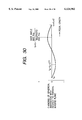
- FIG. 30 is an illustration of the changing of an aberration resulting from the focal length change of a zoom lens.
- FIGS. 1 to 4 are lens cross-sectional views of Numerical Value Embodiments 1 to 4 of the present invention at the wide angle end.
- the letter F designates a focusing lens unit (fore lens unit) of positive refractive power as a first lens unit having a fixed front lens sub-unit F1 of negative refractive power having at least two negative lenses and at least one positive lens, an intermediate lens sub-unit F2 movable on the optical axis thereof during focusing, and a fixed rear lens sub-unit F3 of positive refractive power.
- the letter V denotes a variator for focal length change having negative refractive power as a second lens unit, and the variator V is monotonously moved on the optical axis toward the imaging plane to thereby effect focal length change from the wide angle end (wide) to the telephoto (tele) end.
- the letter C designates a compensator of negative refractive power as a third lens unit having a convex locus toward the object side on the optical axis to correct the changing of the imaging plane resulting from a focal length change and moved non-linearly.
- the variator V and the compensator C together constitute a focal length changing system (zooming system).
- the letters SP denotes a stop which determines open f number
- the letter R designates a fixed relay lens unit of positive refractive power as a fourth lens unit.
- the letter P denotes a color resolving prism, an optical filter or the like, and in FIGS. 1 to 4, it is shown as a glass block.
- the present embodiment is a super-wide angle zoom lens which has a zoom ratio Z of 8.5 times or greater and in which the wide angle end angle of view 2a exceeds 90°, and further, in order to realize a zoom lens which has been made large in aperture in the entire zoom area, it is suitable as a zoom lens of a wide angle system which will satisfy a condition expression that fw/IS ⁇ 0.53, where fw and IS are the focal length of the entire system at the wide angle end and the size of the photo-taking image field (the diagonal length of the image field), respectively.
- the incidence heights of an on-axis ray of light onto the fore lens unit and the variator become successively higher from the wide angle end to the telephoto end, as shown in FIGS. 25 to 28, and in a zoom lens having F drop, the incidence heights become highest at an F drop starting position (zoom position fd in FIG. 27).
- the incidence heights become constant in the fore lens unit, and become low in the variator.
- the incidence height in the rear lens sub-unit of the fore lens unit suddenly becomes high. This tendency becomes more remarkable when an attempt is made to achieve a wider angle, a higher magnification, and compactness and lighter weight.
- the greatest feature is that in order to correct distortion which influences by the cube of the angle of view, within the entire variable power range, an aspherical surface AS1 is provided on at least one of the lens surfaces constituting the fore lens group which satisfies 1.65 ⁇ hw/ht and 1.15 ⁇ hw/hz, where ht is the maximum incidence height of the on-axis light beam, hw is the incidence height of the off-axis light beam at the maximum angle of view at the wide angle end, and hz in the incidence height of the off-axis light beam of the maximum angle of view at a zoom position at a variable power ratio Z 1/4 .
- this aspherical surface is of a shape in which when an aspherical surface for correcting the changing of distortion on the wide angle side is provided on a positive refracting surface in the fore lens unit, positive refractive power becomes stronger toward the peripheral portion of the lens.
- the aspherical surface is provided on a negative refracting surface, the aspherical surface is made into a shape in which negative refractive power becomes weaker toward the peripheral portion of the lens, whereby it is corrected so that the distortion near the wide angle end becomes under (minus).
- the position of the aspherical surface is applied to a location of 1.80 ⁇ hw/ht and 1.20 ⁇ hw/hz, whereby it becomes possible to provide a more desirable aspherical surface effect.
- the aspherical amount of the aspherical surface shape of the fore lens unit is set so as to satisfy the aforementioned conditional expression (1).
- the central portion (the vicinity of the optical axis) of the aspherical lens is substantially spherical (or flat) and the aspherical amount (the amount of displacement from a reference spherical surface) becomes considerably greater toward the periphery of the lens.
- conditional expression (1) prescribes the shape of this aspherical surface, and provides such action that the distortion correcting effect of the aspherical surface is displayed only in some zoom range of the entire zoom area near the wide angle end in which negative distortion is liable to occur, and in the other zoom area, the influence upon spherical aberration, astigmatism, coma, etc. is made as small as possible.
- the front lens sub-unit F1 in the present embodiment is comprised, in succession from the object side, of at least two negative lenses and at least one positive lens, and the negative lens most adjacent to the object side is made into a meniscus shape having a sharp concave surface facing the imaging plane side, whereby the occurrence of distortion at the wide angle end is suppressed to the utmost.
- the achromatizing conditional expression (2) in the front lens sub-unit is satisfied to thereby effectively correct particularly the achromatism of the off-axis ray of light on the wide angle side.
- conditional expression (2) If the lower limit value of conditional expression (2) is exceeded, achromatism will become insufficient and particularly the changing of chromatic difference of magnification on the wide angle side will greatly remain.
- the intermediate lens sub-unit F2 in the present embodiment introduces thereinto the so-called inner focus system for moving it toward the imaging plane side when effecting the focusing on an object at infinity to an object at a very close distance.
- the intermediate lens sub-unit F2 comprises at least one positive lens and the shape thereof is made into a shape having a sharp convex surface facing the imaging plane side to thereby achieve the effect of correcting distortion greatly changing to under (minus) at the wide angle end.
- the rear lens sub-unit F3 is comprised of at least one negative lens and at least three positive lenses, and the focal length of the rear lens sub-unit F3 relative to the entire fore lens group is set as defined in conditional expression (3).
- conditional expression (3) If the lower limit value of conditional expression (3) is exceeded, the radii of curvature of the lenses constituting the rear lens sub-unit F3 tend to suddenly become smaller, and the changing of aberrations particularly on the telephoto side will become great. The number of constituent lenses as the degree of freedom of design for correcting this needs to be great and it becomes difficult to achieve a larger aperture and downsizing. If the upper limit value of conditional expression (3) is exceeded, positive Petzval sum will remarkably decrease and it will become difficult to correct negative Petzval sum occurring in the variator V. Also, the principal point of the imaging plane as the entire fore lens unit comes in and this produces a contrary result against downsizing.
- the achromatizing conditional expression (4) in the rear lens sub-unit F3 is satisfied, and the achromatism of the on-axis ray of light particularly on the telephoto side is corrected.
- conditional expression (4) If the lower limit value of conditional expression (4) is exceeded, achromatism will become insufficient and the on-axis chromatic aberration on the telephoto side will remain.
- an aspherical surface for correcting the changing of spherical aberration on the telephoto side which remains to some extent is provided on at least one surface in the rear lens sub-unit F3 of the fore lens unit F.
- the lens when the aspherical surface for correcting the changing of spherical aberration on the telephoto side is provided on the positive refracting surface of the rear lens sub-unit in the fore lens unit, the lens is made into a shape in which positive refractive power becomes weaker toward the peripheral portion of the lens, and when the aspherical surface is provided on the negative refracting surface of the rear lens sub-unit, the lens is made into a shape in which negative refractive power becomes stronger toward the peripheral portion of the lens, whereby it is corrected that the spherical aberration at the telephoto end becomes under (minus).
- a spherical shape of such a shape that satisfies the aforementioned conditional expression (5) is adopted to effectively correct the spherical aberration at the telephoto end by the higher variable power of zoom.
- What this conditional expression means is a shape in which the center of the optical axis of the aspherical surface is substantially approximate to the spherical shape of the reference spherical surface and the aspherical amount becomes greater toward the periphery of the lens.
- This conditional expression is for causing the spherical aberration correcting effect of the aspherical surface to be displayed only in some zoom range of the zoom area which is near the telephoto end in the variable power system of a zoom lens so that in the other zoom areas, the influence upon astigmatism, coma, etc. may not be provided as far as possible.
- concave, convex, concave, convex and concave lenses are disposed in succession from the object side.
- the negative lens most adjacent to the object side is made into a meniscus shape having its sharp concave surface facing the imaging plane, whereby the distortion at the wide angle end is effectively corrected.
- the changing of chromatic aberration and particularly chromatic difference of magnification itself are corrected by the combination of the second and third concave and convex lenses.
- the variator V is comprised of five lenses and the thickness of the entire variator V is increased and therefore, if the correcting surface for achromatism as the variator is present closer to the imaging plane side, the deviation of the position of the principal point by the wavelength of the variator becomes greater and chromatic difference of magnification occurs greatly. Therefore, as in the construction of the embodiment, the cardinal point of achromatism as the variator V is made to exist on the object side to thereby correct chromatic difference of magnification well.
- the combination of the fourth and fifth concave and convex lenses is used and an appropriate refractive index is set between the two, thereby correcting the coma on the telephoto side in particular.
- the positive lens and the negative lens adopt one of the forms of joint and separation when the influences of high-order aberrations are taken into consideration, and an appropriate refractive index difference for sufficiently displaying the diverging effect of coma particularly when the form of joint is adopted is set.
- the lens surface on which the aspherical surface is provided is appropriately set to thereby effectively correct the changing of the distortion on the wide angle side and the spherical aberration on the telephoto side, thus obtaining high optical performance over the entire variable power range.
- Embodiment 1 shown in FIG. 1 has a zoom ratio of 8.5 times and the wide angle end angle of view 2 ⁇ exceeds 90°.
- R1 to R15 designate a fore lens unit F.
- R1 to R6 denote F1 fixed during focusing and having negative power (refractive power).
- R7 to R8 designate a lens unit F2 having the focusing action and movable toward the imaging plane side during the focusing on an object at infinity to an object at a very close distance
- R9 to R15 denote F3 fixed during focusing and having positive power.
- R16 to R23 designate a variator V monotonously movable toward the imaging plane side from wide (wide angle end) to tele (telephoto end) for focal length change.
- R24 to R26 denote a compensator C having the image point correcting action resulting from focal length change, and having negative power and movable toward the object side so as to describe a convex area during the focal length change from wide to tele.
- SP(27) designates a stop.
- R28 to R44 denote a relay lens unit R having the imaging action, and
- R45 to R47 designate a glass block equivalent to a color resolving prism.
- F1 which greatly influences various aberrations is comprised, in succession from the object side, of three concave, concave and convex lenses, and the concave lens most adjacent to the object side is made into a meniscus shape having its sharp concave surface facing the imaging plane side, whereby the occurrence of distortion in the fore lens unit is suppressed.
- a so-called inner focusing system using F2 as a focusing movable lens unit is adopted as a focusing system, whereby the changing of aberrations due to the object distance is corrected effectively and at the same time, effects such as the downsizing of the entire zoom lens and the mitigation of focus operating torque are achieved.
- F3 which greatly influences the various aberrations on the telephoto side is comprised, in succession from the object side, of four lenses which are concave, convex, convex and convex lenses, and spherical aberration is caused to diverge by the concave lens and the occurrence of spherical aberration in the fore lens group suppressed.
- the variator V is comprised of four lenses which are concave, concave, convex and concave lenses, and spherical aberration, coma, etc. are caused to diverge by the convex lens to thereby suppress the occurrence of various aberrations in the variator.
- the compensator is comprised of two concave and convex lenses, and spherical aberration and chromatic aberration are caused to diverge by the boundary surface therebetween to thereby suppress the occurrence of various aberrations.
- the direction of the aspherical surface is a direction in which positive power becomes stronger as the amount of separation from the optical axis becomes greater, and in order to efficiently correct distortion and spherical aberration up to high-order areas, up to aspherical surface coefficients B, C, D and E are used.
- the aspherical amount at this time is 1057.9 ⁇ m at the maximum height of the incident ray of light on R1.
- Embodiment 2 shown in FIG. 2 has a zoom ratio of 8.5 times and the wide angle end angle of view 2 ⁇ exceeds 90°. Moreover, it is a zoom lens entirely free of F drop on the telephoto side.
- R1 to R17 designate a fore lens unit F.
- R1 to R8 denotes F1 fixed during focusing and having negative power (refractive power)
- R9 to R10 designate F2 having the focusing action and movable toward the imaging plane side during the focusing on an object at infinity to an object at a very close distance
- R11 to R17 denote F3 fixed during focusing and having positive power.
- R18 to R26 designate a variator V monotonously movable from wide (wide angle end) to tele (telephoto end) for focal length change.
- R27 to R29 denote a compensator C having the image point correcting action resulting from focal length change and having negative power, and movable toward the object side so as to describe a convex area during the focal length change from wide to tele.
- SP(30) designates a stop.
- R31 to R47 denote a relay lens unit R having the imaging action, and R48 to R50 designate a glass block equivalent to a color resolving prism.
- F drop on the telephoto side does not occur at all.
- F1 which greatly influences the various aberrations on the wide angle side is comprised, in succession from the object side, of four lenses which are concave, concave, concave and convex lenses, and the concave lens most adjacent to the object side is made into a meniscus shape having its sharp concave surface facing the imaging plane side to thereby suppress the occurrence of distortion in the fore lens unit.
- a so-called inner focusing system using F2 as a focusing movable lens unit is adopted as a focusing system, whereby the changing of aberrations due to the object distance is corrected effectively and at the same time, effects such as the downsizing of the entire zoom lens and the mitigation of focus operating torque are achieved.
- the on-axis ray incidence height becomes great on the telephoto side and therefore, F3 which greatly influences the various aberrations on the telephoto side is comprised, in succession from the object side, of four lenses which are concave, convex, convex and convex lenses, and spherical aberration is caused to diverge by the concave lens and the occurrence of spherical aberration in the fore lens unit is suppressed.
- the variator V is comprised of five lenses which are concave, convex, concave, convex and concave lenses, and the second convex lens and the third concave lens are provided with an appropriate Abbe number difference therebetween to thereby effect achromatism as much as possible on the object side, and the fourth convex lens and the fifth concave lens are provided with an appropriate refractive index difference therebetween to thereby cause spherical aberration, coma etc. to diverge, thus suppressing the occurrence of various aberrations in the variator.
- the compensator C is comprised of two lenses which are concave and convex lenses, and spherical aberration and chromatic aberration are caused to diverge by the boundary surface therebetween, thereby suppressing the occurrence of various aberrations.
- the direction of the aspherical surfaces is a direction in which positive power becomes stronger as the amount of separation from the optical axis becomes greater, and in order to efficiently correct distortion and spherical aberration up to high-order areas, up to aspherical surface coefficients B, C, D and E are used.
- the aspherical amount at this time is 336.3 ⁇ m at the maximum height of the incident ray onto R1.
- the aspherical surface provided on the surface R16 corrects the spherical aberration occurring greatly on the telephoto side because appropriate F drop is not set.
- the direction of the aspherical surface is a direction in which positive power becomes weaker as the amount of separation from the optical axis becomes greater, and in order to efficiently correct distortion and spherical aberration up to high-order areas, up to aspherical surface coefficients B, C, D and E are used.
- the aspherical amount at this time is 198.1 ⁇ m at the maximum height of the incident ray onto R16.
- this aspherical shape is a direction in which the over distortion at the variable power ratio Z 1/4 is mitigated, and is provided on R16 because the more effective is a lens surface on which the incidence height of the on-axis ray is great on the telephoto side and on which the incidence height of the off-axis ray at the variable power ratio Z 1/4 is great.
- FIGS. 10A to 10C to 14A to 14C show spherical aberration, astigmatism and distortion at respective zoom positions.
- Embodiment 3 shown in FIG. 3 has a zoom ratio of nine times, and the wide angle end angle of view 2 ⁇ exceeds 93°.
- R1 to R17 designate a fore lens unit F.
- R1 to R8 denote F1 fixed during focusing and having negative power (refractive power)
- R9 to R10 designate F2 having the focusing action and movable to the imaging plane side during the focusing on an object at infinity to an object at a very close distance
- R11 to R17 denote F3 fixed during focusing and having positive power.
- R18 to R25 designate a variator V monotonously movable toward the imaging plane side from wide (wide angle end) to tele (telephoto end) for focal length change.
- R26 to R28 denote a compensator C having the image point correcting action resulting from a focal length change and having negative power, and movable toward the object side so as to describe a convex area during the focal length change from wide to tele.
- SP(29) designates a stop.
- R30 to R46 denote a relay lens unit R having the imaging action, and
- R47 to R49 designate a glass block equivalent to a color resolving prism.
- F1 which greatly influences the various aberrations on the wide angle side is comprised, in succession from the object side, of four lenses which are concave, concave, concave and convex lenses, and the concave lens most adjacent to the object side is made into a meniscus shape having its sharp concave surface facing the imaging plane side to thereby suppress the occurrence of distortion in the fore lens unit.
- a so-called inner focusing system using F2 as a focusing movable lens unit is adopted as a focusing system, whereby the changing of aberrations due to the object distance is corrected effectively and at the same time, effects such as the downsizing of the entire zoom lens and the mitigation of focus operating torque are achieved.
- F3 which grately influences the various aberrations on the telephoto side is comprised, in succession from the object side, of four lenses which are concave, convex, convex and convex lenses, and spherical aberration is caused to diverge by the concave lens and the occurrence of spherical aberration in the fore lens unit is suppressed.
- the variator V is comprised of four lenses which are concave, concave, convex and concave lenses, and spherical aberration, coma, etc. are caused to diverge by the convex lens and the occurrence of various aberrations in the variator is suppressed.
- the compensator C is comprised of two lenses which are concave and convex lenses, and spherical aberration and chromatic aberration are caused to diverge by the boundary surface therebetween and the occurrence of various aberrations is suppressed.
- the direction of the aspherical surface is a direction in which positive power becomes stronger as the amount of separation from the optical axis becomes greater, and in order to efficiently correct distortion and spherical aberration up to high-order areas, up to aspherical surface coefficients B, C, D and E are used.
- the aspherical amount at this time is 805.2 ⁇ m at the maximum height of the incident ray on R1.
- FIGS. 15A to 15C to FIGS. 19A to 19C show spherical aberration, astigmatism and distortion at respective zoom positions.
- Embodiment 4 shown in FIG. 4 has a zoom ratio of ten times and the wide angle end angle of view 2 ⁇ exceeds 95°.
- R1 to R17 designate a fore lens unit F.
- R1 to R8 denote F1 fixed during focusing and having negative power (refractive power)
- R9 to R10 designate F2 having the focusing action and movable toward the imaging plane side during the focusing on an object at infinity to an object at a very close distance
- R11 to R17 denote F3 fixed during focusing and having positive power.
- R18 to R26 designate a variator V monotonously movable toward the imaging plane side from wide (wide angle end) to tele (telephot end) for focal length change.
- R27 to R29 denote a compensator C having the image point correcting action resulting from a focal length change and having negative power, and movable toward the object side so as to describe a convex area during the focal length change from wide to tele.
- SP(30) designates a stop.
- R31 to R47 denote a relay lens unit having the imaging action, and
- R48 to R50 designate a glass block equivalent to a color resolving prism.
- F1 which greatly influences the various aberrations on the wide angle side is comprised, in succession from the object side, of four lenses which are concave, concave, concave and convex lenses, and the concave lens most adjacent to the object side is made into a meniscus shape having its sharp concave surface facing the imaging plane side to thereby suppress the occurrence of distortion in the fore lens unit.
- a so-called inner focusing system using F2 as a focusing movable lens unit is adopted as a focusing system, whereby the changing of aberrations due to the object distance is corrected effectively and at the same time, effects such as the downsizing of the entire zoom lens and the mitigation of focus operating torque are achieved.
- the on-axis ray incidence height becomes great on the telephoto side and therefore, F3 which greatly influences the various aberrations on the telephoto side is comprised, in succession from the object side, of four lenses which are concave, convex, convex and convex lenses, and spherical aberration is caused to diverge by the concave lens and the occurrence of spherical aberration in the fore lens unit is suppressed.
- the variator V is comprised of five lenses which are concave, convex, concave, convex and concave lenses, and the second convex lens and the third concave lens are provided with an appropriate Abbe number difference therebetween and achromatism is effected as far as possible on the object side, and the fourth convex lens and the fifth concave lens are provided with an appropriate refractive index difference therebetween, whereby spherical aberration, coma, etc. are caused to diverge to thereby suppress the occurrence of various aberrations in the variator.
- the compensator C is comprised of two lenses which are concave and convex lenses, and spherical aberration and chromatic aberration are caused to diverge by the boundary surface therebetween to thereby suppress the occurrence of various aberrations.
- the direction of the aspherical surface is a direction in which positive power becomes stronger as the amount of separation from the optical axis becomes greater, and in order to efficiently correct distortion and spherical aberration up to high-order areas, up to aspherical surface coefficients B, C, D and E are used.
- the aspherical amount at this time is 1400.6 ⁇ m at the maximum height of the incident ray of light on R1.
- the aspherical surface provided on the surface R16 corrects the spherical aberration on the telephoto side.
- the direction of the aspherical surface is a direction in which positive power becomes weaker as the amount of separation from the optical axis becomes greater, and in order to efficiently correct distortion and spherical aberration up to high-order areas, up to aspherical surface coefficients B, C, D and E are used.
- the aspherical amount at this time is 135.5 ⁇ m at the maximum height of the incident ray of light on R16.
- This aspherical shape is in a direction in which the over distortion at the variable power ratio Z 1/4 is mitigated, and is provided on R16 because a lens surface in which the on-axis ray incidence height is great on the telephoto side and the off-axis ray incidence height at the variable power ratio Z 1/4 is great is more effective.
- FIGS. 20A to 20C, 21A to 21C, 22A to 22C, 23A to 23C and FIGS. 24A to 24C show spherical aberration, astigmatism and distortion at respective zoom positions.
- Ri represents the radius of curvature of the ith lens surface from the object side
- Di represents the thickness and air space of the ith lens from the object side
- Ni and vi represent the refractive index and Abbe number, respectively, of the material of the ith lens from the object side.
- a so-called four-unit zoom lens in which the lens disposition of a fore lens unit, the lens disposition of a variator, a focusing system, etc. are appropriately set, and when the maximum incidence height of the on-axis light beam is ht and the incidence height of the off-axis light beam of a maximum angle of view at the wide angle end is hw and the incidence height of the off-axis light beam of a maximum angle of view at a zoom position at a variable power ratio Z 1/4 is hz, an aspherical surface is provided on at least one surface in the fore lens unit which satisfies 1.65 ⁇ hw/ht and 1.15 ⁇ hw/hz, whereby the distortion near the wide angle end is corrected and further the changing of astigmatism, coma and chromatic aberration resulting from a focal length change are corrected in a well-balanced manner and which has high optical performance over the entire variable power range and has an F number on the order of
Landscapes
- Physics & Mathematics (AREA)
- General Physics & Mathematics (AREA)
- Optics & Photonics (AREA)
- Lenses (AREA)
Abstract
This specification discloses a zoom lens which has, in succession from the object side, a first lens unit of positive refractive power, a second lens unit of negative refractive power for focal length change, a third lens unit for correcting the changing of an imaging plane resulting from a focal length change, and a fourth lens unit of positive refractive power, and in which an aspherical surface AS1 is provided on at least one lens surface constituting the first lens unit and satisfying 1.65<hw/ht and 1.15<hw/hz, where ht is the maximum incidence height of an on-axis light beam, hw is the incidence height of an off-axis light beam of a maximum angle of view at the wide angle end, and hz is the incidence height of the off-axis light beam of a maximum angle of view at a zoom position at a variable power ratio Z1/4, and the power disposition and achromatism condition of the first lens unit, a focusing system, etc. are appropriately set.
Description
1. Field of the Invention
This invention relates to a zoom lens, and particularly to a zoom lens suitable for a television camera, a phototaking camera, a video camera, etc. which appropriately uses an aspherical surface in a portion of a lens system, which has a large aperture in which the F number at the wide angle end is of the order of 1.7 and moreover has a wide angle (wide angle end angle of view 2ω=58° to 70°) and good optical performance over the entire variable power range of as high a variable power ratio as a variable power ratio of the order of 8.5 to 10.
2. Related Background Art
Zoom lenses having a large aperture, high variable power and high optical performance have heretofore been required for television cameras, phototaking cameras, video cameras, etc.
In addition, particularly in color television cameras for broadcasting, great importance has been attached to operability and mobility and in compliance with such requirements, compact CCD's (solid state image pickup devices) of 2/3 inch and 1/2 inch have become the mainstream among image pickup devices.
These CCD's have substantially uniform resolving power over the entire image pickup range and therefore, it has been required of zoom lenses using these that resolving power be substantially uniform from the center of the image field to the periphery of the image field.
For example, it is desired that various aberrations such as astigmatism, distortion and chromatic difference of magnification be corrected and the entire image field has high optical performance. It is further desired that the zoom lenses have a large aperture, a wide angle and a high variable power ratio and moreover be compact and light in weight and have a long back focus for disposing a color resolving optical system and various filters in front of image pickup means.
Among zoom lenses, so-called four-unit zoom lenses comprising, in succession from the object side, a first lens unit of positive refractive power for focusing, a second lens unit of negative refractive power for focal length change, a third lens unit of positive or negative refractive power for correcting the movement of an image plane fluctuating with a focal length change, and a fourth lens unit of positive refractive power performing chiefly the imaging action are often used as zoom lenses for color television cameras for broadcasting stations.
Among the zoom lenses of such four-unit construction, a four-unit zoom lens having F number of the order of 1.7, a wide angle end angle of view 2ω=86°, a great aperture ratio and high variable power of a variable power ratio of the order of 8 is proposed, for example, in Japanese Laid-Open Patent Application No. 6-242378.
In a zoom lens, to obtain a great aperture ratio (F number 1.7 to 1.8), a high variable power ratio (variable power ratio 8.5 to 10), a super-wide angle (wide angle end angle of view 2ω=90° to 96°) and moreover high optical performance over the entire variable power range, it is necessary to appropriately set the refractive power and lens construction of each lens unit.
Generally, to obtain a small aberration fluctuation and high optical performance over the entire variable power range, it becomes necessary, for example, to increase the number of lenses in each lens unit and increase the degree of freedom of design in aberration correction.
If for this purpose, an attempt is made to achieve a zoom lens of a great aperture ratio, a super-wide angle and a high variable power ratio, the number of lenses will unavoidably be increased, and this leads to the arising of the problem that the entire lens system becomes bulky, and it becomes impossible to comply with the desire for compactness and lighter weight.
Also, in the imaging performance, first speaking regarding the super-wide angle of a zoom lens, distortion poses the greatest problem. This is because distortion influences by the cube of the angle of view in the area of the third-order aberration coefficient.
As shown in FIG. 29 of the accompanying drawings, distortion is considerably greater under (minus) at the wide angle end (focal length fw). From the wide angle end fw toward the telephoto end (focal length ft), distortion becomes gradually greater in the direction of over (plus) and passes a zoom position at which distortion is 0, and the value of over tends to become greatest near the zoom position fm=fw×Z1/4. From the focal length fm to the telephoto end ft, the over amount becomes gradually smaller. In the foregoing, fw is the focal length at the wide angle end, and Z is a zoom ratio.
This tendency comes to remarkably present itself as the angle of view at the wide angle end becomes greater. In such a super-wide angle zoom lens wherein the wide angle end angle of view 2ω exceeds 90°, distortion of under on the wide angle side is created and the correction of this distortion becomes very difficult.
Next, the changing of a point at which the image contrast of the center of the image field is best, i.e., the so-called best imaging plane, resulting from a focal length change, poses a problem. This is attributable chiefly to the changing of spherical aberration resulting from a focal length change. This spherical aberration influences by the cube of the aperture in the area of the third-order aberration coefficient and therefore, it is the greatest problem in providing a large aperture.
Generally, the changing of spherical aberration resulting from a focal length change tends to be under (minus) with respect to the Gaussian imaging plane from the wide angle end at which spherical aberration is 0 to the vicinity of the zoom position fm=fw×Z1/4 as shown in FIG. 30 of the accompanying drawings when the zoom ratio is Z and the focal length at the wide angle end is fw. When the vicinity of the zoom position fm=fw×Z1/4 is passed, the under amount becomes smaller and becomes 0 at a certain zoom position, and now tends to become over (plus).
It becomes most over (plus) near a zoom position fd=(Fno.w/Fno.t)×ft at which F drop in which F number becomes great (the lens system becomes dark) begins, and when this zoom position is passed, the over amount becomes smaller to the telephoto end and becomes substantially 0 at the telephoto end.
In the foregoing, Fno.w and Fno.t are F numbers at the wide angle end and the telephoto end, respectively, and ft is the focal length at the telephoto end.
As described above, particularly in a zoom lens having a position at which F drop begins, the correction of spherical aberration on the telephoto side becomes very difficult.
In order to correct such changing of various aberrations effectively over the entire variable power range, the number of lenses in the focusing lens unit and the lens unit of the focal length changing system has heretofore been increased. Such a technique, however, gives rise to a new problem that the entire lens system becomes bulky and complicated.
Also, the introduction of an aspherical surface for the solution of such a problem is done in an embodiment disclosed in the above-mentioned Japanese Laid-Open Patent Application No. 6-242378.
However, the specification of zoom lenses has been improved, and in a zoom lens of a great aperture ratio and moreover, a high variable power ratio beginning from a super-wide angle, the reconsideration of the method of introducing the aspherical surface has become necessary.
In a zoom lens of a great aperture ratio and moreover a high variable power ratio beginning from a super-wide angle, distortion changes greatly on the wide angle side and spherical aberration changes greatly on the telephoto side. It has become difficult to correct these two aberrations efficiently and well simply by introducing an aspherical surface into one of the surfaces of a focal length changing portion.
The present invention has as its first object the provision of a so-called four-unit zoom lens in which the refractive power of each lens unit is appropriately set and at least one lens surface in a fore lens unit is made into an aspherical surface to thereby reduce the changing of various aberrations resulting from a focal length change and particularly distortion on the wide angle side and spherical aberration on the telephoto side is effectively corrected. The present invention has as its second object the provision of a zoom lens which has high optical performance over the entire variable power range and in which F number at the wide angle end is of the order of 1.8 and which has a super-wide angle (for example, the angle of view at the wide angle end is of the order of 2ω=90° to 96°) and a great aperture ratio and a high variable power ratio of a variable power ratio of the order of 8.5 to 10.
The zoom lens of the present invention is:
(1) A zoom lens having, in succession from the object side, a first lens unit of positive refractive power, a second lens unit of negative refractive power for focal length change, a third lens unit for correcting the changing of an imaging plane resulting from a focal length change, and a fixed fourth lens unit of positive refractive power, wherein the first lens unit has a front lens sub-unit of negative refractive power fixed during focusing, an intermediate lens sub-unit movable along the optical axis thereof for focusing, and a rear lens sub-unit of positive refractive power fixed during focusing, and when the variable power ratio of the zoom lens is Z and the maximum incidence height of the on-axis light beam in the first lens unit is ht and the maximum incidence height of the off-axis light beam of a maximum angle of view at the wide angle end in the first lens unit is hw and the maximum incidence height of the off-axis light beam of the maximum angle of view at a zoom position at a variable power ratio Z1/4 is hz, an aspherical surface S1 is provided on at least one lens surface at a position satisfying 1.65<hw/ht and 1.15<hw/hz;
(2) Particularly, the aspherical surface AS1, when provided on a positive refracting surface, forms a shape in which positive refractive power becomes stronger toward the peripheral portion of the lens, and when provided on a negative refracting surface, forms a shape in which negative refractive power becomes weaker toward the peripheral portion of the lens, and when the combined focal length of the first lens unit in a state in which it is in focus on an object at infinity is f1 and the aspherical amounts (the amounts of displacement from a reference spherical surface) in 100%, 90% and 70% of the effective diameter of the lens on which the aspherical surface AS1 is provided are Δ10, Δ9 and Δ7, respectively, the aspherical surface AS1 is of a shape satisfying the following conditions: ##EQU1## (3) Also, the front lens sub-unit comprises, in succession from the object side, at least two negative lenses and at least one positive lens, and the negative lens most adjacent to the object side forms a meniscus shape having its sharp concave surface facing the image plane side, and when the average of the Abbe numbers of the at least two negative lenses is Δν11n and the Abbe number of the positive lens is Δν11p, the front lens sub-unit satisfies the following condition:
19<Δν11n-Δν11p (2)
(4) Also, the intermediate lens sub-unit as a focusing lens comprises at least one positive lens movable toward the image plane side during focusing on an object at infinity to an object at a close distance, and having a shape having its sharp convex surface facing the image plane side;
(5) Also, the rear lens sub-unit is comprised of at least one negative lens and at least three positive lenses, and when the focal lengths of the first lens unit and the rear lens sub-unit are f1 and f13, respectively, and the Abbe number of the negative lens is Δν13n and the average of the Abbe numbers of the at least three positive lenses is Δν13p, the rear lens sub-unit satisfies the following conditions:
1.5≦f13/f1≦2.0 (3)
40<Δν13p-Δν13n (4)
(6) Also, the rear lens sub-unit has an aspherical surface AS2 provided on at least one surface thereof, the aspherical surface AS2, when provided on a positive refracting surface, forms a shape in which positive refractive power becomes weaker toward the peripheral portion of the lens, and when provided on a negative refracting surface, forms a shape in which negative refractive power becomes stronger toward the peripheral portion of the lens;
(7) Further, when in the lens of the zoom lens of item (6), the aspherical amounts in 100%, 90% and 70% of the effective diameter of the lens on which the aspherical surface AS2 is provided are Δ10, Δ9 and Δ7, respectively, the lens is of a shape satisfying the following conditions: ##EQU2##
FIG. 1 is a lens cross-sectional view of the wide angle end of Numerical Value Embodiment 1 of the present invention.
FIG. 2 is a lens cross-sectional view of the wide angle end of Numerical Value Embodiment 2 of the present invention.
FIG. 3 is a lens cross-sectional view of the wide angle end of Numerical Value Embodiment 3 of the present invention.
FIG. 4 is a lens cross-sectional view of the wide angle end of Numerical Value Embodiment 4 of the present invention.
FIGS. 5A, 5B and 5C show the aberrations of Embodiment 1 of the present invention at a focal length f=5.50.
FIGS. 6A, 6B and 6C show the aberrations of Embodiment 1 of the present invention at a focal length f=9.39.
FIGS. 7A, 7B and 7C show the aberrations of Embodiment 1 of the present invention at a focal length f=13.75.
FIGS. 8A, 8B and 8C show the aberrations of Embodiment 1 of the present invention at a focal length f=42.08.
FIGS. 9A, 9B and 9C show the aberrations of Embodiment 1 of the present invention at a focal length f=46.75.
FIGS. 10A, 10B and 10C show the aberrations of Embodiment 2 of the present invention at a focal length f=5.50.
FIGS. 11A, 11B and 11C show the aberrations of Embodiment 2 of the present invention at a focal length f=9.39.
FIGS. 12A, 12B and 12C show the aberrations of Embodiment 2 of the present invention at a focal length f=13.75.
FIGS. 13A, 13B and 13C show the aberrations of Embodiment 2 of the present invention at a focal length f=42.08.
FIGS. 14A, 14B and 14C show the aberrations of Embodiment 2 of the present invention at a focal length f=46.75.
FIGS. 15A, 15B and 15C show the aberrations of Embodiment 3 of the present invention at a focal length f=5.20.
FIGS. 16A, 16B and 16C show the aberrations of Embodiment 3 of the present invention at a focal length f=9.01.
FIGS. 17A, 17B and 17C show the aberrations of Embodiment 3 of the present invention at a focal length f=13.00.
FIGS. 18A, 18B and 18C show the aberrations of Embodiment 3 of the present invention at a focal length f=40.11.
FIGS. 19A, 19B and 19C show the aberrations of Embodiment 3 of the present invention at a focal length f=46.80.
FIGS. 20A, 20B and 20C show the aberrations of Embodiment 4 of the present invention at a focal length f=5.00.
FIGS. 21A, 21B and 21C show the aberrations of Embodiment 4 of the present invention at a focal length f=8.89.
FIGS. 22A, 22B and 22C show the aberrations of Embodiment 4 of the present invention at a focal length f=12.50.
FIGS. 23A, 23B and 23C show the aberrations of Embodiment 4 of the present invention at a focal length f=37.50.
FIGS. 24A, 24B and 24C show the aberrations of Embodiment 4 of the present invention at a focal length f=50.00.
FIG. 25 shows the optical path of a portion of FIG. 1.
FIG. 26 shows the optical path of a portion of FIG. 1.
FIG. 27 shows the optical path of a portion of FIG. 1.
FIG. 28 shows the optical path of a portion of FIG. 1.
FIG. 29 is an illustration of the changing of an aberration resulting from the focal length change of a zoom lens.
FIG. 30 is an illustration of the changing of an aberration resulting from the focal length change of a zoom lens.
FIGS. 1 to 4 are lens cross-sectional views of Numerical Value Embodiments 1 to 4 of the present invention at the wide angle end.
In FIGS. 1 to 4, the letter F designates a focusing lens unit (fore lens unit) of positive refractive power as a first lens unit having a fixed front lens sub-unit F1 of negative refractive power having at least two negative lenses and at least one positive lens, an intermediate lens sub-unit F2 movable on the optical axis thereof during focusing, and a fixed rear lens sub-unit F3 of positive refractive power.
The letter V denotes a variator for focal length change having negative refractive power as a second lens unit, and the variator V is monotonously moved on the optical axis toward the imaging plane to thereby effect focal length change from the wide angle end (wide) to the telephoto (tele) end. The letter C designates a compensator of negative refractive power as a third lens unit having a convex locus toward the object side on the optical axis to correct the changing of the imaging plane resulting from a focal length change and moved non-linearly. The variator V and the compensator C together constitute a focal length changing system (zooming system).
The letters SP denotes a stop which determines open f number, and the letter R designates a fixed relay lens unit of positive refractive power as a fourth lens unit. The letter P denotes a color resolving prism, an optical filter or the like, and in FIGS. 1 to 4, it is shown as a glass block.
The present embodiment is a super-wide angle zoom lens which has a zoom ratio Z of 8.5 times or greater and in which the wide angle end angle of view 2a exceeds 90°, and further, in order to realize a zoom lens which has been made large in aperture in the entire zoom area, it is suitable as a zoom lens of a wide angle system which will satisfy a condition expression that fw/IS<0.53, where fw and IS are the focal length of the entire system at the wide angle end and the size of the photo-taking image field (the diagonal length of the image field), respectively.
Description will now be made of the features of the aspherical surface of the zoom lens according to the present invention.
In a zoom lens wherein the wide angle end angle of view 2a begins from 2ω=90° to 96° and the zoom ratio is on the order of 8.5 to 10 times, the incidence heights of an on-axis ray of light onto the fore lens unit and the variator become successively higher from the wide angle end to the telephoto end, as shown in FIGS. 25 to 28, and in a zoom lens having F drop, the incidence heights become highest at an F drop starting position (zoom position fd in FIG. 27). At the telephoto end, due to the F drop, the incidence heights become constant in the fore lens unit, and become low in the variator.
In contrast, a ray of light of the incidence height of the maximum off-axis ray of light (the height of a light beam of the maximum off-axis light beams which is farthest from the optical axis) passes through particularly the front lens sub-unit of the fore lens unit over the effective diameter thereof at the wide angle end, but the ray of light of this incidence height in the front lens sub-unit suddenly becomes low at a zoom position fm=fw×Z1/4. On the other hand, conversely, the incidence height in the rear lens sub-unit of the fore lens unit suddenly becomes high. This tendency becomes more remarkable when an attempt is made to achieve a wider angle, a higher magnification, and compactness and lighter weight.
To efficiently correct distortion which changes greatly on the wide angle side when an aspherical surface is provided in the fore lens unit to thereby suppress the changing of aberrations, it is necessary to dispose the aspherical surface at an appropriate position.
So, in the present embodiment, the greatest feature is that in order to correct distortion which influences by the cube of the angle of view, within the entire variable power range, an aspherical surface AS1 is provided on at least one of the lens surfaces constituting the fore lens group which satisfies 1.65<hw/ht and 1.15<hw/hz, where ht is the maximum incidence height of the on-axis light beam, hw is the incidence height of the off-axis light beam at the maximum angle of view at the wide angle end, and hz in the incidence height of the off-axis light beam of the maximum angle of view at a zoom position at a variable power ratio Z1/4.
Also, this aspherical surface is of a shape in which when an aspherical surface for correcting the changing of distortion on the wide angle side is provided on a positive refracting surface in the fore lens unit, positive refractive power becomes stronger toward the peripheral portion of the lens. On the other hand, when the aspherical surface is provided on a negative refracting surface, the aspherical surface is made into a shape in which negative refractive power becomes weaker toward the peripheral portion of the lens, whereby it is corrected so that the distortion near the wide angle end becomes under (minus).
Now, such shape of the aspherical surface corrects under distortion well near the wide angle end, but conversely speaking, regarding the distortion at a zoom position at a variable power ratio Z1/4 this produces a contrary result, and over (plus) distortion attributable to the strong positive refractive power in the fore lens unit at the zoom position at the variable power ratio Z1/4 is increased more strongly by the aspherical surface effect, whereby it becomes difficult to suppress the distortion.
So, the satisfaction of the above-mentioned condition that 1.65<hw/ht shows that the off-axis ray of light passes only near the wide angle end in the entire variable power range and the difference from the incidence height of the on-axis ray of light on the telephoto side is great, whereby the influence upon the changing or the like of spherical aberration on the telephoto side is suppressed to the utmost while the distortion at the wide angle end by a wider angle is corrected well. In addition, the concurrent satisfaction of the above-mentioned condition that 1.15<hw/hz shows that the off-axis ray of light passes only near the wide angle end in the entire variable power range and the difference from the incidence height of the off-axis light beam of a maximum angle of view near the zoom position at the variable power ratio Z1/4 is great, and it is avoided that the over (plus) distortion attributable to the strong positive refractive power in the fore lens unit at the zoom position at the variable power ratio Z1/4 is increased more strongly by the aspherical surface effect. Thereby, the influence upon the changing or the like of the distortion on the telephoto side is suppressed while the distortion at the wide angle end by a wider angle is corrected well.
More desirably, in accordance with an embodiment which will be described later, the position of the aspherical surface is applied to a location of 1.80<hw/ht and 1.20<hw/hz, whereby it becomes possible to provide a more desirable aspherical surface effect.
Further, in the present embodiment, in order to effectively correct the distortion at the wide angle end by the wider angle, the aspherical amount of the aspherical surface shape of the fore lens unit is set so as to satisfy the aforementioned conditional expression (1). What this condition means is that the central portion (the vicinity of the optical axis) of the aspherical lens is substantially spherical (or flat) and the aspherical amount (the amount of displacement from a reference spherical surface) becomes considerably greater toward the periphery of the lens. The above-mentioned conditional expression (1) prescribes the shape of this aspherical surface, and provides such action that the distortion correcting effect of the aspherical surface is displayed only in some zoom range of the entire zoom area near the wide angle end in which negative distortion is liable to occur, and in the other zoom area, the influence upon spherical aberration, astigmatism, coma, etc. is made as small as possible.
Next, in order to effectively correct optical performance for distortion and particularly chromatic aberration regarding the fore lens unit, the front lens sub-unit F1 in the present embodiment is comprised, in succession from the object side, of at least two negative lenses and at least one positive lens, and the negative lens most adjacent to the object side is made into a meniscus shape having a sharp concave surface facing the imaging plane side, whereby the occurrence of distortion at the wide angle end is suppressed to the utmost. Further, the achromatizing conditional expression (2) in the front lens sub-unit is satisfied to thereby effectively correct particularly the achromatism of the off-axis ray of light on the wide angle side.
If the lower limit value of conditional expression (2) is exceeded, achromatism will become insufficient and particularly the changing of chromatic difference of magnification on the wide angle side will greatly remain.
Now, the intermediate lens sub-unit F2 in the present embodiment introduces thereinto the so-called inner focus system for moving it toward the imaging plane side when effecting the focusing on an object at infinity to an object at a very close distance.
By doing so, the changing of aberrations by the object distance is corrected effectively and at the same time, the effects of downsizing the entire zoom lens and mitigating the focus operating torque are achieved. Also, the intermediate lens sub-unit F2 comprises at least one positive lens and the shape thereof is made into a shape having a sharp convex surface facing the imaging plane side to thereby achieve the effect of correcting distortion greatly changing to under (minus) at the wide angle end.
On the other hand, the rear lens sub-unit F3 is comprised of at least one negative lens and at least three positive lenses, and the focal length of the rear lens sub-unit F3 relative to the entire fore lens group is set as defined in conditional expression (3).
If the lower limit value of conditional expression (3) is exceeded, the radii of curvature of the lenses constituting the rear lens sub-unit F3 tend to suddenly become smaller, and the changing of aberrations particularly on the telephoto side will become great. The number of constituent lenses as the degree of freedom of design for correcting this needs to be great and it becomes difficult to achieve a larger aperture and downsizing. If the upper limit value of conditional expression (3) is exceeded, positive Petzval sum will remarkably decrease and it will become difficult to correct negative Petzval sum occurring in the variator V. Also, the principal point of the imaging plane as the entire fore lens unit comes in and this produces a contrary result against downsizing.
Further, the achromatizing conditional expression (4) in the rear lens sub-unit F3 is satisfied, and the achromatism of the on-axis ray of light particularly on the telephoto side is corrected.
If the lower limit value of conditional expression (4) is exceeded, achromatism will become insufficient and the on-axis chromatic aberration on the telephoto side will remain.
In the zoom lenses shown in FIGS. 1 to 4, the above-described conditions are satisfied, whereby the changing of aberrations is effectively corrected over the entire variable power range and high optical performance is obtained.
Now, in Numerical Value Embodiments 2 and 4 in the present embodiment, an aspherical surface for correcting the changing of spherical aberration on the telephoto side which remains to some extent is provided on at least one surface in the rear lens sub-unit F3 of the fore lens unit F.
Particularly, when the aspherical surface for correcting the changing of spherical aberration on the telephoto side is provided on the positive refracting surface of the rear lens sub-unit in the fore lens unit, the lens is made into a shape in which positive refractive power becomes weaker toward the peripheral portion of the lens, and when the aspherical surface is provided on the negative refracting surface of the rear lens sub-unit, the lens is made into a shape in which negative refractive power becomes stronger toward the peripheral portion of the lens, whereby it is corrected that the spherical aberration at the telephoto end becomes under (minus).
Further, in Embodiments 2 and 4, a spherical shape of such a shape that satisfies the aforementioned conditional expression (5) is adopted to effectively correct the spherical aberration at the telephoto end by the higher variable power of zoom. What this conditional expression means is a shape in which the center of the optical axis of the aspherical surface is substantially approximate to the spherical shape of the reference spherical surface and the aspherical amount becomes greater toward the periphery of the lens.
This conditional expression is for causing the spherical aberration correcting effect of the aspherical surface to be displayed only in some zoom range of the zoom area which is near the telephoto end in the variable power system of a zoom lens so that in the other zoom areas, the influence upon astigmatism, coma, etc. may not be provided as far as possible.
As the additional effect of this aspherical surface, it becomes also possible to suppress the over (plus) distortion attributable to the fact that the off-axis incidence height in the rear lens sub-unit at a zoom position fm=fw×Z1/4 suddenly becomes high, whereby the off-axis ray of light is strongly jumped up by the positive refractive power of the fore lens unit. That is, it is very effective to provide the aspherical surface on that lens surface adjacent to the object side of the fore lens unit in which the on-axis ray incidence height on the telephoto side is high and the change in the off-axis ray incidence height on the wide angle side is great.
Also, in Embodiments 2 and 4, in the variator V, concave, convex, concave, convex and concave lenses are disposed in succession from the object side. The negative lens most adjacent to the object side is made into a meniscus shape having its sharp concave surface facing the imaging plane, whereby the distortion at the wide angle end is effectively corrected.
The changing of chromatic aberration and particularly chromatic difference of magnification itself are corrected by the combination of the second and third concave and convex lenses. The variator V is comprised of five lenses and the thickness of the entire variator V is increased and therefore, if the correcting surface for achromatism as the variator is present closer to the imaging plane side, the deviation of the position of the principal point by the wavelength of the variator becomes greater and chromatic difference of magnification occurs greatly. Therefore, as in the construction of the embodiment, the cardinal point of achromatism as the variator V is made to exist on the object side to thereby correct chromatic difference of magnification well.
Further, the combination of the fourth and fifth concave and convex lenses is used and an appropriate refractive index is set between the two, thereby correcting the coma on the telephoto side in particular. The positive lens and the negative lens adopt one of the forms of joint and separation when the influences of high-order aberrations are taken into consideration, and an appropriate refractive index difference for sufficiently displaying the diverging effect of coma particularly when the form of joint is adopted is set.
As described above, in the present embodiment, the lens surface on which the aspherical surface is provided is appropriately set to thereby effectively correct the changing of the distortion on the wide angle side and the spherical aberration on the telephoto side, thus obtaining high optical performance over the entire variable power range.
The features of each embodiment (numerical value embodiment) of the present invention will now be described.
In this Embodiment 1, when as an index for wider angles, the ratio between the wide angle end focal length fw of the entire zoom lens system and the photo-taking image field IS is defined as fw/IS, the zoom lens has a super-wide angle of fw/IS=0.5. For these wider angles, in the fore lens unit, the off-axis ray incidence height becomes great on the wide angle side and therefore, F1 which greatly influences various aberrations is comprised, in succession from the object side, of three concave, concave and convex lenses, and the concave lens most adjacent to the object side is made into a meniscus shape having its sharp concave surface facing the imaging plane side, whereby the occurrence of distortion in the fore lens unit is suppressed.
Also, a so-called inner focusing system using F2 as a focusing movable lens unit is adopted as a focusing system, whereby the changing of aberrations due to the object distance is corrected effectively and at the same time, effects such as the downsizing of the entire zoom lens and the mitigation of focus operating torque are achieved.
Further, the on-axis ray incidence height becomes great on the telephoto side and therefore, F3 which greatly influences the various aberrations on the telephoto side is comprised, in succession from the object side, of four lenses which are concave, convex, convex and convex lenses, and spherical aberration is caused to diverge by the concave lens and the occurrence of spherical aberration in the fore lens group suppressed.
The aforementioned conditional expressions are Δν11n-Δν11p=20.07, f13/f1=1.636 and Δν13p-Δν13n=41.83.
The variator V is comprised of four lenses which are concave, concave, convex and concave lenses, and spherical aberration, coma, etc. are caused to diverge by the convex lens to thereby suppress the occurrence of various aberrations in the variator.
The compensator is comprised of two concave and convex lenses, and spherical aberration and chromatic aberration are caused to diverge by the boundary surface therebetween to thereby suppress the occurrence of various aberrations.
The aspherical surface is provided on a surface R1, and the aspherical surface on the surface R1 effectively utilizes that the off-axis ray of light passes only near the wide angle end in the entire variable power range and the difference from the incidence height of the on-axis ray of light on the telephoto side is great and that the difference from the incidence height of the off-axis light beam of a maximum angle of view near the zoom position at the variable power ratio Z1/4 is great, and hw/ht=2.886 and hw/hz=1.306.
The direction of the aspherical surface is a direction in which positive power becomes stronger as the amount of separation from the optical axis becomes greater, and in order to efficiently correct distortion and spherical aberration up to high-order areas, up to aspherical surface coefficients B, C, D and E are used. The aspherical amount at this time is 1057.9 μm at the maximum height of the incident ray of light on R1.
FIGS. 5A to 5C, FIGS. 6A to 6C, FIGS. 7A to 7C, FIGS. 8A to 8C, FIGS. 9A to 9C, FIGS. 10A to 10C, FIGS. 11A to 11C, FIGS. 12A to 12C, FIGS. 13A to 13C, FIGS. 14A to 14C, FIGS. 15A to 15C, FIGS. 16A to 16C, FIGS. 17A to 17C, FIGS. 18A to 18C, FIGS. 19A to 19C, FIGS. 20A to 20C, FIGS. 21A to 21C, FIGS. 22A to 22C, FIGS. 23A to 23C and FIGS. 24A to 24C show spherical aberration, astigmatism and distortion at respective zoom positions.
Embodiment 2 shown in FIG. 2 has a zoom ratio of 8.5 times and the wide angle end angle of view 2ω exceeds 90°. Moreover, it is a zoom lens entirely free of F drop on the telephoto side. R1 to R17 designate a fore lens unit F. R1 to R8 denotes F1 fixed during focusing and having negative power (refractive power), R9 to R10 designate F2 having the focusing action and movable toward the imaging plane side during the focusing on an object at infinity to an object at a very close distance, and R11 to R17 denote F3 fixed during focusing and having positive power. R18 to R26 designate a variator V monotonously movable from wide (wide angle end) to tele (telephoto end) for focal length change. R27 to R29 denote a compensator C having the image point correcting action resulting from focal length change and having negative power, and movable toward the object side so as to describe a convex area during the focal length change from wide to tele. SP(30) designates a stop. R31 to R47 denote a relay lens unit R having the imaging action, and R48 to R50 designate a glass block equivalent to a color resolving prism.
In this Embodiment 2, when as an index for wider angles, the ratio between the wide angle end focal length fw of the entire zoom lens system and the photo-taking image field IS is defined as fw/IS, the zoom lens has a super-wide angle of fw/IS=0.5. In addition, in this Embodiment 2, F drop on the telephoto side does not occur at all. For these wider angles and large apertures, in the fore lens unit, the off-axis incidence height becomes great on the wide angle side and therefore, F1 which greatly influences the various aberrations on the wide angle side is comprised, in succession from the object side, of four lenses which are concave, concave, concave and convex lenses, and the concave lens most adjacent to the object side is made into a meniscus shape having its sharp concave surface facing the imaging plane side to thereby suppress the occurrence of distortion in the fore lens unit.
Also, a so-called inner focusing system using F2 as a focusing movable lens unit is adopted as a focusing system, whereby the changing of aberrations due to the object distance is corrected effectively and at the same time, effects such as the downsizing of the entire zoom lens and the mitigation of focus operating torque are achieved.
Further, the on-axis ray incidence height becomes great on the telephoto side and therefore, F3 which greatly influences the various aberrations on the telephoto side is comprised, in succession from the object side, of four lenses which are concave, convex, convex and convex lenses, and spherical aberration is caused to diverge by the concave lens and the occurrence of spherical aberration in the fore lens unit is suppressed.
The aforementioned conditional expressions are Δν11n-Δν11p=28.12, f13/f1=1.67 and Δν13p-Δν13n=41.83.
The variator V is comprised of five lenses which are concave, convex, concave, convex and concave lenses, and the second convex lens and the third concave lens are provided with an appropriate Abbe number difference therebetween to thereby effect achromatism as much as possible on the object side, and the fourth convex lens and the fifth concave lens are provided with an appropriate refractive index difference therebetween to thereby cause spherical aberration, coma etc. to diverge, thus suppressing the occurrence of various aberrations in the variator.
The compensator C is comprised of two lenses which are concave and convex lenses, and spherical aberration and chromatic aberration are caused to diverge by the boundary surface therebetween, thereby suppressing the occurrence of various aberrations.
Aspherical surfaces are provided on a surface R3 and a surface R16, and the aspherical surface on the surface R3 effectively utilizes that the off-axis ray of light passes only near the wide angle end in the entire variable power range and the difference from the on-axis ray of light on the telephoto side is great and that the off-axis ray of light passes only near the wide angle end in the entire variable power range and the difference from the incidence height of the off-axis light beam of a maximum angle of view near the zoom position at a variable power ratio Z1/4 is great, and hw/ht=1.763 and hw/hz=1.162.
The direction of the aspherical surfaces is a direction in which positive power becomes stronger as the amount of separation from the optical axis becomes greater, and in order to efficiently correct distortion and spherical aberration up to high-order areas, up to aspherical surface coefficients B, C, D and E are used. The aspherical amount at this time is 336.3 μm at the maximum height of the incident ray onto R1.
The aspherical surface provided on the surface R16 corrects the spherical aberration occurring greatly on the telephoto side because appropriate F drop is not set. The direction of the aspherical surface is a direction in which positive power becomes weaker as the amount of separation from the optical axis becomes greater, and in order to efficiently correct distortion and spherical aberration up to high-order areas, up to aspherical surface coefficients B, C, D and E are used. The aspherical amount at this time is 198.1 μm at the maximum height of the incident ray onto R16. At the same time, this aspherical shape is a direction in which the over distortion at the variable power ratio Z1/4 is mitigated, and is provided on R16 because the more effective is a lens surface on which the incidence height of the on-axis ray is great on the telephoto side and on which the incidence height of the off-axis ray at the variable power ratio Z1/4 is great.
FIGS. 10A to 10C to 14A to 14C show spherical aberration, astigmatism and distortion at respective zoom positions.
Embodiment 3 shown in FIG. 3 has a zoom ratio of nine times, and the wide angle end angle of view 2ω exceeds 93°.
R1 to R17 designate a fore lens unit F. R1 to R8 denote F1 fixed during focusing and having negative power (refractive power), R9 to R10 designate F2 having the focusing action and movable to the imaging plane side during the focusing on an object at infinity to an object at a very close distance, and R11 to R17 denote F3 fixed during focusing and having positive power. R18 to R25 designate a variator V monotonously movable toward the imaging plane side from wide (wide angle end) to tele (telephoto end) for focal length change. R26 to R28 denote a compensator C having the image point correcting action resulting from a focal length change and having negative power, and movable toward the object side so as to describe a convex area during the focal length change from wide to tele. SP(29) designates a stop. R30 to R46 denote a relay lens unit R having the imaging action, and R47 to R49 designate a glass block equivalent to a color resolving prism.
In this Embodiment 3, when as an index for wider angles, the ratio between the wide angle end focal length fw of the entire zoom lens system and the photo-taking image field IS is defined as fw/IS, the zoom lens has a super-wide angle of tw/IS=0.473. For these wider angles, in the fore lens unit, the off-axis ray incidence height becomes great on the wide angle side and therefore, F1 which greatly influences the various aberrations on the wide angle side is comprised, in succession from the object side, of four lenses which are concave, concave, concave and convex lenses, and the concave lens most adjacent to the object side is made into a meniscus shape having its sharp concave surface facing the imaging plane side to thereby suppress the occurrence of distortion in the fore lens unit.
A so-called inner focusing system using F2 as a focusing movable lens unit is adopted as a focusing system, whereby the changing of aberrations due to the object distance is corrected effectively and at the same time, effects such as the downsizing of the entire zoom lens and the mitigation of focus operating torque are achieved.
Further, the on-axis ray incidence height becomes great on the telephoto side and therefore, F3 which grately influences the various aberrations on the telephoto side is comprised, in succession from the object side, of four lenses which are concave, convex, convex and convex lenses, and spherical aberration is caused to diverge by the concave lens and the occurrence of spherical aberration in the fore lens unit is suppressed.
The aforementioned conditional expressions are Δν11n-Δν11p=27.56, f13/f1=1.829 and Δν13p-Δν13n=41.83.
The variator V is comprised of four lenses which are concave, concave, convex and concave lenses, and spherical aberration, coma, etc. are caused to diverge by the convex lens and the occurrence of various aberrations in the variator is suppressed.
The compensator C is comprised of two lenses which are concave and convex lenses, and spherical aberration and chromatic aberration are caused to diverge by the boundary surface therebetween and the occurrence of various aberrations is suppressed.
An aspherical surface is provided on a surface R1, and the aspherical surface on the surface R1 effectively utilizes that the off-axis ray of light passes only near the wide angle end in the entire variable power range and the difference from the incidence height of the on-axis ray of light on the telephoto side is great and that the off-axis ray of light passes only near the wide angle end in the entire variable power range and the difference from the incidence height of the off-axis light beam of a maximum angle of view near the zoom position at a variable power ratio Z1/4 is great, and hw/ht=3.358 and hw/hz=1.352.
The direction of the aspherical surface is a direction in which positive power becomes stronger as the amount of separation from the optical axis becomes greater, and in order to efficiently correct distortion and spherical aberration up to high-order areas, up to aspherical surface coefficients B, C, D and E are used. The aspherical amount at this time is 805.2 μm at the maximum height of the incident ray on R1.
FIGS. 15A to 15C to FIGS. 19A to 19C show spherical aberration, astigmatism and distortion at respective zoom positions.
In this Embodiment 4, when as an index for wider angles, the ratio between the wide angle end focal length fw of the entire zoom lens system and the photo-taking image field IS is defined as fw/IS, the zoom lens has a super-wide angle of fw/IS=0.454. For these wider angles, in the fore lens unit, the off-axis ray incidence height becomes great on the wide angle side and therefore, F1 which greatly influences the various aberrations on the wide angle side is comprised, in succession from the object side, of four lenses which are concave, concave, concave and convex lenses, and the concave lens most adjacent to the object side is made into a meniscus shape having its sharp concave surface facing the imaging plane side to thereby suppress the occurrence of distortion in the fore lens unit.
Also, a so-called inner focusing system using F2 as a focusing movable lens unit is adopted as a focusing system, whereby the changing of aberrations due to the object distance is corrected effectively and at the same time, effects such as the downsizing of the entire zoom lens and the mitigation of focus operating torque are achieved.
Further, the on-axis ray incidence height becomes great on the telephoto side and therefore, F3 which greatly influences the various aberrations on the telephoto side is comprised, in succession from the object side, of four lenses which are concave, convex, convex and convex lenses, and spherical aberration is caused to diverge by the concave lens and the occurrence of spherical aberration in the fore lens unit is suppressed.
The aforementioned conditional expressions are Δν11n-Δν11p=25.86, f13/f1=1.82 and Δν13p-Δν13n=41.83.
The variator V is comprised of five lenses which are concave, convex, concave, convex and concave lenses, and the second convex lens and the third concave lens are provided with an appropriate Abbe number difference therebetween and achromatism is effected as far as possible on the object side, and the fourth convex lens and the fifth concave lens are provided with an appropriate refractive index difference therebetween, whereby spherical aberration, coma, etc. are caused to diverge to thereby suppress the occurrence of various aberrations in the variator.
The compensator C is comprised of two lenses which are concave and convex lenses, and spherical aberration and chromatic aberration are caused to diverge by the boundary surface therebetween to thereby suppress the occurrence of various aberrations.
Aspherical surfaces are provided on a surface R1 and a surface R16, and the aspherical surface on the surface R1 effectively utilizes that the off-axis ray of light passes only near the wide angle end in the entire variable power range and the difference from the incidence height of the on-axis ray of light on the telephoto side is great and that the off-axis ray of light passes only near the wide angle end in the entire variable power range and the difference from the incidence height of the off-axis light beam of a maximum angle of view near the zoom position at the variable power ratio Z1/4 is great, and hw/ht=3.561 and hw/hz=1.383.
The direction of the aspherical surface is a direction in which positive power becomes stronger as the amount of separation from the optical axis becomes greater, and in order to efficiently correct distortion and spherical aberration up to high-order areas, up to aspherical surface coefficients B, C, D and E are used. The aspherical amount at this time is 1400.6 μm at the maximum height of the incident ray of light on R1.
The aspherical surface provided on the surface R16 corrects the spherical aberration on the telephoto side. The direction of the aspherical surface is a direction in which positive power becomes weaker as the amount of separation from the optical axis becomes greater, and in order to efficiently correct distortion and spherical aberration up to high-order areas, up to aspherical surface coefficients B, C, D and E are used. The aspherical amount at this time is 135.5 μm at the maximum height of the incident ray of light on R16. This aspherical shape, at the same time, is in a direction in which the over distortion at the variable power ratio Z1/4 is mitigated, and is provided on R16 because a lens surface in which the on-axis ray incidence height is great on the telephoto side and the off-axis ray incidence height at the variable power ratio Z1/4 is great is more effective.
FIGS. 20A to 20C, 21A to 21C, 22A to 22C, 23A to 23C and FIGS. 24A to 24C show spherical aberration, astigmatism and distortion at respective zoom positions.
Some numerical value embodiments of the present invention will be shown below. In the numerical value embodiments, Ri represents the radius of curvature of the ith lens surface from the object side, Di represents the thickness and air space of the ith lens from the object side, and Ni and vi represent the refractive index and Abbe number, respectively, of the material of the ith lens from the object side.
When the X-axis is in the direction of the optical axis and the H-axis in a direction perpendicular to the optical axis and the direction of travel of light is positive and R is the paraxial radius of curvature and k, B, C, D and E are aspherical surface coefficients, the aspherical shape is represented by the following expression: ##EQU3##
__________________________________________________________________________
(Numerical Value Embodiment 1)
f = 5.5 to 46.75   fno +1.8 to 2.0   2w = 90° to
__________________________________________________________________________
13.4°
(aspherical
      r1 = 767.772
               d1 = 2.50
                       n1 = 1.82017
                               ν1 = 46.6
surface)
      r2 = 32.686
               d2 = 19.47
      r3 = -78.489
               d3 = 2.00
                       n2 = 1.82017
                               ν2 = 46.6
      r4 = 136.127
               d4 = 0.20
      r5 = 88.252
               d5 = 11.30
                       n3 = 1 76859
                               ν3 = 26.5
      r6 = -76.340
               d6 = 1.24
      r7 = 1861.454
               d7 = 5.38
                       n4 = 1.49845
                               ν4 = 81.6
      r8 = -97.352
               d8 = 10.10
      r9 = -658.162
               d9 = 2.00
                       n5 = 1.81265
                               ν5 = 254
     r10 = 44.836
              d10 = 10.21
                       n6 = 1.49845
                               ν6 = 81.6
     r11 = -166.063
              d11 = 0.20
     r12 = 85.569
              d12 = 10.07
                       n7 = 1.60520
                               ν7 = 65.6
     r13 = -71.853
              d13 = 0.20
     r14 = 45.705
              d14 = 4.79
                       n8 = 1.73234
                               ν8 = 54.7
     r15 = 94.082
              d15 = variable
     r16 = 36.489
              d16 = 0.80
                       n9 = 1.88814
                               ν9 = 40.8
     r17 = 14.884
              d17 = 4.67
     r18 = -63.944
              d18 = 0.80
                      n10 = 1.88814
                              ν10 = 40.8
     r19 = 25.851
              d19 = 2.80
     r20 = 23.222
              d20 = 5.03
                      n11 = 1.79191
                              ν11 = 25.7
     r21 = -26.612
              d21 = 0.84
     r22 = -21.208
              d22 = 0.80
                      n12 = 1.88814
                              ν12 = 40.8
     r23 = 132.833
              d23 = variable
     r24 = -27.903
              d24 = 0.80
                      n13 = 1.77621
                              ν13 = 49.6
     r25 = 64.341
              d25 = 2.57
                      n14 = 1.85501
                              ν14 = 23.9
     r26 = -205.966
              d26 = variable
     r27 = (stop)
              d27 = 1.20
     r28 = -340.189
              d28 = 3.94
                      n15 = 1.50014
                              ν15 = 65.0
     r29 = -32.038
              d29 = 0.15
     r30 = 107.653
              d30 = 3.72
                      n16 = 1.50349
                              ν16 = 56.4
     r31 = -60.918
              d31 = 0.15
     r32 = 45.740
              d32 = 6.78
                      n17 = 1.50349
                              ν17 = 56.4
     r33 = -33.931
              d33 = 1.20
                      n18 = 1.82017
                              ν18 = 46.6
     r34 = -384.229
              d34 = 30.00
     r35 = 56.736
              d35 = 5.15
                      n19 = 1 51825
                              ν19 = 64.2
     r36 = -37.851
              d36 = 0.15
     r37 = -68.700
              d37 = 1.20
                      n20 = 1.88814
                              ν20 = 40.8
     r38 = 21.283
              d38 = 5.78
                      n21 = 1.51825
                              ν21 = 64.2
     r39 = -170.854
              d39 = 0.15
     r40 = 1021.831
              d40 = 6.49
                      n22 = 1.55099
                              ν22 = 45.8
     r41 = -17.525
              d41 = 1.20
                      n23 = 1.81265
                              ν23 = 25.4
     r42 = -60.667
              d42 = 0.15
     r43 = 60.452
              d43 = 5.36
                      n24 = 1.65223
                              ν24 = 33.8
     r44 = -41.692
              d44 = 5.00
     r45 = ∞
              d45 = 30.00
                      n25 = 1.60718
                              ν25 = 38.0
     r46 = ∞
              d46 = 16.20
                      n26 = 1.51825
                              ν26 = 64.1
     r47 = ∞
__________________________________________________________________________
              TABLE 1
______________________________________
Variable Focal length
spacing  5.50      9.39   13.75   42.08
                                       46.75
______________________________________
d15      0.56      14.25  21.71   35.86
                                       36.71
d23      42.39     26.25  17.49   5.95 6.14
d26      1.00      3.44   4.75    2.14 1.10
______________________________________
aspherical surface shape
surface R1
reference spherical
           aspherical
surface R = 767.772
           amount (R1)
                      h           Δ
aspherical surface
            70%       (23.47 mm)   300.2 μm
coefficient
            90%       (30.18 mm)   740.4 μm
k = 4.499 × D.sup.2
           100%       (33.53 mm)  1057.9 μm
B = 1.628 × D.sup.-6
C = -4.253 × D.sup.-10
D = 2.066 × D.sup.-13
E = -1.675 × D.sup.-16
Zoom parameter
fw/IS = 0.5
hw/ht = 2.886
hw/hz = 1.306
Δν11n-Δν11p = 20.07
f13/f1 = 1.636
Δν13n-Δν13p = 41.83
______________________________________
__________________________________________________________________________
(Numerical Value Embodiment 2)
f = 5.5 to 46.75   fno = 1.8   2w = 90° to 13.4°
__________________________________________________________________________
(aspherical
      r1 = 97.068
               d1 = 2.50
                       n1 = 1.77621
                               ν1 = 49.6
surface)
      r2 = 33.932
               d2 = 18.98
      r3 = -665.567
               d3 = 2.00
                       n2 = 1.69979
                               ν2 = 55.5
      r4 = 80.425
               d4 = 9.76
      r5 = -136.818
               d5 = 2.00
                       n3 = 1.69979
                               ν3 = 555
      r6 = 184.824
               d6 = 0.20
      r7 = 94.236
               d7 = 9.13
                       n4 = 1.81265
                               ν4 = 25.4
      r8 = -138.818
               d8 = 1.22
      r9 = 3090.860
               d9 = 6.08
                       n5 = 1.49845
                               ν5 = 81.6
     r10 = -91.089
              d10 = 10.06
     r11 = -417.889
              d11 = 2.00
                       n6 = 1.81264
                               ν6 = 25.4
     r12 = 46.330
              d12 = 11.55
                       n7 = 1 49845
                               ν7 = 81.6
     r13 = -222.307
              d13 = 0.20
     r14 = 81.468
              d14 = 12.72
                       n8 = 1.60520
                               ν8 = 65.5
     r15 = -74.895
              d15 = 0.20
(aspherical
     r16 = 45 554
              d16 = 5.81
                       n9 = 1.73234
                               ν9 = 54.7
surface)
     r17 = 98.609
              d17 = variable
     r18 = 35.274
              d18 = 0.80
                      n10 = 1.88814
                              ν10 = 40.8
     r19 = 13.894
              d19 = 5.07
     r20 = -52.577
              d20 = 3.38
                      n11 = 1.79191
                              ν11 = 25.7
     r21 = -13.945
              d21 = 0.80
                      n12 = 1.82017
                              ν12 = 46.6
     r22 = 32.430
              d22 = 2.47
     r23 = 25.717
              d23 = 4.36
                      n13 = 1.62409
                              ν13 = 36.3
     r24 = -26.590
              d24 = 0.38
     r25 = -22.907
              d25 = 0.80
                      n14 = 1.83945
                              ν14 = 42.7
     r26 = -272.680
              d26 = variable
     r27 = -27.753
              d27 = 0.80
                      n15 = 1.77621
                              ν15 = 49.6
     r28 = 70.696
              d28 = 2.53
                      n16 = 1.85501
                              ν16 = 23.9
     r29 = -194.277
              d29 = variable
     r30 = (stop)
              d30 = 1.20
     r31 = -329.251
              d31 = 3.85
                      n17 = 1.52032
                              ν17 = 59.0
     r32 = -33.663
              d32 = 0.15
     r33 = 109.721
              d33 = 3.58
                      n18 = 1.50349
                              ν18 = 56.4
     r34 = -67.095
              d34 = 0.15
     r35 = 48.472
              d35 = 6.76
                      n19 = 1.50349
                              ν19 = 56.4
     r36 = -32.464
              d36 = 1.20
                      n20 = 1.82017
                              ν20 = 46.6
     r37 = -305.379
              d37 = 30.00
     r38 = 81.431
              d38 = 4.96
                      n21 = 1.51825
                              ν21 = 64.2
     r39 = -42.735
              d39 = 0.15
     r40 = -133.745
              d40 = 1.20
                      n22 = 1.88814
                              ν22 = 40.8
     r41 = 22.914
              d41 = 5.85
                      n23 = 1.51825
                              ν23 = 64.2
     r42 = -473.752
              d42 = 0.15
     r43 = 273.136
              d43 = 6.04
                      n24 = 1.55099
                              ν24 = 45.8
     r44 = -22.885
              d44 = 1.20
                      n25 = 1.81265
                              ν25 = 25.4
     r45 = -66.890
              d45 = 0.15
     r46 = 41.727
              d46 = 5.09
                      n26 = 1.58482
                              ν26 = 40.8
     r47 = -72.688
              d47 = 5.00
     r48 = ∞
              d48 = 30.00
                      n27 = 1.60718
                              ν27 = 38.0
     r49 = ∞
              d49 = 16.20
                      n28 = 1.51825
                              ν28 = 64.1
     r50 = ∞
__________________________________________________________________________
              TABLE 2
______________________________________
Variable Focal length
spacing  5.50      9.39   13.75   42.08
                                       46.75
______________________________________
d17      0.69      14.38  21.83   35.99
                                       36.84
d26      40.24     24.10  15.34   3.80 3.99
d29      1.00      3.44   4.75    ν2.14
                                       1.10
______________________________________
aspherical surface shape
surface R3
reference spherical
            aspherical
surface R = -665.567
            amount (R3)
                       h          Δ
aspherical surface
             70%       (20.09 mm)  87.8 μm
coefficient  90%       (25.83 mm) 227.1 μm
k = 2.230 × D.sup.0
            100%       (28.70 mm) 336.3 μm
B = 6.085 × D.sup.-7
            aspherical
C = -2.254 × D.sup.-10
            amount (R16)
                       h          Δ
D = 1.616 × D.sup.-13
             70%       (18.31 mm)  33.5 μm
E = -6.431 × D.sup.-17
             90%       (23.54 mm) 112.4 μm
surface R16 100%       (26.16 mm) 198.1 μm
reference spherical
           zoom parameter
surface R = 45.554
           fw/IS = 0.5
aspherical surface
           hw/ht = 1.763
coefficient
           hw/hz = 1.162
k = -1.901 × D.sup.2
           Δν11n-Δν11p = 28.12
B = -2.116 × D.sup.-7
           f13/f1 = 1.67
C = -1.366 × D.sup.-10
D = -2.652 × D.sup.-14
E = -2.143 × D.sup.-16
______________________________________
__________________________________________________________________________
(Numerical Value Embodiment 3)
f = 5.2 to 46.8   fno = 1.8 to 2.1   2w = 93.2° to
__________________________________________________________________________
13.4°
(aspherical
      r1 = 133.567
               d1 = 2.50
                       n1 = 1.77621
                               ν1 = 49.6
surface)
      r2 = 31.225
               d2 = 17.75
      r3 = -1863.383
               d3 = 2.00
                       n2 = 1.73234
                               ν2 = 547
      r4 = 84.678
               d4 = 9.01
      r5 = -140.200
               d5 = 2.00
                       n3 = 1.73234
                               ν3 = 547
      r6 = 214.253
               d6 = 0.20
      r7 = 91.689
               d7 = 10.05
                       n4 = 1.81255
                               ν4 = 25.4
      r8 = -107.116
               d8 = 1.20
      r9 = 972.680
               d9 = 6.53
                       n5 = 1.48915
                               ν5 = 70.2
     r10 = -84.575
              d10 = 10.05
     r11 = -330.168
              d11 = 2.00
                       n6 = 1.81264
                               ν6 = 25.4
     r12 = 42.954
              d12 = 10.95
                       n7 = 1.49845
                               ν7 = 81.6
     r13 = -143.390
              d13 = 0.20
     r14 = 80.802
              d14 = 10.00
                       n8 = 1.60520
                               ν8 = 65.5
     r15 = -74.791
              d15 = 0.20
     r16 = 46.624
              d16 = 4.41
                       n9 = 1.73234
                               ν9 = 547
     r17 = 89.951
              d17 = variable
     r18 = 36.638
              d18 = 0.80
                      n10 = 1.88814
                              ν10 = 40.8
     r19 = 13.780
              d19 = 5.02
     r20 = -46.148
              d20 = 0.80
                      n11 = 1.83945
                              ν11 = 42.7
     r21 = 32.757
              d21 = 2.78
     r22 = 27.332
              d22 = 4.18
                      n12 = 1.79191
                              ν12 = 25.7
     r23 = -33.589
              d23 = o.49
     r24 = -25.382
              d24 = 0.80
                      n13 = 1.82017
                              ν13 = 46.6
     r25 = 450.224
              d25 = variable
     r26 = -29.318
              d26 = 0.80
                      n14 = 1.77621
                              ν14 = 49.6
     r27 = 57.089
              d27 = 2.44
                      n15 = 1.85501
                              ν15 = 23.9
     r28 = -267.542
              d28 = variable
     r29 = (stop)
              d29 = 1.20
     r30 = -345.052
              d30 = 3.71
                      n16 = 1.50014
                              ν16 = 65.0
     r31 = -33.307
              d31 = 0.15
     r32 = 108.966
              d32 = 3.40
                      n17 = 1.50349
                              ν17 = 56.4
     r33 = -66.285
              d33 = 0.15
     r34 = 46.492
              d34 = 6.34
                      n18 = 1.50349
                              ν18 = 56.4
     r35 = -32.104
              d35 = 1.20
                      n19 = 1.82017
                              ν19 = 46.6
     r36 = -525.239
              d36 = 30.00
     r37 = 157.757
              d37 = 4.29
                      n20 = 1.51825
                              ν20 = 64.2
     r38 = -36.928
              d38 = 0.15
     r39 = -92.667
              d39 = 1.20
                      n21 = 1.88814
                              ν21 = 40.8
     r40 = 21.383
              d40 = 5.98
                      n22 = 1.51825
                              ν22 = 64.2
     r41 = -123.919
              d41 = 0.15
     r42 = 148.278
              d42 = 6.42
                      n23 = 1.55099
                              ν23 = 45.8
     r43 = -19.560
              d43 = 1.20
                      n24 = 1.81265
                              ν24 = 25.4
     r44 = -85.685
              d44 = 0.15
     r45 = 56.956
              d45 = 5.20
                      n25 = 1.65223
                              ν25 = 33.8
     r46 = -41.016
              d46 = 5.00
     r47 = ∞
              d47 = 30.00
                      n26 = 1.60718
                              ν26 = 38.0
     r48 = ∞
              d48 = 16.20
                      n27 = 1.51825
                              ν27 = 64.1
     r49 = ∞
__________________________________________________________________________
              TABLE 3
______________________________________
Variable Focal length
spacing  5.20      9.01   13.00   40.11
                                       46.80
______________________________________
d17      0.67      14.54  21.64   35.73
                                       36.91
d25      38.97     22.67  14.50   4.79 5.56
d28      3.60      6.03   7.10    2.71 0.77
______________________________________
aspherical surface shape
surface R1
reference spherical
           aspherical
surface R = 133.567
           amount (R1)
                      h           Δ
aspherical surface
            70%       (29.63 mm)  192.8 μm
coefficient
            90%       (33.33 mm)  525.5 μm
k = 7.994 × D.sup.0
           100%       (37.04 mm)  805.2 μm
B = -1.640 × D.sup.-8
C = -6.238 × D.sup.-11
D = -5.429 × D.sup.-14
E = -3.622 × D.sup.-17
zoom parameter
fw/IS = 0.473
hw/ht = 3.358
hw/hz = 1.352
Δν11n-Δν11p = 27.56
f13/f1 = 1.829
Δν13p-Δν13 n = 41.83
______________________________________
__________________________________________________________________________
(Numerical Value Embodiment 4)
f = 5.0 to 50.0   fno +1.8 to 2.4   2w = 95.5° to
__________________________________________________________________________
12.6°
(aspherical
      r1 = 162.851
               d1 = 2.50
                       n1 = 1.77621
                               ν1 = 49.6
surface)
      r2 = 29.732
               d2 = 17.75
      r3 = 524.648
               d3 = 2.00
                       n2 = 1.73234
                               ν2 = 54.7
      r4 = 95.860
               d4 = 9.01
      r5 = -109.529
               d5 = 2.00
                       n3 = 1.73234
                               ν3 = 547
      r6 = 160.248
               d6 = 0.20
      r7 = 87.644
               d7 = 10.05
                       n4 = 1.81265
                               ν4 = 254
      r8 = -96.083
               d8 = 1.20
      r9 = -269.902
               d9 = 6.53
                       n5 = 1.48915
                               ν5 = 70.2
     r10 = -82.572
              d10 = 10.05
     r11 = -715.456
              d11 = 2.00
                       n6 = 1.81264
                               ν6 = 25.4
     r12 = 39.051
              d12 = 10.95
                       n7 = 1.49845
                               ν7 = 81.6
     r13 = -140.417
              d13 = 0.20
     r14 = 60.043
              d14 = 10.00
                       n8 = 1.60520
                               ν8 = 65.5
     r15 = -77.752
              d15 = 0.20
(aspherical
     r16 = 49.302
              d16 = 4.41
                       n9 = 1.73234
                               ν9 = 54.7
surface)
     r17 = 83.409
              d17 = variable
     r18 = 39.705
              d18 = 0.80
                      n10 = 1.88814
                              ν10 = 40.8
     r19 = 12.495
              d19 = 5.02
     r20 = -48.511
              d20 = 0.80
                      n11 = 1.83945
                              ν11 = 42.7
     r21 = -14.391
              d21 = 2.78
     r22 = 39.562
              d22 = 4.18
                      n12 = 1.79191
                              ν12 = 25.7
     r23 = 25.121
              d23 = 0.49
     r24 = -37.281
              d24 = 0.80
                      n13 = 1.82017
                              ν13 = 46.6
     r25 = -32.103
              d25 = variable
     r26 = -303.277
              d26 = 0.80
                      n14 = 1.77821
                              ν14 = 49.6
     r27 = -28.949
              d27 = 2.44
                      n15 = 1.85501
                              ν15 = 23.9
     r28 = 87.087
              d28 = variable
     r29 = -151.301
              d29 = 1.20
     r30 = (stop)
              d30 = 3.71
                      n16 = 1.50014
                              ν16 = 65.0
     r31 = 249400.578
              d31 = 0.15
     r32 = -42.665
              d32 = 3.40
                      n17 = 1.50349
                              ν17 = 56.4
     r33 = 77.871
              d33 = 0.15
     r34 = -89.166
              d34 = 6.34
                      n18 = 1.50349
                              ν18 = 56.4
     r35 = 41.440
              d35 = 1.20
                      n19 = 1.82017
                              ν19 = 46.6
     r36 = -35.591
              d36 = 30.00
     r37 = 861.801
              d37 = 4.29
                      n20 = 1.51825
                              ν20 = 64.2
     r38 = -37.509
              d38 = 0.15
     r39 = -28.353
              d39 = 1.20
                      n21 = 1.88814
                              ν21 = 40.8
     r40 = 131.469
              d40 = 5.98
                      n22 = 1.51825
                              ν22 = 64.2
     r41 = 17.313
              d41 = 0.15
     r42 = -109.752
              d42 = 6.42
                      n23 = 1.55099
                              ν23 = 45.8
     r43 = 120.858
              d43 = 1.20
                      n24 = 1.81265
                              ν24 = 25.4
     r44 = -20.584
              d44 = 0.15
     r45 = -96.935
              d45 = 5.20
                      n25 = 1.65223
                              ν25 = 33.8
     r46 = 44.259
              d46 = 5.00
     r47 = -30.190
              d47 = 30.00
                      n26 = 1.60718
                              ν26 = 38.0
     r48 = ∞
              d48 = 16.20
                      n27 = 1.51825
                              ν27 = 64.1
     r49 = ∞
              d49 =
     r50 = ∞
__________________________________________________________________________
              TABLE 4
______________________________________
Variable Focal length
spacing  5.00      8.89   12.50   37.50
                                       50.00
______________________________________
d17      0.65      15.07  21.58   35.32
                                       37.36
d26      36.66     19.53  12.05   3.72 6.11
d29      6.50      9.21   10.18   4.77 0.34
______________________________________
aspherical surface shape
surface R1
reference spherical
           aspherical
surface R = 162.851
           amount (R1)
                      h           Δ
aspherical surface
            70%       (25.74 mm)   360.2 μm
coefficient
            90%       (33.10 mm)   936.9 μm
k = 1.291 × D.sup.1
           100%       (36.78 mm)  1400.6 μm
B = 4.732 × D.sup.-7
           aspherical
C = -9.614 × D.sup.-11
           amount (R16)
                      h           Δ
D = -1.173 × D.sup.-13
            70%       (15.85 mm)   22.4 μm
E = -5.468 × D.sup.-18
            90%       (20.37 mm)   76.2 μm
surface R16
           100%       (22.64 mm)  135.5 μm
reference spherical
                  zoom parameter
                fw/IS = 0.454
                hw/ht = 3.561
                hw/hz = 1.383
                Δν11n-Δν11p = 25.86
                f13/f1 = 1.82
______________________________________
According to the present invention, as described above, there can be achieved a so-called four-unit zoom lens in which the lens disposition of a fore lens unit, the lens disposition of a variator, a focusing system, etc. are appropriately set, and when the maximum incidence height of the on-axis light beam is ht and the incidence height of the off-axis light beam of a maximum angle of view at the wide angle end is hw and the incidence height of the off-axis light beam of a maximum angle of view at a zoom position at a variable power ratio Z1/4 is hz, an aspherical surface is provided on at least one surface in the fore lens unit which satisfies 1.65<hw/ht and 1.15<hw/hz, whereby the distortion near the wide angle end is corrected and further the changing of astigmatism, coma and chromatic aberration resulting from a focal length change are corrected in a well-balanced manner and which has high optical performance over the entire variable power range and has an F number on the order of 1.8 at the wide angle end, a wide angle end angle of view 2ω=90° to 96°, a large aperture of a variable power ratio of the order of 8.5 to 10 and a wide angle and a high variable power ratio.
Claims (7)
1. A zoom lens having, in succession from the object side, a first lens unit of positive refractive power, a second lens unit of negative refractive power for focal length change, a third lens unit for correcting the changing of an imaging plane resulting from a focal length change, and a fixed fourth lens unit of positive refractive power, characterized in that said first lens unit has a front lens sub-unit of negative refractive power fixed during focusing, an intermediate lens sub-unit movable along the optical axis thereof for focusing, and a rear lens sub-unit of positive refractive power fixed during focusing, and when the variable power ratio of said zoom lens is Z and the maximum incidence height of an on-axis light beam in the first lens unit is ht and the maximum incidence height of an off-axis light beam of a maximum angle of view at the wide angle end in the first lens unit is hw and the maximum incidence height of the off-axis light beam of a maximum angle of view at a zoom position at a variable power ratio Z1/4 is hz, at least one lens surface at a position satisfying 1.65<hw/ht and 1.15<hw/hz is made into an aspherical surface AS1.
2. The zoom lens of claim 1, characterized in that said aspherical surface AS1, when provided on a positive refracting surface, forms a shape in which positive refractive power becomes stronger toward the peripheral portion of the lens, and when provided on a negative refracting surface, forms a shape in which negative refractive power becomes weaker toward the peripheral portion of the lens, and when the combined focal length of said first lens unit in a state in which it is in focus on an object at infinity is f1 and the aspherical amounts at 100%, 90% and 70% of the effective diameter of the lens on which said aspherical surface AS1 is provided are Δ10, Δ9 and Δ7, respectively, said aspherical surface AS1 satisfies the following conditions: ##EQU4##
3. The zoom lens of claim 1, characterized in that said front lens sub-unit is comprised in succession from the object side, of at least two negative lenses and at least one positive lens, the negative lens most adjacent to the object side forms a meniscus shape having its sharp concave surface facing the imaging plane side, and when the average of the Abbe numbers of said at least two negative lenses is Δν11n and the Abbe number of said positive lens is Δν11p, said front lens sub-unit satisfies the following condition:
19<Δν11n-Δν11p.
4. The zoom lens of claim 1, characterized in that said intermediate lens sub-unit comprises at least one positive lens movable toward the imaging plane side during focusing on an object at infinity to an object at a very close distance and having a shape having its sharp convex surface facing the imaging plane side.
5. The zoom lens of claim 1, characterized in that said rear lens sub-unit is comprised of at least one negative lens and at least three positive lenses, and when the focal lengths of said first lens unit and said rear lens sub-unit are f1 and f13, respectively, and the Abbe number of said at least one negative lens is Δν13n and the average of the Abbe numbers of said at least three positive lenses is Δν13p, said rear lens sub-unit satisfies the following conditions:
1.5≦f13/f1≦2.0
40<Δν13p-Δν13n.
6. The zoom lens of claim 1, characterized in that said rear lens sub-unit has an aspherical surface AS2 provided on at least one surface thereof, and said aspherical surface AS2, when provided on a positive refracting surface, forms a shape in which positive refractive power becomes weaker toward the peripheral portion of the lens, and when provided on a negative refracting surface, forms a shape in which negative refractive power becomes stronger toward the peripheral portion of the lens.
7. The zoom lens of claim 6, characterized in that when the aspherical amounts at 100%, 90% and 70% of the effective diameter of the lens on which said aspherical surface AS2 is provided are Δ10, Δ9 and Δ7, respectively, the following conditions are satisfied: ##EQU5##
Applications Claiming Priority (2)
| Application Number | Priority Date | Filing Date | Title |
|---|---|---|---|
| JP9-186501 | 1997-07-11 | ||
| JP18650197A JP3526177B2 (en) | 1997-07-11 | 1997-07-11 | Zoom lens |
Publications (1)
| Publication Number | Publication Date |
|---|---|
| US6124982A true US6124982A (en) | 2000-09-26 |
Family
ID=16189604
Family Applications (1)
| Application Number | Title | Priority Date | Filing Date |
|---|---|---|---|
| US09/110,690 Expired - Lifetime US6124982A (en) | 1997-07-11 | 1998-07-07 | Zoom lens |
Country Status (4)
| Country | Link |
|---|---|
| US (1) | US6124982A (en) |
| EP (1) | EP0890861B1 (en) |
| JP (1) | JP3526177B2 (en) |
| DE (1) | DE69835985T2 (en) |
Cited By (10)
| Publication number | Priority date | Publication date | Assignee | Title |
|---|---|---|---|---|
| US6342974B1 (en) | 1999-10-14 | 2002-01-29 | Canon Kabushiki Kaisha | Zoom lens and photographing apparatus |
| US6512637B1 (en) * | 1999-10-19 | 2003-01-28 | Canon Kabushiki Kaisha | Zoom lens and photographing apparatus |
| US6545818B2 (en) * | 1999-05-10 | 2003-04-08 | Canon Kabushiki Kaisha | Zoom lens and camera system |
| EP2026113A1 (en) | 2007-08-07 | 2009-02-18 | Canon Kabushiki Kaisha | Zoom lens of the telephoto type having four lens groups |
| US7515351B2 (en) * | 2007-07-05 | 2009-04-07 | Largan Precision Co., Ltd. | Inverse telephoto with correction lenses |
| US20100238566A1 (en) * | 2009-03-18 | 2010-09-23 | Canon Kabushiki Kaisha | Zoom lens system and image pickup apparatus including the same |
| US20110037880A1 (en) * | 2009-08-17 | 2011-02-17 | Canon Kabushiki Kaisha | Zoom lens and image pickup apparatus equipped with same |
| CN103797397A (en) * | 2011-09-16 | 2014-05-14 | 富士胶片株式会社 | Zoom lens and imaging device |
| US20150241674A1 (en) * | 2014-02-26 | 2015-08-27 | Fujifilm Corporation | Zoom lens and imaging apparatus |
| EP3699666A1 (en) * | 2019-02-22 | 2020-08-26 | Canon Kabushiki Kaisha | Zoom lens and image pickup apparatus |
Families Citing this family (2)
| Publication number | Priority date | Publication date | Assignee | Title |
|---|---|---|---|---|
| JP5584533B2 (en) | 2010-06-30 | 2014-09-03 | キヤノン株式会社 | Zoom lens and imaging apparatus having the same |
| JP6306911B2 (en) * | 2014-03-18 | 2018-04-04 | キヤノン株式会社 | Zoom lens and photographing system having the same |
Citations (4)
| Publication number | Priority date | Publication date | Assignee | Title |
|---|---|---|---|---|
| JPH06242378A (en) * | 1993-02-17 | 1994-09-02 | Canon Inc | Zoom lens |
| US5737128A (en) * | 1995-06-22 | 1998-04-07 | Canon Kabushiki Kaisha | Zoom lens device with inner focusing method |
| US5745300A (en) * | 1993-02-17 | 1998-04-28 | Canon Kabushiki Kaisha | Zoom lens of the inner focus type |
| US5751497A (en) * | 1993-03-31 | 1998-05-12 | Canon Kabushiki Kaisha | Zoom lens |
Family Cites Families (2)
| Publication number | Priority date | Publication date | Assignee | Title |
|---|---|---|---|---|
| JPH07140386A (en) * | 1993-11-12 | 1995-06-02 | Asahi Optical Co Ltd | Inner focus telephoto zoom lens |
| JP3376177B2 (en) * | 1995-06-29 | 2003-02-10 | キヤノン株式会社 | Zoom lens |
-
1997
- 1997-07-11 JP JP18650197A patent/JP3526177B2/en not_active Expired - Fee Related
-
1998
- 1998-07-07 US US09/110,690 patent/US6124982A/en not_active Expired - Lifetime
- 1998-07-09 EP EP98305463A patent/EP0890861B1/en not_active Expired - Lifetime
- 1998-07-09 DE DE69835985T patent/DE69835985T2/en not_active Expired - Fee Related
Patent Citations (4)
| Publication number | Priority date | Publication date | Assignee | Title |
|---|---|---|---|---|
| JPH06242378A (en) * | 1993-02-17 | 1994-09-02 | Canon Inc | Zoom lens |
| US5745300A (en) * | 1993-02-17 | 1998-04-28 | Canon Kabushiki Kaisha | Zoom lens of the inner focus type |
| US5751497A (en) * | 1993-03-31 | 1998-05-12 | Canon Kabushiki Kaisha | Zoom lens |
| US5737128A (en) * | 1995-06-22 | 1998-04-07 | Canon Kabushiki Kaisha | Zoom lens device with inner focusing method |
Cited By (19)
| Publication number | Priority date | Publication date | Assignee | Title |
|---|---|---|---|---|
| US6545818B2 (en) * | 1999-05-10 | 2003-04-08 | Canon Kabushiki Kaisha | Zoom lens and camera system |
| US6342974B1 (en) | 1999-10-14 | 2002-01-29 | Canon Kabushiki Kaisha | Zoom lens and photographing apparatus |
| US6512637B1 (en) * | 1999-10-19 | 2003-01-28 | Canon Kabushiki Kaisha | Zoom lens and photographing apparatus |
| US7515351B2 (en) * | 2007-07-05 | 2009-04-07 | Largan Precision Co., Ltd. | Inverse telephoto with correction lenses |
| EP2026113A1 (en) | 2007-08-07 | 2009-02-18 | Canon Kabushiki Kaisha | Zoom lens of the telephoto type having four lens groups |
| US20090046375A1 (en) * | 2007-08-07 | 2009-02-19 | Canon Kabushiki Kaisha | Zoom lens and image pickup apparatus |
| US7630145B2 (en) | 2007-08-07 | 2009-12-08 | Canon Kabushiki Kaisha | Zoom lens and image pickup apparatus |
| US7885014B2 (en) * | 2009-03-18 | 2011-02-08 | Canon Kabushiki Kaisha | Zoom lens system and image pickup apparatus including the same |
| US20100238566A1 (en) * | 2009-03-18 | 2010-09-23 | Canon Kabushiki Kaisha | Zoom lens system and image pickup apparatus including the same |
| US20110037880A1 (en) * | 2009-08-17 | 2011-02-17 | Canon Kabushiki Kaisha | Zoom lens and image pickup apparatus equipped with same |
| EP2287650A1 (en) | 2009-08-17 | 2011-02-23 | Canon Kabushiki Kaisha | Zoom lens and image pickup apparatus equipped with same |
| US8223224B2 (en) | 2009-08-17 | 2012-07-17 | Canon Kabushiki Kaisha | Zoom lens and image pickup apparatus equipped with same |
| CN103797397A (en) * | 2011-09-16 | 2014-05-14 | 富士胶片株式会社 | Zoom lens and imaging device |
| US8922906B2 (en) | 2011-09-16 | 2014-12-30 | Fujifilm Corporation | Zoom lens and imaging apparatus |
| CN103797397B (en) * | 2011-09-16 | 2016-03-30 | 富士胶片株式会社 | Zoom lenses and imaging devices |
| US20150241674A1 (en) * | 2014-02-26 | 2015-08-27 | Fujifilm Corporation | Zoom lens and imaging apparatus |
| US9494776B2 (en) * | 2014-02-26 | 2016-11-15 | Fujifilm Corporation | Zoom lens and imaging apparatus |
| EP3699666A1 (en) * | 2019-02-22 | 2020-08-26 | Canon Kabushiki Kaisha | Zoom lens and image pickup apparatus |
| US11294156B2 (en) | 2019-02-22 | 2022-04-05 | Canon Kabushiki Kaisha | Zoom lens and image pickup apparatus |
Also Published As
| Publication number | Publication date |
|---|---|
| JPH1130749A (en) | 1999-02-02 |
| DE69835985D1 (en) | 2006-11-09 |
| EP0890861A3 (en) | 2001-01-17 |
| JP3526177B2 (en) | 2004-05-10 |
| EP0890861A2 (en) | 1999-01-13 |
| DE69835985T2 (en) | 2007-02-15 |
| EP0890861B1 (en) | 2006-09-27 |
Similar Documents
| Publication | Publication Date | Title |
|---|---|---|
| US6084721A (en) | Zoom lens | |
| JP3376177B2 (en) | Zoom lens | |
| US5737128A (en) | Zoom lens device with inner focusing method | |
| JP3486560B2 (en) | Zoom lens | |
| JP3067481B2 (en) | Zoom lens | |
| US6002528A (en) | Zoom lens | |
| US6147810A (en) | Zoom lens having focusing subunit in second lens unit and optical apparatus equipped with the same | |
| JP2988164B2 (en) | Rear focus zoom lens | |
| JP5006575B2 (en) | Zoom lens and imaging apparatus using the same | |
| JPH02201310A (en) | Zoom lens with internal focus lens | |
| JP3173277B2 (en) | Zoom lens | |
| JPH06242378A (en) | Zoom lens | |
| JP3495772B2 (en) | Zoom lens and television camera having the same | |
| JP2006058584A (en) | Zoom lens and imaging apparatus having the same | |
| JP3102200B2 (en) | Zoom lens | |
| US6124982A (en) | Zoom lens | |
| JP4612795B2 (en) | Zoom lens and imaging apparatus using the same | |
| JP3144193B2 (en) | Zoom lens | |
| JP3018742B2 (en) | Zoom lens | |
| JPH07151974A (en) | Zoom lens | |
| JP3057921B2 (en) | Zoom lens | |
| JPH05313066A (en) | Zoom lens | |
| JP3376143B2 (en) | Zoom lens | |
| JPH0713079A (en) | Rear focus type telephoto zoom lens | |
| US5995296A (en) | Zoom lens |
Legal Events
| Date | Code | Title | Description |
|---|---|---|---|
| AS | Assignment |
Owner name: CANON KABUSHIKI KAISHA, JAPAN Free format text: ASSIGNMENT OF ASSIGNORS INTEREST;ASSIGNOR:USUI, FUMIAKI;REEL/FRAME:009353/0684 Effective date: 19980701 |
|
| STCF | Information on status: patent grant |
Free format text: PATENTED CASE |
|
| CC | Certificate of correction | ||
| FEPP | Fee payment procedure |
Free format text: PAYOR NUMBER ASSIGNED (ORIGINAL EVENT CODE: ASPN); ENTITY STATUS OF PATENT OWNER: LARGE ENTITY |
|
| FPAY | Fee payment |
Year of fee payment: 4 |
|
| FPAY | Fee payment |
Year of fee payment: 8 |
|
| FPAY | Fee payment |
Year of fee payment: 12 |