US6089799A - Surface finishing method and machine for the same - Google Patents

Surface finishing method and machine for the same Download PDF

Info

Publication number
US6089799A
US6089799A US09/210,587 US21058798A US6089799A US 6089799 A US6089799 A US 6089799A US 21058798 A US21058798 A US 21058798A US 6089799 A US6089799 A US 6089799A
Authority
US
United States
Prior art keywords
slope
workpiece
cut
rotary tool
carved
Prior art date
Legal status (The legal status is an assumption and is not a legal conclusion. Google has not performed a legal analysis and makes no representation as to the accuracy of the status listed.)
Expired - Lifetime
Application number
US09/210,587
Inventor
Takeshi Momochi
Masahito Shiozaki
Toshihiro Ueta
Current Assignee (The listed assignees may be inaccurate. Google has not performed a legal analysis and makes no representation or warranty as to the accuracy of the list.)
Shibaura Machine Co Ltd
Original Assignee
Toshiba Machine Co Ltd
Priority date (The priority date is an assumption and is not a legal conclusion. Google has not performed a legal analysis and makes no representation as to the accuracy of the date listed.)
Filing date
Publication date
Application filed by Toshiba Machine Co Ltd filed Critical Toshiba Machine Co Ltd
Assigned to TOSHIBA KIKAI KABUSHIKI KAISHA reassignment TOSHIBA KIKAI KABUSHIKI KAISHA ASSIGNMENT OF ASSIGNORS INTEREST (SEE DOCUMENT FOR DETAILS). Assignors: MOMOCHI, TAKESHI, SHIOZAKI, MASAHITO, UETA, TOSHIHIRO
Application granted granted Critical
Publication of US6089799A publication Critical patent/US6089799A/en
Anticipated expiration legal-status Critical
Expired - Lifetime legal-status Critical Current

Links

Images

Classifications

    • BPERFORMING OPERATIONS; TRANSPORTING
    • B23MACHINE TOOLS; METAL-WORKING NOT OTHERWISE PROVIDED FOR
    • B23CMILLING
    • B23C3/00Milling particular work; Special milling operations; Machines therefor
    • GPHYSICS
    • G05CONTROLLING; REGULATING
    • G05BCONTROL OR REGULATING SYSTEMS IN GENERAL; FUNCTIONAL ELEMENTS OF SUCH SYSTEMS; MONITORING OR TESTING ARRANGEMENTS FOR SUCH SYSTEMS OR ELEMENTS
    • G05B19/00Program-control systems
    • G05B19/02Program-control systems electric
    • G05B19/18Numerical control [NC], i.e. automatically operating machines, in particular machine tools, e.g. in a manufacturing environment, so as to execute positioning, movement or co-ordinated operations by means of program data in numerical form
    • G05B19/19Numerical control [NC], i.e. automatically operating machines, in particular machine tools, e.g. in a manufacturing environment, so as to execute positioning, movement or co-ordinated operations by means of program data in numerical form characterised by positioning or contouring control systems, e.g. to control position from one programmed point to another or to control movement along a programmed continuous path
    • GPHYSICS
    • G05CONTROLLING; REGULATING
    • G05BCONTROL OR REGULATING SYSTEMS IN GENERAL; FUNCTIONAL ELEMENTS OF SUCH SYSTEMS; MONITORING OR TESTING ARRANGEMENTS FOR SUCH SYSTEMS OR ELEMENTS
    • G05B2219/00Program-control systems
    • G05B2219/30Nc systems
    • G05B2219/49Nc machine tool, till multiple
    • G05B2219/49164Corner, making corner
    • GPHYSICS
    • G05CONTROLLING; REGULATING
    • G05BCONTROL OR REGULATING SYSTEMS IN GENERAL; FUNCTIONAL ELEMENTS OF SUCH SYSTEMS; MONITORING OR TESTING ARRANGEMENTS FOR SUCH SYSTEMS OR ELEMENTS
    • G05B2219/00Program-control systems
    • G05B2219/30Nc systems
    • G05B2219/50Machine tool, machine tool null till machine tool work handling
    • G05B2219/50207Surface finish
    • YGENERAL TAGGING OF NEW TECHNOLOGICAL DEVELOPMENTS; GENERAL TAGGING OF CROSS-SECTIONAL TECHNOLOGIES SPANNING OVER SEVERAL SECTIONS OF THE IPC; TECHNICAL SUBJECTS COVERED BY FORMER USPC CROSS-REFERENCE ART COLLECTIONS [XRACs] AND DIGESTS
    • Y10TECHNICAL SUBJECTS COVERED BY FORMER USPC
    • Y10TTECHNICAL SUBJECTS COVERED BY FORMER US CLASSIFICATION
    • Y10T409/00Gear cutting, milling, or planing
    • Y10T409/30Milling
    • Y10T409/30084Milling with regulation of operation by templet, card, or other replaceable information supply
    • Y10T409/300896Milling with regulation of operation by templet, card, or other replaceable information supply with sensing of numerical information and regulation without mechanical connection between sensing means and regulated means [i.e., numerical control]
    • YGENERAL TAGGING OF NEW TECHNOLOGICAL DEVELOPMENTS; GENERAL TAGGING OF CROSS-SECTIONAL TECHNOLOGIES SPANNING OVER SEVERAL SECTIONS OF THE IPC; TECHNICAL SUBJECTS COVERED BY FORMER USPC CROSS-REFERENCE ART COLLECTIONS [XRACs] AND DIGESTS
    • Y10TECHNICAL SUBJECTS COVERED BY FORMER USPC
    • Y10TTECHNICAL SUBJECTS COVERED BY FORMER US CLASSIFICATION
    • Y10T409/00Gear cutting, milling, or planing
    • Y10T409/30Milling
    • Y10T409/303752Process
    • Y10T409/303808Process including infeeding
    • YGENERAL TAGGING OF NEW TECHNOLOGICAL DEVELOPMENTS; GENERAL TAGGING OF CROSS-SECTIONAL TECHNOLOGIES SPANNING OVER SEVERAL SECTIONS OF THE IPC; TECHNICAL SUBJECTS COVERED BY FORMER USPC CROSS-REFERENCE ART COLLECTIONS [XRACs] AND DIGESTS
    • Y10TECHNICAL SUBJECTS COVERED BY FORMER USPC
    • Y10TTECHNICAL SUBJECTS COVERED BY FORMER US CLASSIFICATION
    • Y10T409/00Gear cutting, milling, or planing
    • Y10T409/30Milling
    • Y10T409/306664Milling including means to infeed rotary cutter toward work
    • Y10T409/306776Axially
    • Y10T409/307056Axially and laterally
    • Y10T409/307112Simultaneously

Definitions

  • the present invention relates to a surface finishing method and a machine for the method, in which a rotary tool is employed to finish a surface of a workpiece having a bottom and a slope continuing thereto. More specifically, the present invention relates to a surface finishing method for finishing a surface of a concave or convex portion of which profile is carved to a mold material using an end mill or the like, and a machine for implementing the method.
  • an end mill EM is first revolved along an outermost side of the slope 103 (counterclockwise in FIG. 7) to carve the surface of the workpiece W. Subsequently, the end mill EM is moved toward inner side of the slope 103 at a predetermined amount and the surface is carved again while the end mill is revolved along the slope 103. In this way, the end mill EM is gradually moved toward inside to carve the surface.
  • the successive bottom 101 is also carved toward inner side of the bottom 101 by repeating similar movement.
  • an up-cut (cutting upward) and a down-cut (cutting downward) can be co-existed in the above conventional carving method on account of a relation between the relative movement path of the end mill EM and the workpiece W and the revolving direction (moving direction on the surface) of the end mill EM.
  • the surface is down-cut (cutting downward) when the end mill EM is revolved along a side of the slope 103 to carve the surface of the workpiece in FIG. 7, since the end mill EM touches the workpiece W in a far side in the figure and a relative movement direction of a surface of the workpiece W relative to end mill EM and revolving direction (moving direction on the surface) is equal.
  • the surface is up-cut (cutting upward) when the bottom 101 is carved, since the workpiece W is carved sequentially toward inside of the concave portion and the end mill EM touches the workpiece W at a front side of the tip end of the end mill EM in the figure, thereby making the relative moving direction of the surface of the workpiece W relative to the end mill EM opposite to the revolving direction (moving direction on the surface) of the end mill EM.
  • the edge in conducting the up-cut (cutting upward), the edge initially touches a surface which has been carved and gradually cuts uncarved portion, in other words, a swarf thickness in conducting the up-cut (cutting upward) starts from zero and increases gradually.
  • a swarf thickness in conducting the up-cut (cutting upward) starts from zero and increases gradually.
  • the workpiece is begun to be carved, it is impossible to cut the workpiece and the edge just rubs the surface of the workpiece since the swarf thickness, i.e. the amount by which the edge cut the workpiece, is zero.
  • the swarf thickness gets sufficiently large, the workpiece is substantially carved.
  • the edge is rubbed on the surface of the workpiece with a certain amount of pressure being applied, which causes abrasion of edges and burn on the surface of the workpiece.
  • the edge in conducting down-cut (cutting downward) first greatly cut into an uncarved portion and gradually decreases cutting amount, in other words, a swarf thickness in conducting the down-cut (cutting downward) is the greatest at the beginning of cutting and is decreased gradually.
  • the swarf thickness is zero at a final carving stage, the edge moves to separate from the workpiece and scarcely rubs the surface of the workpiece, thereby hardly causing edge abrasion and burn on the surface of the workpiece.
  • the up-cut (cutting upward) is shorter in tool's life and is more likely to cause grinding burn than the down-cut (cutting downward). So, when the up-cut (cutting upward) and the down-cut (cutting downward) coexist in a workpiece as in a conventional carving method, it is difficult to obtain good finish surface accuracy in all of the carving surfaces and the tool's life is shortened.
  • the object of the present invention is to solve aforesaid problems, that is, to provide a surface finishing method and surface finishing machine which can obtain a good finish surface accuracy in all the finishing surfaces and curb the decrease in tool's life.
  • a method according to the present invention is for finishing a surface of a workpiece having a bottom and a slope continued from the bottom using a rotary tool.
  • the method is characterized in that a relative movement path of the rotary tool and the workpiece is changed so that the slope and the bottom is always carved by down-cut in carving both of the slope and the bottom.
  • the relative movement path of the rotary tool and the workpiece is selected so that the slope and the bottom is always carved by down-cut and the bottom and the slope are carved along the relative movement path.
  • the rotary tool and the workpiece are relatively movable in three-dimensional directions (X, Y and Z-axis direction orthogonal with each other).
  • the rotary tool is, for instance, an end mill and a milling cutter and the like.
  • the relative movement path refers to a path including any relative movement directions of the rotary tool and the workpiece.
  • the rotary tool and the workpiece are relatively moved so that the rotary tool is moved approximately parallel to a ridgeline between the slope and the bottom and so that the rotary tool is gradually moved to approach the ridgeline from a position remote therefrom.
  • the rotary tool and the workpiece are relatively moved so that the rotary tool is moved approximately parallel to a ridgeline between the slope and the bottom and so that the rotary tool is gradually moved to approach the ridgeline from a position remote therefrom.
  • the rotary tool and the workpiece are relatively moved so that the rotary tool is moved approximately parallel to the ridgeline between the slope and the bottom (in the same direction) and in a direction to approach the ridgeline.
  • the rotary tool when the slope is carved, the rotary tool may be moved in a direction to approach the ridgeline and revolved counterclockwise relatively to the workpiece to down-cut. And the rotary tool may be moved in a direction away from the ridgeline and revolved clockwise relatively to the workpiece to down-cut when the bottom is carved. In other words, only the revolving direction may be made opposite.
  • the curve ordinarily cannot be down-cut entirely, because, for instance, if the slope is continuously carved by down-cut, the slope comes to be up-cut as the rotary tool approaches a side of the slope touching the bottom.
  • the bottom side is continuously carved by down-cut to approach the ridgeline between the slope and the bottom, the bottom comes to be up-cut as thee rotary tool approaches a side of the bottom touching the slope.
  • the relative movement path of the rotary tool and the workpiece may be changed in carving the slope and in carving the bottom so that the workpiece is always down-cut, and, when the curve is carved, divide the curve into a slope side area and a bottom side area approximately at a border according to an angle bisecting a touching surface of the workpiece with the rotary tool into a down-cut area and an up-cut area to carve the slope side area in succession to carving the slope and carve the bottom side area in succession to carving the bottom.
  • the relative movement path of the rotary tool and the workpiece may be selected so that the slope and the bottom is always carved by down-cut, the curve may be divided into a slope side area and a bottom side area approximately at a border according to an angle bisecting a touching surface of the workpiece with the rotary tool into a down-cut area and an up-cut area, the same relative movement path as in carving the slope may be selected to carve the slope side area and the same relative movement path as in carving the bottom may be selected to carve the bottom side area, and the slope, curve and the bottom may be carved in accordance with the selected relative movement path so that the slope side area of the curve is carved in succession to carving the slope and the bottom side area of the curve is carved in succession to carving the bottom.
  • the curve joining the bottom and the slope can be carved with down-cut, so that all the surface including the bottom, slope and the curve can be carved with down-cut.
  • a machine for finishing a surface of a workpiece according to the present invention has a table onto which a workpiece having a bottom and a slope continuing from the slope is set, a spindle head having a rotary tool, a machine body having the spindle head movably in three-dimensional directions and a controller for controlling a drive of the machine body.
  • the machine is characterized in that the controller has a selector for selecting a relative movement path of the table and the spindle head so that the slope and the bottom are always down-cut when the surface of the workpiece is carved.
  • aforesaid advantage of the profile processing method that is, obtaining a good finish surface accuracy of all the carving surfaces and curbing the decrease in the tool's life span can be attained in the above configuration. Furthermore, since the relative movement path of the rotary tool and the workpiece is automatically selected so that the workpiece is always down-cut by the rotary tool, the workpiece can be processed efficiently.
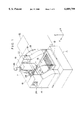
  • FIG. 1 is a perspective view showing a preferred embodiment of a processing machine according to the present invention
  • FIG. 2 is a cross-section of a spindle head according to the aforesaid embodiment
  • FIG. 3 is a block diagram showing a NC device and a driving mechanism according to the aforesaid embodiment
  • FIG. 4 is an illustration showing a movement path of a tool in carving a concave portion in the aforesaid embodiment
  • FIG. 5 is an enlarged view of a part of the FIG. 4;
  • FIG. 6 is an illustration showing a movement path of a tool in carving a convex portion in the aforesaid embodiment
  • FIG. 7 is an illustration showing a movement path of a tool in carving a surface of a workpiece having a concave portion in a conventional processing method
  • FIG. 8(A) is an illustration of up-cut
  • FIG. 8(B) is an illustration of down-cut.
  • FIG. 1 is a perspective view showing a processing machine on which a profile processing method according to the present invention is applied.
  • the processing machine according to the present embodiment is a machine tool controlled by a NC device, and has a base 1, a machine body 11 mounted on the base 1 and a NC device 41 as a controller for controlling the drive of the machine body 11.
  • the machine body 11 is composed of a bed 12 mounted on the upper side of the base 1 through a leveler or the like, a table 13 provided on an upper side of the bed 12 movably in back and forth direction (Y-axis direction), a pair of column 14 and 15 erectly set on both side of the bed 12, a cross rail 16 stretched between upper portions of the columns 14 and 15, a slider 17 provided along the cross rail 16 movably in right and left direction (X-axis direction), a spindle head 18 provided elevatably in up and down direction (Z-axis direction), and a splash guard 19 which covers a front part between the column 14 and 15, of which inside is visible and which can be opened and closed in up and down direction with the upper end thereof as a fulcrum.
  • the bed 12 has a Y-axis driving mechanism 21 which moves the table 13 in Y-axis direction accompanied by a guide (not shown) for guiding the table 13.
  • a feed screw mechanism consisting of a motor and a feed screw shaft rotated by the motor is employed as the Y-axis driving mechanism 21.
  • the side shape of the respective columns 14 and 15 is configured approximately triangle having wider bottom portion than upper portion. Accordingly, the bottom portion is stable enough to decrease generating a vibration even when a high-speed rotating spindle head 18 is used.
  • the cross rail 16 has two guide rail, 23 for movably guiding the slider 17 as well as X-axis driving mechanism 24 for moving the slider 17 in X-axis direction.
  • the slider 17 has a guide (not shown) for guiding the spindle head 18 in Z-axis direction as well as a Z-axis driving mechanism 25 for elevating the spindle head in Z-axis direction.
  • the driving mechanisms 24 and 25 also employ a feed screw mechanism composed of a motor and a feed screw shaft rotated by the motor.
  • the spindle head 18 is composed of an air-bearing supported spindle head. More specifically, the spindle head 18 is composed of an air-bearing supported spindle head having a housing 31 elevatably provided to the cross rail 16 elevated by the Z-axis driving mechanism 25, a spindle 35 supported in parallel to Z-axis direction to the housing 31 rotatably through the air-bearings 32, 33 and 34 and having a fringe 35A in the halfway thereof, and a motor 36 for rotatively driving the spindle 35.
  • the spindle 35 can be rotated at a high-speed of 30,000 to 50,000 rpm.
  • a plurality of air-blowing holes 37 which blow air toward the spindle 35 in a direction perpendicular to the axis of the spindle are formed on an inner side of the respective air-bearings 32, 33 and 34.
  • the air blown by the air-blowing holes 37 forms a radial bearing for supporting the spindle 35 in a radial direction.
  • Another plurality of air-blowing holes 38 which blow air toward the fringe 35A of the spindle 35 are formed on an end side of the respective air-bearings 33 and 34 respectively opposing in axis-direction.
  • the air blown by the air-blowing holes 38 forms a thrust bearing for supporting the spindle 35 in a thrust direction.
  • 39 is an air-supply passage for providing air to the respective air-blowing holes 37 and 38
  • 40 is an air-outlet passage
  • T is a rotary tool such as an end mill.
  • the NC device has a processor 42.
  • an input section 43 and a program storing section 44 for storing a program input through the input section 43 is connected as well as the driving mechanisms 21, 24 and 25 and the spindle head 18.
  • the processor 42 has a selector for selecting a relative movement path of the rotary tool T and a workpiece so that the workpiece is always down-cut by the rotary tool T in processing a profile of a concave portion and a convex portion onto the workpiece in accordance with a program set and stored to the program storing section 44 in advance.
  • the processor 42 has a driver for driving the X, Y and Z-axis driving mechanisms so that the workpiece is always down-cut.
  • the selector for selecting the relative movement path may be software or the like installed in the processor 42. As to specific steps, the selector first determines in which direction the workpiece should be up-cut or down-cut in respective processing path based on a information such as a direction of an edge of the rotary tool T, processing direction set on the processing program and processing path. Consequently, a direction in which the workpiece is down-cut is selected. After selecting the direction in which the workpiece is always down-cut in the respective movement path, the program may be reconstructed so that the respective processing path should be effectively continued.
  • the workpiece is carved by the rotary tool T attached to the spindle 35, while the table 13 and the spindle head 18 are relatively moved in X, Y and Z-axis direction by a command from the NC device 41.
  • the table 3 is moved in Y-axis direction by the Y-axis driving mechanism 21 and the spindle head 18 is moved in X and Z-axis direction by the X-axis driving mechanism 24 and the Z-axis driving mechanism 25.
  • the rotary tool In carving the slope 103, the rotary tool, the end mill EM here, is moved on the slope 103 approximately parallel to a ridgeline between the slope 103 and the bottom 101 to approach the ridgeline from a position remote from the ridgeline. In other words, the rotary tool is relatively revolved along an outermost path of the slope 103. In this case, when the end mill EM is revolved clockwise in FIG. 4, the relative movement path of the end mill EM and the workpiece W is set counterclockwise. Accordingly, the slope 103 is carved by down-cut shown in FIG. 8(B) while the end mill EM is revolved along the slope 103 and moved toward inner side of the slope 102.
  • the workpiece is carved successively to the slope 103 by the same relative movement path until an intermediate portion of the curve 102.
  • a slope side area 102A divided approximately by a border in accordance with an angle ⁇ bisecting a touching surface of the workpiece W abutting the end mill EM into a down-cut area and an up-cut area is carved by the same relative movement path as in carving the slope 103 in succession thereto.
  • the slope side area 102A of the curve 102 can also be carved by down-cut shown in FIG. 8 (B).
  • the end mill EM is moved on the bottom 101 approximately parallel to a ridgeline between the slope 103 and the bottom 101 (counterclockwise in FIG. 4) to approach from a position remote from the ridgeline toward the ridgeline.
  • the rotary tool is relatively moved gradually from an inner side to outer side of the bottom 101. Accordingly, the bottom 101 is also carved by down-cut shown in FIG. 8(B)
  • the workpiece is carved by the same relative movement path until an intermediate portion of the curve 102 successively to the bottom 101.
  • a bottom side area 102B divided approximately by a border in accordance with an angle ⁇ bisecting a touching surface of the workpiece W abutting the end mill EM into a down-cut area and an up-cut area is carved by the same relative movement path as in carving the bottom 101 in succession thereto.
  • the bottom side area 102B of the curve 102 can also be carved by down-cut shown in FIG. 8 (B).
  • the surface of the workpiece W having convex portion 105 can be processed similarly to the concave portion 104.
  • the end mill EM and the workpiece W are relatively moved so that the end mill EM is moved on the slope 103 approximately parallel to a ridgeline between the slope 103 and the bottom 101 (revolved clockwise in FIG. 6) to approach from a position remote from the ridgeline toward the ridgeline.
  • the end mill EM and the workpiece W are relatively moved so that the end mill EM is moved on the bottom 101 approximately parallel to a ridgeline between the slope 103 and the bottom 101 (revolved clockwise in FIG. 6) to approach from a position remote from the ridgeline toward the ridgeline. Accordingly, all the carving surfaces can be carved by down-cut.
  • the relative movement path of the end mill EM and the workpiece W is changed in carving the slope 103 and in carving the bottom 101 to carve the workpiece W always by down-cut, good finish surface accuracy can be obtained and the decrease in tool's life can be curbed.
  • the slope side area 102A of the curve 102 divided approximately by a border in accordance with an angle ⁇ bisecting a touching surface of the workpiece W abutting the end mill EM into a down-cut area and an up-cut area is carved by the same relative movement path as in carving the slope 103 in succession thereto
  • the bottom side area 102B of the curve 102 is carved by the same relative movement path as in carving the bottom 101 in succession thereto, so that the curve 102 can also be carved by down-cut. Accordingly, all the surfaces including the bottom 101, slope 103 and the curve 102 can be carved by down-cut.
  • the spindle head 18 is an air-bearing supported spindle head having the spindle 35 supported by the air-bearings 32, 33 and 34, in other words, since a highly accurate high-speed rotation can be obtained by the air-bearing supported spindle head, the processing can be efficiently conducted with a great cutting feed speed.
  • the relative movement path of the end mill EM and the workpiece W is changed so that the workpiece W is always down-cut in carving the slope 103 and the bottom 101. Accordingly, for example, when the slope 103 in FIG. 4 is carved by the end mill EM revolved counterclockwise relatively to the workpiece W to down-cut, the bottom 101 may be revolved clockwise relatively to the workpiece W to down-cut.
  • the spindle head 18 is movable in X and Z-axis direction and the table 13 is movable in Y-axis direction.
  • the present invention is not limited to the above structure but any structure can be adopted as long as the end mill EM (rotary tool T) and the workpiece W are relatively movable in three-dimensional directions (X, Y and Z-axis directions).
  • the spindle head 18 in the above-described embodiment is the air-bearing supported spindle head having a spindle rotatably supported by the air-bearings
  • the present invention is not limited to the above structure but a spindle head having a spindle supported rotatably by a ball bearing or the like can also be adopted.
Landscapes

  • Engineering & Computer Science (AREA)
  • Mechanical Engineering (AREA)
  • Human Computer Interaction (AREA)
  • Manufacturing & Machinery (AREA)
  • Physics & Mathematics (AREA)
  • General Physics & Mathematics (AREA)
  • Automation & Control Theory (AREA)
  • Milling Processes (AREA)

Abstract

A surface finishing method and a machine therefor, in which good finish accuracy can be obtained in all carving surfaces and deterioration of tool's life can be prevented. When a surface of a concave portion formed on a workpiece is carved, an end mill is first revolved along an outermost side of a slope, and is moved toward inside and revolved along a circumferential direction. When a surface of the slope is carved, a movement path of the end mill is selected so that the surface of the slope is down-cut. When a bottom is carved, the end mill is moved from inside to outside, in other words, the movement path is selected so that a surface of the bottom is down-cut.

Description

BACKGROUND OF THE INVENTION
1. Field of the Invention
The present invention relates to a surface finishing method and a machine for the method, in which a rotary tool is employed to finish a surface of a workpiece having a bottom and a slope continuing thereto. More specifically, the present invention relates to a surface finishing method for finishing a surface of a concave or convex portion of which profile is carved to a mold material using an end mill or the like, and a machine for implementing the method.
2. Description of Related Art
Conventionally, when a surface of, for example, a concave portion of which profile is carved to a workpiece is finished using a rotary tool such as an end mill, the surface is ordinarily carved while the end mill is revolved along a side of the concave portion and is moved gradually from an outermost side to an inner side of the concave portion. Subsequently, the end mill is moved to a bottom of the concave portion through the same movement path and the bottom is finished.
For instance, as shown in FIG. 7, when a surface of a workpiece W having a bottom 101 and a slope 103 provided successively to the bottom 101 at an obtuse angle through a slope 102, an end mill EM is first revolved along an outermost side of the slope 103 (counterclockwise in FIG. 7) to carve the surface of the workpiece W. Subsequently, the end mill EM is moved toward inner side of the slope 103 at a predetermined amount and the surface is carved again while the end mill is revolved along the slope 103. In this way, the end mill EM is gradually moved toward inside to carve the surface. The successive bottom 101 is also carved toward inner side of the bottom 101 by repeating similar movement.
However, an up-cut (cutting upward) and a down-cut (cutting downward) can be co-existed in the above conventional carving method on account of a relation between the relative movement path of the end mill EM and the workpiece W and the revolving direction (moving direction on the surface) of the end mill EM.
More specifically, the surface is down-cut (cutting downward) when the end mill EM is revolved along a side of the slope 103 to carve the surface of the workpiece in FIG. 7, since the end mill EM touches the workpiece W in a far side in the figure and a relative movement direction of a surface of the workpiece W relative to end mill EM and revolving direction (moving direction on the surface) is equal.
On the other hand, the surface is up-cut (cutting upward) when the bottom 101 is carved, since the workpiece W is carved sequentially toward inside of the concave portion and the end mill EM touches the workpiece W at a front side of the tip end of the end mill EM in the figure, thereby making the relative moving direction of the surface of the workpiece W relative to the end mill EM opposite to the revolving direction (moving direction on the surface) of the end mill EM.
When the up-cut (cutting upward) and the down-cut (cutting downward) co-exist, it is difficult to secure sufficient finish surface accuracy in all of the carved surfaces and the tool's life span can be decreased.
Generally speaking, following difference can be observed between the up-cut and the down-cut.
As shown in FIG. 8(A), in conducting the up-cut (cutting upward), the edge initially touches a surface which has been carved and gradually cuts uncarved portion, in other words, a swarf thickness in conducting the up-cut (cutting upward) starts from zero and increases gradually. In this case, when the workpiece is begun to be carved, it is impossible to cut the workpiece and the edge just rubs the surface of the workpiece since the swarf thickness, i.e. the amount by which the edge cut the workpiece, is zero. When the swarf thickness gets sufficiently large, the workpiece is substantially carved. During the time, the edge is rubbed on the surface of the workpiece with a certain amount of pressure being applied, which causes abrasion of edges and burn on the surface of the workpiece.
On the other hand, as shown in FIG. 8 (b), the edge in conducting down-cut (cutting downward) first greatly cut into an uncarved portion and gradually decreases cutting amount, in other words, a swarf thickness in conducting the down-cut (cutting downward) is the greatest at the beginning of cutting and is decreased gradually. Though the swarf thickness is zero at a final carving stage, the edge moves to separate from the workpiece and scarcely rubs the surface of the workpiece, thereby hardly causing edge abrasion and burn on the surface of the workpiece.
Therefore, the up-cut (cutting upward) is shorter in tool's life and is more likely to cause grinding burn than the down-cut (cutting downward). So, when the up-cut (cutting upward) and the down-cut (cutting downward) coexist in a workpiece as in a conventional carving method, it is difficult to obtain good finish surface accuracy in all of the carving surfaces and the tool's life is shortened.
SUMMARY OF THE INVENTION
The object of the present invention is to solve aforesaid problems, that is, to provide a surface finishing method and surface finishing machine which can obtain a good finish surface accuracy in all the finishing surfaces and curb the decrease in tool's life.
A method according to the present invention is for finishing a surface of a workpiece having a bottom and a slope continued from the bottom using a rotary tool. The method is characterized in that a relative movement path of the rotary tool and the workpiece is changed so that the slope and the bottom is always carved by down-cut in carving both of the slope and the bottom.
Specifically, the relative movement path of the rotary tool and the workpiece is selected so that the slope and the bottom is always carved by down-cut and the bottom and the slope are carved along the relative movement path.
Preferably, the rotary tool and the workpiece are relatively movable in three-dimensional directions (X, Y and Z-axis direction orthogonal with each other). The rotary tool is, for instance, an end mill and a milling cutter and the like. The relative movement path refers to a path including any relative movement directions of the rotary tool and the workpiece.
Since the workpiece is always down-cut by the rotary tool in carving both the slope and the bottom, a good finish surface accuracy can be obtained in all the carving surfaces and the decrease in tool's life span caused by up-cut (cutting upward) can be considerably curbed as compared to a conventional method where the up-cut (cutting upward) and the down-cut (cutting downward) are coexisted.
In the above, following steps can be used for changing the relative movement path of the rotary tool and the workpiece so that the slope and the bottom are always down-cut.
In carving the slope the rotary tool and the workpiece are relatively moved so that the rotary tool is moved approximately parallel to a ridgeline between the slope and the bottom and so that the rotary tool is gradually moved to approach the ridgeline from a position remote therefrom. On the other hand, in carving the bottom the rotary tool and the workpiece are relatively moved so that the rotary tool is moved approximately parallel to a ridgeline between the slope and the bottom and so that the rotary tool is gradually moved to approach the ridgeline from a position remote therefrom.
In other words, when the slope and the bottom are carved, the rotary tool and the workpiece are relatively moved so that the rotary tool is moved approximately parallel to the ridgeline between the slope and the bottom (in the same direction) and in a direction to approach the ridgeline.
Alternatively, when the slope is carved, the rotary tool may be moved in a direction to approach the ridgeline and revolved counterclockwise relatively to the workpiece to down-cut. And the rotary tool may be moved in a direction away from the ridgeline and revolved clockwise relatively to the workpiece to down-cut when the bottom is carved. In other words, only the revolving direction may be made opposite.
Incidentally, when the slope and the bottom of the workpiece are provided successively with a curve extending therebetween, the curve ordinarily cannot be down-cut entirely, because, for instance, if the slope is continuously carved by down-cut, the slope comes to be up-cut as the rotary tool approaches a side of the slope touching the bottom. On the contrary, when the bottom side is continuously carved by down-cut to approach the ridgeline between the slope and the bottom, the bottom comes to be up-cut as thee rotary tool approaches a side of the bottom touching the slope.
Accordingly, the relative movement path of the rotary tool and the workpiece may be changed in carving the slope and in carving the bottom so that the workpiece is always down-cut, and, when the curve is carved, divide the curve into a slope side area and a bottom side area approximately at a border according to an angle bisecting a touching surface of the workpiece with the rotary tool into a down-cut area and an up-cut area to carve the slope side area in succession to carving the slope and carve the bottom side area in succession to carving the bottom.
Specifically, the relative movement path of the rotary tool and the workpiece may be selected so that the slope and the bottom is always carved by down-cut, the curve may be divided into a slope side area and a bottom side area approximately at a border according to an angle bisecting a touching surface of the workpiece with the rotary tool into a down-cut area and an up-cut area, the same relative movement path as in carving the slope may be selected to carve the slope side area and the same relative movement path as in carving the bottom may be selected to carve the bottom side area, and the slope, curve and the bottom may be carved in accordance with the selected relative movement path so that the slope side area of the curve is carved in succession to carving the slope and the bottom side area of the curve is carved in succession to carving the bottom.
Accordingly, the curve joining the bottom and the slope can be carved with down-cut, so that all the surface including the bottom, slope and the curve can be carved with down-cut.
A machine for finishing a surface of a workpiece according to the present invention has a table onto which a workpiece having a bottom and a slope continuing from the slope is set, a spindle head having a rotary tool, a machine body having the spindle head movably in three-dimensional directions and a controller for controlling a drive of the machine body. The machine is characterized in that the controller has a selector for selecting a relative movement path of the table and the spindle head so that the slope and the bottom are always down-cut when the surface of the workpiece is carved.
Accordingly, aforesaid advantage of the profile processing method, that is, obtaining a good finish surface accuracy of all the carving surfaces and curbing the decrease in the tool's life span can be attained in the above configuration. Furthermore, since the relative movement path of the rotary tool and the workpiece is automatically selected so that the workpiece is always down-cut by the rotary tool, the workpiece can be processed efficiently.
BRIEF DESCRIPTION OF THE DRAWINGS
FIG. 1 is a perspective view showing a preferred embodiment of a processing machine according to the present invention;
FIG. 2 is a cross-section of a spindle head according to the aforesaid embodiment;
FIG. 3 is a block diagram showing a NC device and a driving mechanism according to the aforesaid embodiment;
FIG. 4 is an illustration showing a movement path of a tool in carving a concave portion in the aforesaid embodiment;
FIG. 5 is an enlarged view of a part of the FIG. 4;
FIG. 6 is an illustration showing a movement path of a tool in carving a convex portion in the aforesaid embodiment;
FIG. 7 is an illustration showing a movement path of a tool in carving a surface of a workpiece having a concave portion in a conventional processing method;
FIG. 8(A) is an illustration of up-cut; and
FIG. 8(B) is an illustration of down-cut.
DETAILED DESCRIPTION OF PREFERRED EMBODIMENT(S)
A preferred embodiment according to the present invention will be described below with reference to the attached drawings.
FIG. 1 is a perspective view showing a processing machine on which a profile processing method according to the present invention is applied. As shown in FIG. 1, the processing machine according to the present embodiment is a machine tool controlled by a NC device, and has a base 1, a machine body 11 mounted on the base 1 and a NC device 41 as a controller for controlling the drive of the machine body 11.
The machine body 11 is composed of a bed 12 mounted on the upper side of the base 1 through a leveler or the like, a table 13 provided on an upper side of the bed 12 movably in back and forth direction (Y-axis direction), a pair of column 14 and 15 erectly set on both side of the bed 12, a cross rail 16 stretched between upper portions of the columns 14 and 15, a slider 17 provided along the cross rail 16 movably in right and left direction (X-axis direction), a spindle head 18 provided elevatably in up and down direction (Z-axis direction), and a splash guard 19 which covers a front part between the column 14 and 15, of which inside is visible and which can be opened and closed in up and down direction with the upper end thereof as a fulcrum.
The bed 12 has a Y-axis driving mechanism 21 which moves the table 13 in Y-axis direction accompanied by a guide (not shown) for guiding the table 13. A feed screw mechanism consisting of a motor and a feed screw shaft rotated by the motor is employed as the Y-axis driving mechanism 21.
The side shape of the respective columns 14 and 15 is configured approximately triangle having wider bottom portion than upper portion. Accordingly, the bottom portion is stable enough to decrease generating a vibration even when a high-speed rotating spindle head 18 is used.
The cross rail 16 has two guide rail, 23 for movably guiding the slider 17 as well as X-axis driving mechanism 24 for moving the slider 17 in X-axis direction.
The slider 17 has a guide (not shown) for guiding the spindle head 18 in Z-axis direction as well as a Z-axis driving mechanism 25 for elevating the spindle head in Z-axis direction. As in the Y-axis driving mechanism 21, the driving mechanisms 24 and 25 also employ a feed screw mechanism composed of a motor and a feed screw shaft rotated by the motor.
As shown in FIG. 2, the spindle head 18 is composed of an air-bearing supported spindle head. More specifically, the spindle head 18 is composed of an air-bearing supported spindle head having a housing 31 elevatably provided to the cross rail 16 elevated by the Z-axis driving mechanism 25, a spindle 35 supported in parallel to Z-axis direction to the housing 31 rotatably through the air- bearings 32, 33 and 34 and having a fringe 35A in the halfway thereof, and a motor 36 for rotatively driving the spindle 35. The spindle 35 can be rotated at a high-speed of 30,000 to 50,000 rpm.
A plurality of air-blowing holes 37 which blow air toward the spindle 35 in a direction perpendicular to the axis of the spindle are formed on an inner side of the respective air- bearings 32, 33 and 34. The air blown by the air-blowing holes 37 forms a radial bearing for supporting the spindle 35 in a radial direction. Another plurality of air-blowing holes 38 which blow air toward the fringe 35A of the spindle 35 are formed on an end side of the respective air- bearings 33 and 34 respectively opposing in axis-direction. The air blown by the air-blowing holes 38 forms a thrust bearing for supporting the spindle 35 in a thrust direction. Incidentally, in FIG. 2, 39 is an air-supply passage for providing air to the respective air-blowing holes 37 and 38, 40 is an air-outlet passage and T is a rotary tool such as an end mill.
As shown in FIG. 3, the NC device has a processor 42. To the processor 42, an input section 43 and a program storing section 44 for storing a program input through the input section 43 is connected as well as the driving mechanisms 21, 24 and 25 and the spindle head 18. The processor 42 has a selector for selecting a relative movement path of the rotary tool T and a workpiece so that the workpiece is always down-cut by the rotary tool T in processing a profile of a concave portion and a convex portion onto the workpiece in accordance with a program set and stored to the program storing section 44 in advance. In other words, the processor 42 has a driver for driving the X, Y and Z-axis driving mechanisms so that the workpiece is always down-cut.
The selector for selecting the relative movement path may be software or the like installed in the processor 42. As to specific steps, the selector first determines in which direction the workpiece should be up-cut or down-cut in respective processing path based on a information such as a direction of an edge of the rotary tool T, processing direction set on the processing program and processing path. Consequently, a direction in which the workpiece is down-cut is selected. After selecting the direction in which the workpiece is always down-cut in the respective movement path, the program may be reconstructed so that the respective processing path should be effectively continued.
The effect of the present embodiment will be described below with reference to FIG. 4 and 5.
The workpiece is carved by the rotary tool T attached to the spindle 35, while the table 13 and the spindle head 18 are relatively moved in X, Y and Z-axis direction by a command from the NC device 41. In other words, the table 3 is moved in Y-axis direction by the Y-axis driving mechanism 21 and the spindle head 18 is moved in X and Z-axis direction by the X-axis driving mechanism 24 and the Z-axis driving mechanism 25.
When the surface of the workpiece W having a concave portion 104, that is, having a slope 103 extending at an obtuse angle around a bottom 101 through a curve 102 is carved, the slope 103 and the bottom 101 are separately carved.
In carving the slope 103, the rotary tool, the end mill EM here, is moved on the slope 103 approximately parallel to a ridgeline between the slope 103 and the bottom 101 to approach the ridgeline from a position remote from the ridgeline. In other words, the rotary tool is relatively revolved along an outermost path of the slope 103. In this case, when the end mill EM is revolved clockwise in FIG. 4, the relative movement path of the end mill EM and the workpiece W is set counterclockwise. Accordingly, the slope 103 is carved by down-cut shown in FIG. 8(B) while the end mill EM is revolved along the slope 103 and moved toward inner side of the slope 102.
The workpiece is carved successively to the slope 103 by the same relative movement path until an intermediate portion of the curve 102. In other words, as shown in FIG. 5, a slope side area 102A divided approximately by a border in accordance with an angle α bisecting a touching surface of the workpiece W abutting the end mill EM into a down-cut area and an up-cut area is carved by the same relative movement path as in carving the slope 103 in succession thereto. Accordingly, the slope side area 102A of the curve 102 can also be carved by down-cut shown in FIG. 8 (B).
On the other hand, when the bottom 101 is carved, the end mill EM is moved on the bottom 101 approximately parallel to a ridgeline between the slope 103 and the bottom 101 (counterclockwise in FIG. 4) to approach from a position remote from the ridgeline toward the ridgeline. In other words, the rotary tool is relatively moved gradually from an inner side to outer side of the bottom 101. Accordingly, the bottom 101 is also carved by down-cut shown in FIG. 8(B)
The workpiece is carved by the same relative movement path until an intermediate portion of the curve 102 successively to the bottom 101. In other words, as shown in FIG. 5, a bottom side area 102B divided approximately by a border in accordance with an angle α bisecting a touching surface of the workpiece W abutting the end mill EM into a down-cut area and an up-cut area is carved by the same relative movement path as in carving the bottom 101 in succession thereto. Accordingly, the bottom side area 102B of the curve 102 can also be carved by down-cut shown in FIG. 8 (B).
In this way, all the carving surfaces can be carved by down-cut by changing the relative movement path of the end mill EM, so that good finish surface accuracy can be obtained and the decrease in tool's life can be curbed.
Incidentally, as shown in FIG. 6, the surface of the workpiece W having convex portion 105 can be processed similarly to the concave portion 104.
When the slope 103 is carved, the end mill EM and the workpiece W are relatively moved so that the end mill EM is moved on the slope 103 approximately parallel to a ridgeline between the slope 103 and the bottom 101 (revolved clockwise in FIG. 6) to approach from a position remote from the ridgeline toward the ridgeline.
When the bottom 101 is carved, the end mill EM and the workpiece W are relatively moved so that the end mill EM is moved on the bottom 101 approximately parallel to a ridgeline between the slope 103 and the bottom 101 (revolved clockwise in FIG. 6) to approach from a position remote from the ridgeline toward the ridgeline. Accordingly, all the carving surfaces can be carved by down-cut.
According to the present embodiment, since the relative movement path of the end mill EM and the workpiece W is changed in carving the slope 103 and in carving the bottom 101 to carve the workpiece W always by down-cut, good finish surface accuracy can be obtained and the decrease in tool's life can be curbed.
When the workpiece W having the bottom 101 and the slope 103 successively extending through the curve 102 is carved, the slope side area 102A of the curve 102 divided approximately by a border in accordance with an angle α bisecting a touching surface of the workpiece W abutting the end mill EM into a down-cut area and an up-cut area is carved by the same relative movement path as in carving the slope 103 in succession thereto, and the bottom side area 102B of the curve 102 is carved by the same relative movement path as in carving the bottom 101 in succession thereto, so that the curve 102 can also be carved by down-cut. Accordingly, all the surfaces including the bottom 101, slope 103 and the curve 102 can be carved by down-cut.
Since the spindle head 18 is an air-bearing supported spindle head having the spindle 35 supported by the air- bearings 32, 33 and 34, in other words, since a highly accurate high-speed rotation can be obtained by the air-bearing supported spindle head, the processing can be efficiently conducted with a great cutting feed speed.
In the above-described embodiment, the relative movement path of the end mill EM and the workpiece W is changed so that the workpiece W is always down-cut in carving the slope 103 and the bottom 101. Accordingly, for example, when the slope 103 in FIG. 4 is carved by the end mill EM revolved counterclockwise relatively to the workpiece W to down-cut, the bottom 101 may be revolved clockwise relatively to the workpiece W to down-cut.
In the above-described embodiment, the spindle head 18 is movable in X and Z-axis direction and the table 13 is movable in Y-axis direction. However, the present invention is not limited to the above structure but any structure can be adopted as long as the end mill EM (rotary tool T) and the workpiece W are relatively movable in three-dimensional directions (X, Y and Z-axis directions).
Though the spindle head 18 in the above-described embodiment is the air-bearing supported spindle head having a spindle rotatably supported by the air-bearings, the present invention is not limited to the above structure but a spindle head having a spindle supported rotatably by a ball bearing or the like can also be adopted.

Claims (3)

What is claimed is:
1. A method for finishing a surface of a workpiece having a bottom and a slope continued from the bottom using a rotary tool, comprising the steps of:
selecting a relative movement path of the rotary tool and the workpiece so that the slope and the bottom are always carved by down-cut; and
carving the bottom and the slope along the relative movement path;
wherein in carving the slope the rotary tool and the workpiece are relatively moved so that the rotary tool is moved approximately parallel to a ridgeline between the slope and the bottom and so that the rotary tool is gradually moved to approach the ridgeline from a position remote therefrom, and wherein in carving the bottom the rotary tool and the workpiece are relatively moved so that the rotary tool is moved approximately parallel to a ridgeline between the slope and the bottom and so that the rotary tool is gradually moved to approach the ridgeline from a position remote therefrom.
2. A method for finishing a surface of a workpiece having a bottom and a slope continued from the bottom through a curve using a rotary tool, comprising the steps of:
selecting a relative movement path of the rotary tool and the workpiece so that the slope and the bottom are always carved by down-cut;
dividing the curve into a slope side area and a bottom side area approximately at a border according to an angle bisecting a touching surface of the workpiece with the rotary tool into a down-cut area and an up-cut area;
selecting the same relative movement path as in carving the slope to carve the slope side area and the same relative movement path as in carving the bottom to carve the bottom side area; and
carving the slope, curve and the bottom in accordance with the selected relative movement path, wherein the slope side area of the curve is carved in succession to carving the slope and the bottom side area of the curve is carved in succession to carving the bottom.
3. A machine for finishing a surface of a workpiece, comprising:
a table onto which a workpiece having a bottom and a slope continuing from the bottom is set;
a spindle head having a rotary tool;
a machine body having the spindle head movably in three-dimensional directions; and
a controller for controlling a drive of the machine body,
wherein the controller has a selector for selecting a relative movement path of the table and the spindle head so that the slope and the bottom are always down-cut when the surface of the workpiece is carved.
US09/210,587 1997-12-17 1998-12-14 Surface finishing method and machine for the same Expired - Lifetime US6089799A (en)

Applications Claiming Priority (2)

Application Number Priority Date Filing Date Title
JP34772097A JP3482331B2 (en) 1997-12-17 1997-12-17 Finishing method
JP9-347720 1997-12-17

Publications (1)

Publication Number Publication Date
US6089799A true US6089799A (en) 2000-07-18

Family

ID=18392137

Family Applications (1)

Application Number Title Priority Date Filing Date
US09/210,587 Expired - Lifetime US6089799A (en) 1997-12-17 1998-12-14 Surface finishing method and machine for the same

Country Status (3)

Country Link
US (1) US6089799A (en)
JP (1) JP3482331B2 (en)
DE (1) DE19858075A1 (en)

Cited By (4)

* Cited by examiner, † Cited by third party
Publication number Priority date Publication date Assignee Title
US20060140734A1 (en) * 2003-06-19 2006-06-29 Arndt Glaesser Milling method used for producing structural components
US7547168B1 (en) * 2008-04-17 2009-06-16 Kosmowski Wojciech B High speed spindle system and centrifugal chuck
EP2960016A3 (en) * 2014-06-23 2016-02-24 TaiZhou Federal Robot Technology Co., Ltd A processing system and method for a work piece surface
US10226901B2 (en) * 2013-01-16 2019-03-12 Rehau Ag + Co Method for rounding edges of polymer motor vehicle components

Families Citing this family (6)

* Cited by examiner, † Cited by third party
Publication number Priority date Publication date Assignee Title
JP2002192414A (en) * 2000-12-25 2002-07-10 Toshiba Mach Co Ltd Cutting method of soft foam resin
JP5577159B2 (en) * 2010-06-04 2014-08-20 本田技研工業株式会社 Work surface processing method
CN103008739B (en) * 2012-11-30 2015-05-13 东台耀强机械制造有限公司 Welding seam intersecting line and groove machining equipment
JP2020110863A (en) * 2019-01-10 2020-07-27 マツダ株式会社 Cutting method, cutting apparatus, and press mold
JP2022074168A (en) * 2019-02-20 2022-05-18 日立Astemo株式会社 Surface processing method of member having penetration hole at bottom wall part of recess, manufacturing method of oil pump and oil pump
JP7713690B2 (en) * 2021-11-29 2025-07-28 旭精機工業株式会社 Cutting method and cutting device

Citations (14)

* Cited by examiner, † Cited by third party
Publication number Priority date Publication date Assignee Title
US3752596A (en) * 1971-04-10 1973-08-14 Schiess Ag Hydrostatic support for longitudinally driven machine post
US4016855A (en) * 1974-09-04 1977-04-12 Hitachi, Ltd. Grinding method
US4259940A (en) * 1978-09-05 1981-04-07 Toyoda Koki Kabushiki Kaisha Grinding machine with a CBN grinding wheel
US4268999A (en) * 1978-05-17 1981-05-26 Hitachi, Ltd. Automatic polishing apparatus
US4569326A (en) * 1983-07-08 1986-02-11 Fujitsu Limited Dicing apparatus
US4621407A (en) * 1983-07-15 1986-11-11 Fuji Seiki Machine Works, Ltd. Body for machining center
US4632615A (en) * 1984-02-09 1986-12-30 Teijin Seiki Company Limited Machine tools
US4850761A (en) * 1986-10-08 1989-07-25 Starrfrashaschinen Ag Milling process and tool
US4869626A (en) * 1986-04-18 1989-09-26 Dynamotion Corporation High speed drilling spindle
US5078558A (en) * 1990-02-16 1992-01-07 Hitachi Seiko, Ltd. Low mass spindle and Z-axis unit
US5108236A (en) * 1990-02-16 1992-04-28 Hitachi, Seiko, Ltd. Low mass spindle and z-axis unit
US5125775A (en) * 1987-11-20 1992-06-30 Starrfrasmaschinen Ag Method for machining a workpiece by end-face cutting tool
US5378091A (en) * 1992-06-17 1995-01-03 Makino Milling Machine Co., Ltd. Method and apparatus for machining a workpiece
US5688084A (en) * 1993-03-10 1997-11-18 Max Rhodius Gmbh Machine tool

Patent Citations (14)

* Cited by examiner, † Cited by third party
Publication number Priority date Publication date Assignee Title
US3752596A (en) * 1971-04-10 1973-08-14 Schiess Ag Hydrostatic support for longitudinally driven machine post
US4016855A (en) * 1974-09-04 1977-04-12 Hitachi, Ltd. Grinding method
US4268999A (en) * 1978-05-17 1981-05-26 Hitachi, Ltd. Automatic polishing apparatus
US4259940A (en) * 1978-09-05 1981-04-07 Toyoda Koki Kabushiki Kaisha Grinding machine with a CBN grinding wheel
US4569326A (en) * 1983-07-08 1986-02-11 Fujitsu Limited Dicing apparatus
US4621407A (en) * 1983-07-15 1986-11-11 Fuji Seiki Machine Works, Ltd. Body for machining center
US4632615A (en) * 1984-02-09 1986-12-30 Teijin Seiki Company Limited Machine tools
US4869626A (en) * 1986-04-18 1989-09-26 Dynamotion Corporation High speed drilling spindle
US4850761A (en) * 1986-10-08 1989-07-25 Starrfrashaschinen Ag Milling process and tool
US5125775A (en) * 1987-11-20 1992-06-30 Starrfrasmaschinen Ag Method for machining a workpiece by end-face cutting tool
US5078558A (en) * 1990-02-16 1992-01-07 Hitachi Seiko, Ltd. Low mass spindle and Z-axis unit
US5108236A (en) * 1990-02-16 1992-04-28 Hitachi, Seiko, Ltd. Low mass spindle and z-axis unit
US5378091A (en) * 1992-06-17 1995-01-03 Makino Milling Machine Co., Ltd. Method and apparatus for machining a workpiece
US5688084A (en) * 1993-03-10 1997-11-18 Max Rhodius Gmbh Machine tool

Cited By (5)

* Cited by examiner, † Cited by third party
Publication number Priority date Publication date Assignee Title
US20060140734A1 (en) * 2003-06-19 2006-06-29 Arndt Glaesser Milling method used for producing structural components
US7237989B2 (en) * 2003-06-19 2007-07-03 Mtu Aero Engines Gmbh Milling method used for producing structural components
US7547168B1 (en) * 2008-04-17 2009-06-16 Kosmowski Wojciech B High speed spindle system and centrifugal chuck
US10226901B2 (en) * 2013-01-16 2019-03-12 Rehau Ag + Co Method for rounding edges of polymer motor vehicle components
EP2960016A3 (en) * 2014-06-23 2016-02-24 TaiZhou Federal Robot Technology Co., Ltd A processing system and method for a work piece surface

Also Published As

Publication number Publication date
DE19858075A1 (en) 1999-06-24
JP3482331B2 (en) 2003-12-22
JPH11179608A (en) 1999-07-06

Similar Documents

Publication Publication Date Title
JP3877128B2 (en) Fine groove processing machine for pads for semiconductor CMP processing
JP3672325B2 (en) Machine tool equipment
US6428252B1 (en) Method for machining
US6089799A (en) Surface finishing method and machine for the same
JP4843238B2 (en) Method for chamfering and / or deburring edges of bevel gear teeth
CN104768684B (en) The control device and lathe of lathe
US6099216A (en) Profile processing method and processing machine therefor
US6357977B1 (en) Processing method for carving a workpiece
WO2005039821A1 (en) Method for machining aspherical surface, method for forming aspherical surface, and system for machining aspherical surface
JP4087608B2 (en) Cutting tool and cutting method using the cutting tool
JP4009237B2 (en) Fine groove processing machine for pads for semiconductor CMP processing
US20100111632A1 (en) Method and apparatus for non-rotary machining
US4691479A (en) Machine and process for cutting chipping-grooves into elongated peripheral milling cutters with hemispherical tips
JP7481370B2 (en) Workpiece processing method
JP4656371B2 (en) Cutting method
JP3748099B2 (en) Cutting method and NC data creation device for performing this cutting method
JP2002160103A (en) Curved surface machine method and its device
WO2002066189A1 (en) Cutting method by rotary tool
JP2001246531A (en) Machine tool
JPH11226811A (en) Machining method and working machine
JP7625865B2 (en) Groove processing device
JP2000126987A (en) Working method, nc device commanding same, nc working machine, nc program composing device, and recording medium
JP3753640B2 (en) Cutting apparatus, processing method, program and recording medium
JP7774413B2 (en) Grinding equipment
JP3622432B2 (en) Top surface processing method of scroll parts

Legal Events

Date Code Title Description
AS Assignment

Owner name: TOSHIBA KIKAI KABUSHIKI KAISHA, JAPAN

Free format text: ASSIGNMENT OF ASSIGNORS INTEREST;ASSIGNORS:MOMOCHI, TAKESHI;SHIOZAKI, MASAHITO;UETA, TOSHIHIRO;REEL/FRAME:009844/0762

Effective date: 19981201

STCF Information on status: patent grant

Free format text: PATENTED CASE

FPAY Fee payment

Year of fee payment: 4

FPAY Fee payment

Year of fee payment: 8

FEPP Fee payment procedure

Free format text: PAYOR NUMBER ASSIGNED (ORIGINAL EVENT CODE: ASPN); ENTITY STATUS OF PATENT OWNER: LARGE ENTITY

FPAY Fee payment

Year of fee payment: 12