US6042983A - Dry toner particles comprising a complex amorphous macromolecule as toner resin - Google Patents
Dry toner particles comprising a complex amorphous macromolecule as toner resin Download PDFInfo
- Publication number
- US6042983A US6042983A US09/310,934 US31093499A US6042983A US 6042983 A US6042983 A US 6042983A US 31093499 A US31093499 A US 31093499A US 6042983 A US6042983 A US 6042983A
- Authority
- US
- United States
- Prior art keywords
- amorphous
- polyester
- polymer
- toner particles
- toner
- Prior art date
- Legal status (The legal status is an assumption and is not a legal conclusion. Google has not performed a legal analysis and makes no representation as to the accuracy of the status listed.)
- Expired - Lifetime
Links
- 229920002521 macromolecule Polymers 0.000 title claims abstract description 129
- 239000002245 particle Substances 0.000 title claims abstract description 72
- 229920005989 resin Polymers 0.000 title description 58
- 239000011347 resin Substances 0.000 title description 58
- 229920000642 polymer Polymers 0.000 claims abstract description 116
- 229920000728 polyester Polymers 0.000 claims abstract description 81
- 238000002844 melting Methods 0.000 claims abstract description 41
- 230000008018 melting Effects 0.000 claims abstract description 41
- 229920000098 polyolefin Polymers 0.000 claims abstract description 17
- 125000003545 alkoxy group Chemical group 0.000 claims abstract description 4
- 239000002253 acid Substances 0.000 claims description 23
- 238000006068 polycondensation reaction Methods 0.000 description 61
- IISBACLAFKSPIT-UHFFFAOYSA-N bisphenol A Chemical compound C=1C=C(O)C=CC=1C(C)(C)C1=CC=C(O)C=C1 IISBACLAFKSPIT-UHFFFAOYSA-N 0.000 description 34
- 238000006243 chemical reaction Methods 0.000 description 29
- 238000000034 method Methods 0.000 description 25
- 239000000203 mixture Substances 0.000 description 20
- KKEYFWRCBNTPAC-UHFFFAOYSA-N Terephthalic acid Chemical compound OC(=O)C1=CC=C(C(O)=O)C=C1 KKEYFWRCBNTPAC-UHFFFAOYSA-N 0.000 description 18
- -1 silver halide Chemical class 0.000 description 16
- LYCAIKOWRPUZTN-UHFFFAOYSA-N Ethylene glycol Chemical compound OCCO LYCAIKOWRPUZTN-UHFFFAOYSA-N 0.000 description 15
- 125000002887 hydroxy group Chemical group [H]O* 0.000 description 15
- VZCYOOQTPOCHFL-OWOJBTEDSA-N Fumaric acid Chemical compound OC(=O)\C=C\C(O)=O VZCYOOQTPOCHFL-OWOJBTEDSA-N 0.000 description 14
- 229940106691 bisphenol a Drugs 0.000 description 12
- 125000003178 carboxy group Chemical group [H]OC(*)=O 0.000 description 11
- 238000011161 development Methods 0.000 description 11
- 238000003384 imaging method Methods 0.000 description 10
- 239000000155 melt Substances 0.000 description 10
- 239000007788 liquid Substances 0.000 description 9
- VZCYOOQTPOCHFL-UHFFFAOYSA-N trans-butenedioic acid Natural products OC(=O)C=CC(O)=O VZCYOOQTPOCHFL-UHFFFAOYSA-N 0.000 description 9
- QQVIHTHCMHWDBS-UHFFFAOYSA-N isophthalic acid Chemical compound OC(=O)C1=CC=CC(C(O)=O)=C1 QQVIHTHCMHWDBS-UHFFFAOYSA-N 0.000 description 8
- 150000007513 acids Chemical class 0.000 description 7
- 150000001732 carboxylic acid derivatives Chemical class 0.000 description 7
- 230000000052 comparative effect Effects 0.000 description 7
- 239000001530 fumaric acid Substances 0.000 description 7
- 125000000524 functional group Chemical group 0.000 description 7
- 239000004615 ingredient Substances 0.000 description 7
- 238000004519 manufacturing process Methods 0.000 description 7
- 239000003960 organic solvent Substances 0.000 description 7
- 229920001225 polyester resin Polymers 0.000 description 7
- 239000004645 polyester resin Substances 0.000 description 7
- 229920005862 polyol Polymers 0.000 description 7
- 150000003077 polyols Chemical class 0.000 description 7
- 238000002360 preparation method Methods 0.000 description 7
- 239000000758 substrate Substances 0.000 description 7
- 230000008901 benefit Effects 0.000 description 6
- 229920001577 copolymer Polymers 0.000 description 6
- 150000002009 diols Chemical class 0.000 description 6
- 150000002148 esters Chemical class 0.000 description 6
- 150000003951 lactams Chemical class 0.000 description 6
- 239000011541 reaction mixture Substances 0.000 description 6
- 230000035484 reaction time Effects 0.000 description 6
- 239000005266 side chain polymer Substances 0.000 description 6
- 239000000126 substance Substances 0.000 description 6
- BDHFUVZGWQCTTF-UHFFFAOYSA-N sulfonic acid Chemical compound OS(=O)=O BDHFUVZGWQCTTF-UHFFFAOYSA-N 0.000 description 6
- ARCGXLSVLAOJQL-UHFFFAOYSA-N trimellitic acid Chemical compound OC(=O)C1=CC=C(C(O)=O)C(C(O)=O)=C1 ARCGXLSVLAOJQL-UHFFFAOYSA-N 0.000 description 6
- OFOBLEOULBTSOW-UHFFFAOYSA-N Malonic acid Chemical compound OC(=O)CC(O)=O OFOBLEOULBTSOW-UHFFFAOYSA-N 0.000 description 5
- 239000011230 binding agent Substances 0.000 description 5
- 230000015572 biosynthetic process Effects 0.000 description 5
- 239000003086 colorant Substances 0.000 description 5
- 238000001816 cooling Methods 0.000 description 5
- 150000004985 diamines Chemical class 0.000 description 5
- 239000000178 monomer Substances 0.000 description 5
- 239000012071 phase Substances 0.000 description 5
- 230000008569 process Effects 0.000 description 5
- 239000000047 product Substances 0.000 description 5
- RTZKZFJDLAIYFH-UHFFFAOYSA-N Diethyl ether Chemical compound CCOCC RTZKZFJDLAIYFH-UHFFFAOYSA-N 0.000 description 4
- BRLQWZUYTZBJKN-UHFFFAOYSA-N Epichlorohydrin Chemical compound ClCC1CO1 BRLQWZUYTZBJKN-UHFFFAOYSA-N 0.000 description 4
- 150000001408 amides Chemical class 0.000 description 4
- 229920001400 block copolymer Polymers 0.000 description 4
- 239000003795 chemical substances by application Substances 0.000 description 4
- 230000000694 effects Effects 0.000 description 4
- 238000010438 heat treatment Methods 0.000 description 4
- 239000000376 reactant Substances 0.000 description 4
- KUBDPQJOLOUJRM-UHFFFAOYSA-N 2-(chloromethyl)oxirane;4-[2-(4-hydroxyphenyl)propan-2-yl]phenol Chemical compound ClCC1CO1.C=1C=C(O)C=CC=1C(C)(C)C1=CC=C(O)C=C1 KUBDPQJOLOUJRM-UHFFFAOYSA-N 0.000 description 3
- 229930185605 Bisphenol Natural products 0.000 description 3
- MIUUNYUUEFHIHM-UHFFFAOYSA-N Bisphenol A bis(2-hydroxypropyl) ether Chemical compound C1=CC(OCC(O)C)=CC=C1C(C)(C)C1=CC=C(OCC(C)O)C=C1 MIUUNYUUEFHIHM-UHFFFAOYSA-N 0.000 description 3
- KXDHJXZQYSOELW-UHFFFAOYSA-N Carbamic acid Chemical compound NC(O)=O KXDHJXZQYSOELW-UHFFFAOYSA-N 0.000 description 3
- PEDCQBHIVMGVHV-UHFFFAOYSA-N Glycerine Chemical compound OCC(O)CO PEDCQBHIVMGVHV-UHFFFAOYSA-N 0.000 description 3
- 150000001298 alcohols Chemical class 0.000 description 3
- 229910052783 alkali metal Inorganic materials 0.000 description 3
- 229910001413 alkali metal ion Inorganic materials 0.000 description 3
- 239000003054 catalyst Substances 0.000 description 3
- 150000001875 compounds Chemical class 0.000 description 3
- MTHSVFCYNBDYFN-UHFFFAOYSA-N diethylene glycol Chemical compound OCCOCCO MTHSVFCYNBDYFN-UHFFFAOYSA-N 0.000 description 3
- 230000032050 esterification Effects 0.000 description 3
- 238000005886 esterification reaction Methods 0.000 description 3
- 239000011521 glass Substances 0.000 description 3
- 229920001519 homopolymer Polymers 0.000 description 3
- 239000000463 material Substances 0.000 description 3
- 238000005259 measurement Methods 0.000 description 3
- 238000002156 mixing Methods 0.000 description 3
- 239000000049 pigment Substances 0.000 description 3
- 238000006116 polymerization reaction Methods 0.000 description 3
- 238000010526 radical polymerization reaction Methods 0.000 description 3
- NIXOWILDQLNWCW-UHFFFAOYSA-M Acrylate Chemical compound [O-]C(=O)C=C NIXOWILDQLNWCW-UHFFFAOYSA-M 0.000 description 2
- IJGRMHOSHXDMSA-UHFFFAOYSA-N Atomic nitrogen Chemical compound N#N IJGRMHOSHXDMSA-UHFFFAOYSA-N 0.000 description 2
- UUAGPGQUHZVJBQ-UHFFFAOYSA-N Bisphenol A bis(2-hydroxyethyl)ether Chemical compound C=1C=C(OCCO)C=CC=1C(C)(C)C1=CC=C(OCCO)C=C1 UUAGPGQUHZVJBQ-UHFFFAOYSA-N 0.000 description 2
- 229920001634 Copolyester Polymers 0.000 description 2
- JOYRKODLDBILNP-UHFFFAOYSA-N Ethyl urethane Chemical compound CCOC(N)=O JOYRKODLDBILNP-UHFFFAOYSA-N 0.000 description 2
- 102100022103 Histone-lysine N-methyltransferase 2A Human genes 0.000 description 2
- 102100022102 Histone-lysine N-methyltransferase 2B Human genes 0.000 description 2
- 101001045846 Homo sapiens Histone-lysine N-methyltransferase 2A Proteins 0.000 description 2
- 101001045848 Homo sapiens Histone-lysine N-methyltransferase 2B Proteins 0.000 description 2
- CERQOIWHTDAKMF-UHFFFAOYSA-N Methacrylic acid Chemical compound CC(=C)C(O)=O CERQOIWHTDAKMF-UHFFFAOYSA-N 0.000 description 2
- 239000004952 Polyamide Substances 0.000 description 2
- VYPSYNLAJGMNEJ-UHFFFAOYSA-N Silicium dioxide Chemical compound O=[Si]=O VYPSYNLAJGMNEJ-UHFFFAOYSA-N 0.000 description 2
- PPBRXRYQALVLMV-UHFFFAOYSA-N Styrene Chemical compound C=CC1=CC=CC=C1 PPBRXRYQALVLMV-UHFFFAOYSA-N 0.000 description 2
- 241000364021 Tulsa Species 0.000 description 2
- XLOMVQKBTHCTTD-UHFFFAOYSA-N Zinc monoxide Chemical compound [Zn]=O XLOMVQKBTHCTTD-UHFFFAOYSA-N 0.000 description 2
- WNLRTRBMVRJNCN-UHFFFAOYSA-N adipic acid Chemical compound OC(=O)CCCCC(O)=O WNLRTRBMVRJNCN-UHFFFAOYSA-N 0.000 description 2
- 125000001931 aliphatic group Chemical group 0.000 description 2
- 125000003277 amino group Chemical class 0.000 description 2
- 150000008064 anhydrides Chemical group 0.000 description 2
- 125000003118 aryl group Chemical group 0.000 description 2
- 230000001588 bifunctional effect Effects 0.000 description 2
- WERYXYBDKMZEQL-UHFFFAOYSA-N butane-1,4-diol Chemical compound OCCCCO WERYXYBDKMZEQL-UHFFFAOYSA-N 0.000 description 2
- VHRGRCVQAFMJIZ-UHFFFAOYSA-N cadaverine Chemical compound NCCCCCN VHRGRCVQAFMJIZ-UHFFFAOYSA-N 0.000 description 2
- 125000002843 carboxylic acid group Chemical class 0.000 description 2
- 239000007795 chemical reaction product Substances 0.000 description 2
- 239000000470 constituent Substances 0.000 description 2
- 238000013461 design Methods 0.000 description 2
- 230000006866 deterioration Effects 0.000 description 2
- 125000005442 diisocyanate group Chemical group 0.000 description 2
- 238000009826 distribution Methods 0.000 description 2
- 238000005516 engineering process Methods 0.000 description 2
- 239000003822 epoxy resin Substances 0.000 description 2
- 230000002349 favourable effect Effects 0.000 description 2
- 230000009477 glass transition Effects 0.000 description 2
- NAQMVNRVTILPCV-UHFFFAOYSA-N hexane-1,6-diamine Chemical compound NCCCCCCN NAQMVNRVTILPCV-UHFFFAOYSA-N 0.000 description 2
- VAMFXQBUQXONLZ-UHFFFAOYSA-N icos-1-ene Chemical compound CCCCCCCCCCCCCCCCCCC=C VAMFXQBUQXONLZ-UHFFFAOYSA-N 0.000 description 2
- 230000001939 inductive effect Effects 0.000 description 2
- 238000004898 kneading Methods 0.000 description 2
- 239000004816 latex Substances 0.000 description 2
- 229920000126 latex Polymers 0.000 description 2
- VZCYOOQTPOCHFL-UPHRSURJSA-N maleic acid Chemical compound OC(=O)\C=C/C(O)=O VZCYOOQTPOCHFL-UPHRSURJSA-N 0.000 description 2
- 239000011976 maleic acid Substances 0.000 description 2
- 239000011159 matrix material Substances 0.000 description 2
- 238000003801 milling Methods 0.000 description 2
- 239000003607 modifier Substances 0.000 description 2
- 239000012299 nitrogen atmosphere Substances 0.000 description 2
- 229920002647 polyamide Polymers 0.000 description 2
- 229920000647 polyepoxide Polymers 0.000 description 2
- 229920006149 polyester-amide block copolymer Polymers 0.000 description 2
- 229920000139 polyethylene terephthalate Polymers 0.000 description 2
- 239000005020 polyethylene terephthalate Substances 0.000 description 2
- 239000002952 polymeric resin Substances 0.000 description 2
- KIDHWZJUCRJVML-UHFFFAOYSA-N putrescine Chemical compound NCCCCN KIDHWZJUCRJVML-UHFFFAOYSA-N 0.000 description 2
- 238000003786 synthesis reaction Methods 0.000 description 2
- 229920003002 synthetic resin Polymers 0.000 description 2
- QHGNHLZPVBIIPX-UHFFFAOYSA-N tin(ii) oxide Chemical compound [Sn]=O QHGNHLZPVBIIPX-UHFFFAOYSA-N 0.000 description 2
- 238000012546 transfer Methods 0.000 description 2
- 230000007704 transition Effects 0.000 description 2
- XLYOFNOQVPJJNP-UHFFFAOYSA-N water Substances O XLYOFNOQVPJJNP-UHFFFAOYSA-N 0.000 description 2
- DNIAPMSPPWPWGF-VKHMYHEASA-N (+)-propylene glycol Chemical compound C[C@H](O)CO DNIAPMSPPWPWGF-VKHMYHEASA-N 0.000 description 1
- DNIAPMSPPWPWGF-GSVOUGTGSA-N (R)-(-)-Propylene glycol Chemical compound C[C@@H](O)CO DNIAPMSPPWPWGF-GSVOUGTGSA-N 0.000 description 1
- YPFDHNVEDLHUCE-UHFFFAOYSA-N 1,3-propanediol Substances OCCCO YPFDHNVEDLHUCE-UHFFFAOYSA-N 0.000 description 1
- RTBFRGCFXZNCOE-UHFFFAOYSA-N 1-methylsulfonylpiperidin-4-one Chemical compound CS(=O)(=O)N1CCC(=O)CC1 RTBFRGCFXZNCOE-UHFFFAOYSA-N 0.000 description 1
- GUOSQNAUYHMCRU-UHFFFAOYSA-N 11-Aminoundecanoic acid Chemical compound NCCCCCCCCCCC(O)=O GUOSQNAUYHMCRU-UHFFFAOYSA-N 0.000 description 1
- SMZOUWXMTYCWNB-UHFFFAOYSA-N 2-(2-methoxy-5-methylphenyl)ethanamine Chemical compound COC1=CC=C(C)C=C1CCN SMZOUWXMTYCWNB-UHFFFAOYSA-N 0.000 description 1
- NIXOWILDQLNWCW-UHFFFAOYSA-N 2-Propenoic acid Natural products OC(=O)C=C NIXOWILDQLNWCW-UHFFFAOYSA-N 0.000 description 1
- AAAWJUMVTPNRDT-UHFFFAOYSA-N 2-methylpentane-1,5-diol Chemical compound OCC(C)CCCO AAAWJUMVTPNRDT-UHFFFAOYSA-N 0.000 description 1
- UPMLOUAZCHDJJD-UHFFFAOYSA-N 4,4'-Diphenylmethane Diisocyanate Chemical compound C1=CC(N=C=O)=CC=C1CC1=CC=C(N=C=O)C=C1 UPMLOUAZCHDJJD-UHFFFAOYSA-N 0.000 description 1
- WVDRSXGPQWNUBN-UHFFFAOYSA-N 4-(4-carboxyphenoxy)benzoic acid Chemical compound C1=CC(C(=O)O)=CC=C1OC1=CC=C(C(O)=O)C=C1 WVDRSXGPQWNUBN-UHFFFAOYSA-N 0.000 description 1
- CARJPEPCULYFFP-UHFFFAOYSA-N 5-Sulfo-1,3-benzenedicarboxylic acid Chemical compound OC(=O)C1=CC(C(O)=O)=CC(S(O)(=O)=O)=C1 CARJPEPCULYFFP-UHFFFAOYSA-N 0.000 description 1
- 241001479434 Agfa Species 0.000 description 1
- 239000004593 Epoxy Substances 0.000 description 1
- 239000004698 Polyethylene Substances 0.000 description 1
- 229920000297 Rayon Polymers 0.000 description 1
- 101100386054 Saccharomyces cerevisiae (strain ATCC 204508 / S288c) CYS3 gene Proteins 0.000 description 1
- KDYFGRWQOYBRFD-UHFFFAOYSA-N Succinic acid Natural products OC(=O)CCC(O)=O KDYFGRWQOYBRFD-UHFFFAOYSA-N 0.000 description 1
- ZJCCRDAZUWHFQH-UHFFFAOYSA-N Trimethylolpropane Chemical compound CCC(CO)(CO)CO ZJCCRDAZUWHFQH-UHFFFAOYSA-N 0.000 description 1
- BWVAOONFBYYRHY-UHFFFAOYSA-N [4-(hydroxymethyl)phenyl]methanol Chemical compound OCC1=CC=C(CO)C=C1 BWVAOONFBYYRHY-UHFFFAOYSA-N 0.000 description 1
- UKLDJPRMSDWDSL-UHFFFAOYSA-L [dibutyl(dodecanoyloxy)stannyl] dodecanoate Chemical compound CCCCCCCCCCCC(=O)O[Sn](CCCC)(CCCC)OC(=O)CCCCCCCCCCC UKLDJPRMSDWDSL-UHFFFAOYSA-L 0.000 description 1
- 230000009471 action Effects 0.000 description 1
- 239000000654 additive Substances 0.000 description 1
- 239000001361 adipic acid Substances 0.000 description 1
- 235000011037 adipic acid Nutrition 0.000 description 1
- 150000007933 aliphatic carboxylic acids Chemical group 0.000 description 1
- 150000001447 alkali salts Chemical class 0.000 description 1
- 229920006125 amorphous polymer Polymers 0.000 description 1
- JFCQEDHGNNZCLN-UHFFFAOYSA-N anhydrous glutaric acid Natural products OC(=O)CCCC(O)=O JFCQEDHGNNZCLN-UHFFFAOYSA-N 0.000 description 1
- 238000010539 anionic addition polymerization reaction Methods 0.000 description 1
- 125000000129 anionic group Chemical group 0.000 description 1
- 238000000149 argon plasma sintering Methods 0.000 description 1
- 230000009286 beneficial effect Effects 0.000 description 1
- 230000005587 bubbling Effects 0.000 description 1
- KDYFGRWQOYBRFD-NUQCWPJISA-N butanedioic acid Chemical compound O[14C](=O)CC[14C](O)=O KDYFGRWQOYBRFD-NUQCWPJISA-N 0.000 description 1
- 238000004364 calculation method Methods 0.000 description 1
- 125000004432 carbon atom Chemical group C* 0.000 description 1
- 239000012876 carrier material Substances 0.000 description 1
- 238000010538 cationic polymerization reaction Methods 0.000 description 1
- VDQQXEISLMTGAB-UHFFFAOYSA-N chloramine T Chemical compound [Na+].CC1=CC=C(S(=O)(=O)[N-]Cl)C=C1 VDQQXEISLMTGAB-UHFFFAOYSA-N 0.000 description 1
- 125000004218 chloromethyl group Chemical group [H]C([H])(Cl)* 0.000 description 1
- 238000000576 coating method Methods 0.000 description 1
- 238000004040 coloring Methods 0.000 description 1
- 239000013065 commercial product Substances 0.000 description 1
- 230000008878 coupling Effects 0.000 description 1
- 238000010168 coupling process Methods 0.000 description 1
- 238000005859 coupling reaction Methods 0.000 description 1
- 238000000151 deposition Methods 0.000 description 1
- JGFBRKRYDCGYKD-UHFFFAOYSA-N dibutyl(oxo)tin Chemical compound CCCC[Sn](=O)CCCC JGFBRKRYDCGYKD-UHFFFAOYSA-N 0.000 description 1
- 239000012975 dibutyltin dilaurate Substances 0.000 description 1
- 150000001991 dicarboxylic acids Chemical class 0.000 description 1
- 230000003467 diminishing effect Effects 0.000 description 1
- 238000006073 displacement reaction Methods 0.000 description 1
- 229920001971 elastomer Polymers 0.000 description 1
- 239000003792 electrolyte Substances 0.000 description 1
- 239000003995 emulsifying agent Substances 0.000 description 1
- 239000003623 enhancer Substances 0.000 description 1
- 125000003700 epoxy group Chemical class 0.000 description 1
- JBKVHLHDHHXQEQ-UHFFFAOYSA-N epsilon-caprolactam Chemical compound O=C1CCCCCN1 JBKVHLHDHHXQEQ-UHFFFAOYSA-N 0.000 description 1
- 125000004185 ester group Chemical group 0.000 description 1
- 239000000945 filler Substances 0.000 description 1
- 235000019256 formaldehyde Nutrition 0.000 description 1
- 238000010528 free radical solution polymerization reaction Methods 0.000 description 1
- 229920000578 graft copolymer Polymers 0.000 description 1
- 229910052736 halogen Inorganic materials 0.000 description 1
- 125000005843 halogen group Chemical group 0.000 description 1
- LNEPOXFFQSENCJ-UHFFFAOYSA-N haloperidol Chemical compound C1CC(O)(C=2C=CC(Cl)=CC=2)CCN1CCCC(=O)C1=CC=C(F)C=C1 LNEPOXFFQSENCJ-UHFFFAOYSA-N 0.000 description 1
- 230000006872 improvement Effects 0.000 description 1
- 239000011256 inorganic filler Substances 0.000 description 1
- 229910003475 inorganic filler Inorganic materials 0.000 description 1
- 230000003993 interaction Effects 0.000 description 1
- 238000012690 ionic polymerization Methods 0.000 description 1
- 239000012948 isocyanate Substances 0.000 description 1
- IQPQWNKOIGAROB-UHFFFAOYSA-N isocyanate group Chemical class [N-]=C=O IQPQWNKOIGAROB-UHFFFAOYSA-N 0.000 description 1
- 150000002513 isocyanates Chemical class 0.000 description 1
- 239000007791 liquid phase Substances 0.000 description 1
- 150000002762 monocarboxylic acid derivatives Chemical class 0.000 description 1
- KYTZHLUVELPASH-UHFFFAOYSA-N naphthalene-1,2-dicarboxylic acid Chemical class C1=CC=CC2=C(C(O)=O)C(C(=O)O)=CC=C21 KYTZHLUVELPASH-UHFFFAOYSA-N 0.000 description 1
- SLCVBVWXLSEKPL-UHFFFAOYSA-N neopentyl glycol Chemical compound OCC(C)(C)CO SLCVBVWXLSEKPL-UHFFFAOYSA-N 0.000 description 1
- 229940117969 neopentyl glycol Drugs 0.000 description 1
- 229910052757 nitrogen Inorganic materials 0.000 description 1
- 238000007645 offset printing Methods 0.000 description 1
- 230000003287 optical effect Effects 0.000 description 1
- 150000007524 organic acids Chemical class 0.000 description 1
- 235000005985 organic acids Nutrition 0.000 description 1
- 239000003973 paint Substances 0.000 description 1
- 239000011236 particulate material Substances 0.000 description 1
- WXZMFSXDPGVJKK-UHFFFAOYSA-N pentaerythritol Chemical compound OCC(CO)(CO)CO WXZMFSXDPGVJKK-UHFFFAOYSA-N 0.000 description 1
- 238000005191 phase separation Methods 0.000 description 1
- 239000004033 plastic Substances 0.000 description 1
- 229920003023 plastic Polymers 0.000 description 1
- 229920000058 polyacrylate Polymers 0.000 description 1
- 229920000573 polyethylene Polymers 0.000 description 1
- 229920002959 polymer blend Polymers 0.000 description 1
- 229920000166 polytrimethylene carbonate Polymers 0.000 description 1
- 235000019353 potassium silicate Nutrition 0.000 description 1
- 238000003825 pressing Methods 0.000 description 1
- 238000007639 printing Methods 0.000 description 1
- 238000012545 processing Methods 0.000 description 1
- 230000002035 prolonged effect Effects 0.000 description 1
- 230000005855 radiation Effects 0.000 description 1
- 239000002964 rayon Substances 0.000 description 1
- 229920006395 saturated elastomer Polymers 0.000 description 1
- 239000000377 silicon dioxide Substances 0.000 description 1
- 229910052709 silver Inorganic materials 0.000 description 1
- 239000004332 silver Substances 0.000 description 1
- 239000007787 solid Substances 0.000 description 1
- 239000002904 solvent Substances 0.000 description 1
- 238000003756 stirring Methods 0.000 description 1
- 101150035983 str1 gene Proteins 0.000 description 1
- 239000000725 suspension Substances 0.000 description 1
- 238000010557 suspension polymerization reaction Methods 0.000 description 1
- ZIBGPFATKBEMQZ-UHFFFAOYSA-N triethylene glycol Chemical compound OCCOCCOCCO ZIBGPFATKBEMQZ-UHFFFAOYSA-N 0.000 description 1
- SRPWOOOHEPICQU-UHFFFAOYSA-N trimellitic anhydride Chemical compound OC(=O)C1=CC=C2C(=O)OC(=O)C2=C1 SRPWOOOHEPICQU-UHFFFAOYSA-N 0.000 description 1
- 238000009736 wetting Methods 0.000 description 1
- 229960001296 zinc oxide Drugs 0.000 description 1
- 235000014692 zinc oxide Nutrition 0.000 description 1
- 239000011787 zinc oxide Substances 0.000 description 1
- 229910000859 α-Fe Inorganic materials 0.000 description 1
Images


Classifications
-
- C—CHEMISTRY; METALLURGY
- C08—ORGANIC MACROMOLECULAR COMPOUNDS; THEIR PREPARATION OR CHEMICAL WORKING-UP; COMPOSITIONS BASED THEREON
- C08G—MACROMOLECULAR COMPOUNDS OBTAINED OTHERWISE THAN BY REACTIONS ONLY INVOLVING UNSATURATED CARBON-TO-CARBON BONDS
- C08G81/00—Macromolecular compounds obtained by interreacting polymers in the absence of monomers, e.g. block polymers
- C08G81/02—Macromolecular compounds obtained by interreacting polymers in the absence of monomers, e.g. block polymers at least one of the polymers being obtained by reactions involving only carbon-to-carbon unsaturated bonds
- C08G81/024—Block or graft polymers containing sequences of polymers of C08C or C08F and of polymers of C08G
- C08G81/027—Block or graft polymers containing sequences of polymers of C08C or C08F and of polymers of C08G containing polyester or polycarbonate sequences
-
- C—CHEMISTRY; METALLURGY
- C08—ORGANIC MACROMOLECULAR COMPOUNDS; THEIR PREPARATION OR CHEMICAL WORKING-UP; COMPOSITIONS BASED THEREON
- C08G—MACROMOLECULAR COMPOUNDS OBTAINED OTHERWISE THAN BY REACTIONS ONLY INVOLVING UNSATURATED CARBON-TO-CARBON BONDS
- C08G63/00—Macromolecular compounds obtained by reactions forming a carboxylic ester link in the main chain of the macromolecule
-
- G—PHYSICS
- G03—PHOTOGRAPHY; CINEMATOGRAPHY; ANALOGOUS TECHNIQUES USING WAVES OTHER THAN OPTICAL WAVES; ELECTROGRAPHY; HOLOGRAPHY
- G03G—ELECTROGRAPHY; ELECTROPHOTOGRAPHY; MAGNETOGRAPHY
- G03G9/00—Developers
- G03G9/08—Developers with toner particles
- G03G9/087—Binders for toner particles
- G03G9/08784—Macromolecular material not specially provided for in a single one of groups G03G9/08702 - G03G9/08775
- G03G9/08788—Block polymers
-
- G—PHYSICS
- G03—PHOTOGRAPHY; CINEMATOGRAPHY; ANALOGOUS TECHNIQUES USING WAVES OTHER THAN OPTICAL WAVES; ELECTROGRAPHY; HOLOGRAPHY
- G03G—ELECTROGRAPHY; ELECTROPHOTOGRAPHY; MAGNETOGRAPHY
- G03G9/00—Developers
- G03G9/08—Developers with toner particles
- G03G9/087—Binders for toner particles
- G03G9/08784—Macromolecular material not specially provided for in a single one of groups G03G9/08702 - G03G9/08775
- G03G9/08797—Macromolecular material not specially provided for in a single one of groups G03G9/08702 - G03G9/08775 characterised by their physical properties, e.g. viscosity, solubility, melting temperature, softening temperature, glass transition temperature
Definitions
- This invention relates to dry toner particles containing an amorphous multiphase polycondensation polymers wherein crystallizable moieties are (co)polycondensed. Particularly it relates to dry toner particles wherein the polycondensation polymer is a polyester and the crystallizable moieties are derived from polyolefines.
- Toner particles are basically polymeric particles comprising a polymeric resin as main component and various ingredients mixed with said toner resin.
- the toner particles comprise at least one black and/or coloring substances, e.g., colored pigment.
- the toner particles can be present in a liquid or in a dry developer composition.
- thermosublimation imaging systems excellent resolution and fine gray rendition at high speed.
- the images are built up by application of particulate marking elements in multiple, superimposed layers onto the final substrate.
- the problems associated with multiple, superimposed layers of particulate marking particles that are in one way or another fixed on a substrate are manifold, not only with respect to image quality but also with respect to image stability and with respect to mechanical issues.
- superimposed layers can only give brilliant mixed colors when the different particles having a different color are intimately mixed.
- some microporosity remains in the image, giving rise to light scattering and to mixing white light with the image colors diminishing the color intensity (saturation).
- heat is involved in one way or another (e.g. pressure and heat fixing, oven fixing, IR (infrared) radiation fusing, etc.).
- the main property needed in a toner resin which makes it possible to have an image with well mixed colors and with a thin image layer, is a good melt fluidity (i.e. low melt viscosity) at quite low fixing temperature.
- the other possibility to lower the melt viscosity of toner particles lies in the design of the toner particles, especially in designing the toner resin with respect to its melting point.
- the melting ⁇ point ⁇ of the toner depending mainly on the melting point of the toner resin, however can not be lowered without lowering in a pronounced way the glass rubber transition temperature (Tg) of the toner resin. Lowering that temperature however induces the deterioration of the toner marking particles and marking system due to the fact that the toner particles will be, at room or slightly higher temperature, too weak to overcome deformation, smearing, etc. by the mechanical forces exerted on the toner particles in the development units.
- Tg glass rubber transition temperature
- the toner particles comprise more or less sophisticated toner resins, but the compromise between Tg and melt temperature and melt viscosity is in most commercial toner particles rather fragile. In most systems, still an appreciable amount of fusing energy is needed and high fusing temperatures are not uncommon, even when Tg of the toner resin is chosen marginally low, reducing developer lifetime and image quality upon prolonged use.
- toner resins In order to optimize the compromise between Tg and melt viscosity of toner resins, more sophisticated polymers are described as being useful as toner resin.
- the major concept is to use a multi-component macromolecule as toner resin.
- polymeric moieties having different properties, are combined to give a final macromolecule showing a compromise between Tg and melting behavior that can depend on the nature of the polymeric moieties that are combined in the same macromolecule.
- a crystalline multi-component macromolecule comprising an amorphous backbone and a high content of crystalline polymeric side-chains.
- the amount of crystalline side-chain is chosen such as to produce a final crystalline macromolecule.
- Such a crystalline macromolecule shows a sharp melting point, ranging at most over 10° C.
- the macromolecules, disclosed in NL 73-00096 show, when used as toner resin, advantages over pure crystalline homopolymers (e.g. toners comprising said macromolecules have lower dark decay and low conductivity), they tend to have the typical crystalline fracture mechanics.
- toner particles comprising said macromolecules and produced by melt kneading and milling, have flat, good aligning fractured surfaces, these surfaces giving rise to strong cohesion, strong adhesion, low flow and poor individual particle behavior.
- the crystallinity of said macromolecules diminishes greatly the compatibility of the macromolecules with a host of toner ingredients. This makes them also less suited as universal toner resin since the use of them limits the freedom for choosing other toner ingredients.
- EP-A 099 140 a multi-component macromolecule comprising immiscible crystalline and amorphous blocks is taught as toner resin.
- the crystalline blocks form the continuous phase of the macromolecule and have a melting point between 45 and 90° C.
- the amorphous blocks have a Tg at least 10° C. higher than said crystalline blocks.
- the crystalline blocks are present in the macromolecule for at least 65% by weight and for at most 95% by weight. Also this macromolecule is basically crystalline and shows the same drawbacks of crystalline macromolecules as explained above.
- EP-A 220 319 the use as toner resin of a block polymer comprising amorphous and crystalline blocks has been described. It is preferred that both the amorphous and crystalline blocks are polyester resins.
- JP-A 01 268,722 a preparation method for polyesters, that are intended to be used as binder in paints, has been described.
- the polyester is prepared by copolycondensation with polyolefins in low concentration, about 2% by weight.
- the Tg of the complex macromolecule has to be high to overcome deformation, smearing, etc. by the mechanical forces exerted on the toner particles in the development units. But by increasing the Tg of the complex macromolecule by using a fair amount of glassy segments with high Tg the melt flow characteristics are worsened and the complex macromolecule shows again a labile compromise between Tg and melt flow characteristics.
- segmented copolymer as toner resin, said segmented copolymer comprising one crystalline or crystallizable polymeric segment chemically linked to at least one amorphous isomeric polymeric segment.
- the segmented copolymer has a Tg lower than 20° C. and a melting point higher than 45° C. It is preferred that the melting range is between 45 and 150° C.
- the segments, forming the segmented element need to have low Tg : the crystallizable segment has a Tg between 20° C. and -100° C., the amorphous segment need to have a Tg lower than 45° C.
- polyester resins offer a combination of good basic electrostatic properties, good optical clearness and good dispersing power for toner ingredients. Therefore these polyester type resins are the preferred resins for high quality applications, such as full color applications. Polyesters, moreover, offer already in the amorphous state a good starting point for a fair balance between Tg and melt behavior. However teachings on the manufacture of amorphous complex polycondensation macromulecules and their use as toner resins have not been found.
- the methods for the production of complex addition macromolecules are typical block and graft procedures known in the art.
- Typical methods are radical polymerization, anionic or cationic polymerization, group transfer polymerization as described in, e.g., Journal of Coatings Technology Vol. 59, No 752 pages 125 to 131 and EP-A 068 887, pseudo living free radical polymerization as disclosed in, e.g. WO 94/11412 and latex grafting.
- all these methods are useful for making block or graft polymers, the practical use is often limited mostly due to the complexity and cost of the production process.
- ionic polymerization methods and in group transfer polymerization methods the purity of the monomers and the solvents, the low reaction temperature and high vacuum needed limit the possibilities of this technique. The use of organic solvents makes these methods also less attractive from an ecological point of view.
- a dry toner particles comprising an amorphous complex macromolecular compound that contains in its macromolecular structure, (i) a polyester backbone (A) having a Tg of at least 45° C. and (ii) at least one polymer chain (B) being attached to said backbone, either terminally and/or in a side-chain, said polymer chain (B) being derived from a polymer selected from the group consisting of polyolefines and polyolefines containing alkoxy groups which on itself has an average molecular weight by number (M avg ) so that 1900 ⁇ M avg ⁇ 4000, a melting point between 50° C. and 150° C. and a melting range of at most 15° C.
- M avg average molecular weight by number
- said polymer chain is attached to said backbone polymer over a connecting group being a member selected from the group consisting of an ester of a carboxylic acid, an ester of a sulphonic acid, an ether, an amide of a carboxylic acid, an amide of a sulphonic acid, an urethane and an anhydride group.
- said polymer chain is attached to said backbone polymer over an ester group of a carboxylic acid.
- said polymer chain is a polyolefine.
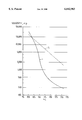
- FIG. 1 the meltviscosity of a polymer according to the present invention and of a comparative polymer as a function of the temperature is shown.
- toner particles comprising a complex macromolecule, comprising an amorphous polymeric backbone, and attached thereto crystalline and/or crystallizable terminal and/or side-chains, as toner resin show an improved balance between the mechanical deformability at ambiant and slightlty elevated temperatures as present in the operating engine and an improved fusibility at lower temperatures (this means a low melt viscosity at relatively low temperatures).
- the amount of crystallizable terminal chain and/or side-chain is preferably chosen in such a way that the complex macromolecule remains basically amorphous.
- Such a basically amorphous complex macromecule comprising crystallizable terminal chains and/or side-chains, gives an extremely interesting situation wherein at low temperatures the terminal chain and/or side-chains do not weaken the macromolecular structure by softening action on the amorphous complex macromolecule and even on the contrary will strengthen the structure by the fact that the structured region will behave as a finely divided filler.
- the Tg of the complex macromolecule will, in most instances, not be lower than that of the amorphous backbone but, on the contrary, will likely rise with respect to the pure amorphous backbone.
- crystalizable chain had an average molecular weight between 400 and 4000
- Toner particles including a modified polymer wherein the crystalizable chains had an average molecular weight lower than 1900 did show a low Tg.
- the ordered (crystalline) regions melt and the liquefied terminal chain and/or side-chains will soften the matrix of the complex amorphous macromolecule in an appreciable amount, thus inducing a remarkable drop in the melt viscosity of the complex amorphous macromolecule, and thus imposing in a macroscopic way a sharp melt behavior of the total matrix of the complex amorphous macromolecule. Due to this effect a remarkable drop of melt viscosity of the complex amorphous macromolecule is observed with respect to the amorphous backbone polymer. This drop gives an immediate effect on the fusing properties of the toner particles comprising said complex amorphous macromolecule as a major constituent. The combination of all cited effects gives rise to an unique situation of better compromise between Tg and melt viscosity.
- amorphous polycondensation polymers could be modified in a simple way to provide basically amorphous macromolecules, comprising crystalline or crystallizable moieties and having a more favorable relation between Tg and melt viscosity.
- the method, according to the present invention, for modifying amorphous polycondensation polymer is a simple, well controllable, relatively fast, chemical reaction, needing no complex dosing of reaction ingredients during the reaction period.
- the chemical reaction takes basically place between reactive groups comprised in said amorphous polycondensation polymer and a reactive group comprised in the monofunctional crystalline or crystallyzable polymers that will be attached (grafted) to the backbone.
- Such modified amorphous polycondensation polymers forming complex amorphous macromolecular compound, are characterized in that they comprise in their macromolecular structure, (i) an amorphous polycondensation backbone, the corresponding backbone polymer having a Tg of at least 45° C. and (ii) at least one polymer chain attached to said backbone, either terminally and/or in a side-chain polymer, said polymer chain being derived from a polymer which on itself has an average molecular weight by number (M avg ) so that 1900 ⁇ M avg ⁇ 4000, a melting point between 50° C. and 150° C. and a melting range of at most 15° C.
- M avg average molecular weight by number
- the amorphous polycondensation backbone, in complex amorphous macromolecules according to the present invention, is preferably a polyester, an epoxy resin or a mixed polycondensate (block or random polymer) comprising polyester and polyamide moieties.
- Mixed polycondensates, comprising polyester and polyamide moieties can be prepared by copolycondensation of at least one di- or polycarboxylic acid, at least one diol or polyol, and at least one aliphatic diamine or aminocarboxylic acid or a lactam. Said diamine, aminocarboxylic acid or lactam is present in the polycondensation mixture for at most 30% mol for mol.
- Examples of useful diamines, aminocarboxylic acids or lactam are e.g. hexamethylene diamine, pentamethylene diamine, tetramethylene diamine, 11-amino-undecanoic acid, e-caprolactam, etc.
- Expoxy resins useful as polycondensation backbone in a complex macromolecule according to the present invention, are linear adduct of bis-phenol A and epichlorhydrin having a Tg of about 54° C.
- epoxy resins are linear adducts of bisphenol compounds and epichlorhydrin as described e.g. by D. H. Solomon in the book “The Chemistry of Organic Film Formers”--John Wiley & Sons, Inc, New York (1967) p. 180-181, e.g. EPIKOTE 1004 (EPIKOTE is a registered trade mark of the Shell Chemical Co).
- the amorphous polycondensation backbone is a homo- or copolyester.
- Said homo- or copolyesters (herinafter termed polyester) can be produced by any known polycondensation reaction between at least one dicarboxylic acid and one diol.
- the polyester, used according to this invention can comprise aromatic dicarboxylic acid moieties.
- aromatic dicarboxylic acid moieties are moieties of terephthalic acid, isophthalic acid, naphthalene dicarboxylic acids, 4,4' diphenylene dicarboxylic acid, 4,4' diphenylether dicarboxylic acid, 4,4' diphenylmethane dicarboxylic acid, 4,4' diphenylsulphodicarboxylic acid, 5-sulphoisophthalic acid, etc and mixtures of these acid moieties.
- Polyesters forming the backbone of an amorphous complex macromolecular compound according to the present invention, can also comprise aliphatic dicarboxylic acid moieties. It may comprise saturated aliphatic dicarboxylic acid moieties derived from, e.g., malonic acid, succinic acid, glutaric acid, adipic acid, etc and/or unsaturated aliphatic carboxylic acid moieties derived from, e.g., maleic acid, fumaric acid, etc.
- Polyesters useful for forming the backbone of an amorphous complex macromolecular compound according to the present invention, can be linear or branched.
- polycarboxylic acids as, e.g. trimellitic acid, etc.
- polyhydroxy compounds as, e.g., trimethylolpropane, glycerol, pentaerythritol, etc.
- Useful polyhydroxycompounds for preparing the polyester backbone of a complex macromolecule according to the present invention are polymers containing hydroxyl groups, said polymers being prepared by polymerization (as well by suspension polymerization, as by solution polymerization, as by blockpolymerization) of olefinic unsaturated monomers.
- Polymers contaning hydroxyl groups and polyesters comprising the same, as disclosed in WO93/20129, are also suitable for use in the preparation of the polycondensation backbone of a complex macromolecule according to the present invention or for use as polyester backbone respectively.
- the hydroxyl groups are introduced via the addition of HO-containing esters of acrylic acid or methacrylic acid, e.g. 4-HO-butyl(meth)acrylate and 2-HO-ethyl(meth)acrylate, to the mixture of monomers.
- polymers disclosed in WO 93/20129 can also be used as polycarboxylic acids in the preparation of the polycondensation backbone of a complex macromolecule according to the present invention, when, instead of hydroxyl groups, carboxylgroups are introduced via the addition of (meth)acrylic acid as monomer to the mixture of monomers.
- diols used to condensate with the di-or polycarboxylic acids can be either aliphatic or aromatic.
- alkylene diol moieties are moieties of ethylene glycol, diethylene glycol, 1,3-propanediol, 1,4-butanediol, 2-methyl-1,5-pentanediol, neopentylglycol, 1,4-cy-clohexanedimethanol, p-xylene glycol.
- Aromatic diols useful in a polyester according to this invention are bisfenol A, ethoxylated bisfenol A, propoxylated bisphenol A, etc.
- mixtures of aliphatic and aromatic diols can be used in a polyester for use in the preparation of an amorphous complex macromolecular compound according to the present invention.
- Polyesters useful for forming the amorphous polycondensation backbone of amorphous complex macromolecular compounds, according to the present invention, have a minimum Tg (glass transition temperature) of 45° C. Any polyester resin having a Tg higher than 45° C. can be used.
- Preferred polyester resins are linear polycondensation products of (i) difunctional organic acids, e.g. maleic acid, fumaric acid, terephthalic acid and isophthalic acid and (ii) difunctional alcohols such as ethylene glycol, triethylene glycol, an aromatic dihydroxy compound, preferably a bisphenol such as 2,2-bis(4-hydroxyphenyl)-propane called "bisphenol A" or an alkoxylated bisphenol, e.g. propoxylated bisphenol examples of which are given in U.S. Pat. No. 4,331,755.
- suitable polyester resins reference is made to GB-P 1,373,220.
- ATLAC T500 which is a trade name of Atlas Chemical Industries Inc. Wilmington, Del. U.S.A.
- ATLAC T500 is a linear polyester of fumaric acid and propoxylated bisphenol A, having a Tg of about 55° C., and is described in e.g. NL 71/16891.
- DIACRON FC150 a tradename of Mitsubishi Rayon, Japan for a linear polyester resin produced by the polycondensation of terephthalic acid, propoxylated bisphenol A and ethylene glycol.
- linear polyesters are polycondensation products of terephthalic acid, isophthalic acid, di-ethoxylated Bisphenol A and ethylene glycol.
- DIANOL 22 di-ethoxylated Bisphenol A
- DIANOL 33 di-propoxylated Bisphenol A
- terephthalic acid and trimellitic acid are trade names of AKZO CHEMIE of the Netherlands. Since the formation of an amorphous complex macromolecular proceeds basically by a chemical reaction between reactive groups comprised in said amorphous polycondensation polymer and a reactive group comprised in the monofunctional crystalline or crystallyzable polymers that will be attached (grafted) to the backbone, both polymers need to have free reactive groups.
- the polymer forming the amorphous polycondensation backbone can comprise as reactive groups: hydroxyl groups, carboxyl groups, carboxylic acid halide groups, alkali metal salts of carboxylic acid groups, epoxy groups, isocyanate groups, amino groups, sulphonic acid groups, sulphonylhalide groups, alkali metal salts of sulphonic acid groups.
- the reactive groups in the amorphous backbone polymer are preferably hydroxyl groups, carboxyl groups, carboxylic acid halide groups and alkali metal salts of carboxylic acid groups.
- Polyesters used for forming the backbone of an amorphous complex macromolecular compound according to the present invention, are most preferably polyesters having an acid value or an hydroxyl value between 5 and 50 mg KOH per g of polyester. Most preferred are polyesters with an acid value or hydroxyl value between 10 and 30 mg KOH per g of polyester.
- the choice of the (co)polymer that will form the terminal chain and/or side-chain, in complex macromolecules according to the present invention is determined by the crystallizability of it.
- This crystallizability of the terminal chain and/or side-chain polymer, useful according to the present invention is reflected in the melting point (measured according to ASTM D-127) of it, which is between 50° C. to 150° C.
- Said melting point of the terminal chain and/or side-chain polymer is preferably between 60 and 150 ° C., more preferably between 75 and 125° C. It is moreover preferred that the terminal chain and/or side-chain polymer has a sharp melting behavior, i.e.
- the transition of a solid polymer to the totally molten polymer will proceed within a range (i.e. have a melting range) of at most 15° C., preferably of at most 10° C.
- the number average molecular weight (M W ) of said polymer is preferably lower than 4000, and as said above for having the good compromise between melting behavior and Tg the number average molecular weight (M W ) of said polymer is preferably higher than 1900.
- the polymer used to form the crystalline or crystallizable terminal chain and/or side chains in an amorphous complex macromolecular compound, according to the present invention is preferably a monofunctional polymer (i.e. carries only one reactive group) and most preferably a terminal monofunctinal polymer.
- Bi- or polyfunctional polymers are preferably avoided for forming the crystalline or crystallizable terminal chain and/or side chains in an amorphous complex macromolecular compound, according to the present invention, because of the fact that such polymers can not only form terminal chain and/or side-chains, but can also react to be grafted between two amorphous polycondensation chains. In such macromolecules the compromise between Tg and melt viscosity is not as good as in amorphous complex molecules wherein the crystallizable or crystalline polymer forms terminal chains and/or side-chains.
- the functional group in the polymer used forming the crystalline or crystallizable terminal chain and/or side chains in an amorphous complex macromolecular compound, according to the present invention can be any group that can react with a functional group present on the amorphous polycondensation backbone.
- the functional group present on the polymer used for forming the terminal chain and/or side chains is preferably a hydroxyl, a carboxyl, a carboxylic acid halide, an alkali salt of a carboxylic acid, an epoxy, an isocyanate, a chloromethyl or an amine group.
- the polymer used for forming the crystalline or crystallizable terminal chain and/or side chains can also be terminated by a halogen bearing group that can react with the alkali metal ion comprised in COOM or SO 3 M groups, comprised in the amorphous polycondensation backbone. Both in COOM and SO 3 M, M is an alkali metal ion.
- the polymer forming a terminal chains and/or side-chain is attached to said backbone polymer over a connecting group, preferably being a member selected from the group consisting of an ester of a carboxylic acid, an ester of a sulphonic acid, an ether, an amide of a carboxylic acid, an amide of a sulphonic acid, an urethane and an anhydride group.
- the polymer used to form a terminal chain and/or side-chain polymer is a crystallizable polyolefine.
- Polyethylene is a more preferred polymer for forming the crystalline or crystallizable terminal chain and/or side chains in an amorphous complex macromolecular compound according to the present invention.
- the polymer forming the terminal chain and/or side-chain is a polyethylene chain comprising alkoxy moieties.
- the amorphous polycondensation backbone polymer is a polyester and the reactive group(s) on said amorphous polycondensation backbone polymer are carboxyl groups that react under esterification with a terminal chain hydroxyl group of the polyolefinic chains or are hydroxyl groups that react under esterification with a terminal carboxyl group of the polyolefinic chains.
- the polyolefinic chain is a copolymer chain corresponding to the general formula (I) ##STR1## wherein 0 ⁇ 12, 10 ⁇ y ⁇ 90 and R 1 is a member selected from the group consisting of --OH, ##STR2## --O--CH 2 --CHOH--CH 2 Cl, --COO--CH 2 --CHOH--CH 2 Cl and COOM (with M is alkali metal ion), R 2 is CH 3 or H, preferably H, and R 3 is either C 2 H 5 or CH 3 .
- R 1 is OH or COOH.
- Examples of monofunctional, hydroxyl terminated polyolefinic polymers are polyolefinic mono alcohols, commercially available as UNILIN 425, UNILIN 550, UNILIN 700, UNILIN 1000 and UNILIN 2000 (trade names of PETROLITE, 6910 East 14th street, TULSA, Okla.
- UNITHOX 720 a tradename for a hydroxyterminated, polyolefinicpolyoxyethylenic macromolecule, with average molecular weight of 875 of the same PETROLITE company.
- a typical example of a monofunctional carboxyl terminated polyolefine is UNICID 700 a tradename of PETROLITE for a polyolefinic monocarboxylic acid with average molecular weight of 700.
- the amount of crystalline or crystallizable polymer that can be built into the amorphous polycondensation backbone is limited by the number of reactive groups on the amorphous polycondensation backbone polymer. In the preferred embodiment, where a polyester, with acid or hydroxyl value between 5 and 50 mg of KOH per g of polyester, is used, between 9.10 -5 and 9.10 -4 mol of the monofunctional crystallizable polymer can be built in pro g of amorphous polycondensation polymer.
- the percentage of the crystalline or crystallizable polymer (% by weight with respect to the weight of the polymer backbone) that can be built in depends on the molecular weight of the crystalline or crystallizable polymer. For a crystalline or crystallizable polymer with molecular weight 400 it ranges from 3,5% to 35%, and for a crystalline or crystallizable polymer with molecular weight 4000 it can range from 35 to 350%.
- the amorphous complex macromolecular compound comprising crystallizable terminal chains and/or side-chains is intended for use as toner resin, it has to be a basically amorphous complex macromolecular compound. Therefore the amount of crystalline or crystallizable polymer that is built into the amorphous polycondensation backbone is preferably limited to 1 to 50% by weight, more preferably between 1 and 25% by weight with respect to the total amorphous complex macromolecular compound.
- an amorphous complex macromolecule that only one type of crystalline or crystallizable polymer is built into the amorphous polycondensation backbone, two or more different types of crystalline or crystallizable polymer can be used, as long a said crystallizable polymers have an average molecular weight by number (M avg ) so that 400 ⁇ M avg ⁇ 4000, a melting point between 50° C. and 150° C. and a melting range of at most 15° C. In such case it is preferred to have two different types of crystallizable polymers, one having an average molecular weight by number (M avg ) lower than 1900 and one having an average molecular weight by number (M avg ) higher than 1900.
- M avg average molecular weight by number
- the amorphous complex macromolecular compounds according to the present invention can be used as toner resin in the manufacture of toner particles that can be used in electrically or magnetically based imaging methods as, e.g. electro(photo)graphy, magnetography, direct electrostatic printing (DEP), ionography, etc.
- the macromolecules can be used as toner resin in toner particles for dry development as well as for liquid development.
- the amorphous complex macromolecular compounds, according to the present invention can (when necessary for a specific imaging technique) be mixed with other known toner resins, both polycondensation resins and addition polymerized resins e.g. unmodified polyesters, styreneacralate polymers, etc..
- Toner particles comprising an amorphous complex macromolecular compound according to the present invention, can comprise any normal toner ingredient e.g. charge control agents, pigments both colored and black, inorganic fillers, etc.
- charge control agents e.g. charge control agents, pigments both colored and black, inorganic fillers, etc.
- a description a charge control agents, pigments and other additives useful in toner particles, comprising an amorphous complex macromolecular compound according to the present invention can be found in e.g. EP-A 601 235.
- Toner particles comprising an amorphous complex macromolecular compound according to the present invention, when used in a multi-component dry developer can be mixed with any known carrier material.
- Known fluidity enhancers as e.g. hydrophobized silica, can be mixed with said toner particles.
- the toner particles can be used as a monocomponent dry developer or mixed with carrier particles to form a multi component developer.
- toner particles comprising an amorphous complex macromolecular compound, according to the present invention, as toner resin, by melt kneading procedures followed by milling, or by a suspension process wherein the toner resin and toner ingredients are dissolved in an organic solvent, the solution dispersed in a medium wherein said organic solvent is insoluble, and finally the organic solvent is evaporated.
- Toner particles comprising an amorphous complex macromolecular compound, according to the present invention, as toner resin can have an average diameter between 1 and 50 ⁇ m, preferably between 3 and 20 ⁇ m and more preferably between 3 and 10 ⁇ m.
- the particle size distribution of said toner particles can be of any type. It is however preferred to have a Gaussian or normal particle size distribution, either by number or volume, with a coefficient of variability (standard deviation divided by the average) ( ⁇ ) smaller than 0.5, more preferably of 0.3.
- An amorphous complex macromolecular compound, according to the present invention can favorably be used in a coated layer of a final substrate, offering the possibility to induce a very efficient fusing and wetting of the thereon deposited toner layer and this at still reasonable temperatures.
- Said toner layer can comprise toner particles comprising an amorphous complex macromolecular compound, according to the present invention, as toner resin as well as toner particles with other toner resins.
- An amorphous complex macromolecular compound, according to the present invention can favorably be used in a topcoat on a final image, e.g. applied by depositing a colorless toner composition comprising said macromolecule.
- An amorphous polycondensation polymer comprising reactive groups either terminal or within the polymer chain, is mixed with at least one crystalline or crystallizable polymer, comprising a functional group.
- the functional group on said at least one crystalline or crystallizable polymer is capable of reacting with the reactive groups on the amorphous polycondensation polymer.
- the method comprises the steps of
- the molten polymers are not miscible and form two distinct phases in the melt.
- the chemical reaction proceeds at the interface.
- the amorphous complex molecular compound comprising an amorphous polycondensation backbone and crystalline or crystallizable polymer(s) attached to said amorphous polycondensation backbone
- the amorphous complex macromolecular compound acts as a kind of emulsifying agent for the reactants, and the reaction proceeds faster.
- the reaction time is between 30 and 300 minutes depending on the reaction temperature.
- the pure amorphous complex macromolecular compound comprising an amorphous polycondensation backbone and crystalline polymer(s) attached to said amorphous polycondensation backbone, is obtained. There is no further need of purifying the reaction product, nor are there organic solvents that have to be recovered.
- the crystalline or crystallizable polymer comprising a reactive group, preferably a hydroxyl group or a carboxyl group, is mixed in the polycondensation mixture (di- or polycarboxylic acids, diols or polyols, if so desired diamines or lactams) for forming the amorphous polycondensation backbone and is thus copolycondensed in said backbone.
- a reactive group preferably a hydroxyl group or a carboxyl group
- This method is comprises the steps of
- a low molecular weight prepolymer is formed by the direct polycondensation of the di- or polycarboxylic acids, the di- or polyols (preferably in this step only dicarboxylic acids and diols are used), and if so desired a diamine or lactam, and the crystalline or crystallizable polymer present in the reaction mixture.
- the reaction is carried out at elevated temperature, and, if so desired in the presence of proper catalysts, e.g. dibutyltindioxide, dibutyltindilaurate, zincoxide, stannous oxide as are described in EP-A 234 899.
- step (iii) above the prepolymer is reacted further with a di- or polyol and/or a di- or polycarboxylic acid until the desired visco-elasticity is reached (in this step preferably polyols or polycarboxylic acids are used).
- the pure amorphous complex molecule comprising an amorphous polycondensation backbone and crystalline polymer(s) attached to said amorphous polycondensation backbone, is obtained. There is no further need of purifying the reaction product, nor are there organic solvents that have to be recovered.
- the glass transition temperature (Tg) mentioned in the examples is determined according to ASTM Designation : D 3418-82.
- UNILIN, UNICID and UNITHOX are trade names of PETROLITE, 6910 East 14th street, TULSA, Oklahoma 74112, USA) for monofunctional polyolefines.
- UNILIN is the tradename for hydroxyterminated polyolefines, UNICID for carboxyl terminated polyolefines and UNITHOX for hydroxyterminated, polyolefinicpolyoxyethylenic macromolecules.
- amorphous linear polyester of propoxylated bisphenol A and fumaric acid (ATLAC T500, a tradename of Atlas Chemical Industries Inc. Wilmington, Del. U.S.A.), having an acid value of 25 mg KOH/g and Tg of 52° C., were mixed, in a glass reactor, with 20 parts of UNILIN 700 (tradename), a monofunctional polyolefinic molecule, consisting of --CH 2 --CH 2 --groups terminated at one side with a --CH 3 group and at the other by a HO-group, having an average molecular weight of 700, and a melting point of 110° C.
- ATLAC T500 a tradename of Atlas Chemical Industries Inc. Wilmington, Del. U.S.A.
- the mixture was heated during 30 minutes at 245° C. and stirred by a nitrogen flow bubbling through the reaction mixture. During this reaction time the water, formed by the reaction was distilled away. Both polymers were, when molten, incompatible with each other and two separate phases existed in the reaction vessel. After about 5 minutes both phases started to mix and at the end of the reaction no separate phases existed anymore, but a shiny homogeneous polymeric mass had been formed, indicating that the reaction was completed. After cooling the polymeric mass was recovered and the properties of the amorphous complex macromolecular compound (ACM1), formed during the reaction, were determined. The Tg of the amorphous complex macromolecular compound was 52° C.
- the tablet was inserted in the viscosity measuring apparatus in the gap between the cone and the plate.
- FIG. 1 A plot of ⁇ * versus temperature for ACM1 is shown in FIG. 1, curve 1. In this plot a first gentle decrease in complex viscosity is seen, followed by a sharp decrease situated between 105° C. and 115° C., i.e. centered around the melting point of the crystalline monofunctional polyolefine; after this sharp drop, the curve flattens out again.
- a factor F * is defined as follows: ##EQU1## wherein ⁇ * 1 is the complex viscosity of the amorphous complex macromolecular compounds at 10° C. below the melting temperature (T melt ) of the crystalline polyolefinic polymer, introduced in the amorphous backbone polymer and 72 * 2 is the complex viscosity of the amorphous complex macromolecular compounds at 10° C. above the melting temperature of the crystalline polyolefinic polymer, introduced in the amorphous backbone polymer.
- T melt 110° C.
- F * 104.
- Two toners were prepared, one using polymer ACM1 (an amorphous complex macromolecular compound according to example 1 of the present invention as binder resin and one using an amorphous linear polyester of propoxylated bisphenol A and fumaric acid (ATLAC T500, tradename) as binder resin.
- polymer ACM1 an amorphous complex macromolecular compound according to example 1 of the present invention as binder resin
- ATC T500 amorphous linear polyester of propoxylated bisphenol A and fumaric acid
- Toner1 97 parts by weight of ACM1 (the amorphous complex macromolecular compound of example 1) and 3 parts by weight of HELIOGEN BLAU (tradename of BASF, Germany for Cu-phthalocyanine) were intimately mixed together, placed in a melt kneader and heated to 120° C. to form a melt. This melt was melt kneaded for 20 minutes. Thereafter the mixture was allowed to cool to room temperature (20° C.).
- ACM1 the amorphous complex macromolecular compound of example 1
- HELIOGEN BLAU tradename of BASF, Germany for Cu-phthalocyanine
- Toner2 The toner was prepared as toner 1, but instead of 97 parts of ACM1, 97 parts of a linear polyester of propoxylated bisphenol A and fumaric acid (ATLAC T500, tradename), after being treated for 30 minutes at 245° C. as described in comparative example 1, was used as binder resin.
- ACM1 a linear polyester of propoxylated bisphenol A and fumaric acid
- Both toners were combined with a ferrite carrier to form 2 two component developers. Each of these developers was used to form an image in an electrostatographic device comprising a heat fixing step. The fusing properties were observed. It was observed that the toner particles of toner1, comprising ACM1 as toner resin could be fused at a temperature that was 15° C. lower than the fusing temperature of the comparison toner (toner2). This is in accordance with the observed differences in melt behavior of the two toner resins.
- example 1 The reaction of example 1 was repeated except for the ratio of the reactants. 90 parts of the amorphous linear polyester (ATLAC T500, tradename) and 10 parts of the monofunctional polyolefine (UNILIN 700, tradename) were used.
- the amorphous complex macromolecular compound of this example had a factor F * of 10 and a Tg of 54° C.
- example 1 The reaction of example 1 was repeated except for the ratio of the reactants. 70 parts of the amorphous linear polyester (ATLAC T500, tradename) and 30 parts of the monofunctional polyolefine (UNILIN 700, tradename) were used.
- the amorphous complex macromolecular compound of this example had a factor F * of 240 and a Tg of 50° C.
- Example 1 was repeated, but with UNILIN 425 (tradename), having an average molecular weight of 425, and a melting point of 87.8° C.
- Example 1 was repeated, but with UNILIN 1000 (tradename ), having an average molecular weight of 1000, and a melting point of 116.7° C.
- Example 1 was repeated, but with UNILIN 2000 (tradename ), having an average molecular weight of 1900, and a melting point of 125.5° C.
- the factor F * of the amorphous complex macromolecular compound was 125 and its Tg was 58° C.
- Example 1 was repeated, except for the polyester and the reaction time, that was, for the complex macromolecule of this example, 60 minutes.
- polycondensation backbone a polyester prepared by the polycondensation of 65 mol % of terephthalic acid, 35 mol % of isophthalic acid, 40 mol % of diethoxylated bisphenol A and 60 mol % of ethylene glycol was used.
- This polyester had a Tg of 58° C. and an acid value of 20 mg KOH/g of polyester. It was reacted with 20 parts of UNILIN 700 (tradename).
- the amorphous complex macromolecular compound of this example had a factor F * of 15.1 and a Tg of 60° C.
- the factor F * of this polymer was 6.5, again lower than the factor F * of the same polyester comprising crystalline polyolefinic blocks as produced in example 8.
- example 1 The procedure of example 1 was repeated again, but instead of an amorphous linear polyester, 80 parts of a branched polyester polycondensed by the reaction of 0.42 mol of terephthalic acid, 0.28 mol of trimellitic acid, 0.30 mol of diethoxylated bisphenol A and 0.7 mol of dipropoxylated bisphenol A, having a Tg of 65° C. and an acid value of 30 mg KOH/g, were used in the reaction with 20 parts of UNILIN 700 (tradename). The reaction time was extended to 180 minutes.
- the amorphous complex macromolecular compound of this example had a factor F * of 15.2 and a Tg of 66° C.
- the factor F * of this polymer was 5.1, again lower than the factor F * of the same polyester comprising crystalline polyolefinic blocks as produced in example 9.
- Example 9 was repeated except that 10 parts of UNILIN 700 (tradename) and 90 parts of the amorphous branched polyester were used and reacted for 30 minutes.
- the amorphous complex macromolecular compound of this example had a factor F * of 8.6 and a Tg of 59° C.
- Example 9 was repeated except that instead of 10 parts of UNILIN 700 (tradename), 10 parts of UNILIN 1000 (tradename) were reacted with 90 parts of the amorphous branched polyester.
- the amorphous complex macromolecular compound of this example had a factor F * of 13.6 and a Tg of 61° C.
- Example 9 was repeated except that instead of 10 parts of UNILIN 700 (tradename), 10 parts of UNILIN 2000 (tradename) were reacted with 90 parts of the amorphous branched polyester for 30 minutes.
- the amorphous complex macromolecular compound of this example had a factor F * of 11.3 and a Tg of 63° C.
- Example 9 was repeated except that instead of 10 parts of UNILIN 700 (tradename), 10 parts of UNITHOX 720 (tradename) were reacted with 90 parts of the amorphous branched polyester.
- the amorphous complex macromolecular compound of this example had a factor F * of 11.5 and a Tg of 60° C.
- Example 9 was repeated except that instead of 10 parts of UNILIN 700 (tradename), 10 parts of UNICID 700 (tradename) were reacted with 90 parts of the branched amorphous polyester.
- the amorphous complex macromolecular compound of this example had a factor F * of 8.0 and a Tg of 59° C.
- Example 14 was repeated except that instead of 90 parts of the amorphous branched polyester, 90 parts of a linear adduct of bisphenol-A and epichlorhydrin (EPIKOTE 1004, tradename of the Shell Chemical Co), with molecular weight by number of 1900 and Tg of 54° C. were used. The reaction time was again 30 minutes.
- EPIKOTE 1004 tradename of the Shell Chemical Co
- the amorphous complex macromolecular compound of this example had a factor F * of 17.1.
- a linear adduct of bisphenol-A and epichlorhydrin (EPIKOTE 1004, tradename of the Shell Chemical Co), with molecular weight by number of 1900 and Tg of 54° C. was heated, for 30 minutes, without addition of a crystallizable or crystalline polymer.
- the factor F * was 11.1.
- An amorphous complex macromolecular compound was prepared by copolycondensation 51.6 g (0.15 mol) of DIANOL 33 (tradename), 23.7 g (0.075 mol) of DIANOL 22 (tradename), 17.5 g (0.025 mol) of UNILIN 700 (tradename) (i.e. 15% by weight of UNILIN 700 with respect to the final amorphous complex macromolecular compound), 17.45 g of terephthalic acid (0.105 mol) and 17.45 mg of dibutyltinoxide.
- the reactants and the catalyst were mixed under nitrogen atmosphere and heated to 280° C. The reaction started immediately and the reaction water was distilled away. After one hour the esterification of the terephthalic acid was complete.
- the reaction mixture was cooled to 220° C. and 13.45 g (0.07 mol) of trimellitic acid anhydride was added. The reaction was carried on for between 3 and 4 hours until the desired viscosity was reached. The mixture was cooled and the amorphous complex macromolecular compound recovered.
- the amorphous complex macromolecular compound of this example had a factor F * of 15.2 and a Tg of 64° C.
- a 100 ⁇ m thick, subbed polyethylene terephthalate film was coated with a 2 ⁇ m thick layer of amorphous complex macromolecular compound ACM1, giving material TRX1 and another 100 ⁇ m thick, subbed polyethylene terephthalate film, was coated with a 2 ⁇ m thick layer of a linear polyester (ATLAC T500, tradename), giving material TRX2.
- ACM1 amorphous complex macromolecular compound
- TRX2 amorphous complex macromolecular compound
Landscapes
- Chemical & Material Sciences (AREA)
- Health & Medical Sciences (AREA)
- Chemical Kinetics & Catalysis (AREA)
- Medicinal Chemistry (AREA)
- Polymers & Plastics (AREA)
- Organic Chemistry (AREA)
- Physics & Mathematics (AREA)
- Spectroscopy & Molecular Physics (AREA)
- General Physics & Mathematics (AREA)
- Developing Agents For Electrophotography (AREA)
Abstract
Description
              TABLE 1
______________________________________
         Functional           M.sub.avg
  Name group Chain* by number T.sub.melt ° C.
______________________________________
UNILIN 425
         HO       --CH.sub.2 --CH.sub.2 --
                               425    87.8
  UNILIN 700 HO --CH.sub.2 --CH.sub.2 --  700 10
  UNILIN 1000 HO --CH.sub.2 --CH.sub.2 -- 1050 116.7
  UNILIN 2000 HO --CH.sub.2 --CH.sub.2 -- 1900 125.5
  UNITHOX 720 HO --CH.sub.2 --CH.sub.2 --  875 106
    and
    --C.sub.2 H.sub.4 --O--
  UNICID 700 COOH --CH.sub.2 --CH.sub.2 --  700 110
______________________________________
 *: constituents of the polyolefinic chain.
                                  TABLE 2
__________________________________________________________________________
                       M.sub.avg (number)
                                 Tg of
     of modifying  modified
  Example # polyester modifying agent agent F* polyester
__________________________________________________________________________
Ex 5  80 parts of
               20 parts of
                        425   n.m.
                                 38° C.
   ATLAC500 UNILIN 425
  Ex 1 80 parts of 20 parts UNILIN  700 104 52° C.
   ATLAC500 700
  Ex 6 80 parts of 20 parts UNILIN 1050 53 53° C.
   ATLAC500 1000
  Ex 7 80 parts of 20 parts UNILIN 1900 125 58° C.
   ATLAC500 2000
  Ex 9 90 parts branched 10 parts UNILIN  700 8.6 59° C.
   polyester 700
  Ex 10 90 parts branched 10 parts UNILIN 1050 13.6 61° C.
                                   polyester 1000
  Ex 11 90 parts branched 10 parts UNILIN 1900 11.3 63° C.
                                   polyester 2000
__________________________________________________________________________
Claims (8)
Priority Applications (1)
| Application Number | Priority Date | Filing Date | Title |
|---|---|---|---|
| US09/310,934 US6042983A (en) | 1994-11-15 | 1999-05-13 | Dry toner particles comprising a complex amorphous macromolecule as toner resin |
Applications Claiming Priority (5)
| Application Number | Priority Date | Filing Date | Title |
|---|---|---|---|
| EP94203323 | 1994-11-15 | ||
| EP94203323 | 1994-11-15 | ||
| US55465595A | 1995-11-08 | 1995-11-08 | |
| US08/922,362 US5981128A (en) | 1994-11-15 | 1997-09-03 | Dry toner particles comprising a complex amorphous macromolecule as toner resin |
| US09/310,934 US6042983A (en) | 1994-11-15 | 1999-05-13 | Dry toner particles comprising a complex amorphous macromolecule as toner resin |
Related Parent Applications (1)
| Application Number | Title | Priority Date | Filing Date |
|---|---|---|---|
| US08/922,362 Continuation-In-Part US5981128A (en) | 1994-11-15 | 1997-09-03 | Dry toner particles comprising a complex amorphous macromolecule as toner resin |
Publications (1)
| Publication Number | Publication Date |
|---|---|
| US6042983A true US6042983A (en) | 2000-03-28 |
Family
ID=27236028
Family Applications (1)
| Application Number | Title | Priority Date | Filing Date |
|---|---|---|---|
| US09/310,934 Expired - Lifetime US6042983A (en) | 1994-11-15 | 1999-05-13 | Dry toner particles comprising a complex amorphous macromolecule as toner resin |
Country Status (1)
| Country | Link |
|---|---|
| US (1) | US6042983A (en) |
Cited By (5)
| Publication number | Priority date | Publication date | Assignee | Title |
|---|---|---|---|---|
| US6670086B2 (en) | 2002-05-21 | 2003-12-30 | Baker Hughes Incorporated | Coupled alcohol ethoxylates for improved thermal properties |
| US6821703B2 (en) * | 2000-10-27 | 2004-11-23 | Dainippon Ink And Chemicals, Inc. | Method for producing polyester resin particle dispersion material, method for producing polyester resin particles, and method for producing electrophotographic spherical toner |
| EP1505450A4 (en) * | 2002-04-26 | 2007-09-19 | Sanyo Chemical Ind Ltd | Binder for electrostatic image developing toner |
| US20100233604A1 (en) * | 2009-03-10 | 2010-09-16 | Fuji Xerox Co., Ltd. | Electrostatic image developing toner, method for manufacturing electrostatic image developing toner, electrostatic image developer, toner cartridge, process cartridge, image-forming method and image-forming apparatus |
| WO2011097478A1 (en) * | 2010-02-05 | 2011-08-11 | Basf Coatings Gmbh | A resin for use in a coating composition |
Citations (4)
| Publication number | Priority date | Publication date | Assignee | Title |
|---|---|---|---|---|
| US3967962A (en) * | 1973-11-23 | 1976-07-06 | Xerox Corporation | Developing with toner polymer having crystalline and amorphous segments |
| US4758626A (en) * | 1987-05-12 | 1988-07-19 | General Electric Company | Melt of an amorphous aromatic polyester with a melt of a carboxy terminated polyacrylate oligomer |
| US4940644A (en) * | 1985-03-15 | 1990-07-10 | Konishiroku Photo Industry Co., Ltd. | Toner for development of electrostatic images and image forming method by use thereof |
| US5578409A (en) * | 1993-01-11 | 1996-11-26 | Canon Kabushiki Kaisha | Toner for developing electrostatic image, one component-type developer and two-component type developer |
-
1999
- 1999-05-13 US US09/310,934 patent/US6042983A/en not_active Expired - Lifetime
Patent Citations (4)
| Publication number | Priority date | Publication date | Assignee | Title |
|---|---|---|---|---|
| US3967962A (en) * | 1973-11-23 | 1976-07-06 | Xerox Corporation | Developing with toner polymer having crystalline and amorphous segments |
| US4940644A (en) * | 1985-03-15 | 1990-07-10 | Konishiroku Photo Industry Co., Ltd. | Toner for development of electrostatic images and image forming method by use thereof |
| US4758626A (en) * | 1987-05-12 | 1988-07-19 | General Electric Company | Melt of an amorphous aromatic polyester with a melt of a carboxy terminated polyacrylate oligomer |
| US5578409A (en) * | 1993-01-11 | 1996-11-26 | Canon Kabushiki Kaisha | Toner for developing electrostatic image, one component-type developer and two-component type developer |
Cited By (9)
| Publication number | Priority date | Publication date | Assignee | Title |
|---|---|---|---|---|
| US6821703B2 (en) * | 2000-10-27 | 2004-11-23 | Dainippon Ink And Chemicals, Inc. | Method for producing polyester resin particle dispersion material, method for producing polyester resin particles, and method for producing electrophotographic spherical toner |
| EP1505450A4 (en) * | 2002-04-26 | 2007-09-19 | Sanyo Chemical Ind Ltd | Binder for electrostatic image developing toner |
| US6670086B2 (en) | 2002-05-21 | 2003-12-30 | Baker Hughes Incorporated | Coupled alcohol ethoxylates for improved thermal properties |
| US20040086795A1 (en) * | 2002-05-21 | 2004-05-06 | Nadolsky Richard J. | Coupled alcohol ethoxylates for improved thermal properties |
| US20100233604A1 (en) * | 2009-03-10 | 2010-09-16 | Fuji Xerox Co., Ltd. | Electrostatic image developing toner, method for manufacturing electrostatic image developing toner, electrostatic image developer, toner cartridge, process cartridge, image-forming method and image-forming apparatus |
| US8343703B2 (en) * | 2009-03-10 | 2013-01-01 | Fuji Xerox Co., Ltd. | Electrostatic image developing toner, method for manufacturing electrostatic image developing toner, electrostatic image developer, toner cartridge, process cartridge, image-forming method and image-forming apparatus |
| WO2011097478A1 (en) * | 2010-02-05 | 2011-08-11 | Basf Coatings Gmbh | A resin for use in a coating composition |
| CN102666623A (en) * | 2010-02-05 | 2012-09-12 | 巴斯夫涂料有限公司 | Resins for use in coating compositions |
| US9328191B2 (en) | 2010-02-05 | 2016-05-03 | Basf Coatings Gmbh | Resin for use in a coating composition |
Similar Documents
| Publication | Publication Date | Title |
|---|---|---|
| US5147747A (en) | Low fusing temperature tone powder of crosslinked crystalline and amorphous polyesters | |
| EP1126324B1 (en) | Toner for electrophotography | |
| US5057392A (en) | Low fusing temperature toner powder of cross-linked crystalline and amorphous polyester blends | |
| EP0220319B1 (en) | Toner for electrostatic image developement and process for forming an image by using it | |
| US5156937A (en) | Reduced viscosity polyester composition for toner powders | |
| US7208563B2 (en) | Crystalline polyester | |
| EP2212369A1 (en) | Polyester resin and toner including the same | |
| JP3089206B2 (en) | Toner particles containing polysiloxane-modified resin | |
| JP3695645B2 (en) | Toner for electrophotography | |
| US5082883A (en) | Reduced viscosity polyblends of polyester and epoxy resins | |
| WO2003001302A1 (en) | Polyester resin for toner, process for producing polyester resin for toner, and toner containing the same | |
| US5368968A (en) | Modified polyester resins, a process for their preparation and toners containing such polyester resins | |
| US6238835B1 (en) | Toner particles containing a mixture of a modified linear polymer, a cross-linked polymer and a wax | |
| EP0712881B1 (en) | A novel amorphous complex macro-molecule and the use thereof | |
| US5981128A (en) | Dry toner particles comprising a complex amorphous macromolecule as toner resin | |
| JP4451160B2 (en) | Toner for electrostatic image development | |
| US5049646A (en) | Polyesters and toners made therewith which absorb ultraviolet light | |
| US5102762A (en) | Polyesters and toners made therewith which absorb ultraviolet light | |
| WO2008111726A1 (en) | Polyester resin composition for toner and toner containing the same | |
| EP0740217A1 (en) | Toner particles comprising polysiloxane modified resins | |
| KR101155074B1 (en) | Polyester resin for electrophotography toner, and toner produced using the same | |
| JP4176216B2 (en) | Toner particles containing a mixture of modified linear polymer, cross-linked polymer and wax | |
| EP0913735B1 (en) | Toner particles containing a mixture of a modified linear polymer, a cross-linked polymer and a wax | |
| JP2019204031A (en) | Binder resin composition for toner | |
| JP3471054B2 (en) | Polyester resin for toner and method for producing the same |
Legal Events
| Date | Code | Title | Description |
|---|---|---|---|
| AS | Assignment |
Owner name: AGFA-GEVAERT, N.C., BELGIUM Free format text: ASSIGNMENT OF ASSIGNORS INTEREST;ASSIGNORS:TAVERNIER, SERGE;MARIEN, AUGUST;OP DE BEECK, WERNER;REEL/FRAME:010412/0439 Effective date: 19990601 |
|
| STCF | Information on status: patent grant |
Free format text: PATENTED CASE |
|
| AS | Assignment |
Owner name: XEIKON NV, BELGIUM Free format text: ASSIGNMENT OF ASSIGNORS INTEREST;ASSIGNOR:AGFA-GEVAERT;REEL/FRAME:011247/0705 Effective date: 20000707 |
|
| FEPP | Fee payment procedure |
Free format text: PAYOR NUMBER ASSIGNED (ORIGINAL EVENT CODE: ASPN); ENTITY STATUS OF PATENT OWNER: LARGE ENTITY |
|
| AS | Assignment |
Owner name: XEIKON INTERNATIONAL N.V., BELGIUM Free format text: ASSIGNMENT OF ASSIGNORS INTEREST;ASSIGNOR:XEIKON NV;REEL/FRAME:014242/0637 Effective date: 20030515 |
|
| FPAY | Fee payment |
Year of fee payment: 4 |
|
| AS | Assignment |
Owner name: PUNCH GRAPHIX INTERNATIONAL NV, BELGIUM Free format text: CHANGE OF NAME;ASSIGNOR:XEIKON INTERNATIONAL NV;REEL/FRAME:019511/0987 Effective date: 20050617 |
|
| FPAY | Fee payment |
Year of fee payment: 8 |
|
| FPAY | Fee payment |
Year of fee payment: 12 |