US6041643A - Gas sensor with protective gate, method of forming the sensor, and method of sensing - Google Patents
Gas sensor with protective gate, method of forming the sensor, and method of sensing Download PDFInfo
- Publication number
- US6041643A US6041643A US09/123,760 US12376098A US6041643A US 6041643 A US6041643 A US 6041643A US 12376098 A US12376098 A US 12376098A US 6041643 A US6041643 A US 6041643A
- Authority
- US
- United States
- Prior art keywords
- sensor
- gas
- protective layer
- layer
- gate
- Prior art date
- Legal status (The legal status is an assumption and is not a legal conclusion. Google has not performed a legal analysis and makes no representation as to the accuracy of the status listed.)
- Expired - Lifetime
Links
- 238000000034 method Methods 0.000 title claims description 16
- 230000001681 protective effect Effects 0.000 title description 6
- 239000007789 gas Substances 0.000 claims abstract description 127
- 230000003197 catalytic effect Effects 0.000 claims abstract description 36
- 239000000463 material Substances 0.000 claims abstract description 35
- 239000004065 semiconductor Substances 0.000 claims abstract description 29
- 239000012212 insulator Substances 0.000 claims abstract description 25
- 239000000758 substrate Substances 0.000 claims abstract description 25
- XLYOFNOQVPJJNP-UHFFFAOYSA-N water Substances O XLYOFNOQVPJJNP-UHFFFAOYSA-N 0.000 claims abstract description 20
- 239000000126 substance Substances 0.000 claims abstract description 15
- 229910052751 metal Inorganic materials 0.000 claims abstract description 9
- 239000002184 metal Substances 0.000 claims abstract description 9
- 239000010410 layer Substances 0.000 claims description 62
- 239000011241 protective layer Substances 0.000 claims description 55
- 230000035945 sensitivity Effects 0.000 claims description 14
- KDLHZDBZIXYQEI-UHFFFAOYSA-N Palladium Chemical compound [Pd] KDLHZDBZIXYQEI-UHFFFAOYSA-N 0.000 claims description 12
- 238000001514 detection method Methods 0.000 claims description 8
- BASFCYQUMIYNBI-UHFFFAOYSA-N platinum Chemical compound [Pt] BASFCYQUMIYNBI-UHFFFAOYSA-N 0.000 claims description 8
- XEEYBQQBJWHFJM-UHFFFAOYSA-N Iron Chemical compound [Fe] XEEYBQQBJWHFJM-UHFFFAOYSA-N 0.000 claims description 6
- PXHVJJICTQNCMI-UHFFFAOYSA-N Nickel Chemical compound [Ni] PXHVJJICTQNCMI-UHFFFAOYSA-N 0.000 claims description 6
- 229910052763 palladium Inorganic materials 0.000 claims description 6
- -1 foreign matter Substances 0.000 claims description 5
- 229910052709 silver Inorganic materials 0.000 claims description 5
- 239000004332 silver Substances 0.000 claims description 5
- BQCADISMDOOEFD-UHFFFAOYSA-N Silver Chemical compound [Ag] BQCADISMDOOEFD-UHFFFAOYSA-N 0.000 claims description 4
- 229910052697 platinum Inorganic materials 0.000 claims description 4
- ZCYVEMRRCGMTRW-UHFFFAOYSA-N 7553-56-2 Chemical group [I] ZCYVEMRRCGMTRW-UHFFFAOYSA-N 0.000 claims description 3
- VYZAMTAEIAYCRO-UHFFFAOYSA-N Chromium Chemical compound [Cr] VYZAMTAEIAYCRO-UHFFFAOYSA-N 0.000 claims description 3
- RYGMFSIKBFXOCR-UHFFFAOYSA-N Copper Chemical compound [Cu] RYGMFSIKBFXOCR-UHFFFAOYSA-N 0.000 claims description 3
- FYYHWMGAXLPEAU-UHFFFAOYSA-N Magnesium Chemical compound [Mg] FYYHWMGAXLPEAU-UHFFFAOYSA-N 0.000 claims description 3
- ZOKXTWBITQBERF-UHFFFAOYSA-N Molybdenum Chemical compound [Mo] ZOKXTWBITQBERF-UHFFFAOYSA-N 0.000 claims description 3
- KJTLSVCANCCWHF-UHFFFAOYSA-N Ruthenium Chemical compound [Ru] KJTLSVCANCCWHF-UHFFFAOYSA-N 0.000 claims description 3
- ATJFFYVFTNAWJD-UHFFFAOYSA-N Tin Chemical compound [Sn] ATJFFYVFTNAWJD-UHFFFAOYSA-N 0.000 claims description 3
- RTAQQCXQSZGOHL-UHFFFAOYSA-N Titanium Chemical compound [Ti] RTAQQCXQSZGOHL-UHFFFAOYSA-N 0.000 claims description 3
- HCHKCACWOHOZIP-UHFFFAOYSA-N Zinc Chemical compound [Zn] HCHKCACWOHOZIP-UHFFFAOYSA-N 0.000 claims description 3
- 229910045601 alloy Inorganic materials 0.000 claims description 3
- 239000000956 alloy Substances 0.000 claims description 3
- 229910052782 aluminium Inorganic materials 0.000 claims description 3
- XAGFODPZIPBFFR-UHFFFAOYSA-N aluminium Chemical compound [Al] XAGFODPZIPBFFR-UHFFFAOYSA-N 0.000 claims description 3
- 229910052804 chromium Inorganic materials 0.000 claims description 3
- 239000011651 chromium Substances 0.000 claims description 3
- 229910017052 cobalt Inorganic materials 0.000 claims description 3
- 239000010941 cobalt Substances 0.000 claims description 3
- GUTLYIVDDKVIGB-UHFFFAOYSA-N cobalt atom Chemical compound [Co] GUTLYIVDDKVIGB-UHFFFAOYSA-N 0.000 claims description 3
- 229910052802 copper Inorganic materials 0.000 claims description 3
- 239000010949 copper Substances 0.000 claims description 3
- PCHJSUWPFVWCPO-UHFFFAOYSA-N gold Chemical compound [Au] PCHJSUWPFVWCPO-UHFFFAOYSA-N 0.000 claims description 3
- 229910052737 gold Inorganic materials 0.000 claims description 3
- 239000010931 gold Substances 0.000 claims description 3
- 229910052741 iridium Inorganic materials 0.000 claims description 3
- GKOZUEZYRPOHIO-UHFFFAOYSA-N iridium atom Chemical compound [Ir] GKOZUEZYRPOHIO-UHFFFAOYSA-N 0.000 claims description 3
- 229910052742 iron Inorganic materials 0.000 claims description 3
- 229910052749 magnesium Inorganic materials 0.000 claims description 3
- 239000011777 magnesium Substances 0.000 claims description 3
- WPBNNNQJVZRUHP-UHFFFAOYSA-L manganese(2+);methyl n-[[2-(methoxycarbonylcarbamothioylamino)phenyl]carbamothioyl]carbamate;n-[2-(sulfidocarbothioylamino)ethyl]carbamodithioate Chemical compound [Mn+2].[S-]C(=S)NCCNC([S-])=S.COC(=O)NC(=S)NC1=CC=CC=C1NC(=S)NC(=O)OC WPBNNNQJVZRUHP-UHFFFAOYSA-L 0.000 claims description 3
- 229910052750 molybdenum Inorganic materials 0.000 claims description 3
- 239000011733 molybdenum Substances 0.000 claims description 3
- 229910052759 nickel Inorganic materials 0.000 claims description 3
- 229910052762 osmium Inorganic materials 0.000 claims description 3
- SYQBFIAQOQZEGI-UHFFFAOYSA-N osmium atom Chemical compound [Os] SYQBFIAQOQZEGI-UHFFFAOYSA-N 0.000 claims description 3
- 229910052703 rhodium Inorganic materials 0.000 claims description 3
- 239000010948 rhodium Substances 0.000 claims description 3
- MHOVAHRLVXNVSD-UHFFFAOYSA-N rhodium atom Chemical compound [Rh] MHOVAHRLVXNVSD-UHFFFAOYSA-N 0.000 claims description 3
- 229910052707 ruthenium Inorganic materials 0.000 claims description 3
- 229910052715 tantalum Inorganic materials 0.000 claims description 3
- GUVRBAGPIYLISA-UHFFFAOYSA-N tantalum atom Chemical compound [Ta] GUVRBAGPIYLISA-UHFFFAOYSA-N 0.000 claims description 3
- 229910052718 tin Inorganic materials 0.000 claims description 3
- 239000010936 titanium Substances 0.000 claims description 3
- 229910052719 titanium Inorganic materials 0.000 claims description 3
- WFKWXMTUELFFGS-UHFFFAOYSA-N tungsten Chemical compound [W] WFKWXMTUELFFGS-UHFFFAOYSA-N 0.000 claims description 3
- 229910052721 tungsten Inorganic materials 0.000 claims description 3
- 239000010937 tungsten Substances 0.000 claims description 3
- 229910052720 vanadium Inorganic materials 0.000 claims description 3
- LEONUFNNVUYDNQ-UHFFFAOYSA-N vanadium atom Chemical compound [V] LEONUFNNVUYDNQ-UHFFFAOYSA-N 0.000 claims description 3
- 229910052725 zinc Inorganic materials 0.000 claims description 3
- 239000011701 zinc Substances 0.000 claims description 3
- 239000002356 single layer Substances 0.000 claims 2
- 239000000470 constituent Substances 0.000 claims 1
- 230000000704 physical effect Effects 0.000 abstract description 9
- 229910052739 hydrogen Inorganic materials 0.000 description 11
- UFHFLCQGNIYNRP-UHFFFAOYSA-N Hydrogen Chemical compound [H][H] UFHFLCQGNIYNRP-UHFFFAOYSA-N 0.000 description 10
- 239000001257 hydrogen Substances 0.000 description 10
- VYPSYNLAJGMNEJ-UHFFFAOYSA-N Silicium dioxide Chemical compound O=[Si]=O VYPSYNLAJGMNEJ-UHFFFAOYSA-N 0.000 description 8
- RWSOTUBLDIXVET-UHFFFAOYSA-N Dihydrogen sulfide Chemical compound S RWSOTUBLDIXVET-UHFFFAOYSA-N 0.000 description 6
- 230000008021 deposition Effects 0.000 description 6
- YZCKVEUIGOORGS-UHFFFAOYSA-N Hydrogen atom Chemical compound [H] YZCKVEUIGOORGS-UHFFFAOYSA-N 0.000 description 5
- 229910000037 hydrogen sulfide Inorganic materials 0.000 description 5
- UGFAIRIUMAVXCW-UHFFFAOYSA-N Carbon monoxide Chemical compound [O+]#[C-] UGFAIRIUMAVXCW-UHFFFAOYSA-N 0.000 description 4
- ZAMOUSCENKQFHK-UHFFFAOYSA-N Chlorine atom Chemical compound [Cl] ZAMOUSCENKQFHK-UHFFFAOYSA-N 0.000 description 4
- 125000004429 atom Chemical group 0.000 description 4
- 229910002091 carbon monoxide Inorganic materials 0.000 description 4
- 229910052801 chlorine Inorganic materials 0.000 description 4
- 239000000460 chlorine Substances 0.000 description 4
- 150000002431 hydrogen Chemical class 0.000 description 4
- 238000004519 manufacturing process Methods 0.000 description 4
- 239000003921 oil Substances 0.000 description 4
- 230000008569 process Effects 0.000 description 4
- 239000000377 silicon dioxide Substances 0.000 description 4
- 238000005516 engineering process Methods 0.000 description 3
- 230000007257 malfunction Effects 0.000 description 3
- 238000012544 monitoring process Methods 0.000 description 3
- QGZKDVFQNNGYKY-UHFFFAOYSA-N Ammonia Chemical compound N QGZKDVFQNNGYKY-UHFFFAOYSA-N 0.000 description 2
- GWEVSGVZZGPLCZ-UHFFFAOYSA-N Titan oxide Chemical compound O=[Ti]=O GWEVSGVZZGPLCZ-UHFFFAOYSA-N 0.000 description 2
- 230000002411 adverse Effects 0.000 description 2
- 238000001311 chemical methods and process Methods 0.000 description 2
- 239000000446 fuel Substances 0.000 description 2
- 125000004435 hydrogen atom Chemical group [H]* 0.000 description 2
- 239000012528 membrane Substances 0.000 description 2
- VNWKTOKETHGBQD-UHFFFAOYSA-N methane Chemical compound C VNWKTOKETHGBQD-UHFFFAOYSA-N 0.000 description 2
- 230000009972 noncorrosive effect Effects 0.000 description 2
- 239000002245 particle Substances 0.000 description 2
- 229920001296 polysiloxane Polymers 0.000 description 2
- 229920001343 polytetrafluoroethylene Polymers 0.000 description 2
- 239000004810 polytetrafluoroethylene Substances 0.000 description 2
- 229910052710 silicon Inorganic materials 0.000 description 2
- 239000010703 silicon Substances 0.000 description 2
- 235000012239 silicon dioxide Nutrition 0.000 description 2
- 239000010409 thin film Substances 0.000 description 2
- OGIDPMRJRNCKJF-UHFFFAOYSA-N titanium oxide Inorganic materials [Ti]=O OGIDPMRJRNCKJF-UHFFFAOYSA-N 0.000 description 2
- 239000002699 waste material Substances 0.000 description 2
- 229910018404 Al2 O3 Inorganic materials 0.000 description 1
- VEXZGXHMUGYJMC-UHFFFAOYSA-M Chloride anion Chemical compound [Cl-] VEXZGXHMUGYJMC-UHFFFAOYSA-M 0.000 description 1
- UFHFLCQGNIYNRP-VVKOMZTBSA-N Dideuterium Chemical compound [2H][2H] UFHFLCQGNIYNRP-VVKOMZTBSA-N 0.000 description 1
- VGGSQFUCUMXWEO-UHFFFAOYSA-N Ethene Chemical compound C=C VGGSQFUCUMXWEO-UHFFFAOYSA-N 0.000 description 1
- 239000005977 Ethylene Substances 0.000 description 1
- 241000208152 Geranium Species 0.000 description 1
- 238000004566 IR spectroscopy Methods 0.000 description 1
- 150000001298 alcohols Chemical class 0.000 description 1
- HSFWRNGVRCDJHI-UHFFFAOYSA-N alpha-acetylene Natural products C#C HSFWRNGVRCDJHI-UHFFFAOYSA-N 0.000 description 1
- PNEYBMLMFCGWSK-UHFFFAOYSA-N aluminium oxide Inorganic materials [O-2].[O-2].[O-2].[Al+3].[Al+3] PNEYBMLMFCGWSK-UHFFFAOYSA-N 0.000 description 1
- 150000001412 amines Chemical class 0.000 description 1
- 229910021529 ammonia Inorganic materials 0.000 description 1
- 238000004458 analytical method Methods 0.000 description 1
- 238000013459 approach Methods 0.000 description 1
- 239000011248 coating agent Substances 0.000 description 1
- 238000000576 coating method Methods 0.000 description 1
- 238000002485 combustion reaction Methods 0.000 description 1
- 239000000356 contaminant Substances 0.000 description 1
- 230000007797 corrosion Effects 0.000 description 1
- 238000005260 corrosion Methods 0.000 description 1
- 238000000354 decomposition reaction Methods 0.000 description 1
- 230000007812 deficiency Effects 0.000 description 1
- 238000000151 deposition Methods 0.000 description 1
- 238000011161 development Methods 0.000 description 1
- 238000009792 diffusion process Methods 0.000 description 1
- 125000002534 ethynyl group Chemical group [H]C#C* 0.000 description 1
- 230000005669 field effect Effects 0.000 description 1
- 238000004817 gas chromatography Methods 0.000 description 1
- 231100001261 hazardous Toxicity 0.000 description 1
- 229930195733 hydrocarbon Natural products 0.000 description 1
- 150000002430 hydrocarbons Chemical class 0.000 description 1
- 230000002209 hydrophobic effect Effects 0.000 description 1
- 230000005661 hydrophobic surface Effects 0.000 description 1
- 239000012535 impurity Substances 0.000 description 1
- 238000011065 in-situ storage Methods 0.000 description 1
- 238000009413 insulation Methods 0.000 description 1
- 230000002452 interceptive effect Effects 0.000 description 1
- 238000010506 ionic fission reaction Methods 0.000 description 1
- 150000002500 ions Chemical class 0.000 description 1
- 238000012423 maintenance Methods 0.000 description 1
- 238000004949 mass spectrometry Methods 0.000 description 1
- 239000007769 metal material Substances 0.000 description 1
- 229910044991 metal oxide Inorganic materials 0.000 description 1
- 150000004706 metal oxides Chemical class 0.000 description 1
- 239000000203 mixture Substances 0.000 description 1
- 238000012986 modification Methods 0.000 description 1
- 230000004048 modification Effects 0.000 description 1
- 239000002052 molecular layer Substances 0.000 description 1
- 150000004767 nitrides Chemical class 0.000 description 1
- 238000013021 overheating Methods 0.000 description 1
- 239000011236 particulate material Substances 0.000 description 1
- 239000013047 polymeric layer Substances 0.000 description 1
- 239000002243 precursor Substances 0.000 description 1
- 238000012216 screening Methods 0.000 description 1
- 150000003384 small molecules Chemical class 0.000 description 1
- 239000007787 solid Substances 0.000 description 1
- 238000001179 sorption measurement Methods 0.000 description 1
Images


Classifications
-
- G—PHYSICS
- G01—MEASURING; TESTING
- G01N—INVESTIGATING OR ANALYSING MATERIALS BY DETERMINING THEIR CHEMICAL OR PHYSICAL PROPERTIES
- G01N33/00—Investigating or analysing materials by specific methods not covered by groups G01N1/00 - G01N31/00
- G01N33/26—Oils; Viscous liquids; Paints; Inks
- G01N33/28—Oils, i.e. hydrocarbon liquids
- G01N33/2835—Specific substances contained in the oils or fuels
- G01N33/2841—Gas in oils, e.g. hydrogen in insulating oils
-
- G—PHYSICS
- G01—MEASURING; TESTING
- G01N—INVESTIGATING OR ANALYSING MATERIALS BY DETERMINING THEIR CHEMICAL OR PHYSICAL PROPERTIES
- G01N27/00—Investigating or analysing materials by the use of electric, electrochemical, or magnetic means
- G01N27/26—Investigating or analysing materials by the use of electric, electrochemical, or magnetic means by investigating electrochemical variables; by using electrolysis or electrophoresis
- G01N27/403—Cells and electrode assemblies
- G01N27/414—Ion-sensitive or chemical field-effect transistors, i.e. ISFETS or CHEMFETS
- G01N27/4141—Ion-sensitive or chemical field-effect transistors, i.e. ISFETS or CHEMFETS specially adapted for gases
-
- G—PHYSICS
- G01—MEASURING; TESTING
- G01N—INVESTIGATING OR ANALYSING MATERIALS BY DETERMINING THEIR CHEMICAL OR PHYSICAL PROPERTIES
- G01N33/00—Investigating or analysing materials by specific methods not covered by groups G01N1/00 - G01N31/00
- G01N33/0004—Gaseous mixtures, e.g. polluted air
- G01N33/0009—General constructional details of gas analysers, e.g. portable test equipment
- G01N33/0011—Sample conditioning
- G01N33/0014—Sample conditioning by eliminating a gas
-
- G—PHYSICS
- G01—MEASURING; TESTING
- G01N—INVESTIGATING OR ANALYSING MATERIALS BY DETERMINING THEIR CHEMICAL OR PHYSICAL PROPERTIES
- G01N33/00—Investigating or analysing materials by specific methods not covered by groups G01N1/00 - G01N31/00
- G01N33/0004—Gaseous mixtures, e.g. polluted air
- G01N33/0009—General constructional details of gas analysers, e.g. portable test equipment
- G01N33/0027—General constructional details of gas analysers, e.g. portable test equipment concerning the detector
- G01N33/0036—General constructional details of gas analysers, e.g. portable test equipment concerning the detector specially adapted to detect a particular component
- G01N33/005—H2
Definitions
- the invention is related to gas sensors.
- the invention is related to a gas sensor with a protective gate.
- Gas and vapor sensors have many industrial applications. These applications include the detection of hazardous gas in the workplace for worker safety, enhanced control of the air-fuel mixture and feed in combustion of fuel, increased product yield and reduced waste in a product stream. These applications generally rely on individual sensors, which are installed to detect a single gas or vapor whose concentration may approach a harmful level.
- gases include, but are not limited to, hydrogen sulfide, carbon monoxide, chlorine, ammonia, hydrogen, and methane.
- the first path involves use of complex analytical instruments, for example infrared spectroscopy, gas chromatography, and mass spectrometry.
- complex analytical instruments for example infrared spectroscopy, gas chromatography, and mass spectrometry.
- microcontrollers and microcomputers have led to smaller versions of these analytical instruments.
- These instruments are very powerful, but they have significant disadvantages, such as being very maintenance intensive. Further, these instruments are sensitive to adverse, corrosive environments and must be located far from the gas or vapor source in a climate controlled enclosure. Thus, a gas (vapor) sample must be transported to the analyzer, as a result real time information is not available. Also, these instruments are expensive, and are thus not affordable candidates for real-time, in-situ applications.
- the second technology path for industrial gas sensors developed with chemical sensor technologies.
- the applications of chemical sensors in chemical processes are well established, and these chemical sensors may be located in process streams to enhance process efficiency and yield, and to reduce waste.
- water-concentration amount determination in a silicone process feed stream can be enhanced by using chemical sensors to sense water concentrations.
- the ability of sensors to identify a target gas depends on several factors. These factors include the sensitivity of the sensor to other interfering gases and vapors, and a concentration of the target gas. The ability to resolve the target gas from other gases is called the selectivity. There are very few known sensors that are highly selective where a sensor has greater than about a tenfold difference in gas detection between sensing states and non-sensing states. Further, within these very few sensors there are even fewer that are relatively reliable to accurately detect individual gases. For example, an unreliable sensor does not provide correct indication of a gas amount when the concentration of an interferant is high. In practice, this limitation is avoided by using a sensor only where a high concentration of interferant is unlikely. This solution, however, limits the effectiveness and uses of a sensor.
- Gas sensors have been used in detection of particular undesirable gases in oil-filled electrical transformers.
- Faults in an oil-filled transformer include arcing (electrical), corona discharge (electrical), low energy sparking (electrical), severe overloading (electrical), pump motor failure (electrical and thermal) and overheating (electrical and thermal) in an insulation system.
- Faults can generate undesirable gases, such as hydrogen (H 2 ), acetylene (C 2 H 2 ), ethylene (C 2 H 4 ), and carbon monoxide (CO).
- H 2 hydrogen
- C 2 H 2 acetylene
- C 2 H 4 ethylene
- CO carbon monoxide
- One class of gas detection sensors normally comprise a semiconductor substrate, a thin insulator layer mounted, for example grown, on the semiconductor substrate, and a catalytic metallic gate mounted, for example deposited, on the thin insulator layer. Sensors of this nature are known. The sensor's level of sensitivity is different for each gas depending on the gate material. The gate material determines what designated gas will be detected, in other words, the gate material tunes the sensor for a designated gas. Accordingly, while an individual sensor may be useful to detect a single gas to which it is tuned, it will not be as useful to detect other gases. If the sensor is not appropriately tuned, the designated gas may not accurately detected, which of course is undesirable.
- known sensors do not provide protection of the sensor components from harmful environments. For example, corrosive gases are often present in a transformer, and adversely affect operation of a sensor. These corrosive gases in a transformer must be kept away from a sensor's catalytic gate in order for the sensor to operate accurately and properly. Also, these known sensors are not protected from water or particulate foreign matter interference, which are often found in transformers.
- a sensor that includes protection from corrosive environments, water, and foreign matter. It is also desirable to provide a sensor that can be designed to be tuned so as to selectively pass and detect a designated gas. Also, it is desirable to provide a system for monitoring concentrations of gases in various applications, for example in a manufacturing apparatus and failure mode monitoring of equipment process to power transformers.
- a gas sensor that determines the presence of at least one designated gas in the ambient environment is disclosed in an embodiment of the invention.
- the gas sensor comprises a semiconductor substrate; a thin insulator layer mounted on the semiconductor substrate; a catalytic metallic gate mounted on the thin insulator layer; and a protective layer mounted on the catalytic metallic gate layer.
- the protective layer changes at least one of a surface chemical and physical property of the sensor.
- the protective layer is formed from a material that protects the sensor from corrosive environments and interference from at least one of particulates (minute separate particles that often result when oil degrades) and water.
- the protective layer enhances the sensitivity of the sensor to a designated gas, and permits the designated gas to pass through to the catalytic metallic gate.
- the catalytic metallic gate alters a designated gas, for example by heterolytic cleavage (decomposition into charged ions) of a C--H or H--H bond in the gas (herein "alters").
- the resultant ionic, atomic hydrogen (H.) diffuses through the gate and varies electrical sensitivity of the sensor.
- a method for sensing a designated gas in a gaseous state comprises providing a sensor, where the sensor includes a semiconductor substrate; an insulator layer disposed on the semiconductor substrate; a catalytic metallic gate layer disposed on the insulator layer; and a protective layer disposed on the catalytic metal gate.
- the protective layer changes at least one of the surface chemical and physical properties of the sensor.
- the protective layer is formed from a material that provides protection of foreign matter and water.
- the protective layer permits the designated gas to pass through to and interact with the catalytic metallic layer and reduces, and even prevents, passage of corrosive gases (chlorine and hydrogen sulfide), water, foreign matter (matter not intended to be associated with the sensor) and gases, other than the designated gas.
- the sensor is positioned in a gaseous environment that may comprise the designated gas to be sensed.
- the designated gas passes through the protective layer and is altered as it adsorbs onto the catalytic metal gate.
- the atomic hydrogen (H.) passes through the gate to the insulator layer, where it alters the altering electrical sensitivity of the sensor.
- another embodiment of the invention provides a method for forming a gas sensor for determining a designated gas.
- the method comprises providing an insulator layer on the semiconductor substrate; providing a catalytic metallic gate on the insulator layer; and providing a protective layer disposed on the catalytic metal gate.
- the protective layer changes at least one of a surface chemical and physical property of the sensor.
- the protective layer is formed from a material that provides protection from corrosive gases (chloride and hydrogen sulfide) and interference from at least one of foreign matter (matter not intended to be associated with the sensor) and water.
- the protective layer permits the designated gas to pass through to the catalytic metallic gate layer, where the designated gas is altered, for example on one of an atomic and molecular level.
- the protective layer reduces, and even prevents, passage of foreign matter, water and gases other than the protective designated gas, and alters the designated gas.
- the designated atomic hydrogen (H.) gas passes through the gate to the insulative layer, where the altered designated gas varies performance of the sensor by altering electrical sensitivity.
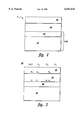
- FIG. 1 is a cross-sectional view of a sensor with a protective gate
- FIG. 2 is a cross-sectional view of a sensor schematically illustrating one example of the operation of the sensor.
- Gas sensors such as, but not limited to, a metal-insulator-semiconductor (MIS) diode gas sensor and a field effect transducer (FET) gas sensor, are known in the art.
- the sensors comprise a semiconductor substrate; a thin insulator layer mounted on the semiconductor substrate; and a catalytic metallic gate (gate) mounted on the thin insulator layer.
- MIS metal-insulator-semiconductor
- FET field effect transducer
- hydrogen gas molecules are adsorbed onto the metallic gate from the surrounding ambient environment.
- the adsorbed molecules are altered, such as by being catalytically dissociated from each other on one of a molecular or atomic level.
- the molecules (H 2 ) are dissociated into individual hydrogen atoms (H.).
- the atomic hydrogen (H.) diffuses through the metallic gate to a metal-oxide interface at the semiconductor substrate. This diffusion forms a dipole layer that modulates electrical conductance of the sensor and changes electrical conductivity of the substrate.
- Many individual gases containing hydrogen such as, but not limited to, amines, mercaptans, hydrocarbons, and alcohols, can be detected in this manner by a sensor.
- the level of sensitivity for each hydrogen-containing gas is different for each particular gate material.
- a sensor is tuned to a particular gas by virtue of the particular gate material.
- Known sensors provide adequate operation for a single hydrogen-containing gas in a clean, dry, noncorrosive environment. These known sensors, however, do not operate effectively if the environment is not clean and contains foreign matter (matter not intended to be associated with the sensor), such as particulates (minute separate particles that often result when oil degrades), or contains water vapor. Also, known sensors do not operate effectively if the sensor is placed in a corrosive gaseous (chlorine and hydrogen sulfide) environment, or if the sensor does not have a satisfactory tuned (sensitivity) level for the designated gas.
- a sensor comprises protective structure to protect the sensor in the presence of at least one of water vapor, foreign matter (matter not intended to be associated with the sensor), and corrosive gases (chlorine and hydrogen sulfide).
- the sensor comprises a gate material that provides a desirable sensitivity for a designated gas, such as a hydrogen-containing gas.
- the gate material will not be corroded in a corrosive gaseous environment, as is often found in electrical transformers, because of the protection afforded by the protective layer.
- the gas sensor 1 is positionable in corrosive environments and provides a real time data.
- the invention will be described with a sensor in a transformer, which is merely an example of applications for the sensor.
- Other applications comprise gas detection in chemical process streams, enclosed potentially dangerous environments, and other places where detection of gases is desirable.
- a possible fault type in a transformer can be evaluated by analysis of gases generated in a transformer.
- a gas sensor 1 in accordance with an embodiment of the invention, comprises a solid state sensor, for example a metal-insulator-semiconductor (MIS) sensor (also known as a metal-oxide-semiconductor (MOS) sensor).
- MIS metal-insulator-semiconductor
- MOS metal-oxide-semiconductor
- the MIS sensor is merely exemplary of sensors within the scope of the invention and will be used in the following description, but is not meant to limit the invention in any way.
- the gas sensor 1 comprises semiconductor substrate 10, a layer of a thin insulator 20, and a catalytic metallic gate layer 30.
- a protective layer 40 is disposed over and mounted on the catalytic metallic gate 30.
- the protective layer 40 is disposed on the gate 30, for example, by deposition so the protective layer 40 adheres directly thereto in continuous and integral manner.
- the protective layer 40 provides a protective cover for the sensor 1 from at least one of a water vapor, corrosive gas and foreign matter, such as particulates. By virtue of the adherence of the protective layer 40 continuous and integral manner, the sensor 1 is protected and no contaminants may reach the gate 30.
- the protective layer 40 changes surface chemical characteristics of the sensor 1.
- the protective layer 40 changes surface physical properties of the sensor 1.
- the surface chemical and surface physical properties of the sensor 1 are changed by the protective layer 40.
- the catalytic metallic gate layer 30 comprises a suitably thick layer of material of an appropriate corrosive-resistant gate material.
- the material of the catalytic metallic gate layer 30 is comprises an appropriate metallic material, such as, but not limited to, at least one of: platinum, palladium, iridium, ruthenium, nickel, copper, rhodium, molybdenum, iron, cobalt, titanium, vanadium, tantalum, tungsten, chromium, manganese, gold, silver, aluminum, palladium:silver, tin, osmium, magnesium, zinc, alloys of these materials, and combinations of these materials.
- the catalytic metallic gate 30 comprises a layer that has a thickness in a range between about 5 nm to about 50 nm, preferably in a range between about 15 nm to about 30 nm, and even more preferably about 20 nm in thickness.
- the thickness of the catalytic metallic gate layer 30 depends on the intended use of the modified gate gas sensor 1.
- the insulator layer 20 comprises an appropriate insulative material, such as silicon dioxide (SiO 2 ). However, any other appropriate material such as titanium oxide (TiO x ), silicone nitride and alumina (Al 2 O 3 ) may be used for the insulator layer 20.
- the insulator layer 20 has a thickness generally in a range between about 1 nm to about 10 nm, and preferably about 5 nm in thickness. The thickness of the insulator layer 20 depends on the intended use of the modified gate gas sensor 1.
- the semiconductor substrate 10 of the modified gate gas sensor 1 comprises an appropriate semiconductor material, such as, but not limited to, silicon, silicon dioxide, geranium, and other semiconductor materials.
- the insulator layer 20 and semiconductor substrate 10 define an insulator-on-semiconductor substrate system 100.
- the insulator-on-semiconductor substrate system 100 comprises SiO 2 on silicon, however other insulator-on-semiconductor substrate systems 100 are within the scope of the invention.
- the exact combinations of materials of the catalytic metallic gate layer 30, the thin insulative layer 20, and the semiconductor substrate 10 can comprise any materials, as long as the protective layer 40 protects the sensor 1, as described herein.
- the protective layer 40 changes (modifies) at least one of chemical properties and physical properties of the sensor 1.
- the sensor 1 possesses modified chemical and physical properties provided by the protective layer 40, which prevents impurity adsorption.
- the sensor 1 is chemical modified as the protective layer 40 provides a hydrophobic surface that reduces and possibly avoids water vapor interference.
- the protective layer 40 improves the sensor's sensitivity by allowing only certain gases to pass through and interact with the catalytic metal gate layer 30. Amounts of other gases, as well as foreign matter, that pass through the protective layer 40 are reduced, and even prevented, from passing through. Accordingly, the sensor 1 possesses altered physical properties. Further, the surface chemical properties of the sensor 1 are altered, as the protective layer 40 changes materials that interact with the sensor 1.
- the protective layer 40 comprises at least one layer, where the at least one layer comprises a single atom thick layer, for example, a layer formed by placement a single atom thick layer on the gate layer 30, such as deposition of a layer of iodine atoms.
- the protective layer 40 comprises a layer formed deposition of a multiple atoms thick layer, where the layer is at least two atoms in thickness.
- the protective layer 40 comprises a molecular layer, for example, a layer formed by deposition of a layer of small molecules, such as a layer of a relatively complex organic molecules such as polytetrafluoroethylene.
- the protective layer 40 comprises a polymeric layer, for example, a layer formed by deposition of a thin film polymeric material, such as a thin film of hydrophobic polytetrafluoroethylene.
- a thin film polymeric material such as a thin film of hydrophobic polytetrafluoroethylene.
- the material and depth of the protective layer 40 is selected for sensitivity and performance with respect to the designated gas to be detected.
- the protective layer 40 is disposed on the metallic gate layer 30 during manufacture of the sensor 1, for example by deposition, screening, coating, and other appropriate manufacturing techniques.
- the protective layer 40 is disposed on an existing sensor, after the sensor has been finally manufactured, to modify the existing sensor.
- a plurality of sensors can be manufactured, providing separate gate materials for tuning.
- the existing sensors possess essentially identical structures and characteristics, and the protective layer 40, which is disposed on the existing sensor after its manufacture, provides the sensor with its tuning for passage of the designated gas.
- an array of modified gas sensors can be formed to provide, for example, real time responses to designated gases.
- a sensor as embodied by the invention, comprises materials so the sensor is tuned and detects a designated gas, for example real time data of the gas.
- a modified gate gas sensor 1 is placed in a location with an ambient environment 50 containing the designated gas to be sensed, for example hydrogen.
- the ambient environment 50 comprises any number of gases and foreign matter, such as particulates.
- the protective layer 40 permits passage of the hydrogen molecules (H 2 ) only. Other gases and foreign matter do not pass through the protective layer 40.
- the protective layer 40 protects the sensor 1 from damage from corrosive gases, water, and foreign matter, such as particulates, by not allowing these to pass therethrough.
- the molecular hydrogen H 2 passes through the protective layer 40, it interacts with the catalytic metallic gate 30. There the hydrogen molecules are then heterolytically cleavaged (altered) into hydrogen atoms (H.). The atomic hydrogen (H.) then passes through the thin insulator layer 20, where the electrical conductance sensitivity of the semiconductor substrate 10 of the gas sensor 1 is altered (as described above). Accordingly, the sensor 1 selectively detects the designated gas in the ambient atmosphere 50. An associated diagnostic system (not illustrated), which is attached to sensor 1 determines the designated gas and its amount as a result of the altered electrical conductivity.
Landscapes
- Chemical & Material Sciences (AREA)
- Health & Medical Sciences (AREA)
- Life Sciences & Earth Sciences (AREA)
- Engineering & Computer Science (AREA)
- Analytical Chemistry (AREA)
- General Physics & Mathematics (AREA)
- Pathology (AREA)
- Immunology (AREA)
- General Health & Medical Sciences (AREA)
- Physics & Mathematics (AREA)
- Biochemistry (AREA)
- Chemical Kinetics & Catalysis (AREA)
- Medicinal Chemistry (AREA)
- Food Science & Technology (AREA)
- Oil, Petroleum & Natural Gas (AREA)
- General Chemical & Material Sciences (AREA)
- Combustion & Propulsion (AREA)
- Microelectronics & Electronic Packaging (AREA)
- Molecular Biology (AREA)
- Electrochemistry (AREA)
- Investigating Or Analyzing Materials By The Use Of Electric Means (AREA)
Abstract
A gas sensor determines the presence of at least one designated gas in a gaseous environment. The gas sensor comprises a semiconductor substrate; a thin insulator layer disposed on the semiconductor substrate; a catalytic metallic gate disposed on the thin insulator layer; and a chemically modified layer disposed on the catalytic metal gate. The chemically modified layer comprises a material that protects the sensor from corrosive gases and interference from at least one foreign matter and water, alters at least one of surface chemical properties and surface physical properties of the sensor, and passes only the designated gas therethrough.
Description
The invention is related to gas sensors. In particular, the invention is related to a gas sensor with a protective gate.
Gas and vapor sensors have many industrial applications. These applications include the detection of hazardous gas in the workplace for worker safety, enhanced control of the air-fuel mixture and feed in combustion of fuel, increased product yield and reduced waste in a product stream. These applications generally rely on individual sensors, which are installed to detect a single gas or vapor whose concentration may approach a harmful level. The examples of these gases include, but are not limited to, hydrogen sulfide, carbon monoxide, chlorine, ammonia, hydrogen, and methane.
Methods for industrial gas and vapor sensing have evolved basically along two technology paths. The first path involves use of complex analytical instruments, for example infrared spectroscopy, gas chromatography, and mass spectrometry. The development of microcontrollers and microcomputers has led to smaller versions of these analytical instruments. These instruments are very powerful, but they have significant disadvantages, such as being very maintenance intensive. Further, these instruments are sensitive to adverse, corrosive environments and must be located far from the gas or vapor source in a climate controlled enclosure. Thus, a gas (vapor) sample must be transported to the analyzer, as a result real time information is not available. Also, these instruments are expensive, and are thus not affordable candidates for real-time, in-situ applications.
The second technology path for industrial gas sensors developed with chemical sensor technologies. The applications of chemical sensors in chemical processes are well established, and these chemical sensors may be located in process streams to enhance process efficiency and yield, and to reduce waste. For example, water-concentration amount determination in a silicone process feed stream can be enhanced by using chemical sensors to sense water concentrations.
The ability of sensors to identify a target gas depends on several factors. These factors include the sensitivity of the sensor to other interfering gases and vapors, and a concentration of the target gas. The ability to resolve the target gas from other gases is called the selectivity. There are very few known sensors that are highly selective where a sensor has greater than about a tenfold difference in gas detection between sensing states and non-sensing states. Further, within these very few sensors there are even fewer that are relatively reliable to accurately detect individual gases. For example, an unreliable sensor does not provide correct indication of a gas amount when the concentration of an interferant is high. In practice, this limitation is avoided by using a sensor only where a high concentration of interferant is unlikely. This solution, however, limits the effectiveness and uses of a sensor.
Gas sensors have been used in detection of particular undesirable gases in oil-filled electrical transformers. Faults in an oil-filled transformer include arcing (electrical), corona discharge (electrical), low energy sparking (electrical), severe overloading (electrical), pump motor failure (electrical and thermal) and overheating (electrical and thermal) in an insulation system. Faults can generate undesirable gases, such as hydrogen (H2), acetylene (C2 H2), ethylene (C2 H4), and carbon monoxide (CO). These fault conditions result in a transformer malfunctioning or indicate an impending malfunction, which, if not corrected, may lead to failure of the transformer. A statistical correlation exists between transformer malfunction and fault gases generated by the transformer. This correlation has use of gas to detect precursors of possible transformer malfunctioning. Accordingly, if an accurate detection of potentially dangerous gases in a transformer is achieved, possible malfunction and failure of the transformer can be addressed and often avoided.
One class of gas detection sensors normally comprise a semiconductor substrate, a thin insulator layer mounted, for example grown, on the semiconductor substrate, and a catalytic metallic gate mounted, for example deposited, on the thin insulator layer. Sensors of this nature are known. The sensor's level of sensitivity is different for each gas depending on the gate material. The gate material determines what designated gas will be detected, in other words, the gate material tunes the sensor for a designated gas. Accordingly, while an individual sensor may be useful to detect a single gas to which it is tuned, it will not be as useful to detect other gases. If the sensor is not appropriately tuned, the designated gas may not accurately detected, which of course is undesirable.
Further, known sensors do not provide protection of the sensor components from harmful environments. For example, corrosive gases are often present in a transformer, and adversely affect operation of a sensor. These corrosive gases in a transformer must be kept away from a sensor's catalytic gate in order for the sensor to operate accurately and properly. Also, these known sensors are not protected from water or particulate foreign matter interference, which are often found in transformers.
Some gas sensors have proposed the use of membranes, sieves and discontinuous layers of material to protect the sensor. However, these proposals are not seen to protect the sensor from corrosion, water and foreign particulate materials. The membranes, sieves and discontinuous layers are not secured to the sensor components so they do not adhere to and protect the sensor, especially the gate.
Therefore, it is desirable to provide a sensor that includes protection from corrosive environments, water, and foreign matter. It is also desirable to provide a sensor that can be designed to be tuned so as to selectively pass and detect a designated gas. Also, it is desirable to provide a system for monitoring concentrations of gases in various applications, for example in a manufacturing apparatus and failure mode monitoring of equipment process to power transformers.
Accordingly, the invention overcomes the above noted deficiencies in known gas sensors. A gas sensor that determines the presence of at least one designated gas in the ambient environment is disclosed in an embodiment of the invention. The gas sensor comprises a semiconductor substrate; a thin insulator layer mounted on the semiconductor substrate; a catalytic metallic gate mounted on the thin insulator layer; and a protective layer mounted on the catalytic metallic gate layer. The protective layer changes at least one of a surface chemical and physical property of the sensor. The protective layer is formed from a material that protects the sensor from corrosive environments and interference from at least one of particulates (minute separate particles that often result when oil degrades) and water. The protective layer enhances the sensitivity of the sensor to a designated gas, and permits the designated gas to pass through to the catalytic metallic gate. The catalytic metallic gate alters a designated gas, for example by heterolytic cleavage (decomposition into charged ions) of a C--H or H--H bond in the gas (herein "alters"). The resultant ionic, atomic hydrogen (H.) diffuses through the gate and varies electrical sensitivity of the sensor.
Also, in accordance with another embodiment of the invention, a method for sensing a designated gas in a gaseous state comprises providing a sensor, where the sensor includes a semiconductor substrate; an insulator layer disposed on the semiconductor substrate; a catalytic metallic gate layer disposed on the insulator layer; and a protective layer disposed on the catalytic metal gate. The protective layer changes at least one of the surface chemical and physical properties of the sensor. The protective layer is formed from a material that provides protection of foreign matter and water. The protective layer permits the designated gas to pass through to and interact with the catalytic metallic layer and reduces, and even prevents, passage of corrosive gases (chlorine and hydrogen sulfide), water, foreign matter (matter not intended to be associated with the sensor) and gases, other than the designated gas. The sensor is positioned in a gaseous environment that may comprise the designated gas to be sensed. The designated gas passes through the protective layer and is altered as it adsorbs onto the catalytic metal gate. The atomic hydrogen (H.) passes through the gate to the insulator layer, where it alters the altering electrical sensitivity of the sensor.
Further, another embodiment of the invention provides a method for forming a gas sensor for determining a designated gas. The method comprises providing an insulator layer on the semiconductor substrate; providing a catalytic metallic gate on the insulator layer; and providing a protective layer disposed on the catalytic metal gate. The protective layer changes at least one of a surface chemical and physical property of the sensor. The protective layer is formed from a material that provides protection from corrosive gases (chloride and hydrogen sulfide) and interference from at least one of foreign matter (matter not intended to be associated with the sensor) and water. The protective layer permits the designated gas to pass through to the catalytic metallic gate layer, where the designated gas is altered, for example on one of an atomic and molecular level. The protective layer reduces, and even prevents, passage of foreign matter, water and gases other than the protective designated gas, and alters the designated gas. The designated atomic hydrogen (H.) gas passes through the gate to the insulative layer, where the altered designated gas varies performance of the sensor by altering electrical sensitivity.
These and other aspects, advantages and salient features of the invention will become apparent from the following detailed description, which, when taken in conjunction with the annexed drawings, where like parts are designated by like reference characters throughout the drawings, disclose embodiments of the invention.
FIG. 1 is a cross-sectional view of a sensor with a protective gate; and
FIG. 2 is a cross-sectional view of a sensor schematically illustrating one example of the operation of the sensor.
Gas sensors, such as, but not limited to, a metal-insulator-semiconductor (MIS) diode gas sensor and a field effect transducer (FET) gas sensor, are known in the art. The sensors comprise a semiconductor substrate; a thin insulator layer mounted on the semiconductor substrate; and a catalytic metallic gate (gate) mounted on the thin insulator layer. These known sensors have been generally used for monitoring gas in clean, dry, noncorrosive environments.
A generalized operation of an MIS gas sensor will now be provided, using hydrogen gas as the detected gas. The sensor, its operation and the hydrogen gas are merely exemplary, and are not meant to limit the invention. Initially, hydrogen gas molecules (H2) are adsorbed onto the metallic gate from the surrounding ambient environment. The adsorbed molecules are altered, such as by being catalytically dissociated from each other on one of a molecular or atomic level. For hydrogen gas (H2), the molecules (H2) are dissociated into individual hydrogen atoms (H.). Next, the atomic hydrogen (H.) diffuses through the metallic gate to a metal-oxide interface at the semiconductor substrate. This diffusion forms a dipole layer that modulates electrical conductance of the sensor and changes electrical conductivity of the substrate. Many individual gases containing hydrogen, such as, but not limited to, amines, mercaptans, hydrocarbons, and alcohols, can be detected in this manner by a sensor.
The level of sensitivity for each hydrogen-containing gas is different for each particular gate material. A sensor is tuned to a particular gas by virtue of the particular gate material. Known sensors provide adequate operation for a single hydrogen-containing gas in a clean, dry, noncorrosive environment. These known sensors, however, do not operate effectively if the environment is not clean and contains foreign matter (matter not intended to be associated with the sensor), such as particulates (minute separate particles that often result when oil degrades), or contains water vapor. Also, known sensors do not operate effectively if the sensor is placed in a corrosive gaseous (chlorine and hydrogen sulfide) environment, or if the sensor does not have a satisfactory tuned (sensitivity) level for the designated gas.
Accordingly, as embodied by the invention, a sensor comprises protective structure to protect the sensor in the presence of at least one of water vapor, foreign matter (matter not intended to be associated with the sensor), and corrosive gases (chlorine and hydrogen sulfide). The sensor comprises a gate material that provides a desirable sensitivity for a designated gas, such as a hydrogen-containing gas. The gate material will not be corroded in a corrosive gaseous environment, as is often found in electrical transformers, because of the protection afforded by the protective layer. Thus, the gas sensor 1 is positionable in corrosive environments and provides a real time data.
The invention will be described with a sensor in a transformer, which is merely an example of applications for the sensor. Other applications comprise gas detection in chemical process streams, enclosed potentially dangerous environments, and other places where detection of gases is desirable.
In a transformer, there are generally four gases that signify a fault or an impending fault. These faults and their underlying signifying gases are:
a.) Thermal-Oil-C2 H4,
b.) Thermal-Cellulose-CO2, CO
c.) Electrical Corona-H2
d.) Electrical-Arcing-H2, C2 H2
Knowing this correlation, a possible fault type in a transformer can be evaluated by analysis of gases generated in a transformer.
As illustrated in FIG. 1, a gas sensor 1, in accordance with an embodiment of the invention, comprises a solid state sensor, for example a metal-insulator-semiconductor (MIS) sensor (also known as a metal-oxide-semiconductor (MOS) sensor). The MIS sensor is merely exemplary of sensors within the scope of the invention and will be used in the following description, but is not meant to limit the invention in any way.
The gas sensor 1 comprises semiconductor substrate 10, a layer of a thin insulator 20, and a catalytic metallic gate layer 30. A protective layer 40 is disposed over and mounted on the catalytic metallic gate 30. The protective layer 40 is disposed on the gate 30, for example, by deposition so the protective layer 40 adheres directly thereto in continuous and integral manner. The protective layer 40 provides a protective cover for the sensor 1 from at least one of a water vapor, corrosive gas and foreign matter, such as particulates. By virtue of the adherence of the protective layer 40 continuous and integral manner, the sensor 1 is protected and no contaminants may reach the gate 30.
In the modified gas sensor 1, the protective layer 40 changes surface chemical characteristics of the sensor 1. Alternatively, the protective layer 40 changes surface physical properties of the sensor 1. Further, as another alternative, the surface chemical and surface physical properties of the sensor 1 are changed by the protective layer 40.
The catalytic metallic gate layer 30 comprises a suitably thick layer of material of an appropriate corrosive-resistant gate material. For example, the material of the catalytic metallic gate layer 30 is comprises an appropriate metallic material, such as, but not limited to, at least one of: platinum, palladium, iridium, ruthenium, nickel, copper, rhodium, molybdenum, iron, cobalt, titanium, vanadium, tantalum, tungsten, chromium, manganese, gold, silver, aluminum, palladium:silver, tin, osmium, magnesium, zinc, alloys of these materials, and combinations of these materials. The catalytic metallic gate 30 comprises a layer that has a thickness in a range between about 5 nm to about 50 nm, preferably in a range between about 15 nm to about 30 nm, and even more preferably about 20 nm in thickness. The thickness of the catalytic metallic gate layer 30 depends on the intended use of the modified gate gas sensor 1.
The insulator layer 20 comprises an appropriate insulative material, such as silicon dioxide (SiO2). However, any other appropriate material such as titanium oxide (TiOx), silicone nitride and alumina (Al2 O3) may be used for the insulator layer 20. The insulator layer 20 has a thickness generally in a range between about 1 nm to about 10 nm, and preferably about 5 nm in thickness. The thickness of the insulator layer 20 depends on the intended use of the modified gate gas sensor 1.
The semiconductor substrate 10 of the modified gate gas sensor 1 comprises an appropriate semiconductor material, such as, but not limited to, silicon, silicon dioxide, geranium, and other semiconductor materials. The insulator layer 20 and semiconductor substrate 10 define an insulator-on-semiconductor substrate system 100. In one embodiment of the invention, the insulator-on-semiconductor substrate system 100 comprises SiO2 on silicon, however other insulator-on-semiconductor substrate systems 100 are within the scope of the invention. The exact combinations of materials of the catalytic metallic gate layer 30, the thin insulative layer 20, and the semiconductor substrate 10 can comprise any materials, as long as the protective layer 40 protects the sensor 1, as described herein.
The protective layer 40 changes (modifies) at least one of chemical properties and physical properties of the sensor 1. For example, the sensor 1 possesses modified chemical and physical properties provided by the protective layer 40, which prevents impurity adsorption. Further, the sensor 1 is chemical modified as the protective layer 40 provides a hydrophobic surface that reduces and possibly avoids water vapor interference.
The protective layer 40 improves the sensor's sensitivity by allowing only certain gases to pass through and interact with the catalytic metal gate layer 30. Amounts of other gases, as well as foreign matter, that pass through the protective layer 40 are reduced, and even prevented, from passing through. Accordingly, the sensor 1 possesses altered physical properties. Further, the surface chemical properties of the sensor 1 are altered, as the protective layer 40 changes materials that interact with the sensor 1.
The protective layer 40 comprises at least one layer, where the at least one layer comprises a single atom thick layer, for example, a layer formed by placement a single atom thick layer on the gate layer 30, such as deposition of a layer of iodine atoms. Alternatively, the protective layer 40 comprises a layer formed deposition of a multiple atoms thick layer, where the layer is at least two atoms in thickness. Also, as another alternative, the protective layer 40 comprises a molecular layer, for example, a layer formed by deposition of a layer of small molecules, such as a layer of a relatively complex organic molecules such as polytetrafluoroethylene. Further as another alternative, the protective layer 40 comprises a polymeric layer, for example, a layer formed by deposition of a thin film polymeric material, such as a thin film of hydrophobic polytetrafluoroethylene. The material and depth of the protective layer 40 is selected for sensitivity and performance with respect to the designated gas to be detected.
The protective layer 40 is disposed on the metallic gate layer 30 during manufacture of the sensor 1, for example by deposition, screening, coating, and other appropriate manufacturing techniques. Alternatively, the protective layer 40 is disposed on an existing sensor, after the sensor has been finally manufactured, to modify the existing sensor. With a modification of an existing sensor, a plurality of sensors can be manufactured, providing separate gate materials for tuning. The existing sensors possess essentially identical structures and characteristics, and the protective layer 40, which is disposed on the existing sensor after its manufacture, provides the sensor with its tuning for passage of the designated gas. Thus, depending on the protective layer 40, an array of modified gas sensors can be formed to provide, for example, real time responses to designated gases.
An exemplary operation of a gas sensor 1 with a protective layer 40 will now be discussed, with reference to FIG. 2. The following operation uses a sensor tuned to have a sensitivity to hydrogen, however this is not meant limit the invention in any way. A sensor, as embodied by the invention, comprises materials so the sensor is tuned and detects a designated gas, for example real time data of the gas.
In operation, a modified gate gas sensor 1 is placed in a location with an ambient environment 50 containing the designated gas to be sensed, for example hydrogen. The ambient environment 50 comprises any number of gases and foreign matter, such as particulates. The protective layer 40 permits passage of the hydrogen molecules (H2) only. Other gases and foreign matter do not pass through the protective layer 40. The protective layer 40 protects the sensor 1 from damage from corrosive gases, water, and foreign matter, such as particulates, by not allowing these to pass therethrough.
Once the molecular hydrogen H2 passes through the protective layer 40, it interacts with the catalytic metallic gate 30. There the hydrogen molecules are then heterolytically cleavaged (altered) into hydrogen atoms (H.). The atomic hydrogen (H.) then passes through the thin insulator layer 20, where the electrical conductance sensitivity of the semiconductor substrate 10 of the gas sensor 1 is altered (as described above). Accordingly, the sensor 1 selectively detects the designated gas in the ambient atmosphere 50. An associated diagnostic system (not illustrated), which is attached to sensor 1 determines the designated gas and its amount as a result of the altered electrical conductivity.
While various embodiments are described herein, it will be appreciated from the specification that various combinations of elements, variations or improvements therein may be made by those skilled in the art, and are within the scope of the invention.
Claims (8)
1. A sensor that is designed for detection of a gas, the sensor comprising:
a semiconductor substrate;
an insulator layer disposed on the semiconductor substrate;
a catalytic metallic gate layer disposed on the insulator layer; and
a protective layer disposed on the catalytic metal gate, the protective layer comprising a material that provides one of protection from a corrosive gas and interference from at least one of foreign matter and water; the protective layer comprising a single atomic monolayer of iodine atoms;
wherein the protective layer permits the designated gas to interact with the catalytic metallic gate layer, and reduces passage of at least one of: gases, other than the designated gas; water; and foreign matter.
2. A sensor according to claim 1, the catalytic metallic gate layer comprises a material selected from:
platinum, palladium, iridium, ruthenium, nickel, copper, rhodium, molybdenum, iron, cobalt, titanium, vanadium, tantalum, tungsten, chromium, manganese, gold, silver, aluminum, tin, osmium, magnesium, zinc, alloys of the materials, or combinations of the materials.
3. A sensor according to claim 1, wherein the catalytic metal gate layer comprises a gate formed from one of platinum, palladium and palladium:silver.
4. A sensor according to claim 1, wherein the protective layer is electrically inert, non-conductive, and electrically insulating.
5. A method for sensing a designated gas in a gaseous environment, the method comprising:
providing a sensor, the sensor comprising:
a semiconductor substrate;
an insulator layer disposed on the semiconductor substrate;
a catalytic metallic gate layer disposed on the insulator layer; and
a protective layer disposed on the catalytic metal gate, the protective layer comprising from a material that provides protection of the sensor from a corrosive gas and interference from at least one of foreign matter and water; the protective layer permits the designated gas to pass through to the catalytic metallic gate layer, and prevents passage of at least one of gases other than the designated gas, water and foreign matter; and the protective layer comprising a single atomic monolayer of iodine atoms;
exposing the sensor to a gaseous environment that may comprise the designated gas to be sensed;
allowing the gaseous environment to pass through and interact with the catalytic metallic gate layer, where the protective layer reduces amounts of water, foreign matter, and gases, other than the designated gas from passing through it;
altering the designated gas as it contacts the catalytic metal gate, the altering comprising at least one of atomically and molecularly altering chemical structure of the designated gas;
allowing the altered designated gas to pass to the insulator layer; and
altering the sensitivity of the sensor.
6. A method according to claim 5, wherein the altering further comprises:
dissociating molecular gases into at least one of atomic and molecular constituents.
7. A method according to claim 5, further comprising selecting the catalytic metallic gate from:
platinum, palladium, iridium, ruthenium, nickel, copper, rhodium, molybdenum, iron, cobalt, titanium, vanadium, tantalum, tungsten, chromium, manganese, gold, silver, aluminum, tin, osmium, magnesium, zinc, alloys of the materials, or combinations of the materials.
8. A method according to claim 5, wherein the protective layer is electrically inert, non-conductive, and electrically insulating.
Priority Applications (5)
| Application Number | Priority Date | Filing Date | Title |
|---|---|---|---|
| US09/123,760 US6041643A (en) | 1998-07-27 | 1998-07-27 | Gas sensor with protective gate, method of forming the sensor, and method of sensing |
| EP99306783A EP1079229B1 (en) | 1998-07-27 | 1999-08-26 | Gas sensor with protective gate, method of forming the sensor, and method of sensing |
| US09/448,032 US6202473B1 (en) | 1998-07-27 | 1999-11-23 | Gas sensor with protective gate, method of forming the sensor, and method of sensing |
| US09/448,033 US6182500B1 (en) | 1998-07-27 | 1999-11-23 | Gas sensor with protective gate, method of forming the sensor, and method of sensing |
| US09/448,031 US6155100A (en) | 1998-07-27 | 1999-11-23 | Gas sensor with protective gate, method of forming the sensor, and method of sensing |
Applications Claiming Priority (2)
| Application Number | Priority Date | Filing Date | Title |
|---|---|---|---|
| US09/123,760 US6041643A (en) | 1998-07-27 | 1998-07-27 | Gas sensor with protective gate, method of forming the sensor, and method of sensing |
| EP99306783A EP1079229B1 (en) | 1998-07-27 | 1999-08-26 | Gas sensor with protective gate, method of forming the sensor, and method of sensing |
Related Child Applications (3)
| Application Number | Title | Priority Date | Filing Date |
|---|---|---|---|
| US09/448,031 Division US6155100A (en) | 1998-07-27 | 1999-11-23 | Gas sensor with protective gate, method of forming the sensor, and method of sensing |
| US09/448,033 Division US6182500B1 (en) | 1998-07-27 | 1999-11-23 | Gas sensor with protective gate, method of forming the sensor, and method of sensing |
| US09/448,032 Division US6202473B1 (en) | 1998-07-27 | 1999-11-23 | Gas sensor with protective gate, method of forming the sensor, and method of sensing |
Publications (1)
| Publication Number | Publication Date |
|---|---|
| US6041643A true US6041643A (en) | 2000-03-28 |
Family
ID=26153566
Family Applications (1)
| Application Number | Title | Priority Date | Filing Date |
|---|---|---|---|
| US09/123,760 Expired - Lifetime US6041643A (en) | 1998-07-27 | 1998-07-27 | Gas sensor with protective gate, method of forming the sensor, and method of sensing |
Country Status (2)
| Country | Link |
|---|---|
| US (1) | US6041643A (en) |
| EP (1) | EP1079229B1 (en) |
Cited By (31)
| Publication number | Priority date | Publication date | Assignee | Title |
|---|---|---|---|---|
| US6324891B1 (en) * | 1998-04-14 | 2001-12-04 | General Electric Company | Method and apparatus for monitoring GAS(ES) in a dielectric fluid |
| DE10105580A1 (en) * | 2001-02-07 | 2002-08-22 | Siemens Ag | Hydrogen sensor comprises gas-sensitive layer with measuring structure applied to it, silicon dioxide filtering layer covering gas-sensitive layer and heating structure |
| US6450007B1 (en) * | 1999-12-01 | 2002-09-17 | Honeywell International Inc. | Robust single-chip hydrogen sensor |
| US20030075438A1 (en) * | 2001-10-22 | 2003-04-24 | Avinash Dalmia | Method and apparatus for providing an electrochemical gas sensor having a porous electrolyte |
| US6634213B1 (en) | 2000-02-18 | 2003-10-21 | Honeywell International Inc. | Permeable protective coating for a single-chip hydrogen sensor |
| US6730270B1 (en) | 2000-02-18 | 2004-05-04 | Honeywell International Inc. | Manufacturable single-chip hydrogen sensor |
| US20040107766A1 (en) * | 2002-12-05 | 2004-06-10 | Honeywell International Inc. | Health monitor |
| US20040112764A1 (en) * | 2002-12-13 | 2004-06-17 | Stokes Edward B. | Sensor device for detection of dissolved hydrocarbon gases in oil filled high-voltage electrical equipment |
| US20040178082A1 (en) * | 2003-03-12 | 2004-09-16 | Mcdaniel Anthony H | Carbon monoxide sensor and method of use thereof |
| US20050097941A1 (en) * | 2003-11-12 | 2005-05-12 | General Electric Company | Gas sensor device |
| US20050285155A1 (en) * | 2004-06-28 | 2005-12-29 | Nitronex Corporation | Semiconductor device-based sensors and methods associated with the same |
| US20060196246A1 (en) * | 2005-02-24 | 2006-09-07 | Dongmei Li | Mis-based sensors with hydrogen selectivity |
| US20060260737A1 (en) * | 2005-03-31 | 2006-11-23 | Maximilian Fleischer | Gas-sensitive field-effect transistor with air gap |
| US20060278528A1 (en) * | 2005-04-01 | 2006-12-14 | Maximilian Fleischer | Method of effecting a signal readout on a gas-sensitive field-effect transistor |
| US20070069313A1 (en) * | 2005-09-21 | 2007-03-29 | Sensistor Technologies Ab | Hydrogen gas sensitive semiconductor sensor |
| US20070181426A1 (en) * | 2004-04-22 | 2007-08-09 | Maximilian Fleischer | Fet-based sensor for detecting reducing gases or alcohol, and associated production and operation method |
| US20070220954A1 (en) * | 2004-04-22 | 2007-09-27 | Micronas Gmbh | Fet-Based Gas Sensor |
| US20070235773A1 (en) * | 2005-03-31 | 2007-10-11 | Ignaz Eisele | Gas-sensitive field-effect transistor for the detection of hydrogen sulfide |
| US20080302672A1 (en) * | 2007-06-05 | 2008-12-11 | General Electric Company | Systems and methods for sensing |
| DE102007039567A1 (en) * | 2007-08-22 | 2009-02-26 | Robert Bosch Gmbh | gas sensor |
| US20090100906A1 (en) * | 2002-09-27 | 2009-04-23 | Honeywell International Inc. | Phased micro analyzer viii |
| US7553458B2 (en) | 2001-03-05 | 2009-06-30 | Micronas Gmbh | Alcohol sensor using the work function measurement principle |
| WO2009126568A1 (en) * | 2008-04-06 | 2009-10-15 | H2Scan Corporation | Protective coatings for solid-state gas sensors employing catalytic metals |
| US20100212403A1 (en) * | 2004-09-25 | 2010-08-26 | University Of Central Florida Research Foundation Inc. | Room Temperature Hydrogen Sensor |
| US7946153B2 (en) | 2004-04-22 | 2011-05-24 | Micronas Gmbh | Method for measuring gases and/or minimizing cross sensitivity in FET-based gas sensors |
| US20110124113A1 (en) * | 2009-11-25 | 2011-05-26 | Abdul-Majeed Azad | Methods and devices for detecting unsaturated compounds |
| US7992426B2 (en) | 2004-04-22 | 2011-08-09 | Micronas Gmbh | Apparatus and method for increasing the selectivity of FET-based gas sensors |
| US8899098B2 (en) | 2011-11-21 | 2014-12-02 | Micronas Gmbh | Semiconductor gas sensor and method for measuring a residual gas proportion with a semiconductor gas sensor |
| US9146226B1 (en) | 2011-05-26 | 2015-09-29 | The University Of Toledo | Methods and devices for detecting unsaturated compounds |
| WO2016026803A1 (en) * | 2014-08-19 | 2016-02-25 | Abb Technology Ag | Hydrogen sensor having a protection layer |
| CN119952066A (en) * | 2024-12-27 | 2025-05-09 | 哈尔滨理工大学 | Preparation method and application of Rh-SnS/WS2 flower-shaped heterojunction nanomaterial |
Families Citing this family (1)
| Publication number | Priority date | Publication date | Assignee | Title |
|---|---|---|---|---|
| DE10204458A1 (en) * | 2002-02-05 | 2003-08-14 | Stefan Raible | gas sensor |
Citations (17)
| Publication number | Priority date | Publication date | Assignee | Title |
|---|---|---|---|---|
| US3844160A (en) * | 1970-08-27 | 1974-10-29 | Fuji Electric Co Ltd | Oil-immersed transformer gas analysis |
| US3864628A (en) * | 1973-05-29 | 1975-02-04 | Inst Gas Technology | Selective solid-state gas sensors and method |
| US4112737A (en) * | 1977-04-27 | 1978-09-12 | Morgan Schaffer Corporation | Transformer fault detection |
| US4218298A (en) * | 1977-11-04 | 1980-08-19 | Kuraray Co., Ltd. | Selective chemical sensitive FET transducer |
| US4347732A (en) * | 1980-08-18 | 1982-09-07 | Leary David J | Gas monitoring apparatus |
| US4885929A (en) * | 1987-10-08 | 1989-12-12 | New Cosmos Electric Co. Ltd. | Ozone gas sensor and ozone gas detecting device having ozone gas sensor |
| US4897628A (en) * | 1986-11-05 | 1990-01-30 | Osaka Gas Co., Ltd. | Gas sensor and method of manufacturing the same |
| US4911892A (en) * | 1987-02-24 | 1990-03-27 | American Intell-Sensors Corporation | Apparatus for simultaneous detection of target gases |
| US4931851A (en) * | 1986-03-12 | 1990-06-05 | Thorn Emi Plc | Gas sensitive device |
| US4935181A (en) * | 1989-02-03 | 1990-06-19 | Trustess Of The University Of Pennsylvania | Process of making oriented films of conductive polymers |
| US4947104A (en) * | 1989-01-19 | 1990-08-07 | Stephen C. Pyke | Device and method for detection of fluid concentration utilizing charge storage in a MIS diode |
| US4953387A (en) * | 1989-07-31 | 1990-09-04 | The Regents Of The University Of Michigan | Ultrathin-film gas detector |
| US5147523A (en) * | 1990-06-11 | 1992-09-15 | Ricoh Company, Ltd. | Thin film gas sensor |
| US5250170A (en) * | 1990-03-15 | 1993-10-05 | Ricoh Company, Ltd. | Gas sensor having metal-oxide semiconductor layer |
| US5384470A (en) * | 1992-11-02 | 1995-01-24 | Kobe Steel, Usa, Inc. | High temperature rectifying contact including polycrystalline diamond and method for making same |
| US5417821A (en) * | 1993-11-02 | 1995-05-23 | Electric Power Research Institute | Detection of fluids with metal-insulator-semiconductor sensors |
| US5431883A (en) * | 1991-01-24 | 1995-07-11 | Commissariat Energie Atomique | Detector for the detection of chemical species or photons using a field effect transistor |
Family Cites Families (4)
| Publication number | Priority date | Publication date | Assignee | Title |
|---|---|---|---|---|
| FR2510260A1 (en) * | 1981-07-24 | 1983-01-28 | Suisse Fond Rech Microtech | ION-SENSITIVE SEMICONDUCTOR DEVICE |
| JP3167022B2 (en) * | 1988-11-18 | 2001-05-14 | 新電元工業株式会社 | Gas sensor |
| DE4115414C2 (en) * | 1991-05-10 | 1995-07-06 | Meinhard Prof Dr Knoll | Process for the production of miniaturized chemo- and biosensor elements with an ion-selective membrane as well as carriers for these elements |
| DE19621997C1 (en) * | 1996-05-31 | 1997-07-31 | Siemens Ag | Electrochemical sensor e.g. for gas determination |
-
1998
- 1998-07-27 US US09/123,760 patent/US6041643A/en not_active Expired - Lifetime
-
1999
- 1999-08-26 EP EP99306783A patent/EP1079229B1/en not_active Expired - Lifetime
Patent Citations (18)
| Publication number | Priority date | Publication date | Assignee | Title |
|---|---|---|---|---|
| US3844160A (en) * | 1970-08-27 | 1974-10-29 | Fuji Electric Co Ltd | Oil-immersed transformer gas analysis |
| US3864628A (en) * | 1973-05-29 | 1975-02-04 | Inst Gas Technology | Selective solid-state gas sensors and method |
| US4112737A (en) * | 1977-04-27 | 1978-09-12 | Morgan Schaffer Corporation | Transformer fault detection |
| US4218298A (en) * | 1977-11-04 | 1980-08-19 | Kuraray Co., Ltd. | Selective chemical sensitive FET transducer |
| US4354308A (en) * | 1977-11-04 | 1982-10-19 | Kuraray Co., Ltd. | Method for manufacture of a selective chemical sensitive FET transducer |
| US4347732A (en) * | 1980-08-18 | 1982-09-07 | Leary David J | Gas monitoring apparatus |
| US4931851A (en) * | 1986-03-12 | 1990-06-05 | Thorn Emi Plc | Gas sensitive device |
| US4897628A (en) * | 1986-11-05 | 1990-01-30 | Osaka Gas Co., Ltd. | Gas sensor and method of manufacturing the same |
| US4911892A (en) * | 1987-02-24 | 1990-03-27 | American Intell-Sensors Corporation | Apparatus for simultaneous detection of target gases |
| US4885929A (en) * | 1987-10-08 | 1989-12-12 | New Cosmos Electric Co. Ltd. | Ozone gas sensor and ozone gas detecting device having ozone gas sensor |
| US4947104A (en) * | 1989-01-19 | 1990-08-07 | Stephen C. Pyke | Device and method for detection of fluid concentration utilizing charge storage in a MIS diode |
| US4935181A (en) * | 1989-02-03 | 1990-06-19 | Trustess Of The University Of Pennsylvania | Process of making oriented films of conductive polymers |
| US4953387A (en) * | 1989-07-31 | 1990-09-04 | The Regents Of The University Of Michigan | Ultrathin-film gas detector |
| US5250170A (en) * | 1990-03-15 | 1993-10-05 | Ricoh Company, Ltd. | Gas sensor having metal-oxide semiconductor layer |
| US5147523A (en) * | 1990-06-11 | 1992-09-15 | Ricoh Company, Ltd. | Thin film gas sensor |
| US5431883A (en) * | 1991-01-24 | 1995-07-11 | Commissariat Energie Atomique | Detector for the detection of chemical species or photons using a field effect transistor |
| US5384470A (en) * | 1992-11-02 | 1995-01-24 | Kobe Steel, Usa, Inc. | High temperature rectifying contact including polycrystalline diamond and method for making same |
| US5417821A (en) * | 1993-11-02 | 1995-05-23 | Electric Power Research Institute | Detection of fluids with metal-insulator-semiconductor sensors |
Cited By (55)
| Publication number | Priority date | Publication date | Assignee | Title |
|---|---|---|---|---|
| US6324891B1 (en) * | 1998-04-14 | 2001-12-04 | General Electric Company | Method and apparatus for monitoring GAS(ES) in a dielectric fluid |
| US6450007B1 (en) * | 1999-12-01 | 2002-09-17 | Honeywell International Inc. | Robust single-chip hydrogen sensor |
| US6634213B1 (en) | 2000-02-18 | 2003-10-21 | Honeywell International Inc. | Permeable protective coating for a single-chip hydrogen sensor |
| US6730270B1 (en) | 2000-02-18 | 2004-05-04 | Honeywell International Inc. | Manufacturable single-chip hydrogen sensor |
| DE10105580A1 (en) * | 2001-02-07 | 2002-08-22 | Siemens Ag | Hydrogen sensor comprises gas-sensitive layer with measuring structure applied to it, silicon dioxide filtering layer covering gas-sensitive layer and heating structure |
| US7553458B2 (en) | 2001-03-05 | 2009-06-30 | Micronas Gmbh | Alcohol sensor using the work function measurement principle |
| US6908538B2 (en) | 2001-10-22 | 2005-06-21 | Perkinelmer Instruments Llc | Electrochemical gas sensor having a porous electrolyte |
| US20050241939A1 (en) * | 2001-10-22 | 2005-11-03 | Perkinelmer Las | Method and apparatus for providing and electrochemical gas sensor having a porous electrolyte |
| US20030075438A1 (en) * | 2001-10-22 | 2003-04-24 | Avinash Dalmia | Method and apparatus for providing an electrochemical gas sensor having a porous electrolyte |
| US7530257B2 (en) | 2002-09-27 | 2009-05-12 | Honeywell International Inc. | Phased micro analyzer VIII |
| US20090100906A1 (en) * | 2002-09-27 | 2009-04-23 | Honeywell International Inc. | Phased micro analyzer viii |
| US7779671B2 (en) | 2002-09-27 | 2010-08-24 | Honeywell International Inc. | Phased micro analyzer VIII |
| US6837118B2 (en) * | 2002-12-05 | 2005-01-04 | Honeywell International Inc. | Health monitor |
| US20040107766A1 (en) * | 2002-12-05 | 2004-06-10 | Honeywell International Inc. | Health monitor |
| US20040112764A1 (en) * | 2002-12-13 | 2004-06-17 | Stokes Edward B. | Sensor device for detection of dissolved hydrocarbon gases in oil filled high-voltage electrical equipment |
| JP2004198418A (en) * | 2002-12-13 | 2004-07-15 | General Electric Co <Ge> | Sensor device for detecting dissolved hydrocarbon gas in oil-filled high-voltage electrical equipment |
| US20070144236A1 (en) * | 2002-12-13 | 2007-06-28 | Stokes Edward B | Sensor Device For Detection of Dissolved Hydrocarbon Gases in Oil Filled High-Voltage Electrical Equipment |
| US7367217B2 (en) * | 2002-12-13 | 2008-05-06 | General Electric Company | Sensor device for detection of dissolved hydrocarbon gases in oil filled high-voltage electrical equipment |
| US7254986B2 (en) * | 2002-12-13 | 2007-08-14 | General Electric Company | Sensor device for detection of dissolved hydrocarbon gases in oil filled high-voltage electrical equipment |
| US7264778B2 (en) * | 2003-03-12 | 2007-09-04 | Sandia Corporation | Carbon monoxide sensor and method of use thereof |
| US20040178082A1 (en) * | 2003-03-12 | 2004-09-16 | Mcdaniel Anthony H | Carbon monoxide sensor and method of use thereof |
| US7053425B2 (en) | 2003-11-12 | 2006-05-30 | General Electric Company | Gas sensor device |
| US20050097941A1 (en) * | 2003-11-12 | 2005-05-12 | General Electric Company | Gas sensor device |
| US7946153B2 (en) | 2004-04-22 | 2011-05-24 | Micronas Gmbh | Method for measuring gases and/or minimizing cross sensitivity in FET-based gas sensors |
| US20090127100A1 (en) * | 2004-04-22 | 2009-05-21 | Maximilian Fleischer | Fet-based sensor for detecting reducing gases or alcohol, and associated production and operationg method |
| US20070220954A1 (en) * | 2004-04-22 | 2007-09-27 | Micronas Gmbh | Fet-Based Gas Sensor |
| US7992426B2 (en) | 2004-04-22 | 2011-08-09 | Micronas Gmbh | Apparatus and method for increasing the selectivity of FET-based gas sensors |
| US7707869B2 (en) | 2004-04-22 | 2010-05-04 | Micronas Gmbh | FET-based gas sensor |
| DE102004019641B4 (en) * | 2004-04-22 | 2009-10-01 | Micronas Gmbh | FET-based gas sensor |
| US20070181426A1 (en) * | 2004-04-22 | 2007-08-09 | Maximilian Fleischer | Fet-based sensor for detecting reducing gases or alcohol, and associated production and operation method |
| US7361946B2 (en) | 2004-06-28 | 2008-04-22 | Nitronex Corporation | Semiconductor device-based sensors |
| US20050285155A1 (en) * | 2004-06-28 | 2005-12-29 | Nitronex Corporation | Semiconductor device-based sensors and methods associated with the same |
| US8034650B2 (en) | 2004-09-25 | 2011-10-11 | University Of Central Florida Research Foundation, Inc. | Fabrication method for a room temperature hydrogen sensor |
| US20100212403A1 (en) * | 2004-09-25 | 2010-08-26 | University Of Central Florida Research Foundation Inc. | Room Temperature Hydrogen Sensor |
| US7791150B1 (en) | 2004-09-25 | 2010-09-07 | University Of Central Florida Research Foundation, Inc. | Room temperature hydrogen sensor |
| US7340938B2 (en) * | 2005-02-24 | 2008-03-11 | The Regents Of The University Of Colorado | MIS-based sensors with hydrogen selectivity |
| WO2006091756A3 (en) * | 2005-02-24 | 2007-04-12 | Univ Colorado Regents | Mis-based sensors with hydrogen selectivity |
| US20060196246A1 (en) * | 2005-02-24 | 2006-09-07 | Dongmei Li | Mis-based sensors with hydrogen selectivity |
| US20060260737A1 (en) * | 2005-03-31 | 2006-11-23 | Maximilian Fleischer | Gas-sensitive field-effect transistor with air gap |
| US7459732B2 (en) | 2005-03-31 | 2008-12-02 | Micronas Gmbh | Gas-sensitive field-effect transistor with air gap |
| US7772617B2 (en) | 2005-03-31 | 2010-08-10 | Micronas Gmbh | Gas sensitive field-effect-transistor |
| US20070235773A1 (en) * | 2005-03-31 | 2007-10-11 | Ignaz Eisele | Gas-sensitive field-effect transistor for the detection of hydrogen sulfide |
| US20060278528A1 (en) * | 2005-04-01 | 2006-12-14 | Maximilian Fleischer | Method of effecting a signal readout on a gas-sensitive field-effect transistor |
| US20070069313A1 (en) * | 2005-09-21 | 2007-03-29 | Sensistor Technologies Ab | Hydrogen gas sensitive semiconductor sensor |
| US7622080B2 (en) * | 2005-09-21 | 2009-11-24 | Adixen Sensistor Ab | Hydrogen gas sensitive semiconductor sensor |
| US20080302672A1 (en) * | 2007-06-05 | 2008-12-11 | General Electric Company | Systems and methods for sensing |
| DE102007039567A1 (en) * | 2007-08-22 | 2009-02-26 | Robert Bosch Gmbh | gas sensor |
| US20090301879A1 (en) * | 2008-04-06 | 2009-12-10 | Prabhu Soundarrajan | Protective coatings for solid-state gas sensors employing catalytic metals |
| WO2009126568A1 (en) * | 2008-04-06 | 2009-10-15 | H2Scan Corporation | Protective coatings for solid-state gas sensors employing catalytic metals |
| US20110124113A1 (en) * | 2009-11-25 | 2011-05-26 | Abdul-Majeed Azad | Methods and devices for detecting unsaturated compounds |
| US9228966B2 (en) | 2009-11-25 | 2016-01-05 | The University Of Toledo | Methods and devices for detecting unsaturated compounds |
| US9146226B1 (en) | 2011-05-26 | 2015-09-29 | The University Of Toledo | Methods and devices for detecting unsaturated compounds |
| US8899098B2 (en) | 2011-11-21 | 2014-12-02 | Micronas Gmbh | Semiconductor gas sensor and method for measuring a residual gas proportion with a semiconductor gas sensor |
| WO2016026803A1 (en) * | 2014-08-19 | 2016-02-25 | Abb Technology Ag | Hydrogen sensor having a protection layer |
| CN119952066A (en) * | 2024-12-27 | 2025-05-09 | 哈尔滨理工大学 | Preparation method and application of Rh-SnS/WS2 flower-shaped heterojunction nanomaterial |
Also Published As
| Publication number | Publication date |
|---|---|
| EP1079229B1 (en) | 2007-10-24 |
| EP1079229A1 (en) | 2001-02-28 |
Similar Documents
| Publication | Publication Date | Title |
|---|---|---|
| US6041643A (en) | Gas sensor with protective gate, method of forming the sensor, and method of sensing | |
| US6202473B1 (en) | Gas sensor with protective gate, method of forming the sensor, and method of sensing | |
| US5417821A (en) | Detection of fluids with metal-insulator-semiconductor sensors | |
| US5591321A (en) | Detection of fluids with metal-insulator-semiconductor sensors | |
| US7254986B2 (en) | Sensor device for detection of dissolved hydrocarbon gases in oil filled high-voltage electrical equipment | |
| US20080302672A1 (en) | Systems and methods for sensing | |
| US20210231633A1 (en) | Graphene-based ppb level sulfur detector | |
| ZA200504717B (en) | Analyzing system for the detection of reducing and oxidizing gases in a carrier gas with a methal-oxide-semiconductor sensor arrangement | |
| Abbas et al. | Multicomponent analysis of some environmentally important gases using semiconductor tin oxide sensors | |
| US9222905B2 (en) | Device for the selective detection of benzene gas, method of obtaining it and detection of the gas therewith | |
| EP1767934B1 (en) | Hydrogen gas sensitive semiconductor sensor | |
| JP4377004B2 (en) | Gas sensor with protected gate, sensor formation and detection | |
| CN1236306C (en) | Gas sensor with protective grid, its forming method and its sensing method | |
| KR100694931B1 (en) | Gas detection sensor, designated gas detection method, gas detection sensor formation method | |
| JP3139477B2 (en) | Gas analysis method | |
| Ryan et al. | Toward a second generation electronic nose at JPL: sensing film optimization studies | |
| US7837846B2 (en) | Electrochemical sensor | |
| EP4102217A1 (en) | Hydrogen gas sensor assembly | |
| DE69937398T2 (en) | Gas sensor with protective gate, as well as method for its production and method of measurement | |
| KR101337673B1 (en) | Improved hydrogen gas sensistive semiconductor sensor | |
| SE529104C2 (en) | Hydrogen gas sensitive semiconductor sensor for use as e.g. Schottky-barrier device, has metal layer with inner surface including adsorption surface portion, where area of layer`s outer surface is larger than total area of portion |
Legal Events
| Date | Code | Title | Description |
|---|---|---|---|
| AS | Assignment |
Owner name: GENERAL ELECTRIC COMPANY, NEW YORK Free format text: ASSIGNMENT OF ASSIGNORS INTEREST;ASSIGNORS:STOKES, EDWARD B.;GUI, JOHN Y.;REEL/FRAME:009362/0122;SIGNING DATES FROM 19980716 TO 19980722 |
|
| FEPP | Fee payment procedure |
Free format text: PAYOR NUMBER ASSIGNED (ORIGINAL EVENT CODE: ASPN); ENTITY STATUS OF PATENT OWNER: LARGE ENTITY |
|
| STCF | Information on status: patent grant |
Free format text: PATENTED CASE |
|
| FPAY | Fee payment |
Year of fee payment: 4 |
|
| FPAY | Fee payment |
Year of fee payment: 8 |
|
| FPAY | Fee payment |
Year of fee payment: 12 |