US5922799A - Organopolysiloxane compositions which can be crosslinked to give flame-resistant elastomers - Google Patents
Organopolysiloxane compositions which can be crosslinked to give flame-resistant elastomers Download PDFInfo
- Publication number
- US5922799A US5922799A US08/805,088 US80508897A US5922799A US 5922799 A US5922799 A US 5922799A US 80508897 A US80508897 A US 80508897A US 5922799 A US5922799 A US 5922799A
- Authority
- US
- United States
- Prior art keywords
- weight
- sub
- crosslinking
- organopolysiloxane
- groups
- Prior art date
- Legal status (The legal status is an assumption and is not a legal conclusion. Google has not performed a legal analysis and makes no representation as to the accuracy of the status listed.)
- Expired - Fee Related
Links
- 239000000203 mixture Substances 0.000 title claims abstract description 59
- 229920001296 polysiloxane Polymers 0.000 title claims abstract description 55
- 229920001971 elastomer Polymers 0.000 title claims abstract description 22
- 239000000806 elastomer Substances 0.000 title claims abstract description 22
- 239000012763 reinforcing filler Substances 0.000 claims abstract description 32
- 229910052580 B4C Inorganic materials 0.000 claims abstract description 20
- INAHAJYZKVIDIZ-UHFFFAOYSA-N boron carbide Chemical compound B12B3B4C32B41 INAHAJYZKVIDIZ-UHFFFAOYSA-N 0.000 claims abstract description 20
- 150000001639 boron compounds Chemical class 0.000 claims abstract description 17
- 229910052751 metal Inorganic materials 0.000 claims abstract description 12
- 239000002184 metal Substances 0.000 claims abstract description 12
- -1 polydimethylsiloxanes Polymers 0.000 claims description 75
- 238000004132 cross linking Methods 0.000 claims description 37
- 239000004215 Carbon black (E152) Substances 0.000 claims description 18
- 229930195733 hydrocarbon Natural products 0.000 claims description 18
- 238000000034 method Methods 0.000 claims description 18
- 125000004432 carbon atom Chemical group C* 0.000 claims description 16
- 239000004014 plasticizer Substances 0.000 claims description 15
- 239000003054 catalyst Substances 0.000 claims description 14
- 239000003431 cross linking reagent Substances 0.000 claims description 11
- 239000007795 chemical reaction product Substances 0.000 claims description 10
- 238000009833 condensation Methods 0.000 claims description 8
- 230000005494 condensation Effects 0.000 claims description 8
- 239000000049 pigment Substances 0.000 claims description 8
- 239000002318 adhesion promoter Substances 0.000 claims description 7
- 239000007787 solid Substances 0.000 claims description 7
- 235000013870 dimethyl polysiloxane Nutrition 0.000 claims description 6
- 239000006260 foam Substances 0.000 claims description 6
- 125000004435 hydrogen atom Chemical group [H]* 0.000 claims description 6
- 229920000435 poly(dimethylsiloxane) Polymers 0.000 claims description 6
- 125000002887 hydroxy group Chemical group [H]O* 0.000 claims description 5
- 125000001931 aliphatic group Chemical group 0.000 claims description 4
- CREMABGTGYGIQB-UHFFFAOYSA-N carbon carbon Chemical compound C.C CREMABGTGYGIQB-UHFFFAOYSA-N 0.000 claims description 4
- 239000011203 carbon fibre reinforced carbon Substances 0.000 claims description 4
- 238000005187 foaming Methods 0.000 claims description 4
- XUIMIQQOPSSXEZ-UHFFFAOYSA-N Silicon Chemical group [Si] XUIMIQQOPSSXEZ-UHFFFAOYSA-N 0.000 claims description 3
- 125000003368 amide group Chemical group 0.000 claims description 3
- 125000003277 amino group Chemical group 0.000 claims description 3
- 125000002344 aminooxy group Chemical group [H]N([H])O[*] 0.000 claims description 3
- 239000001257 hydrogen Substances 0.000 claims description 3
- 229910052739 hydrogen Inorganic materials 0.000 claims description 3
- 125000003544 oxime group Chemical group 0.000 claims description 3
- 229920002379 silicone rubber Polymers 0.000 claims description 3
- 229910020388 SiO1/2 Inorganic materials 0.000 claims description 2
- 229910020487 SiO3/2 Inorganic materials 0.000 claims description 2
- 229910020485 SiO4/2 Inorganic materials 0.000 claims description 2
- BLRPTPMANUNPDV-UHFFFAOYSA-N Silane Chemical compound [SiH4] BLRPTPMANUNPDV-UHFFFAOYSA-N 0.000 claims description 2
- 239000000417 fungicide Substances 0.000 claims description 2
- 239000006254 rheological additive Substances 0.000 claims description 2
- 229910000077 silane Inorganic materials 0.000 claims description 2
- 229910052710 silicon Inorganic materials 0.000 claims description 2
- 239000010703 silicon Substances 0.000 claims description 2
- 229920001821 foam rubber Polymers 0.000 claims 4
- 125000000229 (C1-C4)alkoxy group Chemical group 0.000 claims 3
- 229920001921 poly-methyl-phenyl-siloxane Polymers 0.000 claims 3
- 230000001737 promoting effect Effects 0.000 claims 3
- 239000003795 chemical substances by application Substances 0.000 abstract description 3
- 238000002474 experimental method Methods 0.000 description 17
- 238000007792 addition Methods 0.000 description 14
- 150000003254 radicals Chemical class 0.000 description 14
- 239000000463 material Substances 0.000 description 13
- 238000012360 testing method Methods 0.000 description 13
- VYPSYNLAJGMNEJ-UHFFFAOYSA-N Silicium dioxide Chemical class O=[Si]=O VYPSYNLAJGMNEJ-UHFFFAOYSA-N 0.000 description 11
- 239000007789 gas Substances 0.000 description 11
- 239000000470 constituent Substances 0.000 description 10
- BASFCYQUMIYNBI-UHFFFAOYSA-N platinum Chemical compound [Pt] BASFCYQUMIYNBI-UHFFFAOYSA-N 0.000 description 10
- 235000012239 silicon dioxide Nutrition 0.000 description 8
- 239000000047 product Substances 0.000 description 7
- 238000000354 decomposition reaction Methods 0.000 description 6
- 239000000945 filler Substances 0.000 description 6
- 229910052697 platinum Inorganic materials 0.000 description 6
- 238000007789 sealing Methods 0.000 description 6
- 230000015572 biosynthetic process Effects 0.000 description 5
- 229910044991 metal oxide Inorganic materials 0.000 description 5
- 150000004706 metal oxides Chemical class 0.000 description 5
- 239000005995 Aluminium silicate Substances 0.000 description 4
- VTYYLEPIZMXCLO-UHFFFAOYSA-L Calcium carbonate Chemical compound [Ca+2].[O-]C([O-])=O VTYYLEPIZMXCLO-UHFFFAOYSA-L 0.000 description 4
- OKTJSMMVPCPJKN-UHFFFAOYSA-N Carbon Chemical compound [C] OKTJSMMVPCPJKN-UHFFFAOYSA-N 0.000 description 4
- 235000012211 aluminium silicate Nutrition 0.000 description 4
- 150000001875 compounds Chemical class 0.000 description 4
- NLYAJNPCOHFWQQ-UHFFFAOYSA-N kaolin Chemical compound O.O.O=[Al]O[Si](=O)O[Si](=O)O[Al]=O NLYAJNPCOHFWQQ-UHFFFAOYSA-N 0.000 description 4
- FBEIPJNQGITEBL-UHFFFAOYSA-J tetrachloroplatinum Chemical compound Cl[Pt](Cl)(Cl)Cl FBEIPJNQGITEBL-UHFFFAOYSA-J 0.000 description 4
- 125000003545 alkoxy group Chemical group 0.000 description 3
- 239000010439 graphite Substances 0.000 description 3
- 229910002804 graphite Inorganic materials 0.000 description 3
- 239000011159 matrix material Substances 0.000 description 3
- 239000004848 polyfunctional curative Substances 0.000 description 3
- 150000004756 silanes Chemical class 0.000 description 3
- 239000000377 silicon dioxide Substances 0.000 description 3
- KWKAKUADMBZCLK-UHFFFAOYSA-N 1-octene Chemical compound CCCCCCC=C KWKAKUADMBZCLK-UHFFFAOYSA-N 0.000 description 2
- FKNQCJSGGFJEIZ-UHFFFAOYSA-N 4-methylpyridine Chemical compound CC1=CC=NC=C1 FKNQCJSGGFJEIZ-UHFFFAOYSA-N 0.000 description 2
- 239000004604 Blowing Agent Substances 0.000 description 2
- OYPRJOBELJOOCE-UHFFFAOYSA-N Calcium Chemical compound [Ca] OYPRJOBELJOOCE-UHFFFAOYSA-N 0.000 description 2
- CURLTUGMZLYLDI-UHFFFAOYSA-N Carbon dioxide Chemical compound O=C=O CURLTUGMZLYLDI-UHFFFAOYSA-N 0.000 description 2
- MXRIRQGCELJRSN-UHFFFAOYSA-N O.O.O.[Al] Chemical compound O.O.O.[Al] MXRIRQGCELJRSN-UHFFFAOYSA-N 0.000 description 2
- 229910019029 PtCl4 Inorganic materials 0.000 description 2
- BOTDANWDWHJENH-UHFFFAOYSA-N Tetraethyl orthosilicate Chemical group CCO[Si](OCC)(OCC)OCC BOTDANWDWHJENH-UHFFFAOYSA-N 0.000 description 2
- YKTSYUJCYHOUJP-UHFFFAOYSA-N [O--].[Al+3].[Al+3].[O-][Si]([O-])([O-])[O-] Chemical compound [O--].[Al+3].[Al+3].[O-][Si]([O-])([O-])[O-] YKTSYUJCYHOUJP-UHFFFAOYSA-N 0.000 description 2
- 125000004423 acyloxy group Chemical group 0.000 description 2
- 239000000654 additive Substances 0.000 description 2
- TZCXTZWJZNENPQ-UHFFFAOYSA-L barium sulfate Chemical compound [Ba+2].[O-]S([O-])(=O)=O TZCXTZWJZNENPQ-UHFFFAOYSA-L 0.000 description 2
- 239000011324 bead Substances 0.000 description 2
- 229910052791 calcium Inorganic materials 0.000 description 2
- 239000011575 calcium Substances 0.000 description 2
- 229910000019 calcium carbonate Inorganic materials 0.000 description 2
- OSGAYBCDTDRGGQ-UHFFFAOYSA-L calcium sulfate Chemical compound [Ca+2].[O-]S([O-])(=O)=O OSGAYBCDTDRGGQ-UHFFFAOYSA-L 0.000 description 2
- JHIVVAPYMSGYDF-UHFFFAOYSA-N cyclohexanone Chemical compound O=C1CCCCC1 JHIVVAPYMSGYDF-UHFFFAOYSA-N 0.000 description 2
- 230000001687 destabilization Effects 0.000 description 2
- 239000004205 dimethyl polysiloxane Substances 0.000 description 2
- 239000011521 glass Substances 0.000 description 2
- 150000004677 hydrates Chemical class 0.000 description 2
- 238000009413 insulation Methods 0.000 description 2
- 125000001449 isopropyl group Chemical group [H]C([H])([H])C([H])(*)C([H])([H])[H] 0.000 description 2
- 125000002496 methyl group Chemical group [H]C([H])([H])* 0.000 description 2
- 150000001282 organosilanes Chemical class 0.000 description 2
- TWNQGVIAIRXVLR-UHFFFAOYSA-N oxo(oxoalumanyloxy)alumane Chemical compound O=[Al]O[Al]=O TWNQGVIAIRXVLR-UHFFFAOYSA-N 0.000 description 2
- 238000002360 preparation method Methods 0.000 description 2
- 150000003141 primary amines Chemical class 0.000 description 2
- 125000000467 secondary amino group Chemical class [H]N([*:1])[*:2] 0.000 description 2
- 238000005979 thermal decomposition reaction Methods 0.000 description 2
- 125000000391 vinyl group Chemical group [H]C([*])=C([H])[H] 0.000 description 2
- 229920002554 vinyl polymer Polymers 0.000 description 2
- XLYOFNOQVPJJNP-UHFFFAOYSA-N water Substances O XLYOFNOQVPJJNP-UHFFFAOYSA-N 0.000 description 2
- WYTZZXDRDKSJID-UHFFFAOYSA-N (3-aminopropyl)triethoxysilane Chemical compound CCO[Si](OCC)(OCC)CCCN WYTZZXDRDKSJID-UHFFFAOYSA-N 0.000 description 1
- ZKALVNREMFLWAN-VOTSOKGWSA-N (ne)-n-(4-methylpentan-2-ylidene)hydroxylamine Chemical group CC(C)C\C(C)=N\O ZKALVNREMFLWAN-VOTSOKGWSA-N 0.000 description 1
- FKTXDTWDCPTPHK-UHFFFAOYSA-N 1,1,1,2,3,3,3-heptafluoropropane Chemical compound FC(F)(F)[C](F)C(F)(F)F FKTXDTWDCPTPHK-UHFFFAOYSA-N 0.000 description 1
- ORYGKUIDIMIRNN-UHFFFAOYSA-N 1,2,3,4-tetrabromo-5-(2,3,4,5-tetrabromophenoxy)benzene Chemical compound BrC1=C(Br)C(Br)=CC(OC=2C(=C(Br)C(Br)=C(Br)C=2)Br)=C1Br ORYGKUIDIMIRNN-UHFFFAOYSA-N 0.000 description 1
- 125000004182 2-chlorophenyl group Chemical group [H]C1=C([H])C(Cl)=C(*)C([H])=C1[H] 0.000 description 1
- CGERYHYIVJQVLJ-UHFFFAOYSA-N 2-methylbutane Chemical compound CC[C](C)C CGERYHYIVJQVLJ-UHFFFAOYSA-N 0.000 description 1
- SLRMQYXOBQWXCR-UHFFFAOYSA-N 2154-56-5 Chemical compound [CH2]C1=CC=CC=C1 SLRMQYXOBQWXCR-UHFFFAOYSA-N 0.000 description 1
- 125000004179 3-chlorophenyl group Chemical group [H]C1=C([H])C(*)=C([H])C(Cl)=C1[H] 0.000 description 1
- SNRUBQQJIBEYMU-UHFFFAOYSA-N Dodecane Natural products CCCCCCCCCCCC SNRUBQQJIBEYMU-UHFFFAOYSA-N 0.000 description 1
- 239000005909 Kieselgur Substances 0.000 description 1
- FYYHWMGAXLPEAU-UHFFFAOYSA-N Magnesium Chemical compound [Mg] FYYHWMGAXLPEAU-UHFFFAOYSA-N 0.000 description 1
- 239000004698 Polyethylene Substances 0.000 description 1
- 229920000388 Polyphosphate Polymers 0.000 description 1
- 101100386054 Saccharomyces cerevisiae (strain ATCC 204508 / S288c) CYS3 gene Proteins 0.000 description 1
- 235000021355 Stearic acid Nutrition 0.000 description 1
- ATJFFYVFTNAWJD-UHFFFAOYSA-N Tin Chemical group [Sn] ATJFFYVFTNAWJD-UHFFFAOYSA-N 0.000 description 1
- RTAQQCXQSZGOHL-UHFFFAOYSA-N Titanium Chemical compound [Ti] RTAQQCXQSZGOHL-UHFFFAOYSA-N 0.000 description 1
- HCHKCACWOHOZIP-UHFFFAOYSA-N Zinc Chemical compound [Zn] HCHKCACWOHOZIP-UHFFFAOYSA-N 0.000 description 1
- QCWXUUIWCKQGHC-UHFFFAOYSA-N Zirconium Chemical compound [Zr] QCWXUUIWCKQGHC-UHFFFAOYSA-N 0.000 description 1
- JXOOCQBAIRXOGG-UHFFFAOYSA-N [B].[B].[B].[B].[B].[B].[B].[B].[B].[B].[B].[B].[Al] Chemical compound [B].[B].[B].[B].[B].[B].[B].[B].[B].[B].[B].[B].[Al] JXOOCQBAIRXOGG-UHFFFAOYSA-N 0.000 description 1
- JJLKTTCRRLHVGL-UHFFFAOYSA-L [acetyloxy(dibutyl)stannyl] acetate Chemical compound CC([O-])=O.CC([O-])=O.CCCC[Sn+2]CCCC JJLKTTCRRLHVGL-UHFFFAOYSA-L 0.000 description 1
- UKLDJPRMSDWDSL-UHFFFAOYSA-L [dibutyl(dodecanoyloxy)stannyl] dodecanoate Chemical compound CCCCCCCCCCCC(=O)O[Sn](CCCC)(CCCC)OC(=O)CCCCCCCCCCC UKLDJPRMSDWDSL-UHFFFAOYSA-L 0.000 description 1
- PXAJQJMDEXJWFB-UHFFFAOYSA-N acetone oxime Chemical group CC(C)=NO PXAJQJMDEXJWFB-UHFFFAOYSA-N 0.000 description 1
- 125000003668 acetyloxy group Chemical group [H]C([H])([H])C(=O)O[*] 0.000 description 1
- 239000002253 acid Substances 0.000 description 1
- 230000000996 additive effect Effects 0.000 description 1
- 150000001336 alkenes Chemical class 0.000 description 1
- RMRFFCXPLWYOOY-UHFFFAOYSA-N allyl radical Chemical compound [CH2]C=C RMRFFCXPLWYOOY-UHFFFAOYSA-N 0.000 description 1
- 229910052782 aluminium Inorganic materials 0.000 description 1
- XAGFODPZIPBFFR-UHFFFAOYSA-N aluminium Chemical compound [Al] XAGFODPZIPBFFR-UHFFFAOYSA-N 0.000 description 1
- 125000005428 anthryl group Chemical group [H]C1=C([H])C([H])=C2C([H])=C3C(*)=C([H])C([H])=C([H])C3=C([H])C2=C1[H] 0.000 description 1
- 150000005840 aryl radicals Chemical class 0.000 description 1
- 125000004429 atom Chemical group 0.000 description 1
- QVGXLLKOCUKJST-UHFFFAOYSA-N atomic oxygen Chemical compound [O] QVGXLLKOCUKJST-UHFFFAOYSA-N 0.000 description 1
- QSKKXNSTGHZSQB-UHFFFAOYSA-N azane;platinum(2+) Chemical class N.[Pt+2] QSKKXNSTGHZSQB-UHFFFAOYSA-N 0.000 description 1
- WPYMKLBDIGXBTP-UHFFFAOYSA-N benzoic acid Chemical compound OC(=O)C1=CC=CC=C1 WPYMKLBDIGXBTP-UHFFFAOYSA-N 0.000 description 1
- 125000006267 biphenyl group Chemical group 0.000 description 1
- DSVRVHYFPPQFTI-UHFFFAOYSA-N bis(ethenyl)-methyl-trimethylsilyloxysilane;platinum Chemical class [Pt].C[Si](C)(C)O[Si](C)(C=C)C=C DSVRVHYFPPQFTI-UHFFFAOYSA-N 0.000 description 1
- 239000004566 building material Substances 0.000 description 1
- 125000000484 butyl group Chemical group [H]C([*])([H])C([H])([H])C([H])([H])C([H])([H])[H] 0.000 description 1
- HHSPVTKDOHQBKF-UHFFFAOYSA-J calcium;magnesium;dicarbonate Chemical compound [Mg+2].[Ca+2].[O-]C([O-])=O.[O-]C([O-])=O HHSPVTKDOHQBKF-UHFFFAOYSA-J 0.000 description 1
- 239000006229 carbon black Substances 0.000 description 1
- 239000001569 carbon dioxide Substances 0.000 description 1
- 229910002092 carbon dioxide Inorganic materials 0.000 description 1
- 239000000919 ceramic Substances 0.000 description 1
- 239000003610 charcoal Substances 0.000 description 1
- 238000005336 cracking Methods 0.000 description 1
- 125000000113 cyclohexyl group Chemical group [H]C1([H])C([H])([H])C([H])([H])C([H])(*)C([H])([H])C1([H])[H] 0.000 description 1
- 125000001511 cyclopentyl group Chemical group [H]C1([H])C([H])([H])C([H])([H])C([H])(*)C1([H])[H] 0.000 description 1
- 150000004826 dibenzofurans Polymers 0.000 description 1
- 238000010494 dissociation reaction Methods 0.000 description 1
- 230000005593 dissociations Effects 0.000 description 1
- 230000000694 effects Effects 0.000 description 1
- 125000001495 ethyl group Chemical group [H]C([H])([H])C([H])([H])* 0.000 description 1
- 238000011156 evaluation Methods 0.000 description 1
- 230000007717 exclusion Effects 0.000 description 1
- 239000000835 fiber Substances 0.000 description 1
- 238000011049 filling Methods 0.000 description 1
- 235000013312 flour Nutrition 0.000 description 1
- 229910052736 halogen Inorganic materials 0.000 description 1
- 150000002367 halogens Chemical class 0.000 description 1
- 230000007062 hydrolysis Effects 0.000 description 1
- 238000006460 hydrolysis reaction Methods 0.000 description 1
- 230000002209 hydrophobic effect Effects 0.000 description 1
- AVXURJPOCDRRFD-UHFFFAOYSA-N hydroxylamine group Chemical group NO AVXURJPOCDRRFD-UHFFFAOYSA-N 0.000 description 1
- 239000012535 impurity Substances 0.000 description 1
- 125000000959 isobutyl group Chemical group [H]C([H])([H])C([H])(C([H])([H])[H])C([H])([H])* 0.000 description 1
- 125000001972 isopentyl group Chemical group [H]C([H])([H])C([H])(C([H])([H])[H])C([H])([H])C([H])([H])* 0.000 description 1
- 125000000040 m-tolyl group Chemical group [H]C1=C([H])C(*)=C([H])C(=C1[H])C([H])([H])[H] 0.000 description 1
- 229910052749 magnesium Inorganic materials 0.000 description 1
- 239000011777 magnesium Substances 0.000 description 1
- 239000000395 magnesium oxide Substances 0.000 description 1
- CPLXHLVBOLITMK-UHFFFAOYSA-N magnesium oxide Inorganic materials [Mg]=O CPLXHLVBOLITMK-UHFFFAOYSA-N 0.000 description 1
- AXZKOIWUVFPNLO-UHFFFAOYSA-N magnesium;oxygen(2-) Chemical compound [O-2].[Mg+2] AXZKOIWUVFPNLO-UHFFFAOYSA-N 0.000 description 1
- 239000010445 mica Substances 0.000 description 1
- 229910052618 mica group Inorganic materials 0.000 description 1
- TVMXDCGIABBOFY-UHFFFAOYSA-N n-Octanol Natural products CCCCCCCC TVMXDCGIABBOFY-UHFFFAOYSA-N 0.000 description 1
- WHIVNJATOVLWBW-UHFFFAOYSA-N n-butan-2-ylidenehydroxylamine Chemical group CCC(C)=NO WHIVNJATOVLWBW-UHFFFAOYSA-N 0.000 description 1
- 125000004108 n-butyl group Chemical group [H]C([H])([H])C([H])([H])C([H])([H])C([H])([H])* 0.000 description 1
- 125000003136 n-heptyl group Chemical group [H]C([H])([H])C([H])([H])C([H])([H])C([H])([H])C([H])([H])C([H])([H])C([H])([H])* 0.000 description 1
- 125000001280 n-hexyl group Chemical group C(CCCCC)* 0.000 description 1
- 125000000740 n-pentyl group Chemical group [H]C([H])([H])C([H])([H])C([H])([H])C([H])([H])C([H])([H])* 0.000 description 1
- 125000004123 n-propyl group Chemical group [H]C([H])([H])C([H])([H])C([H])([H])* 0.000 description 1
- 125000001624 naphthyl group Chemical group 0.000 description 1
- 125000001971 neopentyl group Chemical group [H]C([*])([H])C(C([H])([H])[H])(C([H])([H])[H])C([H])([H])[H] 0.000 description 1
- QJGQUHMNIGDVPM-UHFFFAOYSA-N nitrogen group Chemical group [N] QJGQUHMNIGDVPM-UHFFFAOYSA-N 0.000 description 1
- 125000003261 o-tolyl group Chemical group [H]C1=C([H])C(*)=C(C([H])=C1[H])C([H])([H])[H] 0.000 description 1
- QIQXTHQIDYTFRH-UHFFFAOYSA-N octadecanoic acid Chemical compound CCCCCCCCCCCCCCCCCC(O)=O QIQXTHQIDYTFRH-UHFFFAOYSA-N 0.000 description 1
- OQCDKBAXFALNLD-UHFFFAOYSA-N octadecanoic acid Natural products CCCCCCCC(C)CCCCCCCCC(O)=O OQCDKBAXFALNLD-UHFFFAOYSA-N 0.000 description 1
- JRZJOMJEPLMPRA-UHFFFAOYSA-N olefin Natural products CCCCCCCC=C JRZJOMJEPLMPRA-UHFFFAOYSA-N 0.000 description 1
- 150000003961 organosilicon compounds Chemical group 0.000 description 1
- 239000001301 oxygen Substances 0.000 description 1
- 229910052760 oxygen Inorganic materials 0.000 description 1
- 125000004430 oxygen atom Chemical group O* 0.000 description 1
- 239000002245 particle Substances 0.000 description 1
- 235000019362 perlite Nutrition 0.000 description 1
- 125000001997 phenyl group Chemical group [H]C1=C([H])C([H])=C(*)C([H])=C1[H] 0.000 description 1
- CLSUSRZJUQMOHH-UHFFFAOYSA-L platinum dichloride Chemical compound Cl[Pt]Cl CLSUSRZJUQMOHH-UHFFFAOYSA-L 0.000 description 1
- 229920000573 polyethylene Polymers 0.000 description 1
- 239000001205 polyphosphate Substances 0.000 description 1
- 235000011176 polyphosphates Nutrition 0.000 description 1
- 230000002035 prolonged effect Effects 0.000 description 1
- 230000001698 pyrogenic effect Effects 0.000 description 1
- 239000010453 quartz Substances 0.000 description 1
- BHRZNVHARXXAHW-UHFFFAOYSA-N sec-butylamine Chemical compound CCC(C)N BHRZNVHARXXAHW-UHFFFAOYSA-N 0.000 description 1
- 150000004760 silicates Chemical class 0.000 description 1
- 150000003384 small molecules Chemical class 0.000 description 1
- 238000003892 spreading Methods 0.000 description 1
- 239000008117 stearic acid Substances 0.000 description 1
- 238000003860 storage Methods 0.000 description 1
- 101150035983 str1 gene Proteins 0.000 description 1
- 239000000126 substance Substances 0.000 description 1
- 235000012222 talc Nutrition 0.000 description 1
- 125000000999 tert-butyl group Chemical group [H]C([H])([H])C(*)(C([H])([H])[H])C([H])([H])[H] 0.000 description 1
- ZQZCOBSUOFHDEE-UHFFFAOYSA-N tetrapropyl silicate Chemical compound CCCO[Si](OCCC)(OCCC)OCCC ZQZCOBSUOFHDEE-UHFFFAOYSA-N 0.000 description 1
- 150000003606 tin compounds Chemical class 0.000 description 1
- 239000010936 titanium Substances 0.000 description 1
- 229910052719 titanium Inorganic materials 0.000 description 1
- 230000002110 toxicologic effect Effects 0.000 description 1
- 231100000027 toxicology Toxicity 0.000 description 1
- 229910052725 zinc Inorganic materials 0.000 description 1
- 239000011701 zinc Substances 0.000 description 1
- 229910052726 zirconium Inorganic materials 0.000 description 1
Images
Classifications
-
- C—CHEMISTRY; METALLURGY
- C08—ORGANIC MACROMOLECULAR COMPOUNDS; THEIR PREPARATION OR CHEMICAL WORKING-UP; COMPOSITIONS BASED THEREON
- C08K—Use of inorganic or non-macromolecular organic substances as compounding ingredients
- C08K3/00—Use of inorganic substances as compounding ingredients
- C08K3/34—Silicon-containing compounds
-
- C—CHEMISTRY; METALLURGY
- C08—ORGANIC MACROMOLECULAR COMPOUNDS; THEIR PREPARATION OR CHEMICAL WORKING-UP; COMPOSITIONS BASED THEREON
- C08K—Use of inorganic or non-macromolecular organic substances as compounding ingredients
- C08K3/00—Use of inorganic substances as compounding ingredients
- C08K3/01—Use of inorganic substances as compounding ingredients characterized by their specific function
- C08K3/016—Flame-proofing or flame-retarding additives
-
- C—CHEMISTRY; METALLURGY
- C08—ORGANIC MACROMOLECULAR COMPOUNDS; THEIR PREPARATION OR CHEMICAL WORKING-UP; COMPOSITIONS BASED THEREON
- C08K—Use of inorganic or non-macromolecular organic substances as compounding ingredients
- C08K3/00—Use of inorganic substances as compounding ingredients
- C08K3/30—Sulfur-, selenium- or tellurium-containing compounds
-
- C—CHEMISTRY; METALLURGY
- C08—ORGANIC MACROMOLECULAR COMPOUNDS; THEIR PREPARATION OR CHEMICAL WORKING-UP; COMPOSITIONS BASED THEREON
- C08K—Use of inorganic or non-macromolecular organic substances as compounding ingredients
- C08K3/00—Use of inorganic substances as compounding ingredients
- C08K3/38—Boron-containing compounds
Definitions
- U.S. Pat. No. 3,821,140 and the corresponding DE-C 23 00 504 and U.S. Pat. No. 3,677,999 describe flame-resistant or self-extinguishing compositions which are prepared by addition of metal oxides or hydrates of metal oxides, such as hydrated aluminum oxide. At elevated temperatures in the course of a fire, water is split off from these products, and although this briefly reduces flammability, under the elevated temperatures which occur during a more prolonged fire it contributes toward destabilization of the dimethylpolysiloxane by hydrolysis. On dissociation, basic oxides, such as magnesium oxide or aluminum oxide, are formed from these hydrates of metal oxides, and intensify the decomposition under these conditions. The silicone matrix then disintegrates completely due to depolymerization. Combinations of metal oxides/hydrated metal oxides with graphite are known from U.S. Pat. No. 4,405,425 and corresponding EP-B 40 750.
- flame-resistant polysiloxane compositions are prepared by addition of halogenated diphenyl compounds, for example octabromodiphenyl ether.
- halogenated diphenyl compounds for example octabromodiphenyl ether.
- polyhalogenated dibenzofurans or dibenzodioxins are formed from these products, and these are undesirable because of the known toxicological problems. The use of these products might therefore be possible to only a limited extent in future.
- Boron compounds are used in silicone compositions because of their neutron-absorbing action.
- the use of boron carbide for this purpose is known from U.S. Pat. No. 4,176,093.
- the present invention relates to the use of boron compounds chosen from the group consisting of boron carbide and metal borides mixed with non-reinforcing fillers, with the proviso that at least 75% by weight of the non-reinforcing fillers are heat-stable up to 1200° C., as flameproofing agents in organopolysiloxane compositions which can be crosslinked to flame-resistant elastomers.
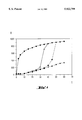
- FIG. 1 is a graph plotting the results of examples 1 through 4, according to the invention and comparison examples 1 through 5.
- FIG. 1 is a graph plotting the results of examples 1 through 4, according to the invention and comparison examples 1 through 5.
- T is temperature in ° C.
- One object of the present invention was to provide organopolysiloxane compositions which can be crosslinked to flame-resistant elastomers and the disadvantages which occur in the prior art are avoided in the event of a fire.
- a further object was to provide organopolysiloxane compositions which can be crosslinked to flame-resistant elastomers and in which the intrinsic color should be as light as possible, and with which elastomers are obtained which, in the event of a fire, increase their volume by foaming, where the foam should be as mechanically stable as possible, and should seal the joints as tightly as possible and have a thermal insulation action which should delay an increase in temperature on the reverse of the component facing the fire for as long as possible.
- the object is achieved by the invention.
- boron compounds are boron carbide, zinc boride, aluminum boride, titanium boride and calcium boride.
- One type of boron compound can be used, however it is possible to use a mixture of at least two boron compounds.
- the predominant content of the non-reinforcing fillers having a specific BET surface area of less than 50 m 2 /g, must be stable at the fire temperatures which usually occur, so that there is no decomposition with loss in volume or a destabilization of the organopolysiloxane matrix owing to the formation of undesirable reaction products.
- Unsuitable fillers are calcium sulfate and hydrated oxides of aluminum or magnesium, in which case undesirable reaction products are water in the form of steam and also alkaline oxides, which are formed during the decomposition.
- a content of calcium carbonate or calcium-magnesium carbonate, which split off carbon dioxide with a loss in volume, of up to 25% by weight of the total amount of non-reinforcing fillers is possible.
- non-reinforcing fillers which are used are only those which are heat-stable up to 1200° C.
- non-reinforcing fillers which are heat-stable up to 1200° C. are naturally occurring and synthetic silicon dioxides, such as diatomaceous earth, amorphous and crystalline quartzes, silicates, such as mica, kaolin, talcs and perlites, silicatic fillers and naturally occurring and precipitated barium sulfate.
- silicon dioxides such as diatomaceous earth, amorphous and crystalline quartzes
- silicates such as mica, kaolin, talcs and perlites
- silicatic fillers and naturally occurring and precipitated barium sulfate.
- One type of filler can be used, however it is possible to use a mixture of at least two fillers.
- organopolysiloxane compositions As a result of the thermal decomposition of organopolysiloxane compositions from a temperature of about 400° C., gaseous low molecular weight organosilicon compounds form, which lead to expansion of the silicone elastomers when they escape. Without the additions according to the invention, the organopolysiloxane matrix would decompose completely in the course of the fire. As a result of the additions according to the invention, a solid, foam-like residue is formed. The silicon dioxide formed during thermal decomposition of the organopolysiloxane and the additions according to the invention sinter to form a mechanically resistant foam. The low molecular weight compounds which form during decomposition of the organopolysiloxane act as blowing agents.
- this foam-like residue also shows an improved insulating action with respect to non-foaming joint compositions, and can be subjected to mechanical stress, in contrast to non-foaming joint compositions, which decompose to form a pulverulent residue which cannot be subjected to mechanical stress.
- a loss in volume and cracking in the remaining joint compositions are avoided, so that no fire gases reach the reverse of the sealed-off structural components and spreading of the fire is therefore avoided.
- organopolysiloxane compositions which comprise the additions according to the invention include so-called condensation-crosslinking 1-component compositions and 2-component compositions and addition-crosslinking 2-component compositions based on organopolysiloxanes.
- organopolysiloxane compositions without the additions according to the invention are the same organopolysiloxane compositions which have been possible to use for the organopolysiloxane compositions known to date which can be crosslinked to flame-resistant elastomers.
- the organopolysiloxanes in the compositions according to the invention can be any desired organopolysiloxanes which have been present in the organopolysiloxane compositions known to date which can be crosslinked to flame-resistant elastomers.
- condensation-crosslinking compositions are preferably organopolysiloxanes which contain end groups which are capable of condensation, of the formula
- R is identical or different monovalent, optionally substituted hydrocarbon radicals having 1 to 18 carbon atoms per radical
- X is a hydroxyl group
- n is an integer of at least 10.
- hydroxyl groups X in above mentioned formula (I) can be replaced by other groups which are capable of condensation, such as alkoxy groups having 1 to 4 carbon atoms per group.
- the addition-crosslinking compositions are preferably organopolysiloxanes which contain aliphatic carbon--carbon multiple bonds, of the formula
- R 1 is identical or different, monovalent, optionally substituted hydrocarbon radicals having 1 to 18 carbon atoms per radical,
- Y is a monovalent hydrocarbon radical with an aliphatic carbon--carbon multiple bond, preferably an alkenyl radical, more preferably a vinyl or hexenyl radical, and
- a 0 or 1
- b is an integer having a value from 20 to 10,000 and
- c is 0 or an integer having a value from 1 to 300.
- siloxane units R 2 SiO can also be present within or along the siloxane chain of the organopolysiloxanes of the above mentioned formulae (I) and (II) which is usually not shown by such formulae.
- examples of such other siloxane units, which are usually present only as an impurity, are those of the formulae R 2 SiO 3/2 , R 3 SiO 1/2 and SiO 4/2 , where R has the meaning given above for this radical.
- organopolysiloxane or several types of organopolysiloxanes can be used.
- the organopolysiloxanes have a viscosity of 1000 to 300,000 mPa•s at 25° C., preferably 6000 to 300,000 mPa•s at 25° C., and more preferably 20,000 to 300,000 mPa•s at 25° C.
- radicals R are alkyl radicals, such as the methyl, ethyl, n-propyl, iso-propyl, n-butyl, iso-butyl, tert-butyl, n-pentyl, iso-pentyl, neo-pentyl and tert-pentyl radical; hexyl radicals, such as the n-hexyl radical; heptyl radicals, such as the n-heptyl radical; octyl radicals, such as the n-octyl radical and iso-octyl radicals, such as the 2,2,4-trimethylpentyl radical; nonyl radicals, such as the n-nonyl radical; decyl radicals, such as the n-decyl radical; dodecyl radicals, such as the n-dodecyl radical; and octadecyl radicals
- substituted radicals R are cyanoalkyl radicals, such as the ⁇ -cyanoethyl radical, and halogenated hydrocarbon radicals, for example haloalkyl radicals, such as the 3,3,3-trifluoro-n-propyl radical, the 2,2,2,2',2',2'-hexafluoro-isopropyl radical and the heptafluoroisopropyl radical, and haloaryl radicals, such as the o-, m- and p-chlorophenyl radical.
- haloalkyl radicals such as the 3,3,3-trifluoro-n-propyl radical, the 2,2,2,2',2',2'-hexafluoro-isopropyl radical and the heptafluoroisopropyl radical
- haloaryl radicals such as the o-, m- and p-chlorophenyl radical.
- radicals R also apply to the radicals R 1 .
- substituted radicals R apply in their full scope to substituted radicals R 1 .
- At least 50%, preferably at least 90%, of the number of radicals R and R 1 in the organopolysiloxanes are preferably methyl radicals.
- Crosslinking agents which are used for crosslinking the condensation-crosslinking organopolysiloxanes are preferably moisture-sensitive silanes of the formula
- x is 0 or 1
- Z is identical or different hydrolyzable groups chosen from the group consisting of
- R 3 is a monovalent hydrocarbon radical having 1 to 4 carbon atoms
- R 4 is hydrogen or identical or different, monovalent hydrocarbon radicals having 1 to 12 carbon atoms and
- A is identical or different radicals of the formula
- R 5 is identical or different, monovalent hydrocarbon radicals having 1 to 5 carbon atoms per radical and
- R 6 is a divalent hydrocarbon radical having 5 to 6 carbon atoms per radical.
- acyloxy groups are acetoxy and formyloxy groups and 2-ethyl-hexanoyloxy groups.
- hydrocarbonoxy groups are methoxy, ethoxy, n-propyloxy, isopropyloxy and n-butyloxy groups.
- substituted hydrocarbonoxy groups are hydrocarbonoxy groups which are substituted by alkoxy groups, such as methoxyethylenoxy, ethoxyethylenoxy and methoxyisopropylenoxy groups.
- amino groups are n-butylamino, sec-butylamino and cyclohexylamino groups.
- oxime groups are methyl ethyl ketoxime groups, methyl isobutyl ketoxime groups, methyl n-amyl ketoxime groups and dimethyl ketoxime groups.
- amide groups are N-methylbenzamido groups and N-methyl-acetamido groups.
- aminoxy group is the hydroxylamine group.
- An example of an enoxy group is the isoptenoxy group.
- the hardener component is admixed immediately before use.
- This hardener component is preferably a tetraalkoxysilane, preferably tetraethyl or tetrapropyl silicate.
- Crosslinking catalysts which are used in the condensation-crosslinking 1- and 2-component compositions are the condensation catalysts known to the expert.
- condensation catalysts are butyl titanates and organic tin compounds, such as di-n-butyltin diacetate, di-n-butyltin dilaurate and reaction products of a silane containing, per molecule, as hydrolyzable groups, at least two monovalent hydrocarbon radicals which are bonded to silicon via oxygen and are optionally substituted by an alkoxy group, or an oligomer thereof, with diorganotin diacylate, all the valencies of the tin atoms in these readion products being satisfied by oxygen atoms of the grouping .tbd.SiOSn.tbd. or by SnC-bonded, monovalent organic radicals.
- the preparation of such reaction products is described in detail in U.S. Pat. No. 4,460,761 (issued Jul. 17, 1984, A. Schiller et al., Wacker-Chemie GmbH).
- organopolysiloxanes containing Si-bonded hydrogen atoms are used as the crosslinking agent. They are preferably of the formula
- R 1 has the meaning given above
- d 0 or 1
- e is 0 or an integer having a value from 1 to 500 and
- f is an integer having a value from 1 to 200
- the hardener component is admixed immediately before use.
- Crosslinking catalysts which are used in the case of addition crosslinking are platinum metals and/or compounds thereof, preferably platinum and/or compounds thereof. All the catalysts which have been used to date for addition of hydrogen atoms bonded directly to Si atoms onto aliphatically unsaturated compounds can be used.
- platinum halides for example PtCl 4 , H 2 PtCl 6 *6H 2 O, Na 2 PtCl 4 *4H 2 O, platinum-olefin complexes, platinum-alcohol complexes, platinum-alcoholate complexes, platinum-ether complexes, platinum-aldehyde complexes, platinum-ketone complexes, including reaction products of H 2 PtCl 6 *6H 2 O and cyclohexanone, platinum-vinylsiloxane complexes, in particular platinum-divinyltetramethyldisiloxane complexes with or without a content of detectable organically bonded halogen, bis(gamma-picoline)platinum dichloride, trimethylene-dipyridineplatinum dichloride, dicyclopentadiene-platinum
- compositions according to the invention can optionally comprise further substances, such as reinforcing fillers, plasticizers, such as dimethylpolysiloxanes or methylphenylpolysiloxanes which are blocked on the ends by trimethylsiloxy groups and have a viscosity of 10 to 5000 mPa•s at 25° C., preferably 35 to 1000 mPa•s at 25° C., adhesion promoters, such as organofunctional silanes or siloxanes, for example aminofunctional silanes or siloxanes, dispersing auxiliaries, pigments, fungicides and rheological additives.
- plasticizers such as dimethylpolysiloxanes or methylphenylpolysiloxanes which are blocked on the ends by trimethylsiloxy groups and have a viscosity of 10 to 5000 mPa•s at 25° C., preferably 35 to 1000 mPa•s at 25° C.
- adhesion promoters such as
- reinforcing fillers having a specific BET surface area of at least 50 m 2 /g, are pyrogenically produced silicon dioxides and precipitated silicon dioxides.
- the reinforcing fillers can be hydrophobized by treatment with agents which render them hydrophobic, such as by treatment with stearic acid or by treatment with organosilanes, -silazanes or -siloxanes.
- One type of filler can be used, but it is also possible to use a mixture of at least two fillers.
- organopolysiloxane compositions which comprise the additions according to the invention are built up as follows:
- organopolysiloxane compositions according to the invention which can be cross to flame-resistant elastomers can be used for all purposes for which organo-polysiloxanes which can be crosslinked to flame-resistant elastomers can be used, for example as joint-sealing compositions between structural components in structural and civil engineering, as a sealing composition for glazing and as sealing and embedding compositions for cable or pipe conduits through non-combustible building materials.
- plasticizer dimethylpolysiloxane containing trimethylsiloxy groups, not capable of crosslinking, viscosity of 100 mPa•s at 25° C.
- the finished composition is pale gray and can be colored in various desired shades, optionally, by suitable pigments.
- This non-sag consistency mixture is stored in commercially available cartridges with exclusion of moisture.
- the preferred use is sealing of vertical joints in buildings or ceiling joints into which the material is applied overhead.
- the composition is introduced as a 12 ⁇ 12 mm wide and 500 mm long joint between 2 blocks of lightweight concrete with a circular cord of suitable material (for example closed-cell, foamed polyethylene, ceramic fibers or the like) as back-filling material, and is cured under standard climatic conditions.
- suitable material for example closed-cell, foamed polyethylene, ceramic fibers or the like
- the specimens are subjected to a burning test in a small burning furnace, such as is described in DIN 4102, part 8, in accordance with the standard burning curve according to DIN 4102, part 2.
- the temperature evolution in the burning space and on the reverse of the joint is recorded with 3 thermocouples.
- the temperatures on the reverse of the joint which are stated in Table 1, and the values on which FIG. 1 is based are the means of 2 measuring elements.
- a temperature difference between the theoretical temperature of the furnace space and the reverse of the joint is a measure of the thermal insulation action of the decomposed joint composition.
- the appearance of the joint and the consistency of the joint composition are evaluated after a burning test for 60 minutes. The results are stated in Table 1 and FIG. 1.
- Example 2 The same constituents as in Example 1, but without boron carbide, are mixed and subjected to testing.
- Example 2 The same constituents as in Example 1, but with naturally occurring, ground calcium carbonate (Omya BLR3 from Omya, Cologne) instead of the aluminum silicate (calcined kaolin), are mixed and subjected to testing.
- ground calcium carbonate Omya BLR3 from Omya, Cologne
- aluminum silicate calcined kaolin
- Example 2 The same constituents as in Example 1, but with hydrated aluminum oxide treated with organosilane on the surface (Maratinal OL from Martinswerke, Bergheim) instead of the aluminum silicate (calcined kaolin), are mixed and subjected to testing.
- quartz flour ground, for example Sicron SF 600 from Quarzwerke GmbH, Frechen as a non-reinforcing filler
- This mixture is free-flowing and can be stored under normal conditions. Before use, 3% of a mixture of tetraethoxysilane and organotin catalyst is added for crosslinking and the components are mixed intensively. Free-flowing mixtures are preferred for sealing horizontal wall openings. Preparation of the test specimens for the burning experiment and the burning test are carried out analogously to Example 1.
- Example 2 The same constituents as in Example 2, but ground zirconium boride from Elektroschmelzwerke Kempten GmbH, Kunststoff is used instead of boron carbide, are mixed and subjected to testing.
- Example 2 The same constituents as in Example 2, but ground calcium boride from Elektroschmelzwerke Kempten GmbH, Kunststoff, is used instead of boron carbide, are mixed and subjected to testing.
- Example 2 The same constituents as in Example 2, but without boron carbide, are mixed and subjected to testing.
Landscapes
- Chemical & Material Sciences (AREA)
- Health & Medical Sciences (AREA)
- Chemical Kinetics & Catalysis (AREA)
- Medicinal Chemistry (AREA)
- Polymers & Plastics (AREA)
- Organic Chemistry (AREA)
- Compositions Of Macromolecular Compounds (AREA)
Abstract
The use is described of boron compounds chosen from the group consisting of boron carbide and metal borides mixed with non-reinforcing fillers, with the proviso that at least 75% by weight of the non-reinforcing fillers are heat-stable up to 1200 DEG C., as flameproofing agents in organopolysiloxane compositions which can be crosslinked to flame-resistant elastomers.
Description
According to U.S. Pat. No. 3,652,488 and the corresponding DE-C 20 34 919, flame resistance is obtained by addition of platinum and the flame-resistant characteristic is enhanced by addition of carbon black. As a result, these compositions are naturally black. The pale shades so often desired for joint-sealing compositions cannot be produced.
U.S. Pat. No. 3,821,140 and the corresponding DE-C 23 00 504 and U.S. Pat. No. 3,677,999 describe flame-resistant or self-extinguishing compositions which are prepared by addition of metal oxides or hydrates of metal oxides, such as hydrated aluminum oxide. At elevated temperatures in the course of a fire, water is split off from these products, and although this briefly reduces flammability, under the elevated temperatures which occur during a more prolonged fire it contributes toward destabilization of the dimethylpolysiloxane by hydrolysis. On dissociation, basic oxides, such as magnesium oxide or aluminum oxide, are formed from these hydrates of metal oxides, and intensify the decomposition under these conditions. The silicone matrix then disintegrates completely due to depolymerization. Combinations of metal oxides/hydrated metal oxides with graphite are known from U.S. Pat. No. 4,405,425 and corresponding EP-B 40 750.
According to DE-B 29 09 462 and DE-A 30 41 031, flame-resistant polysiloxane compositions are prepared by addition of halogenated diphenyl compounds, for example octabromodiphenyl ether. In the event of a fire however, polyhalogenated dibenzofurans or dibenzodioxins are formed from these products, and these are undesirable because of the known toxicological problems. The use of these products might therefore be possible to only a limited extent in future.
None of the above mentioned methods lead to products which increase in volume in the event of a fire and thus show a so-called intumescence effect According to U.S. Pat. No. 5,262,454 and corresponding DE-A 40 13 161 and U.S. Pat. No. 4,694,030 and corresponding DE-A 36 02 888, this can be achieved by addition of expandable graphite compounds and other additives, such as nitrogen-containing polyphosphates, or by hollow glass beads. However, because of the presence of graphite, the products are black and no pale shades can be produced. Furthermore, the surfaces of the silicone compositions are rough and unattractive due to the addition of the expandable graphite or the hollow glass beads, because these products are not available in the necessary small particle sizes (less than 20 μm).
Boron compounds are used in silicone compositions because of their neutron-absorbing action. The use of boron carbide for this purpose is known from U.S. Pat. No. 4,176,093.
The present invention relates to the use of boron compounds chosen from the group consisting of boron carbide and metal borides mixed with non-reinforcing fillers, with the proviso that at least 75% by weight of the non-reinforcing fillers are heat-stable up to 1200° C., as flameproofing agents in organopolysiloxane compositions which can be crosslinked to flame-resistant elastomers.
FIG. 1 is a graph plotting the results of examples 1 through 4, according to the invention and comparison examples 1 through 5. In FIG. 1
T is temperature in ° C.
t is duration of experiment in minutes
the theoretical temperature of the furnace
is examples 1, 2, 3 and 4
is Comparison Experiments 1, 2, 3 and 5
is Comparison Experiment 4
One object of the present invention was to provide organopolysiloxane compositions which can be crosslinked to flame-resistant elastomers and the disadvantages which occur in the prior art are avoided in the event of a fire. A further object was to provide organopolysiloxane compositions which can be crosslinked to flame-resistant elastomers and in which the intrinsic color should be as light as possible, and with which elastomers are obtained which, in the event of a fire, increase their volume by foaming, where the foam should be as mechanically stable as possible, and should seal the joints as tightly as possible and have a thermal insulation action which should delay an increase in temperature on the reverse of the component facing the fire for as long as possible. The object is achieved by the invention.
Examples of boron compounds are boron carbide, zinc boride, aluminum boride, titanium boride and calcium boride.
One type of boron compound can be used, however it is possible to use a mixture of at least two boron compounds.
The predominant content of the non-reinforcing fillers having a specific BET surface area of less than 50 m2 /g, must be stable at the fire temperatures which usually occur, so that there is no decomposition with loss in volume or a destabilization of the organopolysiloxane matrix owing to the formation of undesirable reaction products. Unsuitable fillers are calcium sulfate and hydrated oxides of aluminum or magnesium, in which case undesirable reaction products are water in the form of steam and also alkaline oxides, which are formed during the decomposition.
A content of calcium carbonate or calcium-magnesium carbonate, which split off carbon dioxide with a loss in volume, of up to 25% by weight of the total amount of non-reinforcing fillers is possible.
Preferably non-reinforcing fillers which are used are only those which are heat-stable up to 1200° C.
Examples of non-reinforcing fillers which are heat-stable up to 1200° C. are naturally occurring and synthetic silicon dioxides, such as diatomaceous earth, amorphous and crystalline quartzes, silicates, such as mica, kaolin, talcs and perlites, silicatic fillers and naturally occurring and precipitated barium sulfate. One type of filler can be used, however it is possible to use a mixture of at least two fillers.
As a result of the thermal decomposition of organopolysiloxane compositions from a temperature of about 400° C., gaseous low molecular weight organosilicon compounds form, which lead to expansion of the silicone elastomers when they escape. Without the additions according to the invention, the organopolysiloxane matrix would decompose completely in the course of the fire. As a result of the additions according to the invention, a solid, foam-like residue is formed. The silicon dioxide formed during thermal decomposition of the organopolysiloxane and the additions according to the invention sinter to form a mechanically resistant foam. The low molecular weight compounds which form during decomposition of the organopolysiloxane act as blowing agents. Additional blowing agents are not necessary. In the event of a fire, this foam-like residue also shows an improved insulating action with respect to non-foaming joint compositions, and can be subjected to mechanical stress, in contrast to non-foaming joint compositions, which decompose to form a pulverulent residue which cannot be subjected to mechanical stress. A loss in volume and cracking in the remaining joint compositions are avoided, so that no fire gases reach the reverse of the sealed-off structural components and spreading of the fire is therefore avoided.
The organopolysiloxane compositions which comprise the additions according to the invention include so-called condensation-crosslinking 1-component compositions and 2-component compositions and addition-crosslinking 2-component compositions based on organopolysiloxanes.
The organopolysiloxane compositions without the additions according to the invention are the same organopolysiloxane compositions which have been possible to use for the organopolysiloxane compositions known to date which can be crosslinked to flame-resistant elastomers.
The organopolysiloxanes in the compositions according to the invention can be any desired organopolysiloxanes which have been present in the organopolysiloxane compositions known to date which can be crosslinked to flame-resistant elastomers.
The condensation-crosslinking compositions are preferably organopolysiloxanes which contain end groups which are capable of condensation, of the formula
XR.sub.2 SiO(R.sub.2 SiO).sub.n SiR.sub.2 X (I)
in which
R is identical or different monovalent, optionally substituted hydrocarbon radicals having 1 to 18 carbon atoms per radical,
X is a hydroxyl group and
n is an integer of at least 10.
Optionally, all or some of the hydroxyl groups X in above mentioned formula (I) can be replaced by other groups which are capable of condensation, such as alkoxy groups having 1 to 4 carbon atoms per group.
The addition-crosslinking compositions are preferably organopolysiloxanes which contain aliphatic carbon--carbon multiple bonds, of the formula
Y.sub.a R.sup.1.sub.3-a SiO(R.sup.1.sub.2 SiO).sub.b (R.sup.1 YSiO).sub.c SiR.sup.1.sub.3-a Y.sub.a (II)
in which
R1 is identical or different, monovalent, optionally substituted hydrocarbon radicals having 1 to 18 carbon atoms per radical,
Y is a monovalent hydrocarbon radical with an aliphatic carbon--carbon multiple bond, preferably an alkenyl radical, more preferably a vinyl or hexenyl radical, and
a is 0 or 1,
b is an integer having a value from 20 to 10,000 and
c is 0 or an integer having a value from 1 to 300.
In addition to the diorganosiloxane units R2 SiO, other siloxane units can also be present within or along the siloxane chain of the organopolysiloxanes of the above mentioned formulae (I) and (II) which is usually not shown by such formulae. Examples of such other siloxane units, which are usually present only as an impurity, are those of the formulae R2 SiO3/2, R3 SiO1/2 and SiO4/2, where R has the meaning given above for this radical.
One type of organopolysiloxane or several types of organopolysiloxanes can be used.
The organopolysiloxanes have a viscosity of 1000 to 300,000 mPa•s at 25° C., preferably 6000 to 300,000 mPa•s at 25° C., and more preferably 20,000 to 300,000 mPa•s at 25° C.
Examples of radicals R are alkyl radicals, such as the methyl, ethyl, n-propyl, iso-propyl, n-butyl, iso-butyl, tert-butyl, n-pentyl, iso-pentyl, neo-pentyl and tert-pentyl radical; hexyl radicals, such as the n-hexyl radical; heptyl radicals, such as the n-heptyl radical; octyl radicals, such as the n-octyl radical and iso-octyl radicals, such as the 2,2,4-trimethylpentyl radical; nonyl radicals, such as the n-nonyl radical; decyl radicals, such as the n-decyl radical; dodecyl radicals, such as the n-dodecyl radical; and octadecyl radicals, such as the n-octadecyl radical; alkenyl radicals, such as the vinyl and the allyl radical; cycloalkyl radicals, such as cyclopentyl, cyclohexyl and cycloheptyl radicals and methylcyclohexyl radicals; aryl radicals, such as the phenyl, naphthyl, anthryl and phenanthryl radical; alkaryl radicals, such as o-, m- and p-tolyl radicals, xylyl radicals and ethylphenyl radicals; and aralkyl radicals, such as the benzyl radical and the α- and the β-phenylethyl radical.
Examples of substituted radicals R are cyanoalkyl radicals, such as the β-cyanoethyl radical, and halogenated hydrocarbon radicals, for example haloalkyl radicals, such as the 3,3,3-trifluoro-n-propyl radical, the 2,2,2,2',2',2'-hexafluoro-isopropyl radical and the heptafluoroisopropyl radical, and haloaryl radicals, such as the o-, m- and p-chlorophenyl radical.
With the exception of the alkenyl radicals, the examples of radicals R also apply to the radicals R1. Examples of substituted radicals R apply in their full scope to substituted radicals R1.
Because of easier accessibility alone, at least 50%, preferably at least 90%, of the number of radicals R and R1 in the organopolysiloxanes are preferably methyl radicals.
Crosslinking agents which are used for crosslinking the condensation-crosslinking organopolysiloxanes are preferably moisture-sensitive silanes of the formula
R.sub.x SiZ.sub.4-x (III)
and/or partial hydrolysates thereof, which preferably contain 2 to 10 silicon atoms,in which
R has the meaning given above,
x is 0 or 1 and
Z is identical or different hydrolyzable groups chosen from the group consisting of
acyloxy groups --OCOR2
optionally substituted hydroxycarbonoxy groups --OR3
amino groups --NR4 2
oxime groups --ON═A
amide groups ##STR1## aminoxy groups --O--NR4 2 enoxy groups ##STR2## in which R2 is a monovalent hydrocarbon radical having 1 to 12 carbon atoms,
R3 is a monovalent hydrocarbon radical having 1 to 4 carbon atoms,
R4 is hydrogen or identical or different, monovalent hydrocarbon radicals having 1 to 12 carbon atoms and
A is identical or different radicals of the formula
R.sup.5.sub.2 C═ or R.sup.6 C═
in which
R5 is identical or different, monovalent hydrocarbon radicals having 1 to 5 carbon atoms per radical and
R6 is a divalent hydrocarbon radical having 5 to 6 carbon atoms per radical.
Examples of acyloxy groups are acetoxy and formyloxy groups and 2-ethyl-hexanoyloxy groups.
Examples of hydrocarbonoxy groups are methoxy, ethoxy, n-propyloxy, isopropyloxy and n-butyloxy groups.
Examples of substituted hydrocarbonoxy groups are hydrocarbonoxy groups which are substituted by alkoxy groups, such as methoxyethylenoxy, ethoxyethylenoxy and methoxyisopropylenoxy groups.
Examples of amino groups are n-butylamino, sec-butylamino and cyclohexylamino groups.
Examples of oxime groups are methyl ethyl ketoxime groups, methyl isobutyl ketoxime groups, methyl n-amyl ketoxime groups and dimethyl ketoxime groups.
Examples of amide groups are N-methylbenzamido groups and N-methyl-acetamido groups.
An example of an aminoxy group is the hydroxylamine group.
An example of an enoxy group is the isoptenoxy group.
For the crosslinking of condensation-crosslinking 2-component compositions, the hardener component is admixed immediately before use. This hardener component is preferably a tetraalkoxysilane, preferably tetraethyl or tetrapropyl silicate.
Crosslinking catalysts which are used in the condensation-crosslinking 1- and 2-component compositions are the condensation catalysts known to the expert.
Examples of condensation catalysts are butyl titanates and organic tin compounds, such as di-n-butyltin diacetate, di-n-butyltin dilaurate and reaction products of a silane containing, per molecule, as hydrolyzable groups, at least two monovalent hydrocarbon radicals which are bonded to silicon via oxygen and are optionally substituted by an alkoxy group, or an oligomer thereof, with diorganotin diacylate, all the valencies of the tin atoms in these readion products being satisfied by oxygen atoms of the grouping .tbd.SiOSn.tbd. or by SnC-bonded, monovalent organic radicals. The preparation of such reaction products is described in detail in U.S. Pat. No. 4,460,761 (issued Jul. 17, 1984, A. Schiller et al., Wacker-Chemie GmbH).
After application of the organopolysiloxane compositions, crosslinking to silicone elastomers takes place by access of atmospheric moisture.
In the case of addition-crosslinking 2-component compositions, organopolysiloxanes containing Si-bonded hydrogen atoms are used as the crosslinking agent. They are preferably of the formula
H.sub.d R.sup.1.sub.3-d SiO(R.sup.1.sub.2 SiO).sub.e (R.sup.1 HSiO).sub.f SiR.sup.1.sub.3-d H.sub.d
in which
R1 has the meaning given above,
d is 0 or 1,
e is 0 or an integer having a value from 1 to 500 and
f is an integer having a value from 1 to 200,
with the proviso that on average at least 3 Si-bonded hydrogen atoms are present per molecule.
The hardener component is admixed immediately before use.
Crosslinking catalysts which are used in the case of addition crosslinking are platinum metals and/or compounds thereof, preferably platinum and/or compounds thereof. All the catalysts which have been used to date for addition of hydrogen atoms bonded directly to Si atoms onto aliphatically unsaturated compounds can be used. Examples of such catalysts are metallic and finely divided platinum, which can be on supports, such as silicon dioxide, aluminum oxide or active charcoal, and compounds or complexes of platinum, such as platinum halides, for example PtCl4, H2 PtCl6 *6H2 O, Na2 PtCl4 *4H2 O, platinum-olefin complexes, platinum-alcohol complexes, platinum-alcoholate complexes, platinum-ether complexes, platinum-aldehyde complexes, platinum-ketone complexes, including reaction products of H2 PtCl6 *6H2 O and cyclohexanone, platinum-vinylsiloxane complexes, in particular platinum-divinyltetramethyldisiloxane complexes with or without a content of detectable organically bonded halogen, bis(gamma-picoline)platinum dichloride, trimethylene-dipyridineplatinum dichloride, dicyclopentadiene-platinum dichloride, dimethylsulfoxide-ethylene-platinum(II) dichloride and reaction products of platinum tetrachloride with olefin and primary amine or secondary amine or primary and secondary amine, such as the reaction product of platinum tetrachloride, dissolved in 1-octene, with sec-butylamine, or ammonium-platinum complexes according to EP-B 110 370.
In addition to the organopolysiloxanes, crosslinking agents and crosslinking catalysts, the compositions according to the invention can optionally comprise further substances, such as reinforcing fillers, plasticizers, such as dimethylpolysiloxanes or methylphenylpolysiloxanes which are blocked on the ends by trimethylsiloxy groups and have a viscosity of 10 to 5000 mPa•s at 25° C., preferably 35 to 1000 mPa•s at 25° C., adhesion promoters, such as organofunctional silanes or siloxanes, for example aminofunctional silanes or siloxanes, dispersing auxiliaries, pigments, fungicides and rheological additives.
Examples of reinforcing fillers having a specific BET surface area of at least 50 m2 /g, are pyrogenically produced silicon dioxides and precipitated silicon dioxides. The reinforcing fillers, like the non-reinforcing fillers, can be hydrophobized by treatment with agents which render them hydrophobic, such as by treatment with stearic acid or by treatment with organosilanes, -silazanes or -siloxanes. One type of filler can be used, but it is also possible to use a mixture of at least two fillers.
The organopolysiloxane compositions which comprise the additions according to the invention are built up as follows:
(a) 10% to 80% by weight, preferably 20% to 70% by weight, of organopolysiloxane which is capable of crosslinking
(b) 0% to 40% by weight, preferably 10% to 30% by weight, of plasticizer which is not capable of crosslinking
(c) 0.5% to 15% by weight, preferably 3% to 10% by weight, of crosslinking agent
(d) 0% to 50% by weight, preferably 3% to 10% by weight, of reinforcing filler
(e) 10% to 50% by weight, preferably 20% to 40% by weight, of non-reinforcing filler
(f) 0% to 10% by weight, preferably 1% to 3% by weight, of pigments
(g) 0% to 2% by weight, preferably 0.01% to 1.0% by weight, of catalyst
(h) 0% to 10% by weight, preferably 0.1% to 3% by weight, of adhesion promoter and
(i) 0.1% to 20% by weight, preferably 0.1% to 3% by weight, of boron compound,
where the sum of the constituents must be 100% by weight.
The organopolysiloxane compositions according to the invention which can be cross to flame-resistant elastomers can be used for all purposes for which organo-polysiloxanes which can be crosslinked to flame-resistant elastomers can be used, for example as joint-sealing compositions between structural components in structural and civil engineering, as a sealing composition for glazing and as sealing and embedding compositions for cable or pipe conduits through non-combustible building materials.
In the following examples, all percentage data relate to the weight unless stated otherwise.
The following constituents are brought together in succession in a suitable mixer:
30% of a,ω-dihydroxydimethylpolysiloxane, capable of crosslinking, viscosity of 80,000 mPa•s at 25° C.
19.9% of plasticizer, dimethylpolysiloxane containing trimethylsiloxy groups, not capable of crosslinking, viscosity of 100 mPa•s at 25° C.
6% of methyltrisbutanoneoximosilane as a crosslinking agent
3% of pyrogenic silicon dioxide acid having a specific surface area of about 150 m2 /g, for example HDK V 15 from Wacker-Chemie GmbH, Munich, as a reinforcing filler
38% of calcined kaolin, for example Icecap K from Burgess Pigment Company, USA, as a non-reinforcing filler
2% of γ-aminopropyltriethoxysilane as an adhesion promoter
1% of ground boron carbide from Elektroschmelzwerke Kempten GmbH, Munich, as an additive according to the invention
0.1% of organotin catalyst for the crosslinking.
The finished composition is pale gray and can be colored in various desired shades, optionally, by suitable pigments. This non-sag consistency mixture is stored in commercially available cartridges with exclusion of moisture. The preferred use is sealing of vertical joints in buildings or ceiling joints into which the material is applied overhead.
For fire testing, the composition is introduced as a 12×12 mm wide and 500 mm long joint between 2 blocks of lightweight concrete with a circular cord of suitable material (for example closed-cell, foamed polyethylene, ceramic fibers or the like) as back-filling material, and is cured under standard climatic conditions. After initial storage for four weeks, the specimens are subjected to a burning test in a small burning furnace, such as is described in DIN 4102, part 8, in accordance with the standard burning curve according to DIN 4102, part 2. The temperature evolution in the burning space and on the reverse of the joint is recorded with 3 thermocouples. The temperatures on the reverse of the joint which are stated in Table 1, and the values on which FIG. 1 is based are the means of 2 measuring elements.
A temperature difference between the theoretical temperature of the furnace space and the reverse of the joint is a measure of the thermal insulation action of the decomposed joint composition. The appearance of the joint and the consistency of the joint composition are evaluated after a burning test for 60 minutes. The results are stated in Table 1 and FIG. 1.
The same constituents as in Example 1, but without boron carbide, are mixed and subjected to testing.
The same constituents as in Example 1, but with naturally occurring, ground calcium carbonate (Omya BLR3 from Omya, Cologne) instead of the aluminum silicate (calcined kaolin), are mixed and subjected to testing.
The same constituents as in Comparison Experiment 2, but without boron carbide, are mixed and subjected to testing.
The same constituents as in Example 1, but with hydrated aluminum oxide treated with organosilane on the surface (Maratinal OL from Martinswerke, Bergheim) instead of the aluminum silicate (calcined kaolin), are mixed and subjected to testing.
The following recipe constituents are brought together in succession in a suitable mixer:
66% of a,ω-dihydroxydimethylsiloxane, capable of crosslinking, viscosity of 12,000 mPa•s at 25° C.
33% of quartz flour, ground, for example Sicron SF 600 from Quarzwerke GmbH, Frechen as a non-reinforcing filler
1% of boron carbide analogous to Example 1.
This mixture is free-flowing and can be stored under normal conditions. Before use, 3% of a mixture of tetraethoxysilane and organotin catalyst is added for crosslinking and the components are mixed intensively. Free-flowing mixtures are preferred for sealing horizontal wall openings. Preparation of the test specimens for the burning experiment and the burning test are carried out analogously to Example 1.
The same constituents as in Example 2, but ground zirconium boride from Elektroschmelzwerke Kempten GmbH, Munich is used instead of boron carbide, are mixed and subjected to testing.
The same constituents as in Example 2, but ground calcium boride from Elektroschmelzwerke Kempten GmbH, Munich, is used instead of boron carbide, are mixed and subjected to testing.
The same constituents as in Example 2, but without boron carbide, are mixed and subjected to testing.
              TABLE 1
______________________________________
         Evaluation
                   Temperature
         after     after
Experiment
         60 minutes
                   60 minutes
                             Comments
______________________________________
Example 1
         Joint perfect
                   331° C.
                             Formation of a solid foam-
                             like material due to an
                             increase in volume on the
                             surface, no emergence of
                             fire gases on the reverse of
                             the joint
Comparison
         Joint has a
                   925° C.*)
                             No increase in volume,
Experiment 1
         few trans-          material is soft, fire gases
         verse cracks        emerge through the cracks
Comparison
         Joint has 925° C.*)
                             Decrease in volume due to
Experiment 2
         many trans-         decomposition, material is
         verse cracks        soft, fire gases emerge
                             through the cracks
Comparison
         Joint has 925° C.*)
                             Decrease in volume due to
Experiment 3
         many trans-         decomposition, material is
         verse cracks        very soft, fire gases emerge
                             through the cracks
Comparison
         No joint  925° C.*)
                             The joint material has de-
Experiment 4
         material            composed completely, fire
         remaining           gases emerge through
                             numerous cracks after about
                             35 minutes
Example 2
         Joint perfect
                   335° C.
                             Formation of a solid foam-
                             like material due to an
                             increase in volume on the
                             surface, no emergence of
                             fire gases on the reverse of
                             the joint
Example 3
         Joint perfect
                   342° C.
                             Formation of a solid foam-
                             like material due to an
                             increase in volume on the
                             surface, no emergence of
                             fire gases on the reverse of
                             the joint
Example 4
         Joint perfect
                   338° C.
                             Formation of a solid foam-
                             like material due to an
                             increase in volume on the
                             surface, no emergence of
                             fire gases on the reverse of
                             the joint
Comparison
         Joint has a
                   925° C.*)
                             No increase in volume,
Experiment 5
         few trans-          material is soft, fire gases
         verse cracks        emerge through the cracks
______________________________________
 *)As a result of the transverse cracks which have occurred and the
 resulting emergence of the fire gases on the reverse of the joint during
 fire testing, the theoretical temperature of the furnace interior and the
 reverse of the joint at the end of the experiment after 60 minutes are th
 same.
Claims (19)
1. A method of preparing a flame-resistant silicone elastomer by crosslinking a condensation-crosslinking composition containing an organopolysiloxane bearing silicon-bonded hydroxy groups, C1-4 alkoxy groups, or mixtures thereof as condensation-crosslinkable groups; with a crosslinking agent reactive therewith, the composition further containing a boron compound selected from the group consisting of boron carbide, metal borides, and mixtures thereof, and a non-reinforcing filler of which at least 75 weight percent is heat-stable at temperatures up to 1200° C., and optionally a plasticizer which is not capable of crosslinking.
2. The method of claim 1, wherein said elastomer is a non-foam elastomer which foams to a mechanically stable foam upon exposure to fire.
3. The method of claim 1, wherein said boron carbide and metal boride are in the form of ground solids.
4. The method of claim 1, wherein said organopolysiloxane bearing silicon-bonded hydroxy or C1-4 alkoxy groups or mixtures thereof comprises one or more organopolysiloxanes of the formula:
XR.sub.2 SiO(R.sub.2 SiO).sub.n SiR.sub.2 X (I)
in which
R is identical or different, monovalent, optionally substituted hydrocarbon radicals having 1 to 18 carbon atoms per radical,
x independently is a hydroxyl group or a C1-4 alkoxy group
n is an integer of at least 10.
5. The method of claim 1, wherein said crosslinking agent comprises one or more of
a) a tetraalkoxysilane; or
b) a silane of the formula
R.sub.x SiZ.sub.4-x
or partial hydrolysates thereof, wherein
R is identical or different, monovalent, optionally substituted hydrocarbon radicals having 1 to 18 carbon atoms per radical,
x is 0 or 1 and
Z is an identical or different hydrolyzable group selected from the group consisting of
acyloxy groups --OCOR2
optionally substituted hydroxycarbonoxy groups --OR3
amino groups --NR4 2
oxime groups --ON═A
amide groups ##STR3## aminoxy groups --O--NR4 2 enoxy groups ##STR4## in which R2 is a monovalent hydrocarbon radical having 1 to 12 carbon atoms,
R3 is a monovalent hydrocarbon radical having 1 to 4 carbon atoms,
R4 is a hydrogen or identical or different, monovalent hydrocarbon radicals having 1 to 12 carbon atoms and
A is identical or different radicals of the formula
R.sup.5.sub.2 C═ or R.sup.6 C═
in which
R5 is identical or different, monovalent hydrocarbon radicals having 1 to 5 carbon atoms per radical and
R6 is a divalent hydrocarbon radical having 5 to 6 carbon atoms per radical.
6. The method of claim 1, wherein said condensation-crosslinking composition further comprises a condensation catalyst.
7. The method of claim 1, wherein said elastomer, prior to crosslinking, contains, based on percent by weight of the total composition,
10% to 80% crosslinkable organopolysiloxane;
10% to 30% plasticizer which is not capable of crosslinking;
0.5% to 15% of crosslinking agent; and
0.1 to 20% by weight of boron compound.
8. The method of claim 1, wherein a plasticizer is present, the plasticizer comprising trimethylsiloxy-terminated polydimethylsiloxanes or trimethylsiloxy-terminated polymethylphenylsiloxanes.
9. A method for preparing organopolysiloxane compositions which when crosslinked form flame-resistant non-foam elastomers comprising:
adding to the organopolysiloxane which is crosslinkable to form elastomers, 0.1 to 3 weight percent, based on the total weight of the elastomer, of one or more boron compounds selected from the group consisting of boron carbide and a metal boride, and a non-reinforcing filler, with the proviso that at least 75% by weight of the non-reinforcing filler is heat-stable at temperatures of up to 1200° C.
10. The method of claim 9, said method further comprising adding a plasticizer which is non-crosslinkable.
11. The method of claim 10, wherein the plasticizer comprises trimethylsiloxy-terminated polydimethylsiloxanes and trimethylsiloxy-terminated polymethylphenylsiloxanes.
12. A method for preparing organopolysiloxane compositions which when crosslinked form flame-resistant non-foam elastomers comprising:
adding to the organopolysiloxane which is crosslinkable to form elastomers, from 0.1 to 3 weight percent, based on the total weight of the elastomer, of one or more boron compounds selected from the group consisting of boron carbide and a metal boride, and a non-reinforcing filler, with the proviso that at least 75% by weight of the non-reinforcing filler is heat-stable at temperatures of up to 1200° C., said boron compounds being in the form of ground solids.
13. The method of claim 12, said method further comprising adding a plasticizer which is non-crosslinkable.
14. The method of claim 12, wherein the plasticizer is one or more of trimethylsiloxy-terminated polydimethylsiloxanes and trimethylsiloxy-terminated polymethylphenylsiloxanes.
15. A method for preparing addition-crosslinkable organopolysiloxane compositions which when crosslinked form flame-resistant non-foam elastomers, comprising:
adding, to a composition containing organopolysiloxanes crosslinkable to form elastomers, one or more boron compounds selected from the group consisting of boron carbide and a metal boride, and a non-reinforcing filler, wherein at least 75% by weight of the non-reinforcing filler is heat-stable at temperatures of up to 1200° C., said composition optionally containing reinforcing fillers, plasticizers, adhesion promoters, dispersing auxiliaries, pigments, fungicides, and rheological additives,
with the proviso that said organopolysiloxane which is crosslinkable consists essentially of:
a) organopolysiloxanes which contain aliphatic carbon--carbon multiple bonds of the formula:
Y.sub.a R.sup.1.sub.3-a SiO(R.sup.1.sub.2 SiO).sub.b (R.sup.1 YSiO).sub.c SiR.sup.1.sub.3-a Y.sub.a (II)
in which
R1 is identical or different, monovalent, optionally substituted hydrocarbon radicals having 1 to 18 carbon atoms per radical,
Y is a monovalent hydrocarbon radical with an aliphatic carbon--carbon multiple bond,
a is 0 or 1,
b is an integer having a value from 20 to 10,000,
c is 0 or an integer having a value from 1 to 300,
the organopolysiloxane (II) optionally containing siloxane units of the formulae R1 SiO3/2, R1 3 SiO1/2, and SiO4/2 ; and
b) organopolysiloxanes bearing silicon bonded hydrogen, of the formula:
H.sub.d R.sup.1.sub.3-d SiO(R.sup.1.sub.2 SiO).sub.e (R.sup.1 HSiO).sub.f SiR.sup.1.sub.3-d H.sub.d
in which
R1 has the meaning given above,
d is 0 or 1,
e is 0 or an integer having a value from 1 to 500 and
f is an integer having a value from 1 to 200.
16. A flame-resistant elastomer, consisting of the reaction product of:
a) 10% to 80% by weight of an organopolysiloxane which is capable of condensation-crosslinking;
b) 0% to 40% by weight of a plasticizer which is not capable of crosslinking;
c) 0.5% to 15% by weight of a condensation crosslinking agent;
d) 0% to 50% by weight of a reinforcing filler;
e) 10% to 50% by weight of a non-reinforcing filler;
f) 0% to 10% by weight of a pigment;
g) 0% to 2% by weight of a catalyst capable of promoting crosslinking;
h) 0% to 10% by weight of an adhesion promoter; and
i) 0.1% to 3% by weight of one or more boron compounds selected from the group consisting of boron carbide and metal borides.
17. The flame-resistant elastomer of claim 16, consisting of the reaction product of:
a) 20% to 70% by weight of an organopolysiloxane which is capable of condensation crosslinking;
b) 10% to 30% by weight of a plasticizer which is not capable of crosslinking;
c) 3% to 10% by weight of a condensation crosslinking agent;
d) 3% to 10% by weight of a reinforcing filler;
e) 20% to 40% by weight of a non-reinforcing filler;
f) 0% to 10% by weight of a pigment;
g) 0% to 2% by weight of a catalyst capable of promoting crosslinking;
h) 0% to 10% by weight of an adhesion promoter; and
i) 0.1% to 3% by weight of one or more boron compounds selected from the group consisting of boron carbide and metal borides.
18. A flame-resistant elastomer, consisting of the reaction product of:
a) 20% to 70% by weight of an organopolysiloxane which is capable of addition-crosslinking;
b) 10% to 30% by weight of a plasticizer which is not capable of crosslinking;
c) 3% to 10% by weight of a crosslinking agent;
d) 3% to 10% by weight of a reinforcing filler;
e) 20% to 40% by weight of a non-reinforcing filler;
f) 0% to 10% by weight of a pigment;
g) 0% to 2% by weight of a catalyst capable of promoting crosslinking;
h) 0% to 10% by weight of an adhesion promoter; and
i) 0.1% to 3% by weight of one or more boron compounds selected from the group consisting of boron carbide and metal borides.
19. A flame-resistant crosslinked, non-foam organopolysiloxane elastomer containing one or more boron compounds selected from the group consisting of boron carbide and metal borides, and a non-reinforcing filler of which 75 weight percent is heat-stable at temperatures up to 1200° C., said elastomer further characterized by foaming into a mechanically stable foam when exposed to fire.
Applications Claiming Priority (2)
| Application Number | Priority Date | Filing Date | Title |
|---|---|---|---|
| DE19620816A DE19620816A1 (en) | 1996-05-23 | 1996-05-23 | Crosslinkable organopolysiloxane compositions to be flame-resistant elastomers |
| DE19620816 | 1996-05-23 |
Publications (1)
| Publication Number | Publication Date |
|---|---|
| US5922799A true US5922799A (en) | 1999-07-13 |
Family
ID=7795144
Family Applications (1)
| Application Number | Title | Priority Date | Filing Date |
|---|---|---|---|
| US08/805,088 Expired - Fee Related US5922799A (en) | 1996-05-23 | 1997-02-24 | Organopolysiloxane compositions which can be crosslinked to give flame-resistant elastomers |
Country Status (6)
| Country | Link |
|---|---|
| US (1) | US5922799A (en) |
| EP (1) | EP0808867A1 (en) |
| JP (1) | JPH1081823A (en) |
| KR (1) | KR100235543B1 (en) |
| CA (1) | CA2200942C (en) |
| DE (1) | DE19620816A1 (en) |
Cited By (7)
| Publication number | Priority date | Publication date | Assignee | Title |
|---|---|---|---|---|
| US6582825B2 (en) | 1999-12-27 | 2003-06-24 | General Electric Company | Hydrophobicity imparting particulate |
| US20070190872A1 (en) * | 2006-02-16 | 2007-08-16 | Weber Robert F | Fire retardant silicone textile coating |
| US20090301750A1 (en) * | 2006-04-12 | 2009-12-10 | Bluestar Silicones France | Hot-vulcanizable polyorganosiloxane compositions useful particularly for manufacturing electrical cables or wires |
| CN102220008A (en) * | 2011-05-10 | 2011-10-19 | 嘉兴多角电线电缆有限公司 | High-intensity fire-proof cable insulating material and preparation method of high-intensity fire-proof cable insulating material |
| US20150008227A1 (en) * | 2012-02-28 | 2015-01-08 | Commissariat A L'energie Atomique Et Aux Energies Alternatives | Fire protection material, high-pressure storage tank coated with said material, methods for preparing same, and uses thereof |
| WO2020231603A1 (en) | 2019-05-16 | 2020-11-19 | Dow Global Technologies Llc | Compatibilized blends of terephalate ester polyols and hydrocarbon blowing agents |
| US20250026113A1 (en) * | 2021-12-16 | 2025-01-23 | Dow Silicones Corporation | Laminate barrier with silicone foam layer defining voids containing endothermic material |
Families Citing this family (2)
| Publication number | Priority date | Publication date | Assignee | Title |
|---|---|---|---|---|
| JP2000309708A (en) * | 1999-04-26 | 2000-11-07 | Kanegafuchi Chem Ind Co Ltd | Curable resin composition and foamable resin composition |
| FR2907787B1 (en) * | 2006-10-31 | 2010-05-21 | Sncf | SILICONE FOAM ADDITIONED THERMAL AGENT AND USES OF THE FOAM |
Citations (14)
| Publication number | Priority date | Publication date | Assignee | Title |
|---|---|---|---|---|
| DE2034919A1 (en) * | 1969-07-16 | 1971-01-28 | Dow Corning | Heat hardenable molding compounds based on organopolysiloxane to form flame-resistant elastomers |
| US3677999A (en) * | 1969-11-05 | 1972-07-18 | Siemens Ag | Flame-resistant cast resin molding materials,particularly for the production of noncombustible electrical components |
| DE2300504A1 (en) * | 1972-01-07 | 1973-07-19 | Rhone Poulenc Sa | ORGANOPOLYSILOXANE COMPOSITIONS |
| US4176093A (en) * | 1977-02-22 | 1979-11-27 | Zoch Harold L | Neutron absorbing room temperature vulcanizable silicone rubber compositions |
| DE2909462A1 (en) * | 1979-03-10 | 1980-09-25 | Hagen Perennatorwerk | Flame-proofing room-temp. hardening silicone compsns. - prepd. by adding powdered inorganic filler and halogen donor |
| EP0040750A1 (en) * | 1980-05-14 | 1981-12-02 | Wacker-Chemie GmbH | Organopolysiloxane compositions curable to a fire retardant elastomer |
| DE3041031A1 (en) * | 1980-10-31 | 1982-06-09 | Perennatorwerk Alfred Hagen Gmbh, 6200 Wiesbaden | Flameproofing hardenable or hardened poly-organo-siloxane! elastomer - with powdered mixt. contg. chalk, halogenated di:phenyl deriv(s) and opt. antimony tri:oxide |
| US4433069A (en) * | 1983-01-03 | 1984-02-21 | Dow Corning Corporation | Method for preparing flame resistant polysiloxane foams and foams prepared thereby |
| US4460761A (en) * | 1982-03-31 | 1984-07-17 | Wacker-Chemie Gmbh | Organopolysiloxane compositions which are stable under anhydrous conditions and elastomers formed therefrom |
| EP0110370B1 (en) * | 1982-11-29 | 1987-04-22 | Stauffer-Wacker Silicones Corporation | A process for preparing a one-component organopolysiloxane composition |
| DE3602888A1 (en) * | 1986-01-31 | 1987-08-06 | Bayer Ag | INTUMESCENT POLYSILOXANE MOLDS |
| DE4013161A1 (en) * | 1990-04-25 | 1991-11-07 | Schott Glaswerke | FLAME RESISTANT POLYORGANOSILOXANE |
| EP0505940A1 (en) * | 1991-03-20 | 1992-09-30 | Dainippon Ink And Chemicals, Inc. | Intumescent fire-resistant coating, fire-resistant material, and process for producing the fire-resistant material |
| US5262454A (en) * | 1990-04-25 | 1993-11-16 | Down Corning Gmbh | Flame-resistant polyorganosiloxane compound containing hollow glass balls and intumescent compound |
Family Cites Families (2)
| Publication number | Priority date | Publication date | Assignee | Title |
|---|---|---|---|---|
| JPS5145145A (en) * | 1974-10-16 | 1976-04-17 | Ig Gijutsu Kenkyusho Kk | Taika tainetsusei ojusuru goseijushi |
| DE69223550T2 (en) * | 1991-05-28 | 1998-04-16 | Denki Kagaku Kogyo Kk | Flame retardant resin composition |
-
1996
- 1996-05-23 DE DE19620816A patent/DE19620816A1/en not_active Withdrawn
-
1997
- 1997-02-24 US US08/805,088 patent/US5922799A/en not_active Expired - Fee Related
- 1997-03-25 CA CA002200942A patent/CA2200942C/en not_active Expired - Fee Related
- 1997-05-22 JP JP9132222A patent/JPH1081823A/en active Pending
- 1997-05-22 EP EP97108281A patent/EP0808867A1/en not_active Withdrawn
- 1997-05-22 KR KR1019970020105A patent/KR100235543B1/en not_active Expired - Fee Related
Patent Citations (18)
| Publication number | Priority date | Publication date | Assignee | Title |
|---|---|---|---|---|
| US3652488A (en) * | 1969-07-16 | 1972-03-28 | Dow Corning | Flame resistant silicone elastomers containing carbon black and platinum |
| DE2034919A1 (en) * | 1969-07-16 | 1971-01-28 | Dow Corning | Heat hardenable molding compounds based on organopolysiloxane to form flame-resistant elastomers |
| US3677999A (en) * | 1969-11-05 | 1972-07-18 | Siemens Ag | Flame-resistant cast resin molding materials,particularly for the production of noncombustible electrical components |
| DE2300504A1 (en) * | 1972-01-07 | 1973-07-19 | Rhone Poulenc Sa | ORGANOPOLYSILOXANE COMPOSITIONS |
| US3821140A (en) * | 1972-01-07 | 1974-06-28 | Rhone Poulenc Sa | Organopolysiloxane compositions |
| US4176093A (en) * | 1977-02-22 | 1979-11-27 | Zoch Harold L | Neutron absorbing room temperature vulcanizable silicone rubber compositions |
| DE2909462A1 (en) * | 1979-03-10 | 1980-09-25 | Hagen Perennatorwerk | Flame-proofing room-temp. hardening silicone compsns. - prepd. by adding powdered inorganic filler and halogen donor |
| US4405425A (en) * | 1980-05-14 | 1983-09-20 | Wacker-Chemie Gmbh | Flame-retardant polysiloxane elastomers |
| EP0040750A1 (en) * | 1980-05-14 | 1981-12-02 | Wacker-Chemie GmbH | Organopolysiloxane compositions curable to a fire retardant elastomer |
| DE3041031A1 (en) * | 1980-10-31 | 1982-06-09 | Perennatorwerk Alfred Hagen Gmbh, 6200 Wiesbaden | Flameproofing hardenable or hardened poly-organo-siloxane! elastomer - with powdered mixt. contg. chalk, halogenated di:phenyl deriv(s) and opt. antimony tri:oxide |
| US4460761A (en) * | 1982-03-31 | 1984-07-17 | Wacker-Chemie Gmbh | Organopolysiloxane compositions which are stable under anhydrous conditions and elastomers formed therefrom |
| EP0110370B1 (en) * | 1982-11-29 | 1987-04-22 | Stauffer-Wacker Silicones Corporation | A process for preparing a one-component organopolysiloxane composition |
| US4433069A (en) * | 1983-01-03 | 1984-02-21 | Dow Corning Corporation | Method for preparing flame resistant polysiloxane foams and foams prepared thereby |
| DE3602888A1 (en) * | 1986-01-31 | 1987-08-06 | Bayer Ag | INTUMESCENT POLYSILOXANE MOLDS |
| US4694030A (en) * | 1986-01-31 | 1987-09-15 | Bayer Aktiengesellschaft | Intumescent polysiloxane molding compositions |
| DE4013161A1 (en) * | 1990-04-25 | 1991-11-07 | Schott Glaswerke | FLAME RESISTANT POLYORGANOSILOXANE |
| US5262454A (en) * | 1990-04-25 | 1993-11-16 | Down Corning Gmbh | Flame-resistant polyorganosiloxane compound containing hollow glass balls and intumescent compound |
| EP0505940A1 (en) * | 1991-03-20 | 1992-09-30 | Dainippon Ink And Chemicals, Inc. | Intumescent fire-resistant coating, fire-resistant material, and process for producing the fire-resistant material |
Non-Patent Citations (2)
| Title |
|---|
| Dewent Abstract Corresponding To Jp 51 045 145 ( 76 41127X) XP 002037346 (Apr. 1976). * |
| Dewent Abstract Corresponding To Jp 51 045 145 (#76-41127X) XP 002037346 (Apr. 1976). |
Cited By (10)
| Publication number | Priority date | Publication date | Assignee | Title |
|---|---|---|---|---|
| US6582825B2 (en) | 1999-12-27 | 2003-06-24 | General Electric Company | Hydrophobicity imparting particulate |
| US20070190872A1 (en) * | 2006-02-16 | 2007-08-16 | Weber Robert F | Fire retardant silicone textile coating |
| US20090301750A1 (en) * | 2006-04-12 | 2009-12-10 | Bluestar Silicones France | Hot-vulcanizable polyorganosiloxane compositions useful particularly for manufacturing electrical cables or wires |
| US8193268B2 (en) | 2006-04-12 | 2012-06-05 | Bluestar Silicones France Sas | Hot-vulcanizable polyorganosiloxane compositions useful particularly for manufacturing electrical cables or wires |
| CN102220008A (en) * | 2011-05-10 | 2011-10-19 | 嘉兴多角电线电缆有限公司 | High-intensity fire-proof cable insulating material and preparation method of high-intensity fire-proof cable insulating material |
| CN102220008B (en) * | 2011-05-10 | 2012-08-15 | 嘉兴多角电线电缆有限公司 | High-intensity fire-proof cable insulating material and preparation method of high-intensity fire-proof cable insulating material |
| US20150008227A1 (en) * | 2012-02-28 | 2015-01-08 | Commissariat A L'energie Atomique Et Aux Energies Alternatives | Fire protection material, high-pressure storage tank coated with said material, methods for preparing same, and uses thereof |
| US10765897B2 (en) * | 2012-02-28 | 2020-09-08 | Commissariat A L'energie Atomique Et Aux Energies Alternatives | Fire protection material, high-pressure storage tank coated with said material, methods for preparing same, and uses thereof |
| WO2020231603A1 (en) | 2019-05-16 | 2020-11-19 | Dow Global Technologies Llc | Compatibilized blends of terephalate ester polyols and hydrocarbon blowing agents |
| US20250026113A1 (en) * | 2021-12-16 | 2025-01-23 | Dow Silicones Corporation | Laminate barrier with silicone foam layer defining voids containing endothermic material |
Also Published As
| Publication number | Publication date |
|---|---|
| KR100235543B1 (en) | 1999-12-15 |
| DE19620816A1 (en) | 1997-11-27 |
| EP0808867A1 (en) | 1997-11-26 |
| KR970074841A (en) | 1997-12-10 |
| CA2200942C (en) | 2002-06-18 |
| CA2200942A1 (en) | 1997-11-23 |
| JPH1081823A (en) | 1998-03-31 |
Similar Documents
| Publication | Publication Date | Title |
|---|---|---|
| US3821140A (en) | Organopolysiloxane compositions | |
| CA1172786A (en) | Flame-retardant elastomers | |
| JP2613340B2 (en) | Organo (poly) siloxanes having terminal siloxane units containing organoyloxy and hydrogen groups | |
| KR100618102B1 (en) | Process for the preparation of crosslinkable materials based on organosilicon compounds | |
| EP0543292B1 (en) | A flame retardant elastomeric composition | |
| EP0369255A2 (en) | Self-lubricating heat curable silicone rubber compositions | |
| US4288360A (en) | Flame resistant silicone rubber compositions and methods | |
| JP3419718B2 (en) | RTV-1-alkoxy compositions, their preparation and their use | |
| KR100863454B1 (en) | Method of making kaolin containing silicone rubber compositions | |
| KR102111434B1 (en) | Method for producing an organosilicon compound containing an organooxy group | |
| CA2200942C (en) | Organopolysiloxane compositions which can be crosslinked to give flame-resistant elastomers | |
| JPH05230374A (en) | Material storable in the absence of water and crosslinkable at room temperature on permeation of water to give elastomer | |
| US5260372A (en) | Flame retardant elastomeric composition | |
| US20110184112A1 (en) | Silicone rubber compositions | |
| AU735954B2 (en) | Organopolysiloxane compositions crosslinkable with elimination of alcohols to give elastomers | |
| US3137670A (en) | Silicone elastomers heat-stabilized with heavy metal oxides | |
| JPH0355501B2 (en) | ||
| CA1268884A (en) | Thermally conductive heat curable organopolysiloxane compositions | |
| JPS6318975B2 (en) | ||
| KR20110018872A (en) | Silicone rubber composition | |
| US3474064A (en) | Room-temperature vulcanizable silicone rubber stocks | |
| KR100641308B1 (en) | Crosslinkable compositions based on organosilicon compounds | |
| US3819549A (en) | Room temperature vulcanizing organosilicone compositions | |
| JPS5837338B2 (en) | Compositions that can be reticulated to form elastomers | |
| US4367293A (en) | Composition forming elastic foam at room temperature |
Legal Events
| Date | Code | Title | Description |
|---|---|---|---|
| AS | Assignment |
Owner name: WACKER-CHEMIE GMBH, GERMANY Free format text: ASSIGNMENT OF ASSIGNORS INTEREST;ASSIGNORS:SOLLRADL, HERBERT;KURZ, ALFRED;BALK, GERHARD;REEL/FRAME:008656/0100 Effective date: 19970218 |
|
| REMI | Maintenance fee reminder mailed | ||
| LAPS | Lapse for failure to pay maintenance fees | ||
| FP | Lapsed due to failure to pay maintenance fee |
Effective date: 20030713 |
|
| STCH | Information on status: patent discontinuation |
Free format text: PATENT EXPIRED DUE TO NONPAYMENT OF MAINTENANCE FEES UNDER 37 CFR 1.362 |