US5890530A - Method of making MMC components - Google Patents
Method of making MMC components Download PDFInfo
- Publication number
- US5890530A US5890530A US08/668,058 US66805896A US5890530A US 5890530 A US5890530 A US 5890530A US 66805896 A US66805896 A US 66805896A US 5890530 A US5890530 A US 5890530A
- Authority
- US
- United States
- Prior art keywords
- oxygen
- preform
- binding material
- metal
- binding
- Prior art date
- Legal status (The legal status is an assumption and is not a legal conclusion. Google has not performed a legal analysis and makes no representation as to the accuracy of the status listed.)
- Expired - Lifetime
Links
Images


Classifications
-
- C—CHEMISTRY; METALLURGY
- C22—METALLURGY; FERROUS OR NON-FERROUS ALLOYS; TREATMENT OF ALLOYS OR NON-FERROUS METALS
- C22C—ALLOYS
- C22C1/00—Making non-ferrous alloys
- C22C1/10—Alloys containing non-metals
- C22C1/1036—Alloys containing non-metals starting from a melt
-
- B—PERFORMING OPERATIONS; TRANSPORTING
- B22—CASTING; POWDER METALLURGY
- B22F—WORKING METALLIC POWDER; MANUFACTURE OF ARTICLES FROM METALLIC POWDER; MAKING METALLIC POWDER; APPARATUS OR DEVICES SPECIALLY ADAPTED FOR METALLIC POWDER
- B22F3/00—Manufacture of workpieces or articles from metallic powder characterised by the manner of compacting or sintering; Apparatus specially adapted therefor ; Presses and furnaces
- B22F3/10—Sintering only
- B22F3/1003—Use of special medium during sintering, e.g. sintering aid
- B22F3/1007—Atmosphere
- B22F3/101—Changing atmosphere
-
- B—PERFORMING OPERATIONS; TRANSPORTING
- B22—CASTING; POWDER METALLURGY
- B22F—WORKING METALLIC POWDER; MANUFACTURE OF ARTICLES FROM METALLIC POWDER; MAKING METALLIC POWDER; APPARATUS OR DEVICES SPECIALLY ADAPTED FOR METALLIC POWDER
- B22F3/00—Manufacture of workpieces or articles from metallic powder characterised by the manner of compacting or sintering; Apparatus specially adapted therefor ; Presses and furnaces
- B22F3/10—Sintering only
- B22F3/1003—Use of special medium during sintering, e.g. sintering aid
- B22F2003/1014—Getter
-
- B—PERFORMING OPERATIONS; TRANSPORTING
- B22—CASTING; POWDER METALLURGY
- B22F—WORKING METALLIC POWDER; MANUFACTURE OF ARTICLES FROM METALLIC POWDER; MAKING METALLIC POWDER; APPARATUS OR DEVICES SPECIALLY ADAPTED FOR METALLIC POWDER
- B22F2201/00—Treatment under specific atmosphere
- B22F2201/01—Reducing atmosphere
Definitions
- the invention relates to a method of making MMC components by an infiltration process, with the preform which is disposed inside a crucible and, optionally, held by a preform holder, being placed inside a pressure container, wherein the atmosphere inside the pressure container is changeable during the manufacturing process.
- Composite materials can be infiltrated with molten metal by applying gas under pressure to thereby produce so called metal matrix composites (MMC) are formed.
- MMC metal matrix composites
- the metal Prior to such an infiltration process, the metal must be heated above its melting point so as to be able to permeate into the preform of the composite material.
- the oxygen in the surrounding air reacts with the metal surface, forming oxides which are detrimental to the properties of the formed component.
- the preforms themselves can react with the oxygen in the air.
- substances, like oxides, oxynitrides, oxycarbides, or the like are formed in dependence on the composition of the preform.
- reaction between preform material and air alters thus in addition the material properties of the preform, thereby effecting an unintentional alteration of the physical and thermal properties, on the one hand, and complicating or eliminating the reproducibility of the desired material properties of the composite.
- This object is realized in accordance with the invention by keeping the preform in a sealed atmosphere in the presence of an oxygen-binding material after the infiltration metal has been melted on.
- the oxygen inside the sealed atmosphere i.e. within the pores of the preform, in the cavities between the preform and preform holder, etc., is bound and its harmful effect is thus avoided.
- the oxygen-binding material can be formed from materials such as e.g. graphite, carbon, or the like, and/or from metals such as e.g. zirconium, titanium, or the like.
- the oxygen-binding material may be provided to form the oxygen-binding material as preform holder and, optionally, in addition, as a separate piece work upon the infiltration metal, and/or as a sheath surrounding a crucible.
- An additional component can be eliminated if the preform holder itself is made from oxygen-binding material.
- the infiltration metal can be made from metals, such as e.g. aluminum, copper, magnesium, silicon, iron, titanium, or the like, or alloys thereof.
- These metals are especially well adapted for the manufacture of MMC components.
- the oxygen-binding material is only provided in certain regions.
- sections of the workpieces can be made with different properties in a simple manner.
- FIG. 1a is a vertical section of an apparatus for carrying out the process according to the invention
- FIG. 1b is a vertical section of an alternate embodiment of the apparatus according to FIG. 1a;
- FIG. 2a is another embodiment of the apparatus according to FIG. 1a;
- FIG. 2b is an alternative embodiment of the apparatus according to FIG. 2a;
- FIGS. 3a, b are a perspective view and a vertical section of a MMC component, with metal components being cast therein.
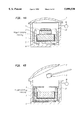
- FIG. 4a is a vertical section of still another variation of the apparatus according to FIG. 1a.
- FIG. 4b is a vertical section of still another variation of the apparatus according to FIG. 1b.
- FIG. 1a shows a pressure container 1 for making the MMC formed bodies.
- a preform holder 2 Disposed inside the pressure container 1 is a preform holder 2 for receiving the preform 3.
- the preform 3 is comprised of a reinforcing material which is arranged in a desired fashion. The entire arrangement is housed inside a crucible 6.
- the pressure container 1 can be sealed with a lid 7 to pressurize the container 1 from a pressure source 10.
- a block or feeder 4 of infiltration metal is disposed on the rim of the preform holder 2.
- a heater 5 causes the metal to melt on.
- the metal completely covers the preform 3 as well as the preform holder 2 and bears upon the inner wall surface of the crucible 6.
- the preform 3 and the preform holder 2 are sealed off from the atmosphere prevalent inside the pressure container 1. This is required to press the liquid metal into the preform 3 through increase of the gas pressure inside the pressure container 1.
- a path would exist for permitting a penetration of gas between the interior space of the pressure container and the preform 3
- a gas pressure increase within the pressure container 1 would result in an equal increase of the gas pressure inside the pores, thereby rendering an infiltration impossible.
- the heater 5 is turned off and the metal is left to solidify under pressure.
- the preform holder 2 is not a requirement, since the preform 3 may be positioned directly inside the crucible 6 as shown in FIG. 4a.
- FIG. 1b shows an alternate embodiment of the apparatus of FIG. 1a, with the heater being omitted.
- the metal 11 which was melted at a different location, covers the preform 3; the lid 7 is closed, the inside of the pressure container 1 is pressurized by means of the pressure source 10, thereby pressing the liquid metal into the preform 3, and the metal is left to solidify.
- FIG. 2a represents a detail within the pressure container 1 of FIG. 1 in a different embodiment. Equivalent parts are given the same reference numbers.
- a preform 3 is again positioned in a preform holder 2.
- a cover 8 with bores 9 rests on the preform holder 2, with the feeder 4 resting on the cover 8.
- the crucible 6 surrounds the preform holder 2 with its inserts and its caps. Through action of the heater 5; the infiltration metal melts, migrates through the bores 9 to the preform 3, and infiltrates the reinforcing material under applied pressure at closed lid 7.
- preform 3 preform holder 2 and cover 8 are sealed gastight by the liquid infiltration metal 4 from the surrounding atmosphere.
- FIG. 2b shows an alternate embodiment of FIG. 2a, whereby the heater has been omitted.
- the metal 11 melted at a different location outside the pressure container 1 covers the cover 8; again, after the lid 7 is closed, the metal is pressed into the preform under pressure application by means of the pressure source 10 and left to solidify.
- the oxygen in the atmosphere inside the pressure container 1 reacts with the infiltration metal 4 and forms compounds which impair the properties of the component to be made.
- the process according to the invention targets to maintain at least the preform 3 or--as in the embodiments shown in the Figures--the entire content of the crucible 6--i.e. the preform 3 and the preform holder 2--in a sealed atmosphere.
- an oxygen-binding material which at elevated temperatures--about 600° C. when using graphite--reacts with and binds the oxygen which is present within the sealed atmosphere, i.e. inside the pores of the preform 3, in the hollows between the preform 3 and the preform holder 2, etc.
- molten infiltration metal of any kind so covers the preform (and preform holder, when included in process) as to enclose the preform (and preform holder, when included in process) and the oxygen-binding material in a sealed atmosphere.
- the oxygen-binding material is either formed as the preform holder 2 itself, or possibly as an additional form piece 20 which is positioned above the infiltration metal 4 (FIG. 1a and 2a), or as a sheath 21 (FIG. 1b) surrounding the crucible 6. If no preform holder 2 is provided and if the preform 3 is placed directly inside crucible 6, then the inner wall of crucible 6 may be coated with oxygen-binding material in order to attain the same reducing action as with preform holder 2. This variation is shown in FIG. 4b. In this case, however, the gas permeability of the oxygen-binding material should be taken into account. As described above, the liquid infiltration metal 4, has to seal the preform 3 together with the oxygen-binding coating against the atmosphere in the pressure container. Should a porous coating extends through the surface of the liquid metal, then the seal of preform 3 would no longer be gastight.
- the sheath 21 and the form piece 20 are not a requirement since both merely bind oxygen from the atmosphere in the pressure container.
- the arrangement of sheath 21 and form piece 20, however, is advantageous since a certain quantity of oxygen is already bound during the heat-up phase, while the infiltration metal 4 has not yet become liquid and has not yet sealed the preform 3 in a gastight manner from the atmosphere in the pressure container. After concluded sealing of the preform 3 from the surrounding atmosphere by the infiltration metal 4, the oxygen content in the pores of preform 3 is already diminished so that the remaining oxygen can be bound more rapidly and more completely.
- the atmosphere in the pressure container 1 is formed preferably of ambient air; however, according to the invention, the atmosphere may also be formed by an inert gas or by an atmosphere at reduced pressure. In all situations, however, according to the invention, a sealed atmosphere is formed within crucible 6, with oxygen-binding materials binding the parasitic oxygen in this atmosphere.
- the oxygen-binding materials may be made from graphite, carbon, or the like, but any other-oxygen-binding material can be employed.
- certain metals with a high affinity for oxygen may be utilized. Examples herefor are zirconium, titanium, or the like.
- an oxygen-binding material which is porous--preferably titanium--and to fill its pores with H 2 before placement of the material inside the crucible 6.
- Such a material has during heating the effect of binding oxygen, while at the same time releasing the inert hydrogen.
- Such a material may be employed in addition to a preform holder 2 made from an oxygen-binding material, by e.g. incorporating a recess in the preform 2 for placement and a porous material placed into said recess.
- the infiltration metal 4 may, depending on the properties required of the MMC component, be formed of metals, such as e.g. aluminum, copper, magnesium, silicon, iron, titanium, or the like, or alloys thereof. This list contains only some examples and any other suitable metal can be employed for carrying out the process according to the invention.
- such components may be made by arranging oxygen-binding material only in certain sections. For example, only one third of the surface of the infiltration metal 4 is covered with an oxygen-binding form piece 20 so that the oxidation processes can take place in the uncovered region of the infiltration metal 4, whereas oxidation processes in the covered region are averted.
- FIGS. 3a, b An actual exemplified application is shown in FIGS. 3a, b.
- a housing which is open at the top is to be made as MMC component.
- This is accomplished by placing a frame 31 made of Kovar on a preform plate 34.
- This frame 31 is provided with openings 32 through which openings 32 pins 30 made of Kovar are passed through to form electrical connections.
- Ceramic sleeves 33 are placed in the openings 32 for isolating the Kovar pins 30 from the frame 31. Since Kovar, as stated above, tends to oxidize during the heat-up phase which precedes the infiltration process, the Kovar components are protected from the effects caused by oxygen through near-by arrangement of oxygen-binding materials 35, 36. In the example of FIGS.
- the oxygen-binding materials are formed, on the one hand, as plates 35 and, on the other hand, as strips which hold the pins 30 during the infiltration process, with the oxygen-binding materials 35, 36 being made from any oxygen-binding material such as e.g. graphite, carbon, or the like.
Landscapes
- Chemical & Material Sciences (AREA)
- Engineering & Computer Science (AREA)
- Mechanical Engineering (AREA)
- Materials Engineering (AREA)
- Metallurgy (AREA)
- Organic Chemistry (AREA)
- Manufacturing & Machinery (AREA)
- Manufacture Of Alloys Or Alloy Compounds (AREA)
- Manufacture And Refinement Of Metals (AREA)
- Glass Compositions (AREA)
- Transition And Organic Metals Composition Catalysts For Addition Polymerization (AREA)
- Materials For Medical Uses (AREA)
Abstract
Description
Claims (11)
Applications Claiming Priority (2)
| Application Number | Priority Date | Filing Date | Title |
|---|---|---|---|
| AT1065/95 | 1995-06-21 | ||
| AT0106595A AT405798B (en) | 1995-06-21 | 1995-06-21 | METHOD FOR PRODUCING MMC COMPONENTS |
Publications (1)
| Publication Number | Publication Date |
|---|---|
| US5890530A true US5890530A (en) | 1999-04-06 |
Family
ID=3505846
Family Applications (1)
| Application Number | Title | Priority Date | Filing Date |
|---|---|---|---|
| US08/668,058 Expired - Lifetime US5890530A (en) | 1995-06-21 | 1996-06-19 | Method of making MMC components |
Country Status (6)
| Country | Link |
|---|---|
| US (1) | US5890530A (en) |
| AT (1) | AT405798B (en) |
| DE (1) | DE19624643C2 (en) |
| FR (1) | FR2735998B1 (en) |
| GB (1) | GB2302336B (en) |
| IT (1) | IT1288116B1 (en) |
Cited By (6)
| Publication number | Priority date | Publication date | Assignee | Title |
|---|---|---|---|---|
| US6599466B1 (en) | 2002-01-16 | 2003-07-29 | Adma Products, Inc. | Manufacture of lightweight metal matrix composites with controlled structure |
| US20040206470A1 (en) * | 2003-04-18 | 2004-10-21 | William Marsh Rice University | Containerless infiltration with electromagnetic levitation |
| CN104525917A (en) * | 2014-12-01 | 2015-04-22 | 北京理工大学 | Mold for preparing metal matrix composites |
| US20160280609A1 (en) * | 2015-03-23 | 2016-09-29 | Rolls-Royce Corporation | Self-propagating braze |
| US10293424B2 (en) | 2015-05-05 | 2019-05-21 | Rolls-Royce Corporation | Braze for ceramic and ceramic matrix composite components |
| US10364195B2 (en) | 2014-07-28 | 2019-07-30 | Rolls-Royce Corporation | Braze for ceramic and ceramic matrix composite components |
Families Citing this family (1)
| Publication number | Priority date | Publication date | Assignee | Title |
|---|---|---|---|---|
| DE19718886A1 (en) * | 1997-05-03 | 1998-11-05 | Bosch Gmbh Robert | Process for the production of porous moldings |
Citations (11)
| Publication number | Priority date | Publication date | Assignee | Title |
|---|---|---|---|---|
| EP0036993A1 (en) * | 1980-03-28 | 1981-10-07 | Wolff Walsrode Aktiengesellschaft | Process for ennobling paper and paper-board |
| EP0375588A1 (en) * | 1988-11-10 | 1990-06-27 | Lanxide Technology Company, Lp. | Methods of forming metal matrix composite bodies by a spontaneous infiltration process |
| US5007475A (en) * | 1988-11-10 | 1991-04-16 | Lanxide Technology Company, Lp | Method for forming metal matrix composite bodies containing three-dimensionally interconnected co-matrices and products produced thereby |
| WO1991017011A1 (en) * | 1990-05-09 | 1991-11-14 | Lanxide Technology Company, Lp | Gating means for metal matrix composite manufacture |
| US5240062A (en) * | 1988-11-10 | 1993-08-31 | Lanxide Technology Company, Lp | Method of providing a gating means, and products thereby |
| US5301738A (en) * | 1988-11-10 | 1994-04-12 | Lanxide Technology Company, Lp | Method of modifying the properties of a metal matrix composite body |
| US5361824A (en) * | 1990-05-10 | 1994-11-08 | Lanxide Technology Company, Lp | Method for making internal shapes in a metal matrix composite body |
| US5487420A (en) * | 1990-05-09 | 1996-01-30 | Lanxide Technology Company, Lp | Method for forming metal matrix composite bodies by using a modified spontaneous infiltration process and products produced thereby |
| US5505248A (en) * | 1990-05-09 | 1996-04-09 | Lanxide Technology Company, Lp | Barrier materials for making metal matrix composites |
| GB2294272A (en) * | 1994-07-28 | 1996-04-24 | Honda Motor Co Ltd | Method and apparatus for producing metal-ceramic composite materials |
| EP1082161A1 (en) * | 1998-06-03 | 2001-03-14 | Hbs S.A. | Electrical device for reducing excess fat |
Family Cites Families (8)
| Publication number | Priority date | Publication date | Assignee | Title |
|---|---|---|---|---|
| JPS5523892B2 (en) * | 1973-04-03 | 1980-06-25 | ||
| JPS602149B2 (en) * | 1980-07-30 | 1985-01-19 | トヨタ自動車株式会社 | Composite material manufacturing method |
| JPS5967336A (en) * | 1982-10-07 | 1984-04-17 | Toyota Motor Corp | Manufacture of composite material |
| DE3504118C1 (en) * | 1985-02-07 | 1985-10-31 | Daimler-Benz Ag, 7000 Stuttgart | Process for the production of fiber-reinforced light metal castings |
| US5040588A (en) * | 1988-11-10 | 1991-08-20 | Lanxide Technology Company, Lp | Methods for forming macrocomposite bodies and macrocomposite bodies produced thereby |
| WO1991017278A1 (en) * | 1990-05-09 | 1991-11-14 | Lanxide Technology Company, Lp | Barrier materials for making metal matrix composites |
| DE4115057A1 (en) * | 1991-05-08 | 1992-11-12 | Austria Metall | METHOD AND DEVICE FOR INFILTRATING MOLTEN METAL |
| US5669434A (en) * | 1994-10-26 | 1997-09-23 | Honda Giken Kogyo Kabushiki Kaisha | Method and apparatus for forming an aluminum alloy composite material |
-
1995
- 1995-06-21 AT AT0106595A patent/AT405798B/en not_active IP Right Cessation
-
1996
- 1996-06-19 US US08/668,058 patent/US5890530A/en not_active Expired - Lifetime
- 1996-06-20 GB GB9612999A patent/GB2302336B/en not_active Expired - Fee Related
- 1996-06-20 DE DE19624643A patent/DE19624643C2/en not_active Expired - Fee Related
- 1996-06-21 IT IT96MI001262A patent/IT1288116B1/en active IP Right Grant
- 1996-06-21 FR FR9607744A patent/FR2735998B1/en not_active Expired - Fee Related
Patent Citations (11)
| Publication number | Priority date | Publication date | Assignee | Title |
|---|---|---|---|---|
| EP0036993A1 (en) * | 1980-03-28 | 1981-10-07 | Wolff Walsrode Aktiengesellschaft | Process for ennobling paper and paper-board |
| EP0375588A1 (en) * | 1988-11-10 | 1990-06-27 | Lanxide Technology Company, Lp. | Methods of forming metal matrix composite bodies by a spontaneous infiltration process |
| US5007475A (en) * | 1988-11-10 | 1991-04-16 | Lanxide Technology Company, Lp | Method for forming metal matrix composite bodies containing three-dimensionally interconnected co-matrices and products produced thereby |
| US5240062A (en) * | 1988-11-10 | 1993-08-31 | Lanxide Technology Company, Lp | Method of providing a gating means, and products thereby |
| US5301738A (en) * | 1988-11-10 | 1994-04-12 | Lanxide Technology Company, Lp | Method of modifying the properties of a metal matrix composite body |
| WO1991017011A1 (en) * | 1990-05-09 | 1991-11-14 | Lanxide Technology Company, Lp | Gating means for metal matrix composite manufacture |
| US5487420A (en) * | 1990-05-09 | 1996-01-30 | Lanxide Technology Company, Lp | Method for forming metal matrix composite bodies by using a modified spontaneous infiltration process and products produced thereby |
| US5505248A (en) * | 1990-05-09 | 1996-04-09 | Lanxide Technology Company, Lp | Barrier materials for making metal matrix composites |
| US5361824A (en) * | 1990-05-10 | 1994-11-08 | Lanxide Technology Company, Lp | Method for making internal shapes in a metal matrix composite body |
| GB2294272A (en) * | 1994-07-28 | 1996-04-24 | Honda Motor Co Ltd | Method and apparatus for producing metal-ceramic composite materials |
| EP1082161A1 (en) * | 1998-06-03 | 2001-03-14 | Hbs S.A. | Electrical device for reducing excess fat |
Cited By (7)
| Publication number | Priority date | Publication date | Assignee | Title |
|---|---|---|---|---|
| US6599466B1 (en) | 2002-01-16 | 2003-07-29 | Adma Products, Inc. | Manufacture of lightweight metal matrix composites with controlled structure |
| US20040206470A1 (en) * | 2003-04-18 | 2004-10-21 | William Marsh Rice University | Containerless infiltration with electromagnetic levitation |
| US10364195B2 (en) | 2014-07-28 | 2019-07-30 | Rolls-Royce Corporation | Braze for ceramic and ceramic matrix composite components |
| CN104525917A (en) * | 2014-12-01 | 2015-04-22 | 北京理工大学 | Mold for preparing metal matrix composites |
| US20160280609A1 (en) * | 2015-03-23 | 2016-09-29 | Rolls-Royce Corporation | Self-propagating braze |
| US10293424B2 (en) | 2015-05-05 | 2019-05-21 | Rolls-Royce Corporation | Braze for ceramic and ceramic matrix composite components |
| US11027351B2 (en) | 2015-05-05 | 2021-06-08 | Rolls-Royce Corporation | Braze for ceramic and ceramic matrix composite components |
Also Published As
| Publication number | Publication date |
|---|---|
| ITMI961262A1 (en) | 1997-12-21 |
| AT405798B (en) | 1999-11-25 |
| DE19624643A1 (en) | 1997-02-27 |
| DE19624643C2 (en) | 2001-12-06 |
| FR2735998A1 (en) | 1997-01-03 |
| FR2735998B1 (en) | 2000-07-13 |
| ITMI961262A0 (en) | 1996-06-21 |
| GB2302336A (en) | 1997-01-15 |
| IT1288116B1 (en) | 1998-09-10 |
| ATA106595A (en) | 1999-04-15 |
| GB9612999D0 (en) | 1996-08-21 |
| GB2302336B (en) | 1998-12-09 |
Similar Documents
| Publication | Publication Date | Title |
|---|---|---|
| FI91496C (en) | Process for forming a macro composite and macro composites formed by the method | |
| FI84343C (en) | FOERFARANDE FOER FRAMSTAELLNING AV ETT SJAELVBAERANDE KERAMISKT KOMPOSITSTYCKE OCH ETT SAODANT KOMPOSITSTYCKE. | |
| FI91611B (en) | A method of making a metal matrix composite body | |
| NZ227522A (en) | Impregnation of filler materials by metals (aluminium and alloys) by heating the filler in an impervious ceramic preform with the molten metal forming an hermetic seal above the filler | |
| JPH05507319A (en) | Cured filler material for metal matrix composites | |
| KR900007530A (en) | Method of forming a metal matrix complex with variable filler loading | |
| US5669434A (en) | Method and apparatus for forming an aluminum alloy composite material | |
| PH26243A (en) | Directional solidification of metal matrix composites | |
| CN1202530A (en) | Process for producing Mg-based composite material or Mg alloy-based composite material | |
| FI91491C (en) | Method of forming a metal matrix composite body using dip molding technique | |
| GB2302336A (en) | Process for producing MMC components. | |
| US4478789A (en) | Method of manufacturing an object of metallic or ceramic material | |
| US5188164A (en) | Method of forming macrocomposite bodies by self-generated vacuum techniques using a glassy seal | |
| FI91612B (en) | Method of forming a macro composite body | |
| US2946700A (en) | Production of infiltrated composites | |
| JP2905514B2 (en) | Inverted shape replication method for forming metal matrix composites | |
| US20080008899A1 (en) | Aluminum-Based Composite Material and Method for Production Thereof | |
| Rao et al. | New technique for pressureless infiltration of Al alloys into Al2O3 preforms | |
| US4230745A (en) | Method of encapsulating a molded ceramic member | |
| JP2849710B2 (en) | Powder forming method of titanium alloy | |
| FI91493B (en) | A method of making a metal matrix composite | |
| US4803046A (en) | Method for making targets | |
| US5787960A (en) | Method of making metal matrix composites | |
| CN112779448A (en) | High-temperature-resistant molybdenum oxide alloy and preparation method thereof | |
| EP0895974A1 (en) | Direct coating hot isostatic pressing encapsulation method |
Legal Events
| Date | Code | Title | Description |
|---|---|---|---|
| AS | Assignment |
Owner name: ELECTROVAC, FABRIKATION ELEKTROTECHNISCHER SPEZIAL Free format text: ASSIGNMENT OF ASSIGNORS INTEREST;ASSIGNOR:SCHMITT, THEODORE NICOLAS;REEL/FRAME:008170/0891 Effective date: 19960711 |
|
| STCF | Information on status: patent grant |
Free format text: PATENTED CASE |
|
| FPAY | Fee payment |
Year of fee payment: 4 |
|
| FPAY | Fee payment |
Year of fee payment: 8 |
|
| FPAY | Fee payment |
Year of fee payment: 12 |
|
| AS | Assignment |
Owner name: EC VERWERTUNGSGESELLSCHAFT 1 GMBH IN LIQU., AUSTRI Free format text: CHANGE OF NAME;ASSIGNOR:ELECTROVAC, FABRIKATION ELEKTROTECHNISCHER SPEZIALARTIKEL GESELLSCHAFT M.B.H.;REEL/FRAME:027761/0580 Effective date: 20101124 |
|
| AS | Assignment |
Owner name: HOFFMANN & CO ELEKTROKOHLE AG, AUSTRIA Free format text: ASSIGNMENT OF ASSIGNORS INTEREST;ASSIGNOR:EC VERWERTUNGSGESELLSCHAFT 1 GMBH IN LIQU.;REEL/FRAME:027842/0806 Effective date: 20120306 |