US5885484A - High temperature thermometric phosphors - Google Patents
High temperature thermometric phosphors Download PDFInfo
- Publication number
- US5885484A US5885484A US08/933,916 US93391697A US5885484A US 5885484 A US5885484 A US 5885484A US 93391697 A US93391697 A US 93391697A US 5885484 A US5885484 A US 5885484A
- Authority
- US
- United States
- Prior art keywords
- phosphor
- emission
- fluorescence emission
- europium
- dysprosium
- Prior art date
- Legal status (The legal status is an assumption and is not a legal conclusion. Google has not performed a legal analysis and makes no representation as to the accuracy of the status listed.)
- Expired - Fee Related
Links
- 229910052693 Europium Inorganic materials 0.000 claims abstract description 62
- OAICVXFJPJFONN-UHFFFAOYSA-N Phosphorus Chemical compound [P] OAICVXFJPJFONN-UHFFFAOYSA-N 0.000 claims abstract description 61
- 229910052692 Dysprosium Inorganic materials 0.000 claims abstract description 58
- KBQHZAAAGSGFKK-UHFFFAOYSA-N dysprosium atom Chemical compound [Dy] KBQHZAAAGSGFKK-UHFFFAOYSA-N 0.000 claims abstract description 49
- -1 europium coactivated lutetium phosphate Chemical class 0.000 claims description 18
- 239000000203 mixture Substances 0.000 claims description 4
- OGPBJKLSAFTDLK-UHFFFAOYSA-N europium atom Chemical compound [Eu] OGPBJKLSAFTDLK-UHFFFAOYSA-N 0.000 abstract description 36
- 239000000463 material Substances 0.000 abstract description 17
- 239000002019 doping agent Substances 0.000 abstract description 14
- 230000003287 optical effect Effects 0.000 description 37
- 230000005284 excitation Effects 0.000 description 22
- 238000004891 communication Methods 0.000 description 17
- 238000001514 detection method Methods 0.000 description 16
- 238000001914 filtration Methods 0.000 description 12
- 238000000034 method Methods 0.000 description 12
- OWNMACFMOIQGAC-UHFFFAOYSA-K lutetium(3+);phosphate Chemical compound [Lu+3].[O-]P([O-])([O-])=O OWNMACFMOIQGAC-UHFFFAOYSA-K 0.000 description 11
- 238000009529 body temperature measurement Methods 0.000 description 10
- 239000000919 ceramic Substances 0.000 description 10
- 239000013078 crystal Substances 0.000 description 8
- 150000002500 ions Chemical class 0.000 description 8
- 238000000926 separation method Methods 0.000 description 8
- 229910019655 synthetic inorganic crystalline material Inorganic materials 0.000 description 7
- 238000012545 processing Methods 0.000 description 6
- 230000003595 spectral effect Effects 0.000 description 6
- 230000015572 biosynthetic process Effects 0.000 description 5
- 239000000843 powder Substances 0.000 description 5
- 238000005259 measurement Methods 0.000 description 4
- 238000005245 sintering Methods 0.000 description 4
- 230000008901 benefit Effects 0.000 description 3
- 230000004907 flux Effects 0.000 description 3
- 238000010438 heat treatment Methods 0.000 description 3
- 229910052747 lanthanoid Inorganic materials 0.000 description 3
- 150000002602 lanthanoids Chemical class 0.000 description 3
- 238000004020 luminiscence type Methods 0.000 description 3
- 238000004519 manufacturing process Methods 0.000 description 3
- 239000011159 matrix material Substances 0.000 description 3
- 230000005855 radiation Effects 0.000 description 3
- 238000003786 synthesis reaction Methods 0.000 description 3
- 239000002699 waste material Substances 0.000 description 3
- QGZKDVFQNNGYKY-UHFFFAOYSA-N Ammonia Chemical compound N QGZKDVFQNNGYKY-UHFFFAOYSA-N 0.000 description 2
- IJGRMHOSHXDMSA-UHFFFAOYSA-N Atomic nitrogen Chemical compound N#N IJGRMHOSHXDMSA-UHFFFAOYSA-N 0.000 description 2
- CURLTUGMZLYLDI-UHFFFAOYSA-N Carbon dioxide Chemical compound O=C=O CURLTUGMZLYLDI-UHFFFAOYSA-N 0.000 description 2
- GRYLNZFGIOXLOG-UHFFFAOYSA-N Nitric acid Chemical compound O[N+]([O-])=O GRYLNZFGIOXLOG-UHFFFAOYSA-N 0.000 description 2
- QNMKNSBXUSWUTF-UHFFFAOYSA-H [Dy+3].P(=O)([O-])([O-])[O-].[Lu+3].P(=O)([O-])([O-])[O-] Chemical compound [Dy+3].P(=O)([O-])([O-])[O-].[Lu+3].P(=O)([O-])([O-])[O-] QNMKNSBXUSWUTF-UHFFFAOYSA-H 0.000 description 2
- 230000003466 anti-cipated effect Effects 0.000 description 2
- 230000008859 change Effects 0.000 description 2
- 239000011248 coating agent Substances 0.000 description 2
- 238000000576 coating method Methods 0.000 description 2
- 230000001419 dependent effect Effects 0.000 description 2
- 239000000835 fiber Substances 0.000 description 2
- 229910017604 nitric acid Inorganic materials 0.000 description 2
- BASFCYQUMIYNBI-UHFFFAOYSA-N platinum Chemical compound [Pt] BASFCYQUMIYNBI-UHFFFAOYSA-N 0.000 description 2
- 239000000243 solution Substances 0.000 description 2
- 238000012360 testing method Methods 0.000 description 2
- 229910000164 yttrium(III) phosphate Inorganic materials 0.000 description 2
- 229910018404 Al2 O3 Inorganic materials 0.000 description 1
- UFHFLCQGNIYNRP-UHFFFAOYSA-N Hydrogen Chemical compound [H][H] UFHFLCQGNIYNRP-UHFFFAOYSA-N 0.000 description 1
- 229910052765 Lutetium Inorganic materials 0.000 description 1
- 229910052772 Samarium Inorganic materials 0.000 description 1
- 229910052771 Terbium Inorganic materials 0.000 description 1
- XSQUKJJJFZCRTK-UHFFFAOYSA-N Urea Chemical compound NC(N)=O XSQUKJJJFZCRTK-UHFFFAOYSA-N 0.000 description 1
- 239000012190 activator Substances 0.000 description 1
- 239000000853 adhesive Substances 0.000 description 1
- 229910045601 alloy Inorganic materials 0.000 description 1
- 239000000956 alloy Substances 0.000 description 1
- PNEYBMLMFCGWSK-UHFFFAOYSA-N aluminium oxide Inorganic materials [O-2].[O-2].[O-2].[Al+3].[Al+3] PNEYBMLMFCGWSK-UHFFFAOYSA-N 0.000 description 1
- JNDMLEXHDPKVFC-UHFFFAOYSA-N aluminum;oxygen(2-);yttrium(3+) Chemical compound [O-2].[O-2].[O-2].[Al+3].[Y+3] JNDMLEXHDPKVFC-UHFFFAOYSA-N 0.000 description 1
- 229910021529 ammonia Inorganic materials 0.000 description 1
- 230000005540 biological transmission Effects 0.000 description 1
- 238000009835 boiling Methods 0.000 description 1
- 238000001354 calcination Methods 0.000 description 1
- 239000004202 carbamide Substances 0.000 description 1
- 229910002092 carbon dioxide Inorganic materials 0.000 description 1
- 239000001569 carbon dioxide Substances 0.000 description 1
- 230000015556 catabolic process Effects 0.000 description 1
- 238000006243 chemical reaction Methods 0.000 description 1
- 238000002485 combustion reaction Methods 0.000 description 1
- 239000004020 conductor Substances 0.000 description 1
- 230000001276 controlling effect Effects 0.000 description 1
- 238000013500 data storage Methods 0.000 description 1
- 230000007123 defense Effects 0.000 description 1
- 238000006731 degradation reaction Methods 0.000 description 1
- 238000000280 densification Methods 0.000 description 1
- 238000000151 deposition Methods 0.000 description 1
- 230000008021 deposition Effects 0.000 description 1
- 238000013461 design Methods 0.000 description 1
- MNNHAPBLZZVQHP-UHFFFAOYSA-N diammonium hydrogen phosphate Chemical compound [NH4+].[NH4+].OP([O-])([O-])=O MNNHAPBLZZVQHP-UHFFFAOYSA-N 0.000 description 1
- 230000000694 effects Effects 0.000 description 1
- 230000007613 environmental effect Effects 0.000 description 1
- 238000001917 fluorescence detection Methods 0.000 description 1
- 238000007716 flux method Methods 0.000 description 1
- 239000011521 glass Substances 0.000 description 1
- 238000007731 hot pressing Methods 0.000 description 1
- 239000001257 hydrogen Substances 0.000 description 1
- 229910052739 hydrogen Inorganic materials 0.000 description 1
- 238000010348 incorporation Methods 0.000 description 1
- 230000005865 ionizing radiation Effects 0.000 description 1
- CDZXKKXSZAMHFU-UHFFFAOYSA-J lead(2+);phosphonato phosphate Chemical compound [Pb+2].[Pb+2].[O-]P([O-])(=O)OP([O-])([O-])=O CDZXKKXSZAMHFU-UHFFFAOYSA-J 0.000 description 1
- OHSVLFRHMCKCQY-UHFFFAOYSA-N lutetium atom Chemical compound [Lu] OHSVLFRHMCKCQY-UHFFFAOYSA-N 0.000 description 1
- 238000007726 management method Methods 0.000 description 1
- 230000007246 mechanism Effects 0.000 description 1
- 238000002844 melting Methods 0.000 description 1
- 230000008018 melting Effects 0.000 description 1
- 229910052751 metal Inorganic materials 0.000 description 1
- 239000002184 metal Substances 0.000 description 1
- 150000002739 metals Chemical class 0.000 description 1
- 238000005649 metathesis reaction Methods 0.000 description 1
- 238000012986 modification Methods 0.000 description 1
- 230000004048 modification Effects 0.000 description 1
- 229910052757 nitrogen Inorganic materials 0.000 description 1
- 239000013307 optical fiber Substances 0.000 description 1
- SIWVEOZUMHYXCS-UHFFFAOYSA-N oxo(oxoyttriooxy)yttrium Chemical compound O=[Y]O[Y]=O SIWVEOZUMHYXCS-UHFFFAOYSA-N 0.000 description 1
- NBIIXXVUZAFLBC-UHFFFAOYSA-K phosphate Chemical compound [O-]P([O-])([O-])=O NBIIXXVUZAFLBC-UHFFFAOYSA-K 0.000 description 1
- 229910052697 platinum Inorganic materials 0.000 description 1
- 238000001556 precipitation Methods 0.000 description 1
- 238000003825 pressing Methods 0.000 description 1
- 230000008569 process Effects 0.000 description 1
- 230000002285 radioactive effect Effects 0.000 description 1
- 229910052761 rare earth metal Inorganic materials 0.000 description 1
- 150000002910 rare earth metals Chemical class 0.000 description 1
- 230000001105 regulatory effect Effects 0.000 description 1
- 238000012827 research and development Methods 0.000 description 1
- 230000004044 response Effects 0.000 description 1
- KZUNJOHGWZRPMI-UHFFFAOYSA-N samarium atom Chemical compound [Sm] KZUNJOHGWZRPMI-UHFFFAOYSA-N 0.000 description 1
- DYRWWVFQQONJJK-UHFFFAOYSA-K scandium(3+);phosphate Chemical compound [Sc+3].[O-]P([O-])([O-])=O DYRWWVFQQONJJK-UHFFFAOYSA-K 0.000 description 1
- 239000006104 solid solution Substances 0.000 description 1
- 230000000087 stabilizing effect Effects 0.000 description 1
- 230000000638 stimulation Effects 0.000 description 1
- GZCRRIHWUXGPOV-UHFFFAOYSA-N terbium atom Chemical compound [Tb] GZCRRIHWUXGPOV-UHFFFAOYSA-N 0.000 description 1
- 238000004861 thermometry Methods 0.000 description 1
- XLYOFNOQVPJJNP-UHFFFAOYSA-N water Chemical compound O XLYOFNOQVPJJNP-UHFFFAOYSA-N 0.000 description 1
- 229910019901 yttrium aluminum garnet Inorganic materials 0.000 description 1
- UXBZSSBXGPYSIL-UHFFFAOYSA-K yttrium(iii) phosphate Chemical compound [Y+3].[O-]P([O-])([O-])=O UXBZSSBXGPYSIL-UHFFFAOYSA-K 0.000 description 1
Images

Classifications
-
- G—PHYSICS
- G01—MEASURING; TESTING
- G01K—MEASURING TEMPERATURE; MEASURING QUANTITY OF HEAT; THERMALLY-SENSITIVE ELEMENTS NOT OTHERWISE PROVIDED FOR
- G01K11/00—Measuring temperature based upon physical or chemical changes not covered by groups G01K3/00, G01K5/00, G01K7/00 or G01K9/00
- G01K11/20—Measuring temperature based upon physical or chemical changes not covered by groups G01K3/00, G01K5/00, G01K7/00 or G01K9/00 using thermoluminescent materials
Definitions
- the present invention relates to a thermometric phosphor and a method of measuring temperature using the phosphor, more particularly, to a high temperature LuPO 4 :Dy,Eu phosphor and a method of measuring temperature using the phosphor.
- thermocouples are subject to degradation and to calibration drift.
- thermophosphor whose fluorescence properties are temperature dependent but whose optical emission is independent of emissivity.
- thermophosphor can be interrogated in a remote manner (i.e. without the use of direct electrical contacts) and can be interrogated on rapidly moving parts without the use of commutators.
- thermometric phosphor it is an object of the present invention to provide a high temperature thermometric phosphor and a method of measuring temperatures utilizing the phosphor. Further and other objects of the present invention will become apparent from the description contained herein.
- a new and improved high temperature phosphor consists essentially of a material having the general formula
- a new and improved high temperature measuring system comprises a lutetium phosphate dysprosium and europium-activated phosphor has a phosphor fluorescence emission comprising a dysprosium fluorescence emission and an europium fluorescence emission, a phosphor excitation means having an excitation emission, an optical focusing means for focusing a phosphor fluorescence emission to a phosphor fluorescence emission separation means, a first filter, a second filter, a first detection means, a second detection means, an analyzing means, a first electrical connecting means and a second electrical connecting means.
- the first filter is for filtering the separated europium fluorescence emission to form a filtered separated europium fluorescence emission.
- the second filter is for filtering the separated dysprosium fluorescence emission to form a filtered separated dysprosium fluorescence emission.
- the phosphor fluorescence emission separation means separates the dysprosium fluorescence emission contained in the phosphor fluorescence emission from the europium fluorescence emission contained in the phosphor fluorescence emission to form a separated dysprosium fluorescence emission and a separated europium fluorescence emission.
- the analyzing means is in electrical communication with the first detection means and the second detection means.
- the excitation emission of the phosphor excitation means is in optical communication with the lutetium phosphate, dysprosium and europium-activated phosphor.
- the phosphor fluorescence emission is in optical communication with the optical focusing means.
- the focused phosphor fluorescence emission is in optical communication with the phosphor fluorescence emission separation means.
- the separated europium fluorescence emission is in optical communication with the first filtering means.
- the separated dysprosium fluorescence emission is in optical communication with the second filtering means.
- the filtered separated europium fluorescence emission is in optical communication with the first detection means and the filtered separated dysprosium fluorescence emission is in optical communication with the second detection means.
- a new and improved method for measuring a temperature of an article comprises the following steps:
- Step 1 An article coated with a lutetium phosphate, dysprosium and europium-activated phosphor is provided.
- Step 2 The lutetium phosphate, dysprosium and europium-activated phosphor is excited with a phosphor excitation means causing the lutetium phosphate, dysprosium, europium activated phosphor to fluoresce a phosphor fluorescence emission comprising a dysprosium fluorescence emission and a europium fluorescence emission.
- Step 3 The phosphor fluorescence emission is optically focused by a optical focusing means and is in optical communication with a phosphor fluorescence emission separation means.
- Step 4 The dysprosium fluorescence emission and the europium fluorescence emission of the phosphor fluorescence emission are separated by the phosphor fluorescence emission separation means forming a separate dysprosium fluorescence emission having a wavelength and an intensity and a separate europium fluorescence emission having a wavelength and an intensity.
- Step 5 The separate dysprosium fluorescence emission is filtered with a first filtering means, and the separate europium fluorescence emission is filtered with a second filtering means forming a filtered dysprosium fluorescence emission and a filtered europium fluorescence emission.
- Step 6 The intensity of the filtered dysprosium fluorescence emission is detected with a first detection means and the intensity of the filtered europium fluorescence emission is detected with a second detection means.
- Step 7 The ratio of the intensity of the filtered dysprosium fluorescence emission and the intensity of the filtered europium fluorescence emission is calculated by an analyzer means.
- Step 8 The temperature of the article is determined from the calculated ratio of the intensity of the filtered dysprosium fluorescence emission and the intensity of the filtered europium fluorescence emission by the analyzer means.
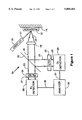
- FIG. 1. is a schematic drawing of a temperature measuring system in accordance with the present invention.
- FIG. 2. is a graph illustrating the relative intensity versus temperature for several spectral lines for the LuPO 4 :Dy(1%), Eu(2%) phosphor in accordance with the present invention.
- the present invention represents the first known or reported use of a thermographic phosphor in which two distinct activator dopants are employed and which act in concert win carrying out remote temperature measurements.
- This doubly doped thermophosphor has the advantage of increasing the number of emission wavelengths from which to select operating conditions. By controlling the excitation wavelength, fluorescence from either Dy or Eu may be independently selected. Additionally, a ratio of the various lines for the doubly doped LuPO 4 host system can be exploited to photo-optically measure temperatures over a very wide and practical range. Measurable fluorescence from Eu in LuPO 4 can be obtained up to 1,200° C. and measurable fluorescence can be obtained from Dy in LuPO 4 up to at least 1350° C.
- this new thermographic phosphor is well suited to use with a Nd:YAG laser since the europium dopant can be excited with the fourth harmonic of this laser at 266 nm while the dysprosium dopant can be independently excited with the third harmonic of the laser at 355 nm.
- a XeF laser can be used to excite the Dy ion by using the 351 nm line of this laser.
- Other laser excitation sources such as a tunable dye laser can be used as well as conventional UV sources.
- the LuPO 4 host material has the advantages of being thermally stable up to 1900° C., and the material is also chemically very stable in the presence of both high- and low-pH environments.
- LuPO 4 is very resistant to radiation damage effects due to displacive radiation or ionizing radiation.
- the thermographic phosphor material can be readily synthesized in powder or bulk ceramic form by using techniques which were originally developed for the formation of nuclear waste disposal media. In the case of the formation of bulk ceramics of LuPO 4 :Dy,Eu, dense ceramic bodies can be formed either by conventional cold pressing and sintering or by hot pressing methods. Additionally, the material can be produced in single crystal form by means of established crystal growth techniques.
- the basis of the subject invention is a new optical thermophosphor which exhibits unique spectral characteristics that are temperature dependent and where variations in the laser stimulated fluorescence output of the material can be calibrated for temperature-measurement applications.
- the new thermophosphor material is based on the concept of the incorporation of more than one optically active ionic species in a host material that is highly stable at elevated temperatures and under a variety of environmental conditions (e.g. under various redox conditions arising from ambient atmospheres).
- the spectral properties of the two rare-earth ionic-dopant species employed in the subject invention i.e. Dy and Eu
- the phosphor is, for the case of the present subject invention, a lutetium orthophosphate host (LuPO 4 ) doped with nominally 1.0 at. % Dy and 2.0 at. % Eu.
- the range of concentration of the two dopant ions, Dy and Eu may be varied in order to adjust the fluorescence lifetimes and other properties of the laser-stimulated optical output.
- the Dy and Eu concentration ranges may, in fact, be independently varied in the region extending from about 0.1 at. % to about 20 at. % for each dopant ion.
- thermophosphor consisting of an LuPO 4 host double doped with Dy and Eu can be made in either the form of a single crystal, a polycrystalline powder which may be applied as a coating to the material whose temperature is to be measured, or in the form of a polycrystalline sintered ceramic.
- the thermophosphor sensor element may be fabricated in a wide range of shapes, sizes, and configurations in order to mate with a variety of parts whose temperature is to be determined.
- Single crystals of LuPO 4 :Dy(1 at. %),Eu(2 at. %) were grown using a flux method, in covered platinum crucibles containing 3.5 g of Lu 2 O 3 , 0.0626 g of Eu 2 O 3 , 0.037 g Dy 2 O 3 and 60 g of lead pyrophosphate, PbHPO 4 as the flux matrix.
- the materials were heated for 16 hours at approximately 1360° C.
- the crucibles where cooled at a rate of 1° C./hour to 900° C. and then, cooled directly to room temperature.
- the flux material was then dissolved in boiling nitric acid to remove from the matrix the single crystals of the tertiary solid solution of LuPO 4 :Dy(1 at. %),Eu(2 at. %) phosphor.
- Polycrystalline powder of LuPO 4 :Dy(1 at. %),Eu(2 at. %) was made by dissolving the oxide form of lutetium, dysprosium and europium in a hot nitric acid solution. A stoichiometric amount of ammonium hydrogen phosphate (NH 2 )HPO 4 is then added to the solution and the lutetium orthophosphate doped with dysprosium and europium is formed by metathesis. At this point, granular urea is added and the mixture is heated at 180° C. until precipitation occurs. Further heating at 400° C. results in a partial release of water vapor, nitrogen, ammonia, hydrogen, and carbon dioxide. Following this step the powder is transferred to an alumina crucible for a complete calcination at 800° C. to form a powder of LuPO 4 :Dy(1 at. %),Eu(2 at. %).
- NH 2 )HPO 4 ammonium hydrogen phosphate
- High temperature measuring system 10 comprises lutetium phosphate, dysprosium and europium-activated phosphor 12 coated on article 14, such as components of a turbine engine, a reciprocating engine, a reactor or any part used in high temperature applications, phosphor excitation means 16, such as a Nd:YAG excitation laser, a XeF excimer laser, or any other pulsed laser, excitation emission 17, such as 266 nm and 355 nm, of phosphor excitation means 16, phosphor fluorescence emission 15, including 484 nm and 575 nm dysprosium lines and 595 nm europium line, optical focusing means 18, such as an optical lens or focusing mirrors, focused phosphor fluorescence emission 19, phosphor fluorescence emission separation means 20, such as a dichroic beam-splitting mirror, separated first emission 21 containing a 595 nm europium line, if any, separated second emission 23 containing a 484 n
- Excitation emission 17 of phosphor excitation means 16 is in optical communication with lutetium phosphate, dysprosium and europium-activated phosphor 12.
- Phosphor fluorescence emission 15 is in optical communication with optical focusing means 18.
- Focused phosphor fluorescence emission 19 is in optical communication with phosphor fluorescence emission separation means 20.
- Separated europium fluorescence emission 21 is in optical communication with first filtering means 22.
- Separated dysprosium fluorescence emission 23 is in optical communication with second emission filtering means 24.
- Filtered separated europium fluorescence emission 25 is in optical communication with first detection means 26.
- Filtered separated dysprosium fluorescence emission 27 is in optical communication with second detection means 28.
- Measuring the temperature of article 14 comprises the following steps:
- Step 1 Article 14 coated with lutetium phosphate, dysprosium and europium-activated phosphor 12 is provided.
- Step 2 Lutetium phosphate, dysprosium and europium-activated phosphor 12 is activated with phosphor excitation means 16 causing lutetium phosphate dysprosium and europium-activated phosphor 12 to fluoresce phosphor fluorescence emission 15 comprising a dysprosium fluorescence emission and an europium fluorescence emission.
- Step 3 Phosphor fluorescence emission 15 is optically focused by optical focusing means 18 and is in communication with phosphor fluorescence emission separation means 20.
- Step 4 Dysprosium fluorescence emission and europium fluorescence emission 21 of phosphor fluorescence emission 15 are separated by phosphor fluorescence emission separating means 20 forming separate dysprosium fluorescence emission 23 having a wavelength and an intensity and separate europium fluorescence emission 21 having a wavelength and an intensity.
- Step 5 Separate dysprosium fluorescence emission 23 is filtered with first filtering means 22, such as a narrow band wide filter, and separate europium fluorescence emission 21 is filtered with second filtering means 24, such as a narrow band wide filter, forming filtered dysprosium emission 25 and filtered europium emission 27.
- first filtering means 22 such as a narrow band wide filter
- second filtering means 24 such as a narrow band wide filter
- Step 6 The intensity of filtered dysprosium fluorescence emission 23 is detected with first detection means 26 and the intensity of filtered europium fluorescence emission 21 is detected with second detection means 28.
- Step 7 The ratio of the intensity of filtered dysprosium fluorescence emission 23 and the intensity of filtered europium fluorescence emission 21 is calculated by analyzer means 30.
- Step 8 The temperature of article 14 is determined from the calculated ratio of the intensity of filtered dysprosium fluorescence emission 23 and the intensity of filtered europium fluorescence emission 21 by analyzer means 30.
- dysprosium, europium activated phosphor, yttrium phosphate, dysprosium and europium-activated phosphor, YPO 4 :Dy.sub.(x),Eu.sub.(y), and scandium phosphate dysprosium and europium-activated phosphor, ScPO 4 :Dy.sub.(x),Eu.sub.(y), can be used in the high temperature measuring system.
- thermophosphor and part may represent components of, for example, a turbine engine, a reciprocating engine, a nuclear reactor, or a furnace for the processing of ceramic components or for the melting and/or fabrication of metals, alloys, or glasses or of any other source of heat which may be employed in either transportation or materials synthesis and processing applications or in research and development applications.
- a test configuration is illustrated which also represents a configuration which could be employed for the calibration of the thermophosphor either individually or in contact with a test piece.
- a pulse generator can provide a trigger signal which actuates a pulsed laser.
- This laser may be, for example, a Nd:YAG excitation laser, a XeF excimer laser, or any other pulsed laser evident to those skilled in the art as being appropriate to the excitation of the fluorescent energy levels of the Dy and Eu dopant ions.
- a Nd:YAG laser is considered particularly advantageous for certain embodiments of the subject invention since with the fourth harmonic of this laser at 266 nm it is possible to excite only the Eu dopant ion, while the third harmonic of the laser at 355 nm may be employed to excited only the Dy dopant ion.
- thermophosphor By employing both excitation lines, it is possible to excite both the Dy and Eu ions and to utilize ratios of the various fluorescent lines in order to carry out temperature measurements over a wide temperature range. It should be noted that the 351 nm output of a XeF laser can be utilized to excite the dysprosium ion in the LuPO 4 host material. Light emitted from the pulsed laser for the purpose of exciting fluorescence form one or both of the dopant ions is directed on the thermophosphor material by means of a beam-splitting mirror or by other means evident to those skilled in the art. It should be noted that the excitation of the thermophosphor is not limited to excitation by a laser, but that for some applications, other excitation sources may be employed such as an ultraviolet lamp.
- thermophosphor When suitably excited, the thermophosphor emits a series of spectral lines which are due to the presence of the Dy and Eu dopants.
- the temperature of the system may be determined by comparing the ratio of selected emission lines from the two dopants.
- the stimulated luminescence emitted from the thermophosphor is then directed to a beam-splitting dichroic mirror by a concave optical lens and can be focused by a lens onto a fiber optic device or directly into an optical train designed to convey the light either to a spectrometer or through a suitable interference filter or a narrow band optical filter to photomultiplier or photodiode detector.
- the fluorescence emitted from the thermophosphor is directed to a spectrometer which is used to analyze the spectral properties (i.e. emitted wavelength and line widths) of the emission.
- the output of the spectrometer is detected by the photomultiplier tube or photodiode, and this signal can then be displayed and stored using a digital oscilloscope whose output can be coupled to a variety of external computers for data storage and processing.
- the output signal can be used in a servo-feedback configuration to either control or program processing and synthesis temperatures and temperature cycles.
- the thermophosphor and associated apparatus could be used to measure the temperature of a ceramic work piece located inside a microwave heating system.
- the detected thermophosphor signal which is proportional to the work piece temperature could then be compared with a set-point signal and the resulting output can be used as a control signal for the purpose of regulating the microwave output power and, thereby, either stabilizing the processing temperature of the ceramic workpiece at a selected value, or by changing the set point in a controlled manner, programming a desired temperature processing cycle.
- FIG. 2 Shown in FIG. 2 are curves generated from the data of the relative intensity versus temperature for several of the pertinent spectral lines (f1, fluorescence; ex, excitation) for the LuPO 4 :Dy(1 at. %), Eu(2 at. %) phosphor sample.
- the line strengths were plotted as a function of temperature.
- the 484-nm Dy line strength is found to change rather rapidly as a function of temperature.
- the 575-nm Dy line and the 595-nm Eu line ( 5 D 0 - 7 F 1 ) both appear to change (though less dramatically) in the temperature range measured. The reason for this difference in response to excitation wavelength is not known.
- the europium line strength is sufficient to produce measurable fluorescence up to temperatures of at least 1200° C.
- the ratio of the various lines from the doubly doped LuPO 4 host of this invention can, in fact, be used to measure temperatures photo-optically over a very wide and practical temperature range, such as from about 350° C. to about 1350° C.
- the LuPO 4 :Dy,Eu thermophosphor can be attached to a moving part.
- the thermophosphor may be in the form of a single crystal, polycrystalline powder-plus-adhesive to form a coating, or a sintered ceramic.
- the luminescent signal can then be excited by means of a laser that is located at a remote location with respect to the heated moving component.
- An appropriately design optical collection system will then collect the stimulated emission from the calibrated LuPO 4 thermophosphor and, depending on the range of the operating temperature of the moving part, either the Dy or Eu luminescence or ratios of the two types of luminescence can be used to determine the temperature with the part in motion. This mode of operation is possible since optical signals are used first to stimulate the fluorescence output of the thermophosphor and subsequently to interrogate the phosphor, and no mechanical or electrical contacts are required between the stimulation source and the fluorescence detection system.
- the present invention can be used to carry out temperature measurements in environments where the use of metallic conductors (e.g. thermocouples) presents a number of practical problems.
- Such environments include, in particular, furnaces in which microwave heating is employed.
- Microwave fields can couple directly to resistive thermometers or to thermocouples which are not adequately shielded or properly placed in the microwave system.
- the present invention circumvents such problems entirely since the temperature measurements are carried out through optical means which do not involve any physical contact with the sample or any electrical connections to the work piece.
- the invention has the potential for remotely making temperature measurements in high radiation environments, and the output of the subject sensor is amenable to transmission through optical fibers or through single-crystal fibers of, for example Al 2 O 3 .
- the subject invention may be utilized in making heat flux measurements or in the control of densification processes in ceramics. Due to its ability to remotely measure temperatures and to measure temperatures on moving parts in the high temperature regime, it is anticipated that the invention will find wide spread use in a variety of industrial, scientific, and military applications.
- the present invention can be used in temperature measurements in a variety of systems for the production, conversion, and conservation of energy including various heat engines, turbines, reciprocating engines, reactors, electrical power generators, and potentially in combustion reactions.
- the subject invention is particularly well suited to applications involving temperature measurements in microwave heated furnaces which are used for materials sintering, processing, and synthesis.
- thermally sensitive phosphor materials that have been previously identified for use at high temperatures above 600° C. These are yttrium oxide doped with europium and yttrium aluminum garnet doped with either dysprosium, samarium, terbium or europium (i.e., YAG:Dy, YAG:Sm, YAG:Tb, YAG:Eu).
- YAG:Dy, YAG:Sm, YAG:Tb, YAG:Eu i.e., YAG:Dy, YAG:Sm, YAG:Tb, YAG:Eu.
- none of these systems employ the remote measurement of temperature by utilizing the ratio of the fluroescence emission of the double dopents dysprosium and europium in the lutetium phosphate phosphor of the present invention.
Landscapes
- Physics & Mathematics (AREA)
- General Physics & Mathematics (AREA)
- Investigating, Analyzing Materials By Fluorescence Or Luminescence (AREA)
- Luminescent Compositions (AREA)
Abstract
A high temperature phosphor consists essentially of a material having the general formula LuPO4 :Dy.sub.(x),Euy) wherein: 0.1 wt %≦x≦20 wt % and 0.1 wt %≦y≦20 wt %.
The high temperature phosphor is in contact with an article whose temperature is to be determined. The article having the phosphor in contact with it is placed in the environment for which the temperature of the article is to be determined. The phosphor is excited by a laser causing the phosphor to fluoresce. The emission from the phosphor is optically focused into a beam-splitting mirror which separates the emission into two separate emissions, the emission caused by the dysprosium dopant and the emission caused by the europium dopent. The separated emissions are optically filtered and the intensities of the emission are detected and measured. The ratio of the intensity of each emission is determined and the temperature of the article is calculated from the ratio of the intensities of the separate emissions.
Description
This invention was made with Government support under contract DE-AC0584OR21400 awarded by the U.S. Department of Energy to Lockheed Martin Energy Systems, Inc. and the Government has certain rights in this Invention.
This application is a division of application Ser. No. 08/704,052 filed Aug. 28, 1996, now U.S. Pat. No. 5,730,528.
The present invention relates to a thermometric phosphor and a method of measuring temperature using the phosphor, more particularly, to a high temperature LuPO4 :Dy,Eu phosphor and a method of measuring temperature using the phosphor.
In the temperature range lying above approximately 800° C., measurements of the temperature of objects in a remote, non-contact, manner or on moving parts (or both) is very difficult. The measurement of such high temperatures by a remote method is often carried out by so-called pyrometric techniques in which the effective "color" of the light emitted from the hot object to be measured is compared to that produced by an externally heated wire or other object whose temperature can be varied in a controlled manner and whose optical emission can be calibrated as a function of temperature. This method suffers from a number of shortcomings including errors which arise due to thermally induced changes in the emissivity of the object whose temperature is to be measured, background reflections or interference, and in some cases, to the deposition of partially transmitting films on windows which may be interposed between the pyrometer and the object. In the case of temperature measurements on moving parts, direct (i.e. non-remote) traditional temperature measurement techniques involving resistive thermometry or thermocouples require electrical contacts which necessitate the use of commutators. The attachment of such devices is not always practical or possible, and in any event, their use can introduce electrical noise and errors in the temperature determination. Additionally, thermocouples are subject to degradation and to calibration drift. The subject invention overcomes these problems by employing an inert "thermophosphor" whose fluorescence properties are temperature dependent but whose optical emission is independent of emissivity. Such a thermophosphor can be interrogated in a remote manner (i.e. without the use of direct electrical contacts) and can be interrogated on rapidly moving parts without the use of commutators.
Accordingly, it is an object of the present invention to provide a high temperature thermometric phosphor and a method of measuring temperatures utilizing the phosphor. Further and other objects of the present invention will become apparent from the description contained herein.
In accordance with one aspect of the present invention, a new and improved high temperature phosphor consists essentially of a material having the general formula
LuPO.sub.4 :Dy.sub.(x),Eu.sub.(Y).
wherein:
0.1 wt %≦x≦20 wt %
0.1 wt %≦y≦20 wt %
In accordance with another aspect of the present invention, a new and improved high temperature measuring system comprises a lutetium phosphate dysprosium and europium-activated phosphor has a phosphor fluorescence emission comprising a dysprosium fluorescence emission and an europium fluorescence emission, a phosphor excitation means having an excitation emission, an optical focusing means for focusing a phosphor fluorescence emission to a phosphor fluorescence emission separation means, a first filter, a second filter, a first detection means, a second detection means, an analyzing means, a first electrical connecting means and a second electrical connecting means. The first filter is for filtering the separated europium fluorescence emission to form a filtered separated europium fluorescence emission. The second filter is for filtering the separated dysprosium fluorescence emission to form a filtered separated dysprosium fluorescence emission. The phosphor fluorescence emission separation means separates the dysprosium fluorescence emission contained in the phosphor fluorescence emission from the europium fluorescence emission contained in the phosphor fluorescence emission to form a separated dysprosium fluorescence emission and a separated europium fluorescence emission. The analyzing means is in electrical communication with the first detection means and the second detection means. The excitation emission of the phosphor excitation means is in optical communication with the lutetium phosphate, dysprosium and europium-activated phosphor. The phosphor fluorescence emission is in optical communication with the optical focusing means. The focused phosphor fluorescence emission is in optical communication with the phosphor fluorescence emission separation means. The separated europium fluorescence emission is in optical communication with the first filtering means. The separated dysprosium fluorescence emission is in optical communication with the second filtering means. The filtered separated europium fluorescence emission is in optical communication with the first detection means and the filtered separated dysprosium fluorescence emission is in optical communication with the second detection means.
In accordance with another aspect of the present invention, a new and improved method for measuring a temperature of an article comprises the following steps:
Step 1. An article coated with a lutetium phosphate, dysprosium and europium-activated phosphor is provided.
Step 2. The lutetium phosphate, dysprosium and europium-activated phosphor is excited with a phosphor excitation means causing the lutetium phosphate, dysprosium, europium activated phosphor to fluoresce a phosphor fluorescence emission comprising a dysprosium fluorescence emission and a europium fluorescence emission.
Step 3. The phosphor fluorescence emission is optically focused by a optical focusing means and is in optical communication with a phosphor fluorescence emission separation means.
Step 4. The dysprosium fluorescence emission and the europium fluorescence emission of the phosphor fluorescence emission are separated by the phosphor fluorescence emission separation means forming a separate dysprosium fluorescence emission having a wavelength and an intensity and a separate europium fluorescence emission having a wavelength and an intensity.
Step 5. The separate dysprosium fluorescence emission is filtered with a first filtering means, and the separate europium fluorescence emission is filtered with a second filtering means forming a filtered dysprosium fluorescence emission and a filtered europium fluorescence emission.
Step 6. The intensity of the filtered dysprosium fluorescence emission is detected with a first detection means and the intensity of the filtered europium fluorescence emission is detected with a second detection means.
Step 7. The ratio of the intensity of the filtered dysprosium fluorescence emission and the intensity of the filtered europium fluorescence emission is calculated by an analyzer means.
Step 8. The temperature of the article is determined from the calculated ratio of the intensity of the filtered dysprosium fluorescence emission and the intensity of the filtered europium fluorescence emission by the analyzer means.
In the drawings:
FIG. 1. is a schematic drawing of a temperature measuring system in accordance with the present invention.
FIG. 2. is a graph illustrating the relative intensity versus temperature for several spectral lines for the LuPO4 :Dy(1%), Eu(2%) phosphor in accordance with the present invention.
For a better understanding of the present invention, together with other and further objects, advantages and capabilities thereof, reference is made to the following disclosure and appended claims in connection with the above described drawings.
The present invention represents the first known or reported use of a thermographic phosphor in which two distinct activator dopants are employed and which act in concert win carrying out remote temperature measurements. This doubly doped thermophosphor has the advantage of increasing the number of emission wavelengths from which to select operating conditions. By controlling the excitation wavelength, fluorescence from either Dy or Eu may be independently selected. Additionally, a ratio of the various lines for the doubly doped LuPO4 host system can be exploited to photo-optically measure temperatures over a very wide and practical range. Measurable fluorescence from Eu in LuPO4 can be obtained up to 1,200° C. and measurable fluorescence can be obtained from Dy in LuPO4 up to at least 1350° C. In particular, this new thermographic phosphor is well suited to use with a Nd:YAG laser since the europium dopant can be excited with the fourth harmonic of this laser at 266 nm while the dysprosium dopant can be independently excited with the third harmonic of the laser at 355 nm. Additionally, a XeF laser can be used to excite the Dy ion by using the 351 nm line of this laser. Other laser excitation sources such as a tunable dye laser can be used as well as conventional UV sources. Additionally, the LuPO4 host material has the advantages of being thermally stable up to 1900° C., and the material is also chemically very stable in the presence of both high- and low-pH environments. Additionally, at temperatures above about 350° C., LuPO4 is very resistant to radiation damage effects due to displacive radiation or ionizing radiation. The thermographic phosphor material can be readily synthesized in powder or bulk ceramic form by using techniques which were originally developed for the formation of nuclear waste disposal media. In the case of the formation of bulk ceramics of LuPO4 :Dy,Eu, dense ceramic bodies can be formed either by conventional cold pressing and sintering or by hot pressing methods. Additionally, the material can be produced in single crystal form by means of established crystal growth techniques.
The basis of the subject invention is a new optical thermophosphor which exhibits unique spectral characteristics that are temperature dependent and where variations in the laser stimulated fluorescence output of the material can be calibrated for temperature-measurement applications. In particular, the new thermophosphor material is based on the concept of the incorporation of more than one optically active ionic species in a host material that is highly stable at elevated temperatures and under a variety of environmental conditions (e.g. under various redox conditions arising from ambient atmospheres). By combining the spectral properties of the two rare-earth ionic-dopant species employed in the subject invention (i.e. Dy and Eu), it is possible to obtain ratios of the outputs and lifetimes of the various fluorescence lines and, thereby, to photo-optically measure temperatures over an extended temperature range which, based on existing results, should extend to elevated temperatures in excess of 1350° C.
The phosphor is, for the case of the present subject invention, a lutetium orthophosphate host (LuPO4) doped with nominally 1.0 at. % Dy and 2.0 at. % Eu. In general practice of the subject invention, however, the range of concentration of the two dopant ions, Dy and Eu, may be varied in order to adjust the fluorescence lifetimes and other properties of the laser-stimulated optical output. Depending on the specific application and the required optical fluorescence properties, the Dy and Eu concentration ranges may, in fact, be independently varied in the region extending from about 0.1 at. % to about 20 at. % for each dopant ion. It is important to note that the thermophosphor consisting of an LuPO4 host double doped with Dy and Eu can be made in either the form of a single crystal, a polycrystalline powder which may be applied as a coating to the material whose temperature is to be measured, or in the form of a polycrystalline sintered ceramic. In the case of a thermophosphor sensor fabricated as a sintered polycrystalline ceramic, the thermophosphor sensor element may be fabricated in a wide range of shapes, sizes, and configurations in order to mate with a variety of parts whose temperature is to be determined. This fabrication can be achieved using the previously established sintering characteristics of the lanthanide orthophosphates For data relating to the sintering properties of the lanthanide orthophosphates, see: "Lanthanide Orthophosphates as a Matrix for Solidified Radioactive Defense and Reactor Wastes" by M. Petek, M. M. Abraham, and L. A. Boatner, in The Scientific Basis for Nuclear Waste Management, Stephen V. Topp, Editor, (Elsevier Science Publishing Co., Inc. 1982) pp 181-186.) and is incorporated herein by reference thereto!.
Single crystals of LuPO4 :Dy(1 at. %),Eu(2 at. %) were grown using a flux method, in covered platinum crucibles containing 3.5 g of Lu2 O3, 0.0626 g of Eu2 O3, 0.037 g Dy2 O3 and 60 g of lead pyrophosphate, PbHPO4 as the flux matrix. The materials were heated for 16 hours at approximately 1360° C. The crucibles where cooled at a rate of 1° C./hour to 900° C. and then, cooled directly to room temperature. The flux material was then dissolved in boiling nitric acid to remove from the matrix the single crystals of the tertiary solid solution of LuPO4 :Dy(1 at. %),Eu(2 at. %) phosphor.
Polycrystalline powder of LuPO4 :Dy(1 at. %),Eu(2 at. %) was made by dissolving the oxide form of lutetium, dysprosium and europium in a hot nitric acid solution. A stoichiometric amount of ammonium hydrogen phosphate (NH2)HPO4 is then added to the solution and the lutetium orthophosphate doped with dysprosium and europium is formed by metathesis. At this point, granular urea is added and the mixture is heated at 180° C. until precipitation occurs. Further heating at 400° C. results in a partial release of water vapor, nitrogen, ammonia, hydrogen, and carbon dioxide. Following this step the powder is transferred to an alumina crucible for a complete calcination at 800° C. to form a powder of LuPO4 :Dy(1 at. %),Eu(2 at. %).
Shown in FIG. 1 is high temperature measuring system 10. High temperature measuring system 10 comprises lutetium phosphate, dysprosium and europium-activated phosphor 12 coated on article 14, such as components of a turbine engine, a reciprocating engine, a reactor or any part used in high temperature applications, phosphor excitation means 16, such as a Nd:YAG excitation laser, a XeF excimer laser, or any other pulsed laser, excitation emission 17, such as 266 nm and 355 nm, of phosphor excitation means 16, phosphor fluorescence emission 15, including 484 nm and 575 nm dysprosium lines and 595 nm europium line, optical focusing means 18, such as an optical lens or focusing mirrors, focused phosphor fluorescence emission 19, phosphor fluorescence emission separation means 20, such as a dichroic beam-splitting mirror, separated first emission 21 containing a 595 nm europium line, if any, separated second emission 23 containing a 484 nm and 575 nm dysprosium lines, if any, first emission filtering means 22, such as a narrow band optical filter, a prism monochromator, a grating monochromator, or an interference optical filter, filtered first emission 25 containing essentially the 595 nm europium line, if any, second emission filtering means 24, such as a narrow band optical filter, a prism monochromator, a grating monochromator, or an interference optical filter, filtered second emission 27 containing essentially the 484 nm and 575 nm dysprosium lines, if any, first detection means 26, such as a photo multiplier or photo diode detector, second detection means 28, such as a photomultiplier or photo diode detector, analyzing means 30, first electrical connecting means 29, such as an electrical cable or wire, electrically connecting second detection means 28 and analyzing means 30, such as a digital oscilloscope coupled to a computer, and second electrical connecting means 31, such as an electrical cable or wire, electrically connecting first detection means 26 and analyzing means 30. Excitation emission 17 of phosphor excitation means 16 is in optical communication with lutetium phosphate, dysprosium and europium-activated phosphor 12. Phosphor fluorescence emission 15 is in optical communication with optical focusing means 18. Focused phosphor fluorescence emission 19 is in optical communication with phosphor fluorescence emission separation means 20. Separated europium fluorescence emission 21 is in optical communication with first filtering means 22. Separated dysprosium fluorescence emission 23 is in optical communication with second emission filtering means 24. Filtered separated europium fluorescence emission 25 is in optical communication with first detection means 26. Filtered separated dysprosium fluorescence emission 27 is in optical communication with second detection means 28.
Measuring the temperature of article 14 comprises the following steps:
Step 1. Article 14 coated with lutetium phosphate, dysprosium and europium-activated phosphor 12 is provided.
Step 2. Lutetium phosphate, dysprosium and europium-activated phosphor 12 is activated with phosphor excitation means 16 causing lutetium phosphate dysprosium and europium-activated phosphor 12 to fluoresce phosphor fluorescence emission 15 comprising a dysprosium fluorescence emission and an europium fluorescence emission.
Step 3. Phosphor fluorescence emission 15 is optically focused by optical focusing means 18 and is in communication with phosphor fluorescence emission separation means 20.
Step 4. Dysprosium fluorescence emission and europium fluorescence emission 21 of phosphor fluorescence emission 15 are separated by phosphor fluorescence emission separating means 20 forming separate dysprosium fluorescence emission 23 having a wavelength and an intensity and separate europium fluorescence emission 21 having a wavelength and an intensity.
Step 5. Separate dysprosium fluorescence emission 23 is filtered with first filtering means 22, such as a narrow band wide filter, and separate europium fluorescence emission 21 is filtered with second filtering means 24, such as a narrow band wide filter, forming filtered dysprosium emission 25 and filtered europium emission 27.
Step 6. The intensity of filtered dysprosium fluorescence emission 23 is detected with first detection means 26 and the intensity of filtered europium fluorescence emission 21 is detected with second detection means 28.
Step 7. The ratio of the intensity of filtered dysprosium fluorescence emission 23 and the intensity of filtered europium fluorescence emission 21 is calculated by analyzer means 30.
Step 8. The temperature of article 14 is determined from the calculated ratio of the intensity of filtered dysprosium fluorescence emission 23 and the intensity of filtered europium fluorescence emission 21 by analyzer means 30.
In addition to a lutetium phosphate, dysprosium, europium activated phosphor, yttrium phosphate, dysprosium and europium-activated phosphor, YPO4 :Dy.sub.(x),Eu.sub.(y), and scandium phosphate, dysprosium and europium-activated phosphor, ScPO4 :Dy.sub.(x),Eu.sub.(y), can be used in the high temperature measuring system.
In the practical embodiment of the invention, however, the thermophosphor and part may represent components of, for example, a turbine engine, a reciprocating engine, a nuclear reactor, or a furnace for the processing of ceramic components or for the melting and/or fabrication of metals, alloys, or glasses or of any other source of heat which may be employed in either transportation or materials synthesis and processing applications or in research and development applications. In the embodiment of the invention shown in the figure, a test configuration is illustrated which also represents a configuration which could be employed for the calibration of the thermophosphor either individually or in contact with a test piece. One embodiment of the invention, a pulse generator can provide a trigger signal which actuates a pulsed laser. This laser may be, for example, a Nd:YAG excitation laser, a XeF excimer laser, or any other pulsed laser evident to those skilled in the art as being appropriate to the excitation of the fluorescent energy levels of the Dy and Eu dopant ions. The use of, for example, a Nd:YAG laser is considered particularly advantageous for certain embodiments of the subject invention since with the fourth harmonic of this laser at 266 nm it is possible to excite only the Eu dopant ion, while the third harmonic of the laser at 355 nm may be employed to excited only the Dy dopant ion. By employing both excitation lines, it is possible to excite both the Dy and Eu ions and to utilize ratios of the various fluorescent lines in order to carry out temperature measurements over a wide temperature range. It should be noted that the 351 nm output of a XeF laser can be utilized to excite the dysprosium ion in the LuPO4 host material. Light emitted from the pulsed laser for the purpose of exciting fluorescence form one or both of the dopant ions is directed on the thermophosphor material by means of a beam-splitting mirror or by other means evident to those skilled in the art. It should be noted that the excitation of the thermophosphor is not limited to excitation by a laser, but that for some applications, other excitation sources may be employed such as an ultraviolet lamp. When suitably excited, the thermophosphor emits a series of spectral lines which are due to the presence of the Dy and Eu dopants. The temperature of the system may be determined by comparing the ratio of selected emission lines from the two dopants. The stimulated luminescence emitted from the thermophosphor is then directed to a beam-splitting dichroic mirror by a concave optical lens and can be focused by a lens onto a fiber optic device or directly into an optical train designed to convey the light either to a spectrometer or through a suitable interference filter or a narrow band optical filter to photomultiplier or photodiode detector. In one embodiment of the invention, the fluorescence emitted from the thermophosphor is directed to a spectrometer which is used to analyze the spectral properties (i.e. emitted wavelength and line widths) of the emission. The output of the spectrometer is detected by the photomultiplier tube or photodiode, and this signal can then be displayed and stored using a digital oscilloscope whose output can be coupled to a variety of external computers for data storage and processing.
In alternate embodiments of the invention, the output signal can be used in a servo-feedback configuration to either control or program processing and synthesis temperatures and temperature cycles. For example, in one embodiment of the invention, the thermophosphor and associated apparatus could be used to measure the temperature of a ceramic work piece located inside a microwave heating system. The detected thermophosphor signal which is proportional to the work piece temperature could then be compared with a set-point signal and the resulting output can be used as a control signal for the purpose of regulating the microwave output power and, thereby, either stabilizing the processing temperature of the ceramic workpiece at a selected value, or by changing the set point in a controlled manner, programming a desired temperature processing cycle.
Shown in FIG. 2 are curves generated from the data of the relative intensity versus temperature for several of the pertinent spectral lines (f1, fluorescence; ex, excitation) for the LuPO4 :Dy(1 at. %), Eu(2 at. %) phosphor sample. The line strengths were plotted as a function of temperature. The 484-nm Dy line strength is found to change rather rapidly as a function of temperature. The 575-nm Dy line and the 595-nm Eu line (5 D0 -7 F1) both appear to change (though less dramatically) in the temperature range measured. The reason for this difference in response to excitation wavelength is not known. For the Dy emissions at 484 and 575 nm, a decrease of a few percent over this range would be expected if thermalization were the only mechanism. However, a 30-50% decrease was observed. Thus other factors appear to be important. In any case, it is known that the europium line strength is sufficient to produce measurable fluorescence up to temperatures of at least 1200° C. We have obtained measurable fluorescence to 1350° C. from the Dy dopants in orthophosphate host crystals. Hence the ratio of the various lines from the doubly doped LuPO4 host of this invention can, in fact, be used to measure temperatures photo-optically over a very wide and practical temperature range, such as from about 350° C. to about 1350° C.
In another embodiment of the subject invention, the LuPO4 :Dy,Eu thermophosphor can be attached to a moving part. Again, the thermophosphor may be in the form of a single crystal, polycrystalline powder-plus-adhesive to form a coating, or a sintered ceramic. The luminescent signal can then be excited by means of a laser that is located at a remote location with respect to the heated moving component. An appropriately design optical collection system will then collect the stimulated emission from the calibrated LuPO4 thermophosphor and, depending on the range of the operating temperature of the moving part, either the Dy or Eu luminescence or ratios of the two types of luminescence can be used to determine the temperature with the part in motion. This mode of operation is possible since optical signals are used first to stimulate the fluorescence output of the thermophosphor and subsequently to interrogate the phosphor, and no mechanical or electrical contacts are required between the stimulation source and the fluorescence detection system.
The present invention can be used to carry out temperature measurements in environments where the use of metallic conductors (e.g. thermocouples) presents a number of practical problems. Such environments include, in particular, furnaces in which microwave heating is employed. Microwave fields can couple directly to resistive thermometers or to thermocouples which are not adequately shielded or properly placed in the microwave system. The present invention circumvents such problems entirely since the temperature measurements are carried out through optical means which do not involve any physical contact with the sample or any electrical connections to the work piece. Additionally, the invention has the potential for remotely making temperature measurements in high radiation environments, and the output of the subject sensor is amenable to transmission through optical fibers or through single-crystal fibers of, for example Al2 O3. The subject invention may be utilized in making heat flux measurements or in the control of densification processes in ceramics. Due to its ability to remotely measure temperatures and to measure temperatures on moving parts in the high temperature regime, it is anticipated that the invention will find wide spread use in a variety of industrial, scientific, and military applications.
It is anticipated that the present invention can be used in temperature measurements in a variety of systems for the production, conversion, and conservation of energy including various heat engines, turbines, reciprocating engines, reactors, electrical power generators, and potentially in combustion reactions. As noted above, the subject invention is particularly well suited to applications involving temperature measurements in microwave heated furnaces which are used for materials sintering, processing, and synthesis.
There are several thermally sensitive phosphor materials that have been previously identified for use at high temperatures above 600° C. These are yttrium oxide doped with europium and yttrium aluminum garnet doped with either dysprosium, samarium, terbium or europium (i.e., YAG:Dy, YAG:Sm, YAG:Tb, YAG:Eu). However, none of these systems employ the remote measurement of temperature by utilizing the ratio of the fluroescence emission of the double dopents dysprosium and europium in the lutetium phosphate phosphor of the present invention.
While there has been shown and described what is at present considered the preferred embodiments of the invention, it will be obvious to those skilled in the art that various changes and modifications may be made therein without departing from the scope of the invention as defined by the appended claims.
Claims (4)
1. A high temperature phosphor comprising dysprosium and europium coactivated lutetium phosphate having the approximate formula:
LuPO.sub.4 :Dy.sub.(x),Eu.sub.(y).
wherein:
0.1 wt %≦x≦20 wt %,
0.1 wt %≦y≦20 wt %, and
said high temperature phosphor has measurable emission characteristic in a temperature range from about 350° C. to about 1350° C.
2. A high temperature phosphor composition in accordance with claim 1 wherein said x is about 1.0% and said y is about 2.0%.
3. A high temperature phosphor composition comprising dysprosium and europium coactivated yttrium phosphate having the approximate formula:
YPO.sub.4 :Dy.sub.(x),Eu.sub.y
wherein:
0.1 wt %≦x≦20 wt %,
0.1 wt %≦y≦20 wt %, and
said high temperature phosphor has measurable emission characteristic in a temperature range from about 350° C. to about 1350° C.
4. A high temperature phosphor composition comprising dysprosium and europium coactivated scandium phosphate having the approximate formula:
ScPO.sub.4 :Dy.sub.(x),Eu.sub.y
wherein:
0.1 wt %≦x≦20 wt %,
0.1 wt %≦y≦20 wt %, and
said high temperature phosphor has measurable emission characteristic in a temperature range from about 350°C. to about 1350° C.
Priority Applications (1)
| Application Number | Priority Date | Filing Date | Title |
|---|---|---|---|
| US08/933,916 US5885484A (en) | 1996-08-28 | 1997-09-23 | High temperature thermometric phosphors |
Applications Claiming Priority (2)
| Application Number | Priority Date | Filing Date | Title |
|---|---|---|---|
| US08/704,052 US5730528A (en) | 1996-08-28 | 1996-08-28 | High temperature thermometric phosphors for use in a temperature sensor |
| US08/933,916 US5885484A (en) | 1996-08-28 | 1997-09-23 | High temperature thermometric phosphors |
Related Parent Applications (1)
| Application Number | Title | Priority Date | Filing Date |
|---|---|---|---|
| US08/704,052 Division US5730528A (en) | 1996-08-28 | 1996-08-28 | High temperature thermometric phosphors for use in a temperature sensor |
Publications (1)
| Publication Number | Publication Date |
|---|---|
| US5885484A true US5885484A (en) | 1999-03-23 |
Family
ID=24827861
Family Applications (2)
| Application Number | Title | Priority Date | Filing Date |
|---|---|---|---|
| US08/704,052 Expired - Fee Related US5730528A (en) | 1996-08-28 | 1996-08-28 | High temperature thermometric phosphors for use in a temperature sensor |
| US08/933,916 Expired - Fee Related US5885484A (en) | 1996-08-28 | 1997-09-23 | High temperature thermometric phosphors |
Family Applications Before (1)
| Application Number | Title | Priority Date | Filing Date |
|---|---|---|---|
| US08/704,052 Expired - Fee Related US5730528A (en) | 1996-08-28 | 1996-08-28 | High temperature thermometric phosphors for use in a temperature sensor |
Country Status (1)
| Country | Link |
|---|---|
| US (2) | US5730528A (en) |
Cited By (6)
| Publication number | Priority date | Publication date | Assignee | Title |
|---|---|---|---|---|
| US6746149B1 (en) * | 1999-06-01 | 2004-06-08 | The United States of America as represented by the Admistrator of NASA | Rare earth optical temperature sensor |
| US20050110991A1 (en) * | 2003-11-25 | 2005-05-26 | Mader Viertl John R. | Methods and apparatus for evaluating rotary machinery |
| US20060176930A1 (en) * | 2005-02-07 | 2006-08-10 | Yoo Jung Y | Method for measuring temperature in microscale |
| US20090135880A1 (en) * | 2007-11-22 | 2009-05-28 | Yamatake Corporation | Temperature sensor probe and manufacturing method of the same |
| WO2014140593A1 (en) * | 2013-03-15 | 2014-09-18 | Isis Innovation Ltd | Scintillator unit for use in a temperature detection system, method and system for temperature detection, and method of producing a scintillator unit |
| US20180152125A1 (en) * | 2016-11-30 | 2018-05-31 | Makita Corporation | Electric working machine |
Families Citing this family (30)
| Publication number | Priority date | Publication date | Assignee | Title |
|---|---|---|---|---|
| US5884235A (en) * | 1996-12-17 | 1999-03-16 | Integrated Systems, Inc. | Non-contact, zero-flux temperature sensor |
| US5837330A (en) * | 1997-08-28 | 1998-11-17 | Seagate Technology, Inc. | Dual fiber optic laser texturing |
| US6974641B1 (en) * | 1998-07-27 | 2005-12-13 | Southside Thermal Sciences (Sts) Limited | Thermal barrier coating with thermoluminescent indicator material embedded therein |
| US20020110180A1 (en) * | 2001-02-09 | 2002-08-15 | Barney Alfred A. | Temperature-sensing composition |
| US6796144B2 (en) * | 2001-05-30 | 2004-09-28 | Battelle Memorial Institute | System and method for glass processing and temperature sensing |
| US6648506B2 (en) * | 2001-09-07 | 2003-11-18 | Board Of Trustees Of Michigan State University | Fluorescence emission ratio imaging thermography for use in heat transfer analysis |
| US6730918B2 (en) | 2001-12-20 | 2004-05-04 | General Electric Company | Apparatus for determining past-service conditions and remaining life of thermal barrier coatings and components having such coatings |
| CA2372637A1 (en) * | 2002-02-20 | 2003-08-20 | Institut National D'optique | Packaged optical sensors on the side of optical fibres |
| JP4043859B2 (en) * | 2002-06-18 | 2008-02-06 | 浜松ホトニクス株式会社 | Resin welding apparatus and resin welding method |
| DE60224267T2 (en) * | 2002-08-14 | 2009-01-08 | MAX-PLANCK-Gesellschaft zur Förderung der Wissenschaften e.V. | Method for determining the temperature of a system |
| US7338202B1 (en) * | 2003-07-01 | 2008-03-04 | Research Foundation Of The University Of Central Florida | Ultra-high temperature micro-electro-mechanical systems (MEMS)-based sensors |
| EP1658480A1 (en) * | 2003-08-13 | 2006-05-24 | Siemens Aktiengesellschaft | Arrangement of at least one heat-insulation layer on a carrier body |
| US7271894B2 (en) * | 2003-10-01 | 2007-09-18 | General Electric Company | Imaging system for robotically inspecting gas turbine combustion components |
| US7562809B2 (en) * | 2006-05-11 | 2009-07-21 | Avago Technologies Ecbu Ip (Singapore) Pte. Ltd. | Method for detecting component placement errors in product assembly and assemblies made therewith |
| US8277119B2 (en) * | 2006-12-19 | 2012-10-02 | Vibrosystm, Inc. | Fiber optic temperature sensor |
| US8089031B2 (en) * | 2007-02-27 | 2012-01-03 | Tokyo Electron Limited | Heating apparatus for heating objects to be heated, heating method for heating the objects to be heated, and storage medium in which computer-readable program is stored |
| US8201996B1 (en) | 2008-04-25 | 2012-06-19 | Ipitek, Inc. | Passive wavelength-division multiplexing (WDM) fiber-optic temperature sensor |
| US8206030B1 (en) * | 2008-05-19 | 2012-06-26 | Ipitek, Inc. | Multiple sensing tip optical fiber thermometer |
| ES2372683B1 (en) * | 2009-06-26 | 2012-11-27 | Consejo Superior De Investigaciones Científicas (Csic) | Luminescent molecular thermometer comprising an organic -organic matrix with TRIS (B-DICETONATE) complexes of Lanthanides. |
| JP5857890B2 (en) * | 2012-06-27 | 2016-02-10 | 豊田合成株式会社 | Semiconductor single crystal extraction device and method for manufacturing semiconductor single crystal |
| US20140269817A1 (en) * | 2013-03-14 | 2014-09-18 | United Technologies Corporation | Phosphor Thermometry Fiber Sensor |
| US9964455B2 (en) * | 2014-10-02 | 2018-05-08 | General Electric Company | Methods for monitoring strain and temperature in a hot gas path component |
| US9395301B2 (en) * | 2014-10-02 | 2016-07-19 | General Electric Company | Methods for monitoring environmental barrier coatings |
| US10060725B2 (en) * | 2016-11-20 | 2018-08-28 | Process Metrix | Scanning laser range finder with surface temperature measurement using two-color pyrometry |
| CN106525281B (en) * | 2016-12-17 | 2023-08-01 | 福州大学 | Optical fiber temperature measurement device and temperature measurement method based on rare earth ion upconversion fluorescence |
| CN108511510B (en) * | 2017-02-28 | 2021-04-30 | 中芯国际集成电路制造(上海)有限公司 | Temperature monitoring wafer and chamber temperature monitoring method |
| US11047747B2 (en) * | 2017-03-27 | 2021-06-29 | Firouzeh Sabri | Light weight flexible temperature sensor kit |
| CN108148594B (en) * | 2018-01-05 | 2019-08-23 | 东北大学 | A Method for Preparing Rare Earth Orthophosphate Monodisperse Spherical Up/Down Conversion Phosphor Powder Using Microwave Uniform Precipitation |
| CN109974884B (en) * | 2019-03-26 | 2023-09-22 | 天津大学 | Temperature measurement method based on carbon monoxide femtosecond laser induced fluorescence spectrum technology |
| CN113566986A (en) * | 2021-07-27 | 2021-10-29 | 浙江大学 | Method and device for synchronously testing strain field and temperature field of non-contact solid surface |
Family Cites Families (8)
| Publication number | Priority date | Publication date | Assignee | Title |
|---|---|---|---|---|
| US4215275A (en) * | 1977-12-07 | 1980-07-29 | Luxtron Corporation | Optical temperature measurement technique utilizing phosphors |
| JPS587530A (en) * | 1981-07-07 | 1983-01-17 | Omron Tateisi Electronics Co | Optical temperature measuring device |
| US5222810A (en) * | 1982-08-06 | 1993-06-29 | Kleinerman Marcos Y | Fiber optic systems for sensing temperature and other physical variables |
| SE448186B (en) * | 1983-04-12 | 1987-01-26 | Asea Ab | FIBER OPTICAL SENSOR |
| US4768886A (en) * | 1984-12-26 | 1988-09-06 | The Regents Of The University Of California | Method and apparatus for simultaneously measuring temperature and pressure |
| US4729668A (en) * | 1986-04-22 | 1988-03-08 | The United States Of America As Represented By The United States Department Of Energy | Method and apparatus for optical temperature measurements |
| GB8621077D0 (en) * | 1986-09-01 | 1986-10-08 | Gen Electric Co Plc | Temperature sensing system |
| US4759033A (en) * | 1987-07-01 | 1988-07-19 | Weyerhaeuser Company | Temperature measurement of hot mineral product by induced fluorescence |
-
1996
- 1996-08-28 US US08/704,052 patent/US5730528A/en not_active Expired - Fee Related
-
1997
- 1997-09-23 US US08/933,916 patent/US5885484A/en not_active Expired - Fee Related
Non-Patent Citations (2)
| Title |
|---|
| Allison et al., "Characterization of High-Temperature Thermographc Phosphors: Spectral Properties of LuP04:Dy(1%), Eu(2%)". Applied opticals, Vol. 34, No. 25, pp. 5624-27. Sep. 1, 1995. |
| Allison et al., Characterization of High Temperature Thermographc Phosphors: Spectral Properties of LuP04:Dy(1%), Eu(2%) . Applied opticals, Vol. 34, No. 25, pp. 5624 27. Sep. 1, 1995. * |
Cited By (10)
| Publication number | Priority date | Publication date | Assignee | Title |
|---|---|---|---|---|
| US6746149B1 (en) * | 1999-06-01 | 2004-06-08 | The United States of America as represented by the Admistrator of NASA | Rare earth optical temperature sensor |
| US20050110991A1 (en) * | 2003-11-25 | 2005-05-26 | Mader Viertl John R. | Methods and apparatus for evaluating rotary machinery |
| JP2005155631A (en) * | 2003-11-25 | 2005-06-16 | General Electric Co <Ge> | Method and apparatus for evaluating rotating machinery |
| EP1536222A3 (en) * | 2003-11-25 | 2005-09-14 | General Electric Company | Methods and apparatus for evaluating rotary machinery |
| US7064825B2 (en) | 2003-11-25 | 2006-06-20 | General Electric Company | Methods and apparatus for evaluating rotary machinery |
| US20060176930A1 (en) * | 2005-02-07 | 2006-08-10 | Yoo Jung Y | Method for measuring temperature in microscale |
| US20090135880A1 (en) * | 2007-11-22 | 2009-05-28 | Yamatake Corporation | Temperature sensor probe and manufacturing method of the same |
| US8123403B2 (en) * | 2007-11-22 | 2012-02-28 | Yamatake Corporation | Temperature sensor probe and manufacturing method of the same |
| WO2014140593A1 (en) * | 2013-03-15 | 2014-09-18 | Isis Innovation Ltd | Scintillator unit for use in a temperature detection system, method and system for temperature detection, and method of producing a scintillator unit |
| US20180152125A1 (en) * | 2016-11-30 | 2018-05-31 | Makita Corporation | Electric working machine |
Also Published As
| Publication number | Publication date |
|---|---|
| US5730528A (en) | 1998-03-24 |
Similar Documents
| Publication | Publication Date | Title |
|---|---|---|
| US5730528A (en) | High temperature thermometric phosphors for use in a temperature sensor | |
| Laia et al. | Nd3+-doped LiBaPO4 phosphors for optical temperature sensing within the first biological window: a new strategy to increase the sensitivity | |
| Gao et al. | A novel upconversion optical thermometers derived from non-thermal coupling levels of CaZnOS: Tm/Yb phosphors | |
| Goss et al. | Surface thermometry by laser‐induced fluorescence | |
| US4215275A (en) | Optical temperature measurement technique utilizing phosphors | |
| Chepyga et al. | Synthesis and photoluminescent properties of the Dy3+ doped YSO as a high-temperature thermographic phosphor | |
| GB1605116A (en) | Optical temperature measurement technique | |
| Hashemi et al. | Temperature measurements using YAG: Dy and YAG: Sm under diode laser excitation (405 nm) | |
| Yu et al. | The development of a dual-mode optical temperature sensor based on fluorescence intensity ratio and lifetime | |
| Kachou et al. | Advanced temperature sensing with Er 3+/Yb 3+ co-doped Ba 2 GdV 3 O 11 phosphors through upconversion luminescence | |
| Rakov | Tm3+, Yb3+: Y2SiO5 up-conversion phosphors: exploration of temperature sensing performance by monitoring the luminescence emission | |
| Feist et al. | Phosphor thermometry for high temperature gas turbine applications | |
| Ćirić et al. | Luminescence temperature sensing using thin-films of undoped Gd2O3 and doped with Ho3+, Eu3+ and Er3+ prepared by plasma electrolytic oxidation | |
| Taleb et al. | High-precision optical thermometry using Pr 3+-doped NaCaY (MoO 4) 3 luminophores: a multi-spectral and chromaticity-based approach to non-contact temperature sensing | |
| Hertle et al. | (Gd, Lu) AlO3: Dy3+ and (Gd, Lu) 3Al5O12: Dy3+ as high-temperature thermographic phosphors | |
| Fhoula et al. | Comparative optical thermometry analysis using Na 2 SrP 2 O 7: Er 3+/Yb 3+ phosphors: evaluation of LIR TCL and LIR NTCL methods for high-resolution temperature sensing | |
| Liao et al. | Afterglow-intensity-ratio-based temperature sensing using a persistent phosphor | |
| Wang et al. | Visualizing temperature inhomogeneity using thermo-responsive smart materials | |
| Rakov et al. | The near-infrared emission of Er3+-doped yttrium oxy-fluoride ceramic powders: Temperature reading using uncoupled and thermally coupled energy levels | |
| Andrade et al. | Thermoluminescence and optically stimulated luminescence properties of the Eu2+-doped KMgF3 produced by a hydrothermal microwave method | |
| Ogugua et al. | Effect of annealing conditions on the luminescence properties and thermometric performance of Sr 3 Al 2 O 5 Cl 2: Eu 2+ and SrAl 2 O 4: Eu 2+ phosphors | |
| Yang et al. | Photoluminescence property, energy transfer mechanism, and optical thermometric behavior of bismuth-europium codoped disordered melilite-type phosphor | |
| Liu et al. | A novel thermal history sensor for thermal barrier coatings based on europium (III) ion self-reduction in barium aluminate | |
| Stamenković et al. | Quantum yield and thermal sensitivity of SrGd2O4: Yb, Tm up-conversion nanoparticles | |
| Evstropiev et al. | YAG: R3+ (R= Ce, Dy, Yb) nanophosphor-based luminescent fibre-optic sensors for temperature measurements in the range 20–500° C |
Legal Events
| Date | Code | Title | Description |
|---|---|---|---|
| FEPP | Fee payment procedure |
Free format text: PAYOR NUMBER ASSIGNED (ORIGINAL EVENT CODE: ASPN); ENTITY STATUS OF PATENT OWNER: LARGE ENTITY |
|
| FPAY | Fee payment |
Year of fee payment: 4 |
|
| FPAY | Fee payment |
Year of fee payment: 8 |
|
| REMI | Maintenance fee reminder mailed | ||
| LAPS | Lapse for failure to pay maintenance fees | ||
| STCH | Information on status: patent discontinuation |
Free format text: PATENT EXPIRED DUE TO NONPAYMENT OF MAINTENANCE FEES UNDER 37 CFR 1.362 |
|
| FP | Lapsed due to failure to pay maintenance fee |
Effective date: 20110323 |