US5845526A - Method for producing pipe having polygon-shaped closed cross-section and device therefor - Google Patents

Method for producing pipe having polygon-shaped closed cross-section and device therefor Download PDF

Info

Publication number
US5845526A
US5845526A US08/831,477 US83147797A US5845526A US 5845526 A US5845526 A US 5845526A US 83147797 A US83147797 A US 83147797A US 5845526 A US5845526 A US 5845526A
Authority
US
United States
Prior art keywords
die
strip
rough pipe
pipe
vicinity
Prior art date
Legal status (The legal status is an assumption and is not a legal conclusion. Google has not performed a legal analysis and makes no representation as to the accuracy of the status listed.)
Expired - Fee Related
Application number
US08/831,477
Inventor
Yoshiaki Kadoma
Iwao Nihashi
Hideo Ogawa
Hiroyuki Amino
Youji Suzuki
Current Assignee (The listed assignees may be inaccurate. Google has not performed a legal analysis and makes no representation or warranty as to the accuracy of the list.)
Toyota Motor Corp
Amino Corp
Original Assignee
Toyota Motor Corp
Amino Corp
Priority date (The priority date is an assumption and is not a legal conclusion. Google has not performed a legal analysis and makes no representation as to the accuracy of the date listed.)
Filing date
Publication date
Application filed by Toyota Motor Corp, Amino Corp filed Critical Toyota Motor Corp
Assigned to AMINO CORPORATION, TOYOTA JIDOSHA KABUSHIKI KAISHA reassignment AMINO CORPORATION ASSIGNMENT OF ASSIGNORS INTEREST (SEE DOCUMENT FOR DETAILS). Assignors: AMINO, HIROYUKI, KADOMA, YOSHIAKI, NIHASHI, IWAO, OGAWA, HIDEO, SUZUKI, YOUJI
Application granted granted Critical
Publication of US5845526A publication Critical patent/US5845526A/en
Anticipated expiration legal-status Critical
Expired - Fee Related legal-status Critical Current

Links

Images

Classifications

    • BPERFORMING OPERATIONS; TRANSPORTING
    • B21MECHANICAL METAL-WORKING WITHOUT ESSENTIALLY REMOVING MATERIAL; PUNCHING METAL
    • B21CMANUFACTURE OF METAL SHEETS, WIRE, RODS, TUBES, PROFILES OR LIKE SEMI-MANUFACTURED PRODUCTS OTHERWISE THAN BY ROLLING; AUXILIARY OPERATIONS USED IN CONNECTION WITH METAL-WORKING WITHOUT ESSENTIALLY REMOVING MATERIAL
    • B21C37/00Manufacture of metal sheets, rods, wire, tubes, profiles or like semi-manufactured products, not otherwise provided for; Manufacture of tubes of special shape
    • BPERFORMING OPERATIONS; TRANSPORTING
    • B21MECHANICAL METAL-WORKING WITHOUT ESSENTIALLY REMOVING MATERIAL; PUNCHING METAL
    • B21CMANUFACTURE OF METAL SHEETS, WIRE, RODS, TUBES, PROFILES OR LIKE SEMI-MANUFACTURED PRODUCTS OTHERWISE THAN BY ROLLING; AUXILIARY OPERATIONS USED IN CONNECTION WITH METAL-WORKING WITHOUT ESSENTIALLY REMOVING MATERIAL
    • B21C37/00Manufacture of metal sheets, rods, wire, tubes, profiles or like semi-manufactured products, not otherwise provided for; Manufacture of tubes of special shape
    • B21C37/06Manufacture of metal sheets, rods, wire, tubes, profiles or like semi-manufactured products, not otherwise provided for; Manufacture of tubes of special shape of tubes or metal hoses; Combined procedures for making tubes, e.g. for making multi-wall tubes
    • B21C37/10Making tubes with seams being neither welded nor soldered, e.g. riveted seams
    • B21C37/104Making tubes with seams being neither welded nor soldered, e.g. riveted seams the tubes having a special shape, e.g. polygonal tubes
    • BPERFORMING OPERATIONS; TRANSPORTING
    • B21MECHANICAL METAL-WORKING WITHOUT ESSENTIALLY REMOVING MATERIAL; PUNCHING METAL
    • B21CMANUFACTURE OF METAL SHEETS, WIRE, RODS, TUBES, PROFILES OR LIKE SEMI-MANUFACTURED PRODUCTS OTHERWISE THAN BY ROLLING; AUXILIARY OPERATIONS USED IN CONNECTION WITH METAL-WORKING WITHOUT ESSENTIALLY REMOVING MATERIAL
    • B21C37/00Manufacture of metal sheets, rods, wire, tubes, profiles or like semi-manufactured products, not otherwise provided for; Manufacture of tubes of special shape
    • B21C37/06Manufacture of metal sheets, rods, wire, tubes, profiles or like semi-manufactured products, not otherwise provided for; Manufacture of tubes of special shape of tubes or metal hoses; Combined procedures for making tubes, e.g. for making multi-wall tubes
    • B21C37/15Making tubes of special shape; Making tube fittings
    • B21C37/155Making tubes with non-circular section

Definitions

  • the present invention relates to a method for continuously producing pipes, each having a polygon-shaped closed cross-section taken perpendicularly to the feeding direction of a strip of metal, by using a feed-bending method, and a device therefor.
  • the pies obtained by this method and device are applicable to reinforcing members for bumpers or the like.
  • Examples of the conventional method or device using the feed-bending method described above include a continuous forming method of long-sized channel materials with a press die (Japanese Patent publication No. sho 57-52128), a feed-bending forming method of circular pipes with an edge bending system (Japanese Patent publication No. Hei 2-61333), a continuous forming device of pipes of various lengths (Japanese Utility Model publication No. Hei 5-27208) and a forming device for plate like long size body (Japanese Patent application laid-open No. Hei 3-221213).
  • widthwise edges of strips are bent inwardly in its width direction with a curvature approximately identical to that of desired circular pipes between an inlet defined by a punch and die and an outlet defined thereby (edge bending), which causes resulting pressed products to have closed circular cross-sections taken perpendicularly to the feeding direction.
  • edge bending causes resulting pressed products to have closed circular cross-sections taken perpendicularly to the feeding direction.
  • pipes, each having a polygon-shaped closed cross-section are intended to produce with the edge bending system described above, designed ridgelines of the strip, which define ridgelines of resulting pipes, would extend in a direction crossing the feeding direction, and shift in parallel therewith every pressing operation. This results in that the strip would be bent and crushed repeatedly along the designed ridgelines, and resulting pipes would become brittle due to metal fatigue.
  • a first aspect of the method of producing pipes, each having a polygon-shaped closed cross-section, in accordance with the present invention, is a feed-bending method including the steps of successively feeding a strip of metal between a first die and a second die by predetermined feed lengths, and pressing the strip with the first die and second die synchronously with feeding, thereby continuously forming pipes, each having a polygon-shaped closed cross-section taken perpendicularly to the feeding direction.
  • the method includes the steps of gradually bending a strip of metal along designed ridgelines defining ridgelines of pipes, each having a polygon-shaped closed cross-section, which extend in the feeding direction, from those close to widthwise ends of the strip towards those near a widthwise center thereof in the course between the vicinity of an inlet defined by the first and second dies and the vicinity of a middle thereof, thereby forming a rough pipe which is connected to the strip and has interior angles inside the designed ridgelines, each of which is approximately identical to that inside a corresponding desired ridgeline, and of which widthwise ends are substantially flush with each other and abuttable each other, and correcting the rough pipe form both the inside and outside thereof in the vicinity of the outlet defined by the first and second dies, thus obtaining a product pipe connected to the rough pipe.
  • the rough pipe connected to the work is initially obtained.
  • the work is merely bent gradually along designed ridgelines defining desired ridgelines of a product pipe, because they extend in the feeding direction, which does not cause brittleness due to metal fatigue.
  • the work is bent along designed ridgelines which extend in the feeding direction
  • the work which has been bent only along the designed ridgelines close to the widthwise ends may deform in a twisting direction in the surfaces corresponding to segments extending in parallel with the pressing direction in the cross-section taken perpendicularly to the feeding direction.
  • camber may be generated with a longitudinal central portion as the center of curvature.
  • the work is bent gradually along the designed ridgelines from those close to the widthwise ends towards those near the widthwise center. Therefore, the above-described surfaces of the work have a short length in a pressing direction, thus mininizing the above camber therein. With this arrangement, however, camber of the work is still inevitable, and may remain in a resulting pipe as a pressed product. Accordingly, if pipes having no or reduced camber are desired, camber must be restrained. To this end, the step of producing a rough pipe may be performed with an inclination or curvature which causes oppositely curved camber given thereto (first means).
  • the rough pipe may be produced while forming bead-like projections on a central surface of the work in a direction perpendicular to the feeding direction thereof, and then crushing the projections formed (second means).
  • second means elongation can be given to the central surface of the work to restrain tensile strain near the widthwise ends, thereby restraining or eliminating wrinkles thereabout, and to restrain springback in the work, thereby preventing the work from being caught by the first die and/or second die.
  • the vicinity of the widthwise ends may be pressed to crush the wrinkles therein.
  • a resulting rough pipe has interior angles inside designed ridgelines, which are generally identical to those inside corresponding ridgelines of a desired pipe. And the widthwise ends thereof extend flush with each other and are abuttable each other. The widthwise ends of the resulting rough pipe, however, may be separated due to a residual stress, because they have been elongated and shrinked by repeatedly bending operations.
  • the rough pipe is corrected from the inside and outside thereof in the vicinity of the outlet defined by the first and second dies. It is preferable that the rough pipe is initially bent greatly such that the distance between the widthwise ends is smaller than that of a desired pipe, and then, this bending force is released. This results in the widthwise ends of the rough pipe abutting each other, and the wrinkles therein beind crushed.
  • pipes, each having a polygon-shaped closed cross-section taken perpendicular to the feeding direction can be obtained continously.
  • FIG. 1 is a schematic longitudinal sectional view of a forming device used in an embodiment of a method in accordance with the present invention
  • FIG. 2 is a cross-sectional view of the forming device taken along the line II--II of FIG. 1;
  • FIG. 3 is a cross-sectional view of the forming device taken along the line III--III of FIG. 1;
  • FIG. 4 is a cross-sectional view of the forming device taken along the line IV--IV of FIG. 1;
  • FIG. 5 is a cross-sectional view of the forming device taken along the line V--V of FIG. 1;
  • FIG. 6 is a perspective view of a product pipe obtained with the method in accordance with the present invention.
  • FIG. 7(A) is a cross-sectional view taken in the direction A of FIG. 6;
  • FIG. 7(B) is a cross-sectional view taken in the direction B of FIG. 6;
  • FIG. 7(C) is a cross-sectional view taken in the direction C of FIG. 6;
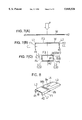
  • FIG. 8 is a partially enlarged view of FIG. 6;
  • FIG. 9 is a graph showing the relation between the forming force and curvature
  • FIG. 10 is a partially enlarged plane view of FIG. 6;
  • FIG. 11 is a partially enlarged perspective view of FIG. 6;
  • FIG. 12 is a graph showing the relation between the over-bending amount and maximum wrinkle depth
  • FIG. 13 is a partially enlarged perspective view of FIG. 6;
  • FIG. 14 is a graph showing the relation between the over-bending amount and opening amount of strip ends.
  • FIGS. 1 through 5 illustrate a forming device used in the present embodiment.
  • a movable table 2 is positioned over a stationary table 1.
  • the movable table 2 includes a press ram (not shown) which is movable in the pressing direction P.
  • a die 3 as a first die is secured to the stationary table 1 while a punch 4 as one part of a second die is secured to the movable table 2.
  • a feeding means (not shown) adapted to feed a strip (work) W in a horizontal feeding direction S is provided on the left side of the forming device.
  • An upper part of an outer surface 5a of the main body 5 in the central section defined by the pressing direction P and feeding direction S is formed flat near the inlet of the forming device, and then curves upwardly.
  • the upper part of the outer surface 5a of the main body 5 in the section perpendicular to the feeding direction S is also formed flat near the inlet of the forming device.
  • the outer surface 5a of the main body 5 is gradually bent through 90 degrees along lines adapted to bend the work W along designed ridgelines L1 and L2.
  • the outer surface 5a of the main body 5 is gradually bent along lines adapted to bend the work W along designed ridgelines L3 and L4. As shown in FIGS.
  • the designed ridgelines L1 and L2 are located near widthwise ends e1 and e2 of the work W while the designed ridgelines L3 and L4 are located next to the designed ridgelines L1 and L2, namely near a widthwise center of the work W.
  • These designed ridgelines L1, L2, L3 and L4 extend in the feeding direction S.
  • the width of the lower part of the main body 5 decreases with the distance between ends of the outer surface 5a.
  • the mandrel 6 has an outer surface 6a connected to the outer surface 5a of the main body 5, and, as shown in FIG. 5, is gradually bent through 90 degrees along lines adapted to bend the work W along the designed ridgelines L3 and L4.
  • the under surface 4a of the punch 4 is gradually bent through 90 degrees along lines adapted to bend the work W along designed ridgelines L3 and L4. As shown in FIG. 5, the width of the punch 4 is reduced to about the sum of the width of the mandrel 6 and double of the thickness of the work W.
  • a pair of slide tables 7 and 8 are secured to left and right of the stationary table 1.
  • Sliders 11 and 12 are slidably provided on the slide tables 7 and 8.
  • the sliders 11 and 12 are biased in directions away from each other with pushing springs 9 and 10.
  • Correction punches 13 and 14 adapted to correct a rough pipe WO with the mandrel 6 and the punch 4 are secured to the sliders 11 and 12.
  • These correction punches 13 and 14 along with the punch 4 define a second die.
  • Slide cams 15 and 16 are secured to the movable table 2.
  • the slide cams 15 and 16 have inclination surfaces 15a and 16a, respectively.
  • inclination surfaces 15a and 16a face each other and conform to inclination surfaces 11a and 12a of the sliders 11 and 12, respectively.
  • the inclination surfaces 15a and 1la are positioned upwardly of the inclination surfaces 16a and 12a, which enables the correction punches 13 and 14 to move at timings with a predetermined time lag.
  • the work W of metal is successively fed between the main body 5, mandrel 6, punch 4 and correction punches 13 and 14 of the forming device thus arranged by predetermined feed lengths.
  • the work W is pressed with the main body 5, mandrel 6, punch 4 and correction punches 13 and 14, thus subjecting the work W to a feed-bending method.
  • a pipe W1 is formed continuously.
  • the rough pipe W0 which is connected to the work W is formed with the main body 5 and punch 4. Since the designed ridgelines L1 through L4 extend in the feeding direction S, the work W is merely bent gradually along the designed ridgelines L1 through L4. This does not cause brittleness of the work due to metal fatigue.
  • the work W is curved upwardly, which restrains generation of tensile strain in flange surfaces F1, F2 (FIG. 7(B)) of the work W, which correspond to segments parallel to the pressing direction P in the cross-section taken perpendicularly to the feeding direction S, on the side of the ends e1 and e2 in relation to the central line CL extending perpendicularly to the pressing direction P, and also restrains generation of compressive strain in the flange surfaces F1, F2 on the side of the central portion thereof in relation to the central line CL. Furthermore, in the first step, a desired curvature is given to the pipe W1.
  • the work W is bent along the designed ridgelines L3 and L4 to obtain the rough pipe W0.
  • the interior angles inside the desinged ridgelines L1 through L4 of the rough pipe W0 are 90 degrees, which are approximately identical to those inside the ridgelines L5 through L8 of the product tube W1, and the widthwise ends e1 and e2 are generally flush with each other and abuttable.
  • the ends e1 and e2 may separate into an open state due to residual stress, because they have elongated and shrinked by repeatedly bending operations.
  • the correcting punches 13 and 14 along with the mandrel 6 and the under surface of the punch 4, which faces the mandrel 6, correct the rough pipe W0 from the inside and outside thereof. More specifically, the correcting punches 13 and 14 initially bend the rough pipe W0 greatly such that, as shown in FIGS. 7(C) and 10, the distance between the surfaces F4 and F5 of the rough pipe W0, which extend in parallel with the pressing direction P, becomes smaller than that of corresponding surfaces of a product pipe W1. After that, this bending force is released. As shown in FIG. 5, the correcting punches 13 and 14 are arranged such that when the slide cams 15 and 16 descend, the correcting punch 13 moves prior to the correcting punch 14.
  • the long end e1 initially abuts the mandrel 6, and then the short end e2 abuts the mandrel 6.
  • open ends e1 and e2 are superimposed on each other, and wrinkles therein are crushed.
  • the pipe W1 having an angular closed cross-section taken perpendicularly to the feeding direction, which is connected to the rough pipe W0, can be obtained continuously. Then, the pipe W1 is cut along the cut line C to obtain a product pipe applicable to a reinforcing member of a bumper, for example.

Landscapes

  • Engineering & Computer Science (AREA)
  • Mechanical Engineering (AREA)
  • Bending Of Plates, Rods, And Pipes (AREA)

Abstract

A method for continuously producing pipes, each having a polygon-shaped closed cross-section taken perpendicularly to the feeding direction of a strip of metal, which are free from brittleness caused by metal fatigue, and have good precision. A feed-bending method of successively feeding a strip of metal (work) W between a main die body, mandrel, punch and correction punches by predetermined feed lengths, and pressing the work W with these members synchroously with feeding is performed. The work W is gradually bent along designed ridgelines L1 through L2 extending in the feeding direction and defining ridgelines L5 through L8 of a product pipe W1, from the ridgelines L1 and L2 close to widthwise ends e1 and e2 to the ridgelines L3 and L4 in the widthwise center thereof in the course between the vicinity of an inlet and the vicinity of a middle of a device, and then, a resulting rough pipe W0 is corrected from the inside and outside thereof in the vicinity of an outlet of the device.

Description

BACKGROUND OF THE INVENTION
1. Field of the Invention
The present invention relates to a method for continuously producing pipes, each having a polygon-shaped closed cross-section taken perpendicularly to the feeding direction of a strip of metal, by using a feed-bending method, and a device therefor. The pies obtained by this method and device are applicable to reinforcing members for bumpers or the like.
2. Description of Related Art
The feed-bending method is the method using a punch and die, for example, as first and second die members, and includes the steps of feeding a strip of metal between the punch and die by predetermined feed lengths, and pressing the strip with the punch and die synchronously with feeding. With this method, since the strip is pressed while being fed by predetermined feed lengths, a small-sized punch or the like is available. The feed-bending method thus arranged enables production of various kinds of products in small quantities at low costs, which has not been effected with a general pressing method of forming a strip of a predetermined length with a large-sized press, and a roll-forming method of forming a strip with a large number of rolls which are arranged sequentially with predetermined angles.
Examples of the conventional method or device using the feed-bending method described above include a continuous forming method of long-sized channel materials with a press die (Japanese Patent publication No. sho 57-52128), a feed-bending forming method of circular pipes with an edge bending system (Japanese Patent publication No. Hei 2-61333), a continuous forming device of pipes of various lengths (Japanese Utility Model publication No. Hei 5-27208) and a forming device for plate like long size body (Japanese Patent application laid-open No. Hei 3-221213).
The conventional methods or devices described above, however, neither disclose nor suggest continuous forming methods or devices of pipes, each having a polygon-shaped closed section taken in a direction perpendicular to the feeding direction of a strip.
More specifically, in the methods of Japanese Patent publication No. Hei 2-61333 and Japanese Utility Model publication No. Hei 5-27208, widthwise edges of strips are bent inwardly in its width direction with a curvature approximately identical to that of desired circular pipes between an inlet defined by a punch and die and an outlet defined thereby (edge bending), which causes resulting pressed products to have closed circular cross-sections taken perpendicularly to the feeding direction. If pipes, each having a polygon-shaped closed cross-section, are intended to produce with the edge bending system described above, designed ridgelines of the strip, which define ridgelines of resulting pipes, would extend in a direction crossing the feeding direction, and shift in parallel therewith every pressing operation. This results in that the strip would be bent and crushed repeatedly along the designed ridgelines, and resulting pipes would become brittle due to metal fatigue.
On the other hand, in the method and device of Japanese Patent publication No. sho 57-52128 and Japanese Patent application laid-open No. Hei 3-221213, strips are gradually bent through 90 degrees or more, and designed ridgelines extend in the feeding direction, so resulting pressed products have angular cross-sections taken perpendicularly to the feeding direction and do not become brittle due to metal fatigue. With these method and device, however, pressed products, each having a closed cross-section, cannot be obtained, because upon bending, both side edges thereof extend generally in parallel with each other or in directions crossing at approximately right angles in a separated state.
In the device of Japanese Patent application laid-open No. Hei 3-221213, a strip is initially bent along a designed ridgeline of the widthwise center thereof, and then bent along the designed ridgelines near the widthwise ends by copying them with a copying model. With this device, however, desired interior angles inside the ridgelines of resulting pressed products are difficult to obtain, and accordingly, precise polygon-shaped cross-sections are difficult to obtain.
SUMMARY OF THE INVENTION
It is an object of the present invention to provide a method of continuously producing pipes, each having a polygon-shaped closed cross-section taken perpendicularly to the feeding direction of a strip, which are free from brittleness caused by metal fatigue, and have good precision, and a device for effecting such a method.
A first aspect of the method of producing pipes, each having a polygon-shaped closed cross-section, in accordance with the present invention, is a feed-bending method including the steps of successively feeding a strip of metal between a first die and a second die by predetermined feed lengths, and pressing the strip with the first die and second die synchronously with feeding, thereby continuously forming pipes, each having a polygon-shaped closed cross-section taken perpendicularly to the feeding direction. The method includes the steps of gradually bending a strip of metal along designed ridgelines defining ridgelines of pipes, each having a polygon-shaped closed cross-section, which extend in the feeding direction, from those close to widthwise ends of the strip towards those near a widthwise center thereof in the course between the vicinity of an inlet defined by the first and second dies and the vicinity of a middle thereof, thereby forming a rough pipe which is connected to the strip and has interior angles inside the designed ridgelines, each of which is approximately identical to that inside a corresponding desired ridgeline, and of which widthwise ends are substantially flush with each other and abuttable each other, and correcting the rough pipe form both the inside and outside thereof in the vicinity of the outlet defined by the first and second dies, thus obtaining a product pipe connected to the rough pipe.
With the method in accordance with the present invention, while the strip (work) is fed from the vicinity of the inlet defined by the first and second dies to the vicinity of the middle thereof, the rough pipe connected to the work is initially obtained. In this step, the work is merely bent gradually along designed ridgelines defining desired ridgelines of a product pipe, because they extend in the feeding direction, which does not cause brittleness due to metal fatigue.
Where, as described above, the work is bent along designed ridgelines which extend in the feeding direction, the work which has been bent only along the designed ridgelines close to the widthwise ends may deform in a twisting direction in the surfaces corresponding to segments extending in parallel with the pressing direction in the cross-section taken perpendicularly to the feeding direction. This results in, if the work still extends linearly in a longitudinal direction, tensile strain being generated in these surfaces thereof on the side of ends in relation to the central line which extends perpendicularly to the pressing direction, while compressive strain being generated in these surfaces on the side of a central portion in relation to the above-described central line. Accordingly, camber may be generated with a longitudinal central portion as the center of curvature. With the method in accordance with the present invention, the work is bent gradually along the designed ridgelines from those close to the widthwise ends towards those near the widthwise center. Therefore, the above-described surfaces of the work have a short length in a pressing direction, thus mininizing the above camber therein. With this arrangement, however, camber of the work is still inevitable, and may remain in a resulting pipe as a pressed product. Accordingly, if pipes having no or reduced camber are desired, camber must be restrained. To this end, the step of producing a rough pipe may be performed with an inclination or curvature which causes oppositely curved camber given thereto (first means). With this first means, the above-describe(ed surfaces corresponding to segments of the cross-section taken perpendicularly to the feeding direction, which are parallel with the pressing direction, tensile strain which would be generated on the side of ends in relation to the central line extending perpendicularly to the pressing direction can be restrained or eliminated, and compressive strain which would be generated on the side of the central portion in relation to the above-described central line can be also restrained or eliminated. With this first means, a desired curvature can be also given to the pipe.
In the work which has been bent along designed ridgelines next to the initially bent designed ridgelines, tensile strain has been eliminated from the widthwise ends of the work so that wrinkles may be generated therein. Even if a rough pipe is produced with an inclination or curvature given to the work with the first means, these wrinkles would be generated, and remain in a resulting pipe as a pressed product. These wrinkles are normally less-desirable so as to be needed to restrain. Furthermore, when the rough pipe is produced with a high inclination or curvature given to the work, a great springback occurs in the work in its feeding direction. This may cause the work to be caught between the first die and/or second die to block feeding of the work. To overcome this problem, the rough pipe may be produced while forming bead-like projections on a central surface of the work in a direction perpendicular to the feeding direction thereof, and then crushing the projections formed (second means). With this second means, elongation can be given to the central surface of the work to restrain tensile strain near the widthwise ends, thereby restraining or eliminating wrinkles thereabout, and to restrain springback in the work, thereby preventing the work from being caught by the first die and/or second die. Alternatively, as a third means, the vicinity of the widthwise ends may be pressed to crush the wrinkles therein.
Thus, a resulting rough pipe has interior angles inside designed ridgelines, which are generally identical to those inside corresponding ridgelines of a desired pipe. And the widthwise ends thereof extend flush with each other and are abuttable each other. The widthwise ends of the resulting rough pipe, however, may be separated due to a residual stress, because they have been elongated and shrinked by repeatedly bending operations.
To overcome this problem, the rough pipe is corrected from the inside and outside thereof in the vicinity of the outlet defined by the first and second dies. It is preferable that the rough pipe is initially bent greatly such that the distance between the widthwise ends is smaller than that of a desired pipe, and then, this bending force is released. This results in the widthwise ends of the rough pipe abutting each other, and the wrinkles therein beind crushed. Thus, pipes, each having a polygon-shaped closed cross-section taken perpendicular to the feeding direction, can be obtained continously. By moving the first and second dies located on the widthwise left and right of the device at timings with a predetermined time lag, the widthwise ends of the rough pipe can be superimposed on each other.
Accordingly, with the method in accordance with the present invention, pipes, each having a polygon-shaped closed cross section taken perpendicular to the feeding direction, can be produced continously. The resulting pipes are free from brittleness caused by metal fatige, and have good precision. And these operational effects can be effected with the die in accordance with the present invention.
Other objects, features, and characteristics of the present invention will become apparent upon considerationof the following description and the appended claims with reference to the accompanying drawings, all of which form a part of this specification.
BRIEF DESCRIPTION OF THE DRAWING
FIG. 1 is a schematic longitudinal sectional view of a forming device used in an embodiment of a method in accordance with the present invention;
FIG. 2 is a cross-sectional view of the forming device taken along the line II--II of FIG. 1;
FIG. 3 is a cross-sectional view of the forming device taken along the line III--III of FIG. 1;
FIG. 4 is a cross-sectional view of the forming device taken along the line IV--IV of FIG. 1;
FIG. 5 is a cross-sectional view of the forming device taken along the line V--V of FIG. 1;
FIG. 6 is a perspective view of a product pipe obtained with the method in accordance with the present invention;
FIG. 7(A) is a cross-sectional view taken in the direction A of FIG. 6;
FIG. 7(B) is a cross-sectional view taken in the direction B of FIG. 6;
FIG. 7(C) is a cross-sectional view taken in the direction C of FIG. 6;
FIG. 8 is a partially enlarged view of FIG. 6;
FIG. 9 is a graph showing the relation between the forming force and curvature;
FIG. 10 is a partially enlarged plane view of FIG. 6;
FIG. 11 is a partially enlarged perspective view of FIG. 6;
FIG. 12 is a graph showing the relation between the over-bending amount and maximum wrinkle depth;
FIG. 13 is a partially enlarged perspective view of FIG. 6; and
FIG. 14 is a graph showing the relation between the over-bending amount and opening amount of strip ends.
DETAILED DESCRIPTION OF THE PRESENTLY PREFERRED EXEMPLARY EMBODIMENTS
Hereinafter, an embodiment of the present invention will be explained with reference to the accompanying drawings.
FIGS. 1 through 5 illustrate a forming device used in the present embodiment. As shown in FIG. 1, a movable table 2 is positioned over a stationary table 1. The movable table 2 includes a press ram (not shown) which is movable in the pressing direction P. A die 3 as a first die is secured to the stationary table 1 while a punch 4 as one part of a second die is secured to the movable table 2. A feeding means (not shown) adapted to feed a strip (work) W in a horizontal feeding direction S is provided on the left side of the forming device. The die 3 includes a main body 5 extending from an inlet of the forming device, which corresponds to an outlet of the feeding means, to the point slightly right of the middle of the die 3, and a mandrel 6 projecting from an upper end of a right side surface of the main body 5 and extending to an outlet of the forming device.
An upper part of an outer surface 5a of the main body 5 in the central section defined by the pressing direction P and feeding direction S is formed flat near the inlet of the forming device, and then curves upwardly. The upper part of the outer surface 5a of the main body 5 in the section perpendicular to the feeding direction S is also formed flat near the inlet of the forming device. And, as shown in FIGS. 2 and 3, the outer surface 5a of the main body 5 is gradually bent through 90 degrees along lines adapted to bend the work W along designed ridgelines L1 and L2. Next, as shown in FIG. 4, the outer surface 5a of the main body 5 is gradually bent along lines adapted to bend the work W along designed ridgelines L3 and L4. As shown in FIGS. 7(A), 7(B) and 7(C), the designed ridgelines L1 and L2 are located near widthwise ends e1 and e2 of the work W while the designed ridgelines L3 and L4 are located next to the designed ridgelines L1 and L2, namely near a widthwise center of the work W. These designed ridgelines L1, L2, L3 and L4 extend in the feeding direction S. As shown in FIGS. 2 to 4, the width of the lower part of the main body 5 decreases with the distance between ends of the outer surface 5a. The mandrel 6 has an outer surface 6a connected to the outer surface 5a of the main body 5, and, as shown in FIG. 5, is gradually bent through 90 degrees along lines adapted to bend the work W along the designed ridgelines L3 and L4.
As shown in FIG. 1, which illustrates a central section defined by the pressing direction P and feeding direction S, an under surface 4a of the punch 4 is formed flat near the inlet of the forming device, and then curves upwardly. As shown in FIG. 3, two bead-like grooves 4b are formed in an upwardly curving part of the under surface 4a in a direction perpendicular to the feeding direction S. In the cross-section of the punch 4, which is perpendicular to the feeding direction S, the under surface 4a thereof is formed flat near the inlet of the forming device. As shown in FIGS. 2 and 3, the under surface 4a of the punch 4 is gradually bent through 90 degrees along lines adapted to bend the work W along the designed ridgelines L1 and L2. Next, as shown in FIG. 4, the under surface 4a of the punch 4 is gradually bent through 90 degrees along lines adapted to bend the work W along designed ridgelines L3 and L4. As shown in FIG. 5, the width of the punch 4 is reduced to about the sum of the width of the mandrel 6 and double of the thickness of the work W.
Near the outlet of the forming device, a pair of slide tables 7 and 8 are secured to left and right of the stationary table 1. Sliders 11 and 12 are slidably provided on the slide tables 7 and 8. The sliders 11 and 12 are biased in directions away from each other with pushing springs 9 and 10. Correction punches 13 and 14 adapted to correct a rough pipe WO with the mandrel 6 and the punch 4 are secured to the sliders 11 and 12. These correction punches 13 and 14 along with the punch 4 define a second die. Slide cams 15 and 16 are secured to the movable table 2. The slide cams 15 and 16 have inclination surfaces 15a and 16a, respectively. These inclination surfaces 15a and 16a face each other and conform to inclination surfaces 11a and 12a of the sliders 11 and 12, respectively. The inclination surfaces 15a and 1la are positioned upwardly of the inclination surfaces 16a and 12a, which enables the correction punches 13 and 14 to move at timings with a predetermined time lag.
In operation, the work W of metal is successively fed between the main body 5, mandrel 6, punch 4 and correction punches 13 and 14 of the forming device thus arranged by predetermined feed lengths. Synchronously with feeding, the work W is pressed with the main body 5, mandrel 6, punch 4 and correction punches 13 and 14, thus subjecting the work W to a feed-bending method. As a result, as shown in FIG. 6, a pipe W1 is formed continuously.
In the steps of forming a rough pipe, which includes a first to third steps, the rough pipe W0 which is connected to the work W is formed with the main body 5 and punch 4. Since the designed ridgelines L1 through L4 extend in the feeding direction S, the work W is merely bent gradually along the designed ridgelines L1 through L4. This does not cause brittleness of the work due to metal fatigue.
In the first step, as shown in FIGS. 1 and 2, the work W is curved upwardly, which restrains generation of tensile strain in flange surfaces F1, F2 (FIG. 7(B)) of the work W, which correspond to segments parallel to the pressing direction P in the cross-section taken perpendicularly to the feeding direction S, on the side of the ends e1 and e2 in relation to the central line CL extending perpendicularly to the pressing direction P, and also restrains generation of compressive strain in the flange surfaces F1, F2 on the side of the central portion thereof in relation to the central line CL. Furthermore, in the first step, a desired curvature is given to the pipe W1. Since the work W is bent along the designed ridgelines L1 and L2 which are near the ends e1 and e2, the length of the flange surfaces F1 and F2 in the pressing direction P is short, which enables oppositely curving camber of the work W to be minimized. As shown in FIG. 6, in the end of the first step, a cut line C is formed in the work W.
In the second step, as shown in FIGS. 1 and 3, two bead-like projections Wb are formed on a central web surface F3 of the work W with bead-like grooves 4b of the punch 4, and as the forming proceeds, these bead-like projections Wb are crushed. This results in, as shown in FIG. 8, elongation δ e being given on the web surface F3 of the work W to restrain tensile strain δ b near the ends e1 and e2, thus restraining generation of wrinkles r (FIGS. 11 and 13). If generated, the wrinkles r can be crushed by pressing the areas near ends e1 and e2 with a slide core or the like.
The relation between the forming force (ton) and the curvature ρ (1/mm) showing the curve of the work W in the case of the height of projections Wb being 0 (mm), 1.5 (mm) and 3.0 (mm) was examined. The examination results are shown in the graph of FIG. 9. In the graph, the relation in the case of the height being 0 (mm) is indicated by , the relation in the case of the height being 1.5 (mm) is indicated by ▪ and the relation in the case of the height being 3.0 (mm) is indicated by ▴. Reference character 11 denotes dimensions of a forming die, and 12 denotes objective dimensions of a product. FIG. 9 shows that by forming the projections Wb on the web surface F3 and thereafter crushing them, springback Sb of the work W can be restrained, and accordingly, the work W can be prevented from being caught between the main body 5, mandrel 6, punch 4 and correction punches 13 and 14.
In a third step, as shown in FIGS. 1 and 4, the work W is bent along the designed ridgelines L3 and L4 to obtain the rough pipe W0. As shown in FIGS. 6 and 7 (C), the interior angles inside the desinged ridgelines L1 through L4 of the rough pipe W0 are 90 degrees, which are approximately identical to those inside the ridgelines L5 through L8 of the product tube W1, and the widthwise ends e1 and e2 are generally flush with each other and abuttable. The ends e1 and e2, however, may separate into an open state due to residual stress, because they have elongated and shrinked by repeatedly bending operations.
To prevent the above problem, in the following correcting step, the correcting punches 13 and 14 along with the mandrel 6 and the under surface of the punch 4, which faces the mandrel 6, correct the rough pipe W0 from the inside and outside thereof. More specifically, the correcting punches 13 and 14 initially bend the rough pipe W0 greatly such that, as shown in FIGS. 7(C) and 10, the distance between the surfaces F4 and F5 of the rough pipe W0, which extend in parallel with the pressing direction P, becomes smaller than that of corresponding surfaces of a product pipe W1. After that, this bending force is released. As shown in FIG. 5, the correcting punches 13 and 14 are arranged such that when the slide cams 15 and 16 descend, the correcting punch 13 moves prior to the correcting punch 14. Therefore, as shown in FIG. 7(C), the long end e1 initially abuts the mandrel 6, and then the short end e2 abuts the mandrel 6. Thus, open ends e1 and e2 are superimposed on each other, and wrinkles therein are crushed.
The relation between the over-bending amount Q (mm), which is the amount by which the correcting punches 13 and 14 bend the rough pipe W0 greatly, as shown in FIG. 10, and the maximum depth d (mm) of the wrinkles r formed near the ends e1 and e2, as shown in FIG. 11, was examined. The examination results are shown in the graph of FIG. 12. As shown, where the rough pipe W0 was first bent greatly by the over-bending amount of about 0.5 mm or more, and then the bending force was released, the generation of wrinkles r was prevented.
Similarly, the relation between the over-bending amount Q (mm) and the ends-opening amount b (b=X-X0) (mm) shown in FIG. 13, was examined. The examination results are shown in the graph of FIG. 14. As shown, where the rough pipe W0 was first bent greatly by the over-bending amount of about 1.0 mm or more, and then the bending force was released, the ends-opening was prevented.
Thus, as shown in FIG. 6, the pipe W1 having an angular closed cross-section taken perpendicularly to the feeding direction, which is connected to the rough pipe W0, can be obtained continuously. Then, the pipe W1 is cut along the cut line C to obtain a product pipe applicable to a reinforcing member of a bumper, for example.
With the present method, pipes W1, each having a rectangular closed cross-section taken perpendicularly to the feeding direction S of the work W, can be produced continuously. Furthermore, the resulting pipes W1 are free from brittleness caused by metal fatigue, and have good precision. And these operational advantages can be effected with the device of the present embodiment.
While the invention has been described in connection with what are considered presently to be the most practical and preferred embodiments, it is to be understood that the invention is not limited to the disclosed embodiments, but, on the contrary, is intended to cover various modifications and equivalent arrangements included within the spirit and scope of the appended claims.
The entire disclosure of Japanese Patent Application No. 8-83821 filed on Apr. 5, 1996, including specification, claims, drawings and summary is incorporated herein by reference in its entirety.

Claims (12)

What is claimed is:
1. A method of continuously producing pipes, each having a polygon-shaped closed cross-section taken perpendicularly to the feeding direction, by a feed-bending method of successively feeding a strip of metal between a first die and a second die by predetermined feed lengths, and pressing the strip with the first die and the second die synchronously with feeding, comprising the steps of:
producing a rough pipe by gradually bending a strip of metal along designed ridgelines which extend in the feeding direction from those close to widthwise ends of the strip towards those near a widthwise center thereof in the course between the vicinity of an inlet defined by the first and second dies and the vicinity of a middle thereof, while said strip is fed in the condition that one of inclinations and curvatures is given thereto to generate oppositely curving camber, and while bead-like projections are initially formed on a central surface of said strip in a direction perpendicular to the feeding direction, and said projections are gradually crushed in accordance with the process of producing said rough pipe, thereby forming said rough pipe which is connected to said strip, each of the designed ridgelines defining an interior angle that is approximately identical to an interior angle defined by a corresponding desired ridgeline, the widthwise ends of the rough pipe being substantially flush with each other and abuttable with each other; and
correcting said rough pipe from the inside and outside thereof in the vicinity of an outlet defined by the first and second dies, thereby obtaining a product pipe connected to said rough pipe.
2. A method as claimed in claim 1, wherein in said step of correcting said rough pipe, said rough pipe is initially bent greatly such that the distance between widthwise ends of said rough pipe becomes smaller than that of said desired pipes, and then, a bending force applied to bend said rough pipe is released.
3. A method as claimed in claim 1, wherein in said step of correcting said rough pipe, a first die and a second die which are located on widthwise right and left sides are moved at timings with a predetermined time lag.
4. A method of continuously producing pipes, each having a polygon-shaped closed cross-section taken perpendicularly to the feeding direction, by a feed-bending method of successively feeding a strip of metal between a first die and a second die by predetermined feed lengths, and pressing the strip with the first die and the second die synchronously with feeding, comprising the steps of:
producing a rough pipe by gradually bending a strip of metal along designed ridgelines which extend in the feeding direction from those close to widthwise ends of the strip towards those near a widthwise center thereof in the course between the vicinity of an inlet defined by the first and second dies and the vicinity of a middle thereof, thereby forming said rough pipe which is connected to said strip, each of the designed ridgelines defining an interior angle that is approximately identical to an interior angle defined by a corresponding desired ridgeline, the widthwise ends of the rough pipe being substantially flush with each other and abuttable with each other; and
correcting said rough pipe from the inside and outside thereof in the vicinity of an outlet defined by the first and second dies, thereby obtaining a product pipe connected to said rough pipe.
5. A method as claimed in claim 4, wherein in said step of producing said rough pipe, said strip is fed while one of inclinations and curvatures is given thereto to generate oppositely curving camber.
6. A method as claimed in claim 4, wherein in said step of producing said rough pipe, bead-like projections are initially formed on a central surface of said strip in a direction perpendicular to the feeding direction, and as said step of producing said rough pipe proceeds, said projections are gradually crushed.
7. A method as claimed in claim 4, wherein in said step of correcting said rough pipe, said rough pipe is initially bent greatly such that the distance between widthwise ends of said rough pipe becomes smaller than that of said desired pipes, and then, a bending force applied to bend said rough pipe is released.
8. A method as claimed in claim 4, wherein in said step of correcting said rough pipe, a first die and a second die which are located on widthwise right and left sides are moved at timings with a predetermined time lag.
9. A method of continuously producing pipes, each having a polygon-shaped closed cross-section taken perpendicularly to the feeding direction, by a feed-bending method of successively feeding a strip of metal between a first die and a second die by predetermined feed lengths, and pressing the strip with the first die and the second die synchronously with feeding, comprising the steps of:
producing a rough pipe by gradually bending a strip of metal along designed ridgelines which extend in the feeding direction from those close to widthwise ends of the strip towards those near a widthwise center thereof in the course between the vicinity of an inlet defined by the first and second dies and the vicinity of a middle thereof, while said strip is fed in the condition that one of inclinations and curvatures is given thereto to generate oppositely curving camber, thereby forming said rough pipe which is connected to said strip, each of the designed ridgelines defining an interior angle that is approximately identical to an defined by a corresponding desired ridgeline, the widthwise ends of the rough pipe being substantially flush with each other and abuttable with each other; and
correcting said rough pipe from the inside and outside thereof in the vicinity of an outlet defined by the first and second dies, while said rough pipe is initially bent greatly such that the distance between widthwise ends of said rough pipe becomes smaller than that of said desired pipes, and then, a bending force applied to bend said rough pipe is released, thereby obtaining a product pipe connected to said rough pipe.
10. A method of continuously producing pipes, each having a polygon-shaped closed cross-section taken perpendicularly to the feeding direction, by a feed-bending method of successively feeding a strip of metal between a first die and a second die by predetermined feed lengths, and pressing the strip with the first die and the second die synchronously with feeding, comprising the steps of:
producing a rough pipe by gradually bending a strip of metal along designed ridgelines which extend in the feeding direction from those close to widthwise ends of the strip towards those near a widthwise center thereof in the course between the vicinity of an inlet defined by the first and second dies and the vicinity of a middle thereof, while said strip is fed in the condition that one of inclinations and curvatures is given thereto to generate oppositely curving camber, thereby forming said rough pipe which is connected to said strip, each of the designed ridgelines defining an interior angle that is approximately identical to an an interior angle defined by a corresponding desired ridgeline, the widthwise ends of the rough pipe being substantially flush with each other and abuttable with each other; and
correcting said rough pipe from the inside and outside thereof in the vicinity of an outlet defined by the first and second dies, wherein a first die and a second die which are located on widthwise right and left sides are moved at timings with a predetermined time lag, thereby obtaining a product pipe connected to said rough pipe.
11. A method of continuously producing pipes, each having a polygon-shaped closed cross-section taken perpendicularly to the feeding direction, by a feed-bending method of successively feeding a strip of metal between a first die and a second die by predetermined feed lengths, and pressing the strip with the first die and the second die synchronously with feeding, comprising the steps of:
producing a rough pipe by gradually bending a strip of metal along designed ridgelines which extend in the feeding direction from those close to widthwise ends of the strip towards those near a widthwise center thereof in the course between the vicinity of an inlet defined by the first and second dies and the vicinity of a middle thereof, while said strip is fed in the condition that one of inclinations and curvatures is given thereto to generate oppositely curving camber, and while bead-like projections are initially formed on a central surface of said strip in a direction perpendicular to the feeding direction, and said projections are gradually crushed in accordance with the process of producing said rough pipe, thereby forming said rough pipe which is connected to said strip, each of the designed ridgelines defining an interior angle that is approximately identical to an interior angle defined by a corresponding desired ridgeline, the widthwise ends of the rough pipe being substantially flush with each other and abuttable with each other; and
correcting said rough pipe from the inside and outside thereof in the vicinity of an outlet defined by the first and second dies, while said rough pipe is initially bent greatly such that the distance between widthwise ends of said rough pipe becomes smaller than that of said desired pipes, and then, a bending force applied to bend said rough pipe is released, wherein a first die and second die which are located on widthwise right and left sides are moved at timings with a predetermined time lag, thereby obtaining a product pipe connected to said rough pipe.
12. A device for continuously producing pipes, each having a polygon-shaped closed cross-section taken perpendicularly to the feeding direction, by a feed-bending method of successively feeding a strip of metal into said die by predetermined feed lengths, and pressing the strip with said die synchronously with feeding, comprising:
a first die and a second die which are arranged such that a strip of metal is gradually bent along designed ridgelines extending in the feeding direction, from those close to widthwise ends of said strip towards a widthwise center thereof in the course between the vicinity of an inlet defined by said first die and said second die and the vicinity of a middle thereof, thereby forming a rough pipe which is connected to said strip, each of the designed ridgelines defining an interior angle that is approximately identical to an interior angle defined by a corresponding desired ridgeline, the widthwise ends of the rough pipe being substantially flush with each other and abuttable with each other, and such that said rough pipe is corrected from the inside and outside thereof in the vicinity of an outlet defined by said first die and said second die, thereby obtaining a product pipe which is connected to said rough pipe,
said first die includes a main body which extends from the vicinity of said inlet to the vicinity of said middle, and a mandrel which is integrally connected to an outer surface of said main body and extends to said outlet, said outer surface of said main body in a central section defined by the pressing direction and the feeding direction is formed horizontal in the vicinity of said inlet, and then curves upwardly, and
said second die includes a punch adapted to face said main body and said mandrel of said first die, and a pair of correction punches which are adapted to face said mandrel, and movable widthwise leftwards and rightwards, an outer surface of said punch of said second die in the central section defined by the pressing direction and feeding direction is formed horizontal in the vicinity of said inlet, and then curves upwardly.
US08/831,477 1996-04-05 1997-03-31 Method for producing pipe having polygon-shaped closed cross-section and device therefor Expired - Fee Related US5845526A (en)

Applications Claiming Priority (2)

Application Number Priority Date Filing Date Title
JP08382196A JP3347573B2 (en) 1996-04-05 1996-04-05 Method for producing closed tube with polygonal cross section and mold therefor
JP8-083821 1996-04-05

Publications (1)

Publication Number Publication Date
US5845526A true US5845526A (en) 1998-12-08

Family

ID=13813365

Family Applications (1)

Application Number Title Priority Date Filing Date
US08/831,477 Expired - Fee Related US5845526A (en) 1996-04-05 1997-03-31 Method for producing pipe having polygon-shaped closed cross-section and device therefor

Country Status (5)

Country Link
US (1) US5845526A (en)
EP (1) EP0799656B1 (en)
JP (1) JP3347573B2 (en)
KR (1) KR100224930B1 (en)
DE (1) DE69703761T2 (en)

Cited By (3)

* Cited by examiner, † Cited by third party
Publication number Priority date Publication date Assignee Title
US6745448B2 (en) * 2000-02-04 2004-06-08 Ricoh Company, Ltd. Pipe body and forming method of the same
CN104028596A (en) * 2014-05-23 2014-09-10 宁波赛乐福板材成型技术有限公司 Plate continuous asymptotic forming device
US20150375288A1 (en) * 2008-09-25 2015-12-31 Jfe Steel Corporation Closed structure parts, method and press forming apparatus for manufacturing the same

Families Citing this family (9)

* Cited by examiner, † Cited by third party
Publication number Priority date Publication date Assignee Title
JP3613702B2 (en) 1999-09-21 2005-01-26 トヨタ自動車株式会社 STRUCTURAL MEMBER HAVING CLOSED SECTION, ITS MANUFACTURING DEVICE, AND ITS MANUFACTURING METHOD
JP3850196B2 (en) * 2000-02-04 2006-11-29 株式会社リコー Pipe body manufacturing method, manufacturing apparatus, pipe body manufactured by these, and image forming apparatus using this pipe body
JP4538997B2 (en) * 2001-08-09 2010-09-08 トヨタ紡織株式会社 Press machine
JP2008080381A (en) * 2006-09-28 2008-04-10 Yorozu Corp Method for manufacturing curved hollow pipe
KR100790773B1 (en) 2006-11-27 2008-01-03 주식회사 성우하이텍 Roll forming apparatus for simultaneous forming and method
JP5206805B2 (en) * 2011-01-24 2013-06-12 Jfeスチール株式会社 Manufacturing method and apparatus for closed-section structural parts
JP5905490B2 (en) * 2011-12-21 2016-04-20 本田技研工業株式会社 Suspension arm mounting structure
WO2013153681A1 (en) * 2012-04-13 2013-10-17 Jfeスチール株式会社 Device and method for producing closed-cross-section-structure component
KR102132652B1 (en) * 2019-06-18 2020-07-10 서종태 Shaping device for beam of vehicle

Citations (9)

* Cited by examiner, † Cited by third party
Publication number Priority date Publication date Assignee Title
US1708872A (en) * 1923-11-01 1929-04-09 Richmond Fireproof Door Co Strip-forming machine
GB328890A (en) * 1928-10-03 1930-05-08 Ig Farbenindustrie Ag Method of manufacturing shaped sections of uniform thickness from sheet metal strips
US1785025A (en) * 1927-12-02 1930-12-16 Guarsteel Safety Stair Co Square tubing for newel posts
US2942643A (en) * 1957-10-11 1960-06-28 Pucci Joseph Method of and apparatus for cutting and shaping strip material
US3119432A (en) * 1961-05-15 1964-01-28 Pullmax Ab Sheet metal forming tools
JPS6254523A (en) * 1985-04-04 1987-03-10 Nippon Steel Metal Prod Co Ltd Forming equipment for pipe stock for angular steel pipe
EP0384287A2 (en) * 1989-02-15 1990-08-29 Enami Seiki Mfg. Co., Ltd. Apparatus for forming long plate member
JPH02261333A (en) * 1989-03-31 1990-10-24 Kanegafuchi Chem Ind Co Ltd Water-in-oil type fat and oil composition for cake
US5104026A (en) * 1990-03-26 1992-04-14 Shape Corporation Apparatus for roll-forming an automotive bumper

Patent Citations (10)

* Cited by examiner, † Cited by third party
Publication number Priority date Publication date Assignee Title
US1708872A (en) * 1923-11-01 1929-04-09 Richmond Fireproof Door Co Strip-forming machine
US1785025A (en) * 1927-12-02 1930-12-16 Guarsteel Safety Stair Co Square tubing for newel posts
GB328890A (en) * 1928-10-03 1930-05-08 Ig Farbenindustrie Ag Method of manufacturing shaped sections of uniform thickness from sheet metal strips
US2942643A (en) * 1957-10-11 1960-06-28 Pucci Joseph Method of and apparatus for cutting and shaping strip material
US3119432A (en) * 1961-05-15 1964-01-28 Pullmax Ab Sheet metal forming tools
JPS6254523A (en) * 1985-04-04 1987-03-10 Nippon Steel Metal Prod Co Ltd Forming equipment for pipe stock for angular steel pipe
EP0384287A2 (en) * 1989-02-15 1990-08-29 Enami Seiki Mfg. Co., Ltd. Apparatus for forming long plate member
JPH03221213A (en) * 1989-02-15 1991-09-30 Enami Seiki:Kk Forming device for plate like long size body
JPH02261333A (en) * 1989-03-31 1990-10-24 Kanegafuchi Chem Ind Co Ltd Water-in-oil type fat and oil composition for cake
US5104026A (en) * 1990-03-26 1992-04-14 Shape Corporation Apparatus for roll-forming an automotive bumper

Cited By (8)

* Cited by examiner, † Cited by third party
Publication number Priority date Publication date Assignee Title
US6745448B2 (en) * 2000-02-04 2004-06-08 Ricoh Company, Ltd. Pipe body and forming method of the same
US20040140011A1 (en) * 2000-02-04 2004-07-22 Takafumi Kondou Pipe body and forming method of the same
US7044169B2 (en) 2000-02-04 2006-05-16 Ricoh Company, Ltd. Pipe body and forming method of the same
US20060185751A1 (en) * 2000-02-04 2006-08-24 Takafumi Kondou Pipe body and forming method of the same
US7318455B2 (en) 2000-02-04 2008-01-15 Ricoh Company, Ltd. Pipe body and forming method of the same
US20150375288A1 (en) * 2008-09-25 2015-12-31 Jfe Steel Corporation Closed structure parts, method and press forming apparatus for manufacturing the same
CN104028596A (en) * 2014-05-23 2014-09-10 宁波赛乐福板材成型技术有限公司 Plate continuous asymptotic forming device
CN104028596B (en) * 2014-05-23 2016-01-06 宁波赛乐福板材成型技术有限公司 The continuous asymptotic shaped device of sheet material

Also Published As

Publication number Publication date
EP0799656A2 (en) 1997-10-08
KR970069171A (en) 1997-11-07
DE69703761T2 (en) 2001-08-09
JPH09271847A (en) 1997-10-21
KR100224930B1 (en) 1999-10-15
EP0799656B1 (en) 2000-12-27
DE69703761D1 (en) 2001-02-01
JP3347573B2 (en) 2002-11-20
EP0799656A3 (en) 1998-07-15

Similar Documents

Publication Publication Date Title
US4148426A (en) Method and apparatus for manufacturing metal pipe
US5845526A (en) Method for producing pipe having polygon-shaped closed cross-section and device therefor
RU2535414C2 (en) Method of forming l-shape component (versions)
KR102339921B1 (en) Metal plate for press forming, press forming apparatus, and manufacturing method of press parts
JP2010023078A (en) Bending method of workpiece and device used for the same
EP1088606B1 (en) Structural member having closed sections
KR102361285B1 (en) Manufacturing method of press parts, press forming apparatus, and metal plate for press forming
KR20190056438A (en) Method and apparatus for manufacturing press-formed article
KR102003631B1 (en) Press forming method and tool of press forming
TWI590885B (en) A method of manufacturing a press-formed product and a press-formed product, and a manufacturing apparatus of the press-formed product
KR101579028B1 (en) Method for manufacturing closed-structure part and apparatus for the same
JP7302747B2 (en) Method for manufacturing press-formed product and press-forming apparatus
JP6387866B2 (en) Press mold
CN113226584B (en) Press forming method
JPH0238287B2 (en)
KR20140079949A (en) Roll forming system and method thereof
US4403495A (en) Apparatus for bending channel section members
CA1179931A (en) Bending
KR20200112989A (en) Press-formed product design method, press-formed mold, press-formed product and press-formed product manufacturing method
KR102545155B1 (en) Press formimg method
WO2022118622A1 (en) Production method for steel component
JP2021176646A (en) Manufacturing method for press component, metal plate for press molding, and high-tensile steel plate
JP7102976B2 (en) Method of creating materials for press molding and its creation equipment
JPH11226635A (en) Method for producing tube with closed polygonal cross section and apparatus therefor
SU1660790A1 (en) Die for manufacture of tubes

Legal Events

Date Code Title Description
AS Assignment

Owner name: AMINO CORPORATION, JAPAN

Free format text: ASSIGNMENT OF ASSIGNORS INTEREST;ASSIGNORS:KADOMA, YOSHIAKI;NIHASHI, IWAO;OGAWA, HIDEO;AND OTHERS;REEL/FRAME:008739/0569

Effective date: 19970418

Owner name: TOYOTA JIDOSHA KABUSHIKI KAISHA, JAPAN

Free format text: ASSIGNMENT OF ASSIGNORS INTEREST;ASSIGNORS:KADOMA, YOSHIAKI;NIHASHI, IWAO;OGAWA, HIDEO;AND OTHERS;REEL/FRAME:008739/0569

Effective date: 19970418

FEPP Fee payment procedure

Free format text: PAYOR NUMBER ASSIGNED (ORIGINAL EVENT CODE: ASPN); ENTITY STATUS OF PATENT OWNER: LARGE ENTITY

FPAY Fee payment

Year of fee payment: 4

FPAY Fee payment

Year of fee payment: 8

REMI Maintenance fee reminder mailed
LAPS Lapse for failure to pay maintenance fees
STCH Information on status: patent discontinuation

Free format text: PATENT EXPIRED DUE TO NONPAYMENT OF MAINTENANCE FEES UNDER 37 CFR 1.362

FP Lapsed due to failure to pay maintenance fee

Effective date: 20101208