US5822240A - Ferroelectric random access memory circuits and structures for preventing ferroelectric capacitors from memory failure - Google Patents

Ferroelectric random access memory circuits and structures for preventing ferroelectric capacitors from memory failure Download PDF

Info

Publication number
US5822240A
US5822240A US08/549,898 US54989895A US5822240A US 5822240 A US5822240 A US 5822240A US 54989895 A US54989895 A US 54989895A US 5822240 A US5822240 A US 5822240A
Authority
US
United States
Prior art keywords
ferroelectric
electrodes
circuit
accordance
random access
Prior art date
Legal status (The legal status is an assumption and is not a legal conclusion. Google has not performed a legal analysis and makes no representation as to the accuracy of the status listed.)
Expired - Lifetime
Application number
US08/549,898
Inventor
In-kyung Yoo
Current Assignee (The listed assignees may be inaccurate. Google has not performed a legal analysis and makes no representation or warranty as to the accuracy of the list.)
Samsung Electronics Co Ltd
Original Assignee
Samsung Electronics Co Ltd
Priority date (The priority date is an assumption and is not a legal conclusion. Google has not performed a legal analysis and makes no representation as to the accuracy of the date listed.)
Filing date
Publication date
Application filed by Samsung Electronics Co Ltd filed Critical Samsung Electronics Co Ltd
Assigned to SAMSUNG ELECTRONICS CO., LTD. reassignment SAMSUNG ELECTRONICS CO., LTD. ASSIGNMENT OF ASSIGNORS INTEREST (SEE DOCUMENT FOR DETAILS). Assignors: YOO, IN-KYUNG
Application granted granted Critical
Publication of US5822240A publication Critical patent/US5822240A/en
Anticipated expiration legal-status Critical
Expired - Lifetime legal-status Critical Current

Links

Images

Classifications

    • HELECTRICITY
    • H01ELECTRIC ELEMENTS
    • H01GCAPACITORS; CAPACITORS, RECTIFIERS, DETECTORS, SWITCHING DEVICES, LIGHT-SENSITIVE OR TEMPERATURE-SENSITIVE DEVICES OF THE ELECTROLYTIC TYPE
    • H01G4/00Fixed capacitors; Processes of their manufacture
    • GPHYSICS
    • G11INFORMATION STORAGE
    • G11CSTATIC STORES
    • G11C11/00Digital stores characterised by the use of particular electric or magnetic storage elements; Storage elements therefor
    • G11C11/21Digital stores characterised by the use of particular electric or magnetic storage elements; Storage elements therefor using electric elements
    • G11C11/22Digital stores characterised by the use of particular electric or magnetic storage elements; Storage elements therefor using electric elements using ferroelectric elements

Definitions

  • the present invention relates to novel ferroelectric random access memory (hereinafter referred to as "FRAM") circuits and structures for preventing ferroelectric capacitors from memory failure. More particularly, the present invention relates to removal of noisy pyroelectric charges, thereby preventing ferroelectric capacitors from polarization reversal.
  • FRAM ferroelectric random access memory
  • Polarization of ferroelectrics is attributed to electric dipole based on atom displacement, which occurs only when external electrical signals are applied.
  • FRAM is designed to utilize such polarization and since electrical signals are employed for detecting a polarization state, any type of electrical noise affects the operation of ferroelectric memories as far as charges are concerned.
  • ferroelectrics have properties which can affect electrical signals.
  • PZT-type materials shows pyroelectricity as well as ferroelectricity.
  • Pyroelectricity is a phenomenon that charges are generated when the temperature of material is changed. Thus, constant temperature does not lead to changing the amount of charge in the ferroelectrics.
  • pyroelectricity may have significant influence on polarization charges which play a role of memory. For example, when a computer employing FRAMs is temporarily taken around a heater, the heat may disturb the FRAMs in the computer and finally lead the FRAMs to memory failure.
  • a ferroelectric random access memory structure which comprises a capacitor consisting of upper and lower plane electrodes and a ferroelectric inserted therebetween, and a transistor comprising a means of inducing the capacitor to polarization and maintaining it, connected with at least one of the electrodes, wherein the electric potential of the upper electrode is equalized with that of the lower electrode, thereby preventing the polarization reversal caused by pyroelectric charges.
  • FIG. 1A shows input signal for measuring hysteresis loop
  • FIG. 1B shows the output signal corresponding to the input signal of FIG. 1B
  • FIG. 1C is a thermal cycle for measuring pyroelectric effect of ferroelectric capacitor
  • FIG. 1D is a schematic cross sectional view of a ferroelectric capacitor
  • FIG. 1E is a circuit diagram showing that the ferroelectric capacitor is connected with a diode, each being grounded;
  • FIGS. 2A and 2B shows hysteresis loops demonstrating pyroelectric effect according to polarization direction and diode alignment
  • FIG. 3 schematically shows the mechanism of polarization reversal caused by pyroelectric charges occurring upon heating and cooling
  • FIG. 4A is a schematic cross sectional view of a FRAM according to the present invention.
  • FIG. 4B is a circuit equivalent to the memory of FIG. 4A;
  • FIG. 4C shows two circuit diagrams of the FRAM OF FIG. 4B which are in the states of reading and writing, respectively;
  • FIG. 4D shows a possible circuit diagram when the FRAM of FIG. 4B retains the information written
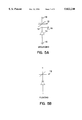
  • FIGS. 5A and 5B show circuit diagrams for preventing pyroelectric effect, according to the present invention
  • FIGS. 6A through 6D show circuit diagrams for pyroelectric effect while FRAM retains information, according to the present invention.
  • FIG. 1D shows a cross section of a ferroelectric capacitor used in this experiment, which comprises upper electrode 1 and lower electrode 3 on and beneath ferroelectric 2, respectively.
  • This ferroelectric capacitor was connected with diode and they each are grounded as shown in FIG. 1E.
  • This resulting circuit was used as a sample for assaying pyroelectricity.
  • Input signal for measuring hysteresis loop is shown in FIG. 1A and its corresponding output signal or hysteresis loop in FIG. 1B.
  • Application of the input signal to the ferroelectric capacitor was carried out at room temperature.
  • FIG. 1C the temperature of the sample was fast raised from room temperature to 50° C., maintained thereat for 1 sec and rapidly reduced into room temperature. Pyroelectricity was detected at point B, a region in which temperature is extremely changed ranging from 25° to 29° C. At the moment that heat was applied, the ferroelectric capacitor was connected with the diode. This experiment was also carried out with polarity reversal.
  • FIG. 2 there are hysteresis loops showing the pyroelectric effects according to the direction of polarization and the alignment of the diode.
  • polarization was reversed when measuring after the sample was fast heated up to 50° C., maintained for 1 sec. and cooled into room temperature.
  • Such polarization reversal is believed to be attributed to a fact that the charges of pyroelectricity affect pure polarization charges. That is, when a ferroelectric is polarized, a polar domain is formed and its polarity is revered by charges generated by heat.
  • Such polarization reversal is temporary. Application of voltage makes the pyroelectric charges disappear through circuit, leading to recovering the original polarization state.
  • polarization reversal causes memory failure.
  • FIG. 3 there is illustrated a mechanism of the polarization reversal attributable to the pyroelectric charges generated upon heating and cooling.
  • pyroelectric charges cannot flow into ground owing to diode, parasitic capacitance occurs between pyroelectric charges and ground, causing back voltage, which brings about polarization reversal of the ferroelectric capacitor. Therefore, if a circuit is constructed taking account of the turning point of direction upon heating and cooling, it is confirmed that the polarization reversal of ferroelectric attributable to pyroelectricity is limited within particular circuits.
  • FIG. 4 shows various states of a ferroelectric memory device.
  • FIG. 4A is a cross section of ferroelectric memory device and FIG. 4B is its equivalent circuit.
  • the ferroelectric memory comprises a ferroelectric capacitor connected with a transistor comprising gate, p-type well and n + -source/drain.
  • FIG. 4C shows two circuit diagrams of the ferroelectric memory which are in the states of reading and writing, respectively. As shown in this figure, when writing, a voltage is applied to the bit line to transmit signals to the plate. On the other hand, when reading, signals are transmitted from the plate to sensor. Accordingly, whenever signaling, the transistor is in "ON" state.
  • FIG. 4D is a possible circuit diagram when the ferroelectric memory retains the information.
  • FIG. 4C when the ferroelectric memory maintains non-volatile memory after writing, zero voltage is applied between the bit and the plate and the p-type substrate of the transistor is in ground state.
  • application of external thermal causes pyroelectric charges to be generated in the ferroelectric. At this time, the polarity of the occurring charges is determined according to the polarization direction.
  • positive charges do not flow through n + -p-ground but are build up in the boundary, causing a voltage between the build-up charges and ground.
  • These charges are induced in the plate by the ferroelectric capacitor, so that they lead to polarization reversal of ferroelectric capacitor. Since pyroelectric effect is dependent on the change rate of temperature and the pyroelectric coefficient of ferroelectric material, the possibility of memory failure with heat always exists. Therefore, there exists a need of an idea for preventing or avoiding the possibility of memory failure.
  • FIG. 5 there are circuit diagrams for preventing pyroelectric effect, according to the present invention.
  • the line between the diode and the ferroelectric capacitor is grounded to remove pyroelectric charges, as shown in FIG. 5A.
  • the circuit itself is floated so that pyroelectric charges may not form ground and parasitic capacitance.
  • FIG. 6 there are circuit diagrams of ferroelectric memory for preventing pyroelectric effect while maintaining memory, according to the present invention.
  • the connection between the transistor and the ferroelectric capacitor is grounded to prevent pyroelectric effect while the ferroelectric memory retains information, as shown in FIG. 6A. That is, the charges generated by pyroelectric effect can be efficiently removed by grounding the connection between ferroelectric capacitor and transistor as well as plate line.
  • the present invention is characterized by grounding the upper and lower electrodes of ferroelectric capacitor each to equalize the electric potential.
  • the present invention while memory state is maintained, pyroelectric effect can be prevented in the circuit shown in FIG. 6B.
  • the opposite terminals of the ferroelectric capacitor are interconnected.
  • the present invention is characterized by connecting the upper electrode of ferroelectric capacitor with the lower electrode and grounding the connection to equalize the electric potential.
  • the transistor when constructing a ferroelectric memory circuit with ungrounded transistor and ungrounded ferroelectric capacitor, the transistor is connected with the opposite terminals of the ferroelectric capacitor in order to prevent pyroelectric effect while the ferroelectric memory retains information, as shown in FIG. 6C. That is, to effectively remove the charges generated by pyroelectric effect, a design is realized in such a way that the transistor substrate is connected with the opposite terminals of the ferroelectric capacitor.
  • the present invention is characterized by uniformly distributing the pyroelectric charges between the upper and lower electrodes to equalize the electric potential.
  • ferroelectric memory can be permanently guaranteed by removing the noisy charges generated by pyroelectric effect according to the present FRAM structures for preventing polarization reversal of ferroelectric capacitor.

Landscapes

  • Engineering & Computer Science (AREA)
  • Power Engineering (AREA)
  • Computer Hardware Design (AREA)
  • Manufacturing & Machinery (AREA)
  • Microelectronics & Electronic Packaging (AREA)
  • Dram (AREA)
  • Semiconductor Integrated Circuits (AREA)

Abstract

A novel ferroelectric random access memory structure which comprises a capacitor consisting of upper and lower plane electrodes and a ferroelectric inserted therebetween, and a transistor comprising a means of inducing the capacitor to polarization and maintaining it, connected with at least one of the electrodes, wherein the electric potential of the upper electrode is equalized with that of the lower electrode, thereby preventing the polarization reversal caused by pyroelectric charges.

Description

BACKGROUND OF THE INVENTION
1. Field of the invention
The present invention relates to novel ferroelectric random access memory (hereinafter referred to as "FRAM") circuits and structures for preventing ferroelectric capacitors from memory failure. More particularly, the present invention relates to removal of noisy pyroelectric charges, thereby preventing ferroelectric capacitors from polarization reversal.
2. Description of the Prior Art
Polarization of ferroelectrics is attributed to electric dipole based on atom displacement, which occurs only when external electrical signals are applied.
FRAM is designed to utilize such polarization and since electrical signals are employed for detecting a polarization state, any type of electrical noise affects the operation of ferroelectric memories as far as charges are concerned.
Besides such polarization, ferroelectrics have properties which can affect electrical signals. For example, PZT-type materials shows pyroelectricity as well as ferroelectricity. Pyroelectricity is a phenomenon that charges are generated when the temperature of material is changed. Thus, constant temperature does not lead to changing the amount of charge in the ferroelectrics. However, in the case that the ferroelectric memories are operated under change of temperature, pyroelectricity may have significant influence on polarization charges which play a role of memory. For example, when a computer employing FRAMs is temporarily taken around a heater, the heat may disturb the FRAMs in the computer and finally lead the FRAMs to memory failure.
Ultimately, there is a fundamental problem in applying ferroelectric capacitor to ferroelectric memory.
SUMMARY OF THE INVENTION
Accordingly, it is an object of the present invention to overcome the above problems encountered in prior art and to provide a novel ferroelectric random access memory structure for preventing ferroelectric capacitor from memory failure.
It is another object of the present invention to provide a high performance ferroelectric random access memory structure.
In accordance with the present invention, the above objects could be accomplished by providing a ferroelectric random access memory structure which comprises a capacitor consisting of upper and lower plane electrodes and a ferroelectric inserted therebetween, and a transistor comprising a means of inducing the capacitor to polarization and maintaining it, connected with at least one of the electrodes, wherein the electric potential of the upper electrode is equalized with that of the lower electrode, thereby preventing the polarization reversal caused by pyroelectric charges.
BRIEF DESCRIPTION OF THE DRAWINGS
The above objects and other advantages of the present invention will become more apparent by describing in detail the preferred embodiments of the present invention with reference to the attached drawings in which:
FIG. 1A shows input signal for measuring hysteresis loop;
FIG. 1B shows the output signal corresponding to the input signal of FIG. 1B;
FIG. 1C is a thermal cycle for measuring pyroelectric effect of ferroelectric capacitor;
FIG. 1D is a schematic cross sectional view of a ferroelectric capacitor;
FIG. 1E is a circuit diagram showing that the ferroelectric capacitor is connected with a diode, each being grounded;
FIGS. 2A and 2B shows hysteresis loops demonstrating pyroelectric effect according to polarization direction and diode alignment;
FIG. 3 schematically shows the mechanism of polarization reversal caused by pyroelectric charges occurring upon heating and cooling;
FIG. 4A is a schematic cross sectional view of a FRAM according to the present invention;
FIG. 4B is a circuit equivalent to the memory of FIG. 4A;
FIG. 4C shows two circuit diagrams of the FRAM OF FIG. 4B which are in the states of reading and writing, respectively;
FIG. 4D shows a possible circuit diagram when the FRAM of FIG. 4B retains the information written;
FIGS. 5A and 5B show circuit diagrams for preventing pyroelectric effect, according to the present invention;
FIGS. 6A through 6D show circuit diagrams for pyroelectric effect while FRAM retains information, according to the present invention.
DETAILED DESCRIPTION OF THE INVENTION
To understand the pyroelectric properties of ferroelectric capacitor with temperature, various experiments were carried out and the results are shown in the accompanying drawings.
First, referring to FIG. 1, there is illustrated an experiment for the polarization change of ferroelectric capacitor attributable to pyroelectric effect upon heating and cooling. FIG. 1D shows a cross section of a ferroelectric capacitor used in this experiment, which comprises upper electrode 1 and lower electrode 3 on and beneath ferroelectric 2, respectively. This ferroelectric capacitor was connected with diode and they each are grounded as shown in FIG. 1E. This resulting circuit was used as a sample for assaying pyroelectricity. Input signal for measuring hysteresis loop is shown in FIG. 1A and its corresponding output signal or hysteresis loop in FIG. 1B. Application of the input signal to the ferroelectric capacitor was carried out at room temperature. The hysteresis loop, informing the polarization state of the sample, was detected at point A of FIG. 1C, which is a thermal cycle for measuring pyroelectricity. As shown in FIG. 1C, the temperature of the sample was fast raised from room temperature to 50° C., maintained thereat for 1 sec and rapidly reduced into room temperature. Pyroelectricity was detected at point B, a region in which temperature is extremely changed ranging from 25° to 29° C. At the moment that heat was applied, the ferroelectric capacitor was connected with the diode. This experiment was also carried out with polarity reversal.
Referring to FIG. 2, there are hysteresis loops showing the pyroelectric effects according to the direction of polarization and the alignment of the diode. As shown in this figure, it was confirmed that the polarization was reversed when measuring after the sample was fast heated up to 50° C., maintained for 1 sec. and cooled into room temperature. Such polarization reversal is believed to be attributed to a fact that the charges of pyroelectricity affect pure polarization charges. That is, when a ferroelectric is polarized, a polar domain is formed and its polarity is revered by charges generated by heat. Such polarization reversal is temporary. Application of voltage makes the pyroelectric charges disappear through circuit, leading to recovering the original polarization state. However, there remains a problem that such temporary polarization offset causes memory failure. In accordance with the present invention, it was revealed that polarization reversal did not occur at different alignments from those of FIG. 2A and 2B.
With reference to FIG. 3, there is illustrated a mechanism of the polarization reversal attributable to the pyroelectric charges generated upon heating and cooling. When pyroelectric charges cannot flow into ground owing to diode, parasitic capacitance occurs between pyroelectric charges and ground, causing back voltage, which brings about polarization reversal of the ferroelectric capacitor. Therefore, if a circuit is constructed taking account of the turning point of direction upon heating and cooling, it is confirmed that the polarization reversal of ferroelectric attributable to pyroelectricity is limited within particular circuits.
FIG. 4 shows various states of a ferroelectric memory device. FIG. 4A is a cross section of ferroelectric memory device and FIG. 4B is its equivalent circuit. As shown, the ferroelectric memory comprises a ferroelectric capacitor connected with a transistor comprising gate, p-type well and n+ -source/drain. FIG. 4C shows two circuit diagrams of the ferroelectric memory which are in the states of reading and writing, respectively. As shown in this figure, when writing, a voltage is applied to the bit line to transmit signals to the plate. On the other hand, when reading, signals are transmitted from the plate to sensor. Accordingly, whenever signaling, the transistor is in "ON" state. At this moment, the transistor substrate is always grounded, so that a potential difference is induced between the gate and ground, thereby switching the transistor "ON" or "OFF". As apparent from the structure, it is confirmed that the ferroelectric capacitor is connected with n+ -p. FIG. 4D is a possible circuit diagram when the ferroelectric memory retains the information. As shown in FIG. 4C, when the ferroelectric memory maintains non-volatile memory after writing, zero voltage is applied between the bit and the plate and the p-type substrate of the transistor is in ground state. On the other hand, application of external thermal causes pyroelectric charges to be generated in the ferroelectric. At this time, the polarity of the occurring charges is determined according to the polarization direction. Negative charges flow through n+ -p-ground into the p-type well without causing parasitic capacitance. In contrast, positive charges do not flow through n+ -p-ground but are build up in the boundary, causing a voltage between the build-up charges and ground. These charges are induced in the plate by the ferroelectric capacitor, so that they lead to polarization reversal of ferroelectric capacitor. Since pyroelectric effect is dependent on the change rate of temperature and the pyroelectric coefficient of ferroelectric material, the possibility of memory failure with heat always exists. Therefore, there exists a need of an idea for preventing or avoiding the possibility of memory failure.
With reference to FIG. 5, there are circuit diagrams for preventing pyroelectric effect, according to the present invention. In order to prevent the pyroelectric effect, the line between the diode and the ferroelectric capacitor is grounded to remove pyroelectric charges, as shown in FIG. 5A. Alternatively, the circuit itself is floated so that pyroelectric charges may not form ground and parasitic capacitance.
Turning now to FIG. 6, there are circuit diagrams of ferroelectric memory for preventing pyroelectric effect while maintaining memory, according to the present invention.
In one aspect of the present invention, when constructing a ferroelectric memory circuit with grounded transistor and ungrounded ferroelectric capacitor, the connection between the transistor and the ferroelectric capacitor is grounded to prevent pyroelectric effect while the ferroelectric memory retains information, as shown in FIG. 6A. That is, the charges generated by pyroelectric effect can be efficiently removed by grounding the connection between ferroelectric capacitor and transistor as well as plate line. Thus, the present invention is characterized by grounding the upper and lower electrodes of ferroelectric capacitor each to equalize the electric potential.
In another aspect of the present invention, while memory state is maintained, pyroelectric effect can be prevented in the circuit shown in FIG. 6B. When constructing a ferroelectric memory circuit with grounded transistor and ungrounded ferroelectric capacitor, the opposite terminals of the ferroelectric capacitor are interconnected. Thus, the present invention is characterized by connecting the upper electrode of ferroelectric capacitor with the lower electrode and grounding the connection to equalize the electric potential.
In a further aspect of the present invention, when constructing a ferroelectric memory circuit with ungrounded transistor and ungrounded ferroelectric capacitor, the transistor is connected with the opposite terminals of the ferroelectric capacitor in order to prevent pyroelectric effect while the ferroelectric memory retains information, as shown in FIG. 6C. That is, to effectively remove the charges generated by pyroelectric effect, a design is realized in such a way that the transistor substrate is connected with the opposite terminals of the ferroelectric capacitor. Thus, the present invention is characterized by uniformly distributing the pyroelectric charges between the upper and lower electrodes to equalize the electric potential.
In still a further aspect of the present invention, during maintenance of memory pyroelectric effect can be prevented in the circuit shown in FIG. 6D. When constructing a ferroelectric memory circuit with grounded transistor and ungrounded ferroelectric capacitor, the prevention can be accomplished by floating the transistor and the ferroelectric capacitor. Thus, when the type and amount of pyroelectric charges generated in the upper electrode are similar to those in the lower electrode the present invention is characterized by electrically floating the upper and lower electrodes so as not to lose the pyroelectric charges on any of the electrodes, thereby equalizing the electric potential.
As described hereinbefore, the performance of ferroelectric memory can be permanently guaranteed by removing the noisy charges generated by pyroelectric effect according to the present FRAM structures for preventing polarization reversal of ferroelectric capacitor.
Other features, advantages and embodiments of the present invention disclosed herein will be readily apparent to those exercising ordinary skill after reading the foregoing disclosures. In this regard, while specific embodiments of the invention have been described in considerable detail, variations and modifications of these embodiments can be effected without departing from the spirit and scope of the invention as described and claimed.

Claims (15)

What is claimed is:
1. A ferroelectric random access memory structure comprising:
a capacitor consisting of upper and lower plane electrodes having a ferroelectric inserted therebetween, and
a transistor for inducing and maintaining polarization in the capacitor, said transistor connected to at least one of the electrodes, wherein the electric potential of said upper electrode is equalized with that of said lower electrode, to prevent polarization reversal of the capacitor caused by pyroelectric charges.
2. The ferroelectric random access memory structure in accordance with claim 1, wherein said upper and lower electrodes each are grounded to remove pyroelectric charges.
3. The ferroelectric random access memory structure in accordance with claim 1, wherein said upper and lower electrodes are electrically interconnected with each other.
4. The ferroelectric random access memory structure in accordance with claim 1, wherein said upper and lower electrodes are electrically interconnected with each other and the interconnection is grounded.
5. The ferroelectric random access memory structure in accordance with claim 1, wherein said upper and lower electrodes are electrically floated so as not to lose pyroelectric charges on any of said electrodes when the type and amount of pyroelectric charges generated in said upper electrode are similar to those in said lower electrode.
6. A circuit using a ferroelectric random access memory structure comprising:
a capacitor consisting of upper and lower plane electrodes having a ferroelectric inserted therebetween, and
a transistor for inducing and maintaining polarization in the capacitor, said transistor connected to at least one of the electrodes, wherein the electric potential of said upper electrode is equalized with that of said lower electrode, to prevent polarization reversal of the capacitor caused by pyroelectric charges.
7. The circuit in accordance with claim 6, wherein said upper and lower electrodes each are grounded to remove pyroelectric charges.
8. The circuit in accordance with claim 6, wherein said upper and lower electrodes are electrically interconnected with each other.
9. The circuit in accordance with claim 6, wherein said upper and lower electrodes are electrically interconnected with each other and the interconnection is grounded.
10. The circuit in accordance with claim 6, wherein said upper and lower electrodes are electrically floated so as not to lose pyroelectric charges on any of said electrodes when the type and amount of pyroelectric charges generated in said upper electrode are similar to those in said lower electrode.
11. A circuit using a ferroelectric random access memory comprising:
a capacitor consisting of upper and lower plane electrodes having a ferroelectric inserted therebetween, and
a diode for inducing and maintaining polarization in the capacitor, said diode connected to at least one of the electrodes, wherein the electric potential of said upper electrode is equalized with that of said lower electrode, to prevent polarization reversal of the capacitor caused by pyroelectric charges.
12. The circuit in accordance with claim 11, wherein said upper and lower electrodes each are grounded to remove pyroelectric charges.
13. The circuit in accordance with claim 11, wherein said upper and lower electrodes are electrically interconnected with each other.
14. The circuit in accordance with claim 11, wherein said upper and lower electrodes are electrically interconnected with each other and the interconnection is grounded.
15. The circuit in accordance with claim 11, wherein said upper and lower electrodes are electrically floated so as not to lose pyroelectric charges on any of said electrodes when the type and amount of pyroelectric charges generated in said upper electrode are similar to those in said lower electrode.
US08/549,898 1995-09-21 1995-10-30 Ferroelectric random access memory circuits and structures for preventing ferroelectric capacitors from memory failure Expired - Lifetime US5822240A (en)

Applications Claiming Priority (2)

Application Number Priority Date Filing Date Title
KR199531247 1995-09-21
KR1019950031247A KR100326586B1 (en) 1995-09-21 1995-09-21 Method for preventing polarization inversion phenomenon of ferroelectric capacitor

Publications (1)

Publication Number Publication Date
US5822240A true US5822240A (en) 1998-10-13

Family

ID=19427544

Family Applications (1)

Application Number Title Priority Date Filing Date
US08/549,898 Expired - Lifetime US5822240A (en) 1995-09-21 1995-10-30 Ferroelectric random access memory circuits and structures for preventing ferroelectric capacitors from memory failure

Country Status (2)

Country Link
US (1) US5822240A (en)
KR (1) KR100326586B1 (en)

Cited By (11)

* Cited by examiner, † Cited by third party
Publication number Priority date Publication date Assignee Title
US5959879A (en) * 1997-06-09 1999-09-28 Samsung Electronics Co., Ltd. Ferroelectric memory devices having well region word lines and methods of operating same
US5978294A (en) * 1998-01-21 1999-11-02 Mitsubishi Denki Kabushiki Kaisha Memory cell evaluation semiconductor device, method of fabricating the same and memory cell evaluation method
US6088257A (en) * 1997-01-13 2000-07-11 Samsung Electronics, Co., Ltd. Ferroelectric random access memory device and method for operating the same
US6411542B1 (en) * 1999-12-15 2002-06-25 Electronics And Telecommunications Research Institute Ferroelectric memory device having ferroelectric memory transistors connected to separate well lines
US6438019B2 (en) * 1998-07-08 2002-08-20 Infineon Technologies Ag Ferroelectric random access memory (FeRAM) having storage capacitors with different coercive voltages
US6548843B2 (en) * 1998-11-12 2003-04-15 International Business Machines Corporation Ferroelectric storage read-write memory
US20050041455A1 (en) * 2000-11-28 2005-02-24 Beigel Michael L. Rectifying charge storage memory circuit
US20050169036A1 (en) * 2004-01-29 2005-08-04 Hynix Semiconductor Inc. Nonvolatile memory device using serial diode cell
US20050254283A1 (en) * 2004-05-17 2005-11-17 Hynix Semiconductor Inc. Non-volatile ferroelectric cell array circuit using PNPN diode characteristics
US7539044B1 (en) * 2007-12-20 2009-05-26 Texas Instruments Incorporated Memory device with capacitor and diode
US20120134197A1 (en) * 2010-11-23 2012-05-31 Eletronics And Telecommunications Research Institute Memory cell and memory device using the same

Citations (2)

* Cited by examiner, † Cited by third party
Publication number Priority date Publication date Assignee Title
US5119329A (en) * 1989-10-20 1992-06-02 Radiant Technologies Memory cell based on ferro-electric non volatile variable resistive element
US5506748A (en) * 1991-09-20 1996-04-09 Rohm Co., Ltd. Capacitor for semiconductor integrated circuit

Patent Citations (2)

* Cited by examiner, † Cited by third party
Publication number Priority date Publication date Assignee Title
US5119329A (en) * 1989-10-20 1992-06-02 Radiant Technologies Memory cell based on ferro-electric non volatile variable resistive element
US5506748A (en) * 1991-09-20 1996-04-09 Rohm Co., Ltd. Capacitor for semiconductor integrated circuit

Cited By (15)

* Cited by examiner, † Cited by third party
Publication number Priority date Publication date Assignee Title
US6088257A (en) * 1997-01-13 2000-07-11 Samsung Electronics, Co., Ltd. Ferroelectric random access memory device and method for operating the same
US5959879A (en) * 1997-06-09 1999-09-28 Samsung Electronics Co., Ltd. Ferroelectric memory devices having well region word lines and methods of operating same
US5978294A (en) * 1998-01-21 1999-11-02 Mitsubishi Denki Kabushiki Kaisha Memory cell evaluation semiconductor device, method of fabricating the same and memory cell evaluation method
US6438019B2 (en) * 1998-07-08 2002-08-20 Infineon Technologies Ag Ferroelectric random access memory (FeRAM) having storage capacitors with different coercive voltages
US6548843B2 (en) * 1998-11-12 2003-04-15 International Business Machines Corporation Ferroelectric storage read-write memory
US6411542B1 (en) * 1999-12-15 2002-06-25 Electronics And Telecommunications Research Institute Ferroelectric memory device having ferroelectric memory transistors connected to separate well lines
US20050041455A1 (en) * 2000-11-28 2005-02-24 Beigel Michael L. Rectifying charge storage memory circuit
US7031182B2 (en) * 2000-11-28 2006-04-18 Beigel Michael L Rectifying charge storage memory circuit
US20050169036A1 (en) * 2004-01-29 2005-08-04 Hynix Semiconductor Inc. Nonvolatile memory device using serial diode cell
US7009866B2 (en) * 2004-01-29 2006-03-07 Hynix Semiconductor Inc. Nonvolatile memory device using serial diode cell
US20050254283A1 (en) * 2004-05-17 2005-11-17 Hynix Semiconductor Inc. Non-volatile ferroelectric cell array circuit using PNPN diode characteristics
US7009865B2 (en) * 2004-05-17 2006-03-07 Hynix Semiconductor Inc. Non-volatile ferroelectric cell array circuit using PNPN diode characteristics
US7539044B1 (en) * 2007-12-20 2009-05-26 Texas Instruments Incorporated Memory device with capacitor and diode
US20120134197A1 (en) * 2010-11-23 2012-05-31 Eletronics And Telecommunications Research Institute Memory cell and memory device using the same
US8493768B2 (en) * 2010-11-23 2013-07-23 Electronics And Telecommunications Research Institute Memory cell and memory device using the same

Also Published As

Publication number Publication date
KR100326586B1 (en) 2002-07-22
KR970017734A (en) 1997-04-30

Similar Documents

Publication Publication Date Title
AU734881B2 (en) A ferroelectric data processing device
EP0364813B1 (en) Semiconductor memory device with memory cells including ferroelectric capacitors
US5822240A (en) Ferroelectric random access memory circuits and structures for preventing ferroelectric capacitors from memory failure
EP0490240B1 (en) Ferroelectric capacitor and method for forming local interconnection
TWI668687B (en) Apparatuses and methods including ferroelectric memory and for accessing ferroelectric memory
TWI650751B (en) Apparatus and method for operating ferroelectric memory including ferroelectric memory
US5592409A (en) Nonvolatile memory
TW201937494A (en) Ferroelectric memory unit
CN109313921A (en) Stamping of memory cells is avoided
TW548652B (en) Ferro-electric memory-arrangement
KR20030074127A (en) Ferroelectric memory wherein bit line capacitance can be maximized
JP2019521464A (en) Power reduction for memory cell sensing operation
TW492005B (en) Nonvolatile ferroelectric memory device and method for driving same
US6404667B1 (en) 2T-1C ferroelectric random access memory and operation method thereof
CN116645984A (en) Signal generation circuitry layout in a memory device
US6026009A (en) Ferroelectric memory device increasing voltage on a bit line to remove dummy cells and a reference voltage generator
JP4158010B2 (en) Ferroelectric memory device sharing cell plate between adjacent memory cells and driving method thereof
EP1398791A2 (en) Ferroelectric memory and method for driving the same
JP2005503632A (en) Ferroelectric memory and operation method thereof
Kraus et al. A 42.5 mm/sup 2/1 Mb nonvolatile ferroelectric memory utilizing advanced architecture for enhanced reliability
CN1719546B (en) Ferroelectric storage device and electronic equipment including the ferroelectric storage device
KR100573837B1 (en) Ferroelectric memory device
KR20000018679A (en) Non-volatile memory device having ferroelectrics capacitor
JPH08167695A (en) Ferroelectric non-volatile memory device and manufacturing method thereof
KR20030002227A (en) Refence generator for increasing reference voltage margine

Legal Events

Date Code Title Description
AS Assignment

Owner name: SAMSUNG ELECTRONICS CO., LTD., KOREA, REPUBLIC OF

Free format text: ASSIGNMENT OF ASSIGNORS INTEREST;ASSIGNOR:YOO, IN-KYUNG;REEL/FRAME:007781/0838

Effective date: 19951023

STCF Information on status: patent grant

Free format text: PATENTED CASE

FEPP Fee payment procedure

Free format text: PAYOR NUMBER ASSIGNED (ORIGINAL EVENT CODE: ASPN); ENTITY STATUS OF PATENT OWNER: LARGE ENTITY

FPAY Fee payment

Year of fee payment: 4

FPAY Fee payment

Year of fee payment: 8

FEPP Fee payment procedure

Free format text: PAYOR NUMBER ASSIGNED (ORIGINAL EVENT CODE: ASPN); ENTITY STATUS OF PATENT OWNER: LARGE ENTITY

Free format text: PAYER NUMBER DE-ASSIGNED (ORIGINAL EVENT CODE: RMPN); ENTITY STATUS OF PATENT OWNER: LARGE ENTITY

FPAY Fee payment

Year of fee payment: 12