US5796645A - Multiply accumulate computation unit - Google Patents
Multiply accumulate computation unit Download PDFInfo
- Publication number
- US5796645A US5796645A US08/697,700 US69770096A US5796645A US 5796645 A US5796645 A US 5796645A US 69770096 A US69770096 A US 69770096A US 5796645 A US5796645 A US 5796645A
- Authority
- US
- United States
- Prior art keywords
- product
- multiplicand
- result
- multiplier
- partial
- Prior art date
- Legal status (The legal status is an assumption and is not a legal conclusion. Google has not performed a legal analysis and makes no representation as to the accuracy of the status listed.)
- Expired - Fee Related
Links
Images

Classifications
-
- G—PHYSICS
- G06—COMPUTING OR CALCULATING; COUNTING
- G06F—ELECTRIC DIGITAL DATA PROCESSING
- G06F7/00—Methods or arrangements for processing data by operating upon the order or content of the data handled
- G06F7/38—Methods or arrangements for performing computations using exclusively denominational number representation, e.g. using binary, ternary, decimal representation
- G06F7/48—Methods or arrangements for performing computations using exclusively denominational number representation, e.g. using binary, ternary, decimal representation using non-contact-making devices, e.g. tube, solid state device; using unspecified devices
- G06F7/544—Methods or arrangements for performing computations using exclusively denominational number representation, e.g. using binary, ternary, decimal representation using non-contact-making devices, e.g. tube, solid state device; using unspecified devices for evaluating functions by calculation
- G06F7/5443—Sum of products
-
- G—PHYSICS
- G06—COMPUTING OR CALCULATING; COUNTING
- G06F—ELECTRIC DIGITAL DATA PROCESSING
- G06F7/00—Methods or arrangements for processing data by operating upon the order or content of the data handled
- G06F7/38—Methods or arrangements for performing computations using exclusively denominational number representation, e.g. using binary, ternary, decimal representation
- G06F7/48—Methods or arrangements for performing computations using exclusively denominational number representation, e.g. using binary, ternary, decimal representation using non-contact-making devices, e.g. tube, solid state device; using unspecified devices
- G06F7/499—Denomination or exception handling, e.g. rounding or overflow
- G06F7/49942—Significance control
- G06F7/49947—Rounding
- G06F7/49963—Rounding to nearest
-
- G—PHYSICS
- G06—COMPUTING OR CALCULATING; COUNTING
- G06F—ELECTRIC DIGITAL DATA PROCESSING
- G06F7/00—Methods or arrangements for processing data by operating upon the order or content of the data handled
- G06F7/38—Methods or arrangements for performing computations using exclusively denominational number representation, e.g. using binary, ternary, decimal representation
- G06F7/48—Methods or arrangements for performing computations using exclusively denominational number representation, e.g. using binary, ternary, decimal representation using non-contact-making devices, e.g. tube, solid state device; using unspecified devices
- G06F7/499—Denomination or exception handling, e.g. rounding or overflow
- G06F7/49994—Sign extension
-
- G—PHYSICS
- G06—COMPUTING OR CALCULATING; COUNTING
- G06F—ELECTRIC DIGITAL DATA PROCESSING
- G06F7/00—Methods or arrangements for processing data by operating upon the order or content of the data handled
- G06F7/38—Methods or arrangements for performing computations using exclusively denominational number representation, e.g. using binary, ternary, decimal representation
- G06F7/48—Methods or arrangements for performing computations using exclusively denominational number representation, e.g. using binary, ternary, decimal representation using non-contact-making devices, e.g. tube, solid state device; using unspecified devices
- G06F7/52—Multiplying; Dividing
- G06F7/523—Multiplying only
- G06F7/533—Reduction of the number of iteration steps or stages, e.g. using the Booth algorithm, log-sum, odd-even
- G06F7/5334—Reduction of the number of iteration steps or stages, e.g. using the Booth algorithm, log-sum, odd-even by using multiple bit scanning, i.e. by decoding groups of successive multiplier bits in order to select an appropriate precalculated multiple of the multiplicand as a partial product
- G06F7/5336—Reduction of the number of iteration steps or stages, e.g. using the Booth algorithm, log-sum, odd-even by using multiple bit scanning, i.e. by decoding groups of successive multiplier bits in order to select an appropriate precalculated multiple of the multiplicand as a partial product overlapped, i.e. with successive bitgroups sharing one or more bits being recoded into signed digit representation, e.g. using the Modified Booth Algorithm
- G06F7/5338—Reduction of the number of iteration steps or stages, e.g. using the Booth algorithm, log-sum, odd-even by using multiple bit scanning, i.e. by decoding groups of successive multiplier bits in order to select an appropriate precalculated multiple of the multiplicand as a partial product overlapped, i.e. with successive bitgroups sharing one or more bits being recoded into signed digit representation, e.g. using the Modified Booth Algorithm each bitgroup having two new bits, e.g. 2nd order MBA
Definitions
- This invention relates to digital computational units that perform series of multiplies, additions, and subtractions on groups of input operands. These units provide high speed and efficiency necessary for computationally intensive applications such as digital signal processing.
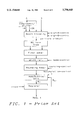
- FIG. 1 shows a typical structure of a multiply/accumulate computational (MAC) unit of prior art.
- the operands A and B which are two's complement binary numbers, form the multiplicand A and the multiplier B.
- the operands A and B is the input to the Complementer/Shifter which forms the suboperands -A and -2A, where -A is the complement of the operand A and -2A is the complement of the operand A shifted left one binary digit.
- the operands A and B and the suboperands -A and -2A are input to the Booth encoder to form the partial products.
- the control of the of the placing of the complements of the operands A and B is accomplished by the signal lines sign -- A -- control and sign -- B -- control.
- the original algorithm of the Booth encoder was described by A D. Booth, in "A Signed Binary Multiplication Technique," Quarterly Journal of Mechanical and Applied Mathematics, Vol 4, Pt 2, 1951, pp 236-240.
- the product is placed in the rounding adder and the control of the rounding adder is determined by the signal Rounding -- Control.
- the binary number representing the number of digits to be rounded is added to the product. For instance if the product was a 16 bit binary number that was to be rounded to the 8th digit then the operation will be ##EQU1##
- the results of the Rounding Adder is transferred to the Add/Subtract Unit, where the results maybe added or subtracted from the previous results Rn-1 and the new results Rn are stored in the Results Register at every active edge of the clock.
- the accumulation of the results of the rounding adder and the previous results Rn-1 is determined by the Accumulation -- control.
- the application of the MAC Unit in iterative processes such as matrix arithmetic make the performance of MAC unit critical to the performance of the computation system.
- the MAC Unit as described will perform the following functions:
- U.S. Pat. No. 5,500,812 (Saishi, et al.) details a multiplier circuit that allows the rounding of the product of a multiplicand and multiplier based on the sign of said multiplicand and multiplier.
- An object of this invention is the reduction in the complexity of the Multiplication/Accumulation Computation circuitry.
- a further object of this invention is the improvement in performance of the Multiply/Accumulation Computation Circuitry while including the ability to multiply the product results by a factor of two and to provide a rounding function to the final results.
- the Multiplier/Accumulator Computation Circuit has a modified Booth multiplier.
- the multiplicand and the multiplier may each be an unsigned binary number or a two's complement binary number.
- the modified Booth multiplier has the inputs of a multiplicand, a multiplier, a set of results from the previous operation, and a digital control code.
- the modified Booth multiplier performs a modified Radix 4 Booth's algorithm multiplication of the multiplicand and the multiplier and creates a set of partial products from this operations.
- the modified Booth multiplier provides a previous result partial product, a two's complement partial product to complete the negating of the multiplicand, a multiplicand partial product to perform the subtracting according to two's complement arithmetic.
- the multiplicand is stored in the multiplicand register
- the multiplier is stored in the multiplier register
- the previous results are stored in the previous results register
- the digital control code in a control register.
- the n operand adder compiles the partial products into a final result.
- the final result is stored in a result register and at every increment of the clock is available to the previous results register and to the subsequent external circuitry.
- FIG. 1 is block diagram of the structure of a Multiplier/Accumulator Computation Unit of prior art.
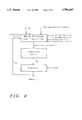
- FIG. 2 is a block diagram of the structure of a Multiplier/Accumulator Computation Unit of this invention.
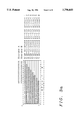
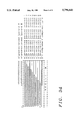
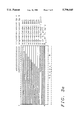
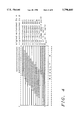
- FIGS. 3a-3e are diagrams of the organization of the operands and the partial products during the execution of the method for the performance of the operations of the multiply/accumulate computation unit of this invention.
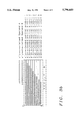
- FIG. 4 is diagram of the organization of the operands and the partial products to illustrate the technique to eliminate excessive sign extension bits from the partial products of this invention.
- the operand A is the multiplicand and the operand B is the multiplier.
- the multiplicand A and the multiplier B are two's complement binary numbers or unsigned binary numbers that are combined in the Booth encoding and translation unit to form the partial products.
- the partial products are modified according to the previous result Rn-1 and the control word which includes the Accumulation -- Control, sign -- B -- control, sign -- A -- control, Mode -- Control, and Rounding -- Control.
- the control word will control the shifting of the partial products to the left by on binary digit to multiply the results by a factor of two, the complementing of the operands A and B, the accumulation with the previous results Rn-1, and the multiplication of the result by a factor of two (left shifting of the partial products by one binary digit).
- the partial products are summed in the n operand adder to form the result product Rn.
- the previous result product Rn-1 is transferred to the Booth encoding and translation unit.
- the output result of the result register is also, passed from the MAC unit to the external circuitry.
- the output result of the result register changes from the previous result Rn-1 to the current result Rn at the active edge of the clock.
- the operations performed by the MAC unit of this invention are:
- FIGS. 3a-3e shows how the multiplicand A, multiplier B, and the partial products are structured during the process of performing the aforementioned operations. If the multiplicand A and the multiplier B are both signed operands they will have been formed into two's complement numbers. In FIG. 3a, each digit of the multiplier B will be combined with the multiplicand A to form a partial product (partial products 1-8). According to the Radix 4 Booth's algorithm as described in Computer Arithmetic Algorithms, by Isreal Koren, Prentice-Hall Internal Editions, 1993, the number of partial products will be one half the number of bits in the operands B.
- the result register R will contain extra digits beyond the N A +N B number of digits described above to allow for the accumulation of the previous results Rn-1 as the MAC iterates through the process. These extra digits will prevent an overflow fault condition from occurring.
- a 16 bit MAC has a results register R that is 40 bits in length. This in excess of the 37 bits required to perform the multiply as described above. The excess binary digits will prevent the aforementioned overflow condition, as the previous results Rn-1 are accumulated with the current results Rn at each iteration.
- Each partial product (partial products 1-8) is sign extended s to align with the most significant digit of the result according to the technique described in the Radix 4 Booth's algorithm reference above.
- the multiplicand A has a single bit sign extension s appended to the most significant bit and the two bit sign extension ss is appended to the most significant bits of the multiplier B. This addition of the two sign extension bits will add an additional partial product (partial product 9) to the set of partial products.
- the value of the sign bits s are determined by the control signals sign -- A -- control and sign -- B -- control. If the operands A and B are unsigned binary numbers, the value of the sign bits s will be 0, However, if the numbers are two's complement binary numbers, then the values of the sign bits s will be as determined in the forming of the two's complement numbers. For example: ##EQU2##
- each of the partial products will have one of the following values: 0, the multiplicand A, the negative of the multiplicand A, the multiplicand A multiplied by two, or the negative of the multiplicand A multiplied by two.
- the two's complement value of the negative of the multiplicand A is not available and has to be developed by complementing the multiplicand A and adding 1 to the value. For instance: ##STR1##
- Performing the process directly in the Booth's encoding and translation unit of FIG. 2 requires much time and additional circuitry and can be accomplished with the two's complement partial product component pp10 to the partial products in FIG. 3c. If a partial product (partial product 1-9) is to be a negative of the multiplicand A, then the partial product (partial product 1-9) is complemented and a binary 1 is placed in the bit position of the two's complement partial product pp10 corresponding to the lease significant binary digit of the partial product of interest (partial product 1-9).
- partial product 1-9 if the partial product (partial product 1-9) is to be -2A, the partial product is shifted one binary digit to the left and a binary 1 is placed at the bit position of the two's complement partial product pp10 aligning with the least significant digit of the left shifted partial product of the partial products product (partial product 1-9).
- the multiplication of the product of the multiplicand A and the multiplier B by a factor of two can be accomplished by simply shifting all of the above mentioned partial products (partial products 1-10) one binary digit to the left as shown in FIG. 3d.
- a rounding-mode-bit r is appended to the least significant binary digit beyond the desired rounding range. For instance in FIG. 3d, the result is to be rounded to 18 significant binary digits.
- the rounding-mode-bit r is placed in the partial product 9 and the results from binary digit 15 to the least significant digit position are all made zeroes.
- multiplicand A is unsigned, the above described process for signed operands is valid. However if the multiplier B is unsigned, it must be sign extended as in FIG. 3b by appending an appropriate binary code to the most significant binary digit of the multiplier B.
- Table 1 shows the combination of the operations and signs of the multiplier B to decide how the multiplier B is to be adjusted
- the adjustments for the multiplier B are controlled by the digital control word shown in FIG. 2 If the operations to performed are
- the multiplicand partial product pp11 and the previous result partial product pp12 will be set to the value of zero. If the operation is to be:
- the multiplicand partial product pp11 has a value of zero, while the previous result partial product pp12 has the previous result.
Landscapes
- Engineering & Computer Science (AREA)
- Physics & Mathematics (AREA)
- General Physics & Mathematics (AREA)
- Theoretical Computer Science (AREA)
- Computational Mathematics (AREA)
- Computing Systems (AREA)
- Mathematical Analysis (AREA)
- Mathematical Optimization (AREA)
- Pure & Applied Mathematics (AREA)
- General Engineering & Computer Science (AREA)
- Complex Calculations (AREA)
Abstract
Description
R=AXB
R=Rn-1+AXB
R=Rn-1-AXB
R=AXB
R=Rn-1+AXB
R=Rn-1-AXB
R=2XAXB
R=Rn-1+2XAXB
R=Rn-1-2XAXB
              TABLE 1
______________________________________
B SIGNED/                        MULTIPLIER
UNSIGNED OPERATION  ADD/SUBTRACT ADJUSTMENT
______________________________________
signed   R=±AXB  -AXB         s,s,B
signed   R=±AXB  +AXB         s,s,B
signed   R=R.sub.n-1 ±AXB
                    -AXB         ˜s,˜s,˜B
signed   R=R.sub.n-1 ±AXB
                    +AXB         s,s,B
unsigned R=±AXB  -AXB         0,0,B
unsigned R=±AXB  +AXB         0,0,B
unsigned R=R.sub.n-1 ±AXB
                    -AXB         ˜0,˜0,˜B
unsigned R=R.sub.n-1 ±AXB
                    +AXB         0,0,B
______________________________________
R=AXB
R=2XAXB,
R=Rn-1+AXB
R=Rn-1+2XAXB,
Claims (20)
Priority Applications (1)
| Application Number | Priority Date | Filing Date | Title |
|---|---|---|---|
| US08/697,700 US5796645A (en) | 1996-08-27 | 1996-08-27 | Multiply accumulate computation unit |
Applications Claiming Priority (1)
| Application Number | Priority Date | Filing Date | Title |
|---|---|---|---|
| US08/697,700 US5796645A (en) | 1996-08-27 | 1996-08-27 | Multiply accumulate computation unit |
Publications (1)
| Publication Number | Publication Date |
|---|---|
| US5796645A true US5796645A (en) | 1998-08-18 |
Family
ID=24802184
Family Applications (1)
| Application Number | Title | Priority Date | Filing Date |
|---|---|---|---|
| US08/697,700 Expired - Fee Related US5796645A (en) | 1996-08-27 | 1996-08-27 | Multiply accumulate computation unit |
Country Status (1)
| Country | Link |
|---|---|
| US (1) | US5796645A (en) |
Cited By (21)
| Publication number | Priority date | Publication date | Assignee | Title |
|---|---|---|---|---|
| US5983258A (en) * | 1996-11-27 | 1999-11-09 | Sony Corporation | Apparatus and method for summing 1-bit signals |
| US6148319A (en) * | 1997-01-10 | 2000-11-14 | Nec Corporation | Multiplier |
| GB2355823A (en) * | 1999-07-28 | 2001-05-02 | Advanced Risc Mach Ltd | A floating-point multiply-accumulator |
| US6564238B1 (en) * | 1999-10-11 | 2003-05-13 | Samsung Electronics Co., Ltd. | Data processing apparatus and method for performing different word-length arithmetic operations |
| US20030196177A1 (en) * | 2002-04-10 | 2003-10-16 | Broadcom Corporation | Low-error fixed-width modified booth multiplier |
| US20040167955A1 (en) * | 2003-02-24 | 2004-08-26 | Fujitsu Limited | Arithmetic device for multiple precision arithmetic for montgomery multiplication residue arithmetic |
| US20040209038A1 (en) * | 2003-04-03 | 2004-10-21 | Foxon Stephen Alan | Playing surface structure and method of construction of a playing surface |
| US20040247822A1 (en) * | 2003-04-03 | 2004-12-09 | Foxon Stephen Alan | Construction of playing surfaces |
| US20040252829A1 (en) * | 2003-04-25 | 2004-12-16 | Hee-Kwan Son | Montgomery modular multiplier and method thereof using carry save addition |
| US20050228845A1 (en) * | 2004-04-12 | 2005-10-13 | Mathstar, Inc. | Shift and recode multiplier |
| US20060224654A1 (en) * | 2005-04-01 | 2006-10-05 | Kimming So | Method and system for performing digital signal processing operations in a computer system |
| US20060224653A1 (en) * | 2005-04-01 | 2006-10-05 | Kimming So | Method and system for dynamic session control of digital signal processing operations |
| US20060271122A1 (en) * | 2005-05-25 | 2006-11-30 | Bohn Derek D | Retrograde atrial sensing for identifying sub-threshold atrial pacing |
| US20070043801A1 (en) * | 2005-07-01 | 2007-02-22 | Stmicroelectronics (Research & Development) Ltd. | Performing rounding in an arithmetic operation |
| GB2474901A (en) * | 2009-10-30 | 2011-05-04 | Advanced Risc Mach Ltd | Multiply-accumulate instruction which adds or subtracts based on a predicate value |
| CN103677736A (en) * | 2012-09-04 | 2014-03-26 | 亚德诺半导体股份有限公司 | Datapath circuit for digital signal processor |
| WO2020238889A1 (en) * | 2019-05-30 | 2020-12-03 | 浙江大学 | Radix-4 encoding and differential weight based multiply-accumulate circuit |
| CN114063974A (en) * | 2021-11-23 | 2022-02-18 | 中电科申泰信息科技有限公司 | Three-level flow Booth multiplier |
| US11416261B2 (en) | 2019-08-08 | 2022-08-16 | Blaize, Inc. | Group load register of a graph streaming processor |
| US11593114B1 (en) | 2019-11-22 | 2023-02-28 | Blaize, Inc. | Iterating group sum of multiple accumulate operations |
| US12236245B2 (en) | 2023-06-12 | 2025-02-25 | Blaize Inc. | Group thread dispatch for graph streaming processor |
Citations (3)
| Publication number | Priority date | Publication date | Assignee | Title |
|---|---|---|---|---|
| US4575812A (en) * | 1984-05-31 | 1986-03-11 | Motorola, Inc. | X×Y Bit array multiplier/accumulator circuit |
| US5497342A (en) * | 1990-07-27 | 1996-03-05 | France Telecom | Cellular multiplier comprising a tree of the overturned stairs type, and method of implementation |
| US5500812A (en) * | 1993-06-14 | 1996-03-19 | Matsushita Electric Industrial Co., Ltd. | Multiplication circuit having rounding function |
-
1996
- 1996-08-27 US US08/697,700 patent/US5796645A/en not_active Expired - Fee Related
Patent Citations (3)
| Publication number | Priority date | Publication date | Assignee | Title |
|---|---|---|---|---|
| US4575812A (en) * | 1984-05-31 | 1986-03-11 | Motorola, Inc. | X×Y Bit array multiplier/accumulator circuit |
| US5497342A (en) * | 1990-07-27 | 1996-03-05 | France Telecom | Cellular multiplier comprising a tree of the overturned stairs type, and method of implementation |
| US5500812A (en) * | 1993-06-14 | 1996-03-19 | Matsushita Electric Industrial Co., Ltd. | Multiplication circuit having rounding function |
Non-Patent Citations (4)
| Title |
|---|
| A.D. Booth, "A Signed Binary Multiplication Technique" Quarterly Journal of Mechanical and Applied Mathematics, vol. 4, p. 42, 1951, pp. 236-240. |
| A.D. Booth, A Signed Binary Multiplication Technique Quarterly Journal of Mechanical and Applied Mathematics, vol. 4, p. 42, 1951, pp. 236 240. * |
| C.S. Wallace, "A Suggestion For A Fast Multiplier" IEEE Transaction on Computers vol. 13, pp. 14-17, Feb. 1964. |
| C.S. Wallace, A Suggestion For A Fast Multiplier IEEE Transaction on Computers vol. 13, pp. 14 17, Feb. 1964. * |
Cited By (34)
| Publication number | Priority date | Publication date | Assignee | Title |
|---|---|---|---|---|
| US5983258A (en) * | 1996-11-27 | 1999-11-09 | Sony Corporation | Apparatus and method for summing 1-bit signals |
| US6148319A (en) * | 1997-01-10 | 2000-11-14 | Nec Corporation | Multiplier |
| GB2355823A (en) * | 1999-07-28 | 2001-05-02 | Advanced Risc Mach Ltd | A floating-point multiply-accumulator |
| US6542916B1 (en) | 1999-07-28 | 2003-04-01 | Arm Limited | Data processing apparatus and method for applying floating-point operations to first, second and third operands |
| GB2355823B (en) * | 1999-07-28 | 2004-02-25 | Advanced Risc Mach Ltd | Data processing apparatus and method for applying floating-point operations to first, second and third operands |
| US6564238B1 (en) * | 1999-10-11 | 2003-05-13 | Samsung Electronics Co., Ltd. | Data processing apparatus and method for performing different word-length arithmetic operations |
| US6978426B2 (en) * | 2002-04-10 | 2005-12-20 | Broadcom Corporation | Low-error fixed-width modified booth multiplier |
| US20030196177A1 (en) * | 2002-04-10 | 2003-10-16 | Broadcom Corporation | Low-error fixed-width modified booth multiplier |
| US7334200B2 (en) | 2002-04-10 | 2008-02-19 | Broadcom Corporation | Low-error fixed-width modified booth multiplier |
| US20050144217A1 (en) * | 2002-04-10 | 2005-06-30 | Broadcom Corporation | Low-error fixed-width modified booth multiplier |
| US20040167955A1 (en) * | 2003-02-24 | 2004-08-26 | Fujitsu Limited | Arithmetic device for multiple precision arithmetic for montgomery multiplication residue arithmetic |
| US7480691B2 (en) * | 2003-02-24 | 2009-01-20 | Fujitsu Limited | Arithmetic device for multiple precision arithmetic for Montgomery multiplication residue arithmetic |
| US20040209038A1 (en) * | 2003-04-03 | 2004-10-21 | Foxon Stephen Alan | Playing surface structure and method of construction of a playing surface |
| US20040247822A1 (en) * | 2003-04-03 | 2004-12-09 | Foxon Stephen Alan | Construction of playing surfaces |
| US7279212B2 (en) * | 2003-04-03 | 2007-10-09 | Nottinghamshire Sports & Safety Systems Limited | Playing surface structure and method of construction of a playing surface |
| US20040252829A1 (en) * | 2003-04-25 | 2004-12-16 | Hee-Kwan Son | Montgomery modular multiplier and method thereof using carry save addition |
| US20050228845A1 (en) * | 2004-04-12 | 2005-10-13 | Mathstar, Inc. | Shift and recode multiplier |
| US20060224654A1 (en) * | 2005-04-01 | 2006-10-05 | Kimming So | Method and system for performing digital signal processing operations in a computer system |
| US20060224653A1 (en) * | 2005-04-01 | 2006-10-05 | Kimming So | Method and system for dynamic session control of digital signal processing operations |
| US20060271122A1 (en) * | 2005-05-25 | 2006-11-30 | Bohn Derek D | Retrograde atrial sensing for identifying sub-threshold atrial pacing |
| US8095587B2 (en) * | 2005-07-01 | 2012-01-10 | Stmicroelectronics (Research & Development) Ltd. | Performing rounding in an arithmetic operation |
| US20070043801A1 (en) * | 2005-07-01 | 2007-02-22 | Stmicroelectronics (Research & Development) Ltd. | Performing rounding in an arithmetic operation |
| GB2474901B (en) * | 2009-10-30 | 2015-01-07 | Advanced Risc Mach Ltd | Apparatus and method for performing multiply-accumulate operations |
| US20110106871A1 (en) * | 2009-10-30 | 2011-05-05 | Arm Limited | Apparatus and method for performing multiply-accumulate operations |
| US8595280B2 (en) | 2009-10-30 | 2013-11-26 | Arm Limited | Apparatus and method for performing multiply-accumulate operations |
| GB2474901A (en) * | 2009-10-30 | 2011-05-04 | Advanced Risc Mach Ltd | Multiply-accumulate instruction which adds or subtracts based on a predicate value |
| CN103677736A (en) * | 2012-09-04 | 2014-03-26 | 亚德诺半导体股份有限公司 | Datapath circuit for digital signal processor |
| US9753695B2 (en) | 2012-09-04 | 2017-09-05 | Analog Devices Global | Datapath circuit for digital signal processors |
| CN103677736B (en) * | 2012-09-04 | 2017-09-05 | 亚德诺半导体股份有限公司 | Data Path Circuitry for Digital Signal Processors |
| WO2020238889A1 (en) * | 2019-05-30 | 2020-12-03 | 浙江大学 | Radix-4 encoding and differential weight based multiply-accumulate circuit |
| US11416261B2 (en) | 2019-08-08 | 2022-08-16 | Blaize, Inc. | Group load register of a graph streaming processor |
| US11593114B1 (en) | 2019-11-22 | 2023-02-28 | Blaize, Inc. | Iterating group sum of multiple accumulate operations |
| CN114063974A (en) * | 2021-11-23 | 2022-02-18 | 中电科申泰信息科技有限公司 | Three-level flow Booth multiplier |
| US12236245B2 (en) | 2023-06-12 | 2025-02-25 | Blaize Inc. | Group thread dispatch for graph streaming processor |
Similar Documents
| Publication | Publication Date | Title |
|---|---|---|
| US5796645A (en) | Multiply accumulate computation unit | |
| US5500812A (en) | Multiplication circuit having rounding function | |
| US10949168B2 (en) | Compressing like-magnitude partial products in multiply accumulation | |
| JP3869269B2 (en) | Handling multiply accumulate operations in a single cycle | |
| US9519460B1 (en) | Universal single instruction multiple data multiplier and wide accumulator unit | |
| US5245564A (en) | Apparatus for multiplying operands | |
| JPH10214176A (en) | Device for quickly calculating transcendental function | |
| US5528529A (en) | Electronic multiplying and adding apparatus and method | |
| JPH0831025B2 (en) | Multiplication circuit | |
| US5623683A (en) | Two stage binary multiplier | |
| JPH0477932B2 (en) | ||
| GB2262637A (en) | Padding scheme for optimized multiplication. | |
| US5870322A (en) | Multiplier to selectively perform unsigned magnitude multiplication or signed magnitude multiplication | |
| US6684236B1 (en) | System of and method for efficiently performing computations through extended booth encoding of the operands thereto | |
| JPH04355827A (en) | Square root calculation device | |
| US7167885B2 (en) | Emod a fast modulus calculation for computer systems | |
| US6421699B1 (en) | Method and system for a speedup of a bit multiplier | |
| Lou et al. | New approach to the reduction of sign-extension overhead for efficient implementation of multiple constant multiplications | |
| US5416733A (en) | Apparatus for finding quotient in a digital system | |
| JPH04172526A (en) | Floating point divider | |
| Takagi | Arithmetic unit based on a high-speed multiplier with a redundant-binary addition tree | |
| Sait et al. | A novel technique for fast multiplication | |
| EP4679256A1 (en) | Optimization for digital processing systems | |
| Gustafsson et al. | Basic arithmetic circuits | |
| JP2777265B2 (en) | High radix square root arithmetic unit |
Legal Events
| Date | Code | Title | Description |
|---|---|---|---|
| AS | Assignment |
Owner name: TRITECH MICROELECTRONICS INTERNATIONAL PTE LTD., S Free format text: ASSIGNMENT OF ASSIGNORS INTEREST;ASSIGNORS:PEH, KHENG BOON;LEE, ENG HAN;REEL/FRAME:008176/0091 Effective date: 19960731 |
|
| FEPP | Fee payment procedure |
Free format text: PAYOR NUMBER ASSIGNED (ORIGINAL EVENT CODE: ASPN); ENTITY STATUS OF PATENT OWNER: LARGE ENTITY |
|
| AS | Assignment |
Owner name: CIRRUS LOGIC, INC., TEXAS Free format text: ASSIGNMENT OF ASSIGNORS INTEREST;ASSIGNOR:TRITECH MICROELECTRONICS, LTD., A COMPANY OF SINGAPORE;REEL/FRAME:011887/0327 Effective date: 20010803 |
|
| FEPP | Fee payment procedure |
Free format text: PAYOR NUMBER ASSIGNED (ORIGINAL EVENT CODE: ASPN); ENTITY STATUS OF PATENT OWNER: LARGE ENTITY Free format text: PAYER NUMBER DE-ASSIGNED (ORIGINAL EVENT CODE: RMPN); ENTITY STATUS OF PATENT OWNER: LARGE ENTITY |
|
| FPAY | Fee payment |
Year of fee payment: 4 |
|
| REMI | Maintenance fee reminder mailed | ||
| REMI | Maintenance fee reminder mailed | ||
| LAPS | Lapse for failure to pay maintenance fees | ||
| LAPS | Lapse for failure to pay maintenance fees |
Free format text: PATENT EXPIRED FOR FAILURE TO PAY MAINTENANCE FEES (ORIGINAL EVENT CODE: EXP.); ENTITY STATUS OF PATENT OWNER: LARGE ENTITY |
|
| STCH | Information on status: patent discontinuation |
Free format text: PATENT EXPIRED DUE TO NONPAYMENT OF MAINTENANCE FEES UNDER 37 CFR 1.362 |
|
| FP | Lapsed due to failure to pay maintenance fee |
Effective date: 20060818 |