US5778962A - Method and apparatus for production of aluminum alloy castings - Google Patents
Method and apparatus for production of aluminum alloy castings Download PDFInfo
- Publication number
- US5778962A US5778962A US08/740,313 US74031396A US5778962A US 5778962 A US5778962 A US 5778962A US 74031396 A US74031396 A US 74031396A US 5778962 A US5778962 A US 5778962A
- Authority
- US
- United States
- Prior art keywords
- molds
- casting
- mold
- path
- paths
- Prior art date
- Legal status (The legal status is an assumption and is not a legal conclusion. Google has not performed a legal analysis and makes no representation as to the accuracy of the status listed.)
- Expired - Lifetime
Links
- 238000005266 casting Methods 0.000 title claims abstract description 71
- 238000004519 manufacturing process Methods 0.000 title claims abstract description 22
- 229910000838 Al alloy Inorganic materials 0.000 title claims abstract description 15
- 238000000034 method Methods 0.000 title claims abstract description 14
- 238000000605 extraction Methods 0.000 claims abstract description 9
- 229910052782 aluminium Inorganic materials 0.000 claims description 17
- XAGFODPZIPBFFR-UHFFFAOYSA-N aluminium Chemical compound [Al] XAGFODPZIPBFFR-UHFFFAOYSA-N 0.000 claims description 17
- 239000007788 liquid Substances 0.000 claims description 12
- 238000004140 cleaning Methods 0.000 abstract description 4
- AZDRQVAHHNSJOQ-UHFFFAOYSA-N alumane Chemical group [AlH3] AZDRQVAHHNSJOQ-UHFFFAOYSA-N 0.000 abstract 1
- 238000001816 cooling Methods 0.000 description 6
- 230000008901 benefit Effects 0.000 description 5
- 238000012423 maintenance Methods 0.000 description 5
- 239000004576 sand Substances 0.000 description 4
- 239000003517 fume Substances 0.000 description 3
- 238000007689 inspection Methods 0.000 description 3
- 230000007547 defect Effects 0.000 description 2
- 238000012986 modification Methods 0.000 description 2
- 230000004048 modification Effects 0.000 description 2
- 238000010791 quenching Methods 0.000 description 2
- 230000003252 repetitive effect Effects 0.000 description 2
- 239000000956 alloy Substances 0.000 description 1
- 239000000498 cooling water Substances 0.000 description 1
- 238000009826 distribution Methods 0.000 description 1
- 230000009977 dual effect Effects 0.000 description 1
- 230000000694 effects Effects 0.000 description 1
- 230000008030 elimination Effects 0.000 description 1
- 238000003379 elimination reaction Methods 0.000 description 1
- 238000007730 finishing process Methods 0.000 description 1
- 238000010438 heat treatment Methods 0.000 description 1
- 238000007654 immersion Methods 0.000 description 1
- 238000009434 installation Methods 0.000 description 1
- 230000002452 interceptive effect Effects 0.000 description 1
- 229910001338 liquidmetal Inorganic materials 0.000 description 1
- 239000000463 material Substances 0.000 description 1
- 235000020030 perry Nutrition 0.000 description 1
- 230000001681 protective effect Effects 0.000 description 1
- 230000000171 quenching effect Effects 0.000 description 1
- 239000000523 sample Substances 0.000 description 1
Images




Classifications
-
- B—PERFORMING OPERATIONS; TRANSPORTING
- B22—CASTING; POWDER METALLURGY
- B22D—CASTING OF METALS; CASTING OF OTHER SUBSTANCES BY THE SAME PROCESSES OR DEVICES
- B22D47/00—Casting plants
Definitions
- the present invention relates to an improved method and apparatus for the production of aluminum alloy castings, more particularly, to a production plant comprising a plurality of movable semi-permanent molds which are positioned in different stations corresponding to the activity being performed in the production cycle, thereby raising the productivity of the casting process and lowering the capital and maintenance costs of the currently used casting equipment.
- This is adaptable in simplified form to permanent molds also.
- Production of aluminum alloy castings for example massive production of certain automobile engine parts, (such as cylinder heads), is usually made in permanent or semi-permanent type molds, in contrast with expendable molds made of sand which are used for only one casting.
- the semi-permanent molds are provided with means for heating, cooling, automatic opening and closing, etc. to complete a full casting cycle.
- one operator serves several molds, and some operations such as core setting, mold filling, and extraction of the casting are made with the help of robot arms, programmed for performing these repetitive operations with accuracy in time and space.
- the production cycle of the casting process comprises the following operations, directly related to the mold: (A) mold cleaning; (B) core setting; (C) mold filling and cooling; and (D)extraction of casting, followed by breaking and elimination of external sand cores and removal of runners.
- the casting is then heat-treated, if necessary, finished and inspected.
- the production process currently in operation involves the use of fixed semi-permanent molds. One such process requires at least one operator and three robots per mold.
- An alternative process uses a revolving platform, typically with 4 to 6 molds mounted thereon, which are served by two or three operators and three robots for said five molds. The productivity of the revolving platforms has been relatively satisfactory but can be improved according to the present invention.
- the revolving platform also has some drawbacks, for example the mass of the revolving platform is on the order of 50 metric tons, which requires high capacity motors and equipment to rotate it from one station to the next. Also, if one of the molds breaks down and has to be repaired, most of the time, the whole platform has to be shut down with the consequent loss of production of the other molds thereon.
- the present invention overcomes the disadvantages of the presently utilized revolving platforms and allows for higher productivity of the casting process.
- This invention thus results in multimillion dollar savings in capital investment and upkeep costs of the revolving platforms and the maintenance costs of such equipment.
- the casting plants are therefore greatly simplified.
- Some of these patents teach for example to synchronize the movement of the molds with the movement of ladles containing the liquid metal, but none suggest to have linear paths for the molds along which the molds can travel and meet the servicing robots for pouring the molten aluminum and extracting the casting one at a time and each one under wholly independent operation of the others.
- the prior art does not suggest to include one station where each mold can be positioned for maintenance, which is practical in the linear path arrangement and not in circular paths, where the molds can be positioned when needed without interfering in any way with the casting cycle of the other molds.
- the objects thereof are achieved by providing (1) a method of manufacturing aluminum alloy castings comprising a plurality of movable molds, and only one liquid aluminum holding furnace in said system, said system including at least a casting position and a casting extraction position in the respective path of each movable mold, said method comprising moving said molds along a respective straight line path for each mold, whereby each mold can be successively positioned at predetermined positions in its respective path according to a scheduled order of process steps for manufacturing said aluminum alloy castings, cyclically positioning said molds at said predetermined positions in their respective paths at different times, so that the operation of filling of said molds with liquid aluminum to form a casting can be done only on one of the molds at a given time, and the operation of extracting said castings from the molds is carried out only on one of the plurality of molds of said system at a given time; and further by providing (2) an apparatus for producing aluminum alloy castings comprising a plurality of molds, and only one liquid aluminum holding furnace serving all molds in said system,
- FIG. 1 is a schematic plan view illustrating the lay-out of the casting system according to the present invention and particularly showing the sequence of positions A to E taken by each of a plurality of molds moving along a respective one of a plurality of parallel tracks to carry out the linearly staggered process steps A to D for producing aluminum castings.
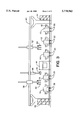
- FIG. 2 is a schematic side elevational view of the casting system shown in FIG. 1, illustrating mainly the sequence of operations A to E along one of the processing tracks, as well as the tracks of the robots for core setting, casting and extraction of the castings.
- FIG. 3 is a schematic side elevational view of the casting system shown in FIG. 1, illustrating mainly the distribution of the mold cradles and the position of the aluminum holding furnace.
- FIG. 4 is a schematic plan view of a casting system showing another embodiment of the invention wherein the number of moving molds is four and wherein the orientation of said molds is different as compared to the orientation of the molds in FIG. 1.
- FIG. 5 is an elevational schematic view of the casting system shown in FIG. 4.
- the casting process of most aluminum alloy castings comprise the following steps:
- (B) Core setting This operation is usually performed with the help of a first robot arm 38 for easing the operator's work and because of the repetitive nature of the operation.
- the robot arm is programmed for accurately placing at least one core in its position within the mold in a given line and to repeat the process for each other mold in the other lines.
- a similar robot arm serves the all molds, typically four to six, located on the platform.
- (C) Casting The filling of molds 10, 12, 14, 16, and 18 with liquid aluminum is carried out by means of a second robot arm 66 having a small ladle 64, which is filled by immersion, by an autoladle, or the like, from a molten aluminum pool held nearby in a holding furnace 46.
- the ladle 64 pours the measured amount of liquid aluminum into one of the respective molds, each in its turn.
- One robot arm for this purpose is used in the prior art rotating platform systems.
- (D) Extraction The casting 48, including the sand core(s) 36, is then withdrawn from the mold with the help of a third robot arm 52 as soon as the casting 48 has undergone sufficient cooling so as to be sufficiently solidified to be handled outside of the mold.
- the mold is provided with a cooling system (not specifically described, many of which are commonly-known) in order to carry out the cooling process of the casting.
- the four steps A to D take place each at different times in the five or more adjoining lines 20, 22, 24, 26 and 28, so as to thereby be enabled to share a single respective robot device for each respective process step among the lines.
- numerals 10, 12, 14, 16 and 18 designate a set of five aluminum alloy casting semi-permanent molds, for example molds for producing automotive cylinder heads.
- Each mold carried in a respective wheeled cradle 19 (typically in the art referred to as a "bench"), can be positioned at different operation positions: (A), (B), (C) or (D), along a plurality of linear paths, here illustrated and defined in the preferred embodiment by straight dual tracks 20, 22, 24, 26 and 28.
- Position (E) is an out-of-service maintenance position.
- a large linked chain 30 serves as a protective carrier in each line for wiring and hoses for compressed air, hydraulic power and cooling water.
- each mold cradle 19 is independently driven for example by an electric motor (not shown). Any other effective motive device can be used to move and position each mold cradle 19 along its respective track.
- Position (A) is the first step in the casting cycle initiated for a given mold. This is the position nearest to the operator 32 and is where the mold is cleaned, usually by compressed air, e.g. from probe 34, which alternatively can be automated, and is also inspected and cleaned as necessary to prevent any defects due, for example, to the presence of extraneous matter in the mold.
- the mold is moved to position (B) where the sand core(s) 36 is placed inside the mold by means of robot arm 38.
- the robot arm 38 By running along overhead rail 40, the robot arm 38, with its gripping device 42, places the core(s) 36 obtained from core baskets 44 in turn into each of the molds, 10, 12, 14 16 and 18.
- the mold is then closed and moved to casting position (C), where it is filled with liquid aluminum taken from holding furnace 46 by means of ladle 64 mounted on robot arm 66.
- Robot arm 66 similarly runs along its own overhead rail 68, enabling it also to serve each of the four molds in the system, one at a time.
- the mold is moved back to position (D), where the casting 48 is withdrawn from the mold by means of an extractor/holding device 50 mounted on robot arm 52 running along overhead rail 51.
- Fumes evolving during the casting and extraction operations are withdrawn through suitable conduits (not all being shown, to simplify the drawings), when the casting process is being carried out.
- Fume conduits 54 are suitably provided for each mold at the positions where fumes and vapors evolve.
- the casting 48 can be further processed off-line, if required, typically as follows: the casting 48, initially delivered by robot arm 52 along rail 51 to station 56, where the bulk of the residuum of the sand cores 36 is removed, it is then moved along to station 58, where the excess aluminum alloy material solidified in the runners and top of the casting is cut and removed, then to quench tank 60 for quenching, then onto inspection table 62, and finally after inspection, it is placed in a basket to continue any following heat treating and/or finishing processes.
- the casting system claimed herein provides a number of advantages over the prior art, for example the capital cost is considerably lower, on the order of 40% less than the cost of the systems comprising rotating tables with 5 molds on each table.
- the amount of equipment parts and installation time is lower too.
- Maintenance costs are reduced because the individual moving molds of this system according to the present invention have a smaller mass to be moved along the successive processing positions of each casting cycle.
- the overall productivity is increased, because if one of the molds is subject to failure or requires to be changed, the other molds respectively moving along the other parallel production lines can continue their production cycle.
- the rotating tables when one mold stops the production of the other molds is also interrupted. Energy costs are also reduced, again because the moving equipment is lighter than the mass of the rotating tables.
- the productivity of the system is also increased by reason of the shorter cycle time for moving each mold to the different positions as compared to the cycle time taken for the rotating tables to accelerate, rotate (typically about 36° to 72° ) and brake to stop a massive structure of about 50 metric tons at the respective production positions.
- the multiple in-line moving molds system provides also the capability of simultaneously producing two or more different products.
- the invention has been exemplified showing a system having five molds, it will be evident that at least two molds can be operated and that more than five molds can also provide the advantages of the invention, especially if the mold casting operation has more or less than 4 automatable processing steps.
- the core setting can be done manually or combined with a robot arm in case products are being cast from two or more molds.
- step B could be eliminated. The thus simplified invention would still be advantageous over the current practices in this art.
- FIGS. 4 and 5 a second embodiment is also illustrated with reference to FIGS. 4 and 5 wherein the casting system has only four molds oriented differently, so that the operator is given a wider access to the whole area of the mold.
- the location of some other elements has been modified but preserving the essential feature of the invention, i.e. that each mold moves in a substantially straight line and that said molds are positioned in certain positions located in said linear tracks for carrying out the operations of the casting cycle for fabrication of aluminum castings.
- the same numerals used in FIGS. 4 and 5 designate similar or equivalent elements as in FIGS. 1, 2 and 3. The description of FIGS.
- FIGS. 4 and 5 also applies to the embodiment shown in FIGS. 4 and 5, with the characteristic of having only four molds in a different orientation. Also, in FIGS. 4 and 5 the positions of the molds have been shown with dotted lines on the same track to show the movement thereof without implying that several molds move on the same track.
Landscapes
- Engineering & Computer Science (AREA)
- Mechanical Engineering (AREA)
- Molds, Cores, And Manufacturing Methods Thereof (AREA)
- Cylinder Crankcases Of Internal Combustion Engines (AREA)
- Continuous Casting (AREA)
Abstract
Method and simplified apparatus for manufacturing aluminum alloys castings, for example those cast aluminum parts utilized in the manufacture of automobile engines: cylinder heads, engine blocks and the like; whereby the castings are cast in a plurality of semi-permanent-type molds, said molds each being movable to a plurality of processing positions along one of a plurality of straight line paths (five in the preferred embodiment), wherein the operations of cleaning, core setting, casting, and casting extraction are performed on each mold at predetermined positions along its respective path and alternating said operations among the molds in order to permit minimization of the number of robot equipment and to increase the aggregate productivity of said molds, since any one processing operation is handled by only one robot arm moving between the plurality of lines seriatim, so that a given process step is performed at any one time only at one of the plurality of lines.
Description
This application claims the benefit of U.S. Provisional Application 60/008,026, filed Oct. 27, 1995.
This application claims the benefit of U.S. Provisional Application 60/008,026, filed Oct. 27, 1995.
The present invention relates to an improved method and apparatus for the production of aluminum alloy castings, more particularly, to a production plant comprising a plurality of movable semi-permanent molds which are positioned in different stations corresponding to the activity being performed in the production cycle, thereby raising the productivity of the casting process and lowering the capital and maintenance costs of the currently used casting equipment. This is adaptable in simplified form to permanent molds also.
Production of aluminum alloy castings, for example massive production of certain automobile engine parts, (such as cylinder heads), is usually made in permanent or semi-permanent type molds, in contrast with expendable molds made of sand which are used for only one casting. The semi-permanent molds are provided with means for heating, cooling, automatic opening and closing, etc. to complete a full casting cycle. Usually one operator serves several molds, and some operations such as core setting, mold filling, and extraction of the casting are made with the help of robot arms, programmed for performing these repetitive operations with accuracy in time and space.
The production cycle of the casting process comprises the following operations, directly related to the mold: (A) mold cleaning; (B) core setting; (C) mold filling and cooling; and (D)extraction of casting, followed by breaking and elimination of external sand cores and removal of runners. The casting is then heat-treated, if necessary, finished and inspected. The production process currently in operation involves the use of fixed semi-permanent molds. One such process requires at least one operator and three robots per mold. An alternative process uses a revolving platform, typically with 4 to 6 molds mounted thereon, which are served by two or three operators and three robots for said five molds. The productivity of the revolving platforms has been relatively satisfactory but can be improved according to the present invention. The revolving platform also has some drawbacks, for example the mass of the revolving platform is on the order of 50 metric tons, which requires high capacity motors and equipment to rotate it from one station to the next. Also, if one of the molds breaks down and has to be repaired, most of the time, the whole platform has to be shut down with the consequent loss of production of the other molds thereon.
The present invention overcomes the disadvantages of the presently utilized revolving platforms and allows for higher productivity of the casting process.
This invention thus results in multimillion dollar savings in capital investment and upkeep costs of the revolving platforms and the maintenance costs of such equipment. The casting plants are therefore greatly simplified.
There have been some proposals in the past addressed to upgrade the efficiency of foundries, where molds undergo a sequence of operations. All of prior art shows circular paths along which the molds circulate and are positioned at several stations for performing the required operations. Examples of the prior art are found in U.S. Pat. No. 3,627,028 to Carignan, 4,747,444 to Wasem et al, 4,299,629 to Friesen el al., 4,422,495 to Van Nette, 3,530,571 to Perry, 5,056,584 to Seaton and 3,8977,461 to Pol et al. None of these patents however teach or suggest the arrangement proposed by the Applicants and its advantages in productivity. Some of these patents teach for example to synchronize the movement of the molds with the movement of ladles containing the liquid metal, but none suggest to have linear paths for the molds along which the molds can travel and meet the servicing robots for pouring the molten aluminum and extracting the casting one at a time and each one under wholly independent operation of the others. The prior art does not suggest to include one station where each mold can be positioned for maintenance, which is practical in the linear path arrangement and not in circular paths, where the molds can be positioned when needed without interfering in any way with the casting cycle of the other molds.
It is therefore an object of the invention to provide a process of manufacturing aluminum alloy castings with improved productivity and at lower capital and operational costs.
It is another object of the invention to provide a new lay-out of the equipment involved in the manufacturing of aluminum alloy castings with higher flexibility and productivity.
Other objects of the invention will be in part obvious and in part pointed out hereinafter.
According to the present invention the objects thereof are achieved by providing (1) a method of manufacturing aluminum alloy castings comprising a plurality of movable molds, and only one liquid aluminum holding furnace in said system, said system including at least a casting position and a casting extraction position in the respective path of each movable mold, said method comprising moving said molds along a respective straight line path for each mold, whereby each mold can be successively positioned at predetermined positions in its respective path according to a scheduled order of process steps for manufacturing said aluminum alloy castings, cyclically positioning said molds at said predetermined positions in their respective paths at different times, so that the operation of filling of said molds with liquid aluminum to form a casting can be done only on one of the molds at a given time, and the operation of extracting said castings from the molds is carried out only on one of the plurality of molds of said system at a given time; and further by providing (2) an apparatus for producing aluminum alloy castings comprising a plurality of molds, and only one liquid aluminum holding furnace serving all molds in said system, a plurality of linear independent paths along which each mold is respectively moved and positioned at predetermined positions in its corresponding path, at least two linear robots: one for pouring the liquid aluminum and the other for extracting the casting from the mold, said linear robots being movable along a respective path which intercepts the paths of the molds at the pouring positions and at the extracting positions respectively; means for cyclically positioning said molds at said predetermined positions in their respective paths at different times so that filling of said molds with liquid aluminum, and said casting extraction is carried out only on one of the plurality of molds at a time.
In this specification and in the accompanying drawings, some preferred embodiments of the invention are shown and described and various alternatives and modifications thereof have been suggested; but it is to be understood that these changes and modifications can be made within the scope of the invention. The suggestions herein are selected and included for purposes of illustration in order that others skilled in the art will more fully understand the invention and the principles thereof and will thus be enabled to modify it in a variety of forms, each as may be best suited to the conditions of a particular use.
FIG. 1 is a schematic plan view illustrating the lay-out of the casting system according to the present invention and particularly showing the sequence of positions A to E taken by each of a plurality of molds moving along a respective one of a plurality of parallel tracks to carry out the linearly staggered process steps A to D for producing aluminum castings.
FIG. 2 is a schematic side elevational view of the casting system shown in FIG. 1, illustrating mainly the sequence of operations A to E along one of the processing tracks, as well as the tracks of the robots for core setting, casting and extraction of the castings.
FIG. 3 is a schematic side elevational view of the casting system shown in FIG. 1, illustrating mainly the distribution of the mold cradles and the position of the aluminum holding furnace.
FIG. 4 is a schematic plan view of a casting system showing another embodiment of the invention wherein the number of moving molds is four and wherein the orientation of said molds is different as compared to the orientation of the molds in FIG. 1.
FIG. 5 is an elevational schematic view of the casting system shown in FIG. 4.
The casting process of most aluminum alloy castings comprise the following steps:
(A) Mold cleaning. This operation involves inspection by an operator of the mold in order to assure that the casting will be free of defects caused by inclusion of foreign elements, and cleaning of loose sand and other materials
(B) Core setting. This operation is usually performed with the help of a first robot arm 38 for easing the operator's work and because of the repetitive nature of the operation. The robot arm is programmed for accurately placing at least one core in its position within the mold in a given line and to repeat the process for each other mold in the other lines. In the prior art revolving platform system, a similar robot arm serves the all molds, typically four to six, located on the platform.
(C) Casting. The filling of molds 10, 12, 14, 16, and 18 with liquid aluminum is carried out by means of a second robot arm 66 having a small ladle 64, which is filled by immersion, by an autoladle, or the like, from a molten aluminum pool held nearby in a holding furnace 46. The ladle 64 pours the measured amount of liquid aluminum into one of the respective molds, each in its turn. One robot arm for this purpose is used in the prior art rotating platform systems.
(D) Extraction. The casting 48, including the sand core(s) 36, is then withdrawn from the mold with the help of a third robot arm 52 as soon as the casting 48 has undergone sufficient cooling so as to be sufficiently solidified to be handled outside of the mold. The mold is provided with a cooling system (not specifically described, many of which are commonly-known) in order to carry out the cooling process of the casting.
The four steps A to D take place each at different times in the five or more adjoining lines 20, 22, 24, 26 and 28, so as to thereby be enabled to share a single respective robot device for each respective process step among the lines.
Referring to FIGS. 1, 2 and 3, numerals 10, 12, 14, 16 and 18 designate a set of five aluminum alloy casting semi-permanent molds, for example molds for producing automotive cylinder heads. Each mold, carried in a respective wheeled cradle 19 (typically in the art referred to as a "bench"), can be positioned at different operation positions: (A), (B), (C) or (D), along a plurality of linear paths, here illustrated and defined in the preferred embodiment by straight dual tracks 20, 22, 24, 26 and 28. Position (E) is an out-of-service maintenance position. A large linked chain 30 serves as a protective carrier in each line for wiring and hoses for compressed air, hydraulic power and cooling water. In the preferred embodiment, each mold cradle 19 is independently driven for example by an electric motor (not shown). Any other effective motive device can be used to move and position each mold cradle 19 along its respective track.
Position (A) is the first step in the casting cycle initiated for a given mold. This is the position nearest to the operator 32 and is where the mold is cleaned, usually by compressed air, e.g. from probe 34, which alternatively can be automated, and is also inspected and cleaned as necessary to prevent any defects due, for example, to the presence of extraneous matter in the mold. After this operation at position (A) is performed, the mold is moved to position (B) where the sand core(s) 36 is placed inside the mold by means of robot arm 38. By running along overhead rail 40, the robot arm 38, with its gripping device 42, places the core(s) 36 obtained from core baskets 44 in turn into each of the molds, 10, 12, 14 16 and 18. The mold is then closed and moved to casting position (C), where it is filled with liquid aluminum taken from holding furnace 46 by means of ladle 64 mounted on robot arm 66. Robot arm 66 similarly runs along its own overhead rail 68, enabling it also to serve each of the four molds in the system, one at a time. After the casting and cooling cycle, the mold is moved back to position (D), where the casting 48 is withdrawn from the mold by means of an extractor/holding device 50 mounted on robot arm 52 running along overhead rail 51.
Fumes evolving during the casting and extraction operations are withdrawn through suitable conduits (not all being shown, to simplify the drawings), when the casting process is being carried out. Fume conduits 54 are suitably provided for each mold at the positions where fumes and vapors evolve.
Once the casting 48 is extracted from the mold by robot arm 52, it can be further processed off-line, if required, typically as follows: the casting 48, initially delivered by robot arm 52 along rail 51 to station 56, where the bulk of the residuum of the sand cores 36 is removed, it is then moved along to station 58, where the excess aluminum alloy material solidified in the runners and top of the casting is cut and removed, then to quench tank 60 for quenching, then onto inspection table 62, and finally after inspection, it is placed in a basket to continue any following heat treating and/or finishing processes.
The casting system claimed herein provides a number of advantages over the prior art, for example the capital cost is considerably lower, on the order of 40% less than the cost of the systems comprising rotating tables with 5 molds on each table. The amount of equipment parts and installation time is lower too. Maintenance costs are reduced because the individual moving molds of this system according to the present invention have a smaller mass to be moved along the successive processing positions of each casting cycle. The overall productivity is increased, because if one of the molds is subject to failure or requires to be changed, the other molds respectively moving along the other parallel production lines can continue their production cycle. Conversely, with the rotating tables, when one mold stops the production of the other molds is also interrupted. Energy costs are also reduced, again because the moving equipment is lighter than the mass of the rotating tables. The productivity of the system is also increased by reason of the shorter cycle time for moving each mold to the different positions as compared to the cycle time taken for the rotating tables to accelerate, rotate (typically about 36° to 72° ) and brake to stop a massive structure of about 50 metric tons at the respective production positions.
The multiple in-line moving molds system provides also the capability of simultaneously producing two or more different products. Although the invention has been exemplified showing a system having five molds, it will be evident that at least two molds can be operated and that more than five molds can also provide the advantages of the invention, especially if the mold casting operation has more or less than 4 automatable processing steps. Also, the core setting can be done manually or combined with a robot arm in case products are being cast from two or more molds. Also, if applied to permanent molds, there would be no need for setting expendable cores, so step B could be eliminated. The thus simplified invention would still be advantageous over the current practices in this art.
Although the invention has been described as a preferred embodiment comprising five molds, a second embodiment is also illustrated with reference to FIGS. 4 and 5 wherein the casting system has only four molds oriented differently, so that the operator is given a wider access to the whole area of the mold. In these FIGS. 4 and 5 the location of some other elements has been modified but preserving the essential feature of the invention, i.e. that each mold moves in a substantially straight line and that said molds are positioned in certain positions located in said linear tracks for carrying out the operations of the casting cycle for fabrication of aluminum castings. For convenience and simplification of this description, the same numerals used in FIGS. 4 and 5 designate similar or equivalent elements as in FIGS. 1, 2 and 3. The description of FIGS. 1 to 3 also applies to the embodiment shown in FIGS. 4 and 5, with the characteristic of having only four molds in a different orientation. Also, in FIGS. 4 and 5 the positions of the molds have been shown with dotted lines on the same track to show the movement thereof without implying that several molds move on the same track.
If it of course to be understood that the foregoing description is intended to be illustrative only and that numerous changes can be made in the structure of the system described and its operating conditions without departing from the spirit of the invention as ultimately defined in the claims.
Claims (2)
1. A method of manufacturing aluminum alloy castings comprising:
using a system having a plurality of molds independently movable along adjacent linear paths with one mod to each path, a liquid aluminum holding furnace, and a plurality of robot arms movable along adjacent linear paths which cross the paths of the molds at automated processing positions, the respective path for each mold including at least a casting pour position and a separate casting extraction position by
moving each mold along its respective linear path to successively position each mold at predetermined processing positions in its respective path according to a scheduled order of process steps for manufacturing said aluminum alloy castings,
cyclically positioning said molds at said predetermined processing positions in their respective paths such that the operation of filling of said molds with liquid aluminum to form a casting is be done for at least several molds successively by at least one robot arm moving along a path including said furnace, and the operation of extracting at least several of said castings from the molds is carried out by at least another robot arm moving along a different path.
2. Apparatus for producing aluminum alloy castings in a system comprising:
a plurality of molds,
a liquid aluminum holding furnace serving at least several molds in said system,
a plurality of linear independent mold paths along which each mold is respectively moved and positioned at predetermined processing positions in its corresponding path with each path including at least a casting pour position and at least a casting extracting position,
at least two robots: one for pouring liquid aluminum into at least several molds and the other for extracting at least several solidified castings from the molds, said robots each being movable along a respective path which intercepts the paths of the molds at the pouring positions and at the extracting positions respectively; means for cyclically positioning said molds at said predetermined positions in their respective paths.
Priority Applications (2)
| Application Number | Priority Date | Filing Date | Title |
|---|---|---|---|
| US08/740,313 US5778962A (en) | 1995-10-27 | 1996-10-28 | Method and apparatus for production of aluminum alloy castings |
| US09/072,423 US6073678A (en) | 1996-10-28 | 1998-05-04 | Method and apparatus for production of aluminum alloy castings |
Applications Claiming Priority (2)
| Application Number | Priority Date | Filing Date | Title |
|---|---|---|---|
| US802695P | 1995-10-27 | 1995-10-27 | |
| US08/740,313 US5778962A (en) | 1995-10-27 | 1996-10-28 | Method and apparatus for production of aluminum alloy castings |
Related Child Applications (1)
| Application Number | Title | Priority Date | Filing Date |
|---|---|---|---|
| US09/072,423 Continuation-In-Part US6073678A (en) | 1996-10-28 | 1998-05-04 | Method and apparatus for production of aluminum alloy castings |
Publications (1)
| Publication Number | Publication Date |
|---|---|
| US5778962A true US5778962A (en) | 1998-07-14 |
Family
ID=21729437
Family Applications (1)
| Application Number | Title | Priority Date | Filing Date |
|---|---|---|---|
| US08/740,313 Expired - Lifetime US5778962A (en) | 1995-10-27 | 1996-10-28 | Method and apparatus for production of aluminum alloy castings |
Country Status (8)
| Country | Link |
|---|---|
| US (1) | US5778962A (en) |
| EP (1) | EP0788856B1 (en) |
| JP (1) | JP3742935B2 (en) |
| BR (1) | BR9605350A (en) |
| CA (1) | CA2188991C (en) |
| DE (1) | DE69603826T2 (en) |
| ES (1) | ES2137611T3 (en) |
| MX (1) | MX9605102A (en) |
Cited By (17)
| Publication number | Priority date | Publication date | Assignee | Title |
|---|---|---|---|---|
| US6073678A (en) * | 1996-10-28 | 2000-06-13 | Tenedora Nemak S.A. De C.V. | Method and apparatus for production of aluminum alloy castings |
| US6405786B1 (en) | 1999-05-27 | 2002-06-18 | Water Gremlin Company | Apparatus and method of forming parts |
| FR2822738A1 (en) * | 2001-04-03 | 2002-10-04 | Fata Aluminium S P A | Automated casting installation incorporates several casting stations, a molten metal lifting station, and robotic displacement devices for controlled and co-ordinated casting operations |
| US20040099397A1 (en) * | 2002-11-25 | 2004-05-27 | Honda Giken Kogyo Kabushiki Kaisha | High pressure die cast process |
| CN1321782C (en) * | 2004-11-22 | 2007-06-20 | 苏州工业园区明志铸造装备有限公司 | Metal casting method and apparatus |
| CN101249548B (en) * | 2008-02-26 | 2010-06-02 | 廊坊智通机器人系统有限公司 | Robot sand core lock core, core setting method and system |
| US20100291435A1 (en) * | 2009-04-30 | 2010-11-18 | Water Gremlin Company | Battery parts having retaining and sealing features and associated methods of manufacture and use |
| US7838145B2 (en) | 2004-01-02 | 2010-11-23 | Water Gremlin Company | Battery part |
| US20110083268A1 (en) * | 2009-10-13 | 2011-04-14 | Justin Finch | Boat hammock installation system |
| US8512891B2 (en) | 2002-03-29 | 2013-08-20 | Water Gremlin Company | Multiple casting apparatus and method |
| US8701743B2 (en) | 2004-01-02 | 2014-04-22 | Water Gremlin Company | Battery parts and associated systems and methods |
| US9748551B2 (en) | 2011-06-29 | 2017-08-29 | Water Gremlin Company | Battery parts having retaining and sealing features and associated methods of manufacture and use |
| US9954214B2 (en) | 2013-03-15 | 2018-04-24 | Water Gremlin Company | Systems and methods for manufacturing battery parts |
| CN111496198A (en) * | 2020-06-03 | 2020-08-07 | 烟台冰轮智能机械科技有限公司 | Automatic sand mold molding production line and method |
| CN112387933A (en) * | 2020-10-23 | 2021-02-23 | 共享智能铸造产业创新中心有限公司 | Sand core carrying device |
| US11038156B2 (en) | 2018-12-07 | 2021-06-15 | Water Gremlin Company | Battery parts having solventless acid barriers and associated systems and methods |
| CN117086304A (en) * | 2023-08-23 | 2023-11-21 | 重庆长安汽车股份有限公司 | An engine aluminum alloy cylinder casting production line and casting method |
Families Citing this family (6)
| Publication number | Priority date | Publication date | Assignee | Title |
|---|---|---|---|---|
| DE10302903A1 (en) * | 2003-01-24 | 2004-08-05 | L. Janke Gmbh | Device for placing cores into casting installations for casting metallic materials comprises a robot and a holding unit for a core which can be moved by the robot between an insertion position and a releasing position |
| US20110303385A1 (en) * | 2008-10-23 | 2011-12-15 | Gerardo Salinas-Pena | Automated system for improved cooling of aluminum castings in sand molds |
| CN102161246B (en) * | 2010-12-10 | 2013-04-24 | 西南铝业(集团)有限责任公司 | Aluminium production system |
| CN102601315A (en) * | 2012-03-26 | 2012-07-25 | 苏州明志科技有限公司 | On-line key cylinder device |
| JP6114607B2 (en) * | 2013-03-28 | 2017-04-12 | 株式会社エフテック | Welding equipment |
| CN114918379A (en) * | 2022-04-29 | 2022-08-19 | 共享智能装备有限公司 | Control method for large sand core processing system |
Citations (8)
| Publication number | Priority date | Publication date | Assignee | Title |
|---|---|---|---|---|
| US3530571A (en) * | 1967-12-15 | 1970-09-29 | Cincinnati Milacron Inc | Manufacturing system |
| US3627028A (en) * | 1968-11-29 | 1971-12-14 | New England Malleable Iron Co | Mold-handling apparatus |
| US3977461A (en) * | 1973-06-21 | 1976-08-31 | General Motors Corporation | Continuous mechanical iron pouring line |
| GB2067940A (en) * | 1980-01-25 | 1981-08-05 | Bruehl Eisenwerk | Permanent mould casting apparatus |
| US4299269A (en) * | 1976-05-20 | 1981-11-10 | Grede Foundries, Inc. | Handling system for foundry sand molds |
| US4422495A (en) * | 1981-02-26 | 1983-12-27 | Joseph B. Stinson Co. | Mold handling system |
| US4747444A (en) * | 1985-05-02 | 1988-05-31 | Amsted Industries Incorporated | Automated casting plant and method of casting |
| US5056584A (en) * | 1989-12-07 | 1991-10-15 | Cmi International, Inc. | Method of and apparatus for pouring molds on a continuously moving conveyor |
Family Cites Families (10)
| Publication number | Priority date | Publication date | Assignee | Title |
|---|---|---|---|---|
| DK245289A (en) * | 1989-05-19 | 1990-11-20 | Dansk Ind Syndikat | AUTOMATIC SUBSTANCES |
| US2338153A (en) * | 1941-07-09 | 1944-01-04 | Edward H Whittaker | Foundry plant |
| US4299629A (en) | 1979-06-01 | 1981-11-10 | Goetze Ag | Metal powder mixtures, sintered article produced therefrom and process for producing same |
| JPS5987970A (en) * | 1982-11-10 | 1984-05-21 | Hitachi Metals Ltd | Casting installation |
| JPS60255261A (en) * | 1984-05-31 | 1985-12-16 | Kubota Ltd | Metal flask transfer type casting installation |
| JPS63268562A (en) * | 1987-04-24 | 1988-11-07 | Hitachi Metals Ltd | Pouring work control system |
| DK245389A (en) * | 1989-05-19 | 1990-11-20 | Dansk Ind Syndikat | AUTOMATIC SUBSTANCES |
| DK245489A (en) * | 1989-05-19 | 1990-11-20 | Dansk Ind Syndikat | AUTOMATIC SUBSTANCES |
| JP3366100B2 (en) * | 1993-09-02 | 2003-01-14 | マツダ株式会社 | Casting equipment |
| JPH08103857A (en) * | 1994-08-08 | 1996-04-23 | Kubota Corp | Method and apparatus for centrifugal casting of tube |
-
1996
- 1996-10-25 MX MX9605102A patent/MX9605102A/en unknown
- 1996-10-28 US US08/740,313 patent/US5778962A/en not_active Expired - Lifetime
- 1996-10-28 DE DE69603826T patent/DE69603826T2/en not_active Expired - Lifetime
- 1996-10-28 CA CA002188991A patent/CA2188991C/en not_active Expired - Lifetime
- 1996-10-28 ES ES96117297T patent/ES2137611T3/en not_active Expired - Lifetime
- 1996-10-28 EP EP96117297A patent/EP0788856B1/en not_active Expired - Lifetime
- 1996-10-28 JP JP32209196A patent/JP3742935B2/en not_active Expired - Lifetime
- 1996-10-29 BR BR9605350A patent/BR9605350A/en not_active IP Right Cessation
Patent Citations (8)
| Publication number | Priority date | Publication date | Assignee | Title |
|---|---|---|---|---|
| US3530571A (en) * | 1967-12-15 | 1970-09-29 | Cincinnati Milacron Inc | Manufacturing system |
| US3627028A (en) * | 1968-11-29 | 1971-12-14 | New England Malleable Iron Co | Mold-handling apparatus |
| US3977461A (en) * | 1973-06-21 | 1976-08-31 | General Motors Corporation | Continuous mechanical iron pouring line |
| US4299269A (en) * | 1976-05-20 | 1981-11-10 | Grede Foundries, Inc. | Handling system for foundry sand molds |
| GB2067940A (en) * | 1980-01-25 | 1981-08-05 | Bruehl Eisenwerk | Permanent mould casting apparatus |
| US4422495A (en) * | 1981-02-26 | 1983-12-27 | Joseph B. Stinson Co. | Mold handling system |
| US4747444A (en) * | 1985-05-02 | 1988-05-31 | Amsted Industries Incorporated | Automated casting plant and method of casting |
| US5056584A (en) * | 1989-12-07 | 1991-10-15 | Cmi International, Inc. | Method of and apparatus for pouring molds on a continuously moving conveyor |
Cited By (35)
| Publication number | Priority date | Publication date | Assignee | Title |
|---|---|---|---|---|
| US6073678A (en) * | 1996-10-28 | 2000-06-13 | Tenedora Nemak S.A. De C.V. | Method and apparatus for production of aluminum alloy castings |
| US6405786B1 (en) | 1999-05-27 | 2002-06-18 | Water Gremlin Company | Apparatus and method of forming parts |
| FR2822738A1 (en) * | 2001-04-03 | 2002-10-04 | Fata Aluminium S P A | Automated casting installation incorporates several casting stations, a molten metal lifting station, and robotic displacement devices for controlled and co-ordinated casting operations |
| US6725903B2 (en) * | 2001-04-03 | 2004-04-27 | Fata Aluminium S.P.A. | Automated casting system |
| US8512891B2 (en) | 2002-03-29 | 2013-08-20 | Water Gremlin Company | Multiple casting apparatus and method |
| US9034508B2 (en) | 2002-03-29 | 2015-05-19 | Water Gremlin Company | Multiple casting apparatus and method |
| US20040099397A1 (en) * | 2002-11-25 | 2004-05-27 | Honda Giken Kogyo Kabushiki Kaisha | High pressure die cast process |
| US6857462B2 (en) | 2002-11-25 | 2005-02-22 | Honda Giken Kogyo Kabushiki Kaisha | High pressure die cast process |
| US10283754B2 (en) | 2004-01-02 | 2019-05-07 | Water Gremlin Company | Battery parts and associated systems and methods |
| US7838145B2 (en) | 2004-01-02 | 2010-11-23 | Water Gremlin Company | Battery part |
| US20110045336A1 (en) * | 2004-01-02 | 2011-02-24 | Water Gremlin Company | Battery part |
| US9190654B2 (en) | 2004-01-02 | 2015-11-17 | Water Gremlin Company | Battery parts and associated systems and methods |
| US8202328B2 (en) | 2004-01-02 | 2012-06-19 | Water Gremlin Company | Battery part |
| US8701743B2 (en) | 2004-01-02 | 2014-04-22 | Water Gremlin Company | Battery parts and associated systems and methods |
| CN1321782C (en) * | 2004-11-22 | 2007-06-20 | 苏州工业园区明志铸造装备有限公司 | Metal casting method and apparatus |
| CN101249548B (en) * | 2008-02-26 | 2010-06-02 | 廊坊智通机器人系统有限公司 | Robot sand core lock core, core setting method and system |
| US8802282B2 (en) | 2009-04-30 | 2014-08-12 | Water Gremlin Company | Battery parts having retaining and sealing features and associated methods of manufacture and use |
| US20100291435A1 (en) * | 2009-04-30 | 2010-11-18 | Water Gremlin Company | Battery parts having retaining and sealing features and associated methods of manufacture and use |
| US11942664B2 (en) | 2009-04-30 | 2024-03-26 | Water Gremlin Company | Battery parts having retaining and sealing features and associated methods of manufacture and use |
| US10910625B2 (en) | 2009-04-30 | 2021-02-02 | Water Gremlin Company | Battery parts having retaining and sealing features and associated methods of manufacture and use |
| US9917293B2 (en) | 2009-04-30 | 2018-03-13 | Water Gremlin Company | Battery parts having retaining and sealing features and associated methods of manufacture and use |
| US9935306B2 (en) | 2009-04-30 | 2018-04-03 | Water Gremlin Company | Battery parts having retaining and sealing features and associated methods of manufacture and use |
| US8497036B2 (en) | 2009-04-30 | 2013-07-30 | Water Gremlin Company | Battery parts having retaining and sealing features and associated methods of manufacture and use |
| US20110083268A1 (en) * | 2009-10-13 | 2011-04-14 | Justin Finch | Boat hammock installation system |
| US10181595B2 (en) | 2011-06-29 | 2019-01-15 | Water Gremlin Company | Battery parts having retaining and sealing features and associated methods of manufacture and use |
| US9748551B2 (en) | 2011-06-29 | 2017-08-29 | Water Gremlin Company | Battery parts having retaining and sealing features and associated methods of manufacture and use |
| US10217987B2 (en) | 2013-03-15 | 2019-02-26 | Water Gremlin Company | Systems and methods for manufacturing battery parts |
| US9954214B2 (en) | 2013-03-15 | 2018-04-24 | Water Gremlin Company | Systems and methods for manufacturing battery parts |
| US11038156B2 (en) | 2018-12-07 | 2021-06-15 | Water Gremlin Company | Battery parts having solventless acid barriers and associated systems and methods |
| US11283141B2 (en) | 2018-12-07 | 2022-03-22 | Water Gremlin Company | Battery parts having solventless acid barriers and associated systems and methods |
| US11804640B2 (en) | 2018-12-07 | 2023-10-31 | Water Gremlin Company | Battery parts having solventless acid barriers and associated systems and methods |
| US12308479B2 (en) | 2018-12-07 | 2025-05-20 | Otter Lake Technologies, Llc | Battery parts having solventless acid barriers and associated systems and methods |
| CN111496198A (en) * | 2020-06-03 | 2020-08-07 | 烟台冰轮智能机械科技有限公司 | Automatic sand mold molding production line and method |
| CN112387933A (en) * | 2020-10-23 | 2021-02-23 | 共享智能铸造产业创新中心有限公司 | Sand core carrying device |
| CN117086304A (en) * | 2023-08-23 | 2023-11-21 | 重庆长安汽车股份有限公司 | An engine aluminum alloy cylinder casting production line and casting method |
Also Published As
| Publication number | Publication date |
|---|---|
| DE69603826D1 (en) | 1999-09-23 |
| JP3742935B2 (en) | 2006-02-08 |
| CA2188991A1 (en) | 1997-04-28 |
| MX9605102A (en) | 1997-04-30 |
| EP0788856A1 (en) | 1997-08-13 |
| JPH09216049A (en) | 1997-08-19 |
| ES2137611T3 (en) | 1999-12-16 |
| BR9605350A (en) | 1998-07-28 |
| DE69603826T2 (en) | 2000-01-20 |
| CA2188991C (en) | 2007-10-02 |
| EP0788856B1 (en) | 1999-08-18 |
Similar Documents
| Publication | Publication Date | Title |
|---|---|---|
| US5778962A (en) | Method and apparatus for production of aluminum alloy castings | |
| US6073678A (en) | Method and apparatus for production of aluminum alloy castings | |
| CN109562441B (en) | Automated assembly cells and assembly lines for the production of sand molds for foundry | |
| US4069764A (en) | Manufacturing production line and method | |
| US7588070B2 (en) | Production line and method for the production of cast parts, from a metallic melt, in particular a light molten metal, which takes place in a continuous cycle | |
| US6725903B2 (en) | Automated casting system | |
| JP2004509768A (en) | Metal casting method and apparatus | |
| CN207952577U (en) | In production, the high-efficient automatic centrifugal chiller of heavy caliber DN700 ~ DN500 high-pressure gas ductile iron pipes | |
| US3862749A (en) | Metal slab conditioning system | |
| US4186793A (en) | Automatic line for coated metal mould casting | |
| US7140416B2 (en) | Continuous metal strip casting plant | |
| US10239114B2 (en) | Systems and methods for transporting material | |
| US2999281A (en) | Apparatus for making castings | |
| GB2024069A (en) | Wheel casting apparatus | |
| JP4257955B2 (en) | Die casting apparatus and die replacement method for die casting apparatus | |
| JPH10323752A (en) | Method for replacing refractory for molten metal container and apparatus for replacing refractory for molten metal container | |
| CN118905208A (en) | Casting system based on steel casting | |
| US3152371A (en) | Method and apparatus in shell molding | |
| JP2695882B2 (en) | Waste transfer equipment in continuous casting equipment | |
| SU1713736A1 (en) | Line for processing big-sized castings | |
| JPH0833957A (en) | How to use and modify tundish of continuous casting machine and casting bed equipment | |
| US1515137A (en) | System for making lead castings | |
| JPH0223264B2 (en) | ||
| JPH0577002A (en) | Transfer device for continuous casting of steel | |
| JPH0312984B2 (en) |
Legal Events
| Date | Code | Title | Description |
|---|---|---|---|
| AS | Assignment |
Owner name: TENDORA NEMARK, S.A. DE C.V., MEXICO Free format text: ASSIGNMENT OF ASSIGNORS INTEREST;ASSIGNORS:GARZA-ONDARZA, OSCAR;SALINAS-PENA, GERARDO;OCHOA-RODRIGUEZ, OCTAVIO JUAN;AND OTHERS;REEL/FRAME:008339/0825 Effective date: 19961122 |
|
| STCF | Information on status: patent grant |
Free format text: PATENTED CASE |
|
| FPAY | Fee payment |
Year of fee payment: 4 |
|
| REMI | Maintenance fee reminder mailed | ||
| FPAY | Fee payment |
Year of fee payment: 8 |
|
| FPAY | Fee payment |
Year of fee payment: 12 |