US5681150A - Piston type variable displacement compressor - Google Patents

Piston type variable displacement compressor Download PDF

Info

Publication number
US5681150A
US5681150A US08/438,386 US43838695A US5681150A US 5681150 A US5681150 A US 5681150A US 43838695 A US43838695 A US 43838695A US 5681150 A US5681150 A US 5681150A
Authority
US
United States
Prior art keywords
passage
compressor
pressure
swash plate
chamber
Prior art date
Legal status (The legal status is an assumption and is not a legal conclusion. Google has not performed a legal analysis and makes no representation as to the accuracy of the status listed.)
Expired - Fee Related
Application number
US08/438,386
Inventor
Masahiro Kawaguchi
Masanori Sonobe
Ken Suitou
Tomohiko Yokono
Current Assignee (The listed assignees may be inaccurate. Google has not performed a legal analysis and makes no representation or warranty as to the accuracy of the list.)
Toyota Industries Corp
Original Assignee
Toyoda Jidoshokki Seisakusho KK
Priority date (The priority date is an assumption and is not a legal conclusion. Google has not performed a legal analysis and makes no representation as to the accuracy of the date listed.)
Filing date
Publication date
Priority claimed from JP6098946A external-priority patent/JPH07310654A/en
Priority claimed from US08/361,111 external-priority patent/US5603610A/en
Priority claimed from US08/421,215 external-priority patent/US5584670A/en
Application filed by Toyoda Jidoshokki Seisakusho KK filed Critical Toyoda Jidoshokki Seisakusho KK
Priority to US08/438,386 priority Critical patent/US5681150A/en
Assigned to KABUSHIKI KAISHA TOYODA JIDOSHOKKI SEISAKUSHO reassignment KABUSHIKI KAISHA TOYODA JIDOSHOKKI SEISAKUSHO ASSIGNMENT OF ASSIGNORS INTEREST (SEE DOCUMENT FOR DETAILS). Assignors: KAWAGUCHI, MASAHIRO, SONOBE, MASANORI, SUITOU, KEN, YOKONO, TOMOHIKO
Application granted granted Critical
Publication of US5681150A publication Critical patent/US5681150A/en
Anticipated expiration legal-status Critical
Expired - Fee Related legal-status Critical Current

Links

Images

Classifications

    • FMECHANICAL ENGINEERING; LIGHTING; HEATING; WEAPONS; BLASTING
    • F04POSITIVE - DISPLACEMENT MACHINES FOR LIQUIDS; PUMPS FOR LIQUIDS OR ELASTIC FLUIDS
    • F04BPOSITIVE-DISPLACEMENT MACHINES FOR LIQUIDS; PUMPS
    • F04B27/00Multi-cylinder pumps specially adapted for elastic fluids and characterised by number or arrangement of cylinders
    • F04B27/08Multi-cylinder pumps specially adapted for elastic fluids and characterised by number or arrangement of cylinders having cylinders coaxial with, or parallel or inclined to, main shaft axis
    • F04B27/14Control
    • F04B27/16Control of pumps with stationary cylinders
    • F04B27/18Control of pumps with stationary cylinders by varying the relative positions of a swash plate and a cylinder block
    • F04B27/1804Controlled by crankcase pressure
    • FMECHANICAL ENGINEERING; LIGHTING; HEATING; WEAPONS; BLASTING
    • F04POSITIVE - DISPLACEMENT MACHINES FOR LIQUIDS; PUMPS FOR LIQUIDS OR ELASTIC FLUIDS
    • F04BPOSITIVE-DISPLACEMENT MACHINES FOR LIQUIDS; PUMPS
    • F04B49/00Control, e.g. of pump delivery, or pump pressure of, or safety measures for, machines, pumps, or pumping installations, not otherwise provided for, or of interest apart from, groups F04B1/00 - F04B47/00
    • F04B49/22Control, e.g. of pump delivery, or pump pressure of, or safety measures for, machines, pumps, or pumping installations, not otherwise provided for, or of interest apart from, groups F04B1/00 - F04B47/00 by means of valves
    • F04B49/225Control, e.g. of pump delivery, or pump pressure of, or safety measures for, machines, pumps, or pumping installations, not otherwise provided for, or of interest apart from, groups F04B1/00 - F04B47/00 by means of valves with throttling valves or valves varying the pump inlet opening or the outlet opening
    • FMECHANICAL ENGINEERING; LIGHTING; HEATING; WEAPONS; BLASTING
    • F04POSITIVE - DISPLACEMENT MACHINES FOR LIQUIDS; PUMPS FOR LIQUIDS OR ELASTIC FLUIDS
    • F04BPOSITIVE-DISPLACEMENT MACHINES FOR LIQUIDS; PUMPS
    • F04B27/00Multi-cylinder pumps specially adapted for elastic fluids and characterised by number or arrangement of cylinders
    • F04B27/08Multi-cylinder pumps specially adapted for elastic fluids and characterised by number or arrangement of cylinders having cylinders coaxial with, or parallel or inclined to, main shaft axis
    • F04B27/14Control
    • F04B27/16Control of pumps with stationary cylinders
    • F04B27/18Control of pumps with stationary cylinders by varying the relative positions of a swash plate and a cylinder block
    • F04B27/1804Controlled by crankcase pressure
    • F04B2027/1809Controlled pressure
    • F04B2027/1813Crankcase pressure
    • FMECHANICAL ENGINEERING; LIGHTING; HEATING; WEAPONS; BLASTING
    • F04POSITIVE - DISPLACEMENT MACHINES FOR LIQUIDS; PUMPS FOR LIQUIDS OR ELASTIC FLUIDS
    • F04BPOSITIVE-DISPLACEMENT MACHINES FOR LIQUIDS; PUMPS
    • F04B27/00Multi-cylinder pumps specially adapted for elastic fluids and characterised by number or arrangement of cylinders
    • F04B27/08Multi-cylinder pumps specially adapted for elastic fluids and characterised by number or arrangement of cylinders having cylinders coaxial with, or parallel or inclined to, main shaft axis
    • F04B27/14Control
    • F04B27/16Control of pumps with stationary cylinders
    • F04B27/18Control of pumps with stationary cylinders by varying the relative positions of a swash plate and a cylinder block
    • F04B27/1804Controlled by crankcase pressure
    • F04B2027/1809Controlled pressure
    • F04B2027/1818Suction pressure
    • FMECHANICAL ENGINEERING; LIGHTING; HEATING; WEAPONS; BLASTING
    • F04POSITIVE - DISPLACEMENT MACHINES FOR LIQUIDS; PUMPS FOR LIQUIDS OR ELASTIC FLUIDS
    • F04BPOSITIVE-DISPLACEMENT MACHINES FOR LIQUIDS; PUMPS
    • F04B27/00Multi-cylinder pumps specially adapted for elastic fluids and characterised by number or arrangement of cylinders
    • F04B27/08Multi-cylinder pumps specially adapted for elastic fluids and characterised by number or arrangement of cylinders having cylinders coaxial with, or parallel or inclined to, main shaft axis
    • F04B27/14Control
    • F04B27/16Control of pumps with stationary cylinders
    • F04B27/18Control of pumps with stationary cylinders by varying the relative positions of a swash plate and a cylinder block
    • F04B27/1804Controlled by crankcase pressure
    • F04B2027/1822Valve-controlled fluid connection
    • F04B2027/1827Valve-controlled fluid connection between crankcase and discharge chamber
    • FMECHANICAL ENGINEERING; LIGHTING; HEATING; WEAPONS; BLASTING
    • F04POSITIVE - DISPLACEMENT MACHINES FOR LIQUIDS; PUMPS FOR LIQUIDS OR ELASTIC FLUIDS
    • F04BPOSITIVE-DISPLACEMENT MACHINES FOR LIQUIDS; PUMPS
    • F04B27/00Multi-cylinder pumps specially adapted for elastic fluids and characterised by number or arrangement of cylinders
    • F04B27/08Multi-cylinder pumps specially adapted for elastic fluids and characterised by number or arrangement of cylinders having cylinders coaxial with, or parallel or inclined to, main shaft axis
    • F04B27/14Control
    • F04B27/16Control of pumps with stationary cylinders
    • F04B27/18Control of pumps with stationary cylinders by varying the relative positions of a swash plate and a cylinder block
    • F04B27/1804Controlled by crankcase pressure
    • F04B2027/1822Valve-controlled fluid connection
    • F04B2027/1831Valve-controlled fluid connection between crankcase and suction chamber
    • FMECHANICAL ENGINEERING; LIGHTING; HEATING; WEAPONS; BLASTING
    • F04POSITIVE - DISPLACEMENT MACHINES FOR LIQUIDS; PUMPS FOR LIQUIDS OR ELASTIC FLUIDS
    • F04BPOSITIVE-DISPLACEMENT MACHINES FOR LIQUIDS; PUMPS
    • F04B27/00Multi-cylinder pumps specially adapted for elastic fluids and characterised by number or arrangement of cylinders
    • F04B27/08Multi-cylinder pumps specially adapted for elastic fluids and characterised by number or arrangement of cylinders having cylinders coaxial with, or parallel or inclined to, main shaft axis
    • F04B27/14Control
    • F04B27/16Control of pumps with stationary cylinders
    • F04B27/18Control of pumps with stationary cylinders by varying the relative positions of a swash plate and a cylinder block
    • F04B27/1804Controlled by crankcase pressure
    • F04B2027/184Valve controlling parameter
    • F04B2027/1845Crankcase pressure
    • FMECHANICAL ENGINEERING; LIGHTING; HEATING; WEAPONS; BLASTING
    • F04POSITIVE - DISPLACEMENT MACHINES FOR LIQUIDS; PUMPS FOR LIQUIDS OR ELASTIC FLUIDS
    • F04BPOSITIVE-DISPLACEMENT MACHINES FOR LIQUIDS; PUMPS
    • F04B27/00Multi-cylinder pumps specially adapted for elastic fluids and characterised by number or arrangement of cylinders
    • F04B27/08Multi-cylinder pumps specially adapted for elastic fluids and characterised by number or arrangement of cylinders having cylinders coaxial with, or parallel or inclined to, main shaft axis
    • F04B27/14Control
    • F04B27/16Control of pumps with stationary cylinders
    • F04B27/18Control of pumps with stationary cylinders by varying the relative positions of a swash plate and a cylinder block
    • F04B27/1804Controlled by crankcase pressure
    • F04B2027/184Valve controlling parameter
    • F04B2027/1854External parameters
    • FMECHANICAL ENGINEERING; LIGHTING; HEATING; WEAPONS; BLASTING
    • F04POSITIVE - DISPLACEMENT MACHINES FOR LIQUIDS; PUMPS FOR LIQUIDS OR ELASTIC FLUIDS
    • F04BPOSITIVE-DISPLACEMENT MACHINES FOR LIQUIDS; PUMPS
    • F04B27/00Multi-cylinder pumps specially adapted for elastic fluids and characterised by number or arrangement of cylinders
    • F04B27/08Multi-cylinder pumps specially adapted for elastic fluids and characterised by number or arrangement of cylinders having cylinders coaxial with, or parallel or inclined to, main shaft axis
    • F04B27/14Control
    • F04B27/16Control of pumps with stationary cylinders
    • F04B27/18Control of pumps with stationary cylinders by varying the relative positions of a swash plate and a cylinder block
    • F04B27/1804Controlled by crankcase pressure
    • F04B2027/184Valve controlling parameter
    • F04B2027/1859Suction pressure
    • FMECHANICAL ENGINEERING; LIGHTING; HEATING; WEAPONS; BLASTING
    • F04POSITIVE - DISPLACEMENT MACHINES FOR LIQUIDS; PUMPS FOR LIQUIDS OR ELASTIC FLUIDS
    • F04BPOSITIVE-DISPLACEMENT MACHINES FOR LIQUIDS; PUMPS
    • F04B27/00Multi-cylinder pumps specially adapted for elastic fluids and characterised by number or arrangement of cylinders
    • F04B27/08Multi-cylinder pumps specially adapted for elastic fluids and characterised by number or arrangement of cylinders having cylinders coaxial with, or parallel or inclined to, main shaft axis
    • F04B27/14Control
    • F04B27/16Control of pumps with stationary cylinders
    • F04B27/18Control of pumps with stationary cylinders by varying the relative positions of a swash plate and a cylinder block
    • F04B27/1804Controlled by crankcase pressure
    • F04B2027/1863Controlled by crankcase pressure with an auxiliary valve, controlled by
    • F04B2027/1881Suction pressure
    • FMECHANICAL ENGINEERING; LIGHTING; HEATING; WEAPONS; BLASTING
    • F04POSITIVE - DISPLACEMENT MACHINES FOR LIQUIDS; PUMPS FOR LIQUIDS OR ELASTIC FLUIDS
    • F04BPOSITIVE-DISPLACEMENT MACHINES FOR LIQUIDS; PUMPS
    • F04B27/00Multi-cylinder pumps specially adapted for elastic fluids and characterised by number or arrangement of cylinders
    • F04B27/08Multi-cylinder pumps specially adapted for elastic fluids and characterised by number or arrangement of cylinders having cylinders coaxial with, or parallel or inclined to, main shaft axis
    • F04B27/14Control
    • F04B27/16Control of pumps with stationary cylinders
    • F04B27/18Control of pumps with stationary cylinders by varying the relative positions of a swash plate and a cylinder block
    • F04B27/1804Controlled by crankcase pressure
    • F04B2027/1886Open (not controlling) fluid passage
    • F04B2027/189Open (not controlling) fluid passage between crankcase and discharge chamber
    • FMECHANICAL ENGINEERING; LIGHTING; HEATING; WEAPONS; BLASTING
    • F04POSITIVE - DISPLACEMENT MACHINES FOR LIQUIDS; PUMPS FOR LIQUIDS OR ELASTIC FLUIDS
    • F04BPOSITIVE-DISPLACEMENT MACHINES FOR LIQUIDS; PUMPS
    • F04B27/00Multi-cylinder pumps specially adapted for elastic fluids and characterised by number or arrangement of cylinders
    • F04B27/08Multi-cylinder pumps specially adapted for elastic fluids and characterised by number or arrangement of cylinders having cylinders coaxial with, or parallel or inclined to, main shaft axis
    • F04B27/14Control
    • F04B27/16Control of pumps with stationary cylinders
    • F04B27/18Control of pumps with stationary cylinders by varying the relative positions of a swash plate and a cylinder block
    • F04B27/1804Controlled by crankcase pressure
    • F04B2027/1886Open (not controlling) fluid passage
    • F04B2027/1895Open (not controlling) fluid passage between crankcase and suction chamber

Definitions

  • the present invention relates to a piston-type variable displacement compressor. More specifically, this invention relates to a piston-type variable displacement compressor capable of efficiently adjusting the pressure in the crank chamber.
  • compressors are mounted in vehicles to supply compressed refrigerant gas to the vehicle's air conditioning system.
  • a compressor whose displacement is controllable.
  • One known compressor of this type controls the inclined angle of a swash plate, tiltably supported on a drive shaft, based on the difference between the pressure in a crank chamber and the suction pressure, and converts the rotational motion of the swash plate to the reciprocal linear motion of each piston.
  • a conventional piston type compressor disclosed in U.S. Pat. No. 5,173,032 uses no electromagnetic clutch for the transmission and blocking of power between an external driving source and the drive shaft of the compressor.
  • the external driving source is coupled directly to the drive shaft.
  • the clutchless structure with the driving source coupled directly to the drive shaft can eliminate shocks which are produced by the ON/OFF action of such a clutch. When such a compressor is used in a vehicle, passenger comfort is improved.
  • the clutchless structure also reduces the overall weight and cost of the cooling system.
  • the aforementioned electromagnetic valve performs a simple ON/OFF action to instantaneously stop or restart the gas flow from the external refrigerant circuit into the suction chamber. Accordingly, the amount of gas supplied into the cylinder bores from the suction chamber decreases or increases drastically. This rapid change in the amount of gas flowing into the cylinder bores causes an abrupt change in the discharge displacement, rapidly decreasing or increasing the discharge pressure. Consequently, the driving torque needed to drive the compressor greatly changes over a short period of time, causing rather large shock.
  • FIG. 1 is a side cross-sectional view of an overall compressor according to the first embodiment of the present invention
  • FIG. 2 is a cross-sectional view taken along the line 2--2 in FIG. 1;
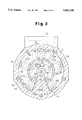
  • FIG. 3 is a cross-sectional view taken along the line 3--3 in FIG. 1;
  • FIG. 4 is a side cross-sectional view of the whole compressor whose swash plate is at a minimum inclined angle
  • FIG. 5 is an enlarged cross-sectional view of essential parts showing the compressor whose swash plate is at a maximum inclined angle
  • FIG. 6 is an enlarged cross-sectional view of essential parts showing the compressor whose swash plate is at the minimum inclined angle
  • FIG. 7 is a side cross-sectional view of an overall compressor according to the second embodiment.
  • FIG. 8 is an enlarged cross-sectional view of essential parts showing the compressor whose swash plate is at the maximum inclined angle
  • FIG. 9 is an enlarged cross-sectional view of essential parts showing the compressor whose swash plate is at the minimum inclined angle
  • FIG. 10 is an enlarged cross-sectional view of essential parts showing the compressor whose swash plate is at the minimum inclined angle
  • FIG. 11 is a side cross-sectional view of an overall compressor according to the third embodiment.
  • FIG. 12 is an enlarged cross-sectional view of essential parts showing the compressor whose swash plate is at the minimum inclined angle
  • FIG. 13 is an enlarged cross-sectional view of essential parts showing the compressor according to the fourth embodiment.
  • FIG. 1 presents a cross-sectional view showing the overall compressor.
  • the outline of the compressor will be discussed with reference to FIG. 1.
  • a cylinder block 1 constitutes a part of the housing of the compressor.
  • a front housing 2 is secured to the front end of the cylinder block 1.
  • a rear housing 3 is secured to the rear end of the cylinder block 1 via a first plate 4, a second plate 60, a third plate 61 and a fourth plate 6.
  • the front housing 2 defines a crank chamber 2a.
  • a drive shaft 9 is supported rotatably on the front housing 2 and the cylinder block 1. The front end of the drive shaft 9 protrudes outside the crank chamber 2a, with a pulley 10 secured to this front end.
  • the pulley 10 is functionally coupled to the engine E of a vehicle via a belt 11.
  • a support pipe 2b protrudes from the front end of the front housing 2 in such a way as to surround the front end of the drive shaft 9.
  • the pulley 10 is supported via an angular bearing 7 on the support pipe 2b. Through the angular bearing 7, the support pipe 2b receives both the thrust load and radial load which act on the pulley 10.
  • a lip seal 12 Between the front end of the drive shaft 9 and the front housing 2 is a lip seal 12 which prevents pressure leakage from the crank chamber 2a.
  • a guide hole 15a is formed in the center portion of a swash plate 15.
  • the swash plate 15 is supported by the drive shaft 9 in such a way as to be slidable along and tiltable with respect to the axis of this shaft 9 via the guide hole 15a.
  • a pair of stays 16 and 17 are secured to the swash plate 15, with guide pins 18 and 19 fixed to the respective stays 16 and 17.
  • Guide balls 18a and 19a are formed at the distal ends of the respective guide pins 18 and 19.
  • a drive plate 8 is fixed to the drive shaft 9.
  • the drive plate 8 has a support arm 8a protruding toward the swash plate 15 (rearward) from the drive plate 6.
  • a pair of guide holes 8b and 8c are formed in the arm 8a, and the guide balls 18a and 19a are slidably fitted in the associated guide holes 8b and 8c.
  • the cooperation of the arm 8a and the guide pins 18 and 19 permits the swash plate 15 to rotate together with the drive shaft 9 and to tilt with respect to the drive shaft 9.
  • Single-headed pistons 22 are retained in the associated cylinder bores 1a.
  • the hemispherical portions of a pair of shoes 23 are fitted on each piston 22 in a mutually slidable manner.
  • the swash plate 15 is held between the flat portions of both shoes 23. Accordingly, the undulation of the swash plate 15 caused by the rotation of the drive shaft 9 is transmitted via the shoes 23 to each piston 22, so that the piston 22 reciprocates in the associated cylinder bore 1a in accordance with the inclination of the swash plate 15.
  • a suction chamber 3a and a discharge chamber 3b are defined in the rear housing 3.
  • Suction ports 4a and discharge ports 4b are formed in the first plate 4.
  • Suction valves 60a are formed on the second plate 60, and discharge valves 61a are formed on the third plate 61.
  • the pistons 22 move backward, the refrigerant gas in the suction chamber 3a forces the suction valves 60a open through the suction ports 4a and enters the cylinder bores 1a.
  • the pistons 22 move forward, the refrigerant gases in the cylinder bores 1a force the discharge valves 61a open through the discharge ports 4b and enter the discharge chamber 3b.
  • As each discharge valve 61a abuts on a retainer 6a on the fourth plate 6 the amount the associated discharge valve opens 61a is restricted.
  • a thrust bearing 29 is placed between the drive plate 8 and the front housing 2. This thrust bearing 29 receives the compressive reaction force that acts on the drive plate 8 via the pistons 22, the swash plate 15, etc.
  • a shutter chamber 13 is formed in the center portion of the cylinder block 1, extending along the axis of the drive shaft 9.
  • a cylindrical spool 21 having one closed end is slidably accommodated in the shutter chamber 13.
  • a spring 24 is located between the spool 21 and the inner wall of the shutter chamber 13. The spring 24 urges the spool 21 toward the swash plate 15.
  • the rear end of the drive shaft 9 is inserted in the spool 21.
  • a ball bearing 25 is located between the rear end of the drive shaft 9 and the inner wall of the spool 21.
  • the ball bearing 25 receives loads in the radial direction and the thrust direction that are applied to the drive shaft 9.
  • the rear end of the drive shaft 9 is supported by the inner wall of the shutter chamber 13 via the ball bearing 25 and the spool 21.
  • the ball bearing 25 has an outer race 25a fixed to the inner wall of the spool 21 and an inner race 25b which is slidable along the outer surface of the drive shaft 9.
  • a step portion 9a is formed on the rear outer surface of the drive shaft 9.
  • the engagement of the inner race 25b of the ball bearing 25 and this step portion 9a inhibits the movement of the ball bearing 25 toward the swash plate 15 (frontward). At the same time, the engagement prohibits the spool 21 from moving toward the swash plate 15.
  • a suction passage 26 is formed in the center portion of the rear housing 3. This suction passage 26 communicates with the shutter chamber 13.
  • a positioning surface 27 is formed on the cylinder block 1 between the shutter chamber 13 and the suction passage 26. The distal end of the spool 21 is abuttable on the positioning surface 27. As the distal end of the spool 21 abuts on the positioning surface 27, the movement of the spool 21 away from the swash plate 15 or in the rearward direction is restricted and the suction passage 26 is disconnected from the shutter chamber 13.
  • a pipe 28 is slidably attached to the drive shaft 9 between the swash plate 15 and the ball bearing 25.
  • the front end of the pipe 28 is abuttable on the rear end face of the swash plate 15.
  • the rear end of the pipe 28 does not contact the outer race 25a of the ball bearing 25 but contacts only the inner race 25b.
  • the pipe 28 pushes the inner race 25b of the ball bearing 25.
  • the spool 21 moves toward the positioning surface 27 against the urging force of the spring 24 and the distal end of the spool 21 abuts on the positioning surface 27.
  • the minimum inclined angle of the swash plate 15 is slightly larger than zero degrees. An incline of zero degrees is defined as the incline of the swash plate 15 when the plane of the swash plate is perpendicular to the drive shaft 9.
  • the spool 21 comes to a closed position to disconnect the suction passage 26 from the shutter chamber 13, as shown in FIG. 6.
  • the spool 21 is movable between this closed position and an open position (see FIG. 5) spaced from the closed position, and is positioned in response to the movement of the swash plate 15.
  • the swash plate 15 is restricted not to incline beyond a predetermined maximum inclined angle.
  • the suction chamber 3a communicates with the shutter chamber 13 via a communication hole 4c which passes through the individual plates 4, 60, 61 and 6. This communication hole 4c is blocked from the suction passage 26 when the spool 21 is in the closed position.
  • the suction passage 26 forms an inlet to supply the refrigerant gas into the compressor. Therefore, the spool 21 blocks the passage of the refrigerant gas from the suction passage 26 to the suction chamber 3a downstream of that inlet.
  • a passage 30 is formed in the drive shaft 9.
  • the passage 30 connects the crank chamber 2a to the interior of the spool 21.
  • a through hole 21a is formed in the distal end of the spool 21.
  • the interior of the spool 21 communicates with the shutter chamber 13 via the through hole 21a.
  • the interior of the spool 21 communicates with the communication hole 4c via the through hole 21a, as shown in FIGS. 4 and 6. Accordingly, the crank chamber 2a always communicates with the suction chamber 3a via the passage 30, the interior of the spool 21, the through hole 21a and the communication hole 4c.
  • a pressure decreasing passage 14 connects the crank chamber 2a to the suction chamber 3a.
  • An electromagnetic valve 32 is attached to the rear housing 3 and is located midway in the pressure decreasing passage 14.
  • a valve body 34 opens a valve hole 32a as shown in FIG. 1.
  • the valve body 34 closes the valve hole 32a as shown in FIG. 4. Therefore, the electromagnetic valve 32 selectively opens or closes the pressure decreasing passage 14 between the crank chamber 2a and the suction chamber 3a.
  • a supply passage 31 connects the discharge chamber 3b to the crank chamber 2a.
  • the refrigerant gas in the discharge chamber 3b is always supplied to the crank chamber 2a via the supply passage 31.
  • An external refrigeration circuit 35 connects the suction passage 26 for supplying the refrigerant gas into the suction chamber 3a to the outlet port 1b for discharging the refrigerant gas from the discharge chamber 3b.
  • a condenser 36 Provided above the external refrigeration circuit 35 are a condenser 36, an expansion valve 37 and an evaporator 38.
  • the expansion valve 37 controls the flow rate of the refrigerant in accordance with a change in gas pressure on the outlet side of the evaporator 38.
  • a temperature sensor 39 is located near the evaporator 38.
  • the temperature sensor 39 detects the temperature in the evaporator 38, and outputs a signal based on the detected temperature to a computer C.
  • An engine speed sensor 41 detects the rotational speed of the engine E and outputs a signal based on the detected engine speed to the computer C.
  • the computer C controls the solenoid 33 of the electromagnetic valve 32. More specifically, the computer C excites or de-excites the solenoid 33 based on the ON action or OFF action of an activation switch 40 for activating the air conditioning system.
  • the computer C de-excites the solenoid 33. At a temperature equal to or below this set value, frosting may occur in the evaporator 38. Further, when the engine speed detected by the engine speed sensor 41 changes abruptly with the activation switch 40 set on, the computer C de-excites the solenoid 33.
  • the solenoid 33 is excited and the pressure decreasing passage 14 is opened.
  • the refrigerant gas in the crank chamber 2a flows out to the suction chamber 3a via the pressure decreasing passage 14 and the passage 30. Therefore, the pressure in the crank chamber 2a approaches the low pressure in the suction chamber 3a, i.e., the suction pressure.
  • the difference between the pressure in the crank chamber 2a and the pressure in the cylinder bores 1a becomes smaller and the inclined angle of the swash plate 15 is maximized. The discharge displacement of the compressor is thus maximized.
  • the refrigerant gas is also supplied to the crank chamber 2a from the discharge chamber 3b through the supply passage 31. This raises the pressure in the crank chamber 2a. The difference between the pressure in the crank chamber 2a and the pressure in the cylinder bores 1a therefore increases and the inclined angle of the swash plate 15 becomes smaller.
  • the spool 21 As the inclined angle of the swash plate 15 becomes smaller, the spool 21 is pushed backward via the pipe 28 and the ball bearing 25. Consequently, the distal end of the spool 21 approaches the positioning surface 27. This movement gradually restricts the cross-sectional area of the passage extending from the suction passage 26 to the suction chamber 3a. The amount of the refrigerant gas flowing into the suction chamber 3a from the suction passage 26 therefore decreases gradually. As a result, the amount of the refrigerant gas sucked into the cylinder bores 1a from the suction chamber 3a also decreases gradually, and the discharge displacement decreases gradually. The discharge pressure falls gradually and the torque needed to drive the compressor becomes smaller gradually. Therefore, the torque does not vary significantly in a short period of time.
  • the spool 21 blocks the suction passage 26 from the suction chamber 3a as shown in FIGS. 4 and 6. Consequently, the refrigerant gas stops flowing into the suction chamber 3a from the external refrigeration circuit 35 and the inclined angle of the swash plate 15 goes to its minimum. Since the minimum inclined angle of the swash plate 15 is not zero degrees, the refrigerant gas is discharged into the discharge chamber 3b from the cylinder bores 1a even when the inclined angle of the swash plate 15 is minimized. Even when the inclined angle of the swash plate 15 is minimized, therefore, there are pressure differences between the discharge chamber 3b, the crank chamber 2a and the suction chamber 3a.
  • the refrigerant gas discharged to the discharge chamber 3b from the cylinder bores 1a flows into the crank chamber 2a via the supply passage 31.
  • the refrigerant gas in the crank chamber 2a flows into the suction chamber 3avia the passage 30 and the through hole 21a, and the refrigerant gas in the suction chamber 3a is drawn into the cylinder bores 1a to be discharged to the discharge chamber 3b.
  • a circulation path connecting the discharge chamber 3b, the supply passage 31, the crank chamber 2a, the passage 30, the through hole 21a, the suction chamber 3a and the cylinder bores 1a is formed in the compressor.
  • the refrigerant gas discharged to the discharge chamber 3b circulates along this circulation path and will not flow out to the external refrigeration circuit 35. Therefore, no frosting will occur in the evaporator 38. Further, the individual moving parts of the compressor are lubricated by lubricating oil suspended in the refrigerant gas.
  • the spool 21 gradually moves away from the positioning surface 27 due to the urging force of the spring 24. This movement gradually increases the cross-sectional area of the passage extending from the suction passage 26 to the suction chamber 3a.
  • the amount of refrigerant gas flowing into the suction chamber 3a from the suction passage 26 therefore increases gradually.
  • the amount of the refrigerant gas drawn into the cylinder bores 1a from the suction chamber 3a also increases gradually, and the discharge displacement increases gradually. Consequently, the discharge pressure rises gradually and the torque needed to drive the compressor becomes larger gradually. Therefore, the torque does not vary significantly in a short period of time.
  • the supply of the refrigerant gas to the suction chamber 3a from the external refrigeration circuit 35 is allowed or inhibited by moving the spool 21 in response to the inclination of the swash plate 15.
  • the use of this spool 21 prevents frosting from occurring in the evaporator 38 when there is no cooling load on the compressor and effectively suppresses rapid torque change when the swash plate 15 is shifted between the maximum inclined angle and the minimum inclined angle.
  • opening and closing of the pressure decreasing passage 14 are frequently repeated in accordance with a change in the cooling load of the compressor, the change-oriented shock can be absorbed because drastic changes in torque are suppressed by the action of the spool 21.
  • this compressor does not require a conventional control valve and therefore has a lower cost.
  • FIGS. 7 through 10 A second embodiment of the present invention will now be described with reference to FIGS. 7 through 10.
  • the members identical to those in the first embodiment are indicated by the same reference numerals and are not explained.
  • a displacement control valve 43 is attached to the rear housing 3 and is located midway in the pressure decreasing passage 14, as shown in FIG. 7.
  • the pressure in the crank chamber 2a is controlled by this control valve 43.
  • a valve housing 44 which houses the control valve 43 is provided with a first port 44a, a second port 44b and a third port 44c.
  • the first port 44a communicates with the crank chamber 2a via the pressure decreasing passage 14.
  • the third port 44c communicates with the suction chamber 3a via the pressure decreasing passage 14.
  • the second port 44b communicates with the suction passage 26 via an inlet passage 46.
  • a suction pressure detection chamber 49 communicates with the second port 44b.
  • the suction pressure upstream of the position where the spool 21 blocks the refrigerant gas passage (between the suction passage 26 and the suction chamber 3a) is communicated with the detection chamber 49.
  • the pressure in this detection chamber 49 acts against an adjust spring 51 via a diaphragm 50.
  • the urging force of the adjust spring 51 is transmitted to a valve body 53 via the diaphragm 50 and a rod 52.
  • the urging force of a spring 54 acts on the valve body 53 in the direction to open a valve hole 44e.
  • the valve body 53 opens or closes the valve hole 44e.
  • the first port 44a is disconnected from the third port 44c, causing the crank chamber 2a to be disconnected from the suction chamber 3a.
  • the temperature sensor 39 is not used.
  • the pressure in the detection chamber 49 increases and the size of the opening of the valve hole 44e by the valve body 53 increases.
  • the size of the opening of the valve hole 44e increases, the amount of the refrigerant gas flowing out to the suction chamber 3a from the crank chamber 2a via the pressure decreasing passage 14 increases.
  • the pressure in the crank chamber 2a falls. Since the suction pressure in the cylinder bores 1a is high, the difference between the pressure in the crank chamber 2a and the pressure in the cylinder bores 1a decreases. Accordingly, the inclined angle of the swash plate 15 becomes larger as shown in FIG. 7 and 8.
  • the valve body 53 closes the valve hole 44e as shown in FIG. 9.
  • the valve body 34 closes the valve hole 32a, blocking the pressure decreasing passage 14 as shown in FIG. 10. Consequently, the pressure in the crank chamber 2a rises and the swash plate 15 moves toward its minimum angle.
  • the solenoid 33 is excited from the state shown in FIG. 10, the pressure decreasing passage 14 is opened and the swash plate 15 moves toward its maximum inclined angle from its minimum inclined angle.
  • the inclined angle of the swash plate 15 is variably controlled continuously between the maximum inclined angle and the minimum inclined angle.
  • a third embodiment of this invention will be described below with reference to FIG. 11 and 12.
  • the members identical to those in the second embodiment are indicated by the same reference numerals and not explained.
  • a displacement control valve 43A is located midway along the supply passage 31 connecting the discharge chamber 3b and the crank chamber 2a as shown in FIG. 11.
  • the pressure in the detection chamber 49 acts against the adjust spring 51 via the diaphragm 50.
  • the urging force of the adjust spring 51 is transmitted to the valve body 53 via the diaphragm 50 and the rod 52.
  • the urging force of the spring 54 acts on the valve body 53 in the direction to close a valve hole 44e.
  • the valve body 53 opens or closes the valve hole 44e. When the valve hole 44e is closed, the discharge chamber 3b is disconnected from the crank chamber 2a.
  • the inclined angle of the swash plate 15 is variably controlled continuously, between the maximum inclined angle and the minimum inclined angle.
  • FIGS. 13 A fourth embodiment of this invention will be described below with reference to FIGS. 13.
  • the members identical to those in the first embodiment are indicated by the same reference numerals and not explained.
  • a passage 32b is formed in the electromagnetic valve 32, and the passage 30 in the drive shaft 9 and the through hole 21a in the spool 21 are omitted.
  • the refrigerant gas circulates along the circulation path in the compressor, when the supply of the refrigerant gas to the suction chamber 3a from the external refrigeration circuit 35 is inhibited. Therefore, the individual portions in the compressor are lubricated by the lubricating oil suspended in the refrigerant gas.

Landscapes

  • Engineering & Computer Science (AREA)
  • Mechanical Engineering (AREA)
  • General Engineering & Computer Science (AREA)
  • Compressors, Vaccum Pumps And Other Relevant Systems (AREA)

Abstract

A compressor has a swash plate tiltable between a maximum and minimum inclining angles with respect to an axis of the drive shaft according to a difference between pressures in a crank chamber and a suction chamber. An electromagnetic valve is disposed in a pressure passage, and opens or closes the pressure passage according to instruction of an external computer. This instruction is based on an operation status of the compressor so that the electromagnetic valve adjusts the pressure in the crank chamber. The pressure passage connects the crank chamber and the suction chamber. The swash plate is inclined toward the maximum inclining angle when the pressure passage is open to release the pressure in the crank chamber to the suction chamber. The swash plate is inclined toward the minimum inclining angle when the pressure passage is closed to increase the pressure in the crank chamber. A disconnecting element is disposed between the external circuit and the suction chamber to disconnect the external circuit with the suction chamber in association with the swash plate driven to the minimum inclining angle.

Description

CROSS REFERENCE TO RELATED APPLICATION
This application is a continuation-in-part of U.S. patent application Ser. No. 08/421,215 filed Apr. 13, 1995 now U.S. Pat. No. 5,584,670, which is a continuation-in-part of U.S. patent application Ser. No. 08/361,111 filed Dec. 21, 1994 now U.S. Pat. No. 5,603,610, which is a continuation-in-part of U.S. patent application Ser. No. 08/225,043 filed Jun. 7, 1994, abandoned, all of which are incorporated herein by reference.
BACKGROUND OF THE INVENTION
1. Field of the Invention
The present invention relates to a piston-type variable displacement compressor. More specifically, this invention relates to a piston-type variable displacement compressor capable of efficiently adjusting the pressure in the crank chamber.
2. Description of the Related Art
In general, compressors are mounted in vehicles to supply compressed refrigerant gas to the vehicle's air conditioning system. To maintain air temperature inside the vehicle at a level comfortable for the vehicle's passengers, it is important to utilize a compressor whose displacement is controllable. One known compressor of this type controls the inclined angle of a swash plate, tiltably supported on a drive shaft, based on the difference between the pressure in a crank chamber and the suction pressure, and converts the rotational motion of the swash plate to the reciprocal linear motion of each piston.
A conventional piston type compressor disclosed in U.S. Pat. No. 5,173,032 uses no electromagnetic clutch for the transmission and blocking of power between an external driving source and the drive shaft of the compressor. The external driving source is coupled directly to the drive shaft.
The clutchless structure with the driving source coupled directly to the drive shaft can eliminate shocks which are produced by the ON/OFF action of such a clutch. When such a compressor is used in a vehicle, passenger comfort is improved. The clutchless structure also reduces the overall weight and cost of the cooling system.
In such a clutchless system, the compressor runs even when no cooling is needed. With such type of compressors, it is important that, when cooling is unnecessary, the discharge displacement is reduced as much as possible to prevent frosting of the evaporator. When no cooling is needed or there is a probability of frosting, the circulation of the refrigerant gas through the compressor and its external refrigeration circuit should be stopped. The compressor described in the aforementioned U.S. patent is designed to block the flow of gas into the suction chamber from the external refrigeration circuit by the use of an electromagnetic valve.
In the compressor described above, when the circulation of the gas from the external refrigeration circuit to the suction chamber is blocked, the pressure in the suction chamber drops and the control valve responsive to that pressure opens fully. The full opening of the control valve allows the gas in the discharge chamber to flow into the crank chamber, which in turn raises the pressure inside the crank chamber.
When the pressure in the suction chamber falls, the suction pressure in the cylinder bores falls, thus increasing the difference between the pressure in the crank chamber and the pressure in the cylinder bores. This pressure differential in turn minimizes the inclination of the swash plate which reciprocates the pistons. As a result, the discharge displacement becomes minimum. At this time, the driving torque needed by the compressor is minimized, thus reducing power loss as much as possible.
When the gas flow to the suction chamber from the external refrigeration circuit starts again, the pressure in the suction chamber rises, and then the control valve closes. This inhibits the gas flow into the crank chamber from the discharge chamber, which lowers the pressure in the crank chamber. As the pressure in the suction chamber rises, the suction pressure in the cylinder bores rises too. The difference between the pressure in the crank chamber and the pressure in the cylinder bores therefore becomes smaller, and the inclined angle of the swash plate becomes maximum, maximizing the discharge displacement. At this time, the torque needed to drive the compressor becomes maximum.
The aforementioned electromagnetic valve performs a simple ON/OFF action to instantaneously stop or restart the gas flow from the external refrigerant circuit into the suction chamber. Accordingly, the amount of gas supplied into the cylinder bores from the suction chamber decreases or increases drastically. This rapid change in the amount of gas flowing into the cylinder bores causes an abrupt change in the discharge displacement, rapidly decreasing or increasing the discharge pressure. Consequently, the driving torque needed to drive the compressor greatly changes over a short period of time, causing rather large shock.
SUMMARY OF THE INVENTION
Accordingly, it is a primary objective of the present invention to provide a compressor capable of suppressing a drastic change in torque needed to drive the compressor.
BRIEF DESCRIPTION OF THE DRAWINGS
The features of the present invention that are believed to be novel are set forth with particularity in the appended claims. The invention, together with objects and advantages thereof, may best be understood by reference to the following description of the presently preferred embodiments together with the accompanying drawings in which:
FIG. 1 is a side cross-sectional view of an overall compressor according to the first embodiment of the present invention;
FIG. 2 is a cross-sectional view taken along the line 2--2 in FIG. 1;
FIG. 3 is a cross-sectional view taken along the line 3--3 in FIG. 1;
FIG. 4 is a side cross-sectional view of the whole compressor whose swash plate is at a minimum inclined angle;
FIG. 5 is an enlarged cross-sectional view of essential parts showing the compressor whose swash plate is at a maximum inclined angle;
FIG. 6 is an enlarged cross-sectional view of essential parts showing the compressor whose swash plate is at the minimum inclined angle;
FIG. 7 is a side cross-sectional view of an overall compressor according to the second embodiment;
FIG. 8 is an enlarged cross-sectional view of essential parts showing the compressor whose swash plate is at the maximum inclined angle;
FIG. 9 is an enlarged cross-sectional view of essential parts showing the compressor whose swash plate is at the minimum inclined angle;
FIG. 10 is an enlarged cross-sectional view of essential parts showing the compressor whose swash plate is at the minimum inclined angle;
FIG. 11 is a side cross-sectional view of an overall compressor according to the third embodiment;
FIG. 12 is an enlarged cross-sectional view of essential parts showing the compressor whose swash plate is at the minimum inclined angle;
FIG. 13 is an enlarged cross-sectional view of essential parts showing the compressor according to the fourth embodiment;
DETAILED DESCRIPTION OF THE PREFERRED EMBODIMENT
A compressor according to a first embodiment of the present invention will now be described with reference to FIGS. 1 through 6. FIG. 1 presents a cross-sectional view showing the overall compressor. The outline of the compressor will be discussed with reference to FIG. 1. A cylinder block 1 constitutes a part of the housing of the compressor. A front housing 2 is secured to the front end of the cylinder block 1. A rear housing 3 is secured to the rear end of the cylinder block 1 via a first plate 4, a second plate 60, a third plate 61 and a fourth plate 6. The front housing 2 defines a crank chamber 2a. A drive shaft 9 is supported rotatably on the front housing 2 and the cylinder block 1. The front end of the drive shaft 9 protrudes outside the crank chamber 2a, with a pulley 10 secured to this front end. The pulley 10 is functionally coupled to the engine E of a vehicle via a belt 11.
A support pipe 2b protrudes from the front end of the front housing 2 in such a way as to surround the front end of the drive shaft 9. The pulley 10 is supported via an angular bearing 7 on the support pipe 2b. Through the angular bearing 7, the support pipe 2b receives both the thrust load and radial load which act on the pulley 10. Between the front end of the drive shaft 9 and the front housing 2 is a lip seal 12 which prevents pressure leakage from the crank chamber 2a.
A guide hole 15a is formed in the center portion of a swash plate 15. The swash plate 15 is supported by the drive shaft 9 in such a way as to be slidable along and tiltable with respect to the axis of this shaft 9 via the guide hole 15a. As shown in FIGS. 1 and 2, a pair of stays 16 and 17 are secured to the swash plate 15, with guide pins 18 and 19 fixed to the respective stays 16 and 17. Guide balls 18a and 19a are formed at the distal ends of the respective guide pins 18 and 19. A drive plate 8 is fixed to the drive shaft 9. The drive plate 8 has a support arm 8a protruding toward the swash plate 15 (rearward) from the drive plate 6. A pair of guide holes 8b and 8c are formed in the arm 8a, and the guide balls 18a and 19a are slidably fitted in the associated guide holes 8b and 8c. The cooperation of the arm 8a and the guide pins 18 and 19 permits the swash plate 15 to rotate together with the drive shaft 9 and to tilt with respect to the drive shaft 9.
A plurality of cylinder bores 1aare formed in the cylinder block 1 in such a way as to communicate with the crank chamber 2a. Single-headed pistons 22 are retained in the associated cylinder bores 1a. The hemispherical portions of a pair of shoes 23 are fitted on each piston 22 in a mutually slidable manner. The swash plate 15 is held between the flat portions of both shoes 23. Accordingly, the undulation of the swash plate 15 caused by the rotation of the drive shaft 9 is transmitted via the shoes 23 to each piston 22, so that the piston 22 reciprocates in the associated cylinder bore 1a in accordance with the inclination of the swash plate 15.
As shown in FIGS. 1 and 3, a suction chamber 3a and a discharge chamber 3b are defined in the rear housing 3. Suction ports 4a and discharge ports 4b are formed in the first plate 4. Suction valves 60a are formed on the second plate 60, and discharge valves 61a are formed on the third plate 61. As the pistons 22 move backward, the refrigerant gas in the suction chamber 3a forces the suction valves 60a open through the suction ports 4a and enters the cylinder bores 1a. As the pistons 22 move forward, the refrigerant gases in the cylinder bores 1a force the discharge valves 61a open through the discharge ports 4b and enter the discharge chamber 3b. As each discharge valve 61a abuts on a retainer 6a on the fourth plate 6 the amount the associated discharge valve opens 61a is restricted.
A thrust bearing 29 is placed between the drive plate 8 and the front housing 2. This thrust bearing 29 receives the compressive reaction force that acts on the drive plate 8 via the pistons 22, the swash plate 15, etc.
As shown in FIGS. 1, 4 and 5, a shutter chamber 13 is formed in the center portion of the cylinder block 1, extending along the axis of the drive shaft 9. A cylindrical spool 21 having one closed end is slidably accommodated in the shutter chamber 13. A spring 24 is located between the spool 21 and the inner wall of the shutter chamber 13. The spring 24 urges the spool 21 toward the swash plate 15.
The rear end of the drive shaft 9 is inserted in the spool 21. A ball bearing 25 is located between the rear end of the drive shaft 9 and the inner wall of the spool 21. The ball bearing 25 receives loads in the radial direction and the thrust direction that are applied to the drive shaft 9. The rear end of the drive shaft 9 is supported by the inner wall of the shutter chamber 13 via the ball bearing 25 and the spool 21. The ball bearing 25 has an outer race 25a fixed to the inner wall of the spool 21 and an inner race 25b which is slidable along the outer surface of the drive shaft 9.
As shown in FIG. 5, a step portion 9a is formed on the rear outer surface of the drive shaft 9. The engagement of the inner race 25b of the ball bearing 25 and this step portion 9a inhibits the movement of the ball bearing 25 toward the swash plate 15 (frontward). At the same time, the engagement prohibits the spool 21 from moving toward the swash plate 15.
A suction passage 26 is formed in the center portion of the rear housing 3. This suction passage 26 communicates with the shutter chamber 13. A positioning surface 27 is formed on the cylinder block 1 between the shutter chamber 13 and the suction passage 26. The distal end of the spool 21 is abuttable on the positioning surface 27. As the distal end of the spool 21 abuts on the positioning surface 27, the movement of the spool 21 away from the swash plate 15 or in the rearward direction is restricted and the suction passage 26 is disconnected from the shutter chamber 13.
A pipe 28 is slidably attached to the drive shaft 9 between the swash plate 15 and the ball bearing 25. The front end of the pipe 28 is abuttable on the rear end face of the swash plate 15. The rear end of the pipe 28 does not contact the outer race 25a of the ball bearing 25 but contacts only the inner race 25b.
As the swash plate 15 moves rearward, it abuts on the pipe 28. The pipe 28 in turn pushes the inner race 25b of the ball bearing 25. As a result, the spool 21 moves toward the positioning surface 27 against the urging force of the spring 24 and the distal end of the spool 21 abuts on the positioning surface 27. At this time, the inclined angle of the swash plate 15 is restricted to be minimized. The minimum inclined angle of the swash plate 15 is slightly larger than zero degrees. An incline of zero degrees is defined as the incline of the swash plate 15 when the plane of the swash plate is perpendicular to the drive shaft 9.
When the inclined angle of the swash plate 15 reaches the minimum, the spool 21 comes to a closed position to disconnect the suction passage 26 from the shutter chamber 13, as shown in FIG. 6. The spool 21 is movable between this closed position and an open position (see FIG. 5) spaced from the closed position, and is positioned in response to the movement of the swash plate 15. As shown in FIG. 1, abutting on a projection 8d of the drive plate 8, the swash plate 15 is restricted not to incline beyond a predetermined maximum inclined angle.
The suction chamber 3a communicates with the shutter chamber 13 via a communication hole 4c which passes through the individual plates 4, 60, 61 and 6. This communication hole 4c is blocked from the suction passage 26 when the spool 21 is in the closed position. The suction passage 26 forms an inlet to supply the refrigerant gas into the compressor. Therefore, the spool 21 blocks the passage of the refrigerant gas from the suction passage 26 to the suction chamber 3a downstream of that inlet.
As shown in FIG. 1, a passage 30 is formed in the drive shaft 9. The passage 30 connects the crank chamber 2a to the interior of the spool 21. As shown in FIGS. 1, 4 and 5, a through hole 21a is formed in the distal end of the spool 21. As shown in FIGS. 1 and 5, when the swash plate 15 is at the maximum inclined angle, the interior of the spool 21 communicates with the shutter chamber 13 via the through hole 21a. When the swash plate 15 is at the minimum inclined angle, the interior of the spool 21 communicates with the communication hole 4c via the through hole 21a, as shown in FIGS. 4 and 6. Accordingly, the crank chamber 2a always communicates with the suction chamber 3a via the passage 30, the interior of the spool 21, the through hole 21a and the communication hole 4c.
As shown in FIGS. 1 and 4, a pressure decreasing passage 14 connects the crank chamber 2a to the suction chamber 3a. An electromagnetic valve 32 is attached to the rear housing 3 and is located midway in the pressure decreasing passage 14. When the solenoid 33 of the electromagnetic valve 32 is excited, a valve body 34 opens a valve hole 32a as shown in FIG. 1. When the solenoid 33 is de-excited, the valve body 34 closes the valve hole 32a as shown in FIG. 4. Therefore, the electromagnetic valve 32 selectively opens or closes the pressure decreasing passage 14 between the crank chamber 2a and the suction chamber 3a.
A supply passage 31 connects the discharge chamber 3b to the crank chamber 2a. The refrigerant gas in the discharge chamber 3b is always supplied to the crank chamber 2a via the supply passage 31.
An external refrigeration circuit 35 connects the suction passage 26 for supplying the refrigerant gas into the suction chamber 3a to the outlet port 1b for discharging the refrigerant gas from the discharge chamber 3b. Provided above the external refrigeration circuit 35 are a condenser 36, an expansion valve 37 and an evaporator 38. The expansion valve 37 controls the flow rate of the refrigerant in accordance with a change in gas pressure on the outlet side of the evaporator 38.
A temperature sensor 39 is located near the evaporator 38. The temperature sensor 39 detects the temperature in the evaporator 38, and outputs a signal based on the detected temperature to a computer C. An engine speed sensor 41 detects the rotational speed of the engine E and outputs a signal based on the detected engine speed to the computer C.
The computer C controls the solenoid 33 of the electromagnetic valve 32. More specifically, the computer C excites or de-excites the solenoid 33 based on the ON action or OFF action of an activation switch 40 for activating the air conditioning system. When the temperature detected by the temperature sensor 39 becomes equal to or below a set value with the activation switch 40 set on, the computer C de-excites the solenoid 33. At a temperature equal to or below this set value, frosting may occur in the evaporator 38. Further, when the engine speed detected by the engine speed sensor 41 changes abruptly with the activation switch 40 set on, the computer C de-excites the solenoid 33.
The operation of the compressor will now be described.
Referring to FIGS. 1 and 5, the solenoid 33 is excited and the pressure decreasing passage 14 is opened. In this situation, the refrigerant gas in the crank chamber 2a flows out to the suction chamber 3a via the pressure decreasing passage 14 and the passage 30. Therefore, the pressure in the crank chamber 2a approaches the low pressure in the suction chamber 3a, i.e., the suction pressure. As a result, the difference between the pressure in the crank chamber 2a and the pressure in the cylinder bores 1a becomes smaller and the inclined angle of the swash plate 15 is maximized. The discharge displacement of the compressor is thus maximized.
When the gas is discharged with the swash plate 15 kept at the maximum inclined angle while the cooling load of the compressor becomes lower, the temperature in the evaporator 38 falls to approach the value that may cause frosting. When the temperature detected by the temperature sensor 39 becomes equal to or lower than the set value, the computer C de-excites the solenoid 33. When the solenoid 33 is de-excited, the pressure decreasing passage 14 is closed to disconnect the crank chamber 2a from the suction chamber 3a. Consequently, the refrigerant gas in the crank chamber 2a stops flowing into the suction chamber 3a via the pressure decreasing passage 14. At the same time, blow-by gas is supplied to the crank chamber 2a from the cylinder bores 1a. Further, the refrigerant gas is also supplied to the crank chamber 2a from the discharge chamber 3b through the supply passage 31. This raises the pressure in the crank chamber 2a. The difference between the pressure in the crank chamber 2a and the pressure in the cylinder bores 1a therefore increases and the inclined angle of the swash plate 15 becomes smaller.
As the inclined angle of the swash plate 15 becomes smaller, the spool 21 is pushed backward via the pipe 28 and the ball bearing 25. Consequently, the distal end of the spool 21 approaches the positioning surface 27. This movement gradually restricts the cross-sectional area of the passage extending from the suction passage 26 to the suction chamber 3a. The amount of the refrigerant gas flowing into the suction chamber 3a from the suction passage 26 therefore decreases gradually. As a result, the amount of the refrigerant gas sucked into the cylinder bores 1a from the suction chamber 3a also decreases gradually, and the discharge displacement decreases gradually. The discharge pressure falls gradually and the torque needed to drive the compressor becomes smaller gradually. Therefore, the torque does not vary significantly in a short period of time.
When the distal end of the spool 21 abuts on the positioning surface 27, the spool 21 blocks the suction passage 26 from the suction chamber 3a as shown in FIGS. 4 and 6. Consequently, the refrigerant gas stops flowing into the suction chamber 3a from the external refrigeration circuit 35 and the inclined angle of the swash plate 15 goes to its minimum. Since the minimum inclined angle of the swash plate 15 is not zero degrees, the refrigerant gas is discharged into the discharge chamber 3b from the cylinder bores 1a even when the inclined angle of the swash plate 15 is minimized. Even when the inclined angle of the swash plate 15 is minimized, therefore, there are pressure differences between the discharge chamber 3b, the crank chamber 2a and the suction chamber 3a.
The refrigerant gas discharged to the discharge chamber 3b from the cylinder bores 1a flows into the crank chamber 2a via the supply passage 31. The refrigerant gas in the crank chamber 2a flows into the suction chamber 3avia the passage 30 and the through hole 21a, and the refrigerant gas in the suction chamber 3a is drawn into the cylinder bores 1a to be discharged to the discharge chamber 3b. With the inclined angle of the swash plate 15 at the minimum angle, therefore, a circulation path connecting the discharge chamber 3b, the supply passage 31, the crank chamber 2a, the passage 30, the through hole 21a, the suction chamber 3a and the cylinder bores 1a is formed in the compressor. The refrigerant gas discharged to the discharge chamber 3b circulates along this circulation path and will not flow out to the external refrigeration circuit 35. Therefore, no frosting will occur in the evaporator 38. Further, the individual moving parts of the compressor are lubricated by lubricating oil suspended in the refrigerant gas.
When the cooling load of the compressor increases from the state shown in FIGS. 4 and 6, the increase appears as a rise in the temperature in the evaporator 38. When the temperature detected by the temperature sensor 39 exceeds the set value, the computer C excites the solenoid 33. When this excitation happens, the pressure decreasing passage 14 is opened. Under this situation, the refrigerant gas in the crank chamber 2a flows out to the suction chamber 3a via the pressure decreasing passage 14, and the pressure in the crank chamber 2a approaches the suction pressure. As a result, the inclined angle of the swash plate 15 shifts toward the maximum inclined angle from the minimum inclined angle.
As the inclined angle of the swash plate 15 increases, the spool 21 gradually moves away from the positioning surface 27 due to the urging force of the spring 24. This movement gradually increases the cross-sectional area of the passage extending from the suction passage 26 to the suction chamber 3a. The amount of refrigerant gas flowing into the suction chamber 3a from the suction passage 26 therefore increases gradually. As a result, the amount of the refrigerant gas drawn into the cylinder bores 1a from the suction chamber 3a also increases gradually, and the discharge displacement increases gradually. Consequently, the discharge pressure rises gradually and the torque needed to drive the compressor becomes larger gradually. Therefore, the torque does not vary significantly in a short period of time.
Even when the solenoid 33 is de-excited in the state in FIG. 5 due to the OFF action of the activation switch 40 or a drastic change in the engine speed, the inclined angle of the swash plate 15 shifts toward the minimum inclined angle from the maximum inclined angle. When the activation switch 40 is switched on or the drastic change in the engine speed is gone in the state in FIG. 6, the solenoid 33 is excited. When the cooling load of the compressor is large then, the inclined angle of the swash plate 15 shifts toward the maximum inclined angle from the minimum inclined angle.
When the engine E stops, the compressor stops running and the solenoid 33 is de-excited, causing the inclined angle of the swash plate 15 to shift toward the minimum inclined angle. With the operation of the compressor stopped, therefore, the swash plate 15 is held at the minimum inclined angle.
In this embodiment, the supply of the refrigerant gas to the suction chamber 3a from the external refrigeration circuit 35 is allowed or inhibited by moving the spool 21 in response to the inclination of the swash plate 15. The use of this spool 21 prevents frosting from occurring in the evaporator 38 when there is no cooling load on the compressor and effectively suppresses rapid torque change when the swash plate 15 is shifted between the maximum inclined angle and the minimum inclined angle. Although opening and closing of the pressure decreasing passage 14 are frequently repeated in accordance with a change in the cooling load of the compressor, the change-oriented shock can be absorbed because drastic changes in torque are suppressed by the action of the spool 21. In addition, this compressor does not require a conventional control valve and therefore has a lower cost.
A second embodiment of the present invention will now be described with reference to FIGS. 7 through 10. In this embodiment, the members identical to those in the first embodiment are indicated by the same reference numerals and are not explained.
In this second embodiment, a displacement control valve 43 is attached to the rear housing 3 and is located midway in the pressure decreasing passage 14, as shown in FIG. 7. The pressure in the crank chamber 2a is controlled by this control valve 43. A valve housing 44 which houses the control valve 43 is provided with a first port 44a, a second port 44b and a third port 44c. The first port 44a communicates with the crank chamber 2a via the pressure decreasing passage 14. The third port 44c communicates with the suction chamber 3a via the pressure decreasing passage 14. The second port 44b communicates with the suction passage 26 via an inlet passage 46.
A suction pressure detection chamber 49 communicates with the second port 44b. The suction pressure upstream of the position where the spool 21 blocks the refrigerant gas passage (between the suction passage 26 and the suction chamber 3a) is communicated with the detection chamber 49. The pressure in this detection chamber 49 acts against an adjust spring 51 via a diaphragm 50. The urging force of the adjust spring 51 is transmitted to a valve body 53 via the diaphragm 50 and a rod 52. The urging force of a spring 54 acts on the valve body 53 in the direction to open a valve hole 44e. In accordance with a change in suction pressure in the detection chamber 49, the valve body 53 opens or closes the valve hole 44e. When the valve hole 44e is closed, the first port 44a is disconnected from the third port 44c, causing the crank chamber 2a to be disconnected from the suction chamber 3a.
In this second embodiment, the temperature sensor 39 is not used. When the cooling load of the compressor is large and the suction pressure is high with the solenoid 33 being excited to open the pressure decreasing passage 14, the pressure in the detection chamber 49 increases and the size of the opening of the valve hole 44e by the valve body 53 increases. As the size of the opening of the valve hole 44e increases, the amount of the refrigerant gas flowing out to the suction chamber 3a from the crank chamber 2a via the pressure decreasing passage 14 increases. As a result, the pressure in the crank chamber 2a falls. Since the suction pressure in the cylinder bores 1a is high, the difference between the pressure in the crank chamber 2a and the pressure in the cylinder bores 1a decreases. Accordingly, the inclined angle of the swash plate 15 becomes larger as shown in FIG. 7 and 8.
When the cooling load of the compressor is small and the suction pressure is low, the size of the opening of the valve hole 44e by the valve body 53 becomes smaller and the amount of the refrigerant gas flowing out to the suction chamber 3a from the crank chamber 2a decreases. Consequently, the pressure in the crank chamber 2a rises. As the suction pressure in the cylinder bores 1a is low, the difference between the pressure in the crank chamber 2a and the pressure in the cylinder bores 1a increases. Therefore, the inclined angle of the swash plate 15 becomes smaller.
When the cooling load of the compressor is very small and the suction pressure is very low, the valve body 53 closes the valve hole 44e as shown in FIG. 9. When the solenoid 33 is de-excited, the valve body 34 closes the valve hole 32a, blocking the pressure decreasing passage 14 as shown in FIG. 10. Consequently, the pressure in the crank chamber 2a rises and the swash plate 15 moves toward its minimum angle. When the solenoid 33 is excited from the state shown in FIG. 10, the pressure decreasing passage 14 is opened and the swash plate 15 moves toward its maximum inclined angle from its minimum inclined angle. In this second embodiment, the inclined angle of the swash plate 15 is variably controlled continuously between the maximum inclined angle and the minimum inclined angle.
A third embodiment of this invention will be described below with reference to FIG. 11 and 12. In this embodiment, the members identical to those in the second embodiment are indicated by the same reference numerals and not explained.
In this third embodiment, a displacement control valve 43A is located midway along the supply passage 31 connecting the discharge chamber 3b and the crank chamber 2a as shown in FIG. 11. The pressure in the detection chamber 49 acts against the adjust spring 51 via the diaphragm 50. The urging force of the adjust spring 51 is transmitted to the valve body 53 via the diaphragm 50 and the rod 52. The urging force of the spring 54 acts on the valve body 53 in the direction to close a valve hole 44e. In accordance with a change in suction pressure in the detection chamber 49, the valve body 53 opens or closes the valve hole 44e. When the valve hole 44e is closed, the discharge chamber 3b is disconnected from the crank chamber 2a.
When the cooling load of the compressor is large and the suction pressure is high, the pressure in the detection chamber 49 increases and the size of the opening of the valve hole 44e by the valve body 53 becomes smaller. As the size of the opening of the valve hole 44e becomes smaller, the amount of the refrigerant gas flowing into the crank chamber 2a from the discharge chamber 3b decreases. As a result, the pressure in the crank chamber 2a falls and the inclined angle of the swash plate 15 becomes larger as shown in FIG. 11.
When the cooling load of the compressor is small and the suction pressure is low, the size of the opening of the valve hole 44e by the valve body 53 increases and the amount of the refrigerant gas flowing into the crank chamber 2a from discharge chamber 3b increases. Consequently, the pressure in the crank chamber 2a rises and the inclined angle of the swash plate 15 becomes smaller as shown in FIG. 12.
In this third embodiment, as in the second embodiment, the inclined angle of the swash plate 15 is variably controlled continuously, between the maximum inclined angle and the minimum inclined angle.
A fourth embodiment of this invention will be described below with reference to FIGS. 13. In this embodiment, the members identical to those in the first embodiment are indicated by the same reference numerals and not explained.
In this fourth embodiment, a passage 32b is formed in the electromagnetic valve 32, and the passage 30 in the drive shaft 9 and the through hole 21a in the spool 21 are omitted. When the solenoid 33 of the electromagnetic valve 32 is de-excited, the pressure decreasing passage 14 is blocked and the pressure in the crank chamber 2a rises. Consequently, the inclined angle of the swash plate 15 becomes smaller and the spool 21 blocks the suction passage 26 from the suction chamber 3a. In this situation, the refrigerant gas in the crank chamber 2a flows out to the suction chamber 3a via the pressure decreasing passage 14 and the passage 32b.
Consequently, in this fourth embodiment, the refrigerant gas circulates along the circulation path in the compressor, when the supply of the refrigerant gas to the suction chamber 3a from the external refrigeration circuit 35 is inhibited. Therefore, the individual portions in the compressor are lubricated by the lubricating oil suspended in the refrigerant gas.
Claims (20)

What is claimed is:
1. A compressor having a swash plate mounted on a drive shaft for an integral rotation in a crank chamber and a piston coupled to the swash plate and disposed in a cylinder bore, the rotation of the drive shaft being converted to a reciprocating movement of the piston to vary a capacity of the cylinder bore to compress gas which is supplied to the cylinder bore from an external circuit by way of a suction chamber and discharged to a discharge chamber, said swash plate being tiltable between a maximum inclining angle and a minimum inclining angle with respect to an axis of the drive shaft according to a difference between pressures in the crank chamber and the suction chamber, wherein said swash plate controls a displacement of the compressor to be maximum and minimum when the swash plate is at the maximum inclining angle and at the minimum inclining angle, respectively, and wherein a pressure passage for adjusting the pressure in the crank chamber is selectively open and closed in accordance with an operation status of the compressor, said compressor comprising:
said pressure passage connecting the crank chamber and the suction chamber;
switching means for selectively opening and closing the pressure passage, wherein said swash plate is inclined toward the maximum inclining angle when the pressure passage is open to release the pressure in the crank chamber to the suction chamber, and said swash plate is inclined toward the minimum inclining angle when the pressure passage is closed to increase the pressure in the crank chamber; and
disconnecting means for disconnecting the external circuit with the suction chamber in association with the swash plate driven to the minimum inclining angle.
2. The compressor as set forth in claim 1, wherein said switching means includes an electromagnetic valve.
3. The compressor as set forth in claim 2, wherein said electromagnetic valve is energized to open the pressure passage, and deenergized to close the pressure passage.
4. The compressor as set forth in claim 1 further comprising a first control valve disposed in the pressure passage, wherein said pressure passage has a sectional area variable in association with said first control valve responding to the pressure of the gas supplied from the external circuit to the suction chamber.
5. The compressor as set forth in claim 4, wherein said first control valve operates in response to the pressure generated upstream of the disconnecting means.
6. The compressor as set forth in claim 1 further comprising:
an internal passage selectively connected and disconnected with the external circuit;
wherein said internal passage includes:
a release passage connecting the crank chamber with suction chamber to release the gas in the crank chamber to the suction chamber;
a supply passage connecting the discharge chamber with the crank chamber to supply he compressed gas from the discharge chamber to the crank chamber, wherein the swash plate is inclined toward the minimum inclining angle; and
a circulating passage including the release passage and the supply passage, said circulating passage being defined upon the disconnection of the internal passage with the external circuit.
7. The compressor as set forth in claim 6 further including a second control valve disposed in said supply passage, wherein said supply passage has a sectional area variable in association with said second control valve responding to the pressure of the gas supplied from the external circuit to the suction chamber.
8. The compressor as set forth in claim 7, wherein said second control valve operates in response to the pressure generated upstream of the disconnecting means.
9. The compressor as set forth in claim 1, wherein said disconnecting means includes:
a suction passage for connecting the suction chamber with the external circuit;
a spool movable along the axis of the drive shaft, said spool having an end surface for closing the suction passage and disconnecting the suction chamber from the external circuit when the swash plate is at the minimum inclining angle.
10. The compressor as set forth in claim 9, wherein said spool closes the suction passage to hold the swash plate at the minimum inclining angle.
11. The compressor as set forth in claim 9 further comprising:
said spool having a hollow cylindrical shape; and
a bearing disposed within the spool to rotatably support the drive shaft.
12. The compressor as set forth in claim 11 further comprising a pipe movable along the axis of said drive shaft for transmitting the inclining motion of the swash plate to the spool by way of said bearing.
13. A compressor having a swash plate mounted on a drive shaft for an integral rotation in a crank chamber and a piston coupled to the swash plate and disposed in a cylinder bore, the rotation of the drive shaft being converted to a reciprocating movement of the piston to vary a capacity of the cylinder bore to compress gas which is supplied to the cylinder bore from an external circuit by way of a suction chamber and discharged to a discharge chamber, said swash plate being tiltable between a maximum inclining angle and a minimum inclining angle with respect to an axis of the drive shaft according to a difference between pressures in the crank chamber and the suction chamber, wherein said swash plate controls a displacement of the compressor to be maximum and minimum when the swash plate is at the maximum inclining angle and at the minimum inclining angle, respectively, and wherein a pressure passage for adjusting the pressure in the crank chamber is selectively open and closed in accordance with instruction of an external computer, said instruction being based on an operation status of the compressor, said compressor comprising:
said pressure passage connecting the crank chamber and the suction chamber;
an electromagnetic valve for selectively opening and closing the pressure passage in accordance with the instruction of the external computer, wherein said swash plate is inclined toward the maximum inclining angle when the pressure passage is open to release the pressure in the crank chamber to the suction chamber, and said swash plate is inclined toward the minimum inclining angle when the pressure passage is closed to increase the pressure in the crank chamber; and
a spool movable in association with the inclining motion of the swash plate, whereby said spool disconnects the external circuit with the suction chamber when the swash plate is at the minimum inclining angle.
14. The compressor as set forth in claim 13, wherein said electromagnetic valve is energized to open the pressure passage, and deenergized to close the pressure passage.
15. The compressor as set forth in claim 7 further comprising a first control valve disposed in the pressure passage, wherein said pressure passage has a sectional area variable in association with said first control valve responding to the pressure of the gas supplied from the external circuit to the suction chamber.
16. The compressor as set forth in claim 15, wherein said first control valve operates in response to the pressure generated upstream of the spool.
17. The compressor as set forth in claim 14 further comprising:
an internal passage selectively connected and disconnected with the external circuit;
wherein said internal passage includes:
a release passage connecting the crank chamber with suction chamber to release the gas in the crank chamber to the suction chamber;
a supply passage connecting the discharge chamber with the crank chamber to supply he compressed gas from the discharge chamber to the crank chamber, wherein the swash plate is inclined toward the minimum inclining angle; and
a circulating passage including the release passage and the supply passage, said circulating passage being defined upon the disconnection of the internal passage with the external circuit.
18. The compressor as set forth in claim 17 further including a second control valve disposed in said supply passage, wherein said supply passage has a sectional area variable in association with said second control valve responding to the pressure of the gas supplied from the external circuit to the suction chamber.
19. The compressor as set forth in claim 18, wherein said second control valve operates in response to the pressure generated upstream of the spool.
20. The compressor as set forth in claim 13 further including:
a suction passage for connecting the suction chamber with the external circuit; and
said spool having an end surface for closing the suction passage and disconnecting the suction chamber from the external circuit when the swash plate is at the minimum inclining angle.
US08/438,386 1994-05-12 1995-05-10 Piston type variable displacement compressor Expired - Fee Related US5681150A (en)

Priority Applications (1)

Application Number Priority Date Filing Date Title
US08/438,386 US5681150A (en) 1994-05-12 1995-05-10 Piston type variable displacement compressor

Applications Claiming Priority (6)

Application Number Priority Date Filing Date Title
JP6098946A JPH07310654A (en) 1994-05-12 1994-05-12 Clutchless single piston type variable displacement compressor
JP6-098946 1994-05-12
US25504394A 1994-06-07 1994-06-07
US08/361,111 US5603610A (en) 1993-12-27 1994-12-21 Clutchless piston type variable displacement compressor
US08/421,215 US5584670A (en) 1994-04-15 1995-04-13 Piston type variable displacement compressor
US08/438,386 US5681150A (en) 1994-05-12 1995-05-10 Piston type variable displacement compressor

Related Parent Applications (1)

Application Number Title Priority Date Filing Date
US08/421,215 Continuation-In-Part US5584670A (en) 1994-04-15 1995-04-13 Piston type variable displacement compressor

Publications (1)

Publication Number Publication Date
US5681150A true US5681150A (en) 1997-10-28

Family

ID=27468689

Family Applications (1)

Application Number Title Priority Date Filing Date
US08/438,386 Expired - Fee Related US5681150A (en) 1994-05-12 1995-05-10 Piston type variable displacement compressor

Country Status (1)

Country Link
US (1) US5681150A (en)

Cited By (23)

* Cited by examiner, † Cited by third party
Publication number Priority date Publication date Assignee Title
US5785503A (en) * 1995-11-24 1998-07-28 Kabushiki Kaisha Toyoda Jidoshokki Seisakusho Variable displacement compressor
US5842834A (en) * 1995-08-21 1998-12-01 Kabushiki Kaisha Toyoda Jidoshokki Seisakusho Swash plate type compressor employing single-headed pistons
US5865604A (en) * 1995-06-13 1999-02-02 Kabushiki Kaisha Toyoda Jidoshokki Seisakusho Displacement controlling structure for clutchless variable displacement compressor
US5871337A (en) * 1995-10-26 1999-02-16 Kabushiki Kaisha Toyoda Jidoshokki Seisakusho Swash-plate compressor with leakage passages through the discharge valves of the cylinders
US5890876A (en) * 1996-04-01 1999-04-06 Kabushiki Kaisha Toyoda Jidoshokki Seisakusho Control valve in variable displacement compressor
US5897298A (en) * 1995-06-05 1999-04-27 Calsonic Corporation Variable displacement swash plate type compressor with supporting plate for the piston rods
US5971716A (en) * 1995-06-09 1999-10-26 Kabushiki Kaisha Toyoda Jidoshokki Seisakusho Variable displacement compressor having a muffler and a capacity control valve mounted thereto
EP0953765A3 (en) * 1998-04-13 2000-05-31 Kabushiki Kaisha Toyoda Jidoshokki Seisakusho Variable displacement type swash plate compressor and displacement control valve
US6135722A (en) * 1996-08-12 2000-10-24 Kabushiki Kaisha Toyoda Jidoshokki Seisakusho Positional relationship of a bearing in the shutoff member of a variable displacement compressor
US6149397A (en) * 1998-03-06 2000-11-21 Toyoda Automatic Loom Works, Ltd. Pressure pulsations reducing compressor
US6217292B1 (en) * 1998-05-27 2001-04-17 Kabushiki Kaisha Toyoda Jidoshokki Seisakusho Variable displacement type refrigerant compressor
US6267562B1 (en) * 1998-11-11 2001-07-31 Tgk Co., Ltd. Variable displacement compressor
WO2001071187A1 (en) * 2000-03-21 2001-09-27 Chancey, Jeffrey, Oliver Control valve for a variable displacement compressor
US6394761B1 (en) * 1999-04-27 2002-05-28 Tgk Co., Inc. Capacity controller of capacity variable compressor
US6517323B2 (en) * 2000-07-07 2003-02-11 Kabushiki Kaisha Toyoda Jidoshokki Seisakusho Displacement control mechanism for variable displacement type compressor
US20030044288A1 (en) * 2001-09-03 2003-03-06 Denso Corporation Fuel injection pump having throttled fuel path for fuel lubrication
US20030044289A1 (en) * 2001-09-06 2003-03-06 Mikio Matsuda Variable capacity compressor
US20030044291A1 (en) * 2001-09-05 2003-03-06 Satoshi Umemura Displacement control device for variable displacement compressor
US6572341B2 (en) * 2000-02-04 2003-06-03 Kabushiki Kaisha Toyoda Jidoshokki Seisakusho Variable displacement type compressor with suction control valve
US20110214564A1 (en) * 2010-03-08 2011-09-08 Kabushiki Kaisha Toyota Jidoshokki Variable displacement compressor
US20160123321A1 (en) * 2014-11-05 2016-05-05 Delphi Technologies, Inc. Variable displacement compressor with an oil check vlave
US20180187665A1 (en) * 2015-06-30 2018-07-05 Valeo Japan Co., Ltd. Variable capacity compressor
US11685232B2 (en) * 2019-05-20 2023-06-27 Hyundai Motor Company Electronic control valve for HVAC system of vehicle and control method of HVAC system

Citations (15)

* Cited by examiner, † Cited by third party
Publication number Priority date Publication date Assignee Title
DE3711979A1 (en) * 1986-04-09 1987-10-15 Toyoda Automatic Loom Works SWASH DISC COMPRESSOR WITH VARIABLE CONVEYING PERFORMANCE
US4801248A (en) * 1986-09-05 1989-01-31 Hitachi, Ltd. Variable capacity swash plate compressor
US4913626A (en) * 1987-07-24 1990-04-03 Sanden Corporation Wobble plate type compressor with variable displacement mechanism
DE4015006A1 (en) * 1989-05-10 1990-11-15 Toyoda Automatic Loom Works Swashplate compressor with variable delivery rate and delivery rate detector
DE4019027A1 (en) * 1989-06-16 1990-12-20 Toyoda Automatic Loom Works SWASH DISC COMPRESSOR WITH VARIABLE CONVEYING PERFORMANCE
US5017096A (en) * 1987-04-22 1991-05-21 Diesel Kiki Co., Ltd. Variable capacity compressor
US5105728A (en) * 1989-11-17 1992-04-21 Hitachi, Ltd. Balanced variable-displacement compressor
DE4033422A1 (en) * 1990-10-20 1992-04-23 Bosch Gmbh Robert Whirling-disc compressor especially for vehicular air-conditioning - has pivoting device causing disc to move into active position at defined angle w.r.t. zero setting
US5173032A (en) * 1989-06-30 1992-12-22 Matsushita Electric Industrial Co., Ltd. Non-clutch compressor
DE4344818A1 (en) * 1992-12-28 1994-07-07 Toyoda Automatic Loom Works Swash plate compressor with adjustable displacement
DE4439512A1 (en) * 1993-11-05 1995-05-11 Toyoda Automatic Loom Works Piston compressor with changeable displacement
DE4446087A1 (en) * 1993-12-27 1995-06-29 Toyoda Automatic Loom Works Variable displacement piston compressor
DE4446832A1 (en) * 1993-12-27 1995-06-29 Toyoda Automatic Loom Works Variable displacement piston compressor for vehicle air conditioning system
US5577894A (en) * 1993-11-05 1996-11-26 Kabushiki Kaisha Toyoda Jidoshokki Seisakusho Piston type variable displacement compressor
US5584670A (en) * 1994-04-15 1996-12-17 Kabushiki Kaisha Toyoda Jidoshokki Seisakusho Piston type variable displacement compressor

Patent Citations (15)

* Cited by examiner, † Cited by third party
Publication number Priority date Publication date Assignee Title
DE3711979A1 (en) * 1986-04-09 1987-10-15 Toyoda Automatic Loom Works SWASH DISC COMPRESSOR WITH VARIABLE CONVEYING PERFORMANCE
US4801248A (en) * 1986-09-05 1989-01-31 Hitachi, Ltd. Variable capacity swash plate compressor
US5017096A (en) * 1987-04-22 1991-05-21 Diesel Kiki Co., Ltd. Variable capacity compressor
US4913626A (en) * 1987-07-24 1990-04-03 Sanden Corporation Wobble plate type compressor with variable displacement mechanism
DE4015006A1 (en) * 1989-05-10 1990-11-15 Toyoda Automatic Loom Works Swashplate compressor with variable delivery rate and delivery rate detector
DE4019027A1 (en) * 1989-06-16 1990-12-20 Toyoda Automatic Loom Works SWASH DISC COMPRESSOR WITH VARIABLE CONVEYING PERFORMANCE
US5173032A (en) * 1989-06-30 1992-12-22 Matsushita Electric Industrial Co., Ltd. Non-clutch compressor
US5105728A (en) * 1989-11-17 1992-04-21 Hitachi, Ltd. Balanced variable-displacement compressor
DE4033422A1 (en) * 1990-10-20 1992-04-23 Bosch Gmbh Robert Whirling-disc compressor especially for vehicular air-conditioning - has pivoting device causing disc to move into active position at defined angle w.r.t. zero setting
DE4344818A1 (en) * 1992-12-28 1994-07-07 Toyoda Automatic Loom Works Swash plate compressor with adjustable displacement
DE4439512A1 (en) * 1993-11-05 1995-05-11 Toyoda Automatic Loom Works Piston compressor with changeable displacement
US5577894A (en) * 1993-11-05 1996-11-26 Kabushiki Kaisha Toyoda Jidoshokki Seisakusho Piston type variable displacement compressor
DE4446087A1 (en) * 1993-12-27 1995-06-29 Toyoda Automatic Loom Works Variable displacement piston compressor
DE4446832A1 (en) * 1993-12-27 1995-06-29 Toyoda Automatic Loom Works Variable displacement piston compressor for vehicle air conditioning system
US5584670A (en) * 1994-04-15 1996-12-17 Kabushiki Kaisha Toyoda Jidoshokki Seisakusho Piston type variable displacement compressor

Cited By (33)

* Cited by examiner, † Cited by third party
Publication number Priority date Publication date Assignee Title
US5897298A (en) * 1995-06-05 1999-04-27 Calsonic Corporation Variable displacement swash plate type compressor with supporting plate for the piston rods
US5971716A (en) * 1995-06-09 1999-10-26 Kabushiki Kaisha Toyoda Jidoshokki Seisakusho Variable displacement compressor having a muffler and a capacity control valve mounted thereto
US5865604A (en) * 1995-06-13 1999-02-02 Kabushiki Kaisha Toyoda Jidoshokki Seisakusho Displacement controlling structure for clutchless variable displacement compressor
US5842834A (en) * 1995-08-21 1998-12-01 Kabushiki Kaisha Toyoda Jidoshokki Seisakusho Swash plate type compressor employing single-headed pistons
US5871337A (en) * 1995-10-26 1999-02-16 Kabushiki Kaisha Toyoda Jidoshokki Seisakusho Swash-plate compressor with leakage passages through the discharge valves of the cylinders
US5785503A (en) * 1995-11-24 1998-07-28 Kabushiki Kaisha Toyoda Jidoshokki Seisakusho Variable displacement compressor
US5890876A (en) * 1996-04-01 1999-04-06 Kabushiki Kaisha Toyoda Jidoshokki Seisakusho Control valve in variable displacement compressor
US6135722A (en) * 1996-08-12 2000-10-24 Kabushiki Kaisha Toyoda Jidoshokki Seisakusho Positional relationship of a bearing in the shutoff member of a variable displacement compressor
US6149397A (en) * 1998-03-06 2000-11-21 Toyoda Automatic Loom Works, Ltd. Pressure pulsations reducing compressor
US6244159B1 (en) 1998-04-13 2001-06-12 Kabushiki Kaisha Toyoda Jidoshokki Seisakusho Variable displacement type swash plate compressor and displacement control valve
EP0953765A3 (en) * 1998-04-13 2000-05-31 Kabushiki Kaisha Toyoda Jidoshokki Seisakusho Variable displacement type swash plate compressor and displacement control valve
US6217292B1 (en) * 1998-05-27 2001-04-17 Kabushiki Kaisha Toyoda Jidoshokki Seisakusho Variable displacement type refrigerant compressor
US6267562B1 (en) * 1998-11-11 2001-07-31 Tgk Co., Ltd. Variable displacement compressor
US6394761B1 (en) * 1999-04-27 2002-05-28 Tgk Co., Inc. Capacity controller of capacity variable compressor
US6572341B2 (en) * 2000-02-04 2003-06-03 Kabushiki Kaisha Toyoda Jidoshokki Seisakusho Variable displacement type compressor with suction control valve
EP1122429A3 (en) * 2000-02-04 2004-05-19 Kabushiki Kaisha Toyota Jidoshokki Variable displacement type compressor with suction control valve
WO2001071187A1 (en) * 2000-03-21 2001-09-27 Chancey, Jeffrey, Oliver Control valve for a variable displacement compressor
US6390782B1 (en) * 2000-03-21 2002-05-21 Alumina Micro Llc Control valve for a variable displacement compressor
US6517323B2 (en) * 2000-07-07 2003-02-11 Kabushiki Kaisha Toyoda Jidoshokki Seisakusho Displacement control mechanism for variable displacement type compressor
EP1172559A3 (en) * 2000-07-07 2003-11-19 Kabushiki Kaisha Toyota Jidoshokki Displacement control mechanism for variable displacement type compressor
US6796778B2 (en) * 2001-09-03 2004-09-28 Denso Corporation Fuel injection pump having throttled fuel path for fuel lubrication
US20030044288A1 (en) * 2001-09-03 2003-03-06 Denso Corporation Fuel injection pump having throttled fuel path for fuel lubrication
US20030044291A1 (en) * 2001-09-05 2003-03-06 Satoshi Umemura Displacement control device for variable displacement compressor
US6729853B2 (en) * 2001-09-05 2004-05-04 Kabushiki Kaisha Toyota Jidoshokki Displacement control device for variable displacement compressor
US6863503B2 (en) * 2001-09-06 2005-03-08 Nippon Soken, Inc. Variable capacity compressor
US20030044289A1 (en) * 2001-09-06 2003-03-06 Mikio Matsuda Variable capacity compressor
US20110214564A1 (en) * 2010-03-08 2011-09-08 Kabushiki Kaisha Toyota Jidoshokki Variable displacement compressor
US8714938B2 (en) * 2010-03-08 2014-05-06 Kabushiki Kaisha Toyota Jidoshokki Variable displacement compressor
US20160123321A1 (en) * 2014-11-05 2016-05-05 Delphi Technologies, Inc. Variable displacement compressor with an oil check vlave
US10066618B2 (en) * 2014-11-05 2018-09-04 Mahle International Gmbh Variable displacement compressor with an oil check valve
US20180187665A1 (en) * 2015-06-30 2018-07-05 Valeo Japan Co., Ltd. Variable capacity compressor
US10746163B2 (en) * 2015-06-30 2020-08-18 Valeo Japan Co., Ltd. Variable capacity compressor
US11685232B2 (en) * 2019-05-20 2023-06-27 Hyundai Motor Company Electronic control valve for HVAC system of vehicle and control method of HVAC system

Similar Documents

Publication Publication Date Title
US5681150A (en) Piston type variable displacement compressor
US5584670A (en) Piston type variable displacement compressor
US5577894A (en) Piston type variable displacement compressor
EP0748937B1 (en) Displacement controlling structure for clutchless variable displacement compressor
EP1384889B1 (en) Control apparatus for variable displacement compressor
US5636973A (en) Crank chamber pressure controlled swash plate compressor with suction passage opening delay during initial load condition
US5871337A (en) Swash-plate compressor with leakage passages through the discharge valves of the cylinders
EP0628722B1 (en) Swash plate type compressor
US5890876A (en) Control valve in variable displacement compressor
US5964578A (en) Control valve in variable displacement compressor
US6227812B1 (en) Refrigerant circuit and compressor
US5529461A (en) Piston type variable displacement compressor
US5603610A (en) Clutchless piston type variable displacement compressor
EP1835177A2 (en) Displacement control valve of variable displacement compressor
EP1081378A2 (en) Control valve for variable displacement compressor
US5586870A (en) Bearing structure used in a compressor
EP0824191B1 (en) Variable displacement compressor
JPH11257217A (en) One side variable displacement compressor
US5616008A (en) Variable displacement compressor
US6672844B2 (en) Apparatus and method for controlling variable displacement compressor
US5741122A (en) Variable displacement compressor having a spool with a coating layer
JP3254872B2 (en) Clutchless one-sided piston type variable displacement compressor
US6425741B1 (en) Clutchless variable-capacity type compressor
US5713725A (en) Clutchless piston type variable displacement compressor
US6578372B2 (en) Apparatus and method for controlling variable displacement compressor

Legal Events

Date Code Title Description
AS Assignment

Owner name: KABUSHIKI KAISHA TOYODA JIDOSHOKKI SEISAKUSHO, JAP

Free format text: ASSIGNMENT OF ASSIGNORS INTEREST;ASSIGNORS:KAWAGUCHI, MASAHIRO;SONOBE, MASANORI;SUITOU, KEN;AND OTHERS;REEL/FRAME:007572/0956

Effective date: 19950509

CC Certificate of correction
FEPP Fee payment procedure

Free format text: PAYOR NUMBER ASSIGNED (ORIGINAL EVENT CODE: ASPN); ENTITY STATUS OF PATENT OWNER: LARGE ENTITY

FPAY Fee payment

Year of fee payment: 4

FPAY Fee payment

Year of fee payment: 8

REMI Maintenance fee reminder mailed
LAPS Lapse for failure to pay maintenance fees
STCH Information on status: patent discontinuation

Free format text: PATENT EXPIRED DUE TO NONPAYMENT OF MAINTENANCE FEES UNDER 37 CFR 1.362

FP Lapsed due to failure to pay maintenance fee

Effective date: 20091028