US5660973A - Developing machine and developing method for color photography - Google Patents
Developing machine and developing method for color photography Download PDFInfo
- Publication number
- US5660973A US5660973A US08/404,584 US40458495A US5660973A US 5660973 A US5660973 A US 5660973A US 40458495 A US40458495 A US 40458495A US 5660973 A US5660973 A US 5660973A
- Authority
- US
- United States
- Prior art keywords
- resin
- developing
- tank
- color
- line
- Prior art date
- Legal status (The legal status is an assumption and is not a legal conclusion. Google has not performed a legal analysis and makes no representation as to the accuracy of the status listed.)
- Expired - Lifetime
Links
- 238000000034 method Methods 0.000 title claims description 58
- 229920005989 resin Polymers 0.000 claims abstract description 129
- 239000011347 resin Substances 0.000 claims abstract description 129
- 239000000463 material Substances 0.000 claims abstract description 82
- -1 aromatic primary amine Chemical class 0.000 claims abstract description 55
- 239000003795 chemical substances by application Substances 0.000 claims abstract description 47
- 239000004721 Polyphenylene oxide Substances 0.000 claims abstract description 30
- 229920006380 polyphenylene oxide Polymers 0.000 claims abstract description 30
- 239000004734 Polyphenylene sulfide Substances 0.000 claims abstract description 21
- 229920000069 polyphenylene sulfide Polymers 0.000 claims abstract description 21
- 229920000306 polymethylpentene Polymers 0.000 claims abstract description 20
- 239000011116 polymethylpentene Substances 0.000 claims abstract description 19
- 239000004696 Poly ether ether ketone Substances 0.000 claims abstract description 18
- 229920002530 polyetherether ketone Polymers 0.000 claims abstract description 18
- 229920001601 polyetherimide Polymers 0.000 claims abstract description 17
- 239000004697 Polyetherimide Substances 0.000 claims abstract description 16
- 229920002492 poly(sulfone) Polymers 0.000 claims abstract description 13
- 229920006393 polyether sulfone Polymers 0.000 claims abstract description 13
- 239000004695 Polyether sulfone Substances 0.000 claims abstract description 12
- 229920001283 Polyalkylene terephthalate Polymers 0.000 claims abstract description 11
- 238000012545 processing Methods 0.000 claims description 76
- 229910052709 silver Inorganic materials 0.000 claims description 29
- 239000004332 silver Substances 0.000 claims description 29
- WVDDGKGOMKODPV-UHFFFAOYSA-N Benzyl alcohol Chemical compound OCC1=CC=CC=C1 WVDDGKGOMKODPV-UHFFFAOYSA-N 0.000 claims description 15
- 230000003746 surface roughness Effects 0.000 claims description 14
- 235000019445 benzyl alcohol Nutrition 0.000 claims description 5
- 239000000243 solution Substances 0.000 description 73
- 238000000465 moulding Methods 0.000 description 32
- XLYOFNOQVPJJNP-UHFFFAOYSA-N water Substances O XLYOFNOQVPJJNP-UHFFFAOYSA-N 0.000 description 25
- 239000000126 substance Substances 0.000 description 23
- 150000001875 compounds Chemical class 0.000 description 22
- 230000035882 stress Effects 0.000 description 22
- 238000012360 testing method Methods 0.000 description 21
- 229920000642 polymer Chemical group 0.000 description 19
- 239000004800 polyvinyl chloride Substances 0.000 description 19
- 238000005406 washing Methods 0.000 description 19
- 229920000915 polyvinyl chloride Polymers 0.000 description 18
- DBVJJBKOTRCVKF-UHFFFAOYSA-N Etidronic acid Chemical compound OP(=O)(O)C(O)(C)P(O)(O)=O DBVJJBKOTRCVKF-UHFFFAOYSA-N 0.000 description 17
- 108010010803 Gelatin Proteins 0.000 description 17
- 229920000159 gelatin Polymers 0.000 description 17
- 235000019322 gelatine Nutrition 0.000 description 17
- 235000011852 gelatine desserts Nutrition 0.000 description 17
- 238000004061 bleaching Methods 0.000 description 16
- 239000008273 gelatin Substances 0.000 description 16
- 230000000087 stabilizing effect Effects 0.000 description 16
- 238000011161 development Methods 0.000 description 15
- 125000004435 hydrogen atom Chemical group [H]* 0.000 description 15
- 239000000839 emulsion Substances 0.000 description 13
- 230000006641 stabilisation Effects 0.000 description 13
- 238000011105 stabilization Methods 0.000 description 13
- 239000002253 acid Substances 0.000 description 11
- 230000000694 effects Effects 0.000 description 11
- NLKNQRATVPKPDG-UHFFFAOYSA-M potassium iodide Chemical compound [K+].[I-] NLKNQRATVPKPDG-UHFFFAOYSA-M 0.000 description 11
- 230000008569 process Effects 0.000 description 11
- 235000019592 roughness Nutrition 0.000 description 11
- 239000000047 product Substances 0.000 description 10
- 229920001955 polyphenylene ether Polymers 0.000 description 9
- 230000002829 reductive effect Effects 0.000 description 9
- 239000003365 glass fiber Substances 0.000 description 8
- 125000005843 halogen group Chemical group 0.000 description 8
- IOLCXVTUBQKXJR-UHFFFAOYSA-M potassium bromide Chemical compound [K+].[Br-] IOLCXVTUBQKXJR-UHFFFAOYSA-M 0.000 description 8
- BWHMMNNQKKPAPP-UHFFFAOYSA-L potassium carbonate Chemical compound [K+].[K+].[O-]C([O-])=O BWHMMNNQKKPAPP-UHFFFAOYSA-L 0.000 description 8
- 230000009467 reduction Effects 0.000 description 8
- DGAQECJNVWCQMB-PUAWFVPOSA-M Ilexoside XXIX Chemical compound C[C@@H]1CC[C@@]2(CC[C@@]3(C(=CC[C@H]4[C@]3(CC[C@@H]5[C@@]4(CC[C@@H](C5(C)C)OS(=O)(=O)[O-])C)C)[C@@H]2[C@]1(C)O)C)C(=O)O[C@H]6[C@@H]([C@H]([C@@H]([C@H](O6)CO)O)O)O.[Na+] DGAQECJNVWCQMB-PUAWFVPOSA-M 0.000 description 7
- 125000000217 alkyl group Chemical group 0.000 description 7
- 230000015572 biosynthetic process Effects 0.000 description 7
- 125000004432 carbon atom Chemical group C* 0.000 description 7
- 230000008859 change Effects 0.000 description 7
- 239000002738 chelating agent Substances 0.000 description 7
- 238000001035 drying Methods 0.000 description 7
- 229920001903 high density polyethylene Polymers 0.000 description 7
- 239000004700 high-density polyethylene Substances 0.000 description 7
- 239000003112 inhibitor Substances 0.000 description 7
- 229910052708 sodium Inorganic materials 0.000 description 7
- QTNKAUVVWGYBNU-UHFFFAOYSA-N 2,6-dimethylphenol;styrene Chemical compound C=CC1=CC=CC=C1.CC1=CC=CC(C)=C1O QTNKAUVVWGYBNU-UHFFFAOYSA-N 0.000 description 6
- CNGYZEMWVAWWOB-VAWYXSNFSA-N 5-[[4-anilino-6-[bis(2-hydroxyethyl)amino]-1,3,5-triazin-2-yl]amino]-2-[(e)-2-[4-[[4-anilino-6-[bis(2-hydroxyethyl)amino]-1,3,5-triazin-2-yl]amino]-2-sulfophenyl]ethenyl]benzenesulfonic acid Chemical compound N=1C(NC=2C=C(C(\C=C\C=3C(=CC(NC=4N=C(N=C(NC=5C=CC=CC=5)N=4)N(CCO)CCO)=CC=3)S(O)(=O)=O)=CC=2)S(O)(=O)=O)=NC(N(CCO)CCO)=NC=1NC1=CC=CC=C1 CNGYZEMWVAWWOB-VAWYXSNFSA-N 0.000 description 6
- PAYRUJLWNCNPSJ-UHFFFAOYSA-N Aniline Chemical compound NC1=CC=CC=C1 PAYRUJLWNCNPSJ-UHFFFAOYSA-N 0.000 description 6
- 239000004733 Xyron Substances 0.000 description 6
- 239000000654 additive Substances 0.000 description 6
- 239000000084 colloidal system Substances 0.000 description 6
- 125000002887 hydroxy group Chemical group [H]O* 0.000 description 6
- 239000000203 mixture Substances 0.000 description 6
- 229920001707 polybutylene terephthalate Polymers 0.000 description 6
- 229920000139 polyethylene terephthalate Polymers 0.000 description 6
- 239000005020 polyethylene terephthalate Substances 0.000 description 6
- 239000011734 sodium Substances 0.000 description 6
- GEHJYWRUCIMESM-UHFFFAOYSA-L sodium sulfite Chemical compound [Na+].[Na+].[O-]S([O-])=O GEHJYWRUCIMESM-UHFFFAOYSA-L 0.000 description 6
- 239000004727 Noryl Substances 0.000 description 5
- 229920001207 Noryl Polymers 0.000 description 5
- PPBRXRYQALVLMV-UHFFFAOYSA-N Styrene Natural products C=CC1=CC=CC=C1 PPBRXRYQALVLMV-UHFFFAOYSA-N 0.000 description 5
- JUPQTSLXMOCDHR-UHFFFAOYSA-N benzene-1,4-diol;bis(4-fluorophenyl)methanone Chemical compound OC1=CC=C(O)C=C1.C1=CC(F)=CC=C1C(=O)C1=CC=C(F)C=C1 JUPQTSLXMOCDHR-UHFFFAOYSA-N 0.000 description 5
- 239000000470 constituent Substances 0.000 description 5
- 230000006866 deterioration Effects 0.000 description 5
- 238000001746 injection moulding Methods 0.000 description 5
- 239000003755 preservative agent Substances 0.000 description 5
- 239000003381 stabilizer Substances 0.000 description 5
- 238000010186 staining Methods 0.000 description 5
- 239000004094 surface-active agent Substances 0.000 description 5
- KCXVZYZYPLLWCC-UHFFFAOYSA-N EDTA Chemical compound OC(=O)CN(CC(O)=O)CCN(CC(O)=O)CC(O)=O KCXVZYZYPLLWCC-UHFFFAOYSA-N 0.000 description 4
- MHAJPDPJQMAIIY-UHFFFAOYSA-N Hydrogen peroxide Chemical compound OO MHAJPDPJQMAIIY-UHFFFAOYSA-N 0.000 description 4
- 239000004724 Iupiace Substances 0.000 description 4
- 229920000106 Liquid crystal polymer Polymers 0.000 description 4
- 239000004977 Liquid-crystal polymers (LCPs) Substances 0.000 description 4
- QPCDCPDFJACHGM-UHFFFAOYSA-N N,N-bis{2-[bis(carboxymethyl)amino]ethyl}glycine Chemical compound OC(=O)CN(CC(O)=O)CCN(CC(=O)O)CCN(CC(O)=O)CC(O)=O QPCDCPDFJACHGM-UHFFFAOYSA-N 0.000 description 4
- ZLMJMSJWJFRBEC-UHFFFAOYSA-N Potassium Chemical compound [K] ZLMJMSJWJFRBEC-UHFFFAOYSA-N 0.000 description 4
- 229920013632 Ryton Polymers 0.000 description 4
- 239000004736 Ryton® Substances 0.000 description 4
- BQCADISMDOOEFD-UHFFFAOYSA-N Silver Chemical compound [Ag] BQCADISMDOOEFD-UHFFFAOYSA-N 0.000 description 4
- FAPWRFPIFSIZLT-UHFFFAOYSA-M Sodium chloride Chemical compound [Na+].[Cl-] FAPWRFPIFSIZLT-UHFFFAOYSA-M 0.000 description 4
- 238000009835 boiling Methods 0.000 description 4
- 239000006172 buffering agent Substances 0.000 description 4
- 239000011575 calcium Substances 0.000 description 4
- OSVXSBDYLRYLIG-UHFFFAOYSA-N dioxidochlorine(.) Chemical compound O=Cl=O OSVXSBDYLRYLIG-UHFFFAOYSA-N 0.000 description 4
- 238000004519 manufacturing process Methods 0.000 description 4
- 229910052757 nitrogen Inorganic materials 0.000 description 4
- 229960003330 pentetic acid Drugs 0.000 description 4
- 239000004417 polycarbonate Substances 0.000 description 4
- 229910052700 potassium Inorganic materials 0.000 description 4
- 229910000027 potassium carbonate Inorganic materials 0.000 description 4
- 230000002335 preservative effect Effects 0.000 description 4
- 230000003595 spectral effect Effects 0.000 description 4
- QTBSBXVTEAMEQO-UHFFFAOYSA-N Acetic acid Chemical compound CC(O)=O QTBSBXVTEAMEQO-UHFFFAOYSA-N 0.000 description 3
- 241000894006 Bacteria Species 0.000 description 3
- OYPRJOBELJOOCE-UHFFFAOYSA-N Calcium Chemical compound [Ca] OYPRJOBELJOOCE-UHFFFAOYSA-N 0.000 description 3
- YCKRFDGAMUMZLT-UHFFFAOYSA-N Fluorine atom Chemical compound [F] YCKRFDGAMUMZLT-UHFFFAOYSA-N 0.000 description 3
- FYYHWMGAXLPEAU-UHFFFAOYSA-N Magnesium Chemical compound [Mg] FYYHWMGAXLPEAU-UHFFFAOYSA-N 0.000 description 3
- OKKJLVBELUTLKV-UHFFFAOYSA-N Methanol Chemical compound OC OKKJLVBELUTLKV-UHFFFAOYSA-N 0.000 description 3
- 229910021607 Silver chloride Inorganic materials 0.000 description 3
- LSNNMFCWUKXFEE-UHFFFAOYSA-N Sulfurous acid Chemical compound OS(O)=O LSNNMFCWUKXFEE-UHFFFAOYSA-N 0.000 description 3
- YXFVVABEGXRONW-UHFFFAOYSA-N Toluene Chemical compound CC1=CC=CC=C1 YXFVVABEGXRONW-UHFFFAOYSA-N 0.000 description 3
- 229920004738 ULTEM® Polymers 0.000 description 3
- 229920004695 VICTREX™ PEEK Polymers 0.000 description 3
- 150000001299 aldehydes Chemical class 0.000 description 3
- 238000005452 bending Methods 0.000 description 3
- 239000007844 bleaching agent Substances 0.000 description 3
- KRKNYBCHXYNGOX-UHFFFAOYSA-N citric acid Chemical compound OC(=O)CC(O)(C(O)=O)CC(O)=O KRKNYBCHXYNGOX-UHFFFAOYSA-N 0.000 description 3
- 239000011248 coating agent Substances 0.000 description 3
- 238000000576 coating method Methods 0.000 description 3
- 230000007547 defect Effects 0.000 description 3
- 229920006351 engineering plastic Polymers 0.000 description 3
- 238000002474 experimental method Methods 0.000 description 3
- 239000011737 fluorine Substances 0.000 description 3
- 229910052731 fluorine Inorganic materials 0.000 description 3
- 229920000578 graft copolymer Polymers 0.000 description 3
- 150000004820 halides Chemical class 0.000 description 3
- 230000001965 increasing effect Effects 0.000 description 3
- 230000002401 inhibitory effect Effects 0.000 description 3
- 239000012784 inorganic fiber Substances 0.000 description 3
- 239000007788 liquid Substances 0.000 description 3
- 239000011777 magnesium Substances 0.000 description 3
- 229910052749 magnesium Inorganic materials 0.000 description 3
- 238000002156 mixing Methods 0.000 description 3
- 239000003960 organic solvent Substances 0.000 description 3
- 230000003647 oxidation Effects 0.000 description 3
- 238000007254 oxidation reaction Methods 0.000 description 3
- 150000004989 p-phenylenediamines Chemical class 0.000 description 3
- 230000036961 partial effect Effects 0.000 description 3
- 229920003023 plastic Polymers 0.000 description 3
- 229920000515 polycarbonate Polymers 0.000 description 3
- 239000011591 potassium Substances 0.000 description 3
- 125000002924 primary amino group Chemical group [H]N([H])* 0.000 description 3
- HKZLPVFGJNLROG-UHFFFAOYSA-M silver monochloride Chemical compound [Cl-].[Ag+] HKZLPVFGJNLROG-UHFFFAOYSA-M 0.000 description 3
- 239000011780 sodium chloride Substances 0.000 description 3
- 235000010265 sodium sulphite Nutrition 0.000 description 3
- 239000002904 solvent Substances 0.000 description 3
- 230000003068 static effect Effects 0.000 description 3
- 230000008961 swelling Effects 0.000 description 3
- DHCDFWKWKRSZHF-UHFFFAOYSA-L thiosulfate(2-) Chemical compound [O-]S([S-])(=O)=O DHCDFWKWKRSZHF-UHFFFAOYSA-L 0.000 description 3
- 125000000391 vinyl group Chemical group [H]C([*])=C([H])[H] 0.000 description 3
- SMZOUWXMTYCWNB-UHFFFAOYSA-N 2-(2-methoxy-5-methylphenyl)ethanamine Chemical compound COC1=CC=C(C)C=C1CCN SMZOUWXMTYCWNB-UHFFFAOYSA-N 0.000 description 2
- NIXOWILDQLNWCW-UHFFFAOYSA-N 2-Propenoic acid Natural products OC(=O)C=C NIXOWILDQLNWCW-UHFFFAOYSA-N 0.000 description 2
- KDWGEPODFRBACT-UHFFFAOYSA-N 2-[hydroxy(2-sulfoethyl)amino]ethanesulfonic acid Chemical compound OS(=O)(=O)CCN(O)CCS(O)(=O)=O KDWGEPODFRBACT-UHFFFAOYSA-N 0.000 description 2
- GRFNBEZIAWKNCO-UHFFFAOYSA-N 3-pyridinol Chemical compound OC1=CC=CN=C1 GRFNBEZIAWKNCO-UHFFFAOYSA-N 0.000 description 2
- NLXLAEXVIDQMFP-UHFFFAOYSA-N Ammonia chloride Chemical compound [NH4+].[Cl-] NLXLAEXVIDQMFP-UHFFFAOYSA-N 0.000 description 2
- QGZKDVFQNNGYKY-UHFFFAOYSA-O Ammonium Chemical compound [NH4+] QGZKDVFQNNGYKY-UHFFFAOYSA-O 0.000 description 2
- LSNNMFCWUKXFEE-UHFFFAOYSA-M Bisulfite Chemical compound OS([O-])=O LSNNMFCWUKXFEE-UHFFFAOYSA-M 0.000 description 2
- 239000004155 Chlorine dioxide Substances 0.000 description 2
- XXAXVMUWHZHZMJ-UHFFFAOYSA-N Chymopapain Chemical compound OC1=CC(S(O)(=O)=O)=CC(S(O)(=O)=O)=C1O XXAXVMUWHZHZMJ-UHFFFAOYSA-N 0.000 description 2
- WSFSSNUMVMOOMR-UHFFFAOYSA-N Formaldehyde Chemical compound O=C WSFSSNUMVMOOMR-UHFFFAOYSA-N 0.000 description 2
- ZRALSGWEFCBTJO-UHFFFAOYSA-N Guanidine Chemical compound NC(N)=N ZRALSGWEFCBTJO-UHFFFAOYSA-N 0.000 description 2
- OAKJQQAXSVQMHS-UHFFFAOYSA-N Hydrazine Chemical compound NN OAKJQQAXSVQMHS-UHFFFAOYSA-N 0.000 description 2
- AVXURJPOCDRRFD-UHFFFAOYSA-N Hydroxylamine Chemical compound ON AVXURJPOCDRRFD-UHFFFAOYSA-N 0.000 description 2
- 229920004142 LEXAN™ Polymers 0.000 description 2
- 239000004418 Lexan Substances 0.000 description 2
- CERQOIWHTDAKMF-UHFFFAOYSA-N Methacrylic acid Chemical compound CC(=C)C(O)=O CERQOIWHTDAKMF-UHFFFAOYSA-N 0.000 description 2
- 229910019142 PO4 Inorganic materials 0.000 description 2
- NBIIXXVUZAFLBC-UHFFFAOYSA-N Phosphoric acid Chemical compound OP(O)(O)=O NBIIXXVUZAFLBC-UHFFFAOYSA-N 0.000 description 2
- 239000004372 Polyvinyl alcohol Substances 0.000 description 2
- CDBYLPFSWZWCQE-UHFFFAOYSA-L Sodium Carbonate Chemical compound [Na+].[Na+].[O-]C([O-])=O CDBYLPFSWZWCQE-UHFFFAOYSA-L 0.000 description 2
- 229910000831 Steel Inorganic materials 0.000 description 2
- QAOWNCQODCNURD-UHFFFAOYSA-L Sulfate Chemical compound [O-]S([O-])(=O)=O QAOWNCQODCNURD-UHFFFAOYSA-L 0.000 description 2
- 235000010724 Wisteria floribunda Nutrition 0.000 description 2
- SJOOOZPMQAWAOP-UHFFFAOYSA-N [Ag].BrCl Chemical compound [Ag].BrCl SJOOOZPMQAWAOP-UHFFFAOYSA-N 0.000 description 2
- 150000007513 acids Chemical class 0.000 description 2
- 230000000996 additive effect Effects 0.000 description 2
- 239000003513 alkali Substances 0.000 description 2
- LEQAOMBKQFMDFZ-UHFFFAOYSA-N alpha-ketodiacetal Natural products O=CC=O LEQAOMBKQFMDFZ-UHFFFAOYSA-N 0.000 description 2
- 150000001412 amines Chemical class 0.000 description 2
- XYXNTHIYBIDHGM-UHFFFAOYSA-N ammonium thiosulfate Chemical compound [NH4+].[NH4+].[O-]S([O-])(=O)=S XYXNTHIYBIDHGM-UHFFFAOYSA-N 0.000 description 2
- 239000002518 antifoaming agent Substances 0.000 description 2
- 150000004982 aromatic amines Chemical class 0.000 description 2
- 125000003118 aryl group Chemical group 0.000 description 2
- QVGXLLKOCUKJST-UHFFFAOYSA-N atomic oxygen Chemical compound [O] QVGXLLKOCUKJST-UHFFFAOYSA-N 0.000 description 2
- UCMIRNVEIXFBKS-UHFFFAOYSA-N beta-alanine Chemical compound NCCC(O)=O UCMIRNVEIXFBKS-UHFFFAOYSA-N 0.000 description 2
- 229910052791 calcium Inorganic materials 0.000 description 2
- 150000004649 carbonic acid derivatives Chemical class 0.000 description 2
- 239000001913 cellulose Substances 0.000 description 2
- 229920002678 cellulose Polymers 0.000 description 2
- 235000010980 cellulose Nutrition 0.000 description 2
- 235000019398 chlorine dioxide Nutrition 0.000 description 2
- 229920001577 copolymer Polymers 0.000 description 2
- 239000013078 crystal Substances 0.000 description 2
- 230000008021 deposition Effects 0.000 description 2
- 239000006185 dispersion Substances 0.000 description 2
- 239000012153 distilled water Substances 0.000 description 2
- 125000001495 ethyl group Chemical group [H]C([H])([H])C([H])([H])* 0.000 description 2
- 238000001125 extrusion Methods 0.000 description 2
- 238000010097 foam moulding Methods 0.000 description 2
- 239000007789 gas Substances 0.000 description 2
- 150000002366 halogen compounds Chemical class 0.000 description 2
- VKYKSIONXSXAKP-UHFFFAOYSA-N hexamethylenetetramine Chemical compound C1N(C2)CN3CN1CN2C3 VKYKSIONXSXAKP-UHFFFAOYSA-N 0.000 description 2
- 229920001519 homopolymer Polymers 0.000 description 2
- 150000002429 hydrazines Chemical class 0.000 description 2
- 229910000378 hydroxylammonium sulfate Inorganic materials 0.000 description 2
- 238000007654 immersion Methods 0.000 description 2
- 238000011835 investigation Methods 0.000 description 2
- 239000000314 lubricant Substances 0.000 description 2
- 229920002521 macromolecule Polymers 0.000 description 2
- 238000005259 measurement Methods 0.000 description 2
- 239000012528 membrane Substances 0.000 description 2
- MGFYIUFZLHCRTH-UHFFFAOYSA-N nitrilotriacetic acid Chemical compound OC(=O)CN(CC(O)=O)CC(O)=O MGFYIUFZLHCRTH-UHFFFAOYSA-N 0.000 description 2
- 230000003287 optical effect Effects 0.000 description 2
- 150000002894 organic compounds Chemical class 0.000 description 2
- 239000001301 oxygen Substances 0.000 description 2
- 229910052760 oxygen Inorganic materials 0.000 description 2
- 235000021317 phosphate Nutrition 0.000 description 2
- 150000003013 phosphoric acid derivatives Chemical class 0.000 description 2
- 238000005498 polishing Methods 0.000 description 2
- 229920003210 poly(4-hydroxy benzoic acid) Polymers 0.000 description 2
- 229920000233 poly(alkylene oxides) Polymers 0.000 description 2
- 239000004848 polyfunctional curative Substances 0.000 description 2
- 229920006324 polyoxymethylene Polymers 0.000 description 2
- 229920002451 polyvinyl alcohol Polymers 0.000 description 2
- 239000000843 powder Substances 0.000 description 2
- 150000003242 quaternary ammonium salts Chemical class 0.000 description 2
- 239000012744 reinforcing agent Substances 0.000 description 2
- 150000003839 salts Chemical class 0.000 description 2
- 230000001235 sensitizing effect Effects 0.000 description 2
- 239000010959 steel Substances 0.000 description 2
- 238000003860 storage Methods 0.000 description 2
- 150000003568 thioethers Chemical class 0.000 description 2
- 150000003585 thioureas Chemical class 0.000 description 2
- NZTCRHBIQWZHEY-UHFFFAOYSA-N (4-azaniumylphenyl)-methylazanium;sulfate Chemical compound OS(O)(=O)=O.CNC1=CC=C(N)C=C1 NZTCRHBIQWZHEY-UHFFFAOYSA-N 0.000 description 1
- SYJPAKDNFZLSMV-HYXAFXHYSA-N (Z)-2-methylpropanal oxime Chemical compound CC(C)\C=N/O SYJPAKDNFZLSMV-HYXAFXHYSA-N 0.000 description 1
- LUMLZKVIXLWTCI-NSCUHMNNSA-N (e)-2,3-dichloro-4-oxobut-2-enoic acid Chemical compound OC(=O)C(\Cl)=C(/Cl)C=O LUMLZKVIXLWTCI-NSCUHMNNSA-N 0.000 description 1
- NWUYHJFMYQTDRP-UHFFFAOYSA-N 1,2-bis(ethenyl)benzene;1-ethenyl-2-ethylbenzene;styrene Chemical compound C=CC1=CC=CC=C1.CCC1=CC=CC=C1C=C.C=CC1=CC=CC=C1C=C NWUYHJFMYQTDRP-UHFFFAOYSA-N 0.000 description 1
- YLYSLDXCNZEPCB-UHFFFAOYSA-N 1,4-bis(1,2,4-triazol-1-yl)piperazine Chemical compound C1CN(N2N=CN=C2)CCN1N1C=NC=N1 YLYSLDXCNZEPCB-UHFFFAOYSA-N 0.000 description 1
- YLVACWCCJCZITJ-UHFFFAOYSA-N 1,4-dioxane-2,3-diol Chemical compound OC1OCCOC1O YLVACWCCJCZITJ-UHFFFAOYSA-N 0.000 description 1
- CBCKQZAAMUWICA-UHFFFAOYSA-N 1,4-phenylenediamine Chemical compound NC1=CC=C(N)C=C1 CBCKQZAAMUWICA-UHFFFAOYSA-N 0.000 description 1
- SIQZJFKTROUNPI-UHFFFAOYSA-N 1-(hydroxymethyl)-5,5-dimethylhydantoin Chemical compound CC1(C)N(CO)C(=O)NC1=O SIQZJFKTROUNPI-UHFFFAOYSA-N 0.000 description 1
- FYBFGAFWCBMEDG-UHFFFAOYSA-N 1-[3,5-di(prop-2-enoyl)-1,3,5-triazinan-1-yl]prop-2-en-1-one Chemical compound C=CC(=O)N1CN(C(=O)C=C)CN(C(=O)C=C)C1 FYBFGAFWCBMEDG-UHFFFAOYSA-N 0.000 description 1
- SAVMNSHHXUMFRQ-UHFFFAOYSA-N 1-[bis(ethenylsulfonyl)methoxy-ethenylsulfonylmethyl]sulfonylethene Chemical compound C=CS(=O)(=O)C(S(=O)(=O)C=C)OC(S(=O)(=O)C=C)S(=O)(=O)C=C SAVMNSHHXUMFRQ-UHFFFAOYSA-N 0.000 description 1
- LIKMAJRDDDTEIG-UHFFFAOYSA-N 1-hexene Chemical compound CCCCC=C LIKMAJRDDDTEIG-UHFFFAOYSA-N 0.000 description 1
- IXPNQXFRVYWDDI-UHFFFAOYSA-N 1-methyl-2,4-dioxo-1,3-diazinane-5-carboximidamide Chemical compound CN1CC(C(N)=N)C(=O)NC1=O IXPNQXFRVYWDDI-UHFFFAOYSA-N 0.000 description 1
- BAXOFTOLAUCFNW-UHFFFAOYSA-N 1H-indazole Chemical compound C1=CC=C2C=NNC2=C1 BAXOFTOLAUCFNW-UHFFFAOYSA-N 0.000 description 1
- YXMWGHKZTMANIJ-UHFFFAOYSA-N 1h-pyrrol-2-ylmethanamine Chemical class NCC1=CC=CN1 YXMWGHKZTMANIJ-UHFFFAOYSA-N 0.000 description 1
- QZTKDVCDBIDYMD-UHFFFAOYSA-N 2,2'-[(2-amino-2-oxoethyl)imino]diacetic acid Chemical compound NC(=O)CN(CC(O)=O)CC(O)=O QZTKDVCDBIDYMD-UHFFFAOYSA-N 0.000 description 1
- SUVZGLSQFGNBQI-UHFFFAOYSA-N 2,5-bis(sulfanyl)hexanedioic acid Chemical compound OC(=O)C(S)CCC(S)C(O)=O SUVZGLSQFGNBQI-UHFFFAOYSA-N 0.000 description 1
- KZTWOUOZKZQDMN-UHFFFAOYSA-N 2,5-diaminotoluene sulfate Chemical compound OS(O)(=O)=O.CC1=CC(N)=CC=C1N KZTWOUOZKZQDMN-UHFFFAOYSA-N 0.000 description 1
- YKUDHBLDJYZZQS-UHFFFAOYSA-N 2,6-dichloro-1h-1,3,5-triazin-4-one Chemical compound OC1=NC(Cl)=NC(Cl)=N1 YKUDHBLDJYZZQS-UHFFFAOYSA-N 0.000 description 1
- JBAITADHMBPOQQ-UHFFFAOYSA-N 2-(1h-benzimidazol-2-yl)-1,3-thiazole Chemical compound C1=CSC(C=2NC3=CC=CC=C3N=2)=N1 JBAITADHMBPOQQ-UHFFFAOYSA-N 0.000 description 1
- QADPIHSGFPJNFS-UHFFFAOYSA-N 2-(1h-benzimidazol-2-ylmethyl)-1,3-thiazole Chemical compound N=1C2=CC=CC=C2NC=1CC1=NC=CS1 QADPIHSGFPJNFS-UHFFFAOYSA-N 0.000 description 1
- PAWQVTBBRAZDMG-UHFFFAOYSA-N 2-(3-bromo-2-fluorophenyl)acetic acid Chemical compound OC(=O)CC1=CC=CC(Br)=C1F PAWQVTBBRAZDMG-UHFFFAOYSA-N 0.000 description 1
- FXWLIOZHGLWASU-UHFFFAOYSA-N 2-(4-amino-n-ethyl-2-methylanilino)ethanol Chemical compound OCCN(CC)C1=CC=C(N)C=C1C FXWLIOZHGLWASU-UHFFFAOYSA-N 0.000 description 1
- QTLHLXYADXCVCF-UHFFFAOYSA-N 2-(4-amino-n-ethyl-3-methylanilino)ethanol Chemical compound OCCN(CC)C1=CC=C(N)C(C)=C1 QTLHLXYADXCVCF-UHFFFAOYSA-N 0.000 description 1
- XZXYQEHISUMZAT-UHFFFAOYSA-N 2-[(2-hydroxy-5-methylphenyl)methyl]-4-methylphenol Chemical compound CC1=CC=C(O)C(CC=2C(=CC=C(C)C=2)O)=C1 XZXYQEHISUMZAT-UHFFFAOYSA-N 0.000 description 1
- PDHFSBXFZGYBIP-UHFFFAOYSA-N 2-[2-(2-hydroxyethylsulfanyl)ethylsulfanyl]ethanol Chemical compound OCCSCCSCCO PDHFSBXFZGYBIP-UHFFFAOYSA-N 0.000 description 1
- XNCSCQSQSGDGES-UHFFFAOYSA-N 2-[2-[bis(carboxymethyl)amino]propyl-(carboxymethyl)amino]acetic acid Chemical compound OC(=O)CN(CC(O)=O)C(C)CN(CC(O)=O)CC(O)=O XNCSCQSQSGDGES-UHFFFAOYSA-N 0.000 description 1
- GRUVVLWKPGIYEG-UHFFFAOYSA-N 2-[2-[carboxymethyl-[(2-hydroxyphenyl)methyl]amino]ethyl-[(2-hydroxyphenyl)methyl]amino]acetic acid Chemical compound C=1C=CC=C(O)C=1CN(CC(=O)O)CCN(CC(O)=O)CC1=CC=CC=C1O GRUVVLWKPGIYEG-UHFFFAOYSA-N 0.000 description 1
- DMQQXDPCRUGSQB-UHFFFAOYSA-N 2-[3-[bis(carboxymethyl)amino]propyl-(carboxymethyl)amino]acetic acid Chemical compound OC(=O)CN(CC(O)=O)CCCN(CC(O)=O)CC(O)=O DMQQXDPCRUGSQB-UHFFFAOYSA-N 0.000 description 1
- QQQMJWSOHKTWDZ-UHFFFAOYSA-N 2-[amino(carboxymethyl)amino]acetic acid Chemical compound OC(=O)CN(N)CC(O)=O QQQMJWSOHKTWDZ-UHFFFAOYSA-N 0.000 description 1
- XWSGEVNYFYKXCP-UHFFFAOYSA-N 2-[carboxymethyl(methyl)amino]acetic acid Chemical compound OC(=O)CN(C)CC(O)=O XWSGEVNYFYKXCP-UHFFFAOYSA-N 0.000 description 1
- UXFQFBNBSPQBJW-UHFFFAOYSA-N 2-amino-2-methylpropane-1,3-diol Chemical class OCC(N)(C)CO UXFQFBNBSPQBJW-UHFFFAOYSA-N 0.000 description 1
- NEAQRZUHTPSBBM-UHFFFAOYSA-N 2-hydroxy-3,3-dimethyl-7-nitro-4h-isoquinolin-1-one Chemical class C1=C([N+]([O-])=O)C=C2C(=O)N(O)C(C)(C)CC2=C1 NEAQRZUHTPSBBM-UHFFFAOYSA-N 0.000 description 1
- JMMZCWZIJXAGKW-UHFFFAOYSA-N 2-methylpent-2-ene Chemical compound CCC=C(C)C JMMZCWZIJXAGKW-UHFFFAOYSA-N 0.000 description 1
- TXPKUUXHNFRBPS-UHFFFAOYSA-N 3-(2-carboxyethylamino)propanoic acid Chemical compound OC(=O)CCNCCC(O)=O TXPKUUXHNFRBPS-UHFFFAOYSA-N 0.000 description 1
- UWRBFYBQPCJRRL-UHFFFAOYSA-N 3-[bis(carboxymethyl)amino]propanoic acid Chemical compound OC(=O)CCN(CC(O)=O)CC(O)=O UWRBFYBQPCJRRL-UHFFFAOYSA-N 0.000 description 1
- CPHGOBGXZQKCKI-UHFFFAOYSA-N 4,5-diphenyl-1h-imidazole Chemical compound N1C=NC(C=2C=CC=CC=2)=C1C1=CC=CC=C1 CPHGOBGXZQKCKI-UHFFFAOYSA-N 0.000 description 1
- NEOLPILWCFQCPC-UHFFFAOYSA-N 4-(4-amino-n-ethyl-3-methylanilino)butan-1-ol Chemical compound OCCCCN(CC)C1=CC=C(N)C(C)=C1 NEOLPILWCFQCPC-UHFFFAOYSA-N 0.000 description 1
- ZNBNBTIDJSKEAM-UHFFFAOYSA-N 4-[7-hydroxy-2-[5-[5-[6-hydroxy-6-(hydroxymethyl)-3,5-dimethyloxan-2-yl]-3-methyloxolan-2-yl]-5-methyloxolan-2-yl]-2,8-dimethyl-1,10-dioxaspiro[4.5]decan-9-yl]-2-methyl-3-propanoyloxypentanoic acid Chemical compound C1C(O)C(C)C(C(C)C(OC(=O)CC)C(C)C(O)=O)OC11OC(C)(C2OC(C)(CC2)C2C(CC(O2)C2C(CC(C)C(O)(CO)O2)C)C)CC1 ZNBNBTIDJSKEAM-UHFFFAOYSA-N 0.000 description 1
- XBTWVJKPQPQTDW-UHFFFAOYSA-N 4-n,4-n-diethyl-2-methylbenzene-1,4-diamine Chemical compound CCN(CC)C1=CC=C(N)C(C)=C1 XBTWVJKPQPQTDW-UHFFFAOYSA-N 0.000 description 1
- QNGVNLMMEQUVQK-UHFFFAOYSA-N 4-n,4-n-diethylbenzene-1,4-diamine Chemical compound CCN(CC)C1=CC=C(N)C=C1 QNGVNLMMEQUVQK-UHFFFAOYSA-N 0.000 description 1
- PUOLMZVLZLRQBX-UHFFFAOYSA-N 4-n-(2-butan-2-yloxyethyl)-4-n-ethyl-2-methylbenzene-1,4-diamine Chemical compound CCC(C)OCCN(CC)C1=CC=C(N)C(C)=C1 PUOLMZVLZLRQBX-UHFFFAOYSA-N 0.000 description 1
- MTGIPEYNFPXFCM-UHFFFAOYSA-N 4-n-(2-ethoxyethyl)-4-n-ethyl-2-methylbenzene-1,4-diamine Chemical compound CCOCCN(CC)C1=CC=C(N)C(C)=C1 MTGIPEYNFPXFCM-UHFFFAOYSA-N 0.000 description 1
- FFAJEKUNEVVYCW-UHFFFAOYSA-N 4-n-ethyl-4-n-(2-methoxyethyl)-2-methylbenzene-1,4-diamine Chemical compound COCCN(CC)C1=CC=C(N)C(C)=C1 FFAJEKUNEVVYCW-UHFFFAOYSA-N 0.000 description 1
- PZBQVZFITSVHAW-UHFFFAOYSA-N 5-chloro-2h-benzotriazole Chemical compound C1=C(Cl)C=CC2=NNN=C21 PZBQVZFITSVHAW-UHFFFAOYSA-N 0.000 description 1
- LRUDIIUSNGCQKF-UHFFFAOYSA-N 5-methyl-1H-benzotriazole Chemical compound C1=C(C)C=CC2=NNN=C21 LRUDIIUSNGCQKF-UHFFFAOYSA-N 0.000 description 1
- AOCDQWRMYHJTMY-UHFFFAOYSA-N 5-nitro-2h-benzotriazole Chemical compound C1=C([N+](=O)[O-])C=CC2=NNN=C21 AOCDQWRMYHJTMY-UHFFFAOYSA-N 0.000 description 1
- PMYTWUAWZUBZQZ-UHFFFAOYSA-N 5-nitroso-1h-indazole Chemical compound O=NC1=CC=C2NN=CC2=C1 PMYTWUAWZUBZQZ-UHFFFAOYSA-N 0.000 description 1
- XPAZGLFMMUODDK-UHFFFAOYSA-N 6-nitro-1h-benzimidazole Chemical compound [O-][N+](=O)C1=CC=C2N=CNC2=C1 XPAZGLFMMUODDK-UHFFFAOYSA-N 0.000 description 1
- HRPVXLWXLXDGHG-UHFFFAOYSA-N Acrylamide Chemical compound NC(=O)C=C HRPVXLWXLXDGHG-UHFFFAOYSA-N 0.000 description 1
- 229920000178 Acrylic resin Polymers 0.000 description 1
- 239000004925 Acrylic resin Substances 0.000 description 1
- NLHHRLWOUZZQLW-UHFFFAOYSA-N Acrylonitrile Chemical compound C=CC#N NLHHRLWOUZZQLW-UHFFFAOYSA-N 0.000 description 1
- GFFGJBXGBJISGV-UHFFFAOYSA-N Adenine Chemical compound NC1=NC=NC2=C1N=CN2 GFFGJBXGBJISGV-UHFFFAOYSA-N 0.000 description 1
- 229930024421 Adenine Natural products 0.000 description 1
- 102000009027 Albumins Human genes 0.000 description 1
- 108010088751 Albumins Proteins 0.000 description 1
- CIWBSHSKHKDKBQ-JLAZNSOCSA-N Ascorbic acid Natural products OC[C@H](O)[C@H]1OC(=O)C(O)=C1O CIWBSHSKHKDKBQ-JLAZNSOCSA-N 0.000 description 1
- CPELXLSAUQHCOX-UHFFFAOYSA-M Bromide Chemical compound [Br-] CPELXLSAUQHCOX-UHFFFAOYSA-M 0.000 description 1
- 101100065878 Caenorhabditis elegans sec-10 gene Proteins 0.000 description 1
- 101100172879 Caenorhabditis elegans sec-5 gene Proteins 0.000 description 1
- 229920002134 Carboxymethyl cellulose Polymers 0.000 description 1
- VEXZGXHMUGYJMC-UHFFFAOYSA-M Chloride anion Chemical compound [Cl-] VEXZGXHMUGYJMC-UHFFFAOYSA-M 0.000 description 1
- KZBUYRJDOAKODT-UHFFFAOYSA-N Chlorine Chemical compound ClCl KZBUYRJDOAKODT-UHFFFAOYSA-N 0.000 description 1
- ZAMOUSCENKQFHK-UHFFFAOYSA-N Chlorine atom Chemical compound [Cl] ZAMOUSCENKQFHK-UHFFFAOYSA-N 0.000 description 1
- VYZAMTAEIAYCRO-UHFFFAOYSA-N Chromium Chemical compound [Cr] VYZAMTAEIAYCRO-UHFFFAOYSA-N 0.000 description 1
- 235000008733 Citrus aurantifolia Nutrition 0.000 description 1
- FCKYPQBAHLOOJQ-UHFFFAOYSA-N Cyclohexane-1,2-diaminetetraacetic acid Chemical compound OC(=O)CN(CC(O)=O)C1CCCCC1N(CC(O)=O)CC(O)=O FCKYPQBAHLOOJQ-UHFFFAOYSA-N 0.000 description 1
- 229920013634 DIC-PPS Polymers 0.000 description 1
- 229920004943 Delrin® Polymers 0.000 description 1
- FEWJPZIEWOKRBE-JCYAYHJZSA-N Dextrotartaric acid Chemical compound OC(=O)[C@H](O)[C@@H](O)C(O)=O FEWJPZIEWOKRBE-JCYAYHJZSA-N 0.000 description 1
- 229920002085 Dialdehyde starch Polymers 0.000 description 1
- PQUCIEFHOVEZAU-UHFFFAOYSA-N Diammonium sulfite Chemical class [NH4+].[NH4+].[O-]S([O-])=O PQUCIEFHOVEZAU-UHFFFAOYSA-N 0.000 description 1
- 229920001174 Diethylhydroxylamine Polymers 0.000 description 1
- 229940120146 EDTMP Drugs 0.000 description 1
- 239000004593 Epoxy Chemical class 0.000 description 1
- LFQSCWFLJHTTHZ-UHFFFAOYSA-N Ethanol Chemical compound CCO LFQSCWFLJHTTHZ-UHFFFAOYSA-N 0.000 description 1
- 241000233866 Fungi Species 0.000 description 1
- SXRSQZLOMIGNAQ-UHFFFAOYSA-N Glutaraldehyde Chemical compound O=CCCCC=O SXRSQZLOMIGNAQ-UHFFFAOYSA-N 0.000 description 1
- VEXZGXHMUGYJMC-UHFFFAOYSA-N Hydrochloric acid Chemical compound Cl VEXZGXHMUGYJMC-UHFFFAOYSA-N 0.000 description 1
- 239000004354 Hydroxyethyl cellulose Substances 0.000 description 1
- 229920000663 Hydroxyethyl cellulose Polymers 0.000 description 1
- WTDRDQBEARUVNC-LURJTMIESA-N L-DOPA Chemical class OC(=O)[C@@H](N)CC1=CC=C(O)C(O)=C1 WTDRDQBEARUVNC-LURJTMIESA-N 0.000 description 1
- KDXKERNSBIXSRK-YFKPBYRVSA-N L-lysine Chemical class NCCCC[C@H](N)C(O)=O KDXKERNSBIXSRK-YFKPBYRVSA-N 0.000 description 1
- LRQKBLKVPFOOQJ-YFKPBYRVSA-N L-norleucine Chemical class CCCC[C@H]([NH3+])C([O-])=O LRQKBLKVPFOOQJ-YFKPBYRVSA-N 0.000 description 1
- JLVVSXFLKOJNIY-UHFFFAOYSA-N Magnesium ion Chemical compound [Mg+2] JLVVSXFLKOJNIY-UHFFFAOYSA-N 0.000 description 1
- PEEHTFAAVSWFBL-UHFFFAOYSA-N Maleimide Chemical class O=C1NC(=O)C=C1 PEEHTFAAVSWFBL-UHFFFAOYSA-N 0.000 description 1
- 229920000881 Modified starch Polymers 0.000 description 1
- BZORFPDSXLZWJF-UHFFFAOYSA-N N,N-dimethyl-1,4-phenylenediamine Chemical compound CN(C)C1=CC=C(N)C=C1 BZORFPDSXLZWJF-UHFFFAOYSA-N 0.000 description 1
- FFDGPVCHZBVARC-UHFFFAOYSA-N N,N-dimethylglycine Chemical class CN(C)CC(O)=O FFDGPVCHZBVARC-UHFFFAOYSA-N 0.000 description 1
- JYXGIOKAKDAARW-UHFFFAOYSA-N N-(2-hydroxyethyl)iminodiacetic acid Chemical compound OCCN(CC(O)=O)CC(O)=O JYXGIOKAKDAARW-UHFFFAOYSA-N 0.000 description 1
- CHJJGSNFBQVOTG-UHFFFAOYSA-N N-methyl-guanidine Natural products CNC(N)=N CHJJGSNFBQVOTG-UHFFFAOYSA-N 0.000 description 1
- 239000004677 Nylon Substances 0.000 description 1
- 229920012266 Poly(ether sulfone) PES Polymers 0.000 description 1
- 229920002845 Poly(methacrylic acid) Polymers 0.000 description 1
- 229930182556 Polyacetal Natural products 0.000 description 1
- 239000004743 Polypropylene Substances 0.000 description 1
- 229920000297 Rayon Polymers 0.000 description 1
- 101150108015 STR6 gene Proteins 0.000 description 1
- 101100386054 Saccharomyces cerevisiae (strain ATCC 204508 / S288c) CYS3 gene Proteins 0.000 description 1
- VMHLLURERBWHNL-UHFFFAOYSA-M Sodium acetate Chemical compound [Na+].CC([O-])=O VMHLLURERBWHNL-UHFFFAOYSA-M 0.000 description 1
- 239000004902 Softening Agent Substances 0.000 description 1
- 229920002125 Sokalan® Polymers 0.000 description 1
- YSMRWXYRXBRSND-UHFFFAOYSA-N TOTP Chemical compound CC1=CC=CC=C1OP(=O)(OC=1C(=CC=CC=1)C)OC1=CC=CC=C1C YSMRWXYRXBRSND-UHFFFAOYSA-N 0.000 description 1
- FEWJPZIEWOKRBE-UHFFFAOYSA-N Tartaric acid Natural products [H+].[H+].[O-]C(=O)C(O)C(O)C([O-])=O FEWJPZIEWOKRBE-UHFFFAOYSA-N 0.000 description 1
- 235000011941 Tilia x europaea Nutrition 0.000 description 1
- GWEVSGVZZGPLCZ-UHFFFAOYSA-N Titan oxide Chemical compound O=[Ti]=O GWEVSGVZZGPLCZ-UHFFFAOYSA-N 0.000 description 1
- GSEJCLTVZPLZKY-UHFFFAOYSA-N Triethanolamine Chemical compound OCCN(CCO)CCO GSEJCLTVZPLZKY-UHFFFAOYSA-N 0.000 description 1
- 229920003289 Ultrason® S Polymers 0.000 description 1
- 229920000508 Vectran Polymers 0.000 description 1
- 239000004979 Vectran Substances 0.000 description 1
- BZHJMEDXRYGGRV-UHFFFAOYSA-N Vinyl chloride Chemical compound ClC=C BZHJMEDXRYGGRV-UHFFFAOYSA-N 0.000 description 1
- HOLVRJRSWZOAJU-UHFFFAOYSA-N [Ag].ICl Chemical compound [Ag].ICl HOLVRJRSWZOAJU-UHFFFAOYSA-N 0.000 description 1
- 239000006096 absorbing agent Substances 0.000 description 1
- DHKHKXVYLBGOIT-UHFFFAOYSA-N acetaldehyde Diethyl Acetal Natural products CCOC(C)OCC DHKHKXVYLBGOIT-UHFFFAOYSA-N 0.000 description 1
- 150000001241 acetals Chemical class 0.000 description 1
- 150000008065 acid anhydrides Chemical class 0.000 description 1
- 229920000122 acrylonitrile butadiene styrene Polymers 0.000 description 1
- 229960000643 adenine Drugs 0.000 description 1
- 125000003295 alanine group Chemical class N[C@@H](C)C(=O)* 0.000 description 1
- 150000001298 alcohols Chemical class 0.000 description 1
- 229910052783 alkali metal Inorganic materials 0.000 description 1
- 229910001508 alkali metal halide Inorganic materials 0.000 description 1
- 150000008045 alkali metal halides Chemical class 0.000 description 1
- 150000001340 alkali metals Chemical class 0.000 description 1
- 239000000956 alloy Substances 0.000 description 1
- 229910045601 alloy Inorganic materials 0.000 description 1
- QWCKQJZIFLGMSD-UHFFFAOYSA-N alpha-aminobutyric acid Chemical class CCC(N)C(O)=O QWCKQJZIFLGMSD-UHFFFAOYSA-N 0.000 description 1
- 229940037003 alum Drugs 0.000 description 1
- 229910000147 aluminium phosphate Inorganic materials 0.000 description 1
- 150000001408 amides Chemical class 0.000 description 1
- SWLVFNYSXGMGBS-UHFFFAOYSA-N ammonium bromide Chemical compound [NH4+].[Br-] SWLVFNYSXGMGBS-UHFFFAOYSA-N 0.000 description 1
- 235000019270 ammonium chloride Nutrition 0.000 description 1
- 150000003868 ammonium compounds Chemical class 0.000 description 1
- 229940107816 ammonium iodide Drugs 0.000 description 1
- 150000003863 ammonium salts Chemical class 0.000 description 1
- SOIFLUNRINLCBN-UHFFFAOYSA-N ammonium thiocyanate Chemical compound [NH4+].[S-]C#N SOIFLUNRINLCBN-UHFFFAOYSA-N 0.000 description 1
- 239000002216 antistatic agent Substances 0.000 description 1
- 235000010323 ascorbic acid Nutrition 0.000 description 1
- 229960005070 ascorbic acid Drugs 0.000 description 1
- 239000011668 ascorbic acid Substances 0.000 description 1
- 230000008901 benefit Effects 0.000 description 1
- JEHKKBHWRAXMCH-UHFFFAOYSA-N benzenesulfinic acid Chemical class O[S@@](=O)C1=CC=CC=C1 JEHKKBHWRAXMCH-UHFFFAOYSA-N 0.000 description 1
- QRUDEWIWKLJBPS-UHFFFAOYSA-N benzotriazole Chemical compound C1=CC=C2N[N][N]C2=C1 QRUDEWIWKLJBPS-UHFFFAOYSA-N 0.000 description 1
- 239000012964 benzotriazole Substances 0.000 description 1
- 229940000635 beta-alanine Drugs 0.000 description 1
- 239000011230 binding agent Substances 0.000 description 1
- 230000005540 biological transmission Effects 0.000 description 1
- 150000001622 bismuth compounds Chemical class 0.000 description 1
- 238000000071 blow moulding Methods 0.000 description 1
- 229910021538 borax Inorganic materials 0.000 description 1
- 150000001642 boronic acid derivatives Chemical class 0.000 description 1
- QZHBYNSSDLTCRG-WUUYCOTASA-N brimonidine tartrate Chemical compound [H+].[H+].[O-]C(=O)[C@@H](O)[C@H](O)C([O-])=O.C1=CC2=NC=CN=C2C(Br)=C1NC1=NCCN1 QZHBYNSSDLTCRG-WUUYCOTASA-N 0.000 description 1
- 150000001649 bromium compounds Chemical class 0.000 description 1
- 239000000872 buffer Substances 0.000 description 1
- 229910001424 calcium ion Inorganic materials 0.000 description 1
- 150000001719 carbohydrate derivatives Chemical class 0.000 description 1
- 150000001720 carbohydrates Chemical class 0.000 description 1
- 150000001728 carbonyl compounds Chemical class 0.000 description 1
- 239000001768 carboxy methyl cellulose Substances 0.000 description 1
- 235000010948 carboxy methyl cellulose Nutrition 0.000 description 1
- 239000008112 carboxymethyl-cellulose Substances 0.000 description 1
- 239000005018 casein Substances 0.000 description 1
- BECPQYXYKAMYBN-UHFFFAOYSA-N casein, tech. Chemical compound NCCCCC(C(O)=O)N=C(O)C(CC(O)=O)N=C(O)C(CCC(O)=N)N=C(O)C(CC(C)C)N=C(O)C(CCC(O)=O)N=C(O)C(CC(O)=O)N=C(O)C(CCC(O)=O)N=C(O)C(C(C)O)N=C(O)C(CCC(O)=N)N=C(O)C(CCC(O)=N)N=C(O)C(CCC(O)=N)N=C(O)C(CCC(O)=O)N=C(O)C(CCC(O)=O)N=C(O)C(COP(O)(O)=O)N=C(O)C(CCC(O)=N)N=C(O)C(N)CC1=CC=CC=C1 BECPQYXYKAMYBN-UHFFFAOYSA-N 0.000 description 1
- 235000021240 caseins Nutrition 0.000 description 1
- 238000006243 chemical reaction Methods 0.000 description 1
- 239000000460 chlorine Substances 0.000 description 1
- 229910052801 chlorine Inorganic materials 0.000 description 1
- 150000001844 chromium Chemical class 0.000 description 1
- 229910052804 chromium Inorganic materials 0.000 description 1
- 239000011651 chromium Substances 0.000 description 1
- WYYQVWLEPYFFLP-UHFFFAOYSA-K chromium(3+);triacetate Chemical compound [Cr+3].CC([O-])=O.CC([O-])=O.CC([O-])=O WYYQVWLEPYFFLP-UHFFFAOYSA-K 0.000 description 1
- 230000000052 comparative effect Effects 0.000 description 1
- 238000011109 contamination Methods 0.000 description 1
- 238000005336 cracking Methods 0.000 description 1
- 125000004122 cyclic group Chemical group 0.000 description 1
- 238000000354 decomposition reaction Methods 0.000 description 1
- UQLDLKMNUJERMK-UHFFFAOYSA-L di(octadecanoyloxy)lead Chemical compound [Pb+2].CCCCCCCCCCCCCCCCCC([O-])=O.CCCCCCCCCCCCCCCCCC([O-])=O UQLDLKMNUJERMK-UHFFFAOYSA-L 0.000 description 1
- 238000010586 diagram Methods 0.000 description 1
- 150000001470 diamides Chemical class 0.000 description 1
- 150000004985 diamines Chemical class 0.000 description 1
- FVCOIAYSJZGECG-UHFFFAOYSA-N diethylhydroxylamine Chemical compound CCN(O)CC FVCOIAYSJZGECG-UHFFFAOYSA-N 0.000 description 1
- SWSQBOPZIKWTGO-UHFFFAOYSA-N dimethylaminoamidine Natural products CN(C)C(N)=N SWSQBOPZIKWTGO-UHFFFAOYSA-N 0.000 description 1
- 150000002012 dioxanes Chemical class 0.000 description 1
- 238000007599 discharging Methods 0.000 description 1
- SRPOMGSPELCIGZ-UHFFFAOYSA-N disulfino carbonate Chemical class OS(=O)OC(=O)OS(O)=O SRPOMGSPELCIGZ-UHFFFAOYSA-N 0.000 description 1
- NFDRPXJGHKJRLJ-UHFFFAOYSA-N edtmp Chemical compound OP(O)(=O)CN(CP(O)(O)=O)CCN(CP(O)(O)=O)CP(O)(O)=O NFDRPXJGHKJRLJ-UHFFFAOYSA-N 0.000 description 1
- 230000003028 elevating effect Effects 0.000 description 1
- 230000006353 environmental stress Effects 0.000 description 1
- 230000002255 enzymatic effect Effects 0.000 description 1
- 150000002148 esters Chemical class 0.000 description 1
- JOXWSDNHLSQKCC-UHFFFAOYSA-N ethenesulfonamide Chemical class NS(=O)(=O)C=C JOXWSDNHLSQKCC-UHFFFAOYSA-N 0.000 description 1
- WBJINCZRORDGAQ-UHFFFAOYSA-N ethyl formate Chemical class CCOC=O WBJINCZRORDGAQ-UHFFFAOYSA-N 0.000 description 1
- DEFVIWRASFVYLL-UHFFFAOYSA-N ethylene glycol bis(2-aminoethyl)tetraacetic acid Chemical compound OC(=O)CN(CC(O)=O)CCOCCOCCN(CC(O)=O)CC(O)=O DEFVIWRASFVYLL-UHFFFAOYSA-N 0.000 description 1
- 238000001704 evaporation Methods 0.000 description 1
- 230000008020 evaporation Effects 0.000 description 1
- 230000003203 everyday effect Effects 0.000 description 1
- 239000006260 foam Substances 0.000 description 1
- 230000002070 germicidal effect Effects 0.000 description 1
- 150000002332 glycine derivatives Chemical class 0.000 description 1
- 229940015043 glyoxal Drugs 0.000 description 1
- 230000005484 gravity Effects 0.000 description 1
- UYTPUPDQBNUYGX-UHFFFAOYSA-N guanine Chemical class O=C1NC(N)=NC2=C1N=CN2 UYTPUPDQBNUYGX-UHFFFAOYSA-N 0.000 description 1
- 229940093915 gynecological organic acid Drugs 0.000 description 1
- 239000008233 hard water Substances 0.000 description 1
- 229910001385 heavy metal Inorganic materials 0.000 description 1
- 235000010299 hexamethylene tetramine Nutrition 0.000 description 1
- 239000004312 hexamethylene tetramine Substances 0.000 description 1
- 229940042795 hydrazides for tuberculosis treatment Drugs 0.000 description 1
- XMBWDFGMSWQBCA-UHFFFAOYSA-N hydrogen iodide Chemical compound I XMBWDFGMSWQBCA-UHFFFAOYSA-N 0.000 description 1
- 235000019447 hydroxyethyl cellulose Nutrition 0.000 description 1
- 150000002443 hydroxylamines Chemical class 0.000 description 1
- WTNULKDCIHSVKN-UHFFFAOYSA-N imidazo[1,2-a]pyridin-2-ol Chemical compound C1=CC=CC2=NC(O)=CN21 WTNULKDCIHSVKN-UHFFFAOYSA-N 0.000 description 1
- 150000002460 imidazoles Chemical class 0.000 description 1
- NBZBKCUXIYYUSX-UHFFFAOYSA-N iminodiacetic acid Chemical compound OC(=O)CNCC(O)=O NBZBKCUXIYYUSX-UHFFFAOYSA-N 0.000 description 1
- 230000006872 improvement Effects 0.000 description 1
- 238000010102 injection blow moulding Methods 0.000 description 1
- 150000004694 iodide salts Chemical class 0.000 description 1
- 239000003456 ion exchange resin Substances 0.000 description 1
- 229920003303 ion-exchange polymer Polymers 0.000 description 1
- NMCUIPGRVMDVDB-UHFFFAOYSA-L iron dichloride Chemical class Cl[Fe]Cl NMCUIPGRVMDVDB-UHFFFAOYSA-L 0.000 description 1
- 239000012948 isocyanate Chemical class 0.000 description 1
- 150000002513 isocyanates Chemical class 0.000 description 1
- 150000002545 isoxazoles Chemical class 0.000 description 1
- TYQCGQRIZGCHNB-JLAZNSOCSA-N l-ascorbic acid Chemical compound OC[C@H](O)[C@H]1OC(O)=C(O)C1=O TYQCGQRIZGCHNB-JLAZNSOCSA-N 0.000 description 1
- 239000004816 latex Substances 0.000 description 1
- 229920000126 latex Polymers 0.000 description 1
- 125000001909 leucine group Chemical class [H]N(*)C(C(*)=O)C([H])([H])C(C([H])([H])[H])C([H])([H])[H] 0.000 description 1
- 239000004571 lime Substances 0.000 description 1
- 230000007774 longterm Effects 0.000 description 1
- 229910001425 magnesium ion Inorganic materials 0.000 description 1
- 230000014759 maintenance of location Effects 0.000 description 1
- 239000006224 matting agent Substances 0.000 description 1
- 229910052751 metal Inorganic materials 0.000 description 1
- 239000002184 metal Substances 0.000 description 1
- 150000002736 metal compounds Chemical class 0.000 description 1
- FQPSGWSUVKBHSU-UHFFFAOYSA-N methacrylamide Chemical compound CC(=C)C(N)=O FQPSGWSUVKBHSU-UHFFFAOYSA-N 0.000 description 1
- WSFSSNUMVMOOMR-NJFSPNSNSA-N methanone Chemical compound O=[14CH2] WSFSSNUMVMOOMR-NJFSPNSNSA-N 0.000 description 1
- 125000002496 methyl group Chemical group [H]C([H])([H])* 0.000 description 1
- 125000000325 methylidene group Chemical group [H]C([H])=* 0.000 description 1
- 150000007522 mineralic acids Chemical class 0.000 description 1
- 235000019426 modified starch Nutrition 0.000 description 1
- 239000000178 monomer Substances 0.000 description 1
- ZAKLKBFCSHJIRI-UHFFFAOYSA-N mucochloric acid Natural products OC1OC(=O)C(Cl)=C1Cl ZAKLKBFCSHJIRI-UHFFFAOYSA-N 0.000 description 1
- NPKFETRYYSUTEC-UHFFFAOYSA-N n-[2-(4-amino-n-ethyl-3-methylanilino)ethyl]methanesulfonamide Chemical compound CS(=O)(=O)NCCN(CC)C1=CC=C(N)C(C)=C1 NPKFETRYYSUTEC-UHFFFAOYSA-N 0.000 description 1
- RGQFFQXJSCXIJX-UHFFFAOYSA-N n-[2-[2-amino-5-(diethylamino)phenyl]ethyl]methanesulfonamide Chemical compound CCN(CC)C1=CC=C(N)C(CCNS(C)(=O)=O)=C1 RGQFFQXJSCXIJX-UHFFFAOYSA-N 0.000 description 1
- HFWWEMPLBCKNNM-UHFFFAOYSA-N n-[bis(hydroxyamino)methyl]hydroxylamine Chemical class ONC(NO)NO HFWWEMPLBCKNNM-UHFFFAOYSA-N 0.000 description 1
- 229920001778 nylon Polymers 0.000 description 1
- QIQXTHQIDYTFRH-UHFFFAOYSA-N octadecanoic acid Chemical compound CCCCCCCCCCCCCCCCCC(O)=O QIQXTHQIDYTFRH-UHFFFAOYSA-N 0.000 description 1
- 239000003921 oil Substances 0.000 description 1
- 235000019198 oils Nutrition 0.000 description 1
- 150000007524 organic acids Chemical class 0.000 description 1
- 235000005985 organic acids Nutrition 0.000 description 1
- 150000002923 oximes Chemical class 0.000 description 1
- QUBQYFYWUJJAAK-UHFFFAOYSA-N oxymethurea Chemical compound OCNC(=O)NCO QUBQYFYWUJJAAK-UHFFFAOYSA-N 0.000 description 1
- 229950005308 oxymethurea Drugs 0.000 description 1
- WXZMFSXDPGVJKK-UHFFFAOYSA-N pentaerythritol Chemical compound OCC(CO)(CO)CO WXZMFSXDPGVJKK-UHFFFAOYSA-N 0.000 description 1
- JRKICGRDRMAZLK-UHFFFAOYSA-L persulfate group Chemical group S(=O)(=O)([O-])OOS(=O)(=O)[O-] JRKICGRDRMAZLK-UHFFFAOYSA-L 0.000 description 1
- CMCWWLVWPDLCRM-UHFFFAOYSA-N phenidone Chemical class N1C(=O)CCN1C1=CC=CC=C1 CMCWWLVWPDLCRM-UHFFFAOYSA-N 0.000 description 1
- 150000002989 phenols Chemical class 0.000 description 1
- YUWVDIIHTJLPRI-UHFFFAOYSA-N phenylhydrazine;sulfuric acid Chemical compound OS(O)(=O)=O.NNC1=CC=CC=C1 YUWVDIIHTJLPRI-UHFFFAOYSA-N 0.000 description 1
- 239000004033 plastic Substances 0.000 description 1
- 229920000191 poly(N-vinyl pyrrolidone) Polymers 0.000 description 1
- 229920002006 poly(N-vinylimidazole) polymer Polymers 0.000 description 1
- 229920002401 polyacrylamide Polymers 0.000 description 1
- 239000004584 polyacrylic acid Substances 0.000 description 1
- 229920006122 polyamide resin Polymers 0.000 description 1
- 229920000768 polyamine Polymers 0.000 description 1
- 229920001230 polyarylate Polymers 0.000 description 1
- 229920000728 polyester Polymers 0.000 description 1
- 239000002861 polymer material Substances 0.000 description 1
- 229920005672 polyolefin resin Polymers 0.000 description 1
- 229920001155 polypropylene Polymers 0.000 description 1
- 229920005990 polystyrene resin Polymers 0.000 description 1
- 229920000036 polyvinylpyrrolidone Polymers 0.000 description 1
- 239000001267 polyvinylpyrrolidone Substances 0.000 description 1
- 235000013855 polyvinylpyrrolidone Nutrition 0.000 description 1
- 239000011148 porous material Substances 0.000 description 1
- DJEHXEMURTVAOE-UHFFFAOYSA-M potassium bisulfite Chemical class [K+].OS([O-])=O DJEHXEMURTVAOE-UHFFFAOYSA-M 0.000 description 1
- 239000001103 potassium chloride Substances 0.000 description 1
- 235000010259 potassium hydrogen sulphite Nutrition 0.000 description 1
- 238000007781 pre-processing Methods 0.000 description 1
- 239000002244 precipitate Substances 0.000 description 1
- 238000001556 precipitation Methods 0.000 description 1
- 239000002243 precursor Substances 0.000 description 1
- 238000004321 preservation Methods 0.000 description 1
- 230000002265 prevention Effects 0.000 description 1
- 238000003672 processing method Methods 0.000 description 1
- 125000001500 prolyl group Chemical class [H]N1C([H])(C(=O)[*])C([H])([H])C([H])([H])C1([H])[H] 0.000 description 1
- QLNJFJADRCOGBJ-UHFFFAOYSA-N propionamide Chemical compound CCC(N)=O QLNJFJADRCOGBJ-UHFFFAOYSA-N 0.000 description 1
- 229940080818 propionamide Drugs 0.000 description 1
- 235000018102 proteins Nutrition 0.000 description 1
- 108090000623 proteins and genes Proteins 0.000 description 1
- 102000004169 proteins and genes Human genes 0.000 description 1
- BYUMAPPWWKNLNX-UHFFFAOYSA-N pyrazol-1-ylmethanol Chemical compound OCN1C=CC=N1 BYUMAPPWWKNLNX-UHFFFAOYSA-N 0.000 description 1
- UWYCMJHIERYINA-UHFFFAOYSA-N pyrrol-1-ylmethanol Chemical class OCN1C=CC=C1 UWYCMJHIERYINA-UHFFFAOYSA-N 0.000 description 1
- GZTPJDLYPMPRDF-UHFFFAOYSA-N pyrrolo[3,2-c]pyrazole Chemical compound N1=NC2=CC=NC2=C1 GZTPJDLYPMPRDF-UHFFFAOYSA-N 0.000 description 1
- 238000011160 research Methods 0.000 description 1
- 230000000630 rising effect Effects 0.000 description 1
- YGSDEFSMJLZEOE-UHFFFAOYSA-N salicylic acid Chemical class OC(=O)C1=CC=CC=C1O YGSDEFSMJLZEOE-UHFFFAOYSA-N 0.000 description 1
- 230000035945 sensitivity Effects 0.000 description 1
- 238000004904 shortening Methods 0.000 description 1
- ADZWSOLPGZMUMY-UHFFFAOYSA-M silver bromide Chemical compound [Ag]Br ADZWSOLPGZMUMY-UHFFFAOYSA-M 0.000 description 1
- ZUNKMNLKJXRCDM-UHFFFAOYSA-N silver bromoiodide Chemical compound [Ag].IBr ZUNKMNLKJXRCDM-UHFFFAOYSA-N 0.000 description 1
- 239000001632 sodium acetate Substances 0.000 description 1
- 235000017281 sodium acetate Nutrition 0.000 description 1
- 239000000661 sodium alginate Substances 0.000 description 1
- 235000010413 sodium alginate Nutrition 0.000 description 1
- 229940005550 sodium alginate Drugs 0.000 description 1
- 229910000029 sodium carbonate Inorganic materials 0.000 description 1
- 239000001509 sodium citrate Substances 0.000 description 1
- NLJMYIDDQXHKNR-UHFFFAOYSA-K sodium citrate Chemical compound O.O.[Na+].[Na+].[Na+].[O-]C(=O)CC(O)(CC([O-])=O)C([O-])=O NLJMYIDDQXHKNR-UHFFFAOYSA-K 0.000 description 1
- 235000010267 sodium hydrogen sulphite Nutrition 0.000 description 1
- NVIFVTYDZMXWGX-UHFFFAOYSA-N sodium metaborate Chemical compound [Na+].[O-]B=O NVIFVTYDZMXWGX-UHFFFAOYSA-N 0.000 description 1
- 239000001488 sodium phosphate Substances 0.000 description 1
- 229910000162 sodium phosphate Inorganic materials 0.000 description 1
- 239000004328 sodium tetraborate Substances 0.000 description 1
- 235000010339 sodium tetraborate Nutrition 0.000 description 1
- VGTPCRGMBIAPIM-UHFFFAOYSA-M sodium thiocyanate Chemical compound [Na+].[S-]C#N VGTPCRGMBIAPIM-UHFFFAOYSA-M 0.000 description 1
- AKHNMLFCWUSKQB-UHFFFAOYSA-L sodium thiosulfate Chemical compound [Na+].[Na+].[O-]S([O-])(=O)=S AKHNMLFCWUSKQB-UHFFFAOYSA-L 0.000 description 1
- 235000019345 sodium thiosulphate Nutrition 0.000 description 1
- 239000007787 solid Substances 0.000 description 1
- 238000010129 solution processing Methods 0.000 description 1
- 235000012424 soybean oil Nutrition 0.000 description 1
- 239000003549 soybean oil Substances 0.000 description 1
- 239000010935 stainless steel Substances 0.000 description 1
- 229910001220 stainless steel Inorganic materials 0.000 description 1
- 101150035983 str1 gene Proteins 0.000 description 1
- 125000003011 styrenyl group Chemical group [H]\C(*)=C(/[H])C1=C([H])C([H])=C([H])C([H])=C1[H] 0.000 description 1
- LSNNMFCWUKXFEE-UHFFFAOYSA-L sulfite Chemical class [O-]S([O-])=O LSNNMFCWUKXFEE-UHFFFAOYSA-L 0.000 description 1
- 238000005987 sulfurization reaction Methods 0.000 description 1
- 230000002195 synergetic effect Effects 0.000 description 1
- 239000011975 tartaric acid Substances 0.000 description 1
- 235000002906 tartaric acid Nutrition 0.000 description 1
- ISIJQEHRDSCQIU-UHFFFAOYSA-N tert-butyl 2,7-diazaspiro[4.5]decane-7-carboxylate Chemical compound C1N(C(=O)OC(C)(C)C)CCCC11CNCC1 ISIJQEHRDSCQIU-UHFFFAOYSA-N 0.000 description 1
- 238000010998 test method Methods 0.000 description 1
- 239000004753 textile Substances 0.000 description 1
- 239000002562 thickening agent Substances 0.000 description 1
- 150000003567 thiocyanates Chemical class 0.000 description 1
- 125000003396 thiol group Chemical group [H]S* 0.000 description 1
- 150000004764 thiosulfuric acid derivatives Chemical class 0.000 description 1
- OGIDPMRJRNCKJF-UHFFFAOYSA-N titanium oxide Inorganic materials [Ti]=O OGIDPMRJRNCKJF-UHFFFAOYSA-N 0.000 description 1
- JOXIMZWYDAKGHI-UHFFFAOYSA-N toluene-4-sulfonic acid Chemical compound CC1=CC=C(S(O)(=O)=O)C=C1 JOXIMZWYDAKGHI-UHFFFAOYSA-N 0.000 description 1
- QXJQHYBHAIHNGG-UHFFFAOYSA-N trimethylolethane Chemical compound OCC(C)(CO)CO QXJQHYBHAIHNGG-UHFFFAOYSA-N 0.000 description 1
- RYFMWSXOAZQYPI-UHFFFAOYSA-K trisodium phosphate Chemical compound [Na+].[Na+].[Na+].[O-]P([O-])([O-])=O RYFMWSXOAZQYPI-UHFFFAOYSA-K 0.000 description 1
- 239000006097 ultraviolet radiation absorber Substances 0.000 description 1
- 125000002987 valine group Chemical class [H]N([H])C([H])(C(*)=O)C([H])(C([H])([H])[H])C([H])([H])[H] 0.000 description 1
- 229920002554 vinyl polymer Polymers 0.000 description 1
- 239000002699 waste material Substances 0.000 description 1
- 239000002351 wastewater Substances 0.000 description 1
- 238000003466 welding Methods 0.000 description 1
- 239000012463 white pigment Substances 0.000 description 1
- 230000037303 wrinkles Effects 0.000 description 1
- 239000004711 α-olefin Substances 0.000 description 1
Images


Classifications
-
- G—PHYSICS
- G03—PHOTOGRAPHY; CINEMATOGRAPHY; ANALOGOUS TECHNIQUES USING WAVES OTHER THAN OPTICAL WAVES; ELECTROGRAPHY; HOLOGRAPHY
- G03D—APPARATUS FOR PROCESSING EXPOSED PHOTOGRAPHIC MATERIALS; ACCESSORIES THEREFOR
- G03D13/00—Processing apparatus or accessories therefor, not covered by groups G11B3/00 - G11B11/00
- G03D13/006—Temperature control of the developer
-
- G—PHYSICS
- G03—PHOTOGRAPHY; CINEMATOGRAPHY; ANALOGOUS TECHNIQUES USING WAVES OTHER THAN OPTICAL WAVES; ELECTROGRAPHY; HOLOGRAPHY
- G03C—PHOTOSENSITIVE MATERIALS FOR PHOTOGRAPHIC PURPOSES; PHOTOGRAPHIC PROCESSES, e.g. CINE, X-RAY, COLOUR, STEREO-PHOTOGRAPHIC PROCESSES; AUXILIARY PROCESSES IN PHOTOGRAPHY
- G03C7/00—Multicolour photographic processes or agents therefor; Regeneration of such processing agents; Photosensitive materials for multicolour processes
- G03C7/30—Colour processes using colour-coupling substances; Materials therefor; Preparing or processing such materials
- G03C7/407—Development processes or agents therefor
- G03C7/413—Developers
-
- Y—GENERAL TAGGING OF NEW TECHNOLOGICAL DEVELOPMENTS; GENERAL TAGGING OF CROSS-SECTIONAL TECHNOLOGIES SPANNING OVER SEVERAL SECTIONS OF THE IPC; TECHNICAL SUBJECTS COVERED BY FORMER USPC CROSS-REFERENCE ART COLLECTIONS [XRACs] AND DIGESTS
- Y10—TECHNICAL SUBJECTS COVERED BY FORMER USPC
- Y10S—TECHNICAL SUBJECTS COVERED BY FORMER USPC CROSS-REFERENCE ART COLLECTIONS [XRACs] AND DIGESTS
- Y10S430/00—Radiation imagery chemistry: process, composition, or product thereof
- Y10S430/164—Rapid access processing
Definitions
- the present invention relates to a processing machine for a silver halide photosensitive material for color photography and a developing method for a color photography using the processing machine.
- the development temperature was usually about 35° to 38° C., and the concentration of the developing agent was about 0.1 mol/l.
- Polyvinyl chloride, stainless steel or the like is often used for tanks and racks of such processing machine due to the cost and easy processability.
- the deformation is accelerated by the temperature of 40° C. or above which is higher than the ordinary development temperature and, in particular, the degree of the deformation is increased to an extent higher than the expectation, since when the parts are immersed in the alkaline developer having a pH of at least 10, the substantial coefficient of linear expansion increases.
- the reduction in the strength and durability is caused because the developing agent is partially oxidized with oxygen in the presence of the developing agent of a high concentration and, thereby, oxygen is reduced to form hydrogen peroxide, which oxidizes and thereby deteriorates the parts. It is thus supposed that the parts are seriously deformed and deteriorated by the synergistic effect of the high temperature and the high concentration of the developing agent.
- an object of the present invention is to provide a processing machine having an excellent durability even at a high temperature and even in contact with the high concentration of the developing agent.
- Another object of the invention is to provide a processing machine which can be easily recycled after using it.
- Another object of the invention is to provide a method for processing a silver halide photosensitive material for color photography by use of the above-mentioned processing machine.
- first aspect of the invention privides a developing apparatus for color photography having at least a developing tank and a rack, which comprises means for keeping the temperature of a color developer having a concentration of an aromatic primary amine developing agent of 0.15 to 0.50 mol/l in the developing tank in the range of 40° to 50° C., the material for at least one of the developing tank and the rack being a resin selected from the group consisting of polyphenylene sulfide resin, polyphenylene oxide resin, polymethylpentene resin, polyether ether ketone resin, polyalkylene terephthalate resin, polyether imide resin, polyether sulfone resin and polysulfone resin,
- the second aspect of the invention provides a method for processing a silver halide photosensitive material for color photography wherein an image-exposed silver halide photosensitive material for color photography is processed with the above-mentioned developing apparatus for color photography.
- FIG. 1 shows stress relaxation curves of resins used as a material for the machine, in which the abscissae indicate the time (hr) and the ordinates indicate the stress ratio (S/So).
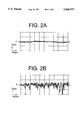
- FIG. 2 are charts showing the measured surface roughness, in which the ordinates indicate the roughness and the abscissae indicate the horizontal direction (scan direction).
- FIG. 3 is a schematic diagram of the automatic developing machine used in Example 5.
- FIGS. a to d and 10 to 47 indicate as follows:
- the developing apparatus of the present invention may have processing tanks usable for developing the photosensitive material in addition to the developing tank.
- the processing tanks include, for example, bleaching tank, fixing tank, bleach-fixing tank, washing-with-water tank and stabilizing solution tank.
- the developing apparatus may further contain have some ordinary means, for example, carrier means for the photosensitive material necessitated for autodeveloping apparatus such as a replenisher tank and temperature-control means in addition to the rack.
- the developing apparatus has a means for controlling the temperature at a predetermined point in the range of 40° to 50° C. in addition to a means for maintaining the temperature in this range.
- the means include a heater and thermostat.
- PPO polyphenylene oxides
- PPE polyphenylene ethers
- IUPIACE polyphenylene ethers
- Preferred structure of them are represented by the following general formula (I): ##STR1## wherein R 1 represents a hydrogen atom, alkyl group having 1 to 3 carbon atoms or halogen atom, methyl group being the most preferred, and n represents an integer of 10 to 1,000,000.
- modified PPE modified polyphenylene ether resins
- modified PPE styrene-grafted polyphenylene ether resins
- polystyrene resin polyamide resin, polyalkylene terephthalate resin, fluorine resin, polyolefin resin or ABS resin.
- an inorganic fiber such as glass fiber may be mixed in the resin of the general formula (I).
- the polyphenylene sulfides are excellent in both acid resistance and alkali resistance. They have preferably a structure of the following general formula (II): ##STR2## wherein R 2 represents a hydrogen atom, alkyl group having 1 to 3 carbon atoms or halogen atom, the hydrogen atom being the most preferred, and n represents an integer of 10 to 1,000,000. If necessary, an inorganic fiber such as glass fiber may be mixed in the PPS of the general formula (II) so as to improve the strength.
- polymethylpentenes which are also called “methylpentene polymers” (TPX and PMP).
- TPX and PMP methylpentene polymers
- Preferred are poly(4-methylpentene)s of the following general formula (III): ##STR3## wherein R 3 represents a hydrogen atom, hydroxyl group or halogen atom, the hydrogen atom being the most preferred, and n represents an integer of 10 to 1,000,000.
- the resin can be copolymerized with various comonomers in order to improve the properties and processability of the polymer.
- Typical comonomers include ethylene, propylene, butene, hexene-1, styrene and ⁇ -olefins.
- the polyether ether ketones are also called "PEEK". They preferably have a structure of the following general formula (IV): ##STR4## wherein R 4 , R 5 and R 6 may be the same or different from one another and each represent a hydrogen atom, hydroxyl group, halogen atom or alkyl group having 1 to 3 carbon atoms, the hydrogen atom being the most preferred, and n represents an integer of 10 to 1,000,000.
- an inorganic fiber such as glass fiber may be mixed in the PEEK of the general formula (IV) so as to improve the strength.
- the polyalkylene terephthalates preferably have a structure of the following general formula (V): ##STR5## wherein P represents an integer of 1 to 5, preferably 2 or 4, and most preferably 4, R 7 represents a hydrogen atom, hydroxyl group, halogen atom or alkyl group having 1 to 3 carbon atoms, the hydrogen atom being the most preferred, and n represents an integer of 10 to 1,000,000.
- P polyethylene terephthalate
- PET polyethylene terephthalate
- P polybutylene terephthalate
- PBTP polybutylene terephthalate
- VALOX Engineing Plastics
- PLANAC Denippon Ink and Chemicals, Inc.
- Toray PBT resin Toray industries, Inc.
- Teijin PBT resin Teijin Ltd.
- NOVADUR Mitsubishi Chemical Industries Ltd.
- TUFPET PBT Mituibishi Rayon Co., Ltd.
- polyether imides which are called "PEI” are polymers having an imido bond.
- glass fiber may be mixed in the polymer to improve the strength.
- This resin is available under a name of "ULTEM” (Engineering Plastics).
- polyether sulfones which are called “PES” or “PESF” are aromatic polysulfone resins. Preferred are those mainly comprising polymers of the following general formula (VII): ##STR7## wherein R 10 and R 11 may be the same or different from each other each represent a hydrogen atom, hydroxyl group, halogen atom or alkyl group having 1 to 3 carbon atoms, the hydrogen atom being the most preferred, and n represents an integer of 10 to 1,000,000.
- glass fiber may be mixed in the polymer to improve the strength.
- This resin is available under a name of "VICTREX PEEK” (ICI Japan), “SUMIPLOY K” (Sumitomo Chemical Co., Ltd.) or “PES” (Mitsui Toatsu Chemicals, Inc.).
- the polysulfon resins include also polysulfones which are called "PSF". Preferred are those mainly comprising polymers of the following general formula (VIII): ##STR8## wherein R 12 and R 13 may be the same or different from each other each represent a hydrogen atom, hydroxyl group, halogen atom or alkyl group having 1 to 3 carbon atoms, the hydrogen atom being the most preferred, and n represents an integer of 10 to 1,000,000.
- glass fiber may be mixed in the polymer to improve the strength.
- This resin is available under a name of "UDEL” (AMOKO Japan Ltd.) or “Ultrason S” (BASF Engineering Plastic). This resin is suitable for use as a material for members such as springs in the rack, taking advantage of its high flexural modulus.
- the polyphenylene oxide, polyphenylene sulfide and polymethylpentene are particularly preferably in the present invention from the viewpoint of the durability.
- the resins selected as described above exert no bad influence on the photograhic properties (such as sensitivity and fog) of the photosensitive material. These three kinds of resins are particularly excellent in this point.
- the processing tank of the processing apparatus for the photosensitive material is produced mainly by a method wherein a rigid vinyl chloride resin plate is cut, and the pieces thus obtained are assembled by welding.
- This method is frequently employed, since it is suitable for the production of various tanks in a small scale.
- the satisfactory surface finish is impossible at a bonded part and welded part of the material and, therefore, the surface is rough.
- This causes the rising of the processing solution along the wall and deposition thereof and as a result, there are produced staining of the processing tank and contamination with a solution from another processing bath.
- This method has other defects such as a high production cost due to many production steps, a low dimensional accuracy and difference of the tanks from each other because the tanks are fabricated separately from each other.
- the rigid polyvinyl chloride to be extrusion-molded comprises the straight polymer and various additives used for improving the moldability and stability.
- a heavy metal compound such as Ca/Pb stearate, lead stearate or liquid Ba-Zn stabilizer
- the recycle of polyvinyl chloride resins is difficult, since the compositions thereof are various.
- a resin material is selected from the group consisting of a polyphenylene oxide resin, polyphenylene sulfide resin, polymethylpentene resin, polyether ether ketone resin, polyalkylene terephthalate resin, polyether imide resin, polyether sulfone resin and polysulfone resin, since these resins are not hydrolyzed or deteriorated even when the color developer has a pH of 10.0 or above; these have an excellent dimensional stability and these are not deformed or corroded even at a temperature of 40° C. or above; these are resistant to staining; these are not easily crystallized; and these are relatively inexpensive.
- these resins the most preferred are polyphenylene oxide, polyphenylene sulfide and polymethylpentene.
- the tank suitable for the present invention may be composed of a bottom pare, side wall and lid, and further may have an inlet and an outlet for an image-wise exposed silver halide photographic material.
- the bottom part and/or side wall may be made of the resin mentioned above.
- the lid be made from the resin.
- the tank is produced by various injection-molding methods with an injection-molding machine. When the tank is small, an ordinary injection-molding method is employed. This is a relatively easy method, since the resin in the solid form can be molded and, therefore, the formed molding has the smooth surface even when an ordinary molding machine is used.
- Various foam molding methods and blow molding methods can be employed so as to obtain a large tank or to obtain a heat-insulating tank. In these methods, the formation of sink marks and warpage in the course of forming a large tank can be prevented by forming a foam layer or hollow layer in the molding and, therefore, the molding accuracy and the surface smoothness of molding can be improved.
- SF molding low expansion molding
- Nippon G. E. Plastics Co., Ltd. and NEW-SFL molding (NEW-SF) method of Asahi Chemical Industry Co., Ltd. can be mentioned.
- Nippon G. E. Plastics Co., Ltd. and Nippon Steel Chemical Co., Ltd. In an injection blow molding method for partial thickness molding by a short shot method, AGI molding method of Asahi Chemical Industry Co., Ltd. or CINPRESS molding method developed by PEERLESS FOAM MOLDING (England) can be employed.
- PFP molding method of Nippon Steel Chemical Co., Ltd. can be employed for the full shot method for the partial thickness molding.
- the tank of the present invention is produced by one of these molding methods, or the tank can also be produced by forming parts by several molding processes and assembling the parts together. After the molding, the resins can be adhered or welded together.
- these molding methods those particularly suitable for producing the tank are low expansion molding methods such as SF molding and NEW-SFL molding methods. Since pores are formed in a gate part (hollow part containing a gas sealed therein) and the processing solution might penetrate into the molding when it is used as the tank, it is preferred to stop up it, if necessary.
- the smoother the surface of the tank thus molded the better.
- the color developing agent having a high concentration easily deposits thereon and, in addition, various chemicals easily deposit by the evaporation because of the high processing temperature, thereby staining the tank. Such a stain will also cause the staining of the photosensitive material or the transportation troubles or flaw of the material.
- the preferred surface roughness in the present invention is such that the center line roughness (Ra) is 5 ⁇ m or below and the maximum roughness (Rmax) is 50 ⁇ m or below.
- Ra herein indicates the distance between the average surface level and the average level or level. This value means the average roughness.
- “Rmax” indicates the maximum distance from the average surface level.
- the roughness can be determined according to the specification thereof. Specifically, the roughness can be easily determined with, for example, SURCOM 575A (a machine for measuring surface roughness and shape; a product of Tokyo Seimitsu Co., Ltd.).
- Ra is preferably 0 to 4 ⁇ m and Rmax is preferably 30 ⁇ m or below in the present invention.
- the surface of the tank thus produced can be smoothened by a chemical paper treatment (chemical polishing treatment) in which the surface is dissolved with a solvent or by coating with a resin.
- the thickness of the tank is preferably 3 to 30 mm, more preferably about 4 to 30 mm, in the present invention.
- the term "thickness" herein indicates the average thickness, and the tank may have thinner portions, of course. It has been found that when the tank is used at a temperature of 40° C. or higher, the stress concentration is caused by the linear expansion and a stress higher than an expected one is partially applied. Further, when the tank is brought into contact with an alkali solution having a pH of 10 or above, the stress crack formation is further accelerated. Thus, the thickness of the tank is preferably at least 3 mm. A thickness thereof exceeding 30 mm is undesirable from the viewpoints of the cost and weight.
- the rack may comprise means for carrying an image-wise exposed silver halide photosensitive material such as a carrier roller, gruide, gear, sprocket, spindle, screw, large roller, small roller or the like.
- the thickness thereof is not particularly limited, since the whole weight of the processing solution is not applied thereto unlike the processing tank.
- resins frequently used as the material for the processing racks such as polyvinyl chloride, high-density polyethylene, polypropylene and nylon are unsuitable for the use for a long period of time, since when they are brought into contact with the color developer of 40° C. or higher as in the present invention, serious dimensional change and load change are caused by the high linear expansion.
- the materials suitable for particularly the side plate of the rack are a polyphenylene oxide, polyphenylene sulfide, polymethylpentene, polyether ether ketone, polyalkylene terephthalate, polyether imide, polyether sulfone and polysulfone. If necessary, a reinforcing agent such as glass fiber can be incorporated thereinto.
- the material suitable for a gear or sprocket for the rack is selected from the group consisting of a polyphenylene oxide, polyether etherketone, polyalkylene terephthalate and polyetherimide. If necessary, a reinforcing agent such as glass fiber can be incorporated thereinto.
- the material suitable for a member (such as a resin spring) of which spring properties are required in a nip or guide of a roller is a polyether sulfone, polysulfone or polyether ether ketone having excellent creep properties at a high temperature.
- a polymethylpentene having a low specific gravity and a low rotation load is usable as a material for the roller.
- a spindle and screws usually made of a metal can be replaced with those made of a resin selected from among those set forth in Claim 1.
- a screws produced by molding a polyetherimide or polyether ether ketone are usable.
- a PEEK screw put on the market by Smith Co., Ltd. is also usable.
- the durability of such a material is desirably determined by a so-called running test wherein the processing machine is actually produced and the photosensitive material is continuously processed with it.
- a long period of time and a heavy operation load are necessary for continuing the running test until the end of the life of the processing machine, and such a long-term test is difficult.
- Parts such as roller and guide to which substantially no load is applied in the practical use are immersed in the solution having a temperature slightly higher than the actual temperature, and the changes thereof in the dimension, weight and strength with time are examined.
- the immersion test may be conducted according to JIS K 7114.
- the strength test the tensile strength, bending strength at breaking and modulus of elasticity are determined according to JIS K 7113 and JIS K 7203. The determination is conducted at predetermined time intervals until changes in the properties have become very small and stable. When a material unsuitable for the present invention is tested, the properties are deteriorated to a level below a predetermined, necessary level, and then the test is no more continued.
- Polyvinyl chloride or the like cannot be judged by the above-described test in some cases.
- the above-described test is a static test wherein the resistance to chemicals are determined without any load, which is a condition necessary but insufficient for resisting the color developing process of the present invention.
- a chemical resistance test under stress according to JIS K 7107 or JIS K 7108 is necessitated. By this test, it is understood that the polyvinyl chloride does not have the necessitated properties.
- Yamazaki Stress Relaxation tester YSR-8 (a product of Yamazaki Seiki Kenkyujo) which has a structure based on a stress relaxation tester of force-detecting type according to JIS K 7107 (1986), 4-1. It is desirable to conduct the test with the processing solution, process temperature and necessary load applied to the machine (which varies depending on the part; and the factor of safety concerning the scattering of molding and stress concentration must be involved) by using the tester.
- test sample is fixed on a given bending strain jig and the processing solution is applied to the sample by a so-called 1/4 ellipse method, or the above-described immersion test is conducted.
- the strain applied to the material by the bending strain jig is determined from the radius of curvature, and the critical stress of the material can be determined from the Young's modulus-in-flexure of the material by Hooke's low.
- this test method is effective for parts such as gears and sprockets to which a high load is applied, the above-described stress relaxation test is also necessary for evaluating the shape stability during the use for a long period of time.
- the color developer used in the processing apparatus of the present invention contains a well-known aromatic primary amine as the color developing agent.
- Preferred examples of these amines include p-phenylenediamine derivatives typified by N,N-diethyl-p-phenylenediamine, 2-amino-5-diethylaminotoluene, 2-amino-5-(N-ethyl-N-laurylamino)toluene, 3-methyl-4-[N-ethyl-N-( ⁇ -hydroxyethyl)amino]aniline, 3-methyl-4-[N-ethyl-N-( ⁇ -hydroxybutyl)amino]aniline, 2-methyl-4-[N-ethyl-N-( ⁇ -hydroxyethyl)amino]aniline, 4-amino-3-methyl-N-ethyl-N-( ⁇ -methanesulfonamido)ethyl]-aniline, N-(2-amin
- the p-phenylenediamine derivatives may be in the form of sulfate, hydrochloride, sulfite or p-toluenesulfonate thereof.
- the aromatic primary amine as the developing agent is used in an amount of about 0.15 to 0.5 mol/l, preferably 0.17 to 0.50 mol/l, per liter of the color developer.
- the color developing replenisher is used in such an amount that the color developing agent is in an amount of preferably about 0.17 to 0.60 mol, more preferably about 0.2 to 0.8 mol, per liter of the replenisher. When the concentration of the color developing agent exceeds 0.5 mol/l, a problem of the solubility might occur.
- a color developer substantially free from benzyl alcohol it is preferred to use a color developer substantially free from benzyl alcohol so as to further improve the durability of the materials of the apparatus.
- substantially free from benzyl alcohol indicates that the benzyl alcohol concentration is preferably 2 ml/l or below, more preferably 0.5 ml/l or below, and most preferably 0 (zero).
- the color developer used in the present invention can contain a hydroxylamine and sulfite ion, and it preferably contains an organic preservative.
- organic preservative herein indicates all the organic compound capable of reducing the deterioration velocity of the aromatic primary amine color developing agent when it is added to the solution for processing the photosensitive material for color photography. Namely, they are organic compounds having a function of preventing the oxidation of the color developing agent with air or the like.
- Particularly effective preservatives are hydroxylamine derivatives (exclulding hydroxylamine), hydroxamic acids, hydrazines, hydrazides, phenols, ⁇ -hydroxyketones, ⁇ -aminoketones, saccharides, monoamines, diamines, polyamines, quaternary ammonium salts, nitroxy radicals, alcohols, oximes, diamide compounds and amines having condensed rings.
- alkanolamines such as triethanolamine
- dialkylhydroxylamines such as N,N-diethylhydroxylamine and N,N-di(sulfoethyl)hydroxylamine
- hydrazine derivatives such as N,N-bis(carboxymethyl)hydrazine
- aromatic polyhydroxy compounds such as sodium catechol-3,5-disulfonate.
- the black-and-white or color developer used in the present invention may contain an antifoggant, if necessary.
- antifoggants include alkali metal halides such as sodium chloride, potassium bromide and potassium iodide, and organic antifoggants.
- the organic antifoggants are typified by nitrogen-containing heterocyclic compounds such as benzotriazole, 6-nitrobenzimidazole, 5-nitrosoindazole, 5-methylbenzotriazole, 5-nitrobenzotriazole, 5-chlorobenzotriazole, 2-thiazolylbenzimidazole, 2-thiazolylmethylbenzimidazole, indazole, hydroxyazaindolizine and adenine.
- the effect of the present invention can be remarkably exhibited when the pH of the developer of the present invention is 10.0 or above, preferably in the range of 10.20 to 11.00.
- the developer can contain other known compounds used as the components of the developer.
- the buffering agents include, for example, carbonates, phosphates, borates, tetraborates, hydroxybenzoates, glycine salts, N,N-dimethylglycine salts, leucine salts, norleucine salts, guanine salts, 3,4-dihydroxyphenylalanine salts, alanine salts, aminobutyrates, 2-amino-2-methyl-1,3-propanediol salts, valine salts, proline salts, trishydroxyaminomethane salts and lysine salts. Particularly preferred are carbonates and phosphates.
- the amount of the buffer to be added to the developer is preferably at least 0.1 mol/l, particularly in the range of 0.1 mol/l to 0.4 mol/l.
- the developer can further contain a chelating agent for inhibiting the precipitation of calcium and magnesium or for improving the stability of the color developer.
- the chelating agents include, for example, nitrilotriacetic acid, diethylenetriaminepentaacetic acid, ethylenediaminetetraacetic acid, N,N,N-trimethylenephosphonic acid, ethylenediamine-N,N,N',N'-tetramethylenephosphonic acid, transcyclohexanediaminetetraacetic acid, 1,2-diaminopropanetetraacetic acid, glycol etherdiaminetetraacetic acid, ethylenediamine-o-hydroxyphenylacetic acid, 2-phosphonobutane-1,2,4-tricarboxylic acid, 1-hydroxyethylidene-1,1-diphosphonic acid, N,N'-bis(2-hydroxybenzyl) ethylenediamine-N,N'-diacetic acid and hydroxyethyliminodiacetic acid.
- the chelating agent is used in an amount sufficient for the sequestering in the developer.
- the amount is, for example, about 0.1 to 10 g per liter.
- a development accelerator can be added, if necessary, to the developer used in the present invention.
- the development accelerators include, for example, thioether compounds described in Japanese Patent Publication for Opposition Purpose (hereinafter referred to as "j. P. KOKOKU”) Nos. Sho 37-16088, 37-5987, 38-7826, 44-12380 and 45-9019 and U.S. Pat. No. 3,813,247; p-phenylenediamine compounds described in Japanese Patent Unexamined Published Application (hereinafter referred to as "J. P. KOKAI”) Nos. Sho 52-49829 and 50-15554; quaternary ammonium salts described in J. P. KOKAI No. Sho 50-137726, J. P. KOKOKU No. Sho 44-30074 and J. P. KOKAI Nos.
- the color developer usable in the present invention preferably contains a fluorescent brightener.
- the fluorescent brightener is prteferably a 4,4'-diamino-2,2'-disulfostilbene compound. It is used in an amount of 0 to 5 g/l, preferably 0.1 to 4 g/l.
- the developer used in the present invention is replenished in an amount of 20 to 1,000 ml, preferably 30 to 300 ml, per m 2 of the photosensitive material.
- the effect of the present invention can be remarkably exhibited at a processing temperature of 40° to 50° C. Particularly, at 42° to 50° C., the excellent durability of the material can be exhibited.
- the color development time is not particularly limited, it is preferably about 10 sec to 2 min, particularly about 15 sec to 1 min 30 sec, since the process is to be rapidly conducted in a rapid automatic processing machine.
- step 2 bleach-fixing
- step 3 bleaching/bleach-fixing
- step 4 bleaching/bleach-fixing/fixing
- step 5 fixing/bleach-fixing
- step 6 fixing.
- the bath may be partitioned into two or more baths to conduct the process in a cascade system.
- bleaching agents are usable for preparing the bleaching solution or bleach-fixing solution usable in the processing machine of the present invention.
- the bleaching agents include hydrogen peroxide, persulfates, potassium ferricyanide, bichromates, iron chloride salts and ferric aminopolycarboxylates.
- Particularly preferred bleaching agents are ferric aminopolycarboxylates.
- aminopolycarboxylic acids include, for example, EDTA, 1,3-PDTA, diethylenetriaminepentaacetic acid, 1,2-cyclohexanediaminetetraacetic acid, iminodiacetic acid, methyliminodiacetic acid, N-(2-acetamido)iminodiacetic acid, nitrilotriacetic acid, N-(2-carboxyethyl)iminodiacetic acid, N-(2-carboxymethyl)iminodipropionic acid, ⁇ -alanine, diethylenediamine-N,N'-disuccinic acid and 1,3-propylenediamine-N,N'-disuccinic acid.
- the concentration of the ferric complex salts in the bleach-fixing solution of the present invention is in the range of 0.005 to 2.0 mol/l, preferably 0.01 to 1.00 mol/l, and more preferably 0.02 to 0.50 mol/l.
- the concentration of the ferric complex salt in the replenisher is preferably 0.005 to 2 mol/l, more preferably 0.01 to 1.5 mol/l.
- the bleaching solution, bleach-fixing solution and/or preprocessing bath can contain a bleaching accelerator selected from among various compounds.
- a bleaching accelerator selected from among various compounds.
- Preferred are, for example, compounds having a mercapto group or disulfide bond described in U.S. Pat. No. 3,893,858, German Patent No. 1,290,812, J. P. KOKAI No. Sho 53-95630 and Research Disclosure No. 17129 (July, 1978); thiourea compounds described in J. P. KOKOKU No. Sho 45-8506, J. P. KOKAI Nos. Sho 52-20832 and 53-32735 and U.S. Pat. No. 3,706,561; and halides such as iodides and bromides, since they have a high bleaching power.
- the bleaching solution or bleach-fixing solution usable in the present invention can contain a rehalogenating agent such as a bromide (e.g. potassium, sodium or ammonium bromide), chloride (e.g. potassium, sodium or ammonium chloride) or iodide (e.g. ammonium iodide).
- a rehalogenating agent such as a bromide (e.g. potassium, sodium or ammonium bromide), chloride (e.g. potassium, sodium or ammonium chloride) or iodide (e.g. ammonium iodide).
- a rehalogenating agent such as a bromide (e.g. potassium, sodium or ammonium bromide), chloride (e.g. potassium, sodium or ammonium chloride) or iodide (e.g. ammonium iodide).
- the bleaching solution or bleach-fixing solution can contain a fluorescent brightener, antifoaming agent, surfactant or organic solvent such as polyvinylpyrrolidone or methanol.
- a known fixing agent is used for the bleach-fixing solution or fixing solution.
- the fixing agents include thiosulfates such as sodium thiosulfate and ammonium thiosulfate; thiocyanates such as sodium thiocyanate and ammonium thiocyanate; thioether compounds such as ethylene bisthioglycolic acid and 3,6-dithia-1,8-octanediol; and water-soluble silver halide-solubilizers such as thioureas. They can be used either singly or in the form of a mixture of two or more of them.
- a special bleach-fixing solution comprising a combination of a fixing agent described in J. P. KOKAI No.
- Sho 55-155354 with a large amount of a halide such as potassium iodide can also be used.
- a thiosulfate, particularly ammonium thiosulfate is preferably used.
- the amount of the fixing agent is in the range of preferably 0.3 to 2 mol, more preferably 0.5 to 1.0 mol, per liter.
- the bleach-fixing solution or fixing solution preferably contains a preservative selected from among sulfite ion-releasing compounds, for example, sulfites (such as sodium, potassium and ammonium sulfites), hydrogensulfites (such as ammonium, sodium and potassium hydrogensulfites) and metabisulfites (such as sodium, potassium and ammonium metabisulfites).
- sulfites such as sodium, potassium and ammonium sulfites
- hydrogensulfites such as ammonium, sodium and potassium hydrogensulfites
- metabisulfites such as sodium, potassium and ammonium metabisulfites
- the sulfite is usually added as the preservative to the bleach-fixing solution or fixing solution
- other compounds such as ascorbic acid, carbonyl bisulfite adducts and carbonyl compounds are also usable. Benzenesulfinic acids are also effective.
- the bleach-fixing solution and fixing solution can contain a buffering agent, fluorescent brightener, chelating agent, anti-foaming agent, mildew-proofing agent and so on.
- the pH range of the bleaching solution or bleach-fixing solution used in the present invention is preferably 3 to 10, more preferably 4 to 9.
- the desilverization by fixing or bleach-fixing is usually followed by washing with water and/or stabilization.
- the above-described chlorine dioxide is most suitably used.
- the amount thereof is preferably about 1 to 100 ppm, most preferably about 2 to 50 ppm.
- the amount of the replenisher in the step of washing with water and the stabilization step is not limited. It is usually about 50 ml to 5 l per square meter of the photosensitive material.
- the amount of the replenisher is desirably as small as about 1.0 to 20 parts per part of the solution brought from the preceding bath. Since the amount of the solution brought from the preceding bath is usually about 50 ml per square meter of the photosensitive material, the actual amount of the replenisher is about 50 to 1,000 ml. It is more preferably about 2 to 10 parts per part of the solution brought from the preceding bath.
- the water in the washing bath or the solution in the stabilization bath in the present invention contains at least 1 ⁇ 10 -4 mol/l, preferably 1 ⁇ 10 -3 to 0.5 mol/l, more preferably 5 ⁇ 10 -3 to 0.1 mol/l, of a thiosulfate.
- the thiosulfate may be directly added thereto or brought by the fixing solution or bleach-fixing solution from the preceding bath.
- the remarkable effect of the present invention can be obtained when the average residence time of the solution in the washing-with-water tank or stabilization tank is in the range of one week to two months.
- the term "average residence time” indicates the average period of time in which the solution is kept in the tank. The average residence time corresponds to a number of days necessitated for feeding the replenisher in an amount equal to that of the solution in the tank.
- the term "amount of the solution in the tank” indicates the total capacity of the tanks when two or more washing-with-water tanks or stabilization tanks are used. From the viewpoint of the deterioration of the overall photographic properties, an excess average residence time is undesirable. For example, when it exceeds 2 months, the effect of the bath cannot be easily maintained.
- the most remarkable effect of delaying the formation of the precipitate by sulfurization of the solution in the chlorine dioxide-containing washing bath and/or stabilization bath can be obtained when the average residence time is in the range of one week to two months, particularly 10 days to one month.
- the replenisher may be fed either continuously or intermittently.
- the solution used in the washing step and/or stabilization step may be used also in the preceding steps. For example, an overflow of the washing water or stabilizing solution is introduced in the preceding bleach-fixing bath by a multi-stage counter current system, and a concentrated solution is fed into the bleach-fixing bath to reduce the amount of the waste water.
- the quantity of the water used in the washing step or the stabilizing solution in the stabilization step can be fixed in various ranges depending on the properties (variable depending on the substances used such as a coupler) of the photosensitive material, use of the material, solution temperature, number of the tanks (number of stages), replenishing method (countercurrent or following current) and other conditions.
- the water very effectively usable for washing or stabilizing solution is prepared by reducing in amount of calcium and magnesium for inhibiting the propagation of bacteria as described in J. P. KOKAI No. Sho 62-288838.
- the water used for washing can contain a surfactant as a hydro-extracting agent or a chelating agent such as EDTA as a softening agent for hard water.
- a surfactant as a hydro-extracting agent or a chelating agent such as EDTA as a softening agent for hard water.
- the photosensitive material can be processed with a stabilizing solution after the step of washing with water or without this step.
- the stabilizing solution contains a compound capable of stabilizing the image such as an aldehyde compound, e.g. formalin, or aldehyde-releasing compound.
- the compounds include hexamethylenetetramine; N-methylolazoles such as N-methylolpyrazole described in Japanese Patent Application No. Hei 3-318644; and azolylmethylamines such as N,N'-bis(1, 2,4-triazol-1-yl)piperazine described in J. P. KOKAI No. Hei 4-313753.
- the stabilizing solution may contain a buffering agent for controlling the membrane to a pH suitable for stabilizing the dye, and an ammonium compound. If necessary, the stabilizing solution may contain a germicide and mildew-proofing agent for inhibiting the propagation of bacteria in the solution or for imparting the mildew-proofing properties to the processed photosensitive material.
- the stabilizing solution may contain a surfactant, fluorescent brightener and hardening agent.
- a chelating agent such as 1-hydroxyethylidene-1,1-diphosphonic acid or ethylenediaminetetramethylenephosphonic acid, or a magnesium or bismuth compound is also used.
- the pH is preferably 4 to 10, more preferably 5 to 8.
- the temperature which varies depending on the use and properties of the photosensitive material is usually 15° to 45° C., preferably 20° to 40° C. Although the time is not particularly limited, the shorter, the better for obtaining the excellent effect of the invention. It is preferably 15 seconds to 1 minute 45 seconds, more preferably 15 seconds to 1 minute.
- the processing composition usable in the present invention can be in various forms.
- the processing agent can be in the form of one concentrated solution or two or more concentrated solutions; or a powder. It can be in such a form that it is directly usable without necessitating any process. Further, the processing agent can be a combination of the concentrated solution, powder and the directly usable solution.
- any kind of the photosensitive materials can be processed by the present invention.
- the silver halide emulsions, other substances (such as additives), layers of the photographic structure (such as layer configuration), methods for processing the photosensitive materials, and additives used for the processing according to the present invention are preferably those described in the following patents, particularly European Patent No. 0,355,660 A2 (Japanese Patent Application No. Hei 1-107011):
- the photosensitive material has preferably at least one emulsion layer containing silver halide grains comprising at least 90 molar %, more preferably 95 to 99.0 molar %, and most preferably 98 to 99.9 molar % of silver chloride. Particularly preferred is that the whole layer comprises a silver chlorobromide emulsion comprising 98 to 99.9 molar % of silver chloride.
- the amount of silver to be used for preparing the photosensitive material is not particularly limited, it is preferably about 0.2 to 15 g/m 2 , particularly about 0.4 to 5.0 g/m 2 .
- Preferred cyan couplers include diphenylimidazole cyan couplers described in J. P. KOKAI No. Hei 2-33144, as well as 3-hydroxypyridine cyan couplers described in European Patent No. 0,333,185 A2 [particularly preferred are a cyan coupler prepared by converting a four-equivalent coupler (42) into a two-equivalent one by introducing a chlorine-linked coupling-off group, and couplers (6) and (9) mentioned therein], and cyclic active methylene cyan couplers described in J. P. KOKAI No. Sho 64-32260 (particularly preferred are Couplers 3, 8 and 34 mentioned therein).
- a dye which can be decolored by a process as described on pages 27 through 76 of European Patent No. 0,337,490 A2 is incorporated into the hydrophilic colloid layer in such a manner that the optical reflection density of the photosensitive material will be 0.70 or above at 680 nm in order to improve the sharpness of the image, or that at least 12% by weight (more desirably at least 14% by weight) of titanium oxide surface-treated with a dihydric to tetrahydric alcohol (such as trimethylolethane) is incorporated into a water-resistant resin layer of the support.
- a dihydric to tetrahydric alcohol such as trimethylolethane
- the photosensitive material for color photography of the present invention preferably contains a compound for improving the dye stability as described in European Patent No. 0,277,589 A2 in addition to the coupler, particularly preferably a pyrazoloazole coupler.
- a compound (F) which can be chemically bonded with an aromatic amine developing agent remaining after the color development to form a chemically inert, substantially colorless compound and/or a compound (G) which can be chemically bonded with an oxidation product of the aromatic amine developing agent remaining after the color development to form a chemically inert, substantially colorless compound it is preferred to use a compound (F) which can be chemically bonded with an aromatic amine developing agent remaining after the color development to form a chemically inert, substantially colorless compound and/or a compound (G) which can be chemically bonded with an oxidation product of the aromatic amine developing agent remaining after the color development to form a chemically inert, substantially colorless compound.
- a mildew-proofing agent as described in J. P. KOKAI No. Sho 63-271247 is preferably incorporated into the photosensitive material of the present invention in order to prevent the propagation of fungi and bacteria in the hydrophilic colloid layer, since they deteriorate the image.
- the remarkable effect of the present invention can be obtained when the dry film thickness of the silver halide photosensitive material of the present invention for color photography excluding the support is 25 ⁇ m or below, preferably 5 to 20 ⁇ m and most preferably 6 to 17 ⁇ m.
- the thickness of the film can be reduced by reducing the amount of the gelatin, silver, oil, coupler, etc. The reduction of the amount of gelatin is most preferred.
- the film thickness can be determined by an ordinary method after leaving the sample to stand at 25° C. at 60 RH % for two weeks.
- the degree of swelling of the photographic layers of the silver halide color photographic material used in the invention is preferably 1.5 to 4.0, particularly 1.5 to 3.0.
- degree of swelling herein indicates a value obtained by dividing the thickness of the photographic layers after immersing the color photosensitive material in distilled water of 33° C. for 2 minutes by the thickness of the dry photographic layers.
- photographic layers indicate layers composed of at least one photosensitive silver halide emulsion layer laminated with hydrophilic colloid layers, the former layer and the latter layers are water-permeable between each other.
- the photographic layers do not include a back layer provided on the support on an opposite side to the photographic photosensitive layers.
- the photographic layers comprise usually two or more layers participating in the formation of a photographic image, namely, a silver halide emulsion layer, intermediate layer, filter layer, antihalation layer and protecting layer.
- the degree of swelling can be controlled as described above by any method. For example, it can be controlled by varying the amount and kind of the gelatin and those of the hardener used for the photographic film or by varying the drying conditions and leaving-to-stand conditions after forming the photographic layers.
- gelatin is advantageously used for forming the photographic layers, other hydrophilic colloids are also usable.
- hydrophilic macromolecular substances can be used such as gelatin derivatives; graft polymers of gelatin and another polymer; proteins such as albumin and casein; cellulose derivatives such as hydroxyethylcellulose, carboxymethylcellulose and cellulose sulfate; saccharide derivatives such as sodium alginate and starch derivatives; and homopolymers or copolymers such as polyvinyl alcohol, partial acetal of polyvinyl alcohol, poly-N-vinylpyrrolidone, polyacrylic acid, polymethacrylic acid, polyacrylamide, polyvinylimidazole and polyvinylpyrazole.
- gelatin derivatives graft polymers of gelatin and another polymer
- proteins such as albumin and casein
- cellulose derivatives such as hydroxyethylcellulose, carboxymethylcellulose and cellulose sulfate
- saccharide derivatives such as sodium alginate and starch derivatives
- homopolymers or copolymers such as polyvinyl alcohol, partial
- the gelatins usable herein include gelatin treated with lime or an acid, gelatin hydrolyzate and enzymatic decomposition products of gelatin.
- the gelatin derivatives are obtained by reacting gelatin with a compound selected from among various acid halides, acid anhydrides, isocyanates, bromoacetic acid, alkanesultones, vinylsulfonamides, maleinimide compounds, polyalkylene oxides and epoxy compounds.
- the graft polymers of gelatin usable herein include those obtained by grafting a homopolymer or copolymer of a vinyl monomer such as acrylic acid, methacrylic acid or a derivative thereof, e.g. an ester or amide thereof, acrylonitrile or styrene onto gelatin.
- graft polymers of gelatin with a polymer which is compatible with gelatin to some extent such as a polymer of acrylic acid, methacrylic acid, acrylamide, methacrylamide or hydroxyalkyl methacrylate. Examples of them are given in U.S. Pat. Nos. 2,763,625, 831,767, 2,956,884 and so on.
- Typical synthetic hydrophilic macromolecular substances are described in, for example, West German Patent Application (OLS) No. 2,312,708, U.S. Pat. Nos. 3,620,751 and 3,879,205 and J. P. KOKOKU No. Sho 43-7561.
- the hardening agents include, for example, chromium salts (such as chromium alum and chromium acetate), aldehydes (such as formaldehyde, glyoxal and glutaraldehyde), N-methylol compounds (such as dimethylolurea and methyloldimethylhydantoin), dioxane derivatives (such as 2,3-dihydroxydioxane), active vinyl compounds ⁇ such as 1,3,5-triacryloyl-hexahydro-s-triazine, bis(vinylsulfonyl)methyl ether and N,N'-methylenebis-[ ⁇ -(vinylsulfonyl)propionamide] ⁇ , active halogen compounds (such as 2,4-dichloro-6-hydroxy-s-triazine), mucohalogenic acids (such as mucochloric acid and mucophenoxychloric acid), isoxazoles, dialdehyde starch and 2-
- Preferred hardening agents are the aldehydes, active vinyl compounds and active halogen compounds.
- the support for the photosensitive material of the present invention may be a white polyester support for display or a support having a white pigment-containing layer formed thereon on the same side as the silver halide emulsion layer. It is preferred to form an antihalation layer on the support on the same side as the silver halide emulsion layer or on the opposite side in order to further improve the sharpness.
- the transmission density of the support is controlled preferably in the range of 0.35 to 0.8 so that the display can be seen with a reflected light or transmitted light.
- the photosensitive material of the present invention may be exposed to a visible light or infrared light.
- the exposing method may be either a low illuminance exposure or a high-illuminance short-time exposure. In the latter, a laser scanning exposing method wherein the exposure time per picture element is shorter than 10 -4 second is preferred.
- a band stop filter described in U.S. Pat. No. 4,880,726 is preferably used in order to remarkably improve the color reproducibility by avoiding the optical color mixing.
- the processing method of the present invention can be employed for various photosensitive materials such as color negative films, color negative papers, color reversal papers, autopositive papers, color reversal films, negative films for movies, positive films for movies, roentgen films, reprophotographic films such as lith films, and black-and-white negative films.
- photosensitive materials such as color negative films, color negative papers, color reversal papers, autopositive papers, color reversal films, negative films for movies, positive films for movies, roentgen films, reprophotographic films such as lith films, and black-and-white negative films.
- color negative films and color negative papers are particularly preferred.
- Color developers I, II and III each having the following composition were prepared by changing the concentration of an aromatic primary amine as the color developing agent as follows:
- the pattern a indicates that the results are almost the same as those obtained in the absence of the processing chemical in air or distilled water under the same conditions. These results indicate that the deterioration with time is low enough and the resin is sufficiently usable.
- the pattern b indicates that although the stress relaxation slightly proceeds, it has the relaxation limit and the relaxation velocity becomes low.
- the resin can be used as a material for only some parts if the parts are designed taking the degree of stress relalxation into consideration, the use of the material having a stress ratio of below 0.5 should be avoided, since its deformation is serious.
- the pattern c indicates that the polymer structure is continuously weakened by chemical change and heat and the polymer is gradually cut off. The use of this resin is difficult.
- the pattern d indicates that the stress is rapidly reduced by the environmental stress cracking.
- the resin cannot be used under the processing conditions of the present invention.
- the resin (Nos. 8 to 18) of the present invention When the resin (Nos. 8 to 18) of the present invention is used, the sufficient durability is obtained even when the color developer (40° C./ II or III) of the invention is used.
- the color developer (40° C./ II or III) of the invention Particularly, polyphenylene oxide and polymethylpentene are preferably used.
- a trial processing tank was produced from a modified PPO (Noryl) by ESF molding method.
- the trial tank will be referred to as "tank A”.
- the surface roughness of the tank was determined with SURCOM 575A (a machine for measuring surface roughness and shape; a product of Tokyo Seimitsu Co., Ltd.) according to JIS B 0601-1982 to find that Ra was 5.2 ⁇ m and Rmax was 54.0 ⁇ m. Then the surface roughness was reduced by paper polishing treatment to obtain tanks B, C and D having different surface roughnesses.
- FIG. 2 is a chart showing the results of the measurement of the surface roughnesses of the tanks A and D. The data are given in Table 8.
- tanks E to H having diffirent surface roughnesses were produced from rigid polyvinyl chloride (PVC) in the same manner as that described above.
- the color developer I, II or III in Example 1 was fed into the tank. After leaving them to stand at 42° C. for one week, the height of the rise of the crystals from the liquid surface level was determined. The solution was replenished everyday to keep the level constant, since it vaporized.
- the modified PPO of the present invention When the modified PPO of the present invention was used, the preferred results were obtained. Particularly, when the resin had a surface roughness of Ra of 5 ⁇ m or below and Rmax of 50 ⁇ m or below, the deposition of the crystals was advantageously reduced to 50% or less.
- 10 l developing tanks were produced from four kinds of resins with the same molds by ESF molding method.
- the molds of three sizes were used so that the basic thickness of the tanks would be 2.5, 3.0 or 4.0 mm.
- the tanks having three kinds of thicknesses were produced from polycarbonate (LEXAN), high-density polyethylene (Sumikathene), polyphenylene oxide (XYRON) and polyetherimide (ULTEM).
- the color developer V described in Example 2 was fed into the developing tanks thus produced. After leaving them to stand at 38° C. or 45° C. for 3 months, the crack formation and change in quantity of the developer in the tank were determined. The results are given in Table 10.
- An automatic processor 10 for color films as shown in FIG. 3 was produced by ESF molding method by using polyphenylene oxide (XYRON) as the material for the tank having the basic thickness of 4.0 mm.
- XYRON polyphenylene oxide
- the automatic processor 10 was covered with a frame 12 to shield the light.
- the bottom of the flame 12 was supported with saddle supports on the floor 16.
- Processing tanks 32 are formed from the bottom of the frame 12 to form a developing tank 20, bleaching tank 22, fixing tank 24, washing tanks 26 and 28 and stabilizing tank 30.
- Each tank contained a processing solution (the tanks will be generally called “processing tanks 32").
- a film-mounting part 34 is provided on the left of the processing tanks 32 (developing tank 20).
- the film-mounting part 34 has a keepining part 38 for a cartridge 36.
- a negative film 40 in the cartridge 36 in the keepining part 38 is drawn out, then interposed between a pair of rollers 42 and carried into the processing tanks 32 with a roller 46.
- a cutter 44 is arranged at a downstream side of the keeping part 38 so that when the whole negative film 40 has been drawn out of the cartridge 36, it is cut with the cutter 44.
- Each of the processing tanks 32 have a processing rack 33 most part (excluding the top) of which is immersed in processing solution.
- a guide groove 33A for guiding the both crosswise edges of the negative film 40 is formed in the developing tank 20 in the processing rack 33.
- the guide groove 33A is provided also in the processing rack 33 in another processing tank 32.
- the negative film 40 is guided along the guide groove 33A in substantially U-shaped course in each of the processing tanks 32.
- Carrier rollers 45 composed of a large-diameter roller 45A and a pair or small-diameter rollers 45B are positioned near the solution surface, near the bottom and an intermediate part between them in the processing rack 33 so that the negative film 40 guided along the guide groove 33A is kept between the rollers and carried.
- the roller 45A, having large diameter, of the carrier roller 45 has additional two rollers 45C around it so that the negative film 40 can be stably turned.
- a part of the processing rack 33, which is above the solution surface, is called "crossover part".
- This part is composed of a carrier roller 47 on the outlet and inlet sides of the two adjacent processing racks 33.
- the carrier rollers 47 are composed of a roller of a large diameter and that of a small diameter. The rollers 47 are for surely delivering the negative film 40 to the subsequent processing rack 33.
- the negative film 40 is processed with the respective processing solutions while it is guided along the guide groove 33A by the carrier roller 45 and carried in the substantially U-shaped course in the respective processing tanks 32.
- the film 40 is then discharged from the stabilizing tank 30 and delivered to the subsequent drying part 56.
- a heater 50 and an air blower 52 are placed in the space. Hot air is fed into the drying part 56 on the downstream side in the processing tank 32 through a duct 54 with a hot air-feeding means.
- the negative film 40 is guided through the U-shape course with a guide roller 48 and guide member 49.
- the film 40 is dryed by being exposed to the hot air while it is guided.
- the negative film 40 thus dried in the drying part 56 is interposed between a pair of rollers 64, which is rotated by a driving force to send the film 40 into a discharging part 66.
- Color negative films used were continuously processed by the following processing steps with the above-described automatic processor 10.
- compositions of the processing solutions used were as follows:
- the bleaching solution, fixing solution and stabilizing solution were CN-16FA N2-R, N3-R and N4-R (products of Fuji Photo Film Co., Ltd.), respectively.
- Water used for the washing was treated with an ion exchange resin to reduce the calcium and magnesium ion concentrations to 3 ppm or below before the use.
- 20 rolls of Super G-400 (Fuji Photo Film Co., Ltd.), 20 rolls of Gold-400 (Eastman Kodak Co., U.S.A.) and 10 rolls of XG-400 (Konica Corporation) were processed a day, and the running test was conducted for one month. No leakage or distortion of the tank was recognized, and the excellent photographic properties could be kept.
- the developing machine of the present invention has an excellent durability and exerts no bad influence on the photographic properties in the course of the development.
Landscapes
- Physics & Mathematics (AREA)
- General Physics & Mathematics (AREA)
- Photographic Developing Apparatuses (AREA)
- Silver Salt Photography Or Processing Solution Therefor (AREA)
- Photographic Processing Devices Using Wet Methods (AREA)
- Compositions Of Macromolecular Compounds (AREA)
Abstract
Description
              TABLE 1
______________________________________
Photographic
constituent, etc.
           J. P. KOKAI No. Sho 62-215272
______________________________________
Silver halide
           From line 6, right upper column, p. 10 to line 5,
emulsion   left lower column, p. 12; and from line 4 from
           below, right lower column, p. 12 to line 17, left
           upper column, p. 13
Solvent for
           Lines 6 to 14, left lower column, p. 12; and from
silver halide
           line 3 from below, left upper column, p. 13 to
           the last line, left lower column, p. 18
Chemical   Line 3 from below, left lower column, p. 12;
sensitizer line 5 from below, right lower column, p. 12; and
           from line 1, right lower column, p. 18, to line 9
           from below, right upper column, p. 22
Spectral sensiti-
           From line 8 from below, right upper column, p. 22
zer (spectral
           to the last line, p. 38
sensitizing method)
Emulsion   From line 1, left upper column, p. 39 to the last
stabilizer line, right upper column, p. 72
Development
           From line 1, left lower column, p. 72 to line 3,
accelerator
           right upper column, p. 91
Color coupler
           From line 4, right upper column, p. 91 to
(cyan, magenta
           line 6, left upper column, p. 121
or yellow coupler)
Color development
           From line 7, left lower column, p. 121
improver   to line 1, right upper column, p 125
______________________________________
              TABLE 2
______________________________________
Photographic
constituent, etc.
              J. P. KOKAI No. Sho 62-215272
______________________________________
Ultraviolet absorber
              From line 2, right upper column, p. 125 to
              the last line, left lower column, p. 127
              column, p. 127
Decoloration inhibitor
              From line 1, right lower column, p. 127
(image stabilizer)
              to line 8, left lower column, p. 137
High boiling and/or low
              From line 9, left lower column, p. 137 to
boiling organic solvent
              the last line, right upper column, p. 144
Dispersion method for
              From line 1, left lower column to
photographic additive
              line 7, right upper column, p. 146
Antistaining  From line 9, right lower column, p. 188 to
agent         line 10, right lower column, p. 193
Surfactant    From line 1, left lower column, p. 201 to
              the last line, right upper column, p. 210
Fluorine-containing
              Line 1, left lower column, p. 210; and
compound (as anti-
              line 5, left lower column, p. 222
static agent,
coating assistant,
lubricant, adhesion
inhibitor, etc.)
______________________________________
              TABLE 3
______________________________________
Photographic
constituent, etc.
             J. P. KOKAI No. Sho 62-215272
______________________________________
Binder       From line 6, left lower column, p. 222 to
(hydrophilic colloid)
             the last line, left upper column, p. 225
Thickening agent
             From line 1, right upper column, p. 225 to
             line 2, right upper column, p. 227
Antistatic agent
             From line 3, right upper column, p. 227 to
             line 1, left upper column, p. 230
Hardener     From line 8, right upper column, p. 146 to
             line 4, left lower column, p. 155
Developing agent
             From line 5, left lower column, p. 155 to
precursor    line 2, right lower column, p. 155
Development inhibitor
             Lines 3 to 9, right lower column, p. 155
releasing compound
Support      Line 19, right lower colulmn, p. 155; and
             line 14, left upper column, p. 156
Constitution of
             From line 15, left upper column, p. 156 to
photosensitive
             line 14, right lower column, p. 156
layers
Dye          From line 15, right lower column, p. 156 to
             the last line, right lower column, p. 184
Color mixing From line 1, left upper column, p. 185 to
inhibitor    line 3, right lower column, p. 188
Gradation    Lines 4 to 8, right lower column, p. 188
controller
Polymer latex
             From line 2, left upper column, p. 230 to the
             last line, p. 239
Matting agent
             From line 1, left upper colum, p. 240 to the
             last line, right upper column, p. 240
Photographic process
             From line 7, right upper column, p. 3 to line
(steps and additives)
             5, right upper column, p. 10
______________________________________
 Notes) The cited portions of J. P. KOKAI No. Sho 62215272 includes also
 those amended by the Written Amendment dated March 16, 1987 as stated at
 the end of this patent publication.
 Among the abovedescribed couplers, preferred yellow couplers are socalled
 shortwave tyoe yellow couplers described in J. P. KOKAI Nos. Sho 63231451
 Sho 63123047, Sho 63241547, Hei 1173499, 1213648 and 1250944.
              TABLE 4
______________________________________
Photographic
constituent, etc.
          J. P. KOKAI No. Hei 2-33144
                             EP 0,355,660A2
______________________________________
Silver halide
          From line 16, right upper column,
                             From line 53,
emulsion  p. 28 to line 11, right lower
                             p. 45 to line
          column, p. 29; and lines 2 to 5,
                             3, p. 47; and
          p. 30              lines 20 to 22,
                             p. 47
Chemical  From line 12, right lower column,
                             Lines 4 to 9,
sensitizer
          to the last line, p. 29
                             p. 47
Spectral sensi-
          Lines 1 to 13, left upper column,
                             Lines 10 to 15,
tizer (spectral
          p. 30              p. 47
sensitizing
method)
Emulsion  From line 14, left upper column to
                             lines 16 to 19,
stabilizer
          line 1, right upper column, p. 30
                             p. 47
Color coupler
          From line 14, right upper column,
                             Lines 15 to 27,
(cyan, magenta or
          3 to the last line, lsft upper
                             p. 4; from line
yellow coupler)
          column, p. 18; and from line 6,
                             30, p. 5 to the
          right upper column, p. 30 to line
                             last line, p.
          11, right lower column, p. 35
                             28; lines 29 to
                             31, p. 45; and
                             from line 23,
                             p. 47 to line
                             50, p. 63
Ultraviolet
          From line 14, right lower column,
                             Lines 22 to 31,
absorber  p. 37 to line 11, left upper colum,
                             p. 65
          p. 38
Decoloration
          From line 12, right upper column,
                             From line 30,
inhibitor (image
          p. 36 to line 19, left upper
                             p. 4 to line
stabilizer)
          column, p. 37      25, p. 45;
                             lines 33 to
                             40, p. 45;
                             and lines 2
                             to 21, p. 65
High boiling and/
          From line 14, right lower column,
                             Lines 1 to
or low boiling
          p. 35 to line 4 from below. left
                             51, p. 64
organic solvent
          upper column, p. 36
Dispersion
          From line 10, right lower column,
                             From line 51,
method for
          p. 27 to the last line, left upper
                             p. 63 to line
photographic
          column, p. 28; and from  line  12,
                             56, p. 64
additive  right lower column, p. 35 to line
          7, right upper column, p. 36
Antistaining
          The last line, left upper
                             From line 32,
agent     colum, p. 37 and line 13,
                             P. 65 to line 17,
          right lower column, p. 37
                             p. 66
______________________________________
              TABLE 5
______________________________________
Photographic
constituent, etc.
           J. P. KOKAI No. Hei 2-33144
                            EP 0,355,660A2
______________________________________
Surfactant Form line 1, right upper
                            --
           column, p. 18 to the last
           line, right lower column,
           p 24; and from line 10 from
           below, left lower column,
           p. 27 to line 9, right lower
           column, p. 27
Fluorine-containing
           Line 1, left upper column,
                            --
compound (as anti-
           p. 25 to line 9, right upper
static agent, coating
           column, p. 27
assistant, lubricant,
adhesion inhibitor,
ect.)
Binder     Lines 8 to 18, right upper
                            Lines 23 to 28,
(hydrohilic colloid)
           column, p. 38    p. 66
Support    From line 18, right upper
                            From line 29,
           column, p. 38 to line 3,
                            p. 66 to line
           left upper dolumn, p. 39
                            13, p. 67
Constitution of
           Lines 1 to 15, right upper
                            Lines 41 to 52,
photosensitive
           column, p. 28    p. 45
layers
Dye        From line 12, left upper
                            Lines 18 to 22,
           column to line 7, right
                            p. 66
           upper column, p. 38
Color mixing
           Lines 8 to 11, right
                            From line 57,
inhibitor  upper column, p. 36
                            p. 64 to line
                            1, p. 65
Photographic
           From line 4, left upper
                            From line 14, p. 67
process (steps and
           column, p 39 to the last
                            to line 28, p. 69
aditives   line, left upper column, p. 42
______________________________________
______________________________________
Color developer       I       II      III
______________________________________
Ethylenediaminetetraacetic acid (g)
                      3.0     3.0     3.0
Sodium catechol-3,5-disulfonate (g)
                      0.3     0.3     0.3
Sodium sulfite (g)    0.2     0.2     0.2
Potassium carbonate (g)
                     30.0    30.0    30.0
Potassium bromide (g)
                      0.03    0.03    0.03
Sodium chloride (g)   6.0     6.0     6.0
N,N-Di(sulfoethyl)hydroxylamine (g)
                      5.0     5.0     5.0
Fluorescent brightener (WHITEX 4;
                      1.0     1.0     1.0
Sumitomo Chemical Co., Ltd.)
N-Ethyl-N-(β-methanesulfonamidoethyl)-
                      0.12    0.15    0.18
3-methyl-4-aminoaniline sulfate (mol)
Water add to          1 l     1 l     1 l
pH (25° C.)   10.05   10.05   10.05
______________________________________
                                  TABLE 6
__________________________________________________________________________
                                   Color developer
                 Abbreviation      38° C.
                                            40° C.
No  Material     or common name
                          Trade Name
                                   I  II III
                                            I  II III
                                                     Remarks
__________________________________________________________________________
1   Polyacetal   POM      DELRIN   b  b  b  b  c  d  Comp. Ex.
2   Polycarbonate
                 PC       LEXAN    b  b  c  c  d  d  "
3   Polyarylate  PAR      U POLYMER
                                   b  b  b  b  c  d  "
4   "            PAR      VECTRAN  a  b  b  b  d  d  "
5   Liquid crystal polymer
                 LCP      EKONOL   a  b  b  b  c  d  "
6   High-density polyethylene
                 HDPE     SUMIKATHENE
                                   a  a  a  a  b  c  "
7   Rigid polyvinyl chloride
                 PVC      HISHIPLATE
                                   a  a  a  a  b  c  "
8   Polyphenylene oxide
                 Modified PPE
                          XYRON    a  a  a  a  a  a  Present invention
9   "            Modified PPO
                          NORYL    a  a  a  a  a  a  "
10  "            Modified PPE
                          IUPIACE  a  a  a  a  a  a  "
11  Polyphenylene sulfide
                 PPS      RYTON    a  a  a  a  a  a  "
12  Polymethylpentene
                 PMP      TPX      a  a  a  a  a  a  "
13  Polyether ether ketone
                 PEEK     VICTREX  a  a  a  a  a  b  "
14  Polybutylene terephthalate
                 PBT      PLANAC   a  a  a  a  a  b  "
15  Polyethylene terephthalate
                 PET      FR-PET   a  a  a  a  a  b  "
16  Polyetherimide
                 PEI      ULTEM    a  a  a  a  a  b  "
17  Polyethersulfone
                 PES      PES      a  a  a  a  a  b  "
18  Polysulfone  PSF      UDEL     a  a  a  a  a  b  "
__________________________________________________________________________
______________________________________
Color developer    IV        V      VI
______________________________________
Diethylenetriaminepentaacetic acid (g)
                   2.0       2.0    2.0
1-Hydroxyethylidene-1,1-diphosphonic
                   2.0       2.0    2.0
acid (g)
Sodium sulfite (g) 3.9       3.9    3.9
Potassium carbonate (g)
                   37.5      37.5   37.5
Potassium bromide (g)
                   1.4       1.4    1.4
Potassium iodide (g)
                   1.3       1.3    1.3
Hydroxylamine sulfate (g)
                   2.4       2.4    2.4
N-Ethyl-N-(β-hydroxyethyl)-3-
                   0.13      0.25   0.60
methyl-4-aminoaniline sulfate (mol)
Water add to       1 l       1 l    1 l
pH (25° C.) 10.05     10.05  10.05
______________________________________
              TABLE 7
______________________________________
                      Symbol or
No.   Material        common name
                                 Trade name
______________________________________
21    Liquid crystal polymer
                      LCP        EKONOL
22    High-density polyethylene
                      HDPE       SUMIKATHENE
23    Rigid polyvinyl chloride
                      PVC        HISHIPLATE
24    Polyphenylene oxide
                      Modified PPE
                                 XYRON
25    "               Modified PPO
                                 NORYL
26    "               Modified PPE
                                 IUPIACE
27    Polyphenylene sulfide
                      PPS        RYTON
28    Polymethylpentene
                      PMP        TPX
______________________________________
Color developer
38° C.  45° C.
No.   IV     V      VI   IV   V    VI   Remarks
______________________________________
21    a      a      b    b    c    d    Comp. Ex.
22    a      a      b    b    c    d    "
23    a      a      a    a    c    d    "
24    a      a      a    a    a    a    Present invention
25    a      a      a    a    a    a    "
26    a      a      a    a    a    a    "
27    a      a      a    a    a    b    "
28    a      a      a    a    a    b    "
______________________________________
              TABLE 8
______________________________________
Tank A             Tank D
Modified PPO       Modified PPO
SF-molded tank     Paper-polished, SF molded tank
______________________________________
ROUGHNESS              ROUGHNESS
CUTOFF      = 0.8 mm   CUTOFF      = 0.8 mm
TILT COR    = FLAT-ML  TILT COR    = FLAT-ML
LENGTH      = 5.00 mm  LENGTH      = 5.00 mm
V-MAG       = 500      V-MAG       = 5000
R-MAG       = 20       H-MAG       = 20
T-SPEED     = 0.3 mm/s T-SPEED     = 0.3 mm/s
POLARITY    = POSITIVE POLARITY    = POSITIVE
Ra          = 5.2 μm
                       Ra          = 0.44 μm
Rmax        = 54.0 μm
                       Rmax        = 7.04 μm
Rz          = 37.4 μm
                       Rz          = 2.12 μm
RMS         = 7.0 μm
                       RMS         = 0.52 μm
______________________________________
 (Notes)
 Ra: average center line roughness,
 Rmax: maximum height,
 Rz: average + point roughness,
 RMS: mean square roughness.
                                  TABLE 9
__________________________________________________________________________
Surface
roughness(μm)
            Rise (mm)
No
  Tank
     Ra Rmax
            Developer I
                  Developer II
                        Developer III
                               Remarks
__________________________________________________________________________
31
  A  5.2
        54.0
            18.9  21.8  23.3   Present invention
32
  B  4.5
        45.3
            9.2   11.0  12.3   "
33
  C  2.5
        15.0
            6.9   7.3   8.1    "
34
  D  0.44
        7.04
            4.0   4.1   4.1    "
31
  E  5.4
        55.3
            38.9  39.8  39.4   Comp. Ex.
32
  F  4.2
        43.4
            33.4  32.1  31.1   "
33
  G  2.6
        17.5
            29.8  29.5  30.1   "
34
  H  0.43
        8.02
            25.7  25.1  25.0   "
__________________________________________________________________________
                                  TABLE 10
__________________________________________________________________________
              Thickness
                   Crack formation
                           Volume change (L)
No
  Material for tank
              mm   38° C.
                       45° C.
                           38° C.
                               45° C.
                                    Remarks
__________________________________________________________________________
41
  Polycarbonate
              2.5  ◯
                       X   0.23
                               --   Comp. Ex.
42
  "           3.0  ◯
                       Δ
                           0.21
                               0.46 "
43
  "           3.5  ◯
                       Δ
                           0.19
                               0.42 "
44
  High-density polyethylene
              2.5  ◯
                       X   0.21
                               --   "
45
  "           3.0  ◯
                       Δ
                           0.19
                               0.48 "
46
  "           3.5  ◯
                       Δ
                           0.17
                               0.44 "
47
  Polyphenylene oxide
              2.5  ◯
                       Δ
                           0.12
                               0.12 Present invention
48
  "           3.0  ◯
                       ◯
                           0.09
                               0.10 "
49
  "           3.5  ◯
                       ◯
                           0.08
                               0.09 "
50
  Polyetherimide
              2.5  ◯
                       Δ
                           0.23
                               0.24 "
51
  "           3.0  ◯
                       ◯
                           0.20
                               0.21 "
52
  "           3.5  ◯
                       ◯
                           0.18
                               0.19 "
__________________________________________________________________________
 Crack formation: ◯: No cracks were formed.
 Δ Cracks were formed only slightly (no leakage of the solution).
 X: Cracks were formed seriously to leak the solution.
______________________________________
                                   Amount of
Step         Temp.      Time       replenisher*
______________________________________
Color development
             45° C.
                        1 min 30 sec
                                   10 ml
Bleaching    40° C.
                        1 min 30 sec
                                    5 ml
Fixing       40° C.
                        1 min 30 sec
                                   20 ml
Washing with water (1)
             38° C.
                        30 sec     --**
Washing with water (2)
             38° C.
                        30 see     20 ml
Stabilization
             38° C.
                        30 sec     20 ml
Drying       50 to 60° C.
                        30 sec
______________________________________
 *replenisher per roll of 24EXP film.
 **cascade system from washing step (2) to (1).
______________________________________
                    Mother  Replen-
                    liquid  isher
______________________________________
Diethylenetriaminepentaacetic acid (g)
                      2.0       2.0
1-Hydroxyethylidene-1,1-diphosphonic acid (g)
                      2.0       2.0
Sodium sulfite (g)    3.9       6.0
Potassium carbonate (g)
                      38        38
Potassium bromide (g) 1.8       --
Potassium iodide (mg) 1.7       --
Hydroxylamine sulfate (g)
                      2.5       4.5
N-ethyl-N-(β-hydroxyethyl)-3-methyl-4-
                      0.20      0.30
aminoaniline sulfate (mol)
Water                 ad 1000 ml
                                1000 ml
pH (25° C.)    10.05     10.10
______________________________________
Claims (15)
Applications Claiming Priority (2)
| Application Number | Priority Date | Filing Date | Title |
|---|---|---|---|
| JP6048997A JPH07261361A (en) | 1994-03-18 | 1994-03-18 | Color photographic developing apparatus and developing method |
| JP6-048997 | 1994-03-18 |
Publications (1)
| Publication Number | Publication Date |
|---|---|
| US5660973A true US5660973A (en) | 1997-08-26 |
Family
ID=12818852
Family Applications (1)
| Application Number | Title | Priority Date | Filing Date |
|---|---|---|---|
| US08/404,584 Expired - Lifetime US5660973A (en) | 1994-03-18 | 1995-03-15 | Developing machine and developing method for color photography |
Country Status (2)
| Country | Link |
|---|---|
| US (1) | US5660973A (en) |
| JP (1) | JPH07261361A (en) |
Cited By (4)
| Publication number | Priority date | Publication date | Assignee | Title |
|---|---|---|---|---|
| US6043007A (en) * | 1998-04-03 | 2000-03-28 | Fuji Photo Film Co., Ltd. | Color developer composition for photography |
| EP1205797A1 (en) * | 2000-11-03 | 2002-05-15 | Eastman Kodak Company | Method of use of stabilized rapid access color developers for color negative film |
| US20020157352A1 (en) * | 2001-04-25 | 2002-10-31 | Wataru Tachikawa | Photosensitive sheet film package and sheet film processing apparatus |
| US20030203325A1 (en) * | 2002-03-01 | 2003-10-30 | Wataru Satake | Concentrated color developer composition and processing method by use thereof |
Citations (6)
| Publication number | Priority date | Publication date | Assignee | Title |
|---|---|---|---|---|
| US4954838A (en) * | 1988-04-11 | 1990-09-04 | Fuji Photo Film Co., Ltd. | Photosensitive material processing apparatus |
| US5176987A (en) * | 1989-07-28 | 1993-01-05 | Fuji Photo Film Co., Ltd. | Method for processing silver halide color photographic materials |
| US5180656A (en) * | 1988-07-29 | 1993-01-19 | Konica Corporation | Method for processing silver halide color photographic light-sensitive materials and the bleach-fixer applicable thereto |
| US5217854A (en) * | 1990-05-10 | 1993-06-08 | Fuji Photo Film Co., Ltd. | Vacuum packaged color developing composition |
| US5384233A (en) * | 1992-06-15 | 1995-01-24 | Konica Corporation | Chemicals kit including a container formed of multilayer film, for processing photographic light-sensitive materials |
| US5432581A (en) * | 1992-03-02 | 1995-07-11 | Eastman Kodak Company | Rack and a tank for a photographic processing apparatus |
-
1994
- 1994-03-18 JP JP6048997A patent/JPH07261361A/en active Pending
-
1995
- 1995-03-15 US US08/404,584 patent/US5660973A/en not_active Expired - Lifetime
Patent Citations (6)
| Publication number | Priority date | Publication date | Assignee | Title |
|---|---|---|---|---|
| US4954838A (en) * | 1988-04-11 | 1990-09-04 | Fuji Photo Film Co., Ltd. | Photosensitive material processing apparatus |
| US5180656A (en) * | 1988-07-29 | 1993-01-19 | Konica Corporation | Method for processing silver halide color photographic light-sensitive materials and the bleach-fixer applicable thereto |
| US5176987A (en) * | 1989-07-28 | 1993-01-05 | Fuji Photo Film Co., Ltd. | Method for processing silver halide color photographic materials |
| US5217854A (en) * | 1990-05-10 | 1993-06-08 | Fuji Photo Film Co., Ltd. | Vacuum packaged color developing composition |
| US5432581A (en) * | 1992-03-02 | 1995-07-11 | Eastman Kodak Company | Rack and a tank for a photographic processing apparatus |
| US5384233A (en) * | 1992-06-15 | 1995-01-24 | Konica Corporation | Chemicals kit including a container formed of multilayer film, for processing photographic light-sensitive materials |
Cited By (6)
| Publication number | Priority date | Publication date | Assignee | Title |
|---|---|---|---|---|
| US6043007A (en) * | 1998-04-03 | 2000-03-28 | Fuji Photo Film Co., Ltd. | Color developer composition for photography |
| EP1205797A1 (en) * | 2000-11-03 | 2002-05-15 | Eastman Kodak Company | Method of use of stabilized rapid access color developers for color negative film |
| US6664035B1 (en) | 2000-11-03 | 2003-12-16 | Eastman Kodak Company | Method of use of stabilized rapid access color developers for color negative film |
| US20020157352A1 (en) * | 2001-04-25 | 2002-10-31 | Wataru Tachikawa | Photosensitive sheet film package and sheet film processing apparatus |
| US20030203325A1 (en) * | 2002-03-01 | 2003-10-30 | Wataru Satake | Concentrated color developer composition and processing method by use thereof |
| US6884572B2 (en) * | 2002-03-01 | 2005-04-26 | Konica Corporation | Concentrated color developer composition and processing method by use thereof |
Also Published As
| Publication number | Publication date |
|---|---|
| JPH07261361A (en) | 1995-10-13 |
Similar Documents
| Publication | Publication Date | Title |
|---|---|---|
| US5660973A (en) | Developing machine and developing method for color photography | |
| EP0631185B1 (en) | Method for continuously processing silver halide color photosensitive material | |
| US5534395A (en) | Method of processing silver halide color photographic materials | |
| US5752122A (en) | Color photographic processing method and apparatus | |
| JPS61275837A (en) | Formation of direct positive color image | |
| EP0488217B1 (en) | A method for processing a silver halide color photographic material | |
| JPH0296146A (en) | Method for processing silver halide color photographic sensitive material | |
| US6638697B2 (en) | Method of processing silver halide color photographic materials | |
| US5619743A (en) | Method of processing a photosensitive material and photographic processing apparatus | |
| US5611077A (en) | Processing apparatus for color photographic material | |
| US5232822A (en) | Method for processing light-sensitive silver halide color photographic material | |
| JPH06123950A (en) | Processing method for silver halide color photographic sensitive material | |
| JPH07261355A (en) | Color photographic processing apparatus and processing method | |
| US5814435A (en) | Photographic composition having fixing capacity and a method for processing using the same | |
| US5738978A (en) | Method for processing silver halide color photographic material and processing composition therefor | |
| JPH0954408A (en) | Processing method and processing apparatus for silver halide photographic light-sensitive material | |
| JP3310089B2 (en) | Processing method of silver halide photographic material | |
| JPH0954411A (en) | Processing method of silver halide photographic material | |
| JPH08292535A (en) | Method for replenishing color developing solution | |
| JPH095965A (en) | Method for processing silver halide color photographic sensitive material | |
| JPH08292510A (en) | Treatment of silver halide color photographic sensitive material | |
| JPH095964A (en) | Method for processing silver halide color photographic sensitive material | |
| JPH0654374B2 (en) | Processing method of silver halide light-sensitive material | |
| JP2005122160A (en) | Photo processing device | |
| JPH06123954A (en) | Processing method for silver halide color photographic sensitive material |
Legal Events
| Date | Code | Title | Description |
|---|---|---|---|
| AS | Assignment |
Owner name: FUJI PHOTO FILM CO., LTD., JAPAN Free format text: ASSIGNMENT OF ASSIGNORS INTEREST;ASSIGNORS:ISHIKAWA, TAKATOSHI;MOGI, FUMIO;REEL/FRAME:007387/0316 Effective date: 19950310 |
|
| FEPP | Fee payment procedure |
Free format text: PAYOR NUMBER ASSIGNED (ORIGINAL EVENT CODE: ASPN); ENTITY STATUS OF PATENT OWNER: LARGE ENTITY |
|
| STCF | Information on status: patent grant |
Free format text: PATENTED CASE |
|
| FPAY | Fee payment |
Year of fee payment: 4 |
|
| FPAY | Fee payment |
Year of fee payment: 8 |
|
| AS | Assignment |
Owner name: FUJIFILM HOLDINGS CORPORATION, JAPAN Free format text: CHANGE OF NAME AS SHOWN BY THE ATTACHED CERTIFICATE OF PARTIAL CLOSED RECORDS AND THE VERIFIED ENGLISH TRANSLATION THEREOF;ASSIGNOR:FUJI PHOTO FILM CO., LTD.;REEL/FRAME:018942/0958 Effective date: 20061001 Owner name: FUJIFILM HOLDINGS CORPORATION,JAPAN Free format text: CHANGE OF NAME AS SHOWN BY THE ATTACHED CERTIFICATE OF PARTIAL CLOSED RECORDS AND THE VERIFIED ENGLISH TRANSLATION THEREOF;ASSIGNOR:FUJI PHOTO FILM CO., LTD.;REEL/FRAME:018942/0958 Effective date: 20061001 |
|
| AS | Assignment |
Owner name: FUJIFILM CORPORATION, JAPAN Free format text: ASSIGNMENT OF ASSIGNORS INTEREST;ASSIGNOR:FUJIFILM HOLDINGS CORPORATION;REEL/FRAME:019193/0322 Effective date: 20070315 Owner name: FUJIFILM CORPORATION,JAPAN Free format text: ASSIGNMENT OF ASSIGNORS INTEREST;ASSIGNOR:FUJIFILM HOLDINGS CORPORATION;REEL/FRAME:019193/0322 Effective date: 20070315 |
|
| FPAY | Fee payment |
Year of fee payment: 12 |