US5571495A - Dielectric thin film of substituted lead titanate - Google Patents

Dielectric thin film of substituted lead titanate Download PDF

Info

Publication number
US5571495A
US5571495A US08/510,270 US51027095A US5571495A US 5571495 A US5571495 A US 5571495A US 51027095 A US51027095 A US 51027095A US 5571495 A US5571495 A US 5571495A
Authority
US
United States
Prior art keywords
thin film
lead titanate
dielectric
sub
dielectric constant
Prior art date
Legal status (The legal status is an assumption and is not a legal conclusion. Google has not performed a legal analysis and makes no representation as to the accuracy of the status listed.)
Expired - Lifetime
Application number
US08/510,270
Inventor
Takashi Iijima
Norio Sanada
Current Assignee (The listed assignees may be inaccurate. Google has not performed a legal analysis and makes no representation or warranty as to the accuracy of the list.)
National Institute of Advanced Industrial Science and Technology AIST
Original Assignee
Agency of Industrial Science and Technology
Priority date (The priority date is an assumption and is not a legal conclusion. Google has not performed a legal analysis and makes no representation as to the accuracy of the date listed.)
Filing date
Publication date
Application filed by Agency of Industrial Science and Technology filed Critical Agency of Industrial Science and Technology
Assigned to JAPAN AS REPRESENTED BY DIRECTOR GENERAL OF AGENCY OF INDUSTRIAL SCIENCE AND TECHNOLOGY reassignment JAPAN AS REPRESENTED BY DIRECTOR GENERAL OF AGENCY OF INDUSTRIAL SCIENCE AND TECHNOLOGY ASSIGNMENT OF ASSIGNORS INTEREST (SEE DOCUMENT FOR DETAILS). Assignors: IIJIMA, TAKASHI, SANADA, NORIO
Application granted granted Critical
Publication of US5571495A publication Critical patent/US5571495A/en
Anticipated expiration legal-status Critical
Expired - Lifetime legal-status Critical Current

Links

Images

Classifications

    • H10P14/69398
    • CCHEMISTRY; METALLURGY
    • C01INORGANIC CHEMISTRY
    • C01GCOMPOUNDS CONTAINING METALS NOT COVERED BY SUBCLASSES C01D OR C01F
    • C01G23/00Compounds of titanium
    • C01G23/003Titanates
    • CCHEMISTRY; METALLURGY
    • C23COATING METALLIC MATERIAL; COATING MATERIAL WITH METALLIC MATERIAL; CHEMICAL SURFACE TREATMENT; DIFFUSION TREATMENT OF METALLIC MATERIAL; COATING BY VACUUM EVAPORATION, BY SPUTTERING, BY ION IMPLANTATION OR BY CHEMICAL VAPOUR DEPOSITION, IN GENERAL; INHIBITING CORROSION OF METALLIC MATERIAL OR INCRUSTATION IN GENERAL
    • C23CCOATING METALLIC MATERIAL; COATING MATERIAL WITH METALLIC MATERIAL; SURFACE TREATMENT OF METALLIC MATERIAL BY DIFFUSION INTO THE SURFACE, BY CHEMICAL CONVERSION OR SUBSTITUTION; COATING BY VACUUM EVAPORATION, BY SPUTTERING, BY ION IMPLANTATION OR BY CHEMICAL VAPOUR DEPOSITION, IN GENERAL
    • C23C14/00Coating by vacuum evaporation, by sputtering or by ion implantation of the coating forming material
    • C23C14/06Coating by vacuum evaporation, by sputtering or by ion implantation of the coating forming material characterised by the coating material
    • C23C14/08Oxides
    • C23C14/088Oxides of the type ABO3 with A representing alkali, alkaline earth metal or Pb and B representing a refractory or rare earth metal
    • CCHEMISTRY; METALLURGY
    • C01INORGANIC CHEMISTRY
    • C01PINDEXING SCHEME RELATING TO STRUCTURAL AND PHYSICAL ASPECTS OF SOLID INORGANIC COMPOUNDS
    • C01P2002/00Crystal-structural characteristics
    • C01P2002/30Three-dimensional structures
    • C01P2002/34Three-dimensional structures perovskite-type (ABO3)
    • H10P14/6329
    • H10P14/6334
    • H10P14/6342

Definitions

  • the present invention relates to a dielectric thin film of a substituted lead titanate. More particularly, the invention relates to a dielectric thin film of a substituted lead titanate capable of exhibiting a high dielectric constant even when the thickness of the thin film is very small to be 1 ⁇ m or smaller.
  • lead titanate of the chemical formula PbTiO 3 is a typical ferroelectric material having a crystallographic structure of perovskite.
  • Thin films of lead titanate are promising as a material for infrared sensors, microactuators, memories and the like and extensive investigations are now underway for the development of these applications.
  • One of the serious problems in the application of a thin film of lead titanate as a dielectric material is that the dielectric properties of the thin film depend on the thickness of the thin film and, in particular, the dielectric constant of a thin film of lead titanate is greatly decreased as compared with the value for a bulk of the same material when the thickness of the thin film is 1 ⁇ m or smaller.
  • a report in this regard is found, for example, in Proc.
  • the present invention accordingly has an object to provide a novel lead titanate-based dielectric thin film having an unexpectedly large dielectric constant even when the thickness of the thin film is so small as to be 1 ⁇ m or smaller.
  • the present invention provides a dielectric thin film of a substituted lead titanate having a chemical composition expressed by the composition formula
  • subscript x is a positive number in the range from 0.05 to 0.50 and M is an element selected from the group consisting of niobium, tantalum, vanadium, antimony, bismuth, arsenic, tungsten, hafnium, germanium, tin, aluminum and gallium substituting for a part of the titanium atoms in the perovskite crystal lattice of lead titanate.
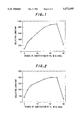
  • FIG. 1 is a graph showing the dielectric constant of a thin film of Pb(Ti,Nb)O 3 as a function of the degree of substitution by niobium for titanium.
  • FIG. 2 is a graph showing the dielectric constant of a thin film of Pb(Ti,Al)O 3 as a function of the degree of substitution by aluminum for titanium.
  • FIG. 3 is a graph showing the dielectric constant of a thin film of Pb(Ti,Ta)O 3 as a function of the degree of substitution by tantalum for titanium.
  • FIG. 4 is a graph showing the dielectric constant of a thin film of Pb(Ti,Sb)O 3 as a function of the degree of substitution by antimony for titanium.
  • the inventors have conducted extensive investigations with the above mentioned object in an approach to discover a substituent element in the crystal lattice of lead titanate to exhibit an improving effect on the dielectric behavior of a thin film of the material.
  • the substituted lead titanate-based dielectric thin film of the present invention has a chemical composition expressed by the above given formula (I), in which the subscript x is a positive number in the range from 0.05 to 0.50 and M is a substituent element selected from the group consisting of niobium, tantalum, vanadium, antimony, bismuth, arsenic, tungsten, hafnium, germanium, tin, aluminum and gallium. Namely, from 5% to 50% by moles or, preferably, from 10 to 50% by moles of the titanium atoms in the perovskite crystal lattice of lead titanate PbTiO 3 are replaced with the atoms of these substituent elements to form a solid solution.
  • substituent elements can be used either singly or as a combination of two kinds or more according to need.
  • the degree of substitution given by the subscript x should be in the range from 0.05 to 0.50 since, when the value of x is too small, the desired improving effect cannot be fully accomplished as a matter of course while, when the value of x is too large, no uniform solid solution can be formed thereby with appearance of a second crystalline phase consequently to decrease the dielectric constant of the thin film.
  • the advantages obtained by the invention are particularly great when the dielectric thin film has a thickness of 1 ⁇ m or smaller or in the range from 0.01 to 1 ⁇ m.
  • the dielectric constant of the inventive dielectric thin film can be as large as 10 times of that of a thin film of unsubstituted lead titanate having the same thickness.
  • the method for the preparation of the dielectric thin film of the invention is not particularly limitative provided that the method ensures controlling of the uniformity of the chemical composition within the range defined by the subscript x in the formula (I).
  • Examples of the applicable methods include the sol-gel method, sputtering method, CVD method, laser ablation method and the like.
  • soluble compounds of lead, titanium and the substituent element such as lead acetate, titanium alkoxide and an alkoxide of the substituent element are dissolved in a suitable solvent such as an alcohol and, after partial hydrolysis of the alkoxides, the solution is applied to the surface of a substrate such as a fused silica glass plate, platinum plate and the like followed by drying of the coating layer to give a film of the dried composition which is then subjected to thermal decomposition of the organic constituents and finally sintered by firing at a temperature up to 700° C. so as to convert the mixed composition into the desired substituted lead titanate in the form of a thin film on the substrate surface.
  • a suitable solvent such as an alcohol
  • the sputtering method can be performed by using, for example, a RF magnetron sputtering apparatus with a powder of the substituted lead titanate in the form of a powder as the target.
  • the target material can be prepared either by the sol-gel method similar to that described above or by the mixed-oxide calcination method in which the oxides of lead, titanium and the substituent element are intimately mixed together to give a powder blend which is compression-molded into a tablet followed by calcination thereof at a temperature of, for example, 600° C. for 30 to 60 minutes.
  • Solutions were prepared by dissolving lead acetate trihydrate, titanium isopropoxide and niobium n-propoxide each in 2-methoxyethanol and these solutions were mixed together in such a varied proportion that the resultant niobium-substituted lead titanate might have a chemical composition of the formula Pb(Ti 1-x Nb x )O 3 , x being 0.05 to 0.60.
  • the thus prepared mixed solution was applied to the surface of a platinum plate by spin coating followed by drying to remove the solvent and heating at 520° C. to effect thermal decomposition of the organic matter. This procedure of spin coating with the mixed solution and drying and thermal decomposition was repeated several times finally followed by a firing treatment by heating at a temperature of 700° C.
  • a thin film of the niobium-substituted lead titanate having a thickness of about 0.15 ⁇ m.
  • another thin film having a thickness of about 0.15 ⁇ m was prepared in the same manner as above excepting omission of niobium n-isopropoxide and use of equimolar amounts of lead acetate and titanium isopropoxide in the formulation of the mixed solution.
  • the thus prepared thin films of the niobium-substituted lead titanate were subjected to the X-ray diffractometric analysis of the crystallographic structure to find that the thin film was constituted of a single phase of perovskite when the degree of substitution by niobium was 50% by moles or lower while, when the degree of substitution by niobium was 60% by moles, an unidentified second phase was detected besides the perovskite phase.
  • the thin films were subjected to the measurement of the dielectric constant by using a digital LCR meter at a frequency of 10 kHz to give the results shown in FIG. 1 as a function of the degree of substitution by niobium.
  • the dielectric measurement was conducted with the platinum substrate as one of the electrodes and a vapor-deposited film of gold on the dielectric thin film as the other electrode.
  • a great increase is found in the dielectric constant of the thin film, which is about 80 for the thin film of unsubstituted lead titanate as is reported in literatures, reaching about 900 when the degree of substitution by niobium is 50% by moles.
  • the dielectric constant of the thin film is rapidly decreased when the degree of substitution by niobium exceeds 50% by moles reaching about 220 with 60% by moles substitution.
  • a mixed solution was prepared by dissolving lead acetate trihydrate, titanium isopropoxide and aluminum isopropoxide in 2-methoxyethanol as a solvent in such a varied molar proportion that the composition could be expressed by the formula Pb(Ti 1-x Al x )O 3 , x being from 0.05 to 0.60, and a powder having a chemical composition expressed by the formula was prepared by gelation of the solution followed by drying thereof and thermal decomposition of the organic matters.
  • a thin film of the aluminum-substituted lead titanate having the same chemical composition as the formula in a thickness of about 0.5 ⁇ m was deposited on a platinum plate kept at a temperature of 700° C. by conducting sputtering for 4 hours in a sputtering chamber of a RF magnetron sputtering apparatus filled by a 9:1 by volume mixture of argon and oxygen under a pressure of 1Pa with 300 watts power input for sputtering.
  • Example 2 The X-ray diffractometric studies of the thus formed thin films led to about the same conclusion as in Example 1 for the crystallographic structure of the aluminum-substituted lead titanates. Further, these thin films on the platinum substrate were subjected to the measurement of the dielectric constant in the same manner as in Example 1 to give the results shown in FIG. 2 as a function of the degree of substitution by aluminum. The highest value of about 400 of the dielectric constant was obtained when the degree of substitution by aluminum was 40 to 50% by moles.
  • Example 2 The experimental procedure was substantially the same as in Example 2 excepting replacement of the aluminum isopropoxide with gallium isopropoxide.
  • the results obtained by the X-ray diffractometric study and measurement of the dielectric constant of the thus formed thin films were also substantially the same as in Example 2.
  • Example 2 The experimental procedure was substantially the same as in Example 2 excepting replacement of the aluminum isopropoxide with tantalum ethoxide.
  • the result obtained by the X-ray diffractometric study of the thus formed thin films was also substantially the same as in Example 2.
  • FIG. 3 of the accompanying drawing shows the result obtained by the measurement of the dielectric constant of these dielectric thin films as a function of the degree of substitution by tantalum. The highest value of about 800 of the dielectric constant was obtained when the degree of substitution by tantalum was 40 to 50% by moles.
  • Example 4 The experimental procedure was substantially the same as in Example 4 excepting replacement of the tantalum ethoxide with n-propoxy vanadyl.
  • the results obtained by the X-ray diffractometric study and measurement of the dielectric constant of the thus formed thin films were also substantially the same as in Example 4.
  • Example 2 The experimental procedure was substantially the same as in Example 2 excepting replacement of the aluminum isopropoxide with antimony ethoxide.
  • the result obtained by the X-ray diffractometric study of the thus formed thin films was also substantially the same as in Example 2.
  • FIG. 4 of the accompanying drawing shows the result obtained by the measurement of the dielectric constant of these dielectric thin films as a function of the degree of substitution by antimony. Different from the preceding examples, the dielectric constant of the dielectric thin films was approximately uniform at about 400 within the range from 20 to 50% by moles of the degree of substitution by antimony.
  • Example 6 The experimental procedure was substantially the same as in Example 6 excepting replacement of the antimony ethoxide with arsenic ethoxide.

Landscapes

  • Chemical & Material Sciences (AREA)
  • Organic Chemistry (AREA)
  • Materials Engineering (AREA)
  • Engineering & Computer Science (AREA)
  • Mechanical Engineering (AREA)
  • Metallurgy (AREA)
  • Chemical Kinetics & Catalysis (AREA)
  • Life Sciences & Earth Sciences (AREA)
  • Environmental & Geological Engineering (AREA)
  • General Life Sciences & Earth Sciences (AREA)
  • Geology (AREA)
  • Inorganic Chemistry (AREA)
  • Compositions Of Oxide Ceramics (AREA)
  • Inorganic Insulating Materials (AREA)
  • Inorganic Compounds Of Heavy Metals (AREA)

Abstract

Proposed is a dielectric thin film of a substituted lead titanate having a chemical composition expressed by the formula
Pb(Ti.sub.1-x M.sub.x)O.sub.3
in which the subscript x is a positive number in the range from 0.05 to 0.50 and M is an element selected from the group consisting of niobium, tantalum, vanadium, antimony, bismuth, arsenic, tungsten, hafnium, germanium, tin, aluminum and gallium substituting for a part of the titanium atoms in the perovskite crystal lattice of lead titanate. Different from thin films of unsubstituted lead titanate or conventional substituted lead titanates, the above defined dielectric thin films of the invention are free from the disadvantage that the dielectric constant of the thin film is greatly decreased when the thickness of the thin film is so small as to be 1 μm or smaller so that the dielectric constant of the inventive dielectric thin film having a thickness of 0.5 μm or even smaller can be as large as 10 times of that of the thin film of unsubstituted lead titanate having the same thickness.

Description

BACKGROUND OF THE INVENTION
The present invention relates to a dielectric thin film of a substituted lead titanate. More particularly, the invention relates to a dielectric thin film of a substituted lead titanate capable of exhibiting a high dielectric constant even when the thickness of the thin film is very small to be 1 μm or smaller.
As is well known, lead titanate of the chemical formula PbTiO3 is a typical ferroelectric material having a crystallographic structure of perovskite. Thin films of lead titanate are promising as a material for infrared sensors, microactuators, memories and the like and extensive investigations are now underway for the development of these applications. One of the serious problems in the application of a thin film of lead titanate as a dielectric material is that the dielectric properties of the thin film depend on the thickness of the thin film and, in particular, the dielectric constant of a thin film of lead titanate is greatly decreased as compared with the value for a bulk of the same material when the thickness of the thin film is 1 μm or smaller. A report in this regard is found, for example, in Proc. FMA-5, page 7 (1985), according to which the dielectric constant of a thin film of lead titanate formed on a substrate by the sol-gel method is only one third to one fourth of the value in bulk when the thin film has a thickness of 1 μm or smaller.
Various proposals and attempts have been made heretofore with an object to provide a lead titanate-based dielectric thin film which does not suffer from a decrease in the dielectric constant when the thickness thereof is decreased including the approaches for the modification of the preparation method of the thin film and introduction of some additive or substituting elements into the crystalline structure of lead titanate. For example, it is reported in Journal of Applied Physics, volume 61, pages 411-415 (1987) and elsewhere that an improvement in the dielectric characteristics can be obtained when a thin film is formed from so-called PLT of (Pb,La)TiO3, which is a lead titanate substituted by lanthanum atoms at a part of the lead atom positions in the crystal lattice of PbTiO3. The improvement obtained by PLT, however, is still insufficient not to impart practicability to lead titanate-based dielectric thin films.
SUMMARY OF THE INVENTION
The present invention accordingly has an object to provide a novel lead titanate-based dielectric thin film having an unexpectedly large dielectric constant even when the thickness of the thin film is so small as to be 1 μm or smaller.
Thus, the present invention provides a dielectric thin film of a substituted lead titanate having a chemical composition expressed by the composition formula
Pb(Ti.sub.1-x M.sub.x)O.sub.3                              (I)
in which the subscript x is a positive number in the range from 0.05 to 0.50 and M is an element selected from the group consisting of niobium, tantalum, vanadium, antimony, bismuth, arsenic, tungsten, hafnium, germanium, tin, aluminum and gallium substituting for a part of the titanium atoms in the perovskite crystal lattice of lead titanate.
BRIEF DESCRIPTION OF THE DRAWING
FIG. 1 is a graph showing the dielectric constant of a thin film of Pb(Ti,Nb)O3 as a function of the degree of substitution by niobium for titanium.
FIG. 2 is a graph showing the dielectric constant of a thin film of Pb(Ti,Al)O3 as a function of the degree of substitution by aluminum for titanium.
FIG. 3 is a graph showing the dielectric constant of a thin film of Pb(Ti,Ta)O3 as a function of the degree of substitution by tantalum for titanium.
FIG. 4 is a graph showing the dielectric constant of a thin film of Pb(Ti,Sb)O3 as a function of the degree of substitution by antimony for titanium.
DETAILED DESCRIPTION OF THE PREFERRED EMBODIMENTS
The inventors have conducted extensive investigations with the above mentioned object in an approach to discover a substituent element in the crystal lattice of lead titanate to exhibit an improving effect on the dielectric behavior of a thin film of the material. Conducting the experiments with their attention directed to the ionic radius of the substituent element which is in proximity to that of titanium ions of 0.075 nm, a large number of substituent elements were tested arriving at a discovery that the above named substituent elements are specifically effective for the purpose among other elements having an ionic radius within about the same range.
The substituted lead titanate-based dielectric thin film of the present invention has a chemical composition expressed by the above given formula (I), in which the subscript x is a positive number in the range from 0.05 to 0.50 and M is a substituent element selected from the group consisting of niobium, tantalum, vanadium, antimony, bismuth, arsenic, tungsten, hafnium, germanium, tin, aluminum and gallium. Namely, from 5% to 50% by moles or, preferably, from 10 to 50% by moles of the titanium atoms in the perovskite crystal lattice of lead titanate PbTiO3 are replaced with the atoms of these substituent elements to form a solid solution.
These substituent elements can be used either singly or as a combination of two kinds or more according to need. The degree of substitution given by the subscript x should be in the range from 0.05 to 0.50 since, when the value of x is too small, the desired improving effect cannot be fully accomplished as a matter of course while, when the value of x is too large, no uniform solid solution can be formed thereby with appearance of a second crystalline phase consequently to decrease the dielectric constant of the thin film.
Though not limitative, the advantages obtained by the invention are particularly great when the dielectric thin film has a thickness of 1 μm or smaller or in the range from 0.01 to 1 μm. With adequately selected parameters, the dielectric constant of the inventive dielectric thin film can be as large as 10 times of that of a thin film of unsubstituted lead titanate having the same thickness.
The method for the preparation of the dielectric thin film of the invention is not particularly limitative provided that the method ensures controlling of the uniformity of the chemical composition within the range defined by the subscript x in the formula (I). Examples of the applicable methods include the sol-gel method, sputtering method, CVD method, laser ablation method and the like. In the sol-gel method, soluble compounds of lead, titanium and the substituent element such as lead acetate, titanium alkoxide and an alkoxide of the substituent element are dissolved in a suitable solvent such as an alcohol and, after partial hydrolysis of the alkoxides, the solution is applied to the surface of a substrate such as a fused silica glass plate, platinum plate and the like followed by drying of the coating layer to give a film of the dried composition which is then subjected to thermal decomposition of the organic constituents and finally sintered by firing at a temperature up to 700° C. so as to convert the mixed composition into the desired substituted lead titanate in the form of a thin film on the substrate surface. The sputtering method can be performed by using, for example, a RF magnetron sputtering apparatus with a powder of the substituted lead titanate in the form of a powder as the target. The target material can be prepared either by the sol-gel method similar to that described above or by the mixed-oxide calcination method in which the oxides of lead, titanium and the substituent element are intimately mixed together to give a powder blend which is compression-molded into a tablet followed by calcination thereof at a temperature of, for example, 600° C. for 30 to 60 minutes.
In the following, the substituted lead titanate-based dielectric thin film of the invention is described in more detail by way of examples.
EXAMPLE 1
Solutions were prepared by dissolving lead acetate trihydrate, titanium isopropoxide and niobium n-propoxide each in 2-methoxyethanol and these solutions were mixed together in such a varied proportion that the resultant niobium-substituted lead titanate might have a chemical composition of the formula Pb(Ti1-x Nbx)O3, x being 0.05 to 0.60. The thus prepared mixed solution was applied to the surface of a platinum plate by spin coating followed by drying to remove the solvent and heating at 520° C. to effect thermal decomposition of the organic matter. This procedure of spin coating with the mixed solution and drying and thermal decomposition was repeated several times finally followed by a firing treatment by heating at a temperature of 700° C. for 30 to 60 minutes to give a thin film of the niobium-substituted lead titanate having a thickness of about 0.15 μm. For comparison, another thin film having a thickness of about 0.15 μm was prepared in the same manner as above excepting omission of niobium n-isopropoxide and use of equimolar amounts of lead acetate and titanium isopropoxide in the formulation of the mixed solution.
The thus prepared thin films of the niobium-substituted lead titanate were subjected to the X-ray diffractometric analysis of the crystallographic structure to find that the thin film was constituted of a single phase of perovskite when the degree of substitution by niobium was 50% by moles or lower while, when the degree of substitution by niobium was 60% by moles, an unidentified second phase was detected besides the perovskite phase.
Further, the thin films were subjected to the measurement of the dielectric constant by using a digital LCR meter at a frequency of 10 kHz to give the results shown in FIG. 1 as a function of the degree of substitution by niobium. The dielectric measurement was conducted with the platinum substrate as one of the electrodes and a vapor-deposited film of gold on the dielectric thin film as the other electrode. As is understood from this graph, a great increase is found in the dielectric constant of the thin film, which is about 80 for the thin film of unsubstituted lead titanate as is reported in literatures, reaching about 900 when the degree of substitution by niobium is 50% by moles. In contrast thereto, the dielectric constant of the thin film is rapidly decreased when the degree of substitution by niobium exceeds 50% by moles reaching about 220 with 60% by moles substitution.
EXAMPLE 2
A mixed solution was prepared by dissolving lead acetate trihydrate, titanium isopropoxide and aluminum isopropoxide in 2-methoxyethanol as a solvent in such a varied molar proportion that the composition could be expressed by the formula Pb(Ti1-x Alx)O3, x being from 0.05 to 0.60, and a powder having a chemical composition expressed by the formula was prepared by gelation of the solution followed by drying thereof and thermal decomposition of the organic matters.
Using the thus prepared powder as the target, a thin film of the aluminum-substituted lead titanate having the same chemical composition as the formula in a thickness of about 0.5 μm was deposited on a platinum plate kept at a temperature of 700° C. by conducting sputtering for 4 hours in a sputtering chamber of a RF magnetron sputtering apparatus filled by a 9:1 by volume mixture of argon and oxygen under a pressure of 1Pa with 300 watts power input for sputtering.
The X-ray diffractometric studies of the thus formed thin films led to about the same conclusion as in Example 1 for the crystallographic structure of the aluminum-substituted lead titanates. Further, these thin films on the platinum substrate were subjected to the measurement of the dielectric constant in the same manner as in Example 1 to give the results shown in FIG. 2 as a function of the degree of substitution by aluminum. The highest value of about 400 of the dielectric constant was obtained when the degree of substitution by aluminum was 40 to 50% by moles.
EXAMPLE 3
The experimental procedure was substantially the same as in Example 2 excepting replacement of the aluminum isopropoxide with gallium isopropoxide. The results obtained by the X-ray diffractometric study and measurement of the dielectric constant of the thus formed thin films were also substantially the same as in Example 2.
EXAMPLE 4
The experimental procedure was substantially the same as in Example 2 excepting replacement of the aluminum isopropoxide with tantalum ethoxide. The result obtained by the X-ray diffractometric study of the thus formed thin films was also substantially the same as in Example 2. FIG. 3 of the accompanying drawing shows the result obtained by the measurement of the dielectric constant of these dielectric thin films as a function of the degree of substitution by tantalum. The highest value of about 800 of the dielectric constant was obtained when the degree of substitution by tantalum was 40 to 50% by moles.
EXAMPLE 5
The experimental procedure was substantially the same as in Example 4 excepting replacement of the tantalum ethoxide with n-propoxy vanadyl. The results obtained by the X-ray diffractometric study and measurement of the dielectric constant of the thus formed thin films were also substantially the same as in Example 4.
EXAMPLE 6
The experimental procedure was substantially the same as in Example 2 excepting replacement of the aluminum isopropoxide with antimony ethoxide. The result obtained by the X-ray diffractometric study of the thus formed thin films was also substantially the same as in Example 2. FIG. 4 of the accompanying drawing shows the result obtained by the measurement of the dielectric constant of these dielectric thin films as a function of the degree of substitution by antimony. Different from the preceding examples, the dielectric constant of the dielectric thin films was approximately uniform at about 400 within the range from 20 to 50% by moles of the degree of substitution by antimony.
EXAMPLE 7
The experimental procedure was substantially the same as in Example 6 excepting replacement of the antimony ethoxide with arsenic ethoxide. The results obtained by the X-ray diffractometric study and measurement of the dielectric constant of the thus formed thin films were also substantially the same as in Example 6.
Claims (2)

What is claimed is:
1. A dielectric thin film of a substituted lead titanate having a chemical composition expressed by the composition formula
Pb(Ti.sub.1-x M.sub.x)O.sub.3
in which the subscript x is a positive number in the range from 0.05 to 0.50 and M is an element selected from the group consisting of niobium, tantalum, vanadium, antimony, bismuth, arsenic, tungsten, hafnium, germanium, tin, aluminum and gallium substituting for a part of the titanium atoms in the perovskite crystal lattice of lead titanate.
2. The dielectric thin film according to claim 1, wherein the thickness of the film is 1 μm or less.
US08/510,270 1994-08-11 1995-08-02 Dielectric thin film of substituted lead titanate Expired - Lifetime US5571495A (en)

Applications Claiming Priority (2)

Application Number Priority Date Filing Date Title
JP6-210644 1994-08-11
JP6210644A JP2642876B2 (en) 1994-08-11 1994-08-11 Lead titanate-based dielectric thin film

Publications (1)

Publication Number Publication Date
US5571495A true US5571495A (en) 1996-11-05

Family

ID=16592727

Family Applications (1)

Application Number Title Priority Date Filing Date
US08/510,270 Expired - Lifetime US5571495A (en) 1994-08-11 1995-08-02 Dielectric thin film of substituted lead titanate

Country Status (2)

Country Link
US (1) US5571495A (en)
JP (1) JP2642876B2 (en)

Cited By (4)

* Cited by examiner, † Cited by third party
Publication number Priority date Publication date Assignee Title
US6001416A (en) * 1994-11-24 1999-12-14 Fuji Xerox Co., Ltd. Oxide thin film and process for forming the same
WO2002032809A1 (en) * 2000-10-17 2002-04-25 Sharp Kabushiki Kaisha Oxide material, method for preparing oxide thin film and element using said material
US20030012874A1 (en) * 2000-11-20 2003-01-16 Lange Frederick F. III-V compound films using chemical deposition
CN100339996C (en) * 2003-03-28 2007-09-26 精工爱普生株式会社 Ferroelectric material, ferroelectric film and method of manufacturing the same, ferroelectric capacitor and method of manufacturing the same, ferroelectric memory,

Citations (7)

* Cited by examiner, † Cited by third party
Publication number Priority date Publication date Assignee Title
GB1204436A (en) * 1967-09-20 1970-09-09 Siemens Ag Improvements in or relating to capacitors dielectrics
US4061583A (en) * 1974-03-13 1977-12-06 Murata Manufacturing Co., Ltd. Preparation of titanates
JPS61285609A (en) * 1985-06-13 1986-12-16 日本曹達株式会社 Lead titanate ferrodielectric thin film and manufacture thereof
US4636378A (en) * 1985-06-11 1987-01-13 Hughes Aircraft Company Method of preparation of perovskite-type compounds
JPS63236713A (en) * 1987-03-25 1988-10-03 Teikoku Kako Kk Production of inorganic fine powder of perovskite-type compound
JPH0570103A (en) * 1990-08-24 1993-03-23 Kawasaki Heavy Ind Ltd Production of inorganic dielectric thin film
JPH0672717A (en) * 1992-08-24 1994-03-15 Honda Motor Co Ltd Piezoelectric electrostrictive material

Family Cites Families (1)

* Cited by examiner, † Cited by third party
Publication number Priority date Publication date Assignee Title
JP2556206B2 (en) * 1991-02-27 1996-11-20 日本電気株式会社 Method for manufacturing dielectric thin film

Patent Citations (7)

* Cited by examiner, † Cited by third party
Publication number Priority date Publication date Assignee Title
GB1204436A (en) * 1967-09-20 1970-09-09 Siemens Ag Improvements in or relating to capacitors dielectrics
US4061583A (en) * 1974-03-13 1977-12-06 Murata Manufacturing Co., Ltd. Preparation of titanates
US4636378A (en) * 1985-06-11 1987-01-13 Hughes Aircraft Company Method of preparation of perovskite-type compounds
JPS61285609A (en) * 1985-06-13 1986-12-16 日本曹達株式会社 Lead titanate ferrodielectric thin film and manufacture thereof
JPS63236713A (en) * 1987-03-25 1988-10-03 Teikoku Kako Kk Production of inorganic fine powder of perovskite-type compound
JPH0570103A (en) * 1990-08-24 1993-03-23 Kawasaki Heavy Ind Ltd Production of inorganic dielectric thin film
JPH0672717A (en) * 1992-08-24 1994-03-15 Honda Motor Co Ltd Piezoelectric electrostrictive material

Cited By (7)

* Cited by examiner, † Cited by third party
Publication number Priority date Publication date Assignee Title
US6001416A (en) * 1994-11-24 1999-12-14 Fuji Xerox Co., Ltd. Oxide thin film and process for forming the same
WO2002032809A1 (en) * 2000-10-17 2002-04-25 Sharp Kabushiki Kaisha Oxide material, method for preparing oxide thin film and element using said material
US20040136891A1 (en) * 2000-10-17 2004-07-15 Takeshi Kijima Oxide material, method for preparing oxide thin film and element using said material
US7205256B2 (en) 2000-10-17 2007-04-17 Sharp Kabushiki Kaisha Oxide material, method for preparing oxide thin film and element using said material
US20030012874A1 (en) * 2000-11-20 2003-01-16 Lange Frederick F. III-V compound films using chemical deposition
US6770131B2 (en) * 2000-11-20 2004-08-03 The Regents Of The University Of California III-V compound films using chemical deposition
CN100339996C (en) * 2003-03-28 2007-09-26 精工爱普生株式会社 Ferroelectric material, ferroelectric film and method of manufacturing the same, ferroelectric capacitor and method of manufacturing the same, ferroelectric memory,

Also Published As

Publication number Publication date
JP2642876B2 (en) 1997-08-20
JPH0855515A (en) 1996-02-27

Similar Documents

Publication Publication Date Title
Zhai et al. Dielectric nonlinear characteristics of Ba (Zr 0.35 Ti 0.65) O 3 thin films grown by a sol-gel process
Chang et al. Effects of dopants in PZT films
Puli et al. Observation of large enhancement in energy-storage properties of lead-free polycrystalline 0.5 BaZr0. 2Ti0. 8O3–0.5 Ba0. 7Ca0. 3TiO3 ferroelectric thin films
Pontes et al. Characterization of BaTi1− xZrxO3 thin films obtained by a soft chemical spin-coating technique
EP0656429B1 (en) Ferroelectric thin film and method of manufacturing the same
GB2349272A (en) Piezoelectric paste and piezoelectric film and piezoelectric part using the same
WO2017057745A1 (en) Dielectric thin film, capacitor element, and electronic component
Muhsen et al. Structure refinement and impedance analysis of Ba0. 85Ca0. 15Zr0. 10Ti0. 90O3 ceramics sintered in air and nitrogen
Ni et al. Effects of annealing temperatures on energy storage performance of sol-gel derived (Ba0. 95, Sr0. 05)(Zr0. 2, Ti0. 8) O3 thin films
Tanaka et al. Grain size effect on dielectric and piezoelectric properties of alkoxy-derived BaTiO3-based thin films
Zhai et al. Preparation and tunability properties of Ba (ZrxTi1− x) O3 thin films grown by a sol–gel process
Co et al. Effect of crystallization temperature on energy-storage density and efficiency of lead-free Bi0. 5 (Na0. 8K0. 2) 0.5 TiO3 thin films prepared by sol–gel method
Ye et al. Dielectric properties of Fe-doped Ba0. 65Sr0. 35TiO3 thin films fabricated by the sol–gel method
Yadav Optical and electrical properties of sol–gel derived thin films of PbTiO3
Kao et al. Properties of LiTaO3 thin films derived by a diol-based sol–gel process
Belhajji et al. Investigation of the structural, microstructural, and dielectric properties of Ho-doped PbTiO3 for piezoelectric applications
US5571495A (en) Dielectric thin film of substituted lead titanate
Zhai et al. Structural and dielectric properties of Ba0. 85Sr0. 15 (Zr0. 18Ti0. 85) O3 thin films grown by a sol–gel process
Marques et al. Temperature dependence of dielectric properties for Ba (Zr0. 25Ti0. 75) O3 thin films obtained from the soft chemical method
Rai et al. Investigation of structural and dielectric properties of (La, Fe)-doped PZT ceramics
Fribourg-Blanc et al. PMNT films for integrated capacitors
Basu et al. Effect of uniform and periodic doping by Ce on the properties of barium strontium titanate thin films
Borderon et al. Mn-Doped Ba 0.8 Sr 0.2 TiO 3 Thin Films for Energy Storage Capacitors
Chopra et al. Synthesis and Characterization of Sol–Gel-Derived (Pb1-x La x) Ti1-x/4O3 Thin Films
Eswaramoorthi et al. Influence of Ga doping on the structural, optical and electrical properties of Ba0. 6Sr0. 4TiO3 thin films

Legal Events

Date Code Title Description
AS Assignment

Owner name: JAPAN AS REPRESENTED BY DIRECTOR GENERAL OF AGENCY

Free format text: ASSIGNMENT OF ASSIGNORS INTEREST;ASSIGNORS:IIJIMA, TAKASHI;SANADA, NORIO;REEL/FRAME:007616/0953

Effective date: 19950725

STCF Information on status: patent grant

Free format text: PATENTED CASE

FEPP Fee payment procedure

Free format text: PAYOR NUMBER ASSIGNED (ORIGINAL EVENT CODE: ASPN); ENTITY STATUS OF PATENT OWNER: LARGE ENTITY

FPAY Fee payment

Year of fee payment: 4

FEPP Fee payment procedure

Free format text: PAYER NUMBER DE-ASSIGNED (ORIGINAL EVENT CODE: RMPN); ENTITY STATUS OF PATENT OWNER: LARGE ENTITY

Free format text: PAYOR NUMBER ASSIGNED (ORIGINAL EVENT CODE: ASPN); ENTITY STATUS OF PATENT OWNER: LARGE ENTITY

FPAY Fee payment

Year of fee payment: 8

FPAY Fee payment

Year of fee payment: 12