US5526869A - Mold for continuous casting system - Google Patents

Mold for continuous casting system Download PDF

Info

Publication number
US5526869A
US5526869A US08/314,746 US31474694A US5526869A US 5526869 A US5526869 A US 5526869A US 31474694 A US31474694 A US 31474694A US 5526869 A US5526869 A US 5526869A
Authority
US
United States
Prior art keywords
plenum
transition portion
coolant
continuous casting
velocity
Prior art date
Legal status (The legal status is an assumption and is not a legal conclusion. Google has not performed a legal analysis and makes no representation as to the accuracy of the status listed.)
Expired - Fee Related
Application number
US08/314,746
Inventor
James B. Sears, Jr.
Current Assignee (The listed assignees may be inaccurate. Google has not performed a legal analysis and makes no representation or warranty as to the accuracy of the list.)
SMS Siemag LLC
Original Assignee
Gladwin Corp
Priority date (The priority date is an assumption and is not a legal conclusion. Google has not performed a legal analysis and makes no representation as to the accuracy of the date listed.)
Filing date
Publication date
Application filed by Gladwin Corp filed Critical Gladwin Corp
Priority to US08/314,746 priority Critical patent/US5526869A/en
Assigned to GLADWIN CORPORATION reassignment GLADWIN CORPORATION ASSIGNMENT OF ASSIGNORS INTEREST (SEE DOCUMENT FOR DETAILS). Assignors: SEARS, JAMES B. JR.
Assigned to PRIMACOR-GLADWIN CORP. (A CORP. OF DELAWARE) reassignment PRIMACOR-GLADWIN CORP. (A CORP. OF DELAWARE) ASSIGNMENT OF ASSIGNORS INTEREST (SEE DOCUMENT FOR DETAILS). Assignors: GLADWIN CORPORATION (A CORP. OF DELAWARE)
Application granted granted Critical
Publication of US5526869A publication Critical patent/US5526869A/en
Assigned to AG INDUSTRIES, INC. reassignment AG INDUSTRIES, INC. CHANGE OF NAME (SEE DOCUMENT FOR DETAILS). Assignors: GLADWIN CORPORATION
Assigned to SMS DEMAG, INC. reassignment SMS DEMAG, INC. ASSIGNMENT OF ASSIGNORS INTEREST (SEE DOCUMENT FOR DETAILS). Assignors: AG INDUSTRIES, INC.
Anticipated expiration legal-status Critical
Expired - Fee Related legal-status Critical Current

Links

Images

Classifications

    • BPERFORMING OPERATIONS; TRANSPORTING
    • B22CASTING; POWDER METALLURGY
    • B22DCASTING OF METALS; CASTING OF OTHER SUBSTANCES BY THE SAME PROCESSES OR DEVICES
    • B22D11/00Continuous casting of metals, i.e. casting in indefinite lengths
    • B22D11/04Continuous casting of metals, i.e. casting in indefinite lengths into open-ended moulds
    • B22D11/055Cooling the moulds

Definitions

  • This invention relates broadly to the field of metal production and casting. More specifically, this invention relates to an improved mold for a continuous casting system that has a longer useful life, improves the uniformity of heat removal, and turns out a better product than conventional continuous casting molds do.
  • a conventional continuous casting mold includes a number of liner plates, usually made of copper, and outer walls surrounding the liner plates.
  • the liner plates define a portion of the mold that contacts the molten metal during the casting process.
  • Parallel vertically extending water circulation slots or passageways are provided between the outer walls and the liner plates to cool the liner plates.
  • water is introduced to these slots, usually at the bottom end of the mold, from a water supply via an inlet plenum that is in communication with all of the slots in a liner plate.
  • the cooling effect so achieved causes an outer skin of the molten metal to solidify as it passes through the mold.
  • the solidification is then completed after the semi-solidified casting leaves the mold by spraying additional coolant, typically water, directly onto the casting.
  • both the top and bottom ends of each slot or passageway 22 are conventionally radiused into the plenum 14 at a transition portion 28 in order to minimize flow resistance.
  • plenum 22 extends along an entire side of a liner plate 20 while the slots 22 are spaced periodically
  • the plenum 14 is relatively large in a cross-section taken along a normal to the flow direction of the water when compared to the combined cross-sections of the slots 22.
  • water flow velocity in the plenum area 14 and in the adjacent transition portion 28 tends to be materially less than the water flow velocity in the main portion of the slots 22.
  • flow velocity in the plenum area was found to be 2-3 feet per second, while the flow rate in the main portion of the slots was estimated at 20-30 feet per second, a ten-fold difference.
  • This flow velocity differential causes the liner plate to be cooled more effectively at its center than at its top and the bottom.
  • the low velocity area at the top of a liner plate has, even when positioned adjacent to the meniscus of the molten metal in the mold, been measured to have as high a temperature than areas that are about two inches below the meniscus, when, if the cooling effect was even, it would be expected to have a lower temperature.
  • This uneven cooling effect causes expansion stresses that substantially limit the life of the liner plates.
  • This invention solves the velocity problem by interposing a velocity plate between the plenum and the transition portion of the slot.
  • the velocity plate increases the velocity of the coolant water at the top and the bottom of the liner plate.
  • an improved mold for a continuous casting process includes an outer wall, the outer wall having a plenum chamber defined in an inner surface thereof and at least one passage for communicating the plenum chamber with an external coolant conduit; a liner that is secured to the inner surface of the outer wall, the liner having a number of slots defined in an inner wall thereof which, together with the outer wall, define a number of passages for transporting coolant to cool the liner during operation of the mold, each of the slots having a radiused transition portion that is proximate to a location where the slot communicates with the plenum, the transition portion decreasing in cross-section near the plenum; and a velocity plate positioned between the plenum and the transition portion to limit an opening by which coolant may flow between the plenum and the transition portion, the velocity plate having a tapered cutout portion defined therein in a side thereof that faces the transition portion, whereby the velocity of coolant flowing between the transition portion and the
  • an improved mold for a continuous casting process includes four outer walls, each of the outer walls having a plenum chamber defined in an inner surface thereof and at least one passage for communicating the plenum chamber with an external coolant conduit; four liner walls, each of the liner walls being secured to the inner surface of one of the outer walls, the liner walls together defining a mold surface through which molten material may be passed and shaped, each of the liner walls having a number of slots defined in an inner surface thereof which, together with the respective outer wall, define a number of passages for transporting coolant to cool the liner during operation of the mold, each of the slots having a radiused transition portion that is proximate to a location where the slot communicates with the plenum, the transition portion decreasing in cross-section as the slot nears the plenum; and a velocity plate positioned between the plenum and the transition portion to limit an opening by which coolant may flow between the plenum and the transition portion, the velocity plate having a tapered cut
  • a method of retrofitting a continuous casting mold of the type that includes an inner liner having a number of coolant passages defined therein and a plenum that is in communication with the passages, the passages having a transition portion that decreases in cross-section proximate the plenum, includes steps of: (a) opening the mold to expose the plenum and the transition portion; (b) securing a velocity plate between the plenum and the transition portion that is sized and proportioned to provide a limited opening between the plenum and the transition portion, and is tapered on a side facing the transition portion so as to induce a substantially constant coolant flow velocity within the transition portion; and (c) resealing the mold with the velocity plate mounted therein.
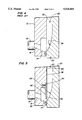
  • FIG. 1 is a cross-sectional fragmentary top view of an improved continuous casting mold that is constructed according to a preferred embodiment of the invention
  • FIG. 2 is a fragmentary side elevational view of the casting mold depicted in FIG. 1, with certain internal components illustrated by hidden lines;
  • FIG. 3 is a side elevational view of a component of the mold that is depicted in FIGS. 1 and 2;
  • FIG. 4 is a fragmentary cross-sectional view of a portion of a conventional continuous casting mold
  • FIG. 5 is a fragmentary cross-sectional view of a portion of the mold that is depicted in FIGS. 1-3, corresponding to FIG. 4;
  • FIG. 6 is a fragmentary cross-sectional view of another portion of the mold that is depicted in FIGS. 1-3 and 5.
  • an improved continuous casting mold 10 that is constructed according to a preferred embodiment of the invention includes four outer walls 12 that each have a plenum 14 defined therein, as may be seen in FIG. 5.
  • Each of the outer walls 12 further has a passage 16 defined therein, as may also be seen in FIG. 5, to communicate plenum 14 with a external conduit of coolant, which in the preferred embodiment is a water inlet supply pipe 18.
  • Continuous casting mold 10 also includes four liner walls 20, each of which is secured to an inner surface 36, respectively, of an outer wall 12, as may best be seen in FIGS. 1 and 5.
  • the liner walls 20 together define a mold surface through which molten material such as steel may be passed and shaped, as is well known in this area of technology.
  • Each liner 20 or liner plate is preferably fabricated from a material that has high thermal connectivity, preferably copper, as is also well known in this technical area.
  • each liner wall 20 has a number of slots 22 defined in an inner surface 24 thereof which, together with the respective outer wall 12, defines a number of passages 26, shown in FIG. 6, for transporting coolant such as water to cool the liner 20 during operation of the mold 10.
  • each of the slots 22 has a radiused transition portion 28 that is proximate to a location where slot 22 communicates with the plenum 14. As is also depicted in FIG. 5, the transition portion 28 decreases in cross section as the slot 22 nears the plenum 14. The radius of the transition portion 28 is fairly large, for the reasons that are discussed above in the discussion of the problems that are associated with the prior art.
  • FIG. 4 depicts a conventional mold, which also includes a plenum 14, a slot 22 and 1 radiused transition portion 28 that has a relatively large diameter. For the reasons discussed above, the water velocity in the plenum chamber and by the radius transition portion 28 is relatively low in comparison to that in a high velocity region 30 of the slot 22.
  • one important aspect of the invention involves the provision of a velocity plate 32 that is positioned between the plenum 14 and the transition portion 28 of the slot 22.
  • Velocity plate 32 functions to limit an opening through which coolant may flow between plenum 14 and transition portion 28, thereby increasing the velocity of coolant flow at this point. Because of the large radius of the transition portion 28, velocity plate 32 would create a significant impediment to water flow between the plenum 14 and the slot 22, if it were not for the provision of a number of tapered cutout portions 34 that are defined in a side of velocity plate 32 that faces the transition portion 28 of slot 22.
  • FIGS. 2 and 3 it will be seen that a cutout portion 34 is provided on velocity plate 32 for each of the slots 22 that are defined in the liner plate 20. The cutout portions 34 are depicted in FIG. 3 in contrast to the flat portions 38.
  • Velocity plate 32 is preferably secured to outer wall 12 by means of a bolt that presents substantially no resistance to coolant flow, such as the flat head bolt 40 that is depicted in FIG. 5.
  • each of the cutout portions 34 in velocity plate 32 is substantially wider at the bottom of the velocity plate 32 than at the top of the velocity plate 32.
  • This has the effect of maintaining a substantially uniform cross section, in a direction that is normal to the flow of coolant during operation, from the plenum 14 to the top of the region that is bounded by velocity plate 32 and transition portion 28, into the main portion of the slot 22.
  • flow velocity remains relatively constant from the point the water leaves plenum 14 to the main portion of the slot 22.
  • this will be within the range of substantially 20 feet per second to about 30 feet per second.
  • the cooling rate along this portion liner 20 will be relatively even, minimizing stresses and prolonging the life of the liner 20.
  • a velocity plate 32 is preferably mounted at both the top of the slot and at the bottom of the slot. However, it is most essential that a velocity plate be mounted at the top of the slot, because the minimization of mold face temperature gradients is most important at the top of the slot, which is close to the point of initial solidification or meniscus of the metal being casted.
  • the invention also embraces a method of retrofitting a continuous casting mold of the type described above by separating the mold elements to expose the plenum and the transition portion, securing a velocity plate of the type described above between the plenum and the transition portion, and resealing the mold with the velocity plate mounted therein.
  • This method can readily be envisioned by comparing FIG. 4 and 5.

Landscapes

  • Engineering & Computer Science (AREA)
  • Mechanical Engineering (AREA)
  • Continuous Casting (AREA)

Abstract

An improved mold for a continuous casting process includes an outer wall that has a plenum chamber defined in an inner surface thereof and at least one passage for communicating the plenum chamber with an external coolant conduit. The mold further includes a liner that is secured to the inner surface of the outer wall. The liner has a number of slots defined in an inner wall thereof which, together with the outer wall, define a number of passages for transporting coolant to cool the liner during operation of the mold. Each of the slots has a radiused transition portion that is proximate to a location where the slot communicates with the plenum. The transition portion decreases in cross-section as the slot approaches the plenum. The mold further includes a velocity plate that is positioned between the plenum and the transition portion to limit an opening by which coolant may flow between the plenum and the transition portion. The velocity plate has a tapered cutout portion defined in a side thereof that faces the transition portion. The combined effect of the cutout portion and the transition portion is to define a flowpath that induces a substantially constant, elevated coolant flow velocity throughout the entire mold, prolonging the life of the mold. A method of retrofitting a mold to include a velocity plate is also disclosed.

Description

BACKGROUND OF THE INVENTION
1. Field of the Invention
This invention relates broadly to the field of metal production and casting. More specifically, this invention relates to an improved mold for a continuous casting system that has a longer useful life, improves the uniformity of heat removal, and turns out a better product than conventional continuous casting molds do.
2. Description of the Prior Art
A conventional continuous casting mold includes a number of liner plates, usually made of copper, and outer walls surrounding the liner plates. The liner plates define a portion of the mold that contacts the molten metal during the casting process. Parallel vertically extending water circulation slots or passageways are provided between the outer walls and the liner plates to cool the liner plates. During operation, water is introduced to these slots, usually at the bottom end of the mold, from a water supply via an inlet plenum that is in communication with all of the slots in a liner plate. The cooling effect so achieved causes an outer skin of the molten metal to solidify as it passes through the mold. The solidification is then completed after the semi-solidified casting leaves the mold by spraying additional coolant, typically water, directly onto the casting. This method of metal production is highly efficient, and is in wide use in the United States and throughout the world.
Briefly referring to FIG. 4, both the top and bottom ends of each slot or passageway 22 are conventionally radiused into the plenum 14 at a transition portion 28 in order to minimize flow resistance. Considering that plenum 22 extends along an entire side of a liner plate 20 while the slots 22 are spaced periodically, the plenum 14 is relatively large in a cross-section taken along a normal to the flow direction of the water when compared to the combined cross-sections of the slots 22. As a result, water flow velocity in the plenum area 14 and in the adjacent transition portion 28 tends to be materially less than the water flow velocity in the main portion of the slots 22. In one calculation that was done by the inventor, flow velocity in the plenum area was found to be 2-3 feet per second, while the flow rate in the main portion of the slots was estimated at 20-30 feet per second, a ten-fold difference. This flow velocity differential causes the liner plate to be cooled more effectively at its center than at its top and the bottom. In fact, the low velocity area at the top of a liner plate has, even when positioned adjacent to the meniscus of the molten metal in the mold, been measured to have as high a temperature than areas that are about two inches below the meniscus, when, if the cooling effect was even, it would be expected to have a lower temperature. This uneven cooling effect causes expansion stresses that substantially limit the life of the liner plates.
This invention solves the velocity problem by interposing a velocity plate between the plenum and the transition portion of the slot. The velocity plate increases the velocity of the coolant water at the top and the bottom of the liner plate.
Ideally, only the very top and bottom ends of the slot 22 in a conventional mold should be radiused, and it would be a fairly small radius. The mold that is disclosed in U.S. Pat. No. 3,763,920 to Auman et al. ("Auman") shows a relatively small radius. However, in practice the slot ends tend to end up with a much longer radius, as is shown in FIG. 4, because the slots 22 are cut into the liner plate 20 by a side mill cutter that has a relatively large diameter. This is almost certainly the case in real-world embodiments of the Auman mold. Auman also discloses a dispersion plate that is positioned between its plenum and cooling slots to break the momentum of the inflowing water and equalize flow rate among the different slots. In practice, the water flow in an Auman mold would be impeded because of the narrow gap that is defined between the dispersion plate and the larger-radius transition portion of the cooling slots that the mold would be likely to have. A need exists, then, to ensure that the velocity plate in this invention does not have similar problems.
SUMMARY OF THE INVENTION
It is an object of the invention to provide an improved mold for continuous metal casting that provides a more balanced cooling effect than has heretofore been achieved by conventional molds.
It is further an object of the invention to provide such an improved mold without creating flow impediment problems of the type that would likely be encountered in a design such as Auman's.
It is yet further an object of the invention to provide an improved method of retrofitting a mold so as to achieve the benefits discussed above.
In order to achieve the above and other objects of the invention, an improved mold for a continuous casting process according to a first aspect of the invention includes an outer wall, the outer wall having a plenum chamber defined in an inner surface thereof and at least one passage for communicating the plenum chamber with an external coolant conduit; a liner that is secured to the inner surface of the outer wall, the liner having a number of slots defined in an inner wall thereof which, together with the outer wall, define a number of passages for transporting coolant to cool the liner during operation of the mold, each of the slots having a radiused transition portion that is proximate to a location where the slot communicates with the plenum, the transition portion decreasing in cross-section near the plenum; and a velocity plate positioned between the plenum and the transition portion to limit an opening by which coolant may flow between the plenum and the transition portion, the velocity plate having a tapered cutout portion defined therein in a side thereof that faces the transition portion, whereby the velocity of coolant flowing between the transition portion and the plenum is increased over conventional designs and is made constant over the entire transition portion by the combined profiles of the transition portion and the tapered cutout portion.
According to a second aspect of the invention, an improved mold for a continuous casting process includes four outer walls, each of the outer walls having a plenum chamber defined in an inner surface thereof and at least one passage for communicating the plenum chamber with an external coolant conduit; four liner walls, each of the liner walls being secured to the inner surface of one of the outer walls, the liner walls together defining a mold surface through which molten material may be passed and shaped, each of the liner walls having a number of slots defined in an inner surface thereof which, together with the respective outer wall, define a number of passages for transporting coolant to cool the liner during operation of the mold, each of the slots having a radiused transition portion that is proximate to a location where the slot communicates with the plenum, the transition portion decreasing in cross-section as the slot nears the plenum; and a velocity plate positioned between the plenum and the transition portion to limit an opening by which coolant may flow between the plenum and the transition portion, the velocity plate having a tapered cutout portion defined therein in a side thereof that faces the transition portion, whereby the velocity of coolant flowing between the transition portion and the plenum is increased over conventional designs and is made constant over the entire transition portion by the combined profiles of the transition portion and the tapered cutout portion.
According to a third aspect of the invention, a method of retrofitting a continuous casting mold of the type that includes an inner liner having a number of coolant passages defined therein and a plenum that is in communication with the passages, the passages having a transition portion that decreases in cross-section proximate the plenum, includes steps of: (a) opening the mold to expose the plenum and the transition portion; (b) securing a velocity plate between the plenum and the transition portion that is sized and proportioned to provide a limited opening between the plenum and the transition portion, and is tapered on a side facing the transition portion so as to induce a substantially constant coolant flow velocity within the transition portion; and (c) resealing the mold with the velocity plate mounted therein.
These and various other advantages and features of novelty which characterize the invention are pointed out with particularity in the claims annexed hereto and forming a part hereof. However, for a better understanding of the invention, its advantages, and the objects obtained by its use, reference should be made to the drawings which form a further part hereof, and to the accompanying descriptive matter, in which there is illustrated and described a preferred embodiment of the invention.
BRIEF DESCRIPTION OF THE DRAWINGS
FIG. 1 is a cross-sectional fragmentary top view of an improved continuous casting mold that is constructed according to a preferred embodiment of the invention;
FIG. 2 is a fragmentary side elevational view of the casting mold depicted in FIG. 1, with certain internal components illustrated by hidden lines;
FIG. 3 is a side elevational view of a component of the mold that is depicted in FIGS. 1 and 2;
FIG. 4 is a fragmentary cross-sectional view of a portion of a conventional continuous casting mold;
FIG. 5 is a fragmentary cross-sectional view of a portion of the mold that is depicted in FIGS. 1-3, corresponding to FIG. 4;
FIG. 6 is a fragmentary cross-sectional view of another portion of the mold that is depicted in FIGS. 1-3 and 5.
DETAILED DESCRIPTION OF THE PREFERRED EMBODIMENT(S)
Referring now to the drawings, wherein like reference numerals designate corresponding structure throughout the views, and referring in particular to FIG. 1, an improved continuous casting mold 10 that is constructed according to a preferred embodiment of the invention includes four outer walls 12 that each have a plenum 14 defined therein, as may be seen in FIG. 5. Each of the outer walls 12 further has a passage 16 defined therein, as may also be seen in FIG. 5, to communicate plenum 14 with a external conduit of coolant, which in the preferred embodiment is a water inlet supply pipe 18.
Continuous casting mold 10 also includes four liner walls 20, each of which is secured to an inner surface 36, respectively, of an outer wall 12, as may best be seen in FIGS. 1 and 5. The liner walls 20 together define a mold surface through which molten material such as steel may be passed and shaped, as is well known in this area of technology. Each liner 20 or liner plate is preferably fabricated from a material that has high thermal connectivity, preferably copper, as is also well known in this technical area. As may be seen in FIG. 1, each liner wall 20 has a number of slots 22 defined in an inner surface 24 thereof which, together with the respective outer wall 12, defines a number of passages 26, shown in FIG. 6, for transporting coolant such as water to cool the liner 20 during operation of the mold 10.
As may best be seen in FIG. 5, each of the slots 22 has a radiused transition portion 28 that is proximate to a location where slot 22 communicates with the plenum 14. As is also depicted in FIG. 5, the transition portion 28 decreases in cross section as the slot 22 nears the plenum 14. The radius of the transition portion 28 is fairly large, for the reasons that are discussed above in the discussion of the problems that are associated with the prior art.
FIG. 4 depicts a conventional mold, which also includes a plenum 14, a slot 22 and 1 radiused transition portion 28 that has a relatively large diameter. For the reasons discussed above, the water velocity in the plenum chamber and by the radius transition portion 28 is relatively low in comparison to that in a high velocity region 30 of the slot 22.
Referring again to FIG. 5, one important aspect of the invention involves the provision of a velocity plate 32 that is positioned between the plenum 14 and the transition portion 28 of the slot 22. Velocity plate 32 functions to limit an opening through which coolant may flow between plenum 14 and transition portion 28, thereby increasing the velocity of coolant flow at this point. Because of the large radius of the transition portion 28, velocity plate 32 would create a significant impediment to water flow between the plenum 14 and the slot 22, if it were not for the provision of a number of tapered cutout portions 34 that are defined in a side of velocity plate 32 that faces the transition portion 28 of slot 22. Looking briefly to FIGS. 2 and 3, it will be seen that a cutout portion 34 is provided on velocity plate 32 for each of the slots 22 that are defined in the liner plate 20. The cutout portions 34 are depicted in FIG. 3 in contrast to the flat portions 38.
Velocity plate 32 is preferably secured to outer wall 12 by means of a bolt that presents substantially no resistance to coolant flow, such as the flat head bolt 40 that is depicted in FIG. 5.
Looking again to FIG. 5, it will be seen that the gap between velocity plate 32 and radiused transition portion 28 is less at the bottom of the velocity plate 32 than it is at the top of the velocity plate 32. However, as may be seen in FIG. 3, each of the cutout portions 34 in velocity plate 32 is substantially wider at the bottom of the velocity plate 32 than at the top of the velocity plate 32. This has the effect of maintaining a substantially uniform cross section, in a direction that is normal to the flow of coolant during operation, from the plenum 14 to the top of the region that is bounded by velocity plate 32 and transition portion 28, into the main portion of the slot 22. As a result, flow velocity remains relatively constant from the point the water leaves plenum 14 to the main portion of the slot 22. Preferably, this will be within the range of substantially 20 feet per second to about 30 feet per second. As a result, the cooling rate along this portion liner 20 will be relatively even, minimizing stresses and prolonging the life of the liner 20.
As may be seen in FIG. 6, a velocity plate 32 is preferably mounted at both the top of the slot and at the bottom of the slot. However, it is most essential that a velocity plate be mounted at the top of the slot, because the minimization of mold face temperature gradients is most important at the top of the slot, which is close to the point of initial solidification or meniscus of the metal being casted.
The invention also embraces a method of retrofitting a continuous casting mold of the type described above by separating the mold elements to expose the plenum and the transition portion, securing a velocity plate of the type described above between the plenum and the transition portion, and resealing the mold with the velocity plate mounted therein. This method can readily be envisioned by comparing FIG. 4 and 5.
It is to be understood, however, that even though numerous characteristics and advantages of the present invention have been set forth in the foregoing description, together with details of the structure and function of the invention, the disclosure is illustrative only, and changes may be made in detail, especially in matters of shape, size and arrangement of parts within the principles of the invention to the full extent indicated by the broad general meaning of the terms in which the appended claims are expressed.

Claims (17)

What is claimed is:
1. An improved mold for a continuous casting process, comprising:
an outer wall, said outer wall having a plenum chamber defined in an inner surface thereof and at least one passage for communicating said plenum chamber with an external coolant conduit;
a liner that is secured to said inner surface of said outer wall, said liner having a number of slots defined in an inner wall thereof which, together with said outer wall, define a number of passages for transporting coolant to cool said liner during operation of said mold, each of said slots having an upper end and a lower end and having a radiused transition portion at at least said upper end that is proximate to a location where said slot communicates with said plenum, said transition portion decreasing in cross-section near said plenum; and
a velocity plate positioned between said plenum and said transition portion at said upper end of said slots to limit an opening by which coolant may flow between said plenum and said transition portion, said velocity plate having a tapered cutout portion defined therein in a side thereof that faces said transition portion, whereby the velocity of coolant flowing between said transition portion and said plenum is increased over conventional designs and is made constant over the entire transition portion by the combined profiles of the transition portion and the tapered cutout portion.
2. A continuous casting mold according to claim 1, wherein said plenum is an inlet plenum.
3. A continous casting mold according to claim 1, wherein said plenum is an outlet plenum.
4. A continuous casting mold according to claim 1, wherein said cutout portion is tapered to increase in width in a direction toward said opening.
5. A continuous casting mold according to claim 1, wherein said cutout portion is shaped and proportioned so as to ensure that coolant between said velocity plate and said transition region will flow at a rate that is substantially equal to the flow rate through said slots.
6. A continuous casting mold according to claim 1, wherein said cutout portion is shaped and proportioned so as to ensure that coolant between said velocity plate and said transition region will flow at a rate within the range of substantially 20 feet per second to substantially 30 feet per second.
7. A continuous casting mold according to claim 1, wherein said velocity plate is secured to said outer wall.
8. A continuous casting mold according to claim 7, wherein said velocity plate is secured to said inner surface of said outer wall by a bolt that presents substantially no resistance to coolant flow.
9. An improved mold for a continuous casting process, comprising:
four outer walls, each of said outer walls having a plenum chamber defined in an inner surface thereof and at least one passage for communicating said plenum chamber with an external coolant conduit;
four liner walls, each of said liner walls being secured to said inner surface of one of said outer walls, said liner walls together defining a mold surface through which molten material may be passed and shaped, each of said liner walls having a number of slots defined in an inner surface thereof which, together with said respective outer wall, define a number of passages for transporting coolant to cool said liner during operation of said mold, each of said slots having a top end, a bottom end and a radiused transition portion at at least said top end that is proximate to a location where said slot communicates with said plenum, said transition portion decreasing in cross-section as said slot nears said plenum; and
a velocity plate positioned between said plenum and said transition portion at said top end to limit an opening by which coolant may flow between said plenum and said transition portion, said velocity plate having a tapered cutout portion defined therein in a side thereof that faces said transition portion, whereby the velocity of coolant flowing between said transition portion and said plenum is increased over conventional designs and is made constant over the entire transition portion by the combined profiles of the transition portion and the tapered cutout portion.
10. A continuous casting mold according to claim 9, wherein said plenum is an inlet plenum.
11. A continous casting mold according to claim 9, wherein said plenum is an outlet plenum.
12. A continuous casting mold according to claim 9, wherein said cutout portion is tapered to increase in width in a direction toward said opening.
13. A continuous casting mold according to claim 9, wherein said cutout portion is shaped and proportioned so as to ensure that coolant between said velocity plate and said transition region will flow at a rate that is substantially equal to the flow rate through said slots.
14. A continuous casting mold according to claim 9, wherein said cutout portion is shaped and proportioned so as to ensure that coolant between said velocity plate and said transition region will flow at a rate within the range of substantially 20 feet per second to substantially 30 feet per second.
15. A continuous casting mold according to claim 9, wherein said velocity plate is secured to said outer wall.
16. A continuous casting mold according to claim 15, wherein said velocity plate is secured to said inner surface of said outer wall by a bolt that presents substantially no resistance to coolant flow.
17. A method of retrofitting a continuous casting mold of the type that comprises an inner liner having a number of coolant passages defined therein and a plenum that is in communication with said passages, said passages having a transition portion that decreases in cross-section proximate said plenum, comprising steps of:
(a) separating the mold elements to expose said plenum and said transition portion;
(b) securing a velocity plate between said plenum and said transition portion that is sized and proportioned to provide a limited opening between said plenum and said transition portion, the velocity plate having a tapered cutout portion facing said transition portion so as to induce a substantially constant coolant flow velocity within said transition portion; and
(c) resealing the mold with the velocity plate mounted therein.
US08/314,746 1994-09-29 1994-09-29 Mold for continuous casting system Expired - Fee Related US5526869A (en)

Priority Applications (1)

Application Number Priority Date Filing Date Title
US08/314,746 US5526869A (en) 1994-09-29 1994-09-29 Mold for continuous casting system

Applications Claiming Priority (1)

Application Number Priority Date Filing Date Title
US08/314,746 US5526869A (en) 1994-09-29 1994-09-29 Mold for continuous casting system

Publications (1)

Publication Number Publication Date
US5526869A true US5526869A (en) 1996-06-18

Family

ID=23221255

Family Applications (1)

Application Number Title Priority Date Filing Date
US08/314,746 Expired - Fee Related US5526869A (en) 1994-09-29 1994-09-29 Mold for continuous casting system

Country Status (1)

Country Link
US (1) US5526869A (en)

Cited By (8)

* Cited by examiner, † Cited by third party
Publication number Priority date Publication date Assignee Title
WO2002022293A1 (en) * 2000-09-11 2002-03-21 Sms Demag, Inc. System and process for optimizing cooling in continuous casting mold
US6367539B1 (en) * 1999-01-13 2002-04-09 Danieli & C. Officine Meccaniche Spa Crystalliser for continuous casting
WO2003106073A3 (en) * 2002-06-13 2004-04-08 Sms Demag Ag SHELL FOR CONTINUOUS CASTING OF LIQUID METALS, PARTICULARLY LIQUID STEEL
WO2004110677A1 (en) * 1999-05-27 2004-12-23 Ag Industries, Inc. Liner for use in continuous casting mold
US6926067B1 (en) * 1998-01-27 2005-08-09 Km Europa Metal Ag Liquid-cooled casting die
DE202014103977U1 (en) 2013-09-03 2014-10-28 Planeco Gmbh stop device
CN107350437A (en) * 2017-08-01 2017-11-17 尚成荣 A kind of split type continuous cast mold of conductive copper material
CN109550909A (en) * 2018-11-29 2019-04-02 何爱建 The auxiliary heat conduction device of Ferrous Metallurgy continuous cast mold

Citations (15)

* Cited by examiner, † Cited by third party
Publication number Priority date Publication date Assignee Title
US2169893A (en) * 1937-11-01 1939-08-15 Chase Brass & Copper Co Cooling means for continuous casting apparatus
US2862265A (en) * 1956-12-10 1958-12-02 Aluminum Co Of America Continuous casting mold
US2893080A (en) * 1954-03-26 1959-07-07 Norman P Goss Apparatus for the continuous casting of metals
US3511305A (en) * 1965-05-03 1970-05-12 Alfred J Wertli Method for cooling a continuous casting
US3528487A (en) * 1967-06-05 1970-09-15 Interlake Steel Corp Continuous casting machine
US3763920A (en) * 1972-03-16 1973-10-09 United States Steel Corp Water inlet construction for continuous-casting molds
US3978910A (en) * 1975-07-07 1976-09-07 Gladwin Floyd R Mold plate cooling system
US4182397A (en) * 1978-07-03 1980-01-08 Allis-Chalmers Corporation Continuous casting mold and means for securing mold liners therein
SU952422A1 (en) * 1980-12-22 1982-08-23 Могилевское Отделение Физико-Технического Института Ан Бсср Continuous casting mould
US4535832A (en) * 1981-04-29 1985-08-20 Gus Sevastakis Continuous casting apparatus
US4640337A (en) * 1985-05-01 1987-02-03 Gus Sevastakis Continuous casting apparatus
JPH0342144A (en) * 1989-07-06 1991-02-22 Kawasaki Steel Corp Method for cooling mold for continuous casting and mold thereof
US5117895A (en) * 1987-12-23 1992-06-02 Voest-Alpine Industrieanlagenbau Gesellschaft M.B.H. Continuous casting mold arrangement
US5201909A (en) * 1990-07-23 1993-04-13 Mannesmann Aktiengesellschaft Liquid-cooled continuous casting mold
US5207266A (en) * 1992-01-03 1993-05-04 Chuetsu Metal Works Co., Ltd. Water-cooled copper casting mold

Patent Citations (15)

* Cited by examiner, † Cited by third party
Publication number Priority date Publication date Assignee Title
US2169893A (en) * 1937-11-01 1939-08-15 Chase Brass & Copper Co Cooling means for continuous casting apparatus
US2893080A (en) * 1954-03-26 1959-07-07 Norman P Goss Apparatus for the continuous casting of metals
US2862265A (en) * 1956-12-10 1958-12-02 Aluminum Co Of America Continuous casting mold
US3511305A (en) * 1965-05-03 1970-05-12 Alfred J Wertli Method for cooling a continuous casting
US3528487A (en) * 1967-06-05 1970-09-15 Interlake Steel Corp Continuous casting machine
US3763920A (en) * 1972-03-16 1973-10-09 United States Steel Corp Water inlet construction for continuous-casting molds
US3978910A (en) * 1975-07-07 1976-09-07 Gladwin Floyd R Mold plate cooling system
US4182397A (en) * 1978-07-03 1980-01-08 Allis-Chalmers Corporation Continuous casting mold and means for securing mold liners therein
SU952422A1 (en) * 1980-12-22 1982-08-23 Могилевское Отделение Физико-Технического Института Ан Бсср Continuous casting mould
US4535832A (en) * 1981-04-29 1985-08-20 Gus Sevastakis Continuous casting apparatus
US4640337A (en) * 1985-05-01 1987-02-03 Gus Sevastakis Continuous casting apparatus
US5117895A (en) * 1987-12-23 1992-06-02 Voest-Alpine Industrieanlagenbau Gesellschaft M.B.H. Continuous casting mold arrangement
JPH0342144A (en) * 1989-07-06 1991-02-22 Kawasaki Steel Corp Method for cooling mold for continuous casting and mold thereof
US5201909A (en) * 1990-07-23 1993-04-13 Mannesmann Aktiengesellschaft Liquid-cooled continuous casting mold
US5207266A (en) * 1992-01-03 1993-05-04 Chuetsu Metal Works Co., Ltd. Water-cooled copper casting mold

Cited By (14)

* Cited by examiner, † Cited by third party
Publication number Priority date Publication date Assignee Title
US6926067B1 (en) * 1998-01-27 2005-08-09 Km Europa Metal Ag Liquid-cooled casting die
US6367539B1 (en) * 1999-01-13 2002-04-09 Danieli & C. Officine Meccaniche Spa Crystalliser for continuous casting
WO2004110677A1 (en) * 1999-05-27 2004-12-23 Ag Industries, Inc. Liner for use in continuous casting mold
RU2259256C2 (en) * 2000-09-11 2005-08-27 Смс Демаг, Инк. Method of cooling mold for continuous casting of metal (versions)
US6374903B1 (en) * 2000-09-11 2002-04-23 Ag Industries, Inc. System and process for optimizing cooling in continuous casting mold
WO2002022293A1 (en) * 2000-09-11 2002-03-21 Sms Demag, Inc. System and process for optimizing cooling in continuous casting mold
WO2003106073A3 (en) * 2002-06-13 2004-04-08 Sms Demag Ag SHELL FOR CONTINUOUS CASTING OF LIQUID METALS, PARTICULARLY LIQUID STEEL
US20060102313A1 (en) * 2002-06-13 2006-05-18 Gereon Fehlemann Continuous casting mold for liquid metals, especially for liquid steel
US7363958B2 (en) 2002-06-13 2008-04-29 Sms Demag Ag Continuous casting mold for liquid metals, especially for liquid steel
DE202014103977U1 (en) 2013-09-03 2014-10-28 Planeco Gmbh stop device
CN107350437A (en) * 2017-08-01 2017-11-17 尚成荣 A kind of split type continuous cast mold of conductive copper material
CN107350437B (en) * 2017-08-01 2019-05-17 南通卓尔机电有限公司 A kind of split type continuous cast mold of conduction copper material
CN109550909A (en) * 2018-11-29 2019-04-02 何爱建 The auxiliary heat conduction device of Ferrous Metallurgy continuous cast mold
CN109550909B (en) * 2018-11-29 2021-01-05 江苏永高钢丝制品有限公司 Auxiliary heat conducting device of ferrous metallurgy continuous casting crystallizer

Similar Documents

Publication Publication Date Title
US5526869A (en) Mold for continuous casting system
US5221511A (en) Strip casting
EP0686445A1 (en) Method to control the deformations of the sidewalls of a crystalliser, and continuous-casting crystalliser
AU2001283736B2 (en) Belt-cooling and guiding means for continuous belt casting of metal strip
US5771958A (en) Mold for continuous casting system
CN102753285B (en) For the supply mouth cast
RO119995B1 (en) DEVICE FOR THE VERTICAL POWER OF A METAL BAR
CN208033608U (en) A kind of continuous cast mold
CA2284190A1 (en) Improved continuous casting mold and method
EP1140392B1 (en) High speed continuous casting device and relative method
FI71245C (en) METALL FORM
EP1345720B1 (en) Process for optimizing cooling in continuous casting mold
CA1320335C (en) Direct chill casting mould
US20010017199A1 (en) Continuous casting mold and processes for making and retrofitting
JP2922252B2 (en) Mold for continuous casting equipment
US4139047A (en) Inductor for electromagnetic casting
JP3720376B2 (en) Metal vertical hot top continuous casting mold
JPH07314096A (en) Spray cooling mold for continuous casting machine
JP2001526590A (en) Casting wheel
JP2002524262A (en) Refractory nozzle
CN220901827U (en) Pulp pump body casting pouring system
RU2030955C1 (en) Metal continuous pouring crystallizer
CN208945126U (en) A kind of crystallizer of double water jacket structure
JPH0270358A (en) Mold for continuous casting
EP0071401A1 (en) A curved mold for continuous casting

Legal Events

Date Code Title Description
AS Assignment

Owner name: PRIMACOR-GLADWIN CORP. (A CORP. OF DELAWARE), PEN

Free format text: ASSIGNMENT OF ASSIGNORS INTEREST;ASSIGNOR:GLADWIN CORPORATION (A CORP. OF DELAWARE);REEL/FRAME:007235/0054

Effective date: 19941130

Owner name: GLADWIN CORPORATION, OHIO

Free format text: ASSIGNMENT OF ASSIGNORS INTEREST;ASSIGNOR:SEARS, JAMES B. JR.;REEL/FRAME:007241/0386

Effective date: 19941123

CC Certificate of correction
AS Assignment

Owner name: AG INDUSTRIES, INC., PENNSYLVANIA

Free format text: CHANGE OF NAME;ASSIGNOR:GLADWIN CORPORATION;REEL/FRAME:008423/0452

Effective date: 19960530

FEPP Fee payment procedure

Free format text: PAYOR NUMBER ASSIGNED (ORIGINAL EVENT CODE: ASPN); ENTITY STATUS OF PATENT OWNER: SMALL ENTITY

FPAY Fee payment

Year of fee payment: 4

AS Assignment

Owner name: SMS DEMAG, INC., PENNSYLVANIA

Free format text: ASSIGNMENT OF ASSIGNORS INTEREST;ASSIGNOR:AG INDUSTRIES, INC.;REEL/FRAME:013467/0600

Effective date: 20020731

LAPS Lapse for failure to pay maintenance fees
FP Lapsed due to failure to pay maintenance fee

Effective date: 20040618

STCH Information on status: patent discontinuation

Free format text: PATENT EXPIRED DUE TO NONPAYMENT OF MAINTENANCE FEES UNDER 37 CFR 1.362