US5510632A - Silicon carbide junction field effect transistor device for high temperature applications - Google Patents

Silicon carbide junction field effect transistor device for high temperature applications Download PDF

Info

Publication number
US5510632A
US5510632A US08/439,328 US43932895A US5510632A US 5510632 A US5510632 A US 5510632A US 43932895 A US43932895 A US 43932895A US 5510632 A US5510632 A US 5510632A
Authority
US
United States
Prior art keywords
layer
sic
gate
source
type
Prior art date
Legal status (The legal status is an assumption and is not a legal conclusion. Google has not performed a legal analysis and makes no representation as to the accuracy of the status listed.)
Expired - Lifetime
Application number
US08/439,328
Inventor
Dale M. Brown
Mario Ghezzo
Current Assignee (The listed assignees may be inaccurate. Google has not performed a legal analysis and makes no representation or warranty as to the accuracy of the list.)
General Electric Co
Original Assignee
General Electric Co
Priority date (The priority date is an assumption and is not a legal conclusion. Google has not performed a legal analysis and makes no representation as to the accuracy of the date listed.)
Filing date
Publication date
Application filed by General Electric Co filed Critical General Electric Co
Priority to US08/439,328 priority Critical patent/US5510632A/en
Application granted granted Critical
Publication of US5510632A publication Critical patent/US5510632A/en
Assigned to AIR FORCE, UNITED STATES OF AMERICA reassignment AIR FORCE, UNITED STATES OF AMERICA CONFIRMATORY LICENSE (SEE DOCUMENT FOR DETAILS). Assignors: GENERAL ELECTRIC COMPANY
Anticipated expiration legal-status Critical
Expired - Lifetime legal-status Critical Current

Links

Images

Classifications

    • HELECTRICITY
    • H10SEMICONDUCTOR DEVICES; ELECTRIC SOLID-STATE DEVICES NOT OTHERWISE PROVIDED FOR
    • H10DINORGANIC ELECTRIC SEMICONDUCTOR DEVICES
    • H10D12/00Bipolar devices controlled by the field effect, e.g. insulated-gate bipolar transistors [IGBT]
    • H10D12/01Manufacture or treatment
    • H10D12/031Manufacture or treatment of IGBTs
    • HELECTRICITY
    • H10SEMICONDUCTOR DEVICES; ELECTRIC SOLID-STATE DEVICES NOT OTHERWISE PROVIDED FOR
    • H10DINORGANIC ELECTRIC SEMICONDUCTOR DEVICES
    • H10D30/00Field-effect transistors [FET]
    • H10D30/80FETs having rectifying junction gate electrodes
    • H10D30/83FETs having PN junction gate electrodes
    • HELECTRICITY
    • H10SEMICONDUCTOR DEVICES; ELECTRIC SOLID-STATE DEVICES NOT OTHERWISE PROVIDED FOR
    • H10DINORGANIC ELECTRIC SEMICONDUCTOR DEVICES
    • H10D30/00Field-effect transistors [FET]
    • H10D30/01Manufacture or treatment
    • H10D30/051Manufacture or treatment of FETs having PN junction gates
    • HELECTRICITY
    • H10SEMICONDUCTOR DEVICES; ELECTRIC SOLID-STATE DEVICES NOT OTHERWISE PROVIDED FOR
    • H10DINORGANIC ELECTRIC SEMICONDUCTOR DEVICES
    • H10D62/00Semiconductor bodies, or regions thereof, of devices having potential barriers
    • H10D62/10Shapes, relative sizes or dispositions of the regions of the semiconductor bodies; Shapes of the semiconductor bodies
    • H10D62/17Semiconductor regions connected to electrodes not carrying current to be rectified, amplified or switched, e.g. channel regions
    • H10D62/343Gate regions of field-effect devices having PN junction gates
    • HELECTRICITY
    • H10SEMICONDUCTOR DEVICES; ELECTRIC SOLID-STATE DEVICES NOT OTHERWISE PROVIDED FOR
    • H10DINORGANIC ELECTRIC SEMICONDUCTOR DEVICES
    • H10D62/00Semiconductor bodies, or regions thereof, of devices having potential barriers
    • H10D62/80Semiconductor bodies, or regions thereof, of devices having potential barriers characterised by the materials
    • H10D62/83Semiconductor bodies, or regions thereof, of devices having potential barriers characterised by the materials being Group IV materials, e.g. B-doped Si or undoped Ge
    • H10D62/832Semiconductor bodies, or regions thereof, of devices having potential barriers characterised by the materials being Group IV materials, e.g. B-doped Si or undoped Ge being Group IV materials comprising two or more elements, e.g. SiGe
    • H10D62/8325Silicon carbide
    • YGENERAL TAGGING OF NEW TECHNOLOGICAL DEVELOPMENTS; GENERAL TAGGING OF CROSS-SECTIONAL TECHNOLOGIES SPANNING OVER SEVERAL SECTIONS OF THE IPC; TECHNICAL SUBJECTS COVERED BY FORMER USPC CROSS-REFERENCE ART COLLECTIONS [XRACs] AND DIGESTS
    • Y10TECHNICAL SUBJECTS COVERED BY FORMER USPC
    • Y10STECHNICAL SUBJECTS COVERED BY FORMER USPC CROSS-REFERENCE ART COLLECTIONS [XRACs] AND DIGESTS
    • Y10S438/00Semiconductor device manufacturing: process
    • Y10S438/931Silicon carbide semiconductor

Definitions

  • This invention relates to semiconductor devices, and more particularly to silicon carbide junction field effect transistors (JFETs) having low gate leakage for high temperature applications.
  • JFETs silicon carbide junction field effect transistors
  • SiC Silicon carbide
  • SiC is a crystalline substance that can withstand very high temperatures. Semiconductor devices manufactured of SiC can withstand temperatures in excess of 200° C. Thus, SiC semiconductors are desirable for applications that require exposure to high temperatures.
  • SiC electronics technology can be viewed as a means of controlling flame temperature by reducing fuel-to-air ratios in high temperature environments, such as encountered in the combustion of a stationary gas turbine or gas turbine employed in an aircraft jet engine, which reduces the production of nitrogen oxide (NO x ) emissions.
  • NO x emissions which are classified as pollutants
  • the flame can produce too much CO and become unstable or even be extinguished.
  • the design constraints for these turbine combustors have become so exacting that the manufacturing tolerances are difficult to achieve.
  • An apparatus for addressing these problems by using a closed loop control of the flame temperature is disclosed in commonly assigned D. M. Brown et al., "Combustion Control for Producing Low NO x Emissions Through Use of Flame Spectroscopy," U.S. application Ser. No. 07/878,933, filed May 5, 1992, which is herein incorporated by reference.
  • High temperature sensors can be used for monitoring and controlling the chemical content of the turbine exhaust gases, but electronic amplifiers for amplifying the sensor signals must be situated at some distance from the combustion zone and exhaust to avoid performance degradation or destruction on account of the high temperatures near the combustion zone.
  • the signal level from the sensor is degraded by noise components in the connective wiring as the signal propagates from the sensor to a remote amplifier.
  • the signal-to-noise ratio (SNR) is reduced.
  • a sensor and an amplifier are combined so that little degradation of the signal occurs as the signal passes from the sensor to the amplifier.
  • a properly designed SiC semiconductor amplifier is capable of withstanding the high temperatures near a turbine exhaust outlet. Therefore, use of a combined SiC based semiconductor amplifier and sensor will result in improved turbine flame monitoring and control apparatus.
  • a SiC sensor is disclosed in commonly assigned D. M. Brown et al., "Silicon Carbide Photodiode with Improved Short Wavelength Response and Very Low Leakage Current," U.S. application Ser. No. 07/878,937, filed May 5, 1992, which is herein incorporated by reference.
  • a SiC metal-oxide-semiconductor field effect transistor (MOSFET) is disclosed in commonly assigned D. M. Brown et al., “Silicon Carbide MOSFET Having Self-Aligned Gate Structure and Method of Fabrication," application Ser. No. 07/925,823, filed Aug. 7, 1992, which is herein incorporated by reference.
  • MOSFETs generally exhibit a high gain-bandwidth product and high input impedance, which are desirable for amplifying low level voltages.
  • operating voltages required for reliable MOSFET device operation at very high temperatures must be kept very low because of the time dependent breakdown of the insulating layer, and therefore the voltages for reliable operation in the desired temperature range are not high enough for all of the applications desired.
  • an object of the present invention is to provide a SiC device for high temperature applications.
  • Another object is to provide a SiC device for controlling gas turbine flame temperature at reduced fuel-to-air ratios which reduces the production of NO x .
  • a method for fabricating a SiC JFET device comprises providing, upon a first SiC layer of a first conductivity type, a second SiC layer of a second conductivity type. The contacting surfaces of the first and second layers form a junction. A gate area of the first conductivity type is provided and supported by the second layer. Ions of the second conductivity type are implanted in the second layer in a source area and a drain area.
  • FIG. 1 is a sectional side view of a conventional SiC JFET device wherein the gate is the substrate;
  • FIG. 2 is a top view of a linear SiC JFET device of the present invention including a gate on the surface opposite a substrate and ion implanted source and drain areas located on opposite sides of the gate;
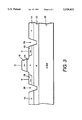
  • FIG. 3 is a sectional side view of one embodiment of the device shown in FIG. 2, wherein the gate is a separate semiconductor layer;
  • FIG. 4 is a graph illustrating the simulation of nitrogen-implanted profiles in SiC
  • FIG. 5 is a sectional side view of another embodiment of the device shown in FIG. 2, wherein the gate is an ion implanted gate;
  • FIG. 6 is a sectional side view of the device shown in FIG. 3, further including an oxide layer and metal interconnects;
  • FIG. 7 is a top view of an annular SiC JFET device including a gate on the surface opposite a substrate in the shape of an annulus and ion implanted source and drain areas located inside and outside the annulus, respectively;
  • FIG. 8 is a sectional side view of one embodiment of the device shown in FIG. 7, wherein the gate is a separate semiconductor layer;
  • FIG. 9 is a sectional side view of another embodiment of the device shown in FIG. 7, wherein the gate is an ion implanted gate.
  • n-channel and p-channel JFET devices are applicable to both n-channel and p-channel JFET devices and their manufacture, for purposes of simplicity the following description will consider fabrication only of a JFET having an n-channel.
  • a p-channel device can be fabricated by reversing each conductivity type discussed with respect to an n-channel device.
  • FIG. 1 is a sectional side view of a conventional SiC JFET device including several layers 12 and 14 wherein the gate G is the substrate 10.
  • the gate constitutes the outermost layer (i.e., substrate) on the backside of the device, i.e., the side opposite the side where source S and drain D areas 24 and 26 of n+ type layer 25 are situated.
  • the gate area greatly exceeds the active channel area, thus causing the device to be more susceptible to defects and have increased gate leakage and gate capacitance compared to a comparable device in which the gate area and active channel area are approximately equal.
  • threshold variation is magnified because an exactly accurate channel groove 22 depth is difficult to achieve.
  • FIG. 2 is a top view of a linear SiC JFET device of the present invention including a SiC gate 16 of one conductivity type which is supported by a SiC layer 14 having opposite conductivity, and ion implanted source and drain areas 18 located in layer 14 on opposite sides of the gate.
  • the phrase "supported by” is meant to encompass both the situation wherein an additional layer rests on layer 14 and the situation wherein a surface-adjacent portion of layer 14 has opposite conductivity from the bulk of layer 14.
  • Layer 14, which is supported by a SiC layer 12 (shown in FIG. 3 and FIGS. 5-6) having the one type conductivity, is formed by either epitaxial deposition or ion implantation.
  • An isolation groove or trench 28 surrounds the linear SiC JFET to isolate the JFET from other devices in an integrated circuit.
  • FIG. 3 is a sectional side view of one embodiment of the linear SiC JFET device shown in FIG. 2.
  • SiC substrate 10 is of p type conductivity and has a depth, for example, of 0.5 millimeters. Although substrate 10 can support individual transistors of various types, for simplicity the description will focus upon creation of transistors having linear structures (FIGS. 2-6) and transistors having annular structures (FIGS. 7-9).
  • a p (or p+) type conductivity layer 12 of SiC is epitaxially and uniformly deposited on substrate 10 by a method such as chemical vapor deposition (CVD).
  • a typical dopant for p type layer 12 comprises aluminum, for example, at a concentration of 10 18 atoms/cm 3 , and, in one embodiment, p type layer 12 is one micrometer thick.
  • the reason for adding p type layer 12 on the substrate, which already is of p type conductivity, is that the dopant concentration in a SiC substrate is generally not certain or uniform. The doping level, and thus the conductivity of p type layer 12, can be controlled when adding p type layer 12.
  • n type layer 14 is then formed by epitaxially growing a uniformly thick SiC layer over the entire p type layer 12.
  • Layer 14 is preferably grown to a total thickness of less than 1 micrometer and has a nitrogen doping level of about 10 16 -10 17 atoms/cm 3 .
  • the contacting surfaces of p type layer 12 and n type layer 14 form a diode junction.
  • the gate is then fabricated by first epitaxially depositing a uniform p+ type layer 16 and then removing p+ type layer 16 everywhere except for the gate area.
  • Layer 16 which is doped to a concentration of 10 18 atoms/cm 3 of an appropriate dopant such as aluminum and need only be about 3000 ⁇ thick, can be etched by using a hard mask (not shown) formed by applying a layer of metal such as aluminum and then using a photoresist to pattern desired openings in the mask surface.
  • the metal can be deposited by sputtering, for example, and, in one embodiment, is 0.5 micrometers thick.
  • a photoresist such as AZ1470, manufactured by Hoechst can next be applied and then selectively exposed and removed to pattern the metal layer.
  • the metal can be etched by reactive ion etching (RIE) using, for example, borontrichloride and oxygen (BCl 3 /O 2 ).
  • a chemical etch or a RIE process is used to remove the portion of p+ type layer 16 which is not located under the hard mask.
  • the etch is preferably designed to end at the point in time when all the unmasked portion of p+ type layer 16 has been removed but before the underlying n type layer 14 is significantly etched.
  • the preferred embodiment for etching SiC includes a reactive ion etch using NF 3 /O 2 (flow rate for NF 3 of 16 sccm, of O 2 4 sccm; pressure of 40 millitorr; power of 300 W) which etches at a rate of 635 ⁇ /minute.
  • molten alkalis or borax can be used, as described in W. V. Muench and I. Pfaffeneder, Thin Solid Films, 31, 39 (1976).
  • the n+ type drain and source areas 18 are formed by ion implantation of additional ionized donor atoms into n type layer 14 on opposite sides of the gate.
  • the dopant can comprise nitrogen atoms, for example, which are donors in SiC material, at a concentration of 10 20 atoms/cm 3 .
  • a mask (not shown) can be fabricated so that ions will be implanted only through the mask openings into the desired areas.
  • mask material can comprise a layer of SiO 2 6000-10,000 ⁇ thick, deposited by CVD using silane (SiH 4 ) and oxygen.
  • a photoresist can be used to pattern the SiO 2 layer, which can be etched using the same NF 3 /O 2 process discussed with respect to SiC, resulting in an etch rate of 548 ⁇ /minute.
  • the energy used for supplying the dopant through the SiO 2 mask openings must be varied so that the dopant is uniformly dispersed throughout the desired volume.
  • the substrate can be held at 1000° C. during ion implantation on the furnace end station of an ion implantation apparatus, such as supplied by Implant Science Corp. of Wakefield, Mass., and subjected to a multiple implant sequence of various doses and energies to create a junction 3000 ⁇ deep with an average concentration of 1.6 ⁇ 10 20 atoms/cm 3 .
  • a multiple implant sequence having various doses and energies is needed to create a box profile because, unlike Si, it is difficult to use heating to cause ions to diffuse to a desired depth in SiC.
  • FIG. 4 is a graph illustrating the simulation of nitrogen-implanted profiles in SiC for the following implants: 180 KeV, 1.6 ⁇ 10 15 ions/cm 2 ; 120 KeV, 9.7 ⁇ 10 14 ions/cm 2 ; 75 KeV, 8.8 ⁇ 10 14 ions/cm 2 ; 40 KeV, 5.7 ⁇ 10 14 ions/cm 2 ; 20 KeV, 3.2 ⁇ 10 14 ions/cm 2 .
  • the substrate is held at 1300° C. in a resistively heated ceramic sintering furnace.
  • Further options for the implantation process including the use of n and p type 6H-SiC layers in the preferred embodiment, are discussed in M. Ghezzo et al., "Nitrogen-Implanted SiC Diodes Using High Temperature Implantation," IEEE Electron Device Letters 13, Dec. 1992, pp. 639-641.
  • the SiO 2 mask is removed by a wet etch in buffered hydrofluoric add.
  • 3C-SiC semiconductor layers are used.
  • Trench 28 which is useful for defining the boundaries of a JFET device, can be formed through a mask in a similar manner as the etching of p+ type layer 16.
  • the RIE etchant is a gaseous mixture of 16 parts NF 3 and 4 parts O 2 by volume which etches a 1 micrometer deep groove in SiC in about 15 minutes.
  • the steps of forming the gate, implanting ions in n type layer 14, and fabricating trench 28 are preferably performed in that order, although the trench can be formed earlier, if desired.
  • FIG. 5 is a sectional side view of another embodiment of the device shown in FIG. 2, wherein gate 16 is fabricated using ion implantation.
  • the process of fabricating a gate by ion implantation is a separate implantation step which is similar to the implantation steps performed in fabricating the source and drain areas, except that an acceptor dopant for SiC such as boron is used, instead of a donor dopant such as nitrogen.
  • the p+ type gate region preferably has a concentration of acceptor dopants in excess of the n doped channel region. Typically, the p+ type gate layer dopant concentration is between 10 18 -10 19 atoms/cm 3 .
  • both n type layer 14 and gate 16 are fabricated using ion implantation. Implantation of n type ionized donor atoms into p type layer 12 can be used to create n type layer 14 in the same manner as described with reference to the fabrication of the gate and drain areas in FIG. 3, with modifications for increased depth and a lower concentration of donor atoms. Source and drain areas 18 are fabricated as discussed with respect to FIG. 3, and gate area 16 is fabricated as discussed above.
  • FIG. 6 is a sectional side view of the device shown in FIG. 3, further including an oxide layer 30 having metal interconnects 32.
  • Oxide layer 30 can be applied, for example, by chemical vapor deposition, and in one embodiment is 1 micrometer thick. This layer may comprise, for example, SiO 2 which is applied using concentrated CVD apparatus and SiH 4 and O 2 to deposit the oxide. After the oxide layer has been applied, openings are patterned through a mask in a similar manner as described with respect to FIG. 3. Electrical conductors such as metal 32 then fill in the openings to provide contacts and connections for the gate, source, and drain areas.
  • One method for providing these conductors is to sputter a contact metal such as nickel for n+ contacts and titanium/aluminum for p+ contacts and to then sinter them at 950° C. Then layers of titanium, molybdenum, and gold are deposited and etched to form interconnections.
  • a contact metal such as nickel for n+ contacts and titanium/aluminum for p+ contacts
  • FIG. 7 is a top view of an annular SiC JFET device including a gate G 16 in the shape of an annulus, and drain D and source S areas 18 located inside and outside the annulus, respectively. Although the area inside the gate annulus 16 is labeled as a drain, the drain and source areas 18 are interchangeable. A shallow isolation trench 15 is an optional feature of the device.
  • FIG. 8 is a sectional side view of one embodiment of the device shown in FIG. 7, wherein gate 16 is fabricated using a separate semiconductor layer in the same manner as discussed with respect to FIG. 3. The only difference is that, instead of a linear pattern, an annular-shaped pattern is used.
  • the gate area of p+ type layer 16 is patterned in an annular shape, and the source and drain areas are implanted such that the drain area is within the gate annulus and the source area is patterned as an annulus surrounding the gate area.
  • FIG. 9 is a sectional side view of another embodiment of the device shown in FIG. 7, wherein the gate is fabricated using ion implantation.
  • the process of fabricating a gate by ion implantation is similar to the process discussed with respect to FIG. 5, except for the annular patterning.
  • both n type layer 14 and gate 16 are fabricated using ion implantation.
  • the procedures for implanting n type layer 14 in p type layer 12 and for implanting gate 16 in n type layer 14 are similar to the corresponding procedures discussed with respect to FIG. 5, except for the annular patterning.

Landscapes

  • Junction Field-Effect Transistors (AREA)

Abstract

A silicon carbide (SiC) junction field effect transistor (JFET) device is fabricated upon a substrate layer, such as a p type conductivity SiC substrate, using ion implantation for the source and drain areas. A SiC p type conductivity layer is epitaxially grown on the substrate. A SiC n type conductivity layer is formed by ion implantation or epitaxial deposition upon the p type layer. The contacting surfaces of the p and n type layers form a junction. A p+ type gate area supported by the n type layer is formed either by the process of ion implantation or the process of depositing and patterning a second p type layer. The source and drain areas are heavily doped to n+ type conductivity by implanting donor ions in the n type layer.

Description

This invention was made with Government support under Government Contract No. F33615-90-C-1494 awarded by the Air Force. The Government has certain rights in this invention.
This application is a Continuation of application Ser. No. 08/299/980, filed 2 Sep., 1994 now abandoned which is a Division of Ser. No. 08/048,448 filed Apr. 19, 1993 now U.S. Pat. No. 5,378,642.
BACKGROUND OF THE INVENTION
1. Field of the Invention
This invention relates to semiconductor devices, and more particularly to silicon carbide junction field effect transistors (JFETs) having low gate leakage for high temperature applications.
2. Description of the Related Art
Silicon carbide (SiC) is a crystalline substance that can withstand very high temperatures. Semiconductor devices manufactured of SiC can withstand temperatures in excess of 200° C. Thus, SiC semiconductors are desirable for applications that require exposure to high temperatures.
SiC electronics technology can be viewed as a means of controlling flame temperature by reducing fuel-to-air ratios in high temperature environments, such as encountered in the combustion of a stationary gas turbine or gas turbine employed in an aircraft jet engine, which reduces the production of nitrogen oxide (NOx) emissions. When the operating temperature is excessively high, NOx emissions, which are classified as pollutants, are also excessively high. However, when fuel is burned lean to hold down the flame temperature, the flame can produce too much CO and become unstable or even be extinguished. The design constraints for these turbine combustors have become so exacting that the manufacturing tolerances are difficult to achieve. An apparatus for addressing these problems by using a closed loop control of the flame temperature is disclosed in commonly assigned D. M. Brown et al., "Combustion Control for Producing Low NOx Emissions Through Use of Flame Spectroscopy," U.S. application Ser. No. 07/878,933, filed May 5, 1992, which is herein incorporated by reference.
High temperature sensors can be used for monitoring and controlling the chemical content of the turbine exhaust gases, but electronic amplifiers for amplifying the sensor signals must be situated at some distance from the combustion zone and exhaust to avoid performance degradation or destruction on account of the high temperatures near the combustion zone. Detrimentally, the signal level from the sensor is degraded by noise components in the connective wiring as the signal propagates from the sensor to a remote amplifier. As a result, the signal-to-noise ratio (SNR) is reduced. Preferably, a sensor and an amplifier are combined so that little degradation of the signal occurs as the signal passes from the sensor to the amplifier. Advantageously, a properly designed SiC semiconductor amplifier is capable of withstanding the high temperatures near a turbine exhaust outlet. Therefore, use of a combined SiC based semiconductor amplifier and sensor will result in improved turbine flame monitoring and control apparatus.
A SiC sensor is disclosed in commonly assigned D. M. Brown et al., "Silicon Carbide Photodiode with Improved Short Wavelength Response and Very Low Leakage Current," U.S. application Ser. No. 07/878,937, filed May 5, 1992, which is herein incorporated by reference. A SiC metal-oxide-semiconductor field effect transistor (MOSFET) is disclosed in commonly assigned D. M. Brown et al., "Silicon Carbide MOSFET Having Self-Aligned Gate Structure and Method of Fabrication," application Ser. No. 07/925,823, filed Aug. 7, 1992, which is herein incorporated by reference. MOSFETs generally exhibit a high gain-bandwidth product and high input impedance, which are desirable for amplifying low level voltages. However, operating voltages required for reliable MOSFET device operation at very high temperatures must be kept very low because of the time dependent breakdown of the insulating layer, and therefore the voltages for reliable operation in the desired temperature range are not high enough for all of the applications desired.
SUMMARY OF THE INVENTION
Accordingly, an object of the present invention is to provide a SiC device for high temperature applications.
Another object is to provide a SiC device for controlling gas turbine flame temperature at reduced fuel-to-air ratios which reduces the production of NOx.
Briefly, according to a preferred embodiment of the invention, a method for fabricating a SiC JFET device comprises providing, upon a first SiC layer of a first conductivity type, a second SiC layer of a second conductivity type. The contacting surfaces of the first and second layers form a junction. A gate area of the first conductivity type is provided and supported by the second layer. Ions of the second conductivity type are implanted in the second layer in a source area and a drain area.
BRIEF DESCRIPTION OF THE DRAWINGS
The features of the invention believed to be novel are set forth with particularity in the appended claims. The invention itself, however, both as to organization and method of operation, together with further objects and advantages thereof, may best be understood by reference to the following description taken in conjunction with the accompanying drawings, where like numerals represent like components, in which:
FIG. 1 is a sectional side view of a conventional SiC JFET device wherein the gate is the substrate;
FIG. 2 is a top view of a linear SiC JFET device of the present invention including a gate on the surface opposite a substrate and ion implanted source and drain areas located on opposite sides of the gate;
FIG. 3 is a sectional side view of one embodiment of the device shown in FIG. 2, wherein the gate is a separate semiconductor layer;
FIG. 4 is a graph illustrating the simulation of nitrogen-implanted profiles in SiC;
FIG. 5 is a sectional side view of another embodiment of the device shown in FIG. 2, wherein the gate is an ion implanted gate;
FIG. 6 is a sectional side view of the device shown in FIG. 3, further including an oxide layer and metal interconnects;
FIG. 7 is a top view of an annular SiC JFET device including a gate on the surface opposite a substrate in the shape of an annulus and ion implanted source and drain areas located inside and outside the annulus, respectively;
FIG. 8 is a sectional side view of one embodiment of the device shown in FIG. 7, wherein the gate is a separate semiconductor layer; and
FIG. 9 is a sectional side view of another embodiment of the device shown in FIG. 7, wherein the gate is an ion implanted gate.
DETAILED DESCRIPTION OF A PREFERRED EMBODIMENT OF THE INVENTION
Although the invention is applicable to both n-channel and p-channel JFET devices and their manufacture, for purposes of simplicity the following description will consider fabrication only of a JFET having an n-channel. A p-channel device can be fabricated by reversing each conductivity type discussed with respect to an n-channel device.
FIG. 1 is a sectional side view of a conventional SiC JFET device including several layers 12 and 14 wherein the gate G is the substrate 10. However, this configuration does not lend itself to device integration since the gate constitutes the outermost layer (i.e., substrate) on the backside of the device, i.e., the side opposite the side where source S and drain D areas 24 and 26 of n+ type layer 25 are situated. Moreover, the gate area greatly exceeds the active channel area, thus causing the device to be more susceptible to defects and have increased gate leakage and gate capacitance compared to a comparable device in which the gate area and active channel area are approximately equal. Additionally, threshold variation is magnified because an exactly accurate channel groove 22 depth is difficult to achieve.
FIG. 2 is a top view of a linear SiC JFET device of the present invention including a SiC gate 16 of one conductivity type which is supported by a SiC layer 14 having opposite conductivity, and ion implanted source and drain areas 18 located in layer 14 on opposite sides of the gate. The phrase "supported by" is meant to encompass both the situation wherein an additional layer rests on layer 14 and the situation wherein a surface-adjacent portion of layer 14 has opposite conductivity from the bulk of layer 14. Layer 14, which is supported by a SiC layer 12 (shown in FIG. 3 and FIGS. 5-6) having the one type conductivity, is formed by either epitaxial deposition or ion implantation. An isolation groove or trench 28 surrounds the linear SiC JFET to isolate the JFET from other devices in an integrated circuit.
FIG. 3 is a sectional side view of one embodiment of the linear SiC JFET device shown in FIG. 2. SiC substrate 10 is of p type conductivity and has a depth, for example, of 0.5 millimeters. Although substrate 10 can support individual transistors of various types, for simplicity the description will focus upon creation of transistors having linear structures (FIGS. 2-6) and transistors having annular structures (FIGS. 7-9).
In one embodiment, a p (or p+) type conductivity layer 12 of SiC is epitaxially and uniformly deposited on substrate 10 by a method such as chemical vapor deposition (CVD). A typical dopant for p type layer 12 comprises aluminum, for example, at a concentration of 1018 atoms/cm3, and, in one embodiment, p type layer 12 is one micrometer thick. The reason for adding p type layer 12 on the substrate, which already is of p type conductivity, is that the dopant concentration in a SiC substrate is generally not certain or uniform. The doping level, and thus the conductivity of p type layer 12, can be controlled when adding p type layer 12.
An n type layer 14 is then formed by epitaxially growing a uniformly thick SiC layer over the entire p type layer 12. Layer 14 is preferably grown to a total thickness of less than 1 micrometer and has a nitrogen doping level of about 1016 -1017 atoms/cm3. The contacting surfaces of p type layer 12 and n type layer 14 form a diode junction.
In the embodiment depicted in FIG. 3, the gate is then fabricated by first epitaxially depositing a uniform p+ type layer 16 and then removing p+ type layer 16 everywhere except for the gate area. Layer 16, which is doped to a concentration of 1018 atoms/cm3 of an appropriate dopant such as aluminum and need only be about 3000 Å thick, can be etched by using a hard mask (not shown) formed by applying a layer of metal such as aluminum and then using a photoresist to pattern desired openings in the mask surface. The metal can be deposited by sputtering, for example, and, in one embodiment, is 0.5 micrometers thick. A photoresist such as AZ1470, manufactured by Hoechst, can next be applied and then selectively exposed and removed to pattern the metal layer. The metal can be etched by reactive ion etching (RIE) using, for example, borontrichloride and oxygen (BCl3 /O2).
A chemical etch or a RIE process is used to remove the portion of p+ type layer 16 which is not located under the hard mask. The etch is preferably designed to end at the point in time when all the unmasked portion of p+ type layer 16 has been removed but before the underlying n type layer 14 is significantly etched. The preferred embodiment for etching SiC includes a reactive ion etch using NF3 /O2 (flow rate for NF3 of 16 sccm, of O2 4 sccm; pressure of 40 millitorr; power of 300 W) which etches at a rate of 635 Å/minute. For a solution etch, molten alkalis or borax can be used, as described in W. V. Muench and I. Pfaffeneder, Thin Solid Films, 31, 39 (1976). After completing the SiC etch, the metal mask is removed by a wet etch in phosphoric/nitric/acetic acid.
The n+ type drain and source areas 18 are formed by ion implantation of additional ionized donor atoms into n type layer 14 on opposite sides of the gate. The dopant can comprise nitrogen atoms, for example, which are donors in SiC material, at a concentration of 1020 atoms/cm3. A mask (not shown) can be fabricated so that ions will be implanted only through the mask openings into the desired areas. For example, mask material can comprise a layer of SiO2 6000-10,000 Åthick, deposited by CVD using silane (SiH4) and oxygen. A photoresist can be used to pattern the SiO2 layer, which can be etched using the same NF3 /O2 process discussed with respect to SiC, resulting in an etch rate of 548 Å/minute.
The energy used for supplying the dopant through the SiO2 mask openings must be varied so that the dopant is uniformly dispersed throughout the desired volume. For example, the substrate can be held at 1000° C. during ion implantation on the furnace end station of an ion implantation apparatus, such as supplied by Implant Science Corp. of Wakefield, Mass., and subjected to a multiple implant sequence of various doses and energies to create a junction 3000 Å deep with an average concentration of 1.6×10²⁰ atoms/cm3. A multiple implant sequence having various doses and energies is needed to create a box profile because, unlike Si, it is difficult to use heating to cause ions to diffuse to a desired depth in SiC. Thus, ions must be implanted at each depth of the desired drain and source. Implant Science Corp. markets a computer program, known as "Profile," for SiC implantation which can model the proper doses and energies for the desired application. FIG. 4 is a graph illustrating the simulation of nitrogen-implanted profiles in SiC for the following implants: 180 KeV, 1.6×10¹⁵ ions/cm2 ; 120 KeV, 9.7×10¹⁴ ions/cm2 ; 75 KeV, 8.8×10¹⁴ ions/cm2 ; 40 KeV, 5.7×10¹⁴ ions/cm2 ; 20 KeV, 3.2×10¹⁴ ions/cm2.
After implantation, the substrate is held at 1300° C. in a resistively heated ceramic sintering furnace. Further options for the implantation process, including the use of n and p type 6H-SiC layers in the preferred embodiment, are discussed in M. Ghezzo et al., "Nitrogen-Implanted SiC Diodes Using High Temperature Implantation," IEEE Electron Device Letters 13, Dec. 1992, pp. 639-641. After the source and drain have been formed, the SiO2 mask is removed by a wet etch in buffered hydrofluoric add. In another embodiment, 3C-SiC semiconductor layers are used.
Trench 28, which is useful for defining the boundaries of a JFET device, can be formed through a mask in a similar manner as the etching of p+ type layer 16. The RIE etchant is a gaseous mixture of 16 parts NF3 and 4 parts O2 by volume which etches a 1 micrometer deep groove in SiC in about 15 minutes.
The steps of forming the gate, implanting ions in n type layer 14, and fabricating trench 28 are preferably performed in that order, although the trench can be formed earlier, if desired.
FIG. 5 is a sectional side view of another embodiment of the device shown in FIG. 2, wherein gate 16 is fabricated using ion implantation. The process of fabricating a gate by ion implantation is a separate implantation step which is similar to the implantation steps performed in fabricating the source and drain areas, except that an acceptor dopant for SiC such as boron is used, instead of a donor dopant such as nitrogen. The p+ type gate region preferably has a concentration of acceptor dopants in excess of the n doped channel region. Typically, the p+ type gate layer dopant concentration is between 1018 -1019 atoms/cm3.
In another embodiment also represented by FIG. 5, both n type layer 14 and gate 16 are fabricated using ion implantation. Implantation of n type ionized donor atoms into p type layer 12 can be used to create n type layer 14 in the same manner as described with reference to the fabrication of the gate and drain areas in FIG. 3, with modifications for increased depth and a lower concentration of donor atoms. Source and drain areas 18 are fabricated as discussed with respect to FIG. 3, and gate area 16 is fabricated as discussed above.
FIG. 6 is a sectional side view of the device shown in FIG. 3, further including an oxide layer 30 having metal interconnects 32. Oxide layer 30 can be applied, for example, by chemical vapor deposition, and in one embodiment is 1 micrometer thick. This layer may comprise, for example, SiO2 which is applied using concentrated CVD apparatus and SiH4 and O2 to deposit the oxide. After the oxide layer has been applied, openings are patterned through a mask in a similar manner as described with respect to FIG. 3. Electrical conductors such as metal 32 then fill in the openings to provide contacts and connections for the gate, source, and drain areas. One method for providing these conductors is to sputter a contact metal such as nickel for n+ contacts and titanium/aluminum for p+ contacts and to then sinter them at 950° C. Then layers of titanium, molybdenum, and gold are deposited and etched to form interconnections.
FIG. 7 is a top view of an annular SiC JFET device including a gate G 16 in the shape of an annulus, and drain D and source S areas 18 located inside and outside the annulus, respectively. Although the area inside the gate annulus 16 is labeled as a drain, the drain and source areas 18 are interchangeable. A shallow isolation trench 15 is an optional feature of the device.
FIG. 8 is a sectional side view of one embodiment of the device shown in FIG. 7, wherein gate 16 is fabricated using a separate semiconductor layer in the same manner as discussed with respect to FIG. 3. The only difference is that, instead of a linear pattern, an annular-shaped pattern is used. The gate area of p+ type layer 16 is patterned in an annular shape, and the source and drain areas are implanted such that the drain area is within the gate annulus and the source area is patterned as an annulus surrounding the gate area.
FIG. 9 is a sectional side view of another embodiment of the device shown in FIG. 7, wherein the gate is fabricated using ion implantation. The process of fabricating a gate by ion implantation is similar to the process discussed with respect to FIG. 5, except for the annular patterning.
In another embodiment also represented by FIG. 9, both n type layer 14 and gate 16 are fabricated using ion implantation. The procedures for implanting n type layer 14 in p type layer 12 and for implanting gate 16 in n type layer 14 are similar to the corresponding procedures discussed with respect to FIG. 5, except for the annular patterning.
While only certain preferred features of the invention have been illustrated and described herein, many modifications and changes will occur to those skilled in the art. It is, therefore, to be understood that the appended claims are intended to cover all such modifications and changes as fall within the true spirit of the invention.

Claims (3)

What is claimed is:
1. A JFET device comprising:
a first SiC semiconductor layer of a first conductivity type;
a second SiC semiconductor layer of a second conductivity type supported by said first layer, the contacting surfaces of said first and second layers forming a junction;
an ion-implanted gate area comprising SiC semiconductor material of said first conductivity type situated in said second layer; and
an ion-implanted source area and an ion-implanted drain area comprising material of said second conductivity type situated in said second layer, wherein said gate area is in the shape of an annulus and said source and drain areas are positioned such that one of said source and drain areas is located in an area surrounded by said gate area and the other one of said source and drain areas is in the shape of an annulus surrounding said gate area.
2. A JFET device comprising:
a first SiC semiconductor layer of a first conductivity type;
a second SiC semiconductor layer comprising a surface-adjacent portion of said first SiC semiconductor layer having material of a second conductivity type, the contacting surfaces of said first and second layers forming a junction;
an ion-implanted gate area comprising SiC semiconductor material of said first conductivity type situated in said second layer; and
an ion-implanted source area and an ion-implanted drain area comprising material of said second conductivity type situated in said second layer, wherein said gate area is in the shape of an annulus and said source and drain areas of said second conductivity type are positioned such that one of said source and drain areas is located in an area surrounded by said gate area and the other one of said source and drain areas is in the shape of an annulus surrounding said gate area.
3. A JFET device comprising:
a first SiC semiconductor layer of a first conductivity type;
a second SiC semiconductor layer of a second conductivity type supported by said first layer, the contacting surfaces of said first and second layers forming a junction;
a gate area comprising SiC semiconductor material of said first conductivity type, said gate area comprising a third SiC semiconductor layer overlying a portion of said second layer; and
an ion-implanted source area and an ion-implanted drain area comprising material of said second conductivity type situated in said second layer, wherein said gate area is in the shape of an annulus and positioned such that one of said source and drain areas is located in an area surrounded by said gate area and the other one of said source and drain areas is in the shape of an annulus surrounding said gate area.
US08/439,328 1993-04-19 1995-05-11 Silicon carbide junction field effect transistor device for high temperature applications Expired - Lifetime US5510632A (en)

Priority Applications (1)

Application Number Priority Date Filing Date Title
US08/439,328 US5510632A (en) 1993-04-19 1995-05-11 Silicon carbide junction field effect transistor device for high temperature applications

Applications Claiming Priority (3)

Application Number Priority Date Filing Date Title
US08/048,448 US5378642A (en) 1993-04-19 1993-04-19 Method of making a silicon carbide junction field effect transistor device for high temperature applications
US29998094A 1994-09-02 1994-09-02
US08/439,328 US5510632A (en) 1993-04-19 1995-05-11 Silicon carbide junction field effect transistor device for high temperature applications

Related Parent Applications (1)

Application Number Title Priority Date Filing Date
US29998094A Continuation 1993-04-19 1994-09-02

Publications (1)

Publication Number Publication Date
US5510632A true US5510632A (en) 1996-04-23

Family

ID=21954645

Family Applications (2)

Application Number Title Priority Date Filing Date
US08/048,448 Expired - Lifetime US5378642A (en) 1993-04-19 1993-04-19 Method of making a silicon carbide junction field effect transistor device for high temperature applications
US08/439,328 Expired - Lifetime US5510632A (en) 1993-04-19 1995-05-11 Silicon carbide junction field effect transistor device for high temperature applications

Family Applications Before (1)

Application Number Title Priority Date Filing Date
US08/048,448 Expired - Lifetime US5378642A (en) 1993-04-19 1993-04-19 Method of making a silicon carbide junction field effect transistor device for high temperature applications

Country Status (1)

Country Link
US (2) US5378642A (en)

Cited By (18)

* Cited by examiner, † Cited by third party
Publication number Priority date Publication date Assignee Title
US5654208A (en) * 1995-04-10 1997-08-05 Abb Research Ltd. Method for producing a semiconductor device having a semiconductor layer of SiC comprising a masking step
US5866925A (en) * 1997-01-09 1999-02-02 Sandia Corporation Gallium nitride junction field-effect transistor
US5932894A (en) * 1997-06-26 1999-08-03 Abb Research Ltd. SiC semiconductor device comprising a pn junction
US6084254A (en) * 1997-06-30 2000-07-04 Hyundai Electronics Industries Co., Ltd. Lateral bipolar mode field effect transistor
US6133587A (en) * 1996-01-23 2000-10-17 Denso Corporation Silicon carbide semiconductor device and process for manufacturing same
US6274889B1 (en) * 1997-04-04 2001-08-14 Matsushita Electric Industrial Co., Ltd. Method for forming ohmic electrode, and semiconductor device
US20030080809A1 (en) * 2001-10-25 2003-05-01 Mcgrath Donald Thomas Methods and apparatus for amplification in high temperature environments
US20040026118A1 (en) * 2002-08-06 2004-02-12 Takemi Muroga Oxide superconducting wire
US20050269661A1 (en) * 2004-06-03 2005-12-08 Ranbir Singh Lateral channel transistor
US20060028318A1 (en) * 2004-08-07 2006-02-09 Atmel Germany Gmbh Semiconductor structure
US20080048214A1 (en) * 2006-08-25 2008-02-28 Sanyo Semiconductor Co., Ltd. Junction field effect transistor and method of manufacturing the same
US7449762B1 (en) 2006-04-07 2008-11-11 Wide Bandgap Llc Lateral epitaxial GaN metal insulator semiconductor field effect transistor
US20100155743A1 (en) * 2008-12-22 2010-06-24 Infineon Technologies Austria Ag SiC SEMICONDUCTOR DEVICE WITH SELF-ALIGNED CONTACTS, INTEGRATED CIRCUIT AND MANUFACTURING METHOD
KR101059562B1 (en) 2004-02-20 2011-08-26 삼성전자주식회사 Sensitivity Bio FET
CN103353814A (en) * 2013-06-27 2013-10-16 京东方科技集团股份有限公司 Touch drive circuit, optical embedded touch screen and display device
US20140050930A1 (en) * 2012-08-16 2014-02-20 General Electric Company Creep-resistant environmental barrier coatings
US9685900B2 (en) 2010-11-19 2017-06-20 General Electric Company Low-inductance, high-efficiency induction machine and method of making same
US20170257050A1 (en) * 2010-11-19 2017-09-07 General Electric Company High power-density, high back emf permanent magnet machine and method of making same

Families Citing this family (25)

* Cited by examiner, † Cited by third party
Publication number Priority date Publication date Assignee Title
US5399883A (en) * 1994-05-04 1995-03-21 North Carolina State University At Raleigh High voltage silicon carbide MESFETs and methods of fabricating same
US5670784A (en) * 1994-08-26 1997-09-23 Ametek Aerospace Products High temperature gas stream optical flame sensor
US5763888A (en) * 1995-01-30 1998-06-09 Ametek Aerospace Products, Inc. High temperature gas stream optical flame sensor and method for fabricating same
US5608515A (en) * 1995-04-20 1997-03-04 General Electric Company Double window for protecting optical sensors from hazardous environments
US5641695A (en) * 1995-10-02 1997-06-24 Motorola Method of forming a silicon carbide JFET
FR2744286B1 (en) * 1996-01-25 1998-04-03 Commissariat Energie Atomique METHOD FOR PRODUCING TRANSISTOR TYPE COMPONENTS, OPERATING AT HIGH FREQUENCY OR HIGH TEMPERATURE
SE9601176D0 (en) * 1996-03-27 1996-03-27 Abb Research Ltd A method of producing a semiconductor device having semiconductor layers of SiC using the implanting step and a device produced thereby
US5895260A (en) * 1996-03-29 1999-04-20 Motorola, Inc. Method of fabricating semiconductor devices and the devices
US5700703A (en) * 1996-08-06 1997-12-23 Motorola Method of fabricating buried control elements in semiconductor devices
DE19832327A1 (en) 1997-07-31 1999-02-04 Siemens Ag Silicon carbide based semiconductor structure e.g. for MOSFET
DE19839969C2 (en) 1998-09-02 2003-02-27 Infineon Technologies Ag Silicon carbide junction field effect transistor
US6503782B2 (en) * 2001-03-02 2003-01-07 Mississippi State University Research And Technology Corporation (Rtc) Complementary accumulation-mode JFET integrated circuit topology using wide (>2eV) bandgap semiconductors
JP3812421B2 (en) * 2001-06-14 2006-08-23 住友電気工業株式会社 Horizontal junction field effect transistor
US7180105B2 (en) * 2004-02-09 2007-02-20 International Rectifier Corporation Normally off JFET
JP4586547B2 (en) * 2005-01-24 2010-11-24 住友電気工業株式会社 Junction field effect transistor
US7670888B2 (en) * 2007-04-11 2010-03-02 Texas Instruments Incorporated Low noise JFET
US8120072B2 (en) 2008-07-24 2012-02-21 Micron Technology, Inc. JFET devices with increased barrier height and methods of making same
US8232585B2 (en) 2008-07-24 2012-07-31 Micron Technology, Inc. JFET devices with PIN gate stacks
US8278691B2 (en) 2008-12-11 2012-10-02 Micron Technology, Inc. Low power memory device with JFET device structures
US8481372B2 (en) 2008-12-11 2013-07-09 Micron Technology, Inc. JFET device structures and methods for fabricating the same
US20100308340A1 (en) * 2009-06-04 2010-12-09 General Electric Company Semiconductor device having a buried channel
JP2011119512A (en) * 2009-12-04 2011-06-16 Denso Corp Semiconductor device and method of manufacturing the same
JP5343904B2 (en) * 2010-03-23 2013-11-13 住友電気工業株式会社 Semiconductor device
US8618583B2 (en) * 2011-05-16 2013-12-31 International Business Machines Corporation Junction gate field effect transistor structure having n-channel
US20140104942A1 (en) * 2012-10-12 2014-04-17 Samsung Electronics Co., Ltd. Recess gate transistors and devices including the same

Citations (4)

* Cited by examiner, † Cited by third party
Publication number Priority date Publication date Assignee Title
JPS5658270A (en) * 1979-10-16 1981-05-21 Chiyou Lsi Gijutsu Kenkyu Kumiai Junction type field-effect transistor
US4925808A (en) * 1989-03-24 1990-05-15 Sprague Electric Company Method for making IC die with dielectric isolation
US5087576A (en) * 1987-10-26 1992-02-11 North Carolina State University Implantation and electrical activation of dopants into monocrystalline silicon carbide
US5264713A (en) * 1991-06-14 1993-11-23 Cree Research, Inc. Junction field-effect transistor formed in silicon carbide

Family Cites Families (4)

* Cited by examiner, † Cited by third party
Publication number Priority date Publication date Assignee Title
US4762806A (en) * 1983-12-23 1988-08-09 Sharp Kabushiki Kaisha Process for producing a SiC semiconductor device
JP2615390B2 (en) * 1985-10-07 1997-05-28 工業技術院長 Method of manufacturing silicon carbide field effect transistor
JPS6347983A (en) * 1986-08-18 1988-02-29 Sharp Corp Silicon carbide field effect transistor
JP2542448B2 (en) * 1990-05-24 1996-10-09 シャープ株式会社 Field effect transistor and method of manufacturing the same

Patent Citations (4)

* Cited by examiner, † Cited by third party
Publication number Priority date Publication date Assignee Title
JPS5658270A (en) * 1979-10-16 1981-05-21 Chiyou Lsi Gijutsu Kenkyu Kumiai Junction type field-effect transistor
US5087576A (en) * 1987-10-26 1992-02-11 North Carolina State University Implantation and electrical activation of dopants into monocrystalline silicon carbide
US4925808A (en) * 1989-03-24 1990-05-15 Sprague Electric Company Method for making IC die with dielectric isolation
US5264713A (en) * 1991-06-14 1993-11-23 Cree Research, Inc. Junction field-effect transistor formed in silicon carbide

Non-Patent Citations (4)

* Cited by examiner, † Cited by third party
Title
"Epitaxial Deposition of Silicon Carbide from Silicon Tetrachloride and Hexane" by WV Muensch, et al., Thin Solid Films, 31 (1976), pp. 39-51.
"Nitrogen-Implanted SiC Diodes Using High-Temperature Implantation" by Mario Ghezzo, et al., IEEE Electron Device letters, vol. 13, No. 12, Dec. 1992.
Epitaxial Deposition of Silicon Carbide from Silicon Tetrachloride and Hexane by WV Muensch, et al., Thin Solid Films, 31 (1976), pp. 39 51. *
Nitrogen Implanted SiC Diodes Using High Temperature Implantation by Mario Ghezzo, et al., IEEE Electron Device letters, vol. 13, No. 12, Dec. 1992. *

Cited By (29)

* Cited by examiner, † Cited by third party
Publication number Priority date Publication date Assignee Title
US5654208A (en) * 1995-04-10 1997-08-05 Abb Research Ltd. Method for producing a semiconductor device having a semiconductor layer of SiC comprising a masking step
US6133587A (en) * 1996-01-23 2000-10-17 Denso Corporation Silicon carbide semiconductor device and process for manufacturing same
US5866925A (en) * 1997-01-09 1999-02-02 Sandia Corporation Gallium nitride junction field-effect transistor
US6274889B1 (en) * 1997-04-04 2001-08-14 Matsushita Electric Industrial Co., Ltd. Method for forming ohmic electrode, and semiconductor device
US5932894A (en) * 1997-06-26 1999-08-03 Abb Research Ltd. SiC semiconductor device comprising a pn junction
US6084254A (en) * 1997-06-30 2000-07-04 Hyundai Electronics Industries Co., Ltd. Lateral bipolar mode field effect transistor
US6358786B1 (en) 1997-06-30 2002-03-19 Hynix Semiconductor Inc. Method for manufacturing lateral bipolar mode field effect transistor
US6788136B2 (en) 2001-10-25 2004-09-07 General Electric Company Methods and apparatus for amplification in high temperature environments
US20030080809A1 (en) * 2001-10-25 2003-05-01 Mcgrath Donald Thomas Methods and apparatus for amplification in high temperature environments
US20040026118A1 (en) * 2002-08-06 2004-02-12 Takemi Muroga Oxide superconducting wire
KR101059562B1 (en) 2004-02-20 2011-08-26 삼성전자주식회사 Sensitivity Bio FET
US20050269661A1 (en) * 2004-06-03 2005-12-08 Ranbir Singh Lateral channel transistor
WO2005122268A3 (en) * 2004-06-03 2006-04-06 Genesic Semiconductor Inc Lateral channel transistor
US7026669B2 (en) * 2004-06-03 2006-04-11 Ranbir Singh Lateral channel transistor
US20060028318A1 (en) * 2004-08-07 2006-02-09 Atmel Germany Gmbh Semiconductor structure
US7633111B2 (en) * 2004-08-07 2009-12-15 Atmel Automotive Gmbh Semiconductor structure
US7449762B1 (en) 2006-04-07 2008-11-11 Wide Bandgap Llc Lateral epitaxial GaN metal insulator semiconductor field effect transistor
US20080048214A1 (en) * 2006-08-25 2008-02-28 Sanyo Semiconductor Co., Ltd. Junction field effect transistor and method of manufacturing the same
US7615809B2 (en) * 2006-08-25 2009-11-10 Sanyo Electric Co., Ltd. Junction field effect transistor and method of manufacturing the same
US20100155743A1 (en) * 2008-12-22 2010-06-24 Infineon Technologies Austria Ag SiC SEMICONDUCTOR DEVICE WITH SELF-ALIGNED CONTACTS, INTEGRATED CIRCUIT AND MANUFACTURING METHOD
US8188482B2 (en) * 2008-12-22 2012-05-29 Infineon Technologies Austria Ag SiC semiconductor device with self-aligned contacts, integrated circuit and manufacturing method
US9685900B2 (en) 2010-11-19 2017-06-20 General Electric Company Low-inductance, high-efficiency induction machine and method of making same
US20170257050A1 (en) * 2010-11-19 2017-09-07 General Electric Company High power-density, high back emf permanent magnet machine and method of making same
US9780716B2 (en) 2010-11-19 2017-10-03 General Electric Company High power-density, high back emf permanent magnet machine and method of making same
US10946748B2 (en) 2010-11-19 2021-03-16 General Electric Company High power-density, high back EMF permanent magnet machine and method of making same
US20140050930A1 (en) * 2012-08-16 2014-02-20 General Electric Company Creep-resistant environmental barrier coatings
CN103353814A (en) * 2013-06-27 2013-10-16 京东方科技集团股份有限公司 Touch drive circuit, optical embedded touch screen and display device
US20150205429A1 (en) * 2013-06-27 2015-07-23 Boe Technology Group Co., Ltd. Touch driver circuit, in-cell optical touch panel and display device
US9846503B2 (en) * 2013-06-27 2017-12-19 Boe Technology Group Co., Ltd. Touch driver circuit, in-cell optical touch panel comprising the touch driver and display device comprising the in-cell optical touch panel

Also Published As

Publication number Publication date
US5378642A (en) 1995-01-03

Similar Documents

Publication Publication Date Title
US5510632A (en) Silicon carbide junction field effect transistor device for high temperature applications
US4078947A (en) Method for forming a narrow channel length MOS field effect transistor
US4838993A (en) Method of fabricating MOS field effect transistor
EP0059848B1 (en) Fet and method for manufacturing such
US4717681A (en) Method of making a heterojunction bipolar transistor with SIPOS
JP2670563B2 (en) Method for manufacturing semiconductor device
US4479297A (en) Method of fabricating three-dimensional semiconductor devices utilizing CeO2 and ion-implantation.
US4980303A (en) Manufacturing method of a Bi-MIS semiconductor device
GB1601676A (en) Semiconductor devices and method of manufacturing the same
US5356825A (en) Method of manufacturing semiconductor devices
US3880676A (en) Method of making a semiconductor device
US5523588A (en) Diamond film field effect transistor with self aligned source and drain regions
US4398962A (en) Method of controlling base contact regions by forming a blocking layer contiguous to a doped poly-si emitter source
JPH0583195B2 (en)
JPH0252422B2 (en)
US5387545A (en) Impurity diffusion method
US4261765A (en) Method of manufacturing a semiconductor device
US4563807A (en) Method for making semiconductor device utilizing molecular beam epitaxy to form the emitter layers
US7714361B2 (en) Bipolar junction transistor having a high germanium concentration in a silicon-germanium layer and a method for forming the bipolar junction transistor
US5614425A (en) Method of fabricating a bipolar transistor operable at high speed
US4350991A (en) Narrow channel length MOS field effect transistor with field protection region for reduced source-to-substrate capacitance
JP2845160B2 (en) Semiconductor device
GB2036431A (en) Double diffused transistor structure
US20070096107A1 (en) Semiconductor devices with dielectric layers and methods of fabricating same
US5516589A (en) Silicon carbide thin film circuit element and method of manufacturing the same

Legal Events

Date Code Title Description
FEPP Fee payment procedure

Free format text: PAYOR NUMBER ASSIGNED (ORIGINAL EVENT CODE: ASPN); ENTITY STATUS OF PATENT OWNER: LARGE ENTITY

STCF Information on status: patent grant

Free format text: PATENTED CASE

AS Assignment

Owner name: AIR FORCE, UNITED STATES OF AMERICA, VIRGINIA

Free format text: CONFIRMATORY LICENSE;ASSIGNOR:GENERAL ELECTRIC COMPANY;REEL/FRAME:008843/0319

Effective date: 19950629

FPAY Fee payment

Year of fee payment: 4

REMI Maintenance fee reminder mailed
FPAY Fee payment

Year of fee payment: 8

SULP Surcharge for late payment

Year of fee payment: 7

FPAY Fee payment

Year of fee payment: 12

REMI Maintenance fee reminder mailed